Archive for cooperative governance

The Real Reason Dairy Farms Are Disappearing (Hint: It’s Not About Better Farming)

Dairy success isn’t about better farming anymore—here’s the real force changing who survives and who sells out.

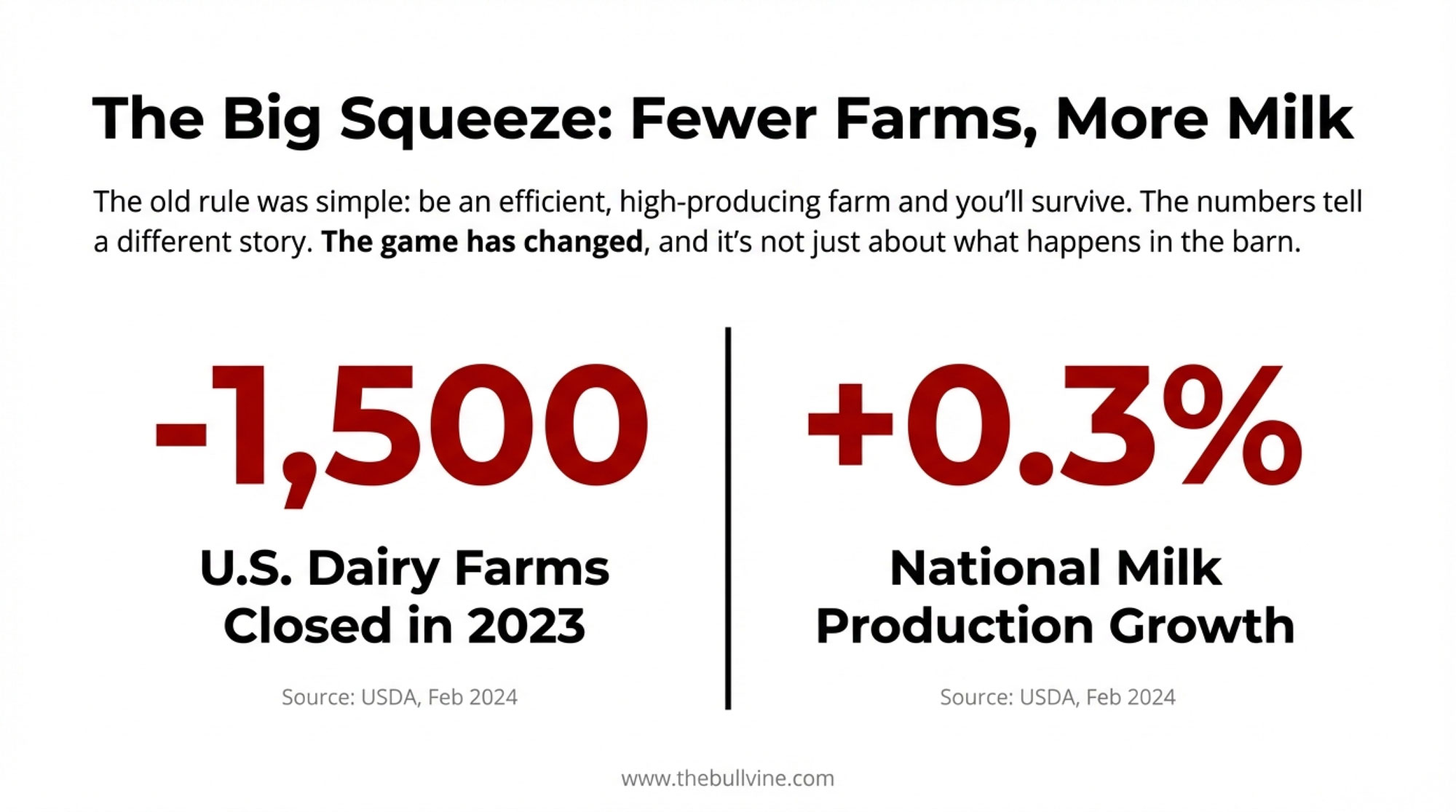
The February 2024 USDA report had a number that’s stuck with me: about 1,500 U.S. dairy farms closed in 2023, yet national milk production ticked higher. That’s not just abstract data—it’s what drives our conversations at kitchen tables and farm meetings across the country. Let’s talk through what’s really happening and what it means for the future.

U.S. dairy farming faces an existential consolidation crisis, with farm numbers plummeting from 39,300 operations in 2017 to a projected 10,500 by 2040—a 73% reduction driven by systematic structural advantages favoring mega-operations over traditional family farms, with 1,420 farms disappearing annually as of 2024.

Looking at How the Structure Has Shifted

Start with the numbers, because they’re telling: The 2022 Census of Agriculture shows about 65% of American milk now comes from just 8% of herds—those with over 1,000 cows. Meanwhile, nearly 9 out of 10 farms (the 100–500 cow group) account for only 22% of the supply. In the Northeast and Midwest, that’s still the “standard” size, but the playing field keeps tilting.

As one third-generation Wisconsin farmer shared, “I remember 13 dairies on our road, but now it’s just us. Plenty of the folks who exited were younger managers, not retirees. They just couldn’t get the numbers to work.”

Cost of production varies dramatically by herd size, with the smallest operations facing a devastating $9/cwt disadvantage that translates to $250,000 in annual losses for a typical 600-cow farm—a gap driven by scale advantages in feed purchasing, financing, and regulatory compliance rather than management quality.

Cornell’s Dairy Farm Business Summary for 2022 has it in black and white: the biggest herds report $22–$24/cwt cost of production. For 100–199 cow operations, the range is $31–$33/cwt. In a market where the base price is set by regional blend or federal order, that gap eats margin and equity fast.

Beyond Raw Efficiency: What’s Really Behind Cost Gaps

What’s interesting here is how much of the “efficiency” story isn’t really about cow management or even genetics anymore. I talked to a Central Valley manager running 5,000 cows who summed it up: “We buy grain by the unit train—110 railcars. Our delivered price is CBOT minus basis, sometimes 15 cents lower. My neighbor with 300 cows pays elevator price, plus haul; that’s 40, 50 cents more per bushel.”

It’s not just West Coast operations seeing this. In the Upper Midwest, neighbors share similar experiences. Volume buyers get priority and save dollars, not because they feed cows better, but because they can buy enough at once to command a discount.

Bring in finance, and the gap widens. Published rates show 2,000-cow herds receiving prime plus 0.5%. A 200-cow farm might see prime plus two. On a $1 million note, that’s more than $15,000 a year in extra interest just for being smaller.

Then consider environmental compliance. The latest Wisconsin Department of Ag reports—which many of us turned to during the farm planning season—show the cost of nutrient management, methane compliance, and water permits comes out to 50 cents/cwt for the largest herds, but easily $15/cwt or more for the smallest. It’s the same paperwork, same inspector fee—just spread over far fewer cows and pounds.

The scale advantage isn’t about better farming—it’s about systematic structural advantages that give large operations a $4/cwt cost edge through volume discounts on feed, preferential financing rates, amortized regulatory compliance costs, and labor efficiency, creating a $100,000 annual penalty for a 500-cow farm that has nothing to do with management quality.

The Co-op/Processor Crossover: Facing Up to the Math

Now, here’s where a lot of dinner-table talk turns pointed. Vertical integration with co-ops, especially after big moves like DFA’s $425 million purchase of Dean Foods’ 44 plants, changes the dynamic. Industry estimates now indicate that more than half of DFA members’ milk flows through DFA plants.

There’s no way around it: when your co-op is both your “agent” and your buyer, it faces a built-in conflict. The original co-op job—fight for a fair farm price—collides with the processor’s goal: keep input costs as low and steady as possible.

A Cornell ag econ professor put it bluntly at last year’s co-op leadership workshop: “Co-ops owning plants face incentives that are tough to align. You can’t maximize both farmer pay price and processing margin.” And I’ve seen the evidence myself; the research shows co-ops often have lower stated deductions, but within the co-op group, “other deductions” can vary wildly. As one board member told us, “Transparency on this stuff is hard for everyone, even when we want it.”

Think about it: if your co-op owns the plant, is the negotiation about pay price truly across the table or just across the hallway?

Canadian Lessons: Costs and the Future

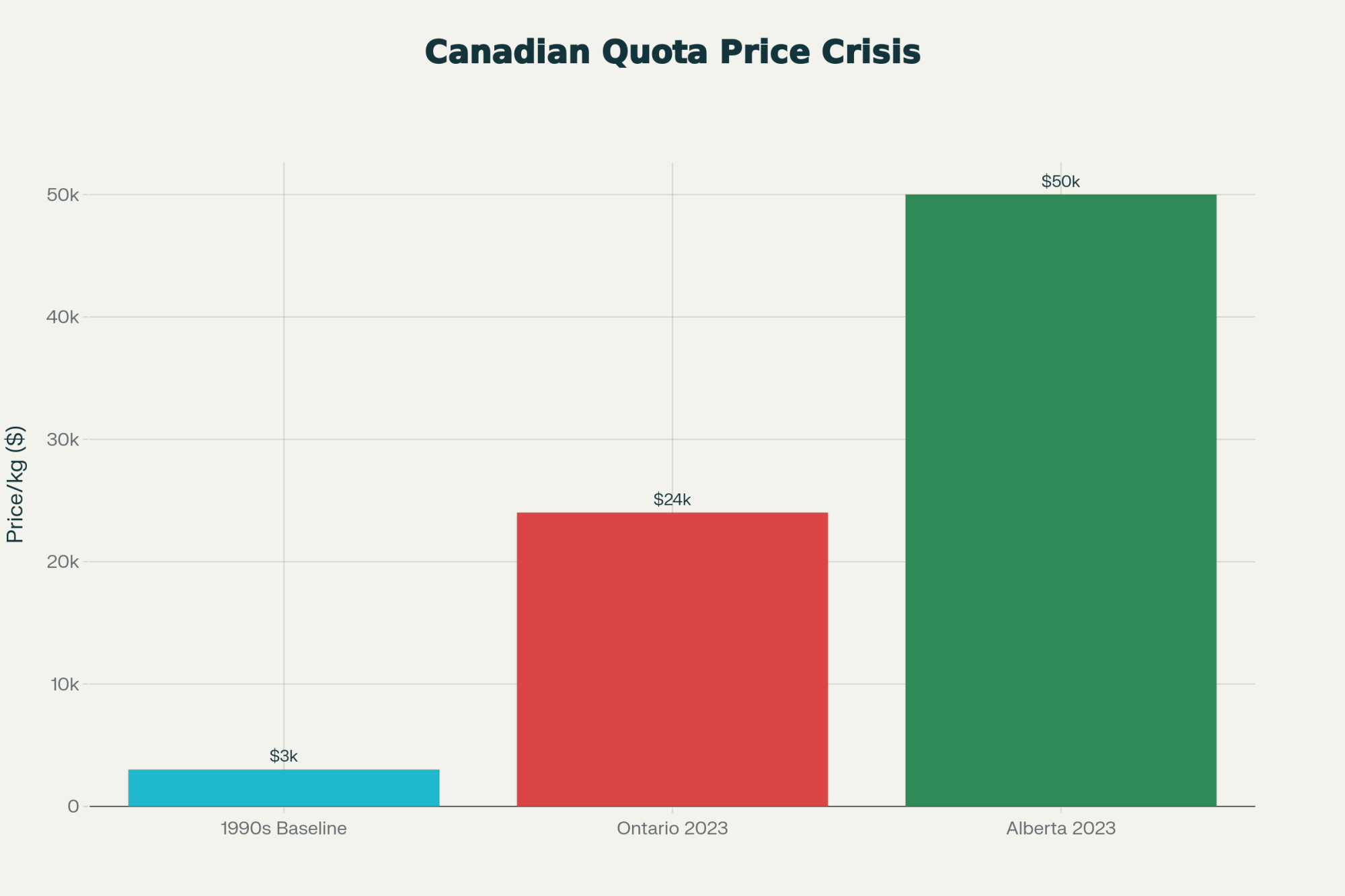
Now, Canadian friends watching these trends aren’t immune either. The Canadian Dairy Information Centre’s latest data puts the last decade’s dairy farm reduction at over 2,700, even under supply management. And quota levels are a choke point: In Ontario, with a strict cap, quota changes hands around $24,000 per kilo of butterfat; Alberta’s uncapped market runs up past $50,000.

A young producer near Guelph explained it best: “We want to keep the farm in the family, but the math now is about buying quota at market rate from Dad—he paid $3,000/kilo in the ’90s. I pay $24,000/kilo or more, and start so far behind on cash flow it feels impossible.”

Canadian dairy quota prices have exploded from $3,000 per kilogram in the 1990s to $24,000 in Ontario and $50,000 in Alberta by 2023—a 1,567% increase that creates an impossible generational wealth transfer barrier, forcing young farmers to begin their careers hundreds of thousands of dollars in debt simply to acquire the right to produce milk their parents obtained for a fraction of the cost.

Producers Team Up—and Win

We should all pay attention to how producers abroad have responded. In Ireland, Dairygold tried to drop prices, but farmers quickly networked on WhatsApp. Once they started comparing pay stubs, they discovered inconsistencies—same pickup, same composition, different pay. They organized: “If 200 show up with real data, will you join?” The answer was yes. Six weeks, 600 farmers, and the transparency improved, the price cut was rescinded.

That lesson isn’t just for Ireland. That’s modern farm business—facts and solidarity over rumors and grumbling.

U.S. Adaptation Tactics: What’s Working

Across the U.S., I’ve watched farmers embrace savvy but straightforward approaches. Central Valley producers doubled back to their milk checks and truck bills and found that some paid 20 cents/cwt more for identical hauls. As a group, they pressed for change—and got it.

Midwesterners have started bottling their own milk—Wisconsin’s extension reports show farmgate price benefits of $2 to $4 a gallon, though yeah, getting there takes $75,000 to $100,000 and some serious compliance stamina.

Debt is a fresh challenge in its own right in cow management. Now’s the time to renegotiate any credit above prime plus one. Dropping even one percent on a $2 million note brings $20,000–$25,000 savings straight to the P&L.

Environmental Law: A Sea Change

California’s methane digester rules, fully phased in over the past two years, are a classic case of “scale wins again.” For big operations, $4 million-plus digesters can become a profit center—especially if you trade renewable natural gas credits north of $1 million a year. Small farms? They can’t justify the capital, so the compliance cost splits unevenly—UC Davis economists show $2/cwt for small farms, under 50 cents for the largest.

It’s not about better manure management; it’s about who can amortize the cost.

The Path Ahead: What’s Next in Dairy Consolidation

The USDA’s Economic Research Service expects U.S. dairy farm numbers to dip below 10,000 by the mid-2030s, with Canadian farm numbers also dropping to around 4,000–5,000. That’s the math if nobody changes the model or the market.

But honestly, what gives me hope are examples of when perseverance, innovation, and strategic shifts pay off. In Wisconsin, several smaller herds now sell directly into grass-fed cheese contracts, pulling in a $4/cwt premium (more than make-allotment size, less fight for line space). “We stopped competing with 5,000-cow barns by beating them at their game,” one farmer told me. “We get paid for our story and our butterfat.”

Where To Focus Now

  • Calculate Your Position Honestly. Know your true cost—family living included—against hard local benchmarks. If the numbers don’t lie, accept what you see and plan accordingly.
  • Don’t Go It Alone. From paycheck audits to volume negotiations, the farms that win increasingly do so together.
  • Strategic Awareness Beats Production Alone. The future belongs to those who know how pricing, processing, and consumer trends intersect—and find their “crack” in the system instead of just producing more.

As Tom Vilsack put it at a dairy business roundtable: “We love to say we’re saving family farms, but policy and business choices keep rewarding bigness and consistency.” No matter your model—organic, conventional, something in between—the goal is to find your margin, your allies, and your leverage.

The numbers will keep changing, but one reality holds—those who adapt, share, and innovate stand the best chance. Old rules are being rewritten, and it’s worth being part of that conversation. For deep dives on industry economics, co-op strategy, and farm resilience, visit www.thebullvine.com.

KEY TAKEAWAYS

  • Butterfat numbers and raw efficiency don’t guarantee survival—market scale, price leverage, and transparency do.
  • Question every deduction and demand clarity from your co-op or processor—internal conflicts don’t have to shortchange you.
  • Benchmark your costs with neighboring farms and negotiate together—solo producers rarely win against consolidated buyers.
  • The farms thriving today are adapting: going direct-to-consumer, value-adding, or finding specialized markets to earn more per cwt.
  • Success in modern dairy comes from forward planning, embracing new models, and building your own leverage—not waiting for the system to “fix itself.”

EXECUTIVE SUMMARY:

Dairy’s old rules—“be efficient and you survive”—no longer hold. Drawing on real farm stories and national data, this investigation exposes why scale, access, and co-op consolidation matter more than top cow performance. You’ll see how market power and processor influence—not just farm management—decide who survives and who sells out. With insights from producers challenging these trends, along with practical strategies and benchmarks, this article is a must-read for anyone rewriting their playbook. Get the facts, the framework, and a clear-eyed look at what real success in dairy now demands.

Complete references and supporting documentation are available upon request by contacting the editorial team at editor@thebullvine.com.

Learn More:

Join the Revolution!

Join over 30,000 successful dairy professionals who rely on Bullvine Weekly for their competitive edge. Delivered directly to your inbox each week, our exclusive industry insights help you make smarter decisions while saving precious hours every week. Never miss critical updates on milk production trends, breakthrough technologies, and profit-boosting strategies that top producers are already implementing. Subscribe now to transform your dairy operation’s efficiency and profitability—your future success is just one click away.

NewsSubscribe
First
Last
Consent

Butter Down €270, Processors Up 25%: Europe’s Dairy Collapse Hits Home

European dairy farmers are discovering that traditional market cycles no longer apply—and the implications reach far beyond the Netherlands

EXECUTIVE SUMMARY: When butter prices dropped by €270 in one week while processors reported 25% profit growth, it confirmed what many farmers suspected: the game has fundamentally changed. European cooperatives now profit from processing cheap milk rather than serving members, while retail algorithms lock in permanent price suppression—the recovery isn’t coming. With the Netherlands buying out farms for €1 million each and Germany losing eight operations a day, this isn’t a crisis; it’s a restructuring. Yet farmers capturing €0.95/liter through direct sales prove success is possible—just different than before. Smart operators are adapting now through specialty contracts, solar revenue, or value-added production, because after May 2027, government support ends, and today’s options disappear. The same patterns are emerging from Wisconsin to New Zealand, making this Europe’s story today, but everyone’s tomorrow.

dairy farm profitability

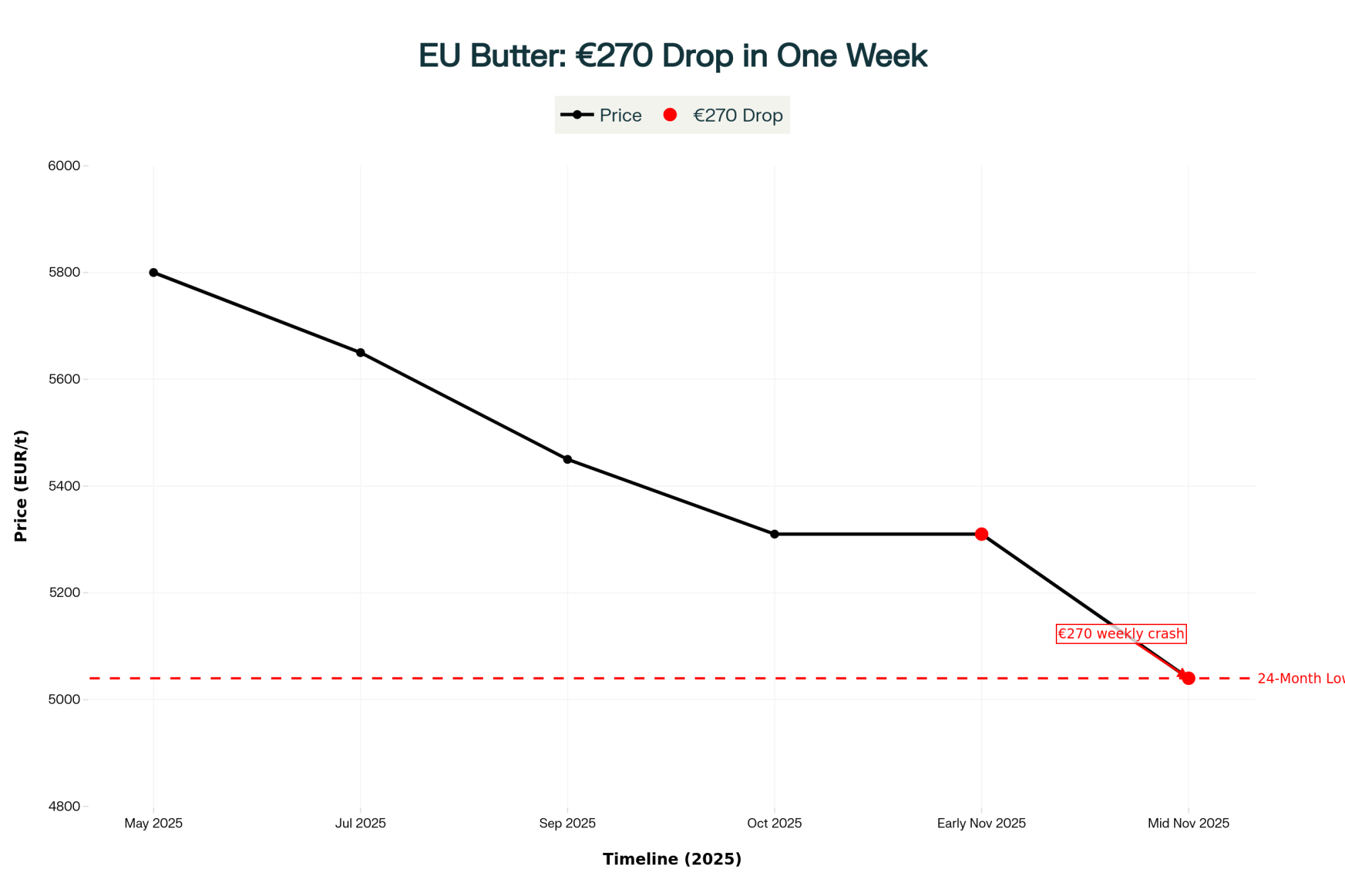
You know, when butter prices in the Netherlands dropped €270 per tonne in a single week this November—hitting €5,040, the lowest we’ve seen in two years—the phone lines lit up across dairy country. Had a Dutch producer near Utrecht tell me something that really stuck: “This isn’t like 2015. Back then, we knew it would bounce back. Now? Nobody’s sure what normal looks like anymore.”

He’s right. The European Dairy Association’s November report shows this was the steepest drop they’ve recorded since they began monitoring weekly prices in 2018. But here’s what’s got everyone talking over morning coffee—processors like FrieslandCampina are reporting strong profits while our milk checks keep getting smaller. That disconnect… well, we need to understand what’s really happening here.

“This isn’t like 2015. Back then, we knew it would bounce back. Now? Nobody’s sure what normal looks like anymore.”
— Dutch dairy farmer near Utrecht

What we’re seeing across Europe right now—this mix of cooperative changes, retail evolution, and policy shifts—it’s creating something genuinely new. And I think these patterns offer insights for all of us, whether you’re milking in Wisconsin’s rolling hills or managing pastures down in New Zealand.

KEY FACTS AT A GLANCE

The Market Situation:

  • €270/tonne butter price drop in one week (November 2025)
  • €5,040/tonne current price—24-month low
  • 56,500-tonne European butter surplus H1 2025

The Financial Picture:

  • FrieslandCampina: 25.7% profit increase H1 2025
  • Same period: 5.92 cent/liter milk price cut for farmers
  • US butter: €4,246/tonne vs. European: €5,100-5,500/tonne

The Demographics:

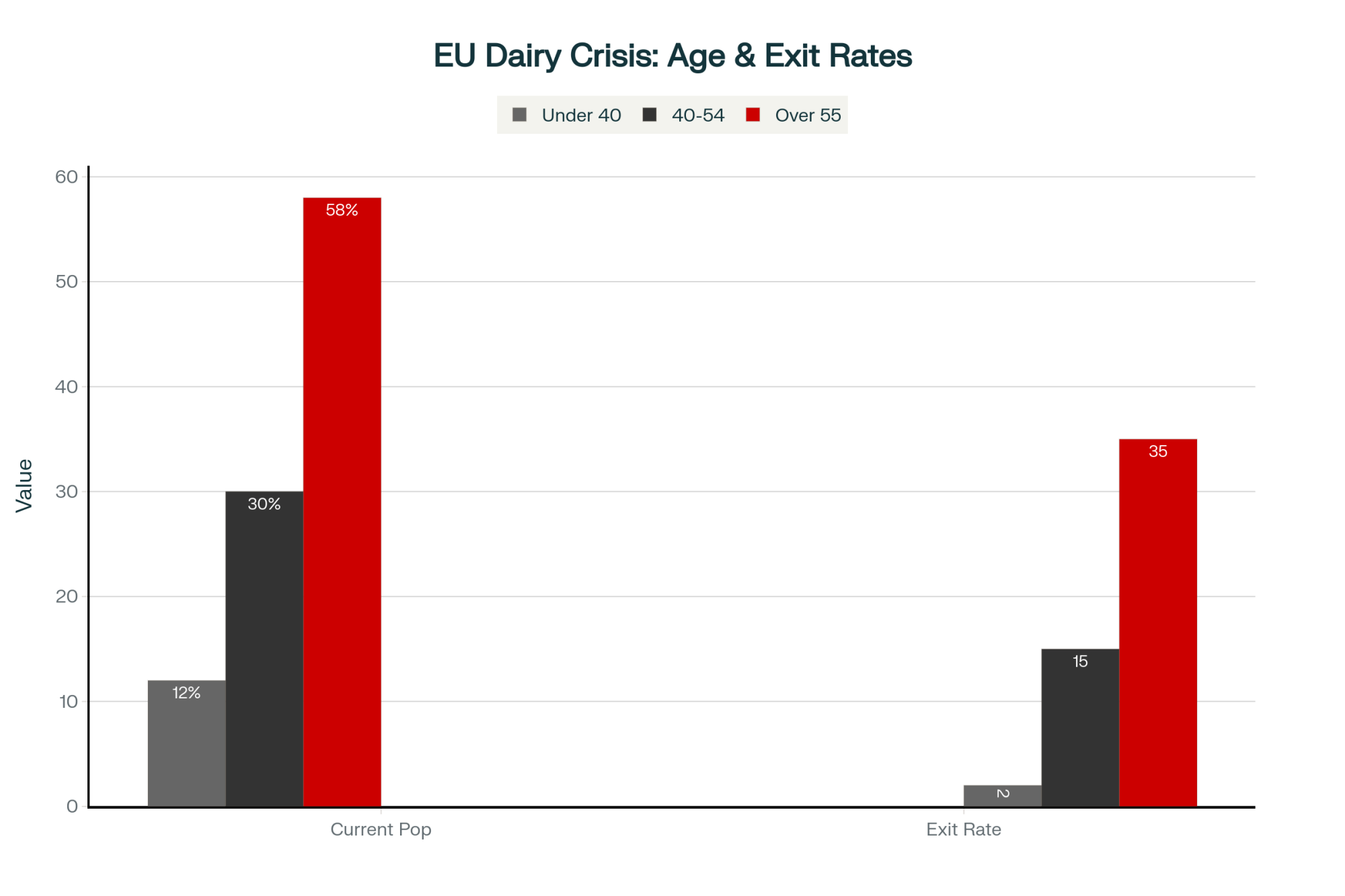
  • 12% of EU farmers are under 40 years old
  • 58% over 55 years old
  • Germany is losing 2,800 farms annually

The Policy Framework:

  • €32 billion Dutch nitrogen reduction program
  • €1 million average transition support per farm
  • 70% nitrogen reduction targets in 131 areas by 2030
With 58% of EU dairy farmers over 55 and Germany bleeding 8 operations daily, the demographic cliff isn’t coming—it’s here. This isn’t a crisis; it’s a restructuring that’s creating opportunities for prepared operators while crushing those waiting for ‘normal’ to return.

The Numbers Tell a Story We Can’t Ignore

European butter prices collapsed €270 in a single week to hit €5,040 per tonne—the lowest level in 24 months. This isn’t your grandfather’s market cycle; it’s a structural breakdown that signals permanent change in dairy economics.

So here’s what’s interesting—and the scale is pretty remarkable when you dig into it. The Agriculture and Horticulture Development Board’s latest assessment shows that European butter production alone created a 56,500-tonne surplus in the first half of 2025. That breaks down to 37,500 tonnes from increased production, 6,500 from exports drying up, and another 12,500 from higher imports. We aren’t talking minor fluctuations here.

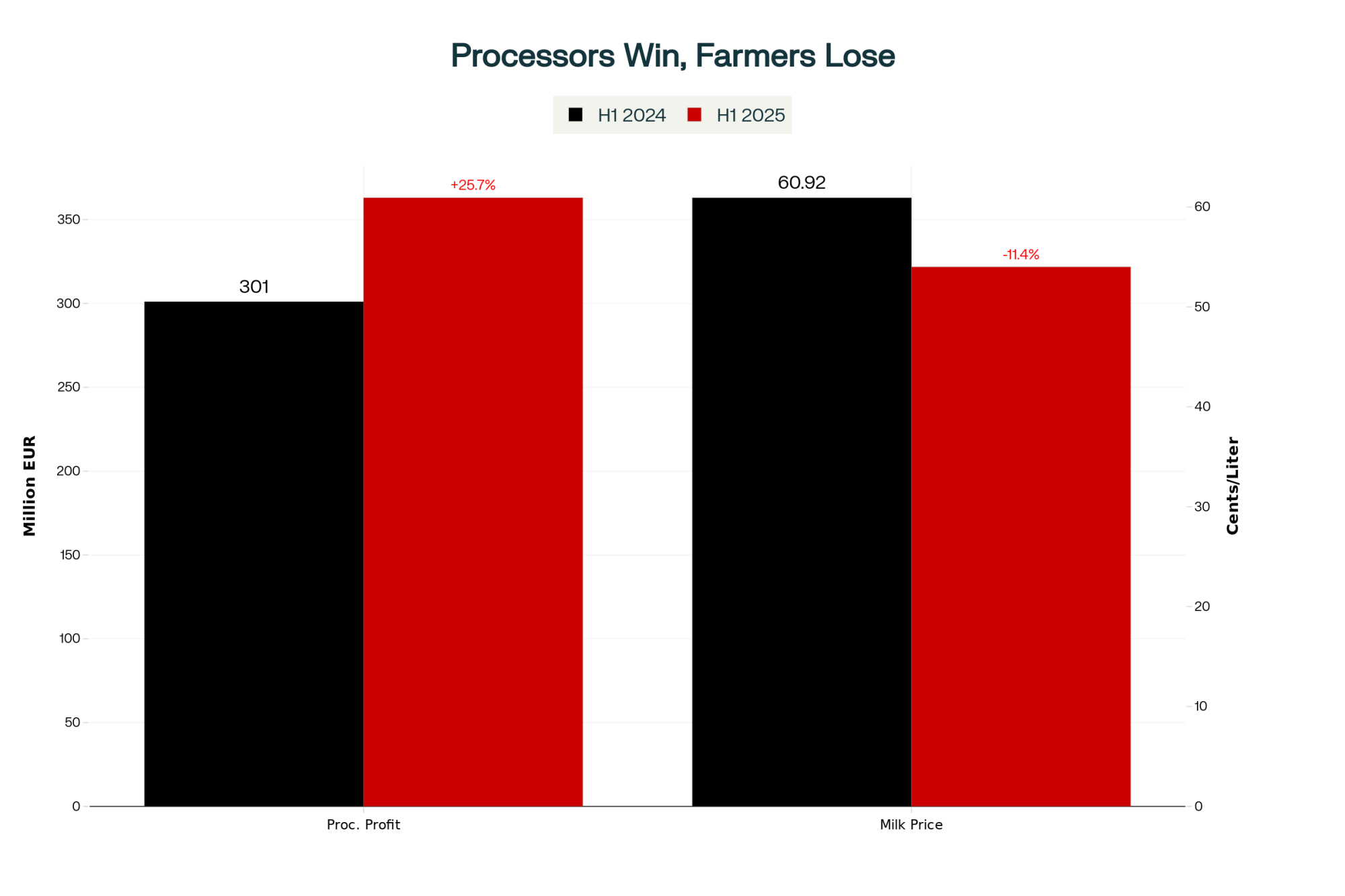
What really gets me is how the processors are doing. FrieslandCampina’s July report showed their profits jumped 25.7% in the first half of 2025—we’re talking €301 million to €363 million. Then October rolls around, and they announce a 5.92-cent-per-liter cut to November milk prices. That’s… that’s one of the biggest monthly drops I’ve seen in years.

Dr. Alfons Oude Lansink over at Wageningen put it perfectly when talking to Dairy Global recently. He said we’re seeing processor profitability completely decouple from what farmers are getting paid. The old assumption—that cooperative success meant member success—well, that’s being challenged in ways we haven’t seen before.

And the international price gap? Man, that’s something else. Vesper’s August analysis has European butter at €5,100-5,500 per tonne, while the USDA shows American butter at €4,246 per tonne. That’s a $1.26-per-pound difference. Usually, these gaps close within months, right? This one’s been hanging around nearly a year now. Makes you think we’re dealing with something more permanent than temporary market hiccups.

How Our Cooperatives Changed While We Weren’t Looking

I’ve been watching cooperatives for over twenty years, and what’s happened recently… it’s remarkable how fast things shifted. Remember when cooperatives were basically just marketing organizations for our milk? That model—the one many of us grew up with—has morphed into something way more complex.

Take FrieslandCampina. Their 2024 annual report shows they’re processing 19 billion kilograms of milk across 30 countries. Think about that scale for a minute. It requires management structures that would’ve been unimaginable when most of us started farming. There’s now multiple layers between your morning milking and the boardroom decisions that affect your milk check.

While FrieslandCampina’s profits soared 25.7% to €363 million, member farmers saw milk prices slashed 11.4% to 54 cents per liter. This is the fundamental disconnect reshaping European dairy—cooperatives now profit from cheap milk rather than serving members.

Jan Willem Straatsma—farms 140 cows near Leeuwarden and serves on the Members’ Council—he told me something that really resonates: “We still have voting rights, but the distance between my morning milking and boardroom decisions has grown considerably.” I think that captures what a lot of us are feeling, doesn’t it?

What’s really shifted in these modern cooperatives:

  • They’re pouring money into processing assets—FrieslandCampina spent over €500 million on capital expenditure in 2024 alone
  • Member equity requirements? Up about 40% over the past decade, according to Rabobank’s analysis
  • Governance now includes folks who, let’s be honest, probably haven’t mucked out a stall in their lives
  • Payment formulas have gotten so complex that neighbors with nearly identical operations can have vastly different milk checks

The guaranteed price system—€55.63 per 100kg in the first half of 2025—sure, it provides some stability. But when butter tanks while cheese holds steady, cooperatives have to make allocation decisions. And understanding how those decisions get made… that’s becoming crucial for all of us.

The Retail Game Has Completely Changed

Here’s something that might surprise folks back home: German grocery retail has consolidated to where just four groups control between 65.9% and 85% of the market. We’re talking Edeka, Rewe, Aldi, and Schwarz Group—they run Lidl and Kaufland. The German Federal Statistical Office confirmed these numbers for 2025, and honestly, the implications are huge.

But what’s really wild is how technology’s changed pricing. Had a procurement manager from one of these chains explain it to me recently—didn’t want his name used, understandably. He said their systems constantly scan competitor prices, and when one store drops butter to €1.59, the others match within hours. All automatic. The computers handle the routine stuff while humans oversee strategic decisions.

“Our systems continuously monitor competitor pricing. When one retailer adjusts butter to €1.59, others typically match within hours.”
— German retail procurement manager

This creates what the academics call price convergence. Studies of German retail markets found butter prices across major chains vary by less than 2% on any given day. That’s… that’s basically identical pricing achieved through algorithms, not people sitting down together.

What’s this mean for us? Well, I was working with some Bavarian producers recently, and we calculated that retailers are selling butter at €1.59 per 250g while the actual milk cost for butter production runs about €11.50 per kilogram. That’s an €8 per kilo loss they’re taking.

Professor Hermann Simon at Cologne’s Retail Research Institute explained it pretty clearly—butter’s just the hook. Gets customers in the door. Then they make margins of 40-70% on everything else in the cart. So basically, our product is subsidizing their profit model. Tough pill to swallow, isn’t it?

Policy Changes That Are Reshaping Everything

The Netherlands’ nitrogen rules—probably the biggest agricultural policy shift we’ve seen in Europe in decades. Government documentation outlines requirements for a 70% reduction in 131 areas near protected sites by 2030. And folks, these aren’t minor tweaks we’re talking about.

Dutch farmers face brutal math: invest €300,000 to meet nitrogen mandates or take the €1 million buyout and retire with dignity. With that typical 58-year-old farmer whose son’s an Amsterdam engineer, the spreadsheet tells the story before emotion enters the room.

The money behind it is substantial, I’ll give them that. Parliament confirmed €32 billion for the program, with €25 billion specifically for farm transitions. Works out to roughly a million euros per farm for those taking the exit package. Real money.

Met a producer near Zwolle recently who’s taking the buyout. He’s 58, son’s an engineer in Amsterdam. His logic was pretty straightforward: “Continuing would mean over €300,000 in compliance investments. The transition support lets me retire with dignity.” Hard to argue with that, you know?

The ripple effects are everywhere:

  • Lely can’t keep up with demand for their Sphere systems—€180,000 to 250,000 installed, and they’re backordered
  • Feed companies pushing additives like Bovaer—runs about €50 per cow annually, but cuts emissions 30%
  • Land prices have gone crazy—saw a hectare near Utrecht sell for €140,000, triple its agricultural value

And demographics make it all worse. Eurostat’s latest census shows only 12% of EU farmers are under 40, while 58% are over 55. Germany’s losing about 2,800 farms a year, according to their Agriculture Ministry. That’s eight operations calling it quits every single day.

What’s Happening Elsewhere

Similar patterns are popping up globally, though the details vary. Understanding these helps put our own challenges in perspective.

The American Situation

USDA’s January report documented 1,420 dairy farms closing in 2024—that’s 5% of all operations. What’s interesting is these weren’t just small farms. Average herd size was 280 cows, way above the 180-cow national average. Seems like pressure’s hitting operations across the board.

Dairy Farmers of America, which handles about 30% of U.S. milk, is facing its own issues. Court documents from Vermont show that DFA began sending more member milk to its own processing plants after buying Dean Foods. Jumped from 50% in 2019 to 66% by 2021.

Dr. Marin Bozic from Minnesota testified before Congress about this, saying that when cooperatives own processing assets, their economics benefit from lower milk procurement costs. Creates real tension with member interests. That hits home for cooperative members everywhere, doesn’t it?

Had a Minnesota producer tell me recently they’re seeing the same disconnect—cooperative doing well while members struggle. “We’re basically funding their expansion while our margins shrink,” he said. Sound familiar?

New Zealand’s Big Move

Fonterra is selling their consumer brands to Lactalis for NZ$3.2 billion—that’s huge. Works out to about NZ$1,950 per farmer-shareholder. Meaningful money, but it’s also a fundamental strategy shift.

Alan Bollard, former Reserve Bank Governor, wrote in the Herald that it shows cooperative structures can’t compete with multinational capital in value-added markets. Sobering thought, but it reflects what many cooperatives are wrestling with.

The implications? Fonterra focuses on ingredients, while Lactalis—a private French company—focuses on premium brands. That’s a big shift in who captures value.

Australia’s Retail Challenge

The Competition Commission’s recent inquiry shows Coles and Woolworths expanding beyond retail into processing. Combined 65% market share plus direct farm sourcing creates unique dynamics.

Professor Frank Zumbo from the Dairy Products Federation notes that when retailers control processing and shelf space, traditional bargaining just disappears. We’re seeing this pattern everywhere now.

Strategies That Are Actually Working

Despite all these challenges—and they’re real—I’m seeing folks find viable paths forward. Not every approach works for everyone, but understanding what’s working helps us all.

[Visual suggestion: Infographic showing labor savings with robotic systems]

Going Direct to Consumers

Visited a 65-cow operation near Cologne that switched to farmstead cheese three years back. They invested €420,000 in equipment and aging rooms—a big risk. But now they’re getting €28 per kilo for their Gouda through direct sales and restaurants.

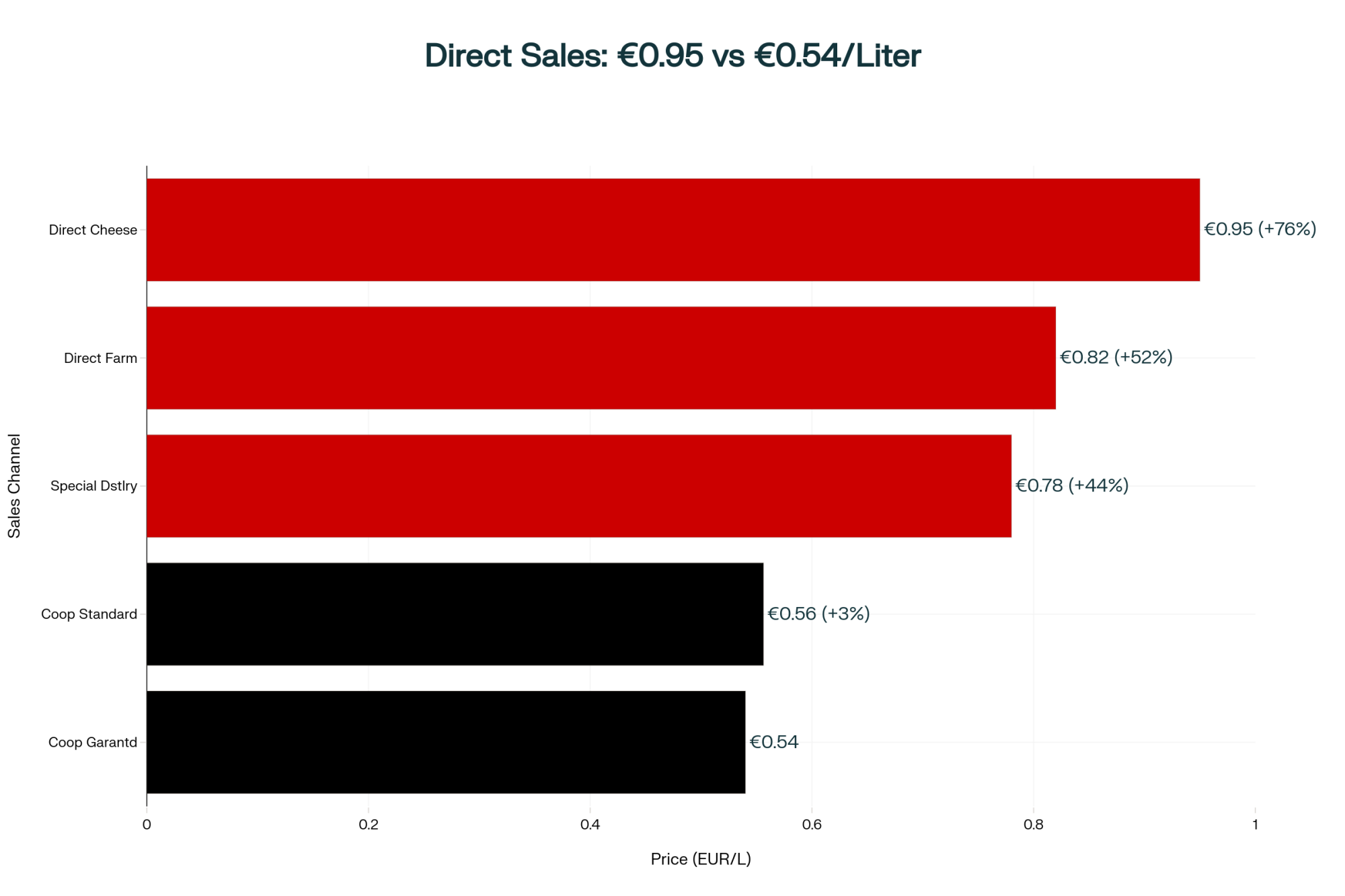
The farmer showed me his books—they’re showing about €0.95 per liter, compared to €0.54 through traditional channels. “Building customers took two years,” he said, “and my wife handles marketing full-time. It’s really a different business entirely.”

“I’d rather be profitable at 60 cows than losing money at 600.”
— Successful small-scale producer

What makes direct marketing work:

  • Location matters: Need to be within 40km of population centers
  • Capital requirements: €300,000-500,000 minimum—banks won’t touch these projects without collateral
  • Marketing skills: Quality alone won’t sell cheese—you need marketing
  • Regulations: EU hygiene requirements are mandatory and expensive
Small-scale farmers capturing €0.95 per liter through direct sales prove success is still possible—just radically different than before. That’s a 76% premium over the €0.54 commodity treadmill, and it’s why smart operators are adapting now rather than waiting for markets to ‘recover.

Smart Technology Choices

A 200-cow operation in northern Germany cut costs by 22% by carefully adopting technology. Nothing flashy—just practical improvements.

Their approach:

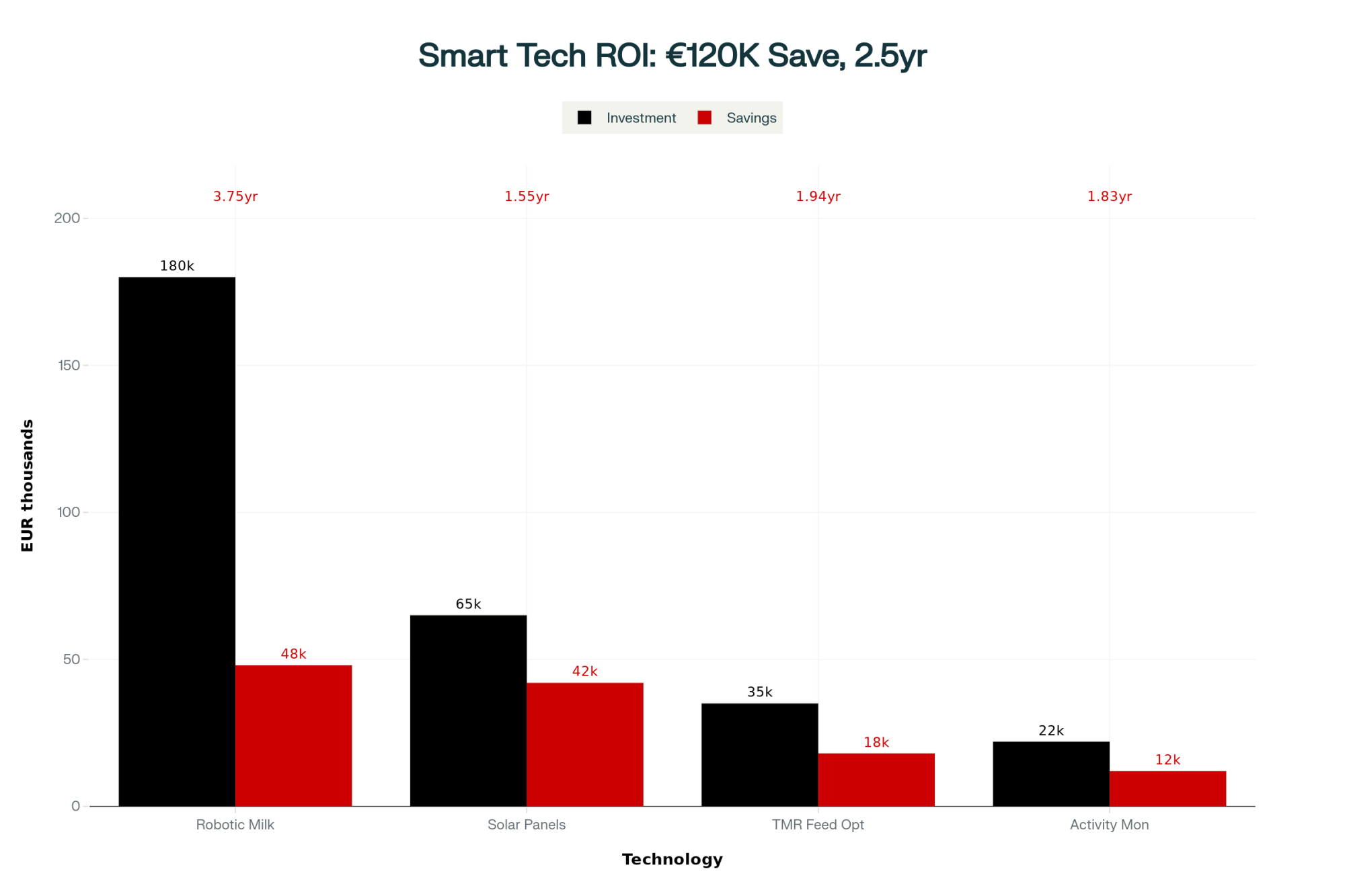
  • Used robots: €180,000 for two DeLaval units, eliminated one full-time position
  • Feed optimization: TMR mixer with sensors cut feed costs by 12%
  • Solar income: €42,000 annually from barn-roof panels

“Every percentage point matters when margins are this tight,” the manager told me. “Can’t control milk prices, but we can control costs.”

Seeing similar success in the States. A Wisconsin friend installed used robots for about $165,000, with the same labor savings. California dairy added solar across their barns—covers all electricity plus $35,000 extra annually. And up in Idaho, a 300-cow operation retrofitted their parlor with activity monitors and automated sort gates for under $80,000—cut breeding costs by 25% and improved pregnancy rates. These aren’t revolutionary—just practical adaptations that work.

A 200-cow German operation slashed costs 22% with €302K in strategic tech investments delivering €120K annual savings. Nothing revolutionary—just robots for labor, solar for energy, sensors for precision. Can’t control milk prices, but you damn sure can control costs.

Creative Revenue Streams

The innovation I’m seeing is really encouraging. Bavarian operation raising 120 replacement heifers annually at €3,200 each—better margins than milk, less volatility.

Successful diversification approaches:

  • Custom heifer raising: Five-year contracts provide stability that commodity markets never offer
  • Solar leasing: €1,100 per hectare annually, minimal labor
  • Specialty contracts: Amsterdam farm getting €0.78/liter for distillery milk—44% premium

In Vermont, a farm partnered with a local creamery for cultured butter—high-end restaurants pay $0.85 per liter equivalent. The Ohio operation makes $120,000 from agritourism while maintaining 150 cows. Shows innovation isn’t always about scale.

Making Sense of the Path Forward

After all these conversations and analysis, several things are becoming clear.

Markets have fundamentally shifted. The structural changes—retail consolidation, pricing algorithms, cooperative evolution—created new equilibrium points. Planning based on old cycles won’t work anymore.

Scale doesn’t guarantee success. I’ve seen all sizes struggle and succeed. It’s about positioning and differentiation. Like one farmer said, “I’d rather be profitable at 60 cows than losing money at 600.”

Cooperative engagement matters now. Can’t be passive members anymore. Either engage actively or develop alternatives.

Compliance is permanent. Whether it’s nitrogen, water quality, or animal welfare, these requirements aren’t going away. Early adoption usually costs less than fighting it.

Demographics create opportunity. With 60% of European farmers over 55, lots of assets will change hands. Prepared operators can build good operations—just avoid the debt traps that hurt previous generations.

The Critical 18-Month Window

What I’m seeing suggests we’re in a crucial period through May 2027 where decisions really matter.

Government programs are funded, cooperative equity’s stable, land markets haven’t crashed, and interest rates are elevated but manageable. But this could all shift quickly as more people make decisions.

For that typical 55-year-old with 80 cows and €2 million debt—and I meet lots in this situation—the math’s pretty clear. At €0.54/liter milk and €0.52 costs, including debt, you’re barely breaking even. Without succession plans or premium markets, continuing might cost more than transitioning.

Financial advisor who specializes in dairy told me recently: “I don’t tell people what to do, but I make sure they understand their real numbers. Emotions are understandable, but math doesn’t lie.”

WHAT THIS MEANS FOR YOUR OPERATION

Under 100 Cows:

  • Focus on being different—direct sales, specialty products beat commodity competition
  • Technology should cut labor, not boost production
  • Consider partnerships for resources and market access

100-500 Cows (The Squeeze Zone):

  • Too small for mega-efficiency, too large for niche marketing
  • Make strategic choices: scale up with clear planning or pivot to value-added
  • Get involved in your cooperative—you need to influence decisions

Over 500 Cows:

  • Efficiency is everything—every percentage point counts
  • Diversify into energy or services for stable revenue
  • Succession planning is critical—the next generation needs a clear profitability path

The Industry Keeps Evolving

This €270 drop in butter prices isn’t just volatility—it shows fundamental changes reshaping dairy globally. Success requires different thinking than what built our industry.

Resilient operations share traits: diversified revenue streams, strong customer relationships, smart technology use, and—crucially—realistic assessment paired with decisive action.

Not everyone will make it through. We need to acknowledge that. But those who recognize the new reality early and adapt, they’ll find opportunities. Just different ones than we’re used to.

“Farming isn’t just about producing milk. It’s about making decisions that protect your family’s future. Sometimes that means knowing when to change course.”
— Dutch farmer preparing for transition

Standing in that Dutch farmer’s parlor last week, watching him prepare for his final season after decades of dedication, his pragmatism struck me. “Farming’s more than milk production,” he said thoughtfully. “It’s stewarding family resources. Sometimes wisdom means recognizing when things have fundamentally changed.”

And you know what? That might be the key insight here. Success isn’t just about perseverance anymore. Sometimes it’s recognizing when the rules changed and having the courage to adapt—whether that’s innovation, diversification, or transition.

What’s happening in European dairy right now… it’s not doom and gloom, but it’s not false hope either. It’s just reality: an industry transforming where old strategies don’t guarantee old outcomes. For those willing to see clearly and act decisively, that clarity becomes an advantage.

What matters is honest evaluation. Not wishful thinking, not catastrophizing, just a realistic assessment of where we are and where we’re headed. That’s how we make decisions that serve our operations and families.

The industry’s changing. We can change with it or get left behind. As always, the choice is ours.

KEY TAKEAWAYS:

  • The old dairy economics are dead: When processors profit from your losses, the game has fundamentally changed
  • Your cooperative isn’t your partner anymore: They profit from cheap milk, not member success—act accordingly
  • Success formula flipped: Small + specialized beats large + commodity (€0.95/L direct vs €0.54 commodity proves it)
  • 18 months until options vanish: Government support, buyout programs, and stable markets end May 2027
  • Only three strategies work now: Go direct to consumers, cut costs with technology, or exit strategically—waiting isn’t a strategy

Complete references and supporting documentation are available upon request by contacting the editorial team at editor@thebullvine.com.

Learn More:

Join the Revolution!

Join over 30,000 successful dairy professionals who rely on Bullvine Weekly for their competitive edge. Delivered directly to your inbox each week, our exclusive industry insights help you make smarter decisions while saving precious hours every week. Never miss critical updates on milk production trends, breakthrough technologies, and profit-boosting strategies that top producers are already implementing. Subscribe now to transform your dairy operation’s efficiency and profitability—your future success is just one click away.

NewsSubscribe
First
Last
Consent

The $300 Million Overrun You’re Paying For: Inside Dairy’s $11 Billion Labor Crisis

What farmers are discovering about the gap between processing expansion and workforce reality—and the practical lessons emerging from projects like Darigold’s Pasco plant

EXECUTIVE SUMMARY: The U.S. dairy industry is pouring $11 billion into processing plants it can’t staff—and farmers are paying for this disconnect through devastating milk check deductions. Darigold’s Pasco facility exemplifies the crisis: costs exploded from $600 million to over $900 million, forcing 300 member farms to cover the overrun at $4 per hundredweight, slashing their income by 20-25%. This infrastructure boom collides with an existential workforce crisis where immigrant workers, who produce 79% of America’s milk, face deportation while dairy remains locked out of legal visa programs that other agricultural sectors freely use. Farmers had no vote on these massive expansions, yet cooperative governance ensures they absorb all losses while contractors pocket overrun profits and board members face zero consequences. Some producers are finding lifelines through direct-to-consumer sales (commanding 400-600% premiums), smaller regional cooperatives, and strategic production management, but these are individual escapes from a systemic failure. Without fundamental reforms in cooperative governance and immigration policy, the industry will complete these factories just in time to discover there’s nobody left to run them—or milk the cows.

dairy governance risk
The largest ever investment in Darigold’s 100-year history, the Pasco plant stands to solidify the Northwest region among dairy producing regions for generations to come.

You know that feeling when you watch a neighbor build a massive new freestall barn, and you can’t help but wonder—who exactly is going to milk all those cows?

That’s not just a neighborhood curiosity anymore. It is the $11 billion question hanging over the entire dairy industry. Except we aren’t talking about barns; we’re talking about processing plants. And the answer is costing you $4.00 per hundredweight.

[IMAGE TAG: Wide shot of massive dairy processing plant under construction with empty parking lots]

So here’s what’s happening. When Darigold opened its new Pasco, Washington processing facility this past June, they had every reason to celebrate. The 500,000-square-foot facility can handle 8 million pounds of milk daily—that’s enough capacity to churn out 280 million pounds of powdered milk and 175 million pounds of butter annually. The technology really is impressive—state-of-the-art dryers, low-emission burners, the whole nine yards.

But here’s where it gets complicated, and you probably know where I’m going with this. That shiny new plant ended up costing over $900 million, even though the original budget was $600 million. That’s a 50% overrun, and if you’re shipping to Darigold, you already know who’s paying for it—their 300 member farms are covering it through that $4 per hundredweight deduction from milk checks.

Darigold’s Pasco plant overran by $300M—and 300 member farms absorbed it all through $4/cwt deductions

I’ve been talking with producers who say it accounts for 20-25% of their payments. Think about that for a minute. You’re already juggling feed costs that won’t quit, trying to find workers who’ll actually show up, dealing with market swings that’d make your head spin, and suddenly a quarter of your milk check disappears to cover someone else’s construction overrun.

“A quarter of your milk check disappears to cover someone else’s construction overrun while you struggle with feed costs, labor shortages, and market volatility.”

What’s interesting is that Pasco isn’t some weird outlier. The International Dairy Foods Association released their October report showing we’re looking at over $11 billion in new processing capacity coming online between now and 2028. We’re talking over 50 major projects here—it’s the largest infrastructure expansion I’ve seen in… well, honestly, ever.

And yet—and this is the kicker—this massive bet on processing capacity is running headfirst into a reality that anyone who’s tried to hire a milker recently knows all too well. We simply can’t find enough workers to operate the facilities we’ve already got, let alone staff new ones.

Quick Facts: The $11 Billion Reality Check

  • Total Infrastructure Investment: $11+ billion (2025-2028)
  • Major Projects: 50+ processing facilities announced or under construction
  • Darigold Overrun: $300 million (50% over budget)
  • Farmer Impact: $4/cwt deduction = 20-25% payment reduction
  • Farms Closing in 2025: 2,800 operations
  • Workforce Reality: 51% immigrant workers producing 79% of the U.S. milk

Understanding the Infrastructure Surge

Let me walk you through what’s actually being built out there, because the scale really is something else.

Chobani broke ground on a $1.2 billion facility in Rome, New York, back in April. Governor Hochul’s office is promising 1,000+ jobs and the capacity to process 12 million pounds of milk daily. Now, I’ve driven through that region recently—beautiful country, no doubt about it. But here’s what’s nagging at me: New York lost more than half its dairy farms between 2009 and 2022. The Census of Agriculture data doesn’t lie. So where exactly is all that milk going to come from?

Then you’ve got Hilmar Cheese Company’s operation in Dodge City, Kansas. It’s a $600+ million plant that started running this past March. They designed it to process 8 million pounds of milk daily, supposedly creating 250 jobs. But here’s what’s interesting—and this is November, mind you—they’re still scrambling to fill critical positions. Maintenance mechanics, facilitators, and milk receivers for night shifts. These aren’t entry-level gigs where you can train someone up in a week. These are technical roles that require people who know what they’re doing.

Fairlife—you know, the Coca-Cola folks—they’re building a $650 million ultra-filtration facility in Webster, New York. It’s part of what the state’s calling a $2.8 billion surge in dairy processing investments. Largest state investment in the nation, they say.

Michael Dykes, over at the International Dairy Foods Association, he’s confident about all this expansion. In their October industry report, he said: “Don’t fret for one moment—dairy farmers hear the market calling for milk. Milk will come.”

I appreciate the optimism, I really do. And on paper, it makes sense. Global dairy demand is growing, especially in Southeast Asia. Export opportunities are expanding. Processing innovation is creating new product categories we couldn’t have imagined ten years ago.

What could go wrong, right?

Well, let me tell you what’s already going wrong.

The Labor Reality Check

[IMAGE TAG: Split screen showing empty milking parlor positions vs. ICE raid at dairy farm]

Here’s the number that should keep every processor awake at night—and probably keeps many of you awake too. Texas A&M did a study in 2023, and the National Milk Producers Federation confirmed it: 51% of the dairy workforce consists of immigrant workers who produce 79% of America’s milk supply. I’ve cross-checked these numbers with multiple sources. If anything, they might be conservative.

Meanwhile—and this is where it gets frustrating—the H-2A temporary agricultural worker program has grown from about 48,000 certified positions back in 2005 to nearly 380,000 in fiscal 2024. Department of Labor tracks all this. But dairy? We’re completely locked out. Why? Because their regulations say work has to be “seasonal or temporary.”

Last I checked, cows need milking 365 days a year. They don’t take vacations.

“51% of the dairy workforce consists of immigrant workers who produce 79% of America’s milk. Yet dairy is locked out of H-2A visas because cows don’t take vacations.”

51% of dairy workers produce 79% of U.S. milk—the uncomfortable truth about American agriculture

What really gets me is that sheep herding operations—sheep herding!—have H-2A access, even though that’s year-round work too. It’s right there in the H-2A Herder Final Rule if you want to look it up. Jaime Castaneda, who handles policy for the National Milk Producers Federation, he’s been beating this drum for years. As he told me, “We have written to the Department of Labor a number of different times and actually even pointed to the fact that the sheep herding industry has access to H-2A, and it’s a very similar industry to dairy.”

But nothing changes.

And it’s not just dairy facing this squeeze. The Associated Builders and Contractors released its 2025 workforce report: the construction industry needs 439,000 additional workers this year just to meet demand. This labor shortage is exactly what’s driving delays and cost overruns on these dairy processing projects. Darigold learned that the hard way.

Workforce Crisis by the Numbers

Let me give you the regional breakdown, because it varies depending on where you’re farming:

  • Wisconsin: The University of Wisconsin School for Workers did a survey in 2023. Found that 70% of dairy workers are undocumented. Seven out of ten.
  • South Dakota: The Bureau of Labor Statistics shows unemployment under 2%. You literally cannot find local workers.
  • Looking ahead, USDA’s Economic Research Service forecasts 5,000 unfilled dairy jobs by 2030.
  • Worst-case scenario: Cornell’s research suggests that if we saw full deportation, milk prices could rise by 90% and we’d lose 2.1 million cows from the national herd.

Lessons from the Darigold Experience

So let me dig into what actually happened with Darigold, because if you’re in a co-op—and most of us are—there are some important lessons here.

What Went Wrong

Back in September 2024, Darigold sent out an update to members trying to explain the delays and cost overruns. I’ve reviewed their communications and spoken with affected producers. Here’s what really happened.

First off, supply chain disruptions hit way harder than anyone expected. And I’m not talking about generic delays here. The specialized dairy processing equipment—most of it comes from Europe—faced 12-18 month lead times instead of the usual 6-9 months. When you’re building something this complex, one delayed component throws everything off. It’s like dominoes.

Second, building regulations changed mid-construction. The Port of Pasco confirmed this in their regulatory filings. These weren’t just minor tweaks either. We’re talking structural changes that required completely new engineering calculations, new permits, and the works.

Third—and this is what really killed them—labor shortages in construction trades meant paying absolutely premium rates for skilled workers. You need specialized stainless steel welders who can work to food-grade standards? You can’t just grab someone off the street. Local construction sources tell me these folks were commanding $45-50 per hour plus benefits. And honestly? They were worth it because you couldn’t get the job done without them.

The plant was originally supposed to open in early 2024. It didn’t actually start operations until mid-2025. By September 2024, Stan Ryan, Darigold’s CEO, had to admit to the Tri-City Herald that it was only 60% complete, with costs already over $900 million.

How Farmers Are Paying the Price

This is where it gets personal for a lot of us. To cover the overrun, Darigold implemented what they’re calling a “temporary” deduction structure. I’ve seen the letters they sent to members. The language is… well, it’s stark.

Jason Vander Kooy runs Harmony Dairy near Mount Vernon, Washington—about 1,400 cows with his brother Eric. What he told Capital Press in May really stuck with me:

“There are a lot of guys who don’t want to quit farming, but can’t keep farming if this continues. The problem is we don’t have any other options. We just can’t leave the plant half constructed and walk away.”

Dan DeRuyter’s operation in Yakima County? They lost almost $5 million over 2 years due to these deductions. Five million. He told Capital Press, “It’s awful. I can’t go on much longer. I don’t think producers will be able to stay in business.”

“Dan DeRuyter’s dairy lost almost $5 million over two years from deductions to cover Darigold’s construction overruns. ‘I don’t think producers will be able to stay in business.'”

What strikes me about these stories—and maybe you’re feeling this too—is that these aren’t struggling operations. These are successful, multi-generational farms that suddenly find themselves cash-flow negative because of decisions they had no real say in making.

John DeJong’s family has been shipping to Darigold for 75 years. Seventy-five years! He put it pretty bluntly: “The deduction has eliminated investment. We’re more in survival mode. This is not a sustainable position—to dip into producers’ pockets.”

The Governance Question

Now, this is where things get interesting—and maybe a little uncomfortable—from a cooperative governance perspective.

Darigold said in their June announcement that “farmer-owners approved the Pasco project in 2021.” But when you dig into what that actually means… well, it’s not what most folks would consider democratic approval.

Based on how cooperative governance typically works—and on the extensive research by agricultural law experts at the University of Wisconsin—the approval probably came through board representatives rather than a direct member vote. Think about it. When was the last time your co-op asked you to vote on specific project budgets? On contractor selections? On who bears the risk if things go sideways?

Cornell’s cooperative research program has documented this pattern. Major capital investments often proceed based on board decisions, with members learning about cost overruns only when the deductions appear on milk checks.

I should mention that when I reached out, Darigold declined to provide specific details about their member approval process. They cited confidentiality of internal governance procedures. Make of that what you will.

The Immigration Policy Disconnect

You can’t talk about dairy labor without addressing the elephant in the barn—immigration policy. And boy, is this getting complicated.

Farmers Caught in Political Contradictions

I’ve spent a lot of time talking with farmers about this lately, and the cognitive dissonance is real.

Take Greg Moes. He manages a four-generation dairy operation near Goodwin, South Dakota, with 40 workers—half of them foreign-born. There was this CNN interview back in December that’s been making the rounds. Moes said: “We will not have food… grocery store shelves could be emptied within two days if the labor force disappears.”

Then there’s John Rosenow, who runs Roseholm-Wolfe Dairy up in Buffalo County, Wisconsin. Eighteen workers, half foreign-born. He told PBS Wisconsin this past October: “I’m out of business. And it wouldn’t take long.”

“We’re voting against our own workforce. I’m not making a political statement here, just observing the contradiction that’s tearing rural communities apart.”

What’s fascinating—and frankly, a bit troubling—is how many of these same farmers vote for politicians promising strict immigration enforcement. It’s like we’re voting against our own workforce. I’m not making a political statement here, just observing the contradiction that’s tearing rural communities apart.

Real-World Impact of Enforcement

And this isn’t theoretical anymore.

This past June, Homeland Security Investigations raided Isaak Bos’s dairy in Lovington, New Mexico. Multiple news outlets covered it. The operation lost 35 out of 55 workers in a single day. Milk production basically stopped. Bos had to scramble—brought in family members, high school students on summer break, anybody who could help keep the livestock alive.

Nicole Elliott’s Drumgoon Dairy in South Dakota went through an I-9 audit. The Argus Leader reported she went from over 50 employees down to just 16. As she told reporters, “We’ve effectively turned off the tap, yet we have not made any efforts to establish a solution for acquiring employees in the dairy sector.”

What I’ve noticed—and maybe you’ve seen this too—is that after these raids, remaining workers often self-deport out of fear. It creates this cascade effect that ripples through entire dairy regions. One raid, and suddenly everybody’s looking over their shoulder.

Understanding the Financial Flow

[IMAGE TAG: Infographic showing money flow – $300M overrun split between contractors, designers, vendors vs farmers]

When we talk about a $300 million cost overrun, it’s worth understanding where that money actually goes—and who absorbs the losses. This isn’t abstract accounting. It’s real money from real farms.

Who Profits from Overruns

So I’ve been looking into this based on construction industry analysis and Engineering News-Record’s contractor rankings.

Construction contractors like Miron Construction—they had $1.74 billion in revenue in 2024, according to ENR’s Top 400 list—typically operate under cost-plus contracts. Their fees increase in proportion to project costs. When projects run over? Their percentage-based fees go up, too. It’s built into the system.

Design firms like E.A. Bonelli & Associates, who designed Darigold’s facility, typically charge 6-12% of total construction costs. That’s standard according to the American Institute of Architects. So a $300 million overrun? That can mean millions more in design fees. Not a bad day at the office.

Equipment vendors benefit from supply chain premiums and change orders. When specialized European equipment is scarce—and it has been—vendors can command premium prices. I’ve seen quotes for processing equipment jump 30-40% during the pandemic supply crunch. Supply and demand, right?

Public entities, such as the Port of Pasco, invested $25+ million in infrastructure to support the project, according to port commission records. They get the economic development win, the ribbon-cutting photo ops, regardless of whether farmers can afford the milk check deductions.

The Processor’s Perspective

Now, to be fair, I did reach out to several processor representatives to get their side of the story. Darigold declined specific comment, but an IDFA spokesperson—speaking on background—made some points worth considering:

“Processors are caught between rising global demand and workforce constraints just like farmers. These investments are made with 20-30 year horizons. Yes, there are challenges today, but we believe in the long-term future of American dairy. The alternative—not investing in capacity—means losing market share to international competitors.”

That’s a reasonable position. It really is. Even if it doesn’t help farmers paying today’s deductions for tomorrow’s theoretical benefits.

Who Bears the Cost

But at the end of the day, it comes down to this: the financial burden falls squarely on cooperative members. The 300 Darigold farms absorbed every penny of that overrun through milk check deductions. They had no direct vote on contractor selection. No control over budget management. No recourse when costs exploded.

“300 Darigold farms absorbed every penny of a $300 million overrun. No vote on contractors. No control over budgets. No recourse when costs exploded.”

Practical Paths Forward for Farmers

Given all these structural challenges, what realistic options do we actually have? I’ve been tracking several strategies that producers are using to create some alternatives.

1. Diversification Beyond Cooperatives

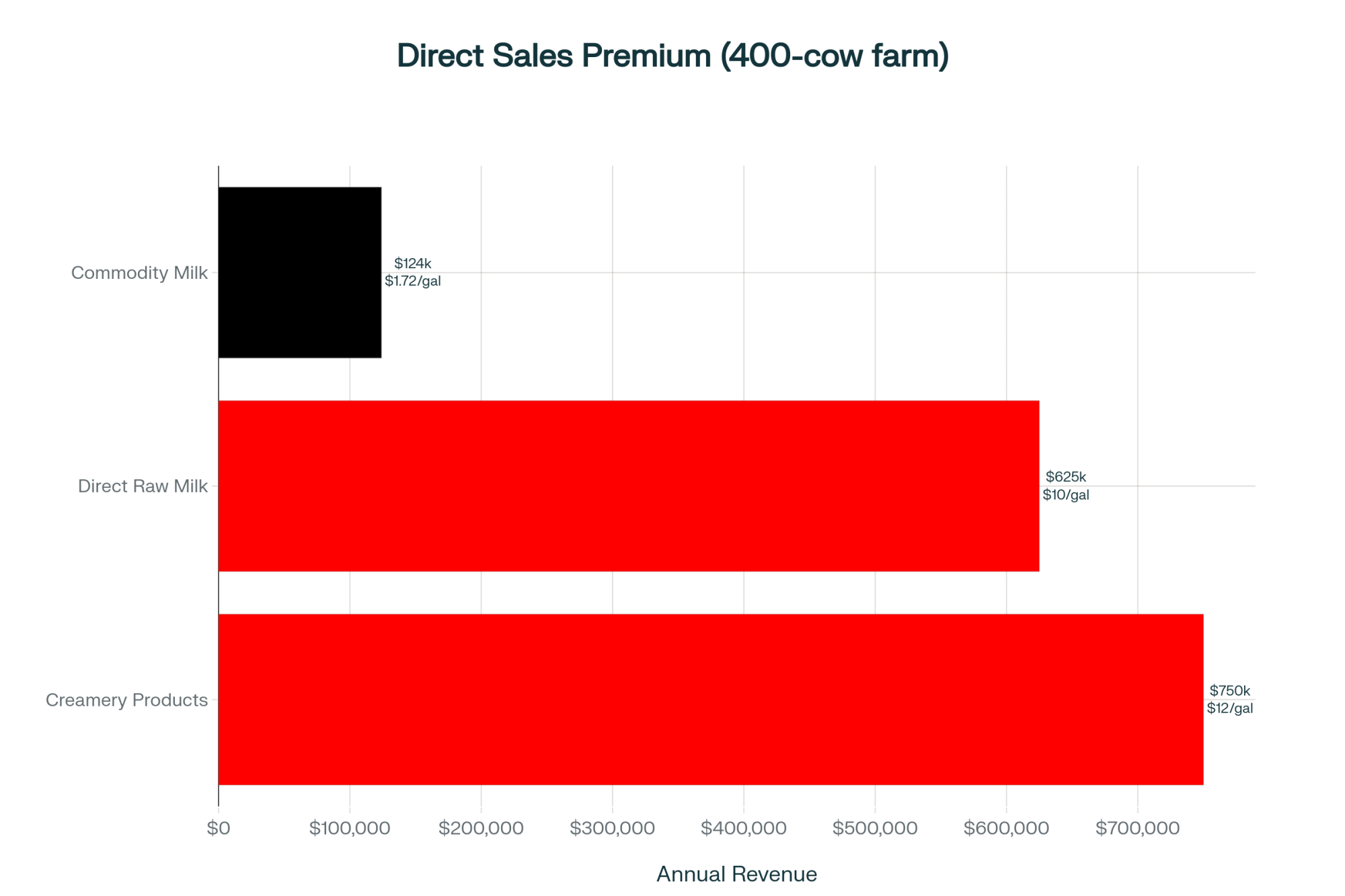
Direct-to-consumer sales are providing some farmers with genuine pricing power. The Farm-to-Consumer Legal Defense Fund tracks this—28 states now allow raw milk sales in some form. Farmers I’ve talked with are getting $8-12 per gallon. That’s a 400-600% premium over conventional farmgate prices.

Direct-to-consumer sales command 400-600% premiums over commodity milk—a viable escape route from cooperative dependency

Cost Comparison Reality Check: Let me break down the numbers:

  • Conventional milk price: $18-20/cwt (works out to roughly $1.55-1.72/gallon)
  • Direct raw milk sales: $8-12/gallon
  • Investment needed: $50,000-150,000 for on-farm processing setup
  • Payback period: Generally 18-36 months if you shift 20% of production to direct sales

Even moving 20% of your production to direct sales can fundamentally change your negotiating position. You’re no longer completely dependent on that co-op milk check.

Dan Stauffer, a California dairy farmer I know, started an on-farm creamery specifically because—as she put it—”the $4.00 deduct combined with all the other standard deductions has made it impossible for us to cash flow.” She didn’t wait for reform. She built an alternative.

One important note, though: regulations vary significantly by state. What works in Pennsylvania won’t necessarily fly in Wisconsin. Always check with your state department of agriculture before making any moves.

2. Regional Cooperative Alternatives

Some farmers are successfully exploring smaller, regional cooperatives with more transparent governance. Research from the University of Wisconsin Center for Cooperatives shows these smaller co-ops often feature:

  • Direct member voting on major investments (imagine that!)
  • Transparent pricing tied to actual costs
  • Limited or no speculative facility construction
  • Focus on value-added products rather than commodity volume

The challenge? Leaving a major cooperative often involves exit fees, equity complications. But here’s what I’m seeing—when groups of farmers coordinate their intentions (legally, of course), cooperatives sometimes become more flexible on governance reforms. Funny how that works.

3. Advocacy for Practical Reforms

Rather than waiting for comprehensive federal legislation—which, let’s be honest, probably isn’t coming anytime soon—farmers are pursuing achievable state-level reforms.

In Wisconsin, a group of farmers filed formal complaints with the state Department of Agriculture regarding violations of cooperative governance. Outcomes are still pending, but it’s gotten attention.

Similarly, farmers in New York are working with their state attorney general’s office on transparency requirements for agricultural cooperatives. These aren’t radical demands. Just basic stuff like seeing the actual construction contracts before being asked to pay for overruns.

4. Strategic Production Management

This one’s delicate, but some farmers are discovering they can influence cooperative behavior through coordinated (but legal) production decisions. If enough members strategically manage production volumes, it creates leverage for governance reforms.

I’m not talking about illegal collusion here. Just individual business decisions that happen to align. When cooperatives see milk volumes dropping, board meetings suddenly become much more interesting.

Key Industry Trends to Watch

Based on conversations I’ve had with industry analysts and extension economists, here’s what I’m tracking:

Processing capacity utilization: Multiple sources suggest plants will operate at 65-75% capacity through 2026 due to milk supply constraints from labor shortages. That’s going to create margin pressure throughout the system. No way around it.

Consolidation acceleration: USDA data shows 2,800 farms closed in 2025. And that’s not the peak—it’s the baseline. Mid-size operations (500-1,500 cows) are facing the greatest pressure. I’m particularly worried about dairies in that sweet spot—too big to go niche but too small to achieve mega-dairy economies of scale.

2,800 dairy farms closed in 2025 alone—nearly double the baseline. The consolidation accelerates while processors invest $11 billion

Immigration policy evolution: Watch for potential executive orders creating temporary pathways for dairy workers. Congressional solutions remain blocked, but I’m hearing administrative workarounds are being discussed at USDA. Sources familiar with the discussions say something might be coming, but I’ll believe it when I see it.

Cooperative governance pressure: The Darigold situation has awakened member interest in governance reform across multiple cooperatives. I’m hearing rumblings from DFA and Land O’ Lakes members about demanding more transparency. About time, if you ask me.

Alternative marketing growth: Direct sales, regional brands, on-farm processing—all continuing to expand. The economics are compelling. Capturing even a portion of that processor-to-retail margin changes everything.

Practical Takeaways for Dairy Farmers

After researching this issue and talking with dozens of farmers, here’s my best advice:

1. Understand your cooperative’s governance structure. Get copies of the bylaws. Read them. Actually read them. Request documentation of how major capital decisions are made. Know your rights—you might have more than you think.

2. Evaluate diversification options. Run the numbers on direct sales or value-added processing. Even if you don’t pull the trigger, knowing your alternatives strengthens your position.

3. Document workforce challenges. Keep detailed records of recruitment efforts, wage offers, and position vacancies. This data matters for policy advocacy and might be required for future visa programs.

4. Build regional alliances. There’s strength in numbers. Coordinated action among neighboring farms—whether for governance reform, marketing alternatives, or workforce solutions—multiplies individual leverage.

5. Monitor capacity developments. Understanding regional processing capacity and utilization rates helps inform production and marketing decisions. If your processor is running at 60% capacity, that affects your negotiating position.

6. Prepare for workforce disruption. Develop contingency plans now. Cross-train employees, investigate automation options where feasible, and build relationships with temporary labor providers. Hope for the best, plan for the worst.

The Road Ahead

Looking at this $11 billion infrastructure investment, I see both dairy’s ambition and its fundamental challenge. We’re building world-class processing capacity while the workforce foundation—both on farms and in plants—is crumbling beneath us.

The Darigold experience isn’t just a cautionary tale. It’s a preview of what happens when expansion proceeds without addressing underlying structural issues. Farmers pay the price while contractors, consultants, and executives move on to the next project.

What’s become clear to me is that the disconnect between processing infrastructure and workforce reality isn’t just a temporary mismatch. It’s a structural crisis that requires fundamental reforms in how cooperatives govern themselves, how immigration policy treats agricultural workers, and how the industry plans for the future.

For dairy farmers navigating this environment, waiting for top-down solutions while writing checks for bottom-up failures isn’t sustainable. The operations that survive and thrive will be those that recognize the current system’s limitations and actively build alternatives—whether through direct marketing, governance reform, or strategic cooperation with like-minded producers.

The infrastructure bet has been placed. The steel is welded, and the dryers are installed. Now we need to ensure farmers aren’t the only ones covering the spread when the dice don’t roll our way.

Because at the end of the day, all those shiny new plants don’t mean a damn thing if there’s nobody left to milk the cows—or if the farmers have gone broke paying for the factory’s cost overruns.

KEY TAKEAWAYS

  • Check your cooperative governance NOW: If your board can approve $50M+ projects without direct member vote, you’re one announcement away from a $4/cwt deduction. Demand to see construction contracts, board votes, and risk allocation before the next expansion—farmers discovering they have legal recourse for unapproved overruns.
  • Build your escape route before you need it: Direct-to-consumer sales command $8-12/gallon (vs. $1.72 conventional) with $50-150K setup costs and 18-36 month payback. Moving just 20% of production creates leverage and covers deduction losses—28 states allow it, but check regulations first.
  • Document everything related to the workforce crisis: keep detailed records of every recruitment attempt, wage offers ($45-50/hr for skilled positions), and unfilled positions. You’ll need this evidence when immigration reform finally comes or when explaining why you can’t meet production contracts after raids.
  • Power comes from numbers, not hoping: Cooperative boards ignore individual complaints but panic when 10+ farms coordinate action. Whether demanding governance reforms, exploring alternative cooperatives, or strategic production management—allied farmers are getting results while solo operators just get bills.

Learn More: 

Join the Revolution!

Join over 30,000 successful dairy professionals who rely on Bullvine Weekly for their competitive edge. Delivered directly to your inbox each week, our exclusive industry insights help you make smarter decisions while saving precious hours every week. Never miss critical updates on milk production trends, breakthrough technologies, and profit-boosting strategies that top producers are already implementing. Subscribe now to transform your dairy operation’s efficiency and profitability—your future success is just one click away.

NewsSubscribe
First
Last
Consent

The $11 Billion Gap: Where Processing Investment Meets Producer Reality

Processing capacity explodes while producer equity stays locked for decades—who really benefits from co-op investments?

EXECUTIVE SUMMARY: What farmers are discovering through recent IDFA data is a fundamental disconnect between processing prosperity and producer profitability—$11 billion in new dairy processing investments across 19 states through 2028, yet milk checks continue facing downward pressure from increased make allowances that took effect June 1. The numbers tell the story: New York leads with $2.8 billion in processing investment, Texas adds $1.5 billion, and Wisconsin contributes another $1.1 billion, while the new FMMO makes allowances that reduce farm milk prices by $0.2519 per pound of cheese and similar amounts across other products. Here’s what this means for your operation: December 1 brings new skim milk composition factors that jump protein baselines from 3.1% to 3.3% and other solids from 5.9% to 6.0%—farms below these levels face penalties while those exceeding them capture premiums worth $8,640 annually for a typical 200-cow herd. Recent research from the National Milk Producers Federation indicates that coordinated producer action has achieved meaningful FMMO reform; however, participation in cooperative governance remains critically low, limiting producer influence over billion-dollar investment decisions funded by member equity. Looking ahead, farms that optimize components before December, understand their complete economic picture, including equity positions, and actively engage with their marketing organizations will be best positioned to navigate this widening gap between processing investment and producer returns.

dairy profitability guide

When the International Dairy Foods Association announced its plans for $11 billion in dairy processing investments across 19 states on October 1st, it sparked conversations from coast to coast. Producers are grappling with a fundamental disconnect—massive capital is flowing into processing facilities, while milk checks remain under pressure.

Looking at the numbers from IDFA, we’re talking about more than 50 individual building projects between now and early 2028. New York leads with $2.8 billion, Texas follows at $1.5 billion, and Wisconsin adds another $1.1 billion in processing capacity. That’s real investment—the kind that should signal opportunity. Yet many of us are dealing with prices that tell a different story entirely.

Quick Reference: Key Dates & Numbers

December 1, 2025: New FMMO skim milk composition factors take effect

  • Protein baseline increases: 3.1% → 3.3%
  • Other solids baseline increases: 5.9% → 6.0%

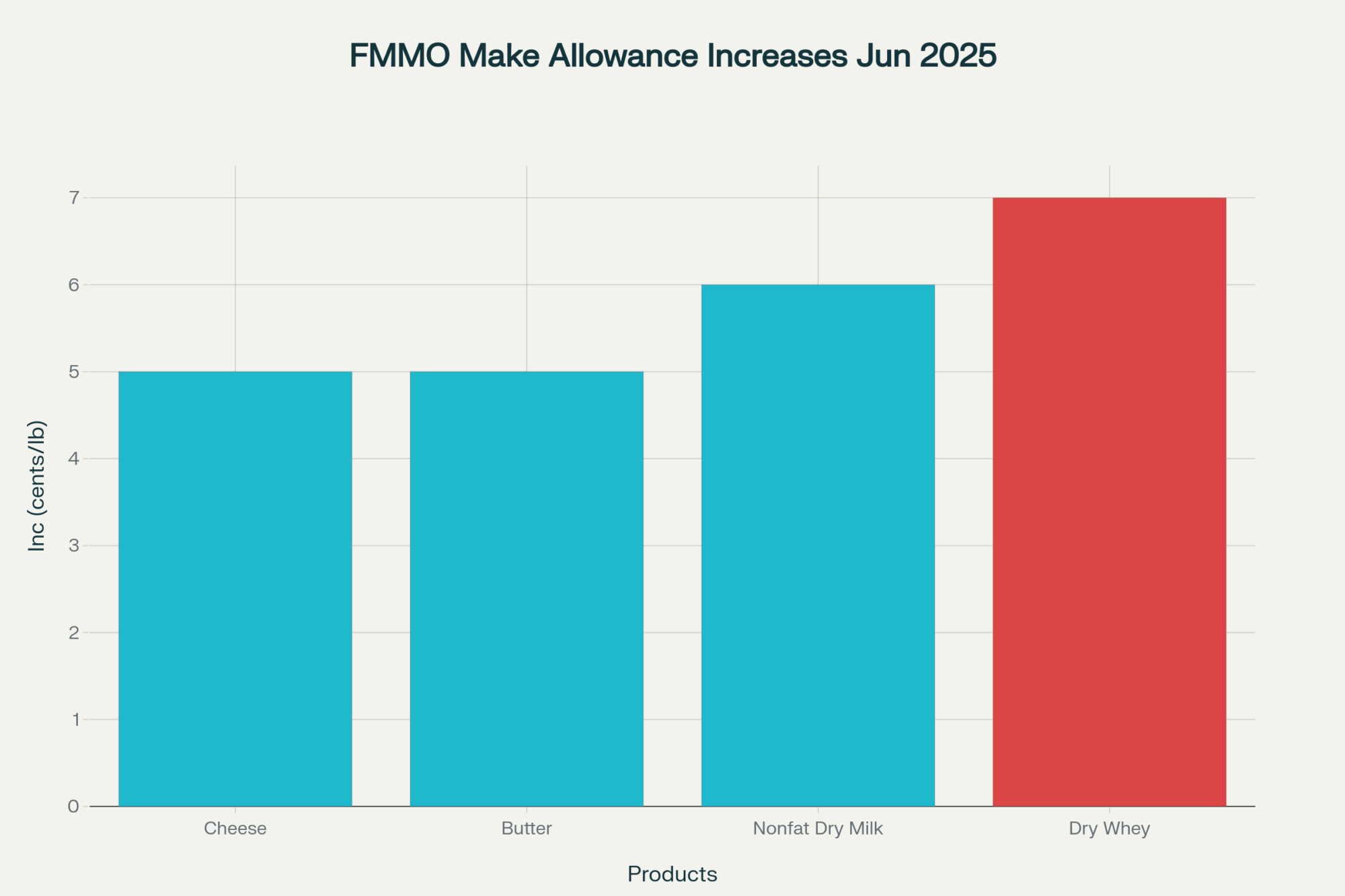
June 1, 2025: FMMO makes allowance changes implemented

  • Cheese: $0.2519/lb
  • Dry whey: $0.2668/lb
  • Butter: $0.2272/lb
  • Nonfat dry milk: $0.2393/lb

Processing Investment by State:

  • New York: $2.8 billion
  • Texas: $1.5 billion
  • Wisconsin: $1.1 billion
  • Idaho: $720 million

Understanding the Processing Boom

Michael Dykes, IDFA President and CEO, shared in their October announcement that the industry expects U.S. milk production to grow by 15 billion pounds by 2030. That’s what’s driving this expansion—cheese plants alone account for $3.2 billion of the investment, with milk and cream facilities adding another $2.97 billion.

The $11 Billion Processing Investment Wave reveals where dairy capital is flowing—and why your milk’s destination matters more than ever for pricing power.

What’s particularly interesting is how this investment concentrates geographically. When New York sees $2.8 billion in processing investment, that fundamentally reshapes milk movement patterns for the entire Northeast. Producers in Pennsylvania and Vermont will feel those ripples. Texas, with its $1.5 billion investment, creates new dynamics in a region that has been expanding dairy production for years—from the Panhandle down to Central Texas. Idaho’s receiving $720 million, which affects not just Idaho producers but also those in Eastern Oregon and Northern Utah.

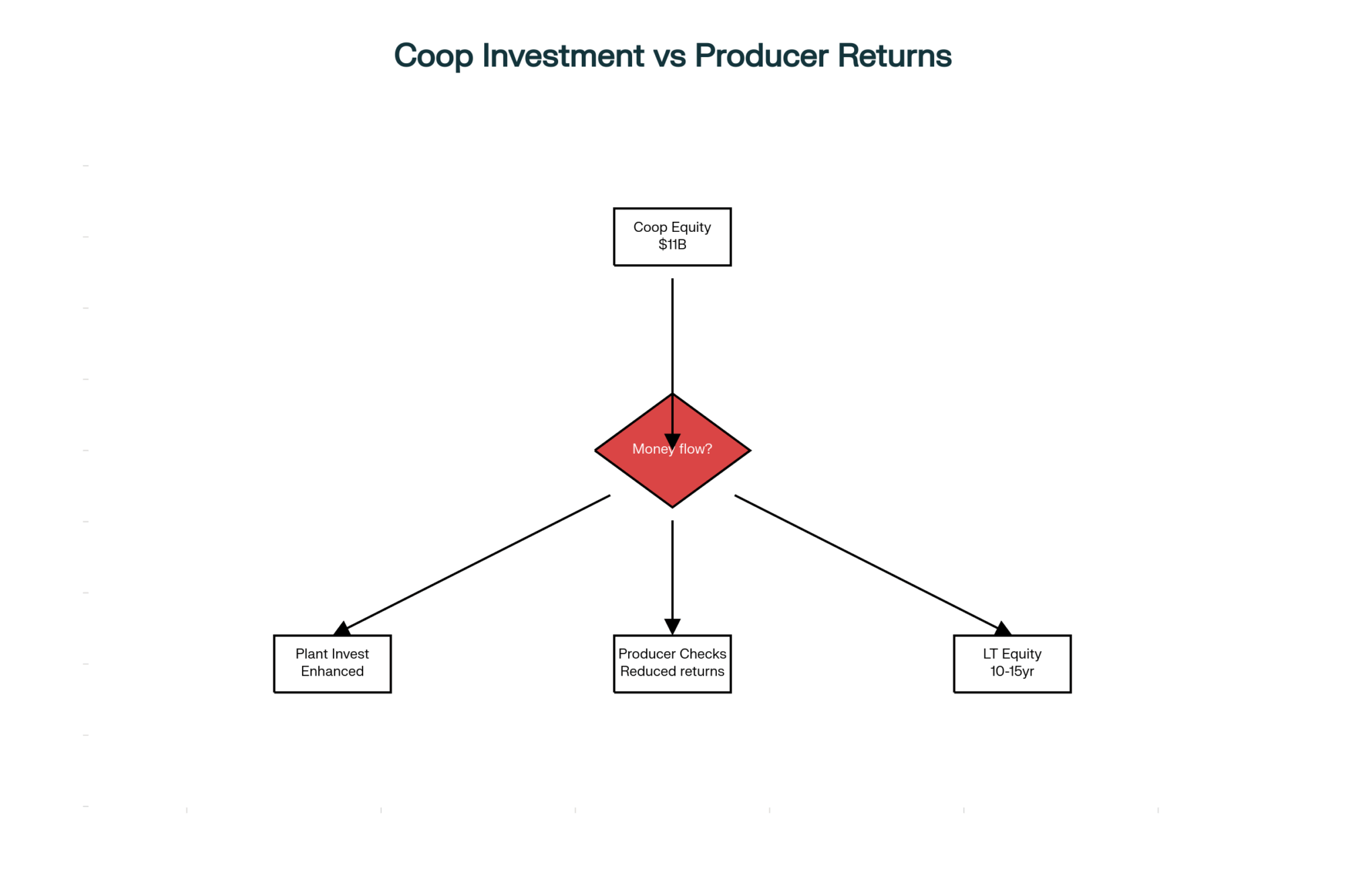
Here’s what gets me thinking: when cooperatives build these facilities, that capital comes from somewhere—typically retained earnings and member equity. We’re essentially wearing two hats, as milk suppliers and infrastructure investors. But the returns on that investment? They often take forms that don’t help today’s cash flow. It’s our money working in the system, but not necessarily working for us in the short term.

The Make Allowance Reality Check

Make Allowance Reality: June 2025 increases transfer $337 million from producer pools to processor margins—every cent per pound comes directly from your milk check.

The new Federal Milk Marketing Order reforms, which took effect on June 1, 2025, represent the most comprehensive overhaul in over two decades. According to the USDA’s announcement and as confirmed by the National Milk Producers Federation, these changes include significant updates to make allowances—those deductions from commodity prices that guarantee processor margins before calculating what producers receive.

Here’s how the math works: USDA takes the commodity price—say cheese—then subtracts the make allowance before determining our milk price. The new rates, which took effect on June 1, increased to $0.2519 for cheese (up from previous levels), $0.2668 for dry whey, $0.2272 for butter, and $0.2393 for nonfat dry milk. When these allowances increase, our prices decrease, regardless of the strength of the commodity market.

Gregg Doud, NMPF President and CEO, acknowledged after the reforms passed that “this final plan will provide a firmer footing and fairer milk pricing.” However, he also noted that NMPF continues to push for mandatory plant-cost studies to inform future better make allowance discussions. Why? Because the current process relies on voluntary cost surveys from processing plants, and participation varies considerably.

These aren’t just numbers on paper—they directly impact cash flow on every farm shipping milk. For producers managing volatile feed costs and labor challenges, understanding these deductions becomes essential for financial planning. The Difference between what consumers pay for dairy products and what we receive for milk keeps widening, and make allowances are a key part of that equation.

The Component Revolution Nobody’s Talking About

Now here’s where things get really interesting for those of us focused on milk quality. The USDA’s final FMMO rule includes new skim milk composition factors, which take effect on December 1, 2025. The baseline assumptions jump from 3.1% protein to 3.3%, and other solids increase from 5.9% to 6.0%.

Let me walk through what this means with real numbers—and trust me, this matters more than you might think.

The Component Revolution shows how genetic improvements are reshaping dairy economics—farmers optimizing for 4.2%+ butterfat and 3.3%+ protein capture December’s FMMO premium opportunities.

Component Payment Scenarios: Before and After December 1

Milk Quality LevelCurrent System PaymentAfter December 1 PaymentAnnual Difference (200-cow herd)
Below Average (3.0% protein, 5.8% other solids)Baseline-$0.15/cwt penalty-$7,500
Average (3.1% protein, 5.9% other solids)Baseline-$0.08/cwt penalty-$4,000
Above Average (3.4% protein, 6.2% other solids)+$0.12/cwt premium+$0.28/cwt premium+$8,000

On 100,000 pounds of milk monthly, moving from 3.1% to 3.4% protein means an extra 300 pounds of protein. With CME Class III futures for October 2025 trading around $18.81 per hundredweight, and protein contributing roughly $2.40 per pound to that value, we’re talking about $720 more per month—$8,640 annually—just from that protein improvement.

What’s encouraging is that many operations have already been moving in this direction. Through focused breeding programs that select for specific components, optimized nutrition management, and improved cow comfort, farms across the country are consistently achieving these higher levels of performance. The December changes will reward those investments.

Regional Dynamics: How This Plays Out Across the Country

The economics of hauling milk have undergone significant shifts over the past few years. With diesel prices volatile and the American Trucking Association reporting ongoing driver shortages, geography matters more than ever.

In the Upper Midwest (Wisconsin, Minnesota, Northern Iowa), where multiple processors compete for milk, we’re seeing different dynamics than in regions dominated by a single plant. Competition can create premium opportunities—but only if you’re positioned to take advantage. Smaller operations near county lines where two co-ops overlap have leverage. Those in the middle of a single co-op’s territory? Not so much.

The Southwest (Texas, New Mexico, Arizona) presents a different picture entirely. That $1.5 billion Texas investment creates new capacity in a region where dairies are larger on average—many over 2,000 cows. These operations have different leverage points than a 150-cow farm in Vermont. Scale matters, and we need to be honest about it.

The Southeast (Georgia, Florida, South Carolina) faces unique challenges. Limited processing options, longer haul distances, and heat stress affecting components all factor in. A producer in South Georgia might be 200 miles from the nearest plant—that changes everything about their economics.

California and the West continue their own evolution. With environmental regulations, water concerns, and some of the nation’s largest herds, the dynamics there don’t translate easily to other regions. What works for a 5,000-cow operation in the Central Valley won’t work for most of us.

Cooperative Governance: The Participation Problem

The Cooperative Capital Flow reveals why your $11 billion investment benefits processors immediately while your equity sits locked for decades—understanding this changes everything

Michael Dykes from IDFA has noted the ongoing consolidation across the industry. That consolidation affects how cooperatives operate and how producer voices get heard in decision-making.

The democratic principles underlying cooperatives assume active member participation. But reality often looks different. Financial presentations can be dense—I’ve sat through three-hour annual meetings where the financials took 20 minutes to present and nobody had time to digest them. Meeting locations might require significant travel. Timing often conflicts with critical farm operations.

This participation gap has real consequences. When only a fraction of members actively engage, investment decisions involving millions of dollars in member equity may be approved by a small percentage of those whose capital is at stake.

The National Milk Producers Federation has been working to address these challenges through their modernization efforts. After more than 200 meetings to formulate their FMMO proposals, they’ve shown what coordinated producer action can achieve. However, that level of engagement remains the exception rather than the rule at the individual cooperative level.

Some cooperatives are experimenting with digital participation options and regional listening sessions. Land O’Lakes started streaming their annual meeting. DFA holds regional forums. These are positive steps, though changing institutional culture takes time. The question is whether traditional governance structures can evolve fast enough to maintain relevance for modern dairy operations.

Component Improvement Checklist

Before December 1:

  • Test current butterfat, protein, and other solids levels
  • Calculate the potential impact of new baselines on your milk check
  • Review genetics—are you selecting for components?
  • Evaluate the ration with a nutritionist for component optimization

Ongoing Management:

  • Monitor individual cow components through DHIA testing
  • Focus on transition cow management (affects entire lactation)
  • Maintain consistent feed quality and delivery
  • Optimize cow comfort (stressed cows produce lower components)
  • Consider breed composition (Jersey influence can boost components)

Alternative Strategies Emerging

What’s encouraging is the diversity of approaches producers are exploring. Direct relationships with processors can offer customized pricing structures, provided they are accompanied by consistent volume and quality. Several operations I know have negotiated premiums ranging from modest to substantial per hundredweight above standard cooperative prices.

The organic market continues showing strength despite its challenges. USDA data from February 2025 shows Mexico and Canada imported a record $3.61 billion in U.S. dairy products in 2024, with organic products capturing premium positions in these markets. For operations that can manage the three-year transition and meet certification requirements, the economics can work—but it’s about more than just the premium. It requires finding reliable buyers and adapting your entire management system.

Value-added processing represents another path. Small-scale cheese operations, bottling facilities, even yogurt production—the margins can be compelling for artisan products. However, it requires capital, regulatory expertise, and market development skills that extend far beyond traditional dairy farming. The folks succeeding here often started small, learned the market, then scaled based on actual demand rather than hoped-for sales.

The International Trade Wild Card

Here’s something that could change everything: trade relationships. According to IDFA’s February 2025 data, Mexico and Canada account for more than 40% of U.S. dairy exports, with Mexico importing a record $2.47 billion and Canada importing $1.14 billion in 2024. China and other Asian markets continue growing, too.

Matt Herrick, IDFA’s Executive Vice President and Chief Impact Officer, emphasized that industry growth “depends on strong trade relationships and access to essential ingredients, finished goods, packaging, and equipment.” With exports needing to absorb more production growth in the coming years, any disruption to these relationships could fundamentally alter supply-demand dynamics.

Export Market Reality: 40% of US dairy exports flow to Mexico and Canada—any trade disruption could fundamentally shift supply-demand dynamics for your milk.

The current political climate adds uncertainty. Trade policy shifts could impact everything from cheese exports to whey protein concentrate markets. Producers need to consider these risks in their long-term planning. A cooperative heavily invested in export facilities might face different pressures than one focused on domestic markets. Understanding your milk buyer’s exposure to trade risks becomes part of evaluating your own risk profile.

Practical Steps for Today’s Environment

Given all this complexity, what should producers actually do?

First, calculate your complete economic picture before the December component changes take effect. Know your current component levels, understand how the new factors will affect your payments, and identify opportunities for improvement. The University of Wisconsin’s Center for Dairy Profitability, along with similar extension services, offers tools to assist with these calculations. Cornell’s PRO-DAIRY program has excellent resources. Penn State Extension runs workshops on this topic.

Second, build market intelligence even if you’re satisfied with current arrangements. Understand what others in your region are receiving. Know what alternative markets require. CME futures can give you insights into price trends—Class III futures for late 2025 are trading in the $18-19 range, suggesting some market stability ahead. But futures only tell part of the story.

Third, focus relentlessly on controllables. Component quality, especially with the new FMMO factors coming into effect on December 1, means that every tenth of a percent improvement in protein or other solids translates directly to revenue. Feed management, genetics, cow comfort—these fundamentals matter more than ever. That might sound basic, but I keep seeing operations leave money on the table by not optimizing what they can control.

Fourth, engage with your cooperative or marketing organization. The FMMO modernization process showed what coordinated producer action can achieve. Ask specific questions about how processing investments benefits members. Push for transparency about capital allocation. Your voice matters, but only when used. And if you can’t make meetings, find someone you trust who can represent your interests.

Resources for Immediate Action

Component Optimization:

  • University of Wisconsin Center for Dairy Profitability: cdp.wisc.edu
  • Cornell PRO-DAIRY: prodairy.cornell.edu
  • Penn State Extension Dairy Team: extension.psu.edu/dairy

Market Intelligence:

  • CME Group Dairy Futures: cmegroup.com/dairy
  • USDA Agricultural Marketing Service: ams.usda.gov
  • National Milk Producers Federation: nmpf.org

FMMO Information:

  • USDA Final Rule Details: ams.usda.gov/fmmo
  • NMPF FMMO Resources: nmpf.org/fmmo-modernization

The Path Forward

The disconnect between $11 billion in processing investment and producer returns reflects structural challenges in how our industry captures and distributes value. It’s not about villains and heroes—it’s about understanding economic dynamics and positioning ourselves accordingly.

According to USDA data released in December 2024, per capita dairy consumption reached 661 pounds in 2023, up 7 pounds from the previous year. Cheese consumption hit a record 42.3 pounds per person, and butter reached 6.5 pounds—the highest since 1965. Consumer demand is strong. The processors investing billions see opportunity.

Our challenge is ensuring producers capture fair value from that demand growth. Based on what I’m seeing—producers asking harder questions, exploring alternatives, demanding transparency—there’s reason for cautious optimism. The challenges are real. But so is the resilience I see across dairy farming communities every day.

The FMMO modernization victory demonstrates what’s possible when producers collaborate. As Gregg Doud noted, “Dairy farmers and cooperatives have done what they do best—lead their industry for the benefit of all.” That leadership needs to continue as we navigate these changes.

Because at the end of the day, all that processing capacity means nothing without the milk we produce. And that gives us more leverage than we sometimes realize. The key is using it wisely, strategically, and together.

The December 1st component changes are coming whether you’re ready or not. The processing investments will reshape regional markets regardless of your participation. Trade policies will shift with the political winds. But your response to these changes—that’s entirely within your control. Make it count.

KEY TAKEAWAYS

  • Component optimization delivers immediate returns: Moving from 3.1% to 3.4% protein generates $720 monthly ($8,640 annually) per 100,000 pounds of milk—achievable through focused genetics, nutrition management, and transition cow care before December 1st changes take effect
  • Regional dynamics create different opportunities: Upper Midwest producers near multiple plants can leverage competition for premiums, while Southeast operations facing 200-mile hauls need superior components or specialty markets to offset transportation disadvantages—know your regional leverage points
  • Cooperative equity redemption stretches 10-15 years on Average: That $11 billion in processing investment comes from producer capital that’s locked up for decades—calculate your true net per hundredweight, including all equity obligations, not just your mailbox price
  • Trade relationships determine future stability: With Mexico and Canada representing 40% of U.S. dairy exports ($3.61 billion in 2024), any disruption could shift supply-demand fundamentally—understand your milk buyer’s export exposure as part of your risk assessment
  • Active governance participation matters more than ever: NMPF’s successful FMMO modernization after 200+ meetings shows what coordinated action achieves—if you can’t attend cooperative meetings, designate a trusted representative to ensure your interests are heard in billion-dollar investment decisions

Complete references and supporting documentation are available upon request by contacting the editorial team at editor@thebullvine.com.

Learn More:

Join the Revolution!

Join over 30,000 successful dairy professionals who rely on Bullvine Weekly for their competitive edge. Delivered directly to your inbox each week, our exclusive industry insights help you make smarter decisions while saving precious hours every week. Never miss critical updates on milk production trends, breakthrough technologies, and profit-boosting strategies that top producers are already implementing. Subscribe now to transform your dairy operation’s efficiency and profitability—your future success is just one click away.

NewsSubscribe
First
Last
Consent
Send this to a friend