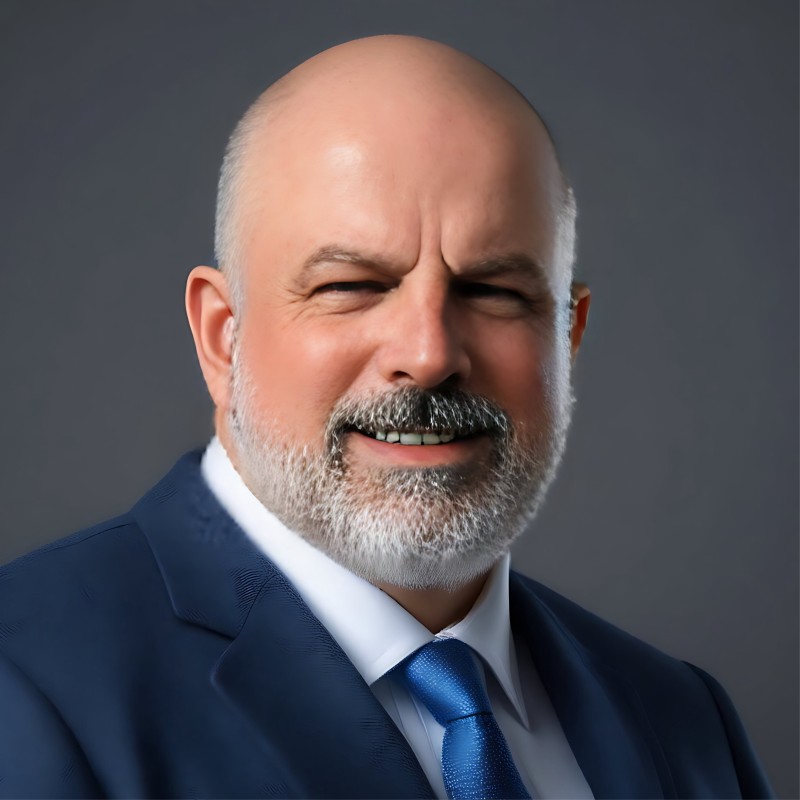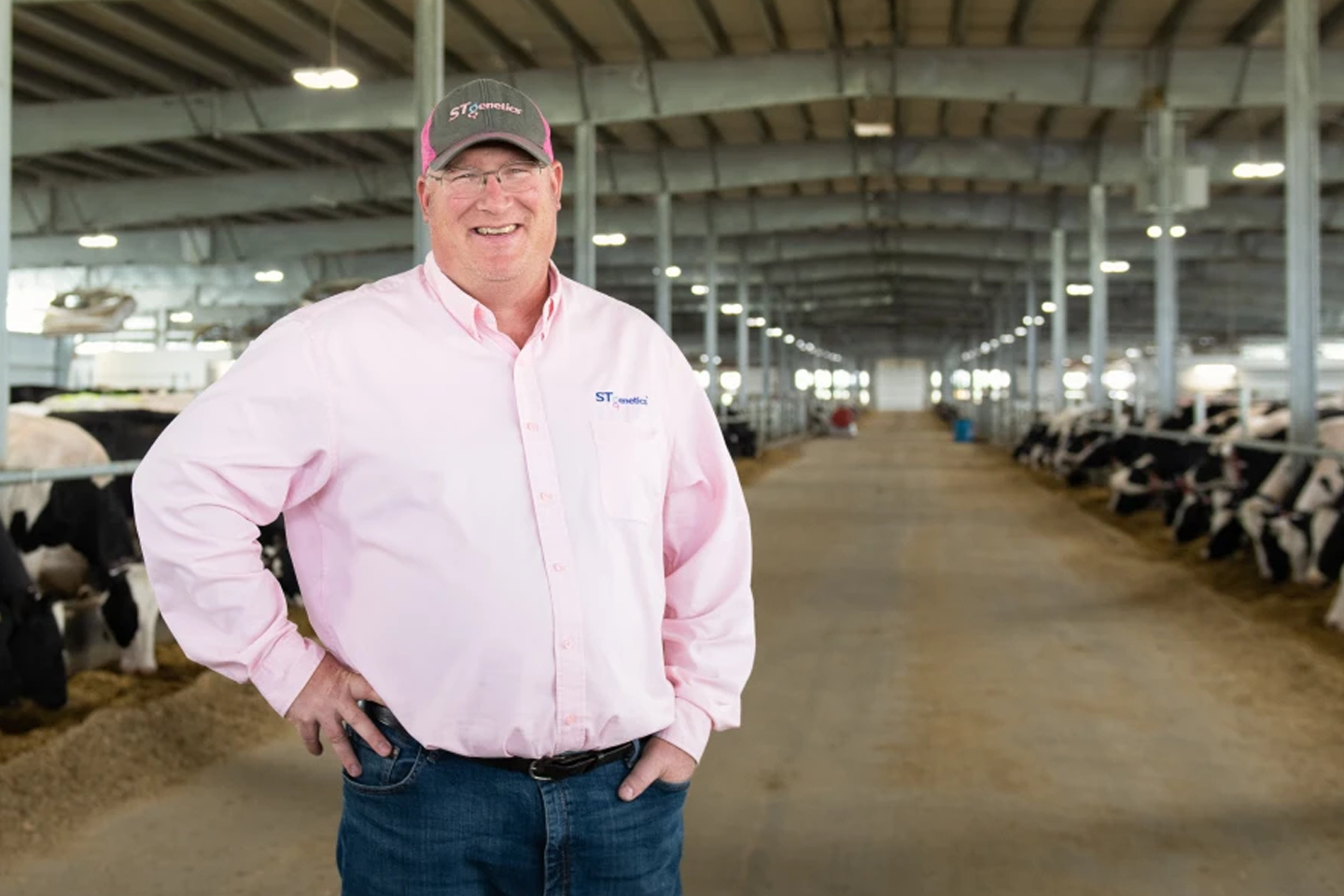
The dairy industry lost one of its quiet builders Sunday afternoon. Paul Detwiler — the man who built Select Sires’ direct-transfer embryo business in the 1990s and then ran the STgenetics Ohio Heifer Center, the operation that helped cut the Holstein generational interval roughly in half — was killed in a tractor rollover on his own property in Jerome Township, Ohio. He was 60.
The Union County Sheriff’s Office says Detwiler was using a John Deere 1025R sub-compact utility tractor to spray weeds on a ditch line outside a guardrail near Courier Road and Converse Huff Road when the tractor tipped on an embankment with a five-to-seven-foot drop. His wife went looking for him when he didn’t come back. Firefighters found him in the ditch with the tractor on top of him. Deputies were dispatched at 2:06 p.m. The investigation is ongoing with the Union County Coroner’s Office; Lt. Josh Kent says the incident is being treated as an accident.
Kent’s other line is the one that will stick with anyone who has ever bolted a sprayer onto a 25-horse compact: “It’s definitely not a lawn mower.”
He’s right, and that is a thing this industry needs to sit with. We will come back to it.
The embryo guy at Select before “the embryo guy” was a job description
Detwiler graduated from Ohio State in 1988 with a B.S. in dairy science and reproductive physiology — exactly the toolkit for what came next. In February 1995, Select Sires put him in charge of the embryo division at Plain City. He spent the next eight years building something that did not really exist at the scale he was about to scale it: a global direct-transfer embryo business.
Direct-transfer was the unsexy plumbing that made elite genetics portable. Frozen embryos a trained tech could thaw and place in a recipient without the lab gymnastics conventional ET demanded. Detwiler led the worldwide sales build-out. If you have ever moved Holstein, Jersey, or beef-on-dairy genetics across a border in a nitrogen tank instead of on a hoof, you were operating in a marketplace he helped build.
In April 2003 he moved to COBA/Select Sires as sales manager for North Central Ohio. Select Sires later named him a Super Achiever — the cooperative’s top sales honor. People who worked with him in those years remember a guy who could explain a NM$ proof, a sexed-semen conception rate, and a customer’s cash-flow problem in the same conversation without losing anyone in the room.
Running the farm that broke the clock
In April 2011, Detwiler took the general manager job at the STgenetics Ohio Heifer Center near South Charleston. On the surface, it was a heifer-raising operation. In practice, it became one of the most aggressive applied-reproduction laboratories on the planet.
Under his watch, the operation grew to roughly 5,000 females and about 900 milking cows, the majority first lactation. Around 250 calves are born there every month — and roughly 95% of them come from embryo transfer, not natural service or conventional AI. The farm flushes 1,500 to 2,000 oocytes a week from genomically elite donors, fertilizes them with sexed semen by IVF, and produces about 500 embryos a week placed into recipients on the Ohio farm and on partner farms.
The number that gets dairy geneticists’ attention isn’t the volume. It’s the age. ST collects oocytes from donors at five to eight months old — before they have ever been bred. That is the move that compressed a generational interval the industry had lived with since herdbooks were paper, dropping it from the conventional 20-to-24 months down toward roughly 14 to 16 — oocyte at seven months, plus nine months in a recipient cow. Detwiler told the Irish Farmers Journal in 2024 that ST “only takes back the cream of the calf crop, as determined by their genotype” — bull calves to the AI studs for further evaluation, the elite heifers retained to be flushed at seven months and started over.
In 2019 he told Farm Flavor the place was “an ordinary dairy farm doing extraordinary things.” It was not an ordinary dairy farm. It was where a meaningful share of the world’s next-generation Holstein, Jersey, and beef-on-dairy bulls were being conceived before their dams were old enough to breed.
The Ohio Heifer Center also became ST’s research engine for EcoFeed, the company’s feed-efficiency and methane-emissions program — collecting individual-animal intake and emissions data at a scale almost no commercial operation can match, then feeding those phenotypes into the genomic indexes that end up on a sire page in a producer’s hand at World Dairy Expo.
The other half of the farm
People in Union County did not talk about Paul Detwiler as a genetics executive. They talked about him as Shelly’s husband — Shelly being the fifth-generation farmer who turned her family’s place on Mitchell-Dewitt Road, just over in Plain City, into Mitchell’s Berries, the U-pick strawberry and flower operation that has become a Central Ohio institution. Paul was co-owner from 2006 on. He showed up. He moved irrigation. He talked to customers in the rows.
That is the part of the obituary that does not make the trade press, and it is the part that almost certainly mattered to him most. A man who could fly to a sexed-semen conference in the morning and pick strawberries with his wife in the afternoon, and treat both as serious work.
The part the industry has to sit with
Lt. Kent said it on Sunday and we are going to say it again on Monday: a sub-compact utility tractor is not a lawn mower. It is a tractor — with a high center of gravity, a chore-grade footprint that lies to you about stability on a slope, and no rollover protection you can trust on a ditch bank if you are not strapped in.
The data is brutal and it has been brutal for a long time. According to NIOSH and the CDC’s MMWR, tractor overturns are the single leading cause of work-related deaths in U.S. agriculture, killing roughly 130 farmers and farm workers in this country every year. NIOSH estimates that fatality rates from rollovers could be cut by at least 71% if every tractor in the U.S. were fitted with a rollover protective structure and the operator was belted in. The University of Iowa’s Great Plains Center for Agricultural Health puts the experienced-operator figure at 80% of overturn deaths — these are not green kids. These are people who have run tractors their whole lives.
This is the contradiction this industry needs to sit with. A man who helped move the world’s most valuable dairy embryos onto airplanes safely was killed at 60 by a chore tractor on his own ditch bank on a Sunday afternoon. The Bullvine is not in the business of soft-pedaling that. If you run a compact tractor on slopes or shoulders, today is the day to look at your ROPS, your seatbelt, and the jobs you still try to do alone.
What we lose
A lot of people in this industry can quote a TPI off the top of their heads. Very few of them have ever moved the curve. Detwiler did — twice. First by making elite embryos portable in the 1990s and 2000s. Then by helping drag a generational interval that had defined cattle breeding for a century down to a number measured in months.
The next time you see a young genomic bull published with a top NM$ and a dam who never calved, remember that the operational reality behind that line of text — the recipients, the calvings, the data capture, the daily chores — was built by people like Paul Detwiler. He did not run the lab. He ran the farm where the lab actually had to work, every day, on real animals, with real recipients, with real calves on the ground.
Paul is survived by his wife, Shelly, and his family. Funeral arrangements have not yet been released. The Bullvine extends its sympathies to them, to his colleagues at STgenetics, COBA, and Select Sires, and to everyone in Plain City and Jerome Township who is going to miss him at the farm gate this week.
We will update this report as we learn more.