






One CDI recall hit 50+ brands and 2.6 million units. Your milk tested clean — but spread the cost across 300 members and it’s $33K–$100K a farm, off a check nobody asked you about.
Executive Summary: On April 20, 2026, California Dairies Inc. issued a voluntary Salmonella-precaution recall on bulk powder, and within weeks it cascaded into 10 downstream recalls across 50-plus brands — Ghirardelli, UTZ, Walmart, Aldi, Target, Williams Sonoma — covering more than 2.6 million units, with no illnesses confirmed. Here’s the part that should stop a CDI member cold: the cooperative’s nearly 300 farms can have those “extraordinary costs” pooled and pulled straight from their milk checks, even though their own milk tested clean. Run the math — a $10 million recall split across the membership is about $33,000 a farm, roughly $0.27/cwt off a 500-cow herd’s mailbox price; a $30 million event pushes it toward $100,000, or about $0.82/cwt. And no state or federal law requires the co-op to call you before that assessment lands quietly on your settlement statement. Three clocks govern this — the FDA’s, California’s 24-hour customer-notice rule, and the co-op bylaw clock nobody talks about — and only the last one reaches your check. The 30-day move is simple: pull your membership agreement and control-F “capital retention,” “loss allocation,” and “indemnification” before you find out the hard way what they say. Stacked on H5N1 hitting 700-plus California herds since 2024, recall exposure isn’t background noise anymore — it’s a line your lender is already modeling, whether you’ve run it or not.

Editor’s note: The 6 a.m. farm scene and the 500-cow operation described below are illustrative composites, modeled from USDA production averages and California Dairies Inc.’s published membership figures. They are not a single named dairy. All recall facts, company names, dates, pathogens, and dollar figures are drawn from FDA records and public filings as cited.
At 6 a.m. in Tulare County, the milk truck still runs on schedule.
Cows walk into the parlor the way they always do. The milk leaves the yard, heads toward the same cooperative it’s gone to for years, and not one thing about that morning feels different. No inspector at the gate. No reporters. No angry customers on the phone. But somewhere between that barn and the grocery shelf, a very different morning is unfolding — and it may eventually show up on that farm’s milk check.
On April 20, 2026, California Dairies Inc. (CDI), the member-owned cooperative based in Visalia and one of the country’s largest milk powder makers, issued a voluntary, precautionary recall of bulk non-fat dry milk and buttermilk powder over a potential Salmonella concern, according to the FDA. No product has been linked to illness, and as of publication on May 29, 2026, no illnesses have been confirmed. And honestly, a voluntary recall like this is the safety system doing its job — catching a problem before anyone gets sick. That part matters, and we’ll come back to it.
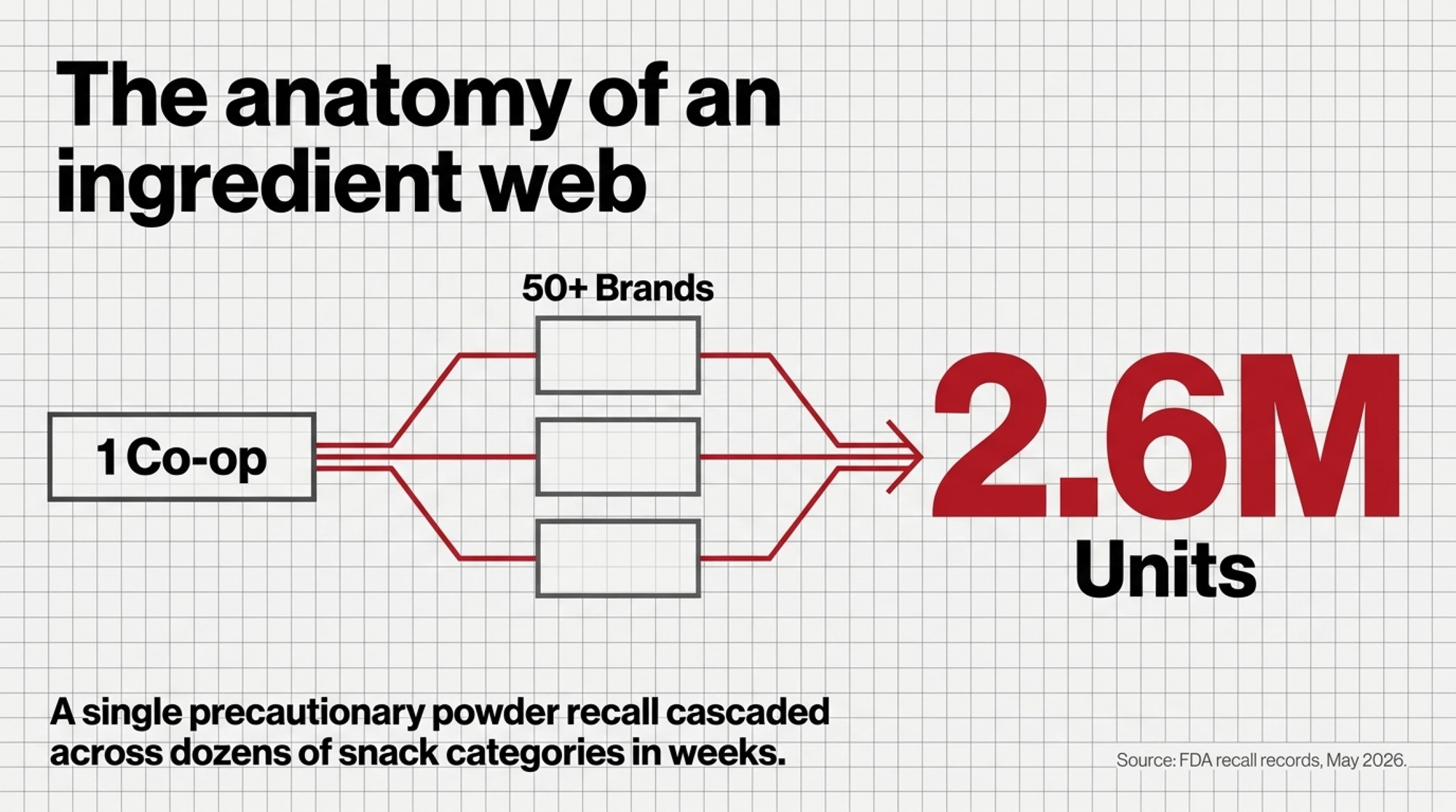
Here’s what happened next. Over the following weeks, the FDA’s recall page kept adding products — Ghirardelli drink mixes, UTZ chips, Walmart and Aldi frozen pizzas, Target’s Good & Gather snack mixes, and Williams Sonoma popcorn seasoning. By late May, the FDA counted 10 downstream products recalled in association with the original action, covering more than 2.6 million units. One co-op. One ingredient. More than 50 affected brand items across pizza, chips, popcorn, pork rinds, and beverages — and nearly 300 family farms, by the cooperative’s own count, whose milk fed those drying towers now sit inside a financial structure most of them have never actually read.
| Clock | Governed By | Notification Deadline | Who It Protects | Farm $ Impact |
|---|---|---|---|---|
| ⏱ Clock 1 — FDA Recall | Federal (FDA/FSMA) | Voluntary or ordered; firm must file recall strategy | Consumers & downstream buyers | Indirect — triggers the event |
| ⏱ Clock 2 — CA 24-Hr Rule | California state law | Within 24 hours of issuing/receiving recall notice | Retailers & downstream customers | None direct |
| ⏱ Clock 3 — Co-op Bylaw | Co-op membership agreement | No legal deadline | Co-op board/operations | Direct — assessment hits milk check |
This isn’t really a food safety story. It’s a story about plumbing — how co-ops are built, how a recall actually moves through the system, and what lands on your balance sheet even when your milk did everything right.
| Stress Event | Estimated Farm Impact (500-cow CA herd) | $/cwt Equivalent | Timing/Control | Mitigable? |
|---|---|---|---|---|
| H5N1 production loss (2024–2026) | $40K–$120K production reduction | $0.33–$0.98/cwt | Ongoing; herd-dependent | Partial (biosecurity) |
| Thin milk margin (price vs. breakeven) | ~$0.19/cwt shortfall at Feb ’26 price | $0.19/cwt | Ongoing | No — market-driven |
| CDI recall assessment ($10M scenario) | ~$33,000 off milk check | $0.27/cwt | 1-time; no warning | No — bylaw-governed |
| CDI recall assessment ($30M scenario) | ~$100,000 off milk check | $0.82/cwt | 1-time; no warning | No — bylaw-governed |
| Equipment replacement (aging mixer) | $15K–$45K depending on scale | $0.12–$0.37/cwt | Deferrable | Yes — timing flexible |
| Operating line draw (at 7% interest) | $7K–$21K/yr on $100–300K line | $0.06–$0.17/cwt | Ongoing | Partial |
What’s Changing and Why
From the outside, the CDI recall looks like a simple ingredient problem.
CDI told the FDA on April 20 that it was voluntarily pulling bulk powdered milk and buttermilk distributed to multiple wholesale distributors and manufacturers. The recall covered bulk powder shipped to other companies — not the milk in your grocery cooler. The FDA opened a dedicated tracking hub and started listing downstream recalls as companies reported them.
By late April, Ghirardelli had pulled several powdered beverage mixes. Within days, UTZ recalled chips, John B. Sanfilippo pulled snack mixes under the Fisher, Southern Style Nuts, Squirrel Brand, and Good & Gather labels, and Jonco recalled white cheddar popcorn, Food Safety News reported. By late May, the list had grown to include products tied to Walmart, Aldi, Target, QVC, and Williams Sonoma — with Stoltzfus cheese curds and more added in the final week.
Two things sit underneath that brand list. First, concentration. CDI is co-owned by nearly 300 dairy producers who ship roughly 17 billion pounds of milk a year, making it one of the largest milk-processing cooperatives in the country. When one co-op is that central to the powder supply, the downstream isn’t a tidy chain — it’s a web. Second, this is a different animal than dairy usually deals with. Raw Farm’s E. coli cheddar recall out of Fresno earlier this spring was a farm-to-consumer story. The CDI event is farm-to-ingredient-to-snack-food — and that runs through a completely different set of contracts and liabilities.
Some downstream products tested negative for Salmonella and were still pulled, which throws a lot of producers off. Here’s the logic. In a shared-ingredient chain, a brand isn’t just asking, “Did this bag test clean?” It’s asking whether the production run it came from can be trusted at all. Contamination in dry-blending environments isn’t evenly distributed, so one clean grab doesn’t prove the next one is — and companies pull the entire associated production block rather than bet on spot tests. That’s also why the FDA list kept growing for weeks: brands were clearing lots by tracing them back to the implicated powder, not by retesting their way out.
There’s a regulatory wrinkle, too. The FDA’s new food traceability rule (FSMA 204) took effect January 20, 2026, but it targets a defined list of high-risk foods. Fluid milk isn’t on that list, and powdered milk used as an ingredient sits in a gray area — so the traceability burden on a powder that ends up in a drink mix or snack seasoning is lighter than it’d be for bagged salad.
How This Plays Out on Real Farms
From the dairy lane, the first couple of weeks look completely normal.
Milk gets picked up. Nobody from the co-op calls. Unless a producer happens to catch an FDA notice or an ag-media headline, they may not even know the powder is under recall. Meanwhile, the downstream is scrambling — brands pulling product, lawyers on the phone, the FDA list growing by the day.
Here’s the rough sequence a CDI member dairy moves through:
- Weeks 1–2: The recall is very real for the food companies. Member farms keep shipping milk, usually with no direct word from the co-op about recall exposure.
- Weeks 3–5: The FDA list keeps growing as more brands check their lots and pull product as a precaution — several noting their own tests came back clean.
- Weeks 6–12: Somewhere in here, CDI has to account for the costs: destroyed product, customer credits, legal fees, and extra testing. In a co-op, those “extraordinary costs” can be pooled and spread across the membership through reduced milk checks or equity withholdings.
Run the math on a 500-cow California operation — again, a modeled scenario built on USDA averages, not a specific named dairy.
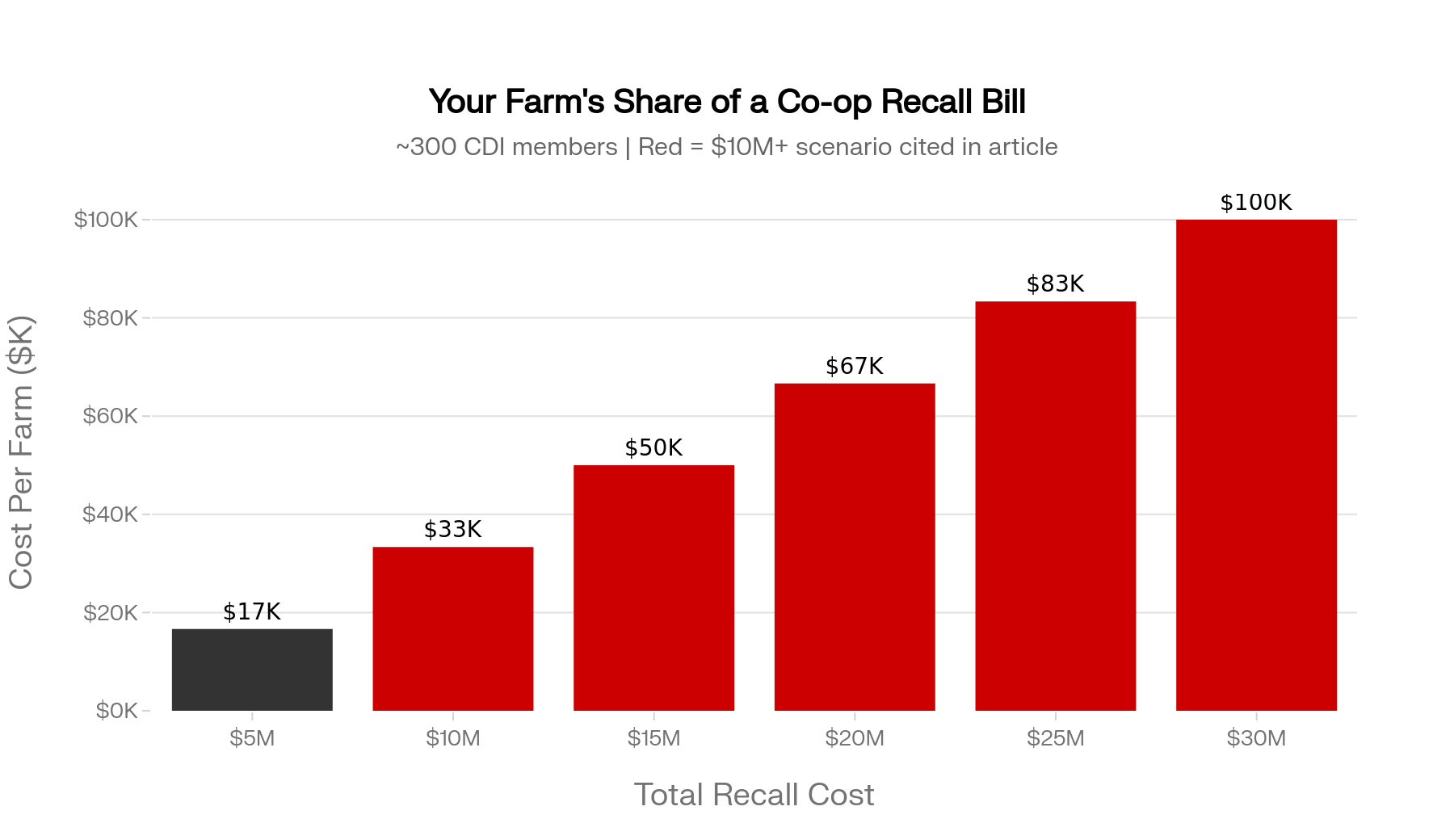
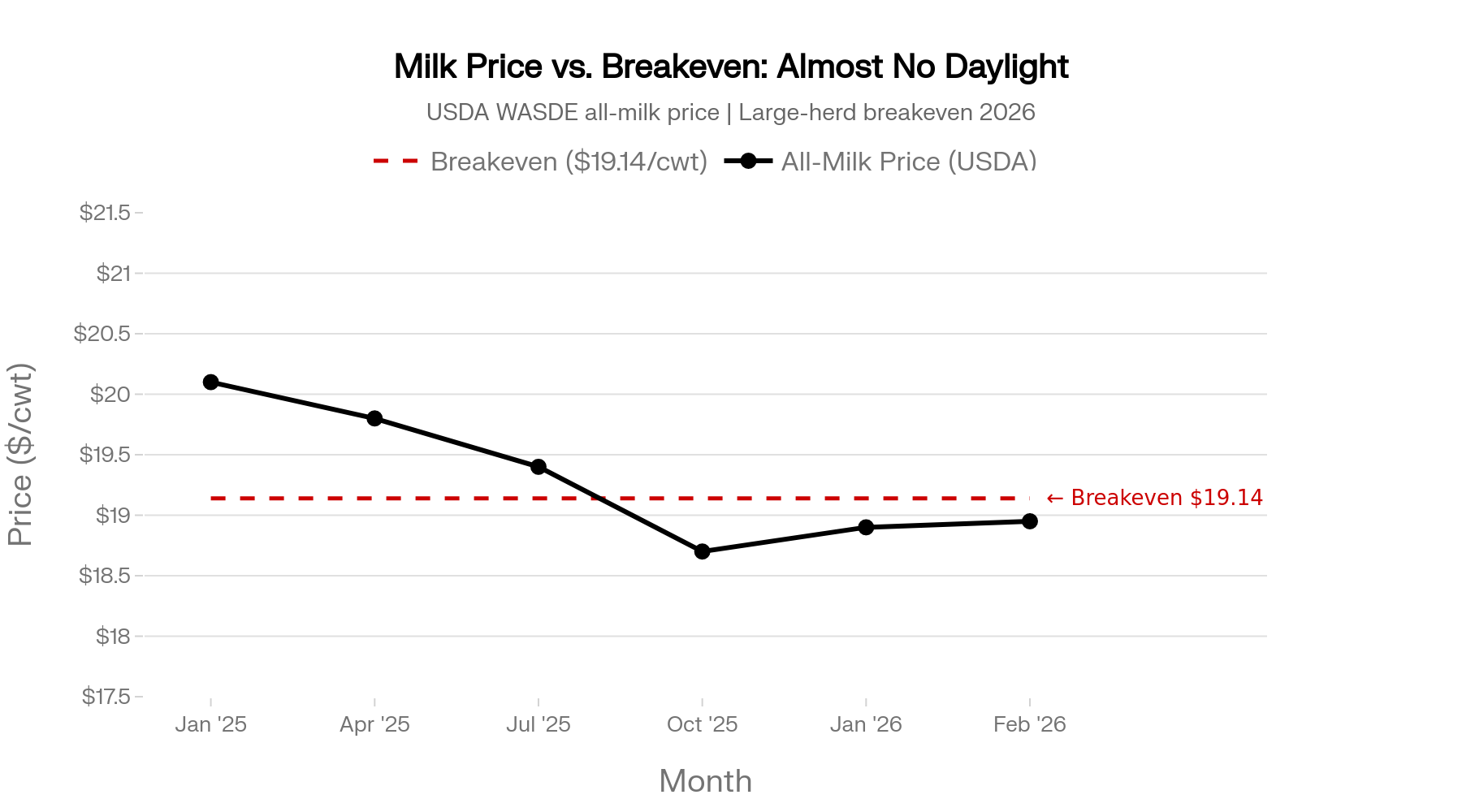
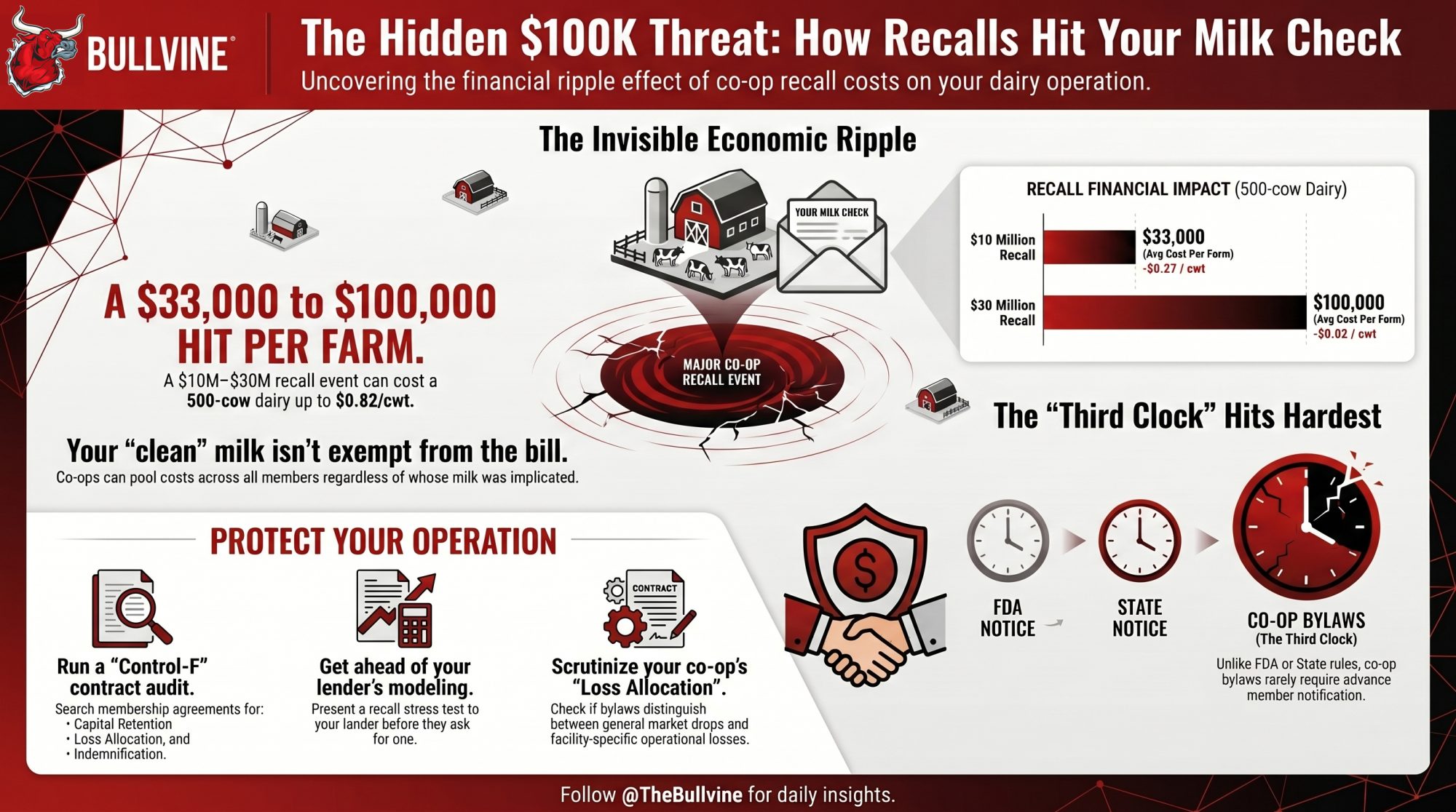
USDA’s February 2026 WASDE put the all-milk price near $18.95/cwt, and the 2025 national average ran about 24,390 lbs per cow. That herd ships roughly 122,000 cwt a year and grosses around $2.3 million in milk revenue. But full-cost figures for 2026 point to a breakeven near $19.14/cwt for large herds — meaning even a “decent” milk price leaves thin daylight. Now layer on a recall assessment. A joint Grocery Manufacturers Association and Food Marketing Institute study has long pegged the average direct cost of a food recall at roughly $10 million — and that’s just direct costs, before brand damage, lost sales, and litigation. Split across CDI’s nearly 300 members, that’s roughly $33,000 a farm. A larger $30 million event — not far-fetched once 2.6 million recalled units, customer credits, and litigation stack up — points closer to $100,000 a farm.
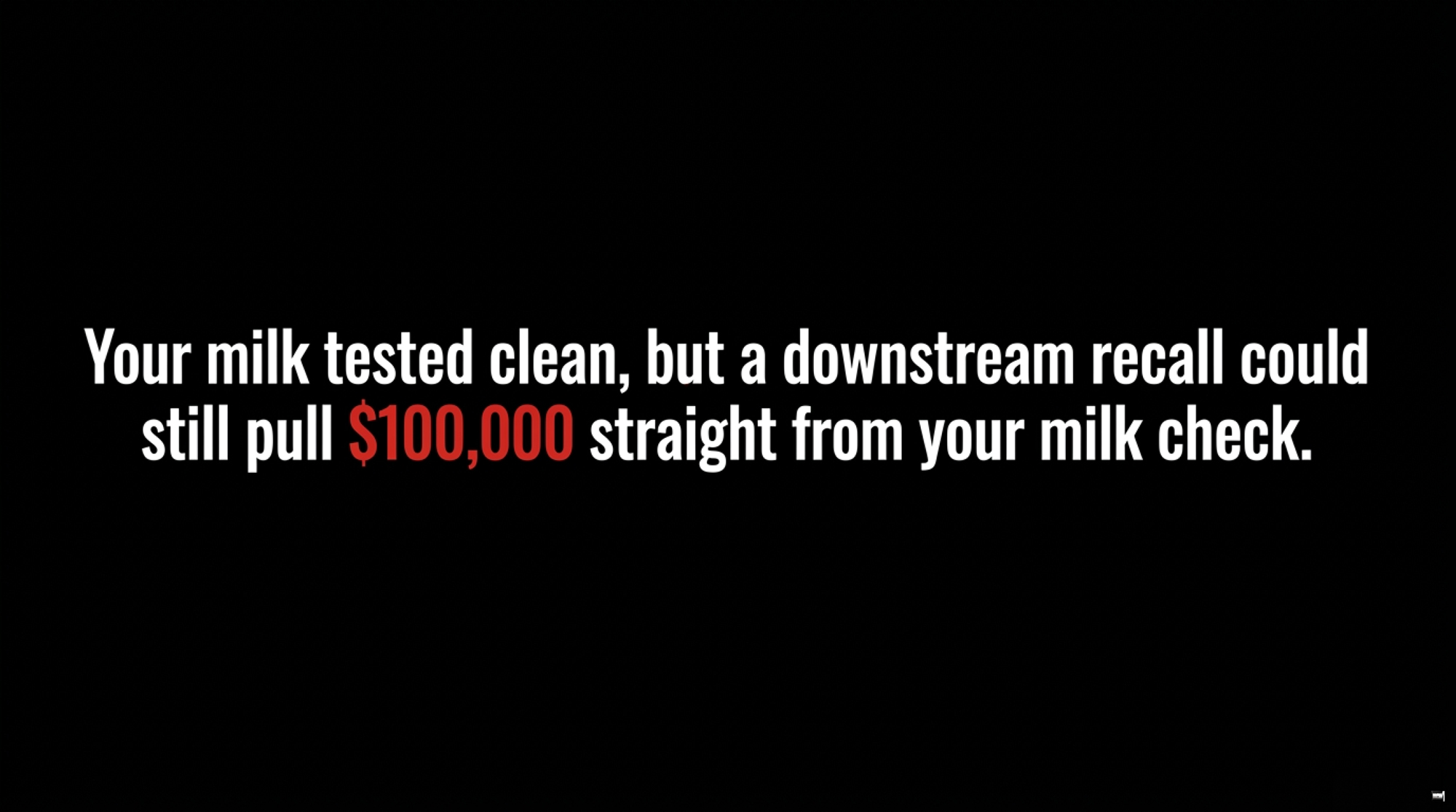
On a herd already running thin, that’s not a rounding error. Those farms shipped good milk — the potential contamination was flagged by testing, not by anyone getting sick — and they still sit under the cloud.
The Mechanics Behind the Outcomes
The cleanest way to understand why this lands on farms is to think about three clocks that start ticking the moment a recall hits.
Clock one is the FDA. When the agency believes a food could cause harm, it contacts the responsible party and offers a voluntary recall before ordering a mandatory one. The firm files a recall strategy, and the FDA posts updates as downstream consignees are identified. That’s why brands tied to CDI powder were still being added more than a month after April 20 — an ingredient buried in dozens of products takes time to trace.
Clock two is California’s 24-hour rule. State law requires manufacturers, distributors, and wholesalers to notify their downstream customers within 24 hours of issuing or receiving a recall notice. This clock protects retailers and consumers. It says nothing about co-op members.
Clock three is the one that hits your milk check — and it’s the one nobody talks about. As a general matter, no state or federal law requires a cooperative to notify its own member-producers within any set timeframe when extraordinary costs get pooled and assessed. Co-op bylaws commonly allow boards to allocate those costs across the membership, and they rarely set a hard deadline to notify members that it’s happening. Whether any particular co-op’s bylaws work that way is a question for its own members to put to the board — the general pattern is what matters here.
The third clock isn’t theoretical. We’ve watched a version of it before — and it points to a structural pattern, not a one-off.
THE PATTERN: ByHeart, and Why CDI Members Should Pay Attention. In the November 2025 ByHeart infant formula recall, the FDA went public on a Saturday. The operator of the powder plant that supplied it wasn’t told his product had tested positive until late January 2026 — roughly ten weeks later. The 55 organic dairies behind that plant were even further back in line. Most found out from the news, not a phone call. On paper, the safety system worked: regulators moved, product got pulled, nobody downstream got hurt. On the ground, farms that did nothing wrong faced contract fallout with no warning and no clear accounting of why. That’s the gap between how the safety system is built and how the money flows. It’s the same gap CDI members are sitting in right now.
The takeaway isn’t that anyone broke the rules. It’s that the rules route the financial fallout back toward producers by default, and the only thing that interrupts that default is a member who’s read the contract before the assessment lands.
How Much Could a Recall Actually Pull From Your Milk Check?
This is the question lenders and co-op boards are quietly running in the background. Worth running it yourself.
Spread a $10 million recall across nearly 300 member farms, and you’re looking at about $33,000 each — roughly $0.27/cwt off that 500-cow herd’s mailbox price over a year. A $30 million event pushes the hit toward $100,000, or about $0.82/cwt. On paper, 27 to 82 cents a hundredweight doesn’t sound like much. In real life, it’s the difference between making the next equipment payment on time or drawing the operating line again — between replacing that worn-out mixer this year or patching it for one more season.
Here’s how it actually shows up, because it won’t arrive as a bill in the mail. A co-op assessment lands quietly, as a line on your settlement statement or as equity the co-op retains instead of paying out — money you earned that doesn’t hit the account. You might see it spread across several months rather than one painful check. That’s gentler on cash flow, but it also makes the hit harder to spot and easy to write off as “just a soft market” when it’s really recall cost flowing back through the pool. It’s the same blind spot a vague milk contract creates — the kind Coles and Brownes just exposed with their $386,000 hole, where the exposure was sitting in plain sight, unredlined.
The sharper question isn’t whether you could survive one hit. It’s whether you could survive it, stacked on everything else, since 2024 — H5N1 touched more than 700 California dairy herds, a large share of the state’s dairies, dragging down production and driving up replacement costs. If your honest answer to “could we absorb another shock right now” is “barely,” recall exposure stops being background noise.
Are Your Co-op’s Rules Already 25 Years Behind?
Short answer: probably.
Co-ops like CDI were largely shaped in an earlier era — CDI itself in 1999 — when the bylaws and membership structures common at the time were shaped by a simpler world. Big plants, sure, but recalls that stayed mostly local before social media turned every label notice into a same-day national story. The co-op model was never built for a global ingredient web where one batch of powder feeds drink mix, pizza, and popcorn seasoning across dozens of brands at once.
That’s the real gap, and across the sector it tends to show up in three places. Many co-op bylaws carry no explicit ceiling on how much recall cost can flow back through the pool. Most set no requirement to notify members before or during an assessment — you find out when the check lands. And plenty treat a one-off equipment failure and a 50-brand national recall the same way on paper, even though the exposure isn’t remotely comparable.
| Bylaw Clause | What It Governs | Producer Risk Level | Red Flag Phrasing to Watch For | Why It Matters |
|---|---|---|---|---|
| Capital Retention / Revolving Fund | How long equity can be withheld to cover operating losses | 🔴 HIGH | “open-ended revolving period,” “at board discretion,” no defined payout timeline | Earned equity can sit unpaid for years during a recall event |
| Loss Allocation / Pooling | Whether recall/facility losses are spread to all members or isolated | 🔴 HIGH | “extraordinary costs pooled across membership,” “no distinction between market and operational losses” | A problem at one plant can hit every member’s milk check |
| Indemnification / Member Liability | Cap on how far an assessment can reach | 🔴 CRITICAL | No explicit cap stated; “assessments may include current milk checks” | Unlimited reach into milk revenue vs. equity-only exposure — two very different risk profiles |
| Supplier Verification (FSMA 204) | Co-op’s traceability obligations for ingredient use | 🟡 MEDIUM | Powder used as ingredient may fall in FSMA 204 “gray area” | Lighter traceability burden = slower recall attribution, longer exposure window |
| Member Notification Requirements | When/how members are informed of recall costs | 🔴 HIGH | No stated timeline, “board may notify at its discretion” | Members can find out from a settlement statement, not a phone call |
So don’t read the whole document — hunt. When you pull the PDF of your membership agreement and bylaws, control-F these three terms and read only what comes up:
- Capital retention and revolving fund. This governs how long the board can hold back your equity to cover operating deficits. A long or open-ended revolving period means money you’ve earned can sit unpaid for years while the co-op absorbs a loss — yours included.
- Loss allocation and pooling. Check whether the co-op distinguishes a general market drop, where everyone’s milk price falls together, from a localized, facility-specific operational loss, such as a recall. If the language treats both the same, a problem at one plant can spread to every member, regardless of who shipped to it.
- Indemnification and member liability. This is the one that matters most. Does the agreement cap your exposure at your equity investment, or can an assessment reach straight into current milk checks? Those are very different risk profiles, and the difference is usually one sentence.
None of this means anyone acted in bad faith. It means the rules can lag the supply chain they’re supposed to govern — and the only thing that changes that is members asking, in writing, for an accounting.
Options and Trade-Offs
You can’t rewrite a co-op’s bylaws on your own, and you can’t touch California’s health code. But you’ve got real levers inside your own operation.
Pull the actual co-op rules — this week. This is the 30-day move. Get your current membership agreement and bylaws, then use Control-F to search for the three clauses above and read what comes up. It takes nothing but the file folder and an email to your field rep if you can’t locate it. The risk is you won’t like what you find — many bylaws give boards broad assessment discretion with no cap, and changing that is a political lift. But knowing the mechanism puts you in a different category than the producer who’s guessing.
Get ahead of your lender before they get ahead of you. This makes sense if you’re near breakeven, carrying an operating line, and your lender has several California dairies on the books. Bring a one-page stress test: here’s what a $33,000 or $100,000 extraordinary cost does to our year, and here’s how we’d absorb it. The downside is that it may prompt harder questions about your overall risk profile. The upside is bigger — lenders hate surprises more than bad news, and a producer who’s already done the math reads as a manager, not a passenger.
Ask harder supplier-risk questions in your milk channel. If your milk flows into plants that make powder, cheese, or other branded food ingredients, ask who their key suppliers are, whether those suppliers carry contaminated-product insurance, and what their FSMA supplier-verification program looks like. You may hear “that’s proprietary.” You probably can’t change the program unilaterally. But the farms that ask these questions are the ones processors want to keep.
Put recall exposure into your long-game plant decisions. If you’re weighing a plant switch, on-farm processing, or a different co-op, treat recall exposure like price, hauling, and premiums — a real line in the comparison. Better governance doesn’t always translate into higher milk prices, and some regions don’t have multiple realistic options. But if two plants are close on price and one has a clear cap or insurance structure around recall costs, that should tip the scales. It’s the kind of difference that only matters every decade or two — and then it really matters.
Key Takeaways
- If any of your milk runs through a co-op, control-F your membership agreement this month for “capital retention,” “loss allocation,” and “indemnification.” Can’t find the document? Request it in writing.
- If a $33,000–$100,000 assessment would push you from “tight” to “underwater,” treat recall exposure as a front-burner risk — not a someday problem.
- If your lender has California dairy exposure, bring them your own recall stress test before they raise it. The producer who frames the conversation wins it.
- If your plant makes branded food ingredients, ask whether suppliers carry contaminated-product insurance and what their FSMA verification covers. Vague answers are an answer.
- If you’re already weighing a plant or co-op switch, put recall-cost governance next to mailbox price in the comparison — not after.
Tomorrow morning, nothing in your bulk tank will feel different. The cows don’t care that a batch of powder is under recall or that 50 snack brands are pulling product. But your balance sheet might, eventually — and the timing won’t be your call.
So here’s the real question: are you comfortable not knowing, in detail, how a recall like this flows back through your co-op and your lender until after it’s already hit? This same recall bill is already landing on dairies that did nothing wrong — 69 sanitation failures, 10 dead, and farms paying for a plant they never set foot in. If you want the full per-herd cost model and the clause-by-clause breakdown of what a milk contract actually leaves you exposed to, that’s where The Bullvine’s deeper recall-economics and contract coverage lives. This piece is here to get you to pull the file folder. The next step is to run your own numbers.
This article is based on FDA recall records and public filings available as of May 29, 2026.
Run Your Numbers
Farm Benchmark Snap Check — Before a recall assessment ever lands on your settlement statement, run Farm Benchmark Snap Check to see whether your margin can absorb a $33K–$100K hit or whether you’re already in the risk zone. It turns “could we take that shock?” into a number you can hand your lender.
Complete references and supporting documentation are available upon request by contacting the editorial team at editor@thebullvine.com.
Learn More
- 55 Dairies, Zero Phone Calls: The Contract Clause the ByHeart Recall Exposed — Reveals how standard cooperative contracts legally shield processors from notifying farmers during a supply chain crisis, arming you with the precise notification gaps sitting unredlined in your current marketing agreement.
- Coles and Brownes Just Exposed The $386000 Hole In Your Milk Contract — Breaks down the multi-class volume caps and hidden operational restrictions quietly creeping into modern processor agreements, delivering the exact calculation metrics needed to stress-test your debt-service coverage ratio against sudden intake limits.
- Record Exports, Reeking Checks: How a 34% Hidden Tax Costs You $5.85/Cwt — Exposes how legacy cooperative bylaws allow board-driven make allowance hikes and aggressive facility debt servicing to intercept your component values, stripping six-figure sums from your mailbox price before the check ever lands.
 The Sunday Read Dairy Professionals Don’t Skip.
 The Sunday Read Dairy Professionals Don’t Skip.
Every week, thousands of producers, breeders, and industry insiders open Bullvine Weekly for genetics insights, market shifts, and profit strategies they won’t find anywhere else. One email. Five minutes. Smarter decisions all week.




