It was no April’s fool joke for Class III Milk futures. Class III milk saw April fall 4 to 14.45, but the balance saw nice gains. May up 38 to 13.12, and June gained 50 cents to 13.56. July forward gained 37-55 cents to average at 14.89/cwt. Class IV milk recouped some losses as well. April up 2 to 11.54, May gained 40 cents to 11.73 and June gained 19 to 11.87/cwt.
The CME spot trade saw Dry whey steady at $0.33. Blocks down $0.02 to $1.31. Barrels down $0.03 to $1.1750. Butter down $0.0250 to $1.31. Five trades were made, ranging from $1.31 to $1.3225. Nonfat dry milk down $0.01 at $0.8750. Eleven trades made, with a range of $0.86 to $0.88.
Grain markets didn’t follow the milk trend. Corn fell 6 cents to 3.34 ¾, Soybeans fell 23 ¼ cents to 8.62 ¾, and Soybean meal fell $6.60 to $314.90/ton.
On the Chicago Mercantile Exchange Cash Dairy Product trade were negative once again today. Class III milk futures were pressured on the heels of a lower cheese product trade. April milk was down 20 cents at $14.75. May declined 31 cents to $12.82. June milk slid 9 cents to $13.23. Second half 2020 lost 7-31 cents and is now averaging $14.61/cwt. Class IV milk futures tumbled downwards. April milk suffered a 37 cent loss to $11.52. May milk drifted 20 cents to $11.33/cwt. July milk was 7 cents lower to $12.02. Second half lost 7-48 cents and is now averaging $12.50.
Dry whey steady at $0.33 Blocks down $0.1075 at $1.33. Barrels down $0.0950 at $1.2050. Seven trades were made, ranging from $1.21 to $1.2575. Butter down $0.0625 at $1.3350. Five trades made, with a range of $1.3350 to $1.3625. Nonfat dry milk down $0.01 at $0.8850.
Spot corn inched ½ cent lower to $3.4075/bushel. Nearby soybeans finished 3.75 cents higher to $8.86. May soybean meal was $4 lower to $321.50/ton. May Chicago Wheat rallied 5.5 cents to $5.77/bushel. Kansas Wheat rose 6.25 cents to $4.93. Fats and feeders closed higher on the day. June live cattle were up $3 to $92.075/cwt. May feeder cattle finished $2 stronger to $122.90.
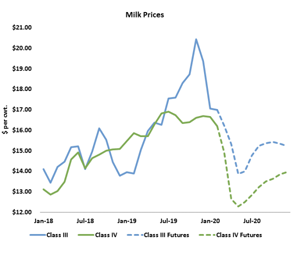
Red ink flooded LaSalle Street this week. The dairy markets were decimated. Every Class III and Class IV contract on the board scored new life of contract lows. The selloff was steep and widespread, but second-quarter contracts suffered most. May Class III plummeted $1.44 to a painfully low $13.87 per cwt. May Class IV fared even worse, falling $1.79 to an unbearable $12.28. At today’s prices, dairy producers in a region with roughly half of their milk check derived from Class III and half from Class IV will earn just $13.08 per cwt., and $13.83 on their Class I share.
Those numbers clearly won’t pay the bills, and after four painful years (and a couple good months) dairy producers are in no shape to weather this storm. Congress set aside billions of dollars for agricultural aid and for food purchases as part of its $2 trillion aid package, but the timing and structure of these payments are still unknown. The dairy safety net will provide a financial cushion for those who enrolled, but low participation in these programs reveals that many are vulnerable to the whims of an increasingly cruel market. Dairy producers insured quarterly floor prices on about 20% of the nation’s milk through Dairy Revenue Protection (DRP). Barring a steep recovery in milk prices, most of these policies are projected to pay indemnities. Less than half of all dairy producers representing 56.2% of the nation’s established milk production history – and a somewhat smaller share of today’s greater milk production – enrolled in the Dairy Margin Coverage (DMC) program, which is now projected to make payments in March through December. It’s likely that many dairy producers who signed up for DRP also enrolled in DMC, so much of the nation’s milk will be sold at very low values, without any safety net protections at all. Unless creditors are exceedingly patient, the industry is likely to suffer a tidal wave of sellouts.
The impact of Covid-19 is beginning to disrupt milk processing along the East Coast. Amidst fear of contagion, some of the labor force is staying home, forcing plants to run below capacity. As a result, more milk is sloshing around the rest of the nation and more tankers are hauling milk greater distances at a discount, even as fluid milk bottling remains elevated. Milk continues to fly off the shelf at grocery stores, although sales are not quite as high as they were during the initial panic-buying surge. Fluid milk is the lone bright spot in the dairy complex. Milk bottlers are skimming off huge volumes of cream, and churns are running hard. Cream is particularly abundant in the West, where cream multiples – the factor used to convert the butter price to a cream price – have dropped to multi-year lows.
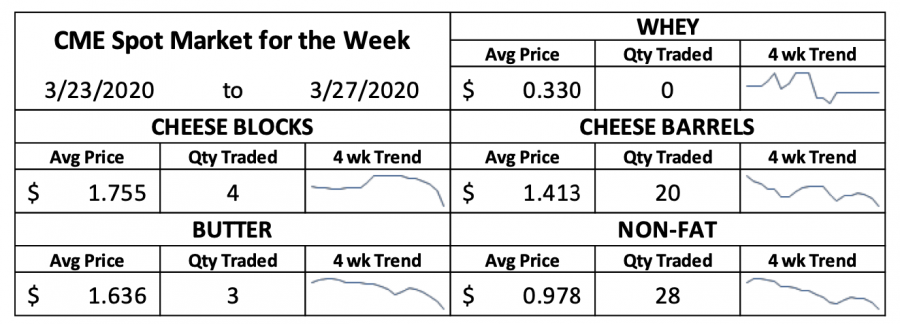
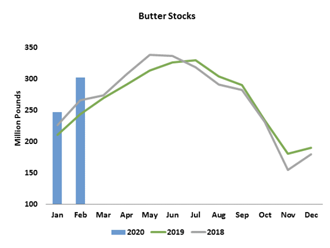
America’s refrigerated warehouses were already bursting with butter before milk bottling ramped up. USDA reports that on February 29 there were 302.3 million pounds of butter in cold storage, the highest total for the month since 1993 and nearly 55 million pounds more than on January 31. The month-to-month build marked the largest January-to-February increase since 1992. February butter inventories are 24% higher than they were a year ago. We’re now adding to that stockpile, and the market is feeling the pressure. CME spot butter plunged 26.75ȼ this week to $1.4875 per pound, its lowest value since October 2013.
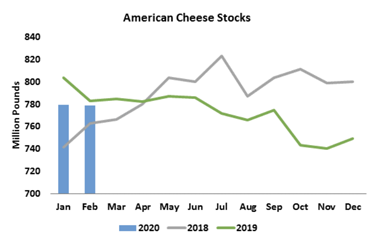
The cheese market was much healthier coming into the crisis. Cheese stocks climbed only slightly from January to February. At 1.36 billion pounds, February cheese stocks were 0.5% lower than a year ago. Inventories of American-style cheese, including Cheddar, were down 0.6%. Cheese is moving quickly at retail, but it is likely not replacing all the lost demand from foodservice. Although pizza delivery franchises are moving a lot of product, sit-down restaurants are not, and mozzarella sales are down. That means cheese makers are likely making a lot of commodity Cheddar. This week both blocks and barrels dropped to one-year lows. Spot Cheddar blocks fell 24.75ȼ to $1.59. Barrels closed at $1.34, down 9ȼ since last Friday.
Sales patterns are similar in Europe, with cheese moving in large volumes through retail channels. However, some European cheesemakers are finding it difficult to obtain the materials necessary to repackage bulk cheese into retail-friendly sizes. As the bloc struggles to contend with border controls for the first time in decades, bottlenecks are slowing the flow of product from the warehouse to grocers. That’s likely to translate into lost demand despite robust consumer appetites. European cheese stocks were tight before Covid-19 slowed markets. European cheese production grew just 0.3% year-over-year in 2019, and exports impressed. In January, Europe sent 19% more cheese abroad than it did the year before.
They spot whey market is holding steady, which is a victory in this environment. CME spot whey powder didn’t budge this week; it stands at 33ȼ per pound. The futures gained ground. In January and February, China imported 4.6% more whey than in the first two months of 2019, after adjusting for Leap Day. The U.S. continues to regain market share now that China has rescinded its punitive tariffs on U.S. whey.
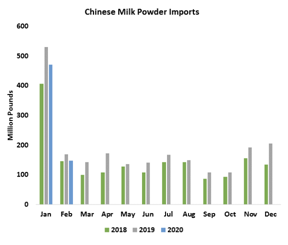
Although Covid-19 was already raging through China in January and February, milk powder imports were better than feared. Combined imports of skim and whole milk powder fell 11.7% from a year ago, when Europe was aggressively moving out its Intervention stockpile and China was buying record volumes of cheap milk powder. Given slowdowns at Chinese ports and reports of very high domestic milk powder output earlier this year, these figures were positive. Now, however, the global trade has stalled. Sporadic port closures are likely to entangle international freight, and foreign buyers have lost considerable purchasing power. The milk powder market is the most dependent on exports, and it is likely to remain under pressure until the impacts of the virus subside. This week, CME spot nonfat dry milk (NDM) dove 6.75ȼ to 92ȼ, the lowest spot value since December 2018. Covid-19 has erased years of hard-won gains in the dairy markets.
Ethanol plants are slowing output or closing their doors altogether, disrupting the feed markets throughout the Corn Belt. The corn basis had been sky-high since the rains became problematic last spring, but now the basis is close to zero in much of the Corn Belt. Cash corn values are down hard. Dairy
producers and other livestock growers who fed distillers grains will have to adjust their rations, which likely means more soybean meal purchases. Unfortunately, soybean meal is one of the few commodities that has been rising in value.
The soy complex got some further support this week from fears that Argentina would halt exports. Port workers are demanding closures so that they can stay home until the virus recedes. But Argentina depends on export taxes and is likely to try to keep product moving, albeit at a slower pace.
May soybeans closed at $8.815, nearly 20ȼ higher than last Friday. At $323.10, soybean meal fell back $2.10 per ton after a sizable rally last week. The corn market inched upward from last week’s multi-year lows. May corn settled at $3.46 per bushel, up 2.25ȼ.
On the Chicago Mercantile Exchange commodities across the board had an atrocious day. Class III milk futures showed no mercy today. April tumbled 49 cents to $14.83. May milk had 72 cents ripped out to $13.15 per cwt. June milk was the biggest loser, finishing limit down at $13.25. Second half 2020 lost 30-67 cents and is now averaging $14.75 per cwt.
Class IV milk was not spared in the dairy beatdown. April, May, and June did not have any trades today. July milk suffered a 66-cent loss to $12.18 per cwt. August fell 38 cents to $12.85. September milk finished limit down to $12.75 per cwt. Second half 2020 is now averaging $12.96 per cwt.
It was an absolute train wreck in the CME Dairy Product trade today as blocks where down $0.1525 at $1.4375. Barrels down $0.04 at $1.30. Six trades were made, with a range of $1.2950 to $1.30. Butter $0.09 lower at $1.3975. Nonfat dry milk down $0.0250 at $0.8950. Thirty-one trades made, ranging $0.8725 to $0.8950. Dry whey steady at $0.33.
On the Chicago Mercantile Exchange April Class III milk futures down 24 cents at $15.70. May off 33 at $14.56. June through August contracts 19 to 42 cents lower.
Butter $0.0675 lower at $1.59. Two trades, with a range of $1.6025 to $1.61. Blocks down $0.05 at $1.74. Barrels down $0.0375 at $1.4025. Three trades were made, ranging from $1.4025 to $1.42. Dry whey steady at $0.33. Nonfat dry milk down $0.0325 at $0.9650. Ten trades were made, ranging from $0.9575 to $0.9650.
Cooperatives Working Together (CWT) member cooperatives accepted 43 offers of export assistance from CWT that helped them capture sales contracts for 2.930 million pounds (1,329 metric tons) of Cheddar, Gouda, Monterey Jack and Swiss cheese; 651,347 pounds (75 metric tons) of butter, 149,914 pounds (68 metric tons) of cream cheese, and 1.208 million pounds (548 metric tons) of whole milk powder. The product is going to customers in Asia, Central and South America, the Middle East and Oceania. The products will be delivered from March through July 2020.
CWT-assisted member cooperative export sales contracts for 2020 total 8.565 million pounds of American-type cheeses, 1.276 million pounds of butter (82% milkfat), 1.540 million pounds of cream cheese and 7.161 million pounds of whole milk powder. The product is going to 19 countries in six regions. These sales are the equivalent of 172.1 million pounds of milk on a milkfat basis.
Assisting CWT members through the Export Assistance program positively affects all U.S. dairy farmers and all dairy cooperatives by strengthening and maintaining the value of dairy products that directly impact their milk price. It does this by helping member cooperatives gain and maintain world market share for U.S dairy products. As a result, the program has significantly expanded the total demand for U.S. dairy products and the demand for U.S. farm milk.
The amounts of dairy products and related milk volumes reflect current contracts for delivery, not completed export volumes. CWT pays export assistance to the bidders only when export and delivery of the product is verified by required documentation.
All dairy farmers and dairy cooperatives should invest in CWT. Membership information is available on the CWT website.
The Cooperatives Working Together (CWT) Export Assistance program is funded by voluntary contributions from dairy cooperatives and individual dairy farmers. The money raised by their investment is being used to strengthen and stabilize the dairy farmers’ milk prices and margins. For more information about CWT, visit www.cwt.coop.
FARM leaders have said they hope to meet with milk processor Meadow Foods over a 2p per litre (ppl) price drop next month for some Cumbrian farmers.
Meadow Food suppliers in Cumbria are braced for the whopping price drop after the processor – during two meetings in the county – blamed the drop on a range of factors, including the loss of an Arla contract.
Company representatives faced furious producers at two meetings, in Penrith and the Greenhill Hotel at Wigton, when it was revealed that the company proposed to drop their milk price in April and May consecutively. Farmers who attended the meetings heard the shrinking consumer market, the impact of coronavirus on exports, and the loss of an Arla contract all factored into the decision, which could see the price drop to 24ppl in April.
There has been speculation of a further reduction to 21ppl-22ppl in May, meaning some Cumbrian suppliers could expect a 5ppl milk price drop in total.
Some Cumbrian suppliers have taken to social media platforms to highlight the ‘unfairness of the situation’ and others walked out of the meetings. One producer said that some farmers had asked for their contracts to be terminated so they could make other arrangements for their milk, but Meadow Foods refused.
NFU dairy board chairman, Michael Oakes, said the union felt for the affected farmers who had very few options to mitigate the price drop. He said: “The discretionary pricing system used by many processors allows risk and pressure to be passed directly on to the farmer, leaving them to bear the cost.
On the Chicago Mercantile Exchange product and milk pricing across the board felt pressure on Tuesday. Class III milk prices suffered 18-22 cent losses in the 2nd quarter to end up at $15.33 cents per cwt. Second half 2020 prices dropped 2-13 cents as well. Class IV markets took it on the chin even harder as months fell 30-55 cents per cwt April through September.
Dry whey steady at $0.33. Blocks down $0.0250 at $1.79. Barrels down $0.01 at $1.44. Butter down $0.0575 at $1.6525. Nonfat dry milk down $0.0025 at $0.9975. Two trades were made, with a range of $0.9950 to $1.00.
Over in the grain space, corn added 1 ½ cents, beans dropped 5, and the wheat complex was up 18 cents in Chicago, Kansas City 10 higher, and Minneapolis was 2 stronger. The cattle space lost a buck in the deferred months on fats, feeders and hogs.
On the Chicago Mercantile Exchange, calmness started to return to commodity markets on Tuesday. Class III milk was unchanged in March at $16.26 and April at $16.08. May fell 12 to $15.38 and July – Dec was mixed varying from 3 higher to 10 lower and averaging at $16.06 per cwt. Class IV milk was unchanged at $14.90 for March, but fell sharply in the balance of 2020 April fell18 at $13.88, $May fell 28 to 13.69 and the second half fell 4-39 cents to average at $14.99 per cwt.
Dry whey unchanged at $0.33. Blocks down $0.0225 at $1.8150. Four trades were made, ranging from $1.8150 to $1.8475. Barrels $0.02 higher at $1.45. Eleven trades made, ranging from $1.43 to $1.45. Butter down $0.03 at $1.71. Nonfat dry milk down $0.0050 at $1.00. Four trades made, with a range of $0.9950 to $1.00.
On the Chicago Mercantile Exchange commodity markets were mostly stronger to start out the week. Class III milk future prices were scattered. April gained 2 cents to $16.07/cwt. May lost 10 cents to $15.21. June dropped 5 cents to $15.47. Second half 2020 is now averaging $16.11. The majority of class IV futures remained unchanged today. May lost 11 cents to $13.96/cwt. August tumbled 12 cents to $14.62/cwt. Second half 2020 is averaging $15.09/cwt.
In the CME Dairy product trade today, Dry whey was steady at $0.33. Blocks also unchanged at $1.8375. Barrels steady at $1.43. Butter down $0.0150 at $1.74. Nonfat dry milk up $0.0175 at $1.0050. Nine trades were made, ranging from $0.9850 to $1.0050.
Spot corn inched ¼ cent lower to $3.4350. Wheat and soybeans both had impressive moves higher today. May soybeans leaped 21.5 cents to $8.84/bushel. Nearby Chicago wheat jumped 23.25 cents to $5.6250. May soybean meal rallied $8.40 to $333.60/ton. Feeders and fats both saw strength, finishing limit up. April Live Cattle are at 101.65 and feeders are at 123.325/cwt.
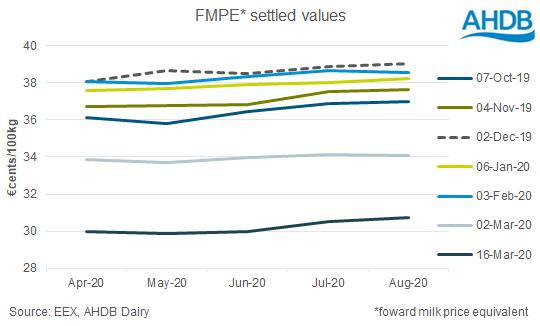
After months of relative stability, settled values on EU dairy futures have shifted down as the impact of the virus continued to be felt across the industry. Settled values on futures contracts provide a good indicator of how market participants expect prices to move, based on current conditions. The latest drops will reflect the concerns over the impacts of lower demand and rising product availability on dairy product prices.
The forward milk price equivalent (FMPE) value combines settled prices for butter and SMP futures contracts on the EEX exchange. Between Oct 2019 and Feb 2020, the FMPE remained in the region of €35-€39 cents/100kg for contracts expiring April through August.
As coronavirus spread across Europe however, market sentiment shifted, and settled prices fell. In early March, before governments starting restricting social mobility, FMPE fell about 11% to around €34c/100kg. More recently, we have seen a further drop, with FMPE falling to around €30c/100kg for contracts with April through June expiry dates.
The coronavirus outbreak is weighing on the global dairy market outlook – but prices at this stage are not taking as big a hit as expected.
The Global Dairy Trade auction defied pundits’ expectations on Tuesday night, falling by 3.9 per cent, well below futures market predictions.
The key whole milk powder price was down 4.2pc compared with futures market predictions of a 9-11pc fall
Some commodities even bucked the downward trend with lactose up 4.9pc and cheddar up 2.6pc.
Westpac head of NZ strategy Imre Speizer said Tuesday night’s auction was expected to be the first to be significantly affected by the coronavirus outbreak, with global containment measures accelerating in early March.
“However, the 3.9pc fall is of a similar magnitude to the three previous auction falls (-4.7pc, -2.9pc and -1.2pc),” he said.
But Rabobank said the onset of the virus in the world’s largest dairy importer China and the permeation across the globe had dairy buyers and sellers scrambling to assess the market impact.
“Global dairy commodity prices have already priced-in the uncertainty,” Rabobank senior dairy analyst Michael Harvey said.
New Zealand bank ASB senior rural economist Nathan Penny said he anticipated NZ’s dairy and food exports were going to hold up relatively well.
“Indeed, we anticipate that global food demand is likely to remain firm (outside of premium foods) as food consumption is prioritised in household budgets,” he said.
“A good example of this is in China where food imports are being fast-tracked for entry via ‘green lanes’ at Chinese ports.”
Mr Speizer said since the outbreak, whole milk powder had fallen by 13.5pc, less than other globally traded commodities, including sugar, wheat, copper and crude oil.
“The evidence to date is that during this pandemic, dairy commodities have outperformed most major commodities, perhaps a testament to demand for core foods with health properties,” he said.
North Asian demand bounced back at Tuesday night’s auction, from a weaker showing at the previous auction.
“While demand for dairy products has been more robust than for other commodities, it is likely to remain affected by the economic fallout from the pandemic for some time,” Mr Speizer said.
Rabobank’s Dairy Quarterly report pointed to anticipated China’s consumer buying patterns normalising by the second half of 2020, with evidence of improvement in some supply chains already visible.
But the report said the risk of a setback or a delayed economic recovery in China presented a major downward price risk to Rabobank’s forecasts.
Against this backdrop, global milk production from the big seven exporters (NZ, United States, European Union, Australia, Brazil, Argentina, Uruguary) was rising.
The combination of reduced Chinese imports, significant supply chain disruptions, including extreme competition for shipping containers across the globe, and rising dairy surpluses in export regions would keep downward pressure on global markets through much of 2020, the Rabobank report said.
Dollar impact
The relative strength of the US dollar against both the Australian and NZ dollars is also helping airy exporters.
Mr Penny said although dairy prices in US dollar terms were materially lower than prior to the COVID-19 virus outbreak, the NZ dollar was offsetting these falls.
On a weighted average basis, overall prices had fallen 13.2pc over February and March but the 8pc decline in the NZD/USD in the same period meant that in NZ dollar terms, prices were down a more modest 5.3pc, he said.
Australian analyst FreshAgenda lifted both its Australian dairy export index and sport commodity milk value for southern Australian dairy manufacturers this week on the back of the weaker dollar.
Both hit record levels.
It said the Australian dollar lost almost five cents against the US dollar last week, ending at US$0.6178.
“The combined impact of these factors lifted the commodity milk value for southern Australian dairy manufacturers by 79 cents to $8.12 a kilogram milk solids,” it said.
Australian outlook
Rabobank said milk production across Australia’s southern export dairy region should continue to gather momentum heading into 2020/21.
It is forecasting Australian milk production to finish 4.9 per cent lower by the end of the 2019/20 season at 8.4 billion litres.
National production grew in January, confirming the minimal impact from the bushfires.
“The turnaround in production so far has been led by Tasmania and eastern Victoria, which account for 32 per cent of Australia’s milk production,” Mr Harvey said.
The Rabobank report said solid rain events across dairying regions at the start of 2020, combined with strong milk price signals and relief from feed costs, had supported on-farm investments and higher milk flows.
On the Chicago Mercantile Exchange April Class III milk futures closed 34 cents higher at $16.01. May up 14 at $15.20. June, July, and August contracts all 16 cents higher.
Dry whey up $0.01 at $0.33. Blocks down $0.01 at $1.8625. Barrels down $0.0450 at $1.3875. Butter up $0.03 at $1.70. Nonfat dry milk down $0.0025 at $0.9625. 17 trades were made, ranging from $0.9525 to $0.9650.
On the Chicago Mercantile Exchange markets continue to struggle through unknown economic situations, dairy took a hit on Wednesday. Class III milk fell sharply across the calendar. March fell 1 to $16.32, April fell 32 to $15.67 and May fell 41 cents to $15.06. Second half months fell as many as 49 cents with the average at $15.82 per cwt. Class IV dove even lower seeing limit moves in several months. March fell 15 to $14.89, April fell 58 to $13.52, and May fell 75 to $13.13 per cwt. Second half months moved 52-75 cents lower to average $14.30 per cwt.
Dry whey down $0.0050 at $0.32. Two trades were made, ranging from $0.32 to $0.3225. Blocks steady at $1.8725. Barrels down $0.0675 at $1.4325. Three trades made, with a range of $1.4325 to $1.48. Butter down $0.07 at $1.67. Nonfat dry milk down $0.04 at $0.9650. Seven trades were made, ranging from $0.9525 to $0.9675.
Grain was mixed – corn falling 8 ¾ cents to $3.35 ¼, soybeans gained 1 ¼ to $8.25 ½, and soybean meal moved $5.70 higher to $304 per ton.
A new report from Rabobank has estimated that total dairy import volume in China will fall by 19% in 2020 due to the onset of coronavirus.
Estimates were released in Rabobank’s latest Global Dairy Quarterly Q1 2020 report, which highlights how the current coronavirus situation across the globe has resulted in buyers and sellers ‘scrambling to assess the market impact’.
The report has based its Chinese estimates on lower demand in retail and foodservice channels and build up in milk powder stocks, on top of larger carryover stocks, as well as further expansion in local milk production through 2020.
In China, dairy demand in liquid milk equivalent (LME) is predicted to fall by 8% in 1H 2020 prior to Rabobank’s previous forecast of a 2.4% increase.
However, the bank anticipates that the forecast reduction will not be as severe as 2014-2015 stocking which resulted in a decline in LME imports of more than 35% over 12 months.
According to Rabobank, China’s consumer buying patterns should normalise by the end of 2H 2020 with evidence of improvements in some supply chains already visible.
For Q4 2019, year-on-year growth of dairy exports was recorded as 0.8%, marking its strongest quarterly gain since Q3 2018. Each region is expected to report a consistent pace in Q2 2020 with a growth rate of 1%.
According to Rabobank, US milk production growth remains range bound although they refer to a ‘slightly gloomier outlook for dairy demand in the coming months’.
In the EU, milk production is reportedly gaining momentum with mild winter conditions laying the foundations for a good spring flush.
December 2019 saw Australia return to growth in the southern export pool, while Rabobank expects milk collections in New Zealand to decline by 1% due poor weather and disrupted trade volumes to China.
The combination of reduced Chinese imports, significant supply chain disruptions, including extreme competition for shipping containers across the globe, and rising dairy surpluses in export regions will keep downward pressure on global markets through much of 2020.
Due to growing measures taken to limit the spread of coronavirus, Rabobank said there could be a greater-than-expected negative impact on dairy demand and supply chains in the upcoming months due to falling tourist numbers already impacting foodservice sectors in several markets.
Dairy product prices fell by 3.9 per cent at this morning’s Global Dairy Trade auction – the fourth decline in a row.
The price of wholemilk powder – which has the greatest bearing on Fonterra’s milk price – fell by 4.2 per cent to US$2797 a tonne – its lowest point in more than a year.
Among the other Fonterra reference products, skim milk powder fell by 8.1 per cent to US$2527 a tonne.
Against the trend, butter prices rose by 0.3 per cent to $4144 a tonne.
Anhydrous milk fat rose by 1 per cent to US$4331 a tonne.
Rabobank said onset of coronavirus stalled the upward trajectory in global dairy prices visible in late 2019 and the hangover had continued.
The GDT Price Index moved lower by 4 per cent with average prices now sitting below US$3,000/tonne.
“Buyers and sellers are still scrambling to assess the market impact as the spread of the virus moves from China to more broadly across the globe,” the bank said.
Outside the reference products, cheddar prices rose by 2.6 per cent to US$4398/tonne and rennet casein rose by 1.0 per cent to US$9987/tonne.
In February, Fonterra reaffirmed its farmgate milk price and earnings forecasts for the year, despite uncertainty surrounding the outbreak of the coronavirus Covid-19 in China.
The co-op said its farmgate milk price forecast range would remain at $7-7.60 per kg and its full-year underlying earnings guidance would stay at 15-25 cents per share.
However, Fonterra revised its forecast milk collections for the 2020 season down from 1530 million kgMS to 1515 million kgMS, due to adverse weather.
The co-op is due to report its first-half result today at 8.30am.
On the Chicago Mercantile Exchange Dairy Markets Unlucky, Class IV Taking the Hardest Hit. Class III milk was not a pot of gold and continued its trend downward today. April milk lost 1 penny to $15.99 per cwt. May milk fell 17 cents to $15.42 per cwt. July-December milk dropped 16-30 cents and is now averaging $16.24 per cwt. Class IV milk was absolutely shamrocked today. April milk lost 36 cents to $14.10 per cwt. May fell 50 cents to $13.91 per cwt. July-December milk was hit hard, dropping 35-57 cents per cwt and is now averaging $15.02 per cwt.
Dry whey unchanged at $0.3250. Blocks steady at $1.8725. Barrels unchanged at $1.50. Butter down $0.325 at $1.74. Five trades were made, ranging from $1.7350 to $1.75. Nonfat dry milk down $0.02 at $1.0050. Ten trades made, with a range of $0.9950 to $1.0050.
On the Chicago Mercantile Exchange it was a different day with the same result. Dairy prices for Class IV added 7 cents in April but lost 9-22 cents May through February 2021. The second quarter average finished at $15.77 while the second half of the year is offering $16.48 per cwt. The Class IV market was roughed up even worse as futures dropped 34 to 55 cents per cwt. The second quarter average stands at $14.41 per cwt. CME spot dairy auction results watched butter decline 4 cents per lb. to $1.77 and a quarter per lb. following a single trade.
Dry whey down $0.0225 at $0.3250. Five trades made, ranging from $0.3250 to $0.3350. Blocks unchanged at $1.8725. Barrels steady at $1.50. Butter down $0.04 at $1.7725. Nonfat dry milk down $0.0275 at $1.0250.
The grain complex watched corn fall 11 cents, soybeans were off 25 cents and the wheat complex softened 8 cents in Chicago and Kansas City.
On the Chicago Mercantile milk futures were mixed Thursday while cheese markets started to perk up for the week. Class III milk prices finished lower here today. April milk lost 3 cents to $15.80 per cwt. May milk fell 14 cents to $15.79 per cwt. Second half 2020 fell 8-12 cents and is now averaging $16.71 per cwt. Class IV milk prices were annihilated today. March fell 41 cents to $15.11 per cwt. April was 48 cents lower to $14.72 per cwt.
Dry whey unchanged at $0.3475. Blocks up $0.06 at $1.81. One sale was made at that price. Barrels up $0.0350 at $1.49. Six trades were made ranging from $1.4550 to $1.4875. Butter down $0.0050 at $1.8125. Two trades were made at $1.8125 and $1.8150. Nonfat dry milk down $0.0175 at $1.05. Eighteen trades were made ranging from $1.04 to $1.05.
Fats and feeders were both limit down here today. Spot corn fell 8.75 cents to $3.6575 per bushel. Spot Soybeans were amongst the hardest hit dropping 13.75 cents to $8.5950 per bushel. May soybean meal finished $1.20 higher to $302.80 per ton.
On the Chicago Mercantile milk futures were mostly lower at midweek while cash trade was mixed. Class III markets finished one to five cents lower while Class IV markets were down 42 cents in March and 10 cents in April and the other commodity markets.
Dry whey up $0.01 at $0.3475. Two trades were made at $0.34 and $0.3425. Blocks unchanged at $1.76. Barrels up $0.0450 at $1.4550. Eight trades were made ranging from $1.4150 to $1.4550. Butter unchanged at $1.8175. Nonfat dry milk down $0.0125 at $1.0675. Two trades were made at $1.0675 and $1.07.
Corn lost three cents with December ending at $3.77 per bushel soybeans were also down three at $8.6675. Soybean meal was up a dollar per ton and the wheat complex ended nine cents lower in Chicago and in Kansas City while Minneapolis was off six. The fat and feeder cattle markets were both limit down while hogs were off another dollar.
On the Chicago Mercantile milk futures turned around Tuesday as traders took back oversold positions. Class III milk saw March gain 3 cents to $16.33, April gained 4 to $16.85, and May gained 3 to $15.99 per cwt. Second half months gained 2-7 cents respectively. Class IV milk also bounced back. Though March remained unchanged at $15.52, April gained 10 to $15.20, and May gained 19 to $15.29. Second half months saw 8-31 cent gain.
Dry whey up $0.0050 at $0.3375. One trade was made at that price. Blocks unchanged at $1.76. Barrels unchanged at $1.41. Butter unchanged at $1.8175. Nonfat dry milk down $0.0025 at $1.08. Three trades were made ranging from $1.0775 to $1.0850.
On the Chicago Mercantile Milk futures closed lower Monday with coronavirus impacts continuing to erode markets. Class III milk finished quite a bit lower today. March was down 7 cents to $16.30 per cwt. April milk was down 20 cents to $15.83 per cwt. May fell the most, dropping 28 cents to $16.00 per cwt. Class IV milk continued to show weakness today. April milk was down 30 cents to $15.10 per cwt. May lost 40 cents to $15.10. June milk took the biggest slide, dropping 47 cents to $15.30 per cwt.
Dry whey down $0.0150 at $0.3325. Three trades were made ranging from $0.3325 to $0.3375. Blocks up $0.01 at $1.76. One trade was made at that price. Barrels down $0.0675 at $1.41. Nine trades were made ranging from $1.4075 to $1.47. Butter down $0.0375 at $1.8175. Seven sales were made at ranging from $1.8175 to $1.84. Nonfat dry milk down $0.0325 at $1.0825. Eleven trades were made ranging from $1.06 to $1.0825.
On the Chicago Mercantile milk futures adjusted higher Thursday while cash markets remain mixed with the storyline very much unchanged as coronavirus concerns continue on. Class III milk prices were on of the few bright spots adding 2-13 cents through the end of the year. Class IV months struggled and fell single digits in the nearby months.
CME spot dairy auction results ended with dry whey up $0.0050 at $0.34. Four trades were made at that price. Blocks down $0.01 at $1.75. Two sales were made at $1.7450 and $1.75. Barrels down $0.04 at $1.4775. Four trades were made ranging from $1.4775 to $1.5125. Butter up $0.0150 at $1.88. One sale was made at that price. Nonfat dry milk down $0.01 at $1.1250. Thirteen trades were made ranging from $1.12 to $1.13.
Grain markets turned in a round of lower trade with corn down 3 cents, soybeans off 10, and the wheat complex was down 1 in Chicago, and 7 in Kansas City and Minneapolis. Fat cattle lost $2 per cwt and feeders were $1.90 per cwt lower. The energy complex fell 75 cents while diesel dropped 4 cents per gallon.
On the Chicago Mercantile Exchange it was mostly a negative day in Class III milk as we saw March up 4 cents to $16.38 per cwt. April was down 5 cents to $16.03 per cwt. Second half 2020 lost 2-12 cents and is now averaging $17.00 per cwt. March Class IV milk was the only month in green for Class IV today, rising 5 cents to $15.63 per lb. April Class IV milk declined 10 cents to $15.55 per cwt and May lost 4 cents to $15.84 per cwt. Second half 2020 Class IV milk is averaging $16.76 per cwt.
In the CME dairy product trade today, Dry whey unchanged at $0.3350. Blocks down $0.0025 at $1.76. Barrels down $0.02 at $1.5175. Butter up $0.0050 at $1.8650. Nonfat dry milk down $0.0050 at $1.1350. Five trades made, ranging from $1.13 to $1.14.
Corn continued its rebound higher today with May corn moving 3.75 cents higher to $3.85 per bushel. May soybeans also finished 3.75 cents higher to $9.0725 per bushel. May soybean meal finished $1.20 per ton lower to $308.90 per ton.
The Global Dairy Trade auction index in New Zealand continued lower as global markets continue to react to coronavirus fears. The index declined 1.2 percent to $3,112 per ton. Butter milk powder had the largest decline, down 4.8 percent, followed by cheddar, down 4.7 percent, and skim milk powder, down 3.2 percent. Gains were seen in lactose, butter and rennet casein.
Key Results:
MF index down 1.7%, average price US$4,302/MT
Butter index up 1.0%, average price US$4,131/MT
BMP index down 4.8%, average price US$2,718/MT
Ched index down 4.7%, average price US$4,285/MT
LAC index up 5.7%, average price US$871/MT
RenCas index up 0.5%, average price US$9,891/MT
SMP index down 3.2%, average price US$2,747/MT
SWP index not available, average price not available
The Australian farmgate milk price is expected to fall by 2024-25 after hitting record levels in 2019-20, according to the Australian Bureau of Agriculture Resource Economics.
ABARES analyst Andrew Duver said farmgate milk prices had hit record levels this year due to drought-induced constraints on supply and a lower dollar.
But this would not last, as supply stabilised and the dollar appreciated.
The market was also vulnerable to price and supply shocks, while the Australian industry would face potential challenges from climate variability and higher irrigation water prices.
Mr Duver said intense competition for milk had driven higher farmgate prices in Australia, which it forecast to hit 52.4 cents a litre this year.
“Recent investment in processing capacity has resulted in under-utilised factories that require additional milk supplies to maintain profitability,” he said.
“Processors will have an incentive to continue to offer farmers higher prices in an effort to encourage production.
“This may become unsustainable and increasingly risky for processors over the medium term.
“A forecast fall in world prices would put downward pressure on processor margins, potentially forcing further consolidation of domestic manufacturing facilities.”
ABARES was forecasting the price to fall to 52c/L in 2020/21 and to 51.9c/L in 2021/22.
Milk production is tipped to continue to fall – down 1 per cent in 2019/20 to 8470 million litres.
“The recovery of production is expected to lag behind an assumed improvement in seasonal conditions,” Mr Duver said.
This was because farmers had been selling cows and it would take time to restock.
Farmers in the southern Murray Darling Basin would continue to face high water costs, and unless grain and fodder production increased and prices fell, farms exposed to these costs would continue to diversify.
But production is expected to recover by 2022-23, partly due to increased herd numbers and also to improved milk yield per cow on the back of improved pasture quality and availability and genetic improvements.
Production is forecast to hit 8708 million litres by 2024/25.
But this forecast depends on a return to normal seasonal conditions.
If drought conditions returned in 2022-23, milk production would fall to 8200 million litres in 2022-23 before increasing to 8300 million litres in 2024-25.
Global markets to remain volatile
Mr Duver said global prices for manufactured dairy products were forecast to fall in the short term, as improved climatic conditions led to increased supply.
“Global supply growth over the medium term is expected to be more subdued,” he said.
“A slowdown in production growth could increase prices if forecast demand materialises over the medium term.”
But world markets would be increasingly volatile due to an uncertain trade environment.
Trade issues continue to create uncertainty.
The United States applied a tariff surcharge on some European Union products in October, in a retaliatory move in a dispute on European subsidies for aircraft manufacturers.
The China-US free trade deal included improved market access for the US to China.
Cheese exports to Japan, Australia’s largest market for cheese, face increasing competition from the US and the EU, as the result of trade agreements signed in the past year.
Mr Duver said as global markets become more competitive, Australia would direct its falling milk supply to export higher-value manufactured products.
Australian manufacturers would also look to diversify markets away from China, particularly given it had implemented policy changes that had hit imports of products such as infant formula.
Mr Duver said the short-term implications of the coronavirus (COVID-19) outbreak were still unknown.
“If quarantine measures in China disrupt domestic supply chains then imports will be required to supplement domestic production, potentially through daigou channels,” he said.
On the Chicago Mercantile Exchange milk futures took note of declining global trade reports and ended Tuesday lower while cash trade was mixed. Class II and Class IV had a mismatch day after Global Dairy Trade event 255 kicked off the morning. Class IV milk surged higher – March gained 13 to $15.58, April gained 11 to $15.65 and May gained 14 to $15.88. November saw the biggest gain in the futures months gaining 40 cents to $16.93. Class III however saw March fall 3 to $16.34, April took the biggest move lower – losing 20 to $16.08 and May fell 10 to $16.28 per cwt.
Dry whey down unchanged at $0.3350. Blocks down $0.0050 at $1.7625. Two sales were made at $1.7575 and $1.7625. Barrels down $0.0475 at $1.5375. Four trades were made at that price. Butter up $0.03 at $1.86. Two sales were made at $1.85. Nonfat dry milk up $0.03 at $1.14. Nine trades were made ranging from $1.1325 to $1.14.
On the Chicago Mercantile milk futures began March with a new leaf, seeing higher movement as traders take back losses from coronavirus fears. Class III milk futures markets added 5 to 17 cents on Monday. March to June milk futures are offering producers $16.42 cents per cwt. Second half 2020 closed the day at $17.04 per cwt. Class IV months climbed 20 to 47 cents April through December 2020.
Dry whey down $0.0050 at $0.3350. Blocks up $0.0450 at $1.7675. Three sales were made ranging from $1.75 to $1.7675. Barrels down $0.0050 at $1.5850. Three trades were made at $1.5850 and $1.59. Butter up $0.1050 at $1.83. Four sales were made at $1.82 and $1.83. Nonfat dry milk up $0.0450 at $1.11. Six trades were made at $1.10 to $1.11.
Grain priced settled out with corn up 7 and a quarter in May at $3.75 and a half, soybeans added 8 cents and soybean meal closed at $3 per ton stronger. The wheat complex had Chicago down 2 cents, Kansas City was up 4 and a half, Minneapolis ended three-quarters of a cent higher.
Fonterra has already signed deals with suppliers in China, which should offset the impact of the coronavirus and has enabled it to maintain its forecast farmgate milk price range at $7.00-7.60 per kilogram of milksolids.
The dairy giant has also reaffirmed its forecast full-year underlying earnings guidance of 15-25 cents per share, and revised its forecast milk collections for the 2020 season down from 1530 million kgMS to 1515 million kgMS.
ASB analyst Nathan Penny described it as a “reassuring and comforting” announcement, considering the speculation around coronavirus.
Chief executive Miles Hurrell was bullish about the forecast.
“The momentum we saw in the first three months of the financial year has continued, and as we approach the interim results our underlying earnings are tracking well. However, given the potential significant risks that could arise from coronavirus in the second half, we are taking a prudent approach and maintaining our full-year forecast earnings range.
STACY SQUIRES/STUFF
The price to farmers is projected to be the same, but production will fall.
“The current situation is very fluid and uncertain. However, we have already contracted a high percentage of our 2020 financial year’s milk supply and this is helping us manage the impact of coronavirus,” Hurrell said.
While there had been a slow down in container processing at ports, products were continuing to be cleared by customs and quarantine officials.
Penny said what stood out to him was the confirmation that product was being cleared.
“That’s the important part, they’re getting their product in, it’s still being sold despite the issues. That’s what we suspected because Chinese buyers on the global dairy auctions have been active, albeit cautious.”
The ASB forecast is for $7.40.
Because so many restaurants and food outlets had been closed, Fonterra’s food service sector had been adversely affected.
Milk collections were forecast to be down because of the dry conditions in Waikato and the north, and the extreme flooding in Southland.
Fonterra’s interim result will be announced on March 18.
On the Chicago Mercantile milk futures slid again Thursday as coronavirus impacts weigh on cash markets and global trade. Class III milk saw February fall 2 to $16.99, March fello 15 to 16.32, and April fell 16 to 16.02/cwt. Class IV gained 4 in February but the balance of months were lower. March off 9 to 15.35, April fell 10 to 15.12, and May fell 20 cents to 15.20/cwt.
Dry whey down $0.0150 at $0.3375. Three sales were made at $0.34. Blocks down $0.0375 at $1.7225. Three trades were made ranging from $1.7225 to $1.7450. Barrels unchanged at $1.59. Three trades were made at $1.5875 and $1.59. Butter down $0.0250 at $1.6950. Twenty-one sales were made ranging from $1.6750 to $1.70. Nonfat dry milk down $0.02 at $1.08. Two trades were made at $1.08 and $1.0925.
Soybeans turned higher midday to finish the day at 8.86 ¼, 5 ¼ cents higher, Soybean meal followed gaining $5.60 to 296.90/ton, however corn couldn’t find support, falling 6 cents to 3.64 ½.
On the Chicago Mercantile milk futures continued mostly lower Tuesday as did cash trade. Class III milk continued its slide lower outside of Feb that gained 2 cents to 17.03, March fell 9 to 16.53, and April fell 8 to 16..39/cwt. Class IV milk saw double digits move lower though February held unchanged at 16.17. March was down 17 to 15.38, and April fell 24 cents to 15.28/cwt.
The CME spot Dairy Market saw limited volume for the second day. Only 3 total loads traded across the 5 products for the week so far. Corona Virus continues to be our main market driver with lack of fresh spot market information. Dry whey down $0.0175 at $0.3525. Blocks down $0.0075 at $1.76. Barrels unchanged at $1.59. One sale was made at that price. Butter down $0.0075 at $1.73. Nonfat dry milk down $0.0350 at $1.1050. Two trades were made at $1.1050 and $1.11.
On the Chicago Mercantile Exchange milk futures started the week lower with limited cash news as the spread of coronavirus continued in China but also to other countries as well. A broad-based commodity sell-off was witnessed as corn fell 4 and a half cents; soybeans were down 16 and a half and the wheat complex softened 10-17 cents. Cattle futures closed limit down in fats and feeders while lean hogs dropped $2.40 per cwt. Crude oil lost $2 and diesel was off 7 and a half cents per gallon.
Class III and IV markets fell just like all other commodities. Prices declined 3-13 cents per cwt. in March through December in Class III while Class IV markets were walloped another 18-40 cents per cwt.
Dry whey unchanged at $0.37. Blocks down unchanged at $1.7675. Barrels unchanged at $1.59. Butter down $0.0175 at $1.7375. Nonfat dry milk down $0.03 at $1.14.
Cooperatives Working Together (CWT) member cooperatives accepted six offers of export assistance from CWT that helped them capture sales contracts for 44,092 pounds (20 metric tons) of Cheddar cheese, 70,548 pounds (32 metric tons) of cream cheese, and 1.323 million pounds (600 metric tons) of whole milk powder. The product is going to customers in Asia, Central and South America, and North Africa. The products will be delivered from February through May 2020.
CWT-assisted member cooperative export sales contracts for 2020 total 2.780 million pounds of American-type cheeses, 407,855 pounds of butter (82% milkfat), 827,836 pounds of cream cheese and 4.630 million pounds of whole milk powder. The product is going to 12 countries in six regions. These sales are the equivalent of 75.1 million pounds of milk on a milkfat basis.
Assisting CWT members through the Export Assistance program positively affects all U.S. dairy farmers and all dairy cooperatives by strengthening and maintaining the value of dairy products that directly impact their milk price. It does this by helping member cooperatives gain and maintain world market share for U.S dairy products. As a result, the program has significantly expanded the total demand for U.S. dairy products and the demand for U.S. farm milk.
The amounts of dairy products and related milk volumes reflect current contracts for delivery, not completed export volumes. CWT pays export assistance to the bidders only when export and delivery of the product is verified by required documentation.
All dairy farmers and dairy cooperatives should invest in CWT. Membership information is available on the CWT website.
The Cooperatives Working Together (CWT) Export Assistance program is funded by voluntary contributions from dairy cooperatives and individual dairy farmers. The money raised by their investment is being used to strengthen and stabilize the dairy farmers’ milk prices and margins. For more information about CWT, visit www.cwt.coop.
Class III milk futures were lower on follow through selling on the Chicago Mercantile Exchange. Class III milk futures closed 9-22 cents lower. March is now trading at $16.67 per cwt. June and onward in 2020 still holds a price in excess of $17.00 per cwt. Class IV markets took it on the chin even harder. March milk lost 30 cents per cwt. while all other months declined double digits.
In the cash market, cheese barrels were steady at $1.585 and blocks were down a penny at $1.80. Grade A nonfat dry milk was $.0175 lower at $1.1775, AA butter was down $.02 at $1.755, and extra grade dry whey held at $.37.
The commodity space watched red spread across the various markets on Thursday. Grains saw corn lose 2 and a half cents, soybeans fell 5 cents and the wheat complex softened 5-6 cents per bu. The meat markets followed suit as fat cattle dropped $1 and a half dollars per cwt., feeders softened 75 cents and hogs lost $1 per cwt.
On the Chicago Mercantile milk futures closed lower Wednesday while cash trade was mostly inactive. February Class III milk down a penny at $16.97. March down 24 cents at $16.77. April 31 cents lower at $16.85. May down 21 cents at $17.03. June through September contracts seven to 15 cents lower.
Dry whey unchanged at $0.37. Blocks unchanged at $1.81. Barrels unchanged at $1.5850. Butter down $0.02 at $1.7750. Nonfat dry milk down $0.0050 at $1.1950. Eight trades were made ranging from $1.1875 to $1.2050.
Global dairy prices and volumes dropped for a second time in a row at an auction on Thursday, as prices fell across almost all products.
The Global Dairy Trade (GDT) Price Index dipped 2.9%, with an average selling price of $3,176 per tonne, continuing from a 4.7% drop at the previous sale earlier in Feb, according to GDT Events.
Whole milk powder prices were down 2.6% to their lowest in 12 months and skim milk powder prices also dropped 2.6%.
Milkfats were down, with anhydrous milk fat down 5.5% and butter slipping 3.9%.
“While AMF prices continue their downward trend, butter prices have been relatively stable near or above the US$4000/t mark since mid-2019,” said aid Robert Gibson, analyst at NZX.
A total of 28,181 tonnes was sold at the latest auction, falling 2.8% from the previous one, the auction platform said on its website.
Analysts say the prices could see further downward pressure due to the impact on exports from the spread of the coronavirus in China.
The auction results can affect the New Zealand dollar as the dairy sector generates more than 7% of the nation’s gross domestic product.
The dairy prices, however, took a back seat as concerns over the spread of coronavirus in China has weighed on Asian currencies, with the kiwi currency already down 0.7% at $0.6386 on Thursday.
The New Zealand milk co-operative, which is owned by about 10,500 farmers, controls nearly a third of the world dairy trade.
GDT Events is owned by New Zealand’s Fonterra Co-operative Group Ltd, but operates independently from the dairy giant.
U.S.-listed CRA International Inc is the trading manager for the twice-monthly Global Dairy Trade auction. (Reporting by Praveen Menon Editing by Chizu Nomiyama)
On the Chicago Mercantile Exchange milk futures were mostly up, and cash dairy prices were mixed Tuesday. Class III milk started the day down sharply, but as we moved through trading bounced back to finish mostly in the green. February fell 1 to $16.98, March unchanged at $17.01, and April gained 10 to $17.16. The balance of 2020 was 3-12 higher except Dec which was off 4 cents. Class IV milk saw nice gains following a large volume of butter trading – Feb was unchanged at $16.28, March gained 18 to $16.20 and April gained 15 to $16.35/cwt. Balance of 2020 trading 10-15 higher.
Dry whey was unchanged at $.37 cents per pound. No sales were recorded. Forty-pound blocks were down $.01 at $1.81 per pound. There were five sales recorded from $1.79 to $1.7925. Barrels were unchanged at $1.5850 per pound. There were no sales recorded. Grade AA Butter was down $.0050 at $1.7950 per pound. Seven sales were recorded from $1.7950 to $1.8150. Nonfat dry milk was up $.03 at $1.20 per pound. Two sales were recorded at $1.1950 and $1.20.
Grains saw wheat as the story of the day – gaining 24 cents to $5.66 ¾, while corn and soybeans were mostly mixed.
The Agriculture Department left unchanged its 2020 milk production forecast in the latest World Agricultural Supply and Demand Estimates report. The 2020 production and marketings estimate remains at 222.0 and 221.0 billion pounds respectively. If realized, 2020 production would be up 3.7 billion pounds or 1.7% from 2019.
The 2020 fat basis export and import forecasts were also unchanged from the previous month. On a skim-solids basis, the import forecast was unchanged while the export forecast was raised on the strength of international demand for nonfat dry milk and skim milk powder.
Annual product price forecasts for cheese and butter were lowered from the previous month as demand remains relatively weak. The 2020 nonfat dry milk forecast was unchanged while the whey price forecast was raised.
The Class III milk price forecast was reduced on a lower cheese price forecast while the Class IV price was reduced, reflecting a lower butter price forecast. Look for the 2020 Class III to average around $16.95 per hundredweight (cwt.), according to the USDA, down 40 cents from what was projected in January, down a penny from the 2019 average, but compares to $14.61 in 2018.
Thursday’s Class III futures settlements, added to the January announced price, portended a 2020 average of $17.41.
The Class IV projection was put at $16.70, down 20 cents from the January estimate, and compares to the 2019 average of $16.30 and $14.23 in 2018.
This month’s 2019/20 U.S. corn outlook is little changed relative to last month, with offsetting changes to exports and corn used for ethanol. Exports were lowered 50 million bushels, reflecting the slow pace of shipments through January. Offsetting is a 50 million bushel increase in corn used for ethanol. US corn ending stocks were unchanged from last month. The season average corn price received by producers was also unchanged at $3.85 per bushel.
This month’s soybean outlook is for increased exports and lower ending stocks. Soybean exports were projected at 1.825 billion bushels, up 50 million from last month, partly reflecting increased imports for China. With soybean crush unchanged, soybean ending stocks were reduced 50 million bushels to 425 million. The US season-average soybean price for 2019/20 is forecast at $8.75 per bushel, down 25 cents reflecting reported prices to date. The soybean oil price forecast was lowered a half-cent to 33.5 cents per pound and the soybean meal price forecast was unchanged at $305.00 per short ton.
Cotton estimates were unchanged, except for a 1 cent-per pound reduction in the season-average upland farm price, to 62 cents, 8.3 cents lower than in 2018/19.
Checking December commercial dairy product disappearance; total cheese was off 0.3% from December 2018, according to USDA’s latest data, second consecutive month it was below the year ago level, and it was pulled down by lower exports that overcame slightly higher domestic demand, according to HighGround Dairy’s analysis.
Butter disappearance was down 22.7% from November but 11.4% above a year ago, steepest year over year increase since January, says HGD, and marked the strongest December demand since 2014.
Domestic nonfat dry milk disappearance dropped sharply versus prior year levels and marked the lowest December disappearance since 1999. The 59.4% year over year decline was the largest since February 2017.
Dry whey domestic disappearance was up 10.9% from November and 18.7% above a year ago, the eighth consecutive month it bested that of the year before.
The stars came into a little better alignment in the cheese market Valentine’s Week but still have not achieved Nirvana. The Cheddar blocks closed Friday at $1.82 per pound, down 11 cents on the week, lowest since December 26, 2019, but 24 cents above a year ago.
The barrels finished at $1.5850, up 10.75 cents on the week, 15 cents above a year ago, and 23.5 cents below the blocks, better than what it was but a far cry from the normal 3 to 5 cent differential. 6 cars of block traded hands on the week at the CME and 31 of barrel.
Midwest cheesemakers reported varying demand Valentines Week, with most suggesting sales are meeting expectations while others, particularly barrel producers, are concerned about market tones which are not helpful to their bottom line. Spot milk was widely available for cheesemakers who are on the spot market, with reported prices in a tight, discounted range of $2 to $3 under Class III. Cheese inventories are available, but not overly concerning at this time. The block barrel price gap may have narrowed, says Dairy Market News, but “markets are definitely on shaky terrain.”
Western contacts suggest that cheese is readily available and heavy milk flows are resulting in as much milk moving through the vats as possible. Some of this milk is heavily discounted, just to make room in the processing facility. Retail demand has been solid, enough so that stocks of some block cheese brands are highly committed for the next few months. Prices are supported by this demand while prices are weaker for barrel cheese, according to DMN.
Butter fell to $1.80 per pound on Wednesday, lowest CME price since October 24, 2016, and stayed there, 3.25 cents below the previous week’s closing and 45 cents below a year ago. 48 cars found new homes on the week.
Butter makers report that sales are level and or meeting expectations and buying interest is beginning to show signs of springtime revival. Churning is active and cream is easily accessible from local and Western suppliers. Producers are, at least in the near term, not overly concerned about the market dip, says DMN. “In recent years butter has been a dairy commodity stalwart regarding market tones”
Churns are busy in the west with the increased availability of cream. Bulk butter demand is very strong and several customers are looking for coverage to third quarter. Print butter sales are low in some areas but high in others. With the approaching holiday, it is expected that butter requests will increase in three to four weeks. Supplies are currently readily available but some wondering how stocks will look this summer if interests in bulk butter continue to increase.
Dry whey closed Friday at 37 cents per pound, down 2 cents on the week and 1.75 cents above a year ago, with 5 cars finding new homes on the week.
Grade A nonfat dry milk plunged to a Friday close at $1.17 per pound, down 8 cents and the lowest since November 1, 2019, but still 18.25 cents above a year ago. 36 cars were sold on the week, highest weekly total since August 26, 2019.
FC Stone’s Dave Kurzawski wrote in his February 14 Early Morning Update that “China changed how it tests and tallies coronavirus, causing the number of cases to skyrocket from Wednesday to Thursday, and US dairy markets, particularly Class IV markets, felt it.”
“Some traders reacted to the news and pulled the trigger on exiting long positions ahead of next week’s GDT event,” Kurzawski explained. “More than likely they were trying to beat any potential selling rush, if one should develop.” The next GDT auction is Tuesday, leaving only Friday to “square away positions ahead of a very uncertain GDT,” as the markets were closed Monday for Presidents Day.
Speaking in the February 17 Dairy Radio Now broadcast, Kurzawski said there’s a lot of “flux” in the dairy markets right now and the volatility we have seen the past six months or so isn’t going away. The coronavirus holds part of the blame but he suggests we consider what part of the news cycle are we in. “Are we in the beginning, the middle, or the end?” he asked.
He believes we’re in the middle of the cycle but cautions; “There could still be some reverberating impacts for dairy markets.”
Looking at the past 12 months however, he points out that “We’ve made less milk, we’ve made less components within that milk, and we haven’t really changed the dynamic in terms of cow numbers.” “We’re at a higher price level, which is beneficial for producers,” he said, “But within that we’re going to have some big swings on all of these markets.”
I asked for his thoughts on the slam against the dairy industry made at the Oscars by actor Joaquin Phoenix who charged; “We feel entitled to artificially inseminate a cow and when she gives birth, we steal her baby. Even though her cries of anguish are unmistakable. And then we take her milk that’s intended for her calf and we put it in our coffee and our cereal.”
Kurzawski said the comment was “unfortunate,” but he pointed out that the dairy industry is in a public relations battle with the plant-based industry. He adds that “We have a really good, wholesome product and we need to figure out a way to market it in a better way and I think we can do that.” He concluded, reporting that dairy demand domestically last year was up 2.5% versus 1.6% in 2018, “So we have good demand for dairy products,” and he remains optimistic about 2020.
Several in the dairy industry have responded to Phoenix’s attack and while we may be tempted to laugh and dismiss this kind of criticism outright, we must be assured that this is a sign of things to come. It stems from a vegan agenda that seeks to rule the thoughts, words, and deeds of consumers the world over.
Back in the real world, Penn State’s monthly Dairy Outlook had a warning for Pennsylvania dairy producers and, really all US producers. It begins by stating that “The 2020 outlook provided by the futures markets for milk, corn and soybeans points to a positive year for dairy producers. Milk prices are predicted to be the highest in six years and grain prices are expected to remain in their current range, even with some anticipated positive developments in trade agreements. Increases in domestic milk production have been under 1% in 2018 and 2019, helping to support higher prices. Additional good news includes increased skim milk powder sales to China in recent months, and less milk production by leading milk producing nations.”
“However, even with this positive outlook, there remains a level of concern among dairy producers, as the unprecedented pressures of sustained low prices of previous years continues to significantly change our domestic dairy industry. Several facts regarding the industry are challenges to Pennsylvania dairy producers,” the Outlook warned. “The average fat test for domestic herds has now risen to 3.9%. Milk fat and milk protein levels have increased beyond what was once thought possible and they have become the main way to improve premiums. An annual milk fat average of 3.5-3.6% for a Holstein herd is now considered a problem area needing attention,” the Outlook stated. “Many of Pennsylvania’s herds are still in this range.”
“In December 2019, Pennsylvania cows averaged 65 pounds of milk per day. The average for U.S. cows was 73 pounds of milk per day. This lower average continues to push Pennsylvania’s cost of production per cwt. higher compared to other leading dairy states. This is the primary factor challenging Pennsylvania’s dairy industry,” according to Penn State.
Speaking of milk output, Dairy Market News reports that the number of milk cows in the US as of January 1, 2020, totaled 9.33 million head, down slightly from the previous year. Milk cow replacement heifers totaled 4.64 million head, down 1%. The percentage of milk cow replacement heifers per 1,000 milk cows on January 1, 2020 was 49.7, down 1% from 2019. Milk cow replacement heifers expected to calve during the year totaled 29.3 million head, down 2% from the previous year.
Meanwhile, farm milk output is generally steady to higher, across the country, ahead of the upcoming spring flush, according to DMN. “Protein butterfat milk components remain at high levels but are anticipated to steadily decrease until the summer. At this point, raw milk volumes are more than adequate to meet all processing needs. In fact, some milk loads for Class III can be found at discounted prices, under the market, especially in the Central region.”
Looking down under, the February 10 Daily Dairy Report points out that New Zealand’s 2019 calendar-year milk collections fell 0.7% to 21.786 million metric tons (MMT) from 2018’s 21.947 MMT, while milk solids dropped 0.3% below year-earlier levels, according to the Dairy Companies Association of New Zealand.”
“Extreme weather at the start of this year suggests milk collections are also likely to fall slightly below prior-year levels in early 2020,” the DDR says, and “This year’s weather in New Zealand is a tale of two islands, with flooding on the South Island and near-drought conditions on the North Island, including in the major dairy areas on the North Island’s south end.”
I would add that wild fires in Australia have not helped matters there so dairy exports from Oceania maybe somewhat limited in 2020, perhaps enabling the US to step in and make up some of the shortfall.
Cooperatives Working Together member cooperatives accepted seven offers of export assistance this week to help capture sales contracts for 253,532 pounds of Cheddar and Monterey Jack cheese, and 1.323 million pounds of whole milk powder. The product will go to customers in Asia, Central and South America, and the Middle East through June.
On the Chicago Mercantile milk futures turned lower Thursday while cash markets provided little direction. Class III milk was lower across the futures. February fell 2 to 17.01, March fell 17 to 17.12. The balance of the first half moved 25-28 cents lower to average at 17.14/cwt. Second half of 2020 slid 15-26 lower to average at 17.67/cwt. Class IV milk also slid lower, losing 7 in Feb to 16.35, March fell 26 to 16.14, and April fell 33 to 16.33/cwt.
Dry whey down $0.0025 at $0.3925. Blocks unchanged at $1.8650. One sale was made at that price. Barrels up $0.0250 at $1.5850. Five trades were made at $1.57 and $1.5850. Butter unchanged at $1.80. Nonfat Dry milk down $0.0275 at $1.1975. Four trades were made at $1.1950 and $1.1975.
Grain and feed continue to be mixed Corn fell 3 ½ to 3.79 ½, Soybeans gained 3 ¾ cents to 8.96 ½, and Soybean meal gained 20 cents to 291.90/ton.
To provide the best experiences, we use technologies like cookies to store and/or access device information. Consenting to these technologies will allow us to process data such as browsing behavior or unique IDs on this site. Not consenting or withdrawing consent, may adversely affect certain features and functions.
Functional
Always active
The technical storage or access is strictly necessary for the legitimate purpose of enabling the use of a specific service explicitly requested by the subscriber or user, or for the sole purpose of carrying out the transmission of a communication over an electronic communications network.
Preferences
The technical storage or access is necessary for the legitimate purpose of storing preferences that are not requested by the subscriber or user.
Statistics
The technical storage or access that is used exclusively for statistical purposes.The technical storage or access that is used exclusively for anonymous statistical purposes. Without a subpoena, voluntary compliance on the part of your Internet Service Provider, or additional records from a third party, information stored or retrieved for this purpose alone cannot usually be used to identify you.
Marketing
The technical storage or access is required to create user profiles to send advertising, or to track the user on a website or across several websites for similar marketing purposes.
To provide the best experiences, we and our partners use technologies like cookies to store and/or access device information. Consenting to these technologies will allow us and our partners to process personal data such as browsing behavior or unique IDs on this site and show (non-) personalized ads. Not consenting or withdrawing consent, may adversely affect certain features and functions.
Click below to consent to the above or make granular choices. Your choices will be applied to this site only. You can change your settings at any time, including withdrawing your consent, by using the toggles on the Cookie Policy, or by clicking on the manage consent button at the bottom of the screen.
Functional
Always active
The technical storage or access is strictly necessary for the legitimate purpose of enabling the use of a specific service explicitly requested by the subscriber or user, or for the sole purpose of carrying out the transmission of a communication over an electronic communications network.
Preferences
The technical storage or access is necessary for the legitimate purpose of storing preferences that are not requested by the subscriber or user.
Statistics
The technical storage or access that is used exclusively for statistical purposes.The technical storage or access that is used exclusively for anonymous statistical purposes. Without a subpoena, voluntary compliance on the part of your Internet Service Provider, or additional records from a third party, information stored or retrieved for this purpose alone cannot usually be used to identify you.
Marketing
The technical storage or access is required to create user profiles to send advertising, or to track the user on a website or across several websites for similar marketing purposes.












 The coronavirus outbreak is weighing on the global dairy market outlook – but prices at this stage are not taking as big a hit as expected.
 A new report from Rabobank has estimated that total dairy import volume in China will fall by 19% in 2020 due to the onset of coronavirus.
 /arc-anglerfish-syd-prod-nzme.s3.amazonaws.com/public/I3JEDC72KVGR3AWUWPHVFSTGTY.jpg) Dairy product prices fell by 3.9 per cent at this morning’s Global Dairy Trade auction – the fourth decline in a row.
Dairy product prices fell by 3.9 per cent at this morning’s Global Dairy Trade auction – the fourth decline in a row.


 The Agriculture Department left unchanged its 2020 milk production forecast in the latest World Agricultural Supply and Demand Estimates report. The 2020 production and marketings estimate remains at 222.0 and 221.0 billion pounds respectively. If realized, 2020 production would be up 3.7 billion pounds or 1.7% from 2019.



