Archive for 2013 – Page 7

Lance Armstrong, Drugs and the Dairy Industry

The whole world watched as Lance Armstrong admitted to Oprah that he used EPO, human-growth hormone, testosterone and other drugs to help him win his 7 Tour de France titles.  Actually, many learned about his confession second hand since, not that many people get Oprah Winfrey’s OWN network.  The part that was really interesting is how Mr. Armstrong said he doesn’t consider himself to be a cheater.  He said he looked up the word “cheat” in the dictionary and said the definition—to gain an unfair advantage—doesn’t describe his use of performance-enhancing drugs.  “So many other riders were also using them”, he said, that “the playing field was level”.  This got me to thinking, if leveling the playing field is what some of those in the show and high end genetics world consider that they are doing?

Much has been said about dairy cattle show ethics over the years (Read more – The Code: The Unwritten Rules of Dairy Cattle Show Ethics), as well as the ethics of those breeding and marketing top genetic animals (Read more – Business Ethics and Marketing Dairy Cattle and Has Genomics Knocked Out Hot House Herds?) and also  dairy cattle photography ethics (Read more – Dairy Cattle Photography: Ethics and Copyright and Has Photo Enhancement Gone Too Far?).  People feel very strong on both sides of this argument.  Others simply wish to enjoy cattle shows without having to think about the ethics, politics, economics (Read more – RF Goldwyn Hailey: Cash Cow or Cash Hog) and social issues.

Show Ethics and Major Sports They Have a Very Similar Past

The one thing that caught my attention was how for the most part show ethics have mirrored those of the cycling world as well as most other major North American pro sports.  Baseball, Football, Basketball and Hockey (yes we are Canadian so we have to acknowledge Hockey) as well as cycling have all gone through major transformation in their perspective on performance enhancing drugs.

At one time, using illegal drugs or doing unethical practices was seen as a necessary evil in order to compete at the top level.  As Armstrong says the need to take banned substances was like saying “we have to have air in our tires and we have to have water in our bottles.”  Well, in the show scene, at one time, it was pretty much the same.  For the most part in order to compete at the highest level (there are exceptions) you needed to push the limits in order to win the prize.

Villains or Lambs to the Slaughter?

Lance Armstrong is to cycling what Jose Canseco is to Baseball (Read more – The Big Bad Wolf of the Dairy Industry).  Both have been tagged as the poster child for their drug era.  Both sports want to put this dark time behind them.  The debate boils down to whether these two  are really the rare villain or are they  the greatest of their time who performed on the stage demanded  by the spectators  of that time?

It’s funny when Mark McGwire and Sammy Sosa were in pursuit of Roger Maris and his single season home run record, the world watched with great amazement.  Television broadcasts interrupted prime time shows to show a McGwire towering blast.  Previously, interruptions were restricted to an act of war or a Presidential address.  Similarly, everyone loved the great story of Armstrong’s seven Tour de France victories.  But now as the full story comes to light everyone looks back and labels them as horrible people, as evidenced by the treatment of Armstrong in the media, and how both McGwire and Sosa were shunned in the recent Hall of Fame voting.

Have Things Really Changed?

The question now becomes “Has the cheating stopped?  Or are those being tested just one step ahead of the testers?”  There has been great debate in the media whether baseball and the other major sports are really clean, or have the users found new and better ways to elude detection.  In the case of Armstrong, there was regular testing at the time but he was able to elude detection.  It was not until recently that new tests were developed that they were able to confirm his use, since they had his blood samples on file (Something the major pro-sports have not started until recently).  This has me thinking, has the show ring and the genetics market really cleaned up their act?  Or are they just staying one-step ahead?

The Bullvine Bottom Line

In the 90’s and early twenty first century, drug use in sports was so endemic that the moral culpability of individual players who start taking steroids after the use is widespread is much more ambiguous.  Much like the dairy cattle show scene in the late 80’s and early 90’s.  I am sure there are those that will tell you it never happened.  There are also those who will try to tell you that the Apollo Moon landing was a hoax or that there really were UFO’s recovered at Roswell.  Even better, that the Council on Dairy Cattle Breeding (CDCB) are controlled by the big A.I companies and they just want to beat the little guy down.  The major lesson is that you can’t waste your time pointing the finger at individuals but, instead, we need to keep working together to improve the industry as a whole.

 

Get original “Bullvine” content sent straight to your email inbox for free.


[related-posts-thumbnails]
BREEDING RI-VAL-RE: Where Looking Good in the Stall Is Just As Important As Looking Good On Paper

Can a great business plan look good on paper and in the lineup too? Twenty-four year old Jerry Jorgensen of Ri-Val-Re Holsteins in Webberville, Michigan gives a resounding “Yes!” He states their breeding goal as follows” We want to breed cows that appeal to the eye as much as they do on paper.”

No Sibling Rivalry Behind the Scenes

Ri-Val-Re Holsteins milks 300 Holsteins twice a day. Jerry and his dad Aaron focus on the dairy operation.  They have 850 head of young stock and farm 8000 acres of soybeans, corn, alfalfa and wheat. Jerry outlines the setup. “The acreage is farmed in partnership with my grandpa, dad and aunt and uncle.” He outlines his own role. “I’m in charge of all breeding decisions, marketing (purchasing and selling) and have been for the past ten years. My sister Julie works full time assisting the vet and, in addition to daily chores, keeps up on all the paperwork associated with the farm.” Beyond the Jorgensen family they also have five other full time employees who milk, feed cattle and haul manure.

Ri-Val-Re Made Headlines

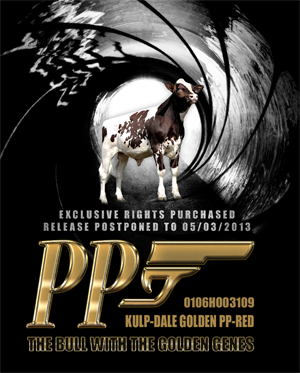
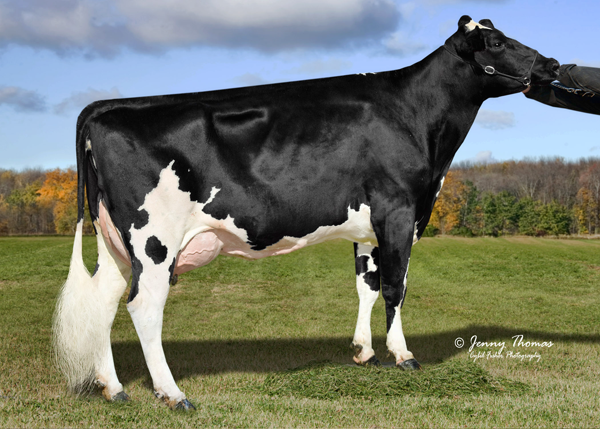
Golden PP adRi-Val-Re recently attracted prominent attention, when they paid $10,000 a dose for five doses of polled semen. That’s a great story in itself but this one was even more unique in that it took place on Facebook (Golden PP Facebook Page). Of course Jerry had a plan.  He wrote “I’ll pay 10K a unit if I can get the first 5 and no one else can buy it for 90 days.” The early negotiations were right out there for everyone to see as Roy MacGregor responded, “That’s a pretty hard offer to ignore!”  The deal was made and everyone eagerly pencilled out the possibilities (Read more – $10,000 a dose polled semen). It looked like Ri-Val-Re was set to turn Golden PP into golden business tactics.
Reaction To Ri-Val-Re Risk Taking

Every new shift in the marketplace, stirs up interest and sometimes controversy.  Such was the case with the $10,000 semen deal.  Jerry reports that reaction was pretty mixed, “I would guess I have received calls, emails and text from 100 different people. Most were wondering if it was true or not.” Securely grounded in his vision for the future, he reports that opinions changed. “After I explained my plan and what I was doing with the semen, most people thought it would work out well for me and that it was a good risk to take.”

Golden PP was not a Shot in the Dark

Those who are less willing to take a leap of faith are won over by Jerry’s analysis of what went into the decision. “I love the Colt P x Goldwyn cross. Also he is the first homozygous bull available that has appealing numbers across the board.” Again that combination of numbers and the eye appeal which he says “I feel okay using him without sacrificing too much. Also with IVF and what you can do with a single unit of semen and knowing that every single calf will be polled there are several advantages economically that way.”

Ready to Risk on Genomics

With this explanation of the Ri-Val-Re game plan, it isn’t surprising to learn that genomics doesn’t inspire timidity either. Jerry confirms that “Genomics has changed our breeding program in the fact that we use all young bulls, where before all we used were daughter proven bulls. We still look for good pedigrees but we definitely are willing to take a lot more risk.” It all boils down to personal confidence, “I’m a big believer in genomics so I feel safe using young sires.”

Ri-Val-Re Grows Thanks to Breeding Program Stars

RI-VAL-RE SUPER NIKE VG-85 VG-MS +2180 GTPI

RI-VAL-RE SUPER NIKE VG-85 VG-MS
+2191 GTPI, From Goldwyn Nadine family.
Her first daughter (Alchemy Nikole *RC #1 RC heifer in breed) sold for $150,000

When discussing the stars of their breeding program Jerry notes, “We have three major areas. Firstly, Ri-Val-Re Goldwyn Nadine-Et VG-87 has been on a continuous flush program since she calved as a two year old. She’s the 7th generation VG or EX and has a sire stack of Goldwyn, Oman, Jesther, Terry, Elton and Melvin. She has 6 sons in A.I. the highest indexing one being Ri-Val-Re Nely (a Facebook at Semex) with a DGV LPI +3293. She has several daughters over 2300+ GTPI by Mogul, Observer and Numero Uno. Currently we have over 150 pregnancies on the way from her and her daughters.”

RI-VAL-RE ALC MINI-P-RED-ET 2168 GTPI PO & R&W. Sold for $100,000 in August 2012

RI-VAL-RE ALC MINI-P-RED-ET
2168 GTPI PO & R&W. Sold for $100,000 in August 2012

Ri-Val-Re Adv Win-Go-Red-Et Ex-90 and her daughters are being extensively flushed. Win-Go is the Grand dam of Ri-Val-Re Alc Mini-P-Red who is the #1 GTPI polled, red and white heifer. She is also the Grand dam of Ri-Val-Re Obsrvr Dolo-P *RC one of the highest GTPI PO bulls.

Over 100 pregnancies are on the way from Win-Go and her RC daughters by MacGuiness & Observer (many will be Polled & Red). Several other heifers that are 2300-2400 GTPI are on IVF flush programs from other branches of these families and other purchases.

Currently the sires being used at Ri-Val-Re Holsteins are Shanosber-P *RC, Golden-PP-Red, Predestine, AltaOak, Shan, Cashcoin, Colt-45, Platinum, Morgan, Chevrolet, Willpower and  Liquid Gold.

Full Sales Ahead for Ri-Val-Re Holsteins

Starting in February we will be doing advertising leading up to our summer sale here at the farm. We consign to several sales throughout the year and are having our own sale June 15th. We plan to sell 300-350 genomic tested heifers in 2013 through consignment sales and our own sales in June and November.

Foreseeing An Emphasis on Health with More Polled Animals

A keen observer of the dairy business, despite his relative youth, Jerry reports “The biggest change I’ve seen in the last ten years is the emphasis put on health traits…. Not really sure what will change in the near future, I do believe the breed will be mostly polled by 2020 though once more and more polled animals are bred with comparable genetics to horned animals it will make more sense for breeders to breed polled and once that happens it will be hard to turn back .

The Bullvine Bottom Line

Jerry confirms what we have heard from many breeders. Real success comes when you can put it all together both on paper and in the barn.  “We are heavily invested in genomics but I still want a product I`m happy to have my prefix in front of.” He advises new breeders to “start off slow and buy into cow families with deep pedigrees and known success.” As they continue to have success on paper and in the barn, they are proving that, when it comes to cattle breeding,

Ri-Val-Re is here to stay!


Get original “Bullvine” content sent straight to your email inbox for free.


[related-posts-thumbnails]

Do All-Canadian Heifers Make All-Canadian Cows?

Every year as I am watching the yearling classes at Madison and the Royal I find myself thinking about this question.  You watch those massive yearlings and can’t help but   wonder how many of them will be topping the classes next year, once they have calved.  In typical Bullvine form, we decided to let the numbers do the talking.

Since we needed 2yr classification scores, we decided to use All-Canadian results as our guide, since we could get current classifications plus 2-year-old classification score on all the Canadian animals through Holstein Canada’s website.  The following is what we found.

All-Canadian 2yr Old Performance

CRAIGCREST RUBIES GOLD REJOICE VG-89-2YR-CAN ALL-CANADIAN SR.2-YR,INT.1-YR,INT.CALF ALL-AMERICAN SR.2-YR,INT.1-YR,INT.CALF

CRAIGCREST RUBIES GOLD REJOICE VG-89-2YR-CAN
ALL-CANADIAN SR.2-YR,INT.1-YR,INT.CALF
ALL-AMERICAN SR.2-YR,INT.1-YR,INT.CALF

First we looked at the All-Canadian, Reserve All Canadian and Honorable Mention All Canadian Sr. and Jr 2yr olds over the past 5 years.  This group is led by CRAIGCREST RUBIES GOLD REJOICE who came off her momentum of Junior Champion at Madison and Reserve Junior Champion at the Royal in 2010 to be 1st place Senior 2yr old at both Madison and the Royal.  There have been nine All-Canadian, Reserve or Honourable Mention 2yr olds that were also at least nominated for All Canadian as yearlings.  The others are MILIBRO GOLDWYN ROSELILACE , ROCKYMOUNTAIN GOLDWYN TRISHA, IDEE GOLDWYN LULU, LONG-HAVEN GOLD ROCHELLE, CALBRETT DUNDEE GYPSY, CROVALLEY GIBSON ALLISON, COMCO ROY SPEARS and BLONDIN LYSTER BEAUTY.

Of interesting note is that, of these 30 cows who were Honourable mention or higher as 2yr olds, 9 (30%) of them have gone on to be at least nominated again in milking form.  They are led by EASTSIDE LEWISDALE GOLD MISSY, the 2010 Royal and Madison Supreme Champion. The others are BLONDIN LYSTER BEAUTY, ABF SEPTEMBER CHEESE, LONG-HAVEN GOLD ROCHELLE, BRAINWAVE GOLDWYN LAURAMIE, DUBEAU DUNDEE HEZBOLLAH, SILVERMAPLE DAMION CAMOMILE, STANHOPE LEAH GOLDWYN and LYLEHAVEN DURHAM LEKYSYA.

As a group these 30 heifers scored an average of 88 points as 2yr olds and, with age, have increased to an average of 90 points.  Highlights include EASTSIDE LEWISDALE GOLD MISSY, ABF SEPTEMBER CHEESE, and EBY016 PSS TRINITY, who presently are all over 93 points.

All-Canadian Yearling Performance

T-TRIPLE-T GOLD PRIZE EX92 1st 4 Year Old, 1st Udder 2012 WDE Unanimous All-American Winter Yearling 2009 All-Canadian Winter Yearling 2009 1st Winter Yearling & Junior Champion 2009 RAWF and WDE

T-TRIPLE-T GOLD PRIZE EX92
1st 4 Year Old, 1st Udder 2012 WDE
Unanimous All-American Winter Yearling 2009
All-Canadian Winter Yearling 2009
1st Winter Yearling & Junior Champion 2009 RAWF and WDE

So, seeing that 1/3 of the All-Canadian 2 yr. olds were even nominated as heifers, how have the All-Canadian heifers been calving in?  To answer this, we looked at the All-Canadian, Reserve and Honourable Mention Yearlings, for the four yearling groups, over the past 4 years to see what they scored as 2yr olds. What we found was that only 6 of the 48 (12.5%)  of these animals went on to show ring success and All-Canadian, Reserve or Honourable Mention awards in milking form.  In addition to Rejoice, Trisha and Roselilace mention above there are T-TRIPLE-T GOLD PRIZE, BONACCUEIL CAMEE FINAL CUT and SALEM GOLDWYN THERESA, who were ever nominated in milking form.

The 48 animals do average an impressive 86.9 points as 2yr olds.  Standouts in this group are   Theresa, Prize, and Rejoice as well as WHITAKER STORMY RAE, ROB-CRI TRIBUTE SHIMMER and SIEMERS GOLDWYN GOLDIE who all scored 89 points as 2yr olds. Some have matured really well and scored an impressive 93 points or higher. Those ones are Theresa as well as GOLDENFLO ALLEN CANDLE, ATOZ GOLDWYN LIMO, JACOBS GOLDWYN EMORY and KINGSWAY DUNDEE ALABAMA.

The Bullvine Bottom Line

While the numbers would make you question just how good a job we are doing at predicting what yearling heifers will be the next great 2yr olds, you need to remember that the largest part of the Cow Judging Scorecard is mammary system (40 points), which is something that you cannot really predict as yearlings or heifers.  I  remember when I was first learning to judge and was taught to take a look at a heifer’s “udder promise” and try to  predict what she would calve in like.  After years of observation, the one thing I have learned is that, other than checking that there are four teats and no webbed ones, you cannot really tell which heifers are going to calve in great and which ones will not.  For that you are far better to check out their maternal line and sire stack and go from there (Read more – Who’s The Next Great One? and 7 Sires to Use in Order to Breed the Next World Dairy Expo Champion ).  While the numbers do show that great show heifers don’t always make great show cows, this exercise does highlight how the accomplishments of CRAIGCREST RUBIES GOLD REJOICE are truly outstanding.


Get original “Bullvine” content sent straight to your email inbox for free.


[related-posts-thumbnails]

30 Sires that will produce Feed Efficient Cows

2013ecttop13of2013Commercial milk producers want to breed cows that have high feed conversion efficiency, that avoid culling and that take the least care or staff time (Read more – Feed Efficiency: The Money Saver).  The well known and widely used total merit indexes, TPI*TM  and LPI, rank sires according to which ones leave the most profitable ideal or true type cow. However the factors in those indexes and the assumptions that are made when calculating them do not address feed, culling or low maintenance.   Milk producers are left to fend for themselves when it comes to selecting sires that will leave their kind of cows.

What’s Being Heard

Milk Producers say: “All I want is a trouble free cow that efficiently converts forages to the kind of milk my milk buyer wants.

Veterinarians say:  “Cows must get in calf, have minimal feet problems and must not be prone to having production limiting diseases (reproduction problems, mastitis, metabolic disorders or  ..etc.).

Farm Workers say:  “Sick animals, calving problems and animals that do not work easily within the farm system waste my time.

Feed Advisers say: “Test your forages, feed the rumen, get the most out of your forages and the use of nutrients for both production and maintenance must be considered simultaneously (i.e. medium sized cows yielding the same as large cows are more feed efficient).

Milk Processors say: ”Except for the milk we sell as a drink, we want the solids not the water.

Financial Advisers say:  “Make decisions based on profit per cow, per litre, per hectare, per pound of feed consumed, per worker, …etc.

Consumers say: – Well in fact we may not be listening to consumers (Read more – Milk Marketing: How “Got Milk?” became “Got Lost”)

There are even more voices speaking in producers ears and more words appearing on the computer screens that producers read.  With all the information that is currently available, selecting sires that best meet the needs of milk producers can be a daunting task.

Getting Started

Milk producers do not wish to deal all the numbers that appear on proof sheets. That can be a very time consuming exercise with no definitive answers at the end of it.

The Bullvine decided to research what is available today on selecting sires for feed conversion efficiency, for freedom from major known reasons for culling and for minimal extra care. We recognize that down the road there will be genomic indexes that are based on the relationship between yet to be recorded on-farm cow performance data and the DNA make-up of cows for these three areas. But today those genomic indexes do not exist.

Bullvine Efficiency Index (BEI)

Based on the information from a number of countries that we have been able to access, the Bullvine has developed the following formulas:

  1. BEI = Production (45%) + Durability (35%) + Health & Fertility (25%)
  2. Production = 30 Fat Yield + 50 Protein Yield + 10 Fat% + 10 Protein%
  3. Durability = 17 Herd Life + 42 Mammary System + 25 Feet & Legs  – 8 Body Depth – 8 Stature
  4. Health & Fertility = 46 Somatic Cell + 23 Daughter Fertility + 23 Udder Depth + 8 Milking Speed

Notes:

  1. Milk Yield is not included as it contributes to more udder strain and added milk haulage or on-farm water removal costs.
  2. The negative weightings on Body Depth and Stature reflect that larger cows  require extra feed to grow to that size and to maintain that larger size each and every day compared to cows of more moderate size.

Sire Rankings

Using CDN’s Custom Index Calculator  the following sires came to the top of the list,

CANADIANINTERNATIONALYOUNG SIRES
LONG-LANGS OMAN OMAN-ETCO-OP BOSSIDE MASSEY-ETFARNEAR-TBR-BH CASHMONEY-ET
CRACKHOLM FEVERCOYNE-FARMS DORCY-ETSOUTHERN-HILLS BAYARD-ET
BRAEDALE GOLDWYNDE-SU  CIMARRON-ETFARNEAR-TBR-BH CASHCOIN-ET
ALLYNDALE-I ATTICUSBADGER-BLUFF FANNY FREDDIEMR LOOKOUT P ENFORCER-ET
LIRR DREW DEMPSEYCERVI ALLEMAR ETCO-OP BOOKEM YUXI-ET
DE-SU GILLESPY-ETDE-SU GULF-ETCO-OP MASTER GENO-ET
GEN-I-BEQ BRAWLERBERTAIOLA MINCIO ETAMIGHETTI NUMERO UNO ET
GILLETTE JORDANGUARINI-ETTEEMAR OBSERVER ADAM-ET
GEN-I-BEQ TOPSIDEDE-SU FORK-ETDE-SU DISTINCTION 11130-ET
ENSENADA TABOO PLANET-ETDE-SU WATSONDE-SU UNO 11446-ET

Please note: Due to the fact that CDN’s Custom Index tool only allows quires by Domestic Canadian, MACE and Genomic individually it is not possible to do an overall ranking.

Key Findings

  • Except for the Domestic Canadian list only a small difference exist between bulls
  • The rankings do not always follow TPI* TM or LPI due mainly to the negative weighting on body depth and stature and increased emphasis on SCS, daughter fertility and udder depth.
  • Although Braedale Goldwyn, Sandy Valley Bolton and Picton Shottle progeny are prominent on these listings, they are from different cow families so inbreeding using the sires on these lists should not be a problem, providing a breeder does not focus on just one of them

Highlights

  • Braedale Goldwyn appears on the listings himself. As well he has six sons on the lists and is the maternal grandsire of three of the genomic bulls.
  • Sandy Valley Bolton has seven sons on the listings
  • Picton Shottle is the maternal grandsire of nine bulls on the listings
  • Oman sons Long-Langs Oman Oman and Badger-Bluff Fanny Freddie both appear on the listings, as do one son and one maternal grandson of each of them
  • De-Su Observer, yet to be daughter proven, has three sons and one maternal grandson on the genomics listing

The Bullvine Bottom Line

Commercial milk producers often want the decisions on which sires to use to be as simplified as possible. That is why the Bullvine has produced these BEI listings. With due consideration to avoid inbreeding, milk producers can expect BEI to rank bulls for them for production, durability and health & fertility with emphasis on the sires that can convert intake into milk production.

Get original “Bullvine” content sent straight to your email inbox for free.


[related-posts-thumbnails]

Durham vs. Goldwyn: A Clash of Two Titans

Inspired by the recent announcement of Regancrest Elton Durham siring the most excellent cows in the U.S. (Read more – Durham Passes Elevation to Become the Leading Sire of Excellent Cows in the U.S.) and Braedale Goldwyn the most in Canada (Read more – Goldwyn First Ever to 1000 EX Daughters in Canada), we here at The Bullvine thought it would be a great time to take a closer look at these genetic giants to  see who has had more impact on the Holstein breed.

The Regancrest Elton Durham Story

Durham coverBred by Regancrest Farms, Waukon, Iowa, Durham was born in 1994 and would go on to be one of the most popular sires of the first decade of the new millennium. Durham’s pedigree combines Bell and Chief Mark bloodlines as he was by a son of Bell, and Snow-N Denises Dellia (EX).  His dam was out of a Bell daughter. Also Dellia and Effie, his sire’s dam, were both from Chief sons and his pedigree shows four Ivanhoe crosses and two to Fond Matt.  Durham has left a very consistent transmitting pattern in both his daughters and his sons. Due to his low production numbers, he was not used heavily as a sire of sons, but his daughters have seen extensive use as bull mothers.
For five consecutive years 2003-2007, Durham was Premier Sire at World Dairy Expo.  This certainly establishes Durham as a once-in-a-lifetime sire of type.  His pattern leaves long bodies, broad and flat rumps, udders that are well attached and  wide rear udders.  However what made him so successful in the show ring was that Durham also transmitted outstanding dairyness and style.

Durham Sons

Durham sons were extremely consistent in their pattern and, at one point, eight of them were in the top ten spots for P.T.A.T (2005).  Some highlights include:

  • REGANCREST-MR DRHAM SAM
    From the Saturday family, his dam was Sher-Est Emory Swanny (EX). Mr Sam is also the sire of the popular type sire Pine-Tree Sid, who is the sire of Micheret Alexandra Sid (VG-88-2YR) All-American (tied) and All-Canadian Senior 2yr old in 2010.
  • MESLAND DUPLEX
    Sampled in Spain, Duplex was the highest type sire in the US for several summaries, with high numbers for udders and feet & legs.  Similar to Mr Sam, Duplex was also from an Emory dam this time going back to Henkeseen Mark Marci (EX-94).
  • REGANCREST-LH MODEST
    Modest was Durham’s highest production son from Meadow Bridge Aero Missy (EX).
  • TO-MAR D-FORTUNE
    At one time, Fortune was in the top 10 on the Canadian LPI list.  Probably best known now for being the sire of the winning 4 year old at the 2012 Royal, Macpes Fortune Koquine EX-94-Can.
  • WINDY-KNOLL-VIEW PRIMETIME
    From a great maternal breeding family, Primetime was the Durham son of Windy-Knoll-View Peggy (EX-94), and had a high type proof and for a long time was among the top Herd Life sires in Canada.  He was also the sire of the 2006 World Dairy Expo Junior Champion and All-American fall calf, Wm Ariannas Pt Aesha.

Durham Daughters

Daughters represent  the area where Durham has had his greatest impact. There are many great daughters to choose from. Here are just a few:

  • KAMPS-HOLLOW ALTITUDE EX-95-2E-USA DOM 1*
    Probably best known for being the dam of KHW Kite Advent who was Premier Sire of the Grand International Red and White show for three consecutive years and KHW Regiment Apple who was Grand Champion of the 2011 International Red & White Holstein show.
  • LYLEHAVEN LILA Z EX-94-CAN 14*
    Probably best known for being the second highest selling cow in Canadian History (Read more – Lylehaven Lila Z: Was she really worth $1.15 Million? and 2012 Golden Dam Finalist) she is also the dam of 2012 Canadian Cow of the Year Nominee, Comestar Goldwyn Lilac (VG-89) who’s descendants led the way at the recent Genetics By Design Sale (Read more – Genetics By Design – Crosses the $4,000,000 Mark).
  • MD-DELIGHT DURHAM ATLEE  EX-92-4YR-USA DOM GMD   6*
    All-American in her own right as a 3yr old in 2005, Atlee is probably best known for her sons who dominate the current type evaluations: MS Atlees Sht Aftershock (+18 Conformation Dec*12); Maple-Downs-I G W Atwood (+17 Conformation Dec*12) and MR Atlees AltaAmazing (+16 Conformation Dec*12).  Atlee herself traces back to the great brood cow AITKENBRAE STARBUCK ADA EX-CAN EX-94-2E-USA DOM 4* (Read more – MD DELIGHT DURHAM ATLEE – 2012 Golden Dam Finalist).
  • REGANCREST-PR BARBIE EX-92-7YR-USA DOM GMD 3*
    BARBIE is the sixth generation of the Regancrest breeding program combining both the Dellias and the Brinas.  Eleven of her daughters are ranked in the top 25 of the American type index list.  Barbie’s offspring consistently generate top prices at international sales.  In 2009, granddaughter and fellow 2012 Golden Dam finalist, Regancrest S Chassity EX 92, sold in a package with her offspring for $1.5 million.  Barbie is the dam of 14 EX & 16 VG daughters and, currently, one of the breed’s leading type sires – Braxton EX-95.
  • MARKWELL DURHAM DAISY EX-92-6YR-USA GMD DOM
    Daisy does it all.  She has high production, fitness, longevity and outstanding type.  This Excellent Durham granddaughter of Markwell Bstar Raven EX-95, who as a young cow made many waves at Madison, also transmits it all.  Daisy’s dam Markwell Luke Rapture recently passed away at 18 years of age.  Numerous daughters, granddaughters and their sons distinguish themselves in the genomic rankings.  As a bull dam in 2010, Daisy had some fabulous results with the high-ranking O-Man sons Dakota (the Netherlands), Duke (Germany), and Osaka (Spain).  In 2012, Daisy’s first progeny sampled grandson, Danillo, provided an impressive sequel with top position in the Netherlands.  Also of note is her grandson Goldday (By Goldwyn) who is from A-L-H Destiny and currently the top International Sires on the BPI List (Read more – Bullvine Performance Index (BPI) – Top Sires December 2012)

While Durham daughters were not typically the hardest milkers they were some of the most trouble free cows and, as more attention is being given to this, Durham decedents are gaining more attention again.  Because of their health traits, Durham daughters have been appearing on the Net-Merit lists and have A.I. studs using them heavily as dams  of sons, not just to get type sires, but to also get Net-Merit list toppers.

The Braedale Goldwyn Story

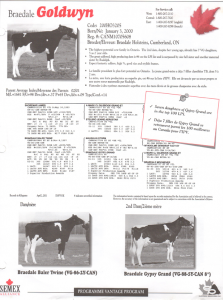
goldwyn test sire sheetGoldwyn has been an extremely popular sire worldwide since his initial proof in 2004.  This is not surprising given the strong maternal line behind him.  His dam Braedale Baler Twine (VG-86 23*) was Canada’s cow of the year in 2007 and his second dam Braedale Gypsy Grand (VG-88 36*) was the Canadian Cow of the year in 2003.  While many think that Goldwyn made the name for this cow family, long before Goldwyn was proven the family was already proving itself with Gypsy Grand sons Goodluck, Freelance, Spy, Freeman and Bold topping the bull list and daughters Cheetah, Second Cut, and Clairvoyant topping the cow lists.  This explains why Baler Twine was contracted as a virgin heifer at a time when the family name was not as prevalent as it is now.

According to E.Y Morwick in his book The Holstein History, “The pedigree of Braedale Goldwyn offers a clinic on the art of successful line breeding.  He carried three close crosses to Madawaska Aerostar: Sharemar James, his sire, was out of the Aerostar daughter, Stelbro Jenine Aerostar (VG); Braedale Baler Twine, his dam, was sired by Maughlin Storm, an Aerostar son; and Braedale Moonriver, dam of Braedale Gypsy Grand (Goldwyn’s maternal grand-dam), was an Aerostar daughter.  In Goldwyn’s lineage were three crosses to Walkway Chief Mark: Shoremar James and Braedale Gypsy Grand were both by Mark CJ Gillbrook Grand, a Chief Mark son; while Gypsy’s maternal granddam was Sunnylodge Chief Vick (VG 2*), a Chief Mark daughter.”

By February of 2009, Goldwyn had racked up a pretty impressive list of accomplishments, including finishing in the top six on the Canadian LPI list 14 out of 15 times.  He was number one once and number two twice.  He was also the top rated sire for conformation 11 times.  In 2008 when Goldwyn won Premier Sire at World Dairy Expo (ending Durham’s long reign), he was not only the youngest sire in 25 years to do so, but he was also the first bull who topped the LPI list to do so. With his win in 2012, Goldwyn has now tied Durham in achieving five consecutive Premier Sire awards at World Dairy Expo.

Goldwyn Sons

In addition to Goldday mentioned above, there have been impressive sons.  While maybe not LPI or TPI list toppers, they have certainly passed on the high type traits that Goldwyn has to offer.  They include:

  • CRACKHOLM FEVER
    Underrated by many, Fever is more than just a high type sire (+16 Conformation Dec *12) he is also a great mastitis and fertility improvement sire making him a great sire to address the major herd culling problems and should probably get greater attention from many breeding programs (Read more – From Fantasy to Reality – Top Sires to Address Herd Culling Problems).
  • LIRR DREW DEMPSEY
    Similar to Durham, many Goldwyn sons did not excel in production but did offer great improvement in conformation and health and fertility traits.  Dempsey is one such case.  His daughters would not WOW you with their production, but their strong components, outstanding udders and legs, combined with long herd life and low somatic cell score, certainly make them favorites among their owners.
  • MAPLE-DOWNS-I G W ATWOOD
    Atwood is probably the sire that is going to give Goldwyn the closest run for his money, over the next few years, at the Royal and World Dairy Expo.  His daughters are already putting up some impressive show results (Read more – Breeding The Next Show Winners) and he was among our picks for one of the sires to breed the next World Dairy Expo Champion (Read more – 7 Sires to Use in Order to Breed the Next World Dairy Expo Champion).  Of course Atwood is from the magic cross of Goldwyn on Durham that has produced many great results.  His dam is one of the top Durham daughters MD-DELIGHT DURHAM ATLEE EX-92-4YR-USA DOM GMD 6* (Mentioned above).
  • COMESTAR LAUTHORITY
    Lauthority combines two of Canada’s greatest cow families, the Gypsy Grand’s and the Laurie Sheik’s. His dam is COMESTAR LAUTELMA IGNITER who is proving she can leave top sons and top daughters as proven by COMESTAR LAUTAMIE TITANIC VG-89-2YR-CAN 14* who was Reserve All-Canadian Jr. 2yr old in 2006.
  • FUSTEAD GOLDWYN GUTHRIE
    Guthrie is currently Goldwyn’s highest proven LPI son at +2494 that has him in the top 50 MACE  gLPI sires.  Guthrie is one of the few Goldwyn sons over 1000 KG of milk and combines that with extreme type (+16 Conformation) and solid health and fertility traits.

Goldwyn Daughters

Similarly to Durham, Goldwyn  has made a bigger impact through the maternal side. Some of his  most notable daughters include:

The Bullvine Bottom Line

There is no doubt that Goldwyn and Durham are the two greatest type sires since the turn of the century.  However, they have yet to leave that legacy son that tops the lists.  While Goldwyn does have Atwood who is going to give him a run for his money at the upcoming North American shows, there is no top index sire to continue the tradition.  For both sires the greatest impact is going to come through their daughters and in that area Goldwyn holds much more opportunity, since Durham was found to be a carrier for CVM and could not be used in countries like Canada, greatly limiting his potential impact.  Which brings us to the question, “Is Goldwyn’s dominance because  he has had a greater opportunity than Durham did (Read more – Braedale Goldwyn: Is He the Greatest Type Sire Ever?).  What is clear is that Goldwyn daughters have fared much better in the show ring while Durham daughters have proven themselves more when it comes to proven sons.  Though the quality of both these sires’ progeny is certainly of the highest level, it will take time to determine just which one of these two sires will have the greatest final impact.

[related-posts-thumbnails]

What the Dairy Industry Can Learn From the Firing of Brian Burke

Hockey fans, which most dairy farmers are, know Brian Burke as the guy with the permanently askew necktie and reddish face, and a plug of chewing tobacco planted firmly beneath his cheek and gums as he stared down at his hockey team from the general manager’s box in the press level at the Air Canada Centre, chirping at opposing teams or on-ice officials and urging on his Toronto Maple Leafs.  They also know him as the guy who talked a good game but failed to deliver a competent goaltender and overspent for players.  Something far too familiar to many dairy industry executives.  Burke was fired this week.

The thing that many dairy farmers need to realize from this scenario is that dairy farming, just as hockey is a results oriented business.  Just like hockey, when someone is not performing, change is needed.  When Burke was ushered in to Toronto many fans were already planning the Stanley Cup parade down Yonge Street.  The problem is it never materialized.  Similar to the announcements of many dairy industry executives.

Leadership starts at the Board Level

The same can be said of many dairy organizations.  New leadership comes in and it seems to take a long time to see any change, and even longer for the boards that preside over these organizations to realize it’s not working and enact change.  Take a look at the Leafs, the board at the time when Burke was hired, was comprised of mostly hockey fans (Ontario Teachers’ Pension Plan owned the Leafs as much for the PR value with membership as they did for ROI).  Then about a year ago Canada’s two media giants, Rogers and Bell, teamed up to purchase the majority stake in the Leafs for $1.07 billion, with official transfer happening in late August.  As one of their first moves, though delayed by the lockout, the very results driven board decided that Burke was not the man to lead them forward.  He’s gone.

This is one area that I think many of the dairy breeder boards (Breeds, Milk Recording, A.I., Milk Marketing etc.) do not do a good job of.  While everyone likes to be everyone’s friend, management must be held accountable for results.  This is its very mandate that every board should hold itself to.  Now I know that in many cases breeders tenure on these boards is short (something many big corporate boards would never allow), so the ability to bring about change can be hard.  However, it is also why I think as an industry we need to look closer at how we comprise these boards.

While there is no doubt I believe the breeders should be represented, it can also be very helpful to have people from outside the industry on these boards.  Any good board needs to have its stakeholders (the breeders) on its board.  However, it’s also important to bring non-investor (non-breeder) who has outside perspectives to the board.  Typically this means bringing people from financial, legal and organizational growth to the table.  This will help in bringing a more balanced approach to growing the organization.

Blue and White Disease

For all his performance shortcomings, there were certainly things about Brian Burke’s tenure that I have a great deal of respect for.  One thing is the way in which he worked at getting rid of the “blue and white” disease.  This was the clever phrase Brian used to slam the culture of entitlement they believed every Leaf was stricken with.  We see this in many dairy organizations, where staff and board members seem to have a sense of entitlement just because of their position with that organization.  They seem immune to the performance and accountability that all employees and boards should feel as paid or elected representatives of a public or co-operative organization.

Now I understand that there is a time and a place for different styles of leadership.  At times, it is better to lead from the rear than the front.  No questions asked.  However, much like William Wallace (Braveheart) and Maximus (Gladiator) there is also a time that you need to lead your organization from the front, leading the fight at risk of firing or in Wallace and Maximus case even death.  That is what it is going to take to win.  In a time where there was no superstar capable of being the front man for the Leafs, Burke took the heat and stood up for the organization.  (Don’t even get me started on Kessel, whose trade may be the one biggest mistake Burke made that ultimately cost him his job).  Now he may have partly done it out of ego, but when the organization or even certain players were under severe scrutiny (which happens a lot in the hockey crazed city of Toronto), Burke stepped up and took the heat, something that earned him a great deal of respect from all internal staff and players.  This is one thing I see severely missing in the dairy industry.  At one time there were people like Moe Freeman, Roy Snyder and George Clemons, that when it was needed stepped up and led from the front lines.

The Bullvine Bottom Line

The dairy industry is stricken by its own Blue and White disease.  The sense of entitlement held by many of its breeder organizations is staggering.  These organizations need to be accountable for performance, and when performance metrics are not met, heads need to roll.  Currently, there is rising uncertainty, due to changes in consumer demand, marketplace decline and genomics.  It is time for leaders to step up to the plate.  It is time to lead from the front.  It is time for accountability.  Brian Burke accepted that leadership responsibility.  He was willing to risk it all, knowing that performance would dictate his fate.  Can dairy breeders expect the same from our boards and leaders?

[related-posts-thumbnails]

Feed Efficiency: The Money Saver

Fed up? Losing money? Start Tracking Feed Efficiency. The current lack of forages for dairy cattle in North America and high grain prices globally has brought feed front and center on most dairymen’s radar screen. Since for most herds feed costs vary between 50% to 60 % of the dairy’s operational costs, the current higher costs are narrowing on-farm margins. In some cases it has resulted in farms downsizing their milking herd, selling off their heifer herd and for some farms an exit from the dairy business. To say the least dairy farmers are having to address something foreign to most of them – the amount and cost of the feed their herd is consuming.

New Territory for Dairy Farmers

Given that dairy cattle breeding, to a very large extent, has ignore any genetic aspects to a cow’s ability to convert feed into milk, the idea of culling cows that do not convert well is an unheard of practice. Seeing that this subject is new to most breeders, The Bullvine decided to delve a little deeper into what is known and what investigation is underway when it comes to the efficiency with which cows convert their feed to products humans can consume.

Feed In. Dollars Out. It’s Hard to Capture FIDO.

It is costly and time consuming to capture individual cow feed consumption, so producers and their feed advisors have taken the approach of feeding the herd or groups within the herd and monitoring the production, feeds costs and the returns over feed costs. Only in research herds has there been any attention paid to individual cows and their efficiency of conversion or return over feed cost.  And then only for cows on feed composition trials and nothing on a cow or sire’s daughters genetic merit for feed conversion. So to put it simply the industry has said – feed them more, balance the diet differently, add some micronutrients, have adequate fibre in the diet, etc. because we have not been able to address the cow’s genetic ability to convert feed to milk.

What We Know about What’s Eating You

Some facts about feeds, feeding animals and feed costs include:

  • The poultry and swine industries have paid considerable attention, for quite some time now, to feed conversion / feed efficiency. With much success especially in      poultry meat industries. In beef and sheep feed conversion for animals being finished in feedlots is an important profit factor.
  • In dairy cattle, feed conversion ability includes all aspects – feeding for growth, production and maintenance.  We do not always think about the extra cost to grow heifers larger or to maintain a large versus a medium sized cow. By the way the Net Merit index does include a 6% weighting on cow size. And it is a negative weighting so larger cows are penalized for their extra size. So if you have been using the Net Merit index you will already be indirectly breeding for feed efficiency.
  • Level of milk production very much depends on the amount of feed consumed by a cow (commonly known as Dry Matter Intake). But we do not know the degree of correlation between volume consumed and feed efficiency.
  • Recent cost studies show that milking cow feed costs on individual farms vary from 20 to 35% of milk revenue. That variation is significant! So the opportunity to make progress in returns over feed costs is out there.
  • Given the wide variety of feeds and feed practices on dairy operations, an average feed cost per milking cow per day on individual farms can be anywhere from $4.00 to $8.00.
  • Every day dairy farmers have happen but do not monitor or comprehend differences in their cows’ ability to convert their diet into milk revenue. Depending on lactation numbers and stage of lactation a cow consumes 1 kg of dry matter to producer between 0.8 kg and 1.8 kgs of fat or energy corrected milk. Differences in milk, fat and protein production are monitored on-farm however cow differences in feed conversion efficiency are not.

Measuring the Future: You are What THEY Eat

Farmers and their nutritional advisors will continue to fine-tune the diets of cows. That’s a given. Gains in the returns over feed costs will be made by fine tuning diets and by adjusting the management and environments for cow and heifers.

However if the swine and poultry industries have been able to genetically enhance their species’ ability to convert feeds to meat or eggs, then is there not an opportunity for dairy cattle to also be bred for feed conversion efficiency?

It should be possible to breed for heifers that grow more efficiently and cows that convert feeds more efficiently into the milk needed to produce the products consumers want and will buy. If through more efficient milk cows there could be $0.33 more profit per cow per day, which amounts to an extra net income of $25,550 per year for a 200 cow milking herd. Nothing to be sneezed at.

From a Pile of Feed to a Pail of Milk?  Where’s the Genetics DATA?

However the challenge remains how to the get data for use in on-farm decision making and for determining the genetic difference between animals and bloodlines for feed efficiency. Well in fact there are some keen researchers in the United States, the Netherlands, the United Kingdom and Australia in association with countries with national data bases used for genetic evaluation addressing this challenge. Currently they have studies underway to measure feed intake and cow outputs for cows on research trails. After obtaining the data they will correlate the efficiency results with the DNA (snips) makeup of the cows. In the USA alone there will be over 8,000 cows currently being studied.

Within a year the dairy industry can expect to see some preliminary results of this research work. But genomic indexes will only be the start. I expect that on-farm data capture software and systems will become available to measure a cow’s feed intake. The data from such systems will have value both at the farm level and at the genetic evaluation level.

The Bullvine Bottom Line

Stay tuned for what will be new genetic evaluations and animal genomic indexes for feed conversion efficiency. It could take up to a decade for there to be accurate indexes and wide use made of the indexes but it will come fast once the basics building blocks are in place. Even a 5% gain in feed conversion efficiency in dairy cattle will be worth billions of dollars annually to the global dairy industry. Once again opportunity knocks at our doors.

Looking for more on Feed Efficiency check this out – Holstein vs. Jersey: Which Breed Is More Profitable?

[related-posts-thumbnails]

MILK MARKETING: How “Got Milk?” BECAME “Got Lost”

taylor-swift-got-milk2013ectIt’s just eight days into a New Year and already I’m thinking about the ‘good ol’ days!”.  Remember when the dairy industry was at the top of the agricultural sustainable list, milk was the “perfect food” and milk moustaches were seen on celebrities and sports stars? Hmmm. Where has all the glory gone? In 2013, the dairy industry is fighting to stay alive, the North American diet, including milk, is under attack as obesity from babes to the elderly is out of control and, when all is said and done, milk is a slipping way down on the favorite beverage list!

The land of milk and money is gone. In the cold light of the soul searching brought on by a new year, it seems that this shocking state of affairs has happened suddenly and for no apparent reason.  In actual fact, the signs have been there for more than thirty years and we as an industry let it happen.

MILK OF AMNESIA – We forgot the basics

It took three steps for the milk market to evaporate!

  1. We forgot about the consumer.
    The first commandment of business, “The customer is always right!”  in the dairy industry has become “The cow always comes first!”
  2. We forgot about the product.
    Somewhere production, with the myriad of logistics in between, pulled out in front of the inherent value of our end product – milk.
  3. We forgot delivery.
    Despite the first two failures, we still expected that the product we produced could be delivered in boring, hard-to-open cardboard cartons, heavy jugs or even plastic bags and compete against the “cool” the “sexy” and the “handy” beverages provided by competitors – who wanted — and stole — our market share!

MISSING THE TARGET:  Where’s The Consumer? Where’s the market?

Consumer demand is the key to market sustainability. There’s no use producing a product if there is nobody to buy it. The truth is demand for milk has been in a free fall for the last three decades.  North American milk consumption has dropped a startling 36% since the 1970s. The continuing economic downturn has refocused consumers on value.  They not only are choosing private label products and discount store venues, they are seeking low calorie, reduced sugar and functional value in the beverages they consume. Milk – even though billions of pounds are being produced is losing out to fortified, organic, sports drinks and a myriad of better-for-you products. We are paying the piper for focusing on just one highly commoditized product, ignoring market trends, and trying valiantly to sell what we make rather than what people want.  If we don’t give consumers what they want, someone else will.

LOOK BEYOND THE PAIL: Think outside the box stall.

For decades industry strategy has been to make dairy operations more efficient.  It has succeeded: From 1970 to 2006, the number of cows declined 25%, output per cow more than doubled. But while the dairy industry focused on squeezing more milk out of fewer cows, they largely ignored the fact that demand was getting squeezed as well. That’s the nature of business. Where’s the competitive spirit that drives all the other parts of the dairy industry?  Even the perfect sire or model cow, needs to be marketed.  Our over-riding concern to “protect” ourselves from each other, the economy and even mother-nature, has made us put on blinders to the dangers of not being relevant to the marketplace.  Breeder beware! We could protect our industry right to zero!!

4 STEP ACTION PLAN: It’s Time for a MILK SHAKE Up!

Three steps got us into this mess.  Let’s start with four to get us out.

  1. Pay Attention:
    With per-capita North American milk consumption down 36% between 1970 and 2011, it isn’t whether or not there is a problem. The fact is the dairy industry is in trouble.
  2. Make it Functional:
    You’ve got to get the drink – in our case milk – into consumers’ hands. This is no time for doing things the way they’ve always been done.  Look at Nestle.  They wanted their milk drink containing probiotic for children to have a shelf life of one year.  Realising that it is impossible to keep the probiotic alive at room temperature for more than a few days.  The solution was a shelf-stable nutritional drink with the probiotic in the straw, instead of in the drink.  Inside the patented straw of boost Kid Essentials is the probiotic lactobacillus reuteri ‘protectus’, released by the liquid when the consumer drinks through the straw! Now that’s functional!  On-the-go consumption is increasing. Milk packaging needs to conform to this trend.  Consumers are increasingly looking for a range of package sizes to suit different beverage types and thirst levels, as well as functional and aesthetically-pleasing packaging. Not my area, you say as a dairy farmer?  Whose is it?  Who cares?
  3. Make it Healthy:
    Whether it’s the health benefits you get from drinking milk or the environmental benefits of how it is packaged – the consumer cares about both! Parents are increasingly concerned about the nutrition and sugar content of the products consumed by their children.  This can work for us (with soft drink competition) or against us (sugar added milk products).  Again packaging enters the discussion. Studies in 2011 showed there is a substantial proportion of European consumers that would be prepared to pay extra for glass containers, especially for milk, yoghurts, juices and wine. “it may well be that consumers are willing to pay more as good packaging protects the health benefits and taste of the product for longer”. The health and wellness trend is not going away.  We have a healthy product but it won`t sell itself if we continue our milk-sells-itself mind set!
  4. New Products. New Location.
    We`ve got to ask ourselves what does the market want and then find innovative ways to provide it. Perhaps even before we answer those questions we have to zero in on “where” the market will be.  In a global marketplace, we need to consider the enormous potential of focusing on the end user – perhaps in another country!

LIVE OR DIE MILK BATTLE: Consumption is the Key

We can no longer rest on our milk stools. We have to compete for the marketplace with all the old beverages … and countless innovative new ones. That may seem to be a daunting task but it can no longer be ignored.  Again.  The world is waiting.  Look at the graphic below.  While our own markets are mature in the milk marketplace, there are HUGE opportunities for dairy in the global scene. 

Consider this: One glass of milk per day per child in China could surpass the milk consumption of the entire North American market. It’s a new frontier to be won!

THE BULLVINE BOTTOM LINE

We can’t continue to let narrow focus override finding the consumer and serving them the milk products they want. Laying blame won’t stem the downward trend of the dairy industry.  Remember when land-line phones had a monopoly on communication? Think about large phone companies (another almost monopolistic industry, especially in Canada). Where would they be today, if they had continued to whine about the intruders into the marketplace?  The faster we learn from their example, the sooner we’ll prove that the North American dairy industry isn’t ready to kick the milk bucket yet!

[related-posts-thumbnails]

Semen Prices Are Never Too High

Many cattle breeders may be under-spending on semen. They have the mistaken idea that not spending is providing savings. What they are failing to consider is that short term savings could be causing expenses in the longer term.  While the old adage “It takes money to make money.” seems cynical, there are times when it simply means there is good cause for loosening the purse strings.

Heifer Costs TODAY

A check of dairy heifer rearing costs for North America reveals a range between $1900 and $2200. For today’s discussion, let’s assume that that is the cost to produce an average proven sire daughter. It takes five doses of semen to get a heifer calf (including repeat services and a ratio of 50% bulls and 50% heifers). Therefore the cost to get a higher quality heifer is $ 2000 + 5 times the extra semen dose costs. That is the simple math and the simple answer is “Yes!” It costs more and the numbers could range, on average, from $25 to $50 extra per female bred per year.

What’s it WORTH to YOU?

It would be wonderful if you could dial in a one-size fits all answer to the complicated business of dairy cattle breeding. Since we can’t, we have to constantly analyze our business and the marketplace. Each dairy herd ultimately has to make semen buying decisions based on the answers to questions such as these ones:

  • Where are the genetics of your herd at today?
  • Where do you want your herd genetics to be in the future?
  • What financial or logistics issues affect your sire choices (i.e. herd size; availability of semen)?
  • What market are you targeting as your revenue stream (sales of milk, embryos or breeding stock?)

A Closer Look at SEMEN

Looking at recent economic studies we found that, on average, North American producers spend about 1.5% of their annual expenses on AI costs. On average that is $76 per cow per year and that does not include the on-farm labour costs for herds that inseminate their own animals. If, upon reading this, you are happy with where you fit in relation to the average, let’s remember “Being average today means that you will be behind tomorrow!”

At The Bullvine we are interested in which sires get used.  We obtained the semen price lists for six major North American AI studs.  Each organization has different product lines and their pricing strategies and customer focus groups also differ.

Our next study was to determine average semen prices, depending on a bull’s merit. For each organization we determined a weighted average semen price and compared categories of bulls to that average. The following chart shows how much extra you would have to spend on semen cost to get the targeted results. (See below)

What’s the DIFFERENCE?

Targeted Results Extra Semen Cost per Dose
Average Proven Sire on Price Listings $ 0
Sexed Semen  + $19
Proven Sires  
Over 2200 TPI and PTAT >2   or  2500 LPI and CONF >+10 + $22
Over 2000 TPI and PTAT >1 or  2000 LPI and  CONF >+5 $0
Other bulls -$21
Net Merit > +$600  + $10
Unproven Sires
Genomics        TPI > 2200 or LPI > +2500 + $ 18
Genomics        TPI < 1800 or LPI < +2000 –  $ 11
Net Merit > + $750 + $ 12

Since neither Red nor Polled Sires on the price lists covered the genetic merit ranges listed above, a comparison for those categories was not possible.

An increase of $20 per dose is one thing when you’re looking at a 40 cow herd but it becomes quite significant in a herd of 500 cows.  Is it a good investment or a worrisome expense?

What Is The Sexed Payback?

At the outset you have to accept that any payback from using sexed semen or will be three to four years down the road.  With sexed semen, although there is lower conception and therefore it requires more doses per pregnancy, you are 90% sure of getting a female.  Some breeders limit the use of sexed semen to their higher genetic merit animals. The payback is that they get more heifers from cow families they want to build from. Consider that 100 cows require an average of 30 replacements (a range form 20 to 40 dependent of herd).  Using sexed semen on your top 50 cows will cost an additional $2850 ($19 x 3 or $57 in semen per cow). Your savings will have been in not rearing heifers from lower end cows. Those low end heifers can be sold at birth, vealed, bred for beef calves or used as embryo recipients. If you save $250 per cow per year in rearing fewer calves and getting some income from low end heifers calves, you save $25,000 for every 100 cows in one year. Why isn’t everyone using sexed semen?  Simple answer: Sexed semen is not available on unproven or all top bulls.

Proven Semen: Show Me The Money?

The difference in semen cost between an average and top proven bull is $110 (5 x $22) per heifer calf. By selecting to solve herd problems (Read more – Fact vs. Fantasy: A Realistic Approach to Sire Selection and From Fantasy to Reality – Top Sires to Address Herd Culling Problems), here is what should you get for your money:

  • Less mastitis
  • Less feet problems
  • Less labour for calving problems
  • Less labour for health problems
  • Higher performance
  • Longer Productive Life

If you can save $250 per cow per year on these issues, you will net $14,000 per hundred cows.  So you have invested $11,000 to get $25,000 back.  A net of fourteen thousand is nothing to sneeze at. And, unlike with sexed semen, you should be able to target the bulls that provide the corrections that your herd needs.

You Could Get EVEN MORE MONEY.

There is a $29 difference (-$11 vs. +$18) between young sire with low genomics compared to one with high genomics. Here it gets into exactly which young sires you use. If you use the top ones, you reduce the risk of calving out the “dogs” from lower end genetic bulls. If it costs $2000 to raise a “dog” and she sells for $1500 (or less) you have lost $500 at the outset. On the other hand, the scenario of using the top genomics young bull produces a heifer with significantly more sale value than the $2000 cost to raise her. Using high genomics, you again have the potential for savings on mastitis, feet, calving and health problems. With genomic testing of your heifers, you also have the choice of not raising an animal that is undesirable for your target market. Granted there is an added cost of $45 but you potentially save on rearing costs, have parentage verified and you have a head start, if the numbers are high, of attracting interest from the marketplace.

Can You Bank On It?

Depending on your scenario, the opportunity to benefit from investing more dollars in semen can vary. Let`s look at different scenarios.

If you are heavily into ET and IVF, avoid sexed semen as it appears to give poor results.  You are going to have to make your money back from using non-sexed semen from the top sires and merchandising some progeny from them to cover the added costs and more bull calves. (Read more – $10,000 a dose polled semen and $750 Dollar Semen! Are you crazy?)

If you are milking 500 cows, you can use both sexed semen and semen from top proven and genomics sires. Your challenge is that you will have to manage more breeding events but your rewards are that you do not need as large a heifer herd around for replacements and the ones you do have will be of a higher quality.

If you are working with robotics, you may feel that semen isn`t a big issue that you are more concerned with cows that work within your system. However, you have already got the savings on labour and you can invest some of those dollars back into raising the genetic level of your herd. This could be a new revenue stream to assist your bottom-line. (Read more: Robotic Milking: More than just automation it’s a new style of herd management)

Low Cost Semen Actually Costs More Money

If, over several years of breeding, you consistently choose your semen based on low cost, you are not only falling behind the genetic curve but you are also not solving the problems that your herd has.

The Bullvine Bottom Line

The bottom line is that if you really want to move forward in today’s dairy breeding business, you’re going to have to invest money in semen! Lose the death grip on your wallet.

When the sires you use meet your on-farm needs, semen is never too expensive!! 


The Dairy Breeders No BS Guide to Genomics


Not sure what all this hype about genomics is all about?

Want to learn what it is and what it means to your breeding program?

Download this free guide.


[related-posts-thumbnails]

Preferential Treatment – The Bull Proof Killer

Accuracy of bull proofs has been one of the biggest challenges for dairy cattle improvement for many years.  It has been well known that top index cows have always received some level of “preferential treatment” and as a result their indexes have been inflated.  Usually this didn’t affect their sire’s proof since they were usually already proven sires and when weighted with many other daughters this had little to no effect on the sires proofs.  Enter genomics and large portions of young sire daughters receiving preferential treatment and this could have huge effects on the proofs of these genomic index bulls.  There is no question that the current systems around the world cannot account for this preferential treatment and as a result many genomic sires’ first proofs will be inflated.

In the past when young sires were sampled they were used across many different herd environments and regions.  I remember when regionally proven sire (California, etc) or breeder proven sires were released. Many breeders where hesitant to use them because they were not confident that these sires proofs would hold up.  Young sire programs in the past offered semen at low cost or pretty much free (when you factor in incentives) to many different breeders in order to ensure that the sire got enough daughters and that they would be able to achieve a reliable proof.

Does random sampling still exist?

Young sires are no longer randomly sampled.  In today’s genomic age, a lot of the systems and controls are gone.  Yes, many of the sires are still offered to all breeders, but these high-ranking young sires are sold at a much higher price, and marketed much heavier.  In addition often the first release semen is only used on contract matings on extremely high index, carefully selected mates.  This results in anything but random sampling and in reality is almost the perfect method for receiving an inflated proof.  It isn’t just because of the actual mates they are being used on but also because of the care the resulting calves will receive.

Why do daughters receive preferential treatment?

Think about it, if you have paid upward of $750 for a dose of semen (Read more – $750 Dollar Semen! Are you crazy?) to be used on your most valuable animals, wouldn’t you make sure you protected your investment by giving them the best care possible?  It is well known that top index cattle around the world have received over inflated indexes as a result of preferential treatment.  The problem is ‘how do we account for the biases?

Does the current system account for preferential treatment?

Genetic evaluation systems assume that all animals in the herd are treated equally.  Yet while there is nothing wrong with a breeder wanting to ensure their return on their investment in these top genetic animals, it certainly causes many problems when accounting for it in the genetic evaluations of these animals. (Read more – The Hot House Effect on Sire Sampling).

Most “animal-model” genetic evaluations in the world account for the genetic merit of a sire’s mates.  However, when the US first added females to their genomic reference set they actually got lower reliabilities as a result of inaccuracies in female’s proofs due to preferential treatment.  That is why some countries actually leave female genomic data out of their reference sets, as a large portion of the females are these high index animals that, in many cases, have received preferential treatment.  In the US they actually implemented a scaling-effect adjustment to bring those top females down.  The US has also implemented a new single-step model that includes genomic and traditional data together designed to account for this in bull proofs.  Other countries are also looking for potential solutions.  This includes potentially withholding early data from evaluations as well as other options.  The challenge is that no one has found a real solution to the actual problem, and steps so far just mask the issue with scale downs and other band-aids.

How to identify preferential treatment?

I recently attended a GEB session put on by CDN (Canadian Dairy Network) where they gave a presentation on accounting for herd bias.  Brian Van Doormaal presented a few different ways he theorized would identify bulls’ daughters who might have received this preferential treatment.  One indicator he presented of possible preferential treatment was if a high percentage of a bull’s early offering were the result of ET.  Another indicator he looked at was the percentage of daughters that have been genotyped.  However, neither delivered conclusive results.  Another suggestion that was presented was increasing the number of daughters a sire needs  in order to receive an official proof.  The challenge with that is that A.I. companies and most high profile breeders are wanting sires to get a proof as quickly as possible and increasing the requirements will cause delay.  In addition, analysis of semen price so far does not show it to be a great predictor either.  Currently there are simply no answers.

In Brian’s presentation he equated this problem to the challenges we have seen with second-country proofs.  In Canada bulls like Shottle, Planet and more recently Man-O-Man (Read more – Man-O-Man will he turn platinum? and Is Man-O-Man really going to be a sire of sons?) that come through with initial Canadian proofs over 3500 LPI, which everyone knows to be unrealistic, in time saw their proofs drop 300+ points with the addition of more daughters.  Van Doormaal also comments that you could expect bulls like Snowman, and genomic sires to do the same.

The Bullvine Bottom Line

Currently there are no definitive answers only growing concerns.  This preferential treatment problem is going to get greater attention, as more high profile genomic sires,  priced high and highly marketed will start to receive proofs in 2013. The industry must be proactive about this issue. If not we are going to see breeder confidence in proofs decrease, instead of increase, because of genomics. That would be a killer!


The Dairy Breeders No BS Guide to Genomics


Not sure what all this hype about genomics is all about?

Want to learn what it is and what it means to your breeding program?

Download this free guide.


[related-posts-thumbnails]

Bullvine Performance Index (BPI) – Top Sires December 2012

While there is no doubt that national composite index’s (TPITM, LPI, PLI etc.) are great marketing tools, recently there has been  discussion about their merits as actual genetic advancement tools.  With each index providing “home field” advantage to domestic animals and many out of date with where the industry is headed, we here at the Bullvine have developed the Bullvine Performance Index (BPI).

In the BPI we use direct genomic values instead of parent averages and we also incorporate reliabilities, in order to greater account for animals whose indexes stand the best chance of being stable over time.  As far as what traits we looked at, we have used an equally balanced weighting between production, longevity and health and fertility, as we see that emphasis represents where the market is heading.  We also include a small component (MPS) that factors in dam, 2nd dam and 3rd dam actual performance irrelevant of country of origin, as per our discussion with many breeders who feel that this should have some weight.  Instead of trying to be reactionary to the marketplace like most composite indexes, we are trying to be leading and ahead of the market.  We also are publishing BPI as a percentage so that it is clear just how far apart each animal is from each other.  Since this is a ranking index we felt it was more important to show the range between animals than to give a number that technically means nothing.

Top 50 BPI Sires

Sire NameBPIProductionLongevityHealth and FertilityMPS
MR LOOKOUT P ENFORCER-ET100%97%94%78%96%
LONG-LANGS OMAN OMAN-ET94%99%60%19%96%
COYNE-FARMS DORCY-ET93%58%93%50%95%
SOUTHERN-HILLS BAYARD-ET90%68%87%78%99%
HAMMER-CREEK FRED KRUNCH-ET89%74%77%84%96%
GOLDDAY89%45%96%47%99%
ZANI BOLTON MASCALESE ET87%94%64%34%94%
TEXEL BEAUTY COSMO-ET86%77%81%54%98%
AMIGHETTI NUMERO UNO ET86%65%92%70%96%
CO-OP BOSSIDE MASSEY-ET85%79%48%59%92%
UFM-DUBS OLEGANT-ET85%48%66%70%95%
BADGER-BLUFF FANNY FREDDIE85%74%51%63%89%
RMW ANCHOR-ET85%82%84%67%96%
FARNEAR-TBR-BH CASHMONEY-ET84%84%92%52%99%
MOUNTFIELD SSI DCY MOGUL-ET84%83%89%43%97%
LIRR DREW DEMPSEY84%34%85%49%97%
RMW DORCY AMBROSE-ET83%59%100%61%96%
CERVI ALLEMAR ET83%39%74%79%94%
WABASH-WAY EXPLODE-ET83%58%87%28%96%
MR LOOKOUT P EMBARGO-ET83%84%91%43%96%
CRACKHOLM FEVER81%33%85%42%96%
STANTONS BOOKKEEPER80%84%86%53%95%
SEAGULL-BAY SARGEANT-ET80%97%62%50%94%
CO-OP O-STYLE OMAN JUST-ET80%66%40%66%96%
CERVI PHONIC80%38%48%100%94%
FARNEAR-TBR-BH CASHCOIN-ET79%92%74%41%99%
CO-OP BOOKEM YUXI78%75%95%53%93%
O-BEE MANFRED JUSTICE-ET78%85%11%50%93%
DE-SU JEROD 1223-ET77%82%83%60%93%
COYNE-FARMS DORCY YIM-ET77%61%87%65%92%
GENERVATIONS LIQUID GOLD77%100%79%27%98%
MR LOOKOUT PSC ALTADRUM-ET77%99%55%57%97%
COYNE-FARMS BOLTON DOM-ET76%70%70%21%95%
COYNE-FARMS JACEY CRI-ET76%82%64%69%94%
GEN-I-BEQ BRAWLER76%56%68%18%97%
WELCOME BOL LATHAM-ET75%93%50%7%99%
SILDAHL JETT AIR-ET75%41%79%42%96%
MORNINGVIEW LEVI75%86%35%35%96%
DE-SU GILLESPY-ET74%72%77%0%96%
COYNE-FARMS SHOTLE YANCE-ET74%87%42%37%91%
DE-SU DISTINCTION 11130-ET74%92%83%40%96%
REGANCREST ALTAIOTA-ET73%68%49%36%97%
SYNERGY ALTAJENKINS73%47%58%67%94%
S-S-I PEOTI MOWGLI-ET73%86%61%66%95%
SULLY MCCORD 269-ET72%93%69%44%94%
TOLLENAARS ALTAQUALITY72%54%48%67%93%
S-S-I BOOKEM MORGAN-ET71%86%65%61%95%
CROCKETT-ACRES EIGHT-ET70%79%16%29%100%
S-S-I PEOTI MANSUR-ET70%88%62%53%95%
GENERVATIONS FUZION70%88%55%52%98%

Key Findings

  • One of the neat things we found in developing this index is that it is able to give a realistic comparison between sires from all countries.
  • Even more importantly it also gives a good comparison of genomic test sires versus proven sires.  Four of the top ten sires are proven sires, as compared to most national indexes that, when combining the genomic sires and the proven sires would find that at least nine if not all ten would be genomic test sires.
  • Outside of MR LOOKOUT P ENFORCER most of the sires are very close and really do warrant that you make sure you use the corrective mating for your specific animal as opposed to just using the top 5 or 10 bulls.
  • Another finding was the ability for second crop sires to also compare favorably with genomic test sires.  Besides Man-O-Man (LONG-LANGS OMAN OMAN-ET) other second crop sires who come up high are UFM-DUBS ALTAESQUIRE-ET (BPI of 68%) and BRAEDALE GOLDWYN (BPI of 66%).  This demonstrates that these high reliability sires very much still have value in many mating programs.

Highlights

  • There is no question that MR LOOKOUT P ENFORCER offers an extremely balanced package.  His strong production numbers combined with his extreme type and longevity with good health and fertility traits will have him be a sire of sons worldwide.  He may be hard to get your hands on as he is just one year old and he may only be released for contract matings.  This Marbri Facebook son has the highest DGVs in the breed.  Look for him to sire extreme component yields from strong dairy cattle with great feet and legs.  One area to be cautious on using him is his body depth.  Both his sire stack and his DGVs would say this area needs protecting.
  • There is no question that this last proof round Man-O-Man (LONG-LANGS OMAN OMAN) stole the show.  His outstanding second crop daughter numbers have many top index breeders going back and using him again.  His extreme production numbers have him and his daughters in high demand.  With many sons like UNO also coming on the scene and offering a more balanced offering, it’s important to make sure you use Man-O-Man or maybe GENERVATIONS LIQUID GOLD when looking for the splash of production for a high type, high health and fertility mating. However hold off, if you are looking to improve those areas.  Use a more balanced sire like MR LOOKOUT P ENFORCER-ET or maybe SOUTHERN-HILLS BAYARD-ET.
  • Coming up strong, as he keeps adding daughter numbers, is COYNE-FARMS DORCY.  Look for Dorcy to sire balanced dairy cattle that have great udders and very good feet & legs, though he will need to be protected for dairy strength, fat percent and, specifically, for his body depth and chest width.
  • Also catching our eye are a couple of Freddie sons – SOUTHERN-HILLS BAYARD and HAMMER-CREEK FRED KRUNCH.  Both these sires offer a greater type and longevity option over their sire BADGER-BLUFF FANNY FREDDIE who suffers on our BPI index as his second and third dam’s classification and performance scores are low.
  • The top non- North American sire on our list is GOLDDAY.  Goldday is a Goldwyn son from A-L-H DESTINY VG-87-3YR-USA DOM GMD.  Destiny is of course the popular bull mother from Markwell Durham Daisy (Read more – Markwell Durham Daisy – 2012 Golden Dam Finalist), proven in Germany.  Goldday is also the full brother to former #1 German sire Danillo.  Look for Goldday to sire unbelievable udders and legs as well as long herd life.  One area where you will want to protect Goldday is rump angle.  Be cautious in using him on cattle that need production improvement.

The Bottom Line

It is difficult to keep track of all the top animals and compare them accurately. Trying to compare genomic sires with proven sires with each country having their own index with apparent bias makes it doubly hard.  Having said that, comparisons are instructive for informed decision-making.  That is why we developed the BPI formula.  Contrary to popular belief that you need to be using 100% genomic sires to accelerate your genetic advancement, our analysis shows absolutely that there are  proven sires that should be used in order to minimize your risk and still achieve the greatest results.

[related-posts-thumbnails]

Stanton Brothers – Doing it right

In my career I have had the good fortune of getting to know and work with Ken Blanchard, bestselling business author of all time and creator of The One Minute Manager.  One of the great things that Ken has always said to me is that you cannot always be catching people doing things wrong, you also need to highlight when people are doing things right.  It’s for that reason that since I did point out the recent challenges Stanton Brothers had been having in proving sires, that I  also highlight when they are doing things right.

Under pressure from recent  publicity, including an article here on the Bullvine that pointed out that since the introduction of genomics the average Stanton Brother proven sire had actual daughter performance approximately 712 LPI  lower than their parent averages (Read more – The Hot House Effect on Sire Sampling), Stanton’s’ placed an ad in the recent Holstein Journal with some interesting Facts and Stats – as follows:

  • #1 Red Proven Sire
  • #1 GPA LPI Conformation Sire
  • #2 GPA LPI Sire Released in Canada
  • 15 Cows on the Top 100 GLPI list
  • 16 Heifers on the Top 100 GPA LPI Under 9 Month Old List
  • 19 Heifers on the Top 100 GPA LPI Over 9 Month Old List
  • 3 Heifers on the Top 12 GPA LPI Polled List
  • 135 Head Over +2200 GTPI

I love that Stanton Brothers have taken this proactive approach.  However, it did slightly miss the mark as most of these animals are still unproven and the publicity was about the inability to convert from unproven to proven.  As well, many on this list are from recent purchases of females (Read more – Genetics by Design Crosses the $4,000,000 Mark) and not proven sires.

Nevertheless we commend  Stanton Brothers for taking a proactive approach to managing their PR and continued investment in top genetics. Everyone needs an action plan for dealing with negative publicity.  We would recommend the following five steps:

  1. Look into the problem
    Identify the cause, if it’s not obvious. Get experts to verify/debunk any claims/rumors before making a public statement. The best way to regain credibility   is to quash unsubstantiated rumors with hard-hitting facts.  If the bad publicity is based on facts as this is, best to move on to #2.
  2. Acknowledge mistakes.
    If you’re receiving negative publicity because you made a mistake, people will trust you more if you own up to any issues, rather than if you attempt to cover up what happened. “That way they understand that if there is ever [another] problem, they can trust that you can be approached about it.”
  3. Get on Facebook
    The vast majority of conversation these days is occurring on Facebook.  Instead of just hitting the few thousand magazine subscribers, hit the tens of thousands that are online talking.  It’s more than just having a Facebook page, it`s about joining the community and taking part in the conversation.  (Read more – 7 Reasons Why Your Dairy Farm Needs to be on Facebook)
  4. Enlist supporters to speak on your behalf.
    You can’t underestimate the power of satisfied clients. When negative publicity surfaces, your loyal customers are often your best advocates.  It is best if you can get these people to comment right at the source of the bad publicity.  On the other hand, don`t leave them hanging out there on their own.
  5. Follow up continually
    After the initial storm has subsided, do not let up with re-building your image.  Once dented, your image will be vulnerable to attacks for some time to come.

The Bullvine Bottom Line

Negative publicity is never easy to deal with.  With the introduction of social media things have greatly amplified (Read more – How Social Media is Changing The Holstein World).  It’s no longer just a couple of people talking over the bulk tank, it’s thousands of people talking around the world.  When bad publicity happens you need to act fast.  Even for breeders who have not faced the challenge of negative publicity, it is still important to have a public relations strategy in order to promote your herd (Read more – Marketing Lessons from Glen Drummond Aero Flower).  You absolutely must stay engaged!

To learn more about how to get your farm on Facebook download the Dairy Breeders Guide to Facebook

[related-posts-thumbnails]

Rumors, Lies, and other stuff Salesmen will tell you.

Over the years, I have often been amazed at the rumors that go around the dairy industry.  Sometimes these are just a result of a bad game of “gossip” where one person passes a story on to another and each time parts are added or changed. Other times there seems to be actual intent to spread fraudulent rumors for financial gain.  Recently some of these have come to my attention and provided a few  chuckles over the holiday season.  For example did you hear this juicy tidbit “The Bullvine is  secretly funded by Select Sires”?

The part that made me take notice, as I traced back to the source, was that these particular rumors are coming from semen salesmen!  Of course,  they vow that they are just repeating what they have been told by people higher up in their company. Is this how they are trying to contradict what they perceive as bad publicity that is out there?  These somewhat unsuspecting sales representatives have  passed on what they are told, trying to get breeders to believe that what they are saying is based on fact.

Well the fact is, as we have stated many times, the Bullvine is currently funded 100% from our own pocket books.  We have not accepted any payments from any A.I. or other companies, in either advertisement or any other form.  The comments we make and subjects that we write about are inspired by actual conversations we have had with dairy breeders or subjects that have caught our interest.  NOTHING ELSE.

While this rumor about the Bullvine gives me a good chuckle, it does not really catch me by surprise.  For years the grapevine has been a marketing tool that many companies have used.  They pass information, often incorrect or not 100% accurate, to their frontline staff in order to sway public perception (Read more – Fight the Power).  The problem is in the 21st Century, these are old school public relation tactics that, instead of demonstrating how progressive a company is, highlight the fact that they are still stuck in the  past and not ready or willing to connect to today’s breeders.

Instead of using these out of date tactics, these companies should be engaging breeders in the public forum that is social media (Read more – How Social Media Is Changing the Holstein World).  I found it very funny that while these companies think they are taking a beating on social media platforms like Facebook, they choose to say nothing there.  Instead they try to use their out of date methods to combat the publicity.  Maybe they are afraid of what they cannot control?  (Read more – Got the Horns to Mess with the Bullvine?)

They have even gone as far as calling us here at the Bullvine and asking for “private” conversations, where we can clear things up.  The one thing we have said since we started is that we believe what the industry needs is transparency and accountability.  That is why we have been 100% transparent in our actions, and why we will NOT have  “private” back room conversations brokering deals or whatever with ANYONE.  We believe in our values and will  hold true to them.

The Bullvine Bottom Line

We all know many  salesmen whom we like and respect from many different  companies. Obviously one  important part of their job  is that of Public Relations.  For many companies these are the only frontline staff that will interact on-farm with breeders.  How they represent their organization can have a huge impact on the success of that organization within  that breeder’s herd.  While I have written articles in the past about the need for semen salesman (Read more – Are There Too Many Semen Salesmen Coming in The Lane?), I sincerely believe that  they provide a great service to the breeders they work with.  The ones that are most respected  build trust, offer unbiased advice, and leave the job of disseminating false rumors to those of lesser credibility.  So, the next time you hear a rumor that  seems to be too much PR bull and not enough fact, think twice and ask your source, “Where is this coming from?”

[related-posts-thumbnails]

Editors’ Choice – The Top 12 of 2012

With 10 months in at The Bullvine and a New Year just beginning,  this is a timely opportunity to revisit our Top 12 Favorite Stories of 2012 and tell you why we loved them so much.

These aren’t necessarily the highest-traffic stories (The Top 10 of 2012 – The most read articles of the year) although in some cases they did attract a lot of attention.  More importantly, they are the stories that best represent what we try to deliver to our Bullvine readers every day:  real stories, features, and analysis about the people, cows, issues and trends that are shaping the dairy industry in North America and around the world.

These are the ones that kept us up at night and got us out of bed in the morning!  We know that when we are engaged, you will be too! Read on for our favorites of 2012!

12. Early to Bed Early to Rise Work Like Mad and Advertise

“These days, dairy producers need to have as much confidence in handling their advertising as they do when handling their high-producing cows.” We like this article for its relevance to modern dairy producers. Just as important as what you feed your dairy cattle, what you feed your customers in terms of information can make or break your bottom line. Social media has overtaken our industry. (Read more – How Social Media is Changing the Holstein World).  What tech gadget did YOU get or give for Christmas? Unlike other advertising trends these ones are here to stay and growing more and more relevant to marketing success.


11. Which Is Your Most Profitable Cow

“Every farmer and every farm has their own individual situation. One type of cow is not the most profitable for everyone. But it is important that every cattle breeder takes the time to decide which, for them personally, is the most profitable cow. And then it’s equally important that they take the next step and breed for that type of cow. Your reality is the source for your profit.”  This is a message that The Bullvine feels is both informative and timely.  With a changing industry, global economics and advancements in genetics and technology finding the profitable cow is crucial to every producer.


10. Don Schwartz: Love What You Do and Do the Best You Can

“This was our favorite story to put together this year”.  That is saying a lot when you consider that The Bullvine provided the opportunity to interview Cristy Nurse (Read more – Cristy Nurse: From Show Ring Beauty to World Class Rower and  Cristy Nurse: Standing Tall) and Bonnie Mohr (Read more – Bonnie Mohr: Science and Art Together Creates a Holstein Love Story) – who are both amazing role models for the industry.  In the case of Don Schwartz it was the unassuming way in which he has dedicated himself to the cows he works with that stood out for us.  His passion shows in the cattle he guides from birth to the show ring — and home again. The 2012 Curtis Clark Award Winner is a fine example, like Cristy and Bonnie, of how far you can go by loving what you do and doing your best every day!


9. The Bullvine – The Party is Over

From the outset The Bullvine has stated our belief that open discussion is the best way for the industry to grow, develop and move forward.” This article reiterates that. One supporter wrote, “If only there were more people in our industries who adopted the same attitude. Don’t shy away from it, reveal it, raise it, discuss it and come out the other side better informed, more empowered, more engaged, and much stronger!”  Will do!


8. Holstein vs. Jersey: Which Breed is More Profitable?

There are many questions that are relevant to today’s dairy industry and this article is one example that we have taken a look at. Profitability is the driving force of a sustainable industry and weaves its way through many of our articles on investing in genomics, robotics and management articles that consider the money-makers and money-wasters in today’s dairy business. Of course, it’s always relevant to keep our minds and eyes open to more than “black and white”.


7. Gone But Not Forgotten.

Seventh place on my top 12 list is occupied by cows who have left a legacy for the dairy industry despite passing on much too soon for those who raised and loved them.  Rainyridge Talent Barbara (Read more: LASTING LEGACY:  A Tribute to Rainyridge Talent Barbara) and Sweet Pepper Black Francesca (Read more:  The Magic of Francesca) are two stories that are the cornerstone for why breeders dedicate their lives to dairy cattle breeding.


6. Talk About Money!

The Bullvine takes seriously its role in providing information to breeders to help them make informed decisions. We enjoy the research and analysis that provides a basis for articles that are relevant and useful. Our investment articles are consistently among the most popular and, for us, bring this article in at number 6 (Read more: Top 6 ways to invest $50000 in Dairy Cattle Genetics).


5. Answering the Tough Questions.

Every day we are faced with new ideas, financial challenges and, on occasion, the impact of Mother Nature on our day to day dairying success.  It isn`t the Bullvine`s style to fly below the radar or to deny the obvious.  Whether it`s providing a needed wakeup call  or asking a tough questions about Genomics, the Show Ring, hot house or high priced cattle or Industry leadership, we bring the issues to the table for discussion and debate.  One of our favorites earns 5th place – (Read more: $750 Semen Are You Crazy?”)  because it took a different angle on this new approach to dairy cattle semen selling.


4. The Perfect Holstein Cow.

If frequency of discussion was the only measure, this article on envisioning the perfect Holstein cow would be out in front by a country mile.  It is a topic that we never tire of at The Bullvine.  With experience in classification, true-type model designing and day-by-day cattle management, it is the “impossible dream” that eludes our grasp.  That doesn’t mean that we won’t try every scientific, photographic or genetic tool to bring it within our impassioned reach! And we WILL talk and write about it!!


3. The Story Behind the Story.

There are many obvious stories to write about: the winner at the cattle show; the top seller at the Auction; the list of industry Award Winners and so on. However, for the Bullvine, the real excitement comes from learning what goes on “behind barn doors” as we say!  By far one of our favorite articles was the one from this year’s Royal describing the touching events for the Eby family in “The 2012 Royal Winter Fairy Holstein Show – One of the Greatest Stories Ever Told”.  While it rises to the top, we are constantly impressed by the dedication, commitment and expertise of the dairy breeders we meet. Quality Holsteins (Read more: Quality Holsteins – Well Deserved Congratulations) and (Read more: Top 10 most Influential Holstein Breeders of All-Time) are great examples. It is the personal stories they shared with us that make our work a pleasure every day.


2. If it Matters, It Produces Controversy.

We continually ask ourselves, “What really matters to the dairy breeders who read the Bullvine?”  Sometimes the answers take us into areas that may be deemed politically incorrect or even none of our business. Great! Obviously, we receive (and accept) criticism especially when it leads to open and transparent discussion of these issues. When we look at industry leaders, we definitely raise hackles (Read more: Semex – The Rise and Fall of a Semen Empire). Our readers give us feedback: “I for one enjoy the service you provide. While I do not always agree with you, you always make me think” “Unfortunately truth is not always popular and frequently contradicts the institutional consensus.” and, most encouraging, “Your articles and subject are great.  I’m so damned tired of hearing the same old thing from others.” “I read The Bullvine first thing every morning and think about it, while I do chores!” Perfect!


This brings us to #1 on our Editors’ Choice list of favourites.


#1 Now That’s Timely.

Anyone involved in journalism will tell you that the Holy Grail of article writing is timeliness. At the Bullvine we strive to provide news in a way that is relevant to where you are RIGHT NOW!  Sometimes we burn the midnight oil.  Quite often we see the sun rise while we click away on our computers. It is all worth it when it works for YOU!

For these reasons our favorite article of 2012 was (Read more: Who’s Next? World Dairy Expo: Holstein Show Preview).  This choice may surprise many.  While, to some it was controversial, it comes in at number one because it met our top three criteria of timeliness, usefulness and relevance.

As we seated ourselves early on the morning of the Holstein Show at World Dairy Expo, I received a tap on my shoulder. The couple in the seats behind us had noticed our Bullvine logo on our jackets. As we introduced ourselves the gentleman pulled a paper out of his pocket. It was the article previewing World Dairy Expo.  He had printed it off and brought it with him. He updated us throughout the show on our insights.   We were right on and he followed up with comments, when he returned home. This interaction and dialogue happens often whether its auction sales, cattle shows or predictions of rising stars in genomics or the next proof run!

Input from our readers will always be #1 with The Bullvine.


THE BULLVINE BOTTOM LINE

At the end of the day — or at the beginning – we love what we do.  Your passion and enthusiasm for dairy breeding inspires everyone The Bullvine.  We are grateful to Len Vis, the breeder-friend who didn’t hesitate to be the first breeder to interview with us (Read more: “Mapel Wood Farms – Invest in the Best! Forget the Rest!) and are thrilled at the growing network of breeders, experts and enthusiasts who share with us regularly. We will continue to look for our best story ever!  It’s coming soon and will definitely be shared on The Bullvine.
[related-posts-thumbnails]

Send this to a friend