Proof, not promises. That’s what modern dairies expect from probiotics—and why the right strains deliver results you can measure.
Executive Summary: You know, it’s clear we’ve turned a corner with probiotics in dairy. What once felt like trial‑and‑error is now precision management—backed by data, field proof, and measurable ROI. Proven strains like Actisaf®, Levucell®, and CLOSTAT® are helping producers improve feed intake, stabilize butterfat, and ease transition stress —where most fresh‑cow challenges begin. Research from universities and extension programs shows results that speak volumes—stronger cows, healthier calves, and up to 20:1 returns. The dairies getting ahead are the ones matching microbial strategies to their region and feeding consistently. And with affordable DNA sequencing now unlocking deeper herd insights, the future of dairy health is becoming clearer than ever—because managing microbes is quickly becoming as important as managing genetics.
You know, it’s interesting how some dairy ideas come full circle. Probiotics are one of those. Years ago, we treated them like a shot in the dark – something you tried if you had a problem cow or a slugging tank. Today, the conversation sounds very different. Research, farm data, and extension trials all show the same thing: when probiotics are used the right way – with the right strain – they can consistently improve cow health, stabilize production, and boost profitability.
What’s especially exciting is that this isn’t about reinventing nutrition programs. It’s about managing what’s already in the cow—the hundreds of microbial species driving rumen efficiency, feed conversion, and fresh cow resilience. Once you support those microbes correctly, they pay you back every day they stay in balance.
Looking at the Transition Period: The Biggest Opportunity
If you’ve milked cows or managed fresh cows, you already know—the transition period is where you win or lose the year. Energy drops, feed intake declines, and health risks peak. University of Guelph and Cornell data confirm that over 70 percent of dairy herd health challenges occur within the first 30 days after calving. And they’re expensive. Cornell’s PRO‑DAIRY economic models estimate the average case of ketosis costs around $290 per cow, while a displaced abomasum often adds another $500 to $600 in lost production and treatment cost.
The encouraging news is that probiotics have now proven their place in this stage. Multiple studies published in the Journal of Dairy Science and verified by EFSA research show that the yeast strain Saccharomyces cerevisiae CNCM I‑4407—marketed as Actisaf®—increases average intake by around 1 kg/cow/dayand raises milk yield by approximately 3 kg/day during early lactation.
What’s happening is basic microbial biology. Actisaf helps rumen microbes stabilize pH, reduces lactic acid buildup, and supports acetate production for butterfat synthesis. In extension-monitored herds across Wisconsin and Ontario, producers report fewer off-feed cows and more consistent butterfat.
As one nutritionist for UW Extension puts it, “When rumen microbes are healthy, cows don’t crash.” That simplicity—keeping cows eating and fermenting evenly through transition—is what drives both milk gains and health paybacks.
Breaking Down What Works: The Proven Strains
DNA sequencing dropped from $3,000 to under $100 per sample—a 97% cost collapse that’s pushing microbiome management from research labs to feed bunks, with Cornell predicting commercial tools within 5 years
Let’s get clear about something important: not all probiotics perform equally. Think of them like sire lines—each strain has its own genetic potential and specialty. Here are the top three strains with consistent dairy‑specific validation:
Enhances fiber digestion and fermentation for high‑forage diets.
Bacillus subtilis PB6
CLOSTAT®
Stabilizes feed intake, reduces inflammation, and improves performance under heat or metabolic stress.
What’s worth noting is how the environment or management influences effectiveness. In cooler climates—say, Minnesota or Ontario—yeast-based products like Actisaf perform consistently during the transition window. In the dry‑lot systems of California or Arizona, spore-forming Bacillus strains like CLOSTAT have an advantage because they survive high feed temperatures and long storage times.
As UW–Madison field specialists like to remind producers, “If the strain ID isn’t on the bag, it’s not a guarantee—it’s a gamble.” Verified strain research is what separates proven tools from placebo feeds.
Calf Health: The Race to Colonize Early
What’s fascinating about current research is how probiotics can change the trajectory of youngstock performance. The gut of a newborn calf is almost sterile at birth, so timing matters. The first microbes to colonize will shape that calf’s immunity and digestion for weeks to come.
Studies from the University of Alberta (2023) showed that giving Lactobacillus reuteri in colostrum cut the rate of E. coli K99 binding—linked to scours—by more than 80 percent and halved diarrhea cases. Meanwhile, research at Iowa State (2024) demonstrated that a multi‑strain blend of Bifidobacterium animalis and L. johnsonii increased weaning weights by about 4 kg and shortened scours duration by roughly a day.
Spending $4.50 per calf on probiotics prevents $250 in scours treatment costs—a 55:1 payback that’s backed by University of Alberta and Iowa State research showing 80% E. coli reduction and 50% fewer diarrhea cases
For those watching costs, scours prevention is one of the easiest wins. Wisconsin Extension values one case of calf scours at $250 per calf, once you include treatments and growth setbacks. Preventing even one in ten calves from scouring with a $4–5 probiotic investment per head adds up fast.
But the timing window’s short. Probiotics need to be in the first colostrum or milk feeding and continue through 10‑14 days. Wait longer, and the pathogens win the race to colonize.
Let’s Talk ROI: The Real Math Behind the Microbes
Transition cows deliver the highest immediate payback at 19:1 ROI—proof that precision nutrition during the critical 3-week window transforms both health and profitability
Herd data from the University of Wisconsin and Penn State Extension show remarkably consistent returns for well‑managed probiotic protocols:
Herd Category
Program Cost (100 Cows)
Average ROI
Observed Benefit
Calves
$300 – $350
1:10 – 1:12
Stronger starts, fewer scours
Transition Cows
~$500
1:18 – 1:20
Better intake, smoother health curves
Lactating Herd
~$2,600
1:4 – 1:6
More consistent butterfat, feed efficiency
Transition cows deliver the most immediate payback, with returns up to 1:20, justifying the high ROI figures in the title. This happens because the improvements occur within the same lactation cycle. Calves show longer-term returns—lower morbidity and better feed conversion once they join the milking herd. Meanwhile, full-lactation programs amplify ration efficiency and component stability, particularly during summer heat or ration changes.
The common factor? Consistency. Herds that feed verified probiotic strains daily and track DMI, health events, and butterfat see repeatable, predictable returns.
When transition diseases can cost $289 to $550 per case and hit over 70% of fresh cows, the $5 probiotic investment looks less like a feed additive and more like production insurance
Regional Fit: Matching Microbes to Management
Probiotic performance depends on regional and environmental conditions, which is why “copy‑paste” programs rarely hold up across the country. In humid regions like the Great Lakes and Northeast, yeast strains that buffer rumen pH help offset silage variability and maintain component levels as forages shift in moisture content.
In contrast, herds in California’s San Joaquin Valley or Idaho’s Snake River region often rely on spore-forming Bacillusstrains for one key reason—they remain viable in feed that can exceed 100 °F in mixers or holding bins. Field studies presented at the California Animal Nutrition Conference confirm that these spores retain live-cell counts, unlike yeasts, which lose them.
Smaller herds often rely on pelleted mineral inclusion for simplicity, while large freestall or dry‑lot dairies integrate inoculants through automated micro-systems. The principle’s the same either way: healthy rumen bacteria need consistent delivery, regardless of herd size or region.
The Next Wave: Precision Microbiome Management
Here’s what’s encouraging. DNA sequencing that once cost thousands per sample now runs under $100. Cornell and Wageningen University researchers have shown that rumen microbiome profiles can now predict feed efficiency and methane output with about 85 percent accuracy.
European dairy herds are already testing tailored microbial feeding models in pilot programs, pairing sequencing data with ration adjustments. Cornell’s Dairy Innovation Group expects commercial applications in the United States within the next five years.
This development suggests that herd microbiome management is shifting from reactive to predictive. Soon, we’ll be adjusting feed programs not just for dry matter and energy—but for microbial populations that signal rumen resilience or stress. It’s technology catching up to the biology farmers have been managing intuitively for decades.
Practical Takeaways: From Research to Routine
Across the board, the dairies seeing the most consistent ROI from probiotics share three traits:
They feed daily. Skipping doses resets microbial populations.
They use verified strains. Each product lists strain number, live count, and dairy trial data.
They track outcomes. DMI, components, and health metrics are logged every month.
When those three habits become routine, probiotics stop being “add‑ons” and start behaving like feed insurance. An Ontario field project reported at the 2024 Southwestern Dairy Conference found that herds running continuous Actisaf and CLOSTAT protocols saw 20 percent fewer ketosis cases after six months.
And as Université Laval microbiologist Dr. Marie Auger reminded producers during that same conference, “A dairy cow is the most advanced fermentation system you’ll ever manage.” She’s right. Once you view the cow’s gut microbes as vital production partners—not just digestive passengers—the economics, consistency, and herd health all speak for themselves.
Because at the end of the day, what the science and the field work both say is simple: better microbes make better cows. And better cows make better margins.
Key Takeaways:
Verified probiotics—Actisaf®, Levucell®, and CLOSTAT®—have moved past the marketing stage, delivering consistent 20:1 returns by keeping rumens stable and cows milking strong.
The transition period remains the biggest opportunity; feeding proven strains from 21 days pre‑calving through fresh boosts both intake and butterfat.
Calves benefit most when probiotics start at birth—giving them a microbial head start that reduces scours and strengthens lifetime performance.
Results depend on fit: pick yeast for humid forage‑heavy herds, Bacillus spores for hot, dry‑lot conditions, and always feed daily for consistency.
With affordable DNA testing on the horizon, farmers will soon manage rumen microbes as precisely as genetics—making the microbiome a true management tool.
Complete references and supporting documentation are available upon request by contacting the editorial team at editor@thebullvine.com.
Learn More:
Breaking the Rules: How Strategic Fatty Acid Feeding is Revolutionizing Fresh Cow Performance – This tactical guide complements the probiotic discussion by showing how specific fat profiles (palmitic vs. oleic acid) can be timed to optimize fresh cow energy balance and milk components. It provides a detailed nutritional playbook for reducing metabolic risks and achieving an estimated $0.50–$1.00/cow/day return in the critical transition window.
2025 Dairy Market Reality Check: Why Everything You Think You Know About This Year’s Outlook is Wrong– This strategic analysis reveals the economic engine driving the need for component-focused nutrition. It shows how component production now outpaces milk volume and explains how updated FMMO composition factors will reward high butterfat/protein milk, making your investment in strain-specific probiotics a non-negotiable market strategy.
Genetic Revolution: How Record-Breaking Milk Components Are Reshaping Dairy’s Future – Expanding on the “Microbiome Mapping” section, this article confirms that genetics are aligning with nutrition to drive profitability. It details how the 2025 genetic reset prioritizes feed efficiency (up 41% in weighting) and component value, positioning rumen health and genomic selection as the two most critical drivers for building the resilient 2030s herd.
Join the Revolution!
Join over 30,000 successful dairy professionals who rely on Bullvine Weekly for their competitive edge. Delivered directly to your inbox each week, our exclusive industry insights help you make smarter decisions while saving precious hours every week. Never miss critical updates on milk production trends, breakthrough technologies, and profit-boosting strategies that top producers are already implementing. Subscribe now to transform your dairy operation’s efficiency and profitability—your future success is just one click away.
$2.4B in Northeast processing needs milk specs; 60% of farms can’t meet them. Yet.
EXECUTIVE SUMMARY: What farmers are discovering through the $2.4 billion processing expansion in New York State alone is that the traditional blend price for clean milk has given way to a new reality—processors like Chobani’s Rome facility and Coca-Cola’s Fairlife in Webster are creating premiums of $0.50 to $1.50 per hundredweight specifically for milk hitting 3.25% protein or higher. Research from Mark Stephenson’s dairy policy group at UW-Madison confirms what hprocessors have known for years: that a ten percent bump from 3.0% to 3.3% protein yields about 10% more Greek yogurt, translating to potentially $640,000 in additional daily revenue when processing 12 million pounds of milk. This isn’t just a Northeast phenomenon, either—similar dynamics are playing out from Michigan’s oversupplied markets to South Dakota’s balanced growth. Producers who positioned their getnetics three years ago are now capturing these premiums, while others scramble to adjust their rations and breeding programs. The International Dairy Foods Association reports $11 billion in nationwide processing investment, most of which requires specifications that current production struggles to meet consistently. For the Mohawk Valley farmer watching his Jersey-cross neighbor pull an extra dollar per hundredweight, the message is clear: understanding processor needs and adapting your operation accordingly is no longer optional—it’s the difference between thriving and just surviving in tomorrow’s specification-driven marketplace.
What farmers are discovering about processor expansion that fundamentally changes milk pricing—and why timing your response matters more than you think
I was sitting with a dairy farmer in New York’s Mohawk Valley last Tuesday, watching him scroll through his latest component test results. His Holstein herd’s putting out solid milk—3.15% protein, 3.78% butterfat—numbers that would’ve earned him a pat on the back from his dad. But here’s the thing: his neighbor down the road, who switched to Jersey crosses five years back, is pulling an extra dollar and change per hundredweight through their co-op’s new premium structure.
“The game’s completely changed,” he told me, shaking his head. “We all used to get a blend price for clean milk. Now it’s like they want us to be nutritionists, geneticists, and data analysts all at once.”
And you know what? He’s not wrong. What we’re seeing across the Northeast—and really, across the whole country—isn’t just another price cycle. Chobani announced in April that it is investing $1.2 billion in its new facility in Rome, New York. Coca-Cola’s Fairlife is putting $650 million into Webster. Add it all up with what’s already here, and we’re looking at $2.4 billion in new dairy processing in New York State alone.
That’s… well, that’s enough concrete to make you think something big is happening.
The $2.4 billion processing boom creating premium demand across the Northeast—with facilities requiring milk that 60% of producers can’t currently deliver
The Processing Math That Actually Matters to Your Bottom Line
Looking at this trend, what’s fascinating is how the economics break down once you understand what happens inside these facilities. I’ve been talking with folks who understand the processing side, including Mark Stephenson’s team at UW-Madison’s dairy policy group—they’ve been tracking these dynamics through their market analysis programs for years.
Greek yogurt isn’t just regular yogurt with the whey drained off—though plenty of folks still think that. You’re actually concentrating the milk proteins through mechanical separation or straining. And here’s where it gets interesting for producers: every tenth of a percentage point increase in protein content means more finished product from the same volume of milk.
Food science research generally shows that bumping protein from 3.0% to 3.3% gets you about 10% more Greek yogurt yield. Now, Chobani plans to run 12 million pounds of milk daily through Rome once it’s operational—they’re targeting 2027-2028, based on their announcements. Do the math on that tiny protein difference, and you’re looking at potentially 320,000 extra pounds of finished product. Every single day.
How Protein Levels Translate to Processor Economics
From commodity to cash cow—a mere 0.3% protein bump translates to $640,000 additional daily revenue for processors, explaining why premiums of $0.50-$1.50/cwt suddenly make business sense
Milk Protein Content
Estimated Greek Yogurt Yield
Daily Output (12M lbs milk)
Potential Additional Daily Revenue
3.0% (baseline)
100% (baseline)
3.2 million lbs
Baseline
3.1%
~103%
3.3 million lbs
+$200,000
3.2%
~106%
3.39 million lbs
+$380,000
3.3%
~110%
3.52 million lbs
+$640,000
*Estimates based on typical strain-based Greek yogurt production at $2/lb wholesale pricing. Actual yields vary by processing method and equipment efficiency.
At wholesale prices hovering around two bucks a pound for Greek yogurt, we’re talking hundreds of thousands in additional daily revenue. From that small component bump.
“We’re not paying premiums to be nice. Higher protein reduces our processing costs and aids in managing acid whey. It’s straight business math.” — Greek yogurt procurement specialist (speaking on condition of anonymity)
Extension services across dairy states have been tracking this, and farms hitting these specs are already seeing premiums ranging from fifty cents to well over a dollar per hundredweight. A Vermont producer I talked with last month said their co-op’s premium structure has become “the new normal, not some temporary bonus.”
What processors are generally looking for these days:
Protein at 3.25% minimum, ideally 3.3% or higher
Butterfat around 3.85%, trending toward 3.9-4.0%
SCC way below legal limits—under 150,000 cells/mL
Daily component variation is less than 0.05%
PI counts below 10,000 CFU/mL
That consistency piece? That’s what catches a lot of us off guard. It’s not just hitting the numbers—it’s hitting them day after day after day.
Breaking Down Specific Ration Adjustments
Since we’re discussing practical changes, let me share what’s generally working for producers who’ve successfully increased their protein intake—based on what nutritionists are observing in the field.
For a typical TMR running 16.5% crude protein, many operations are seeing success adding 1.5 to 2 pounds of bypass soybean meal per cow daily. The cost typically runs about $0.35 per cow per day, and protein often increases by 0.10-0.15% within a few weeks. Another approach that’s working is switching from regular corn silage to BMR corn silage—though that’s a longer-term play that requires replanting.
Fresh cow management makes a bigger difference than most realize. Extending the transition period from 21 to 28 days, with a specific fresh cow ration containing approximately 18% crude protein and added rumen-protected methionine, has helped several operations maintain more consistent components throughout lactation. These are pretty standard nutritional approaches, but the consistency of application is what makes the difference.
A smaller operation I know—just 85 cows in central Pennsylvania—made simple changes that paid off big. “We couldn’t afford a major genetic overhaul,” the owner told me. “But adding bypass protein and being religious about feed push-ups? That got us over the premium threshold. Now we’re getting an extra 75 cents per hundredweight on milk we were already producing.”
5 Warning Signs Your Processor May Cut Contracts
What farmers are finding is that who owns the processing plant matters as much as the price they’re offering today. Remember those 89 organic farms Danone cut back in August 2021? Some of those families had been shipping to Horizon for decades. Decades! Then boom—replaced by larger operations closer to their Buffalo plant.
Ed Maltby from the Northeast Organic Dairy Producers Alliance has been vocal about this, pointing out that B Corp certifications and sustainability pledges lack significance when quarterly earnings calls arise.
Watch for these red flags:
Market share is sliding in their product category
Recent ownership or management changes without clear communication
Shifting from annual to month-to-month contracts
Increased talk about “supply chain optimization”
Your field rep is visiting less often or seems distracted during visits
I was talking with a producer near Watertown who runs about 450 cows. After Dean Foods gave farmers 90 days’ notice before filing for bankruptcy in November 2019, he has became particularly concerned about understanding who owns these plants. “Public company? Private equity? Family controlled?” he said. “That matters way more than today’s price.”
What’s different about Chobani is that they don’t have Wall Street breathing down their neck every quarter. Hamdi Ulukaya still owns the majority—something like 68% or more, even after raising $650 million at a $20 billion valuation this spring. That gives them room to think long-term.
Remember back in 2014 when everyone was hammering Greek yogurt makers about acid whey disposal? Some processors attempted to pass those costs on to farmers. Chobani? They spent millions on reverse osmosis systems at their Twin Falls facility. Industry professionals familiar with that project say it actually hurt their margins in the short term. But that’s the difference—a public company watching quarterly earnings might not have made that call.
The Geography Lesson Nobody’s Talking About
Here’s something that doesn’t get enough attention: where you’re located matters more than ever for capturing these premiums. And I’ve watched this play out in different states over the years.
Take Michigan. They’ve doubled production since 2000 and achieved the highest per-cow average in the country—USDA data shows over 26,000 pounds annually. You’d think they’d be sitting pretty, right? But by 2017, they had some of the lowest mailbox prices nationally. Christopher Wolf, who previously worked at Michigan State and now teaches at Cornell, has conducted extensive research on dairy farm financial performance, demonstrating how they added cows faster than processing capacity could accommodate. When your milk has to travel 300-plus miles to find a home, you’ve got zero leverage.
Now look at South Dakota—completely different story. Valley Queen expanded their Milbank plant. Bel Brands opened up. First District built out its capacity. They’re adding millions of pounds of production, but prices are holding because the processing came first.
For folks here in the Northeast, between Chobani’s Rome plant, fairlife in Webster, plus what Danone and the co-ops already have… we’re seeing real competition for quality milk. If you can hit the specs, that is.
Regional Variations That Change Everything
What’s interesting is how this plays out differently across regions. Down in Georgia and Florida, producers face unique challenges. A producer near Valdosta told me last week: “We’re dealing with heat stress that Northern folks can’t imagine. Maintaining consistency with components when it’s 95 degrees with 80% humidity from May through October? That’s a whole different ballgame.”
They’re investing in cooling systems that cost significantly more than those in up North—cross-ventilation barns can run around $2,500 per stall, versus approximately $1,200 for natural ventilation, based on recent construction estimates. But the Southeast market premiums for local milk—often $2-3 per hundredweight above Federal Order minimums—make those investments pencil out.
Meanwhile, producers in the Mountain West face their own challenges. A Colorado producer managing 1,800 cows at 5,000 feet elevation explained: “Our cows eat 10% more just to maintain body condition at altitude. Component consistency is tough when you’re dealing with 40-degree temperature swings daily.” They’ve found success with more frequent feeding—five times daily versus three—to maintain steady rumen pH and component production.
Even internationally, these dynamics are playing out. While U.S. producers chase component premiums, European producers face different pressures—sustainability metrics, carbon footprints, and animal welfare standards. However, the fundamental shift from commodity to specification is a global phenomenon. New Zealand’s Fonterra, the world’s largest dairy exporter, is implementing similar component-based pricing structures.
The Timeline That’s Already Running
This development suggests a critical timing issue most producers haven’t fully grasped. If you’re picking bulls today based on the April 2025 genomic evaluations, those daughters won’t be milking until late 2028, maybe even 2029.
Corey Geiger from CoBank has been writing about this timing challenge for years in the dairy press. The producers who’ll capture premiums when these plants hit full capacity? They started positioning two or three years ago.
The genetic progress has been incredible, though. The USDA has just rolled back its genetic base by 45 pounds for butterfat and 30 pounds for protein—the biggest adjustment since genomic evaluations began. Paul VanRaden’s team at the USDA’s Animal Genomics and Improvement Laboratory says it reflects unprecedented progress in the national herd.
We broke through 4.23% butterfat nationally last year, according to USDA data. First time since the late 1940s. Some geneticists believe we could reach 5% within a decade if current trends continue. But here’s the catch—when everybody’s improving at the same rate, nobody really gets ahead. We’re all just running faster on the same treadmill.
Comparison: Where You Stand vs. Where You Need to Be
The specification gap is real—commodity producers face stagnant returns while those adapting to processor needs capture $50K-$250K annually, with niche markets offering even higher premiums for those willing to make the 6-8 year genetic commitment
Producer Type
Current Reality
5-Year Projection
Investment Needed
Annual Return Potential
Commodity Producer
$16-18/cwt base
Same, maybe less
Minimal
Breaking even
Specification Producer
$17-19/cwt with premiums
$19-22/cwt
$30,000-100,000
$50,000-250,000
Niche Producer (A2, organic)
$20-25/cwt
$22-28/cwt
$50,000-150,000
$75,000-300,000
Alternative Paths When You’re Already Behind
Not everyone’s gonna catch this first wave, and honestly? Sometimes that’s the smarter play. The increased management complexity of chasing specifications isn’t for everyone—tracking daily variations, adjusting rations constantly, and dealing with more rejected loads if targets are missed.
I know a producer in Minnesota who has been pursuing A2 certification for over five years. “People thought I was nuts,” she laughs now. “Why chase A2 when everyone else is breeding for components? But now I’m getting substantial premiums over base, and processors are calling me.”
The market research backs her up. Grand View Research projects that the global A2 market will reach $26-27 billion by 2030. In the U.S., Polaris Market Research forecasts potential sales of $7-8 billion in A2 dairy products by 2032. Yeah, the Council on Dairy Cattle Breeding reports 60% of AI bulls are A2A2 now, but getting your whole herd certified? That’s still a 6-to 8-year project for most people.
Other strategies I’m seeing work:
Wait for round two: History shows—and the International Dairy Foods Association has documented this—big processing investments trigger follow-on expansions 3-5 years later. We saw it after Greek yogurt’s first boom. Maybe position yourself for 2029-2031 instead of trying to catch up to 2027.
Quality first, components second: Sometimes consistency beats absolute levels. Good cooling, monitoring systems, rock-solid sanitation… these improvements often pay back in 18-36 months regardless of genetics. Farms with SCC under 150,000 and low PI counts can currently secure quality premiums.
Robotic milking for consistency: Several producers are finding that robots help with component consistency through more frequent milking and individualized feeding. “The robot doesn’t have bad days,” a Wisconsin producer with two Lely units told me. “Our daily component variation dropped by half after installation.”
Managing Risk While Capturing Opportunity
I’ve noticed that the most successful producers aren’t putting all their eggs in one basket. Chobani almost went under in 2014-2015. They needed $750 million from TPG Capital at what the Financial Times called “some of the highest rates in corporate credit markets.” Their Idaho plant, which was supposed to transform the company? It nearly killed them instead.
They survived, came back stronger, but it was a close call. Real close.
This matters because you can’t build your entire operation around a single processor relationship. Dean Foods looked bulletproof until November 2019, when they filed for bankruptcy. Those Danone organic producers? Some had relationships that had been going on for 30 years. Didn’t matter when the termination letters came.
Someone who’s worked in milk procurement for years—can’t name them, but they’ve seen multiple cycles—gave me solid advice: “The survivors maintain options. Stay in a co-op even if direct deals pay better. Qualify for multiple premium categories. Be ready to pivot.”
Your Next 90 Days: Making This Real
So here’s your homework, and I mean actually do this, not just think about it. Pull your last 90 days of component tests. Not just the monthly average—look at the daily numbers. See that variation? That’s what processors care about as much as the averages.
Schedule real meetings with your field representative and at least two other processors or cooperatives. Face-to-face if you can swing it. You learn things from body language that emails never tell you.
Questions worth asking:
What exactly are your minimum specs for premiums, and what’s the actual payment?
How do my 90-day numbers stack up?
What’s your minimum volume, and can I aggregate through a co-op?
If I don’t qualify now, what would it really take to qualify?
What contract protections exist—such as notice periods, volume guarantees, and price floors?
Do you care more about monthly averages or daily consistency?
After those conversations, you’ll probably find yourself in one of three spots:
Close but not quite: Maybe you’re at 3.20% protein, and premiums kick in at 3.25%. Often, that’s fixable—different bypass protein (perhaps 1.5 lbs of bypass soy at around $0.35/cow/day, based on typical nutritional approaches), better fresh cow grouping, and tweaking the minerals a bit. Fix it this winter, capture premiums by spring.
Two to four years out: There is a need for serious investment in genetics and possibly infrastructure. Run real numbers. If $80,000 gets you $45,000 annually, you’re looking at a reasonable payback. However, ensure that those are contracted premiums, not projections.
Commodity producer: Your setup won’t economically reach premium specs given your location, facilities, or genetics. That’s not failure—it’s clarity. Consider exploring grass-fed, direct marketing, or even selling while land values are strong due to all this expansion.
The Bigger Picture We Can’t Ignore
Take a step back and examine what’s really happening here. According to the International Dairy Foods Association, we’re talking $11 billion in processing investment nationwide—Chobani, fairlife, plus dozens of other facilities. Most of this new capacity requires specifications that a significant portion of current production can’t consistently meet.
These aren’t plants for processing more regular milk. They require different milk—higher protein content, better consistency, specific markers, and documented quality systems. What worked in 2015? Might not even qualify by 2030.
That Mohawk Valley farmer I started with? Had these conversations three weeks ago. Turns out his protein is just 0.05% below his co-op’s premium threshold. Little ration adjustment (adding some bypass soy, based on standard nutritional recommendations), extending his transition period to 28 days, and possibly culling a few chronic low producers… he figures he’ll be there by spring.
“Six months from now, I’ll get that premium,” he told me yesterday. “Not by copying my neighbor’s setup, but by understanding what processors actually want and figuring out how to deliver it with what I’ve got.”
Five years from now, I think we’ll look back at 2025 as when everything changed. Not because of any single facility, but because this was when we collectively realized that producing milk and manufacturing to specifications are completely different businesses.
The folks who figure that out fastest? They’ll be the ones still here, still profitable, writing the next chapter of American dairy.
KEY TAKEAWAYS:
Immediate protein boost strategy: Adding 1.5-2 lbs of bypass soybean meal at $0.35/cow/day can increase protein by 0.10-0.15% within three weeks, potentially capturing premiums of $0.50-$1.50/cwt if you’re close to the 3.25% threshold—that’s $25,000-40,000 annually for a 200-cow operation
Geographic positioning matters more than size: Michigan producers with 26,000 lbs/cow average see lower mailbox prices than South Dakota farmers with less production because processing capacity came first in SD—being within 150 miles of new facilities like Chobani’s Rome or Fairlife’s Webster creates leverage regardless of herd size
The 2028 genetics gap is already set: Bulls selected today based on April 2025 evaluations won’t have milking daughters until late 2028, meaning producers capturing 2027-2028 premiums started positioning in 2022-2023—but quality improvements (cooling, consistency, sanitation) can pay back in 18-36 months
Risk diversification beats premium chasing: Dean Foods’ 2019 bankruptcy and Danone’s 2021 termination of 89 organic contracts prove processor relationships aren’t guaranteed—maintaining co-op membership while qualifying for multiple premium categories (components, A2, quality) provides essential protection
Small operations have viable alternatives: An 85-cow Pennsylvania farm captured $0.75/cwt premiums through simple bypass protein and consistent feed push-ups, while robotic milking systems are helping smaller Wisconsin dairies achieve the daily component consistency (<0.05% variation) that processors increasingly demand
Complete references and supporting documentation are available upon request by contacting the editorial team at editor@thebullvine.com.
Learn More:
Your 0.77 Ratio Is Wrong: The $67500 Component Fix That Can’t Wait Until 2028 – This tactical guide reveals why the national protein-to-fat ratio () is costing daily in processor standardization fees. Learn specific genetic and nutritional strategies to hit the target required by cheese plants, protecting your check from hidden costs.
Robotic Milking Revolution: Why Modern Dairy Farms Are Choosing Automation in 2025 – Explore the measurable and data advantages of robotic milking systems. This piece demonstrates how automation drastically reduces labor costs and provides the precise, cow-specific data necessary to achieve the daily component consistency (<0.05% variation) required by today’s specification processors.
Join the Revolution!
Join over 30,000 successful dairy professionals who rely on Bullvine Weekly for their competitive edge. Delivered directly to your inbox each week, our exclusive industry insights help you make smarter decisions while saving precious hours every week. Never miss critical updates on milk production trends, breakthrough technologies, and profit-boosting strategies that top producers are already implementing. Subscribe now to transform your dairy operation’s efficiency and profitability—your future success is just one click away.
“Playing it safe” with milk prices? That’s the riskiest move you can make in 2025. Here’s why the old playbook will crush your margins.
You know what happened while most of us were arguing with feed dealers over spring contracts? $22 billion in potential dairy export value just… vanished from industry forecasts. And I’m betting half the producers in your neck of the woods still don’t get how this connects to their next milk check—or what the sharpest operators are already doing about it.
Look, those 3 AM worry sessions you’ve been having? They’re not in your head. USDA took a machete to 2025 milk price forecasts, slashing them to $21.60 per hundredweight. For your typical 500-cow operation, that’s about $125,000 in lost annual revenue—real money that was sitting there in March planning meetings and disappeared by June.
But here’s what’s really keeping folks like me awake at night: this is just the warm-up act. Trade tensions are building like one of those late-July storms that rolls across Wisconsin dairy country, Chinese import patterns are more unpredictable than spring weather in Vermont, and those same market forces that created brutal 150% price swings back in the day? They’re now supercharged by algorithms that trade faster than you can get from the parlor to the office.
Breaking Down That $175,400 Number (Because You Asked)
Let me be straight about that headline figure—because producers like you deserve the real math, not marketing fluff. That $175,400 represents the combined annual profit optimization potential for a typical 500-cow operation that actually implements comprehensive risk management. Here’s how it breaks down:
Labor automation gets you about $40,000 annually per robotic milking system (most 500-cow operations need two systems). Feed efficiency programs can save $18,750 at $1.25 per hundredweight improvement on 1.5 million pounds annually. Component optimization adds another $18,150 from just a 0.1% butterfat improvement. Risk management tools reduce income volatility by $15,000-25,000 through blended strategies. Technology integration brings $25,000 in operational efficiencies. Infrastructure improvements save $12,000-15,000 from reduced feed waste alone.
That’s not pie-in-the-sky thinking—it’s what forward-thinking operations are already banking while traditional dairies keep playing defense.
The Thing About Playing It Safe? It’s Become the Most Dangerous Game
What strikes me about this industry after twenty-plus years is that the old playbook of crossing your fingers for stable prices and just focusing on production has become a recipe for getting steamrolled.
Current market conditions make this crystal clear. U.S. cattle inventory has shrunk to 86.7 million head—the lowest in decades. Replacement dairy heifers? Down to levels we haven’t seen since 1978. These supply constraints create the kind of price volatility that unprepared operations simply can’t weather.
According to recent research published in the Journal of Dairy Science, farms operating without structured risk management strategies experience 40% greater income volatility compared to those with comprehensive approaches. What’s particularly noteworthy is how this research quantifies what many of us have been observing… that the performance gap between prepared and unprepared operations keeps widening.
What “Hoping for the Best” Actually Costs You
Here’s the reality check: Farm labor costs are expected to rise by 3.6% in 2025 according to USDA projections, and with industry turnover averaging 30-38.8%, operations without automation strategies face annual swings of $45,000 per critical position. I was just talking to a producer in central Wisconsin who lost his experienced herdsman during breeding season—it cost him more than what a new robot would have run.
Meanwhile, farms implementing automated milking systems capture $32,000-$45,000 in annual labor savings per robot with payback periods of 18-24 months. The DeLaval and Lely systems I’ve seen basically pay for themselves in labor savings alone—and that’s before you factor in the data advantages.
Feed cost reality: Corn hit $4.58 per bushel in Q1 2025, and without precision nutrition programs, you’re accepting whatever feed efficiency your current system delivers. But here’s what’s interesting… producers using data-driven ration formulation are saving significant money per hundredweight—money that flows straight to your bottom line regardless of what milk prices do.
The Risk Management Revolution Most Producers Are Missing
Here’s what’s fascinating about our industry right now… dairy has undergone this quiet revolution in risk management tools, but adoption remains surprisingly low. Research from the USDA Economic Research Service shows only about 20% of producers use any form of price risk management, meaning 80% are operating without protection against market volatility. And honestly? That number hasn’t budged much in five years.
This isn’t about complicated financial instruments that require a Wall Street background. It’s about practical tools that successful producers already use to stabilize operations and capture opportunities that volatility creates.
The Blended Approach That’s Actually Working
The most successful producers aren’t trying to eliminate risk entirely—they’re using blended risk management strategies that provide stability while preserving flexibility to capture favorable movements.
The winning formula? Successful operations typically contract about 40% of production six months ahead, 30% three months ahead, and leave 30% exposed to cash markets. This approach keeps milk revenue within 5% of budgeted projections while maintaining upside potential. Think of it like having crop insurance while still being able to benefit from a bumper year.
According to University of Wisconsin Extension research, covering the first 5 million pounds of production with DMC at the $9.50 margin would have generated positive net benefits in 13 of 15 years. That’s an 87% success rate—better than most investment strategies you’ll find.
Technology Integration: Where the Real Money Lives
The precision dairy farming revolution is happening whether you’re part of it or not. According to the latest Global Dairy Equipment Market Report, the market reached $12.05 billion in 2025, representing a 6.8% compound annual growth. This growth reflects increasing automation adoption across the industry, and early adopters are capturing the biggest advantages.
Real-world example: Last spring, I visited an 850-cow operation outside Fond du Lac that implemented comprehensive technology over three years. The producer—let’s call him Jim since he doesn’t want his exact numbers floating around—started with automated milking systems in 2022, added precision nutrition monitoring in 2023, and integrated comprehensive data analytics in 2024.
Here’s what happened: Labor costs dropped 35% despite wage increases. Feed efficiency improved 12%. Most importantly, milk revenue stayed within 3% of budgeted projections throughout 2024’s price volatility, while neighboring operations without risk management saw 15-20% swings.
“The data from our AMS systems revealed production patterns we never would’ve spotted otherwise,” Jim explained during my visit. “We’re making breeding, feeding, and culling decisions based on individual cow data rather than gut feelings. It’s like having X-ray vision into your herd.”
Automated milking systems do more than save labor—they generate valuable individual cow performance data that enables management decisions you simply can’t make with traditional systems. The technology creates feedback loops where better data leads to better decisions, which leads to better financial outcomes.
Precision nutrition programs transform your largest operational expense into a competitive advantage. According to Penn State’s dairy extension team, farms with covered feeding areas show 8-12% better feed conversion rates with payback periods averaging 4-6 years.
What’s Happening in Global Markets (And Why You Should Care)
While you’re focused on daily operations—and rightfully so—global market forces are directly impacting your operation. China’s role as the world’s largest dairy importer means their policy decisions affect your milk price. According to Rabobank’s latest analysis, Chinese dairy imports are expected to grow by 2% in 2025, creating opportunities for global suppliers.
But here’s where it gets concerning… recent research from Cornell’s Agricultural Economics department shows that potential retaliatory tariffs could cost dairy farmers $6 billion in profits over four years. The U.S. exports nearly one-fifth of its dairy production, making trade policy a real risk factor that most producers aren’t prepared for.
What’s particularly noteworthy is how quickly these global shifts translate to local markets. When Chinese buying patterns change, it affects New Zealand export patterns, which influences global commodity prices, which shows up in your milk check within weeks. It’s like dominoes falling, except each domino is worth millions of dollars in market value.
Regional Variations That Matter
The thing about risk management strategies is that they don’t work the same everywhere. What pencils out for a 2,000-cow operation in the Central Valley might not make sense for a 300-cow farm in Vermont.
In the Upper Midwest—Wisconsin, Minnesota, Iowa—I’m seeing a lot of focus on automation and efficiency gains. Labor’s getting harder to find, and the seasonal challenges of feeding in those barns during winter make precision nutrition systems more valuable.
Southwest operations—Arizona, New Mexico, parts of California—tend toward scale advantages and component optimization. The consistent climate and feed access allow for different strategies than what works when you’re dealing with snow and mud seasons.
Northeast producers often pursue premium strategies—organic, grass-fed, direct-to-consumer—that provide protection from commodity volatility. A 150-cow organic operation in Pennsylvania might be more profitable than a 500-cow conventional farm in Iowa, depending on how they manage their risks.
How Risk Management Tools Actually Work
Let me walk you through the practical options without all the financial jargon…
Dairy Margin Coverage (DMC) is basically insurance for the gap between what you get paid for milk and what you pay for feed. At the $9.50 margin level, it costs about $0.155 per hundredweight but pays out when margins get squeezed. University of Wisconsin research shows it would have paid out in 13 of the last 15 years.
Class III futures let you lock in a milk price you’ll produce months from now. It’s like forward contracting your grain, except for milk. The minimum contract is 200,000 pounds, so it works for most commercial operations.
Livestock Gross Margin (LGM-Dairy) protects against the relationship between milk prices and feed costs, both corn and soybean meal. This one’s particularly useful when feed prices are volatile, which… let’s be honest, they always are.
Here’s a comparison that might help:
Tool
Best For
What It Protects
Typical Cost
When It Pays
DMC ($9.50 margin)
Most farms
Income margin
$0.155/cwt
When margins drop below $9.50
Class III Futures
Larger operations
Milk price
Variable
Price protection at the chosen level
LGM-Dairy
Feed cost exposure
Gross margin
$0.50-$1.00/cwt
When margins compress
Revenue Protection
Income stability
Quarterly revenue
Premium varies
Revenue drops below coverage
Assessing Where Your Operation Really Stands
Financial vulnerability check: How sensitive is your cash flow to a $2 per hundredweight milk price drop? If that creates serious stress, you need stronger risk management. What percentage of your revenue comes from base milk prices versus premiums? The higher the base percentage, the more exposed you are to commodity volatility.
I was working with a 400-cow operation in Pennsylvania last month, and we ran through this exercise. Turns out they were getting 85% of their revenue from base milk prices—no component premiums, no quality bonuses, nothing. That’s like driving without a seatbelt in a snowstorm.
Operational efficiency reality: What’s your feed conversion efficiency compared to regional averages? If you’re not measuring it precisely, you’re probably leaving money on the table. How much individual cow data do you collect and analyze? Manual systems miss optimization opportunities that automated systems capture every day.
Technology adoption status: Are you using precision feeding systems? Do you have automated monitoring for cow health and reproduction? How quickly can you identify and respond to production changes? Slow response times cost money in today’s competitive environment.
Your Next Steps: Moving from Knowledge to Action
Here’s where the rubber meets the road… knowing what to do and actually doing it are two different things.
This week: Get yourself enrolled in DMC coverage at the $9.50 margin level through your local FSA office. Takes about an hour and costs pennies compared to the protection. Request a feed efficiency analysis from your nutritionist—if you don’t have baseline data, you can’t improve. Start tracking butterfat and protein percentages by individual cow if you’re not already.
This month: Complete that financial vulnerability assessment I mentioned earlier. Schedule a sit-down with your banker to discuss cash reserve strategies (most successful operations keep 3-6 months of operating expenses in reserve). Contact at least two equipment dealers about automation options—even if you’re not ready to buy, understanding your options is crucial for planning.
This quarter: Implement at least one precision nutrition improvement based on your feed efficiency analysis. Establish forward contracting relationships with your milk handler or co-op. Complete a comprehensive risk assessment with an agricultural specialist—many extension services offer this for free or low cost.
Key resources you need to know about: Your local Farm Service Agency office handles DMC enrollment and can walk you through the process. University extension dairy specialists provide operational guidance and often have benchmarking data for your region. Agricultural risk management consultants can help develop comprehensive strategies tailored to your operation.
The thing is… every operation is different, and what works for that 3,000-cow dairy in Arizona might not be the right approach for a 150-cow operation in Vermont. But the principles remain the same: measure what matters, protect against catastrophic losses, and continuously improve your operational efficiency.
What’s Coming Down the Pike
Looking ahead, several trends are going to reshape how we think about risk management…
Continued consolidation means the efficiency gap between large and small operations will keep widening. This doesn’t mean small farms can’t succeed, but it does mean they need clear competitive advantages—whether that’s location, premium products, or exceptional efficiency.
Technology integration will become standard rather than optional. Operations not adopting precision dairy technologies will find themselves at increasing disadvantage. The question isn’t whether to automate, but how quickly and effectively you can implement these systems.
Climate variability is creating new operational challenges. Heat stress management, feed security planning, and weather-related disruptions require different risk management approaches than we’ve traditionally used.
What’s particularly interesting is how global market integration continues to accelerate. Dairy markets will become increasingly connected to international trade, currency fluctuations, and global economic conditions. Local operations need to understand these trends and their implications.
The Industry’s Economic Reality
Here’s something that doesn’t get talked about enough… the dairy industry’s economic impact extends far beyond individual farms. According to the International Dairy Foods Association, dairy supports over 3 million American jobs, $198 billion in wages, and nearly $780 billion in total economic impact. This massive economic footprint underscores why industry stability and growth matter—not just for individual producers, but for entire rural communities.
Supply chain integration means that what happens on your farm affects feed suppliers, equipment dealers, veterinarians, truckers, processors, and retailers. When dairy operations struggle, it ripples through the entire economy. When they thrive, everyone benefits.
The Bottom Line: Your Competitive Future
The dairy producers who emerge strongest from current market volatility will be those who embrace comprehensive risk management as a competitive advantage rather than viewing it as a necessary cost center.
Every day you delay implementation, you’re essentially choosing to accept whatever market conditions deliver rather than actively managing your operation’s financial future. In an industry where margins are thin and volatility is increasing, that’s a choice you literally can’t afford to make.
Here’s the thing I’ve learned after working with hundreds of dairy operations: the producers who wait for perfect conditions never get started. The ones who take action with the information they have are the ones who succeed. Your operation’s financial future depends on decisions you make today, not tomorrow.
The tools are available, the strategies are proven, and the window for implementation is wide open. The $175,400 in profit optimization opportunities we discussed aren’t going away—but they might go to your more prepared competitors if you don’t act.
Will you be ready for the next market disruption? Or will you be another casualty of volatility that could have been managed?
The choice, as always, is yours. But choose quickly—the industry isn’t waiting.
KEY TAKEAWAYS
Automate your labor headaches away – Robotic milking systems deliver $32,000-$45,000 annual savings per unit with 18-24 month payback periods. Start by contacting two equipment dealers this month to understand your options, especially with 2025’s 30-38% industry turnover rates crushing labor budgets.
Turn feed costs into competitive advantage – Precision nutrition programs save $0.75-1.25 per hundredweight through data-driven ration formulation. Get a feed efficiency analysis from your nutritionist immediately – if you’re not measuring conversion rates precisely, you’re bleeding money with corn futures swinging from $3.94 to $4.80 per bushel.
Lock in DMC coverage before you regret it – The $9.50 margin level costs just $0.155 per hundredweight but historically pays out 87% of the time. Enroll at your local FSA office this week – it’s cheap insurance that successful operations use as their safety net foundation.
Optimize components for instant cash flow – Every 0.1% butterfat increase adds $0.15-0.20 per hundredweight, translating to $18,150 annually for a 500-cow operation. Start tracking individual cow butterfat and protein percentages now – component premiums are your buffer against commodity price volatility.
Implement blended risk strategies like the pros – Contract 40% of production six months ahead, 30% three months ahead, leave 30% exposed to capture upside. This approach keeps revenue within 5% of budget projections while global trade tensions threaten $6 billion in dairy farmer profits over four years.
EXECUTIVE SUMMARY
Look, I get it – you’re busy milking cows and don’t have time for fancy financial instruments. But here’s what caught my attention: while 80% of producers are flying blind without risk management protection, the smart ones are systematically capturing $175,400 in annual profit optimization. We’re talking real money here – $40,000 per robotic milking system, $18,750 from feed efficiency improvements, another $18,150 just from bumping butterfat by 0.1%. With USDA slashing 2025 milk forecasts to $21.60 per hundredweight and trade tensions building like a summer storm, the old “hope and pray” approach isn’t cutting it anymore. Global market forces – especially China’s shifting import patterns – are creating volatility that’ll steamroll unprepared operations. You need to start implementing these risk management strategies this week, not next year.
Complete references and supporting documentation are available upon request by contacting the editorial team at editor@thebullvine.com.
Join over 30,000 successful dairy professionals who rely on Bullvine Weekly for their competitive edge. Delivered directly to your inbox each week, our exclusive industry insights help you make smarter decisions while saving precious hours every week. Never miss critical updates on milk production trends, breakthrough technologies, and profit-boosting strategies that top producers are already implementing. Subscribe now to transform your dairy operation’s efficiency and profitability—your future success is just one click away.
$4.60/cwt gap between 4.23% and 3.69% butterfat = $370K annually. Your genomic testing strategy better be dialed in.
EXECUTIVE SUMMARY: Look, I’ve been walking through barns for twenty: years, and the conversation’s completely changed. We’re not in the milk business anymore – we’re in the component business, and most producers are still stuck in the old mindset. Recent Journal of Dairy Science research shows butterfat production jumped 30.2% while milk volume only grew 15.9% since 2011, creating a $4.60 per hundredweight premium for high-component milk. That’s real money – a 500-cow operation shipping 4.23% butterfat versus 3.69% banks an extra $370,000 annually from the same cows eating the same feed. With genomics now driving 70% of production gains and processors investing $8 billion in component-focused facilities through 2026, the writing’s on the wall. You need to get serious about component optimization right now, because while you’re deciding, your competitors are already capturing that premium.
KEY TAKEAWAYS
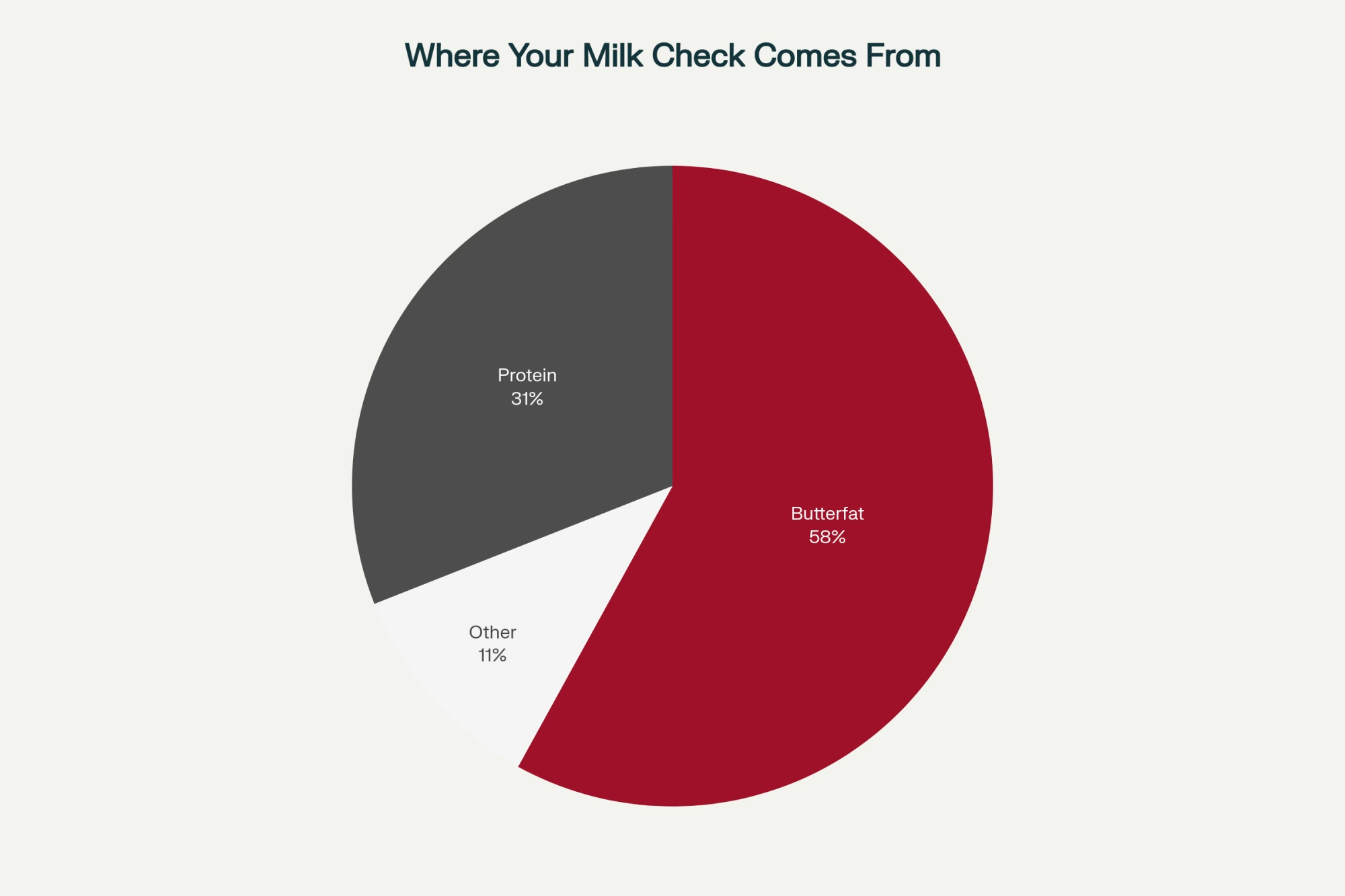
Component Premium Reality Check: Butterfat accounts for 58% of your milk check, protein another 31% – that’s 89% of your income from solids, not water. Start tracking your monthly component trends against regional averages and identify which cow groups are dragging down your bulk tank performance.
Genomic ROI That Actually Pays: With over 10 million animals now genotyped and genomics driving 70% of production gains, systematic genomic testing of heifer calves gives you 70% accuracy on future component potential. Implement testing on your top 25% for breeding decisions – the genetic gains are permanent and cumulative.
Heat Stress = Money Walking Out the Door: I watched Midwest operations lose 0.3-0.4 percentage points of butterfat during July 2024’s heat waves – that’s thousands in lost revenue. Invest in effective cooling systems ($400-800 per cow) and optimize feeding times to avoid peak heat periods in these 2025 climate conditions.
Processing Competition Works in Your Favor: With $8 billion in new cheese and butter plants coming online, processors are competing for component-rich milk that maximizes their efficiency. Farms consistently delivering high-component milk are becoming price makers instead of price takers – leverage this to negotiate better processor relationships.
Export Dependency Creates Opportunity: The U.S. exports 69% of its skim solids production while importing butterfat to meet domestic demand. This structural imbalance means component-focused operations are positioned to capture both domestic premiums and global market stability through 2025 and beyond.
You know what caught my attention at the farm show last month? It wasn’t the latest robotic milker or some fancy new TMR mixer. It was a conversation I overheard between two Wisconsin producers in the coffee line.
“Dave’s shipping the same pounds I am,” one guy was saying, shaking his head. “But somehow he’s banking an extra grand every single day.”
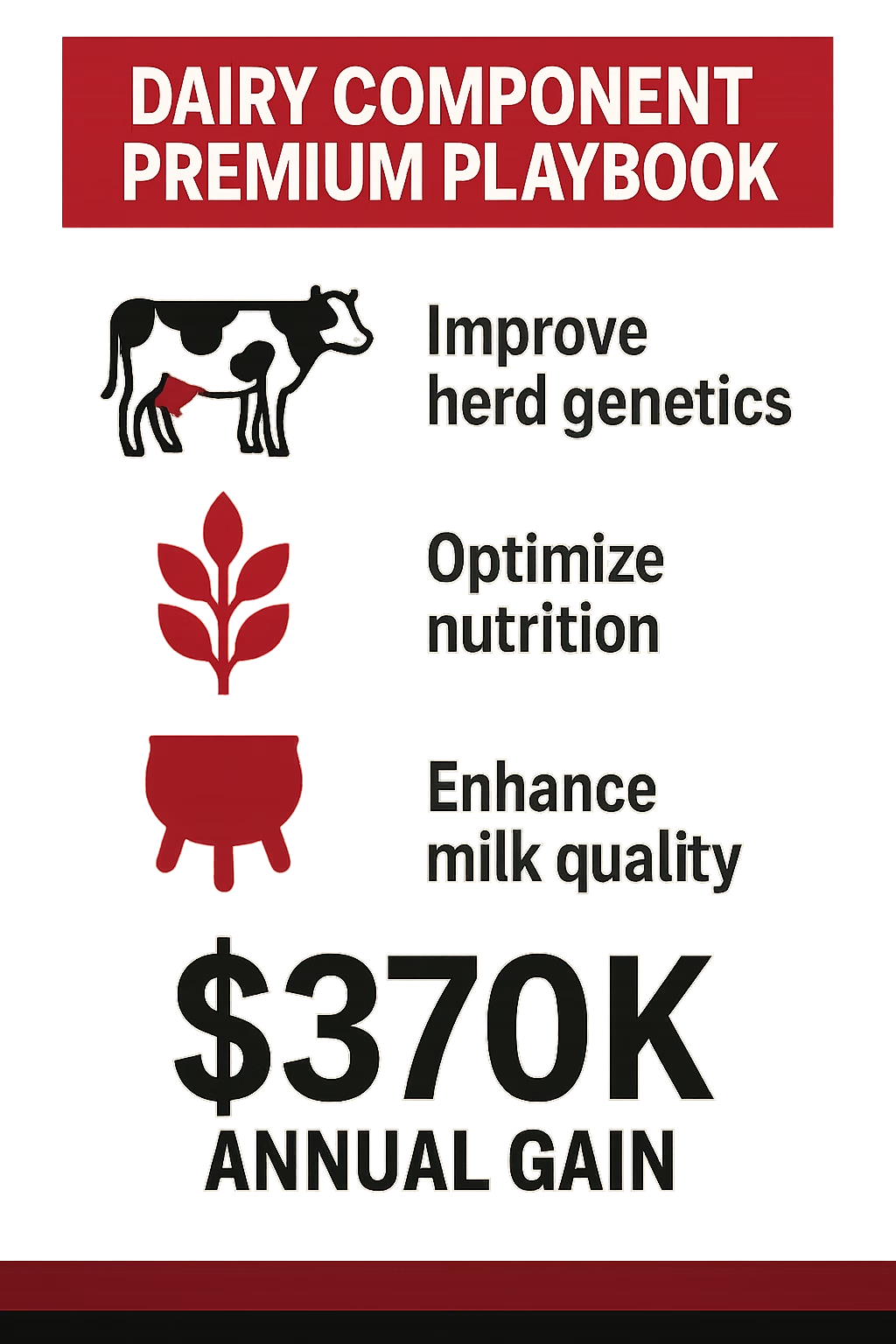
What’s the difference? Dave’s cows are averaging 4.23% butterfat, while his neighbor’s herd remains at 3.69%. That gap—that seemingly small difference in butterfat numbers—is worth $4.60 per hundredweight on every load leaving the farm.
Scale that across a 500-cow operation shipping around 22,000 pounds daily… you’re looking at over $1,000 in additional revenue every single day. That’s $370,000 in incremental income annually from what amounts to the same cows eating roughly the same feed.
Here’s what that difference looks like at a glance:
Factor
High-Component Herd (4.23% BF)
Average Herd (3.69% BF)
Edge for High-Component
Butterfat (%)
4.23
3.69
+0.54 pts
Component Premium ($/cwt)
+$4.60
—
+$4.60
Daily Revenue Gain (500 cows)
+$1,000
Baseline
+$1,000
Annual Revenue Gain
+$370,000
—
+$370,000
Feed Program
Same TMR
Same TMR
No added cost
Strategic Focus
Genomics + Components
Volume
Higher Margin
Here’s the thing, though… this isn’t some future trend we need to prepare for. This transformation is happening right now, and it’s accelerating faster than most producers realize.
The Shift That’s Redefining Everything
The thing about major industry changes is they tend to sneak up on you. One day, you’re doing business the way your dad did, the next day, the entire game has changed. What are we seeing in dairy right now? It’s that pivotal moment when everything clicks into place.
I’ve been walking through barns across the Midwest for over two decades, and the conversations I’m having today are fundamentally different from even five years ago. Maybe it hit you when your nutritionist started asking about butterfat targets instead of milk per cow. Or when your milk check jumped despite shipping fewer pounds last month.
According to recent work from the Journal of Dairy Science, the numbers tell a clear story: from 2011 to 2024, while milk production increased by a modest 15.9%, butterfat production increased by 30.2% and protein production climbed by 23.6%. Think about what this means for your bottom line… the same number of cows, managed with similar protocols, are now producing fundamentally different milk—and way more valuable—than what they produced a decade ago.
What’s happening is we’ve moved from a simple commodity model to something much more sophisticated. Raw milk isn’t just a fluid anymore; it’s become a sophisticated, customizable raw material where value is defined by its solids content, not water.
And this brings us to an important consideration…
The Genomic Revolution That Actually Delivered
Remember when genomic testing was an expensive experiment that only the largest operations could justify? Well, according to the Council on Dairy Cattle Breeding, the industry has now tested over 10 million animals through genomic programs. That’s created what researchers are calling the most comprehensive genetic database of any domestic animal species except humans and lab mice.
What this reveals is that genomics now accounts for over 70% of the production gains on U.S. dairy farms—a complete flip from previous decades when management practices were the dominant factor. This isn’t just about having better bulls in your breeding program (though that’s certainly part of it). It’s about fundamentally altering what comes out of your cows.
The April 2025 genetic evaluations from Holstein Association USA revealed something that would have been considered impossible just five years ago—genetic improvements on butterfat that are honestly pretty remarkable. Because butterfat and protein are among the most heritable traits (with heritabilities of 20-25% according to multiple peer-reviewed studies), the genetic gains we’re making today will compound across generations.
The surprising part is that most producers I work with are still underestimating just how powerful this genetic momentum has become. Every young bull entering your breeding program today has genetic potential that would have been science fiction just a few years ago.
However, here’s the challenge… and this is something that consistently arises in my conversations with producers: genetic change is a generational phenomenon. You’re looking at 18-24 months before you start seeing meaningful improvements in your bulk tank. That’s a long time to wait when your neighbor is already capturing that premium today.
Where Your Milk Check Money Actually Lives Now
Let me ask you something that might surprise you: if you’re still thinking about milk pricing the way you did in 2010, are you missing the biggest profit opportunity in modern dairy farming?
Under Multiple Component Pricing (MCP)—which governs over 90% of the U.S. milk supply through Federal Milk Marketing Orders—butterfat now accounts for 58% of the average milk check, with protein contributing another 31%. That means nearly 90% of your milk check value comes from the components, not the water your cows produce.
Butterfat alone now accounts for more than half of the average U.S. milk check, making it the single most important driver of dairy profitability.
The financial impact is honestly staggering. Recent USDA Agricultural Marketing Service data shows Class III milk prices averaging $18.82 per hundredweight for June 2025, while Class IV prices were $18.30 per hundredweight. But here’s the kicker: butterfat hit $2.7448 per pound, demonstrating just how much premium value fat components carry.
Component Premium Assessment Tool
Take a moment to evaluate your current position:
What’s your current herd average butterfat percentage?
How does this compare to your county or regional average?
What’s the spread between your highest and lowest producing groups?
Are you tracking component trends on a monthly basis or just looking at annual averages?
If you can’t answer these questions off the top of your head, you’re probably leaving money on the table.
What’s interesting is that each 0.1% increase in butterfat can add $15-20 in monthly revenue per cow. For a 1,000-cow operation, that translates to $15,000-$20,000 in additional monthly income from what amounts to a relatively small improvement in component levels.
However, this leads to a crucial point: despite this production boom, the U.S. remains a net importer of butterfat. Consumer demand has grown even faster than our supply gains, creating a unique market dynamic where domestic demand continues to outpace production.
The Consumer Story That’s Actually Driving Everything
This isn’t just about supply—it’s about a fundamental shift in how Americans eat dairy, and I’ve watched this play out in real time over the past few years.
Recent USDA Economic Research Service data shows per capita consumption of dairy products reached 661 pounds per person in 2023, matching the all-time record set in 2021. But here’s what’s really fascinating: while fluid milk consumption continues its long-term decline, butter consumption hit 6.5 pounds per person (highest since 1965) and cheese consumption reached 42.3 pounds per person.
Americans aren’t abandoning dairy—they’re fundamentally changing how they consume it. They’re shifting from fluid milk as a beverage toward manufactured, higher-fat dairy products, such as butter, cheese, and premium yogurt. This trend accelerated with everything from the home-baking renaissance during COVID to the rise of social media food trends, such as the elaborate charcuterie boards that are now ubiquitous.
What’s particularly fascinating is the science behind this shift in consumer behavior. Research published in the Journal of Dairy Science shows that dairy fat is the most complex edible fat found in nature, comprising over 400 distinct fatty acids with different chain lengths and chemical structures. The unique milk fat globule membrane (MFGM) that encases fat globules plays a crucial role in the digestion and metabolism of dairy fat.
This brings us to an important consideration from a health perspective: multiple prospective cohort studies now show that consumption of full-fat dairy is associated with neutral or even reduced risk of major health outcomes, including cardiovascular disease, type 2 diabetes, and metabolic syndrome. Some compelling evidence suggests that a high intake of full-fat dairy is actually associated with a decreased risk of developing type 2 diabetes, an outcome not observed with low-fat dairy.
The $8 Billion Processing Bet That’s Changing Everything
Here’s something that should catch your attention: the U.S. dairy industry is investing over $8 billion in new processing capacity through 2026, with approximately half of the investment targeting cheese production. This isn’t just expansion—it’s a massive bet on the continued growth of component-driven demand.
Think about what this means for your operation. When processing capacity is expanding this aggressively, it creates competition for your milk—and that competition is specifically for component-rich milk that can maximize plant efficiency and profitability.
I’ve seen firsthand how this plays out. Operations that can consistently deliver high-component milk are finding themselves with multiple buyers competing for their product, while those still producing average-component milk are becoming price takers rather than price makers.
Regional Variations That Really Matter
The geography of American dairy is changing, and it’s being driven by the same component economic components that are reshaping individual operations. The May 2025 USDA Milk Production report indicates 19.1 billion pounds of milk production in the 24 major states, representing a 1.7% increase from May 2024.
However, the surprising part is that component production has consistently outpaced fluid milk growth, with butterfat levels improving from 4.17% to 4.24% between May 2024 and May 2025. That improvement yielded 1.8 pounds more butterfat per cow, representing a 2% yield gain per cow.
What I’m seeing in different regions is honestly fascinating. In the Upper Midwest—specifically, Wisconsin, Minnesota, and Michigan—producers face different challenges than those in the Southwest or California. Heat stress management becomes absolutely crucial in Arizona and Texas (as we saw firsthand during last summer’s heat waves), while in Wisconsin and Minnesota, producers are focusing more on forage quality and barn ventilation systems.
The spring flood issues we saw across parts of Iowa and Illinois this year? That created some interesting butterfat challenges as producers dealt with compromised forage quality and had to adjust their nutrition programs on the fly.
Regional Component Optimization Strategies
Upper Midwest (Wisconsin, Minnesota, Michigan):
Focus on high-quality forage production during short growing seasons
Invest in advanced barn ventilation for summer heat stress management
Leverage strong genetics programs from local breeding cooperatives
Southwest (Arizona, Texas, New Mexico):
Prioritize heat stress abatement systems (evaporative cooling, shade structures)
Optimize feeding times to avoid peak heat periods
Consider night milking schedules during extreme weather
California Central Valley:
Navigate drought conditions with drought-resistant forage varieties
Manage seasonal feed cost volatility
Balance component production with regulatory compliance requirements
The message for your operation is clear: regardless of where you’re located, you need to be thinking about how to produce the kind of milk that processors are building billion-dollar plants to handle.
How Smart Producers Are Capturing This Component Premium
Now that you understand the forces driving this transformation, let’s discuss its implications for your operation. The primary strategic shift is moving from a “milking for volume” mindset to “milking for margin.”
The Genetics Game-Changer
The genetic gains achieved through genomics are permanent and cumulative, ensuring that strategic breeding decisions you make today will pay dividends for decades. Here’s what that means practically…
You need to leverage component-focused selection indexes, such as Net Merit ($ NM), which now places substantial weighting on butterfat and protein values. Work with A.I. companies that can provide genomic young sires specifically bred for component production, and implement systematic genomic testing of your own heifer calves to identify the top 25% for breeding and the bottom 25% for terminal mating.
The economic weighting for butterfat in selection indexes has increased by 13% to reflect current market values, demonstrating the industry’s commitment to component optimization.
But here’s something I’ve learned from working with producers who’ve made this transition: don’t expect immediate results. Genetic change is generational, and you’re looking at 18-24 months before you start seeing meaningful improvements in your bulk tank.
Decision Framework: Is Your Genetics Program Component-Optimized?
Ask yourself these questions:
What percentage of your breeding decisions are based on component traits versus volume traits?
Are you systematically using genomic testing to replace heifers to identify genetic potential early?
Do you have a clear genetic plan for the next 5 years, or are you just buying the “hot bull” of the moment?
How do you balance component gains with other important traits, such as health and fertility?
If you can’t answer these confidently, you might be missing the biggest opportunity in modern dairy farming.
Nutrition: The Other Half of the Equation
Even the best genetics won’t deliver results without precision nutrition management. The key is creating rumen conditions that maximize acetate production—the direct precursor to milk fat.
University extension research shows that feeding high-quality, highly digestible forages promotes acetate production in the rumen. Maintaining a stable rumen pH through proper fiber management and strategic buffering is critical, as acidosis can disrupt fatty acid metabolism and lead to milk fat depression.
This reveals the crucial role of heat stress management. It causes cows to reduce feed intake, particularly of forages that support fat synthesis. This past summer, I watched operations in the Midwest lose 0.3-0.4 percentage points of butterfat during the July heat wave—that’s real money walking out the door.
Here’s where it gets challenging, though: every operation is different. What works for a 500-cow freestall in Wisconsin might not work for a 5,000-cow operation in California’s Central Valley. Feed costs, climate conditions, and labor availability —all of these factors affect your ability to optimize for components.
I’ve seen producers get so focused on chasing butterfat numbers that they forget about the bigger picture. Cow health, reproductive performance, longevity—these all matter too. The most successful producers I work with are those who optimize for components while maintaining overall herd performance.
The Trade-Off Most Producers Don’t Consider
This leads to a crucial point that honestly keeps me up at night thinking about the industry’s future…
The U.S. dairy industry’s component-focused model creates a critical dependency on skim solids exports. While we consume most of our butterfat domestically, we export massive quantities of skim milk powder, nonfat dry milk, and whey products to balance the market.
According to USDA Agricultural Outlook Forum data, the U.S. exported a record 17.8% of its total milk solids production in 2022, with 78% of those exported solids being in the form of dry skim milk ingredients. The exports-to-production ratio for dry skim milk products reached 69%.
This export dependency makes the industry vulnerable to trade disputes, tariffs, and protectionist policies in key markets, such as Mexico, Canada, and China. A major trade disruption could destabilize the entire domestic milk pricing structure by flooding the market with skim solids that can’t find export homes.
The Risks We Need to Talk About
While the component boom presents tremendous opportunities, it also creates new vulnerabilities that strategic operators must understand and manage.
The Processing Bottleneck Challenge
The $8 billion processing investment wave carries significant timing risks. If these large facilities come online simultaneously and consumer demand fails to keep pace, the industry could face severe oversupply conditions, leading to sharp price declines.
Processors are already experiencing what some call a “cream tsunami,” with butter manufacturers acting as a relief valve to absorb surplus cream, often at discounted prices. This is creating manufacturing imbalances, with butter and American cheese production rising while other traditional uses of butterfat decline.
The surprising part is whether these new plants are truly optimized to handle the increasingly component-rich milk being produced. Traditional processing equipment was designed for lower-solid milk, and running higher-solid milk through it can create inefficiencies that could erode processor margins and, eventually, the premiums paid to farmers.
Implementation Challenges: The Reality Check
Let’s be honest about something that doesn’t get discussed enough: transitioning to component-focused production isn’t easy, and it’s not inexpensive.
I’ve worked with producers who have invested heavily in genomics and precision nutrition, only to see modest improvements in their bulk tank. Why? Because component optimization is a systems approach that requires everything to work together—genetics, nutrition, management, facilities, and even seasonal timing.
Take heat stress management, for example. Installing effective cooling systems can cost $400 to $ 800 per cow, depending on your setup. That’s a significant investment, and the payback period varies dramatically based on your climate, facility design, and current production levels.
Feed costs are another reality check. High-quality, highly digestible forages that support fat synthesis often cost more than maintenance-level feeds. Rumen-protected fats, dietary buffers, precision additives—these all add up. I’ve seen operations increase their feed costs by $0.50-1.00 per cow per day while optimizing for components.
Labor is probably the biggest challenge of all. Component optimization requires more management attention, more frequent monitoring, and often additional skilled labor. In today’s labor market, that’s not always easy to find or afford.
Technology Disruption: The Precision Fermentation Question
Here’s something that honestly makes me uncertain about the long-term future: the emergence of precision fermentation technology, which utilizes microorganisms to produce dairy proteins without the need for cows.
While the technology is still in early commercial phases, companies are already investing heavily in this space. The timeline for significant market impact remains unclear, but if precision fermentation can eventually produce commodity dairy ingredients at lower costs than traditional agriculture, it could potentially disrupt the skim solids export model that supports current component pricing structures.
This reveals how different segments of the industry may be affected differently. Premium, local, and specialty dairy products might be less vulnerable to this disruption than commodity ingredients.
What This Means for Your Operation Going Forward
The component revolution isn’t coming—it’s here. Every day that you operate with a volume-focused mindset rather than a component-focused strategy, you’re potentially leaving money on the table and falling behind competitors who have made the transition.
Your Strategic Roadmap
Right Now (Next 30 Days): Start by auditing your current genetic program to ensure component traits are properly weighted. Analyze your milk checks from the last 12 months to understand your component performance trends. Are you consistently above or below average? What’s your seasonal pattern? Are there specific groups of cows that are dragging down your overall performance?
Evaluate your nutritional program for optimal rumen health and fat synthesis. This may involve collaborating with your nutritionist to review your current ration formulation or investing in more advanced feed management systems.
Most importantly, assess your processor relationships for component pricing competitiveness. Are you getting paid appropriately for the quality of milk you’re producing? If not, it might be time to explore alternatives.
Medium-Term (Next 6-12 Months): Implement systematic genomic testing of heifer calves. This is becoming more common across the industry, and the ROI data is compelling. But don’t just test—develop a systematic approach to using that information in your breeding decisions.
Consider upgrading your nutrition management systems for precision feeding. This may involve investing in new TMR mixers, feed management software, or more sophisticated monitoring systems.
Develop risk management protocols for component price volatility. The reality is that component prices can be more volatile than traditional milk prices, so you need strategies to manage that risk.
Long-Term Positioning (Next 2-5 Years): Build operational flexibility to adapt to changing market demands. This may involve diversifying your product mix, exploring direct-to-consumer opportunities, or developing niche market positions.
Invest in technologies that improve efficiency and reduce labor dependency. Automation, monitoring systems, and decision support tools will become increasingly important as the industry evolves.
Create sustainability metrics that support premium market positioning. Consumers and processors are increasingly interested in environmental and social responsibility, and these factors are likely to become more important in the future.
The Global Context That Matters
What’s happening in the U.S. isn’t occurring in isolation. European dairy producers face similar component-driven market forces, albeit within different regulatory frameworks. New Zealand’s dairy industry—always a benchmark for efficiency—is seeing comparable trends in component optimization.
Research from Teagasc in Ireland shows similar patterns emerging across European dairy systems, with component pricing becoming increasingly important. However, the U.S. market’s unique structure—with our heavy reliance on skim solids exports—creates both opportunities and vulnerabilities that other dairy economies don’t face.
Key Questions to Consider:
How will changing trade relationships affect your ability to capture component premiums?
What role will sustainability requirements play in future component pricing?
How might climate change affect your ability to optimize for components?
What new technologies might emerge that could change the game again?
The Bottom Line: Where We Go From Here
The dairy industry has undergone fundamental changes, and the most successful operations of the next decade will be those that recognize and adapt to this new reality. The component boom isn’t just about producing different milk—it’s about building a different kind of dairy business, one that’s optimized for profitability, sustainability, and long-term competitive advantage.
What keeps me optimistic about this industry is seeing how innovative producers are embracing these changes. I’ve watched farms transform their operations, improve their genetics, and build more profitable businesses by focusing on component quality rather than just volume.
But I’d be lying if I said this transition is easy or guaranteed. The producers who succeed will be those who approach it systematically, with realistic expectations about timelines and costs, and with a clear understanding of both the opportunities and the risks.
The question isn’t whether you can afford to make this transition—it’s whether you can afford not to. Because while you’re deciding, your competitors are already capturing the premium, and that gap is growing every day.
This transformation represents the most significant shift in dairy economics since the introduction of bulk tanks… and the producers who master it will be the ones who thrive in the decades to come.
So here’s my challenge to you: stop thinking about milk production the way your dad did. Start thinking about it the way your kids will have to. Because the future of dairy isn’t about more milk—it’s about better milk. And that future? It’s already here.
Complete references and supporting documentation are available upon request by contacting the editorial team at editor@thebullvine.com.
5 Technologies That Will Make or Break Your Dairy Farm in 2025 – Explores cutting-edge innovations like smart calf sensors and AI-driven analytics that early adopters use to achieve 40% mortality reductions and 20% yield increases through precision management.
Join the Revolution!
Join over 30,000 successful dairy professionals who rely on Bullvine Weekly for their competitive edge. Delivered directly to your inbox each week, our exclusive industry insights help you make smarter decisions while saving precious hours every week. Never miss critical updates on milk production trends, breakthrough technologies, and profit-boosting strategies that top producers are already implementing. Subscribe now to transform your dairy operation’s efficiency and profitability—your future success is just one click away.
Stop treating calf pneumonia symptoms. New research reveals every ‘successful’ treatment creates $2,800 in hidden lifetime losses.
EXECUTIVE SUMMARY: The dairy industry’s beloved “treatment success” stories are actually documenting systematic economic failures that cost producers thousands per animal over their productive lifetime. While veterinarians celebrate 95% pneumonia treatment rates, research shows these “saved” calves face 230% higher culling odds and produce 525 kg less milk in their first lactation alone—worth $285-300 at current $21.60/cwt prices. Progressive operations are abandoning reactive protocols for precision pathogen management strategies that eliminate the stress-immunity vortex, achieving mortality rates below 3% while generating 3:1 to 5:1 ROI through targeted interventions. The controversial truth: conventional biosecurity approaches address symptoms while ignoring the biological warfare happening inside your calves, creating false security that’s bleeding operations dry. With the U.S. dairy industry generating $779.45 billion in economic impact, every management decision in your calf barn directly influences lifetime productivity and profitability. Stop playing defense against calf disease—audit your colostrum protocols this week and discover whether you’re building champions or manufacturing expensive disappointments.
KEY TAKEAWAYS
Economic Reality Check: Every calf that survives pneumonia during calfhood produces 121.2 kg less milk in first lactation and faces 2.30x higher odds of culling before first calving, representing $285-300 in immediate lost revenue plus replacement costs that dwarf the original $67/day treatment expenses.
Precision Colostrum Protocol Advantage: Operations implementing verified colostrum management (10% body weight, >22% Brix, within 6 hours) report 40-60% reductions in scours incidence and 25-35% improvements in average daily gain, yet two-thirds of dairy calves still don’t receive adequate colostrum—pointing to a systemic industry failure.
Technology Investment Trap Exposed: Farms spending $120-160 per calf on monitoring sensors while maintaining 15.5% mortality rates from diarrhea are drowning in data while missing fundamental management failures—successful operations focus on stress reduction and environmental optimization generating 8-12 month ROI on $5,000-15,000 biosecurity investments.
Stress Response Cascade Management: Understanding the HPA axis and chronic stress impacts enables precision interventions that break the “stress-immunity vortex,” with breed-specific protocols (Holstein vs. Jersey inflammatory responses) and gender-based management delivering measurable improvements in immune function and disease resistance.
Male Calf Revenue Recovery: The industry’s systematic neglect of male calf management represents a 50% profit leak, with 64% sold within 10 days despite research showing strategic investment in male calf care generates price premiums and transforms liabilities into profit centers for progressive operations.
Every calf that survives pneumonia carries permanent scars worth thousands in lost productivity, but breakthrough management strategies are helping progressive dairy operators break the pathogen-immunity cycle that’s been bleeding their operations dry. The difference between reactive treatment and proactive management isn’t just about calf survival—it’s about unlocking your operation’s true genetic potential.
You’re watching a $5,000 investment walk into your barn every time a calf is born. But here’s what most producers don’t realize: that sick calf you successfully treated for pneumonia last month? She’s going to cost you another $2,800 in lost milk production over her lifetime, assuming she even makes it to first lactation.
With 2025 milk prices forecast at $21.60 per hundredweight and the U.S. dairy industry supporting 3.05 million jobs while generating $779.45 billion in economic impact, every management decision in your calf barn directly impacts your bottom line. The industry has been playing defense against calf disease for decades, throwing antibiotics at symptoms while the real culprits—stress, poor nutrition, and systemic management failures—continue undermining profitability.
What if I told you a growing group of dairy operators have essentially eliminated the traditional calf disease cycle? They’re not using magic bullets or expensive miracle cures. They’re leveraging cutting-edge science about something called the “Stress Response Cascade” combined with precision nutrition strategies that most producers have never heard of.
The Industry’s Dirty Secret: Your “Successful” Treatments Are Creating Future Failures
Here’s a controversial truth that veterinary associations won’t admit: conventional treatment protocols are creating long-term productivity disasters while making everyone feel successful in the short term. Research published in the Journal of Dairy Science reveals that heifers diagnosed with bovine respiratory disease during calfhood face devastating long-term consequences that dwarf immediate treatment costs.
But here’s the real scandal: while you’re celebrating that 95% treatment success rate, you’re actually documenting a 230% increase in future culling risk for those “saved” calves.
The Technology Trap That’s Bankrupting Progressive Farms
The precision agriculture industry has sold dairy producers a seductive lie: that more data automatically equals better outcomes. A recent analysis of precision livestock technology adoption shows farms are drowning in information while missing fundamental management failures.
Here’s the uncomfortable reality: farms spending $120-160 per calf on sensors are still seeing 15.5% mortality rates from diarrhea. The technology isn’t the problem—it’s the misguided belief that monitoring symptoms can replace preventing causes.
Think about it: if your milking system was failing 15% of the time, would you invest in better monitoring equipment or fix the system?
The Hidden Truth About Pathogen Load
Traditional approaches treat calf disease as isolated incidents—like trying to fix a milking system by replacing individual components instead of analyzing the entire parlor workflow. But here’s where it gets interesting: short-term stress can actually help calves by priming their immune systems. The problem emerges when stress becomes chronic, creating what researchers call the “stress-immunity vortex.”
Are you unwittingly creating this vortex on your farm?
When a calf encounters stressors—poor nutrition, weaning shock, thermal extremes, or infection—the body activates the Acute Phase Response through the Hypothalamic-Pituitary-Adrenal axis. Prolonged stress creates a cascading failure: stress weakens immunity, making infection more likely, which creates more stress, which further suppresses immunity.
The Economic Devastation Timeline Nobody Talks About
Let’s talk numbers that will make your accountant cringe. The immediate costs everyone discusses—those $67 daily treatment bills—are just the beginning. Think of it as comparing your daily feed costs to your total production cost; the visible expenses barely scratch the surface.
With current milk prices, that 525 kg loss from subclinical pneumonia represents approximately $285-300 in reduced revenue per cow—before factoring in the extended costs of delayed breeding and increased replacement rates.
Individual Variation: Why One-Size-Fits-All Is Financial Suicide
Here’s something that’ll challenge everything you think you know about calf management: not all calves respond to stress the same way. Holstein calves show higher inflammatory responses compared to Jersey calves following immune challenges, suggesting Jersey calves may face greater post-weaning morbidity risk.
Gender matters, too. Heifers exhibit greater cortisol concentrations than bull calves, potentially indicating enhanced immune system “priming” following acute stress. Even temperament plays a role—calves with reactive dispositions show higher basal cortisol levels and reduced antibody responses to vaccination.
Yet, how many operations still use one-size-fits-all protocols?
Revolutionary Management Strategies That Actually Work
The most successful operations have abandoned reactive treatment in favor of systematic prevention. Here’s how they’re doing it.
Biosecurity: Building Your Invisible Defense Wall
Progressive operations implementing comprehensive biosecurity protocols report significant reductions in calf mortality rates and treatment costs. The most effective protocols include controlled farm access, clean/dirty zones at barn entrances, animal movement management, equipment sanitization, and comprehensive hygiene programs.
Implementation Timeline: Full biosecurity protocol implementation typically requires 30-60 days, with initial setup costs ranging from $5,000-15,000, depending on farm size. ROI typically breaks even within 8-12 months through reduced veterinary costs and improved calf survival.
The Colostrum Crisis: Industry’s Best-Kept Failure
Here’s a statistic that should terrify you: research consistently shows that more than two-thirds of dairy calves don’t receive adequate volumes of quality colostrum. This isn’t just poor management—it’s financial suicide.
Think of colostrum as your calf’s first and most critical “software update”—it programs their immune system for life. Yet, why does the industry continue to fail at this fundamental practice?
Precision Colostrum Management Protocol:
Quality target: >22% Brix refractometer reading
Timing: Within 6 hours of birth
Volume: 10% of birth weight (4 liters for 40 kg calf)
Let’s address the elephant in the barn: male calf management remains a systemic failure across the industry. Research reveals that while colostrum feeding practices are similar between male and female calves, male calves receive less milk while still on the dairy farm and are more likely to be fed raw, unsalable milk.
Male calves represent 50% of your calf crop, yet many operations treat them as liabilities rather than assets. How much money are you literally throwing away by not optimizing male calf care?
The data shows that 64% of male calves are sold between 1-10 days, primarily through direct sales to calf-rearing facilities (45%) or auctions (35%). However, 43% of producers reported that a price premium for more vigorous calves would motivate better male calf care.
Challenge the Status Quo: Instead of viewing male calves as problems to solve quickly, what if you treated them as profit centers requiring strategic investment?
The Bottom Line
Remember that $5,000 calf investment I mentioned at the beginning? The difference between operations that treat calves as an expense center versus those that view them as future profit generators comes down to one fundamental shift: moving from reactive crisis management to proactive system optimization.
With the U.S. dairy industry supporting 3.05 million jobs and generating $779.45 billion in economic impact, every management decision in the first weeks of a calf’s life influences revenue streams for the entire lactation career.
In today’s market environment, with milk prices forecast at $21.60 per hundredweight and production efficiency becoming increasingly critical, the return on investment for precision calf care becomes undeniable. With lifetime production losses of 525 kg of milk from subclinical pneumonia alone—worth $285-300 at current prices—the economics are clear.
But here’s the real question: Are you ready to challenge your assumptions and embrace evidence-based change?
Your Strategic Action Plan:
Week 1: Audit your current colostrum protocol. Invest $200 in a Brix refractometer and measure quality, timing, and volume for the next ten calves born. You’ve found your first leak if you’re not hitting 10% body weight within six hours with >22% Brix quality colostrum.
Month 1: Evaluate your biosecurity gaps systematically. Budget $5,000-15,000 for comprehensive upgrades that will deliver 8-12 month ROI through reduced veterinary costs and improved survival rates.
Quarter 1: Assess your housing environment and consider precision nutrition programs. The math is compelling, with implementation costs of $15-25 per calf generating 3:1-5:1 ROI.
Year 1: Implement comprehensive monitoring systems. Initial setup costs of $2,000-5,000 typically deliver 15-25% mortality reduction and measurable improvements in lifetime productivity.
Stop playing defense against calf disease. Start building champions in your calf barn.
The evidence is overwhelming, the technology is available, and the economic justification is bulletproof. The only question remains whether you’ll lead this revolution or be forced to follow when market pressures make these changes inevitable.
Learn More:
Top 5 Must-Have Tools for Effective Calf Health and Performance – Discover the essential equipment every progressive dairy needs for optimal calf management, from sanitary colostrum vessels to ammonia monitors that prevent respiratory disease outbreaks.
Join over 30,000 successful dairy professionals who rely on Bullvine Weekly for their competitive edge. Delivered directly to your inbox each week, our exclusive industry insights help you make smarter decisions while saving precious hours every week. Never miss critical updates on milk production trends, breakthrough technologies, and profit-boosting strategies that top producers are already implementing. Subscribe now to transform your dairy operation’s efficiency and profitability—your future success is just one click away.
Boost dairy cow productivity with optimal dietary starch and amino acids. Discover how to enhance component yields and improve feed efficiency. Ready to maximize your herd’s potential?
Profitability for dairy farmers depends on increasing the fat and protein output in milk. To maximize milk output, dairies must implement nutrition plans that stress high digestibility and the exact balance of critical elements. Precision nutrition—which emphasizes the proper ratio of carbohydrates to amino acids—is crucial. In the upcoming sections, we investigate techniques to maximize essential nutrients, enabling dairy farms to balance production, maintain herd health, and enhance overall efficiency and success. Maximizing milk components isn’t just about feeding more; it’s about feeding smarter. Precision nutrition ensures that every bite contributes to superior productivity and animal well-being.
Key strategies covered include:
The importance of evaluating feed efficiency and component yields
The critical role of forage quality and inventory management
Balancing starch and NDF for optimal rumen function
Incorporating sugars and soluble fibers
The strategic use of amino acids and fatty acids
Innovative solutions amidst forage shortages
Addressing common bottlenecks in dairy management
Maximizing Dairy Cow Productivity: Key Metrics for Success
Two primary indicators assess dairy cow productivity: feed efficiency and daily milk output adjusted for fat and protein, known as Energy Corrected Milk (ECM). A feed efficiency ratio of 1.4 to 1.6 pounds of milk per pound of dry matter intake (DMI) is effective for high-producing dairy cows. Good ECM values vary based on breed, lactation stage, and dairy operation goals. Generally, Holstein cows, which yield high milk volumes, tend to have higher ECM values. However, context and herd-specific factors are crucial when evaluating ECM.
Furthermore, the daily consumption of fat and protein or ECM is essential. ECM standardizes milk production to include fat and protein levels by offering a better picture of a herd’s output. Higher fat and protein content milk often commands more excellent pricing. Dairy farmers may boost component yields by emphasizing feed economy and ECM. These are linked: better feed efficiency increases fat and protein yields, increasing dairy businesses’ profitability and output.
The Crucial Role of Forage Quality in Dairy Production
Forage quality becomes extremely important for dairy production, particularly with the digestion of neutral detergent fiber (NDF). High-quality fodder improves herd efficiency and nutritional intake. NDF digestibility primarily focuses on the cow’s ability to break down cellulose, hemicellulose, and lignin-based plant cell walls. Excellent digestibility ensures cows convert fiber into energy effectively, enhancing rumen performance.
High digestibility forages offer several advantages to optimize rumen efficiency and overall productivity:
Enhanced Rumen Function: A stable and efficient ruminal environment with better fermentation and more volatile fatty acids is essential for milk production and energy levels.
Increased Milk Components: Improved energy availability supports higher milk fat and protein yields, boosting economic viability.
Better Health and Productivity: Reduced risk of metabolic disorders, leading to healthier cows and sustained productivity.
Ultimately, dairy farm managers may strategically address forage quality and NDF digestibility. High digestibility forages guarantee effective feed use, better cows, and increased milk output, promoting a sustainable dairy enterprise.
Balancing Starch and NDF: The Key to Enhanced Dairy Cow Productivity
Enhancing dairy cow productivity hinges significantly on the precise management of starch content in their diet. As a cornerstone energy source, starch is pivotal for achieving high milk yields. However, it must be judiciously balanced with neutral detergent fiber (NDF) to prevent metabolic issues and maintain overall cow health.
The interplay between starch and NDF can profoundly influence milk production and component quality. While starch boosts milk yield and energy levels, excessive amounts can lead to acidosis, disrupting rumen health and decreasing feed intake. Conversely, insufficient starch limits energy availability, thereby reducing milk production.
The ideal NDF to starch ratio can vary based on forage type, lactation stage, and overall diet. Typically, an effective diet consists of 30-32% NDF and 25-28% starch. This balance maintains rumen function and provides energy for milk production.
Cows need an adequate supply of NDF to sustain optimal rumen function and avert digestive complications. While increasing starch can enhance milk yield and protein content, the inclusion of highly digestible starch sources, such as maize, is often preferred for their efficiency. At the same time, incorporating highly digestible NDF sources, such as citrus or beet pulp, can mitigate the risks associated with high-starch diets. These fibers improve rumen function and help maintain higher milk fat production.
Dairy producers can carefully balance starch and NDF to optimize milk output, component yields, and overall herd health. Although starch remains crucial, its optimal utilization requires a nuanced approach. Managing the interaction between starch and NDF is essential to maximizing milk production and quality while safeguarding cow health.
Strategic Benefits of Incorporating Sugars and Soluble Fibers in Dairy Cow Diets
Incorporating soluble fibers and sugars into dairy cow diets presents clear advantages. By immediately providing energy, sugars play a pivotal role in enhancing rumen fermentation and increasing butyrate levels. Additionally, certain fatty acids are essential for effective milk fat production. By strategically lowering starch and increasing sugar content to 5–7%, butyrate production is maximized, thus improving the quality of milk fat. Soluble fibers, such as those from beet or citrus, augment the pool of fermentable fibers. These fibers break down rapidly in the rumen, thereby boosting butyrate levels. These dietary adjustments raise milk fat content and enhance energy efficiency, increasing dairy farm profitability and output.
The Essential Role of Amino Acids in Enhancing Dairy Cow Productivity
Dairy cow diets require amino acids, significantly affecting milk output and general health. Lysine, methionine, and histidine are essential amino acids because they function in protein synthesis and metabolism.
Lysine is essential for muscle protein synthesis, calcium absorption, immune function, and hormone production. As the first limiting amino acid in dairy diets, lysine supplementation is vital for maximizing milk protein yield. Adequate levels can be ensured through high-lysine feeds or supplements.
Methionine is critical for methylation and influences DNA and protein synthesis. It also helps produce other amino acids like cysteine and taurine. Methionine levels can be maintained with methionine-rich feeds (e.g., soybean meal) or specific additives.
Histidine supports histamine and carnosine production, which is essential for muscle function and metabolism. Its direct influence on milk production makes it vital. Histidine is typically sourced from blood meal.
To maintain adequate amino acid levels, diet formulation should include:
Analyzing feed components for amino acid content.
High-quality protein sources like canola, blood, and soybean meal are used.
Employing supplements for targeted amino acid delivery.
Monitoring cow performance to adjust diets as needed.
Maintaining nitrogen balance and maximizing feed efficiency depends on carefully balancing these amino acids between rumen-degradable and rumen-undegradable protein needs. Emphasizing these essential amino acids produces better cow health, yields, and financial returns.
The Strategic Role of Fatty Acids in Dairy Cow Diets
Dairy cow diets must include fatty acids as they affect metabolic processes necessary for milk output. Usually considered energy sources, certain fats like palm oil and high oleic beans may significantly increase milk fat content and general energetic efficiency. Rich in palmitic acid (C16:0), palm oil powerfully promotes milk fat production. It increases milk fat production by supplying necessary fatty acids for triglyceride synthesis in the mammary gland, saving the cow’s metabolic energy for other uses. This produces more milk fat without draining the cow’s energy supply too rapidly.
High oleic beans, with oleic acid (C18:1), increase mammary glands’ cell membrane fluidity and metabolic flexibility. This improves milk fat synthesis and digestion, guaranteeing that energy intake is effectively transformed into useful outputs like more excellent milk fat percentages.
Including these fatty acids in dairy cow diets calls for a measured approach. Reducing feed efficiency and causing metabolic problems may be the result of overfeeding. However, adequately controlled lipids from palm oil and high oleic beans may significantly increase production, enabling a dairy farming system with maximum efficiency.
Navigating the Challenges of Variability in Blood Meal for Dairy Nutrition
One major challenge in dairy nutrition is the variability in feed ingredients, especially blood meal. Blood meal’s inconsistency in bioavailability and digestibility can complicate diet formulations and affect herd productivity. This variability often results from differences in processing, handling, and sourcing. Regular testing and analysis of blood meal batches are essential to tackle this. Implementing assays to estimate bioavailability and working with reputable suppliers can help ensure consistent product quality.
Additionally, diversifying protein sources by incorporating fish, soybean, or other high-quality supplements can reduce reliance on blood meal and mitigate its variability. Utilizing precise feed formulation software that adjusts nutrient levels based on ingredient analyses can also help maintain balanced diets. While blood meal variability is challenging, proactive management and diversified supplementation can ensure consistent nutrient delivery and enhance dairy cow productivity.
Innovative Solutions for Maintaining Optimal NDF Levels Amid Forage Shortages
When forage availability is limited, innovative solutions are needed to maintain optimal NDF levels and support rumen function. Utilizing non-forage fiber sources can be effective for dairy producers facing constrained forage supplies. Consider incorporating the following alternatives:
Wheat Mids: Enhance the overall fiber content of the diet with this valuable NDF source.
Soy Hulls: Rich in digestible fiber, they boost dietary fiber without affecting feed efficiency.
Beet pulp is high in fiber and palatable and supports rumen health.
Citrus Pulp: Adds soluble fibers, improving digestion and nutrient absorption.
These non-forage fiber sources can help balance the diet, ensuring adequate fiber to support healthy rumen function and productivity, even when forage supplies are limited.
Addressing Common Management Bottlenecks: Unlocking Dairy Cow Productivity
Maximizing dairy cow output depends on addressing typical management obstacles such as crowding and limited water space. Overcrowding decreases resting time, raises stress, lowers feed intake, and affects milk output and general health by reducing resting time. Following advised stocking densities is essential to help mitigate these problems so that every cow has adequate room to walk, eat, and relax. Gradually reducing stocking density will significantly improve animal comfort and output.
Furthermore, ensuring water troughs are sufficiently spaced and easily reachable is crucial, as design defects might restrict adequate water availability, affecting hydration and feed efficiency. Optimizing cow comfort requires sufficient lighting, good ventilation, and dry, clean bedding. Frequent observation of the barn surroundings helps to avoid respiratory problems and support steady milk output.
Good time management is essential. Maintaining constant feeding schedules, structuring the cows’ day to promote rest and rumination, and limiting disturbances aids digestion and nutrient absorption, directly affecting milk output. Regular evaluations of cow behavior and health markers help to spot early stresses or inefficiencies. Using wearable technology or routine health inspections, minute indicators of pain or disease may be identified, enabling quick treatments and continuous output.
The Bottom Line
Understanding vital benchmarks like feed efficiency and pounds of fat, protein, or energy-corrected milk daily helps maximize dairy cow output. Excellent forages are essential; their primary goal should be to raise digestible NDF to improve ruminal efficiency and general cow condition. Energy supply and milk components depend on carefully balancing starch and NDF levels. Adding soluble fibers and sugars enhances fermentation and increases milk fat synthesis. Adding methionine, lysine, and histidine—essential amino acids—helps to maximize protein synthesis and milk supply. Adding fatty acids improves milk fat production and meets energy demands. Dealing with the fluctuations in blood meal as a protein source guarantees a consistent dairy cow diet. When premium forages are few, non-forage fiber sources may help preserve NDF levels. Addressing management issues such as water availability and congestion significantly affects output. These techniques improve general herd health, milk supply, and feed efficiency, promoting economic success. By being knowledgeable and flexible, producers can ensure the welfare of their herds and support successful, environmentally friendly farming.
Key Takeaways:
Feed efficiency and pounds of fat and protein per day are critical metrics for evaluating dairy cow productivity.
Increasing utilizability of Neutral Detergent Fiber (NDF) in forages significantly enhances dairy cow performance.
Balancing dietary starch levels while optimizing NDF can lead to higher component yields.
Incorporating sugars and soluble fibers into cow diets can boost butyrate production and overall efficiency.
Amino acids, particularly lysine, methionine, and histidine, play an essential role in maximizing milk production.
Fatty acids, such as those from high oleic beans, contribute to higher milk fat and overall productivity.
The variability of blood meal can impact its effectiveness; monitoring and adaptation are necessary for optimal use.
Non-forage fiber sources can help maintain optimal NDF levels when forage availability is limited.
Common management bottlenecks like overcrowding and inadequate water space can inhibit productivity despite a well-balanced diet.
Summary:
Dairy farmers’ profitability relies on increasing fat and protein output in milk through nutrition plans that focus on high digestibility and balance of critical elements. Precision nutrition, which emphasizes the proper ratio of carbohydrates to amino acids, is crucial for dairy farms to balance production, maintain herd health, and enhance efficiency. Key strategies include evaluating feed efficiency, balancing starch and NDF for optimal rumen function, incorporating sugars and soluble fibers, strategic use of amino acids and fatty acids, innovative solutions amidst forage shortages, and addressing common dairy management bottlenecks. Higher feed efficiency increases profitability, lowers feed costs, and improves environmental sustainability.
To provide the best experiences, we use technologies like cookies to store and/or access device information. Consenting to these technologies will allow us to process data such as browsing behavior or unique IDs on this site. Not consenting or withdrawing consent, may adversely affect certain features and functions.
Functional
Always active
The technical storage or access is strictly necessary for the legitimate purpose of enabling the use of a specific service explicitly requested by the subscriber or user, or for the sole purpose of carrying out the transmission of a communication over an electronic communications network.
Preferences
The technical storage or access is necessary for the legitimate purpose of storing preferences that are not requested by the subscriber or user.
Statistics
The technical storage or access that is used exclusively for statistical purposes.The technical storage or access that is used exclusively for anonymous statistical purposes. Without a subpoena, voluntary compliance on the part of your Internet Service Provider, or additional records from a third party, information stored or retrieved for this purpose alone cannot usually be used to identify you.
Marketing
The technical storage or access is required to create user profiles to send advertising, or to track the user on a website or across several websites for similar marketing purposes.
To provide the best experiences, we and our partners use technologies like cookies to store and/or access device information. Consenting to these technologies will allow us and our partners to process personal data such as browsing behavior or unique IDs on this site and show (non-) personalized ads. Not consenting or withdrawing consent, may adversely affect certain features and functions.
Click below to consent to the above or make granular choices. Your choices will be applied to this site only. You can change your settings at any time, including withdrawing your consent, by using the toggles on the Cookie Policy, or by clicking on the manage consent button at the bottom of the screen.
Functional
Always active
The technical storage or access is strictly necessary for the legitimate purpose of enabling the use of a specific service explicitly requested by the subscriber or user, or for the sole purpose of carrying out the transmission of a communication over an electronic communications network.
Preferences
The technical storage or access is necessary for the legitimate purpose of storing preferences that are not requested by the subscriber or user.
Statistics
The technical storage or access that is used exclusively for statistical purposes.The technical storage or access that is used exclusively for anonymous statistical purposes. Without a subpoena, voluntary compliance on the part of your Internet Service Provider, or additional records from a third party, information stored or retrieved for this purpose alone cannot usually be used to identify you.
Marketing
The technical storage or access is required to create user profiles to send advertising, or to track the user on a website or across several websites for similar marketing purposes.










 Join the Revolution!
 Join the Revolution!