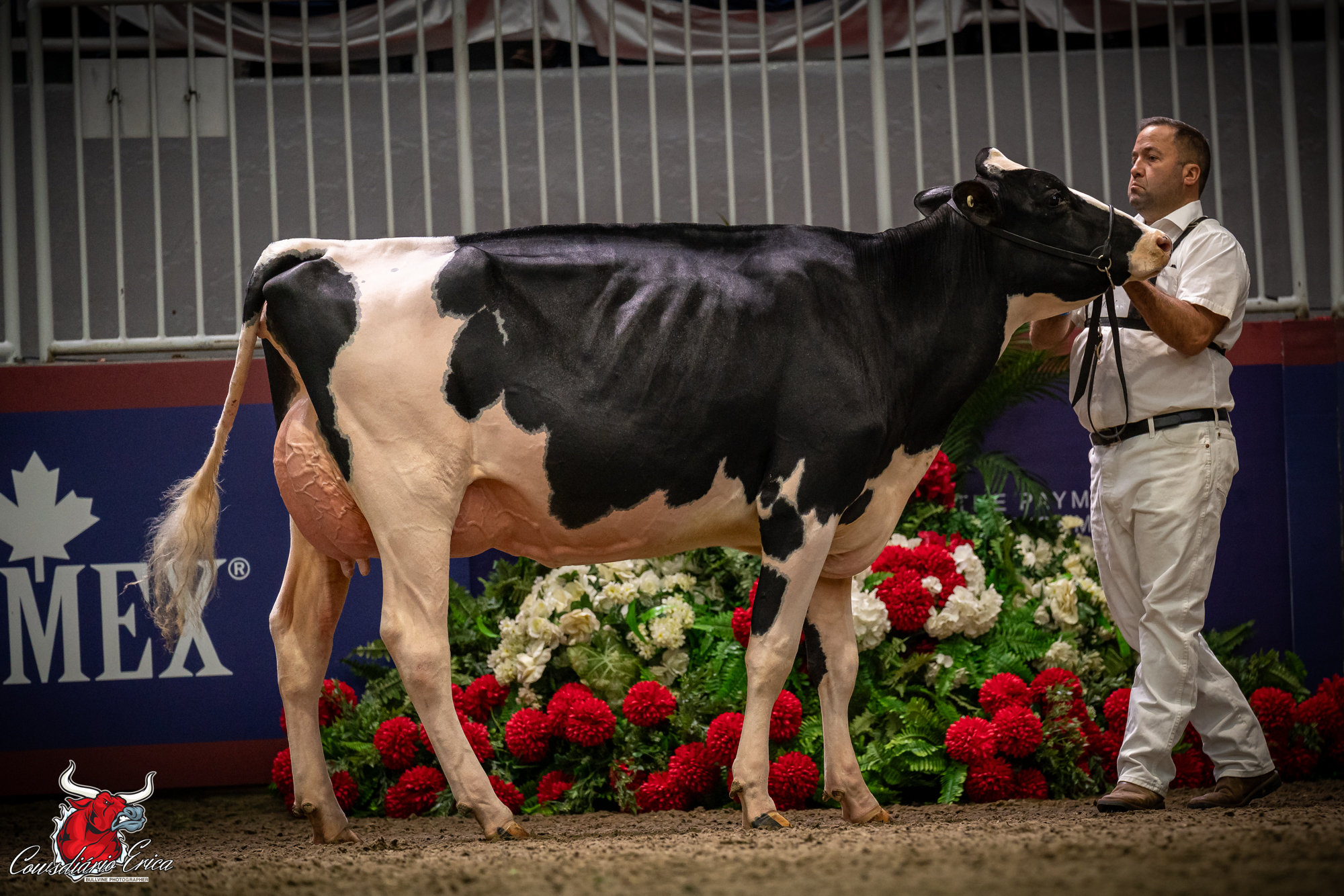
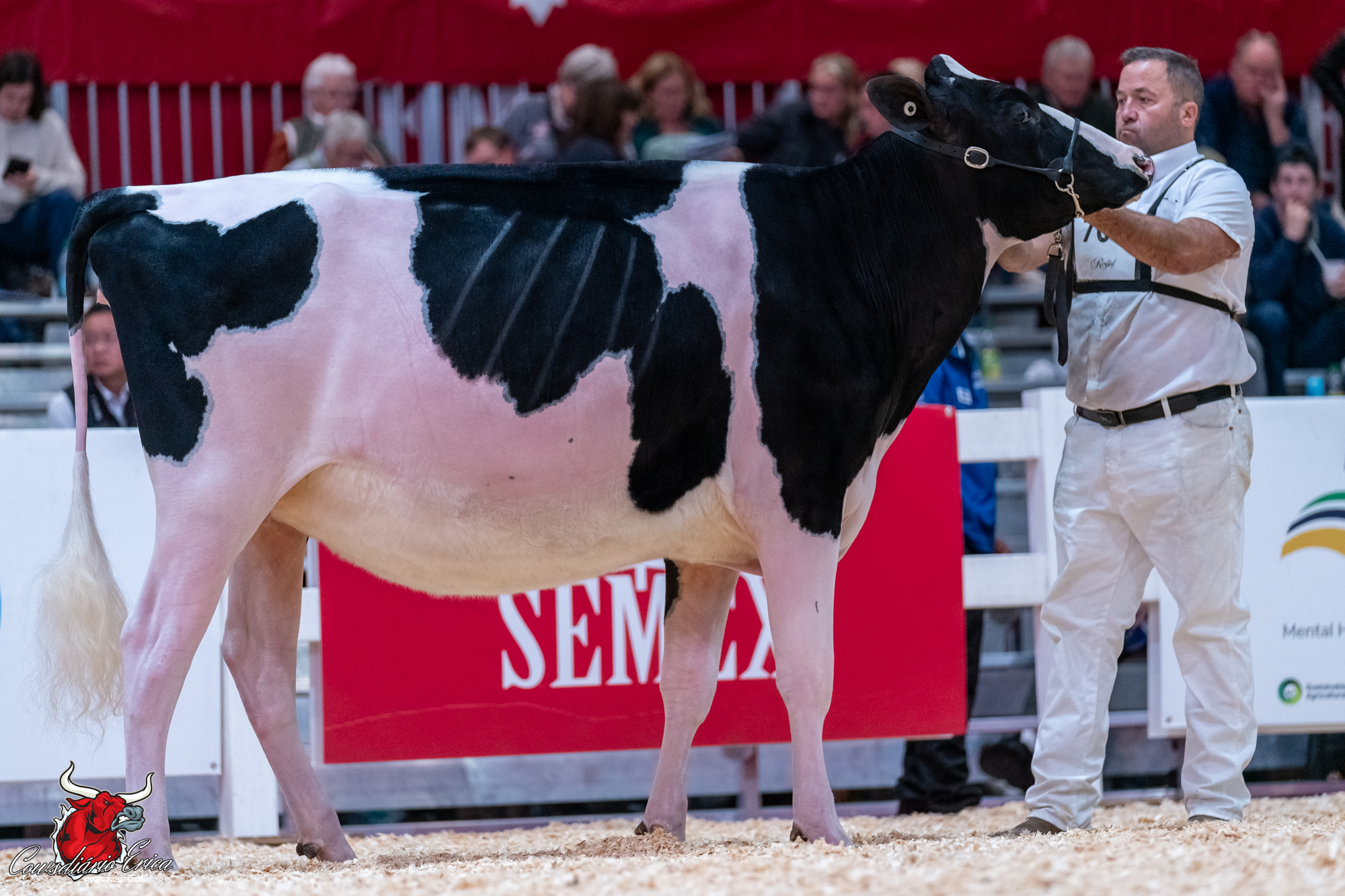
The heifer looked fine. She was eating her morning feed, moving normally, ready for the ring at Canada’s most prestigious dairy show in about 48 hours. Twenty years of experience told Maxime Petitclerc everything was on track. The rumen bolus sitting in her stomach told a different story.
It was November 2025, preparation week for the Royal Agricultural Winter Fair, and Ferme Petitclerc’s show string was bedded down in Quebec before the long haul to Toronto. Core body temperature on one heifer: trending upward. Rumination: starting to drop. The Farmfit monitoring system flagged what no one could see yet—this animal was probably 12 to 18 hours from showing obvious signs of illness.
“We saw her temperature rising, and we started treatments,” Petitclerc explained in a recent interview with STgenetics Canada. “We caught it much sooner. She wasn’t showing many symptoms yet, but the data showed things sooner than our eyes can see them.”
STgenetics Canada facilitated the interview and background access for this story; all research citations and ROI calculations in this article have been independently sourced and verified by The Bullvine editorial team.
Check out the interview with Max following the show
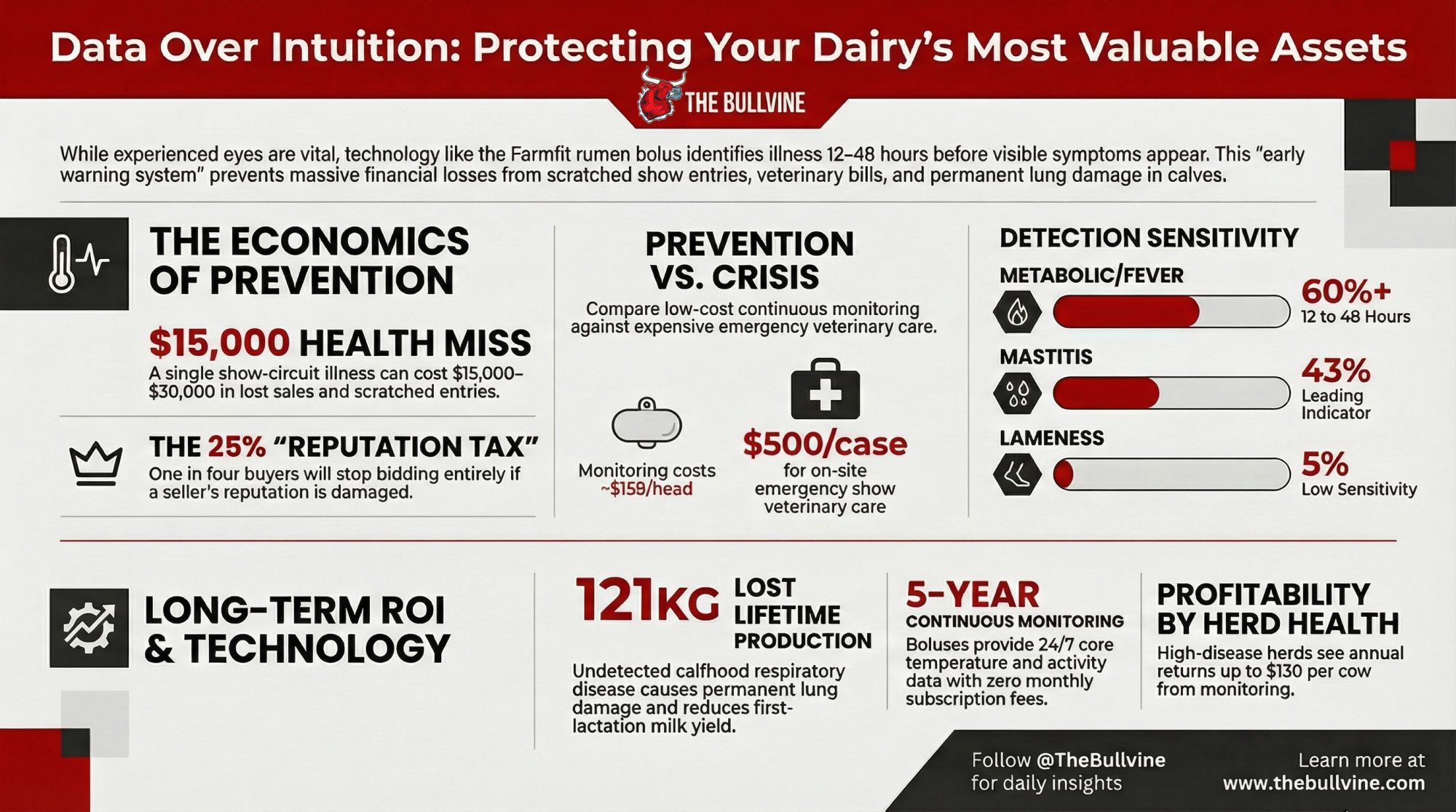
That early catch likely saved Petitclerc from a cascade that could have cost tens of thousands in lost sales, scratched entries, and the kind of reputation damage that Oklahoma State University research shows causes a quarter of cattle buyers to walk away entirely—regardless of an animal’s individual quality.
By evening feeding—the next time anyone would’ve given her a close look—she likely would’ve been obviously off. At that point, you’re looking at a potential scratch from competition, a vet call, and questions about whether she should even make the trip. Instead, early treatment kept her in sound and show-ready condition.
Here’s the part that actually changes your math: catching problems early doesn’t just save animals—it makes treatment more effective, reduces the risk of antimicrobial resistance building in your herd, and costs less than waiting until symptoms become obvious. With Farmfit, the temperature curve can be marked with treatment times, making it easy to see whether your intervention is working or needs adjustment.
Most farms do the opposite. This wasn’t some pilot project on commercial cattle. Petitclerc put the monitoring technology on his most valuable animals first—the ones headed to The Royal. And that decision runs against how most farms approach new technology.
The Reputation Tax Is Real—Here’s the Math
Before we dive into the technology itself, let’s talk about why this matters so much for exhibitors. Everyone in the industry understands that sick cattle cost money. But on the show circuit, the math works differently than it does in the commercial milking string—and the stakes are considerably higher.
Direct costs are straightforward enough: on-site veterinary work at a major show can easily run $200 to $500 per case. Anyone who’s made that call at World Dairy Expo or The Royal knows exactly what I’m talking about.
What gets expensive fast is everything else.
Research on cattle marketing shows that seller reputation significantly influences buyers’ willingness to pay. Oklahoma State University survey work found some striking numbers here. Certified cattle from positive reputation sellers commanded premiums averaging $10.42 per hundredweight, while uncertified cattle from positive reputation sellers still earned $2.86/cwt premiums over base prices. That’s real money.
But here’s the part that should make every exhibitor pause: according to the University of Wisconsin Livestock Extension’s summary of this research, roughly 25% of buyers indicated they wouldn’t bid at all on cattle from sellers with negative reputations, regardless of the animal’s individual quality. One in four potential buyers walks away if your reputation takes a hit.
The Show Circuit Risk Calculation
If a quarter of your buyer pool disappears after a public health incident, the cost of monitoring technology gets covered by a single saved sale. For a high-profile problem at The Royal or World Dairy Expo, the cascade includes immediate vet costs ($200-500), scratched competition entries ($500-2,000 in prep and fees), evaporated private sale discussions (potentially $10,000-50,000 depending on genetics), and long-term reputation damage that can follow a prefix for years. Run your own numbers—the math usually isn’t close.
For Ferme Petitclerc, with nearly two decades of Royal Winter Fair history behind them, one public health failure could undermine years of careful breeding decisions. That’s the context for understanding why Petitclerc was willing to try monitoring technology on his show cattle first—not as an experiment, but as protection for genetics that took generations to develop.
What Would a Health Miss Have Cost Petitclerc?
Let’s make this concrete. Petitclerc had 22 animals in his Royal string. At $99 CAD per bolus, plus one Internet Gateway ($700 CAD) and one Collector for the barn setup ($600 CAD), his total Farmfit investment came to approximately $3,478 CAD—about $158 per head.
Now consider what a missed fever on that heifer could have cost:
- Entry fees, transport, and prep already spent: Easily $1,500-2,500 for a single animal headed to The Royal
- Emergency vet care at the show: $300-500 minimum, potentially more for after-hours calls
- Scratched from competition: The primary reason for making the trip—gone
- Private sale conversations that evaporate: Hard to quantify, but if that heifer had serious buyer interest, we’re talking $8,000-25,000 in potential lost revenue.
- Breeding season impact: Stress and illness during show prep can extend calving intervals by weeks, at roughly $5-6 per day in delayed production
Add it up, and a single serious health incident could easily exceed $15,000 to $ 30,000 in combined direct costs and lost opportunity costs. Against a monitoring investment of $3,478 CAD for the entire show string, the insurance math makes sense.
| Cost Category | Low Estimate | High Estimate |
|---|---|---|
| Entry fees + transport + prep (sunk) | $1,500 | $2,500 |
| Emergency vet at show venue | $300 | $500 |
| Scratched competition entry | — | — |
| Private sale conversations lost | $8,000 | $25,000 |
| Breeding season delay (stress impact) | $150 | $400 |
| Reputation damage (hard to quantify) | — | — |
| Total potential loss per incident | $9,950 | $28,400 |
And that’s before we factor in the reputation effects that compound over the years.
A Growing Industry Response
Petitclerc’s preventative save isn’t just a lucky break—it’s a microcosm of a broader shift in how we manage livestock. The precision livestock farming market has grown substantially, reaching roughly $7.5 billion in 2024 according to Grand View Research’s industry analysis, with projections suggesting it could approach $20 billion by 2033.
That kind of investment flooding into the sector means your neighbor is probably evaluating this technology too—and the farms that figure out the ROI math first will have an edge in both production efficiency and genetics marketing.
About 70% of large-scale farms now use at least one precision agriculture technology, based on the latest USDA data. But when you look specifically at livestock operations, the picture is more nuanced. Wearable technology adoption—such as activity collars and rumen boluses—currently sits at around 12% on large farms, while robotic milking systems are deployed in roughly one in five large dairy operations. So we’re still in relatively early days, at least compared to what’s happened in crop agriculture with GPS and variable-rate applications.
Canadian adoption figures are harder to pin down, though anecdotally, Ontario and Quebec appear to be leading in adoption among elite genetics programs. The combination of high-value registered cattle and a concentrated show season creates natural pilot conditions.
The typical adoption pathway makes sense from a risk management perspective: try new technology on your commercial animals first, work out the kinks, validate that it delivers value, then consider expanding to higher-value genetics. There’s nothing wrong with that approach.
Ferme Petitclerc took a different path.
When STgenetics Canada approached them about Farmfit—their rumen bolus monitoring system—Petitclerc decided to start with the 22 animals heading to The Royal. His show string. The cattle that carry his prefix onto the national stage.
“Right now, we have 22 on the bedding here, and all 22 have the bolus,” he explained. “We wanted that little bit of an edge, to be a step ahead—especially with the long hours of trucking.”
One detail that makes Farmfit particularly practical for show operations: the Collectors can be mobile. STgenetics had a farm whose cattle were continuously monitored from Washington state to World Dairy Expo using a Collector mounted in the trailer that traveled with the animals. For anyone who’s ever worried through a long haul, that kind of continuous data is a different level of peace of mind.
Petitclerc’s experience represents an early-adopter perspective—about 3 weeks of use at the time of the interview. That context matters when evaluating any new technology. But the technology’s performance is either verifiable or it isn’t—and third-party research supports the core claims about its early-detection capabilities.
Within three weeks, he was already planning to expand beyond show cattle. “Eventually, we’re going to have more boluses. We’ll invest more in it. It’s working well so far.”
Why the Show Circuit Stress-Tests Everything
Here’s what I find compelling about Petitclerc’s choice of testing ground: the show circuit effectively stress-tests every assumption about health-monitoring technology.
Think about what these cattle go through. You’re taking a genomically valuable heifer, putting her on a trailer for hours, changing her environment completely, disrupting her feeding routine, and then asking her to peak physically in a crowded arena. That’s a lot of variables working against her immune system.
Research on cattle transport consistently supports this. Even relatively short hauls trigger measurable stress responses—elevated cortisol, altered immune function, and shifts in energy metabolism—that can persist for days after arrival. There’s a solid body of peer-reviewed work documenting these effects, and they’re significant enough that the European Food Safety Authority conducted a comprehensive review in 2022. EFSA identified 11 distinct welfare consequences during cattle transport: group stress, handling stress, heat stress, injuries, motion stress, prolonged hunger, prolonged thirst, respiratory disorders, restricted movement, restlessness, and sensory overstimulation. That’s a lot of physiological challenges hitting animals simultaneously.
The fall show circuit adds another layer that anyone who’s hauled cattle in November understands. Temperature swings across the Northeast and into Ontario mean animals acclimated to outdoor conditions are suddenly housed in climate-controlled facilities, or vice versa. Many Quebec and Ontario producers I’ve talked with over the years mention this transition as particularly tricky—you’re managing animals through environmental stress at exactly the moment you need them looking their best.
In Canadian quota systems, there’s an additional wrinkle worth considering. Sick cattle don’t just cost treatment dollars—reduced production affects your ability to fill quota and can impact long-term quota holdings. The opportunity cost extends beyond the individual animal.
The Hidden Cost of Calfhood Disease
This is the piece most people miss about the economics of early detection—and why monitoring young stock matters more than most producers realize.
A 2021 meta-analysis published in the Journal of Dairy Science by Buczinski, Achard, and Timsit reviewed 27 studies on bovine respiratory disease (BRD) in calves. The numbers are pretty hard to ignore:
- 2.9 times higher odds of dying for heifers that had BRD as calves
- 2.3 times higher odds of being removed from the herd before first calving (dead, culled, or sold)
- Average daily gain reduced by 0.067 kg/day
- 121 kg less milk during the first lactation
U.S. data suggest the average incidence of calfhood respiratory disease is around 37%, depending on the publication, with a total cost of roughly $237 per case when accounting for treatment, poorer growth, and lost future production.
What’s particularly striking is that this lung damage from calfhood respiratory disease is permanent. The research followed the animals throughout their productive lives. By the time those heifers enter the milking string, the damage is already done.
This is where Farmfit’s design becomes relevant. Unlike systems designed primarily for mature cows, Farmfit boluses can be administered as early as the first month of life. That means you can identify temperature spikes indicating respiratory challenges before they do permanent damage to lung tissue—damage that would otherwise follow that animal through every lactation she completes.
For operations raising heifers at a separate facility—which is increasingly common—this matters even more. Those animals often don’t get seen as frequently as the milking herd. Continuous temperature monitoring fills that gap and provides early warning for animals quietly drifting off track.
Comparing Your Monitoring Options
Whether you’re running a 100-cow operation in the Eastern Townships or a 3,000-head facility in California’s Central Valley, the monitoring options have expanded considerably. Each system has distinct strengths and tradeoffs.
Monitoring Technology Comparison
| Technology | Primary Strength | Temperature Accuracy | Cost Range | Key Limitation |
| Rumen Bolus (ex. Farmfit) | Early illness/fever detection | High (core body, ±0.1°C) | $110–$125/head* | Low overall lameness sensitivity (~5%) |
| Activity Collar | Heat detection | High for activity; moderate for temp | $80–$150/unit | Environmental interference (wind, cold) |
| Ear Tag Sensors | Low entry cost | Moderate (skin surface) | $30–$80/unit | Weather variability affects readings |
*Farmfit pricing based on typical 100-head installations with 1 Gateway + 2–3 Collectors; individual boluses are $99 CAD. Detection sensitivity data from Pfrombeck et al. 2025 SimHerd study, Journal of Dairy Science.
What I notice in talking with producers who’ve tried multiple systems is that each optimizes for different priorities. For Petitclerc’s specific situation—show cattle under transport stress where early fever detection mattered most—the bolus approach made sense. For a commercial dairy prioritizing heat detection in a large breeding pen, collars have proven their worth over decades.
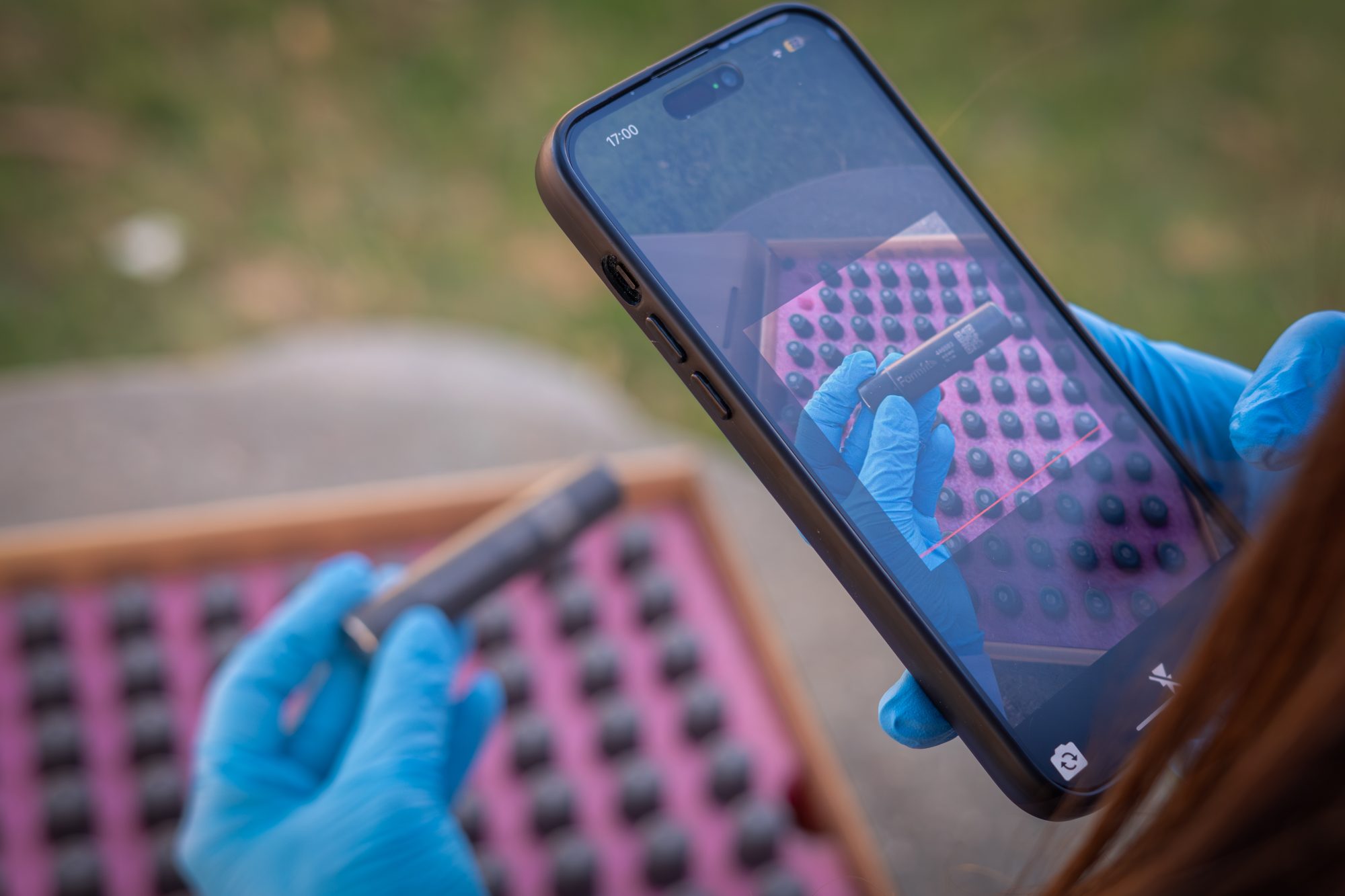
- Rumen boluses remain in the reticulum throughout the animal’s lifetime, providing continuous core temperature readings unaffected by external conditions. They measure every 15 minutes, tracking temperature, rumination patterns through accelerometers, and activity levels. Temperature change is the early, leading indicator of disease—often moving 12 to 48 hours before visible signs or rumination drops—while rumination change tends to follow as a secondary indicator. Farmfit includes an integrated magnet for hardware disease protection, which explicitly captures wire fragments, nails, and staples that end up in TMR. Farmfit boluses have a 5-year battery life, and there are no subscription fees—you get a full dairy management software platform included.
The significant limitation is that overall lameness detection sits around 5% in the modeling work. Most non-infectious hoof problems don’t create a strong temperature signal. That said, Farmfit users and STgenetics’ team have identified lameness cases linked to infectious causes, such as footrot, in which fever was the primary early symptom. So you will catch some lameness—but mainly those cases where systemic infection is driving a temperature spike, not every cow with sore feet. - Activity collars remain the gold standard for heat detection, having undergone years of refinement. They’re moderately effective for illness detection, with a typical battery life of 5 to 7 years. Research indicates that external sensors are susceptible to environmental conditions, so operations in Manitoba or Alberta that deal with extreme temperature swings should factor that into their evaluation.
- Ear tag sensors offer the lowest barrier to entry, but they’re measuring skin surface temperature rather than core body temperature. In the variable conditions of a show barn—or most transitional housing situations—that accuracy gap matters.
What Ferme Petitclerc’s Implementation Looked Like
The practical details of the Petitclerc experience offer useful insights for anyone considering precision monitoring, particularly for show or elite genetics programs.
They started focused: 22 head in the Royal string, bolused before show preparation and the trip to Toronto. Daily monitoring happened through the Farmfit phone app—checking overnight temperature trends, rumination patterns, and activity data became part of the morning routine.
The key moment came early. That heifer whose temperature began to rise before she showed any visible symptoms.
What made early detection matter in this case was something every show exhibitor understands: the schedule. Show cattle typically get fed twice daily during events. If you miss a subtle sign at the morning feeding—maybe an animal that’s slow to get up or doesn’t clean up her grain quite as fast—you might not get another close look until evening. That’s a 10- to 12-hour window when problems can develop unnoticed, especially when you’re busy with fitting, washing, and ring preparation.
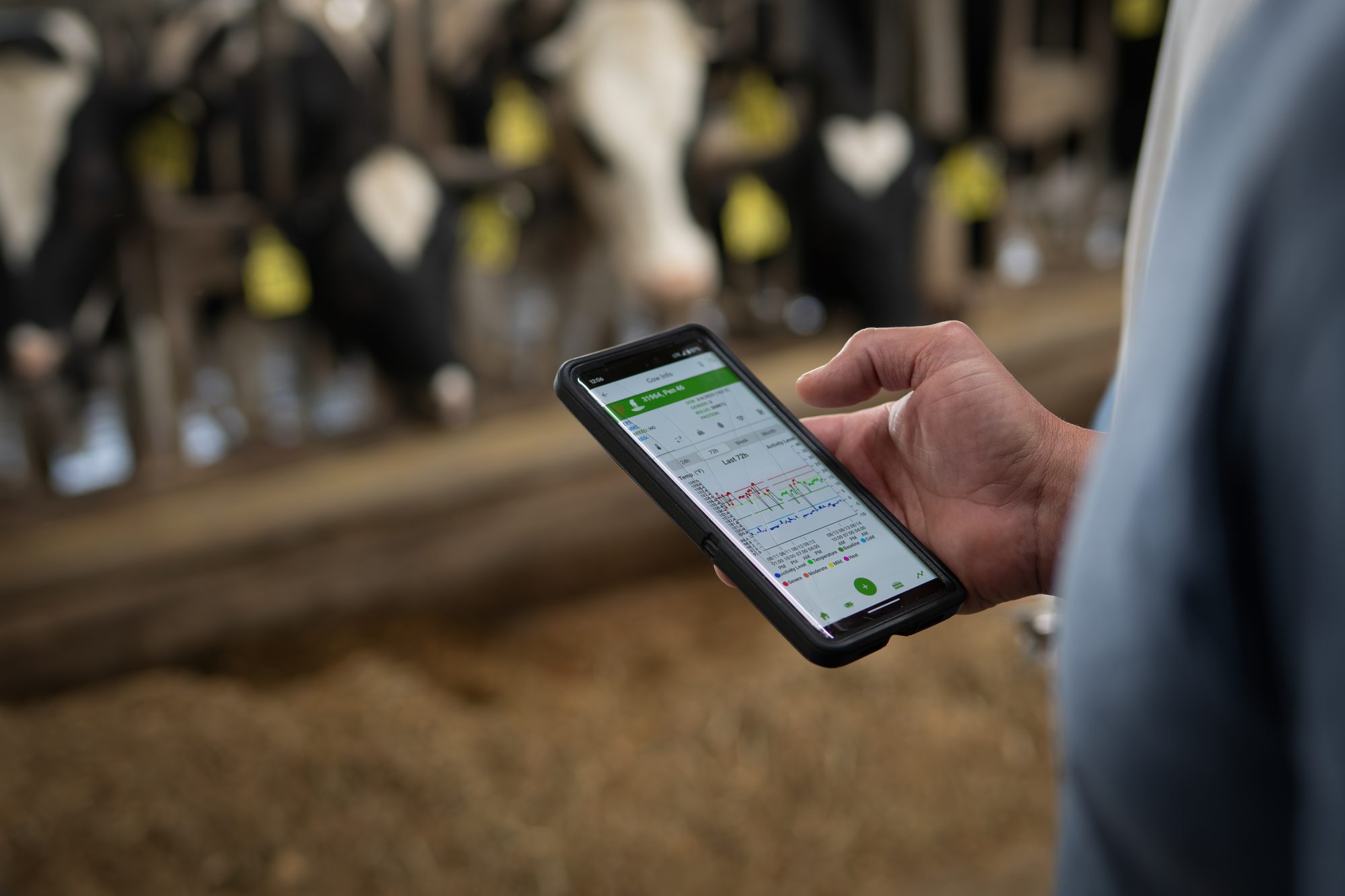
Farmfit flagged the temperature trend while the heifer still looked essentially normal to experienced eyes. Dominique Petitclerc, who works with the heifers daily, used that data to trigger treatment. By the time visual symptoms would’ve been obvious, intervention was already underway.
“It’s an eye 24 hours a day, seven days a week for the well-being of your animals,” Maxime said. “You wake up in the morning, and you have the data from the night—you see activity levels, you see heats, you see what’s coming.”
I’ve heard similar observations from other early adopters. Nic Sauder of River Valley Farm, a Jersey operation in Tremont, Illinois, mentioned checking the app “first thing in the morning before I even get into the barn” to know what to expect. Brian Oster of Retso Holsteins, who runs about 150 milking cows near Schodack Landing, New York, and boards show cattle for several outside clients, called it “an extra set of eyes,” providing peace of mind for both his staff and the breeders whose cattle they manage.
The common thread is a reduction in uncertainty—knowing before you walk in the barn whether something needs attention.
For operations already using STgenetics genomics, the integration creates a single dashboard view of both genetic potential and real-time health status—useful for identifying whether high-genomic animals are actually expressing their potential or being held back by subclinical issues that traditional observation might miss.
The ROI Reality Check
Marketing materials for precision livestock technology often make impressive claims. The independent research paints a more nuanced picture—still generally positive in the right circumstances, but with important caveats.
On the cost side, Farmfit runs approximately $110-125 per head for typical installations (100 boluses at $99 CAD each, plus one Gateway at $700 CAD and 2–3 Collectors at $600 CAD each to cover barn areas). Smaller installations like Petitclerc’s show that string work costs roughly $158 per head due to fixed infrastructure costs spread across fewer animals.
What’s particularly noteworthy is how returns vary based on your starting point. A study published in the Journal of Dairy Science (Pfrombeck et al. 2025) used SimHerd modeling on 65 dairy cows with rumen bolus sensors and found annual net returns that ranged dramatically based on baseline herd health:
Economic Returns by Herd Health Status
| Baseline Herd Health | Annual Return Per Cow (EUR) | Annual Return Per Cow (USD)* |
| Poor health (above-average disease incidence) | +€23 to +€119 | +$25 to +$130 |
| Average health | -€12 to +€84 | -$13 to +$92 |
| Excellent health (below-average disease) | -€33 to +€63 | -$36 to +$69 |
*USD figures calculated at approximately $1.09/€1.00 exchange rate as of January 2026.
If you’re facing above-average disease rates, the research suggests you could see annual returns of $25 to $ 130 per cow. If your health protocols are already excellent, you might actually lose money on the investment.
Here’s the uncomfortable truth the technology vendors won’t tell you: if your transition program is already running at 90th-percentile health metrics, you might be better off spending that $15,000 on an extra part-time employee than on sensors. The math only works when there’s something to catch.
One important nuance here: those mature cow ROI numbers are already discounted by whatever lung damage and health losses happened back in calfhood, because those animals never had early intervention to reduce BRD impacts. In other words, the modeled returns don’t capture the extra upside of catching respiratory disease in calves before it permanently affects lifetime performance.
That said, Natalia at STgenetics confirms that this matches their field experience: herds with unresolved health issues make the biggest gains from adopting the technology. If you know you’ve got problems but can’t quite pin them down, that’s where monitoring shines.
That same study found detection rates that varied considerably by condition:
Detection Sensitivity by Condition
| Health Condition | Detection Rate |
| Retained placenta | 64% |
| Clinical milk fever (hypocalcemia) | 61% |
| Mastitis | 43% |
| Metritis | 25% |
| Lameness | 5% |
The pattern reveals what the technology does well and where it struggles. Systemic and metabolic conditions—where core temperature changes early as a leading indicator—are more reliably caught. Reproductive tract issues show moderate detection. Locomotion problems largely escape notice because a bolus sitting in the reticulum can’t see what’s happening in the hooves unless infection is driving a systemic fever.
On disease prevention specifically, the numbers are encouraging where detection works. University of Wisconsin Dairy Extension shows that preventing a single case of clinical ketosis saves roughly $289 and boosts 305-day milk yield by about 3.5 percent—numbers that should get the attention of any producer managing fresh cows.
For show operations, the math shifts because animals have fundamentally different value profiles. A Royal-bound heifer isn’t comparable to a commercial fresh cow. The cost of monitoring a 20-animal show string is modest, whereas a serious health incident during a major show could cost several times that amount.
Canadian Availability and Considerations
For Canadian producers, some regional context is helpful.
STgenetics has been actively expanding Farmfit availability through its Canadian headquarters in Sainte-Marie-Madeleine, Quebec. The system operates in the 915 MHz frequency band, which is compatible with North American regulations—an important technical detail, since some European systems use different frequencies.
One practical advantage worth noting: Farmfit charges no subscription fees. Once you’ve purchased your boluses and infrastructure, you’ll have full access to their dairy management software platform with no ongoing monthly costs. For operations that closely monitor cash flow, a predictable cost structure matters.
Competing options include smaXtec (pricing varies by distributor, with producers reporting costs in the $250- $ 400/bolus range for full-featured systems) and collar-based systems from Allflex, SCR, and several others.
Five Questions to Ask Before You Invest
What’s actually costing you money? Pull your 12-month health records. Count your transition disease cases. That’s your baseline problem rate—and the ceiling on what monitoring can save you.
How does this integrate with your setup? Get a demonstration of your actual herd management software. Compatibility issues are the most common frustration I hear about.
What does support look like when something breaks? Ask for references from Canadian operations of similar size. Find out response times.
What’s your realistic learning curve? Factor in the time it takes your team to become comfortable checking data daily. A system nobody looks at is worthless.
Will you actually use it? Be honest. If it doesn’t become part of the morning coffee routine, you’re wasting money.
Who Should—and Shouldn’t—Consider This Technology
The Ferme Petitclerc experience suggests specific applications, though what makes sense varies considerably by operation.
- For show exhibitors and elite genetics programs: If your show string insurance (entry fees, transport, prep costs) exceeds $3,000 per animal and your average private sale value exceeds $8,000, monitoring technology likely pays for itself with a single prevented incident. Transport stress, environmental changes, and compressed timelines create exactly the conditions where early detection matters most.
- For commercial operations with fresh cow challenges: If your transition program is where problems concentrate—above-average rates of metritis, ketosis, or displaced abomasums—that’s where monitoring investment pays back fastest. The research consistently shows stronger returns in herds with higher baseline disease incidence.
- For heifer-raising operations: This is an application that deserves more attention. Many farms raise heifers at a separate facility, where those animals aren’t observed as frequently as the milking herd. Given research showing that calfhood respiratory disease causes permanent lung damage that reduces lifetime productivity—121 kg less milk in the first lactation alone—catching respiratory issues early in young stock may be where monitoring delivers its biggest long-term payback.
- For smaller herds with limited labor, the “always watching” aspect is particularly valuable when there aren’t enough people to conduct frequent visual observation. Being able to check overnight data before morning chores could catch issues that would otherwise wait until evening feeding. Producers running 80 to 150 cows often find real value here, particularly during busy seasons like planting or harvest.
- For operations with excellent existing outcomes: This one requires honest self-assessment. If your protocols are already working well—low transition disease rates, strong reproduction, minimal fresh cow losses—monitoring technology might not meaningfully improve your numbers. That capital might be further invested in facilities, genetics, nutrition, or additional labor. Not every technology makes sense for every operation.
Dr. Robert Van Saun, Professor of Veterinary Science at Penn State University, has emphasized in his work on transition cow metabolic health that monitoring technology functions best as a supplement to skilled observation rather than a replacement for it. The goal is earlier detection and better-informed decisions—not hands-off management.
Petitclerc’s approach reflected this philosophy. His father, Réjean, still handles most breeding decisions on the farm. Farmfit didn’t change that dynamic—it just gave them better information to work from.
The precision livestock market’s projected growth—from $7.5 billion to nearly $20 billion over the next decade, according to Grand View Research—suggests the industry broadly agrees this technology category is here to stay.
The technology works. The question isn’t whether precision monitoring can catch problems earlier—the research confirms it can. The question is whether your specific operation has enough problems to catch.
What This Means for Your Operation
If this sounds like you, monitoring probably pays:
- You haul high-value show cattle multiple times a year and a single scratch or health incident would blow a five‑figure hole in your genetics revenue.
- Your calf BRD rate is north of ~25% and you’re seeing too many heifers culled or underperforming in first lactation.
- Your fresh-cow pen is a mess—metritis, ketosis, DA—and you’re constantly reacting instead of catching problems a day early.
If this sounds like you, fix the basics before buying boluses:
- Your herd health is already excellent, with low transition disease and BRD rates and no obvious weak spots in records.
- You rarely ship cattle, most animals stay on‑farm, and visual observation is genuinely happening several times a day.
- Most of your losses are hoof‑driven (lameness, cow comfort, flooring) rather than metabolic or respiratory disease.
Your 30/90/365-day checklist:
- Next 30 days: Pull 12 months of vet and treatment records. Count your BRD, metritis, ketosis, and DA cases, and estimate a real cost-per-case (vet, drugs, lost milk, culls).
- Next 90 days: Pilot monitoring on one high-risk group—your show string, fresh cows, or off‑site heifers—and track whether alerts actually move treatment timing earlier.
- Next 365 days: Compare this year’s BRD and transition disease rates, cull rates, and treatment timing against your baseline. If the numbers and timing don’t change, cut the tech and put the money into facilities, feed, or labor.
Key Takeaways
- A $3,478 bolus investment on 22 head at The Royal likely saved Ferme Petitclerc from a five‑figure hit in scratched entries, vet bills, and lost genetics sales.
- Reputation is the hidden cost driver: once your health reputation tanks, roughly one in four potential buyers stops bidding, no matter how good the animal looks.
- Calf BRD at “normal” levels (≈37%) quietly burns $26,000+/year in a 300‑cow herd before you count the lost 121 kg of first‑lactation milk per sick heifer.
- Rumen boluses make financial sense when you haul cattle often or run BRD above ~25%; smaller, closed herds often get more ROI from fixing basics like ventilation and vaccine timing.
- The article hands producers a 30/90/365‑day checklist to prove whether monitoring is insurance or just another expensive dashboard.
The Bottom Line
After nearly 20 years of showing cattle at The Royal, Maxime Petitclerc discovered that sometimes the best way to see your cattle clearly is to supplement what your eyes can catch.
“It’s an eye 24 hours a day, seven days a week for the well-being of your animals,” he said. “We always want to have that little edge—to be a step ahead.”
The trade-off is straightforward: monitoring technology costs $110-160 per head, depending on installation size, catches 60%+ of metabolic issues through early temperature changes, but misses most non-infectious lameness. For show cattle under transport stress, that’s a good bet. For a pasture-based operation where hoof health is your primary concern, it’s probably not.
Know your numbers. Know your gaps. Let the math make the decision.
Complete references and supporting documentation are available upon request by contacting the editorial team at editor@thebullvine.com.
Learn More
- Tech Reality Check: The Farm Technologies That Delivered ROI in 2024 (And Those That Failed) – Stop guessing and start measuring with this brutal 90-day roadmap that separates high-performing tech from expensive barn ornaments. It arms you with verified ROI figures—like a 2.1-year payback on sensors—to protect your balance sheet from underperforming vendor promises.
- Beyond Efficiency: Three Dairy Models Built to Survive $14 Milk in 2026 – Secure your operation’s future with three battle-tested business models designed to survive structural shifts in processing. This strategy reveals how to pivot from volume-chasing to risk-diversified stability, ensuring you’re positioned to capture premiums through 2028 and beyond.
- Revolutionizing Dairy Farming: How AI, Robotics, and Blockchain Are Shaping the Future of Agriculture in 2025 – Weaponize your data with AI-optimized breeding and blockchain tracking to turn standard metrics into a high-margin “superpower.” This reveals the method for predicting hoof cracks 72 hours early while slashing labor by 70%, giving disruptors a massive competitive edge.
 The Sunday Read Dairy Professionals Don’t Skip.
 The Sunday Read Dairy Professionals Don’t Skip.
Every week, thousands of producers, breeders, and industry insiders open Bullvine Weekly for genetics insights, market shifts, and profit strategies they won’t find anywhere else. One email. Five minutes. Smarter decisions all week.