Archive for inbreeding depression

When Your “Elite” Genetics Start Costing You Real Money

Think chasing top TPI is pure profit? Your pocketbook might be tanking from inbreeding you can’t see.

A sentiment echoing from industry leaders around the world is that the genetic diversity challenge is about to shift from crucial to absolutely critical. What we’re seeing with inbreeding today is just the tip of the iceberg — this is poised to become a major industry crisis if we don’t get ahead of it now.

You know what keeps coming back to me during all these dairy chats I’ve been having lately? It’s how much time we spend chasing the highest genomic indexes and fancy TPI numbers, but we hardly ever dig into what’s lurking beneath those shiny scores — the risk of losing genetic diversity and quietly bleeding cash without even realizing it.

Just last month, I was up in upstate New York, walking through a solid 2,500-cow operation. The owner was beaming, boasting about his herd’s average TPI, which had hit 2,800. Great numbers, right? But here’s the thing… behind those glittering stats, the genetic base looked dangerously narrow. That’s when our conversation flipped — from celebrating elite genetics to facing the looming threat of a shrinking gene pool.

And honestly? It got uncomfortable real quick.

The Math That Should Keep You Awake at Night

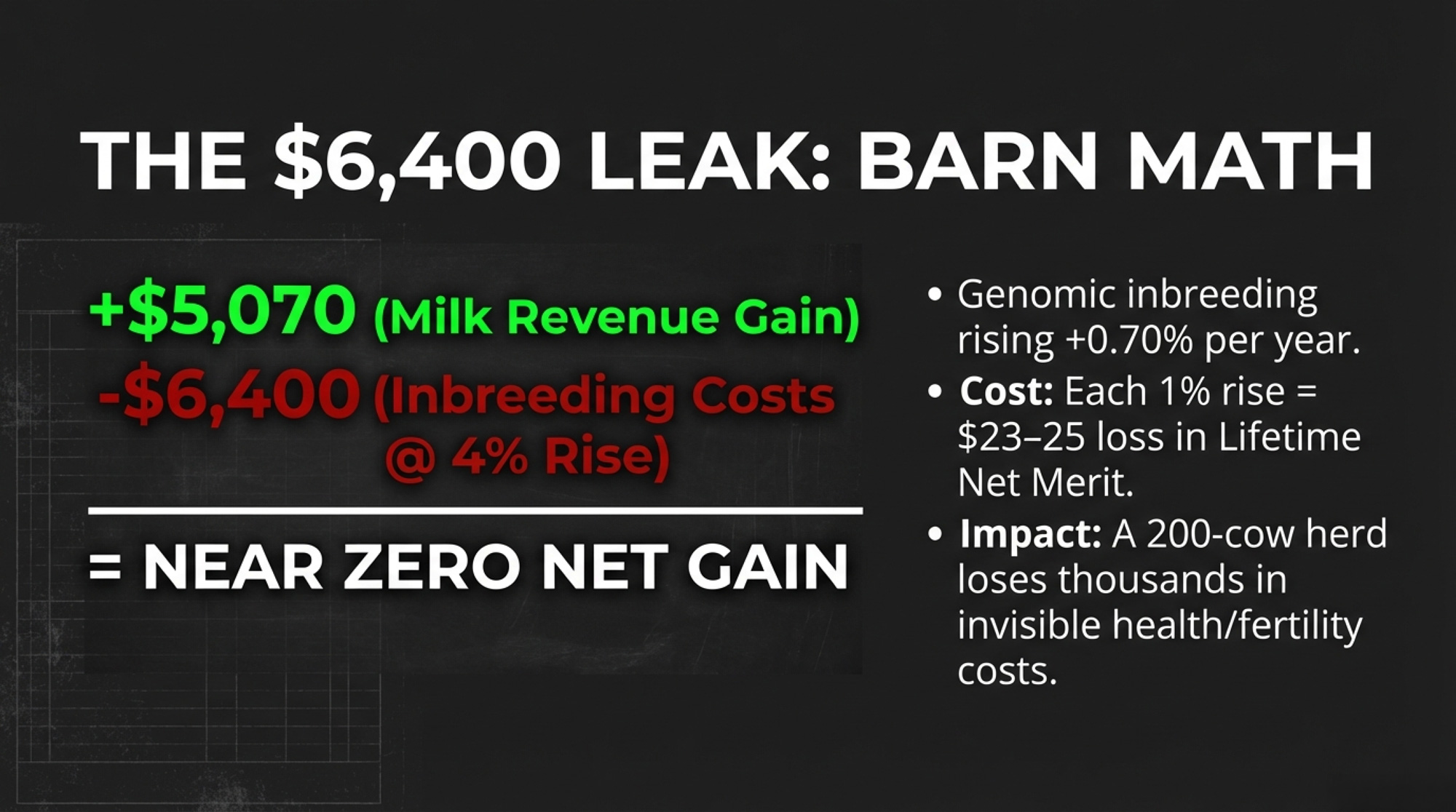
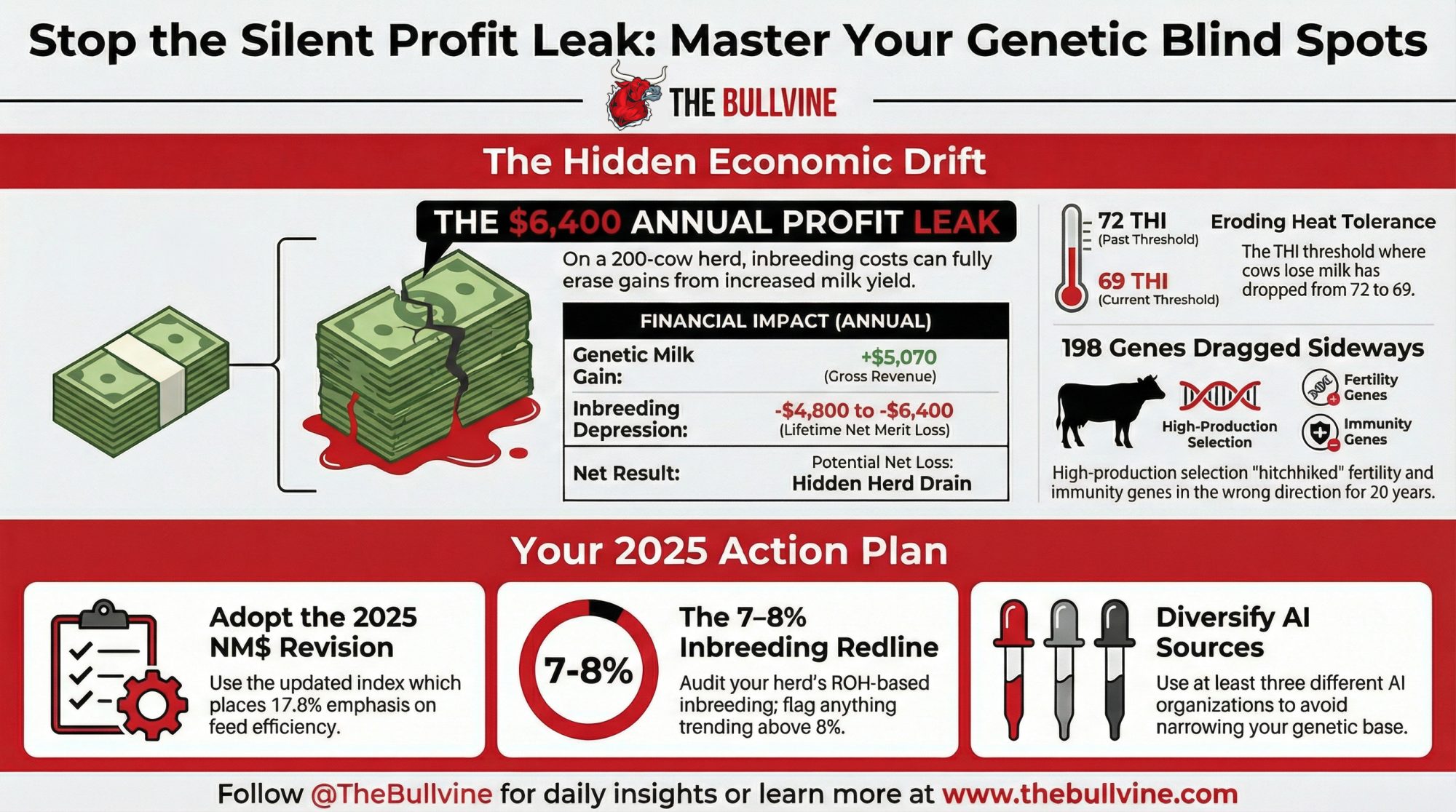
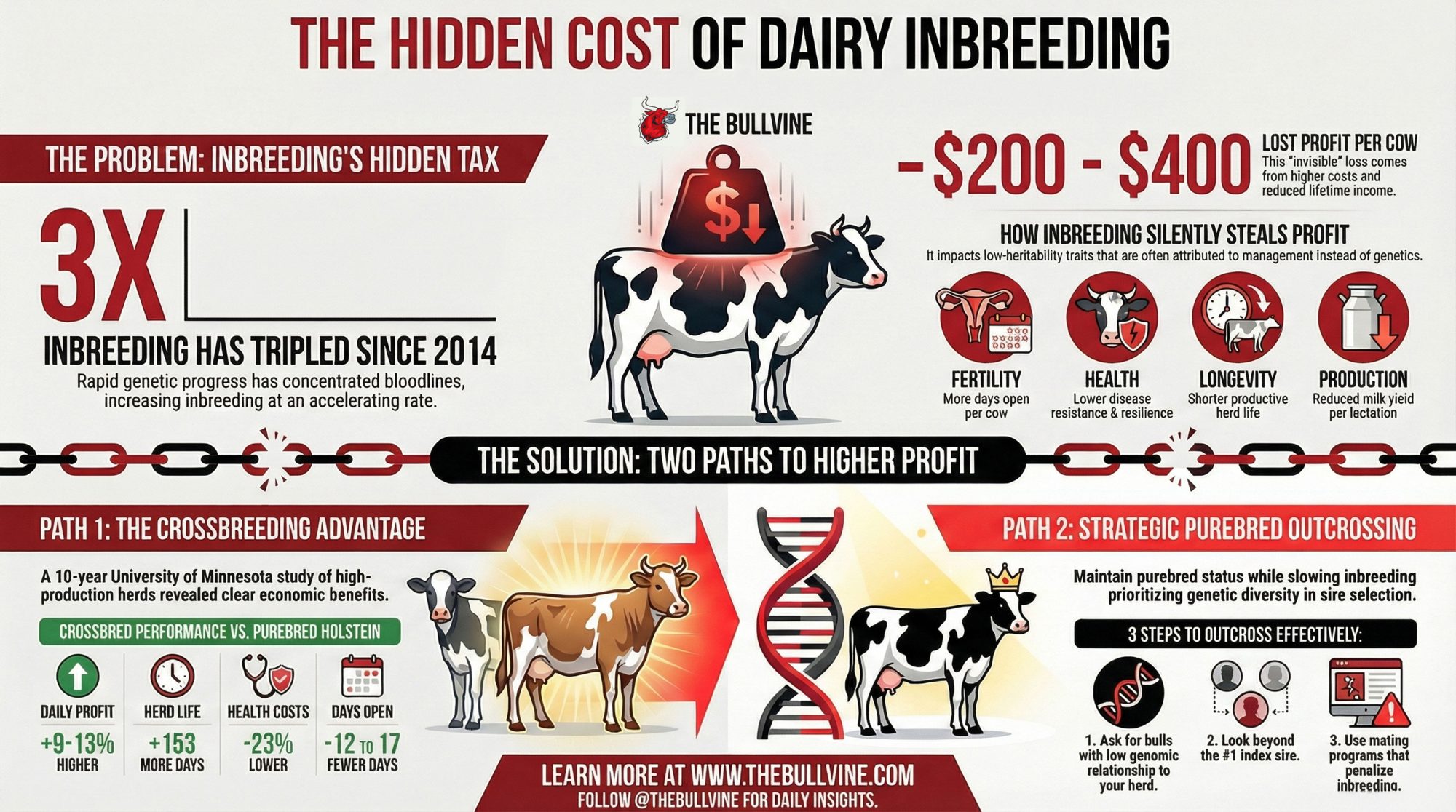
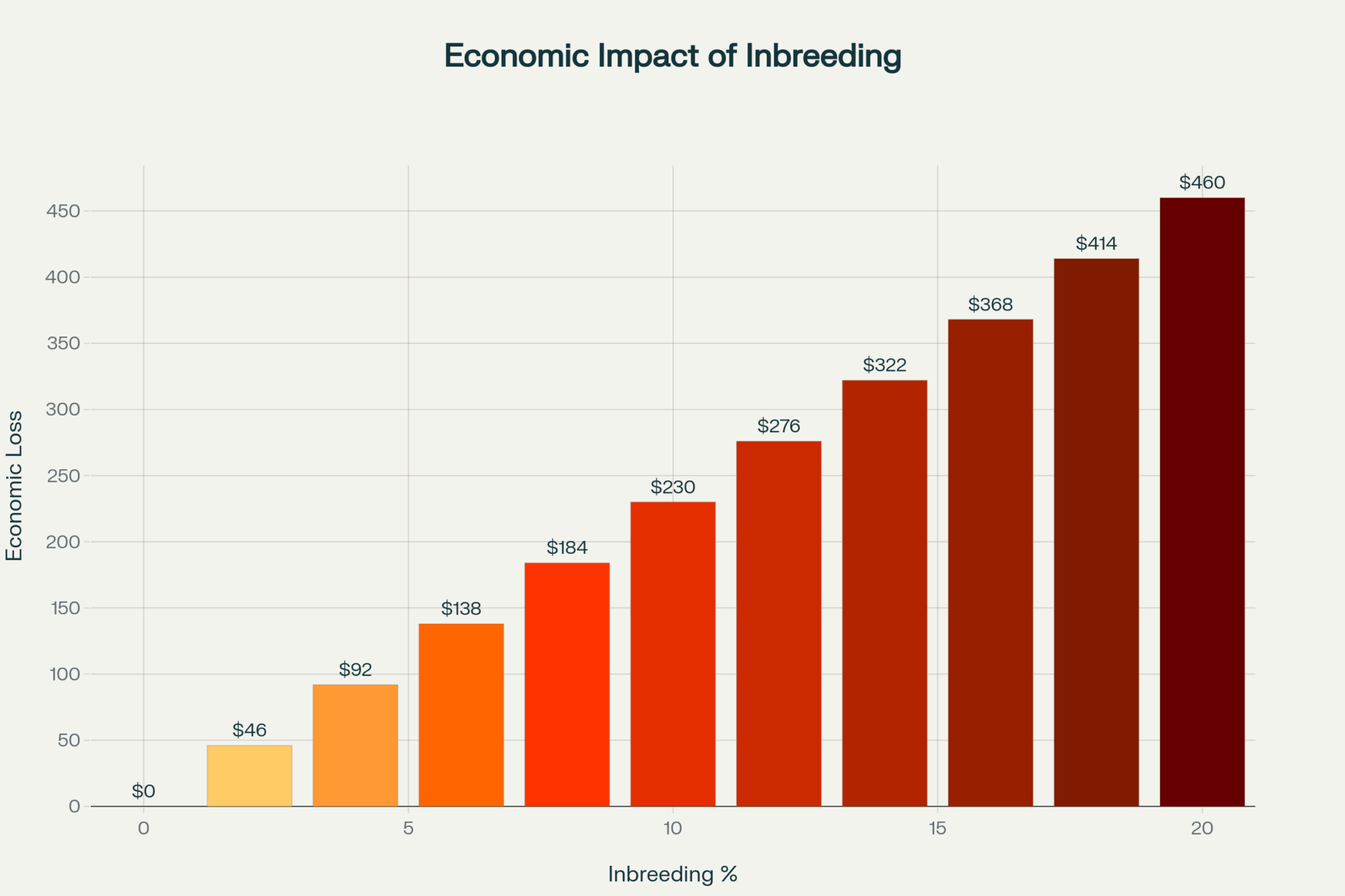
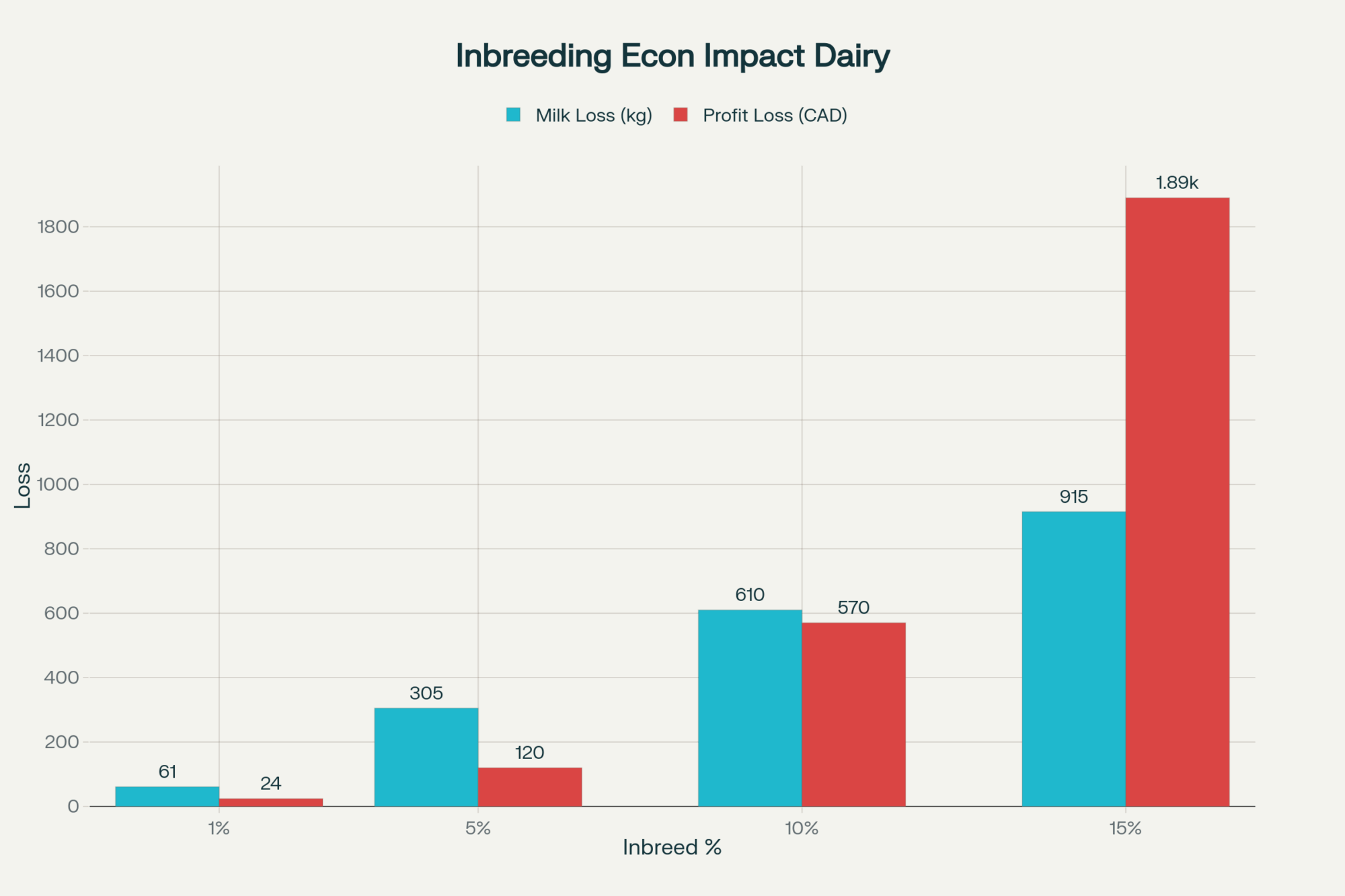
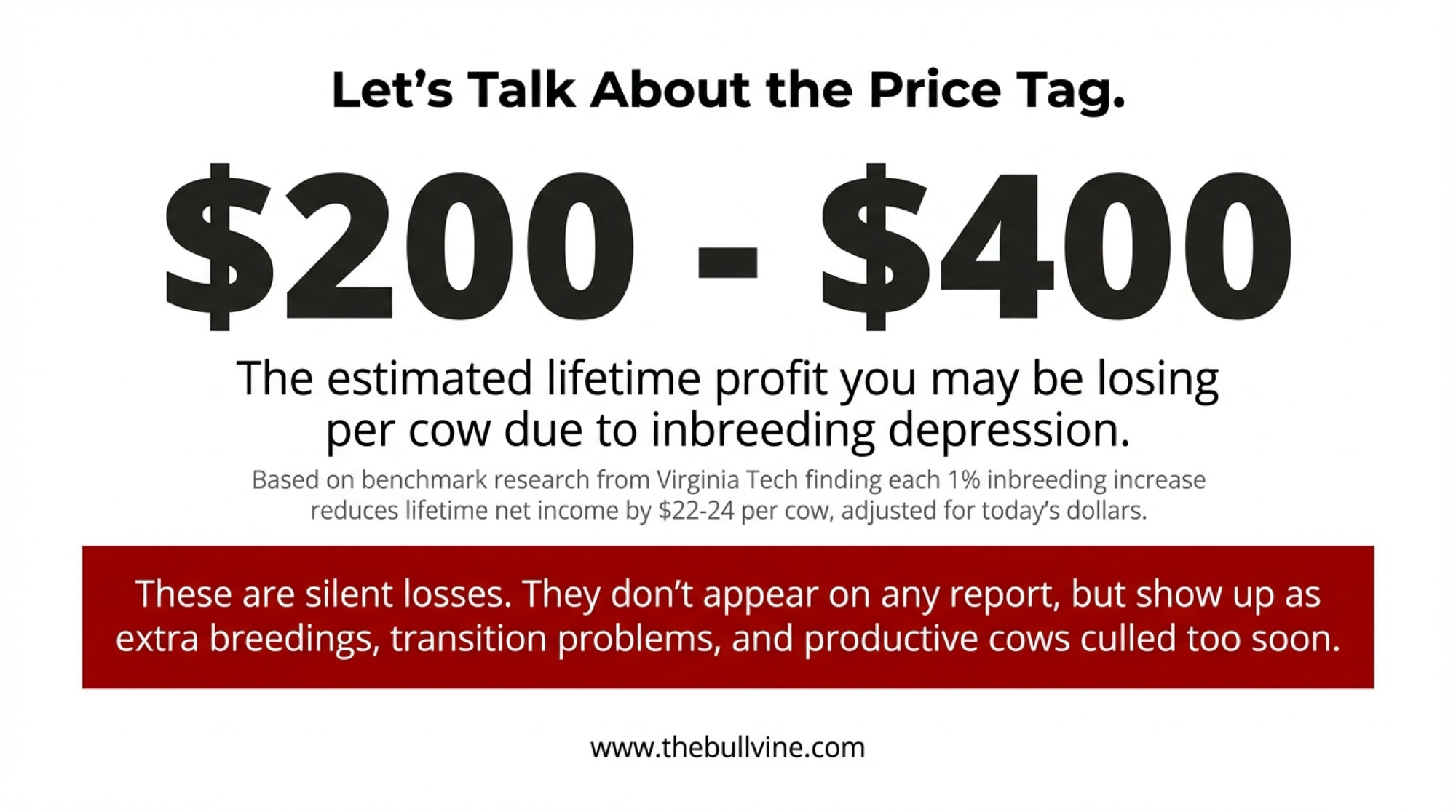
Let’s talk dollars and cents — those losses you actually feel in your wallet. Every 1% uptick in a cow’s inbreeding coefficient can cost you around $22 to $24 in lifetime profit. That’s not some theoretical number buried in research papers; that’s real money walking right out your barn door.

Economic impact of inbreeding depression showing cumulative losses per cow based on inbreeding coefficient levels

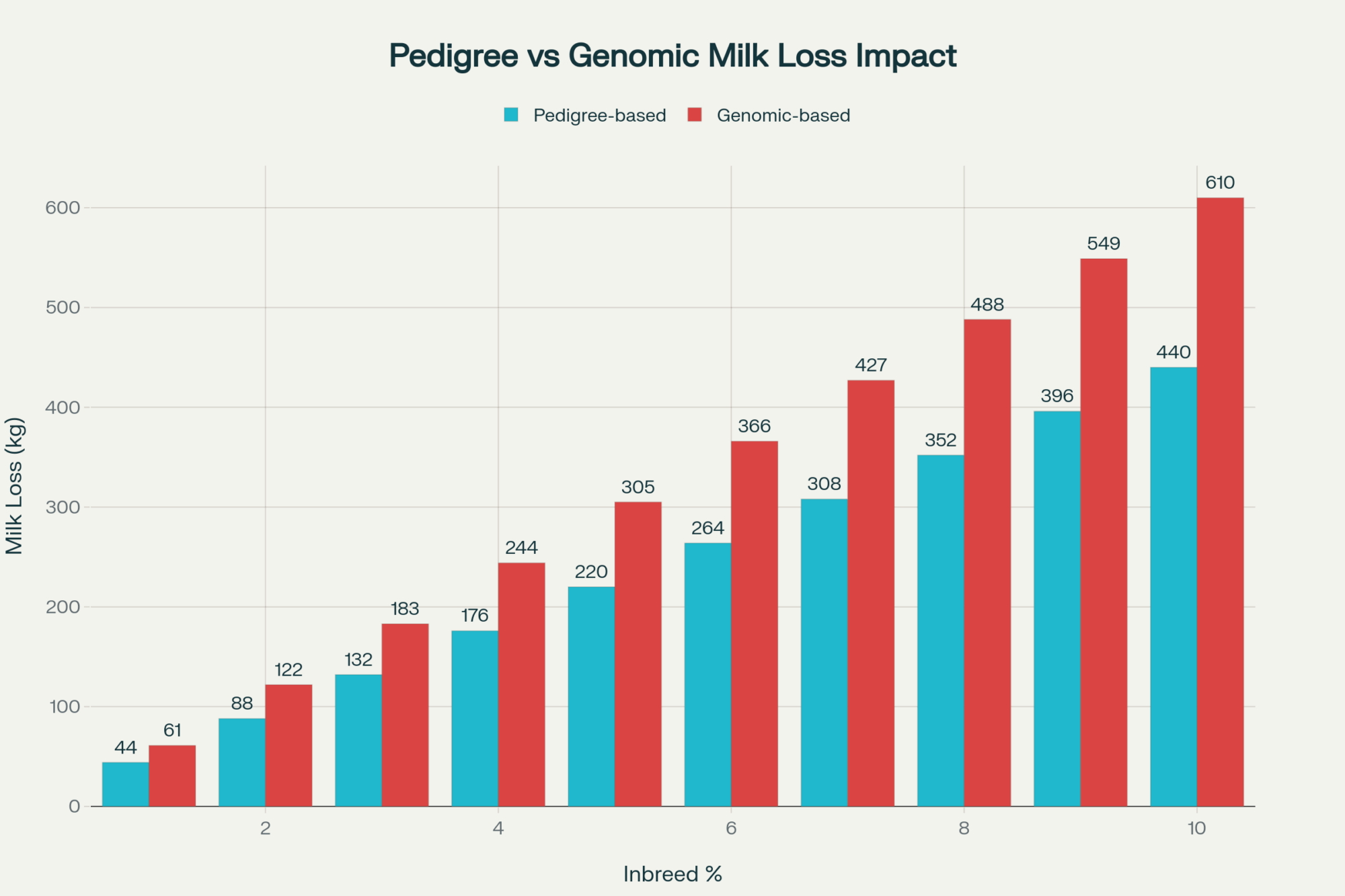
However, here’s the kicker that really makes me sit up: a 2023 Italian study suggested that the real damage might be 40% worse than previous estimates indicated. Put simply, where pedigree-based calculations said you’d lose 44 kg of milk per 1% inbreeding increase, genomic data showed a 61 kg drop. Ouch.

Comparison of milk production losses calculated using pedigree-based versus genomic-based inbreeding assessments

With milk prices hovering near $18.93 a hundredweight and labor costs pushing $18 an hour, those losses aren’t small potatoes. They add up fast, especially when you multiply them across your entire herd.

Have you actually calculated your operation’s inbreeding exposure? Most producers I know haven’t. And I get why — it’s not exactly the sexy topic your AI rep brings up during sire selection meetings.

Economic Impact of Inbreeding on Dairy Cattle Showing Milk Yield and Profit Loss over Inbreeding Level (1-15%)

When “Elite” Becomes the Problem, Nobody Wants to Talk About

The unspoken consensus among many industry geneticists is that our most powerful tool for genetic advancement has become a double-edged sword. While genomic selection has driven incredible progress, it has also accelerated inbreeding at an unprecedented pace, creating a genetic bottleneck that threatens the health and productivity of our dairy herds.

“Our most powerful tool for genetic advancement has become a double-edged sword.”

That’s the paradox that’s reshaping everything. The numbers back this up. According to Council on Dairy Cattle Breeding data, genetic concentration in North American AI programs reached concerning levels by 2017, when just a handful of elite sires were responsible for producing the majority of young bulls entering AI programs globally. When you multiply that concentration across millions of breeding decisions… well, you get the picture.

The genetic bottleneck becomes inevitable.

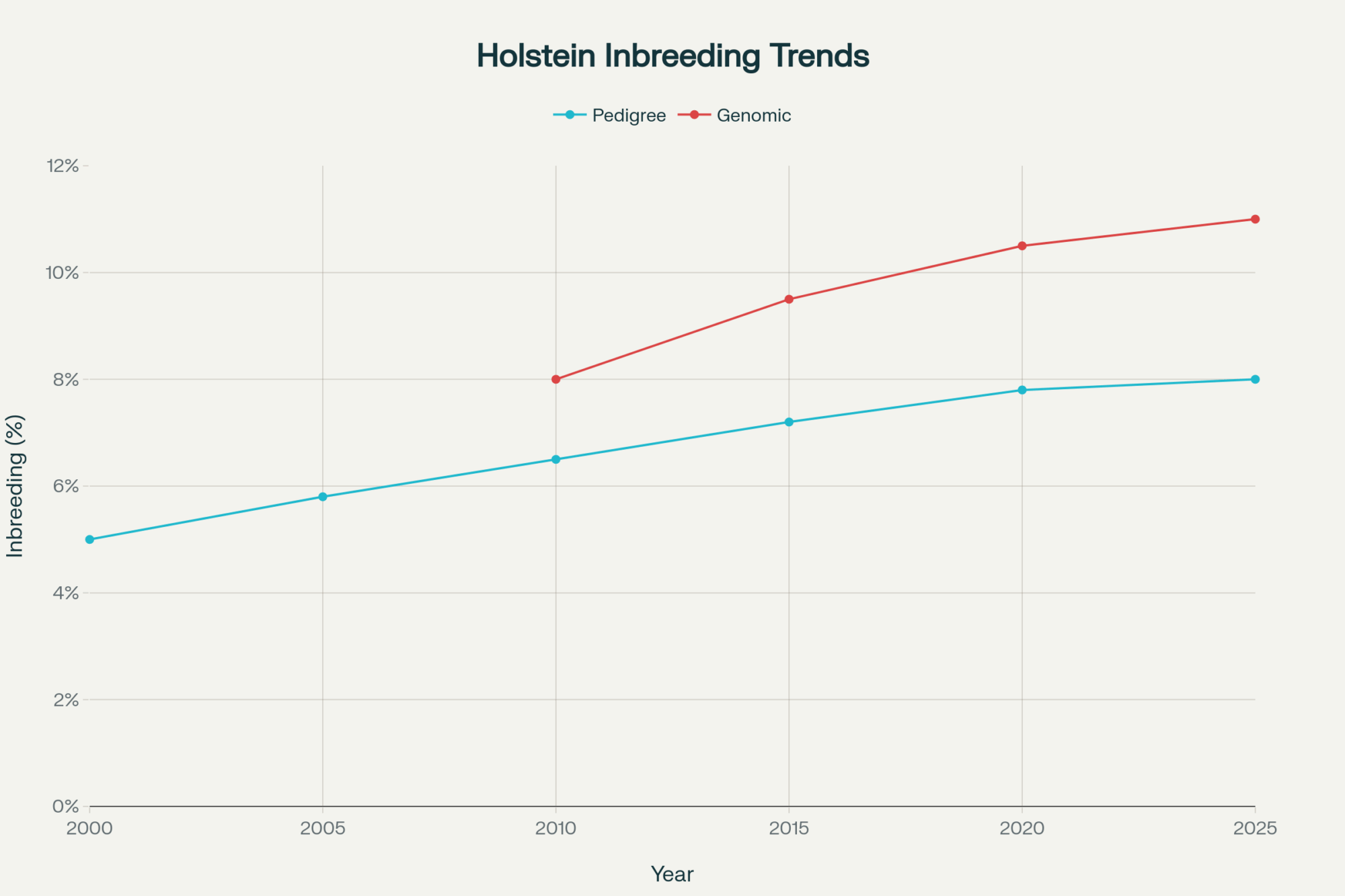
Trend showing increasing inbreeding levels in Holstein cattle from 2000-2025, comparing pedigree-based versus genomic-based measurements

Enter the “Elite Outcross” Revolution

So what’s the fix? This is where things get interesting…

Once, outcrossing had a bad reputation — people feared it would dilute their prized bloodlines. Random mating to genetically distant but inferior animals? Yeah, that would set any breeding program back.

But now? It’s precision science, leveraging genomic data to make calculated, surgical strikes, not wild gambles.

Here’s something that’s caught my attention lately — many industry insiders from companies like Select Sires and ABS are moving away from the term “outcrossing” altogether. They’re talking about “diversity” instead, and their reasoning makes a lot of sense. The real goal isn’t just finding one genetically distant bull — it’s about using many different genetic lines to build true resilience in your herd. A single outcross bull might still be mediocre quality, but when you focus on genetic variety across both sides of the pedigree, you’re building something much stronger.

Look at proven examples: CO-OP BOSSIDE MASSEY brought wide appeal, ZANI BOLTON MASCALES introduced European bloodlines to North America, and more recently, stars like 14HO15179 TROOPER and his son 7HO16276 SHEEPSTER proved you can blend unique maternal lines with high merit to create genuine value.

These bulls validate the strategy: outcrossing isn’t gambling when robust genomic data and clear breeding objectives back it.

What’s fascinating is how this shifts the entire conversation. Instead of just asking “What’s his TPI?” the smart money now asks “What’s his relationship to my herd?” and “How does his genetic background complement what I’ve got?”

How the Smart Money Is Playing This Game

AI companies have figured this out, and they’re adapting fast. They’re not just selling semen packages anymore — they’re selling sophisticated genetic risk management.

However, here’s the challenge they’re all facing: German AI professionals have observed that large commercial operations often prioritize top performance indexes over everything else, including diversity of pedigree. The market reality is that many large dairies will select the bull with the highest TPI, regardless of genetic relationships, which doesn’t exactly reward companies for maintaining diverse genetic portfolios.

That’s what makes the Canadian approach so interesting. Semex has deliberately maintained what they call genetically “free” female lines — unique cow families that aren’t heavily related to the mainstream population. This strategy ensures they can always bring something genuinely different to the market when diversity becomes critical. It’s a long-term vision that’s particularly relevant for us here in Ontario, where Semex’s home base provides them with a Canadian perspective on sustainable breeding.

Take ABS Global’s approach. Their Genetic Management System 2.0 utilizes genomic intelligence to guide mating choices, explicitly incorporating genomic inbreeding calculations to manage relationships with greater precision than pedigree-based methods have ever allowed.

Semex hands the keys to farmers through tools like SemexWorks and OptiMate, letting producers define their own economic parameters and build personalized selection indexes. It’s like giving you the GPS instead of just telling you where to go.

Select Sires? They’re mixing high-touch consulting with modern tech, offering programs like StrataGEN that manage inbreeding by rotating distinct, unrelated sire lines every 18 months. Simple but brilliant.

My advice? Don’t take the sales patter at face value. Ask hard questions about true genetic diversity in their outcross catalogs. Who’s really getting you diverse genetics, and who’s just selling shiny promises?

The Future: When AI Meets Genetics

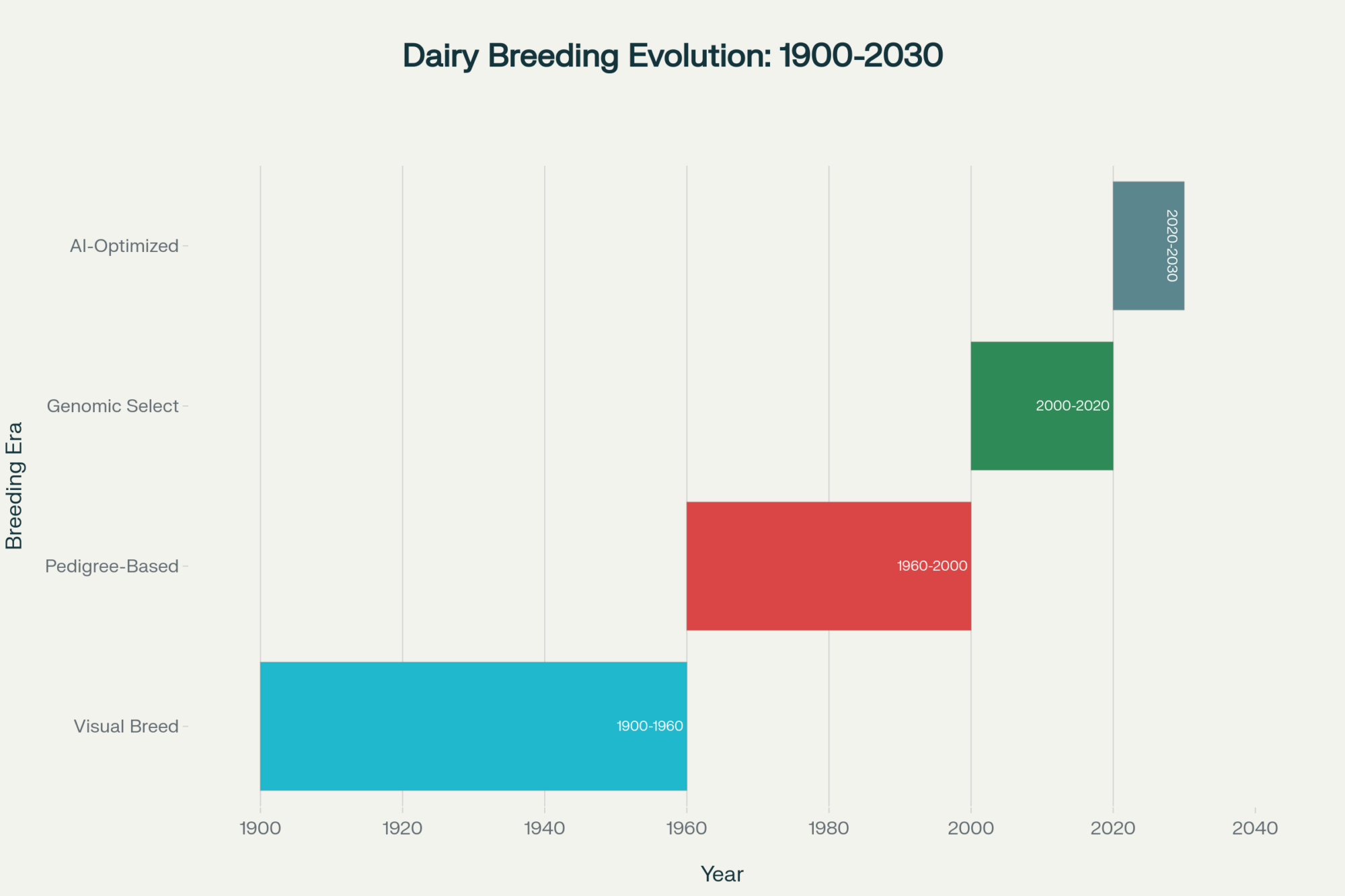
Timeline showing the evolution of dairy cattle breeding methods from visual assessment to AI-optimized genetic management

Here’s where it gets really exciting… the future belongs to machine learning, crunching massive genomic databases and optimizing matings through algorithms like Optimal Contribution Selection (OCS).

Think of it as playing chess on a global board, where every move considers not just immediate genetic gain but long-term sustainability. OCS calculates the ideal genetic contribution from each potential parent to maximize progress while simultaneously constraining inbreeding to acceptable levels.

The companies mastering this intersection of artificial intelligence and artificial insemination? They’ll dominate the next chapter. It’s not just about who has the best bulls anymore — it’s about who has the sharpest algorithms.

Your Action Plan (Because Knowledge Without Action Is Just Expensive Education)

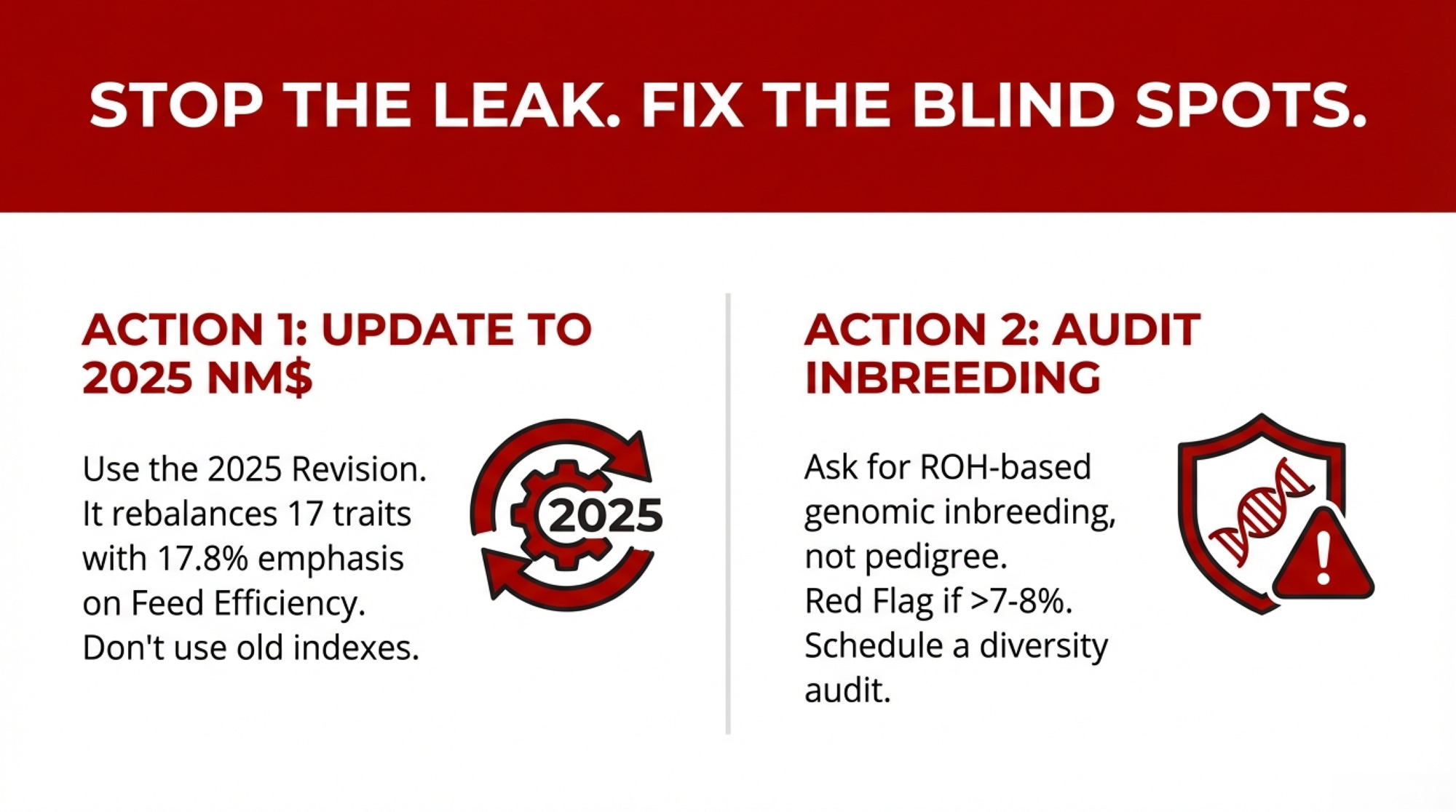
First things first: audit your genetic risk exposure. Most producers I work with have zero clear picture of their herds’ inbreeding levels or the relationships among their AI sires. Begin by conducting genomic testing on your breeding females to establish a baseline.

Second, evaluate your AI company’s diversity management capabilities honestly. Companies that utilize genomic inbreeding calculations, offer genuine outcross options, and provide sophisticated mating programs will deliver superior long-term results.

Third, develop a systematic approach to elite outcrossing. Consider this scenario: You have cow families tracing back to the same popular sire line as half of your herd. Instead of using another bull from that same genetic background, identify a high-merit outcross that brings fresh genetics while maintaining or improving economic performance.

That’s not gambling. That’s strategic breeding.

The Global Picture (Because Your Herd Doesn’t Exist in Isolation)

Here’s something that might surprise you: the Holstein breed is now effectively a single global population. Elite genetics flow freely across borders, and North American bloodlines dominate worldwide — sometimes representing over 90% of genetics in certain regions.

Italy is taking this challenge seriously at a policy level. They’ve updated their national genetic index — the PFT — to include a direct mathematical correction based on each bull’s Expected Future Inbreeding. Bulls that increase inbreeding are penalized in their official rankings, while those that bring genetic diversity receive a boost. It’s the first time I’ve seen a country incorporate inbreeding management into its national breeding policy.

Organizations such as the Council on Dairy Cattle Breeding and Interbull work behind the scenes to coordinate international genetic evaluations and ensure data integrity. Their systems help producers understand how genetics will perform under specific conditions while managing global genetic diversity.

Looking Ahead: The Technology Revolution Continues

Gene editing with CRISPR holds incredible promise for precise genetic tweaks — adding polled genetics to elite lines, boosting disease resistance, even modifying milk composition for better cheese yield — all without the linkage drag of traditional breeding.

Think of it as the ultimate “elite outcross.” It’s the surgical introduction of desired genetic diversity without any of the associated baggage.

But regulatory and ethical hurdles remain significant, and public perception will play a huge role in adoption.

The Bottom Line

Ignore genetic risk management at your peril — it quietly drains profits while you’re not looking.

“The most expensive cow isn’t the one that costs the most upfront; it’s the one that silently costs you money for years without you knowing it.”

Start by gauging your herd’s genetic risk, rethink sire selection strategies, and demand transparency from your AI partners. This isn’t just theory — it’s what will separate thriving operations from those scrambling to catch up a decade down the road.

What questions do you have about your herd’s genetic diversity strategy? Because honestly, this conversation is just getting started, and waiting only makes managing the risk more expensive.

Those who act now will be the winners when genetic diversity becomes the industry’s scarcest resource.

KEY TAKEAWAYS:

  • Save up to $24 per cow annually by managing inbreeding levels strategically. Start by genomic testing your breeding females to establish baseline inbreeding coefficients (FROH). Context: Essential with 2025’s margin squeeze from high feed and energy costs.
  • Recover potentially 61kg of lifetime milk production per cow by reducing genetic bottlenecks. Ask your AI rep specifically about “elite outcross” sires that bring diversity without sacrificing merit. Context: Part of the global shift toward sustainable genetic management happening right now.
  • Cut veterinary and replacement costs through better fertility and longevity outcomes. Push for mating strategies using Optimal Contribution Selection (OCS) that balance gain with genetic health. Context: Forward-thinking operations are already seeing results with these AI-driven tools in 2025.
  • Future-proof your operation against the genetic squeeze that’s tightening worldwide. Demand transparency from your genetics provider about actual relationships in their bull lineup — don’t just take TPI at face value. Context: Critical as global “holsteinization” continues consolidating the gene pool faster than ever.

EXECUTIVE SUMMARY:

Look, I just dug into some eye-opening research that’s got me pretty fired up. That relentless chase for sky-high genomic indexes? It’s quietly costing you $24 per cow for every 1% jump in inbreeding — and most of us have no clue it’s happening. Here’s the kicker: new Italian data shows we’ve been underestimating milk losses by 40% — we’re talking 61kg drops per percentage point, not the 44kg we thought. With feed costs still brutal and milk prices bouncing around in 2025, this isn’t pocket change anymore. The thing is, this genetic squeeze is happening globally as the same elite bloodlines get used everywhere through AI. But here’s what smart producers are already doing — they’re using genomic testing and something called “elite outcrossing” to keep their herds genetically strong without sacrificing performance. Trust me, you need to get ahead of this before it really bites your bottom line.

Complete references and supporting documentation are available upon request by contacting the editorial team at editor@thebullvine.com.

Learn More:

Join the Revolution!

Join over 30,000 successful dairy professionals who rely on Bullvine Weekly for their competitive edge. Delivered directly to your inbox each week, our exclusive industry insights help you make smarter decisions while saving precious hours every week. Never miss critical updates on milk production trends, breakthrough technologies, and profit-boosting strategies that top producers are already implementing. Subscribe now to transform your dairy operation’s efficiency and profitability—your future success is just one click away.
NewsSubscribe
First
Last
Consent

Inbreeding by the Numbers: What Your Bull Proofs Aren’t Telling You

Everyone says chase the highest milk yield… but what if that’s quietly draining your profits, one genomic bull at a time?

The numbers on the screen look great, but what are the hidden costs of our genetic choices?

You ever have that moment, late at night, scrolling through bull proofs with a cold cup of coffee, and something just doesn’t add up? On paper, your herd’s genetic merit is off the charts, but conception rates are slipping, and you’re seeing more health issues than you’d like to admit. Trust me, you’re not imagining things—and you’re definitely not alone.

I’ve been talking with producers from coast to coast—big dry lots out in California’s Central Valley, tie-stalls on the rolling hills of Wisconsin, and everywhere in between. There’s a quiet trend building, and it’s not about milk price or feed costs (though, let’s be honest, we all lose sleep over those too). This is something deeper—a multi-billion-dollar genetic reckoning that’s happening right now in all our herds.

Here’s what really sticks in my craw: we’re spending fortunes chasing the top 1% of sires, poring over genomic proofs until our eyes cross, and on paper, our herds have never looked better. So why does it feel like we’re running faster just to stay in the same place?

The $23-Per-Cow Problem That’s Adding Up Fast

Let me hit you with a number that’ll wake you up faster than a fresh cup of dark roast. According to a 2020 study from Penn State, between 2011 and 2019—right as genomic selection was gaining steam—the U.S. Holstein industry lost between $2.5 and $6 billion. That’s not a typo, and it wasn’t a market crash or feed crisis. That was the cost directly tied to rising inbreeding that came with our shiny new genomic tools.

For every 1% bump in inbreeding costs you about $23 per cow annually—and let’s be clear, that’s per lactation, not lifetime. Do the math. If you’re milking 1,000 cows, that’s $23,000 a year for every percentage point of inbreeding. Over five years? That’s $115,000—enough to replace 40 solid cows.

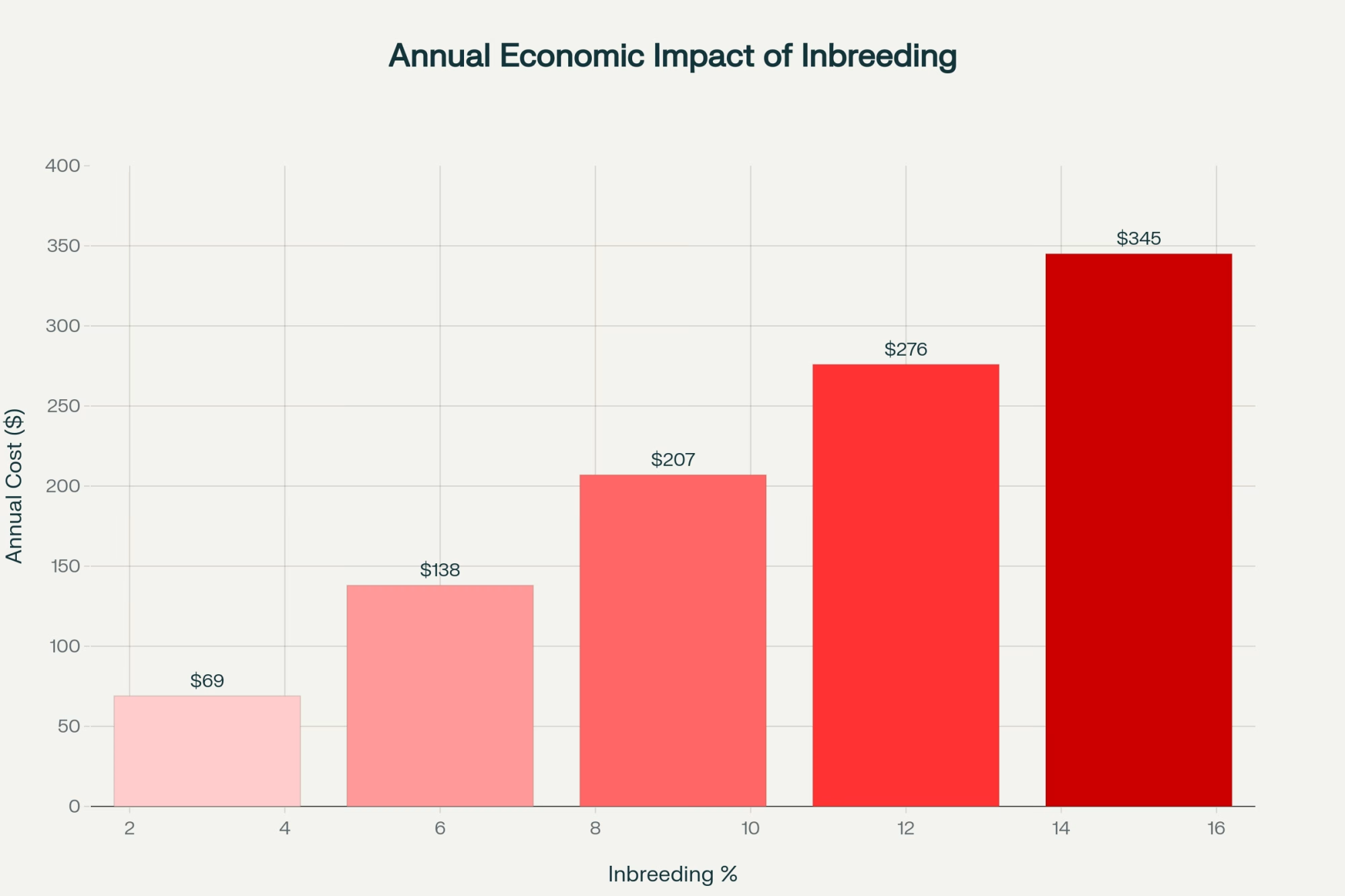
Annual economic impact of inbreeding shows escalating costs, with highly inbred cows (15%) costing $345 more per year than moderately inbred cows (3%), representing a five-fold increase in economic burden

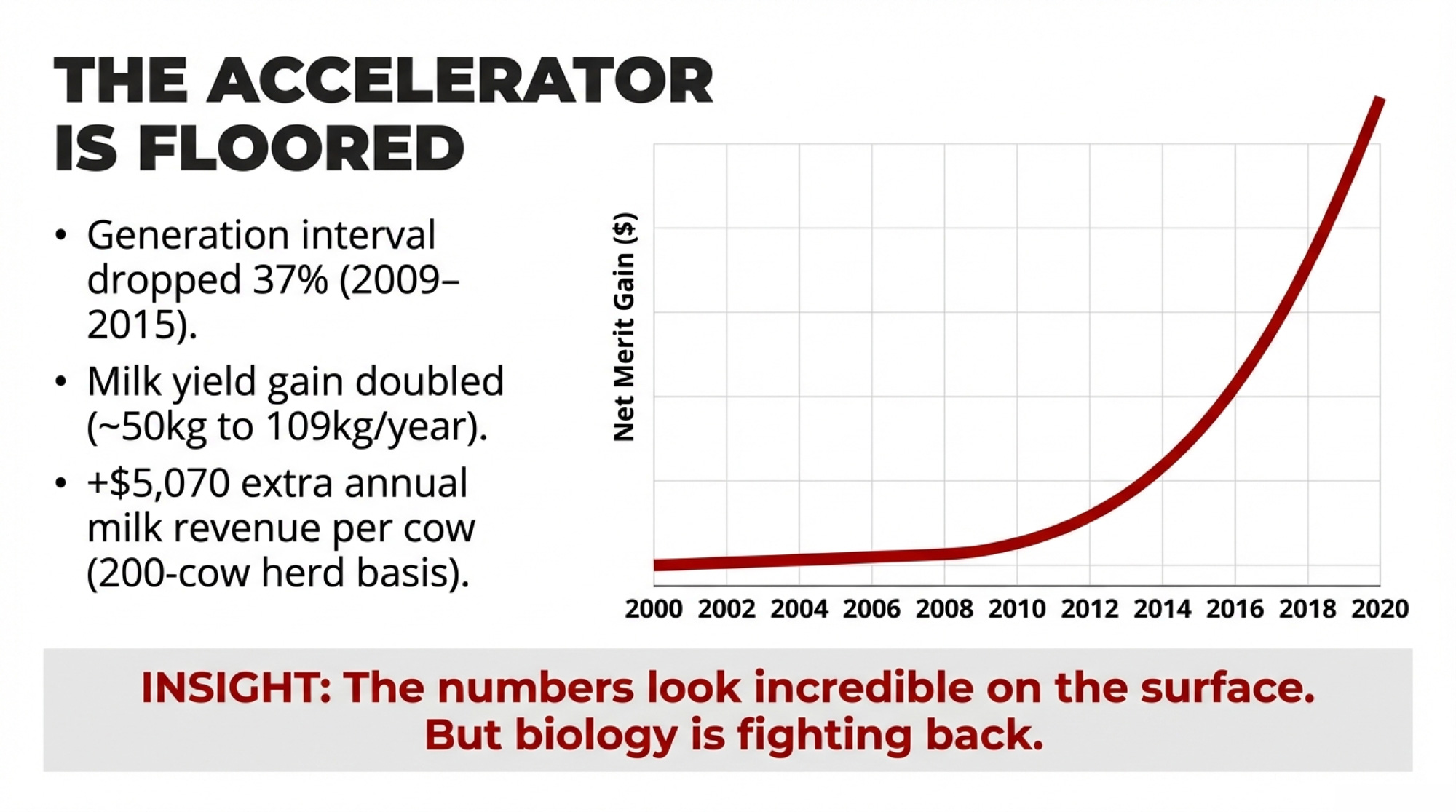
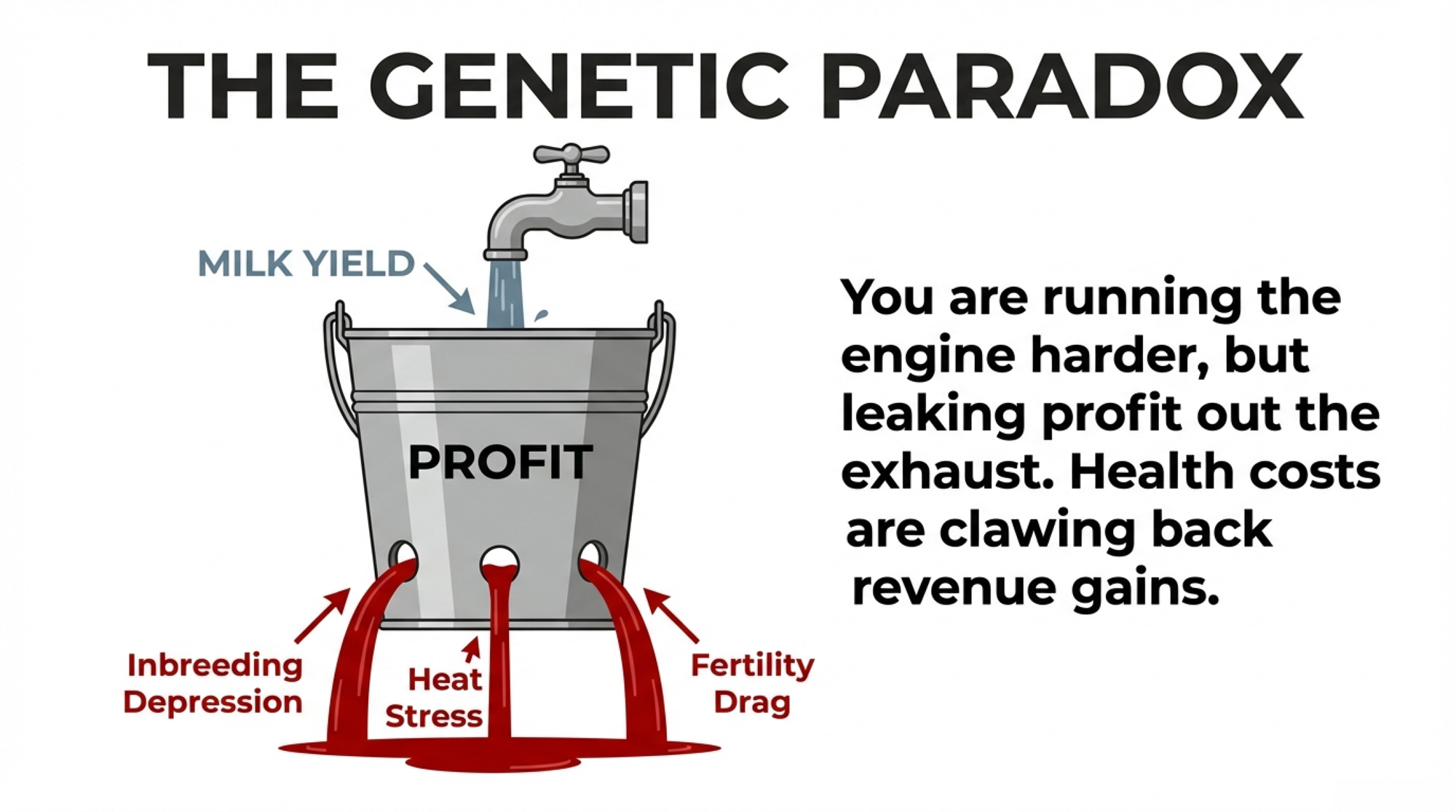
But here’s what keeps me up at night: the very technology we embraced to future-proof our herds could be creating a systemic vulnerability if we’re not managing it with our eyes wide open. Genomic selection has been a game-changer. It’s slashed generation intervals from about 5.5 years to less than two, and according to recent CDCB research, genetic gain has jumped by 12% to over 100% compared to the old progeny testing days.

The problem? That same rocket fuel has driven the effective population size of U.S. Holstein bulls down to a historic low—just 43 to 66 animals. Think about it: the genetic diversity of the world’s most dominant dairy breed now rests on fewer animals than most high school graduating classes.

Pedigree vs. Genomic: Which Inbreeding Number Actually Matters?

Genomic selection dramatically reduced generation intervals from 7.0 to 2.3 years while nearly doubling genetic gain rates, demonstrating the revolutionary impact of genomic technologies on dairy cattle breeding efficiency

Here’s where things get interesting. When we talk about inbreeding, we’re really talking about two different numbers, and the difference matters more than you might think.

Pedigree-based inbreeding is what we’ve used for decades—it’s like cattle genealogy, calculating the odds that an animal inherited identical genes from a common ancestor. But it often underestimates what’s actually happening in the genome.

Genomic inbreeding, measured through runs of homozygosity (ROH), looks directly at the DNA to see where an animal truly has identical gene sequences. It’s the difference between assuming what went into a recipe and actually tasting the final dish.

What strikes me about the genomic approach is how it can distinguish between old inbreeding (from way back in the pedigree) and recent inbreeding (from repeatedly using popular sires). The recent stuff—that’s what’s really hurting us. A 2023 study from the University of Guelph showed that recent inbreeding under genomic selection has a sharper negative impact on both production and fitness traits than the “old” inbreeding our breeds have carried for generations.

So, which should you focus on? My take: use genomic measures for the animals you’ve got data on, and supplement with pedigree for everything else. Genomic tools give you the real picture of what’s happening now.

Where to Actually Find These Numbers (Because That Matters)

You can’t manage what you can’t measure. For U.S. herds, your best bet is the CDCB (Council on Dairy Cattle Breeding) website. They publish Holstein inbreeding reports that give you both pedigree and genomic inbreeding levels for AI sires. It’s free, it’s current, and it’s data you can use.

Canadian producers might have it even better—Lactanet has integrated genomic inbreeding tools right into their genetic evaluation system. You can get inbreeding levels on individual animals as part of your regular genetic evaluations.

Here’s what’s interesting, though: most breed associations don’t routinely publish inbreeding levels in their regular communications. It’s there if you dig, but it’s not as front-and-center as TPI or LPI rankings. That needs to change.

The Wake-Up Call: Genomic vs. Proven Sires

Rising inbreeding rates in Holstein cattle showing the dramatic increase since genomic selection implementation, with genomic measures revealing higher true inbreeding levels than pedigree-based calculations

Want something that’ll make you think twice about your next sire selection? Here’s a stat that’s been making the rounds among geneticists but hasn’t gotten the attention it deserves.

The top 10 TPI genomic sires—the young bulls everyone’s chasing—are averaging around 4–6% inbreeding. Proven sires typically run 3–5%. It’s easy to misread these numbers. That 4–6% inbreeding on a top genomic bull isn’t an additional amount; it’s his total inbreeding. Considering the average Holstein cow is already at 11%, this shows that AI companies are actively managing this trait, selecting elite bulls that are often less inbred than much of the female population. So, when you see those numbers on a bull proof, it’s showing you the bull’s own calculated inbreeding, not how much higher (or lower) he’s compared to the average cow in the population. This distinction matters because it means that even the most popular young sires are typically being selected with inbreeding management in mind, not just raw genetic merit.

Why are the genomic bulls a little more inbred than the proven ones? It comes down to selection intensity. When you can spot the “best” animals at 6 months old instead of waiting 5 years for daughters to freshen, the temptation is to concentrate selection on a smaller and smaller group of elite animals. The math works—until it doesn’t.

Holstein vs. Jersey: A Tale of Two Breeding Philosophies

Breed comparison reveals Holstein cattle have the highest inbreeding rates but lowest milk component percentages, while Jersey cattle show better component quality with lower inbreeding levels, highlighting the trade-offs between production volume and quality

This trend reveals something fascinating when you compare breeds. Current Holstein populations average around 11% genomic inbreeding, while Jerseys typically run closer to 9%. The economic impact? That $23-per-cow hit I mentioned earlier applies to Holsteins. Jerseys, with their more regional breeding patterns and less reliance on a handful of global sires, tend to experience less inbreeding and, as a result, see smaller economic losses from inbreeding depression.

What’s the difference? Scale and global reach. Holstein genetics flows globally—a popular sire in the Netherlands is used heavily in the U.S., Canada, and a dozen other countries. Jersey breeding, while international, tends to be more regionalized with more diverse sire usage patterns.

A Tale of Two Neighbors

MetricFarm A (Volume Focus)Farm B (Component Focus)
Breeding GoalMax Milk VolumeMax Component Yield & Health
Milk / Day100 lbs90 lbs
Butterfat %4.10%4.60%
Protein %3.00%3.40%
Total Solids / Day7.2 lbs7.2 lbs
Key OutcomeHigh Volume, High StressResilient Herd, Same Solids

Let’s bring this down to something you can picture—a real-world scenario that’s playing out in more herds than you might think.

Imagine two Holstein herds, each milking 80 cows. Both are run by savvy managers who keep a close eye on their numbers and aren’t afraid to try new things. For the last five years, both have used genomic selection, but their breeding philosophies have diverged.

Farm A is laser-focused on maximizing milk volume. They’ve chased the highest-ranking genomic bulls for milk yield, and their cows average 100 pounds per day. On paper, that looks impressive. But their herd averages 4.1% butterfat and 3.0% protein, which works out to about 7.2 pounds of combined fat and protein per cow per day.

Farm B takes a different tack. Their goal is to maximize component yield and herd health, not just volume. They select bulls based on fat and protein percentages, aiming for a more balanced cow. Their cows average 90 pounds of milk per day, but with 4.6% butterfat and 3.4% protein, also 7.2 pounds of combined solids per cow per day.

Now, here’s where it gets interesting. Even though Farm B’s cows are producing less milk by volume, they’re matching Farm A on actual solids shipped per cow. And with higher component percentages, Farm B’s milk checks are more resilient to market swings that reward fat and protein. Plus, their cows are under less metabolic stress, which means fewer health issues, better fertility, and less burnout for the staff. There’s less time spent in the hospital pen and more time with cows in the parlor where they belong.

Over time, Farm B’s approach pays off. Their vet bills are lower, cows stay in the herd longer, and staff turnover drops because the work is more manageable. When you pencil it out, Farm B’s cows are just as profitable—if not more so—than their higher-volume neighbors, all while running a less stressful, more sustainable operation.

The lesson? Chasing maximum milk yield isn’t always the path to maximum profit or herd health, especially when you focus on what really matters: pounds of fat and protein shipped, cow well-being, and a system that works for both people and animals.

The Numbers That Tell the Real Story

This isn’t just philosophical—there are hard numbers behind these observations. Research from multiple countries paints a consistent picture of what inbreeding depression actually costs:

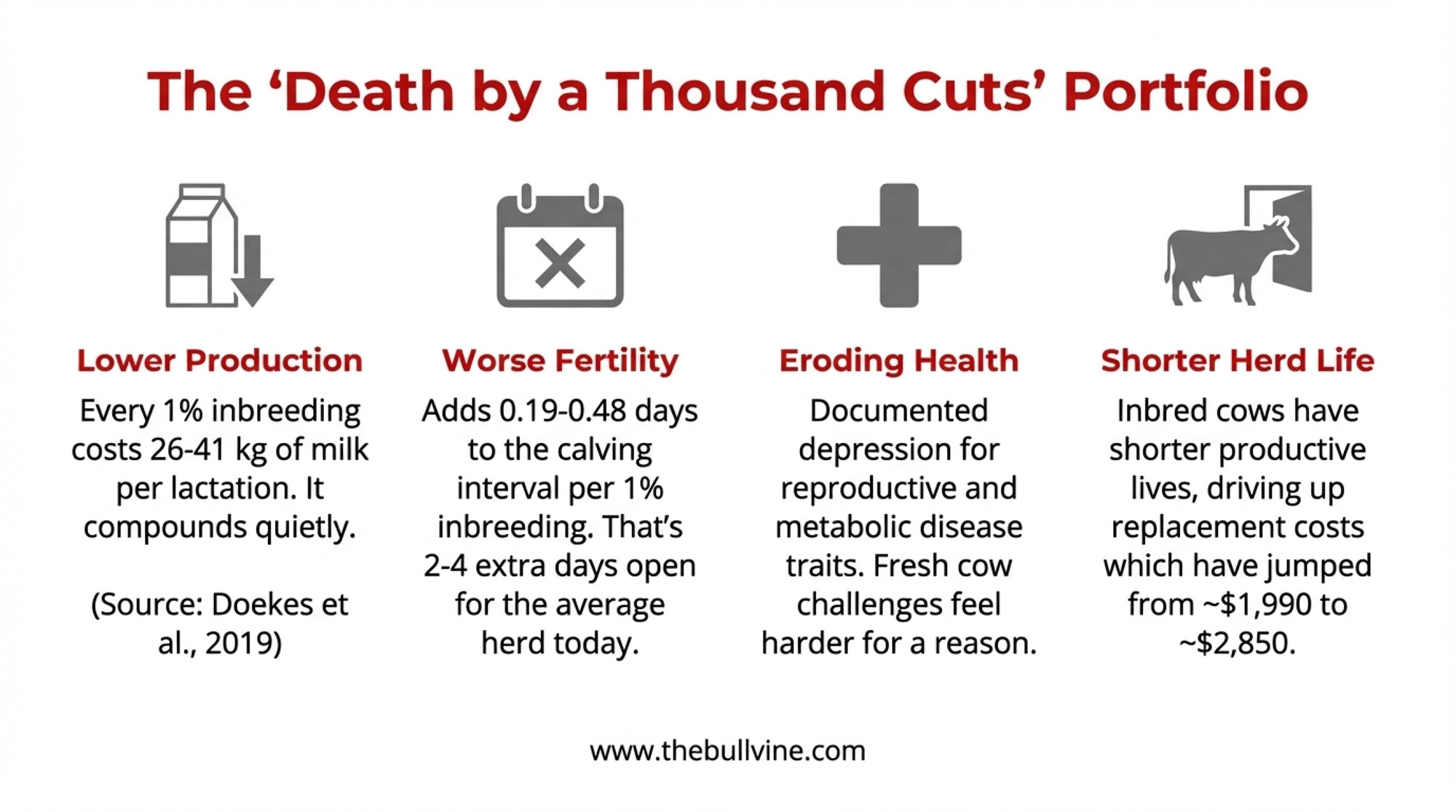
  • Production hits: Every 1% increase in inbreeding typically reduces annual milk production by 26–41 kg (that’s 57–90 pounds). For fat and protein, you can expect losses of 1–2 kg each. Doesn’t sound like much? Multiply it across your entire herd and calculate the results over a full lactation and for longer productive lifetimes per cow.
  • Fertility takes the biggest hit: This is where inbreeding depression really shows its teeth. Calving intervals stretch out by about a quarter-day for every 1% of inbreeding. I know that sounds tiny, but when you’re already struggling to get cows bred back, every day matters.
  • The hidden costs: Here’s what really gets expensive—increased somatic cell counts, higher culling rates, more stillbirths, and what I call “mystery ailments.” These are cows that aren’t clinically sick but don’t thrive as they should.

What’s particularly concerning, based on recent research from Australia and Europe, is that the inbreeding we’re accumulating now under genomic selection appears to be more detrimental than the traditional inbreeding from past generations. This suggests we’re making genetic changes faster than natural selection can keep up with.

Managing the “Junk” in Our Gene Pool

The thing about genetics is you get the whole package—the good, the bad, and the downright ugly. There are over 130 known genetic defects in cattle, and that’s just the stuff we’ve identified so far and can test for. A significant portion of the real damage stems from early embryonic losses, which we often attribute to “didn’t settle” or “bad heat detection”.

This is where organizations like Lactanet in Canada and the CDCB in the U.S. earn their keep. They’re tracking these genetic defects and building tests to identify carriers. Most AI companies now provide carrier status for about 22 known genetic defects as part of their standard genetic evaluation reporting package.

But here’s what keeps geneticists up at night: new mutations keep popping up. When an influential AI sire carries a new deleterious mutation—especially if he’s a mosaic, meaning only some of his sperm carry it—that mutation can spread like wildfire before anyone notices. Remember the “Pawnee Farm Arlinda Chief” situation? One sire, one mutation, over 500,000 spontaneous abortions, and nearly $420 million in global industry losses.

Smart Strategies That Actually Work

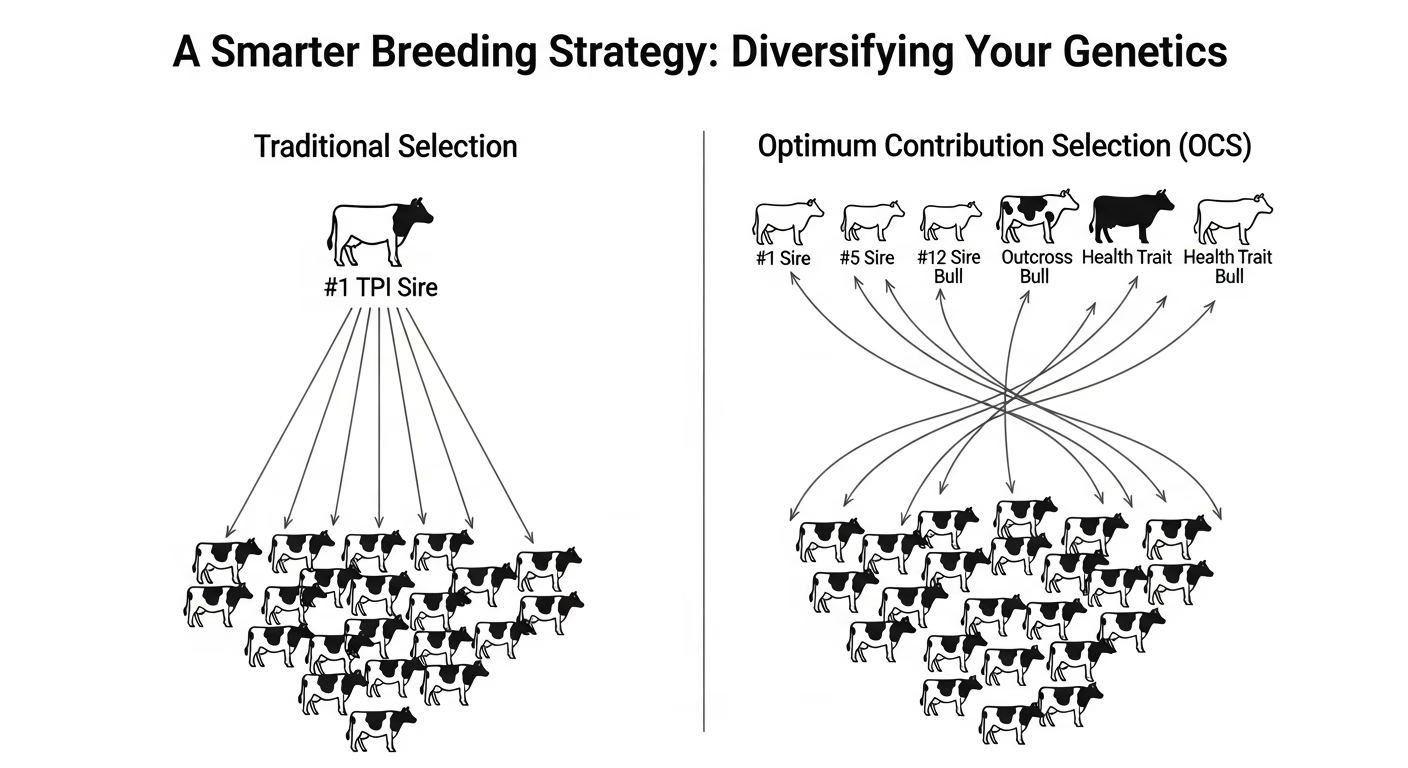
Diagram: Instead of putting all your genetic eggs in one basket, Optimum Contribution Selection (OCS) diversifies your sire portfolio to maximize long-term gain while controlling inbreeding risk.

Alright, enough about the problems. Let’s talk solutions—real ones that producers are using right now with good results.

Optimum Contribution Selection is the technical term for what amounts to informed genetic planning. Instead of just using the highest-ranking bull for every breeding, OCS figures out the optimal genetic contribution from a whole group of candidates. The goal is to maximize genetic gain while keeping inbreeding under control.

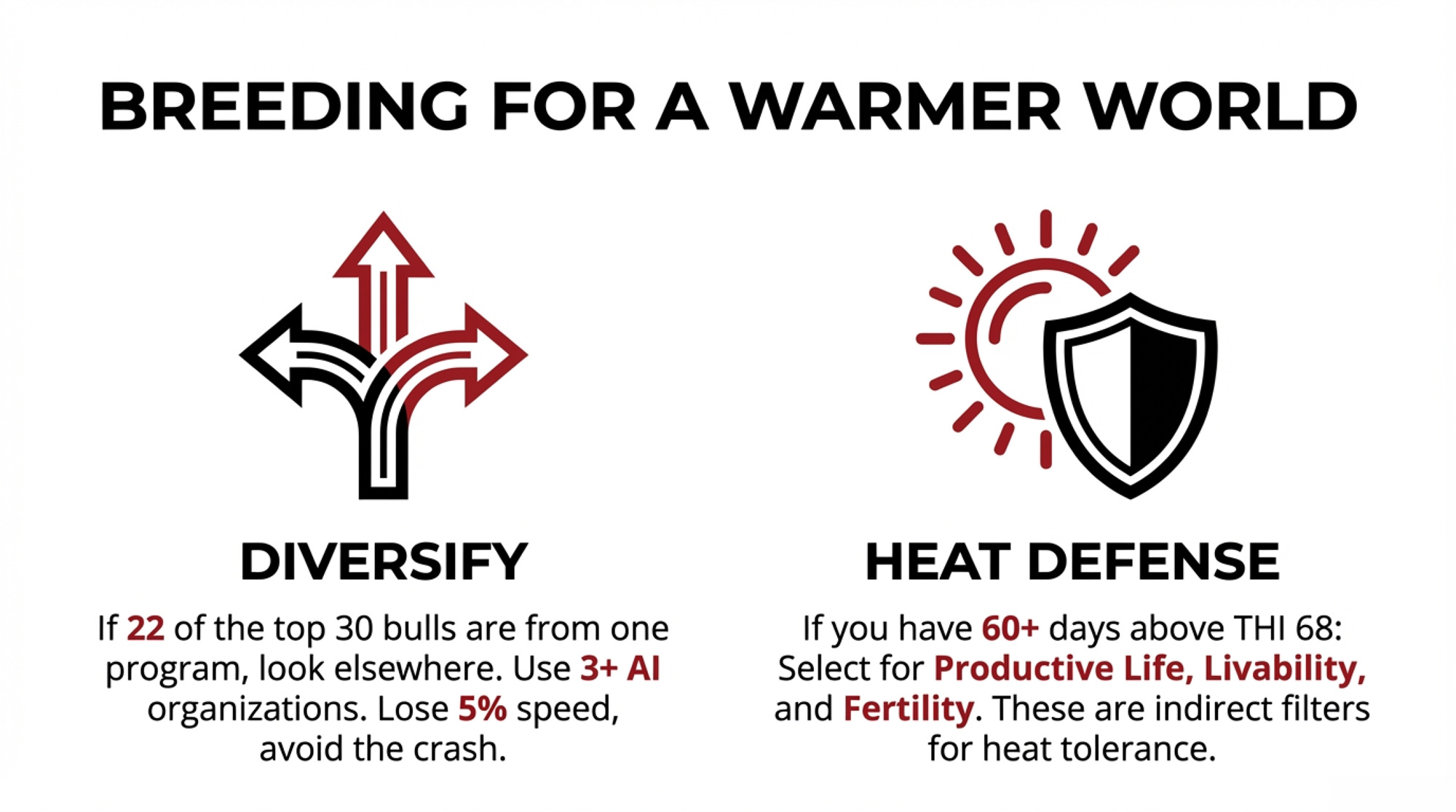
Think of it this way: you might use the #1 TPI bull on 40% of your herd, the #5 bull on 30%, and a few others to fill out the genetic diversity. You’re still getting tremendous genetic progress, but you’re not putting all your eggs in one genetic basket.

The research backs this up. Multiple recent studies—including work involving Cornell and other major universities—have shown that OCS programs can achieve higher long-term genetic gain than traditional selection, all while keeping inbreeding rates in check. It’s not just theory; the scientific consensus is growing as more research teams publish real-world results.

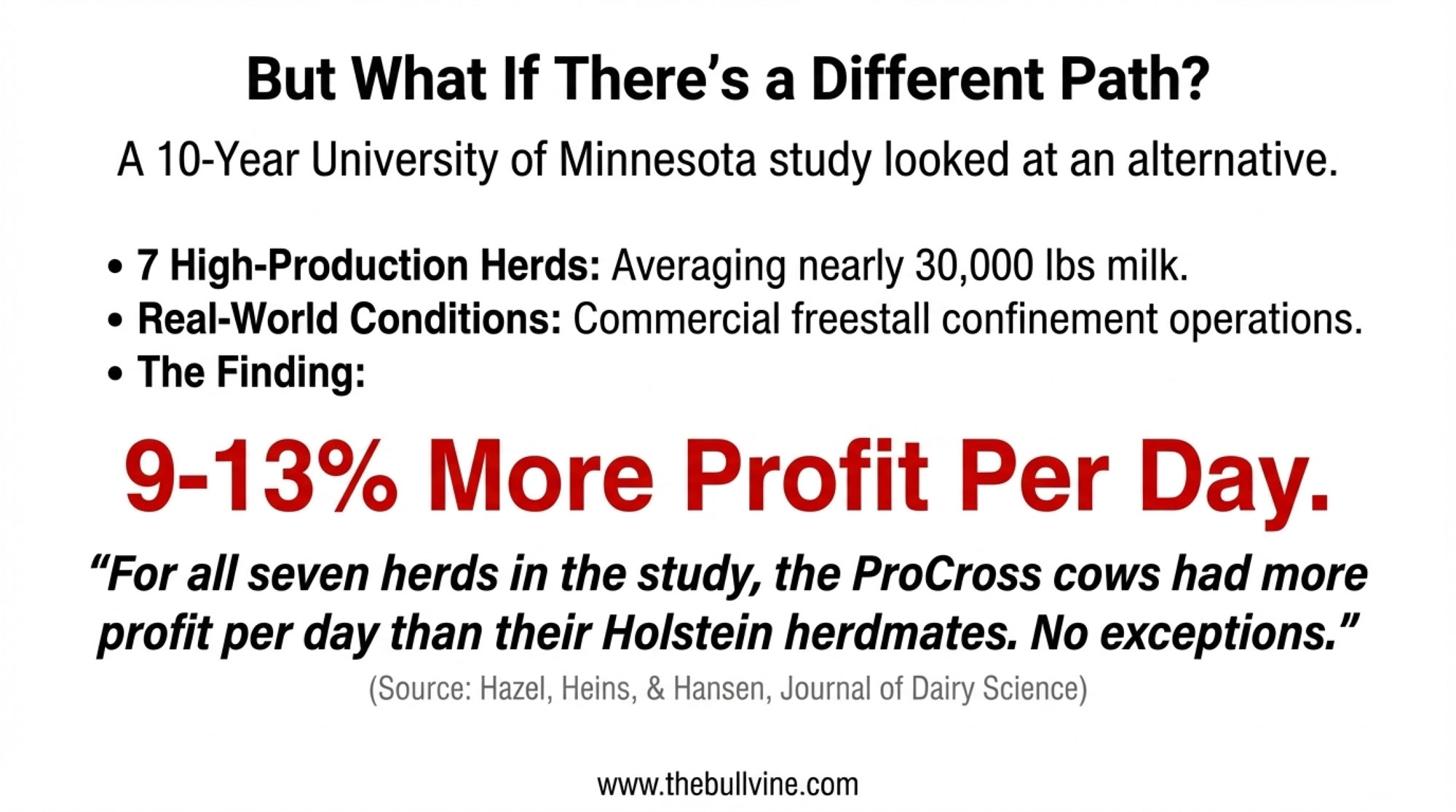
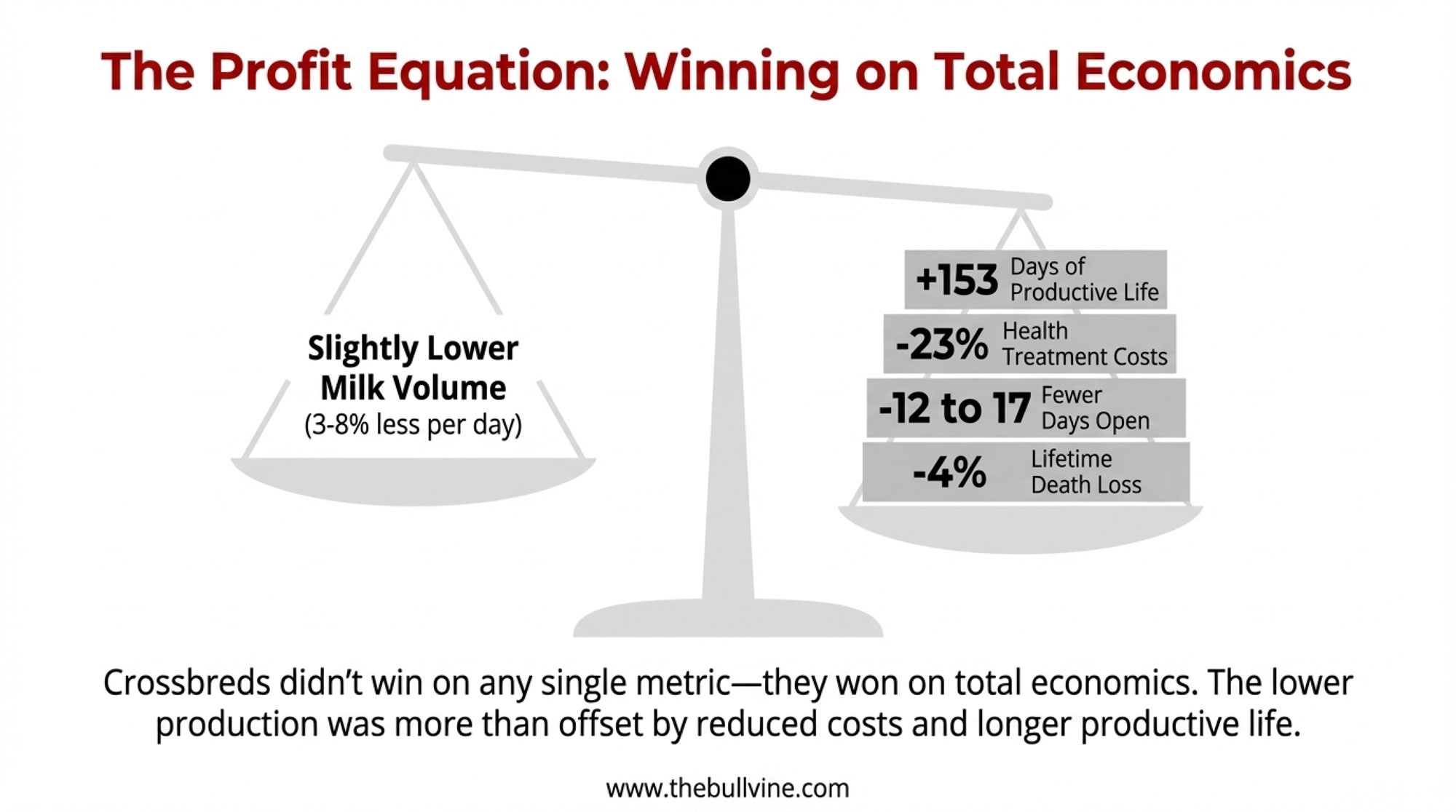
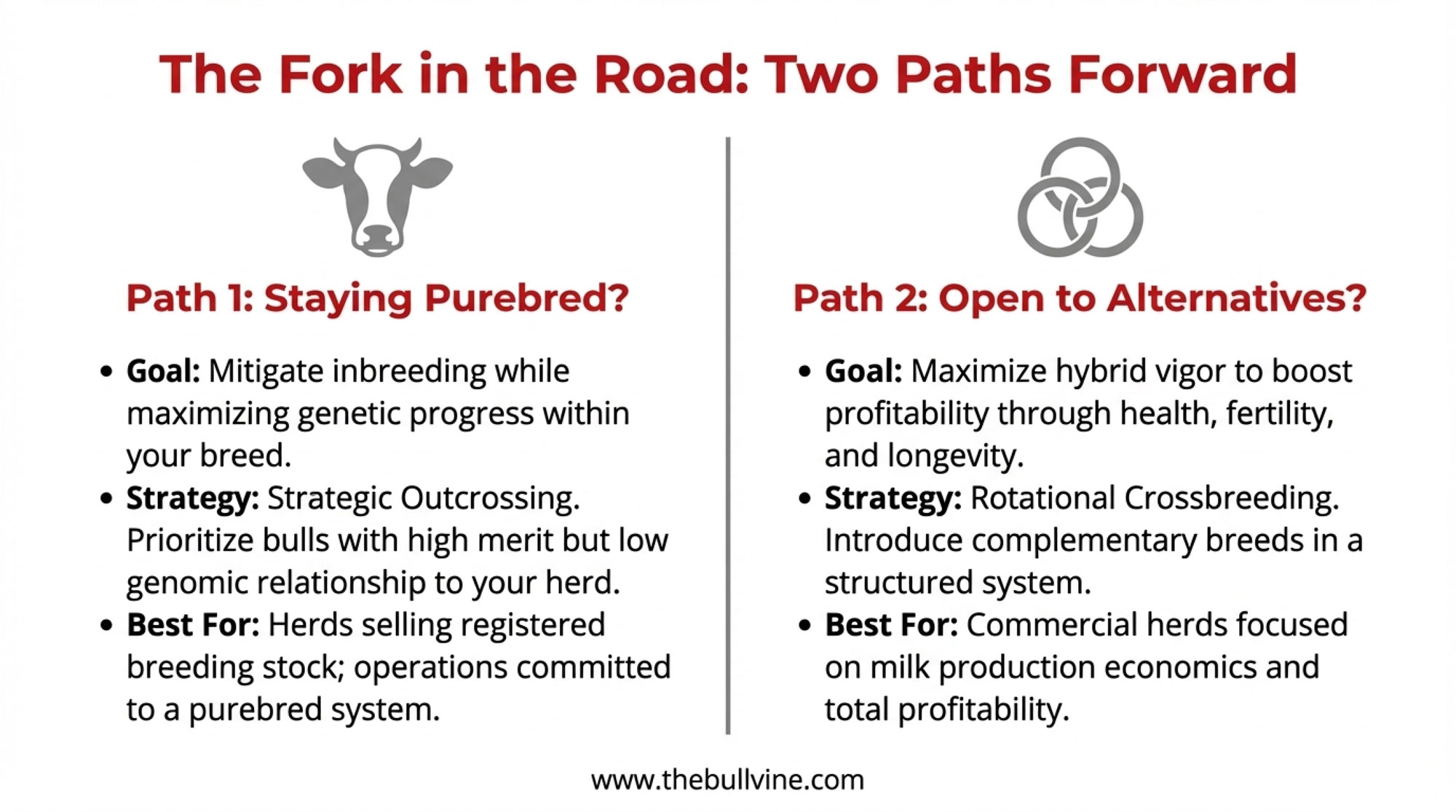
Crossbreeding is another tool that’s gaining traction, especially among commercial producers who get paid on components. A well-planned three-way cross with Holstein, Jersey, and maybe Montbéliarde or Brown Swiss can deliver significant improvements in fertility and health through hybrid vigor. I know it’s not for everyone—especially if you’re in a market that demands Holstein cattle—but for commercial operations focused on profit per cow rather than genetic prestige, it’s worth considering.

Gene banking might sound like science fiction, but it’s actually a practical form of insurance. Storing and using semen and embryos from a diverse group of animals provides options down the road if current breeding trends create unforeseen problems.

The Reality Check: Implementation Hurdles

Implementing a diverse breeding strategy requires meticulous record-keeping and semen tank management, a key hurdle for many operations.

Here’s where theory meets the real world, and it’s not always a pretty picture. I’ve spoken to numerous producers who have attempted to implement these advanced breeding strategies, and the feedback is consistent: it’s more challenging than it sounds.

  • Logistics matter. If you commit to an OCS program, you might get a breeding plan that calls for very specific matings—Bull A to Cow 123, Bull B to Cow 456. That requires meticulous record-keeping and a well-organized semen tank. For operations where one person is responsible for all breeding, especially in larger herds, this can be a significant challenge.
  • Inventory costs add up. Using a diverse group of sires means keeping more bulls in your tank, which ties up capital and requires more careful inventory management than just ordering the “bull of the month.”
  • The human element is huge. It takes discipline to stick to a long-term plan when there’s a chart-topping TPI bull available. The mindset shift from maximizing every single mating to optimizing the long-term health, production efficiency, and welfare of the whole herd requires buy-in from everyone—owner, herd manager, AI technician.

That said, the producers who’ve made this transition tell me it gets easier with time, and the results speak for themselves.

Looking Forward: What’s Coming Next

The future of genetic diversity management is getting more sophisticated every year. Artificial intelligence is beginning to play a role in optimizing breeding strategies, not only for genetic gain but also for managing inbreeding and diversity across multiple generations.

Whole genome sequencing is becoming more affordable, which means we’ll be better in the future at identifying harmful mutations before they spread. The cost has dropped from thousands of dollars per animal to hundreds, and it continues to decline.

What’s particularly exciting is the development of combined strategies that use multiple approaches simultaneously—OCS, weighted selection for rare beneficial alleles, strategic outcrossing, and active management of genetic defects. Early research suggests these combined approaches can deliver the best of both worlds: continued genetic progress with better diversity maintenance.

The Bottom Line: Your Genetic Legacy

Look, we’re at a crossroads. We can continue to chase maximum short-term genetic gain and accept the hidden costs of genetic erosion as just the price of doing business. Or we can get smarter about how we breed cattle—capturing genetic progress while building herds that are resilient enough to handle whatever comes next.

The evidence is clear: producers who take genetic diversity seriously don’t sacrifice genetic progress—they optimize it for the long haul. They’re not accepting lower profits; they’re building more sustainable competitive advantages.

The tools exist. The research is solid. The question is whether we’ll be among the early adopters who see the writing on the wall, or whether we’ll wait until the problems are too big to ignore.

Your genetic decisions this year will impact your herd’s productivity and your farm’s profitability for generations to come. That multi-billion-dollar hit the industry has already taken? It’s both a warning and an opportunity. The producers who heed the warning will be the ones who capture the opportunity.

So here’s my challenge to you: next time you’re selecting sires, ask yourself—and your genetics advisor—some tough questions. What’s our herd’s current inbreeding level? How can we apply OCS principles to strike a balance between our goals? Which outcross sires would be suitable for our system?

The real question isn’t whether you can afford to implement these strategies. It’s whether you can afford not to.

Bottom line: Don’t just follow the crowd. The smartest producers in 2025 are protecting their herds—and their profits—by thinking beyond the next bull proof. Give these strategies a shot and let your milk check do the talking.

Coming up in our next article, “Part 2: A Deep Dive into the Data,” we’ll dig deep into the shocking statistics every breeder should know, including detailed comparisons of top genomic versus proven sires and breed-specific benchmarks to help you assess where your herd stands.

KEY TAKEAWAYS

  • Stop silent profit leaks: Every 1% rise in inbreeding costs you $23 per cow, per year.
    Action: Check your herd’s inbreeding numbers on CDCB or Lactanet today—don’t wait for a consultant.
  • Genomic testing is a double-edged sword: Yes, it boosts genetic gain by 12–100%, but it’s also shrinking your genetic base fast.
    Action: Ask your genetics rep for the inbreeding coefficient on every bull you buy—aim for below the breed average (currently ~11% for Holsteins).
  • Components beat volume for real ROI: Two herds with the same solids shipped (7.2 lbs/cow/day) can have wildly different stress, health, and profit—don’t chase milk pounds alone.
    Action: Shift your sire selection index to prioritize fat and protein percentages, not just yield.
  • Diversify or pay the price: Herds using optimum contribution selection (OCS) or crossbreeding are seeing lower vet bills and longer cow lifespans, even with lower daily milk.
    Action: Try OCS planning or introduce a crossbred bull—see how it impacts your cull rate and staff workload.
  • 2025 is all about resilience: Feed and labor costs aren’t dropping, so your genetics program needs to deliver more than just big numbers on paper.
    Action: Review your breeding plan with a focus on genetic diversity and operational sustainability—don’t get left behind.

EXECUTIVE SUMMARY

Let me lay it out straight—chasing the top 1% of genomic bulls might be costing you more than you think. According to a Penn State study, U.S. Holstein herds lost between $2.5 and $6 billion from inbreeding tied to aggressive genetic selection. Every 1% jump in inbreeding knocks $23 off your annual revenue per cow, and with herds averaging 11% inbreeding, that’s real money. Sure, genomic testing slashed generation intervals and doubled genetic gain, but it also shrank the effective bull population to just 43 animals. That’s not just a U.S. thing—global trends show the same squeeze on diversity, from Europe to Australia. The kicker? Herds focusing on fat and protein yield, not just milk pounds, are matching or beating their high-volume neighbors in profit and cow health. If you want to protect your margins in 2025’s tight market, it’s time to rethink your breeding strategy—try mixing in optimum contribution selection or crossbreeding, and watch your bottom line thank you.

Complete references and supporting documentation are available upon request by contacting the editorial team at editor@thebullvine.com.

Learn More:

  • Genomic Inbreeding: How Much Is Too Much? – Offers practical strategies for monitoring and managing inbreeding at the farm level, including step-by-step guidance on using genomic data to make smarter breeding decisions and immediately reduce risk in your herd.
  • The Dollars and Sense of Dairy Genetics – Reveals how genetic choices impact long-term profitability, with actionable insights on navigating market trends, economic trade-offs, and the real-world financial implications of different breeding strategies in today’s volatile dairy industry.
  • Dairy Breeding Innovation: Are You Ready for What’s Next? – Explores cutting-edge technologies and future opportunities, demonstrating how forward-thinking producers can leverage emerging tools and innovations to stay ahead of genetic challenges and build a more resilient, productive herd.

Join the Revolution!

Join over 30,000 successful dairy professionals who rely on Bullvine Weekly for their competitive edge. Delivered directly to your inbox each week, our exclusive industry insights help you make smarter decisions while saving precious hours every week. Never miss critical updates on milk production trends, breakthrough technologies, and profit-boosting strategies that top producers are already implementing. Subscribe now to transform your dairy operation’s efficiency and profitability—your future success is just one click away.
NewsSubscribe
First
Last
Consent

The Silent Genetic Squeeze: Is Holstein Breeding Painting Itself into a Corner?

Holstein inbreeding has tripled in a decade. Discover how hidden genomic risks threaten dairy profits and what you can do to protect your herd’s future.

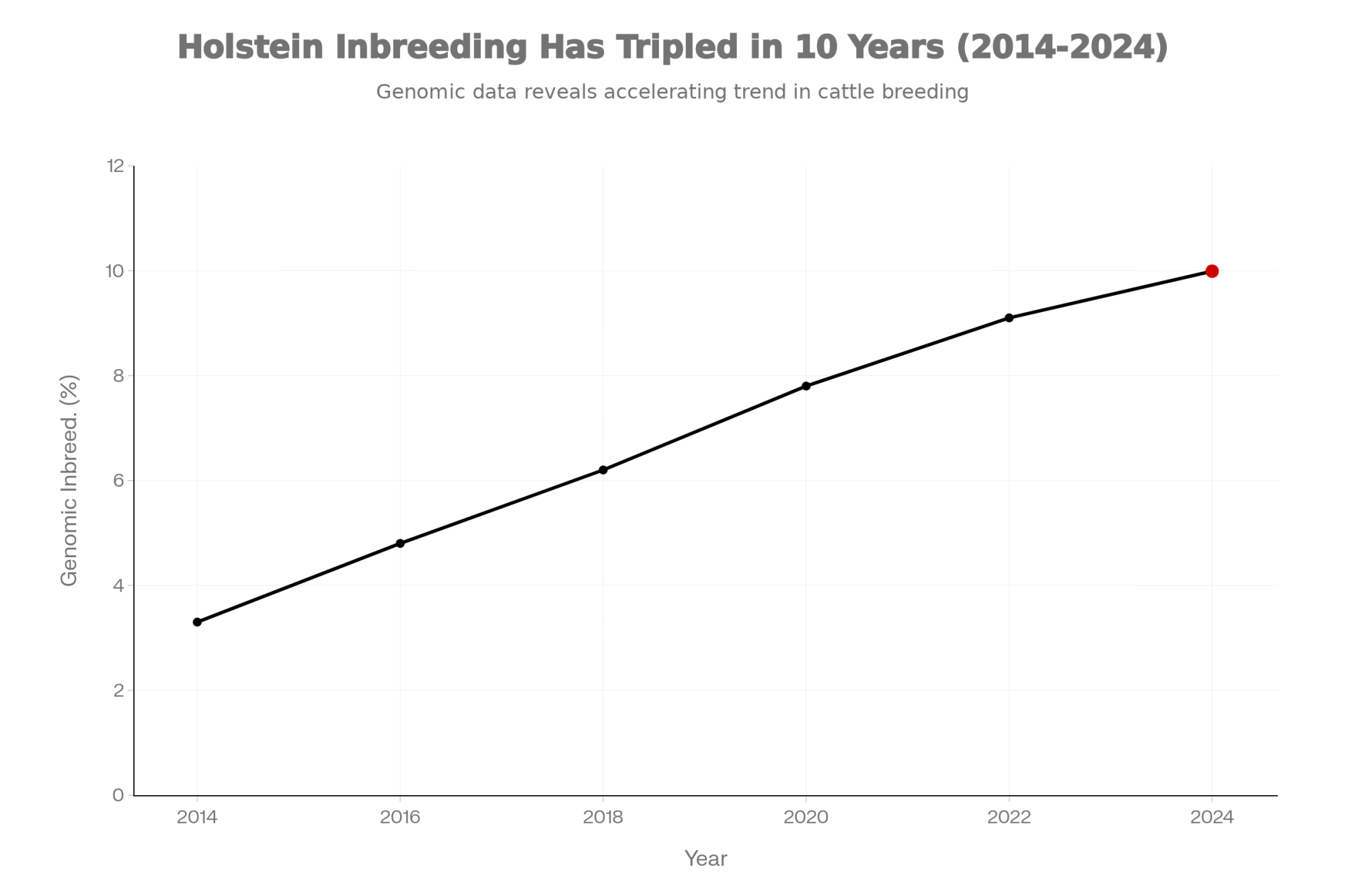
The relentless pursuit of genetic advancement in Holsteins has created an uncomfortable truth the industry refuses to confront: we’re creating a narrow genetic highway with no exit ramps. While milk production has soared through genomic selection, inbreeding has silently tripled in elite lines over just one decade. This genetic narrowing threatens long-term sustainability and demands immediate action from every stakeholder in the dairy industry – including YOU.

Remarkable genetic progress in Holstein cattle has transformed dairy production, but beneath the celebrated gains lurks a concerning trend that many farmers either don’t notice or choose to ignore. The genomic revolution that accelerated genetic improvement has simultaneously accelerated inbreeding at rates unprecedented in breed history.

You’ve probably heard whispers about this at dairy conferences or read passing references in industry publications. Perhaps you’ve noticed subtle changes in the “modern Holstein” – that increasingly angular, refined animal appearing in show rings and high-ranking genomic lists. But few connect these dots to the underlying genetic squeeze right before our eyes. And why would they? The major AI companies aren’t highlighting this problem in their glossy catalogs, are they?

The Inbreeding Paradox: What the Numbers Tell Us

When did you last scrutinize the inbreeding metrics in your genetic evaluations? If you’re like most producers, you monitor Expected Future Inbreeding (EFI) values when selecting service sires. But here’s the uncomfortable truth: EFI isn’t telling you the whole story – and the organizations supplying your genetics know it.

The divergence between genomic inbreeding levels in Holstein bulls (rising to 15.2%) and the declining number of active AI bulls (down 61%) creates a dangerous genetic bottleneck.

The difference between EFI and genomic inbreeding is like comparing your TMR formulation to what the cow’s sort and consume. One gives you the big picture; the other tells you what’s happening where rubber meets road.

EFI measures a bull’s average relationship to the broader population (currently heifers born in 2020), while genomic inbreeding (F_ROH) directly measures actual homozygosity in an individual’s DNA. This distinction matters tremendously when making mating decisions in your breeding program.

What makes this particularly troubling is that the base population used to calculate EFI is becoming more inbred each year. Between 2015 and 2020, the average EFI of the Holstein base population jumped from 7.5% to 9.4%. This means the genetic “yardstick” we use to measure inbreeding is shrinking, creating the illusion of stability when inbreeding is accelerating. It’s like measuring water depth in a sinking boat – the numbers stay the same while you slowly drown.

DEBUNKED: “If a bull’s EFI is low, he’s an outcross.” This common assumption falls apart under scrutiny. A bull can show a low EFI relative to today’s highly inbred base population yet still be closely related to other elite lines. This creates a false sense of security when making breeding decisions, particularly when using multiple “elite” bulls across your herd that secretly share recent common ancestry.

Contract limitations on elite bulls further distort the picture. When high Net Merit$ sires are restricted to specific breeding programs or available only through exclusive contracts, their genetics eventually enter the broader population through sons and maternal grandsons. By then, a new generation of even more inbred sires dominates the market, continuing a cycle of intensifying homozygosity that isn’t fully captured by EFI values.

Follow the Numbers: A Decade of Genetic Narrowing

The data tells a compelling story of rapidly diminishing genetic diversity. In just one decade (2010-2020), genomic inbreeding in Holstein bulls skyrocketed from approximately 5.7% to 15.2% – a staggering 168% increase.

Meanwhile, active AI bulls declined precipitously, from 2,734 in 2010 to just 1,079 in 2020. That’s a 61% reduction in the available gene pool in just 10 years.

Let’s put this in perspective:

Metric20102020Change
Elite Genomic Sires5.7%15.2%+168%
Active AI bulls2,7341,079-61%
EFI base population7.5%9.4%+25%

You might think, “But genomic selection has dramatically improved our herds. Isn’t this just the price of progress?”

That’s partly true. Genomics allows us to identify elite genetics with unprecedented accuracy and speed. But the unintended consequence is that we’re now selecting from an increasingly narrow pool of animals that share more and more of their ancestry.

Only 75-100 top genomic young bulls enter AI programs annually today, compared to over 1,000 pedigree-selected bulls pre-2010. With three major U.S. cooperatives now controlling over 80% of semen sales, we’re essentially drinking from the same concentrated genetic well – and it’s getting more focused every year. Is anyone asking what happens when that well runs dry?

What’s Driving This Trend?

This genetic bottleneck didn’t happen by accident. Several forces are working together to squeeze our Holstein gene pool:

Genomic selection efficiency

Genomic testing has revolutionized our ability to identify genetic outliers earlier and more accurately. That’s the good news. The flip side? We’re identifying the same families repeatedly because we’re selecting for the same traits using the same algorithms. It’s like using the same filter on your DHIA sheets month after month – you’ll keep identifying the same cows as top performers. As these related animals dominate the rankings, they’re used more intensively, concentrating their genetics in the population.

Restricted access to elite genetics

Have you noticed that the most exciting new bulls often have fine-print limitations? These restrictions aren’t just marketing gimmicks- they fundamentally alter how genes flow through the population. Elite bulls primarily mate with elite cows, creating a separate genetic stream that only gradually filters down to commercial herds, by which time inbreeding has intensified further within the elite nucleus. When did you last have unrestricted access to the industry’s absolute top genomic sires? The answer is likely never.

Industry consolidation

Remember when there were dozens of competitive AI organizations, each with distinct breeding philosophies? Today’s landscape looks vastly different. Stud consolidation means fewer decision-makers directing the genetic future of the breed, often with similar selection objectives driven by identical economic indices like NM$, TPI, and JPI.

The beef-on-dairy effect

The explosive growth of beef-on-dairy breeding, 7.9 million units of beef semen used in dairy herds in 2023, means fewer dairy females contribute to the next generation of purebred Holsteins. This further shrinks the dairy genetic pool, concentrating selection on a smaller nucleus of elite cows bred to elite bulls. It’s like how keeping fewer replacement heifers intensifies selection pressure – except now we’re doing it across the entire breed.

The Real-World Impact on Your Herd

This isn’t just an abstract genetic discussion; inbreeding has tangible effects on your bottom line and day-to-day operation.

The economic impact of inbreeding rises from 10% to 20%, the lifetime profit loss per cow escalates dramatically from $450 to over $3,700, with corresponding declines in production and fertility. *

For every 1% increase in inbreeding:

  • Lifetime milk production decreases by 177-400 pounds
  • First-lactation fat and protein yields drop by about 2 pounds each
  • Productive life shortens by approximately 6 days
  • Calving interval extends by 0.19-0.34 days
  • Net Merit declines by about $23-25

These might seem like small numbers individually, but they compound quickly, much like subclinical milk fever impacts that aren’t obvious day-to-day but erode profitability over time. A cow at 15% inbreeding (now increasingly common) could face production losses of 584-730 kg of milk, extended calving intervals of 5-8.5 days, and lifetime profit reductions of $1,035-1,890 compared to a cow at 5% inbreeding.

However, perhaps the most concerning thing for some breeders is the emerging correlation with linear type traits. While research hasn’t definitively linked inbreeding directly to specific conformational changes, there’s growing evidence that our current selection path is creating a “modern type” characterized by:

  • Decreased strength scores
  • Shallower body depth
  • Higher pin placement

These trends align with recent changes to selection indices. The April 2025 update to the CDCB Net Merit formula explicitly increased emphasis on “smaller stature cattle with more focus on dairy form” while penalizing stature at -$0.45/lb.

What if… we’re selecting a dairy cow that excels on paper but lacks the physical robustness to thrive in real-world conditions? What if the next major disease outbreak targets a genetic pathway we’ve inadvertently narrowed through intense selection?

Is this the robust dairy cow we want for the future? Or are we blindly following economic indices without questioning the long-term consequences? The answer depends on your perspective and breeding goals. Still, the narrowing genetic base means we’re increasingly locking ourselves into a particular type with fewer options to course-correct if needed.

Where Are We Headed? Projecting the Future

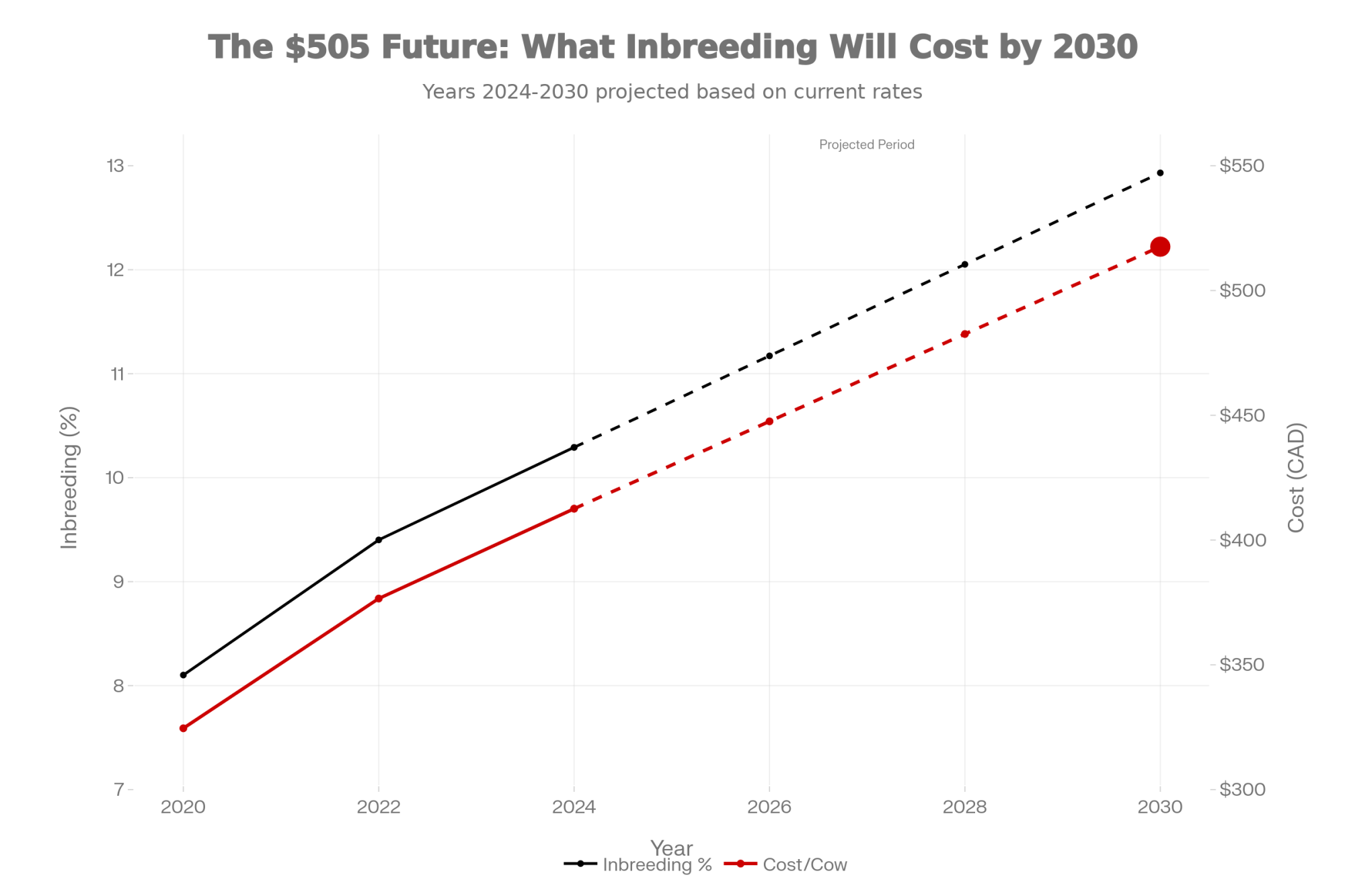
If current trends continue unabated, with inbreeding increasing at 0.25-0.44% annually, elite Holstein bulls could reach 18-22% average genomic inbreeding by 2030. The effective population size could drop below 50, which geneticists consider the minimum threshold for maintaining long-term adaptability.

What happens after another decade of accelerating genetic concentration? The risks intensify:

Emerging recessive disorders

As homozygosity increases, so does the probability of expressing harmful recessive genes. Through testing, we’ve managed known haplotypes like HH1-6, CVM, and BLAD, but new, currently unidentified recessives will inevitably emerge as inbreeding intensifies. Without genetic diversity to provide alternative alleles, these conditions could become increasingly difficult to manage, like controlling digital dermatitis when every cow in your herd carries the same susceptibility genes.

Reduced genetic resilience

A narrow genetic base means less capacity to adapt to new challenges, whether emerging diseases, climate shifts affecting heat tolerance, or evolving consumer demands requiring different milk components. The traits we might need in the future could be the ones we’re inadvertently selecting against today. Are we removing the very genes that might help dairy cattle survive in an uncertain climate future?

Diminishing returns on genetic progress

Eventually, we hit what geneticists call the “genetic ceiling”-the point where progress slows or stalls because we’ve exhausted the available genetic variation. The very tools that accelerated our progress could ultimately limit our future options.

The economic impact compounds over time:

Inbreeding LevelMilk Yield Loss (kg)Calving Interval (+days)Lifetime Profit Loss ($)
10%259-4061.9-3.4230-450
15%584-7305.1-8.51,035-1,890
20%1,168-1,46010.2-17.02,300-3,780

Taking Control: Practical Solutions for Your Breeding Program

Despite these concerning trends, you’re not powerless. Here are practical steps you can take to balance genetic progress with maintaining diversity:

ACTION CHECKLIST: 5 STEPS TO MANAGE INBREEDING TODAY

  1. DEMAND genomic inbreeding information (F_ROH) from your genetic provider
  2. IMPLEMENT genomic audits of your replacement heifers
  3. SET a maximum acceptable inbreeding increase per generation (<0.1%)
  4. DESIGNATE 15-20% of matings to true outcross sires
  5. MONITOR linear traits for signs of reduced robustness

Look beyond EFI

When evaluating bulls, don’t just check the EFI value. Demand genomic inbreeding information (F_ROH) from your genetic provider. Some progressive AI companies now include this data, particularly for bulls marketed as “outcross” options. Understanding the homozygosity in your prospective matings gives you a more accurate picture of inbreeding risk.

Implement genomic audits

Consider genomic testing your replacement heifers, not just for selection, but specifically to monitor inbreeding levels. Pay special attention to runs of homozygosity (ROH) greater than 4 Mb, which indicate recent inbreeding that’s particularly concerning. These genomic audits can reveal inbreeding hotspots in your herd that pedigree analysis might miss, like how milk culturing identifies specific pathogens that bulk tank SCC alone doesn’t reveal.

Utilize advanced mating software

Modern mating programs like Select Mating Service (SMS), Optimal Genetic Pathways, and Genetic Audit can optimize for genetic gain and inbreeding control. Set a maximum acceptable inbreeding increase per generation (ideally <0.1%) and let the software help you balance progress with diversity. Tools like MateSel or the CDCB’s Inbreeding Calculator can help identify matings that minimize inbreeding while maximizing genetic gain.

Strategic crossbreeding

Consider structured crossbreeding systems like ProCROSS (Montbeliarde × Viking Red × Holstein) for a portion of your herd. Research consistently shows these systems maintain productivity while improving fertility, reducing calving difficulties, and eliminating inbreeding concerns in the crossbred animals. Dedicating 20% of your matings to well-planned crossbreeding can provide valuable genetic risk management, like diversifying your feed inventory rather than relying on a single forage source.

Seek true outcross genetics

Work with your genetic provider to identify bulls less related to your cow families. Sometimes these aren’t the highest-ranking bulls on popular indices, but they may offer valuable genetic diversity that pays dividends in future generations. Don’t just look at the bull’s inbreeding- examine his relationship to your specific herd’s genetic makeup.

Consider embryos from gene banks

The US National Animal Germplasm Program (NAGP) preserves 98.2% of segregating loci found in Holsteins. Access to this genetic material could provide true outcross options that are increasingly rare in commercial channels. These “genetic time capsules” represent diversity rapidly disappearing from the active population.

The Industry’s Responsibility

Individual farmers can’t solve this challenge alone. The entire dairy genetics industry needs to acknowledge the problem and take collective action:

CDCB reforms

The CDCB should report genomic inbreeding (F_ROH) alongside EFI in evaluations to provide a more complete picture. They could also implement inbreeding caps within selection indices to discourage excessive homozygosity. Making inbreeding more visible in evaluations would bring much-needed transparency to the issue.

Sire diversity quotas

AI studs should maintain genetic diversity by ensuring that 15-20% of their catalogs feature bulls with less than 8% genomic inbreeding and low kinship to the top 100 sires. This provides accessible outcross options to all breeders, not just those with the resources to seek specialty genetics. Why don’t we demand this level of transparency from our genetic suppliers?

Transparent reporting

Breed associations like Holstein Association USA should regularly publish trends in genomic inbreeding, not just in population averages, but specifically in the elite breeding nucleus where future AI sires originate. This data should be publicly available and easily understood, allowing farmers to make informed decisions.

Research incentives

Universities and the USDA-AGIL should prioritize research on optimizing the balance between genetic gain and diversity preservation, including developing selection indices that explicitly value genetic uniqueness. Current economic indices focus almost exclusively on short-term production traits without accounting for the long-term value of genetic diversity.

Education initiatives

Extension services and industry organizations must help farmers understand the full implications of inbreeding and provide practical guidance on managing it effectively. Many producers don’t realize how dramatically inbreeding has increased or how it might affect their operations over the long term.

The Bottom Line

The Holstein breed stands at a genetic crossroads. We’ve made remarkable progress in productivity, but we’re borrowing from the future to pay for today’s genetic gains. The narrowing genetic base, evidenced by skyrocketing inbreeding coefficients and a shrinking bull population, threatens the long-term sustainability and adaptability of the breed we depend on.

As one dairy geneticist bluntly stated, “We’re mining genetic capital faster than replenishing it. The bill will come due in calves born with recessive defects we can’t even name yet.”

You have the power to influence this trajectory, both through individual breeding decisions and by demanding more transparency and commitment to genetic diversity from industry organizations. The Holstein breed has thrived because of its adaptability, ensuring it maintains enough genetic variation to evolve for the next century.

Ask yourself: Are you selecting for the subsequent lactation or breeding for the next generation? Like balancing your ration for immediate milk production versus long-term cow health, your genetic strategy requires thinking beyond immediate results. The answer will determine not just your herd’s future, but the future of the Holstein breed itself.

The time for action is now. Start by examining the true inbreeding levels in your herd. Challenge your genetic provider to supply bulls with verified low genomic inbreeding. Implement mating strategies that actively manage homozygosity. And most importantly, join the conversation about genetic diversity at industry meetings, breed association gatherings, and in discussions with AI representatives.

What will you do differently in your next genetic selection decision? How will you balance your breeding program’s immediate needs with the long-term sustainability of the genetic resources we all share? What’s the ONE change you’ll make to your breeding strategy after reading this?

The time for this conversation isn’t somewhere in the future- it’s now, while we still have genetic diversity to preserve.

Key Takeaways:

  • Elite Holstein genomic inbreeding tripled (5% → 15%) in 10 years, faster than EFI metrics reveal.
  • EFI vs. reality gap: Base population adjustments mask elite subgroup risks, enabling “hidden” homozygosity.
  • Rising inbreeding correlates with -400 lbs milk/1%, +9-day calving intervals, and weaker conformation traits.
  • $1,890+/cow profit loss at 15% inbreeding; 20% levels could double losses by 2030.
  • Solutions: Crossbreeding (ProCROSS), gene banks, and industry-wide sire diversity quotas.

Executive Summary:

Modern Holstein breeding faces a silent crisis: genomic inbreeding in elite lines has surged from 5% to 15% in 10 years, driven by AI consolidation and overreliance on top sires. While industry metrics like Expected Future Inbreeding (EFI) downplay risks, true genomic inbreeding correlates with reduced milk yields, fertility issues, and a concerning “modern type” of weaker, shallower cows. With active AI bulls halved since 2010 and studs controlling 80% of genetics, unchecked trends could slash lifetime profits by $3,700/cow by 2030. The article urges immediate action, from crossbreeding to demanding genomic inbreeding (F_ROH) data, to balance genetic progress with diversity before the breed hits a genetic ceiling.

Learn more:

Join the Revolution!

Join over 30,000 successful dairy professionals who rely on Bullvine Weekly for their competitive edge. Delivered directly to your inbox each week, our exclusive industry insights help you make smarter decisions while saving precious hours every week. Never miss critical updates on milk production trends, breakthrough technologies, and profit-boosting strategies that top producers are already implementing. Subscribe now to transform your dairy operation’s efficiency and profitability—your future success is just one click away.
NewsSubscribe
First
Last
Consent

Beyond Pedigrees: How Inbreeding Affects Milk Production, Fertility, and Health in Holstein Cows – New Insights

Explore the profound effects of inbreeding on milk production, fertility, and health in Holstein cows. Are you strategically enhancing your herd’s genetic potential?

Summary:

Inbreeding in dairy cattle can significantly affect milk output, fertility, and health, making it crucial for farms to differentiate themselves. Traditional pedigree techniques are still used, but advances in genotyping offer unique insights into cattle DNA. This study highlights the need to combine contemporary genomic technologies with conventional approaches by comparing inbreeding estimators using pedigree and genomic data in German Holstein dairy cattle. Inbreeding results in homozygosity across the genome, which is common in dairy cows due to selective breeding for qualities like milk output and fat content. However, these methods may inadvertently reduce genetic diversity, increasing the likelihood of cousins mating. Inbreeding depression is the main problem, reducing general animal performance, leading to lower milk production, poor reproductive efficiency, and increased disease sensitivity. Understanding and controlling inbreeding is crucial for maintaining herd health and fertility. Combining pedigree-based and genomic-based inbreeding estimators is a pragmatic need for sustainable dairy farming, improving animal health, and increasing output.

Key Takeaways:

  • Inbreeding can significantly affect dairy cattle health, fertility, and milk production, necessitating careful management.
  • Utilizing both pedigree-based and genomic-based methods provides a more thorough understanding of inbreeding’s impact.
  • The study revealed the average inbreeding coefficients from various estimators, ranging from -0.003 to 0.243.
  • A 1% increase in inbreeding can lead to a decrease in milk yield by up to 40.62 kg, demonstrating the adverse effects on production.
  • Health traits showed minor variations with increased inbreeding, but digital dermatitis exhibited a contrasting increase compared to mastitis.
  • Managing inbreeding levels is pivotal for maintaining cattle fertility and overall herd sustainability.
  • Genomic estimators often presented negative values, indicating different sensitivities and implications compared to pedigree-based methods.
milk production, fertility rates, genomic technologies, dairy cattle inbreeding, pedigree analysis, genetic diversity, inbreeding depression, Holstein dairy cows, sustainable dairy farming, cattle health management

Inbreeding in dairy cattle may either make or destroy your dairy’s viability. Understanding how it affects milk output, fertility, and health can empower you to differentiate your farm from others experiencing challenges and greatly improve your dairy’s performance. Though many still rely on conventional pedigree techniques, losing out on essential data for herd management, advances in genotyping provide unique insights into cattle DNA, which could be costing your dairy.

Inbreeding is a double-edged sword: it may be both a tool for advancement and a quiet potential danger. This work shows the critical need to combine contemporary genomic technologies with conventional approaches by comparing inbreeding estimators depending on pedigree and genomic data in German Holstein dairy cattle. This all-around strategy guarantees that inbreeding may be used to improve general herd health, fertility, and production.

When closely related animals mate, inbreeding results in homozygosity across the genome. This is common in dairy cows due to selective breeding for qualities like milk output and fat content. While these methods aim to increase production, they may inadvertently reduce genetic diversity, increasing the likelihood of cousins mating. Understanding and preserving genetic diversity is crucial in animal genetics and husbandry.

Inbreeding has many significant drawbacks. Inbreeding depression is the main problem as it reduces general animal performance. Lower milk production, poor reproductive efficiency, and increased disease sensitivity—including mastitis and digital dermatitis—can follow this. Harmful recessive alleles become more frequent, reducing herd performance and welfare and causing inbreeding depression. This poses a problem for dairy producers striving for lucrative, sustainable output. Maintaining herd health and fertility depends on awareness of and control of inbreeding.

Percentage of InbreedingMilk Yield Depression (kg)Fat Yield Depression (kg)Protein Yield Depression (kg)Calving Interval Increase (days)
1%25.94 – 40.621.18 – 1.700.90 – 1.450.19 – 0.34
5%129.70 – 203.105.90 – 8.504.50 – 7.250.95 – 1.70
10%259.40 – 406.2011.80 – 17.009.00 – 14.501.90 – 3.40
20%518.80 – 812.4023.60 – 34.0018.00 – 29.003.80 – 6.80
50%1297.00 – 2031.0059.00 – 85.0045.00 – 72.509.50 – 17.00

Understanding Inbreeding Risks: Diverse Methods for Comprehensive Analysis 

Healthy and profitable dairy cattle depend on awareness of the inbreeding risk. This research approximates inbreeding using pedigree- and genomic-based approaches with unique insights.

Depending on proper pedigree data, the pedigree-based approach Fped computes inbreeding using ancestry records. For herds with enough pedigree information, it is sufficient.

On the other hand, six genomic-based methods provide potentially higher precision: 

  • Fhat1: Assesses the proportion of the genome identical by descent, focusing on overall genetic similarity.
  • Fhat2: Considers linkage disequilibrium effects, offering a more detailed genetic relationship map.
  • Fhat3: Utilizes another layer of genetic data, estimating more subtle inbreeding effects.
  • FVR1: Uses observed allele frequencies to estimate inbreeding based on the genetic makeup.
  • FVR0.5: Sets allele frequencies to 0.5, valid for theoretical comparisons.
  • Froh: Examines runs of homozygosity to identify recent inbreeding, reflecting parental similarity.

Each method enhances our understanding and management of dairy cattle’s genetic diversity. Using both pedigree and genomic estimators offers a nuanced approach, helping to mitigate inbreeding’s adverse effects on production, fertility, and health traits in dairy herds.

Examining the Genetic Fabric: Data-Driven Insights from a Legacy of German Holstein Dairy Cattle

The research utilized data from 24,489 German Holstein dairy cows, including phenotypic and genotypic information. The pedigree covers 232,780 births between 1970 and 2018, providing a strong foundation for the study.

Using linear animal models, they evaluated how inbreeding affects characteristics like calving interval and 305-day milk output. Their results were more straightforward to comprehend and implement, as they converted them into a probability scale using ‘threshold models, ‘a statistical method that sets a threshold for a particular health variable, allowing for a more nuanced understanding of health outcomes.

Quantifying the Toll: Inbreeding’s Varying Impact on Milk, Fat, and Protein Yield

EstimatorEffect on Milk Yield (kg)Effect on Fat Yield (kg)Effect on Protein Yield (kg)
Fhat1-25.94-1.18-0.90
Fhat2-30.50-1.30-0.98
Fhat3-40.62-1.70-1.45
FVR1-28.35-1.25-0.95
FVR0.5-33.20-1.40-1.10
Froh-32.00-1.60-1.20
Fped-30.75-1.35-1.00

The results revealed that inbreeding greatly influences important dairy cow production factors like milk yield, fat, and protein output. From 25.94 kg to 40.62 kg, a 1% increase in inbreeding dropped the 305-day milk output. For instance, the Fhat1 approach revealed a 25.94 kg loss, whereas the Fhat3 approach suggested a more notable decline of 40.62 kg.

Regarding fat generation, the drop per 1% inbreeding increase varied from 1.18 kg (Fhat2) to 1.70 kg (Fhat3). Protein synthesis fell similarly between 0.90 kg (Fhat2) and 1.45 kg (Froh and Fhat3). These differences draw attention to the need to use pedigree and genomic techniques to completely grasp the influence of inbreeding on production features.

Navigating Fertility Challenges: The Crucial Role of Managing Inbreeding Levels 

Inbreeding EstimatorImpact on Calving Interval (Days)
Fped0.19
Fhat10.25
Fhat20.22
Fhat30.34
FVR10.20
FVR0.50.21
Froh0.31

Dairy producers striving for maximum output are concerned about how inbreeding affects reproductive features, especially the calving interval. Our extensive investigation, which utilized pedigree- and genomic-based estimators, showed the consistent effects of inbreeding depression on fertility. More precisely, a 1% increase in inbreeding stretched the calving interval from a 0.19-day rise (Fped) to a 0.34-day increase (Fhat3). This result emphasizes the need to control inbreeding levels to closely preserve effective reproductive performance. Knowing various estimators’ differing degrees of influence allows a sophisticated genetic management strategy to combine conventional and genomic knowledge to safeguard herd fertility.

Strategic Integration of Inbreeding Management: A Key to Sustainable Dairy Farming 

Dairy producers depend on the results of this research. Inbreeding seriously affects health features, fertility, and productivity. Controlling inbreeding is crucial for maintaining herd production and animal welfare.

The research underlines the requirement of pedigree-based and genomic-based inbreeding estimators in breeding operations. While genomic-based approaches give a precise, current picture utilizing improved genotyping technology, pedigree-based approaches—like Fped—offer a historical perspective of an animal’s genetic origin. Combining these methods lets farmers track and reduce inbreeding depression.

Genomic techniques enhance breeding pair selection by exposing hidden genetic features that pedigrees would overlook. This dual approach preserves genetic variety and resilience in the herd while preventing aggravation of inbreeding problems.

Especially noteworthy is the subtle influence of inbreeding on variables like milk output, fat, protein, and calving interval. Digital dermatitis and mastitis are health issues that react differently to more inbreeding. This complex picture enables farmers to customize breeding plans to fit their herd’s demands, improving animal welfare and output.

Using both pedigree-based and genomic-based inbreeding estimators is all things considered, a pragmatic need. This method helps the long-term viability of dairy enterprises, improves animal health, and increases output.

The Bottom Line

Crucially, one must know how inbreeding affects Holstein dairy cows. Using both pedigree and genomic-based estimators, our studies show how increased inbreeding results in longer calving intervals and lower milk, fat, and protein synthesis. This emphasizes the need to run herds using many inbreeding estimators.

Depending only on conventional pedigree techniques might miss important genetic information genomic estimators offer. Using superior breeding choices and integrating new data helps farmers increase productivity, health, and fertility. Effective farm management, environmental sustainability, and financial economy also help comprehensive inbreeding estimators.

Managing inbreeding via a data-driven method enhances environmentally friendly dairy output. Using new genetic techniques will assist in guaranteeing herd health and production as the sector develops. Technological developments and research will improve inbreeding control methods even more, boosting the dairy industry.

Learn more:

Join the Revolution!

Bullvine Daily is your essential e-zine for staying ahead in the dairy industry. With over 30,000 subscribers, we bring you the week’s top news, helping you manage tasks efficiently. Stay informed about milk production, tech adoption, and more, so you can concentrate on your dairy operations. 

NewsSubscribe
First
Last
Consent
Send this to a friend