



Archive for herd management strategy

438,000 Missing Heifers. $4,100 Price Tags. Beef-on-Dairy’s Reckoning Has Arrived.

Biology doesn’t negotiate. The heifers you didn’t breed in 2023 can’t freshen in 2026. $4,100 price tags are just the start of this reckoning.

A Wisconsin dairyman running 650 cows near Fond du Lac remembers the exact moment he knew something had shifted. It was September 2025, and he was on the phone with his heifer supplier, trying to secure replacements for his operation. The price quote stopped him cold: $4,100 per head.

“Two years ago, I was paying $1,800,” he shared, asking that his name not be used due to ongoing supplier negotiations. “I actually asked the guy to repeat himself. I thought maybe we had a bad connection.”

They didn’t. What he was hearing was the sound of breeding decisions made across thousands of farms in 2023 and 2024 finally hitting the replacement market. You probably remember how it played out—when dairy farmers embraced beef-on-dairy genetics, chasing $400-800 beef-cross calves instead of $50-150 dairy bull calves, the math looked irresistible. Premium beef semen ran $8-15 per straw versus $25-40 for sexed dairy genetics. The premiums were real and immediate.

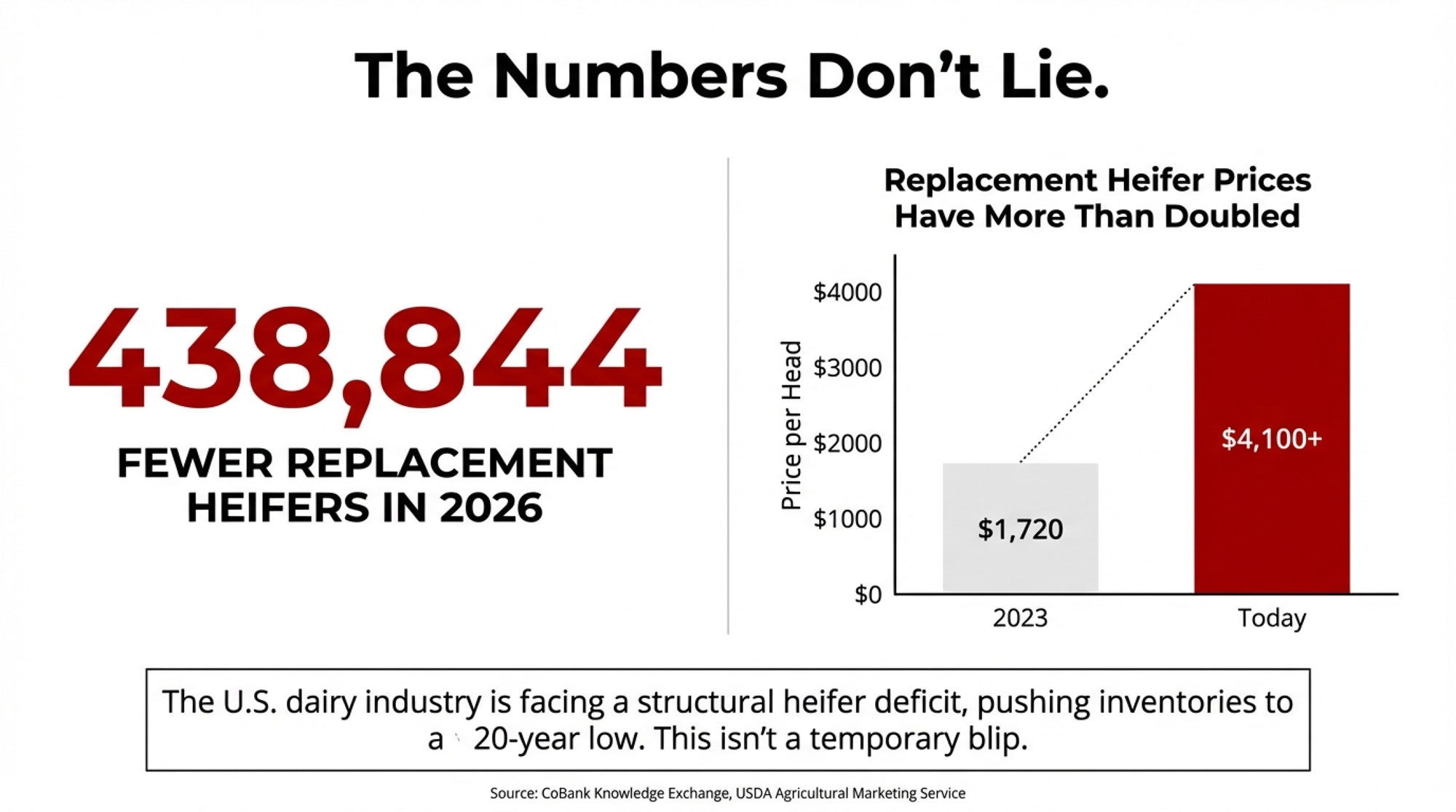
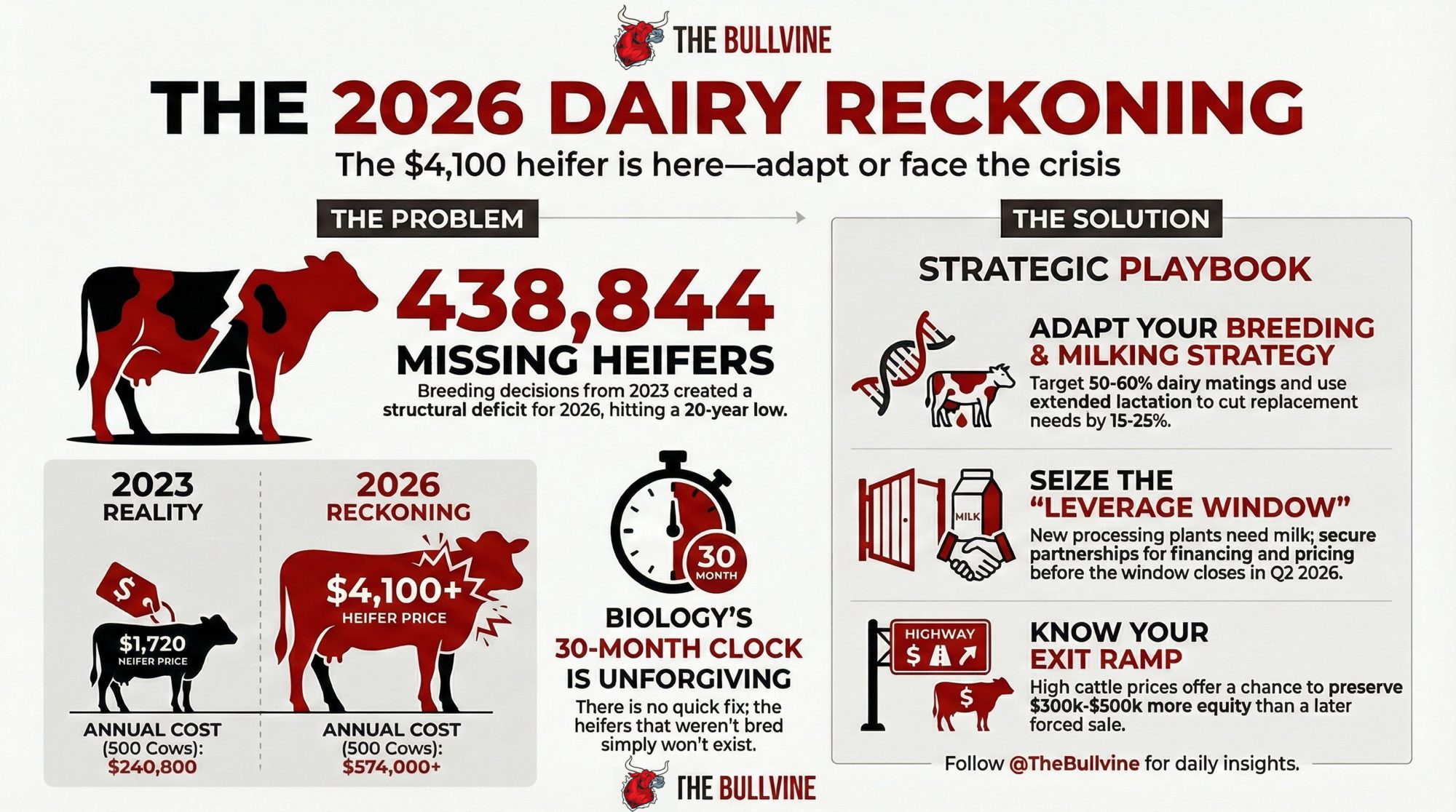
What wasn’t immediately visible was the 30-month lag hidden in those breeding choices. And here’s where it gets sobering. According to CoBank’s Knowledge Exchange report – Dairy Heifer Inventories to Shrink Further Before Rebounding in 2027, published this past August by lead dairy economist Corey Geiger and industry analyst Abbi Prins, the U.S. dairy industry faces 438,844 fewer replacement heifers in 2026 compared to 2025. We’re looking at heifer inventories hitting a 20-year low—territory we haven’t seen since the mid-2000s.

“We’re not talking about a temporary blip,” Geiger says. “The heifer deficit is structural. It reflects breeding decisions that were made two to three years ago, and those decisions can’t be unwound quickly.”

The farms that recognized this timeline early are positioning themselves for the decade ahead. Those that didn’t are facing some difficult choices. And the industry emerging on the other side? It’s going to look fundamentally different.
Biology Doesn’t Care About Your Cash Flow

Here’s what makes this situation so challenging—and you know this as well as anyone: the core constraint isn’t financial or managerial. It’s biological. And biology doesn’t negotiate.
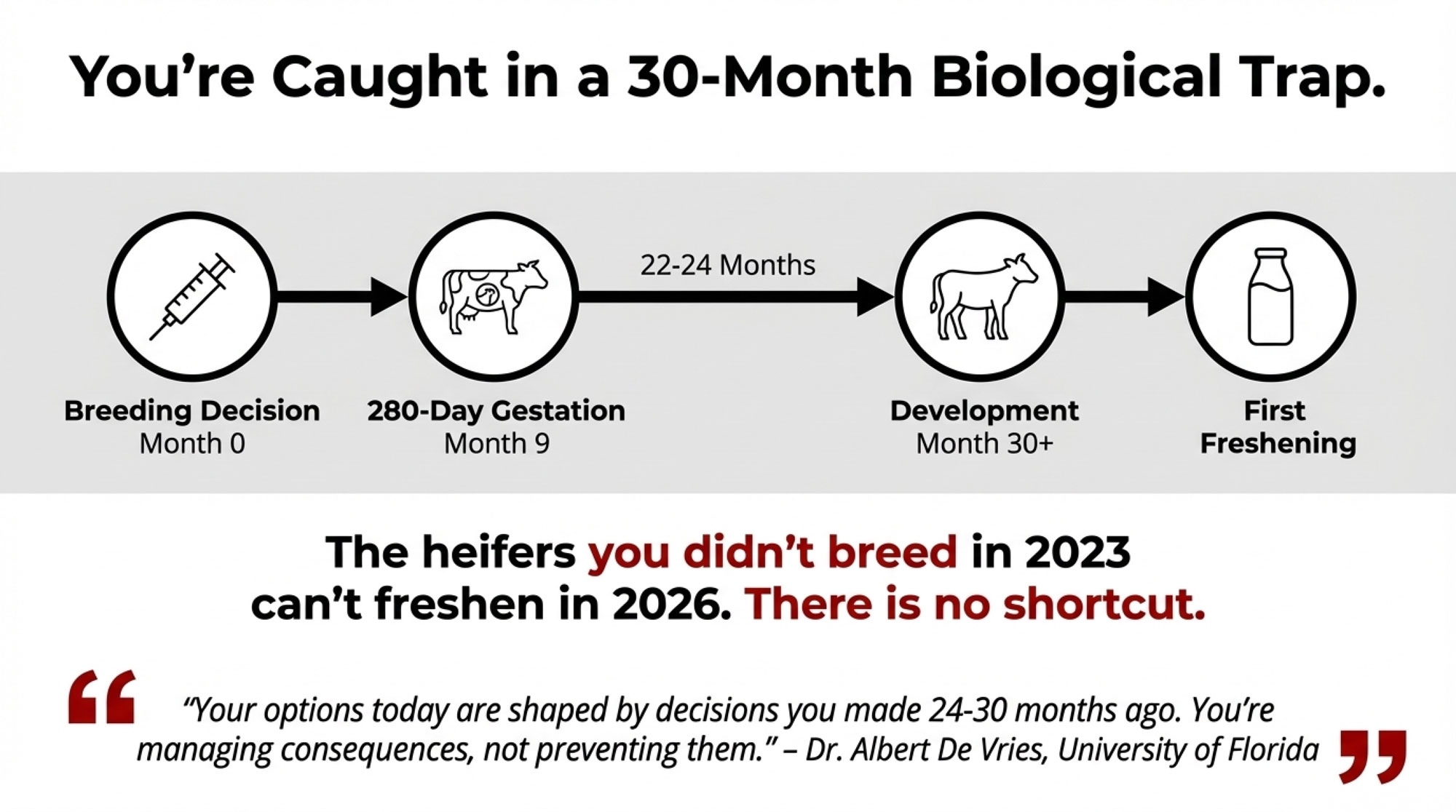
A breeding decision made today takes approximately 30 months to produce a milking cow. You’ve got 280 days of gestation, then 22-24 months of heifer development before that animal freshens and enters your milking string. There’s simply no shortcut through that timeline, regardless of what you’re willing to invest.

What this means, practically, is that the heifer shortage hitting farms in 2026-2027 was locked in by breeding decisions made in 2023-2024. Dr. Albert De Vries, professor of dairy management and economics at the University of Florida, has been modeling replacement dynamics for over two decades. His research on optimal replacement decisions, published in the Journal of Dairy Science, consistently shows that herd composition changes operate on multi-year cycles that can’t be compressed.

“Farmers sometimes ask me, ‘What can I do right now to fix my replacement situation?'” De Vries shared. “The honest answer is that your options today are shaped by decisions you made 24-30 months ago. You’re managing consequences, not preventing them.”

It’s a difficult message, but a necessary one.

The practical impact shows up across the board:

  • Replacement heifer prices have climbed from $1,720 in April 2023 to $3,800-4,200 currently—more than doubling in under 30 months, according to USDA Agricultural Marketing Service livestock reports
  • A 500-cow dairy requiring 140 annual replacements now faces $532,000-588,000 in heifer costs versus $241,000 two years ago
  • Custom heifer rearing operations across the Upper Midwest report being fully booked through the remainder of 2026, with limited capacity for new clients
Metric2023 Reality2026 ReckoningChange
Heifer Price (Per Head)$1,720$4,100+138%
Annual Cost (500-Cow Herd, 140 Replacements)$240,800$574,000+$333,200
Breeding Strategy60-80% Beef-on-Dairy40-50% Beef-on-DairyRecalibration
Beef Calf Premium$400-800 vs. $50-150 Dairy$350-700 vs. $40-120 DairyStill Positive
Custom Heifer CapacityAvailableFully Booked Through 2026Zero Slack
Processor LeverageBuyer’s MarketSeller’s Market (Q1-Q2 2026 Window)Historic Shift
Primary Strategy LeverMaximize Beef PremiumsExtended Lactation / PartnershipsSurvival Mode

One custom heifer operator running 400 head outside Lancaster, Pennsylvania, says he’s turned away 11 inquiries in just the past 3 months. “I’ve never seen demand like this,” he shared, asking that his name be withheld due to client confidentiality. “Guys who never called me before are suddenly very interested in long-term contracts. But I’m full. Everyone’s full.”

For operations that went heavily into beef breeding—we’re talking 60-80% of eligible matings, which wasn’t uncommon—the math creates a genuinely challenging scenario. Those heifers that should be entering the milking herd in 2026-2027? They were never conceived in the first place.

The North American Picture

It’s worth noting that this isn’t purely a U.S. phenomenon, though the dynamics differ by market structure. Canadian producers operating under supply management face a different calculus—quota values exceeding $40,000 per kg in many provinces mean heifer prices have always commanded premiums, but the beef-on-dairy trend has been more muted north of the border. The quota system creates built-in incentives to maintain replacement pipelines that open-market systems don’t.

In New Zealand and parts of the EU, seasonal calving patterns and grass-based systems create their own constraints on replacement. But the U.S. situation is unique in scale and severity—the combination of high beef-cross adoption rates and massive processing expansion has created a perfect storm that other markets haven’t experienced to the same degree.

What’s worth watching: The EU’s Green Deal and Farm to Fork Strategy—targeting a 30% reduction in agricultural emissions and 25% organic farmland by 2030—is adding regulatory pressure that’s expected to shrink EU dairy herds further in coming years. EU milk production already declined 0.2% in 2025 to 149.4 million metric tons, with environmental compliance costs straining smaller producers. According to UW-Madison Extension analysis , many EU dairy farmers are concerned these sustainability mandates will hurt their competitiveness in global markets. For U.S. exporters, this creates a potential opening—if domestic supply can keep pace with new processing capacity. The heifer shortage complicates that equation considerably.

Survival of the Smartest: Why Your 2023 Strategy Is Your 2026 Crisis

What’s encouraging is that rather than treating this as an insurmountable crisis, many progressive operations are discovering that the heifer shortage actually creates opportunities—if you adapt quickly enough. The key lies in understanding which strategies work within biological constraints and which ones amount to wishful thinking.
Extended Lactation: The Fastest Lever You Can Pull

Extended lactation protocols—keeping cows milking 14-18 months instead of the traditional 12-month cycle—offer the quickest path to reducing replacement pressure. This isn’t a new concept, as many of us know, but it’s getting a serious second look given current heifer economics.

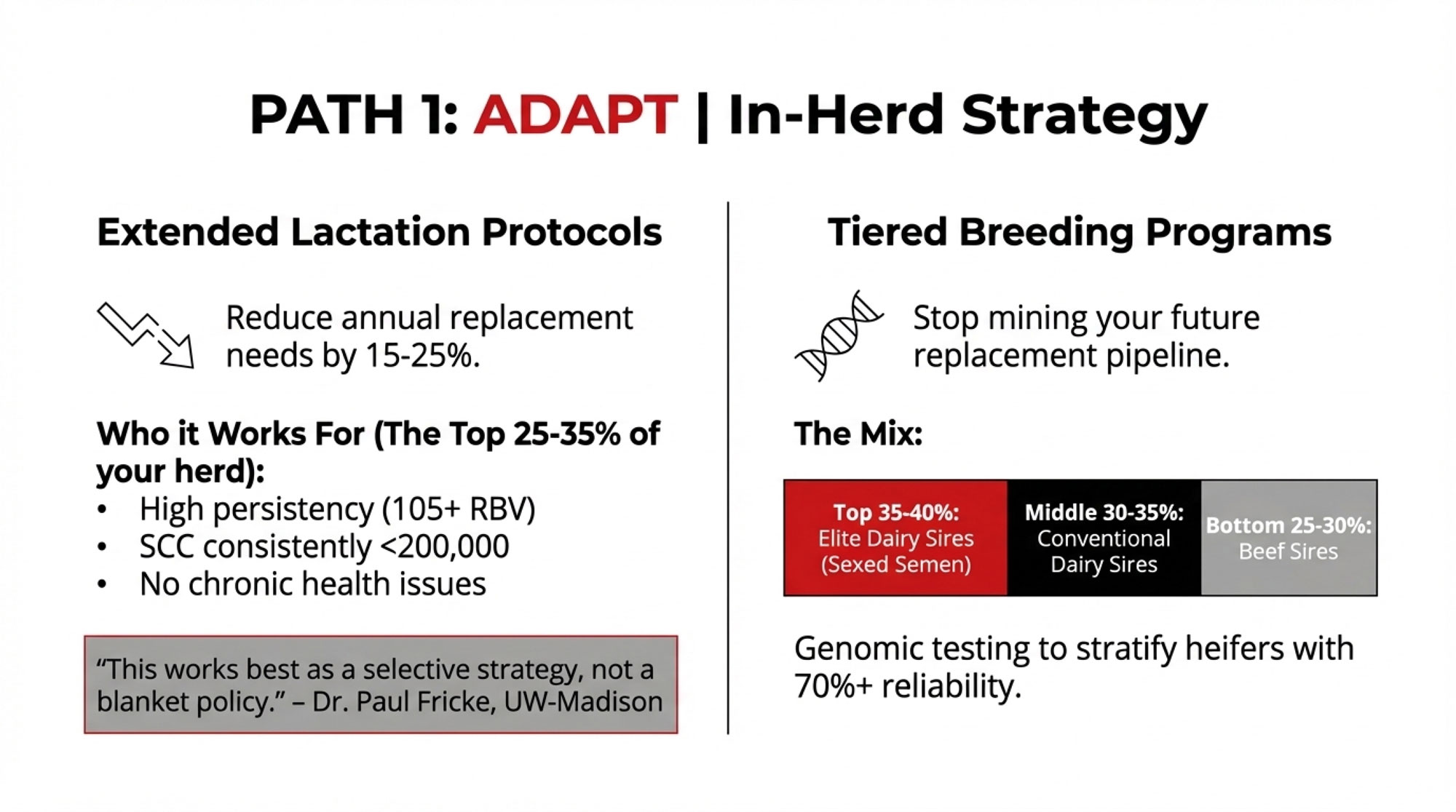
Research from the University of Wisconsin-Madison’s Dairy Science Department, led by Dr. Kent Weigel, shows that well-managed extended lactations can reduce replacement needs by 15-25% without sacrificing lifetime production. The key word there is “well-managed.” This isn’t about keeping every cow milking longer—it’s about identifying the right candidates.

Here’s how the economics generally work:

A cow producing 85 pounds daily at month 12 typically drops to 68-72 pounds by month 16. That’s a real decline in daily output, no question. But here’s what the daily production numbers miss: that cow isn’t generating replacement costs, breeding expenses, dry-period feed costs, or fresh cow health risks during transition. When you factor in the full cost of bringing a replacement into the herd—currently running $4,000+ just for the heifer purchase, plus another $800-1,200 in transition period costs—the extended lactation cow often comes out ahead on a total cost basis.

One central Wisconsin producer milking 850 Holsteins started implementing extended lactation protocols in early 2025. “We’re keeping about 130 cows on 16-month cycles now,” she explained, requesting anonymity to avoid drawing competitor attention to her cost structure. “My replacement purchases dropped from 240 last year to around 185 this year. At current prices, that’s real money—probably $220,000 in savings.”

The candidates that work best for extended lactation, based on research and field experience:

  • Persistency ratings above 105 RBV (these cows maintain production better through late lactation)
  • Somatic cell counts consistently below 200,000, because udder health has to be solid for this to work
  • No chronic lameness or recurring health issues
  • Body condition scores holding at 2.75-3.25 through mid-lactation

Now, here’s an important caveat that doesn’t always make it into the enthusiastic discussions of extended lactation. Dr. Paul Fricke, professor and extension specialist in dairy cattle reproduction at UW-Madison, notes: “There are real considerations around subsequent fertility and metabolic health. Cows that go significantly longer between calvings can have more difficulty conceiving on subsequent cycles. This works best as a selective strategy, not a blanket policy.”

That’s worth emphasizing. Extended lactation isn’t about keeping your whole herd milking longer. It’s about identifying the 25-35% of your cows that are genuinely good candidates and managing them differently. Your veterinarian can help develop monitoring protocols specific to your operation.

Tiered Breeding: Stop Mining Your Own Future

The operations handling this best are implementing what you might call tiered breeding—a systematic approach that captures beef premiums where it makes sense while ensuring adequate replacement supply.

Here’s where genomic testing has become genuinely transformative. Instead of relying on parent average or waiting for first-lactation data, farms using genomic evaluations can stratify their heifer calves at 2-3 months of age with 70%+ reliability on key traits. That precision matters when you’re deciding which animals get the $40 sexed dairy straw versus the $12 beef straw. The cost of genomic testing—typically $35-50 per head—pays for itself many times over when it prevents you from putting beef genetics on a heifer that should have been a herd-building dam.

Here’s how a typical protocol structures breeding decisions based on genetic merit:

Herd Segment% of HerdGenetic MeritBreeding StrategyCost Per StrawStrategic Purpose
Top Tier35-40%Top 1/3 Net Merit or TPISexed Dairy Semen (Elite Sires)$35-45Herd builders – next generation genetic improvement
Middle Tier30-35%Average geneticsConventional Dairy Semen (Solid Sires)$15-25Replacement pipeline – maintain herd numbers
Bottom Tier25-30%Lowest 1/3 production/healthBeef Semen$8-15Terminal value – cull candidates
Extended Lactation Candidates10-15%High persistency (>105 RBV), excellent healthSkip Breeding / Delay 4-6 months$0 initialReduce replacement pressure short-term
  • Top 35-40% of herd (highest genetic merit): These are your herd builders. Breed them to elite dairy sires using sexed semen. Yes, it costs more per straw—$35-45 versus $8-15 for conventional beef. But these matings produce your next generation of genetic improvement. They’re investments, not costs. If you’re using genomic testing, these are your animals with Net Merit or TPI in the top third of your herd.
  • Middle 30-35% (average genetics): Breed to conventional dairy sires—no sexing premium, solid genetics, predictable outcomes. These animals maintain your replacement numbers without straining the budget.
  • Bottom 25-30% (lowest merit): This is where beef genetics make sense. These animals should be transitioning out of your herd anyway based on their production and health profiles. Breeding them to beef sires maximizes their terminal value without compromising your replacement pipeline.

Many progressive operations have recalibrated their breeding mix after going heavy on beef genetics in 2023. The pattern emerging across Wisconsin and the Upper Midwest: farms that had 70% or more of matings going to beef are now pulling back to 40-50%, being much more deliberate about which cows get which service.

The key insight these producers have landed on: not every cow should leave genetic offspring in your herd—but enough of them have to, or you’re mining your own future.

The Processor Partnership Window: Leverage You Won’t See Again

Now, here’s where things get genuinely interesting from a market-dynamics standpoint. Perhaps the most significant—and honestly, underreported—development of late 2025 is the shift in negotiating leverage between farms and processors.
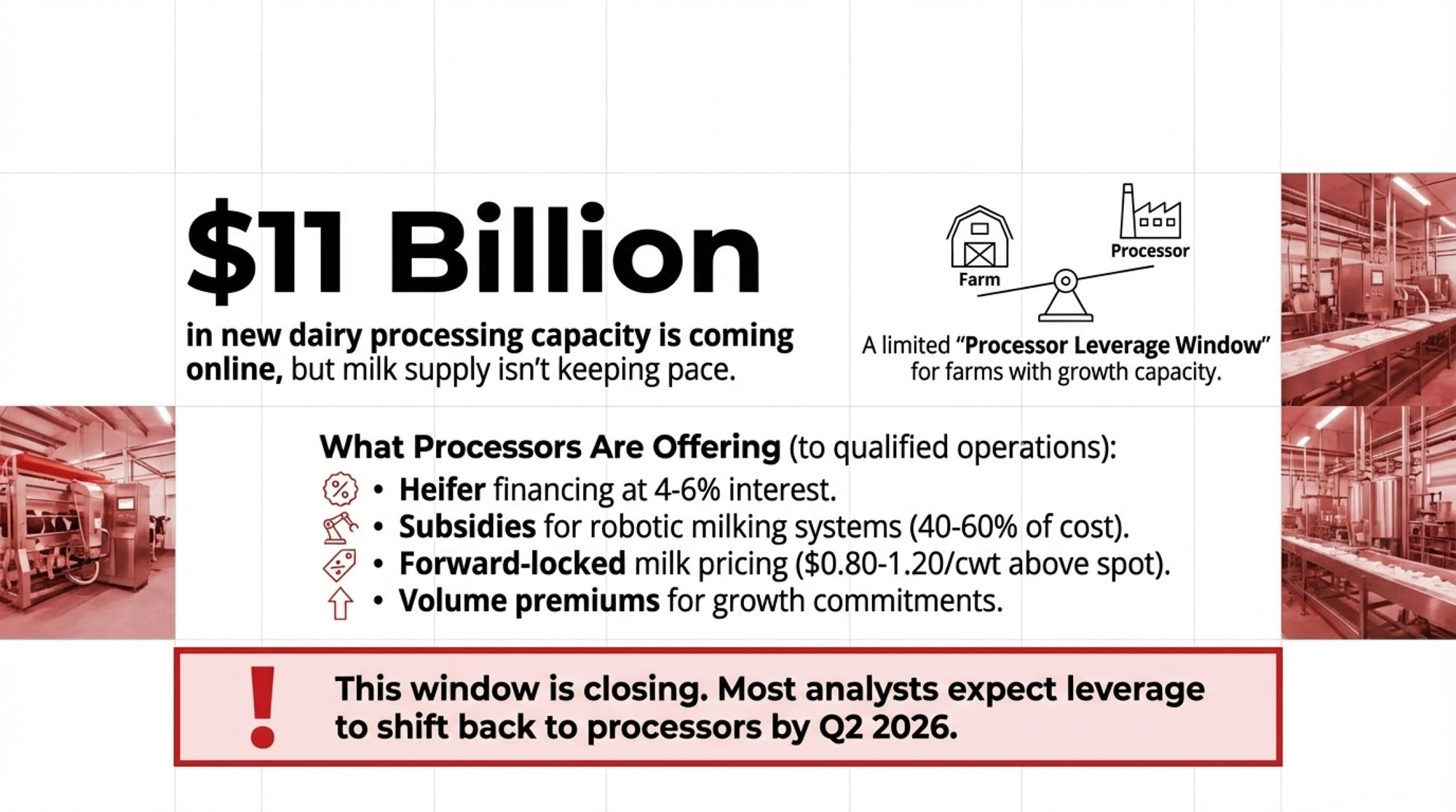
There’s roughly $11 billion in new dairy processing capacity coming online between 2025 and early 2028, according to IDFA data released this past October. These are major investments: Hilmar’s Texas expansion, Leprino’s new Texas facility, Glanbia’s recent Michigan expansion, plus a string of regional cheese and specialty product facilities across the Upper Midwest and Southwest.

Here’s the challenge these processors are facing: plants designed for 85-90% utilization are running at 60-70% because the milk supply growth they projected isn’t materializing. When you breed 60-70% of your herd to beef for two years, you don’t have the replacement heifers to expand production. The connection seems obvious in hindsight, but it caught many in the processing sector off guard.

“We planned capacity based on historical supply growth trends,” one Midwest cooperative procurement manager shared, speaking on background due to ongoing contract negotiations. “Nobody modeled what happens when a significant portion of the national herd stops producing dairy replacements for two years. We’re adjusting our assumptions now, but the capacity is already built.”

This creates what some industry observers are calling a “leverage window”—a period where farms with growth capacity can negotiate terms that would have been unthinkable three years ago.

What some processors are offering qualified operations:

  • Heifer financing at 4-6% interest, compared to 7-9% from traditional agricultural lenders
  • Equipment subsidies covering 40-60% of robotic milking system costs in exchange for supply commitments
  • Forward-locked milk pricing 12-36 months out, often $0.80-1.20/cwt above the current spot market
  • Volume premiums for farms that can commit to production growth trajectories

I’ve spoken with several farm operators in Wisconsin and Idaho who’ve signed or are negotiating agreements along these lines, though all requested anonymity given the competitive sensitivity. The common thread: processors are willing to put capital at risk to secure future milk supply because they’re genuinely concerned about where future growth will come from.

“They need us more than they’re used to needing us,” is how one central Wisconsin dairyman put it. “It’s a strange feeling after years of being told to take whatever price they offered.”

The qualification requirements typically include:

  • 500+ cows are currently milking
  • Component levels approaching 3.2% protein (this aligns with December 2025 FMMO pricing changes that increase protein’s value)
  • Debt-to-equity ratios below 50%
  • Willingness to sign 5-7 year exclusive supply agreements
  • Demonstrated ability to grow production 10-20% over the contract period

For farms meeting these criteria, the partnerships can genuinely reshape their economics. For those who don’t qualify for processor financing, traditional options remain available—FSA guaranteed loans, state dairy assistance programs, and Farm Credit services are all seeing increased demand as farmers look for ways to finance heifer purchases and facility upgrades during this tight market.

But these windows don’t stay open forever. As processor capacity fills and supply concerns ease, the negotiating dynamics will shift back toward buyers.

The realistic window, based on conversations with dairy economists and processor representatives? Probably through Q1 or Q2 of 2026. Maybe a bit longer in regions with less processing competition. But farms considering this path shouldn’t assume the current leverage environment persists indefinitely.

The Exit Ramp: When Walking Away Is the Smartest Play

Processor partnerships aren’t available everywhere, and they’re not the right fit for every operation. For some farms, the current market offers a different kind of opportunity—one that involves making a clear-eyed decision about the future rather than doubling down on growth.
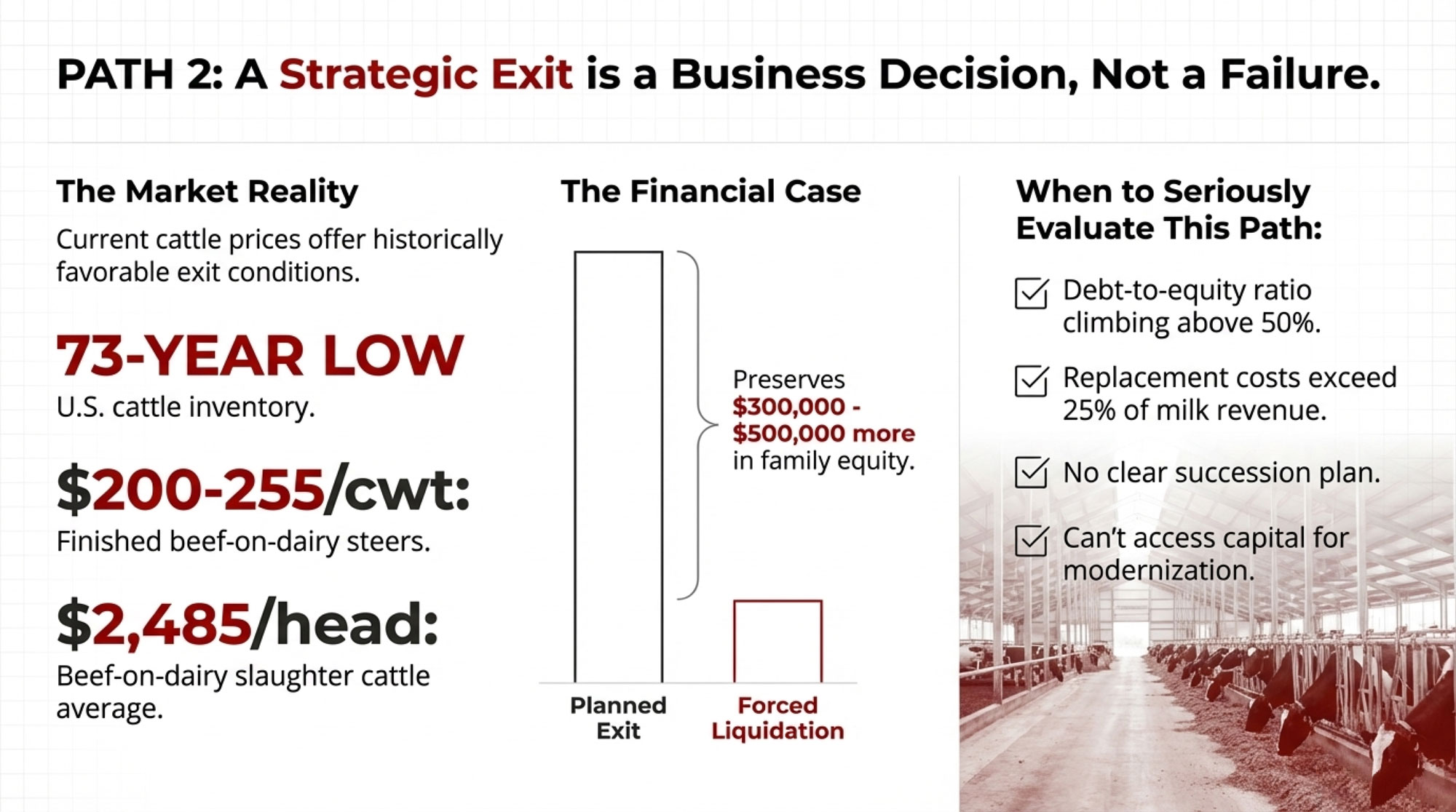
This is the part that’s hardest to write, honestly, but it would be dishonest to leave it out. For farms facing multiple stressors simultaneously, a strategic exit during the current cattle price peak may preserve more family wealth than continued operation.

I want to be clear about framing here: this isn’t a failure narrative. Cattle markets operate in cycles, as we’ve all seen over the years, and the current cycle offers historically favorable exit conditions. Making a clear-eyed decision to capture that value isn’t giving up—it’s recognizing market realities.

Consider the current market context:

  • Finished beef-on-dairy steers are bringing $200-255/cwt according to USDA Agricultural Marketing Service reports—near all-time highs
  • Beef-on-dairy slaughter cattle are averaging $2,485/head, outperforming native beef by roughly $100/head
  • U.S. cattle inventory sits at a 73-year low—the smallest since 1951 according to USDA data—supporting continued strong pricing through at least 2026-2027 per CattleFax projections

What farm transition data suggests—compiled by agricultural lenders, extension economists, and farm management associations—is that the timing difference between strategic exit and forced liquidation can be substantial. Operations that make planned exits in months 8-10 during financial stress typically preserve $300,000-500,000 more in family equity than those forced into distressed sales in months 16-18.

That gap represents college funds, retirement security, or capital to start something new. It’s not trivial.

Indicators that suggest seriously evaluating strategic exit:

  • Cash flow negative for 3+ consecutive months with no clear path to reversal
  • Debt-to-equity ratio above 50% and still climbing
  • No processor contract and fully exposed to spot market volatility
  • Replacement heifer costs are consuming more than 25% of milk revenue
  • Primary operator is 55-65 with no clear succession plan
  • Can’t access capital for necessary modernization

For families recognizing themselves in that list, the current window—Q4 2025 through Q2 2026—offers optimal timing. Cattle prices remain elevated, equipment values haven’t yet been depressed by consolidation-driven sales volume, and agricultural real estate markets in dairy regions remain relatively stable.

One southern Minnesota couple in their early 60s exited their 380-cow dairy this past August after running the numbers on replacement costs. “Our kids aren’t interested in the operation, and the heifer prices were the final straw,” the husband shared, asking that names be withheld to protect family privacy. “Once we did the math on replacing 110 heifers a year at $4,000-plus each, versus what we could get for the herd and equipment right now, the decision got a lot clearer.”

They netted roughly $1.4 million after debt payoff. “Ask me if I’m sad about it? Sure, some days. Ask me if it was the right call? Absolutely.”

A note on taxes: Livestock sale proceeds are taxable income—something that catches some exiting producers off guard. This family worked with an agricultural accountant to structure their sale across two tax years and take advantage of capital gains treatment where applicable. If you’re considering an exit, consult with a tax professional familiar with farm transitions before finalizing timing. The difference between a well-structured exit and an unplanned one can be substantial.

Two Models Will Dominate—Where Does Your Operation Fit?

Looking beyond the immediate heifer crunch, what we’re really watching is a structural transformation that will reshape dairy farming for the next generation. The numbers in various USDA and academic projections tell a consistent story: we’re likely moving from approximately 22,000 dairy farms today to 14,500-17,000 by 2028-2029, while total milk production increases modestly.

That’s not just “fewer farms.” It’s a fundamental restructuring around two viable models, with a shrinking middle ground between them.
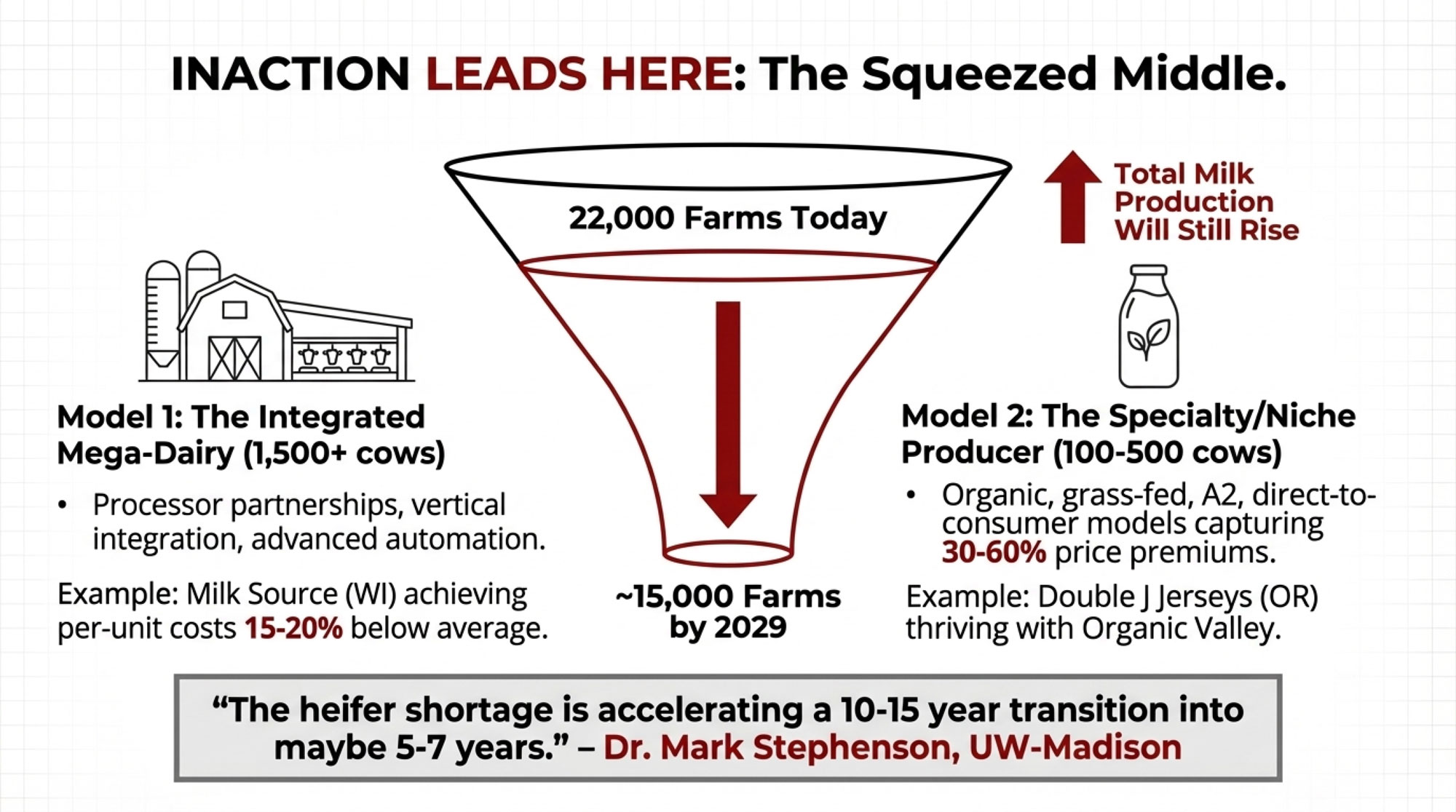
Model 1: The Integrated Mega-Dairy

Operations of 1,500+ cows with exclusive processor partnerships, advanced automation, and increasingly vertical supply chains. According to the USDA’s “Consolidation in U.S. Dairy Farming” report, these farms are projected to produce 55-60% of U.S. milk from just 4-5% of total operations by decade’s end.

Large integrated operations, such as Milk Source in Wisconsin, illustrate this model at scale. Co-founded in 1994 by Jim Ostrom, John Vosters, and Todd Willer—all UW-Madison graduates from multi-generational Wisconsin farm families—the operation traces its roots to 1965, when John’s parents started a small 30-cow dairy in Freedom. Today, Milk Source operates multiple facilities across Wisconsin and the Midwest, running their own feed mills, calf ranches, and cropping operations, achieving per-unit costs 15-20% below industry average through vertical integration. That’s the competitive advantage mega-dairies are building: not just size, but system control.

Model 2: The Specialty/Niche Producer

Operations of 100-500 cows focused on organic, grass-fed, A2, or direct-to-consumer markets. These farms capture significant price premiums—often 30-60% above conventional—that offset their smaller scale. Organic Valley, for instance, reports steady demand growth for its farmer-members’ milk, with farmgate prices well above those in conventional markets.

Jon Bansen operates Double J Jerseys, a grass-fed, organic dairy with approximately 150-200 cows near Monmouth, Oregon, that sells through the Organic Valley cooperative. A multi-generational dairy farmer, Bansen has built his operation around intensive rotational grazing and 100% grass-fed practices—even when it means leaving some acres unproductive for conservation. What’s encouraging about operations like Double J Jerseys is that grass-fed premiums and cooperative membership provide price stability that helps absorb cost increases, which might challenge conventional operations of their size.

What’s getting squeezed: The traditional mid-size commodity dairy—500-1,000 cows producing undifferentiated milk for spot markets without processor partnerships or specialty premiums. This segment faces pressure from both directions: too small for mega-dairy efficiencies, too large for niche positioning.

CharacteristicModel 1: Integrated Mega-DairyModel 2: Specialty/Niche ProducerThe Disappearing Middle
Herd Size1,500-10,000+ cows100-500 cows500-1,000 cows
Market PositionExclusive processor partnerships, vertical integrationOrganic, grass-fed, A2, direct-to-consumerUndifferentiated commodity milk
Price RealizationVolume efficiency: $0.40-0.80/cwt below market, profit on scalePremium pricing: 30-60% above conventionalSpot market exposure: full volatility
Competitive AdvantagePer-unit costs 15-20% below average via automation and vertical supply chainsDifferentiation premiums and brand loyaltyNone sustainable
Capital Requirements$15-40 million (barriers to entry)$500K-3 million (differentiation investment)$3-8 million (too big for niche, too small for efficiency)
Risk ProfileContract stability, but massive debt serviceMarket volatility, but loyal customer baseMaximum exposure: no contracts, no premiums
ExamplesMilk Source (WI), Riverview Dairy (SD)Double J Jerseys (OR), Organic Valley membersMost 500-1,000 cow operations without processor partnerships
2028 Projection55-60% of U.S. milk from 4-5% of farms8-12% of U.S. milk from 15-20% of farmsDeclining share, consolidation pressure

Dr. Mark Stephenson tracked these structural shifts throughout his career as Director of Dairy Policy Analysis at UW-Madison. “The middle hasn’t been comfortable for a while,” he notes. “What the heifer shortage is doing is accelerating a consolidation that was already underway. It’s compressing a 10-15 year transition into maybe 5-7 years.”

Regional Realities: One Size Doesn’t Fit All

The geographic impact isn’t uniform, and it’s worth factoring regional dynamics into your planning.

Upper Midwest (Wisconsin, Minnesota): High processor density creates more partnership options, but also more competition for those deals. Wisconsin’s strong cheese industry values high-component milk, which advantages operations that can hit 3.2%+ protein targets. The state may see farm numbers decline 35-40%, but surviving operations will likely have strong processor relationships.

Northeast (New York, Pennsylvania, Vermont): More fragmented processor landscape with significant organic and specialty opportunity. The decline in fluid milk continues to pressure conventional operations, but proximity to population centers supports direct-market strategies. Farms close to urban markets may find the niche model more viable here than elsewhere.

West/Southwest (California, Idaho, Texas, New Mexico): Where mega-dairy expansion is concentrated. Lower regulatory burden, available land, and new processing capacity are pulling production westward. Texas has seen particularly significant dairy expansion in recent years, according to USDA NASS data, with growth concentrated almost entirely in operations with 2,000 or more head.

Pacific Northwest (Washington, Oregon): Mixed picture—strong organic demand through Tillamook and similar cooperatives, but conventional operations face the same squeeze as elsewhere. Water availability is increasingly a factor in expansion decisions.

What This Means for Your Operation

I want to be careful about projecting too much certainty here. Markets are complicated, and anyone who claims to know exactly what heifer prices will be in 2027 is guessing. That said, there are patterns worth watching and principles that seem reasonably sound.

What seems fairly certain:

  • The heifer shortage is structural, not cyclical. It reflects breeding decisions already made and can’t be reversed quickly.
  • Replacement costs will remain elevated through at least 2027, with CoBank projecting meaningful recovery only in late 2027 or 2028.
  • The farms that position themselves now—whether for growth, for niche markets, or for strategic exit—will have more options than those who wait.

What’s less certain:

  • Exactly how high will heifer prices go. The $4,000-$4,500 range seems likely, but market dynamics could push it higher.
  • How long does the processor-leverage window stay open? Current estimates suggest Q1-Q2 2026, but this depends on how quickly supply concerns ease.
  • Whether export markets absorb the new processing capacity. Trade policy, currency movements, and global demand all factor in.

If You’re Planning to Continue and Grow

Take a serious look at processor partnership opportunities now, while the leverage window remains open. This may be your best chance in a decade to negotiate favorable terms. Think about extended lactation protocols for the right candidates—that 25-35% of your herd with strong persistency, good udder health, and solid body condition. Work with your veterinarian to develop monitoring protocols that fit your operation.

Restructure your breeding program so that at least 50-60% of matings produce dairy replacements. The beef premiums are real, but so is the replacement pipeline you’re building. And budget conservatively—plan for replacement heifer costs of $4,000-5,000 through 2027. Hope for lower, but don’t count on it.

If you’re not already genomic testing your heifer calves, now’s the time to start. The $40-50 investment per head pays for itself when you’re making $4,000 breeding decisions. Knowing which animals have the genetic merit to justify elite dairy genetics versus which should get beef semen isn’t guesswork anymore—it’s data.

If processor financing isn’t available in your area, explore FSA guaranteed loans and state dairy assistance programs. Demand is up, but funds remain available for qualified operations.

If You’re Uncertain About the Future

Start with an honest financial assessment. Debt-to-equity ratio, debt service coverage, cash flow trends, and family situation. These numbers tell you something. Understand that a strategic exit in 2025-2026, at peak cattle valuations, preserves substantially more equity than a forced exit in 2027-2028 when prices may be lower, and more farms are competing for buyers.

Talk to agricultural attorneys and accountants about transition planning. Good advice costs money; poor advice costs more. And consider partial strategies if full continuation isn’t viable—retaining real estate while liquidating livestock and equipment can provide ongoing income while preserving land wealth.

Don’t overlook risk management tools: The Dairy Margin Coverage (DMC) program , extended through 2031 under the recent budget legislation, offers coverage levels from $4.00 to $9.50 per cwt—and Tier 1 coverage has been increased to 6 million pounds of milk. Producers enrolling for multiple years through 2031 can lock in a 25% premium discount. For operations navigating uncertain margins, DMC provides a floor that can help with cash flow planning. LGM-Dairy insurance offers another option, protecting against both feed cost spikes and milk price drops on a rolling 11-month basis. Neither program solves the heifer shortage, but both can help stabilize income while you work through the transition.

For Everyone

Accept that the industry structure of 2028 will look different from today. Not worse, necessarily—but different. Planning for that difference beats hoping it doesn’t happen.

The 30-month biological constraint isn’t going away. Every quarter you wait to adjust breeding protocols is another quarter before those decisions produce results. The farms that feel most confident about their position are those that began adjusting 12-18 months ago. They’re not immune to the heifer shortage, but they’re managing it rather than being managed by it.

The Beef on Dairy Boom that Changed the Game

The beef-on-dairy boom of 2023-2024 revealed something important about dairy economics: optimizing for today can create constraints tomorrow. That’s not a criticism of the farmers who made those breeding decisions—the premiums were real, and the cash flow mattered. But it’s a reminder that agricultural systems operate on biological timelines that don’t align neatly with market cycles.

The farms discovering that lesson now still have time to adapt. The 30-month clock that started with those breeding decisions keeps running. What happens next depends on decisions being made right now.

As that Wisconsin dairyman still processing the $4,100 heifer quote put it: “I can’t go back and change what I bred in 2023. But I can sure change what I’m doing today. That’s gotta count for something.”

It does. The question is whether enough farms figure that out while they still have choices to make.

The Bullvine Bottom Line

If you’re waiting for heifer prices to drop before you change your breeding mix, you’ve already lost. The 438,844-heifer deficit hitting in 2026 was locked in by decisions made in 2023, and the clock started ticking the moment those beef straws went in. Biology doesn’t care about your cash flow projections. The only question left: Are you breeding for 2024’s market or 2028’s reality?
Key Takeaways 

  • 438,844 Missing Heifers: The 2026 shortage was locked in by 2023 breeding decisions. Biology’s 30-month timeline means there’s no quick fix—only adaptation.
  • Replacement Costs Doubled: Heifers jumped from $1,720 to $4,100+. For a 500-cow dairy, that’s $300,000+ more per year in replacement costs alone.
  • The Leverage Window Closes Q2 2026: Processor partnerships, heifer financing at 4-6%, and forward pricing are available NOW. This window won’t reopen once capacity fills.
  • Restructure Your Breeding Mix: Target 50-60% dairy matings minimum. Extended lactation protocols on your top 25-35% of cows can reduce replacement needs by 15-25%.
  • Strategic Exit Beats Forced Liquidation: For operations under financial stress, exiting at peak cattle prices ($200-255/cwt for beef-on-dairy steers) preserves $300K-500K more in family equity.

Executive Summary: 

U.S. dairy is staring down a 438,844-heifer deficit in 2026—the unavoidable consequence of 2023’s beef-on-dairy breeding boom. Replacement prices have more than doubled, from $1,720 to over $4,100 per head, adding $300,000+ in annual replacement costs for a typical 500-cow operation. Biology’s 30-month timeline means there’s no quick fix; the heifers that weren’t bred can’t be milked. The farms adapting fastest are implementing extended lactation protocols, restructuring breeding programs to ensure 50-60% dairy matings, and locking in processor partnerships while the leverage window remains open through Q1-Q2 2026. For operations facing compounding stress, current cattle prices—with finished beef-on-dairy steers at $200-255/cwt—offer strategic exit conditions that preserve $300,000-500,000 more in family equity than forced liquidation later. The industry is accelerating toward two dominant models: integrated mega-dairies and specialty niche producers. Mid-size commodity operations without contracts or differentiation are getting squeezed from both directions—and what you decide in the next 6-12 months will determine which side of this reckoning you land on.

About the Data in This Article

Heifer inventory projections and pricing trends cited in this analysis come from CoBank’s August 2025 Knowledge Exchange report by Corey Geiger and Abbi Prins, USDA Agricultural Marketing Service livestock reports, and USDA NASS cattle inventory data. Replacement cost calculations assume 140 annual replacements for a 500-cow dairy (28% replacement rate) at current market pricing of $3,800-4,200 per head. Regional costs and individual farm economics vary significantly based on location, management practices, existing heifer inventory, and market access. Some farmer sources requested anonymity due to ongoing business negotiations or family privacy considerations. We welcome producer feedback and case studies for future reporting—contact editor@thebullvine.com.

For additional resources on replacement heifer management, breeding economics, and dairy transition planning, visit the University of Wisconsin-Madison Division of Extension dairy resources or contact your state extension dairy specialist.

Learn More

The Sunday Read Dairy Professionals Don’t Skip.

Every week, thousands of producers, breeders, and industry insiders open Bullvine Weekly for genetics insights, market shifts, and profit strategies they won’t find anywhere else. One email. Five minutes. Smarter decisions all week.

NewsSubscribe
First
Last
Consent

The Triple Cushion Trap: Why 2025’s Strong Margins Won’t Save You in 2026

Three things propping up your dairy. All temporary. The window to reposition closes in weeks, not months.

Executive Summary: Three temporary forces are keeping mid-size dairies profitable: beef-on-dairy premiums, cheap feed, and strong margins. All three face pressure by late 2026. Here’s the structural problem underneath: the U.S. herd has grown to 9.58 million head—highest since 1993—while only 2.5 million heifers are expected to calve in 2025, the lowest in 22 years of USDA tracking. Producers are stretching the cow productive life to cover the gap. That strategy has a ceiling, and we’re approaching it. When the cushions deflate, operations with costs above $20/cwt face margin compression that could erase six figures annually. The window to act—contract review, strategic herd adjustment, revenue diversification—is weeks, not months.

Something unusual is happening in U.S. dairy right now. Mid-size operations are stacking up real financial advantages from multiple directions at once—beef-on-dairy premiums, cheaper feed, and risk management support all landing in the same year. We haven’t seen this kind of alignment since around 2014.

That’s the good news.

Here’s what should concern you: three temporary economic cushions are masking a structural transformation that will reshape this entire industry. The producers who understand what’s actually happening—and position now—will come out ahead. Those who don’t may find out the hard way that 2025’s profits were a trap.

The Three Cushions (And Why They Won’t Last)

Cushion #1: Beef-on-Dairy Revenue

The beef-cross breeding revolution has fundamentally changed calf economics. Market experts like Mike North of Ever.Ag report some beef-on-dairy calves bringing close to $1,000 just a few days after birth—a world away from the often double-digit prices traditional dairy bull calves have brought in many markets over the years.

For a 500-cow operation running a meaningful percentage of beef breedings, that’s tens of thousands of dollars in additional annual revenue that simply didn’t exist five years ago.

“Those beef calves are paying my property taxes and then some.” — Wisconsin dairy producer

Why do these premiums exist? Simple supply and demand. USDA’s January 2025 Cattle Inventory Report shows total cattle at 86.7 million head—the lowest since 1951. Beef cows were at about 27.9 million, the fewest since 1961. When feeder cattle supplies are this tight, dairy-beef crosses fill a real gap.

The part that can sneak up on you: Canadian and U.S. cattle market outlooks in 2025 point to the early stages of beef herd rebuilding, with some analysts expecting modest beef cow number increases to start showing up in 2026. When that happens, feeder prices will likely soften. Your high-value beef calves may not stay quite so high-value.

Cushion #2: Cheap Feed

What’s encouraging on the cost side: USDA’s August 2025 DMC calculations showed feed costs at $9.38 per hundredweight—the lowest since October 2020. Corn’s been averaging around $4.00 per bushel based on the USDA’s recent estimates. That puts feed at roughly 45% of the milk check versus the 50-55% range that usually squeezes margins hard.

As recent USDA-based reports have highlighted, premium alfalfa has ranged from about $175 per ton in Idaho to around $380 per ton in Pennsylvania, depending on region and quality. If you’re in a favorable feed region, you’re feeling some real breathing room right now.

What could change: Any return to $5.00-plus corn—and remember, we saw that as recently as 2022—would add meaningful cost back to your operation. For a mid-size dairy, we’re talking six figures in additional annual expense. Weather remains the wildcard nobody can predict.

Feed costs are low—until they aren’t. Corn at $4.00/bushel in 2025 feels stable, but the 2021–22 spike above $6.50 cost a 350-cow operation over $120,000 in additional annual expense. The window to build working capital reserves closes fast when everyone realizes the risk at the same time.

Cushion #3: DMC Payments

Dairy Margin Coverage provided solid support through 2024 and into early 2025. With margins now above the $9.50 trigger at standard coverage levels, payments have become more intermittent.

Worth remembering: DMC is insurance, not income. When margins compress, the safety net helps—but it won’t save an operation that’s structurally unprofitable at the cost levels it’s running.

The Paradox: How Do You Grow a Herd While Running Out of Replacements?

Here’s what should keep you up at night.

The U.S. dairy herd has grown to about 9.58 million head according to the USDA’s October 2025 Milk Production Report—the highest since 1993. Meanwhile, replacement heifer inventory has fallen to 3.914 million head, the lowest since 1978.

The Replacement Crisis: Record Herd, Historic Low Heifers

And the number that really matters: only 2.5 million heifers are projected to calve in 2025—the lowest in the 22-year history of USDA tracking this metric.

The math doesn’t work long-term. Producers everywhere are extending cow productive life to cover the gap—keeping older, proven cows in the milking string rather than cycling through replacements. USDA reports replacement cow prices up 29% year-over-year to $2,660 per head in January 2025.

That strategy has a ceiling. We’re approaching it.

Real Numbers From a Working Operation

Meet “Heartland Family Dairy”—a composite I’ve put together based on conversations with producers across Wisconsin and Pennsylvania. 350 cows, second-generation, parents approaching retirement.

MetricTheir Numbers
Milk revenue$1.65 million/year at $20.50/cwt
Beef-cross calf revenue$35,000-40,000
Operating costs$20.48/cwt
Annual debt service$175,000
Working capital6-8 weeks

On paper, they’re breaking even. The cushions are keeping them viable.

The question: What happens when beef premiums slip? When feed costs spike? When milk prices compress?

If multiple cushions deflate at once—and that’s entirely plausible for 2026-2027—operations running costs above $20/cwt are going to feel real pressure. The kind of pressure that forces hard decisions.

The Benchmarks That Separate Survivors From Everyone Else

Jason Karszes, the dairy farm management specialist with Cornell University’s PRO-DAIRY program, has been studying profitability patterns for years. His finding that sticks with me most:

A well-managed 150-cow dairy in the top profitability quartile often earns more annual profit than a poorly-managed 500-cow dairy in the bottom quartile—sometimes by $100,000 or more.

Scale matters. Management matters more. That’s actually encouraging if you think about it.

Where Do You Stand?

Survivor ZoneDanger Zone
Operating costs below $18.50/cwtOperating costs above $20.00/cwt
Labor efficiency 50+ cows/FTEBelow 45 cows/FTE
Production 26,000+ lbs/cowBelow 24,000 lbs
Cull rates 30-33%Above 38%
Debt-to-asset below 50%Above 60%
Working capital 6+ monthsBelow 3 months

Component optimization matters too. USDA’s November 2025 data shows butterfat at $1.71 per pound, protein at $3.01 per pound. Butterfat has come down from the highs we saw in late 2023, but current component prices still reward higher butterfat and protein performance. Top-component herds consistently see a noticeably higher milk check per cow than herds running average components—money that doesn’t depend on base milk price.

Performance TierButterfat %Protein %Annual Revenue/Cow
Average herd3.80%3.05%$4,510
Above-average herd4.10%3.25%$4,685
Top-quartile herd4.40%3.50%$4,875

Operations hitting these benchmarks can weather significant margin compression. Those falling short face difficult decisions regardless of herd size. That’s the terrain we’re all working with now.

Three Moves to Make Before Year-End

The coming weeks offer a window for strategic repositioning. Here’s what I’m hearing from advisors, lenders, and producers who’ve navigated tough cycles before.

Move #1: Get Your Milk Contract Reviewed

Cost: $1,500-$3,000 for a professional review. ROI: Avoiding liability exposure that could cost you many times that amount.

Before December 31, verify:

  • Written volume guarantees with clear pricing formulas
  • Liability caps at reasonable levels
  • Termination provisions with 60-90 day notice minimums
  • Whether coordinating with neighbors creates negotiating leverage

Verbal understandings don’t hold up when things get tight. An agricultural attorney familiar with dairy contracts will spot issues you’ll miss.

Move #2: Run the Numbers on Strategic Herd Reduction

This feels counterintuitive. Hear me out.

Cull cow prices are near record levels—USDA-based forecasts suggest 2025 average prices around $145 per cwt, following a record annual average near $127 per cwt in 2024. Replacement heifers averaging $2,660 per head. A 400-cow operation reducing to 300 head can generate substantial cull revenue while improving per-cow profitability and labor efficiency.

A producer in Pennsylvania described it to me as “right-sizing rather than downsizing.” She dropped from 280 to 220 cows. Net income actually improved because labor costs fell faster than revenue.

This isn’t a retreat. It’s repositioning—setting yourself up to rebuild selectively when heifer prices moderate, probably sometime in 2027-2028 if current trends continue.

Move #3: Diversify Revenue Streams

Operations capturing additional value through beef genetics contracts, component premiums, and quality programs are building resilience that pure commodity producers don’t have.

Options worth exploring:

  • Direct relationships with feeders for documented-genetics calves (premium pricing for known sires and health records)
  • Component value pricing from processors paying separately on butterfat and protein
  • Quality premiums through SCC management and milk quality certifications

For Heartland Family Dairy, executing two of these three moves could shift their position from “surviving on cushions” to “sustainable regardless of market conditions.”

The Performance Factor Nobody Talks About

Here’s something the spreadsheets miss: you can’t manage a 500-cow herd effectively if you’re burning out.

Research led by Dr. Andria Jones-Bitton at the University of Guelph has documented that farmers experience significantly elevated stress, anxiety, depression, and burnout compared to the general population. The 3 a.m. payment worries, the strain on marriages, the guilt about whether to encourage the kids toward this business or away from it—this isn’t just personal. It’s a management problem.

Burned-out operators make worse decisions. They miss the cull that should have happened. They defer maintenance. They don’t catch the fresh cow problem early enough. Mental health directly impacts the benchmarks that determine whether your operation survives.

The business case for planned transitions: Farm transition specialists consistently report that families who plan their exits while they still have equity and control over timing preserve significantly more wealth than those forced into distressed sales. The difference can be substantial.

Both staying and exiting can be the right choices. The wrong choice is drifting into a decision you didn’t make.

The Industry in 2030

The direction is reasonably clear, even if the exact numbers aren’t. Continued consolidation. Larger operations are capturing a larger share of production. Southwest and Northern Plains are gaining ground. Traditional dairy regions in the Upper Midwest and Northeast are under ongoing pressure.

Operations that can consistently cash flow in the high teens per hundredweight generally have far more flexibility than those needing $20-plus milk just to break even—especially in a more volatile pricing environment.

Bottom Line

For operations committed to long-term dairy:

  • Audit costs against survivor benchmarks. Sub-$18.50/cwt is the target.
  • Get contracts reviewed before year-end
  • Build 12-18 months working capital
  • Run the strategic herd reduction numbers

For operations weighing options:

  • Strong cull prices and land values favor orderly transitions now
  • Have the succession conversation before a crisis forces it
  • December 2025 positioning beats mid-2026

For everyone:

  • The industry is restructuring, not just cycling
  • Decisions made in the next few months shape outcomes for years
  • Make an active choice before circumstances choose for you

The cushions won’t last. The question isn’t whether the industry restructures—it’s whether you’ll be positioned favorably when it does.

For families like Heartland Family Dairy, the next few months matter more than usual. The decisions aren’t easy. But they’re a lot easier to make while you still have choices.

“Heartland Family Dairy” is a composite based on producer conversations across Wisconsin, Pennsylvania, and other traditional dairy regions. Financial scenarios reflect real conditions facing mid-size operations in late 2025. Work with your own advisors for decisions specific to your situation.

Key Takeaways 

  • Three cushions. All temporary. Beef premiums, cheap feed, and strong margins—all face pressure by late 2026
  • The paradox nobody’s solving: Biggest U.S. herd since 1993. Fewest heifers to calve in 22 years. The math has an expiration date.
  • Know your cost. Operations above $20/cwt face real pressure when cushions deflate. Where do you stand?
  • Three moves before December 31: Contract review. Herd right-sizing numbers. Component premium strategy.
  • Weeks, not months. Reposition now while you still have choices—or react later when you don’t.

Complete references and supporting documentation are available upon request by contacting the editorial team at editor@thebullvine.com.

Learn More:

The Sunday Read Dairy Professionals Don’t Skip.

Every week, thousands of producers, breeders, and industry insiders open Bullvine Weekly for genetics insights, market shifts, and profit strategies they won’t find anywhere else. One email. Five minutes. Smarter decisions all week.

NewsSubscribe
First
Last
Consent

80% Full or 95% Desperate: The $400,000 Difference in Dairy Expansion Timing

Expand at 80%: 28 months of cash runway. Expand at 95% = 8 months. Which farm survives the next milk price crash?

EXECUTIVE SUMMARY: Timing your expansion at 80% capacity versus 95% isn’t just about convenience—it’s a $400,000 decision that determines whether you’ll survive the next downturn. At 80% utilization, you have $400-600K working capital and 28 months of financial runway; at 95%, you’re down to $300K and 8 months before crisis hits. The hidden killer nobody’s calculating: heifer costs exploded from $1,800 to $4,000 between 2023 and 2025, adding an unbudgeted quarter-million to every expansion. Smart operators now work backwards from a 36-month timeline, securing heifer supplies before designing parlors. But here’s the plot twist—producers choosing NOT to expand are often outperforming expansion operations by 40%, using premium markets, cooperatives, and value-added processing to build margins without debt. This isn’t about getting bigger anymore; it’s about getting smarter with the assets you already have.

Dairy farm expansion strategy

I just came back from a producer panel in Madison, and—true to form—by the time coffee hit the table, we were deep into a debate: When’s the right time to expand? The folks from Texas mentioned USDA’s October 2025 figures—Texas added nearly 47,000 cows in the last twelve months. South Dakota? State data shows a 65% herd increase since 2019, thanks in part to Valley Queen’s ambitious processing expansion. And you can’t ignore Rabobank’s latest numbers: we’re talking billions in new dairy plant investment rolling out across the country through 2028. It’s a wild time for U.S. dairy.

But I noticed something as these success stories bounced around the room—nobody wanted to bring up the producers struggling under new debt loads or the expansions that triggered more stress than success. After reviewing cases with financial advisors, talking with university folks, and swapping stories with dairies from Georgia to Washington, I’m convinced we need a new framework for thinking about expansion. Let’s get practical.

The 80% Trigger—And Why Most Expansion Happens Too Late

Looking at this trend, it’s natural to assume the decision comes when the parlor’s maxed out, the labor’s grinding, and you’re racing against milk production efficiency limits. Michigan State University’s 2024 expansion analysis, along with similar work from Wisconsin’s Center for Dairy Profitability, reveals a different story. Their advice? Expand at 80% utilization—not after the wheels come off at 95%. When you do, your odds of profit skyrocket.

Here’s what I see in operations working at that 80% sweet spot:

  • Working capital sitting comfortably between $400,000 and $600,000 (not drained by constant cow turnover)
  • Debt-to-equity ratios below 0.5, so lenders trust you to ride out rough spots
  • Maybe 18–24 months’ cash cushion if things go sideways

But at 95%? Working capital has likely dropped below $300,000, debt pressures are building, and every new day at full tilt erodes your negotiating position. Lenders notice. Suddenly, rates creep up, terms get shorter, and flexibility disappears. This isn’t theoretical—producers in Iowa and New York both told me their latest refinancing offers came with “crisis” pricing, not partnership terms.

What’s particularly noteworthy is how that 80% number gives you time: time to fix bottlenecks, test labor models, and roll out changes before you’re under the gun. That breathing room is worth more than any construction discount you’ll ever get for waiting to expand.

The $400,000 Safety Net: Why 80% Capacity Expansion Timing Creates Financial Runway

Hidden Heifer Costs: The Expansion Killer in Plain Sight

What’s interesting here is how expansion plans rarely factor in the real price of replacements. CoBank’s October 2025 Dairy Quarterly puts current U.S. heifer inventories at a two-decade low—just shy of 3.9 million head. That’s about 18% lower than where we stood in 2018. And based on what I see at auctions and in dealer quotes around Wisconsin and Pennsylvania, a replacement heifer that cost $1,800 a couple of years back is now going for $3,500 to $4,000, with the best lines topping $5,000 on strong-herd sales.

USDA’s Livestock, Dairy, and Poultry Outlook supports this, showing heifer supply tightness through at least 2026. Plan for earlier recovery at your peril.

So if you’re modeling a jump from 300 to 450 cows, here’s what you’re really looking at:

The Quarter-Million Dollar Surprise Nobody Budgets For

Hidden Cost CategoryWhat You BudgetedWhat You’ll Actually Pay
Heifer Premium (150 head @ current market)$270,000 (@ $1,800/head)$525,000-$600,000 (@ $3,500-$4,000/head)
Additional Heifer Acquisition Cost+$255,000 to $330,000
Feed & Labor During 24-Month DevelopmentIncluded in operations+$50,000 (Cornell Pro-Dairy estimates)
Transition Health Management$5,000+$10,000-$15,000 (U of MN veterinary studies)
Overlapping Debt ServiceOften ignored+$35,000-$50,000
Total Unbudgeted:$350,000-$445,000

Bottom line? That quarter-million to nearly half-million dollar hole in your expansion budget isn’t a rounding error—it’s the difference between profit and bankruptcy. As Dr. Christopher Wolf at Cornell reminded us at a recent extension webinar, it’s not about filling the barn—it’s about whether you can afford to fill those stalls with cows that pay you back at today’s prices.

The Quarter-Million Dollar Surprise: Hidden Heifer Costs That Bankrupt Expansion Plans

Backward Planning: The 36-Month Expansion Timeline

From what I’ve seen in successful multisite operations across the Midwest and Northeast, the farms that ‘nail’ expansion don’t start with construction—they start three years out and work backwards.

Here’s how it plays out on farms that have grown without regrets:

  • At 36 months out, they’re assessing heifer facilities: can we build enough of our own, or do we need to secure outside sources? Consultants (think folks from Compeer Financial or university extension) are already involved, running stress tests and flagging operational or management gaps.
  • By 24 months, most of these producers are disabling beef semen programs and boosting sexed dairy semen use, which stings when you’re giving up $750–$900/hd for beef-dairy cross calves (just check any current USDA market report). Still, it’s necessary to provide the replacements.
  • 12 months out sees the start of construction—parlor design reflects actual heifer capacity, not fantasy projections. You’ll see operations using this window to bulletproof their management structure, too.

After the parlor goes live, it’s all about measured, gradual onboarding. Bringing heifers in over 12–16 weeks—rather than in one massive wave—gives everyone (cows and people) time to adapt, keeps butterfat performance on track, and helps maintain fresh cow management discipline.

One consultant put it to me like this: by the time you ‘decide’ to expand, if you’re doing it right, you’re really just executing the plan you made three years ago.

Designing for the Herd You’ll Have—Not the Cows You’ve Got

I visited a 400-to-650 cow Michigan operation that offers a simple but profound lesson: they built everything 50% bigger than needed—holding areas, feed alleys, manure storage, you name it. Wisconsin’s Dairyland Initiative supports this “150% Rule” in their 2024 planning guidelines, and the cost savings down the line are enormous.

Get this—building a larger holding pen initially costs $35,000–$50,000, while reconstructing a cramped one later runs $80,000–$120,000 and may force a multi-month shutdown. Operations from California (with tougher water board restrictions) to the Southeast (dealing with heat stress) should adapt the concept, but the “plan for growth” mindset seems universally valuable. Even Mountain West dairies dealing with seasonal water access and Southwest operations managing extreme summer temps are finding this forward-thinking approach pays dividends.

Modular barns—clusters of 250–350 stalls with independent ventilation—are growing popular in Idaho and Pennsylvania. You can add a new block without disrupting milk flow, which makes sense given the unpredictability of future herd size. Feed alleys and equipment, according to dealer experience and recent construction bids I’ve seen, cost more up front but save $100,000+ against retrofits later.

Building manure management for the next generation, not just today, is critical. One producer in central Wisconsin told me his “build only what you need now” approach meant a catastrophic $120,000 retrofit and 3 months of idle time when expansion couldn’t wait any longer.

Labor Is Now the True Bottleneck

Let’s talk labor, because nearly every operator I know admits it’s the limiting factor—sometimes more than parlor stalls or feed space. USDA’s 2025 Farm Labor Survey reports annual turnover rates near 40%, and Texas A&M’s economists calculate it costs $15,000–$25,000 every time you lose a trained hand. Think about it: that’s four to five cows’ worth of revenue lost every single year, just to churn.

I’m seeing operations adapt by leveraging automation—robotic milking, sort gates, feed pushers. The latest Lely and DeLaval systems, as deployed in California and New York herds, reduce labor needs up to 60% and pay for themselves in under two years if you’re in a tight labor market. This is transforming dairy farm management at every scale. And the non-wage elements—affordable housing, pickup shuttles, flexible shifts, pathways to supervisor roles—are finally getting attention. The University of Vermont’s 2024 dairy labor research suggests these perks cut turnover from 45% to 15% in pilot projects.

Big, multi-barn operations in the Midwest offer something else: real career ladders, so entry-level milkers can move up to shift lead or assistant manager roles as the farm grows. One HR director told me what keeps people isn’t just a fair hourly rate—it’s the chance to stick around and grow, plus an environment that respects their families and ideas.

The First Real Investment: Honest, Independent Analysis

Nearly every expansion I’ve seen succeed started with a $15,000–$35,000 commitment to serious, unbiased planning—a line item paid to consultants from Farm Credit, extension, or non-affiliated ag business planners. They’re not selling rotary parlors or advocating for any specific supplier. They’re just there to ask the brutal questions:

  • Would you expand if milk dropped $3/cwt for a year?
  • Can your buyer really take another 20% peak milk during the spring flush?
  • Does your current team have the management capacity for multisite or larger-scale operation, or are you training up as you go?

And here’s the value: good consultants model all this and often point out that your “8-year payback” plan will actually take 14 years under today’s risk profile. Sometimes, they even tell producers not to expand at all—which, believe it or not, is the advice that saves the most equity in the long run.

Choosing “Not to Expand”—and Winning Anyway

The Contrarian Play: Why NOT Expanding Often Beats Bigger-Herd Economics

What’s encouraged me most recently is meeting producers who took “no” for an answer after running the numbers—and ended up thriving. How? By focusing on premiums and efficiency, not just scale.

Consider organic transitions. The Organic Trade Association’s 2025 report shows price increases of 20–40% for certified milk. A2 milk and high-component lines command similar, sometimes higher, premiums. Even old-fashioned quality bonuses—holding SCC well under 100,000—mean an extra 40 to 60 cents per hundredweight at most Midwest and Northeast processors.

Out East, producer co-ops like Hudson Valley Fresh help members—regardless of herd size—earn meaningful premiums and negotiate better hauling and input deals. And Cornell’s Dairy Foods Extension has shown that on-farm cheese and yogurt ventures (with $150,000–$300,000 startup investment) routinely pay back in two to three years when executed well.

Don’t discount Vermont’s recovery model after 2015–17’s price crash. Instead of growing bigger, groups of family dairies leaned into direct-market sales, branded fluid milk, and value-added production. Their net margins—documented in Vermont Agency of Agriculture data—eclipsed many larger commodity peers.

A Farmer’s Framework for Deciding

For everyone I meet seriously eyeing expansion, here’s my basic checklist—honed from the best minds at Farm Credit, university extension, and my own seat-of-the-pants experience:

  • Stress test: How many months of negative cash flow can you truly weather? Most lenders want to see at least a year of history.
  • Scenario planning: Run the numbers for stable, down 12%, and down 15–20% price scenarios. Use current heifer prices and milk market conditions from sources like the USDA’s recent outlooks—never last year’s cheapest quotes.
  • Hidden costs: Don’t ignore transition losses (15–20% production dips are well-documented by Michigan State), overlapping debt, or retraining expenses.
  • Management readiness: Be honest—can your team adapt to delegation and documentation, or do you need to build that muscle before you break ground?
  • Alternatives analysis: Is there a premium brand, co-op, or processing venture you’re overlooking that could offer similar ROI with less debt risk?

If you’re short on any of those, slow down. Your farm’s resilience will depend on finding the right fit—not just the biggest number.

Looking Ahead: The Hard Truth About Smart Growth

Here’s what nobody wants to admit at those polite industry conferences: The era of “expand or die” is dead. It’s been replaced by “expand smart or die slowly.”

The data doesn’t lie. Based on Farm Credit lending data and recent expansion studies, operations expanding at 95% utilization with depleted working capital face substantially higher failure rates than those expanding from positions of strength. Farms that ignore the quarter-million-dollar heifer reality end up selling at distressed prices within five years. And those waiting for the “perfect moment” to expand? They’re still waiting while their neighbors either scaled strategically or pivoted to premium markets that pay double commodity prices.

The new reality is this: Smart growth beats fast growth. No growth beats dumb growth. And sometimes, the boldest move isn’t building bigger—it’s having the guts to stay exactly where you are and do it better than anyone else.

That 80% rule? It’s not just about timing. It’s about having enough oxygen in your operation to think clearly, plan strategically, and execute flawlessly. Because in today’s dairy economy, the difference between thriving and surviving isn’t the size of your herd—it’s the size of your margin for error.

And if that margin’s already gone? Well, maybe it’s time to stop focusing on expansion plans and start focusing on what actually makes money in this business. Because I’ll tell you what—it’s not always more cows.

KEY TAKEAWAYS

  • Your expansion trigger is 80%, not 95%—miss this and you’re $400,000 poorer: At 80% you have resources to plan; at 95% you’re making desperate decisions with 8 months runway instead of 28
  • Budget $4,000 per heifer, not $1,800—then add $100,000 for surprises: The quarter-million dollar gap between planned and actual heifer costs is bankrupting more expansions than milk prices
  • Winners plan backwards from a 36-month timeline: Secure heifer genetics at -24 months (yes, give up those $900 beef calves), build replacement inventory at -18 months, break ground at -12 months
  • The highest ROI might be NOT expanding: Producers capturing organic premiums (20-40%), joining cooperatives, or adding on-farm processing are beating expansion economics by staying exactly where they are

Complete references and supporting documentation are available upon request by contacting the editorial team at editor@thebullvine.com.

Learn More:

The Sunday Read Dairy Professionals Don’t Skip.

Every week, thousands of producers, breeders, and industry insiders open Bullvine Weekly for genetics insights, market shifts, and profit strategies they won’t find anywhere else. One email. Five minutes. Smarter decisions all week.

NewsSubscribe
First
Last
Consent

The Math Doesn’t Lie: Why $16 Billion Can’t Save American Dairy

Disaster Relief Reality: $278 per Cow Recovers Loss—But a $5,600 Annual Gap Proves Dairy’s Deeper Crisis.

Executive Summary: The USDA’s $16 billion Supplemental Disaster Relief Program (SDRP) Stage 2, announced in November 2025, is targeted emergency relief approved by Congress to help producersrecover documented weather-related and natural disaster losses from 2023–2024—including forage quality, dumped milk, and infrastructure impacts—not a general economic support program or market ‘bailout’ for the dairy sector. While these funds are critical for actual disaster recovery, they highlight a deeper divide: the permanent cost-of-production gap between small and mega-dairies—a gap disaster relief cannot and is not designed to resolve.

Dairy Cost Analysis

$16 billion in weather disaster aid is historic relief, but it’s also a wake-up call about the underlying economic wounds that disaster payments alone cannot heal.

Here’s what’s happening right now with the SDRP Stage Two payments from the Farm Service Agency—the ones announced on November 16th. A typical 300-cow Wisconsin operation with documented disaster losses could receive around $83,000. That’s roughly $278 per cow, give or take. Meanwhile, that 2,000-cow dairy out in Idaho? They hit the payment cap at $250,000, which works out to just $125 per cow.

On paper, smaller operations may appear to benefit more from per-cow relief. But these disaster payments, crucial for documented weather-related recovery, are not intended nor able to equalize ongoing production costs or ensure long-term survival in commodity markets.

What SDRP Stage 2 Actually Is: Appropriated by Congress, SDRP Stage 2 is strictly designed to compensate documented weather and natural disaster losses—such as drought-, flood-, smoke-, or freeze-driven impacts on milk, forage, or storage. This is not an open-ended economic aid or safety net for all farms, but targeted disaster coverage accompanying events in 2023 and 2024. Producers seeking specific payment estimates or qualification should review the official USDA checklist and apply through their local FSA office. Official details and eligibility: www.fsa.usda.gov/sdrp.

Understanding the Real Math Behind These Payments

The structural cost disadvantage facing small dairy operations is mathematically insurmountable—no disaster payment can bridge a $23.56/cwt permanent gap when mega-dairies operate at less than half the cost of farms with fewer than 50 cows

You know, I’ve been going through the payment structures with a few neighbors, and it’s easier to see the whole picture when you lay it out in a table:

Farm SizeEst. Relief PaymentPayment CapCost of Production/cwt
300 Cows~$83,000 ($278/cow)$125k-$250k~$25-28
2,000 Cows~$250,000 ($125/cow)$250k (Capped)~$19.14
Small (<50 cows)~$13,900 ($278/cow)$125k~$42.70

What’s really telling here—and the folks at the Center for Dairy Profitability at UW-Madison have been tracking this all year—is that many 300-cow operations in Wisconsin have been running negative margins for months now. So when you get a payment that covers maybe 16 months of those losses… sure, it helps. Absolutely. But it’s not changing the fundamental math we’re all dealing with.

Let’s be brutally honest about what even historic emergency relief can—and can’t—do for long-term economics. The SDRP Stage 2 payments, as outlined by USDA in November, are strictly for compensating weather and disaster losses: milk dumped, forage destroyed, inventory ruined. But once those bills are paid, the day-to-day reality is still a cost structure gap so wide that no single disaster relief check closes it.

USDA Data Reveals Massive Cost of Production Gap

The USDA Economic Research Service published some data in their 2024 cost of production report that… well, it’s eye-opening. You ready for this?

Small operations—we’re talking under 50 cows—are averaging $42.70 per hundredweight in total production costs. The mega-dairies with 2,000-plus cows? They’re down at $19.14 per hundredweight.

That’s a $ 23.56-per-hundredweight permanent disadvantage—over $5,600 per cow annually.

Just… think about that for a minute. When you run those numbers annually—and most of us figure about 240 hundredweight per cow per year—you’re looking at a structural disadvantage that no disaster payment can overcome. Not this one, not the next one.

I was reading through some research from dairy economists at UW-Madison recently, and they make a point that’s hard to argue with: these aren’t inefficiencies that better management can fix. We’re talking structural cost advantages here:

  • Labor utilization—one worker handling 80 cows versus 150 or more
  • Feed purchasing power—buying by the ton versus by the rail car
  • Equipment costs are spread over way more units of production

You can be the best manager in the world with 100 cows—and I know some who are—and still face these disadvantages.

What Different Sized Operations Are Actually Doing

While small farms receive higher per-cow payments ($278 vs. $125), they face an insurmountable $5,600 annual structural cost disadvantage—making these relief funds temporary breathing room, not救ue solutions

I’ve been talking with extension folks across Wisconsin, Pennsylvania, and Idaho lately, trying to get a sense of how farms are actually using these payments. The patterns are pretty revealing—and they vary dramatically by operation size.

Operations Under 200 Cows: Buying Time or Buying Out

Based on what extension educators across Wisconsin are observing, there’s been a notable uptick in farms asking about exit strategies right alongside their SDRP payment applications. It’s particularly noticeable among operations under 150 cows, and honestly, who can blame them?

But here’s what’s encouraging—the ones staying in traditional dairy are getting creative:

  • Direct-to-consumer relationships—farm stores, delivery routes, that kind of thing
  • Organic certification—and those $8-12 per hundredweight premiums that USDA’s Agricultural Marketing Service has been tracking are real
  • On-farm processing—cheese, ice cream, yogurt operations that capture those retail margins

Mid-Size Operations (200-500 Cows): The Efficiency Push

This group’s in a tough spot, you know? They’re too big to pivot to niche markets easily, but not quite large enough for full economies of scale.

What I’m hearing from Farm Credit folks and in extension discussions throughout 2025 is that there’s a strong interest in technology investments among these mid-size operations. They’re using relief funds as the capital they’ve been waiting for:

  • Activity monitors for better reproduction management
  • Automated calf feeders—especially with labor running $15-20 per hour plus benefits, according to National Milk Producers Federation data
  • Parlor upgrades targeting real efficiency gains

Cornell PRO-DAIRY’s analyses have emphasized that these farms need to get below $22 per hundredweight to remain viable in the long term. The smart ones I’ve talked to are using these payments for targeted investments toward that goal. It’s strategic thinking, not panic spending.

Larger Operations (500+ Cows): Environmental and Expansion

The bigger operations? Different game entirely. Many are putting relief funds toward environmental compliance—and honestly, that’s just smart planning. California’s methane reduction requirements are going full force by 2030, and you know other states are watching closely. Better to get ahead of it than scramble later.

The Young Farmer Perspective: Mathematically Impossible Entry

Here’s something that keeps me up at night. The average dairy farmer is 58 years old—that’s from the 2022 USDA Census of Agriculture. The barrier to entry for a 25-year-old today isn’t just hard—it’s mathematically impossible without inheritance or massive leverage.

Federal Reserve Bank of Chicago’s agricultural land value reports from the first three quarters of 2025 show dairy-quality farmland in Wisconsin ranging from approximately $8,000 to $12,000 per acre. Add in livestock, equipment, and facilities—you’re looking at a minimum of $3-5 million for a competitive operation. That’s before you’ve produced a single pound of milk.

“If farms with no debt are struggling, what chance does someone have starting with modern debt loads?”

That’s what a young farmer asked me last week, and I didn’t have a good answer.

Some young farmers are finding creative entry paths, though:

  • Management agreements with retiring farmers—gradual ownership transition
  • Starting with contract heifer raising before moving into milking
  • Intensive grazing systems that need less upfront capital
  • Minority ownership partnerships in established operations

But let’s be honest—these are exceptions, not the rule.

The Mental Health Crisis Nobody’s Measuring

Here’s something that doesn’t show up in any payment calculations but affects every decision we make: the stress factor. Research on farmer mental health—and university extension services have been tracking this closely—consistently shows elevated stress levels among dairy producers. Younger farmers are particularly affected.

Agricultural economists have noted that farmers often make decisions based on stress reduction rather than pure economic considerations. A payment providing 16 months of breathing room might be worth more psychologically than financially. And you know what? That’s completely valid.

Extension agents are reporting increased interest in:

  • Simplified systems that reduce management complexity
  • Seasonal calving to create actual downtime
  • Partnerships that share the management burden
  • Exit strategies that preserve dignity and family relationships

There’s no shame in any of those choices. None whatsoever.

Cross-Border Reality Check: Canadian “Stability” at What Cost?

Can’t really discuss American dairy economics without acknowledging what’s happening north of the border. Canada’s supply management system maintains about 9,000 dairy farms with remarkable stability. They announced 2025 price adjustments to account for inflation, maintaining their cost-of-production pricing formula. No emergency payments needed. No mass exodus from dairy.

But here’s the catch—and Canadian farmers will tell you this immediately—according to Dairy Farmers of Ontario quota exchange data, quota values have been running CAD $25,000 to $30,000 per kilogram of butterfat in recent transactions. That’s essentially a mortgage on your right to produce milk—something we don’t face here in the States.

The tradeoff? Well, predictable margins enable completely different business planning than our volatile commodity markets. Whether that’s “better” is a political debate for another day—probably best saved for when we’re not trying to figure out how to pay next month’s feed bill.

Five Brutal Truths About Making Decisions Right Now

For many farms, the $83,000 weather disaster relief payment—while life-saving after catastrophic losses—only buys about 16 months at current structural margins. When SNOW, drought, or fire is past, cost-of-production gaps remain; that’s why 2,800 operations closed this year, even with relief. For some, these disaster payments are a bridge as much as a recovery grant.

After all this analysis and talking with farmers across multiple states, here’s what seems most relevant if you’re trying to make decisions right now:

1. Know your real position: Calculate your actual cost per hundredweight. The Dairy Profit Monitor tools from Wisconsin, Cornell, and Penn State extension services can help with this. If you’re producing at $35 or more when efficient operations are at $20… that gap won’t close without fundamental changes.

2. Treat relief payments as capital, not income: Strategic improvements compound over time. Operating losses? They just come back next quarter.

3. Set realistic timelines: Give yourself 3-5 years to hit profitability targets. If structural disadvantages—not just bad years—prevent reaching those targets, having an exit strategy isn’t giving up. It’s responsible management.

4. Explore alternative models seriously: Grass-based systems, organic production, on-farm processing, agritourism—these aren’t easy pivots, but they can offer margins that commodity production just can’t match anymore. Cornell’s Dairy Farm Business Summary shows that organic operations often see $3-5 per hundredweight higher margins, though with different risk profiles.

5. Protect your mental health: Farm Aid’s hotline at 1-800-FARM-AID offers confidential support. Many states now have farm-specific mental health programs, too. No operation—and I mean this—is worth destroying your family or your wellbeing.

The Bottom Line: Dairy’s Structural Transformation Is Here

Dairy consolidation accelerates as America loses three farms daily while milk production increases—mega-operations with 2,500+ cows now drive industry growth, rendering the traditional family dairy model economically obsolete

Looking at how these payments land across different operations, it’s clear we’re witnessing a structural transformation, not just another rough patch. Based on consolidation patterns we’ve seen over the past decade, we’re likely to continue seeing fewer but larger farms—the National Milk Producers Federation and various agricultural economists have all been pointing to this trend.

But here’s what’s important, and what often gets missed in these discussions: fewer farms doesn’t automatically mean less opportunity for those who remain or enter strategically. The operations that survive and thrive will be those that either achieve commodity-scale efficiency or successfully differentiate into premium markets. There’s not much room left in the middle, unfortunately.

Success increasingly depends less on production excellence alone and more on strategic positioning.

You can have the best cow care and highest production in the world—and I know farmers who do—but if you’re in the wrong cost structure for your market position, excellence alone won’t save you.

These disaster relief payments offer crucial help after real, often catastrophic losses. But as storms pass and immediate recovery ends, the economic realities for U.S. dairy remain unchanged. Surviving and thriving beyond the next weather event will require structural solutions—relief alone isn’t enough. In an industry where crisis so often drives decision-making, that breathing room might be the most valuable aspect of all.

Because at the end of the day—and we all know this deep down—what matters isn’t whether you get $278 or $125 per cow in relief. What matters is understanding where your operation fits in dairy farming’s evolving structure and making informed decisions based on that reality.

The farms that do that, regardless of size? Those are the ones that’ll still be shipping milk in 2030 and beyond. And I hope yours is one of them.

The Bullvine’s analysis is grounded in publicly available research (USDA ERS, land-grant university economics, and direct extension interviews). All numbers are attributed, and cost estimates are taken directly from federal research. If your real-world experience varies or you have case-study data, we invite you to contribute insights or corrections for future reporting.

Complete references and supporting documentation are available upon request by contacting the editorial team at editor@thebullvine.com.

Key Takeaways:

  • Your True Position: If your operation depends on recurring weather disaster relief but your costs exceed $30/cwt, these programs help you recover from one storm—not from year-over-year competitive losses.
  • Strategic Capital Decision: That $83,000 payment offers three real choices: invest in efficiency tech (if you’re within striking distance of $22/cwt), pivot to premium markets ($8-12/cwt organic premiums), or exit with dignity while equity remains.
  • 16-Month Clock: Most disaster payments cover up to 16 months of losses; use this window for strategic plans, not hoping tough math will disappear.

Learn More:

The Sunday Read Dairy Professionals Don’t Skip.

Every week, thousands of producers, breeders, and industry insiders open Bullvine Weekly for genetics insights, market shifts, and profit strategies they won’t find anywhere else. One email. Five minutes. Smarter decisions all week.

NewsSubscribe
First
Last
Consent

Cheddar’s Record 6.6% Crash Exposes Dairy’s Broken Recovery Plan: 90 Days to Act

I felt sick watching today’s GDT results. Not the WMP decline—the 6.6% cheddar crash. That was supposed to be our safety net. Now what?

EXECUTIVE SUMMARY: The November 4 GDT auction revealed the harsh truth: cheddar’s record 6.6% crash signals that dairy’s Plan B—pivoting from powder to cheese—has failed spectacularly. China won’t rescue us; they’re now 85% self-sufficient, with 40% fewer babies needing formula. The math is unforgiving: typical 500-cow operations are burning $101,000 per month, with 20 months of equity facing a 24-30-month downturn. CME futures at $16, versus USDA’s fantasy $19 forecast, show who’s been paying attention. Three paths remain viable: premium markets (requires location and a $400K investment), massive scale (minimum 2,000 cows), or a strategic exit before equity evaporates. Bottom line: decisions made in the next 90 days determine who survives 2027.

Dairy Market Strategy

So here we are again, checking those GDT results from November 4, 2025, and honestly, I felt that familiar knot in my stomach watching Whole Milk Powder drop another 2.7%. That’s six straight declines since early August, according to the latest GDT data. But here’s what really caught my attention—and I think this is what we all need to be talking about—cheddar cheese absolutely tanked, down 6.6% to $3,864 per metric ton. That’s the biggest single-category drop we’ve seen in recent memory, and it changes everything we thought we knew about where this market’s headed.

You know, I’ve been watching these markets for over two decades now, and what’s happening today feels fundamentally different. It’s not just China backing away from powder imports (though that’s huge), or these productivity gains that keep milk flowing despite terrible economics, or even CME Class III futures sitting $2.50 to $3.00 below what USDA keeps telling us we’ll get. It’s all of it together. And if you’re still running your operation like this, is just another down cycle… well, we need to talk.

The November 4 GDT auction delivered a devastating 6.6% cheddar crash—the largest single-category drop in recent memory—confirming that dairy’s Plan B (pivoting from powder to cheese) has failed spectacularly

Quick Market Reality Check

Key Numbers from November 4:

  • GDT Index: Down 2.4% to 1,135 (lowest since August)
  • Whole Milk Powder: -2.7% to $3,503/MT
  • Cheddar: -6.6% to $3,864/MT (largest single decline)
  • Butter: -4.3% to $5,533/MT
  • Winners: Only mozzarella (+1.6%) and buttermilk powder (+1.0%)

What Makes This Time Different

Looking at those November 4 numbers more closely, the overall GDT Price Index fell 2.4% to 1,135—that’s our lowest point since August, based on the Event 391 summary. Since that tiny 1.1% bump we got back on July 15, it’s been pretty much straight down. Reminds me of 2015-16, except… well, except for everything else that’s different this time around.

Here’s the breakdown that matters: Whole Milk Powder hit $3,503 per metric ton. Skim milk powder? Flat. Butter dropped 4.3% to $5,533. But that cheddar number—down 6.6%—that’s what keeps me up at night. See, cheese was supposed to be our safety valve, right? The product that would soak up all that displaced WMP demand as China shifts gears. When your backup plan crashes harder than your original problem… that’s when you know you’re in trouble.

The only bright spots were mozzarella (up 1.6%) and buttermilk powder (up 1.0%). But let’s be real here—those are niche products. They can’t carry the weight that WMP used to handle.

I was talking with a Wisconsin producer last week—a third-generation operation with about 280 cows—and he put it perfectly: “I’ve never seen such a gap between what the government says and what my milk check actually shows.” USDA’s forecasting $19 milk, but his co-op’s already warning members to budget for $16 through spring. That’s a massive difference when you’re trying to plan feed purchases or, heaven forbid, thinking about expansion.

CME Class III futures trade $2.50-$3.00 per hundredweight below USDA’s optimistic $19.10 forecast—a reality gap that represents $1.25-1.5 million in lost revenue expectations for a typical 500-cow operation over 24 months, and proof that markets saw this crash coming while bureaucrats kept pushing rosy scenarios

Out in California, the larger operations—we’re talking 1,800 cows and up—are seeing processors cut quality premiums in half. Used to be you’d get 40 cents extra for really low somatic cell counts. Now? Twenty cents if you’re lucky. Every penny counts when margins are this tight.

Meanwhile, in the Northeast, smaller operations are feeling it differently. A Vermont producer with 120 cows told me their processor just extended payment terms from 15 to 30 days. That’s an extra full pay period of float you have to cover. These little changes add up fast.

The China Reality We Need to Accept

China achieved 85% dairy self-sufficiency by 2025 while infant formula imports crashed 35% from their 2019 peak—a permanent structural shift driven by plummeting birth rates (down 40%) and massive domestic production investment that’s fundamentally rewriting global dairy trade dynamics

Alright, let’s address the elephant in the room: China isn’t coming back to buy powder the way they used to. Period.

According to the USDA’s Foreign Agricultural Service report from May 2025, China successfully boosted their domestic milk production by 10 million metric tons between 2018 and 2025. They actually hit their target two years early. Think about that—they went from 70% self-sufficient to about 85%. And here’s what really matters: their economy grew 5% in the first half of 2025 according to Chinese government statistics, yet powder imports stayed flat. Economic recovery isn’t bringing back that demand.

The demographics make it even more permanent. China’s Statistics Bureau shows the birth rate dropped from 10.48% in 2019 to 6.39% in 2023. The number of kids aged 0-3—your core infant formula market—fell from 47.2 million to 28.2 million. That’s not a temporary dip, folks. That’s a 40% structural reduction in the exact demographic that drives WMP consumption.

Industry contacts at the major export companies tell me they’ve basically written off any return to 2021-22 WMP levels. Everyone’s pivoting to cheese and butter production, which sounds great until you realize… yeah, everyone’s doing exactly that. Hence, the cheese price crash we just witnessed.

How Smart Operators Are Adapting Right Now

What I’m seeing from the operations that are navigating this successfully is that they’re not waiting around, hoping for a miracle. They’re making hard decisions today while they still have options.

The Culling Math Nobody Wants to Do (But should)

With beef prices around $145 per hundredweight—USDA Agricultural Marketing Service confirmed this in late October—the economics of culling have completely shifted. Let me walk you through the actual numbers here.

Say you’re running 500 cows. Your bottom 20%—that’s 100 head—are probably giving you about 55 pounds a day, while your top girls are at 75 pounds. At $16.50 milk, those bottom cows generate roughly $2,768 in annual revenue. But here’s the kicker: they’re costing you at least $4,200 in feed, labor, vet work, and utilities. You’re losing $1,432 per cow per year just keeping them around.

Now, if you ship those 100 cows at an average of 1,400 pounds and $145 per hundred, that’s $203,000 cash in hand. Real money you can use today.

I know several Idaho operations that pulled the trigger on this in September. They culled their bottom 15%, used half the money to pay down debt, and half to upgrade their feed systems. What’s interesting is that their remaining cows are actually producing more total pounds now. Better feed efficiency, less competition at the bunk—sometimes less really is more.

Getting Smart About Feed Costs

December corn futures are around $4.10 per bushel, and soybean meal is at $274.50 per ton, based on CME data from early November. That’s actually manageable—if you lock it in now. University of Wisconsin calculations show income-over-feed margins at about $7.80 per hundredweight. Barely breakeven for good operations, but it’s workable if you’re on top of things.

The regional differences are huge, though. Texas producers with local grain access are doing okay. But if you’re in the Upper Midwest, dealing with basis issues and trucking costs? That’s a different story. Nutritionists I work with tell me operations keeping milk-to-feed ratios above 2.35 are surviving. Below that? They’re hemorrhaging cash.

And California… don’t get me started. Between water issues and hay prices that swing $50 a ton depending on the week, feed costs can vary $2-3 per hundredweight just based on timing. Feed dealers in the Central Valley tell me they’ve never seen such demand for almond hulls and other byproducts—everyone’s scrambling to cut costs wherever possible.

Southeast operations have their own challenges. With the costs of humidity- and heat-stress management, they’re spending an extra $1.50-2.00 per hundredweight just on cooling compared to northern states. A Georgia producer with 600 cows said his electric bill alone runs $8,000 per month in summer.

The Timeline Nobody Wants to Hear (But Needs To)

CME Class III futures paint a pretty clear picture if you’re willing to look. November 2025 contracts at $16.17, December at $16.39, and the first quarter of 2026 at an average of just $16.35, according to daily settlements. Meanwhile, USDA keeps saying we’ll average $19.10 for 2025. That $2.50 to $3.00 gap? That’s the market telling you the government’s being way too optimistic.

I lived through the 2015-16 crisis, and it took about 15-18 months — from peak oversupply to decent prices again — according to USDA historical data. But we had some natural circuit breakers then that we don’t have now:

China came back once they worked through inventory—Rabobank documented this in their 2016 reports. La Niña hit and naturally reduced New Zealand’s production. We had various government programs that provided at least some relief.

This time? New Zealand just reported milk collection in August 2025 at 1.68 billion liters, up 14.6% from last year, according to the Dairy Companies Association. U.S. production is up 1.6% despite everything, per the USDA’s latest report. And the weather’s been perfect for grass growth pretty much everywhere. No natural brakes this time around.

The Productivity Problem That’s Breaking Everything

Here’s something that should blow your mind: According to data compiled by Cornell’s dairy economists from USDA records, average U.S. butterfat went from 3.95% in 2020 to 4.218% by November 2024. Protein jumped from 3.181% to 3.309%.

What’s that mean in real terms? Despite losing 557,000 cows from the national herd in 2024, total milk solids production actually increased by 1.345%. We’re making more cheese and butter with fewer cows. Great for efficiency, terrible for market balance.

The genetics have gotten so good that we’ve essentially broken the old supply-demand correction mechanism. Herds shrink, but production stays flat or even grows. It’s remarkable from a technical standpoint, but it means this oversupply problem isn’t going away naturally like it used to.

New Zealand shows this even more starkly—they reduced cow slaughter rates by 18.4% according to their Ministry for Primary Industries, even while WMP prices crashed for six straight auctions. Why? Because each cow today produces so much more than five years ago that farmers literally can’t afford to cull heavily. They’d lose too much capacity.

Three Paths Forward (And Why You Need to Pick One Soon)

Based on everything I’m seeing and hearing from producers who’ve survived multiple cycles, there are really only three strategies that make sense right now.

The Premium Route (Maybe 20-25% of You Can Do This)

If you’re within a reasonable distance of a city and can tell a good story, direct sales can get you 50-75% premiums. Vermont producers doing this successfully report $32-38 per hundredweight equivalent. That’s basically double commodity prices.

But—and this is a big but—it requires serious investment. We’re talking $400,000 minimum in processing equipment, dedicated marketing staff, and probably 20+ hours a week of your time on social media and customer management. It’s not dairy farming anymore; it’s running a specialty food business. Some folks love it. Others find it exhausting.

The organic market’s another option. USDA data shows the Organic Pay Price averaged $38.69 in September 2025. But that three-year transition period is brutal, and you better have contracts locked before you start.

Scale and Efficiency (Works for 30-35% of Producers)

The Texas model shows how this works. Average Panhandle dairy runs about 4,000 cows according to the Texas Association of Dairymen. With new plants from Cacique Foods in Amarillo, Great Lakes Cheese in Abilene, and Leprino in Lubbock, there’s demand for big, efficient suppliers.

But you need serious scale—minimum 1,000 cows, probably more like 2,000+. And the capital requirements for automation and upgrades… well, if you’re a 300-cow operation in Wisconsin, this probably isn’t your path. I wish it were different, but that’s reality.

The co-ops are adjusting, too. Industry reports show DFA consolidating smaller farms’ milk into bigger pools to maintain negotiating power. Land O’Lakes is pushing component improvement hard—offering bonuses for consistently hitting protein targets. It’s all about efficiency now.

Strategic Exit (The Hardest but Sometimes Smartest Choice)

Nobody wants to talk about this, but for operations caught between premium and scale, getting out while you still have equity might be the smartest move.

Chapter 12 bankruptcy—the farmer-friendly option—can get you reorganized in about 100 days, according to ag bankruptcy attorneys. It lets you restructure debt while keeping the farm running. But timing is everything. Act before you default, and you have options. Wait until you’re behind on payments, and those options evaporate fast.

The generational piece makes this even tougher. I know young farmers looking at these projections for the next two years and thinking maybe that agronomy job in town makes more sense right now. Can’t say I blame them.

Why The Cheddar Crash Changes Everything

Let’s circle back to that 6.6% cheddar price collapse, because this is crucial. Cheese was supposed to be our growth story, right? China’s cheese imports rose 13.5% through September 2025, according to its customs data. Processors globally have invested billions in cheese capacity.

But if cheese is crashing harder than powder, it means the pivot everyone’s counting on is already overcrowded. Instead of 18-24 months to rebalance, we might be looking at 24-30 months or longer.

California processors I talk with say they’re getting squeezed on every product now. Can’t make money on powder, and cheese margins are evaporating too. Something’s got to give, and it’s probably going to be at the farm level.

The Financial Reality Check

Let me paint you the picture for a typical 500-cow operation at current prices. You’re looking at about $101,000 in monthly losses. Over a 24-month downturn—which is what futures markets suggest—that’s $2.4 million in red ink.

Most farms I know started this downturn with maybe $2 million in equity if they were lucky. Do the math. You run out around month 20, just before the projected recovery. That’s the cruel joke here—operations that survive 80% of the downturn still fail because they can’t bridge those last few months.

Operations with $2M in starting equity face complete depletion at month 20—just four months before projected recovery begins at month 24—meaning 80% of the struggle buys you nothing if you can’t bridge the final cruel gap, making the next 90 days of strategic decisions literally the difference between survival and bankruptcy

We’re currently in months 4-5 of what could be a 24-30 month adjustment. Decisions you make right now have completely different outcomes than those same decisions in March or April when equity’s gone and options have narrowed to basically nothing.

The Human Side We Can’t Ignore

Behind those 259 bankruptcy filings in Q1 2025—up 55% from last year, according to federal court statistics—are real families watching everything disappear.

The Journal of Rural Mental Health published research showing farmers face suicide rates 3.5 times higher than the general population. Mental health professionals describe this pattern where chronic stress builds for months until hitting what psychotherapist Lauren Van Ewyk calls a “quick flip”—that breaking point where you can’t think straight anymore.

I bring this up because recognizing the stress early and getting help—whether it’s financial advice, operational changes, or just someone to talk to—that preserves way more options than waiting until you’re in crisis mode. We need to look out for each other right now.

What You Should Be Doing Right Now

Next 30 Days: Figure out your real equity runway. Not the optimistic version—the actual number of months you can sustain these losses. If it’s less than 24 months, you need to act now, not later.

Lock in feed prices while you can. That $4.10 corn won’t last forever. Take a hard look at your bottom 20% for culling while beef prices are still strong. And call your processor about contract opportunities—they’re making deals right now.

Next 90 Days: Stress-test everything against a 24-30 month downturn. Can you survive it? Be honest. If you’re in the right location, explore premium markets, but be realistic about what it takes.

Technology that actually reduces costs—robotic milkers if you’re big enough, better feed systems, genetic improvements—these aren’t luxuries anymore. They’re survival tools. And if refinancing is in your future, talk to your lender now while you’re still current on your payments.

What to Watch: The late November GDT auction will tell us if this cheese crash was a one-off or a trend. If CME Class III futures for Q2 2026 start climbing above $17.50, maybe recovery comes sooner. China’s Q4 import data will confirm if this structural shift is as permanent as it looks. And keep an eye on processor announcements—they’re reshaping regional opportunities as we speak.

Where We Go from Here

The November 4 GDT results confirm what many of us suspected but didn’t want to admit: this isn’t your typical dairy cycle. China’s not coming back for powder, productivity gains mean we can’t count on natural supply correction, and none of the usual recovery mechanisms are working.

The operations that’ll make it through won’t necessarily be the ones with the best cows or the most land. They’ll be the ones who recognized early that the game has changed and adapted accordingly. Maybe that means doubling down on efficiency, maybe pivoting to premium markets, or maybe—and this is hard to say—getting out while there’s still equity to preserve.

For the industry as a whole, this evolution is probably necessary for long-term health. But that’s cold comfort when you’re trying to figure out next month’s loan payment.

What November 4 made crystal clear is that waiting and hoping aren’t strategies. The data says we’re in for extended weakness that requires careful planning, smart positioning, and probably some fundamental changes to how we operate.

The clock’s ticking, friends. The decisions you make in the next 60-90 days will determine whether you’re still milking in 2027. The path forward isn’t easy, but at least it’s becoming clearer. What you do with that clarity… well, that’s up to you.

If you or someone you know needs support, U.S. farmers can reach Farm Aid at 1-800-FARM-AID (1-800-327-6243). Canadian farmers can contact the Canadian Suicide Prevention Service at 1-833-456-4566. New Zealand farmers can reach Rural Support Trust at 0800 RURAL HELP (0800 787 254).

KEY TAKEAWAYS

  • Cheddar’s 6.6% Crash = Plan B Failed: When cheese falls harder than powder, your pivot strategy is dead. Stop hoping, start adapting.
  • China’s Done Buying: 85% self-sufficient + 40% fewer infants + 10M MT new production = permanent demand destruction. They’re not coming back.
  • The $2.4M Question: Your 500-cow operation loses $101K/month. You have ~$2M equity. Recovery takes 24-30 months. Do the math.
  • Only 3 Paths Work: Premium route (needs location + $400K), mega-scale (2,000+ cows + millions), or strategic exit (Chapter 12 before default).
  • 90 Days to Decide: By February 1, 2026, you must commit to scaling, pivoting, or exiting. After that, the bankruptcy court decides for you.

Complete references and supporting documentation are available upon request by contacting the editorial team at editor@thebullvine.com.

Learn More:

The Sunday Read Dairy Professionals Don’t Skip.

Every week, thousands of producers, breeders, and industry insiders open Bullvine Weekly for genetics insights, market shifts, and profit strategies they won’t find anywhere else. One email. Five minutes. Smarter decisions all week.

NewsSubscribe
First
Last
Consent
Send this to a friend





