

Archive for dairy technology adoption

1,810 Dairy Farms to 24: Inside North Dakota’s Collapse – and Why You’re Next

When one mega-dairy can replace 1,800 family farms, the math changes for everyone still milking

EXECUTIVE SUMMARY: What farmers are discovering through North Dakota’s dramatic transformation – from 1,810 dairy farms in 1987 to just 24 today – is that consolidation isn’t just happening, it’s accelerating in ways that fundamentally change the economics for everyone. Recent USDA data show that transportation costs alone create a $1.50 per hundredweight advantage for large operations, while volume purchasing delivers 10-20% feed savings, which can mean $150,000 annually for a 5,000-cow dairy. The technology gap compounds these differences… farms using automated monitoring systems now catch metabolic disorders 24-48 hours earlier, transforming what used to be $500 problems into $50 treatments. Here’s what’s encouraging, though—producers finding success aren’t necessarily the biggest, they’re the ones matching their strategy to their strengths, whether that’s capturing organic premiums worth $9.50 per hundredweight, installing robots that give back 20 hours weekly, or joining equipment syndicates that make $300,000 harvesters affordable. With alternative proteins capturing market share and digesters generating $200-$ 400 per cow annually in states like California, the playbook for survival has expanded beyond simply getting bigger. The question isn’t whether you’ll adapt—it’s which path makes sense for your operation, your family, and your community.

That feeling when something significant is happening in the industry and you’re not quite sure whether to be excited or concerned? That’s exactly where I find myself with North Dakota’s recent developments.

The state just approved what could become one of the largest dairy operations in their region, and this isn’t just another expansion story—it’s potentially a preview of where the entire industry is headed. Every time a state approves one of these massive facilities, the rest of us wonder what it means for our operations.

The Vanishing Herd: North Dakota’s Dairy Farms Have Disappeared at a Rate of One Per Week for 35 Years. 

Something I’ve noticed recently is how the timing here reflects broader patterns. According to the USDA’s Census of Agriculture, North Dakota’s dairy sector has experienced a significant decline over the past four decades. The state had 1,810 dairy farms in 1987, and by the 2022 census, that number had dropped to just 24. We’re talking about going from nearly two thousand family operations to barely enough to fill a small meeting room. And now, suddenly, there’s momentum for facilities that could multiply the state’s milk production almost overnight. This mirrors transformations we’ve already witnessed in states like Indiana and Texas, where similar large-scale dairy consolidation has reshaped the entire landscape.

Key Numbers at a Glance:

  • ND dairy farms: 1,810 (1987) → 24 (2022)
  • Transportation cost difference: $1.50+/cwt by operation size
  • Feed cost advantage: 10-20% for volume buyers
  • Disease detection improvement: 24-48 hours earlier with monitoring
  • Phosphorus accumulation: 50-100 lbs/acre annually
  • School enrollment impact: 15-20% drop in consolidating counties
  • Soybean meal basis variation: $40-60/ton by location
  • Robotic system cost: $180,000-$250,000
  • Organic premium: $9.50/cwt above conventional
  • CA digester revenue: $200-400/cow annually
  • Direct dairy sales growth: 30% since 2020

Understanding the Economic Reality

It struck me recently when reviewing the USDA Economic Research Service’s ongoing work on dairy consolidation—their data confirms what many of us have suspected for years. The cost structure fundamentally changes at different scales of production, and it’s not a subtle difference.

Why is this significant? Well, smaller operations—and I’m referring to well-managed farms—face production costs that are substantially higher per hundredweight than those of larger facilities. These aren’t minor differences; they determine whether you’re profitable or underwater in any given year.

When the milk truck charges the same stop fee whether they’re picking up one tank or five, the math becomes clear. Federal Milk Marketing Order reports consistently show that transportation costs alone can create significant differences per hundredweight between small and large operations. Examining Upper Midwest data, it’s not unusual to see differences of $1.50 or more in hauling charges between farms shipping under 50,000 pounds monthly and those shipping over 500,000 pounds.

It’s Not Just Milk Price—It’s a System Built for Scale. 

What farmers are finding is that this extends way beyond milk prices. It’s about negotiating power with suppliers, access to specialized services, and even the ability to hire dedicated herd health consultants. In Wisconsin, the Center for Dairy Profitability at UW-Madison has documented how larger operations often pay 10-20% less for purchased feed simply due to volume discounts. We’re talking about meaningful differences that really add up over the course of a year.

Large operations save $1.50/cwt on transport alone – enough to determine profit or loss in tight markets. The math doesn’t lie

Technology’s Role in This Transformation

At this year’s World Dairy Expo, the technology on display represented a fundamental shift in how dairy operations can function. It’s not just incremental improvements anymore.

Modern rotary parlors are processing hundreds of cows per hour with minimal labor. However, what really caught my attention is the data collection itself, which is revolutionary. Each cow generates dozens of data points every milking—conductivity readings that predict mastitis, flow rates indicating udder health, behavioral patterns suggesting lameness or heat stress.

Research from land-grant universities consistently shows that farms using automated monitoring systems can detect health issues significantly earlier than traditional observation methods. The Journal of Dairy Science has published multiple studies demonstrating improvements in the detection of metabolic disorders within 24 to 48 hours. As many of us have seen firsthand, catching issues even a day or two earlier in fresh cow management makes the difference between a $50 treatment and a $500 problem.

Something else that’s fascinating—large facilities are diversifying beyond milk production. The EPA’s AgSTAR database tracks over 250 dairy digesters operating across the country, generating substantial renewable energy. California’s dairy digesters alone are reducing greenhouse gas emissions equivalent to taking over 750,000 cars off the road annually, according to the California Department of Food and Agriculture. In states with strong renewable energy incentives, monthly biogas revenue can sometimes match or even exceed milk revenue during certain market conditions.

The Environmental and Community Considerations

Let’s have an honest conversation about what this means for communities and watersheds—these are legitimate concerns that deserve serious discussion.

Large dairy operations require substantial water resources. Cooling systems alone, chilling thousands of gallons of milk from body temperature to 38 degrees daily, typically consume hundreds of thousands of gallons per day. That’s just physics—you can’t get around it.

Then there’s nutrient management. The University of Minnesota’s Discovery Farms program has documented phosphorus loading challenges across Upper Midwest watersheds. Even with best management practices—and I’ve seen some impressive systems where operations are actually exporting processed manure as commercial fertilizer—concentrating that much manure production creates challenges. According to their research, phosphorus can accumulate in soils at rates of 50-100 pounds per acre annually when manure is applied at nitrogen-based rates.

Rural sociologists have documented consistent patterns when regions transition from many small farms to a few large ones. A 2023 study from Iowa State University’s Department of Sociology found that counties experiencing rapid dairy consolidation saw an average drop in school enrollment of 15-20% within a decade. Equipment dealers consolidate or close, feed stores disappear. While large operations bring economic benefits, they fundamentally alter the social fabric.

When dairy farms disappear, entire communities collapse – North Dakota’s 85% community vitality loss tells the real story

What’s happening in the Netherlands offers an interesting contrast—their environmental regulations, particularly around nitrogen emissions, are pushing consolidation in a completely different direction. Dutch farmers are focusing on technology-intensive operations that maximize output per acre rather than total scale. Some are producing 2,500 pounds of milk per acre of farmland, nearly double the U.S. average.

Strategic Advantages of Geography and Timing

The development that really caught my eye about North Dakota’s situation is how it coincides with massive regional soybean processing expansion. ADM’s new facility in Spiritwood and Marathon’s planned renewable diesel plants are creating enormous soybean meal supplies as byproducts.

This creates strategic advantages that are difficult to replicate elsewhere. Large dairy operations near these facilities could see significantly lower feed costs than those relying on rail-shipped meal from Iowa or Illinois. The USDA’s Agricultural Marketing Service reports that the local basis for soybean meal can vary by $40 to $ 60 per ton, depending on the distance from crushing facilities. For a 5,000-cow dairy feeding 50 pounds of grain per cow daily, that’s a potential difference of $150,000 annually in feed costs alone.

Similar patterns emerged when ethanol plants expanded across the Corn Belt in the 2000s. The University of Minnesota Extension documented how dairies within 50 miles of ethanol plants experienced feed cost advantages of $100-$ 200 per cow annually from access to wet distillers grains. The same principle applies, just with soybean meal instead.

Alternative Paths Forward

Despite all this consolidation pressure, I’m seeing some interesting counter-trends that offer hope for diverse operational models.

Robotic milking systems are becoming more financially viable for smaller operations. Cornell’s PRO-DAIRY program published case studies in 2024, showing positive returns for farms with 60 to 240 cows that use robotic systems. While these systems still require significant capital—most installations cost between $180,000 and $250,000 per robot—the labor savings and lifestyle benefits are proving substantial. One Vermont producer told me at a recent conference that robots gave him back 20 hours per week, allowing his son to stay interested in taking over the farm.

Smart operators are adding $1,600+ per cow through strategic revenue diversification – are you leaving money on the table?

The alternative protein sector is advancing more rapidly than many expected. When Leprino Foods, which produces cheese for most major pizza chains, announced partnerships with precision fermentation companies, that was a wake-up call. Perfect Day is already selling ice cream made with fermentation-derived dairy proteins in over 5,000 stores. This isn’t some distant future; it’s happening now.

Direct-to-consumer opportunities continue expanding, too. The USDA’s Agricultural Marketing Service reports that direct sales of dairy products have grown over 30% since 2020. I keep hearing about producers achieving two to three times commodity prices through direct relationships. One Pennsylvania operation shared its numbers at a grazing conference—they increased per-cow revenue by 180% by transitioning half of their production to on-farm processing and direct sales.

Three Plausible Scenarios for the Next Decade

Examining current trends and projections from groups like the Food and Agricultural Policy Research Institute, three paths appear to be the most likely.

First scenario: consolidation continues accelerating. The USDA’s baseline projections suggest we could see 70% of milk production from operations over 2,000 cows by 2035. That would mirror what’s happened in poultry, where the top 25 companies now control over 95% of production.

Second possibility: technology and markets enable operational diversity. If robotic milking costs continue to drop—and they’ve fallen 25% in the past five years, according to manufacturer data—plus direct marketing matures and consumer preferences shift toward local production, diverse operations could remain viable. New Zealand has maintained over 11,000 dairy farms through their cooperative structure, so it’s not impossible.

Third scenario—and this might be most realistic: we get a hybrid system. Large operations handle commodity production efficiently, while alternative proteins capture 15-20% of the ingredient market, as some analysts project. Smaller farms, on the other hand, focus on premium and local markets. Different from our grandparents’ industry, but potentially sustainable.

Direct marketing delivers 2.5x revenue per cow with 98% less capital than mega-dairies

Practical Considerations for Today’s Decisions

StrategyInitial InvestmentPayback PeriodRevenue UpliftRisk LevelBest For
Go Big (2,000+ cows)$8-15M12-15 yearsScale efficiencyHIGH (red)Capital-rich operators
Go Robotic (60-240 cows)$180-250K/robot5-7 years20 hrs/week savedMEDIUMLabor-constrained farms
Go Organic$50-100K conversion2-3 years$9.50/cwt premium (red)LOW-MEDIUMPremium markets access
Go Direct$150-300K processing3-5 years2-3x commodity price (red)MEDIUMPopulation centers
Go Hybrid$500K-2M7-10 yearsMultiple streamsLOW (red)Diversified operations

So, where does this leave those of us making decisions today? It really depends on your situation and goals.

Smaller operations—those with fewer than 500 cows—need to focus on differentiation and innovation. The USDA reports organic milk premiums averaging $9.50 per hundredweight above conventional prices in 2024. Can you capture those premiums? Can automation help you compete on efficiency? A Wisconsin grazer milking 80 cows told me he’s netting more per cow than his neighbor milking 800, but it took completely rethinking his system.

Mid-size operations—500 to 2,000 cows—face perhaps the toughest decisions. You have real overhead without certain scale efficiencies. Focus on operational excellence and careful debt management. Some Midwest producers are finding success through machinery syndicates and shared ownership of expensive equipment. Three neighbors sharing a $300,000 forage harvester makes more sense than each buying their own.

Larger operations must think beyond milk production. California’s dairy digesters are generating $200-400 per cow annually in additional revenue through the Low Carbon Fuel Standard program. Carbon credits, renewable energy, nutrient exports—these all need to be part of the business model. And keep an eye on those alternative proteins, because disruption often occurs faster than we expect.

There’s No Single Path to Success—Only the Right Path for You. The era of one-size-fits-all dairy farming is over. 

The Bottom Line

Every generation of dairy farmers faces transformation. My grandfather told stories about the shift from hand milking to machines—how neighbors said it would never work. My dad navigated the change from cans to bulk tanks. Now we’re experiencing something perhaps even more fundamental.

At a recent industry meeting, someone asked whether farming would even exist in 20 years, the way we know it today. The honest answer? Probably not. But that doesn’t mean there won’t be opportunities. They’ll just look different.

North Dakota’s dairy transformation represents one piece of a much larger puzzle. Whether these large-scale operations prove the future or simply another chapter remains uncertain. What’s clear is that the industry will look different five years from now than it does today.

The producers who successfully navigate this transition won’t necessarily be the best farmers in the traditional sense. They’ll be the ones who can operate successfully in fundamentally different business environments—whether that’s managing 5,000 cows with a team of specialists, direct marketing to 500 loyal customers, or something we haven’t imagined yet.

We’re all trying to figure this out together. Change is accelerating, and today’s decisions will determine who remains in business over the next decade. The resilience of dairy farmers constantly amazes me—we’ve adapted to every challenge thrown our way. This one’s big, but I have faith we’ll figure it out.

How are you thinking about these changes? What strategies are you considering? Because ultimately, we’re all grappling with the same fundamental question: how do we continue doing what we love in an industry that’s transforming beneath our feet?

The cows haven’t changed much over the years… but everything around them sure has. The question is: where do we fit in this new landscape? And, more importantly, how do we ensure there’s still room for the next generation, whatever form that may take?

Maybe that’s always been the real challenge in dairy farming. Not just producing milk, but adapting to constant change while holding onto what matters most. The land, the animals, the communities we’re part of. Those things endure, even as everything else transforms.

KEY TAKEAWAYS

  • Scale economics are real but not absolute: Operations shipping over 500,000 pounds monthly save $1.50+ per hundredweight on hauling alone, but Wisconsin grazers milking 80 cows report higher net margins than neighbors milking 800 through system optimization and premium capture
  • Technology adoption depends on your timeline: Robotic systems ($180,000-$250,000) deliver positive ROI for 60-240 cow operations within 5-7 years, while automated monitoring pays back in months through earlier disease detection and reduced treatment costs
  • Geography creates opportunity: Dairies within 50 miles of ethanol plants or new soybean crushing facilities see $100-200 per cow annual feed savings—location advantages that offset some scale disadvantages for mid-size operations
  • Revenue diversification is becoming essential: California digesters generate $200-400/cow annually, direct sales capture 2-3x commodity prices, and organic premiums average $9.50/cwt—multiple income streams buffer volatility better than scale alone
  • The hybrid future rewards clarity: Whether you’re targeting commodity efficiency, local premium markets, or value-added processing, operations with focused five-year plans and appropriate debt levels navigate consolidation better than those trying to compete everywhere

Complete references and supporting documentation are available upon request by contacting the editorial team at editor@thebullvine.com.

Learn More:

Join the Revolution!

Join over 30,000 successful dairy professionals who rely on Bullvine Weekly for their competitive edge. Delivered directly to your inbox each week, our exclusive industry insights help you make smarter decisions while saving precious hours every week. Never miss critical updates on milk production trends, breakthrough technologies, and profit-boosting strategies that top producers are already implementing. Subscribe now to transform your dairy operation’s efficiency and profitability—your future success is just one click away.

NewsSubscribe
First
Last
Consent

The Buffalo Buzz: Why India’s Dairy Scene is Stirring Up the Global Game

Did you know India produces 69% of the world’s buffalo milk—nearly double US cow production? Imagine the untapped profit potential!

EXECUTIVE SUMMARY: Here’s the thing—India’s buffalo dairy sector controls nearly 70% of global buffalo milk, pumping out over 104 billion kilos a year, while exporting just $1.5 million. The gap is huge. Buffalo milk commands a fat-driven premium of around 90 cents per liter, compared to 60 cents for cow’s. What’s new? AI-driven breeding tech is making waves, boosting milk yields by over 500 kg per lactation and adding roughly $570 income per buffalo (source: IJAS 2025). Yet sensor adoption is still under 5%, so the upside is massive. Farmers in Punjab report AI daughters with better yields and creamier quality, though success rates trail those of cattle. Global demand, especially in Asia, is booming, pushing exports higher. If you want new profit streams, it’s time to rethink buffalos, not just cows, and invest in precision breeding technologies.

KEY TAKEAWAYS:

  • Boost milk by 525+ kg/lactation with AI breeding tech—potentially add $570 revenue per buffalo. Start with heat detection accuracy improvements and reproductive management programs (source: IJAS, 2025).
  • Tap into premium buffalo milk pricing at 90 cents/liter, nearly 50% higher than cow’s milk, by focusing on butterfat-rich genetics and strategic herd nutrition (source: Dairy Market Reports, 2025).
  • Leverage digital tools like rumen sensors and remote vet platforms to cut health costs and improve reproductive success—MoooFarm already connects 15,000 farmers (source: Dairy Global, 2024).
  • Prepare your export game now: Asia’s dairy import demand is massive, but cold chain compliance and traceability tech (think blockchain pilots) are essential to compete (sources: FAO, Dairy Global).
  • Recognize buffalo’s ecological edge with 30% lower emissions per liter than cows—position your operation for future carbon regulations and sustainability premiums (source: Indian Ag Research, EPA).

I was with a farmer in Haryana at dawn recently. He pulled up his phone and said, “Priya’s ready for AI breeding in six hours.” Not guesswork—this little rumen bolus sensor tucked in her first stomach was telling him exactly when she was at her peak heat.

Priya’s a Murrah, India’s superstar breed, kind of like the Holstein but with butterfat that’s nearly double: 7 to 8 percent. This farmer runs his operation at roughly half the cost of many North American dairy operations.

What’s fascinating is that this kind of tech isn’t just staying on the big farms—it’s creeping into the smaller outfits too, shaking up the entire Indian dairy scene.

The Scale of India’s Buffalo Herd

India produces about 69 percent of the world’s buffalo milk—45.8 million buffaloes delivering over 104 billion kilograms annually. That’s just over the whole US annual production of 103 million tonnes.

But here’s where it gets interesting: while AI and sensor technology offer huge benefits, their adoption is still low, sitting at just a few percent according to some estimates. Clearly, there’s a big gap—and an even bigger opportunity.

Buffalo milk commands around 90 cents per liter in the market here—nearly 50% more than cow’s milk prices, which hover near 60 cents a liter. Yet, exports of buffalo milk products linger near $1.5 million annually, tiny compared to the size of the domestic market.

Technology Bridges the Gap

Take a startup like MoooFarm. They’ve connected 15,000 farmers with vets through smartphones—meaning more than two-thirds of herd health issues get managed remotely before they balloon into bigger problems.

Then there’s the real star: CIRB’s rumen bolus sensors quietly gathering data inside the buffalo’s rumen, tracking temperature and gut health, helping farmers catch heat and health issues earlier than ever.

Here’s how that scales in numbers:

BreedButterfat %Daily Milk (Liters)Cost per cwt (USD)
Murrah Buffalo7.5 – 8.08 – 1216 – 20*
US Holstein3.6 – 3.828 – 3518 – 22
European Mix4.0 – 4.220 – 2520 – 25
NZ Friesian4.5 – 4.815 – 1815 – 19

*Note: Indian cost data focuses primarily on feed costs; full farm costs are still being analyzed.

Source: Compiled from Tridge, USDA, and industry data.

Hot Weather, Dry Feed, and Patchy Signals

Farmers in Gujarat know the hit that summer delivers: milk production can dip by up to 25% as green feed dries up pre-monsoon. Meanwhile, internet cuts in Rajasthan make it challenging to get timely vet advice.

But innovation clicks in: a farmer near Mysore invested $50,000 in solar-powered cooling, slashing milk spoilage and paying off the system in under a year.

Building the Digital Backbone

India’s Digital Agriculture Mission put about $340 million into digitizing farming, but coverage isn’t uniform—Punjab leads, others fall behind.

Champions like 23-year-old Preet work tirelessly to train even older farmers on digital technology, which requires patience and persistence.

The Economic Reality of AI Breeding

Data shows AI breeding can lift milk yields by 525 kilograms per animal, roughly adding $570 in revenue—something more grounded and realistic than some of the hype.

Farmers like Sharma in Punjab say their AI daughters produce richer milk, too.

Success rates around 35% for buffalo lag behind cattle rates of 60%—mostly due to cold chain and training gaps.

Export Potential: Challenges and Promise

Buffalo dairy exports are small right now, but don’t overlook Asia’s massive dairy demand—with imports from China, Indonesia, and the Philippines in the billions.

Export challenges? Strict cold chain and food safety standards are a real barrier.

Technologies like blockchain might be the solution—but they’re still in early pilot stages.

Targeted Investment and Farm-Level ROI

The Maharashtra government has allocated $60 million over five years to scale up the adoption of AI, particularly among smallholders.

Case studies from Punjab Agricultural University’s extension programs document that some cooperative farmers with larger buffalo operations (10+ head) achieve positive returns within 6-12 months, although results vary significantly based on local conditions, management quality, and infrastructure availability.

Technology Built for Buffalo

Buffalo aren’t cows. Their udders and milking behaviors demand specialized equipment. That’s why Delmer Group designed machines specifically for buffalo.

Add to that, buffalo heat signs are subtle and slip away fast—lasting 12-18 hours versus cows’ 18-24. That sensor tech is the real lifesaver in accurately timing AI.

Buffalo’s Carbon Advantage

Buffalo milk production emits about 30% less greenhouse gases per liter than cow milk, which should matter more and more as the market demands eco-friendly production.

This isn’t just a feel-good stat—it’s becoming a trade reality.

The Bottom Line

The tech is real, and producers are already seeing returns—though it all depends on local conditions, infrastructure, and how well you manage the basics.

If you’re eyeing exports: competing on price is no longer enough. Brand trust and supply chain transparency are the new currency.

For innovators and investors: this is an opening you can’t afford to miss in a market hungry for buffalo-specific solutions.

The buffalo revolution isn’t coming—it’s here. Dairy leaders can’t afford to ignore this shift.

Complete references and supporting documentation are available upon request by contacting the editorial team at editor@thebullvine.com.

Learn More:

  • Making Sense of Your Herd’s Data – This article provides a tactical guide for turning sensor data into profitable decisions. It reveals practical methods for interpreting health and reproduction alerts, helping you implement the same kind of precision monitoring discussed in the main piece on your own operation.
  • The Global Dairy Market: Are You A Player Or A Spectator? – While the main article highlights India as an emerging competitor, this piece offers a broader strategic view of global market dynamics. It outlines key economic trends and forces you to consider your farm’s position in the international dairy trade.
  • The Genomic Revolution: Are You Breeding for the Future or Just for Today? – Moving beyond the AI breeding discussed in India, this article explores the next frontier: genomics. It demonstrates how to leverage advanced genetic data to build a more resilient, efficient, and profitable herd for future market and environmental challenges.

Join the Revolution!

Join over 30,000 successful dairy professionals who rely on Bullvine Weekly for their competitive edge. Delivered directly to your inbox each week, our exclusive industry insights help you make smarter decisions while saving precious hours every week. Never miss critical updates on milk production trends, breakthrough technologies, and profit-boosting strategies that top producers are already implementing. Subscribe now to transform your dairy operation’s efficiency and profitability—your future success is just one click away.
NewsSubscribe
First
Last
Consent

Pakistan’s Dairy Revolution: Why This “Sleeping Giant” Should Keep You Up at Night

Pakistan’s hitting 470 gBPI scores while we’re stuck at 267. Time to rethink what’s possible with genomic testing.

EXECUTIVE SUMMARY: Okay, here’s what’s got me fired up about Pakistan’s dairy scene. They’re producing 63 million tonnes annually with herds hitting genomic scores that embarrass some of our best operations. We’re talking 470 gBPI when top 1% globally barely cracks 267. Their corporate farms are deploying the same elite genetics we use, but with $0.15/lb lower feed costs and 30% better heat stress management. One operation went from crossbred mediocrity to world-class daughters in just three years using Australian genomics and Zoetis testing. With export markets exploding and their 55% productivity gap closing fast, this isn’t just an overseas story anymore. If you’re not watching what Pakistan’s doing with TMR optimization and reproductive tech, you’re missing the next wave of dairy efficiency.

KEY TAKEAWAYS:

  • Boost genetic progress 2.5x faster with genomic testing like Pakistan’s elite farms—talk to your breeding consultant about implementing daughter evaluations this fall before breeding season
  • Save $0.15 per pound on feed costs through precision TMR formulations and heat-adapted rations—work with your nutritionist to optimize for 2025’s volatile ingredient markets
  • Cut reproductive failures by 20% using advanced heat detection tech that’s solving Pakistan’s “silent heat” problems—especially critical as summer heat stress increases
  • Slash milk spoilage losses 15-20% with cooperative chilling stations like Pakistan’s World Bank program—explore shared cooling infrastructure with neighboring farms
  • Tap export premium markets worth billions through halal certification and international partnerships—diversify your income streams while global dairy demand surges
dairy farming, genomic testing, global dairy competition, milk production efficiency, dairy technology adoption

You know those moments at a conference when someone drops information that completely shifts your perspective? Had one of those recently while chatting over coffee with a geneticist who’d just returned from Pakistan. What he told me about what’s happening there… well, it’s got me thinking we all need to pay closer attention.

Here’s the thing most of us don’t fully grasp about Pakistan: they’re not just another developing market dabbling in dairy. We’re talking about the world’s fifth-largest population — over 255 million people — and a dairy sector that’s exploding. Their livestock sector now includes 57.5 million cattle plus 46.3 million buffalo, creating one of the world’s largest dairy herds.

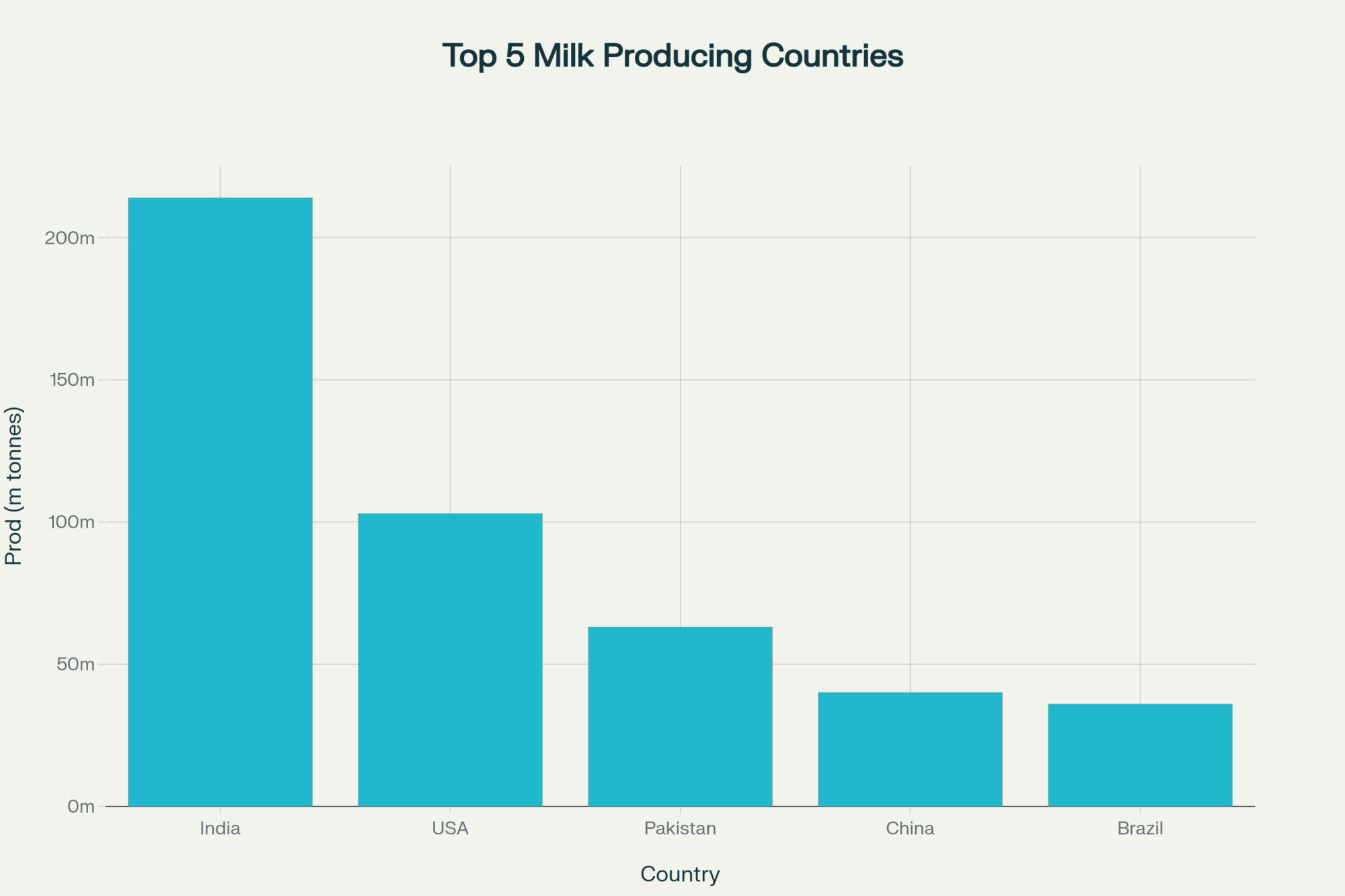
Milk production of top 5 countries in 2022 showing Pakistan’s rank

Think about that for a second. That’s more dairy animals than our entire North American inventory, and they’re producing around 64.3 million tons of milk annually, according to FAO’s latest data. That puts them third globally — behind India and the US, ahead of China and Brazil.

However, here’s where it gets interesting —and perhaps a little concerning for those of us considering long-term competition.

The Tale of Two Completely Different Dairy Worlds

What strikes me about Pakistan’s setup is how it’s basically two industries running side by side. You’ve got this massive traditional sector — we’re talking 80% of production coming from smallholder farms with just 2-5 animals each. Picture motorcycles weaving through traffic, loaded with twin milk cans, delivering fresh milk directly to consumers. That’s the reality for most of their supply chain.

Then there’s this other world emerging… and it’s impressive. Around 80 corporate mega-dairies ranging from 1,000 to 6,000 cows, with facilities that — I’m not exaggerating here — would make some of our operations take notice.

Take Interloop Dairies, recognized as Pakistan’s largest corporate dairy farm. They’re running over 10,000 Holstein Friesians with advanced milking parlors from GEA, producing export-quality mozzarella using Individual Quick Freezing technology. That’s not your typical developing market operation.

What’s fascinating is their cost structure. Abundant high-quality groundwater in Punjab province (think about that in our water-stressed environment), cheap labor, and the ability to grow corn and forages on incredibly fertile soils. Research shows that their commercial farms average 844 liters per cow daily for water usage during the summer — that’s a lot of water, but it’s available.

That combination should get anyone’s attention.

The Indigenous Foundation: Asset and Challenge

Here’s where breeding gets interesting. Pakistan’s traditional foundation is built on indigenous breeds that are perfectly adapted to local conditions, yet possess unique characteristics.

The Nili-Ravi buffalo dominates smallholder farms, and get this — recent research shows they’re producing milk with around 6.8% fat content. These animals are tough as nails — they have to be in that climate — but their genetic ceiling creates interesting dynamics. Then you have heat-tolerant Zebu cattle, such as the Sahiwal and Red Sindhi, which have evolved specifically for those conditions.

However, here’s the breeding challenge that most people don’t realize: those Nili-Ravi buffalo are prone to “silent heats,” making heat detection a significant challenge for AI adoption. From a competitive standpoint, this creates a moat around the traditional sector. You can’t just gradually upgrade these operations with better genetics — the biology doesn’t work that way.

That’s exactly why the corporate farms are going all-in on imported Holstein genetics. It’s not just about higher yields; it’s about building systems where modern breeding tech actually functions.

The Genetics Revolution Nobody Saw Coming

This development fascinates me more than anything else… Pakistan has quietly become a major destination for the same elite genetics driving productivity from Wisconsin to New Zealand.

The story that really captures what’s happening: a Pakistani veterinarian got stranded in Australia during COVID. Instead of sitting around, he worked on several high-tech Australian dairy farms and saw firsthand what elite genetics could do. When he returned home, he and two colleagues set up a dairy operation using imported, genomically tested Australian heifers.

This is where it gets impressive. HRM Dairies now genotypes all heifers with Zoetis and has produced daughters of Carenda Pilbara ranging between 348 and 470 gBPI. For context, the top 1% in Australia has an average wealth of over 267 gBPI. These aren’t just good numbers for Pakistan — these are elite numbers by any standard.

The Pakistani government has committed Rs40 billion toward genetic improvement programs. That’s transformational money.

Here’s what this means for competitive positioning: Research on 600 dairy farms in Punjab shows genomic selection could close a 55% productivity gap that currently exists. If they achieve even half those gains across their massive animal base…

Think about the implications… If a major milk-producing region can accelerate genetic progress by that magnitude, how does it change global market dynamics within a decade?

Corporate Farms That Would Impress Anyone

I’ll be honest — some of these operations are more sophisticated than farms I’ve visited in established dairy regions.

Dairyland was established with imported Australian Holstein heifers and now operates a complete “grass-to-glass” vertical integration, featuring hormone-free production and rigorous microbiological testing.

FrieslandCampina Engro’s Nara Dairy Farm spans 220 acres, housing over 6,000 animals that adhere to international health and safety standards. They’ve been pioneering corporate dairy farming since 2006, with flagship brands like Olper’s and Tarang as household names.

Everfresh Farms focuses on exceptionally high-quality fresh milk, consistently achieving low Total Plate Counts — a critical measure of milk hygiene. They’re using sophisticated milking parlors from GEA WESTFALIA Surge.

What caught my attention is the technology adoption. These aren’t scaled-up traditional operations — they’re deploying automated milking systems, climate-controlled barns with misting (essential at 50°C), TMR wagons for scientifically balanced feeding, and substantial solar installations.

What strikes me about these operations is how they’re integrating sustainability from day one. Water conservation, renewable energy, waste-to-biogas systems — they’re building climate-smart dairying into their DNA rather than retrofitting later.

The Infrastructure Reality That’s Finally Changing

Let’s talk about the elephant in the room — the cold chain that’s finally being built.

Anyone dealing with milk in extreme heat knows temperature control isn’t optional. In Pakistan’s climate, where summer temps hit 50°C (122°F), loose milk without refrigeration… well, you can imagine.

The numbers: Historically, 15-20% of milk wastage occurs due to spoilage before reaching consumers. For context, that’s equivalent to discarding the entire annual production of a mid-sized US state.

What’s interesting, though, is how targeted interventions prove this isn’t insurmountable. The World Bank’s Sindh Agriculture Growth Project provided milk chillers to producer groups, yielding immediate results: reduced waste, increased farmer incomes, and improved quality control.

Corporate farms are deploying full cold chain infrastructure alongside their advanced systems. They’re building modern dairy infrastructure from scratch, without the legacy constraints that many of us face.

For producers watching from afar: These infrastructure investments create templates that work in challenging climates. Some cooling and logistics solutions being developed could apply to southern US operations dealing with increasing heat stress.

The Productivity Gap That’s Actually an Opportunity

Here’s where numbers get really interesting. Recent research on 600 dairy farms in Punjab indicates that the average farm has a 55% yield improvement potential. By closing that gap, average operations could increase yearly fat-corrected milk production by 120,036 kg and the non-milking herd for meat by 25 head.

What strikes me is that we’re not talking about theoretical improvements. These are achievable gains based on existing technology and management practices that have already been demonstrated on corporate farms.

The study found that small farms (under 25 head) are actually more technically efficient than medium and large farms — suggesting room for improvement across all scales. Clear evidence shows that keeping higher shares of exotic cows versus local breeds, along with higher farm-gate milk prices, triggers significant efficiency gains.

That’s the productivity trajectory that could fundamentally alter global supply dynamics if it scales across their 30-million-head base.

The Export Opportunity That Changes Everything

Here’s where strategic implications become clear. Pakistan’s milk exports reached $5.47 million in 2023, primarily to Saudi Arabia ($2.78 million), the UAE ($1 million), and Somalia ($ 572,000). It might not sound like much, but industry analysts discuss export potential reaching billions.

The strategy involves utilizing buffalo milk for domestic consumption while targeting cow milk-based products for export, such as cheese, butter, and ghee. This leverages the growing base of high-yield Holstein and Jersey cows while maximizing value from different milk types.

China represents the primary target, with agreements already in place for companies like Fauji Foods Limited to begin exporting buffalo milk to China’s Royal Group. Given China’s dairy deficit and Pakistan’s geographic proximity, this could scale rapidly.

Middle East and North Africa markets offer additional opportunities, particularly for Halal-certified products, where Pakistan has natural competitive advantages.

What’s interesting from a competitive standpoint is the strategic focus on products. Rather than competing directly in commodity milk, they’re targeting value-added products where margins are higher and technical barriers create natural protection.

The Policy Wild Card Everyone’s Watching

Here’s where things get complicated… and why timing matters more than most realize.

Current policy includes an 18% sales tax on packaged milk, which has caused a 20% decline in formal sector volumes, effectively subsidizing the informal loose milk market while penalizing companies that invest in food safety and modern infrastructure.

But change is coming. The Pakistan Dairy Association proposed reducing that tax from 18% to 5%, projecting it could boost volumes by 20% and increase government revenue by 22% year-on-year. Government officials confirmed they’re reviewing this policy.

As Dr. Shehzad Amin from Pakistan Dairy Association put it: “No country taxes milk at 18% — the highest global rate is 9%. Safe milk is not a luxury, it’s a right.”

The competitive implications become clear when you consider that policy alignment could accelerate the timeline for Pakistani dairy reaching export competitiveness by several years.

Technology Adoption That’s Actually Impressive

What gets my attention is how quickly leading operations are adopting advanced technology.

Corporate farms aren’t just buying better cows — they’re deploying the full suite of modern dairy technology. Automated milking, climate-controlled housing, precision feeding, genomic testing, reproductive management software… the works.

HRM Dairies distinguished itself as the only farm in Pakistan currently conducting genomic testing. They’re not just importing genetics; they’re utilizing the same scientific selection tools that drive productivity on the most advanced farms globally.

Their genomic testing capability generates daughters that are performance-proven under Pakistani conditions. According to management, 97% of their herd achieved pregnancy last year, with low mortality and production averaging over 12,000 liters per cow. That’s world-class performance.

This trend suggests that we’re seeing “demonstration farms” — operations that prove elite genetics work under local conditions and serve as showcases for wider adoption.

Climate Innovation with Global Applications

Pakistan’s extreme climate forces innovations that could benefit dairy operations worldwide.

Research shows increasing cooling sessions to five times daily improved milk yield by 3.2 kg per day in Nili Ravi buffaloes. Studies indicate that a 1°C temperature increase reduces milk yields by 1.72 liters per month, while humidity increases further suppress yields.

These pressures drive the development of heat stress management systems with automated cooling cycles, feed adjustment protocols optimized for high-temperature periods, and water management systems designed for extreme conditions.

Technology adaptation opportunities are significant. Sprinkler cooling systems, climate-controlled housing designs, and feed formulation strategies developed for 50°C conditions could provide competitive advantages in other regions facing similar challenges — such as Texas, Arizona, or anywhere heat stress is becoming a bigger issue.

The Human Element That Makes It Real

Behind all these numbers and technology stories are people making it happen.

What resonates with me is how these operators think systemically about profitability, animal health, and long-term sustainability rather than just chasing production numbers.

The Pakistani veterinarian stranded in Australia perfectly captures how knowledge transfer happens in modern dairy. He didn’t just bring back genetics — he brought back an entire approach to dairy management that’s now influencing operations across Pakistan.

I was impressed by conversations with Muddassar Hassan from HRM Dairies, who played a key role in introducing Australian genetics to Pakistan. His background includes importing heifers from leading Australian breeders, seeing firsthand how these animals perform under local conditions.

“Profit isn’t just about milk production; it’s also about lower expenses. If your cow is producing 12,000 litres but gets mastitis twice and takes four services to get pregnant, you aren’t making much profit. But if she’s producing 8,000-9,000 litres while getting pregnant easily and staying healthy, she’s almost certainly more profitable,” he explained.

That’s practical wisdom that transcends geographic boundaries.

Regional Lessons for North American Producers

Several developments in Pakistan offer insights for producers dealing with similar challenges:

Heat stress management: Climate-controlled barn designs and cooling protocols developed for extreme conditions could benefit operations in southern US regions where summer temperatures are increasingly problematic.

Genomic acceleration: The Pakistani experience demonstrates how quickly genetic progress can be achieved when genomic testing combines with elite genetics and proper management — they’re compressing timelines that we thought would take decades.

Cooperative infrastructure: The Success of programs like the World Bank’s milk chiller project demonstrates how shared infrastructure enables smaller operations to access technology that would be uneconomical for them individually. Applications for producer cooperatives dealing with processing or cooling challenges.

Sustainability integration: Building renewable energy and resource conservation into operations from the ground up rather than retrofitting later. Their solar installations and water recycling systems are impressive.

What This Means for Global Markets (And Why You Should Care)

Implications here are bigger than most of us think. Pakistan isn’t just scaling up dairy production — it’s building an entirely different cost structure while deploying the same elite genetics that drive productivity in developed markets.

Consider the math: if these corporate operations achieve even moderate success in raising the productivity of that 30-million-head base while maintaining cost advantages, we’re potentially looking at fundamental shifts in global dairy competitiveness within the next decade.

Traditional bottlenecks — such as heat stress management, breeding efficiency, and feed quality — are being systematically addressed by operations with capital and technical sophistication, enabling the implementation of effective solutions.

And here’s the kicker: they’re doing it with labor cost structures and feed production capabilities most Western operations can’t match.

Looking Forward: What to Watch

The timeline for Pakistani dairy becoming a significant global competitor is compressing. Several factors suggest major impacts within 5-7 years:

Policy reforms that reduce tax barriers and improve regulatory consistency could accelerate the formalization of milk supply. That 18% to 5% tax reduction alone could be transformational.

Infrastructure investments in cold chain and processing capacity create the backbone for scaled operations. Once that cold chain is built, everything changes.

Genetic improvements are already yielding measurable results at leading farms and will continue to compound over time. Starting with a 55% productivity gap, there’s tremendous upside potential.

Export market development provides economic incentives for continued investment and modernization. Those Chinese contracts could be just the beginning.

The productivity improvement potential identified in recent research isn’t theoretical — it’s achievable with existing technology and management practices. If that scales across their massive animal base…

The question for North American producers isn’t whether Pakistan will become a significant dairy competitor, but when and how to position for that reality.

The Strategic Questions We Should Be Asking

This development raises fundamental questions about future global dairy competition:

Are we ready for this level of competition? When you combine scale, low costs, modern technology, and elite genetics, you get a formidable competitor.

What’s our competitive advantage moving forward? If they can deploy the same genetics and technology we use, what differentiates us?

How do we adapt our heat stress management? As climate change affects traditional dairy regions, innovations being developed for 50°C conditions could become essential.

What about our feed efficiency? Their necessity to optimize every production aspect might drive innovations we should watch.

The Bottom Line for Your Operation

So where does this leave us? Several practical takeaways:

Stay informed about global developments — what happens in Pakistan won’t stay in Pakistan. Global dairy markets are more interconnected than ever, and genetics companies, equipment manufacturers, and consultants are already active in this space.

Consider climate adaptation technologies — if heat stress is becoming a more significant issue for your operation, examine what’s being developed for extreme conditions. Some solutions might be applicable sooner than you think.

Don’t underestimate the power of genomics — the Pakistani experience shows how quickly genetic progress can accelerate with the right tools and commitment. Are you maximizing your genetic potential?

Think about your competitive advantages — what makes your operation unique in an increasingly competitive global market? Quality? Efficiency? Sustainability? Location advantages?

Watch policy developments — government decisions on taxes, trade, and regulations can dramatically shift competitive dynamics. Sometimes, policy changes matter more than technology.

The dairy industry has always been about adapting to change. The question is whether we’re adapting fast enough to stay competitive in a rapidly evolving global marketplace.

This sleeping giant is waking up fast. The combination of scale, modern technology, elite genetics, and cost advantages they’re building is unlike anything we’ve seen before in the dairy industry.

The Competitive Reality Check

Here’s what I keep coming back to: Pakistan represents a distinct model of dairy development that we haven’t seen before. Instead of gradually modernizing existing systems, they’re essentially building a parallel, modern industry alongside traditional operations.

If successful — and early indicators suggest they might be — this creates a producer with significant scale, low costs, and increasingly sophisticated genetics and management. That’s not a combination global dairy markets have had to contend with before.

For North American producers, this isn’t necessarily a crisis, but it’s definitely something to monitor. The same genetics companies we work with, the same technology providers, the same management consultants — they’re all active in Pakistan now. The knowledge and tools that give us a competitive advantage are no longer exclusive.

The question isn’t whether Pakistan’s dairy industry will continue to grow and modernize. Based on what I’m seeing, that trajectory is pretty well established. The question is how quickly they can scale their modern sector and what impact that has on global supply dynamics.

We might be looking at a new major player in global dairy markets within the next 5-10 years. Unlike some other emerging producers, they’re building on a foundation of modern technology and elite genetics from day one.

What are your thoughts? Are you seeing similar developments in other markets? How are you positioning your operation to compete in this global market?

Because one thing’s becoming clear: the global dairy industry is getting more competitive, not less. Producers who think strategically about these shifts — whether adapting climate technologies, maximizing genetic potential, or developing their own competitive advantages — will be the ones who thrive in the years ahead.

The real question isn’t whether Pakistan will become a major player in global dairy markets. Based on what I’m seeing, that trajectory is established. The question is: are we ready?

The bottom line? Pakistan’s combining our genetics with their innovation to create something we haven’t seen before. Time to steal their playbook.

Complete references and supporting documentation are available upon request by contacting the editorial team at editor@thebullvine.com.

Learn More:

Join the Revolution!

Join over 30,000 successful dairy professionals who rely on Bullvine Weekly for their competitive edge. Delivered directly to your inbox each week, our exclusive industry insights help you make smarter decisions while saving precious hours every week. Never miss critical updates on milk production trends, breakthrough technologies, and profit-boosting strategies that top producers are already implementing. Subscribe now to transform your dairy operation’s efficiency and profitability—your future success is just one click away.
NewsSubscribe
First
Last
Consent

AI Adoption in Dairy: The Strategic Imperative That’s Separating Winners from Losers

While farmers debate AI costs, smart operations capture 76% milk yield forecasting accuracy and $31/cow feed savings. Your “wait and see” is expensive.

EXECUTIVE SUMMARY: While the dairy industry clings to “traditional farmer intuition,” progressive operations are using AI to achieve 76% accuracy in milk production forecasting—leaving gut-instinct farmers bleeding money quarterly. Research across 13 Israeli farms proves AI-driven feed optimization delivers $31 per cow annually in savings, while health monitoring systems detect subclinical ketosis with 95.6% accuracy up to five days before clinical symptoms appear. Robotic milking systems require $150,000-$200,000 upfront investment but generate $32,000-$45,000 annual labor savings per robot with 60-75% direct labor reduction. Global adoption data reveals a stark competitive divide: New Zealand achieves 82% organizational AI adoption while U.S. operations lag at 25%, creating compound advantages for early adopters that stack quarterly. Michigan farms report 38% mastitis reduction in year one, California producers see 7% production increases, and the precision livestock farming market expands 11.1% to $5.59 billion in 2025. Stop waiting for “perfect” technology—your competitors are already capturing AI’s 18-month ROI timeline while you fall behind permanently.

KEY TAKEAWAYS

  • Feed Efficiency Revolution: AI-driven precision feeding systems slash feed costs by 25% overall and $31 per cow annually, while automated systems save 112 minutes daily on 120-cow operations—transforming your largest expense into competitive advantage
  • Disease Prevention Economics: Machine learning algorithms achieve 72% mastitis prediction accuracy and prevent $2,000+ losses per disease case through early detection, with treatment cost reductions of 40-70% and antibiotic usage cuts up to 70%
  • Labor Optimization Reality: Robotic milking systems deliver 60-75% direct labor reduction with 3-15% milk yield increases, generating $32,000-$45,000 annual savings per robot despite $150,000-$200,000 initial investment—payback periods now hitting 4-7 years
  • Global Competitive Intelligence: Farm size economics matter—research confirms “sizeable proportion of small-to-medium enterprises is a hindrance to AI adoption,” while larger operations capture economies of scale through high-volume data generation and superior ROI from incremental improvements
  • Environmental Revenue Streams: AI optimization reduces nitrogen excretion by 5.5 kg per cow annually and achieves 14% methane emission reductions, unlocking carbon credit markets and premium pricing up to 15% higher for verifiable sustainability practices
AI dairy farming, dairy technology adoption, milk production optimization, dairy farm profitability, precision agriculture

While everyone’s debating whether AI will replace dairy workers, smart farmers are using it to make their existing teams 40% more productive. Here’s what really gets me fired up: we’re not just talking about fancy gadgets—we’re talking about Artificial Neural Networks achieving 76% accuracy in milk production forecasting while conventional methods fumble around with gut instinct. The question isn’t whether you can afford AI—it’s whether you can afford to fall behind while your competitors gain documented productivity advantages that compound every single quarter.

The Brutal Math Nobody Wants to Talk About

Here’s what’s keeping progressive dairy operators awake at night: we’re not just facing labor shortages—we’re bleeding money while our competitors pull ahead using the same technologies we’re “still evaluating.”

But here’s what really gets me fired: while traditionalists worry about technology costs, forward-thinking operations generate verified ROI that would make any banker smile. We’re talking about documented cases where ANNs achieve 76% accuracy in milk production forecasting (with a range of 23–99%), feed optimization delivering $31 per cow annually in savings, and disease prevention systems detecting subclinical ketosis with 95.6% accuracy up to five days before clinical signs appear.

Think about this for a second: if your neighbor’s herd was consistently producing more milk with significantly less labor while preventing mastitis cases that cost you thousands per cow, how long would you wait to ask what they’re doing differently?

Section 1: The AI Reality Check – Challenging the “Wait and See” Mythology

Let’s tackle the most dangerous conventional wisdom in dairy today: the belief that “waiting for AI technology to mature” is a safe strategy. This thinking isn’t just wrong—it’s economically destructive.

The Fatal Flaw in “Wait and See” Thinking

Here’s where I’m going to challenge an industry sacred cow: the idea that cautious technology adoption protects your operation. Research shows that Artificial Neural Networks feature in 47% of reviewed studies for milk output predictions, with Convolutional Neural Networks appearing in 24%. These aren’t experimental technologies anymore—they’re proven tools with measurable results.

Why is this conventional approach failing? Because it ignores the compound nature of competitive advantage. While you’re waiting for “better” technology, early adopters are already capturing advantages that stack up quarterly. ANNs consistently demonstrate considerable accuracy in milk production forecasting, averaging 76%, often surpassing traditional statistical methods due to their superior ability to model complex, nonlinear relationships within dairy data.

Reality Check: If you’re still making breeding decisions based on gut instinct rather than AI-optimized protocols that can “halve sperm costs and predict milk yield and disease resistance with an impressive 99.8% precision, accelerating genetic progress by 300% compared to conventional methods”, you’re not being conservative—you’re being reckless.

The evidence-based alternative? Implement pilot AI projects now, focusing on immediate ROI applications while building the data infrastructure necessary for advanced implementations.

Global Adoption: The Leaders and the Laggards

Here’s something that should keep you awake tonight: the global adoption landscape reveals massive disparities that directly impact your competitive positioning. While New Zealand achieves 82% organizational AI adoption with AI collars delivering 93% efficiency boosts, the U.S. shows only 25% overall enterprise AI adoption despite leading in AI investment with $109.1 billion in 2024.

The EU presents an interesting paradox: overall enterprise adoption remains at 13.48%, but large enterprises hit 41.17% adoption rates, achieving 5-7% yield boosts through IoT collars and 12% waste reduction via AI milk analyzers. This suggests that scale matters significantly in AI implementation success.

Why This Matters for Your Operation: If you’re milking 500+ cows, you’re in the sweet spot for AI adoption. Operations under 200 cows need to consider cooperative models or service-based implementations to access these technologies economically.

Beyond Cost: The Real Barriers Nobody Discusses

Here’s where conventional wisdom gets dangerous again. The biggest obstacles aren’t financial—they’re operational. A prevalent “lack of data integration” significantly impedes farmers from fully leveraging available information. Data from various sources—including sensors on milking equipment, feed intake monitoring systems, and health tracking devices—are often disparate and challenging to link effectively.

It’s like having championship genetics but never recording breeding dates, calving ease scores, or milk yields. The tools are there, but without integrated data, you’re flying blind.

Cross-Disciplinary Reality Check: This connects directly to genetic selection efficiency. AI’s analytical capabilities extend to animal genetics, facilitating the prediction and optimization of milk production outcomes based on individual genetic profiles. But suppose your data systems can’t talk to each other. In that case, you’re missing the compound benefits where AI-driven breeding decisions optimize feed efficiency, improving health outcomes and boosting milk quality premiums.

Section 2: Implementation Roadmap – Your 12-Month AI Adoption Strategy

Let me walk you through a systematic transformation approach based on real-world implementations. This isn’t about buying the latest gadget but building a competitive advantage that compounds quarterly.

Months 1-3: Foundation Building and Critical Assessment

Question Everything About Your Current Data Flow Start by challenging how you currently make breeding, feeding, and health decisions. What specific bottlenecks are costing you money? AI applications can increase milk yield by up to 20% and reduce labor costs by 50%, but these benefits only materialize with proper strategic alignment.

Most farmers skip this step and wonder why their expensive new robot isn’t delivering promised results. Your data infrastructure determines AI success more than the algorithms’ sophistication.

Infrastructure Reality Check Most critically, ensure internet connectivity meets network requirements—AI systems often depend on stable connections. Data’s strategic integration and homogenization present a substantial opportunity to enrich analyses and profoundly improve farm management decisions.

Financial Deep Dive Beyond Simple Payback Here’s where most farmers get it wrong: they focus only on equipment costs. Conduct a comprehensive cost-benefit analysis extending beyond initial purchase costs. Robotic milking systems require substantial upfront investment—$150,000 to $200,000 per robot, or $3,200 to $3,800 per cow—but deliver $32,000-$45,000 in annual labor savings per robot.

Months 4-6: Technology Selection and Pilot Implementation

Start Where ROI Is Fastest: Feed and Health Focus on applications with the fastest ROI—typically feed optimization or health monitoring. Machine learning algorithms achieve 72% accuracy in predicting mastitis cases, while automated feeding systems save approximately 112 minutes per day on a 120-animal farm.

Why This Matters for Your Operation: The prevention of a single clinical disease during a cow’s transition period can result in a 3.5% increase in her 305-day milk yield, with AI systems capable of preventing significant financial losses potentially exceeding $2,000 per cow for single disease cases.

Months 7-9: System Integration and Cross-Disciplinary Optimization

Connect the Dots Between Genetics, Nutrition, and Economics This is where AI’s real power emerges. Focus on seamless integration of diverse data streams. While AI promises enhanced decision-making through existing farm data systems integration, success depends on establishing a robust data infrastructure and standardized protocols.

Labor Evolution, Not Replacement Plan for skills transformation. AI “reduces the burden on farm staff, allowing them to focus on more critical, decision-centric responsibilities”. This isn’t about job displacement—it’s role redefinition where humans evolve from performing routine tasks to interpreting AI outputs for strategic decisions.

Months 10-12: Optimization and Scaling Across Disciplines

Performance Monitoring with Cross-Impact Analysis Track measurable improvements across interconnected metrics. AI systems average 76% accuracy in forecasting milk production, while automated activity monitoring systems reach 90% detection rates for heat with 100% accuracy.

Scaling Decisions Based on Compound Benefits Consider how technology simultaneously scales across breeding programs, feed efficiency, and health management. The research shows AI models capable of identifying critical health conditions with high accuracy: hypocalcemia (72% AUC), ketosis (66% AUC), metritis (82% AUC), and mastitis (92% AUC).

Section 3: ROI Analysis – Real Numbers from Real Farms

Let’s examine documented ROI data from actual implementations, because claims without evidence are worthless in strategic planning.

Feed Optimization: Where Genetics Meets Economics

AI-driven feed optimization delivers some of the fastest ROI returns. Precision feeding systems achieve a 25% reduction in overall feed costs, with optimizing diet accuracy through intelligent farm data leveraging, decreasing feed costs by $31 annually per cow.

For a 500-cow operation, this translates to $15,500 annual savings in feed costs alone. But here’s the cross-disciplinary connection most farmers miss: AI-driven systems automate the management of feed timing and quantity, optimizing milk production per feed unit and substantially reducing waste.

Economic Reality: Think of it like precision genetics for nutrition. Instead of feeding every cow the same TMR regardless of genetic merit, lactation stage, or individual DMI patterns, you’re customizing rations based on individual cow data that connects directly to her genetic potential for feed conversion efficiency.

Environmental benefits add another revenue stream: optimized diets reduce nitrogen excretion by 5.5 kg per cow per year. An AI-driven model focused on enteric methane mitigation achieved a 14% reduction in emissions on commercial farms, positioning operations for carbon credit opportunities.

Health Management: Prevention Over Treatment Economics

Early disease detection represents perhaps the most compelling ROI story in dairy AI. Machine learning algorithms achieve 72% accuracy in predicting mastitis cases, while subclinical ketosis can be detected with 95.6% accuracy up to five days before clinical signs appear.

The financial impact is dramatic:

  • Treatment cost reduction: 40-70%
  • Antibiotic usage reduction: up to 70%
  • Veterinary expense reduction: 20%
  • Disease prevention value: exceeding $2,000 per cow for single disease cases

Cross-Disciplinary Impact: One Michigan farm reported a 38% drop in mastitis cases within the first year of implementing robotic milking systems. But the compound benefit extends beyond immediate health savings—healthier cows with consistent milk quality achieve better genetic expression, improving breeding decisions and long-term herd improvement.

Robotic Milking: Labor, Genetics, and Economics Integration

Robotic milking systems represent AI’s most comprehensive impact across multiple disciplines:

  • Annual labor savings: $32,000-$45,000 per robot
  • Milk yield increase: 3-15%
  • Direct milking labor reduction: 60-75%
  • Payback period: 4-7 years

A California producer managing 1,250 cows with 20 robots reported a 7% increase in production and a 40% reduction in labor. Wisconsin producers are achieving payback in just over six years instead of the projected nine years due to increased production and labor savings.

Why This Matters Beyond Labor Savings: Robots’ consistent routines and detailed data contribute to better udder health and overall milk quality, creating data streams that improve genetic selection accuracy and feed optimization decisions.

Section 4: Global Competitive Intelligence – Where Markets Are Heading

Understanding global AI adoption patterns isn’t academic—it’s competitive intelligence that directly impacts your operation’s future viability.

The Asian Advantage: Why Western Farmers Should Pay Attention

Asia-Pacific markets are moving aggressively beyond traditional dairy paradigms. India shows 57% national AI adoption with 71% of companies planning significant AI investments, while China leads with 58% national adoption and 61.1% of global AI patents originating there.

What This Means for Your Operation: Adopting AI in dairy cattle in Kenya resulted in an 11% monetary gain. This isn’t happening in some high-tech laboratory—this is a real-world application delivering measurable results in challenging economic conditions.

European Integration: Policy, Sustainability, and Economics

EU adoption patterns reveal sophisticated integration of AI with sustainability mandates. The EU Green Deal is driving efficiency gains through technology, with IoT collars delivering 5-7% yield boosts and AI milk analyzers achieving 12% waste reduction.

Policy Analysis: This creates strategic opportunities for non-EU operations to capture premium markets that reward verifiable environmental practices. AI applications like “udder-to-table tracking” using sensors create “fraud-proof records” commanding premium pricing up to 15% more for verifiable welfare practices.

New Zealand’s Strategic Positioning

New Zealand’s 82% organizational AI adoption rate isn’t accidental—it’s strategic market positioning. AI applications are projected to contribute NZ$2.1 billion to their economy by 2035, with AI collars for herd management delivering 93% efficiency boosts.

Cross-Market Implications: Small geographic scale doesn’t limit technological leadership. Concentrated, high-value dairy operations can achieve technological advantages that translate directly into export market premiums.

Market Timing: The Competitive Window

The global precision livestock farming market is experiencing rapid growth, expanding 11.1% to $5.59 billion in 2025 and projected to reach $7.93 billion by 2029. This isn’t gradual adoption—it’s accelerating transformation.

Think of it like the transition from conventional to genomic testing fifteen years ago. Early adopters captured genetic advantages that compounded over generations. Late adopters are still catching up. The same dynamic is happening with AI—except the competitive cycle is faster.

Why “Farm Size Doesn’t Matter” Is Destroying Dairy Profitability

Nobody wants to discuss the controversial truth: the dairy industry’s romanticization of small-scale operations is actively undermining competitive advantage and economic sustainability in the AI era.

The Research Says What We’re All Thinking: The data is unambiguous—”a sizeable proportion of small-to-medium-sized enterprises… is a hindrance to more widespread use of AI”. Why? Because larger operations benefit from economies of scale, where high volume throughput generates more refined data and greater returns from incremental AI-driven improvements.

The Economic Reality Nobody Discusses: AI adoption faces significant barriers, “particularly in small businesses,” due to high costs and lack of infrastructure. This dynamic could potentially widen the economic performance gap between large, technologically advanced farms and smaller, less resourced operations.

Instead of pretending all farm sizes are equally viable, we should ask: How do we restructure the industry to capture AI benefits across all operations? This might mean cooperative AI systems, shared data platforms, or strategic consolidation that maintains family ownership while achieving operational scale.

Cross-Disciplinary Implications: This isn’t just about technology but genetics, economics, and policy. Small operations can’t afford genomic testing on enough animals to make statistically significant breeding decisions. They can’t generate enough data points for AI health monitoring to achieve meaningful accuracy. They can’t justify the fixed costs of robotic milking systems.

The Solution Most Won’t Consider: Maybe the answer isn’t making AI cheaper—maybe it’s making operations larger through innovative structures that preserve family control while achieving technological scale.

Industry Maverick Profile: The Israeli Environmental Innovation

Let me tell you about a group that’s completely rewriting the environmental playbook using AI. Researchers across 13 commercial Israeli dairy farms developed an AI-driven model that predicts which farms will benefit most from methane-reducing feed additives.

The Breakthrough: Instead of applying expensive additives to all farms (the traditional approach), their AI model identified 50% of farms that would benefit most. Result? A 14% reduction in enteric methane emissions versus only 8% with the traditional “spray and pray” approach.

Why This Matters Globally: This demonstrates AI’s capacity to address major environmental challenges with measurable results while improving economic efficiency. The statistical validation (Kendall’s Tau = -0.73, Spearman’s Rho = -0.89) confirms the model’s accuracy.

Cross-Disciplinary Impact: This isn’t just environmental—it’s economic, genetic, and policy-relevant. Operations that can prove verified emission reductions capture carbon credit revenue, satisfy regulatory requirements, and appeal to environmentally conscious consumers willing to pay premiums.

Case Study: Michigan’s Mastitis Revolution

Here’s a real-world example that’ll make you question everything about reactive health management. One Michigan farm implementing robotic milking systems with AI-powered health monitoring reported a 38% drop in mastitis cases in their first year.

The Numbers: With mastitis treatment costs averaging $200-400 per case and production losses reaching $2,000+ per severe case, this farm potentially saved $50,000-$100,000 annually for a 200-cow operation. But here’s the kicker—the compound benefits extended far beyond immediate health savings.

The Cross-Disciplinary Connection: Healthier cows maintained consistent milk quality and production, enabling more accurate genetic selection decisions. The continuous data stream from robotic milking provided unprecedented insights into individual cow performance, leading to optimized feeding protocols and improved breeding choices.

This demonstrates the multiplier effect of AI adoption. Single-point solutions deliver linear improvements, but integrated AI systems create exponential benefits across genetics, nutrition, health, and economics.

The Bottom Line

The farms documenting substantial productivity improvements aren’t using magic—they’re systematically implementing AI across feed optimization (delivering $31 per cow annually in savings), health management (preventing $2,000+ losses per disease case), and labor efficiency (60-75% direct labor reduction). Your ROI timeline starts with immediate feed cost savings, accelerates through disease prevention, and compounds through improved milk yields and reduced labor costs.

But here’s what really gets me fired up: we’re not just talking about incremental improvements. We’re talking about fundamental transformation where AI-optimized breeding programs generate superior genetics, improving feed conversion efficiency, reducing environmental impact, unlocking premium markets and carbon credits, and furthering AI adoption in a virtuous cycle of competitive advantage.

Reality Check: The competitive reality is stark—operations implementing comprehensive AI strategies are building sustainable advantages that compound quarterly. Those waiting for “perfect” technology or “cheaper” solutions are falling behind permanently. The global precision livestock farming market, growing 11.1% to $5.59 billion in 2025, isn’t waiting for stragglers.

Your next step isn’t buying technology—it’s conducting the comprehensive assessment outlined in this roadmap. Ask yourself these critical questions based on documented research:

  1. Are you losing $31 per cow annually by not optimizing feed accuracy?
  2. How many $2,000+ disease cases could AI prevent on your operation this year?
  3. Can you afford to fall further behind while your competitors capture 76% accuracy in milk production forecasting?
  4. Is ignoring 99.8% precision breeding protocols really “traditional farming” or just expensive stubbornness?
  5. Are you missing environmental revenue opportunities worth 15% premiums for verifiable sustainability practices?

Because in 18 months, you’ll either celebrate documented productivity gains across genetics, nutrition, health, and economics, or explain to your banker why your competitors pulled ahead. The window for competitive AI adoption is narrowing rapidly, but hasn’t closed.

The choice is yours. But choose quickly—your competitors already are.

Source:  Serrano-Torres, G. J., López-Naranjo, A. L., Larrea-Cuadrado, P. L., & Mazón-Fierro, G. (2025). Transformation of the Dairy Supply Chain Through Artificial Intelligence: A Systematic Review. Sustainability, 17(3), 982.

Learn More:

Join the Revolution!

Join over 30,000 successful dairy professionals who rely on Bullvine Weekly for their competitive edge. Delivered directly to your inbox each week, our exclusive industry insights help you make smarter decisions while saving precious hours every week. Never miss critical updates on milk production trends, breakthrough technologies, and profit-boosting strategies that top producers are already implementing. Subscribe now to transform your dairy operation’s efficiency and profitability—your future success is just one click away.
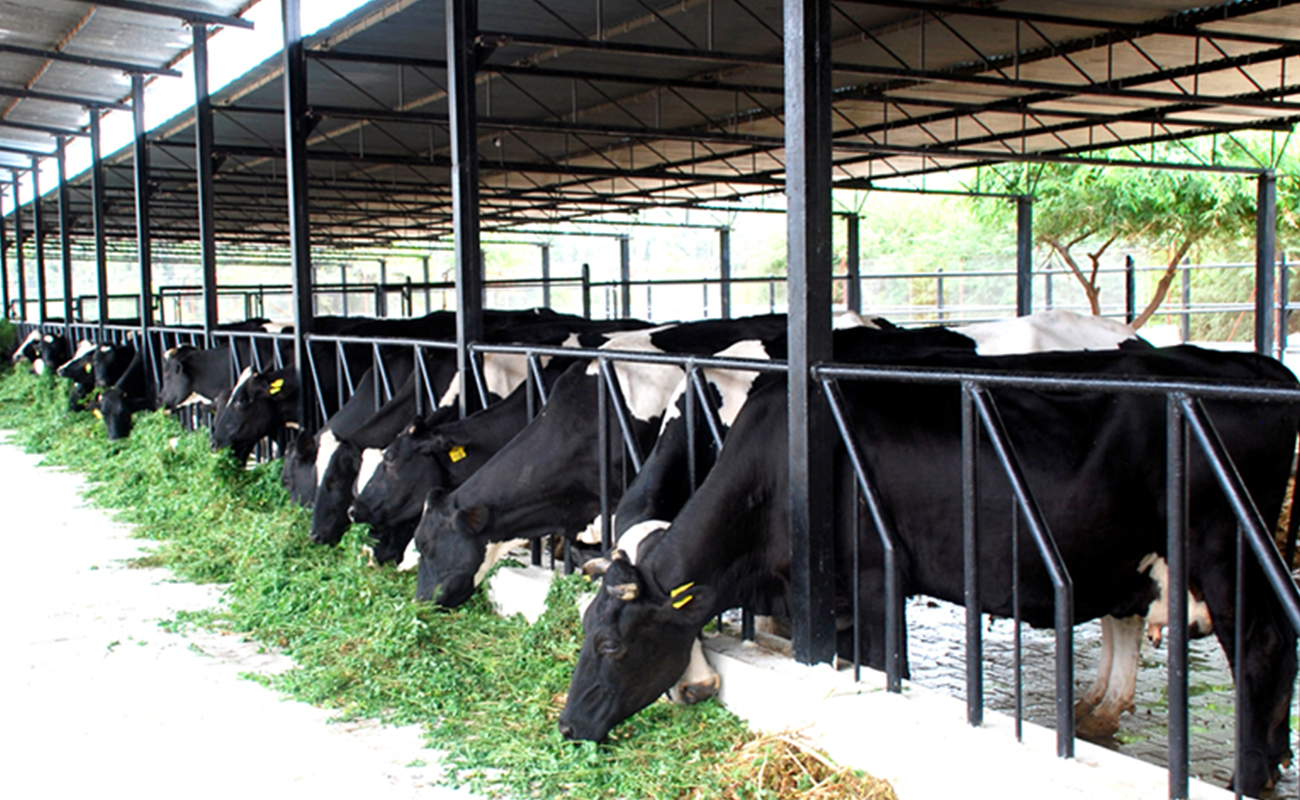
NewsSubscribe
First
Last
Consent

European Dairy Farmers Fight Back: How Trade Deals Threaten Your Market Share and What You Can Do About It

Stop waiting for trade policy salvation. EU farmers cutting losses 15% through component optimization while competitors flood markets with cheap imports.

EXECUTIVE SUMMARY: European dairy farmers are discovering that crying about unfair trade deals won’t save their operations—but strategic component optimization and technology adoption will. While Spanish farmers project €1 billion losses in 2025 from Mercosur and Ukraine import pressure, smart operators are leveraging the fact that cheese production is forecast to increase 0.6% to 10.8 million tonnes despite EU milk production declining 0.2% to 149.4 million tonnes. The uncomfortable truth: farms implementing IoT technology are achieving 5-12% efficiency gains and positioning themselves for premium cheese-quality milk markets, while their neighbors protest quotas allowing 30,000 tonnes of Mercosur cheese into EU markets. Technology adoption isn’t just about staying competitive anymore—it’s about survival in a market where every liter must generate maximum value through optimal butterfat and protein profiles. The EU’s policy shift from “Farm to Fork” to economic sustainability creates a narrow window for operations to build component leadership before import pressure peaks. Instead of hoping politicians will solve your problems, ask yourself: are you producing 4.5% butterfat milk that processors fight over, or 3.5% commodity milk headed for the blending tank?

KEY TAKEAWAYS

  • Component Wars Are Here: With cheese production increasing 0.6% while milk volume drops 0.2%, operations achieving above-average component levels (4.0%+ butterfat, 3.2%+ protein) command premium pricing that cheap imports struggle to match—delivering $120-180 more per cow annually through strategic breeding and precision feeding.
  • Technology = Survival Insurance: Farms implementing precision agriculture and IoT monitoring systems are capturing 5-12% efficiency gains while reducing health-related costs by 30%, creating competitive advantages that work regardless of trade policy changes or import quotas.
  • Policy Pivot Creates Opportunity: The EU’s strategic shift from environmental compliance to economic sustainability under the new “Vision for Agriculture and Food” provides a 2-3 year window for progressive operators to build market positioning before regulatory requirements potentially tighten again.
  • Double Standard = Competitive Edge: While European farmers face strict environmental regulations that Mercosur imports avoid, smart operations are leveraging this “burden” as a marketing advantage, using AI-powered monitoring systems to document quality advantages that consumers and processors increasingly demand.
  • Protest Politics vs. Profit Strategy: Spanish farmers projecting €1 billion losses are learning that waiting for blocking minorities against trade deals wastes time—meanwhile, operations investing in component optimization and technological efficiency are building resilience that survives any import pressure or policy change.
European dairy farming, dairy competitiveness, precision agriculture, milk component optimization, dairy technology adoption

European dairy farmers are facing an unprecedented challenge as massive trade agreements flood their markets with cheaper imports produced under lower standards. While EU milk production is forecast to decline 0.2% in 2025 to 149.4 million tonnes (European Union: Dairy and Products Annual), new quotas allow 30,000 tonnes of Mercosur cheese and 10,000 tonnes of milk powder into European markets at reduced tariffs. With cheese production forecast to increase 0.6% to 10.8 million tonnes despite declining milk supplies (EU Dairy Production Falls as Brussels Pivots from Farm to Fork to New Vision), the question isn’t whether this will impact your operation—it’s how quickly you’ll adapt to survive the component wars ahead.

Why Are European Dairy Farmers Taking to the Streets?

Here’s the uncomfortable truth the industry doesn’t want to discuss: European farmers aren’t just protesting trade policy—they’re fighting against a rigged game where they’re forced to play by premium rules while competing against commodity pricing.

French and Spanish farmers aren’t protesting just for the headlines. They’re fighting for their economic survival against what they see as a fundamentally unfair system that demands premium standards from European operations while opening the floodgates to imports produced under dramatically different rules.

Spanish farmers alone project losses of €1 billion in 2025, largely attributed to trade agreements that have driven prices below sustainable production costs. But here’s what the agricultural establishment won’t tell you: this isn’t just about short-term market disruption—it’s about a systematic dismantling of the European dairy industry’s competitive foundation.

Imagine you’re running a high-SCC penalty system where European farms get docked for anything above 200,000 cells/mL while imports face no somatic cell count requirements. That’s essentially what’s happening with environmental and welfare standards across these trade deals.

But why is this happening now? The answer reveals a fundamental flaw in how European policymakers think about agriculture. They’ve created a regulatory environment that treats farming like manufacturing—optimizing for compliance rather than competitiveness.

According to industry analysis, implementing the European Green Deal could reduce cattle output by 10-15%, with farm revenues varying significantly by region (How the European Green Deal Affects Dairy Farmers). While some farms may see revenue increases, others will face substantial decreases due to regional restrictions and varying CAP fund distributions.

Jean-Michel Schaeffer, head of French poultry industry group Anvol, summed up the core frustration: “Our demands are simple: reciprocity of rules, traceability abroad, and much clearer labeling.” It’s not about protectionism—it’s about fair competition.

What Does the EU-Mercosur Deal Mean for Your Dairy Operation?

Let’s cut through the political rhetoric and focus on the concrete impacts heading your way. The EU-Mercosur agreement, finalized in December 2024, creates specific import quotas that will directly affect your market positioning.

The Dairy-Specific Damage

Here’s the reality nobody wants to discuss: the cheese quota system is designed to fail European producers. The agreement establishes a 30,000-tonne quota for Mercosur cheeses entering EU markets, with gradual tariff reductions from current 28% levels over 10 years, starting with 3,000 tonnes initially.

Milk powder operations face an even bleaker scenario. Quotas expand from 1,000 to 10,000 tonnes over the implementation period, achieving tariff-free status at the end of the 10-year timeline. Considering that EU milk powder exports to major markets declined 20% between January-August 2024 versus 2023, you’re looking at a perfect storm of shrinking export opportunities and increased import competition.

Here’s what the dairy-specific quotas look like:

ProductQuota VolumeTariff ReductionImplementation Timeline
Cheese30,000 tonnes (starting 3,000)From 28% to zero10-year phase-in
Milk Powder1,000 to 10,000 tonnesTo zero tariff10-year phase-in
Infant FormulaVolume unspecified18% reductionImmediate implementation

Why This Matters for Your Operation: These quotas represent more than market access—they’re changing the competitive landscape for component-rich products. The conventional wisdom that European quality commands premium pricing is about to be tested like never before.

How Are Environmental Regulations Creating a Double Burden?

Here’s where conventional dairy industry thinking falls apart completely. The European Green Deal isn’t just an environmental policy—it’s accidentally become the most effective trade protection dismantling mechanism in EU history.

Following the Green Deal requirements could reduce cattle output by 10-15%, with significant variations in farm revenues depending on regional restrictions and CAP fund variations (How the European Green Deal Affects Dairy Farmers). The costs of additional environmental measures represent significant economic considerations for dairy farmers, while imports face no such requirements.

You’re being asked to meet increasingly strict environmental standards while competing against imports without such requirements. These environmental compliance costs aren’t just regulatory boxes to check—they’re substantial cost centers that directly impact your bottom line.

Think of it like this: It’s like running a precision feeding program that optimizes dry matter intake (DMI) to 24 kg/day for maximum metabolizable energy (ME) efficiency while your competitors dump whatever’s cheapest in the feed bunk. Your milk yield per cow might be higher, but their cost per hundredweight crushes yours.

Meanwhile, Mercosur producers operate entirely under different rules. They can use production methods that are restricted or banned in European operations, including GMO feeds and growth promoters. You’re literally being forced to compete with one hand tied behind your back.

But here’s the question nobody’s asking: Why did European policymakers create this system in the first place? The answer reveals a fundamental misunderstanding of how global agricultural markets actually work.

Spanish farmer leader Javier Fatas captured this perfectly: “This happens because of trade deals signed by Spain and the EU as part of geopolitics, bringing us prices too low to sustain our farms.”

The Ukraine Complication: Market Disruption in Real Numbers

The EU’s trade relationship with Ukraine has undergone significant changes that directly impact dairy markets. Following the expiration of the duty-free regime on June 6, 2025, new quotas have been reinstated for Ukrainian agricultural products (European Commission approves quotas for Ukrainian agricultural products).

The specific dairy-related quotas for the remainder of 2025 include:

  • Milk and cream: 5,833 tonnes (from annual 10,000 tonnes)
  • Dry milk: 2,917 tonnes (from annual 5,000 tonnes)
  • Butter: 1,750 tonnes (from annual 3,000 tonnes)

Ukraine could face an estimated loss of $800 million in export revenue for the remainder of 2025 due to these reinstated quotas. However, the damage to European farmers occurred during the period of full liberalization, when Ukrainian products flooded markets with minimal restrictions.

Why This Matters for Your Operation: The initial flood of Ukrainian dairy products during the emergency liberalization period created market disruptions from which neighboring EU farmers are still recovering. Even with quotas back in place, the market memory of that pricing pressure lingers.

Strategic Positioning: How Top Performers Are Adapting

While the trade environment presents challenges, smart dairy operations are already adapting their strategies. But here’s what the industry consultants won’t tell you: the conventional “premium positioning” approach is about to become irrelevant.

Component Optimization: The New Profit Strategy

Despite declining milk production (forecast down 0.2% to 149.4 million tonnes), cheese production is forecast to increase 0.6% to 10.8 million tonnes in 2025 (European Union: Dairy and Products Annual). This shift toward high-value products represents a strategic opportunity for operations willing to invest in specialized production capabilities.

Here’s the uncomfortable truth about component optimization: Most European dairy farmers still think like volume producers in a component world. EU processors are carefully deciding which products to prioritize with available milk supplies, with cheese remaining the primary output goal supported by solid domestic consumption and continued export demand.

This strategic product allocation comes at the expense of butter, non-fat dry milk (NFDM), and whole milk powder production (European Union: Dairy and Products Annual). Smart farmers need to align their production strategies with these processor priorities.

Technology Investment for Efficiency

Here’s where conventional wisdom about technology adoption gets dangerous. With margins under pressure, operational efficiency becomes critical. Technology adoption, including IoT collars and AI milk analyzers, offers 5-12% efficiency gains, helping offset declining cow numbers (EU Dairy Production Falls as Brussels Pivots from Farm to Fork to New Vision).

But here’s what the equipment dealers won’t tell you: Most farms implement technology without understanding the data it generates. The farms that will thrive aren’t just adopting technology—they’re fundamentally using it to rethink their operational philosophy.

Why This Matters for Your Operation: Lower milk production is expected to be only partially offset by lower fluid milk consumption (projected to decrease 0.3% to 23.5 million tonnes in 2025) (European Union: Dairy and Products Annual). This means every liter of milk must generate maximum value through optimal component profiles and efficient production systems.

Policy Response: From Stick to Carrot

Responding to widespread farmer protests, European policymakers have dramatically shifted their approach. The European Commission has replaced its Farm to Fork strategy with a new “Vision for Agriculture and Food” that shifts emphasis from environmental requirements toward economic sustainability, resilience, and simplification (EU Dairy Production Falls as Brussels Pivots from Farm to Fork to New Vision).

This represents a fundamental change in agricultural policy philosophy—moving from “stick to carrot” and “green to lean” approaches prioritizing farm economic viability alongside environmental goals.

But here’s the critical question: Why are European farmers depending on policy solutions instead of building competitive advantages that work regardless of trade policy?

The Vision for Agriculture and Food explicitly emphasizes economic sustainability rather than environmental compliance as the primary driver, marking a clear departure from previous Farm to Fork priorities. However, policy changes alone won’t solve European dairy’s structural competitive challenges.

What This Means for Your Operation’s Future

Here’s the strategic reality the dairy industry doesn’t want to discuss: European dairy farming is entering a new era where traditional competitive advantages no longer guarantee survival.

Immediate Actions You Can Take

Audit your component profile now. With cheese production prioritized despite declining milk supplies, understanding your butterfat and protein percentages becomes critical for strategic decision-making. Operations achieving above-average component levels can command premium pricing that imports struggle to match.

But here’s the critical question: How many European farmers actually know their true component costs versus volume costs?

Implement precision feeding protocols. Optimize dry matter intake and metabolizable energy levels to maximize component production. With technology offering 5-12% efficiency gains, precision feeding systems deliver proven ROI through reduced waste and improved milk composition.

Focus on cheese-quality milk production. Since processors prioritize cheese production (up 0.6% despite milk constraints), positioning your operation to supply high-quality cheese milk provides a competitive advantage and pricing premiums.

Long-Term Strategic Considerations

Technology adoption becomes non-negotiable. The efficiency gains from modern dairy technology aren’t optional luxuries—they’re survival requirements in a more competitive environment.

Here’s the strategic question every European dairy farmer must answer: Will you invest in becoming data-driven, or will you hope that traditional methods somehow remain competitive?

Consider this perspective: Just like transitioning from visual heat detection to activity monitoring collars, adapting to new trade realities requires embracing technology and data-driven decision making rather than hoping traditional methods will suffice.

The Bottom Line

European dairy farmers face their most challenging competitive environment in decades. With EU milk production declining 0.2% to 149.4 million tonnes while cheese production increases 0.6% to 10.8 million tonnes (European Union: Dairy and Products Annual), the farms that thrive will be those who stop waiting for policy solutions and start building component optimization and operational efficiency advantages that work in any competitive environment.

The protest movement across France and Spain represents more than frustration—it’s a wake-up call that traditional European dairy farming approaches are no longer sustainable in a global market. Whether through policy changes or market adaptation, the industry must find ways to ensure that high-standard production becomes economically advantageous, not just morally superior.

The EU-Mercosur deal’s 30,000-tonne cheese quota and 10,000-tonne milk powder quota, combined with reinstated Ukrainian quotas of 5,833 tonnes for milk/cream and 2,917 tonnes for dry milk, represent fundamental shifts in competitive dynamics that require an immediate strategic response.

Here’s your strategic challenge: While your competitors protest trade policies, will you build a component-optimized, technologically advanced operation that can compete regardless of import pressure?

Take action now: Evaluate your component profile using precision testing, identify your competitive advantages through systematic data collection, and start building the operational resilience you’ll need to thrive in Europe’s changing dairy landscape. The farmers who wait for policy solutions will be the ones struggling to survive when the full impact hits their bottom line.

Here’s the final uncomfortable truth: You can either be the operation producing premium cheese-quality milk that processors fight over or the one producing commodity milk that gets relegated to lower-value products. The choice you make today determines which category you’ll occupy when import pressure peaks.

Your decisive moment is now: Are you ready to embrace component optimization, technological efficiency, and data-driven management strategies that successful farms worldwide are already implementing, or will you continue hoping that traditional approaches will somehow compete against operations using every technological advantage available?

The data provides the roadmap. Your response determines whether you’ll lead or follow in European dairy’s rapidly evolving competitive landscape.

Ready to transform your operation? Start with a comprehensive component analysis and technology audit. The farms implementing these strategies today will be the industry leaders tomorrow—while those waiting for easier times may find themselves waiting forever.

Learn More:

Join the Revolution!

Join over 30,000 successful dairy professionals who rely on Bullvine Weekly for their competitive edge. Delivered directly to your inbox each week, our exclusive industry insights help you make smarter decisions while saving precious hours every week. Never miss critical updates on milk production trends, breakthrough technologies, and profit-boosting strategies that top producers are already implementing. Subscribe now to transform your dairy operation’s efficiency and profitability—your future success is just one click away.

NewsSubscribe
First
Last
Consent
Send this to a friend