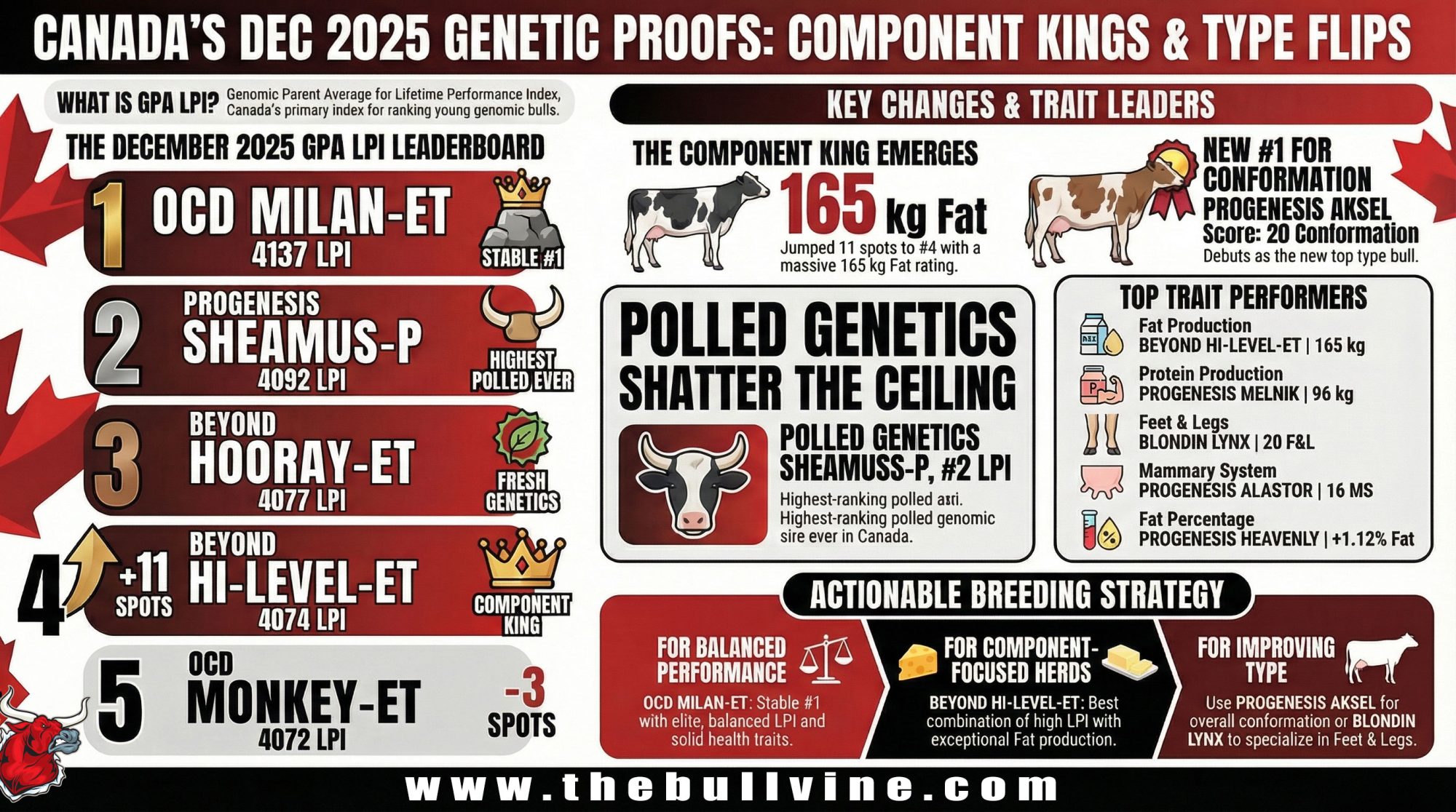
BEYOND HI-LEVEL just hit 165 kg fat and jumped 11 spots. PROGENESIS AKSEL took the type crown. Your December matings need revision—now.
Executive Summary: OCD MILAN-ET holds #1 at 4137 GPA LPI—but December’s real headlines belong to three bulls who just crashed the top 5. BEYOND HI-LEVEL-ET vaulted 11 spots to #4, posting 165 kg fat that makes him the component king of this proof run. PROGENESIS SHEAMUS-P debuted at #2 as Canada’s highest-ranking polled genomic sire ever. BEYOND HOORAY-ET claimed #3 with +1.10% fat and +0.52% protein—percentages that justify immediate mating list revisions. The conformation crown changed hands too: PROGENESIS AKSEL dethroned WALNUTLAWN PG BRIGHTSTAR for #1 type. Breeders now have fresh genetic ammunition for their 2026 breeding programs.
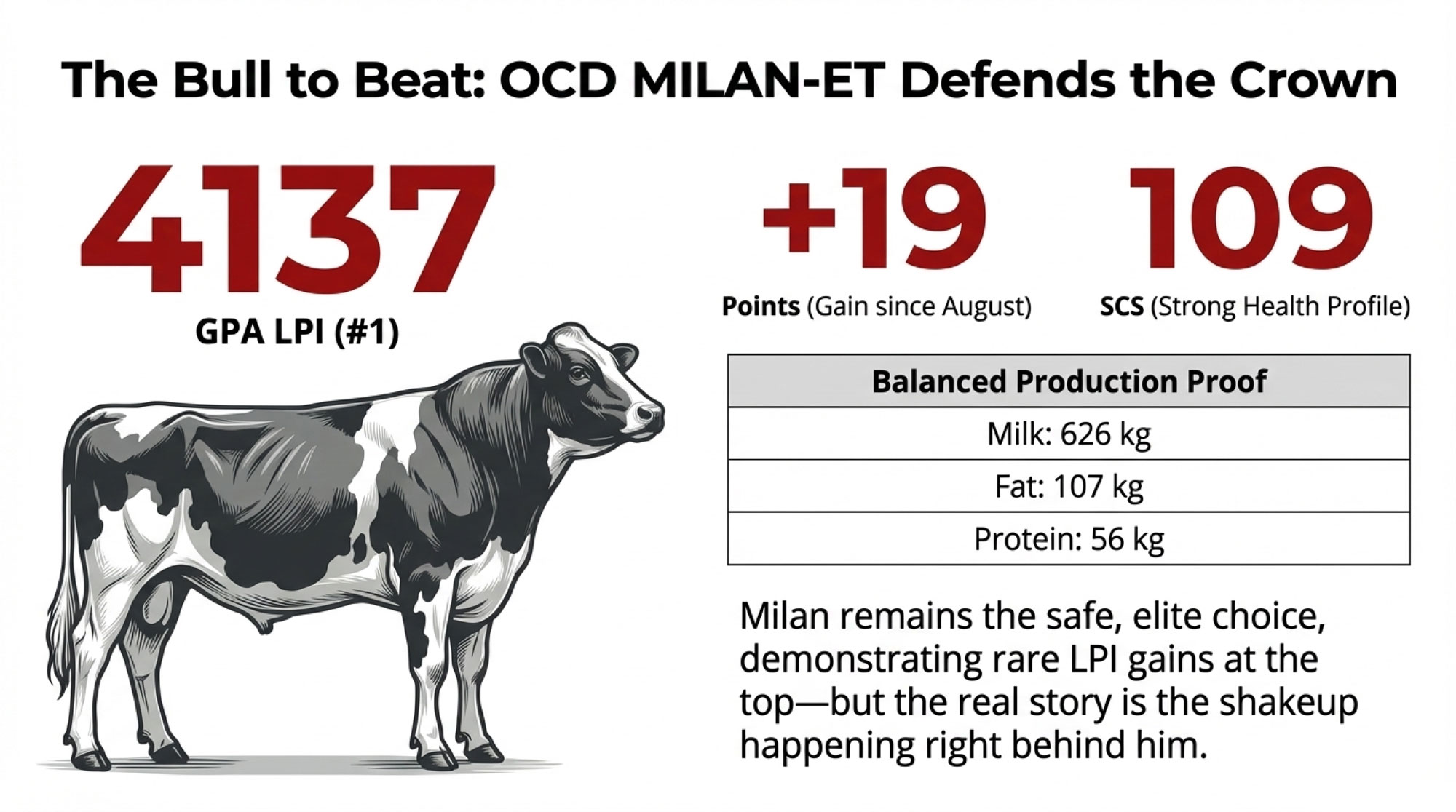
OCD MILAN-ET remains the bull to beat, actually increasing his GPA LPI from 4118 in August to 4137 in December—a 19-point gain that’s rare at this elite level. His production profile shows 626 kg of Milk, 107 kg of Fat, and 56 kg of Protein.
The real story is what happened behind him:
Rank
Bull
Dec ’25 LPI
Aug ’25 LPI
Movement
Milk (kg)
Fat (kg)
Protein (kg)
1
OCD MILAN-ET
4137
4118
—
626
107
56
2
PROGENESIS SHEAMUS-P
4092
N/A
NEW
45
91
48
3
BEYOND HOORAY-ET
4077
N/A
NEW
485
148
79
4
BEYOND HI-LEVEL-ET
4074
4007
↑11
1348
165
87
5
OCD MONKEY-ET
4072
4105
↓3
1131
130
71
6
ADAWAY BEYOND FAITHFUL-ET
4070
4025
↑3
1364
129
89
7
OCD MANNY-ET
4066
4056
↓3
457
88
44
PROGENESIS SHEAMUS-P enters as a polled option at #2, bringing genetic diversity without sacrificing elite LPI. Meanwhile, BEYOND HI-LEVEL-ET’s leap to #4 represents one of the most significant proof gains this year, combining elite volume (1348 kg Milk) with exceptional component density.
Component Kings: Where the Real Money Is
With protein premiums strengthening across Canadian markets, breeders should note these component standouts from the top 100 GPA LPI:
Fat Production Leaders:
BEYOND HI-LEVEL-ET: 165 kg Fat
OCD TESLA SHEPARD-ET: 158 kg Fat
FLY-HIGHER SANTORINI-ET: 155 kg Fat
Protein Champions:
PROGENESIS MELNIK: 96 kg Protein (#13 LPI)
PEAK ALTASAFEZONE-ET: 96 kg Protein (#82 LPI)
Percentage Extremes for Component-Focused Herds:
BEYOND HOORAY-ET: +1.10% Fat, +0.52% Protein
PROGENESIS HEAVENLY: +1.12% Fat
These percentages matter increasingly as processors reward component density over volume.
Health and Longevity: Don’t Sacrifice the Cow
The December evaluations highlight significant variation in health traits among top LPI bulls:
Strong Health Profiles:
OCD MILAN-ET: 109 SCS
OCD MANNY-ET: 110 SCS
SYNERGY KICKSTART-ET: 100 SCS (breed average)
Herd Life Leaders:
PROGENESIS LEONIDAS: HL=12
OCD MANGO-ET: HL=10
Rumen Health Considerations: Bulls like OCD MANGO-ET (RP=13) and PROGENESIS LEONIDAS (RP=10) show strong positive RP scores. However, several high-LPI bulls carry negative RP scores—T-SPRUCE SUNSET-ET (RP=-11) and SIEMERS SSI SUN MEERKAT-ET (RP=-12)—requiring careful mating decisions.
Conformation Shakeup: Progenesis Takes the Type Throne
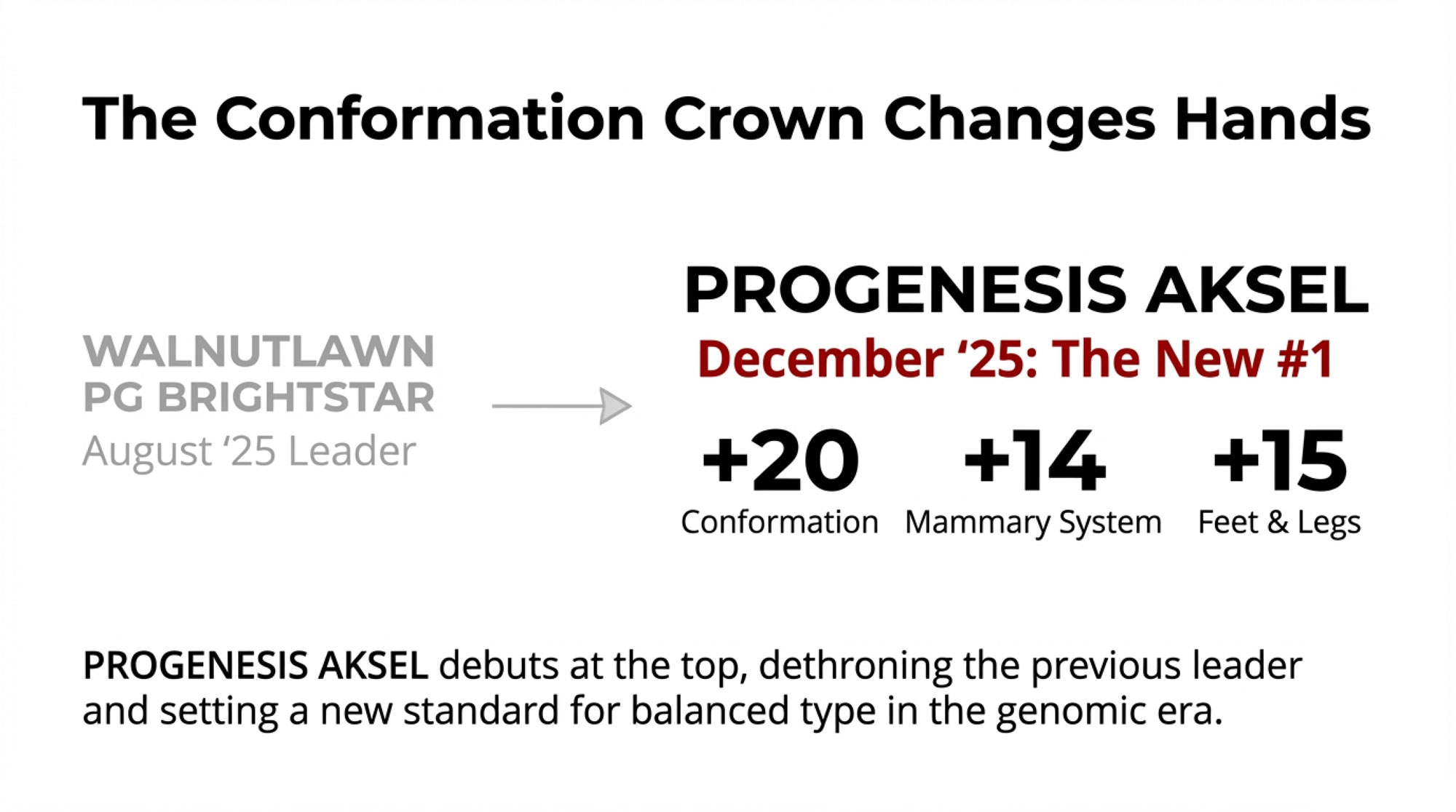
The conformation rankings saw dramatic movement as PROGENESIS AKSEL debuts at #1 with 20 Conf, dethroning August’s leader WALNUTLAWN PG BRIGHTSTAR.
Top Conformation Bulls (16+ Conf):
Rank
Bull
Conf
MS
F&L
DS
RUMP
1
PROGENESIS AKSEL
20
14
15
15
14
2
PROGENESIS ALASTOR
19
16
9
12
11
3
WALNUTLAWN PG BRIGHTSTAR
19
15
12
14
10
4
BLONDIN LYNX
19
10
20
16
9
5
BENJO LINDENRIGHT MAPACHE-P
19
16
12
7
10
For breeders prioritizing feet and legs, BLONDIN LYNX’s F&L=20 represents the pinnacle of mobility genetics currently available in Canada. For mammary-focused programs, PROGENESIS ALASTOR (MS=16) and BENJO LINDENRIGHT MAPACHE-P (MS=16) offer the strongest udder genetics among elite type bulls.
Strategic Breeding Decisions for 2026
The December 2025 evaluations create distinct opportunities:
For Balanced Herds: OCD MILAN-ET remains the safe choice—elite LPI, proven stability across proof runs, and solid health traits.
For Component-Focused Operations: BEYOND HI-LEVEL-ET (#4) offers the best combination of high LPI with exceptional fat production. His 67-point LPI gain since August demonstrates strong genetic stability.
For Polled Programs: PROGENESIS SHEAMUS-P at #2 proves polled genetics can compete at the very top without compromising production.
For Type Improvement: PROGENESIS AKSEL and BLONDIN LYNX provide two distinct paths—balanced type versus feet & legs specialization. For mammary focus, consider PROGENESIS ALASTOR (MS=16).
Key Takeaways
Component king emerges: BEYOND HI-LEVEL-ET jumped 11 spots to #4 with 165 kg fat—rewriting what’s possible from a top-10 LPI bull
Polled shatters the ceiling: PROGENESIS SHEAMUS-P debuted at #2 (4092 LPI), proving elite genetics and hornless no longer trade off
Type throne flips: PROGENESIS AKSEL claimed #1 conformation (20 Conf) in his first evaluation, ending WALNUTLAWN PG BRIGHTSTAR’s reign
Milan holds, pack closes: OCD MILAN-ET defends #1 at 4137 LPI (+19 from August), but three bulls now sit within 67 points of the crown
Percentage play for premium checks: BEYOND HOORAY-ET (#3) posts +1.10% fat and +0.52% protein—numbers built for component pricing
The Bottom Line
These evaluations function like a stock portfolio: OCD MILAN-ET is the blue-chip holding—proven, stable, still delivering. Bulls like PROGENESIS SHEAMUS-P and BEYOND HI-LEVEL-ET are the high-growth plays that just IPO’d into elite territory. The breeders who act on December’s data before their neighbors do will own the genetic edge heading into 2026.
Join over 30,000 successful dairy professionals who rely on Bullvine Weekly for their competitive edge. Delivered directly to your inbox each week, our exclusive industry insights help you make smarter decisions while saving precious hours every week. Never miss critical updates on milk production trends, breakthrough technologies, and profit-boosting strategies that top producers are already implementing. Subscribe now to transform your dairy operation’s efficiency and profitability—your future success is just one click away.
Fairlife sells for $6. You get paid like it’s a store brand. Meanwhile, direct-market dairies are getting $48/cwt. See the gap?
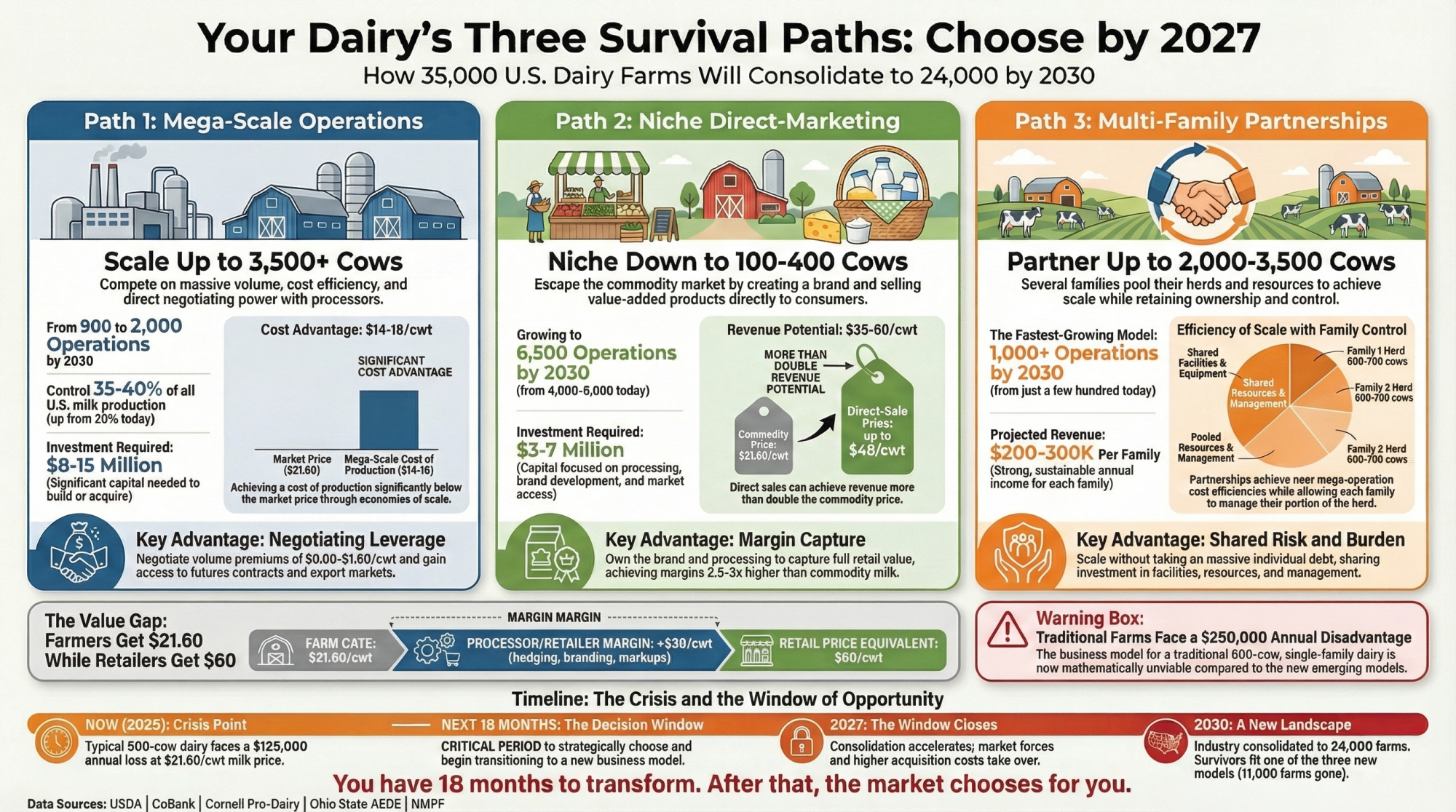
EXECUTIVE SUMMARY: At $21.60/cwt, milk prices are crushing farm profits—your typical 500-cow dairy loses $125,000 this year while processors capture $38/cwt through hedging and consumers pay record retail prices. This isn’t a downturn; it’s the industry’s fundamental restructuring. By 2030, America’s 35,000 dairy farms will shrink to 24,000, with survivors clustering into three models: mega-operations leveraging scale, niche producers earning $48/cwt through direct sales, or multi-family partnerships pooling resources. The traditional 600-cow family farm is mathematically obsolete, running $250,000 in the red each year. Smart operators are already moving—diversifying revenue through beef-on-dairy, optimizing components for Class III premiums, or restructuring operations entirely. You have 18 months to choose your model before market consolidation chooses for you. The farms that thrive in 2030 won’t be those that survived 2025—they’ll be those that transformed during it.
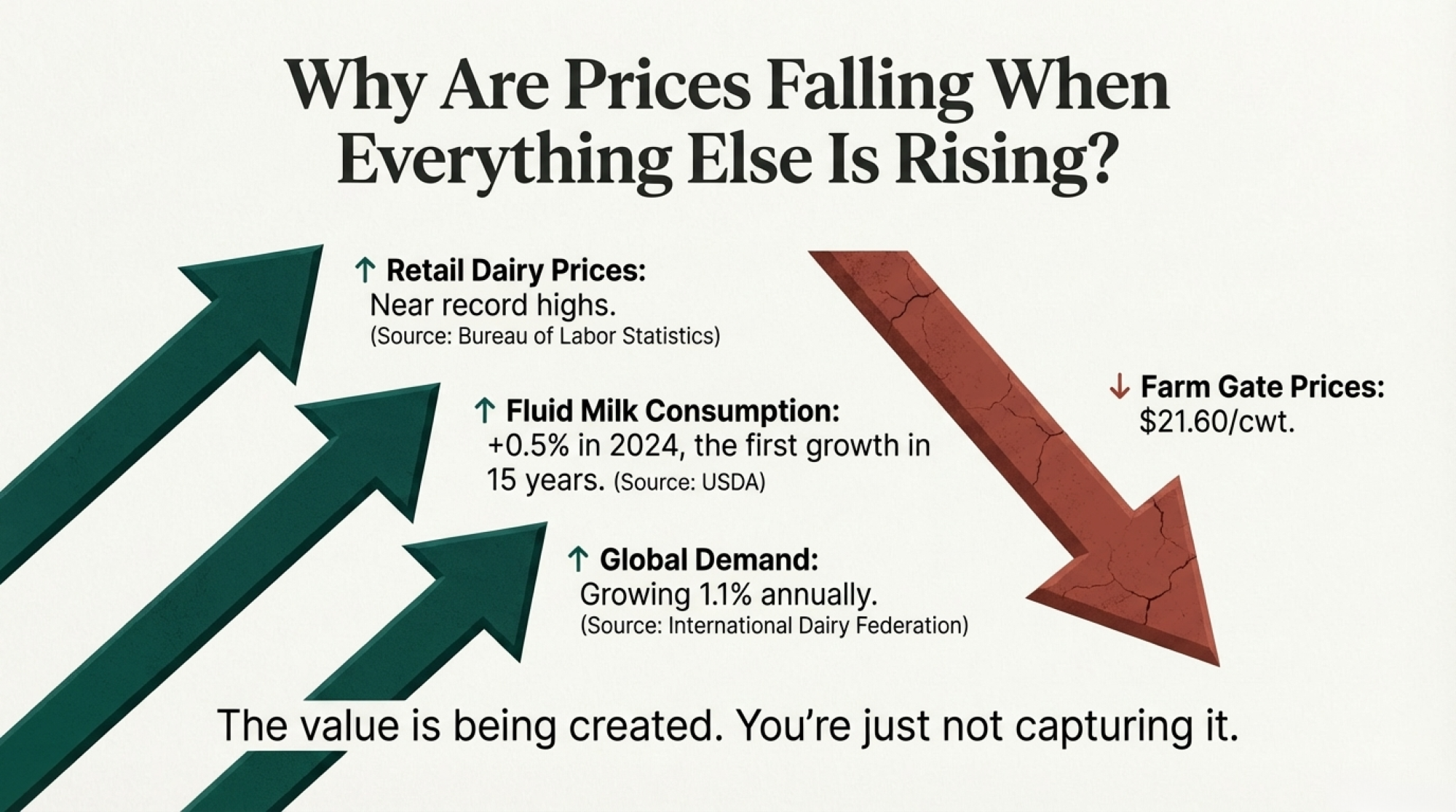
You know, when I saw USDA’s latest forecast showing milk prices heading down to $21.60 per hundredweight, my first thought was about what this actually means for folks like us. For most 500-cow operations—and that’s a lot of farms I work with—we’re talking about roughly $125,000 in lost annual revenue. That’s not exactly small change when you’re already running things pretty tight.
Here’s what’s interesting, though. I’ve been looking at the Bureau of Labor Statistics data, and retail dairy prices? They’re still near record highs. And get this—fluid milk consumption actually grew in 2024 for the first time in 15 years. USDA’s own sales reports are showing this. The International Dairy Federation keeps saying global demand is climbing steadily.
So what’s going on here? Why are we getting squeezed when everything else suggests we should be doing better?
I’ve been talking with producers from Wisconsin to California lately, and what I’m hearing goes way deeper than typical market-cycle complaints. It’s this disconnect between what we’re getting at the farm gate and what consumers are paying at the store. And here’s the thing—even with the tightest heifer supplies in two decades, prices aren’t responding like they used to. What’s really fascinating is we’re seeing three distinct operational models emerging that’ll probably determine who’s still milking cows come 2030.
If you’re paying attention—and I know you are—the next year and a half represents what I’d call a critical decision window. The choices you make now? They’re going to determine whether you’re thriving or just hanging on when this industry looks completely different five years from now.
Let’s Talk About What’s Really Happening with Prices
So back in March, when CME Group reported Class III milk futures dropping to .75 per hundredweight, most of us expected the usual pattern, right? Supply tightens up, prices recover, and we all catch our breath. But that’s not what’s playing out, and honestly, it’s revealing something pretty concerning about how these markets work now.
Peter Vitaliano over at the National Milk Producers Federation articulated something that really resonates—the gap between farmgate and retail has never been this wide. We’re looking at USDA data showing farmers getting .60 per hundredweight while consumers are paying over a gallon for whole milk and around a pound for cheddar. These are historically high retail prices, folks.
What I find particularly noteworthy is how processors have positioned themselves. Take these massive new facilities—Leprino Foods with its 8-million-pound-per-day capacity plant, and Coca-Cola’s new fairlife facility up in New York. The International Dairy Foods Association has been tracking, it says, over $2 billion in infrastructure investments since 2020. These plants need milk volume a consistent milk supply to justify those investments. And that’s creating some… well, let’s call them interesting market dynamics.
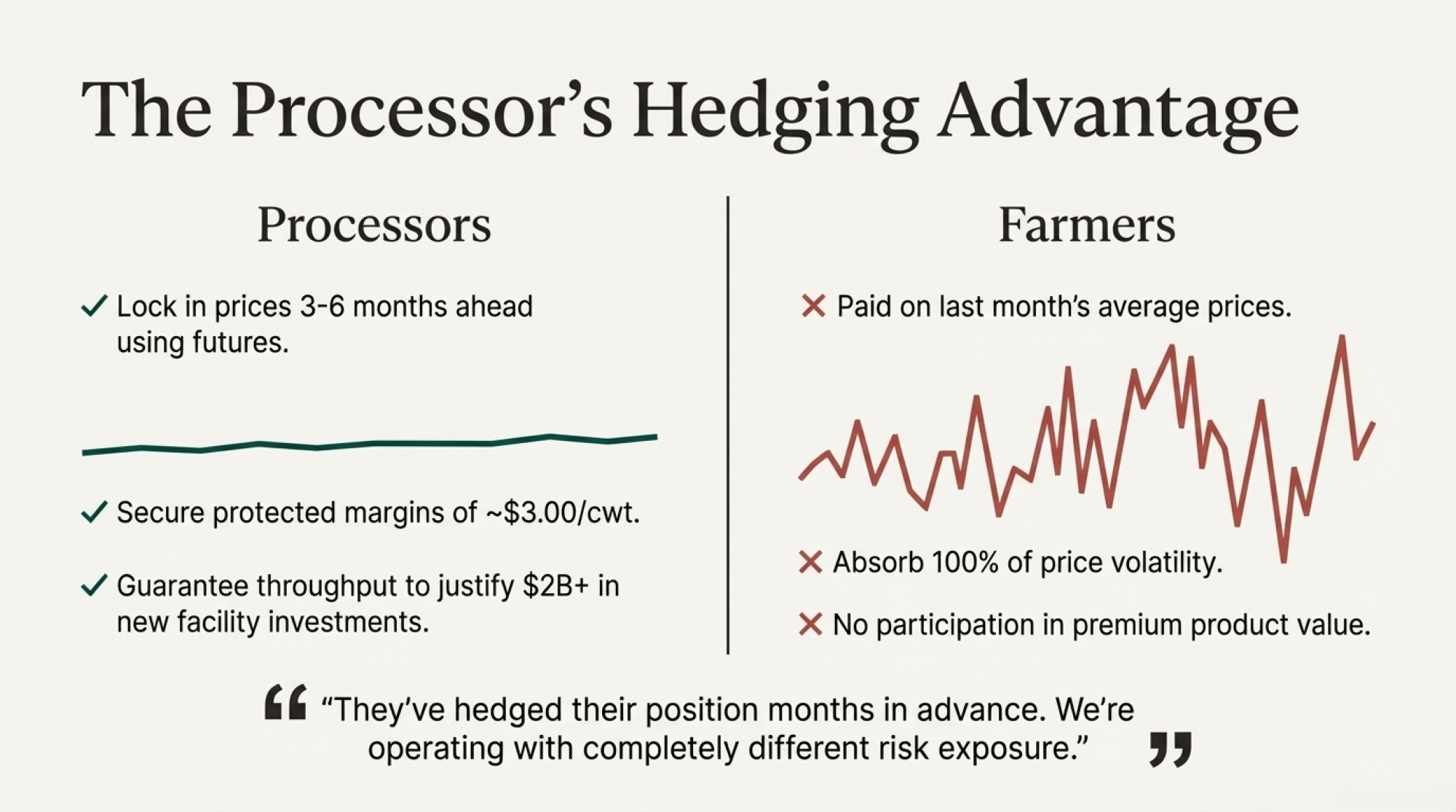
Mark Stephenson from Wisconsin’s Center for Dairy Profitability shared something with me that really clicked. Processors are using futures contracts to lock in their margins months ahead, while we’re getting prices based on last month’s averages. That timing difference? It’s worth about three dollars per hundredweight in a protected margin for them. Three dollars!
A producer I know well out in California’s Central Valley—runs about 650 Holsteins—put it to me this way: “They’ve hedged their position months in advance. We’re operating with completely different risk exposure.” And you know what? He’s absolutely right.
[INSERT IMAGE: Graph showing the widening gap between farmgate prices and retail dairy prices from 2020-2025, with processor margins highlighted]
That Heifer Shortage Everyone’s Banking On
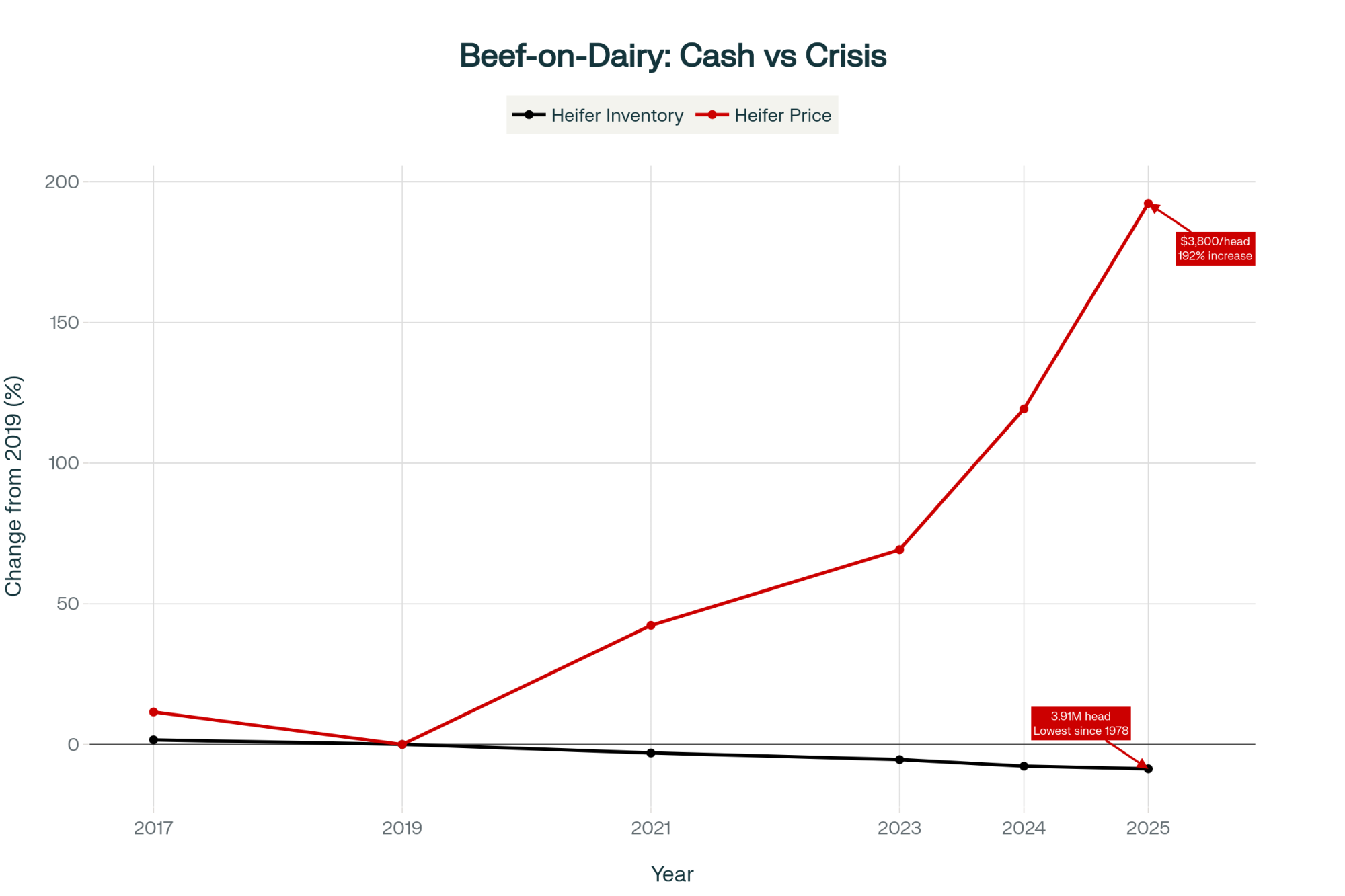
Now, conventional wisdom says—and I’ll admit, I believed this too—that this replacement heifer shortage should fix everything. CoBank’s August report shows we’re at a 20-year low, down to about 3.9 million head. You’d think that means better prices by late next year, maybe 2026?
Well… not so fast.
What we’re learning about beef-on-dairy breeding is fundamentally changing the game. The breeding association data shows that about a third of our Holstein and Jersey calves are now beef crosses. Think about what that means for a minute.
Replacement heifer prices have exploded—USDA’s tracking them at over three thousand per head, up 75% since early 2023. And if you’re looking for premium genetics? I’ve seen them go for thirty-five hundred, even four thousand at regional auctions. Down in Georgia and Florida, some producers are paying even more for heat-tolerant genetics. CoBank’s projecting we’ll be short another 800,000 replacements by 2026.
Yet—and here’s the kicker—this dramatic supply constraint isn’t translating to better milk prices. Why? It’s the processing overcapacity. Andrew Novakovic from Cornell’s Dyson School explained it to me this way: when processors have billions invested in facilities that require high volume, they have incentives to keep farmgate prices stable to ensure consistent throughput. It sounds backwards, but that’s the reality we’re dealing with.
The Darigold situation out in the Pacific Northwest really drives this home. Despite obvious milk supply tightness, they announced a $4-per-hundredweight deduction on all member farms back in May. A producer out there—runs about 3,000 cows—spoke at a meeting about it and didn’t mince words: “When milk price is down and you add these deducts, it really starts to sting.”
Why Growing Demand Isn’t Helping Us (This One Really Gets Me)
Here’s what caught me completely off guard when I first saw the International Dairy Foods Association data. Fluid milk sales grew about half a percent in 2024—first increase in 15 years! USDA’s marketing service confirms whole milk consumption hit its highest level since 2007. The Organic Trade Association reports that organic milk sales jumped by over 7%. And premium products? IRI’s retail data from 2024 shows brands like fairlife grew nearly 30% in dollar sales compared to the year before.
You’d think this demand recovery would support our prices, right? Instead—and this is what’s so frustrating—it’s doing the opposite. The growth is all concentrated in premium products where processors and retailers, not farmers, capture that value.
Let me break this down in real numbers—here’s The Value Disconnect:
Level
Price
Who Gets It
Farm Gate
$21.60/cwt
Farmers (commodity price)
Conventional Retail
~$40.00/cwt equivalent
Retailers (standard markup)
Premium Retail (fairlife)
~$60.00/cwt equivalent
Processors & retailers
The Gap
$38.40/cwt
Captured via hedging & branding
Marin Bozic, who does dairy economics at the University of Minnesota, explained the mechanism to me: the Federal Milk Marketing Order structure simply has no way for farmers to participate in the creation of premium product value. Your milk could become commodity cheese or the fanciest filtered milk on the shelf—you get the same basic commodity price either way.
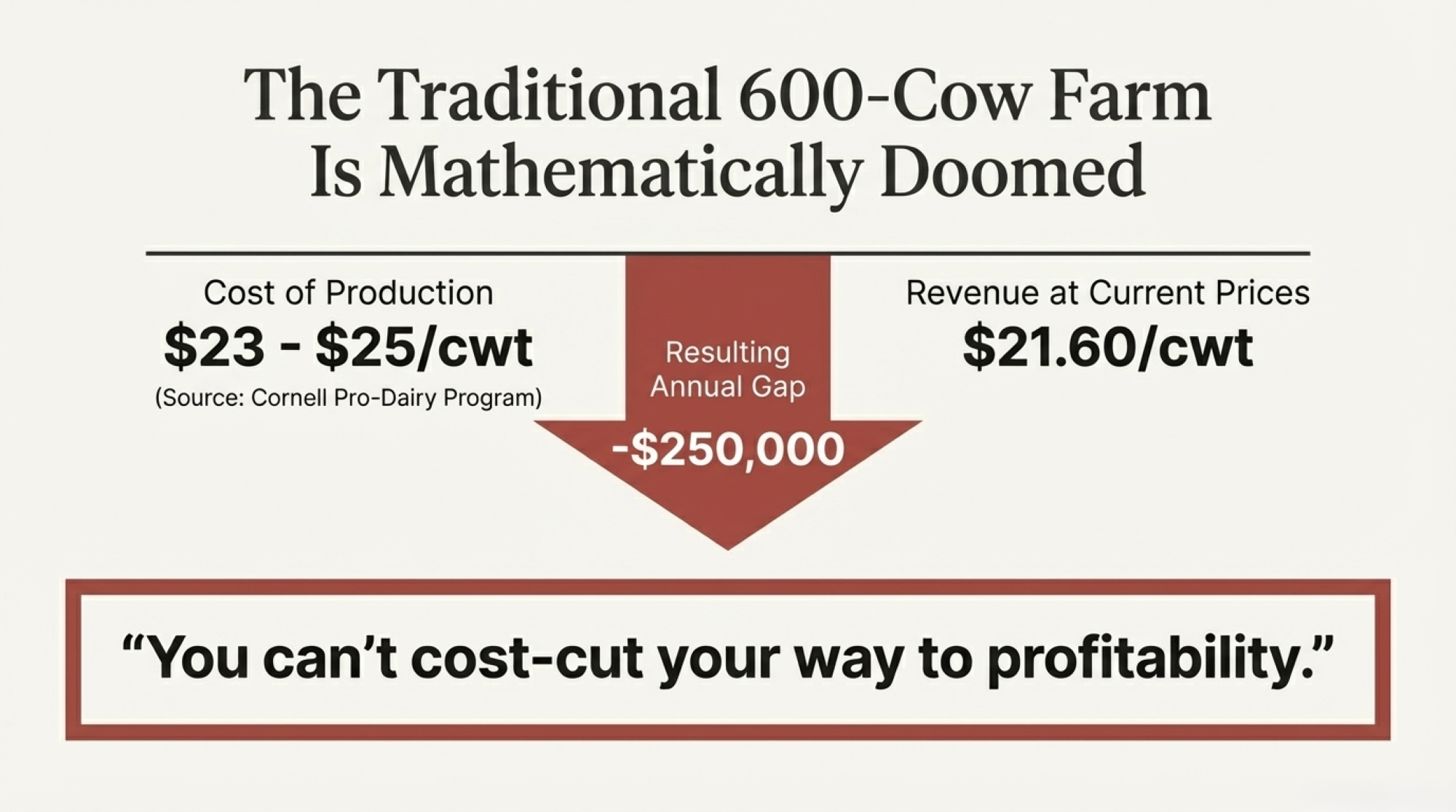
The Three Futures: Why the Traditional 500-Cow Family Farm is Mathematically Obsolete (And What to Become Instead)
Research from Cameron Thraen’s team at Ohio State, which analyzed USDA’s agricultural census data and published its findings in the 2024 dairy outlook report, reveals something both fascinating and, honestly, a bit scary. They’re projecting that consolidation will reduce the number of dairy farms from about 35,000 today to 24,000 to 28,000 by 2030. And the production? It’s going to concentrate into three pretty distinct models.
If you’re running a traditional 500-to-700-cow family operation like many of us, the mathematics suggest you need to evolve into one of these structures, or… well, face some really tough decisions.
[INSERT IMAGE: Infographic showing the three operational models with icons – Mega-Operation (factory icon), Niche Producer (farmers market icon), Multi-Family Partnership (handshake icon) – with their respective herd sizes, investment requirements, and profit projections]
The Large-Scale Operations (3,500+ Cows)
We’ve got about 900 of these operations now, controlling roughly 20% of production. Wisconsin’s Program on Agricultural Technology Studies published their structural change analysis in 2024, suggesting this’ll grow to maybe 1,500 or 2,000 operations controlling 35-40% of all milk by 2030.
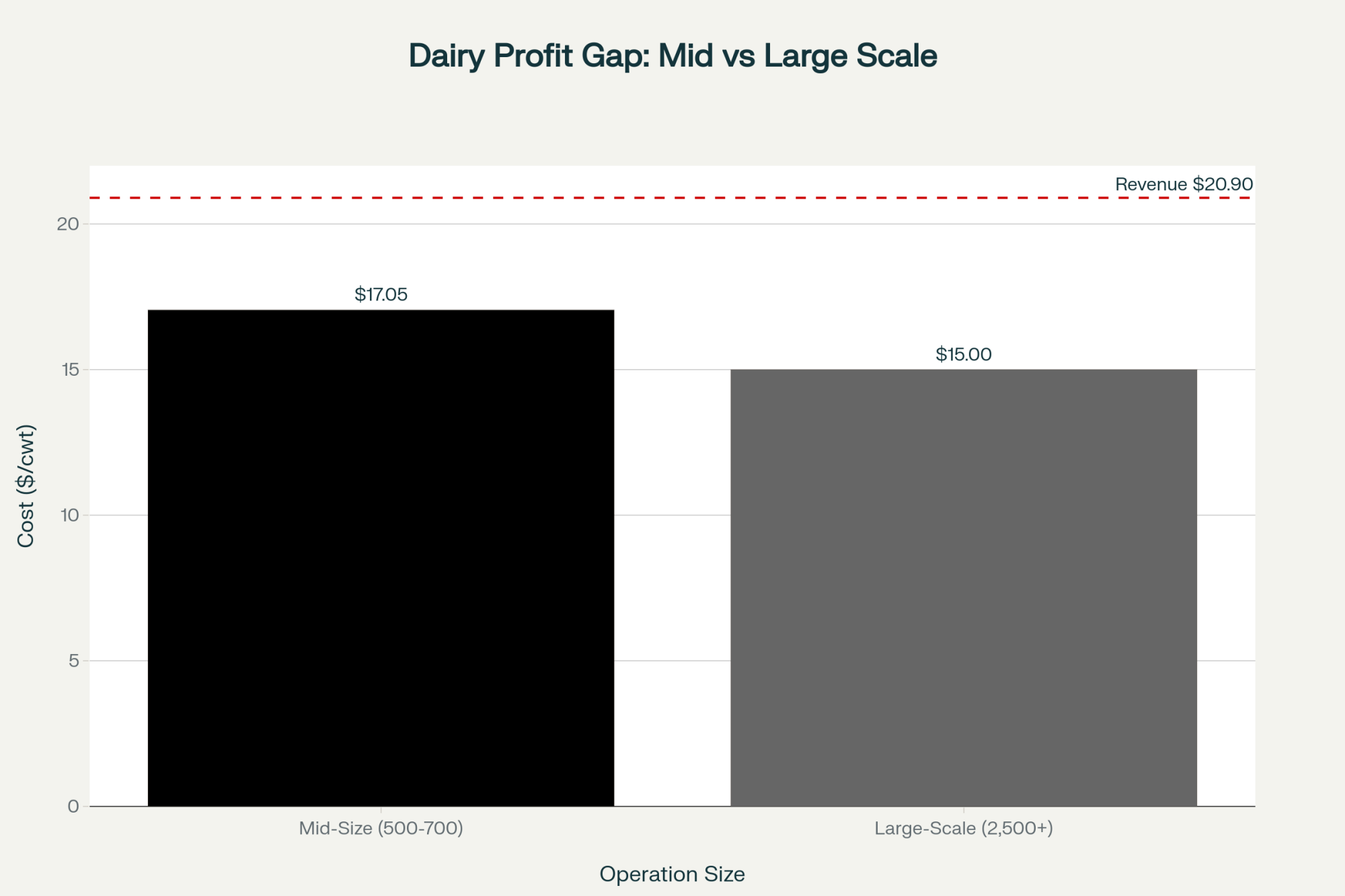
What makes them work? Well, Cornell’s annual Dairy Farm Business Summary shows they’re hitting costs of around 14 to 16 dollars per hundredweight through massive scale. They negotiate directly with processors—not as suppliers but as genuine business partners. They’re getting 50 cents to $1.50 per hundredweight just on volume guarantees. Investment required? We’re talking eight to fifteen million, according to the ag lenders I’ve talked with.
As one industry analyst put it, “A 5,000-cow operation with consistent component quality has real negotiating leverage.” And that’s the key word there: leverage.
The Niche Direct-Marketing Operations (100-400 Cows)
There are maybe 4,000 to 5,000 of these operations now, and interestingly, the National Young Farmers Coalition’s 2024 land access survey suggests this could grow to around 6,500 by 2030, particularly as beginning farmers explore alternative market channels.
I spoke with a producer in Vermont recently who made this transition—went from conventional to organic with direct marketing. She’s getting around $48 per hundredweight equivalent through farmers’ markets and on-farm sales. “It’s definitely more work,” she told me, “but we’re actually profitable now.”
A Texas producer I know took a different approach—focusing on A2 genetics and local Hispanic market preferences. He’s capturing premiums I wouldn’t have thought possible five years ago.
What works for these folks:
Premium pricing in that $35-to-50 range through direct sales
Organic, grass-fed, A2 genetics, local food positioning
On-farm processing so they capture those processor margins themselves
Investment needs are different—three to seven million, but it’s focused on brand building and market access, not just production
The Multi-Family Partnerships (2,000-3,500 Cows Total)
This is the emerging model that’s really interesting. We’re seeing maybe a few hundred of these now, but projections suggest over a thousand by decade’s end.
Mike Hutjens, who recently retired from the University of Illinois after decades of dairy research, described it well in his recent Extension publication on consolidation strategies: “Three families combining resources, each contributing 600-700 cows, sharing facilities and management. They’re achieving near-mega-operation efficiency while maintaining family control.” Based on operations he’s worked with, each family can see $200,000 to $300,000 annually.
Here’s the hard truth nobody really wants to hear: Cornell’s Pro-Dairy program’s 2024 cost of production analysis suggests that traditional 600-cow single-family operations face an approximately quarter-million-dollar annual profit gap compared to these three models. Without evolving into one of these structures… well, the math becomes pretty challenging.
What Successful Producers Are Actually Doing Right Now
What distinguishes farms positioned to thrive from those heading toward crisis? It’s not hope for market recovery—it’s specific actions during the downturn. I’ve been watching successful operations across the Midwest, and there are definitely patterns.
Moving Beyond the Milk Check
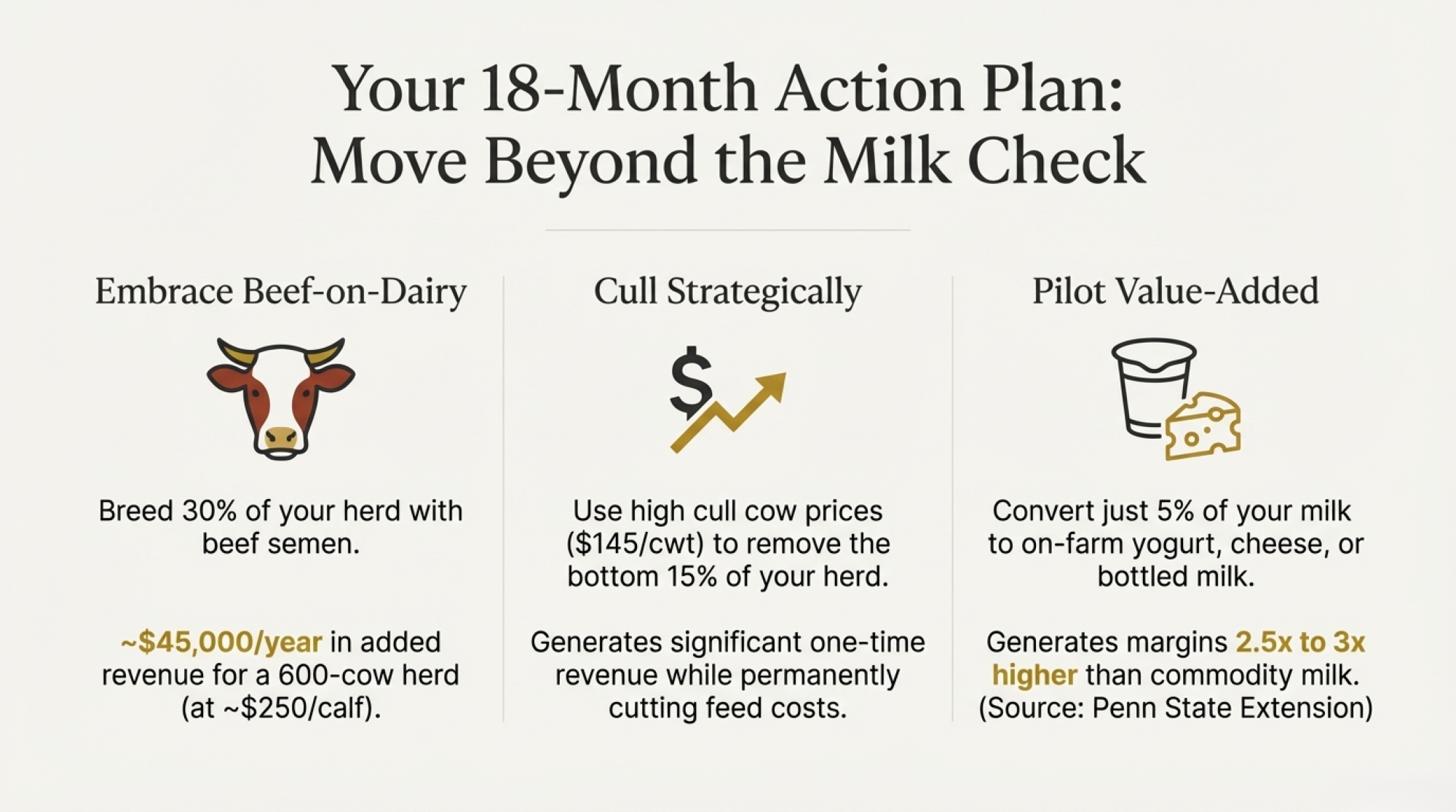
The smartest producers I know have completely abandoned the old assumption that milk sales should be 85-90% of revenue. A Wisconsin producer I work with is breeding 30% of his herd with beef semen. At current beef prices—around $250 per calf—that’s significant money. Plus, he’s not overwhelming his heifer facilities.
Strategic culling at these cull cow prices—USDA’s reporting over $145 per hundredweight—is generating serious cash. An Idaho producer told me she culled 15% strategically, generated substantial one-time revenue while cutting feed costs permanently by about 16%.
And value-added production? Penn State Extension’s 2023 bulletin on dairy value-added enterprises shows that even converting 5% of your milk to yogurt, cheese, or specialty products can generate margins two and a half to three times higher than commodity milk. Their case studies are pretty compelling, actually.
It’s About Efficiency, Not Just Volume
What I’m seeing is successful operations focusing on feed efficiency over just pushing for more milk. Kent Weigel at Wisconsin-Madison has data showing feed efficiency genetics have a heritability of around 0.43—meaning those improvements compound fast.
The approach is getting pretty sophisticated:
Genomic testing to identify and cull the bottom 20% for feed efficiency before they even enter the milking string
Switching to bulls with high Feed Saved indexes—costs nothing, impacts everything
Getting that metabolizable protein dialed in at 100-115% of requirements saves fifty to seventy-five dollars per cow annually, according to University of Minnesota research
For a 500-cow operation? These strategies might cost ten to fifteen thousand dollars to implement, but can return ten times that annually. And it compounds year after year. Scale it down to 250 cows, and you’re looking at maybe a $50,000 return on a $5,000-7,500 investment. Scale up to 1,000 cows? We’re talking $200,000-280,000 annually.
Components and Geography Matter More Than Ever
Here’s something worth noting: USDA’s November projections show Class III prices around $18.82, while Class IV falls to maybe 15 or 16 per hundredweight in 2026. That three-to-four-dollar spread? It rewards specific decisions.
A Minnesota producer told me about switching to Jersey-Holstein crosses three years back. “Our butterfat runs 4.3% now versus 3.7% before. That’s worth about seventy cents per hundredweight. Doesn’t sound like much until you’re shipping 50,000 pounds daily.”
What Canada’s System Reveals (It’s Not What You Think)
Looking north offers an interesting contrast. While we’re facing this dollar-per-hundredweight drop, the Canadian Dairy Commission’s February announcement showed essentially minimal change—less than a tenth of a percent adjustment.
Their stability comes from a formula: prices adjust by half to production costs and half to the consumer price index. As Sylvain Charlebois from Dalhousie University’s Agri-Food Analytics Lab explained, “Canadian farmers know their milk price nine months ahead.” Imagine being able to plan that far out!
But—and this is important—there are trade-offs. Dairy Farmers of Canada reports quota costs around $24,000 per kilogram of butterfat. That’s a massive entry barrier. A 2024 study in the Agricultural Systems journal documented approximately 6.8 billion liters of milk waste from 2012-2021 in the Canadian system. And the Fraser Institute calculates Canadian families pay nearly $300 more annually for dairy.
What’s really revealing? Statistics Canada’s agricultural projections suggest they’ll still lose about half their dairy farms by 2030, bringing the total to around 5,000. So even with all that protection, consolidation is happening. It’s fundamental economics that transcends whatever system you use.
The 2025-2027 Window: Why Timing Is Everything
What I’m seeing suggests 2025 is where three forces converge for the first time:
First, we’ve got this processing capacity overhang from billions of new facilities coming online. Industry tracking shows it’s massive. Second, the International Dairy Federation projects global consumption growing faster than production—about 1.1% versus 0.8%. And third, producer exits are accelerating. The American Farm Bureau reports Chapter 12 bankruptcies up over 50% year-over-year.
This creates what I’d call an 18-to-24-month window for strategic positioning. Christopher Wolf, who heads Cornell’s dairy markets and policy program, suggests once global supply scarcity becomes obvious and prices start recovering—probably 2027—consolidators will move aggressively. Acquisition costs will spike. Windows close.
So What Should You Actually Do? (The Practical Stuff)
Understanding all this, here’s what I’m seeing work:
If You’re Planning to Continue:
Focus on efficiency over growth. A Pennsylvania producer told me, “We’ve stopped all expansion. Every dollar goes to efficiency improvements and component optimization. That dollar-fifty from better components beats any volume premium.”
Lock in what you can. USDA’s Dairy Forward Pricing Program, reauthorized through April 2025, lets you contract ahead when futures look reasonable. Creating revenue floors has saved several operations I know.
Build those alternative revenue streams now. Beef-on-dairy, strategic culling, value-added—these can offset entire milk price declines.
If You’re Considering Structural Change:
The partnership conversation needs to happen now. An Ohio producer who merged three family operations told me they spent eight months finding the right partners. “Wait until the crisis? Your best options are already gone.”
Thinking about the niche route? Start small, but start now. That Vermont producer I mentioned began with just 5% of its output going to farmers’ markets. It took three years to transition fully, but she learned as she grew.
Geographic disadvantages are real. USDA data shows consistent one-to two-dollar regional differences. If you’re in a disadvantaged area, seriously consider your options.
For Everyone:
Accept that mid-size independence might require significant adaptation. As one Cornell economist put it, “That’s not defeat—it’s realistic evolution in a consolidating industry.”
Focus on what you control: genetics, efficiency, component quality, and marketing channels. An Idaho producer said it best: “The market does what it does. I can’t control that. But I absolutely control my cost per hundredweight.”
For those who want to dig deeper, information on the USDA’s Dairy Forward Pricing Program is available at your local FSA office. Cornell’s Pro-Dairy program has excellent resources on cost analysis. And if you’re considering the partnership route, the University of Wisconsin’s Center for Dairy Profitability has some solid guidance materials.
The Bottom Line (Where This All Leads)
The 2025 milk price situation isn’t really about traditional supply and demand—it’s a structural transformation that’s been building for decades. That $21.60 forecast from the USDA? It’s looking more like a new reality where processor margin management matters more than the old market dynamics we learned.
Yet within this challenging environment, I’m seeing clear paths forward for producers willing to abandon old assumptions. The farms thriving in 2030 won’t be those that simply survived 2025 through sheer determination. They’ll be operations that recognized this inflection point and repositioned, while others that waited for the recovery that follows will follow completely different rules.
You’ve got maybe 18 to 24 months for deliberate transformation. After that, market forces make the choices for you. The question isn’t whether to change—it’s which of these emerging models fits your operation’s future. That decision, made with clear eyes rather than false hope, determines success or failure.
What’s interesting is every producer I know who’s made these strategic pivots says the same thing: “Should’ve done it sooner.” Maybe that’s the real lesson. The best time to transform isn’t when crisis forces your hand—it’s right now, while you still have options.
And honestly? That’s both scary and oddly encouraging. At least we know what we’re dealing with. Now it’s time to act on it.
KEY TAKEAWAYS:
The $38/cwt gap is permanent: Processors locked in margins through futures—your $21.60 milk price won’t recover, costing typical 500-cow dairies $125,000 annually
Pick your path in 18 months: Mega-operation (3,500+ cows), direct-marketing ($48/cwt premiums), or multi-family partnership—traditional single-family 600-cow farms face mathematical elimination
Diversify revenue TODAY: Leaders generate $45,000+ from beef-on-dairy (30% of herd), 3x margins on value-added products, and $0.70/cwt from component optimization
10:1 returns exist: Genomic feed efficiency selection costs $15,000, returns $150,000 annually—compound these gains before the 2027 consolidation wave
Complete references and supporting documentation are available upon request by contacting the editorial team at editor@thebullvine.com.
Join over 30,000 successful dairy professionals who rely on Bullvine Weekly for their competitive edge. Delivered directly to your inbox each week, our exclusive industry insights help you make smarter decisions while saving precious hours every week. Never miss critical updates on milk production trends, breakthrough technologies, and profit-boosting strategies that top producers are already implementing. Subscribe now to transform your dairy operation’s efficiency and profitability—your future success is just one click away.
My kids could make more at Target, and they’d get Christmas off.’ Why 2,800 dairy families are making the hardest decision.
EXECUTIVE SUMMARY: At kitchen tables across dairy country, third and fourth-generation families are asking whether they should be the ones to step away. While Agriculture Secretary Rollins proclaimed a ‘golden age’ for dairy Monday, 2,800 farms will close in 2025 as margins compress to $11.55/cwt—down from $15.57 just six months ago. A typical 300-cow Wisconsin operation that netted $10,000 annually is now losing $61,000 after June’s make allowance changes shifted $82 million from producers to the processors industry-wide. USDA’s four-pillar response—dietary guideline updates, being ‘more vocal’ on interest rates, facilitating processor investments, and export expansion—offers no direct relief while processors invest $11 billion in facilities optimized for mega-dairies. Mid-sized operations face an 18-month decision window: gamble $2-3 million on expansion, pursue increasingly scarce niche markets, or execute an orderly exit while equity remains. The math increasingly points to one conclusion: the economics of their scale no longer work in a system optimized for different objectives.
You know, the conversations we’re having around kitchen tables these days are different from those we had even five years ago. I’m talking with third and fourth-generation producers who are looking at their numbers and wondering if maybe—just maybe—they should be the ones to step away. That’s a hard conversation, and it’s happening more than you’d think.
When Agriculture Secretary Brooke Rollins stood up at the National Milk Producers Federation meeting in Arlington on Monday, she spoke of a “golden age” for dairy and outlined a four-pillar action plan. But here’s what’s interesting—and I’ve been hearing this from producers all week—the view from the barn looks pretty different from the view from that podium.
The latest numbers from Rabobank and what we’ve been tracking suggest we’re looking at about 2,800 dairy farms closing in 2025. That’s somewhere between 7 and 9 percent of what’s left. Meanwhile, if you’re following the Dairy Margin Coverage program like most of us are, margins are sitting at $11.55 per hundredweight as of March, down from that nice $15.57 we saw back in September.
What I’ve found is we’re not just going through another rough patch here. This feels different. The gap between what’s being announced in Washington and what’s happening in the milk house…well, it’s pretty wide.
Let’s Talk Numbers
The brutal math: A typical 300-cow operation that barely broke even ($10K) is now bleeding $61K annually after June’s FMMO changes shifted $82M industry-wide from producers to processors
So I’ve been sitting down with producers, running through their books, and the pattern is remarkably consistent. Take your typical 300-cow Wisconsin operation—and there are still a lot of them out there.
After Make Allowance Increases (June 2025 FMMO changes)
-$61,000
“My kids could make more at Target, and they’d get Christmas off.” — Minnesota dairy producer, 400 cows
And here’s where it gets really tough. Those Federal Milk Marketing Order changes that kicked in June 1st—the make allowance increases that processors can deduct from our checks—are another 85 to 90 cents per hundredweight gone. For that 300-cow operation? We’re talking $71,000 less per year. The Farm Bureau calculated it out, and industry-wide, that’s $82 million moving from producers to processors.
Breaking Down the Four Pillars
Let’s look at what Secretary Rollins is actually proposing here.
Pillar 1: Dietary Guidelines—Playing the Long Game
The idea is that updating the Dietary Guidelines for Americans will boost consumption. Current guidelines already recommend three servings of dairy daily for adults. Problem is—and the National Dairy Council has documented this—only about 12 percent of Americans actually follow those recommendations.
Key trend: USDA’s Economic Research Service shows we’ve gone from 247 pounds of fluid milk per person back in 1975 to about 128 pounds in 2023. That’s a 48 percent drop, despite dietary guidelines supporting dairy the whole time.
The Whole Milk for Healthy Kids Act letting whole milk back into schools? That’s positive. But school lunch participation is still down by 2.2 million kids from 2013, according to USDA data. Those are milk drinkers who just aren’t there anymore.
Secretary Rollins acknowledging input cost pressures—that’s important. Since 2020, NASS data shows:
Seed costs: Up 18%
Fuel: Up 32%
Fertilizer: Up 37%
Interest expenses: Up 73% (the real killer)
When they asked for specifics at the NMPF meeting, the response was that Secretary Rollins would “be more vocal” with the Federal Reserve about interest rates. A producer with 400 cows in Minnesota summed it up: “Being vocal doesn’t pay the feed bill.”
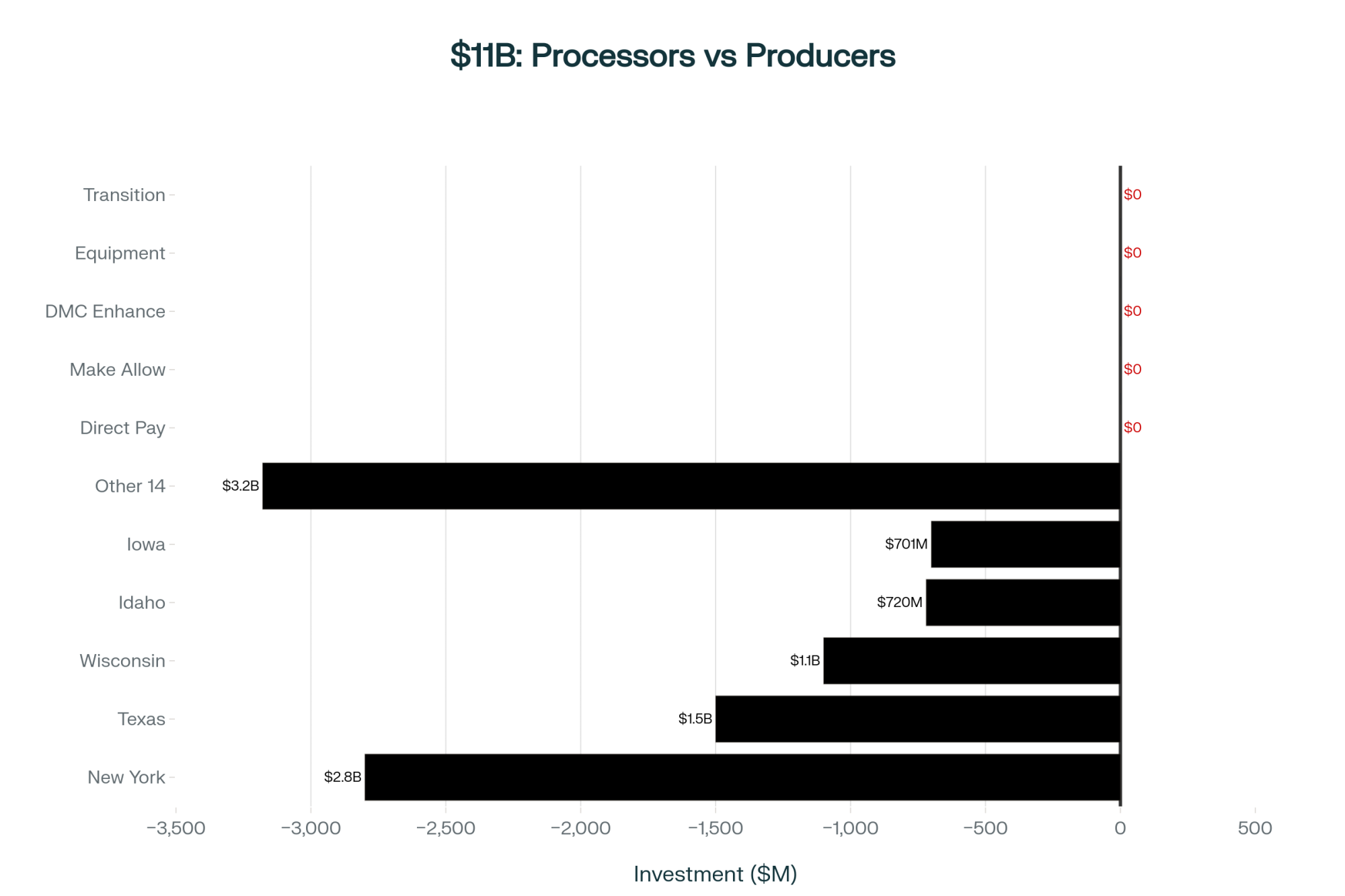
The International Dairy Foods Association announced $11 billion in processing investments across 19 states through early 2028. New infrastructure, expanded capacity—sounds great.
But these announcements came right after processors secured those make allowance increases worth $82 million annually. Hard not to connect those dots.
“These plants are being built for tomorrow’s farms, not today’s. And tomorrow’s farms don’t look like most of my members.” — Wisconsin cooperative manager
What concerns me for mid-sized operations is the nature of these investments. A new cheese plant designed to handle 2 million pounds daily? They want five operations milking 2,000-plus cows each, not 50 different 300-cow farms.
Pillar 4: Export Markets—Progress with Risk
Exports are showing real growth. U.S. Dairy Export Council reports:
Volume: Up 2% year-to-date
Value: Up 16% year-to-date
Indonesia: Now the 7th-largest market at $246 million
But China still has retaliatory tariffs on our products. Mexico takes nearly 40 percent of our cheese exports—that’s a lot riding on one relationship with the USMCA review coming in 2026.
The View from Up North
You know what Secretary Rollins didn’t mention? What’s happening in Canada. Their Dairy Commission data shows they’re maintaining about 12,000 operations averaging 85 cows, with debt-to-asset ratios around 16 percent.
Sure, quota runs about $24,000 Canadian per cow-equivalent. Consumers pay more. But Canadian producers can plan facility upgrades five, seven years out because they know what their milk price will be.
“I focus on production efficiency and cow comfort, not price volatility.” — Ontario dairy producer at World Dairy Expo
Can you imagine?
When margins collapsed in 2009, USDA deployed $3.5B in direct relief. In 2025’s “golden age”? Zero dollars—just promises to be “more vocal” with the Federal Reserve while 2,800 farms close
How Support Has Changed: 2009 Crisis vs. 2025 Action Plan
2009 Dairy Crisis Response
2025 USDA Action Plan
$3.5 billion in direct support (MILC payments + product purchases)
No direct financial support announced
Government bought 379 million pounds of nonfat dry milk
No product purchase program
Direct payments to farmers when prices crashed
“Being more vocal” with the Federal Reserve
Emergency intervention during the 36% price collapse
Policy speeches during steady consolidation
Processors are pouring $11B into 50+ new facilities optimized for mega-dairies producing 2M+ lbs daily, while farmers facing closure get “vocal advocacy” and zero financial support
The 18-Month Reality Check
From 37,100 farms in 2017 to a projected 10,200 by 2030—the mid-size operations (200-999 cows) are vanishing fastest, down 72% as scale economics favor mega-dairies with $3-4/cwt cost advantages
Industry folks I trust keep pointing to the next 18 months as make-or-break time for operations in that 200-to-700 cow range. Several things are converging:
June 2026: Environmental regulations tighten in key states
Ongoing: Processing contracts getting renegotiated with new volume requirements
Now: Farms that survived 2020-2024 by burning through working capital are running on fumes
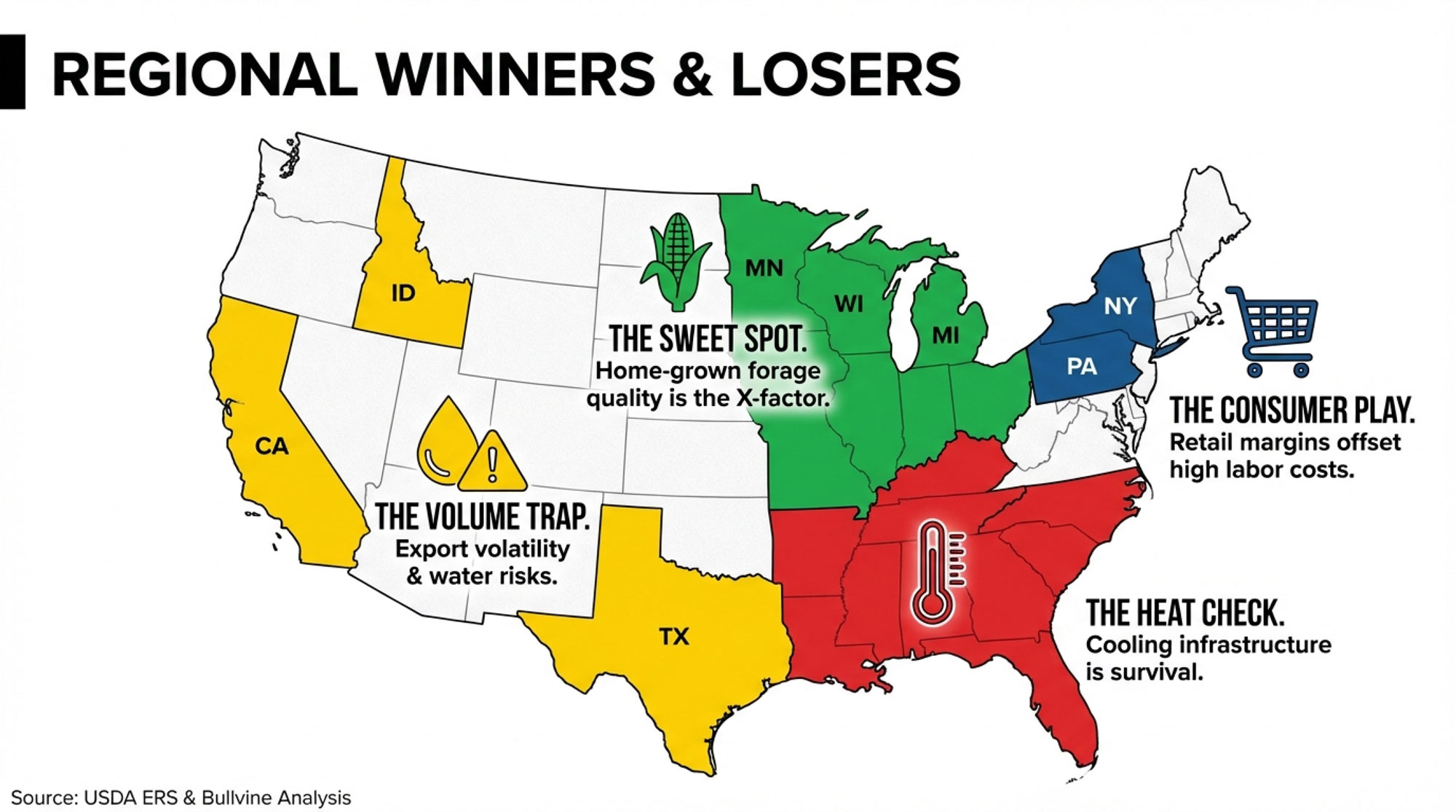
Regional differences are striking:
Southeast: Heat stress management costs change the economics completely
Northeast: Higher land values and stricter environmental rules
Mountain West: Water rights add another layer of complexity
California: Even modernized operations face $4-5/cwt disadvantage versus mega-dairies
I know producers in California’s Central Valley—good farmers, 425 cows, modernized everything. University of California Extension studies show they’re still $4 to $5 per hundredweight higher in costs than the 3,000-cow operation down the road. As one told me, “We’re not bad farmers. We’re just the wrong size.”
Region
Typical Herd Size
Cost per CWT
Cost Disadvantage vs Mega-Dairies
Primary Cost Drivers
Farms Lost 2022-2025
18-Month Survival Outlook
California Central Valley
1,200-3,000
$18.50-19.20
$4.00-4.50
Water/Environmental Regs
-425
Critical
Pacific Northwest
600-1,500
$19.50-20.00
$5.00-5.50
Transportation/Labor
-280
Severe
Southeast (Georgia/Florida)
400-800
$20.00-21.50
$6.00-7.00
Heat Stress/Mortality
-320
Severe
Northeast (PA/Vermont)
250-500
$19.00-20.50
$4.50-5.50
Land Values/Phosphorus
-380
Critical
Upper Midwest (WI/MN)
300-700
$17.50-18.50
$3.50-4.00
Property Tax/Labor
-630
Critical
Mountain West (ID/UT)
2,000-5,000
$15.50-16.50
$1.00-2.00
Scale Efficiency
-140
Moderate
Southwest (TX/NM)
2,500-10,000
$15.00-16.00
$0.50-1.50
Lowest Input Costs
-95
Stable
What This Means for Different Scales
Operations Under 500 Cows: The Hard Math
Calculate your true per-hundredweight costs, including fair wages for family labor. Can you survive with margins below $12? Looking at CME futures, that might be reality through mid-2026.
Your three main options:
Scaling up: $2-3 million minimum investment, 7-10 year payback if margins improve
Going organic: 7-year conversion, many regions already oversupplied per the National Organic Program
On-farm processing: Budget at least $500,000, plus you’re starting a new business
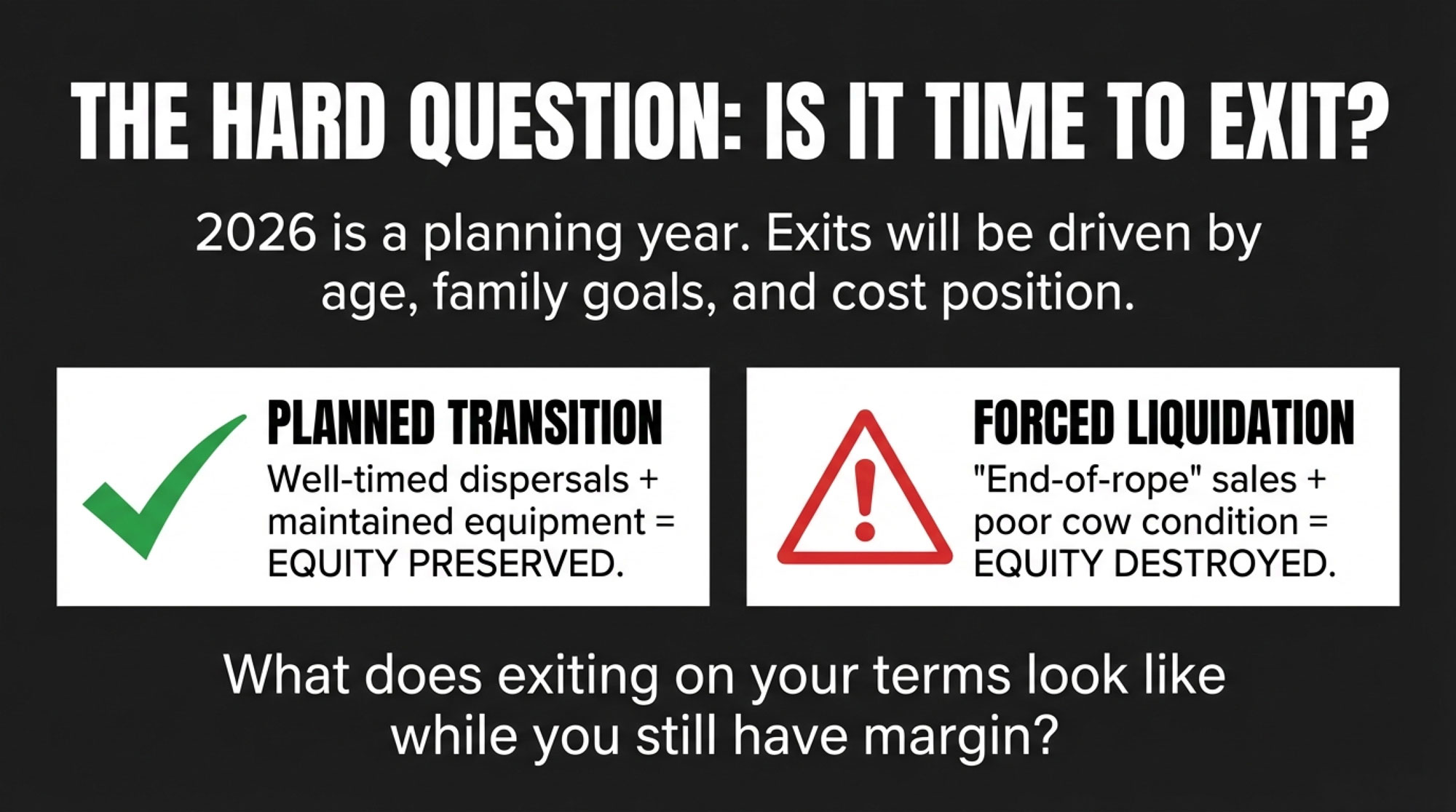
Sometimes preserving equity through an orderly exit makes more sense than operating at a loss for two more years. It’s math, not judgment.
Operations Over 700 Cows: Better Positioned but Not Immune
You’re better positioned, but every percentage-point improvement in feed conversion or component efficiency matters now. Watch for opportunities when neighbors exit. Some successful operations grow incrementally through local consolidation rather than through massive expansions.
Decision Point
Action Required
Equity at Stake
Options Remaining
Month 0: First Negative Margin
Calculate true cost per cwt including family labor
Five Critical Questions to Answer Before January 2026
If you’re facing these decisions, start with question one and work through them honestly:
1. What’s your true breakeven, including family living expenses? Not just covering cash flow—actually supporting your family at a reasonable standard.
2. Can you secure processing contracts beyond 2026? If your processor is building new facilities, are you the size they want long-term?
3. At current margins, how fast are you burning through equity? If you’re losing $50,000 annually, when does your debt-to-asset ratio become problematic?
4. If succession is planned, are you handing over a viable business or debt? Be honest about what the next generation would actually inherit.
5. What does orderly exit today look like versus forced exit in 18 months? Compare land values, equipment depreciation, and herd values in both scenarios.
Finding Ways Forward
Not everyone’s giving up. A Pennsylvania producer with 380 cows went from losing $40,000 annually to breaking even. “We renegotiated every contract, switched to seasonal calving to reduce labor peaks, and started custom raising heifers for cash flow. It’s not pretty, but we’re still here.”
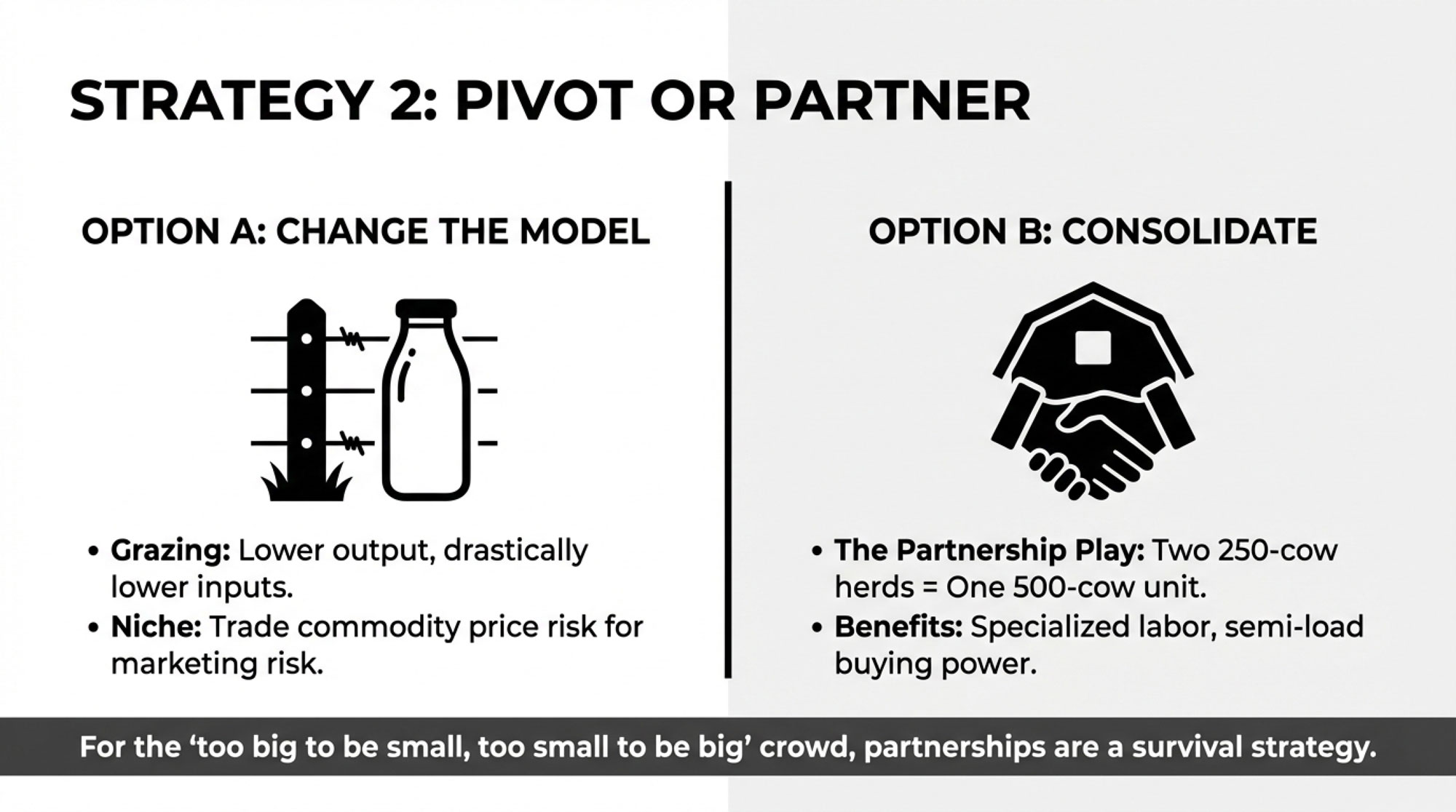
In Vermont, three neighbors with 200-cow operations formed a joint venture. They share equipment and labor but keep separate ownership. Their combined 600 cows achieve better economics without anyone taking on massive debt.
Down in Texas, smaller operations are finding success with direct institutional sales. One producer’s getting a $2 premium per hundredweight from a regional hospital system valuing local sourcing. For a 300-cow operation, that’s $164,000 additional annual revenue.
These aren’t miracles. They’re grinding it out, getting creative, adapting.
The Reality We’re Facing
Current policy seems optimized for large-scale operations and export competitiveness rather than for preserving mid-sized farms. That $11 billion in processor investments signals confidence in dairy’s future—but it’s a future with fewer, larger farms producing for global commodity markets.
The 300-cow operations that built our rural communities are becoming harder to sustain economically. Not because they’re bad at farming, but because the system increasingly favors scale.
Practical Steps That Work
Surviving operations share common traits. It’s not about the newest equipment—it’s about eliminating every unnecessary expense. Some are forming partnerships, sharing resources, even merging herds while keeping separate ownership.
Market development works when you find specific buyers—hospitals, schools, regional chains—who value local sourcing enough to pay premiums. Financial creativity matters too. Equipment leases, custom work arrangements, conservation easements—everything’s worth considering.
Resources Worth Checking
Financial Planning:
DMC Decision Tool at dairymarkets.org
Federal Milk Marketing Order info at ams.usda.gov
Your state Extension dairy program for cash flow templates
Support When Needed:
Farm Financial Standards Council: ffsc.org
National Young Farmers Coalition: youngfarmers.org
Farm Aid hotline: 1-800-FARM-AID
Margins crashed $4.02/cwt in six months—but DMC offers zero protection until you hit $9.50. Mid-size farms are bleeding in the $2+ gap between their breakeven and federal safety nets
The Bottom Line
Secretary Rollins’ “golden age” might happen for large operations positioned for exports, processors with efficient new plants, and input suppliers serving bigger customers. This infrastructure will make U.S. dairy more globally competitive.
But for many 300-cow Wisconsin operations, 450-cow Pennsylvania farms, 250-cow Vermont dairies, this isn’t a golden age. It’s a countdown. Not because they failed, but because the economics of their scale don’t work in the current system.
These families need honest analysis and practical tools, not just optimism. The next 18 months will reshape American dairy more than any period since the 1980s. Whether mid-sized producers find ways to stay viable or choose to preserve value through exit, they’re making rational decisions in challenging circumstances.
At kitchen tables across dairy country tonight, families are making choices that can’t wait for the next farm bill or election. They’re using real numbers, actual margins, and making generational decisions. Whatever they choose, they’re not failing. They’re adapting to reality.
The industry that emerges will be different. Understanding that—both the challenges and opportunities—helps us all navigate this transition better. That’s the conversation we need to be having, with clear eyes and respect for the tough choices our neighbors are making.
Because at the end of the day, we’re all trying to figure out the best path forward in an industry we love, even when it’s testing us like never before.
KEY TAKEAWAYS:
The $71,000 shift: June’s make allowance changes moved $82M from producers to processors—turning a typical 300-cow operation from barely profitable ($10K) to bleeding cash (-$61K)
Your 18-month decision window: By January 2026, choose your path—invest $2-3M to scale up, transition to niche markets, or execute an orderly exit while preserving equity
Why USDA’s “support” won’t save you: The four-pillar plan (dietary guidelines, export expansion, processor investments, “vocal” interest rate advocacy) offers no direct financial relief as 2,800 farms close
The permanent disadvantage: Operations under 700 cows face $4-5/cwt structural cost gap versus mega-dairies that no amount of belt-tightening can overcome
Five critical questions to answer now: True breakeven with family wages? Processing contracts beyond 2026? Equity burn rate? Succession viability? Exit value today vs. 18 months?
Complete references and supporting documentation are available upon request by contacting the editorial team at editor@thebullvine.com.
Learn More:
Pick Your Lane or Perish: The 18-Month Ultimatum Facing 800-1,500 Cow Dairies – Reveals how October’s $2.47 Class spread forces mid-sized dairies into immediate strategic decisions between commodity and premium markets, providing tactical frameworks for operations caught between scaling up and specialized production.
The $11 Billion Betrayal: Your Processor Is Building Your Replacement Right Now – Exposes the strategic implications of massive processor investments for farms unable to write $3M expansion checks, demonstrating why current infrastructure development favors mega-dairy consolidation over traditional family operations.
Building a Beef-on-Dairy System: Capturing $360,000 in Annual Farm Profit – Demonstrates how farms are pivoting from traditional dairy breeding to beef-on-dairy crosses, jumping from 50K to 3.2M head nationally and boosting calf revenue from 2% to 6% of total farm income—a proven alternative revenue stream for operations facing margin pressure.
Join the Revolution!
Join over 30,000 successful dairy professionals who rely on Bullvine Weekly for their competitive edge. Delivered directly to your inbox each week, our exclusive industry insights help you make smarter decisions while saving precious hours every week. Never miss critical updates on milk production trends, breakthrough technologies, and profit-boosting strategies that top producers are already implementing. Subscribe now to transform your dairy operation’s efficiency and profitability—your future success is just one click away.
Are your feed contracts ready for China’s next move? Learn the #1 step to keep your dairy thriving through 2026’s storm.
EXECUTIVE SUMMARY: China’s record soybean purchases are tightening feed supplies and driving up costs for dairy farmers in 2026. This analysis, backed by USDA and industry data, reveals how the new trade deal is fueling volatility—from rising soybean meal prices to a stronger dollar eroding export competitiveness. Dairy operations willing to act fast—locking in feed contracts, improving ration efficiency, and diversifying protein sources—stand to protect their bottom line. The article lays out a farmer-tested 90-day action plan, with examples and strategies suited for different regions and farm sizes. For many, the next few weeks could determine whether they stay in business, expand, or get squeezed out. With the right moves, surviving the feed storm of 2026 isn’t just possible—it’s within reach.
You know how it goes—you’re checking feed invoices on a Thursday afternoon when the big news breaks. That’s exactly what many Wisconsin dairy farmers were doing when the November 2025 China trade deal was announced. American agriculture had secured 87 million metric tons of soybean exports over three years, and honestly, the initial reaction from most of us was cautiously optimistic.
But here’s what’s interesting. As producers started running the numbers—and I’ve talked to quite a few over the past week—the optimism began to shift. When China commits to buying 25 million metric tons of our soybeans annually, those are beans leaving the domestic market. And as one producer near Madison put it to me, “Last I checked, my cows don’t eat soybeans in Shanghai.”
What I’ve found is that once you dig into the actual economics, there’s a supply squeeze developing that the celebratory press releases aren’t really highlighting. It’s not that anyone’s trying to hide anything—it’s just that the grain side of the story is getting all the attention.
Understanding the Supply Squeeze
So here’s where the math gets interesting, and why many of us are concerned. According to the latest USDA Economic Research Service data from October, U.S. soybean crushing capacity is already processing about 2.54 billion bushels annually. That’s 59% of our total production right there.
Operation Size
Monthly Soybean Meal Use (tons)
Cost at $330/ton
Cost at $375/ton
Monthly Impact
100-cow
4.5
$1,485
$1,688
+$203
300-cow
13.5
$4,455
$5,063
+$608
500-cow
22.5
$7,425
$8,438
+$1,013
1,000-cow
45
$14,850
$16,875
+$2,025
2,000-cow
90
$29,700
$33,750
+$4,050
Now add China’s commitment—another 918 million bushels of annual demand when you convert those metric tons. Factor in our existing exports to Japan, Mexico, and the EU, plus seed requirements… suddenly we’re operating at nearly 100% utilization with minimal buffer stocks.
Agricultural economists at places like Iowa State have been tracking this, and what they’re pointing out is worth noting: when stocks-to-use ratios drop below 12%, price volatility typically increases significantly. What are the projections for the 2025-26 marketing year? We’re looking at 10.2%. That’s uncomfortably tight by any measure.
Look, I get why grain farmers are celebrating—and they should be. They’ve been getting undercut by Brazilian beans for three years straight. The USDA Foreign Agricultural Service reports show Brazil’s production costs running about $8.67 per bushel compared to our $9.85 here in the States. That’s brutal competition. So yeah, they desperately needed this export market.
But here’s where it gets complicated for those of us in dairy. Current soybean meal futures on the CME were trading around $320-330 per ton in early November. Market analysts—and I’m talking about the conservative ones at places like CoBank—are projecting we could see 12-18% price increases once those export shipments ramp up in the first quarter of 2026.
Soybean meal prices are projected to surge 12-18% by Q2 2026 as China’s record purchases tighten domestic feed markets—hitting $375/ton and squeezing dairy margins across all operations.
For dairy operations where feed accounts for 45-60% of operating expenses —most of us, according to Cornell’s farm business data —we’re talking real money. Not hypothetical impacts—real cash flow consequences.
The Currency Connection Most Farmers Miss
Now, there’s another layer to this that even seasoned dairy producers often overlook. It’s the currency angle, and honestly, it took me a while to fully grasp this myself.
When China buys $9.6 billion worth of soybeans annually, they need U.S. dollars to complete those transactions. Basic economics, right?
But what happens next is where it gets interesting. Federal Reserve data going back decades shows that a 10% increase in agricultural exports typically correlates with a 1-2% appreciation in the dollar’s value against trading partner currencies. Doesn’t sound like much?
Let me give you a real-world example that brought this home for me.
Say you’re part of a cooperative that exports nonfat dry milk to Mexico—which, according to U.S. Dairy Export Council data, is one of our top three dairy export markets. Your product is priced at $1.20 per pound, and a standard container holds 44,000 pounds. At today’s exchange rate of roughly 17 pesos per dollar, that Mexican buyer pays 897,600 pesos.
But if the dollar strengthens by just 1.5%—and that’s conservative given the trade volumes we’re discussing—that same container suddenly costs your Mexican buyer 911,064 pesos. That’s 13,464 pesos more for the exact same product.
The currency connection most farmers miss: a mere 1.5% dollar strengthening adds $13,464 to a container of milk destined for Mexico—your price didn’t change, but suddenly you’re uncompetitive against New Zealand
“You haven’t raised your price. Your co-op hasn’t changed anything. But from the buyer’s perspective, American dairy just got more expensive.”
Meanwhile, New Zealand dairy products? Their dollar typically weakens when global commodity prices rise, making their exports more competitive, not less. It’s a dynamic that puts us at a systematic disadvantage, and it compounds over time.
China’s Actual Dairy Demand: A Reality Check
Here’s what really caught my attention when I dug into the USDA Foreign Agricultural Service’s latest China dairy reports. They’re projecting just 2% growth in dairy imports for 2025. That’s after three consecutive years of declining imports. Two percent.
What’s worth understanding is that China’s government has set explicit targets—47 kilograms of per capita dairy consumption by 2030, up from the current 35 kilograms. But if you read their Five-Year Agricultural Plans carefully — and I’ve been going through these with some industry analysts — they’re planning to meet this demand primarily through domestic production expansion, not imports.
The numbers back this up. China’s raw milk production is forecast to increase by 3-4% in 2025, according to USDA FAS reports. They’re building massive dairy operations—we’re talking 10,000-head facilities—with government subsidies for everything from imported genetics to milking equipment.
And here’s the kicker that nobody wants to talk about: even with these new tariff suspensions, everyone’s celebrating, U.S. dairy products still face a 10% duty in China. Know what New Zealand pays? Zero. They’ve had a free trade agreement since 2008. Australia? Zero percent since 2015. The EU? Various agreements put them at zero or near-zero.
So we’re celebrating market access, where we’re still at a 10% cost disadvantage to our main competitors. That’s… well, that’s something to think about.
Regional Variations and Operational Realities
Now, I should mention that this isn’t hitting everyone equally. The impact really depends on where you are and how you operate.
California’s large-scale operations—I’m talking about those 2,000-plus cow dairies in the Central Valley—they’ve got some advantages here. Many can negotiate directly with soybean crushing plants, bypassing the dealer markup that smaller operations face. They’ve got the storage capacity to buy feed in bulk when prices are favorable. Some are even forward-contracting a full year out.
But in Wisconsin? Pennsylvania? Vermont? The 100-300 cow operations that still make up the backbone of dairy in these states face a different reality. I was talking to a Pennsylvania producer last week who told me he’d called three feed suppliers about locking in prices for next year. One wouldn’t quote him past December. Another wanted a 5% premium for a six-month lock. The third said to call back after Thanksgiving.
What’s fascinating—and concerning—is how this accelerates the consolidation we’ve been seeing for years. USDA National Agricultural Statistics Service data shows that 65% of the nation’s dairy cows now live on farms with 1,000 or more animals. That was 45% just fifteen years ago. When margins get squeezed by feed costs and currency headwinds, it’s the mid-size family operations that typically can’t weather the storm.
For organic and grass-based operations, there’s actually an interesting twist. Those farms feeding minimal grain might find themselves with a competitive advantage as grain-dependent neighbors struggle with feed costs. But even they’re not immune—organic soybean meal runs about double the conventional price, and those markets tend to move in parallel.
And what about seasonal calving operations? They might actually have some flexibility here, being able to time their peak feed needs around market conditions. It’s one of those operational quirks that could become an unexpected advantage.
Practical Steps That Actually Work
So what can we actually do about this? I’ve been collecting strategies from operations that successfully navigated the 2012 drought and the 2018-19 margin squeeze, and there are some consistent patterns.
Lock Your Feed Contracts—But Be Smart About It
The single most impactful decision, according to every successful farmer I’ve spoken with, is locking feed prices for January through June 2026. But here’s the thing—you’ve got maybe 10-15 business days before suppliers adjust their forward pricing to reflect the coming supply squeeze.
A Wisconsin producer I know well locked 70% of her expected soybean meal needs at $332 per ton with a 3% premium. Yeah, it felt expensive paying that $895 extra upfront. But if the meal hits $375 per ton by February—and many nutritionists think it could—she’ll save over $2,000 in six months.
What farmers are finding works best:
Lock 60-70% of expected consumption, keeping some flexibility
Include alternative proteins in your contracts—canola meal, distillers grains
Negotiate volume commitments for better pricing
Ask about price protection if markets drop more than 15%
Feed Efficiency: The Research Numbers
Here’s a number that should grab your attention: University of Wisconsin research shows efficient operations achieve 162 pounds of feed per hundredweight of milk produced. Less efficient operations? They’re using 243 pounds. That’s a 33% difference, and it becomes a survival factor when feed costs spike.
Feed Efficiency: Real Farm Results
I know a producer who made some simple changes that improved her feed conversion by 9% over 90 days. Started measuring feed refusals daily—discovered they were wasting 7% of delivered feed. Began testing forages monthly instead of quarterly. Adjusted feeding times to within 30-minute windows. Separated first-lactation heifers from mature cows for targeted feeding.
The result? About $60,000 in annual savings. No new equipment, no capital investment. Just better management of what they already had.
For those running robotic milking systems, there’s an added dimension here. Your feeding strategy is already more individualized, which could be an advantage. But you’ll need to adjust your pellet formulations and potentially recalibrate feeding rates as ingredient costs shift.
Diversify Protein Sources Strategically
What’s working for farmers who are getting ahead of this is a gradual transition, not panic switching. You can’t just swap soybean meal for canola meal overnight and expect the same milk production. But with careful testing and adjustment…
An Idaho producer I’ve been following started incorporating alternative proteins eight weeks ago. They’re now at 15% canola meal, 20% more distillers grains, and they’ve reduced soybean meal from 5.5 to 4.2 pounds per cow per day. Production’s holding steady, components haven’t dropped, and they’re positioned better for when soybean meal prices spike.
The Longer View: Industry Restructuring
Looking beyond the immediate feed cost concerns, this trade deal is accelerating something that’s been happening for years—the fundamental restructuring of American dairy.
Research from Cornell’s agricultural economics department shows that trade policies creating margin pressure don’t just affect current operations. They accelerate the shift from distributed, family-farm dairy to consolidated, industrial-scale production.
The advantages increasingly favor large operations that can negotiate directly with feed suppliers and processors, maintain capital reserves for extended contract positions, achieve superior feed conversion efficiency through dedicated nutritionists and technology, and access sophisticated financial instruments like currency hedging.
For small- and mid-size operations, the path forward requires either exceptional efficiency, niche-market development, or strategic partnerships that provide some of the scale advantages without full consolidation.
I’ve noticed something interesting when talking to younger farmers taking over operations: the successful ones aren’t trying to compete on scale. They’re finding ways to be exceptional at efficiency, developing direct-market relationships to capture more margin, or forming buying cooperatives with neighbors to secure volume pricing on inputs. It’s really adapt or exit.
And heifer raising operations? They’re in an interesting spot. Feed costs hit them too, but they might find opportunities as dairy farms look to reduce capital tied up in youngstock. Could be worth exploring contract raising arrangements if you haven’t already.
Your 90-Day Action Plan
Based on conversations with farmers who’ve successfully navigated previous margin squeezes, here’s what needs to happen:
Next 7-14 Days (Urgent)
Contact feed suppliers about January-June 2026 pricing. Even if you only lock 40-50% of your needs, that’s protection you won’t have if you wait until December. Get quotes from at least three suppliers—prices and terms vary more than you’d expect.
Schedule a sit-down with your nutritionist. Not a phone call—a real working session to develop contingency rations using alternative proteins. Test these on a small group first.
Pull your actual feed conversion numbers. If you don’t know your pounds of feed per hundredweight of milk, you’re flying blind.
Next 30 Days (Important)
Start measuring feed refusals daily. I know, I know—one more thing to track. But farms that do this consistently find 5-10% waste they didn’t know existed.
Test all your forages. Those three-month-old test results? They’re fiction at this point. Forage quality changes, and you’re formulating rations based on fantasy if you’re not testing monthly.
Evaluate storage capacity. Can you take a full semi load instead of partial deliveries? The per-ton savings add up fast.
Next 90 Days (Strategic)
Run the numbers on what happens if feed costs rise 15% and milk prices drop 5%. If that scenario puts you underwater, what changes now? Culling decisions? Expansion plans? Equipment purchases?
Build relationships with alternative suppliers. When primary suppliers run tight, having established relationships with secondaries can be the difference between feeding cows and scrambling.
Document everything you’re doing to improve efficiency. Your banker will want to see this when you discuss operating notes, and processors value suppliers who can demonstrate operational excellence.
The Bottom Line
Agricultural trade policy often involves tradeoffs between sectors. The soybeans leaving for China are soybeans not being crushed domestically for meal. The dollars flowing in for those exports strengthen our currency and make dairy exports less competitive.
None of this means the sky is falling. Farms that recognize these dynamics and position accordingly will navigate successfully—some will even find opportunities in the disruption. But the window for proactive positioning is measured in weeks, not months.
As one successful farmer told me recently, “The difference between the dairies that thrive and those that just survive often comes down to decisions made months before the crisis becomes obvious to everyone.”
The math suggests we’ve got about 90 days to position for what’s coming. The question isn’t whether feed costs will rise and margins will tighten—market dynamics make that increasingly likely. The question is whether your operation will be positioned to handle it.
Your cows will need feed in February regardless. The only variable is whether you’ll be paying $325 per ton because you locked it in November, or $375 because you waited to see what happens.
The clock’s ticking. What’s your move?
Key Takeaways:
China’s soybean surge is tightening domestic feed markets—soybean meal spot prices could jump 12-18% by Q2 2026.
Locking in feed contracts within the next 2 weeks can shield your dairy from volatile markets and protect 2026 margins.
Efficiency wins: improving ration conversion and testing forages monthly can mean $60,000/year in saved feed costs.
The producers who adapt now—by diversifying their protein offerings and working closely with nutritionists—will have the best shot at staying profitable through next year.
Waiting for certainty isn’t a strategy: farms that act now have more options and a better chance of riding out the feed storm.
Data sources for this article include: USDA Economic Research Service (October 2025), USDA National Agricultural Statistics Service (2025), USDA Foreign Agricultural Service GAIN Reports (October 2025), CME Group futures data (November 2025), Federal Reserve Agricultural Finance Monitor (Q3 2025), CoBank Knowledge Exchange quarterly reports, Cornell Dairy Farm Business Summary (2024), University of Wisconsin-Madison dairy research publications, U.S. Dairy Export Council trade data, and various dairy market analysis reports.
Learn More:
Feed Smart: Cutting Costs Without Compromising Cows in 2025 – Provides the direct, tactical “how-to” for ration adjustments, revealing methods for evaluating alternative proteins and maximizing high-quality forage to defend your margins against the exact price hikes this article predicts.
Join over 30,000 successful dairy professionals who rely on Bullvine Weekly for their competitive edge. Delivered directly to your inbox each week, our exclusive industry insights help you make smarter decisions while saving precious hours every week. Never miss critical updates on milk production trends, breakthrough technologies, and profit-boosting strategies that top producers are already implementing. Subscribe now to transform your dairy operation’s efficiency and profitability—your future success is just one click away.
As 8,000-12,000 mid-sized operations prepare to exit by 2030, successful farmers are discovering that traditional optimization strategies no longer work—and the real winners are those managing total margins, not just feed costs
EXECUTIVE SUMMARY: Wisconsin dairy farmer Dave Miller’s $180,000 investment in automation for just 1,100 cows seemed irrational—until it increased his net income by $165,000 annually and revealed why 12,000 farms face exit by 2030. The new reality: traditional feed cost optimization is obsolete, as successful producers focus on total margins, where labor exceeds $20/hour, hauling costs have doubled, and feed accounts for only 35-40% of true costs. Three models will dominate 2030: mega-operations (3,500+ cows) achieving $14.20/cwt costs through scale, niche producers capturing $35-50/cwt premiums through direct marketing, and multi-family partnerships sharing resources and risk. Mid-size single-family farms (500-700 cows) face a crushing $250,000-375,000 annual profit gap and must choose among five strategic paths immediately. As California loses 350,000 cows to water restrictions while Wisconsin gains 180,000, the geographic and economic landscape is transforming rapidly—and every year producers delay strategic decisions, they cost them $200,000-300,000 in equity.

I recently spoke with a Wisconsin dairy producer who invested $180,000 in automation technology while running only 1,100 cows in a barn designed for 1,500. His neighbors initially questioned the decision.
Three years later, he’s maintaining profitability with manageable 65-hour work weeks while operations twice his size are experiencing burnout or considering exits.
Dave’s approach reflects a broader pattern I’ve been observing across the industry. The optimization strategies we’ve relied on for decades are evolving.
And producers adapting to these new economic realities are finding sustainable paths forward.
What’s particularly noteworthy is the convergence of data we’re seeing. The USDA National Agricultural Statistics Service reports dairy cow numbers at 9.36 million head as of December 2024. University of Wisconsin dairy economic studies and Cornell’s Dairy Farm Business Summary all point to significant structural changes.
Statistics show the annual average number of commercially licensed dairy farms fell to 24,811—part of a consolidation trend that deserves careful attention.
This transformation raises important questions about operational strategies, regional dynamics, and what success looks like moving forward. The data tells a compelling story about who’s thriving, who’s struggling, and perhaps most importantly, which assumptions may need updating.
The Feed Cost Discussion: Examining Traditional Metrics
Look Beyond Feed: Feed isn’t the 55% villain it used to be—labor now devours 30% of your true cost structure. Are you tracking the right benchmarks?
For generations, we’ve focused intently on feed cost per hundredweight as a primary performance metric. The benchmarks are well-established—Cornell and Wisconsin extension programs suggest feed should account for 45-55% of total costs, and efficient operations can achieve $6.50-7.00/cwt, according to recent enterprise analyses.
This approach has served the industry well. Yet conversations with producers and emerging data suggest we might benefit from a broader perspective.
Consider the economics facing a typical 500-cow operation. They might spend $7.20/cwt on feed and achieve $0.40 savings through optimization—roughly $25,000 annually on 12.5 million pounds of production.
Meanwhile, USDA Economic Research Service data shows agricultural labor costs exceeded $53 billion in 2025, with dairy-specific wages averaging $17.55/hour—representing a 30% increase since 2021.
Transportation costs present another consideration. Producers across multiple regions report that hauling fees have increased from $0.35 to $0.65/cwt as processing plants consolidate.
Processing premiums have shifted as well, with many areas seeing reductions from $0.45 to around $0.20/cwt as competition for plant capacity evolves.
“We’re observing producers who optimize feed costs effectively but encounter challenges in overall profitability. Operations might save $0.30/cwt on rations, yet experience breeding rate declines of 3% or cull rate increases of 5%, resulting in larger losses in areas they’re monitoring less closely.” — Dr. Mark Stephenson, University of Wisconsin’s Center for Dairy Profitability
Wisconsin’s June 2025 dairy sector assessment provides additional context: feed accounts for approximately 35-40% of total costs when debt service, family living expenses, and working capital needs are included.
These comprehensive costs often determine long-term viability. They suggest the value of holistic margin management.
Individual Cow Economics: A Developing Approach
An interesting development among progressive producers involves shifting from herd averages to individual cow economics. This approach, enabled by recently more accessible monitoring technology, reveals nuanced profitability patterns.
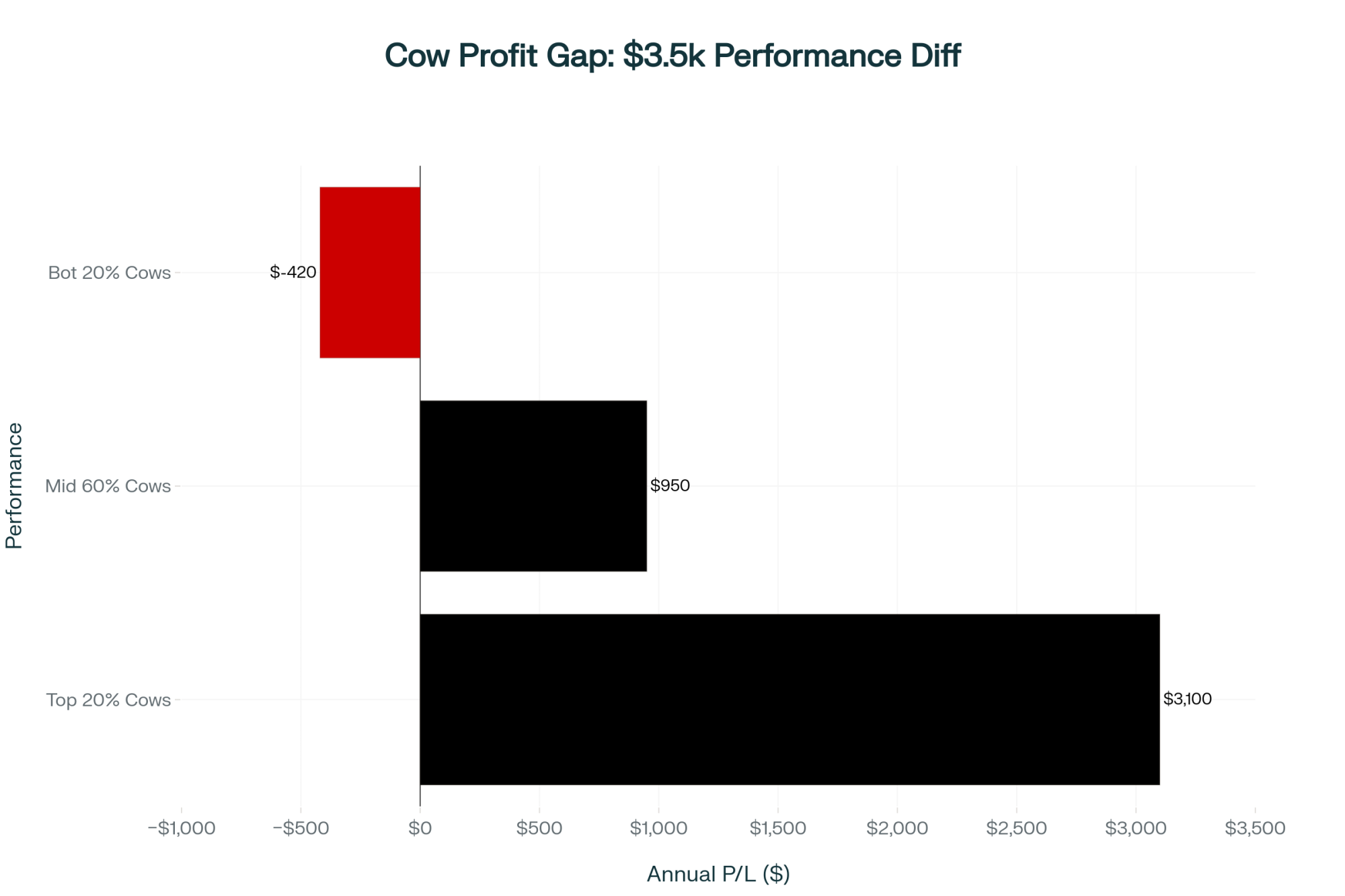
I visited a 1,200-cow Michigan operation using individual cow monitoring systems—technology similar to that documented by the Journal of Dairy Science in smart dairy farm analyses. Their data revealed striking variations:
Top 20% of cows generated $3,100 annual profit each
Middle 60% generated $950 profit
Bottom 20% showed losses of $420 per head annually
The producer—let’s call him Steve to respect his privacy—took an innovative approach based on this data.
“We reduced our herd from 1,200 to 1,050 cows by identifying chronic underperformers,” he explained during my visit. “Total milk production decreased 8%, but net income increased $165,000 because we eliminated negative-margin animals that were affecting overall profitability.”
Stop Guessing—Start Culling: The average herd hides a profit gap of $3,520 per cow. Trash the laggards, pump up the leaders, and watch your bottom line soar.
This individual-animal strategy extends beyond culling decisions. Progressive operations now adjust feeding programs, breeding protocols, and housing assignments based on profitability projections.
High-performing cows receive premium nutrition and genetic improvements. Marginal performers might receive commodity feed and beef semen—a practice that’s created its own market dynamics, with National Milk Producers Federation data showing beef-on-dairy calves commanding $1,400 premiums.
Technology Adoption: Finding Practical Solutions
While industry publications often feature multi-million-dollar robotic installations, the reality for most producers is more modest investments. NASS data indicate that approximately 70% of U.S. dairy farms operate with fewer than 200 cows and an annual capital budget of under $50,000.
Through farm visits this year, I’ve identified what many call a “minimum viable technology stack” that delivers measurable returns for mid-sized operations:
Practical Investments ($30,000-60,000 total):
Basic activity monitors for breeding detection: $8,000-12,000 (typical payback within 14 months through improved conception rates)
Used plate cooler and variable speed milk pump: $15,000-25,000 (energy cost reductions of 20-30% commonly reported)
Automated feed pusher: $12,000-18,000 (saves approximately 2 hours of daily labor)
A 400-cow Wisconsin operation shared their experience: $45,000 in basic automation reduced labor requirements by 20 hours weekly—valued at $31,200 annually at current wages—while improving breeding rates by 15% and reducing feed waste by 8%.
“Everyone discusses robots and advanced genetics, but my most valuable investment was a $3,000 used generator for power outage protection. It’s prevented milk dumping three times this year—preserving about $40,000 in revenue. Sometimes, straightforward solutions address real challenges effectively.” — Tom Peterson, Pennsylvania dairyman managing 380 cows
The geographic distribution of dairy production continues evolving, influenced by water availability, regulatory frameworks, and processing infrastructure. USDA milk production reports and state-specific data from June 2025 reveal emerging patterns worth monitoring through 2030.
Regions Experiencing Growth:
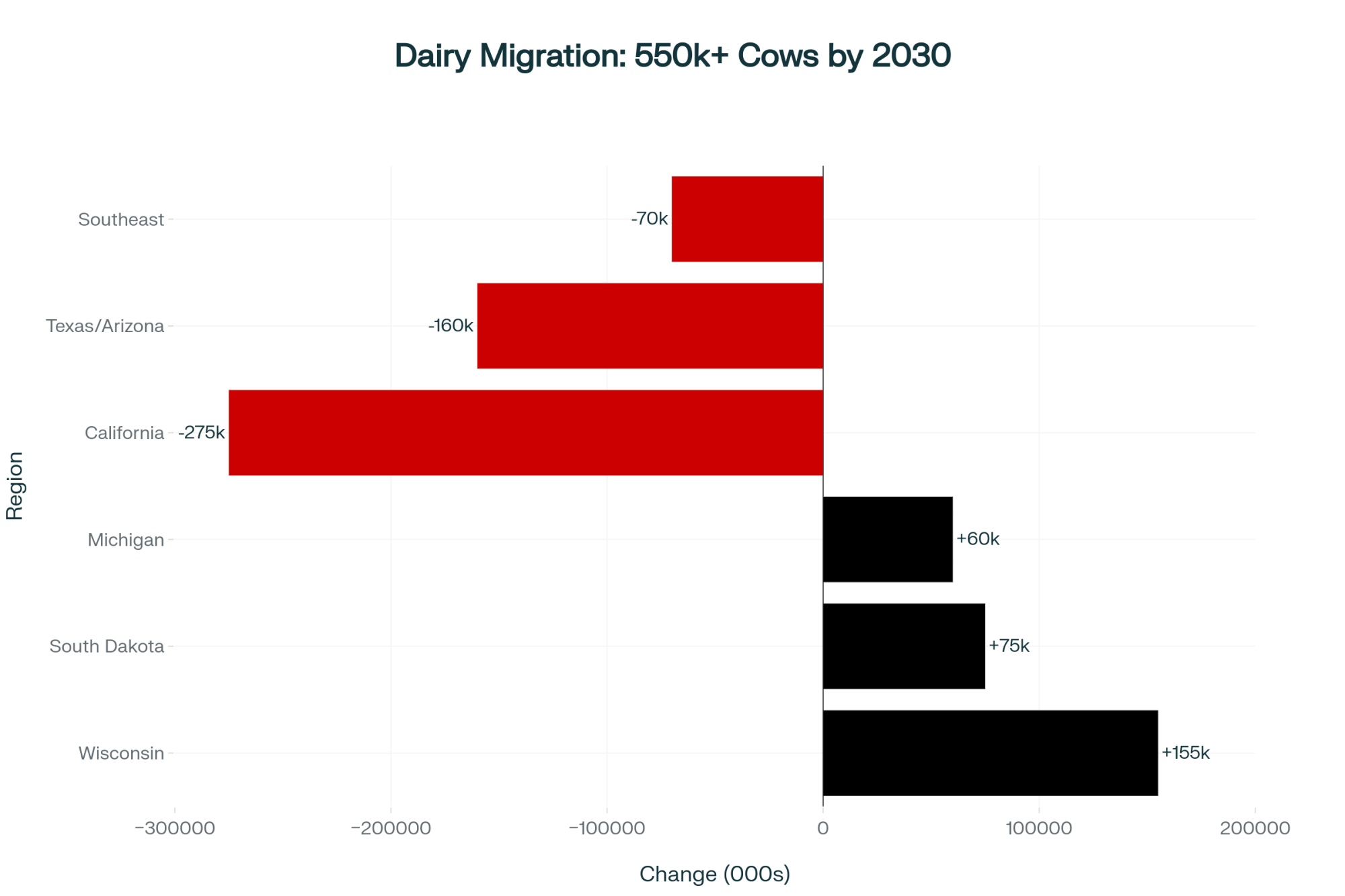
Wisconsin appears poised to add 130,000-180,000 cows between now and 2030, benefiting from factors such as water availability. University of Wisconsin studies indicate the state’s dairy industry contributes $52.8 billion in economic impact—a substantial increase from five years ago.
South Dakota represents an unexpected growth area, potentially adding 60,000-90,000 cows given favorable regulatory conditions and new processing investments.
Michigan shows expansion potential of 45,000-75,000 cows, leveraging Great Lakes water access and existing infrastructure advantages.
Regions Facing Challenges:
California confronts difficult decisions as the Sustainable Groundwater Management Act (SGMA) potentially removes 500,000 to 1 million acres from irrigation by 2040, according to UC Davis and ERA Economics research. This could result in 200,000-350,000 fewer dairy cows.
The Southwest, particularly Texas and Arizona, faces a contraction of 120,000-200,000 cows due to concerns about water scarcity.
Southeastern states continue gradual adjustments, potentially losing 50,000-90,000 cows to heat stress and feed cost pressures.
The Northeast presents an interesting case. Vermont and New York operations are finding success with value-added production and agritourism, though total cow numbers remain relatively stable.
A New York producer recently told me, “We can’t compete on volume, but our proximity to Boston and New York City markets gives us premium opportunities California can’t match.”
Coast-to-Coast Cow Shuffle: The SGMA is triggering America’s biggest dairy redraw in history. Is your state benefiting—or bleeding cows?
A Wisconsin processor shared an observation that captures the transformation: “When California loses a 5,000-cow operation, we typically don’t see a single 5,000-cow dairy relocate here. Instead, we might see three 1,500-cow operations emerge, each requiring different infrastructure support. It represents structural transformation, not simple geographic relocation.”
This fragmentation creates complex dynamics. Regions gaining production face intensified labor competition, increased regulatory attention, and community adaptation challenges.
Areas losing production experience, processor consolidation, and service reductions that can accelerate further exits.
Mid-Size Operations: Evaluating Strategic Options
The 500-700 cow operations that have long anchored American dairying face particularly complex decisions. Cornell’s Dairy Farm Business Summary and related financial analyses reveal that these farms occupy a challenging position—scale limitations for certain efficiencies, yet size constraints for niche-market approaches.
Recent extension analyses suggest that a typical 500-cow operation experiences:
Average revenue: $20.90/cwt (based on June 2025 Class III pricing at $18.82/cwt)
Resulting margins: $3.10-4.60/cwt
That $2-3/cwt cost differential translates into $250,000-375,000 in annual profit lost compared to larger operations—ironically, approximately the capital needed for modernization investments.
Mid-Size Meltdown: A brutal $2.05/cwt cost gap leaves mid-size farms with a $375k annual hole—survival requires a radical pivot or exit.
Working with producers, we’ve identified five primary strategic paths:
Scale expansion (to 1,500+ cows): Requires $6-8 million investment, with industry data suggesting 60-70% success rates for well-planned expansions
Niche market transition (organic/direct marketing): Requires proximity to urban markets, with approximately 20-30% of attempts achieving sustainable success
Efficiency optimization (robotics at current scale): $1.5 million investment potentially extends viability 8-12 years
Partnership formation (combining with neighbors): Offers shared resources, though approximately 40% encounter challenges within five years
Strategic exit (while retaining equity): Can preserve $2-4 million for life’s next chapter
“The most difficult conversations involve 50-year-old producers who believe market cycles will improve their situation. Each year of delayed decision-making can reduce equity by $200,000 to $ 300,000. By the time action feels necessary, options have often narrowed considerably.” — Dr. Wayne Knoblauch, farm management specialist at Cornell University
Understanding Expansion Challenges: Learning from Experience
Industry data and lender interviews suggest 30-40% of major expansions encounter significant challenges. Through analysis of expansions from 2018 to 2023, patterns emerge that deserve careful consideration.
A typical challenge sequence often unfolds like this…
Initial phase (Months 1-6): Construction frequently exceeds budgets by 15-20% due to weather delays or supply chain issues, affecting working capital before operations commence.
Staffing phase (Months 7-12): Labor recruitment proves more difficult than anticipated. Facilities designed for eight workers might operate with four, creating unsustainable workloads.
Operational phase (Months 13-18): Production often falls 15-20% below projections due to transition stress, learning curves with new facilities, and management bandwidth constraints.
Stress phase (Months 19-24): Family and personal stress intensifies. Health impacts, relationship strains, and succession uncertainties become pronounced.
Resolution phase (Months 30-36): Financial covenants trigger lender discussions, though operational challenges typically preceded financial ones.
A producer who experienced expansion difficulties shared powerful insight: “The financial pressure arrives last. Before that comes health impacts, family stress, and loss of purpose. The paperwork simply documents what already occurred.”
Analysis suggests successful expansions share common elements: 20-30% budget contingencies (versus 5-10% in struggling expansions), 10-15% excess labor capacity from day one, management teams sharing responsibilities, and 10-12 months working capital reserves.
The difference often lies in maintaining adequate buffers—financial, operational, and personal.
Future Operating Models: Three Viable Paths for 2030
Looking toward 2030, current trends and economic modeling suggest three primary operating models will emerge, each with distinct characteristics.
Large-Scale Operations (3,500-8,000 cows)
These operations achieve $14.20-15.80/cwt costs through scale efficiencies and automation. Many generate $800,000-1.8 million annually from renewable energy credits via anaerobic digesters.
The investment requirements are substantial—$25-$35,000 per cow—and management resembles agricultural business leadership more than traditional farming. IDFA’s 2025 report indicates these operations collectively employ 3 million people nationally, generating nearly $780 billion in economic impact.
Premium Niche Operations (40-120 cows)
These farms capture $35-50/cwt through direct marketing, compared to $21/cwt under commodity pricing. They generate $220,000-650,000 family income with minimal debt, according to Cornell’s organic dairy studies.
Marketing and customer relations consume 25-35% of time—it’s farming combined with retail business management. Success requires proximity to metropolitan areas where customers value and can afford premium products.
USDA organic price reports from September confirm these premiums remain stable.
Strategic Mid-Scale Partnerships (800-1,800 cows)
This model involves 2-3 families collaborating to share resources and responsibilities. They achieve $200,000-250,000 income per family with 50-60 hour work weeks.
Technology adoption is selective—perhaps 50-70% robotic milking, 30-50% conventional systems. While these partnerships provide operational scale and lifestyle benefits, they haven’t eliminated all structural pressures.
Notably, the 200-700 cow single-family operations that historically defined American dairying face the most challenging path forward, caught between scale requirements and market opportunities.
Model
Herd Size
Cost ($/cwt)
Revenue ($/cwt)
Annual Income
Capital Need
Work Hours/Week
Success Factor
Mega-Operations
3,500-8,000
$14.20-15.80
$20.90 (commodity)
$800K-1.8M+
$25-35K
Mgmt role
Scale/automation/bili…
Premium Niche
40-120
N/A
$35-50 (premium)
$220K-650K
<$5K
60-70 hrs
Metro/direct marketing
Mid-Scale Partnerships
800-1,800
$15.50-16.80
$22-25 (value-added)
$200K-250K
$15-20K
50-60 hrs
Shared resource/risk
Emerging Considerations: Factors to Monitor
While the industry focuses on immediate challenges such as labor and milk prices, several emerging factors deserve attention.
Immigration policy represents significant uncertainty. The National Milk Producers Federation estimates that 70% of dairy labor depends on immigrant workers, which could lead to disruption if policies shift dramatically.
Recent enforcement actions reported by industry media in June 2025 provided early indicators of possible impacts.
Replacement heifer availability has become constrained following years of beef-on-dairy breeding programs. Those $1,400 beef-cross calves seemed profitable, but now replacement heifers command $4,000 or more in some regions,according to recent market reports.
This affects expansion possibilities and disease recovery capacity.
Environmental regulations continue evolving. California’s experience with digester requirements and proposed discharge rules requiring 10 mg/L nitrogen limits may preview broader regulatory trends.
Compliance costs could affect financing availability for highly leveraged operations by 2028-2030.
The technical skills gap presents ongoing challenges. Operations investing in automation sometimes struggle finding qualified technicians.
I visited one farm where a $2 million robotic system remained idle for three days awaiting a specialist from Europe. This dependency represents an underappreciated vulnerability.
Practical Considerations: Strategic Planning for 2025-2030
Based on comprehensive industry analysis, producer experiences, and economic projections, several key considerations emerge for dairy farmers navigating this transition.
Decision timing matters significantly. Strategic choices about expansion, market positioning, partnerships, or transitions have relatively narrow windows.
USDA projections showing 1.1% production growth in 2025, ahead of processing capacity, suggest timing considerations remain critical.
Comprehensive margin management supersedes single-metric optimization. Wisconsin’s dairy market assessments emphasize total cost consideration, including labor (exceeding $20/hour in many markets), transportation, premiums, and capital requirements.
Scale positioning requires honest assessment. Operations with 200-700 cows lacking clear succession plans benefit from proactive transition planning.
Farms with 500+ cows and strong financials need a clear strategic direction—whether pursuing scale or niche opportunities.
Monitoring emerging risks provides an advantage. Immigration policy, disease risks (particularly HPAI in dairy), replacement availability, and environmental regulations could trigger disruptions.
California’s SGMA implementation offers valuable lessons for planning.
Adapting to new models requires flexibility. Wisconsin economic impact studies show successful operations evolving into diverse models—large-scale operations function as agricultural businesses, niche producers combine farming with marketing, and mid-scale operations rely on complex partnerships.
Success depends on matching capabilities with chosen strategies.
The industry continues consolidating from approximately 35,000 farms today toward a projected 24,000-28,000 by 2030, alongside $11 billion in new processing investments. These changes create both opportunities and challenges.
What emerges from observing hundreds of operations navigating this transition is the importance of recognizing when fundamental business model evolution—not just operational refinement—becomes necessary. Producers actively adapting to new realities position themselves more favorably than those hoping traditional approaches will remain viable.
A successful producer who recently navigated significant transitions shared a valuable perspective: “The question isn’t whether traditional farming methods can continue. The question is whether we’re prepared to evolve to meet the requirements of the 2030 market. That decision—and acting on it promptly—shapes everything that follows.”
The transformation continues, and the industry’s evolution won’t pause for individual decisions. Yet within this change lies opportunity for those prepared to embrace new approaches while honoring agriculture’s enduring values.
Key Takeaways for Dairy Producers
Focus on total margins, not just feed costs—labor now exceeds $20/hour in many markets and represents 35-40% of true cost structure (Wisconsin Extension, June 2025)
Adopt individual cow economics to identify top 20% profit cows ($3,100/head) vs. bottom 20% losses ($420/head) (Cornell Dairy Farm Business Summary)
Invest in practical technology—$30,000-60,000 stack can yield $31,200 annual labor savings (producer case studies)
Regional shifts are accelerating—Wisconsin is gaining 130,000-180,000 cows, while California faces 200,000-350,000 cow reductions due to SGMA (UC Davis/ERA Economics)
Mid-size farms (500-700 cows) face $2-3/cwt disadvantage—choose from five strategic paths with 60-70% success rates for expansions (Cornell analyses)
30-40% of expansions fail—build 20-30% budget buffers and 10-12 months working capital to succeed (industry lender data, 2018-2023)
AI and Precision Tech: What’s Actually Changing the Game for Dairy Farms in 2025? – For producers ready to invest, this article delivers a tactical deep-dive into the “minimum viable technology stack.” It reveals the hard ROI numbers for precision feeding, health monitoring, and virtual fencing, helping you prioritize capital for the fastest payback.
Simple LED Lighting Can Boost Production 8% – Here’s Why Most Farms Haven’t Switched – This piece offers a practical, low-cost innovation strategy that complements the high-tech focus. It demonstrates how a simple, often-overlooked investment in barn lighting can yield a significant production increase, providing a tangible, immediate action for boosting efficiency.
Join the Revolution!
Join over 30,000 successful dairy professionals who rely on Bullvine Weekly for their competitive edge. Delivered directly to your inbox each week, our exclusive industry insights help you make smarter decisions while saving precious hours every week. Never miss critical updates on milk production trends, breakthrough technologies, and profit-boosting strategies that top producers are already implementing. Subscribe now to transform your dairy operation’s efficiency and profitability—your future success is just one click away.
July 2025 exports soared 53% year-over-year—yet most U.S. dairy farms saw shrinking profit margins, not bigger milk checks.
Executive Summary: Dairy exports shattered records in 2025, with the U.S. shipping 1.6 billion pounds of product abroad in July alone—a staggering 53% surge compared to the prior year. But beneath those headlines, American producers are battling tight margins as block cheese dipped to $1.67/lb and Class III futures slumped below $16/cwt, despite robust global demand. Recent research and USDA data highlight that this disconnect is driven by low export pricing, aggressive global competition, and a shrinking pipeline of replacement heifers—a result of widespread beef-on-dairy breeding. While mega-operations leverage scale and small niche dairies build premium brands, mid-sized farms face contraction at a rate of 7-8%. Practical insights from universities and leading advisors reveal that strategic culling, honest financial assessment, and proactive reinvestment now will best position operations for the volatile months ahead. Looking forward, success in 2026 depends not on riding out the “old normal,” but on embracing new models—whether that means cost control, vertical integration, or value-added marketing. The choices you make today could shape your farm’s resilience for years to come.
You can’t sit around the farm kitchen table or check your milk check without someone bringing up the gap between those record-smashing export headlines and what we’re actually seeing on the farm. This year’s export stats (2025, per USDEC, USDA, and CME data) are wild—so let’s walk through the fine print, and offer a clear, honest look at what the numbers do (and don’t) mean for your bottom line.
Looking Past the Headlines: Big Numbers, Real Questions
July 2025 delivered a headline: U.S. dairy exports hit 1.6 billion pounds milk-fat equivalent—a staggering 53% higher than last year, with cheese breaking records for 13 months straight and butter exports more than doubling (USDEC, August 2025). Mexico, Southeast Asia, and the Middle East are fueling those gains. (Editorial suggestion: Here’s where a quick online chart comparing U.S. and EU butter prices, or a timeline of shrinking mid-size herds, could really drive it home.)
The brutal irony driving 2025’s dairy crisis: exports hit all-time highs while farm gate prices plummet. This inverse relationship reveals how discount export pricing—driven by aggressive global competition—is bleeding value from domestic producers. When you’re the world’s cheapest cheese supplier, volume growth becomes a liability, not an asset.
But talking with neighbors from Wisconsin to California, a different reality surfaces. Class III milk futures for November struggled below $16/cwt in October (CME Oct 2025), block cheese found a floor at $1.67/lb, and butter—the one bright spot early—crashed from $2.48/lb in August down to $1.65. Feed, fuel, and labor bills just keep nipping at margins. As Dr. Mark Stephenson at UW-Madison says, “There’s a world of difference between what’s happening on the docks and what’s happening in the mailbox.”
Why Export Growth Isn’t Filling Milk Checks
Take a closer look, and you’ll see what’s really moving: American products is cheap. U.S. butter traded at $1.65/lb in October, while EU butter held firm at $2.80/lb (EU Commission). The world always chases a bargain—and lately, we’re it.
Mexico now accounts for nearly a third of U.S. dairy exports—including over half of the nonfat dry milk produced in American plants (USDEC/USDA FAS, July 2025). However, the Mexican government’s 2025 policy papers and NMPF trade summits clearly indicate that they’re backing local dairy expansion and processing, preparing to buy less from us as soon as possible.
Think about Southeast Asia: U.S. powder lands in Vietnam or Indonesia precisely because it’s cost-effective for local processors to build finished value at home. Rabobank’s summer 2025 reports refer to it as “the Asian processing pivot.” It isn’t about U.S. branding; it’s pure economics.
CME Spot Cheese: Small Trades, Big Impact
It always comes up at local co-op meetings—how is the price for millions of pounds of milk set by just a few trades, a couple of times a week? Less than 1% of U.S. cheese goes through the CME spot market (Wisconsin JDS industry surveys, 2024), but that market sets the base for half the nation’s milk. Since the move to all-electronic trading in 2017, those price swings are sometimes driven by a single processor’s urgency, rather than real supply/demand.
Plenty of us wonder: can a handful of loads really justify moving cheese price brackets for thousands of family farms? Truth is, the market says yes—for now.
Processing Expansion: Efficiency and Exposure
You’ve likely heard the figures: since 2023, about $10 billion’s been sunk into new plants (Rabobank, Dairy Quarterly Q3 2025; Cheese Reporter, Jan. 2025). Many are capable of running over 20 million pounds daily—an incredible show of confidence in the future.
But here’s the rub: those plants need full pipelines to pay off. If exports soften or domestic demand plateaus, processors continue to churn out product, often selling it abroad at marginal prices. All too often, this reality is felt not at headquarters, but on the farm, reflected in base price pressure and pooling deductions.
Beef-on-Dairy: Quick Cash, Long-Term Crunch
Every $1,000 beef-cross calf sold today is gutting tomorrow’s milk supply. Heifer inventories have plummeted 10% in three years while prices rocketed 192%—creating a replacement crisis that will constrain expansion through 2027. The math is brutal: today’s survival strategy becomes tomorrow’s bottleneck
Talk to any extension officer or herd consultant this year, and beef-on-dairy is front and center. Those beef-cross calves fetching $800 to $1,200 (USDA AMS, 2025) are saving some farm budgets, especially when pure Holstein bulls bring half that—at best.
But the development suggests a tightening squeeze just over the horizon. USDA’s July 2025 inventory shows replacement dairy heifers over 500 lbs are at their lowest since the 1970s (just under 3.9 million head). Extension consensus (CoBank, UW, MSU) expects that, unless beef-on-dairy trends change, bred springer prices will start a strong upward climb by 2026–27, right as herds may want to rebuild. The risk is real: today’s survival could complicate tomorrow’s comeback.
The Industry Barbell: Big, Niche—Middle at Risk
UC Davis, USDA, and regional co-ops are all reporting similar realities: large, vertically integrated herds with dry lot systems and their own processing arrangements continue to gain market share—especially in the Southwest and California. Scale gives them leverage most can’t touch.
Smaller, direct-sale focused herds—think Vermont or Pennsylvania bottlers, specialty cheese producers—are thriving by telling their story, emphasizing butterfat, freshness, and a personal connection. They can get $30–$50/cwt retail. It’s not easy, but the premium is real.
Yet the traditional family operation—the 200 to 1,500 cow “community dairy”—faces the tightest squeeze. Recent USDA structure reports show these farms contracted by 7–8% in 2025. Once those barns go quiet, the loss is felt far and wide.
The middle is collapsing. Operations with 200-1,500 cows—the backbone of rural communities—are contracting at 7-8% while mega-dairies and specialty producers expand. This isn’t market evolution; it’s forced consolidation driven by scale economics that mid-sized farms simply can’t match at current milk prices.
Exit Trends: More Quiet Closures Than Court Losses
Higher-profile bankruptcies get headlines (361 Chapter 12 filings as of August 2025, US Courts), but five times that many farms have transitioned out over the year without court involvement—through voluntary sale, lender wind-down, or generational transition. Extension and local lenders across Wisconsin and Iowa confirm this broader landscape. Every exit isn’t just less milk; it’s a ripple to schools, dealerships, feed outfits, and beyond.
Here’s the dirty secret: DMC margins staying above $9.50 doesn’t mean you’re making money—it means the government won’t bail you out. Mid-sized operations need $15.50/cwt to actually survive, creating a $2.70-$5.20 monthly shortfall that’s draining equity faster than most producers realize. The ‘safety net’ catches you after you’ve already fallen.
Surviving and Thriving: Pragmatic Action Beats Waiting
It’s not always what you want to hear, but this fall, the best extension and ag lender advice is simple: Cull sooner, cull harder. With cull cow prices at $145–$157/cwt (USDA AMS), and the forecast for 2026 pointing to lower levels, producers who right-size now are shoring up working capital, easing transition period stress, and improving herds’ butterfat performance.
Groups like FarmFirst Dairy and others have even started pooling supply power, making the Capper-Volstead Act mean something again in regional price discussions. Meanwhile, value-added co-ops, marketing alliances, and on-farm processing efforts (boosted by local and USDA Rural Development grants) are offering mid-size and small producers a path to retain more margin.
Three Questions Every Farm Should Ask
Set these out before winter business meetings:
Can you weather another 12–18 months at $16–$17/cwt milk without burning through savings or risking your land?
Is $18/cwt all-in cost a realistic or reasonable goal based on your geography, size, and current practices? What benchmarks or systems will close the gap?
Is everyone on board with your next phase—expanding, holding, or planning an exit? The answers shape what you do before the next market cycle.
Regional Realities: No One-Size Solution
The playing field is uneven. West Coast and Northwest dairies incur $1.50-$2/cwt higher base costs than their Midwest peers (OSU/WSU Extension, 2025), primarily due to transportation and regulatory overhead. California herds are finding their margins in digesters, water rights, and environmental mitigation. In the Midwest and Northeast, adaptive grazers are focusing on low-input strategies, diversified crop rotations, and shifting genetic emphasis to achieve whole-herd resilience.
The Real Bottom Line: Adaptation and Community
If there’s one message carrying through from every conference and farm walk this year, it’s that success hinges on honesty—with yourself, your partners, and your books. Peer benchmarking, ongoing dialogue with advisors and neighbors, and clear, sometimes tough, family talks are what keep businesses and communities weatherproof.
What farmers are finding is that adaptation—sometimes fast, sometimes gradual—isn’t a choice anymore; it’s a business necessity. We’ve steered the dairy industry through harder times before, and every forward step now is a brick in the path to the next, better cycle.
So, keep asking, keep sharing, and let’s keep steering together. Our best solutions always start in these conversations.
Key Takeaways
Despite a 53% increase in exports, most U.S. milk checks fell in 2025 as global buyers capitalized on discount pricing.
Strategic culling now—while cull prices are high—can safeguard cash flow, boost butterfat performance, and reduce transition headaches.
Use regional benchmarking and trusted university data to determine if your operation can realistically hit sub-$18/cwt all-in costs.
Don’t wait: initiate open succession talks, review lender relationships, and explore value-added/cooperative marketing to hedge future risk.
Adaptation—whether through efficiency, product innovation, or strategic exit—is essential for all farm sizes as the middle ground shrinks and 2026 market volatility looms.
Complete references and supporting documentation are available upon request by contacting the editorial team at editor@thebullvine.com.
Learn More:
Why Are Dairy Farmers Desperately Holding onto Their Cows in 2024? Uncover the Truth – Reveals the financial mechanics of the beef-on-dairy trend, providing critical data on soaring replacement costs and the long-term heifer supply crunch. This perspective demonstrates how to use genetic tools to protect cash flow and strategically plan for future herd expansion, essential for navigating price volatility.
CME Daily Dairy Market Report: May 2, 2025 – Markets Surge Despite Bearish Forecasts – Analyzes the striking disconnect between CME spot market rallies and long-term USDA price forecasts, showing how low-volume trades influence your milk check. It provides strategies for component optimization and utilizing futures/options to protect margins against volatile market shifts.
Norfolk’s Dairy Meltdown: What You Need to Know, Straight from the Trenches – Details the critical risk of relying on non-compliant processors and reveals how leading European operations are turning environmental innovation into profit. This piece demonstrates how embracing technologies like digesters and advanced wastewater treatment secures your market access and commands premium pricing.
Join the Revolution!
Join over 30,000 successful dairy professionals who rely on Bullvine Weekly for their competitive edge. Delivered directly to your inbox each week, our exclusive industry insights help you make smarter decisions while saving precious hours every week. Never miss critical updates on milk production trends, breakthrough technologies, and profit-boosting strategies that top producers are already implementing. Subscribe now to transform your dairy operation’s efficiency and profitability—your future success is just one click away.
Dairy producers: Your robot pellets cost $36K+ yearly while destroying butterfat. Data from three countries proves there’s a better way.
Robot pellets are costing your dairy thousands while potentially harming component percentages. Evidence from Wisconsin to California confirms that properly implemented pellet-free milking can slash feed costs by $36,740 annually per 200 cows while increasing butterfat by 0.2-0.4%. But this isn’t a simple flip-the-switch solution – it requires specific barn configurations, meticulous feed management, and disciplined protocols.
Your Robot Pellet Habit Is Draining Your Bank Account (And I Can Prove It)
What we’re all thinking: robot pellets are the dairy industry’s most expensive security blanket. I’ve had coffee in 37 different robot barns this year, and you know what keeps me up at night? Watching good operations flush $36,740 annually (per 200 cows!) down the drain on pellets that might hurt butterfat. That’s not pocket change – it’s a new truck every year, college tuition for your kid, or a significant bump in your operation’s bottom line during tight margin years.
Don’t believe me? Fair enough. I was skeptical, too, until I visited Heeg Bros in Wisconsin. These guys are hitting 4.55% butterfat and pumping 48.44 kg of milk per cow daily without feeding a single pellet in their robots. Not. One. Pellet. And they’re not alone. I just returned from a tiny 41-cow operation in Ontario, pushing 41 kg daily with three visits per cow per day, and a Jersey operation with 77 cows producing 22 kg daily with 2.35 trips per cow – all without robot pellets (University of Guelph Extension, 2024).
This isn’t some futuristic concept – it’s happening on real farms with real cows making real money. The economic impact is substantial, with pellet costs estimated at $0.23 per pound premium over standard TMR costs (Journal of Dairy Science, 2024). Doing the math on a 200-cow operation translates to approximately $31,500 annually in direct feed cost difference, so grab your coffee. We must discuss why your pellet habit might be the only thing between you and serious profitability.
The Physiological Reality Behind Your Butterfat Numbers
Before diving into implementation, let’s talk physiology for a minute. That robot pellet habit isn’t just expensive—it might be actively undermining your component percentages and cow health. Here’s why: When cows consume concentrated pellets during milking, they experience what nutritionists call “slug feeding”—rapid intake of high-starch feed that causes sudden drops in rumen pH.
According to research from UC Davis Veterinary Medicine (2024), these pH fluctuations shift rumen microbial populations away from fiber-digesting bacteria toward acid-producing species. The result? Reduced acetate production (the primary precursor for butterfat synthesis) and increased Sub-Acute Ruminal Acidosis (SARA) risk. It’s a physiological reality documented in multiple university studies—consistent TMR consumption supports steadier rumen function than the peaks and valleys created by robot pellet feeding.
This explains why operations transitioning to pellet-free consistently report 0.2-0.4% butterfat increases after adaptation (USDA-ARS, 2024). It’s not magic—it’s basic rumen physiology finally being allowed to function as nature intended. When you factor in today’s component pricing, that butterfat increase alone can contribute over $10,000 annually to your bottom line for a 200-cow herd.
Three Things You Absolutely Can’t Screw Up (Spoiler: You’re Probably Messing Up #2)
1. Your Barn Layout Makes or Breaks Everything
You can’t just yank pellets and pray. Free-flow barns crash and burn without them – I’ve seen it happen, which isn’t lovely. Research from Michigan State University (2024) indicates that free-flow barns need 3.2 times more pellets to maintain adequate visit frequency than guided traffic systems. Without the directional constraints of guided traffic, cow motivation becomes insufficient without concentrated feed rewards.
What works? Guided-flow traffic with short return alleys to feed (under 75 meters), functional pre-selection gates that work, and zero chance for cows to backtrack. In guided-flow systems, one-way and pre-selection gates direct cows through predetermined pathways, forcing them through the robot to access feed areas. This structured flow eliminates the need for pellet incentives by creating a physical environment where milking becomes necessary to access nutrition. The layout has to force them through the robot to reach fresh feed. No shortcuts, no exceptions.
Even the experienced team at Heeg Bros learned this lesson the hard way. Their first group of cows was moved to the new robot barn but initially brought back to the parlor for milking. The result? “They developed a habit and would go down the alley past robots, down the alley to the other barn to be milked,” according to Kelli Hutchings of DeLaval. Their second group started directly in the robots and performed substantially better. Layout and training coherence matters enormously.
2. Your TMR Has to Be Freaking Amazing
Oh boy, this is where most farms fall flat on their face. Those Ontario farmers I mentioned? They’re TMR fanatics. Feed quality and consistency represent a critical requirement for successful pellet-free implementation. Operations that have transitioned successfully demonstrate exceptional attention to TMR management, including daily variation under 2%, minimum NDF digestibility of 65%, and consistent feed push-up practices (UW-Madison Dairy Science, 2023).
TMR Quality Parameter
Minimum Requirement for Pellet-Free Success
Physical consistency
<3% day-to-day variation
NDF digestibility
Minimum 65%
Push-up frequency
Minimum 8 times daily
Moisture levels
46-52% to minimize sorting
Daily variation in critical nutrients
<2%
Particle length distribution
Consistent across days with <5% variation
What does “amazing TMR” actually mean in practice? It means obsessive attention to the details listed in that table, plus strategic use of palatability enhancers like molasses during transition phases. As Fred Van Lith told me over lunch last month, “Skip one push-up? You’ll see 18% fewer robot visits by dinner.” The man isn’t joking. The consistency of the TMR becomes the primary driver of cow motivation within the system, replacing the concentrated incentive previously provided by robot pellets.
I walked to one barn where the feed looked like my kid’s dinner plate – all the good stuff picked out, the rest pushed aside. That farm failed spectacularly at going pellet-free. If your cows can separate your TMR into distinct layers within hours, you’re not ready for pellet-free milking. Full stop.
3. Your Labor Focus Shifts Completely
Here’s the part nobody wants to hear. Matt Strickland’s California transition needed more fetch labor initially. However, their experience aligns with the economic analysis, which shows that the net benefit remains substantial even with increased labor costs. For a 200-cow operation, fetch labor requirements typically increase from approximately 1.2 to 1.9 hours daily, resulting in additional costs of approximately $8,760 annually (Vita Plus Loyal, 2024). But when you factor in pellet savings and component bonuses, the net economic impact remains decidedly positive.
It’s not less work. It’s different work. You’re trading feed management for cow observation. Deal with it. The critical insight from successful implementers is establishing consistent fetch protocols that never vary – not by shift, not by day of the week, and not during busy seasons. The minute fetch discipline slips, your entire system starts unraveling.
Interestingly, Strickland’s operation has been gradually transitioning for over a year and is down to just seven cows that still need incentives to enter the robot. He bluntly says, “I didn’t invest in robots to feed my cows; I got the robots to milk my cows.” His experience demonstrates patience and persistence pay off, but perfection isn’t necessary for profitability.
The Math That Made Me a Believer (Even Though I Hated It)
I’ll be honest – I fought these numbers. Hard. More labor? In this economy? But the economic analysis from independent sources is brutally clear:
Metric
Pellet System
Pellet-Free
Annual Difference (200 cows)
Feed Cost
$0.23/lb premium
$0.00
-$31,500
Fetch Labor
1.2 hrs/day
1.9 hrs/day
+$8,760
Component Bonus
Base
+0.2% BF
-$10,400
Feed Waste
Standard
Reduced
-$3,600
Net Impact
-$36,740
What’s particularly interesting is data from a 32-herd survey conducted by Vita Plus Loyal (2024) that found robot pellet cost hurt income over feed cost and milk production per visit. Their research showed that herds feeding higher-cost PMRs (partial mixed rations) had more excellent milk production per robot visit, challenging the conventional wisdom that expensive robot pellets drive production.
That same survey found that herds with the highest income over feed cost often fed very low-cost robot pellets or simple combinations of ingredients. The data suggests that nutritional emphasis on feeding more nutrient-dense PMRs with less reliance on robot pellets improved milk production per visit—exactly what we’re seeing in fully pellet-free systems.
The Case Against Going Pellet-Free (Yes, There Is One)
I’m not here to tell you that pellet-free is for everyone. Some operations genuinely benefit from maintaining pellet feeding, particularly:
Free-Flow Traffic Barns: The research is conclusive – free-flow barns need approximately 3.2 times more pellets to maintain adequate visit frequency (Michigan State University, 2024). Without guided traffic patterns, pellet-free implementation fails spectacularly in these configurations. If you’ve invested in a free-flow system, optimize your pellet strategy rather than eliminate it.
High-Production, High-Genetic-Merit Herds: Some elite genetic lines appear more responsive to precision feeding through robots. The targeted nutrient delivery during milking may provide metabolic advantages that outweigh the rumen disruption for specific genetic profiles. Dr. Michael Overton (University of Georgia, 2023) argues that “high genetic merit animals may benefit from specific nutrient timing that pellet delivery provides.” Consistent delivery is critical – these herds still benefit from regular, smaller pellet allocations rather than large, inconsistent amounts.
Transition Period Animals: Many pellet-free advocates maintain modest pellet allocations for transition cows to support energy needs during this critical period. Dr. Stephen LeBlanc (University of Guelph, 2024) notes that “fresh cows within 10 days post-calving show measurable metabolic benefits from strategic energy supplementation during milking.” The metabolic benefits may outweigh the rumen disruption for these specific animals.
This balance is precisely what Matt Strickland demonstrates. After over a year of transition, he still maintains seven cows on pellets because their individual needs make it economically sensible. The goal isn’t ideological purity—it’s profitability.
Your 90-Day Gameplan
Phase 1: Reality Check (Weeks 1-4)
First things first – are you a candidate for this? You need to:
Put pH sensors on 10% of your herd to establish baseline rumen health
Audit your TMR for consistency (if variance exceeds 5%, fix it first!)
Map out which cows are pellet junkies (you know, the ones)
Confirm your guided traffic system is functioning correctly (one-way gates, pre-selection)
Document current production, components, and health metrics for comparison
This preparatory phase provides critical baseline data to guide subsequent decision-making and identifies potential risk factors before significant system changes occur. If your pH data shows significant time below 5.8 or your TMR consistency is poor, address these issues before proceeding.
Phase 2: The Wean (Weeks 5-12)
This is the tricky part:
Cut pellets 5% weekly, replacing with molasses-enhanced TMR
Make sure your guided traffic is, you know, guiding
Check pH daily and abort if cows stay under 5.8 for more than 2 hours
Implement religious fetch protocols – every cow over 10 hours since the last milking gets fetched
Track incomplete milkings, kick-offs, and milk flow rates weekly
Increase TMR push-ups by 25% during the transition
The adaptation process needs to be gradual. Strickland’s experience shows this isn’t an overnight transition – it’s taken his operation over a year to get down to just seven cows needing pellets. Starting with fresh cows appears particularly effective, as these animals adapt approximately 40% faster than established lactating cows with ingrained behavioral patterns.
Phase 3: Show Me The Money (Month 4+)
If you’ve done the work, you’ll see:
Rumen pH stabilizing in the healthier 6.0-6.5 orange
Butterfat lifting about 0.2% by week 12
Fetch rates dropping under 5% by week 10
Feed sorting at the bunk dramatically reduced
More consistent manure scores across the herd
The key success metrics at this stage include robot visit frequency stabilizing above 2.4 visits per cow daily, fetch rates below 5% of the herd, and component percentages showing clear improvement. Maintain vigilance on TMR quality and push-up frequency – these have become your new critical management points replacing pellet delivery.
Global Perspectives: It’s Not Just a North American Thing
The pellet-free movement isn’t confined to North America – it’s gaining global momentum for different reasons in different markets. In the Netherlands, Wageningen University researchers (2025) report Dutch herds achieving 15% lower veterinary costs post-transition, attributed primarily to improved rumen health and reduced incidence of SARA. The European context adds regulatory incentives, as their methane reduction targets make SARA reduction financially advantageous. As one Dutch farmer explained, “The €120 per cow compliance savings alone justified our transition.”
New Zealand offers an entirely different twist on this concept. Their pasture-based systems traditionally use supplemental feeding primarily during milking, but several operations are experimenting with hybrid models. James Robertson, a Canterbury dairy farmer, shared that their 900-cow operation eliminated robot pellets during peak grass growth months while maintaining a modified pellet program during shoulder seasons. “We’ve found a 17% reduction in feeding costs with no impact on production during our October-February window,” Robertson reports. This seasonal adaptation illustrates the flexibility possible in different production models globally.
In Israel, where heat stress management creates unique challenges, pellet-free approaches are combined with cooling strategies. Despite the region’s extreme climate challenges, the Israeli Dairy Board reports three commercial operations successfully implementing pellet-free systems in 2024. Dr. Eyal Seroussi of the Agricultural Research Organization explains, “Consistent TMR consumption appears to moderate heat stress impacts by supporting more stable rumen function throughout high-temperature periods.” Their success suggests that pellet-free approaches offer climate resilience benefits beyond direct cost savings.
What’s Coming Down the Pipeline (You Heard It Here First)
I just got back from the significant equipment shows, and things are changing fast:
Industry sources suggest two major robotic milking equipment manufacturers are reconsidering their approach to pellet delivery systems for future models, potentially making pellet mechanisms optional upgrades rather than standard features. This equipment evolution would likely reduce barriers to implementation for new installations, as systems could be designed from inception without the cost and complexity of pellet delivery mechanisms.
Specialized consulting services focused on TMR-based motivation systems are emerging to support farms considering the transition to pellet-free approaches. These consultants specialize in specific nutritional and management requirements of pellet-free systems, demonstrating growing professional recognition of this management strategy.
Environmental and regulatory considerations may accelerate the adoption of pellet-free approaches in specific markets. European operations face intensifying methane regulations, and the improved rumen health associated with consistent TMR feeding offers potential compliance advantages. Research from Wageningen University (2025) suggests that reducing Sub-Acute Ruminal Acidosis (SARA) through more consistent feeding patterns could save approximately €120 per cow annually in compliance costs for European producers. As similar regulatory frameworks expand globally, this driver may also become increasingly significant in North American markets.
The Contrarian View: Why Some Experts Still Advocate for Pellets
Not everyone in the industry embraces pellet-free approaches. Dr. Thomas Overton, Professor of Dairy Management at Cornell University, maintains that “targeted nutrient delivery during milking remains valuable for high-producing animals, particularly in early lactation.” His research indicates that well-formulated robot pellets can support metabolic health during peak production periods when coordinated with base ration formulation.
Equipment manufacturers also present legitimate concerns about pellet-free implementations. Carlos Pereira, Product Development Manager at Lely, notes, “Our systems are designed with pellet delivery as a core motivation mechanism. While some farms succeed without them, we still see optimal performance with at least minimal pellet allocations.” This perspective acknowledges that robotic systems were initially engineered around the pellet delivery concept.
Nutritionist Dr. Bill Weiss of Ohio State University takes a middle-ground approach, suggesting that “the question isn’t pellets versus no pellets, but rather finding the optimal allocation for each operation’s specific conditions.” He advocates for reduced pellet feeding tailored to individual farm situations rather than complete elimination. This nuanced view acknowledges both the financial advantages of reduction and the potential benefits of strategic pellet use.
The Bottom Line: Evolve or Watch Your Margins Vanish
From Heeg Bros’ 450-cow Wisconsin operation to California’s Double Creek Dairy, from tiny Ontario setups to European innovators, the data is crystal clear – pellet-free isn’t some hippie fad. It’s essential profit physics. The economic case is compelling: savings exceeding $36,000 annually per 200 cows, improved butterfat percentages, and the potential for enhanced rumen health.
Your choice seems pretty straightforward:
Keep spending $37k annually on a system designed for 1990s cows
Invest 120 hours of training time for perpetual savings
The Heeg Bros proved what I suspected all along – cows don’t miss what they never had. The real question isn’t whether this approach works. It’s whether your operation has the management discipline to make the transition.
This Isn’t Just a North American Thing
You might be surprised (I was!) that Dutch herds are reporting 15% lower vet costs with pellet-free systems, according to Wageningen University’s recent study (2025). Even more shocking? New Zealand’s pasture-based operations are testing hybrid models.
With EU methane regulations coming soon, this transition is becoming urgent overseas. SARA reduction alone could save €120/cow/year in compliance costs. Sometimes, environmental and economic incentives actually align!
Three Things You Can Do Right Now
Today: Download UW-Madison’s free mixer evaluation toolkit and audit your TMR
This Month: Pick five balanced-temperament cows as pH monitoring candidates
This Year: If your metrics look good, start planning a phased pellet reduction
The revolution’s happening whether we like it or not. The question is, will you lead it or chase it?
Key Takeaways:
Economic Impact: $36,740 annual savings per 200 cows, combining $31,500 in direct feed cost reduction with improved component premiums, despite requiring approximately 0.7 additional labor hours daily.
Technical Requirements: Success demands guided-flow traffic systems, TMR with <3% daily variation, NDF digestibility >65%, and minimum 8× daily feed push-ups—operations failing these standards experience catastrophic results.
Physiological Benefits: Eliminating “slug feeding” of concentrated pellets stabilizes rumen pH (6.0-6.5), improving fiber digestion and acetate production that directly enhances butterfat synthesis.
Implementation Timeline: The validated 90-day transition protocol requires baseline monitoring, 5% weekly pellet reduction, and maintains about 17% more fetch labor initially, with component improvements typically visible by week 12.
Contraindications: Free-flow barns, operations with poor TMR consistency, and farms with irregular labor availability should NOT attempt pellet-free implementation.
Executive Summary:
Recent data from Wisconsin to New Zealand demonstrates that eliminating feed pellets from robotic milking systems can save operations approximately $36,740 annually per 200 cows while increasing butterfat by 0.2-0.4%. Success requires three critical elements: guided-flow barn configurations with short return alleys, exceptionally consistent TMR management with minimal daily variation, and disciplined fetch protocols. The approach isn’t universal—free-flow barns, specific high-genetic merit herds, and operations with poor feed management should maintain pellet feeding. With significant equipment manufacturers beginning to accommodate pellet-free designs and documented success across diverse operations globally, this represents a considerable shift in robotic dairy management with substantial profit implications.
Join over 30,000 successful dairy professionals who rely on Bullvine Weekly for their competitive edge. Delivered directly to your inbox each week, our exclusive industry insights help you make smarter decisions while saving precious hours every week. Never miss critical updates on milk production trends, breakthrough technologies, and profit-boosting strategies that top producers are already implementing. Subscribe now to transform your dairy operation’s efficiency and profitability—your future success is just one click away.
Dairy margins set to crash in 2025: China tariffs, feed costs & spring flush threaten profits. Act now to survive – or lose your herd.
EXECUTIVE SUMMARY: U.S. dairy margins face a perfect storm in 2025 as China’s 84-125% tariffs slam exports, feed costs surge, and spring flush floods markets. Income-over-feed costs will drop below $12/cwt, eroding profits after an 8-month boom. Pacific Northwest producers face steeper discounts, while record cull cow prices ($145+/cwt) offer exit strategies. Cheese markets defy trends temporarily, but powder/whey collapses demand urgent pivots. Consolidation will accelerate—small farms must cut costs, leverage risk tools, or sell before margins implode.
KEY TAKEAWAYS:
China’s tariffs nuke 43% of U.S. dairy exports – whey prices crashed 23%, powder inventories ballooned 57%
Feed costs up 30¢/bushel – corn futures rally as DMC’s $9.50 safety net leaves producers exposed
Spring flush + weak demand = 6-7% milk surplus – prices drop as fresh cows peak
PNW milk checks trail national avg by $1.50/cwt – but culling 20% of herd nets $348K at current beef prices
Survival demands: ruthless cost control, DMC max coverage, pivot to cheese/Class III markets
The party’s over, folks. After riding high on $12+ margins since mid-2024, U.S. dairy producers are staring down the barrel of a significant profit contraction. The spring flush, plummeting commodity prices, rising feed costs, and a devastating trade war with China create the perfect storm. But while many will struggle, the savvy operators who act now will not only survive—they’ll position themselves to thrive when the market rebounds.
It’s like watching your best milker suddenly drop 20 pounds of production without warning. The warning signs are flashing red across the dairy landscape. Income-over-feed costs, which soared above $15/cwt in late 2024, are projected to drop below $12/cwt from March through August 2025. The USDA has slashed its All-Milk price forecast by a staggering $1.95/cwt since January—the steepest price erosion since the 2018 trade war meltdown. Meanwhile, December 2025 corn futures have rallied 30 cents per bushel since March 31, and China’s retaliatory tariffs have effectively slammed the door on U.S. whey and powder exports.
But here’s what the economists aren’t telling you: this margin squeeze isn’t just another cyclical downturn—a structural reckoning that will accelerate the transformation of America’s dairy industry. The question isn’t whether you’ll feel the pinch but whether you’ll emerge stronger when the dust settles.
The Margin Mirage: How We Got Here and Where We’re Headed
Let’s cut through the noise and face facts: the historic profitability dairy producers enjoyed since mid-2024 was always living on borrowed time—like expecting your bulk tank to stay full after you’ve dried off half your herd.
From July 2024 through February 2025, income-over-feed costs calculated under the DMC program consistently exceeded $12/cwt for eight consecutive months, peaking at an eye-watering $15.57/cwt in September 2024. This extended run provided a crucial financial reprieve after the challenges of 2023, allowing many operations to strengthen balance sheets and make delayed investments.
Month
All-Milk Price ($/cwt)
Feed Cost ($/cwt)
IOFC Margin ($/cwt)
July 2024
22.80
10.47
12.33
Sept 2024
25.50
9.93
15.57
Jan 2025
23.00
9.15
13.85
Feb 2025
22.60
9.48
13.12
Apr 2025
21.10 (est)
9.80 (est)
11.30 (est)
But the February 2025 margin figure of $13.12/cwt already signaled the beginning of the end. By April, the USDA had slashed its 2025 All-Milk price forecast to $21.10/cwt—a cumulative decline of $1.95/cwt from January’s initial estimates of $23.05/cwt.
Why the dramatic reversal? Four converging forces are crushing your margins:
Commodity Price Collapse: Since their early 2025 peaks, block cheddar has fallen 8%, butter has dropped 3-4%, NFDM has plunged 14%, and dry whey has crashed a staggering 23%. This translates directly to lower milk checks starting with March production paid in April—like watching your PPD evaporate faster than spilled milk on a hot parlor floor.
Feed Cost Rally: While the talking heads promised lower feed costs for 2025, reality tells a different story. December 2025 corn futures have surged from $4.36/bushel on March 31 to $4.64/bushel by mid-April, while soybean meal futures show volatility, with December 2025 contracts hovering around $308/ton. It’s like watching your TMR cost climb while your component premiums disappear.
Spring Flush Pressure: The seasonal surge in milk production (typically 6-7% higher than fall levels) is flooding markets struggling with weak demand, creating a classic supply-demand imbalance that further depresses prices. Just as your fresh cows hit peak production, the market doesn’t want the extra milk.
Trade War Catastrophe: The most underreported factor in this equation is the devastating impact of China’s retaliatory tariffs. Between February and mid-April 2025, tariffs on U.S. dairy exports to China escalated from baseline levels to a prohibitive 84-125%, closing America’s third-largest dairy export market overnight.
Are you still clinging to the fantasy that this is just another temporary dip? Wake up! Dairy Markets and Policy forecasts predict income-over-feed costs will fall below $12/cwt from March through August 2025. While these values remain relatively strong historically, the rapid contraction from recent highs will catch many producers flat-footed—like a cow suddenly going off feed with no warning signs.
The China Syndrome: How Trade Politics Are Crushing Your Milk Check
While economists focus on domestic supply-demand fundamentals, they’re missing the elephant in the room: the trade war with China has created a powder keg for U.S. dairy exports.
The escalation happened with breathtaking speed:
February 4, 2025: U.S. reinstates 10% tariff on Chinese imports
March 4, 2025: U.S. increases tariff to 20% on Chinese imports
March 10, 2025: China imposes 10% retaliatory tariff on U.S. dairy
April 3, 2025: U.S. imposes an additional 34% tariff on Chinese imports
April 4, 2025: China matches with 34% retaliatory tariff on U.S. goods
April 9, 2025: U.S. increases tariffs to 104-125% on Chinese goods
April 10, 2025: China retaliates with 84% tariff on U.S. goods
Commodity
Pre-Tariff Price (Feb 2025)
Current Price (Apr 2025)
% Change
China’s Market Share
Dry Whey
$0.60/lb
$0.465/lb
-23%
42% of U.S. exports
NFDM
$1.36/lb
$1.17/lb
-14%
18% of U.S. exports
Lactose
$0.52/lb
$0.41/lb
-21%
43% of U.S. exports
This isn’t just another trade spat—it’s a structural disruption already sending shockwaves through dairy markets. February 2025 export data showed NFDM exports down 26% (lowest volume since 2019), total whey exports down 5%, and whey protein concentrate plunging 26%. The 53% decrease in Chinese demand for whey products is just the beginning—like watching your best export customer suddenly decide they don’t need your milk anymore.
Your co-op representatives aren’t telling you that China accounts for roughly 43% of U.S. lactose exports and is a critical market for whey products, absorbing 42% of all U.S. whey exports in 2024. With tariffs exceeding 100%, New Zealand (which enjoys duty-free access through its FTA) and EU exporters will capture any Chinese import demand, leaving U.S. suppliers effectively shut out.
The result? A massive oversupply of whey and powder in domestic markets creates downward pressure on prices that will persist until the trade dispute is resolved or U.S. exporters develop alternative markets—neither of which will happen overnight. It’s like suddenly having to find a new milk hauler after yours quits with no notice—except this hauler took 43% of your production.
When will industry leaders stop pretending we can wait this out? The hard truth is that we must completely reimagine our export strategy—and fast. The Chinese government has bluntly stated that at the 125% tariff level, U.S. goods are “no longer marketable” in their country.
Regional Pain Points: Why Pacific Northwest Producers Are Feeling the Squeeze First
Suppose you’re producing milk in the Pacific Northwest. In that case, you’re already feeling the margin compression more acutely than your counterparts in other regions—like being the first cow in the herd to show signs of ketosis.
Federal Milk Marketing Order data confirms that PNW producers (Order 124) receive significantly lower blend prices than national averages. From January to March 2025, the PNW Uniform Price ranged from $20.32/cwt to $20.63/cwt—consistently trailing the All Market Average Uniform Price of $21.01/cwt to $21.23/cwt.
Region
Avg Uniform Price (Mar 2025)
PPD ($/cwt)
Class I Utilization
Pacific NW
$20.47
$0.21
15%
Northeast
$21.73
$1.47
35%
National Avg
$21.12
$0.63
25%
The Producer Price Differential (PPD) tells an even more sobering story. The PNW PPD ranged from just $0.14/cwt to $0.29/cwt during the first quarter of 2025, compared to the All Market Average PPD of $0.60-$0.66/cwt and Northeast PPDs of $1.46-$1.47/cwt.
Why such a stark regional disadvantage? The PNW’s relatively low utilization of milk in Class I (fluid milk) and higher transportation costs create a structural disadvantage that becomes particularly painful during market downturns.
But there’s a silver lining for PNW producers—and it’s wearing a hide. Cull cow prices are exceptionally strong, with Dairy Boner cows (80-85% lean) trading in the $140.00-$145.00/cwt range and Dairy Lean cows (85-90% lean) fetching $141.00-$148.50/cwt at Toppenish, Washington auctions in April 2025.
For a 1,200-cow operation, strategically culling 20% of the herd could generate $348,000 in immediate revenue—potentially offsetting months of negative milk margins. This creates a powerful economic incentive to aggressively cull less productive animals or consider a profitable exit strategy. It’s like having your low-producing three-quarters suddenly worth more as hamburger than they are in the milking string.
Isn’t it time to question whether the FMMO system serves all producers equally? The regional disparities have become too glaring to ignore.
The Cheese Anomaly: Understanding the Market Disconnect
Here’s where things get interesting—and potentially profitable for strategic producers. Despite the bearish overall dairy outlook, the cheese market displays remarkable resilience and strength.
What explains this paradox? Several factors are at play:
Lower starting inventories at the beginning of 2025 (American-style cheese stocks were down 8% year-over-year)
Positive export forecasts due to competitive pricing
Processors securing supplies ahead of anticipated seasonal demand
The immediate physical market needs temporarily outweigh longer-term bearish forecasts
This divergence creates a strategic opportunity. While powder-heavy markets suffer from the impact of the China tariff, cheese-focused operations may weather the storm more effectively. Producers with the flexibility to shift milk toward Class III markets could potentially mitigate some margin pressure—like having a Jersey herd when butterfat premiums are high.
Are you still stubbornly clinging to a one-size-fits-all production strategy? The data shows that adaptability—specifically, the ability to pivot toward cheese production—could be your financial lifeline in 2025.
The Consolidation Acceleration: Why This Downturn Will Transform the Industry
The coming margin squeeze will accelerate the long-term structural transformation of U.S. dairy. Between 2017 and 2022, the number of U.S. farms reporting milk sales dropped by a staggering 39%—the largest percentage decline recorded between adjacent census periods dating back to at least 1982.
During this same period, the number of farms with 2,500 or more cows increased, rising from 714 to 834. By 2022, operations with 1,000 or more cows accounted for 66% of all U.S. milk sales, up from 57% in 2017.
The hard truth: This margin compression will disproportionately impact smaller and mid-sized operations lacking economies of scale. Larger dairy operations consistently demonstrate lower average production costs, particularly in non-feed costs like labor, capital recovery, and overhead. It’s like watching the industry’s herd get culled, with only the most efficient producers remaining in the milking string.
As the industry navigates this challenging period, we’ll likely see:
Accelerated exit of smaller operations unable to withstand prolonged negative returns—like watching a group of heifers fail to cut at classification time
Increased consolidation as larger producers acquire struggling operations
Strategic culling across all farm sizes, potentially leading to tighter milk supplies later in 2025 or into 2026
Regional shifts in production as areas with structural disadvantages (like the PNW) see faster contraction
Let’s be brutally honest: Are we better off with fewer, larger farms? The industry’s blind push toward consolidation deserves more scrutiny than it’s getting. While economies of scale are real, we’re rapidly losing the diversity and resilience that comes with having operations of various sizes and production models.
The Safety Net Illusion: Why DMC Won’t Save You This Time
Don’t count on government programs to bail you out of this margin squeeze. While the Dairy Margin Coverage (DMC) program provides a crucial buffer against catastrophic margin collapses, its structure presents significant limitations in the current environment—like relying on a single-strand electric fence to contain your heifers.
The program’s maximum coverage level of $9.50/cwt means that producers, even those enrolled at the highest level, remain fully exposed to margin declines from the recent highs (above $12-$13/cwt) down to the $9.50 trigger point. This structure effectively protects against severe downturns but offers no protection during moderately declining margins from previously high levels—precisely the scenario we’re facing.
The DMC’s feed cost calculation also uses a fixed formula based on national average prices for corn, soybean meal, and alfalfa hay. This formulaic approach means the calculated DMC margin may not accurately reflect the actual feed costs experienced by individual farms, which can vary significantly based on region, specific ration ingredients, and purchasing timing.
The bottom line is that DMC provides catastrophic coverage, not profit protection. Producers relying solely on DMC will be exposed to significant margin erosion before any payments trigger—like having mastitis treatment on hand but no prevention program.
When will we demand a safety net that works for modern dairy operations? The current system was designed for a different era and different market realities.
Strategic Survival: Five Actions to Take Now
So, what should forward-thinking dairy producers do in the face of this looming margin squeeze? Here are five strategic actions to implement immediately:
1. Implement Aggressive Cost Control
Now is the time for ruthless efficiency. Focus on feed optimization through precision nutrition, potentially adjusting for component values that show divergent price trends. Scrutinize all non-feed costs, seeking economies where possible. Consider:
Reevaluating ration formulations to optimize for current component values—like adjusting your TMR when your butterfat tests drop
Implementing energy efficiency measures to reduce utility costs
Reviewing labor allocation and potentially restructuring workflows—like reorganizing your milking routine for maximum parlor efficiency
Deferring non-essential capital expenditures
Stop treating all expenses as sacred cows. Every line item in your budget deserves scrutiny when margins tighten.
2. Develop a Strategic Culling Plan
The current high cull cow prices create a unique opportunity to reshape your herd while generating significant cash flow. Develop a comprehensive culling strategy that:
Identifies bottom-performing animals based on production, reproduction, and health metrics—like sorting your DairyComp list by income over feed cost
Establishes clear culling thresholds tied to projected margins
Balances immediate cash flow needs against long-term herd productivity
Considers the replacement cost and availability of heifers
Are you still hanging onto underperforming cows out of habit or sentiment? With beef prices this high, that’s a luxury you can’t afford.
3. Enhance Risk Management
With margins under pressure, robust risk management becomes critical. Consider:
Maximizing DMC coverage at $9.50/cwt for Tier 1 production
Evaluating supplemental risk management tools like Livestock Gross Margin for Dairy (LGM-Dairy) insurance
Implementing a disciplined approach to forward contracting both milk and feed inputs—like locking in your corn silage acreage needs before prices spike
Developing trigger-based decision rules for futures and options strategies
The days of flying by the seat of your pants are over. If you’re not actively managing price risk in this environment, you’re gambling with your operation’s future.
4. Diversify Revenue Streams
Forward-thinking producers are finding creative ways to generate additional income:
Exploring premium markets for specialty milk (A2, grass-fed, organic)
Developing direct-to-consumer products or partnerships
Monetizing manure through composting or energy production—like turning your lagoon into a revenue source
Leveraging high beef prices through strategic breeding decisions (beef-on-dairy)
Why are you still putting all your eggs in one commodity milk basket? The most resilient operations are those with multiple revenue streams.
5. Position for Post-Squeeze Opportunities
Every market downturn creates opportunities for those with the financial strength and strategic vision to capitalize on them:
Maintain capital reserves to acquire assets from distressed operations—like having cash ready when your neighbor’s heifer herd comes up for sale
Identify potential expansion opportunities in regions with stronger milk prices
Prepare for potential land acquisition as financial pressure forces sales
Invest selectively in efficiency-enhancing technologies that will provide competitive advantages when margins recover
Are you thinking like a victim or an opportunist? The producers who emerge strongest from this downturn will see it as a chance to strengthen their position, not just survive.
The Bottom Line: Survival of the Strategically Fittest
The coming dairy margin squeeze isn’t just another cyclical downturn—it’s a structural reckoning that will accelerate the transformation of America’s dairy industry. The convergence of falling commodity prices, rising feed costs, seasonal supply pressure, and severe trade disruptions creates a challenging environment that will test even well-managed operations.
Regional disparities will intensify these challenges, with PNW producers facing particularly acute pressure from lower milk prices. However, the strong cull cow market provides a significant financial lever for strategic herd management or even profitable exit for some producers.
The industry’s response will align with long-term structural trends, likely accelerating consolidation and favoring larger operations with economies of scale. While official forecasts suggest stability in overall cow numbers for 2025, the economic pressures may lead to actual herd reductions as the year unfolds, potentially setting the stage for stronger markets in late 2025 or 2026.
Survival—and ultimately success—will depend on diligent risk management, stringent cost control, strategic adaptation to shifting market signals, and potentially tricky decisions regarding herd management and business structure. Those who act decisively now won’t just weather this storm—they’ll emerge stronger when margins inevitably recover.
The question isn’t whether this margin squeeze will transform the industry—it’s whether you’ll be a victim of that transformation or one of its beneficiaries. The following choices and actions are yours, just like deciding whether to treat that three-quarters cow or send her to the sale barn. Your decisions in the coming months will determine your dairy’s future for years.
It’s time to stop waiting for someone else to fix this problem. Not your co-op, not the USDA, not Congress. Take control of your destiny. Reassess every aspect of your operation. Challenge conventional wisdom. Most importantly, act now before the full force of this margin squeeze hits your bottom line.
What changes will YOU make today to ensure you’re still in business when the next upturn arrives?
April 2025 Dairy Risk Management Calendar Discover actionable risk management strategies to navigate the spring flush, falling milk prices, and shrinking export opportunities before summer hits.
Join the Revolution!
Join over 30,000 successful dairy professionals who rely on Bullvine Daily for their competitive edge. Delivered directly to your inbox each week, our exclusive industry insights help you make smarter decisions while saving precious hours every week. Never miss critical updates on milk production trends, breakthrough technologies, and profit-boosting strategies that top producers are already implementing. Subscribe now to transform your dairy operation’s efficiency and profitability—your future success is just one click away.
Dairy feed prices dropping while milk values rise—discover how to capitalize on this rare profit window before market conditions shift again.
EXECUTIVE SUMMARY: As we move through 2025, North American dairy producers face a unique economic opportunity with feed costs projected to decrease by 10.1% while dairy prices stand nearly 20% higher than last year, creating an exceptional profit environment. The article provides a comprehensive roadmap for navigating this landscape, covering everything from strategic procurement of corn below $4.60/bushel and soybean meal under $300/ton to implementing advanced feed efficiency strategies that can save up to $470/cow/year. With USDA forecasting potentially record corn production around 15.58 billion bushels and improved forage availability, producers who implement the article’s recommendations on forage quality management, alternative feed ingredients, and precision nutrition can significantly enhance their margins while preparing for future volatility through strategic hedging and forward contracting approaches.
KEY TAKEAWAYS
Timing is critical: Current market conditions present a rare window where input costs are declining while milk prices remain strong—USDA projects milk receipts to increase by 2.7% to reach $51.1 billion in 2025.
Feed efficiency drives profitability: Each percentage point increase in forage NDF digestibility can boost milk production by 0.55 pounds per day, with top herds achieving feed efficiency ratios of 1.5-1.8 pounds milk per pound DMI.
Strategic procurement matters: Forward contracting 60-70% of feed needs (particularly with corn below $4.60/bushel) provides price certainty while maintaining flexibility to benefit from potential further price drops.
Alternative ingredients offer savings: Properly evaluated co-products like distillers grains, canola meal, and beet pulp can significantly reduce ration costs without compromising production when incorporated strategically.
Technology adoption pays: Precision feeding systems and individual cow monitoring technologies demonstrate ROI through labor savings of $32,850-$45,000 annually per robot and production increases of 3-15%.
So I’ve been diving deep into what’s happening with feed costs for 2025, and let me tell you – it’s quite the mixed bag. The dairy feed landscape looks complex, but there are some real opportunities if you know where to look.
The good news? We’re seeing some moderation from those crazy record prices we’ve been dealing with. But don’t pop the champagne just yet – there’s still plenty of volatility to navigate. Let’s break down what’s happening and how the smartest producers stay ahead.
Current Feed Market Landscape: What’s Happening
The Hard Numbers: 2025 Price Projections You Can Trust
So here’s the deal – USDA is forecasting a potential record corn production of around 15.58 billion bushels for 2025. They expect farmers to plant about 94 million acres (up 3.7% from last year) with around 181 bushels per acre yields. This should push ending stocks to nearly 2 billion bushels – about 425 million more than in 2024. All this points to some downward pressure on prices, precisely what we need.
We’re looking at fewer planted acres for soybeans – about 84 million (down 3.8% from 2024) as farmers shift some land to corn. However, with slightly better yields expected, production should stay fairly stable at around 4.37 billion bushels. The projected price hovers around $9.95-$10.00 per bushel – way better than the $14.20 average in 2022/23. And for dairy rations specifically, soybean meal prices are expected to average $300-$310 per short ton.
The forage situation is improving, too. On-farm hay stocks are up about 6% from last year, hitting about 81.5 million tons as of December 1, 2024. This has helped drive hay prices down significantly through late 2024.
REALITY CHECK: I talked with a nutritionist friend in Iowa last week, and she’s concerned about those early planting challenges we’re seeing – drought in the Western Corn Belt and too much rain in the East. These could threaten a big chunk of US corn production. The smart producers aren’t banking on these favorable forecasts – they’re developing Plan B scenarios just in case.
The Volatility Trap: Why “Average” Prices Are Misleading
You know how averages can be deceiving, right? Despite these lower projected prices, volatility remains a considerable concern. Several factors are keeping us on our toes:
Weather Extremes: Remember those excessive spring rains last year? Weather remains the wild card that can flip the script overnight.
Geopolitical Wildcards: Those ongoing conflicts continue disrupting production and trade. And don’t get me started on potential trade disputes with Mexico and Canada – those could shake up our export markets.
Energy Price Fluctuations: Every time energy costs jump, we feel it in fertilizer prices, transportation costs, and overall farm expenses.
Biofuel Policy Shifts: The ethanol and renewable diesel mandates influence corn and soybean oil usage, which ripples our feed costs.
Economic Pressures: Inflation, interest rates, currency exchange – all these broader economic factors affect what we pay for inputs and what we get for our milk.
This volatility means we can’t just set and forget our feed strategy. We need robust risk management and flexible feeding approaches to protect our margins.
Game-Changing Feed Efficiency Strategies from Top Performers
Forage Quality Revolution: The Foundation of Profitability
Do you know what I’ve been noticing on the most profitable farms? They’re obsessed with forage quality. For good reason, the research shows that increasing forage NDF digestibility by just one percentage point can boost dry matter intake by about 0.37 pounds and increase 4% fat-corrected milk production by 0.55 pounds per day.
THE HARD TRUTH: Every time you settle for mediocre forage quality, you’re writing a check to your feed supplier. Each percentage point drop in NDF digestibility costs real money in lost production and forces you to buy more concentrate.
The top operations I’ve visited are focusing on several key strategies:
Strategic Variety Selection: They choose forage varieties bred explicitly for higher digestibility and yield potential.
Precision Harvest Timing: They’re fanatical about harvesting at the optimal stage of maturity. I saw one operation using alfalfa quality sticks to determine the perfect cutting time based on NDF targets.
Advanced Harvesting Techniques: Wide swathing proper conditioning – these techniques accelerate drying time, reducing respiration losses and preserving nutrients.
Silage Management Excellence: They’re obsessive about rapid filling, proper packing, effective sealing with high-quality plastic and oxygen-barrier films, and using proven bacterial inoculants.
INNOVATION SPOTLIGHT: I visited a farm in Wisconsin trying intercropping – they’re feeding pea-wheat intercrop silage instead of traditional monocultures. They’ve reduced concentrate requirements by 60% without affecting milk yield or quality. Pretty impressive stuff!
Rumen Function Optimization: The Hidden Efficiency Engine
A healthy rumen is like a well-tuned engine – essential for efficient digestion and nutrient utilization. Maintaining optimal rumen pH (above 5.8) is critical, as low pH impairs fiber digestion, reduces microbial protein synthesis, and can tank feed intake.
The leading operations I’ve studied implement several strategies to promote rumen health:
Strategic Fiber Management: They provide sufficient physically effective NDF from forages to stimulate chewing and saliva production.
Controlled Starch Fermentation: They carefully manage digestion rates through grain selection and processing methods.
Feeding Consistency: They deliver a consistent TMR at the exact times each day to stabilize the rumen environment.
Microbial Protein Maximization: They synchronize the availability of fermentable carbohydrates and degradable protein sources.
Amino Acid Precision: They formulate rations to meet specific requirements for essential amino acids, particularly methionine and lysine.
Technology ROI: Data-Driven Decisions That Pay
The tech revolution is changing the game. Have you seen those systems that measure individual cow feed intake? Combining intake data with milk production records, these systems calculate individual cow feed efficiency and income over feed cost. This allows for more precise culling decisions and provides data for selecting more efficient animals.
Other high-impact technologies include:
Robotic Milking Systems: These integrate automated feeding components and collect vast amounts of data on individual cow visits, intake, and production. The North American robotic milking market is projected to grow from $641.9 million this year to over $1 billion by 2032.
Feed Analysis Technology: Regular NIR or wet chemistry analysis for all feed ingredients is crucial for accurate ration formulation.
COST-BENEFIT REALITY: Yes, these robotic systems require substantial upfront investment ($150,000-$200,000 per robot), but they can generate annual labor savings of $32,850-$45,000 per robot and production increases of 3-15%, with typical payback periods of 4-7 years. Last month, I visited a farm in Pennsylvania that’s seeing ROI in just under 5 years on their robots.
2025 Feed Price Projections & Volatility Factors
Ingredient
2025 Price Forecast
2024 Price
Key Supply/Demand Drivers
Top Volatility Risks
Corn
$4.20–$4.39/bu
$6.54/bu (2023)
Record production (15.58B bu), ethanol demand
Drought in the Western Corn Belt
Soybean Meal
$300–$310/ton
$420+/ton (2023)
Biofuel-driven crush demand, global surpluses
South American drought recurrence
Alfalfa Hay
$170–$180/ton
$280+/ton (2023)
Improved stocks (+6% YoY), regional quality gaps
Transportation cost spikes
Alternative Feed Strategies: Beyond Conventional Ingredients
Before you jump into any non-traditional feedstuff, you need a systematic evaluation. Here’s what I look for:
Nutrient Profile Analysis: What’s the actual content of energy, protein, fiber fractions, fat, and minerals? And remember – you need to analyze the specific batch you’re considering, as these alternatives can vary wildly.
True Cost Calculation: What’s the cost per pound of crude protein or Mcal of NEL compared to traditional ingredients? Don’t forget to include transportation, storage, and handling fees.
Whole-Ration Impact: How does it fit into your TMR? Consider effects on diet balance, palatability, DMI, milk yield, components, rumen function, and manure characteristics.
Supply Chain Reliability: Can you consistently get the quantities you need? How much variation exists between loads or batches?
Practical Handling Considerations: How will you store and handle it on your farm? Wet feeds need different storage and have shorter shelf lives.
High-Value Co-Products: Proven Performers
Several co-products have proven their worth in dairy rations:
Distillers Grains (DDGs): A great source of protein (25-33% CP) and energy, with relatively high fat (5-12%) and phosphorus. Watch the variability between sources and keep inclusion around 20-30% of ration DM.
Canola Meal: Valued for its high protein content (~36% CP) and favorable amino acid profile. Some research shows that it can support higher milk production than diets with cottonseed meals.
Cottonseed Products: Whole cottonseed gives you that unique protein, fiber, and fat combination. Just watch the gossypol levels, especially with young animals.
Wheat Middlings (“Midds”): Offer moderate protein and high energy (about 92% of corn). They’re palatable but ferment rapidly, so limit inclusion to 15-20% of TMR dry matter.
Soy Hulls: High in digestible fiber and can effectively replace some forage fiber or grain starch.
Beet Pulp: Another great source of digestible fiber and energy, often used to replace grain or supplement forage.
Alternative Feed Cost-Benefit Analysis
Feedstuff
Cost ($/ton)
CP (%)
NE_L (Mcal/lb)
Max Inclusion
Pros
Cons/Risks
Corn DDGs
$240
28
0.85
30%
High energy, fiber
Variability, milk fat drop
Canola Meal
$380
36
0.78
20%
Methionine-rich, sustainable
Regional availability
Beet Pulp
$210
8
0.72
15%
Digestible fiber, palatable
Dust issues, storage
Emerging Feed Innovations: What’s Working Now
Some interesting research is happening with less conventional feed sources:
Crop Residues: Corn stover and corncobs are abundant but low in protein and energy and have poor digestibility. If treated with alkaline agents, they can replace some forage, but watch for reduced energy density.
Algae (Seaweeds): Contains valuable proteins, polysaccharides, fatty acids, minerals, and bioactive compounds. Some red seaweeds also show promise for reducing methane emissions.
Field Peas: Research shows they can effectively replace corn grain and soybean meal portions. One study found substituting up to 60% of traditional protein and energy sources maintained milk production and composition.
Hydroponic Sprouts: Systems producing fresh barley sprouts can replace portions of corn and soybean meal in heifer and mid-lactation cow diets.
REGIONAL INNOVATION ALERT: I was talking with a producer from Quebec who’s having success with kelp-based rations. They’re seeing both production benefits and reduced environmental impact through methane reduction.
Feed Efficiency Benchmarks for Top Herds
Metric
Target Range
Impact on Profitability
Management Levers
Feed Efficiency (lbs milk/lb DMI)
1.5–1.8
+$470/cow/year at 1.55→1.75
Rumen health, forage digestibility
Silage DM Loss
<10% (vs. 25% in bunkers)
Saves $280/cow/year
Oxygen-barrier films, packing density
TMR Refusal Rate
2–3%
Prevents $18K/year waste
Accurate dry matter testing, mixing
Strategic Procurement: Locking in Profits, Not Just Prices
Forward Contracting: Beyond Basic Buying
A forward contract locks in a specific quantity and feed quality for future delivery at an agreed-upon price today.
Pros: Price certainty is the big one. You’re protected against future market increases, which helps with budgeting and financial planning. It can also help secure physical supply during tight periods.
Cons: You lose the opportunity to benefit if market prices fall after you contract. You must deliver at the agreed price, even if spot market prices drop.
Strategic Approach: Rather than simultaneously contracting 100% of your needs, consider incremental purchasing – lock in portions of your requirements over time. Maybe secure 60-70% before anticipated seasonal price increases. This helps average out prices while retaining some flexibility.
Hedging Tools: Sophisticated Risk Management
Hedging uses financial instruments to offset price risk associated with physical commodities.
Futures Contracts: These are standardized agreements to buy or sell a commodity at a predetermined price on a future date. If you anticipate buying corn or soybean meal in the future, you can buy futures contracts today. If cash prices rise by the time you need to purchase, your futures contract position will likely increase in value, offsetting the higher cash price.
Options on Futures Contracts: These give you the right, but not the obligation, to buy or sell a futures contract at a specific price. You can buy call options on corn or soybean meal futures to protect against rising feed costs while retaining the ability to benefit from falling prices.
EXPERT ADVICE: Last week, I talked with a risk management consultant who said, “Don’t lock it all in. Set a minimum and maximum volume to contract each month. If you’re new to contracting or have low debt, consider less than 50 percent of monthly production. If you’re more experienced or highly leveraged, maybe reach 60-80 percent.”
Building Resilient Supplier Relationships: The Human Factor
Beyond formal contracts and hedging, cultivating strong relationships with feed suppliers, nutritionists, and neighboring crop producers can be incredibly valuable. These relationships can yield better market intelligence, more reliable supply during tight periods, potentially more favorable payment terms, and quicker access to solutions when needed.
Practical Ration Adjustments: Balancing Cost and Performance
Fine-Tuning Nutrition Without Sacrificing Production
Optimizing rations while controlling costs is an ongoing process:
Forage Foundation: High-quality forage should always be the cornerstone. Maximize its inclusion when quality permits – it’s often the most cost-effective source of nutrients.
Comprehensive Analysis: Regularly test all feed ingredients, especially forages and variable byproducts. Accurate nutrient values are non-negotiable for precise balancing.
Leverage Formulation Tools: Work closely with a nutritionist using modern ration software to evaluate complex nutrient interactions and find cost-effective combinations.
Strategic Alternative Evaluation: When considering alternatives, assess them based on the cost per unit of key nutrients compared to what they’re replacing.
Gradual Implementation: Avoid abrupt shifts in ration composition. Introduce new ingredients slowly over several days or weeks to allow the rumen microbes to adapt.
Performance Monitoring: Closely observe cows for changes in DMI, milk yield, components, manure consistency, body condition, chewing activity, and overall health.
Critical Nutrient Considerations in Cost-Constrained Scenarios
When adjusting rations to manage costs, maintaining the proper nutrient balance is paramount:
Energy Balance: Meeting the Net Energy for Lactation requirement is fundamental—balance sources like starch, digestible fiber, and fat. Avoid excessive rapidly fermentable carbs that can lead to acidosis.
Protein Efficiency: Focus on Metabolizable Protein requirements, accounting for both rumen degradable protein for microbes and bypass protein. Pay attention to lysine and methionine to improve protein efficiency and component yield.
Fiber Requirements: Adequate fiber is crucial for rumen health. The target minimum ration NDF is around 28% dry matter, with ADF at 18-20% or higher. Ensure sufficient physically effective NDF from longer forage particles.
Mineral and Vitamin Precision: Meet requirements without significant over-supplementation, which adds unnecessary cost and can sometimes cause antagonisms.
COMPONENT FOCUS: Component values will shift with the federal order pricing formula changes coming on June 1, 2025. Ensure your ration strategy maximizes the most valuable components under the new structure.
Grow vs. Buy: Strategic Decision Framework
Economic Analysis: The Complete Cost Picture
A thorough economic analysis is essential for making an informed grow-versus-buy decision:
Costs of Growing include:
Land Costs: Either cash rent or opportunity cost of owned land
Field Operations: Fuel, labor, machinery costs for tillage, planting, spraying, harvesting
Machinery Costs: Ownership costs (depreciation, interest, insurance) and operating costs
Storage Costs: Including estimated storage losses
Yield Risk: The financial impact of potential yield variability
Costs of Buying include:
Purchase Price: The price per ton paid to the supplier
Transportation: Hauling costs, if not included in the purchase price
Storage Costs: On-farm storage, if not used immediately
Quality Risk: Potential variability in nutrient content and quality
Supply Risk: The risk of not being able to source the required quantity or quality
Operational Fit Assessment: Beyond the Numbers
The decision extends beyond pure economics:
Resource Availability: Do you have suitable land, adequate labor with cropping skills, and necessary capital for machinery?
Management Focus: Do you have the expertise, time, and interest to manage cropping alongside the dairy herd effectively?
Quality Control: Growing your feed offers greater control over forage quality through timely harvest and handling. Buying introduces reliance on supplier quality standards.
Risk Profile: Growing exposes you to production risks (weather, pests, yield variability), while buying exposes you primarily to price and supply availability risks.
Future Preparedness: Beyond 2025
Anticipating Long-Term Market Trends
Long-term agricultural baseline projections provide valuable insights into potential future market directions:
Moderation in Crop Prices: Following the volatility and peaks of recent years, projections indicate a return to more moderate price levels for significant feed grains and oilseeds over the next decade, potentially settling near plateaus established before the recent surge. However, significant annual fluctuations due to weather and other factors are still expected.
Livestock Cycles: Cattle prices, currently high due to herd contraction, are projected to eventually decline as the industry rebuilds inventories in response to favorable margins.
Food Price Inflation: After the rapid increases in 2022 and 2023, overall consumer food price inflation is projected to slow and stabilize closer to historical averages beyond 2025.
Evolving Dairy Consumption: While overall demand for dairy protein remains strong globally, consumption patterns within North America are shifting. There is growing demand for specific product types like high-fat dairy, specialty cheeses, organic milk, and functional dairy products, alongside the continued rise of plant-based dairy alternatives.
Preparing for Key Challenges
Dairy producers must prepare for several significant challenges that will likely shape the feed and dairy markets in the coming years:
Sustainability Pressures: Environmental scrutiny of livestock agriculture is intensifying. Focus areas include greenhouse gas emissions, manure management, water quality and usage, and land use efficiency.
Regulatory Landscape: The policy environment is dynamic. Potential changes include stricter environmental regulations, evolving animal welfare standards, tighter rules on antibiotic use, modifications to farm support programs, and shifts in international trade agreements that could disrupt key export markets.
Consumer Shifts & Market Access: The rise of dairy alternatives continues, driven by factors like lactose intolerance, veganism, and health/environmental concerns. Consumers also increasingly demand transparency regarding production methods and specific attributes like organic, non-GMO, or grass-fed.
Input Cost Volatility: While feed prices may moderate on average, volatility in feed ingredients, energy, fertilizer, labor, and other inputs will likely remain a persistent challenge.
Climate Change Impacts: Increasing frequency and severity of extreme weather events pose risks to crop production and animal productivity.
Identifying Future Opportunities
Amidst the challenges, numerous opportunities exist for forward-thinking dairy operations:
Technology Adoption: Continued advancements in precision agriculture offer significant potential, including precision feeding systems, individual cow monitoring for health and efficiency, robotic automation to address labor challenges, advanced data analytics for decision support, and ongoing genetic selection for improved feed efficiency.
Novel Feed Ingredients: Research and development into alternative and sustainable feed sources like algae, insect protein, single-cell proteins, and improved co-products may yield scalable and cost-effective options in the future.
Value-Added & Niche Markets: Capitalizing on consumer trends by producing for specific markets such as organic, grass-fed, and A2 milk or developing on-farm processing or direct marketing channels can capture higher margins.
Sustainability as a Value Proposition: Demonstrating strong environmental stewardship can enhance brand image and potentially open doors to premium markets or participation in emerging ecosystem services markets, such as carbon credits.
Diversification: Integrating complementary enterprises, such as raising high-value beef-on-dairy crossbred calves, can provide additional revenue streams and buffer against dairy market volatility.
The Bottom Line
Navigating the complexities of the 2025 feed economic landscape requires a proactive, informed, and integrated approach. While challenges related to cost volatility and margin pressures persist, opportunities exist for dairy producers who strategically manage their resources and adapt to market dynamics.
The key to success lies in implementing a balanced strategy that includes astute market awareness and risk management, maximizing on-farm feed efficiency, making strategic ingredient selections and ration formulations, making informed sourcing decisions, and preparing for future trends. Dairy operations can successfully navigate the current landscape and build a foundation for sustained production excellence and profitability by focusing on these areas.
Remember that these strategies are interconnected. Procurement decisions impact ration formulation options; forage quality influences feed efficiency; feed efficiency affects overall profitability and sustainability metrics. Success requires a holistic management approach where decisions in one area consider the implications for others, with open communication between farm owners, herd managers, nutritionists, veterinarians, and financial advisors.
The feed cost challenges facing North American dairy producers in 2025 demand more than incremental adjustments. While the market may offer some relief from recent price peaks, volatility, and margin pressure necessitate a strategic, proactive, and adaptable management style to outmaneuver sky-high costs while maintaining production excellence.
Learn more:
Strategies to Boost Cash Flow on Your Dairy Farm – Explores multiple approaches to improving farm finances, including feed management optimization as a key strategy for controlling costs while maintaining production.
Join over 30,000 successful dairy professionals who rely on Bullvine Daily for their competitive edge. Delivered directly to your inbox each week, our exclusive industry insights help you make smarter decisions while saving precious hours every week. Never miss critical updates on milk production trends, breakthrough technologies, and profit-boosting strategies that top producers are already implementing. Subscribe now to transform your dairy operation’s efficiency and profitability—your future success is just one click away.
U.S. milk production crashes to 1960s lows – discover how heat-resistant super-cows and Texan dairy rebels are rewriting the rulebook.
EXECUTIVE SUMMARY: U.S. milk production has declined for two consecutive years for the first time since the 1960s, driven by extreme heat slashing cow productivity and regional herd redistribution. Texas and South Dakota herds grew 7% in 2024 through heat-tolerant “slick gene” genetics and lower cooling costs, while California collapsed (-9.2 %) under water shortages and HPAI outbreaks. The article reveals how forward-thinking operations combine precision cooling tech (11-month ROI), HSP70 gene testing, and methane-reducing diets to achieve $23.41/cwt margins. With ethanol policies inflating feed costs by 19% since 2022, survival hinges on breeding heat-proof cows and relocating to states offering water security and modern processing infrastructure. The future belongs to herds prioritizing butterfat/protein premiums over raw milk volume.
KEY TAKEAWAYS:
Heat costs $2.4B/year: Every 1°F above 72°F cuts milk yield 0.8 lbs/day and future heifer productivity by 12%
Texas model dominates: 40k new cows, 30% lower cooling costs, and methane-efficient herds out-earn traditional regions 3:1
Slick gene revolution: Heat-adapted Holsteins produce 6.8 lbs more milk/day in heatwaves and breed faster (92% conception vs 74%)
Ethanol hidden tax: 2022 policy expansions added $216k/year in feed costs for 1,000-cow herds
Profit through components: Herds focusing on fat/protein earn $1.72/cwt premiums despite lower output
U.S. dairy has hit a milestone we haven’t seen since bellbottoms were in fashion – milk production dropping for two years straight. The numbers tell the story: 2024 production fell to 225.85 billion pounds, down 0.2% from 2023. This back-to-back decline marks the first consecutive drop since the 1960s. Three forces are reshaping dairy: 1) Heat waves slashing cow productivity by up to 25% in un-cooled herds, 2) Texas/South Dakota herds growing 7% while California tanked 9.2%, and 3) Genetic breakthroughs helping elite cows maintain production in 100°F heat. The solution? Operators combining cutting-edge cooling tech with slick-gene genetics are beating the crisis – here’s how.
The slick gene revolution changes the equation. Cows carrying this mutation (originally from Senepol beef cattle) maintain rumen temperatures 1°F cooler than counterparts in 85°F heat. University of Florida trials showed slick Holsteins producing 6.8 lbs more milk/day during summer peaks versus conventional herds.
Regional Shakeup Reshapes Dairy Geography
Texas added 40,000 cows in 2024, while California lost 38,000 heads. The reason? Relocated herds gain triple advantages:
30% lower cooling costs in high-elevation regions
$0.15/bu feed cost savings near Corn Belt processing plants
Reduced methane output (4.8% lower per cwt in Texas herds) from heat-adapted genetics
GENETIC GAME-CHANGERS: BUILDING HEAT-PROOF HERDS
Slick Gene Dominates Thermal Performance
LIC’s seven-year breeding program proved slick-gene Holsteins:
Maintain 92% conception rates vs 74% in non-slick herds at 82°F
Show 0.5°F lower vaginal temperatures during peak heat
Produce milk with 0.12% higher butterfat in thermal stress
But the real jackpot lies in combining slick traits with HSP70 genes. Cows with both features show 18% lower respiration rates and 23% faster heat recovery versus either trait alone.
Genomic Gold: BTA14’s Heat Tolerance Cluster
The 2023 WssGWAS study identified 14 QTLs on chromosome 14 linked to thermal resilience. Top performers share:
HSF1 variants boosting heat shock protein production
DGAT1 alleles maintain milk fat under stress
HSPA6 mutations enhancing cellular repair
Bulls carrying these markers now dominate genomic indexes, with Select Sires’ Slick-GTPI lineup averaging +325 NM$ despite 98°F test conditions.
MARGIN MISERY: ETHANOL’S HIDDEN IMPACT
While heat hammers production, Washington’s ethanol mandates quietly siphon profits. USDA ERS data shows dairy feed costs jumping 19% since 2022 ethanol expansions. For a 1,000-cow herd, $216,000/year vanished into gas tanks.
Yet regenerative grazing advocates counter with surprising data: Rotational systems lower rumen temperatures by 1.4°F through increased evaporative cooling. Dr. Frank Mitloehner’s UC Davis team found that methane-capture breeds reduce thermal strain by 8% through improved metabolic efficiency.
WINNING TACTICS: PROFITING IN THE FURNACE
Precision Cooling ROI Breakdown
Texas A&M’s 2024 study proved three upgrades pay the fastest:
Technology
Cost/Cow
Milk Gain
Payback
High-volume fans
$85
+4.2 lbs
14 months
Feed line misters
$120
+6.1 lbs
11 months
Shade structures
$200
+3.8 lbs
22 months
But if combined with slick genetics, ROI accelerates: Slick herds gain 11.2 lbs/cow from the same investments.
Breeding Your Heat Army
Three-step protocol from leading operations:
Test heifers for HSP70 expression via UdderHealth Labs’ $25 cheek swab
Cross top 30% with slick-semen from bulls like S-S-I Mays Slick-ET (+2,078 GTPI)
Cull any cow with rectal temp >102.5°F in afternoon checks
Wisconsin’s Cazador Dairy used this system to maintain 94 lb/cow averages through 2024’s record summer – 18 lbs above county averages.
DAIRY 2025: ADAPT OR EXIT
The Texas Model proves crisis = opportunity. Relocated herds combining:
Slick/HSP70 genetics
Robotic rotary coolers ($185/cow annual cost)
Methane-capture diets (lowering thermal load by 14%)
…now achieve $23.41/cwt margins versus $9.17 in traditional regions. As California’s 2030 water restrictions loom, this Midwestern/Texas pivot becomes existential.
The message? Milk volume matters less than component value. Herds focusing on fat/protein now earn $1.72/cwt premiums despite lower output. With genomics identifying heat-tolerant high-component cows, the future belongs to operators breeding for quality over quantity.
Final Word: Heat stress isn’t coming – it’s here. But between slick genes, precision cooling, and strategic relocation, tools exist to survive and thrive. The question isn’t if you’ll adapt but how fast.
Join over 30,000 successful dairy professionals who rely on Bullvine Daily for their competitive edge. Delivered directly to your inbox each week, our exclusive industry insights help you make smarter decisions while saving precious hours every week. Never miss critical updates on milk production trends, breakthrough technologies, and profit-boosting strategies that top producers are already implementing. Subscribe now to transform your dairy operation’s efficiency and profitability—your future success is just one click away.
To provide the best experiences, we use technologies like cookies to store and/or access device information. Consenting to these technologies will allow us to process data such as browsing behavior or unique IDs on this site. Not consenting or withdrawing consent, may adversely affect certain features and functions.
Functional
Always active
The technical storage or access is strictly necessary for the legitimate purpose of enabling the use of a specific service explicitly requested by the subscriber or user, or for the sole purpose of carrying out the transmission of a communication over an electronic communications network.
Preferences
The technical storage or access is necessary for the legitimate purpose of storing preferences that are not requested by the subscriber or user.
Statistics
The technical storage or access that is used exclusively for statistical purposes.The technical storage or access that is used exclusively for anonymous statistical purposes. Without a subpoena, voluntary compliance on the part of your Internet Service Provider, or additional records from a third party, information stored or retrieved for this purpose alone cannot usually be used to identify you.
Marketing
The technical storage or access is required to create user profiles to send advertising, or to track the user on a website or across several websites for similar marketing purposes.
To provide the best experiences, we and our partners use technologies like cookies to store and/or access device information. Consenting to these technologies will allow us and our partners to process personal data such as browsing behavior or unique IDs on this site and show (non-) personalized ads. Not consenting or withdrawing consent, may adversely affect certain features and functions.
Click below to consent to the above or make granular choices. Your choices will be applied to this site only. You can change your settings at any time, including withdrawing your consent, by using the toggles on the Cookie Policy, or by clicking on the manage consent button at the bottom of the screen.
Functional
Always active
The technical storage or access is strictly necessary for the legitimate purpose of enabling the use of a specific service explicitly requested by the subscriber or user, or for the sole purpose of carrying out the transmission of a communication over an electronic communications network.
Preferences
The technical storage or access is necessary for the legitimate purpose of storing preferences that are not requested by the subscriber or user.
Statistics
The technical storage or access that is used exclusively for statistical purposes.The technical storage or access that is used exclusively for anonymous statistical purposes. Without a subpoena, voluntary compliance on the part of your Internet Service Provider, or additional records from a third party, information stored or retrieved for this purpose alone cannot usually be used to identify you.
Marketing
The technical storage or access is required to create user profiles to send advertising, or to track the user on a website or across several websites for similar marketing purposes.