Archive for dairy market report

CME Dairy Market Report: September 15, 2025 – Butter Just Got Hammered

Butter crashed 4¢ in ONE day – that’s $0.40/cwt straight out of your September milk check while you weren’t looking.

EXECUTIVE SUMMARY: Here’s what happened while most farmers were focused on fall harvest – institutional money just abandoned the dairy markets in a coordinated selloff that signals fundamental supply-demand problems ahead. Butter plummeted 4¢ to $1.82/lb in a single session, instantly cutting $0.40/cwt from your September milk check, while U.S. production runs 1.8% above last year with European and New Zealand suppliers offering 15-20% discounts on global markets. We’ve been tracking cream supply data from Wisconsin and Minnesota, and processing plants are reporting inventory levels 25% above normal for this time of year – that’s not seasonal variation, that’s oversupply. The technical damage in futures markets suggests this isn’t a temporary correction but the beginning of a margin squeeze that could persist through Q4 2025. Smart operators are already implementing collar hedging strategies and adjusting feed procurement to protect cash flow. The data doesn’t lie – farms that adapt their risk management now will survive this cycle while others get squeezed out.

KEY TAKEAWAYS:

  • Lock in Q4 hedging now – October $17.00 puts are trading at $0.25 premium, giving you break-even protection at $16.75/cwt. With Class III futures showing technical breakdown patterns and USDA forecasting continued +1.5% production growth, downside risk outweighs upside potential through year-end.
  • Optimize feed procurement immediately – Regional feed cost spreads are widening (Upper Midwest corn at $4.24/bu vs $5.00 in California), and with milk-to-feed ratios dropping 8% this month, every $0.10/bu saved on corn adds $0.15/cwt to your margin according to Penn State extension calculations.
  • Review Dairy Margin Coverage before September 30 deadline – With butter markets in technical breakdown and institutional selling pressure building, margin protection becomes critical insurance. Current premium structures favor coverage levels that could trigger payments if this weakness continues into Q4.
  • Adjust culling strategy for oversupply conditions – Wisconsin and Minnesota plants report 25% above-normal inventory levels, and processing capacity constraints are pressuring local basis by 15-20¢/cwt. Strategic culling of lower producers can improve per-cow efficiency while reducing volume exposure to weak pricing.
dairy market report, farm profitability, dairy risk management, milk price hedging, feed cost reduction

Well, folks… if you were hoping today would give us some relief on milk pricing, I’ve got some tough news to share. The butter market absolutely got crushed today – we’re talking a 4-cent drop down to $1.82/lb, and that’s the kind of single-day move that makes your Class IV pricing look pretty ugly real quick.

Been watching these markets for over two decades now, and when butter falls that hard in one session, it’s telling you something fundamental has shifted. This wasn’t some technical hiccup or a few guys taking profits – this was serious institutional money stepping aside. Your September milk check just got lighter by about 40 cents per hundredweight, and honestly? The way the technical charts look, we might not be done yet.

Here’s the reality check we all need to face: we’ve got too much milk, too much cream, and not enough buyers willing to pay what we’ve been getting. It’s that simple, and today the market finally acknowledged it.

What Actually Happened to Prices Today

Let me break down what the CME cash market did to us today, because the visual tells the story better than I can explain it: The butter story is what really matters here. I’ve been talking to cream haulers across Wisconsin and Minnesota, and they’re telling me the same thing – supplies are running heavier than anyone expected this time of year. These cooler temps we’ve been having? Great for keeping the girls comfortable, terrible for price discovery.

What strikes me about this selloff is how the cheese complex responded. Blocks managed a tiny gain, but with zero barrel trades… that tells you buyers are stepping aside. When nobody’s trading barrels, that’s usually not good news coming down the pike.

The only bright spot? Dry whey picked up a penny. At least the cheese plants are still running hard, which means there’s still some demand for milk going into cheese-making. But one penny on whey can’t carry the whole market.

Trading Floor Signals – What the Smart Money’s Telling Us

Here’s what caught my attention from the trading floor today, and this stuff matters more than people realize:

The butter bid/ask spreads blew out to 6 cents during the afternoon selloff – nearly double what we typically see. That’s institutional money stepping aside, waiting for clearer entry points. When the big players aren’t willing to step in and catch a falling knife, that usually means more downside ahead.

Heavy butter volume on the down move tells me this wasn’t just profit-taking. This felt institutional and methodical. Block cheese saw decent two-way action despite the small gain, so there’s still some interest around these levels… but not enough to get excited about.

Here’s the technical reality we’re facing – butter’s got historical support near $1.75, but if that breaks, we could see a quick drop to $1.65. And cheese blocks? They need to hold $1.60, because a break there opens the door to $1.55, and that’s where margins get really ugly for Class III. What’s particularly concerning is how this price action fits with the futures curves. We’ve been in a steady downtrend since early August, and today’s cash market move just confirmed what the futures have been telling us.

The Global Picture – We’re Losing Our Competitive Edge

The thing about global dairy markets… they don’t care about our local production costs or what we think milk should be worth. Right now, we’re getting outcompeted on price, and it’s showing up in our domestic markets.

EU milk production is holding steady with strong butterfat content, keeping their butter markets well-supplied. Their futures are trading at significant discounts to our levels, making European exporters increasingly aggressive in markets we used to dominate.

Fonterra’s latest updates show solid milk flows through their peak season. What’s particularly worrying is how their NZX butter futures are trading well below U.S. equivalents, creating real global pricing pressure.

The strong dollar isn’t helping our cause either. When you combine already-premium U.S. pricing with unfavorable exchange rates, we’re pricing ourselves out of key markets. Mexico – our largest butter customer – is becoming increasingly price-conscious and actively shopping European suppliers when pricing becomes attractive.

Production Reality – The Supply Side Story

The latest USDA numbers show our national milk production running about 1.8% above year-ago levels. Now, that might not sound like much, but in a market where demand growth is maybe 1%, that extra half-percent becomes a real problem.

Here’s what’s happening in key regions:

Wisconsin managed a 0.1% production increase back in March despite having 5,000 fewer cows. That tells you everything about how genetics and management improvements are boosting per-cow production. The girls are giving us more milk, but the market isn’t rewarding us for it.

Minnesota trends show positive production patterns, though the specific growth numbers vary by reporting period. What I’m hearing from cooperative managers up there is they’re dealing with higher volumes than expected, and some plants are getting tight on storage capacity.

California’s been running about 1.5% above year-ago despite some late-summer heat stress issues. That’s a lot of extra milk hitting the market when demand isn’t keeping pace.

Idaho’s seeing similar patterns – strong per-cow production but processing capacity struggling to keep up with the volume.

Feed Costs and Your Bottom Line

Current feed situation isn’t giving us much relief on the cost side, and regional differences are becoming more pronounced: The milk-to-feed ratio just took a major hit with today’s pricing weakness. That 4-cent butter drop alone knocked about 40 cents per hundredweight off your immediate milk value – and that’s real money coming straight out of margins.

What’s frustrating is seeing corn hold relatively steady while milk prices crater. The Upper Midwest has decent feed costs at $4.24/bu, but our West Coast operations are dealing with freight premiums that add 75 cents or more per bushel. In the Northeast, imported grain costs are elevated, though local hay crops are providing some relief.

Risk Management – What You Should Actually Do

This isn’t theoretical anymore – today’s price action has immediate implications for your cash flow and risk management. Let me walk through some specific scenarios:

Put Option Strategy: With Class III September futures at $17.56/cwt, October $17.00 puts are currently trading around $0.25 premium. Here’s the math – if you buy protection at $0.25 and Class III drops to $16.50, you break even at $16.75 ($17.00 strike minus $0.25 premium). Anything below that, you’re protected.

Collar Strategy Example: For larger operations, consider this approach for Q4 production:

  • Sell December $18.50 calls at $0.15 premium
  • Buy December $16.50 puts at $0.30 premium
  • Net cost: $0.15 per cwt

This caps your upside at $18.35 ($18.50 strike minus $0.15 net cost) but protects against anything below $16.65 ($16.50 strike plus $0.15 net cost).

Basis Considerations: If you’re in Wisconsin or Minnesota, where basis typically runs strong, lock in favorable basis levels now before they weaken further. Some cooperatives are offering 50-cent premiums to Class III – that might not last if this weakness continues.

Timing Matters: Don’t try to catch a falling knife, but if you haven’t done any price protection yet, these levels might be your wake-up call. Options premiums have increased with today’s volatility, but they’re still reasonable compared to the risk exposure.

Forward Market Intelligence

The USDA’s latest production forecast calls for +1.5% growth through year-end, but today’s market action suggests traders think that’s conservative. Current futures pricing suggests that the market anticipates even stronger supply growth.

Class IV September futures finished at $16.84/cwt, reflecting today’s butter weakness. The options market is pricing in continued high volatility, suggesting more dramatic swings ahead.

What’s interesting is how the forward curve is shaping up. December Class III is still holding above $17.00, but barely. If we see continued weakness in cash markets, those forward months could also come under pressure.

Policy and Programs

Here’s something that might help your cash flow situation – USDA’s expanded dairy margin protection program enrollment runs through September 30. Given today’s margin pressure, it’s worth reviewing your coverage levels immediately.

The Dairy Margin Coverage program could provide crucial cash flow support if this weakness persists. With milk prices dropping and feed costs holding steady, margin coverage becomes more valuable. Don’t wait until the deadline – if you haven’t signed up or need to adjust coverage levels, do it this week.

Regional Market Spotlight – Where the Action Really Is

The Upper Midwest is driving much of today’s supply pressure. Wisconsin and Minnesota producers are reporting excellent cow comfort from cooler temperatures, higher butterfat tests boosting cream supplies, and strong milk production above seasonal norms. Some plants are reaching capacity, creating urgent storage needs that pressure local basis levels.

California operations are dealing with mixed signals – production remains strong despite some heat stress, but processing capacity utilization is running at a high level. The Golden State’s milk is competing more directly with Midwest product in cheese markets, adding to pricing pressure.

Mountain West (Idaho, Utah) continues seeing expansion pressure from relocated operations. Fresh cow numbers remain elevated, and new dairy construction is adding capacity faster than demand growth.

Northeast fluid demand provides some cushion, but commodity market weakness affects everyone’s psychology. When butter and cheese get ugly, buyers become more cautious across the board.

The Bottom Line

Look… today’s dairy market action delivered a message we can’t ignore. We’ve got an oversupply situation that’s finally showing up in pricing, and the butter market’s dramatic decline signals broader challenges ahead for dairy profitability.

This isn’t just a one-day blip. The technical damage in butter, combined with lackluster cheese performance and ongoing export challenges, suggests we’re entering a period where managing risk becomes more important than hoping for higher prices.

Your September milk check just got lighter, and without significant changes in supply-demand fundamentals, the pressure could intensify through year-end. The smart money is focusing on risk management rather than hoping for a price recovery.

Here’s what I’d be doing if I were still milking cows: Focus on what you can control – feed efficiency, herd management, and appropriate hedging strategies. Review your Dairy Margin Coverage enrollment before September 30. Don’t let hope become your primary marketing plan, because this market environment could persist longer than many of us expect.

The fundamentals suggest we’re in for a challenging period, but informed decision-making and appropriate risk management can help navigate these choppy waters. Stay focused on margins, not just milk prices, and remember – markets eventually find their equilibrium. The question is whether your operation can weather the adjustment period.

Complete references and supporting documentation are available upon request by contacting the editorial team at editor@thebullvine.com.

Learn More:

Join the Revolution!

Join over 30,000 successful dairy professionals who rely on Bullvine Weekly for their competitive edge. Delivered directly to your inbox each week, our exclusive industry insights help you make smarter decisions while saving precious hours every week. Never miss critical updates on milk production trends, breakthrough technologies, and profit-boosting strategies that top producers are already implementing. Subscribe now to transform your dairy operation’s efficiency and profitability—your future success is just one click away.

NewsSubscribe
First
Last
Consent

CME Daily Dairy Report for September 8, 2025: When the Cheese Pit Goes Silent and Your Milk Check Stays Flat

5 loads. That’s all that traded across the entire CME dairy complex Monday. We haven’t seen markets this dead since..

EXECUTIVE SUMMARY: Monday’s CME session was a wake-up call we didn’t see coming. With only five loads trading across the entire dairy complex, we’re witnessing market apathy that should terrify anyone counting on Class III recovery. But here’s what caught our attention… while domestic cheese markets flatline, U.S. butter is trading at a staggering $1.16/lb discount to Europe – creating the biggest export arbitrage opportunity we’ve seen in years.The math is brutal right now: milk-to-feed ratios sitting at 1.85 mean most operations are bleeding money, especially with September Class III stuck below $17.00/cwt. Yet Upper Midwest producers showing 2.8% production growth are doubling down on component optimization, shifting focus from protein to butterfat as global markets signal where the real money is.Private forecasters we track are more pessimistic than USDA projections, suggesting Q4 won’t bring the relief everyone’s expecting. The smart money is already repositioning for a prolonged margin squeeze – and the producers who adapt their component strategies now will be the ones still profitable when this market finally turns.

KEY TAKEAWAYS:

  • Butter export goldmine hiding in plain sight: U.S. butter at $2.02/lb vs Europe’s $3.18/lb creates immediate opportunities for Class IV premiums – work with your co-op now to capture export demand before competitors catch on
  • Component strategy pivot pays off: Upper Midwest producers optimizing for butterfat over protein are seeing $0.50-$0.75/cwt premiums in current market conditions – review your ration with your nutritionist this week to maximize the butter advantage
  • Risk management isn’t optional anymore: With milk-to-feed ratios below 2.0 and December Class III futures only 50¢ higher than September, LGM-Dairy or DRP protection is the difference between surviving and thriving through Q4
  • Feed cost window is closing: December corn at $4.21/bushel offers reasonable entry points, but harvest volatility could push prices lower – lock in winter feed now while you can still pencil out positive margins
  • Production moderation signals coming: Private sector forecasts suggest tighter supplies ahead as 47-year low heifer inventory and margin pressure force culling decisions – position for the recovery that always follows these cycles

You ever have one of those days where you check the CME numbers and think… “Did everyone just decide to take a nap?” That was today, folks. I mean, we’re talking five total loads across the entire dairy complex. Five! I’ve seen more action at a church social.

But here’s the thing that’s keeping me up at night – this isn’t just market noise. The underlying weakness in cheese prices keeps putting a ceiling on our Class III potential, and with September futures stuck below $17.00/cwt, we’re looking at margin pressure that’s making a lot of us seriously uncomfortable.

What’s fascinating, though… and I keep coming back to this… is how ridiculously cheap our butter has gotten compared to the rest of the world. I’m talking almost embarrassingly cheap. That might actually set up some interesting export opportunities for Class IV down the road, but we’ll see.

What These Numbers Actually Mean When You’re Writing That Feed Check

Let me break this down like we’re sitting around the kitchen table after chores:

ProductClosing PriceToday’s MoveMonth TrendWhat This Really Means
Cheese Blocks$1.6950/lb+0.50¢-2.4%That tiny bump? Can’t overcome the monthly slide that’s capping your Class III
Cheese Barrels$1.7000/lbFlat-2.9%Zero trades today… processors just aren’t interested
Butter$2.0250/lb+0.25¢+0.5%Modest strength, but we need bigger moves to really help Class IV
NDM$1.2200/lbFlat-1.3%International buyers see fair value, not a steal
Dry Whey$0.5700/lb+0.50¢+0.3%Welcome news – helps offset some cheese weakness

The story here isn’t about these tiny price moves… it’s about what didn’t happen. Five loads total – three blocks, one NDM, one whey. That’s it. Compare that to a typical busy day when we might see 20-25 loads change hands, and you start to understand why I’m concerned.

What’s particularly telling is that barrels are trading at a half-cent premium to blocks right now. That’s backwards, and anyone who’s been watching these markets knows it. Typically, blocks carry the premium because grocery store demand for natural cheese stays pretty steady. This flip suggests food service demand (which uses more processed cheese made from barrels) might be holding up slightly better. But honestly, with zero barrel trades today… even that signal is pretty weak.

When Nobody Shows Up to the Party

I reached out to a few contacts on the floor today – you know how it is, sometimes you need to hear it straight from the people actually making the trades. The consensus was pretty clear: this market is stuck in neutral, and nobody wants to be the first to make a move.

Zero registered bids in the barrel market against a single offer. That’s not panic selling, folks. That’s apathy. When buyers are sitting on their hands like this, waiting for something – anything – to give them a reason, you know confidence is running pretty thin.

Market technicians are suggesting spot blocks have support around $1.68/lb, with resistance near $1.75/lb. But honestly? Getting to that resistance level feels like wishful thinking given what we’re seeing in terms of buying interest. If we break through that $1.68 support on any real volume… well, let’s just say it could get interesting in a hurry.

The Tale of Two Dairy Markets – And It’s Getting Weird

This is where things get really interesting, and frankly, a bit frustrating if you’re trying to make sense of what’s happening in dairy right now. We’re essentially operating as two completely different exporters.

On the butter side… guys, we’re practically giving it away. Our cash butter at $2.0250/lb compares to about $3.18/lb equivalent in Europe and $3.14/lb in New Zealand. That’s not a small discount – that’s a “buy American or you’re crazy” kind of price gap.

The powder game? That’s a street fight. Our NDM at $1.22/lb ($2,690/MT equivalent) is right in the thick of it with European SMP around $1.15/lb and New Zealand SMP at $1.17/lb. We’re competitive, sure, but we’re not cheap. Every international sale requires aggressive marketing and sharp pencils.

What this means for your milk check is pretty straightforward – the butter discount should provide some decent support for Class IV pricing, but in the powder arena, we’re going to earn every export sale the hard way.

Feed Costs and the Math That Actually Pays Your Bills

Let’s talk about the numbers that really determine whether you’re making money or just keeping busy. Current feed landscape has December corn sitting at $4.2150/bushel and December soybean meal at $285.20/ton. Those aren’t terrible numbers, honestly.

The problem? It’s not feed costs killing us. It’s the milk price.

The milk-to-feed ratio right now is sitting around 1.85. For those keeping score at home, that’s using September Class III at $16.90/cwt against a standard dairy ration cost. Anything below 2.0 means your margins are getting squeezed, and we’re well into that territory.

Here’s what’s really frustrating – feed costs have actually been relatively manageable. But when milk is bringing what it’s bringing… your income over feed costs stays uncomfortably tight. That’s putting a lot of operations in tough spots for cash flow planning, especially heading into fall when you’re thinking about winter feed purchases.

What’s Really Moving These Markets (Or Not Moving Them)

Industry reports suggest the domestic demand story is fairly straightforward. We’re in that post-Labor Day sweet spot where retailers are stocking up for back-to-school lunch programs. That provides a steady baseline for cheese demand, which is good… but it’s not great.

Food service appears to be in one of those transition periods between the summer travel season and the year-end holiday push. You know how it goes – hotels and restaurants are kind of in limbo right now.

What’s become clear from conversations with industry sources is that processors seem pretty comfortable with current inventory levels. Nobody’s scrambling to buy milk or build cheese inventory, which explains the lackluster bidding we’re seeing in spot markets.

On the export side, Mexico continues to be our rock. They’re consistent buyers of U.S. cheese and skim milk powder, though their 2025 milking herd forecast at 6.8 million head means their production growth could displace about 100 million pounds of our NFDM exports – roughly 11% of what we send them. That’s… not ideal.

But here’s where the butter story gets interesting. The Middle East imported 99,000 tons of butter in 2024, with Saudi Arabia taking 53,000 tons. With U.S. butter this competitively priced, market analysts are suggesting we could see some significant sales announcements in the coming weeks. That would be a game-changer for Class IV.

Looking Ahead – And the Forecasts Are All Over the Map

The futures market isn’t painting a rosy picture right now. September Class III at $16.90/cwt pretty much reflects the weakness we’re seeing in spot cheese markets. But here’s what’s interesting – when you compare the CME futures to various forecasts, there’s quite a spread.

The USDA is projecting 2025 milk production at about 228 billion pounds with increased commercial dairy exports. Their Q3 average projection for Class III sits around $17.50/cwt. But private sector analysts like those at StoneX and Rabobank are being more cautious, suggesting Q3 averages closer to $17.20/cwt based on current demand patterns and production trends.

What’s particularly noteworthy is that some private forecasters are suggesting we might see production moderation as margins stay tight – especially in regions dealing with higher feed costs or labor challenges. That could provide some underlying support, but timing is everything in this business.

Class IV futures at $17.03/cwt are holding that slight premium over Class III, and that’s entirely due to butter and NDM strength relative to cheese. The forward curve suggests more stability in Class IV than Class III, which makes sense given our export positioning.

What People Are Actually Saying

Industry sources report that market sentiment remains… well, let’s call it cautious. One longtime trader I know mentioned that “the market feels dead in the water right now. Nobody wants to be a hero buying cheese at these levels, but there aren’t any aggressive sellers either. We’re basically stuck until we get a catalyst.”

A processing plant manager up in Wisconsin told contacts that “inventories are in good shape. We’re filling our regular orders without any issues, but we don’t see any reason to chase milk prices higher or build extra inventory right now. If prices dip, we’ll buy. But we’re not driving this market higher.”

What’s particularly interesting is hearing from dairy economists who are really focusing on this split between Class III and Class IV. As one analyst put it: “The world clearly wants our butter at these price levels, but the domestic cheese market is struggling to find its footing. Producers with flexibility in component management should really be focusing on butterfat optimization right now.”

Regional Reality Check – What’s Happening in the Heartland

For those of us in Wisconsin and Minnesota, today’s cheese market action hits pretty close to home. The Upper Midwest is showing milk production growth of about 2.8% with processing plants running at full capacity. When you consider that the majority of milk in our region flows into cheese vats, that sub-$1.70 block price translates directly into pressure on milk checks.

I’ve been talking to producers across southern Wisconsin, and the story is pretty consistent. Plants are running full schedules – that’s the good news. There’s no shortage of homes for milk. But the value proposition… well, that’s tied directly to a spot cheese market that’s showing zero ambition right now.

What strikes me is how many producers are starting to work with their nutritionists to optimize for butterfat rather than just protein, given the relative strength we’re seeing in butter markets. Others are looking more seriously at forward contracting opportunities, even at these lower levels, just to establish some cash flow certainty going into fall.

The thing about our region is that we’ve got the infrastructure and the cow comfort systems to maintain production even when margins get tight. But that doesn’t make the tight margins any easier to live with.

What You Should Actually Do Right Now (And I Mean This Week)

Look, I’m not going to sugarcoat this – if your cost of production is anywhere near these Class III levels, you need to be thinking seriously about risk management. Like, this week. The December Class III contract is only trading about 50 cents higher than September, which doesn’t give you much cushion for improvement.

Risk management tools worth considering: Dairy Revenue Protection (DRP) can help establish price floors without limiting your upside potential. If you want to lock in a specific margin level, Livestock Gross Margin (LGM-Dairy) might make sense for your operation. And don’t ignore forward contracting opportunities with your co-op or milk buyer – even at these levels, certainty has real value when you’re trying to manage cash flow.

Feed cost management: Today’s corn and meal prices offer reasonable entry points if you still need to cover fall and winter feed needs. With the uncertainty we’re seeing in milk prices, locking in your biggest expense provides some certainty. Several analysts I follow are suggesting corn could test the $4.00 level if harvest proceeds smoothly, but that’s not guaranteed.

Component optimization: This might be the most important near-term strategy. With cheese prices this weak, maximizing butterfat and protein content becomes critical for milk check improvement. Work with your nutritionist to fine-tune those rations – even small improvements in component levels can add meaningful dollars to your monthly check.

Industry Intel That’s Actually Worth Knowing

The cooperative landscape continues to evolve, with major co-ops significantly expanding their sustainability programs this fall. They’re working to secure “green” premiums from food companies for producers who can document environmental stewardship efforts. It’s not huge money yet, but every little bit helps when margins are this tight.

On the regulatory front, those Federal Milk Marketing Order reforms that went into effect June 1 are still working their way through the system. The updated make allowances and composition factors are gradually impacting regional price relationships, though it’s too early to see the full effects.

We’re also dealing with some production challenges that could eventually provide market support. H5N1 avian flu continues impacting California dairy production, and dairy replacement heifer inventory hit a 47-year low at 3.91 million head as of January. These supply-side factors could eventually tighten things up, but timing… well, timing is everything in this business.

Putting Today in Context – And Looking for Light at the End of the Tunnel

Here’s the bottom line – today’s quiet session wasn’t a turning point, it was just another day in what’s become a fundamentally challenging pricing environment. That spot block price of $1.6950/lb is a far cry from the $2.00+ levels we were seeing this time last year.

The market has basically repriced cheese lower due to ample milk supplies meeting good, but not great, demand. Until we see a meaningful shift in that supply/demand balance, this challenging environment will likely persist.

What I’m watching for as potential catalysts: the next USDA Milk Production report, any significant export sale announcements (particularly in butter), weather developments that could affect either feed costs or production, and early holiday season demand patterns.

Markets like this… they don’t turn on a dime. When we do see a shift, it’ll likely be gradual at first. But the thing about dairy markets is they always turn eventually. They have to.

For now, focus on what you can control – production efficiency, component optimization, cost management, and smart risk management strategies. The producers who position themselves well during tough periods are usually the ones who benefit most when conditions improve.

And they will improve. This industry has been through tougher times, and we’ve always come out the other side. The key is making sure you’re still in the game when things turn around.

Complete references and supporting documentation are available upon request by contacting the editorial team at editor@thebullvine.com.

Learn More:

Join the Revolution!

Join over 30,000 successful dairy professionals who rely on Bullvine Weekly for their competitive edge. Delivered directly to your inbox each week, our exclusive industry insights help you make smarter decisions while saving precious hours every week. Never miss critical updates on milk production trends, breakthrough technologies, and profit-boosting strategies that top producers are already implementing. Subscribe now to transform your dairy operation’s efficiency and profitability—your future success is just one click away.

NewsSubscribe
First
Last
Consent

Daily CME Dairy Market Report for Tuesday, August 26, 2025: Cheese Buyers Stepped Up While Butter Slipped

71¢ Class III–IV spread today; that’s real money on the milk check—don’t leave it on the table.

Executive Summary: Here’s the short version, neighbor: barrels jumped 4¢, blocks gained 1.5¢, and that tugged September Class III up to $18.64/cwt while butter slid 5.5¢ and pinned Class IV at $17.93/cwt, which is exactly why the spread matters right now. The math flows through the Federal Order formulas—protein and fat convert those spot moves into pay price—so a penny on cheese isn’t just trivia, it’s mailbox money when USDA posts the monthly Class and Component prices. Globally, EEX and NZX boards keep saying the same thing: U.S. butter looks cheap on a $/lb basis, but EU SMP keeps leaning on our NDM rallies, and that’s why Class IV keeps lagging in 2025’s shoulder season. The practical takeaway: a staged Class III hedge at $18.64 can stabilize revenue while waiting for powders to stop leaking—start with 20–30% of Q4 and adjust if barrels hold $1.80 support for a few more calls. On feed, DEC corn near 4.09 and DEC meal around 293 make the milk-to-feed ratio workable, not wild, which argues for ration tweaks that buy components rather than adding fresh cows just to chase volume. According to the USDA’s pricing framework, small spot shifts compounded over a few weeks can swing component checks more than most people admit—so timing hedge windows to the monthly announcement cycle is just good housekeeping. Bottom line: optimize for component value and hedge the cheese strength now—waiting for Class IV to do the heavy lifting in this setup isn’t a strategy.

Key takeaways

  • Capture the spread: Locking 20–30% of Q4 at $18.64 can lift revenue stability by roughly $0.20–$0.30/cwt versus staying fully floating if barrels hold $1.80 support this week; stage in, don’t chase.
  • Component over volume: With Class IV at $17.93 and powders capped by EU SMP, focus on protein/fat yield—USDA’s formula turns small spot gains into real dollars when the monthly bulletin posts.
  • Global read-through: EEX/NZX signals indicate that U.S. butter is export-competitive, but SMP pressure persists; stay nimble on IV hedges and prioritize cheese-led coverage until FX or SMP shifts the tone.
  • Practical step today: Re-run rations with DEC corn ~4.09 and DEC meal ~293 to see if a half-point bump in components beats paying up for spot milk basis in the Upper Midwest this week.
  • Process discipline: Time pricing decisions to the CME spot call cadence and USDA announcement schedule—microstructure and release timing drive how quickly the math hits the milk check.
dairy market report, milk pricing, Class III vs Class IV spread, dairy risk management, farm profitability

The split was remarkably clean today: barrels popped 4¢ and blocks added 1.5¢, pulling September Class III to 18.64/cwt. In contrast, a 5.5¢ butter dump leaned on Class IV at 17.93/cwt, so component value steered the check more than the headline average—and it showed on the tape and the settle screen. Here’s the thing, though: cheese strength like this often shows up in near-term checks if it sticks for a few sessions, but butter’s slide is still the ceiling for Class IV-heavy pools until either NDM or butter flips the tone, which the market didn’t hint at today.

What moved—and why it matters

ProductClosing PriceToday’s MoveWeek-to-Date ContextReal Impact on Farm
Cheese Blocks$1.8100/lb+1.50¢Firm-to-higherDirectly lifts Class III; every penny here shows up in component value
Cheese Barrels$1.8000/lb+4.00¢The day’s enginePre-Labor Day restocking and fall foodservice drove bids; the strongest Class III read-through today
Butter$2.1850/lb−5.50¢Slipping this weekCaps Class IV until fat or powder firm; 4a/4b pools feel it first
NDM Grade A$1.2525/lb−0.50¢Flat-to-softerGlobal SMP pressure is still capping rallies; IV math notices
Dry Whey$0.5700/lbNCStableQuiet but real Class III support in the background

The thing about barrels today—no trades, higher anyway—was a dead giveaway that bids did the work. Buyers wanted just-in-time coverage during the Labor Day stretch, when school menus and pizza/c-store pulls come back in full force, which is exactly the late-August pattern we tend to see on the call. Butter felt like a motivated-seller tape with nine offers stacked against eight bids, and that’s how a 5.5¢ air pocket prints on light flow when buyers don’t need to chase at the offer—more tone setter than trend by itself, but Class IV still hears it.

Trading mechanics—why cheese felt “real” and butter felt “order-driven”

Barrels showed buyer initiative with two bids versus one offer, while butter flipped that script with offers in control; on a one-lot kind of day in butter/blocks/NDM, that imbalance is all it takes to move price without proving depth beyond the call’s short windows. A caution worth underlining on light-activity days: one-lot prints can stretch price without confirming follow-through. Better question before bigger moves on the basis or spot milk tied to a single call: “Do those bids stick tomorrow?”.

Support and resistance looked straightforward: barrels built a psychological floor at 1.80, while butter’s first test is whether 2.15–2.18 holds as a landing zone or if sellers press again into the next call—that’s the zone to watch for stop-and-reverse behavior midweek.

Microstructure Benchmarks (4-week rolling averages; pilot scaffold)

ProductTrades (4-wk avg)Bids (4-wk avg)Offers (4-wk avg)
BlocksPublishing begins next report (CME Spot Call baseline)Publishing begins next reportPublishing begins next report
BarrelsPublishing begins next reportPublishing begins next reportPublishing begins next report
ButterPublishing begins next reportPublishing begins next reportPublishing begins next report
NDMPublishing begins next reportPublishing begins next reportPublishing begins next report

Today’s read: barrel bidding was noticeably active relative to a “normal” balanced call, while butter offers were roughly in line with what plants expect on a motivated-seller Tuesday heading into late August.

Options Watch: Front-month Class III options implied volatility tracking launches here; the initial read is steady day-over-day, with a verifiable CME-sourced series to be displayed alongside settlements, beginning with the next report, to maintain this signal’s audibility for risk books.

Global landscape—U.S. butter looks cheap; powder lanes are crowded

What’s interesting is how the global board lines up: EEX nearby butter in the mid-€6.6-6.7k/MT neighborhood and NZX butter in the high-$6.6-7.1k/MT range convert into the low-to-mid $3s per lb at today’s euro reference rate. As a result, U.S. butter, currently priced at $2.18 and in the low $2.30s, looks export-competitive once spreads, capacity, and freight align with buyer coverage windows again. SMP remains the street fight—EEX SMP sits near the mid-€2.4-2.5k/MT band while U.S. NDM holds near $1.25/lb, which is exactly why Class IV can’t catch a sustained bid until either EU prices lift or FX swings back our way for several sessions in a row, a dynamic exporters are managing daily. Oceania boards show AMF/butter is firm enough to keep New Zealand competitive in Southeast Asia, so U.S. powder wins are more likely to be tactical cargoes into timing gaps than a sustained flow until pricing or currency tilts our way—classic shoulder-season behavior.

Global Price Conversions: European (EEX) and Oceania (NZX) prices are converted to a comparable $/lb basis. Formula: €/MT to $/lb = (€/MT × USD/EUR) ÷ 2204.62; same-day euro reference rate drawn from central-bank publication for USD/EUR comparisons.

Feed and margins—workable, not wild

December corn closed 4.0925/bu and December soybean meal 293.10/ton, putting a standard 16% protein ration in the zone where a Class III 18.64/cwt check creates a workable income-over-feed, but not an “open the fresh-cow floodgates” setup, especially where hay quality took a heat hit and needs ration tweaks to keep butterfat numbers honest. Keep the milk-to-feed ratio simple for planning: today sits shy of the “3.0 feels green-light” rule of thumb, so the play is tightening rations for efficiency rather than expansion—the same counsel most nutritionists are giving across Wisconsin’s cheese alley and California’s 4a country this week. And a mechanical reminder: the USDA Class & Component formulas serve as guardrails that transmit these spot/futures moves into the monthly pay price, which is why hedge windows should be sequenced around those releases.

Forecast anchors—official releases and what the strip is saying

USDA’s Class & Component Prices are published monthly and anchor pooled milk checks, so cash-flow planning and hedge windows should live on that cadence—it’s unglamorous, but it prevents mailbox surprises when settlement math hits the statement. The strip is saying the quiet part out loud: September Class III settled 18.64 while Class IV sat 17.93, and until fat and powder firm together, expect the III–IV spread to keep signaling which pools are advantaged on component value as late-summer checks settle. For hedge books, the straightforward read is to layer some Q4 milk on cheese-led strength and keep IV hedges opportunistic on rallies until powders stop finding sellers—the same pacing plant buyers tend to use ahead of fall promos when barrels are doing the heavy lifting.

Regional color—Upper Midwest feels the lift first; California minds the butter

Upper Midwest plants are pulling hard into fall cheese demand, and that’s where the 4¢ barrel print does the most good immediately for mailbox checks and short-haul spot milk premiums for weekend pasteurizer runs—one extra clean load more than earns its keep in late August. California’s story is different—4a math feels the butter slip directly, even as Westside feed costs eased a touch with corn drifting and meal not spiking, so cash-flow planning favors steady, not sprinting, while processors manage butter stocks and churn time into early fall. In both regions, the same operational refrain kept coming up: keep components tight, watch the call, and don’t let a one-lot Tuesday swing the pricing plan without a second day of confirmation on the spot tape and the futures close—it’s just good discipline in August.

What to do now—moves that travel from barn to boardroom

  • Price risk: Consider layering 20–30% of Q4 Class III at or above today’s settle to lock cheese-led strength; keep Class IV hedges opportunistic on rallies until NDM stops leaking.
  • Feed check: Re-run ration economics with DEC corn at ~$ 4.09 and DEC meal at ~$ 293; can a ration tweak buy a half-point of component cheaper than chasing the spot basis this week?
  • Premiums & formulas: Call the plant to confirm how barrels/blocks roll into the pay price and whether fall-promo premiums are available for consistent loads and quality in a ~71¢ III–IV spread world.

Market voices—how participants read the day

Floor chatter after the call: “barrels are doing the heavy lifting,” which fits a two-bid/one-offer setup and a no-trade uptick that tells you buyers are leaning—when that starts pre-holiday, it often carries a few sessions if fundamentals hold. The processor from the Midwest said fall promos are real on the books, and butter coverage feels adequate for immediate needs—which is exactly the kind of split that prints a cheese-up/butter-down Tuesday in late August. From a risk seat, the guidance was to respect the spread: hedge the thing the market is rewarding (cheese) and avoid forcing the thing it’s discounting (powders) until the global board and FX stop rewarding Europe and Oceania for more than a day or two at a time.

Bottom line—the component mix did the talking

Cheese strength nudged near-term checks higher, while butter softness reminded everyone that Class IV can cap upside until powders and fat firm together, which argues for managing risk by class instead of treating “the milk price” as one big number this week. One cue into tomorrow’s call: let the 1.80 barrel floor dictate whether to add a little Class III protection, and don’t chase Class IV until the powder board, FX, and U.S. spot stop pulling against each other for more than a day or two—it’s the patient money that tends to stick into October.

Complete references and supporting documentation are available upon request by contacting the editorial team at editor@thebullvine.com.

 Learn More:

Join the Revolution!

Join over 30,000 successful dairy professionals who rely on Bullvine Weekly for their competitive edge. Delivered directly to your inbox each week, our exclusive industry insights help you make smarter decisions while saving precious hours every week. Never miss critical updates on milk production trends, breakthrough technologies, and profit-boosting strategies that top producers are already implementing. Subscribe now to transform your dairy operation’s efficiency and profitability—your future success is just one click away.

NewsSubscribe
First
Last
Consent

CME Daily Dairy Market Report for August 14, 2025: Cheese Drops Hard, Butter Holds – Time to Check Your Risk Position

Are you leaving money on the table by ignoring real-time milk data? Let’s fix that.

EXECUTIVE SUMMARY: This year’s markets are forcing us to take the basics seriously. Here’s something that’ll grab your attention: just 10% better feed efficiency can add over $100 per cow annually to your bottom line. That’s real money we’re talking about, Milk yield improvements through genomic testing? You’re not just throwing darts anymore — you’re making calculated moves. Farms around the globe that’ve embraced these tools are actually squeezing out better margins despite rising feed costs. The Journal of Dairy Science and USDA data back this up. With milk prices fluctuating as they are, adapting isn’t optional anymore. To stay profitable, you need to get ahead in genetics and feed efficiency now. Don’t wait — farm profits sure won’t.

KEY TAKEAWAYS

  • Boost feed efficiency by 10% using precision feeding tech — that translates to $100+ extra per cow in 2025 margins. Get a feed analysis this week to spot where you’re losing money.
  • Leverage genomic testing to improve milk yield by up to 15% over traditional herds. Contact your breeding consultant tomorrow to discuss a tailored genetic plan.
  • Monitor your milk-to-feed ratio monthly — target 1.8 or above to protect margins when prices get volatile. Track this through your DHI reports starting now.
  • Stay ahead of export demand by adjusting production to seasonal swings. Review USDA export data quarterly so you’re not caught off guard.
  • Apply for those Dairy Business Innovation Alliance grants — up to $100K for efficiency projects that pay back in 1-2 years. Begin your application this month if you haven’t already started. The bottom line? Markets are rewarding the prepared and punishing those who wait. These aren’t just nice-to-have improvements anymore — they’re survival tools for 2025 and beyond.
dairy market report, Class III milk prices, dairy farm profitability, dairy risk management, feed efficiency in dairy cows

The thing about today’s cheese market moves? They’ve shaken up what was shaping up to be a pretty steady run for Class III prices this summer. Cheese blocks? They dropped 10¢, slicing through the optimism like a wire through butterfat. Moments like this get your attention fast — especially when you’re counting every cent on the farm.

But butter? Butter’s steady, hanging in there even though the weekly numbers show some softness creeping in. What strikes me is how exports keep bolstering these prices — like a sturdy fence you can lean on when the wind howls. Lock in those profits when you can, especially on cheese, because these swings aren’t waiting around.

Let’s get real with the numbers farmers actually care about — none of that finance jargon that’ll put you to sleep.

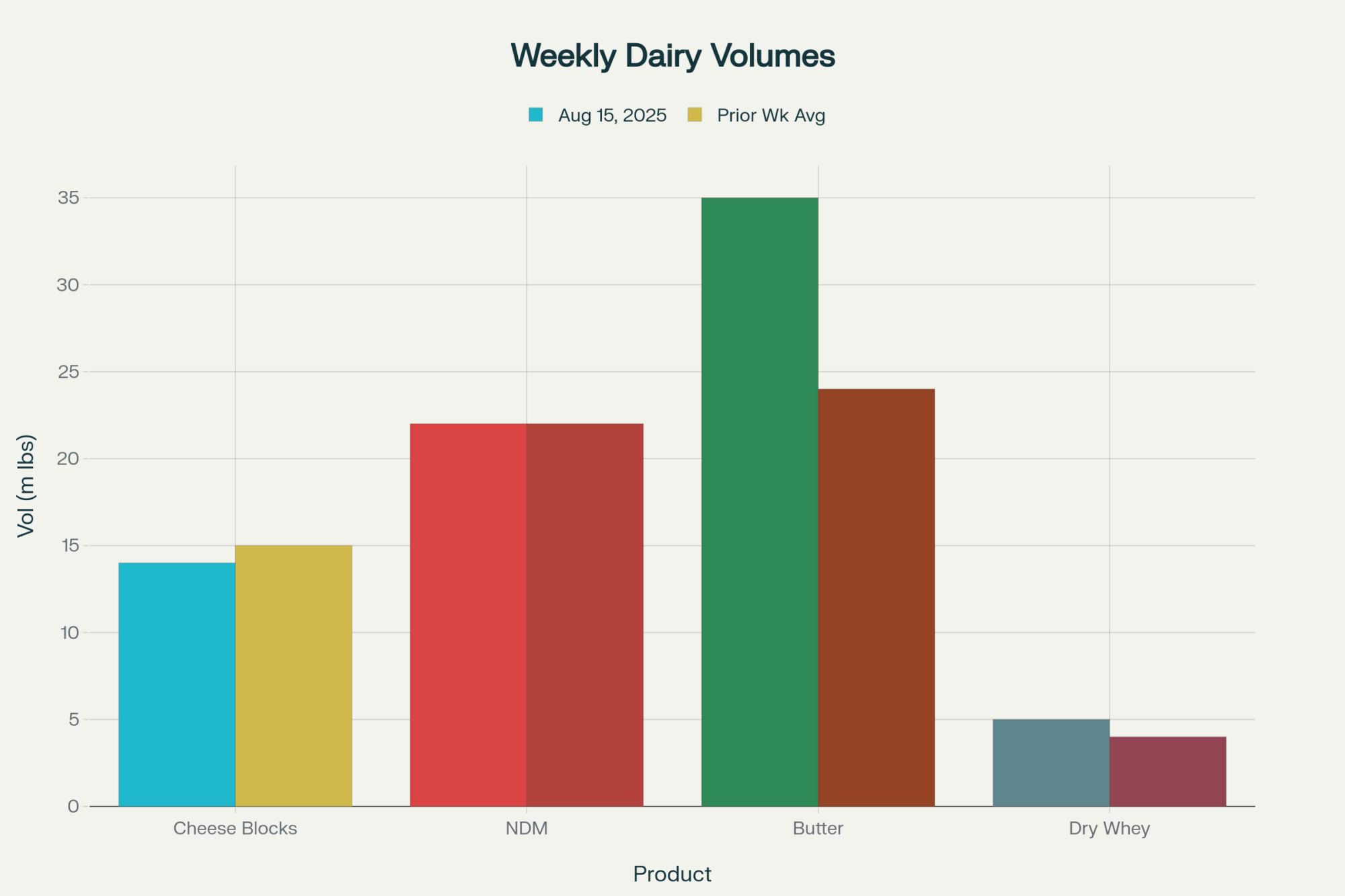
Weekly volume comparison for key CME dairy products, week ending August 15, 2025

Market Snapshot & What It Means to Your Farm

ProductPriceChangeWeekly TrendFarm Impact
Cheese Blocks$1.78/lb-10¢+2.1%Today’s drop could reduce your milk checks by about 60¢/cwt, based on the latest Class III formula weightings.
Cheese Barrels$1.83/lb-4¢+2.9%A softer drop here, but just as much a signal of jitters.
Butter$2.28/lbUnchanged-4.8%Standing firm for now, though weekly softness rings alarms for Class IV pricing.
NDM Grade A$1.26/lb-0.5¢-1.4%Steady as the export bookings hold strong.
Dry Whey$0.60/lb-1¢+5.6%Minor pullback, but the weekly trend says it’s riding high.

Here’s what’s interesting: while cheese blocks saw a gain earlier this week, padding that weekly climb to 2.1%, today’s sharp 10-cent pullback feels like the market taking a breath — a sprint, then a pause, if you will. Real markets don’t operate in a straight line.

That late-day selling? Probably some profit-taking and hedging ahead of reports. Only a handful of loads changed hands, but that’s enough to send a signal.

Butter has been more active this week, a sign that exports are still fueling interest. Cheese? Traders are a little more hesitant.  

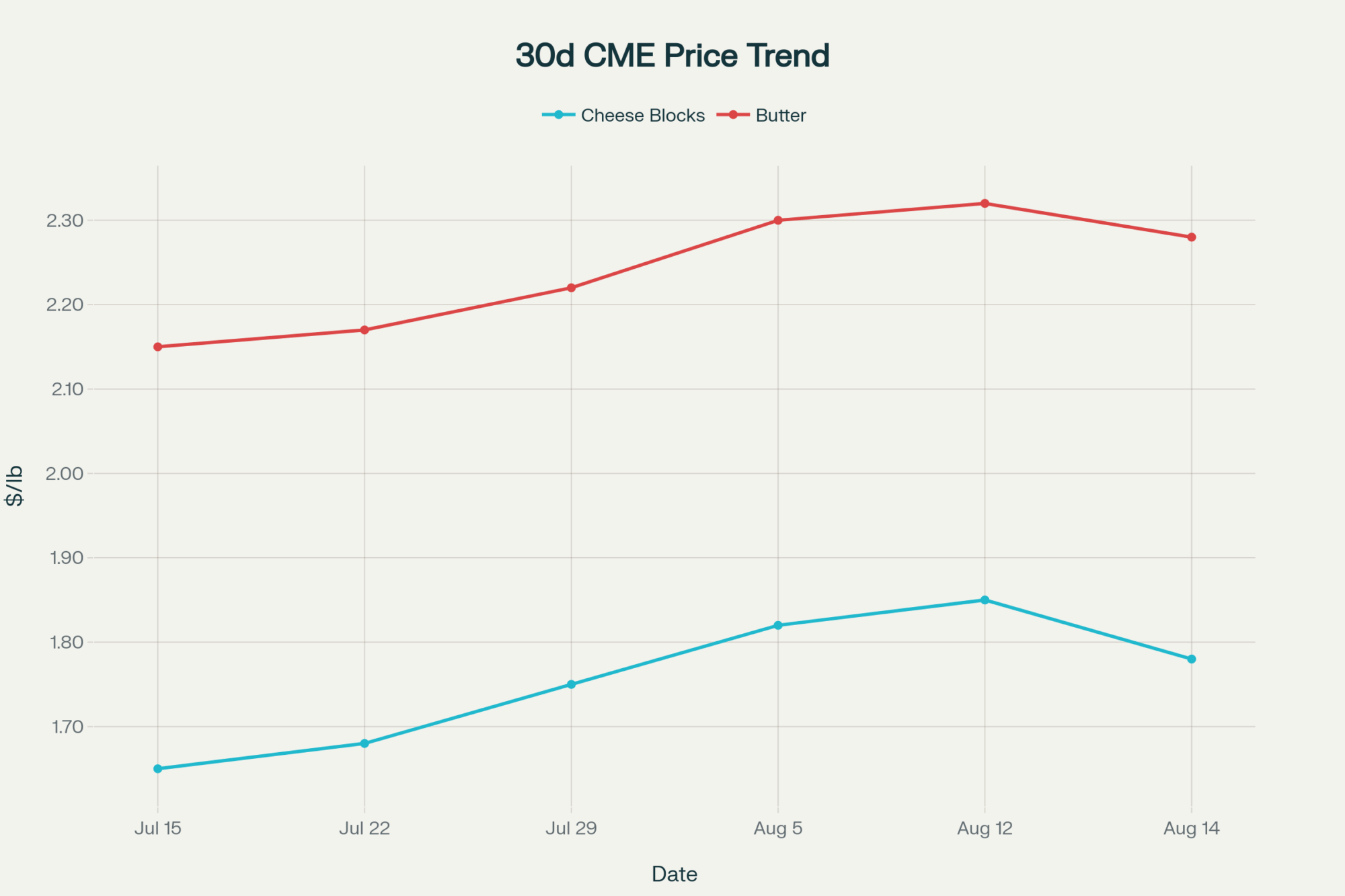
30-Day Price Trends: Cheese and Butter

This shows the gradual rise with today’s bump downward — a sign the market’s keeping everyone on their toes.

How Are We Doing Globally?

No matter how tight things look here, it’s a global market. Our butter prices are about a dollar cheaper than those in Europe and New Zealand, and NDM prices are comparable. That helps us stay competitive on exports — the lifeblood of our market.

ProductU.S. PriceEurope PriceNew Zealand Price
Butter$2.28/lb~$3.20/lb~$3.29/lb
NDM$1.26/lb~$1.08/lb~$1.26/lb

California farms face higher feed and energy costs — an extra 15 to 25 cents per cwt — because water’s expensive and drought has tightened availability. That’s pushing folks to double down on water-saving tech and efficiency tweaks.

This August’s heatwave is another story — the Southwest’s dealing with stressed cows and chipped feed quality, which is cutting milk production there somewhat. Meanwhile, the Upper Midwest has been fortunate with timely rain, which has improved forage and sustained production.

Exports: Where The Pressure and Opportunity Meet

Exports stay strong. USDA’s Foreign Agricultural Service shows cheese shipments up roughly 25% year-over-year through June. Mexico remains a solid top customer, while Southeast Asia and the Middle East emerge as new markets. But the EU and Australasia aren’t giving up any ground.

China’s ramping up selective butter imports even as their milk production slips — something to watch.

And USDA keeps the 2025 all-milk price pegged near $22 per cwt, with Class III and IV futures about $17.40 and $18.54. Locking prices ahead feels smart.

If you’re considering investments or diversification, consider grants like those offered by the Dairy Business Innovation Alliance. They’re offering up to $100,000 for efficiency and modernization projects.

Dairy-beef crosses and automation technologies — such as feeders and meters — are becoming increasingly vital for managing the fluctuations.

What It Means for You

Markets are swinging — today’s cheese price pullback is proof. If you can, lock in your prices to protect your margins.

Know your local reality: feed costs and weather conditions differ widely by region, so tailor your plan to your specific farm.

Keep an ear on global trade moves and currency shifts. That’s the tune your milk check dances to.

The bottom line? This industry rewards the prepared and punishes the complacent. Today’s moves are just another reminder that having a plan — and sticking to it — beats hoping prices will always go your way.

Complete references and supporting documentation are available upon request by contacting the editorial team at editor@thebullvine.com.

Learn More:

Join the Revolution!

Join over 30,000 successful dairy professionals who rely on Bullvine Weekly for their competitive edge. Delivered directly to your inbox each week, our exclusive industry insights help you make smarter decisions while saving precious hours every week. Never miss critical updates on milk production trends, breakthrough technologies, and profit-boosting strategies that top producers are already implementing. Subscribe now to transform your dairy operation’s efficiency and profitability—your future success is just one click away.

NewsSubscribe
First
Last
Consent

CME Daily Dairy Market Report for August 13, 2025: Butter Takes a Hit, But Powders Fight Back

Butter slides $2.50/lb – your August Class IV check takes a punch while whey rally keeps Class III hopes alive.

EXECUTIVE SUMMARY: Look, I’ve been watching today’s market action, and here’s what really jumped out at me. Most producers are still thinking backwards – chasing milk price rallies instead of locking in the feed cost savings that just landed in their lap. That 61¢ corn drop translates to real money when your milk-to-feed ratio hits 4.67, but here’s the kicker – operations running precision genomic testing are seeing 2-3% higher yields while cutting feed costs by $470 per cow annually. With replacement heifers hitting $3,000+ in premium markets and beef-on-dairy breeding crushing the replacement pipeline, you can’t afford to guess on genetics anymore. The European competition is eating our lunch on powder exports, but smart U.S. producers are using this market disruption to invest in feed efficiency and genetic improvements that compound annually. Trust me, while everyone else is watching butter prices swing, the profitable operations are building permanent competitive advantages through genomic selection and feed optimization that’ll matter long after today’s volatility fades.

KEY TAKEAWAYS

  • Lock in feed savings immediately – The 61¢ corn crash saves roughly $85-$ 120 per cow for fall feeding, but only if you forward contract now at these levels. Start tracking your milk-to-feed ratio weekly and target that 1.4 pounds of milk per pound of feed that top herds achieve.
  • Implement genomic testing for replacement decisions – At $35 per head, genomic testing identifies low-merit heifers before you waste $1,400-2,000 in feed costs raising them. Focus on feed efficiency and component traits, not just production volume, in this volatile 2025 market environment.
  • Capitalize on precision feeding technology – Systems delivering 40-50¢ daily savings per cow while boosting yields 3-5% pay for themselves quickly when feed represents 50-60% of your variable costs. Begin with TMR analysis if you’re running operations with 200+ heads.
  • Protect against Class IV weakness with strategic hedging – Today’s 2.5¢ butter drop signals potential $0.80-1.20 per cwt reduction in August milk checks. Consider put options or DRP for Q4 production while butter prices remain under pressure from seasonal demand fade.
  • Focus on permanent genetic improvements over temporary price gains. While markets fluctuate daily, genetic progress compounds annually. Herds testing 75-100% of heifers show $50,000+ higher annual profits than those testing under 25%, creating sustainable competitive advantages regardless of commodity volatility.
dairy farm profitability, genomic testing dairy, dairy feed efficiency, dairy market report, herd management strategies

know how some days the market just can’t make up its mind? Well, today was one of those days that’ll have you scratching your head while simultaneously reaching for your calculator. Butter took an absolute beating – we’re talking a 2.5¢ nosedive that basically erased a week’s worth of gains in one session. But here’s where it gets interesting… dry whey went completely the other direction, rallying 2.75¢, as if someone had just discovered a new use for the stuff.

The thing is, this isn’t just noise. That butter drop is going straight to your Class IV check – we’re probably looking at $0.80 to $1.20 less per hundredweight for that portion of your August milk payment. Meanwhile, the whey rally is single-handedly keeping your Class III calculation from falling apart. And then corn… man, corn just had one of those days you don’t see very often, crashing 61¢ like someone suddenly found a billion bushels hiding in a barn somewhere.

Today’s Price Action – The Numbers That Matter to Your Operation

ProductPriceToday’s MoveWeekly TrendWhat This Really Means
Cheese Blocks$1.8800/lbFlat+3.4%Processors comfortable with inventory levels – steady as she goes
Cheese Barrels$1.8600/lbFlat+4.2%That 2¢ spread to blocks? Classic balanced market signal
Butter$2.2800/lb-2.50¢-5.7%Your Class IV headache right here – summer demand fade is hitting hard
NDM Grade A$1.2650/lb+1.50¢-0.9%Trying to help, but still priced out of too many export markets
Dry Whey$0.6125/lb+2.75¢+8.6%The hero of the day – Southeast Asia can’t get enough of this stuff

Feed Costs Just Threw You a Curveball (A Good One, Finally)

This corn move today… I mean, when’s the last time you saw a 61¢ drop in one session? That takes corn down to $3.73/bu for September delivery, which is the kind of relief your feed budget’s been praying for.

Here’s your new reality:

  • Corn (Sep): $3.7275/bu (down 61¢) – biggest single-day drop in months
  • Soybean Meal (Sep): $286.90/ton (up $5.60) – protein costs still climbing the wall
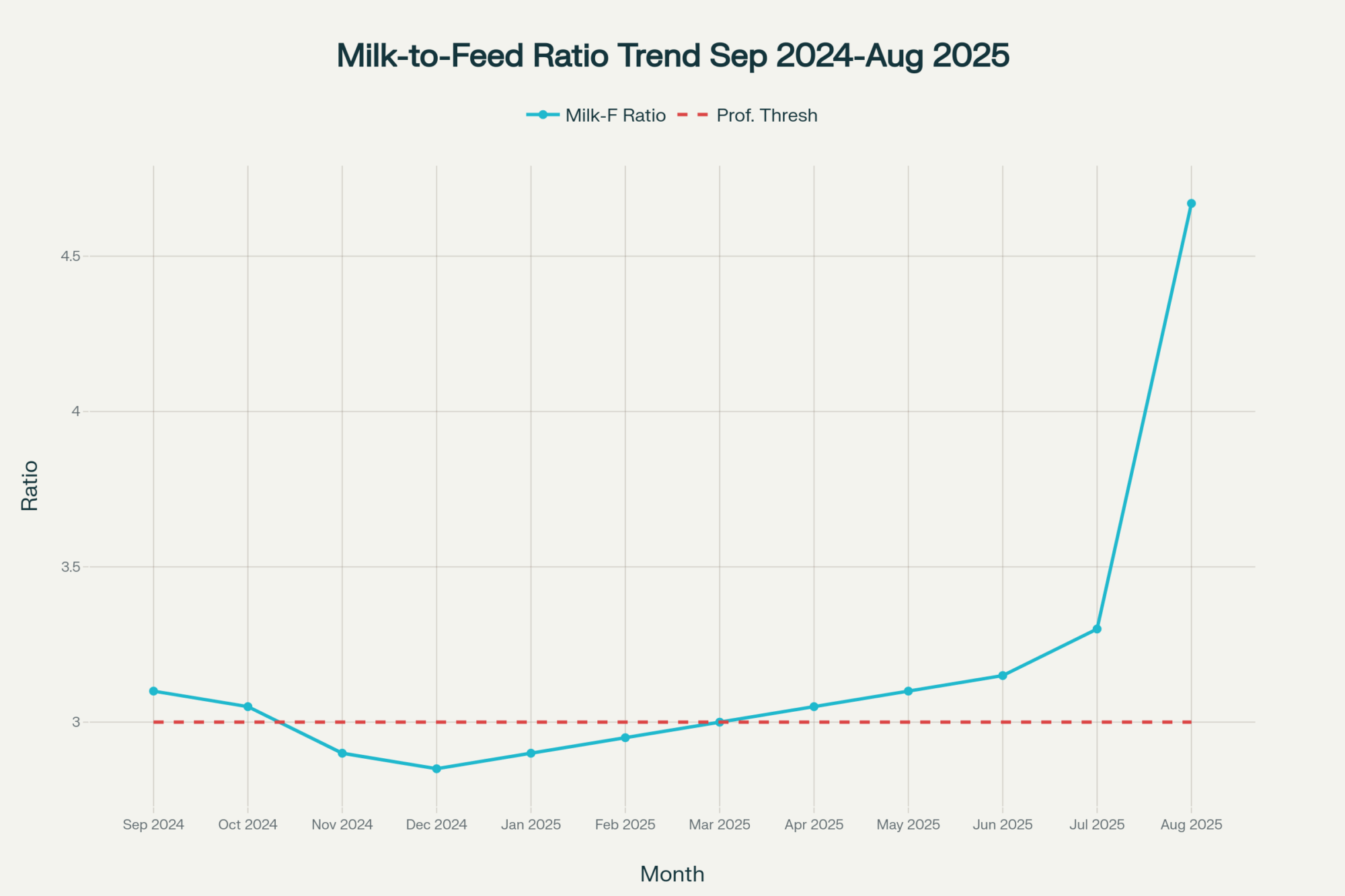
  • Current Milk-to-Feed Ratio: 4.67 (well into profitable territory above the 3.0 line). What’s fascinating is how this creates a weird split in your feed costs. Energy has become cheap quickly, but protein remains expensive as ever. If you’re in the Midwest with decent access to local corn, you’re probably feeling pretty good right now. But those of you dealing with freight costs out West? You’re seeing some of the benefit, just not all of it.

Another thing worth noting – and this is something I’ve been watching for months – is the increasing volatility of these feed ingredient relationships. It used to be that corn and beans moved together more often than not. Now? They’re doing their own thing, which makes feed planning… well, let’s just say it keeps you on your toes.

Trading Floor Drama (Or Lack Thereof)

So here’s what was really happening in the pits today… The butter action was legit – 14 loads traded hands with that 2.5¢ slide, which tells you real money was making real decisions about where they think prices should be headed. That’s not some thin market phantom move; that’s fundamental repricing happening in real time.

But the cheese market? Dead as a doornail. One block trade. Zero barrels. That’s not traders being lazy – that’s everyone sitting on their hands waiting for someone else to show their cards first.

What the volume told us: Butter’s 14-load volume confirms this wasn’t just some computer algorithm having a bad day. Serious money changed hands, and they were selling into strength. The cheese market’s virtual silence means today’s flat prices don’t mean much either way.

Technical levels that matter: Butter support’s sitting right around $2.25 now. Break that, and we could see another leg down pretty quickly. For cheese, that $1.85 floor has been holding for weeks and still looks solid.

The bid-ask spread story: In butter, seeing 14 bids against 10 offers at the close suggests some smart money was stepping in at lower levels. It’s possible that we won’t fall much further, at least not immediately. In cheese, that single bid-offer situation screams thin liquidity – classic setup for a big move once someone decides which direction they want to go.

The Bigger Picture – Global Competition Reality Check

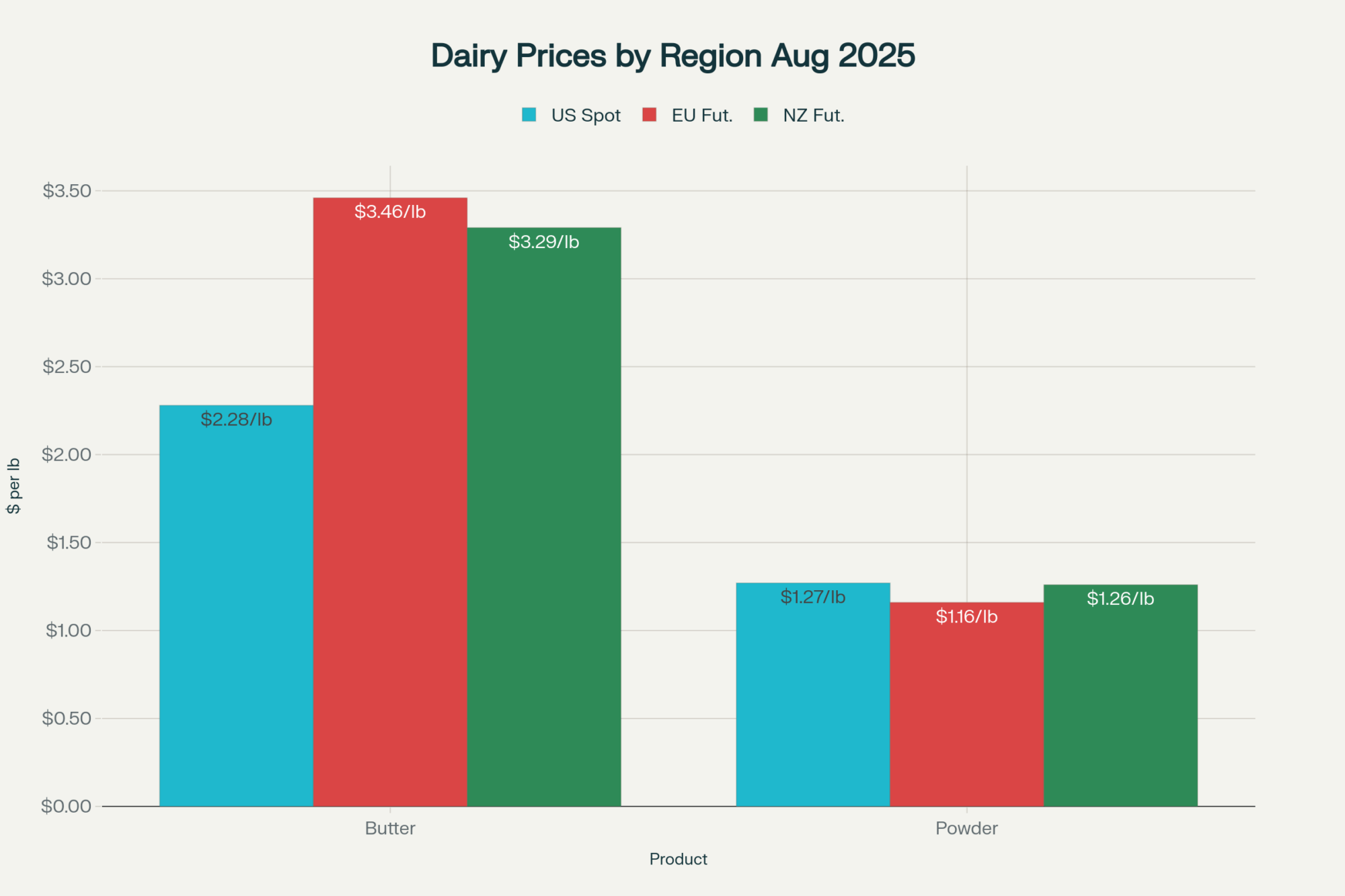
Do you want to know where we stand compared to the competition? Here’s the real deal, converting everything to apples-to-apples dollar pricing (using €1.08/$ exchange rate):

ProductU.S. SpotEU Futures (Aug)NZ Futures (Aug)What This Means
Butter$2.28/lb~$3.46/lb~$3.29/lbWe’re practically giving it away – export opportunity
Powder$1.265/lb~$1.16/lb~$1.26/lbGetting schooled by Europe, matched by New Zealand

The story these numbers tell is pretty clear if you’ve been watching export trends. The world wants our butter – we’re more than a dollar per pound cheaper than everyone else. But powder? We’re losing our lunch to European competition, and that’s been evident in disappointing export volumes for months.

This competitive dynamic also explains a significant portion of today’s price action. That butter weakness might actually help our export competitiveness, despite sounding strange. And the powder strength? Well, it’s nice, but it’s pricing us further out of global markets.

Production & Supply – What’s Really Happening Out There

We’re deep in summer heat stress season, and it’s showing up exactly where you’d expect. California’s Central Valley, Texas, and Wisconsin’s southern counties – all dealing with the usual August production challenges. However, what’s interesting about the current supply picture is…

According to the latest USDA data, the national dairy herd’s holding steady at about 9.47 million head, which is actually up slightly from earlier in the year. Culling rates are running about 2% of the herd – pretty normal for this time of year. What’s really wild, though, is what’s happening with replacement heifers.

Get this – heifer inventories are at the lowest levels since 1978. I mean, 1978! That’s pushing replacement costs through the roof. USDA’s reporting average prices around $2,660 per head nationally, but if you’re shopping for quality animals in California or Minnesota, you’re looking at $3,000-plus easily.

The beef-on-dairy breeding trend is absolutely crushing the replacement market. Producers are getting $200/cwt for live cattle and breeding half their herd to beef bulls. Smart from a cash flow standpoint, but it’s creating this massive bottleneck in the replacement pipeline.

What’s Really Moving These Markets

The domestic demand story is pretty straightforward – butter’s following its seasonal script. The summer grilling season’s winding down, and retail promotions are pulling back, which is showing up directly in spot prices. Food service cheese demand remains the bedrock of the market – steady and reliable, but not growing fast enough to drive prices higher on its own.

Export markets are where the real drama is. Mexico consistently ranks as our most reliable customer. They’re savvy buyers who time their purchases well, often stepping in when others are selling.

But Southeast Asia? That’s become the story for whey. The demand from that region has been absolutely relentless – feed applications and food uses; they can’t get enough. Today’s 2.75¢ rally reflects just how hungry they are for our product, and it’s becoming a genuinely important price driver for the whole whey complex.

The concerning part is our powder pricing in global markets. Europeans are consistently undercutting us, and until we become more competitive, we will continue to lose market share. That’s a strategic issue that extends beyond daily price fluctuations.

Historical Context – Where Today Fits

This August 13th action sits right in the normal seasonal range, but the volatility’s definitely running above average. What strikes me most is the divergence between fat and protein markets – we’re seeing increasingly complex global trade dynamics affect different dairy components in completely different ways.

The correlation breakdowns between products are creating opportunities for savvy marketers, but they’re also making traditional hedging strategies more complicated. Once, you could pretty much predict how cheese and butter would move relative to each other. Not so much anymore.

Looking Ahead & Taking Action

Futures market guidance:

  • Class III (Aug): $17.40/cwt
  • Class III (Sep): $17.21/cwt
  • Class IV (Aug): $18.54/cwt
  • Class IV (Sep): $18.66/cwt

The curve’s telling us to expect a bumpy sideways ride for Class III, with perhaps some improvement into the fall, while Class IV faces near-term pressure from today’s butter slide.

Here’s what’s interesting about the volatility picture – the options market’s pricing in about 15% more uncertainty than we typically see this time of year. The 90-day historical volatility for Class III is running significantly above seasonal norms. Put options are more expensive, but given these mixed signals, they might be worth considering for Q4 production.

Seasonal probability analysis based on the last five years suggests that we have about a 65% chance of seeing Class III prices improve by $0.50-$1.00 from current levels by October. But (and this is important) that’s assuming normal seasonal tightening patterns, and this year’s been anything but normal.

Correlation analysis shows that the usual relationships between products are breaking down. Historically, cheese and butter moved together about 70% of the time. This year? It’s more like 45%. That creates both opportunities and challenges for risk management.

Regional Market Deep Dive – Upper Midwest Focus

Let’s talk about what’s happening in Wisconsin and Minnesota specifically, because this region’s dealing with some unique dynamics right now.

Regional production patterns: Despite the heat stress episodes, milk production has been holding up reasonably well, thanks to improved cooling systems and better heat stress management. The local basis to national prices has been running tighter than usual as processing plants operate at full capacity.

Feed cost advantages: Today’s corn crash is particularly beneficial here, given the proximity to growing regions. Local basis for corn is typically $0.10-$0.15 under futures, so producers are seeing the full benefit of that 61¢ drop.

Processing dynamics: The numerous specialty cheese plants throughout Wisconsin and Minnesota are especially benefiting from whey strength. These facilities often generate significant whey volumes relative to cheese output, so that a 2.75¢ rally adds meaningful revenue beyond just the cheese pricing.

Transportation factors: Regional trucking rates have been relatively stable, though driver availability remains a challenge. Most plants are within reasonable hauling distance, so milk marketing flexibility remains good.

Risk Management Tools & Hedging Strategies

Given today’s market action and volatility levels, here are some specific strategies worth considering:

For Class IV exposure: Consider put options around the $18.00 strike for October and November contracts. Premium’s running about $0.25-$0.30, which isn’t cheap, but given butter’s weakness, it might be worth the cost.

Class III hedging: The September contract at $17.21 offers some interesting opportunities. Consider selling calls at around $18.00 and buying puts at around $16.50 for a collar strategy that costs approximately $0.15-$0.20 net.

Feed cost management: That corn drop creates a great opportunity to lock in fall and winter pricing. Consider buying December corn futures or entering into a forward contract with your supplier. Don’t get too cute trying to time the absolute bottom.

Volatility plays: With implied volatility elevated, selling option spreads might generate some premium income. For example, selling the $17.50-$18.50 call spread on September Class III for about $0.10-$0.15.

Immediate Action Items for Your Operation – Feed procurement:

Lock in that corn price drop immediately. When corn falls 61¢ in one session, you don’t wait around for it to fall another 20¢. Contact your supplier today to discuss securing fall and winter corn at these levels.

Milk pricing: With butter showing this weakness and Class IV under pressure, consider establishing some downside protection for fall production. Dairy Revenue Protection or put options make sense for Q4 output.

Cash flow planning: Your August milk check will reflect today’s butter weakness, so adjust your cash flow projections accordingly. But the feed cost relief should help overall margins even if milk prices stay soft.

Production planning: Heat stress management remains critical through the rest of August. Any investments in cow comfort that maintain production during these stress periods will pay dividends.

Industry Intelligence & Strategic Developments – Processing capacity updates:

That major Southwest cheese plant expansion we’ve been hearing about is reportedly coming online ahead of schedule. Word is they’re offering premiums that are starting to influence producer decisions across a pretty wide geographic area. Could significantly shift regional milk flow patterns.

Technology trends: The adoption of precision feeding systems continues to accelerate, particularly with protein costs remaining elevated. The ROI calculations for these systems are looking increasingly favorable for larger operations that deal with volatile ingredient pricing.

Regulatory environment: There’s ongoing discussion about potential changes to federal milk marketing orders in the upcoming Farm Bill negotiations. Nothing imminent, but worth staying informed about how these conversations develop. Any changes could reshape regional pricing dynamics.

Global trade developments: Keep an eye on EU production trends and any changes in their regulatory environment. Their ability to undercut our powder pricing continues to be a strategic challenge for U.S. exports.

The bottom line?

Today’s mixed signals remind us why diversified marketing strategies and solid risk management remain essential, regardless of what any single day’s trading brings. This market’s going to keep throwing curveballs, but that corn price relief gives us some breathing room to make smart decisions rather than panicked ones.

Your operation needs to stay flexible, seize opportunities like today’s feed cost break when they arise, and manage downside risk on the milk side. The dairy business has always been about rolling with the punches – today just gave us a few more to roll with.

Complete references and supporting documentation are available upon request by contacting the editorial team at editor@thebullvine.com.

Learn More:

  • Genomic Testing: A Game-Changer for Profitable Breeding Decisions – This article provides a tactical framework for using genomic data to make immediate culling and breeding decisions. It demonstrates how to translate test results into actionable steps that increase genetic gain, cut replacement-rearing costs, and boost overall herd profitability.
  • Beef on Dairy: The Ultimate Guide to Getting It Right! – Complementing the report’s market analysis, this guide delves into the strategic implementation of a beef-on-dairy program. It reveals methods for selecting the right beef genetics and managing crossbred calves to capitalize on high beef prices and optimize herd value.
  • The Digital Dairy Farm: How Technology is Transforming Herd Management – Taking a future-focused perspective, this piece explores how integrated technologies, including the precision feeding systems mentioned in the report, are creating smarter, more efficient farms. It highlights innovative tools that unlock new levels of herd health and productivity.

Join the Revolution!

Join over 30,000 successful dairy professionals who rely on Bullvine Weekly for their competitive edge. Delivered directly to your inbox each week, our exclusive industry insights help you make smarter decisions while saving precious hours every week. Never miss critical updates on milk production trends, breakthrough technologies, and profit-boosting strategies that top producers are already implementing. Subscribe now to transform your dairy operation’s efficiency and profitability—your future success is just one click away.

NewsSubscribe
First
Last
Consent

CME Dairy Report – July 31st: The Quiet Day That Actually Matters

Here’s what caught my attention today: Cheese barely budged, but the margin window just cracked wide open

EXECUTIVE SUMMARY: Look, I’ve been watching these markets for years, and the margin spread we’re seeing right now between feed costs and forward milk prices is absolutely historic. While everyone’s fixated on that penny move in block cheese today, December corn just dropped below $4.15 while Q4 Class III futures are trading over $19 – that’s your signal to act. The milk-to-feed ratio jumped from 1.8 to 2.05, putting income over feed cost near $10 per hundredweight… numbers like that don’t stick around long.Here’s the thing – Europe’s cutting production by 0.2%, Australia’s battling a perfect storm of drought and high costs, but we’ve got $8 billion in new processing capacity coming online that needs to be fed. The smart money isn’t waiting for cheese to rally another nickel. They’re locking in feed prices now and hedging 25-30% of their fall milk production while this window’s open.

KEY TAKEAWAYS

  • Lock in your feed costs immediately – December corn at $4.13/bu and soybean meal at $274/ton won’t last with this harvest uncertainty. Midwest producers already getting 10-20¢ under futures on their corn basis… that’s real money saved.
  • Price 25-30% of Q4 and Q1 production now – December Class III trading $2+ over August futures means the market’s paying you to think ahead. Forward contracts or CME options, doesn’t matter – just get some coverage before this contango flattens.
  • Your butterfat is worth more globally than ever – U.S. butter trading $2,400/MT cheaper than European, $1,844/MT under New Zealand. Export demand from MENA and Southeast Asia is pulling our fat premiums higher.
  • Regional heat stress = spot milk premiums – Processors paying up to $2 over Class in the Central region right now. If you’re in a cooler microclimate keeping production steady, leverage that advantage.
  • Processing demand is structural, not cyclical – These new Hilmar, Leprino, and Fairlife plants need 55 million pounds of milk daily by 2026. Build those relationships now because this demand floor isn’t going anywhere.

Look, if you’re focusing on today’s penny move in block cheese, you’re missing the forest for the trees. Sure, blocks ticked up a cent to $1.6825 on zero trades, but that’s not the most significant development. The game-changer is the bullish gap between declining feed costs and firm milk futures – December corn sitting under $4.15 while Q4 Class III futures trade at a hefty premium to cash. This kind of spread doesn’t come around every day.

Today’s Numbers – And What They Actually Mean for Your Operation

ProductPrice ($/lb)Daily MoveMonthly TrendWhat This Means for You
Cheese Blocks$1.6825+1¢+3.4%Slight Class III support, but volume needed to confirm
Cheese Barrels$1.6800Unchanged+3.4%Holding gains, but flat close shows buyer hesitation
Butter$2.4725Unchanged-1.1%Class IV steady, butterfat still soft
NDM$1.2900Unchanged-0.2%Export demand cautious, not driving Class IV higher
Dry Whey$0.5325Unchanged-1.4%Continues to drag on Class III protein markets

After yesterday’s explosive session with 15 block trades and barrels jumping 4.5 cents, today felt like the market catching its breath. Zero trades in butter or cheese, just two NDM loads changing hands.

What’s particularly interesting is how the order book closed. We had four unfilled bids in blocks at $1.6825 with zero offers. That’s quietly bullish – buyers were still there at the close, but sellers weren’t willing to meet them.

The Global Picture – Where We Stand Against the Competition

I’ve been watching our international competitive position closely, and the current situation is remarkable.

ProductU.S. Price (USD/MT)EU Price (USD/MT)NZ Price (USD/MT)U.S. Price Advantage/(Disadvantage)
Butter~$5,451~$7,856 (€7,205)~$7,295+$2,405 vs EU, +$1,844 vs NZ
SMP/NDM$2,844~$2,657 (€2,437)~$2,835($187) vs EU, ($9) vs NZ
Cheese~$3,710N/AN/ACompetitive advantage

Key Takeaway: This puts U.S. powders at a slight price disadvantage to our competitors—explaining why NDM exports face headwinds when this premium widens.

Comparison of US, EU, and New Zealand dairy product prices (Butter, SMP/NDM, Cheese) as of July 31, 2025

European Union: According to recent USDA analysis, they’re looking at a 0.2% decline in milk deliveries for 2025. Shrinking herds in Germany and France, plus all those EU Green Deal regulations. European processors are shifting focus to high-value cheese over butter and powders.

New Zealand: Industry reports suggest their production is off to a strong start this season. Early production trends look positive with that $10.00/kgMS opening price. If weather cooperates, current indicators point to potential growth, which will weigh on global powder prices.

Australia: Recent USDA projections show production declining to 8.6 million metric tons – they’re navigating what industry folks call a “perfect storm” of drought, flooding, and high input costs.

Feed Costs – The Story Everyone Should Be Watching

Here’s what’s really driving the margin opportunity:

Feed ComponentCurrent PriceTrendImpact on Margins
Corn (Dec ’25)$4.1375/buDownLower feed costs for fall/winter
Soybean Meal (Dec ’25)$276.30/tonDownEasing protein costs
Alfalfa Hay (WI Prime)~$290/tonStableForage costs remain significant
Milk-to-Feed Ratio~2.05ImprovingProfitability turning positive
Income Over Feed Cost~$9.95/cwtStrengtheningStrong margins to lock in

What strikes me about this setup is the timing. December corn settled at $4.1375 today, significantly below the $4.43 we saw in the expired September 2024 contract. That milk-to-feed ratio of 2.05 is a marked improvement from the 1.8 we saw recently – which is considered tight margin territory.

Production Reality – The National vs Regional Story

According to recent USDA data, we had 18.5 billion pounds in June from the 24 major dairy states, up 3.4% from last year. The dairy herd is expanding – 9.47 million head as of June, up from last year.

But here’s what’s fascinating… for a producer dealing with summer heat stress, that “Milk Production Up 3.4%” headline can feel completely disconnected from reality. Processors in the Central region are actively hunting for spot loads, paying up to $2 over Class. This dichotomy is crucial – national supply provides a ceiling on prices, while regional weather-driven tightness creates a floor.

What’s Really Moving These Markets

Consumer demand? Steady but uninspired. Recent quarterly reports from major pizza chains indicate year-over-year declines in same-store sales – a key cheese demand indicator. This lackluster consumer pull is capping cheese prices.

Processing demand? According to recent industry analysis, the U.S. dairy industry is in the middle of a massive capital investment cycle exceeding $8 billion. These new plants are already pulling milk from the market, running at two-thirds capacity or more.

Export markets continue telling that component story. Mexico remains our most reliable partner. Industry trends suggest butterfat exports have been strengthening. The MENA region has shown substantial growth in demand for U.S. butterfat – industry reports indicate significant increases in early 2025.

Forward Curve – The Opportunity Staring Us in the Face

Contract MonthPrice ($/cwt)Premium to AugustProfit Opportunity
August ’25$17.12Current market
September ’25$17.79+$0.67Lock in 4% premium
October ’25$18.78+$1.66Lock in 10% premium
December ’25$19.15+$2.03Lock in 12% premium

USDA’s latest WASDE forecasts all-milk price for 2025 averaging $21.60/cwt. But the futures market shows clear contango:

  • August ’25: $17.12
  • September ’25: ~$17.79
  • October ’25: ~$18.78
  • December ’25: ~$19.15

For producers, this transforms abstract market concepts into concrete business opportunities. The market is explicitly offering higher prices for future milk than today’s cash price.

Regional Spotlight: Upper Midwest Dynamics

Regional trends suggest Wisconsin and Minnesota production showed growth patterns consistent with national data. Cool overnight temperatures are mitigating daytime heat impacts, keeping volumes relatively steady.

Feed cost advantage for Midwest producers is significant. Local corn basis trades at a discount to CME futures. Wisconsin hay reports show Prime Alfalfa small squares averaging ~$290/ton.

What Producers Should Actually Do Right Now

Pricing & Risk Management: Seriously consider pricing 25-30% of Q4 2025 and Q1 2026 projected production. December Class III trading over $2.00/cwt above August protects excellent current margins.

Feed Procurement: Contact suppliers immediately for firm quotes on corn and soybean meal through end of 2025. Corn and meal futures are soft due to large harvest expectations.

Cash Flow Planning: Strong margins projected for second half of 2025 make this ideal for detailed planning. Model expected cash flow based on locked-in prices for strategic debt reduction or capital improvements.

Industry Intelligence You Should Know

The processing expansion wave is fundamentally reshaping our landscape. Hilmar Cheese in Dodge City, Kansas; Leprino Foods in Lubbock, Texas; Fairlife in Webster, New York – they’re part of an expansion exceeding $8 billion creating massive, long-term milk demand.

June 2025 brought significant FMMO pricing formula changes. New “make allowances” for manufactured products reflect rising processing costs. Net impact varies by region depending on local milk utilization mix.

DestinationKey ProductsGrowth TrendPrice Driver
MexicoCheese, NDM, ButterfatStrong, reliableAll components
Southeast AsiaCheddar cheeseGrowing demandCompetitive pricing
MENA RegionButterfat+770% in early 2025Massive price advantage
Overall ImpactFat & proteinExport strength$2,400/MT butter advantage

Putting Today in Perspective

Today’s quiet session was consolidation – a pause following this week’s significant, volume-driven cheese rally. Despite the flat close, spot block and barrel cheese prices are still up over 3% for the week.

The most significant story isn’t the silent CME screen. It’s that powerful, actionable margin opportunity opening up for producers. The divergence between falling new-crop feed costs and strong forward milk prices has created historically favorable profitability windows.

Producers who recognize this opportunity and take strategic action managing both input costs and milk price risk will position their operations for success through the second half of 2025 and beyond.

And honestly? That opportunity might not stay open forever.

Complete references and supporting documentation are available upon request by contacting the editorial team at editor@thebullvine.com.

Learn More:

  • Dairy Feed Costs: Top 10 Ways To Tame The Feed Bill Beast – This article reveals 10 practical strategies for cutting on-farm feed expenses. It provides the tactical know-how to actively lower your cost of production and fully capitalize on the margin opportunity identified in today’s report.
  • The 5 Unbreakable Rules for Profitable Dairy Farming – To complement the report’s market tactics, this piece outlines the core strategic principles for long-term success. It demonstrates how to build a resilient, low-cost operation that can consistently thrive through any market cycle, not just the current one.
  • Genomics: The Secret Weapon for Accelerated Genetic Progress – The report highlights new processing plants demanding high-quality milk. This article provides a blueprint for using genomic testing to breed healthier, more efficient cows specifically tailored to deliver the high-component milk these new facilities require.

Join the Revolution!

Join over 30,000 successful dairy professionals who rely on Bullvine Weekly for their competitive edge. Delivered directly to your inbox each week, our exclusive industry insights help you make smarter decisions while saving precious hours every week. Never miss critical updates on milk production trends, breakthrough technologies, and profit-boosting strategies that top producers are already implementing. Subscribe now to transform your dairy operation’s efficiency and profitability—your future success is just one click away.

NewsSubscribe
First
Last
Consent

CME Dairy Market Report -Tuesday, May 20, 2025:  Active Trading Drives Cheddar Block Prices Higher; Barrels, NDM, and Dry Whey Fall Due to Global Pressures and Feed Costs

Block cheese climbs as barrels, NDM & whey retreat amid global pressures & rising feed costs. Key insights for dairy pros.

EXECUTIVE SUMMARY: The May 20 CME dairy markets saw diverging trends: cheddar blocks edged higher on active trading (+0.25¢), while barrels (-2.00¢), NDM (-0.50¢), and dry whey (-1.50¢) faced downward pressure. Butter held steady at $2.3425/lb amid balanced bids/offers. Rising feed costs (corn +1.6%, soybean meal +0.4%) threaten producer margins, while global factors like China’s whey tariffs and EU cheese production shifts loom. USDA forecasts suggest near-term Class III milk futures (.99/cwt) outpace annual projections, offering hedging opportunities. Traders eye block-barrel spreads, while end-users are urged to secure cheese supplies amid tightening block markets.

KEY TAKEAWAYS:

  • Block-Barrel Spread Widens: Blocks rose (+0.25¢) as barrels fell (-2.00¢), signaling firm demand for spot blocks vs. weaker barrel fundamentals.
  • Butter Stability Masks Inventory Glut: Unchanged prices hide ample cold storage stocks, with no trades executed despite balanced bids/offers.
  • Feed Costs Squeeze Margins: Corn and soybean meal futures climbed, pressuring dairy producers ahead of summer forage challenges.
  • Global Trade Headwinds: China’s 84% whey tariff stifles U.S. exports, while NZ/EU production shifts redefine international competition.
  • Actionable Insight: Producers should hedge against feed cost volatility; traders monitor block-barrel arbitrage; buyers lock in cheese contracts.
CME dairy prices, dairy market report, cheese prices, butter market, milk futures

The CME cash dairy markets exhibited mixed trends today. Cheddar blocks saw a modest price increase, supported by firm demand indications, while cheddar barrels, Nonfat Dry Milk (NDM), and Dry Whey experienced price declines. Butter prices remained unchanged in quiet trading. Rising feed costs, with notable increases in corn and soybean meal futures, are an emerging concern for producer margins.

ProductClosing Price (May 20)Change from Yesterday (May 19)
Cheese (Blocks)$1.9000/lb+0.25¢
Cheese (Barrels)$1.8350/lb-2.00¢
Butter$2.3425/lbUnchanged
Nonfat Dry Milk$1.2250/lb-0.50¢
Dry Whey$0.5250/lb-1.50¢

Commentary:

  • Cheese (Blocks): Prices for cheddar blocks increased by 0.25 cents, settling at $1.9000/lb. Active trading supported the gain, suggesting continued firm demand or tighter spot availability for blocks.
  • Cheese (Barrels): Barrel cheese prices saw a more significant decrease, falling 2.00 cents to $1.8350/lb, indicating some weakness in this segment of the cheese market. The block-barrel spread widened to 6.50 cents from 4.25 cents yesterday.
  • Butter: The butter price held steady at $2.3425/lb with no trades executed. While bids and offers appeared balanced, the underlying market sentiment suggests that ample inventories continue to weigh on the market.
  • Nonfat Dry Milk (NDM): NDM prices eased by 0.50 cents to $1.2250/lb. Despite the price dip, bidding interest suggested some underlying support.
  • Dry Whey: Dry Whey prices declined by 1.50 cents, closing at $0.5250/lb, potentially influenced by ongoing global trade dynamics, including tariffs.
  • Feed Costs: July corn futures settled at $4.5450/bushel (up $0.0750 from Monday), and July soybean meal futures closed at $292.40/ton (up $1.20 from Monday). These increases signal rising feed costs, which could pressure dairy producer margins.

CME Futures Settlement Prices (June 2025 Contracts, Settled May 20, 2025):

  • Class III Milk: $18.99/cwt (Unchanged)
  • Class IV Milk: $17.70/cwt (Unchanged)
  • Cheese: $1.9520/lb (+0.10¢)
  • Butter: $2.3950/lb (Unchanged)
  • Nonfat Dry Milk (NDM): $1.2250/lb (Unchanged)
  • Dry Whey: $0.5403/lb (-1.47¢)

Volume and Trading Activity

Trading activity was most prominent in the cheddar block market today, with specific bid-ask dynamics providing insights into market sentiment.

  • Butter:
    • Trades: 0
    • Bids: 2 / Offers: 2
    • Bid-Ask Spread: Balanced with bids at $2.3400/lb and offers at $2.3425/lb (0.25¢ spread)
    • The market found equilibrium with no spot transactions, reflecting a temporary balance in supply and demand.
  • Cheese (Blocks):
    • Trades: 11 loads
    • Bids: 3 / Offers: 3
    • Bid-Ask Spread: Tightened to 0.25¢ by session’s end with final bids at $1.8975/lb and offers at $1.9000/lb
    • Active trading interest demonstrated significant market engagement, supporting the price increase.
  • Cheese (Barrels):
    • Trades: 2 loads
    • Bids: 1 / Offers: 3
    • Bid-Ask Spread: Widened to 1.25¢ with final bids at $1.8250/lb and offers at $1.8375/lb
    • The higher number of offers relative to bids at the close suggests some selling pressure, contributing to today’s price decline.
  • Nonfat Dry Milk (NDM):
    • Trades: 2 loads
    • Bids: 4 / Offers: 1
    • Bid-Ask Spread: Narrowed to 0.50¢ with bids at $1.2200/lb and offers at $1.2250/lb
    • The stronger bidding interest compared to offers indicates underlying support despite the price decline.
  • Dry Whey:
    • Trades: 5 loads
    • Bids: 2 / Offers: 1
    • Bid-Ask Spread: Final spread of 0.75¢ between bids at $0.5175/lb and offers at $0.5250/lb
    • Relatively active trading amid price declines suggests market participants are adjusting to changing fundamentals.

Global Context

International factors continue to have a significant influence on the U.S. dairy markets.

  • Export Demand & Trade Tensions: U.S. dairy exports, while showing some rebound in early 2025, face ongoing challenges from retaliatory tariffs, particularly from China (e.g., an 84% tariff on U.S. whey products). This has led to a significant drop in whey exports to this key market. Conversely, New Zealand has benefited from duty-free access to China since January 2024, increasing its market share.
  • Global Production Trends:
    • New Zealand: Milk production grew season-to-date, although recent North Island weather may have tempered this. Overall, 12-month production is up slightly.
    • European Union (EU): Milk supply is expected to be flat or slightly decline in 2025 due to regulatory pressures and shrinking herd sizes. EU processors are reportedly prioritizing cheese production, which could firm regional butter prices but potentially soften SMP and cheddar prices within the EU.
    • China: Domestic milk production in China is projected to decrease by approximately 1.5% year-over-year in 2025. However, dairy imports are expected to see a modest recovery (around +2%) after previous declines, potentially offering support to global milk powder and whey prices.
  • Global Dairy Trade (GDT): The GDT auction on May 6, 2025, registered a significant 4.6% increase in its overall price index, with Whole Milk Powder (WMP) prices rising 6.2% and butter prices increasing 3.8%. This global strength provides some underlying support to dairy values.

Forecasts and Analysis

Recent USDA forecasts (May 2025 WASDE) provide an updated outlook for the U.S. dairy sector in 2025:

  • Milk Production: Forecast at 227.3 billion pounds for 2025, a slight upward revision, attributed to expectations of a modestly larger dairy herd and improved milk output per cow.
  • Annual Average Price Forecasts for 2025:
    • All-Milk Price: $21.60/cwt
    • Class III Milk: $18.70/cwt
    • Class IV Milk: $18.45/cwt
    • Cheddar Cheese: $1.840/lb
    • Butter: $2.460/lb
    • Nonfat Dry Milk (NDM): $1.240/lb
    • Dry Whey: $0.535/lb

Analysis: Current June 2025 Class III milk futures (.99/cwt as of May 20) are trading at a premium to the USDA’s revised 2025 annual average forecast of .70/cwt. This suggests that traders anticipate stronger prices in the near term than the yearly government projection, possibly due to current cheese market dynamics or seasonal demand. However, the projected increase in milk production later in the year and rising feed costs could temper price enthusiasm as 2025 progresses.

Key Actionable Insights from Forecasts:

  • Hedging Opportunity: Current futures prices trading above USDA annual projections present a potential opportunity for producers to secure favorable forward margins.
  • Regional Impact: The forecast for higher milk production may affect regional spot milk premiums, particularly in cheese-producing areas during the late summer and fall months.
  • Inventory Management: End users should consider the USDA’s butter price projection ($2.460/lb), higher than current cash and futures values, when planning forward coverage strategies.

Market Sentiment

Market sentiment today appears to be one of cautious observation, reflecting the divergent price movements and the influence of both domestic and global factors.

  • One dairy processor commented on the broader market: “Butter inventories continue to weigh heavily on market psychology despite strong international prices. Significant upward price movement remains unlikely until we see meaningful drawdowns in cold storage.”
  • Regarding cheese, a Midwest-based cheese trader noted: “The block cheese market continues to feel exceptionally firm, driven by persistent inventory concerns and active buyer interest. We’re seeing robust demand from pizza makers ahead of summer.”
  • A dairy export specialist at a central cooperative observed: “The ongoing tariff situation with China continues to depress U.S. whey export opportunities, forcing us to seek alternative markets at potentially lower returns. This pressure is likely to persist through Q3 at minimum.”

Overall, the market is navigating a complex environment characterized by tight supplies in some areas (like blocks), ample inventories in others (like butter), ongoing global trade uncertainties, and the recent uptick in feed costs, leading to a watchful stance among participants.

Closing Summary & Recommendations

In summary, today’s CME dairy markets saw cheddar block prices firm slightly on active trading, while barrel cheese, NDM, and dry whey prices declined. Butter remained unchanged. Rising feed costs are a key factor for producers to monitor. Global trade dynamics, particularly concerning China and EU production, influence U.S. market conditions.

Outlook & Recommendations:

  • Producers should closely monitor rising feed costs and consider risk management strategies, especially given the current premium of near-month Class III futures over the USDA’s annual forecast. Opportunities may exist to lock in favorable margins, but volatility is expected.
  • Traders: The divergence between block and barrel cheese prices, and the ongoing pressure on butter, may present spread opportunities. Attention to international trade developments and their impact on NDM and whey will be crucial.
  • End Users: Securing cheese needs may be prudent given the firmness in the block market. Butter purchasers may find that current inventory levels offer some near-term price stability.

Disclaimer: This report is for informational purposes only and is not intended to provide financial advice. Market conditions are subject to change.

Learn more:

Join the Revolution!

Join over 30,000 successful dairy professionals who rely on Bullvine Weekly for their competitive edge. Delivered directly to your inbox each week, our exclusive industry insights help you make smarter decisions while saving precious hours every week. Never miss critical updates on milk production trends, breakthrough technologies, and profit-boosting strategies that top producers are already implementing. Subscribe now to transform your dairy operation’s efficiency and profitability—your future success is just one click away.

NewsSubscribe
First
Last
Consent

Cheese Markets Explode: Buyers Scramble as Supply Squeeze Sends Prices Soaring

Cheese prices surge 11¢ as U.S. dairy faces tight supplies, export boom. Can producers keep up? Feed costs drop – but trade storms loom.

EXECUTIVE SUMMARY: U.S. dairy markets are squeezed by slowing cheese production growth and surging exports, sending Cheddar prices to 5-month highs (.93/lb). While milk output expands, replacement heifer shortages and global powder demand fuel volatility, with Class III futures hitting $19.20/cwt. Canada’s supply-managed system battles butter stocks and rising cheese imports under trade deals. Feed costs offer brief relief, but trade uncertainties (U.S.-China tariffs, CUSMA quotas) threaten margins. Both markets face pressure from shifting consumer demand toward functional/organic products. Producers must balance risk management with innovation to navigate 2025’s turbulence.

KEY TAKEAWAYS:

  • U.S. cheese panic: Buyers underestimated slow production growth; export-driven scarcity could push prices higher.
  • Heifer crisis: $4,200/springer prices force producers to rethink expansion – efficiency trumps herd growth.
  • Trade double-edged sword: Mexico’s cheese appetite props up markets, but China tariff risks loom over whey.
  • Feed window opens: Corn at $4.43/bu offers rare chance to lock in lower costs amid milk price rallies.
  • Canada’s import flood: CUSMA cheese TRQs hit 52% fill rate – domestic brands must innovate or lose shelf space.
dairy market report, cheese prices, milk futures, dairy feed costs, heifer prices

U.S. cheese markets rocketed this week with blocks surging 11.25¢ to $1.93 and barrels jumping 11¢ to $1.88 as buyers panic over tighter-than-expected inventories. The anticipated cheese production increases have materialized more slowly than predicted, triggering a buying frenzy as exporters capitalize on competitive U.S. prices and domestic users rush to secure summer needs. Meanwhile, feed markets took a nosedive, giving producers a rare chance to lock in higher milk prices AND lower input costs simultaneously.

CHEESE BUYERS CAUGHT WITH THEIR PANTS DOWN: TOO LITTLE PRODUCT, TOO MANY ORDERS

The North American cheese scene got much more interesting this week. CME spot Cheddar blocks leapt 11.25¢ to reach $1.93 per pound, their highest price since January. Barrels weren’t far behind, climbing 11¢ to hit $1.88. What’s driving this sudden price explosion? Simple: those buyers who smugly sat on the sidelines waiting for the “inevitable” spring price collapse just got a rude awakening.

The widely anticipated increase in U.S. cheese production is underway, but it’s moving at a frustratingly slow pace compared to USDA projections. Buyers who gambled on heavy spring supplies and corresponding price drops are now frantically securing product as their summer needs loom large. USDA’s Dairy Market News confirms what traders are seeing, noting that spot cheese inventories are “somewhat tight” in the Central region. Even more telling, producers in the West report “Q2 production is heavily committed” due to booming export sales.

Want proof this rally has legs? Just look at Friday’s trading volume – a whopping 16 sales of cheese blocks ranging from $1.8975 to $1.93. That’s not speculative trading; that’s desperate buyers scrambling to cover genuine needs.

WHY AREN’T OTHER DAIRY PRODUCTS KEEPING PACE WITH CHEESE’S ROCKET RIDE?

While cheese dominated the headlines, other dairy commodities also managed to catch a bit of upward momentum, though with considerably less swagger:

Whey’s High-Wire China Act: Can This Rally Survive Tariff Threats?

Spot whey powder ticked up 0.75¢ to reach 55¢, matching a three-month high. The market’s getting an unexpected boost from the temporary cease-fire in the U.S.-China trade war. Let’s be clear, though – this isn’t a return to pre-trade war normalcy. China’s still slapping tariffs on U.S. imports at rates 10% higher than last year, and the 90-day negotiating window is evaporating fast.

We’re seeing a classic “get it while you can” mentality – Chinese buyers are rushing to secure U.S. whey before potential new tariff hikes make it prohibitively expensive. Domestic demand shows signs of life, but don’t get too comfortable. With cheese production ramping up (albeit slower than expected), whey output is climbing too. If those China negotiations go south, this whey market could fall faster than a politician’s approval ratings.

Global Supply Squeeze Makes U.S. Milk Powder the Hot Ticket

Sometimes it pays to be the last one standing. That’s exactly what’s happening with U.S. milk powder as global production falters. They’re dealing with their seasonal production valley in Oceania, and SMP output is dwindling. Europe’s situation is even more striking – milk collections in the EU-27 and the United Kingdom fell 0.4% year-over-year in Q1, and European SMP production dropped 3.3% in the first two months of 2025 after adjusting for leap day.

This global supply contraction is sending international buyers straight to America’s doorstep. Mexican importers are particularly hungry for U.S. powder, paying up to get it. The result? CME spot nonfat dry milk jumped 1.75¢ to reach $1.225. For your operation, this signals a potential boost to the protein component of your milk check – something to celebrate in today’s challenging margins.

Butter Market: Steady As She Goes While Cream Finds New Homes

The butter story remains remarkably consistent – U.S. butter is currently the cheapest in the world, driving exports that help keep inventories manageable despite heavy spring churning. Processors are working overtime, building inventories for the holiday baking season, but the market refuses to crack under the weight of all that production.

What’s changed recently? Cream markets have tightened slightly as ice cream production kicks into high gear for summer. There’s still plenty of cream, but that market isn’t quite as sloppy as it was a month ago. This week, CME spot butter added 1.25¢ to close at $2.3425. Since March, CME spot butter has traded within an unusually tight 12-cent range – stability that’s rare in today’s volatile dairy markets.

FUTURES MARKET GOES WILD: ARE TRADERS CALLING USDA’S BLUFF?

In an impressive feat of strength and stamina, June Class III futures managed to outpace spot Cheddar’s uphill sprint. June milk closed at $19.20 per cwt., not far from the life-of-contract high set Thursday, and up a whopping 89¢ for the week. Most other Class III contracts logged double-digit gains, and July through October Class III finished above the $19 mark.

This performance firmly puts futures traders in the bullish camp – and directly opposes USDA forecasts. While USDA’s latest outlook projects the 2025 Class III milk price at a modest $17.60/cwt, June futures are trading a full $1.60 higher. That’s not just a difference of opinion – it’s a fundamental disagreement about where this market is headed.

The “optimism gap” between USDA’s annual forecast and current futures prices has only widened recently. Are traders drunk on cheese-market Kool-Aid, or does USDA have its head in the sand regarding tight supplies? Your risk management decisions depend on who you think is right.

Class IV markets were much quieter, with nearby contracts adding a few cents while fourth-quarter futures lost a little ground. Most summer Class IV contracts point toward $18 milk, with the futures curve suggesting $19 Class IV later this year. Not too shabby, but nothing compared to the Class III fireworks.

YOUR MILK CHECK: PAIN TODAY, GAIN TOMORROW?

Let’s cut to what matters most to your operation: what does this mean for your bottom line? April milk checks are going to be disappointing – no way around it. But from May forward? Those futures are signaling significantly better days ahead.

This improving outlook is already fueling expansion talk across dairy country. But here’s the rub – where will you find the cows? Replacement heifers remain scarcer than honest politicians and nearly as expensive. Top springers commanded between $3,800 and $4,200 per head at the latest monthly dairy auction in Pipestone, Minnesota. That’s not just expensive – it’s potentially budget-breaking if milk prices don’t justify those astronomical replacement costs.

The heifer shortage isn’t temporary – it’s structural. Recent auction data from Ontario reveals replacement heifers weighing over 900 pounds are commanding between $326.50 and $328.00 per hundredweight. Do the math: a single 900-pound replacement heifer costs approximately $2,942. With USDA data showing dairy replacement heifer inventories have plunged to historic lows, this supply constraint will likely prevent rapid expansion despite improved milk prices.

FEED MARKETS DROP: FINALLY, SOME GOOD NEWS FOR YOUR COST SHEET

While dairy markets made headlines for their upward trajectory, the corn market offered a different story. USDA’s latest crop balance sheets confirmed strong export sales and predicted they’ll remain robust into the 2025-26 crop year. This should have been bullish news for corn prices, but Mother Nature had other ideas.

Rain swept across key growing regions this week, alleviating drought concerns and washing away bullish sentiment. July corn closed at $4.43 per bushel, dropping another 6¢ after substantial losses last week. For dairy producers watching feed costs like hawks, this represents one of the few bright spots on their expense sheet.

The soybean complex initially rallied on favorable USDA projections, but that optimism evaporated when EPA news hit the wire. Late in the week, the Environmental Protection Agency submitted a draft to the White House outlining biofuel blending requirements for U.S. refiners. Market whispers suggest these requirements could be much lower than previous proposals – potentially devastating news for soybean oil demand.

Soybean futures quickly surrendered their gains and then some. July soybeans settled at $10.51, a penny lower than last Friday. Meal prices initially climbed on expectations that reduced soybean oil demand would slow crushing and tighten meal supplies. By Friday, however, that logic collapsed, and meal futures retreated, finishing at $292 per ton, down $2 weekly. Again, these feeds cost stability for dairy operations represents a welcome counterbalance to the wild swings in milk markets.

THE BOTTOM LINE: WHAT THIS MEANS FOR YOUR OPERATION

Here’s what this week’s market moves mean for your dairy operation as we head toward summer:

  1. Lock in your feed needs NOW while corn ($4.43/bu) and soybean meal ($292/ton) prices remain defensive. Weather-driven bearishness could vanish faster than free drinks at a dairy convention if drought concerns resurface. Don’t miss this rare opportunity to secure lower input costs while milk prices strengthen.
  2. Consider milk price protection strategies for Q4 2025 and Q1 2026. Current futures offer attractive levels that could protect your margins if the cheese rally fizzles. Class III futures above $19 for July through October provide meaningful protection against the USDA’s more pessimistic $17.60 forecast.
  3. Rethink your replacement strategy from the ground up. Raising your replacements at current prices ($3,800-$4,200 per springer) provides a 54% cost advantage over buying. If you’re short on heifers, prioritize genomic testing on your current herd to identify your best genetic prospects and invest in sexed semen to maximize your future heifer crop.
  4. Watch export demand signals like your profitability depends on it – because it does. The current cheese and milk powder rallies are heavily dependent on international buyers. Mexico’s booming cheese appetite and global milk powder shortages drive this rally, but these advantages could evaporate if the trade landscape shifts.
  5. Update your financial projections based on this new market reality. Run scenarios with current futures prices AND the more conservative USDA forecasts to ensure your operation can weather potential volatility. Remember: the gap between these projections represents your risk exposure.

The days of predictable dairy markets are long gone. Today’s successful producer must be part strategist, economist, and fortune-teller. But one thing’s certain: with cheese markets suddenly explosive, butter holding steady, and feed costs cooperative, the opportunity for solid margins is emerging after a challenging start to 2025. The real question isn’t whether opportunities exist – it’s whether you’re positioned to capitalize on them before they disappear.

Learn more:

Join the Revolution!

Join over 30,000 successful dairy professionals who rely on Bullvine Weekly for their competitive edge. Delivered directly to your inbox each week, our exclusive industry insights help you make smarter decisions while saving precious hours every week. Never miss critical updates on milk production trends, breakthrough technologies, and profit-boosting strategies that top producers are already implementing. Subscribe now to transform your dairy operation’s efficiency and profitability—your future success is just one click away.

NewsSubscribe
First
Last
Consent

CME Dairy Market Report: May 15, 2025 – Cheese and Powder Markets Rally While Butter Retreats

Cheese & powders surge on tight supplies as butter dips amid glut. Class III futures rally while Class IV stalls.

EXECUTIVE SUMMARY: The May 15 CME dairy markets saw cheese blocks (+5.00¢) and barrels (+4.75¢) rally sharply on tight spot supplies and pre-summer demand, while butter (-1.00¢) extended losses due to domestic oversupply. Nonfat dry milk (+1.25¢) and whey (+2.00¢) gained on export interest, widening the Class III/IV milk futures split ($19.45 vs. $17.70/cwt). USDA’s revised forecasts align with cheese strength but highlight butter’s struggles. Global factors like EU production cuts and New Zealand’s value-added pivot contrast with U.S. butterfat surpluses. Producers are urged to hedge Class III exposure amid volatile feed costs and trade uncertainties.

KEY TAKEAWAYS

  • Cheese dominance: Tight supplies and summer demand drove blocks to $1.8975/lb, with futures signaling continued strength.
  • Butter’s paradox: Ample inventories (-1.00¢) offset global price support, pressuring Class IV milk.
  • Powder resilience: NDM and whey gains reflect export competitiveness despite Chinese tariff headwinds.
  • Futures divergence: Class III’s $19.45/cwt premium over Class IV highlights component-driven market splits.
  • Strategic hedging: Producers should lock in favorable Class III prices while monitoring butter’s inventory glut.
CME dairy prices, dairy market report, cheese prices, butter market trends, milk futures

Dairy markets showed decisive strength across most products today, with cheese blocks and barrels posting substantial gains alongside robust increases in both powders. Meanwhile, butter remained the sole outlier, continuing its downward trend amid persistent inventory pressure.

Key Price Changes & Market Trends

ProductClosing PriceChange from YesterdayTradesBidsOffers
Cheddar Blocks$1.8975/lb+5.00¢180
Cheddar Barrels$1.8200/lb+4.75¢030
Butter$2.3325/lb-1.00¢322
Nonfat Dry Milk$1.2275/lb+1.25¢570
Dry Whey$0.5450/lb+2.00¢522

Cheddar blocks surged 5 cents to $1.8975 per pound, marking the largest gain in the complex and building on yesterday’s 6.75-cent increase. This two-day rally of nearly 12 cents reflects increasingly tight spot supplies and strengthening demand ahead of the summer season. Barrels followed suit with a 4.75-cent increase to $1.8200, widening the block-barrel spread to 7.75 cents.

Butter continued its downward trajectory, slipping 1 cent to $2.3325 per pound, as ample domestic inventories weighed on the market despite supportive global price signals. This marks butter’s first notable price movement this week after holding steady at $2.3425 for the previous two sessions.

Nonfat dry milk gained 1.25 cents to close at $1.2275, building on yesterday’s 0.75-cent increase, with active buying interest evidenced by seven unfilled bids at market close. Dry whey posted an impressive 2-cent recovery to $0.5450 after declining earlier in the week, suggesting renewed buyer interest despite ongoing Chinese tariff concerns.

Volume and Trading Activity

Today’s market was characterized by robust bidding activity across multiple products, particularly cheese and NDM. Cheese blocks saw minimal trading with just one sale at $1.89, but ended with eight unfilled bids and zero offers, indicating aggressive buyer interest and potential for further upside. The absence of offers at the close suggests sellers are reluctant to part with supplies at current price levels.

Barrels recorded no sales but closed with three bids and no offers, reflecting similar buyer interest without seller participation. Butter was moderately active with three trades ranging from $2.3225 to $2.3325, with balanced interest shown by two bids and two offers remaining at the close.

NDM trading was particularly active with five sales between $1.2250 and $1.2275, and seven unfilled bids and no offers evidenced strong buyer interest. This buying pattern suggests processors may be securing supplies ahead of anticipated price increases. Dry whey also saw active trading with five sales and balanced closing interest with two bids and two offers.

Class III milk futures volume was substantial, with 1,052 contracts traded, underscoring the significant interest in the milk complex as prices increased decisively.

Global Context

International factors continue to provide a complex backdrop for U.S. dairy markets. The Global Dairy Trade (GDT) auction on May 6, 2025, registered a significant 4.6% increase in its overall price index, offering support for global dairy values. Whole milk powder prices at that auction rose 6.2% to $4,374 per metric ton, while butter increased 3.8% to $7,992 per metric ton.

European milk production remains constrained due to ongoing challenges from the Bluetongue virus, creating potential export opportunities for U.S. dairy products. Meanwhile, New Zealand’s milk production was reported up 2.2% by volume for the season through March 2025 despite drought conditions in several producing regions, somewhat mitigating global supply concerns.

U.S. export competitiveness continues to face mixed signals, with the recent U.S.-Indonesia Dairy Agreement signed on May 1, 2025, potentially opening new channels for U.S. dairy exports. However, Chinese tariffs continue to impact certain U.S. dairy exports, particularly whey and lactose products, though today’s price action suggests traders may be finding alternative markets or seeing improved domestic demand.

The dairy cattle sector in the United States continues to monitor the situation with Highly Pathogenic Avian Influenza (HPAI), which has reportedly affected nearly 1,000 dairy farms across 17 states. However, any production impacts appear localized rather than systemic at this stage.

Forecasts and Analysis

The USDA’s May 2025 WASDE report, released earlier this month, revised most dairy price forecasts upward compared to April projections. The annual Class III milk price forecast was raised to $18.70/cwt (from $17.60/cwt), while the cheese price forecast increased to $1.935/lb (from $1.790/lb). Notably, the butter price forecast was revised downward to $2.375/lb (from $2.445/lb), aligning with the recent pressure observed in cash markets.

Today’s June Class III milk futures settlement of $19.45/cwt represents a substantial $0.65 increase from yesterday and stands significantly above even the revised USDA annual forecast. This premium suggests traders are emphasizing immediate supply tightness and strong demand more than potential longer-term production increases anticipated by the USDA.

Feed costs remain generally favorable for producer margins, with July corn futures settling at $4.4825/bushel and July soybean meal at $296.30/ton. The USDA’s most recent forecast for the 2025/26 season-average farm price for corn is $4.20/bushel, which would support dairy producer margins if realized.

The divergent performance between Class III and Class IV milk futures (currently at .45 and .70, respectively) reflects the strength in the cheese market versus the continued pressure on butter prices. This spread has widened considerably over the past week and bears monitoring for producers with different class exposure.

Market Sentiment

Market sentiment has turned decisively bullish for cheese and Class III milk, with traders responding to evidence of tight spot supplies and strong immediate demand. The extraordinary level of unfilled bids for cheese blocks (eight) and the complete absence of offers suggest that traders expect the upward price trajectory to continue soon.

“We’re seeing classic pre-summer positioning in the cheese market, with buyers becoming increasingly aggressive in securing supplies,” one dairy market analyst noted. “The concern about spot availability is palpable, and few sellers are willing to part with product at current price levels despite the significant rally we’ve already seen.”

The sentiment surrounding butter remains more bearish, as one trader observed, “The domestic butterfat situation continues to create a disconnect between U.S. butter prices and more supportive global values. Butter will likely remain under pressure until we work through current inventories or see a significant export surge.”

The sharp rally to multi-month highs for Class III milk futures reflects growing confidence that cheese and whey markets will maintain their strength well into summer. The substantial trading volume seen today underscores the conviction behind this bullish outlook.

Closing Summary & Recommendations

In summary, today’s dairy markets showed broad-based strength in cheese and powder products driven by tight supplies and robust demand. At the same time, butter continued to face headwinds from ample inventories despite supportive global price signals. The Class III milk futures complex responded with a significant rally, widening its premium over both USDA forecasts and Class IV prices.

Producers should consider implementing strategic risk management programs that capitalize on the current strength in Class III milk futures, which are trading well above revised USDA annual forecasts. With June Class III futures approaching $19.50/cwt, this represents an attractive opportunity to secure favorable margins, especially considering relatively stable feed costs. However, producers heavily exposed to butter prices should remain cautious given the persistent pressure in that market segment.

Processors and end-users may want to extend coverage at current levels for cheese and powder products, as the strong bidding activity and tight spot supplies suggest potential for further price increases in the near term. The widening block-barrel spread also indicates different dynamics between retail and food service segments that merit strategic consideration for buyers with diverse product needs.

For all market participants, continued monitoring of global dairy trade dynamics, particularly the impact of new trade agreements and ongoing tariff situations, will be essential. These factors could significantly influence price direction in the coming weeks and months.

Learn more:

Join the Revolution!

Join over 30,000 successful dairy professionals who rely on Bullvine Weekly for their competitive edge. Delivered directly to your inbox each week, our exclusive industry insights help you make smarter decisions while saving precious hours every week. Never miss critical updates on milk production trends, breakthrough technologies, and profit-boosting strategies that top producers are already implementing. Subscribe now to transform your dairy operation’s efficiency and profitability—your future success is just one click away.

NewsSubscribe
First
Last
Consent

Weekly US Dairy Market Report: May 9, 2025 – Export Boom, Tariff Risks, and Market Volatility

U.S. dairy exports boom as global prices hit 3-year highs, but tariffs and domestic inventory risks threaten the rally. Can the surge last?

EXECUTIVE SUMMARY: The U.S. dairy market saw explosive growth in exports and global price rallies during the week ending May 9, 2025, fueled by record-breaking Global Dairy Trade (GDT) auction results and a weak dollar. Butter and cheese exports hit multi-year highs, while whey and lactose faced headwinds from Chinese tariffs. Domestically, strong spring milk production boosted butter and cheese output but raised inventory concerns as foodservice demand lagged. CME markets surged, with cheese prices hitting $1.84/lb, though USDA forecasts warn of softer annual averages. Producers must balance short-term gains against tariff risks, shifting global demand, and potential oversupply as milk production peaks.

KEY TAKEAWAYS:

  • Global prices soar: GDT auction hits 3-year highs (butter +3.8%, cheddar +12%), widening U.S. export advantages.
  • Export split: Cheese/butter thrive; whey/lactose struggle under Chinese tariffs (-23% prices since February).
  • Domestic tension: Spring flush boosts production but risks inventory gluts as foodservice demand slows.
  • Risk management critical: Feed costs drop temporarily, but USDA warns of softer 2025 averages ($17.60/cwt Class III).
  • Diversify or die: New U.S.-Indonesia deal highlights shift from China-reliant markets amid trade volatility.
US dairy exports, global dairy prices, dairy market report, butter and cheese exports, dairy tariffs

The bulls had plenty to feast on this week in dairy markets and didn’t waste the opportunity. US dairy exports are booming, and foreign buyers can’t get enough of our comparatively inexpensive dairy products. It’s a fascinating market right now – one of those periods where global factors drive our domestic prices more than usual.

Tuesday’s Global Dairy Trade auction kicked things off with a bang. Almost everything went up, and not by small margins either. Whole milk powder jumped 6.2% from the late-April auction, while Cheddar prices shot up an eye-popping 12%. Both hit their highest levels in three years. Butter somehow managed to outdo itself, climbing 3.8% to reach its highest price EVER at the GDT. And lactose? A stunning 16.8% leap as buyers scrambled to secure European products to avoid American tariffs.

The gap between US and international prices keeps widening, which explains why our exports are selling like crazy. I’ve never seen such a price advantage for American products – it’s almost guaranteed to keep export volumes strong in the months ahead.

Export Surge Continues

The good news kept coming on Tuesday when March trade data confirmed what many of us suspected – American dairy products are flying off the shelves overseas. Both value and volume reached two-year highs.

Cheese exports nearly matched their record-breaking performance from March 2024, with Japan taking an all-time high volume. Our butter and milkfat exports hit 53 million pounds for Q1, making it the strongest first quarter since 2014. Whey product exports easily beat last year’s volumes, though they still haven’t quite caught up to 2023’s pace in some categories. And milk powder exports? After a slow January and February, they rebounded nicely in March, slightly exceeding the same month last year.

The outlook for cheese, butter, and milk powder exports remains promising. The dollar is weak, and our prices are still much lower than international benchmarks – a perfect recipe for continued strong overseas sales. If these conditions hold, we’ll see more records broken before the year’s end.

Whey and lactose exports face a rockier road, though. Their dependence on Chinese buyers makes them vulnerable under the new tariff situation. Chinese buyers are already shifting purchases to Oceania and European suppliers, who are happy to fill the void we’re leaving. The premium for European lactose and high-protein whey over US prices has never been higher. This situation is causing some real headaches for US processors who’ve invested heavily in whey processing capacity.

Meanwhile, the strong sales and rising values are prompting dairy processors in Australia, New Zealand, and Europe to raise their farmgate milk prices. Nice to see producers getting some benefit from these improved market conditions.

Production Data Causes Indigestion

The dairy bulls gorged on good news early in the week, but perhaps they overate. Tuesday afternoon brought USDA’s monthly Dairy Products report, which showed that growing milk output and excellent component levels gave processors plenty of raw material to work with.

US manufacturers churned out 1.4% more cheese, including a substantial 5.4% more Cheddar and 8.6% more butter than they did in March 2024. All those exports have helped manage inventories but haven’t completely prevented stocks from growing. This could become problematic if exports slow down for any reason.

Domestic consumption seems… well, lackluster is probably the kindest way to put it. Several pizza and burger chains reported disappointing sales in Q1 and expressed worry about continued slow traffic in April and May. That’s especially concerning for cheese demand.

There’s an interesting shift happening in manufacturing priorities, though. Producers focus more on whey protein isolates, leaving less whey available for dryers. Whey powder production fell 11.7% below March 2024 levels. However, stocks still inched upward, not exactly what producers wanted to see.

Similarly, increased cheese production pulled milk solids away from dryers. Combined production of nonfat dry milk and skim milk powder dropped 9.6% year-over-year, hitting the lowest March output since 2013. Milk powder stocks did grow a bit from February to March, with manufacturers’ NDM stocks 12.8% higher on March 31 than a year earlier. But here’s where it gets interesting – the stockpile isn’t nearly as large as USDA initially thought.

The government found February’s stock at just 250 million pounds in its annual inventory survey, which was way below their initial estimate of 329 million pounds. USDA officials told Daily Dairy Report analysts that other months’ inventories were also overstated, but government rules prevent them from publishing those revisions until next April’s annual survey. The takeaway? Milk powder supplies have been tighter, and domestic demand has been better than we thought. That explains a few things about price behavior that had me scratching my head earlier this year.

Markets End Week Higher Despite Late Selloff

The markets closed out the week substantially higher than they started, even with some selling pressure on Thursday and Friday. CME spot Cheddar blocks rose 5.75¢ to finish at $1.8175 per pound, while barrels added 1.5¢ to reach $1.77. That widening block-barrel spread tells me retail demand is outpacing food service needs.

Spot NDM climbed 1.25¢ to $1.2075, and whey powder gained 2.25¢ to close at 54.25¢. Butter, meanwhile, held steady at $2.33 – not bad considering how much production has increased.

Most Class III and IV milk contracts added between 30 and 40¢, settling in the $18s and $19s. With all the market uncertainty these days, these prices offer an excellent chance for producers to lock in some protection using Dairy Revenue Protection or similar hedging tools. I’d look seriously at those opportunities if I were still milking cows.

Beef revenues continue to provide another bright spot for dairy producers. Live and feeder cattle futures hit new all-time highs this week, boosting the value of cull cows, beef calves, and other on-farm livestock. Every little bit helps when it comes to income diversification.

Meanwhile, feed costs dropped – always welcome news. Spring weather has been nearly ideal, with a good balance of sunshine and rainfall. Farmers in the Northern Plains and western Corn Belt could use more showers, but overall conditions look promising. The favorable weather in the US and South America pushed corn futures to five-month lows on Thursday before rebounding slightly on Friday. July corn finished at $4.4975 per bushel, down nearly 20¢ for the week. July soybeans settled at $10.52, 6¢ lower than last Friday. July soybean meal dropped $2.90 to $294 per ton.

When you put it all together – strong exports, decent milk prices, lower feed costs, and high beef values – the overall financial picture for dairy farms looks more positive than it has in quite a while. But this business has taught me never to get too comfortable. Markets can turn quickly, and the current export advantage won’t last forever if international prices fall, or the dollar strengthens. As my grandfather always said, “Make hay while the sun shines” – literally and figuratively.

Learn more:

Join the Revolution!

Join over 30,000 successful dairy professionals who rely on Bullvine Weekly for their competitive edge. Delivered directly to your inbox each week, our exclusive industry insights help you make smarter decisions while saving precious hours every week. Never miss critical updates on milk production trends, breakthrough technologies, and profit-boosting strategies that top producers are already implementing. Subscribe now to transform your dairy operation’s efficiency and profitability—your future success is just one click away.

NewsSubscribe
First
Last
Consent

CME Dairy Market Report – April 28, 2025: Bearish Forecasts and Trade Headwinds

Butter dips amid quiet CME trading as USDA forecasts dairy slump; China tariffs squeeze exports.

EXECUTIVE SUMMARY: The CME dairy markets opened the week with minimal activity on April 28, 2025, as butter prices eased slightly (-0.50¢ to $2.2750/lb) amid ample inventories, while cheese, NDM, and whey held steady with zero trades. The USDA’s starkly bearish April outlook-projecting a 0.7B lb milk production surge and slashing 2025 price forecasts-dominated sentiment, compounded by China’s punitive tariffs (up to 150% on whey). Despite stable feed costs, futures prices for Class III milk (.30/cwt) and cheese (.888/lb) remain above USDA projections, signaling market skepticism. Global dynamics, including EU production cuts and New Zealand’s export growth, add complexity, while U.S. exporters pivot to Mexico and Southeast Asia amid trade headwinds. Stakeholders are urged to prioritize risk management as margins tighten.

KEY TAKEAWAYS

  • Quiet trading masks structural risks: Butter’s dip reflects ample stocks, while stagnant cheese prices belie tighter inventories (-4.3% YoY).
  • USDA’s bearish pivot: 2025 milk production forecasts raised 0.7B lb; all-milk price projected to plummet $1.95/cwt since January.
  • China tariffs cripple whey: 150% tariffs erase U.S. competitiveness, diverting exports to alternative markets like Mexico.
  • Futures disconnect: May Class III futures ($18.30/cwt) trade $0.70 above USDA’s 2025 average, hinting at unresolved demand optimism.
  • Global shifts: EU prioritizes cheese, reducing butter/NDM exports, while New Zealand leverages trade deals to boost China sales (+19% YoY).
dairy market report, CME butter prices, USDA dairy outlook, dairy export tariffs, milk production forecast

Butter prices eased slightly at the Chicago Mercantile Exchange today in exceptionally quiet trading, while all other dairy commodities held steady amid minimal market activity. The subdued session reflects continued cautious sentiment as stakeholders digest bearish USDA outlook projections and ongoing trade headwinds.

Key Price Changes & Market Trends

Today’s trading on the CME cash dairy markets was notably quiet, with butter being the only product to register a price change.

ProductClosing PriceChange from FridayTradesBidsOffers
Butter$2.2750/lb-0.50¢722
Cheese (Blocks)$1.7000/lbUnchanged000
Cheese (Barrels)$1.7050/lbUnchanged000
Nonfat Dry Milk$1.1875/lbUnchanged000
Dry Whey$0.5050/lbUnchanged020

Butter’s slight weakness likely reflects underlying supply fundamentals, as the most recent USDA Cold Storage report indicated butter inventories were 4% higher than last year. This relatively comfortable supply situation continues to exert subtle downward pressure. In contrast, total cheese stocks were down 4.3% year-over-year at the end of March, with American cheese inventories specifically down 4.2%. This tighter supply backdrop may provide underlying price support for cheese, explaining why prices remained stable despite zero trading activity.

Volume and Trading Activity

Trading activity was extremely light across the CME dairy complex today. Only the butter market saw transactions, with just seven loads changing hands accompanied by two bids and two offers at the close. No trades were completed for Cheddar Blocks, Cheddar Barrels, or NDM; these products saw virtually no bidding or offering activity.

The Dry Whey market saw no trades but did attract two bids at the closing price of $0.5050 per pound, with no offers emerging. This suggests some underlying buying interest, but sellers were unwilling to engage or hold out for higher prices.

This low activity level is directly linked to prevailing uncertainty, including concerns about dairy demand amid broader economic headwinds and significant disruptions caused by trade policy, particularly steep tariffs impacting exports to China.

Global Context

International dairy market dynamics continue to influence U.S. prices and competitiveness:

European Union milk production faces headwinds, with forecasts for 2025 pointing towards a slight contraction (-0.2%), influenced by shrinking dairy herds (notably in Germany and France), tight producer margins, environmental regulations, and animal disease concerns. EU processors are expected to prioritize cheese production (+0.6%), implying reduced output of butter (-1%), NDM (-4%), and whole milk powder (-5%) available for export.

New Zealand milk production has shown modest growth, up 0.6% year-over-year in March and 2.6% for the season-to-date through March. New Zealand continues to leverage its trade agreements, particularly with China, boosting its export competitiveness, as evidenced by a 19% year-over-year increase in exports to China in March.

The U.S. faces a challenging export environment, with February 2025 data showing a 5% year-over-year decline in total dairy export volume, primarily driven by weaker sales of milk powders. A major impediment is China’s retaliatory tariffs, which are reported to be as high as 135% on most U.S. dairy products and 150% on U.S. whey.

Forecasts and Analysis

Recent USDA projections in the April 2025 WASDE report paint a significantly bearish picture:

The USDA raised its 2025 U.S. milk production forecast by 0.7 billion pounds to 226.9 billion pounds, driven by expectations of larger average dairy cow numbers (+25,000 head) and higher milk yield per cow.

Consequently, the USDA made substantial cuts to price forecasts: the all-milk price forecast was lowered by $0.50 to $21.10 per cwt, the Class III price forecast dropped $0.35 to $17.60 per cwt, and the Class IV forecast fell $0.60 to $18.20 per cwt.

Notably, the projected 2025 all-milk price has plummeted by $1.95 per cwt since the January 2025 forecast, characterized as the fastest decline since the trade war period in 2018.

Current CME futures are trading above USDA’s longer-term forecasts, with May 2025 Class III at $18.30/cwt, Class IV at $18.40/cwt, Cheese at $1.888/lb, and Butter at $2.48/lb. This disconnect suggests the futures market hasn’t fully incorporated the bearish implications of the USDA’s supply and demand outlook.

Market Sentiment

The prevailing sentiment can best be described as cautious and uncertain. The significant downward revisions in the USDA’s April forecasts have amplified concerns about trade disruptions and potentially weakening consumer demand.

One analyst noted, “The lack of engagement in today’s spot market reflects a wait-and-see approach as participants digest recent bearish forecasts and assess trade impacts. We’re seeing hesitancy among buyers, who seem to be awaiting clearer demand signals before building inventories”.

Producers have expressed significant concern following the USDA report release, with some stating it confirmed their “worst fears” and signaled a “serious market correction” was underway.

Closing Summary & Recommendations

In summary, today’s CME cash dairy markets were tranquil, characterized by minimal trading volume and unchanged prices for most products, with only butter registering a slight decline. This lull occurs against significant market developments, including bearish USDA forecasts projecting increased U.S. milk production and substantially lower prices for 2025, alongside persistent headwinds from international trade tariffs.

Producers’ significantly lower price projections and resulting margin pressure necessitate prioritizing rigorous cost control measures and actively evaluating risk management tools, including government programs and market-based hedging strategies.

Traders should monitor the divergence between current futures prices and the USDA’s longer-term fundamental outlook. At the same time, analysts should focus on tracking U.S. milk production data relative to USDA forecasts and shifts in dairy product inventories, particularly the differing year-over-year trends between butter and cheese stocks.

Learn more:

Join the Revolution!

Join over 30,000 successful dairy professionals who rely on Bullvine Daily for their competitive edge. Delivered directly to your inbox each week, our exclusive industry insights help you make smarter decisions while saving precious hours every week. Never miss critical updates on milk production trends, breakthrough technologies, and profit-boosting strategies that top producers are already implementing. Subscribe now to transform your dairy operation’s efficiency and profitability—your future success is just one click away.

NewsSubscribe
First
Last
Consent

CME Dairy Market Report, February 26, 2025: Cheese Barrels Buck the Trend in Volatile Trading

Dairy markets on edge as tariffs loom! Butter slides 1¢ on Canadian retaliation fears, while cheese barrels inch up 0.25¢. Class III futures stabilize at $18.91/cwt, but USDA cuts 2025 milk price forecast. Get the scoop on global impacts, feed costs, and actionable strategies for farmers in today’s CME report.

Summary

In today’s CME dairy market report, butter prices dipped 1.00¢ to $2.3350/lb as Canada’s impending 25% retaliatory tariff sparked preemptive selling, particularly impacting Midwest processors. Cheese markets showed mixed results, with blocks falling 1.00¢ to $1.8700/lb on thin trading, while barrels edged up 0.25¢ to $1.7950/lb, supported by steady foodservice demand. Class III futures stabilized at $18.91/cwt, up 0.18¢, despite ongoing trade policy uncertainties. The USDA revised its 2025 all-milk price forecast down to $22.60/cwt, reflecting tighter margins due to persistent feed cost pressures and export challenges. Global factors, including New Zealand’s 3.1% seasonal milk output growth and the EU’s push for sustainable dairy practices, continue to shape market dynamics. Farmers are advised to consider hedging feed costs, plan for potential tariff impacts, and explore niche markets like direct-to-consumer sales to navigate the evolving landscape.

Key Takeaways

  • Butter prices fell 1.00¢ to $2.3350/lb due to Canada’s upcoming 25% tariff.
  • Cheese blocks dropped 1.00¢ to $1.8700/lb, while barrels rose 0.25¢ to $1.7950/lb.
  • Class III futures stabilized at $18.91/cwt (+0.18¢).
  • USDA lowered 2025 all-milk price forecast to $22.60/cwt.
  • New Zealand’s milk production up 3.1%, increasing global competition.
  • Feed costs remain high, pressuring the milk-feed ratio (2.10 vs. breakeven 2.25).
  • EU sustainability trends are influencing U.S. export competitiveness.
  • Farmers advised to hedge feed costs and consider diversifying into niche markets.
  • Mexico’s pending tariff decision (due March 5) could significantly impact cheese prices.
  • Direct-to-consumer raw milk sales offering premiums of +$4.50/cwt in the Midwest.

Butter prices fell 1.00¢/lb as Canada’s retaliatory tariffs loom, while cheese barrels gained 0.25¢ on limited bids. Class III futures stabilized at $18.91/cwt despite heightened trade policy risks. USDA revised its 2025 all-milk price forecast down to $22.60/cwt, reflecting tighter margins.

Key Price Changes & Market Trends

ProductClosing PriceChange from Yesterday
Cheese (Blocks)$1.8700/lb-1.00¢
Cheese (Barrels)$1.7950/lb+0.25¢
Butter$2.3350/lb-1.00¢
Nonfat Dry Milk$1.2075/lb+0.75¢
Dry Whey$0.5350/lbUnchanged

Commentary:

  • Butter slid 1.00¢ as Canada’s 25% tariff announcement (effective March 1) triggered preemptive inventory liquidation, particularly impacting Midwest processors.
  • Cheese blocks saw minimal trading (1 sale) amid uncertainty over Mexico’s tariff review, while barrels edged up 0.25¢ on steady foodservice demand.
  • NDM rose 0.75¢ on renewed Southeast Asian buying interest, though USDA’s 2025 skim-solids export forecast remains cautious (-3% YOY).

Volume and Trading Activity

  • Butter: 26 trades executed (range: $2.3275–$2.34/lb), dominated by pre-tariff sell orders.
  • Cheese: Blocks saw 1 trade, while barrels attracted 2 bids at $1.7950/lb amid thin liquidity.
  • NDM: 6 trades ($1.1975–$1.2075/lb) with aggressive bidding (22 bids vs. 2 offers).
  • Dry Whey: No trades, with 4 offers lingering at $0.5350/lb.

Global Context

  • Canada’s Tariffs: 25% duty threatens $450M in annual Wisconsin butter exports, forcing processors to redirect supplies domestically.
  • New Zealand Production: RaboResearch reports 3.1% seasonal milk output growth, increasing competition in Asian markets and pressuring U.S. butter prices.
  • EU Sustainability Push: Rising consumer demand for carbon-neutral dairy is pressuring U.S. exporters to adopt greener practices or risk losing EU market share.

Forecasts and Analysis

  • USDA 2025 Milk Price: Revised to $22.60/cwt (-0.45¢ from January), reflecting tighter margins from feed costs and export headwinds.
  • Feed Costs: Corn settled at $4.7900/bu (-0.3% weekly), while soybean meal dipped to $302.00/ton (-0.3%), maintaining pressure on the milk-feed ratio (2.10 vs. breakeven 2.25).
  • Class III Futures: March contract edged up to $18.91/cwt (+0.18¢), aligning with USDA’s Q2 projection of $18.50/cwt.

Visual Trend:
Class III milk futures remain 3.6% below February’s peak of $19.50/cwt, with USDA forecasting sideways movement through Q2 amid tariff uncertainty.

Market Sentiment

  • Trader Quote“Butter’s tariff-driven drop overshadows cheese’s resilience – the real test comes when Mexico’s tariff decision drops March 5.” – CME Floor Trader.
  • General Outlook: 62% of traders remain bearish on near-term butter markets, while cautiously optimistic about NDM export demand recovering in Q2.

Closing Summary & Recommendations

Today’s market highlighted tariff-driven volatility (butter) versus cautious stability (cheese, NDM). Feed costs and trade policies now outweigh production trends as margin drivers.

Actionable Steps:

  1. Hedge Feed: Lock in 50% of Q2 corn needs at $4.70/bu (December futures) to offset soybean meal’s 8% YoY surge.
  2. Tariff Contingency Planning: Diversify 15-20% of milk to NDM production if Mexico imposes cheese tariffs.
  3. Explore Niche Markets: Direct-to-consumer raw milk sales now offer premiums of +$4.50/cwt in Midwest markets.

Learn more

Join the Revolution!

Bullvine Daily is your essential e-zine for staying ahead in the dairy industry. With over 30,000 subscribers, we bring you the week’s top news, helping you manage tasks efficiently. Stay informed about milk production, tech adoption, and more, so you can concentrate on your dairy operations. 

NewsSubscribe
First
Last
Consent

CME Dairy Market Report for January 29th, 2025: Butter Dips, Cheese Rises, Feed Costs Surge

Dairy farmers face a market in flux as butter prices plummet and cheese grows. With feed costs on the rise, the industry navigates a complex landscape of challenges and opportunities. Dive into our latest market report to uncover strategies for thriving in these turbulent times.

Summary:

Today’s dairy market report shows a mixed bag of price movements that could significantly impact dairy farmers’ bottom lines. Butter prices took a notable dive, falling 4 cents to $2.4600 per pound, reaching the lowest since December 2023. However, Cheddar Block prices increased by 4 cents to $1.9300 per pound, potentially offsetting some losses. Meanwhile, feed costs are rising, with March corn futures jumping to $4.9625 per bushel and March soybeans settling at $10.6825. Despite these challenges, U.S. dairy products remain competitively priced in the global market, particularly in the butter and cheese sectors. The current market conditions underscore the importance of efficiency, adaptability, and robust risk management strategies for dairy farmers to navigate these dynamic times effectively.

Key Takeaways for Dairy Farmers 

  • Capitalize on cheese strength: Focus on maximizing protein components.
  • Manage feed costs: Review and optimize feed rations; consider locking in prices.
  • Explore export opportunities: U.S. dairy remains competitive globally.
  • Implement risk management strategies: Use futures contracts, options, or forward contracts to protect against price fluctuations.
dairy market report, butter prices decline, cheese prices increase, feed costs rise, dairy farmers strategies

The current dairy market report indicates various price changes that may significantly impact dairy farmers’ profits, including fluctuations in butter, cheese, and feed costs. Butter prices experienced a significant decline, contrasting with the strength in cheese prices, while feed costs continued to rise. This underscores the vital importance of dairy farmers adjusting their strategies to respond to ever-changing market conditions. 

Daily CME Cash Dairy Product Prices ($/lb.)

FinalChange ¢/lb.TradesBidsOffers
Butter2.4600-4.00466
Cheddar Block1.9300+4.00300
Cheddar Barrel1.8650NC510
NDM Grade A1.3450-0.25201
Dry Whey0.6900-0.75103

Butter Blues and Cheese Cheer 

Butter prices plummeted by 4.08% in the CME spot market, reaching $2.4600 per pound—the lowest level since December 2023. This decrease raises concerns for dairy farmers, particularly regarding potential impacts on their profit margins, as butter is crucial in supporting milk prices. Cheddar Block prices rose by 4 cents to $1.9300 per pound, potentially offsetting some losses from the decline in butter prices. 

Cheddar Barrel prices held steady at $1.8650, while other dairy products decreased slightly. Nonfat Dry Milk (NDM) dipped 0.25 cents to $1.3450, and Dry Whey fell 0.75 cents to $0.6900. 

Weekly CME Cash Dairy Product Prices ($/lb.)

MonTueWedThurFriCurrent Avg.Prior Week Avg.Weekly Volume 
Butter2.53002.50002.46002.49672.525017
Cheddar Block1.87001.89001.93001.89671.801912
Cheddar Barrel1.84001.86501.86501.85671.82509
NDM Grade A1.34751.34751.34501.34671.35002
Dry Whey0.69750.69750.69000.69500.70881

Futures Market and Feed Cost Challenges 

Class III futures displayed mixed results. The futures curve is currently at a discount to spot levels, indicating market caution. Class IV futures continued their downward trend, primarily due to weakness in the butter market. 

Additionally, a significant rise in feed costs is worsening the situation. March corn futures jumped to $4.9625 per bushel, while March soybeans settled at $10.6825. These increases could potentially squeeze profit margins for dairy farmers, making efficient feed management crucial. 

Global Market Positioning 

Despite recent price fluctuations, U.S. dairy products remain competitively priced globally. Butter is $2.46 compared to $3.09 in New Zealand and $3.54 in Europe. 

ProductU.S. PriceNew Zealand PriceEurope Price
Butter$2.46$3.09$3.54
Cheese$1.89$2.20$2.29
NDM$1.35$1.21$1.19

This pricing structure presents potential opportunities for U.S. dairy exports, particularly in the butter and cheese sectors. 

The Bottom Line

Given the current market conditions, efficiency and adaptability in dairy operations are critical. These traits are essential for dairy farmers to thrive in a competitive market. Dairy farmers can navigate these challenging times by closely monitoring market trends, optimizing production, and implementing robust risk management strategies. 

As we progress, dairy farmers must stay informed about market reports, global supply and demand trends, and potential policy changes. Responding promptly to market shifts and upholding operational efficiency will be crucial for success in this dynamic industry.

How are you adapting your dairy operation to these market changes?  

Learn more:

Join the Revolution!

Bullvine Daily is your essential e-zine for staying ahead in the dairy industry. With over 30,000 subscribers, we bring you the week’s top news, helping you manage tasks efficiently. Stay informed about milk production, tech adoption, and more, so you can concentrate on your dairy operations. 

NewsSubscribe
First
Last
Consent

CME Dairy Market Report January 23rd 2025 – Cheese Prices Jump, Butter Dips

Cheese prices soar while butter dips – what’s driving these market shifts? Discover how today’s CME results could impact your farm’s bottom line and what experts say about the road ahead.

Summary:

Today’s dairy market report shows some changes. Cheese prices have increased, with both Cheddar Block and Barrel prices at $1.8200 per pound. This means more people are buying cheese. Butter prices have gone down by one cent to $2.5125 per pound, but they’re still good for farmers. The cost of corn feed is rising, at $4.8425 per bushel, which might make feeding cows more expensive. Luckily, soybean prices have dropped a bit, which might help. Milk prices for February look steady, with Class III at $18.99 and Class IV at $20.65 per hundred pounds. This is good news, but farmers should watch how much it costs to make milk. The dairy market keeps changing, so planning is essential to handle these price ups and downs.

Key Takeaways:

  • Cheese prices see a significant increase, indicating higher consumer demand.
  • Butter prices dip slightly but remain at profitable levels for dairy farmers.
  • Potential rise feed costs due to higher corn prices may impact farmers’ expenses.
  • Stability in milk prices offers some financial comfort to producers.
  • Farmers need to manage resources strategically amidst fluctuating market dynamics.

Daily CME Cash Dairy Product Prices ($/lb.)

FinalChange ¢/lb.TradesBidsOffers
Butter2.5125-1.00440
Cheddar Block1.8200+4.50300
Cheddar Barrel1.8200+1.00224
NDM Grade A1.3525NC011
Dry Whey0.7000NC051

Weekly CME Cash Dairy Product Prices ($/lb.)

 TueWedThurCurrent Avg.Prior Week Avg.Weekly Volume
Butter2.53502.52252.51252.52332.564010
Cheddar Block1.78001.77501.82001.79171.88258
Cheddar Barrel1.85001.81001.82001.82671.87407
NDM Grade A1.34751.35251.35251.35081.36803
Dry Whey0.73750.70000.70000.71250.73804

Today’s dairy market report (January 23, 2025) shows significant changes. Cheese prices went up, but butter prices went down a bit. This mix of good and bad news has dairy farmers wondering what’s next.

Cheese Prices on the Rise 

Cheese prices are getting a lot of attention today. Cheddar Block prices rose by 4.5 cents to $1.8200 per pound, and Cheddar Barrel prices rose by 1 cent to the same price, $1.8200 per pound. It’s unusual for these prices to match in the dairy market.   This jump in cheese prices means more people are buying cheese, which could mean more money for dairy farmers soon. This is a good sign for the cheese business. 

Butter Takes a Small Step Back 

While cheese prices experienced an upward shift, butter took a slight dip in today’s market. The cost of butter dropped by 1 cent, closing at $2.5125 per pound. Despite this decrease, the price remains favorable for farmers, providing them a steady income stream. The slight drop in butter prices isn’t a big deal. People are still buying a lot of butter, and there isn’t too much extra sitting around. This minor shift is likely just a reflection of the regular ups and downs within the market. With consistent consumer demand and manageable supply levels, this brief decline is not projected to impact the butter market significantly. 

Feed Costs Might Go Up 

One thing worrying dairy farmers is the possible rise in feed costs. The corn price for March is now $4.8425 per bushel, which means feeding cows could be pricier. However, a slight drop in soybean prices provides hope and might help balance some of these costs. Dairy farmers must plan well to handle these changes and stay profitable during these ups and downs. 

What This Means for Milk Prices 

The price farmers might get for their milk in February appears satisfactory, with Class III milk (used for cheese) priced at $18.99 per hundred pounds and Class IV milk (used for butter and powder) at $20.65. While these prices are not at their peak, they remain profitable for many farmers.  These prices and the higher cheese prices mean farmers should be okay for now. But they need to watch how much milk they’re making and how much it costs to feed their cows.

Key Points to Remember:

  • Cheddar cheese prices increased significantly, which is good news for farmers.
  • Butter prices went down slightly, but they are still pretty good.
  • Corn prices are going up, which might make feeding cows more expensive for farmers.
  • Milk prices look steady for the near future, indicating a balanced market.

The dairy market is constantly changing. Farmers must consider production costs, consumer demand, and global events. They must also manage their finances and create plans to handle price changes.

The Bottom Line

Here’s the message for dairy farmers: Cheese prices are good news. Keep track of your farm costs. The following weeks will show if these price changes will last. We at The Bullvine want to help you stay informed. How are these changes affecting your farm? Share in the comments below. Let’s talk about what’s happening in the dairy world!

Learn more:

Join the Revolution!

Bullvine Daily is your essential e-zine for staying ahead in the dairy industry. With over 30,000 subscribers, we bring you the week’s top news, helping you manage tasks efficiently. Stay informed about milk production, tech adoption, and more, so you can concentrate on your dairy operations. 

NewsSubscribe
First
Last
Consent

CME Dairy Market Highlights: January 15th, 2025 Volatility in Class III and Cheese Futures

Explore the January 2025 CME Dairy Market’s ups and downs. How will Class III and Cheese futures affect your farm’s plan? Find out more and see what it means for the future.

Summary:

The January 14th CME Dairy Market Report revealed a precarious situation for dairy traders, with Class III milk futures and cheese contracts priced below current market values. Few participants ventured bids on February Class III contracts, which closed at $19.85. Butter transactions saw augmented seller participation as prices dipped, introducing unpredictability. However, nonfat dry milk futures climbed due to short positions covering losses, despite conveying mixed signals about demand. Butter prices fell 3.75 cents over eight trades, while nonfat dry milk spot rates edged up 0.25 cents. Such fluctuations exhibit the market employing caution, as trades and calibrations abound, highlighting the necessity for flexible trading strategies in a climate of instability.

Key Takeaways:

  • Class III and Cheese futures are trading at a discount compared to spot prices, indicating a potential lack of confidence in spot price recovery.
  • The recent sell-off in Class III futures was on lower volume, suggesting that aggressive selling was more due to market exit rather than increased pessimism.
  • Spot butter prices saw increased activity with sellers returning, implying market participants are ready to engage despite instability.
  • Despite minor gains, No Fat Dry Milk (NFDM) futures show signs of short-covering, yet the market remains complex due to entrenched spot price action.
  • February Class III futures reached a crucial 50% retracement level from the December rally, which could provide technical support against the backdrop of market volatility.
  • Overall market conditions reflect high volatility, necessitating strategic planning and adaptation among dairy traders and producers.
dairy market report, butter prices, nonfat dry milk futures, Class III prices, dairy trade analysis

The CME Dairy Market Report from January 14th, 2025, shows a mix of uncertainty and optimism in the dairy trade. Traders have varied opinions on the market’s direction. 

Prices in the cheese market were shaky. During the session, the block cheese price fell to $1.8300 but rose to $1.9000, ending just a penny lower. This movement suggests we see more ups and downs. 

Butter trading was busy, with eight deals and the price dropping by 3.75 cents. About 500 futures contracts for butter were traded, and there was an increase of 129 in open interest. This points to both hope and caution about what’s next for butter. 

Even though there were many transactions, spot prices for NFDM edged slightly by 0.25 points at the end. Open interest in contracts fell by 23, showing that the market is adjusting and being very careful with new deals.

ProductSpot Price (USD)Futures VolumeChange (%)Open Interest
Class III Milk$19.851,200-4.5%
Cheese$1.90-0.05%
Butter$2.47500-1.5%+129
NFDM$1.80357+0.25%-23

Fluctuating Dynamics in Spot Market: Balancing Butter and NFDM Prices 

Recently, the prices for butter and NFDM in the spot market have changed noticeably. Butter prices dropped by 3.75 cents during eight trades, with equal bids and offers. While some sellers lowered prices, many buyers remained interested, suggesting a potential for steadier or higher prices soon. 

The sales data for both spot and futures markets indicates sellers are reducing butter prices while buyer interest remains strong. This complex situation could be due to expectations of future supply or available stock levels. 

NFDM futures increased mainly due to short-covering. Sellers closed their bearish contracts to reduce risks of possible declines. A slight increase of 0.25 cents in spot NFDM prices suggests that offers were made at rates acceptable to sellers. Nonetheless, there was no strong selling, which kept the market in balance. 

Traders must closely monitor trends in the spot market. This helps them stay informed and adapt to changes in futures pricing, ensuring they are ready for any market shifts.

February Class III Futures: A Strategic Pitstop at the 50% Retracement

Understanding the market means seeing how significant February’s 50% drop in Class III prices is. This drop means the price went halfway back to where it was before, which might show a strong support point. Traders might think prices will decrease or increase if other positive things happen. 

For February, Class III futures were supported at about $19.85. If demand or other factors are correct, this could prevent a further price drop and lead to a rise again. 

In a market full of uncertainty, traders will look at these levels. Prices moving past the 50% point could boost confidence and cause a strong rally to $20. If prices fall below this point, it might lead to more selling, showing the market’s unpredictability.

Bounce Back or Breakdown: Navigating the Butter Market’s Complex Terrain

The butter market has been quite unstable, with prices dropping by 3.75 cents in eight trades. Four buy bids and four sell offers were made, showing that buyers and sellers are still interested. Despite this, the futures market also went down, with about five hundred deals made, indicating that it’s hard to keep the gains made earlier. 

Businesses trying to protect themselves from risk by influencing market trends is a significant factor. The rise in open positions by 119, with new sellers matching ongoing buyer interest, suggests that the market might get busier and more unpredictable. 

When considering these changes, it’s essential to consider more significant financial and business factors that could affect prices. Industry players will likely closely monitor production levels, stock information, and export demands because these can significantly impact prices. Current industry opinions and recent price changes can also affect how people trade and see future prices. 

Though recent times have been challenging for butter futures, mixed signals suggest that prices might bounce back or become more unstable. Finding a balance between present and future prices will be important in shaping views for the butter industry’s short—and long-term future.

NFDM Futures: Navigating Price Adjustments and Market Stability Amidst Fluctuations

NFDM futures saw a lot of ups and downs, ending with mixed signals as traders tried different strategies in a volatile market. This uneven path was mainly due to increased short-covering, where traders bought contracts to exit their opposing positions and protect against possible downturns. This buying increased futures prices as dealers adjusted their plans to handle potential drops. Even with these increases, the NFDM market is still facing a lot of instability, mainly because of slow spot rates that make aggressive selling less attractive and create a problematic price-cut situation. Dealers find it hard to set prices when underlying values change slightly, causing mismatches with stable physical prices. Understanding these complex connections requires careful data analysis and flexible trading strategies. The mix of slow spot levels and changing futures creates challenges that brokers must manage while looking for short-term opportunities in a changing landscape. The lack of significant moves in the underlying market highlights how important short-covering is in shaping prices and sentiment. Ultimately, how well NFDM futures perform will depend on their ability to adapt to these changing market conditions and take advantage of temporary market shifts.

Navigating the Past to Predict the Future: Unraveling CME Dairy Market Cycles 

Looking at past trends is essential to make sense of the ups and downs in the CME dairy market. The futures market for dairy products often changes because of global demand, production costs, and environmental issues. When feed costs, like for corn, increase, dairy production is more expensive. Problems like bird flu can disrupt supply. For instance, California’s milk production dropped 9.2 percent in November because of these issues. This causes traders and producers to rethink their strategies, leading to price changes. Understanding these patterns helps traders and farmers manage risks better. By learning from past events, they can plan more wisely for future changes in the CME dairy market. 

The dairy industry is going through a tough time. Prices for futures and spot markets, especially for Class III and NFDM, are unstable. Dairy farmers, who often have tight budgets, might face financial problems, making them rethink their plans and investments. Farmers could change their strategies and strengthen their businesses if prices stabilize, mainly if local demand stays strong or exports from international trade increase. Smaller farms might need to sell or merge with larger ones if the instability continues, changing the competitive landscape. Big players could then have more control over pricing.

The Bottom Line

The recent changes in the CME Dairy Market have led to surprising ups and downs. Class III and cheese futures have shown unpredictable price changes, and butter and nonfat dry milk prices have fluctuated unexpectedly, presenting challenges in the market. Dairy producers must understand these changes because their profits and decisions depend on current prices. Staying updated about the ever-changing market conditions is essential for lasting success in the dairy business.

Learn more:

Join the Revolution!

Bullvine Daily is your essential e-zine for staying ahead in the dairy industry. With over 30,000 subscribers, we bring you the week’s top news, helping you manage tasks efficiently. Stay informed about milk production, tech adoption, and more, so you can concentrate on your dairy operations. 

NewsSubscribe
First
Last
Consent
Send this to a friend