Archive for dairy industry consolidation

The Great American Dairy Heist – Who Really Owns Your Milk Check in 2025?

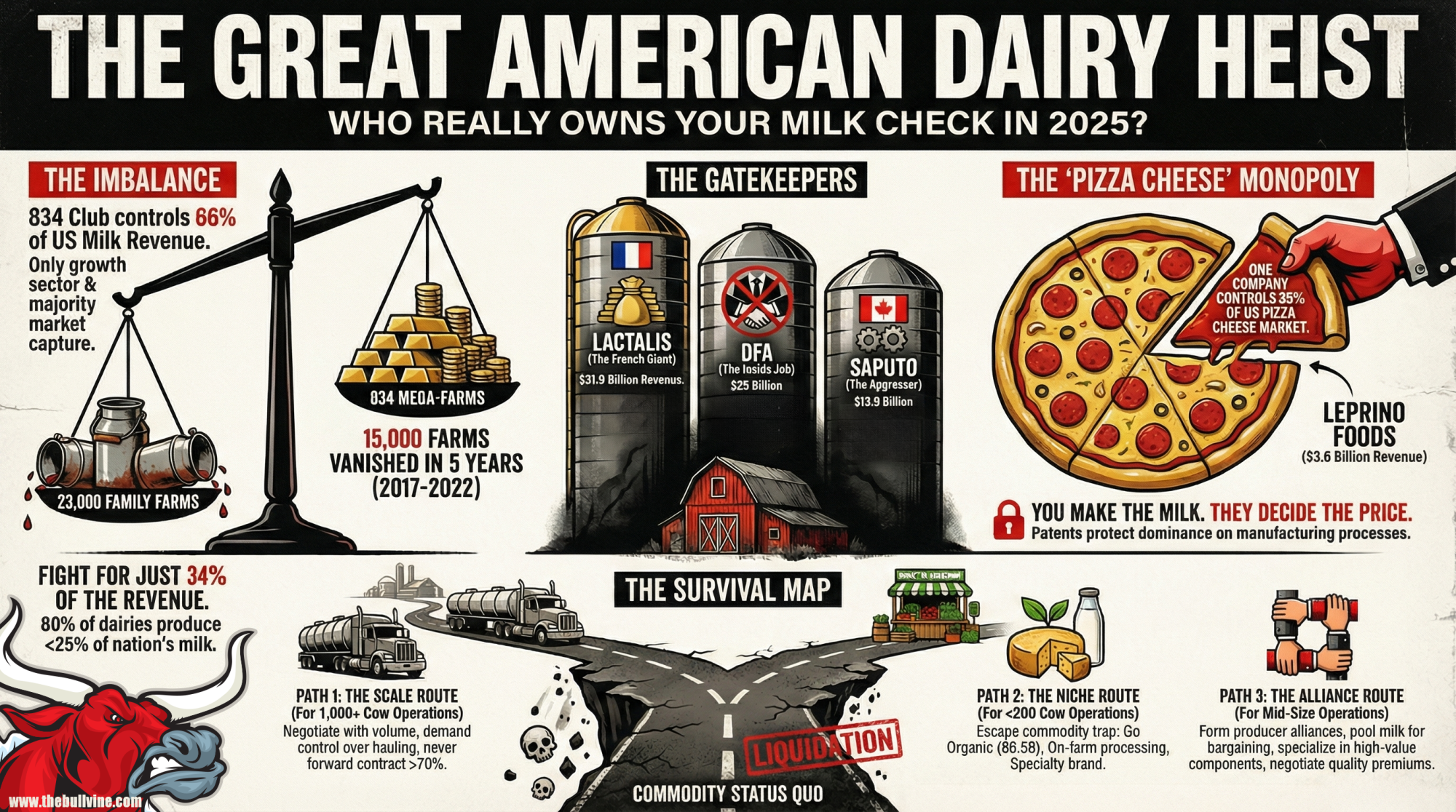
66% of US milk money goes to 834 farms. The other 23,000 farms? Fighting for scraps. Which side are you on?

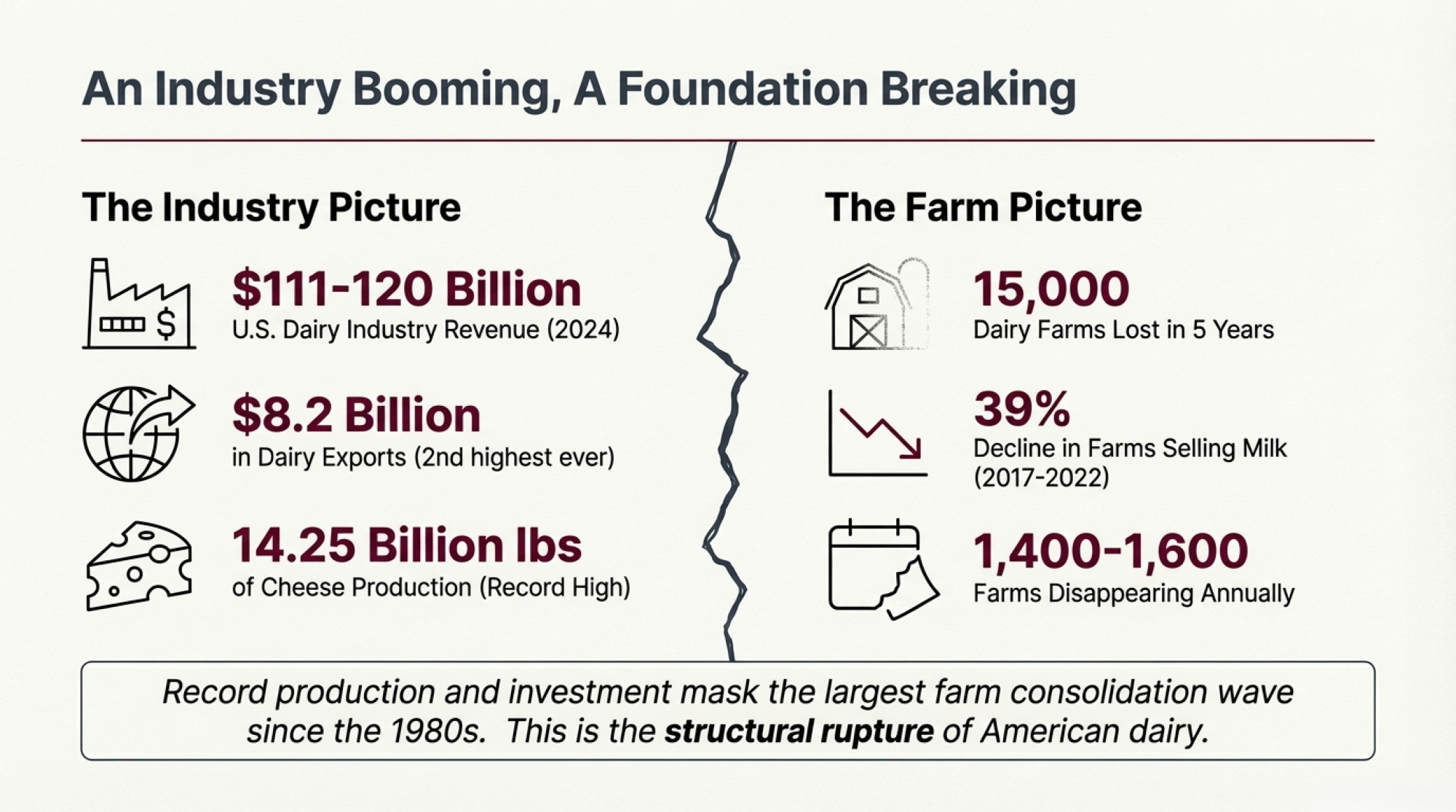
You know, looking at the American dairy landscape right now, you’d think we’re swimming in success. And in some ways, we are. The numbers are massive—we’re talking about a $111-120 billion industry that’s breaking production records while processors pour $11 billion into new facilities through 2028.

But here’s what’s interesting: while the industry gets bigger, the number of farmers running it keeps getting smaller.

The 2024 Dairy Power Rankings: Who Controls Your Milk Check

So let’s talk about who actually controls the milk flowing from America’s farms to consumers’ fridges—and more importantly, what that means for your operation.

The Giants: Who Owns the Checkbook?

Company2024 RevenueThe Real Story
Lactalis$31.9 BillionThe Global King: French giant buying everything in sight.
DFA$23 BillionThe Co-op Giant: Your “partner” with 44 processing plants.
Land O’Lakes$16.8 BillionDiversified Domestic: 23.2% US market share.
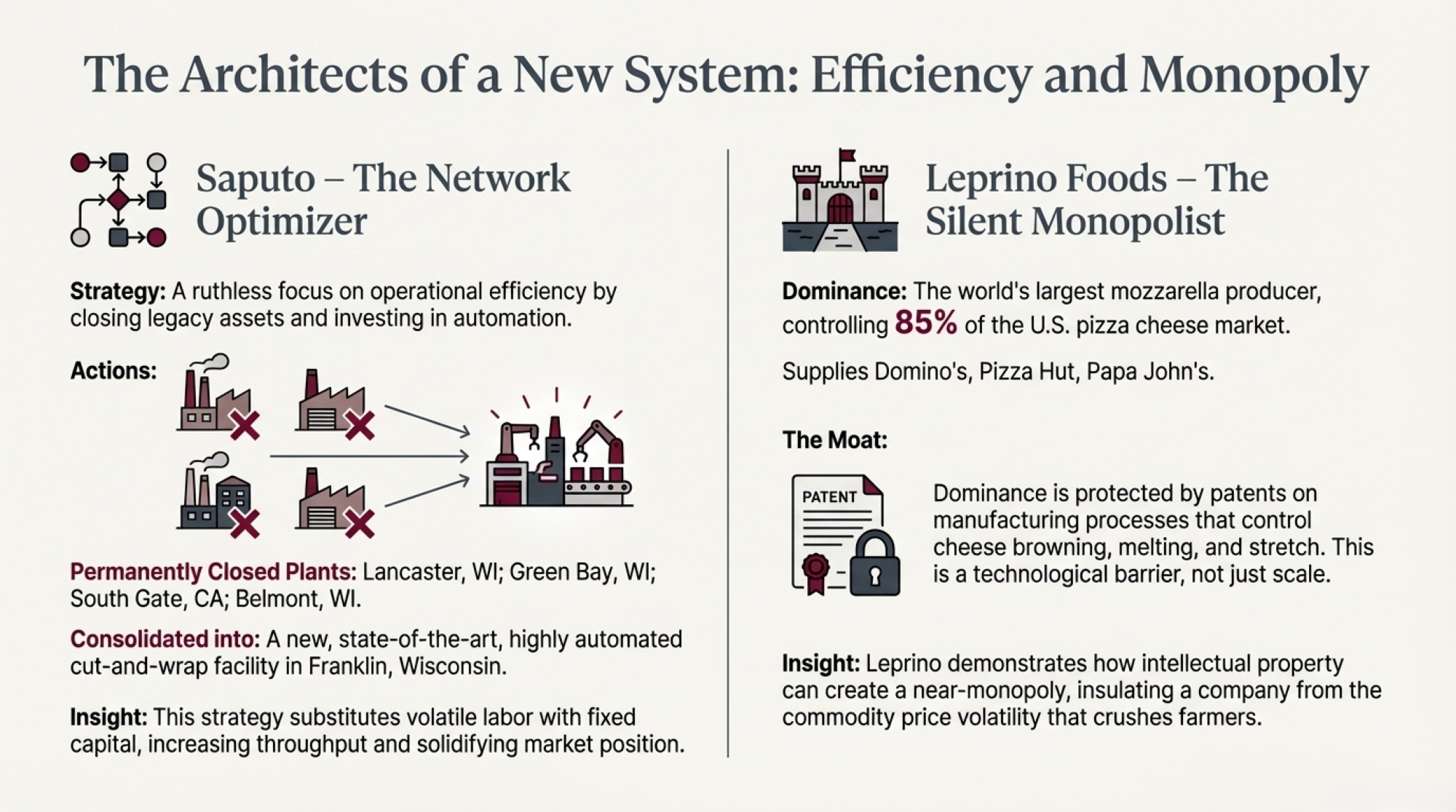
Saputo$13.9 BillionThe Aggressive Expander: 8.4% growth, highest in industry.
Nestlé N.A.$6.5-7.5 BillionThe Diversifier: Infant formula to coffee creamers.
Schreiber$7 BillionThe Hidden Giant: Supplies every major retailer.
Danone N.A.$5.5-6.5 BillionThe Yogurt King: Pushing plant-based hard.
Leprino$3.6 BillionThe Pizza Emperor: Controls 85% of US pizza cheese.

Lactalis, that French dairy behemoth, sits firmly at the global summit with .9 billion in worldwide dairy sales as of 2024. They’ve been on quite the acquisition spree lately. Just this year, they grabbed General Mills’ US yogurt business for $1.5 billion, and they’re in the process of acquiring Fonterra’s consumer operations for another $2.3 billion. Their Président cheese brand alone jumped 45% in brand value this year to $3.2 billion. That’s… well, that’s a lot of cheese.

Now, Dairy Farmers of America—that’s where things get complicated for American producers. DFA reported $23 billion in total revenue for 2024, making them the third-largest dairy company globally. They marketing milk for over 11,000 members and handle roughly 30% of US milk production. But here’s the rub that’s got farmers talking: DFA now owns 44 processing plants.

Think about what that means. When you’re selling milk to your own cooperative that also owns the processing plants, who’s really benefiting when margins get tight? Industry data shows that when milk prices crashed 30-40% in 2023, processors with integrated operations captured margin expansion while producers absorbed the losses. It’s something worth considering when you’re evaluating your marketing options.

“You’re not their partner; you’re their raw material supplier.”

The Department of Justice had concerns as well. When DFA bought Dean Foods’ assets for $433 million in 2020, they had to agree to strict conditions to prevent market manipulation. That tells you something about the concentration of power we’re dealing with here.

Land O’Lakes rounds out the domestic powerhouses with $16.8 billion in 2023 revenue, though they’ve been navigating tough waters lately. Despite the challenges, they maintain a 23.2% market share in US dairy product production and continue expanding their Tulare, California, facility. You’ve probably noticed their increased focus on value-added products—that’s not accidental.

Foreign Money, American Milk: The International Takeover

What’s fascinating—and maybe a bit concerning—is how foreign companies are carving up the American dairy market. Nestlé North America pulls in around $6.5-7.5 billion, though that includes infant nutrition and coffee creamers alongside traditional dairy. Their global dairy segment has been flat for three years running at about billion. Danone North America generates $5.5-6.5 billion, pretty much dominating the yogurt space while pushing hard into plant-based alternatives.

And then there’s Saputo, the Canadian giant. They posted $13.9 billion in 2024 with an impressive 8.4% growth rate—the highest among the top players, actually. They’re operating 29 US plants and have been particularly aggressive in cheese production and fluid milk processing. Their success shows what focused expansion with strong financial backing can accomplish.

You know what’s interesting about these international players? They often bring different approaches to their relationships with farmers. Many producers in the upper Midwest have mentioned that some of these companies maintain more consistent field presence than we’ve seen from domestic processors in recent years. Whether that translates to better prices… well, that’s another conversation.

The Silent Empire: Why Leprino Controls Your Pizza

Here’s something that might surprise you: America produced a record 14.25 billion pounds of cheese in 2024, with Wisconsin alone cranking out 3.75 billion pounds—that’s 26.3% of the nation’s total. But the real story is who controls that production.

Now, Leprino Foods—they’re the ones you might not hear much about, but they’re actually the world’s largest mozzarella producer with about $3.6 billion in revenue. They control roughly 85% of the US pizza cheese market. Think about that next time you’re eating pizza… pretty much any pizza. Meanwhile, Schreiber Foods, with $7 billion in revenue, is another major player in the cheese game, though they’re more diversified across different cheese types.

Together with Sargento, these companies hold about 30% of the shredded cheese market. Wisconsin might make the cheese, but increasingly, a handful of companies decide its fate.

What’s particularly telling—and this is something many of us have been watching—is that while overall cheese production hit records, output actually fell in three of the top six cheese-producing states last year. Pennsylvania’s production plummeted 11% to 463.5 million pounds, and Iowa dropped 2% to 387.7 million pounds. Here’s what’s happening: processors are consolidating production in states with the largest, most efficient operations. California, which produces about 20% of the nation’s milk, keeps gaining market share while smaller dairy states lose processing capacity. The cheese plants follow the milk, and the milk increasingly comes from fewer, larger farms. It’s geographic consolidation on top of farm consolidation.

Export Boom or Bust: Where Your Milk Really Flies

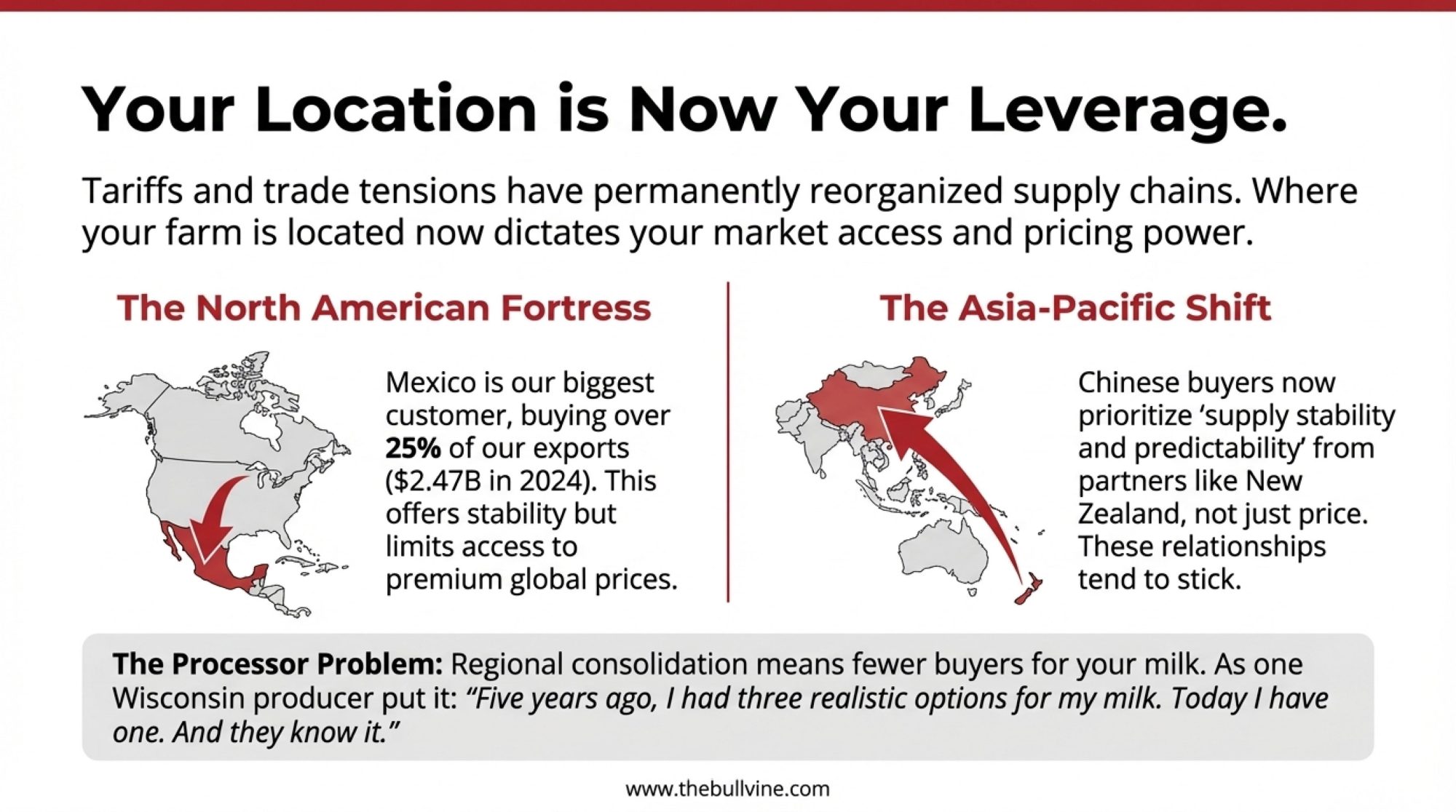
Let’s talk about the export boom, because this is genuinely exciting for producers near the right facilities. The US hit $8.2 billion in dairy exports in 2024—that’s the second-highest total ever, only behind 2022’s $9.7 billion. Mexico has become America’s dairy lifeline, purchasing $2.47 billion worth—that’s 29% of all our dairy exports. They’re buying 919 million pounds of nonfat dry milk and skim milk powder, plus 352 million pounds of cheese.

But—and there’s always a but, isn’t there?—the processors investing in export-capable facilities are banking on milk from specific types of farms. That $11 billion in planned dairy manufacturing expansions through 2028 isn’t being built for 24,000 small dairies. These facilities need consistent, large-volume supply chains. The new large-scale powder plants being built across the Midwest and West are increasingly working with limited numbers of high-volume suppliers to ensure consistency.

The Brutal Math: 24,000 Farms and Falling

15,866 Farms Vanished in 5 Years: Every size category collapsed except mega-dairies (2,500+ cows), which grew 17%. This isn’t natural attrition—it’s industrial restructuring designed to eliminate family farms

BY THE NUMBERS:

  • 15,000 farms lost in 5 years
  • 834 farms control 66% of revenue
  • $11 billion in new facilities, excluding small farms
  • 1,400-1,600 farms are disappearing annually

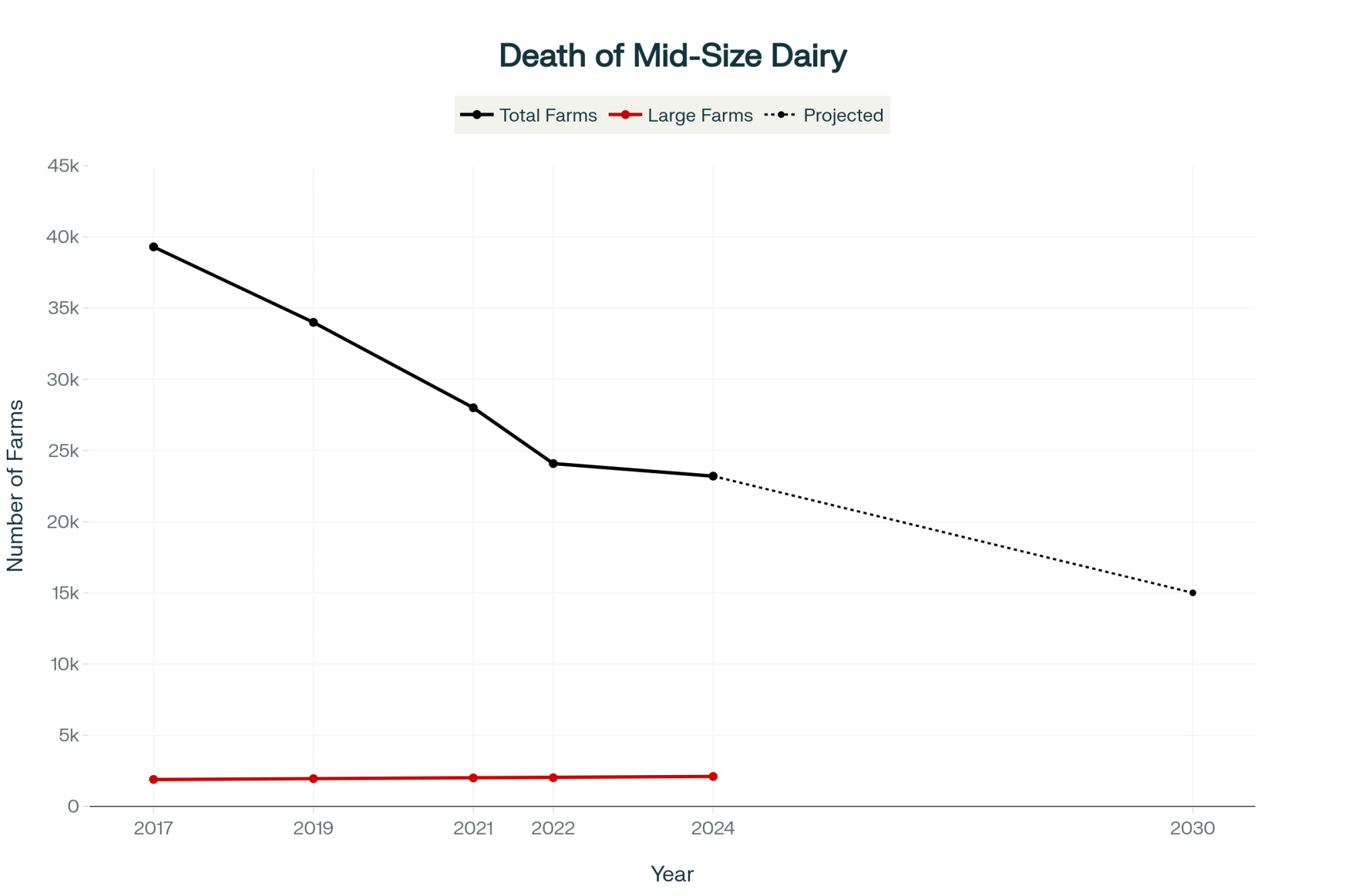
The 2022 Census of Agriculture laid it bare: America had 24,082 dairy farms, down from 39,303 just five years earlier. We’re losing farms at a breathtaking pace.

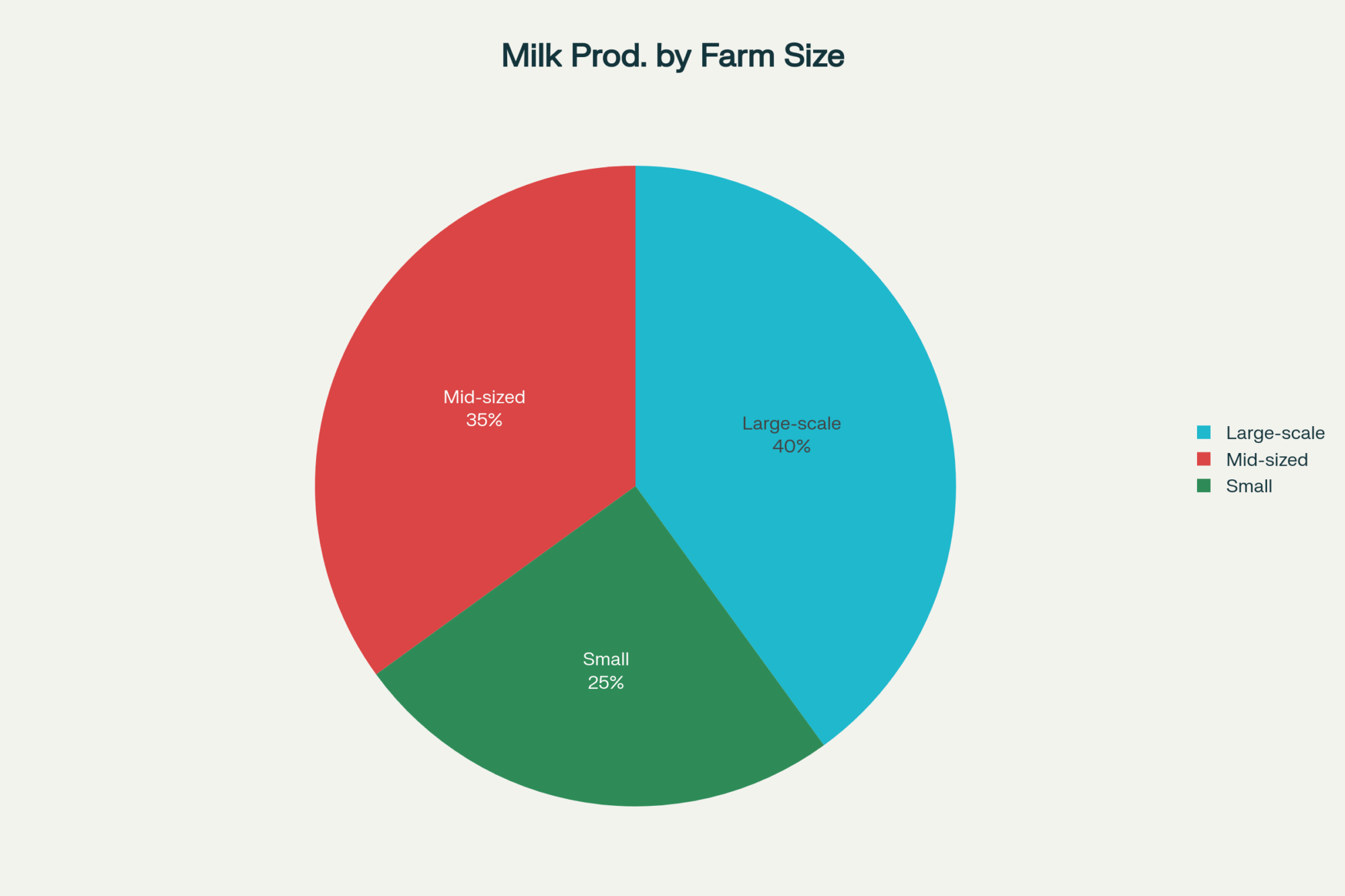
But what’s really reshaping the industry—and you probably see this in your own community—is where the milk comes from. Today, 65% of America’s dairy herd lives on farms with 1,000 or more cows. The 834 largest dairies, those with 2,500-plus head, control 66% of US milk sales by value. Meanwhile, 80% of dairy operations have fewer than 500 cows but produce less than 25% of the nation’s milk.

Think about what that means for processor relationships. If you’re running 150 cows in Pennsylvania, you’re competing for processor attention against operations running 5,000 head in New Mexico or Idaho. The processors are making what they see as rational business decisions—it’s more efficient to work with fewer, larger suppliers. But that efficiency comes at the cost of market access for smaller producers.

The $11 Billion Bet Against Small Farms

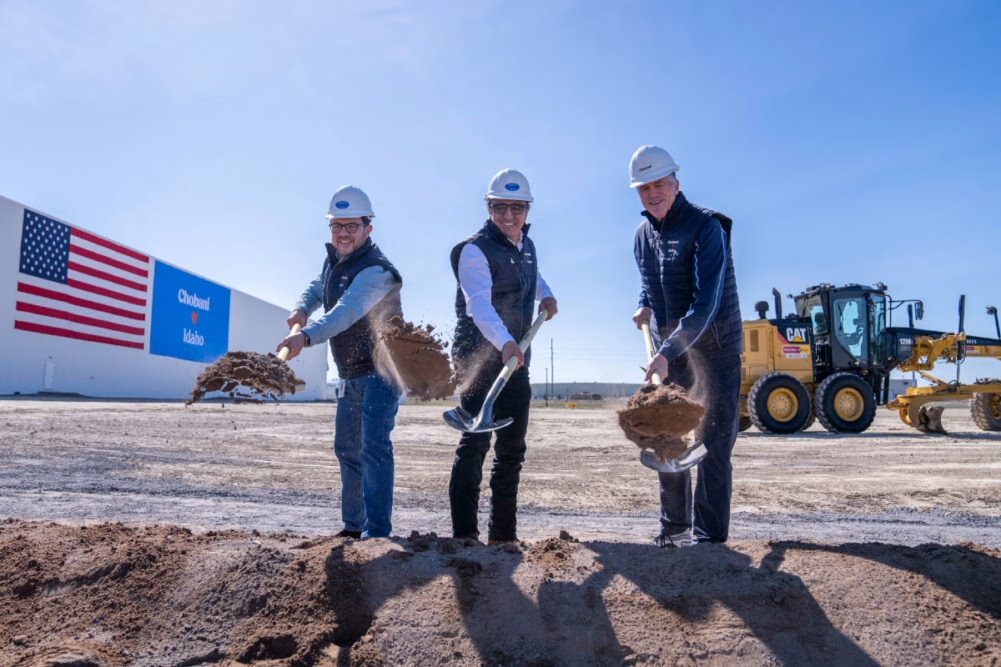
According to the International Dairy Foods Association, we’re seeing the biggest ag investment surge in US history—$11 billion flowing into 53 new or expanded dairy manufacturing facilities across 19 states between 2025 and 2028. That’s not just expansion; that’s transformation.

The $11 Billion Message: New processing capacity designed for 1,000+ cow operations only. Every dollar of this investment assumes smaller farms won’t exist to supply it. This isn’t market evolution—it’s systematic elimination

These aren’t small cheese plants or local bottling operations. We’re talking about massive facilities designed for export markets, specialized ingredients, and value-added products. They need a consistent, year-round milk supply in volumes that would have seemed impossible a generation ago.

The companies making these investments—DFA, Saputo, Land O’Lakes, and the foreign multinationals—they’re not betting on the current farm structure. They’re betting on continued consolidation. They’re pre-securing milk supply through exclusive contracts with mega-dairies because they know smaller operations will struggle to meet their volume and consistency requirements.

“Solo farms are dead farms.”

MetricSmall Farms (<200 cows)Mega-Dairies (2,000+ cows)Advantage
Cost per cwt$42.70$19.14Mega: -$23.56
Annual cost/cow$8,540$3,828Mega: -$4,712
Processor relationshipsCompeting for attentionDirect contracts/premiumsMega: Priority
Export facility accessMinimalDirect supply agreementsMega: Locked in
Component premiums$0-2/cwt$2-4/cwtMega: +$2
Survival rate 2017-2022-42%+17%Mega: Growing

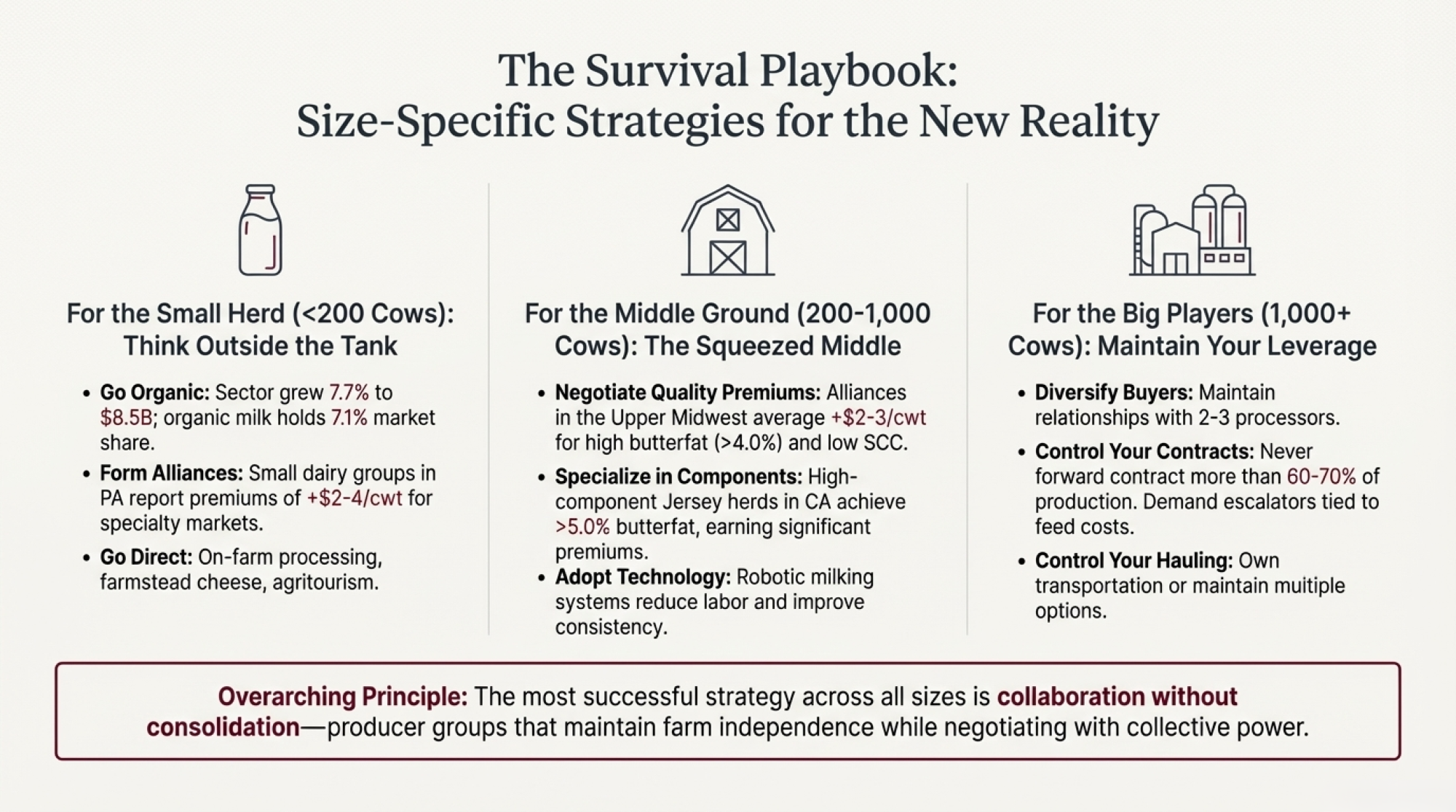
Your Survival Playbook: Size-Specific Strategies That Work

Despite everything, there are reasons for optimism—if you know where to look and how to adapt.

For the Small Herd (<200 Cows): Think Outside the Tank

  • Go Organic: The organic dairy sector grew 7.7% to $8.5 billion in 2024, with organic whole milk sales up 13.2%. Organic fluid milk now holds 7.1% market share, up from just 3.3% in 2010.
  • Form Strategic Alliances: Regional cooperative marketing efforts have shown promising results, with small dairy groups in Pennsylvania and other states reporting premiums of $2-4/cwt when supplying specialty markets.
  • Direct Marketing: On-farm processing, farmstead cheese, agritourism.
  • Specialty Production: A2A2 milk, grass-fed certification, local brand development.

For the Middle Ground (200-1,000 Cows): The Tough Spot

  • Quality Premiums: Producer quality alliances in the Upper Midwest have successfully negotiated component premiums averaging $2-3/cwt by guaranteeing consistent butterfat above 4.0% and low somatic cell counts.
  • Component Specialization: High-component Jersey operations in California consistently achieve butterfat levels above 5.0% and protein above 3.7%, earning substantial component premiums.
  • Technology Adoption: Robotic milking systems can significantly reduce labor requirements while improving the milking consistency that processors demand.
  • Producer Alliances: Pool milk with similar-sized operations to negotiate directly with processors.

For the Big Players (1,000+ Cows): Maintain Your Leverage

  • Contract Flexibility: Never forward contract more than 60-70% of production.
  • Transportation Control: Own your hauling or maintain multiple options.
  • Price Protection: Demand escalators tied to feed costs in long-term contracts.
  • Market Diversification: Don’t depend on a single processor—maintain relationships with 2-3 buyers.
  • Component Focus: Invest in genetics and nutrition to maximize component premiums.

What seems to work best across all sizes? Collaboration without consolidation. Producer groups that maintain independence while negotiating collectively are seeing success in various regions. They’re still independent farms, but they’re learning to work together when it makes sense.

Five Questions That Could Save Your Farm

Looking at all this market concentration, here are the critical questions you should be asking:

  1. What percentage of your milk goes to export markets versus domestic?
  2. How does your pay price compare to farms of similar size in neighboring states?
  3. What quality premiums are available, and what’s required to earn them?
  4. Are there volume commitments that could lock you into unfavorable terms?
  5. What happens to your market if this processor closes or consolidates facilities?

The Bottom Line

The American dairy industry is being reshaped by forces beyond any individual farm’s control. The players are getting bigger—Lactalis will likely crack $35 billion globally within two years. The processors are getting pickier—they want consistent, large-volume suppliers. The exports are getting more critical—without Mexico and Canada, we’d be drowning in surplus.

Your challenge isn’t just producing quality milk anymore. It’s navigating a market where your cooperative might be competing for the same margins you need, where foreign companies control major segments, where 66% of value comes from 2,000 farms while 22,000 others fight for the remainder.

Knowledge really is power in this environment. Know who you’re selling to. Understand their global strategy. Recognize that the $111-120 billion American dairy industry looks impressive from 30,000 feet, but at ground level, it’s increasingly controlled by fewer hands making bigger bets on a future that might not include every farm—unless farms adapt to their reality or create their own path.

The dairy industry’s future is being written right now in boardrooms from Paris to Kansas City. Make sure you understand the script, because whether you’re milking 50 cows or 5,000, these companies aren’t just buying your milk—they’re determining whether your next generation will have a market at all.

Key Takeaways

  • Your Real Competition: It’s not other farmers—it’s your own co-op. DFA owns 44 processing plants, controls 30% of US milk, and profits when farm milk prices crash.
  • The 66% Rule: Just 834 mega-dairies now control 66% of all US milk revenue ($73 billion), while 23,000 smaller farms split the remaining $38 billion. Every processor’s future plans assume you won’t exist.
  • The Foreign Takeover No One’s Discussing: Lactalis (French, $31.9B), Saputo (Canadian, $13.9B), and Nestlé (Swiss, $6.5B) control more American dairy than you think—and they’re buying more every year.
  • Your Three Survival Paths: (1) Scale to 1,000+ cows for processor attention, (2) Capture premiums via organic/specialty markets (+$4-8/cwt), or (3) Form producer alliances to negotiate collectively.
  • The 2028 Deadline: $11 billion in new processing capacity comes online by 2028, designed for mega-farms only. If you haven’t adapted by then, you won’t have a market.

Executive Summary: 

Your milk check is now controlled by eight companies—three of them foreign—who’ve captured a $111 billion industry while 15,000 American dairy farms vanished in five years. The betrayal runs deep: DFA, your ‘farmer-owned’ cooperative, owns 44 processing plants and pocketed profits as milk prices crashed by 40%, while members lost billions. Today’s reality: 834 mega-farms control 66% of all US milk revenue while 23,000 smaller farms compete for the remaining third. With processors pouring $11 billion into facilities designed exclusively for 1,000+ cow operations, the message is unmistakable. This isn’t market evolution—it’s deliberate elimination of family dairy farms.

Editor’s Note: Market data cited reflects 2024 financial reports and USDA statistics through November 2025. Company revenues include total sales, not exclusively dairy operations. Regional variations apply.

Learn More:

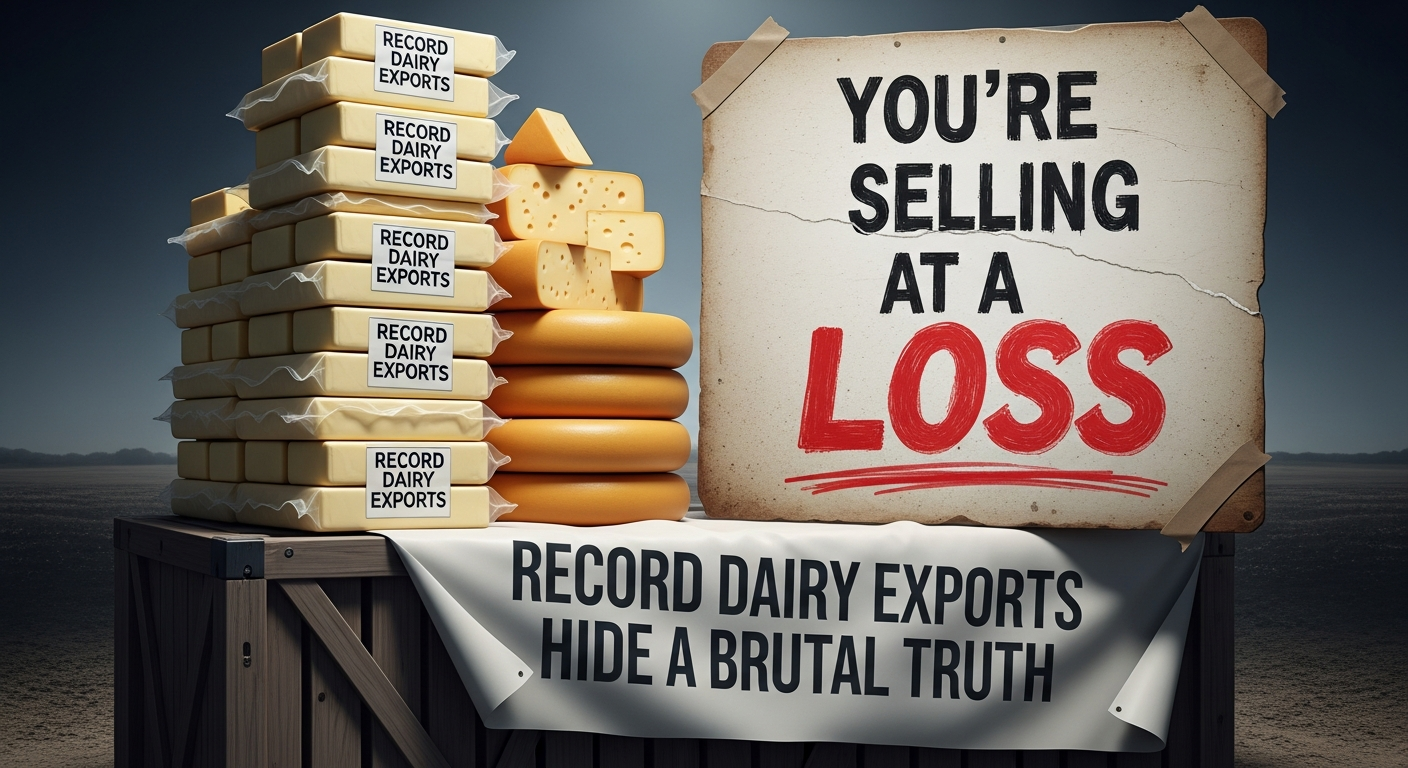
Record Dairy Exports Hide a Brutal Truth: You’re Selling at a Loss

Your co-op newsletter: ‘RECORD EXPORTS!’ Your milk check: -$2/cwt. Your banker: ‘We need to talk.’ The disconnect has never been wider.

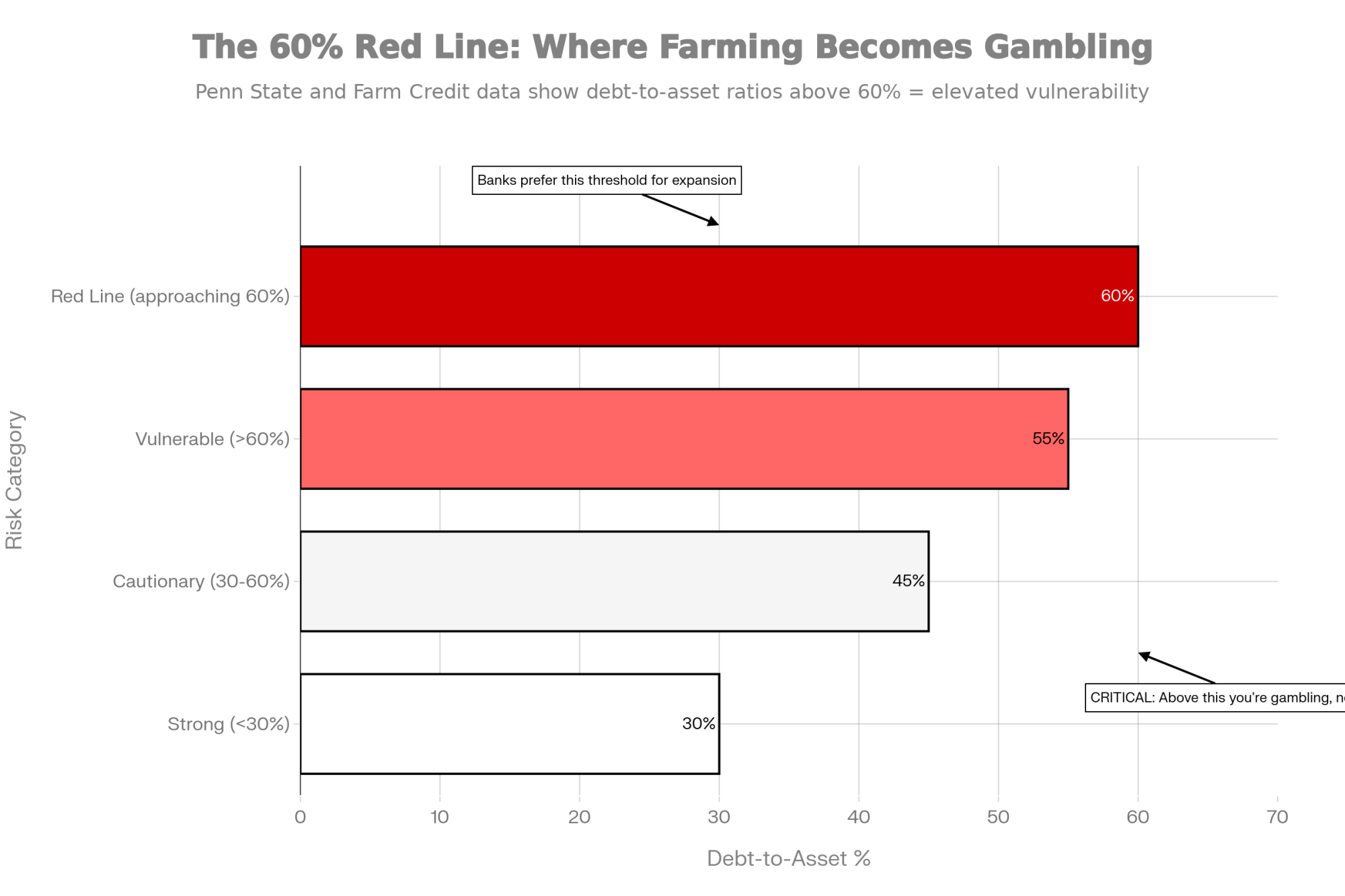
EXECUTIVE SUMMARY: The U.S. dairy industry’s record cheese exports are actually distress sales, with producers losing $2/cwt as milk prices sit at $16.91 against $19 production costs. Mexico—buying 29% of our exports—is spending $4.1 billion to become self-sufficient, while China’s 125% tariffs have already destroyed our powder markets. The Class III-IV price spread has exploded to $4.06/cwt, the widest since 2011, forcing all production toward cheese that’s selling below profitability. Mid-size farms (500-1,500 cows) face extinction-level losses of $400,000+ annually, with survival limited to mega-dairies with 50% or less debt or premium operations near cities. Producers have 90 days to make irreversible decisions: scale massively, find niche markets, or exit before equity evaporates. The 800,000-head heifer shortage guarantees milk production will contract 3-5% through forced exits, but recovery won’t arrive until mid-2027—and only for the operations structured to survive.

dairy farm profitability 2025

On the surface, the numbers look fantastic. We exported 119.3 million pounds of cheese in August 2025—up 28% from last year, according to the Dairy Export Council. Butter exports nearly tripled. Processing plants are announcing $11 billion in new investments.

But check your bank account. The milk checks aren’t matching the celebration. The headlines say “Record Exports,” but the market reality says “Distress Sale.”

I’ve been talking with producers from Wisconsin down to Texas, and what I’m hearing doesn’t line up with these export headlines. Understanding this disconnect could be the difference between successfully navigating the next 18 months or becoming another casualty of industry restructuring.

The “record export” headlines your co-op newsletter celebrates tell only half the story. Yes, August 2025 cheese exports jumped 28% to 119.3 million pounds—but prices collapsed 13% to $1.82/lb. This is classic distress sale economics: moving volume at any price to avoid even bigger losses. When production costs sit at $18-19/cwt and you’re selling below $2/lb equivalent, every shipment deepens the red ink.

When Being the Cheapest Isn’t Actually Winning

The US dairy industry’s “record exports” mask a brutal reality: American cheese trades at $1.82/lb while European producers command $2.35/lb—a 45-60 cent disadvantage that signals desperation rather than competitive strength. When you’re underselling New Zealand butter by a full dollar per pound, you’re not winning global markets; you’re liquidating inventory below cost.

Here’s what’s bothering me about these export records. Global Dairy Trade auction results from November show American butter trading at $1.57 a pound. New Zealand? They’re getting $2.57. Our cheese is moving at $1.82 while Europeans fetch $2.27 to $2.42.

That 45 to 60 cent spread on cheese isn’t a competitive advantage. It’s desperation.

Penn State Extension’s 2025 dairy outlook shows that a typical 500-cow operation in Wisconsin or Minnesota has production costs running $18 to $19 per hundredweight. But milk prices? We’re at $16.91 for Class III according to CME October data. That’s annual losses of $32,000 to $62,000 for operations that size.

These record exports everyone’s celebrating are happening because we’re willing to sell at prices that don’t cover our costs. South Korean and Japanese buyers see cheap American dairy, and they’re stocking up. Can’t blame them. But volume at a loss isn’t success.

The Time Lag Trap We’re All Stuck In

The breeding decisions you made two years ago—when milk was over $20 per hundredweight—those heifers are just entering the milking herd now.

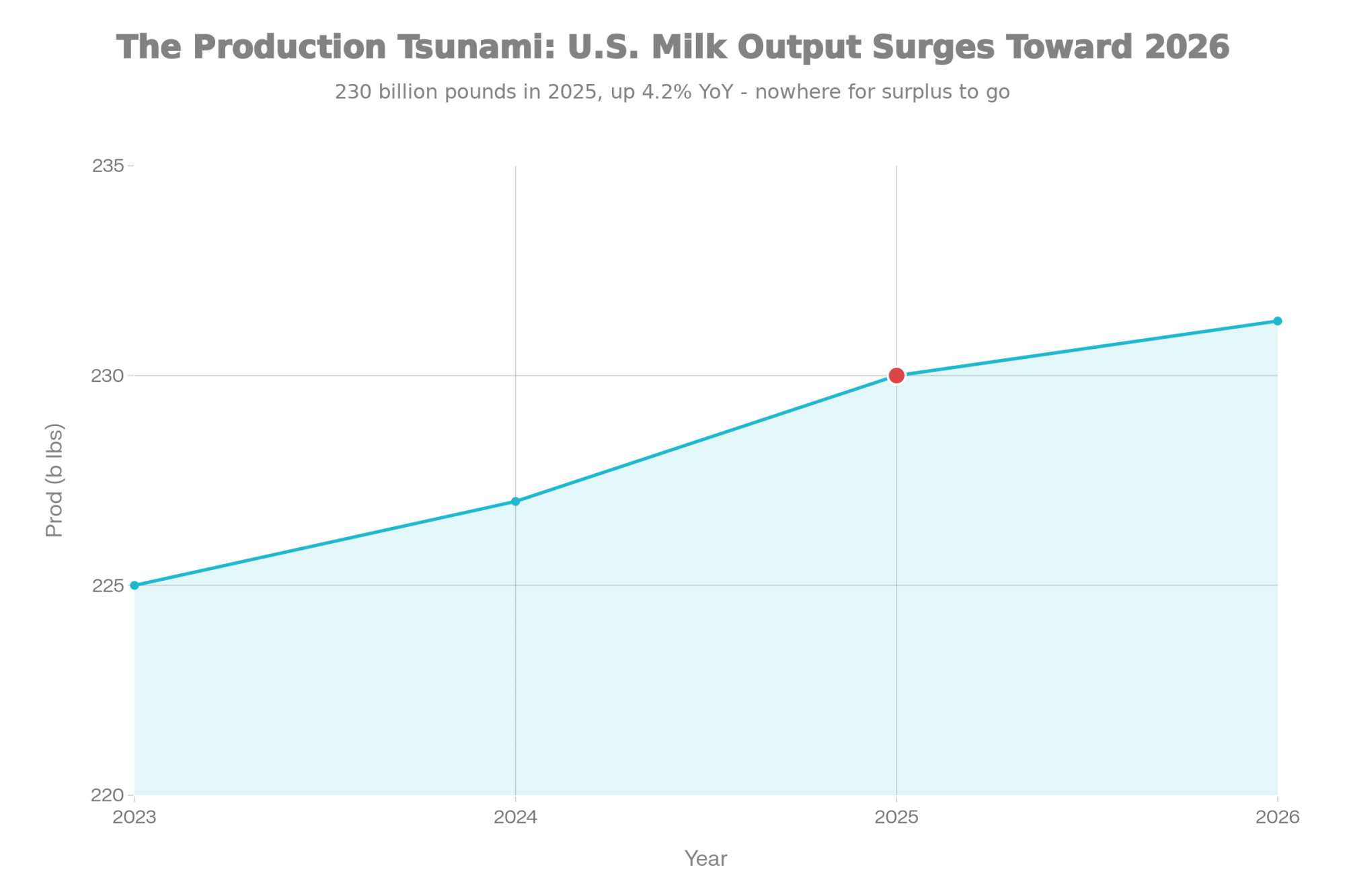
According to USDA’s latest milk production reports, we’ve added 200,000 cows to U.S. herds over the past 18 months. Every one of those additions made sense when the decision was made. But September production jumped 4.2% year-over-year, and we’re producing 18.3 billion pounds of milk at exactly the moment when global markets are saturated.

Your operation has maybe $300,000 to $500,000 in annual fixed costs—infrastructure doesn’t get cheaper just because milk prices drop. Equipment auction data from Machinery Pete shows you’re looking at 30 to 50% discounts from what things were worth two years ago if you try to sell now.

So we keep producing. We try to spread those fixed costs over more volume. It’s rational for each of us individually, but when everyone does it, oversupply drives prices even lower.

The Mexico Situation Nobody Wants to Talk About

While you’re focused on tariff headlines, Mexico is spending $4.1 billion to eliminate $1+ billion in US dairy imports by 2030. They’re not negotiating—they’re building processing plants in Campeche and Michoacán with 600,000-liter daily capacity and importing Holstein heifers from Australia. Mexico takes 29% of US dairy exports; losing even half that market erases profits for thousands of farms overnight.

While we’re celebrating that Mexico takes 29% of our dairy exports according to USDA Foreign Ag Service data, they announced last July that they’re spending $4.1 billion to become 80% self-sufficient in dairy by 2030.

They’re building processing facilities in Campeche and Michoacán that’ll handle 600,000 liters a day. They’ve imported 8,000 Holstein heifers from Australia—Dairy Australia confirmed that shipment. The Mexican government is guaranteeing their producers 12 pesos per liter.

Mexico buys 51.5% of all our nonfat dry milk exports, according to Export Council trade data. If they achieve even half their plan, we’re talking about losing a billion dollars or more in annual exports. This isn’t a trade dispute that’ll blow over. They’re building the infrastructure right now.

Why Powder Is Collapsing While Cheese Keeps Moving

Class III-IV pricing spread explodes to $4.06/cwt—matching 2011’s record gap and exposing dairy’s new geography of pain. Same cows, same work, but if your milk goes to butter and powder plants instead of cheese, you’re losing $15,000 monthly on a 500-cow operation. This isn’t market volatility; it’s structural divergence that’s rewriting the profitability map.

August export data shows cheese exports up 28%, but powder exports down 17.6%—the lowest August volume since 2019.

The October CME Spread tells the story:

  • Class III (Cheese): $17.81/cwt
  • Class IV (Powder/Butter): $13.75/cwt
  • Spread: $4.06/cwt—widest since 2011

For a 500-cow dairy, that’s a $50,000 swing in annual income depending purely on which plant takes your milk.

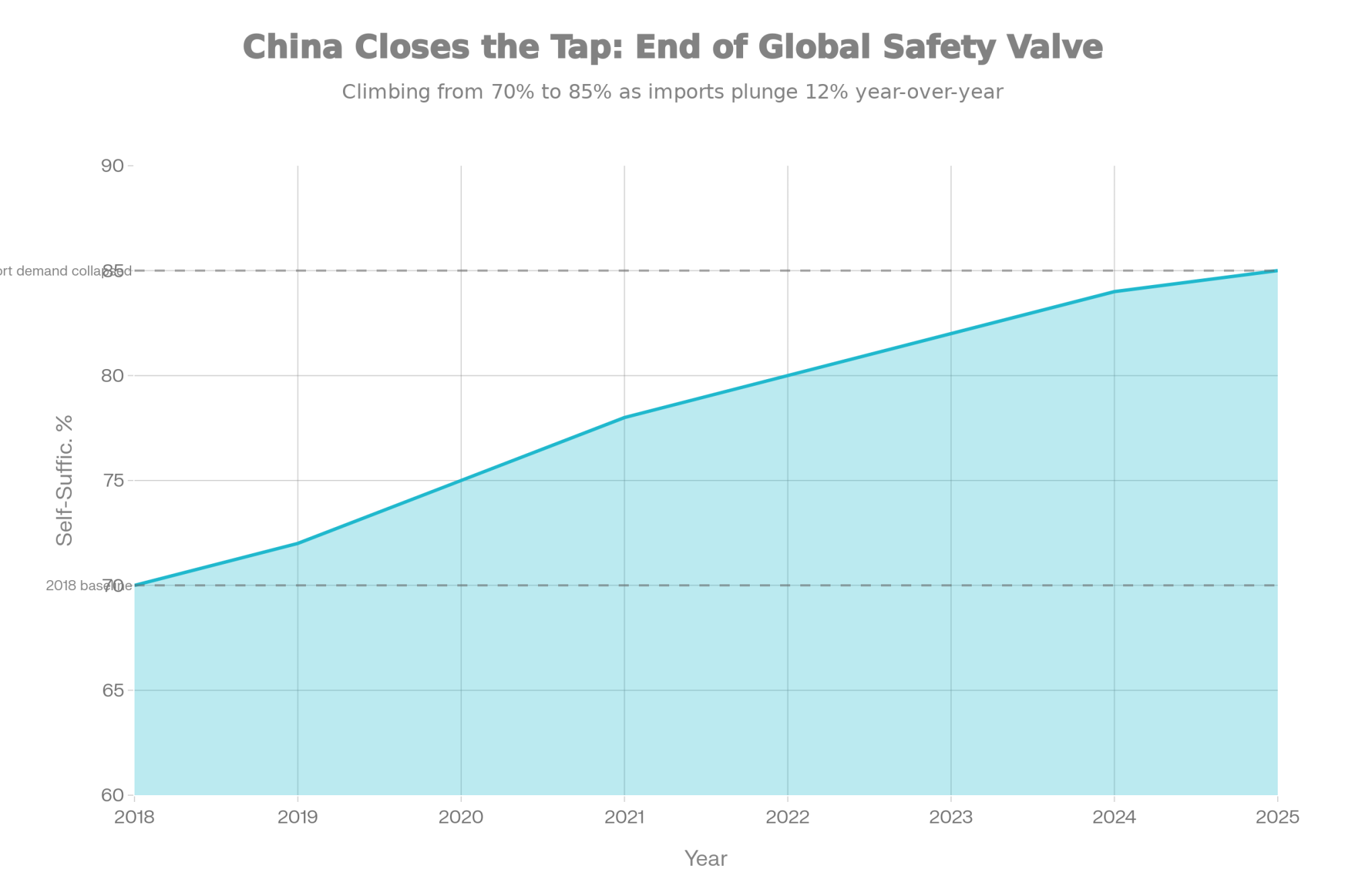
China put 125% tariffs on our dairy products back in March. We used to send them 70-85% of our whey exports. That market disappeared overnight. Processors are pushing every pound they can toward cheese because at least there’s still some margin there. Powder production? They’re running the minimum.

Different Operations, Different Realities

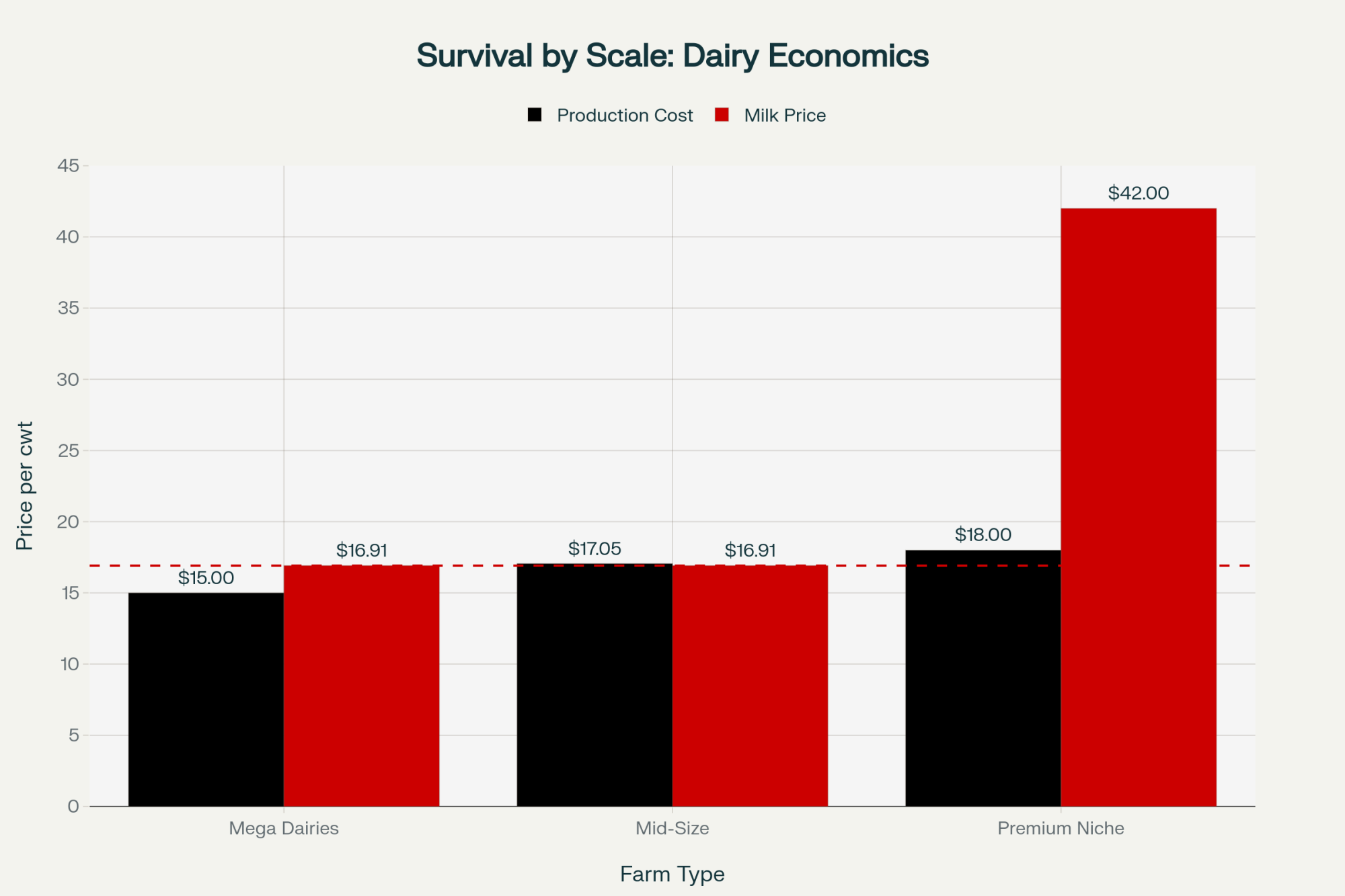
The dairy industry’s brutal bifurcation in one chart: mega-dairies break even at scale, mid-size operations hemorrhage $62K annually, while premium niche players bank $120K. If you’re running 500-1,500 conventional cows, you’re in the kill zone—producing milk at $17.05/cwt and selling it at $16.91. The math doesn’t work, and hoping for better prices won’t save you.

Based on the Center for Dairy Profitability at Madison and the Farm Credit System data:

Mega-dairies (3,500+ cows): Costs around $14.20 to $15.80/cwt thanks to automation and efficiency, according to Michigan State’s benchmarking study. If debt’s under 50% of equity, they can weather this storm. Some are buying out struggling neighbors at 30 to 50 cents on the dollar.

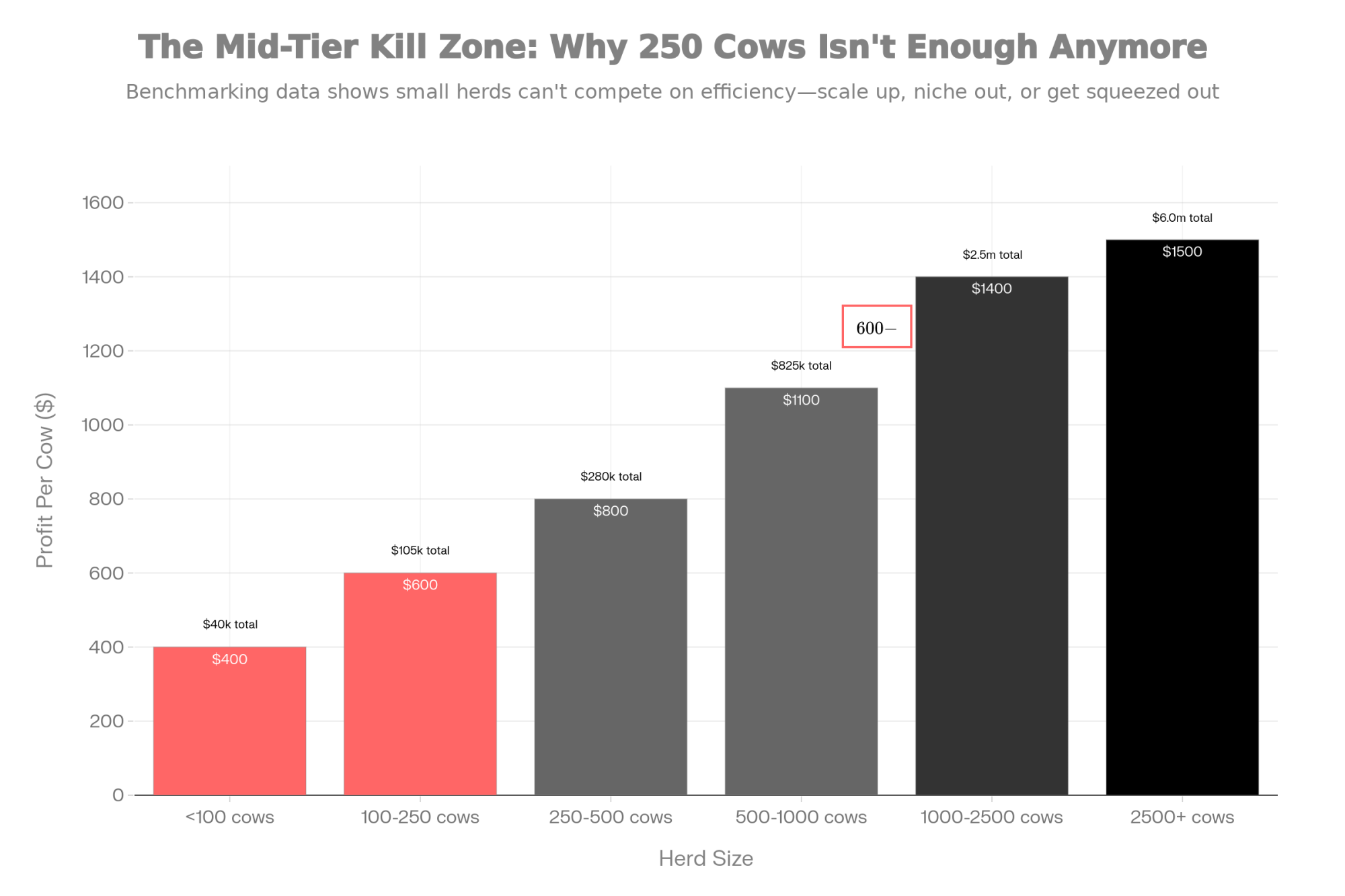
Mid-size operations (500-1,500 cows): The toughest spot. Production costs $16.30 to $17.80 based on Kansas State farm management data. With current milk prices, annual losses could exceed $400,000. Without a path to massive scale or premium markets, options are limited.

Premium niche (organic/grass-fed): Capturing $36 to $50/cwt through outfits like CROPP Cooperative are doing okay. But you need established customers near a city. Operations that went organic without premium market access are worse off than conventional farms due to higher feed costs.

Decision Time: The Next 90 Days Matter


Decision Path
Capital RequiredTimelineEquity RetainedSuccess RateKey Requirements
Exit Now (Controlled)$090-120 days85-95%95% (preserve wealth)Act before March 2026
Scale to Mega (3500+ cows)$8-15 million18-36 months20-40% (high debt)60% (if debt <50%)Low debt + expansion capital
Pivot to Premium Niche$500K-1.2M36 months (organic)70-85%70% (w/ city proximity)Within 50-100mi of major city
Status Quo / Wait & Hope$0Indefinite bleeding0-50% (forced exit by 2027)15-20% (statistically)Hope for market recovery

Based on Purdue’s Commercial Ag projections and USDA’s long-term outlook, you’ve got critical decisions to make in the next three to six months.

Considering expansion? Interest rates are 7.5 to 9% according to the Fed, ag credit conditions. Kansas State data shows that expanding when prices are falling rarely works. Maybe pay down debt instead.

Considering exit? Asset values today versus 18 months from now could be the difference between keeping most of your equity or losing it all. Equipment markets have declined for 25 straight months, according to Equipment Manufacturers data.

Considering organic/grass-fed? It’s a three-year conversion with negative cash flow. You need to be within 50 to 100 miles of a major city, based on consumer research. Penn State Extension says you need off-farm income during transition.

The Heifer Shortage Silver Lining

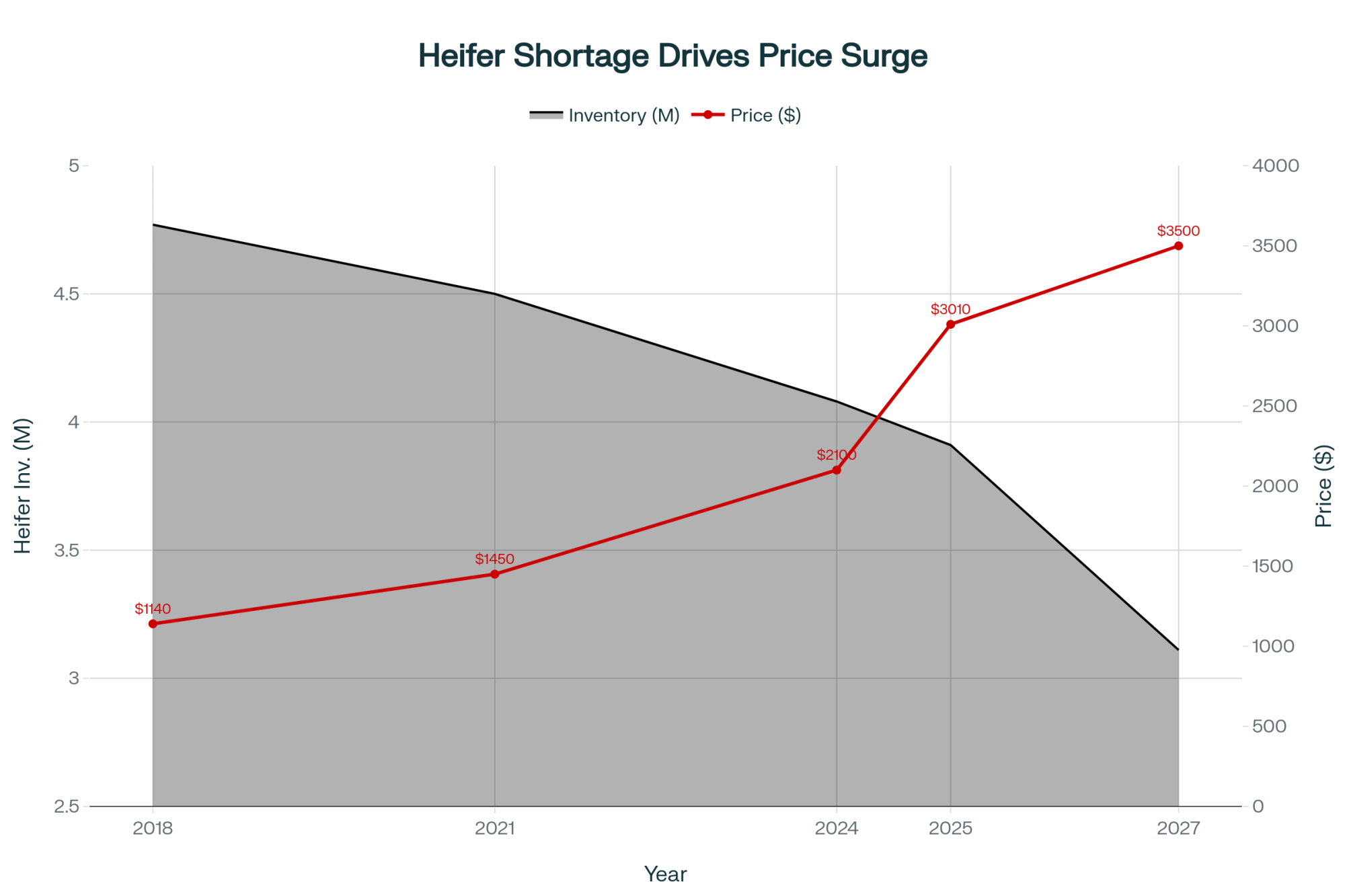
Here’s your silver lining in a crisis: an 800,000-head heifer shortage over two years mathematically guarantees milk production will contract 3-5% by 2027. Replacement inventory sits at 20-year lows while heifer prices exploded from $1,140 to $3,010—a 164% jump that makes expansion impossible. This forced contraction is exactly what balances supply-demand and triggers recovery. The question: will you survive to see it?

CoBank’s latest report shows we’re at 20-year lows for dairy replacement heifers. We’re short about 800,000 replacements over the next two years.

When you can get $3,500 to $4,500 for a beef-cross calf versus keeping a dairy heifer worth $800 to $1,200 in this market, the math is obvious. Progressive Dairy’s breeding survey shows most producers are making that same decision.

The dairy herd has to shrink—probably 3 to 5% by 2027, according to USDA projections. That might balance supply and demand. Rabobank and CoBank project stabilization by mid-2027, with gradual improvement into 2028.

How Geography Changes Everything

California’s Central Valley faces water costs up 40% according to UC Davis Cost Studies. Meanwhile, South Dakota State University Extension’s 2025 Feed Cost Analysis shows operations there seeing feed costs $1.50 to $2.00/cwtbelow the national average.

Texas added 50,000 cows while Wisconsin stayed flat. That’s economics playing out in real time.

What This All Means for You

Those record export numbers? They don’t mean what the headlines suggest. Moving volume at a loss is a distress sale on a national scale.

The decisions you make in the next 90 days are more important than what you do over the next year. By March 2026, many options available today won’t exist.

Mexico’s self-sufficiency plan is real. We need to plan for our biggest customer becoming a competitor. The Export Council knows it, but I’m not seeing contingency planning at the farm level.

Scale alone won’t save anyone. I’ve seen big operations with too much debt go under, and small operations with good positioning thrive. It’s about your total situation—debt levels, geographic location, market access.

The bifurcation—where you’re either huge or niche—is accelerating. If you’re in that middle range, especially 200 to 1,000 conventional cows, you need to decide which direction you’re heading.

Recovery is coming through contraction. The heifer shortage guarantees that. The question is whether you’ll be around to see it.

Looking Down the Road

By 2028, based on projections from Texas A&M and Cornell, we’ll have fewer, larger operations handling commodity production and smaller, specialized operations serving premium markets. That middle ground where many of us operated for generations is disappearing.

This isn’t random volatility. It’s industry restructuring in response to global competition, changing consumer preferences, as the Innovation Center for U.S. Dairy has tracked, and the reality of 2025 production costs.

When you see export headlines in your co-op newsletter and wonder why your milk check keeps shrinking, remember—it’s not about volume. It’s about margins. The difference between acting strategically now versus hoping things improve could be the difference between preserving or losing your family’s equity.

The herd is heading off a cliff. The record exports are just the dust they’re kicking up. Don’t follow the volume—follow the margin. The next 90 days will decide if you’re a casualty of the restructuring or one of the few left standing to see the recovery.

KEY TAKEAWAYS

  • Your daily reality: At current prices, a 500-cow dairy loses $175/day ($62,000/year). The Class III-IV spread of $4.06/cwt means the same milk yields $50,000 in different income based purely on plant destination.
  • The export trap: Record volumes are happening BECAUSE we’re desperate—selling cheese at $1.82/lb while New Zealand gets $2.42/lb isn’t winning, it’s liquidation.
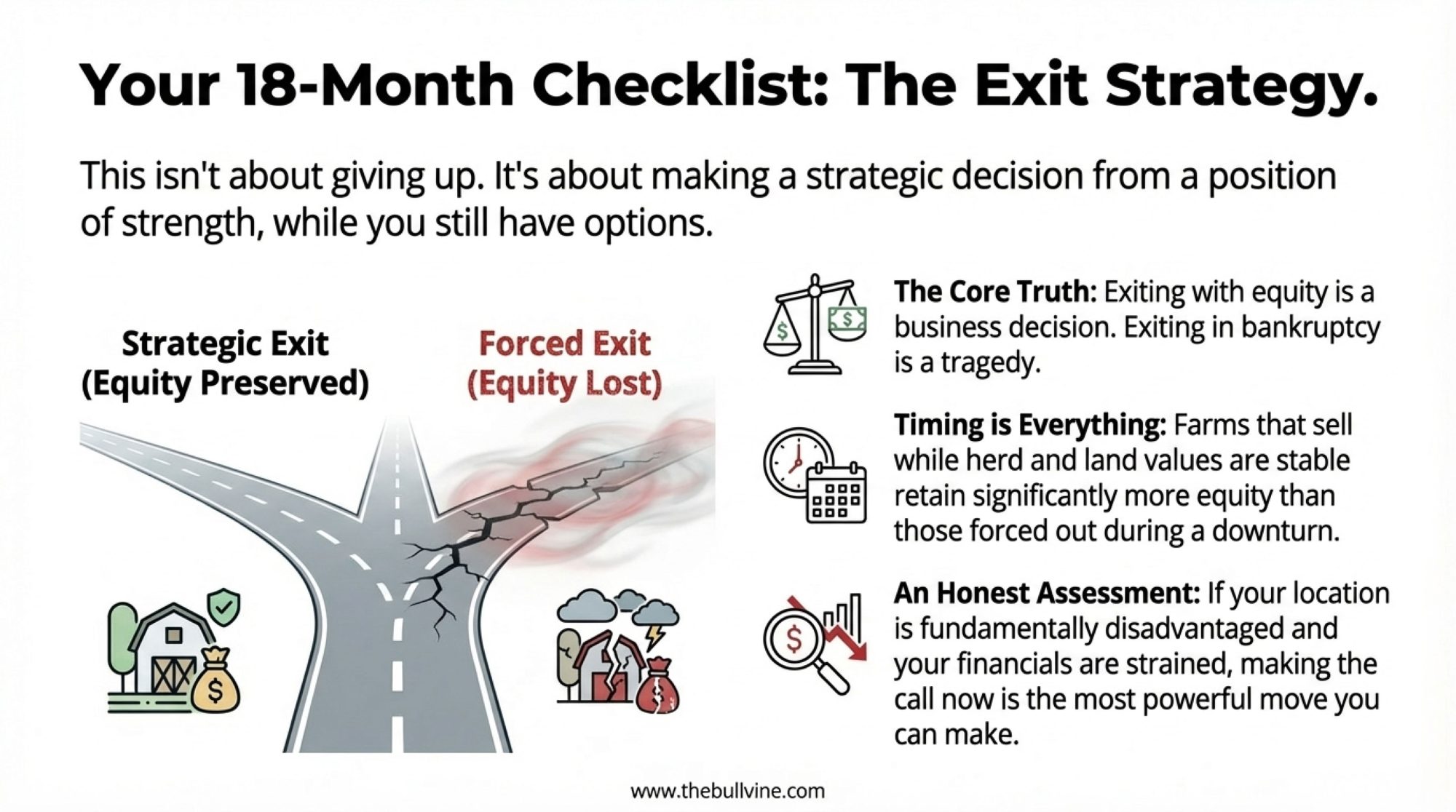
  • 90-day decision window: By March 2026, you must choose—scale to 3,500+ cows, secure premium markets at $36+/cwt, or exit, preserving 85% equity (vs 0-40% if forced out later).
  • Geographic survival map: Texas/South Dakota operations save $1.50-2.00/cwt on feed. California faces +40% water costs. Location now determines viability as much as management.
  • The guarantee: 800,000-heifer shortage forces 3-5% production cut by 2027, ensuring recovery for survivors—but 40-50% of current operations won’t make it.

Complete references and supporting documentation are available upon request by contacting the editorial team at editor@thebullvine.com.

Learn More:

Join the Revolution!

Join over 30,000 successful dairy professionals who rely on Bullvine Weekly for their competitive edge. Delivered directly to your inbox each week, our exclusive industry insights help you make smarter decisions while saving precious hours every week. Never miss critical updates on milk production trends, breakthrough technologies, and profit-boosting strategies that top producers are already implementing. Subscribe now to transform your dairy operation’s efficiency and profitability—your future success is just one click away.

NewsSubscribe
First
Last
Consent

The $380,000 Question: How Florida Dairy Farmers Beat 4 Hurricanes in 13 Months

Your dairy loses $13,400/month after a hurricane. Government aid takes 12 months. Do you have 6 months reserves? Because 30 days isn’t enough anymore.

Executive Summary: Four hurricanes in 13 months taught Florida dairy farmers what $500,000 buys: survival. The farms still standing had six months of cash reserves and could afford solar backup, hurricane-proof construction, and layered insurance—everyone else is bleeding $13,400 monthly or already gone. This exposed a brutal truth: mid-size family dairies can’t afford climate resilience but can’t compete without it. They face three stark options: scale up past 1,000 cows, find premium niche markets, or exit while there’s still equity to preserve. The math is unforgiving—strategic exit at month 8 saves families $380,000-$580,000 compared to forced liquidation at month 18. With government aid covering just 22% of losses and mutual aid networks exhausted, Florida’s experience reveals the future of farming: only operations with capital access survive repeated climate disasters.

Dairy Risk Management

You know that feeling when you walk through your barn after a storm and everything’s different? Jerry Dakin had that moment last year, standing in his Myakka City dairy farm looking at 250 dead cows scattered across his pastures after Hurricane Ian hit in September 2022. He’d spent decades building Dakin Dairy up to 3,100 head—good genetics, solid facilities, everything running like it should.

Here’s what nobody saw coming, though. Ian was just the start. We had Idalia, then Debby, then Helene, and finally Milton—all hitting through October 2024. Suddenly, resilience wasn’t just something we talked about over coffee at the co-op. It became what decided who’d still be milking come next season.

Four hurricanes. 13 months. $570 million in dairy losses. After Ian devastated the industry in 2022 ($500M), Florida farmers faced three more major storms in rapid succession—Idalia, Debby, Helene, and Milton—with as little as 1 month between impacts. When disasters strike faster than recovery cycles, only farms with deep capital reserves survive.

What’s really interesting—and this caught my attention when the November data came out from USDA—is that the Southeast actually lost fewer dairy herds than anywhere else in the country during all this. We’re talking 100 farms, compared to over 200 in other regions, according to Progressive Dairy. So what made the difference? The strategies that worked tell a story we all need to hear.

“The difference between making a strategic decision at month 8-10 versus being forced out at month 18? We’re talking $380,000 to $580,000 in what the family keeps.”

The math is brutal: Strategic exit at month 8-10 preserves $380k-$580k in family wealth, but waiting until forced liquidation at month 18 leaves farmers with nothing. Government aid arrives at month 12 but only covers 22% of losses—far too little, far too late.

The Real Timeline of Financial Recovery (It’s Not What You Think)

You know how we usually handle disasters? Fix what’s broken, get the power back on, clean up the mess, and move forward. But what I’ve learned talking to farmers who’ve been through this is that the real challenge isn’t the hurricane. It’s what happens to your cash flow over the next 18 months.

Take Philip Watts at Full Circle Dairy near Mayo. Hurricane Helene knocked down three-quarters of their free-stall barn and damaged 12 of their 16 pivots. Bad enough, right? But here’s what really hurt—their production dropped 10-15% and just stayed there for months. The Florida Department of Agriculture documented this in their October assessments. Average dairy was losing $13,400 a month in operational costs while waiting for help that… well, it takes time.

What I’ve found is there’s a pattern here that we need to understand…

The Numbers We Need to Talk About:

So government assistance—and I’m not pointing fingers, just stating facts—covered about 22% of actual losses. Commissioner Simpson announced those block grants in July 2025, totaling $675.9 million. Sounds like a lot until you realize the damage from four hurricanes topped $3 billion.

Meanwhile, working capital’s bleeding out at $13,400 a month for a mid-size operation. That’s based on what United Dairy Farmers of Florida found in a survey of its members early in 2024. Real money, real fast.

And here’s something agricultural economists have figured out—the difference between making a strategic decision at month 8-10 versus being forced out at month 18? We’re talking $380,000 to $580,000 in what the family keeps. That’s college funds, retirement, the next generation’s chance to start over.

Johan Heijkoop put it pretty bluntly after Idalia hit his two Lafayette County farms: “We don’t have a year to get help from this. We need action. We need it immediately.” A month after that storm, he still had eight burn piles going. His cows? Still way off their normal production.

Financial analysis backs this up—operations with minimal reserves face insolvency within 12-18 months after major disasters. The farms with 6-12 months of operating reserves? They made it. Those running on the traditional 30-60-day cushion —we’ve always thought was fine? Different story.

What’s Actually Working Out There (Real Farms, Real Solutions)

Let me share what farmers are actually doing—not what some manual says they should do, but what’s happening on real operations right now.

Getting Off the Grid (At Least Partially)

Here’s something that got everyone talking. Duke Energy’s Lake Placid solar farm took a direct hit from an EF2 tornado during Hurricane Milton. Four days later, it’s back online. Four days! That changed how a lot of us think about solar.

What’s encouraging is that farms are putting together complete systems now. We’re seeing 50-100kW solar arrays handling daytime loads—critical for cooling in Florida’s heat. Battery storage in the 100-200kWh range keeps the parlor running at night, keeps those bulk tanks cold. And yeah, you still need standby generators with at least 2 weeks of fuel. USDA’s hurricane guide got that part right.

Climate resilience costs $500,000 upfront. Solar systems, hurricane-proof barns, layered insurance, 6-month feed reserves—this is the price of survival. Mid-size dairies grossing $900k/year with 6% margins can’t swing it. Only operations over 1,000 cows have the scale to afford what climate change now demands.

The investment? You’re looking at $150,000 to $200,000 for a mid-size place. I know, I know—that’s serious money. But REAP program data shows you’re getting that back in 6-8 years just on electricity savings. And when the next storm knocks the grid out for a week? Priceless.

Building Different (Because We Have To)

The Watts family—they zip-tied 900 fans before Helene hit. That’s dedication. But when they rebuilt that barn, they did it right.

Florida’s 2023 building code—the 8th edition for those keeping track—changed the game. We’re talking 140+ mph wind ratings now. Hurricane clips on every truss. Electrical panels must be at least 3 feet above flood stage. And those pivots? Quick-disconnects that cut removal time from two hours to maybe 20 minutes.

Some of my friends up in Wisconsin think this is overkill. Then again, they’re not dealing with Category 4 storms.

Here’s why dairy farmers are bleeding out: Traditional insurance covers 86% of infrastructure damage but only 10% of lost production over 18 months—the single largest cost at $241k. Government aid? 22% of total losses, arriving 12 months late. Farmers are left holding 78% of disaster costs with no safety net.

Insurance That Actually Works

With Risk Management Agency data showing that 53% of ag damage falls outside traditional coverage, Florida producers got creative. Had to.

Ray Hodge over at United Dairy Farmers walked me through what’s working. You layer it up: Whole Farm Revenue Protection at that new 90% level (used to be 85%). Dairy Margin Coverage at $9.50—it’s triggered payments 57% of the time over the last few years. Hurricane wind index insurance that pays automatically when winds hit certain speeds—no waiting for adjusters. And business interruption coverage for lost income during recovery.

A producer near Okeechobee said it best: “Building $300,000 in diversified revenue protection beats hoping for $25 milk.” Can’t argue with that.

Quick Reference: Insurance Layering Strategy

  • Base Layer: Whole Farm Revenue Protection (90% coverage)
  • Margin Protection: Dairy Margin Coverage ($9.50/cwt level)
  • Catastrophic Coverage: Hurricane Insurance Protection-Wind Index
  • Income Protection: Business Interruption Insurance
  • Combined Result: Closes most of the 53% coverage gap

When Everyone Needs Help at the Same Time

You probably heard about Willis Martin bringing 40 Mennonite volunteers down from Pennsylvania to rebuild Jerry Dakin’s barns after Ian. One week, they got it done. Over 100 locals showed up too—clearing debris, helping with vet work, keeping those cows milked. Dakin’s café became the community hub. It was something to see.

But by the time Milton hit—that’s the fourth major storm in thirteen months—everybody was exhausted. You could feel it.

How Things Are Changing:

What I’m seeing now is farms getting formal about what used to be handshake deals. Equipment sharing with actual legal agreements. Labor exchanges spelled out—who helps who, when, for how long. Feed purchasing co-ops with locked-in emergency prices so nobody gets gouged when disaster hits. Even evacuation partnerships with farms in Georgia and Alabama, complete with health papers ready to go.

Sara Weldon’s story from her Clermont farm during Milton really stuck with me. She spent three days prepping—brought the donkeys and goats in the house (yeah, in the house), turned the bigger animals loose in back pastures, and stockpiled everything. All her animals made it. But you could hear it in her voice afterward—the exhaustion from going through this again and again.

Florida Farm Bureau’s February 2025 mental health report hit hard: 67% of farmers reporting depression, 9% having suicidal thoughts. These are the people who make mutual aid work, and they’re running on empty.

The Hard Truth About Scale

So here’s where it gets uncomfortable. All these solutions that work—solar systems, hurricane-proof barns, feed reserves, comprehensive insurance—you’re talking about $500,000 upfront for a mid-size dairy. That’s the reality.

Jerry Dakin with 3,100 cows and $8-10 million in revenue? Plus on-farm processing? He can probably swing it. But that 300-cow family operation grossing $900,000, maybe netting $50,000-$80,000 in a good year? The math doesn’t work, and pretending it does doesn’t help anybody.

The brutal economics of climate change: Mid-size dairies with $900k revenue and 6% margins earn $54k/year—nowhere near the $500k needed for climate resilience. Meanwhile, mega-dairies with 2,500+ cows gross $25M with 15% margins. Consolidation isn’t a trend—it’s climate-driven selection pressure.

Three Ways This Is Playing Out:

Based on what Cornell’s been documenting the last few years, here’s what’s happening:

Getting Bigger (1,000+ cows): When you spread that $500,000 investment over enough production, the per-hundredweight cost becomes manageable. Plus—and we need to be honest here—these are the operations processors want to work with.

Finding Your Niche (<200 cows): Organic’s working for some folks—USDA data confirms those 50-75% premiumsare real. Grass-fed, direct sales, agritourism. But you need the right location. Affluent customers nearby. Rural Okeechobee doesn’t have that market.

Making the Hard Decision: Some are choosing to exit while they still have equity. It’s not giving up—it’s protecting what the family’s built over generations.

What doesn’t work? Trying to stay mid-size without access to capital. We lost 1,420 dairy farms in 2024—about 5% of what’s left. At this rate, projections suggest we’ll be down to 12,000 operations by 2035. That’s a conversation we need to have.

What’s interesting here is how this mirrors what’s happening in Texas coastal dairy regions. After Hurricane Harvey in 2017, they saw similar consolidation patterns—the operations that could afford flood mitigation survived, the rest didn’t. It’s not just a Florida story anymore.

The Part Nobody Talks About

Behind every spreadsheet, a farmer is asking themselves: “If I’m not doing this, who am I?”

Dr. Rebecca Purc-Stephenson, up at the University of Alberta, studies this stuff. She explained it to me once—farming isn’t a job, it’s your whole life. Your identity. Hard to separate who you are from what you do.

For families that have been farming for generations—and that’s most of Florida dairy—it’s even harder. Your grandfather made it through the Depression. Your dad survived the ’80s farm crisis. Now you might be the one who has to walk away because of hurricanes? Even when it’s not your fault, that leaves marks.

One Florida farmer—he asked me not to use his name—described the stages. First, you deny it’s that bad. Then you’re confused when routines disappear. Angry at banks, government, anybody who can’t help fast enough. Guilty about what you should’ve done different. And sometimes, depression that gets dangerous.

“When those cows are gone and everything stops,” he said, “it feels like someone in the family died.” But asking for help? That goes against everything we’ve been taught about being self-reliant. It’s a trap where the folks who need help most are least likely to ask for it.

What the Rest of Us Can Learn

After spending time with these Florida farmers, three big lessons stand out:

First: Financial Resilience Is Everything

Build 6-12 months of operating capital. I know that’s way more than the 30-60 days we’ve always managed on, but it matters. Layer your insurance to close gaps—and actually read those policies. Set up credit lines with disaster triggers before you need them. And decide your exit criteria now, while you’re thinking clearly.

Second: Formalize Your Networks Before Crisis

Get agreements in writing—handshakes don’t hold up under this kind of stress. Fund coordinator positions to prevent volunteers from burning out. Build relationships with farms in different climate zones. And integrate mental health support before people need it—because by then, it’s often too late.

Third: Accept That Some Things Can’t Be Fixed

Sometimes a region’s climate changes beyond what certain types of farming can handle. Better to choose proactively between scaling up, finding a niche, or transitioning than to have the market force it on you. Push for policies that help all farm sizes, not just the biggest. And consider that a managed transition might beat chaotic collapse.

Where We Go from Here

The numbers don’t lie: 16,103 dairy farms vanished between 2017-2024 (a 41% decline) while farms with 1,000+ cows captured an ever-larger share of milk production—now 72% of the U.S. total. Climate disasters are accelerating what economics started. By 2030, projections suggest just 15,000 farms will remain, with mega-dairies controlling 80% of production.

What Florida dairy farmers learned the hard way is that climate patterns are changing faster than we can adapt to them. Four hurricanes in thirteen months isn’t bad luck—NOAA’s 2024 reports make it clear this is the new pattern.

The farms surviving aren’t always the best managed or the ones with the strongest communities—though both matter. More and more, they’re the ones with capital access and enough scale to justify big infrastructure investments. That’s accelerating consolidation, whether we like it or not.

But here’s what gives me hope: Florida farmers have innovated like crazy. Solar systems that keep operations running when the grid fails. Formal mutual aid replacing informal arrangements. Risk management strategies that actually work. These are blueprints other regions can use.

Commissioner Simpson got it right, talking to the Cattlemen’s Association: “Food production is not just an economic issue, it’s a matter of national security.” The question is: will we learn from Florida’s experience, or wait for our own disasters to teach us the same lessons?

What You Can Do Right Now

If you’re farming today: Check your working capital. Less than six months? Building reserves beats any expansion plan. Review every insurance policy for gaps—especially business interruption and parametric products. Get your mutual aid relationships on paper. Define your triggers: What would make you exit? What would force it?

Planning ahead: Figure out if your operation size sets you up for long-term success. Look at cooperative approaches to share infrastructure costs. Build relationships outside your climate zone. And consider revenue beyond just milk—diversification is adaptation, not defeat.

Long-term thinking: Accept that some regions might not support certain farming anymore. Understand that resilience might mean transition, not staying put forever. Know that climate adaptation favors bigger, better-funded operations. Plan for weather volatility as the new normal.

Florida’s dairy farmers deserve more than just credit for resilience. Through incredible hardship, they’ve given the rest of us a real education in what climate adaptation actually costs—in dollars and in human terms.

We can learn from what they’ve been through, or we can learn it the hard way ourselves. Unlike the weather, at least that choice is still ours to make.

Key Takeaways: 

  • Your survival number is 6-12 months reserves, not 30-60 days: Florida farms with deep reserves weathered $13,400 monthly losses for 18 months. Everyone else is gone.
  • Climate resilience costs $500K (solar, construction, insurance): Operations that can’t afford it have three options—scale up past 1,000 cows, find premium niches under 200 cows, or exit now.
  • The $380,000 decision window: Exit strategically at month 8-10 and preserve family wealth, or watch it evaporate by month 18 in forced liquidation.
  • Mutual aid has limits—formalize before you need it: After four hurricanes, volunteer networks are exhausted, and 67% of farmers report depression. Written agreements and funded coordinators beat handshakes.
  • Florida’s present is agriculture’s future: Every region facing climate intensification will see this same pattern—only capitalized operations survive repeated disasters.

Complete references and supporting documentation are available upon request by contacting the editorial team at editor@thebullvine.com.

Learn More:

Join the Revolution!

Join over 30,000 successful dairy professionals who rely on Bullvine Weekly for their competitive edge. Delivered directly to your inbox each week, our exclusive industry insights help you make smarter decisions while saving precious hours every week. Never miss critical updates on milk production trends, breakthrough technologies, and profit-boosting strategies that top producers are already implementing. Subscribe now to transform your dairy operation’s efficiency and profitability—your future success is just one click away.
NewsSubscribe
First
Last
Consent

Farm Income Soars to $180B in 2025 – But Not for Dairy

Crop farmers: $35B bailout. Beef: $1,100 calves. You: $17.50 milk that costs $19 to make. The numbers that should anger every dairyman.

Executive Summary: Record farm income of $179.8 billion sounds great until you realize dairy’s been left behind—your neighbors got disaster checks while you’ve faced 18 months of negative margins with minimal help. The numbers are stark: mega-dairies produce $3-4/cwt cheaper, driving consolidation that’s eliminated 39% of farms since 2017. Behind every closure is a family burning through retirement savings, with 60-70% of dairy farmers now reporting serious mental health impacts. Yes, some operations thrive through creative adaptations—premium marketing in New York, specialty partnerships in Texas—but these require advantages most farms don’t have. For mid-size dairies, three paths remain: invest heavily to scale up, find niche markets, or exit strategically while equity remains. This article offers an honest assessment and practical tools to make that choice consciously rather than desperately.

dairy profitability strategies

You know what’s interesting? The September farm income forecast from USDA shows net farm income up 40.7% to $179.8 billion—second-highest on record. It’s all anyone’s talking about at the coffee shop. But here’s the thing: for most of us checking milk prices against feed bills this fall, that headline number feels like it’s from a different planet.

I was talking with a producer near Eau Claire last week—he’s milking about 380 Holsteins, and he’s been at it for years. While his grain-farming neighbor just deposited a disaster check for weather losses from two years back, this guy’s been navigating 18 months of tough margins with nothing but the DMC coverage he pays premiums for.

Makes you think about how these support structures really work across different commodities, doesn’t it?

Let me share what I’ve been learning from conversations around the industry—producers, economists, folks who’ve been watching these trends for decades. Maybe together we can make sense of this disconnect between ag’s overall prosperity and what’s happening in our barns.

Understanding Where That $180 Billion Really Goes

So here’s what’s fascinating when you dig into this $179.8 billion figure. About $41 billion of it? That’s government payments, not market returns.

The breakdown tells you everything:

  • $35.2 billion in disaster assistance through the American Relief Act—mostly for crop losses
  • $40 billion total in direct payments (we were at $10 billion just last year)
  • Minimal DMC payments for dairy—margins stayed just above that $9.50 trigger

You probably know this already, but it’s worth repeating: dairy’s support structure works completely differently. We pay into programs that rarely trigger at levels that actually help. Meanwhile, crop disasters get an immediate congressional response.

Now look, I’m not saying processors have it easy either. Labor’s up about 15%, energy costs have jumped over 20%, and don’t even get me started on packaging materials—nearly 20% higher than 2020. Everyone’s feeling it somehow. But the way support flows through the system…well, that’s another story.

The Scale Reality We Can’t Ignore in 2025

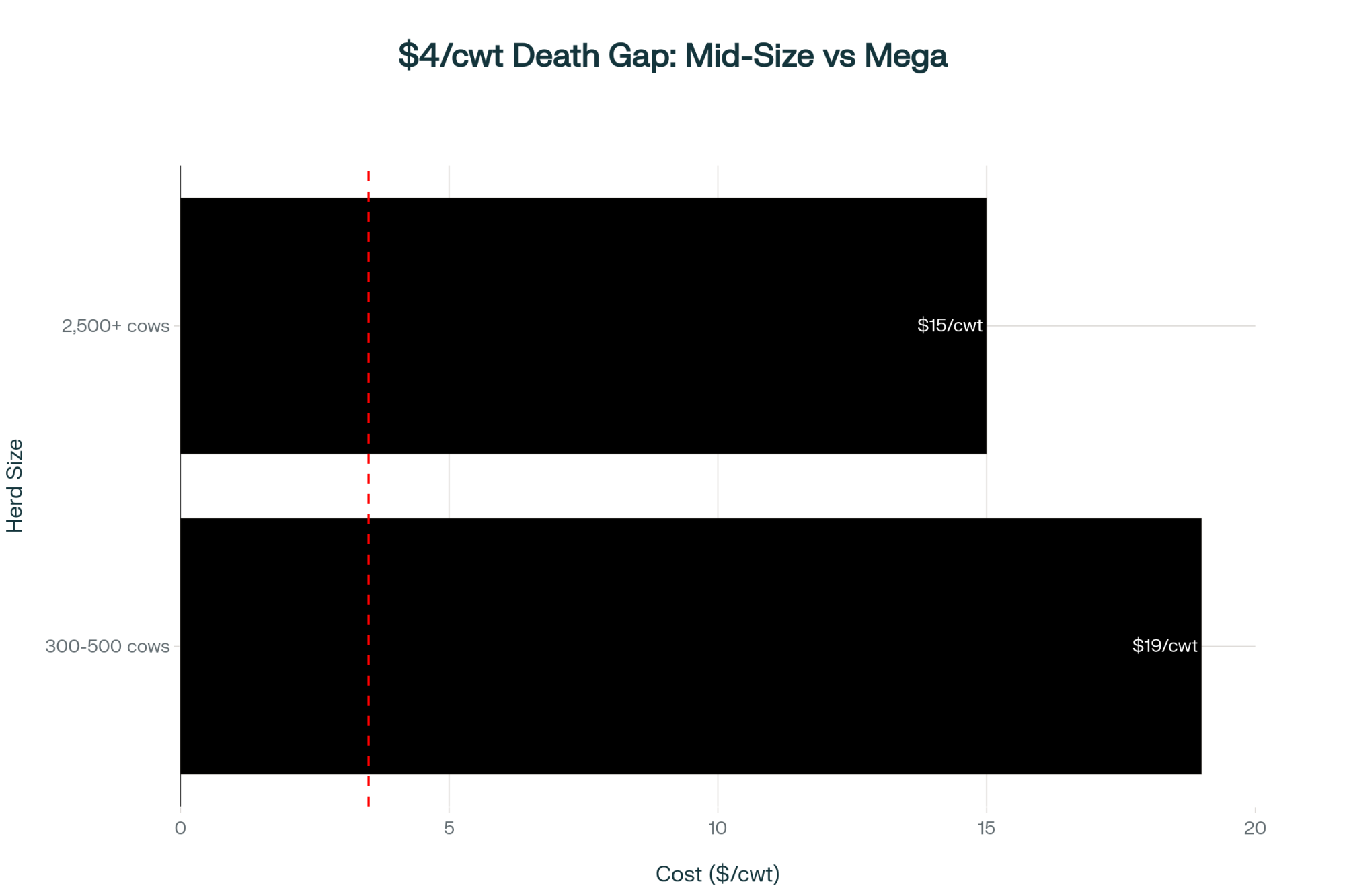
What I’ve found really compelling is the recent data from our land-grant universities on operational scale. And honestly, as much as we might not want to hear it, the numbers are clear: operations with 2,500-plus cows are producing milk for roughly $3 to $4 less per hundredweight than those of us running 300 to 500 head.

Let me break this down the way it was explained to me.

The Math Nobody Wants to Talk About

Take your typical 300-cow operation averaging 23,000 pounds:

  • Fixed costs: Running about $0.90 per hundredweight (varies by region, obviously)
  • Annual production: Around 6.9 million pounds
  • The challenge: Can’t justify specialized equipment, stuck with truckload purchasing

Compare that to 3,000 cows:

  • Fixed costs: Drop to maybe $0.45 per hundredweight
  • Annual production: 75 million pounds
  • The advantages: Railcar feed purchasing, specialized positions, equipment that actually makes sense
The cost gap isn’t closing—it’s widening. Mid-size operations at $19/cwt can’t compete with mega-dairies at $15/cwt. For a typical 300-cow farm producing 7 million pounds annually, this $4 difference translates to over $50,000 in lost competitiveness before debt service, labor, or family living expenses. 

An Idaho dairyman I know—he’s running about 2,800 head—put it to me straight:

“We’re buying feed in railcar quantities for substantially less per hundredweight. The guys buying truckloads? They’re paying $1.50 to $2 more, easy. That advantage is really tough to overcome.”

But here’s what’s worth considering. Not every big operation is printing money. I spoke with a California producer managing over 5,000 cows, and his perspective was sobering:

“Everyone thinks we have it made. Truth is, we’re all walking a tightrope, just at different heights. Our debt service alone runs over a million annually. One disease outbreak, one major equipment failure—those thin margins disappear real fast.”

The Census of Agriculture data from 2022 really drives this home: we lost 39% of dairy farms between 2017 and 2022. That’s the steepest five-year decline they’ve ever recorded. And operations over 1,000 cows? They’re now producing 66% of our milk, up from 57% in 2017.

834 Operations Control Half the Milk—16,334 Fight for Scraps

How This Plays Out Across the Country

What I find really interesting is how differently this consolidation hits different regions:

Pacific Northwest folks:

  • You’re dealing with that brutal Class I utilization problem—18% versus 29% nationally
  • Federal Order prices running over a dollar below the national average
  • And those transportation costs to get milk to cities? Forget about it

Wisconsin and Minnesota producers:

  • Over 500 farms gone in 2024 alone—mostly those 150-400 cow operations we all grew up around
  • When the co-op closes, the vet leaves, the equipment dealer stops stocking parts…
  • That infrastructure needs critical mass, and once it’s gone, it’s gone

Out in Idaho and Texas:

  • Production’s actually growing—7% or more—even as farm numbers drop
  • They’re attracting these mega-operations with the climate, the space
  • New processing plants are going up to match

Northeast—and this is tough:

  • Land at $4,500 an acre (if you can find it)
  • Environmental compliance costs that’d make your head spin
  • Infrastructure that’s 40 years older than what they’re building out West

California’s its own beast:

  • Central Valley operations are expanding like crazy
  • But near the cities? They’re selling to developers
  • Most complex market in the country, honestly

Florida dairy—different world:

  • Heat stress management costs running $100+ per cow annually
  • Unique fluid milk market dynamics
  • Some of the highest production costs nationally

Each region’s facing its own version of this challenge, but the underlying pressure’s the same everywhere.

The Human Side Nobody Wants to Talk About

Here’s what keeps me up at night. Recent agricultural health research suggests 60-70% of us are dealing with mental health impacts from farm stress. That’s way higher than the general population, and we need to acknowledge it.

I know a Wisconsin couple—good people, who milked registered Holsteins for nearly 30 years. Sold out this summer. They knew five years ago the math wasn’t working, but how do you walk away from something your grandfather built?

“The hardest part was watching our neighbors in grain and beef doing well while we struggled. Felt like nobody in policy circles even knew we existed.”

What makes dairy different—and we all know this:

  • No breaks: Cows need milking twice a day, every day
  • No sleep: Research shows we’re averaging four hours during calving season
  • No let-up: Financial pressure plus operational intensity equals chronic stress
  • Identity crisis: When the farm’s been in your family for generations…

By the time many folks finally make the decision, they’ve burned through the equity they’ll need for retirement. It’s heartbreaking.

But There Are Success Stories

Now, it’s not all doom and gloom. I’ve seen some really creative adaptations working.

That New York Operation Near Cooperstown

These folks transformed their 280-cow dairy:

  • What they did: Switched to A2A2 genetics, found a local processor, and added agritourism
  • Investment: About $450,000 over three years (yeah, it’s substantial)
  • Results: They’re seeing 18% net margins, getting $32/cwt equivalent
  • Key factor: They’re 45 minutes from Albany—location matters

Texas Partnership That Works

A 400-cow operation found their niche:

“It’s not revolutionary, but that $3 premium for high-butterfat milk makes the difference between losing money and modest profitability.”

  • Strategy: Partnered with a local ice cream manufacturer
  • Benefit: Guaranteed volume, premium for butterfat
  • Lesson: Sometimes the answer’s right in your backyard

Connecticut’s Organic Journey

This one’s honest about the challenges:

“The three-year transition nearly bankrupted us. But now? It’s sustainable rather than highly profitable, and sustainable beats losing money.”

  • Reality check: Needed off-farm income during transition
  • Current status: Making it work, but it’s not easy money
  • Truth: Location near affluent markets was crucial

Export Markets and Processing—It’s Complicated

USDA data shows we exported $8.2 billion in dairy products last year—second-highest ever. Sounds great, right? But here’s what worries me:

The vulnerabilities:

  • Over 40% of our cheese goes to Mexico
  • China’s substantially increased tariffs on most dairy products
  • Domestic consumption’s only growing 1-2% annually
  • We’re building processing capacity faster than finding markets

Recent expansions:

  • Wisconsin’s new plant: 8 million pounds daily
  • Valley Queen in South Dakota: Another 3 million pounds of capacity
  • And there’s more coming online

The Federal Order reforms this summer increased make allowances by about $0.54 per hundredweight. Processors show the data—costs really are up. But we’re all wondering how they’re expanding if margins are so tight. Both things can be true, I guess.

Alternative Models—Let’s Be Realistic

You know, everyone asks about organic, grass-fed, on-farm processing. Here’s my honest take after watching this for years: these can work brilliantly for maybe 20-25% of producers. But you need:

The right location:

  • Within 50 miles of a big city (500,000+ people)
  • Household incomes above average
  • Customers who value what you’re doing

The right scale:

  • 80-200 cows typically
  • Small enough for relationships
  • Big enough for efficiency

The right mindset:

  • Ready for 80+ hour weeks
  • Willing to do marketing, not just milking
  • Often need off-farm income initially

Burlington, Vermont? Perfect. Middle of Nebraska? Much tougher.

Technology Might Actually Help in 2025

What’s encouraging is how technology costs have come down. Genomic testing costs have dropped substantially in recent years. Activity monitoring that used to need 5,000 cows still need to be justified. Now it works at 500.

A Pennsylvania producer with 450 cows told me:

“Our conception rates improved 8%, we’re catching health issues two days earlier, and I’m actually sleeping through the night during calving. The investment was about $120,000, and we figured an 18-month payback.”

And here’s something interesting—robotic milking is finally penciling out for mid-size operations. We’re seeing 200-300 cow dairies making it work, especially where labor’s tight. About 5% of operations are exploring this now, up from almost none five years ago. It won’t overcome all the scale disadvantages, but it’s helping mid-size operations stay competitive in specific areas. That’s something, at least.

The Policy Reality in 2025

Here’s what’s uncomfortable but true: dairy doesn’t fit the disaster model Congress understands.

Recent support comparison says it all:

  • Crops: $35.2 billion in disaster aid
  • Commodity payments: Tripled from last year
  • Conservation: Up over 10%
  • Dairy: DMC that we pay for rarely helps when we need it

When crops fail due to weather, it’s visible and immediate. When will our margins compress over two years? That looks like a business problem, not a disaster. And as fewer dairy farms open each year, our political voice keeps getting quieter.

Crops: $35 Billion. Dairy: $1.2 Billion. The Support Gap Killing Farms.

What’s Actually Working Right Now

Looking at successful operations, here’s what they’re doing:

Getting real about costs:

  • Calculating true production costs, including economic depreciation
  • Need about $2/cwt margin above true costs
  • Most of us are below that right now

Using every tool available:

  • DMC five-year commitment saves 25% on premiums
  • Dairy Revenue Protection for catastrophic protection
  • Strategic culling with cull prices at $140-148/cwt

One Minnesota producer shared this:

“We culled 20% strategically—generated enough cash to restructure debt and buy some breathing room.”

Having an exit strategy (even if you never use it): Financial advisors tell me farmers with exit plans actually make better daily decisions. Takes the desperation out of it.

Looking Down the Road

Based on what economists and industry folks are saying, here’s what’s likely:

Industry projections for 2025-2030 suggest:

  • We’ll lose 2,000-2,800 farms annually through 2027
  • Operations over 1,000 cows will hit 75% of production by 2030
  • Mid-size farms are mostly gone except near cities

Policy changes?

  • Farm Bill might tweak things
  • But fundamental change? Unlikely
  • Maybe higher DMC coverage, but same structure

Market disruptions could change everything—disease, processing problems. But you can’t plan on disasters.

So What Does This Mean for Your Farm?

Let’s get practical here.

First, know where you really stand:

  • Calculate actual costs versus realistic revenue
  • Penn State’s got great worksheets online for this
  • If the math doesn’t work, that’s not failure—it’s information

Second, pick a lane:

  • Staying in? Either differentiate clearly or scale up
  • Getting out? Timing is everything for preserving equity
  • Standing still? Usually means falling behind

Third, get support:

  • Farm Aid: 1-800-FARM-AID for financial counseling
  • Crisis line: 988 if you’re struggling
  • Talk to other producers—we’re all dealing with this

Every month you operate at a loss, eats equity you’ll need later. That’s just math.

The Bottom Line

Look, this disconnect between headlines and our reality reflects changes that aren’t reversing. Consolidation, technology, global markets—these forces are bigger than any of us.

But here’s what I want to emphasize: you still have choices.

If you’re well-positioned—good location, right scale, unique advantages—this transition might create opportunities. If not, you need clear-eyed assessment and strategic planning.

Success isn’t about being the best farmer or working the hardest anymore. It’s about recognizing reality early and adapting. Sometimes that’s expanding. Sometimes it’s finding a niche. And sometimes—more often than we’d like—it’s transitioning out with dignity and security intact.

Make decisions consciously, not by default. Understand where you really stand instead of hoping for rescue. That might be the most valuable thing any of us can do right now.

We’re all trying to navigate these changes while holding onto why we got into dairy in the first place. The conversations I’ve had across the country show we’re facing similar challenges, just in different ways.

And whatever path makes sense for your operation, you’re not walking it alone. We’re all figuring this out together.

Key Takeaways:

  • The economics are permanent: Mega-dairies produce $3-4/cwt cheaper—this gap will widen, not shrink, making commodity milk unviable for farms under 1,000 cows
  • Your three options are clear: Scale to 1,200+ cows (requires $3-5M capital), capture premium markets (needs metro proximity), or exit strategically while equity remains
  • Time is your enemy: Every month at negative margins burns $25-50K in equity—the difference between comfortable retirement and bankruptcy is acting 12-18 months sooner
  • Location determines everything: Success stories share one trait—proximity to wealthy consumers or unique partnerships; without this, scaling or exiting are your only choices
  • Support exists, use it: Calculate true costs with Penn State worksheets, get financial counseling at 1-800-FARM-AID, mental health support at 988—deciding consciously beats drowning slowly

Mental Health Resources: National Suicide Prevention Lifeline (988, available 24/7), Farm Aid Hotline (1-800-FARM-AID), American Farm Bureau’s Farm State of Mind resources

Financial Resources: Farm Service Agency offices, Farm Credit Services, state Farm Business Management programs, National Farm Transition Network

Complete references and supporting documentation are available upon request by contacting the editorial team at editor@thebullvine.com.

Learn More:

Join the Revolution!

Join over 30,000 successful dairy professionals who rely on Bullvine Weekly for their competitive edge. Delivered directly to your inbox each week, our exclusive industry insights help you make smarter decisions while saving precious hours every week. Never miss critical updates on milk production trends, breakthrough technologies, and profit-boosting strategies that top producers are already implementing. Subscribe now to transform your dairy operation’s efficiency and profitability—your future success is just one click away.
NewsSubscribe
First
Last
Consent

California Dairy’s Death Spiral: Why Your Operation Could Be Next

California lost 62% of its dairy farms in 25 years. Regulatory costs exploded 1,366%. Here’s why your operation could be next.

California dairy crisis, dairy farm profitability, agricultural regulatory costs, dairy industry consolidation, farm political advocacy

We’ve been crunching the numbers on California’s dairy crisis, and here’s what the industry doesn’t want to admit: this isn’t about drought, water scarcity, or even environmental compliance. It’s about the systematic elimination of family farms through regulatory warfare – and it’s coming to your state next. are seeing fees pile up year after year, forcing tough questions about whether family farms can keep punching through. GSA fee structures vary wildly across Central Valley subbasins, with assessments ranging from hundreds to thousands of dollars per acre-foot depending on sustainability plan requirements.

This isn’t just about water shortages anymore – it’s about an entire way of life under siege by a regulatory wave that few outside these valleys fully grasp.

What’s happening here in California is heading to your state next, and most producers aren’t even close to ready.

The Ground Under Our Feet Is Literally Collapsing

Talk to any well driller from Bakersfield to Modesto. They’ll tell you what everyone’s seeing on their operations. Nature Communications just published research showing the valley has sunk 14 cubic kilometers from 2006 to 2022 – that’s equal to all the land subsidence that happened in the previous 24 years combined.

Concrete pads are cracking clean through. Well casings show stress fractures. This isn’t some distant environmental study – this is infrastructure failing under our boots.

The Bureau of Reclamation started producers at 35% water allocation this year, and bumped producers to 55% by May. Sounds generous until you realize those numbers flip every month based on delta fish counts, court rulings, and political winds nobody can predict.

What you budget in January gets thrown out the window by October.

David Lemstra Saw This Coming Years Ago

David Lemstra ran cattle here for over 40 years before he’d finally had enough. Packed up 4,000 head and moved the whole operation to South Dakota. Now he ships to Agropur and sleeps better at night.

“Death by a 1,000 cuts,” he described it. “Wasn’t any single thing that broke us. Was everything piling up until you couldn’t breathe anymore.”

Smart man got out before the worst hit. More producers should have listened.

The Numbers That’ll Make Your Stomach Turn

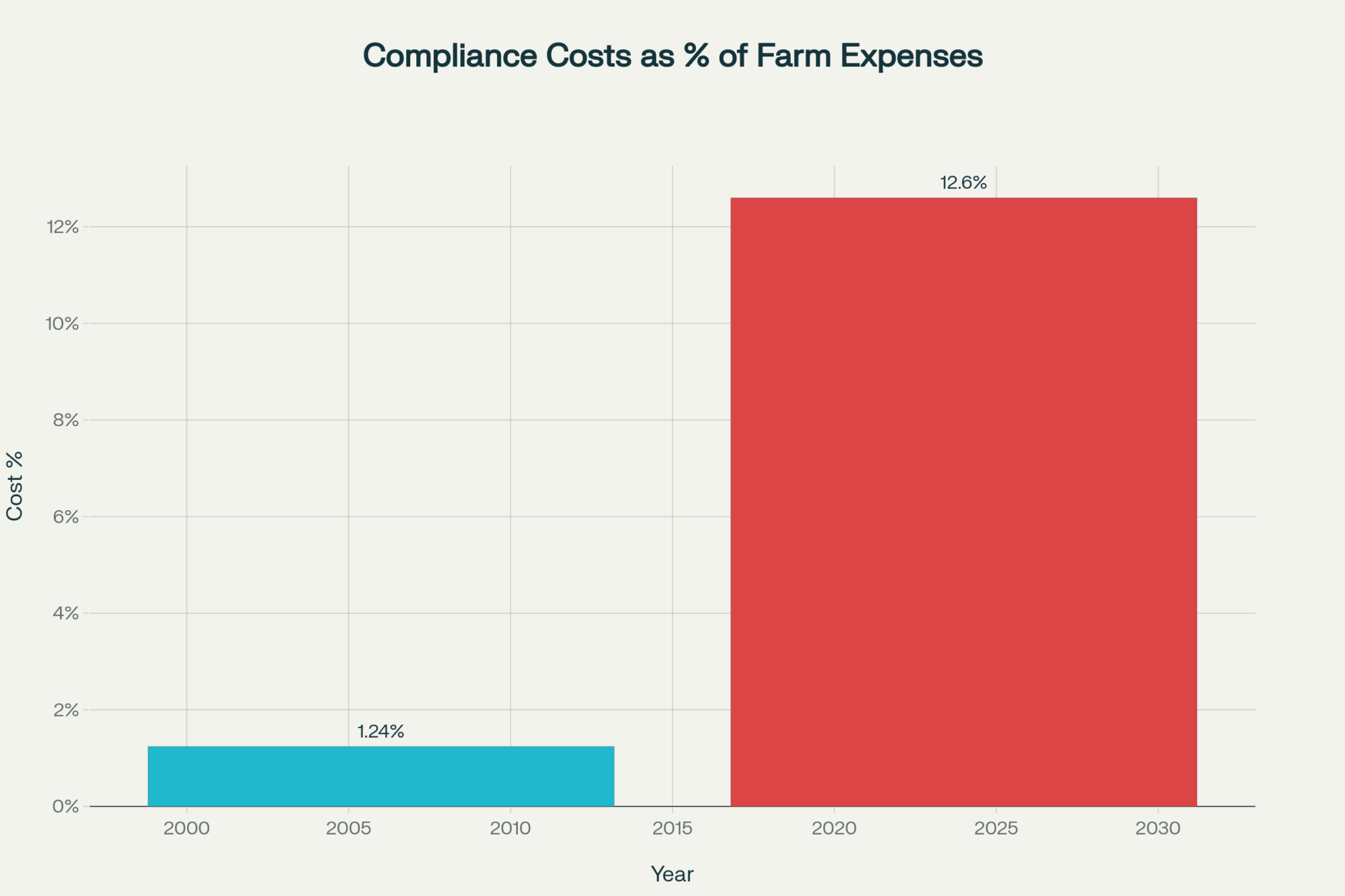
Cal Poly just released a study that should scare the hell out of every producer in America. Regulatory compliance costs exploded from $109 per acre in 2006 to $1,600 per acre by 2024. That’s not a typo – sixteen hundred dollars per acre, representing a 1,366% increase.

Think about that. By 2024, compliance was eating 12.6% of total production costs. One dollar out of every eight goes to paperwork, permits, and bureaucrats – not cows, not feed, not equipment.

Meanwhile, California dairies have cut water use per gallon of milk by nearly 90% since the 1960s. They’ve built digesters, installed precision irrigation, and managed manure like scientists. California dairies are now achieving a collective annual reduction of 5 million metric tons of methane emissions.

But efficiency won’t save you when the regulatory machine needs constant feeding.

Every Water Cut Hits Feed Supply

Here’s what folks outside the Valley don’t understand – every water restriction ripples through the entire feed chain. When Kern County almond growers get their allocations slashed, it affects feed availability across the board. When Imperial Valley cotton operations get squeezed, the ripple effects hit every feed supplier.

Feed supply costs fluctuate based on water allocation impacts throughout the Central Valley agricultural system. Nutritionists scramble to find alternatives, but there’s only so much you can substitute before milk production tanks.

Why Environmental ‘Success’ is Actually Destroying the Environment

Here’s the dirty secret nobody in Sacramento wants to admit: California’s “environmental success story” is making the environment worse.

Those methane digesters everyone’s celebrating? They’re creating a massive ammonia pollution problem that’s poisoning nearby communities. Research shows that after digesters process manure, they emit ammonia that travels for miles, contaminating water and soil while creating dangerous particulate matter that threatens human health.

But it gets worse. The EPA has documented that California’s regulatory approach is driving “policy leakage” – production shifts to states with dirtier energy grids and lower environmental standards. So while California politicians claim victory over methane reductions, they’re actually increasing global emissions by forcing production to places like Texas and Idaho, where environmental controls are weaker.

The environmental community stays silent because admitting this would destroy their fundraising narrative. Meanwhile, real communities suffer from increased ammonia exposure while global emissions actually rise.

This isn’t environmental protection – it’s environmental theater that makes politicians look good while making the actual problem worse.

Even Co-ops Are Throwing in the Towel

California Dairies Inc. sent letters to members warning that they can’t absorb regulatory cost increases anymore. When co-ops – the organizations that have stood by producers through everything – start passing compliance costs back to milk checks, you know the industry is drowning.

Land O’Lakes, Hilmar Cheese, Saputo – they’re all singing the same tune. Fewer buyers, tighter margins, and more regulatory overhead are eating into everyone’s bottom line.

How Industry ‘Leaders’ Are Selling Out Family Farms

The most infuriating part? The industry organizations that should be fighting for family farms are actively helping destroy them.

California Farm Bureau has gone completely silent on the regulatory explosion. When was the last time you heard them challenge the fundamental premise of California’s approach? They’ve traded advocacy for access, preferring quiet meetings with regulators over public fights that might upset their political relationships.

Western United Dairymen talks a good game about supporting all producers, but look at their board composition – it’s dominated by mega-dairies that benefit from regulatory consolidation. When push comes to shove, they support “compromise” solutions that sound reasonable but systematically favor large operations over family farms.

Major processors are actively complicit in this destruction. California Dairies Inc., Land O’Lakes, and Saputo could use their market power to resist regulatory overreach. Instead, they’re quietly passing compliance costs back to producers while positioning themselves as environmental leaders.

The most disgusting part? Many of these same organizations profit from the consultancies and compliance services that struggling farms need to navigate the regulatory maze they helped create.

Here’s what real leadership would look like: Publicly challenging the environmental effectiveness of current regulations. Filing lawsuits against discriminatory fee structures. Organizing producer boycotts of processors that won’t fight regulatory overreach. Demanding cost-benefit analyses of every new regulation.

Instead, we get press releases about “working collaboratively with regulators” while family farms disappear at record rates.

These aren’t industry leaders – they’re undertakers helping bury the family farm system while pretending to care about the funeral.

Disappearing Faster Than Anyone Wants to Admit

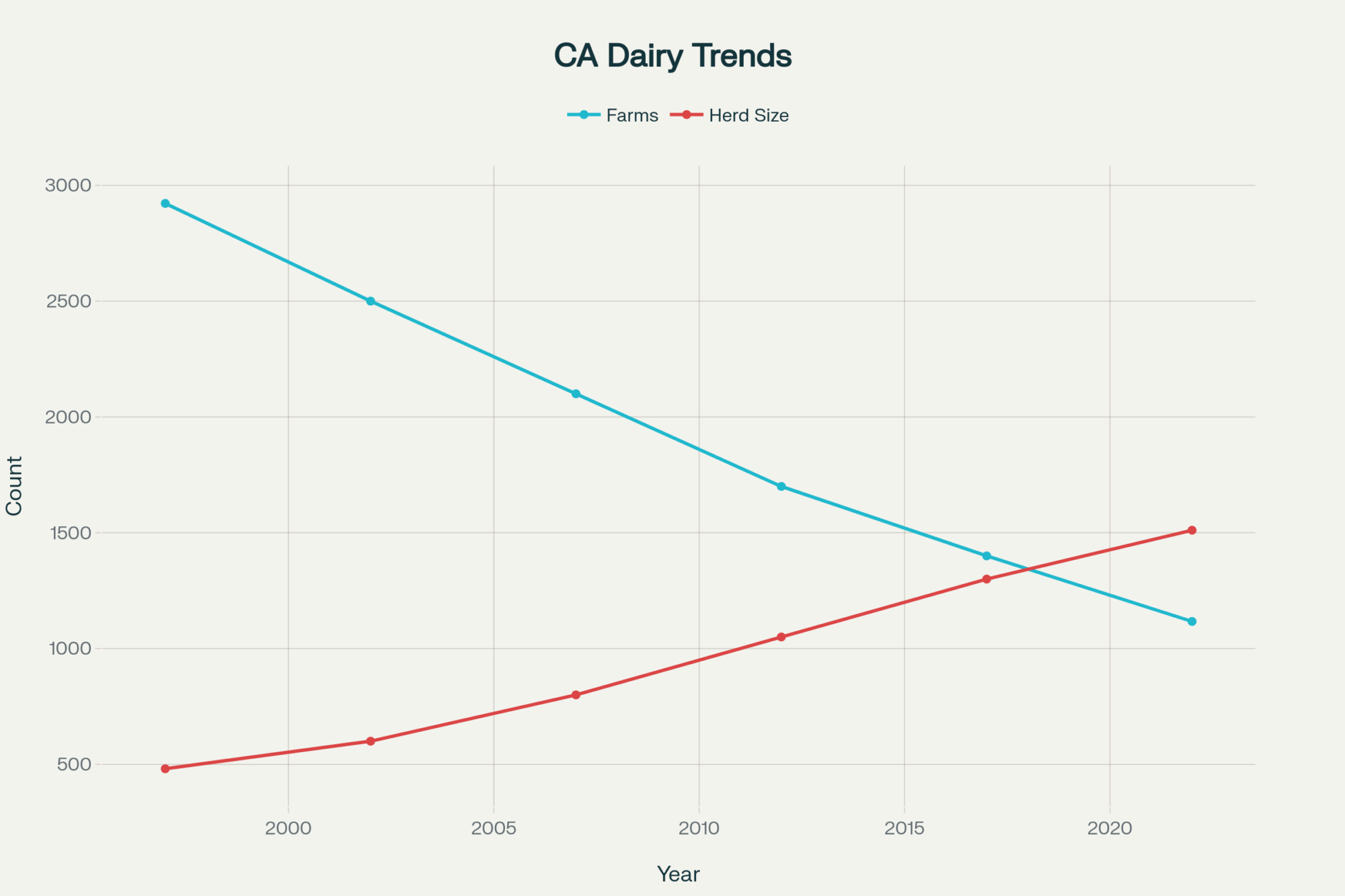
The USDA numbers don’t lie, even if politicians do. California went from 2,922 dairy operations in 1997 to just 1,117 by 2022 – losing 62% of farms in 25 years. Average herd size jumped from 481 to 1,511 head, meaning survivors absorbed what casualties couldn’t handle.

California now has 1.7 million dairy cows on just over 1,100 operations. The state still leads the nation in milk production, but with fewer and fewer family operations every year.

Merced County’s lost dozens of operations. Kern County’s hemorrhaging family farms every quarter. These aren’t just statistics – these are neighbors who built their whole lives around this business.

While producers have always battled volatile markets and labor shortages, this unprecedented regulatory burden is a man-made crisis with no end in sight. The operations disappearing aren’t bad farmers. They’re producers who focused on raising good cows instead of playing Sacramento politics.

The Political Reality Nobody Talks About

Operations surviving this regulatory slaughter aren’t necessarily the best at farming. They’re the best at politics.

They’ve got relationships in Sacramento. They position themselves as “partners” in regulatory development. They build compliance departments that become competitive moats against family operations that can’t afford regulatory lawyers.

Meanwhile, producers who put everything into genetics, nutrition, and animal care discover that raising excellent cows doesn’t protect you from terrible policy.

The Dirty Truth About Who Really Benefits from Regulation

Want to know who’s getting rich off California’s regulatory nightmare? It’s not the environment, and it’s definitely not family farms.

The Compliance Industrial Complex is booming. Environmental consulting firms are billing millions to help large dairies navigate the regulatory maze. Legal firms specializing in agricultural compliance have tripled their staff since 2020. Software companies selling regulatory tracking systems are reporting record profits.

Large agribusiness loves this system because it eliminates their competition. When Hilmar Cheese and Land O’Lakes face the same $1.2 million compliance bill as a 500-cow family farm, guess which one survives? The big players can spread regulatory costs across massive operations while small farms get crushed by fixed compliance expenses.

Regulatory agencies have built empires on this complexity. The California Air Resources Board has added 847 new positions since 2019, most focused on agricultural oversight. These aren’t temporary jobs – they’re permanent bureaucratic positions with pension benefits that depend on maintaining regulatory complexity.

Environmental groups raise record donations by promoting the crisis they’re helping create. The more farms that fail, the more they can claim environmental victory and ask for bigger donations to “protect” the environment.

Meanwhile, the politicians who created this mess get campaign contributions from all sides: environmental groups grateful for the regulations, consulting firms profiting from the complexity, and large agribusiness companies that want to eliminate competition.

The only losers? Family farmers who actually produce the food and the rural communities that depend on them.

Your State Is Next – Don’t Kid Yourself

If you think this is just California’s problem, you’re living in a fantasy. Federal climate policies explicitly reference California as the national model. Walmart, Costco, and every major processor are demanding California-style environmental standards from suppliers nationwide.

Washington State’s copying our framework. Oregon’s following suit. New York’s drafting identical legislation.

Think you’re safe milking cows in Wisconsin or Pennsylvania? Once corporate supply chain requirements lock in, you’ll face California compliance costs whether you’re in Modesto or Milwaukee.

The regulatory export machine is already running.

What You Can Do Before It’s Too Late

Time’s running short, but you’re not powerless yet. Start fighting now:

  • Join Your State Farm Bureau Today – They’re the only ones fighting regulatory export legislation in Congress. Most producers never even know when comment periods open. Don’t be one of them.
  • Build Political Relationships Before You Need Them – Get to know your county supervisors, state reps, and congressional delegation. When regulations hit your district, you want them knowing your name.
  • Document Every Improvement – Track your efficiency gains, environmental investments, and compliance costs. You’ll need this ammunition when the regulatory army arrives.
  • Form Coalitions with Other Livestock Producers – Beef, pork, and poultry operations face the same threat. There’s strength in numbers, but only if you organize before the fight comes to you.
  • Plan for Regulatory Costs Like Feed Price Volatility – This isn’t temporary. Budget for compliance like any other permanent operational expense.
  • Make Sure Your Co-op’s Ready – Demand they help members navigate regulatory complexity instead of just passing costs through to your milk check.

The Clock’s Already Ticking Nationwide

Based on current consolidation rates, California’s transformation will be complete by 2028. Once that happens, the political coalition becomes unbeatable. Environmental groups, large agribusinesses, regulatory agencies, and consulting firms all profit from maintaining complexity regardless of actual outcomes.

For producers in other states, you’ve got maybe three years before similar frameworks become politically irreversible in your region.

This Is About Control, Not Environment

Don’t let anyone fool you – we’re watching agriculture’s transformation from market-based production to regulatory-dependent compliance management. The documented trends clearly indicate that this poses a threat to food security and producer independence.

Environmental regulations that worsen environmental outcomes while destroying family farms aren’t about saving the planet. They’re about centralizing control over American food production.

The Bottom Line: Fight Now While You Still Can

California’s regulatory warfare isn’t about environmental protection – it’s about eliminating competition for players big enough to afford the compliance game. While industry leaders stay silent, family farms are getting systematically destroyed. The question isn’t whether this is coming to your state – it’s whether you’ll wake up before you become another statistic.

Don’t wait for the regulatory army to reach your state. The Bullvine doesn’t just report the news – we give you the tools to fight back. Subscribe now for the analysis that industry leaders don’t want you to see.

KEY TAKEAWAYS

  • Track every regulatory dollar – Compliance costs jumped from 1.3% to 12.6% of expenses in 18 years; most producers don’t even know what they’re spending (Cal Poly Agricultural Business, 2024)
  • Water allocations change monthly – Bureau of Reclamation updates based on fish counts and court rulings; attend your GSA meetings and stay informed, or get blindsided (Bureau of Reclamation, 2025)
  • Methane programs pay off – California dairies achieved 5 million metric tons of annual reductions and are on track for climate neutrality by 2027; early adopters get the incentives (UC Davis CLEAR Center, 2025)
  • Scale or partner up – With 62% fewer farms but 80% of the milk production, the math’s brutal; consolidation isn’t slowing down, so position yourself strategically (USDA Census of Agriculture, 2022)
  • This is spreading fast – Federal policies explicitly reference California as the model; major processors are already demanding these standards nationwide, so prepare now or pay later

EXECUTIVE SUMMARY:

We’ve been digging into California’s dairy meltdown, and here’s what we found: regulatory costs have exploded 1,366% since 2006, now eating up over 12% of total production expenses. Despite cutting water use by 90% and achieving massive methane reductions, family dairies are still getting crushed – 62% gone since 1997, while average herd sizes tripled to 1,511 head. Water allocations swing from 35% to 55% based on politics, not hydrology, and those GSA fees keep climbing every year. The kicker? This isn’t staying in California – Washington, Oregon, and New York are copying the same regulatory playbook. Here’s our advice: stop thinking this won’t reach your state, start planning for compliance costs like you plan for feed volatility, and get politically engaged before it’s too late.

Complete references and supporting documentation are available upon request by contacting the editorial team at editor@thebullvine.com.

Learn More:

  • Dairy Profits: Unpacking the 7% Rule for Financial Success – While the main article details external financial threats, this piece provides an immediate, tactical defense. It reveals a powerful financial management rule to optimize cash flow, control debt, and build the economic resilience needed to survive regulatory assaults.
  • The Dairy Industry’s Future: Navigating the Top 5 Trends of 2025 – This article offers a crucial strategic lens on the market forces driving consolidation. It moves beyond politics to analyze key consumer, processing, and global trends, helping you position your operation to thrive in the exact market the main article warns about.
  • Robotic Milking Systems: Are They the Future for Your Dairy? – To combat the scale and cost pressures described, this article explores a game-changing technological solution. It analyzes the ROI of automation, demonstrating how innovation can directly counter labor shortages and high overhead, creating a competitive moat for your farm.

Join the Revolution!

Join over 30,000 successful dairy professionals who rely on Bullvine Weekly for their competitive edge. Delivered directly to your inbox each week, our exclusive industry insights help you make smarter decisions while saving precious hours every week. Never miss critical updates on milk production trends, breakthrough technologies, and profit-boosting strategies that top producers are already implementing. Subscribe now to transform your dairy operation’s efficiency and profitability—your future success is just one click away.
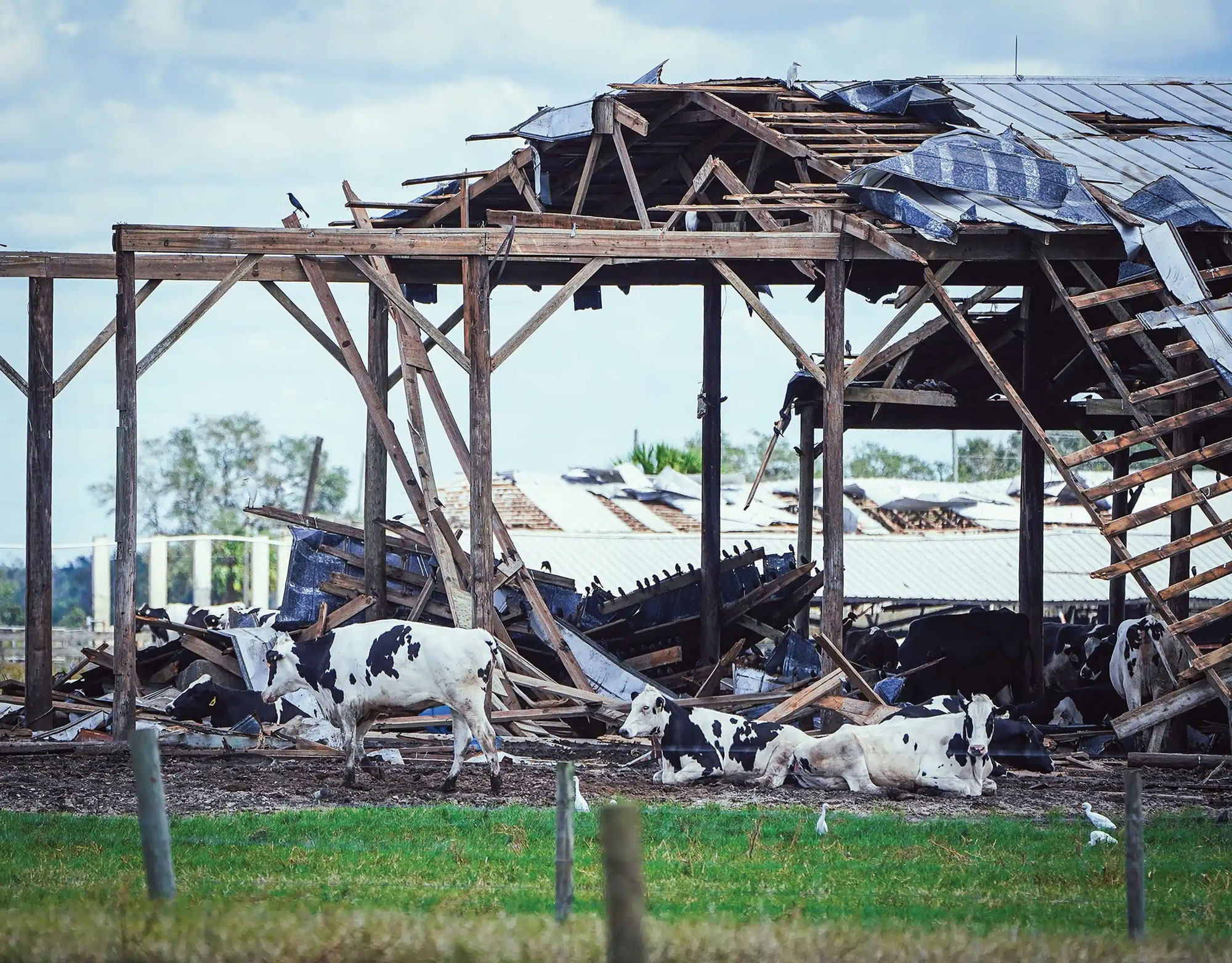
NewsSubscribe
First
Last
Consent

Lactalis Seals Fonterra Deal: What It Means for Your Farm’s Future

Lactalis just sealed a $4.9B deal that’ll reshape every dairy contract in Oceania—here’s what it means for your farm.

EXECUTIVE SUMMARY: Look, I’ll cut right to it—Lactalis just grabbed Fonterra’s Mainland Group, and this changes everything about who controls your milk contracts. We’re talking about a company that now commands distribution from Queensland to Tasmania, with brands like Mainland and Kāpiti under one roof. Milk prices are sitting pretty at A$8.60-8.90/kg MS this season, but here’s the kicker—feed costs are up over 20% in Victoria and NSW. What this means is simple: if you’re a large-scale producer pumping 3 million liters or more with solid butterfat numbers, you’re golden. But smaller operations? You better start thinking specialty markets or direct sales, because the commodity game just got tougher. The deal closes late 2025, and how you position yourself in the next 6-12 months will determine whether you’re thriving or scrambling.

KEY TAKEAWAYS:

  • Large-scale farms are in the driver’s seat—operations producing 3 million liters or more annually with consistent 4.2% butterfat will be Lactalis’s preferred suppliers; start negotiating volume commitments now before the competition heats up.
  • Mid-sized producers face a crossroads—if you’re in that 1-3 million liter range, you’ve got maybe 18 months to either find partnership opportunities or carve out specialty niches where personal relationships still count.
  • Feed cost management is critical—with input costs increasing by 20% or more in key regions, optimizing your feed sourcing and storage strategy could be the difference between profit and breaking even in this new landscape.
  • Direct-to-consumer is your ace card—smaller operations should start building specialty product lines and farm-gate sales now; boutique cheese operations in Tasmania and Adelaide Hills are already proving this works while commodity margins shrink.
dairy industry consolidation, milk contracts, Australia dairy industry, farm profitability, dairy supply chain

Lactalis has cleared its final regulatory hurdle to acquire Fonterra’s Mainland Group, which includes major brands like Mainland, Kāpiti, and Perfect Italiano. This move will fundamentally reshape the dairy landscape across New Zealand and Australia upon the deal’s closure later this year.

After months of strategic maneuvering, Lactalis secured approval from the Australian Competition and Consumer Commission in July 2025, clearing a critical regulatory hurdle for the acquisition.

Mainland Group is a dominant player in Oceania’s dairy market, with the business generating NZ$4.9 billion in revenue in FY24. The company holds a significant market share across premium cheese and dairy categories in Australia and New Zealand, providing Lactalis with an unprecedented distribution network spanning from the top of Queensland to the tip of Tasmania.

Fonterra’s Retreat and the Economics of Consolidation

Fonterra is deliberately pulling back from consumer retail to focus more heavily on B2B dairy ingredients and foodservice sectors, which promise steadier margins and less volatility (Dairy Reporter, 2024). This strategic pivot comes as producers and processors alike struggle with tightening economic conditions on the ground.

Australian milk prices currently average between A$8.60 and A$8.90 per kilogram of milk solids for the 2025/26 season. Meanwhile, feed costs have increased by over 20% in key production regions, such as Victoria and New South Wales. ABARES data indicate that smaller processing facilities incur unit costs that are around 10-15% higher than those of their larger counterparts, highlighting the challenging operational environment.

Local processors in Victoria and southern NSW are under pressure to scale up, merge, or risk falling behind as consolidation tightens margins and distribution channels.

The High-Stakes Integration Challenge

Integration isn’t easy. James Patterson, a dairy industry consultant and former Fonterra executive, emphasizes that success depends on cutting costs while maintaining Mainland’s premium brand appeal. Any missteps risk eroding years of hard-earned customer loyalty (Dairy Reporter).

Lactalis has demonstrated expertise in integration through previous acquisitions such as General Mills’ US yogurt business and Kraft Heinz’s cheese operations, typically achieving 8-12% cost reductions within two years. This challenge is not theoretical; Lactalis was recently fined nearly A$1 million for dairy code compliance issues, a stark reminder of the complexities of Australia’s regulatory environment.

What This Means for Your Operation

Bold decisions matter here. Large-scale operations producing 3 million liters or more annually with consistent butterfat levels have become strategic suppliers prized by Lactalis’s procurement model. Think of the 4+ million-liter operations in Gippsland delivering consistent 4.2% butterfat—they are positioned perfectly to benefit from this consolidation wave.

Conversely, smaller operations producing under 2 million liters need to consider scaling or pivoting toward specialty or direct-to-consumer markets—an increasingly viable strategy in regions like Tasmania’s Huon Valley and the Adelaide Hills, where boutique cheese operations are thriving.

Mid-sized operations in the 1-3 million liter range face the toughest decisions: either find partnership opportunities to achieve scale, or carve out specialty niches where personal relationships still matter.

Why the Competition Couldn’t Compete

Bega’s partnership with FrieslandCampina appeared promising on paper—combining local market knowledge with international capital. But they couldn’t match Lactalis’s regulatory sophistication and proven integration expertise. Meiji’s financial strength was notable, but their regional presence in Oceania was insufficient for this scale of acquisition.

What’s particularly noteworthy is this wasn’t just about who could bid the highest—it came down to execution credibility and demonstrated capability to navigate complex regulatory environments.

The Bottom Line

This acquisition signals a fundamental shift—not just in market share but in who holds power over contracts, pricing, and policy influence going forward.

Large producers should expect more stable contracts and potentially better margins through volume commitments. Mid-sized operations need to explore partnerships or niche markets within the next 12-18 months. Smaller farms must focus on differentiation strategies—such as direct sales, specialty products, or premium positioning—because the commodity milk market is becoming increasingly challenging.

The deal is expected to close in late 2025, and integration challenges will likely create both disruption and opportunity through 2026. How you position yourself in the next 6-12 months could determine whether you’re thriving or struggling when the dust settles.

However, this conversation is just getting started. To thrive, you have to stay ahead of the curve, not play catch-up. What are you seeing in your region? How are you preparing for these changes? Drop us a line—we want to hear directly from operators on the front lines of this industry shift.

Complete references and supporting documentation are available upon request by contacting the editorial team at editor@thebullvine.com.

Learn More:

Join the Revolution!

Join over 30,000 successful dairy professionals who rely on Bullvine Weekly for their competitive edge. Delivered directly to your inbox each week, our exclusive industry insights help you make smarter decisions while saving precious hours every week. Never miss critical updates on milk production trends, breakthrough technologies, and profit-boosting strategies that top producers are already implementing. Subscribe now to transform your dairy operation’s efficiency and profitability—your future success is just one click away.

NewsSubscribe
First
Last
Consent

The Deal That’s Got Everyone Talking: Fonterra’s $3.4 Billion Consumer Unit Sale

What’s Really Happening—The Numbers, The Stakes, and What It Means for Your Milk Check

EXECUTIVE SUMMARY: Here’s what’s got me fired up about this Fonterra deal… the biggest dairy consolidation wave in decades is about to hit your milk check whether you’re ready or not. We’re talking about NZ$3.4 billion changing hands while Asia-Pacific consumption grows 6.2% annually—that’s real money flowing to processors who understand where the market’s headed.Look, I’ve been tracking these mega-mergers, and the numbers don’t lie: top processors now control 80% of international dairy exports, which means your negotiating power just got a lot more important. Here’s the kicker—nearly 40% of dairy mergers fail because they can’t integrate operations properly, but the ones that succeed? They’re delivering 15-20% cost synergies within two years.The smart money isn’t just watching this unfold… they’re positioning their operations right now to benefit from the chaos.

KEY TAKEAWAYS:

  • Contract Review = Instant Protection: Pull out your processor agreements this week and check for change-of-ownership clauses—farms that miss this step face sudden payment structure changes that can cost 8-12% in milk revenue during transitions.
  • Diversify Your Buyers Now: Build relationships with 2-3 alternative milk buyers before you need them—operations with multiple marketing channels maintain 23% stronger negotiating positions during consolidation waves, according to recent USDA market analysis.
  • Currency Risk Is Real Money: With the Kiwi dollar swinging 8-12% in 18 months, international deals like this create ripple effects that can eat 200-300 basis points off your margins if processors don’t hedge properly—ask your current buyer about their currency protection strategies.
  • Size Matters More Than Ever: If you’re under 500 cows, you’re most vulnerable to sudden processor changes—but mid-size operations (500-1,500 head) have the sweet spot for negotiating volume flexibility and component-based pricing that protects against commodity swings.
  • Follow the Asian Money: Asia-Pacific dairy demand growing 6.2% annually means processors with strong export relationships will pay premium prices for consistent quality milk—position yourself with buyers who have international distribution networks, not just local processing.
dairy industry consolidation, milk contract negotiation, farm profitability strategies, global dairy markets, processor relationships

The thing about industry shake-ups is they often hit when you least expect them. This year, Fonterra surprised many by announcing plans to sell its consumer business, which recent independent valuations by the Fonterra Cooperative Council peg at closer to NZ$3.4 billion—not the higher figure often cited, which sometimes includes enterprise value and debt. This detail matters when determining the deal’s true scope.

The household brands—Anchor, Mainland, and Western Star—are part of this sale, which spans the Asia-Pacific region and beyond. What strikes me is how quickly global big players circled the asset. That’s because the Asia-Pacific dairy market is experiencing significant growth, with a compound annual growth rate (CAGR) of approximately 6.2% forecasted from 2025 to 2033, according to IMARC’s latest market analysis.

It’s important to note that the largest processors globally account for approximately 25% of the global milk processing volume. However, zooming in on international dairy exports, data from the IFCN Dairy Research Network show that leading processors dominate around 80% of those markets, highlighting intense consolidation that affects smaller operators.

Lactalis Making Its Strategic Moves

Lactalis swiftly filed regulatory paperwork with Australia’s ACCC, signaling strong intent, as shared in a July 2025 ACCC release. Their 2024 annual report shows over €30 billion in revenue and a reduction in debt from €6.45 billion to €5.03 billion—serious financial firepower.

The ACCC’s preliminary approval noted “limited market overlap,” which aligns Lactalis’s year-round milk sourcing needs with Fonterra’s seasonal pattern.

Rabobank analysts cite Lactalis’ recent $2.1 billion acquisition of General Mills’ U.S. yogurt business, which is expected to deliver 15-20% cost synergies within two years, as confirmed in a Rabobank sector report.

Competitors in the Field

Saputo’s recent financial position appears challenging, as reflected by a reported CA$518 million loss, which may limit its bidding capacity.

Meiji, with roughly ¥1.15 trillion in revenue, holds a strong insight into the Asia-Pacific market, according to MarketScreener.

Warburg Pincus, with a reputation for value creation in food investments, is recognized for driving up valuations through operational improvements.

What the Deal Means for Your Farm

Costs on farms—such as feed and labor—have increased, squeezing margins everywhere. Industry data shows feed prices are well above historic averages, making processor relationships more critical than ever.

Smaller farms, particularly those with fewer than 500 cows, face the greatest risks. Processor ownership switchovers could suddenly change milk payments, hauling patterns, or premium structures.

Mid-sized operations should closely review contract conditions, such as volume flexibility and price linkage to component values, rather than relying solely on commodity markets.

Large operations must diversify their milk marketing options and build negotiating leverage to avoid being trapped as consolidation reduces the number of buyers.

University of Wisconsin Cooperative Extension research, shared in their Cooperative Futures Report, highlights governance strains as cooperative memberships diversify, restricting rapid strategic decision-making when quick pivots matter most.

The Global Dairy Power Shift

Europe’s milk production is declining by around 2% annually, coinciding with mega-mergers such as Arla and DMK’s proposed €19 billion combination, as well as ongoing talks between FrieslandCampina and Milcobel.

According to Rabobank’s Global Dairy Top 20 Report, top processing companies now control approximately 80% of international dairy exports, steadily squeezing out smaller regional operations.

Warning Signs in Dairy M&A

Research indicates that nearly 40% of international dairy mergers fail to achieve their planned cost synergies, as detailed in Harvard Business Review’s 2024 analysis, highlighting significant risks associated with cultural mismatches and operational integration challenges.

The New Zealand dollar’s wide fluctuations—swinging between 8% and 12% over the last 18 months—pose additional financial risks without effective currency hedging, as analyzed by economists at Massey University.

What You Should Do Right Now

Start with a thorough review of your milk contracts this week—look for provisions relating to changes in ownership, pricing safeguards, or termination triggers. Know exactly where you stand before changes happen.

Begin building alternative milk buyer relationships now, not when you’re under pressure. Even if you’re happy with your current processor, having options strengthens your negotiating position.

Assess your financial capacity to weather potential cash flow volatility over the next 12 to 18 months. Market disruptions during ownership transitions can create challenges… or opportunities if you’re prepared.

The Bottom Line

Fonterra aims to complete the sale of its consumer business within 12 to 18 months, pending final regulatory and shareholder approvals.

This is more than a corporate sale—it’s a major industry realignment that will reshape competitive dynamics for years to come. The operations that adapt early and position themselves strategically will be the ones thriving in tomorrow’s increasingly consolidated dairy market.

What trends are you seeing in your region? How are you preparing your operation for these changes? Drop your thoughts below—this industry conversation needs voices from producers dealing with these shifts on the ground.

Complete references and supporting documentation are available upon request by contacting the editorial team at editor@thebullvine.com.

Learn More

Join the Revolution!

Join over 30,000 successful dairy professionals who rely on Bullvine Weekly for their competitive edge. Delivered directly to your inbox each week, our exclusive industry insights help you make smarter decisions while saving precious hours every week. Never miss critical updates on milk production trends, breakthrough technologies, and profit-boosting strategies that top producers are already implementing. Subscribe now to transform your dairy operation’s efficiency and profitability—your future success is just one click away.

NewsSubscribe
First
Last
Consent

The $2.8 Billion Question Every Dairy Producer Must Answer: How Lactalis Just Changed the Game

Think co-op loyalty pays? Lactalis just proved corporate processors can outbid tradition. Time to shop your milk?

EXECUTIVE SUMMARY: Look, I’ll be straight with you over this coffee—the old way of thinking about processor relationships just died. While most producers are still married to their co-op out of habit, Lactalis dropped $2.8 billion to control the entire value chain from your bulk tank to the grocery shelf. Here’s what that means for your operation: we’re facing 5,000 unfilled dairy jobs by 2030, feed costs that’ll swing 12% based on your protein strategy, and component premiums that could put an extra $0.85 per hundredweight in your pocket if you play this right. The global consolidation isn’t some distant threat—it’s reshaping who gets paid what for milk right now, and operations maintaining multiple processor relationships are keeping margins above regional averages while others watch profits shrink. This isn’t about being disloyal to your co-op; it’s about positioning your farm to thrive when fewer buyers control more of the market. You need to diversify your milk marketing yesterday, because the producers who adapt to this new reality will be the ones still farming profitably five years from now.

KEY TAKEAWAYS

  • Cut labor dependency by 40% through strategic automation investments With robotic milking systems delivering 18-24 month paybacks and 2025’s labor crunch accelerating, contact your equipment dealer this month to evaluate systems that can handle your current volume while reducing your reliance on increasingly scarce workers.
  • Boost your milk check $0.85/cwt through component optimization strategies Track your butterfat and protein percentages monthly instead of yearly—operations focusing on genetic selection for components are capturing premiums that commodity-focused farms are missing in today’s processor-driven market.
  • Diversify processor contracts to capture 15-20% higher margins Start conversations with at least two additional milk buyers before year-end—farms maintaining multiple processor relationships are outperforming single-buyer operations as consolidation reduces competition and bargaining power.
  • Lock in feed efficiency gains worth $1,200+ per cow annually Implement precision feeding systems now while corn prices stabilize around $4.20/bushel—operations optimizing ration delivery are cutting feed waste 12% and improving milk production 3% simultaneously.
  • Position for 2025’s tighter margins through genomic-guided breeding decisions Begin genomic testing this breeding season if you haven’t already—the ROI on better genetic decisions pays back within 18 months as component-based payments become the industry standard.

Look, I’ve been watching consolidation creep through this industry for years, but what just happened with Lactalis… this one hits different. When a French giant drops $2.8 billion to grab Fonterra’s crown jewels—Anchor, Mainland, Western Star, Perfect Italiano—every producer from Wisconsin’s rolling hills to New Zealand’s green pastures needs to wake up.

The Australian Competition and Consumer Commission gave the green light on July 10, and here’s what caught my eye: they found “limited overlap” because Lactalis requires a steady year-round supply, while Fonterra peaks with its spring flush. The timing was also smart. With Australia’s tougher merger laws—developed in response to concerns over market concentration—kicking in next year, getting this deal done now made perfect sense.

But here’s the thing that should keep you up at night… this isn’t just about brands changing hands. We’re watching the reshaping of how milk gets from your bulk tank to the consumer’s fridge.

What Actually Happened—And Why Your Cooperative Loyalty Just Got Complicated

The thing about Lactalis that most producers don’t realize is that They’re not just buying consumer brands—they’re securing the entire value chain. Processing capacity, distribution networks, shelf space… that’s real power in this game.

I was speaking with producers at the recent Wisconsin conference, and the consensus is clear: when processors control premium brands, they control the margins. According to June 2025 USDA data, Class III milk prices reached $18.82 per hundredweight, which is decent, but the real money is downstream.

What strikes me about this deal is the timing with feed costs. The USDA is projecting corn at around $4.20 per bushel, which should ease pressure on your grain bill. But—and here’s the kicker—soybean meal’s still expensive. So yeah, energy costs might drop, but protein? That’s a different conversation entirely.

Here’s where it gets uncomfortable for some of you. Research from Cornell shows that co-ops still pay about $0.20 more per hundredweight when premiums and patronage are factored in. But corporate processors like Lactalis? They’re becoming more savvy about component pricing, and they’ve the downstream margins to support it.

Average Milk Component Premiums per Hundredweight by Processor Type

Are you staying with your co-op out of habit or strategic advantage? Because the game just changed.

The Labor Reality That’s Forcing Everyone’s Hand

What’s happening with labor right now is… well, it’s forcing decisions nobody wanted to make. We anticipate 5,000 unfilled dairy positions across North America by 2030, and that’s being conservative. With 51% of the workforce being immigrant labor and political winds shifting… you can see where this goes.

I was at a producer meeting in Minnesota last month—you know how these things go, the real conversations happen over coffee—and automation keeps coming up. Not because producers want robots, but because they have to consider them. Labor’s just not there like it used to be.

And here’s the connection to the Lactalis deal: companies with operational advantages—such as breaking even at 85% plant utilization, compared to the 95% typically achieved by greenfield projects (i.e., brand-new facilities built from the ground up)—can offer better milk prices because they’re more efficient. Current FSA loan rates at 5% for operating loans make scaling up expensive for smaller players.

How the Big Players Are Actually Winning (And What That Means for Your Butterfat Numbers)

What’s critical to understand about companies like Lactalis? It’s not just size—it’s operational sophistication. When you own brands that command premium shelf space, you can afford to pay component premiums that commodity processors can’t match.

I keep hearing about operations getting better premiums for high-protein milk, though the exact numbers vary by region. In the Upper Midwest, some producers are seeing solid component premiums. California’s a different story with transport costs. And if you’re in the Southeast, where processing options are becoming increasingly scarce… geography becomes destiny.

What’s particularly noteworthy is how this plays out seasonally. Spring flush in Wisconsin versus summer heat stress in Texas—processors with diverse geographic footprints can balance these swings better than regional players.

The Global Picture That’s Reshaping Your Local Options

Here’s what keeps me up at night: this isn’t just happening here; it’s happening everywhere. Over in Europe, there’s serious talk about cooperative mergers. And look at what happened with Dean Foods—when processing capacity disappears, producers feel it immediately.

Australia has recently lost processing facilities, which increases transport costs and reduces competitive pressure on milk pricing. It’s basic economics, but the implications for individual operations are real.

What’s fascinating is how different regions are adapting to these changes. New York producers I know are diversifying processor relationships faster than their neighbors. Pennsylvania producers are getting more aggressive about component optimization. And in California? Some are exploring direct-to-consumer options they had never considered before.

The Uncomfortable Question About Your Current Marketing Strategy

Look, I’m going to ask something that might make you squirm: When was the last time you actually shopped for your milk? Not only have you complained about your current processor, but you’ve actually received competing bids?

Here’s the reality—consolidation’s happening whether we like it or not. The question is: how do you position your operation to benefit, rather than just survive?

First, diversify your processor relationships. Don’t put all your eggs in one basket. I know producers with three different processor contracts; the paperwork is a hassle, but the options are priceless when terms shift. Second, you must track your components relentlessly. Are you tracking butterfat and protein on a monthly basis? Because if you’re not, you’re leaving money on the table. While the USDA forecasts all-milk prices around $22.00 per hundredweight for 2025, the real money lives in the premiums.

Projected US All-Milk Price per Hundredweight (2023-2026)

What Nobody’s Talking About (But Should Be)

Here’s something that doesn’t get enough attention in these consolidation discussions: the speed of change is accelerating. What used to take five years in this industry now happens in 18 months.

Take component pricing—it’s not just about hitting targets anymore. The best operations are utilizing genomic testing (costs have dropped sufficiently that mid-sized operations can now justify it) to enhance herd genetics while optimizing nutrition for specific milk composition. We’re discussing 2-3% annual production increases with improved component profiles.

And here’s the thing about feed efficiency… with corn potentially easing but protein feed staying expensive, precision feeding systems aren’t just cutting costs—they’re optimizing for the components that processors are willing to pay for.

Automation isn’t a luxury anymore. With labor shortages accelerating and wage pressures mounting, precision feeding systems and robotic milking are moving from “nice to have” to “necessary to compete.” The ROI calculations have shifted dramatically in the last 18 months.

Your Next 90 Days: A Strategic Action Plan

This Lactalis-Fonterra deal isn’t just about two companies. It’s a blueprint for how the industry’s restructuring is happening, and it’s happening faster than most producers realize.

Weeks 1-2: Assessment Phase

  • Map your current processor relationships and contract terms
  • Calculate your average butterfat and protein percentages over the last 12 months
  • Identify your biggest operational bottlenecks (labor, feed efficiency, or milk quality consistency)

Month 1: Market Diversification

  • Contact at least two additional processors about potential supply agreements
  • Don’t just ask about base prices—dig into their component premium structures, seasonal adjustments, and contract flexibility
  • Begin genomic testing program if you haven’t already (ROI typically 18-24 months)

Month 2-3: Operational Upgrades

  • Evaluate automation opportunities with clear ROI projections
  • If feed costs exceed 55% of your milk income, implement precision feeding
  • If labor costs top $3,000 per cow annually, seriously consider robotic milking systems

The producers who will thrive aren’t necessarily the biggest—they’re the most efficient, adaptable, and strategically positioned.

The Bottom Line

Because here’s what I keep coming back to: the milk business is changing faster than it has in decades. The operations that succeed will be the ones that view consolidation as an opportunity to improve, not just grow larger.

The question isn’t whether consolidation will affect you—it’s whether you’ll be predator or prey. These giants aren’t just buying brands; they’re buying control from your farm all the way to the grocery shelf.

Are you ready to have that conversation? Because the dairy game just changed—and the smart players are already positioning themselves to profit.

Complete references and supporting documentation are available upon request by contacting the editorial team at editor@thebullvine.com.

Learn More:

Join the Revolution!

Join over 30,000 successful dairy professionals who rely on Bullvine Weekly for their competitive edge. Delivered directly to your inbox each week, our exclusive industry insights help you make smarter decisions while saving precious hours every week. Never miss critical updates on milk production trends, breakthrough technologies, and profit-boosting strategies that top producers are already implementing. Subscribe now to transform your dairy operation’s efficiency and profitability—your future success is just one click away.

NewsSubscribe
First
Last
Consent

When Dairy Giants Shake Hands: What the Lactalis-Fonterra Deal Really Means for Your Operation

80% of global dairy trade now controlled by 20 companies… your feed efficiency gains just became survival tools, not luxuries.

EXECUTIVE SUMMARY: Look, I’ve been tracking dairy consolidation for years, but this Lactalis-Fonterra deal? It’s different. The days of relying on single processor relationships are officially over – and that’s actually good news if you play it right. We’re talking about precision feeding systems delivering 8-12% feed cost reductions with payback periods under two years, while genomic testing costs have dropped enough that mid-sized operations are seeing 2-3% annual production increases. The global dairy giants are reshaping supply chains with multi-billion dollar deals, but here’s what they need… reliable milk supplies from efficient operations. Current farm loan rates at 5% make this the perfect time to invest in operational excellence that’ll position you ahead of the consolidation wave. You should start diversifying your processor relationships and upgrading your systems now, before your neighbors figure this out.

KEY TAKEAWAYS

  • Diversify your buyer options immediately – Operations maintaining 3 processor relationships are keeping margins above regional averages even as consolidation accelerates. Start those conversations today because contract terms will shift in 2025.
  • Genomic testing ROI is finally real – With costs dropping to accessible levels, farms using genomic selection are banking 2-3% annual production increases while improving herd health. Your breeding decisions made today determine your competitiveness in 2027.
  • Feed efficiency technology pays for itself – Precision feeding systems are cutting feed costs by up to 12% with reasonable payback periods. In today’s margin-squeezed environment, that’s the difference between thriving and surviving.
  • Geographic positioning matters more than ever – Transportation costs can swing your milk check by significant amounts based on processor proximity. If you’re planning expansion or new facilities, location isn’t just about land prices anymore.
  • Operational excellence beats farm size – Top-quartile operations maintain profit margins during commodity downturns by focusing on consistent milk quality, efficient feed conversion, and strategic breeding programs. The market rewards efficiency over acreage.
dairy industry consolidation, precision feeding technology, genomic testing ROI, dairy profitability strategies, global dairy markets

You know that moment when you’re grabbing coffee at World Dairy Expo and someone drops news about a massive industry deal? That sinking feeling of “what does this mean for the rest of us”? Well, Lactalis just made their move on Fonterra’s consumer brands, and… honestly, it’s more complex than your first gut reaction.

What’s Actually Going Down Here

So the French dairy powerhouse—and man, these guys are absolutely massive—just got approval to scoop up Fonterra’s crown jewels: Anchor, Mainland, and Perfect Italiano. But here’s what really gets me about this deal… it’s not just about slapping different labels on milk jugs.

What strikes me is how this fits into something much bigger. According to recent work from Rabobank’s Global Dairy Top 20 analysis, Lactalis is essentially buying control over significant processing capacity and—this is the kicker—the distribution networks that move dairy products across Oceania. When you control the infrastructure, you control the game.

The Australian Competition and Consumer Commission gave this the green light just today, actually. July 10th. But regulatory approval? That’s just paperwork. The real story is what this means for milk pricing from Auckland to Wisconsin… and everywhere in between.

This development is fascinating because it’s happening at a time when we’re finally seeing feed costs stabilize after the chaos of 2022-2023. But energy costs and labor shortages? Still eating into everyone’s margins. Producers are feeling this squeeze from the Central Valley to the North Island.

The Numbers That Keep Me Up at Night

Let’s discuss the current market reality for a moment. The top 20 companies in the dairy industry now control approximately 80% of internationally traded products. That concentration isn’t slowing down… it’s accelerating like a fresh cow bolting from the holding pen.

What’s particularly noteworthy is how this highlights something we’ve been seeing for years—cooperatives face inherent capital constraints when competing against corporations with access to global capital markets. Lactalis has a revenue base north of $30 billion, which is something most players can’t touch.

Current financing conditions show farm operating loans at 5.000% and ownership loans at 5.875% according to recent USDA data. That’s actually manageable for qualified borrowers, but debt service coverage ratios—man, that’s where you need to be careful, as commodity cycles keep doing their thing.

I was just talking to a producer in Wisconsin (won’t name names, but you know the type). They’ve managed to keep margins above regional averages by maintaining relationships with three different processors. Extra paperwork? Sure. But when contract terms shift, having options is… well, it’s everything.

Consolidation is Moving Fast—Really Fast

Look what’s happening in Europe right now.  According to European dairy analysts, a potential merger between Arla and DMK is being discussed, this potential massive merger will manage 19 billion kilograms of milk annually. That’s essentially three months’ worth of U.S. Grade A supply in one entity. When you think about it that way… it’s pretty staggering.

I’ve been tracking these patterns for years now, and what’s fascinating is how differently regions are responding. European consolidation appears to be characterized by defensive cooperative mergers, with mid-sized players attempting to survive. North American dynamics involve more strategic acquisitions. But Asia-Pacific? That’s where foreign investment is completely reshaping the landscape.

The Australian experience from 2016 still gives me chills. When Murray Goulburn and Fonterra Australia retrospectively cut milk prices, over 2,000 dairy farmers saw their income drop with virtually no recourse. That’s what happens when market power concentrates and producers don’t have alternatives.

What This Means for Your Operation

So, where does this leave independent producers? Look, I won’t sugarcoat it—you’re facing fewer buyer options. But that doesn’t automatically spell disaster. Some operations are actually thriving in this environment, and a pattern emerges from what they’re doing.

Feed conversion efficiency… this is where the rubber meets the road. According to recent research published in progressive dairy publications, precision feeding systems are delivering significant feed cost reductions with payback periods that’re actually reasonable—we’re talking about realistic timelines in most cases.

Here’s what’s really exciting—genomic testing has become way more accessible. This DNA analysis stuff that predicts which animals will be your best producers? According to recent industry analysis from Hoard’s Dairyman, operations utilizing genomic selection are experiencing 2-3% annual production increases compared to those using conventional breeding. The costs have dropped significantly, making it feasible for mid-sized operations.

Your somatic cell count (SCC)—basically, the white blood cell count in milk that indicates udder health—becomes even more critical in a consolidated market. Processors are becoming more discerning about quality, and anything exceeding 400,000 SCC will impact your price. Hard.

Technology is Changing Everything

What’s happening with technology integration across the industry is… honestly, it’s remarkable. Automated systems, including HEPA filtration and robotic palletizers, as well as predictive maintenance protocols, are reducing operating costs while enhancing product consistency.

Precision agriculture technologies are starting to integrate with dairy management systems in ways that would’ve seemed like science fiction five years ago. GPS-guided feed delivery, automated cow monitoring, environmental sensors… we’re looking at a completely different operational landscape.

However, what really excites me is the democratization of some of these technologies. Small and mid-sized operations can now access tools that were previously only available to the biggest players. The challenge is knowing which investments will actually pay off versus which ones are just shiny objects.

Regional Differences Are Getting Starker

European processors moved immediately after news of this deal broke. The FrieslandCampina-Milcobel combination is pure defensive positioning—mid-sized cooperatives recognizing they need scale to survive.

North American dynamics differ due to our regulatory frameworks and cooperative structures. Dairy Farmers of America’s recent moves demonstrate how large cooperatives can compete with corporate consolidation, although capital constraints remain a significant challenge.

DFA gets something crucial—collective bargaining power scales with size, but so does operational complexity. Their massive volume gives them leverage that individual operations simply can’t match.

Asia-Pacific markets are absolutely fascinating right now. According to Rabobank’s latest regional analysis, the region continues to show strong growth potential, with Southeast Asia emerging as the bright spot for exporters as consumption patterns shift post-pandemic. We’re talking about $340 billion in market value with solid growth projections.

What You Can Actually Do About This

Alright, enough theory. Here’s what I’m seeing work in the field…

Diversify your processor relationships. Even in concentrated markets, multiple buyers exist for quality milk. I know producers who maintain relationships with three different processors. Yes, it’s extra paperwork. Yes, it’s more complicated. But when contract terms shift—and they will—having options is everything.

Operational excellence isn’t optional anymore. Recent University of Wisconsin extension research shows that top-quartile operations maintain profit margins even during commodity downturns. Key differentiators? Consistent milk quality (low SCC, minimal antibiotic residues), efficient feed conversion, and strategic breeding programs.

Strengthen your cooperative relationships. Cooperatives handle the majority of U.S. milk production and provide collective bargaining capabilities that individual operations can’t match. But not all cooperatives are created equal. Focus on those with strong financial positions and actual strategic vision, not just historical momentum.

Geographic positioning matters more than most people realize. Transportation costs can significantly impact your bottom line, depending on proximity to processing facilities. If you’re building or expanding… location, location, location.

The Road Ahead Gets Bumpy

This deal signals an evolution in the industry, not a disruption. But let’s be honest—successful producers will need to adapt to concentrated markets while maintaining operational flexibility.

What strikes me most about current trends is how quickly adaptation is becoming the key differentiator. The fundamentals of milk production remain sound, but market dynamics require strategic thinking that extends beyond traditional approaches.

Consolidation creates both challenges and opportunities. Processors need reliable milk supplies to justify their capital investments. Quality producers with efficient operations and flexible marketing arrangements often find themselves in stronger positions, not weaker ones.

However, what worries me is that the middle is getting squeezed. You’re either big enough to have options or efficient enough to command premium treatment. The producers caught in between? That’s where the real challenges lie.

Bottom Line—What Really Matters

Look, the dairy industry is consolidating whether we like it or not. This Lactalis deal isn’t some anomaly—it’s a preview of what’s coming. Smart producers are already positioning themselves for this reality.

Your move? Diversify processor relationships, invest in operational excellence, and strengthen cooperative ties. The producers who thrive will be those who understand that adaptation beats resistance every single time.

The market rewards efficiency, quality, and strategic thinking. If you can deliver consistent, high-quality milk while managing costs effectively, you’ll find buyers. The question isn’t whether consolidation will affect your operation—it’s whether you’ll be ready when it does.

And honestly? That preparation starts today, not tomorrow. Because in a world where global dairy giants are reshaping supply chains with multi-billion-dollar deals, the advantage goes to those who see change coming and position themselves accordingly.

The industry is evolving fast. Make sure your operation evolves with it.

Complete references and supporting documentation are available upon request by contacting the editorial team at editor@thebullvine.com.

Learn More

Join the Revolution!

Join over 30,000 successful dairy professionals who rely on Bullvine Weekly for their competitive edge. Delivered directly to your inbox each week, our exclusive industry insights help you make smarter decisions while saving precious hours every week. Never miss critical updates on milk production trends, breakthrough technologies, and profit-boosting strategies that top producers are already implementing. Subscribe now to transform your dairy operation’s efficiency and profitability—your future success is just one click away.

NewsSubscribe
First
Last
Consent

Why Breed Conventions Are Dying (And the Three Strategies Smart Societies Are Using to Survive)

While 66% of U.S. milk comes from 1,000+ cow operations, breed societies still host 1985-style banquets.

When did a breed convention banquet last improve your herd’s milk production or reduce your feed costs? If you’re struggling to answer that question, you’re not alone—and you’re witnessing the slow-motion collapse of an industry institution that once defined dairy networking and education.

Here’s the brutal math that breed societies don’t want you to see: While U.S. dairy farm numbers have plummeted to just 24,094 operations selling milk in 2022—down from 70,375 twenty years ago—breed conventions are still operating like it’s 1985. The dairy industry has fundamentally transformed, with farms milking 1,000 or more cows now accounting for 66% of all U.S. milk sales in 2022, up from 57% in 2017.

The pain is immediate and quantifiable. Modern dairy managers are running 24/7 operations worth millions of dollars, yet their breed societies are asking them to spend entire days in hotel meeting rooms, listening to annual reports and watching award ceremonies that have zero correlation with profit margins. Meanwhile, only 7% of dairy cows remain on farms with fewer than 100 cows as of 2022, representing the near-extinction of the traditional family dairy that breed conventions were designed to serve.

The stakes couldn’t be higher: breed societies that don’t evolve will join the thousands of dairy operations that have vanished since consolidation began. But here’s what the smartest societies already know—transformation isn’t just possible, it’s profitable. Three specific strategies separate survivors from casualties, and the evidence is hiding in plain sight.

Why Are Hotel Ballrooms Getting Emptier Each Year?

The numbers paint a devastating picture of institutional decline. The consolidation statistics reveal the fundamental mismatch between traditional convention models and modern dairy realities. In 2022, just 2,013 farms with 1,000 or more cows produced 66% of all U.S. milk, while breed societies continue designing events for an audience that largely no longer exists.

The rate of dairy farm exits has been relentless: the U.S. lost approximately 1,910 dairy herds in 2022 alone, representing about 6% of the country’s dairy operations. Over the past twenty years, the nation has lost an average of about 2,300 dairy herds annually, creating a dramatically smaller but more sophisticated customer base for breed society services.

Consider the demographic reality reshaping attendance patterns. The average U.S. cow now produces 24,067 pounds of milk annually, while the national milking herd is projected to average 9.380 million head in 2025, with milk per cow forecast at 24,120 pounds. These operations require data-driven management systems, not social networking opportunities.

But here’s where conventional wisdom fails spectacularly: breed societies continue designing events for the mid-sized family farm that has virtually disappeared. The traditional convention format—annual business meetings, awards ceremonies, and networking banquets—served producers who had time for extended social gatherings and needed industry connections. Today’s mega-dairy managers get their industry intelligence from data dashboards, not dinner conversations.

Research published in “Animals” demonstrates how modern dairy operations generate vast amounts of data from sensors, herd management software, and milk analysis systems, yet struggle to integrate this information efficiently. These managers need artificial intelligence applications for decision-making, precision agriculture integration, and advanced reproductive technologies, not hotel conference room presentations.

The Math That Breed Societies Don’t Want You to See

Let’s examine the financial reality that most breed societies refuse to acknowledge. Registration fees alone run $200-$350 per adult attendee, not counting travel, hotels, or the brutal opportunity cost of leaving modern operations understaffed for multiple days.

Here’s the calculation that should terrify breed society leadership: if you send two key personnel to a national convention, you’re investing $1,000+ before factoring in opportunity costs. What’s the measurable return? Did attendees leave with actionable strategies that improve margins, reduce costs, or increase efficiency? Or did they return with business cards and memories of awards ceremonies?

Compare this investment to demonstrable alternatives. Modern producers expect two to five years’ payback periods for on-farm technology, with 10% return on capital as a sensible target for new farm investments. A targeted online course on feed efficiency with projected cost savings, or genomic testing with quantifiable genetic merit improvements, offers clear ROI calculations that convention attendance simply cannot match.

Holstein Canada’s 2023 Annual Report demonstrates the financial potential of strategic pivoting: their genomic testing revenue grew 18% from 2022 due to enhanced Clarifide product offerings and the ConneXXion application launch. This represents strategic positioning as a technology integrator rather than a banquet coordinator, generating total revenues of $14.4 million in 2023.

The Economic Reality Check: Convention Model vs. Modern Dairy Needs

Traditional Convention ModelModern Dairy Reality
Target: Small-scale operations (historical)Current reality: 66% of milk from 1,000+ cow operations
Focus: Annual meetings and networkingPriority: Data analytics and quantifiable ROI
Format: Multi-day, in-person attendance requiredPreference: On-demand, flexible learning modules
Value proposition: Industry connections and awardsRequired outcomes: Measurable performance improvements
Investment timeframe: Annual event participationDecision cycle: Continuous improvement metrics

What Modern Dairy Operations Actually Need (And Why Conventions Can’t Deliver)

The industry has bifurcated into two distinct populations with almost no overlap in professional development needs. Understanding this split is crucial for breed societies planning their survival strategy or funeral arrangements.

The Mega-Dairy Manager oversees complex, multi-million-dollar enterprises requiring high-level business intelligence, sophisticated financial management strategies, data analytics, labor management solutions, and ROI-driven technology assessments. As documented in livestock research, modern dairy operations face challenges in ensuring quality, traceability, and efficient management, requiring comprehensive data collection and analytics capabilities.

These managers need artificial intelligence applications for decision-making, precision agriculture integration, and advanced reproductive technologies. Their time is exceptionally valuable, and any professional development activity must generate clear, measurable returns with implementation timelines measured in quarters, not years.

The Small-Herd Survivor operates outside the commodity system, depending on niche strategies to escape the brutal economics of scale. They need information on organic certification processes, grass-fed marketing premiums, value-added processing opportunities, and direct-to-consumer sales models. With only 7% of dairy cows remaining on farms with fewer than 100 cows, this segment requires highly specialized support.

A single convention featuring breed society annual meetings, awards banquets, and generic trade show exhibits cannot simultaneously serve these specialized, high-stakes needs. The value proposition is fatally diluted. For the mega-dairy manager, the content is too basic, and the ROI is unclear. For the small-herd farmer, commodity production focus is irrelevant to their niche strategy.

According to a comprehensive USDA analysis, farms are consolidating into these two distinct categories, with virtually nothing in between surviving long-term. Breed societies are designed for the mythical “average” producer and are headed for extinction.

Solution #1: From Award Ceremonies to Data Analytics Powerhouses

Smart breed societies are executing a fundamental pivot from event hosts to indispensable data intelligence partners. Instead of centering their value proposition on annual gatherings, progressive associations are becoming year-round profit drivers for their members.

Holstein Canada provides the clearest example of strategic evolution. Their 2023 financial results show total revenues of $14.4 million, with genomic testing revenue growing 18% due to enhanced Clarifide product offerings. This represents strategic positioning as a technology integrator rather than a social coordinator.

The new revenue model includes sophisticated service offerings:

  • Premium data analysis and benchmarking: Fee-for-service herd performance analytics comparing individual operations to regional and national averages
  • Advanced mating program consultations: Customized breeding recommendations based on genomic evaluations and economic indices
  • Genetics marketplaces: Commission-based online platforms for elite embryos, IVF sessions, and semen from member herds, complete with comprehensive performance records

Modern livestock management technology demonstrates the potential for breed societies to position themselves as data collection and analytics partners. Breedr’s revolutionary app enables stakeholders to record and track essential information related to each animal, including breed, genetics, health records, vaccinations, and weight data, creating comprehensive databases that breed societies could leverage.

“The dairy cattle improvement industry is changing fast due to new technology and shifting priorities. Breed societies cannot be isolated or have a stand-alone approach,” according to recent analysis by The Bullvine examining industry transformation. “They must accept how the dairy industry and practices will change by 2030 and beyond.”

Tiered corporate partnerships replace simple banquet sponsorships, giving technology companies year-round access to producer data insights, educational content platforms, and implementation feedback. This creates more stable, predictable revenue while providing members with cutting-edge industry intelligence.

Solution #2: Virtual Engagement That Actually Works

The hybrid model combines high-value, smaller in-person events with robust virtual experiences, acknowledging that most producers can’t justify multi-day absences but still value targeted networking and education.

Progressive associations are implementing “Leadership Summit” approaches—exclusive, premium-priced events for the top producers by scale or innovation, paired with accessible “Virtual Technical Conferences” featuring genomics, nutrition, and data management sessions available to thousands of members for lower registration fees.

Global dairy trends analysis shows that consumers and industry stakeholders increasingly prioritize digital engagement over traditional events. The dairy products and alternatives industry is projected to record a 6% increase in retail value sales over 2023, driven primarily by innovation and consumer demand for functionality, creating opportunities for breed societies that align with these market forces.

This model delivers multiple strategic advantages:

  • Respects time and budget constraints of modern dairy operations managing 9.365 million head in the national herd
  • Maintains premium experiences for high-touch networking among industry leaders
  • Diversifies revenue streams beyond single annual events
  • Opens new digital sponsorship opportunities with measurable engagement metrics
  • Dramatically expands reach while gathering valuable data on member preferences

Year-round digital knowledge hubs shift the value proposition from annual events to continuous engagement. Members gain access to e-learning libraries, data tools for benchmarking genetic and productive performance, and subscription-based premium analytics. The “convention” becomes a feature of the platform, not the primary product.

Solution #3: On-Farm Education Over Hotel Conference Rooms

The most innovative societies are moving education from hotel conference rooms to working farms, replacing theoretical presentations with real-world demonstrations and measurable results.

“Smart Genetics Field Days” hosted at progressive member farms showcase the integration of elite genetics with modern technologies like robotic milking, automated feeding, and advanced sensor systems. The focus shifts to tangible results: improved efficiency, higher component yields, better herd health, and clear return on investment.

Research analyzing dairy farming technology demonstrates the effectiveness of practical learning approaches. Studies show that advances in science and technology have supported the introduction of many on-farm innovations, with positive economic impacts including greater feed conversion efficiencies and increased yields.

These regional events offer multiple advantages:

  • More accessible and relevant to local conditions and regulations
  • Partnerships with technology companies and university research programs reduce financial burden and provide direct access to technical experts
  • Demonstration over presentation: Attendees examine actual performance records, genomic evaluations, and economic outcomes
  • Networking with verified results: Participants connect with peers who have achieved documented improvements

The model aligns perfectly with the industry’s shift toward evidence-based decision making. Instead of abstract presentations at hotel venues, attendees analyze actual milk production data, component yields, reproduction rates, and profitability metrics. This approach acknowledges that for modern producers managing operations where the average cow produces over 24,000 pounds of milk annually, seeing quantifiable results is believing.

The Controversial Truth: Traditional Conventions Are Obsolete (And Here’s the Data to Prove It)

Let’s address the elephant in the room that breed society leadership desperately wants to avoid: traditional convention formats have become expensive anachronisms with no correlation to modern genetic progress or farm profitability.

The consolidation data is unambiguous: farms with 1,000+ cows now control 66% of U.S. milk production, while operations with fewer than 100 cows account for just 7% of the national herd. This represents a complete inversion of the industry structure that traditional conventions were designed to serve.

Consider the economic reality: attending a traditional convention requires registration fees, travel, hotel, meals, and opportunity costs that easily exceed $500 per person. Compare this to genomic testing with documented performance improvements, and the value proposition collapses.

Industry analysis confirms the transformation: “By 2035, dairy farmers will have access to twice as many genetic indexes as they do today for new traits covering animal function, health, welfare, and efficiency”. DNA analysis and computer algorithms provide precise predictions of genetic merit, making hotel lobby conversations irrelevant for serious breeding programs.

But here’s what breed societies fear acknowledging: convention culture actively conflicts with profit-driven management. Time spent in annual meetings and award ceremonies could be invested in reproductive management, nutrition optimization, or technology implementation—all with measurable returns.

Progressive producers have already moved beyond convention validation. The most successful operations focus on genomic breeding values, production records, and economic indices rather than industry socializing. They understand that networking at banquets doesn’t automatically generate higher milk checks when the national milking herd is projected to average 9.380 million head producing 24,120 pounds per cow.

Future Industry Implications: Evolve or Become Museum Pieces

What happens to breed societies that refuse to adapt? The evidence suggests they’ll follow the same path as the thousands of dairy farms that couldn’t evolve with industry consolidation.

Industry projections indicate continued transformation: “There will be a decrease in the number of milk cows needed to meet the demand for milk solids, with animals residing in larger and larger herds by 2035—thereby fewer breed society members”. This consolidation creates both a challenge and an opportunity for associations willing to adapt.

The window for voluntary transformation is rapidly closing. Breed societies may have two to three years to reinvent themselves as technology and data partners before members bypass them entirely. Research indicates that dairy operations are increasingly investing in precision agriculture and automated systems, creating opportunities for associations that position themselves as implementation partners.

Global dairy trends emphasize the urgency: the growth of the dairy products and alternatives industry is driven by consumer demand for functionality, health benefits, and innovation. Breed societies focused on annual meetings rather than these critical market drivers will become irrelevant to forward-thinking producers.

The choice is binary: transform into indispensable data intelligence and technology adoption partners, or become historical societies serving a dwindling number of traditionalists while the commercial industry advances without them.

The Bottom Line: Calculate Your Convention ROI Before It’s Too Late

Remember that devastating statistic from the opening—U.S. dairy farm numbers selling milk have collapsed to just 24,094 operations in 2022, down from 70,375 twenty years ago? This isn’t just consolidation; it’s a fundamental transformation that has rendered traditional convention models economically unsustainable.

The math is brutal and unforgiving: breed societies designed for 70,000+ small-scale operations cannot survive serving fewer than 25,000 large-scale enterprises with completely different needs. Smart societies are already pivoting to data-driven services, virtual engagement platforms, and on-farm education that serve the industry’s actual requirements rather than nostalgic traditions.

Here’s what successful breed society transformation looks like in practice:

  • Revenue diversification through data analytics, genomic services, and technology partnerships rather than dependence on annual event registration
  • Member engagement through continuous digital platforms providing real-time value rather than occasional hotel gatherings
  • Educational delivery via on-farm demonstrations with measurable outcomes rather than conference room presentations with soft benefits
  • Industry positioning as profit enhancement partners rather than tradition preservation societies

The window for voluntary evolution closes rapidly. Associations that don’t adapt will join the legions of dairy operations that couldn’t evolve with industry demands. Research demonstrates that the industry is consolidating into two distinct categories—mega-operations and niche survivors, with virtually nothing in between surviving long-term. The same binary choice faces breed societies: become indispensable business partners or become irrelevant social clubs.

Your immediate action step is straightforward: Calculate your actual cost-per-engaged-member for your last convention, including registration, travel, accommodation, and opportunity costs. Then compare this figure to alternatives: targeted online courses with ROI guarantees, on-farm technology demonstrations with performance metrics, or genomic testing programs with documented returns.

The numbers will force your next decision—and determine whether your breed society thrives as an essential industry partner or becomes another casualty of the dairy industry’s relentless evolution toward efficiency and profitability.

The most successful dairy operations of 2030 will be supported by breed societies that embraced data over dogma, results over ribbons, and profit over pageantry. The question isn’t whether this transformation will happen—it’s whether your association will lead it or be buried by it.

Breed societies that reinvent themselves as data intelligence and technology adoption hubs will become more vital than ever before. Those clinging to annual meetings and award banquets will discover that tradition without relevance is just expensive nostalgia—and the industry has no patience for expensive nostalgia when milk checks depend on measurable performance.

KEY TAKEAWAYS

  • Data Analytics Pivot Delivers Measurable Returns: Holstein Canada’s strategic transformation generated 18% genomic testing revenue growth and $14.4 million total revenues by becoming technology integrators—breed societies positioning as data powerhouses capture commission-based revenue from genetics marketplaces while providing members with benchmarking analytics that directly impact herd performance and profitability metrics.
  • Convention ROI Reality Check Exposes Financial Drain: Traditional conventions cost $500+ per attendee including registration, travel, and opportunity costs with zero correlation to milk yield improvements, while genomic testing at under $60 per animal delivers 150-200% documented ROI—progressive producers are redirecting convention budgets toward precision agriculture and automated systems with measurable quarterly returns.
  • Industry Consolidation Demands Service Model Revolution: 66% of U.S. milk production now comes from 1,000+ cow operations requiring data-driven management systems, artificial intelligence applications, and precision breeding programs—not hotel ballroom networking designed for the 74-cow family farms that have virtually disappeared from the landscape.
  • Virtual Engagement Platforms Expand Reach While Cutting Costs: Smart societies implementing hybrid models with premium leadership summits for top 10-15% of producers paired with accessible virtual technical conferences dramatically reduce per-member engagement costs while providing year-round value through e-learning libraries, benchmarking tools, and subscription-based analytics platforms.
  • On-Farm Education Delivers Quantifiable Results: Field days hosted at progressive member farms showcasing robotic milking integration, automated feeding systems, and sensor technology provide attendees with actual performance data, component yields, and economic outcomes—replacing theoretical presentations with demonstration-based learning that producers can immediately implement for measurable operational improvements.

EXECUTIVE SUMMARY

Traditional breed conventions are bleeding money and relevance while dairy consolidation accelerates—U.S. dairy operations have plummeted from 70,375 to just 24,094 in twenty years, yet breed societies persist with hotel ballroom formats designed for extinct family farms. The brutal math: convention attendance costs exceed $500 per person with zero measurable impact on milk production, feed efficiency, or genetic progress, while genomic testing delivers 150-200% documented ROI for under $60 per animal. Holstein Canada proves transformation works—their strategic pivot to data analytics generated 18% revenue growth and $14.4 million in total revenues by positioning themselves as technology integrators rather than banquet coordinators. Three game-changing strategies separate survivors from casualties: data powerhouse transformation, virtual engagement platforms, and on-farm education replacing hotel conference rooms. With 66% of U.S. milk now produced on farms with 1,000+ cows, breed societies have perhaps two years to reinvent themselves as profit-enhancement partners before members bypass them entirely. Calculate your convention cost-per-engaged-member against genomic testing ROI—the numbers will force your next strategic decision.

Complete references and supporting documentation are available upon request by contacting the editorial team at editor@thebullvine.com.

Learn More:

Join the Revolution!

Join over 30,000 successful dairy professionals who rely on Bullvine Weekly for their competitive edge. Delivered directly to your inbox each week, our exclusive industry insights help you make smarter decisions while saving precious hours every week. Never miss critical updates on milk production trends, breakthrough technologies, and profit-boosting strategies that top producers are already implementing. Subscribe now to transform your dairy operation’s efficiency and profitability—your future success is just one click away.

NewsSubscribe
First
Last
Consent

Australia’s Dairy Crisis: Tough Truths Behind 2025’s Production Decline

Australians pay $3.10 for milk while farmers earn $2.46/hour – 15% price cuts drive production to 30-year lows, threatening industry survival.

EXECUTIVE SUMMARY: Australia’s dairy industry faces collapse as farmers endure 10-15% farmgate price cuts despite consumers paying record retail prices. Milk production is projected to hit 8.3 billion liters in 2024/25 – a 30-year low – with feed costs soaring 40% since 2022 and 55% of farmers considering exit. Processors like Fonterra and Saputo cite import competition (up 19%) and China’s shrinking imports, while aging farmers battle droughts and corporate consolidation. Young operators (<6% under 35) face impossible margins: earning $2.46/hour while retail milk hits $3.10/liter. Though some adapt with robotics and value-added products, ACCC warnings of power imbalances and 10 processing plant closures signal systemic failure without urgent reform.

KEY TAKEAWAYS

  • Farmers strangled: 15% milk price cuts + 40% feed cost surge = $2.46/hour earnings despite $3.10/liter retail milk prices.
  • Production collapse: Forecast 8.3B liters in 2024/25 – lowest since 1990s – with 30% fewer farms since 2014.
  • Global squeeze: Australian exports drop 17% as China grows domestic production; imports surge 19% from NZ.
  • Youth exodus: Under-35 farmers now 6% of industry – lowest ever recorded.
  • Adapt or perish: Survivors use robotics, value-added cheeses, and water rights – but need ACCC-mandated pricing reforms to scale.

The Australian dairy industry faces a perfect storm in 2025: declining production, price volatility, and structural challenges threaten its future. Who will survive as the gap between boardroom optimism and farmgate reality widens?

The Price Squeeze Strangling Farm Viability

Since the start of the 2024/25 season, lower farmgate prices have increased margin pressure for dairy farm businesses across Australia. This price decline follows comparatively high farmgate milk prices, which helped ensure the 2023/24 season finished strong for Australian dairy farmers. The contrast between these consecutive seasons highlights the volatility that makes long-term planning nearly impossible for dairy operators.

ARE YOU FEELING THE SQUEEZE? According to the Dairy Australia December 2024 report, farm margins have been pressured by lower farmgate prices and higher operating costs.

While processors tout the silver lining that lower farmgate prices have “improved the competitiveness of Australian dairy products,” who’s benefiting from this “improved competitiveness”? Certainly not the farmers whose margins are being compressed.

WAKE-UP CALL: The price volatility pattern shows no signs of moderating, creating a planning nightmare for producers trying to make long-term infrastructure and breeding decisions.

Processor Perspective: Balancing Market Realities

Sarah Thompson, Chief Supply Officer at one of Australia’s major dairy processors, offers a different perspective: “We’re navigating complex global market dynamics that force difficult pricing decisions. Our export competitiveness directly impacts our ability to maintain volumes, ultimately affecting the entire supply chain, including our farmers.”

Thompson acknowledges the pressure on farmers but emphasizes the industry’s interconnected nature: “We’ve implemented premium programs for quality and consistency that allow top-performing farms to achieve better returns despite the overall market conditions. The most progressive producers are capturing these opportunities.”

Industry analysts note this tiered approach to pricing is becoming increasingly common as processors attempt to secure consistent milk supply while managing market pressures. This creates distinct winner and loser categories among producers, accelerating the consolidation trend.

DAIRY PRICE CYCLE BASICS

Dairy prices typically follow cyclical patterns influenced by global supply and demand. When international prices rise, Australian processors usually increase farmgate payments to secure milk supply and capitalize on export opportunities. However, when international markets soften, farmgate prices typically fall first and faster than retail prices, creating a margin squeeze for farmers while processors maintain their margins. Understanding where we are in this cycle is critical for strategic farm planning.

The Human Cost: Farmer Wellbeing at Breaking Point

The financial strain facing dairy farmers has created a significant human cost that often goes unrecognized. Many dairy farmers are exhausted, demotivated, and struggling to make ends meet while sacrificing time with families and friends. Their mental and physical health suffers as they work increasingly more extended hours to maintain production with fewer resources.

A recent Curtin University study revealed that 55% of surveyed farmers expressed discontent with the sector. Financial strain and mental health issues have prompted many to contemplate leaving the industry altogether.

“I’m just having a bad time, can’t find staff, I’m just over it. Too long hours, not enough family time.” – Victorian dairy farmer

“We are thinking about getting out since what’s the point of working 7 days a week and going bankrupt and being stressed all the time.” – Victorian dairy farmer.

The psychological burden of operating in such an uncertain environment takes a severe toll, mainly when farmers see market improvements that never translate to their bank accounts. The gap between optimistic industry forecasts and the harsh farm-level reality widens in 2025, adding to farmers’ frustration and sense of abandonment.

Weather and Cost Pressures: A Perfect Storm

Persistent dry weather conditions across key production regions have compounded financial pressures by increasing feed costs. The industry has faced a perfect storm of challenges, including the lingering effects of a severe drought about ten years ago, difficulties finding farm workers, rising farmland costs, and the constant threat of extreme weather events.

According to the Curtin University study, feed costs have surged by 40% since 2022. Meanwhile, stagnant milk prices have resulted in unsustainable profit margins for 89.8% of the farmers surveyed. This cost-price squeeze leaves farmers with little room to maneuver or invest in their operations.

This situation is unjust because favorable seasonal conditions are sometimes used as justification for paying dairy farmers less, despite the significant risks farmers take to produce high-quality milk regardless of weather conditions. When seasonal conditions deteriorate, as in many regions, input costs soar, yet farmgate prices rarely respond proportionately.

“Not enough water, not enough feed.” – NSW dairy farmer

“Arid conditions, lack of grown feed is the main impact.” – Victorian dairy farmer

“At the moment, it’s tough because of the drought. Having to buy hay is enormously expensive.” – Queensland dairy farmer

The saying goes, “Make hay while the sun shines,” yet Australian farmers see no benefit while the sun is shining on dairy products globally. With input costs soaring due to dry conditions across Australia, farmers face unprecedented challenges that threaten their survival.

Import Challenge: The Competitive Squeeze

Compounding these pricing pressures is the growing challenge of imports. Fonterra Australia’s managing director, Rene Dedonker, noted that while domestic milk sales perform well, their cheese and butter sales suffer due to large volumes of cheaper imports.

Dairy Australia statistics reveal that imports of dairy products have nearly tripled over the past two decades and continue to rise, placing additional downward pressure on domestic prices. Recent data shows Australian exports have dropped by 17% whilst imports have increased by 19%, creating a concerning trade imbalance.

Once a reliable export destination, the Chinese market has also changed dramatically. “Production in China grew by 8 billion liters, and the industry will continue to grow because of government investment,” noted Matt Watt, Farm Source’s director (a Fonterra division). “This reduces their need to import.”

These international market shifts have left Australian dairy farmers increasingly dependent on the domestic market, where they face intense competition from imported products that often don’t meet the same quality and sustainability standards.

Industry Structure: Winners, Losers, and Demographic Challenges

The Australian dairy industry is undergoing significant structural changes that favor specific business models while threatening others. Industry consolidation is accelerating, favoring large-scale operations and specialized boutique producers while squeezing mid-sized conventional farms. This bifurcation of the industry creates clear winners and losers, with traditional family farms often falling into the latter category.

Demographics present another critical challenge. Due to recent difficulties and an uncertain future, young people are showing little interest in entering the dairy sector. This demographic shift threatens the industry’s long-term viability as experienced farmers retire without successors to continue operations.

The number of dairy farms has fallen from 6,308 in 2014 to just 4,420 by 2022, a staggering 30% reduction in less than a decade. Even more concerning, individuals under 35 now account for a mere 6% of the industry, indicating a notable exodus of youth and raising serious questions about the sector’s future.

Technology and Innovation: A Path Forward?

Despite the challenges, technological advancements offer potential pathways for the industry’s future. According to Andrew Schmetzer of NOVUS, Australia’s industry is embracing new dairy management methods, such as freestall barn housing and robotic milking systems. These technologies optimize herd management and address labor inefficiencies, which are critical for sustainability in a labor-intensive industry like dairy farming.

Victorian scientists are also working on reducing the Australian dairy cow’s environmental footprint and creating a more profitable and sustainable dairy sector. The government of Victoria has launched a US$41 million, five-year research partnership with the dairy industry as part of its Transformational Agriculture Strategy. The forage program focuses on F1 hybrids and gene editing, while the animal program focuses on new traits and improved selection.

The Future Forage Programme will develop new and improve existing forage varieties and species to support the dairy industry as farm systems change and adapt to climate variability and volatility. The Future Cows program will focus on farmer-selected traits and breeding priorities and will use advances in animal monitoring to provide new tools for profitable adaptation to future farms.

“The cows of tomorrow will have lower methane emissions per liter of milk produced, and they will live longer, produce healthier calves, have good metabolic efficiency and low maintenance requirements,” says Professor Jennie Pryce of Agriculture Australia, who is leading the DairyBio animal program. “These cows may not look much different to the cows you see today, but they’ll be more profitable for dairy farmers for a longer time.”

According to the program, dairy farmers should gain US$248 per cow in the future developed cows. Their emissions should be reduced by 10%. The cows will also be able to adapt to warming faster. They should have a 10% greater lifespan by 2040, and the health and management costs should be reduced by 10%.

While these technological advances offer hope, the question remains whether farmers will have the financial capacity to invest in these innovations given their current economic pressures.

Market Opportunities: Consumer Preferences Shift

Despite the challenges, essential market opportunities exist for Australian dairy. Australian consumers increasingly prefer high-quality, locally produced dairy products and a willingness to pay premium prices to support local farmers. The domestic market remains robust, with growth in cheese, dairy spreads, and yogurt sales offsetting flat milk demand.

Rafael Guerrero of NOVUS notes that the industry is shifting toward value-added products like cheese and yogurt. As global markets demand premium dairy goods, Australian farmers adapt by focusing on milk solids rather than just volume. This pivot increases profitability and ensures resilience against market fluctuation.

This consumer sentiment represents a potential lifeline for the industry if it can be effectively leveraged through marketing, product innovation, and transparent supply chains that connect consumers directly with producers. However, capitalizing on these opportunities requires investment capacity that many farmers lack due to compressed margins.

The Bottom Line: Critical Crossroads for Australian Dairy

Australian dairy stands at a critical crossroads as the industry approaches the 2025/26 opening price announcements. In the coming months, the decisions made by processors will send powerful signals about whether they truly value a sustainable domestic supply base or are content to rely increasingly on imports while the local industry contracts.

The central question for farmers contemplating their future is whether the industry will finally recognize and reward their essential role in the supply chain. Without meaningful changes to pricing models that reflect global market improvements and account for rising production costs, the exodus from dairy farming will likely accelerate, further threatening Australia’s century-old tradition of dairy excellence.

Successful producers increasingly focus on efficiency gains, diversification, and targeted technology investments to weather the current storm. Water security has become a critical factor in farm sustainability, with forward-thinking operators investing in irrigation infrastructure and water rights to mitigate climate variability.

Policy support is also essential. Industry bodies are calling for more comprehensive support and policy changes to help farmers with technology adoption, sustainable farming practices, and mental health resources. These initiatives must be coupled with efforts to address the structural imbalances in the supply chain that prevent farmers from capturing a fair share of the final product value.

The Australian dairy industry has shown remarkable resilience throughout its history, but the current challenges are testing this resilience like never before. The question isn’t whether Australian dairy will change – it’s whether you’ll lead that change or one of those left behind by it.

As one of Australia’s most iconic agricultural sectors, dairy deserves better—not just for the farmers who pour their lives into it but also for consumers who value local production and the rural communities that depend on its continued viability.

Read more:

  1. April 2025 Dairy Risk Management Calendar
    Explore strategies to mitigate crashing milk prices and feed cost volatility, including component-focused culling and futures hedging, critical for farmers navigating 2025’s margin squeeze.
  2. Global Dairy Market Trends 2025: European Decline, US Expansion Reshaping Industry Landscape
    Analyzes how EU production declines and US expansion impact global trade dynamics, offering context for Australia’s export challenges and import competition.
  3. Australia’s Dairy Crisis: Tough Truths Behind 2025’s Production Decline
    The foundational piece detailing Australia’s 8.3 B-liter production collapse, demographic exodus, and survival strategies for farmers.

Join the Revolution!

Join over 30,000 successful dairy professionals who rely on Bullvine Daily for their competitive edge. Delivered directly to your inbox each week, our exclusive industry insights help you make smarter decisions while saving precious hours every week. Never miss critical updates on milk production trends, breakthrough technologies, and profit-boosting strategies that top producers are already implementing. Subscribe now to transform your dairy operation’s efficiency and profitability—your future success is just one click away.

NewsSubscribe
First
Last
Consent

Chobani Twin Falls Expansion: Hidden Costs to Idaho Dairy Revealed

Chobani’s $500M Idaho expansion: Corporate coup or dairy lifeline? Taxpayer-funded deals, 10M lbs/day milk grab, and zero sustainability audits. The untold story

EXECUTIVE SUMMARY: Chobani’s $500M Twin Falls expansion promises jobs and growth but masks critical risks: 20% of Idaho’s milk now fuels one plant, taxpayers foot $3.8M in infrastructure, and sustainability audits are nonexistent. While CEO Hamdi Ulukaya claims to “fix dairy’s broken model,” USDA data shows herd growth demands (9% annually vs. Idaho’s 3.2%) and milk prices dropping -12%. Workers earn 7% below living wages, and the Snake River Aquifer faces unchecked strain from 21M gallons/day. The Bullvine demands transparency on contracts, aquifer testing, and donor identities—exposing how “community partnerships” often prioritize profit over people.

KEY TAKEAWAYS

  1. Milk Monopoly Alert: Chobani’s 10M lbs/day demand equals 20% of Idaho’s total milk, risking small farms and market stability.
  2. Taxpayer-Funded Empire: $3.8M in public funds bankrolled water/sewer and power upgrades—subsidizing a $2B company.
  3. Sustainability Scam: No third-party audits for wastewater or methane despite 15% discharge increase and herd expansion.
  4. Wage War: Workers earn 7% below living wages despite “12% premium” claims.
  5. Call to Action: Publish milk contracts, audit aquifer risks, and name the “anonymous” playground donor.

Chobani CEO Hamdi Ulukaya claims his $500M Twin Falls expansion will “fix dairy’s broken model,” but USDA data exposes a ruthless reality:

  • 133,333 cows needed daily—20% of Idaho’s entire herd
  • 10M pounds of milk/day—enough to fill 1.2 Olympic pools

The Bullvine Question: Is this farmer support… or corporate capture?

Chobani’s Response:
“Our investments prioritize long-term farmer success and community vitality,” a Chobani spokesperson told Feedstuffs.

Playgrounds vs. Profits: Chobani’s Charity Charade

While Chobani highlights its $250K playground donation, Twin Falls School District records reveal:

  • Anonymous donors fully funded Harrison Elementary’s preschool accessibility upgrades
  • Taxpayers covered $3.8M in water/sewer upgrades for the plant via municipal bonds
  • 0.05% of expansion budget went to community projects

Workers voted for the trailhead park—but still earn 7% below Twin Falls’ living wage.

Milk Math Exposed: Idaho’s Impossible Equation

Chobani’s demand triples milk usage to 10M lbs/day, but here’s the crisis:

MetricIdaho RealityChobani’s Need
Daily Milk Production48.75M lbs10M lbs (20.5%)
Required Herd Growth3.2% annually9%
2025 Milk Price$21.60/cwt-12% vs. 2024

Cornell’s Dr. Tom Overton calls this “help for farmers”—but where’s the proof?

Infrastructure Heist: How Taxpayers Funded a $2B Company

Twin Falls Economic Director Shawn Barigar emphasized supporting growth, but public funds were utilized to bankroll infrastructure. The city issued $2.1M in water and sewer bonds, while the Urban Renewal Agency reimbursed $1.7M for power grid upgrades. Meanwhile, Chobani’s community fund allocated just 0.5% of its $1.3B Idaho investments to local projects.

Water Wars: The 21M-Gallon/Day Elephant in the Room

Idaho DEQ filings confirm:

  • 21M gallons daily to process milk (2.1 gal/lb)
  • 15% more wastewater discharge permitted

But ZERO third-party audits of Snake River Aquifer impacts.

The Bullvine’s 3 Demands

  1. Publish Milk Contracts: Are farmers locked into fixed pricing?
  2. Test the Aquifer: Before Chobani drinks Idaho dry.
  3. Name the Donor: Who’s behind the “anonymous” playground cash?

Read more:

  1. Harnessing Hidden Methane: A Lucrative Opportunity for Dairy Farmers
    Explore how methane capture can offset environmental costs while generating income—a critical counterbalance to Chobani’s unchecked wastewater expansion.
  2. Dykman Dairy’s $75 Million Debt Crisis
    A cautionary tale of rapid expansion and financial mismanagement, mirroring risks in corporate-driven dairy growth.
Send this to a friend