Archive for dairy economics

Why Your Milk Check Math Doesn’t Work Anymore (And 5 Ways Dairy Farmers Are Fighting Back)

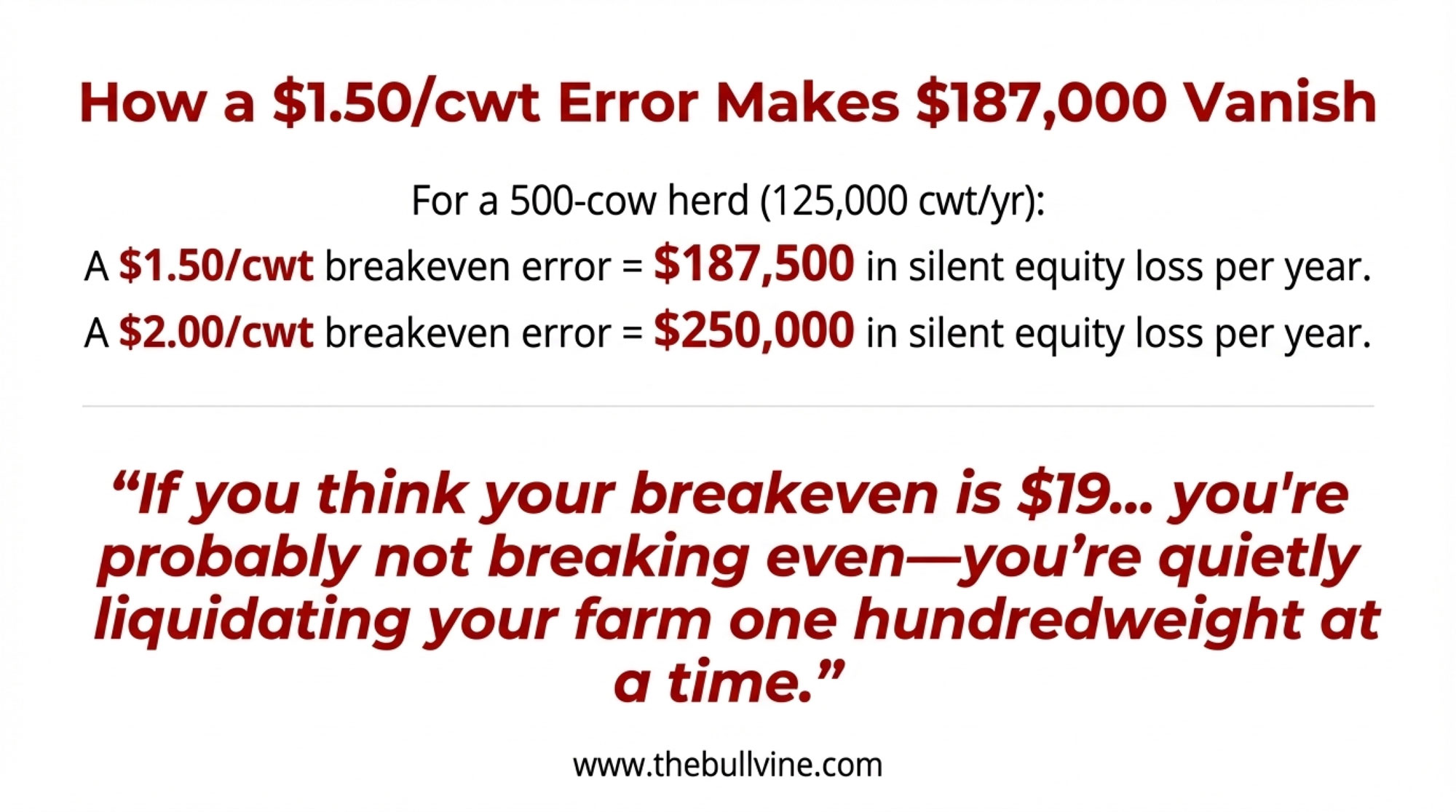
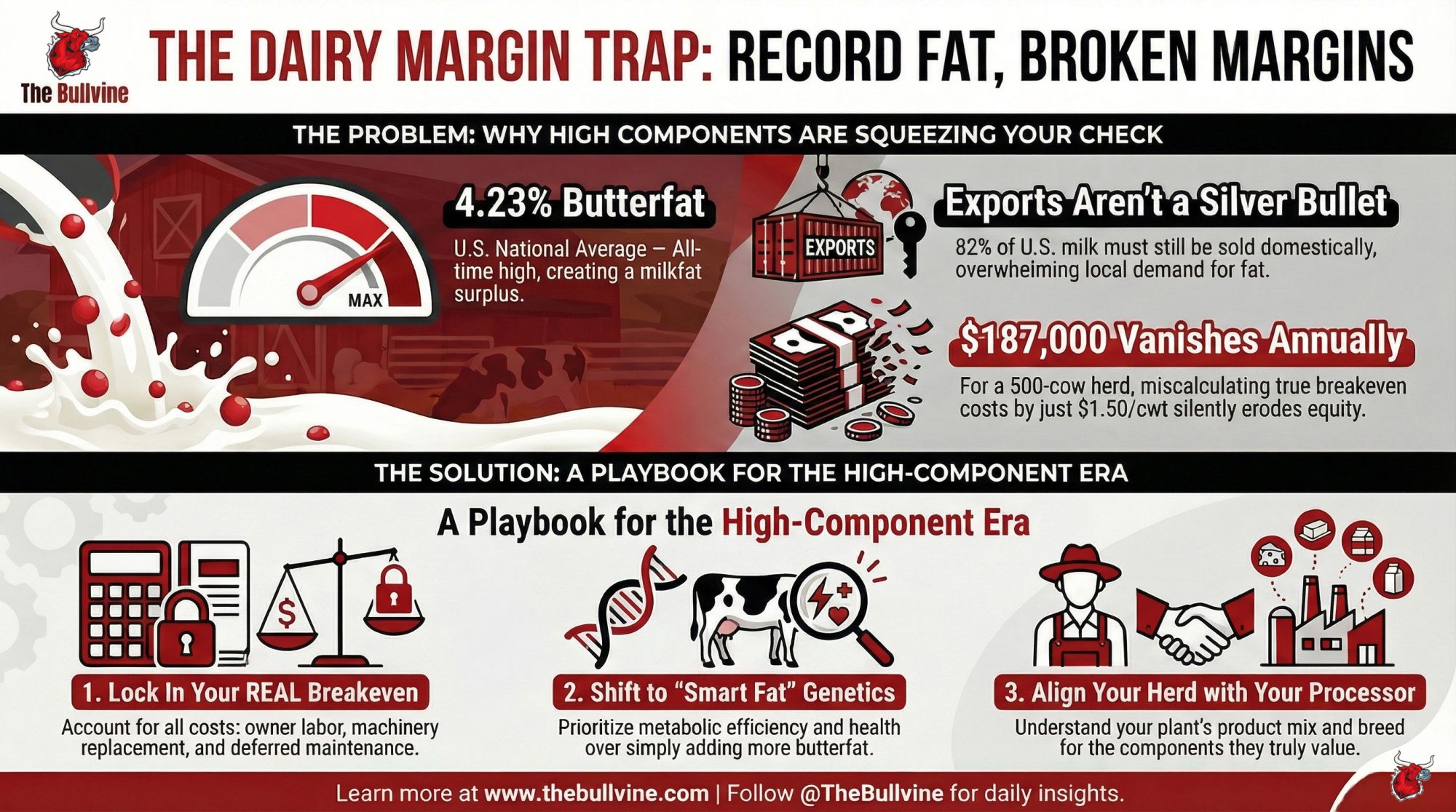
The $3 drop from January’s $20.34 to today’s $17.59 milk price costs a 500-cow dairy $1,800 daily

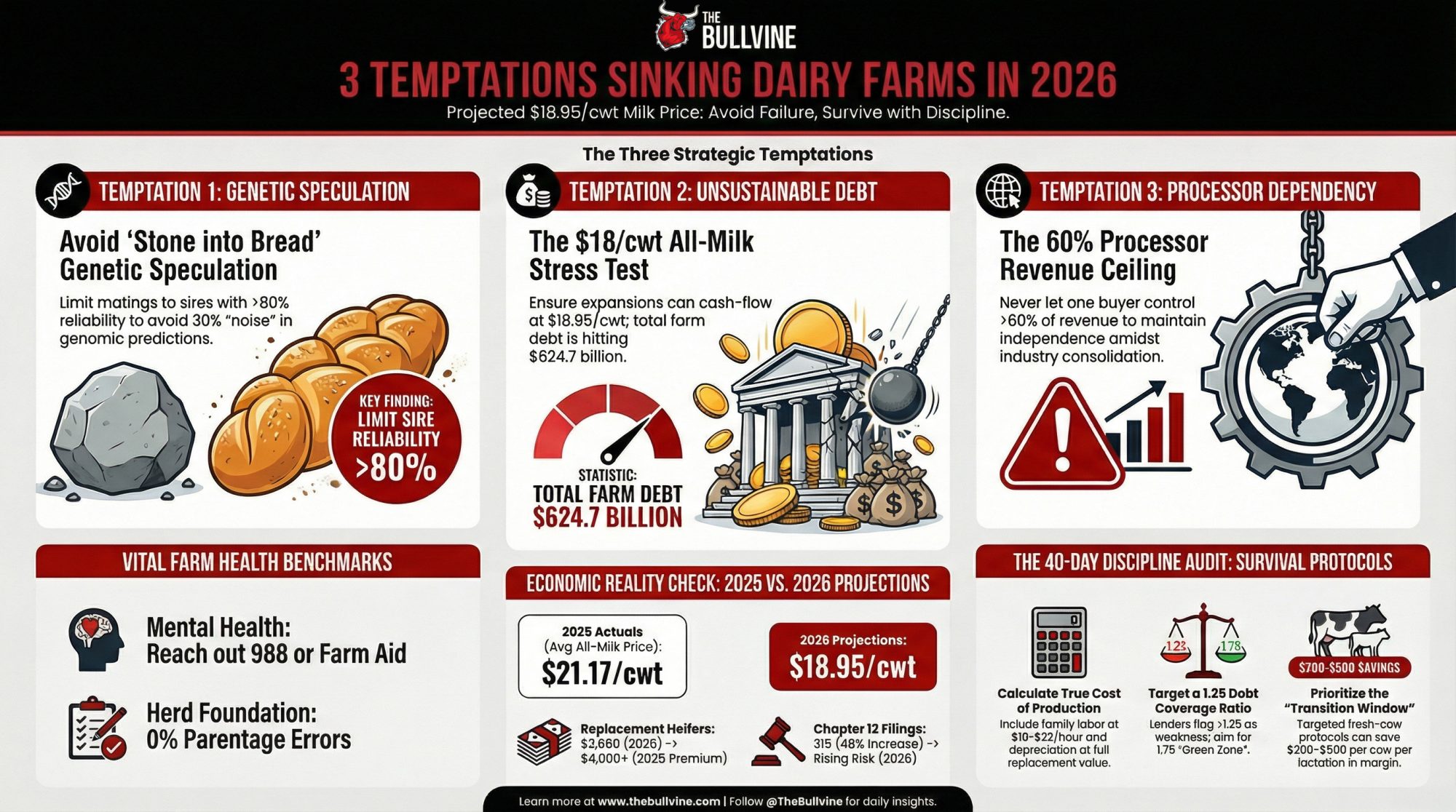
EXECUTIVE SUMMARY: What farmers are discovering right now is a fundamental disconnect between milk prices and production costs that goes beyond normal market cycles—the September Class III price of $17.59 represents a $3 drop from January’s highs, costing typical Midwest operations roughly $135 per cow monthly. Recent USDA data confirm that we’ve lost 15,532 dairy farms (nearly 40%) between 2017 and 2022, yet milk production increased by 8%. As a result, the largest 3% of operations now produce over half of our milk supply. Cornell and Penn State research shows that successful adaptations are emerging: direct marketing captures $2-4 premiums per gallon, precision feeding delivers 8-12% efficiency gains with sub-two-year paybacks, and strategic breed shifts to Jerseys improve component economics. The $5-8 billion in processor investments signals continued consolidation ahead, but innovative mid-sized operations are finding profitable niches through differentiation, technology adoption, and regional market advantages. Here’s what this means for your operation: understanding these structural shifts—not waiting for prices to “return to normal”—becomes essential for making informed decisions about expansion, technology investments, or alternative marketing strategies that align with your farm’s specific strengths and local opportunities.

You know how it is at 4:30 AM—there’s something about that quiet time in the parlor that gets you thinking. Recently, I’ve been giving a lot of thought to where we stand with milk prices and what it means for all of us trying to make a living in the dairy industry.

I’ve spent the past few weeks reviewing the latest market data and, more importantly, speaking with producers from Wisconsin to Pennsylvania, California, and even the Southeastern United States. What’s emerging is… well, it’s complicated. However, it’s worth understanding because it affects each of us differently.

Where Prices Stand Right Now

So here’s where we are. The USDA announced in early October that September’s Class III came in at $17.59 per hundredweight—that’s up thirty-five cents from August. Now, if you’re like me, you probably remember those January and February prices this year—$20.34 and $20.18, according to the Federal Milk Marketing Order announcements. That three-dollar difference? You’re feeling it in your milk check, I guarantee it.

The disconnect between costs and prices becomes even clearer when you look at this historically. The Bureau of Labor Statistics’ inflation calculators indicate that if milk prices had kept pace with general inflation since the 1970s, we’d be looking at significantly higher prices today. The gap represents something deeper happening in our industry.

At a co-op meeting last month, I heard a producer from central Wisconsin say it perfectly: “My dad used to be able to predict milk prices within reason based on feed costs and what was happening in the general economy. That relationship? It’s just gone now.” And you know what? He’s absolutely right.

As we head into the winter feeding season—with concerns about feed inventory on everyone’s mind after the variable growing conditions this past summer—that disconnect between costs and prices feels even more pronounced. Many of us are already planning for the spring flush, wondering whether to push production or hold back, given the potential direction of prices.

Quick Reference: Key Numbers to Know

  • Current Class III: $17.59/cwt (September 2025)
  • Make Allowances (June 1, 2025): Cheese $0.2504/lb, Butter $0.2257/lb
  • Farms Lost (2017-2022): 15,532 operations (39.5% decline)
  • Typical Robot Cost: $180,000-250,000
  • Organic Premium Range: $35-40/cwt
  • Beef-on-Dairy Premium: $200-400/calf

The Processing Side of Things

What many of us are realizing is how dramatically the processing landscape has shifted. Remember when you had four or five plants competing for your milk? According to USDA Agricultural Marketing Service data, most regions now have just one or two buyers. That’s a dramatic shift in negotiating power.

Those Federal Milk Marketing Order changes that took effect on June 1—the make allowances increased as documented in the Federal Register. Cheese to $0.2504 per pound, butter to $0.2257. Now, these might sound like small adjustments, but multiply them across your production… For those Upper Midwest operations shipping anywhere from 35,000 to 45,000 pounds daily—which is pretty typical for a 400 to 500-cow herd with decent production—that’s real money coming right out of the milk check.

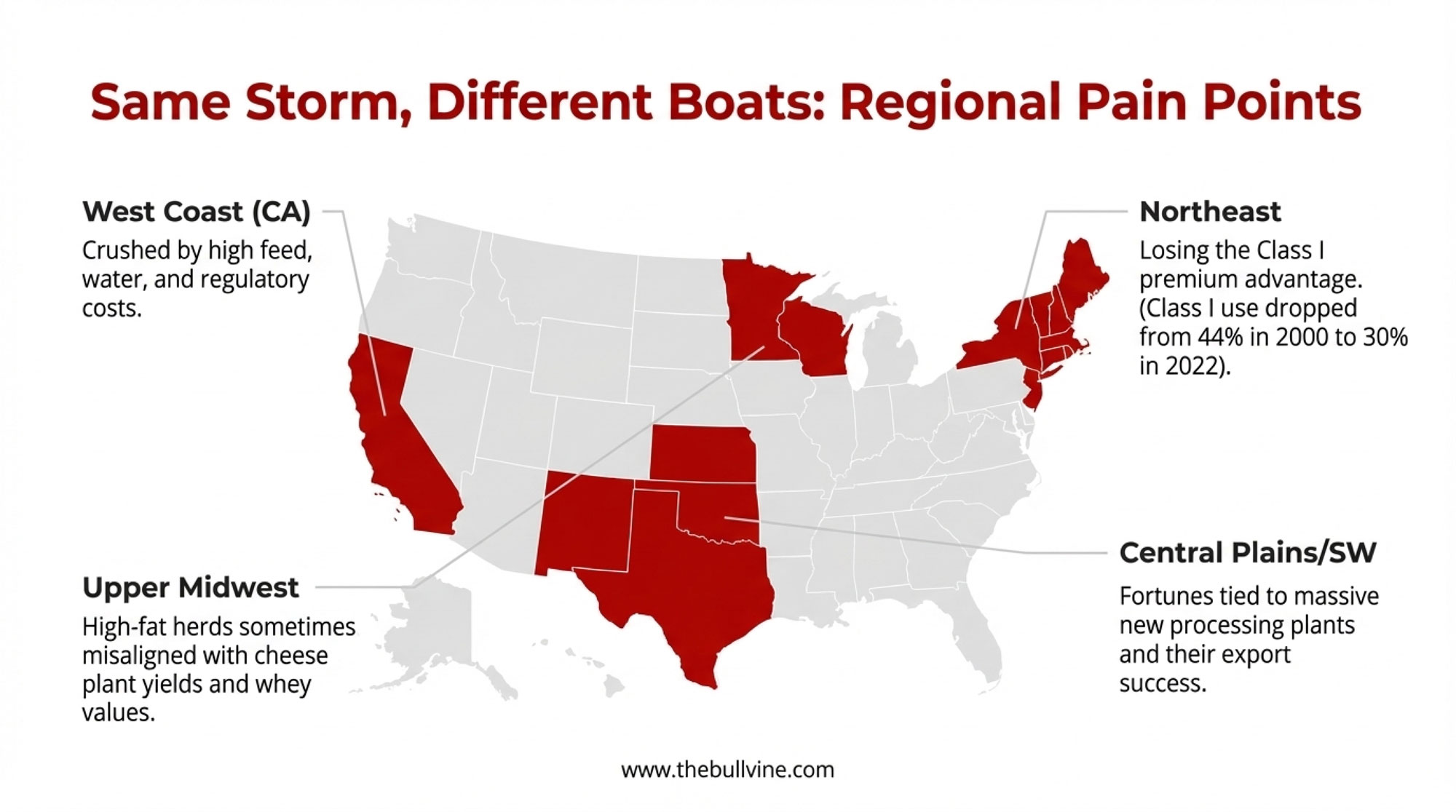
The regional differences are striking, too. Northeast producers often have access to those fluid markets—though university extension reports from Cornell show the premiums aren’t what they used to be, averaging just $2-3 above manufacturing milk. Meanwhile, those of us in the Midwest are primarily dealing with fluctuating milk prices.

RegionAverage Herd SizeFluid Market AccessHeat Stress CostsProcessing OptionsDirect Marketing PotentialLabor AvailabilityFeed Cost Advantage
Upper Midwest400-500 cowsLimited$01-2 buyersModerateChallengingCorn/soy belt
Northeast200-300 cowsGood ($2-3 premium)$25-35/cow3-4 buyersHigh ($2-4/gal premium)Very challengingHigher costs
California1,300+ cowsManufacturing focus$35-50/cowMultiple co-opsLowModerateVariable
Southeast300-400 cowsSome fluid access$50-75/cow2-3 buyersGrowingChallengingHeat stress offset

California’s situation is unique, too. They’ve been in the Federal Order system since November 2018, but with average herd sizes over 1,300 head according to California Department of Food and Agriculture data, they’re operating at a completely different scale. And down in the Southeast? Those folks are dealing with heat stress management costs that can range from $50 to $ 75 per cow annually, according to University of Georgia research, which eats into any fluid premiums they might capture.

Looking at processor investments, we’re seeing announcements totaling $5-8 billion in new facilities coming online by 2026, based on industry reports and construction permits. For example, Dairy Farmers of America alone announced over $1 billion in processing expansions this year. They’re clearly betting on continued consolidation.

Farm Size Category2017 Farms2022 FarmsChange (%)Milk Production Share 2022Survival Strategy
Under 100 cows2317014129-39%7%Niche marketing/Exit
100-499 cows110007326-33%17%Efficiency/Technology
500-999 cows20541434-30%16%Scale up or specialize
1,000-2,499 cows13651179-14%31%Continued expansion
2,500+ cows714834+17%29%Market dominance

Learning From Our Neighbors North

It’s worth examining what’s happening in Canada with their supply management system. Statistics Canada reports show that their dairy farms maintain more predictable margins, with average net farm income significantly higher than that of comparable U.S. operations. Their farms tend to have debt-to-asset ratios of around 20%, according to Farm Credit Canada, compared to the 35-40% range reported by the USDA Economic Research Service for U.S. dairy operations.

They pay more for milk in Canada, no question—retail prices run about 30% higher according to comparative price studies. However, they have been chosen by a society that expects farms to be profitable enough to survive and pass on to future generations. We’ve made different choices here, and… well, we’re living with the consequences of those choices.

I was talking with a producer at the Pennsylvania Farm Show who said, “We keep looking for the perfect system, but maybe it’s about finding what works for each operation within the system we’ve got.” That really resonates with me.

What Producers Are Doing to Adapt

Despite all these challenges, I’m seeing some really creative adaptations out there. And it’s worth sharing because even if something doesn’t work for your operation, it might spark an idea that does.

Direct marketing is one path that’s gaining traction, especially for farms near population centers. Penn State Extension’s research shows that operations successfully transitioning to direct marketing can capture margins of $2 to $ 4 per gallon above commodity prices. I am aware of a typical mid-sized operation in Pennsylvania—approximately 300 cows—that invested around $800,000 in a bottled milk processing facility a few years ago. They’re now capturing significantly better margins on about a third of their production and expect to hit payback within four to five years. The capital requirements are substantial—USDA’s Value-Added Producer Grant program data shows typical processing facility investments range from $500,000 to $2 million. But those who make it work? They’re capturing margins that completely change the equation.

The organic market has gotten more complex. USDA Agricultural Marketing Service Organic Dairy Market News reports indicate that premiums are currently running $35-40 per hundredweight, but as more producers convert, those premiums are being squeezed. And we’ve seen major processors like Horizon Organic dropping dozens of farms when they have oversupply, so it’s not the guaranteed path it might have looked like a few years back.

Speaking of different approaches, I’ve noticed Jerseys making more economic sense for some operations lately. With butterfat premiums where they are and lower feed requirements per pound of components, a neighbor switched half his herd and says it’s working out better than expected.

The Technology Conversation

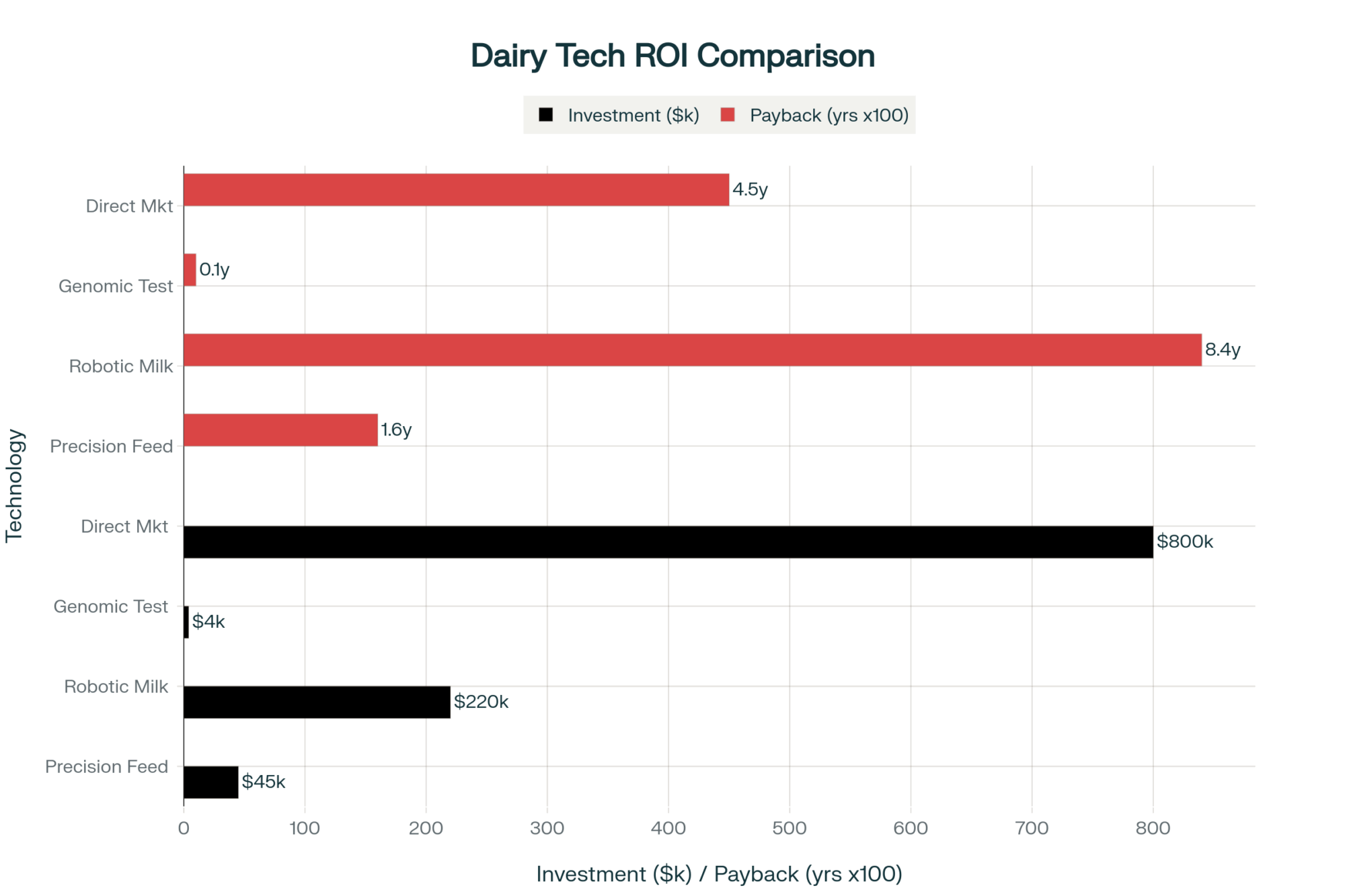
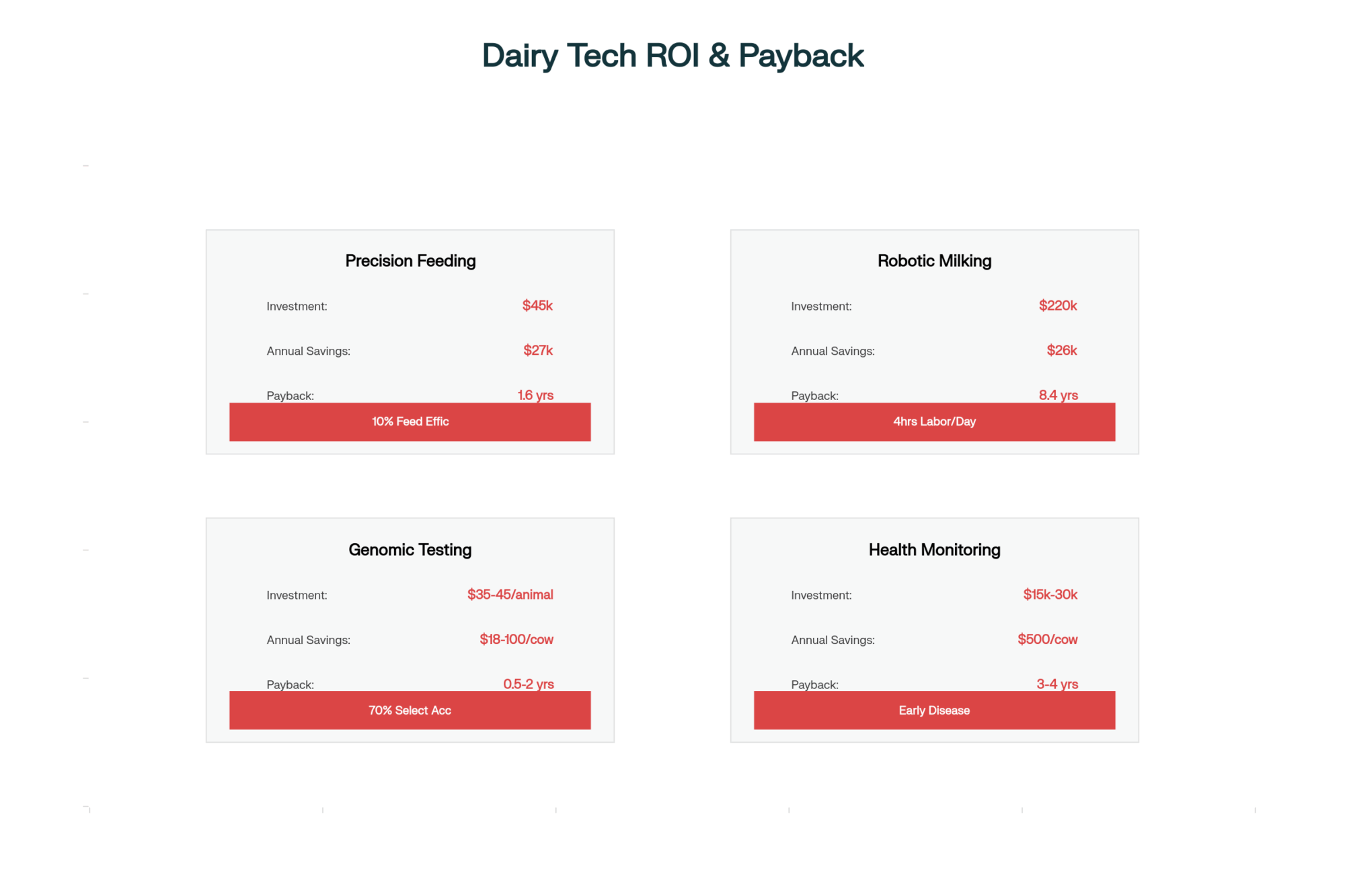
TechnologyInitial InvestmentAnnual Savings/RevenuePayback PeriodKey Success FactorRisk Level
Precision Feeding (120 cows)$45,000$27,3601.6 years10% feed efficiency gainLow
Robotic Milker (120 cows)$220,000$26,2808.4 yearsConsistent protocols + labor shortageMedium-High
Genomic Testing (per animal)$35-45$18-100/cow0.5-2 years70% selection accuracyVery Low
Health Monitoring (120 cows)$20,000$500/cow2-4 yearsEarly disease detectionLow
Direct Marketing Setup$800,000$2-4/gal premium4-5 yearsNear population centersHigh

Here’s a discussion I’m having everywhere I go: should you invest in technology when margins are this tight?

Penn State Extension’s dairy team has done excellent work showing that precision feeding systems can deliver real returns—typically 8-12% improvement in feed efficiency. Cornell’s Dairy Farm Business Summaries indicate that feed costs typically range between $8 and $11 per hundredweight of milk produced, making significant efficiency gains.

Let me give you a concrete example: A 120-cow operation investing $45,000 in precision feeding, saving 10% on feed at $9.50/cwt, producing 24,000 pounds per cow annually—that’s about $27,360 in annual savings. You’re looking at less than two years payback if everything goes right.

Robotic milkers? That’s even more complex. University of Wisconsin research shows labor savings of three to four hours daily per robot, which, at $15-$ 20 per hour, adds up. Take that same 120-cow operation: one robot at $220,000, saving 4 hours daily at $18/hour equals $26,280 annual labor savings. Before any production increases or milk quality improvements, you’re looking at 8+ years for payback. Most extension analyses indicate that total payback periods typically range from 5 to 8 years when factoring in all costs.

A producer from Michigan, whom I met at World Dairy Expo, put it well: “Technology is a tool, not a solution. It works when it fits your operation, your finances, and your management style.”

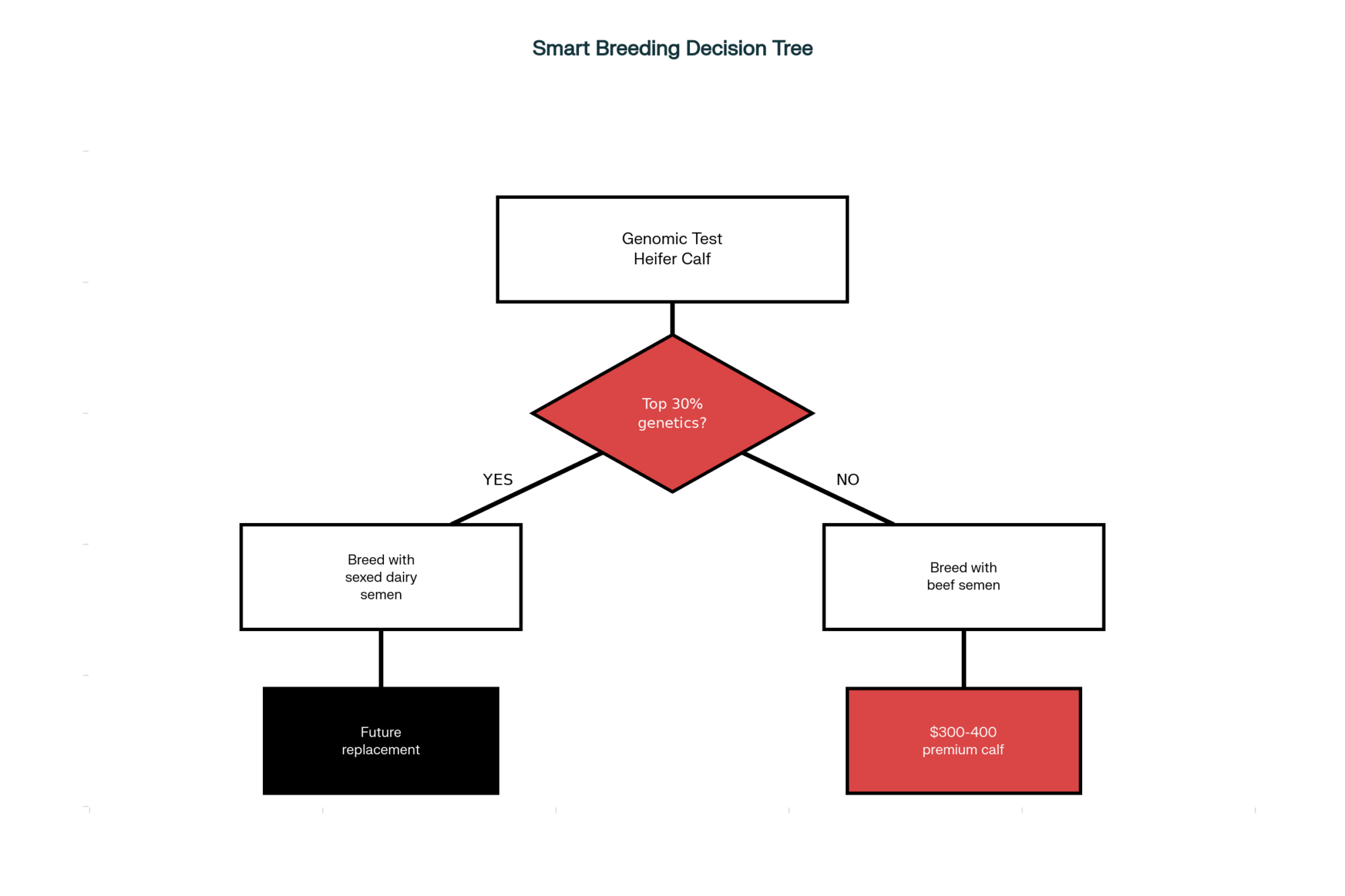
And speaking of management, the heifer side of things is getting interesting too. With replacement heifer values where they are and beef-on-dairy premiums running $200-$ 400 per calf, according to recent market reports, more operations are rethinking their entire replacement strategy. Add in genomic testing at $35-45 per animal (companies like Zoetis CLARIFIDE or STgenetics), and you can really target which heifers to keep. Do you raise every heifer, or do you breed your best cows for replacements and use beef semen on the rest? It’s a conversation worth having.

Where We’re Heading

The 2022 Census of Agriculture numbers were eye-opening. We went from 40,002 dairy farms in 2017 to just 24,470 in 2022. That’s… that’s nearly 40% of our dairy farms gone in just five years. But here’s what’s really telling: USDA National Agricultural Statistics Service data shows milk production actually went up 8% during that same period.

The larger operations are picking up that production and then some. Economic Research Service analysis shows that the largest 3% of dairy farms now produce over 50% of our milk. The economics increasingly favor these bigger dairies, and you can see processors positioning themselves for a future with fewer, larger suppliers in their capital investment patterns.

The mid-sized dairies—those 200 to 500-cow operations that are too big for niche marketing but don’t have the scale of the really large operations—they’re in a particularly tough spot, according to most agricultural economists. But I’m still seeing innovative mid-sized farms finding ways through differentiation, efficiency improvements, or strategic partnerships.

Geography matters more than ever now. A 200-cow dairy near Madison or Burlington might actually have opportunities that a 1,000-cow operation in northern Minnesota doesn’t have. It’s all about understanding and leveraging what advantages you do have.

Making Sense of Your Own Situation

Every operation is different—your debt structure, your family situation, where you’re located, what you’re good at managing. There’s no one-size-fits-all answer here, but there are some things worth thinking about as we head into the winter planning season.

If you’ve got kids who genuinely want to farm, that changes your whole calculation compared to someone whose kids are happily working in town. And that’s okay—there’s no judgment there. It’s just about being honest about what makes sense for your family.

Your financial structure significantly determines your flexibility. Cornell’s Dairy Farm Business Summaries consistently show operations with debt-to-asset ratios under 30% have significantly more options during tough times. As that ratio climbs above 40%, your options narrow pretty quickly. Every month of losses eats into that equity cushion you’ve built up over the years.

Location and market access create opportunities or constraints that you can’t ignore. Being within 50 miles of a city with over 100,000 people, having multiple processing options, and understanding your local food economy —all of these factors go into what strategies might work for you.

Looking Forward with Clear Eyes

Despite all these challenges, I’m actually encouraged by a lot of what I see. The innovation, the willingness to try new approaches while building on proven management practices, is a testament to the resilience in this industry that shouldn’t be underestimated.

I was at a young farmer meeting in Ohio where someone made a comment that really stuck: “We can’t control milk prices or feed costs, but we can control how we respond. That’s where our opportunity is.”

As we approach the spring flush, with all the management decisions that entail, such as breeding, culling, and production planning, the mindset of controlling what we can control becomes even more crucial. How we handle transition cows, fresh cow management, and even which bulls we’re using… these decisions matter more when margins are tight.

The industry’s going to keep evolving—global markets, consumer preferences, technology advances, policy changes—it’s all part of the mix. But farmers have always adapted. We’ve always found ways to make it work, even when “making it work” means making tough decisions about the future.

The Bottom Line

The economic pressures we’re facing—they’re real and they’re structural. Understanding them without sugar-coating but also without doom and gloom helps us make better decisions.

For some operations, expansion to capture scale economies makes sense. Others might find their path in differentiation or adding value to their product. And yes, for some, transitioning out of dairy might be the right decision for their family. Each choice reflects individual circumstances and priorities.

What matters is making informed decisions based on a realistic assessment of the situation. The dairy farmers I respect most look at their situation honestly, thoroughly explore options, and make decisions aligned with their family’s long-term well-being.

Whatever path you choose, make it with clear eyes about what’s happening in our industry. The decisions we make today—whether about technology, herd expansion, replacement strategies, or succession planning—shape not just our own operations but also the future of dairy farming.

The conversation continues, and your voice and experience are part of it. That’s what makes this industry worth being part of, even in these challenging times.

As my old neighbor used to say, “Dairy farming isn’t just about making milk—it’s about making decisions.” And right now, those decisions matter more than ever.

KEY TAKEAWAYS:

  • Technology ROI varies dramatically by operation: Precision feeding systems ($45,000 investment) can deliver $27,360 annual savings on a 120-cow farm through 10% feed efficiency gains, achieving payback in under two years—while robotic milkers require 5-8 years for full ROI when factoring production increases and quality premiums
  • Geographic advantage matters more than size: Operations within 50 miles of cities over 100,000 people can capture direct marketing premiums of $2-4/gallon, making a 200-cow dairy near Madison potentially more profitable than a 1,000-cow operation in remote Minnesota
  • Debt structure determines flexibility: Cornell’s Farm Business Summaries show operations with debt-to-asset ratios under 30% maintain multiple adaptation options, while those above 40% face rapidly narrowing choices—making equity preservation as important as operational efficiency
  • Heifer strategies are shifting fundamentally: With beef-on-dairy premiums at $200-400 per calf and genomic testing at $35-45 per animal, breeding only the top 30% of cows for replacements while using beef semen on the rest can add $15,000-30,000 annually to a 100-cow operation’s bottom line
  • Regional processing dynamics create different realities: Southeast operations face $50-75 per cow in annual cooling costs that offset fluid premiums, while Upper Midwest farms shipping to single buyers lose negotiating power but benefit from lower operating costs—understanding your regional context shapes which strategies actually work

Complete references and supporting documentation are available upon request by contacting the editorial team at editor@thebullvine.com.

Learn More:

Join the Revolution!

Join over 30,000 successful dairy professionals who rely on Bullvine Weekly for their competitive edge. Delivered directly to your inbox each week, our exclusive industry insights help you make smarter decisions while saving precious hours every week. Never miss critical updates on milk production trends, breakthrough technologies, and profit-boosting strategies that top producers are already implementing. Subscribe now to transform your dairy operation’s efficiency and profitability—your future success is just one click away.

NewsSubscribe
First
Last
Consent

The $3,800 Heifer Problem: How Smart Dairies Are Adapting When Beef Premiums Don’t Cover Replacement Costs

What if the beef-on-dairy strategy that made sense at $2,200 heifers is now costing you $280K yearly?

EXECUTIVE SUMMARY: What farmers are discovering about today’s replacement market fundamentally challenges the beef-on-dairy strategies that seemed bulletproof just two years ago. With springer heifers commanding $3,800 to $4,000 across most regions — a 73% jump from 2023’s $2,200 average — while actual beef-cross premiums hover around $20-30 after all costs, the economics have completely inverted. Research from Penn State’s dairy team and Wisconsin’s Center for Dairy Profitability confirms what producers are experiencing firsthand: operations that shifted to aggressive 65% beef breeding are now facing an additional $200,000 to $280,000 annually in replacement costs. Here’s what this means for your operation — the traditional 70/30 dairy-to-beef ratio is making a comeback, but with strategic twists like genomic testing every animal and tiered breeding programs that maximize both genetic progress and cash flow. Forward-thinking producers are already locking in 2026-2027 heifer contracts at today’s prices, essentially buying insurance against further market volatility. The path forward isn’t about abandoning beef-on-dairy entirely… it’s about finding the sweet spot where replacement security meets revenue opportunity, and that calculation looks different for every farm.

 dairy breeding strategy

Let me share what’s been on my mind lately. You know something’s fundamentally different when processing plants appear to have capacity while replacement heifers are commanding historically high prices across the country. It’s not following the patterns we’ve come to expect, is it? And if you’re trying to figure out when to ship cull cows or whether that beef-on-dairy program is actually paying for itself… well, these dynamics matter more than most of us initially realized.

What’s particularly noteworthy is how these patterns are playing out differently across regions. Industry reports suggest California’s vertically integrated systems are seeing different market signals than what’s emerging in Wisconsin’s co-op model or the grazing-based operations down South. This builds on what we’ve been observing since spring 2024 — a fundamental shift in how breeding strategies and replacement economics interact.

As we head into winter feeding season, these decisions become even more critical.

What Current Market Observations Are Telling Us

So here’s what’s interesting about the conditions we’re seeing. The beef processing industry generally runs facilities at high utilization rates when everything’s functioning properly — that’s basic industrial economics. In normal times, we’d expect to see something around 95% capacity utilization. But recent industry observations suggest we’re nowhere near that level.

Kevin Grier, that Canadian economist who’s been tracking North American beef markets for decades through his Market Analysis and Consulting firm, has been documenting this fascinating disconnect between available processing capacity and actual cattle throughput. Why is this significant? The economics suggest patterns that go beyond simple supply and demand.

Producers across Wisconsin and other dairy states are reporting similar experiences — cattle ready to ship, processing capacity theoretically available, yet prices that don’t reflect what we’d expect from those conditions. The math doesn’t seem to add up.

This pattern — and this is what’s really caught the attention of many observers — isn’t isolated to one region. Whether you’re looking at traditional dairy states like Wisconsin and New York with their smaller family operations, the larger feedlot-integrated systems in Texas and New Mexico, or even California with its unique market dynamics… similar patterns keep emerging. Dr. Derrell Peel from Oklahoma State’s agricultural economics department, one of the respected voices in livestock market analysis, suggests in his recent Extension publications that these patterns indicate something beyond typical market cycles.

The Beef-on-Dairy Reality Check

Geography determines survival: Minnesota premiums hit $3,850 while Texas stays ‘only’ $2,900 – but even the cheapest market doubled in two years, proving Andrew’s point that this is a structural, not cyclical, shift.

Remember those genetic company presentations from 2022 and 2023? The promise of significant premiums for beef-cross calves seemed like a genuine opportunity to diversify revenue streams. And conceptually, it made perfect sense — capture premium markets, reduce exposure to volatile dairy calf prices, improve cash flow.

But here’s where reality has diverged from projection. Industry reports and producer feedback across multiple states suggest that actual returns often fall significantly short of initial projections. After accounting for transportation costs (and with diesel prices where they’ve been), shrink at sale barns, and various marketing fees, many operations are finding net premiums considerably lower than anticipated.

What Extension services across Pennsylvania, Wisconsin, Minnesota and other states have been observing reveals that real-world returns can differ dramatically from those PowerPoint projections we all saw. Penn State’s dairy team, Wisconsin’s Center for Dairy Profitability, and Minnesota’s Extension dairy program all report similar findings — the gap between projected and actual returns is substantial.

I’ve noticed operations that are making beef-on-dairy work really well tend to have specific advantages — direct marketing relationships with particular buyers, consistent quality that commands loyalty, or local markets that value certain attributes. Success often comes down to matching your operation’s strengths with specific market opportunities.

And then there’s the replacement heifer situation…

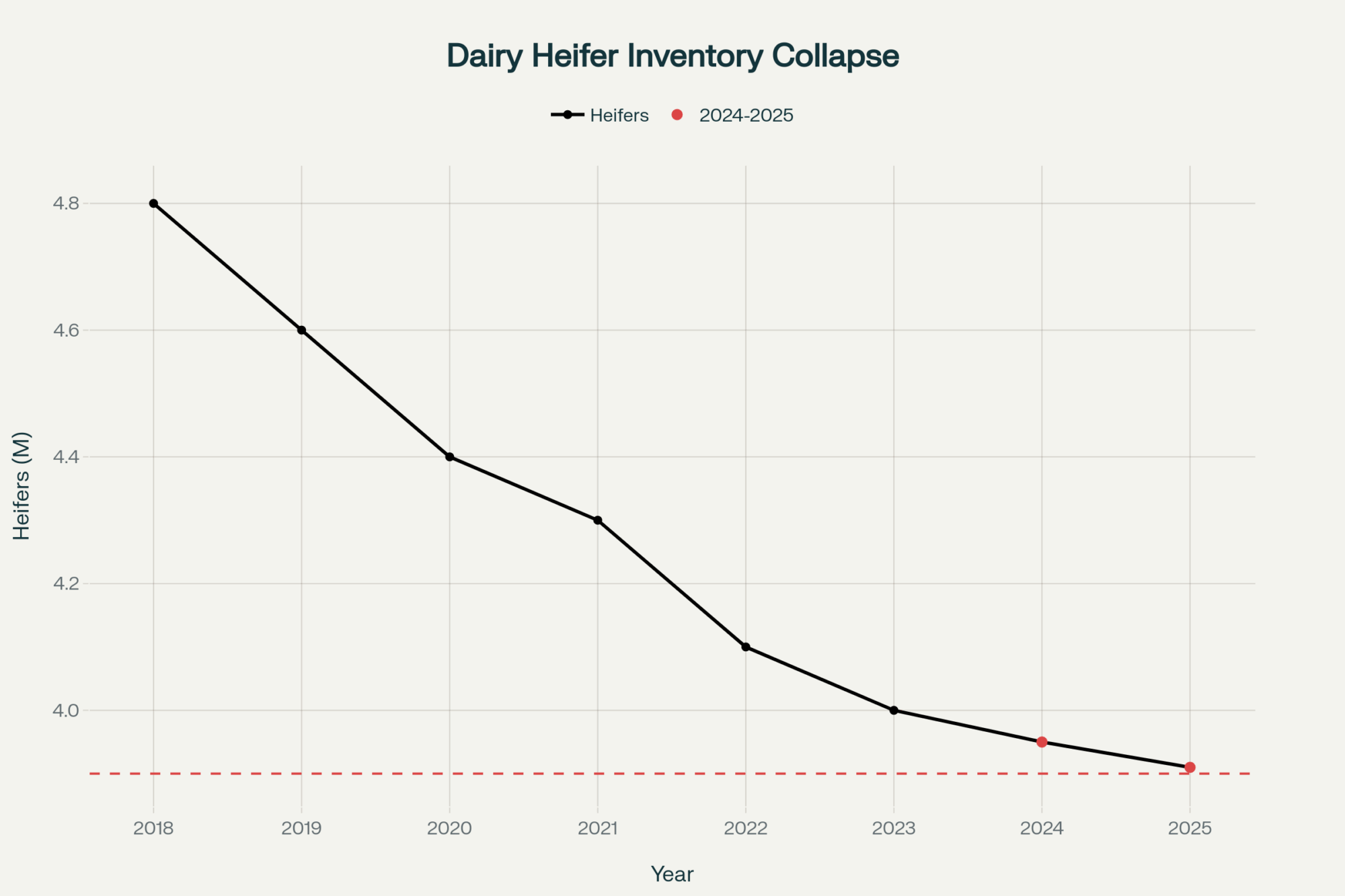
Multiple market sources, including reports from the National Association of Animal Breeders and various regional heifer grower associations, confirm what producers across the country are experiencing — springer heifer prices have reached levels that fundamentally alter breeding economics. Custom heifer growers in traditional dairy regions report being booked solid through mid-2026, with waiting lists growing.

Consider what this means for a typical 500-cow operation that shifted from a traditional 70-30 breeding strategy (70% dairy, 30% beef) to a more aggressive 35-65 approach. You’re potentially purchasing significantly more replacements at these elevated prices. The financial implications can run into hundreds of thousands of dollars annually in additional replacement costs. One Wisconsin producer recently calculated his operation’s additional replacement cost at nearly $280,000 annually — enough to make anyone reconsider their breeding strategy.

Understanding the Replacement Market Dynamics

So what’s driving these unprecedented heifer prices? It’s really a convergence of factors, and while market data is still developing on some aspects, the pattern is becoming clearer.

There’s the supply situation — when the industry collectively shifted breeding strategies over a relatively short period, it created replacement availability challenges. Dr. Jeffrey Bewley at Holstein Association USA, who analyzes breeding data extensively, points out in his industry presentations that different breeding strategies have compounding effects over time. Research published in the Journal of Dairy Science consistently shows beef semen generally has lower conception rates than conventional dairy semen — often running 8-12 percentage points lower depending on management and season — and those differences accumulate in ways that weren’t immediately obvious.

Then consider milk price dynamics. When Class III futures trade at relatively attractive levels, as they have periodically through 2025, producers naturally want to maintain or expand cow numbers. But when replacement availability is constrained… well, basic economics takes over.

What’s particularly interesting is the regional variation we’re observing. Larger operations in the West sometimes have different market dynamics than smaller farms in traditional dairy areas. California’s integrated systems might negotiate directly with heifer growers, while Midwest operations often compete on the open market. They might have scale advantages in negotiating, but they’re also competing with each other for limited replacements.

Industry economists, including those at agricultural lenders like CoBank and Farm Credit who track these markets closely in their quarterly dairy outlooks, suggest these inventory dynamics aren’t likely to shift dramatically in the near term. This appears to be more structural than cyclical — a distinction that matters for long-term planning.

Strategies Emerging Across the Industry

What’s encouraging is observing how different operations are adapting. There are some genuinely innovative approaches emerging across various regions.

Many operations are restructuring their breeding programs entirely. Some are using genomic testing more strategically — and the economics are interesting here. With genomic tests running around $35-45 per animal through major breed associations, operations are testing their entire herd to make targeted breeding decisions. Bottom-tier genetics might receive beef semen, solid performers get conventional dairy semen, and top genetics receive sexed semen (which typically runs $15-30 premium per unit over conventional). Yes, it costs more upfront, but it helps maintain that replacement pipeline while still capturing some beef revenue.

This development suggests producers are thinking more strategically about genetic progress and cash flow simultaneously. It’s not just about maximizing one or the other anymore.

What’s also emerging is renewed interest in contract heifer growing arrangements. Some operations are securing replacements eighteen to twenty-four months in advance. The prices might include a premium for certainty — think of it like buying insurance — but as many producers note, you can plan around known costs. It’s the unknowns that create problems.

The Contract Market Many Don’t Consider

Here’s something worth noting — custom heifer growers, particularly in traditional dairy regions like eastern Wisconsin, Minnesota, and upstate New York, are often interested in longer-term commitments. These arrangements typically involve predetermined pricing and delivery schedules over multiple years.

Both parties can benefit from these arrangements. Growers get predictable cash flow (which lenders appreciate when it comes to operating loans), and dairy operations get cost certainty. The challenge, naturally, is that many producers hope for price improvements. But what if prices don’t drop? Or what if they actually increase? That’s the risk-reward calculation each operation needs to make.

New Processing Capacity — Context Matters

The vanishing herd: 900,000 heifers disappeared as the industry chased short-term beef profits and ignored long-term replacement needs.

You’ve probably heard about new processing facilities being developed. Recent industry reports, including those from Rabobank’s North American beef quarterly and CattleFax market updates, indicate several major projects underway, each with different capacity targets and business models.

What distinguishes many of these new operations is their structure. Unlike traditional commodity plants that buy on the spot market, many feature integrated supply chains or specific retail partnerships. Their procurement models often involve contracting cattle well in advance with specific quality parameters — think Certified Angus Beef specifications or natural program requirements.

The question worth considering is why new capacity is being built when existing facilities aren’t maximizing utilization. Various theories exist among market analysts, but it suggests these new plants might be operating under fundamentally different business assumptions than traditional facilities. Are they positioning for future supply? Creating regional competition? Building branded programs? The answer probably varies by project.

Global Factors Adding Complexity

International beef markets increasingly influence our domestic situation. USDA’s Foreign Agricultural Service October 2025 Livestock and Poultry report tracks significant production shifts in countries like Brazil and Australia. When Brazilian exports increase substantially (up 15% year-over-year according to their latest data) or Australia recovers from drought-induced liquidation, it affects global beef flows.

Major processors operate internationally, and their strategies reflect global opportunities. Companies like JBS, Tyson, and Cargill balance operations across continents. When operations in different regions show varying profitability patterns, it influences domestic investment and operational decisions.

For U.S. dairy producers, these international factors contribute to price volatility in ways that weren’t as pronounced even five years ago. Global beef trade essentially influences domestic price ceilings — when imported product can fill demand at certain price points, our cull cow values face pressure.

Canadian producers, despite their different regulatory framework providing some buffer through supply management, are experiencing similar dynamics with beef-on-dairy economics. The fundamentals transcend borders, as recent reports from the Canadian Cattlemen’s Association indicate.

Practical Considerations for Current Conditions

After observing various operational approaches this season, here are some considerations worth discussing:

It’s crucial to track actual returns versus projections. Many land-grant universities have developed tools for this purpose — Wisconsin’s Center for Dairy Profitability has spreadsheets, Penn State offers decision tools, Cornell’s PRO-DAIRY program provides calculators. These resources can reveal important gaps between expectations and reality. Success metrics vary, but operations reporting improved cash flow often see 15-20% better performance when they track actual versus projected returns closely.

When calculating replacement costs, remember it extends beyond purchase price. There’s financing (and with interest rates where they are, that matters), transportation (fuel costs add up quickly), and that transition period when fresh heifers adjust to your system — different water, new TMR, group dynamics. University research, including work from Michigan State and Cornell, suggests these additional costs can add 10-15% to the sticker price.

If you’re committed to a particular breeding strategy, explore risk management tools. The Livestock Risk Protection for Dairy (LRP-Dairy) program offers price floor protection. Forward contracting through organizations like DFA or your local co-op might provide stability. Various hedging products exist through the CME — they all have costs, certainly, but weigh those against the risks you’re managing.

The optimal breeding strategy varies by operation. Your conception rates (which vary seasonally and by management), voluntary culling patterns, facilities (tie-stall versus freestall versus robotic), available labor — they all factor in. What works for a 2,000-cow operation with its own feed mill won’t necessarily translate to a 200-cow grazing operation. And that’s okay — diversity has always been one of dairy’s strengths.

Market timing has become increasingly complex. Those traditional seasonal patterns we relied on for decades — shipping cull cows before grass cattle hit the market, buying replacements in spring — they’re less predictable now. Price swings within monthly periods can be substantial. Local and regional market intelligence has become more valuable than ever.

Maintaining Perspective in Uncertain Times

Markets evolve — sometimes gradually, sometimes surprisingly quickly. What functions in one region might not translate to another. What makes sense for a large, integrated operation might not pencil out for a traditional family farm. And that’s the diversity that’s always characterized our industry.

Before implementing significant changes, consultation with your advisory team becomes crucial. Your nutritionist sees things from the feed efficiency and production angle. Your veterinarian considers herd health and reproduction implications. Your lender evaluates cash flow and debt service coverage. Each perspective contributes to better decision-making.

And let’s acknowledge — some operations are finding genuine success with various strategies. Direct marketing relationships with specific buyers who value consistency. Genetic programs that command buyer loyalty. Local markets that pay premiums for specific attributes. These successes remind us that opportunities exist even in challenging markets. Success often comes down to matching your operation’s strengths with market opportunities.

Looking Forward Together

This market environment certainly isn’t what any of us anticipated back in 2023 when beef-on-dairy really took off. The interaction between processing capacity, replacement availability, and breeding economics has created unprecedented challenges.

But what’s encouraging is how producers are adapting. Whether through adjusted breeding strategies, innovative contracting arrangements, or collaborative marketing efforts (like the producer groups forming in several states to pool beef-cross calves for better marketing leverage), paths forward exist. The dairy industry has weathered significant challenges over the decades — the 1980s farm crisis, the 2009 collapse, the 2020 pandemic disruptions. This situation, while unique in certain aspects, represents another test of our collective resilience.

The fundamentals remain constant: understand your actual costs (not what you hope they are or what someone projected they’d be), know your markets (both what you’re selling into and buying from), and base decisions on real data rather than projections. Every farm faces unique circumstances — facilities, labor availability, local markets, financial position. But understanding broader patterns helps inform better individual decisions.

We really are navigating this together. The conversations at co-op meetings, information shared at winter dairy conferences, neighbor-to-neighbor discussions over fence lines or at the feed store — that’s how our industry has always moved forward. Whether you’re milking 50 cows or 5,000, whether you’re in Vermont or California, we all face these markets together.

These are certainly interesting times. But with solid information, realistic planning, and thoughtful adaptation, operations will find their way through. That’s what we do, isn’t it? We observe, we adapt, we support each other, and we keep moving forward.

Always have. Always will.

KEY TAKEAWAYS:

  • Contract heifer growing arrangements can reduce replacement uncertainty by 100% while typically costing 20-25% less than panic buying on spot markets — Wisconsin and Minnesota growers report strong interest in 18-24 month contracts at $2,800-$3,200 delivered, providing both parties predictable cash flow
  • Strategic genomic testing at $35-45 per animal enables precision breeding that maintains genetic progress while capturing beef revenue — bottom 20% get beef semen, middle 50% conventional dairy, top 30% sexed semen, optimizing both cash flow and herd improvement
  • Regional market variations create opportunities smart operators are exploiting — California’s integrated systems negotiate direct contracts while Midwest co-ops pool beef-cross calves for 15-20% better premiums than individual marketing
  • Risk management tools like LRP-Dairy provide price floor protection that costs $15-25 per head but prevents catastrophic losses when replacement markets spike or cull values crash — essentially disaster insurance for volatile times
  • The optimal breeding ratio depends on your conception rates, culling patterns, and local markets — 60/40 might work with excellent reproduction, but operations with challenges find 70/30 provides essential cushion against today’s $3,800 replacement reality

Complete references and supporting documentation are available upon request by contacting the editorial team at editor@thebullvine.com.

Learn More:

Join the Revolution!

Join over 30,000 successful dairy professionals who rely on Bullvine Weekly for their competitive edge. Delivered directly to your inbox each week, our exclusive industry insights help you make smarter decisions while saving precious hours every week. Never miss critical updates on milk production trends, breakthrough technologies, and profit-boosting strategies that top producers are already implementing. Subscribe now to transform your dairy operation’s efficiency and profitability—your future success is just one click away.

NewsSubscribe
First
Last
Consent

17-26x ROI: Why Top Dairies Stopped Saving Calves and Started Preventing Loss

What if your best calves aren’t the ones you saved, but the ones that never got sick?

EXECUTIVE SUMMARY: Recent research from Cornell and Wisconsin reveals that operations achieving sub-3% calf mortality are generating 17 to 26 times return on prevention investments—roughly $800 more per calf than traditional treatment-focused farms. The 2024 Feedstuffs report confirms that national mortality remains stuck at 6%, costing producers through lost first-lactation milk (716-1,100 pounds per affected calf) and delayed breeding, which Penn State documents as a 2.9 times higher likelihood of calving after 30 months. What’s driving this shift is the intersection of biology and economics: veterinary research shows that intestinal damage from early disease permanently reduces nutrient absorption by 30-50%, even in “recovered” calves. Progressive operations are investing just $40-50 per calf in prevention protocols—Brix testing, rapid colostrum delivery, extended transition milk feeding—while traditional farms spend $850-1,050 per sick calf when factoring lifetime productivity losses. With replacement heifers commanding $2,500-3,500 and beef-on-dairy tightening supplies, the economics have never been clearer. The farms implementing these protocols aren’t abandoning treatment skills—they’re simply needing them 70% less often.

calf health economics

You know, I was sitting in the back row at the Professional Dairy Producers conference in Madison this past March—the one with the “Dialing It In” theme—and something clicked for me during a conversation about calf mortality economics. We’ve celebrated our treatment success rates for decades, and we should. But what the researchers from Cornell, Wisconsin, and other universities are telling us… well, it’s making me reconsider how we define success itself.

The Real Economics Behind “Saving” Calves

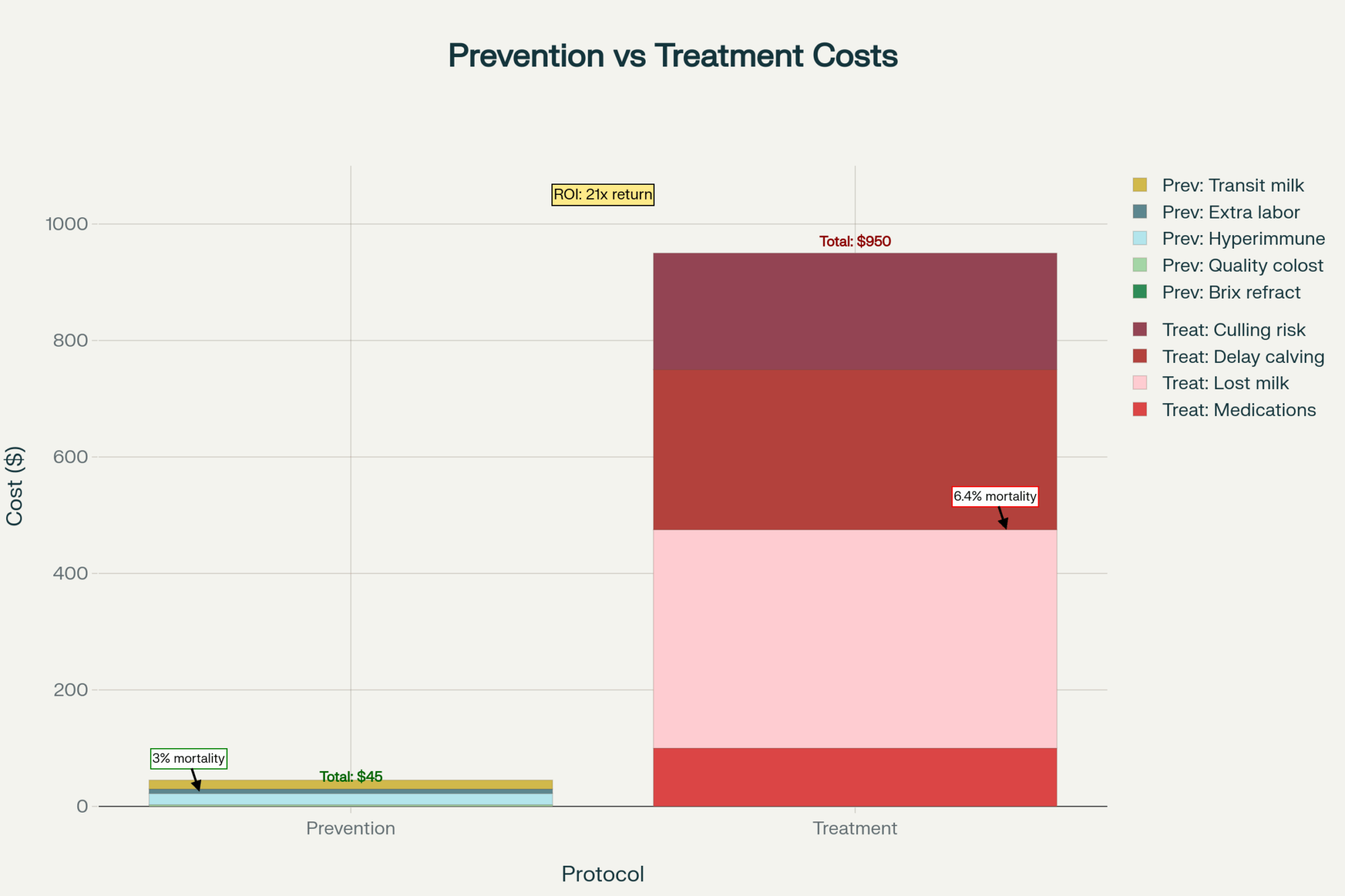
Forget what your vet told you – prevention isn’t just cheaper, it’s 21 times more profitable. While you’re spending $950 treating sick calves, smart operations invest $45 in prevention and pocket the difference.

Let me start with something that might surprise you. According to the latest NAHMS data from 2014, the national trend has improved, with pre-weaning mortality decreasing from 7.8% in 2007 to 6.4%. And yes, I know that’s over a decade old—we’re all waiting for updated national numbers. But the 2024 Feedstuffs report confirms mortality is still hovering around 6% across both the U.S. and Canada. So, it seems we’ve plateaued.

Meanwhile, the Dairy Calf and Heifer Association’s gold standard sits under 3%. I’m meeting more operations every year that consistently hit that mark.

What’s the difference between 6% and 3% worth? When you factor in everything—and I mean everything—we’re talking about $800 or more per calf.

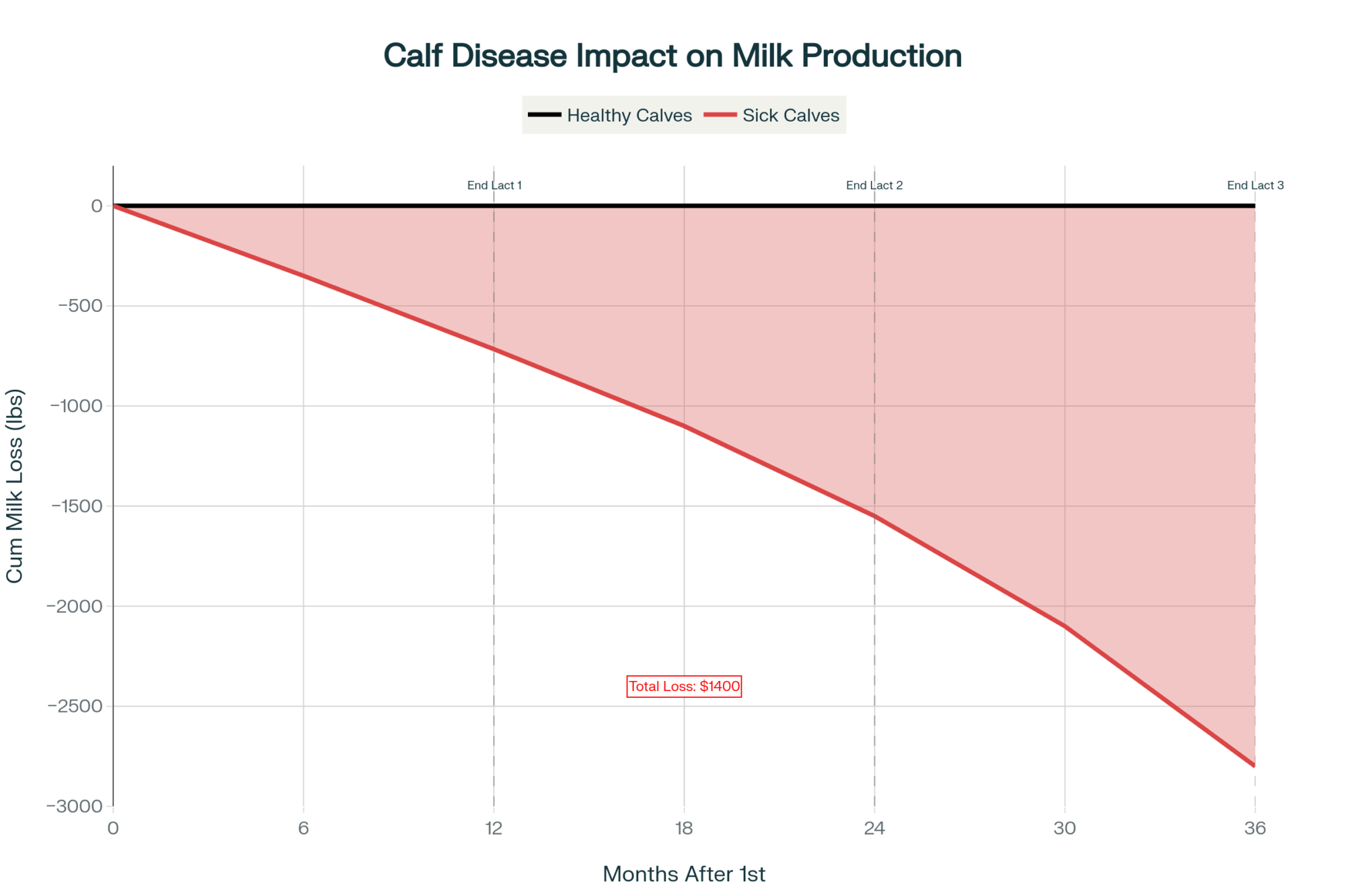
Research from the University of Guelph shows calves that get sick early but recover produce 716.5 pounds less milk in their first lactation. The Journal of Dairy Science has studies pushing that figure up near 1,100 pounds. Penn State Extension documented that these same “recovered” calves are 2.9 times more likely to calve after 30 months, rather than the ideal 22-to 24-month period.

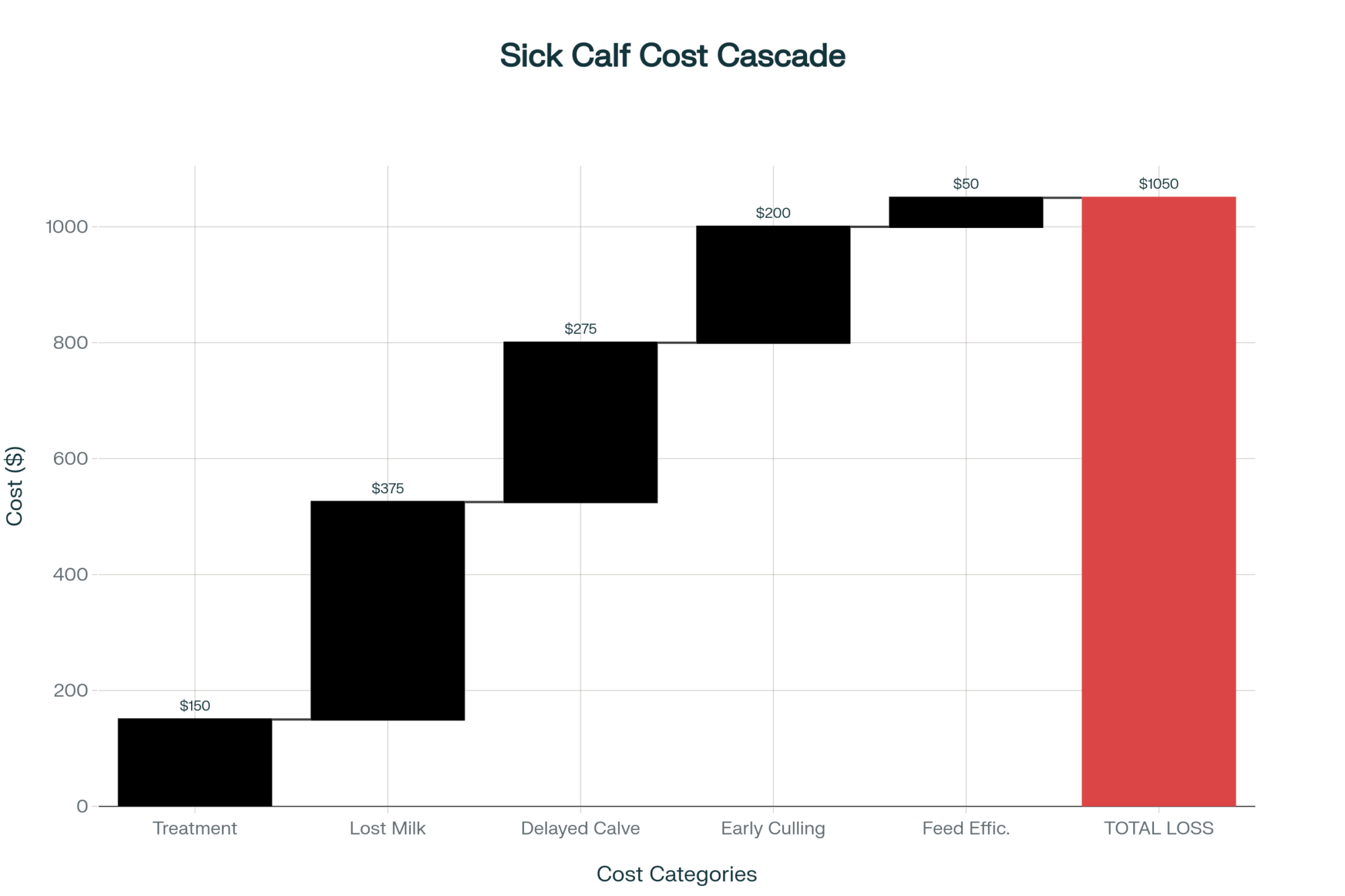
Let’s put some rough dollars to this. Feed costs for an extra six months? That’s easily $250-300, depending on your feed prices. Delayed income from milk production? Another $400-500. Higher replacement risk because these animals tend to leave the herd earlier? The numbers just keep climbing. And that’s before we even talk about the immediate treatment costs—NAHMS documented those ranging from $50 to over $150 per case.

“By the time we’re treating clinical mastitis, we’ve already lost the battle.”
— Dr. Paul Virkler, Cornell University Quality Milk Production Services

What Biology Teaches Us About Permanent Damage

That ‘recovered’ calf? She’ll cost you 2,800 pounds of milk over three lactations. Cornell proved it, Wisconsin confirmed it, but most vets still say ‘she’ll be fine.’ The math says otherwise.

Dr. Paul Virkler, who’s the Senior Extension Associate at Cornell’s Quality Milk Production Services, made that comment at a recent mastitis workshop. It really stuck with me.

Same principle applies to calves, doesn’t it? By the time we’re treating, the damage is often permanent.

I’ve been following Dr. Jennifer Van Os’s work at the University of Wisconsin—she’s their Extension Specialist in Animal Welfare. Her research on calf development is eye-opening. Those calves that battle scours or pneumonia early and survive? They carry that burden their entire lives.

The biology behind this is actually pretty straightforward once you understand it. Research published in veterinary journals shows that healthy intestinal villi—you know, those tiny finger-like projections that absorb nutrients—are permanently altered after disease. Even in fully “recovered” calves, the absorption capacity is compromised.

Think about it like running your combine with damaged sieves. Sure, it still harvests, but you’re leaving potential in the field. That’s essentially what these calves face for life.

Prevention vs. Treatment: The Real Numbers

When treating sick calves, your total costs include:

  • Medications and labor: $50-150
  • Lost milk production (first lactation): $350-400
  • Delayed calving (6+ extra months): $250-300
  • Increased culling risk: $200+
  • Total impact: $850-1,050 per affected calf

Prevention investment runs about:

  • Brix refractometer (one-time): $45 for thousands of tests
  • Quality colostrum management: $2-3 per calf
  • Hyperimmune products (high-risk periods): $15-25
  • Extra labor for protocols: $5-10
  • Extended transition milk: $15
  • Total prevention: $40-50 per calf

That’s a 17-26x return on investment

Watch $150 in treatment snowball into $1,050 in lifetime losses. Every. Single. Time. Meanwhile, $45 in prevention stops the avalanche before it starts.

Why Your Vet Might Not Want You Reading This

Let’s address the elephant in the barn. Some veterinarians generate substantial revenue streams by treating sick calves. I’m not saying they want calves to get sick—far from it. However, when your business model relies on treatment protocols, prevention can appear as a threat rather than a means of progress.

I had an interesting conversation with a vet at the Southwest Dairy Conference who admitted, “We’re having to rethink our service model completely. Prevention consulting doesn’t generate the same per-visit revenue as emergency treatments.”

Smart vets are adapting—charging for prevention protocols, monitoring programs, and health audits. But the transition isn’t easy for everyone.

The Prevention Protocols That Work

Only 12% of farms achieve excellent colostrum quality. The other 88%? They’re gambling with $1,000 per calf. A $45 refractometer could change everything, but tradition dies hard.
Protocol ComponentTraditional PracticeGold StandardCost DifferenceROI Multiple
Colostrum TestingVisual assessment onlyBrix ≥22% required$0.05/calf45×
First Feeding Timing4-6 hours after birthWithin 1-2 hours$5 labor/calf28×
Colostrum Volume2 liters × 2 feedings4 liters first feeding$8/calf35×
Transition Milk DaysSwitch to milk Day 2Feed 3-5 days$15/calf18×
Hyperimmune ProductsNoneDuring high-risk periods$15-25/calf12×
Housing ManagementIndividual until weaningConsider pair housingNeutral

Considering that operations consistently achieve sub-3% mortality rates, several practices continue to stand out. And these aren’t theoretical—they’re from working farms sharing results at conferences and through extension programs.

First, they meticulously test colostrum quality. The University of Wisconsin Extension’s guidelines specify a Brix refractometer reading of 22% or higher as the gold standard. What’s sobering is how much colostrum doesn’t meet this threshold—various studies suggest it could be 30% or more of what we assume is good quality.

Timing is absolutely critical. Four liters within two hours—using an esophageal feeder if necessary. The Journal of Dairy Science has published multiple studies showing calves fed within one hour have significantly higher immunoglobulin levels than those fed even just two hours later. Every minute counts here.

Extended colostrum feeding is something I’m seeing more farms adopt. Hoard’s Dairyman reported that feeding transition milk from milkings two through four can add 6.6 pounds to weaning weight and cut disease incidence by 50%. That’s not a marginal improvement—that’s transformational.

Many operations are also incorporating hyperimmunized antibody products during high-risk periods. While the peer-reviewed data is still developing, field trials presented at various conferences suggest meaningful reductions in scours incidence when used as part of comprehensive protocols.

Regional Realities Shape Implementation

What works in Wisconsin doesn’t automatically translate to Arizona. I’ve noticed successful operations adapt core principles to their specific challenges.

Up here in the Midwest, where winter temperatures can be brutal, calf jackets make a real difference. Research shows they can improve average daily gain in cold conditions—though the exact amount varies by study and conditions.

Down South? Heat stress management takes priority. Studies from warmer climates consistently demonstrate that shade and cooling reduce the incidence of respiratory disease. Same concept—environmental management—but completely different application.

Fall calving brings its own challenges. Cornell’s Pro-Dairy program documented that December colostrum from mature cows averages significantly lower Brix readings than spring colostrum. Some older cows produce very little quality colostrum in winter. That’s why I’m seeing more operations banking on high-quality spring colostrum as a form of insurance.

Dr. Van Os’s research on paired housing, published in the Journal of Dairy Science, demonstrates real benefits, including improved starter intake before weaning, enhanced cognitive development, and better stress resilience. The EU already requires group housing after the first week. However, and this is crucial, it only works with excellent hygiene and proper feeding management. Simply putting calves together without proper protocols? That’s a recipe for disaster.

Making It Work on Your Farm

If your mortality is above 3%, you’re in the red zone. That’s not opinion—that’s $375 per dead calf plus $1,050 per ‘recovered’ calf. Do the math on your last 100 calves.

I get the challenges we’re all facing. Good labor is nearly impossible to find. Milk prices… well, they do what they do. Nobody expects you to revolutionize everything overnight.

Start simple. A Brix refractometer runs about $45 from any dairy supplier. Testing typically takes around 30 seconds once you become comfortable with it. The University of Wisconsin’s Dairy Calf Care website offers free resources that guide you through the entire process.

For mid-sized operations—that 200 to 1,000 cow range—dedicated calf management often pays big dividends. Wisconsin’s Center for Dairy Profitability found that operations with dedicated calf staff generally have lower pre-weaning mortality than those using rotating staff. Consistency matters more than perfection.

Bigger operations can justify more sophisticated monitoring systems. But even they need the basics first. As someone said at World Dairy Expo: “Technology can’t fix bad protocols—it just documents failure faster.”

The Shifting Economic Landscape

Replacement heifer prices tell the story. We’re seeing prices in the $2,500-$ 3,500 range in many markets, with some high-quality animals going even higher. Meanwhile, beef-on-dairy programs have significantly tightened heifer supplies. Every calf matters more than ever.

Penn State Extension’s analysis, which shows that 73.2% of dairy culls are involuntary, really drives this home. Breaking that down—infertility, mastitis, lameness—many of these issues potentially trace back to compromised early calf development. Dr. Michael Overton at the University of Georgia has suggested that improving calf health could meaningfully reduce involuntary culling rates. Those aren’t just statistics—they’re future profit walking out your gate.

Banking relationships are also starting to reflect this. I’ve heard from multiple producers that operations with documented strong calf health metrics are getting better terms on operating loans. Banks recognize that healthy calves mean more predictable cash flow.

Finding Your Balance Point

Every farm faces unique constraints. What works for a large operation in New Mexico with dedicated facilities may not translate directly to a smaller, grass-based system in Vermont.

Have you considered which of your current practices might be holding you back? Some extension programs have found that operations focusing on just three core areas—colostrum quality, feeding timing, and housing hygiene—can see meaningful mortality reductions over a couple of years. Not perfection, but real progress.

Maybe you invest in basic colostrum management tools. Perhaps ventilation improvements would be more suitable for your situation. The University of Kentucky has developed economic calculators that can help estimate returns for different interventions based on your specific circumstances.

A Real-World Transformation

I recently spoke with a producer who shared their operation’s journey—they preferred to remain anonymous but gave permission to share the general story. They were experiencing fairly typical mortality rates for their region, accompanied by significant annual treatment costs.

They began with the basics: testing all colostrum, banking high-quality batches, and refining maternity pen protocols. Added esophageal feeding for any calf that wouldn’t voluntarily drink adequate colostrum quickly.

In year two, they invested in ventilation improvements and started using hyperimmune products during their high-risk winter months. They also shifted their calf manager’s incentives from treatment success to prevention metrics.

The results? Mortality dropped significantly, two-thirds of the herd was cut, and they had surplus heifers to sell in a strong market. The total investment was recouped many times over through reduced costs and additional sales. Plus, their lender took notice of the improved metrics.

The Path Forward

Good treatment protocols remain absolutely essential. Even the best prevention programs will see some morbidity—the American Association of Bovine Practitioners reminds us of this in their guidelines. We need those treatment skills.

However, here’s what encourages me: by adding prevention layers, we’re not replacing treatment—we’re reducing the frequency of when we need it. It’s both/and, not either/or.

I’m genuinely curious what you’re seeing on your operations. At various conferences recently, I’ve heard producers mention success with different approaches, including targeted electrolyte supplementation, specific vaccination timing, and various housing modifications. The diversity of approaches that work tells me we’re all still learning together.

What practices have made the biggest difference for you? What challenges are you facing that others may have already solved? The beauty of this industry has always been our willingness to share what works—and what doesn’t.

Maybe the real revolution isn’t about choosing prevention over treatment. It’s about having enough information to make the right decisions for our specific situations. And with heifer prices where they are, labor challenges what they are, consumer expectations evolving… these decisions matter more than ever.

The math is clear. The biology is proven. The only question is whether you’ll lead this change or follow it. Start with one thing—test your colostrum tomorrow. See what you discover.

Resources for Getting Started

Free Online Tools:

  • University of Wisconsin Dairy Calf Care: dysci.wisc.edu/calfcare
  • Penn State Extension Calf Health Resources: extension.psu.edu
  • University of Kentucky Economic Calculator: Contact your extension office

Key Equipment Investments:

  • Brix refractometer: $45-60
  • Esophageal feeders: $35-50
  • Calf jackets (cold climates): $25-35 each
  • Basic ventilation improvements: $15-30 per calf space

Educational Opportunities:

  • Professional Dairy Producers Conference (March annually in March, Madison)
  • World Dairy Expo seminars (October, Madison)
  • Regional extension workshops (check your land-grant university)

Questions to Ask Yourself:

  • What’s your current pre-weaning mortality rate?
  • How much are you spending annually on calf treatments?
  • What percentage of your colostrum meets quality standards?
  • How many heifers leave before completing their first lactation?

Drop me a line at The Bullvine—I’d love to hear what’s working on your farm. Because at the end of the day, we’re all trying to raise healthy, profitable animals. The methods might vary, but the goal remains the same.

KEY TAKEAWAYS

  • Immediate ROI opportunity: Prevention protocols costing $40-50 per calf deliver 17-26x returns versus $850-1,050 lifetime impact of treating sick calves—start with a $45 Brix refractometer tomorrow
  • Four critical hours, lifetime impact: Calves receiving 4 liters of 22%+ Brix colostrum within two hours show 50% lower disease incidence and gain 6.6 pounds more at weaning, according to Wisconsin Extension and Hoard’s Dairyman research
  • Regional adaptation matters: Midwest operations seeing success with calf jackets improving cold-weather ADG, while Southern farms reduce respiratory disease 15% through shade management—match protocols to your climate challenges
  • Dedicated staff pays dividends: Wisconsin’s Center for Dairy Profitability found operations with consistent calf managers achieve 4.2% lower mortality than rotating staff—consistency beats perfection in prevention protocols
  • Banking relationships improving: Multiple producers report 0.25% lower interest rates with documented calf health metrics as lenders recognize healthy calves mean predictable cash flow in tight heifer markets

Complete references and supporting documentation are available upon request by contacting the editorial team at editor@thebullvine.com.

Learn More:

  • Ensuring Calf Health: How to Gauge Your Dairy Farm’s Success through Key Tests – This practical guide provides a clear checklist of key performance indicators beyond mortality rates. It reveals how to use simple, on-farm tests—from blood serum to fecal scoring—to identify underlying health issues before they become expensive problems, giving you a powerful tool to track your prevention program’s effectiveness.
  • Why Dairy Farmers Are Seeing Double: Unpacking the Surge in Summer Heifer Prices – Get the strategic market context behind the “every calf matters” philosophy. This report analyzes why heifer and calf prices are at historic highs, revealing how factors like heat stress and the beef-on-dairy trend are tightening supply and creating a new economic reality for your replacement strategy.
  • Top 5 Must-Have Tools for Effective Calf Health and Performance – This article moves beyond the Brix refractometer to explore a range of innovative tools that can improve calf management. It introduces the ROI of technologies like ammonia monitors and growth-tracking scales, offering a forward-looking perspective on how to modernize your calf-raising protocols.

Join the Revolution!

Join over 30,000 successful dairy professionals who rely on Bullvine Weekly for their competitive edge. Delivered directly to your inbox each week, our exclusive industry insights help you make smarter decisions while saving precious hours every week. Never miss critical updates on milk production trends, breakthrough technologies, and profit-boosting strategies that top producers are already implementing. Subscribe now to transform your dairy operation’s efficiency and profitability—your future success is just one click away.

NewsSubscribe
First
Last
Consent

Your Milk Check Just Got $337M Lighter – And Your Co-op Helped Plan It

$337M vanished from producer pools in 90 days, while cooperatives counted processing profits

EXECUTIVE SUMMARY: Here’s what we discovered: while cooperatives sold “technical modernization” to members, they orchestrated regulatory changes that transferred $337 million from producer pool values to processing advantages in just three months. Farm Bureau’s analysis reveals that make allowance increases of 26-60% across dairy commodities will slice 85-90 cents per hundredweight from milk prices—but here’s the kicker: cooperatives with processing operations capture these enhanced cost recovery mechanisms through their manufacturing divisions. Geographic warfare is surgical: California faces $94 million in annual losses, while the Mid-Atlantic regions gain $2.20/cwt through Class I differential increases, systematically advantaging politically connected fluid-milk territories over efficient manufacturing regions. December brings another redistribution wave as component assumptions jump to 3.3% protein, creating pool formulas that reward genetic and nutritional investments while penalizing volume-focused operations. This isn’t market evolution—it’s regulatory capture disguised as industry progress, and the data proves your cooperative helped design the very mechanisms now draining your milk checks.

 dairy pricing reform

Look, I’m gonna start with something that might sting a little.

Your cooperative just sold you out.

I know, I know… that’s harsh. But honestly? Sometimes the truth cuts deep, especially when it’s been buried under two years of “technical modernization” doublespeak and regulatory complexity designed—and I mean specifically designed—to hide what amounts to the largest wealth transfer from dairy producers to processors in modern history.

$337 million.

That’s how much money vanished from producer pool values between June 1st and August 31st this year. The American Farm Bureau Federation just released their quarterly analysis, and I’ve been poring over these numbers for weeks, trying to wrap my head around the scale of what just happened. Not because of feed costs going crazy. Not weather disasters. Hell, not even the usual corporate greed we’ve all grown accustomed to dealing with.

This is something way worse—systematic regulatory changes that, regardless of intent, redistributed massive wealth from the farm gate to processing margins.

While cooperatives were telling members about “updating outdated formulas” and “technical improvements”—you know, the same buzzwords they always use when major changes are coming—they were actually implementing reforms that drained $337 million from farmer milk checks to processor profit margins in just 90 days.

And here’s what really gets me: the National Milk Producers Federation—supposedly representing your interests as a farmer—spent over two years designing these proposals. Two years to figure out how to help farmers, and the end result is the biggest wealth transfer in dairy history.

Now, to be fair, NMPF and their supporters argue these changes were necessary to “modernize” pricing formulas and improve industry competitiveness. However, when you examine who actually benefits versus who pays, the math tells a different story than their press releases.

The Make Allowance Money Grab: When “Technical Updates” Create Winners and Losers

Alright, let me strip away all the regulatory jargon and show you exactly what happened to your money.

Make allowances… they sound innocent enough, right? Manufacturing cost deductions are processors’ claims against milk prices when they produce cheese, butter, or powder. These hadn’t been comprehensively updated for over a decade—which, by the way, gave everyone involved the perfect justification for what they successfully marketed as “technical modernization.”

Here’s where it gets interesting, though. USDA and NMPF argued these increases were based on actual cost increases in processing operations. They commissioned studies, held hearings, and gathered input from the industry. The whole regulatory process looked legitimate from the outside.

But here’s what really happened. Check out these numbers from the USDA’s final decision:

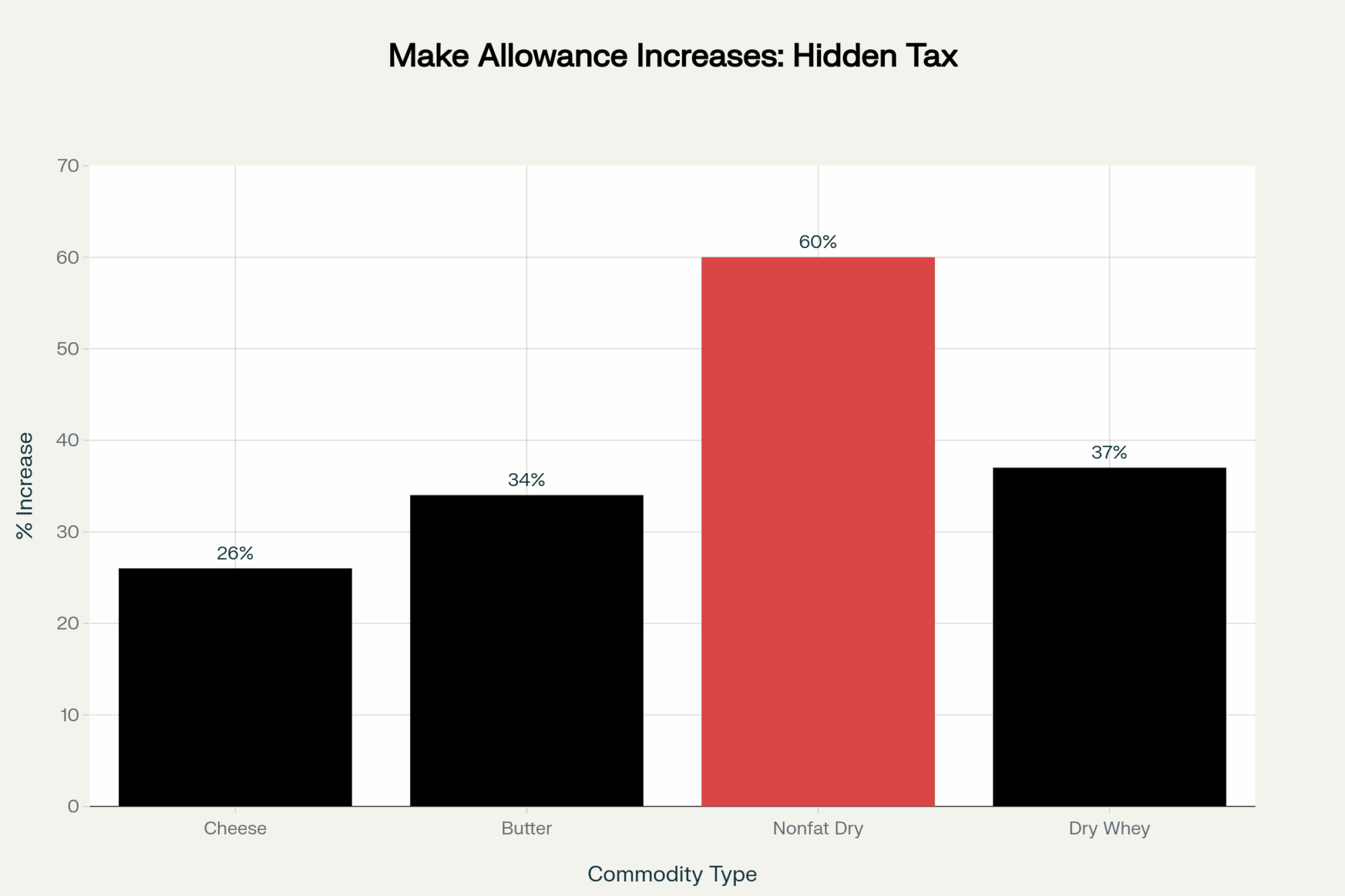
Cheese allowance: Jumped 26% from twenty cents to 25.19 cents per pound
Butter allowance: Spiked 34% from seventeen cents to 22.72 cents per pound
Nonfat dry milk: Get this—exploded 60% from fifteen cents to 23.93 cents per pound
Dry whey: Climbed 37% from 19.5 cents to 26.68 cents per pound

The Regulatory Heist in Numbers – While NMPF sold ‘technical updates,’ they engineered percentage increases that slice 85-90¢ from every hundredweight. That 60% nonfat dry milk spike? That’s your money flowing straight to processor profit margins.

Danny Munch—he’s the economist over at Farm Bureau who actually crunched these numbers instead of just accepting industry explanations—calculates these increases slice 85 to 90 cents per hundredweight from milk prices across all classes. Every single class.

Now, NMPF would tell you these increases reflect genuine cost inflation in processing operations since… well, since they were last comprehensively updated. Labor costs, energy costs, equipment costs—all legitimate concerns. And honestly? Some of that argument holds water.

However, what they don’t emphasize is that while these “cost adjustments” reduced producer pool values by $337 million in three months, cooperatives with processing operations receive enhanced make allowance cost recovery through their manufacturing facilities.

Think about the dynamic here. You ship milk to your “farmer-owned” cooperative. They process it into cheese. Those new make allowances let them claim extra cents per pound as “manufacturing costs” before calculating what they owe back to the pool. So your co-op’s processing division captures the benefit while your farm-gate price absorbs the cost.

Industry defenders would argue that this reflects economic reality—processing really does cost more than it did years ago. And they’re not entirely wrong. However, when cost increases are passed down to producers while the processing benefits flow to cooperative manufacturing divisions, that represents a fundamental shift in how value is distributed throughout the system.

What Your Cooperative’s Official Position Doesn’t Tell You

NMPF’s public justification emphasizes modernizing outdated formulas and improving competitiveness. Their white papers discuss aligning with current processing realities, supporting rural economies, and strengthening the industry’s global position.

And you know what? Some of those arguments aren’t completely without merit. Processing costs have increased significantly. Energy, labor, compliance costs—they’ve all gone up.

However, what their official positions overlook is that the industry cost studies justifying these increases primarily came from companies and cooperative processing divisions that benefit most from higher allowances. The processors provided the studies that justified their own enhanced cost recovery.

That’s not necessarily a case of fraud or conspiracy. It may simply be a matter of how regulatory processes work when complex industries are required to provide their own cost data. However, the conflict of interest becomes apparent when one steps back and examines it.

Industry trade groups framed these changes as an economic necessity rather than a move driven by advantage-seeking. And maybe they genuinely believe that. But notice what’s missing from all the official justifications? Any mechanism to ensure these “cost adjustments” flow back to producers through higher over-order premiums when processing operations benefit.

The Geographic Warfare: When Good Intentions Create Regional Winners and Losers

Here’s where the FMMO reforms get really complicated, and honestly, where some of the industry’s official reasoning starts to fall apart.

The changes didn’t just redistribute money between producers and processors—they systematically advantaged some regions while disadvantaging others. Now, USDA would argue this reflects legitimate differences in transportation costs and market dynamics. And again, that’s not entirely wrong.

The Protected Class: Northeast and Mid-Atlantic operations got massive Class I differential increases that more than offset the make allowance hits. Federal Order 5, which covers the Mid-Atlantic region, saw differentials increase from $3.40 to $5.60 per hundredweight, according to USDA implementation data.

The official justification? Higher transportation costs, market premiums for fluid milk, and regional economic factors. All legitimate considerations that regulators weighed during the hearing process.

The Sacrifice Zones: California, the Upper Midwest, and Western orders—basically, the regions where most of the milk is actually processed for manufacturing—they absorb the full impact of milk allowance increases with zero offsetting benefits.

In California, they’re examining what Edge Dairy Farmer Cooperative calculated as a $94 million annual reduction in pool value. Southwest Order? They’re expecting $72 million in annual losses.

Now, USDA would argue these manufacturing-heavy regions benefit from lower transportation costs and established processing infrastructure. The regulations aren’t deliberately targeting anyone—they’re just reflecting economic realities.

However, here’s the problem with that reasoning: when regulatory changes systematically favor politically connected fluid-milk regions while disadvantaging efficient manufacturing areas, the practical effect appears to be deliberate economic engineering, regardless of the official intent.

Edge Dairy Farmer Cooperative released an analysis acknowledging that the reforms “would slightly decrease the minimum regulated price private milk buyers have to pay to pooled milk producers.” That’s cooperative-speak for “your margins just got systematically compressed through regulatory changes.”

The Complexity of Regulatory Intent vs. Practical Impact

What strikes me about the regional disparities is how they align so perfectly with political influence rather than economic efficiency. The regions that benefit most from Class I differential increases happen to be the areas with the strongest political representation in dairy policy discussions.

Is that deliberate favoritism? Or just how regulatory processes naturally work when different regions have different levels of political sophistication and influence?

The USDA would argue that they’re simply responding to economic data on transportation costs, market premiums, and regional factors. They’d point to studies showing legitimate cost differences between regions that justify differential adjustments.

But when the practical effect systematically advantages less efficient regions while penalizing more efficient ones, the intent becomes less important than the outcome.

You talk to any Pennsylvania or Maryland producer, and they’ll tell you those differential increases help cushion the blow from higher make allowances. Meanwhile, down in Wisconsin or California—the backbone of American cheese production—they’re getting hammered by make allowance increases with no relief.

The Cooperative Dilemma: Competing Loyalties and Conflicting Interests

And this is where it gets really complicated, because I don’t think most cooperative leadership deliberately set out to screw their members.

The National Milk Producers Federation spent over two years developing these proposals through extensive consultation with the industry. They held meetings, commissioned studies, and gathered member input. NMPF President Gregg Doud genuinely believes the final decision provides “a firmer footing and fairer milk pricing.”

From their perspective, these changes represent necessary modernization that will ultimately strengthen the entire industry in the long term. They’d argue that stronger processing margins benefit everyone by supporting infrastructure investment, improving competitiveness, and stabilizing markets.

And honestly? That’s not entirely a bogus argument. A strong processing infrastructure benefits producers by providing market outlets and value-added opportunities.

But here’s where the cooperative model creates inherent conflicts: when your “farmer-owned” organization also owns processing facilities that receive enhanced make allowances, which interest takes priority?

The Governance Challenge of Dual Roles

Modern cooperatives have evolved far beyond their origins as farmer-protection organizations, and this evolution creates genuine dilemmas rather than simple betrayals of their founding principles. They’ve become processor stakeholders through joint ventures, shared manufacturing facilities, and board governance that has to balance multiple interests.

Your co-op’s leadership may genuinely believe that stronger processing margins will ultimately benefit all members through improved services, a stronger market position, and enhanced competitiveness. That’s not necessarily wrong—it’s just a different theory of value creation than direct milk price maximization.

The problem lies in governance structures that concentrate decision-making power among the largest operations—exactly those most likely to benefit from processing partnerships and enhanced allowances. When delegates representing 5,000-cow operations with processing deals outvote representatives from 500-cow farms focused purely on milk prices, that’s not a conspiracy. That’s just how voting power works in cooperative governance.

But the practical effect is the same: systematic advantages for the largest, most diversified operations at the expense of smaller, milk-focused producers.

You’re running 500 or 800 cows in Ohio or Wisconsin? Your voice gets drowned out by delegates representing mega-operations with processing partnerships. Small and mid-scale producers… we lack the influence to counteract delegate votes that favor processing investments over farm-gate returns.

Industry position differences during the hearing process suggest that some cooperative leadership recognized these tensions. The question is whether they had realistic alternatives given the political dynamics of regulatory change.

The Price Discovery Changes: Technical Complexity vs. Market Impact

The removal of 500-pound barrel cheese from Class III pricing calculations represents another layer of regulatory change that official explanations struggle to justify convincingly.

USDA’s reasoning focused on streamlining price discovery and reducing complexity in commodity pricing formulas. They argued that barrel pricing created volatility and confusion in market signals.

From a technical regulatory perspective, that argument has some merit. Simpler pricing mechanisms can reduce administrative complexity and improve market transparency.

But the practical effect concentrates price-setting power among fewer market participants, which typically benefits buyers more than sellers. When you reduce the number of pricing points used to set commodity values for the entire industry, you typically reduce competitive pressure.

Block cheese producers lobbied for these pricing changes during the hearing process, and their arguments about market efficiency and price discovery weren’t entirely without merit. But they got exactly what they wanted: reduced competitive pressure from barrel pricing.

The Challenge of Technical vs. Political Justifications

What bothers me about pricing formula changes is how technical complexity provides cover for market advantages. When regulatory changes require specialized expertise to understand, most participants can’t effectively evaluate whether the changes serve broader industry interests or specific player advantages.

USDA’s technical justifications for barrel removal sound reasonable in isolation. However, when you combine these with allowance increases and regional differential changes, the overall pattern systematically favors certain players while disadvantaging others.

Is that deliberate market manipulation? Or just the inevitable result of complex regulatory processes where different players have different levels of technical expertise and political influence?

The answer probably depends on your position in the industry hierarchy. If you benefit from the changes, they represent necessary modernization. If you’re disadvantaged, they looks like regulatory capture.

What This Really Means Long-Term: Competing Visions of Industry Structure

The $337 million first-quarter transfer from Farm Bureau’s analysis represents more than just money moving between accounts. It reflects competing visions of how the dairy industry should be structured and who should capture value at different points in the supply chain.

NMPF and their supporters would argue that these regulatory changes strengthen the industry by improving processing margins, encouraging infrastructure investment, and enhancing global competitiveness. They’d point to expansion plans and processing investments as evidence that their approach is working.

From this perspective, temporary producer pain leads to long-term industry strength that eventually benefits everyone through stronger markets, better services, and enhanced competitiveness.

However, critics, such as Edge Dairy and the Farm Bureau, view a systematic wealth transfer from efficient producers to processing interests that may never be reflected in farm-gate prices. Their analysis suggests continued consolidation pressure in manufacturing-focused regions that could undermine the industry’s competitive foundation.

Industry analysts are already projecting different scenarios depending on whether these regulatory structures drive beneficial investment or simply redistribute wealth from producers to processors without creating genuine value.

The honest answer? We won’t know which vision proves correct for several years. However, the immediate impact is clear: $337 million was transferred from producer pool values to processing advantages in just three months.

Regional Implications and Competitive Dynamics

You’re going to see the Northeast and Mid-Atlantic regions positioned to benefit from permanent Class I premiums and processing investments that capture regulatory advantages. Whether that strengthens or weakens overall industry competitiveness depends on whether protected regions utilize their advantages for genuine improvement or merely engage in rent-seeking.

Meanwhile, California, the Upper Midwest, and Western operations face continued pressure from regulatory disadvantages that may force consolidation or exit. If those regions represent the industry’s most efficient production, it could undermine long-term competitiveness, regardless of short-term improvements in processing margins.

The global implications are murky. Enhanced make allowances might improve U.S. processing competitiveness by providing guaranteed cost recovery. Or they might create artificial advantages that reduce incentives for genuine efficiency improvements.

International buyers increasingly value supply chain consistency and reliable quality over marginal regulatory advantages. Whether FMMO changes enhance or undermine those qualities remains to be seen.

Component Factor Changes: Modernization or Redistribution?

Starting December 1st, the assumed protein content increases from 3.1% to 3.3%, while other solids rise from 5.9% to 6.0%, according to the USDA implementation schedule.

The USDA’s justification emphasizes the recognition of genuine improvements in milk quality and genetic progress over the past decade. And honestly? That argument has solid support. Average component levels have improved significantly through genetic selection and nutrition management.

From a technical perspective, updating component assumptions to reflect current reality makes perfect sense. If most producers are achieving higher components than the formulas assume, the assumptions should be updated.

However, here’s where technical accuracy creates practical consequences: these changes will benefit operations already achieving high efficiency while disadvantaging those still focused on volume production.

The December changes don’t create new value—they redistribute existing pool money based on component assumptions that favor certain production strategies over others.

The Question of Fair vs. Advantageous Updates

Smart operators are already adjusting their breeding programs and ration formulations to capitalize on these regulatory advantages. Whether that represents a necessary adaptation to industry evolution or regulatory changes in gaming depends on your perspective.

USDA would argue they’re simply updating formulas to reflect current industry reality. Producers achieving higher components deserve recognition for their genetic and management investments.

But producers focused on volume production—often smaller operations with older genetics or limited nutritional resources—will subsidize their higher-component competitors through pool redistribution formulas.

Is that fair recognition of superior management? Or systematic disadvantaging of producers who can’t afford the latest genetic and nutritional technologies?

The answer probably depends on whether you view dairy as a commodity industry where efficiency should be rewarded, or as a rural economic system where smaller operations deserve protection from technological displacement.

Down in Pennsylvania, I was speaking with a producer who has been pushing his nutritionist hard on component manipulation strategies. He’s targeting 3.8% butterfat and 3.3% protein specifically because of these December changes. He said he’s not going to subsidize his neighbors who haven’t yet figured out the new game.

And honestly? This is no longer about milk volume. It’s about maximizing value per pound in a system that’s been restructured to reward components over quantity.

You’re still focused on pounds per cow? You’re gonna get killed in this new regulatory environment.

Fighting Back: Navigating Complex Realities Rather Than Simple Villains

Look, the wealth transfer is happening whether the motivations were pure or calculated. Your milk checks already reflect these new realities, regardless of whether cooperative leadership intended to disadvantage smaller producers or genuinely believed they were modernizing industry structures.

Independent producers who refuse to accept systematic disadvantages must move aggressively, but the solutions are more complex than simply fighting “bad actors.”

Component Optimization: Adapting to Regulatory Realities

Target 3.8% butterfat and 3.3% protein through systematic genetic selection and precision nutrition management. Whether the December component changes represent fair modernization or regulatory favoritism, they’re happening.

Work with nutritionists who understand component manipulation strategies, rather than just focusing on volume maximization. Focus on rumen-degradable protein levels that support component synthesis while maintaining the health of the cow.

Utilize genomic services to identify high-genetic potential within your existing herd. Cull animals that can’t achieve competitive component levels regardless of management inputs.

The reality is that operations unable to compete on components will subsidize those that can, starting December 1st. Whether that’s fair or not doesn’t change the economics.

And honestly, if your fresh cows aren’t consistently meeting these component targets, you need to refine your transition cow management. Because starting December 1st, every cow below these assumptions is subsidizing your competitors.

Strategic Milk Marketing: Working Within Flawed Systems

Negotiate over-order premiums with processors who receive enhanced make allowance cost recovery. Document your component achievements and demand premiums that reflect true quality rather than just pool averages.

These processors are capturing regulatory advantages whether they deserve them or not. Demand your share through premium negotiations based on documented quality metrics.

What I’m seeing work in Ohio is producers forming marketing groups to negotiate collectively rather than accepting whatever pools provide. When you consistently achieve high component targets, you have leverage regardless of regulatory advantages.

Explore partnerships with regional processors willing to share value-added margins rather than just paying pool prices. Direct-to-market alternatives bypass FMMO redistribution entirely.

Coalition Building: Addressing Systemic Issues

Pool resources with other disadvantaged producers to challenge regulatory methodologies through formal petitions or legal action. Whether the original intent was benign or calculated, the practical effects are documentable and challengeable.

The power structure that created these advantageous changes can be influenced through organized pressure, but it requires coordination across regional and cooperative boundaries.

What strikes me about current producer responses is that most operations are adapting individually rather than organizing collectively to address systemic disadvantages. That approach might preserve individual operations, but it won’t change the underlying regulatory structures.

Political Engagement: Long-term Structural Reform

Launch campaigns targeting legislators in manufacturing-disadvantaged regions with specific evidence of regulatory impacts. Whether the original changes were intentional or accidental, the documented effects provide concrete evidence for advocacy.

Frame regulatory reform around fairness and competitive balance rather than conspiracy theories about deliberate theft. Focus on documented outcomes rather than speculated motivations.

Partner with consumer groups and rural development organizations to widen coalitions beyond agriculture. Position regulatory reform as supporting competitive markets and rural economic vitality.

The key is addressing the systemic issues that allow regulatory processes to systematically advantage certain players while disadvantaging others, regardless of whether that outcome was originally intended.

Down in Wisconsin, there’s already talk about organizing producer groups to pressure state legislators. The question is whether enough people realize they’re being systematically disadvantaged and actually do something about it.

The Bottom Line: Complex Problems Require Sophisticated Responses

The dairy industry has just experienced its largest wealth redistribution in decades, thanks to regulatory changes that may have been well-intentioned but have created systematic disadvantages for independent producers. $337 million transferred from farmer milk checks to processing advantages in three months, with more likely to follow.

Whether cooperative leadership deliberately betrayed producer interests or genuinely believed they were modernizing industry structures matters less than the documented outcomes. The regulatory process systematically advantaged certain players while disadvantaging others, regardless of original intent.

This isn’t simply about fairness versus unfairness—it’s about competing visions of industry structure and value distribution. The challenge is building sufficient political and economic pressure to rebalance regulatory outcomes without getting trapped in conspiracy theories about deliberate betrayal.

Strategic Response Framework

This month: Adapt to regulatory realities through component optimization while documenting the costs of regulatory disadvantages for advocacy purposes. Those December component changes are coming fast.

  • Audit your herd’s genetic potential for 3.8% butterfat and 3.3% protein targets
  • Begin processor premium negotiations based on documented quality metrics
  • Calculate your operation’s specific losses from the 85-90¢/cwt make allowance impact

Next three months: Form coalitions with other disadvantaged producers to pool resources for legal challenges and political pressure targeting regulatory rebalancing. The Farm Bureau analysis gives you concrete numbers to work with.

  • Join regional producer alliances across cooperative boundaries
  • Pool resources for economic and legal expertise on regulatory challenges
  • Document specific financial impacts for legislative advocacy

Through 2025: Implement marketing strategies that capture value outside regulated pool formulas while supporting broader reform efforts. But honestly? Most of us lack the expertise for complex workarounds.

  • Explore direct-to-market partnerships bypassing FMMO pools
  • Negotiate over-order premiums, capturing regulatory advantages
  • Support cooperative governance reform requiring transparent processing profit disclosure

Strategic thinking: Support regulatory process reforms that require independent verification of industry cost claims and broader representation in policy development.

The $337 million wealth transfer already happened, according to Farm Bureau’s analysis. Whether it represents deliberate theft or unintended consequences, the practical effect is systematic disadvantaging of independent producers who lack processing partnerships and political influence.

Your response determines whether you adapt successfully to capture remaining value while building pressure for fairer regulatory processes… or watch your operation subsidize others’ advantages through government formulas that may never be rebalanced without sustained political pressure.

The regulatory game is complex, but the outcomes are clear. Understanding that complexity is essential for developing effective responses rather than just complaining about unfairness.

Your milk didn’t become less valuable. The formulas valuing your milk got restructured in ways that systematically favor certain players over others. The only question now is what you’re gonna do about it.

KEY TAKEAWAYS

  • Target 3.8% butterfat and 3.3% protein immediately—December component changes will redistribute pool money from operations below new assumptions to those hitting higher targets through systematic genetic selection and precision nutrition management
  • Negotiate over-order premiums with processors benefiting from enhanced make allowances—document your component quality and demand sliding-scale premiums that capture portions of the regulatory advantages flowing to processing margins
  • Form regional coalitions across cooperative boundaries to challenge regulatory methodologies—Farm Bureau’s $337 million documentation provides concrete evidence for legal petitions and political pressure targeting make allowance reversals
  • Calculate your operation’s specific losses from the 85-90¢/cwt make allowance impact—operations shipping 2,000 cwt monthly face $17,000-$18,000 annual reductions that cooperative processing divisions now capture as enhanced cost recovery
  • Explore direct-to-market alternatives, bypassing FMMO pool redistribution—regional partnerships with specialty processors willing to share value-added margins offer escape routes from regulatory formulas systematically favoring large-scale operations with processing partnerships

Complete references and supporting documentation are available upon request by contacting the editorial team at editor@thebullvine.com.

Learn More:

Join the Revolution!

Join over 30,000 successful dairy professionals who rely on Bullvine Weekly for their competitive edge. Delivered directly to your inbox each week, our exclusive industry insights help you make smarter decisions while saving precious hours every week. Never miss critical updates on milk production trends, breakthrough technologies, and profit-boosting strategies that top producers are already implementing. Subscribe now to transform your dairy operation’s efficiency and profitability—your future success is just one click away.


NewsSubscribe
First
Last
Consent

The $1,600 Calf That’s Breaking Every Market Rule: Why This Dairy Crash Won’t Self-Correct

Dairy prices crash, but farmers aren’t culling—what’s keeping supply inflated?

EXECUTIVE SUMMARY: Here’s what we discovered: butter prices plunged 40% to $1.86 per pound, and milk futures hit historic lows, but dairy farmers are sticking with their herds. The culprit? Beef-on-dairy calf prices are hitting $1,600 in auctions, cushioning losses and disrupting traditional supply pressures. U.S. milk production surged 3.5% through July, mirrored by growth in the EU and New Zealand, creating a global surplus that dwarfs export gains. Scientific data and USDA reports reveal this simultaneous production boom is unprecedented in recent history, baffling markets and dragging down prices. This broken feedback loop means prices may remain depressed for longer, forcing farmers to reassess their risk and herd management strategies. Independent producers need to understand these dynamics now to adapt and survive—waiting for a market correction could mean bleeding margins for months.

KEY TAKEAWAYS:

  • Farmers can buffer revenue losses with beef-on-dairy calves selling between $900-$1,600, easing pressure from falling milk prices.
  • Lock in futures contracts near $17-$17.50 for risk protection amid volatile price trends.
  • Focus on maximizing butterfat and protein components as premium payments shift away from volume in 2025.
  • Recognize that global simultaneous milk supply growth from the U.S., EU, and New Zealand is unprecedented and pressuring prices lower.
  • Monitor beef market shifts closely, as calf price drops will trigger the necessary herd contraction for market balance.
beef on dairy, dairy economics, farm profitability, dairy markets, milk futures

Look, I’ve been tracking dairy fundamentals long enough to recognize when something’s fundamentally shifted. September 15 brought us CME butter at $1.86 per pound—lowest since October 2021—yet half the producers I’m talking to aren’t in crisis mode. Here’s the uncomfortable truth nobody’s discussing: this market’s traditional feedback mechanisms are completely broken.

When the Numbers Tell a Different Story

U.S. butter spot prices and Class III milk futures from June-September 2025 showing the dramatic market collapse that defines this dairy crisis.

The headline numbers are brutal, no question. CME spot butter crashed to $1.86 per pound on September 15, down more than 40% from mid-summer highs and hitting levels we haven’t seen in nearly four years. Class III futures dropped to life-of-contract lows at $16.31 per hundredweight, with Class IV even uglier at $15.90.

But here’s what’s got me scratching my head… walking through farm offices across Pennsylvania and upstate New York last week, the conversations weren’t what you’d expect. Sure, everyone’s feeling the milk price pain, but there’s this underlying confidence that wasn’t there in previous downturns.

The reason? Beef-on-dairy has become a game-changer nobody fully anticipated.

The Calf Market That’s Rewriting Farm Economics

At recent Premier and Empire auctions across Pennsylvania and New York, beef-on-dairy crossbred calves are routinely commanding $900 to $1,600 per head. That’s not hyperbole—Empire Livestock’s September reports show “Beef Type Calves” trading between $8.00-$17.50 per pound, which translates to these per-head values for 100-120 pound calves.

One producer near Lancaster told me his September calf sales covered three months of feed bills. When your day-old crossbred is worth more than most people’s monthly mortgage payment, it changes how you think about culling decisions entirely.

This isn’t just Northeast pricing either. Similar premiums are showing up across the Midwest wherever beef-on-dairy genetics are being marketed through organized sales.

Global Supply Dynamics: Everyone’s Producing More

Global milk production changes by major dairy regions in July 2025, illustrating the simultaneous supply growth driving market oversupply

What makes this situation particularly concerning is the production data coming out of all major dairy regions. U.S. milk production surged 3.5% in July compared to the same month last year, building on the 3.4% increase we saw in June. USDA raised their 2025 production forecast to 228.3 billion pounds, citing increased cow inventories and higher milk per cow yields.

The growth isn’t evenly distributed, though—it’s concentrated in regions like Kansas, Texas, and South Dakota where new processing capacity has come online. Industry reports suggest this additional processing infrastructure may be encouraging regional herd expansion, though formal analysis of this relationship is still pending.

New Zealand posted similarly strong numbers, with milk solids climbing 2.2% in July. Fonterra’s reporting record production for the third consecutive month, driven by favorable weather conditions and strategic supplemental feeding programs, including increased palm kernel imports.

The European situation is more complex. While some regions show growth, overall EU production for January-July 2025 was actually down 0.3% compared to 2024, with significant regional variation due to disease outbreaks in France and weather impacts across different member states. The UK bucked this trend with a stronger performance, but the continental picture remains mixed.

According to USDA data, this represents significant simultaneous growth across major dairy regions—a pattern that’s putting unprecedented pressure on global absorption capacity.

Export Numbers Hide the Real Problem

The export headlines sound encouraging at first glance. U.S. dairy exports jumped 7.1% in July, with butter exports soaring 206% year-over-year. USDEC confirms cheese reached 52,105 MT, up 29% and setting new monthly records driven by demand from Central America, the Caribbean, South Korea, and Japan.

But here’s the thing that’s got me concerned… much of this “growth” is being bought with margin destruction. We’re offering aggressive discounts to move oversupplied product faster than domestic markets can absorb it. Meanwhile, nonfat dry milk and skim powder exports collapsed 16% as we’re getting priced out by European and New Zealand competitors.

At the Global Dairy Trade auctions, European supplier Arla was moving SMP at prices equivalent to $2,575, down 4.8% from previous sessions and undercutting U.S. offerings significantly.

The Feed Cost Buffer

USDA’s September crop report projects 16.8 billion bushels of corn production for 2025—one of the largest harvests on record. This abundance is keeping feed costs historically low, providing producers with a critical buffer that’s preventing the usual financial pressure that forces herd reductions.

What’s interesting is how this interacts with the beef-on-dairy phenomenon. Cheap feed means lower breakeven costs, while premium calf values provide additional revenue streams. Together, they’re eliminating the economic incentives that typically force supply contraction during price downturns.

Why Traditional Market Cycles Are Broken

The broken dairy market feedback loop: How high calf prices and cheap feed prevent traditional supply corrections, perpetuating oversupply.

Here’s where it gets really concerning from a market structure perspective… The traditional dairy cycle relied on economic pressure forcing tough culling decisions when milk prices dropped. But when beef-on-dairy calves are worth $1,200-$1,600 per head, producers can actually profit from keeping cows that aren’t covering their milk production costs.

This creates a perverse incentive structure where low milk prices don’t trigger the supply response the market needs. Instead of reducing cow numbers, producers are maintaining or even expanding herds because the beef side of the equation is so profitable.

It’s a fundamental break from historical market dynamics, and honestly… I’m not sure how long it can persist without causing more serious structural problems.

Regional Variations and Seasonal Impacts

The impact isn’t uniform across all production regions. Midwest operations with strong relationships to beef buyers are weathering this much better than single-buyer situations in more isolated areas. Fresh cow markets in Pennsylvania and New York are showing more resilience than I’d expected, partly due to the proximity to premium auction facilities.

Seasonal factors are also playing a role. The September-October calving peak means higher volumes of crossbred calves hitting premium markets just as beef prices remain elevated. This timing is providing crucial cash flow support during what would normally be a financially stressful period for many operations.

What Smart Operators Are Doing Now

The producers who are positioning themselves best in this environment aren’t waiting for “normal” markets to return. December Class III futures near $17.00-$17.50 might be your last reasonable hedge opportunity before this situation potentially gets worse.

Component focus has become absolutely critical. Milk buyers are increasingly paying for butterfat and protein content rather than volume, and the producers who’ve optimized their component production are seeing significantly better returns than those still focused on total pounds.

Whey protein concentrate demand remains strong despite the broader commodity weakness, which suggests there are still opportunities in value-added products for operations positioned to capture them.

The Uncomfortable Truth About Market Timing

Look, what we’re seeing here—this combination of crashing milk prices alongside sustained farm profitability—isn’t a temporary market quirk. It’s a structural shift that could persist for months or even years until external factors finally force the supply contraction this market desperately needs.

The moment beef-on-dairy calf prices start sliding back toward historical norms, that’s when you’ll see the real market correction begin. But until then? We’re in uncharted territory where traditional market analysis doesn’t provide the usual roadmap.

The operations that thrive through this period will be the ones that adapt their business models now, rather than waiting for markets to return to patterns that may not exist anymore.

Complete references and supporting documentation are available upon request by contacting the editorial team at editor@thebullvine.com.

Learn More:

Join the Revolution!

Join over 30,000 successful dairy professionals who rely on Bullvine Weekly for their competitive edge. Delivered directly to your inbox each week, our exclusive industry insights help you make smarter decisions while saving precious hours every week. Never miss critical updates on milk production trends, breakthrough technologies, and profit-boosting strategies that top producers are already implementing. Subscribe now to transform your dairy operation’s efficiency and profitability—your future success is just one click away.

NewsSubscribe
First
Last
Consent

Understanding the Differences Between Cheese and Butter: Pricing Trends, Production, and Market Dynamics

Learn the main differences between cheese and butter pricing, production, and market dynamics. See how these factors affect Class III milk prices.

Ever wonder why your food bill swings? Knowing the variations between cheese and butter and how they affect Class III milk pricing—can provide insightful analysis. This essay seeks to analyze cheese and butter price patterns so that you can better understand dairy economics.

The fundamental variation in price patterns between butter and cheese is pronounced. Cheese costs have remained constant over the last five years while butter prices have skyrocketed. These developments are vital for customers and everyone working in the dairy sector.

Let us explore the figures’ background and their implications for you.

Cheddar Cheese Pricing: A Beacon of Stability Amid Inflation

YearRetail Price ($/lb)Wholesale Price ($/lb)
2019$5.50$1.85
2020$5.55$1.80
2021$5.60$1.82
2022$5.54$1.84
2023$5.56$1.83
2024$5.37$1.87

Over the last five years, cheddar cheese prices have been remarkably stable. Retail prices averaged $5.57 per pound; in May 2024, specifically, they were $5.37 per pound. Wholesale prices in May 2024 were $1.87 per pound, averaging $1.83 per pound in 2019. This stability, even in the face of inflation, is a testament to the well-managed Class III milk and cheese manufacture.

The Stability Powerhouse: Understanding the Dynamics of Wholesale Cheese Inventories 

YearInventory (Million Pounds)
202055
202157
202256
202356
202456

The predictability of wholesale inventory levels, especially for cheddar, is a cornerstone in determining the price of American cheese. Stable inventory levels provide a predictable supply environment that results in consistent pricing. The above table demonstrates, discounting the COVID era, that the constancy in days’ supply of American cheese over the previous five-plus years has been around 56 million pounds.

Because manufacturers and stores can depend on a constant inventory level, this consistency helps reduce price fluctuation. Well-matched supply to demand helps avoid abrupt price swings. Maintaining the stability of Cheddar cheese pricing depends mostly on tightly controlled inventory levels.

Knowing this impact enables one to understand why outside inflation does not change Cheddar cheese prices. Reasonable inventory control guarantees a balanced market, acting as a buffer against unanticipated changes in demand and supply.

Strategically Managed Factors Behind Cheese Pricing Stability 

Thanks to well-controlled variables, cheese prices stay constant. Consistent Class III milk output guarantees a consistent raw material supply, avoiding unneeded price swings.

In cheese manufacture, advanced processing methods and inventory control prevent overproduction and shortages, preserving steady wholesale and retail prices.

Understanding customer demand is crucial for manufacturers to match their production plans, particularly during high-spending seasons like holidays. This customer-centric approach is a key factor in maintaining the stability of Cheddar cheese pricing.

Even with outside economic forces like inflation, coordinated efforts from first Class III milk production to final retail sales help maintain cheese price stability.

Unpacking the Divergence: Butter’s Rise Amid Cheese’s Calm

YearRetail Price per PoundWholesale Price per Pound
2020$4.50$2.00
2021$4.70$2.10
2022$5.10$2.30
2023$5.40$2.60
2024$5.60$2.72

Trends in butter price provide a different picture from cheese pricing stability. Butter prices have risen dramatically starting in 2022. Retail costs have increased 13%, but wholesale prices have jumped 36%.  This volatility emphasizes the significance of knowing what is causing these fluctuations in the butter market compared with the consistent tendencies of cheese.

Inventory Consistency vs. Pricing Volatility: Unraveling the Butter Conundrum

YearInventory (Million Pounds)
201962
202070
202165
202268
202371

Examining the wholesale butter supply levels reveals an exciting narrative. This table shows a constant trend in the days’ butter supply from 2019 forward. People starting to eat at home caused a notable rise in supply during the COVID-19 era.

Post-pandemic inventory levels steadied even with this increase. Chart IV’s start and finish show constant days’ supply when compared. A consistent supply may indicate consistent pricing. Chart III, however, demonstrates that, despite continuous inventory levels, retail and wholesale prices of butter have fluctuated significantly.

Unlike the steadiness in the cheese market, this mismatch implies that other factors are pushing butter prices upward. Awareness of these elements helps one appreciate the general patterns in dairy prices.

Decoding the Butter Price Surge: An Intricate Web of Influencing Factors

Knowing why butter and butterfat prices have skyrocketed requires looking at numerous elements. USDA butter prices are complicated and dependent on many factors, making navigation difficult.

Butter prices have gradually climbed over the last 25 years, clearly displaying a consistent trend of ongoing increases.

Minimal Global Impact: The Predominance of Domestic Dynamics in Butter Pricing

Exports or imports do not influence butter prices much. While imports are higher and result in net imports exceeding net exports, butter exports account for about 4% to 5% of total output. This demonstrates how mostly domestic factors affect butter prices.

Complicating matters include consumption trends and packaging. The change from dining out to home cooking during COVID raised demand for residential butter packaging. This shift upset supply systems, driving retail and wholesale prices and emphasizing how much consumer behavior influences the butter market.

The Bottom Line

The price dynamics of cheese and butter are essentially different but equally crucial for Class III milk pricing. Well-managed inventory levels and consistent customer demand have helped cheddar cheese prices stay constant, therefore shielding them from inflation. On the other hand, butter has demonstrated notable price fluctuation, driven by variations in packaging, COVID-related demand changes, and butter manufacturing complexity. Even with constant supply levels, deeper market factors have increased butter prices.

These observations show that while more general factors, cheese benefits from organized manufacturing and inventory policies influence butter’s price. Stakeholders all over the dairy supply chain depend on an awareness of these distinctions. Whether your role is customer, distributor, or manufacturer, understanding the elements behind these patterns can help you to negotiate the market. Keep educated and proactive in changing the dairy scene. Strategic choices. Keep updated.

Key Takeaways:

  • Cheddar cheese prices have showcased remarkable stability both at retail and wholesale levels despite inflationary pressures.
  • Wholesale cheese inventory levels, particularly for American cheese, have been consistent, ensuring stable supply and pricing.
  • Advanced management practices in Class III milk production and inventory control have contributed to this pricing steadiness for cheese.
  • In contrast, butter prices have experienced significant increases, particularly since 2022, driven by complex market factors.
  • Butter inventory levels have also been stable, but unlike cheese, butter prices have increased markedly over the years.
  • Factors influencing butter pricing include long-term trends, minimal impact from global trade, and fluctuating demand between home and restaurant consumption.

Summary:

This essay explores the price patterns of cheese and butter, focusing on the impact of inflation on dairy economics. Cheese prices have remained stable over the last five years, with retail prices averaging $5.57 per pound and wholesale prices at $1.87 per pound in May 2024. Stable inventory levels, particularly for cheddar, are crucial for determining American cheese prices. Strategic factors behind cheese pricing stability include well-controlled variables, consistent Class III milk output, advanced processing methods, inventory control, and understanding customer demand. However, butter prices have risen dramatically since 2022, with retail costs increasing 13% and wholesale prices jumping 36%. Understanding the butter price surge requires examining various elements, including USDA butter prices, which are complex and dependent on various factors. Understanding these price dynamics is crucial for stakeholders in the dairy supply chain to negotiate the market and make strategic choices.

Learn more:

Send this to a friend