







No milk check for 17 days cost 200+ farms their operations—here’s the $72K firewall that saved the rest
EXECUTIVE SUMMARY: What farmers are discovering through recent cooperative payment disruptions is that operational survival now depends on financial firewalls most never thought they’d need. The FBI’s Internet Crime Complaint Center documented a 38% increase in agricultural cyberattacks during 2024, with cooperatives controlling billions in milk payments becoming prime targets. When ransomware encrypts their financial servers, even processed milk can’t generate payments for weeks. Pennsylvania producers who maintained $72,000 in segregated reserves (roughly 30 days operating expenses for a 750-cow dairy) weathered 17-day payment delays while unprepared neighbors faced equipment loan defaults and, in some cases, foreclosure. Farm Credit advisors are now seeing a pattern where operations have just 72 hours before critical payment decisions cascade into long-term compromises. Yet, simple preparations—such as network segmentation costing $3,500, triple documentation systems taking three minutes per load, and establishing alternative buyer relationships over coffee—are proving the difference between disruption and disaster. Looking forward, with the top four cooperatives now controlling 41% of U.S. milk marketing according to GAO analysis, this concentration of risk isn’t reversing, making farm-level resilience strategies essential for any operation serious about surviving the next inevitable breach.

Cooperative payment disruptions are teaching dairy farmers valuable lessons about cash flow management and operational security. Here’s what producers across the country are discovering—and how they’re adapting to protect their operations.
I recently spoke with a Wisconsin producer who described a moment many of us can relate to—checking the cooperative’s member portal for the third straight day, still offline. Standing in her milking parlor, she was running numbers that just wouldn’t balance.
Picture this reality: Five hundred cows producing 45,000 pounds daily. Payroll is due Friday at $18,500. The feed delivery on Thursday requires $22,000. Bank note auto-debiting on Monday for $8,400. Cash on hand? Just $14,200.
“When payment certainty disappears, your entire operation shifts into a different gear,” she explained. And that’s exactly what we’re seeing across the industry right now.
The accounts shared throughout this discussion reflect genuine experiences from multiple operations nationwide. While we’ve protected individual privacy by adjusting names and specific details, the operational and financial realities remain accurate.
What’s particularly interesting is how recent cooperative security incidents have become catalysts for change. The FBI’s Internet Crime Complaint Center (IC3) 2024 Annual Report indicates that agricultural infrastructure attacks increased by 38% year-over-year, with cooperatives emerging as prime targets. When ransomware hits these systems, it can encrypt the cooperative’s financial servers and payment databases, making it impossible to access member account data or execute ACH transfers to farms. So even though your milk was picked up and processed, the cooperative literally can’t send your payment because their entire financial system is locked behind encrypted files. When a major cooperative processing a huge chunk of the national milk supply experiences this type of disruption, affected producers often find themselves with limited immediate alternatives.
How Dairy Cooperative Cybersecurity Changed the Game
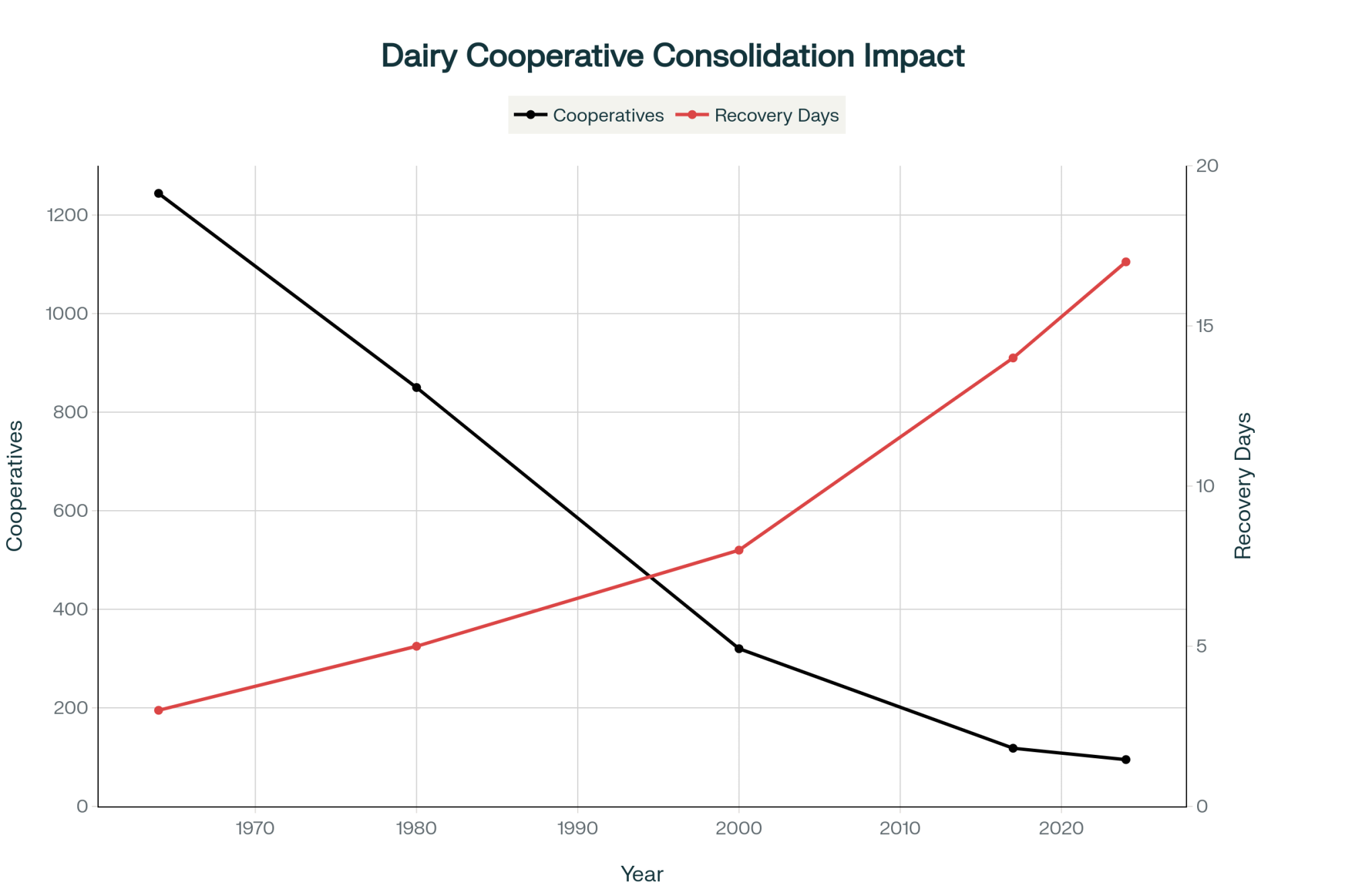
You probably recall when regional cooperatives were a common sight. Smaller operations, sure—but if one had problems, you had options within reasonable hauling distance.
The transformation has been striking. According to USDA Rural Development’s 2024 Agricultural Cooperative Statistics report, the number of dairy cooperatives decreased from 1,244 in 1964 to 118 by 2017. However, what really matters is that the Government Accountability Office’s 2020 dairy cooperative analysis (GAO-20-366) found that the top four now manage 41% of U.S. milk marketing.
Each consolidation made solid business sense at the time. Enhanced bargaining power with retailers. Processing efficiencies through scale. Better positioning in global markets. On paper, it all looked great.
Economists at Cornell and other universities keep finding the same pattern, though. What do we called inefficiencies? They were redundancies. And redundancies provide resilience when things go sideways.
The math tells an interesting story. With 1,244 cooperatives, one organization’s challenges might affect less than 0.1% of the milk supply. Today? When a major cooperative experiences problems, thousands of farms feel the impact simultaneously.
Understanding the Critical 72-Hour Cash Flow Window
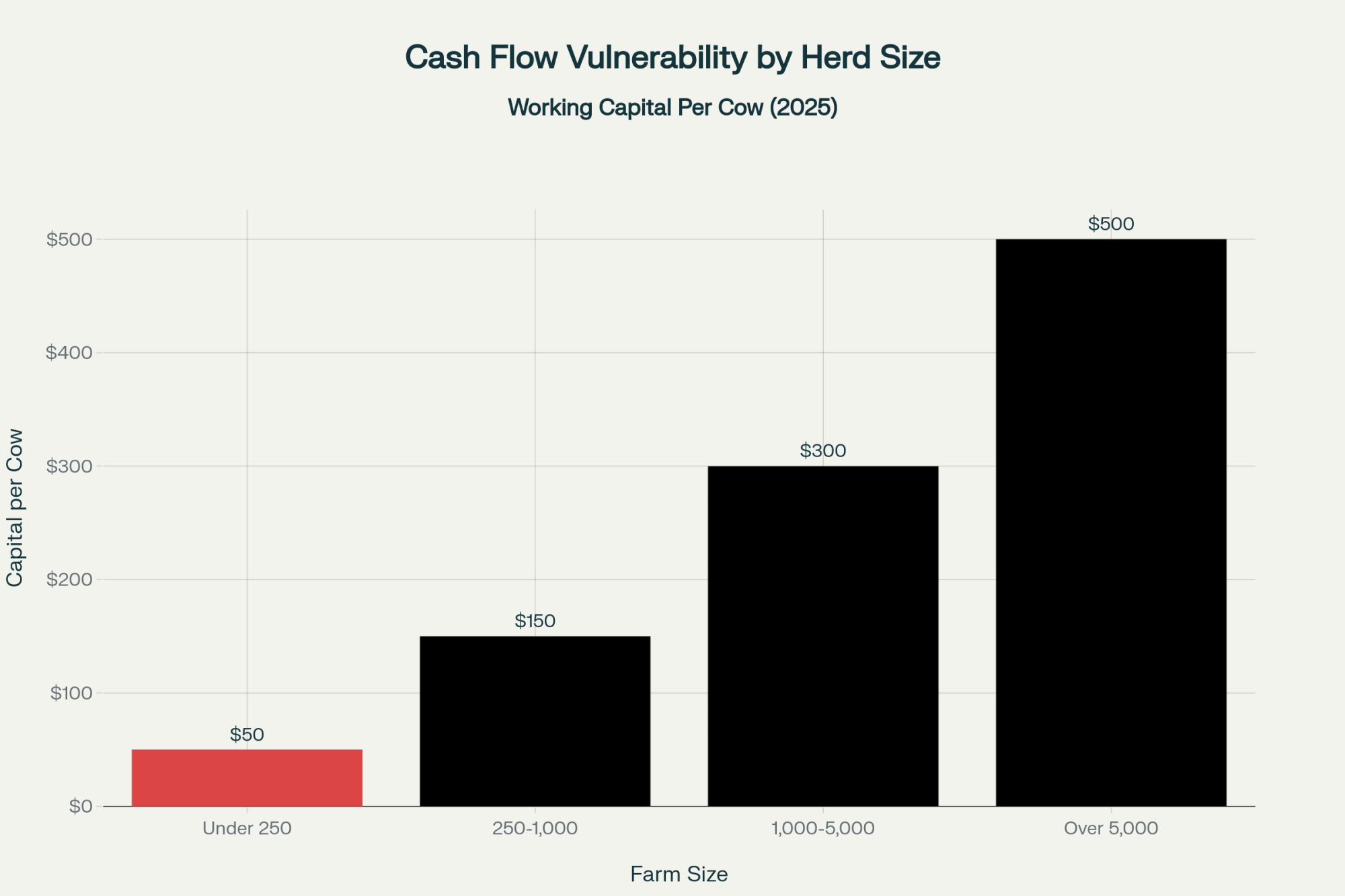
Farm Credit System advisors working with affected producers have identified what they call the “operational runway”—basically, how long you can continue to operate without incoming revenue.
“What surprises producers is how fast financial pressure compounds,” one advisor shared with me recently. “We’re typically looking at 72 hours before decisions become critical.”

Here’s the pattern I’ve seen repeatedly:
Day One: Checking systems, making calls, assuming things will normalize. Everyone stays relatively calm.
Day Two: Feed suppliers start asking about upcoming payments. Your banker expresses concern. Reality sets in.
72 Hours: You’re prioritizing payments. Which can wait? Which absolutely can’t? That’s when tough choices start.
Beyond That: Credit lines approach limits. You’re making operational adjustments—maybe delaying maintenance, adjusting feed quality, and making compromises that affect long-term productivity.
The USDA Economic Research Service’s 2025 Cost of Production data, combined with Farm Credit benchmarks, indicate that a typical 500-cow operation requires $14,000 to $18,000 per week for essentials. With most operations operating on 30- to 45-day payment cycles, even brief interruptions create significant pressure.
Protecting Your Own Farm’s Digital Infrastructure

Here’s something we need to talk about more—your farm’s own cybersecurity. While cooperative vulnerabilities grab headlines, many dairy operations are running sophisticated digital systems that also require protection.
A Vermont producer running 400 cows with robotic milkers learned this the hard way. “We had our parlor management system, feed monitoring software, and office computers all on the same network,” he explained. “When malware hit our office computer through a phishing email, it spread to everything.”
The fix wasn’t complicated, but it required planning. Working with their local IT consultant and following CISA’s agricultural cybersecurity guidelines, they:
Segmented their networks: The milking parlor runs on its own network, completely separate from the office systems. Feed monitoring has its own isolated connection. This way, if one system gets compromised, the others keep running.
Implemented Multi-Factor Authentication (MFA): Every system that touches financial data—from online banking to cooperative portals—now requires both a password and a code from their phone. According to Microsoft’s security research, MFA blocks 99.9% of automated attacks.
Created offline backups: Their herd management data gets backed up daily to an external drive that’s physically disconnected after each backup. Can’t encrypt what’s not connected.
Trained everyone: The biggest vulnerability? People. They now run quarterly training sessions—even for part-time milkers—on recognizing phishing attempts. One click on the wrong email attachment can compromise everything.
The total cost? About $3,500 for network segmentation hardware and initial setup, plus $150 monthly for managed firewall services. Compare that to losing access to your robotic milking data for even 48 hours.
International Perspectives: Learning from Canada
Here’s something encouraging. Lactanet in Canada faced a similar security challenge last year with markedly different outcomes. Most producers never knew because member services continued uninterrupted.
Their approach, documented in official incident reports filed with the Office of the Privacy Commissioner of Canada (PIPEDA filing 2024-05-15), involves investing over $150,000 annually in cybersecurity. Some board members initially questioned the expense until modeling showed potential downtime costs.
Their defense includes continuous monitoring, regular employee training (including simulated phishing attempts that redirect to educational content), and—crucially—triple-redundant backups with offline storage immune to remote encryption.
When unauthorized access occurred, their security team monitored the situation for three hours, gathering intelligence before terminating the access. Result? Two servers needed restoration. Member impact? None.
The lesson seems straightforward: prevention investment consistently costs less than incident recovery.
Navigating the Dairy Cooperative Insurance Coverage Gap
Agricultural insurance professionals from major carriers are observing something important that many producers don’t discover until they need it.
“There’s this assumption that business interruption insurance covers cooperative payment delays,” specialists explain. “Standard policies typically cover interruptions to YOUR operation, not your buyer’s systems.”
This distinction matters. If your farm’s systems get hit, coverage likely applies. When your cooperative’s payment infrastructure fails? Standard policies often provide no protection.
New products are filling this gap, though. Hartford Steam Boiler’s AgriRisk program includes coverage for supply chain disruptions. Based on 2025 agricultural insurance rate surveys from the American Farm Bureau Federation, premiums run $3,000 to $8,000 annually for meaningful protection on a 500-cow operation. Cowbell Cyber offers specialized agricultural policies; however, qualifying requires implementing security measures such as multi-factor authentication.
The products exist, but their cost leads many to accept the risk rather than pay premiums.
Regional Approaches to Building Milk Payment Security
What’s fascinating is seeing how different regions develop distinct strategies based on local conditions. And here’s something worth noting—robotic milking operations often have slightly different vulnerabilities, as their systems are already digitally integrated, making documentation easier but also creating additional cyber exposure points that require protection through network segmentation.
A Pennsylvania producer managing 750 cows shared his approach after witnessing neighbors’ struggles. “We keep 30 days of operating capital—roughly $72,000—in a completely separate credit union account,” he explained. The key? It’s not where his operating loans are held. He learned that from a neighbor whose bank exercised offset rights during payment delays.
His reserve-building strategy involves systematic culling. Those bottom-tier producers consuming 120 pounds of TMR daily while barely covering feed costs? “Converting them to cash reserves makes more sense than maintaining marginal production.”
Texas operations face different circumstances—drought pressures, longer hauls, and different processor options. Producers there often maintain multiple processor relationships as contingencies. Emergency pricing might drop to $14 per hundredweight, compared to the normal $19 blend prices, but that still beats disposal costs.
Florida’s specialty markets create unique opportunities. One producer converted 30% of their milk to A2A2 milk through direct specialty processor contracts in Miami. Managing dual production streams adds complexity but provides valuable optionality.
In my conversations with smaller operations—those milking under 200 cows—the challenges are even more acute. They often lack the volume to attract alternative buyers and the cash flow to support significant reserves. Several have formed informal cooperatives within the cooperatives, agreeing to provide short-term loans to one another during disruptions.
And here’s what’s interesting for organic producers: they often have slightly better backup options because organic processors actively seek suppliers, though the certification requirements mean you can’t just switch overnight.
Documentation: Building Your Defense Against Payment Disputes
A Central Valley producer shared an expensive lesson from several years back—losing $47,000 in arbitration over disputed deliveries.
“They claimed 15,000 pounds short over a month,” she recalled. “Their digital records versus my recollections didn’t end well.”
Her current system: triple documentation for every pickup. Digital entry with cloud backup. Duplicate paper logs, stored in a fireproof container. Smartphone photos of weight tickets to multiple cloud services.
Takes maybe three minutes per load. Since its implementation, it’s prevented two disputes from escalating.
“When databases face corruption or disputes arise, documentation becomes invaluable,” she notes. “Without proof of delivery, you’re negotiating from weakness.”
Market Structure: The Bigger Picture of Dairy Consolidation
Economists at Purdue and other universities have extensively studied the evolution of the dairy market, providing valuable context.
Their research, published in the Journal of Agricultural Economics and other peer-reviewed sources, consistently shows consolidation’s efficiency gains come with concentrated risk. We’ve optimized for normal operations—the 99% scenario—while potentially underestimating the need for preparation for disruptions.
Regional variations tell the story. Southeast operations, where smaller cooperatives like Maryland & Virginia (covering Virginia, Maryland, Delaware, and parts of Pennsylvania and North Carolina) maintain a presence, demonstrated greater flexibility during recent events. Alternative marketing options existed, albeit less favorable.
Contrast that with Upper Midwest dynamics, where mega-cooperative dominance leaves fewer alternatives when primary systems fail.
The vulnerability remains consistent whether you’re managing 100 cows or 10,000—dependence on payment systems beyond your control.
Global Lessons: Europe and New Zealand Cooperative Strategies
The 2017 NotPetya incident, which affected European food companies and resulted in confirmed global losses of $10 billion, according to White House economic assessments, prompted significant changes.
Industry reports and corporate disclosures suggest that companies like Arla Foods discovered that distributed processing creates resilience. They’ve structured operations so each country can function independently for up to two weeks if necessary.
New Zealand’s Fonterra adopted similar principles. Despite controlling most of the national milk supply, they’ve implemented regional segmentation, preventing localized issues from cascading nationally.
These examples offer valuable insights for considering our own system’s evolution.
Your Comprehensive Cybersecurity Action Plan
| Farm Size | Reserve/Cow ($) | Total Reserve | Days Covered | Priority |
| Under 250 cows | $300 | $75k | 15 | High |
| 250-1,000 cows | $250 | $156k | 12 | High |
| 1,000-5,000 cows | $200 | $500k | 10 | Medium |
| Over 5,000 cows | $150 | $1.12m | 8 | Low |
Based on successful producer experiences navigating recent challenges, here’s what’s working:
This Week’s Priorities
Calculate your actual runway without incoming revenue. Not estimates—documented expenses. If coverage falls below 14 days, urgent action is needed.
Review your entire cooperative agreement, particularly force majeure provisions. Several producers discovered contract language permitting temporary marketing after specified non-performance periods. This knowledge proved invaluable. Generally, it takes about two weeks to establish alternative buyer agreements, so knowing your options matters.
For your farm’s cybersecurity: Check if your parlor management system and office computers are on the same network. If yes, that’s your first vulnerability to address.
This Month’s Improvements
Establish reserves at an institution separate from operating lenders. Credit unions often work well—they understand agriculture while avoiding potential conflicts of interest. Begin with any amount. Even modest reserves provide options.
Implement comprehensive documentation. Yes, it requires discipline. But consider potential savings in dispute resolution.
Strengthen your farm’s digital defenses: Enable multi-factor authentication on all financial accounts and cooperative portals. Back up critical data offline daily. If you’re running robotic milking or automated feeding systems, consider obtaining quotes for network segmentation, which typically ranges from $2,000 to $ 4,000 for proper setup.
Explore alternative buyer relationships—not to switch, but understanding emergency options. A Georgia producer discovered a craft processor nearby paying premiums for documented grass-fed production during emergencies. Such relationships, while hopefully never needed, provide contingency planning.
This Quarter’s Strategic Positioning
Obtain cyber insurance quotes from agricultural specialists. The American Farm Bureau Federation is collaborating with carriers on improved agricultural products. Annual premiums might reach $5,000 to $10,000 based on current rates. Compare that to weeks without milk revenue.
Invest in farm-level security training: The USDA and CISA offer free agricultural cybersecurity resources through their websites. Schedule quarterly 30-minute sessions with all employees to recognize phishing attempts and follow security protocols.
Consider establishing or joining producer communication networks. Wisconsin groups have created informal systems sharing payment updates and providing mutual assistance. Combined volume creates leverage that individual operations lack.
Looking Forward: The Farm and Food Cybersecurity Act
Congress reintroduced the Farm and Food Cybersecurity Act in 2025 (S. 774 in the Senate, H.R. 1573 in the House), potentially mandating security standards for operations controlling a significant market share. The bill is currently in the House Agriculture Committee’s Subcommittee on Livestock, Dairy, and Poultry, with hearings expected this fall. Until legislation advances, protection remains voluntary mainly.
USDA and FBI agricultural specialists indicate these challenges will likely intensify. Agricultural cooperatives present attractive targets—processing substantial volumes, often operating legacy systems, and unable to afford extended downtime.
“While we can’t reverse industry consolidation,” a Wisconsin producer observed thoughtfully, “operational security is ultimately on us—both at the cooperative level and on our own farms.”
Following recent events, she’s established 45-day cash reserves, maintains triple documentation, developed relationships with two alternative buyers, and invested $4,500 in segregating her farm’s networks. A neighboring operation without preparations? They faced foreclosure when equipment loans defaulted during payment delays.
“Is this the most efficient approach? Probably not. Does it require time and resources? Absolutely,” she reflected. “But efficiency becomes irrelevant if you can’t survive disruption.”
The key insight isn’t that cooperatives have failed or that technology creates problems; rather, it is that cooperatives have failed to address these issues effectively. It’s recognizing that concentration inherently creates vulnerabilities, and preparing for those vulnerabilities—both at the cooperative and farm level—becomes each operation’s responsibility.
After all, feed deliveries continue regardless of payment system status. Tuesday morning arrives, regardless of whether checks are being processed or not.
KEY TAKEAWAYS
- Build your 30-day cash firewall now: Segregate $14,000-$18,000 per 100 cows in milk at a credit union separate from your operating lender—Pennsylvania producers who maintained these reserves continued operations through 17-day payment delays, while others defaulted on equipment loans
- Protect your farm’s digital infrastructure for under $4,000: Network segmentation between parlor management and office systems (roughly $3,500 setup) plus multi-factor authentication on all financial accounts blocks 99.9% of automated attacks according to Microsoft security research—one Vermont robotic dairy learned this after malware spread from their office to milking systems
- Document every load three ways starting tomorrow: Digital entry with cloud backup, duplicate paper logs (one fireproof), and smartphone photos of weight tickets—takes three minutes but saved a California producer $47,000 in disputed deliveries when cooperative databases corrupted
- Establish alternative buyer relationships before you need them: Georgia producers with craft processor connections maintained $14/cwt emergency pricing versus dumping milk, while Texas operations leveraging multiple processor relationships avoided complete shutdowns despite longer haul distances
- Know your cooperative contract’s force majeure provisions: Several Midwest producers discovered language permitting temporary marketing after 10-day non-performance periods, knowledge that proved invaluable when primary buyers couldn’t execute ACH transfers—generally takes two weeks to establish these agreements, so understanding your options now matters
This discussion draws on conversations with dairy producers nationwide and an analysis of agricultural cybersecurity developments, as documented by the FBI Internet Crime Complaint Center (IC3) reports and USDA sources. Producer experiences represent composite accounts from multiple operations, with identifying details modified to protect privacy while preserving operational accuracy. Financial benchmarks are derived from the USDA Economic Research Service’s 2025 data and Farm Credit System analysis. Insurance information reflects current carrier programs and American Farm Bureau Federation industry rate surveys as of October 2025. Cybersecurity recommendations align with the CISA’s guidance for the agricultural sector and Microsoft’s security research on the effectiveness of multi-factor authentication.
Complete references and supporting documentation are available upon request by contacting the editorial team at editor@thebullvine.com.
Learn More:
- Strategies to Boost Cash Flow on Your Dairy Farm – This tactical guide reveals methods for optimizing production, managing feed costs, and diversifying revenue streams to proactively build the cash reserves discussed in the main article. Readers will gain actionable financial strategies to strengthen their operational runway before a crisis hits.
- 2025 Dairy Market Reality Check: Why Everything You Think You Know About This Year’s Outlook is Wrong– This strategic analysis details policy volatility, component economics, and trade risks—the other external shocks that can compound cyber and payment disruptions. It provides a crucial, big-picture perspective on why multi-layered risk management is non-negotiable for modern dairy operations.
- Is Your Herd Safe? Cybersecurity Essentials for Modern Dairy Farms – Expand your farm’s defense beyond financial firewalls with this technical deep-dive. It provides a practical checklist for securing robotic milkers and herd management software and explains the specific vulnerabilities of connected devices, including the need for multi-factor authentication and offline backups.
 The Sunday Read Dairy Professionals Don’t Skip.
 The Sunday Read Dairy Professionals Don’t Skip.
Every week, thousands of producers, breeders, and industry insiders open Bullvine Weekly for genetics insights, market shifts, and profit strategies they won’t find anywhere else. One email. Five minutes. Smarter decisions all week.




