






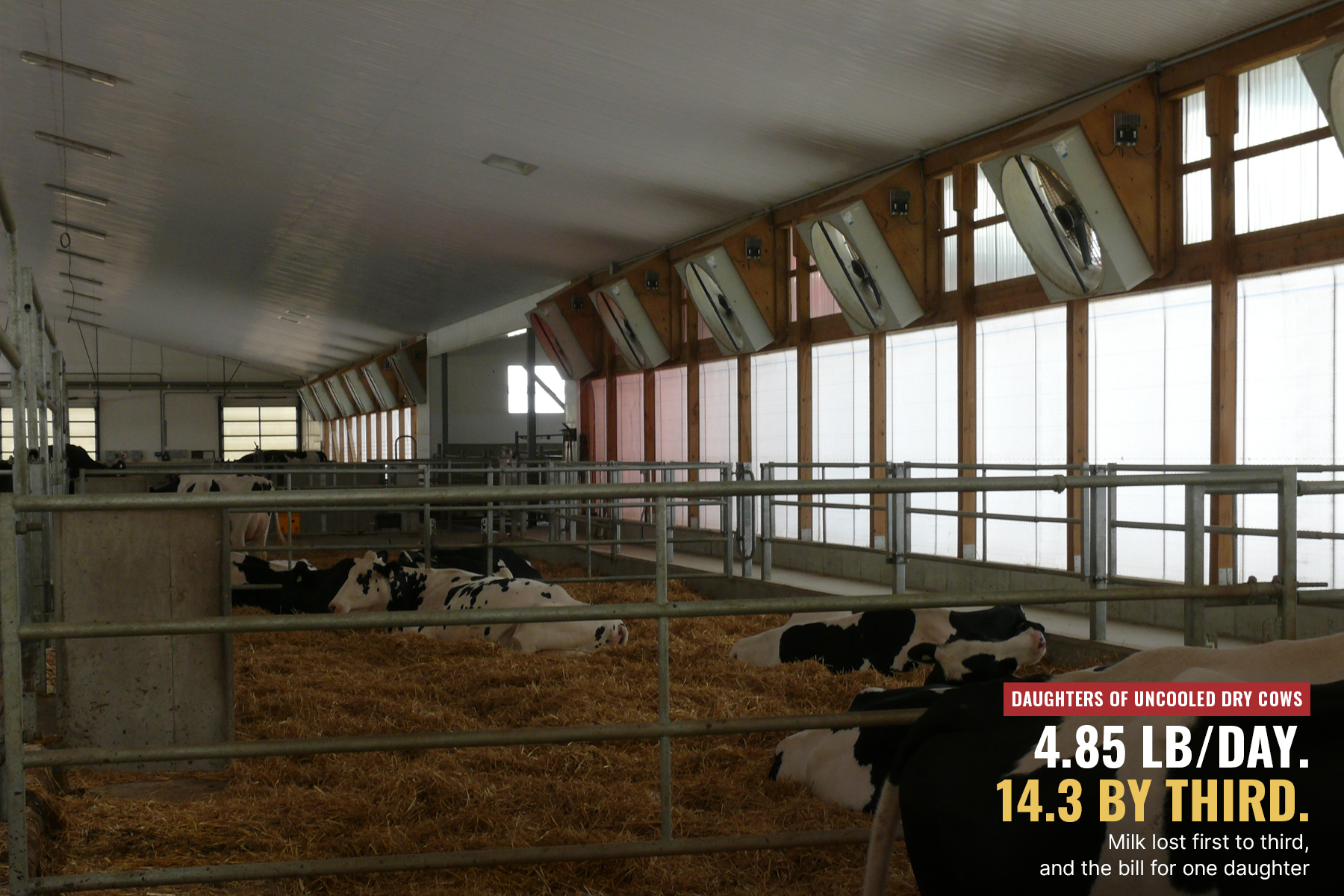
We printed 5–11 lb. The Florida data says 4.85 in first lactation and 14.3 by third. UF’s cooling spreadsheet doesn’t charge for that daughter. Its own factsheet does, and averages her away.
Executive Summary: Jimena Laporta’s 2020 Journal of Dairy Science analysis pooled 10 years of University of Florida dry cow trials. Daughters of shade-only dams gave 2.2 kg a day less milk in first lactation and 6.5 kg by third, and lived 11.7 months less. UF’s AN374 factsheet averages that loss to $39 per daughter per year nationally and $29 in Wisconsin. Bullvine priced one daughter who lasts three lactations: 5,941 lb over the 35 weeks measured in each, or $891 over feed. Wisconsin’s 75 heat-stress days already justify cooling on the dam alone. This piece also corrects seven entries in our own archive.
In April 2025, The Bullvine told readers that a heifer born to a heat-stressed dam gives 5 to 11 lb a day less milk in her first lactation. Our heifer heat stress tag page repeated it. Seven months later, “Concrete, Air, and Shade” ran the same range and credited it to Geoffrey Dahl’s studies. The 11 traces back to earlier, smaller trials, which found a first-lactation gap of 5.1 kg (11.2 lb) a day.
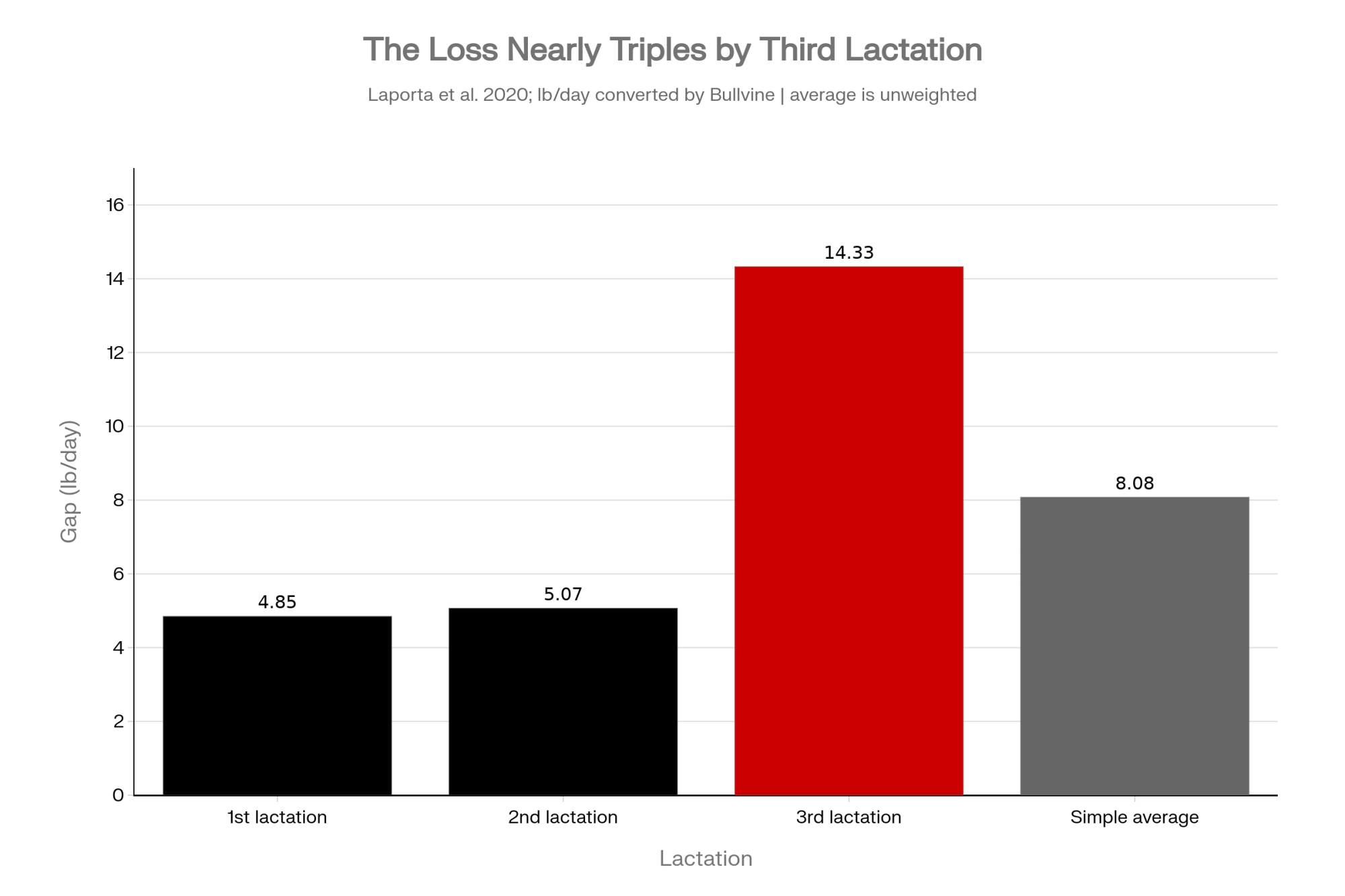
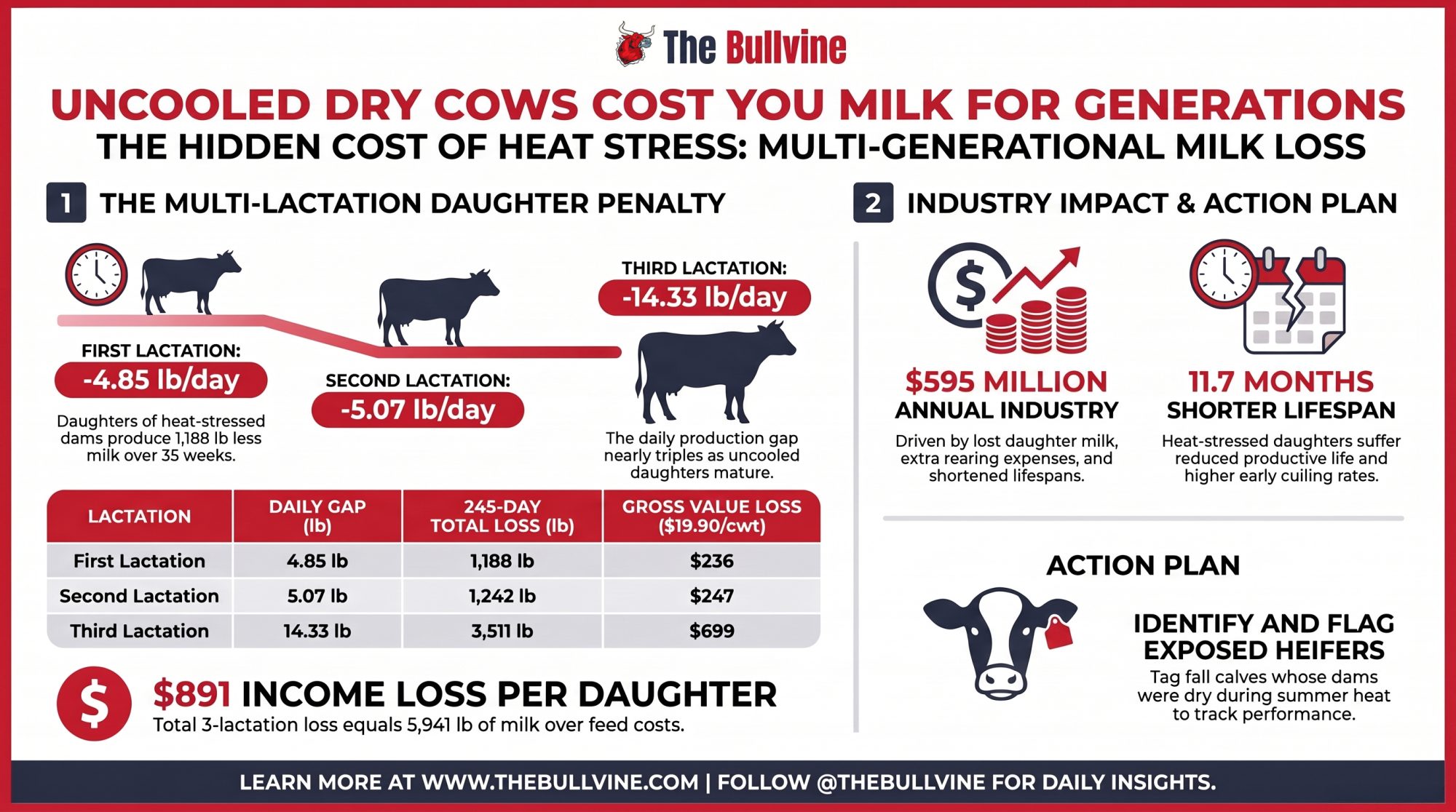
The bigger dataset doesn’t fit that range. Jimena Laporta, then a University of Florida scientist and now an associate professor at UW-Madison, pooled 10 years of Florida dry cow trials for a 2020 JDS paper. Dahl was a co-author. Daughters of uncooled dams gave 2.2 kg (4.85 lb) a day less in first lactation, and by third lactation the gap was 6.5 kg (14.3 lb). The bottom of our range was about right. The shape was wrong: the loss grows.
What the Florida data actually measured
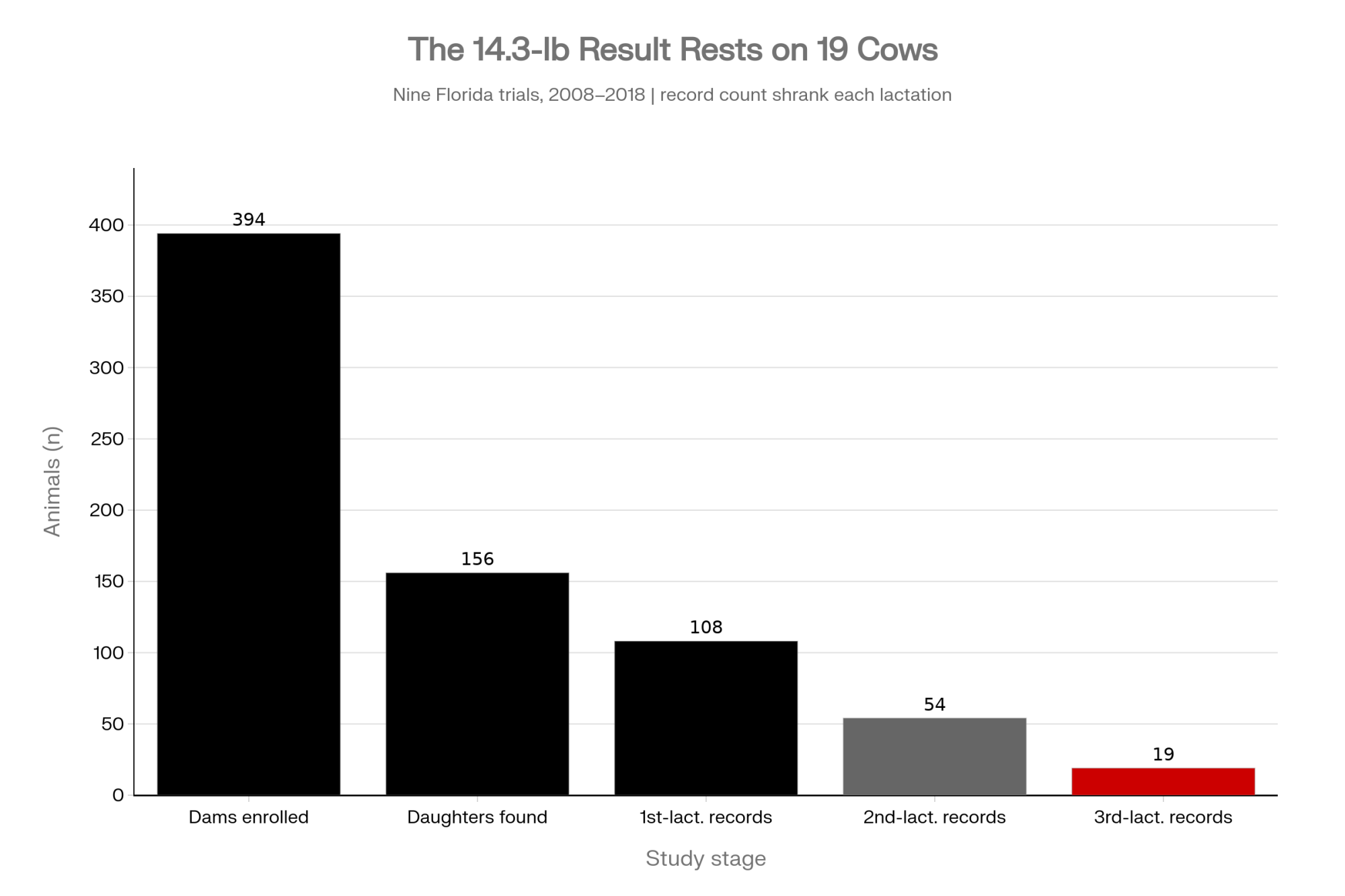
The 394 dams came from nine trials run between 2008 and 2018. Each trial covered the last 46 days of gestation, the whole dry period. The 196 cooled dams got the shade of a freestall barn, fans, and soakers; the 198 heat-stressed dams got shade only. Records came back on 77 daughters of cooled dams and 79 daughters of heat-stressed dams. Every daughter was actively cooled through her first three lactations. The sires behind the two groups had similar PTA Milk (591 vs 551 kg, P = 0.58). So the gap opened before she was born, and it wasn’t the bull.
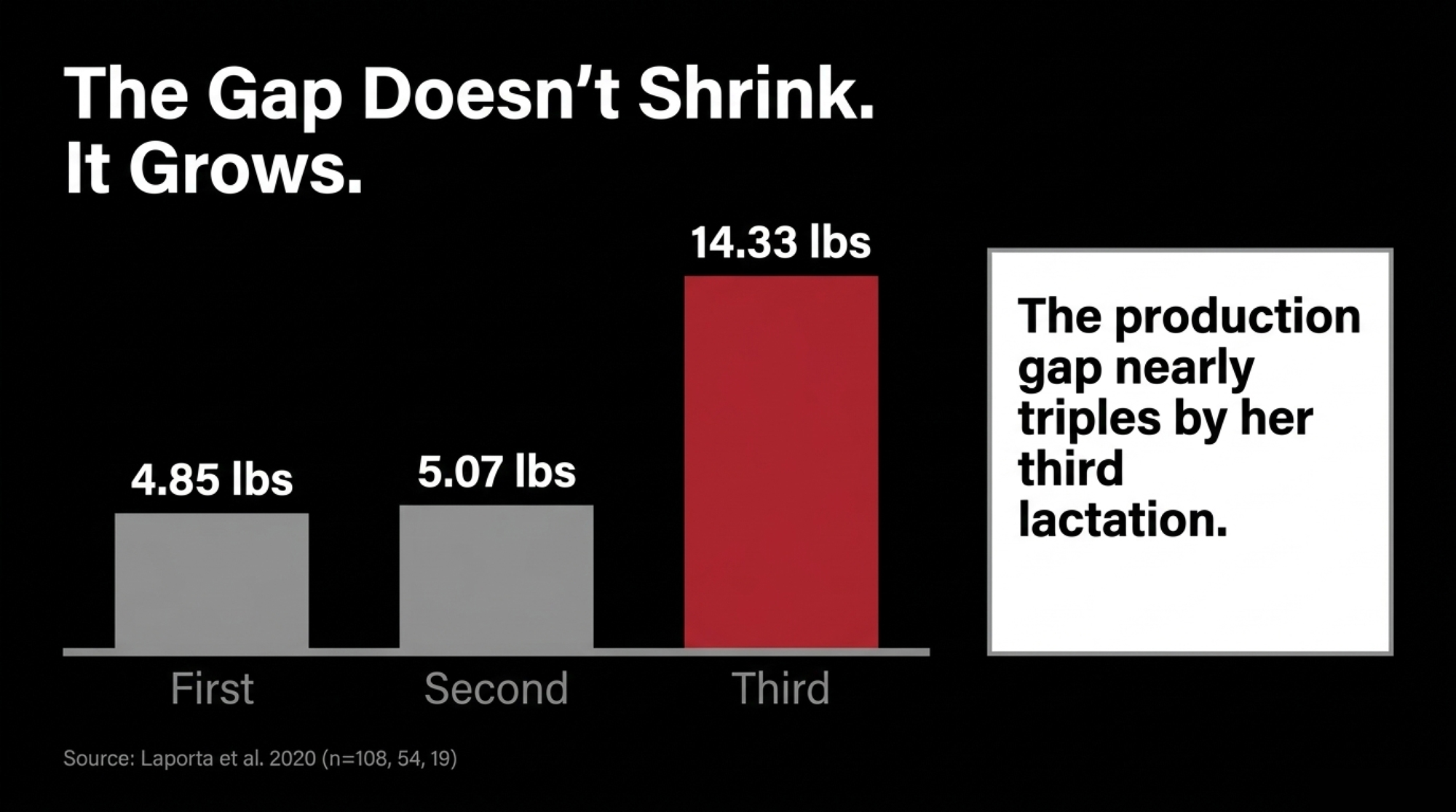
| Lactation | Daily gap, kg (Laporta et al. 2020) | Daily gap, lb (Bullvine conversion) | Daughters with milk records, both groups |
| First | 2.2 | 4.85 | 108 |
| Second | 2.3 | 5.07 | 54 |
| Third | 6.5 | 14.33 | 19 |
Milk was measured with in-parlor meters up to 35 weeks in milk. All three gaps were statistically significant. But the third-lactation figure rests on 19 cows, and fewer of the heat-stressed group lasted that long. Read 14.3 lb as the direction of the effect, not a number to bank.
Fewer of these heifers reach the parlor.
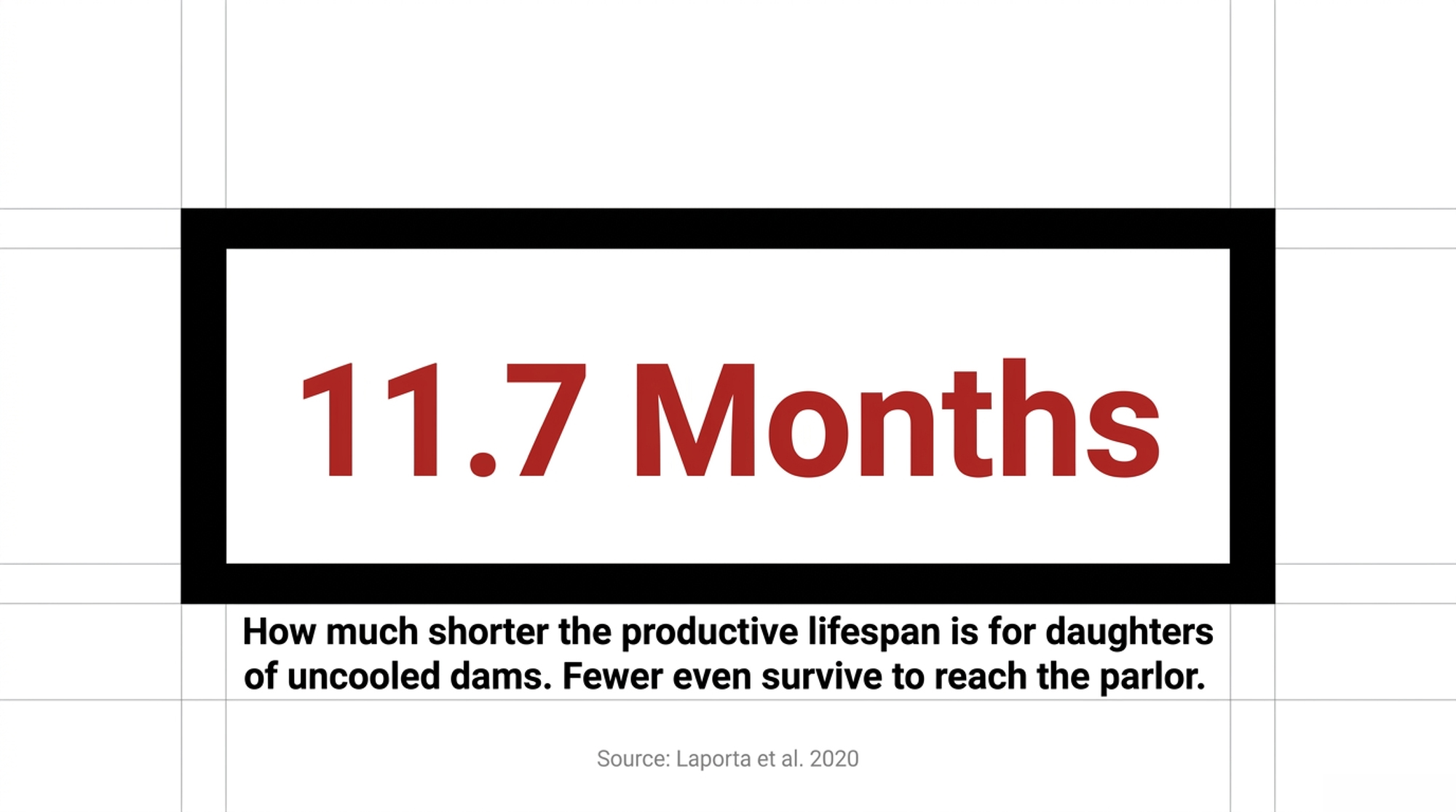
Of the heat-stressed daughters, 71% survived to first calving, against 82% of the cooled daughters. That’s a statistical trend (P = 0.09), not a firm difference, but the paper still prices it at $157.49 extra to rear each heifer. The ones that calved had a productive life of 20.9 months against 25.8. Their lifespan was 356 days shorter, which is 11.7 months. The earlier trials found these heifers were smaller at calving and gave 5.1 kg a day less in first lactation, despite similar age and weight at calving.
Do they handle heat better or worse as adults? The research doesn’t agree. In a 2017 study, cows heat-stressed in the womb sweated less and ran lower rectal temperatures under heat, and the authors read that as better heat tolerance. Davidson and colleagues’ 2022 JDS heifer study found the opposite: higher rectal temperatures and higher sweating rates. Don’t bank on these heifers coping either better or worse.
What does one daughter cost?
UF has already put a number on her. AN374 (Casarotto, Laporta and Dahl, 2021) averages the daughters’ lost milk to $39 per daughter per year nationally and $29 per cow in Wisconsin. It uses $0.20/lb milk and $0.15/lb income over feed. That’s a herd average. It spreads the loss across every cow and every year, weighted by heat-stress days and by how many cows are in each lactation. It can’t tell you what one exposed heifer costs if she stays, so we priced her.
Bullvine calculation
- Published evidence: daily gaps of 2.2, 2.3 and 6.5 kg across three lactations, measured to 35 weeks in milk (Laporta et al. 2020).
- Assumptions:
- 245 days per lactation, which is the 35 weeks actually measured. The paper’s own economic model ran 340-day lactations.
- Milk at $19.90/cwt, USDA’s 2026 all-milk forecast from the September 10, 2026 WASDE.
- Income over feed at $0.15/lb, the rate used in both Laporta 2020 and AN374.
- 2.2046 lb per kg.
- Values aren’t discounted.
- Bullvine math:
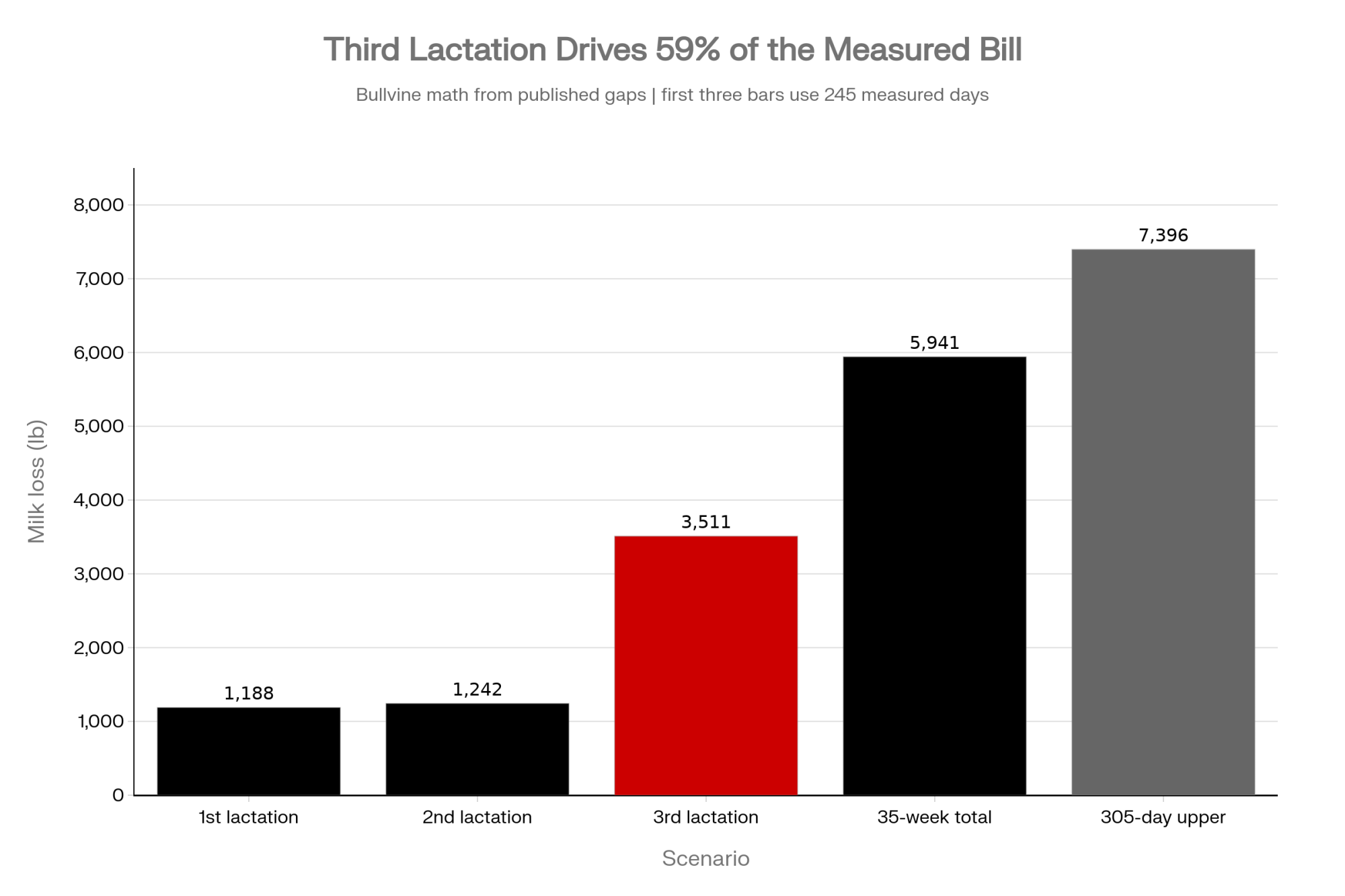
| Lactation | lb/day | lb over 245 days | Gross value at $19.90/cwt |
| First | 4.85 | 1,188 | $236 |
| Second | 5.07 | 1,242 | $247 |
| Third | 14.33 | 3,511 | $699 |
| Total | 5,941 | $1,182 |
Four limits apply:
- It’s gross milk value. At $0.15/lb income over feed, the same 5,941 lb is worth $891.
- It’s a survivor’s bill. It applies only to a daughter who completes three lactations, and fewer of these daughters do. Nearly half the total sits on the 19-cow third-lactation figure.
- The 305-day figure is an upper bound. If the gaps held to 305 days, the bill would rise to 7,396 lb: $1,472 gross, or $1,109 over feed. Nobody measured past week 35.
- It leaves out costs the paper prices separately: extra rearing and lost productive life.
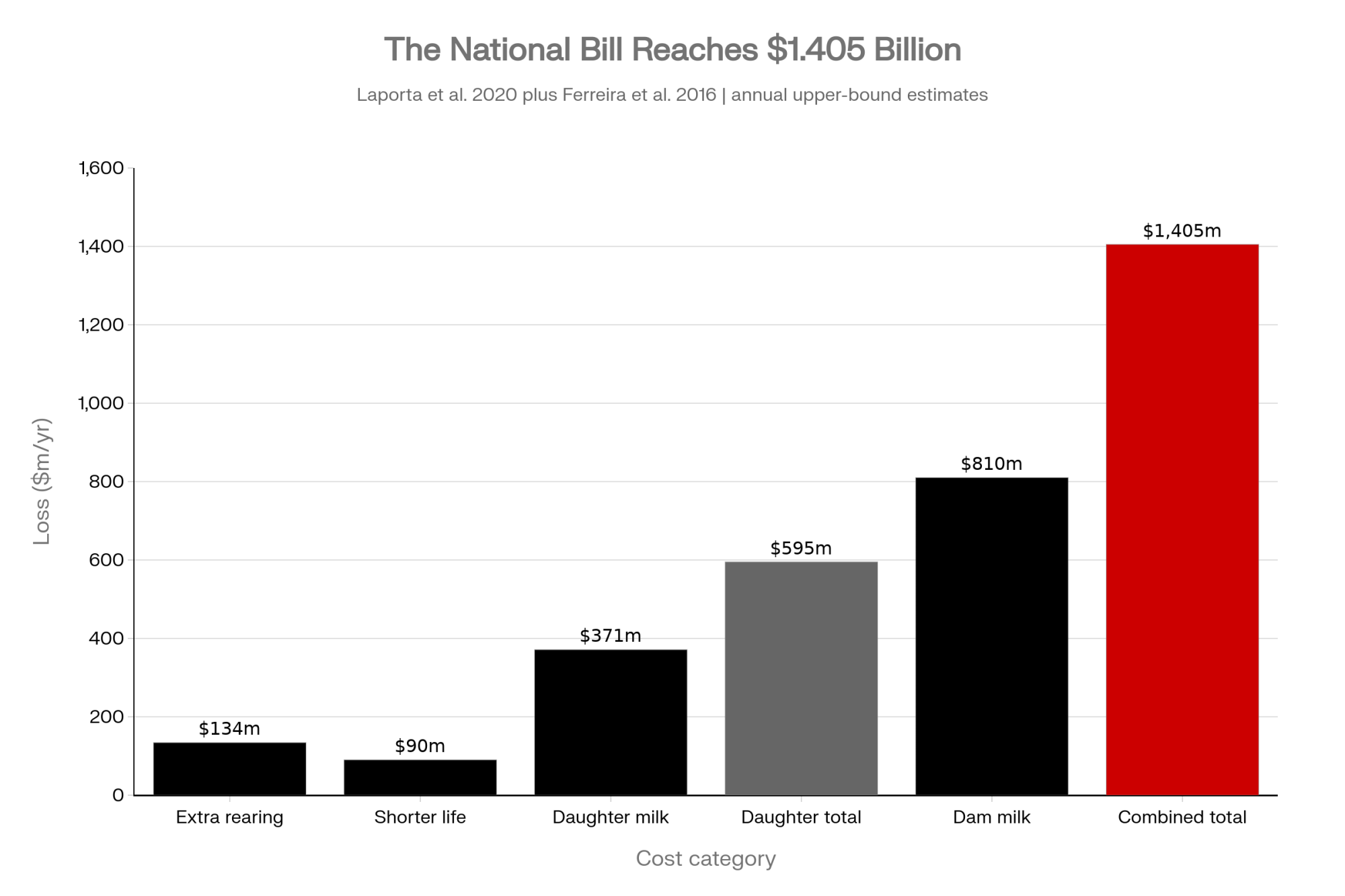
Nationally, the paper puts the yearly cost of these daughters at $595 million: $134 million in extra heifer rearing, $90 million in lost productive life and $371 million in lost milk. Add Ferreira and colleagues’ 2016 estimate of $810 million a year in the dams’ own lost milk, and the paper reaches $1.405 billion. The authors call their figures an upper bound, because they assume no U.S. dry cow is cooled.
Why the dry cow spreadsheet comes up short
UF/IFAS’s AN342 spreadsheet charges 10.3 lb of next-lactation milk and $0.91 for every heat-stress day a dry cow spends uncooled. At the U.S. average of 96 heat-stress days, AN342 finds that building a new cooled dry cow barn:
- returns an NPV of $22.50 per cow;
- pays back in 5.67 years;
- has a benefit-cost ratio of 1.45;
- is profitable for 89% of U.S. cows.
Is dry cow cooling worth it if you already have the barn?
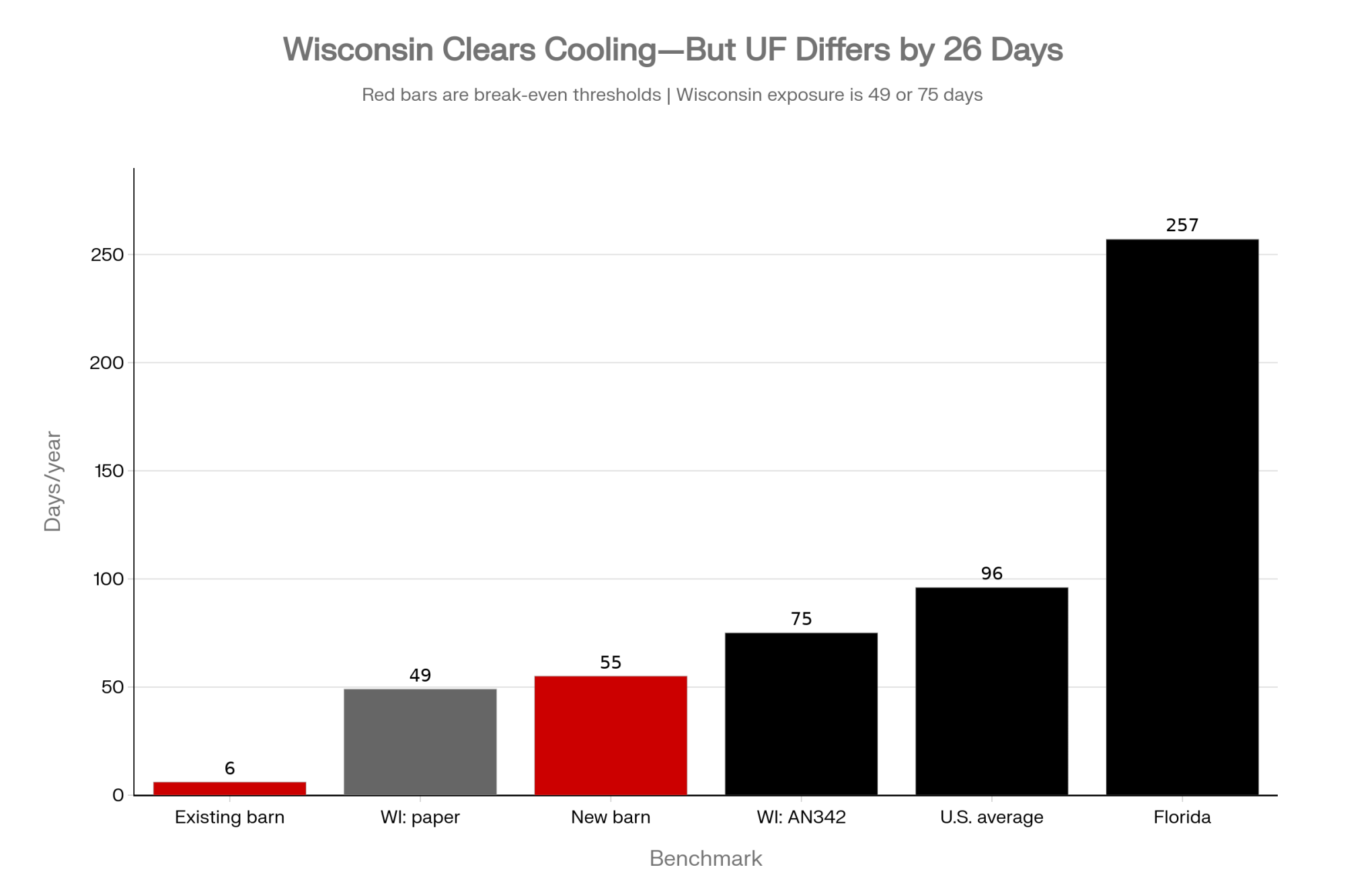
Yes, and fast. Ferreira’s 2016 model puts payback at 0.27 years for adding cooling to an existing barn, with a benefit-cost ratio of 3.15. That setup turns a positive NPV at just 6 heat-stress days a year; a new barn needs 55.
Every one of those numbers is the dam’s. AN342 credits Wisconsin with 75 heat-stress days, which clears both thresholds. That works out to 773 lb of next-lactation milk lost per uncooled dam. Ferreira’s model books it as $68 a cow a year in lost profit. At the same $0.15/lb income over feed we used for the daughter, those 773 lb are worth $116.
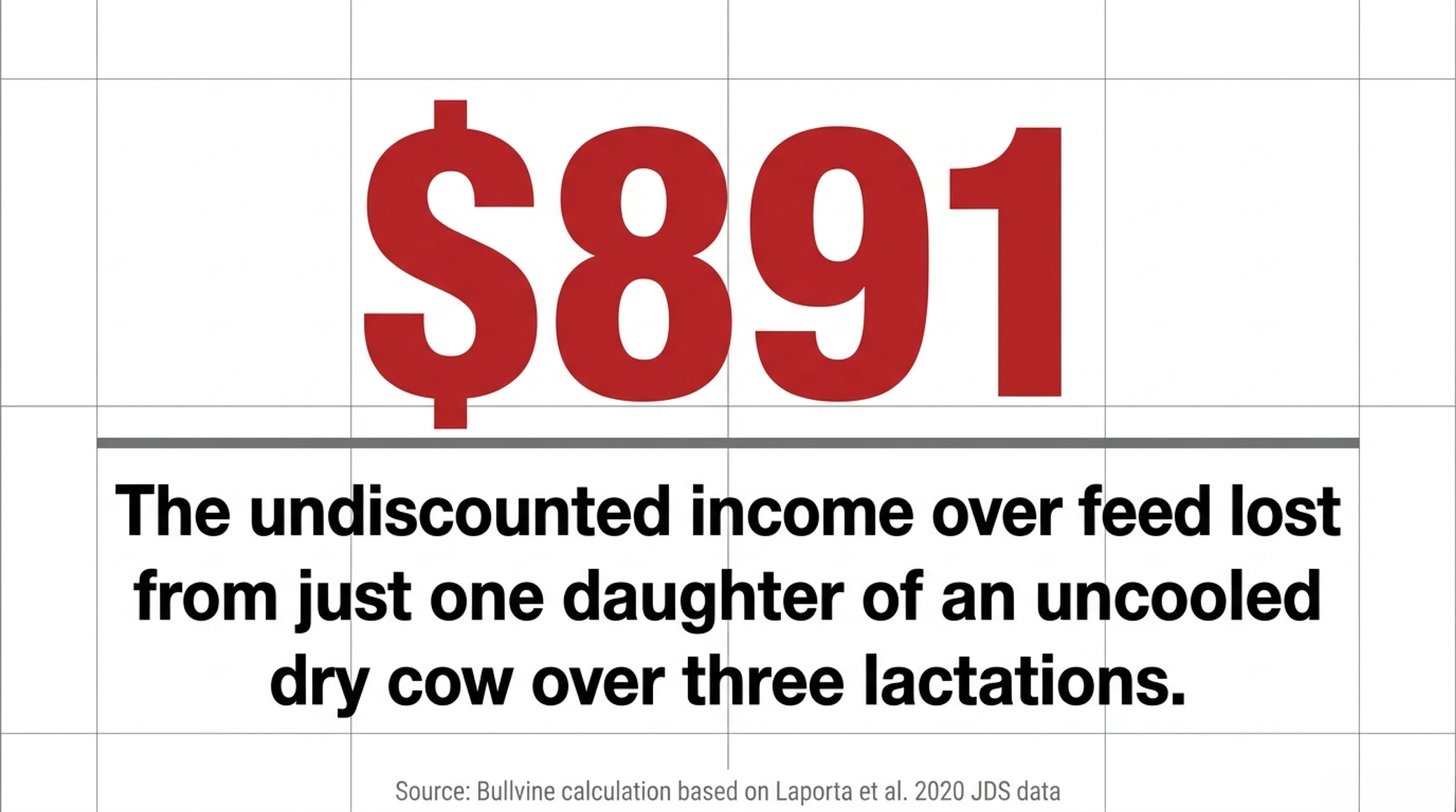
If she’s carrying a heifer calf, AN342 never charges for her. AN374 does, at $29 per Wisconsin cow per year as a herd average. Our survivor’s bill comes to $891 over feed across her three lactations, undiscounted, if she makes it that far.
The two UF models don’t agree on Wisconsin, either. AN342 counts 75 heat-stress days. The Laporta paper’s own state table, which feeds AN374’s $29, lists 49. At 49 days, Wisconsin still clears the 6-day threshold for an existing barn, but falls short of the 55 a new barn needs. That’s exactly where the daughter’s bill would tip the decision.
Don’t stack the daughter’s bill straight on top of AN342’s per-day figure, though. The pooled analysis tested one exposure level: the whole 46-day dry period. A Wisconsin cow dry in July sees a fraction of that. Laporta’s team has started Wisconsin work on shorter, milder exposure, and she told Dairy Herd in July 2026 that early results already show first-lactation milk differences. None of it is published yet. Until it is, treat AN342’s answer as the minimum case for cooling.
Does the loss reach the granddaughter?
Laporta moved her program to UW-Madison in 2020 and brought cattle from Florida. The trial heifers arrived in December 2020.
The 2020 paper tracked 45 granddaughters: 24 from the cooled line and 21 from the heat-stressed line. First-lactation milk records came from 23 of them, just 7 on the heat-stressed side, and showed a 1.3 kg (2.9 lb) daily gap. That’s the only granddaughter milk figure the paper tested statistically.
Second and third lactations are descriptive only: 8.0 kg (17.6 lb) and 4.9 kg (10.8 lb) a day less, from 11 and 4 animals. UF’s AN374 factsheet carries those two numbers without the sample sizes. Survival to puberty tended to be lower in the heat-stressed line (62% vs 88%, P = 0.08). Lifespan was 14.5 months shorter, which wasn’t significant.
The lab has since reported skin and hair changes in granddaughters. In great-granddaughters, a later study found fewer, smaller sebaceous glands but no change in hair coat. Laporta says production data for great-granddaughters is still limited.
Can methionine do what the fans didn’t?
Adisseo and UW-Madison ran a 60-cow trial in three groups: thermoneutral cows, heat-stressed cows, and heat-stressed cows fed supplemental methionine. Dairy Herd reported in July 2026 that daughters of the methionine-fed dams gave roughly 300 lb more first-lactation milk than daughters of unsupplemented heat-stressed dams. We haven’t found that 300 lb in a peer-reviewed paper. Guadagnin and colleagues’ August 2026 JDS paper on rumen-protected methionine in heat-stressed pregnant Holsteins reports growth and blood markers, not daughter milk.
Set 300 lb against the pooled data’s 1,188-lb first-lactation gap, but don’t net them; they’re different cows and different trials. In the same interview, Laporta’s group put the first-lactation loss at “about 2,000 pounds,” well above what the 2020 pooled data supports over 35 weeks. Her bottom line didn’t hedge: “We 100% need to continue cooling cows.”
When a rep brings this research to your kitchen table, ask three things: was there a cooled comparison group, does it report milk, and is the milk number peer-reviewed?
Correcting our own archive
These Bullvine pages carry figures that don’t match the primary sources. Each one gets corrected the day this piece runs.
| Bullvine page | What it says | What the primary data says |
| “Heat Stress in Heifers: The Profit-Killer You’re Ignoring” (Apr 13, 2025), and the dairy heifer heat stress tag page | 5–11 lb/d in first lactation; daughters “culled 5–12 months earlier” | 4.85 lb/d in first lactation, rising to 14.3 by third; 4.9 months less productive life and an 11.7-month shorter lifespan |
| “Concrete, Air, and Shade” (Nov 11, 2025) | 5–11 lb/d, credited to Dahl’s studies | 4.85 lb/d in first lactation, from Laporta et al. 2020, with Dahl a co-author |
| “The $1,200 Heifer Paradox” (Mar 27, 2025), as excerpted on the heat stress in dairy cows tag page | “Approximately 5 pounds less milk per day, on average, during their first three lactations”; “5 lbs/day across three generations of offspring” | 4.85, 5.07 and 14.33 lb/d by lactation; three-lactation average about 8 lb/d.* Three lactations are one generation. The granddaughter gap was tested for first lactation only: 1.3 kg/d, with 7 heat-stressed animals |
| Heat stress economic impact tag page | National cost shown as “5 million annually” | $595 million a year |
| “The Silent Inheritance,” as excerpted on the Milk Production and Cow Comfort tag pages | $1,200–1,800 “per animal across multiple generations,” with no source shown | Bullvine math: $1,182 gross for one daughter’s three 35-week lactations ($1,472 if the gap ran 305 days). That’s one generation. Granddaughter figures beyond first lactation come from 11 and 4 animals, untested |
| “Cornell Found the 3 kg/Day Heat Stress Leak…” (Apr 3, 2026), and the heat stress in dairy cows, dairy profitability and Nutrition pages that excerpt it | “Daughters of heat-stressed dry cows (n=198)” vs “daughters of cooled dry cows (n=196)”; national cost “5 million/year” | 198 and 196 were the dams; the daughters were 79 and 77. National cost: $595 million a year |
| “Dry cow cooling: the $87 loss you never book” (Jul 15, 2026) | Lead author “Jacobo Laporta” | Jimena Laporta |
*Bullvine calculation: simple average of the three published lactation gaps, (4.85 + 5.07 + 14.33) ÷ 3 = 8.08 lb/d. Not a figure reported in the paper. Archive audit run October 7, 2026, against live pages.
What This Means for Your Operation
- Flag your exposed heifers before this fall’s calvings close out. Pull every heifer born to a dam that was dry during the summer 2026 heat, and mark her in your records.
- Count your own heat-stress days the way AN342 does: average daily THI of 68 or higher. Then run the spreadsheet at your own milk and feed prices. With an existing barn, the break-even is 6 days.
- Read AN342’s answer as the minimum. If cooling pencils out on the dam alone, a heifer calf only adds to it. If it doesn’t, the daughter’s bill is what tips it.
- Check the dam before you blame the sire. In the Florida data, the sires were matched on PTA Milk, and the gap still showed up. When a first-calf heifer milks below her genomic projection, find out whether her dam was dry in the heat.
- Ask three questions of any additive pitched off this research: was there a cooled comparison group, does it measure milk, and is that milk number peer-reviewed?
Key Takeaways
- If you’re still quoting “5–11 lb,” replace it with the lactation-by-lactation numbers: 4.85, 5.07 and 14.33 lb/d. The third rests on 19 cows.
- AN342 prices the dam only, and AN374 averages the daughter down to $29 per Wisconsin cow per year. One daughter who completes three lactations costs about 5,941 lb on Bullvine math: $1,182 gross, or $891 over feed, undiscounted.
- If your dry pen sees only part-summer heat, don’t plug in the Florida daughter numbers whole. Laporta’s Wisconsin work on shorter exposure is under way, but not yet published.
- The 300 lb methionine result comes from one 60-cow industry-partnered trial and isn’t in peer review that we can find. Cooling comes first.
- If someone quotes granddaughter losses beyond first lactation, ask about the sample size. It’s 11 animals in second lactation and 4 in third, with no statistical tests.

Heifers born this fall to dams that went dry in the summer 2026 heat won’t reach third lactation until around 2030. That’s when the biggest piece of their bill comes due. Can you name which of this fall’s heifers came out of an uncooled dry pen? If you can’t, that’s the first record to start keeping.
Learn More
- Dry cow cooling: the $87 loss you never book — Calculates the precise ROI for adding soakers to an existing dry pen versus pouring concrete for a new barn. Reveals how as few as six heat-stress days a year justify a retrofit to capture the dam’s lost milk.
- Concrete, Air, and Shade: The Real Drivers Behind Milk Yield — Maps the structural design failures that cap herd performance regardless of genetic merit. Dismantles outdated ventilation math to show exactly how targeted airflow and stall dimensions drive higher facility margins over the next five years.
- Cornell Found the 3 kg/Day Heat Stress Leak Your Fans Were Never Going to Fix — Exposes the invisible microclimates stalling production even when the barn thermostat says you are safe. Follows the money on localized humidity pockets blocking heat dissipation, equipping you with the exact sensor protocols needed to spot the leak.




