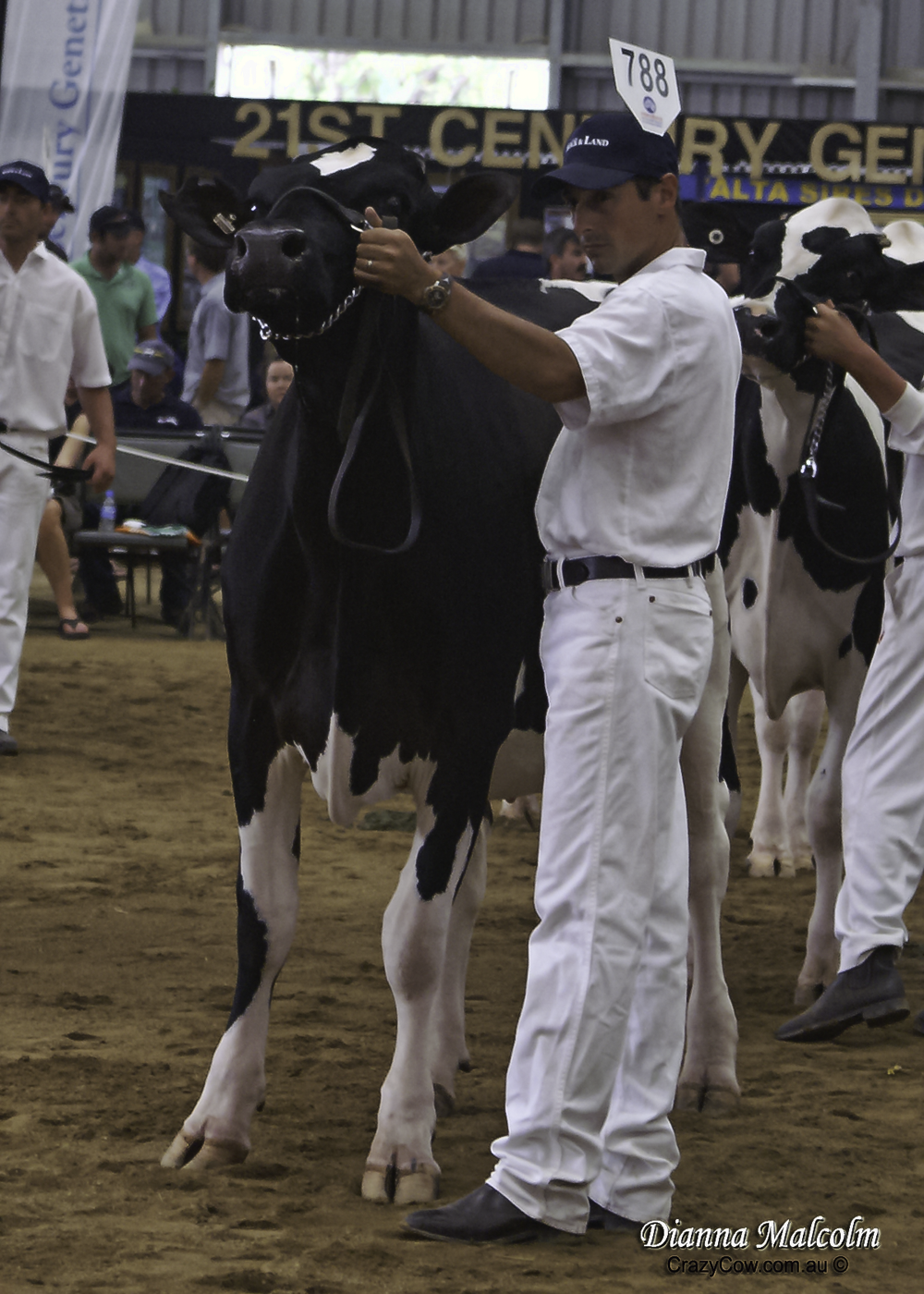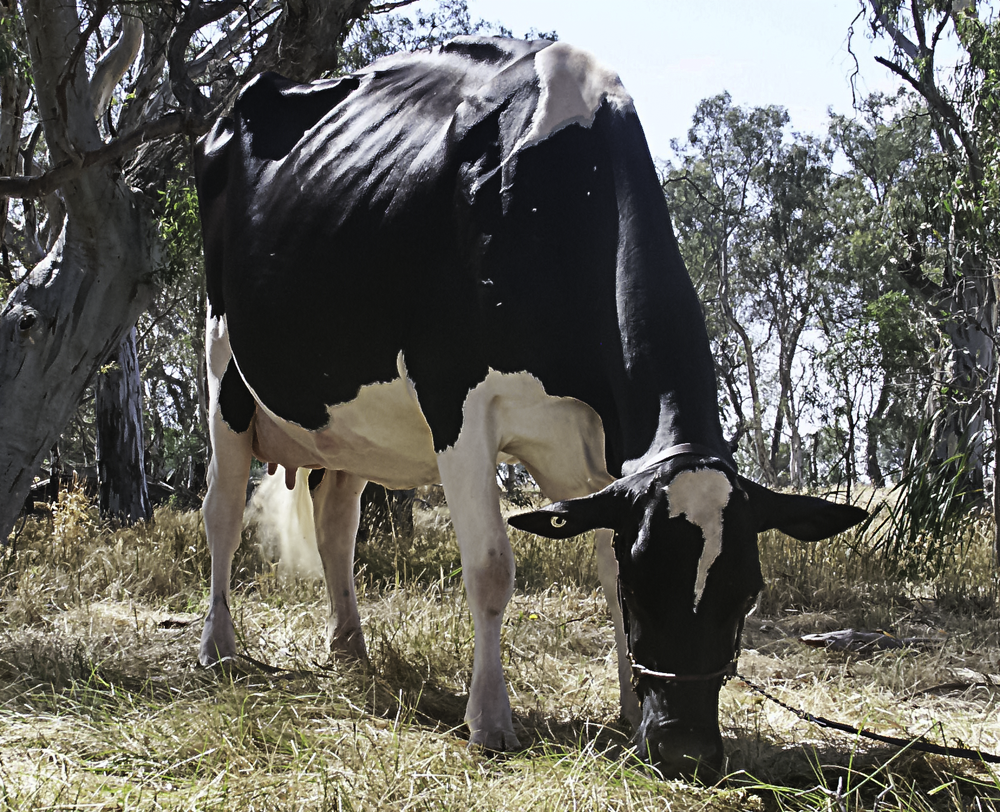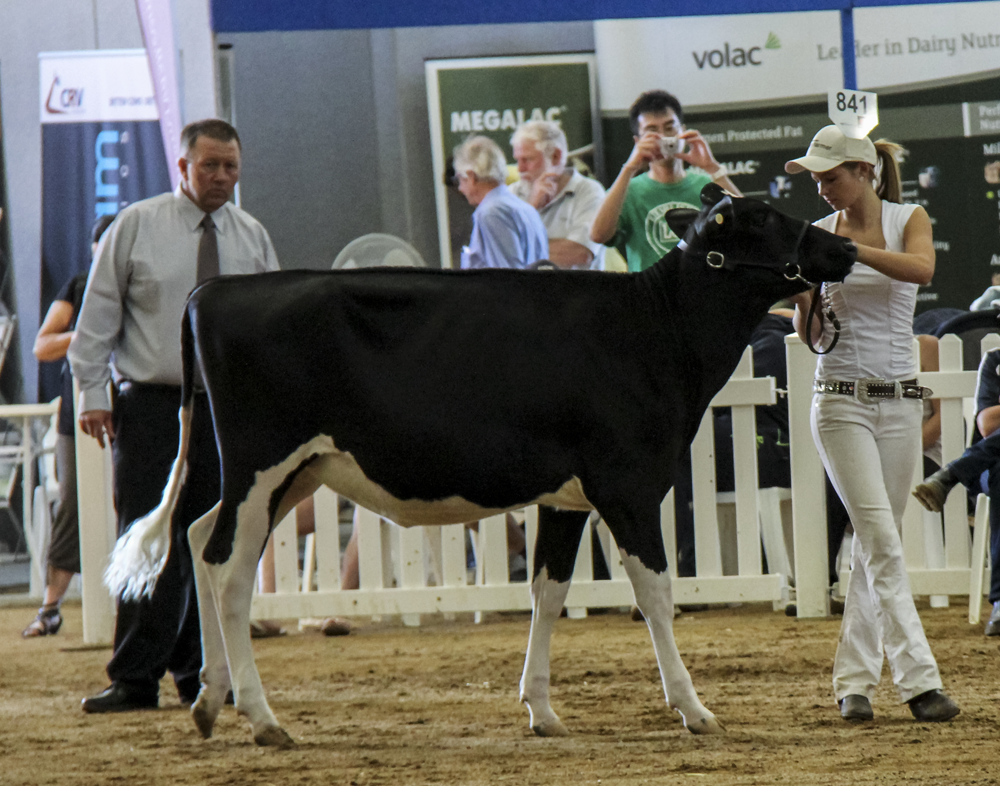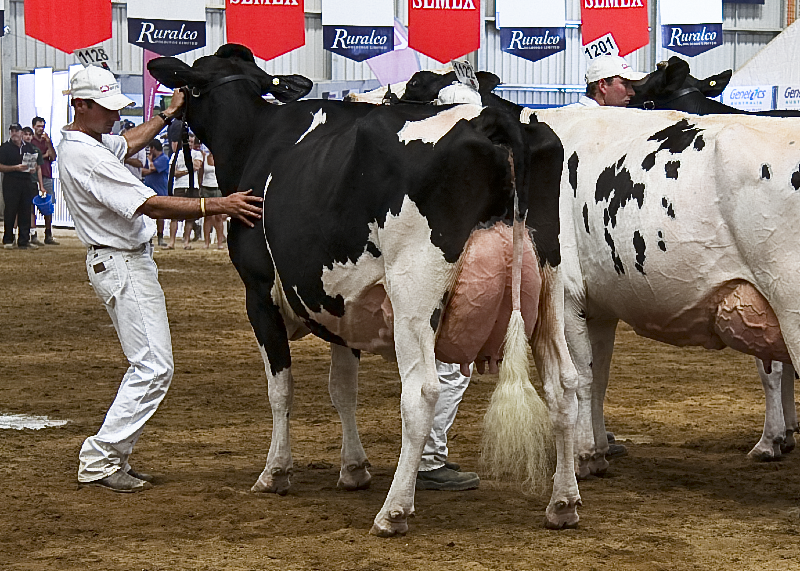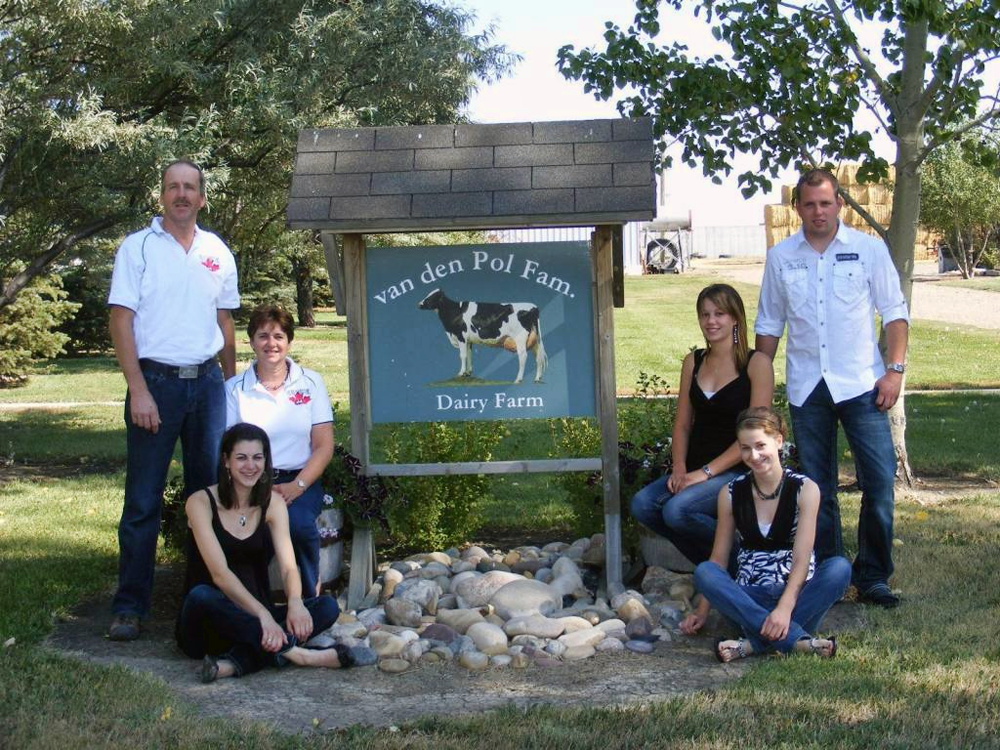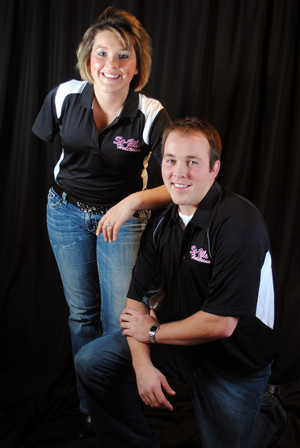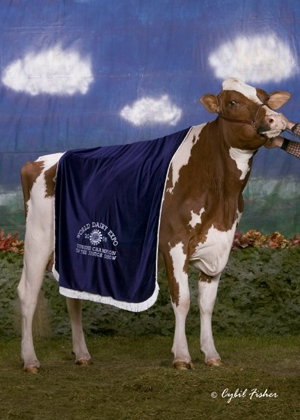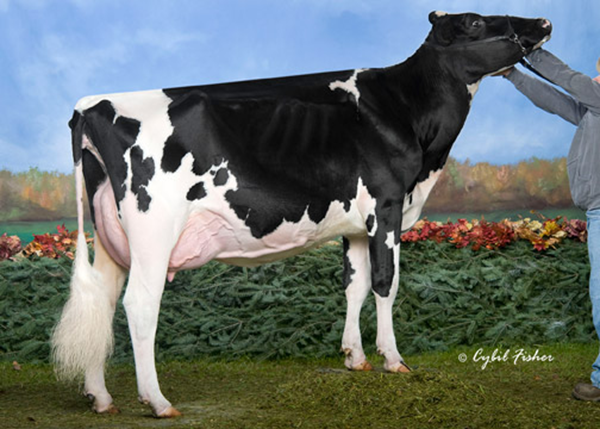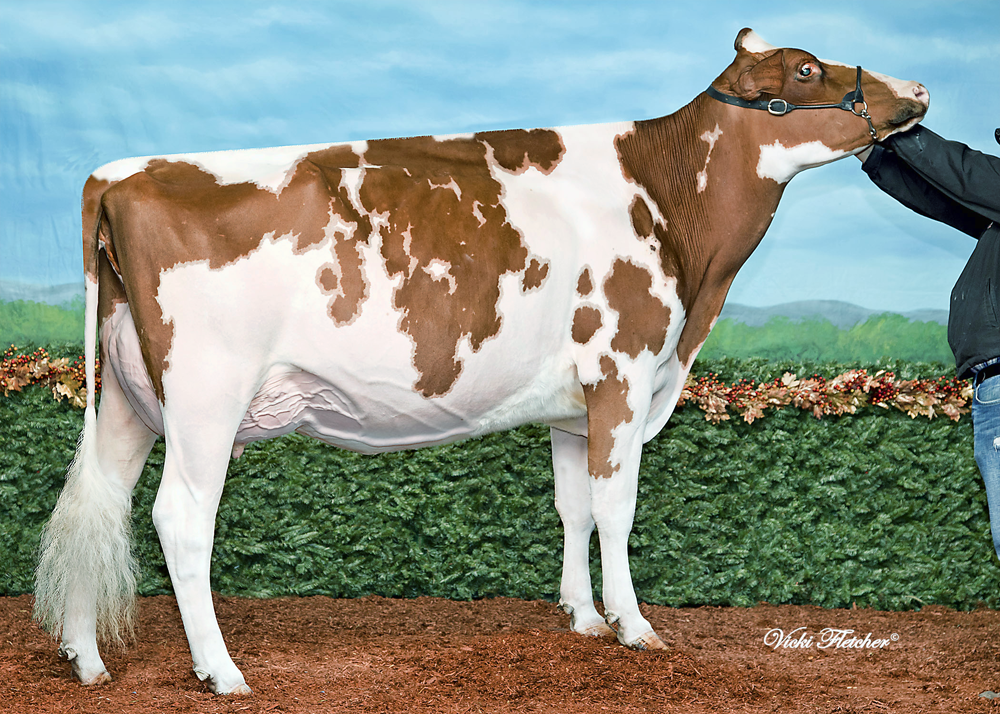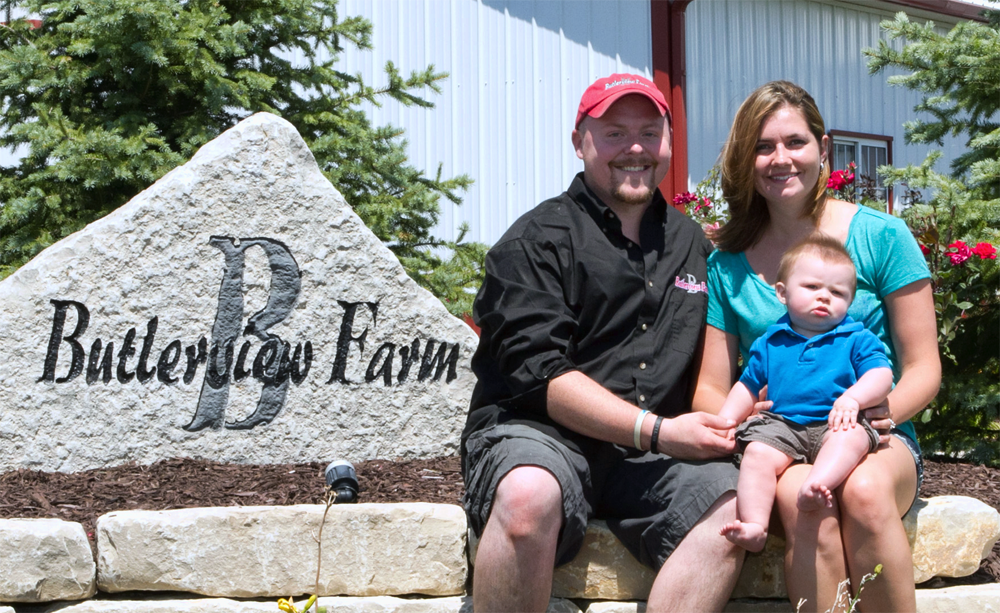

Today the average North American is three generations removed from a farm. Food is still being provided even though the numbers would suggest that dairy farmers themselves are going missing. Both husband Murray and I represent the fourth generation to live on the family dairy farm, which puts us among the 2 percent who still live on farms. Although each succeeding generation has spent more time working off the farm, all three of our children are in agricultural careers in A.I., nutrition and ag marketing.
In the modern marketplace milk and the dairy industry are misjudged and misunderstood. (Read more: How got milk? Became got lost?) Those of us who remain are concerned about what happens to the milk they produce between the time it leaves the farm lane and takes up shelf space in the dairy aisle. This formerly “perfect food” is marked by a hit and miss journey that has many more misses than hits. Targeted by misconceptions, misinformation, and communication is it any wonder that there are days when both sides feel that dairy pride could be presumed missing?
MIStaken Identity
Every one of us who grew up with a farmer as a role model is astonished today at the metamorphosis from “Farmer in the Dell” to “The Farmer is the Devil”. However on the farmer side of the fence, we too shouldn’t jump to the conclusion that the consumer is “the Big Bad Wolf.” ready to huff and puff and blow our dairy world down. None of these images fully portrays the real strengths, challenges and fears facing 21st Century farmers and their customers.
MISunderstood
It’s extremely difficult to understand how some of the public perceives farmers as “MOST WANTED!” for abuses against our own animals. The immediate question arises, “How can anyone imagine that people who work daily with livestock don’t care about the animals?” It would seem to be a no-brainer that only the best possible care allows animal handlers to survive and thrive on the farm. Having said that, neither are financial reasons the main motivation. “You do it because you love the animals. Otherwise why would you be up before sunrise and making final rounds after sunset day in and day out?” You wouldn’t.
MISlabeled
Over time, fewer and fewer find the rewards that are commensurate with the commitment and dedication that dairying demands. For those who do have the desire, farming methods have become more efficient. Technology has contributed to the sustainability. Automated equipment, robotic milkers and GPS tractors are just a few of the tools that keep efficiency growing. As in any other industry, investing in new technology requires that the business, in this case the farm, must get bigger. In responding to the challenges, it is frustrating to be labeled with the implied derogatory term, “Factory Farmers.” The truth is 98% of farms are family owned (what other business can claim that) and the goal is, as it has always been, to provide food …. for everyone. Not selfish. Not criminal.
MISjudged
It’s ironic in this day and age of mass production, mega stores and IMAX that big farms are judged to be bad. It’s hypocritical to accept the growth of computer assembled cars and think that food producers can remain at a static size. There was a time when one famer fed five. Everyone respected their hard work. Today one farmer feeds 200 and it seems like everything from motives, to ethics to animal husbandry is being questioned. Is there any other profession, where the consuming public insists on reverting to the past? If you’re reading this, you are using a computer. How many channels are available on your TV? Is your transportation provided by a “mom-and-pop” car shop? Do you drink your water from a pump in your yard or do you reach for a plastic bottle?
MISconceptions
As an industry we need to accept responsibility for debunking myths that have taken hold in consumer understanding. Jude Capper, assistant professor of dairy science at Washington State University spoke at the Alltech Symposium. “Organic dairy farming certainly has a very favorable consumer perception. But, productivity on the typical organic dairy farm is lower than conventional farms – anywhere from 14 to 45 percent lower in terms of milk yield per cow.” she said. “What that means is that more cows are needed in the organic systems, along with more natural resources, to make the same amount of milk as the conventional systems. And, that increases the carbon footprint per pound of milk.” Since 1944 the carbon footprint per pound of milk has been reduced by 63%. Dairy farmers have made major progress and it is something they should be proud to declare and share.
MISinformation
For whatever reason – perhaps because of their agrarian forefathers – people feel quite comfortable assuming their expertise about modern farming. Where they might tread lightly in pronouncing how factories should be managed yet there are many “activists” who can speak against modern agricultural practices. Genetically modified organisms deepen the divide between farmers and consumers. GMOs are crops that have been scientifically altered to enhance the plant’s quality and resistance to elements and pesticides. In a national survey 64 percent of people said they were unsure if eating GMOs was safe. It is time for the dairy producer to stand proudly behind the products we produce, eat, drink and serve to ourselves and our children.
MIScommunication
Farmers and consumers too often have an “us against you” mentality, which the media intensifies by focusing on negative instances that can colour the entire industry. More consumers are asking questions about where their food comes from and about farming in general. That’s great. Just asking questions is the best way for the public to learn about farming. Asking and getting an answer is the only way to bridge the gap between emotional finger pointing and mutual thumbs up!
MISSing the Opportunity
The time is long past, where we can rely on our good intentions to spread the good word to the consuming public. It’s time to proactively take whatever role we are most comfortable with. Rather than witness a loss in dairy and consumer confidence – I would rather stand on my soapbox, share great stories, teach what I believe in, and raise my voice at every opportunity. It’s time to be the “change I wish to see!”
The Bullvine Bottom Line
It’s not easy being on the receiving end of blame. However whether producer or consumer it’s in our best interest to make sure that there are voices, from both sides, speaking with pride, about the products we produce and eat!
We all love good cows. We also admire good cattle breeders. When you find a good story teller to add to that mix, you have met Charlie McEvoy of Marathon, New York. Whether you are a member of his family, a friend or a fellow cattle enthusiast, Charlie is one of those good people that inspires everyone who knows him to sing his praises. Of course, he is far too modest to agree but quite simply states, “I’ve been driven by my love of cattle and the thrill of breeding the next generation.”
A Holstein Family Man
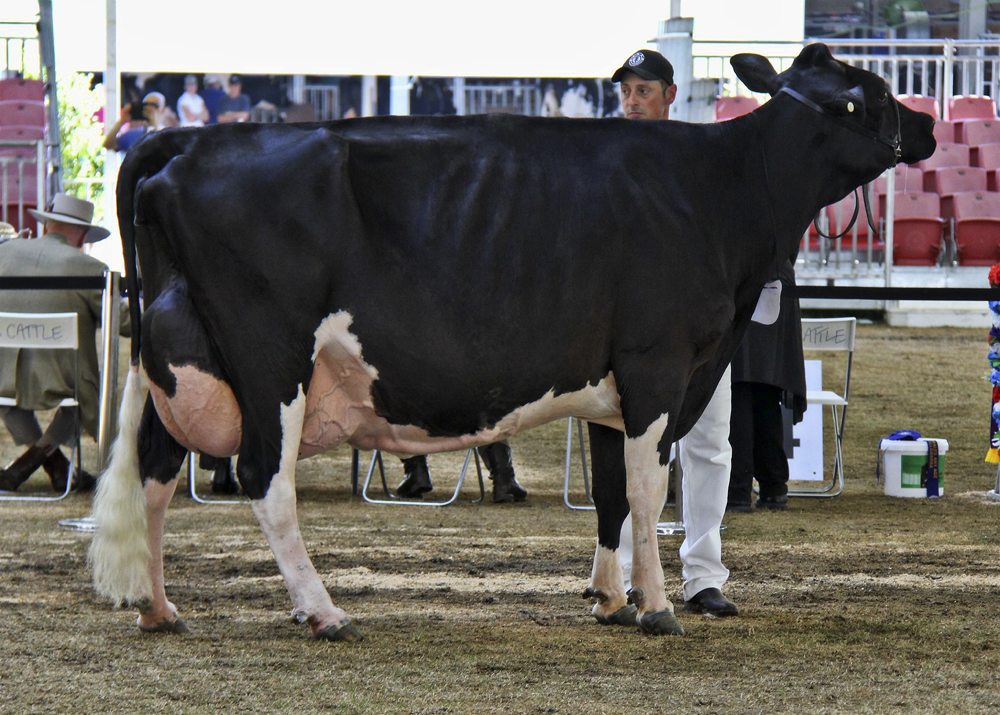
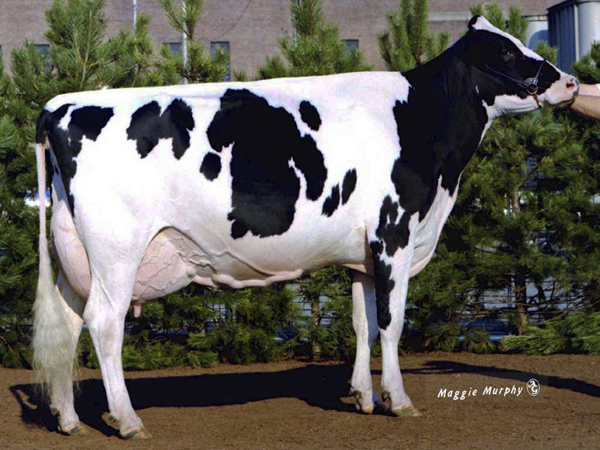
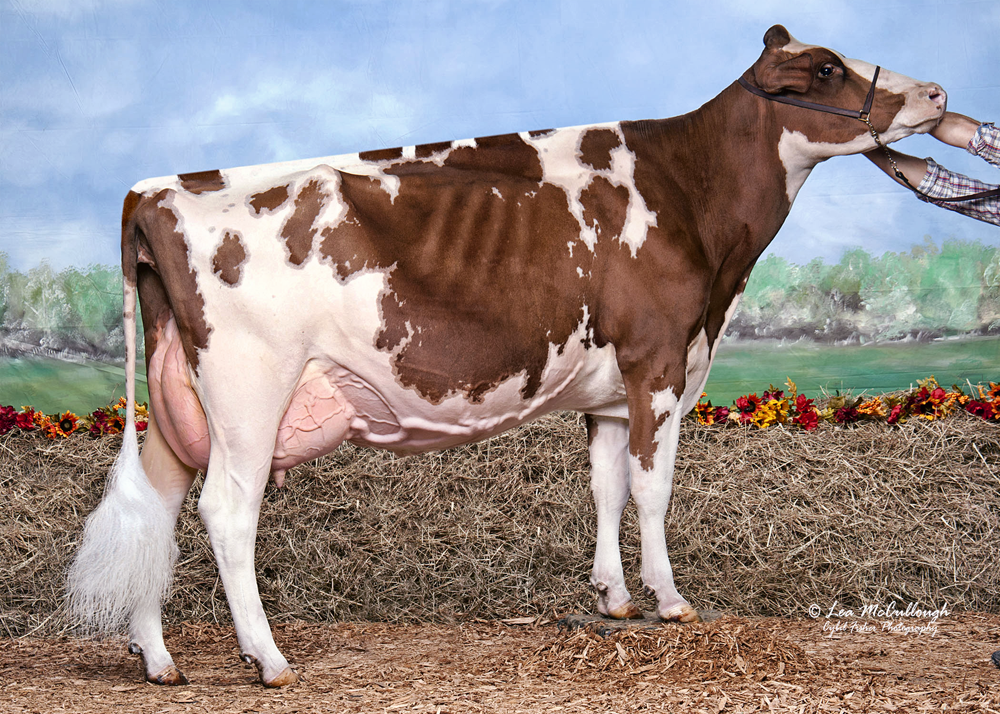
Busholm Eclip Ken Milkshake EX-95. She is owned by McEvoy’s, VanSkiver, McGarr and Green
Family means a lot to Charlie McEvoy. In 1951 his parents established Mac-Mara Holsteins in Marathon, New York. Charlie was 16 years old at the time. His father Ken played an important mentorship role in Charlie’s life. He was a farmer and also sheriff of Cortland County for 27 years. “Dad was my good friend, partner in the farm and a man that who was respected by everyone he met.” Sixty-two years later Charlie is now the respected role model. He continues his love for registered Holsteins as 2013 President for the New York Holstein Association. He has served on many boards and committees and always encourages the next generation.
There are many reasons for Charlie to be proud of his legacy but he is quick to proclaim what he feels to be his finest achievement. “Caroline and I have raised eight children that are great kids and fantastic parents for our 18 grandchildren.” Today Charlie is in partnership on the farm with his youngest son, Ken and his wife Lydia. The other seven are professionally employed in their chosen careers: engineer, lab tech, accounting , sales, town high employee, retired cooperative extension agent. They are all proud of their agricultural roots and the sons still find time to show and help at the farm. On the cow side his herd reached 113.1 BAA in 2008. Great achievements in family and in the barn.
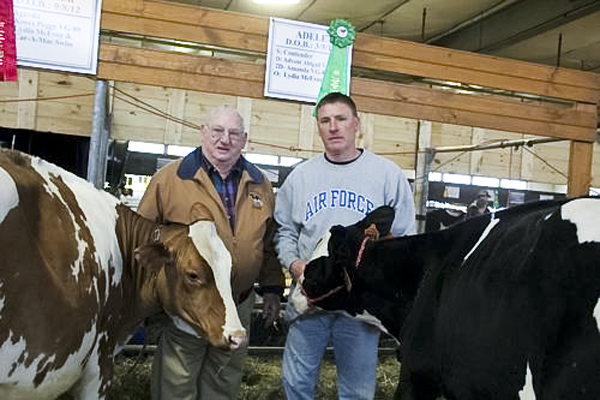
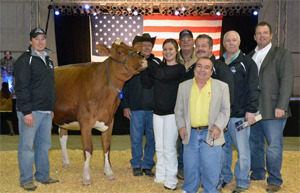
Charlie McEvoy is a standard fixture at many dairy shows. He has been actively exhibiting at every New York Spring Dairy Carousel since its origin. Pictured here with his son Donny.
The Rail McEvoy
It was in the early 1950s when McEvoy met Henry Thomas, a nationally known cattleman who Charlie felt, along with Casey Sly, “were the first great cowmen I got to work with.” During those days, Charlie traveled across the country by railway to shows in Columbus, Chicago, Waterloo, and points farther west. He tells the story. “My first trip on the box car was when I was 14 years old with McDonald Guernsey Farm going to the National Dairy Congress in Waterloo. It was the first trip of many. In the box car each cow or bull had their own stall. We would brush them regularly and their tails were washed daily. We would put 8 mature cows and 4 younger head on a box car. Over the top of them we would build a deck that housed hay, feed, water and our cots. It took about 5 days to get from Cortland to Waterloo. We would load the cows in the morning and let them get comfortable and acclimated to the car. At night the engine would come to take us to Binghamton to meet more show herds and head west. We’d stop in Buffalo to add more cars and head to Chicago where we’d spend a day getting rearranged to go to Waterloo. Once at Waterloo a tack truck would meet us to haul our show gear and we would lead the cows to the fairgrounds about a quarter mile away. During the ride on the box car we lived on cheese, crackers, sardines and beans.” Those grand kids are going to hear good stories!
Charlie Has A Way With Cows
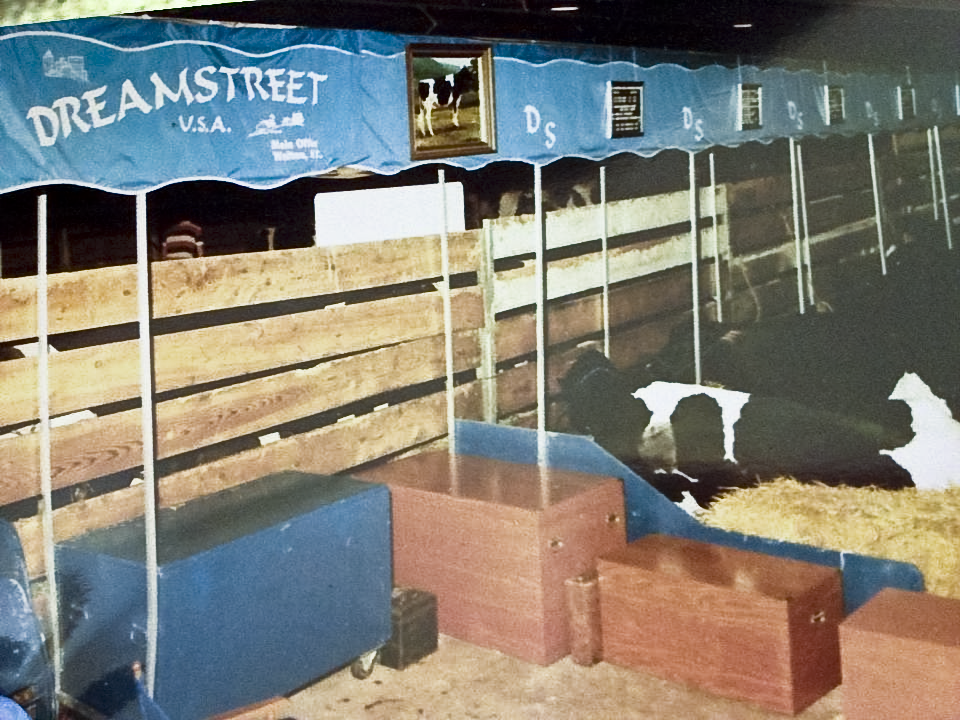
Doing what he loved throughout six decades provides Charlie with an opportunity to meet and work with the best in the business. He has worked with such iconic herds as Dreamstreet, Lylehaven, Pamtom, Arethusa and many others. Herb Kerr, owner of Pamtom Farm, often referred to his famous Star Marie cow as “Charlie’s Cow,” as he was the only one to show her at the National Shows. From Charlie’s viewpoint two things stand out from those experiences. “What made it special were the amazing cows that each string had in them.” And then he adds “But what made it more memorable was the great talented people I got to work with. Any amount of pressure and hard work is easy when you’re laughing.”
The Award Winner of Marathon
Charlie McEvoy & Gary Culberston of Ladyholm Holsteins in picture when they were showing for Mansion Valley Farm
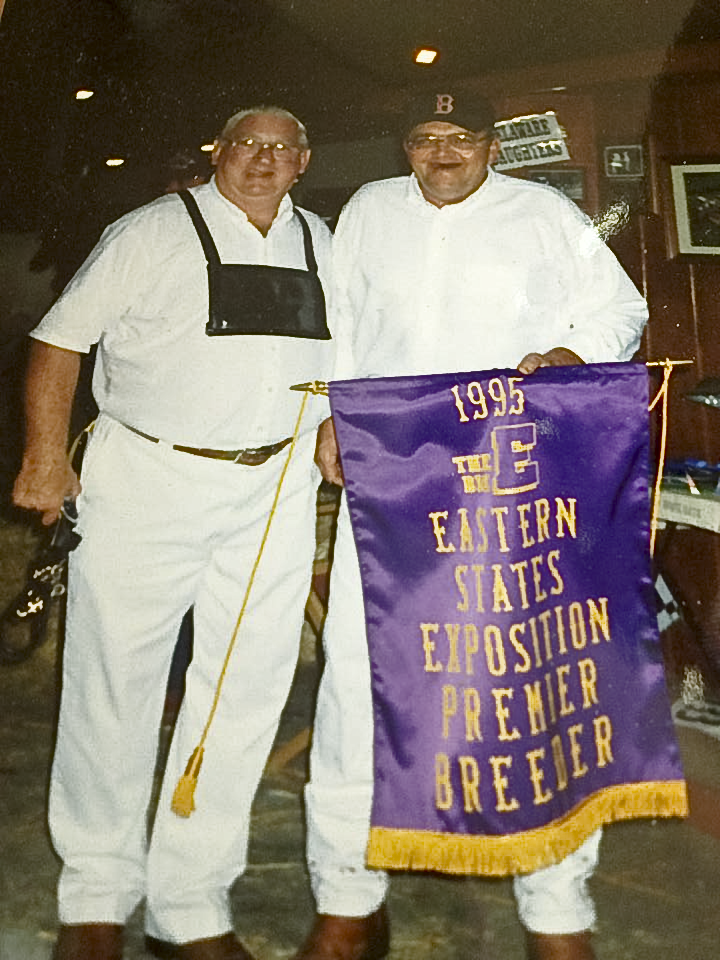
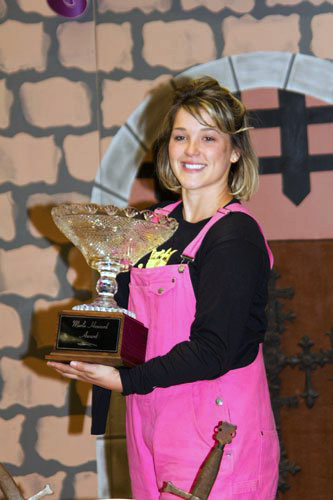
In 2006, Charlie was honored for his dedication to the Cortland Classic show, and, in 2007, for his outstanding fellowship and sportsmanship at the New York State Fair. McEvoy’s career as a farmer and a showman has included a number of awards, among them New York State Active Master Breeder (2009), Northeast Fall National Holstein Herdsman Award in Springfield, Mass., the Stanley Murphy Award, the New York State Fair W. Stewart Stephens Memorial Award for Outstanding Fellowship and Dedication as a Showman. In 2009 Charlie McEvoy, was named the 68th winner of the Klussendorf Trophy, the highest recognition given to a dairy cattle showman in the United States. He says, “It was a humbling experience.”
Showman. Sportsman. Herdsman.
Charlie has had a long and distinguished career with dairy cattle and has witnessed tremendous changes. He points out. “The speed at which things change or move is mind boggling. I’m from a generation when you mated cows it was with bulls that you’ve seen daughters out of and have reliability. Now we use a son of a young sire out of a heifer that hasn’t calved yet”.
To this day, he still loves the show ring and is enthusiastic. “The quality at any show up and down the line is amazing. The modern cow has so much style, balance, openness of rib combined with dairy strength and a sewed on udder. Also the fitting practices have changed so much. When I first started out we would clip their heads and shoulders and then blanket them. Now toplines and belly hair are groomed to perfection.”
Looking back at cows that have had impact on the Holstein breed Charlie singles out Aitkenbrae Starbuck Ada. He explains his choice. “She is one of my favorite young cows of all time. Her descendants, whether male or female, have changed our barns and show strings forever.”
Closer to home his love of breeding the next generation of cows makes narrowing down the list difficult. “It is hard to choose just one “greatest”. There are so many special cows but I guess the first ones that jump to my mind are Millervale Ultimate Rosalyn and Camp-Hollow Ultimate Kate. They were Grand and Reserve at World Dairy Expo in 1983. Taraley Astro Sherry was another favorite, just because she was an awesome individual and a true dairy man’s dream.”
Committed to Cows and Community
Dairy cattle remain a passion for Charlie who does chores every day and still finds time to think about the next human generation as well. He has served on many boards and community groups. McEvoy served as the dairy supervisor at the Broome County Fair for 30 years. While supervisor he encouraged the creation of a milking parlor which demonstrates the milking procedure to the public. He has been an advocate for the youth in agriculture, assisting many with the pursuit of their dreams.
Charlie recognizes that changes are inevitable and has seen many of them. Looking toward the future he says, “Hopefully the greatest change will be the American milk pricing system. If it aint broke don’t fix it. If it is broke over haul it.”He offers this advice. “Work hard, stay positive, take advice from ones that have been in it, visit and see other successful farm operations and when possible diversify your farm to provide different avenues for income. “
The Bullvine Bottom Line
Much has changed in the dairy business from the shows to the barn to the cattle themselves, but Charlie inspires those who learn from his dedication and hard work. A family man. A cow man. A gentleman. Goodness knows Charlie McEvoy is as Good as Gold!
Recently the Bullvine wrote an article, “Is Down Under Going Under?” which initiated an ongoing exchange of emails between Murray Hunt and Dianna Malcolm. Despite her happiness with the “positive messages regarding our sale”, Dianna was somewhat revved up. “Your blog’s timing was just appalling in terms of our sale marketing. The story was fair, but we had our balls to the wall and we were trying to be so positive for ourselves and our courageous co-vendors.” With a little coaxing on our part, Dianna agreed to give us a more fully rounded picture of the situation. So settle in for a trip down under to the State of Victoria, where Dianna and husband Dean keep at least five business growing. It numbers even more when you include their commitment to encouraging the young, the dedicated and even the discouraged dairymen and women to hang on to hope in these crazy times for the Australian dairy business.
Keeping Up and Always Moving Forward
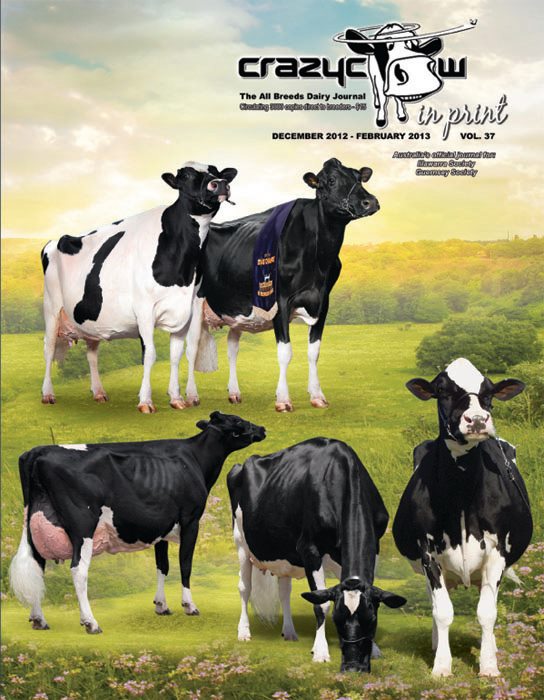
When faced with adversity in the dairy business, there are many who would scale back. Not so for Dean and Dianna Malcolm, who were born into dairy families and inherit their work ethic and, probably their tenacity, from their parents. At the present time, they have no less than five businesses that grew out of their shared expertise: Crazy Cow in Print and website; Public Relations; Bluechip Genetics; Extreme Genetics and Cattle Photography. These are their offspring. “We were unable to have a family, so we have instead put our energy into the business.” And what considerable energy that is. Indeed the Malcolms continually widen their circle as they polish every aspect of their passion for dairying.
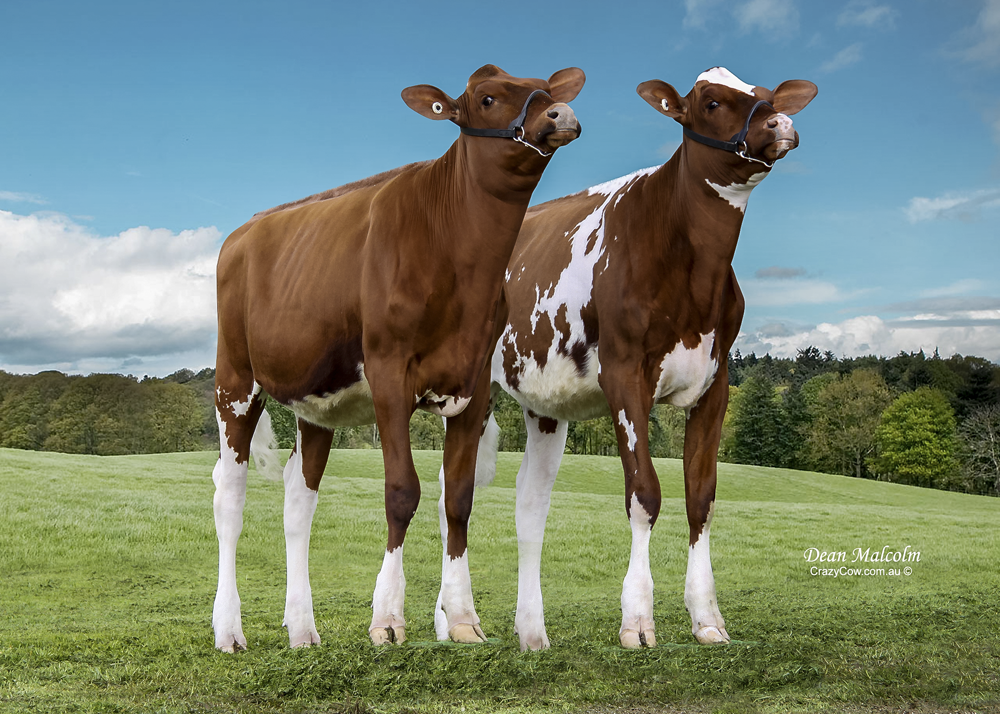
Bluechip Apple Spice (left – sold for $101,000) and Bluechip Toffee Apple (Right) (photo taken at 6 1/2 mths old) Dam: KHW Regiment Apple, EX95, Grand Champion R&W WDE 2011, All World R&W 2010
The Tall Poppy Syndrome
“We do push each other and ourselves to be the best we can be.” says Dean referring to the successes they have already measured. “We started Bluechip Genetics from the ground up in 2006. The farm comprises 225 acres, milking 125 cows averaging over 10,000 litres at a 4.1% fat and a 3.3% protein. We have 125 heifers (40 bulls to be sold as herd sires) and 50 Angus cattle, which are used as recips. We are honoured to have partnerships with Mike Deaver, Mike and Julie Duckett, Ferme Blondin and St Jacobs/Tim Abbott, which has been exciting. We also have a number of awesome Australian partners and Dean and Jo Geddes, from Tahora in NZ.” They stand poppy-tall in the showring too where they have been Premier Breeder and Premier Exhibitor for the last three successive years at the fourth biggest show in the world, International Dairy Week (IDW).
Bluechip Alexander Whynot Recent Jr Champion at IDW. Owned by Bluechip Genetics & Averill Leslie
The Dean and Di Duo: She Fits the Words .. He Fits the Cows
Success for this couple hinges on working closely together while highlighting their different areas of expertise. Dianna’s background in mainstream media (including working as a reporter in television) has been a big help. The CrazyCow website was established in 2000 and CrazyCow in Print has been up and running since 2003. Dean and Dianna see key advantages to their shared talents. “At the core of it all, Dean was a successful cattle fitter, so we do have the advantage of being able to manage and develop (and now to also market cattle through photography and CrazyCow) relatively inexpensively in-house.” Both get to travel (for instance regularly to the World Dairy Expo). “And through CrazyCow and Bluechip, we have found like-minded partners and supportive networks that keep us thinking globally and moving forward.”
CrazyCow In Print
Dean and Dianna are justifiably gratified at CrazyCow In Print’s evolution. “When we started the first all breeds journal of the modern era back in 2003 out of our lounge room it was in the middle of the drought and so many people said it wouldn’t work. But it has endured, grown and been mirrored by a number of other international publications. To now have international respect and interest for a magazine produced in Australia is a personal triumph for us both. It’s also good for the Australian industry to be showcased and understood by the greater global dairy community.”
To Market. To Market.
The Malcolms have complimentary roles with the cattle too “I rear the calves and Dean takes my babies from eight months of age to complete their development and plan their careers.” And then promotion clicks in: both showing and picturing. “We believe print advertising still plays a huge part in the dairy industry. But, in particular, Facebook is becoming massive and we try to manage a balance between the social media and the various in print mediums. We have also pursued video work, which has been distributed through social media, and that has been incredibly successful.” Dean sums up their marketing philosophy: “We also work extremely hard to build stronger and deeper cow families in terms of show ring success, picturing, classification and production.” Is it becoming clearer what triggered their concern over worldwide attention to the Aussie dairying troubles?
“Advertising is Critical!!! Just Critical!!!!!”
Like any entrepreneurs who put everything on the line, the Malcolms risked everything for their recent Bluechip Invitational Sale. “We had all our marketing on the line, because we used CrazyCow In Print and FB to market, including the video that young industry talent Bradley Cullen, Di and I made,” Dean said. “So many people were fearful that our sale would not fly … and, to be honest, we depend on marketing cattle to keep the farm going forward because there is not enough money in milk right now. But we also had CrazyCow on the line because we had marketed so heavily through there (naturally) and we knew people would judge that decision too. Di and I stuck together and put up 75% of our young in-milk team and our best heifers in a year that I have to wonder if others would have done.” They kept moving forward but recognized what was at stake. “To say I wasn’t breathing when the sale started is an understatement – but this sale proved that good animals, with the right pedigrees, presented in the right form do sell,” Dianna said. The sale averaged $6600 overall – Bluechip animals averaged $7300. How does she feel today? “Dean is more courageous than me, perhaps because he is such a detailed planner. For me, I’m just so relieved to have this sale behind us. It was (in the end) a positive day for the whole industry and hopefully injected some hope into the whole game that has been seriously missing in Australia.” Thank goodness for today’s marketing. Both Malcolms feel it is “so much more immediate, fun and so empowering.”
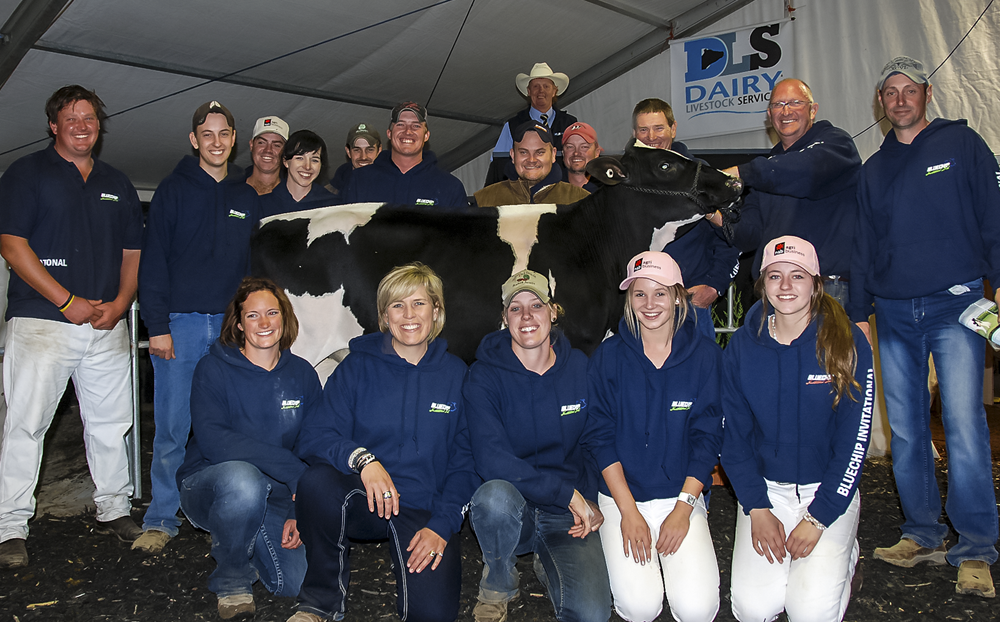
Top price at the Bluechip sale was Bluechip Goldwyn Frosty, Goldwyn X Dundee x Harvue Roy Frosty, sold for Top price $72,000 (Pictured here with the outstanding sale crew)
Knickers and Knockers – A Knotty Situation
With a quick sigh of relief due to their well-earned success, Dean and Dianna readily admit that there are still many challenges facing them. What you may ask could ever faze these two. Dianna answers with heat. “ Milk price!!! And our useless government!” She feels quite strongly about these two. “Strangely, that has hurt us more even than the droughts, the floods, the pestilence and the severe heat (animals aren’t housed indoors in Australia)… So that gives you some idea of what we face right now. We have never seen it so tough.” Dean looks forward with a grim prediction. “If small business and agriculture are not more respected by our governments, there will be no food. We love that saying: If you ate today, thank a farmer.” The picture isn’t pretty in fact they both describe it as “horrific.” “We have been pushed into working harder and harder, for less and less,” Dean said. “Without our passion we would have exited this industry long ago because we have the ability to make money in other lines of work. Someone must be making money from our product. The world needs more and more food, yet primary production (not just dairy) in Australia has been smashed. That goes for small business too. It is criminal really. No-one is educating the next generation about farming and they are getting more and more disconnected. It is incredibly disappointing and concerning. Milk price needs to lift significantly and immediately because when farmers make money, everyone makes money.” Dianna adds: “Sadly, farmers are so independent that achieving solidarity is no mean feat and that is what we all need to achieve change (in my opinion).” If only more opinions were so eloquently expressed and actively implemented but there is only so much time for these multi-faceted business entrepreneurs.
Dean and Dianna also host many international students and young breeders and shared their wealth of knowledge. Shown here are Katie Kearns(left) and Darci and Justin Daniels(Right).
“We Don’t Have a Life”
It’s hard to picture with so much going on that the Malcolms declare that they don’t have a life. Dianna does give a clue to the management philosophy. “There are some very robust conversations in this house, but we have a common goal so we usually work it out without too much bloodshed.” We’re sure it is much more peace loving than that and she agrees. “The fact that we’re still married might be viewed as an accomplishment in this fast-moving world.” Of course they don’t have a life. They have five lives.
The Bullvine Bottom Line
Constant change (much of it unsettling) is unfortunately the current situation for dairying in many parts of the world. For these two Aussies we are grateful that they are sharing their passion and enthusiasm. We wish Dean and Dianna Malcolm all the best as they continue to turn things up down under!
So much about dairying in North America is in a state flux, that it is reassuring when people are willing to take leadership roles. Glen McNeil, the Immediate Past President of Holstein Canada, demonstrated his commitment to Holsteins and leaves the position still committed to continuous improvement of the industry and hopeful for changes ahead. “There will be speed bumps that give us a reality check and that is called balance and experience.” But overall he is positive. “People seek, adapt and embrace change at different stages. Developing proactive policies and direction on an ongoing basis is the responsibility of the Board of Directors as is due diligence…” This doesn’t mean he sees the world through rose-coloured glasses. “The constant degree and speed of change, and the methods of communication that are being used today mean that everything becomes super fast paced.” Adapting to the times and respect for the people on all sides of an issue has worked well for Glen.
Barn to the Board Room – Respect for the Roots
Glen has great respect for people in the barn and in the Board Room. It has served him well and been returned to him. He highlights his experiences while at the Holstein Canada Board table. “This enriching experience at the Board table has helped me develop an attitude of respect towards people and their opinions. People remember how you treat them and how you make them feel, longer than what you said. The most important ingredient of success is knowing how to get along with people.”
Getting the basics right about people and developing cow knowledge skills has been important to Glen. He looks to those who influenced him early on. ” My parents taught me work ethic, morals, respect and care of livestock. Dave Houck (Romandale Farms) taught me the art of breeding including aAa. Dave introduced me to Bill Weeks from Vermont, Frank Phister of Mexico, and many great Holstein enthusiasts worldwide. Earl Osborne, Bill Grieve and Pascal Lemire, all Past Presidents of Holstein Canada, were great leaders that inspired me.”
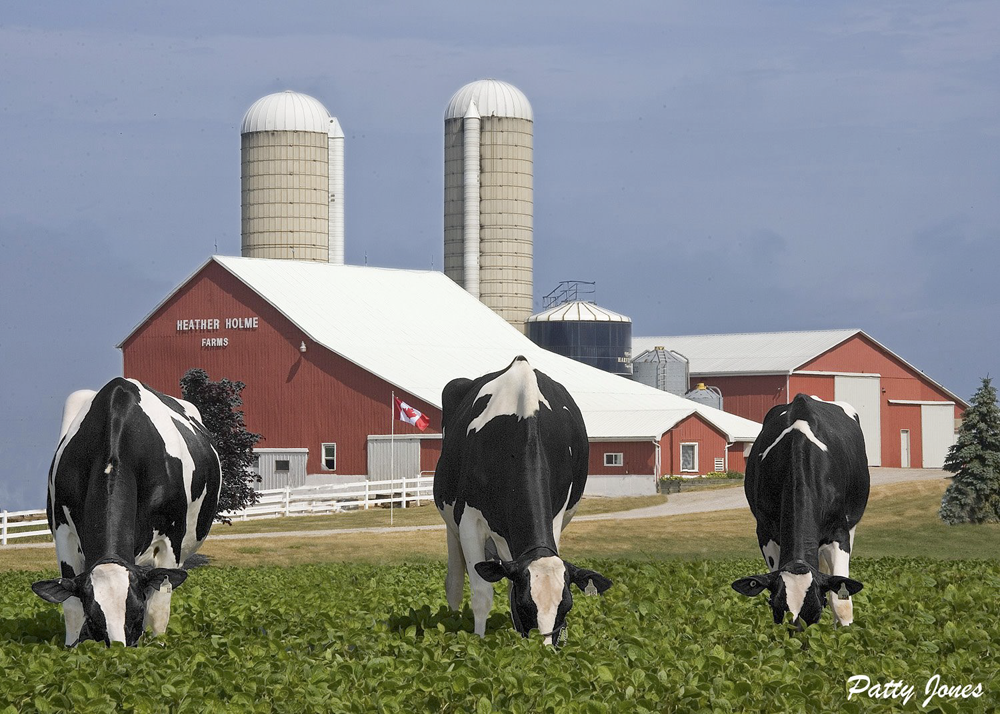
The Triple Excellent Heather Holme Team
The team of Glen and Vanda took over ownership of Heather Holme in 1977 and they have always focused on “the vital importance of developing positive relationships with family, employees, clients, and suppliers to our business.” Attention to detail has helped the McNeils to bring out the best in their cows. Having won three Master Breeder Shields is a unique and rare achievement. It is always amazing that those who reach these heights make the success sound simple. Glen has a four point philosophy. “Sire selection and animal care on a day to day basis is paramount! Consistently using elite breed improving sires in complimentary matings for generations is vital. We use our classification information and aAa in every mating. We avoid incorporating inferior genetics. “ Simple but true. And yet it goes beyond genetics to the people involved. The McNeils praise each team member on-farm at Heather Holme or through their service suppliers for the expertise that they contribute to the overall success.
(L) Heather Holme R Josee EX 4E (C) Heather Holme Gibson Jolene EX 2E (R) Heather Holme Golden Jewel VG
The World Wide Excellence of Canadian Holsteins
Glen is equally emphatic about his commitment to Canadian Holsteins and their role. “There is not a country in the developed world that is short of milk or we would not have the milk price issues that are as evident as they are today in so many countries. Canada needs to continue to breed a balanced dairy cow that can sustain the high production to enable them to express their genetic potential over a lifetime to increase profitability. Every dairyman in the world wants trouble free, profitable cows, with the correct conformation to withstand the high production that today’s dairy cow is capable of producing.” A big order but one Glen is confident can be achieved.
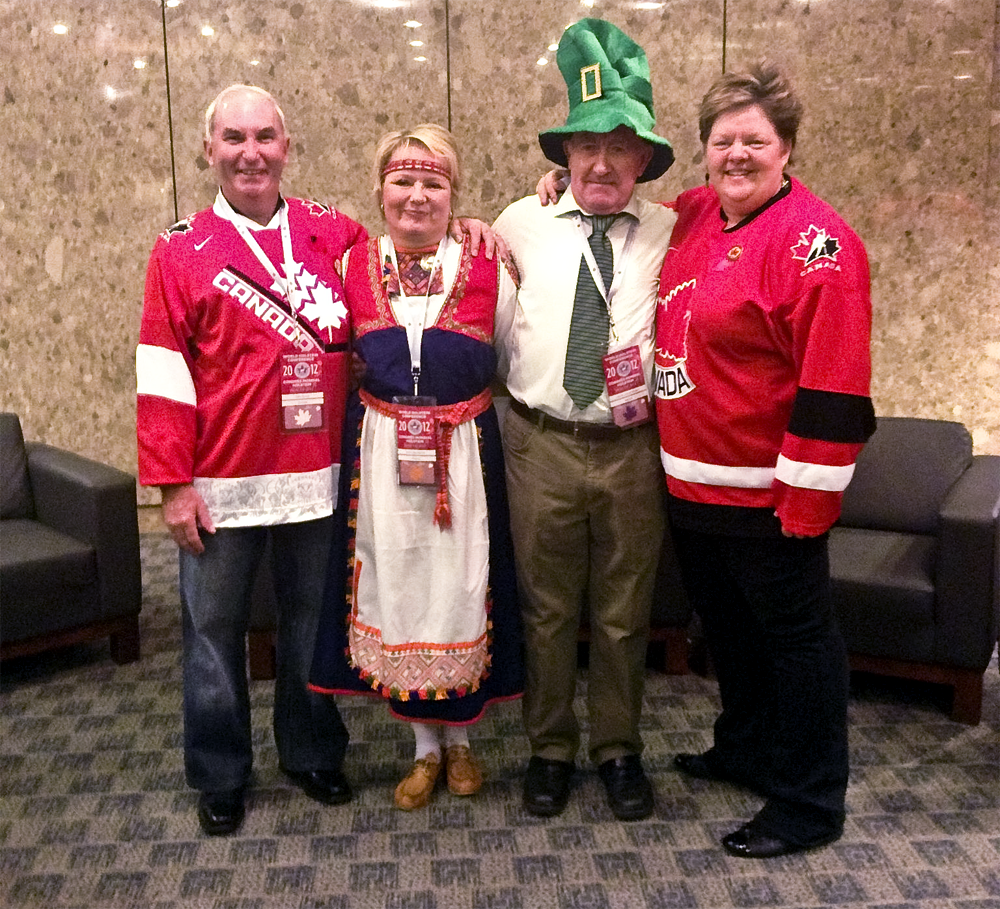
Glen McNeil and Holstein Canada CEO Ann Louise share their Canadian “hockey” heritage with Irish and Finnish 2012 World Holstein Conference Participants!
Achieving More Close to Home Too
With the pressures on all organizations to provide relevant and needed services to its members, The Bullvine asked for Glen’s thoughts on Holstein Field Services “Field Service is just that, an extension service to our members to communicate to and educate our dairies on the profitability opportunities with registration, classification, milk recording, genome testing, etc. The pricing model for services must be flexible and will evolve as more dairies see the advantages of these services. Communications in different forms is paramount today.”
The Next Turn in the Road
Having seen the Holstein industry from various viewpoints, Glen shares his perspective. “I have tremendous respect and faith in our youth involved in the dairy business at many different levels. In having the opportunity to travel worldwide I have great appreciation for supply management in Canada.” New opportunities will present themselves with all the hills and valleys that progress demands. McNeil knows it will take willingness to change. “We would never consider using the same sires that we used 20 years ago, or farm the same way, feed or manage our cows the way we did 20 years ago. Common sense and understanding what Genomics can and cannot do will be very revealing in the next 2-3 years.”
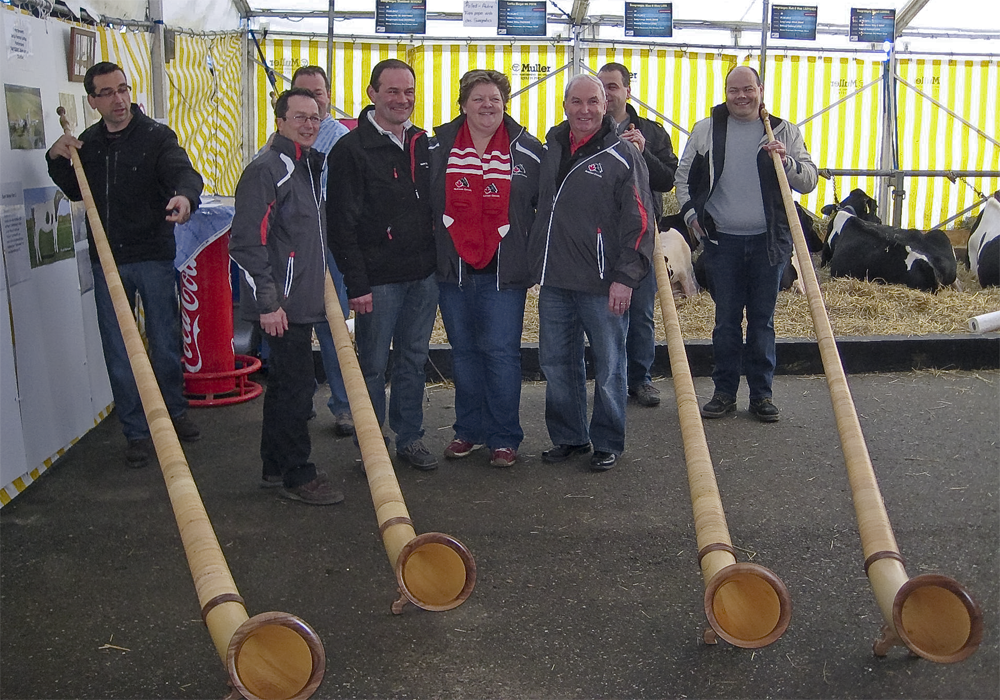
Glen McNeil and Holstein Canada CEO Ann Louise Carson, Mario Perrault were attending the All-European Championship Show in Fribourg, Switzerland. The traditional alpine horns in the picture are played in the Swiss Alps.
“One Door Closes. Another Opens.”
History will continue to be written at Heather Holme where one theme they have built on is that “challenges are also opportunities”. Glen welcomes the changes opening up in his schedule. “I am fortunate to be able to return to our farm on a more regular basis than I have for a few years to assist Curtis and Vanda as required and spend more valuable time with our family”. No doubt there will be new evolutions ahead. It is noteworthy that the McNeils are using Facebook to share their ideas and to market their cattle by almost daily updates. Look for the McNeils to have and sell healthy cattle as they have maintained their CHAH (disease free) Herd status when others found it an expense rather than an investment.
Son Curtis and herdsman Greg Feagan, Greg has been working with Heather Holme for 31 years.
The Bullvine Bottom Line
The McNeils at Heather Holme believe in taking good stock and best practices, making them better and getting results. Adapting to and changing with the times has built their success. Glen looks to the future with the same equanimity that has served both Heather Holme and Holstein Canada well. “Change is inevitable and desirable. Adapt and harness new technologies to continue to be profitable and competitive and learn how to adapt to change. “We applaud McNeil for his dedication, vision and commitment. It smoothes out the speed bumps so that Glen can confidently declare. “The future is bright for Holstein Canada and the Canadian dairy industry!”
It would be oversimplifying a very complex management situation, if you reduced calf management to feeding colostrum. You must pay attention to a myriad of details. It all starts with the health and management of the mother and ripples out to include the environment, biosecurity, health and protocols of all the areas that touch on a calf before birth and after. Having said that, it is still valid to declare that colostrum remains the key to success with newborn calves. It is also where too many of us are falling short.
Not ALL Colostrum is Created EQUAL
Researcher Kim Morrill and a team of colleagues at Iowa State University conducted a study on colostrum quality. The team collected 827 samples of first-milking colostrum from 67 farms in 12 states between June and October 2010. The parity of donor cows was recorded, as was the storage method of the colostrum when it was sampled — either fresh, refrigerated or frozen. The findings were reported in the July 2012 edition of the Journal of Dairy Science. What the team found is rather revealing. Only 39.4 percent of the samples met industry standards for both immunoglobulin (IgG) concentration and a bacteria measure known as total plate count (TPC).
Survival of calves with inadequate serum immunoglobulin concentrations is reduced, compared with calves having acceptable levels of immunity. Source: National Dairy Heifer Evaluation Project, NAHMS, 1992.
Therefore, slightly more than 60 percent of colostrum on dairy farms is inadequate, putting a large number of calves at risk of failure of passive transfer and/or bacterial infections.
If judged only on the basis of IgG, without looking at TPC, a sizeable number of the samples still fail to pass muster. Almost 30 percent of the samples had IgG concentrations that fell below the industry standard, which is defined as having more than 50 milligrams of IgG per milliliter.
Nearly 43 percent of the samples had total plate count or TPC that failed the industry standard, which is defined as having less than 100,000 colony-forming units per milliliter.
Colostrum Effectiveness: Goes Down Fast
The ability of the calf to absorb colostrum decreases with time. By 9 hours after birth the calf can only absorb half of the colostrum. By 24 hours the amount absorbed is minimal.
Feed the colostrum as soon as possible after birth
Feed calves one gallon of colostrum (100 pound calf). Minimum for Holsteins is 3 quarts.
Eight to twelve hours later feed another two quarts
Try to get the calf to suck the colostrum, whatever they do not suck will need to be tubed.
What about ARTIFICIAL Colostrum?
The most common methods used for evaluating colostrum quality are with a colostrometer, a refractometer or by visual appearance. The calf needs to continue to receive colostrum the first two days, if not from its mother then from another cow that has recently given birth. Manufactured colostrum replacers are also available. Sometimes these arrive frozen. Because the antibodies in the colostrum are crucial to helping the calf build its disease resistance, thawing should be achieved slowly and carefully to avoid destroying the antibodies.
Quantity: This area needs improvement.
“A lot of dairy producers are giving only about 2 quarts of milk per calf per day. They’re doing a pretty good job of getting it to the calf early, but they’re not giving them a great enough quantity of milk. They need a gallon a day and more in cold weather.” Surveys show that 45.8 percent of operations hand-fed more than 2 quarts but less than 4 quarts of colostrum during the calves’ first 24 hours of life. there’s a lot of data on the role colostrum plays in growth, says Jim Drackley, dairy scientist at the University of Illinois and another of the roundtable participants.“The initial development of the intestinal tract in the first couple days of life is very much dependent on colostrum intake. We know that the basics include getting enough colostrum into the calf as quickly as possible, and that the colostrum should be of good quality in terms of its antibody concentration.
KEEP IT CLEAN: Unsanitary Colostrum
There is too much bacteria in much of the colostrum that is collected and fed on dairy farms. This could be the source of an early infection or give the calf problems in absorption. But even people who feed adequate amounts can still have problems if the colostrum is unsanitary, points out Simon Timmermans, veterinarian from Sibley, Iowa. “We’ve started a HACCP protocol where we collect a random colostrum sample weekly before it goes into the calf,” Timmermans says. “We can detect if there is a hygiene problem based on the bacterial count. I think that’s the key reason why we see such better performance out of the beef industry. It’s the human element, and it goes to hygiene.”
Every Delay. Every Bucket Change. Multiplies Contamination
Timmermans explains that colostrum is a great culture media for iron-loving bacteria like Salmonella. “The producer may do everything perfectly, collecting that one gallon of colostrum, but then he lets it sit out in a bucket for three hours before he gets it fed to the calf” and bacterial levels explode.
What We All Know. What we DON`T Always Do!
Cows have stronger, higher quality colostrum compared to heifers. It is important to feed one gallon of colostrum to Holsteins to make up for the differences in strength. (The stronger the colostrum, the more antibodies that it contains.) A colostrometer can be used to determine the quality of colostrum. This will detect the poor quality of colostrum which should not be used.
Save Calf Lives, Sanitize
Dam’s udders should be cleaned and prepped with pre-dip before colostrum is harvested. Extra colostrum can be stored in the refrigerator for up to 7 days. Be sure to date the colostrum so that freshness can be ensured. Colostrum can be frozen for up to one year. Colostrum should be thawed out by placing the container in warm water. Microwaving colostrum will destroy the valuable antibodies present.
The Bullvine Bottom Line
Producers do a pretty good job of getting colostrum to the calf early. Colostrum is the key to success, but you have to have the right combination of timing, quality and quantity.
There are some herds where the temperature is checked on fresh cows twice a day for the first couple of days after calving. But for the rest, how many of us know the temperatures and the borderline sicknesses of animals in our herds? Should we?
Let’s look at this a little closer.
Lost Dollars
“The economics of animal disease are huge and often unrecognized.”
“A goal of every dairy producer is to have healthy cows that breed back quickly.”
“Early detection of disease reduces the cost of disease to the farm and increases the length of animals’ lives.” These are three quotes from Dr Jeffrey Bewley, a University of Kentucky Professor whose research focus is precision economics.
Consider your own farm. If you are not 100% aware of the health status of every animal on your farm, how can you know the dollars disease is costing you?
There are numbers reported that say each mastitis case costs us $350-$400 or that each extra day open for our milking herd costs us $4 – $5 in lost profit. But do we know anything about our heifer herds? What does a case of calf pneumonia or scours cost? How much of our labor costs are associated with treating sick animals? And then there are costs to subclinical disease that we do not even know exist (Read more: Dollars and Sense: Herd Health and Reproduction).
The Big Unknown
How many disease incidents get missed on our farms? Let’s admit it, we do not know. If we could have an army of herd persons, we might come close to knowing but then our bank balance would be a very large negative number.
So let’s step away from dairy farming for a minute. Let’s go to our local hospital, where sick people are nursed back to health. The patient is hooked up to machines for constant monitoring so that the Doctors and Nurses can use the numbers to make decisions. Continuous monitoring.
Wouldn’t it be great to make informed decisions by having numbers provided by continuous animal health monitors on dairy farms??
Is it any wonder that robot owners tell us that they have never known as much about their cows and managed them so well?
But robots exist beyond the milking herd. Calves can now be fed robotically. And other devices are arriving on the market every year to capture more animal performance information.
Another way to consider precision dairy farming is to think in terms of more data to manage with and make more profit from.
Like to “Know”
However before going further into what equipment is out there to capture on-farm animal data. it is important to know where you’re starting from. What are the biggest health challenges on your farm?
How would you rank the following?
heat detection / timing of breeding / cows not showing heats until over seventy days in milk
heifers not detected in heat until after fifteen months of age / heifers not calving until 27 months
LDAs / milk fever / ketosis
lameness followed by loss in production, hoof trimming, medication and milk being discarded
difficult calvings followed by retained placentas, metritis,… resulting in cost and delayed conception
animals off feed and off on performance
calves or heifers with health challenges
not able to detect the onset of sickness prior to it becoming a major problem
We all have problems. First we need to identify our problems. Only after that can we plan to manage to not have them.
Systems Available
State-of-the art milking systems will measure drops in yield. Robots will do it by each quarter of the cow’s udder, and in particular, electrical conductivity of the milk at the quarter level during milking. Parlor systems measure it at the cow level. There is a good association between electrical conductivity, somatic cell count and mastitis.
Tags will measure rumination, or cud chewing, providing an opportunity to react quickly to, say, the onset of illness or disadvantageous feeding changes, at the single-animal and herd level
Another system uses ear tags to take the surface temperature of the inside of the right ear of each transition and fresh cow every five minutes.
A passive rumen bolus system will monitor animal core temperature, which provides information for early disease detection, ovulation detection, heat stress and timing of parturition.
Another ear tag will monitor ear temperature and head-ear movement to identify potential peripheral shock (cold extremities), which may be particularly useful for early identification of milk fever or for detecting cows moving their head or ears more when they are in heat.
Another technology will monitor lying behavior and activity. Activity monitoring is a comparatively new technology that is gaining in use for monitoring animal health including estruses.
Yes there are new systems continually becoming available but the question is how accurate are they and do their benefits out-weigh their cost? For example, $25 more profit per cows per year from using a device may not be worth it but $200 more profit per cow definitely requires serious consideration of the technology.
Plan for Profit
It is no longer good enough to not know or ignore health (that includes fertility) details on your cows. Past approaches of ‘not sweating the small health stuff’ are not appropriate as profit on today’s dairy farms depends on taking a total package approach. Remember: you need to continually looking for ways to improve; you need to decide on the limiting factors on your farm; you need to prioritize your technological enhancements; you need to capture the information accurately and economically; and you need to manage for profit.
The-Bullvine-Bottom-Line
None of this is new information to people who work with dairy cows. We all breathe a sigh of relief when a cow gets through the transition period disease free and we can look forward to a productive lactation and a confirmed pregnancy ahead. Or when a healthy calf in born that grows quickly and enters the milking herd at a young age. Obviously the first line of defence or attack is always a proactive plan to grow and have healthy, disease free, disease resistant profitable cattle. When it comes to profitable dairy cows, raising health is a good thing!
We are glad you have joined us at The Bullvine for Part 2 of the Hometown Jerseys success story. In Part 1 we saw how Neil and Melanie Hunter started a dairy farm which in some ways seemed to be “Against All Odds”. (Read more: HOMETOWN JERSEYS: Against All Odds). Mentored by family Melanie and her sister Tiffany started in 4-H with two daughters of Springville Designer Jewel VG. Neil too was mentored by his Uncle Ralph Cherry and local dairy farmers, Doug and Mary Anne Peart of Peartome Holsteins. Once married, the young couple saw past the drawbacks of purchasing a 265 acre farm that hadn’t shipped cream in 15 years. They claim that they took advice to “find a way to get started and worry about everything else after.” However they continued to carefully plan and evaluate their choices. Despite BSE, changes in quota regulations, financial and family health impacts, this young couple persevered thanks to hard work, due diligence and, above all, the ability to take advice. They learned from the best mentors in the business including family (Glenn, Ann and Tiffany Babcock, Ralph Cherry, Earl and Jean Baker), friends (Doug and Mary Anne Peart) and cattle breeders near and far who shared their passion for good cattle.
Great Accomplishments & Very Good Two Year Old Streak
Hometown Jerseys have recorded several successes but they agree on what Neil describes as their greatest accomplishment. “For us it was simply getting started to milk cows against the odds and all of the people who said it couldn`t be done. That includes our bank client rep at the time, who told us in 2009 that we should sell it all and buy a house in town.” A benchmark of which they are also justifiably proud is this one “We have had a VG 2yr old in every round since we started milking 8 years ago , including the round when we only had 1 cow to show, a VG 86 2yr. old. And over 50 percent of our homebred 2 year olds (Hometown prefix) have scored VG.” Very good indeed!
Strategic Climb to Opportunities and Hometown Recognition
With growing confidence after their purchases in Virginia and Tennessee, Hometown returned the following year to Gaby Jersey Farm’s Production Sale and purchased lot #1 “Pick of the Herd” for $25,000. Neil covers the highlights. “We selected Gabys Action Baby EX 91 who was the 3rd high seller in the US that year. She has put 5 bulls in AI. Our relationship with Gaby Jersey Farm was further strengthened in Nov 2011 (15 months later) when we travelled back to Louisville KY (the 1st time since representing Ontario on the judging team) to show Gabys Artist Ambrosia in the Mature Cow class of the All-American. Ambrosia created quite a bit of interest since there had never been as high a genomically tested Jersey at such a high profile event. She had already been 2nd Mature Cow at both the Quinte and Stratford Championship Shows in Ontario, also winning the highest BF record in both shows. Ambrosia placed 10th in Louisville, but opened the eyes of many conventional breeders that there may be something to this “genomic thing”. Completing the list of awards for 2011 was the highest Butterfat produced by a Jersey cow in Canada presented to Gabys Artist Ambrosia. Our herd had never achieved anything like that before and certainly had never made it a goal. The strategic purchase of these cows in 2010 was proving its worth in recognition of the Hometown herd name worldwide and was starting to pay dividends.”
Gabys Action Baby EX-91 4-11 proj. 11681M 603F 5.2% 429P 3.7% (373-351-361) Dam of three TAG sires (Branson, Banker, Donovan) Full sister to Ballard at ABS Has contracts with Semex, ABS and Alta
Hometown Bred. Hometown Owned.
Two cows have fulfilled Neil and Melanie’s goal of working with and breeding the best. Neil describes his first Hometown Owned choice. “Way-Bon Counciller Mystery SUP EX 95-5E was bought at the end of 1st lactation. She has wowed visitors anytime in her lactations with her huge, long dairy frame that looks the same all year long. This is the cow which gave us confidence to take some chances after selling her son first son, Hometown On The Money, to AI. She is a 3* brood cow off of the 1st 4 milking daughters. She will continue to increase as she will have at least 4 sons in AI and likely all but one daughter will be EX.”
Way-Bon Counciller Mystery SUP EX 95-5E HM. Grand Champion – NY Spring Show 2013 2nd Place 100,000 Lb. Cow – NY Spring Show 2013 6th Place Mature-Cow – Royal Winter Fair 2010 1st Place Mature-Cow – Ontario Spring 2010 2nd Place Mature-Cow – Ontario Summer 2010 4th Place Mature-Cow – Royal Winter Fair 2009 Nominated All-Canadian – Mature-Cow 2008 6th Place Mature-Cow – Royal Winter Fair 2008 4th Place Mature-Cow – Ontario Spring 2008 Nominated All-Canadian – 5-Year-Old 2007 3rd Place 5-Year-Old – Royal Winter Fair 2007 Female Offspring: 8 Daughters Average 87.75 Points Including 3 Excellent Daughters Dam of Semex Genomax Sire: Hometown On The Money
Next Neil goes on to describe Hometown bred J Meant To Be VG 87 2yr. “Meant To Be has attracted great cattle people like Gerald Coughlin’s interest since a being a Sept Calf. She lived up to our expectations when she went 87pts 10 days fresh and later that week was 1st Senior 2yr old, NY Spring Carousel 2013 and a major contributor to our 1st Premier Exhibitor banner at a major show. Meant To Be is from the prolific heifer giving family we are developing which traces back to the original Jersey cow Melanie’s grandfather gave to her and her sister Tiffany.”
Hometown J Meant To Be VG 87 (18 days fresh, 1st calf) 1st Senior 2 Year Old at the New York Spring Carousel 2013
Hometown Marketing Programs and Initiatives:
Melanie and Neil have a 4-step approach to marketing. They outline what they use and why.
Unique Niches: “We aren’t large and don’t have a large budget, therefore we buy or develop unique cows and market sons to AI or privately sell semen, leaving us with the females for the next generation”.
Facebook: “For the past 5 months we are continuing to increase our use of this marketing avenue as it is cheaper, simpler and more current than a webpage or magazine advertising.”
Magazines: “This is used for large announcements and ads when we have a need to speak to a larger audience than the keenest or most aggressive 25% which we feel already use Facebook.”
Face To Face Contact: “We attempt to be in contact with people as often as possible by supporting the breed events like shows, sales, meetings and judging opportunities. We feel people buy from people in the majority of cases, therefore, pure use of the internet as a marketing tool will have a limited reach.”
The “Bull Business” and “Genomics” Growing at Hometown Jerseys
Click on image to see ad
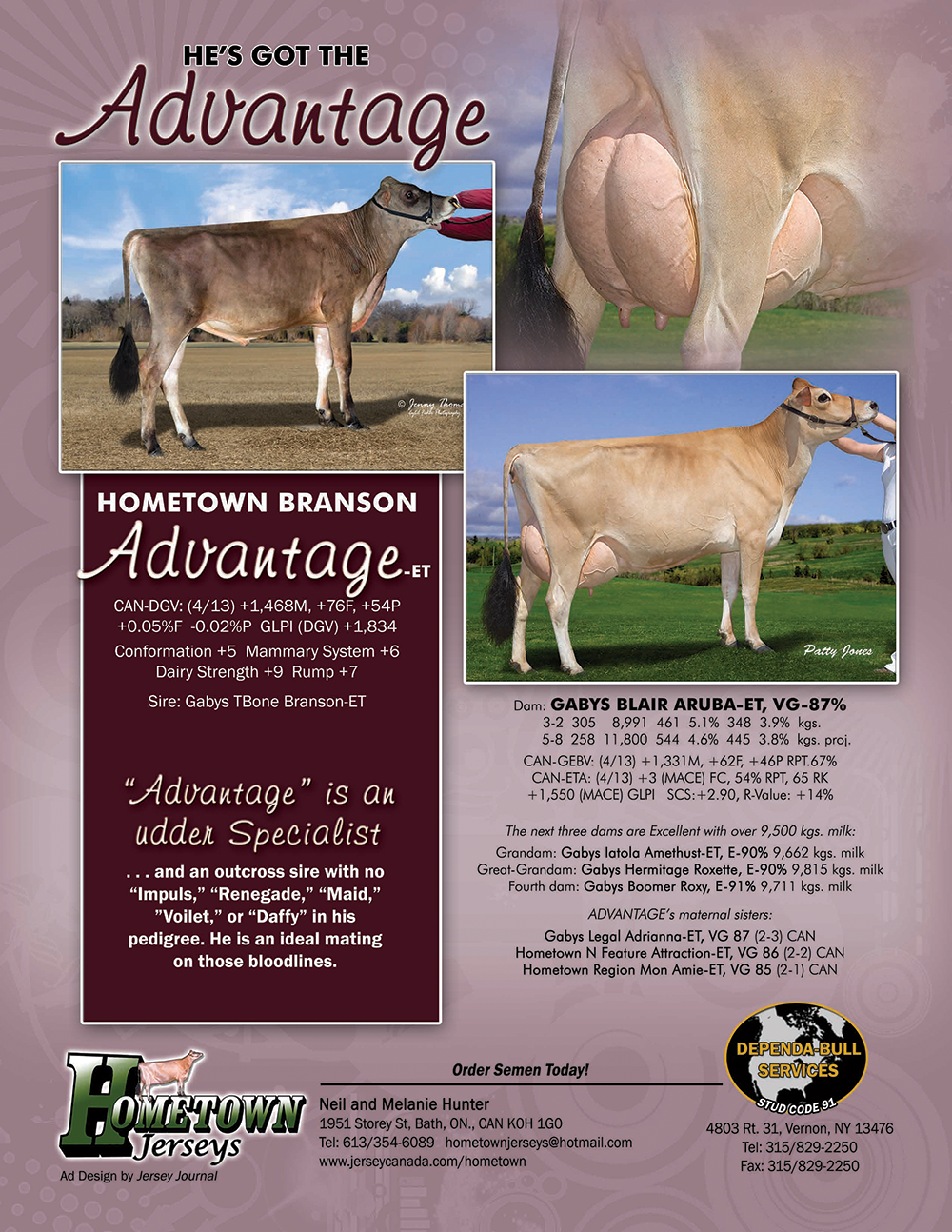
Neil and Melanie are keen and look for opportunities to take advantage of such as Genomics. “The advent of genomics gave us a trend to recognize and get ahead of. It has become a key, but not exclusive, decision making tool when deciding which sires to use and which donors to include in our flushing program. It will also be utilized as a culling tool in the same fashion, but will never supersede our “cow sense” related to their visual appearance.” They go on to provide examples of how it is working. “In the recent April proof run, Hometown privately genomically tested 9 bulls; 6 of them will be high enough to see AI service. The future of our business should include bulls sold to major AI’s as well as privately proven. The decisive factor of which ones will be private will relate to the size of the potential market and the “net” value attached to them by ourselves vs. conventional AI businesses.”
Hometown Breeding Philosophy:
Hometown sticks to a sustainable breeding plan. Neil describes the parameters. “We breed for pleasing general appearance cattle with snuggly attached udders, solid feet and legs, deep rib and wide enough chest and muzzles to eat large amounts of homegrown forage in order to convert it to high amounts of BF and Protein in the most cost efficient manner possible. This has led us to use a base of more typically type sires and cross them with the more attractive general appearance “production sires” that possess extreme rear udder width.” They make use of genetic tools. “We do rely on genomic testing as one of the influencers in narrowing down our sire and donor dam selections, but not exclusively. Finally, we breed from the deepest cow families as they will always be in demand as they have the highest probability of transmitting the traits they are recognized for.”
The Bullvine Bottom Line
With the courage of their convictions and a dream that they shared through whatever came their way, Melanie and Neil Hunter are building Hometown Jerseys in a way that is making the family, friends and fellow dairy breeders who encouraged them very proud. We know that they will use their experiences and enthusiasm to encourage and mentor those who aspire to thrive against the odds. For Hometown Jerseys they’re working hard to make sure the odds remain in their favor.
Many heads are perking up to the siren call of “Decrausaz Iron O’Kalibra *RC EX-96-SW.” Bred by Fredy Decrausaz and Sons who also bred her dam, this Swiss Miss has set off much debate.“Many North American experts say she should walk on the colored shavings at Madison and give the North American cattle a run for their money”.
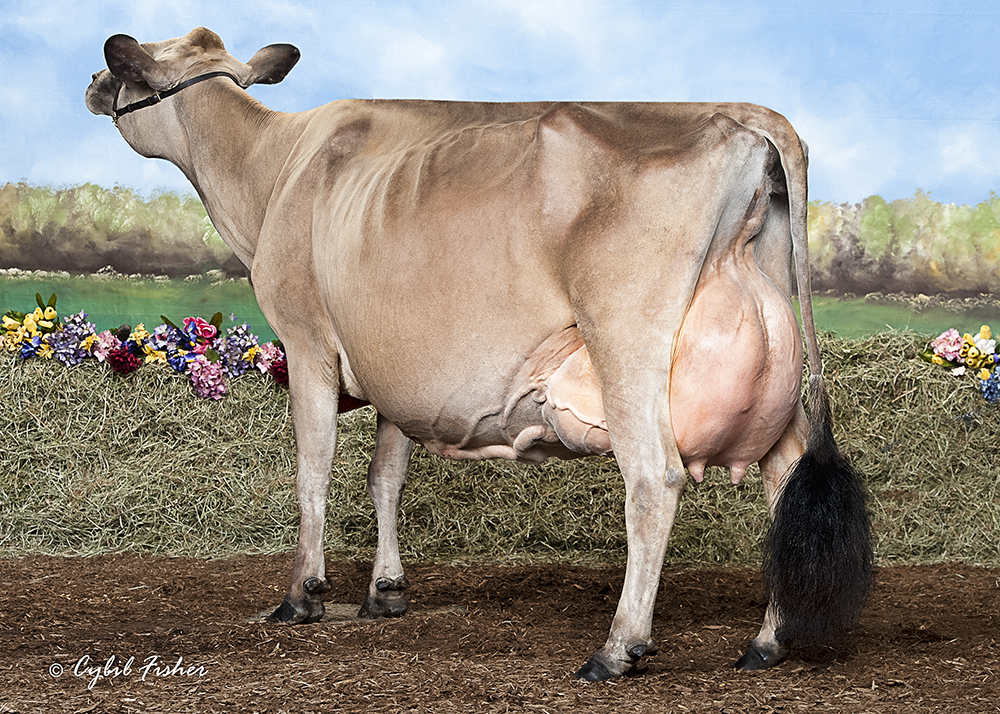
Decrausaz Iron O’Kalibra Grand Champion 2013 All European Championship
O’Kalibra “Where the Wins Keep Flowing Like Champagne”
Decrausaz Iron O’Kalibra – Mammary Photo from All European Championship Show 2013
Where is O’Kalibra Now?
At a cattle show in the Switzerland she stood out for Edwin Steiner, GS Alliance (Buerglen Switzerland) who bought her almost dry as a 2 year old. When she was fresh as a 4 year old a share was sold to Pat Conroy (Indiana USA). GS Alliance started with a predominantly Brown Swiss herd. Currently GS is 60% Holstein, 20% Red and White and 20% Swiss. To fulfill their goals of providing buyers with varied top quality breeding, they seek out exceptional cattle. Edwin explains, “Additions made to our herd are either show cows or bull dams and we invest in individuals with a deep pedigree. This way we seek to develop cows that satisfy every breeder.” Pat Conroy who partnered in the purchase of O’Kalibra, who still resides in Switzerland, adds to the story. “We bought her when she was fresh and for Edwin and I, it was her massive frame, wide chest, and high quality udder that caught our attention. It was only a bonus that she had a pedigree that made her marketable outside the show ring.”
Decrausaz Iron O’ Kalibra *RC EX-94-SW (3rd Lactation Photo) Grand Champion Swiss Expo 2013 Grand Champion Swiss Expo 2012 Res. Grand Champion Expo Bulle 2011 Hon. Mention Grand Champion Swiss Expo 2011 Res. Grand Udder Champion Swiss Expo 2011
And the Best Just Keeps Getting Better
Although not a common sire stack, O’Kalibra is backed by well proven sires. Her sire Boss Iron (Bookie x Chief Mark) was proven over a decade ago in Italy. He has many strengths, including high daughter fertility, fat percent, daughter calving ability, somatic cell score and productive life. This easily makes him the kind of sire many breeders look for today. Beyond Iron her sire stack goes to Integrity (Blackstar x Chief Mark) who is known for his deep bodied show type daughters. After that her sires are Milestone, Factor and Astre. Definitely the inclusion of Chief Mark twice in her sire stack is well expressed in O’Kalibra’s dairy strength and overall style.
Decrausaz Iron O’ Kalibra *RC EX-94-SW (4th Lactation Photo) Grand Champion Swiss Expo 2013 Grand Champion Swiss Expo 2012 Res. Grand Champion Expo Bulle 2011 Hon. Mention Grand Champion Swiss Expo 2011 Res. Grand Udder Champion Swiss Expo 2011
Five Generations Makes O’Kalibra Special
O’Kalibra traces back five generations to Cloverlands Skylar Cherry Red 11 Stars and two Superior Production records made famous by Granduc Holsteins, Quebec, Canada. Her fourth dam Granduc Carla Astre 9 Stars was one of three outstanding Astres from Cherry. Her third dam was a Milestone embryo sold by Lystel Holsteins to David Clark, UK. Originating from this same famous cows family are Dudoc Mr Burns (Thunder x Storm X Astre x Cherry) GLPI 1715 popular also as red carrier and Granduc Tribute a full brother to Mr Burns’ Storm grandma who is 4Stars with three Superior Production lactations. Her owners feel there are even more ways that she is special. Edwin proudly points out that “O’Kalibra has the build for longevity and a pedigree to go along with it. She is an extremely good day to day cow. She is the kind of cow that can look after herself, and never has a bad day. In addition to that, she milks like crazy.”
GRANDUC CARLA ASTRE
O’Kalibra Is An Excellent Swiss Hitter
O’Kalibra recently has been nominated for Excellent 96 and will see the panel next week. Her outstanding parts are Mammary and Frame. Not far behind those top areas are great scores for Rump and Legs. She has fulfilled the predictions of many that she would move beyond 94.
First calving at 2 years 2 months, in305 days O’Kalibra produced a respectable 9166 kgs, 3.6 % fat and 3.3% protein. Her best record in 305 days was as a four year old: 14,247 kgs., 4.0% fat and 2.9% protein. Great production runs in her pedigree with her dam producing 13,372 kgs as a four year old. Her grand dam produced 14,217 kgs as a seven year old. It goes all the way back to her fifth dam who produced 17,621 kgs as a three year old.
You’re Doing Fine O’Kalibra
Pat Conroy is happy with O’Kalibra. “We have sold a Sid daughter to a guy in Australia, a Sid bull to Select Star in Switzerland, an Acme son to Swiss Genetics, a Red Destry son to Swiss Genetics, and an Atwood choice in the USA to Morasci/Borba&Glaeser. We will also sell an Armani or MAS choice in the Field of Dreams sale May 24 in West Union Iowa.” Although he acknowledges that the best cross is yet to be determined he says, “All of her daughters and sons so far have been very good “do-ers”. We will decide which has been the best cross as the daughters freshen or sons transmit. Plans are to do a flush on her in 2 weeks to Armani (Goldwyn x Apple).”
It’s Beyond Okay for O’Kalibra in the Future
Both Pat and Edwin have a positive attitude toward O’Kalibra’s potential. “At this point, we will consider showing her again in the future” “when she really looks perfect.” When asked to compare her to cows in North America these proud owners remain positive but humble, “She has a bit more strength than most, however we do not want to take away anything from cows over there.”
The Bullvine Bottom Line
When encouraging breeders to breed the best Pat sums up his and Edwin’s theory. “Personally we would say that cows that have some power and strength, yet are still dairy, will ultimately outlast and out milk the high style younger cows that seem to be one hit wonders.” For both gentlemen it is obviously a shared opinion when Pat concludes, “I think that Iron O’Kalibra is one example that proves this fact to be true”.
Producing The Bullvine keeps us in touch with the best people in the world – dairy breeders. The unlimited passion, commitment and enthusiasm that they share with us is awesome. We recently struck pure dairy gold when we reached out to Neil and Melanie Hunter of Hometown Jerseys in Bath, Ontario. If you can believe it, they thanked us for the opportunity. Neil responded, “You don’t often take time to take a picture of your activities and just stand back and look at it. I decided to write it as it happened so somebody can give it to our grandkids.” And what a story he forwarded to us! In the Hunt family we call it the stuff legends are made of. The legend of Hometown is a two part series: Part 1: Against All Odds Part 2: Beating the Odds
Against All Odds
Unlike most dairy stories, the hero and heroine did not grow up on dairy farms but were infected with the bug through family, friends and mentors who turned their interest, into passion and eventually into a shared dream. Their paths, separate and together, led them through part time employment, to flushing from proven cow families until by 2005 they were ready to risk it all and start farming on the farm they purchased from Melanie’s grandparents; the same grandfather who had given Melanie her 1st Jersey heifer.
Neil, Chelsea and Melanie Hunter
Disaster Strikes Hometown More Than Once
Neil takes over the story. “In September 2002, I purchased 50 Holstein heifers and 5 old Jersey flush cows to provide my part of our future herd base. The following spring BSE hit and the fresh Holstein heifers I was counting on selling for $2200-$2500 that fall were now worth $500-$600. For those wanting to do the math, 50 x $2000 difference equals $100,000 in cash flow (all borrowed money). Luckily, the private lender holding the loan was pretty understanding about having to wait for his money until I had either worked it off or borrowed enough to cover it as I stepped into the next venture. Uncle Ralph Cherry (a past Holstein Canada President), was hired to help calve out these Holsteins and raise the ET Jersey calves until weaning, as I needed to work full-time and then some with such a big hole I had dug myself.” The hole may have been deep but Neil held to his dream and had prepared a detailed business plan for commercial lenders and, with a little bit of luck, had it approved. However…..
“The approved business plan had been to purchase the farm, 5.1kgs immediately and the balance of 25kgs of quota that fall at the budgeted $25,000/kg price tag. By the time bidding in the fall came around, the price was almost $30,000/kg and was no longer within the reach of our business plan and borrowing capabilities. We were stuck. Gut check time. Do we struggle along hoping for a break and find a use for our extra milk or quit? For the next 6 months we fed pigs, extra calves, etc. In the spring we managed a milking reduction sale, which included another herd of cows we purchased to increase our sale numbers in order to make it worth the trip for buyers. We sold everything saleable, leaving us with the ¾, old and high SCC cows and a few select unfresh heifers.” Keeping strong through all of these physical and financial setbacks would have been enough on their own, however, disaster seems to come in multiples. Sadly Neil relates what happened next to the first and one of the finest of Neil’s mentors.. “It was on the way home from the sale that Uncle Ralph Cherry, who so eagerly was there to assist where he could, died after hitting a transport.” It was definitely a very low day “Not only did we have to sell most of the cattle we were trying to build up but then we lost one of the key mentors of our efforts to that point.”
After Hard Knocks, Opportunity Knocks?
Obviously not ones to give up Neil and Melanie hung on. Finally, the break every start-up needs. We were provided with an opportunity to milk another person’s 30 cows and fill their quota for up to a year under DFO’s disaster relief program on a shared facility arrangement due to his sudden illness. This turned out to be the break every start-up needs. This opportunity allowed us to create cash flow, utilize the freshening cows/heifers of our own in the herd and create a financial track record for the financial institutions to scrutinize at a reasonable 35kg start-up level. It was kind of like our own DFO start-up program with the ability to equivalently rent all of the quota for 1 year to prove we could do it while holding down full-time jobs and therefore borrow that amount needed using our own cash flow records, rather than the estimated numbers for the average Holstein herd the banks wanted to compare us to.
“Around the time this opportunity ended, DFO was announcing the quota cap at $25,000 and related new rules. (Note: this was the $ level for quota we had previously been approved at) We could see that only being able to bid on a maximum of 10% of quota holdings each month was going to be like trying to climb Mount Everest since we only owned 5.1kgs.” And then came the decisions that make the Hometown story remarkable. Neil chooses his words carefully. “ After thorough scrutiny of the rule book, we made what is clearly the ballsiest (riskiest if you prefer) move to date. We sold our 5.1kgs in July in order to be considered a “New Entrant” on the September quota exchange.
A Special Anniversary Project
When many look back on anniversaries with candlelight and roses, Neil and Melanie share a much different memory. “Because we were an approved bidder without quota in September, we were allowed to bid on up to 35kgs and would get it as long as we were one of the 1st three bidders. Melanie and I spent our wedding anniversary sitting in the Purina Feed dealership office where I worked in order to utilize the direct line, high speed internet in Napanee. The glow of the heat lamp overtop of some unclaimed new chicks from earlier in the day was our candle as midnight approached. Not knowing whether DFO’s clocks were the same as ours, we sat with the internet form filled out with our bid, hitting the bid button and the back button for the last 10 minutes before midnight. The closer it got to midnight, the faster I would do it. Fingers sore and heart racing as blinding button punching speed ensued until… pop! It was done. Our bid was accepted. It was not for a few days before we knew that our bid got in 1st and we were going to ship 35kgs of milk starting October 1st. Yes, we finally had achieved our goal.” Was there every any doubt Bullvine asks?
Alert for Opportunities
As we follow these two on their dairy quest it is obvious that they are not ones to rest on their laurels. Soon they would respond to another opportunity. “Yet another dairy farmer had fallen ill. Having heard about our past shared facility agreement, he contacted us to see if he could work with us to utilize the DFO disaster relief program and move his 20kgs of quota to us as well while his teenage son decided to go to school the next fall or stay home to milk cows. Since we are gluttons for punishment and needed the cash flow, we agreed. We phoned the bank and our rep wasn’t going to be able to come out to for a couple of days to discuss our needs. The trusses for the new building to be used to house the new herd of cows and swing them in/out of the tie stall arrived 30 seconds after the banker stepped out of his car later that week. After quickly showing the driver where we wanted the trusses, we presented our new business cash flow and borrowing needs to the banker for the 1st time. It was one of those make it or break it meetings early in a business relationship that had to go well. That day, and several times since, that same banker realized we had a plan, but weren’t afraid to change it as new opportunities needed to be capitalized on. Milking 60 cows in a 40 cow tie stall barn, while maintaining 2 full-time jobs, nearly killed us for 9 months, but gave the business a much needed cash flow boost and left another structure the dairy barns needed to support the eventual goal of 50 milking cows and supporting young-stock.” Opportunity knocks but not everyone has the Hunter’s welcome for hard work while chasing possibilities and potential.
Way-Bon Counciller Mystery SUP EX 95-5E HM. Grand Champion – NY Spring Show 2013 2nd Place 100,000 Lb. Cow – NY Spring Show 2013 6th Place Mature-Cow – Royal Winter Fair 2010 1st Place Mature-Cow – Ontario Spring 2010 2nd Place Mature-Cow – Ontario Summer 2010 4th Place Mature-Cow – Royal Winter Fair 2009 Nominated All-Canadian – Mature-Cow 2008 6th Place Mature-Cow – Royal Winter Fair 2008 4th Place Mature-Cow – Ontario Spring 2008 Nominated All-Canadian – 5-Year-Old 2007 3rd Place 5-Year-Old – Royal Winter Fair 2007 Female Offspring: 8 Daughters Average 87.75 Points Including 3 Excellent Daughters Dam of Semex Genomax Sire: Hometown On The Money
Hometown Jerseys and Genomics
The Hunter’s vision for the future allows them the occasional rose colored glasses viewpoint but they never wear blinders and are always ready to look into the leading edges of science and technology. Genomics came knocking next. “That fall, after the RAWF, we had too much time on our hands so we surveyed the activities and new technology being rolled out in the Holstein industry in the form of genomics. Since we had sold our 1st bull to AI (Hometown On The Money @ Semex – On-Time x Way-Bon Counciller Mystery SUP EX 95-5E) we had some new found confidence that this was a business we could do as well in the Jersey breed. We reviewed what key breeders in the Holstein circles had done to utilize genomics in the year before Jerseys started releasing information.” This time Neil and Melanie didn’t have to use a heat lamp to work on the internet but they did stay up late says Melanie.”Three months of nightly research went into finding a high genomic Jersey family which we felt had a similar type standard to the herd we were developing. To get into this venture, it was imperative that the new cows could be appreciated by all breeders and that they would “fit in” whenever visitors came to view our herd.” This opportunity would mean taking to the road as described by Neil. “A trip to Greeneville, TN to Gabys Jersey Farms with childhood neighbour and adored Jersey Master Breeder, Bill Fletcher was planned. The goal was to purchase Gabys Blair Aruba, a VG 87 2 yr old and sister of the then #1 JPI Jersey cow in the US, Gabys Artist Ambrosia. Ambrosia had been the #1 cow for an unprecedented 24 months straight. After a very enjoyable day-long tour of the 150 milking cows and equal number of heifers, we were left dumbfounded by the deal offered. We elected to purchase the cow we went for, Aruba, a sister to her dam and 50% of Ambrosia. Ambrosia was clearly the most expensive cow in the offering, but by buying 50% of her, a long-term relationship was about to be built sharing the American breeding guidance and marketing connections of Henry Gaby for the foreseeable future.” The planning had paid off. What next?
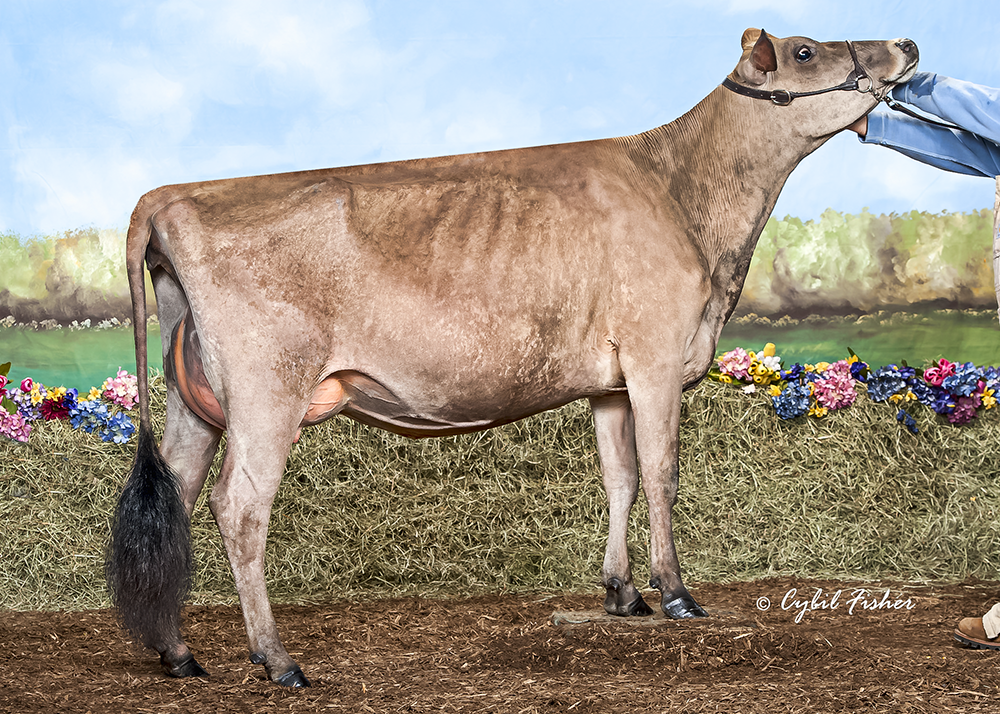
Gabys Blair Aruba VG 87 2 yr old #1 Protein, #2 Fat and #2 Milk among genomically tested cows in Canada in December 2010 Full sister to former #1 JLPI cow – Gabys Artist Ambrosia Dam of Gabys Arrow at Semex
Hometown IVF Ready
Not ones to shy away from the unknown Neil reports Hometown’s first experience with IVF. “All of Greeneville purchases stopped at Transova Maryland, for our 1st experience with IVF on their way to Canada. It was also the place where we made exportable embryos to Canada by a sire Mack Dairy Region, who was the highest type sire in the US, but not available in Canada. These embryos became part of the 1st genomic marketing effort in Canada by Hometown. 10 embryos were offered in the RJF Red Carpet Sale that summer with 2 bull contracts and a 2 bull, 1 heifer guarantee. Nothing like this had ever been done before in the Jersey breed and caused lots of discussion (pro/con) when it sold to John Claessens, Ingersoll, ON for the highest price of the day at $22,000. Genomics had officially arrived in the Canadian Jersey breed!” As they say on TV, obviously, Fear Wasn’t a Factor for Hometown Jerseys” as their enthusiasm for elite cattle breeding continued to grow.
Gabys Artist Ambrosia EX 91 Former #1 JPI Cow (for 24 months) Two Second-calve daughters with maximum lactation scores in the US of EX-91 Five sons in A.I. 4th generation EX bull dam
“More Opportunities Right Around the Corner”
Neil and Melanie exemplify how enthusiasm breeds more enthusiasm and soon they were finding another way to get ahead of the curve but this time in “Polled” Jersey cattle. Neil explains, “I had learned of a really high genomic test for a polled “Legal” son of a cow I had picked out of 350 cows in the Schultz herd of Jim Huffard, of Virginia, on the way down to Gaby Jersey Farms in 2010. The test would make this 6 month old calf the highest ranking “Polled” bull within any dairy breed ever; being released around #8 in the Jersey breed. With this knowledge in hand, I reconnected with Jim Huffard and purchased Schultz Mygent Chilli-P EX. Back to Transova-Maryland we went for extensive IVF.” Hometown was very literally living the part of the dream where the rubber hits the road.
Schultz Mygent Chili-P EX-90 She is a polled daughter of Schultz Paramount Mygent-P out of a Hallmark dam. She has a GJPI of +179 (04/11).
Another Hurdle or Another Hometown Opportunity?
Sometimes we miss opportunities because they come disguised as too expensive or too risky. Neil and Melanie have been there and done that … but they never let it hold them back from their continued quest to add the best genetics. They did the pedigree research to make that happen and as they tell it, “We tripped onto a son of a past RAWF Champion, Huronia Connectn Crystalyn SUP EX 95-3E. The bull was by Impressive Indiana (probably the best Renaissance son who was not available in Canada). When I approached Lorne Ella, Hornby, ON to purchase Rock Ella Impression, I was told that I would have to outbid AI, namely ABS. After inspection of the bull, we agreed to pay the price asked as long as we had the opportunity to purchase at least 50% of Crystalyn and be able to take her home to work with her. After a couple of days, Lorne phoned back with the offer to purchase all of Crystalyn at double the price. Not knowing where we would find that money too, Melanie and I jumped at the chance to own this world renowned Jersey cow. It was clearly a huge honor to have this revered Jersey Master Breeder sell to a young, upstart couple like us, what we thought was his best bred Jersey cow. We also knew she had a huge number of admirers/marketability. Having the bull’s semen sales pay for them both was the NEW plan!”
Huronia Connectn Crystalyn EX-95-2E the 2006 Royal Grand Champion and All Canadian in 2006 and 2007. Neil and Melanie purchased Crystalyn from Lorne Ella along with her son, Rock Ella Impression (by Indiana)
The Bullvine Bottom Line
Having a solid plan is what gave Melanie and Neil their start at Hometown Jerseys and against all odds they have continued to build toward success. Don’t miss Part 2 of their story “Beating the Odds.”
Even though we write from Canada where Supply Management supports against extreme variation in milk prices, there are more and more of our fellow producers in from Canada and the US quietly exiting from the dairy industry. For the time being, total production is maintained by the increased herd size. Whether it`s exiting from the business entirely, or deciding which cattle are not pulling their freight (Read more: Why You Should Get Rid of the Bottom 10%), the decisions you make about the future of each cow directly affect your dairy farming future.
The Numbers are Up
In the US after dropping from high levels in January to a more-normal range in February, slaughter of cull dairy cows crept back up in March. According to the “Livestock Slaughter” report by the USDA on Thursday, April 26th 274,000 dairy cows were slaughtered under federal inspection in March. — up 15,000 head from February, but down 4,000 head from March 2012. In January, the number of slaughtered dairy cows reached 297,000 — the highest monthly slaughter figure since 1986. This high cull rate came as no surprise, since many farms have had to deal with high feed cost and low profitability.
Tough Call! Tough Cull!
When you`re already facing mounting costs on every front, it`s seems disloyal to put any of the blame at the feet (or udders) of the cows you love working with every day. For many, although necessary, it isn`t as easy as firing the bottom 10% (Read more: Why You Should Get Rid of the Bottom 10%). The question involves a full range of variables including the financial, the emotional and all the other “when, why and how” questions.
Say “When!”
Quite often when serving family and friends a beverage we automatically offer the choice, “Say when!” Unfortunately, when the glass of dairy life is filling with the hard issues of debt and sustainability, deciding when enough is enough is much more difficult and definitely not hospitable.
At a basic level the decision to cull less-productive cows is made on how much room is available for housing and/or how many are needed to fill quota. At the financial level, bankers and lenders have definite opinions on keeping the barn full for cash-flow reasons. Ironically, lenders should be the first ones who see the value in pencilling out all the numbers. In an article entitled, “Rewriting Culling Decision with Changing Marketing Decisions” Dr. Jeffrey Brewley of the University of Kentucky urges dairy breeders to consider 4 steps:
Calculate the breakeven production level necessary to cover feed costs.
Each cow, at a minimum, should produce enough milk to cover the costs of the feed she is eating.
Cows below the minimum level must be culled from the herd. As feed prices increase or milk prices decrease, the breakeven production level increases.
Although difficult to consider, if the majority of the herd falls below the breakeven level it is time to seriously consider exiting the dairy industry.
Leaving by Example
The very informative Brewley article provides statistical examples and tables of production costs
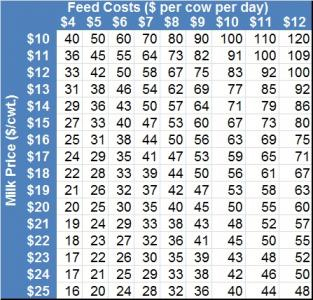
Table 1. Breakeven milk production levels (pounds per cow) needed to cover daily feed costs for varying daily feed costs and milk prices.
“For example, when milk prices are high ($25 per cwt) and feed prices are low ($4 per cow per day), breakeven milk production level to cover just feed costs is only 16 pounds per cow per day.
On the other hand, when feed costs are high ($10 per cow per day) and milk prices are low ($12 per cwt), breakeven milk production level is 83 pounds per cow per day. With today’s feed costs for many herds in the $8- to $10-per-cow range with milk prices around $20 per cwt, breakeven milk production levels range from 40 to 50 pounds. As feed and milk prices change, dairy producers need to re-evaluate when cows should be culled.” Jeffrey Brewley goes on to say,” This method for calculating when to cull dairy cows only accounts for feed costs. Feed costs account for the largest percent of total costs (50 to 75 percent) but do not account for all costs.
Thus, the true breakeven milk production level will be a few pounds higher and will vary considerably from farm to farm.”
Beyond the Milk
Unfortunately, culling decisions are seldom based on a single factor. For a cow beyond mid-lactation the most important issue is whether or not she is pregnant. Cows pregnant in later lactation and producing below daily feed costs can be dried off early. Of course, the future for these cows depends on other factors such as the feed costs during her dry period, the length of the dry period and the projection of whether she will be able to produce enough to pay for the next lactation. Finally, the availability of a replacement for her must be factored in.
“Show Me the Money!”
The constant repetition of the demand for the sports agent in the movie Jerry McGuire to “Show Me the Money” was humorous but not entirely without a reasonable basis for sustaining a profitable dairy business. The actual calculations for this “money showing” retention pay-off are fairly complex. Dr. David Galligan from the University of Pennsylvania has an excellent dashboard to calculate the retention pay-off for an individual cow in your herd (Click here to view this dashboard). The concept is also useful when deciding what cows to cull. It comes down to weighing of the future income potential compared to the income potential of the replacement heifer brought into the herd. Culling is recommended when numbers show that the future heifer will outperform the present cow.
How Old is Too Old?
Experts, such as Dr. Greg Bethard of G&R Dairy Consulting Inc., caution that the bottom line on culling decisions is also affected by the age of the animals involved and the decisions are different for younger cows than they are for older ones. “The future income potential of an older cow is limited. The future income potential of a pregnant cow in late gestation is much higher than that of an open cow. The future income potential of a non-lame, low SCC cow is higher than a lame, chronically high SCC cow.” The list of cull reasons for your particular situation could be much longer than the ones mentioned here. The basic points to consider are:
Every milking cow needs to cover the cost of the feed she consumes. No debate.
Pencil in the realistic amount earned by the current animal compared to the potential income from her replacement. Do the math.
The Bullvine Bottom Line
Business minded breeders are finding that culling is key. With such important decisions affecting success on the dairy farm, your knowledge of your own herd, your cows and your marketplace is the key to your survival. It’s your cull.
There are some issues that polarize everybody and the debate over GMOs (Genetically Modified Organisms) does that. People emphatically declare that the facts are black or white, wrong or right one way or the other. If you’re on the wrong side, you are not only politically incorrect but you offend science, religion and the environment. This does not sound like the win-win situation that we are encouraged to seek in most areas of life. Indeed when it comes to GMOs we are determined to prove only one thing… and that is that… the OTHER side is absolutely wrong.
GMOs Throw Dirt… Lose Ground
It’s a no win situation with both sides throwing dirt at each other in the press, on TV, in rallies, parades and even, resorting to boycotts and stand offs. There’s an old saying that my grandmother (a mother of 10 and grandmother of 43) quoted effectively when rivalry escalated to harmful levels, “Whenever you throw dirt, you lose ground.” Today`s dirt throwing GMO war of the words has shifted the focus from the production of sustainable, healthy food to a challenge of the very character of the producers. Like anything, even when incorrect, if it is repeated often enough, it gains the perception of truth. As a result consumers are beginning to bite the very hand that feeds them.
The Win-Sin Battle between Good and Evil
Emotions run high when you’re talking about the life-giving food required by every living thing. Add into the mix, the conspiracy theory that money will make food producers sell their souls and it becomes a battle between right and wrong, good and evil. At the other extreme, the equally evil fanaticist viewpoint is that farmers, unlike their apparently perfect forebears, are working fiendishly with big science or big companies to give you cancer, make you fatter and, generally, ruin your good health.
It`s Your Choice
The underlying fear of sickness, misinformation about food-raising processes and a desire for an absolute answer propels the attack on food producers. If only it were that simple. A target allows us to lay the blame for sickness and obesity onto someone else. But at the end of the day it isn’t some agricultural trickster but our own choices that are making us sick and fat. It’s the choices that are made that produce the results that raise alarms for the health of future generations. And choice is a fundamental part of the GMO or anti-GMO debate. People who are anti-GMO have the absolute right to choose what they eat. People who produce food have the absolute right to choose what to grow. It’s hypocritical to limit the choice of either side.
Take off the Rose Colored Glasses
We often look to the past and assume it must have been better and healthier then. We must not overlook the facts. There are reasons that the life expectancy for our farming forefathers was considerably less than today’s norms. Every early farmer practiced genetic selection to improve food production. It’s even harder and more necessary to select for improvement today. Try growing an organic garden in the city with all of the challenges – air pollution, lack of water and too much or not enough sunshine. Imagine if your life depended on the results. That’s farming!
Where Praise is Due
That’s were kudos go to the scientists who are creating seeds and foods that can withstand so many adversities. Kudos to scientists and farmers who are taking responsibility for reducing chemical applications. With the advent of GMO crops there is significantly less usage of insecticides and herbicides. With so few farmers providing for so many, subsistence farming is now obsolete.
Survival of the Fittest or “Who Controls Who?”
Whether you`re talking animal genetics or plant genetics, survival of the fittest has been nature`s way of modification. Weeds, like any other life form, adapt to survive. Weeds adapt to cultural practices as well as chemical. Growing food or crops in a “steel city”, as we do, is a challenge before a single chemical has been applied to the fields. One “strong” unrestrained monoculture that provides no edible benefits for man or animals is an ever present challenge. Drive along any roadway and ask yourself what has happened to biodiversity? It’s not blame but “better” that we need to aim for.
Here at The Bullvine we raise the question of animal genetics and GMOs (Read more: Are You Ready For Genetically Modified Cattle? ). Again ours is an industry with numerous regulations and scientific studies driving profitability and sustainability. Again there are big guys, bad guys and concerns for safety and health issues of the food products we are producing. And again, it isn’t blame but “better” that should be the driving mantra for the future. It will be too bad if we resort to, “Don’t confuse me with facts, my mind is made up”.
Two Different Paths … the Same Destination
Total agreement is not the goal. Total vindication of one side or the other doesn`t serve any constructive purpose. Regardless of absolute right or wrong there is one absolute truth,
The world must be fed.
During the next 40 years the world`s population is projected to reach more than nine billion people. Demand for food is expected to increase by 60 percent. The competition for land, water and food will escalate and is having a very real impact on food production and therefore on health, poverty and hunger. We must find a way to safely and sustainably support the world`s poorest and most vulnerable.
Without returning to everyone becoming a food producer, there is no way to feed the huge and growing demand. Yes! Small scale farmers feed 70% of the world…but they are subsistence farming to sustain their own family. North American farmers are producing to provide for a growing population. Not every country can do this. But imagine a scenario where everyone ate only locally grown, organic food. Where does that leave metropolitan areas? We cannot turn back the clock on large cities. In that scenario, what would become of Tokyo, New York, London or Rio de Janeiro?
The Bullvine Bottom Line
In every responsible home there is the desire to make better choices for the health of our families. On the farm, we make those choices too with the added responsibility of providing for others. There is a time and a place to hear the concerns of all sides of the debate. We farmers must defend and guarantee the food products we produce. Don’t throw dirt but hold our ground. We must not be silent.
Dairy producers around the world can be forgiven for having a romanticized vision of producers in Australia. We imagine that, like the country, the industry is big, bold and populated by the friendliest people you could ever meet. Well, that`s the story. But unfortunately our peer group is finding it impossible to stick with it! Headlines report that a full blown “Crisis” is turning things upside down with “Massive job losses!” and “Rural Debt Approaching $60 Billion” It is hard to imagine what they’re going through. However, it isn’t only financial strife that is hitting that usually Teflon group known as Aussie dairy farmers. The downturn has gone on so long that it is spreading beyond the farm. Many rural towns that rely on farm dollars are closing businesses because of the financial impact. Banks are closing down on lending. It’s dire straits for everybody. In the long term it doesn’t look any better. ABARES (Australian Bureau of Agricultural and Resource Economics andSciences) forecasts a 36 cents per litre farm-gate price within five years – well below the cost of production. For many families who make up the backbone of Australia’s third biggest agricultural industry, the threat of going under has turned from “it will never happen” to “it could happen soon”!
Quit or Lose Everything?
Yes! Although renowned for their warmth and informality and universal love for their country, today’s Australian dairy farmer is facing serious challenges. It is estimated that 20 per cent of south-west Victorian dairy farmers are potentially in great trouble with the banks. The current 6,700 dairy farmers in Australia is a number that is down considerably from 12,000 a decade ago. And instead of enjoying productivity and success even fourth generation dairy farmers are on shaky ground and seeking options before it’s too late. For many that time is here. “There comes a time when you’ve got to stop. That’s why we’re getting out because I don’t want to walk away with nothing.” Year after year of losses have affected what options they face in leaving too. Those who have clung desperately to their dairy operations are finding it next to impossible to sell, especially in the last two years. There are hundreds of dairy farms for sale in south-west Victoria. Unfortunately there are very few buyers. Farmers who previously expect up to $7000 an acre are struggling to get offers of $4000 or $5000. On the sale of an entire farm that could mean a million dollars less after years of dedication and hard work.
Dollars and Senselessness
From the outside looking in, we would love to identify what caused this situation in Australia and, hopefully, guarantee that our own national industry, wherever we’re from, isn’t on the same path. However, the causes of Australia’s crisis are eerily familiar:
Milk prices are NOT rising.
Input costs – electricity, fuel, wages, feed and water – ARE rising.
Investments were made that look foolish in hindsight.
New policies and new taxes add new burdens.
Not heeding #’s 1 to 4.
… C.O.P.s and Robbers
Two variables have had particularly unpleasant repercussions in Australia. Dairy farmers are usually resilient and cope with Cost of Production challenges with belt-tightening and management methods that have seen them through the regular up and down cycles of the dairy industry. However, COP creativity can’t make a stand against the highway robbery that appears to be happening in Australian grocery store aisles. Press releases report that “At the moment the milk price we’ve been getting is 25 or 26 cents a litre. The cost of production does vary from farm to farm, but for us it’s around 43 cents a litre.” As if that wasn’t disheartening enough, the strong Aussie dollar (and who doesn’t want a strong national currency) is severely weakening the dairy industry. But the blows just keep on coming.
Coles says the milk war is not to blame for lower prices.
Milk Wars
Dairy producers worldwide face country specific challenges. Even so the battle between two parts of the same industry is disconcerting for Australian producers. “Two years ago Coles discounted its home brand milk to $1 a litre. Its decision sparked a milk war as the other supermarket chains followed suit. This has driven down the farm gate milk price. Coles argues the milk war is not to blame and has undertaken an advertising campaign to put a better spin on their role. Dairy Farmers president Noel Campbell replies, “Part of the reason why people are so angry with the Coles situation is, whether you supply domestic or the export market, people think milk being sold for $1 a litre is just wrong. “The amount of capital expended on the farm,. The amount of labour expended on the farm, long hours etcetera, people just see it as a slap in the face.”
Seeking Solutions
When milk is cheaper than water, a universal cry is raised, “Help!” Some Australian groups turn to the government. “The government should appeal to the consumer to support our local dairy industry and the additional 50 cents per litre would be distributed direct to each farm by way of 12 cents per liter and would keep this quality product on our supermarket shelves,” Coffey Hunt On-Farm Agribusiness partner Garry Smith said. “We need to get more money paid for our milk and continue to reduce our costs and inputs.” Good suggestions but another hurdle is thrown up since there have been savage cuts to agricultural R&D right around the country. Places to seek innovative solutions and leadership are running out. Farmers are understandably agitating for low interest or no interest loans to help them through until prices improve. One suggestion is that there could be a consumer-paid 50-cents-a-litre Dairy Industry Support Initiative on milk.
Is Today’s Crisis Tomorrow’s Disaster?
Wherever they are, but most especially in Australia, farmers need to start thinking about the big picture beyond the farm gate. Failure to face the future could mean that the opportunity to build a sustainable industry is lost. Profitability is the goal. We need to stop internal competition and fighting before the entire industry is lost.
The Bullvine Bottom Line – Who’s Next?
The milk industry is volatile and affected by many variables. That’s not new but now there is a new world order of dairying nations. Everyone – perhaps foolishly – buys into the story of a glowing future where demand soars and there is a wealthy future for dairy farmers. Unfortunately here and now Australian dairy farmers must face the reality that they are no more profitable now than they were a decade ago. Something needs to change or the down under romantic story will become the down under dairy industry tragedy.
We all know what an oxymoron is: working holiday, tight slacks and freezer burn. Well here’s another one “An anti-social dairy farmer”. Farmers have always enjoyed the “social” aspect of their 24-7 business. Wherever there are two farmers there is bound to be good gossip.. ahemm … good conversation going on.
Can we talk?
In an industry blown about by the whims of Mother Nature, politics, local regulations and world issues … there’s a lot to talk about. Facebook and all other social media are all about connecting (Read more: 7 Reasons Why Your Dairy Farm Needs To Be On Facebook). It is absurd to think that our already social business would not grasp digital social networking with open arms and tapping fingers. Think about it. Today at some point you will “social” ize with someone coming in your lane. Whether it’s a sales person of genetics, feed, seed, nutrition or health … you will meet, greet and connect at some level. To me, it follows that it should be natural to welcome delivery of the same informed decision-making tools from cyberspace.
Social media is made for farmers
Farmers are completely familiar with sharing opinions, recommendations and trusting those who have their feet in our barnyard, feed alley or under our board table or kitchen table. Couple this with the home truth that farmers rarely have the opportunity to do their networking on the golf course, a sandy-beach or at the gym and social media is not only the logical choice it’s the perfect choice!
Videos such as Ram Trucks’ “Farmer” Super Bowl ad have gone viral promoting farmers to 0ver 20 million viewers on YouTube alone
Not that it doesn’t take getting used to.
Those of us, who spend time in social media, tend to live and breathe the space as if it were real life, which of course it isn’t. It is however, a great place to build a network, to find like minded people and discover what they are working on, and learn with and from them. Just like over the line fence or at the farm supply store or at a farm meeting. It`s a place to live, learn and move forward.
The goal is to apply what we learn to real life.
Like any social interaction, the benefit comes from applying what you know to what you are doing. New ideas for improving the logistics, cash flow, genetics and marketing of our dairy businesses are what we are seeking out. Doing these things better doesn’t only pay the bills, it also provides satisfaction for those who love their work. Now we can come in from the barn after a long day and have the quiet satisfaction of having a day’s work well done and take time to enjoy a more technical version of “cow talk”.
“The most important connection in marketing today is business to business”
I would challenge everyone in the dairy industry to modify that mantra to, “the most important connection in dairy marketing today is barn to barn”. Numbers wise, there are not a lot of us left out there. In times past you looked to the horizon and saw farms as far as the eye could see. Today, it’s hard to see a fellow farmer from that viewpoint. It doesn’t mean the network is lost, it simply means in the 21st Century it actually is a “network” of connected internet users.
From Face-to-Face to Place-to-Place
We need to receive these “online” conversations in the same way we receive face-to-face conversations. When face to face we can express our view and assume from the non-reaction of the person we’re expounding to that they support our position. It’s too bad we don’t hear their report when they share it with the next person who comes into the milk house.
There is the question of tone of voice being missing from social media. Anyone who has had the tone in one of their emails misread will understand the problem. It’s hard to convey the subtlety of face-to-face or telephone interaction using words or text only. However, when was the last time your spoken words were misunderstood? Nothing promises total perfection.
What`s Next?
If you’re reading this, you’re probably already beyond the beginner level with email and Facebook. Do you have a Website or Blog? Don’t skip this step. Your website is the first place you can let the market know that you have something they’re looking for. Even if you’re not planning to conduct all your business on line, you still want to drive customers to your website or to your farm.
So how do you get started?
There are online Guides for every social media program. Check them out and set up accounts on Twitter, Facebook, YouTube and LinkedIn. Of course (bias aside) you could check out the Dairy Breeders Guide to Facebook. The wonderful thing about technology is that there are many ways to learn the how, what and when. A simple question placed on “Google” and you can discover step by step instructions to your success using social media.
The first step is always the hardest.
The neat thing is that there is always somebody close to you that has the expertise to help you join up. While “joining” is easy, it is wise to consider that rushing in and then doing nothing is like that New Year’s resolution to workout. You join the gym but your membership is as active as the clothes hangar otherwise known as your Treadmill. While you won’t lose it if you don’t use it, remember that it is “social” and why join, if you intend to remain a wallflower?
There are two questions to ask yourself.
What do people need to know about you and your dairy operation?
What do you need to know about the marketplace?
The primary goal in becoming “social” is to have your prefix, product or genetics come to a buyer’s mind the minute they have identified what they are looking to buy. Hit people with your features and benefits and you win their minds. Get your story out there and you win their hearts.
Make sure that you share new births, fresh heifers, your genetic successes, your dairy industry issues and your pride in your family business. You can never post too many pictures.
Continually polish and perfect your “story”. It’s the social magnet to attract more business.
The Bullvine Bottom Line
At the end of the day dairy farmers are definitely social. We’re not talking extinction …but dairy DIStinction. Far from being on the verge of extinction, farmers are prime candidates for using this handy new tool. In reality (a word overused today) we probably do better when our social life takes place in a variety of ways. If we limit ourselves to one form … we limit ourselves period. Let’s get social.
Julia James of Norwich, Ontario has the wisdom of a seasoned business analyst, the heart of a philosopher and the adrenaline of a long distance runner. However the secret of success for this one-of-a-kind dairy dynamo is the well-honed focus that allows her to live the lifelong dream of owning a dairy farm every single day. She is not yet 30!
Growing by Leaps and Bovines
Julia has numerous examples of how long she has held the dream of owning a dairy farm. What makes her one-of-a-kind is that she apparently never put that dream on the back burner for any of the commonly accepted reasons. “I started milking cows on August 1st, 2008 in a rented facility just outside of Woodstock.” This is a mere two years after graduating with a B. Sc. Agr. (Animal Science) from the University of Guelph. She outlines the process. “I purchased my beginning quota from my parents who reside in Lanark County (Eastern Ontario). Since my start date and through buying quota as often as cash-flow allowed I have been able to grow my total quota holdings by 24% in 5 years.”
The Dream is Real. Today.
Obviously, Julia is not waiting for a better time, a different time or any time that means waiting or holding to the status quo. She describes her setup. “Currently I milk 29 cows in a 3 row free stall, slated floor rented barn. The herd is a mixed herd of Jersey and Holstein. I raise all of my own replacements for a total of 78 head currently. Where the cows are currently milked is a rented facility. Where I reside is a 54-acre farm that I purchased last year in hopes that someday a dairy facility would be built there.” Her use of “currently” reflects her acceptance of and push toward continuous change.
FUELING THE DREAM: Education. Collection. Selection.
There’s an old saying that people often miss opportunities because they come disguised as work. It’s unlikely that Julia James will ever miss an opportunity. She works everything in. “When I first graduated I worked as an AI technician for ABS Global for 2 years. Then started milking in 2008, once settled into my routine of farming I was hired by Select Sires Canada in June of 2009 where I currently work today as a reproductive specialist.” The key word for Julia is that she is working.
Positively Positive
Many would consider her grueling schedule as a deterrent to success, but Julia, as expected, has a different viewpoint. “Being a driven, independent person I don’t see many things as challenges but rather learning opportunities. There are days when it is challenging getting through your to-do list, but by putting one foot in front of the other I always manage to get there. I also have great students who help out during the week with some chores.” She loves the support of agricultural community, family and friends. “Over the past 5 years, there are definitely more people cheering me on than standing in my way or providing negative energy.” Julia is also a cheer-leader of her favorite pastimes (soccer, curling, cycling), community groups (church and milk committee) family and friends, especially Thomas. “When you’re doing what you love,” says this dynamo “there’s a time and place for everything … including dehorning and cleaning calf pens.”
In dairy farming Julia has found her pot of gold.
Julia James on a Mission Statement
Businesses are encouraged to be able to briefly express their goals. For Julia the word mission could be replaced by the word passion. She says,” I am driven by passion. My heart, my passion and my dreams are rooted in the dairy industry. I am very happy and fortunate to be doing what I love and receive great satisfaction from contributing to the economy everyday as a primary producer of a safe and quality product.” That could be a motivational posting in every dairy barn.
Don’t Keep Your Dreams on the Shelf
Julia’s dreams are being achieved because she has an eye for those to follow and emphasizes that “My parents and family have always been supporting me and cheering me on, even in times when they may not agree with some of the decisions I make. “ She encourages others. “Anyone who takes responsibility for who they are and what they believe in and works hard and smart to make themselves happy all while being a productive member of society is a salt-of-the-earth hero to me. For Julia fear of the future is not an option. “People are afraid to take risks and chance their dreams in fear of failure or lack of self-confidence. You never know until you try and you have to chase your dreams. With proper research, networking and planning you will get there. But you never know unless you try and you must remain positive.” This dairy entrepreneur has teaching and mentoring talents in her resume too.
Appreciate the Gift of Every Day
Julia thrives on learning and modestly claims she has much to look forward to. “My greatest accomplishment is still a work in progress. Every day I celebrate little achievements. Whether it is a new baby heifer calf alive and well running around in its pen or watching all of my cows lie-down chewing their cud an hour and a half after milking. It could be a satisfied customer, or being in bed by 9:00 with the to-do list empty and all animals healthy and resting, preparing to start a new day. These are all accomplishments to me.” It sounds like she has achieved the perfect idyll already but she sees great things ahead. “My work in progress is to be able to farm one day with the one I love, raising a family on the farm, and running a very successful, sustainable dairy farm with my best friend, fellow team-mate and husband. Thomas and I are well on our way there taking on the challenges as they come and making them into opportunity.”
Ready for a Sustainable Future
Julia’s special talent is having her hands taking care of the “now”, while her eye is targeting the “future” with realistic assessments. She has considered the challenges ahead. “The biggest change I see coming is sustainability. Many aspects of the industry achieve this on some level already probably more so than many others. Taking responsibility for what we do and making sure our passion for what we do is evident will be critical in growing our markets and further establishing the trust of our consumers.” She rallies her dairy peers to provide a foundation for the next generation to build on.
Flying High Between Chores
It isn’t surprising to hear that Julia would like to take speed lessons and learn to fly in an hour. “If I could learn to fly in an hour, I would do it in a heartbeat. There is so much to see in the world and so much to learn outside your own back-yard. Being able to fly would allow me to experience these wonders all between chores.”
Choose it. Do it. Achieve it.
Even when she fantasizes about having her head in the clouds, Julia’s feet are firmly planted on the ground. “Take time to smell the roses (even if they are growing in the manure pile). Never stop dreaming, believing, achieving and ALWAYS have fun!! Her dream of her ultimate dairy farm is powered by the Julia’s amazing ability to live the dream every day.
The Bullvine Bottom Line
Some people dream of a life they hope to have some time.Julia has a three word answer to anything and everything that may be holding you back, “Do it now!”
When successful artists recount their early inspirations, they often recall their youth. Emma Caldwell isn’t yet old enough to look back from that distant viewpoint, but this already attention-attracting artist confirms that she is inspired by her dairy roots.” I grew up on Maple Holme Farms, a dairy farm in Carp. We milked 45 Holsteins in a tie stall barn, until we sold our quota in 2007. We mainly do cash crops now. I have been a member of the Carp 4H dairy clubs for the past 12 years. After we sold our herd, I borrowed calves from Sandy Crest Holsteins, Riview Jerseys and Drentex Jerseys for my 4H projects. Last year I bought half of a jersey calf which I co-own with Mike & Monique Bols of Russell, Ontario. The past three years I have been helping the Bols of Drentex Jerseys along with Jenna James with their show string and helping out with clipping and preparing for the classifier. This will be my last year in 4H, but I hope to continue working with Drentex.”
Emma’s recent painting “Hailey” of the great RF Goldwyn Hailey. Want to own this this painting? Click on the picture to find out how
In Praise of Painting
It’s exciting to hear how young Emma was when her artistic talent took root. “I think I have been drawing since I was old enough to hold a pencil, and it was something my dad and I did together after he got in from morning chores.” Looking at Emma’s portfolio, one envies the vision and talent that produce such art with apparent ease. It turns out that it was indeed a special talent. “I have two learning disabilities, and up until I was diagnosed I really struggled with school. I think if you don’t think you’re good at much else you’re going to focus on anything that gets you that bit of praise from your teacher or peers. So I guess art was attractive to me from a very early age because it was and still is a method of communication that I find most natural.”
Painting Her Way to the Top
Despite challenges along the way, 21 year old Emma has always set and achieved her goals. “I think my greatest accomplishment will be graduating from Queen’s University with a Bachelor of Fine Arts. I have struggled throughout my entire education with learning disabilities. The Fine Arts program at Queen’s only accepts 30 students out of the 300 that apply each year, and since Queen’s was my first choice, to be one of those 30 is something I worked really hard for, and am really proud of.” This is a special achievement for Emma and one that, through her art, she can continue to share.
Basically Bovine with a Unique Perspective
As more art enthusiasts get the opportunity to explore Emma’s portfolio, they will become part of the evolution of this artist who feels her style is still developing. “I am always trying to grow as an artist. I want my art to have energy. I use a lot of bright colours, splashes and drips of paint with brushy strokes of paint. I like it when I let some of the underpainting show through, and leaving hints that there is more than meets the eye underneath. This year I started using gold leaf in some works and I really love the contrast it brings to a painting. It is not important that a painting be totally realistic, I am more concerned with the impression of character or presence. I think sometimes when I leave a part unfinished or just give a suggestion of something like hooves, it brings more life to the painting than I would achieve by trying to copy a photograph. What really draws me to cows is their personalities that you only get to know from being in close contact with them your whole life. I want my paintings to feel like they have captured the character of an animal.”
Emma’s painting that was auctioned off as part of the 2012 Jersey Ontario AGM.
Expressing Dairy Strength and Power
One of the great pleasures of being an artist is having the opportunity to explore the different aspects of the chosen subject. “With cattle this becomes challenging,” says Emma, “because they do not fall into the two usual categories of animal painting: pets or wildlife.” She elaborates, “Cows are working animals, and although we love them, they’re not our pets, they are still bred for a purpose. I want to capture the strength and power that humans have bred them to be.” She sees the contrasting sides of these dairy animal partners. “Cows have been bred to be big, strong animals but also to have wonderful quiet temperaments that allows people to work with them). I try to convey the calm air that a mature cow has AND that tremendous physical strength that is absolutely necessary in an enduring cow, which is only really obvious in person, but also present her as feminine, dairy and stylish. That is a challenge exclusive to cow painting.” In eagerly accepting this challenge, Emma also recognized others who excel in this field and therefore are role models for her. “Bonnie Mohr has had the biggest influence on my artistic career. Not in terms of style, I am not going to try and be the next Bonnie Mohr because there is only one Bonnie Mohr, I just want to be myself. But I definitely look to Bonnie as my role model, especially her work ethic and setting goals for myself.” (Read more: Bonnie Mohr – Science and Art Together Creates a Holstein Love Story)
Emma’s picture of Gillette E Smurf who holds the world record for the highest milk yield in a lifetime by Guinness World Record. (Click on image to see enlarged version)
From Work in Progress to Charitable Fund Raiser
Emma’s art has provided her with special experiences recently as she explains, “When I am at school I often tweet pictures of my ‘works in progress’. One of the works I did at school was a painting of the legendary Ayrshire Sweet Pepper Black Francesca (Read more: The Magic of Francesca). I tweeted a picture of the unfinished work and a couple retweets later, Francesca was recognized. Deer Hill Ayrshires inquired about the painting and Jason French & Kris McLeod of Holstein Ontario asked if I could work on something for the branch AGM’s fun auction. These exchanges all happened within an hour.” The painting of Ferme Gillette’s Smurf was a highlight of the auction and was purchased by another passionate bovine observer, Patty Jones. The final site for hanging the painting was also meaningful to Emma, “It was so generous of Patty Jones to hang Smurf at Gillette. I think she looks right at home!”
Check out the detailed work on “Smurf” udder
Sharing Art in a Social World
Emma is continually surprised and humbled by the speed with which her work has reached people and inspired their enthusiasm. “Thanks to social media, my art has reached more people from across the world than I ever dreamed. I am absolutely blown away by the response, and when people retweet or share an image of mine I am absolutely just so humbled that people want to share my art with their followers or friends. It truly is an amazing time to be growing up with social media.” This modern change inspires her to reflect on what agricultural artists who precede her faced. “It gives me so much more respect for artists like Ross Butler who were as successful as they were in getting their art out there. It used to be just word of mouth and making sure you got your art seen and traveling.”
The Agricultural Spirit – Unlimited!
Forecasting the future for this rising artist is another broad canvas for Emma, seeing as she is so recently out of school. “Right now I am still just working as establishing myself as an artist, but in the future who knows! I think that there are many opportunities out there for myself as an agricultural artist. However, I don’t want to limit myself to only one area of art. There is so much I want to do and learn.”
Motivated by a tweet by an individual alarmed about dirt on their potatoes, Emma painted this in response. (Click on image to read the full story)
The Bullvine Bottom Line
Despite her youth, or perhaps because of it, Emma has a clear vision of the possibilities she is facing. “A lot of my work at school has to do with the future of Canadian agriculture and I think my goal as an artist will always be to depict the passion of life that Canadian agriculture embodies. The farming community in Canada takes tremendous pride in the beauty and life in our land, and my art is a reflection of that spirit.” Obviously her artistic future is in good hands … her own!
Around the world whenever the province of Alberta is mentioned everyone pictures beautiful images of the Rocky Mountains. Ranchers and dairy farmers are farming in one of the most scenic settings in the world. Imagine for a moment what it would be like to move from a country like the Netherlands with the goal of “going dairying”. For Gys and Silia Van Den Pol and their three daughters Corien, Djoeke and Tilly they not only moved there but used the mountains, buttes and foothills as encouragement to take their goals higher all the time!
Gys and Silia Van Den Pol and their three daughters
All the Right Moves!
Silia and Gys both grew up on dairy farms in the Netherlands. Gys had been on international exchange programs to New Zealand and Canada and considered moving to New Zealand. Married in 1985 the couple’s first move involved raising (hogs). It was good training for their future because that industry is fast moving with emphasis of technical results and management skills can make a big difference. In 1998 they visited Canada. In 1999 they bought a going concern dairy farm near Picture Butte, Alberta which included a 60-cow purebred Holstein herd and a quarter section of land (160 acres). Seven years later (2005) they moved to their present 160 acres farm outside of Coaldale, Alberta.
Higher Ground Overview of Pol Butte
This part of Alberta is (ranch country) so you can imagine how a tie-stall barn would stand out in this free-stall landscape. Corien sums up the Van den Pol Farm logistics. “We currently milk 80 purebred Holsteins in a modern tie stall facility. We raise our own young stock of 130 head, as well as 50 young bulls for future breeding purposes as natural sires. We farm 150 acres of irrigated land, where we produce our own corn and alfalfa hay.”
“The Home of Contented Cows”
The Van Den Pol family are dedicated to fulfilling their farm slogan, “Home of Contented Cows”. It is the foundation of their breeding philosophy which Gys outlines for us. “My breeding philosophy is to strive for good udders and feet and legs. Sires are selected on genomic numbers and depth of pedigree. We have also been investing high profile cow families to breed the next generation from.” Gys makes his own breeding decisions and strives for a balance of type and production. For beginners he urges, “Start with a purchase of cows from solid cow families that will give less risks of failure in the future. And watch for health traits!”
A Work in Progress – Then and Now
“When we purchased the original herd in 1999, it had 2 VG cows and was 50% GP and better. Our last classification round showed our improvement. We are now 100% GP and better.” This is remarkable but it is not the only benchmark that is being met. “We are also expecting 4 of our homebred cows to surpass 100,000 kgs this year.” Their herd average is 11,953 kg milk 3.8% F 3.1% P putting them in the top ten herds in Alberta. Oh yes and they also flush 40-50 cows a year and genomic test about 40 animals. Not to mention that three years running they were Premier Breeder and Exhibitor at the Green Acres Club Show (2009-2011). Gys looks realistically toward the future and the changes ahead. “Marketing will change and genomics testing of our young bulls is ahead. The very fast pace of new genetics – coming and going – will create higher risks of failures.” He cautions. “We have to watch that we don’t go too far now and just focus on genomics and index and the end number.”
Gys is obviously a man prepared to take action when he sees something he likes and he always liked what he knew about (Barbie) and her descendants with a Goldwyn x Shottle x Durham sire stack. “I saw Barbie herself a few months before her passing. She made such an impression on me that I was determined to purchase something from this tremendous cow family. I was also very impressed by her offspring. Her Shottle and Goldwyn daughters were just recently milking. So when the Goldwyn sale in PEI (2009) offered a Goldwyn choice from Brasilia, we went after it. After the genomic results were in, Banner proved to be an easy pick.” Corien expresses the family enthusiasm for Banner. “Banner is special because she’s not just a cow. She has her special spot in the barn and shines when she gets that extra special treatment.” She is already recognizably special and the #1 Genotyped Conformation cow in Canada. This continues to attract attention. “We still get regular email requesting offspring from her.”
Regancrest Brasilia-ET EX-92 DOM
Cows and Families: Worth the Drive to Pol Butte
All the hard work would hardly be worth it, if there wasn’t a market for the results. The Van den Pols have invested in many different cow families so there is always something for the variety of buyers local and international who make their way to the Van den Pols. Imagine going to Pol Butte Holsteins and being able to buy from cow families like Barbie, Corey, Crimson, Delia, Fools Gold, Janice, Linda, Paradise and Zandra. A great choice, no matter how you stack it and well worthy of consideration.
Breeding Naturally from Top Marketable Sires
Gys looks for popular bulls with good numbers who rank at the top of the lists. He will use high genomic young sires only if they have a solid cow family behind them. Ì look for bulls that can sire long living, good framed, open ribbed cows with good udders and feet and legs. We currently have heifers by Dempsey, Goldchip, Beau, SuperSire, MCCutchen, Meridian, Hero, Cancun, Number Uno, Mogul, Colt P, Epic and Lavaman.” He sums up other points they consider. “We don`t need a 64-inch, show cow, but because one of our biggest customers is the Hutterite Colonies who buy natural bulls, we do need to also breed a good framed, commercial, barn cow with good feet and legs who can walk in a free- stall.” With a keen eye for cattle, they also watch the marketplace.
Make Contacts and Keep Them Coming
Corien explains “If you don’t have something to offer, they won’t come here. It’s a fast moving market. You have to find things sometimes outside of the box to attract people.” They value other means of marketing too. “We have our own website http://www.polbutte.com/ and we advertise in magazines. We do keep in touch with the sire analysts and give them updates. We regularly visit our customers who purchase our natural breeding bulls. We also enter animals into sales and shows.” A unique marketing feature was added several years ago. “We added a free-stall training area to sell more animals into the local commercial market.” Gys explains that simple changes can be very important. “The simpler you keep things, the fewer mistakes you can make.” Wise words.
The Bullvine Bottom Line
The Van Den Pols live by the motto, “Always do your best. Nothing half way.” So there will always be new breeding mountains for Gys and Silia and the girls to climb. They would like to win a Master Breeder Shield. And dear to their parental hearts “It would be great to see one of the girls eventually take over the farm.” Regardless of the surrounding terrain …. mountains, buttes, flatlands or valleys, Pol Butte Holsteins have their sights set on moving on and moving up. We wish them all the best!
We are all familiar with the saying, “It’s not WHAT you know, but WHO you know that counts!” when you’re looking for a job. However, when you’re in the business of selling cattle, it isn’t who you know but who knows YOUR COWS that will get the job done!
If you don’t intend to sell dairy genetics, stop reading now. However, if selling is in your future, this article is for you.
Selling breeding stock in 2013 is a rapidly changing market which means that old marketing strategies like waiting for someone to beat a path to your door just doesn’t cut it anymore. I know the argument, “But I’ve got the best (fill in the blank with cows, bulls, calves, embryos or genetics.) They sell themselves.” To start with, all the great genetics in the world won’t have you making deposits in the bank, unless the right people (aka the buyers) know what you have to offer.
Grab Customers by the Horns and Fire Up Your Brand
You could be the best dairy cattle breeder the world has ever seen, however, if no one knows you exist you might as well be doing something else. Branding is about letting the world know that you are here and that you are selling exactly what they need. Just like a brand burns into cowhide, you want to make a memorable impression on the marketplace. When they’re looking for embryos, heifers, cows and bulls, you want your Herd Prefix to spring immediately to their minds. Long before you offer a product for sale, make sure you know what the market is looking for.
Don’t Just Shoot the Bull. Get Them Talking About Your Cows!
Every time you shake a hand, you market your brand. Think of all the people you interact with daily. Share your passion so that when people talk about you they become walking, talking advertisements for what you’re selling. What other farmers say about dairy breeders is becoming the most important input in cattle genetics buying decisions. Statistics say that more than two-thirds of buyers seek review or recommendations from others. And we’ve all been put off a product or service by a lone bad review. Make sure that everybody has heard great things about your herd. Revenue starts with your reputation and the reputation of your cow families.
You Must Have a Tale – not just a Tail – to Sell
Even if you don’t believe what you offer is truly spectacular – and it’s important to be honest with yourself about that – there are still many ways to differentiate yourself from others. Every breeder is not starting from the top 10% and there are many improvements to be made along the way. Make sure you know what your genetic “improvers” are. Educate the audience so they know the story of your success breeding strategy and how it can work for them. Of course, your usual farm charm and gregariousness will help too. Buyers love to be part of a success story. Share your good news! Follow up with buyers. Encourage their success and share it online, on your website and over the farm fence.
Establish Your Cow-Know-How
Once you have captured the interest of your audience, you must then establish your cow sense. People do business with those they trust. Deliver what you promise. That is your brand.
But some will say, “I’m not a company. I’m just a one-person-show. There is no one else to help me market my genetics.” That’s one of the biggest branding myths out there! Everyone you know is on your “marketing team” and can help spread the word! The truth is everyone already has perceptions, thoughts and feelings about you and your herd. This is why it’s so critical to take charge of your brand definition. Leaving it to chance is no way to build a genetics business. After all great herds didn’t get to be great by accident.
You Can’t Sell All By Keeping Secrets
So let’s get down to the nitty-gritty. If you want people to buy genetics from you, they have got to know what’s in it for them. What can they expect to improve in their own herd, if they buy something from yours? This means you have to be as open about problems as you are with successes. It is never as simple as the single sale. That customer who leaves your farm– glad or sad – is going to have an impact on your future sales too! You have heard the saying, “Make new friends, but keep the old. One is silver and the other gold?” Well these “old friends” are your existing customers. Just how golden are they? Studies show that it costs six to nine times as much to attract a new sale as it costs to keep a current customer happy. Responsiveness is the name of the game today.
Talk Back
There will undoubtedly be times when you face a less than perfect situation. There are many things that can change both before and after money changes hands. The only mistake is trying to “shout down” or “freeze out” any unpleasant discussion. Learn from big business examples. BP failed to engage with the debate after the Gulf of Mexico oil spill in 2010. Their big budget advertising retaliation only served to alienate people and further damage the company’s reputation. In the real world and with dairy genetics in particular, caring trumps bullying every time. The ability to engage with customers one-on-one particularly after purchase is vital to success and key to customer loyalty. Focus on making sales transactions, easy, convenient and delivery of real benefits.
Market Dissemination. 10 Ways to Achieve Sales Success.
The test of your marketing success will be the number of customers who know to come to you for what they need. Your goal is to have your Prefix seemingly appear everywhere. Seize every opportunity to make sure customers have heard about your Prefix from several different validating sources
Make it easy for customers to find you and your cattle genetics information.
Use all media: Internet, television, radio, farm signage. Start small. Keep growing.
Subscribe to industry e-newsletters and blogs, follow Twitter, “like” or comment on dairy articles on Facebook, share YouTube videos. Your “brand” will come naturally.
Invest in a good website. Unfortunately a bad one will work against you. Highlight what makes your genetics unique.
Make it easy for customers to find you, find your farm and find your genetics.
Learn how to work with potential clients to help them meet their goals.
Always provide full disclosure, in writing, of cows available for sale, their performance and what you see as their strengths and weaknesses. Trust travels fast.
Make sure information is always up-to-date and that you are always ready to work with customers to meet their needs.
Don’t hesitate to send customers to another seller if you don’t have what they’re looking for. . Your openness will be appreciated and the favor could come back in the future, from this same potential customer or even from your competitor.
Keep up the connection. Don`t miss future sales because of poor follow-up.
The Bullvine Bottom Line
If you can engage customers and enhance their good experiences with cattle breeding, you will undoubtedly build long-term dairy breeding sustainability and value! At the end of the day the it`s not YOU but YOUR CATTLE that will do the talking!
“My Grandpa gave me my first Holstein when I was 6.” and that gift of Wishing Well Mata-RC really sparked Stephanie Aves lifelong interest in dairy cattle. In case there was any doubt where the family saw the future, Stephanie’s parents, Kevin and Julie, took her name and her brother Kyle’s and christened the farm with the prefix, “St-yle!” That happy label was further inspiration for Stephanie who reports that she was always involved trying to do chores and then “From age 8 I began showing at local and county fairs.”
Show Your Winning St-yle
Stephanie had successive years in the winner’s circle and has added these honors to her show ring credits:
2005 Senior Showmanship Winner World Dairy Expo Fitting & Showing
2006 Jr Champion Grand Int. Red & White Show (JR/Open)
2007 Winner of Sr Showmanship World Dairy Expo
2008 Supreme champion JR Show World Dairy Expo
2009 Grand Champion Grand International RW Jr Show
2010 Bred the Intermediate Champion Grand International RW Jr Show who then became my first Bred & Owned JR All American.
Also was honored with the Merle Howard Award in 2010.
2011 Won the Sr Best 3 Class at the Grand International RW Show. (All daughters of Joyful by Advent)
Currently In St-yle
Stephanie provides this St-yle update where we can see that the show ring is definitely part of the big picture. “Currently ST-YLE Holsteins consist of my Parents, Kevin & Julie, and my brother Kyle and I. We have about 100 head of cattle total on the farm consisting of Holsteins, Red & Whites, and Jerseys. We also are currently boarding about 10 show quality animals being Red & White, Jersey, Guernsey, and Holstein. In 2007 we completed our show barn that features 2 big box stalls to hold a max of 8 milking cows, along with 7 individual pens for heifers, and 2 box stalls for individual cow care when calving or needed for show rations.”
Do You Have That in Red?
Whenever you set goals that include the show ring, there are bound to be opportunities and obstacles. Stephanie confesses “The biggest challenge to me has been to find sires that combine the pedigrees along with the conformation that are Red & White or RC. Those Red of RC sires are few and far between that have something that I would use to breed to make the next show winner. It has even gotten harder with increase in genomics.
Once again, we hear how “luck” played a part in hard-working, well-planned dairy operations that achieve success. “I have had a great amount of luck over my past 10 years. I have 2 animals that were the foundation of ST-YLE Holsteins. Scenic-Edge Joyful who I purchased in May 2006 who was JR Champion WDE, then on to be named Supreme Champion as a 2 year old at WDE. Joyful now has 4 daughters on the farm. 3 by Advent, and 1 by Talent-RC. Savage-Leigh Alexee-ET is also another great individual that I owned she was the 2007 All-American Spring Calf. Both these 2 were foundation animals that have truly left an impact on ST-YLE.
Joyful was purchased after Spring Show 2006. I saw Joyful show in her class that year and I knew I needed her. Seven years later Joyful is still leaving that impression on me. When I saw her was the complete package she had everything I wanted style, balance, and strength. Joyful also has a great pedigree which is a huge selling point in animals to me. They have to be able to back up the looks that they have and show that they are going to be able to make a great cow.
From exporting embryos around the world Joyful now has 1 bull testing to be in stud at KI De Toekomst in Holland. Defender is a Debonair out of Joyful. He also has a full sister in Sweden. Semen will be available in April in the UK. In July 2013 Joyful will also have 1 heifer and 1 bull in Columbia.
SAVAGE-LEIGH ALEXEE EX-90
Alexee I picked at the Savage Leigh sale in 2007. Alexee caught my eye being the biggest calf in the group combining that with the pedigree she had. I remember the day I bought her my mom said “She’s a 1 month old calf, and you never know how she’s going to turn out.” I knew even though she was very young she had every potential to be my next All American. “
ST-YLE-SA JUMPN 4 JOY-RED-ET Advent X Joyful-Red
Currently Looking Good and In St-yle
We love to hear how people are moving forward and what their focus is. “Currently we are working with 2 Advent X Joyful- Jumpn 4 Joy (4yrOld), and Itz Joytime (5YrOld). I bred both of these and own Joytime still. In September 2012 a part of Jumpn was sold to Todd Galton. Advent was a choice I made as there was not a huge selection of RW Sires. Advent was popular and fit the need at that time. We also have a Fall Yearling for 2013 (JumpRope) out of a herd bull, and have a Redburst Heifer by Joytime (Itz SpringTime).”
ST-YLE-SA IZ JOYTIME-RED-ET (EX-91) Advent X Joyful-Red
St-yle Savvy Sires
As previously mentioned, Stephanie finds it’s very slim pickings when looking for red and white sires to use. She explains. “It is especially hard to find ones to use on Advents. We are currently using Redburst on the Advents X Joyful as he is making them a little more dairy, and longer necked. As far as Holstein’s bulls we have been using Gillete Windbrook and Atwood.
Stephanie Aves’ passion for showing dairy cattle earned her the 2010 Merle Howard Award
St-yle Must Have Pedigree – Pick from the Name Brands
This youthful dairy breeder encourages others to follow their dream. “The biggest piece of advice I have is to make sure when you are purchasing animals to make sure they have the pedigree to back the animal up. I’ve seen a lot of people older and younger make huge investments in animals that have nothing behind them to fall back on. At least animals with a pedigree that can’t be shown you can say there is pedigree and that it holds value for the animal otherwise they are just another heifer.”
St-yle is getting the Word Out: Black and White and Read All Over
Having a market to sell to is especially crucial when you’re breeding show type animals. “Social Media and Word of mouth is the 2 biggest things we use to market ourselves. We have set up a Facebook page for the farm and use that as our primary marketing tool. We used to have a website, but didn’t find the amount of interest was there from the website that couldn’t be on Facebook. I actually sold more embryos online on Facebook in 1 year then on my website in 2 years. Keeping things fresh and updated is the key. The more you see it the more it sticks in their mind. We have giveaways here and there to give away St-yle gear. People enjoy getting gifts and its free advertising for you.”
The Bullvine Bottom Line: Tomorrow’s Style Forecast
There are times when we fantasize that we would like to have three wishes granted. Stephanie imagines what her questions would be. “What are the right choices of the dairy industry to make things profitable, and successful for my dairy career? Is it genomics, polled, red and white, Holsteins, or colored breeds? If someone could tell me now what even 3 years in the dairy industry is going to be let alone what 10 years will bring could help set up what I am doing today to make things assist in a successful tomorrow.” We hope she shares if she finds the answers.
“All we know for sure is it was in our blood.” This is the heartfelt reason given by every member of the family at Keightley and Core Jerseys when asked to answer the question, “What motivates you?” The Core’s who live and farm in Salvisa, Kentucky believe this is the healthy force that keeps them going strong. “While dairy farming and the show business can be a rewarding life, it also isn’t easy. You really have to make sure that you understand the hard work, dedication, and sacrifices involved. At the end of the day, you have to have and understand the passion that is needed.” The Core family has it: Alta Mae and Jeff, son Brady, daughters Brittany and Brooke Powers (married to Chad) and grandchildren Jackson and Embry personify the vision of a close knit farm family.
They’re Putting Down Roots and Raising Records
Having found their passion the family works together to keep their focus on doing better all the time. “We currently farm about 250 acres and milk right around 70 cows with a total herd size of 175. We are truly a family run operation and employ no outside help. We are very proud to announce that we have recently achieved 2 milestones in production and classification. After a resent classification our herd of 71 cows has an average of 90 points, this is a first for us as we have average 89 for many years. Second, in the March issue of the Jersey Journal you will find that in the 40-79 lactation herd size we now rank 3rd in the nation for milk at 22,207 lbs of milk, 4th for protein, and 10th for fat, another exciting accomplishment at KCJF!”
Alta Mae Core recalls the 1964 Kentucky Nationals because her dad, A.J. Keightley, sold a champion cow that year, Sleeping Jester Kate.
Valued Family. Family Values.
Families are the building block that provides the foundation for how people develop in life. Alta Mae acknowledges this influence. “My parents definitely helped shape the person I am today. I was raised on a small registered Jersey farm and was taught at a young age that the hard work is the key to success. Both of my parents, AJ and Adelene Keightley believed in the Jersey breed and instilled that same passion within me.”
Watch the Best. Ask Questions
This nationally renowned dairy judge and 1999 Klussendorf winner expresses warm praise for other influences too. “I was also fortunate to grow up in the golden age of showing Jerseys. I had the honor and the privilege to watch and compete against Happy Valley, Vauclause Farm, Heaven Hill, Mayfield Farms, and many others. It was both a thrill and a learning experience to see how the great cowmen associated with these farms ran the operations and managed the show string. I’m sure as a kid I was a little annoying to some of them as well as their staff. I can remember watching and asking questions as they tended their cattle. I was eager to learn the fine points of what they did whether it was making the pack, putting the immaculate edge on the pack, putting up their display ( years ago some of these places wouldn’t have a straw out of place), or even the fine art of fluffing a switch. Norm Nabholz was and is probably the master of the switch. (Read more: Halter, Pen and Gavel. That’s Just the Norm.) But people like “Big John” Bob Finberg, Dick Walraven and many many others were people I watched. Also Lew Porter and Max Gordon were people that I looked up to for their class and professionalism.”
The Family “Treasure” Album
Although there are plenty of cows that still hold a special place in our heart we consider ourselves blessed to have had the opportunity to breed and develop KCJF Regency Treasure. She is not only one of the few 97 points cows in the breed but is also homebred on both sides of her pedigree by a homebred sire out of a homebred cow family. Treasure has not only been a five time All American but has also won numerous production awards and at 12 years of age continues to be an impact on our herd. She defines our breeding philosophy of strong cow families and a breeding program that balances type and production.”
KCJF Regency Treasure EX-97 Supreme Champion 2012 KY State Fair
Family Hall of Fame: Ritzy
“Treasure is obviously still a large part of our current program and her impact is felt in the pedigrees of numerous other cows we are currently working with. Most notably KCJF Tracers Ritzy, winner of the 2012 National Jersey Jug Futurity is by a Treasure son. In addition Ritzy was All American Junior Two Year Old in 2011. Ritzy’s mother KCJF Centurion Ritz is also a cow that is still in our herd and show string and was All American Senior Two Year Old in 2009.” (Read more: Gary Sauder – The Muse in his Studio)
Puttin on the Ritzy
Family Hall of Fame: Molly
Another cow family of note that is making a current impact on the Keightley-Core herd is KCJF Sambo Molly, 2008 National Jersey Jug Futurity Winner. They tell us, “While Molly may be gone, she left behind numerous offspring both male and female that are making waves in our herd currently. We recently had 3 Two Year Olds all score 89 points who are all directly from that family. In addition, Molly’s son KCJF Molly’s Ren Motion sired 1 All American and 2 Reserve All Americans in 2012. Another son that has been collected and is now being used in many herds besides our own is KCJF One in a Million.”
KCJF Sambo Molly 2008 National Jersey Jug Futurity Winner
Keightley-Core Values
At this point it is hard to say how genomics will affect our operation. It is something we will definitely watch long term to see how it will meld into our breeding philosophy. Probably due to my upbringing and parents influence we have always believed in using bulls out of good strong cow families whether it was our own farm bred bull or from another. Breeding strategies are as varied as the people who devise them. Keightley-Core Jerseys has a strategy that works for them. “We definitely use a number of our own homebred bulls such as Million, Motion, Regency and although we did not breed Hollylane Response we did purchase and collect him and still use him in our current program. We also use a number of other AI sires from both American and Canadian genetics.”
Generation “Next”
At Keightley-Core they are concerned about the steady reduction of family farms nationally, however, they have also seen many positive changes in the Jersey breed and they point specifically to the areas of productivity and efficiency. Jeff and Alta Mae agree wholeheartedly on one other thing. “Raising our children to have an interest in the Jersey breed and our farming operation has definitely been our greatest accomplishment. All three of our children were educated in the Agriculture field and continue to be involved in the farm. Now we also have grandchildren and are beginning to see their interest as well. It is a great feeling of satisfaction to see the future generations taking an interest in the future of our farm and the desire to continue the legacy that was started by both Jeff and my families.”
The Bullvine Bottom Line
It is all about building on heartfelt passion for family – both home and livestock. Everyone at Keightley and Core Jersey Farm knows exactly where their heart is!
We all look forward to those times in life when all the pieces come together. That is exactly what is happening for Dusty Schirm who resides in Chebanse Illinois with his wife Nicole and son Wyatt, awaiting the arrival of their second son due in June. Dusty is the Show Manager at Butlerview Farm where he tells us he feels fortunate to work with some of the top show cattle and most sought after genetics. (Read more: Exciting Times for Butlerview) “I spend the vast majority of my time working with Joe Price and our crew with the show cattle, preparing everything for the upcoming show season.” This life he loves started at home for Dusty.
In His Footsteps
Dusty has always had a keen eye for cows and people and gives credit to his father, Larry Schirm. “The biggest influence in my life has always been my dad. He is a man I have respected as long as I can remember. He has always been sought after to judge the greatest shows in the world and is someone everyone always enjoys. Mike Heath is someone who has helped me along with every aspect of learning cattle. When I was first starting out I would spend weeks with him touring around looking at cattle and trying to learn how to see them in the rough just like he does. He has also been one of the toughest critics on me and never afraid to push me to be better.”
Dusty’s First Top Model
Dusty’s father and Grandpa both contributed to the star maker he would become. He looks back fondly, “My start in cattle started in Junior Jersey shows. Both of my grandparents were Jersey breeders and the passion for not only dairy cattle but the show ring started at a young age. When I was 8 my grandpa Schirm let me pick out a calf to start my own cow family with and to show that year. I spotted my calf. She was a broken color Jersey with quite a bit of white on her and I named her Dusty’s MX Butterscotch and she was a March calf. Little did I know she would go on to be very successful the following year and be named Jr Champion at all the national shows (World Dairy Expo, Harrisburg, Louisville) and that was when I was hooked!”
Learning the Saw-Dusty Trail
Some people have a natural talent for bringing out the best in dairy cattle. Dusty is modest and prefers to give credit to others. “I first started fitting around the age of 16 and was very fortunate to have some great teachers. Starting out with Terry Rawn and Steve Deam. Once I turned 18 I worked with Delbert Yoder for the first year and learned many valuable tools. After that I was fortunate to work along with all the great fitters, Paulo, Roger Turner, Mike Heath, Joel Kietzman and Mark Rueth.” He continues to study these talents.
Roadways, Roses and Runways
For the observer, fitters are the magic makers of the show scene. We rarely consider what hard work that must be. Dusty explains, “For me the hardest challenge in being a fitter was the lifestyle I lived. I would spend 320 plus days a year on the road never having much free time and when I did have some time off I would usually spend that looking for the next great one on the road. It is a wear and tear business and not for everyone. There are many highs and lows that also come with being a fitter and a lot of scrutiny win or lose!” Dusty has learned to make it work.
Learning from the Topliners!
Being at the top of your chosen career is never easy but Dusty has advice to those who would follow the fitters dream, “Starting out is not as tough as one might think. There are many great people in this business that will give anyone a chance. My advice is when you get an opportunity, take full advantage of the people you are surrounded by. The reason you are working with those individuals is because they have the formula for success. Take what they do and apply it to your own goals.”
From Heads and Tails to Setting Sales
Looking back Dusty’s career path is a straight line from show string to sales string but thinks it has more serendipity (he encouraged the Bullvine to use big words). “Last year was my first sale on my own. It is a funny story how I got pushed into doing one though. Mike Heath always had a very successful Spring Valley Jersey Sale every other year and last year would have been time for him to do another sale. When he told me he wasn’t going to do one I thought well, do you think I could do one. He more or less said yep you are doing one and that was it. Following in his footsteps was not an easy task because his success with his sales has always been top level. Mike was great though with helping me through all the steps of having my own sale and with his help and many others we had a very successful sale.” A little serendipity. A lot of hard work.
Happy Talk is the Measure of Success
Everybody measures success differently. For Dusty Schirm he likes to have people talking about him. “Success for me is getting calls from all the consignors that let me know they saw their animal win at a show or they just talked to the buyer of the animal who wants to come to the farm to purchase another one or to see the animal’s cow family. That for me is how I measure success from a sale when seller and buyer are happy and say, “Thank you!”
Dusty Follows the Stars from Runway to Retail
Over the course of his “hands-on” career, Dusty has been side-by-side with many great cows. As always, cow-men find it hard to pick out favorites. “There are so many I have loved to be part of. From Jerian Sterling Mason, Dupasquier Cousteau Mamie, Friendly-Acres Linjet Murphy, Co-Vista Airliner Sarah, SavageLeigh Linjet Joy, Harvue Roy Frosty to current stars such as Cookview Goldwyn Monique, Silvermaple Damion Camomile and R-E-W Happy Go Lucky. I have been so fortunate to be associated with these individuals over my short career. But I would have to say my favorite all time was JIF Little Minnie. I bought Little Minnie as a 3yr old many moons ago in an old tie stall barn before she was popular and she has now gone on to be such a marquee cow in the Jersey breed.”
JIF Little Minnie EX-96 4E All-Canadian Mature Cow 2002 & 2004 All-Canadian Champion Cow 2002
Making Change when Shift Happens
For Dusty the biggest change he has witnessed in his career has happened in the marketplace. “The value of show cattle is increasing to extremely high ends at the top and losing some of the value for the state show and regional type of cattle. It used to be if you had a real nice cow with a great pedigree that could win or compete at state show levels, she would be worth $7500-$15000. Though it’s great to see the value on the greatest show cattle in the world at an all time high, it’s sad to see that the markets for smaller homebred herds to market their individuals are losing their value.” This brings Dusty to face the future with a forecast.
Survival of the Fittest
Not one to mince words, Dusty looks ahead with a clear eye. “The number one change ahead for my generation is survival. This means that milking cows will probably not cut it to raise a family so you must find a niche market to provide more income to support your love for dairy cattle. Also we must learn the art of mating cattle to achieve our personal goals. Taking the time to study pedigrees that would be the ideal cross on a cow to make the next great one. It seems more and more we use the “HOT” sire, which is ok for some matings, but we really need to learn about cow families and thinking outside the box. Some of the best cattle ever have been as a result from someone doing something no one else would have!”
Fortunes, Favorites and Fatherhood!
Dusty says he is fortunate to have been involved in many great accomplishments from fitting cattle that have won at Madison to owning or selling individuals that have been National Winners or All Americans. However, these are not number one on his achievement list. He points out, “My proudest moment ever is seeing my little guy for the first time!” He continues to add special achievements, “My greatest accomplishment so far would be seeing so many individuals go on to be successful from our Jersey Sale this past spring. It is truly one of my proudest moments seeing the Reserve Jr Champion and Honorable Mention Jr Champion heifers from Madison that sold in the Franchise Sale last spring.” (Check out the great work Dusty and the team are doing for The Franchise Kind II Sale)
Wit, Wisdom and a Happy Wife
Dusty loves the new opportunities opening up in his life and has special visions for the future. Jokingly he suggests, “Perhaps I will start up an internet site that tells the truth about the cattle industry… OOPS! … That’s been done .. The Bullvine!”
The Bullvine Bottom Line
Then seriously Dusty concludes, “I would like to continue the blessings of time shared with my wonderful wife and family and someday have my own herd of cows that my children could carry on with.” No doubt his boys will enjoy learning hand-in-hand with their dad. Dusty Schirm is a shining example!
“I grew up in Madison WI, exactly 2 miles south of the World Dairy Expo grounds.” So begins what could be a simple diary entry. But there is nothing simple about the writing of Carrie Mess who was raised in the heart of dairy land but not exactly part of it – at least not in the beginning. “Aside from seeing lots of cattle trailers on the Beltline as a kid, I had zero connection to dairy farms.” That all changed when Carrie met Patrick Mess whose family has been in the dairy business for generations. “After we got married I left my job in town and started working on the farm. We knew we wanted farming to be a part of our future but I had no idea if I could hack it on a dairy farm. I literally knew nothing about cows when I started but fell in love fast and found what I believe is the path I was meant to be on.” Those who know Carrie wholeheartedly agree.
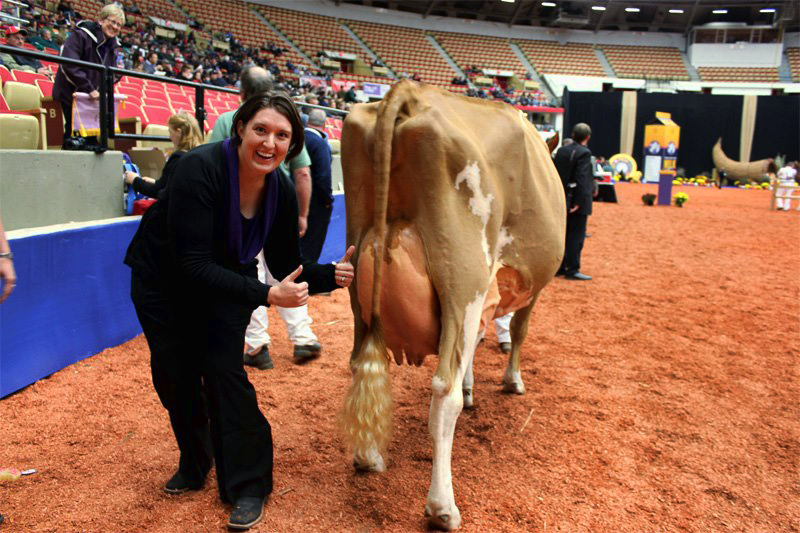
Blogging In Vicariously!
Carrie had found her path but there would be some twists and turns. Technology became one helpful signpost along the way. Carrie explains some of the first steps. “Via twitter I found a group of farmers that called themselves the AgChat Foundation. This group was all about using social media to tell the story of agriculture. I attended the 2nd AgChat Foundation 2.0 Conference and started thinking about creating a blog. At the time I was searching for a strong connection to agriculture. Patrick and I had had changes in our lives and weren’t on the dairy farm. I wanted something that kept me part of the dairy industry. A few weeks later I wrote my first post and the rest is history!” History yes! But a lot more interesting for her readers!!
“All the Moos About Me!”
Patrick and Carrie are back on the farm now and have formed an LLC (Limited Liability Company) with his parents to purchase their 100 cow dairy. Carrie manages the herd health side of things as well as scheduling a few part time employees. She is a blog writer but her passion makes it so much more as she explains, “My blog is centered around agriculture and mainly dairy. However the title is “The Adventures of Dairy Carrie” and my life does include things outside of cows. Sometimes I will blog about music, food or whatever else I am thinking. It’s my blog so I make the rules! I find that writing about non dairy topics is also a great way to connect with people outside of agriculture.” You might say that anything relating to pen-manship — on the farm or on the keyboard — inspires Carrie.
This Merry Prairie Carrie has Mentors
Actresses have role models and bloggers do too! Once again, Carrie aspires to the unexpected. “When I grow up I want to be a combination of the Pioneer Woman and Mike Rowe*. They are both great at sharing stories in a fun and entertaining way.” However, Carrie’s career path has been mentored well on the serious side too. “When it comes to the cows, my in-laws, Clem and Cathy Mess have taught me the vast majority of what I know about dairy cattle. The care they give their cows is an example for all of us.” (Michael Gregory “Mike” Rowe is an American media personality best known as the host of the Discovery Channel series Dirty Jobs)
Carrie is Caring, Sharing and Calling YOU!
Carrie’s commitment to agriculture is a rallying cry for all of us. ““I believe that the future of agriculture, the very future of our food supply, rests in my hands and the hands of the people out there on Twitter, Facebook and YouTube sharing their lives.
Does She Get Carried Away? Absolutely!!
As the wave of Carrie’s dairy enthusiasm grows, so does the pressure on her schedule. She admits, “I don’t sleep very much and my smart phone is glued to my hand. Between the farm, my full time position with Udder Comfort, selling semen for Sierra Desert Breeders and Dairybullsonline.com, my blog is often neglected. I try to post at least one post a week. A post can take me anywhere from 20 minutes to write to hours. I’ve found that some of my most popular posts are posts that I put up in a hurry. I guess I should take that as a hint and not to over think everything that I write.” Judging from her popularity Carrie probably could rest on her laurels and fall back on, “If it ain’t broke don’t fix it!” That’s not the Carrie way however!!
The Big Barn Theory Hammers Home Carrie’s “Shocking” Message
Carrie has used many means to deliver her message and one of them was especially revealing. “My most popular post, with over 42,000 views was the video I made showing what really happens on a dairy farm. I set it up as a “shocking undercover video” to mimic the animal rights videos that get out. Again, I was blown away by the response I got! The video was shot quickly and put up so I wouldn’t feel guilty about not posting all week. I think it went over so well because people who were expecting to see something bad instead watched, laughed and learned and didn’t even realize it. I find humor is the best approach to the heavy stuff. Makes it all easier to digest.” Whatever her method the results are music to dairy lovers everywhere.
Someday She Will Carrie a Tune
This dynamo has many fields that she would like to cover in the future. “I would really love to learn to play the guitar. I am a huge music lover and wish I had the talent to make my own music.” She’s modest but her musical enthusiasm led to a connection that was behind this hardworking ambassador’s promotion of another agricultural event. ““The Departed song “Worth the Fight” is a really great tune; it really gets me revved up and rocking,” It was the inspiration behind her Farming: Worth the Fight! Agvocacy. “The song has been my biggest inspiration. Last fall when I was organizing a Hay Drive to help struggling farmers and ranchers in Oklahoma and Texas, the guys from The Departed helped me out by sharing the Hay Drive info to their fans. I really appreciated their help and thought that this was a great way to say thanks to them, as well as tie my love for agriculture and music into one big post.” When Carrie loves something, you’re going to hear about it.
Diary of Another Fine Mess
Inspired by the family farm and loving her life with husband Patrick Mess, Carrie says he is the one she relies on. “He can make or fix anything and he keeps me sane when life starts spiraling out of control.” And that is probably why she so firmly believes that there is hope even though as she puts it, “ the future of farming in our country is teetering on the edge of disaster.” and needs all of us to raise our voices. “Misinformation is running wild across the news channels and internet. If the people out here making the decisions about how food in this country is produced don’t speak up and provide the transparency that our customers are demanding, soon our decisions will be made for us.” Hear here!!
The Bullvine Bottom Line – Carry Forward!
With champions like Carrie sharing her Dairy Diary and carrying the Dairy Torch, the future looks brighter indeed. Let’s help her keep carrying on!! It’s good for all of us!
Brothers Joe and Matt Engel and their parents, Dennis and Beth, have the obvious good fortune to own and operate Luck-E Holsteins of Hampshire, Illinois. The really fortunate part is that their luck is not just in the name but in their achievements too!
Talk About Luck-E
Luck-E Holsteins have bred or developed hundreds of Excellent cows (260+ homebred) including 5 EX-95, set national production records, bred 15+ All-American nominations. That is outstanding and Joe Engel gives further updates. “For years the average score of the dams of all cows in the herd has been EX-91 or EX-92. I think the biggest accomplishment is developing our four main cow families that transmit so consistently every generation our ‘goal cow’.” So obviously it isn’t just an accident. But where did their Luck begin? The Engel brothers explain.
Luck-E Goldwyn Aaliyah VG-89-2yr Dam is Luck-E Outside Anxious 3E-93 x 2E-90 x 3E-93 x 2E-94
Luck-E Start
“Our parents grew up on Angus farms. Our dad bought the farm we are at today and started milking 38 grade cows. Our parents married in ’68 and bought their first registered cow. From then on all purchased animals were registered. When getting ready to register the first calf, they realized they needed a prefix. After seeking advice from an established breeder, they were told you want something short, positive and easy to remember. Take the Y off Lucky and put E for Engel and the Luck-E name was born. When the first of us five boys started 4-H so did going to the county fair and district show which led to State Show and then to National shows.”
What Luck-E Holsteins Looks Like
Currently the Engels are milking 150 cows in 38 stall barn with 19 machines; all cows are housed in sand freestalls and feed a one group TMR. Calves are raised in hutches for about 80-85 days and then to loose housing bedded with straw. Bred heifers, milk cows, and dry cows have access to pasture about 8 months a year. The two brothers and their parents all play an active role in the everyday operation of the farm.
Luck-E Advent Atlanta EX-92 3yr Max Score Atlanta is a full sister to the dam of 200H6450 Adonis-Red.
Making Their Own Luck
When it comes to cattle breeding they have a well prepared plan. “We want a truly well balanced cow; wide from her muzzle to her pins with a silky well attached udder and high protein. A cow needs to be able to calve, go right out to the freestalls, be healthy, have the capacity to make a lot of milk from forage and last. Chest width is the building block for all of that. Proven cow families on both sides of the pedigree are important. We want to develop and work with families that hit every time. It is just as important how good the worst sister is as the best one. It costs just as much to make and feed a bad one as a good one. Duds are too expensive. Protein makes a huge difference on the milk check and marketing.” Obviously they feel that the harder they work on their goals the better the results will be.
Loving All Their Luck-E Stars, Including the Red Ones!
Luck-E Holsteins have had so many great cows they feel it is hard to narrow down the list of favorites says Joe. “I can’t pick one. However Luck-E Blitz Australia and Luck-E Rubens Kaylie” stand out for him. He describes these two “*RC. Australia was built just the way we like with tremendous dairy strength and perfect udder attachments. She was the high index Blitz for a long time when Blitz was hot. She is the cow that started bringing international visitors to the farm. She has our kind of pedigree, production and type. She has had three daughters max out at EX-92 2nd calf. We are very excited about how they are starting to transmit including Asia’s in demand son Luck-E Adonis-Red.”
Then their attention turns to Kaylie and an outline of her strengths. “Kaylie *RC is a Rubens from two generations EX-94. She was the first virgin heifer we ever flushed. She was the kind of heifer you just wanted to breed from. Wide chest, tremendous rump, straight lines, and *RC (like good Triple Threat). We flushed her to the first available semen from a red bull out of a really nice young Durham with a great pedigree. That flush yielded what we believe to be the first milking All-American Advent Luck-E Advent Kite-Red, the first EX-92 Advent Luck-E Advent Kalotta (first to win at a National show milking) and the first EX Advent son Luck-E Advantage. Their full sister is Luck-E Advent Kandie –Red EX-92 MS95 3yr. Kalotta’s daughter Luck-E Talent Kiwi EX-92 (max) is following the families mold with great type protein.”
Building on Luck
The plan is working well for the Engels. “We aim for consistent performance every generation. Luck-E Advent Asia EX-92, Luck-E Advent Atlanta EX-92, Luck-E Advent Kandie-Red EX-92, Luck-E Talent Kiwi EX-92, and Luck-E Goldwyn Aaliyah VG-89 2yr. are all cows built the way we like with maximum scores, and most importantly from proven cow families that seem to always transmit.
Luck-E Advent Asia EX-92 2yr Max Score 1st 2-year-old Futurity, IL Championship Show 2010 Daughter of LUCK-E BLITZ AUSTRALIA VG-87 2YR
Luck-E Matches Strength to Strength
Joe outlines how clearly they build the exact mating for each Luck-E Holstein. “Despite the opportunity to fill index contracts, we flushed Australia (dam of Asia & Atlanta) to Advent because we thought it would make a beautifully balanced cow and *RC is appealing. Kaylie we did to Advent to make Kandie because of the success of her first Advents. We mated Kaylie to Advent originally because of Advent’s cow family and sire stack. Kiwi we made because Talent and Advent makes sense. Talent just needs to be used on strength; a Talent from Kalotta is going to have that. Aaliyah’s dam we did to Goldwyn because of her tremendous frame (98 Dairy Strength) and Goldwyn’s style.”
Adonis, Absolute, Acme, Armani, Baltimor, Braxton and Buxton are some of the current service sires at Luck-E. “The Adonis- cow family is our ideal.” Joe affirms his confidence in cow families asking, “Do Altitude or Barbie ever disappoint?” He then goes on, “I would add that the Bolton blood in Buxton is a nice shot of milk where needed. Like Blitz in Guthrie and Windbrook we used previously.” He sums up their marketing goals, “We try to take a well rounded approach to marketing. Nothing is better than word of mouth and the best way to get that is happy customers. That is the most important. We think it’s also important to get out and see people at sales and shows whether it’s here, Canada or across the ocean. We try to spread our advertising around to reach more markets. Of course our website is important and the center of our advertising. Facebook is a nice way to compliment those things.” For the Engels there is one important target, “We aim to stay in touch with people and get updates out fast.”
Learning How to be Lucky
Joe gives credit to those who have contributed to his and Matt’s success. “Our parents taught us how to work, how to live, how to farm.” Others have shared lessons too. “Bill Berghorn (former herdsman of Hartman Farms) was at our first classification and almost every one since. He helped us catch the ‘show bug’ and taught us everyday cow sense. Jim Hipel helped us purchase hundreds of cows from Canada.” He wraps up the list with glowing praise.” Of course there is Barb Royle- Master Breeder of the Bardholm herd we purchased in ’99. Anyone who can breed cows like that can teach you something.”
Luck-E Braxton Maeve VG-89 EX-MS 2yr Sr 2 for 2013!
Genomics On Demand
Everyone is aware of today’s changing marketplace and Matt and Joe Engel pinpoint two particular areas. “Genomics and shifts in the market resulting from them and the tightening in dairy margins that have made an efficient, long lasting cow more important than ever no matter what path you take to breed her.” In typical style they know how to deal with this. “Genomics has not had a large affect on how we manage our herd. The young sires we are using are selected because of their maternal line and sire stack. An example would be when we used Braxton and Baltimor initially. We bought a lot of semen before their genomics came out because we loved Barbie and her daughters.” The more prepared you are the luckier you get. Matt continues discussing market demand. “Demand does seem to have made a shift from embryos to live animals. And the higher the level of animal the more demand has increased.” They both feel there is future in “polled”.
The Bullvine Bottom Line
The Engels don’t attribute success to any single method. “There is no question there are more ways than one to breed cows and be successful.” The next step is important too. “Whether you want the highest genomics, elite type or just a herd full of balanced cows, always follow your goal with each bloodline.” say these two brothers. Joe sums their philosophy with feeling and, in doing so, gives away the secret of their exceptional success “The reason we try to breed the kind of cow we do, the way we do, is because that’s what we love doing.” Luck-E indeed!
Several years ago, the marketing team I worked with was led by a gentleman who loved to use the quote, “When you’re selling, don’t sell the steak sell the sizzle.” Although celebrity Chef Lynn Crawford was a keynote speaker at Canadian Dairy Xpo, the Dairy Classroom got cooking early with Billy Frey’s on-farm social media presentation. The dynamic Frey is the Senior Vice President of Alltech Ag Network and he really knows how to sell the sizzle. He grabbed attention early with on-line streaming of his presentation and one-liners like, “What happens in Vegas stays on Facebook” which caught and held the attention of the standing room only audience.
Lyons, TVs and Broadcasts – Oh My!
Alltech Ag Network, as envisioned by its founder, Dr. Pearse Lyons, has always been a company built on relationships explains Billy. “We knew if we could build a relationship, we could learn of someone’s problems. Once we knew the problem, we could find a solution. About 2 years ago, we spoke with our friend Jim Host. Jim is known as the grandfather of sports marketing for the programs he and his company (Host Communications) put together for the NCAA. In fact, Jim was just inducted into the College Basketball Hall of Fame, not for his play, but for his contributions to the game, principally setting up the NCAA corporate partner program.” This dream team was primed for what was about to happen.
It’s iHigh Time for Ag
Frey outlines the serendipity. “Jim Host had started a new company called iHigh.com. This was an online TV company that broadcast high school sporting events. The idea was simple: iHigh put the Production Truck that you see at major sporting events into a computer and let the schools broadcast their own games. The schools could generate revenue through advertising, which proved quite profitable. Jim and Dr. Lyons thought “Why not agriculture?” That was the first step and then “Alltech bought the rights to agriculture and began engaging Ag groups (FFA, rodeo organizations, horse shows, etc) to broadcast their events on iHigh.” This was a key and very logical piece according to Frey, “Agriculture has such a great story to tell, and who better to tell it than the participants themselves?”
A Communication Cover-All for Ag
As with any great idea once the pieces start coming together the momentum builds. Frey shares this synopsis of events. “Shortly thereafter we entered into discussions with RFD-TV. Patrick Gottsch, the founder of RFD-TV had been ‘telling ag’s story” for many years and he was looking to move into the online world. Once he met with Jim Host and Pearse Lyons and learned about the technology, a partnership was formed. Now, all RFD-TV content can be found online by going to MYRURALTV.com. Patrick and RFD-TV have given a voice to the smaller events that might not be on network television. Not only do they provide great coverage to their 65 million subscribers, but they also direct them to MYRURALTV.com whereby fans of RFD-TV can watch even more Ag content online.” Social media was on the move and the potential it was facing, meant a lot to Billy Frey.
Frey Gets Plugged In
The timing was right for Frey who had graduated from Centre College in 1998 with a degree in International Economics. He outlines his career path, “From there I worked in a bank. The banking business didn’t enthuse me so I applied for a job with this international animal health company called Alltech. I had never heard of it, but after interviewing, seeing the marketing philosophy, etc, I realized that this is something that I could get into. I’ve been with Alltech for 14 years. When I started we were an $85M company with about 500 people. Now, we should hit about $800M in annual sales with 3000 employees.”
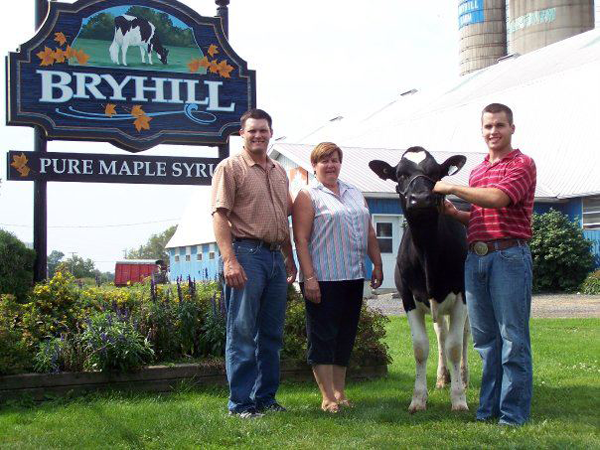
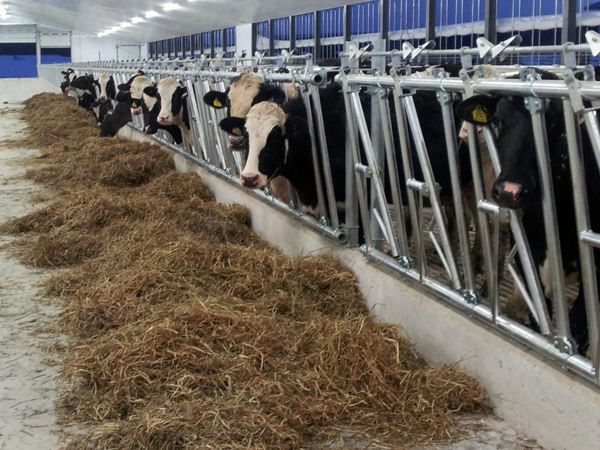
Computer Traffic Increase on the Information Highway
To date we have more than 300 organizations or groups broadcasting live events online. Our traffic continues to grow, as people watch signature events like the FFA National Convention, the National HS Rodeo Finals, and more online. With the world, in particular the world’s youth, watching video online we have seen a 4-fold increase in traffic online.”
Watch! It`s Alive!
Frey confirms that the online Ag content that will be provided by the partnership between Alltech and RFD-TV, utilizing the iHigh.com technology, will continue to grow. “Last year 12 state FFA conventions were broadcast live online. This year, we expect 30 state conventions to be broadcast online. We expect more rodeos, more equestrian competitions, and of course, all the same great RFD-TV content to be available online. No longer does mom and dad have to wonder what’s going on at the FFA Convention. They can tune in. No longer does Grandma and Grandpa have to look at pictures of their grandchild win an award or compete in a rodeo…they can watch it live.”
Technology is Smokin’
As an observer of change Frey joins the rest of us in awe at the rapidly changing social media scene, “The rise and adoption of technology has been first and foremost of the changes I’ve witnessed. The world is at our fingertips, so that leads to infinite possibilities. Consumer attitudes have shifted. Globally we’re taking an interest in what’s in our food and how is it produced. Look at what’s happening in Europe right now with the horse meat situation. People want to know what’s in their food and when they’re duped, they revolt. Along with oxygen and water, it’s one of the three most important things in life.”
Family Matters. They’ve Got Freys with That!
Speaking of important things in life Frey affirms his appreciation for the Alltech philosophy of marketing through education and, he adds, “our goal of helping to feed the world while at the same time educating people as to where their food comes from”. Frey admits that his current role as Senior Vice President of the Alltech Ag Network is his biggest challenge to date but then, in his branded positive style adds,” Like most great challenges, it’s the most rewarding.” Nevertheless it isn’t Frey’s biggest success story, “Personally, in the past 5 years I’ve met the love of my life, gotten married, and last June, became a father to a beautiful baby girl. That’s definitely the best thing I’ve ever done.”
It’s Fast. It’s Instant. It’s Ready to Serve.
There’s another old saying, “If you can’t stand the heat, get out of the kitchen!” However, everyone knows that’s where the action is. A few minutes of listening to Billy Frey confirms that social media is the kitchen and you become a believer that this company has also found the “secret ingredient”. Frey looks into the future for us. “I see traceability and value added products coming to the forefront. I want to know who produced this milk I’m drinking and what went into the ice cream or the cheese I’m eating (too much of by the way). Why can’t I just use my phone, scan the carton and see the farmer? I’m in agriculture so I trust those who provide me food. Most people don’t have the good fortune of working in our industry, so they don’t know how milk is made. When they don’t know, they do two things: find out for themselves or assume the worst. Since the internet has given us instant information, people trust whatever comes up first on a Google search. People want to know where their milk comes from, so let’s tell them. We have every reason to do it and zero reasons not to.” The recipe for success!
BULLVINE BOTTOM LINE
Thanks to our look at marketing through the eyes of “Shake Sizzle and Frey” we have learned that, social media is the means whereby, the farm, the farmer and agriculture are no longer anonymous. People are eager to get to know and like who is growing their food. The Bullvine thinks that Alltech is one of the first companies to turn up the heat on Ag sizzle. If you are still waiting for a taste test, you could not only miss the heat, but the entire kitchen altogether. Go where the action is. “Social Media in Agriculture is Heating Up!”
The Bryson family of Ormstown, Quebec are following their dream of growing Bryhill International Genetics into a leading dairy breeding operation.
Of course, expanding a farm and growing a family business can be both rewarding and challenging at the same time. Matthew and David Bryson take a moment to look back and consider how far they have come. “The past 6 years have led us to change our breeding philosophy completely, while gearing up for a large commercial dairy environment.” As the Brysons share how they made the necessary changes, Bullvine readers have a perfect opportunity to look at 10 big steps taken by Bryhill International Genetics as they follow their dream.
1. THE FOUNDATION: Start with the Right Team
The principle of building on the foundation of a great team is the basis of success for sports and business. The team members at Bryhill are Lynn, David, Stacey, Matt, and Sarah. Jason Bryson, a cousin, is also a very important employee involved throughout the farm activities and specifically the nursery where the new calves and high end genetics get their start. A brother, Alan, helps analyze breeding decisions and investments for future genetic orientations. It takes commitment and a shared vision for the future.
David, Lynn and Matthew Bryson at the original homestead
2. LEADING EDGE IDEA. Make it Work.
David and Matt Bryson describe the motivation behind Bryhill International Genetics. As a founding member of Trans America Genetics, “B.I.G. was used to set focus and aim at identifying, acquiring and merchandising breed leading genetics with a specific focus in mind. The move to a large freestall, the need to adapt to the changing technology (genomics) and the need to be more efficient, means that every decision we have made has led to aggressive moves so as to be better positioned for the future in order to have a business that would move easily into the next generation.” A successful, sustainable family dairy business.
3. FAMILY MATTERS. That’s Where We’re Going.
Every big dream starts with little steps. There are many variables that impact decisions. This was definitely the situation facing the Bryson family. “The expansion was prompted by a few different things. First, the business needed to support two families. Second, the previous site had limitations due to highway, rivers and town in close proximity. Third we wanted to offer a working environment that facilitated high volumes using efficient methods therefore allowing quality time with our families and preparing ourselves better for the future.”
4. GROWTH IS A GIVEN. Build More.
With growing clarity on where they needed to be, Bryhill got down to the actual building. Matt says, “The latest expansion is now complete. There are now two main dairy barns of 105’ x 475’ and a hospital, close-up barn of 75’ x 250’.The milking parlour is a double 16 allowing for more expansion and high flow as well as a calf barn with automatic feeding, just off the milking parlour. We currently milk 300 head and plan to keep growing the herd with the most efficient genetics possible.”
Inaugural feeding in Bryhill’s new facility
5. A WORLD VIEW: Key in On It
Great product and facilities would be nothing, if it wasn’t meeting the demands of the marketplace. Dave clarifies the Bryhill philosophy. “We have identified the high GTPI, NM, Polled segments as our key markets. These are to us the markets which shall develop the highest demand for the commercial dairy farm and meet over 95% of world market needs.”
The number one GTPI polled heifer of the breed, Bryhill One Sassy P. Potentially the best heifer ever bred at BIG.
6. MAKE THE COWS MAKE THE DIFFERENCE. Make it Fast
Growing a successful dairy business always boils down to the cows that produce the milk, the genetics, the buyer interest and the bottom line financial success. The Brysons share which families they have introduced, “The cow families that we are working with are Sizzle P, Planet Lucia, Chart Topper, Shottle May, Converse Judy, Allen Dragonfly, Brocade, Baxter Carmel, Cosmopolitan, Adeen, and Dreary.” Here too there is a great deal of thought that has gone into the selections. “These are all cow families that have proven their abilities to make extremes. Breed changers we like to call them.” BIG changers!!
7. GENOMICS. Go for it NOW.
There is no hesitation at Bryhill International Genetics when it comes to using Genomics. “The top sires we are using are 100% genomic. Leading genomic sires will remain among the top of the breed regardless of rank.” That is important to the Brysons. “This gives us an advantage over the longer run as we shorten generation intervals and increase genetic gain.” Again it is no surprise to hear them say, “We aim to remain among the forerunners.”
8. GENOMICS. The Game Changer.
When you’re developing an international company that is relevant and sustainable you have to evolve with the modern marketplace. David recognizes the impact of genomics. “Genomics has significantly changed the way we do business. It has made us realize the value of cattle and breeding. While we still enjoy solid conformation, it has created more objectivity in our decisions and, we look more at what that individual will potentially transmit. We take pride in making these top females available and in fact it has also helped our merchandising. New progeny become recognized on objective, public top lists that are accessible to all. This has led to great contacts and marketing opportunities.”
9. CHANGE IS HERE. Be Part of it
Matt confirms this viewpoint. “The marketplace will change according to changes in market demand and technology. Consumers will play a huge impact and animal welfare will play a part too.” Dave highlights another game changer. “The polled gene has been a big part of our change as we see this becoming a standard!”
De-Su 199 Chart Topper In partnership with TAG, Bryhill purchased Chart Toppers 1st Choice Numero Uno daughter for $79,000 at World Classic Sale 2011. Chart topper is a Watson x Pine-Tree Missy Oman Miranda VG-86 x Wesswood-HC Rudy Missy EX-92 3E GMD DOM x EX-90 GMD DOM x VG-87
10. GET GOOD ADVICE. Grow With It
Despite their relative youth, the Bryhill team knows the value of good mentors. “ TAG has been an influential entity in our genetic development,” say the Brysons. They admit it is tough to offer advice to others but know that their experience could help others who are interested in expanding their genetic marketing strategies. “Two things come to mind.” say the Bryhill team. “It’s hard to go wrong with high genomics from top cow families.”” Try to identify where the market is going.” “This is not easy but it is doable.”
THE BULLVINE BOTTOM LINE
When you want to know what makes the BIG difference, it really is clear what is working for the Bryson family and Bryhill International Genetics. They take many small steps consistently and persistently. They are following their dream and obviously are ready to make a mountain out of Bryhill. That’s the B.I.G. difference.
No one likes paying upfront fees for anything. After all, what’s the point of paying for something you haven’t received yet? But there are some situations where paying upfront totally makes sense. Getting genetic information is one of those times. You give up your money first and it translates into rewards later.
The Pieces are Put Together to Pull Together
Twenty years ago in Canada the dairy industry was faced with a challenge. Government said it would fund research and development but not genetic evaluation services. The goal was to shrink the cost and size of government. The industry said these reports are valuable so we are going to have to get involved and that is what happened.
Canadian Dairy Network (CDN) was established in May 1995. General Manager, Brian Van Doormaal, has been with CDN since its inception and summarizes the general details. “CDN is governed by a Board of Directors that primarily consists of breeders who are elected as representatives from four categories of member organizations, namely Breed Associations, DHI Agencies, A.I. organizations and Dairy Farmers of Canada.
The Canadian Dairy Network provides five major services:
Genetic Evaluation Services
Research and Development Projects
Industry Standards
Maintains the National Dairy Data Base
Operates the Data Exchange amongst the industry partners
It`s Fully Integrated and Always Moving
In the simplest terms, all the relevant information is shared by those who contribute. Examples are: Breed pedigrees go to CDN; CDN shares them with everyone who is a partner; DHI records go to CDN and are shared with partners. These and more types of information are available to all users at all times via the Internet. Everything can be found at the CDN website AT NO CHARGE for lookups.
The Dollar Division
Van Doormaal updates the funding process behind CDN. “All activities of CDN are financed by the industry organizations that are its members and for this reason the CDN Board of Directors has established an equitable service fee structure.” He further breaks out the pay structure. “80% is paid by AI and 20% by breed associations and milk recording provide their information at no charge to CDN.”
FEES: Fearsome Hurdle or Forward Thinking?
When there is a 79% cost increase (effective April 2013), there are going to be questions. Namely, “How did CDN determine the cost of $7500 to prove a bull in Canada?” Previously the fee was $4200. The same fee has been set on a per bull basis for privately owned genotyped bulls, starting April 2013. CDN does not have any other fees so this is an all-inclusive rate that gives the bull owners access to various services associated with genetic and genomic evaluations.”
Van Doormaal further clarifies. “With the arrival of genomic evaluations in 2009, operational costs have risen due to increased staffing needs and computer power while the number of young bulls with semen released in Canada each year has almost halved.” Obviously, the plan is three-fold: provide more research; more development and, at the same time, cover costs into the future.
Everybody Pays!
Van Doormaal stresses that, “In one way or another, all people and organizations will be paying fees to receive genetic and genomic evaluation services from CDN for bulls. While the mechanism for paying differs for breeders compared to A.I. organizations that are members of CDN, the level of payment is equivalent. On the female side, no fees are applied on an animal basis since the breed associations contribute to funding CDN activities on behalf of their members.”
Brian Van Doormaal, CDN Speaking at the 2012 China-Canada Dairy Conference
What’s Up in Other Countries?
Van Doormaal knows the international scene and explains, “While there are other countries like Canada for which the genetic evaluation services are financed completely by industry stakeholders, as opposed to government, each country inevitably ends up with its own funding formula and mechanism.” He speaks of the American situation. “In the US, the mechanism proposed for financing its genetic and genomic evaluation services includes some level of fee applied to every male and female for which a genomic evaluation is to be calculated.”
Proving Your Own Bull
When asked about advice for breeders looking to prove their own sires, Van Doormaal urges. “Genotyping young bull calves shortly after birth makes as much sense for breeders as the genotyping of their newborn heifers. Once the genomic evaluations are available to the breeder, better decisions can be made about the bull’s future. Owners (AI or breeders) of bulls with outstanding results can then pay the CDN fee to make results official and have the young bull ranked among others available in Canada.”
LPI Formula Changing
Van Doormaal reports “The LPI for Holsteins in Canada currently has a range in values of approximately -3000 to +3000, which is three times bigger than the TPI in the United States and over 50 times bigger than national indexes used in most other countries.
The CDN Board of Directors decided, after consulting all stakeholders, that the LPI scale should be halved. To achieve this objective while maintaining the current level of LPI values for the highest progeny proven bulls, it was decided to add a “constant” value to the LPI formula in a manner similar to what the United States has done for years with its TPI formula. Conversion from current LPI values to the proposed new scale is simply done by dividing the current LPI in half and then adding the constant of 1700.”
LPI Formula Give and Take
Another adjustment Van Doormaal expects to happen to the LPI formula relates to the specific traits included and the relative emphasis placed on each. Analysis of various options and discussion will proceed through 2013 with a likely implementation of an updated formula in April 2014. Based on feedback received from a cross-section of breeders, there seems to be a general interest to increase the overall emphasis on longevity, fertility and disease resistance in the formula. Of course, once the emphasis is increased on some traits, there also has to be other traits losing emphasis.
Future CDN Genetic Evaluation Evolution
In December 2012, CDN introduced Body Condition Score as a newly evaluated trait for all breeds, which can be used as an indicator for fertility, disease resistance and longevity. The release in December 2013 will include the first official genetic evaluations for Mastitis Resistance in all breeds which should be followed by Resistance to Metabolic Disorders in 2014. Other traits on the planning horizon within the next five years include desirable fatty acids and other components of milk, hoof health and feed efficiency.
Changing Gears for Genomics
Van Doormaal provides updates resulting from the introduction of Genomics. “Prior to 2009, CDN had six different genetic evaluation systems, which were run monthly to evaluate over 60 traits including production, type, longevity, female fertility, calving performance and milking speed/temperament. With the arrival of genomics, a new system was developed and implemented, which estimates Direct Genomic Values (DGVs) for all traits and combines them with traditional evaluations to produce the published genomic evaluations. This new system is also run monthly and also required the establishment of a national database to process and store all genotypes, which now totals over 310,000 across all breeds. Operationally, these new services that are highly valued by the industry organizations and breeders, have required additional geneticists and new web site development as well as investments in advanced computer equipment and processing power.”
CDN: Providing Global Genetics and Genomics
Looking to the future, Van Doormaal gives an overview. “The era of genomics is still in its embryonic stages. It is difficult to predict the extent to which it will continue to impact the dairy cattle industry over the next 10 or 20 years. One thing for certain is that the world of genetics will continue to shrink at an increasing rate since it is so easy to collect DNA from any animal in the world and assess its genomic evaluation on numerous country scales.”
CDN: Fine-Tuning
CDN will dedicate much time and effort in the coming years to fine-tuning existing traditional genetic evaluation systems and methods for estimating genomic evaluations. Van Doormaal is realistic about the possibilities. “The shift towards a higher market share held by genomic young sires compared to progeny proven sires will likely experience some pendulum swings, eventually reaching stabilized proportions as breeders and industry gain experience in the coming year.”
After 25 years working and educating in the Canadian proving system, Van Doormaal is proud of the achievements. “We are fortunate in Canada to have many geneticists and research scientists who realize that the ‘practice’ of genetic selection and mating is not the same as the ‘science’. Both sides need to continue to respect and listen to the knowledge and experience of the other. The most progress is made by incorporating the ‘science’ of genetic improvement into a solid, practical breeding program.”
BULLVINE BOTTOM LINE:
Recognizing the potential of responding to changes in the industry, in technology and from science, CDN is focused on the future on behalf of breeders.
Today Jan de Vries and Arjan van der Vlis keep their cattle connections productive through Eurogenes the Netherlands based online cattle auction service. Looking back, it`s easy to pinpoint their early interest in cows. Jan says, “Since I was a little child I have been working on farms. During holidays I always spend time on farms. I always had a special interest for breeding and mating sires.” Arjan too had a cattle connection. “Got my interest in cattle through my father with buying cows, he is a butcher and we searched for the cattle ourselves. Later on I became more interested in dairy cattle and in the breeding of them. Through practical training and family I got my extreme interest in dairy cattle breeding.” No doubt their joint enthusiasm for cattle led them to keep open minds regarding ways to be involved with the business.
Eurogenes Means E(asy) Commerce
In 2000 Alex Arkink, a cow photographer started Eurogenes. Both Jan and Arjan were involved in managing the Eurogenes Sales. After four years Jan ws ready to take the next step with Lammert Hielema. The two of them who own Genetics Consolidated went forward. “In 2004 we purchased all shares from Alex Arkink.” Arjan is the Business Unit manager for Eurogenes. They were excited at the possibilities presented by this young company. “Eurogenes was among the first companies in cattle breeding to really use internet as its main marketing gateway.” Jan confirms their belief in this idea. “We have always felt the simple concept of having members consign embryos, calves and now also bulls to sales is a very strong one.”
Buy, Buy Bovines
Eurogenes is part of Genetics Consolidated B.V. This group of companies also includes Diamond Genetics, Holstein Plaza, AI Total, Holstein Select and more. In a little over ten years there has been significant growth. “Eurogenes currently has 150 members from across Europe. Once a month there is an embryo sale and 2x per year there is a heifer sale. The next sale is in March.” Everything works smoothly. They explain. “The Heifer sales work according to the Dutch Auction system, in which an animal starts with a start price and then goes down each day until a buyer decides to take it for that price.” They are pleased with the interest and report that embryos have been exported to 25 different countries.
Holland Masters Sale 2012 Managed by Eurogenes and had the highest sale average ever in Europe with EUR 15.809
Eurogenes has Sell-A-Bulls … and cows.. and heifers… and embryos
On line cattle sales are proving to be dynamic for Eurogenes. “Current cow families that get a lot of trade done are the Atlee’s, the Roxy’s, the Ralma’s, the Barbie’s, the Altitude’s. Then there are always some specific cow families from a specific country like the Denmire Marie’s from the UK, the Rita’s from Holland, the WEH Janna family from Germany which can get a lot trade done.” The sales inventory has something for everybody. Arjan gives examples. “Eurogenes stand for offering a wide range of Holstein Genetics, from top genomic females to show type animals to good families that a lot of cow lovers would like to work with in their barns at home.”
Eurogenes: E(asy) Commerce
Filling a niche and providing breeders with what they want is only part of Eurogenes success. “Eurogenes has been the first in the industry to start selling heifers on line and still has all the online record in Europe for sale averages. Eurogenes and Holstein Plaza together make the Hotspots magazine. This magazine gives you a perfect insight into what is going on on the main breeding farms and what cow families are being actively worked with.” Jan and Arjan explain why they are on the leading edge. “Eurogenes is still the first company in the world to host online bull sales with bulls for AI companies. Inventing new things and keep going forward always looking for improvement is probably our biggest accomplishment.”
Don’t stall. Get off the Auction Block. Just start.
With any new business there are new lessons. Both men feel that they are learning something every day. Having said that, they feel that you have to make the leap and learn some lessons as you go. “Our biggest lesson is probably that you learn by doing. If you have an idea, if you want to do something you have to do it and see if it works and then keep improving.” There is always more to learn so Eurogenes is always learning and trying new things. For example, Eurogenes is organizing a big live sale each year. Jan provides this update. “This year the sale will be on the farm of Eurogenes members JK Eder Holsteins on May 25th 2013.” They proudly point out that, “This sale will contain 100% Eurogenes member consignments.”
Genomics is Spreading the Opportunities
One of the biggest learning curves for any 21st Century cattle breeding business is the one presented by Genomics. This new tool is impacting every part of the industry. Everybody has new opportunities. Jan explains, “Part of our business that is driven to make the bulls for AI companies has changed with genomics, since the world is more transparent. Embryo buyers in other countries than the former main suppliers of AI bulls suddenly have just as much chance to get a high bull that the AI companies want.” This is exciting for everyone. “People who want to are able to bring in embryos or a heifer to improve their herd. They can use genomics as a tool to make a better selection and make better matings.”
Genomics and Technology – 2013
The Eurogenes team points out that April 2013 is going to be interesting with the opening up of genomics. “It is going to be interesting how many things will settle out after this; how is the European Consortium going to respond, what will Interbull’s role be, who is in favour the big multionational AI company or the small flexible AI company.” At the same time that this is happening, technology will continue to evolve and impact the marketplace. “Then we will see new things coming after Facebook. There will be new and better applications. The technology on pc’s, smart phones and I-pads will keep developing.” Beyond these tools, the trading word is changing as well. “The world wide growing demand for milk will create new Holstein countries.” Far from being overwhelmed these entrepreneurs are excited.”There are always more things that we do not even know about.”
The BULLVINE Bottom Line
The last decade has seen tremendous changes in the selling of cattle internationally. Not everybody has the ability to manage a website themselves and attract visitors. Jan and Arjan have the expertise. “Eurogenes is doing all the work. Visitors from around the world will see your top genetics with a great presentation. “ Today the sales logistics whenever you want to buy or sell are as simple as a few clicks on a keyboard. If you are ready to consider marketing genetics internationally, Jan and Arjan have one final piece of advice, “Eurogenes is open 24/7 to advertise your genetics.” Don’t just love it. List it!
Dairy breeding is about putting the right pairings together. It is also the formula for success that has worked more than once for photographer Han Hopman, one of the founders of Holstein International. He explains the beginning of his dual interests. “With my parents I always went on vacation to a dairy farmer. He always took me with him for milking and feeding the cows. I loved them. Back home in town again I missed them dearly. When I became 10 years old I asked for a camera to take pictures of the cows and glue them into a book. From that time I wanted to be a cow photographer.” Cameras and cows. Han can’t have one without the other.
Han Hopman has captured some of the greatest bull shots in history, including this one of Ensenada Taboo Planet
Mission Possible: Write On! Great pics! From Cover to Cover
Han’s passion for cows was later enhanced by collaboration with Jan Bierma. “We were already making articles for several magazines like Holstein World, Holstein Journal, Typex in France, Bianco Nero in Italy and Veeteelt in the Netherlands and a few more. In Holstein World we had the Euroworld section. We published in that section information about bulls and genetics from Europe. When we had to stop that because of political reasons, we decided to start our own international magazine.” In 1994 they founded Holstein International in the Netherlands. Because of their professions Jan Bierma took on the editorial part of the magazine while Han took over the photography. Another great pairing.
Special presentation by Han Hopman (holding camera) and Jan Bierma (left) to Barry Slack and Charlie Will of Select Sires.
Quantum of Success
Hopman and Bierma already shared the bonds of friendship and commitment to Holsteins and it soon became obvious how well their words and pictures would continue the complementary relationship. “We have made Holstein International as it is now. One of the most important and leading Holstein Magazines in the World. The only independent unbiased magazine in the world, which is published in six different languages in over 60 countries. And all the information so up to date!” They have come a long way as Han marvels, “I didn’t foresee this when we started in 1994.”
The Incredible Shrinking World – Cows Unlimited
During the nineteen years spanned by their publication, Holstein dairy breeding has gone from primarily a country-by-country breeding focus to a global panorama where the Holstein breed is international in every way. “When we started HI, global breeding was just beginning. Every country was on its own. Now days you can use almost every bull you want and use every cow family you like – from anywhere in the world. The breeding world has become one big country. I think this is the biggest change I have seen. It has helped the industry a lot.” Han is happy with these changes and proudly affirms, “I am sure Holstein International did a good job to speed up this process!”
Han Hopman has captured some of the most iconic images in the dairy industry. Including this shot of the great Harvue Roy Frosty.
Genomics Isn’t a ‘Point and Shoot’ Solution
Han urges caution when incorporating new and exciting changes such as the ones coming about with Genomics. He advises. “Genomics is a good tool for a breeder. But only a few parts are known.” It is the unknown that concerns him. “What is the influence of linking genes? We don’t know yet but we act as if we know everything about it.” He has concerns for the future. “We have to take care that we do not destroy our breed by using genomic bulls on daughters of genomic bulls who don’t have a daughter-proof yet. It is a pity if we destroy what breeders like Pete Heffering, Frank Reagan and others like them have built up for us.” The worst case scenario for Han would be, “Mating purely on genomics (because that) has nothing to do with breeding any more. It is multiplying the ‘highest bull with the highest heifer’. A pity.”
Always catching the moment this is a great teamwork shot by Han Hopman.
The “BIG” Picture is Changing Focus
Han anticipates that other changes will also be coming into view. “In the long run I think that small farms cannot survive and that there will be more and bigger farms.” These evolving changes will be impacted by many other things as Han points out “Land will be expensive and also the costs of transporting food will increase.” He foresees major changes ahead for the cows he loves. “Genetics technology will have a big influence on our Holstein population. Genomics in the future will have more and more reliability. If that is true, then you will see a larger difference between farms who have cows to produce milk and farms who produce the animals for the next generation. So the whole set up of the industry will change when genomics becomes more reliable.”
Han Hopman’s great passion is catching dairy cattle in their natural state.
Shooting Stars – Naturally
From the very beginning Han has enjoyed taking pictures of cows in a natural setting. “I started as a side shot photographer but my passion is to picture them as relaxed as possible. It is nice to make a natural shot of a cow. To picture her in a way that you can see from the picture that she is happy or at least fully herself. If you can catch that moment, it gives me a happy feeling. And it is nice that I have my own magazine, which is a beautiful podium to publish these kinds of pictures.”
Han Hopman always get’s his shot including this one of Eastside Lewisdale Goldwyn Missy & RF Goldwyn Hailey, Grand Champion and Reserve Grand Champion at Royal Winter Fair 2011.
You Only Love Once – Get It on Film
Han loves his work and has advice for others. “Do what you like and love. You only live once! I loved cows as a child and got homesick when I wasn’t with them. Now I have the best job in the world. I have my own cow magazine and travel a lot around the world to visit the most important herds of the world and see the most beautiful cows.”
Han Hopman pictured To-Mar Blackstar pictured a few weeks before Blackstar died.
Photographic memory: Once More with Feeling
Such enthusiasm and dedication has undoubtedly produced a huge portfolio of images. Han has an evolving list of favorites. He says, “For a long time it was the picture of Blackstar. I pictured him a few weeks before he died in his box. He was my first important American bull that I pictured. I was so proud that I got the opportunity to do that. Charley Will from Select Sires made it happen for me and I am still thankful for that.” New pictures are always rising up his list. “At the moment it is the picture of Planet. In the picture you can see who he is. And such an important bull at the moment!” Han speaks emotionally of a picture he took last year at Omaha Beach. “Just a cow with a beautiful girl. It was the place where D-day started and you could still feel the atmosphere of the awful things that happened there. So many young people killed. The picture is very serene. And the interaction between the woman and the cow was so special. It looks as if they are alone in the world. A great moment which I never will forget!”
The Bullvine Bottom Line: Aim High
Han has discovered much wisdom from his chosen breed and chosen career. “There are so many small lessons I have learned through the years. The biggest one is that it is better to cooperate with your competitors than to compete with them.” That’s a lesson we can all benefit from. However Han feels his greatest life lessons are owed to his friend. “Jan Bierma, taught me what friendship means and from him I learned the passion to make a magazine.” As they head into their third successful decade, we thank Han for sharing with the Bullvine. “All the best as you continue to aim HI.”
The story of RAELAND LEDUC WILHELMINA’s Excellent Adventure began in Ontario where she was bred and owned by Rae and Concetta Stadder of Raeland Holsteins. They enthusiastically believed in improving genetics and made the sire choices that laid the groundwork that would come to fruition for Wilhelmina more than 2000 miles to the west at RockyMountain Holsteins of Alberta.
RAELAND LEDUC WILHELMINA EX-92-2E-CAN 5* RES. ALL-CANADIAN JR.3-YR 2004 GRAND CALGARY SPRING 2005
In true Cinderella story fashion, the family behind Wilhelmina started at the commercial level. Her dam was RAELAND R MARKER WINNIE VG 87 2*, followed by VG85 and a VG85 2*. With each succeeding generation the family got better due to breeding for conformation. Her entire Sire Stack is at least Superior Type: Leduc x Red Marker x Lincoln x Unique x Ned.
Beautiful Wilhelmina, as a yearling heifer, attracted attention and soon she was off to the west to become a great show cow.
Goldwyn-ing Ways
If Wilhelmina is the Cinderella of this fairy tale, then Goldwyn is Prince Charming. To date there are nine Goldwyn daughters with seven in lactation classifying EX94, VG89, VG88 (2 yr), 2 VG86 (2yr) and 2 GP (2yr). It’s not too surprising that Wilhelmina would have show ring successes in 2011-2012 seeing that she carries frame and capacity and Goldwyn added the udder and refinement.
Right from the start Wilhelmina’s type placed her in the top 1% of first lactation cows. By the time she was in her fourth lactation, Wilhelmina was in the top 0.1%! Here’s how she did it:
1st Lactation (106 days in milk) VG85 Mammary System VG85
2nd Lactation (152 days in milk) VG89 max Mammary System EX90
3rd Lactation (19 days in milk) EX92 max Mammary System EX90
4th lactation 2E
While type is what has distinguished Wilhelmina, her production ability should not be ignored. She grew into a great production cow as well. Her two Superior Lactation records stand out. Her three year old record (305D) was 13,135 kgs with 4.7% Fat and 3.2% Protein. Then at four years of age she produced (305D) 15,746 kgs with 4.7% Fat and 3.2% Protein. In four lactations she produced 5,975 pounds of butterfat. Wilhelmina’s production records, especially for butterfat, put her at the top for Red Carriers and cows nominated for “Cow of the Year”.
Wilhelmina Sends the Family to Make History at the Royal 2012 Ball
Years of observation and experience, would lead any judicious cattle fan to conclude that one cow cannot produce a winning Breeder’s Herd all on her own. Especially at a show of the quality of The Royal. At least, that’s what you would have said until November 2012. The RockyMountain Breeder’s herd that was 5th at the Royal Winter Fair 2012 and was nominated for All-Canadian was made up of 3 milking Goldwyn daughters of Wilhelmina. This was the first time in the history of the Royal and All-Canadian contest that 3 full sisters made up a Breeder’s Herd.
Wilhelmina’s three Goldwyn daughters RockyMountain breeders herd at the 2012 RAWF
Wilhelmina`s Daughters are True to Type
As a brood cow Wilhelmina really shines. Her sixteen daughters, none over 6 years of age, score 63% Very Good or better and 50% VG 86 or better. No wonder she is a Five Star Brood Cow. There are 8 more that were born in 2011 and 2012 sired by Fever, Goldwyn, Atwood, Braxton and Dempsey. Her daughter popularity has seen 24 of her daughters owned in 21 herds.
Rocky Mountain Gold Winter Ex94 was nominated All-Canadian Senior 3 Year Old 2011.
Rocky Mountain Gold Wishes VG89 2yr was Intermediate Champion at Quebec Spring Show 2012.
Rocky Mountain Goldwyn Winnie VG88 2yr was 3rd Junior 2 Year Old and Best Udder in Class at the 2012 Royal and was nominated for All-Canadian.
Internationally, another Goldwyn daughter of Wilhelmina was Junior Champion at the Northern Expo and Champion Calf at the Lancashire Calf Show in 2012 in the UK.
From relative obscurity to international recognition, Wilhelmina has garnered attention as a winning example of a show matriarch. Her consistent transmitting qualities are the magic wand that will guarantee that Wilhelmina`s influence is felt in breeding programs both near and far. Many look forward to happy-ever-after results from 2012 Canadian Cow of the Year Nominee, Raeland Leduc Wilhelmina EX 92 2E.
Make Your Vote Count
Over the next few days we will be profiling the nominees and encourage you to get your vote in before the deadline. There are 4 ways of voting— Voting options for Holstein Canada members include mail in ballot; faxing your ballot; emailing your vote to cowoftheyear@holstein.ca; or voting online through your Holstein Canada account. Also share this on Facebook to make sure your fellow breeders get out and vote.
Bred and owned by Syndicate Gen-I-Beq, GEN-I-BEQ SHOTTLE BARBI EX-92-CAN 5* takes the spotlight to reveal the complete package of pedigree, performance and type. She fulfils the pedigree behind her, has excelled in her own right and she has produced progeny that are high achievers as well.
GEN-I-BEQ SHOTTLE BARBI EX-92-CAN 5* Potential 3rd Generation Canadian Cow of the Year
BARBI’S BEAUTY IS IN HER STAR FILLED GENES
Barbie’s sire stack, Shottle x Champion x Storm x Grand x Aerostar, is without question one that is highly balanced and pleasing to the most discerning of breeders. Barbie’s sire, Picston Shottle, is famous for producing daughters that are the balanced Canadian kind of cow. His credits do not stop there however. Shottle has produced many highly proven sons in many countries.
On the maternal side, Barbi ensures the continued success of a deep and prolific Gypsy Grand cow family. Her dam is the solid 4 Star Brood Cow, Gen-I-Beq Champion Bambi Ex 90, whose daughters include 1 EX, 6 VG, 3 GP and 1 G daughter. Two of her daughters are multiple star Brood Cows.
GEN-I-BEQ CHAMPION BALLY EX-95-CAN 4* RES. ALL-CANADIAN JR.3-YR 2007 ALL-ONTARIO JR.3-YR 2007 Full sister to dam of Barbi
BRAEDALE BALER TWINE VG-86-2YR-CAN 33* Holstein Canada Cow of the Year – 2007 2nd dam of Barbi
Of course, Barbi’s next dam is none other than Gypsy Grand 37*, the foundation of this great family. She has no less than five extra sons
In the four generations immediately behind Barbi, every sire is Extra or Gold Metal and the dams on her female side have earned 112 Stars. That in itself is amazing!
BRAVO BARBI
Barbi has earned 1 Superior Lactation Award, is high in components and in three lactations has produced as follows:
Her Mammary System is Barbi’s strong point in her conformation.
1st Lactation (59 days in milk) VG87 Mammary System VG88
2nd Lactation (61 days in milk) VG88 Mammary System EX91
3rd Lactation (112 days in milk) EX92 Mammary System EX95
BARBI IS A DOLL ON PAPER TOO!
In addition to the previously mentioned 1 Superior Lactation Award, Barbi has placed well on the gLPI cow listing. In fact in August 2009 Barbi was #13 with a gLPI of +2832.
Currently daughter Bibi (Man-O-Man) is the #21 gLPI cow excelling in fat, protein, components and conformation (Read more: Man-O-Man Will He Turn Platinum?). Daughter Bellita (Man-O-Man) is the #51 gLPI cow. But it does not stop there.
GEN-I-BEQ MANOMAN BIBI VG-85-2YR-CAN Man-O-Man from Barbi #21 gLPI Cow in Canada
Granddaughters Bermuda (Snowman x Bibi) has a DGV gLPI +3862 and Bindy (Lexor x Bibi) has a DGV gLPI +3152. The Barbi family is putting up the numbers!
GENERATION NEXT: Barbi’s Sons and Daughters
Barbi follows in the footsteps of her model forebears/ the model brood cows ahead of her.
She has produced 52 registered offspring: 29 heifers and 23 bulls. Barbi’s embryos have sold around the world and she has daughters in Germany, Italy, USA, France and Argentina.
Her offspring follow Barbi’s pattern excelling in both type and production. Four daughters are classified Very Good, 10 Good Plus and 1 Good. Her daughters’ first lactation performances in Canada include:
GEN-I-BEQ BAXTER BERTHE VG-87-2YR-CAN Barbi’s Baxter Daughter Full sister to BRAWLER
Berthe and Britany are full sisters to Brawler and AltaBuzzer. Bibi is the dam of the #1 Fat and Protein heifer in the world.
HER SONS SHINE ON THE BARBI BILLBOARD
Barbi has 8 sons in Canadian AI studs. Two are proven and six are awaiting proofs.
Barbi has a son, Brawler, who received his first official proof in August 2012 and immediately was designated as Class Extra coming in at #1 Canadian proven LPI sire at +2368 (Read more: A Closer Look at the August 2012 New Release Sires).
GEN-I-BEQ BRAWLER VG-87-4YR-CAN EXTRA’12 Barbi’s Baxter Son Former #1 gLPI sire in Canada
He had very good genomic numbers, even though he was sampled before genomics was on the scene. Brawler has been used as a sire of sons by many AI organizations. Not far behind Brawler, is his full brother AltaBuzzer gLPI +2148.
BANK ON BARBI
Investing in Barbi has provided good return on investment. Sales results from the 2012 Genetics By Design Sale show that Barbi daughter Bibi sold for $83,000 and Bibi daughters had great sales: $124,000 (Oconnors Snowman Bermuda – DGV LPI +3862); $44,000 (choice female by Ladd P from Bibi) and $18,000 (Mapel Wood Epic Believe in ME – DGV LPI +3107). (Read more: Genetics By Design – Crosses the $4,000,000 Mark)
THE BARBI EFFECT:
Barbie will have global influence through both her sons and her daughters. The family produces progeny with high genomic numbers and comes through with high sire proofs, high cow indexes and solid performance in the barn. Barbi`s family are the kind that every breeder wants to milk!
Make Your Vote Count
Over the next few days we will be profiling the nominees and encourage you to get your vote in before the deadline. There are 4 ways of voting— Voting options for Holstein Canada members include mail in ballot; faxing your ballot; emailing your vote to cowoftheyear@holstein.ca; or voting online through your Holstein Canada account. Also share this on Facebook to make sure your fellow breeders get out and vote.
Eastside Lewisdale Gold Missy EX 95 bred by the Thompsons and Lewis’s of Eastside and Lewisdale was bought 3 weeks prior to freshening on April 01, 2008 by Morsan Farms Ltd. Ponoka, Alberta from Frizzells Valleyville Farm Inc., Hunter River, PEI. Valleyville had purchased Missy as an embryo (Read more: Morsan Farms – Money Well Spent and Eastside Holsteins- Where Modern Marketing Rises to the Challenge). Missy has had a dominant career in the North American show ring. She and her offspring are moving the Holstein breeding industry forward. In 2009, Missy sold for $1.2 million in the Road to the Royal Sale.
EASTSIDE LEWISDALE GOLD MISSY EX-95-CAN ALL-AMERICAN 5-YR,JR.3-YR,JR.2-YR ALL-CANADIAN 5-YR,JR.2-YR GRAND ROYAL 2011 GRAND MADISON 2011 RES.INT. MADISON 2009
Missy’s Gold Bearing Pedigree
Missy expresses the best that can be derived from her sire stack of Goldwyn x Outside x Progress x Southwind x He-Man. She has dairy strength, production and show ring prowess. Of course, she sparkles with that pure vein of gold derived from Braedale Goldwyn Extra ’05 and Gold Metal ’12 (USA). Missy also has the example set by her dam Stadacona Outside Abel VG 88 who hits all the right numbers too (Read more: Stadacona Outside Abel: 2011 Canadian Cow of the Year Nominee) . With 1 Superior Lactation and 29* on 35 milking daughters, Abel has produced 5 EX and 28 Very Good daughters and was Honorable Mention All-Atlantic Intermediate Yearling in 2001. Missy has 7 VG full sisters. 3 EX Champion sisters and 3 full sisters yet to calve (Read more: You Can Bank on Amaze to Pump Up the Volume).
STADACONA OUTSIDE ABEL VG-88-4YR-CAN 29* 2011 Canadian Cow of the Year Finalist Dam of Missy
Missy Is ALL Gold in the Show Ring Too
It seems like Missy has won everything. The following is the long list of show accomplishments that have made Missy a household name in show circles (Read more: Do All-Canadian Heifers Make All-Canadian Cows?). Note that there are no less than seven major titles.
All-Atlantic 4H Jr Yr – 2007
All-Can Jr 2 yr – 2008
All-American Jr 2 yr – 2008
All-American Jr 3 yr – 2009
All-Can 5 yr – 2011
All-American 5 yr – 2011
Supreme Champ WDE & Royal 2011
The plan is for Missy to continue writing her story in the show ring. She is due to calve in April 2013 (at 7-00 years) and hopefully will be back on the fall show circuit this year.
Missy Is Setting the Gold Standards
Only the best will do for Missy. When it comes to posting conformation scores, during her 1st lactation (152 days in milk) she received VG89 and Mammary System VG 89. Both maximum scores possible! During Missy’s 3rd lactation (82 days in milk) she scored EX 95.
Missy’s production records are also sky high. Missy has 1 Super3 and 3 Superior Lactation Awards.
2-00 (305D) 10,673 kgs 4.5%F 3.2%P
3-01 (305D) 14,331 kgs 4.4%F 3.2%P
5-00 (305D) 16,208 kgs 4.2%F 3.2%P
3 lactations 48,379 kgs 4.4%F 3.3%P BCA’s 306-363-310 +58 +114 +62
On the Canadian gLPI Cow List, Missy has been as high as #86 gLPI cow.
Daughters of the Divine Miss “M”
In Missy`s biography the “M” will stand for mother. A star in her own right, this famous mother has produced 52 fabulous daughters. Imagine the impact they will have as they take their turns in front of the classifier. One daughter is in Germany and the remaining 51 are in North America: 15 were born in 2012 and 27 were born in 2011. Five daughters are VG 2 year olds (none lower) with four of these sired by Man-O-Man. Obviously the daughters are as eye-catching as their role model mother.
Missy’s oldest daughter, Valleyville Dolman Missy VG89, is just completing her second Superior Lactation. An interesting fact is that four of Missy’s five lactating daughters are currently projected to be making Superior Lactations. Missy’s highest gLPI daughter is a Numero Uno daughter, Morsan Miss Alined. She has 2425 gTPI and +3061 DGV PA gLPI with +16 for Conformation (Read more: Does Genomics Belong in the Show Ring?).
Some of the more popular mates in producing Missy daughters have been – Damion (9), Hero (7), Numero Uno (6), Man-O-Man (5), Sid (4), Snowman (4) and Shamrock (4).
MORSAN MISS CONGENIALITY VG-86-2YR-CAN Man-O-Man daughter of Missy
Missy daughters are in demand at sales. In 2011 eighteen daughters changed ownership and in 2012, twelve went to new homes. Everyone wants a Missy!!!
Far and Near Missy Sons
Missy’s transmitting power is expected to continue with her sons. To date, her sons haven’t embarked on their proven careers. Seven sons are in AI by Man-O-Man, Showman, Shamrock and Shottle. Her highest PA gLPI son (+2818), sired by Man-O-Man, is in Germany. Her highest DGV PA gCONF son (+15), Morsan MR Snow Business (Snowman) is currently in his sampling period. Obviously, the Missy lineup is rapidly expanding and marked for success.
Missy Leads the Way to a Gold Mine
Missy is a definite hit! Dominant in the North American show ring, Missy has fulfilled her great pedigree, performed at the highest levels and is set to transmit both production and conformation to her progeny. Clearly Eastside Lewisdale Gold Missy, 2012 Canadian Cow of the Year Nominee, is ready to go for the gold!
Make Your Vote Count
Over the next few days we will be profiling the nominees and encourage you to get your vote in before the deadline. There are 4 ways of voting— Voting options for Holstein Canada members include mail in ballot; faxing your ballot; emailing your vote to cowoftheyear@holstein.ca; or voting online through your Holstein Canada account. Also share this on Facebook to make sure your fellow breeders get out and vote.
“It was a very good year.” can be the opening lyrics for a song or the lyrical description of a remarkable year in the life of Comestar Goldwyn Lilac. In 2012 Lilac had daughters and granddaughters command high prices at sales. Her progeny became list toppers during the year. Owned by Genervations Inc., Mapel Wood Farms and O’Connor Land & Cattle Co., of Jerseyville, Ontario, Lilac was flushed in 2012 to add polled and red to the family. On all sides she expressed what a complete cow she had become: pedigree + performance + progeny. As her owners confirmed, “Lilac, from the Lila Z family, was great to work with in developing and marketing elite genetics.”
An amazing year doesn’t happen just out of the blue it has to be supported by a great foundation. The sires behind Lilac read like a who’s who of highly proven, well-respected sires: Goldwyn x Durham x Formation x Starbuck x Astro Jet. Now that is a formula for success! And that’s just the sire side. High is more than just a word commonly used with Goldwyn who has high scoring, high producing and high genomic sons and daughters. He has re-written the book on daughters winning at shows.
Let’s take a look back at Lilac’s dam and you face the dazzling resume of Lylehaven Lila Z EX-94, 9* (Read more: LYLEHAVEN LILA Z – 2012 Golden Dam Finalist) . She, herself, has two generations of EX 94 cows with high production preceding her. The Million Dollar Cow was living at Comestar, when she was flushed to Goldwyn to produce several full Goldwyn sisters, including Lilac (Read more: Lylehaven Lila Z : Was She Really Worth $1.15 Million?). They all carry high type, high production and high index. Like Lilac the other daughters have also placed bulls in A.I. and have had global demand for their embryos. Now Lilac carries on the strong transmitting potential she got from this great pedigree.
LYLEHAVEN LILA Z EX-94-CAN 14* Dam of Lilac ALL-CANADIAN JR.2-YR,JR.1-YR HM. ALL-CANADIAN 5-YR,4-YR HM.INT. ROYAL 2004 1ST JR.2-YR ROYAL 2004
The Limelight Loves Lilac
“It never rains but it pours” could be applied to the showers of accolades that fell on Lilac in 2012. Not only was she in the top four for 2012 Cow of the Year but she topped a field of six finalists, Comestar Goldwyn Lilac was named Holstein World’s Favorite Goldwyn Daughter.
Lilac Blooms in the Spotlight
Even though 2012 was a peak year for Lilac, it merely marked the next step on a path filled with a considerable list of achievements. Over two lactations Lilac produced 53,569 kgs at 4.6% Fat and 3.6% protein. She has garnered two superior lactation awards with records of 2-03 (305D) 14,556 kgs 4.6%F 3.7%P and 4-06 (305D) 19,612 kgs 4.6%F 3.4%P. In addition in 2008, Lilac was named All-Ontario Senior 2 year old and in her second lactation lit up with a VG89 classification score – the maximum possible. Lilac has been competitive on the index list as well. She has placed as high as #6 LPI cow but, even more amazing, is that she has placed in the top 16 on the LPI list no less than 9 consecutive times. That’s blooming great no matter how you look at it.
OCONNORS PLANET LUCIA VG-86-2YR-CAN Daughter of Lilac #1 LPI Cow in Canada
Shining Lilac Reflects on her Neon Offspring
This is one family whose reputation has only been enhanced with the arrival of genomics. Lilac’s high indexing sons and daughters are set to follow in her red-carpet footsteps. Her daughters’ star power stands at 3 stars led by Lucia and Lucy. She has 17 classified daughters: 13 Very Good and 4 Good Plus. Nothing lower! Taking a closer look at Planet daughter Lucia, we see she was the #1 LPI Cow in August and December 2012. Lilac’s MOM daughter, Lucy, is her highest DVG LPI daughter. Another special note is that Lilac’s Brewmaster daughter Lauren 3210 DVG LPI has an unheard of +1.15% Fat and 0.40% Protein.
MAPEL WOOD M O M LUCY Lilac’s highest DGV daughter by Man-O-Man
No doubt this seemingly magical transmitting ability will continue with her sons who are too young yet for official proofs. Having said that Lexor was once the #1 PA gLPI Bull and Latimer (Freddie) has been high on the PA gTPI Bull List. As well as her grandsons Willpower, Liquid Gold, Fuzion and Gizmo also topping the lists (Read more: $750 Dollar Semen! Are You Crazy?)
Lilac Also Transmits the Scent of Money
Lilac’s daughter, Lucia, sold for $410,000 in the Genetics By Design Sale. She and her progeny sold for more than $2.1 Million in that November 2012 sale (Read more:Genetics by Design – Crosses the $4,000,000 Mark). Lucy had a Sudan daughter sell for over $150,000 in 2012 at the International Intrigue Sale, as well as selling for $77,000 herself in the Genetics by Design Sale. All told, Lilac’s family accounted for approximately 66% of the Genetics By Design Sale’s total! As well, son Lexor had many high selling daughters in the November 2012 sales.
BAXTER LILAC Z VG-88-2YR Baxter Daughter of Lilac in The Netherlands
Lilac’s Growing Legacy
With the tremendous highs of 2012, came the ultimate heartbreak. In July, Lilac suddenly died. Nevertheless, Lilac and the family around her, are in high demand whether for females or semen from sons. The impact of the Lilac family is spreading through numerous herds in many countries. One such daughter is Baxter Lilac Z VG-88-2yr owned by Soureth Holsteins in The Netherlands. Now other breeders will enjoy the sweet smell of success from 2012 Cow of the Year Nominee Comestar Goldwyn Lilac.
Make Your Vote Count
Over the next few days we will be profiling the nominees and encourage you to get your vote in before the deadline. There are 4 ways of voting— Voting options for Holstein Canada members include mail in ballot; faxing your ballot; emailing your vote to cowoftheyear@holstein.ca; or voting online through your Holstein Canada account. Also share this on Facebook to make sure your fellow breeders get out and vote.
Edward Young Morwick, author, cattle breeder and lawyer, was born in 1945 on the Holstein dairy farm of his father, Hugh G. Morwick. Impressions from those childhood days have had a tremendous impact on his journey through life. He recalls, “One of my first memories involves my mother carrying me in her arms down the aisle in front of the cows. She would stop in front of each cow, and I would lean over and pat the cow on the muzzle.” This is a familiar beginning for many country boys but then the picture changes. “My father died when I was six years of age and my mother Jean went back to teaching school.” No doubt there were hard turns ahead, however, Edward’s connection to Holsteins had already been forged. He clarifies the process. “I bought my first Holstein calf in 1953 when I was seven years of age. I have owned Holsteins ever since, except for a period in the late 1960’s to mid-1970 when I was attending university and law school.”
It’s Relative To His Case
From a very early age, Edward was interested in the lineage of both cattle and family. The connections were strong ones. “My maternal grandfather was William Young who bred the Ingleneuk Holsteins at Alberton, Ontario. He had one of the better Holstein farms of the era. He sold a bull to Lady Eaton named Ingleneuk King Hengerveld. Lady Eaton sold one of his daughters to Mrs. Edith Dilworth and she became the fifth dam in the maternal line of Osborndale Ivanhoe.”
Morwick’s uncle, James R. Henderson of Strathaven Farm in Kingston, Ontario made significant contributions to cattle breeding as is noted in Edward’s book, “The Chosen Breed.” Edward expands on the list of achievements of this well-respected cattle Judge and Master Breeder. “Uncle Jim bred Strathaven Top Grade, the sire of Glenvue Nettie Jemima (EX-13*). He also bred Inka Supreme Reflection, who was a Rosafe herd sire. “Nettie Jemima” was dam of Rosafe Magician and Rosafe Citation R. who set records for siring All-American gets of sire. Also, Inka Supreme Reflection is behind both Pawnee Farm Arlinda Chief and Round Oak Rag Apple Elevation.” A wonderful resume pointed to with pride. “My Uncle Jim Henderson is one of the few Canadians who bred an animal in Elevation’s pedigree. Also, he bred the sires of dams back in the tenth to twelfth generations of the pedigree of Braedale Goldwyn.”
And The Law Won
With such solid role models, you know there has to be a story to explain Edward’s choice of law as a career. “I ended up becoming a lawyer as follows: I entered University of Guelph in 1968. It was my intention to be a journalist. My ultimate goal was to be a columnist on either the New York Times or Chicago Tribune. In my second year at university, it became apparent that I would win the Gold Medal in English Literature. At that point I received an invitation from Osgoode Hall Law School to enroll there, in spite of the fact that I had not completed my Bachelor of Arts. When I entered Osgoode Hall in the fall of 1970 I was one of four students out of a beginning class of 306 who did not have a bachelor’s degree.
In my first year at law school, I ended up second in a class of 306. That fact, plus my entire academic record at law school, led to my being hired by Fasken & Calvin, a Bay Street law firm in Toronto.”
Weighing the Pros and Cons
The story continues. “I chose a career in law in preference to one that would involve teaching English Literature at the high school or college level because I thought the practice of law would be much less restrictive and would give me an opportunity to meet a lot of interesting people. Also, the practice of law requires a great deal of writing, which satisfied my compulsion to write. However, it was my wish to practise criminal law so I set up my own practise in Hamilton in February of 1975. I started in Hamilton because it was close to my home at Jerseyville, and also was a “hot-bed” of crime, so I knew I would be busy.” One wonders if Mr. Morwick will pen a legal book at some point in the future.
Morwick’s book’s The Chosen Breed and The Holstein History are must reads for those wanting to learn more about just who and how the North American Holstein breed has developed (Digital Painting of Mount Victoria Farms with Hanover Hill Starbuck standing in front)
Penned For Posterity
It took ten years for Edward to write the highly praised book “The Chosen Breed”. He uses very few words when referring to his inspiration. “The reasons I wrote The Chosen Breed and The Holstein History can be summed up in the words recognition, remembrance and gratitude. Further, I love to write and I love the Holstein breed and the people who support it.” A wonderful opening statement which he expands on in the book itself. Those who have read his writing go beyond the author’s reticence. Richard Keene, of Keeneland Farms in Gilbertsville, N.Y. exclaims, ““Wow! What a great history. Certainly an enjoyable must read for the real student of the breed.” Dallas Burton of Berryton, Kansas supports that motion. “Tremendous job. Thank you for taking the time and the remarkable effort in accounting these 125 years of our history.” And Richard McNamara of Stratford sums it up saying “I’m surprised you could produce this book in only ten years with all that it takes to get it done. Really enjoyed the human interest and humour.”
Misty Springs Shottle Satin VG-86-2YR-CAN former #1 GLPI Cow of the Breed
A Jury of His Peers
“In dealing with the greatest sires in history, you need to focus on eras.” says Edward. Before elaborating, he admits a personal favorite. “One of my personal favorites is Picston Shottle as he sired my cow, Misty Springs Shottle Satin, who was No. 1 genotype cow when the designation was first introduced in 2009.” Having said that, he gives a brief for consideration. “The student should not ask ‘Who was the greater bull, Johanna Rag Apple Pabst or Hanoverhill Starbuck?’ Starbuck obviously sired offspring who were superior to those of J.R.A.P., but fifty years later. The proper way to frame the question would be to ask ‘Was Starbuck as great and as influential a sire in his era as J.R.A.P. was in his?’ And the answer would be a resounding ‘No!’”. Lest the Jury be confused, lawyer Morwick presents his arguments. “In the early period, the great sires were Netherland Prince, Billy Boelyn, Mooie and Conqueror. Come forward three decades to Sir Pietertje Ormsby Mercedes. And after him came Pontiac Korndyke and Hengerveld DeKol. In the 1920’s you had Johanna Rag Apple Pabst, one of the great sires of all-time, some say the greatest; and in the same period was Sir Bess Ormsby Fobes, who left remarkable sons. And then there was Wisconsin Admiral Burke Lad and his descendant, Wis Burke Ideal. Important bulls in the 1950’s were A.B.C. Reflection Sovereign and Osborndale Ivanhoe. In the modern era, the most influential bulls were Pawnee Farm Arlinda Chief and Round Oak Rag Apple Elevation. Carlin-M Ivanhoe Bell also cast a broad influence, as did To-Mar Blackstar, Walkway Chief Mark, S-W-D Valiant and O-Bee Manfred Justice. In the recent past, among the best bulls were Regancrest Elton Durham, Picston Shottle and Braedale Goldwyn.” The defense rests.
Raising The Bar
Are there actually role models for authors who are also lawyers? Edward says his were available early on. “In high school years I worked on the farm of my neighbor, Richard Schleissner, and also for Agro Brothers, doing the usual farm work and also helping to take out their show herds. The biggest influences on my life were the dairy farmers who lived in the community where I grew up, among whom I could name Douglas Lovering, Joe Loewith and Lloyd Hunter. I worked for all of them. They taught me the value of hard work. None of them would undertake a job unless perfectly prepared to complete it to the very best of his ability.” This set the foundation which was built upon with Edward’s legal career. “In later years, the biggest influence on my life was Angelo Agro of Agro Bros. Ltd., for whom I acted as attorney for a period in excess of 20 years. He taught me that you could be an honest businessman and still make a lot of money. He was an extremely hard worker, a brilliant strategist and possibly the best judge of human character I ever knew. Mr. Agro had the ability to talk for two or three minutes to a man he’d never met before, and he could pretty well tell you, quite accurately, what kind of man he was.” These are also excellent skills for a lawyer as well. It’s no surprise that his mentor also considered Edward to be exceptional.
The Bullvine Bottom Line
It’s Bovine Legal – Edward Y. Morwick has taken a one-of-a-kind journey from those visits to the barn as a baby. He credits his mother with teaching him a key lesson, “She taught me very early on that a person can accomplish pretty well anything he sets his mind to, if he tries hard enough.” Edward has done that. His legacy – book and bovine – will stand beyond a reasonable doubt!
Have you seen any beautiful cows lately? If you know of artist Gary Sauder you can quickly answer, “Yes!” Gary’s detailed paintings make you feel as if you are actually there viewing the animal on the farm or over a fence. His chosen technique of super-realism reflects the pride he takes in accurate portrayals of the cattle who are his subjects. He goes beyond photographic to artistic and many clients feel that owning his work is very special. Alta Mae Core shares her experience. “We have had the privilege to work with Gary on several occasions. The first being a pencil drawing of our farm favorite KCJF Regency Treasure. Since then he has done numerous other paintings of several of our cows both past and present. I think his extraordinary talent stems from his knowledge and passion for ‘cows’ in general. When you combine that knowledge and passion with his god given gift, it is easy to see why his work is truly one of a kind.
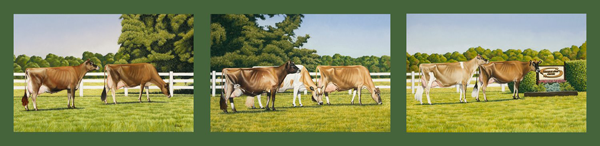
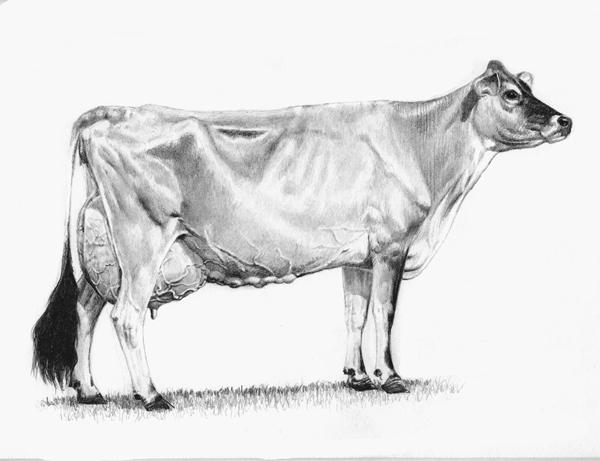
Keightly Core
From Farming to Framing
Gary Sauder grew up showing registered Jersey cows from a small farm in Sonoma Country, California. During his last 4-H year, he exhibited the Grand Champion Jersey at every show he entered, including the Jr. Grand National at the Cow Palace and the California State Fair. At the same shows, he was the dairy showmanship champion as well as the Round Robin Master Showmanship Champion. He earned the Paul Jackson Scholarship that same year. After college, Gary took a position caring for and exhibiting cattle for then, Meadow Glen Farms of Orland California. It was about this time that he made the exciting leap into the realm of painting.
Puttin on the Ritzy
A Love for All Things Bovine
Sauder’s work has been juried into many exhibitions. He is resident artist at the Healdsburg Center for the Arts. Gary loves capturing the beauty and character of the cows he paints but he has just as much passion and concern for the dairy breeders themselves and for the generations to come. While he finds it difficult to pick a favorite from his work he does rise to the challenge. “If I had to choose one it would be my painting “The Jersey Cow.” He explains his choice. “This painting was the culmination of my Jersey experiences throughout my life and brought into play elements of many of my favorite cows that I had seen and admired from afar, as well as having had the great fortune to work with. Cows like Generators Sweet Dreams, KCJF Regency Treasure, Huronia Centurion Veronica, Lloyn Jude Griffen, Generators Topsy, Generators Imp, and Sunset Canyon MBSB Anthem and cows like that. After that I like the painting I did of my own cattle entitled “Jersey Fields” and that is for purely sentimental reasons. The next few are all special and I like the newest one for Brady Core of “Ritzy” and I really like the painting of “Kit Kat” that I did for George Colpetzer.
Capturing the Ideal Bovine on Canvas
Gary is a perfectionist and renowned for his ultra-realistic portrayals that some people think are photos. “I take that as a compliment” he says and adds, “Even though I am not trying to create a photo, I am trying to show how I see and how I want to communicate to the viewer.” Of course his photos are not done in Photoshop – “I don’t get the Photoshop question” – but he goes on to explain. “I do use Photoshop myself in order to help build compositions and correct colors for reproduction and Internet promotion. It is a valuable tool and I use it as such.” Gary has produced five “ideal” cows in his artistic repertoire: Jersey; Holstein; Brown Swiss; Milking Shorthorn and Red & White.
Mentors From Both the Barn and the Gallery
Sunset Canyon MBSB Anthem drawing
Gary acknowledges that there are quite a few in the art world that have had an effect on him. “Most of them are from the wildlife/animal art world and they include Carl Brenders, Terry Isaac, Leslie Harrison and the great portrait artist Daniel E. Greene.” On the dairy side, Gary feels that it was his great good fortune to grow up around “some of the giants in the industry.” His list has many familiar names. “Local dairymen such as Henry Lafranchi, George, Tom and Marvin Nunes, Jim Pappas, John McKitrick and Doug Maddox.” He goes on. “These men used to judge our local county fairs and, when there, I got to compete with Cheryl LaFranchi, Hank Van Excel and John Rowe.” He speaks with the enthusiasm of a true dairyman, “ I showed Jerseys and always admired the cattle that were shown against me and the ones that stood out where the cattle with the MG prefix that were bred by Harlan Askeland and of course the Stardust cattle. Our county Fair always put on quite an Open Jersey Show with such renowned breeders as Harlan Askeland, Bob Bignami, Jack Snell, Phil Nyberg and John Giacomini. If you wanted to learn about quality Jerseys, there was no better show to watch.” Gary obviously learned from these leaders as he reports, “Later I had the privilege of working with the Askeland-Bignami herd and got to work with some great cattle like Generators Sweet Dreams, MG Tradition Robyette, Empire Amelia Beacon, and MG Master MC Lou.” Sauder not only watched the cows he watched the competitors and he shares this interesting side note. “During the last couple of years that I showed as a junior I kept noticing and talking to a very energetic and quite enthusiastic young exhibitor who seemed to know more about Jerseys, breeders and pedigrees than anyone in the barns. It is no surprise to me that he has grown up to be what I think is the most influential Jersey breeder of our time and I am talking about Eric Silva of Sunset Canyon Jerseys.”
Sunset Canyon Wall of Fame
Pencil, Police and Pastels
In looking back, Gary reports that he had been drawing as long as he could remember but says, “I had grown bored with drawing in graphite and hadn’t done it for a long time.” Then one movie changed everything. “I saw a movie about a sketch artist for the police and he was using colored pencils and I decided to find out more about them. I got some books on the medium and I conquered my fear of color and shortly thereafter I graduated to pastel and even water color and oils.” A momentous change and he confirms, “I enjoy them all but I prefer to paint in pastel.”
Facebook Extends the Artist’s Reach
No matter what career path you’re on, there are going to be changes. This has been true for Gary Sauder as well. “The biggest changes for me are two completely different things that came about at different times for me. The first was my discovery of coloured pencils and the second was the digital camera. The camera helps me not waste as much time and money on photographing my reference material.” But there are other tools that have made changes in Gary’s work. “Right now the two most profound things to affect my business are the new pastel product called Pan Pastel and the surface PastelMat and Facebook.” He is emphatic, “Without Facebook I would not be able to reach as many people as I do now and it really reaches my target audience.”
Passionate about Breeders, Breed Promotion and Paternity
Gary, like many artists, considers every finished painting an accomplishment. He modestly leaves it up to the viewer to determine if that is a great accomplishment or not. For himself he ranks “becoming a father last year” at the top of the list. This fits very nicely with his commitment to the future of the dairy industry. “I have donated a painting to the Ayrshire Junior Youth Fund and a really nice painting called “Generations” to the AJCA for their Jersey Youth Academy”. Gary is definitely putting the positive reaction to his work to a valuable purpose.
Something in the Ayr
No Shortcuts
Having admired the honesty of his own mentors, Gary strives to be the same. “I have always believed in the honest cow and having showed and milked many of those kinds of cattle I have always thought that I could portray that quality in a painting. To that end I prefer to work from “casual” pictures taken by mew or a client and, if you look at my paintings of “Anthem” and “KitKat” you can really see that influence.” I also believe in no shortcuts in creating a painting and by that I mean doing a drawing first to perfect the pose or setting and then using that drawing as the basis for the painting.” As in any high calling, there is no “easy” way says Gary the encouraging mentor. “It’s going to take about a hundred paintings, before you get really good and consistent and develop a style” It is really important to learn to draw, before you learn to paint.” And, above all, “Never give up!”
Xanadu Brendan Kit Kat
Balance, Line and Proportion
Speaking of never giving up, the ultimate goal of every purebred dairy breeder is to bring all the best parts of the dairy cow together in one animal. Gary Sauder has a parallel artistic vision and Russell Gammon, former General Manager of Jersey Canada and now Jersey Program Manager at Semex Canada, applauds Gary’s work and explains why he personally has expectations of a “Mona Lisa Jersey painting”. “Gary Sauder’s artwork fills a niche in the dairy industry. Given his long term passion for dairy cows and dairy cow conformation (especially that of the Jersey breed) he nails proportions and the small details perfectly. I’ve seen some of the cows he has painted and he captures them perfectly on canvas.”
The Bullvine Bottom Line – “Follow Your Moos”
There is no doubt that Gary Sauder, the muse in his gallery, will always follow his “Moos”. And, as long as he does so, there will be a growing following in the dairy/art world who will agree with Gammon’s praise of his mastery, “Call Gary Sauder the Renoir, the Picasso, the Da Vinci of the Dairy World!”
One of the fun family parts of raising Holsteins comes with naming them. Larcrest Holsteins of Minnesota not only does a great job with the names of their herd (most of which start with “C”) but those names have earned worldwide recognition for one cow family based on the descendants of Larcrest Juror Chanel EX-93 3E GMD DOM. Jon and Ann Larson and their son Tyler own and operate Larcrest Holsteins and, even without the signature “C” names, they are building an impressive reputation as hard-working, honest Holstein Breeders. A noteworthy group all around!
Larcrest Juror Chanel 3E-93 GMD DOM
GOOD TIMING: 8 to the Barn
As the second generation at Larcrest, Jon and Ann continue to build. “We currently milk 120 cows and farm approximately 500 acres.” says Ann. “The dairy was started in 1960 by Jon’s parents, David and Raymona Larson. When they started their family, Raymona used her teacher’s retirement savings to purchase 8 registered Holstein heifers. Most of the registered Holsteins at Larcrest have descended from the original 8 heifers.” A great opening number for the herd. Positive dynamics have happened on the family side as well. Today Jon`s sister, Linda, and her children, Chase, Bridget and Lydia are an active part of the team.
Larcrest Crimson-ET EX-91 93-MS GMD DOM Daughter of Cosmopolitan Grand daughter of Champagne Great grand daughter of Chanel #4 GTPI Female on Locator List (12/12)
LARCREST DREAM: The Complete Cow
At Larcrest everybody is on the same page, or to continue the musical analogy, they sing the same breeding philosophy tune. They explain their goals. “We very much strive to breed a complete cow. We have always appreciated cows with high type and longevity. Each corrective mating is important to us. Now with more modern tools we are more accurately able to identify each cow’s strengths and weaknesses. Health traits are gaining importance and service sires are screened for them.” Such harmony in goal setting has meant that Larcrest Holsteins is recognized for “outstanding type, modern health traits and high components.”
Larcrest Chima-ETS VG-88 DOM Planet x Crimson #25 GTPI Cow on the Locator List (12/12)
STRONG COW FAMILY: Hitting the High “C’s”
Much is written, talked about and attempted in the breeding of great cow families. With Juror Chanel, Ann and Jon got started on the right note and haven`t been off-key since. Chanel, Champagne, Cosmopolitan, Crimson, and Chenoa are making records for Larcrest. Ànn and Jon provide this update, “Our breeding and ET programs are based on the members of the Chanel family. Great Granddaughter Crimson and her daughters are the current focus. We are presently quite excited about 2 of Crimson’s daughter to calve this spring. Cale by Observer is due in March and Cordial by Atwood is due in June. Crimson and her 3 Planet daughters now rank as 4 of the top 26 CTPI cows of the breed. Larcrest Cardigan (2634 GTPI Cale x Numero Uno # 6 GTPI of the breed) and Larcrest Charmed (2590 GTPI Crimson x Numero Uno # 10 GTPI of the breed) as well as Larcrest Crayon (2512 GTPI Crimson x Mogul) show much promise in the calf pens.
LARCREST CALE Observer x Crimson GTPI+2379 +771NM$ PTAT+3.18
LARCREST: A Chorus of Praise — Lucky Notes
Even a brief look at Larcrest leaves a strong impression of the achievements of Jon, Ann and Tyler. Theirs is the unique situation of a high index cow family that has many generations of home breeding. “A lot of credit for the generations of success can be given to our good friend and mentor, Dr. Marv Johnson who has done our embryo transfer work from the beginning.” Says Jon and he and Ann agree, “Breeding cows and seeing the next generation improve is something that we truly enjoy.” From the outside it’s hard to imagine such easy harmony but that too is practiced. “Patience and focus have produced the kind of cattle that we want to work with. We have some luck along the way… Chanel was nearly lost on first calving and Champagne was twin to a bull.” Nevertheless, everything reached a positive resolution. “Fertility and aggressiveness have also helped the cow family to thrive.”
Larcrest Oside Champagne-TW VG-88 EX-MS GMD DOM Dam of Cosmopolitan 2nd dam of Crimson Daughter of Chanel
Key Changes Come with Genomics
Whether you consider it as the previously mentioned aggressive or put it down to natural cow sense, Jon and Ann have moved with the times. “The use of genomics has changed our breeding program. It has shaped the decisions on which members of the family to concentrate our focus on. It has encouraged the use of more young sires. We still like to use daughter proven bulls when possible, especially on intriguing matings.” They definitely like the finer details of cattle breeding, “On the genetics end the biggest change has been the shortening of the generation interval with genomics. We feel that this has both positives and negatives. The positives would include the rapid increase in genetic potential. The negative would be increased inbreeding and higher risks for holes in the pedigree. We feel that the greatest animals are the proven cattle, both male and female, sired by daughter proven bulls that can still compete with the younger generations genetics-wise.”
Larcrest Cosmopolitan VG-87 VG-MS DOM Daughter of Champagne Dam of O-Cosmopolitan (the #1 Planet son in the world)
In the Spotlight: And Now Here’s Cosmopolitan
When it comes to long- running performances, Cosmopolitan, the Shottle granddaughter of Chanel, steals the show. Her progeny have been sought after by many breeders, many in embryo form, by breeders in North America and Europe. The spotlight is held by her top son O-Cosmopolitan, the #1 Planet son in the world. He is being used heavily in Europe. One of his full sisters is #2 gTPI Planet in Europe. The bright lights continue to shine for Cosmopolitan progeny and the continuous production of embryos since she was flushed to top bulls for Net Merit, TPI and PTAT.
Marketing: It Takes Perfect Pitch
Marketing elite cattle when you are not the dairy heartland can be very challenging. For Larcrest Holsteins they take advantage of all available tools to get it right. Says Ann, “We use Holstein Plaza, website on Holstein World, Facebook, ads in Hotspots, Cowsmopolitan, Holstein World, Cattle Connection, and Holstein International.” She admits that it takes great work behind the scenes as well. “I think that the best marketing that we can do is through having good people that know the family inside and out. The performance of the cattle plus the representation of this group of people have been key to our success.”
Larcrest Chenoa-ETS VG-87 DOM Planet x Crimson Dam of Chevrolet GTPI+2490, #1 Freddie son of the breed and #6 GTPI sire worldwide
SOUND ADVICE: Practice Makes Perfect
Such resounding success doesn’t come by accident. From day one Jon and Ann have stuck to their values. “If we were to give any advice it would be to be honest with yourself about what you have or don’t have. Accurate representation of your cattle both positive and negative in the long run will pay dividends
THE BULLVINE BOTTOM LINE: The Key to Success
And so the curtain continues to rise on Larcrest Holsteins with years of great performance and headliners to come. The stage is set for Larcrest’s outstanding home bred high index cow family to remain in the spotlight. As they pay attention right down to the smallest details of name selection, there is little doubt that genetic stars from Larcrest Holsteins will be hitting all the right notes! Encore! Bravo!!
When you look back from the mid-point of a rewarding career, it is sometimes easier to see the tools that made success possible. In the case of Norman Nabholz of West Union Iowa there are three tools that stand out: Halter, Pen and Gavel. Norm has used all three of these tools to carve out a unique career spanning the show ring, the written word and as a sale promoter. However, like many of his peers, this 1989 Klussendorf Trophy Winner finds it impossible to talk about himself. He states simply that he “was born into dairying” and is emphatic that “cows have been my life from day one.”
Norman Nabholz of West Union, Iowa owns and operates Nabholz Farm that has owned or sold 16 Grand Champion Jerseys at World Dairy Expo, including two Supreme Champions. Nabholz has also owned two All-American Grand Champions, two Royal Winter Fair Grand Champions and five Jersey Jug winners. The farm has earned Premier Breeder and Exhibitor awards at World Dairy Expo and Premier Exhibitor at the NAILE in Louisville. Norm has served as Official Judge three times at World Dairy Expo and three times at the Royal Winter Fair. He has judged in more than 30 states, four Canadian provinces, Argentina, Australia, Ecuador and Mexico. In 1976, Norm started Nabholz Sales Company and has since managed or co-managed the highest selling Jersey dispersal of all time and several of the highest selling sales in history. Three of the breed’s 10 highest-selling females of all times have been sold through the Field of Dreams sales, managed by Nabholz.
Despite these achievements, Norm deflects praise regarding his breeding philosophies. “As I look at my office wall I don’t see a lot Premier Breeder Banners. If I did breed a good one it was pure luck. For that question I would turn to somebody like Darin Meyer or Frank Regan or Jeff and Alta Mae Core. I find it amusing all the people that talk about breeding cows and breeding philosophies and the ones that do the talking are not the ones that have bred great herds like De Su or Regancrest or Keightley Core”.
Great Mentors, Great Minds and Great Stories
He has definite opinions about those who have influenced him saying, “My parents and then several including Max Gordon, Lew Porter and, in later years, David Younger and Peter Heffering (Read more – Hanover Hill Holsteins: Peter Heffering 1931-2012). My dad and mom started with nothing and worked harder than anybody I have ever seen. My dad was as good a cowman as I have ever been around. Max Gordon was a genius and such a class act. Lew Porter taught me attention to detail. I was blessed to have considered Dave Younger and Peter Heffering personal friends and would talk to them on a weekly basis and, toward the end, more often. I learned so much from them. Not to offend but “they don’t make ‘em like those anymore”.
REGANCREST JUROR BRINA EX-92-4YR-USA GMD
Norm’s PEN Pals in the Barn
Norm looks for value in people and has favorites in the barn as well. Frank Regan’s Dellias and Barbies are Norm’s choices for a cow family that has had the greatest impact on the breed. “”I have had the great opportunity to have lived close to them and watched their remarkable progress. I worked with the first daughters of Durham and Barbie’s dam “Brina” and believe she was one of the all time great show cows EVER. These two cow families breed so true that they are as close to sure things as there are in this business. I must say, in the Jerseys, Duncan Belle and Veronica have set the bar very high.”
Norm’s strong feelings don’t stop with his own cows although he avoids naming a favorite saying, “This would be like me asking a parent which of their kids is the greatest? I have a few that are special. Gil-Bar Unique Bonnie who was supreme champion at Madison, Taraley Astro Sherry (owned her for 2 days but she helped my confidence level a bit.) Quality Ridge Stormi Hazel (what a doll). Response Wonder, was a Jersey we owned for a month that might have been the greatest show cow I ever saw including the previous mentioned three cows.”
Norm with PEN in Hand
Since Norm’s first visit to the National Dairy Cattle Congress, he has been drawn to such dairy showplaces and returned every year. “I was captivated by it,” Nabholz said. “I remember everything, from the smells to the sights, sounds, and the people. It’s why I’m in the business that I’m in today”
Millionaires in the Cornfield: The Glory Days of the National Dairy Cattle Congress
In time for the 100th anniversary of the fall tradition, Norm penned a book recalling those days and “some of the greatest cows God created.” He wrote “Millionaires in the Cornfield: The Glory Days of the National Dairy Cattle Congress.” (To order the book contact Nabholz Farm) Nabholz said he wrote the book because the last great show at the Cattle congress was in 1965, and he wanted to record the stories of the people who were there before that generation passed”. Not only a record keeper, Norm is also an active admirer, “For days I’d just live in the past, remembering,” he said. “The millionaires of the cornfield were my idols, my rock stars.”
With GAVEL in Hand: From Show Ring to Auction Sale
While admiring those men and women around him, Norm Nabholz quietly established himself as a respected cow man as well. Today he sells cattle ranging from commercial animals for people who milk to show cattle. He also shows and judges dairy cattle and reads pedigrees. A simple resume that covers the facts of his career in the show ring as showman and judge, and in the sale box, as pedigree announcer or auctioneer. The facts but not the fine points of his attention to detail, eye for type, love for cattle and day-to-day passion for the dairy industry. Nabholz Sales Company — biannual Field of Dreams Sale which celebrated Sale VI in 2011. Whether he’s reviewing past successes or working with a team to present the best of today, Norm takes great pleasure in working hard and doing a good job at whatever he turns his hand to and then, diverting the praise to everyone else.
Change is Normal. Love is the Key.
Clone of the Million Dollar Apple! She sold for $30,100
Whether looking back or looking ahead, Norm is well aware that the only sure thing is that change is going to happen. “So many changes have occurred, some good, and some not. Technology has done so many great things to help with the care of cows and farming in general but perhaps has not helped create a new generation of cow people. The last generation spent more time with their cattle and that meant they learned what made them tick. Knowing a cows weaknesses made it easier to improve on them.” Considering technology somewhat further he makes two predictions and voices a concern. “Robotic milking will become the norm. Efficiency will be a word used more often than it is now. Something will have to be done with milk marketing in the U.S. The world will get smaller and smaller when it comes to genetics.” For someone starting out, Norm looks back at his decades in dairying and points out a truth he has learned. “You have to love this business to survive. It will give you the highest of highs and the lowest of lows. Being able to handle both will dictate how you survive.”
Norm says, “The cows are second to the people.”
Norm has no problem when facing difficult questions or situations. When asked, “If you could learn to do anything in an hour, what would it be?” he answers in a flash. “Learn the art of political correctness.” The dairy business – especially for those with a pen in their hand — can be quite challenging from that point of view. However, in Norm’s case, it goes without saying that he is driven by the best motivations and has been quoted as saying that “If you think the cows are impressive” you’re going to be amazed when you look at the people behind them. “The cows are second to the people.” He has a clear idea of the people he enjoys (everybody!) however if he had to narrow it down to few on an island he has a quick plan ready in response. “I have been told that I am not a very good vacation person, so being on an island, without the conveniences I so enjoy, would be tough. But if I had to be there, it would be fun to have Ray Brubacher, Bill Fetherstone, Bob Morrell and a couple of bottles (maybe more than that).” Like his halter, pen and gavel, Norm knows that it’s important to have the right kit at the right time. He concludes, “We would laugh and wouldn’t the stories be cool?”
The Bullvine Bottom Line
There is no doubt that Norman Nabholz has already left a strong influence on those near and far, who are privileged to have known him. He is a gifted thinker, talented cowman and a sincere ambassador of all that is great about the characters and cows that are building on the past to move the dairy business forward. For this dairy man “Exceptional” is the every day “NORM”. Thank you Norman Nabholz.
“X” marks the spot for dairy lovers this February. The inaugural Canadian Dairy XPO is being held at the Stratford Rotary Complex on February 6th and 7th, 2013. CDX is the realization of a dream conceived by CDX founders, Jordon Underhill and Talo Tamminga, who felt passionately about providing a platform for the Canadian dairy industry, its people and its possibilities.
Lineup of “X”perts!
Day one of the two day event starts with Andrew Dellava, Marketing Manager of Hoard’s Dairyman Magazine. This knowledgeable Master of Ceremonies will welcome everyone to an “x”citing dairy classroom education program, which includes several internationally recognized experts. The program is designed to give you tons of content you can use from key people in the dairy industry. This is where you get to have your questions answered on the following topics:
Genetic Advancement HIR trait
Brad Sayles, Semex Alliance – Canada
Dr. Bonnie Mallard, University of Guelph
Technology and Social Media
Billy Frey, Alltech Ag Network – USA
Nutrition
Dr. Charles Swab, University of New Hampshire –USA
Global Dairy Summit Meeting
5 dairymen from USA, UK, Hungary, Poland, Brazil and of course Canada
Economics and Animal Welfare
Joep Driessen, CowSignals, Netherlands
Consumer Connection
Lynn Crawford, Celebrity Chef Toronto, Ontario
“X”po Recognizes Female “X”pertise
The full spectrum of agricultural opportunities and leadership will be highlighted over the two-day program. Three women who are making their mark in diverse areas of the dairy business are recognized by CDX. Vicky Morrison, of Bally Bright Farms in Bright, Ontario is originally from Northern Ireland and now milks around 100 cows with her husband Mark. They have recently installed two robots and she is keen to share her experiences and says she is “grateful to have worked with some wonderful people in research, extension and practical agriculture.” Like Vicky, Kathryn Kyle, General Manager of Jersey Canada, encourages “all women passionate about the industry to step forward and take advantage of the countless opportunities our rapidly progressing industry has to offer.” Kathryn is looking forward to face-to-face time with breeders who visit the exhibition halls. Dr. Bonnie Mallard, Professor of Immunogenetics at the University of Guelph is one of those who is enjoying a career that grew from her lifelong connection with farming. Her career journey has provided the opportunity to focus on learning about genetic regulation of the immune system and its impact on dairy health. Her talks will highlight how these new genetic tools are ways to improve animal health and well-being as well as food quality and safety.
Excited to Explore
From the complimentary pancake breakfast that will start each morning to the demonstrations, exhibitions, genetics showcase, robotic showcase and extensive seminars, there is something for everybody at this showcase of dairy innovation. Attendees will get to evaluate the latest tools and technology for growing their dairy business. They will learn about initiatives and all that is dear to the heart of dairy cattle breeders and industry stakeholders. Three tradeshow halls and the Britespan Cow Coliseum (itself a massive 65 ft x 300 ft structure) will guarantee that everything is bright, light and right at hand for spectators to discover.
Real Know-How and Real X-amples
Everyone knows that the best part of attending seminars is the one-on-one opportunity to ask questions, get answers and learn from the best in the industry. The opportunity to get up close and personal with the leading technology will be a definite highlight of CDX. Three demonstrations will be feature twice daily in the Britespan Cow Coliseum.
Real Time Somatic Cell Count Testing Using An iPhone Milk GuardianTM using patents pending technology From Dairy Quality Inc. will demonstrate how after a sample is drawn, the device scans the milk, an image is captured and analyzed and displayed on the iPhone seconds later. The cell activity will then be shown to spectators on a TV screen.
Live Colostrum Management/Feeding Demo The unique aspect of the ColoQuick system is a hygienic way of handling and storing colostrum without de-naturing it. The demonstrations will show how pasteurized colostrum can be taken from frozen to feeding in less than 15 minutes and immediately fed to newborn calves.
Live Demonstration of Tranfaunation Using the Rumen Transfaunation involves the removal of rumen fluid from a healthy herd mate that is then drenched into a sick cow. In addition to treating sick cows, research at Cornell University also shows the benefit of using this rumen fluid to greatly reduce scours in calves’ first 14 days of life. Should every producer have a healthy fistulated cow on farm? Come see for yourself!
As well there will be four simulated milking robot demos LIVE under one roof!
Buildings are already being constructed.
Event organize enthusiastically proclaim that these robot demos are “first for the world!” As the technology expands CDX is providing a showcase for dairy producers to see and compare the latest in robotic milking excellence. They report: “In the last 15 years, milking robotics and on-farm automation have gone from expensive curiosities to redefining the dairy industry. The growing use of robotics on Canadian dairy farms demonstrates that this technology is not only proven, but that there isn’t just one approach to farming anymore.”
“X” tras Make the Xpo Experience “X”ceptional!
It goes without saying that you will want to see Celebrity Chef Lynn Crawford who will be cooking with 4-H kids and photo opportunities with the TV star will be available.
Genervations will be selling tickets on four high genomic Holstein heifers that will be showcased in the Cow Coliseum as part of their dairy daughter showcase. Not only an eye-full but also potentially a winning opportunity! Tickets available to 4-H’ers at the XPO and a draw at the end of the XPO where one lucky youth will get choice of the 4 heifers for their 2013 4-H project…WOW!
Dave Carson Auctions will present an Elite Embryo LIVE auction with 100% of the sale commission proceeds going to 4-H. Support for 4-H and our future dairy industry is a recurring theme throughout the event.
The Bullvine Bottom Line
The Canadian Dairy XPO hopes to inspire both the current generation and the tech-savvy next generation. Of course, the CDX TEAM has put their hearts into this event and are confident in saying to dairy lovers everywhere “We trust you will find this a rewarding experience!”.
Can a great business plan look good on paper and in the lineup too? Twenty-four year old Jerry Jorgensen of Ri-Val-Re Holsteins in Webberville, Michigan gives a resounding “Yes!” He states their breeding goal as follows” We want to breed cows that appeal to the eye as much as they do on paper.”
No Sibling Rivalry Behind the Scenes
Ri-Val-Re Holsteins milks 300 Holsteins twice a day. Jerry and his dad Aaron focus on the dairy operation. They have 850 head of young stock and farm 8000 acres of soybeans, corn, alfalfa and wheat. Jerry outlines the setup. “The acreage is farmed in partnership with my grandpa, dad and aunt and uncle.” He outlines his own role. “I’m in charge of all breeding decisions, marketing (purchasing and selling) and have been for the past ten years. My sister Julie works full time assisting the vet and, in addition to daily chores, keeps up on all the paperwork associated with the farm.” Beyond the Jorgensen family they also have five other full time employees who milk, feed cattle and haul manure.
Ri-Val-Re Made Headlines
Ri-Val-Re recently attracted prominent attention, when they paid $10,000 a dose for five doses of polled semen. That’s a great story in itself but this one was even more unique in that it took place on Facebook (Golden PP Facebook Page). Of course Jerry had a plan. He wrote “I’ll pay 10K a unit if I can get the first 5 and no one else can buy it for 90 days.” The early negotiations were right out there for everyone to see as Roy MacGregor responded, “That’s a pretty hard offer to ignore!” The deal was made and everyone eagerly pencilled out the possibilities (Read more – $10,000 a dose polled semen). It looked like Ri-Val-Re was set to turn Golden PP into golden business tactics.
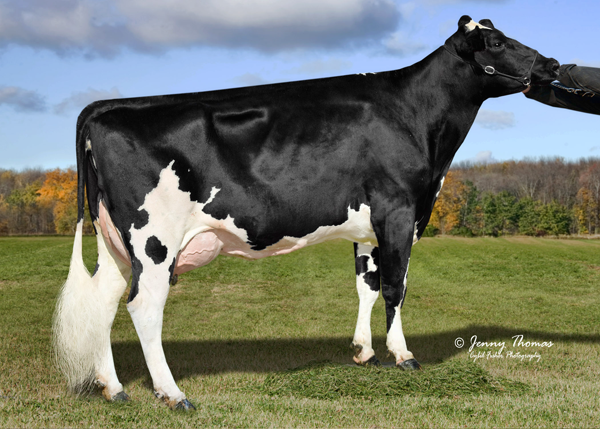
Reaction To Ri-Val-Re Risk Taking
Every new shift in the marketplace, stirs up interest and sometimes controversy. Such was the case with the $10,000 semen deal. Jerry reports that reaction was pretty mixed, “I would guess I have received calls, emails and text from 100 different people. Most were wondering if it was true or not.” Securely grounded in his vision for the future, he reports that opinions changed. “After I explained my plan and what I was doing with the semen, most people thought it would work out well for me and that it was a good risk to take.”
Golden PP was not a Shot in the Dark
Those who are less willing to take a leap of faith are won over by Jerry’s analysis of what went into the decision. “I love the Colt P x Goldwyn cross. Also he is the first homozygous bull available that has appealing numbers across the board.” Again that combination of numbers and the eye appeal which he says “I feel okay using him without sacrificing too much. Also with IVF and what you can do with a single unit of semen and knowing that every single calf will be polled there are several advantages economically that way.”
Ready to Risk on Genomics
With this explanation of the Ri-Val-Re game plan, it isn’t surprising to learn that genomics doesn’t inspire timidity either. Jerry confirms that “Genomics has changed our breeding program in the fact that we use all young bulls, where before all we used were daughter proven bulls. We still look for good pedigrees but we definitely are willing to take a lot more risk.” It all boils down to personal confidence, “I’m a big believer in genomics so I feel safe using young sires.”
Ri-Val-Re Grows Thanks to Breeding Program Stars
RI-VAL-RE SUPER NIKE VG-85 VG-MS +2191 GTPI, From Goldwyn Nadine family. Her first daughter (Alchemy Nikole *RC #1 RC heifer in breed) sold for $150,000
When discussing the stars of their breeding program Jerry notes, “We have three major areas. Firstly, Ri-Val-Re Goldwyn Nadine-Et VG-87 has been on a continuous flush program since she calved as a two year old. She’s the 7th generation VG or EX and has a sire stack of Goldwyn, Oman, Jesther, Terry, Elton and Melvin. She has 6 sons in A.I. the highest indexing one being Ri-Val-Re Nely (a Facebook at Semex) with a DGV LPI +3293. She has several daughters over 2300+ GTPI by Mogul, Observer and Numero Uno. Currently we have over 150 pregnancies on the way from her and her daughters.”
RI-VAL-RE ALC MINI-P-RED-ET 2168 GTPI PO & R&W. Sold for $100,000 in August 2012
Ri-Val-Re Adv Win-Go-Red-Et Ex-90 and her daughters are being extensively flushed. Win-Go is the Grand dam of Ri-Val-Re Alc Mini-P-Red who is the #1 GTPI polled, red and white heifer. She is also the Grand dam of Ri-Val-Re Obsrvr Dolo-P *RC one of the highest GTPI PO bulls.
Over 100 pregnancies are on the way from Win-Go and her RC daughters by MacGuiness & Observer (many will be Polled & Red). Several other heifers that are 2300-2400 GTPI are on IVF flush programs from other branches of these families and other purchases.
Currently the sires being used at Ri-Val-Re Holsteins are Shanosber-P *RC, Golden-PP-Red, Predestine, AltaOak, Shan, Cashcoin, Colt-45, Platinum, Morgan, Chevrolet, Willpower and Liquid Gold.
Full Sales Ahead for Ri-Val-Re Holsteins
Starting in February we will be doing advertising leading up to our summer sale here at the farm. We consign to several sales throughout the year and are having our own sale June 15th. We plan to sell 300-350 genomic tested heifers in 2013 through consignment sales and our own sales in June and November.
Foreseeing An Emphasis on Health with More Polled Animals
A keen observer of the dairy business, despite his relative youth, Jerry reports “The biggest change I’ve seen in the last ten years is the emphasis put on health traits…. Not really sure what will change in the near future, I do believe the breed will be mostly polled by 2020 though once more and more polled animals are bred with comparable genetics to horned animals it will make more sense for breeders to breed polled and once that happens it will be hard to turn back .
The Bullvine Bottom Line
Jerry confirms what we have heard from many breeders. Real success comes when you can put it all together both on paper and in the barn. “We are heavily invested in genomics but I still want a product I`m happy to have my prefix in front of.” He advises new breeders to “start off slow and buy into cow families with deep pedigrees and known success.” As they continue to have success on paper and in the barn, they are proving that, when it comes to cattle breeding,
It’s just eight days into a New Year and already I’m thinking about the ‘good ol’ days!”. Remember when the dairy industry was at the top of the agricultural sustainable list, milk was the “perfect food” and milk moustaches were seen on celebrities and sports stars? Hmmm. Where has all the glory gone? In 2013, the dairy industry is fighting to stay alive, the North American diet, including milk, is under attack as obesity from babes to the elderly is out of control and, when all is said and done, milk is a slipping way down on the favorite beverage list!
The land of milk and money is gone. In the cold light of the soul searching brought on by a new year, it seems that this shocking state of affairs has happened suddenly and for no apparent reason. In actual fact, the signs have been there for more than thirty years and we as an industry let it happen.
MILK OF AMNESIA – We forgot the basics
It took three steps for the milk market to evaporate!
We forgot about the consumer.
The first commandment of business, “The customer is always right!” in the dairy industry has become “The cow always comes first!”
We forgot about the product.
Somewhere production, with the myriad of logistics in between, pulled out in front of the inherent value of our end product – milk.
We forgot delivery.
Despite the first two failures, we still expected that the product we produced could be delivered in boring, hard-to-open cardboard cartons, heavy jugs or even plastic bags and compete against the “cool” the “sexy” and the “handy” beverages provided by competitors – who wanted — and stole — our market share!
MISSING THE TARGET: Where’s The Consumer? Where’s the market?
Consumer demand is the key to market sustainability. There’s no use producing a product if there is nobody to buy it. The truth is demand for milk has been in a free fall for the last three decades. North American milk consumption has dropped a startling 36% since the 1970s. The continuing economic downturn has refocused consumers on value. They not only are choosing private label products and discount store venues, they are seeking low calorie, reduced sugar and functional value in the beverages they consume. Milk – even though billions of pounds are being produced is losing out to fortified, organic, sports drinks and a myriad of better-for-you products. We are paying the piper for focusing on just one highly commoditized product, ignoring market trends, and trying valiantly to sell what we make rather than what people want. If we don’t give consumers what they want, someone else will.
LOOK BEYOND THE PAIL: Think outside the box stall.
For decades industry strategy has been to make dairy operations more efficient. It has succeeded: From 1970 to 2006, the number of cows declined 25%, output per cow more than doubled. But while the dairy industry focused on squeezing more milk out of fewer cows, they largely ignored the fact that demand was getting squeezed as well. That’s the nature of business. Where’s the competitive spirit that drives all the other parts of the dairy industry? Even the perfect sire or model cow, needs to be marketed. Our over-riding concern to “protect” ourselves from each other, the economy and even mother-nature, has made us put on blinders to the dangers of not being relevant to the marketplace. Breeder beware! We could protect our industry right to zero!!
4 STEP ACTION PLAN: It’s Time for a MILK SHAKE Up!
Three steps got us into this mess. Let’s start with four to get us out.
Pay Attention:
With per-capita North American milk consumption down 36% between 1970 and 2011, it isn’t whether or not there is a problem. The fact is the dairy industry is in trouble.
Make it Functional:
You’ve got to get the drink – in our case milk – into consumers’ hands. This is no time for doing things the way they’ve always been done. Look at Nestle. They wanted their milk drink containing probiotic for children to have a shelf life of one year. Realising that it is impossible to keep the probiotic alive at room temperature for more than a few days. The solution was a shelf-stable nutritional drink with the probiotic in the straw, instead of in the drink. Inside the patented straw of boost Kid Essentials is the probiotic lactobacillus reuteri ‘protectus’, released by the liquid when the consumer drinks through the straw! Now that’s functional! On-the-go consumption is increasing. Milk packaging needs to conform to this trend. Consumers are increasingly looking for a range of package sizes to suit different beverage types and thirst levels, as well as functional and aesthetically-pleasing packaging. Not my area, you say as a dairy farmer? Whose is it? Who cares?
Make it Healthy:
Whether it’s the health benefits you get from drinking milk or the environmental benefits of how it is packaged – the consumer cares about both! Parents are increasingly concerned about the nutrition and sugar content of the products consumed by their children. This can work for us (with soft drink competition) or against us (sugar added milk products). Again packaging enters the discussion. Studies in 2011 showed there is a substantial proportion of European consumers that would be prepared to pay extra for glass containers, especially for milk, yoghurts, juices and wine. “it may well be that consumers are willing to pay more as good packaging protects the health benefits and taste of the product for longer”. The health and wellness trend is not going away. We have a healthy product but it won`t sell itself if we continue our milk-sells-itself mind set!
New Products. New Location.
We`ve got to ask ourselves what does the market want and then find innovative ways to provide it. Perhaps even before we answer those questions we have to zero in on “where” the market will be. In a global marketplace, we need to consider the enormous potential of focusing on the end user – perhaps in another country!
LIVE OR DIE MILK BATTLE: Consumption is the Key
We can no longer rest on our milk stools. We have to compete for the marketplace with all the old beverages … and countless innovative new ones. That may seem to be a daunting task but it can no longer be ignored. Again. The world is waiting. Look at the graphic below. While our own markets are mature in the milk marketplace, there are HUGE opportunities for dairy in the global scene.
Consider this: One glass of milk per day per child in China could surpass the milk consumption of the entire North American market. It’s a new frontier to be won!
THE BULLVINE BOTTOM LINE
We can’t continue to let narrow focus override finding the consumer and serving them the milk products they want. Laying blame won’t stem the downward trend of the dairy industry. Remember when land-line phones had a monopoly on communication? Think about large phone companies (another almost monopolistic industry, especially in Canada). Where would they be today, if they had continued to whine about the intruders into the marketplace? The faster we learn from their example, the sooner we’ll prove that the North American dairy industry isn’t ready to kick the milk bucket yet!
With 10 months in at The Bullvine and a New Year just beginning, this is a timely opportunity to revisit our Top 12 Favorite Stories of 2012 and tell you why we loved them so much.
These aren’t necessarily the highest-traffic stories (The Top 10 of 2012 – The most read articles of the year) although in some cases they did attract a lot of attention. More importantly, they are the stories that best represent what we try to deliver to our Bullvine readers every day: real stories, features, and analysis about the people, cows, issues and trends that are shaping the dairy industry in North America and around the world.
These are the ones that kept us up at night and got us out of bed in the morning! We know that when we are engaged, you will be too! Read on for our favorites of 2012!
“These days, dairy producers need to have as much confidence in handling their advertising as they do when handling their high-producing cows.” We like this article for its relevance to modern dairy producers. Just as important as what you feed your dairy cattle, what you feed your customers in terms of information can make or break your bottom line. Social media has overtaken our industry. (Read more – How Social Media is Changing the Holstein World). What tech gadget did YOU get or give for Christmas? Unlike other advertising trends these ones are here to stay and growing more and more relevant to marketing success.
“Every farmer and every farm has their own individual situation. One type of cow is not the most profitable for everyone. But it is important that every cattle breeder takes the time to decide which, for them personally, is the most profitable cow. And then it’s equally important that they take the next step and breed for that type of cow. Your reality is the source for your profit.” This is a message that The Bullvine feels is both informative and timely. With a changing industry, global economics and advancements in genetics and technology finding the profitable cow is crucial to every producer.
“This was our favorite story to put together this year”. That is saying a lot when you consider that The Bullvine provided the opportunity to interview Cristy Nurse (Read more – Cristy Nurse: From Show Ring Beauty to World Class Rower and Cristy Nurse: Standing Tall) and Bonnie Mohr (Read more – Bonnie Mohr: Science and Art Together Creates a Holstein Love Story) – who are both amazing role models for the industry. In the case of Don Schwartz it was the unassuming way in which he has dedicated himself to the cows he works with that stood out for us. His passion shows in the cattle he guides from birth to the show ring — and home again. The 2012 Curtis Clark Award Winner is a fine example, like Cristy and Bonnie, of how far you can go by loving what you do and doing your best every day!
From the outset The Bullvine has stated our belief that open discussion is the best way for the industry to grow, develop and move forward.” This article reiterates that. One supporter wrote, “If only there were more people in our industries who adopted the same attitude. Don’t shy away from it, reveal it, raise it, discuss it and come out the other side better informed, more empowered, more engaged, and much stronger!” Will do!
There are many questions that are relevant to today’s dairy industry and this article is one example that we have taken a look at. Profitability is the driving force of a sustainable industry and weaves its way through many of our articles on investing in genomics, robotics and management articles that consider the money-makers and money-wasters in today’s dairy business. Of course, it’s always relevant to keep our minds and eyes open to more than “black and white”.
7. Gone But Not Forgotten.
Seventh place on my top 12 list is occupied by cows who have left a legacy for the dairy industry despite passing on much too soon for those who raised and loved them. Rainyridge Talent Barbara (Read more: LASTING LEGACY: A Tribute to Rainyridge Talent Barbara) and Sweet Pepper Black Francesca (Read more: The Magic of Francesca) are two stories that are the cornerstone for why breeders dedicate their lives to dairy cattle breeding.
6. Talk About Money!
The Bullvine takes seriously its role in providing information to breeders to help them make informed decisions. We enjoy the research and analysis that provides a basis for articles that are relevant and useful. Our investment articles are consistently among the most popular and, for us, bring this article in at number 6 (Read more: Top 6 ways to invest $50000 in Dairy Cattle Genetics).
5. Answering the Tough Questions.
Every day we are faced with new ideas, financial challenges and, on occasion, the impact of Mother Nature on our day to day dairying success. It isn`t the Bullvine`s style to fly below the radar or to deny the obvious. Whether it`s providing a needed wakeup call or asking a tough questions about Genomics, the Show Ring, hot house or high priced cattle or Industry leadership, we bring the issues to the table for discussion and debate. One of our favorites earns 5th place – (Read more: $750 Semen Are You Crazy?”) because it took a different angle on this new approach to dairy cattle semen selling.
If frequency of discussion was the only measure, this article on envisioning the perfect Holstein cow would be out in front by a country mile. It is a topic that we never tire of at The Bullvine. With experience in classification, true-type model designing and day-by-day cattle management, it is the “impossible dream” that eludes our grasp. That doesn’t mean that we won’t try every scientific, photographic or genetic tool to bring it within our impassioned reach! And we WILL talk and write about it!!
3. The Story Behind the Story.
There are many obvious stories to write about: the winner at the cattle show; the top seller at the Auction; the list of industry Award Winners and so on. However, for the Bullvine, the real excitement comes from learning what goes on “behind barn doors” as we say! By far one of our favorite articles was the one from this year’s Royal describing the touching events for the Eby family in “The 2012 Royal Winter Fairy Holstein Show – One of the Greatest Stories Ever Told”. While it rises to the top, we are constantly impressed by the dedication, commitment and expertise of the dairy breeders we meet. Quality Holsteins (Read more: Quality Holsteins – Well Deserved Congratulations) and (Read more: Top 10 most Influential Holstein Breeders of All-Time) are great examples. It is the personal stories they shared with us that make our work a pleasure every day.
2. If it Matters, It Produces Controversy.
We continually ask ourselves, “What really matters to the dairy breeders who read the Bullvine?” Sometimes the answers take us into areas that may be deemed politically incorrect or even none of our business. Great! Obviously, we receive (and accept) criticism especially when it leads to open and transparent discussion of these issues. When we look at industry leaders, we definitely raise hackles (Read more: Semex – The Rise and Fall of a Semen Empire). Our readers give us feedback: “I for one enjoy the service you provide. While I do not always agree with you, you always make me think” “Unfortunately truth is not always popular and frequently contradicts the institutional consensus.” and, most encouraging, “Your articles and subject are great. I’m so damned tired of hearing the same old thing from others.” “I read The Bullvine first thing every morning and think about it, while I do chores!” Perfect!
This brings us to #1 on our Editors’ Choice list of favourites.
#1 Now That’s Timely.
Anyone involved in journalism will tell you that the Holy Grail of article writing is timeliness. At the Bullvine we strive to provide news in a way that is relevant to where you are RIGHT NOW! Sometimes we burn the midnight oil. Quite often we see the sun rise while we click away on our computers. It is all worth it when it works for YOU!
For these reasons our favorite article of 2012 was (Read more: Who’s Next? World Dairy Expo: Holstein Show Preview). This choice may surprise many. While, to some it was controversial, it comes in at number one because it met our top three criteria of timeliness, usefulness and relevance.
As we seated ourselves early on the morning of the Holstein Show at World Dairy Expo, I received a tap on my shoulder. The couple in the seats behind us had noticed our Bullvine logo on our jackets. As we introduced ourselves the gentleman pulled a paper out of his pocket. It was the article previewing World Dairy Expo. He had printed it off and brought it with him. He updated us throughout the show on our insights. We were right on and he followed up with comments, when he returned home. This interaction and dialogue happens often whether its auction sales, cattle shows or predictions of rising stars in genomics or the next proof run!
Input from our readers will always be #1 with The Bullvine.
THE BULLVINE BOTTOM LINE
At the end of the day — or at the beginning – we love what we do. Your passion and enthusiasm for dairy breeding inspires everyone The Bullvine. We are grateful to Len Vis, the breeder-friend who didn’t hesitate to be the first breeder to interview with us (Read more: “Mapel Wood Farms – Invest in the Best! Forget the Rest!) and are thrilled at the growing network of breeders, experts and enthusiasts who share with us regularly. We will continue to look for our best story ever! It’s coming soon and will definitely be shared on The Bullvine.
[related-posts-thumbnails]
Today The Bullvine joins with Beverly Donovan and Richard Caverly of Benton Maine during a sad moment in the breeding journey of Deer Hill Ayrshires, as they mourn the passing of Sweet-Pepper Black Francesca 3E-94. Francesca, wasn’t just a cow who had great show ring accomplishments, she was a cow who won the hearts and minds of breeders the world over. She was one of those rare cows that transcended her breed to be loved by all. Beverly and Richard took amazing care of “Frannie” and gained a close friend in return.
Sweet-Pepper Black Francesca – EX-94-3E (USA) Grand Champion World Dairy Expo 2012, 2010 Grand Champion Royal Agricultural Winter Fair 2012 All-World 6 & 7 Year-Old Ayrshire 2012 Total Performance Winner World Dairy Expo 2012, 2011 Nasco International & Type Production Award World Dairy Expo 2012, 2011 Reserve Grand Champion World Dairy Expo 2011 Grand Champion Eastern States National 2011, 2009
A Firm Foundation
Richard recalls how they found Francesca. “Beverly was looking to add a strong foundation animal to her Deer Hill herd. We visited Craig and Bonnie Hawksley, as Craig has always been the most helpful mentor and friend. He has an uncanny ability to breed Ayrshire cattle.” It was a great consultation that netted results. “Francesca was discussed and later purchased as the cow that would become a focus of Beverly’s Ayrshire passion.”
Dedication, Commitment and Support
Once the choice was made, the focus at Deer Hill became Francesca’s development. Richard describes that attention to detail. “Beverly’s passion to seek the greatest things for each and every one of her animals is something found in very few individuals. If it is chore time, no matter what the job may be, Beverly is there to provide for the animals first and foremost.” He points out that this care is not a 9 to 5 event at Deer Hill. “From the time her feet hit the floor in the morning, Bev’s sole attention is for her animals. We also have the incredible support of a team of trusted and cherished friends, family, and people willing to share their successes and help with our problems.”
Francesca being shown by close friend Jim Strout during the Supreme Champion Parade at the 2012 WDE
Francesca’s Feats
At Deer Hill, Francesca, fondly known as Frannie, made high records including 6-09 (305 days), 34,560 pounds, 4.3% Fat and 3.1% Protein and has had three calves the oldest a son Deer Hill Francis EX91. Francis is the main herd sire at Deer Hill and his two Calimero sisters, Princess, now a yearling and Pixiedust, born in early August 2012, are very promising heifers. Francesca’s feats are even more amazing when you know that she calved six times before her eighth birthday.
2012 Madison Tanbark Legends Frannie with Veronica and Vivid at 2012 WDE Team Arethusa
Francesca Truly Was a Saint!
Obviously, overcome with the loss they must face, Richard explains how Francesca’s perfection was the motivation that inspired all of them. “In many ways she was both magical and determined. She would make you turn your head with her beauty and fascinate you with her ability to excel as a cow, while she appeared to be running on cruise control!” He credits Frannie with presenting two sides to her own story. “On the one hand she made everything easy. Yet was the first to show you that nothing should be taken for granted. She would take unexpected opportunities to bring you into reality as she guided you through a dream.”
A Shining List of Achievements
Sweet-Pepper Black Francesca was the Grand Champion of the 2012 International Ayrshire Show at World Dairy Expo. She was the winning entry from the Six-Year-Old & Over Class, best uddered, the senior champion and the grand champion female of the show, the Nasco type & production award winner, and total performance winner of the show. Francesca was also the recipient of the Udder Comfort $1,000 Cash Award. This was another crowning achievement after being the 2010 Grand Champion and the 2011 Reserve Grand Champion. In 2012, she was the Grand Champion of the Eastern States Exposition for the third time in her show career, and also won Best Uddered Cow, the Nasco Type & Production Award, Total Performance Award, and the Milk Fat Production Award, all awards that she had won in 2011 at that show, too. In 2012 she was also the winning Mature Cow, Senior Champion, Grand Champion and Best Udder at the Royal Agricultural Winter Fair. Earlier this year, Francesca won the All-World Title for Best 6 to 7 Year Old Ayrshire from the World Ayrshire Federation. In both 2010 and 2011, she was named Unanimous All-American. Deer Hill Farm has shown Francesca 6 times at national shows in the U.S.A. and won Grand Champion at 5 of the 6 and Reserve Grand Champion at the other.
The “Frannie Pack”
As already mentioned, Francesca had 6 calves before she was 8 years old. Richard describes her offspring. “The first 3 born at Sweet Pepper were all males. Deer Hill’s first arrival was also a male who we named Francis. Francis is the hub of the Deer Hill program as his calves have truly been incredible and he currently is the service sire of choice with every female within the other families here at Deer Hill.” With justifiable pride, he points out that her daughters excel for him and Beverly as well. “Fairytale Princess is Francesca’s first daughter and the epitome of what we look for in a young female. Fairytale Pixiedust is the family baby, who like momma and siblings inspires us to go to the barn! We are blessed to be working with Craig and Bonnie with Francesca’s dam Feather. At 15 years old she was raised to Excellent 93 in a system that only allows for a 94-point maximum score. She has been a show Grand Champion as well, as recently as this summer at the state fair.” As expected there is true affection for the success of others in Francesca’s family. “She has two sisters who have both won shows in milking form this year. Faith is Francesca’s sister here at Deer Hill. She is a June baby who is truly precious to us.”
Frannie and Beverly Supreme at Skowhegan State Fair (Oldest Continuing Fair in The World)
The Frannie Dream Team is Amazing Both “At Home” and “Away”
As Francesca’s story unfolded Bev and Richard were supported, uplifted and mentored by many others who saw the potential and possibilities facing Francesca. They recognize how much that has meant to them. “With such great family, friends, neighbors, and my employer, we always felt safe with our “home team” watching out for us!” It takes many players to pull together a winning team and Richard starts with “Pam Jeffery – because every great team is known by its cheerleaders!” He gives special recognition to Ernest Kueffner, Terri Packard, Gary and Melissa Bowers, Steve McDonald and Julie Hemp because, as Richard points out “These great individuals let us be part of their wonderful teams at the shows! Team Arethusa, Mac-Ayr, M & J Heifer Care, and Lencrest. So many people, such wonderful individuals! The veterinarians, foot trimmers, truckers, fitters, and that one very special lady who always looked Frannie up to make sure her tail looked glamorous (Joyce Thomas).Also, the ever-important leadsmen Steve White, Gary Bowers, Jim Strout and Mike Duckett.” Richard doesn’t leave out one other important group, the Judges, who contributed to Francesca’s success. “ It was always their decision in the end and for the most part they all did agree!
The Team the helped Frannie at the 2012 RAWF
Ode To Francesca
The support, friendship and love Frannie has received through the years is amazing. “People whom we do not know spent their vacation time and hard earned dollars to travel millions of miles to see her. She brought them to the coliseum and back to the straw pack where they admired her and often had their photo taken with her.” Obviously, Francesca was more than one of the cows she was a superstar at the shows and “one of the family” all the time.
Life Lessons from Francesca
Richard is thankful and declares “It is an honor to share such an experience with so many! For everyone who loved Frannie you all shared in the dream in your own special way. Frannie touched a generation, and if they learned one thing from her she would want them to know “Dream big. Dedicate Yourself and Follow the Dream” Francesca started out in the little state of Rhode Island. Bev gave her homes in Massachusetts and Maine and Francesca conquered the world with love and friendship.”
Francesca and Beverly early one morning at Eastern States Expo
The Bullvine Bottom Line
Bev and Richard have been married 2 ½ years and Francesca has been a shared dream. Faced with a future without her, they sum it up quite eloquently. The magic of Francesca is that she has excelled at showing, milking, producing nice offspring, and winning the hearts of people all over the world. She has been a magical fairytale in our lives by making Bev’s dreams come true. The future may bring more fairytale magic to Deer Hill Farm, and in time, we will see if the ‘Magic of Francesca’ continues through her offspring.
“Loved by All” Sweet-Pepper Black Francesca 2004-2012
To provide the best experiences, we use technologies like cookies to store and/or access device information. Consenting to these technologies will allow us to process data such as browsing behavior or unique IDs on this site. Not consenting or withdrawing consent, may adversely affect certain features and functions.
Functional
Always active
The technical storage or access is strictly necessary for the legitimate purpose of enabling the use of a specific service explicitly requested by the subscriber or user, or for the sole purpose of carrying out the transmission of a communication over an electronic communications network.
Preferences
The technical storage or access is necessary for the legitimate purpose of storing preferences that are not requested by the subscriber or user.
Statistics
The technical storage or access that is used exclusively for statistical purposes.The technical storage or access that is used exclusively for anonymous statistical purposes. Without a subpoena, voluntary compliance on the part of your Internet Service Provider, or additional records from a third party, information stored or retrieved for this purpose alone cannot usually be used to identify you.
Marketing
The technical storage or access is required to create user profiles to send advertising, or to track the user on a website or across several websites for similar marketing purposes.
To provide the best experiences, we and our partners use technologies like cookies to store and/or access device information. Consenting to these technologies will allow us and our partners to process personal data such as browsing behavior or unique IDs on this site and show (non-) personalized ads. Not consenting or withdrawing consent, may adversely affect certain features and functions.
Click below to consent to the above or make granular choices. Your choices will be applied to this site only. You can change your settings at any time, including withdrawing your consent, by using the toggles on the Cookie Policy, or by clicking on the manage consent button at the bottom of the screen.
Functional
Always active
The technical storage or access is strictly necessary for the legitimate purpose of enabling the use of a specific service explicitly requested by the subscriber or user, or for the sole purpose of carrying out the transmission of a communication over an electronic communications network.
Preferences
The technical storage or access is necessary for the legitimate purpose of storing preferences that are not requested by the subscriber or user.
Statistics
The technical storage or access that is used exclusively for statistical purposes.The technical storage or access that is used exclusively for anonymous statistical purposes. Without a subpoena, voluntary compliance on the part of your Internet Service Provider, or additional records from a third party, information stored or retrieved for this purpose alone cannot usually be used to identify you.
Marketing
The technical storage or access is required to create user profiles to send advertising, or to track the user on a website or across several websites for similar marketing purposes.