There is a growing urban-rural divide. Somehow being a dairy farmer —in the public eye — is much harder than we thought. From the public side, the reported news, alleged abuse and videos are the information sources that are galvanizing activists and inciting angry mobs.
THERE IS A NEW URBAN PASTIME- It’s called, ‘Finding Fault with Farmers’
THERE IS A NEW RURAL PASTIME- It’s called, ‘Finding Fault with the Consumer.’
Did you ever notice how everyone has a family roots story about their loved farming grandparents from long ago? But somehow today having smelly noisy animals next door and equipment running while you are enjoying sitting outside in your yard … is annoying.
Did you ever notice what saints farmers are when they are hauling something for the school, or church or sports team …but, as a group, those same appreciative people feel farmers are trying to rip them off with their farm practices – pesticides — and rising prices in the grocery aisle?
Every one of us is a saint in isolation. However, when our particular group, urban or rural, gets targeted in the news, that’s when our real weaknesses, flaws and shortcomings are exposed. Of course, we in agriculture have no reason to find fault with those who consume the food we produce. Because if we did, we would by guilty of the pot calling the kettle black. Blanket assertions that all consumers are misinformed is offensive too. Both sides share responsibility and accountability for actions taken.
THE COLLISION COURSE BETWEEN
GROCERY AISLE CONFIDENCE and NEGATIVE PRODUCER PUBLICITY
When we look at the day to day exchange between dairy producers and dairy consumers, we seem to be offering fresh milk, cheese, butter and dairy products to a more and more alarmed consumer. The days are gone when people were more hands-on in their own food preparation and trusted those who were in the business of growing the products they needed. Consumers back then recognized that no one farm could do it all.
Today, from the business side of dairying, it is easy to resort to a broad scale negative branding of all consumers. The condescending observation that “Consumers don’t produce anything but criticism.” ignores the positive impact resulting from push back from the consumer. These advancements include banned tail docking, new dehorning protocols and strict regulation of antibiotics and change for the better that have happened in part because of pressure from activists and/or consumer demand.
BULLIES, VICTIMS and THOSE WE LOVE TO HATE
Shocking daily headlines bombard the consumer with a growing list of offences from food waste, to hunger and include video evidence of inhumane livestock conditions. As a result, farmers are compiling a growing list of offences committed against them. These now include verbal harassment, trespassing, intimidation and even death threats.
Does spending money automatically give the non-producing consumer the right to criticize producers? Certainly! However, from the rural side of the fence, constructive criticism appears to be turning into bullying power.
“CAN YOU BELIEVE IT? “
It is easy to become cynical and decide that the consumer’s opinion of farmers is irrevocably damaged. “People don’t believe what farmers tell them.” because “farmers benefit from doing it wrong!” Consumers always seem to believe what is shown to them on video news, especially when it declares that agriculture has been caught in the act. It is easier to believe news even when it comes from what a friend of a friend reports as real, then to let their own reasoning ask the second question, “What is the big picture here? What is at the root of the problem? Who stands to gain from this situation?”
On the positive side, real conversations and opportunities for actual on-farm experiences are helping consumers make sense of the science of food production. Will this do anything to dispel the urban legends about farming that are so easily recited?
For example, mention methane and somebody will inform you that cows are the problem. In fact, when it comes to livestock, cows are the primary methane offenders. Each animal releases 30 to 50 gallons a day on average. But cows are not the main offenders in methane production. Most methane emissions come, directly or indirectly from humans.
- Decay in landfills.
- From plastic bags that when heated by sunlight or soaked in seawater emit methane.
- Leakage from the oil and gas industry (1/3 of all methane emissions).
WHAT YOU DON’T KNOW CAN HURT YOU
When I was growing up, there was a common proverb, “What you don’t know won’t hurt you.”. The idea is that by remaining ignorant or uninformed about something, it allows you not to have the sense of responsibility to worry or think about it.
Imagine overhearing this conversation; “How much did your dairy lose last month? Or “Did your milk processor raise their prices this month?” Or “Is producing milk harmful to animals or people?” What about “Can consumers afford to drink milk?” “Are the stories about animal abuse real or faked?” If the answers are always a version of “Don’t even ask – what you don’t know won’t hurt you!”, then it is time to move beyond being uninformed. Whether it is in the grocery aisle or the milking parlor, what you don’t know can and will hurt you!
FAIR OAKS FARMS … IS IT FAIR?
There are those who feel strongly that dairy publications should refuse to produce, share or report the negative news such as the horrendous video shared on social media and alleging that animal abuse was carried out at Fair Oaks Farm in Indiana. The reasoning is that news reports such as this are so extreme and incendiary that they destroy any hope for maintaining the credibility of dairy food producers. Having said that, I believe anyone contributing to cruelty – animal or human –should be prosecuted. When does seeking justice cross the line to seeking vengeance?
“UNDERCOVER or UNDERHANDED”
Because these “groundbreaking investigations” by such groups as Animal Recovery Mission (ARM) are only shared on social media, how do they represent justice? Is the ending of abuse to animals really the goal? The headlines shout of farm owner deception driven by profit-seeking. Who profits when sensational videos convince consumers to give up animal products?
BITING THE HANDS THAT FEED US
Reality says that we need dairy producers to produce and consumers to consume. Jumping on the bandwagon of criticism isn’t working for anybody. On the one side, there is the urban bus rolling by the fields and passengers pronouncing indignantly against what they can only partially see. From field level, the farmer managing machines, milking cows and raising calves knows that it isn’t as simple as it looks from a drive-by viewing.
It is easy to find fault. It is hard to provide food. Today Canadian farmers feed 120 and supply products to 150 other countries. US farmers feed 155. Food production has big needs. Food production cannot be met using past measurements and romanticized visions of family farms. Will consumers ever understand the enormity of that problem, or will they continue to turn their support toward sensational headlines and away from the food producers?
“ LET’S GET RID OF THE FARMER”
We pay lip service to the idea of dialogue. If we, as farmers, don’t allow consumer dialogue are we guilty of assuming that all our current practices are above reproach and need no alteration? This is an unrealistic conclusion, no matter what business you are in. There is always room for improvement. This leads us to the question, “If consumers don’t trust farmers who will they trust to provide them with food?”
Is food provision the only problem farming causes?
Having raised that question around the family table the other day, a non-farming relative asked, “How much carbon does a farm return to the environment? Shouldn’t farmers get a carbon rebate, if the rest of us are paying a carbon tax? Another time, a frustrated farmer at a social event stopped a conversation cold with the observation, “If we can’t do anything right, why have farmers at all?” We need conversations. We need answers. We need farmers.
THE DAIRY “RUT” MEANS RESPECT, UNDERSTANDING AND TRUST
It is often hard for those digging themselves into a rut to dig themselves out. First, we have to recognize the fruitlessness of some of our actions. What is the point in resorting to what is negative, when there is no balancing appreciation for the ultimate goal, which is to produce healthy food? Both sides can agree on that.
Healthy food production needs an inspection of soil, crops, water, pests, waste management, harvest and storage methods, energy, labor and sales supervision. Oversight by governments, federal and local, needs to be relevant, responsible and accountable. Having said that, we cannot legislate our way to a healthier greener food system.
THE BULLVINE BOTTOM LINE
Farmers and consumers need to recognize their need for one another. Open communication is not about embarrassing each other. It is about empowerment. Of both sides.

Get original “Bullvine” content sent straight to your email inbox for free.
[related-posts-thumbnails]
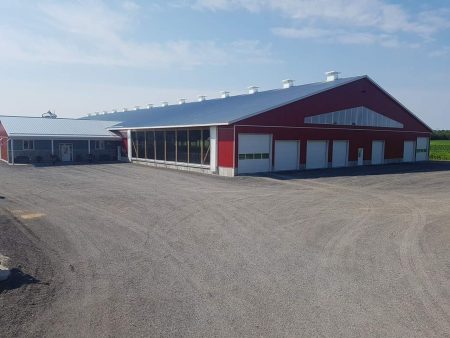 “I am the third generation dairy farmer at our current location which is a half hour South of downtown Ottawa, “says Justin. Riverdown is truly a family farm operation he explains. “I farm with my parents and grandparents and have no employees outside of family labour.” The farm is comprised of 650 acres of which 550 are owned. “We milk 110 cows in a new robotic dairy barn with 2 Lely Astronaut A4 robots.” The robotic change is recent for the Velthuis family. “We moved in just over one year ago. All animals except the show heifers and calves on milk are housed in the new barn.”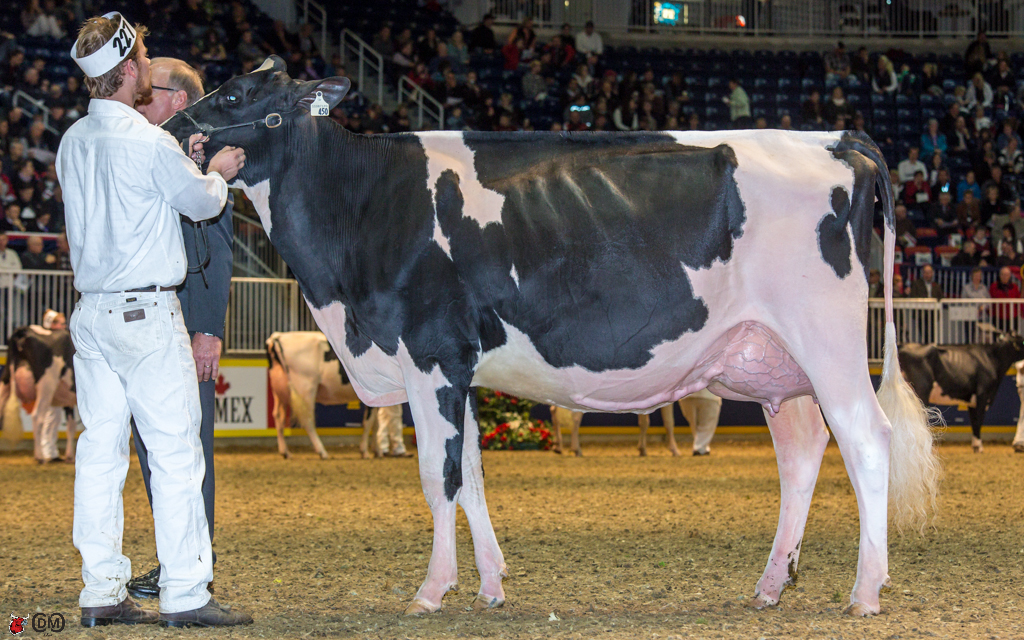
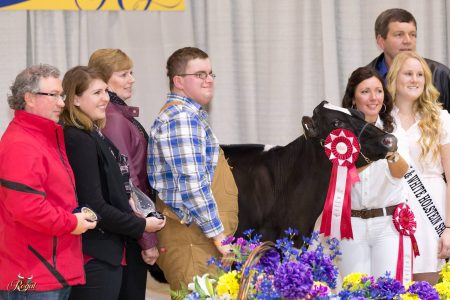
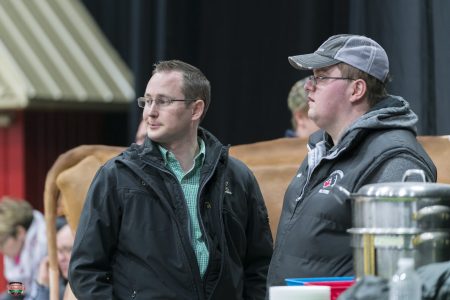
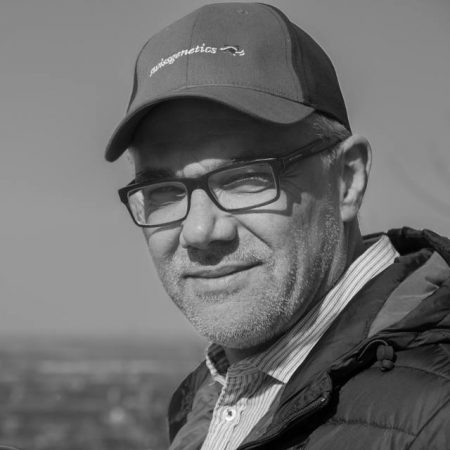 It is the dream of every passionate dairy breeder to achieve recognition. This can be done in many ways, from success in the show ring to earning Master Breeder status. Dominique Savary of Grand-Clos Holstein in Switzerland has earned both those benchmarks. However, he has not stopped there and is continuing to gain recognition for his skill in taking great photographs of the cattle, people and dairy industry that he is so passionate about. The Bullvine recently had the pleasure of interviewing Dominique and discussing his experiences as dairy breeder, showman and photographer.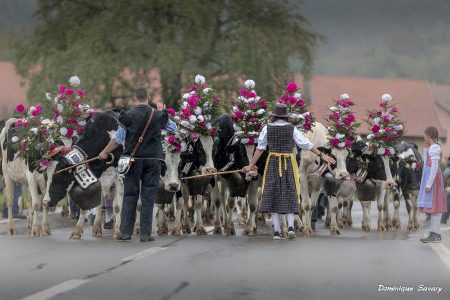
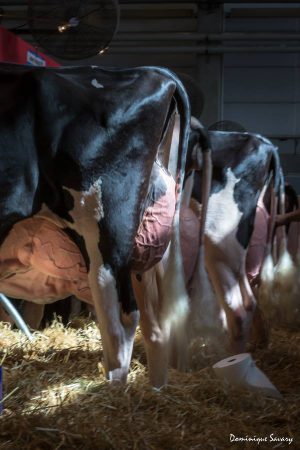 Dominique and Grand-Clos Holstein received the title of Master Breeder in 2015
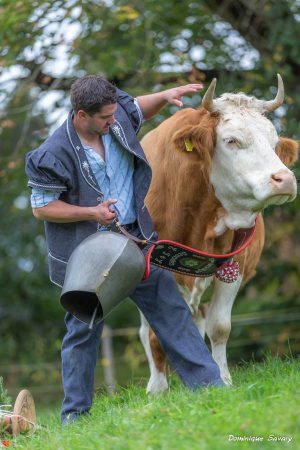 “I really want to do more studying of the technical side of photography.”
 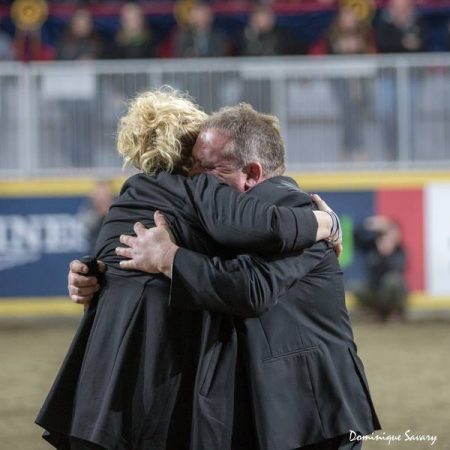 Dominique’s favorite places. “The Royal Winter Fair” “World Dairy Expo” “Quebec landscapes”
 Everyday Objects Are Given New Life
 Andrea Jorgensen now living and loving life on Ri-Val-Re Farm in Webberville, Michigan unexpectedly declares that her journey to becoming a bovine artist wasn’t the usual one of lifelong familiarity with cows. “I wasn’t raised on a farm, so the whole dairy industry has really opened my eyes.” Andrea’s eye-opening experience has art also opened the eyes of dairy art lovers. Those familiar with her art, admire her eye for dairy anatomy and the way her paintings capture the nuances of the different personalities or her subjects. From a single painting or a hanging of several pieces, it is easy to see what set’s Andrea’s work apart. Her unique, ultra-colorful paintings, are comprised of layers of bright acrylics that enhance and expand our usual perception of the black, white and brown dairy cows that dairy folk love to admire. (Read more: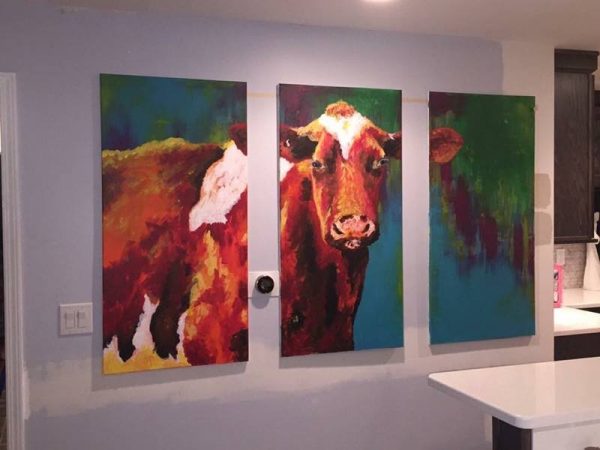
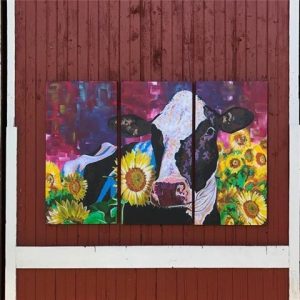 You might say that Andrea was inspired by a favorite from her husband Jerry’s stable and, as a result, Andrea has created a stable of painted favorites to send out into the world. Much of Andrea’s painting has been done on commission and frequently the products of her talent, like the gift she painted for her husband, become gifts given and shared between other dairy admirers.
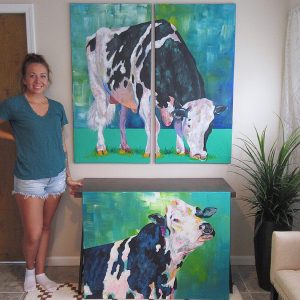 As we get to meet this artist, we are in the fortunate position of being able to use hindsight to discern what events were responsible for getting Andrea’s artistic career started. Andrea gives credit for her introduction to dairy to one her husband Jerry Jorgensen, known to many as a successful dairy breeder and recognized dairy judge. “I probably wouldn’t be painting at all if it wasn’t for him. Not just because of the support and encouragement but because of the family dairy farm. I wasn’t raised on a farm, so the whole dairy industry has really opened my eyes. I always thought cows were dumb, stinky creatures before I met Jerry.” It is an understatement to say that he changed her initial perceptions of cattle, “Yes, they can still come off (as smelly) but I have a different respect for their beauty now.”
  At this point, I must make sure that my reporting does not limit Andrea’s artistic talent to cow portraits only. As much as this is what drives The Bullvine, it isn’t fair to this gifted artist to limit the reporting of her talents to dairy only. Indeed, when asked to list her favorite works to date, Andrea responds the same way that dairy breeders, cattle judges and show string historians do, by first proclaiming what a difficult question that is. “It’s so hard to choose one! I have an attachment with all my paintings! There’s a top 5 favorites list which is constantly changing as I do more paintings.” Her diversity shows in the list she provided us with, which included what is hanging in her own home.” Right now, I would say my top 5 favorites are (in no particular order): Burt & Ernie (a painting of 2 pigs that is hanging in our living room), Antoine (a ram), Gizzard (a longhorn), Alfred (a rooster that is hanging in our kitchen), & Gatsby (a custom Jersey).
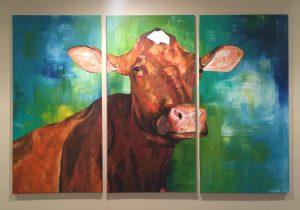 Whenever you see someone doing a successful job of using their talents to build a career, it is human nature to want to understand how they have managed to do it. As a successfully productive artist, Andrea is in the position of not only growing from her own life choices but also being able to help others who wish to start their artistic journey. Her suggestions, like her art, are bold, forthright and forward looking. Here are the three that she urges others to use.
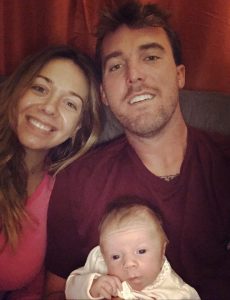 The Artist. The Mother.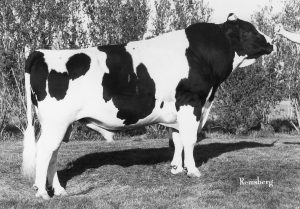
 Elevation Made an Impact on Organisations

 Election platforms come and go and sometimes the ones that win never get put into action, but Andrew Scheer voiced support for supply management and for abolishing Prime Minister Trudeau’s carbon tax. Rural voters took notice of what he claimed and also were not as supportive of Maxime Bernier’s statements that he wanted to abolish supply management. Thus the expected winner became the election-night loser.


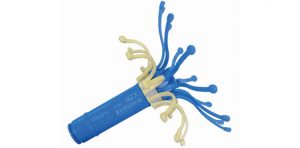 vetMEDRIA SENSOR – Cow Monitoring System is Dedicated to Reliable Real-Time Data
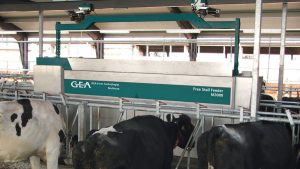 In July of 2016, GEA introduced the Wireless Integrated Control (WIC) system which is an intelligent software for its proven MixFeeder. The new system ensures that every performance group receives the optimal mix ration of raw feed, concentrated feed and minerals in the right volumes at the most appropriate intervals. The WIC delivers the feed precisely and reliably around the clock. This benefits milk producers and herd managers as it ensures that their cows are always performing at their full potential, thereby improving milk volumes and quality and reducing workload and costs.
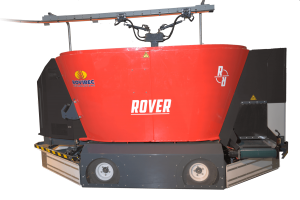 Introducing the Robot Named, “ROVER!”
 #1: “No one could do what I do as well as I do it!”