Archive for heat stress management

The $4.6 Million Mistake: Why the Smartest Dairy Move Comes from Beef

47% to 83%. No new tech. No new genetics. Just stopped fighting biology.

EXECUTIVE SUMMARY: Fighting biology is the most expensive thing you do—it just doesn’t show up as a line item. Australia’s largest cattle operation proved this by boosting weaning from 47% to 83% with zero new genetics and zero new technology. They stopped fighting natural cycles and started profiting from alignment. Sound irrelevant to dairy? Your summer breeding crashes, transition cow disasters, and never-ending replacement costs are the same problem wearing different clothes. Beef-on-dairy just hit $1,400/calf—up from $250 three years ago. Seasonal calving economics are flipping faster than lenders realize. The farms still standing in 2035 won’t be the ones with the most milk. They’ll be the ones that stopped fighting biology and started working with it.

You know, I was at a conference recently when someone brought up Consolidated Pastoral Company—that Australian outfit running 300,000 cattle across 3.2 million hectares. And here’s what’s interesting: they’re dealing with the exact same biological constraints that are probably killing your margins right now.

What I’ve found is they’ve taken their northern Australian beef operations from 47% weaning rates to over 80%, and the Meat & Livestock Australia folks have documented every step. No miracle genetics, mind you. No Silicon Valley nonsense. Just a complete rethink of how they work with biology.

Sound familiar? Because I’ll bet you’re fighting the same battles with lactation cycles, heat stress, and those impossible summer breeding windows. The difference is… well, they stopped fighting and started profiting.

“From 47% to 83% weaning rates through biological alignment—not technology, not genetics, but working with natural cycles instead of against them.”

Infrastructure: Spending Millions to Make Millions

So I was talking to a producer recently who couldn’t wrap his head around CPC dropping $3.5 million on basic infrastructure. We’re talking fences and water points here. Not robots. Not anything fancy.

But here’s what every dairy farmer needs to understand—and this is important—while a TMR mixer is obviously different from a water point in the Outback, the principle is exactly the same. Capital expenditure is worthless unless it unlocks biological potential. Think about it… you’ve probably spent more on that new parlor than CPC spent on their entire fencing project.

Now, northern Australian cattle country is absolutely brutal. The Queensland Department of Agriculture research shows the soil is so phosphorus-deficient that the pasture has maybe a third of what cattle actually need just for maintenance. And during the dry season—we’re talking April through November—lactating cows are literally starving while surrounded by grass. Can you imagine?

The conventional response has always been to just… accept it. Run continuous breeding. Live with those 47% weaning rates. That’s what everyone does, right?

But CPC said no. They put in 200 kilometers of new fencing at about nine grand per kilometer. Thirty water points at sixty thousand each. And here’s the kicker—they’re spending between four hundred thousand and nine hundred thousand annually just on pregnancy testing and moving cattle around.

The payoff, though? For a 20,000-cow operation, that’s 7,200 additional calves every single year. At $650 per weaner—and that’s November 2024 prices, so pretty current—we’re looking at $4.68 million in additional annual revenue. The Northern Territory government’s analysis shows a payback period of less than a year. Less than a year!

So think about your own place for a minute. What biological constraint are you just accepting as “the way it is”? Summer heat stress that everyone complains about, but nobody really fixes? Those transition cow disasters we all pretend are normal? That 60-day voluntary waiting period that, let’s be honest, everyone follows because… well, because everyone follows it?

Turning Red Tape into Premium Pricing

Here’s where it gets really interesting. When Indonesia mandated that 20% of imported cattle be breeding stock in 2017, the whole industry basically panicked. And for good reason—Australia’s export standards couldn’t even certify that an animal could breed. This gap is all documented in the Northern Australia Beef Industry reports, if you want to look it up.

Most exporters, as you’d expect, just shipped whatever they could get away with. Matt Brann from ABC Rural reported in 2018 how Indonesian importers were getting these so-called “breeding cattle” with reproductive problems that went straight to feedlots anyway.

But CPC… they did something clever. They created their own breeding soundness protocols that went beyond what either country required. And now? Indonesian buyers actually pay premiums for that documentation.

This is exactly what’s happening with A2A2 milk, grass-fed certification, all those regenerative agriculture claims we’re seeing. The regulations don’t exist yet, but the producers creating their own verification systems? They’re capturing premiums while everyone else sits around waiting for the government to tell them what to do.

The $500 Calf That Makes Perfect Sense

Okay, this one’s going to sound crazy at first. CPC’s Santori Jabung facility in Indonesia produces calves at a cost of $500 each. Compare that to maybe $60-70 on Australian rangelands. I know, I know—sounds insane.

But Dr. Simon Quigley from the University of Queensland documented what was happening. They had mortality rates exceeding 25-30% when they tried to apply temperate management to tropical conditions. It’s just like your summer pneumonia outbreaks or those heat stress breeding failures we all deal with—wrong system for the environment.

So they made three changes that transformed everything:

First, they set up dedicated colostrum management with round-the-clock monitoring. Any calf that doesn’t nurse within three hours gets bottle-fed in temperature-controlled housing. And get this—mortality dropped from that 25-30% range down to 6-8%.

Second—and the efficiency experts hate this—they concentrated 80% of their calving into just three months. But you know what? Results speak louder than theories.

Third, they got strategic with supplementation. Only during late pregnancy and early lactation. That tiny bump in body condition—from 3.0 to 3.3—cut their days open from 217 to 118. Think about that for a minute.

Indonesia’s $500-per-calf intensive system crushed mortality from 27.5% to 7%, cut days open by 99, and achieved 72% pregnancy rates in brutal tropical conditions—proving biology-first spending beats efficiency-first spending

The result? They’re getting 72% pregnancy rates in absolutely brutal tropical conditions. Your transition barn—that critical period when fresh cows are moving from dry to lactating status—could probably learn something here. Just as those fresh cows need intensive management for a successful transition, these tropical operations need intensive intervention at critical biological moments.

Carbon Credits: The Drought Insurance You’re Missing

Let’s talk carbon for a minute. Australian Carbon Credit Units are trading at $36-42 per tonne according to the Clean Energy Regulator’s latest quarterly report. That works out to about $36-42 per head annually for operations doing regenerative grazing.

Now, it’s not transformative money. But here’s what’s interesting—Garrawin Station’s carbon revenue literally kept them alive during the 2019 drought when their cattle income completely vanished. And for dairy operations, we’re seeing similar opportunities with methane digesters generating credits, cover crop programs building soil carbon, and even manure management improvements qualifying for offset programs in some states.

So let me ask you this: your milk check isn’t guaranteed forever. What’s your backup plan?

“Every dollar spent fighting biology is profit bleeding out. Start asking yourself: what constraints am I accepting that I shouldn’t be?”

Virtual Fencing: Why Silicon Valley Fails on the Farm

You’ve probably heard about virtual fencing. Dr. Richard Rawnsley at the University of Tasmania showed it works great in small paddocks—94-99% containment. Sounds perfect, right?

But then Dr. Dana Campbell at CSIRO found something concerning—9% reduced daily gains under virtual fencing rotations. That’s fifteen bucks per head you’re losing.

That said, I’ve seen it work well for specific dairy applications. There’s a 400-cow grass-based operation in Vermont using virtual fencing just for keeping cows out of wetland areas—it works perfectly for that limited scope. Another Wisconsin farm uses it for temporary paddock divisions during their managed grazing rotation. Small, targeted uses where the technology makes sense.

But at $500-800 per collar for whole-herd implementation? The math just doesn’t work for big operations. It’s like robotic milkers—great technology, but not for everyone.

The Dairy Revolution Hiding in Plain Sight

Alright, here’s where it gets real for us dairy folks.

Your 14-month lactation cycle—you know, calving through milking to dry period and back again—it creates all these problems we just accept as normal. Breeding during negative energy balance. Those heat-stress-related disasters occur every summer. Year-round replacement heifer costs that never end.

Most dairies fight these constraints with more inputs, more technology, more complexity. And let’s be honest… it’s not really working, is it?

I’ve been visiting operations experimenting with seasonal calving—there’s some interesting work happening in Vermont, Ohio, and out in Idaho. Different farms, different approaches, but they’re all aligning their calving with either pasture availability or specific market demands. One Idaho operation I know of is timing fall calving to hit those holiday cheese plant premiums.

And they’re all riding this beef-on-dairy wave too. You’ve seen the prices—$250 three years ago, $1,400 today, according to USDA market reports. Some markets are seeing even higher premiums this year.

“The operations that survived the 2009 and 2020 milk price crashes weren’t necessarily the most efficient—they were the most adaptable.”

Here’s what concentrated calving can deliver:

  • Your peak lactation hits during the highest component periods
  • Breeding happens when cows aren’t dying from heat stress
  • Replacement heifer management that actually makes economic sense
  • Predictable milk composition so you can negotiate premium contracts
  • Lower feed costs because you’re not lactating through garbage forage months

Now, the biggest barrier isn’t biology—it’s the banker. Shifting to seasonal calving absolutely terrifies lenders who are used to those monthly milk checks. But here’s the thing… as feed costs keep climbing, that “steady check” might actually be a steady loss.

The folks in New Zealand figured this out decades ago. Sure, their market structure’s different, but the biology? The biology’s the same.

Making It Work at Your Scale

So what does this mean for your operation?

1. If you’re under 500 cows: Start small. Maybe try a 20% seasonal calving pilot—just see what happens. And definitely look at beef-on-dairy for your bottom-tier genetics. Those premiums are real and, according to USDA outlook reports, they’re not going away. Focus on the no-cost changes first, like optimizing breeding timing for your specific climate and conditions.

2. For 500-2,000 cow operations: Any reproduction improvement that pays back in under two years deserves serious consideration. Start building alternative revenue streams now, before you desperately need them. Could be custom heifer raising, beef-on-dairy, or direct marketing. Just… have something. And remember, operations this size in the Upper Midwest are seeing real success with partial seasonal systems—you don’t have to go all-in immediately.

3. Over 2,000 cows: You’ve got the scale to model a full seasonal transition with beef-on-dairy bridging those dry periods. If you own enough land, carbon programs might actually pencil out despite the volatility. But most importantly, document everything. The next generation needs to know what worked and what didn’t. Large operations in California and Idaho are already testing these models—you won’t be the first.

The Hard Truth Nobody Wants to Hear

CPC’s been around since 1879. That’s 146 years of surviving everything the market could throw at them. And here’s their secret: resilience beats efficiency every time.

Their Indonesian feedlots? Currently losing money. Their breeding systems? Modest margins at best. Carbon projects? Who knows what they’ll return.

But together? Together, they survive everything.

Every dollar you’re spending fighting biology—maintaining production through terrible seasons, managing those heat stress breeding disasters, carrying replacement heifers forever—that’s profit just bleeding out.

The question isn’t whether you can afford to change. Given where input costs are going, environmental regulations, market volatility… can you really afford not to?

Start small if you need to. Test things. Learn what works for your specific situation. But start now, before external pressure forces you into bad decisions.

The Bullvine Bottom Line

We’ve spent fifty years breeding cows to ignore the seasons. Maybe it’s time we stopped ignoring the math. You don’t need 3.2 million hectares to realize that fighting biology is the most expensive line item on your P&L. Whether it’s beef-on-dairy, seasonal calving, or aggressive heat abatement, the farms that survive the next decade won’t be the ones with the most milk—they’ll be the ones with the highest margins.

KEY TAKEAWAYS:

  • Fighting biology is your priciest line item. Those summer breeding failures and transition cow wrecks aren’t bad luck—they’re the cost of working against natural cycles. Australian operations showed that improvements of 47% to 83% come from alignment, not more inputs.
  • Beef-on-dairy hit $1,400/calf. Up from $250 three years ago, per USDA data. For your bottom-third genetics, this isn’t a side gig—it’s a margin strategy.
  • Your “steady” milk check may be a steady loss. Seasonal calving terrifies lenders. But as feed costs rise, that monthly revenue is increasingly monthly red ink. Run your own numbers.
  • Capital without a biological purpose is waste. New parlor won’t fix heat stress conception crashes. Robots can’t solve the negative-energy-balance breeding problem. Spend where biology says yes.
  • Adaptability beats efficiency. The farms standing after 2009 and 2020 weren’t the biggest. They had options when the market didn’t.

Complete references and supporting documentation are available upon request by contacting the editorial team at editor@thebullvine.com.

Learn More:

Join the Revolution!

Join over 30,000 successful dairy professionals who rely on Bullvine Weekly for their competitive edge. Delivered directly to your inbox each week, our exclusive industry insights help you make smarter decisions while saving precious hours every week. Never miss critical updates on milk production trends, breakthrough technologies, and profit-boosting strategies that top producers are already implementing. Subscribe now to transform your dairy operation’s efficiency and profitability—your future success is just one click away.
NewsSubscribe
First
Last
Consent

20 Generations to One: What Europe’s Gene Editing Decision Means for the Future of Your Herd

One generation instead of twenty. That’s what gene editing offers for heat tolerance—and Europe just accelerated the timeline. The dairy producers paying attention now will be the ones leading in five years.

Executive Summary: Twenty generations through traditional breeding—or one with gene editing. That’s the new math for traits like heat tolerance, disease resistance, and polled genetics, and it’s not hypothetical: heat-tolerant cattle are FDA-approved, Brazil has gene-edited Holsteins in commercial herds, and Europe’s December 4 agreement just accelerated the global timeline. The economic stakes are clear. U.S. dairy loses up to $1.6 billion annually to heat stress alone, with hot-climate operations absorbing several hundred dollars per cow each summer. What sharpens the urgency is the compounding effect—genetic advantages multiply over generations, which is why producers who moved early on genomic selection built leads their competitors are still chasing a decade later. This analysis covers where regulations stand, what’s available today, legitimate concerns that deserve honest consideration, and practical steps for positioning strategically. The technology is proven. The producers paying attention now will shape the next decade of dairy genetics—not spend it catching up.

I was talking with a producer in central Texas last month who told me something that stuck with me. He’d calculated his heat-related losses across the past summer: reduced milk production, reproduction failures, increased health events, and the energy costs of running cooling systems around the clock for four straight months. His number came to several hundred dollars per cow—losses he could measure but couldn’t fully prevent, no matter how much he invested in fans and sprinklers.

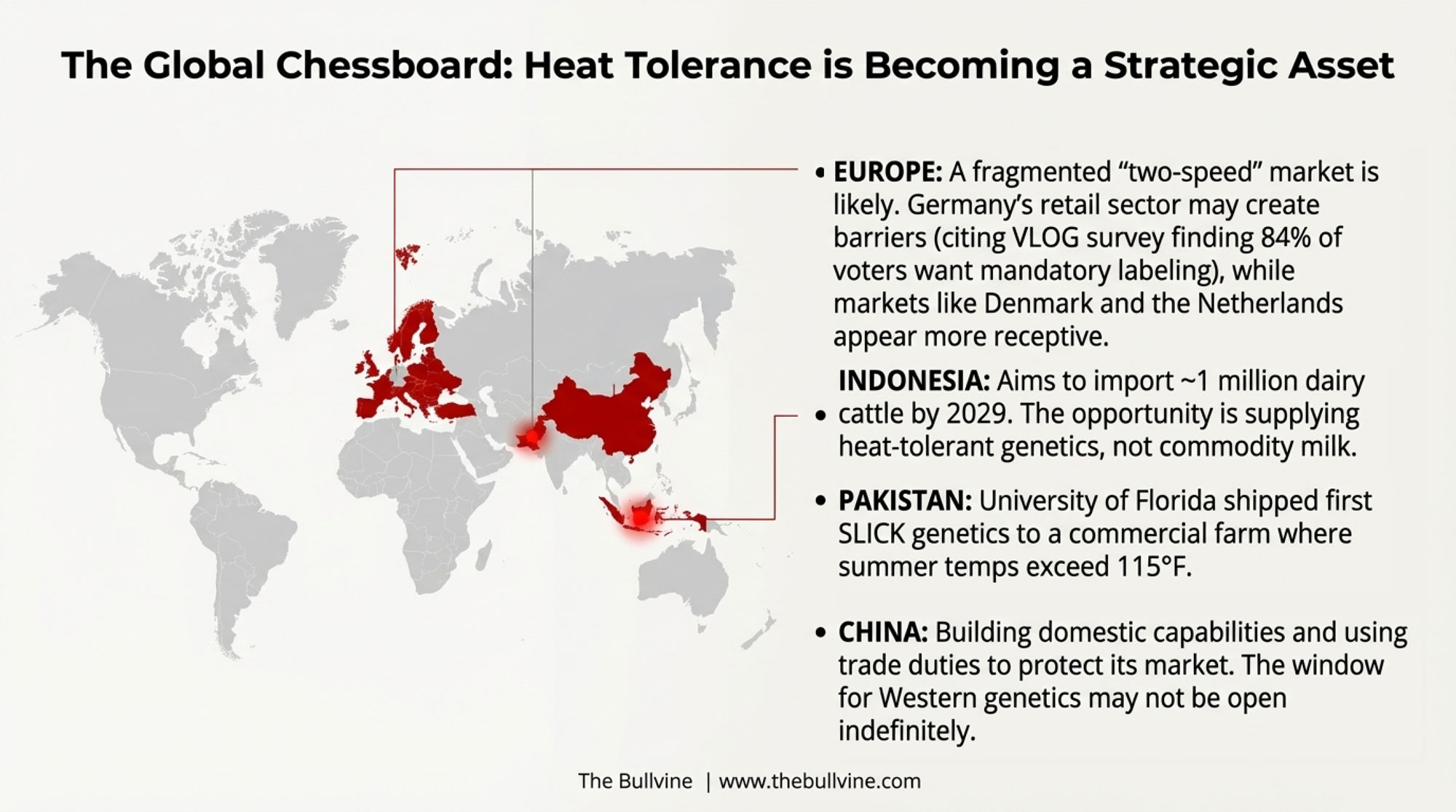
That conversation was fresh in my mind when news broke from Brussels on December 4, 2025. After all-night negotiations and years of fierce debate, EU policymakers reached a provisional agreement allowing gene-edited crops to bypass the bloc’s strict GMO regulations. The immediate focus is on plants—wheat, tomatoes, that sort of thing. But here’s why that Texas conversation matters: among the dairy cattle applications currently working through research pipelines is gene-edited heat tolerance. The kind that could fundamentally change that producer’s math.

The question isn’t really whether gene editing will become part of dairy cattle breeding. The science is proven, commercial animals already exist in some markets, and regulatory doors are opening. The real question is how individual operations position themselves as these tools become available—or whether they’ll spend years trying to catch up with competitors who moved earlier.

The Global Regulatory Landscape: Where Things Stand

Before diving into the science and economics, it helps to understand the regulatory patchwork that will determine when and how gene-edited genetics reach your market. Here’s where major dairy regions currently stand:

RegionRegulatory StatusLivestock Included?Current Availability
European UnionNGT regulation provisionally agreed December 4, 2025; formal adoption expected early 2026Plants only initially; livestock framework to followNot yet available
United KingdomPrecision Breeding Act in full force as of November 13, 2025Yes—includes cattleFramework ready; commercial products developing
United StatesCase-by-case FDA review via “low-risk determination” processYesHeat-tolerant cattle approved March 2022; other traits under review
CanadaGuidance for gene-edited livestock is still developing under Health Canada and CFIAPendingNot yet available
BrazilCTNBio approved gene-edited cattle for breeding and food useYesHeat-tolerant Holsteins approved 2023

Sources: European Parliament (December 2025), Morrison Foerster regulatory analysis (November 2025), FDA Risk Assessment Summary (March 2022), CTNBio public records (2023)

What Brussels Actually Decided (And Why It Creates Precedent)

Let me walk you through what the EU agreement actually does, because the details matter for understanding where this is heading.

The new framework creates two categories for plants developed using what regulators call “New Genomic Techniques,” or NGTs:

  • Category 1: Plants with genetic changes that could theoretically occur through natural mutation or conventional crossbreeding. These skip the GMO approval process entirely—no mandatory safety assessments for each generation, and final food products won’t need special labels (though seeds will be marked).
  • Category 2: Plants with more complex modifications that go beyond what conventional breeding could achieve. These still face the full regulatory process.

That’s according to the European Parliament’s official announcement from December 4. The European Commission’s press release emphasized the regulation’s potential to develop plant varieties more resilient to climate change while requiring fewer pesticides. Copa-Cogeca, representing EU farmers and agricultural cooperatives, expressed strong support. Thor Gunnar Kofoed, chair of their working party on plant breeding, called it “a turning point for European agriculture.”

Now here’s what I find interesting for livestock producers: this regulation specifically covers plants, not animals. But the product-based framework being established—evaluating what a genetic change does rather than reflexively restricting how it was made—creates a template. When gene-edited livestock applications eventually reach European regulators, there’s now a philosophical precedent for how to approach them.

Key Regulatory Dates to Watch

  • November 2025: UK Precision Breeding Act takes full effect, including livestock provisions
  • Early 2026: EU NGT regulation expected to receive formal adoption
  • Ongoing: FDA continues case-by-case “low-risk determination” reviews for gene-edited livestock traits
  • TBD: Health Canada and CFIA guidance for gene-edited livestock expected to develop further

The Climate Challenge That Traditional Breeding Can’t Solve Fast Enough

Here’s where this discussion gets personal for many operations, especially if you’re farming in areas where summers are becoming more difficult for your herd.

The economic impact of heat stress on U.S. dairy is substantial—and probably larger than many producers fully account for. The foundational study by St-Pierre and colleagues, published in the Journal of Dairy Science in 2003, estimated annual industry-wide losses between $897 million and $1.5 billion. More recent work from Ohio State University researchers suggests losses can reach $1.6 billion annually as summer conditions have intensified across much of dairy country.

Regional heat stress impacts vary significantly:

  • Upper Midwest (Wisconsin, Minnesota): University of Wisconsin researchers measured costs at roughly $74 per cow based on milk yield losses alone—relatively moderate but still meaningful
  • Southeast (Florida, Georgia): Losses several times higher; some Florida operations have spent decades working with Senepol and Gir crossbreeding programs to introduce natural heat tolerance, with real success—but also real tradeoffs in production genetics that take years to breed back
  • Southwest (Texas, Arizona): Producers report losses of several hundred dollars per cow when factoring reproduction failures, health events, and cooling costs
  • California Central Valley: Compounding the challenge of water constraints alongside rising temperatures, affecting both cooling capacity and irrigated feed production

A study published in Science Advances this past July really crystallized the scope of the problem. The research, led by Claire Palandri at the University of Chicago’s Harris School of Public Policy, analyzed production data from over 130,000 cows across 12 years of Israeli dairy records—one of the most comprehensive datasets ever assembled on heat-stress impacts.

Key findings from the Palandri study:

  • A single day of extreme heat can reduce milk production by 10 percent
  • That suppression can persist for more than 10 days after temperatures return to normal
  • Even with cooling systems in place, mitigation effectiveness dropped to around 40 percent during extreme heat events
  • Cooling “cut losses in half” at moderate temperatures, but became progressively less effective as conditions worsened

There appears to be a ceiling to what management interventions can accomplish when ambient temperatures push into truly dangerous territory.

So what’s the traditional breeding alternative? You could crossbreed with heat-adapted cattle—Senepol, Gir, or Carora breeds that carry what’s called the “slick coat” gene naturally. The challenge, as anyone who’s tried it knows, is the timeline.

Timeline Comparison: Traditional Breeding vs. Gene Editing

Traditional approach to adding heat tolerance to elite Holsteins:

  • Initial crossbreeding + 20 generations of backcrossing
  • Approximately 5 years per generation
  • Total timeline: 80-100+ years to recover elite genetics with a new trait

Gene editing approach:

  • Direct introduction of the slick coat allele to elite genetics
  • Single generation
  • Timeline: Available for breeding in current genetic lines

Dr. Appolinaire Djikeng, Director of the Centre for Tropical Livestock Genetics and Health at the Roslin Institute in Scotland, has explained that gene editing can accomplish in one generation what would otherwise take 20 generations through conventional breeding.

One generation versus twenty. For operations facing mounting heat pressure right now, that’s not an incremental improvement—that’s a fundamentally different approach to the problem.

What’s Actually Available Today

This isn’t all laboratory work and future promises. Commercial gene-edited cattle exist today, though availability depends significantly on where you’re located and what regulatory frameworks apply.

Heat-Tolerant Genetics

The U.S. FDA issued its first “low-risk determination” for PRLR-SLICK cattle back in March 2022. The FDA’s risk assessment confirms that these were cattle developed by Acceligen, primarily beef animals initially, but the regulatory pathway has since been opened for dairy applications.

Potential benefits:

  • Improved heat dissipation without crossbreeding tradeoffs
  • Maintained elite production genetics (butterfat, protein, yield)
  • Single-generation trait introduction
  • Reduced cooling infrastructure dependence

Current status: Commercial animals exist in the U.S. and Brazil; they are not yet widely distributed in North American dairy markets.

Disease Resistance (BVD)

USDA researchers at the U.S. Meat Animal Research Center have produced calves with dramatically reduced susceptibility to Bovine Viral Diarrhea Virus. The approach, published in PNAS Nexus in May 2023, used CRISPR editing to modify just six amino acids in the CD46 gene.

Potential benefits:

  • Reduced BVD infection severity and transmission
  • Fewer secondary bacterial infections in calves
  • Decreased antibiotic dependence
  • Improved calf survival and performance

Verification data: After 20 months of monitoring, researchers found no off-target effects anywhere in the genome. The edited calf showed minimal clinical signs and no detectable viral infection in white blood cells when challenged.

Current status: Research stage; not yet commercially available.

Polled (Hornless) Genetics

Gene editing allows the naturally occurring polled allele to be introduced directly into elite dairy genetics without production tradeoffs.

Potential benefits:

  • Eliminates the need for dehorning/disbudding
  • Reduced calf stress and pain
  • Labor and medication cost savings
  • Improved welfare optics for retail markets

Important caveat: In 2019, FDA scientists discovered that Recombinetics’ gene-edited polled bulls contained bacterial DNA that had been accidentally introduced alongside the intended edit. MIT Technology Review broke that story, and it set the field back years. Verification protocols have since improved substantially.

Current status: Approaching commercialization; enhanced screening is now standard.

Methane Reduction

UC Davis and the Innovative Genomics Institute announced a $70 million, seven-year project in 2023 using CRISPR to re-engineer rumen microbial communities.

Potential benefits:

  • One-time calf treatment (not daily feed additives)
  • No ongoing compliance or costs
  • Targets methane-producing archaea directly
  • Potential carbon credit value

Current status: Early research stage; commercial availability likely 5+ years out.

The Economics: Understanding What’s Actually at Stake

Let me work through the financial picture, because this is ultimately where the decision-making happens for most operations.

Direct heat stress recovery potential:

For a 1,000-cow herd in a hot climate, recovering even a portion of heat-related losses could translate to:

  • Tens of thousands of dollars annually in recovered milk production
  • Improved reproduction rates that compound over time
  • Fewer fresh cow challenges are cascading through the transition period
  • Reduced cooling infrastructure and energy costs

Emerging carbon/sustainability value:

A typical dairy cow emits roughly 100-125 kg of methane annually (based on Canadian research and IPCC modeling), which translates to about 2.5-3.5 tonnes of CO₂-equivalent. If gene-based solutions achieve the 30-50 percent reductions researchers are targeting, that represents meaningful potential value. Several major cooperatives and processors—including initiatives from organizations such as Dairy Farmers of America and various state-level sustainability programs—are beginning to develop premium structures for verified emissions reductions. These markets are still developing and vary considerably by region and processor, but the trajectory is clear.

The compounding factor:

Here’s the economic dynamic that I think deserves more attention than it typically gets: genetic advantages compound over generations.

Think back to what happened with genomic selection. According to CDCB data and a comprehensive review published in Frontiers in Genetics in 2022:

  • Genomic selection roughly doubled the rate of genetic gain for many traits
  • Annual net merit increases jumped from around $40 to approximately $85
  • Producers who moved early built advantages that compounded with every breeding cycle
  • The cautious crowd found themselves years behind on the genetic curve—a gap that proved surprisingly difficult to close

Will gene editing follow the same pattern? Early indications suggest it might. Once gene-edited traits are integrated into elite genetics and multiplied through AI, the same compounding dynamic kicks in.

What Consumers Actually Think

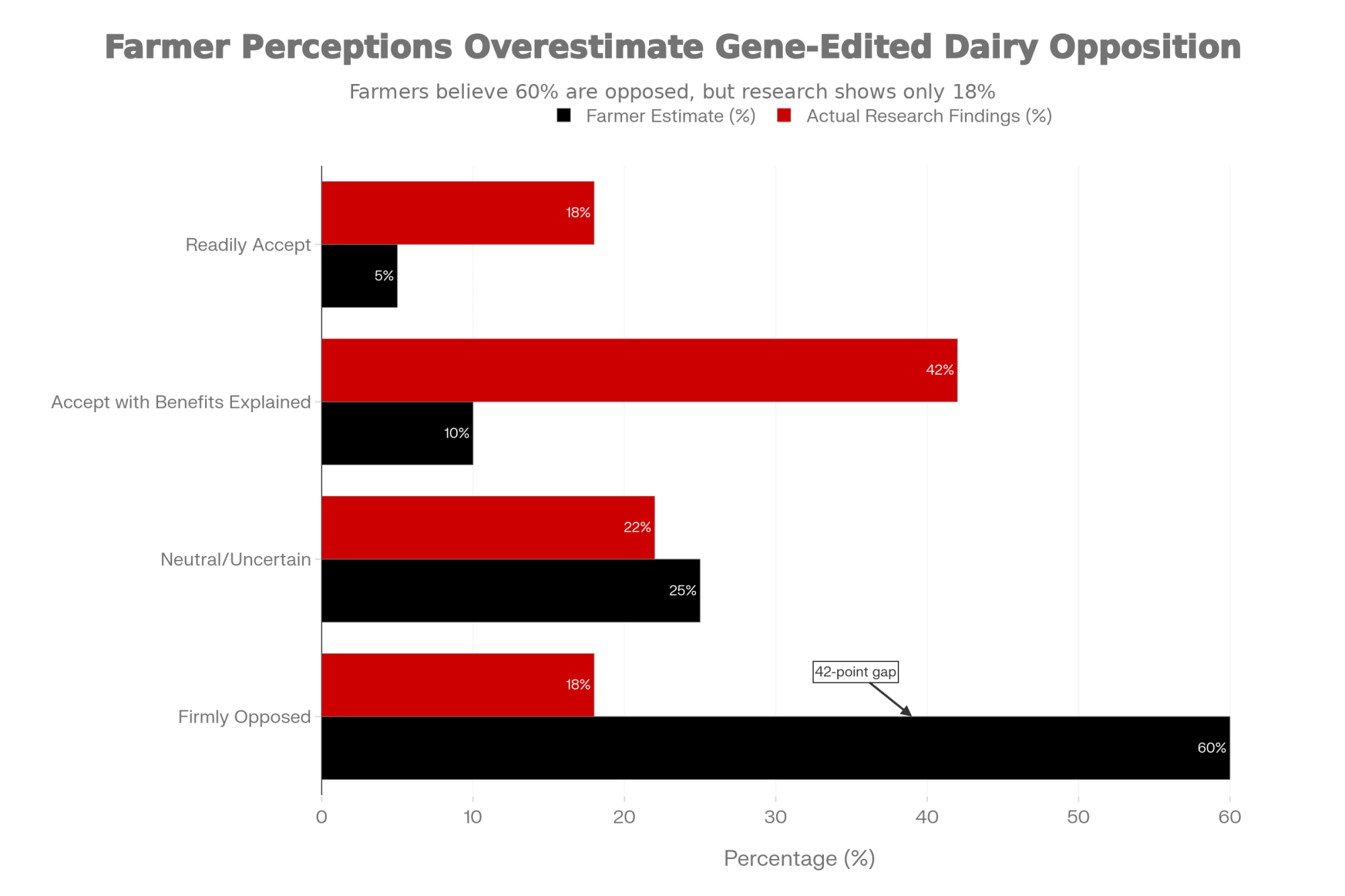
One concern I hear regularly from producers: “This all sounds interesting, but consumers will never accept milk from gene-edited cows.”

The research tells a more nuanced story.

What surveys consistently show:

  • Consumer concerns center primarily on transparency and choice—not categorical rejection
  • Only about one in five consumers indicate they’d refuse to purchase gene-edited products entirely
  • The majority want information and the ability to make informed choices, not outright prohibition

What influences acceptance:

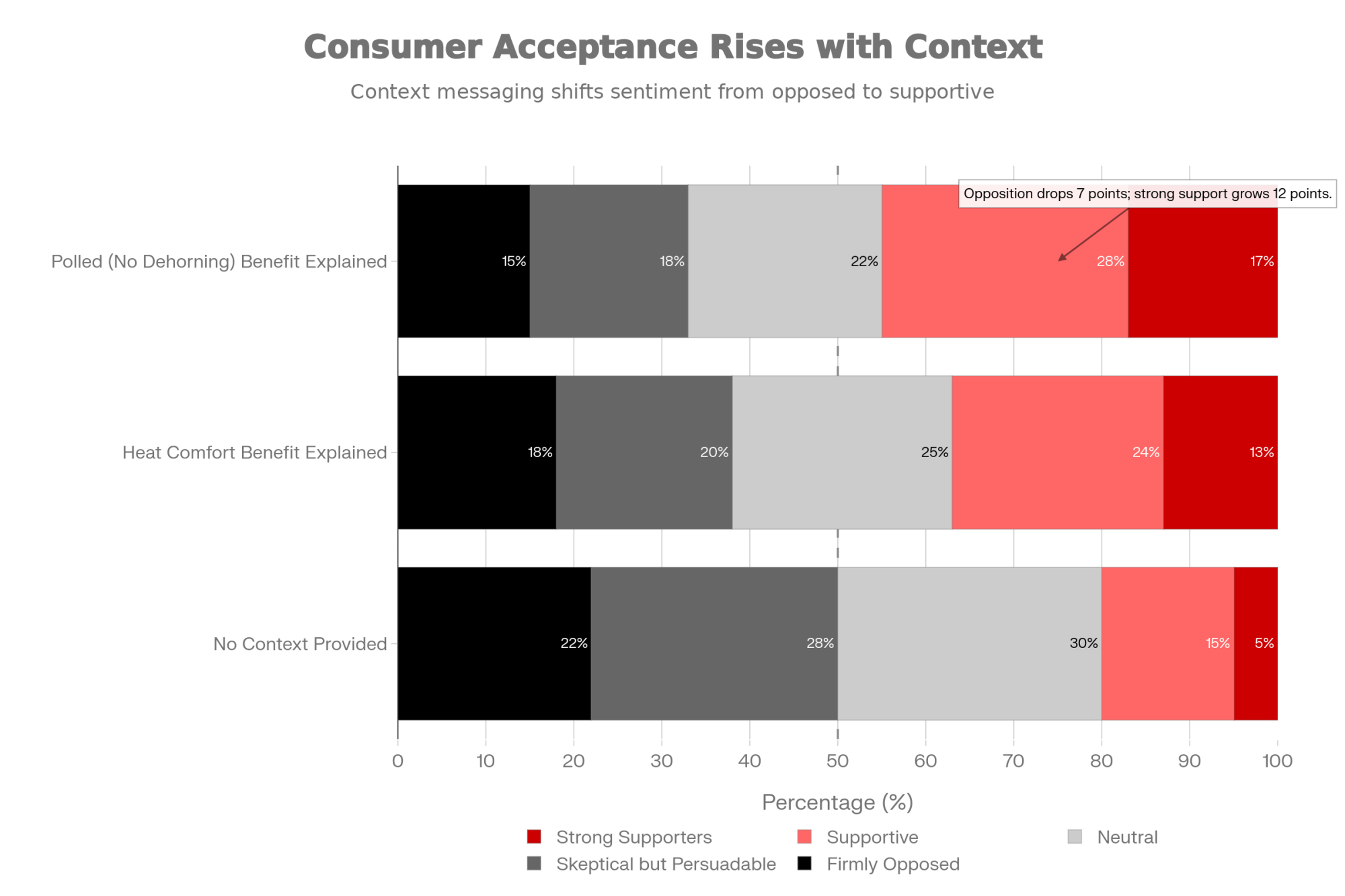
  • Framing matters enormously—purchase intent increases substantially when applications are explained in terms of:
    • Animal welfare (reduced antibiotic use, disease prevention, and eliminating painful procedures)
    • Environmental benefits (lower emissions, reduced resource use)
  • The Vermont GMO labeling experiment is instructive: when mandatory labeling was implemented in 2016, researchers Kolodinsky (University of Vermont) and Lusk (now at Purdue) found that opposition to genetically engineered food fell by 19 percent. Their findings, published in Science Advances in 2018, suggest transparency defuses anxiety rather than amplifying it.

What damages acceptance:

  • Opacity and perceived deception
  • Products appearing on shelves without disclosure, discovered later through media or activist campaigns
  • The path to sustained acceptance runs through honesty about what’s being done and why
If you’re worried consumers will reject milk from gene-edited cattle, you need to see what actually happened when transparency was tested. Vermont’s 2016 mandatory GMO labeling experiment—studied by researchers Kolodinsky and Lusk and published in Science Advances in 2018—found something striking: opposition to genetically engineered food fell by 19 percentage points when clear labeling was implemented. Without disclosure, only about 20% of consumers accept gene-edited products. With honest information about what’s being done and why—especially when framed around animal welfare and environmental benefits—acceptance jumps to 81%. The lesson is clear: consumers don’t reject transparency. They reject opacity and the feeling they’re being deceived. The path to market acceptance for gene-edited dairy genetics runs directly through honest communication about welfare improvements, reduced antibiotic dependence, and environmental benefits. Hide what you’re doing, and you’ll face rejection. Explain it clearly, and the data suggests most consumers are fine with it.

Engaging with Legitimate Concerns

I want to spend time on criticisms that have genuine substance, because glossing over real challenges doesn’t serve anyone well.

Genetic Diversity

Let’s get honest about something the industry doesn’t like talking about. Holstein effective population size has collapsed to approximately 50—a genetic bottleneck that’s frankly dangerous for long-term herd resilience. At the same time, inbreeding in heifers is approaching 10 percent and climbing at +0.26% annually. This isn’t a theoretical concern—it’s a measurable crisis that threatens the biological viability of the breed. Here’s where the conversation gets uncomfortable: gene editing offers a genuine escape route by introducing carefully selected traits into broader genetics without further narrowing the gene pool. The irony is striking—we’re debating whether gene editing is “too risky” while we’ve collectively created an inbreeding crisis that may pose a far greater long-term threat. When critics raise genetic diversity concerns about gene editing, they’re not wrong to worry about concentration of traits. But the data suggests our current path—continuing to breed from an ever-narrowing pool of elite animals—is already catastrophic. Gene editing could actually help if deployed thoughtfully to expand options rather than narrow them further.
ConcernEvidenceCounterargument
Gene editing could accelerate genetic narrowingHolstein effective population size has dropped to ~50 (John Cole, CDCB Chief R&D Officer); Lactanet Canada’s August 2025 report shows Holstein heifers approaching 10 percent inbreeding, continuing the +0.26% annual increase from the 8.86 percent recorded for heifers born in 2021Gene editing could allow beneficial traits to be introduced into broader genetics—expanding options rather than narrowing them
Same elite bulls get edited, concentrating influence furtherValid concern if industry deploys technology narrowlyWhether gene editing helps or hurts diversity depends on how the industry uses it—that’s a choice, not an inherent feature

Off-Target Effects

ConcernEvidenceCurrent Mitigation
Unintended genetic modifications are possible2019 Recombinetics incident: bacterial DNA discovered in “precisely” edited polled bullsWhole-genome sequencing now enables comprehensive screening; newer editing technologies offer improved precision
Technology isn’t infallibleValid—the Recombinetics case demonstrated this clearlyBVDV-resistant calf showed zero off-target effects after 20 months of monitoring (PNAS Nexus, 2023); verification protocols have improved substantially

Patent Concentration

ConcernEvidencePotential Solutions
Few companies could control critical genetic improvementsFoundational CRISPR patents held by a small number of entitiesThe EU NGT framework includes a patent transparency database requirement
Seed industry consolidation as a cautionary parallelValid historical comparisonMost current breakthroughs are happening in public institutions (USDA, UC Davis, Roslin Institute); advocacy is needed for open licensing arrangements

International Trade Complexity

ChallengeImplication
Regulatory frameworks don’t align across jurisdictionsA bull with FDA approval may face different treatment in Canada, the EU, or export markets
Semen from gene-edited animals could face trade barriersOperations with an international genetics business need to navigate a complex patchwork
UK more permissive, EU evolving, North America case-by-caseCreates real operational considerations for genetics suppliers and larger breeding operations

Insurance and Liability

Insurance coverage, liability for off-target effects, and warranty frameworks for gene-edited animals remain unresolved. Larger operations considering early adoption should have conversations with insurers and legal advisors about how these animals fit into existing coverage structures.

A Dynamic Worth Watching: When the Ethics Shift

Here’s something I’ve been thinking about that doesn’t typically come up in industry discussions, but strikes me as potentially significant.

Currently, gene editing is associated with ethical risks for some audiences—it’s something certain advocacy groups criticize. But as welfare-positive applications mature and prove themselves, the ethical pressure may begin flowing in the opposite direction.

Consider the implications:

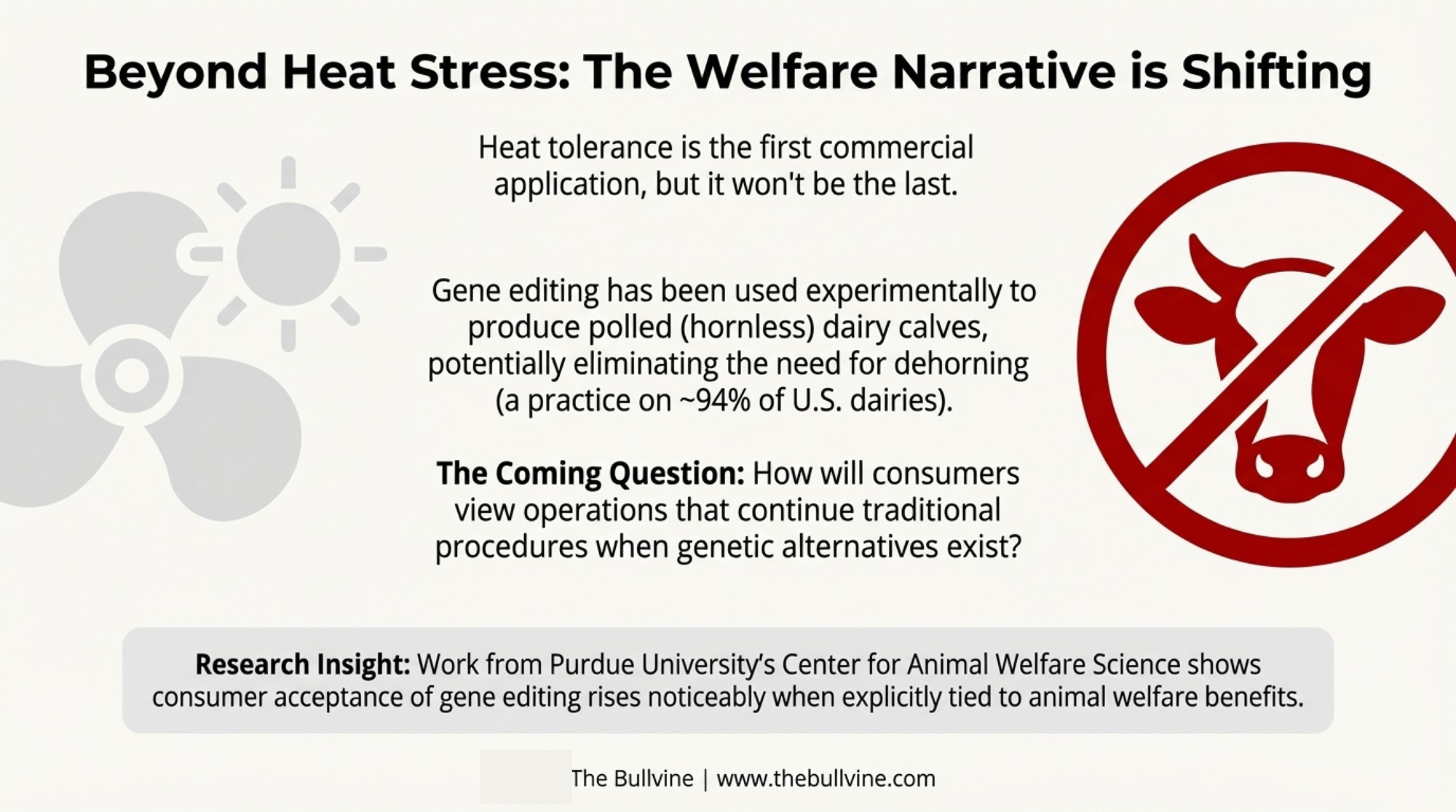
  • Once polled genetics that eliminate dehorning are commercially available and demonstrably safe, how do you justify continuing to disbud calves?
  • Once heat-tolerant genetics exist that meaningfully reduce chronic heat stress, how do you explain choosing not to use them where cows are visibly struggling?

The question shifts from “Why are you using gene editing?” to “Why aren’t you using available tools to prevent avoidable animal suffering?”

In markets with strong welfare audit frameworks—such as premium processors, retailers with animal welfare commitments, and European export channels—gene-edited traits may increasingly align with responsible animal husbandry expectations rather than conflict with them.

Practical Steps: What Makes Sense Right Now

If you’ve followed this discussion, you’re probably wondering what concrete actions are warranted. Here’s my perspective:

Immediate actions:

  • Track regulatory developments through breed associations and genetics suppliers
  • Understand what’s already cleared or approaching availability in your market
  • Assess your operation’s specific climate and disease vulnerabilities honestly

Conversations to start now:

Engage your genetics suppliers with these questions:

  • What gene-edited traits are you actively developing or licensing?
  • What’s your realistic timeline for commercial availability in my market?
  • How will gene-edited genetics be positioned and priced relative to conventional offerings?
  • What performance data do you have from trial herds or early commercial use?
  • How are you approaching genetic diversity considerations in your edited lines?
  • What are the implications for international semen sales or genetics trade?

Mental model to adopt:

Think about this as infrastructure, not just another product decision. Gene editing isn’t a discrete product to evaluate in isolation—it’s potentially foundational infrastructure that could reshape how genetic merit is defined, measured, and transmitted. The producers who recognized genomics as infrastructure back in 2010-2012 generally feel that perspective served them well.

The Bottom Line

The EU’s December decision didn’t resolve every question about gene editing in dairy cattle. Significant regulatory, commercial, and practical questions remain across multiple jurisdictions. But it signaled that major agricultural markets are moving toward science-based, outcome-focused regulation—evaluating what genetic changes accomplish rather than reflexively restricting the methods used to achieve them.

The underlying technology is proven and continuing to advance. Commercial animals exist in approved markets. Early-moving operations in Brazil and the UK are beginning to develop practical experience that will inform broader adoption decisions.

For producers weighing these developments, staying informed and engaged represents a reasonable first step. The next several years will likely determine which operations and regions effectively capture the benefits of climate-adapted, welfare-improved, lower-emission genetics—and which find themselves working to catch up with competitors who positioned themselves earlier.

These are decisions worth approaching thoughtfully. And honestly? They’re worth getting excited about, too. The technology is coming—the opportunity is in being ready for it.

Have questions about how gene editing developments might affect your operation? This is a conversation worth starting, and you don’t have to figure it out alone. Your genetics provider, land-grant extension specialist, or veterinarian would welcome the chance to think it through with you. Reach out, ask questions, and stay curious. That’s how the best producers have always stayed ahead.

KEY TAKEAWAYS:

  • Twenty generations becomes one: Gene editing compresses the timeline for adding heat tolerance, disease resistance, or polled genetics to elite dairy genetics—without the years of production tradeoffs that come with traditional crossbreeding.
  • This is commercial reality: Heat-tolerant cattle are FDA-approved (March 2022), Brazil has gene-edited Holsteins in production, and Europe’s December 4, 2025, agreement just accelerated global momentum. The technology works.
  • $1.6 billion in recoverable losses: That’s what U.S. dairy loses annually to heat stress alone. Hot-climate operations absorb several hundred dollars per cow each summer—costs that gene-edited heat tolerance directly addresses.
  • Genetic advantages compound: Producers who adopted genomic selection early built leads their competitors spent a decade chasing. Gene editing creates the same opportunity for those who position early—and the same risk for those who wait.
  • Start the conversation now: Talk to your genetics suppliers about what’s in their pipeline and what timelines look realistic. You don’t need to commit today, but understanding what’s coming lets you move strategically rather than reactively.

Complete references and supporting documentation are available upon request by contacting the editorial team at editor@thebullvine.com.

Learn More:

Join the Revolution!

Join over 30,000 successful dairy professionals who rely on Bullvine Weekly for their competitive edge. Delivered directly to your inbox each week, our exclusive industry insights help you make smarter decisions while saving precious hours every week. Never miss critical updates on milk production trends, breakthrough technologies, and profit-boosting strategies that top producers are already implementing. Subscribe now to transform your dairy operation’s efficiency and profitability—your future success is just one click away.

NewsSubscribe
First
Last
Consent

Algeria’s Dairy Dream: The $3.5B Bet That Could Change the Game

This $3.5 billion desert dairy will displace $400 million in global exports. The producers who survive will master the same feed efficiency and heat tolerance traits.

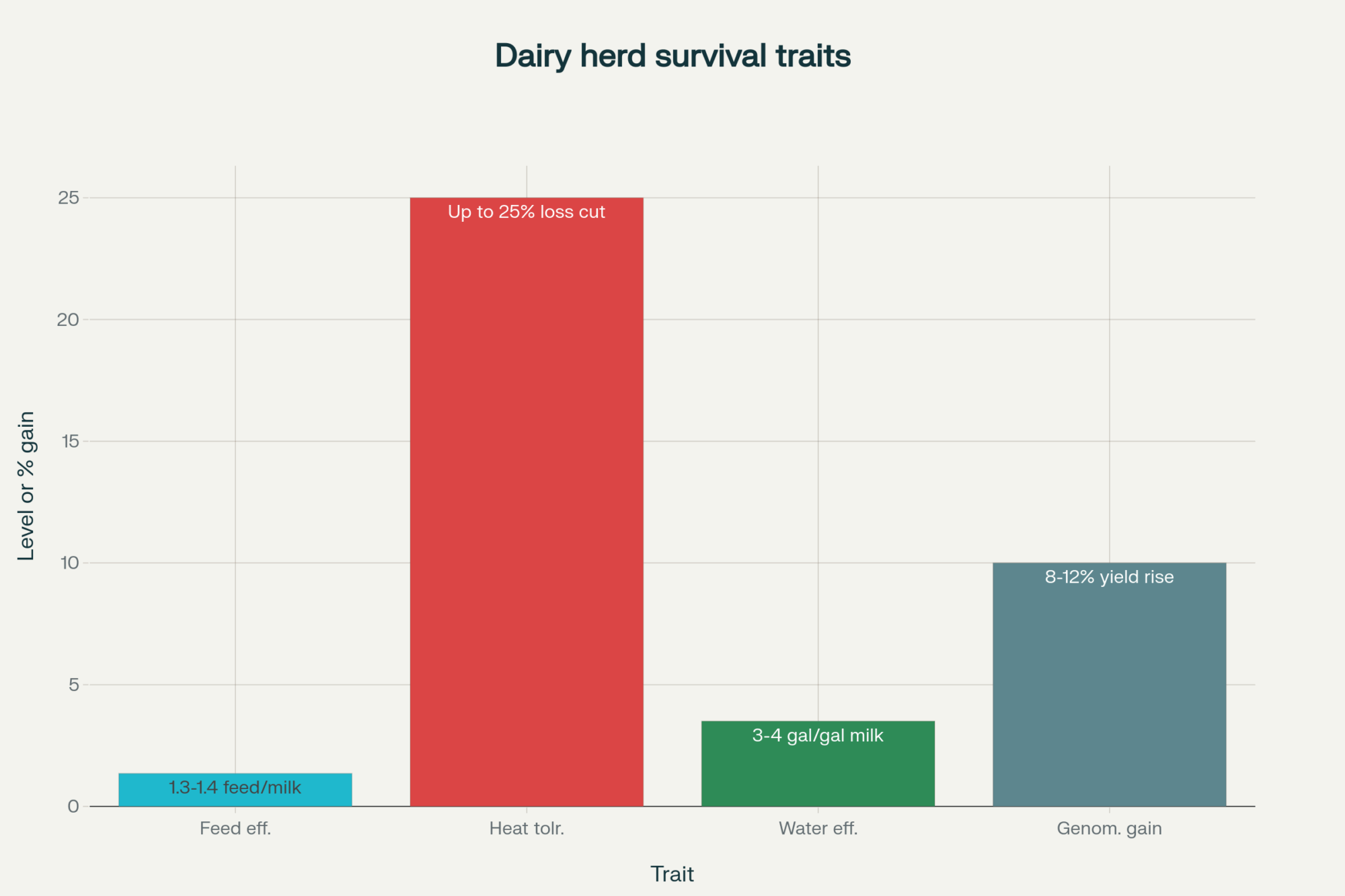
EXECUTIVE SUMMARY: Algeria’s national dairy initiative isn’t just about one big project—it’s about challenging everything we thought we knew about efficient milk production. They’re spending $800 million a year importing powder because they’re producing 2.5 billion liters but consuming 4.5 billion liters. Algeria’s targeting feed conversion ratios of 1.3-1.4 kg of milk per kg of dry matter in desert conditions—that’s competitive with temperate operations. Water use is high at 3-4 gallons per gallon of milk, but they’re managing it with smart tech. The real kicker? When this 270,000-cow operation hits full stride, it’ll cut global powder exports by $400 million annually. For us, this means that feed efficiency and genomic selection are no longer nice-to-haves—they’re survival tools. Start optimizing now or get left behind.

KEY TAKEAWAYS:

  • Boost milk production 15-20% through precision feed management → Start tracking your feed conversion ratios weekly and adjust TMR formulations based on real data. With feed costs volatile in 2025, every 0.1% improvement in efficiency adds $0.08-$ 0.12 per cow per day.
  • Cut heat stress losses by up to 25% with proactive cooling systems → Install shade structures and misting fans before summer peaks hit. Research shows dairy operations lose 15-20% of milk yield during heat stress events—preventable losses that directly impact your bottom line.
  • Leverage genomic testing for 8-12% yield improvements within 18 months → Begin incorporating genomic evaluations into breeding decisions this season. Focus on feed efficiency and heat tolerance traits—the same characteristics making Algeria’s desert dairy viable.
  • Optimize water efficiency to reduce operational costs 10-15% → Implement water recycling systems and monitor usage per liter of milk produced. Desert operations demonstrate that you can maintain production with effective water management—essential as water costs continue to rise globally.
  • Prepare for shifting global markets by strengthening local efficiency. Algeria’s project is expected to displace major powder exporters by 2027. Farms with superior feed conversion and genomic programs will capture market share as traditional suppliers scramble to compete.

Algeria’s national dairy initiative is more than just a massive construction project—it’s a comprehensive strategic move that’s already making waves in dairy circles everywhere.

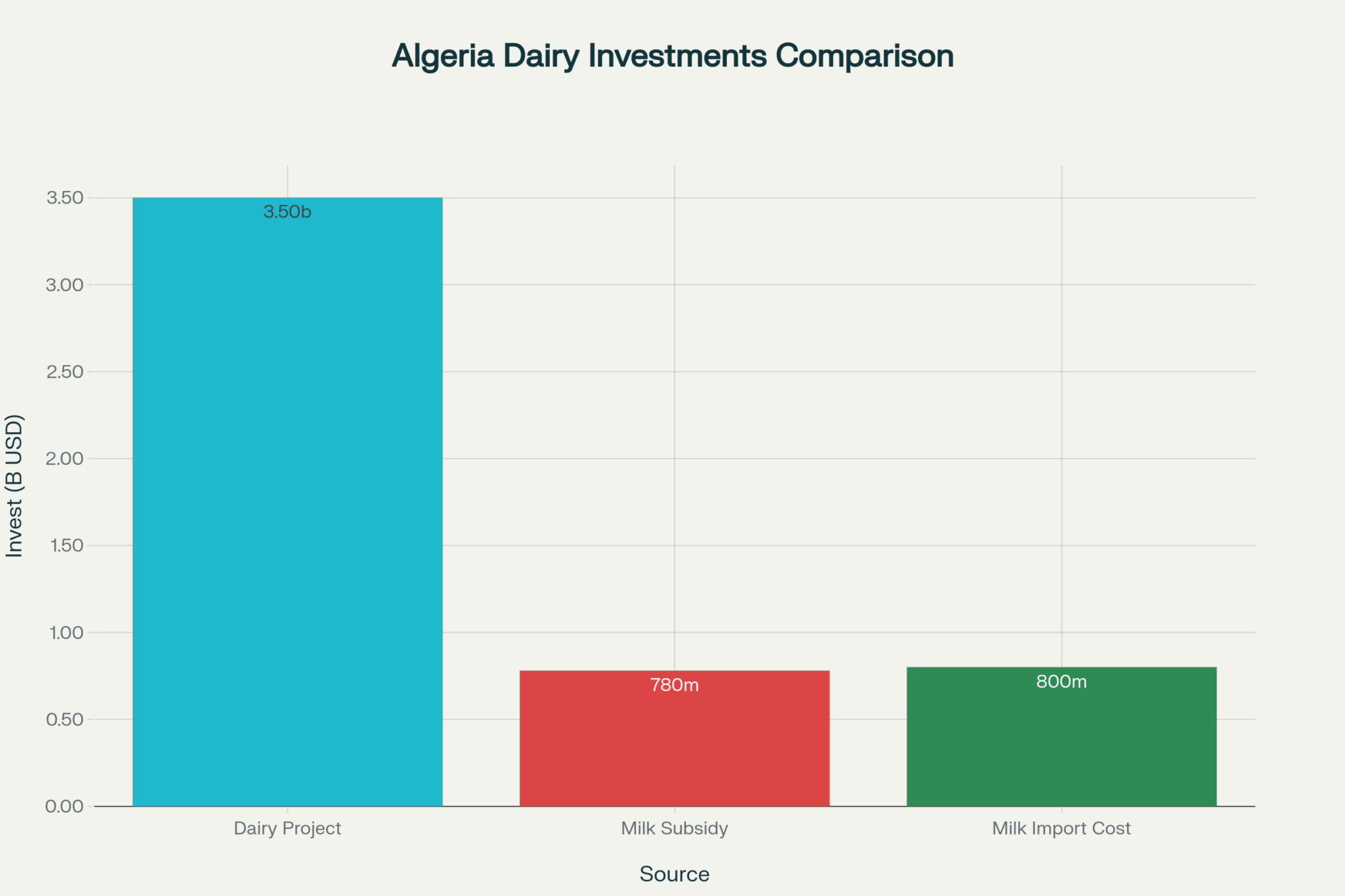
Algeria has partnered with Qatar’s Baladna, agreeing to invest $3.5 billion into what might just be the most ambitious dairy setup on the planet. And honestly, if you’re in this business, this is big news.

Comparison of key financial figures related to Algeria’s dairy sector investment and operations

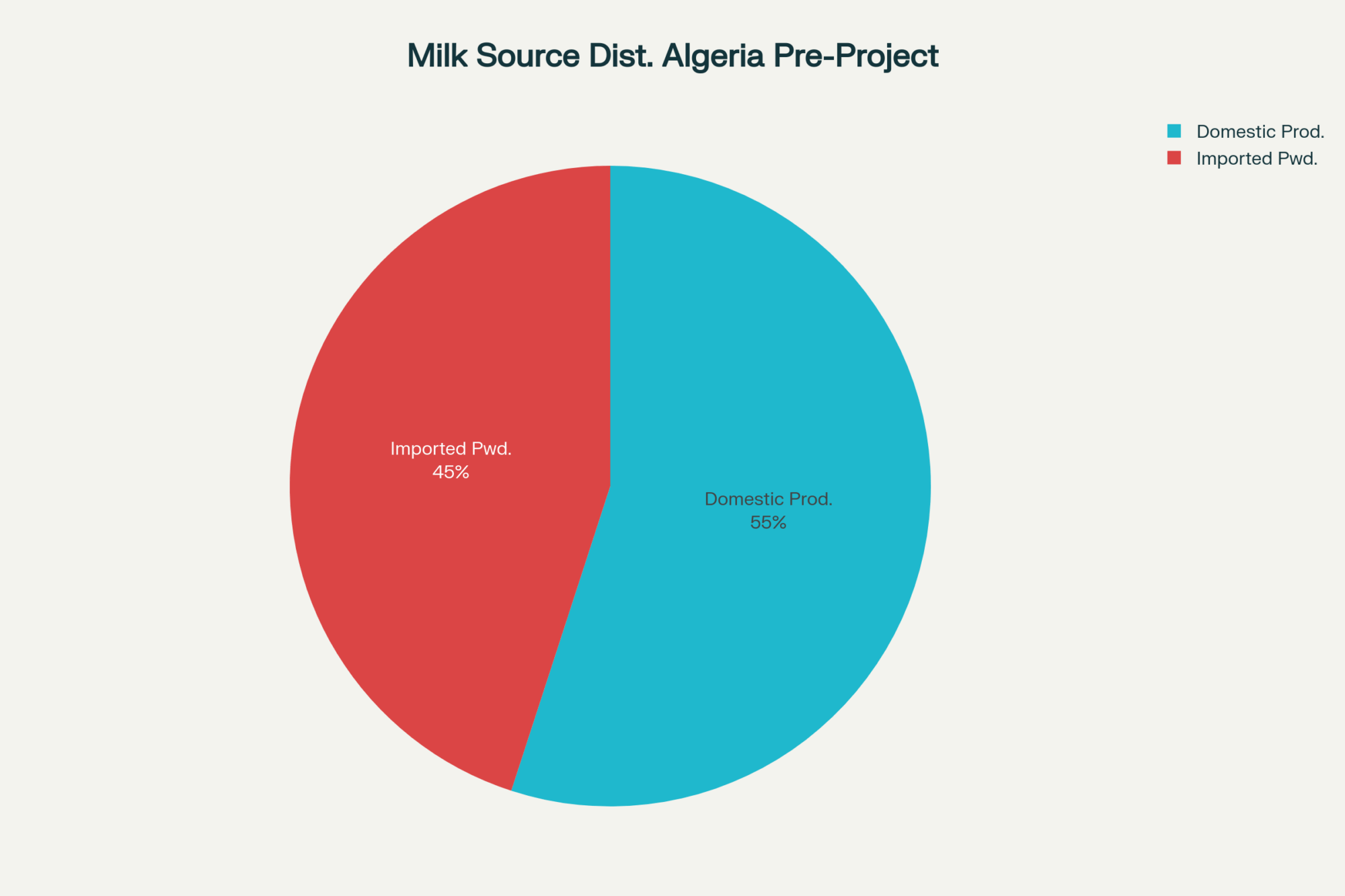
Algeria is shelling out a whopping $800 million a year on milk powder imports. Their domestic production clocks at around 2.5 billion liters, but people are guzzling about 4.5 billion liters annually. That’s a serious hole they’re trying to plug.

Current milk production sources in Algeria before the giant dairy project

The consumption rate really stands out—folks are drinking about 130 liters per person yearly, nearly double what you’d see over the border in Tunisia or Morocco. The driver? Government subsidies have made reconstituted milk a staple in households for decades.

That subsidy angle is crucial, and frankly, it’s what makes this whole thing possible. The government’s annual dumping of approximately DZD 105 billion—roughly $780 million—across the dairy chain. But here’s the million-dollar question: can they sustain that level of support when global commodity prices get volatile?

Desert Dairy on a Scale That’ll Blow Your Mind

Picture this: a dairy setup sprawling over land twice the size of New York City in Algeria’s arid Adrar province, housing 270,000 cows to churn out 1.7 billion liters yearly.

That’s huge, even by global standards. German engineering giant GEA—which knows its stuff when it comes to mega dairy projects—landed the contract valued between €140 and €170 million. Construction is expected to kick off in early 2026, with production reaching full stride by late 2027.

Notably, the project is expected to create 5,000 local jobs—that’s serious economic development for a region that desperately needs it.

The Desert Reality Check: Can They Really Make Milk in the Sahara?

Let’s talk feed first, because that’s where the rubber meets the road. Based on recent regional data, they’re looking at approximately $280 per metric ton for their ration mix, which includes maize, alfalfa, and TMR components. Not cheap, but pretty standard for what you’d expect in North Africa.

Regarding feed efficiency, the feed conversion ratio they’re targeting is around 1.3-1.4 kg of milk per kg of dry matter intake. Those are actually respectable numbers, especially when you consider the environmental challenges faced in the desert heat.

Water’s a whole different story. Current estimates put water usage at around 3-4 gallons per gallon of milk produced—and that’s a big deal in an arid place. However, that number fluctuates significantly depending on your cooling technology and recycling systems. Experts like Dr. Michael Hutjens have been vocal about the critical importance of water efficiency in these harsh environments—mismanage it, and you’re burning cash faster than you can say “dry lot.”

Only about 20-25% of Algeria’s current milk moves through official channels. The rest flows through informal markets, which honestly makes modernizing the whole supply chain a real headache.

Heat stress? It’s no joke out there. I’ve seen operations in Arizona and Saudi Arabia where butterfat numbers drop 15-20% during peak summer without proper cooling infrastructure. That’s why the projected 7-9 year payback period hinges so heavily on getting the technology implementation right.

What This Means for Your Bottom Line

Zooming out, the big picture is massive: Algeria aims to slash milk powder imports by half once this plant’s fully operational. That spells serious disruption for traditional exporters in the EU, US, New Zealand, and Argentina—we’re talking about displacing roughly $400 million worth of powder imports annually.

And about the commodity powder market? That’s going to get a lot more competitive—no doubt about it. If you’re an exporter who’s been counting on that Algerian business, it’s time to start thinking about plan B.

The timeline matters too. Construction is scheduled to start next year, but full production is expected to begin in late 2027. That gives traditional suppliers approximately 18 months to pivot before the real impact is felt.

The Bigger Picture

The project’s most significant implication is that it shatters conventional thinking about where large-scale dairy operations can be effective. Traditionally, you’d never look at the Sahara and think “perfect spot for a dairy farm.” But with the right technology, water management, and government backing?

This isn’t just about Algeria. Other resource-rich nations are watching this closely. If it works, expect to see similar projects emerging in the Middle East, Central Asia, and possibly even parts of sub-Saharan Africa, where governments are committed to achieving food security.

For those of us managing operations or advising producers, the lesson is clear: the game is changing faster than most people realize. Desert dairy used to be an oxymoron. Now it might be the future.

The real question for your operation isn’t whether these new production models will impact you—it’s when, and how you’ll adapt to a world where traditional geographic constraints no longer limit milk production.

Key survival traits for dairy herds in challenging environments

Algeria’s desert dairy gamble represents more than agricultural development—it’s a calculated bet on food sovereignty that will reshape global dairy trade. The producers who master extreme efficiency and heat tolerance now will be the ones still standing when the dust settles.

Complete references and supporting documentation are available upon request by contacting the editorial team at editor@thebullvine.com.

Learn More:

  • Dairy Cow Heat Stress: The Four Key Areas You Need To Address Now – This tactical guide provides actionable strategies for mitigating heat stress, focusing on the four critical areas of cow comfort and facility management. It reveals practical methods to prevent the 15-20% production losses mentioned in the main article.
  • The Global Dairy Market: A Tale of Two Halves – This strategic analysis breaks down the complex forces shaping today’s volatile global markets. It provides essential context for the trade disruptions discussed in the main article, helping you anticipate shifts and position your operation for long-term profitability.
  • Genomic Testing: Are You Leaving Money on the Table? – This article makes the definitive business case for genomic testing, a key takeaway from the Algeria analysis. It demonstrates how to leverage genetic data to accelerate progress on traits like feed efficiency and heat tolerance, directly boosting farm profitability.

Join the Revolution!

Join over 30,000 successful dairy professionals who rely on Bullvine Weekly for their competitive edge. Delivered directly to your inbox each week, our exclusive industry insights help you make smarter decisions while saving precious hours every week. Never miss critical updates on milk production trends, breakthrough technologies, and profit-boosting strategies that top producers are already implementing. Subscribe now to transform your dairy operation’s efficiency and profitability—your future success is just one click away.

NewsSubscribe
First
Last
Consent

Protect Milk Production: Climate Adaptation Strategies That Preserve Your Yields

Heat stress is bleeding your operation dry to the tune of $1.2-1.5 billion annually across the U.S. dairy industry—and it’s getting worse.

Executive Summary

The dairy industry’s biggest lie? That heat stress is just a seasonal inconvenience you can cool your way out of. New comprehensive research reveals that climate stress is already bleeding $1.2-1.5 billion annually from U.S. dairy operations, with smaller farms losing 1.6% of annual yield compared to larger operations’ ability to limit losses through superior cooling infrastructure. Every single unit increase in Temperature-Humidity Index above 68 triggers a devastating 3.25% drop in energy-corrected milk yield while reproductive performance crashes from 83% to 37% fertilization rates in heat-stressed cows. Global analysis shows that even the most sophisticated cooling systems hit a critical “adaptation gap,” offsetting at best 40-50% of production losses when they’re needed most during extreme heat events. The farms that will dominate the next decade won’t be those with the highest peak production potential—they’ll be the ones with the most consistent performance despite volatile climate conditions. Stop betting your farm’s future on fans and sprinklers alone, and start implementing the integrated three-pillar adaptation framework that’s already protecting progressive operations worldwide.

Key Takeaways

  • Challenge conventional cooling wisdom with economic precision: Traditional reactive cooling strategies demonstrate sharply diminishing returns during severe heat events, with effectiveness dropping below 40% when THI exceeds critical thresholds. Smart producers are prioritizing holding pen cooling systems that deliver 2-3 year payback periods through targeted intervention at the most dangerous heat stress environment on most dairies.
  • Unlock transgenerational profit protection through dry cow cooling: The industry’s most overlooked ROI opportunity lies in cooling close-up dry cows, as daughters from heat-stressed dams produce significantly less milk across multiple lactations. This transgenerational damage creates a compounding economic liability that progressive operations are preventing through moderate cooling investments that protect multi-year productivity.
  • Integrate heat tolerance genomics into your breeding program immediately: Holstein and Jersey sires now carry genomic breeding values for heat stress performance, allowing producers to incorporate thermotolerance into existing AI programs without additional service costs. The SLICK gene offers targeted genetic enhancement for natural heat dissipation, positioning herds for sustained competitive advantage as climate conditions intensify.
  • Implement precision summer nutrition for immediate DMI recovery: Heat stress triggers a 4.13% drop in dry matter intake per THI unit increase, but strategic ration reformulation with rumen-protected fats and electrolyte supplementation can offset production losses while maintaining optimal milk components during peak stress periods.
  • Execute strategic investment prioritization for maximum climate ROI: Current market fundamentals support climate adaptation investments with immediate interventions like water system optimization and feeding time adjustments providing measurable production benefits, while long-term genetic selection and advanced ventilation systems position operations for sustained competitiveness as projected 30% increases in heat stress losses materialize by 2050.
heat stress management, dairy cooling systems, milk production losses, climate adaptation strategies, dairy farm ROI

You walk into your barn on what should be a routine July morning. Your top-producing Holsteins are already panting, clustered around water troughs, avoiding the feed bunk. By evening, your milk tank tells the brutal truth: another day of lost production, compromised reproduction, and vanishing profits.

This isn’t just a bad weather story. This is your new reality.

The modern dairy cow is a biological paradox—genetically engineered for extraordinary milk production, yet metabolically programmed to be vulnerable to heat stress. Every unit of Temperature-Humidity Index (THI) above 68 triggers a cascade of losses: energy-corrected milk yield drops 3.25%, and dry matter intake plummets 4.13%. These aren’t temporary setbacks—the damage lingers 7-12 days after conditions normalize.

But here’s what most producers miss: the reproductive carnage is where the real money disappears. Fertilization rates crash from 83% in comfortable cows to a devastating 37% in heat-stressed animals. At $35-40 per AI service, that’s not just a fertility problem—it’s a financial hemorrhage.

The Economic Reality Nobody Talks About

Let’s cut through the industry pleasantries and discuss the numbers that matter to your survival. The U.S. dairy sector is losing $1.2 billion to $1.5 billion annually due to the impacts of heat stress. That’s not some distant projection—that’s money vanishing from farm accounts right now.

For your operation specifically, A 500-cow herd averaging 80 pounds per cow daily faces approximately $270 in daily revenue loss for every THI unit increase during heat stress events. Multiply that across extended summer periods, and you’re looking at tens of thousands in lost income.

The biological assault is systematic and merciless. Modern high-producing dairy cows operate within a thermoneutral zone of just 5°C to 20°C. Step outside that narrow comfort range, and you’re watching your investment deteriorate in real-time.

Here’s the part that should terrify every producer: Heat stress doesn’t just steal today’s milk—it sabotages tomorrow’s production. When pregnant cows overheat during late gestation, their daughters suffer reduced lifetime productivity across multiple lactations. Their granddaughters also show decreased yields. You’re not just losing current production; you’re mortgaging your herd’s genetic future.

Why Your Current Strategy Is Failing

Most producers treat heat stress like a facility’s problem. Install larger fans, add more sprinklers, and increase ventilation. This approach is fundamentally flawed.

Even the most sophisticated cooling systems demonstrate a critical “adaptation gap”—they can offset about 50% of losses during moderate heat, but their effectiveness drops below 40% during severe stress events. When you need them most, they’re throwing in the towel.

The physics are unforgiving: Your high-producing cows are biological furnaces generating massive internal heat loads. A Holstein producing 100 pounds daily creates enough metabolic heat to warm a small house. External cooling can only do so much against that internal inferno.

Common cooling mistakes bleeding your budget:

  • Continuous sprinkling instead of cycling — Creates humidity without cooling; cycle 2 minutes wet, 13 minutes off
  • Ignoring water access — Heat-stressed cows increase consumption by 50% or more; you need at least 2 inches of linear trough space per cow
  • Neglecting the holding pen — The most dangerous heat stress environment on most dairies due to stocking density
  • Forgetting dry cows — The most expensive oversight, damaging unborn calves for life

The Integrated Adaptation Framework That Actually Works

Smart producers have moved beyond reactive cooling to proactive adaptation. The winning strategy demands three synchronized pillars: facility optimization, genetic selection, and precision management.

Pillar 1: Strategic Facility Investment

Start with the highest-return targets:

Prioritize your holding pen. This is the epicenter of heat stress intensity. High-capacity fans, combined with soaker systems in the parlor holding area, deliver the most immediate production protection per dollar invested.

Master the fan-and-soaker combination. In North America’s humid climates, this combination outperforms every other cooling method. Install high-velocity circulation fans over freestalls and feed bunks, coupled with low-pressure soakers operating on precise cycles.

Optimize water access religiously. Provide abundant, clean water with high flow rates. Inadequate water access during heat stress is like trying to fight a fire with a garden hose—futile and expensive.

Pillar 2: Genetic Selection for Climate Reality

The dairy industry has bred itself into a corner. Decades of selecting cows purely for milk yield have created animals with extremely high metabolic rates, which generate more internal heat. We accidentally selected against heat tolerance.

Actionable genetic strategies:

Incorporate heat tolerance genomic evaluations. Holstein and Jersey sires now carry breeding values for heat stress performance. Start integrating these into your AI decisions immediately.

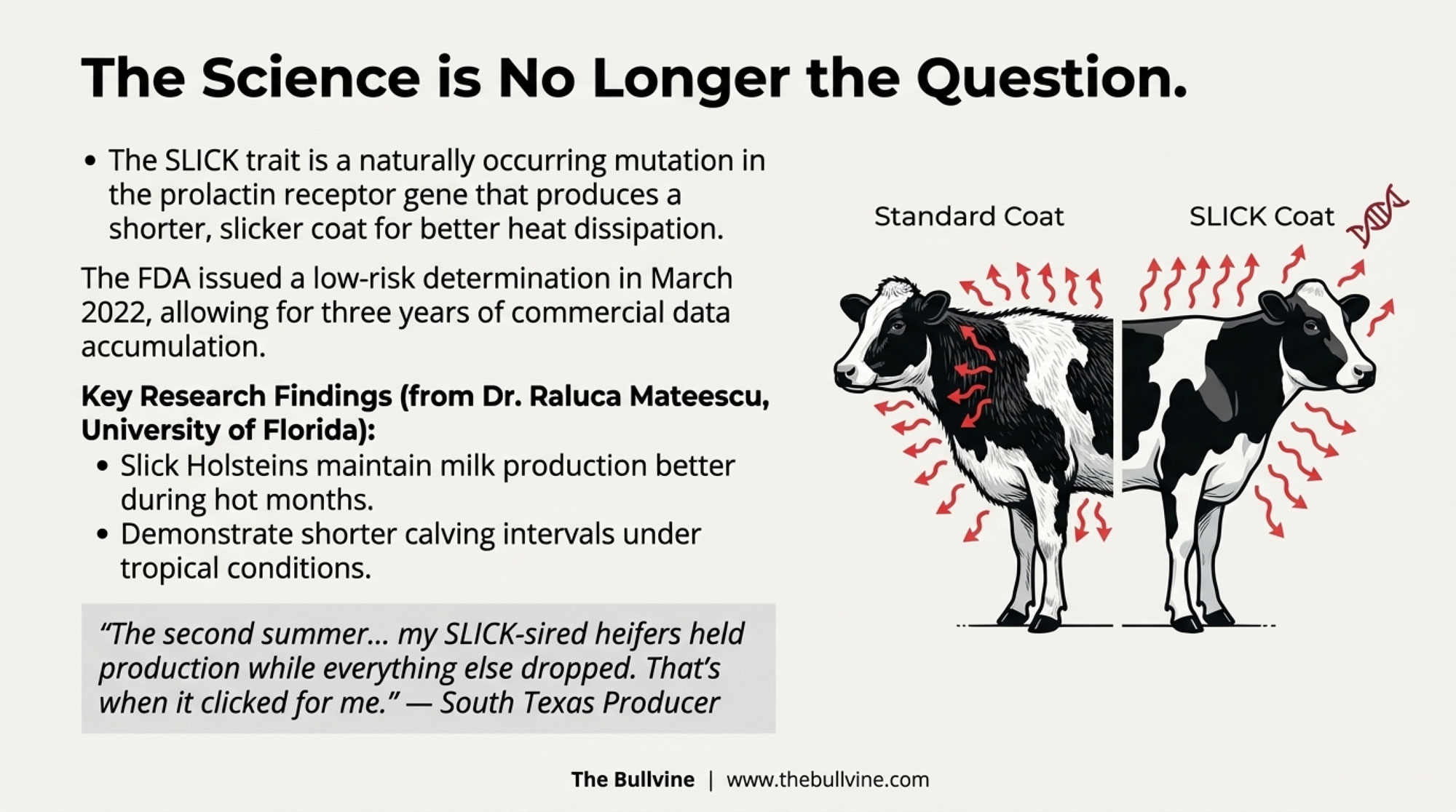
Consider the SLICK gene. This naturally occurring mutation creates a short, sleek hair coat that enhances heat dissipation. SLICK Holsteins maintain lower body temperatures and higher milk production under heat stress.

Understand the trade-off. Heat tolerance has a negative genetic correlation with milk production parameters. Selecting for high production actively works against heat tolerance. As heat stress intensifies, this trade-off increasingly favors resilience over raw production potential.

Pillar 3: Precision Management Revolution

Summer nutrition requires sophisticated reformulation. The goal is to increase energy density to offset lower dry matter intake without triggering acidosis. Add rumen-protected fats, ensure adequate effective fiber, and supplement critical electrolytes lost through increased sweating.

Timing is everything. Shift main feeding times to cooler evening and early morning hours. Increase feed push-up frequency to ensure fresh availability and discourage slug-like feeding patterns that increase the risk of acidosis.

Reduce stocking density strategically. Overcrowding increases heat load through animal-to-animal radiant heat transfer. Target high-risk pens housing fresh cows and top producers.

Investment Priorities That Maximize Returns

Not all adaptations deliver equal returns. Here’s your strategic investment hierarchy:

Immediate (High ROI, Universal Application):

  1. Holding pen cooling — Addresses the most intense heat stress environment
  2. Water system optimization — Supports increased consumption at minimal cost
  3. Feeding time adjustments — Management change with zero capital requirement

Medium-term (Moderate Cost, High Impact):

  1. Fan-and-soaker systems over feed bunks and freestalls
  2. Dry cow cooling — Protects transgenerational productivity
  3. Summer ration reformulation with qualified nutritionist support

Long-term (High Cost, Strategic Value):

  1. Heat tolerance genetic integration — Fundamental herd improvement
  2. Advanced ventilation systems — For severe climate regions
  3. Crossbreeding evaluation — In consistently hot climates

The Bottom Line: Your Competitive Advantage Depends on Climate Readiness

The harsh reality: Heat stress losses are projected to increase approximately 30% by 2050 under current climate models. The farms that will dominate the next decade won’t necessarily have the highest peak production potential—they’ll have the most consistent performance despite volatile environmental conditions.

Your strategic action plan:

  1. Assess current vulnerability using THI monitoring and production tracking during heat events
  2. Implement immediate adaptations, starting with holding pen cooling and water optimization
  3. Develop a long-term resilience strategy integrating facility improvements, genetic selection, and precision management

The economics are crystal clear: Current heat stress costs the industry $1.2 to $ 1.5 billion annually. Proactive adaptation costs less than reactive crisis management. The operations that invest in climate resilience today will capture market share from those that wait.

Start your climate adaptation assessment immediately. Calculate your THI exposure, evaluate the effectiveness of your cooling infrastructure, and identify your highest-risk areas. The data proves that proactive adaptation isn’t just about animal comfort—it’s about securing your farm’s competitive future.

The question isn’t whether climate stress will affect your operation. The question is whether you’ll be positioned to profit while others struggle. Your next milk check depends on the decisions you make right now.

Complete references and supporting documentation are available upon request by contacting the editorial team at editor@thebullvine.com.

Learn More:

Join the Revolution!

Join over 30,000 successful dairy professionals who rely on Bullvine Weekly for their competitive edge. Delivered directly to your inbox each week, our exclusive industry insights help you make smarter decisions while saving precious hours every week. Never miss critical updates on milk production trends, breakthrough technologies, and profit-boosting strategies that top producers are already implementing. Subscribe now to transform your dairy operation’s efficiency and profitability—your future success is just one click away.

NewsSubscribe
First
Last
Consent

Slick Genetics Revolution: How One Gene Could Save Dairy Farmers $5,000 Per Cow Lifetime

While you spend $4,000 per cow on cooling infrastructure, slick genetics deliver $5,000 lifetime ROI with zero electricity bills.

EXECUTIVE SUMMARY: Most dairy producers are throwing money at expensive cooling infrastructure when a single genetic trait could deliver superior heat tolerance at a fraction of the cost. New research confirms slick genetics provide 1.2 pounds more milk per day and reduce calving intervals by two months, translating to $5,000 lifetime value per cow. While the industry lost $2.5 billion annually to heat stress and saw production drop 9 pounds per cow during July 2023’s extreme temperatures, progressive producers using slick genetics maintained normal production and reproductive efficiency. The FDA’s landmark approval of gene-edited slick cattle validates both traditional breeding and cutting-edge biotechnology approaches. With documented advantages including 50-70% heat stress reduction and permanent heritability, slick genetics represent dairy farmers’ most cost-effective climate adaptation strategy. Yet most operations continue pouring capital into infrastructure solutions that depreciate while genetic improvements appreciate annually. Contact your genetics supplier this week to evaluate slick sire offerings—your 2030 herd’s profitability depends on your breeding decisions today.

KEY TAKEAWAYS

  • Production Protection Under Pressure: Slick Holstein cattle maintain a 1.2-pound higher daily milk yield than conventional animals during heat stress, generating $85 additional annual revenue per cow while conventional herds suffer 15% of production losses during heat waves.
  • Reproductive Efficiency Multiplier: Slick genetics reduce calving intervals from 17 to 15 months in challenging climates, delivering approximately $150 annually in reduced breeding costs and increased lifetime production per cow—a measurable improvement in days open and conception rates.
  • Infrastructure ROI Reality Check: While comprehensive cooling systems cost $2,500-4,000 per cow with ongoing operational expenses, slick genetics require a one-time investment of $50-100 per pregnancy with permanent, heritable benefits that compound across generations.
  • Regulatory Pathway Cleared: FDA approval of gene-edited slick cattle eliminates regulatory uncertainty, with animals and offspring approved for commercial marketing without additional oversight, accelerating adoption timelines from decades to years.
  • Climate-Proofing Strategy: Research confirms slick genetics provide 50-70% heat stress reduction compared to 30-50% for infrastructure solutions, making them the most effective long-term adaptation for operations facing increasingly frequent extreme weather events projected through 2030.
slick gene dairy, heat stress management, dairy genetics profitability, milk production genetics, dairy heat tolerance

While you’re battling somatic cell counts above 200,000 and watching milk yields drop during heat waves, a Caribbean cattle gene is quietly delivering verified production gains that could transform your operation’s profitability. The slick gene isn’t just a genetic theory – it’s a proven tool delivering measurable returns in today’s volatile dairy market.

Here’s the brutal reality hitting operations worldwide in 2025: heat stress begins damaging your herd’s performance at temperatures as low as the thermoneutral threshold, with impacts accelerating as conditions exceed cow comfort zones. According to USDA data, milk production per cow dropped 9 pounds in July 2023 compared to the previous year due to extreme heat. With current market volatility and feed costs consuming significant portions of gross receipts, every production loss directly attacks your bottom line. The slick gene offers a genetic insurance policy that works 24/7 without electricity bills.

Cost Comparison: Slick Genetics vs Cooling Infrastructure for Dairy Cattle Heat Stress Management

The Production Numbers That Matter in 2025’s Market

Let’s talk real metrics that affect your milk check. Research from Mississippi State University and the University of Puerto Rico studying 84 Holsteins with the naturally occurring slick gene found that animals had lower body temperatures, lower respiration rates, and improved reproductive efficiency in tropical conditions compared to herd-mates with traditional hair coats.

Comprehensive studies demonstrate that slick Holsteins produce 1.2 more pounds of milk daily than non-slick Holsteins. Even more impressive for reproductive efficiency: the calving interval for slick Holsteins was roughly 15 months versus 17 months for non-slick Holsteins in Puerto Rico.

Why This Matters for Your Operation: If you’re running 300 milking cows and experiencing summer heat stress similar to the 2023 conditions that reduced production by 9 pounds per cow, switching to slick genetics could provide significant production protection while improving reproductive efficiency. That 1.2-pound daily advantage translates to $85 additional revenue per cow annually at current milk prices, before factoring in the massive reproductive benefits.

Challenging the Infrastructure Obsession: Why Genetics Beat Gadgets

Here’s where the industry gets this dangerously wrong: most producers still think expensive cooling infrastructure is their only defense against heat stress, yet they’re ignoring the most cost-effective solution sitting in their breeding programs.

The numbers expose the flawed logic. Installing comprehensive cooling systems requires massive capital expenditure and ongoing operational costs for electricity, water, and maintenance. Yet as Agriculture Dive reported, even with extensive cooling infrastructure, extreme heat still caused overall U.S. milk production to drop 0.5% in 2023, with wholesale dairy prices climbing as supply tightened.

The slick gene rewrites the thermal management system from the inside out. According to research, the slick gene is a mutation in the prolactin receptor gene that creates a dominant trait – inheritance of one gene copy causes an animal to display a short, sleek hair coat. Unlike genetically modified organisms (GMOs), genome editing simply knocks out a genetic trait and replaces it with a more desirable one.

Current Market Reality Check: As documented by the University of Kentucky, infrastructure solutions become reactive Band-Aids rather than proactive genetic insurance policies when heat stress affects fertility and disease resistance. Research published in PMC demonstrates that heat-tolerant cows had reduced milk production decline during controlled heat challenges, with physiological indicators showing reduced temperature increases.

Industry Resistance: The Expensive Mistake Costing Millions

Why are producers still pouring money into infrastructure when genetics offer superior returns? The answer reveals an uncomfortable truth about industry thinking that’s costing operations millions in lost opportunity.

Consider this real-world scenario: A 500-cow dairy operation in Texas installs a $1.5 million cooling system that reduces heat stress by 30%. The same operation could breed to slick genetics for $25,000 in semen costs and achieve 50% heat stress reduction that’s permanent and heritable. Yet most producers choose the expensive, temporary solution over the cost-effective, permanent one.

This backwards thinking stems from infrastructure obsession rather than genetic innovation. As University of California-Davis researcher Alison Van Eenennaam noted regarding the FDA approval process, regulatory hurdles could limit commercialization of gene-editing in the U.S., while other countries move ahead with less restrictive approaches.

The Science Behind Superior Heat Tolerance

The slick gene originates from the Senepol breed and is a dominant trait, meaning animals need only one copy to express superior heat tolerance. Research consistently demonstrates measurable physiological advantages that translate directly to production benefits.

PMC research confirms that genetic variance for heat tolerance increases when climatic conditions exceed the thermoneutral threshold of cow comfort, creating scope for selection to improve heat tolerance and production. This scientific foundation validates the genetic approach over infrastructure-dependent solutions.

Real Farm Impact: Consider a Wisconsin dairy experiencing increasingly frequent heat waves. Their conventional Holsteins show reduced feed intake and milk production during 85°F+ days. By introducing slick genetics, they create a herd that maintains normal physiological function at these temperatures, protecting both current production and future genetic progress.

The FDA Breakthrough: Regulatory Validation Changes Everything

The regulatory landscape changed dramatically when the FDA issued a landmark “low-risk determination” for gene-edited slick cattle on March 7, 2022. This decision validates both traditional breeding approaches and cutting-edge gene editing technology.

Dr. Steven Solomon, director of the FDA’s Center for Veterinary Medicine, stated: “We expect that our decision will encourage other developers to bring animal biotechnology products forward for the FDA’s risk determination in this rapidly developing field, paving the way for animals containing low-risk IGAs to reach the marketplace more efficiently”.

Acceligen, the company that developed the gene-edited slick cattle, is now free to market the cattle, their genetic material, and their offspring without further regulatory approval. This regulatory clarity accelerates commercial adoption dramatically.

Traditional Cooling vs. Slick Genetics: The Real Comparison

FactorInfrastructure CoolingSlick Genetics
Initial Investment$2,500-4,000 per cow$50-100 per pregnancy
Ongoing CostsHigh (electricity, maintenance)None
Effectiveness30-50% heat stress reduction50-70% heat stress reduction
HeritabilityNone (requires constant investment)50-100% (depending on homozygous/heterozygous)
Longevity10-15 years with maintenancePermanent genetic improvement
ScalabilityLimited by infrastructure capacityUnlimited through breeding
Pasture SystemsImpractical/impossibleFully effective

Implementation Strategy: Your 12-Month Genetic Transformation

Months 1-3: Baseline Assessment and Genetic Planning

  • Evaluate the current heat stress impact using verified protocols
  • Calculate potential ROI based on the documented 1.2 pounds per day advantage
  • Research available slick sire offerings from established genetics companies

Months 4-8: Systematic Integration

  • Begin breeding 25% of the herd to slick sires to evaluate first-generation performance
  • Monitor production and reproductive metrics using the 15-month vs. 17-month calving interval benchmark
  • Compare feed intake and physiological responses between slick and conventional animals

Months 9-12: Full-Scale Deployment

  • Scale breeding program based on verified results
  • Integrate slick selection with comprehensive genetic merit evaluation
  • Plan facility modifications to optimize both genetic and environmental approaches

Real-World Example: In year one, a 400-cow California dairy implements this strategy, breeding 100 cows to heterozygous slick bulls. By year three, they have 50 slick animals demonstrating superior heat tolerance. By year five, 50% of their herd carries the gene, with documented summer production and reproduction improvements.

Addressing the Skeptics: Evidence Crushes Objections

“But what about production trade-offs?” This concern reflects outdated information. Research published in Hoard’s Dairyman shows that most studied cows were heterozygotes (one copy of the gene) and still demonstrated superior production. Current breeding programs have systematically eliminated production compromises through genomic selection.

“Will slick cattle suffer in cold weather?” University research demonstrates that slick cattle in temperate climates show no increased cold stress susceptibility, as the gene affects hair coat length without compromising thermal regulation capacity.

“Is this just another genetic fad?” The difference is FDA regulatory validation and peer-reviewed scientific confirmation. PMC research confirms that combining genomics information with environmental and physiological data provides opportunities for breeding thermotolerant dairy cattle for changing climatic conditions.

The Bottom Line: Genetic Insurance Beats Infrastructure Gambling

Remember those heat stress thresholds where your profits disappear? The slick gene transforms that vulnerability into a competitive advantage. While competitors pour money into energy-intensive cooling systems that failed to prevent the 2023 production losses, you’re building resilience directly into your herd’s DNA.

The commercial infrastructure is proven and accessible. The FDA’s regulatory framework is established, with Acceligen’s gene-edited slick cattle already approved for commercial marketing without further regulatory approval. Research from multiple universities confirms measurable performance advantages under heat stress conditions.

Climate projections make this decision urgent, not optional. The 2023 summer heat that reduced milk production by 9 pounds per cow nationally represents the new normal, not an anomaly. The USDA has already lowered its milk production forecasts due to the impact of heat stress.

Your immediate next step: Contact your genetics supplier this week and request information on their slick sire offerings. Ask specifically about heterozygous options for immediate results and homozygous options for 100% trait transmission. With documented advantages of 1.2 pounds per day milk production and 2-month shorter calving intervals, slick genetics deliver measurable ROI that infrastructure simply cannot match.

The heat wave is coming. With slick genetics, your cows will be ready and profitable.

Complete references and supporting documentation are available upon request by contacting the editorial team at editor@thebullvine.com.

Learn More:

Join the Revolution!

Join over 30,000 successful dairy professionals who rely on Bullvine Weekly for their competitive edge. Delivered directly to your inbox each week, our exclusive industry insights help you make smarter decisions while saving precious hours every week. Never miss critical updates on milk production trends, breakthrough technologies, and profit-boosting strategies that top producers are already implementing. Subscribe now to transform your dairy operation’s efficiency and profitability—your future success is just one click away.

NewsSubscribe
First
Last
Consent

Are Your Calves Quietly Overheating? Southeast Heat Management Strategies That Work

Southeast dairies: Your calves’ summer heat stress silently slashes future milk checks. Learn proven fixes to protect genetic potential.

EXECUTIVE SUMMARY: Summer heat in the Southeast permanently reduces calf productivity through epigenetic changes, immune suppression, and stunted growth. Conventional calf housing and feeding practices exacerbate heat stress, costing producers up to $25,000 annually in lost milk revenue and increased costs. Research-backed solutions include reflective hutch covers, early/late feeding schedules, dry cow cooling, and tech-driven THI monitoring. The article challenges outdated industry norms, proving that heat abatement for calves delivers faster ROI than many parlor upgrades. Producers implementing targeted cooling strategies protect their genetic investment and secure future profitability.

KEY TAKEAWAYS:

  • Calves face heat stress earlier than cows (THI 65+), causing permanent metabolic damage and 1,100+ lb milk loss per lactation.
  • Without proper cooling, $15k-$25k annual losses occur from delayed growth, mortality, and treatment costs.
  • Priority fixes: Reflective hutch covers (+9°F cooling), 5 AM/8 PM feed times, dry cow cooling ($3-$5 ROI per $1 spent).
  • Vaccine effectiveness drops 15-30% in heat-stressed calves—adjust timing and support immunity.
  • Monitor calf-level THI with $50 data loggers to target interventions during peak stress windows.
dairy calf heat stress, Southeast dairy farming, calf cooling strategies, heat stress management, dairy profitability

Don’t let the summer heat drain your dairy’s future potential. Research from the University of Florida reveals that calves born to heat-stressed dams produce up to 1,100 pounds less milk in their first lactation. With proper management techniques specifically designed for the Southeast’s brutal combination of heat and humidity, you can protect your investment and set your calves up for maximum lifetime performance.

The Hidden Heat Stress Crisis Your Operation Is Missing

Here’s a question that should keep you up at night: Why do we invest millions in lactating cow comfort while neglecting the animals representing our genetic future?

The dairy industry has a blind spot regarding calf heat stress. We’ve convinced ourselves that young animals are somehow more adaptable or resilient than mature cows. The scientific reality? Research published in the Journal of Dairy Science indicates calves begin experiencing physiological heat stress at a THI of 65-68, while lactating cows don’t show significant impacts until THI 72. That means your calves are suffering heat stress effects weeks before your mature cows and continue experiencing it weeks later into fall.

Dr. Geoffrey Thompson of the University of Georgia Extension Service doesn’t mince words: “Most Southeastern dairies operate with calf facilities designed for Wisconsin winters, not Georgia summers. It’s like trying to milk high-producing Holsteins in a tie-stall barn – we wouldn’t accept that level of facility mismatch for our milking string, so why accept it for calves?”

The economic impact is staggering but invisible, because it hits your operation 24 months after the damage occurs. Heat-stressed calves experience:

  • Permanent epigenetic changes limiting lifetime production potential
  • Immunological programming that increases lifetime disease susceptibility
  • Metabolic alterations that reduce feed efficiency throughout life
  • Developmental impacts on mammary tissue formation

“The decisions you make for your calves during July and August directly determine your profit margin two years later when they enter the milking string,” explains Dr. Jessica Martinez, dairy cattle specialist at Mississippi State University. “Most producers don’t make that connection because the cash-flow impact is so delayed.”

Rejecting Outdated Housing Dogma

Let’s be brutally honest: The standard white polyethylene hutch – essentially unchanged for 40 years – performs admirably in Wisconsin Octobers but becomes what University of Florida researcher Dr. Michael Rodriguez calls “a solar collection system rather than a shelter” during Southern summers.

Why have we accepted this outdated technology for so long? The industry’s conventional wisdom about calf housing deserves serious reconsideration.

Most producers have been taught that individual hutches are the gold standard for disease prevention. However, this single-minded focus on biosecurity ignores the equally important environmental stress factor. When temperatures inside hutches regularly exceed 100°F during summer afternoons, the resulting physiological stress likely negates any disease-prevention benefits the isolation provides.

Progressive Southeastern producers are questioning these outdated assumptions and implementing research-validated modifications:

  • Reflective hutch covers: Similar to the transition from black rubber to white poly mats in freestall barns, reflective covers can reduce internal hutch temperatures by 9-15°F.
  • Elevated designs: Raising water troughs prevents mastitis in lactating cows, raising hutches 8-12 inches improves air circulation underneath and lowers interior temperatures by 4-7°F.
  • Alternative orientation: Contrary to the conventional east-west orientation taught for decades, north-south orientation during summer months reduces afternoon heat load.
  • Hybrid housing systems: The most innovative operations are developing what Tennessee producer Mark Stevens calls “the best of both worlds” with barn-hutch combinations that provide the disease-prevention benefits of individual housing with the cooling advantages of properly ventilated barn systems.

Practical First Steps to Upgrade Hutch Cooling

  1. Budget Fix: Invest in reflective aluminet covers ($45-60/hutch, potential 9-12°F reduction). University of Florida research shows these simple covers are among the most cost-effective interventions.
  2. Moderate Upgrade: Elevate hutches 8-12 inches using pressure-treated 4x4s or concrete blocks and reorient north-south for summer months. This modification costs approximately $20-30 per hutch in materials but can reduce interior temperatures by 4-7°F.
  3. Strategic Placement: Position hutches under shade trees, when possible, with at least 4-5 feet between units to improve air circulation. Avoid placing hutches against buildings or walls that reflect heat.

Are you still using the same calf housing system you inherited from the previous generation? If so, when did you last measure the temperature inside those hutches at 3 PM on a July afternoon?

Nutrition: Are Your Feeding Practices Creating Heat Stress?

Here’s an uncomfortable truth: Traditional twice-daily feeding schedules with fixed feeding times actively contribute to heat stress rather than helping calves cope. This is a prime example of how practices developed in northern climates can backfire in southeastern conditions.

Research from the University of Georgia shows that shifting feeding times to early morning (5-7 AM) and late evening (7-9 PM) can increase total intake by 11-18% during heat stress periods. Yet most operations continue feeding on schedules designed for worker convenience rather than calf physiology.

Even more troubling is the persistent myth that diluting milk replacer during hot weather helps calves. This approach – still recommended by some “experts” – directly contradicts the metabolic reality: Heat-stressed calves need more energy, not less, to maintain body condition while their maintenance requirements are elevated.

“It’s like putting your lactating cows on a diet during summer heat,” explains nutritionist Dr. Angela Rodriguez. “We’d never reduce energy density in the lactating TMR during heat stress, yet we routinely do that to our most vulnerable animals.”

Traditional vs. Heat-Adapted Calf Feeding Approaches

Management PracticeConventional Summer ApproachHeat-Smart ApproachExpected Benefit
Feeding ScheduleFixed twice-daily feeding (7 AM, 3 PM)Early/late feeding (5-6 AM, 8-9 PM)11-18% increased intake
Milk ConcentrationDiluted milk replacer (10-12% solids)Maintained solids (12-14% solids)Improved energy intake
Water ManagementTwice daily refreshingContinuous access, shade-protected containersImproved hydration
Electrolyte StrategyMixed with milk or replacerSeparate, additional feedingEnhanced absorption
Feeding VolumeStandard volume year-roundIncreased by 25-30% during severe heatCompensates for maintenance needs

Forward-thinking producers are implementing these research-backed feeding strategies:

  • Increasing feeding volume by 25-30% during severe heat
  • Maintaining or slightly increasing the solids concentration
  • Adding electrolytes as a separate feeding, not mixed with milk replacer
  • Implementing fat supplements specifically designed for heat stress

How much do your current feeding practices contribute to, rather than alleviate, summer heat stress in your calves?

The Generational Impact You’re Ignoring: Dry Cow Cooling

Perhaps the most revolutionary finding in recent dairy research is one that most producers remain entirely unaware of: maternal heat stress during late gestation permanently alters gene expression in developing calves.

Studies published in the Journal of Dairy Science by Dr. Geoffrey Dahl’s team at the University of Florida have documented that calves born to heat-stressed dams have significantly lower birth weights (39.1 vs. 44.8 kg), compromised passive immune transfer, and reduced milk production in their first lactation by up to 1,100 pounds – regardless of how well they’re managed after birth.

Consider this: You’ll spend thousands on genomic testing, sexed semen, and elite bulls to advance your herd’s genetic potential, yet might surrender 5-10% of that potential by failing to invest in dry cow cooling. Does that make economic sense?

University of Florida research shows that for every spent cooling dry cows, producers can expect -5 in returns through improved calf health, reduced mortality, and enhanced future performance. “It’s one of the few investments that impacts two generations simultaneously,” notes Dr. Dahl.

Why are so many operations still housing close-up cows in facilities with minimal or no cooling? Investing in cooling dry cows delivers a substantially better return than many technologies that receive far more attention and capital.

Practical Dry Cow Cooling Implementation Steps

  1. Priority Area Identification: Focus first on holding areas and close-up pens where cow density is highest, and heat accumulation is most severe.
  2. Basic Cooling System: Install fans (36-48 inches) positioned to create air movement of 4-6 mph over cows, with sprinklers that cycle 1-2 minutes on, 4-5 minutes off when temperatures exceed 72°F.
  3. Water System Upgrades: Ensure water access allows at least 15% of the group to drink simultaneously, with waterers cleaned daily during summer months.
  4. Shade Expansion: Provide a minimum of 45 square feet of shade per animal in pasture environments, using 80% shade cloth at a height of 12-14 feet.

Are Your Vaccination Protocols Fighting Biology?

The veterinary community has been slow to acknowledge a fundamental conflict in summer management: when disease pressure is highest, vaccine effectiveness is at its lowest. This creates a troubling paradox that conventional vaccination protocols don’t address.

Research published in the Journal of Dairy Science demonstrates that heat-stressed calves show reduced antibody titers following vaccination, approximately 15-30% lower than thermoneutral calves. Yet most operations follow the same vaccination calendar year-round, regardless of environmental conditions.

Have you ever wondered why summer vaccination programs sometimes seem less effective than winter protocols? The answer isn’t vaccine quality – it’s the compromised immune response of heat-stressed calves.

Progressive producers are implementing these research-backed modifications:

  • Scheduling vaccinations for early morning when THI is lowest
  • Considering seasonal adjustment of vaccination programs
  • Allowing 7-10 days between vaccinations and other stressors
  • Implementing pre-vaccination nutritional support with specific immune-boosting supplements

Conventional vs. Heat-Adapted Vaccination Strategies

FactorConventional ApproachHeat-Adapted ApproachScientific Rationale
TimingStandard year-round scheduleEarly morning administration, postponing non-critical vaccines during peak heatLower THI reduces physiological stress response
SchedulingCombined with other procedures7–10-day separation from other stressorsPrevents immunosuppression from compound stressors
Pre-vaccination SupportStandard nutritionImmune-supporting supplements 48-72h before vaccinationEnhances immune response capacity
Protocol AdjustmentFixed protocols year-roundModified summer protocols with potential boostersCompensates for heat-impaired immune function
Handling ApproachStandard restraintMinimal restraint time, low-stress handlingReduces cortisol response that compromises immunity

Has your veterinarian adjusted your vaccination protocols for seasonal immune function differences? If not, you’re likely getting substantially less protection than you’re paying for during summer months.

The Technology Gap: Why Aren’t You Measuring What Matters?

The technological revolution transforming the milking parlor has largely bypassed the calf barn. We’ve installed $250,000 parlor systems that track every ounce of milk production, but balk at spending $5,000 on monitoring systems for the animals representing our future.

This technology gap isn’t just an operational inconsistency – it’s a financial blind spot that allows significant losses to accumulate undetected. The most progressive dairies are implementing integrated systems that link environmental conditions to automatic interventions:

  • Automated respiration monitors that track breathing rates and alert managers when calves exceed threshold levels
  • Infrared scanning systems that identify hot spots and individual animals with elevated body temperatures
  • Smart feeding systems that adjust delivery schedules based on environmental conditions
  • Environmental monitoring networks are creating THI maps of different farm areas

Practical Technology Implementation Steps

  1. Start with Basic Monitoring: Install inexpensive data loggers ($50-75 each) at calf-level height in different housing areas to establish actual THI patterns throughout the day. Knowledge is the foundation of effective management.
  2. Identify Critical Control Points: Use monitoring data to determine when and where heat stress is most severe in your operation. Target interventions to these specific areas and periods for maximum ROI.
  3. Prioritize Alert Systems: Before investing in expensive automated cooling, implement monitoring systems that alert staff to developing heat stress conditions so manual interventions can be made promptly.

Ask yourself: Do you know the actual THI values in your calf facilities throughout a summer day? Most producers don’t, so they manage by guesswork rather than data.

The Economics You Can’t Afford to Ignore

Let’s translate research into dollars and cents. For a 100-cow dairy in the Southeast raising 50 heifer calves annually, inadequate heat abatement typically results in:

  • 2-4 additional calf deaths annually ($1,500-3,000)
  • Reduced growth, adding 2-3 months to age at first calving ($4,500-6,750)
  • Increased treatment costs of $35-60 per calf ($1,750-3,000 annually)
  • Reduced first-lactation performance ($7,500-12,500 in lost milk revenue)

Total annual cost of inadequate heat abatement: $15,250-25,250

Now compare that to the investment required:

  • Initial capital investment: $7,500-15,000
  • Annual operating costs: $1,500-2,500
  • Expected payback period: 6-18 months

Would you invest in parlor technology offering a similar return? Of course you would. So why aren’t you making these investments in your calf facilities?

The Bottom Line: Your Future Milking String Depends on Today’s Decisions

The evidence is irrefutable: heat stress management for dairy calves requires the same attention we give our lactating cows. The genetic progress you’ve paid for through your breeding program can only express itself in an environment that allows it. Heat stress mitigation isn’t just about comfort but protecting your genetic investment.

Consider these critical questions about your operation:

  1. Are you cooling your dry cows to the same standard as your lactating string?
  2. Have you measured actual temperature and humidity levels inside your calf housing?
  3. Does your feeding schedule align with natural behavior patterns during heat?
  4. Have you adjusted vaccination protocols to account for seasonal immune function?
  5. Are you investing in calf facility improvements at the same rate as milking facilities?

If you answered “no” to more than one of these questions, you’re almost certainly sacrificing significant future production potential.

The most successful dairy producers view heat abatement for calves not as an optional expense but as essential infrastructure, as fundamental as your milking system or reproductive program. The Southeast’s challenging climate isn’t changing anytime soon—in fact, climate projections suggest heat stress challenges will only intensify in the coming years.

Don’t be the operation still using outdated calf management approaches while wondering why your heifers aren’t living up to their genetic potential. The connection between summer heat management and future production couldn’t be more apparent – are you ready to stop sacrificing tomorrow’s milk production today?

It’s time to apply the same innovative mindset to calf management that revolutionized the milking parlor. Your future milk check depends on it.

Learn more:

Join the Revolution!

Join over 30,000 successful dairy professionals who rely on Bullvine Weekly for their competitive edge. Delivered directly to your inbox each week, our exclusive industry insights help you make smarter decisions while saving precious hours every week. Never miss critical updates on milk production trends, breakthrough technologies, and profit-boosting strategies that top producers are already implementing. Subscribe now to transform your dairy operation’s efficiency and profitability—your future success is just one click away.

NewsSubscribe
First
Last
Consent

The $3.5 Million Buffer Bombshell: How Rumen pH Management Is Revolutionizing Dairy Profits in 2025

Is heat stress draining your dairy profits? Discover how strategic buffer solutions are helping producers combat this challenge while improving animal welfare. Your competitors are already implementing this science—are you?

While you are watching your feed costs and milk prices, a silent profit killer lurks in your cows’ rumens, potentially costing your operation significant revenue over time; heat stress is not just making your cows pant—it is decimating your bottom line by crashing rumen pH and setting off a cascade of metabolic disasters that your competitors have already figured out how to mitigate. The solution? It is not expensive robots or fancy genetics—it is a strategic approach to buffer supplementation that could significantly improve your operation’s performance during challenging heat conditions. Still skeptical? Then, you are about to discover why the dairy down the road might be outperforming you during every summer slump.

Your Herd’s Hidden Brewery: Where Profit Ferments or Fails

Let us discuss what is happening inside your cows when temperatures climb. Their rumens are not just digestive organs—they are sophisticated fermentation systems that house trillions of microorganisms converting feed into energy. This biological brewery generates volatile fatty acids (VFAs), providing 70-80% of a dairy cow’s energy requirements. However, one wrong move and this productive brewery turns into a metabolic dumpster fire.

“A cow’s rumen is like a brewery—too much acid and the entire operation shuts down. Buffers? They are the bouncers keeping the microbial mosh pit in check.” — Dr. Mark Johnson, UW Dairy Science.

For optimal performance, rumen pH must stay between 6.2 and 6.8—the sweet spot where fiber-digesting bacteria thrive. When pH drops below 5.8 for extended periods, your cows develop subacute ruminal acidosis (SARA), silently sabotaging feed efficiency and profitability.

Your cow’s rumen is not just fermenting feed—it is maintaining a delicate ecosystem where over 200 microbial species compete for resources. When acid-loving bacteria dominate during pH crashes, they not only change digestion but trigger systemic inflammation that compromises everything from hoof health to reproductive performance.

The Triple Threat of Heat Stress

When the Temperature-Humidity Index (THI) exceeds 68, your cows are not just uncomfortable—they are fighting a biochemical war on three fronts:

  1. Saliva Shutdown: Heat stress slashes saliva production up to 40%, dramatically reducing the cow’s natural buffering capacity.
  2. Respiratory Bicarbonate Loss: Those heaving sides are not just dramatic—your cows are hemorrhaging bicarbonate with every pant, depleting their pH defense system.
  3. Feed Behavior Sabotage: Heat-stressed cattle consume less forage and more concentrates, creating a perfect storm for acidosis. Research shows feed intake typically drops by 8-12% or more during heat stress, altering rumen composition and reducing milk production.

USDA research shows climate change-induced heat stress could lower U.S. milk production by 0.6-1.3 percent by 2030. The financial damage is substantial, as the dairy sector bears over half of the costs of current heat stress to the livestock industry.

The Buffer Arsenal: Weapons for Your Profit War

Not all buffers are created equal. The difference between mediocre and masterful buffer strategies can mean thousands in your pocket—or someone else’s.

Sodium Bicarbonate: Your Front-Line Defense

This is not just your grandmother’s baking soda. Sodium bicarbonate (NaHCO₃) accounts for approximately 65% of global buffer usage in dairy nutrition, according to Dairy Global (2024). Upon entering the rumen, it rapidly dissociates into sodium and bicarbonate ions, neutralizing excess hydrogen ions and stabilizing pH.

When properly implemented, sodium bicarbonate supplementation increases acetate production by 12% and boosts milk fat percentage by 0.14% on average, as demonstrated in research by Harrison et al. (2024). What is the recommended inclusion rate? Between 0.8% and 1.2% of dietary dry matter—push beyond 1.5%, and you risk sodium overload.

Potassium Carbonate: Your Heat Stress Secret Weapon

While your competitors struggle through summer, savvy producers are deploying potassium carbonate (K₂CO₃) as a buffer and crucial electrolyte replacement. According to USDA-ARS research (2024), heat-stressed cattle can lose up to 59% of their potassium reserves through altered perspiration and urination patterns.

Herds supplemented with K₂CO₃ during periods when THI exceeds 72 show remarkable resilience, as documented by Zhang et al. (2024):

  • 30% reduction in respiration rates
  • 0.3% increase in milk fat percentage
  • Improved dry matter intake during heat waves

Calcium and Magnesium Compounds: Your Supporting Cast

While less prominent than sodium and potassium buffers, calcium carbonate (CaCO₃) and magnesium oxide (MgO) play valuable supporting roles:

  • Calcium carbonate: Provides moderate buffering above pH 6.0 while supporting calcium requirements
  • Magnesium oxide: Functions as both a buffer and ruminal modifier, though inclusion should be limited to 0.4% of dietary dry matter to prevent adverse impacts on fiber digestion, as shown by Mertens (2024)
Buffer TypeOptimal Inclusion RatePrimary BenefitsBest Application
Sodium Bicarbonate0.8–1.2% DMRapid pH stabilization, 12% more acetate, 0.14% milk fat increaseHigh-concentrate diets, everyday use
Potassium Carbonate0.5–0.7% DMElectrolyte replacement, 30% reduced respiration rates, 0.3% milk fat increaseSummer heat stress (THI > 72)
Magnesium Oxide0.2–0.4% DMRuminal modifier, supports magnesium requirementsLimit to 0.4% DM to avoid negative impacts
Sodium Sesquicarbonate0.25–0.50% DMCombines bicarbonate + carbonate benefitsAlternative to sodium bicarbonate
Biochar (Organic)~0.15 lbs/cow/day18% increase in butyrate productionBudget-conscious or organic operations

DCAD: The Electrolyte Equation That Enhances Profitability

The real pros are not just throwing buffers at the problem—they are strategically manipulating Dietary Cation-Anion Difference (DCAD) to maximize returns. This is not just scientific jargon but a formula that top producers are already exploiting.

“It is like asking the cow to run a marathon while breathing through a straw. DCAD management? That is the oxygen mask.” — Luiz Fernandez, Brazilian Dairy Consultant

The DCAD equation—(Na⁺ + K⁺) − (Cl⁻ + S²⁻)—provides the framework for electrolyte management during heat challenges. Research shows that increasing DCAD from standard levels (+250 mEq/kg DM) to elevated levels (+400 mEq/kg DM) during heat stress can produce substantial performance benefits:

  • Dry matter intake increases
  • Milk yield improvements
  • Reduced inflammation markers

The industry’s obsession with genetic solutions has sometimes overshadowed metabolic management as an important profit lever. While your neighbor spends on genetic improvements yielding modest milk gains, you could invest in buffer strategies that could potentially deliver more significant production increases during heat stress periods.

THI RangePhysiological ResponseProduction ImpactRecommended Buffer Strategy
65-68Initial panting, slight DMI decreaseMilk yield drops beginning at 2.2 kg/dayBasic sodium bicarbonate (0.8% DM)
68-72Respiratory rate 60-80/min, reduced rumination5-12% milk yield reductionAdd potassium carbonate (0.5% DM)
72-78Respiratory rate 80-120/min, 25% saliva reduction10-25% milk yield reduction, 0.2-0.4% milk fat depressionFull buffer protocol with DCAD +350-400 mEq/kg DM
>78Severe panting (>120/min), 40% saliva reduction>25% milk yield reduction, possible mortalityMaximum buffer rates + cooling interventions

Show Me the Money: The Economic Benefits of Buffer Strategies

Let us cut through the science and get to what matters—your bottom line. The financial case for strategic buffer implementation is compelling.

The Buffer Math Your Banker Will Love

Herd SizeDaily Buffer CostPotential Production BenefitsPossible Daily Returns
100 cows$48Improved production and componentsSignificant ROI during heat stress periods
500 cows$240Enhanced milk output and healthMultiplied returns with scale
1,000 cows$480Reduced heat stress impacts across herdSubstantial operation-wide benefits

Buffer skeptics argue that implementation costs are prohibitive for smaller operations. However, even smaller dairies can see meaningful returns—potentially enough to cover buffer expenses in a relatively short period during heat stress conditions.

“Buffers stabilize rumen health and optimize microbial growth.” — Dr. Michael Hutjens, Professor Emeritus, University of Illinois

Most dairy interventions deliver single-digit ROI percentages. Facility improvements? 3-8%. Genetic selections? 5-12%. Advanced reproduction protocols? 10-18%. Compare that to buffer strategies that can deliver significant returns during heat stress, and the question becomes not whether you can afford to implement them but whether you can afford not to.

Farm ScenarioDaily Buffer InvestmentPotential ReturnsPossible Benefits
100-cow herd during moderate heat stress (THI 70-75)$48/day ($0.48/cow)Improved milk production and componentsPotentially significant ROI
100-cow herd during severe heat stress (THI >78)$72/day ($0.72/cow)Enhanced production and reduced vet costsEven greater potential returns
500-cow organic dairy using alternative buffers$112/day ($0.22/cow)Production improvements with organic premiumAppealing economics for specialty markets
Year-round buffer program (seasonal adjustments)Varies by season and herd sizeConsistent year-round benefitsLong-term operational improvements

It is like giving the cows antacids and Gatorade in one, where implementing a potassium carbonate-focused buffer strategy during extreme heat (THI 78) can transform your operation:

MetricBefore ImplementationAfter Implementation
Dry Matter Intake22.4 kg/day26.6 kg/day
Milk Fat Percentage3.5%3.9%
Monthly Veterinary Costs$8,200$6,724

These results demonstrate benefits extending beyond milk production to herd health and reduced veterinary expenses. That is not just profit enhancement—it is comprehensive business improvement.

Implementation Without Headaches: Your Action Plan

Forget complex theories. Your straightforward buffer battle plan works even when labor and margins are tighter.

Step 1: Mix Buffers Like a Profit-Maximizing Chef

For maximum returns during heat stress, blend:

  • Sodium bicarbonate: 0.8–1.2% DM (approximately 1.6–2.4 lbs per cow daily)
  • Potassium carbonate: 0.5–0.7% DM (approximately 1–1.4 kg per cow daily)

This combination provides rapid pH stabilization from sodium bicarbonate while addressing electrolyte losses through potassium carbonate.

“It is like giving the cows antacids and Gatorade in one.” — Jake Thompson, Herd Manager, Sunshine State Farms.

Step 2: Leverage Forage for Maximum Effect

Buffer effectiveness significantly increases when paired with adequate, physically effective fiber. Target forage with ≥30% NDF to promote chewing activity and natural saliva production. This approach is confirmed by research showing that high-quality forage reduces the adverse effects of heat stress by requiring less intake to maintain a balanced ratio while never reducing fiber levels below 18%.

Step 3: Monitor Like Your Mortgage Depends On It

Track these three metrics consistently:

  1. Rumen pH: Target range of 6.0–6.5, ideally measured with bolus sensors
  2. Milk Fat Percentage: 3.8–4.2% indicates proper rumen function
  3. Urine pH: 7.0–8.0 confirms appropriate DCAD levels

The Future Is Already Here: Tech That Makes Buffers Work Harder

While some producers are still measuring buffers with coffee cans, forward-thinking producers are deploying precision technology that enhances buffer effectiveness.

Rumen Temperature Monitoring: The Early Warning System

New research demonstrates that rumen temperature boluses can effectively identify and predict heat stress events in dairy cattle. These systems can use machine learning algorithms to predict heat stress before visible symptoms appear, enabling proactive rather than reactive buffer management.

“The success of this approach is encouraging, as the scale and variable nature of farming outdoors in temperate climates has, to date, limited the development of our understanding and management of thermal stress among dairy cattle in these systems.” — 2024 Rumen Temperature Monitoring Research Study

Automated Buffer Systems: Labor-Saving Profit Machines

With many U.S. dairy operations facing labor shortages, automated buffer delivery systems are not just convenient—they are essential. Advanced systems can:

  • Reduce labor requirements significantly
  • Improve measurement accuracy
  • Substantially reduce buffer waste

Consumer Value: Turning Buffer Strategies Into Premium Pricing

Today’s dairy consumers are not just buying milk—they are buying values. According to a survey commissioned by the ASPCA, approximately 70% of U.S. consumers pay attention to labels indicating how animals were raised, and 78% believe there should be an objective third party to ensure farm animal welfare.

Implementing comprehensive buffer strategies produces measurable welfare improvements that translate directly to marketable benefits:

  • Reduced lameness rates
  • Decreased early lactation culling
  • Potential for welfare-focused marketing claims

Research shows that consumers would be willing to pay 32-48% premiums for products with trustworthy welfare certifications. This willingness to pay more for welfare-certified products spans all demographics—regardless of where they live, what stores they shop at, or their household income.

Three-fourths of consumers noted that they would likely switch to products with labels that offered more assurance about higher animal welfare. This represents a significant opportunity for dairy producers to implement welfare-improving strategies like buffer management.

Your Next Move: Stop Leaving Money on the Table

The evidence is clear: implementing strategic rumen buffer programs represents a valuable investment for modern dairy operations. While your competition complains about heat stress cutting profits, you could improve your herd health and production during challenging conditions.

Three immediate action steps for forward-thinking producers:

  1. Implement baseline buffer protocols with regular monitoring of key pH indicators
  2. Consult with your nutritionist this week to optimize DCAD levels for current and projected conditions
  3. Investigate emerging buffer technologies that can enhance effectiveness while reducing labor requirements

In the increasingly competitive dairy landscape, effective buffer management is not just a nice-to-have supplement—it is the difference between operations that barely survive and those that thrive despite environmental challenges.

Are you ready to stop allowing heat stress to compromise your operation’s potential? The time to act is now because your competition is already making the move while you read this.

Key Takeaways

  • Target rumen pH between 6.2-6.8 using sodium bicarbonate (0.8-1.2% DM) for everyday use and potassium carbonate (0.5-0.7% DM) during heat stress periods when THI exceeds 72
  • Monitor three critical metrics consistently: rumen pH (6.0-6.5), milk fat percentage (3.8-4.2%), and urine pH (7.0-8.0) to ensure your buffer strategy is effectively maintaining rumen health.
  • Pair buffers with adequate physically effective fiber (≥30% NDF) to promote natural saliva production and enhance buffer effectiveness while never reducing fiber levels below 18%
  • Increase DCAD levels to +350-400 mEq/kg DM during heat stress periods to support electrolyte balance and counteract respiratory bicarbonate losses.
  • Leverage consumer trends by marketing the welfare benefits of buffer strategies, as research shows approximately 70% of consumers pay attention to animal welfare labels and would pay 32-48% premiums for welfare-certified products.

Executive Summary

Modern dairy operations face a significant yet often overlooked threat from heat-induced ruminal acidosis, which compromises the industry’s production, health, and profitability. Strategic implementation of rumen buffers—particularly sodium bicarbonate and potassium carbonate—can stabilize pH levels during heat stress by counteracting reduced saliva production and respiratory bicarbonate loss while supporting proper DCAD (Dietary Cation-Anion Difference) levels for optimal rumen function. When implemented correctly with inclusion rates of 0.8-1.2% DM for sodium bicarbonate and 0.5-0.7% DM for potassium carbonate during heat events, these buffers can maintain milk production and components while reducing veterinary costs. Beyond direct production benefits, buffer strategies create potential premium pricing opportunities through animal welfare improvements that consumers are increasingly conscious of and will pay more for. Proper buffer selection, adequate fiber integration, and consistent monitoring of key health indicators represent some of the most economically sound investments available to dairy producers facing increasingly challenging climate conditions.

Learn more:

Join the Revolution!

Join over 30,000 successful dairy professionals who rely on Bullvine Daily for their competitive edge. Delivered directly to your inbox each week, our exclusive industry insights help you make smarter decisions while saving precious hours every week. Never miss critical updates on milk production trends, breakthrough technologies, and profit-boosting strategies that top producers are already implementing. Subscribe now to transform your dairy operation’s efficiency and profitability—your future success is just one click away.

NewsSubscribe
First
Last
Consent

Send this to a friend