Meet the dairy game-changers leading innovation, sustainability, and policy reform in today’s evolving industry.
You know that moment walking through World Dairy Expo when you bump into someone whose operation just seems to work differently? That happened to me three times this year, and honestly, it’s got me thinking about where this industry’s headed.
When you look at this year’s World Dairy Expo award winners—the McCarty family, Juan Moreno, and Jim Mulhern—you’re not just seeing three success stories. You’re seeing a roadmap for what dairy looks like when things get done right.
The McCarty Method: The Systems Approach to Scalable Success

The McCarty Family: Generations of dairy farming excellence stands proudly in one of their innovative free-stall barns. From left to right, brothers Mike, Clay, Tom (father), Dave, and Ken McCarty have transformed a 15-cow Pennsylvania dairy into a sustainability-focused operation spanning multiple states, earning them World Dairy Expo’s prestigious 2025 Dairy Producer of the Year award.
Here’s what strikes me about the McCartys—they took everything conventional wisdom says about family dairy operations and turned it sideways. Most family farms struggle to make it past the second generation, right? These guys are bringing in their fifth while milking 20,000 cows across multiple states. (Read more: The McCarty Magic: How a Family Farm Became the Dairy Industry’s Brightest Star)
But the numbers that really caught my attention weren’t the cow counts. It was their employee retention rates.
Think about it—when’s the last time you heard of dairy employees sticking around for 10, 15, even 25 years? In an industry where turnover can kill you faster than a market crash, the McCartys have cracked something fundamental. Their “DIRT” principles—Dedication, Integrity, Respect, Teamwork—sound like corporate speak until you realize that most of their processing plant team has been there since the facility opened in 2012.
According to research from the University of Wisconsin Extension on dairy workforce management, operations with stable workforces exhibit 18-23% better productivity metrics than those that constantly train new personnel. The McCartys aren’t just keeping people; they’re proving that investing in human capital pays measurable dividends.
Their on-farm processing plant is where things get really interesting. When Ken McCarty told me they’re processing 2.2 million pounds daily and claim they’ve cut transportation needs by 75%, my first thought was skepticism. However, I then looked at USDA Agricultural Marketing Service data, which shows that transportation typically accounts for 8-12% of total milk marketing costs…
The math starts making sense when you realize they’re not just moving milk—they’re condensing it before shipping to Danone. Less water weight, fewer trucks, tighter quality control. Additionally, they receive component results within hours instead of days. Try making ration adjustments with that kind of real-time feedback.
However, here’s the reality check: building a processing plant requires a massive capital investment—we’re talking $5-15 million upfront, with payback periods of 7-10 years. For most operations, this model isn’t feasible. What is scalable are their approaches to data standardization and employee management. You don’t need a processing plant to implement consistent protocols across multiple sites or invest in your people.
What really gets me excited, though, is their sustainability story. Their sand reclamation system, developed in collaboration with Kansas State University, captures 97% of the bedding material for reuse. Cover crops on 95% of their Ohio acres—way above the 15-20% typical Midwest adoption rates according to USDA Conservation Effects Assessment Project data. Water recycling is achieved through their condensing system, which is used first for cleaning and then for irrigation.
Juan Moreno: The Genetics Pioneer Who Listens to Farmers
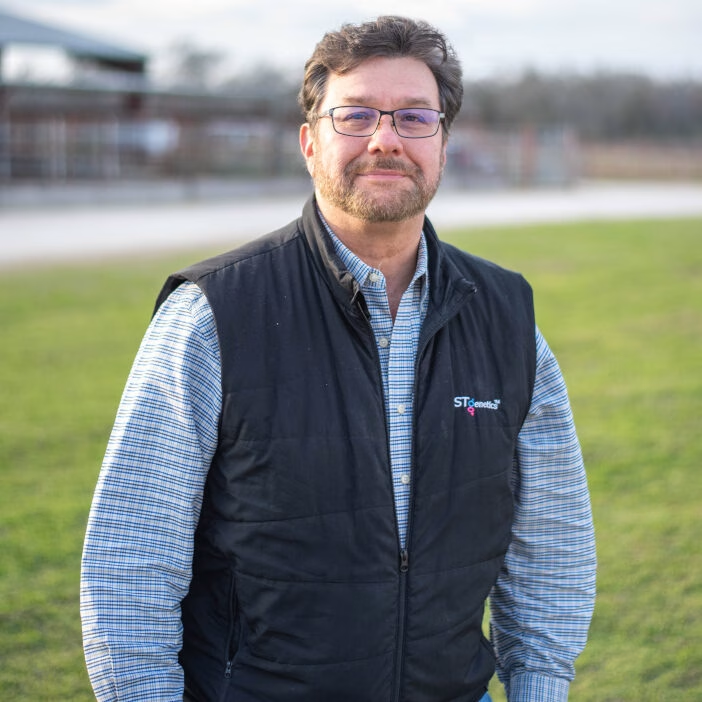
Juan Moreno, CEO of STgenetics, stands at the forefront of his company’s facilities where revolutionary genetic technologies are developed. Under his visionary leadership, Moreno has transformed the dairy breeding industry through innovations in sexed semen technology and genomic testing that have fundamentally changed how farmers approach herd genetics worldwide.
I’ve watched a lot of biotech companies come and go in this industry, but Juan Moreno’s different. Perhaps it’s because he began working on a Colombian cattle operation and understands what it’s like when breeding decisions go awry. (Read more: Bull in a China Shop: How Juan Moreno Turned the Dairy World Upside Down)
His sexed semen technology—now used in about 30% of worldwide sales according to industry tracking—isn’t just about predicting calf gender with 90%+ accuracy. It’s about fundamentally changing the economics of replacement heifer management.
Here’s the part that made me pull out my calculator: genomic testing costs around $30 to $ 50 per calf. Recent research in the Journal of Dairy Science research confirms 76% accuracy in predicting productive lifecycle outcomes. The economic analysis shows annual returns of $75-$ 150 per animal through the early identification and culling of individuals with poor genetic quality.
But Moreno breaks it down even simpler: “For the first 60 days, a calf costs about $5 per day. After that, roughly $2 daily for feed. So why wait two years and spend $1,400-1,500 to find out a heifer’s below average when you can spend $30 as a calf and know her genetic potential?”
The math works exceptionally well for operations managing 500+ breeding females, where genomic testing typically shows positive returns within 18-24 months according to Cornell Cooperative Extension economic analysis.
The catch? Smaller operations might not see immediate ROI, and the technology works best when paired with sophisticated management systems. For farms with fewer than 200 cows, the benefits may not outweigh the costs without first making significant improvements in other management areas.
His EcoFeed innovation, which won the 2024 International Dairy Federation’s Innovation in Climate Action award, targets feed efficiency improvements of 8-10%. Given that feed represents 55% of most operations’ total costs, even modest improvements translate to significant savings.
What really impressed me about Moreno’s approach is his emphasis on regional adaptation. He’s brutally honest about limitations: “I don’t believe in the concept of a super cow. Farmers have different priorities depending on location and markets.”
Jim Mulhern: The Policy Architect Who Built the Dairy Safety Net

Jim Mulhern speaks on Capitol Hill: Leading with calm resolve and a producer’s perspective during his transformational tenure at NMPF.
You may not know Jim Mulhern’s name, but you’ve likely felt the impact of his work. Forty-five years in dairy policy, most recently as CEO of the National Milk Producers Federation, and his fingerprints are all over the programs that kept operations running during the worst market downturns. (Read more: More Than Policy: For Jim Mulhern, Legacy is Measured One More Season at a Time)
The Dairy Margin Coverage program alone has distributed over $2 billion since its inception. During COVID-related market crashes, DMC payments provided critical cash flow for thousands of operations when milk prices collapsed and feed costs stayed high.
USDA Farm Service Agency data shows DMC enrollment grew from 18,000 operations in 2019 to over 23,000 in 2024, covering approximately 85% of U.S. milk production. Those aren’t just statistics—they represent real farms that stayed in business instead of going to auction.
But Mulhern’s impact goes beyond safety net programs. The Federal Milk Marketing Order reforms he shepherded reduced milk price volatility by 8-12% in most markets, according to USDA Agricultural Marketing Service analysis. That means more predictable cash flow, easier financial planning, and reduced need for expensive hedging strategies.
The ongoing challenge? Not everyone’s happy with the FMMO reforms. Vermont producers continue to complain about Class I differentials, while Western operations question the fluid milk pricing mechanisms. The reform process wasn’t pretty—months of stakeholder negotiations, regional conflicts, and compromises that satisfied no one completely. As one co-op chair told me, “Predictable beats chaos in my mailbox every time,” but the debate continues.
Your Next Steps: Making These Lessons Work
Look, I know it’s easy to read about 20,000-cow operations, cutting-edge genetics, and Washington policy-making and think, “That’s interesting, but what about my 300-cow farm in Ohio?”
Here’s the thing—the principles scale down better than you might think.
Start with the McCarty approach to standardization: select one health protocol, one feeding schedule, and one breeding strategy, and implement them consistently across all your facilities. Track the same metrics the same way. Most importantly, invest in your people. According to the National Association of State Departments of Agriculture workforce studies, dairy operations offering competitive benefits and clear advancement paths show significantly lower turnover rates.
Consider Moreno’s genetics strategy: If you’re managing 200+ breeding females, the genomics economics usually work. But don’t chase every new technology—focus on traits that matter for your specific conditions. Heat tolerance in the Southeast, grazing efficiency in pasture-based systems, and component quality for premium markets.
Use Mulhern’s risk management tools: DMC premiums range from $0.05 to $ 0.20 per hundredweight, depending on the coverage. These aren’t just insurance costs—they’re investments in business stability. Operations using multiple risk management tools show 12-18% less income volatility over 10-year periods.
The Bottom Line
Environmental pressure will intensify. Labor markets will tighten further. Market consolidation will accelerate. Consumer preferences will continue shifting. Climate variability will require more sophisticated risk management.
The question isn’t whether change is coming—it’s whether you’ll help shape that change or simply react to it.
These three leaders chose to be proactive, and their recognition at World Dairy Expo reflects the value of that approach. The same opportunities exist for producers willing to think strategically about the future of their operations.
So pour yourself that cup of coffee, take a walk through your facility, and start thinking about what your next chapter looks like. The dairy industry’s future depends on the decisions being made right now in operations just like yours.
Key Takeaways:
- McCartys show that scalable success comes from blending technology, sustainability, and people investment. Their employee retention and data standardization approaches work at any scale, even if processing plants don’t.
- Moreno’s genomic advances revolutionize breeding and reduce environmental impact – Sex-sorted semen and genomic testing deliver measurable ROI for farms with 200+ cows while cutting feed costs and emissions.
- Mulhern’s policy work stabilizes dairy through safety net programs amid volatility – DMC enrollment, covering 85% of U.S. production, proves that policy can provide real financial protection during downturns.
- Start with standardized protocols, targeted genomics, and risk management tools – Pick one health protocol to standardize, consider genomic testing if you manage 200+ breeding females, and use DMC/LRP programs as business stability investments.
- Future success depends on combining strong roots with an openness to innovation. Environmental pressures, labor challenges, and market shifts require operations that blend traditional values with strategic technology adoption.
Executive Summary:
Examine the groundbreaking contributions of three dairy industry leaders recognized at the 2025 World Dairy Expo: the McCarty family (Producer of the Year), Juan Moreno (International Person of the Year), and Jim Mulhern (policy legacy recognition). The McCartys demonstrate how blending innovative technology, sustainable practices, and deep investment in employee retention can create scalable success, transforming from a 15-cow Pennsylvania operation to a 20,000-cow multi-state enterprise with remarkable employee retention rates and environmental achievements. Juan Moreno’s advancements in genomic testing and sexed semen technology have revolutionized breeding strategies, delivering measurable economic returns (-150 per animal annually) while reducing environmental impact through improved feed efficiency. Jim Mulhern’s extensive policy work has strengthened vital dairy safety net programs, such as DMC, which now covers 85% of U.S. milk production and has distributed over $2 billion during market downturns, while also stabilizing milk price volatility through Federal Milk Marketing Order reforms. The article offers practical guidance for dairy producers, emphasizing the importance of data standardization, strategic adoption of genomic technology for operations with 200 or more breeding females, and leveraging available risk management tools, such as DMC and LRP programs. These leaders exemplify how combining traditional farming values with strategic innovation can provide a roadmap for sustainable and resilient dairy farming amid intensifying environmental, labor, and market challenges. Their success stories offer both inspiration and actionable strategies for dairy operations seeking to thrive in an evolving industry landscape.
Learn More:
- How to Attract and Retain Exceptional Labor for Your Dairy Farm – This article provides a tactical, step-by-step guide on the practical strategies mentioned in the main article. It reveals specific methods for implementing a culture of retention through improved benefits, consistent training, and team communication, offering a clear roadmap for addressing labor challenges head-on.
- Global Dairy Market in 2025: Production Shifts, Demand Fluctuations, and Trade Dynamics – This piece offers a macro-level, strategic view of the global trends influencing the industry. It connects the policies discussed by Jim Mulhern to a broader economic context, helping producers understand how their operations fit into and are affected by global supply and demand shifts in 2025.
- Genomics Meets Artificial Intelligence: Transforming Dairy Cattle Breeding Strategies – Expanding on the genetics innovation of Juan Moreno, this article provides a forward-looking perspective on how AI and advanced genomics are poised to revolutionize herd management. It demonstrates how these emerging technologies will enable producers to make smarter, more precise breeding decisions for future profitability.
 Join the Revolution!
 Join the Revolution!
Join over 30,000 successful dairy professionals who rely on Bullvine Weekly for their competitive edge. Delivered directly to your inbox each week, our exclusive industry insights help you make smarter decisions while saving precious hours every week. Never miss critical updates on milk production trends, breakthrough technologies, and profit-boosting strategies that top producers are already implementing. Subscribe now to transform your dairy operation’s efficiency and profitability—your future success is just one click away.