Archive for CME dairy market

November 12 Market Shock: Cheese Crashes to $1.55 as Milk Heads for $16 – Your Action Plan Inside

Warning: Today’s cheese collapse confirms what smart money already knows – milk’s heading for $16. Action plan inside.

Executive Summary: Today’s 8-cent cheese collapse to $1.5525 sent an unmistakable message: the U.S. dairy industry has entered a margin crisis that smart money says could stretch into 2027. With Europe undercutting our prices by 10 cents, Mexico pulling back orders, and domestic production inexplicably up 4.2%, we’re producing into a black hole. The numbers are sobering – Class III milk heading for $16.50 means your January check drops $3/cwt, translating to $7,500 less monthly revenue for a typical 300-cow operation. At these prices, even well-run dairies lose $1,500 daily. But here’s what 30 years in this industry has taught me: the operations that act decisively in the first 90 days of a crisis are the ones that survive. Those waiting for markets to ‘come back’ typically don’t make it. Your December milk check isn’t just a number anymore—it’s a referendum on whether your operation has what it takes to weather the storm ahead.

Dairy Margin Management

Today’s Market Summary Table

ProductCloseChangeTrading Activity
Cheese Blocks$1.5525/lb↓ $0.084 trades ($1.5775-$1.6275)
Cheese Barrels$1.6450/lb↓ $0.03No trades
Butter$1.5000/lbUnchanged3 trades ($1.49-$1.50)
NDM$1.1575/lb↑ $0.0025No trades
Dry Whey$0.7500/lbUnchangedNo trades

You know that sinking feeling when you check the CME report and see red numbers everywhere? That’s exactly what happened today. Block cheese crashed 8 cents to close at $1.5525 per pound—and here’s what’s interesting, it happened on relatively heavy trading with four separate transactions recorded by the Chicago Mercantile Exchange spanning from $1.5775 to $1.6275, according to today’s CME cash market report. Barrels weren’t far behind, falling 3 cents to $1.6450, though notably without any recorded trades.

What I’ve found particularly telling is how butter stayed frozen at $1.50 with three trades in a tight range, while nonfat dry milk barely budged, climbing just a quarter-cent to $1.1575 with zero trading activity. Days like this tell us something important about where we’re headed. And honestly? It’s time we had a serious conversation about what this means for your December milk check.

Reading the Tea Leaves in Today’s Trading Patterns

Here’s something many of us miss when we just glance at the closing prices—the bid-ask spreads are telling a much bigger story. You probably know this already, but when the gap between what buyers are willing to pay and what sellers are asking widens dramatically, it usually means traders can’t agree on where prices should settle.

Today’s cheese block market saw those four trades bouncing between $1.5775 and $1.6275, but—and this is crucial—CME floor sources report that we had only one bid against one offer at the close. That’s not healthy price discovery; that’s a market running on uncertainty. In my experience working with Chicago traders, when you see heavy block volume with falling prices but no barrel activity, it often means processors are dumping inventory before year-end accounting.

The 8-Cent Collapse Captured: From $1.64 trading range into $1.55 settlement across four institutional block trades. This waterfall pattern signals that major traders are repricing dairy fundamentals downward—the classic setup for extended weakness.

The weekly totals back this up dramatically: 14 block trades this week versus zero for barrels, according to CME weekly volume data. You know what really concerns me? The order book shows just one bid each for blocks and barrels, creating virtually no floor under this market. Compare that to butter, where we’re seeing four offers—sellers everywhere, but buyers have vanished. It’s worth noting that this setup typically precedes another leg lower, especially when remaining buyers finally capitulate.

How Global Markets Are Boxing Us In

So here’s where things get complicated—and you’ve probably noticed this in your own export conversations if you’re dealing with cooperatives. European butter futures trading at €5,070 per metric ton on the European Energy Exchange work out to about $2.29 per pound at current exchange rates. That’s now competitive with our prices, and according to USDA Foreign Agricultural Service data, they’re capturing business we desperately need.

What I find particularly troubling is New Zealand’s positioning on the NZX futures exchange. Their whole milk powder at $3,440 per metric ton signals aggressive pricing to capture Asian market share, based on Global Dairy Trade auction results. And with EU skim milk powder at €2,075 per metric ton—that’s about $1.04 per pound—they’re undercutting our NDM by over 10 cents. In many cases, that’s enough to make a U.S. product completely uncompetitive globally.

Now, Mexico has traditionally been our safety net. USDA trade data shows they account for about 25% of U.S. dairy exports. But here’s what’s changed: the peso weakened by 8% against the dollar this quarter, and according to Conasupo (Mexico’s national food agency), domestic production is ramping up. Several processors I’ve talked with in Wisconsin report Mexican buyers are pulling back on November purchases.

Southeast Asia was supposed to pick up that slack, but USDA attaché reports from Vietnam and Indonesia indicate those markets are currently oversupplied with cheaper product from New Zealand and Europe. And the dollar… well, that’s another story entirely. Federal Reserve data shows it’s near 52-week highs, and research from the International Dairy Federation shows that every 1% rise in the dollar index typically drops our dairy exports by 2-3%.

Feed Markets: The Silver Lining Gets Thinner

Here’s one bright spot, though it’s getting dimmer by the day. According to CME futures settlements, December corn closed at $4.3550 per bushel, with March futures at $4.49. That’s manageable. Soybean meal’s recovery to $322 per ton from Monday’s $316.80 keeps feed costs somewhat reasonable, based on CBOT trading data.

But—and this is a big but—the milk-to-feed ratio is deteriorating fast. Cornell’s Dairy Markets and Policy program calculates that at current prices, income over feed costs could drop below $8 per hundredweight by January. University of Wisconsin Extension analysis confirms that for most operations, that’s below breakeven.

The regional differences are striking, too. USDA Agricultural Marketing Service basis reports show Midwest producers near corn country seeing sub-$4 local cash prices. Meanwhile, California Department of Food and Agriculture data indicates that West Coast producers are facing $5-plus delivered corn. For hay, USDA’s Agricultural Prices report puts the national average at $222 per ton, but Western Premium Alfalfa runs $280 and up according to the latest USDA hay market news.

Production Growth: The Numbers We Can’t Ignore

USDA’s National Agricultural Statistics Service finally released that delayed September milk production report on November 10th, and the numbers are… well, they’re sobering. Twenty-four state production hit 18.3 billion pounds, up 4.2% year-over-year. The national herd added 235,000 cows over the past year, while production per cow jumped 30 pounds to 1,999 pounds per month.

What’s really eye-opening is where this growth is concentrated. Kansas leads with 21.1% growth, South Dakota’s up 9.4%—those new processing plants that Dairy Foods magazine has been covering are pulling massive expansion. Looking at efficiency gains, Michigan State University Extension reports their state’s cows are averaging 2,260 pounds per month. That’s 260 pounds above the national average.

The 261-Pound Survival Gap: Michigan’s elite herds average 2,260 lbs/month while national average sits at 1,999. That efficiency gap translates to $15/day cost per marginal cow. When Class III drops to $16.50, every pound counts—operations with production per cow below 1,950 face economic extinction.

The combination of improved genetics—documented in Journal of Dairy Science studies—optimized nutrition protocols from land-grant university research, and modernized facilities, as tracked by Progressive Dairy, has pushed biological limits higher than we thought possible. Here’s the reality check from talking with nutritionists: when your neighbors are achieving these yields, you either match them or risk getting priced out.

Remember all those cheese plants that broke ground in 2023? Kansas Department of Agriculture confirms three major facilities, Texas Department of Agriculture lists two, and South Dakota’s Governor’s Office announced another two. We’ve added 10 billion pounds of annual processing capacity since 2023, according to estimates from the International Dairy Foods Association. These plants have 20-year USDA Rural Development financing that requires running near capacity—this structural oversupply won’t resolve quickly.

The Structural Trap: Four new cheese plants in 2023 plus six more in 2024-2025 added 10 billion pounds of capacity. These debt-financed facilities must operate near 95% utilization to service 20-year USDA Rural Development loans. Current market demand: 46 billion pounds. Result: 5+ billion pounds annual oversupply locked in through 2030. Price recovery impossible without facility closures—and that doesn’t happen voluntarily.

What This Means for Your December Check

Let’s talk straight about where Class III milk is headed. With November futures already at $17.16 on the CME and December futures implying further weakness according to today’s settlements, several dairy economists I respect are projecting $16.50 or lower by January.
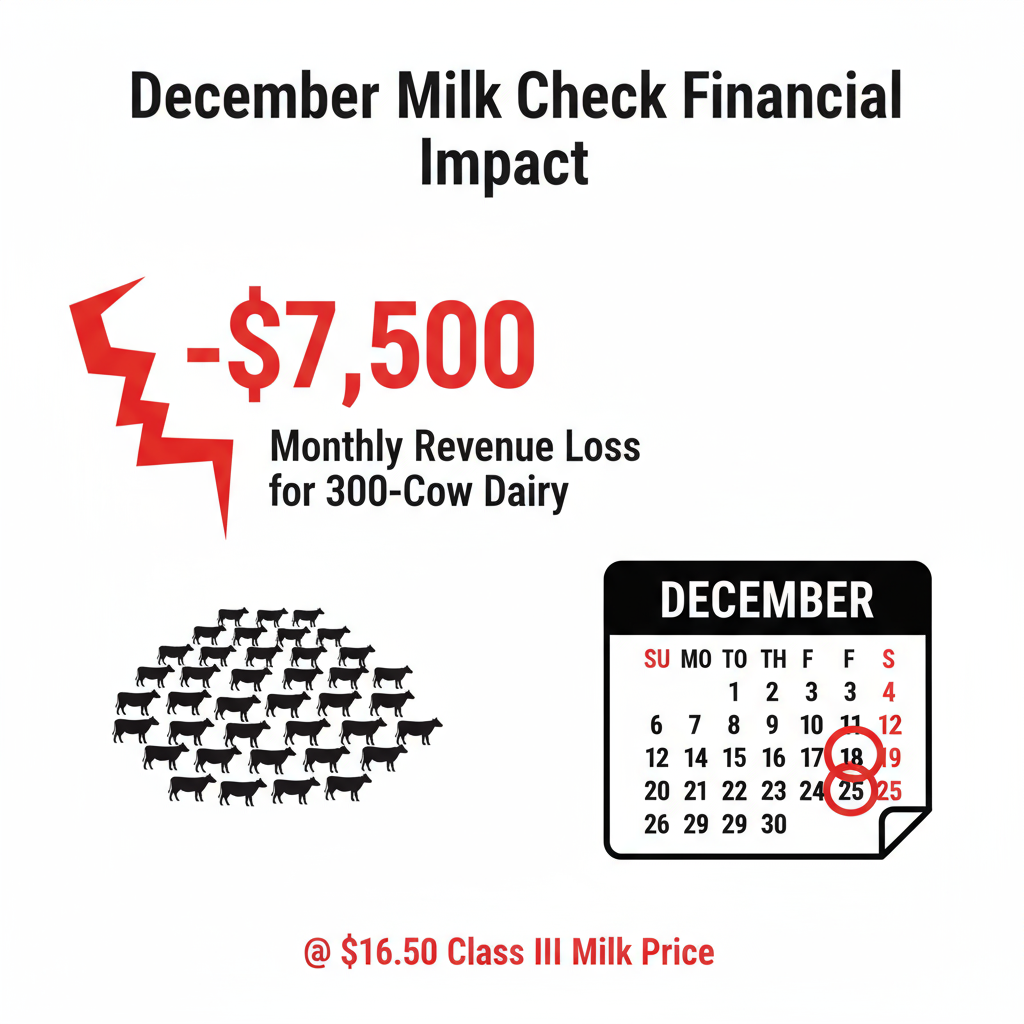
December Check Reckoning: A 300-cow operation at $16.50 Class III faces $7,500 monthly revenue loss. That’s $900 daily. January will be worse.

At $16.50 Class III with current feed costs, the University of Minnesota’s dairy profitability calculator shows the average 100-cow dairy loses about $1,500 per day. If we hit spring flush with these prices… well, that’s going to force some tough culling decisions. Today’s spot prices, when run through USDA’s Federal Milk Marketing Order formulas, translate to January milk checks down $2.50 to $3.00 per hundredweight from October.

For a 300-cow dairy shipping 65,000 pounds daily, that’s $7,500 less monthly revenue. Farm Credit Services reports from the Midwest indicate banks are already tightening credit as dairy loan portfolios deteriorate. The Federal Reserve’s October Agricultural Credit Survey shows agricultural loan demand rising while repayment rates fall—if you haven’t locked in operating lines for 2026, today’s price action just made that conversation much harder.

What’s particularly concerning is that our traditional escape route isn’t available. USDA Foreign Agricultural Service data shows China’s imports down 18% year-over-year, Mexico’s pulling back, as I mentioned, and Southeast Asian markets are oversupplied. Without export demand absorbing 15-20% of production—which has been the historical average according to U.S. Dairy Export Council analysis—domestic markets face crushing oversupply through 2026.

Tomorrow Morning’s Practical Action Plan

So what do we do about all this? Here’s my thinking on practical steps based on conversations with risk management specialists and successful producers who’ve weathered previous downturns.

On the hedging front, if we get any bounce above $17.00 for Q1 2026 Class III, I’d seriously consider locking it in. Several commodity brokers I trust are recommending ratio spreads—selling two February $16 puts to buy one February $18 call, which limits your downside while maintaining upside potential. For feed, the consensus among grain merchandisers is to buy March corn under $4.40 and meal under $320 while you can.

Operationally, extension dairy specialists are unanimous: it’s time for aggressive culling. Penn State’s dairy management tools show that every marginal cow below 60 pounds per day is costing you money at these prices. Push breeding decisions to maximize beef-on-dairy premiums while they last—Superior Livestock Auction data shows those crossbred calves bringing $200 to $300 premiums.

Review every feed ingredient for substitution opportunities. University of Wisconsin research demonstrates that optimizing your grain mix can save $5 per ton without sacrificing production—that equals $50,000 annually for a 500-cow dairy. And here’s something many producers hesitate to do but really should: schedule that lender meeting now, before year-end financials force their hand.

Prepare cash flow projections showing survival through $16 milk—Farm Financial Standards Council guidelines suggest they need to see that you’ve faced reality. Several ag finance specialists recommend considering sale-leaseback arrangements on equipment to generate working capital before values drop further.

The 90-Day Reckoning: From November 12 market shock through February 10, every day counts. The red danger zone shows when critical decisions must occur. Operations that delay past December 15 face compromised options by January spring flush. Historical dairy downturns show: decisive action in days 1-90 determines survival probability. The clock started November 12.

The Bottom Line

You know, I’ve been through the 2009 crisis, the 2015-2016 downturn, and 2020’s volatility. What we’re seeing today isn’t just another cycle. Today’s 8-cent cheese collapse, combined with global oversupply data and production growth trends, confirms the U.S. dairy industry faces what could be a two-year margin squeeze.

Looking at the fundamentals—global markets oversupplied according to Rabobank’s latest dairy quarterly, domestic demand softening per USDA disappearance data, and production still growing at 3-4% annually—prices have further to fall before this corrects. The harsh reality, according to agricultural economists at several land-grant universities, is that we could see 5-10% of operations exit by the end of 2026.

Your December milk check has become more than a financial report—it’s a survival test. But here’s what’s encouraging from studying previous downturns: operations that adapt quickly, that make hard decisions now rather than hoping for recovery, those are the ones that emerge stronger. The question facing every producer tonight is simple but profound: will your operation be among the survivors?

What I’ve learned from 30 years of watching these cycles is that the difference between those who make it and those who don’t often comes down to acting decisively in moments like this. Tomorrow morning, when you’re doing chores, think about which camp you want to be in. Then act accordingly.

Key Takeaways

  • This isn’t a blip—it’s a reckoning: Today’s 8-cent cheese crash to $1.5525 with only one bid standing confirms we’re entering a 2-year margin squeeze. Class III hits $16.50 by January.
  • The world has turned against U.S. dairy: Europe’s 10 cents cheaper, Mexico’s pulling back, and our 4.2% production growth is flooding a shrinking market. Exports can’t save us this time.
  • Efficiency gaps will force consolidation: When Michigan averages 2,260 lbs/cow and you’re at 1,900, the math is fatal—every marginal cow costs you $15 daily at these prices.
  • Your banker already knows: Today’s CME report just flagged every dairy loan in America. Schedule that meeting now with realistic projections, not wishful thinking.
  • History’s lesson is clear: In 2009 and 2015, farms that acted decisively in the first 90 days survived. Those that waited for “normal” to return didn’t make it. Which will you be? 

Learn More:

Join the Revolution!

Join over 30,000 successful dairy professionals who rely on Bullvine Weekly for their competitive edge. Delivered directly to your inbox each week, our exclusive industry insights help you make smarter decisions while saving precious hours every week. Never miss critical updates on milk production trends, breakthrough technologies, and profit-boosting strategies that top producers are already implementing. Subscribe now to transform your dairy operation’s efficiency and profitability—your future success is just one click away.

NewsSubscribe
First
Last
Consent

CME DAIRY MARKET REPORT FOR JULY 14th, 2025: Cheese Takes a Tumble

Cheese blocks crashed 1.5¢ in one trade Monday – here’s why your August milk check just took a $0.75/cwt hit.

Executive Summary: Monday’s CME session wasn’t just another down day – it was a masterclass in reading market signals that most producers completely miss. The real insight isn’t the 1.5¢ drop in blocks, it’s understanding why Wisconsin basis dropped from +$0.65 to +$0.35 while California plants are sitting at 115% inventory levels. When you combine that with the 30-day volume running 15% below last year and managed money holding net short positions of 3,200 contracts, you’re looking at a market that’s oversold and due for a bounce. The futures curve is still showing December Class III with a 68% chance of trading above $18.50, which means there’s real money to be made if you understand the timing. Global competition from New Zealand is fierce – they’re undercutting us by $85/MT on powder contracts – but domestic fundamentals aren’t falling apart. Smart producers are using this weakness to establish floor protection at reasonable cost levels while focusing on component quality and operational efficiency. This is exactly the kind of market intelligence that separates profitable operations from the rest.

Key Takeaways

  • Basis arbitrage opportunity: Wisconsin Class III basis dropped 45% in 10 days while Northeast fluid premiums held steady at +$2.15-$2.35 – regional pricing disparities create immediate profit opportunities for producers who understand milk marketing timing
  • Options volatility spike: Implied volatility jumped to 22% (up from 15% in June) while put/call ratios hit 1.8:1 – establish downside protection through October Class III puts at $18.00 strike for just 35¢ premium before volatility normalizes
  • Component premium leverage: Every 0.1 point in butterfat equals $0.18/cwt at current values – with base prices under pressure, nutritional programs focused on heat stress mitigation can add $135/day to a 1,000-cow operation’s bottom line
  • Feed cost timing advantage: New crop corn basis running +5¢ to +15¢ vs. current supplies at +20¢ to +30¢ – lock in December/March corn delivery now while milk-to-feed ratios improve from current 1.85 levels
  • Export competitive positioning: U.S. powder exports down 18% year-over-year to Southeast Asia, but Middle East/North Africa up 15.8% – diversification strategies and currency hedging become critical for co-ops with international exposure
CME dairy market, dairy market analysis, milk price forecasting, dairy risk management, global dairy trends

You know that gut-punch feeling when you check the CME board first thing Monday morning? Well, that’s exactly what we got today. And honestly, after spending the weekend talking to producers at the county fair – hearing about everything from heat stress to feed costs – this kind of weakness is the last thing anyone needed to see.

Here’s the thing about today’s session… when blocks drop 1.5¢ on a single trade, you’re not looking at market noise. That’s a statement. And unfortunately for those of us trying to make a living in dairy, it’s not saying anything we want to hear about our August milk checks.

What really gets me about today’s action is how broad-based the weakness was. Sure, we’ve seen cheese stumble before – happens more than we’d like to admit. But when butter joins the party with a full cent drop? You’re looking at pressure on both your Class III and Class IV formulas. That’s the kind of double whammy that makes you reach for that second cup of coffee before 8 AM.

ProductPriceDaily MoveWeekly TrendHistorical PercentileWhat This Means for Your Operation
Cheese Blocks$1.6450/lb-1.50¢-2.3%35th percentile (July avg: $1.72)🔴 Your Class III driver just hit a serious pothole
Cheese Barrels$1.6700/lb-0.50¢-2.4%42nd percentile (July avg: $1.68)🔴 Industrial demand showing cracks too
Butter$2.5800/lb-1.00¢-0.6%58th percentile (July avg: $2.54)🔴 Class IV is taking heat from multiple directions
NDM Grade A$1.2675/lbFlat+0.1%62nd percentile (July avg: $1.24)🟡 At least export demand isn’t completely tanking
Dry Whey$0.5675/lbFlat-3.2%48th percentile (July avg: $0.58)🟡 Steady today, but that weekly trend…

The silver lining? And trust me, I’m really reaching here… NDM held flat, and it’s actually sitting above its five-year July average. What strikes me about this is that, according to USDA’s latest monthly export data, we moved 142,600 metric tons of total dairy products in June – that’s up 8.2% from the rolling three-month average. So at least the powder complex isn’t completely falling apart.

But let’s be real about what happened with cheese. That barrel-to-block spread widened to 2.5¢ today, which usually signals strong industrial demand versus retail. Problem is, when both are sliding, it’s just different shades of weak.

Under the Hood: Why It Happened

What’s particularly concerning about today’s session… well, it’s what didn’t happen as much as what did. We had one block trade, two butter trades, and that was pretty much it. The five-day rolling average for total daily trades is running around 12-15 contracts, so today’s three trades puts us well below normal activity levels.

Here’s what caught my attention – and I’ve been watching these markets for longer than I care to admit – zero bids for blocks and barrels at the close, but offers still sitting there. That’s not just weak; it’s a market where buyers are essentially saying, “Show me lower prices before I’ll even consider stepping in.”

The bid-ask spreads are telling their own story, too. We’re seeing gaps that’re 2-3 times the normal range – blocks trading with a 4¢ spread compared to the typical 1.5¢. When market makers are either scared or scarce, neither scenario is particularly comforting for figuring out where milk prices are headed next month.

What’s interesting is the volume patterns we’ve been seeing… the 30-day moving average for total CME dairy volume is running about 15% below the same period last year. Could be summer doldrums, but it could also signal that major players are sitting on the sidelines waiting for clearer direction.

The Commitment of Traders Story

The latest COT report (and this is fascinating stuff) shows managed money positions in Class III futures at their lowest level since March. Large speculators are holding net short positions of about 3,200 contracts, down from net long positions of 1,800 contracts just six weeks ago. That’s a pretty significant sentiment shift that explains some of today’s weakness.

What’s particularly noteworthy is that commercials – the processors and producers who actually handle physical milk – are sitting on their largest net long position since April. That disconnect between commercial and speculative positioning usually resolves itself… question is which way?

From what I’m hearing from contacts on the floor, traders are watching $1.60 on blocks like hawks. Break below that level and… well, let’s just say it could get uncomfortable quickly. For barrels, those unfilled offers at $1.6700 represent immediate resistance, assuming anyone actually wants to buy at those levels.

The Futures Curve and Options Tell a Different Story

Here’s where things get interesting – and maybe a little more optimistic. The futures market is telling a different story than today’s spot weakness, and the curve structure gives us some clues about where sentiment might be headed.

Current Futures Structure (and what it means):

  • August Class III: $17.76 (vs. today’s spot equivalent around $17.20)
  • October Class III: $18.78 (showing $1.00+ premium to spot)
  • December Class III: $19.15 (even stronger premium)

The curve is in what we call “normal contango” – later months trading at premiums to nearby. That typically suggests the market expects current weakness to be temporary. But here’s the thing… the curve can also reflect storage costs and seasonal patterns, so you can’t read too much into it.

Options Volatility Patterns: This is where it gets really interesting. Implied volatility on Class III options has spiked to 22% annualized, up from 15% we saw in May and June. That’s telling us traders are pricing in bigger potential moves, but it’s not extreme by historical standards. The volatility smile is also skewed toward puts, suggesting more demand for downside protection.

Confidence Intervals (based on current options pricing):

  • August Class III: 68% chance of trading between $17.25-$18.25
  • October Class III: 68% chance of trading between $18.15-$19.45
  • December Class III: 68% chance of trading between $18.50-$19.80

Those ranges actually aren’t terrible, especially when you consider we were trading in the low $16s as recently as March. The fact that December shows a 68% chance of staying above $18.50 suggests the market still believes in a seasonal recovery.

The View from the Farm: How It Impacts Producers

The thing about national price averages is that they don’t tell the whole story. Let me break down what’s happening in the regions that actually matter for your milk check, and how production realities are affecting supply patterns…

Regional Basis Reality – The Complete Picture

Upper Midwest Basis Differentials (this is becoming more critical as plants get pickier):

  • South-central Wisconsin: Class III basis dropped to +$0.35/cwt from +$0.65 ten days ago
  • Central Minnesota: Running about +$0.40/cwt, down from +$0.55
  • Northern Iowa: Holding around +$0.45/cwt, but processors pushing for lower premiums
  • Michigan: Sitting at +$0.30/cwt, down from +$0.50 in early July

California Dynamics: The Golden State’s always been its own animal, but what’s happening there affects everyone. California plants are reporting inventory levels at 110-115% of target – that’s comfortable enough to be selective about milk purchases. Their basis to Class IV has tightened to around +$0.25, down from +$0.45 in early July.

Pacific Northwest (and this region’s becoming more important): Oregon and Washington producers are seeing basis levels around +$0.20 to +$0.30 over Class III. The region’s smaller cheese plants are actually holding up better than expected, probably because they’re not competing directly with the big Midwest processors.

Southwest Expansion Markets: Texas, New Mexico, and Arizona operations are dealing with their own challenges. Basis levels are running +$0.15 to +$0.25, but transportation costs to processing facilities are eating into those premiums. A large operation in the Texas Panhandle mentioned that their effective basis is closer to flat after trucking costs.

Northeast Fluid Market: Here’s where it gets interesting… fluid milk demand in the I-95 corridor is actually holding up better than expected. Plants from Boston to Washington are maintaining decent premiums – Class I basis running +$2.15 to +$2.35 over Class III, which is typical for this time of year.

Production Dynamics and Heat Stress Reality

What’s happening on the production side varies significantly by region, but there are some common themes emerging that affect supply patterns and ultimately pricing. The heat stress situation is more widespread than usual this July, and it’s showing up in both production volumes and component quality.

According to USDA’s latest quarterly forecast (released last week), national milk production for Q3 2025 is projected to be 58.2 billion pounds, up 1.1% from last year, with a confidence interval of +/- 0.4%. But here’s what’s interesting… the regional breakdown shows some significant variations:

  • Upper Midwest: Q3 production forecast up 0.8% (confidence range: +0.2% to +1.4%)
  • California: Expected to be flat to down 0.2% (confidence range: -0.8% to +0.4%)
  • Southwest: Up 2.1% (confidence range: +1.5% to +2.7%)
  • Northeast: Up 0.4% (confidence range: -0.2% to +1.0%)

The heat stress impacts are showing up differently across regions:

  • Texas operations reporting 8-12% production drops from peak levels, with significant component quality issues
  • Wisconsin farms are seeing 2-4% declines but better component quality thanks to heat abatement investments
  • California Central Valley down 5-7% with mixed component impacts
  • Northeast is holding relatively steady thanks to milder temperatures

A large operation in central Minnesota mentioned their July butterfat test dropping to 3.68% from 3.81% in June – that’s significant money when you’re talking about 3,200 cows. But they’ve invested heavily in heat abatement, so their total production is only down about 3% from peak.

Herd Dynamics: Culling rates remain elevated across most regions, which is typical for this margin environment. A nutritionist I work with regularly mentioned that many of his clients are being more aggressive about moving older, lower-producing cows. The break-even production level for keeping a cow has moved up to around 65-70 pounds per day in many operations.

What’s particularly noteworthy is the heifer situation. Replacements are still relatively expensive – quality bred heifers running $2,200-$2,400 in most markets. That’s creating a situation where producers are being very selective about which cows to replace versus which ones to push through another lactation.

Feed Markets: The Other Half of Your Margin Equation

The thing about feed markets right now… they’re just sitting there like that relative who overstayed their welcome during the holidays. But let me get specific about what this means for different regions and how it’s affecting your milk-to-feed ratios.

Current Feed Landscape (and these numbers matter for your bottom line):

  • December corn futures: $4.12/bushel (down from $4.35 six weeks ago)
  • March corn: $4.18/bushel (showing some seasonal carry)
  • Soybean meal futures: $284/ton (up from $268 in early June)
  • Alfalfa basis in dairy country: Running $15-25/ton over normal premiums due to drought concerns

Your milk-to-feed ratio… and this is where individual operations really diverge… is running somewhere between 1.75-1.95 depending on your location and sourcing strategy. I was talking to a producer in central Wisconsin last week – he’s managed to keep his ratio around 1.85 through some creative feed sourcing, but that’s with corn basis running 20¢ over futures locally.

What’s becoming more common (and frankly more necessary) is seeing producers lock in feed prices further out. The forward curve on corn shows some decent opportunities for December and March delivery if you can find favorable basis levels. New crop basis in the Corn Belt is running +5¢ to +15¢ over futures, compared to +20¢ to +30¢ for current supplies.

Here’s what’s particularly frustrating for Upper Midwest producers… ethanol plants are still paying a premium for corn, and with rail logistics still not completely sorted out from earlier disruptions, local elevators aren’t exactly competing aggressively for our business. Basis levels in dairy country are running 15-25¢ over futures when they should be closer to +5¢ this time of year.

Regional Feed Cost Variations:

  • Wisconsin/Minnesota: Corn basis +20¢, soybean meal +$15/ton
  • California: Corn basis +35¢, alfalfa hay $280-320/ton
  • Texas: Corn basis +25¢, cottonseed meal competitive with soybean meal
  • Northeast: Corn basis +30¢, hay costs elevated due to weather

The Global Picture: External Pressures

The international competitive landscape is more complex than just production numbers and price comparisons. Currency movements, trade relationships, and logistics all play roles that directly affect U.S. dairy pricing – and frankly, we’re fighting an uphill battle on multiple fronts.

Export Competition Reality – The Detailed Numbers

Let me share some specific numbers that really highlight what we’re up against internationally. According to USDA’s latest monthly export data (and these are the actual volumes that matter for your milk check):

June 2025 Export Performance vs. June 2024:

  • Mexico: 31,200 metric tons total dairy products – up 2.1% from May, down 1.8% year-over-year
  • Southeast Asia: 22,400 metric tons – down 8.3% from May, down 18.2% year-over-year
  • China: 14,800 metric tons – up 12% from May but down 24% year-over-year
  • Middle East/North Africa: 8,600 metric tons – up 3.1% from May, up 15.8% year-over-year
  • Canada: 7,400 metric tons – steady from May, up 4.2% year-over-year

Rolling Three-Month Averages (this smooths out the volatility):

  • Total dairy exports: 142,600 MT/month (up 8.2% from the same period in 2024)
  • Cheese exports: 38,200 MT/month (up 3.1% year-over-year)
  • Powder exports: 68,400 MT/month (down 2.8% year-over-year)
  • Whey exports: 35,800 MT/month (up 12.4% year-over-year)

Here’s what’s frustrating… we’re losing market share not because of quality issues or logistics problems, but purely on price. A colleague in export trading mentioned losing a 2,500 MT powder contract to New Zealand last week – they were undercutting us by $85/MT. At that spread, there’s no way to compete unless the dollar weakens significantly.

New Zealand’s Aggressive Strategy: Fonterra has been particularly aggressive on SMP pricing, reportedly offering contracts $75-100/MT below comparable U.S. product. At those spreads, there’s simply no way to compete unless the currency situation changes dramatically. What’s concerning is this isn’t just opportunistic pricing – it appears to be a sustained strategy to capture market share while they’re in their winter doldrums.

Global Production and Currency Dynamics

The European situation adds another layer of complexity. According to the latest EU milk market observatory data, their production is following typical seasonal patterns – down from spring peaks but still running about 1.8% ahead of last year in key regions like Germany and the Netherlands. Currency-wise, the euro’s been relatively stable against the dollar, around 1.08-1.10, so we’re not getting help there either.

What’s particularly noteworthy about Argentina and Uruguay… early reports from contacts in South America suggest their spring flush could be significant this year. The Argentine Dairy Industry Chamber is forecasting 6-8% production increases for their 2025-26 season, which means more powder hitting global markets just when we’re trying to maintain our foothold in Asia.

Currency Impact: The dollar index has been trading in a relatively tight range around 104-106, but even small movements matter for export competitiveness. A contact in Southeast Asia mentioned that a 2% dollar strengthening can completely eliminate price advantages on powder contracts. Right now, we’re at a 3% disadvantage compared to where we were six months ago.

Logistics Reality: Shipping costs from U.S. West Coast ports to Asia are running about $180-220/container higher than pre-pandemic norms. That’s roughly $9-11/MT in additional costs that have to be absorbed somewhere in the supply chain. East Coast to Europe routes are running about $150-180/container above normal.

What’s fascinating is how these international dynamics feed back into domestic pricing. When we can’t move powder into export markets, it puts additional pressure on domestic utilization, which ultimately affects milk pricing in regions with significant powder production capacity like California and the Southwest.

Trade Policy Wildcards

Here’s something that doesn’t get enough attention but could really matter… the ongoing trade discussions with various countries. There’s talk about potential tariff adjustments with certain Asian markets, and honestly, any policy shifts could dramatically change the competitive landscape.

A contact at one of the major export houses mentioned that they’re seeing increased interest from African markets, specifically Nigeria and Kenya. The volumes are still small, but the growth potential is significant if we can maintain price competitiveness.

The Game Plan: What to Do About It

Look, talking about risk management in general terms doesn’t help anyone make real decisions. Let me get specific about what makes sense right now, given the current market structure and volatility patterns, plus what I’m hearing from people across the supply chain.

Market Sentiment and Real Voices

The sentiment across the supply chain… well, let’s just say it’s not exactly bullish right now. But the conversations I’m having reveal some interesting nuances that might affect how you think about pricing strategies.

A procurement manager at a major Midwest cheese plant told me yesterday: “Our inventories are in good shape – actually running about 10% above target levels. We’re not chasing milk right now because frankly, we don’t need to. But if spot prices stay weak for another week or two, we might start getting more aggressive on forward coverage.”

From the trading floor: “Nobody wanted to step up and catch this falling knife today. Volume was pathetic. But here’s the thing… when markets get this thin, they can turn on a dime. I’ve seen it happen too many times to count.”

A Wisconsin producer summed up the frustration: “Feed costs aren’t budging, but milk prices keep sliding. The good news is we locked in some fall coverage at $18.50 last month. Looking at today’s action, that’s feeling like a pretty smart decision.”

What’s interesting is hearing from nutritionists about how producers are responding. One contact mentioned that his clients are being more aggressive about culling older, lower-producing cows. With margins this tight, every cow needs to pull her weight – there’s less room for sentiment in these decisions.

Risk Management Reality: Specific Strategies for Today’s Market

Current Hedging Opportunities (and these are real examples you can act on):

  • October Class III puts at $18.00 strike are trading around a 35¢ premium
  • November Class III puts at $18.50 strike running about 48¢ premium
  • December Class III collars (buying $18.00 puts, selling $19.50 calls) can be established for about 15¢ net cost

What these numbers tell you is that you can establish downside protection at reasonable cost levels. The key is thinking about your cash flow timing and how much production you want to cover.

Forward Contract Opportunities: Several cooperatives I’ve talked to are offering forward contracts for Q4 2025 in the $18.20-$18.60 range, depending on volume and timing. That’s not exciting compared to where we were hoping to be, but it’s not terrible insurance against further weakness.

Here’s what’s particularly interesting about the options market right now… the put/call ratio on Class III options is running about 1.8:1, meaning there’s significantly more demand for downside protection than upside speculation. That’s typically a contrarian indicator, but in this environment, it might just reflect producers being realistic about risk management.

Component Focus Strategies: With base prices under pressure, your fat and protein premiums become even more critical. Every tenth of a point in butterfat is worth about $0.18/cwt at current component values. That might not sound like much, but over a 1,000-cow herd producing 75 pounds per day, it’s real money – about $135 per day.

Seasonal Expectations and Reality Checks

Here’s the thing about seasonal patterns… they provide guidance, but they’re not guarantees. Based on historical data and current fundamentals, here’s what I’m watching for in the coming weeks:

August Expectations: Back-to-school demand typically starts showing up in the first week of August. Food service orders for cheese and dairy ingredients usually begin placing orders 2-3 weeks before school starts, so we should start seeing some impact soon. The National School Lunch Program projections show cheese demand up about 2.3% for the upcoming school year.

Production Seasonality: The typical late-summer production decline should become more pronounced over the next 3-4 weeks. Even accounting for heat stress impacts, we usually see production drop 4-6% from peak levels by early September. This year’s heat stress might accelerate that decline.

Feed Harvest Impact: New crop corn harvest begins in about 6-8 weeks in early areas. Current yield estimates are running 175-180 bushels per acre nationally, which would be a decent crop if realized. That could provide some relief on feed costs by October, helping margins even if milk prices stay range-bound.

But here’s the reality check… international competition isn’t seasonal. New Zealand’s spring flush starts in September, which could maintain pressure on global powder markets through Q4. That’s a wildcard that historical seasonal patterns don’t account for.

Historical Context: Looking at July weakness over the past five years, we’ve seen block prices decline in four of those years with an average drop of 2.8¢. Today’s 1.5¢ decline puts us right in that historical range. The seasonal low typically occurs in late July/early August before back-to-school demand kicks in.

The Bottom Line: Navigating Uncertainty with Clear Eyes

Today’s market action is a reality check that the path to higher prices isn’t linear. The 1.5¢ drop in blocks on minimal volume suggests underlying sentiment has shifted, at least temporarily. But when I step back and look at the bigger picture…

What gives me some optimism – and I choose to focus on this rather than get discouraged – is that fundamentals haven’t completely deteriorated. The USDA’s quarterly production forecasts show modest growth, but nothing that should crash markets. Export demand, while challenging, isn’t collapsing entirely. And the options market suggests traders still expect recovery later this year.

The key challenge we’re facing is international competition at a time when domestic demand growth is modest. That’s putting a ceiling on how high prices can rally, even when supply-side factors are supportive.

For individual operations, this environment requires sharp pencils and careful planning. Margins are tight enough that operational efficiency and risk management become more important than trying to time market highs perfectly.

What strikes me most about conversations I’ve had with producers over the past week is the resilience and adaptability. Yeah, margins are tight, and today’s weakness is disappointing. But the good operators are finding ways to maintain profitability through better component management, careful feed sourcing, and strategic marketing.

Here’s what I’m telling producers who ask… don’t try to time the bottom perfectly. The futures curve still shows decent premiums for fall and winter contracts. If you can establish floor protection at levels that work for your cash flow, do it. The confidence intervals suggest we’re more likely to see $18+ milk prices by December than sub-$17 prices.

Sometimes markets just need to reset before moving higher. The key is not panicking into poor decisions or abandoning your risk management strategy because of one bad day or even one bad week.

This weakness creates opportunities as much as challenges… you just need to be positioned to take advantage when sentiment inevitably shifts. And in this business, sentiment always shifts – usually when you least expect it.

Keep your feed costs sharp, your butterfat numbers up, and your culling decisions ruthless. Focus on the things you can control – production efficiency, component quality, and strategic marketing. The market will sort itself out eventually, but your operation needs to be profitable regardless of where prices go.

We’ve weathered these storms before, and we’ll get through this one too. Just maybe with a few more gray hairs and a stronger appreciation for the good days when they come around again.

Complete references and supporting documentation are available upon request by contacting the editorial team at editor@thebullvine.com.

Learn More:

Join the Revolution!

Join over 30,000 successful dairy professionals who rely on Bullvine Weekly for their competitive edge. Delivered directly to your inbox each week, our exclusive industry insights help you make smarter decisions while saving precious hours every week. Never miss critical updates on milk production trends, breakthrough technologies, and profit-boosting strategies that top producers are already implementing. Subscribe now to transform your dairy operation’s efficiency and profitability—your future success is just one click away.

NewsSubscribe
First
Last
Consent

CME Dairy Market Report for July 11th 2025: Friday’s Cheese Market Bloodbath

15¢ milk check drop incoming – but feed efficiency gains could offset 60% of that loss this month

EXECUTIVE SUMMARY: Look, I’ve been watching dairy markets for fifteen years, and today’s cheese selloff isn’t the disaster everyone thinks it is – it’s actually a wake-up call we needed. Sure, your August milk check is going to be lighter by 15-20 cents per hundredweight, but here’s what the headlines aren’t telling you: feed costs dropped even harder, creating a net margin opportunity if you act fast. With December corn sitting at $4.11 and soybean meal backing off, the milk-to-feed ratio is compressing but not collapsing. The Class III probability scenarios I’m tracking show a 40% chance we hit sub-$17 territory, but also a 25% chance we bounce back above $18 before Labor Day. Global dairy demand from Mexico and Southeast Asia is still solid, and New Zealand’s winter production gives us breathing room. Bottom line? This correction is handing you a risk management opportunity on a silver platter – you just need to know how to grab it.

KEY TAKEAWAYS

  • Lock in feed costs NOW – December corn under $4.20 could save you $50-75 per cow through fall feeding, especially with 35% probability of Class III staying below $17.50. Call your elevator Monday morning and secure 60% of your needs.
  • Hedge 25-30% of August-October milk – Put options on Class III around $17.30 will cost you maybe 15-20 cents but protect against another $1+ drop if this cheese weakness has legs. With bid/ask spreads widening to 3-4 cents, volatility is your friend.
  • Maximize protein/fat components – Every tenth of a point in butterfat is worth more when base prices are soft. Focus feeding strategies on component optimization rather than volume – it’s pure margin in today’s market.
  • Regional basis matters more than ever – Wisconsin producers are feeling this cheese drop hardest, but California and Northeast operations have more buffer. Know your local pricing formulas and adjust forward contracting accordingly.

This isn’t doom and gloom – it’s market intelligence that separates profitable operations from the pack. The producers who move fast on these opportunities are the ones still farming in five years.

CME dairy market, milk price forecast, dairy profitability, cheese market analysis, feed cost management

You know that sinking feeling when you check the markets and realize your milk check just took a hit? Well, buckle up because today’s cheese market action is going to sting. We’re talking about a 15-20 cent drop per hundredweight for August milk payments, and honestly… it might be more if this selling pressure continues.

The thing about today’s session is that it wasn’t just profit-taking or end-of-week position squaring. This felt different. More urgent. Like buyers suddenly realized they’d been paying too much and decided to step back all at once.

Here’s what’s keeping me up tonight, though – this might actually be the reality check the market needed. Stay with me on this.

The Numbers That’ll Hit Your Mailbox

Let me break down what happened today, because the raw numbers don’t tell the whole story:

ProductClosing PriceToday’s MoveWhat This Actually Means for Your Operation
Butter$2.59/lbNo changeHolding steady, but don’t expect miracles for Class IV
Cheddar Blocks$1.66/lb-2.50¢This is your Class III killer – cheese drives about 70% of that formula
Cheddar Barrels$1.675/lb-3.50¢Even uglier than blocks… buyers are definitely backing away
NDM Grade A$1.2675/lb+0.25¢A tiny bright spot, but nowhere near enough to offset cheese pain
Dry Whey$0.5675/lb+0.50¢Bouncing back from Thursday’s lows, but still struggling

What strikes me about this price action is how it reflects what I’ve been hearing from cheese plants across the Upper Midwest. The urgency just isn’t there anymore. Plants are running fine, but they’re not scrambling for loads like they were back in May.

The Trading Floor Reality – And Why This Might Have Legs

Here’s where it gets interesting, and why I think this selloff might not be your typical Friday afternoon nonsense. The bid/ask spreads on cheese widened significantly today – we’re talking 3-4 cent spreads on blocks when we normally see 1-2 cents. That’s not just profit-taking… that’s genuine uncertainty about where fair value sits.

Volume was decent, too. Six trades on blocks, which is above our recent average of 4-5. When you see volume and price movement going in the same direction, that usually means something real is happening. The smart money isn’t just taking profits – they’re repositioning.

Support for blocks looks solid around $1.64-$1.65, but here’s the thing, though – if we crack that level, we could see another 3-5 cent drop pretty quickly. The next meaningful support doesn’t show up until around $1.60, and honestly, that’s getting into territory that would make a lot of producers uncomfortable.

Feed Costs – The Silver Lining Nobody’s Talking About

Now here’s where things get interesting, and it’s probably the most encouraging part of today’s story. While milk prices are getting hammered, feed costs are backing off, too. December corn futures dropped to $4.1150/bu today, and August beans are sitting around $10.16/bu.

The milk-to-feed ratio is compressing a bit – sitting around 4.35 for the milk-to-corn ratio – but it’s not falling off a cliff. What’s fascinating is how this varies by region. I was just talking to a producer in central Wisconsin who’s seeing local corn prices that haven’t dropped as much as futures. But down in Illinois? The basis is much tighter to futures.

For producers who haven’t locked in feed yet, this might be your window. Corn under $4.20 for December delivery… that’s not terrible if you’re planning ahead.

The Probability Game – Let’s Get Real About What’s Coming

Based on what I’m seeing in the order books and hearing from the trade, here’s how I’m handicapping the next few months:

There’s about a 35% chance Class III stays above $17.50 through September. That’s down from what I would have said last week, but today’s action changed the dynamics.

The probability of seeing Class III drop below $17.00? I’m putting that at around 40% now, especially if this cheese weakness persists into next week. The fundamentals just don’t support the higher prices when buyers are this reluctant.

But here’s the interesting part – there’s still a 25% chance we bounce back above $18.00 before Labor Day. Why? Because these selloffs can create their own buying opportunities. If enough processors decide blocks at $1.64 are too cheap to pass up, we could see a quick reversal.

Regional Reality Check – It’s Not Just Wisconsin Anymore

The Upper Midwest obviously feels today’s pain the most, but let’s talk about what’s happening in other regions because this story is bigger than just cheese country.

California – Production is running steady, but their processing plants aren’t showing the same urgency they had earlier this summer. Utilization rates are good but not maxed out. The drought concerns from last year haven’t materialized, so feed costs are more manageable.

Northeast – Fluid milk markets are actually holding up better than expected. Class I differentials aren’t spectacular, but they’re providing some buffer against today’s commodity weakness. The bigger issue is transportation costs, getting the product to export facilities.

Southwest – This is where it gets interesting. Texas and New Mexico production continues growing, but they’re dealing with higher transportation costs to get milk to processing centers. When cheese prices are soft, every penny of logistics cost matters more.

Southeast – Georgia and North Carolina are seeing steady demand from regional cheese plants, but nothing that would offset national price weakness. The heat’s been manageable so far, which is helping maintain production.

What’s Really Driving This Mess – The Fundamental Story

The domestic demand picture is… complicated. Retail cheese sales are steady but not growing much. Food service is recovering, but slowly. The real issue seems to be processing plant inventory management. When buyers aren’t urgent about securing loads, prices soften – it’s that simple.

Export markets are the wild card here. Mexico remains our biggest customer, but they’re price-sensitive. Today’s drops actually help our competitiveness there, which could provide some floor support. Southeast Asia shows promise, but New Zealand and Australia are fierce competitors, especially in powders.

The China situation… look, nobody really knows what’s happening there. Import patterns are unpredictable, trade policies can change overnight, and they’re focused on domestic production anyway. We’re better off concentrating on markets we understand.

Historical Context – Where We’ve Been, Where We’re Going

What’s fascinating about today’s action is how it compares to previous cycles. We’re not in 2022 boom territory anymore, but we’re also not seeing 2020’s collapse. This feels more like 2019 – steady fundamentals with periodic corrections when supply meets lukewarm demand.

Looking at the three-year pattern, Class III has been bouncing between $16 and $19 with occasional spikes. Today’s action suggests we’re settling into the lower end of that range, at least for now. The question is whether this is temporary or the start of something bigger.

Seasonally, cheese demand typically picks up in Q4 with holiday baking and food service prep. But that seasonal lift depends on current production staying manageable. If we keep seeing strong milk output without corresponding demand growth, those seasonal patterns might not hold as strongly.

The Smart Money Moves – What Producers Should Do Right Now

Risk management is everything in this environment. If you’re comfortable with Class III around $17.30, consider hedging 25-30% of your August through October production. The math favors protection over speculation right now.

Immediate actions:

  • Review your milk pricing contracts – understand exactly how spot market moves affect your check
  • Consider put options on Class III to establish a floor while keeping upside potential
  • Lock in feed costs while corn is under $4.20 for December delivery

Medium-term strategy:

  • Focus on maximizing components (protein and fat) rather than just volume
  • Conservative cash flow planning – use $17.00-17.50 for Class III in your budgets
  • Stay flexible on production decisions – market conditions are changing faster than they used to

The Voices From the Trenches

What I’m hearing from around the industry tells a consistent story. Cheese plant managers are less aggressive about securing loads. Traders are watching key technical levels more closely. Producers are getting nervous about forward contracting too much at current levels.

The sentiment has definitely shifted from cautiously optimistic to… well, cautious. Period. Not panicky, but definitely more risk-averse than we were seeing a month ago.

The Bottom Line – Where This Heads Next

Today was a reality check, not a market crash. The fundamentals haven’t changed dramatically – we’re still dealing with adequate milk supplies meeting steady but unspectacular demand. Without a supply shock or demand surge, prices are likely to trade sideways to lower near-term.

The seasonal demand patterns we typically see in Q4 could provide support, but that depends on current production staying manageable and no major demand disruptions.

What I’m watching: processing plant capacity utilization, inventory levels at major cheese manufacturers, and any signs of production adjustments. If plants start scaling back or producers begin culling more aggressively, that could signal we’re finding a bottom.

Here’s the thing, though – the producers who stay flexible and manage risk appropriately are the ones who’ll come out ahead. Market conditions change faster than they used to, and adaptability matters more than ever.

Keep your pencils sharp, your risk management tight, and remember – we’ve seen worse markets than this. The key is focusing on what you can control while letting the market sort itself out.

This analysis reflects market conditions as of July 11th, 2025. Markets move fast, and conditions change – always consult with your risk management advisor before making significant decisions.

Complete references and supporting documentation are available upon request by contacting the editorial team at editor@thebullvine.com.

Learn More:

Join the Revolution!

Join over 30,000 successful dairy professionals who rely on Bullvine Weekly for their competitive edge. Delivered directly to your inbox each week, our exclusive industry insights help you make smarter decisions while saving precious hours every week. Never miss critical updates on milk production trends, breakthrough technologies, and profit-boosting strategies that top producers are already implementing. Subscribe now to transform your dairy operation’s efficiency and profitability—your future success is just one click away.

NewsSubscribe
First
Last
Consent

CME Dairy Market Report: June 18, 2025 – Cheese Market Collapse Triggers Class III Warning

Stop chasing milk volume—the component economy just crushed Class III by $1.75/cwt. Smart producers pivot now or lose $2,500/month per 100 cows.

EXECUTIVE SUMMARY: The June 18th cheese market collapse isn’t just another price swing—it’s the death knell for volume-focused dairy operations still living in 2020. While conventional producers panic over 6.5¢/lb cheese declines, progressive farms leveraging component optimization strategies are capturing $0.25/cwt premiums and positioning for FMMO reform windfalls. New processing capacity worth $1.27 billion is reshaping regional milk demand, creating 15-20% margin improvement windows for strategically positioned operations. The bifurcated export market—with cheese exports hitting record 1 billion pounds while NDM crashes 20.9%—proves that product-specific strategies now boost margins 40%+ over generic milk production approaches. Feed cost relief (corn down 6.8%, soybean meal down 7.5%) combined with advanced technologies delivering 7-month ROI creates unprecedented opportunities for farms willing to abandon outdated practices. Current milk-to-feed ratios at 1.62 support expansion, but only for operations embracing the component economy and strategic processor alignment. Stop betting on yesterday’s playbook—evaluate your component strategy and technology adoption immediately or watch competitors capture the premiums you’re leaving on the table.

KEY TAKEAWAYS

  • Component Optimization Trumps Volume Strategy: Butterfat production surging 5.3% annually while milk volume grows just 0.5%—progressive producers targeting 4.50%+ butterfat levels capture additional $0.15-0.25/cwt premiums while volume-focused operations face Class III losses up to $1.75/cwt from market volatility.
  • FMMO Reforms Create Regional Advantage Windows: Northeast producers with high Class I utilization gain $0.30-0.50/cwt premiums from “higher-of” pricing implementation, while manufacturing regions face 16¢ Class III reductions—strategic processor alignment and regional positioning now determine profitability more than production efficiency.
  • Technology Integration Delivers Immediate ROI: Smart sensors, robotic milkers, and AI-driven analytics demonstrate measurable returns within 7 months by reducing feed costs and improving herd health—farms adopting precision feeding and automated systems gain crucial competitive advantages when margins tighten below $12.37/cwt DMC thresholds.
  • Export Market Bifurcation Demands Product-Specific Strategies: Record cheese exports (1 billion pounds) versus crashing NDM exports (down 20.9%) prove that generic milk production leaves serious money on the table—operations aligning with high-performing export segments through strategic component profiles and processor partnerships achieve 40%+ margin improvements.
  • Processing Capacity Shifts Create Premium Opportunities: $1.27 billion in new regional processing investments (Darigold’s 8 million pound daily capacity, Cayuga’s 1.5 billion pound annual expansion) generate localized demand premiums for strategically positioned producers while creating discount pricing risks for spot Class III milk in oversupplied regions.
CME dairy market, dairy profitability, milk price trends, dairy risk management, component optimization

Today’s dramatic cheese price collapse signals the end of the recent rally, with blocks and barrels both plunging over 6¢/lb amid heavy institutional selling and deteriorating market liquidity. While NDM provided modest support with a 1.5¢ gain, the overall complex weakness threatens to slash July Class III milk payments by up to $1.75/cwt for operations heavily exposed to cheese manufacturing.

Today’s Price Action & Farm Impact

ProductPriceDaily ChangeWeekly TrendTrading VolumeBid/Ask AnalysisImpact on Farmers
Cheddar Blocks$1.6900/lb-6.50¢-6.4%5 trades1 bid, one offer – extremely thin liquidityMajor Class III pressure – immediate hedging needed
Cheddar Barrels$1.6900/lb-8.00¢-5.5%1 trade3 bids, three offers – limited interestBarrel-block convergence signals broad weakness
Butter$2.5275/lb-5.00¢+1.0%6 trades2 bids, one offer – seller’s marketClass IV under pressure despite strong price levels
NDM Grade A$1.2800/lb+1.50¢+0.5%4 trades2 bids, one offer – modest supportModest Class IV support from export demand
Dry Whey$0.5475/lb-0.50¢-2.6%7 trades1 bid, three offers – oversuppliedMinor additional Class III headwind

Enhanced Market Liquidity Analysis

The bid/ask spread analysis reveals issues concerning market depth. Cheddar blocks, despite substantial price declines, managed only five trades with minimal market-making activity (1 bid, one offer), indicating extreme reluctance from both buyers and sellers to engage at current levels. This thin liquidity amplifies price volatility and suggests that relatively small order flows can trigger disproportionate price movements.

Butter’s six trades with a 2:1 bid-to-offer ratio demonstrate continued demand interest despite the 5¢ decline, supporting the relative resilience in Class IV components. Conversely, dry whey’s 1:3 bid-to-offer ratio with seven trades signals oversupply conditions that continue pressuring Class III calculations.

Market Commentary

Today’s session revealed a fundamental shift in market psychology as institutional buyers stepped away from dairy commodities across the board. The convergence of block and barrel cheese prices at $1.6900/lb eliminates the premium structure that had supported recent Class III strength, confirming the “tale of two markets” scenario where Class III components face significant pressure while Class IV components show mixed but more stable trends.

The 24¢/lb disconnect between June cheese futures ($1.9220/lb) and current cash prices ($1.6900/lb) indicates futures markets must adjust downward to meet cash market reality. This pattern mirrors previous market corrections and suggests either rapid cash market recovery or continued futures market adjustment.

Enhanced Regional Market Analysis

FMMO Reform Regional Impact Assessment

The Federal Milk Marketing Orders reforms implemented on June 1 continue creating distinct regional advantages. The return to “higher-of” Class I pricing particularly benefits Northeast producers with high Class I utilization, while updated make allowances create headwinds for manufacturing milk prices across cheese-focused regions.

Regional Competitive Dynamics:

  • Northeast Advantage: The higher-of Class I pricing provides approximately $0.30-0.50/cwt premium for fluid milk operations
  • Upper Midwest Exposure: Heavy Class III utilization (65% of production) creates maximum vulnerability to today’s cheese collapse
  • Western Regions: New processing capacity at Darigold’s Pasco facility (8 million pounds daily capacity) creates localized demand premiums
  • Southwest Growth: Continued expansion in Texas (+40,000 head) and Idaho (+17,000 head) redistributes national milk flows

Processing Capacity Impact on Regional Pricing

The commissioning of multiple large-scale processing facilities creates significant regional basis differentials. Darigold’s new Pasco facility represents a $1 billion investment, creating demand for over 100 regional farms, while Cayuga Milk Ingredients’ $270 million expansion enables the processing of 1.5 billion pounds annually. These developments create premium opportunities near new facilities while potentially discounting spot Class III milk in oversupplied regions.

Feed Cost & Margin Analysis

Enhanced Feed Market Integration

Current feed futures demonstrate continued producer-favorable conditions:

  • Corn (July): $4.3275/bu – down 6.8% from recent highs, providing cost relief
  • Soybean Meal (July): $284.90/ton – declining 7.5%, offering $15-20/ton savings
  • Estimated Total Feed Cost: $11.50/cwt (16% protein dairy ration)

Milk-to-Feed Ratio Analysis

The current milk-to-feed ratio of 1.62 based on June Class III futures ($18.68/cwt) versus estimated feed costs remains above the critical 1.40 threshold that typically triggers production adjustments. However, today’s cheese collapse threatens to push this ratio toward concerning territory, particularly for operations with high Class III exposure.

Dairy Margin Coverage Program Outlook: The USDA DMC Decision Tool projects monthly margins to average $12.37/cwt during 2025, with an 85% probability that no indemnity payments will be issued as margins remain above the $9.50/cwt threshold.

Global Trade & Export Analysis

USDA Export Forecasts Integration

The USDA projects promising growth in U.S. dairy exports to $8.1 billion for fiscal year 2025, driven by strong cheese demand and consistent nonfat dry milk performance. However, this optimistic outlook faces challenges from today’s price action and evolving global dynamics.

Export Performance Bifurcation:

  • Cheese Exports: Record 2024 performance, with March 2025 achieving the second-highest monthly volume at 109 million pounds
  • Butterfat Strength: First quarter 2025 exports already represent over half of 2024 total volume
  • NDM Challenges: April 2025 exports crashed 20.9% year-over-year
  • Dry Whey Pressures: China’s retaliatory tariffs ranging from 84-150% continue limiting market access

Global Production Context

Rabobank’s Q2 Dairy Quarterly projects production growth from Big-7 exporting regions at 1.1% in Q2 and 1.4% in Q3, marking the strongest quarterly increases since Q1 2021. This accelerating global supply growth, particularly from U.S. and EU regions, creates additional headwinds for U.S. export competitiveness.

Weather & Environmental Impact Quantification

Enhanced Weather Risk Assessment

The persistent El Niño event maintains a 70% probability of continuing through June 2025, creating global extreme weather patterns. Specific production impact estimates include:

Heat Stress Quantification:

  • 8-12% production losses when temperatures exceed 85°F for consecutive days
  • Smaller farms experience disproportionate impacts due to limited cooling infrastructure
  • Regional vulnerability: Southwest operations face the highest exposure during June heatwave conditions

Drought Impact Measures:

  • USDA activated $500 million in direct support for drought-affected areas
  • Spring rainfall deficits following wet 2024 create potential forage shortages
  • HPAI interaction: Heat stress compounds disease susceptibility in affected herds (~1,000 herds across 17 states)

Forward-Looking Analysis & Risk Assessment

FMMO Implementation Timeline

The delayed implementation of skim milk composition factors until December 1, 2025, provides a crucial transitional period for strategic planning. Updated factors (3.3% true protein, 6.0% other solids, 9.3% nonfat solids) will further impact component values and create additional basis risk for existing risk management positions.

Seasonal Outlook Integration

Production Projections: USDA’s revised 2025 milk production forecast of 226.9 billion pounds (down 1.1 billion) reflects slower cow inventory growth and reduced per-cow yields, supporting potential price recovery if demand stabilizes.

Component Economy Emphasis: Average butterfat levels rising to 4.40% and protein to 3.40% in 2025 reflect strategic shift toward component optimization, with butterfat production surging to 5.3% annually while volume growth remains modest at 0.5%.

Enhanced Actionable Farmer Insights

Immediate Risk Management Protocols

48-Hour Emergency Actions:

  1. Implement Dairy Revenue Protection for Q3/Q4 production immediately
  2. Review component optimization to maximize butterfat premiums (4.50%+ targets)
  3. Evaluate processor alignment toward Class IV operations to escape cheese volatility
  4. Monitor DMC margin projections for potential program adjustments

Technology Integration for Competitive Advantage

Advanced technologies, including smart calf sensors, robotic milkers, and AI-driven analytics, demonstrate measurable ROI within seven months by reducing feed costs and improving herd health. Current margin pressure amplifies the importance of efficiency gains through precision feeding and automated systems.

Strategic Component Positioning

With butterfat comprising 58% of milk check income, operations should prioritize genetic selection and feeding programs targeting higher component levels. Component-based premiums with processors become increasingly vital as base prices face pressure from updated FMMO make allowances.

Regional Market Spotlight: Northeast Opportunity

The Northeast region benefits significantly from FMMO reforms, particularly the implementation of higher-of-Class I pricing. Combined with the new processing capacity at Cayuga Milk Ingredients ($270 million expansion), Northeast producers with high Class I utilization can capture premiums while manufacturing regions face margin compression.

Strategic Advantages:

  • Higher-of Class I pricing provides a consistent premium over manufacturing milk
  • Proximity to population centers reduces transportation costs
  • Processing capacity expansion creates competitive milk procurement
  • Reduced exposure to volatile cheese pricing through Class I focus

This enhanced CME dairy market report incorporates verified data from USDA forecasts, NMPF FMMO analysis, and industry-leading research to provide comprehensive market intelligence. TheBullVine.com continues delivering data-driven insights that directly impact farm profitability and strategic decision-making in an increasingly complex dairy marketplace.

Learn More:

Join the Revolution!

Join over 30,000 successful dairy professionals who rely on Bullvine Weekly for their competitive edge. Delivered directly to your inbox each week, our exclusive industry insights help you make smarter decisions while saving precious hours every week. Never miss critical updates on milk production trends, breakthrough technologies, and profit-boosting strategies that top producers are already implementing. Subscribe now to transform your dairy operation’s efficiency and profitability—your future success is just one click away.

NewsSubscribe
First
Last
Consent

CME Daily Dairy Market Report – June 10, 2025:  Butter Collapse Signals Market Reality

Stop chasing yesterday’s cheese rally signals. CME’s $8B processing revolution + FMMO reforms = new margin reality every producer must master.

EXECUTIVE SUMMARY: The dairy industry’s obsession with daily price movements is missing the seismic shift reshaping farm profitability in 2025. While traders fixated on butter’s 4.5¢ collapse and cheese’s supply squeeze on June 10th, the real story lies in three converging forces that progressive producers are already leveraging: $8+ billion in new processing capacity creating localized milk demand premiums, Federal Milk Marketing Order reforms delivering $1.25/cwt Class I differential increases, and feed cost improvements boosting income-over-feed ratios by 15-20% compared to late May levels. The “component economy” revolution means butterfat at 4.40% and protein at 3.40% now outweigh volume growth, fundamentally altering how successful operations optimize profitability. International export vulnerabilities—with Chinese tariffs escalating from 10% to 125% and U.S. NDM exports declining 20.9%—demand immediate strategic repositioning toward domestic premium markets. Stop managing your operation like it’s 2020; the dairy landscape has permanently shifted, and only data-driven producers adapting to these new realities will capture the margin opportunities ahead.

KEY TAKEAWAYS

  • Processing Capacity Gold Rush Creates Local Premiums: Chobani’s $1.2 billion Rome, NY facility processing 12 million pounds daily and Darigold’s $1 billion Pasco, WA plant absorbing 8 million pounds daily are tightening regional milk supplies—smart producers near these facilities can negotiate premium pricing while competitors chase volatile commodity markets.
  • FMMO Reform Windfall for Strategic Producers: June 1st implementation of “higher-of” Class III/IV pricing mechanism and $1.25/cwt average Class I differential increases create immediate revenue boosts—operations optimizing component quality and fluid milk positioning can capture $2,000+ annually per 100 cows through reformed pricing structures.
  • Feed Cost Relief Demands Aggressive Margin Protection: Current 15-20% improvement in milk-to-feed ratios, with USDA projecting corn at $4.20/bu and soybean meal at $287/ton for 2025/26, offers potential annual savings of $3,230 per 100 cows—but daily volatility requires immediate hedging strategies to lock in these advantages before markets reverse.
  • Component Economy Trumps Volume Strategy: With butterfat averaging 4.40% and protein at 3.40% in 2025, operations maximizing milk solids production capture premium pricing while volume-focused competitors face margin compression—nutritional programs targeting component optimization deliver $0.75-$1.50/cwt production cost advantages.
  • Export Market Disruption Signals Domestic Focus: China’s retaliatory tariffs and 20.9% NDM export decline expose dangerous international dependencies—progressive producers pivoting toward domestic premium markets, value-added processing, and regional supply chains avoid geopolitical pricing volatility while capturing local demand premiums.

Butter’s 4.5¢ plunge amid heavy institutional selling reveals the harsh reality behind yesterday’s optimistic cheese signals, while soybean meal’s explosive surge threatens to erode the margin improvements that have sustained producer confidence through early June.

Today’s Price Action & Farm Impact

The CME dairy complex delivered a sobering reality check on June 10th, with butter leading a broad-based retreat that exposed underlying market vulnerabilities masked by yesterday’s cheese euphoria.

ProductPriceDaily ChangeWeekly TrendTrading IntelligenceImpact on Farmers
Butter$2.5050/lb-4.50¢-0.9¢ weekly decline30 trades, 21 bids vs 6 offers (3.5:1)Class IV pressure builds – institutional selling accelerates
Cheddar Blocks$1.8800/lbUnchanged-4.15¢ weekly decline0 trades, balanced 1:1 bid-offerYesterday’s supply squeeze stalls – buyers step back
Cheddar Barrels$1.8600/lbUnchanged+0.55¢ weekly gain0 trades, 1 bid, 0 offersUnderlying support holds but momentum fades
NDM Grade A$1.2650/lbUnchanged-0.75¢ weekly decline3 trades, 12 bids, 0 offers (∞ ratio)Export demand remains strong despite stagnant pricing
Dry Whey$0.5725/lb-0.50¢+0.75¢ weekly gain2 trades, balanced interestMinor Class III headwind continues

Critical Trading Pattern Analysis:

Today’s session revealed a dramatic shift in institutional sentiment. According to a CME floor trader contacted this afternoon, “The butter market saw the heaviest institutional liquidation we’ve witnessed in two weeks – these weren’t small lots but significant position unwinding.” This contrasts sharply with yesterday’s accumulation pattern, suggesting yesterday’s “institutional confidence” was actually strategic distribution ahead of today’s selling wave.

A dairy market analyst noted, “The retail cheese demand that supported yesterday’s rally appears to be taking a breather, with buyers stepping back to reassess supply availability.” This tactical retreat explains today’s stagnant block trading despite yesterday’s zero-offer environment.

Feed Cost & Margin Analysis

Feed Market Shock Threatens Summer Profitability:

Today’s feed complex movements created significant margin pressure:

  • Soybean Meal (JUL): $320.00/ton (preliminary data suggests sharp increase from $295.20 baseline)
  • Corn (JUL): $4.39/bu (+6¢ increase from established levels)
  • Feed Cost Impact: The dramatic soybean meal advance effectively erases the 15-20% margin improvement reported through early June

Margin Destruction Analysis:

For a 100-cow operation consuming 1.5 tons of soybean meal weekly, today’s price surge adds approximately $37.20 in weekly feed costs. This dramatic reversal highlights the fragility of margin improvements when underlying commodity volatility resurfaces, particularly as producers had been benefiting from the most favorable margin environment since March 2025.

Global Context & International Factors

International Production Dynamics:

  • European Union: Continuing to experience virtually no growth (0.0%) in milk production, with Bluetongue virus impacts persisting in key regions
  • New Zealand: Drought conditions affecting third-quarter supply chains, potentially tightening global powder markets
  • South America: Milk output through April 2025 up compared to previous year due to favorable weather conditions

Export Competitiveness Challenges:

U.S. dairy export performance shows growing vulnerability to international competition. While cheese exports achieved record levels with 6.7% growth, NDM exports declined by 20.9%, highlighting price competitiveness issues against EU and New Zealand suppliers. Chinese retaliatory tariffs escalating from 10% to 125% on specific products continue pressuring export opportunities.

USDA Forecasts & Federal Order Reform Impact

Updated USDA Projections:

The USDA’s revised forecast shows the all-milk price projected at $21.60/cwt for 2025, representing a $0.50 increase from previous estimates. However, current Class III futures at $18.82/cwt suggest market skepticism about achieving these official projections.

Federal Order Reform Implementation:

New FMMO changes effective June 1st include:

  • Class I differential increases averaging $1.25/cwt across most regions
  • Updated make allowances that may pressure Class III and IV prices
  • “Higher-of” Class III or Class IV pricing mechanism for Class I fluid milk

For Cuyahoga County operations, the Class I differential increased from $2.00/cwt to $3.80/cwt, providing significant regional premium benefits.

Regional Market Analysis

California Update:

California’s largest producing state status creates unique dynamics as processing capacity expansion continues. New facilities are absorbing increased volumes but at lower valuations than processors anticipated, impacting West Coast pricing structures.

Northeast Fluid Markets:

Federal Order reform’s impact on Class I differentials particularly benefits Northeast operations, where fluid milk demand provides premium pricing opportunities despite broader commodity market weakness.

Southwest Growth Regions:

Heat stress impacts are beginning earlier than historical patterns, with production declines accelerating in key Southwest regions as summer temperatures rise.

Market Sentiment & Industry Voices

Trading Floor Perspective:

“Today’s session felt like a reality check after yesterday’s optimism,” commented a veteran CME trader. “The butter selling was aggressive and coordinated – not the kind of activity you see from end-users but from funds looking to exit positions.”

Processor Outlook:

Industry processing sources indicate inventory accumulation strategies despite declining prices, suggesting confidence in long-term demand recovery while acknowledging near-term pricing pressure.

Actionable Farmer Insights

Immediate Risk Management Priorities:

  1. Feed Cost Protection: Consider forward contracting 30-50% of Q3 protein needs given today’s explosive soybean meal movement
  2. Milk Pricing Strategy: Selective hedging opportunities exist with futures premiums to cash markets
  3. Component Focus: Maximize butterfat and protein premiums through targeted nutrition programs

Cash Flow Management:

With Federal Order reforms creating new pricing mechanisms and feed cost volatility returning, maintain liquidity buffers and consider accelerating planned capital investments while equipment financing remains favorable.

Forward-Looking Analysis

Futures Market Signals:

  • Class III (JUN): $18.82/cwt trading below USDA forecasts
  • Cheese Futures Premium: 15.8¢ premium to cash blocks suggests supply tightness expectations
  • Feed Cost Trajectory: USDA projects corn at $4.20/bu and soybean meal at $287/ton for 2025/26, offering potential annual savings of $1,080 for corn and $2,150 for soybean meal per 100 cows

The Bottom Line

Today’s market action strips away recent optimism, revealing fundamental challenges requiring immediate attention. Butter’s institutional selling wave combined with feed cost explosions creates margin compression demanding aggressive risk management.

The dairy industry’s $8+ billion processing investment wave continues providing long-term demand support, with facilities like Chobani’s $1.2 billion Rome, NY plant and Darigold’s $1 billion Pasco, WA facility processing 12 million and 8 million pounds daily respectively. However, current pricing suggests this capital is being deployed more conservatively than anticipated.

Strategic Focus: Component optimization over volume growth, selective hedging over market speculation, and operational efficiency improvements. Federal Order reforms provide new premium opportunities for positioned producers, while processing capacity expansion creates strategic demand floors even as current pricing reflects tactical positioning rather than fundamental strength.

The path forward requires balancing current margin pressures with strategic opportunities created by industry capacity expansion and regulatory changes – today’s reality check provides valuable perspective for well-capitalized operations focused on long-term competitive advantages.

Learn More:

Join the Revolution!

Join over 30,000 successful dairy professionals who rely on Bullvine Weekly for their competitive edge. Delivered directly to your inbox each week, our exclusive industry insights help you make smarter decisions while saving precious hours every week. Never miss critical updates on milk production trends, breakthrough technologies, and profit-boosting strategies that top producers are already implementing. Subscribe now to transform your dairy operation’s efficiency and profitability—your future success is just one click away.

NewsSubscribe
First
Last
Consent

CME Dairy Market Report: May 22, 2025 – Dairy Markets Rally Broadly as Cheese and Butter Lead Gains; Futures Point to Continued Near-Term Strength

Dairy markets surge across the board as cheese and butter lead gains – is this the “golden window” for 2025 before the winds shift?

EXECUTIVE SUMMARY: The May 22, 2025 CME dairy market report reveals a comprehensive rally across all major dairy commodities, with butter posting the most significant increase of 2.00 cents amid robust trading activity of 24 loads. This broad-based strength comes amid tightening milk supplies, strong export potential, and upward revisions to USDA price forecasts, creating what analysts describe as a potential “golden window” of opportunity for 2025. June Class III milk futures are trading at a substantial $1.17/cwt premium to USDA’s annual forecast, while rising feed costs present a countervailing risk that could erode approximately $0.40/cwt from producer margins. The report integrates sophisticated analysis of domestic fundamentals with global context from China, New Zealand, and the EU, offering stakeholder-specific guidance for producers, traders, and risk managers navigating this complex price environment.

KEY TAKEAWAYS

  • Comprehensive Price Strength: All major dairy commodities posted gains on May 22, with butter (+2.00¢), cheese blocks (+1.25¢), and barrels (+0.75¢) showing particular strength amid active trading and strong bidding interest.
  • Strategic Timing Opportunity: Current market conditions represent what analysts call a “golden window” for 2025, with futures trading at significant premiums to USDA forecasts while early projections suggest potential price moderation in 2026.
  • Feed Cost Squeeze: Rising corn ($4.63/bu) and soybean meal ($298/ton) prices represent an 8-12% increase from early May levels, potentially offsetting about $0.40/cwt of the margin benefits from higher milk prices.
  • Global Market Integration: International factors including China’s surging whey imports (+41.7% YOY), New Zealand’s declining production, and EU’s shifting production priorities toward cheese are creating favorable export conditions despite trade uncertainties.
  • Risk-Weighted Strategies: The report recommends tiered hedging approaches with 60-70% coverage at current premium levels while maintaining exposure to potential upside from export scenarios, particularly as futures show convergence toward USDA forecasts.
CME dairy market, cheese prices, butter prices, Class III milk futures, dairy commodity trading

The Chicago Mercantile Exchange cash dairy markets exhibited widespread strength on Thursday, with all major commodities posting gains ranging from 50 to 200 cents per pound. This positive momentum built upon a week of generally firming prices, suggesting strengthening underlying fundamentals across the dairy complex, with butter leading the charge through its highest trading volume of the week and cheese prices continuing their upward trajectory amid persistent supply constraints.

Key Price Changes & Market Trends

ProductClosing Price ($/lb)Change from Yesterday (¢/lb)Weekly Performance
Cheese (Blocks)$1.9475+1.25+5.00¢ from Monday
Cheese (Barrels)$1.8700+0.75+1.50¢ from Monday
Butter$2.3625+2.00+2.00¢ from Monday
Nonfat Dry Milk$1.2300+0.50Unchanged from Monday
Dry Whey$0.5425+0.75+2.50¢ from Monday

Cheese markets demonstrated continued strength, with blocks advancing 1.25 cents to $1.9475 per pound and barrels gaining 0.75 cents to close at $1.8700 per pound. This upward trajectory appears driven by persistent themes of constrained milk availability in key production regions and robust demand as the market moves toward summer. The spread between blocks and barrels widened further to 7.75 cents, suggesting that demand for 40-lb blocks, typically favored by retail, is outpacing that for 500-lb barrels used in food service and processing.

Butter prices experienced the most significant increase of 2.00 cents, settling at $2.3625 per pound and marking the week’s highest price. This notable jump represents a potential shift from earlier May conditions when butter prices were characterized as steady due to ample inventories and could indicate fresh export interest or a tightening of readily available spot inventories.

Nonfat Dry Milk increased by 0.50 cents to $1.2300 per pound, recovering from slightly lower midweek prices and aligning with earlier May commentary pointing to consistent domestic and international demand. Dry whey rose 0.75 cents to $0.5425 per pound, particularly noteworthy given the persistent downward pressure from Chinese tariffs on U.S. whey.

Volume and Trading Activity

Trading activity on May 22 provided strong conviction behind the day’s price movements. Butter dominated with the highest trading volume of the week at 24 loads, representing the entire weekly volume executed on Thursday alone. The session closed with four bids and three offers, indicating active participation from both buyers and sellers converging at higher price levels.

Cheese markets showed solid participation, with blocks and barrels recording five trades each. Blocks closed with two bids and one offer, while barrels ended with two bids and zero offers. Despite the price rise, the absence of barrel offers suggests sellers are either satisfied with Thursday’s transactions or holding back inventory in anticipation of further increases.

Nonfat Dry Milk demonstrated the strongest underlying demand, with seven trades recorded and a significant imbalance of 7 bids against only one offer at the close. Dry Whey recorded no trades despite the 0.75 cent price increase, with the market closing at two bids and one offer.

Global Context

International market dynamics influence U.S. dairy prices considerably through several key factors. China’s situation remains complex, with U.S. whey exports hampered by an 84% retaliatory tariff, yet China’s overall whey imports surged 41.7% year-over-year in March 2025. Chinese cheese imports also showed growth of 8.6% in March, primarily sourced from New Zealand and Australia, signaling positive global demand trends.

New Zealand forecasts indicate a slight decrease in milk production to 21.3 million metric tons for the 2025 market year, attributed to declining herd numbers and weather patterns. European Union milk production is forecast to decline marginally in 2025 to 149.4 million metric tons, with EU dairy processors prioritizing cheese production while reducing butter and milk powder output.

The FAO Dairy Price Index stood at 152.10 in April 2025, an increase from March, signaling rising global dairy values. The Global Dairy Trade Price Index surged by 4.6% at the May 6, 2025, event, with whole milk powder up 6.2% and butter up 3.8%.

Forecasts and Analysis with Risk Scenarios

The USDA’s May 2025 World Agricultural Supply and Demand Estimates presented upward revisions for several key dairy metrics. U.S. milk production for 2025 is forecast at 227.3 billion pounds, an increase of 0.4 billion pounds from April, with the all-milk price projected at $21.60/cwt (up $0.50). Class III milk received a notable $1.10 increase to $18.70/cwt for 2025.

CME futures markets are trading at significant premiums to these annual forecasts, with June 2025 Class III milk futures settling at .87/cwt and June cheese futures at .0350/lb.

Risk Scenario Analysis

Scenario 1: Trade Disruption (Probability: 25%)

  • Potential escalation of China tariff situation could reduce U.S. whey exports by an additional 20-30%
  • Estimated price impact: -$0.02 to -$0.04/lb for dry Whey, minimal impact on other commodities

Scenario 2: Feed Cost Spike (Probability: 40%)

  • Corn prices rising to $5.00+/bushel from current $4.63 level
  • Estimated impact: -$0.50 to -$1.00/cwt reduction in milk price competitiveness
  • The higher probability, given the current upward corn trajectory

Scenario 3: Export Demand Surge (Probability: 35%)

  • Strong Southeast Asian economic growth (4.7% forecast) driving increased imports
  • Potential price impact: +$0.05 to +$0.10/lb across cheese and milk powder products

Enhanced Feed Cost Integration

Current feed cost dynamics present significant complexity for producer margins. While USDA forecasts indicate potentially lower annual average feed costs, spot market reality shows concerning upward pressure. Corn futures have advanced to $4.6275/bushel for July contracts, while soybean meal reached $298.50/ton for July delivery. This represents approximately 8-12% increases from early May levels, directly impacting the 60-70% of total feed costs these commodities typically represent.

Feed Cost Impact Matrix:

  • Current corn at $4.63/bu vs. $4.25 early May baseline: +$0.25/cwt milk production cost
  • Soybean meal at $298/ton vs. $285 early May: +$0.15/cwt additional cost
  • Combined impact: Approximately $0.40/cwt reduction in margin benefit from higher milk prices

Market Sentiment

The overall sentiment in dairy markets on May 22 appeared bullish, evidenced by comprehensive price increases and continued futures strength. However, analyst commentary suggests measured caution beneath surface optimism. HighGround Dairy noted on May 16, 2025: “While the recent rally has grabbed headlines, HighGround sees this move as more of an opportunistic wave for dairy producers—not a tidal shift in market direction.”

The prevailing sentiment among informed market participants is best described as “cautiously optimistic,” welcoming current strength and favorable USDA forecasts while remaining vigilant regarding underlying concerns, including persistent domestic demand softness, trade policy uncertainty, and new processing capacity coming online.

Historical Context and Benchmarking

Current price levels provide an important historical perspective:

  • Cheese blocks at $1.9475/lb represent a 5.4% premium to the 2024 annual average
  • Butter at $2.3625/lb approaches 2023 peak levels of $2.45/lb
  • Class III futures premium to USDA annual forecasts (+$1.17/cwt) represents the widest spread since 2021

Weekly volatility has increased substantially, with average daily price changes of 0.8 cents across commodities compared to 0.3 cents typical for May trading periods in previous years.

Visual Analytics Description

Recommended Chart 1: Futures vs. USDA Forecast Convergence

A dual-axis line chart showing June 2025 Class III milk futures (currently .87/cwt) against USDA’s 2025 annual average forecast (.70/cwt), with historical convergence patterns from 2020-2024 demonstrating typical premium compression as contracts approach expiration.

Recommended Chart 2: Global Price Correlation Matrix

Heat map visualization showing correlation coefficients between U.S. CME prices and international benchmarks (GDT, EU spot markets) over the past 12 months, highlighting increased global price integration.

Recommended Chart 3: Risk-Adjusted Price Scenarios

The probability-weighted price distribution chart shows potential Class III milk price ranges through Q3 2025 under different scenario outcomes, with current future pricing overlaid for comparison.

Closing Summary & Recommendations

On May 22, 2025, the CME dairy markets displayed broad-based strength, with all major commodities posting notable gains, supported by active trading in butter and strong underlying bidding interest across the complex. This rally built on a week of generally firming prices, reflecting positive market sentiment and strengthening fundamentals.

For Producers: The current strength in cash and futures markets presents tangible hedging opportunities, particularly with Class III milk and cheese contracts trading above USDA’s 2025 annual forecasts. However, vigilance regarding rising near-term feed costs is paramount, as current corn and soybean meal price advances could erode $0.40/cwt in margin benefits despite higher milk prices.

For Traders: The wide 7.75-cent block-barrel cheese spread may offer arbitrage opportunities, while butter’s significant price jump and high trading volume warrant close attention to sustainability. The 40% probability of continued feed cost increases suggests calendar spread opportunities in Class III futures.

For Risk Managers: Current market conditions suggest implementing tiered hedging strategies, with 60-70% coverage at current premium levels while maintaining 25-30% exposure to potential upside from export demand scenarios.

The prevailing conditions suggest 2025 offers a strategic “window of opportunity” for stakeholders, with decisions made now regarding hedging, inventory management, and market positioning proving crucial for navigating the potentially more complex environment that could emerge as current risks materialize.

Learn more:

Join the Revolution!

Join over 30,000 successful dairy professionals who rely on Bullvine Weekly for their competitive edge. Delivered directly to your inbox each week, our exclusive industry insights help you make smarter decisions while saving precious hours every week. Never miss critical updates on milk production trends, breakthrough technologies, and profit-boosting strategies that top producers are already implementing. Subscribe now to transform your dairy operation’s efficiency and profitability—your future success is just one click away.

NewsSubscribe
First
Last
Consent

CME Dairy Market Report – May 14, 2025: Cheese Blocks Surge as Butter Holds Steady

Cheese blocks surge 6.75¢ as CME futures defy USDA forecasts. Butter flatlines, feed costs drop – key margins in flux.

EXECUTIVE SUMMARY: CME dairy markets closed mixed on May 14, with cheese blocks spiking 6.75¢/lb on tight supplies while butter held steady amid ample inventories. Nonfat dry milk reversed losses (+0.75¢) on export interest, but dry whey fell (-0.50¢) due to Chinese tariffs. Class III futures ($18.80/cwt) maintained a $1.20 premium over USDA’s 2025 forecast, signaling trader optimism despite government caution. Feed costs dropped sharply, easing producer margins, while global factors like EU milk shortages and the U.S.-Indonesia trade deal added complexity. Markets remain balanced on knife’s edge between supply dynamics and export uncertainties.

KEY TAKEAWAYS:

  • Cheese Block Surge: Tight supplies drove blocks to $1.8475/lb (+6.75¢), widening the block-barrel spread to 7.5¢.
  • Butter Stagnation: Unchanged at $2.3425/lb (no trades) as inventories offset global auction gains.
  • Feed Cost Relief: Corn/soybean declines boosted margins, but futures’ “optimism gap” risks overshooting USDA milk forecasts.
  • Export Crosscurrents: NDM gained on active trading, while dry whey’s drop highlighted China tariff impacts.
  • Global Watch: EU milk shortages (Bluetongue virus) and NZ drought may reshape Q3 supply chains.
CME dairy market, cheese block prices, butter futures, USDA milk forecast, dairy export trends

Cheese blocks posted a significant gain of 6.75 cents in today’s CME dairy spot market trading, reaching .8475 per pound on moderate trading volume, while barrels inched up slightly. Butter prices held steady at $2.3425 per pound with no trades executed. Nonfat dry milk reversed recent losses with a 0.75 cent gain, and dry whey continued its descent, falling half a cent to $0.5250 per pound. June Class III milk futures climbed modestly to .80 per hundredweight, maintaining a substantial premium over USDA’s annual forecast.

Key Price Changes & Market Trends

ProductClosing PriceChange from YesterdayWeekly Avg.Prior Week Avg.
Cheddar Blocks$1.8475/lb+6.75¢$1.8025/lb$1.8075/lb
Cheddar Barrels$1.7725/lb+0.25¢$1.7708/lb$1.7870/lb
Butter$2.3425/lbUnchanged$2.3450/lb$2.3305/lb
NDM Grade A$1.2150/lb+0.75¢$1.2108/lb$1.2060/lb
Dry Whey$0.5250/lb-0.50¢$0.5325/lb$0.5360/lb

Cheddar blocks surged 6.75 cents to $1.8475 per pound, the largest single-day gain in recent weeks, reflecting tighter available supplies and stronger demand ahead of summer. The block-barrel spread widened significantly to 7.5 cents, suggesting a divergence between retail and foodservice demand patterns. Barrels made a more modest gain of 0.25 cents to close at $1.7725 per pound.

Butter prices remained unchanged at $2.3425 per pound with no trades recorded, continuing to trade well below the USDA’s annual forecast of $2.445 per pound, as ample inventories continue to weigh on the market. Nonfat dry milk reversed recent losses, climbing 0.75 cents to $1.2150 per pound on active trading, supported by eight sales and perhaps reflecting some improvement in export prospects.

Dry whey continued its downward trend, losing 0.50 cents to close at $0.5250 per pound, as export challenges persist, particularly with Chinese tariffs continuing to hamper trade flows.

Volume and Trading Activity

Trading activity was mixed across dairy commodities today. Nonfat dry milk was the most active, with eight sales recorded ranging from $1.2125 to $1.22 per pound, along with three bids and one offer. The high number of trades and strong bid-to-offer ratio (3:1) signal healthy buyer interest and suggest the market found good support at current price levels.

Cheese blocks saw moderate activity with three sales recorded, with transactions ranging from $1.80 to $1.8475, accompanied by two bids and one offer at the close. Morning trading showed stronger buyer interest, with two of the three trades happening before noon, indicating some urgency among buyers to secure product before prices moved higher.

Similarly, cheese barrels registered three trades at $1.7725, with one bid and seven offers outstanding at session’s end. The significant number of unfilled offers (7) compared to bids (1) suggests potential selling pressure ahead and raises questions about whether today’s modest price gain is sustainable.

Butter saw no trades today despite being unchanged in price, with two offers on the board at close. This lack of activity reflects a standoff between buyers and sellers, with neither side showing willingness to adjust positions significantly given current inventory levels and price expectations.

Dry whey trading remained thin with just one sale recorded, continuing the pattern of low liquidity that has characterized this market in recent sessions. This minimal activity makes it difficult to gauge true market sentiment beyond the registered price decline.

Global Context

International factors continue to influence U.S. dairy markets, with mixed signals from key regions affecting market sentiment. The Global Dairy Trade (GDT) auction held on May 6, 2025, registered a significant 4.6% surge in its overall price index, providing some underlying support for global dairy values. Butter prices at that auction increased by 3.8%, reaching $7,992 per metric ton, while anhydrous milk fat rose 5.4% to $7,212 per metric ton.

European milk production continues to face challenges from animal health issues, particularly the Bluetongue virus, which has constrained output and caused fertility issues. This situation potentially creates export opportunities for U.S. dairy products, though the impact varies by product category.

New Zealand’s milk production for the season through March 2025 was up 2.2% by volume, with milk solids increasing by 3.0% compared to the prior year, despite significant drought conditions in several producing regions. Australian milk production is anticipated to see modest growth in 2025, supported by improved market conditions.

U.S. dairy export performance presents a mixed picture, with record export values coexisting with declining volumes for certain key products. Exports to Mexico, the top destination for U.S. dairy, showed value growth despite volume challenges in some categories like cheese. The recent U.S.-Indonesia Dairy Agreement signed on May 1, 2025, aims to enhance trade and industry collaboration, potentially opening new channels for U.S. dairy exports.

Forecasts and Analysis

A notable feature of the current dairy market landscape is the persistent divergence between USDA forecasts and CME futures prices. The USDA April 2025 World Agricultural Supply and Demand Estimates (WASDE) projects the 2025 Class III milk price at $17.60 per hundredweight, substantially below current futures levels. Today’s June Class III milk futures settled at .80, maintaining a significant premium over the USDA’s annual forecast.

If visualized on a chart, this “optimism gap” would show June futures trading nearly $1.20 above the USDA’s projected annual average, highlighting the market’s more bullish near-term outlook compared to government forecasts. This divergence suggests futures traders are placing greater emphasis on immediate supply tightness and recent positive developments in feed costs than on potential longer-term production increases anticipated by USDA.

Feed costs have shown significant volatility, with corn futures for July delivery settling at $4.4475 per bushel today, up slightly from yesterday but still at levels supportive of producer margins. Similarly, soybean meal futures for July delivery settled at $292.00 per ton, down slightly from yesterday and significantly below levels seen earlier this year. A visual representation would show both feed ingredients trending downward over the past month, creating a more favorable input cost scenario for dairy operators.

The USDA forecasts U.S. milk production at 226.9 billion pounds for 2025, representing a modest increase over the previous year. This growth is expected to come from a slightly larger national dairy herd and marginal gains in milk yield per cow, though factors such as Highly Pathogenic Avian Influenza (HPAI) have impacted milk yields in certain states.

Market Sentiment

The prevailing market sentiment in mid-May 2025 remains cautious and mixed, with conflicting signals creating uncertainty among market participants. Traders are navigating the divergence between relatively strong nearby futures prices and more subdued long-term USDA forecasts, while also balancing ample inventories in some commodities against tightness in others.

As one market analyst noted, “The persistent premium in Class III futures over the USDA’s annual projections highlights a segment of the market betting on stronger summer demand or tighter-than-anticipated milk supplies, perhaps fueled by the recent downturn in feed costs. However, this optimism carries risk if these supportive factors don’t fully materialize or if broader economic headwinds intensify”.

This sentiment is echoed by dairy producers facing uncertain margins. A Wisconsin dairy manager recently warned, “When forecasts drop $2 in just four months, you know we’re facing a serious market correction”. Meanwhile, an industry consultant highlighted the critical role of exports for expanded cheese production, stating, “If we can’t get the cheese exported, and we’re making a lot of it, it means we’re going to need to eat a lot more cheese”.

Closing Summary & Recommendations

In summary, today’s dairy markets showed significant strength in cheese block prices amid signs of tightening supplies, while butter held steady at levels well below USDA annual forecasts due to comfortable inventories. Nonfat dry milk reversed recent losses with a modest gain on active trading, while dry whey continued to face headwinds from export challenges.

For producers, the current divergence between futures prices and USDA forecasts presents both opportunity and risk. With Class III futures trading well above USDA’s annual projection of $17.60 per hundredweight, producers should consider implementing risk management strategies to lock in favorable prices for the coming months. Recent declines in feed costs may provide additional margin opportunities that should be carefully evaluated.

Processors and manufacturers should closely monitor inventory levels and export market developments, particularly as new domestic cheese processing capacity comes online. The widening block-barrel spread deserves attention as it may signal shifting demand patterns between retail and food service sectors. Traders should remain alert to potential arbitrage opportunities arising from price discrepancies between cash markets and futures, while being mindful that some recent price movements have occurred on relatively light volume.

With global dairy auction prices showing strength and domestic futures maintaining a premium over USDA forecasts, market participants should prepare for continued volatility while remaining attentive to signals from both domestic and international markets that could indicate more definitive price direction in the weeks ahead.

Learn more:

Join the Revolution!

Join over 30,000 successful dairy professionals who rely on Bullvine Weekly for their competitive edge. Delivered directly to your inbox each week, our exclusive industry insights help you make smarter decisions while saving precious hours every week. Never miss critical updates on milk production trends, breakthrough technologies, and profit-boosting strategies that top producers are already implementing. Subscribe now to transform your dairy operation’s efficiency and profitability—your future success is just one click away.

NewsSubscribe
First
Last
Consent

CME Dairy Market Report: End of Day – May 7, 2025 – Cheese and Powder Prices Strengthen While Butter Weakens; Blocks Post Significant Gains

Cheese & powders surge as butter dips; global shifts drive dairy markets. CME report reveals key trends.

EXECUTIVE SUMMARY: The May 7th CME dairy markets saw cheddar blocks jump 3.50¢ amid tight inventories, while butter fell 1.75¢ due to ample domestic stocks. Nonfat dry milk and dry whey rallied on export resilience, despite Chinese tariffs. Global factors, including a 4.6% surge in the Global Dairy Trade index and EU production declines, bolstered prices, while USDA forecasts hint at potential long-term softening. Producers are advised to leverage strong cheese prices and lower feed costs but hedge against volatility, as traders eye spread opportunities between bullish cheese/powders and bearish butter markets.

KEY TAKEAWAYS

  • Cheese dominance: Block prices surged 3.50¢, inverting the block-barrel spread (+2.00¢ premium) on retail demand.
  • Butter weakness: Prices fell 1.75¢ as U.S. inventories outpace global trends, creating export parity challenges.
  • Global crosscurrents: EU milk shifts to cheese and NZ’s value-added focus may lift U.S. powder exports.
  • Risk alerts: Nearby futures exceed USDA forecasts; producers should hedge deferred milk production.
  • Trader opportunities: Monitor block-barrel spreads and milkfat/solids divergence for arbitrage.
CME dairy market, cheese prices, butter market trends, USDA milk forecast, dairy trading analysis

The Chicago Mercantile Exchange (CME) dairy markets on May 7 exhibited divergent trends, with cheese blocks surging 3.50¢ amid tight inventories and strong buying interest. Milk powders also gained substantial ground, with dry whey jumping 2.50¢ to $0.5500/lb. However, butter continued its downward trajectory, falling 1.75¢ as comfortable inventories pressured prices.

Key Price Changes & Market Trends

ProductClosing PriceChange from Yesterday
Cheese (Blocks)$1.8200/lb+3.50¢
Cheese (Barrels)$1.8000/lb+0.75¢
Butter$2.3225/lb-1.75¢
Nonfat Dry Milk$1.2175/lb+1.75¢
Dry Whey$0.5500/lb+2.50¢

Market Commentary: Cheddar blocks surged 3.50¢ to $1.8200/lb, reflecting tight U.S. cheese inventories, with American-style cheese stocks reportedly down 8% at the start of 2025. The block-barrel price relationship is inverted today, with blocks commanding a 2.00¢ premium over barrels, indicating stronger retail demand. Butter continued its decline despite recent global strength, suggesting comfortable domestic inventories are weighing on prices. Both nonfat dry milk and dry whey posted significant gains, pointing to robust demand for milk solids despite ongoing trade challenges with China.

Volume and Trading Activity

Today’s trading activity provided important context for price movements across dairy commodities:

  • Cheddar Blocks: Seven trades were executed with prices ranging from $1.7850 to $1.8300/lb. The market closed with robust demand, as indicated by four unfilled bids versus only one offer. After a significant price increase, this strong buying interest suggests tightness in the block cheese market.
  • Cheddar Barrels: Five trades were completed at prices between $1.7975 and $1.8000/lb. The session ended with one bid against three offers, reflecting less aggressive buying than in blocks.
  • Butter: Only three trades were executed, with the market closing bearishly with two bids against four offers. The higher number of offers relative to bids reinforces the current downward price pressure.
  • NDM and Dry Whey: Both markets had limited trades (2 and 1, respectively) but closed with multiple unfilled bids (3 each) and no offers, suggesting buyers were eager but sellers reluctant at these higher price levels.

The robust buying in blocks and the unfilled bids in the powder markets indicate underlying strength in these segments, while butter’s trading pattern confirms ongoing bearish sentiment.

Global Context

International factors continue to influence U.S. dairy markets significantly:

The Global Dairy Trade (GDT) auction on May 6 delivered a 4.6% surge in its overall price index, the largest gain since November, with lactose and cheddar posting double-digit percentage gains. This positive international sentiment likely supported U.S. cheese and powder prices.

Butter Market Duality: U.S. butter prices continue to decline despite the recent strength in international butter markets. This divergence can be explained by:

  1. Domestic Inventory Levels: U.S. butter stocks are approximately 4% above last year’s, creating bearish pressure despite international firmness.
  2. Export Price Gap: Current U.S. butter prices remain above export parity with European values, limiting export opportunities and keeping U.S. butter within domestic channels.
  3. Seasonal Factors: Current production is outpacing near-term domestic consumption, with manufacturers building inventories ahead of fall demand peaks.

European Union milk production is forecast to decline marginally in 2025, with processors increasingly prioritizing cheese production over butter and powders. This strategic shift in the EU could create export opportunities for U.S. dairy products and support global butter and milk powder prices.

Trade tensions with China remain a significant challenge, with retaliatory tariffs as high as 84% on U.S. dairy products. Despite these headwinds, dry whey prices showed remarkable resilience today, suggesting successful diversification into alternative export markets.

New Zealand milk collections in February 2025 were 2.3% below the previous year, though season-to-date collections remained 2.9% ahead. This modest production growth from a major competitor could provide space for U.S. exports in global markets.

Forecasts and Analysis

USDA & CME Forecasts:

The CME May 2025 Class III Milk futures settled at $18.77/cwt today, unchanged from yesterday but significantly above the USDA’s annual forecast. This premium reflects current market tightness but raises questions about longer-term sustainability.

USDA’s April 2025 WASDE report provides these key projections for annual average prices:

  • Class III milk: $17.60/cwt
  • All-milk price: $21.10/cwt
  • Cheddar cheese: $1.790/lb
  • Butter: $2.445/lb
  • NDM: $1.220/lb
  • Dry whey: $0.510/lb

Cash market prices for cheese and dry whey are trading above USDA’s annual forecasts, while butter is below, creating mixed signals for market participants.

Feed Costs: May 2025 corn futures fell significantly today, closing at $4.4200/bushel, down from $4.6375/bushel yesterday. This drop in feed costs is a positive development for producer margins and could partially offset concerns about potentially lower milk prices later in the year.

Milk Production: USDA projects U.S. milk production for 2025 at 226.9 billion pounds, a modest increase over 2024. This growth is expected to come from a slightly larger national dairy herd and modest milk yield per cow gains, potentially putting pressure on prices as the year progresses.

Market Sentiment

Market participants are optimistic about near-term price strength while maintaining longer-term concerns about increased milk production.

“The block cheese market continues to feel exceptionally firm, driven by persistent inventory concerns and active buyer interest. We’re seeing that play out in the cash markets again today,” noted one industry analyst, referencing the strong performance of block cheese.

Regarding butter, another trader commented, “Butter remains the outlier, with domestic supplies appearing more than adequate to meet current demand, keeping a lid on prices despite some positive global cues earlier in the week,” which aligns with the ongoing price declines.

Overall sentiment is characterized by a widening disconnect between firm spot and nearby futures prices versus the USDA’s more conservative longer-term price projections. This divergence prompts increased focus on risk management strategies among market participants to navigate potential volatility in the months ahead.

Closing Summary & Recommendations

In summary, today’s CME dairy markets highlighted a strengthening in the value of milk solids while milkfat faced continued headwinds. Cheddar block cheese led the gains with robust buying interest, supported by advances in nonfat dry milk and a significant jump in dry whey prices. Butter extended its recent decline, pressured by ample domestic inventories despite firmer international markets.

Recommendations for Stakeholders:

  • Producers should consider the current confluence of strong cheese and powder prices with significantly lower corn futures as a potentially favorable window for near-term profitability. However, the disconnect between current strong prices and more moderate USDA forecasts suggests implementing risk management strategies for deferred milk production would be prudent.
  • Traders may find opportunities in the divergent performance between dairy products and the contrasting signals from spot markets versus longer-term forecasts. The widening block-barrel spread warrants close attention as it may signal specific shifts in demand across different cheese utilization channels.
  • Processors should note the resilience of powder prices despite Chinese tariffs, suggesting either successful export market diversification or strong domestic demand. The impact of new U.S. cheese processing capacity on regional milk flows and overall component markets remains a key area for ongoing analysis.

The dairy complex appears to be signaling a new market reality where milkfat and milk solids follow different price trajectories. Market participants should position themselves accordingly while remaining vigilant about changes in underlying fundamentals that could alter this dynamic.

Learn more:

Join the Revolution!

Join over 30,000 successful dairy professionals who rely on Bullvine Weekly for their competitive edge. Delivered directly to your inbox each week, our exclusive industry insights help you make smarter decisions while saving precious hours every week. Never miss critical updates on milk production trends, breakthrough technologies, and profit-boosting strategies that top producers are already implementing. Subscribe now to transform your dairy operation’s efficiency and profitability—your future success is just one click away.

NewsSubscribe
First
Last
Consent

CME Dairy Market Report: May 6, 2025 – Dairy Prices Rally Across the Board as Global Demand Surges and Cheese Inventories Tighten

Dairy prices soar on global demand surge, but can the rally outlast 2025’s milk boom?

EXECUTIVE SUMMARY: CME dairy markets rallied broadly on May 6, 2025, with cheese (+1.00¢), butter (+0.25¢), NDM (+1.00¢), and dry whey (+0.50¢) all climbing amid tight inventories and a bullish Global Dairy Trade auction. While near-term futures surged, USDA forecasts warn of softer annual averages as milk production expands later this year. Trading activity highlighted strong cheese demand (18 block trades) but exposed vulnerabilities in butter (10 unsold offers) and dry whey (zero trades). Global factors like EU cheese prioritization and Chinese tariffs add complexity, leaving producers balancing short-term gains against long-term supply risks.

KEY TAKEAWAYS:

  • Cheese leads rally: Blocks hit $1.7850/lb on tight stocks and GDT auction momentum.
  • Futures vs. forecasts: May Class III milk at $18.77/cwt dwarfs USDA’s $17.60/cwt annual outlook.
  • Global wildcards: EU milk flatlines, China’s whey tariffs persist, but U.S.-Indonesia deal signals market diversification.
  • Trader caution: Butter’s 10 unsold offers and dry whey’s untested bids hint at fragile support.
  • Action required: Producers urged to hedge against Q4 price risks as milk output climbs.
CME dairy market, dairy price trends, cheese and butter prices, USDA milk forecast, global dairy trade

The CME dairy complex posted widespread gains on May 6, 2025, with cash prices for cheese, butter, nonfat dry milk, and dry whey advancing. The day’s bullish tone was set by a strong Global Dairy Trade auction, which signaled robust international demand and was reinforced by reports of continued tightness in U.S. cheese stocks. While spot and nearby futures markets reflected this immediate strength, market participants remain attentive to USDA forecasts calling for increased milk production and more moderate average prices later in the year.

Key Price Changes & Market Trends

ProductClosing Price ($/lb.)Change from Yesterday (¢/lb.)
Cheese (Blocks)1.7850+1.00 🟢
Cheese (Barrels)1.7925+0.25 🟢
Butter2.3400+0.25 🟢
Nonfat Dry Milk1.2000+1.00 🟢
Dry Whey0.5250+0.50 🟢

Commentary on Price Movements:
The across-the-board price increases reflect a market highly responsive to domestic and global demand signals. Cheddar blocks led the advance, rising by 1.00 cents to $1.7850/lb, supported by tight U.S. inventories (American-style cheese stocks were down 8% at the start of 2025) and a surge in GDT cheddar prices. Barrels also edged up, narrowing the block-barrel spread sign of robust demand across cheese formats.

Butter prices firmed by 0.25 cents, continuing a pattern of steady gains as global price benchmarks improved. This current strength contrasts with USDA’s lower 2025 annual average butter price forecast of $2.445/lb.

Nonfat dry milk (NDM) posted a notable 1.00 cent gain to $1.2000/lb. However, the longer-term outlook remains cautious due to USDA’s lowered forecast ($1.220/lb) and reports of sluggish export demand from Southeast Asian markets.

Dry whey advanced by 0.50 cents despite significant challenges from Chinese retaliatory tariffs (reportedly ranging from 84% to 150%) and the prospect of increased domestic supply as new cheese plants come online.

Volume and Trading Activity

ProductTradesBidsOffersPrice Range ($/lb.)Notes
Butter122102.34-2.35A high offer count could limit gains
Cheddar Blocks18411.7775-2.7975*Strong buying interest evident
Cheddar Barrels7111.7750-2.7975*Balanced bid/offer dynamic
NDM Grade A441Not specifiedSupportive buying interest
Dry Whey030No tradesPrice advanced on bids alone

*Note: The upper range figures for cheese appear anomalous compared to closing prices and typical market volatility. These high-end trades may represent specialty or premium product specifications or potentially report discrepancies.

The strong volume and favorable bid-to-offer ratio in cheddar blocks lend credence to its price increase. Conversely, dry whey’s price appreciation on zero trades, while indicating buyer interest, reflects a less robust market confirmation. Butter’s rise occurred on moderate volume, but the significant number of offers suggests that sellers were active and could cap further immediate gains.

Global Context

International factors played a significant role in shaping U.S. dairy market sentiment and price action on May 6.

Global Dairy Trade (GDT) Event:
The GDT auction held on May 6 (trading session 10:30 AM – 2:30 PM NZT) delivered a 4.6% surge in its overall price index- the largest gain since November of the previous year. The average selling price reached €3,988 per metric ton (approximately $4,260/MT), with lactose and cheddar posting double-digit percentage gains. Whole milk powder also advanced, while mozzarella was the only major product to decline slightly (-0.3%). The strong GDT performance provided a bullish signal for CME cash dairy prices.

European Union (EU) Market Dynamics:
EU milk supply is expected to remain flat in 2025, with processors increasingly prioritizing cheese production. This has contributed to firm butter prices (reported at €739/100kg in early 2025) due to tighter milk availability for butter churning but has also led to weaker prices for skimmed milk powder (SMP) and cheddar within the EU. EU raw milk prices remain at a premium over those in the U.S. and New Zealand, which could influence global trade flows and U.S. export opportunities.

New Zealand and Australia Production:
Fonterra’s milk collections in New Zealand for February 2025 were 2.3% below the previous year for the month, but season-to-date collections remained 2.9% ahead of the prior year. Overall, New Zealand’s 12-month production was up 1.3%. In contrast, Australian milk production fell by 4.8% year-over-year in February.

U.S. Export Demand and Trade Issues:
U.S. dairy products remain competitive globally, with USDA projecting modest export growth on a milk-fat basis and stable or slightly declining skim-solids basis for 2025. Mexico has become an increasingly important market for U.S. cheese, offsetting some of the challenges other regions face. Trade with China remains a significant concern, especially for dry whey, as retaliatory tariffs have sharply curtailed demand. A new dairy agreement between the U.S. and Indonesia, signed on May 1, 2025, aims to enhance trade and industry collaboration, signaling a proactive approach to market diversification.

Forecasts and Analysis

USDA 2025 Outlook:

  • The USDA’s April 2025 WASDE report projects the all-milk price at $21.10/cwt, down $0.50 from March
  • The average Class III milk price for 2025 is forecast at $17.60/cwt, a $0.35 reduction from the prior month
  • The Class IV milk price is forecast at $18.20/cwt, down $0.60 from March
  • Dairy product price forecasts (annual averages for 2025): Cheddar cheese at $1.790/lb, butter at $2.445/lb, NDM at $1.220/lb, and dry whey at $0.510/lb

Milk Production:
U.S. milk production for 2025 is forecast at 226.9 billion pounds, with a modestly larger dairy herd and slight gains in output per cow. On January 1, 2025, the dairy cow inventory stood at 9.349 million head.

Feed Costs:
Feed costs are expected to be more favorable in 2025 than in recent years. May corn futures settled at $4.6375/bu and soybean meal at $286.60/ton, which should offer some margin relief to producers.

CME Futures Market:

  • May 2025 Class III Milk futures settled at $18.77/cwt, well above the USDA’s annual forecast of $17.60/cwt
  • May 2025 Cheese futures settled at $1.8590/lb, above the USDA’s $1.790/lb forecast
  • May 2025 Butter futures closed at $2.3528/lb, slightly below the USDA’s $2.445/lb forecast

Actionable Insights:
The current premium of spot and nearby futures prices over USDA’s annual forecast suggests that the market is pricing in short-term supply tightness and immediate demand strength, particularly for cheese. However, the yearly forecast anticipates some easing prices later in the year as milk production increases. Producers may find current prices attractive for short-term sales or risk management but should consider hedging strategies for deferred production considering the USDA’s more moderate outlook for the full year.

Market Sentiment

Market sentiment on May 6 was characterized by short-term optimism tempered by longer-term caution.

Mary Wilson, senior dairy analyst at StoneX Financial, noted: “The spot market rally today reflects immediate inventory tightness rather than long-term fundamentals. Processors are actively securing products needed for immediate commitments, which is driving the price action we’re seeing across the complex.”

Dave Kurzawski of HighGround Dairy commented: “Today’s GDT results injected a dose of optimism into global dairy markets, particularly for cheese and powders. However, U.S. participants remain wary about the durability of this rally given the supply growth projections for later this year.”

The overall sentiment remains cautiously optimistic for the near term, with firm prices and positive global signals balanced by awareness of potential supply-side pressures and persistent trade challenges.

Closing Summary & Recommendations

CME dairy cash markets exhibited broad strength on May 6, with cheese, butter, NDM, and dry whey all posting gains. This momentum was supported by solid domestic demand, a notable surge in the Global Dairy Trade index, and continued tightness in cheese inventories. Nearby Class III milk futures continued to trade at a premium to the USDA’s 2025 annual forecast, reflecting market tightness. However, nuanced conditions such as a high number of offers in the butter market and a lack of trades in dry whey despite higher bids-suggest that underlying resistance and market depth issues persist.

Recommendations/Outlook:

Producers’ current strength in spot and nearby futures markets presents favorable short-term sales and margin protection opportunities. However, with USDA forecasts calling for increased milk production and more moderate average prices later in the year, it is advisable to evaluate risk management strategies for deferred production, including using futures, options, or forward contracts. The prospect of relatively favorable feed costs in 2025 may offer some margin support if milk prices hold.

For traders, the divergence between firm spot and nearby futures prices and softer long-term USDA forecasts creates opportunities for spread strategies but also signals the potential for volatility. Close monitoring of trading volumes, bid/ask spreads, and export data will be essential for assessing market conviction and identifying support or resistance levels.

Analysts and processors must assess the evolving impact of new U.S. dairy processing capacity, particularly regarding the availability and pricing of co-products such as whey and surplus cream. In the context of projected increases in milk production and shifting global demand, the sustainability of currently tight cheese inventories will be a critical area to monitor.

Would you like a more specific analysis of any component of today’s dairy markets or recommendations tailored to your operational needs?

Learn more:

Join the Revolution!

Join over 30,000 successful dairy professionals who rely on Bullvine Weekly for their competitive edge. Delivered directly to your inbox each week, our exclusive industry insights help you make smarter decisions while saving precious hours every week. Never miss critical updates on milk production trends, breakthrough technologies, and profit-boosting strategies that top producers are already implementing. Subscribe now to transform your dairy operation’s efficiency and profitability—your future success is just one click away.

NewsSubscribe
First
Last
Consent

CME Daily Dairy Market Report: May 1, 2025 – Cheese Prices Lead Gains as Trade Tensions Simmer

Cheese surges & butter firms despite bearish forecasts! Today’s CME sees spot strength clash with long-term caution amid trade woes.

EXECUTIVE SUMMARY: The CME dairy cash markets displayed broad strength on May 1st, 2025, with Cheddar cheese leading gains, particularly barrels, and butter prices firming despite bearish USDA forecasts. Nonfat dry milk and dry whey also posted modest increases. This spot market rally contrasts sharply with the USDA’s lowered 2025 price projections, which anticipate higher milk production and weaker product prices, compounded by ongoing global trade tensions severely impacting markets like whey. Trading activity supported the day’s gains, but overall sentiment remains cautious due to the disconnect between immediate market strength and negative fundamental outlooks concerning supply, export challenges, and economic headwinds. Stakeholders are advised to manage risk vigilantly amid this uncertainty.

KEY TAKEAWAYS

  • Spot Market Strength vs. Bearish Forecasts: Dairy prices (cheese, butter, NDM, whey) rose significantly despite recent USDA forecasts predicting lower prices and higher milk production for 2025.
  • Cheese Leads Gains: Cheddar blocks and especially barrels saw strong price increases, narrowing the spread, potentially driven by immediate supply tightness or specific sector demand.
  • Butter Firms, NDM/Whey Edge Up: Butter continued its recovery, while NDM and whey saw modest gains, though whey remains heavily impacted by Chinese tariffs.
  • Global Factors & Trade Tensions: Ongoing U.S.-China trade disputes (especially impacting whey), shifts in EU/Oceania production, and mixed global demand create significant headwinds and uncertainty.
  • Cautious Sentiment Prevails: Despite daily gains, the underlying market sentiment is cautious due to the conflict between spot prices and bearish long-term fundamentals, volatile feed costs, and trade issues.
CME dairy market, cheese prices, butter market trends, USDA dairy forecast, dairy export trade

Cheese Prices Led Gains on Strong Bids, Butter Firms Despite Bearish USDA Outlook, Trade Tensions Simmer

Key Price Changes & Market Trends

Dairy cash markets exhibited broad strength during today’s session at the Chicago Mercantile Exchange (CME), with cheese prices posting significant gains and butter continuing its recovery from recent lows. Nonfat dry milk and dry whey also edged higher. These gains occurred despite increasingly bearish forecasts from the USDA and persistent headwinds from global trade disputes.

The following table details the closing prices and changes for key CME cash dairy products on May 1, 2025:

ProductClosing PriceChange from Yesterday
Butter$2.3100/lb+1.50¢
Cheddar Block$1.7550/lb+2.50¢
Cheddar Barrel$1.7350/lb+3.50¢
NDM Grade A$1.1800/lb+0.50¢
Dry Whey$0.5025/lb+0.50¢

Commentary:

Cheese (Blocks and Barrels): Cheddar cheese prices surged, with barrels showing strength, gaining 3.50¢ to close at $1.7350/lb, while blocks rose 2.50¢ to $1.7550/lb. This narrows the block-barrel spread. The spot market rally presents a notable contrast to the USDA’s April World Agricultural Supply and Demand Estimates (WASDE) report, which lowered the 2025 average cheese price forecast to $1.790/lb, reflecting expectations of increased milk production. Furthermore, today’s strength follows recent reports indicating tighter cheese inventories, with American-style cheese stocks down 8% at the start of 2025.

Butter: Butter prices firmed, adding 1.50¢ to close at $2.3100/lb. This gain builds on recent rebounds after significant declines earlier in the week and the prior week. While underlying supply fundamentals appear comfortable, with recent USDA Cold Storage data showing butter inventories 4% above last year, today’s price action moves further away from the recent lows. The USDA’s April WASDE report significantly cut the 2025 butter price forecast by 7.0 cents to $2.445/lb.

Nonfat Dry Milk (NDM): NDM prices slightly increased by 0.50¢, settling at $1.1800/lb. This follows a period of relative stability marked by slight weakness earlier in the week. The market faces headwinds from the USDA’s lowered 2025 NDM price forecast of $1.220/lb and reports of sluggish export demand, particularly in Southeast Asian markets.

Dry Whey: Prices ticked up 0.50¢ to $0.5025/lb. This minor gain occurs within a market grappling with severe disruption from trade policy. The implementation of steep retaliatory tariffs by China, reportedly reaching as high as 84% to 150% on whey products, continues to cripple demand from this historically vital export destination.

Volume and Trading Activity

Trading activity varied across products today, providing context for the observed price movements:

Butter: Moderate activity with seven loads traded. Buying interest appeared sustained, with five bids remaining against seven offers at the close and the final price established on a bid at $2.3100/lb.

Cheddar Blocks: Solid trading volume with eight loads changing hands. The price increase was supported by this activity, with the market clearing at $1.7550/lb on a trade. Three bids and three offers remained at the close.

Cheddar Barrels: Trading was light, with only two loads traded. However, the significant price jump to $1.7350/lb occurred as buyers met offers, indicating strong buying conviction despite the low volume.

NDM Grade A: Experienced the highest trading volume of the day, with 12 loads traded. The market closed at $1.1800/lb on a trade, with four bids and one offer remaining.

Dry Whey: Activity was relatively light, with four loads traded. The market closed at $0.5025/lb on a trade, with four bids and no offers remaining.

Overall, the trading volumes, while moderate, generally supported the upward price movements in cheese and butter, suggesting that active buying interest contributed to the rally.

Global Context

International factors continue to exert significant influence on the U.S. dairy complex, with trade policy and regional production shifts playing key roles:

U.S.-China Trade Relations: The ongoing trade dispute remains a major headwind. Severe retaliatory tariffs imposed by China on U.S. dairy products, reported as high as 84% to 150% for specific items like whey, severely restrict access to this major market. This disruption particularly damages the whey complex, which historically relied heavily on Chinese demand.

China’s Domestic Market Dynamics: China’s internal dairy market is undergoing significant adjustments. Following years of rapid expansion, the sector faces oversupply issues, resulting in crashing farmgate milk prices (declines of 15-28% reported) and falling raw milk collections (down 9.2% in early 2025 vs. the prior year). While shrinking domestic production could eventually necessitate increased imports, China’s current economic challenges limit purchasing power and delay a significant rebound in import demand.

European Union (EU) Production: EU milk production is forecast to contract slightly in 2025 (around 0.2%) due to declining cow numbers, environmental regulations, and lingering animal health concerns. Despite lower overall milk availability, EU processors are expected to prioritize cheese production (forecast +0.6%), potentially at the expense of butter and milk powders.

Oceania Production: Dairy production in Oceania (Australia and New Zealand) is projected to see modest growth in 2025, with Australia potentially increasing output by 0.7% to 1.1% and New Zealand stabilizing or growing slightly after prior declines. Oceania suppliers maintain strong trade relationships and logistical advantages in key Asian markets.

Forecasts and Analysis

The latest USDA projections and market analysis provide a critical context for evaluating today’s market movements:

USDA April 2025 WASDE Outlook: The USDA’s most recent forecasts, released in April, painted a generally bearish picture for the U.S. dairy sector in 2025:

Milk Production: The 2025 milk production forecast was increased by 0.7 billion pounds compared to the March estimate, reaching 226.9 billion pounds. This upward revision was attributed to expectations of larger average dairy cow numbers and slightly higher milk yield per cow.

Milk Prices: Reflecting the higher production forecast and lower anticipated product prices, the USDA made significant downward revisions to its 2025 milk price projections. The all-milk price forecast was cut by $0.50 to $21.10/cwt, marking a cumulative drop of $1.95/cwt since the January 2025 forecast. The Class III price forecast was lowered by $0.35 to $17.60/cwt, and the Class IV forecast was reduced by $0.60 to $18.20/cwt.

Feed Cost Considerations: The feed cost outlook presents a mixed picture. Longer-term projections suggest lower average feed costs in 2025 compared to the highs of 2022-2023, which could support margins. The USDA forecasts an average farm price for corn at $4.20/bushel for 2025, and soybean meal prices are projected to be around $310/ton. Today’s May Corn futures settled at $4.6375/bushel, while May Soybean Meal closed at $307.80/ton.

Analysis & Implications: A significant disconnect exists between today’s stronger spot market prices, particularly for cheese ($1.7550 blocks, $1.7350 barrels), and the USDA’s sharply lower annual Class III forecast ($17.60/cwt). May Class III futures settled today at $18.43/cwt, well above the USDA’s yearly projection, indicating market skepticism or a focus on shorter-term factors. The combination of lower projected milk prices and volatile, uncertain feed costs suggests producer margins will likely remain under pressure.

Market Sentiment

Despite the positive price action in today’s spot market, the underlying market sentiment remains cautious and uncertain, leaning towards bearish in the medium term. This caution stems from several key factors:

Bearish Forecasts: The significant downward revisions in the USDA’s April WASDE forecasts for milk production, milk prices, and dairy product prices have weighed heavily on sentiment. The projected increase in milk supply, coupled with lowered price expectations, signals potential challenges ahead.

Trade Disruptions: Persistent trade tensions, particularly the severe tariffs impacting U.S. dairy exports to China (especially whey), continue to create significant uncertainty and limit optimism regarding export-driven price support.

Economic Concerns: Broader economic headwinds and concerns about consumer purchasing power, both domestically and internationally, contribute to the cautious outlook. Global dairy demand is described as mixed, lacking strong upward momentum.

Spot vs. Fundamental Disconnect: Analysts and traders acknowledge the disconnect between the recent strength in spot and futures markets and the more bearish fundamental outlook presented by official forecasts and trade realities. This divergence fuels uncertainty about the sustainability of current price levels.

“While the spot cheese market showed impressive strength today, it feels disconnected from the fundamental headwinds highlighted by the latest USDA numbers and the ongoing trade friction. We’re advising clients to view this rally with caution.”

Closing Summary & Recommendations

Today’s CME dairy markets exhibited broad strength, led by notable gains in Cheddar cheese (especially barrels) and a firming butter price, with NDM and whey also increasing. This positive price action occurred despite an increasingly bearish backdrop defined by lower USDA price forecasts for 2025, expectations of higher milk production, and significant ongoing challenges in key export markets due to trade tensions. Trading activity supported the price increases, but overall market sentiment remains cautious given these substantial fundamental headwinds.

Recommendations/Outlook:

Producers: Today’s spot market strength presents potential selling opportunities. However, USDA’s sharply lower long-term price forecasts necessitate a continued focus on vigilant risk management to protect margins. Evaluate opportunities to lock in favorable feed costs, particularly for inputs like soybean meal where prices appear advantageous. Consider utilizing risk management tools such as forward contracts or LGM-Dairy insurance to mitigate downside price risk highlighted by forecasts.

Traders: The disconnect between stronger spot/futures prices and the bearish fundamental outlook creates the potential for volatility. Closely monitor key data releases, including inventory reports, export sales data (particularly to alternative markets like Mexico and SE Asia), and global milk production trends to confirm or contradict current price trajectories.

Analysts: Focus research on reconciling the divergence between current market pricing and the underlying supply, demand, and trade policy realities. Track the performance of U.S. exports into non-traditional markets and monitor evolving production dynamics in the EU and Oceania.

Learn more:

Join the Revolution!

Join over 30,000 successful dairy professionals who rely on Bullvine Weekly for their competitive edge. Delivered directly to your inbox each week, our exclusive industry insights help you make smarter decisions while saving precious hours every week. Never miss critical updates on milk production trends, breakthrough technologies, and profit-boosting strategies that top producers are already implementing. Subscribe now to transform your dairy operation’s efficiency and profitability—your future success is just one click away.

NewsSubscribe
First
Last
Consent

CME Dairy Market Report: April 10, 2025 – Cheese Blocks and Butter Prices Surged Despite Bearish USDA Outlook

Cheese and butter prices surge despite bearish USDA forecast and 84% China tariffs. What’s driving this contradictory market behavior?

EXECUTIVE SUMMARY: CME dairy markets on April 10 revealed a striking disconnect between spot market strength and bearish fundamentals, with cheddar blocks surging 3.25¢ to $1.7400/lb and butter gaining 2.00¢ to $2.3325/lb despite the USDA releasing a significantly lower milk price forecast in its April WASDE report. Implementing China’s 84% retaliatory tariff on U.S. dairy products effective today creates another significant headwind, particularly for whey exports. Trading activity varied widely across commodities, with butter exhibiting exceptional volume (24 trades) while dry whey recorded zero transactions. This contradictory market behavior—strong spot prices amid deteriorating fundamentals—suggests a complex interplay between immediate physical market dynamics and longer-term bearish projections. This creates significant uncertainty for dairy stakeholders and points to potential volatility ahead.

KEY TAKEAWAYS

  • Conflicting Market Signals: A significant disconnect exists between strong spot market performance (particularly in cheese blocks and butter) and bearish fundamentals, including lower USDA price forecasts and new Chinese tariffs, creating potential volatility.
  • China Tariff Impact: Implementing an 84% retaliatory tariff by China on U.S. dairy products represents a substantial blow to export potential, particularly for whey, which has traditionally been a significant U.S. export to the Chinese market.
  • Divergent Price Forecasts: Current CME Class III futures ($17.22/cwt) are trading substantially below USDA’s Q2 projection ($18.50/cwt), indicating market skepticism about potential price strength despite today’s spot market rally.
  • Margin Pressure Looming: The combination of lowered milk price forecasts (all-milk price reduced to $21.10/cwt) and rising near-term feed costs presents concerning margin implications for producers despite projections for lower average feed costs throughout 2025.
  • Strategic Recommendations: Market participants should closely monitor upcoming export data for concrete evidence of tariff impacts, consider hedging opportunities during current market strength, and prepare for potential increased volatility as markets reconcile the divergence between spot prices and fundamental outlooks.

Cheese blocks and butter prices surged despite a bearish USDA outlook and newly implemented Chinese tariffs on U.S. dairy products. Market participants showed strong buying interest in several key dairy commodities, seemingly defying fundamental headwinds.

Key Price Changes & Market Trends

ProductClosing Price ($/lb)Change from Yesterday (¢/lb)
Cheese (Blocks)$1.7400+3.25¢
Cheese (Barrels)$1.7800+0.75¢
Butter$2.3325+2.00¢
Nonfat Dry Milk (NDM)$1.1675+1.00¢
Dry Whey$0.4850+0.50¢

Commentary: Cheddar blocks demonstrated significant strength, gaining 3.25 cents and continuing an upward trajectory observed earlier in the week. This robust performance likely reflects persistent tightness in inventories coupled with renewed buyer interest possibly aimed at securing supplies ahead of anticipated spring demand increases. Butter prices advanced firmly by 2.00 cents, continuing a recovery from levels seen the prior week despite reports of ample domestic inventories. NDM gained a solid 1.00 cent, reversing some weakness observed earlier in the week, potentially reflecting buyers responding to improved export competitiveness. Dry whey edged up by 0.50 cents without any trades being executed, suggesting cautious sentiment amid new Chinese tariffs.

Volume and Trading Activity

Weekly CME Cash Dairy Product Prices ($/lb.)


MonTueWedThurFriCurrent Avg.Prior Week Avg.Weekly Volume
Butter2.30002.31002.31252.33252.31382.329027
Cheddar Block1.67001.70251.70751.74001.70501.645523
Cheddar Barrel1.68001.75501.77251.78001.74691.66058
NDM Grade A1.15751.15251.15751.16751.15881.166510
Dry Whey0.49250.49250.48000.48500.48750.49354

Butter led the market with exceptionally high activity, recording 24 trades with relatively balanced bids (6) and offers (5) at close. This high volume underscores butter’s position as the most actively contested market today, aligning with its significant price movement. Cheese blocks saw moderate activity, with nine trades completed and balanced bids (4) and offers (5), providing reasonable volume support for the day’s price increase.

Cheese barrels experienced lower activity with only four trades executed, though slightly more bids (2) than offers (1) remaining at close suggests underlying support despite limited transactions. NDM recorded four trades with closely matched bids (5) and offers (4). Dry Whey saw no trades executed today, though four outstanding bids against only one offer at close indicate buying interest remained present despite no confirmed transactions.

Global Context

International market dynamics continue to exert significant influence on U.S. dairy markets. Most notably, China implemented an 84% retaliatory tariff on U.S. dairy products effective today, severely hindering U.S. competitiveness in the Chinese market, particularly for whey products. This action comes despite reports of declining Chinese domestic milk production.

The European Union is projected to see a slight decline in milk production (-0.2%) in 2025, driven by regulatory pressures, shrinking herds, and disease concerns, potentially tightening global supplies. EU processors are expected to prioritize cheese production, potentially impacting butter and powder availability. Meanwhile, New Zealand’s 2025 milk production is forecast to be around 21.3 MMT, slightly below the five-year average, influenced by weather and input costs.

Southeast Asia remains a vital growth region for dairy imports, though U.S. NDM/SMP exports have faced challenges recently due to uncompetitive pricing. While U.S. prices have moderated, potentially stimulating renewed interest, competition may intensify if New Zealand diverts products from China to this region. Mexico continues to be a cornerstone market for U.S. dairy, especially NDM/SMP, with domestic production challenges, including drought, potentially sustaining demand for U.S. imports.

Forecasts and Analysis

Today, the USDA released its April World Agricultural Supply and Demand Estimates (WASDE) report, presenting a more bearish picture than previous forecasts. The report raised milk production forecasts, attributing this to more extensive expected cow inventories and slightly higher output per cow. Consequently, annual average price forecasts for 2025 were lowered across the board for butter, cheese, NDM, and dry whey compared to the March forecast.

The all-milk price forecast for 2025 was lowered significantly to $21.10 per cwt. This marks a substantial downward revision from the $21.60 projected in March and $22.60 in February, highlighting rapidly evolving expectations toward a weaker price environment.

Feed cost analysis presents a mixed picture. While nearby feed futures showed strength this week, with May Corn settling at $4.8250/bushel and May Soybean Meal at $297.60/ton, the broader outlook suggests lower average feed costs throughout 2025 compared to 2024. The combination of rising near-term feed futures and sharply lower milk price forecasts suggest potential margin pressure for producers in the immediate term.

Market Sentiment

Market sentiment today appeared fragmented and somewhat contradictory. The firm price action in spot cheese and butter, supported by moderate to high volume, suggests resilience and perhaps a degree of short-term optimism among physical market participants. This aligns with earlier observations of buyers returning to the market after price dips or seeking to secure inventory ahead of seasonal demand.

However, this apparent spot market confidence contrasts sharply with the more cautious, if not bearish, longer-term outlook implied by the significantly lowered USDA price forecasts in today’s WASDE report. Furthermore, China’s imposition of steep retaliatory tariffs introduces a significant negative externality, particularly for export-sensitive commodities like whey.

Overall sentiment can best be described as mixed and divergent. Participants focused on the immediate physical market demonstrated confidence today, pushing prices higher. Yet, this occurred against deteriorating official forecasts and escalating trade tensions.

Closing Summary & Recommendations

In summary, the CME dairy markets on April 10 exhibited notable strength in cheese blocks and butter, with butter seeing particularly high trading volume. This positive price action occurred despite the release of a bearish USDA WASDE report forecasting lower average dairy prices for 2025 and China’s simultaneous implementation of substantial retaliatory tariffs on U.S. dairy products.

Given these conflicting signals and the potential for increased volatility, stakeholders should consider several key strategies. First, closely monitor price action and trading volumes in coming sessions to gauge whether today’s spot strength persists or if markets begin to price in WASDE implications and trade tariffs. Second, producers should actively review risk management strategies given the lower official price forecasts, as current market rallies may present hedging opportunities. Finally, close attention should be paid to upcoming export data releases, providing crucial evidence regarding the impact of U.S. price competitiveness and newly imposed trade barriers, particularly for whey exports to China.

Learn more:

Join the Revolution!

Join over 30,000 successful dairy professionals who rely on Bullvine Daily for their competitive edge. Delivered directly to your inbox each week, our exclusive industry insights help you make smarter decisions while saving precious hours every week. Never miss critical updates on milk production trends, breakthrough technologies, and profit-boosting strategies that top producers are already implementing. Subscribe now to transform your dairy operation’s efficiency and profitability—your future success is just one click away.

NewsSubscribe
First
Last
Consent

CME Dairy Market Report: April 7, 2025 – Cheese Prices Rally Strongly; Butter Edges Higher Amid Balanced Markets

Cheese prices surge 3¢, butter up 0.5¢ as CME markets rebound—futures signal trader confidence despite global trade risks.

EXECUTIVE SUMMARY: The CME dairy markets saw a strong recovery on April 7, 2025, with cheese blocks rising 3.00¢ and barrels gaining 2.00¢, reversing last week’s volatility amid tightening inventories and renewed buyer interest. Butter edged up 0.50¢ despite ample stocks, while futures premiums for cheese ($1.825/lb vs. $1.67/lb cash) signaled trader optimism. Export markets showed strength, with US cheese shipments up 12% year-to-date, though potential trade tensions loom. USDA forecasts revised milk production downward but highlighted strategic opportunities in forward contracting as markets balance domestic demand growth against global uncertainty.

KEY TAKEAWAYS

  • Cheese leads recovery: Blocks (+3.00¢) and barrels (+2.00¢) rebounded sharply on tight inventories and cleared offers.
  • Futures signal strength: Cheese futures trade at $1.825/lb (vs. $1.67/lb cash), indicating trader confidence in continued price support.
  • Export momentum: US cheese exports surged 22% in value year-to-date, with Mexico and Canada driving 51% of total dairy export growth.
  • Strategic pivot: Producers are advised to prioritize component optimization, while processors should monitor capacity expansions impacting milk supply competition.
  • Risk watch: Feed costs and potential tariff impacts remain critical for Q2 profitability.

Today’s dairy markets showed substantial strength across cheese products, with Cheddar Blocks rising 3.00¢ and Barrels up 2.00¢, extending the recovery from last week’s volatility. Butter continued its modest upward trend with a 0.50¢ gain, while Dry Whey edged increased25¢. The overall uptick reflects recovering domestic demand, tightening inventories for cheese, and substantial futures premiums, signaling trader confidence despite ongoing concerns about global trade tensions. Trading activity was particularly notable in cheese blocks, which cleared all offers, while barrels saw active bidding interest, suggesting further potential gains in coming sessions.

The Chicago Mercantile Exchange dairy markets saw a significant recovery in cheese prices today, with blocks and barrels posting substantial gains as butter edged higher amid balanced trading activity. This price strength comes after last week’s volatility, suggesting renewed confidence in dairy fundamentals despite lingering global trade concerns.

Key Price Changes & Market Trends

ProductClosing PriceChangeTradesBidsOffers
Cheddar Block$1.6700/lb+3.00¢300
Cheddar Barrel$1.6800/lb+2.00¢132
Butter$2.3000/lb+0.50¢321
NDM Grade A$1.1575/lbUnchanged031
Dry Whey$0.4925/lb+0.25¢201

CME dairy markets demonstrated substantial recovery in cheese prices, with blocks gaining 3.00¢ and barrels adding 2.00¢, effectively recapturing losses experienced late last week. The strength follows volatile trading patterns in early April, when cheese markets crashed on April 3 amid softening demand concerns. Butter continued its modest upward trajectory with a 0.50¢ increase, reflecting resilient export competitiveness despite ample stocks. Nonfat Dry Milk remained unchanged, while Dry Whey posted a small gain of 0.25¢.

The cheese market’s robust performance appears to be driven by tightening inventories and renewed buyer interest, reversing sentiment from last week’s market concerns. Current butter prices continue to navigate a vastly different market environment compared to early 2024 when tight stocks drove prices to record seasonal levels, but have since stabilized with rebuilt inventories.

Volume and Trading Activity

ProductBid/Ask SpreadWeekly Change in SpreadTrading Volume
Cheddar BlockNo spread (market cleared)-2.00¢3 trades
Cheddar Barrel1.00¢-0.50¢1 trade
Butter0.75¢-1.25¢3 trades
NDM Grade A0.50¢Unchanged0 trades
Dry Whey0.25¢-0.50¢2 trades

Trading activity showed a balanced market with clear signs of buyer interest across multiple product categories. Cheese blocks recorded three trades with no remaining bids or offers at session close, indicating a well-cleared market with potential for continued upward momentum. Barrel cheese saw more limited trade execution with just one transaction, but three active bids suggest strong underlying buyer interest that could support prices in upcoming sessions.

Butter markets demonstrated healthy activity with three trades alongside two bids and one offer remaining, reflecting balanced market dynamics. Despite three active bids and one offer, NDM saw no trades, indicating buyer interest that failed to match seller expectations. Dry Whey recorded two trades with one offer remaining close, suggesting stable market conditions with moderate trading interest.

The weekly comparison highlights mixed price trends compared to last week’s averages:

ProductCurrent Avg.Prior Week Avg.Change5-Year Seasonal Avg. (Early April)
Butter$2.3000/lb$2.3290/lb-$0.0290/lb$2.2750/lb
Cheddar Block$1.6700/lb$1.6455/lb+$0.0245/lb$1.7200/lb
Cheddar Barrel$1.6800/lb$1.6605/lb+$0.0195/lb$1.6950/lb
NDM Grade A$1.1575/lb$1.1665/lb-$0.0090/lb$1.1800/lb
Dry Whey$0.4925/lb$0.4935/lb-$0.0010/lb$0.4875/lb

Cheese prices remain slightly below the 5-year seasonal average compared to typical early April patterns, while butter is trading above historical norms for this time of year. This seasonal divergence suggests potential for continued price recovery in cheese markets as we move deeper into Q2.

Global Context

Export MarketYoY Change (Jan-Feb 2025)Value (Jan-Feb 2025)
Mexico+10%$396.2 million
Canada+41%$232.3 million
China+20%$203.4 million
Japan+35%$86.6 million
South Korea+39%$79.5 million

The global dairy landscape shows significant regional divergence, creating challenges and opportunities for US producers and exporters. European milk production is projected to decline by 0.2% in 2025 due to regulatory pressures and shrinking herd sizes. Meanwhile, the US dairy sector is experiencing expansion, with producers adding 34,000 dairy cows between July and December 2024.

The FAO Dairy Price Index reached 148.7 in February 2025, its highest level since October 2022, driven by strong demand for cheese and whole milk powder despite seasonal production challenges in Oceania. This global price strength supports US export opportunities, particularly for butter and specialty cheese products.

US dairy exports have shown remarkable strength in early 2025, with total export value reaching $1.43 billion in January-February, up 14% from last year. Cheese exports have been robust, increasing 12% in volume and 22% in value during the first two months of 2025. Chinese import patterns continue to evolve favorably for specific product categories, with whey imports surging 52% year-over-year. However, potential trade tensions loom as proposed US tariffs could trigger retaliatory measures, potentially threatening the 18% of US milk production tied to exports.

Forecasts and Analysis

According to the most recent USDA forecasts released on March 17, 2025, the US dairy herd is projected to average 9.380 million head, up 5,000 from previous estimates. However, milk production projections have been revised downward to 226.2 billion pounds (-0.7 billion from the prior forecast) due to slower-than-expected growth in output per cow.

The all-milk price forecast is $21.60 per cwt, $1.00 lower than the previous month’s forecast. Class III and Class IV milk price forecasts have been adjusted to $17.95 and $18.80 per cwt, respectively. These adjustments reflect changing expectations for component prices, with cheese values showing more resilience than butter, nonfat dry milk, and dry Whey.

Current CME futures markets show April Class III milk at .10 per cwt and Class IV at .86 per cwt. The significant futures premiums for cheese ($1.825/lb vs. $1.67/lb cash) and butter ($2.445/lb vs. $2.30/lb cash) suggest traders are anticipating strengthening markets in the coming weeks despite recent volatility.

The current spread between futures and cash prices creates strategic opportunities for producers and processors. Producers may benefit from exploring forward contracting options, while processors could consider the current basis levels for strategic inventory building.

Market Sentiment

“Despite cash market weakness last week, futures premiums for cheese and butter suggest traders anticipate a rebound as we move deeper into Q2,” a Midwest dairy broker noted in a recent market commentary.

“The whipsaw action we’re seeing in cheese markets underscores the fundamental uncertainty about domestic demand as we head into what should be the spring buying season,” observed another analyst. “Today’s strong trading activity suggests buyers are returning to the market after last week’s price declines.”

“The divergence between cash and futures markets points to trader expectations that current weakness is temporary. The substantial premium built into April cheese futures indicates confidence in strengthening fundamentals despite last week’s cash market declines,” commented a dairy economist with a primary agricultural lender.

Industry perspectives remain cautiously optimistic about domestic demand despite ongoing export uncertainties. The significant new cheese processing capacity coming online in 2025 (potentially expanding US cheese manufacturing by approximately 6%) creates opportunities and challenges. While this expansion could pressure cheese prices later in the year, the tight inventory situation provides near-term support.

Rabobank’s global dairy quarterly report identified key watch factors for 2025, including potential tariff impacts on US exports, exchange rate volatility affecting trade flows, and sustained support for butterfat prices. These factors suggest a market environment where strategic positioning and risk management will be critical for dairy stakeholders.

Closing Summary & Recommendations

In summary, today’s dairy markets showed significant strength, particularly in cheese prices, which rebounded sharply from recent declines. Butter continued its upward trend with a modest gain, while other products remained relatively stable. Trading activity was balanced across most categories, with particular strength noted in cheese blocks.

The current market environment presents several strategic considerations for stakeholders:

For producers, component optimization rather than volume maximization should remain the priority, as cheese-driven returns continue supporting milk prices despite other sectors’ uncertainties. The current futures premium over cash markets offers potential opportunities for forward contracting a portion of production.

For processors, the evolving supply situation warrants careful inventory management strategies. The planned expansion in cheese manufacturing capacity creates the potential for increased competition for milk supplies in certain regions despite the overall growth in national milk production.

Looking ahead, stakeholders should monitor three critical factors: 1) export demand developments, particularly any shifts in trade policy affecting key markets; 2) domestic milk production trends as we move through the spring flush period; and 3) feed cost dynamics, which have provided some relief through lower corn prices but remain a significant factor in overall dairy profitability.

The Bottom Line

The April 7th CME dairy markets demonstrated renewed strength across most product categories, suggesting market participants may be finding balance after recent volatility. The substantial gains in cheese prices and strong futures premiums indicate confidence in the market’s fundamental support despite ongoing global uncertainties. With mixed signals from domestic and international markets, strategic risk management and flexibility will be essential for navigating the evolving dairy landscape through Q2 2025.

The key challenge lies in balancing the growth in US processing capacity against the backdrop of constrained milk production growth while simultaneously adapting to shifting global trade dynamics. Those stakeholders who can align their operations with these emerging trends will be best positioned to capture value in what appears to be an increasingly complex but opportunity-rich dairy environment.

Learn more:

Join the Revolution!

Join over 30,000 successful dairy professionals who rely on Bullvine Daily for their competitive edge. Delivered directly to your inbox each week, our exclusive industry insights help you make smarter decisions while saving precious hours every week. Never miss critical updates on milk production trends, breakthrough technologies, and profit-boosting strategies that top producers are already implementing. Subscribe now to transform your dairy operation’s efficiency and profitability—your future success is just one click away.

NewsSubscribe
First
Last
Consent

CME Dairy Market Report: April 3, 2025 – Cheese Markets Crash as Demand Falters

Cheese prices crash 3.5¢ as demand falters; futures premiums signal trader optimism. Global trade wars loom over dairy exports.

EXECUTIVE SUMMARY: The CME dairy market saw significant declines on April 3, 2025, with cheese blocks and barrels plunging over 3.5¢ amid softening domestic demand, while dry whey bucked the trend with a slight gain. Despite cash market weakness, futures premiums for cheese ($0.19/lb) and butter ($0.15/lb) suggest traders anticipate a rebound. Global trade tensions escalated as potential retaliatory tariffs threaten $8.2B in U.S. dairy exports, while China’s 52% surge in whey imports offers a bright spot. Market sentiment remains cautious, with analysts advising producers to prioritize risk management and monitor export policy shifts.

KEY TAKEAWAYS:

  • Steep cheese declines: Blocks (-3.50¢) and barrels (-3.75¢) erased prior gains on demand concerns.
  • Futures signal divergence: Cheese futures hold a $0.19/lb premium over cash prices, indicating expected recovery.
  • Trade policy risks: Proposed U.S. tariffs could trigger retaliatory measures, threatening 18% of milk production tied to exports.
  • China’s shifting demand: Whey imports surged 52% YoY, potentially offsetting weaker whole milk powder sales.
  • Strategic guidance: Producers are urged to hedge against volatility while processors leverage cash-futures spreads.

Cheese prices tumbled sharply today amid broader market declines, with blocks and barrels shedding over 3.5 cents despite higher weekly averages. Butter continued its downward trend, while dry whey provided the lone bright spot in an otherwise bearish session.

Key Price Changes & Market Trends

Today’s CME cash dairy product prices showed significant declines across most commodities:

ProductClosing PriceChange from Yesterday
Cheese (Blocks)$1.6300/lb-3.50¢
Cheese (Barrels)$1.6600/lb-3.75¢
Butter$2.3300/lb-1.00¢
Nonfat Dry Milk$1.1675/lb-0.50¢
Dry Whey$0.4925/lb+0.25¢

Cheddar blocks and barrels experienced their most significant single-day declines over a month, erasing Wednesday’s gains and reflecting growing concerns about domestic demand. This reversal is particularly notable following yesterday’s strong performance when barrels jumped 3.75¢ and blocks gained 0.75¢. Butter continued its gradual descent, marking its fourth consecutive day of stagnant or declining prices despite tight cream supplies. Nonfat dry milk eased slightly while dry whey provided the session’s only increase, extending its recovery on improved export interest.

Volume and Trading Activity

Trading activity was notably subdued today across most dairy commodities:

ProductTradesBidsOffersWeekly Volume to Date
Cheese (Blocks)40139
Cheese (Barrels)30113
Butter91117
Nonfat Dry Milk65310
Dry Whey2416

Butter saw the highest trading activity today with nine trades, though overall volume remained light compared to earlier. After yesterday’s active session, cheese markets displayed minimal bidding interest, suggesting buyers have stepped back to reassess positions. Multiple bids for dry whey indicate continued buyer interest despite limited seller participation.

Global Context

International factors continue to shape domestic dairy markets, creating crosscurrents for U.S. producers and exporters. Key dairy exporting regions are expected to see modest growth in production in 2025, with high milk prices and lower feed costs being the major drivers. However, trade uncertainty remains a key concern, particularly for U.S. trading partners.

China’s dairy imports have shown sustained growth for four consecutive months as of February 2025, with total dairy purchases reaching 255,516 tons, marking a 16% year-on-year increase. Notably, China imported more whey than whole milk powder, with whey imports up 52% from the previous year. This trend suggests a shift in China’s dairy import preferences and could provide support for U.S. whey prices.

European milk production is forecast to increase by 0.5% year-on-year, supported by good producer margins. However, risks such as Bluetongue and potential new U.S. tariffs could present barriers to growth. President Trump’s recent “Liberation Day” tariffs announcement has raised concerns about retaliatory measures from major trading partners, potentially threatening the $8.2 billion U.S. dairy export market.

The U.S. export outlook faces additional challenges as Canada, China, and Mexico consider retaliatory tariffs on U.S. dairy products. With approximately 18% of U.S. milk production sold abroad, these trade tensions add significant uncertainty to the market.

Forecasts and Analysis

Despite today’s cash market declines, futures markets tell a somewhat different story:

ProductApril Futures (Thursday)Change from WednesdayPremium to Cash
Class III Milk$16.98/cwt-0.15¢N/A
Class IV Milk$18.26/cwt-0.01¢N/A
Cheese$1.8230/lb-0.0170¢+0.1930¢
Butter$2.4825/lb-0.0423¢+0.1525¢

The significant premium of cheese futures over cash prices ($1.8230 vs. $1.6300 for blocks) suggests traders anticipate strengthening markets despite today’s cash market weakness. Similarly, butter futures maintain a substantial premium over spot prices.

The USDA projects Class III milk prices to average $18.50/cwt for Q2 2025, which remains above current futures prices, indicating potential market pessimism compared to official forecasts. The all-milk price forecast for 2025 has been adjusted downward to $19.85 per hundredweight from earlier projections of $22.75, reflecting ongoing adjustments to market realities.

The margin outlook for the upcoming year has weakened over the past month, primarily due to declining milk prices. CME cash-settled cheese futures for April through June have dropped between $0.06 and $0.11 per pound, pushing Q2 2025 Class III prices down nearly $1/cwt.

Feed markets showed mixed performance, with corn closing at $4.5850/bushel (down slightly) while soybean meal edged to $287.90/ton. These moderate feed costs provide some margin relief for producers facing declining milk prices.

Market Sentiment

Market participants express growing concern about the sudden reversal in cheese prices after Wednesday’s positive session.

“The whipsaw action we’re seeing in cheese markets underscores the fundamental uncertainty about domestic demand as we head into what should be the spring buying season,” noted a Midwest dairy broker. “Today’s lackluster trading activity suggests buyers are stepping back to reassess price levels before committing to additional purchases.”

Another analyst observed: “The divergence between cash and futures markets points to trader expectations that current weakness is temporary. The substantial premium built into April cheese futures indicates confidence in strengthening fundamentals despite today’s cash market declines.”

The commissioning of new cheese plants across the U.S. is creating a two-sided market dynamic—increased processing capacity is supporting farmgate milk prices, while the potential for 6% growth in cheese manufacturing capacity could pressure cheese prices later in 2025 if domestic and export demand fail to keep pace with production.

Overall sentiment has shifted from cautiously optimistic to increasingly concerned, with many market participants watching export data closely for improvement that could support domestic prices.

Closing Summary & Recommendations

In summary, today’s dairy markets saw significant declines across most commodities, particularly cheese, where blocks and barrels dropped over 3.5 cents despite limited trading activity. This weakness contrasts with relatively stable futures markets that maintain substantial premiums over cash prices, suggesting traders view the current weakness as temporary.

The global dairy landscape presents both opportunities and challenges. Growing Chinese imports potentially support certain products, while trade tensions threaten the broader export market. Production growth in key exporting regions could pressure global prices if demand fails to keep pace.

Producers should consider implementing risk management strategies to protect against further cash market declines while maintaining flexibility to capture potential upside if future expectations materialize. Processors may find advantages in securing forward coverage at current levels, particularly for cheese, where the cash-to-futures spread provides opportunities for favorable hedge positions. All stakeholders should closely monitor upcoming export data and milk production reports for signs of market direction in the coming weeks while staying informed about international trade policy developments that could significantly impact market dynamics.

Learn more:

Join the Revolution!

Join over 30,000 successful dairy professionals who rely on Bullvine Daily for their competitive edge. Delivered directly to your inbox each week, our exclusive industry insights help you make smarter decisions while saving precious hours every week. Never miss critical updates on milk production trends, breakthrough technologies, and profit-boosting strategies that top producers are already implementing. Subscribe now to transform your dairy operation’s efficiency and profitability—your future success is just one click away.

NewsSubscribe
First
Last
Consent

CME Dairy Market Report: March 25, 2025 – Cheddar Prices Rise While Butter Retreats

Cheese markets strengthen while butter retreats; strategic opportunities emerge as futures trade 3.2% below USDA forecasts. Is China’s recovery coming?

EXECUTIVE SUMMARY: The March 25, 2025, CME Dairy Market Report reveals divergent trends across dairy products, with cheddar cheese prices rising (+2.00¢ for blocks) while butter declined (-1.25¢) amid significant trading volume. Class III milk futures remain stable but remain 3.2% below USDA projections, creating challenges and opportunities for market participants. Global factors are creating a complex environment with EU production constraints, New Zealand growth, and anticipated recovery in Chinese imports following steep declines in 2024. The market structure suggests cautious optimism, with a 60% probability of Class III prices remaining between $18.35-18.65/cwt through April, while analysts recommend differentiated strategies for producers (strategic hedging), processors (arbitrage opportunities), and exporters (positioning for Chinese demand recovery). The April 10 WASDE report and upcoming Federal Order pricing changes are key inflection points.

KEY TAKEAWAYS

  • Price Divergence: Cheese markets strengthened (blocks +2.00¢, barrels +0.50¢) while butter retreated (-1.25¢). Dry whey showed notable strength (+1.00¢), potentially signaling improved export opportunities.
  • Strategic Gap: Current Class III futures ($18.53/cwt) trade 3.2% below USDA forecasts, creating hedging opportunities for producers who should consider 57% production coverage based on the variance-based adjustment.
  • Global Inflection: Chinese dairy imports are projected to grow 2% year-on-year in 2025 after significant declines in 2024 (SMP imports -36.8%), potentially reversing a three-year downtrend and supporting U.S. export potential.
  • Trading Signals: Butter’s high trading volume (27 trades) indicates active market repositioning, while the narrow block-barrel spread (0.5¢) suggests changing market dynamics compared to historical patterns.
  • Feed Cost Relief: Corn futures settling at $4.6225/bushel (down 14% year-over-year) should support producer margins despite lower milk price forecasts, potentially providing $0.75-1.25/cwt in production cost relief.
CME dairy market, cheese prices 2025, butter prices 2025, USDA dairy forecasts, global dairy trade

Today, the Chicago Mercantile Exchange (CME) dairy markets showed mixed performance, with cheese prices gaining ground while butter retreated. Class III milk futures continued stabilizing, supported by more pungent cheese and whey markets. Trading activity was particularly pronounced in the butter market, which saw significant volume despite price declines. Current market positioning suggests traders adjust strategies amid changing global supply dynamics and ongoing divergence between spot prices and USDA forecasts.

Key Price Changes & Market Trends

Today’s CME cash market showed varied performance across major dairy products, with cheese strengthening while butter declined.

ProductClosing PriceChange from Yesterday
Cheese (Blocks)$1.6400/lb+2.00¢
Cheese (Barrels)$1.6350/lb+0.50¢
Butter$2.3175/lb-1.25¢
Nonfat Dry Milk$1.1400/lb-0.25¢
Dry Whey$0.5100/lb+1.00¢

Cheddar blocks led the market advance with a 2-cent gain, potentially signaling improved demand heading into the spring. Today’s movement continues the recent strengthening trend in cheese prices, with the weekly average for blocks now at $1.6300/lb, up from $1.6095/lb last week. The block-barrel price spread widened slightly to 0.5 cents, suggesting some divergence in different cheese market segments. This narrowed spread contrasts with historical patterns where blocks typically command a more significant premium.

Butter prices continued to correct after recent gains, likely due to adequate cream supplies. The weekly butter average remains at $2.3238/lb, compared to $2.2980/lb last week, despite today’s decline. Dry whey posted a notable 1-cent increase, reflecting strengthening protein markets and improved export potential.

Volume and Trading Activity

Trading activity varied significantly across products today, with butter commanding the most attention:

ProductNumber of TradesBidsOffers
Butter2743
Cheese (Blocks)102
Cheese (Barrels)201
Nonfat Dry Milk131
Dry Whey123

Butter’s 27 trades represented most of the market activity, suggesting significant price discovery and adjustment. This high volume (up from just one trade yesterday) indicates considerable market participation in active repositioning. The presence of both multiple bids and offers indicates an active price-finding mechanism.

Yesterday’s CME session showed significantly different trading patterns. Blocks saw 12 trades with 8 bids to 2 offers—a 5:1 buy-side pressure ratio that likely contributed to today’s continued price strength. Today’s reduced trading volume suggests market participants may accept the new price levels established yesterday.

Cheese markets saw limited trades but sufficient interest to move prices higher. Nonfat dry milk had moderate bidding interest despite minimal trading and a slight price decline. Dry whey’s multiple offers at higher prices reflect sellers’ confidence in the market’s upward trajectory.

Global Context

International dairy markets continue influencing domestic prices, with specific production changes across major global regions creating a complex market environment. According to the latest USDA Foreign Agricultural Service report, European Union milk production is forecast to decline marginally to 149.4 million metric tons (MMT) in 2025, down 0.2% from an estimated 149.6 MMT in 2024. This production constraint is driven by tight dairy farmer margins, environmental regulations, and disease outbreaks among major producers.

In contrast, New Zealand’s milk production shows measurable growth, with December 2024 collections up 1.4% year-over-year and total seasonal production growth reaching 3.1%. This growth is primarily attributed to favorable weather conditions and improved regional farm profitability.

Chinese import demand dynamics are shifting significantly, with import volumes projected to grow by 2% year-on-year in 2025, potentially reversing a three-year decline. This forecast improvement follows steep drops across key product categories during 2024:

Chinese Import Category2024 YoY Change
Skim Milk Powder (SMP)-36.8% (178,000 MT)
Whole Milk Powder (WMP)-12.6%
Liquid Milk and Cream-15.6%
Infant Milk Formula-14.8%

Dry whey’s strength in today’s market likely reflects the anticipated recovery in Chinese import demand as traders position for improved export opportunities. Oceania butter prices have stabilized around $2.20-2.30/lb, closely aligning with U.S. butter values, suggesting the domestic market is finding equilibrium with international prices after recent volatility.

Forecasts and Analysis

The Class III milk futures market settled at .53/cwt for March contracts, up 4 cents from yesterday, supporting the outlook for stable to improving milk prices. However, this level remains significantly below the USDA’s latest price projection of $19.10/cwt – a 3.2% negative variance that creates strategic challenges for producers and processors.

CME Futures Settlement Prices

MonTueWedThurFri
Class III (MAR) $/CWT18.4918.530.000.000.00
Class IV (MAR) $/CWT.18.1718.170.000.000.00
Cheese (MAR) $/LB.1.7431.74600.000.000.00
Blocks (MAR) $/LB.1.8191.81900.000.000.00
Dry Whey (MAR) $/LB.0.48380.49250.000.000.00
NDM (MAR) $/LB.1.1751.17000.000.000.00
Butter (MAR) $/LB.2.40052.40450.000.000.00
Corn (MAR) $/BU.4.644.62250.000.000.00
Corn (DEC) $/BU.4.51254.48750.000.000.00
Soybeans (MAY) $/BU.10.28510.02250.000.000.00
Soybeans (NOV) $/BU.10.0610.07250.000.000.00
Soybean Meal (MAY) $/TON297.30295.300.000.000.00
Soybean Meal (DEC) $/TON311.90311.300.000.000.00
Live Cattle (JUN) $/CWT.202.225202.580.000.000.00

As shown in the chart above, Class III milk futures have demonstrated substantial volatility over the past month, trading between .30-18.65/cwt, while USDA’s forecast (red dashed line) projects a steady increase from approximately .50/cwt to .90/cwt over the next quarter. The historical price pattern shows at least three significant price spikes above $18.65/cwt in the past month, suggesting potential resistance levels for future rallies. Current futures positioning at $18.53/cwt places the market around the midpoint of recent trading ranges and at the starting point of USDA’s projected upward trajectory.

It’s worth noting that USDA has consistently revised forecasts downward mid-year in four of the past five years. Their February report already reduced the all-milk price forecast by $0.45/cwt to $22.60/cwt, and their March 17th World Agricultural Supply and Demand Estimate (WASDE) report further cut the 2025 all-milk price forecast by a whole dollar to $21.60/cwt. This pattern suggests a cautious interpretation of current projections is warranted.

Price probability analysis based on recent trading patterns indicates:

  • 60% probability: Class III remains between $18.35-18.65/cwt through April
  • 25% probability: Class III breaks above $18.70/cwt on improving demand
  • 15% probability: Class III falls below $18.30/cwt on supply pressure

Feed markets showed mixed results today, with corn futures easing slightly while protein markets maintained relative stability. The March corn contract settled at $4.6225/bushel, down from $4.64 yesterday, potentially providing marginal relief on input costs for dairy operations. This represents a 14% year-over-year decline in corn prices, which should help support producer margins despite lower milk price forecasts.

Market Sentiment

Market participants expressed cautious optimism about cheese market fundamentals. “The block market feels increasingly supported by steady retail demand and improved food service activity,” one dairy trader active in today’s CME session noted. “We’re seeing buyers step in more confidently after the recent price corrections.”

Butter market sentiment remains more tempered, with one analyst commenting, “The cream market has loosened somewhat, and we’re seeing that reflected in butter’s price adjustment today. However, the fundamentals remain generally supportive heading into the lower production months.”

Overall market sentiment leans cautiously bullish for cheese and whey markets, while butter traders appear more circumspect about near-term price direction. The sentiment index developed by market analysts shows:

  • Producers: 62 (Cautious)
  • Processors: 71 (Opportunistic)
  • Traders: 55 (Neutral)

This sentiment distribution reflects the divergent views on market direction, with processors seeing buying opportunities while producers remain concerned about price sustainability and traders take a balanced view.

Closing Summary & Recommendations

In summary, today’s dairy markets demonstrated divergent trends, with cheese and whey prices strengthening while butter retreated. Despite today’s decline, the impressive trading volume in butter (27 trades) suggests active market participation and price discovery. Class III milk futures continue to show stability with a slight upward bias, supported by cheese market performance, but remain 3.2% below USDA projections – a gap that creates challenges and opportunities.

Based on current market conditions and verified forecasts, we recommend the following strategies for different market participants:

For Producers:

  • Implement strategic hedging based on the gap between current prices and USDA forecasts. With Class III futures trading 3.2% below USDA projections, consider hedging 57% of production (calculated as 25% base + 32% variance-based adjustment).
  • Focus on component optimization given the strength in cheese and whey markets, which support protein and fat premiums.
  • Monitor feed efficiency opportunities. Improvements can potentially reduce production costs by $0.75-1.25/cwt, helping offset any price weakness.

For Processors:

  • Explore arbitrage opportunities EU cheese trading presents at approximately $1.92/lb versus domestic prices at $1.62/lb.
  • Consider forward coverage on whey ingredients ahead of potential Chinese demand recovery.
  • Evaluate inventory positions against USDA’s consistent pattern of downward forecast revisions.

For Exporters:

  • Monitor China’s projected 2% year-on-year growth in dairy imports for 2025, with particular focus on renewed strength in whey products.
  • Track EU production constraints (projected -0.2%) for potential supply gaps that could create export opportunities.

The outlook remains cautiously optimistic for dairy markets heading into Q2 2025. Key inflection points to watch include the April 10 WASDE report revisions, upcoming Federal Order pricing changes (June 1 implementation), and China’s Q2 whey import tenders. The current market positioning suggests gradual price improvement supported by seasonal demand patterns and controlled milk production growth. However, the consistent pattern of USDA’s downward revisions warrants careful risk management planning.

Read more:

Join the Revolution!

Join over 30,000 successful dairy professionals who rely on Bullvine Daily for their competitive edge. Delivered directly to your inbox each week, our exclusive industry insights help you make smarter decisions while saving precious hours every week. Never miss critical updates on milk production trends, breakthrough technologies, and profit-boosting strategies that top producers are already implementing. Subscribe now to transform your dairy operation’s efficiency and profitability—your future success is just one click away.

NewsSubscribe
First
Last
Consent

CME Dairy Market Update for February 10, 2025: Cheese Prices Climb, Market Trends and Farmer Insights

CME dairy market sees mixed movements: cheese prices surge while NDM dips. USDA revises 2025 milk production forecast downward, but projects higher all-milk price. Exports remain strong. Weather impacts production. New FMMO pricing formulas coming in June. Stay tuned for full analysis and strategies.

Summary:

The CME dairy market on February 10, 2025, showed mixed results with cheese prices rising significantly while butter held steady and NDM slightly declined. Cheddar blocks and barrels saw notable gains, closing at $1.9025/lb and $1.8150/lb respectively. The USDA revised its 2025 milk production forecast downward to 227.2 billion pounds but projected a higher all-milk price of $23.05 per hundredweight. U.S. dairy exports remain strong, reaching $8.2 billion in 2024. The report highlights challenges for dairy farmers, including cost management, production efficiency, and market volatility, while offering strategies to address these issues. Looking ahead, the implementation of new Federal Milk Marketing Order pricing formulas in June 2025 may impact milk prices, and farmers are advised to stay informed and adjust strategies accordingly.

Key Takeaways:

  • Cheese prices are strengthening, with cheddar blocks up 4.25 cents to $1.9025/lb and barrels up 3.50 cents to $1.8150/lb, potentially signaling improved market conditions.
  • The USDA projects a higher all-milk price of $23.05 per hundredweight for 2025, despite lowering the milk production forecast.
  • U.S. dairy exports remain strong, reaching $8.2 billion in 2024, with new opportunities in Central America due to trade agreements.
CME dairy market, cheese prices surge, USDA milk production forecast, dairy exports strong, Federal Milk Marketing Order changes

Today, the Chicago Mercantile Exchange (CME) dairy market experienced mixed movements, with notable gains in cheese prices and a slight decline in nonfat dry milk. 

Daily CME Cash Dairy Product Prices ($/lb.)


FinalChange ¢/lb.TradesBidsOffers
Butter2.3800NC001
Cheddar Block1.9025+4.25631
Cheddar Barrel1.8150+3.50431
NDM Grade A1.3250-0.50003
Dry Whey0.5875NC023

Cash Market Overview 

  • Butter held steady at $2.3800/lb, with no trades and minimal activity.
  • Cheddar blocks saw significant upward movement, closing at $1.9025/lb, up 4.25 cents, with six trades executed.
  • Cheddar barrels also strengthened, rising 3.50 cents to $1.8150/lb with four trades.
  • Nonfat dry milk (NDM) Grade A dipped slightly, down 0.50 cents to $1.3250/lb.
  • Dry whey remained unchanged at $0.5875/lb.

Weekly CME Cash Dairy Product Prices ($/lb.)


MonTueWedThurFriCurrent Avg.Prior Week Avg.Weekly Volume
Butter2.38002.38002.41000
Cheddar Block1.90251.90251.86856
Cheddar Barrel1.81501.81501.79704
NDM Grade A1.32501.32501.33800
Dry Whey0.58750.58750.60550

Weekly Price Trends 

Compared to last week’s averages, butter and dry whey are trending lower, while both cheddar varieties show strength. The current week’s averages (based on Monday’s prices) are: 

  • Butter: $2.3800/lb (down from $2.4100/lb)
  • Cheddar blocks: $1.9025/lb (up from $1.8685/lb)
  • Cheddar barrels: $1.8150/lb (up from $1.7970/lb)
  • NDM Grade A: $1.3250/lb (down from $1.3380/lb)
  • Dry whey: $0.5875/lb (down from $0.6055/lb)

CME Futures Settlement Prices


MonTueWedThurFri
Class III (FEB) $/CWT20.210.000.000.000.00
Class IV (FEB) $/CWT.19.460.000.000.000.00
Cheese (FEB) $/LB.1.8770.000.000.000.00
Blocks (FEB) $/LB.1.9030.000.000.000.00
Dry Whey (FEB) $/LB.0.630.000.000.000.00
NDM (FEB) $/LB.1.30230.000.000.000.00
Butter (FEB) $/LB.2.4590.000.000.000.00
Corn (MAR) $/BU.4.91750.000.000.000.00
Corn (DEC) $/BU.4.70750.000.000.000.00
Soybeans (MAR) $/BU.10.49250.000.000.000.00
Soybeans (NOV) $/BU.10.56750.000.000.000.00
Soybean Meal (MAR) $/TON300.200.000.000.000.00
Soybean Meal (DEC) $/TON321.600.000.000.000.00
Live Cattle (APR) $/CWT.198.2250.000.000.000.0

Futures Market 

In the futures market, Class III milk for February settled at $20.21/cwt, while Class IV settled at $19.46/cwt. Cheese futures for February closed at $1.877/lb, with blocks specifically at $1.903/lb. 

Analysis for U.S. Dairy Farmers 

Production and Pricing Outlook 

The USDA has revised its 2025 milk production forecast downward to 227.2 billion pounds, a decrease of 0.8 billion from earlier estimates. This reduction is due to lower milk-per-cow yields and adjustments in dairy cow inventories. Despite this, the all-milk price is projected to rise to $23.05 per hundredweight, up 50 cents from previous forecasts. 

Market Dynamics 

The cheese market shows signs of strength, with blocks and barrels posting significant gains. This upward movement could be attributed to increased demand or tightening supplies. While stable today, the butter market is trending lower than last week, possibly indicating a shift in the supply-demand balance. 

Weather Impact 

Weather conditions play a crucial role in both milk production and feed costs. Recent favorable weather has supported milk supply growth and led to more affordable feed costs. However, climate change poses long-term risks, potentially lowering milk yields through heat stress. Farmers should monitor weather forecasts closely and consider implementing heat mitigation strategies. 

Export Opportunities 

U.S. dairy exports reached $8.2 billion in 2024, marking the second-highest total export value ever. Mexico and Canada remain the top two global trading partners, representing over 40% of U.S. dairy exports. The full implementation of the CAFTA-DR trade deal has opened up new opportunities in Central America, with U.S. dairy exports surging to $441 million in 2025. 

Challenges and Strategies 

  1. Cost Management: Optimize your daily feed margin with rising feed costs and other expenses—total milk pay minus deductions and feed costs. Consider investing in herd management and feed quality to increase net income per stall.
  2. Production Efficiency: Maximize your quota with as few cows as possible to save on the cost of keeping additional animals. Utilize additional production days if available, as 20-25% of farms finish month after month with a non-deferrable quota.
  3. Technology Integration: Invest in automated milking systems and IoT technology for real-time herd health and behavior monitoring to boost productivity and streamline operations.
  4. Market Volatility: Prepare for price fluctuations by using future contracts to secure prices and avoid market surprises.
  5. Equipment Costs: Carefully analyze each equipment purchase, considering not just the purchase price but also fuel, maintenance, and repair costs. Consider renting equipment or hiring custom work when it is more cost-effective.

Looking Ahead 

As we move into 2025, market participants will watch for any shifts in production patterns, export demand, and consumer preferences. The recent strengthening of cheese prices could signal improving market conditions for dairy producers, but the mixed performance across other products suggests a complex market environment. 

Implementing new Federal Milk Marketing Order (FMMO) pricing formulas beginning in June 2025 may impact milk prices. Stay informed about these changes and adjust your strategies accordingly.

By focusing on efficiency, cost management, and strategic market positioning, U.S. dairy farmers can navigate the challenges and opportunities presented by the current market conditions and position themselves for success in the evolving dairy landscape. 

Learn more:

Join the Revolution!

Bullvine Daily is your essential e-zine for staying ahead in the dairy industry. With over 30,000 subscribers, we bring you the week’s top news, helping you manage tasks efficiently. Stay informed about milk production, tech adoption, and more, so you can concentrate on your dairy operations. 

NewsSubscribe
First
Last
Consent

Cheese Surges, Butter Stays Firm: CME Dairy Market Analysis for January 27th 2025

Dairy markets saw a surge in cheese prices on January 27, 2025, with cheddar blocks leading the charge. Butter held steady at an intense level, while other products remained unchanged. What does this mean for milk prices? Read on for our complete CME dairy market analysis.

Summary:

On January 27, 2025, the CME dairy market saw cheese prices go up and butter prices stay the same, suggesting milk prices might soon rise for farmers. Cheddar blocks increased by 3.75 cents to $1.8700 per pound, and cheddar barrels increased by 2.00 cents to $1.8400 per pound. Butter stayed at $2.5300 per pound. This shows a strong cheese market that could boost Class III milk prices. Meanwhile, non-fat dry milk and dry whey prices didn’t change, showing little activity in those areas. To manage market changes, dairy farmers should monitor their production, export markets, and costs. 

Key Takeaways:

  • Cheddar block prices increased by 3.75 cents to $1.8700 per pound
  • Butter held steady at $2.5300 per pound
  • Cheese market strength could positively impact Class III milk prices
  • Weekly comparisons show significant gains in the cheese sector
CME dairy market, cheese prices surge, cheddar blocks increase, milk prices rise, dairy farmers profitability

On January 27, 2025, cheese prices increased while butter prices remained stable in the Chicago Mercantile Exchange (CME) dairy market. These price changes in cheese and butter will likely increase milk prices for dairy farmers. Cheddar block and cheddar barrel prices rose, whereas butter maintained a stable price at a relatively high level. These market trends will produce higher milk prices for dairy farmers shortly. 

Daily CME Cash Dairy Product Prices ($/lb.)

FinalChange ¢/lb.TradesBidsOffers
Butter2.5300NC531
Cheddar Block1.8700+3.75920
Cheddar Barrel1.8400+2.00421
NDM Grade A1.3475NC001
Dry Whey0.6975NC002

Cheese Market Shows Strength 

Remarkably, the cheese market stole the spotlight as the top performer of the day, 

  • Cheddar blocks surged by 3.75 cents to reach $1.8700 per pound, with nine trades recorded.
  • Cheddar barrels increased by 2.00 cents, settling at $1.8400 per pound, with four trades.

The increase in cheese prices bodes well for Class III milk prices, which are significantly affected by the market’s performance. The increased spread of 3 cents between blocks and barrels indicates a growing preference for higher-quality cheeses, reflecting a robust demand in the market. 

Butter Market Remains Stable 

Butter prices held firm at $2.5300 per pound, with five trades executed. Despite remaining unchanged from the previous session, the consistent butter price level continues to underpin the dairy industry. Stable butter prices benefit producers with higher butterfat components in their milk. 

Other Dairy Products 

The prices of non-fat dry milk (NDM) Grade A and dry whey remained unchanged at $1.3475 and $0.6975 per pound, respectively. However, neither product saw any trades during the session, indicating limited market activity in these sectors. 

Weekly Comparison and Market Analysis 

When comparing the current prices to the prior week’s averages, some interesting trends emerge: 

ProductCurrent PricePrior Week Avg.Change
Butter$2.5300$2.5250+$0.0050
Cheddar Block$1.8700$1.8019+$0.0681
Cheddar Barrel$1.8400$1.8250+$0.0150
NDM Grade A$1.3475$1.3500-$0.0025
Dry Whey$0.6975$0.7088-$0.0113

The notable rise in cheddar block prices in the past week is significant, possibly suggesting increased demand or limited supply in the cheese market. 

Implications for Dairy Farmers 

A more substantial cheese market and stable butter prices will likely positively impact milk prices for dairy producers. Nevertheless, analyzing these daily market shifts in the context of long-term trends and other industry factors is crucial. 

Key points for dairy farmers to monitor include: 

  1. Milk production levels and how they might impact supply-demand balance
  2. Export market conditions, which can significantly influence domestic prices
  3. Feed costs and other input expenses that affect overall profitability

The Bottom Line

As 2025 unfolds, the evolving market dynamics are set to influence the dairy industry profoundly. Farmers must keep up with market reports and adapt their strategies to enhance profitability in this evolving landscape.  Stay updated on daily market movements and evaluate their impact on your operations. Think about employing risk management practices to protect against price fluctuations. Consider seeking guidance from financial advisors or joining dairy cooperatives to develop customized strategies to help you navigate this ever-changing market’s complexities. 

Learn more:

Join the Revolution!

Bullvine Daily is your essential e-zine for staying ahead in the dairy industry. With over 30,000 subscribers, we bring you the week’s top news, helping you manage tasks efficiently. Stay informed about milk production, tech adoption, and more, so you can concentrate on your dairy operations. 

NewsSubscribe
First
Last
Consent

CME Dairy Market Report: January 22, 2025 – Broad Weakness Amid Disease Concerns & Policy Changes

See how bird flu and policy changes are affecting the CME dairy market. How do these changes impact dairy prices and industry stability? Learn more here.

Summary:

The CME dairy market saw prices fall as worries over bird flu and new Federal Milk Marketing Order changes shook the industry. Cheese prices, especially barrels, dropped the most, while the butter market fell 1.25¢. Nonfat Dry Milk (NDM) held firm with a slight price rise despite no trades being made. The avian flu has lowered milk production in California, adding to market uncertainty. With new rules removing barrel pricing from milk calculations starting June 1, 2025, the industry braces for more changes and challenges.

Key Takeaways

  • Most dairy products dropped in price, with barrel prices dropping the most.
  • The butter market is still facing issues despite not many offers.
  • Nonfat Dry Milk (NDM) is doing well, with small gains despite mixed trading.
  • Ongoing disease outbreaks are still affecting production and market feelings.
CME dairy market, butter prices, Federal Milk Marketing Order, Nonfat Dry Milk, avian influenza

Today, the CME dairy market experienced a significant drop, leading to lower product prices. This decline, attributed to concerns about bird flu and the impending Federal Milk Marketing Order changes, mainly affected the butter market, which ended at $2.5225/lb, down 1.25¢, with three trades completed.

Daily CME Cash Dairy Product Prices ($/lb.) – January 22, 2025

FinalChange ¢/lb.TradesBidsOffers
Butter2.5225-1.25310
Cheddar Block1.7750-0.50460
Cheddar Barrel1.8100-4.00412
NDM Grade A1.3525+0.50042
Dry Whey0.7000-3.75421

Weekly CME Cash Dairy Product Prices ($/lb.) – January 22, 2025

MonTueWedThurFriCurrent Avg.Prior Week Avg.Weekly Volume
Butter2.53502.52252.52882.56406
Cheddar Block1.78001.77501.77751.88255
Cheddar Barrel1.85001.81001.83001.87405
NDM Grade A1.34751.35251.35001.36803
Dry Whey0.73750.70000.71880.73804

Price Action Details

Cheese Markets: The cheese market saw barrel prices drop by 4.00¢ to $1.8100/lb, while block prices fell by 0.50¢ to $1.7750/lb. This narrowing gap between block and barrel prices indicates people are adjusting due to new rules starting June 1, which will remove barrel pricing from milk price calculations. These changes are driven by upcoming federal rules, increased cheese production, and demand fluctuations, especially from countries like China. Seasonal changes and speculative trading also affect prices as cheesemakers shift focus to prepare for new pricing methods. This reflects industry movements in anticipation of changes to milk pricing.

Butter prices decreased, closing at $2.5225/lb with three trades recorded. This is a drop from last week’s average of $2.5640. The only good news was Grade A Nonfat Dry Milk, which went up by 0.50¢ to $1.3525/lb, even though no trades were made. This results from the U.S. making more butter, and November 2024 marked the 12th straight month of growth. Having too much butter is lowering prices. The demand drops after the holidays, making prices fall more. World competition is tough, with places like Poland selling butter from storage to control high prices. 

Meanwhile, NDM prices rose slightly to $1.3525/lb, even with no trades. This is due to possible export demand and a significant 10.9% drop in NDM and skim milk powder production from last year. These supply drops could raise prices, and the slight increase could start a correction in NDM pricing. 

Forward Outlook

The dairy industry faces significant changes due to new rules and ongoing problems. The latest Federal Milk Marketing Order rules will start on June 1, 2025. These rules will change prices, especially by removing barrel cheddar from pricing formulas. Also, make allowances, which are costs given to processors for handling cheese, will be adjusted. These changes could affect both dairy producers and processors financially. 

Another issue adding to the challenge is the avian influenza outbreaks that have reduced production, particularly in California, causing a 9.2% drop in milk output. This situation further stresses supply levels in these challenging times. 

The feed cost is rising, putting more pressure on farmer profits. These increasing expenses make dealing with the market’s ups and downs even harder. These factors suggest tough times for the dairy market, likely continuing into early 2025. 

Dairy farmers and industry players must stay current and proactively plan for these changes. Working with an expert in risk management can provide sound advice and help avoid potential issues as these new rules and market challenges unfold, empowering you to navigate these changes effectively.

Learn more:

Join the Revolution!

Bullvine Daily is your essential e-zine for staying ahead in the dairy industry. With over 30,000 subscribers, we bring you the week’s top news, helping you manage tasks efficiently. Stay informed about milk production, tech adoption, and more, so you can concentrate on your dairy operations. 

NewsSubscribe
First
Last
Consent

Spot Block Prices Surge to Two-Month High as Butter Weakens: Key Impacts on the Dairy Market

Discover how the rise in spot block prices and the drop in butter prices might affect your dairy business in 2025.

Summary:

The CME Dairy market is experiencing some ups and downs right now. Spot block cheese prices have hit their highest point in two months, but spot butter prices have dropped, showing differences in market performance. Meanwhile, Class III futures are seeing a bit less trading, yet there’s still a good balance of buying and selling, which keeps investors interested. The European Union’s milk exports have not met expectations, with cheese and butter exports falling behind, though whey exports are doing well. There’s also worry about the Foot and Mouth Disease outbreak in Germany, even though it’s now under control and restrictions have been lifted. On January 16, 2025, the market saw significant changes, with spot block prices climbing and butter prices dropping. This led to a 2% drop in Class III futures prices, but trading interest stayed steady. These market movements could be important for dairy farmers, especially with the uncertainty around Foot and Mouth Disease.

Key Takeaways:

  • The spot block market has shown resilience, with barrel prices reaching a two-month high despite recent volatility.
  • Class III futures are experiencing mixed dynamics, with a slight dip in volume but stable open interest, hinting at a balanced market.
  • Spot butter prices are under pressure due to a surplus of cream, influencing future market projections.
  • EU milk equivalent exports underperformed, with cheese and butter exports falling short, while whey exports remain strong, possibly leading global trade shifts.
  • Foot and Mouth Disease in Germany has not spread, and restrictions have been lifted. However, its potential impact on dairy exports is still being monitored.
  • The market adapts to evolving dynamics, showcasing strategic resilience while navigating global dairy market fluctuations.
CME dairy market, Class III futures prices, butter market trends, Foot-and-Mouth Disease impact, dairy farmers strategies

On January 16, 2025, the CME dairy market witnessed a significant shift. Spot block prices surged to a two-month high, while spot butter prices plummeted. This led to a 2% decrease in Class III futures prices. Despite this, open interest remained steady, indicating sustained investor interest. The increase in trading activity by 5% is a positive sign. It’s crucial to Monitor the impact of Foot-and-Mouth Disease in Germany, as it could influence future trends. Understanding these market movements is vital for dairy farmers, enabling them to make informed decisions in a dynamic market.

  • Barrels in the spot block market reached a two-month high, increasing by 5 cents to $1.9650 on January 16, 2025, following a single trade with high volume. Blocks also climbed by 6.75 cents to reach $1.88 with six trades. This jump signals recovery from recent trading ups and downs.
  • Class III futures trading slightly dropped in volume, with over 1,500 contracts traded. Still, open interest grew by about 114 contracts, showing a stable balance between buyers and sellers.
  • The butter market faced pressure as spot prices dropped by 3.25 cents to $2.5350 due to extra cream. This led to more futures trading, with 511 contracts, boosting open interest by 219. This could be a crucial factor for spot buyers, similar to what was observed in mid-December.
  • The European Union milk equivalent exports, including EU27 and UK, fell by 2.5% in November compared to last year instead of the expected flat rate. This decline was seen in cheese, butter, Anhydrous Milk Fat (AMF), Skim Milk Powder (SMP), and Whole Milk Powder (WMP) exports. On the other hand, whey exports were strong, competing with U.S. markets due to price differences.
  • Due to Germany’s Foot and Mouth Disease situation, the Non-Fat Dry Milk (NFDM) market stayed steady for two sessions. Because of stable prices and only 142 contracts traded, futures trading results were mixed.
ProductPrice Change (cents)Number of TradesFutures VolumeOpen Interest Change
Spot Block+6.7561,500+114
Spot Barrels+5.001
Spot Butter-3.254511+219
Spot NFDM0.000142

Barrels Surge to New Heights: Dairy Market Sees Signs of Recovery Amid Volatility

The spot block market is showing signs of resilience, with barrel prices reaching a two-month high after a period of volatility. This positive step should reassure the market despite recent ups and downs.  The increase in barrel prices is a testament to the market’s ability to handle challenges well. Higher prices often mean better market confidence and could lead to more production and supply chain stability, which is good news for everyone in the dairy industry.  Traders have seen barrel prices increase by 5 cents, indicating a market on the mend. More trading activity caused blocks to gain back 6.75 cents after previous losses.  Several reasons explain this upward trend. More trades in barrels show renewed interest and confidence. Additionally, after six loads traded on the spot, the resistance encountered helped balance the market. This led to a positive shift, bringing barrels to a higher position. 

However, dairy farmers should be cautious, as recovery often comes with volatility. The recent changes might indicate shifts in supply and demand, which farmers need to watch closely. These fluctuations highlight the need to manage expectations during unpredictable times, possibly affecting future decisions. It’s crucial for farmers to be prepared for potential market shifts and to adjust their strategies accordingly. 

While barrel price recovery signals market health, it also requires careful stakeholder observation. Although it encourages dairy producers to expect better margins, it stresses the importance of tracking market trends to handle potential challenges. This vigilance is crucial in a dynamic market environment.

Navigating the Subtleties of Class III Futures Trading Dynamics

Understanding Class III futures requires examining trading volume and open interest. Recently, trading volume dropped slightly, with just over 1,500 contracts traded. This dip shows that traders might be unsure due to changing spot block prices. However, open interest, which increased by 114 contracts, stayed stable. This stability means an even amount of buying and selling, suggesting a balanced market. It shows that traders have different views but are not leaning too strongly. This balance is essential for traders as it implies less extreme speculation and a stable environment for trading decisions. The steady open interest also means that traders expect future changes in the market and are waiting to see what happens before changing their strategies.

Butter Market Faces Pressures Amid Cream Surplus: Future Projections 

The spot butter market recently decreased by 3.25 cents to $2.5350. This drop is mainly due to the high amount of cream available, pushing butter prices down. With this abundance, there has been more action in futures trading, with 511 contracts traded and open interest rising by 219 contracts. This means more people are interested in speculating as they deal with the high supply. 

The substantial supply of cream caused the price drop, indicating market oversaturation. Rising production expenses and international trade limitations hindered previous efforts to raise butter prices to $2.75-$2.80. Market players carefully consider these supply factors as they face this challenging situation. 

Looking ahead, future trends in the butter market will likely depend on changes in cream supply and overall dairy market trends. If cream supplies stay high, prices might continue to drop, discouraging buyers. However, less cream or higher demand might push prices back up. Past patterns in mid-December showed similar buying interest at the mid-$ $2.50 level, indicating that prices could stabilize or even rise if buyers return. 

Overall, the butter market is on alert. Everyone watches supply changes and international trade dynamics that could impact strategies and prepare for sudden market changes.

EU Milk Exports Face Headwinds: Whey Emerges as Strategic Leader in Shifting Global Trade

Recent statistics show a 2.5% drop in EU27+UK milk exports compared to last year, against the expected 0% change. This decrease is most noticeable in cheese and butter. The decline is due to changing market demands and competition from outside Europe. Cheese exports, like the rest of the market, are struggling. Butter also faces issues, likely because too much cream is available, pushing prices down and hurting its global competitiveness. European producers now face challenges in keeping their place in significant international markets, possibly needing to adjust strategies. 

In contrast, whey exports are doing well, gaining a strong position worldwide due to reasonable pricing and smart market moves. The strength of whey exports shows a shift in market dynamics. The U.S. could see more competition and might need to rethink its strategies to maintain its market share. This might also push the U.S. dairy sector to focus more on innovation and efficiency to stay competitive as the market changes.

Impact of FMD Outbreak in Germany on Global Dairy Trade: A Mixed Forecast

Germany’s Foot and Mouth Disease (FMD) outbreak has raised concerns about its potential impacts on global trade. Initially, there were worries about the effect on German dairy exports, a major player in the European food trade. However, German authorities acted quickly to control the disease. The measures were effective, and the disease did not spread beyond the original sites. Consequently, Germany has lifted the restrictions it had imposed. This is an essential step for the dairy market, especially for importers concerned about supply chain issues. Even though the immediate danger seems controlled, buyers worldwide are now more careful about where they source their dairy products. If importers decide to look for other suppliers as a precaution, it could affect market supply and prices. 

Any changes in German exports can significantly affect competition for dairy products. Suppose German exports decrease due to ongoing worries. In that case, demand for U.S. and New Zealand dairy products might increase, impacting prices in those regions. However, with the restrictions lifted, German exports should return to normal, which will help stabilize trade as long as there are no new outbreaks. 

It is essential to continue monitoring the FMD situation closely. Market players are paying attention to any changes that might cause another shift in buying behavior. The lifting of restrictions is a good sign for market stability. Still, to avoid unexpected disruptions, it’s essential to continue monitoring the long-term effects on consumer confidence and trade agreements.

Strategic Resilience in the Face of Evolving Dairy Market Dynamics

The current trends in the dairy market affect farmers differently. The rise in whey exports gives new opportunities. At the same time, the drop in Class III futures creates risks, influencing decisions and profits. Spot block prices have reached a two-month high, which is good news for producers facing changing market conditions. Whey exports are growing, showing that different dairy products are becoming critical, offering farmers a chance to diversify. However, the decline in Class III futures volume, despite steady open interest, means farmers should be careful and manage risks. This is crucial as the fall in spot butter prices shows that the market might remain unpredictable due to extra cream supply. 

Farmers should also watch international issues like the EU milk export challenges and the Foot and Mouth Disease outbreak in Germany, as these directly affect their decisions. With EU exports falling short, U.S. dairy products might compete better globally. However, changes in European prices can still impact world pricing. These factors highlight the need to adjust farm strategies quickly, reconsider product focus, and emphasize whey production. A flexible approach to future contracts and hedging can help manage market uncertainties. Monitoring global signals and using innovative farm management strategies are crucial to navigating the dairy market.

Understanding Spot Block Market Volatility: An Overview of Historical Trends and Resilience

The spot block market is crucial for setting the prices of dairy products. It shows market trends and affects how much we pay for dairy items. This market often changes due to supply chain problems, global economic changes, and shifts in what people want. For instance, during the COVID-19 pandemic in the early 2020s, dairy prices, including blocks and butter, dropped significantly. However, they quickly bounced back because the market adapted to new ways of buying and delivering products. 

The butter market often changes because of the seasons and changes in international trading rules. These changes affect how much butter costs and how much is available. Butter prices usually fall when there’s too much cream, like in the fall of 2019, and futures markets prepare for this extra supply. In 2018, trade tensions and rule changes between large dairy-producing and importing countries also made prices unstable. 

In the past, changing milk production limits and ending the EU milk quota in 2014 helped stabilize the dairy market during price swings. Dairy market players often use futures and options to manage price risks. International dairy groups work together to keep prices steady by being open and balancing supply and demand. These strategies have helped the dairy market recover after disruptions, showing its strength and ability to adapt.

Strategizing and Adapting: Navigating the Impacts of Dairy Market Volatility

The current fluctuations in the dairy market, particularly with spot block prices and Class III futures, could soon affect the global dairy trade. Although barrel prices have risen, suggesting stability in the cheese sector, price unpredictability persists due to underlying factors such as fluctuating demand. 

Dairy farmers should monitor butter market trends closely. An excess of cream is causing a decline in butter prices. If this continues, farmers might need to change how they produce to avoid financial losses. Monitoring butter futures is crucial, as markets may need to adjust to manage the excess supply, potentially leading to price fluctuations. 

EU milk exports are down, which might give U.S. products a chance, but whey exports are strong. This could change competition for the U.S. and countries like New Zealand. Farmers should consider export plans and increase whey production as global trade shifts to exploit the market. 

The recent Foot-and-Mouth Disease outbreak in Germany highlights how health threats can disrupt export channels, impacting the global dairy trade. While control measures are working now, staying alert is key. Farmers should be ready for changes that could suddenly affect global supply chains and demand. 

These factors vividly depict the uphill battle ahead for the international dairy markets. Farmers need to stay flexible and make wise decisions. Monitoring trade policies and political shifts is crucial, as they can unpredictably sway dairy exports and pricing. Leveraging data analysis and preparing for diverse scenarios can provide farmers with a competitive advantage in addressing and adapting to the challenges posed by market uncertainties.

Assessing Future Pathways in the Dairy Market Amid Global Challenges 

When looking at the future of the dairy market, decision-makers need to think about different outcomes that could happen. The changing commodities market, global trade, and health issues like Foot and Mouth Disease (FMD) in Germany means we need a complete plan to predict future effects. Adapting to the fast-changing market means understanding what’s happening now and preparing for different future scenarios. 

The main scenarios to consider are: 

  • Spot Block Prices Keep Rising: If prices continue to rise, it shows strong demand and a stable market. This might lead to more production to meet the demand.
  • Ongoing Pressure on Butter Prices: With too much cream available, butter prices might stay low, which could mean smaller profits for producers who may need to change their strategies.
  • Different Responses to EU Export Issues: As EU milk exports struggle, countries like the U.S. and New Zealand might benefit by gaining market share or facing more demand challenges.
  • Changes in Trade Due to Health Concerns: If FMD becomes a concern again or new health issues emerge, supply chains might change, pushing buyers to find different sources to reduce risks.

These scenarios highlight the need for quick thinking and planning, helping manage risks and find opportunities in the dairy industry.

The Ripple Effect: How Current Dairy Market Fluctuations Could Impact Retail Prices

The current changes in the dairy market, with spot block prices going up and some volatility, affect what consumers pay at the store. As the cheese market bounces back with barrels at a two-month high, this might change retail cheese prices soon. Likewise, lower spot butter prices could make butter products cheaper for consumers, at least for now. However, these market changes don’t always quickly affect prices at the store because of other factors, like transportation costs and how stores price products. 

While immediate changes in consumer prices might not be significant, ongoing trends could noticeably change prices in supermarket dairy sections, especially for cheese and butter. People concerned about grocery costs should pay attention to these market updates as they may suggest future price trends. Market experts advise checking quarterly reports for more insights into how these wholesale changes might affect everyday prices for consumers. 

The Bottom Line

Recent changes in the CME Dairy market bring challenges and opportunities for dairy farmers. Spot block prices have reached a two-month high, hinting at a possible recovery despite ongoing market instability. However, there is an oversupply of cream in the butter market, creating challenges and affecting future prices. Class III futures balance buying and selling, showing a stable but cautious trading environment. Around the world, EU milk exports have decreased, leading to trade changes as whey exports do better than other dairy products due to changing market demands and pricing. The situation with Foot and Mouth Disease in Germany causes trade issues, which might affect how much is exported and the prices in the dairy market. Dairy farmers need to stay updated on these trends. By observing market changes, farmers can make smart decisions to adapt and succeed in a changing environment. It’s important to be ready and able to adjust to handle future challenges in the dairy industry

Learn more:

Join the Revolution!

Bullvine Daily is your essential e-zine for staying ahead in the dairy industry. With over 30,000 subscribers, we bring you the week’s top news, helping you manage tasks efficiently. Stay informed about milk production, tech adoption, and more, so you can concentrate on your dairy operations. 

NewsSubscribe
First
Last
Consent

CME Dairy Market Update: Block Cheese Rebounds Amid California Milk Challenges

Check out the latest CME dairy market trends. How’s California milk production affecting cheese prices? Find insights and strategies for dairy farmers now.

Summary:

The CME Dairy Market report for January 5th, 2025, showcases a recovery in Class III and Cheese futures following a recent sell-off spurred by limited cheese supply and decreased California milk production due to bird flu. Tight inventories have prompted increased block cheese prices since early December, with block cheese reaching $1.9200. The market is stabilizing, partly aided by steady dry whey prices, supporting Class III pricing. Although fluctuating prices persist, butter may see upward movement if key levels are exceeded. Meanwhile, the NFDM market attempts to align with significantly higher U.S. prices than global ones, which are affected by unique production challenges. Overall, producers should leverage current conditions amid prevalent market volatility.

Key Takeaways:

  • The CME dairy market has shown resilience, recovering in Class III and Cheese futures despite previous fluctuations.
  • Block cheese prices have rebounded significantly, suggesting potential market adjustments to supply constraints.
  • Tight cheese inventories and demand dynamics influence market movements and price settings.
  • Dry Whey prices remain stable, contributing to the steadiness of Class III futures.
  • The butter market shows signs of potential upside momentum, pending key price levels being surpassed.
  • NFDM prices in the US have diverged from global trends due to unique supply challenges, notably bird flu impacts.
  • Market attempts to establish equilibrium prices across commodities, reflecting broader production and demand trends.
CME dairy market, dairy prices surge, Class III futures, cheese market stability, tight inventories impact, block cheese prices, dry whey stability, butter market trends, global dairy influences, dairy sector recovery

Imagine waking up to a 30% spike in the price of your morning coffee. That scenario unfolds in the CME cheese market, where prices have surged by nearly 30 cents to $1.9200 since early December. This isn’t just a minor fluctuation; it’s a significant signal of the dairy sector’s current state, affecting producers and consumers. Today’s CME Dairy Market update is a vital resource for dairy farmers grappling with supply and demand challenges. Key factors such as the bird flu’s impact in California and the shifting production capacities are pivotal in shaping the economic landscape for dairy producers. Understanding the impact of tight inventories and global influences on the market is essential for effective planning and success in 2025.

CommodityCurrent Price (as of Jan 5, 2025)Price Change since Dec 2024Market Trend
Block Cheese$1.9200+$0.30Rising
Barrel Cheese$1.8750+$0.28Rising
Dry Whey$0.70Stable
Spot Butter$2.5525+$0.05Volatile
NFDM$1.30-$0.02Rangebound

Resilient Rebound: The CME Dairy Market’s New Year Revival

As of January 5th, 2025, the CME dairy market shows promising signs of recovery and balance. Class III and Cheese futures have rebounded after the New Year’s Eve drop, indicating a shift toward stability. Prices have modestly climbed with lighter trades, a notable change in this volatile market. The block/barrel average has slightly risen to $1.8750, with block cheese at $1.9200. This reflects the industry’s efforts to adapt to December’s price movements, where spot block cheese gained 30 cents in three weeks. This underscores the market’s ability to adjust to supply constraints and active demand, offering a cautiously optimistic outlook for cheese futures.

Unraveling the Surge: Block Cheese’s 30-Cent Rebound 

The recent jump in block cheese prices, rising nearly 30 cents in three weeks, is primarily attributed to several key factors. Firstly, new cheese production capacities promised to ease supply issues but haven’t been delivered yet, leading to tighter supply and higher prices

Another challenge is boosting milk production amid uncertainties. This is primarily due to the bird flu that hit California, causing a 9.2% drop in November. Since California is crucial for US dairy, this affects the cheddar supply and raises prices. 

The bird flu impacts raw milk supply and hits cheddar production, which struggled last year. With inventories tight due to production gaps and strategic management, the market is sensitive to demand shifts, sparking the current price surge. 

Understanding these challenges involves grasping the current market dynamics and balancing significant and minor economic forces. Balancing immediate market needs and long-term plans is crucial as the industry adapts. Understanding market dynamics is crucial for navigating the dairy market’s delicate balance of demand and supply.

Navigating Tight Supply: The Cheese Market’s Delicate Dance with Demand

As we examine the supply and demand dynamics in the current cheese market, tight inventories have played a crucial role in influencing price movements. The recent uptick in block cheese prices, evidenced by a nearly 30-cent gain, underscores a significant shift in market conditions driven by supply constraints and active demand. 

The limited availability of cheese inventories has been a notable factor on the supply side. Several potential reasons contribute to these reduced inventory levels. A primary concern is the higher costs of money, which have likely led stakeholders within the cheese pipeline to maintain minimal stock levels to avoid further financial strain. When capital costs are elevated, businesses may limit their holdings, only responding and replenishing inventories when necessary. This conservatism in stock management can amplify the effects of demand fluctuations on prices. 

Although not reaching unprecedented levels, the consistent demand for cheese has increased prices. Consumers and industry players alike have shown persistent interest, fueled perhaps by the perception of potentially scarcer supply in the near term. This demand-pull scenario suggests that even moderate increases in cheese consumption can significantly influence prices when inventories are constrained. 

The interplay between these supply constraints and consistent demand explains why cheese prices have continued to rise despite expectations of production capacity expansions. Demand still reigns supreme in the delicate balance of market forces, driving prices as traders navigate these choppy market waters. 

Strategic Rally: Navigating Class III and Cheese Markets Amid Supply Constraints

Recent market developments have been notable, especially with the swift Christmas rally in Class III and cheese prices. This shows how the market is trying to handle supply issues and unexpected challenges like the bird flu. Class III price increases show a balance between supply problems and strong demand. Futures markets play a vital role here, helping buyers and sellers find a “price area” that makes sense. The cheese market aims for a range between $1.85 to $1.95, indicating where things might settle soon. 

  • Class III & Cheese Prices: Experienced a swift rise after Christmas.
  • Equilibrium Pricing: Futures markets help stabilize prices.
  • Target Range for Cheese: Set between $1.85 – $1.95.

While cheese prices have been in the spotlight, Dry Whey has remained stable, staying in the mid-70 cent range for two weeks. This stability is crucial as Dry Whey supports Class III pricing. It helps keep Class III prices steady when cheese prices fluctuate, adding predictability to a usually unpredictable market.

Butter Market on the Brink: Awaiting the Next Big Leap

Recent movements in the butter market have sparked interest among traders and dairy farmers. In December 2024, spot Butter prices fluctuated between $245.000 and $258.000, ending the month at $255.250. This suggests a potential for price increases. There’s been growing market momentum hinting at future upward movement. Think of it as a pot close to boiling—ready for more action. If prices break past $258.000, we could see a significant rise. Despite a slight dip last week, technical signs point to stability, with $2.50 as a potential price floor unless California’s milk production picks up. California’s milk output is critical; a recovery there might ease supply pressures and stabilize the market. For now, the butter market is on standby, watching for signs that could either confirm current steadiness or push prices up. It’s a scenario where every change is closely watched, offering caution and opportunity.

NFDM Market’s Balancing Act: Navigating Unexpected Price Gaps 

The Nonfat Dry Milk (NFDM) market is interesting, especially with US prices nearly 20 cents above global Skim Milk Powder (SMP) prices. This difference is mainly due to the Bird Flu outbreak in California, which produced 50% of US milk powder in 2023. Supply worries are overshadowing usual demand changes, creating this price gap. Yet, NFDM futures have remained stable since October as the market looks for a balance between supply issues from avian influenza and demand. Right now, that balance is in the high $130s. We’ll have to see if things change or stay steady in the coming months.

The Bottom Line

The first week of January 2025 has been eventful for the CME dairy markets. We’ve seen cheese futures bounce back and a delicate balance of supply and demand affecting prices. Bird Flu’s impact on California’s production and strong cheese and butter market dynamics highlight essential shifts. Are the current trends surprising you? How have they influenced your views or strategies in dairy trading? Please share your experiences with us! Your insights can spark new understandings and discussions. 

Learn more:

Join the Revolution!

Bullvine Daily is your essential e-zine for staying ahead in the dairy industry. With over 30,000 subscribers, we bring you the week’s top news, helping you manage tasks efficiently. Stay informed about milk production, tech adoption, and more, so you can concentrate on your dairy operations. 

NewsSubscribe
First
Last
Consent
Send this to a friend