Archive for beef on dairy strategy

The $4.6 Million Mistake: Why the Smartest Dairy Move Comes from Beef

47% to 83%. No new tech. No new genetics. Just stopped fighting biology.

EXECUTIVE SUMMARY: Fighting biology is the most expensive thing you do—it just doesn’t show up as a line item. Australia’s largest cattle operation proved this by boosting weaning from 47% to 83% with zero new genetics and zero new technology. They stopped fighting natural cycles and started profiting from alignment. Sound irrelevant to dairy? Your summer breeding crashes, transition cow disasters, and never-ending replacement costs are the same problem wearing different clothes. Beef-on-dairy just hit $1,400/calf—up from $250 three years ago. Seasonal calving economics are flipping faster than lenders realize. The farms still standing in 2035 won’t be the ones with the most milk. They’ll be the ones that stopped fighting biology and started working with it.
You know, I was at a conference recently when someone brought up Consolidated Pastoral Company—that Australian outfit running 300,000 cattle across 3.2 million hectares. And here’s what’s interesting: they’re dealing with the exact same biological constraints that are probably killing your margins right now.

What I’ve found is they’ve taken their northern Australian beef operations from 47% weaning rates to over 80%, and the Meat & Livestock Australia folks have documented every step. No miracle genetics, mind you. No Silicon Valley nonsense. Just a complete rethink of how they work with biology.

Sound familiar? Because I’ll bet you’re fighting the same battles with lactation cycles, heat stress, and those impossible summer breeding windows. The difference is… well, they stopped fighting and started profiting.

“From 47% to 83% weaning rates through biological alignment—not technology, not genetics, but working with natural cycles instead of against them.”

Infrastructure: Spending Millions to Make Millions

So I was talking to a producer recently who couldn’t wrap his head around CPC dropping $3.5 million on basic infrastructure. We’re talking fences and water points here. Not robots. Not anything fancy.

But here’s what every dairy farmer needs to understand—and this is important—while a TMR mixer is obviously different from a water point in the Outback, the principle is exactly the same. Capital expenditure is worthless unless it unlocks biological potential. Think about it… you’ve probably spent more on that new parlor than CPC spent on their entire fencing project.

Now, northern Australian cattle country is absolutely brutal. The Queensland Department of Agriculture research shows the soil is so phosphorus-deficient that the pasture has maybe a third of what cattle actually need just for maintenance. And during the dry season—we’re talking April through November—lactating cows are literally starving while surrounded by grass. Can you imagine?

The conventional response has always been to just… accept it. Run continuous breeding. Live with those 47% weaning rates. That’s what everyone does, right?

But CPC said no. They put in 200 kilometers of new fencing at about nine grand per kilometer. Thirty water points at sixty thousand each. And here’s the kicker—they’re spending between four hundred thousand and nine hundred thousand annually just on pregnancy testing and moving cattle around.

The payoff, though? For a 20,000-cow operation, that’s 7,200 additional calves every single year. At $650 per weaner—and that’s November 2024 prices, so pretty current—we’re looking at $4.68 million in additional annual revenue. The Northern Territory government’s analysis shows a payback period of less than a year. Less than a year!

So think about your own place for a minute. What biological constraint are you just accepting as “the way it is”? Summer heat stress that everyone complains about, but nobody really fixes? Those transition cow disasters we all pretend are normal? That 60-day voluntary waiting period that, let’s be honest, everyone follows because… well, because everyone follows it?

Turning Red Tape into Premium Pricing

Here’s where it gets really interesting. When Indonesia mandated that 20% of imported cattle be breeding stock in 2017, the whole industry basically panicked. And for good reason—Australia’s export standards couldn’t even certify that an animal could breed. This gap is all documented in the Northern Australia Beef Industry reports, if you want to look it up.

Most exporters, as you’d expect, just shipped whatever they could get away with. Matt Brann from ABC Rural reported in 2018 how Indonesian importers were getting these so-called “breeding cattle” with reproductive problems that went straight to feedlots anyway.

But CPC… they did something clever. They created their own breeding soundness protocols that went beyond what either country required. And now? Indonesian buyers actually pay premiums for that documentation.

This is exactly what’s happening with A2A2 milk, grass-fed certification, all those regenerative agriculture claims we’re seeing. The regulations don’t exist yet, but the producers creating their own verification systems? They’re capturing premiums while everyone else sits around waiting for the government to tell them what to do.

The $500 Calf That Makes Perfect Sense

Okay, this one’s going to sound crazy at first. CPC’s Santori Jabung facility in Indonesia produces calves at a cost of $500 each. Compare that to maybe $60-70 on Australian rangelands. I know, I know—sounds insane.

But Dr. Simon Quigley from the University of Queensland documented what was happening. They had mortality rates exceeding 25-30% when they tried to apply temperate management to tropical conditions. It’s just like your summer pneumonia outbreaks or those heat stress breeding failures we all deal with—wrong system for the environment.

So they made three changes that transformed everything:

First, they set up dedicated colostrum management with round-the-clock monitoring. Any calf that doesn’t nurse within three hours gets bottle-fed in temperature-controlled housing. And get this—mortality dropped from that 25-30% range down to 6-8%.

Second—and the efficiency experts hate this—they concentrated 80% of their calving into just three months. But you know what? Results speak louder than theories.

Third, they got strategic with supplementation. Only during late pregnancy and early lactation. That tiny bump in body condition—from 3.0 to 3.3—cut their days open from 217 to 118. Think about that for a minute.

Indonesia’s $500-per-calf intensive system crushed mortality from 27.5% to 7%, cut days open by 99, and achieved 72% pregnancy rates in brutal tropical conditions—proving biology-first spending beats efficiency-first spending

The result? They’re getting 72% pregnancy rates in absolutely brutal tropical conditions. Your transition barn—that critical period when fresh cows are moving from dry to lactating status—could probably learn something here. Just as those fresh cows need intensive management for a successful transition, these tropical operations need intensive intervention at critical biological moments.

Carbon Credits: The Drought Insurance You’re Missing

Let’s talk carbon for a minute. Australian Carbon Credit Units are trading at $36-42 per tonne according to the Clean Energy Regulator’s latest quarterly report. That works out to about $36-42 per head annually for operations doing regenerative grazing.

Now, it’s not transformative money. But here’s what’s interesting—Garrawin Station’s carbon revenue literally kept them alive during the 2019 drought when their cattle income completely vanished. And for dairy operations, we’re seeing similar opportunities with methane digesters generating credits, cover crop programs building soil carbon, and even manure management improvements qualifying for offset programs in some states.

So let me ask you this: your milk check isn’t guaranteed forever. What’s your backup plan?

“Every dollar spent fighting biology is profit bleeding out. Start asking yourself: what constraints am I accepting that I shouldn’t be?”

Virtual Fencing: Why Silicon Valley Fails on the Farm

You’ve probably heard about virtual fencing. Dr. Richard Rawnsley at the University of Tasmania showed it works great in small paddocks—94-99% containment. Sounds perfect, right?

But then Dr. Dana Campbell at CSIRO found something concerning—9% reduced daily gains under virtual fencing rotations. That’s fifteen bucks per head you’re losing.

That said, I’ve seen it work well for specific dairy applications. There’s a 400-cow grass-based operation in Vermont using virtual fencing just for keeping cows out of wetland areas—it works perfectly for that limited scope. Another Wisconsin farm uses it for temporary paddock divisions during their managed grazing rotation. Small, targeted uses where the technology makes sense.

But at $500-800 per collar for whole-herd implementation? The math just doesn’t work for big operations. It’s like robotic milkers—great technology, but not for everyone.

The Dairy Revolution Hiding in Plain Sight

Alright, here’s where it gets real for us dairy folks.

Your 14-month lactation cycle—you know, calving through milking to dry period and back again—it creates all these problems we just accept as normal. Breeding during negative energy balance. Those heat-stress-related disasters occur every summer. Year-round replacement heifer costs that never end.

Most dairies fight these constraints with more inputs, more technology, more complexity. And let’s be honest… it’s not really working, is it?

I’ve been visiting operations experimenting with seasonal calving—there’s some interesting work happening in Vermont, Ohio, and out in Idaho. Different farms, different approaches, but they’re all aligning their calving with either pasture availability or specific market demands. One Idaho operation I know of is timing fall calving to hit those holiday cheese plant premiums.

And they’re all riding this beef-on-dairy wave too. You’ve seen the prices—$250 three years ago, $1,400 today, according to USDA market reports. Some markets are seeing even higher premiums this year.

“The operations that survived the 2009 and 2020 milk price crashes weren’t necessarily the most efficient—they were the most adaptable.”

Here’s what concentrated calving can deliver:

  • Your peak lactation hits during the highest component periods
  • Breeding happens when cows aren’t dying from heat stress
  • Replacement heifer management that actually makes economic sense
  • Predictable milk composition so you can negotiate premium contracts
  • Lower feed costs because you’re not lactating through garbage forage months

Now, the biggest barrier isn’t biology—it’s the banker. Shifting to seasonal calving absolutely terrifies lenders who are used to those monthly milk checks. But here’s the thing… as feed costs keep climbing, that “steady check” might actually be a steady loss.

The folks in New Zealand figured this out decades ago. Sure, their market structure’s different, but the biology? The biology’s the same.

Making It Work at Your Scale

So what does this mean for your operation?

1. If you’re under 500 cows: Start small. Maybe try a 20% seasonal calving pilot—just see what happens. And definitely look at beef-on-dairy for your bottom-tier genetics. Those premiums are real and, according to USDA outlook reports, they’re not going away. Focus on the no-cost changes first, like optimizing breeding timing for your specific climate and conditions.

2. For 500-2,000 cow operations: Any reproduction improvement that pays back in under two years deserves serious consideration. Start building alternative revenue streams now, before you desperately need them. Could be custom heifer raising, beef-on-dairy, or direct marketing. Just… have something. And remember, operations this size in the Upper Midwest are seeing real success with partial seasonal systems—you don’t have to go all-in immediately.

3. Over 2,000 cows: You’ve got the scale to model a full seasonal transition with beef-on-dairy bridging those dry periods. If you own enough land, carbon programs might actually pencil out despite the volatility. But most importantly, document everything. The next generation needs to know what worked and what didn’t. Large operations in California and Idaho are already testing these models—you won’t be the first.

The Hard Truth Nobody Wants to Hear

CPC’s been around since 1879. That’s 146 years of surviving everything the market could throw at them. And here’s their secret: resilience beats efficiency every time.

Their Indonesian feedlots? Currently losing money. Their breeding systems? Modest margins at best. Carbon projects? Who knows what they’ll return.

But together? Together, they survive everything.

Every dollar you’re spending fighting biology—maintaining production through terrible seasons, managing those heat stress breeding disasters, carrying replacement heifers forever—that’s profit just bleeding out.

The question isn’t whether you can afford to change. Given where input costs are going, environmental regulations, market volatility… can you really afford not to?

Start small if you need to. Test things. Learn what works for your specific situation. But start now, before external pressure forces you into bad decisions.

The Bullvine Bottom Line

We’ve spent fifty years breeding cows to ignore the seasons. Maybe it’s time we stopped ignoring the math. You don’t need 3.2 million hectares to realize that fighting biology is the most expensive line item on your P&L. Whether it’s beef-on-dairy, seasonal calving, or aggressive heat abatement, the farms that survive the next decade won’t be the ones with the most milk—they’ll be the ones with the highest margins.

KEY TAKEAWAYS:

  • Fighting biology is your priciest line item. Those summer breeding failures and transition cow wrecks aren’t bad luck—they’re the cost of working against natural cycles. Australian operations showed that improvements of 47% to 83% come from alignment, not more inputs.
  • Beef-on-dairy hit $1,400/calf. Up from $250 three years ago, per USDA data. For your bottom-third genetics, this isn’t a side gig—it’s a margin strategy.
  • Your “steady” milk check may be a steady loss. Seasonal calving terrifies lenders. But as feed costs rise, that monthly revenue is increasingly monthly red ink. Run your own numbers.
  • Capital without a biological purpose is waste. New parlor won’t fix heat stress conception crashes. Robots can’t solve the negative-energy-balance breeding problem. Spend where biology says yes.
  • Adaptability beats efficiency. The farms standing after 2009 and 2020 weren’t the biggest. They had options when the market didn’t.

Complete references and supporting documentation are available upon request by contacting the editorial team at editor@thebullvine.com.

Learn More:

Join the Revolution!

Join over 30,000 successful dairy professionals who rely on Bullvine Weekly for their competitive edge. Delivered directly to your inbox each week, our exclusive industry insights help you make smarter decisions while saving precious hours every week. Never miss critical updates on milk production trends, breakthrough technologies, and profit-boosting strategies that top producers are already implementing. Subscribe now to transform your dairy operation’s efficiency and profitability—your future success is just one click away.

NewsSubscribe
First
Last
Consent

The Tyson Shutdown Playbook: How Plant Closures Steal $10,000 From Your Dairy – Every Year

When beef plants close, dairy basis widens. Here is the economic playbook used to squeeze producer margins—and how to protect your operation

EXECUTIVE SUMMARY: Tyson claims ‘unprecedented cattle shortages’ justified closing their Lexington plant—yet cattle inventory is down just 3% and the company paid $2 billion MORE for cattle this year, not less. This closure eliminates 30% of Nebraska’s processing capacity, extracting .5 million annually from producers through wider basis—the gap between futures prices and what farmers actually receive. Dairy farmers are already living this reality: processor consolidation costs the average 1,000-cow dairy ,000-14,000 yearly in reduced cull cow values alone. With four firms controlling 85% of beef processing (up from 25% in 1977), capacity decisions become price controls—no conspiracy required, just strategic plant closures. The same playbook that eliminated 61% of dairy farms over 25 years is now accelerating in beef. This investigation reveals how basis compression works, why consolidation makes it worse, and what producers can do to protect their operations before they become the next casualty.

Dairy cull cow revenue

When Tyson Foods announced the closure of their Lexington, Nebraska, beef processing plant on November 21st—citing “unprecedented cattle shortages”—it sparked conversations across agricultural communities. The facility processes 5,000 head daily, employs 3,000 workers in a town of 10,000, and will shut down by January 2026. That represents roughly 30% of Nebraska’s beef processing capacity disappearing in a single corporate decision. While this is a beef industry headline, the blueprint is identical to the consolidation already squeezing dairy margins—and understanding these mechanics could mean the difference between adapting successfully or becoming another farm closure statistic.

What makes this particularly relevant for dairy operations is how the actual cattle inventory data appears to tell a different story than the corporate narrative suggests. For those of us who’ve watched dairy consolidation over the past decade, these patterns feel remarkably familiar.

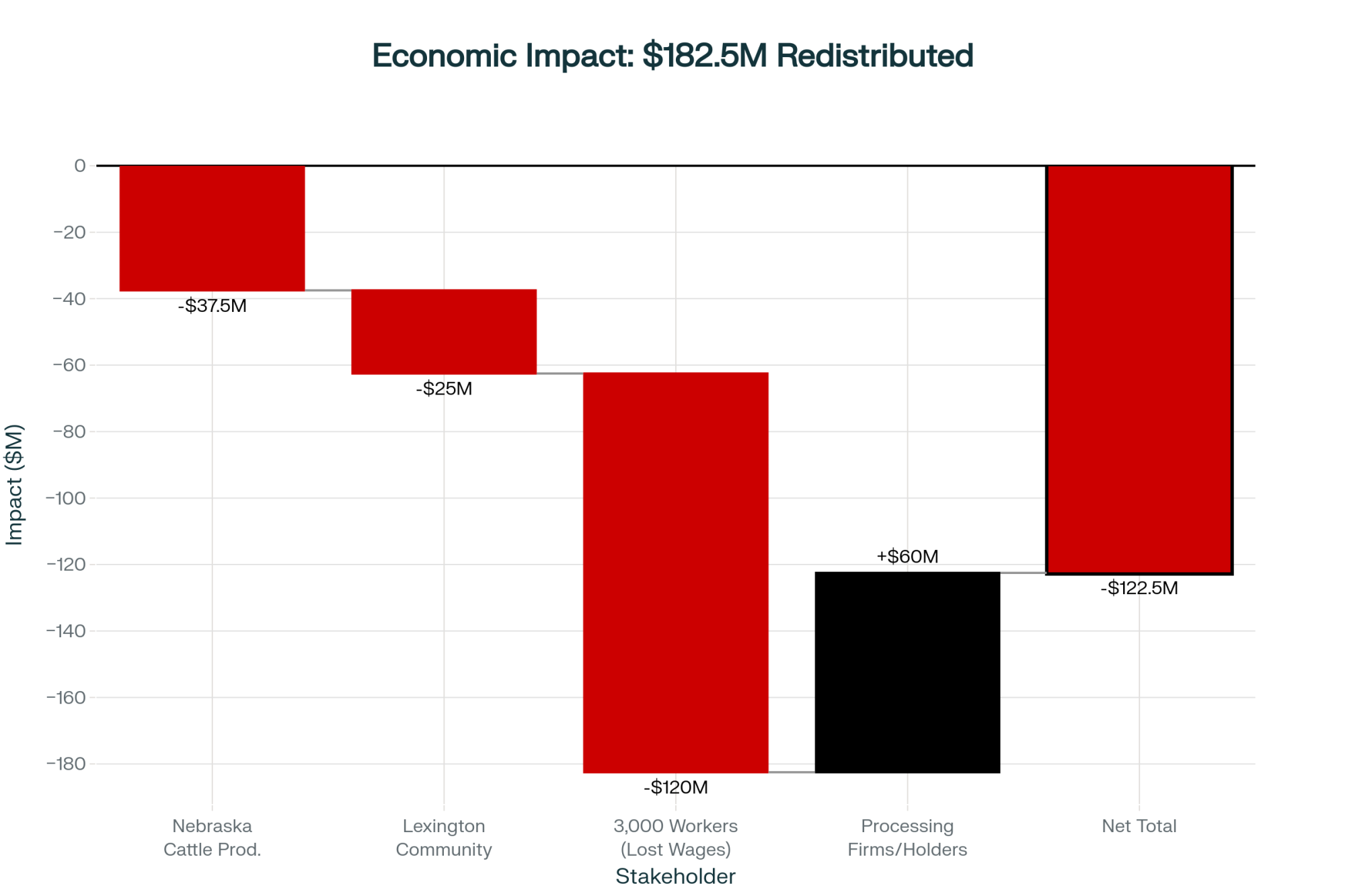
Economic Impact Distribution: When Tyson closes Lexington, $182.5M leaves rural Nebraska—cattle producers lose $37.5M annually in basis compression, the community loses $25M, workers lose $120M in wages. Processing companies and shareholders capture $60M in improved margins

Understanding Basis Pricing: The Mechanism Behind Local Markets

Let me share something that becomes increasingly important as markets consolidate—the concept of “basis” and how it affects what producers actually receive versus what they see on commodity screens.

Basis represents the difference between futures prices—those numbers flashing on Chicago Mercantile Exchange screens—and the actual cash price producers receive at their local market. Think of it as your regional market adjustment. In dairy, we see this same dynamic between Class III futures and mailbox prices, and the parallels are instructive.

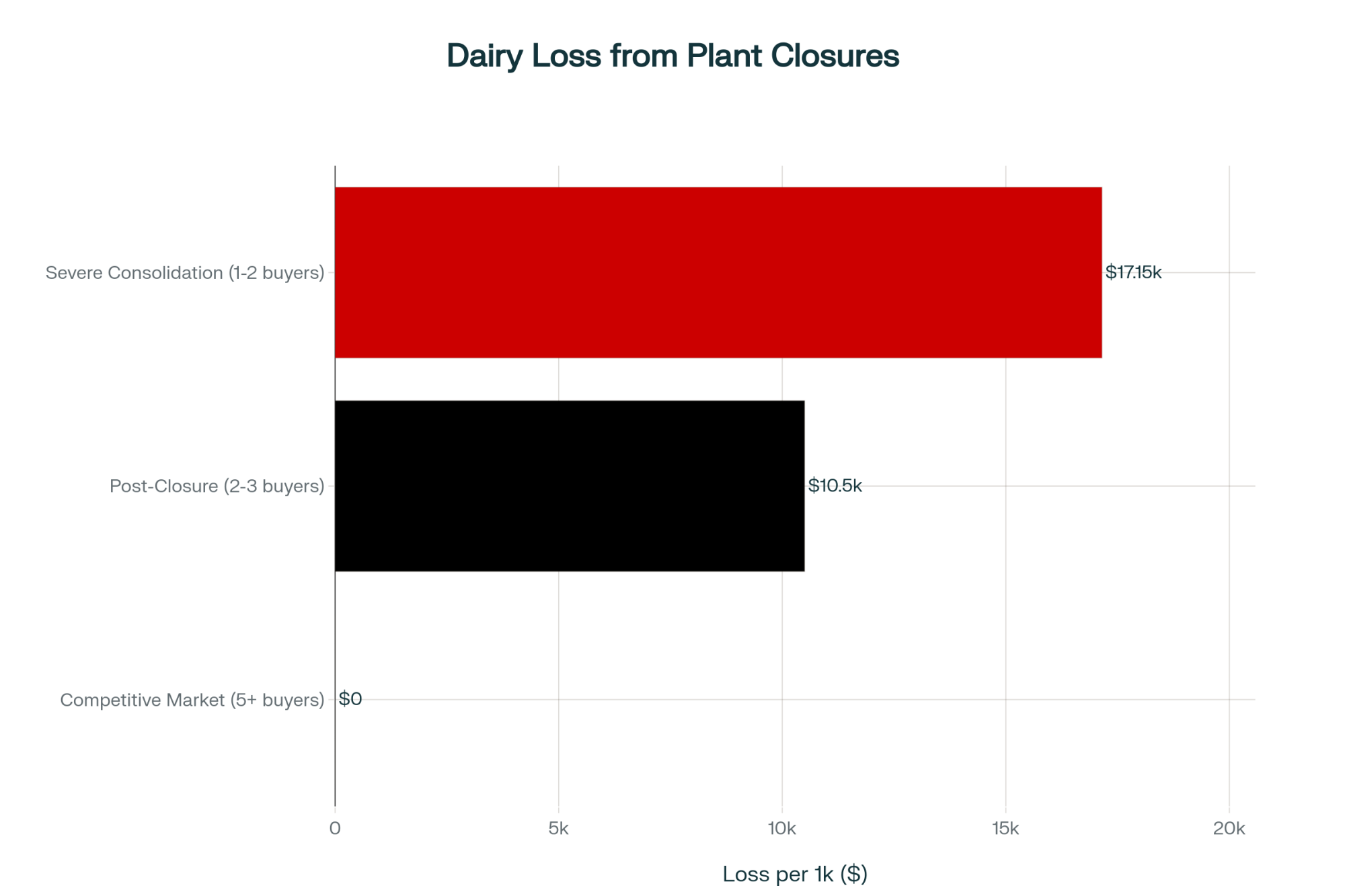
Basis Compression Impact: Plant closures directly translate to lost revenue for dairy producers through wider basis differentials on cull cow sales. A 1,000-cow dairy loses $10,000-$17,000 annually as processing competition evaporates

The agricultural economics team at the University of Nebraska-Lincoln has extensively documented these patterns through its research publications. Their findings show that in competitive markets, feedlot operators typically receive the futures price minus a modest basis adjustment—perhaps 5 to 15 cents per hundredweight — for transportation and regional supply-and-demand factors.

What’s particularly noteworthy is how dramatically this changes when processing capacity leaves a region:

In a competitive market scenario: A feedlot 50 miles from multiple processors might see:

  • Basis of approximately -$0.05/cwt
  • Multiple competitive bids arriving weekly
  • Cash price around $193.95/cwt on a 1,250 lb steer, yielding $2,424

After significant capacity reduction: That same operation now shipping 180+ miles might experience:

  • Transportation costs are adding $33 per head (based on USDA-tracked rates of $5.50 per loaded mile)
  • Basis weakening to -$2.50/cwt or more
  • New cash price dropping to $191.50/cwt, or $2,394 per head

When you calculate that $30 per head difference across the 1.25 million head annually processed at Lexington, Nebraska producers potentially face $37.5 million in reduced annual revenue—not from market fundamentals, but from structural changes in competitive dynamics.

The Cull Cow Connection: What This Means for Your Bottom Line

Here’s something every dairy producer needs to understand about processing capacity: it directly affects your cull cow revenue. For a 1,000-cow dairy culling 35% annually, that’s 350 cull cows heading to market each year. When regional processing capacity shrinks, the basis on those cull cows widens just like it does for fed cattle.

Using current market dynamics, if basis widens by just $2.00/cwt due to reduced processing competition, that represents approximately $10,000 to $14,000 in lost annual cash flow for that 1,000-cow operation (assuming 1,400 lb cull cows at current prices). For many dairies, that’s the difference between profit and break-even—or between staying in business and selling out.

Examining the Supply Narrative: What the Data Actually Shows

The interesting thing about market narratives is how they sometimes diverge from documented data. USDA’s National Agricultural Statistics Service reported Nebraska’s January 2025 cattle inventory at 6.05 million head, down just 3% from the previous year. The state’s cattle-on-feed inventory in September 2025 stood at 2.43 million head, showing remarkable stability through recent reporting periods.

What’s particularly revealing—and this comes from Tyson’s own SEC filings—is that the company reported cattle costs increased by $2 billion in fiscal 2025 compared to the prior year. That pattern typically suggests competitive bidding for supply rather than genuine scarcity.

Dr. Derrell Peel at Oklahoma State University, who’s done extensive work on livestock markets, has observed that when processors simultaneously report supply challenges and increased input costs, it often indicates competitive pressure rather than actual shortage conditions. This aligns with what many market observers have noted.

Tyson’s beef segment reported an adjusted operating loss of $426 million in fiscal 2025, with forward guidance suggesting losses of $400-600 million in fiscal 2026. The closure removes 6,700 head of daily processing capacity from the market when you include reductions at their Amarillo facility—a significant structural change to regional competition.

Learning from Dairy’s Consolidation Journey: Regional Patterns Emerge

The dairy industry’s experience with consolidation offers a valuable perspective on these dynamics—and it’s playing out differently across regions.

Market Concentration Timeline: As processing consolidation accelerated from 25% to 85% control by four firms, dairy farm numbers collapsed by 61%. The correlation isn’t coincidence—it’s cause and effect

When Dean Foods filed for bankruptcy in November 2019, they operated 57 facilities across 19 states—essentially the largest fluid milk processor in America. Dairy Farmers of America’s 2020 acquisition of 44 of those plants for 3 million represented a significant concentration of processing capacity.

The Northeast Experience

Vermont exemplifies how consolidation pressures compound. The November 2025 Class I base price hit $16.75/cwt, down $1.29 from October, despite relatively stable national commodity markets. With 78% of Vermont experiencing severe drought conditions according to U.S. Drought Monitor data, producers face what economists describe as converging pressures—rising feed costs coinciding with price compression from national oversupply.

The Midwest Transformation

Wisconsin’s story shows how quickly landscapes change. Saputo’s recent optimization strategy provides a textbook example. Between 2024 and 2025, they’ve closed facilities in Belmont, Big Stone (South Dakota), Lancaster, Tulare (California), South Gate (California), and Green Bay. Each announcement emphasized “network optimization” and “operational efficiency.”

The Suamico, Wisconsin, closure eliminated 240 positions according to state workforce notifications. What’s particularly significant for smaller operations is that Saputo’s new Franklin, Wisconsin, facility requires 4-5 million pounds of milk daily for efficient operation—volume typically sourced from larger operations rather than traditional family-scale dairies.

Wisconsin has seen three major facility closures in 18 months. For producers in central regions, buyer options have decreased from five to perhaps two or three—a fundamental shift in market structure. International Dairy Foods Association tracking shows $11 billion in new processing capacity announced nationwide, with significant investment flowing to Texas, Idaho, and New Mexico—regions with operational scales different from traditional Midwest dairy.

I recently spoke with a Wisconsin producer milking around 400 cows who shared their experience after the Lancaster closure. Their milk hauling distance jumped from 45 miles to 110 miles, adding roughly 90 cents per hundredweight to their costs—assuming truck availability, which isn’t always guaranteed in tight transportation markets.

The Western Perspective

A California producer I connected with last month offered a different perspective. “We’ve watched consolidation reshape our market for two decades,” she explained. “When you’re down to two buyers for your milk in a 200-mile radius, the conversation changes completely. It’s not negotiation anymore—it’s take it or leave it.”

The progression seems consistent across all regions:

  • Processors announce efficiency-driven network optimization
  • Regional processing options decrease
  • Basis differentials widen as competition diminishes
  • Margin pressure intensifies for producers
  • Scale becomes increasingly critical for survival

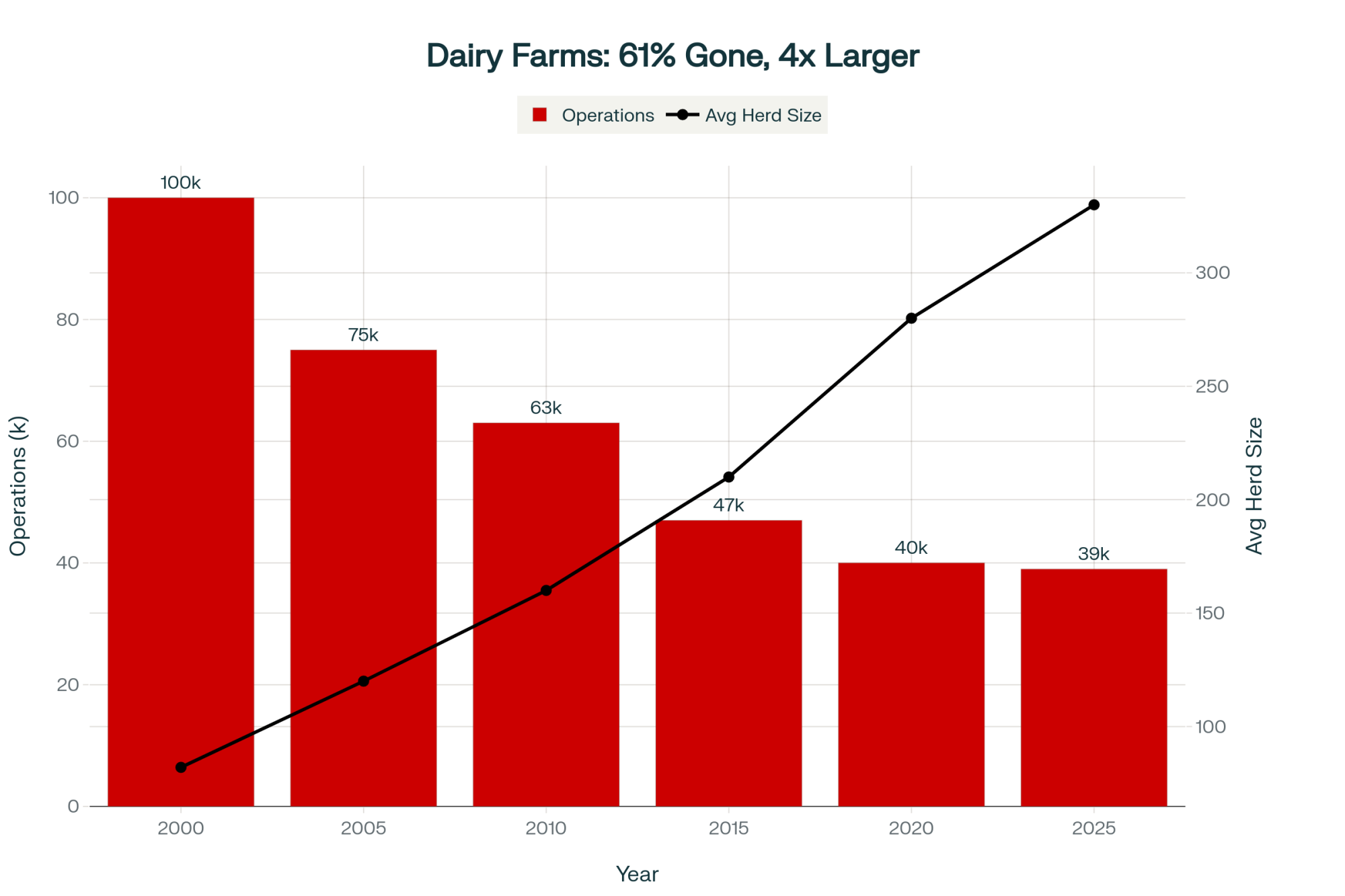
USDA Economic Research Service data documents this trajectory in dairy—from approximately 100,000 operations to 39,000 over 25 years, a 61% reduction. American Farm Bureau projections suggest 2,800 dairy operations may exit in 2025 alone, though market conditions could affect these estimates.

Dairy Consolidation Acceleration: As processor consolidation squeezes margins, operations exit at increasing rates. Survivors must scale dramatically—average herd size jumped from 82 to 330 cows. The 300-cow family dairy that once thrived now barely survives

Understanding Make Allowance Impacts

The June 2025 Federal Milk Marketing Order adjustments increased make allowances in ways that the National Milk Producers Federation analysis suggests will shift approximately $91 million annually from producer revenues to processor margins. University of Wisconsin dairy enterprise budgets indicate a typical 300-cow operation that might have netted $10,000 annually could face $61,000 in losses under current conditions—challenging math for any operation.

The Economics of Community Impact

Rural development researchers have modeled the economic ripple effects of major facility closures, suggesting impacts of around $300 million over time for a community like Lexington—roughly $30,000 per capita in a town of 10,000. This encompasses lost wages, reduced tax revenue, diminished retail activity, and the broader multiplier effects that flow through rural economies.

Make Allowance Revenue Transfer: The June 2025 Federal Order changes shifted $91M annually from producer milk checks to processor margins. A typical 300-cow dairy loses $10,000/year—often the difference between profitability and loss. This isn’t market forces; it’s regulatory capture

Understanding where economic value flows in these transitions helps explain the dynamics:

For processing companies and shareholders: Industry analysis suggests potential margin improvements of $40-80 million annually through strategic capacity management and reduced regional competition. Tyson’s dividend program distributes $353 million annually to shareholders, with share buyback authorizations exceeding $1 billion in fiscal 2025.

For producers: Transportation cost increases alone could reach $42 million annually for cattle previously processed at Lexington. Add basis compression and reduced negotiating leverage, and the economic pressure compounds significantly.

For communities: Property tax revenue losses estimated at $15-25 million annually create budget pressures that affect schools, infrastructure, and essential services—impacts that persist long after the initial closure.

Monitoring Market Consolidation: Warning Signs to Watch

Language That Warrants Attention:

When processors use terms like “network optimization,” “reducing duplicate capacity,” or “investing in next-generation facilities,” it often precedes structural changes. Similarly, phrases about “managing supply challenges” or “consolidating operations” deserve careful consideration.

Market Indicators to Track:

  • Widening gaps between announced prices and actual payments
  • Shifting regional price differentials
  • Increasing hauling distances to remaining processors
  • Investment patterns favoring certain regions over others

Proactive Steps to Consider:

  • Maintain detailed records of basis trends
  • Build information networks with regional producers
  • Request transparency in pricing calculations
  • Preserve operational flexibility where possible

Price Discovery: The Foundation of Fair Markets

One fundamental shift deserves particular attention—the evolution of price discovery mechanisms. Iowa State University research documents that in the 1990s, approximately 80% of fed cattle were traded through transparent cash markets. Today, that figure has dropped to around 20%, with formula contracts dominating transactions.

Why does this matter? When price discovery depends on limited transactions, those prices become both less representative and potentially more influenced by strategic behavior. Academic research shows that as formula contracts grew from 20% to 80% of volume, the packer-to-retail price spread effectively doubled.

Price Discovery Erosion: Cash market trading collapsed from 80% to 20% of cattle transactions. Formula contracts now dominate—but those formulas are based on the thin cash market, creating a self-reinforcing cycle of reduced transparency and price control

Dairy maintains relatively better price transparency through Federal Order reporting, which explains why the June 2025 make allowance changes generated immediate producer response—the impacts were visible and quantifiable. Markets operating primarily through private formula contracts offer less transparency for impact assessment.

Strategic Considerations for Producers

While consolidation trends seem likely to continue, producers have options for navigating these changes:

Near-term Risk Management:

  • Document basis patterns systematically—tracking announced versus actual prices monthly reveals trends that inform decisions
  • Build information networks—comparing experiences with regional producers helps identify systematic patterns versus individual situations
  • Seek pricing transparency—understanding calculation methodologies helps identify where value gets captured
  • Maintain operational flexibility—long-term commitments may limit options during structural market shifts

Longer-term Positioning:

  • Evaluate differentiation opportunities—value-added production or direct marketing can provide alternative revenue streams, though these require different skill sets and market development
  • Strengthen collective representation—producer organizations provide platforms for information sharing and advocacy
  • Engage in policy discussions—market structure issues ultimately require policy responses
  • Assess scale strategically—understanding where your operation fits in evolving market structures informs investment decisions

Essential Questions for Processors:

  1. What methodology determines base pricing, and is the underlying data accessible?
  2. What proportion of supply comes through formula versus cash transactions?
  3. How does pricing compare across similar regional suppliers?
  4. Where are capital investments being directed geographically?
  5. How will any facility changes affect net returns after transportation?

Broader Implications for Agricultural Markets

The Tyson Lexington situation illustrates how market concentration—with four firms controlling 81-85% of beef processing, up from 25% in 1977—fundamentally alters market dynamics. Similar patterns in dairy, with comparable concentration levels, suggest these aren’t isolated incidents but structural trends.

What’s becoming increasingly clear:

  • Processor capacity decisions significantly influence regional pricing dynamics
  • Economic impacts flow predictably from rural communities toward corporate returns
  • Reduced price transparency through formula contract dominance creates structural advantages for processors
  • These patterns appear consistent across protein sectors

What remains less certain:

  • The potential for meaningful antitrust enforcement or policy intervention
  • Timeline and effectiveness of producer collective action
  • Whether technological or market innovations might create alternatives
  • How consumer preferences might influence market structures

Understanding these dynamics isn’t about pessimism—it’s about realistic assessment. Market structures have evolved significantly from previous generations’ experience. Success requires recognizing these changes, adapting strategically, and working collectively where appropriate to maintain competitive markets.

The fundamental question isn’t whether consolidation will continue—current trajectories suggest it likely will. The question becomes how producers can best position themselves within evolving market structures while advocating for policies that preserve competitive dynamics.

What unfolds in Lexington over the coming months may preview developments in other agricultural regions. Producers who understand mechanisms like basis compression, price discovery evolution, and formula contract implications will be better positioned to navigate these changes. Those who don’t may find themselves questioning why returns diminish even as demand appears stable.

Markets evolve. Producers who recognize and adapt to structural changes while maintaining operational excellence will be best positioned for long-term success. And perhaps, with sufficient understanding and collective action, we can influence how these markets develop rather than simply reacting to changes imposed upon us.

INDUSTRY RESOURCES

KEY TAKEAWAYS

  • The $10,000 Question: When processors close regional plants, your cull cow basis widens $2-3/cwt—costing a 1,000-cow dairy $10,000-14,000 annually in lost revenue
  • Decode the Language: “Network optimization” = plant closures coming. “Supply challenges” = margin restoration through consolidation. “Efficiency improvements” = fewer buyers for your milk
  • The Math That Matters: 4 firms control 85% of processing + only 20% cash market trading = they set prices, you take them
  • Your Action Plan: Track basis monthly (the gap between futures and your check), build regional producer networks for price transparency, and avoid long-term contracts during consolidation periods
  • The Pattern Is Clear: The same consolidation that eliminated 61% of dairy farms in 25 years is accelerating—understanding it is your best defense

Complete references and supporting documentation are available upon request by contacting the editorial team at editor@thebullvine.com.

Learn More:

Join the Revolution!

Join over 30,000 successful dairy professionals who rely on Bullvine Weekly for their competitive edge. Delivered directly to your inbox each week, our exclusive industry insights help you make smarter decisions while saving precious hours every week. Never miss critical updates on milk production trends, breakthrough technologies, and profit-boosting strategies that top producers are already implementing. Subscribe now to transform your dairy operation’s efficiency and profitability—your future success is just one click away.
NewsSubscribe
First
Last
Consent

The Hidden Cost of Every $1,200 Beef Calf: A $4,000 Heifer Bill

The 60-day pregnancy check is becoming the most terrifying day on the dairy calendar.

EXECUTIVE SUMMARY: You’ve been breeding 35% to beef, banking $1,200 per calf while dairy bulls bring just $200—the math seemed obvious until June’s pregnancy check reveals you’re 150 heifers short. With dairy heifer inventory at its lowest since 1978 and replacements costing ,000 each, this “profitable” strategy has just created a 0,000 problem that will take two years to fix. The culprit: not tracking what percentage of pregnancies are dairy versus beef, the single metric that predicts replacement availability 18 months out. Successful operations monitor this number weekly—when it drops below 45%, they immediately increase sexed dairy semen usage, trading $520 in monthly semen costs to avoid a six-figure crisis. The entire monitoring system takes 30 minutes weekly, yet most producers don’t discover the problem until it’s biologically impossible to fix. The difference between thriving and crisis isn’t luck—it’s whether you’re tracking one number that takes five minutes to calculate.

beef on dairy strategy

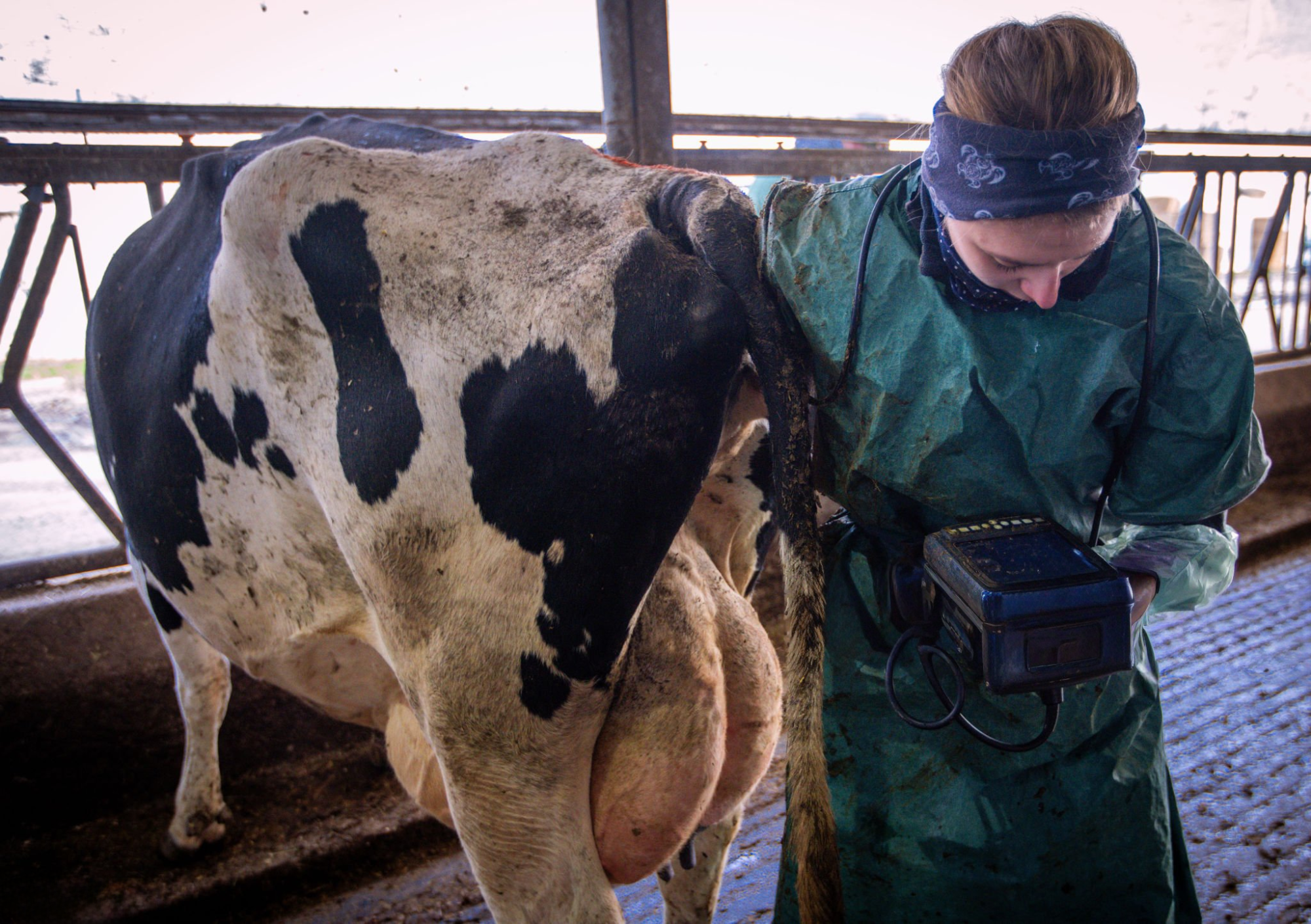
You look at the ultrasound monitor as the technician calls out the results. Bull. Bull. Bull. Heifer. Bull. Your stomach drops. You’ve been breeding 35% to beef, following the plan you set in January. The math was perfect on paper—$1,200 beef calves versus $200 dairy bulls. But now you’re staring at a 120-heifer shortage for next year, and replacement heifers are selling for $3,500 to $4,000 each.

How did this happen? You followed your breeding plan to the letter.

Here’s what’s interesting—the answer lies in a calculation that deserves more attention: the forward-looking replacement inventory formula. The beef-on-dairy movement has certainly delivered valuable calf revenue when we’ve needed it most. Lord knows, those $1,200 beef calves have kept many of us afloat. At the same time, it’s creating what CoBank economists describe as a significant structural adjustment period for operations whose monitoring systems haven’t evolved alongside their breeding strategies.

The New Economics Reshaping Dairy Breeding

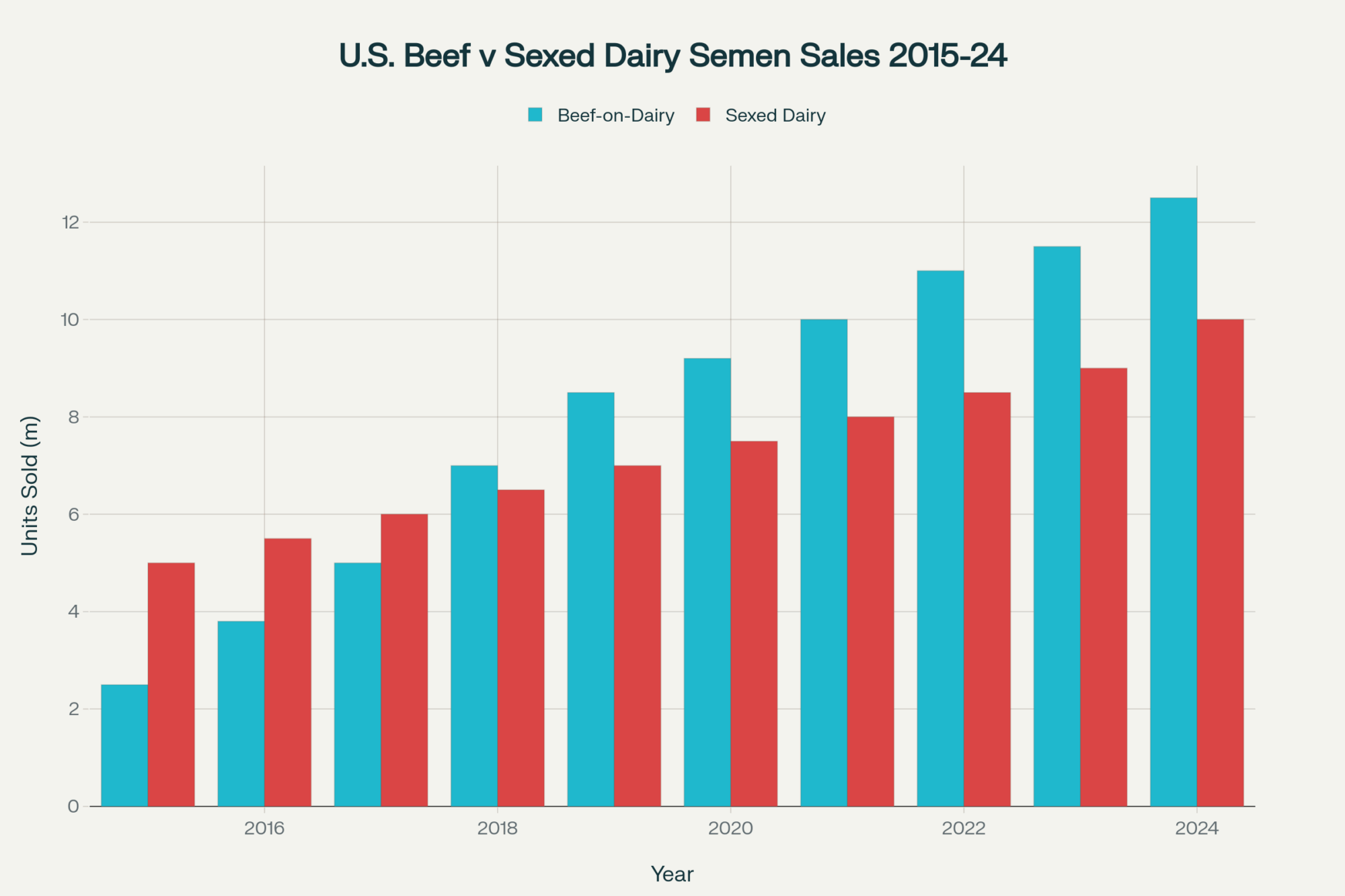
You know, the numbers tell a compelling story about where we are as an industry. The National Association of Animal Breeders reports that beef semen sales to dairy operations climbed from 2.5 million units in 2017 to 7.9 million units in 2024—a 216% increase that reflects fundamental changes in how we think about calf value.

Day-old beef-cross calves now command $1,000 to $1,400. Dairy bull calves? You’re lucky to get $100 to $200, and that’s if you can find a buyer. For a 1,000-cow operation breeding 35% to beef, that’s approximately $210,000 to $245,000 in additional annual calf revenue. That’s real money when you’re dealing with volatile milk prices and input costs that just won’t quit.

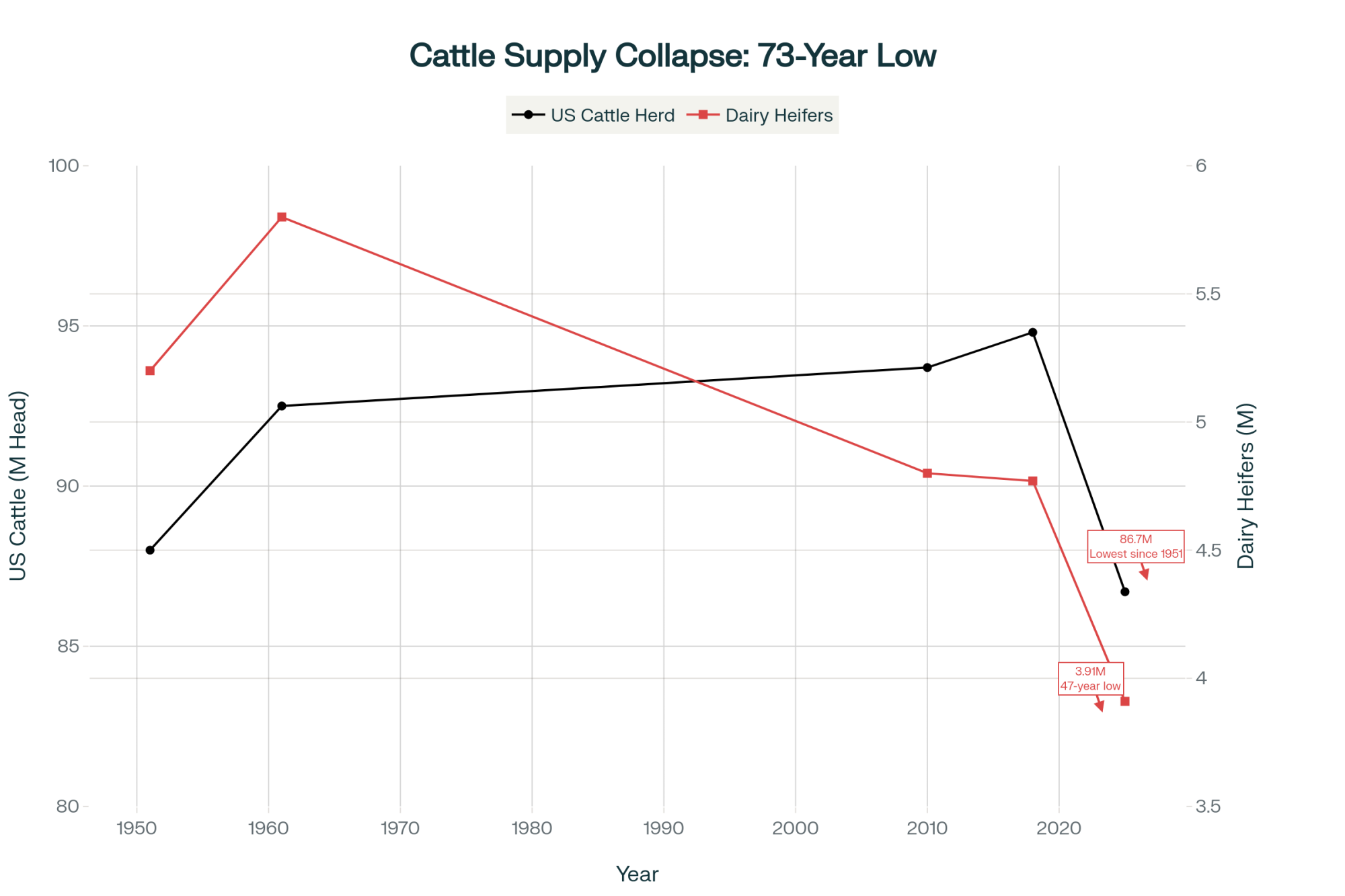
But here’s what’s particularly concerning—and what many of us are just starting to realize. The Holstein Association has documented that each percentage-point shift toward beef breeding removes approximately 95,000 dairy heifers from the national pipeline each year. The USDA’s January cattle inventory report reveals our dairy heifer inventory has declined to 3.914 million head. That’s a level we haven’t seen since 1978, when we were milking very different cows in very different systems.

CoBank’s dairy quarterly analysis from August makes this clear: we’re facing an 800,000-head decline in dairy heifer inventory before any meaningful recovery begins in 2027. This replacement shortage is becoming increasingly apparent to anyone who’s tried to buy heifers lately. They’re simply not available—at any price in some regions.

What’s worth noting is how this plays out differently across borders. Canadian producers navigating supply management face unique constraints when beef revenue opportunities conflict with quota requirements. European operations are balancing beef-on-dairy opportunities with stricter environmental regulations and different subsidy structures. Australian and New Zealand producers, with their seasonal calving systems, face entirely different timing pressures. But the fundamental challenge—balancing today’s revenue with tomorrow’s replacements—that’s universal.

The Critical Calculation Most Operations Miss

Let me share something that I’ve found most operations overlook:

The Forward Replacement Inventory Formula:

Herd Size × (Age at First Calving ÷ 24) × Cull Rate × (1 + Heifer Non-Completion Rate) = Annual Replacements Needed

ScenarioDairy Pregnancies %Annual Heifer ShortageReplacement CostCrisis Total
Unmonitored Herd (No Weekly Tracking)35%-150$3,500-$4,000$525,000-$600,000
Target Range (Disciplined Monitoring)45-55%On targetN/A$0 (Averted)
Early Warning (April Detection)42-45%-50$3,500-$4,000$175,000-$200,000
Sexed Semen Response50%+ recovery-25$520/month semen$6,240
annual
Late Detection (June Preg Check)35%-120+$3,800-$4,200$456,000-$504,000

Based on conversations with producers across the country—and I talk to a lot of them—most operations make at least one of three common miscalculations that can really bite you later:

First, we tend to be optimistic about heifer completion rates. Many of us plan with the assumption that 90-95% of heifer calves will eventually enter the milking herd. But research from folks at Elanco, based on extensive herd monitoring, shows actual rates are 75-80% on well-managed operations. That 15-20 point gap? It compounds annually, and suddenly you’re wondering where your heifers went.

Second: Age at first calving matters more than we think. Penn State Extension research shows that each month beyond 24 months increases replacement needs by approximately 4%. Push from 24 to 26 months—maybe because your heifer grower had a tough winter or you had some respiratory issues—and a 1,000-cow operation needs 33 additional heifers annually just to maintain herd size.

Third: And this is the one that really catches people—not tracking dairy versus beef pregnancy percentages. Research from UW-Madison identifies this as a critical predictive metric for future replacement availability. You probably know your overall pregnancy rate, but do you know what percentage of those pregnancies are dairy versus beef?

When Reality Hits: The 60-Day Moment of Truth

Here’s how it typically unfolds. You set your breeding plan in January, usually over coffee at the kitchen table or during that annual meeting with your nutritionist and vet. Execute it faithfully through spring. Everything looks fine on paper. Then June arrives with 60-day pregnancy checks and fetal sexing capability.

The ultrasound technician begins: “Heifer, bull, bull, bull, heifer, bull…”

Your expression changes as you realize the sex ratio isn’t what you expected. And here’s the kicker—five months of breeding decisions are now locked into 280-day gestations. A shortage of 120 to 150 replacement heifers is mathematically inevitable. You can’t unbred those cows.

What happens next? Well, I’ve watched this play out too many times:

  • July: You’re calling every heifer dealer in 200 miles
  • August: Prices climb from $3,000 to $3,600 per head
  • September-October: Crisis pricing hits—$3,800 to $4,200
  • November: You either write massive checks or keep those arthritic fifth-lactation cows another year

The Weekly Metric That Changes Everything

What successful operations are doing differently—and this really surprised me when I first learned about it—is monitoring dairy pregnancies as a percentage of total pregnancies weekly. Not monthly. Not quarterly. Weekly.

Your Decision Tree:

  • Dairy % between 45-55%: ✓ Continue current strategy
  • Dairy % at 42-45%: ⚠ CAUTION – Monitor closely next week
  • Dairy % below 42% or declining 3 weeks straight: 🔴 ACTION – Adjust immediately

This 5-minute habit can save you six figures. Think about that for a second. Identifying trends in April or May allows correction before June’s breedings lock in. Waiting for a 60-day pregnancy confirmation means the opportunity has passed. The biology is already set.

The Sexed Semen Solution That Surprises Producers

When dairy pregnancy percentages decline, here’s what seems counterintuitive: increase sexed semen usage despite lower conception rates. But look at the math:

Semen TypeConception RateFemale %Result per 100 Breedings
Conventional40%50%20 female calves
Sexed33%90%30 female calves

Despite an 18% conception penalty, sexed semen generates 50% more females. The cost difference? About $520 monthly in additional semen cost versus $3,500-4,000 per replacement heifer. That’s a no-brainer when you run the numbers.

The 30-Minute Weekly System That Works

Here’s what you need—and you probably already have most of it:

  • Your existing herd management software
  • A basic spreadsheet (or, honestly, even a notebook works)
  • 30 minutes weekly

Track five simple data points:

  1. Week number
  2. Total pregnancies confirmed
  3. Dairy pregnancies
  4. Beef pregnancies
  5. Dairy percentage (calculated)

Veterinarians I work with report that producers have avoided $400,000 replacement crises with nothing more than disciplined weekly monitoring. That’s it. Thirty minutes that could save you from financial disaster.

What Successful Producers Do Differently

They adjust breeding strategies based on real-time data rather than annual projections. When dairy pregnancy percentages drift, they respond within weeks, not quarters. No committee meetings, no analysis paralysis—just adjustments based on data.

They monitor conception rates by semen type. One California producer who asked not to be named noticed a problem when dairy conception was running at 38% while beef was at 44%. Overall, it looked fine at 41%, but the divergence signaled specific dairy bull fertility issues that needed to be addressed immediately.

They plan realistic completion rates. A Pennsylvania producer shared this experience: “We assumed 90% of heifer calves would reach the milking parlor. Reality was 76%. That 14% gap over three years? 180-heifer shortage.” That’s a lesson learned the hard way.

And perhaps most importantly, they resist market timing. When beef prices surge—and they will again, markets are cyclical—disciplined operations maintain their breeding allocation rather than chase short-term revenue.

The Industry Dynamics Creating This Challenge

Several factors are converging that make this more complex than it was even five years ago.

Rabobank identifies $10 billion in new processing capacity requiring 2-3% annual production growth. That milk has to come from somewhere—either more cows or higher production per cow, both requiring careful replacement planning.

Research from UW-Madison shows that keeping older, lower-genetic cows costs several hundred dollars per lactation in unrealized genetic potential. It’s a hidden cost that adds up quickly when you’re holding onto cows past their prime.

CME data confirms we’re seeing unprecedented spreads between beef-cross and dairy bull values. That economic pressure to breed beef is real and it’s intense.

And here’s what makes it tough—once beef-on-dairy revenue reaches a significant portion of farm income, as industry analysis suggests is happening for many operations, returning to previous breeding strategies becomes financially challenging, even when replacement needs suggest you should.

These industry pressures aren’t just numbers on a spreadsheet—they’re reshaping how we make decisions every single day on our farms.

Practical Lessons from the Field

Looking at how these dynamics play out in real operations, the patterns become clear.

One California producer managing 1,500 cows, who preferred to remain anonymous, shared this sobering experience: “We bred 40% to beef without weekly monitoring. By July, we were 180 heifers short. Cost us $650,000 in purchased replacements plus another $80,000 in health and adaptation challenges. Now we monitor weekly—takes 20 minutes, prevents million-dollar mistakes.”

A Pennsylvania operation with 800 cows reported better results: “When our dairy percentage dropped to 43% in April, we immediately increased sexed semen usage. That early adjustment means we’re actually ahead on replacements now.”

And from the other side of the equation, a Minnesota custom heifer raiser tells me: “Three years ago, I had excess capacity. Today, I’m declining inquiries weekly. The offers I’m getting—$500 per head premiums just to accept calves, before any feeding costs—show how desperate the situation has become. But biological realities mean these animals require two years regardless of how urgent the need.”

Looking Ahead: What This Means for Your Operation

The beef-on-dairy opportunity has provided crucial revenue during challenging economic periods—I’m not arguing against it. As replacement availability tightens and prices reach historic levels, though, success will belong to operations that balance opportunity with disciplined management.

This isn’t really about choosing between beef revenue and dairy replacements. It’s about implementing systems that enable real-time response rather than hoping annual projections prove accurate. These principles apply whether you’re managing 3,000 cows in an Arizona dry lot or 200 cows on a Missouri pasture—the mathematics remain consistent, only the scale varies.

So here’s the question that matters: Are you monitoring the right metrics weekly, or are you waiting for problems to become crises?

Tracking dairy pregnancies as a percentage of total pregnancies requires just 30 minutes weekly. The cost of not monitoring? Producers nationwide are discovering it can easily exceed $400,000 when replacement shortages force them to make desperate purchasing decisions.

The beef-on-dairy opportunity remains valuable—genuinely so. But like all agricultural opportunities, it rewards those who measure, monitor, and adjust based on data—not those who set plans in January and hope for the best.

As we approach 2026, your dairy pregnancy percentage might be the most critical metric on your farm. The encouraging news? The tools and knowledge exist to navigate this successfully. It simply requires discipline and perhaps a shift in how we think about breeding management—from annual planning to continuous optimization.

Don’t know your current Dairy Pregnancy %? Go check your herd management software right now. If it’s below 42%, call your breeding advisor today.

KEY TAKEAWAYS

  • Your dairy pregnancy percentage predicts your future: Below 45% means you’re heading for a 150-heifer shortage worth $600,000—monitor it weekly, not annually
  • Timing is everything: Problems discovered in April can be fixed with breeding adjustments; problems discovered at June’s 60-day check are locked in for two years
  • Sexed semen is cheaper than panic: $520/month extra for sexed semen generates 50% more heifers and beats paying $3,500-4,000 per replacement
  • The 30-minute solution: Weekly monitoring of one metric (dairy pregnancies ÷ total pregnancies) has prevented $400,000 crises for disciplined producers
  • Action required today: Check your dairy pregnancy percentage now—if it’s below 42%, increase sexed dairy semen usage immediately

Complete references and supporting documentation are available upon request by contacting the editorial team at editor@thebullvine.com.

Learn More:

Join the Revolution!

Join over 30,000 successful dairy professionals who rely on Bullvine Weekly for their competitive edge. Delivered directly to your inbox each week, our exclusive industry insights help you make smarter decisions while saving precious hours every week. Never miss critical updates on milk production trends, breakthrough technologies, and profit-boosting strategies that top producers are already implementing. Subscribe now to transform your dairy operation’s efficiency and profitability—your future success is just one click away.

NewsSubscribe
First
Last
Consent

Dairy Wins, Beef Loses: Inside the 18-Month Window Where $1,400 Calves Meet Record Component Premiums

Plot twist: Dairy farms now produce more beef profit than beef ranches. $1,400/calf vs. their $800. The math is devastating.

EXECUTIVE SUMMARY: Dairy has stumbled into the opportunity of a generation: we’re producing 230 billion pounds of milk while simultaneously filling the void left by beef’s collapse to 1961 lows—effectively owning both markets. Three strategies are generating $600-770K in additional annual revenue for progressive operations: beef-on-dairy genetics transforming worthless bull calves into $1,400 assets; component optimization capturing $84,000 from butterfat premiums; and export positioning, as China and India desperately need our proteins. The proof is compelling—producers investing $70,000 are returning $200,000 in year one, with 60% efficiency. Here’s the urgency: only 28% have moved while premiums are maximum; by 2027, when adoption hits 70%, the window closes. Make no mistake—this isn’t about incremental improvement, it’s about who survives the next decade.

beef on dairy profitability

I was reviewing the November USDA reports, and something remarkable jumped out that deserves our attention. The latest WASDE data shows dairy production surging to 230 billion pounds, while beef production drops by 70 million pounds and pork production falls by 80 million pounds. What’s particularly noteworthy is how few producers have fully grasped the implications of this shift.

This development builds on what we’ve been seeing across the industry—not just another typical market cycle, but what appears to be a fundamental restructuring of North American protein production. Several economists I’ve spoken with are describing this as an 18-month window of genuine opportunity, and the more I analyze the data and talk with producers, the clearer the pattern becomes.

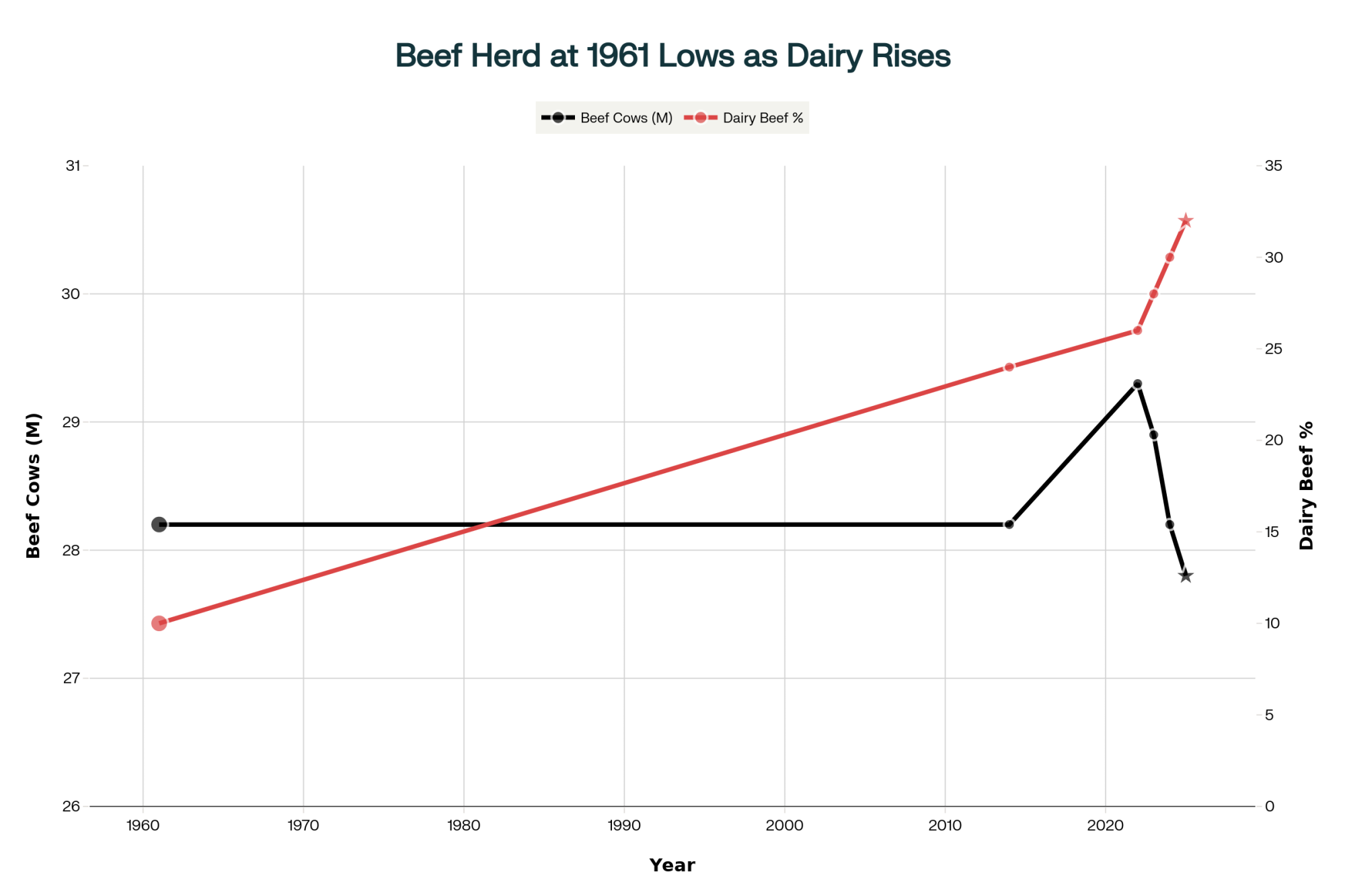
The consumption trends align with this narrative. USDA’s Economic Research Service shows Americans consuming record levels of dairy products, reaching historic highs that would have seemed impossible just five years ago. Globally, the milk protein market continues its substantial growth trajectory, with multiple analyses projecting sustained expansion through 2032. This coincides with the beef cow herd dropping to approximately 28 million head—USDA data confirms this represents the lowest level since the early 1960s.

In recent conversations with producers from various regions—Wisconsin cooperatives, California independents, Texas operations—those experiencing the most success share a common trait: they’re adapting now, even if imperfectly, recognizing that this convergence of factors presents opportunities we haven’t encountered in decades.

Beef-on-dairy calf prices have surged from $225 to $1,439 in under three years—a 540% increase—while Holstein bull calves remain virtually worthless at $50. This $1,389 price gap represents the single largest profit opportunity in modern dairy history

The Beef-on-Dairy Revolution: From Liability to Asset

How Forward-Thinking Farms Discovered the Formula

Here’s what’s happening on farms across the country. Producers are telling me they used to essentially give away Holstein bull calves—some mentioned getting as little as five dollars for two calves just a few years back. Today, according to USDA Agricultural Marketing Service data this fall, those same genetics bred to carefully selected beef sires are commanding $1,200 to $1,400 each.

For perspective, a large dairy operation implementing this strategy could potentially generate $600,000 to $770,000 in additional annual revenue, depending on their size and execution. Same facilities, same management team, fundamentally different economics.

What’s particularly interesting—and this has been confirmed through discussions with extension specialists at both Cornell and Wisconsin—is how beef genetics on dairy has evolved beyond simple calf value. It’s reshaping our entire approach to genetic progress and herd optimization.

The Strategic Framework That Makes It Work

The most successful implementations I’ve observed, from California’s Central Valley to New York’s traditional dairy regions, share common elements that go well beyond basic crossbreeding.

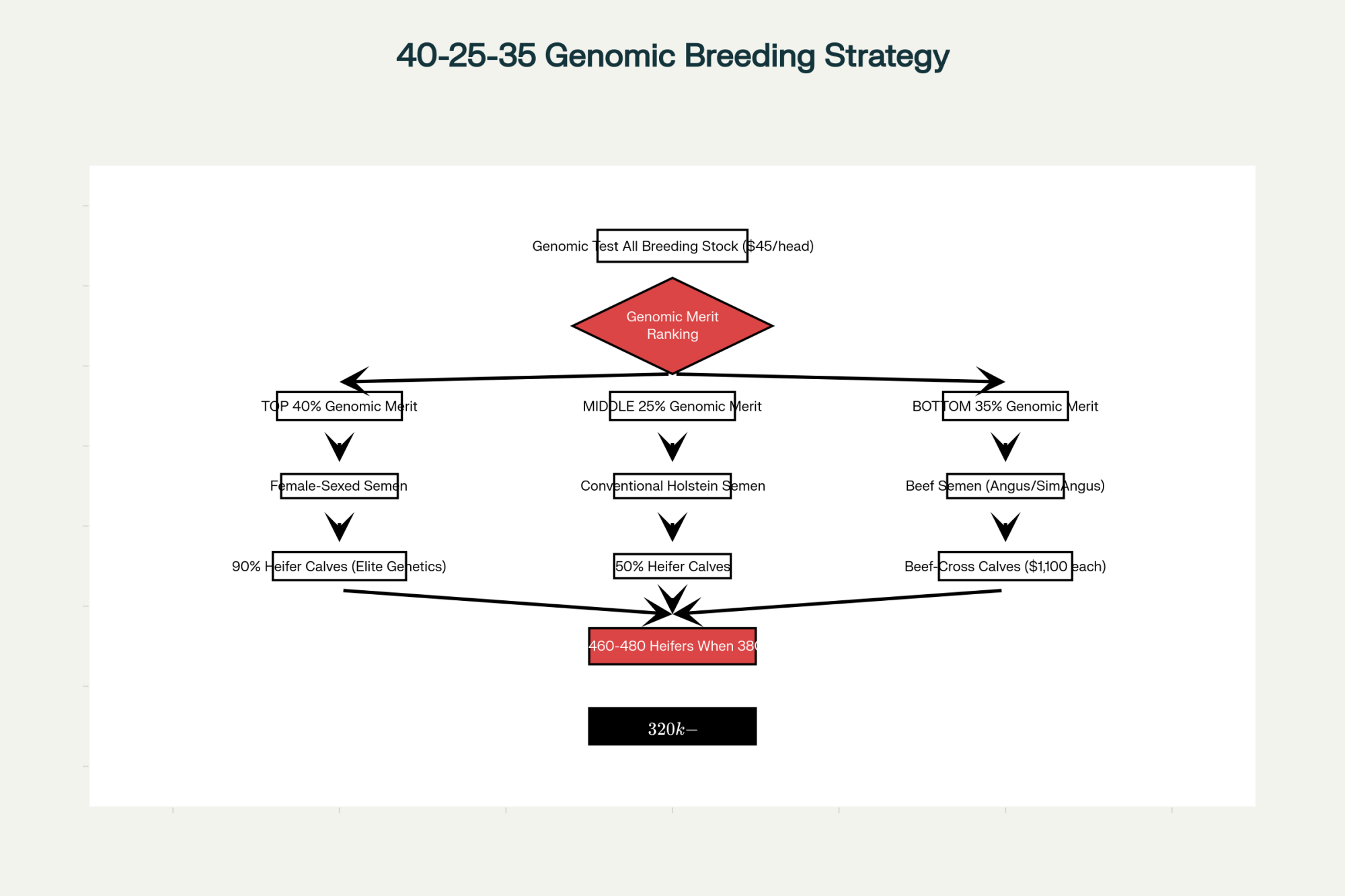
Progressive producers are walking me through their approach: genomic testing of the entire herd at approximately forty dollars per animal, creating a precise roadmap of genetic potential. This allows targeted breeding decisions—sexed semen (at a fifteen to twenty-five dollar premium per breeding) on the top 40 to 50 percent of cows, while the remainder are bred to proven beef sires.

The sire companies report Angus and SimAngus dominating these selections, and for good reason—the calving ease and growth characteristics align well with dairy operations. University of Wisconsin research continues to validate this approach, showing consistent economic advantages.

The beef cow herd has crashed to 27.8 million head—matching 1961 levels—while dairy’s contribution to the beef supply has surged from 10% to 32%. Dairy isn’t supplementing beef production anymore; it’s becoming the backbone of the entire protein system

Current industry data indicates dairy contributes approximately 28 percent of the total U.S. calf crop, compared to roughly 24 percent in the mid-1990s. Given beef cow rebuilding timelines—typically five to six years minimum based on historical cattle cycles—this percentage could realistically reach 32 to 35 percent by 2027.

The math is brutal: as adoption rates surge from 28% today to 70% by 2027, beef-cross calf premiums will collapse from $1,400 to $800. Early movers capture maximum value; late adopters fight for scraps. The 18-month window isn’t marketing hype—it’s market mechanics

Component Optimization: The Hidden Value in Every Tank

Why Volume-Based Production Is Becoming Obsolete

Producers in California have been showing me compelling comparisons of their milk checks from 2023 versus the current year. The transformation in how milk is valued has been striking.

When Federal Order changes took effect this summer, the entire pricing dynamic shifted. California pricing announcements show butterfat reaching $2.62 per pound, making component optimization increasingly critical. The economics are straightforward yet powerful—every 0.1 percent increase in butterfat adds approximately thirty-five cents per hundredweight in additional revenue.

Component premiums reward precision nutrition: a 0.2% butterfat improvement from 4.1% to 4.3% delivers $61,320 in additional annual revenue for a mid-sized operation, with zero additional cows or facilities. It’s not glamorous, but it’s pure margin expansion

For a typical herd producing 24,000 pounds daily, improving from 4.1 to 4.3 percent butterfat could translate to roughly $84,000 in additional annual revenue under optimal conditions.

These aren’t just theoretical projections—producers are seeing real improvements in their milk checks.

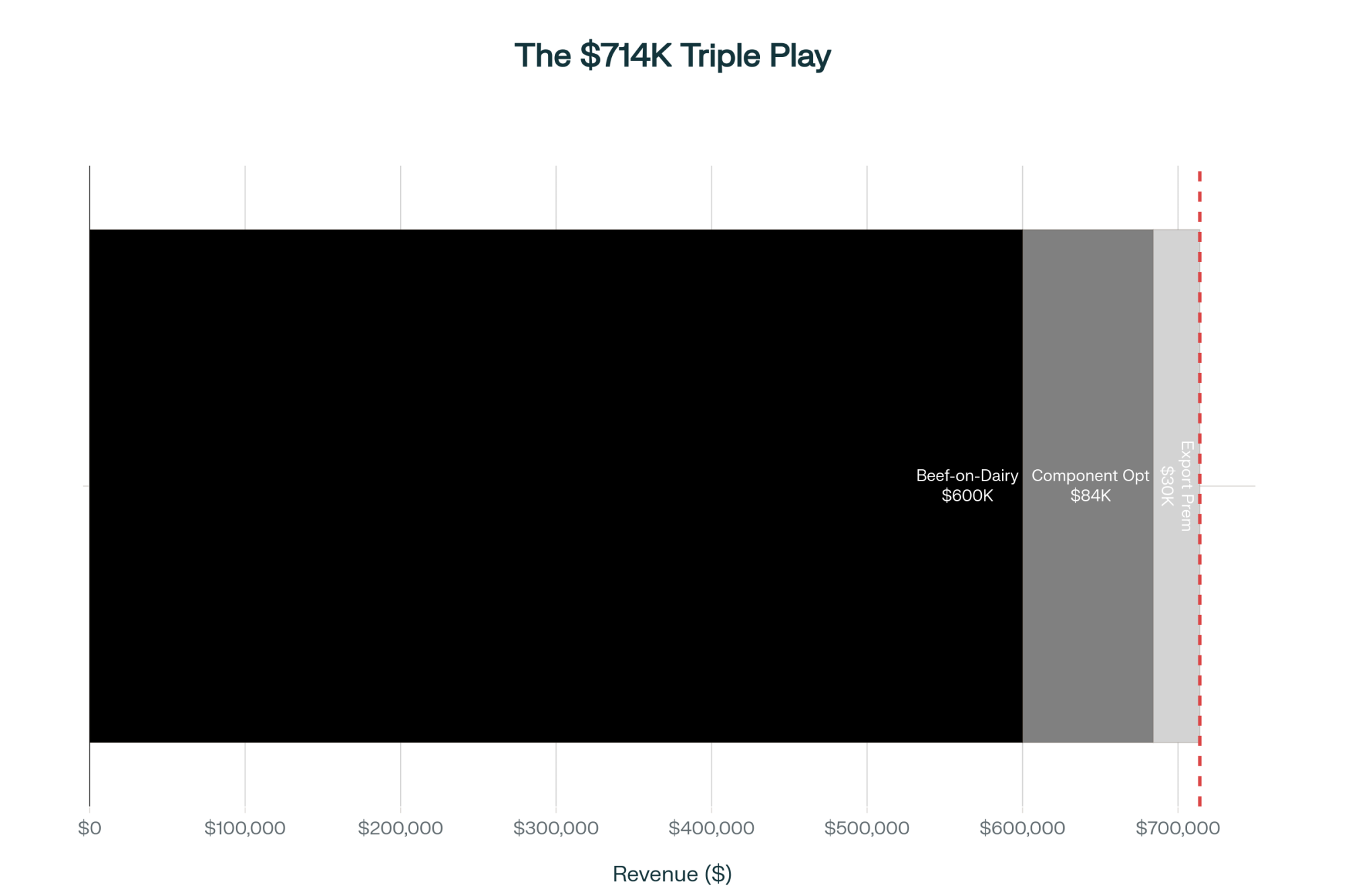
Progressive dairy operations are stacking three distinct revenue streams—beef-on-dairy genetics ($600K), butterfat optimization ($84K), and export premiums ($30K)—to generate over $714,000 in additional annual revenue without adding a single cow to the milking herd

The Genetic Revolution Driving Component Gains

The April genetic base change data from the Council on Dairy Cattle Breeding revealed something significant—a 45-pound rollback in butterfat Estimated Breeding Values, representing substantial industry-wide genetic progress.

During a recent genetics conference, specialists characterized this as unprecedented selection intensity for components. The practical impact? Producers selecting bulls with plus-50 pounds butterfat and plus-40 pounds protein are creating meaningful competitive advantages over operations using industry-average sires.

Nutritionists working with herds across Wisconsin are sharing their evolving approach: precise rumen pH management, maintaining a pH of 6.0 to 6.2 for optimal fat synthesis, and transitioning from generic bypass fats to targeted palmitic acid supplements at 200 to 250 grams per cow daily. University research from this past spring demonstrates that this can increase butterfat by 0.2 percent within 30 days—seemingly modest yet economically significant across an entire herd.

The Export Opportunity: Beyond Domestic Markets

China’s Strategic Shift Creates Targeted Opportunities

While the U.S. Trade Representative confirms 135 percent tariffs on many dairy products to China, the underlying trade dynamics tell a more nuanced story. USDA Foreign Agricultural Service data from this fall reveals interesting patterns in China’s import behavior.

According to trade data, imports of sweet whey powder have been growing significantly year over year, even as imports of commodity milk powder have declined. The driver appears to be specialized demand for swine feed ingredients and infant formula components rather than bulk commodities.

Producers shipping to export-oriented processors are reporting premiums of approximately forty cents per hundredweight for high-protein milk that yields better in whey extraction. For a mid-sized operation, that could translate to meaningful additional annual revenue—we’re talking potentially $25,000 to $30,000 for a 600-cow herd.

India’s Protein Crisis Opens New Channels

The opportunity in India may be even more significant, based on USDA attaché reports from New Delhi. Given that 70 to 80 percent of Indians do not meet daily protein requirements, according to the Medical Research Council, the government has launched a revised National Program for Dairy Development with substantial funding for fortification initiatives.

The tariff structure clearly reveals the opportunity. India applies approximately 30 to 60 percent tariffs on fluid milk and cheese imports, yet only around 8 percent on whey protein and 5 percent on lactose—reflecting limited domestic production capacity for these specialized ingredients.

European Market Dynamics

What’s also developing—and this hasn’t received much attention—is the European Union’s shifting protein strategy. With increasing pressure on their livestock sector from environmental regulations, industry reports suggest EU imports of specialized dairy proteins have been growing substantially since 2023. U.S. producers meeting specific sustainability metrics are finding opportunities for premium access to these markets.

The Operations at Risk: Recognizing Warning Signs

Who Faces the Greatest Challenges

We need to acknowledge candidly that not all operations are positioned to capture these opportunities. USDA’s Agricultural Resource Management Survey data from recent years indicates that operations with fewer than 200 cows face average production costs of around $20.93 per hundredweight, compared to $16.50 for operations with more than 1,000 cows.

Producers who’ve recently exited the industry have shared their experiences. When cooperatives announce infrastructure deductions—like the documented four-dollar-per-hundredweight case with Darigold in May—smaller operations can face thousands of dollars in additional monthly costs. For a 150-cow operation, that could mean over $7,000 in additional monthly expenses, creating immediate cash-flow challenges.

Studies suggest the majority of recent dairy exits have involved smaller operations with single-processor relationships and limited value-added strategies. While difficult to discuss, understanding these dynamics is essential for informed decision-making.

Regional Variations Matter

The strategies that succeed in Wisconsin may face challenges in Georgia—regional context matters tremendously. University of Florida dairy specialists have documented that Southeast operations often face production costs per hundredweight that are 2 to 3 dollars higher due to heat-stress management and feed procurement requirements.

Conversely, Texas Panhandle operations benefit from proximity advantages. Producers there report capturing an additional hundred to hundred-fifty dollars per calf on dairy-beef crosses compared to operations shipping longer distances, simply because of their location near multiple beef feedlots.

Technology Adoption Patterns

What’s interesting is how technology adoption varies by operation size. Research suggests operations between 500-1,000 cows often show strong adoption rates for genomic testing and precision feeding—they seem to hit a sweet spot of having adequate resources while maintaining operational flexibility.

Practical Implementation: Learning from Those Who’ve Done It

The Measured Approach That Works

Producers who’ve successfully transitioned share common timelines and approaches. They typically start with genomic testing—investing approximately $40-50 per animal for a comprehensive herd evaluation. This provides the genetic roadmap.

Within a few months, they’re implementing sexed semen on superior genetics. Then comes beef sire selection tailored to their facilities—calving ease often proves critical, especially in older barn configurations. By the following fall, they’re seeing the first beef-cross calves arriving.

“Year one, we captured perhaps 60 to 70 percent of the potential while learning the system. Even at that efficiency level, we generated substantial additional revenue on essentially unchanged feed costs.” — Minnesota dairy producer

Investment Reality Check

Based on producer experiences and consulting firm analyses, here’s the realistic investment framework:

  • Genomic testing: $40-50 per animal (one-time investment)
  • Sexed semen: $15-25 premium per breeding above conventional
  • Nutritionist consultation: $2,000-5,000 monthly, depending on service level
  • Component feed adjustments: Approximately $0.50 per cow daily
  • Data management software: $200-500 monthly for quality tracking systems

For a representative mid-sized operation, year-one implementation might total $60,000 to $80,000. However, combining beef-calf premiums with component improvements could potentially generate substantial additional revenue. While results vary, the fundamentals of economics generally favor well-managed operations.

Sustainability Considerations

What’s encouraging for long-term viability is how these strategies align with sustainability goals. The genetic improvements that reduce days to market for beef-cross calves can translate into lower lifetime emissions per pound of protein produced. Several processors are beginning to consider these metrics—something worth monitoring as carbon markets develop.

Looking Ahead: The Questions That Matter

Is This Sustainable or Another Bubble?

In discussions with agricultural economists and market analysts, the consensus suggests solid fundamentals underpin current conditions. Beef cow herd rebuilding faces structural constraints, with projections indicating a return to pre-drought inventory levels at the earliest in 2030. Global protein demand maintains 2 to 3 percent annual growth,according to FAO data—this reflects structural rather than cyclical factors.

However, appropriate caution is warranted. As beef-on-dairy adoption increases—already substantial in certain regions—some premium compression is likely. Markets are already seeing variation, with premiums ranging from $1,000 to $1,400 depending on genetics, location, and buyer relationships.

The indicator I’m monitoring most closely? USDA’s quarterly Cattle on Feed reports tracking dairy replacement heifer inventories, currently at approximately 1.88 million head—the lowest since the late 1970s, according to NASS data. Continued decline through 2026 would suggest structural transformation; recovery above 2.1 million might indicate temporary market dynamics.

What About Farmers Who Can’t or Won’t Change?

I’ve spoken with veteran producers approaching retirement who’ve made the conscious choice to maintain current practices rather than implementing new strategies. With paid-off operations and no succession plans, this approach has validity.

Industry observers suggest a significant portion of current operations may exit within the next decade, regardless of market conditions—due to demographic realities rather than economic failure. For these producers, operational stability may appropriately outweigh optimization opportunities.

Key Takeaways for Your Operation

After extensive data analysis, producer conversations, and expert consultation, several key insights emerge.

The opportunity window exists, but it continues to narrow. Early adopters captured the highest premiums with limited competition. Current implementers are seeing good returns, though not quite at early-adopter levels. By 2027, returns may normalize further, though they will remain profitable for efficient operations.

Geography influences profitability more than scale—surprising but documented. A strategically located, smaller dairy near beef infrastructure can perform well compared to larger operations that face logistical challenges. Understanding your regional advantages and constraints proves essential.

Processor relationships have evolved from customer-vendor to strategic partnerships. If your processor cannot articulate clear export strategies or component valuation methods, opportunities may remain unexploited. Business alignment now matters as much as traditional loyalty considerations.

Experience teaches that perfection often impedes progress. Producers achieving partial efficiency in year one while generating meaningful profits demonstrate that imperfect action often surpasses perfect planning.

Your Next Steps

Looking at actionable items for interested producers:

  1. Request genomic testing information from your breed association or genetics provider—understanding costs and logistics is the first step
  2. Schedule a conversation with your nutritionist about component optimization potential in your current ration
  3. Contact your processor to understand their component pricing structure and export market positioning
  4. Reach out to beef breed associations for information on dairy-appropriate sires and local calf buyer networks
  5. Connect with producers who’ve already made transitions—their practical experience proves invaluable

As we consider the industry landscape this November, dairy isn’t declining—it’s transforming. Producers who recognize the shift from commodity milk production to strategic protein business models position themselves for success. Those awaiting return to historical norms may discover that “normal” has fundamentally changed.

The data supports action. Strategies have proven effective. Progressive neighbors are already implementing changes. The question has evolved from whether to adapt to how rapidly you can position your operation for emerging opportunities.

KEY TAKEAWAYS

  • The $1,400 Reality Check: Your Holstein bull calves are worth $1,400 to smart producers, $50 to you—the difference is three breeding decisions and genetics testing
  • Triple Revenue Stream, Same Cows: Beef-on-dairy ($600K) + butterfat optimization ($84K) + export premiums ($30K) = $700K+ additional annual revenue without adding a single cow
  • The 18-Month Countdown: Today, only 28% have adapted; when it hits 70% by 2027, premiums crash from $1,400 to $800—early movers win, others consolidate
  • Proven ROI Formula: Invest $70K (genetics + nutrition + consulting) → Return $200K year one, even at 60% efficiency—this isn’t theory, it’s what producers are doing now

Complete references and supporting documentation are available upon request by contacting the editorial team at editor@thebullvine.com.

Learn More:

Join the Revolution!

Join over 30,000 successful dairy professionals who rely on Bullvine Weekly for their competitive edge. Delivered directly to your inbox each week, our exclusive industry insights help you make smarter decisions while saving precious hours every week. Never miss critical updates on milk production trends, breakthrough technologies, and profit-boosting strategies that top producers are already implementing. Subscribe now to transform your dairy operation’s efficiency and profitability—your future success is just one click away.
NewsSubscribe
First
Last
Consent

Trump Promised Cheaper Beef – Here’s Your $160,000 Counter-Move

When everyone zigs to beef breeding, who profits from zagging to heifer production?

EXECUTIVE SUMMARY: What farmers are discovering right now is that political promises about cheaper beef can’t change the biological timeline of cattle production—and that’s creating a remarkable opportunity. With the U.S. cattle herd at just 86.7 million head (the smallest since 1951) and dairy heifer inventories hitting a 47-year low of 3.91 million, we’re looking at an 18-month window where strategic breeding decisions could mean the difference between netting $160,000 in profit or scrambling to buy $4,500 replacement heifers. Recent CoBank analysis shows that 72% of dairy farms now using beef semen have collectively eliminated nearly 428,000 potential replacements from the pipeline, creating what economists call a “coordination failure” that rewards contrarian thinking. The Minnesota producer who shared his strategy of sacrificing $75,000 in immediate beef premiums to potentially net $270,000 in heifer profits after raising costs when everyone else needs them might just have the right idea. With genomic testing at $40-50 per head providing the roadmap, sexed semen achieving 90% female conception rates, and new LRP insurance offering downside protection at $26 per head, farmers have the tools to navigate this unprecedented market dynamic. Here’s what this means for your operation: The decisions you make about breeding strategies in the next 30 days will resonate through your balance sheet for the next two years.

heifer replacement strategy

I was talking with a Wisconsin producer, when the latest political announcement about beef imports sent cattle futures tumbling. “There goes my breeding strategy,” he said, using his phone to recalculate.

But here’s the thing—whether it’s trade deals, import policies, or market volatility, these announcements are just the latest reminder of what we’re really dealing with: a fundamental supply-demand imbalance that political promises can’t fix overnight.

The fundamentals tell an interesting story. According to the USDA’s January inventory, we’ve got 86.7 million head of cattle in the U.S., the smallest herd since 1951. Beef cow numbers? Just 28.7 million, the lowest since 1961.

This year’s calf crop is coming in at 33.1 million head, the smallest on record.

And dairy farms? Well, about 72% are now using beef semen in their breeding programs to some degree. That’s become standard operating procedure, especially when beef-cross calves are bringing $1,000-plus while Holstein bulls fetch maybe $100.

When you factor in the $2,400 cost to raise each heifer, the economics flip dramatically—beef-focused operations lose $145,900 annually while strategic heifer producers turn a $56,000 profit by selling surplus replacements into the $4,200 market

The Three-to-Four Year Reality Check

U.S. cattle numbers hit their lowest point in 73 years while dairy heifer inventories plummet to a 47-year low—the biological timeline means this supply crunch will persist for 18+ months regardless of policy changes.

A central Pennsylvania dairyman explained it to me perfectly: “Politicians can promise whatever they want, but a heifer I keep today won’t drop a calf until July 2026. And that calf? It won’t be beef until 2028.”

That biological timeline matters more than any trade deal.

Think about what this means for dairy operations. While beef producers struggle with rebuilding (and most can’t with current drought conditions in parts of the country), dairy farms have positioned themselves at an interesting crossroads. They’re producing premium beef-cross calves into a supply-constrained market. But they’re also creating their own replacement heifer shortage.

CoBank’s August analysis put some hard numbers on this. Dairy heifer inventories hit 3.91 million head in January 2025—that’s a 47-year low, down 18% from 2018.

I remember buying nice springers for $1,600 five years ago. Last month, a neighbor paid $4,100 for a comparable animal.

Small Operations Need Different Strategies

One thing that doesn’t get enough attention—operations under 200 cows face unique challenges with this beef-on-dairy approach. The genomic testing investment hits harder proportionally. They might not have volume for forward contracts. And losing even a few replacements to disease can derail their program.

Here’s what a 150-cow dairy might look like with a conservative approach:

Annual breeding breakdown (150-cow herd):

  • 30 cows (20%) to beef semen = 30 beef-cross calves worth $33,000
  • 60 cows (40%) to conventional dairy = 30 heifer replacements
  • 60 cows (40%) to sexed semen = 54 elite heifer calves
  • Total: 84 potential replacements when they need 45
Farm SizeBeef %Replacements NeededHeifers ProducedSafety BufferGenomic InvestmentBeef RevenueHeifer Net ProfitTotal Net Opportunity
150 cows20%4584+39 (+87%)$6,750$33,000$62,400$95,400
500 cows30%165240+75 (+45%)$22,500$82,500$120,000$202,500
1,200 cows35%380470+90 (+24%)$54,000$115,500$144,000$259,500

Note: Small operations require higher safety buffers (87% vs 24%) to protect against disease events and culling variations—justifying lower beef percentage

This gives them a 39-heifer buffer for selection and sales while still capturing some beef premiums. Compare that to a larger operation going 35% beef, and you can see why smaller dairies need that extra cushion.

But whether you’re running 150 cows or 1,500, certain strategies are proving successful across the board.

Learning from Operations That Are Making It Work

The 40-25-35 genomic breeding strategy transforms a $45 test into a quarter-million-dollar roadmap—directing elite genetics to sexed semen while capturing beef premiums from low-merit animals.

A 1,200-cow operation near Tulare showed me their approach recently. They’re spending about $45 per calf on genomic testing, which sounds expensive until you consider the alternative.

Now, let’s be clear about the economics here. It costs about $2,400 to raise a heifer from birth to calving, according to 2024-2025 university research. So when we talk about selling a springer for $4,000, the net profit is around $1,600 per head. That’s still exceptional money, but it’s important to understand we’re talking net, not gross.

“Without genomic data,” their manager explained, “we were making quarter-million-dollar breeding decisions based on whether a cow looked good or had mastitis last month.”

Their approach is pretty straightforward:

  • Top 40% by genomic merit get female-sexed semen (about 90% heifer calves)
  • Middle 25% get conventional Holstein semen
  • Bottom 35% go to Angus or SimAngus

This generates roughly 460 to 480 replacement heifers when they need 380.

Those extra 80 to 100? At current prices, with $2,400 in raising costs per heifer, that could be $128,000 to $160,000 in net profit. That’s $4,000 selling price minus $2,400 raising cost = $1,600 net per heifer. Though, as one producer wisely noted, “That’s if the market holds.”

Quick Reference: Genomic Breeding Strategy

  • Top 40%: Female-sexed semen only
  • Middle 25%: Conventional dairy semen
  • Bottom 35%: Beef semen exclusively
  • Result: 460-480 heifers produced when 380 were needed

The Insurance Most People Haven’t Heard About

Since July 1, USDA’s Risk Management Agency has offered Livestock Risk Protection for beef-on-dairy calves. A crop insurance agent in Iowa broke it down for me: “For about $26 per head, you can protect 95% of expected value on those beef crosses. Apply at least 30 days before you expect to sell.”

Let’s say you’re breeding 150 cows to beef (30% of a 500-cow herd). At $1,100 per calf, that’s $165,000 in expected revenue.

Insurance runs about $3,900 to protect $156,750 of that value.

If imports flood the market and beef crosses drop to $700? The policy covers the difference. Not bad for peace of mind.

Spring 2026: When Everything Converges

Looking at CME futures and talking with dairy economists, April through June 2026 could get interesting—and not in a good way.

Class III milk futures for that period are trading around $17.00 to $17.50 per hundredweight. At those prices, modeling suggests 60-70% of operations could face negative margins before replacement costs.

April-June 2026 convergence of $17.50 milk, $4,500 replacement heifers, and potentially crashed beef-cross values creates perfect storm—operations positioned as heifer suppliers will weather this squeeze.

Add in replacement heifers potentially exceeding $4,500, and if beef-cross values crash to $400-600 from expanded imports?

A Midwest nutritionist ran the numbers for me: “At $17.50 milk, $4,500 replacements, and $500 beef calves, we’re looking at annual deficits that would stress even well-capitalized operations.”

The Squeeze on Different Operation Types

What’s interesting is how this hits different farms:

  • Grazing operations might actually weather it better with lower input costs
  • Organic dairies face unique challenges—their premiums help, but replacement options are limited
  • Conventional confinement operations see the full brunt of feed and replacement costs

Why Your Location Changes Everything

What works in Wisconsin’s climate doesn’t translate to Arizona’s heat or Vermont’s grazing systems.

A Texas dairyman managing 2,500 cows shared something revealing: “Our sexed semen conception drops 12-15% in summer. We concentrate sexed breeding from November through March, then shift toward beef when heat stress peaks.”

Their cull rate also runs higher—approaching 38%—which limits how aggressive they can be with beef breeding overall.

Feed economics adds another layer. Pennsylvania producers buying delivered corn at $5.40 per bushel face different economics than Indiana neighbors seeing $4.20 on farm.

That $1.20 difference shifts beef-cross break-evens by $60-80 per head.

And LRP insurance basis risk varies regionally, too. Southern dairy areas sometimes see $75 basis swings that rarely occur in Wisconsin.

The Collective Action Problem Nobody Talks About

Here’s what’s genuinely revealing. Each farm breeding more cows to produce beef makes perfect individual sense. Quality beef crosses bring $1,000-plus while Holstein bulls fetch $100. The math is obvious.

But with 72% of the industry now using beef semen, we’ve collectively created the replacement shortage now driving heifer prices to record levels.

It’s rational individual behavior producing challenging collective outcomes.

What’s different this time is technology. Modern sexed semen achieving 90% female conception rates means farms can pursue beef revenue from lower-merit animals while maintaining replacements from elite genetics. That wasn’t feasible even a decade ago.

Several economists suggest we’re heading toward a new baseline. Replacement heifers might settle at $2,500-$3,000rather than returning to $1,500-$2,000.

Beef-cross premiums could stabilize at $300-500 over dairy bulls instead of the historical $100-200 differentials.

Your Next Month’s Action Plan

Based on what’s working for successful operations, here’s what makes sense:

Get genomic testing started. At $40-50 per test, a 500-cow operation faces about a $22,500 investment in testing all youngstock. But compared to breeding decisions worth hundreds of thousands? It’s becoming easier to justify.

Submit samples to your genetics provider—Alta, Select Sires, ABS, whoever. Results take about two weeks.

Those genomic rankings become your breeding bible: top 40% get sexed, bottom 35% get beef, middle 25% get conventional.

Look into price protection. Your crop insurance agent (who probably handles your other coverage) can quote LRP. Current pricing suggests $25-30 per head protects about $1,100 in expected value per beef calf.

Calculate your actual needs. Here’s the math: Herd size × cull rate × (age at first calving ÷ 24) × 1.1 for non-completion.

A 500-cow herd with 30% culling needs about 165 replacements annually.

Remember to factor in raising costs. At $2,400 per heifer to raise and $4,000 to sell, each surplus heifer nets you $1,600. Even at these margins, 75 extra heifers means $120,000 in additional profit—money that goes straight to your bottom line.

Compare that to what your breeding strategy produces. If you’re generating 240 heifers but need 165, those 75 extra represent $120,000 in net profit at current prices ($4,000 sale price minus $2,400 raising cost = $1,600 net × 75 head).

Some Farms Are Zigging While Others Zag

A Minnesota producer recently explained their contrarian strategy: reducing beef semen to 15% while ramping sexed usage to 55%.

We’re sacrificing maybe $75,000 in immediate beef premiums, but if we can sell 150 heifers at $4,200 when everyone else needs them, that’s $630,000 in revenue. After $2,400 per head in raising costs, we’re netting $270,000—still $195,000 ahead.”

Several operations are already exploring forward contracts for 2026 heifer deliveries at prices that would have seemed impossible three years ago. Some are even considering embryo transfer to multiply their best genetics—though that’s a whole different investment level.

The Challenges We Need to Acknowledge

Beef-cross calves sometimes present different health challenges, particularly respiratory issues in the first 30 days. Most operations adapt protocols successfully, but it requires attention.

Market concentration varies by region. Some areas have robust buyer competition; others see just two or three buyers controlling volume. Know your local market.

And political uncertainty remains the wildcard. Trade policy can shift quickly. While biological constraints limit immediate supply response, import changes could affect pricing relatively fast.

Looking at the Next 18 Months

The convergence of biological constraints, market dynamics, and political uncertainty suggests we’re in an 18-month window where beef-on-dairy economics remain favorable—though perhaps not at recent extreme levels.

Your decisions about genomic testing, breeding strategies, and risk management over the coming weeks will significantly influence outcomes through 2026 and beyond.

What seems clear is that cattle biology operates on its own timeline. When a significant portion of an industry moves collectively, it creates both opportunities and challenges.

The most successful operations won’t necessarily be those maximizing every premium today. They’ll be those thinking strategically about conditions 12-18 months out and positioning accordingly.

Sometimes the greatest opportunity isn’t following the crowd. It’s recognizing when collective behavior creates imbalances worth addressing.

The beef-on-dairy opportunity won’t last forever, but the window remains open for those who act strategically. This beef-on-dairy window is real. The timeline is becoming clearer. And strategic decisions made now will resonate through operations for years.

Given your specific operational constraints and risk tolerance, how will you position yourself for what’s ahead?

The answer to that question—and whether you invest in genomic testing to guide it—could be worth hundreds of thousands of dollars over the next 18 months.

Your genetics rep is waiting for your call. Make it count.

KEY TAKEAWAYS

  • Genomic testing ROI is compelling: A $22,500 investment (500-cow herd) guides breeding decisions worth $160,000+ in potential surplus heifer net profit when accounting for $2,400/head raising costs when using the 40-25-35 strategy (sexed-conventional-beef)
  • Small operations need adjusted strategies: Farms under 200 cows should limit beef semen to 20% versus 35% for larger operations, maintaining a 39-heifer buffer while still capturing $33,000 in beef premiums on 150 cows
  • Regional variations demand flexibility: Texas operations seeing 12-15% conception drops in summer heat need seasonal breeding adjustments, while $1.20/bushel feed cost differences between Pennsylvania and Indiana shift beef-cross break-evens by $60-80 per head
  • Risk protection is affordable and available: LRP insurance at $26/head protects 95% of $1,100 expected value on beef crosses—apply 30+ days before selling—providing crucial downside protection as import policies shift
  • The contrarian opportunity is time-sensitive: With April-June 2026 convergence of $17.50 milk, $4,500 heifers, and potential $500 beef calves, operations positioning as heifer suppliers rather than beef maximizers could capture significant premiums in the next 18 months

Complete references and supporting documentation are available upon request by contacting the editorial team at editor@thebullvine.com.

Learn More:

Join the Revolution!

Join over 30,000 successful dairy professionals who rely on Bullvine Weekly for their competitive edge. Delivered directly to your inbox each week, our exclusive industry insights help you make smarter decisions while saving precious hours every week. Never miss critical updates on milk production trends, breakthrough technologies, and profit-boosting strategies that top producers are already implementing. Subscribe now to transform your dairy operation’s efficiency and profitability—your future success is just one click away.

NewsSubscribe
First
Last
Consent

The $800 Calf vs. The $4,000 Mistake: Real-World Lessons from Dairy’s Beef Gambit

Milk yields are up, but did you know using beef-on-dairy strategies could boost your calf check by $400–$800 per head this year?

EXECUTIVE SUMMARY: Alright, let’s cut to it over this coffee. The old “breed everything for the parlor” playbook doesn’t pencil out in 2025. We’re sitting in a year where using beef semen on the bottom 60% of your cows—while protecting your genomics up top—can turn a $200 calf into an $800 windfall if you nail the timing and the market. The numbers are right there: this year’s bred replacements are averaging $2,660 a head, and some are clearing $4,000 at select Midwest barns. Meanwhile, global herd efficiency is tightening—herds that invest in sexed semen and genomic testing are shaving breeding costs and pulling ahead in ROI. Every market move from Ontario to Oklahoma says the same thing: if you’re not flexing with these tools, you’re losing ground. Give this strategy a hard look. It’s not just new—it’s smart, and it’s making some neighbors quietly profitable.

KEY TAKEAWAYS

  • Boost per-calf revenue up to $800:
    Start breeding lower-merit cows with Angus or SimAngus beef semen. Track market demand—2025 beef cross premiums are strong, especially when regional feeders are short.
  • Cut replacement costs by 20%:
    Roll out genomic testing (like Clarifide) and reserve sexed semen for your top 30–40% cows. Fewer home-grown replacements, but higher quality and less cash bled on average heifers.
  • Improve feed efficiency by $30–$45/head:
    Target beef-on-dairy calves for feedlot—Texas Tech and USDA numbers say these crosses gain faster and finish with better feed-to-gain than straight Holstein steers.
  • Use herd monitors (CowManager, Afimilk) for faster ROI:
    Tighten up open days and hit better conception with AI—smart heat detection is the easiest thing you’ll do this year for more predictable calf crops.
  • Plan for price swings and replacements:
    Don’t get caught chasing auction highs—model worst-case heifer shortages so your beef breeding never comes back to haunt you when the next drought zaps the market.

The thing about running numbers on a July night—long after the last fresh cow’s been checked and while tomorrow’s ration is still running through your mind—is you realize just how easily the whole game can tilt. One extra beef calf on the truck might mean an $800 check at Saturday’s sale… or leave you scrambling for a replacement heifer and wondering which one hurts worse: missing genetics or missing cash.

Mid-Thought, Mid-Shift: How the Beef-on-Dairy Boom Is Rewriting the Old Playbook

So, what’s really happening out here, across barns from the Texas Panhandle to upstate New York? The latest NAAB data shows U.S. dairies snapped up about 7.9 million units of beef-on-dairy semen in 2024—yep, another record, and it’s not some flash-in-the-pan. From what Hoard’s Dairyman and regional summaries are flagging, herds with 120 cows and 2,500 cows are both picking—and betting—on the same fork in the road. The truth is, whether you’re at the Michigan Milk Producers meeting or a WhatsApp group with Mennonite neighbors, the question is no longer “should we do beef-on-dairy?” anymore. It’s “how much beef, how fast, and on which end of the herd?”

Since overtaking sexed dairy in 2018, beef-on-dairy semen sales have skyrocketed, highlighting a fundamental strategic shift in U.S. dairy breeding priorities aimed at capturing new revenue streams.

What the Numbers—and the Auction Barn—Are Really Telling Us

This development is fascinating, precisely because it’s rooted in both economics and genetics. Recent USDA and Hoard’s Dairyman calf market data confirm regular $200–$400 premiums for beef crosses over straight dairy bull calves. At the better barn sales, that premium climbs—$600, sometimes even $800—for crossbred calves out of Holstein cows on a standard ration, especially with the right Angus or SimAngus bulls in the mix. But be careful: those numbers spike mostly when regional feedlot buyers jump in for supply. For most of us, the average falls lower.

What strikes me is how quickly individual auction highs can tempt an operation into risky territory. That’s classic “don’t bet the farm on a neighbor’s best day” stuff.

Meanwhile, heifer prices have become a true pain point. USDA’s spring report shows bred replacements average $2,660 and higher nationally, and $3,500 isn’t unusual in Ontario sales or California’s most competitive barns. Midwest producers are feeling the pain, and Canadian operators are taking note. Some springers—particularly if they have the genomics and look—have been going for $4,000. Is that sustainable? Probably not forever, but nobody expects a collapse soon.

This growing divergence between calf value and replacement cost is the core economic driver of the entire trend. The data from the last several years makes the math undeniable:

Comparison of U.S. Replacement Heifer Prices and Beef-on-Dairy Calf Premiums (2018–2025)

YearReplacement Heifer Price ($/head)Beef-on-Dairy Calf Premium ($/head)
20181,200150
20191,450200
20201,800300
20212,300400
20222,500500
20232,700600
20242,800650
20252,900700

The widening gap between soaring replacement heifer costs and rising crossbred calf premiums illustrates the powerful economic engine driving the beef-on-dairy strategy across North America.

Cutting to the Chase: Who Gets Bred to What (and Why)

Here’s how the best operations are acting, from what I see and hear. Genomic testing (Clarifide and similar) now sorts the top 30–40% for sexed dairy semen; the rest of the string typically receives proven calving-ease beef, often from Angus or Simmental breeds. Limousin? That’s popping up in some Western Canada barns this summer, too.

However, I must bring some nuance to this. There is no single playbook. A South Dakota dry lot might approach replacement math differently than a Wisconsin tie-stall or a New Mexico freestyle that can pivot to raise more young stock. Feed costs, labor availability, proximity to a progressive feeder—all of it matters.

Where real value shows up is in precision management. Herds using CowManager or Afimilk, or even just loyal pedometer tags, are shaving off open days, boosting conception rates, and matching cross-calves to premium buyers rather than just flooding the local calf market. One Vermont operation reported that they trimmed replacement costs by 20% in one spring simply by linking heat detection to more targeted breeding. That seems to be the trend everywhere—flexibility pays, not blanket strategy.

Data Meets Packing Plant: The Carcass Analysis Nobody Saw Coming

If you’d asked me in 2020 whether packers—or even feeders—would care about beef-on-dairy genetic lines, I’d have been skeptical. Now, conversations at packing plants often involve marbling, color, and dressing percentage—sometimes even ahead of component tests. According to recent work by Dr. Dale Woerner at Texas Tech, crosses are often graded Choice or better, up to 95% of the time, and the number hitting Prime is inching higher each year.

Want proof? USDA and Kansas State feedout analysis shows that crossbred steers often save $30–$45 in feed compared to Holstein peers, although local price swings and ration costs can alter that number. The feed-to-gain advantage? That’s what makes these calves easier to place; current trends suggest that crossbreds pencil out cleaner than straight Holstein steers without sacrificing much in daily gain, although results vary by region and season.

And as more herds adopt the Feed Saved trait, you’re not only chasing beef premiums but reducing feed cost per cwt of gain—good for the wallet and sustainability numbers.

The Downside: Genetics, Starvation, and Chasing Your Own Tail

Here’s where things turn dicey. Some folks get too excited about beef premiums, and the replacement pipeline dries up quickly. Suddenly, it’s a $4,000 invoice—or worse, settling for lower-genetic heifers that don’t boost production.

As Dr. Mark Stephenson of UW-Madison has warned, skipping in-house replacements means paying more and losing ground. Your milk yield, fertility, and even animal health can decline, and the genetic deficit can persist for years. That’s not just an American story. Canadian herd advisors echo the same thing: preserve elite genetics for the next generation, crossbreed only those cows unlikely to move your herd forward, and know your market backward and forward before that next breeding season.

What’s Brewing North of the Border?

Don’t overlook what’s unfolding up north. In Ontario and Quebec, barn space is tight, and the local veal market sets a high floor for crossbred calf prices. Semex’s Beef Up program is prevalent in those provinces, with some special sales reaching C$1,100–1,200 per top calf—although most prices are lower if supply surges.

Alberta, Manitoba, Saskatchewan? They’re betting on enough Holstein replacements but swinging hard on beef crosses heading for U.S. and Alberta lots. However, here’s the curveball: currency volatility, uncertainty among feeder buyers, and demands for traceability. Each province’s playbook is tailored to its specific market, not the national average.

RegionStrategy FocusTop Beef SiresTypical Calf Premium ($)
Midwest U.S.Replacement shortage, beef crossAngus, SimAngus600–800
Ontario/QuebecVeal, tight barn spaceAngus, Simmental900–1,200 CAD
Western CanadaExport markets, traceabilityLimousin, Angus500–900 CAD
Texas/West U.S.Feedlot linkage, heat toleranceAngus, Beefmaster500–700

Bottom Line Box: Don’t Let the Premiums Blind You

Here’s the take-home, no matter where you milk:

Genomic test and prioritize your best cows—keep your replacements coming, don’t just chase beef checks.
Use beef on the bottom cows only if you can place every calf with a buyer you trust.
Run the numbers—include the ugly scenarios too. Don’t rely on a few standout sales to support your budget.
Monitoring tools are a force multiplier, but nothing beats a sharp herdsman who knows the pen and the market calendar.
Pay attention to shifts in both local and cross-border premiums; Canadian feeder play and Midwest calf demand can rapidly fluctuate prices.
Count on averages, not outliers—don’t chase unicorns.
Plan for tight spots: if replacements get scarce, your only “golden calf” might be an invoice.

This trend isn’t going away. The herds that keep their heads—wide awake to the risks, but willing to flex as markets and genetics shift—are the ones writing the new rules.

What strikes me about all this? We’re living through a real-time rewrite of dairy economics. Ten years ago, the “bull calf problem” was just a cost of milking cows; now, the right crossbred can write a check—even as the wrong math can bounce the next year’s herd into trouble.

So, keep probing, keep running your own numbers, and stay skeptical of quick fixes. Because in this business, adaptability and discipline—not trends—pay the bills.

Complete references and supporting documentation are available upon request by contacting the editorial team at editor@thebullvine.com.

Learn More:

  • Beef on Dairy: More Than Just a Black Calf – Go beyond just picking a black bull. This tactical guide breaks down the critical EPDs—from calving ease to carcass merit—to help you select beef sires that truly boost profitability without compromising the health of your dairy herd.
  • Don’t Let Short-Term Gains Ruin Your Long-Term Genetic Strategy – Before you go all-in on beef, read this. It outlines a strategic framework for protecting your dairy herd’s long-term genetic progress and profitability, ensuring today’s beef premium doesn’t become tomorrow’s genetic and financial deficit.
  • The Genomic Revolution: Are You Making Data-Driven Culling Decisions? – Maximize the value of your beef-on-dairy strategy with this deep dive into applied genomics. Learn how to precisely identify your lowest-ranking animals for beef breeding, improving overall herd efficiency and ensuring only elite genetics create your next generation.

Join the Revolution!

Join over 30,000 successful dairy professionals who rely on Bullvine Weekly for their competitive edge. Delivered directly to your inbox each week, our exclusive industry insights help you make smarter decisions while saving precious hours every week. Never miss critical updates on milk production trends, breakthrough technologies, and profit-boosting strategies that top producers are already implementing. Subscribe now to transform your dairy operation’s efficiency and profitability—your future success is just one click away.

NewsSubscribe
First
Last
Consent
Send this to a friend