Even with its strict production quotas and guaranteed high milk prices, dairy farms in Canada are disappearing at a rate not far below what is happening in the United States. The country’s latest agricultural census shows a 14 percent decline in the number of Canadian dairy farms from 2011 to 2016. By comparison, U.S. dairy farms shrunk by 18.5 percent in the same five years.
The actual numbers, released earlier this month, the total number of dairy cattle reported in Canada decreased 3.8% from 2011 to 1.4 million in 2016. On farms reporting dairy cattle, the average number of dairy cattle per farm increased 11.9% from 2011 to 100 dairy cattle per farm in 2016. The goal of supply management in the Canadian dairy industry is to balance the supply and demand of milk and maintain stable production throughout the year and throughout the country through a quota system.
Canada’s dairy type farms are concentrated in Quebec and Ontario, where combined, it is the largest agricultural farm type by gross farm receipts. Quebec accounted for 35.7% of national dairy cows and heifers and 42.0% of farms reporting dairy cattle in 2016. Ontario followed closely behind, accounting for 34.2% of national dairy cattle and 34.9% of farms reporting dairy cattle.
The number of small (200 dairy cattle or fewer) specialized dairy farms (operations reporting dairy cattle but no beef cattle) decreased, while the number of large (more than 200 dairy cattle) specialized dairy farms increased from 2011 to 2016, suggesting that the sector underwent some consolidation.
While some producers left the sector, those who stayed were able to grow as quota became available. On farms reporting dairy cattle in Quebec, the average number of dairy cattle per farm increased by 9.0% from 2011 to 85 in 2016. Ontario saw the same trend, with the average number of dairy cattle per farm on farms reporting dairy cattle rising 12.1% to 98 in 2016.
Producing more with less
The decrease in the national dairy herd was primarily due to improved production efficiency. Data on the sale of milk indicates that from 2011 to 2016, milk production in Canada increased despite a smaller dairy herd (CANSIM table 003-0011, accessed April 13, 2017).
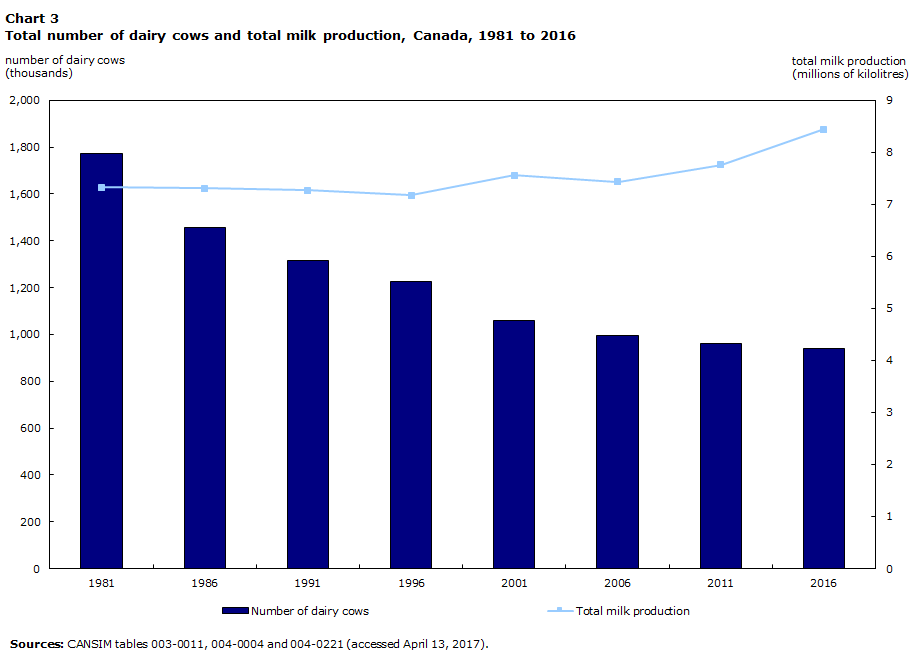
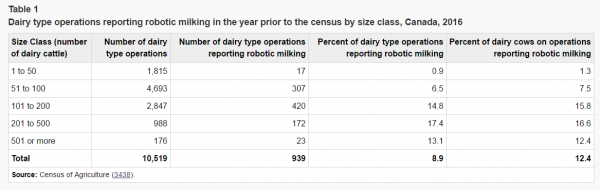
Increased efficiency in the dairy industry was achieved through improvements in feed quality and management, genetics and advancements in technology, including the use of robotic milking. According to data from the Census of Agriculture, 8.9% of dairy type operations now use robotic milking.
Mid-sized farms are more likely to report robotic milking than small and large-sized farms with 44.7% of dairy type farms reporting robotic milking having 101 to 200 cows (Table 1).
In addition to using robotic milking, the improved efficiencies of many dairy type farms can be linked to advancements in animal housing, milking technology, herd management and feed management. In 2015, almost half of dairy type farms reported using automated environmental controls for animal housing or automated animal feeding technology. Investment in innovative technology contributes to the dairy industry producing more with less.