Archive for Sustainable Farming

The Hidden Carbon Challenge: Why Soil Management Could Make or Break Your Dairy’s Path to Net Zero

Is your silage field silently leaking carbon? Discover how soil management could make-or break-your dairy’s climate goals and bottom line.

As the US dairy industry charges ahead with ambitious plans to achieve net-zero greenhouse gas (GHG) emissions by 2050, a critical piece of the sustainability puzzle remains hidden in plain sight, right beneath your feet. While we’re busy counting methane emissions from cow burps and monitoring electricity usage in milking parlors, the carbon cycling through your farm’s soils represents one of the industry’s biggest climate challenges and potentially its greatest opportunity.

Over the past five decades, dairy farmers have made remarkable progress, reducing the GHG intensity per unit of milk by 42%. Production efficiencies have soared, with average milk output per cow climbing from about 9,700 pounds in the 1970s to over 23,000 pounds today. But let’s be brutally honest: are these efficiency gains really as impressive as they seem if they’re coming at the expense of our soil’s carbon bank account?

“The carbon balance on your farm is like your herd’s reproductive efficiency; you can’t manage what you don’t measure,” says Dr. Matthew Ruark, Professor of Soil Science at the University of Wisconsin-Madison. “When we include soil carbon losses in our calculations, the carbon footprint of milk can increase nearly twofold. This represents a significant challenge to meeting net-zero goals but also points to an incredible opportunity if we can reverse these losses through improved management.”

This article explores how your forage management choices directly impact soil carbon, what this means for dairy’s climate goals, and most importantly, what practical pathways exist for transforming this challenge into an opportunity for both environmental and economic sustainability on your operation.

The Surprising Carbon Cost of Modern Dairy Forage Systems
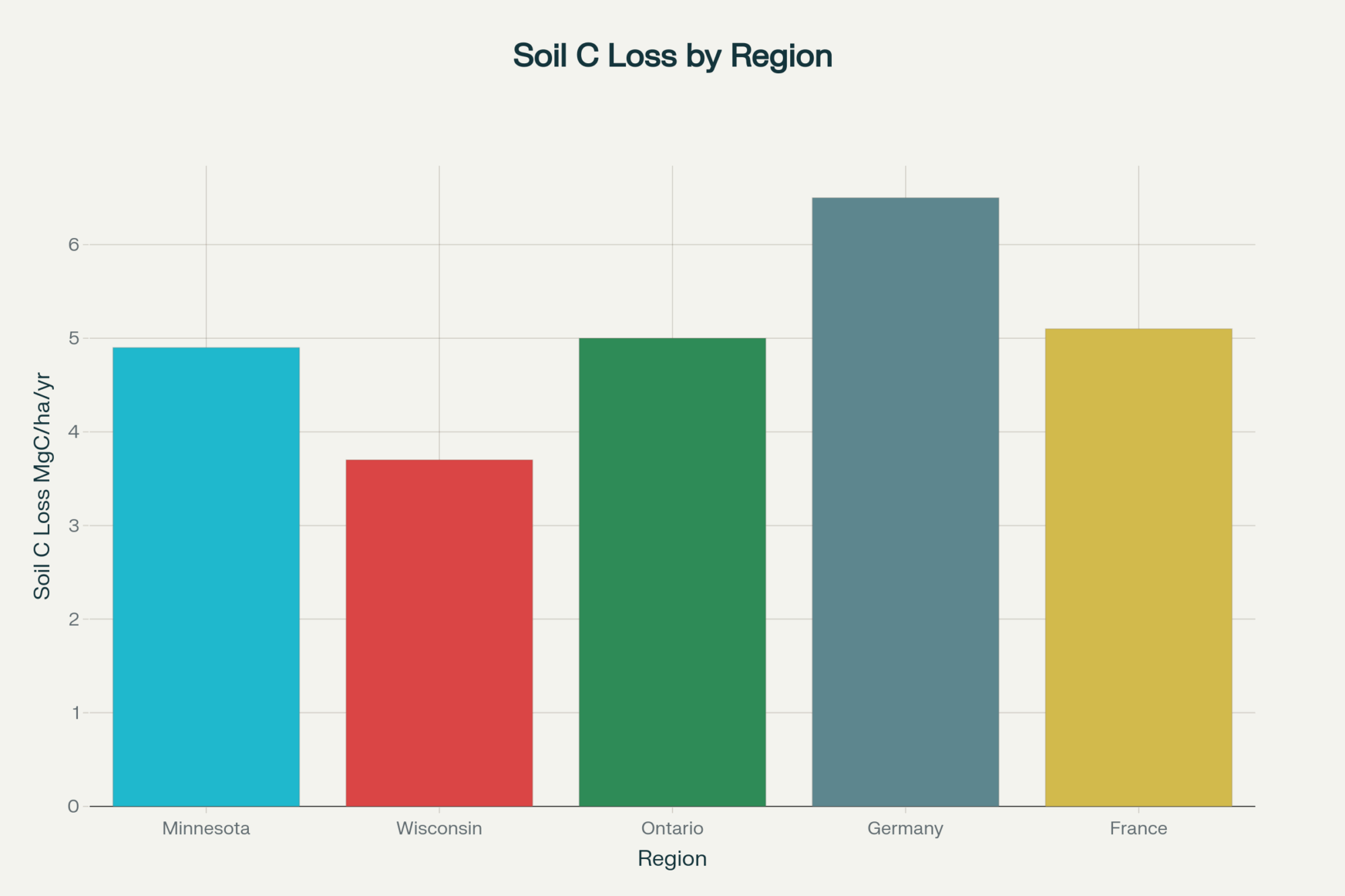
Estimated annual soil carbon loss in corn silage fields across different regions, highlighting the environmental impact of silage-based forage systems

Why Your Silage Fields Might Be Carbon Leakers

Modern dairy farms have gravitated toward corn silage as a cornerstone of their feeding programs, and for good reasons. Corn silage delivers high yields, excellent energy content, and is relatively easy to harvest and preserve. For decades, these agronomic and nutritional advantages made it the undisputed king of forage, driving dairy efficiency in an era before the full carbon cost to our soils was widely understood or accounted for. But at what cost to our soils.

WHAT THIS MEANS FOR YOUR BOTTOM LINE: Think about soil carbon depletion as a hidden withdrawal from your farm’s long-term asset account. Each year of intensive silage production without carbon replacement is like skipping maintenance on your milking equipment; the bill will eventually come due.

Here’s the catch rarely discussed at nutrition conferences or industry meetings. When harvested for silage, most of the corn plant’s above-ground biomass is removed, leaving minimal crop residue to return to the soil. This creates a fundamental imbalance in the carbon cycle, with far more carbon being extracted than returned, like continuously drawing down your herd’s genetics without reinvesting in superior breeding stock.

“Think of soil carbon like your farm’s bank account,” explains dairy nutritionist Dr. Mary Beth Hall. “When you remove more carbon through harvest than you deposit through residues and roots, you’re making withdrawals from an account with a limited balance. Eventually, the soil carbon account becomes depleted.”

Studies using direct measurement techniques have documented substantial carbon losses across North America and Europe under corn silage systems, ranging from 13.5 to 25.6 Mg CO₂ per hectare annually. In Minnesota, researchers monitored an 8-year crop rotation of 5 years of silage corn and 3 years of alfalfa, finding net carbon losses of 13.9 Mg CO₂ per hectare annually, with most losses (17.9 Mg CO₂ per hectare) occurring during corn years.
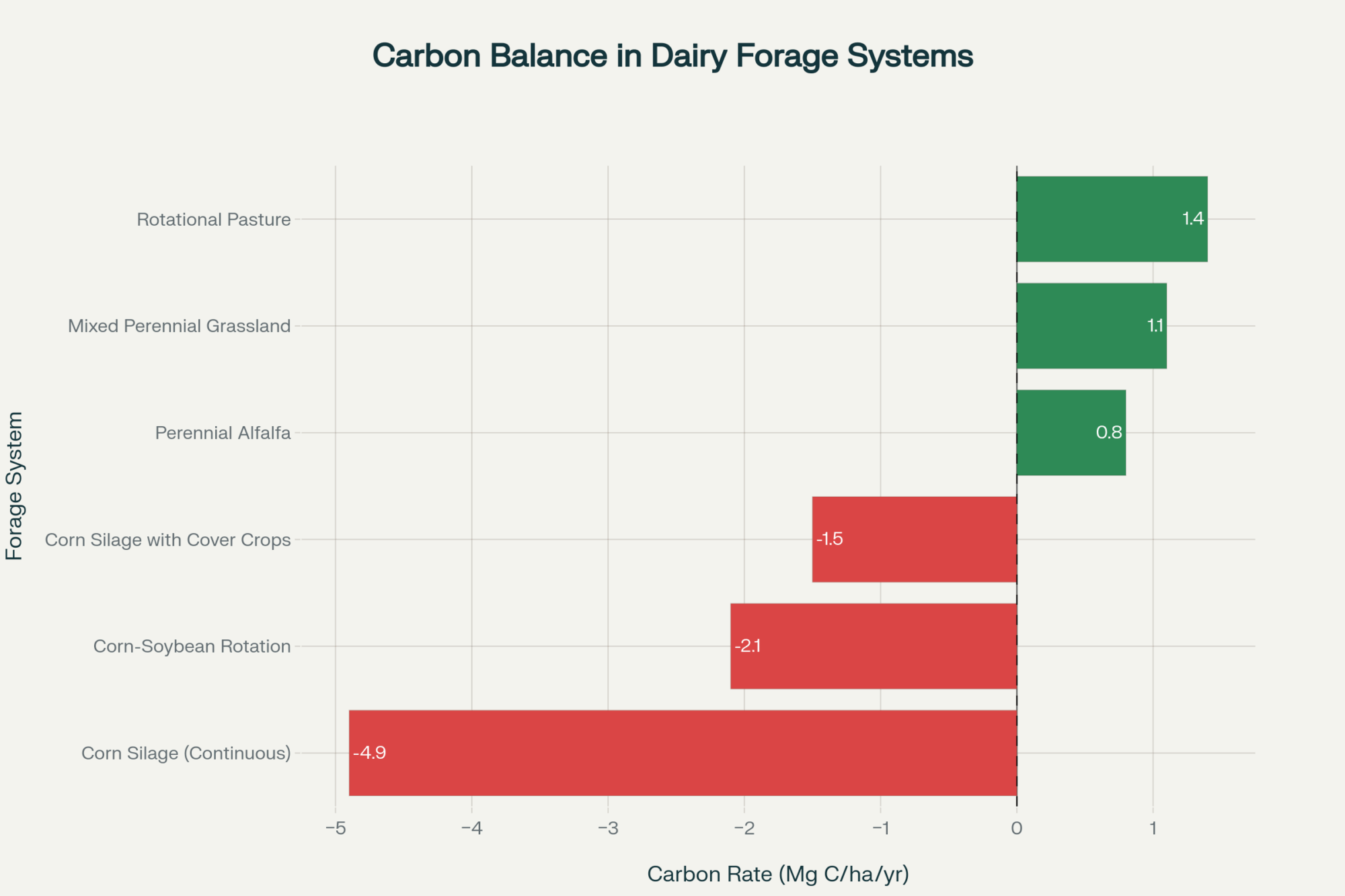
Carbon balance comparison across different dairy forage systems showing soil carbon losses vs gains

What’s even more troubling? You’ll likely never see these losses on your farm’s climate impact statement.

The Accounting Gap That Changes Everything

Here’s what should concern every dairy farmer committed to sustainability: these substantial soil carbon losses typically aren’t included in the carbon footprint of milk.

When researchers at the University of Wisconsin included soil carbon losses in their accounting for a representative 5,000-cow dairy operation in the Midwest, they found the GHG footprint of milk increased by 60% to 93%, rising from the standard 0.75-1.16 kg CO₂e per kg of fat-and-protein-corrected milk (FPCM) to 1.45-1.86 kg CO₂e per kg FPCM.
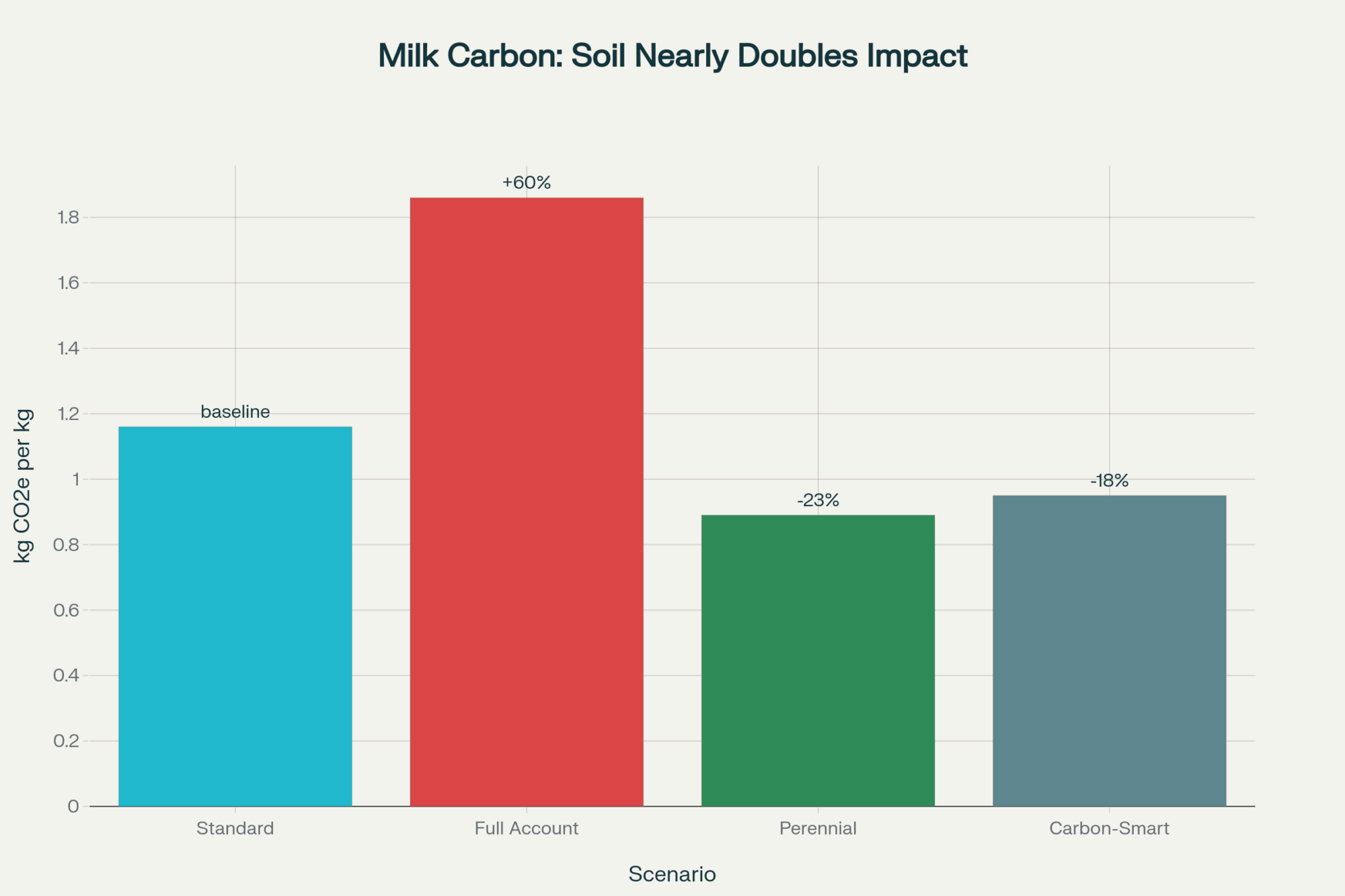
Impact of soil carbon accounting on the true carbon footprint of milk production

“This isn’t just an academic exercise in carbon accounting,” explains Dr. Randy Jackson, grassland ecologist at the University of Wisconsin-Madison. “These carbon losses represent the mining of a finite resource, soil organic matter that took centuries to accumulate. When we lose soil carbon, we lose long-term productivity and resilience, just like pushing your cows too hard can compromise future lactation performance.”

In other words, the carbon efficiency gains in milk production that the industry celebrates may have come partly at the expense of soil carbon stocks. Instead of soils serving as carbon sinks to offset emissions, many dairy forage systems create a carbon liability that increases the challenge of reaching net-zero emissions.

Rethinking Forage Systems for Climate-Smart Dairy

The Power of Perennials

One of the most effective strategies for reversing soil carbon losses is increasing the role of perennial forages in your rotation. Are we overlooking our most powerful climate tool by relegating perennials to marginal land while devoting our best acres to corn silage?

Perennial systems offer fundamental advantages for carbon sequestration:

  • Continuous living cover protects soil from erosion and temperature extremes
  • Extensive root systems deliver carbon deep into the soil profile
  • Minimal soil disturbance preserves soil structure and existing carbon stocks
  • Year-round photosynthesis captures more atmospheric carbon

“There’s a stark contrast between what happens under perennial systems versus annual crops like corn silage,” says Dr. Sarah Goslee, research ecologist with the USDA Agricultural Research Service. “Perennial pastures managed with rotational grazing have demonstrated significantly greater accumulation of stable forms of soil carbon than even the most sustainable annual cropping systems.”

Research comparing various forage systems found that perennial pastures accumulated substantially more total soil organic carbon and, importantly, more mineral-associated organic matter (MAOM-C), a more stable carbon pool, compared to annual cropping systems, even those implementing conservation practices like no-till, diversified rotations, and cover crops.

This doesn’t mean eliminating corn silage but reimagining rotations to include longer periods under perennial forages. Options include:

  • Grass-legume hay mixtures (orchardgrass, tall fescue, timothy paired with alfalfa or clovers)
  • Multi-species pastures for grazing
  • Emerging dual-purpose crops like Kernza intermediate wheatgrass that provide both forage and grain

WHAT THIS MEANS FOR YOUR BOTTOM LINE: Extending your perennial forage phases can reduce annual seed, fuel, and equipment costs while building soil fertility. Research from the University of Turin shows that farms incorporating more perennials have significantly lower land occupation impacts per kg of milk, making more milk on less land.

Many Italian dairy operations producing Parmigiano-Reggiano cheese have maintained this balance for generations, with research showing that farms growing higher proportions of forage on-farm and incorporating more perennials have significantly lower land occupation impacts per kg of milk. According to researchers at the University of Torino, “The LO [land occupation] per unit of production can be reduced by increasing on-farm feed production, particularly protein components, and to a lesser extent by valorizing byproducts.”

Filling the Winter Gap

In temperate regions, winter represents a period of carbon loss, as soil microbial activity continues to decompose organic matter while plant photosynthesis has ceased. Why allow our fields to leak carbon for months when we could be capturing it? Winter annual crops offer a strategic opportunity to reverse these carbon losses while diversifying the forage supply.

Options like winter rye, winter barley, field pennycress, or winter camelina can:

  • Capture carbon during otherwise dormant periods
  • Protect the soil from erosion
  • Scavenge nutrients that might otherwise leach
  • Provide additional forage or grain revenue streams

“Winter covers are like hiring a workforce that works for free during the off-season,” explains dairy nutritionist Dr. Mary Beth Hall. “They’re photosynthesizing when your fields would otherwise be bare, building soil organic matter, and can provide valuable supplemental feed.”

Research in the Midwest has shown that integrating these winter annual crops into corn silage systems can substantially reduce the carbon deficit while providing additional forage or grain, like how strategic dry cow management improves transition cow performance and prevents metabolic disorders without adding excessive costs.

Beyond the Species: Management Makes the Difference

While what you grow matters tremendously, how you manage your forages is equally important:

Conservation tillage: Reducing soil disturbance through no-till or strip-till practices helps preserve soil structure and existing carbon stocks. Studies show this can be particularly beneficial when transitioning from one forage to another, like how minimizing stress during cow transitions improves performance.

Cover cropping: Implementing cover crops between main forage harvests adds biomass to the soil and protects the surface from erosion. Different cover crops offer complementary benefits:

  • Non-legumes (cereals, brassicas) scavenge leftover nutrients and produce substantial biomass
  • Legumes (clovers, vetches) fix atmospheric nitrogen and often create more stable forms of soil carbon
  • Mixes provide multiple benefits simultaneously, like a properly balanced TMR, which delivers multiple nutrients

Strategic grazing: Well-managed rotational grazing promotes uniform nutrient distribution, allows for rest and regrowth periods that enhance root development, and can improve species composition over time. This precision approach to grazing mirrors the principles of precision dairy nutrition, where feed efficiency improves with strategic management.

Manure management: Field application of dairy manure returns photosynthetic carbon to the soil, but how manure is handled before application significantly affects its carbon contribution. Recent research published in the Journal of Dairy Science shows that anaerobic digestion reduces slurry dry matter by 55% compared to raw manure, from 76 g/kg to 34 g/kg, which affects the carbon available for soil building. Raw slurry or solid manure typically delivers more carbon than digested or separated slurry.

As the University of Wisconsin’s Dr. Jessica Gutknecht puts it: “The carbon balance of a dairy farm is fundamentally about how much carbon you’re putting into the soil versus how much is being removed or lost. Every management decision tip that balances one way or another, like your feeding program, affects your components and bulk tank averages.”

Practical Pathways: Making the Transition Work for Your Farm

Transforming your forage system to enhance soil carbon requires a strategic approach tailored to your specific farm conditions. Here are practical steps to consider:

1. Assess Your Current Carbon Balance

Before making changes, understand your starting point. When did you last measure your soil organic matter levels across your fields? Consider:

  • What proportion of your land is in annual versus perennial forages?
  • How long are your current crop rotations?
  • What is your typical tillage intensity?
  • How much crop residue remains after harvest?
  • What type and quantity of manure are you returning to your fields?

This assessment provides a baseline for measuring progress and identifying your biggest opportunities for improvement, like how you’d evaluate your herd’s current production metrics before implementing genetic or management changes.

2. Extend Rotations with Perennials

Look for opportunities to extend the perennial phase of your rotation:

  • Instead of 1-2 years of alfalfa followed by 3-4 years of corn silage, consider 3-4 years of alfalfa or mixed hay followed by 2-3 years of corn
  • Evaluate marginal cropland that might be more profitable and environmentally sound as permanent pasture
  • Consider dedicating 10-15% of your land to strategic perennial plantings, especially on erosion-prone or less productive areas

A study from the University of Turin in Italy demonstrated that dairy farms with a higher percentage of permanent grasslands showed better land occupation efficiency per kg of fat- and protein-corrected milk (FPCM), with extensive farms producing more milk on their utilized agricultural area than on their off-farm land occupation.

3. Implement Winter Covers Strategically

Target your winter cover crop investments where they’ll provide the greatest return:

  • Fields with early corn silage harvest offer an ideal window for establishing winter covers
  • Choose species based on your specific goals (soil building, forage production, nitrogen fixation)
  • Consider interseeding cover crops into standing corn to get a head start on establishment

4. Optimize Your Manure Strategy

Manure represents recycled carbon that can help close your farm’s carbon loop:

  • Consider solid-liquid separation to strategically direct carbon-rich solids to fields with the greatest carbon deficit
  • Time applications to maximize nutrient use efficiency and minimize losses
  • Pair manure applications with cover crops that can capture and utilize nutrients

Recent research from Penn State University demonstrated how strategic applications of manure with cover crops enhanced soil carbon and improved nutrient retention in the soil profile, mitigating potential environmental impacts.

5. Reduce Tillage Intensity

While complete no-till may not be practical in all forage systems, reducing tillage intensity can help preserve soil carbon:

  • Consider strip-till for corn planting after perennials
  • Minimize the number of tillage passes when establishment is necessary
  • Use no-till drills for cover crop establishment whenever possible

6. Focus on Soil Health Monitoring

Regular soil testing with a focus on organic matter can help track your progress:

  • Establish baseline measurements of soil organic matter at consistent depths
  • Consider more advanced soil health tests that measure active carbon fractions
  • Photo-document soil structure and residue cover to track visual changes

WHAT THIS MEANS FOR YOUR BOTTOM LINE: Every 1% increase in soil organic matter can hold approximately 20,000 more gallons of water per acre, reducing irrigation costs and improving drought resilience, that’s money in the bank during dry years.

“Making these transitions doesn’t have to happen all at once,” advises Dr. Randy Jackson. “Start with pilot areas, learn what works on your farm, and expand gradually. Some of the biggest gains can come from relatively small changes applied consistently over time, similar to how small tweaks in your transition cow program can lead to significant improvements in lactation performance.”

Beyond Carbon: The Multiple Benefits of Carbon-Smart Forage Systems
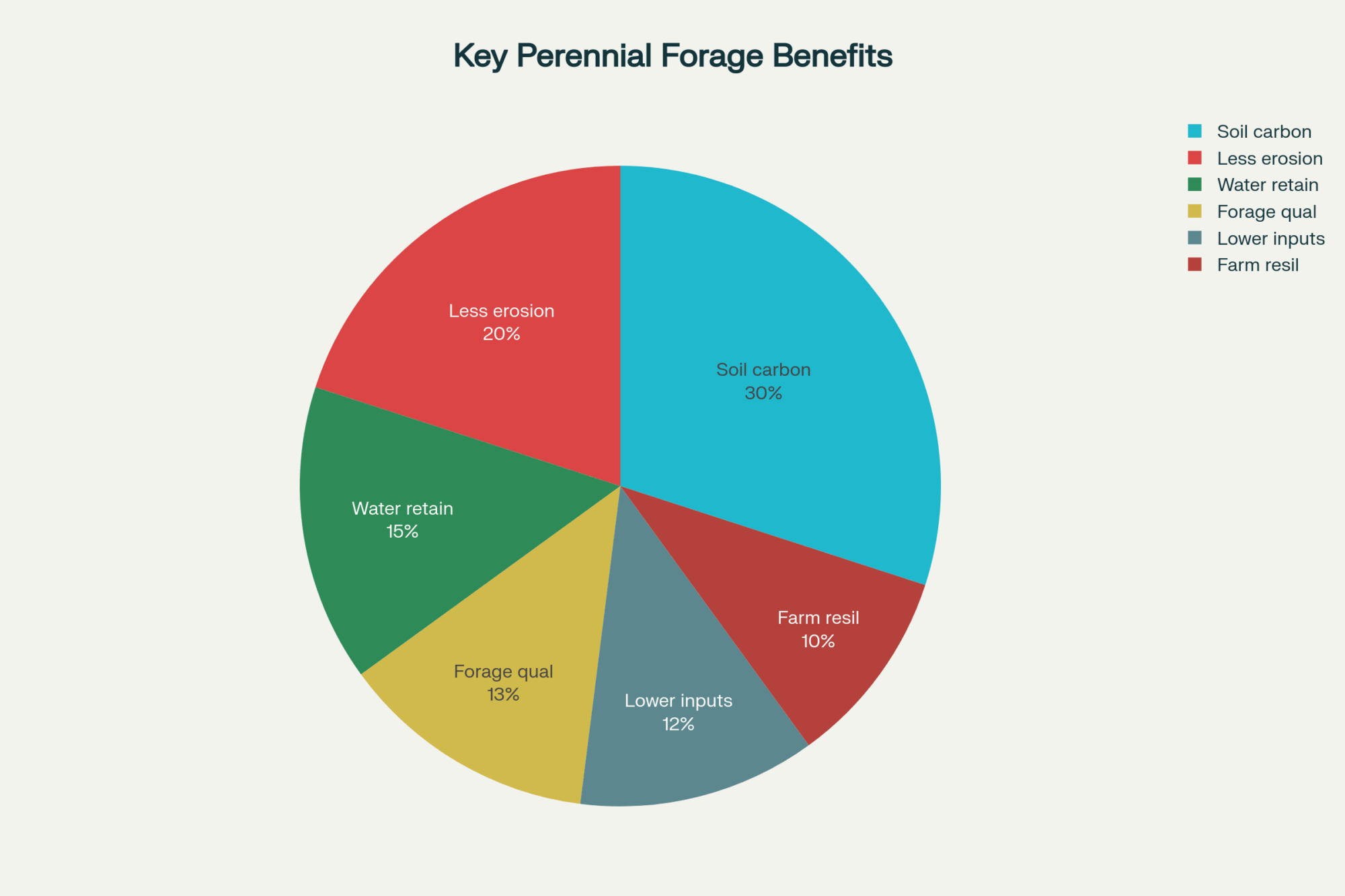
While reducing greenhouse gas emissions is a worthy goal, the benefits of enhancing soil carbon extend far beyond climate mitigation. These “co-benefits” often provide more immediate and tangible value to dairy operations:

Improved Drought Resilience

Soil organic matter acts like a sponge, dramatically increasing the water-holding capacity of soils. Research shows that for every 1% increase in soil organic matter, soils can hold approximately 20,000 more gallons of water per acre. This translates to greater drought resilience and potentially reduced irrigation needs.
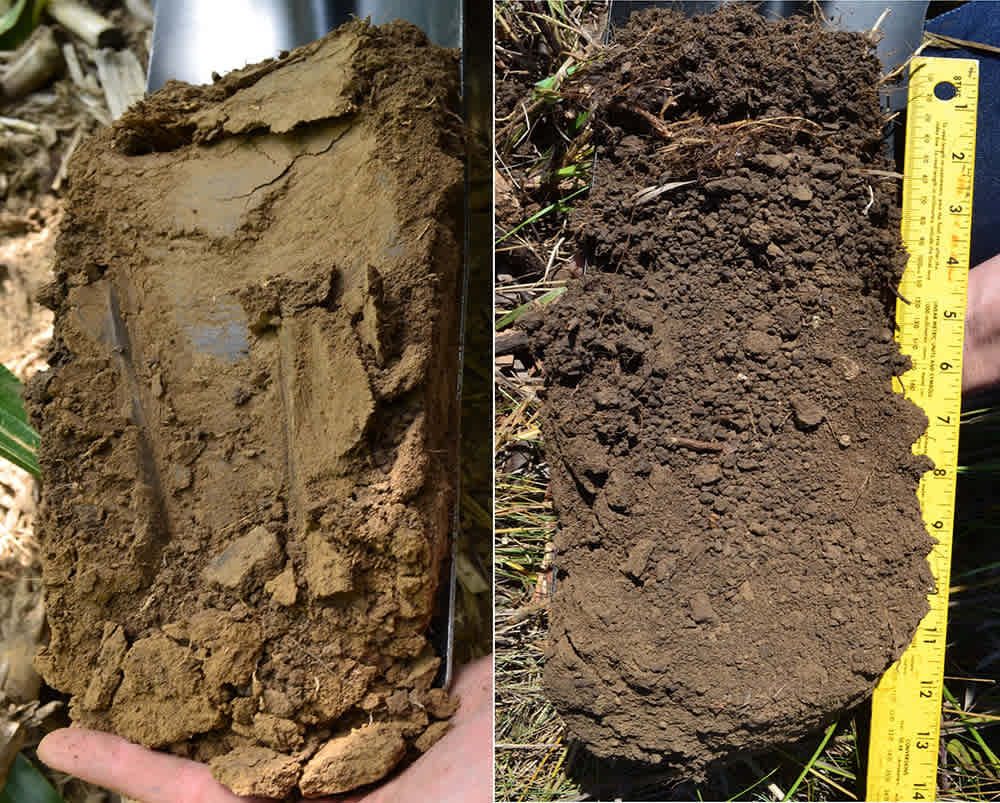
Side-by-side comparison of depleted light soil versus rich dark organic matter soil illustrating soil health differences

“In the 2012 drought, we saw dramatic differences in forage production between farms with high and low soil organic matter,” notes Dr. Christine Jones, an internationally recognized soil ecologist. “The farms that had built their soil carbon had a buffer against the drought stress that devastated other operations, much like how a properly conditioned cow handles the stress of calving better than one that enters the dry period too thin or too fat.”

Enhanced Nutrient Cycling and Efficiency

Carbon-rich soils support more diverse and active soil microbial communities that help cycle nutrients more efficiently. This can reduce fertilizer requirements and associated costs while improving water quality by reducing nutrient runoff and leaching.

Studies in the Northeast have shown that dairy farms implementing perennial-based rotations with cover crops have reduced nitrogen fertilizer needs by 30-50% while maintaining or improving yields, enhancing farm profitability like how strategic feeding of bypass proteins can reduce total protein requirements while maintaining milk production.

Reduced Erosion and Improved Water Quality

The soil structure improvements associated with higher organic matter dramatically reduce erosion potential. This keeps your valuable topsoil in place while preventing sediment and nutrients from impacting waterways.

“Soil health and water quality are two sides of the same coin,” explains Dr. Matt Ruark. “The practices that build soil carbon also tend to be the ones that protect water resources.”

Greater Farm Resilience

Diversifying forage systems creates natural insurance against weather extremes, disease and pest pressures, and market volatility. If one crop struggles, others may thrive under the same conditions.

“Resilience is about having options,” says dairy farmer Ron Holter from Jefferson, Maryland, who transitioned to a perennial pasture-based system. “When you’re working with a diverse, carbon-building system, you’re not putting all your eggs in one basket, just like you wouldn’t want a herd susceptible to the same genetic weaknesses or all at the same stage of lactation.”

The Economics: Does Carbon-Smart Farming Pay?

The ultimate question for many dairy farmers considering changes to their forage systems is: Will it pay? The economics of carbon-smart forage management include both potential costs and benefits:

Potential Costs and Investments

  • Equipment modifications or purchases (e.g., no-till drills, roller crimpers)
  • Learning curve associated with new practices
  • Potential short-term yield adjustments during transition periods
  • Additional management complexity
  • Higher seed costs for cover crops or diverse forage mixes

Potential Benefits and Returns

  • Reduced fuel, labor, and machinery maintenance costs from less tillage
  • Lower fertilizer requirements due to improved nutrient cycling
  • Reduced irrigation needs from improved water retention
  • Potential premium markets for low-carbon dairy products
  • More stable yields under weather extremes
  • Potential carbon credit revenue

The Carbon Market Opportunity

Emerging carbon markets represent a potential new revenue stream for dairy farmers implementing practices that increase soil carbon or reduce methane emissions. While still developing, these markets are gaining momentum:

  • Carbon credits from agricultural soil projects currently range from $15 to $ 45 per metric ton of CO₂ equivalent
  • Projects typically require verified changes in management and measured or modeled carbon gains
  • Credits can come from soil carbon increases, methane reductions (e.g., manure digestion), or both

“The carbon market is still maturing, but forward-thinking dairy farms are positioning themselves to benefit,” explains Dr. Debbie Reed, Executive Director of the Ecosystem Services Market Consortium. “The farms with good data and documented practice changes will be best positioned to participate as these markets develop, similar to how farms that were early adopters of robotic milking or precision feeding technology often gained market advantages.”

Real-World Economics

Perhaps most compelling are the experiences of dairy farms that have already made transitions to more carbon-friendly systems:

Rettland Farm (Pennsylvania) transitioned from a corn silage-based confinement operation to a managed grazing system with diverse perennial pastures. While milk production per cow decreased slightly, the farm eliminated silage production costs, reduced grain purchases by 30%, and improved herd health, resulting in net profitability gains of $800 per cow annually.

Grazeway Dairy (Wisconsin) implemented a partial system where 40% of the forage comes from perennial pasture and 60% from harvested feed. They’ve documented a 35% reduction in machinery and fuel costs while maintaining comparable milk production. Soil organic matter on their pastures has increased from 3.2% to 5.7% over 12 years.

Blue Spruce Farm (Vermont) maintained its corn silage system but added winter cover crops, reduced tillage, and incorporated manure injection. While spending approximately $30 per acre more on seeds and management, they’ve reduced fertilizer costs by $45 per acre and documented yield increases worth $65-90 per acre in their subsequent corn crops.

As fifth-generation dairy farmer Jon Gilbert puts it: “There’s a cost to changing, but there’s also a cost to not changing. When I look at what we’re spending on fertilizer, fuel, and equipment repairs in our conventional system versus our transition fields, the numbers increasingly favor the carbon-building approach; it’s like comparing the economics of preventing metabolic disease versus treating it.”

Taking Action: Where to Start on Your Farm

Ready to explore how carbon-smart forage management might work on your dairy? Here are the practical next steps:

1. Start with Knowledge Building

  • Attend field days where carbon-friendly practices are being demonstrated
  • Connect with your local extension office about soil health programs
  • Join farmer networks focused on regenerative agriculture and soil health
  • Consider a soil health assessment to establish your baseline

2. Experiment on a Small Scale

  • Choose a field or portion of a field for trying new approaches
  • Consider side-by-side comparisons of your current system versus alternatives
  • Document what you observe, including operational aspects and visual soil changes
  • Be patient, soil carbon changes happen over years, not months, like genetic improvements in your herd

3. Seek Technical Assistance and Incentives

  • NRCS (Natural Resources Conservation Service) offers technical assistance and cost-sharing for many carbon-enhancing practices
  • State departments of agriculture often have specific programs for dairy conservation
  • Some milk processors and cooperatives are developing sustainability incentive programs
  • Carbon market project developers can help assess your operation’s potential for credit generation

4. Connect with Peers Who Have Made Similar Transitions

  • Farmer-to-farmer learning is consistently rated as the most valuable information source
  • Look for progressive dairy discussion groups in your region
  • Consider visiting farms that have successfully implemented practices you’re interested in

5. Take a Whole-Farm Systems Approach

  • Consider how forage changes might integrate with other sustainability efforts (e.g., renewable energy, manure management)
  • Think about potential synergies across your operation
  • Involve your nutritionist, crop advisor, and other team members in planning

Looking Forward: Dairy’s Carbon-Smart Future

The dairy industry stands at a pivotal moment. The path to net-zero emissions requires addressing all sources of greenhouse gases, including those from the soils that grow dairy feeds. While this challenges conventional forage systems, it also creates tremendous opportunities for innovation and leadership.

Researchers at institutions like the Swedish University of Agricultural Sciences are exploring additional technologies to reduce methane emissions, including seaweed supplements like Asparagopsis taxiformis, which has shown a 30% reduction in methane production in some trials. However, managing soil carbon through improved forage systems represents a more fundamental solution with multiple co-benefits.

“The dairy farms that will thrive in the coming decades are the ones thinking holistically about carbon, not just how to reduce emissions, but how to actively build carbon in their soils,” predicts Dr. Jed Colquhoun, Associate Dean for Extension at the University of Wisconsin-Madison.

Are you ready to be part of this transformation? By reimagining your forage systems to enhance soil carbon, you can:

  • Make meaningful progress toward industry climate goals
  • Build more resilient, profitable operations
  • Improve environmental outcomes beyond carbon (water, biodiversity)
  • Position yourself for emerging ecosystem service markets
  • Tell a compelling sustainability story to consumers and processors

The transition won’t happen overnight, and there’s no one-size-fits-all solution. But by starting the journey now, testing, learning, and adapting, you can turn one of the industry’s biggest climate challenges into one of its greatest opportunities.

As we reimagine dairy forage systems for a carbon-constrained future, the focus must extend beyond yield and feed quality to include these systems’ fundamental role in the carbon cycle. The practices that build soil carbon, incorporating more perennials, reducing tillage, implementing cover crops, optimizing grazing, and refining manure management, represent climate solutions and pathways to more resilient, productive dairy farms.

The carbon that sustains us ultimately comes from the soil. By managing that carbon more thoughtfully, you can lead agricultural climate solutions while building operations that will thrive for generations. What will your farm’s carbon legacy be?

Key Takeaways

  • Soil carbon losses from intensive silage corn production (3.7-7.0 Mg C/ha/yr) are significant but typically excluded from carbon footprints, dramatically increasing the true climate impact of dairy production when accounted for.
  • Perennial forage integration, conservation tillage, cover cropping, and strategic grazing represent proven approaches to reverse soil carbon losses while providing drought resilience and potential economic benefits through reduced input costs.
  • Every 1% increase in soil organic matter can hold approximately 20,000 more gallons of water per acre, creating natural insurance against increasingly common weather extremes.
  • Farmers who have implemented carbon-smart practices report tangible benefits-from 35% reductions in machinery and fuel costs to improved herd health and drought resilience-demonstrating that environmental and economic sustainability can be aligned.
  • The transition to carbon-smart forage systems doesn’t require wholesale change overnight; starting with pilot areas and scaling gradually allows farmers to learn what works best for their specific operation while building soil health and climate resilience.

Executive Summary

This compelling article reveals how conventional corn silage-based dairy systems are creating a significant but often overlooked carbon deficit in soils, potentially doubling milk’s true carbon footprint when properly accounted for. The author challenges the industry’s reliance on corn silage, presenting evidence that perennial forages, cover crops, and strategic grazing can reverse soil carbon losses while improving drought resilience, reducing input costs, and enhancing overall farm profitability. Through case studies of innovative dairy operations and expert insights, the article demonstrates that transitioning to carbon-smart forage systems offers multiple pathways to achieve both environmental sustainability and economic advantages. With practical guidance for implementation and a frank assessment of the challenges, the piece makes a persuasive case that soil carbon management represents both dairy’s biggest climate challenge and its greatest opportunity.

This article was developed based on research from the University of Wisconsin, Minnesota, Vermont, Cornell, Turin, and the Swedish University of Agricultural Sciences, as well as the USDA Agricultural Research Service and interviews with dairy farmers implementing carbon-smart practices. For more information on specific regional practices or programs, contact your local Extension office or NRCS field office.

Complete references and supporting documentation are available upon request by contacting the editorial team at editor@thebullvine.com.

Learn more:

Join the Revolution!

Join over 30,000 successful dairy professionals who rely on Bullvine Weekly for their competitive edge. Delivered directly to your inbox each week, our exclusive industry insights help you make smarter decisions while saving precious hours every week. Never miss critical updates on milk production trends, breakthrough technologies, and profit-boosting strategies that top producers are already implementing. Subscribe now to transform your dairy operation’s efficiency and profitability—your future success is just one click away.

NewsSubscribe
First
Last
Consent

The Carbon Credit Programs Every Dairy Should Join Before 2026

While you track milk prices, smart dairies bank $400+ per cow from carbon credits. Here’s the enrollment window closing fast.

Here’s a statistic that should wake up every dairy operator: anaerobic digestion systems are generating up to $450 per cow annually in carbon revenue, with documented cases showing realistic annual revenue figures in the range of $400 to $450 per cow for high-value projects producing Renewable Natural Gas (RNG). That’s equivalent to $1.50 per hundredweight in additional income, and it’s happening right now while most producers focus solely on traditional revenue streams.

The problem? Most dairy operations are missing this opportunity because they assume carbon credits are too complex, too risky, or “not for farms like theirs.” The bigger problem? With carbon credit markets experiencing a documented “flight to quality” favoring permanent, verifiable reductions over questionable soil claims, early adopters are locking in the most favorable terms before capacity limits are reached.

Here’s what the industry doesn’t want you to know: Three legitimate programs are currently accepting new enrollments, government funding covers up to 85% of implementation costs through programs like OFCAF, and documented case studies prove this isn’t theoretical—it’s transforming dairy economics across North America.

Challenging the “Environmental Compliance as Cost Burden” Myth

Let’s confront one of the dairy industry’s most expensive misconceptions: that environmental initiatives are purely cost centers that drain profitability without generating returns. This conventional wisdom isn’t just wrong—it’s costing you six figures annually.

The Evidence Against Conventional Thinking:

The comprehensive analysis reveals that capital-intensive methane abatement technologies, particularly anaerobic digesters producing RNG, represent a high-reward pathway with documented earnings reaching $400-$450 per cow annually, driven by high-value compliance markets like California’s Low Carbon Fuel Standard. One documented case study of a large 5,500-cow Western U.S. dairy reported generating $1.4 million in annual carbon credit revenue after expenses, equating to roughly $255 per cow—revenue that exceeded the farm’s profit from milk production in a good year.

Why the Old Mindset Persists:

The dairy industry’s resistance stems from decades of viewing environmental programs through a regulatory compliance lens. But here’s where conventional wisdom fails catastrophically: carbon markets represent a fundamental shift from regulatory compliance to market-based incentives. Instead of paying penalties for emissions, farms now get paid for reductions.

The New Reality Creating Millionaires:

Research shows that feed additive programs alone have generated substantial returns. Across three carbon projects initiated in 2021 and 2022, U.S. dairy farmers using the feed additive Agolin Ruminant received nearly $3 million in carbon-asset payments. The profitability hinges on carbon credit prices being high enough to offset the daily cost of the additive, estimated at $0.15 to $0.30 per cow per day.

The Three-Tier Carbon Revenue Strategy (Verified by Real Farm Data)

Technology/PracticeFarm Size (Cows)Capital Cost RangeAnnual Revenue per Cow (Low)Annual Revenue per Cow (High)Implementation TimelineGovernment Support Available
Anaerobic Digester + RNG (Large)2,500+$5M – $10M+40045018-36 monthsYes (ACT, OFCAF)
Anaerobic Digester + RNG (Medium)1,000-2,500$2M – $5M25035012-24 monthsYes (ACT, OFCAF)
Feed Additive (Bovaer)300-1,000Minimal3516030 daysNo
Feed Additive (Agolin)300-1,000Minimal3510030 daysNo
Cover Cropping<300Low2101 seasonYes (OFCAF)
No-Till Farming<300Low281 seasonYes (OFCAF)
Rotational Grazing100-500Low-Medium5256 monthsYes (OFCAF)
Manure Management500+Medium15406-12 monthsYes (OFCAF)

Tier 1: The RNG Gold Rush (Large Operations)

For operations with 2,500+ cows, anaerobic digestion systems represent the “gold standard” technology for maximizing carbon revenue. The captured biogas can be used in two main ways: electricity generation for on-farm use or grid sale, or upgraded to pipeline-quality RNG for injection into natural gas grids as low-carbon transportation fuel.

The Financial Reality: With capital costs running from $3 million to over $10 million, this opportunity is largely accessible only to the largest dairy operations or those able to secure significant grant funding. However, the returns justify the investment—documented payback periods range from 3 to 7 years under favorable market conditions.

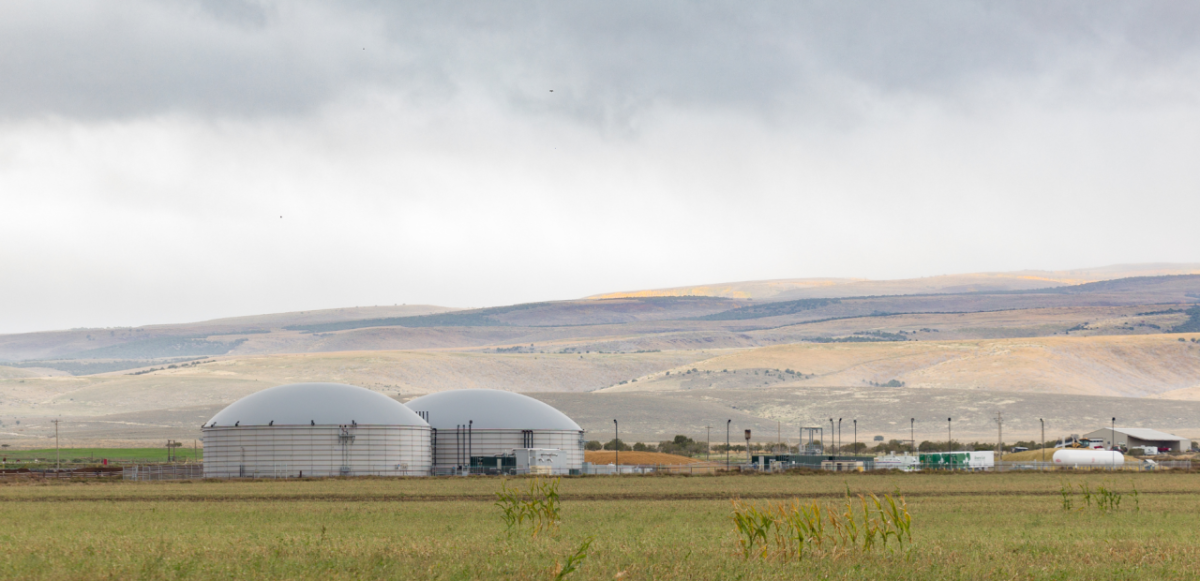
An aerial view of a dairy farm's anaerobic digestion and biogas facility, featuring large green domes and processing equipment
An aerial view of a dairy farm’s anaerobic digestion and biogas facility, featuring large green domes and processing equipment.

Tier 2: The Feed Additive Sweet Spot (Medium Operations)

Feed additives that reduce enteric methane represent a rapidly developing area with significant potential. Specific, scientifically validated feed additives can be incorporated into a cow’s diet to inhibit the microbes that produce methane.

Proven Technologies:

  • Agolin Ruminant: This proprietary blend of essential oils has been certified by The Carbon Trust for methane reduction and is the foundation for carbon inset projects that have resulted in nearly $3 million in payments to U.S. dairy farmers
  • 3-Nitrooxypropanol (3-NOP/Bovaer): Scientifically shown to consistently reduce enteric methane emissions in dairy cattle

The Implementation Reality: The first verified transaction through Athian’s livestock carbon insetting marketplace involved Texas dairy farmer Jasper DeVos generating nearly 1,150 metric tons of CO2e reduction, which was purchased by Dairy Farmers of America.

This chart shows the annual revenue potential per cow for different carbon credit technologies available to dairy farms, ranging from high-investment anaerobic digesters to low-cost management practices

Tier 3: The Soil Carbon Foundation (Small Operations)

For smaller operations, soil carbon sequestration through cover cropping, reduced tillage, and rotational grazing offers an entry point, though returns are more modest. An example from Alberta’s Conservation Cropping Protocol showed net returns to farmers of just $0.87 to $1.73 per acre after aggregator fees. A 2013 study found most participating Alberta farmers earned between $1,000 and $5,000 total from their contracts, representing only about 1% of average gross farm income.

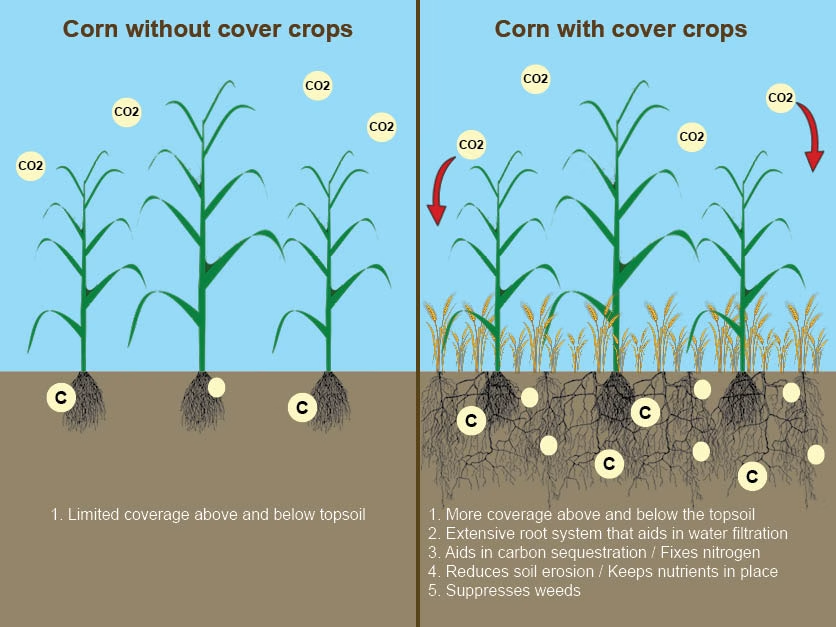
Diagram illustrating the benefits of cover crops in corn fields, showing enhanced carbon sequestration and improved soil health compared to fields without cover crops

Here’s What Dairy Cooperatives Don’t Want You to Discover About Carbon Revenue

Program/PlatformRevenue Share to FarmerVerification StandardTrack RecordKey PartnersRed Flags
Athian (Livestock Carbon)75%Third-party verifiedDocumented DFA purchaseDFA, Elanco, NewtrientNone identified
Concord Agriculture Partners85%Third-party verified$3M paid to farmersAlltech, AgolinNone identified
Carbon by Indigo75%Climate Action Reserve$30/credit in 2022Major food companiesNone identified
Farmers Edge (Warning)Variable/UnclearUnclear processMultiple complaintsUnknownPayment delays, high fees
Unnamed Aggregators (Red Flag)50% or lessNo verificationNo documented paymentsUnknownNo transparency, high upfront costs

The Insetting Revolution That Changes Everything:

The most significant development transforming carbon markets is the rise of “insetting”—where credits are purchased by companies within the dairy value chain rather than unrelated buyers. This creates more stable, predictable demand because dairy processors need these credits to meet their own supply chain (Scope 3) emissions targets.

Programs Worth Your Time (With Verified Track Records):

Athian – The Dairy Industry’s Insider Secret

  • Revenue Split: 75% to farmer, 25% to platform
  • Key Partners: Dairy Farmers of America, Elanco Animal Health, Newtrient
  • Why It Works: Keeps value within the animal agriculture value chain, creating built-in demand from dairy processors

Concord Agriculture Partners – The Feed Additive Specialist

  • Revenue Split: Industry-leading 85% to farmer, 15% to platform
  • Focus: Enteric methane reduction using Agolin Ruminant feed additive
  • Track Record: Part of projects that have delivered nearly $3 million to U.S. dairy farmers

Carbon by Indigo – The Soil Carbon Leader

  • Revenue Split: 75% to farmer, 25% to platform
  • Registry: Climate Action Reserve (CAR) for high credibility
  • Performance: Paid $30 per credit in 2022, higher than initially projected $20

Government Funding: Your Secret Weapon for Million-Dollar Projects

Support TypeFunding LevelMaximum AmountEligible TechnologiesApplication Status
OFCAF Cost-Share65-85% of costs$75,000 CADCover crops, rotational grazing, nitrogen managementOngoing intakes
ACT Program Funding50% of costs$2M CADAnaerobic digesters, clean technologyOngoing
USDA REAP Grants25-75% of costs$1M USDRenewable energy systems, digestersOngoing
LCFS Credit Multiplier28x CO2 valueNo limitRNG production, dairy methane captureAutomatic for qualified projects
Investment Tax Credits30-50% of investmentNo limitAnaerobic digesters, renewable energyAvailable

Federal Support That Changes the Math:

On-Farm Climate Action Fund (OFCAF): This $200 million fund provides direct cost-share funding for beneficial management practices. The Ontario program offers 65% cost-share, with a specialized stream for organic farms offering up to 85% of eligible costs, maximum $75,000 per operation.

Agricultural Clean Technology (ACT) Program: Targeted at larger-scale projects, providing non-repayable contributions of up to 50% of project costs, maximum $2 million—critical funding for anaerobic digester investments.

Provincial Opportunities:

  • Alberta: Operating under TIER regulation, the most mature provincial system with government-approved protocols for agricultural offset projects
  • Quebec: Cap-and-Trade system linked with California’s allows specific agricultural offset protocols including methane mitigation through slurry pit covering and biomethanization

Why Major Dairy Associations Haven’t Promoted These Opportunities Aggressively

The Market Transformation Creating Six-Figure Opportunities:

The carbon market is experiencing a documented “flight to quality,” where demand shifts toward credits representing real, verifiable, and permanent GHG reductions. This trend strongly favors credits from direct methane abatement technologies like anaerobic digesters over less certain soil carbon sequestration.

Compliance Markets vs. Voluntary Markets:

Compliance market prices are generally higher and more predictable, tied to government-mandated schedules. Voluntary market prices can fluctuate significantly, but the insetting model addresses volatility by creating stable demand within the dairy value chain.

Calculate Your Operation’s Carbon Earning Potential

Realistic Financial Projections by Farm Size:

Farm Size (Cows)Technology/PracticeEst. Capital CostEst. Annual Revenue/CowNet Revenue/Cow (Post-Fees)
2,500+Anaerobic Digester + RNG$5M – $10M+$400 – $450$150 – $250+
300-1,000Feed Additive (Agolin)Minimal$35 – $160$0 – $100+
<300Cover Cropping/No-TillLow$2 – $10/acre$0 – $5/acre

Source: Smart Prosperity Institute comprehensive analysis

Critical Cost Considerations:

  • Measurement, Reporting, Verification (MRV): $10,000 to $20,000 per individual farm project
  • Aggregator Fees: Range from 15% to 50%, with transparent programs like Athian stating 75%/25% split
  • Transaction Costs: Often underestimated but essential for program integrity

Programs to Avoid: The $100,000 Mistake

The Farmers Edge Cautionary Tale:

Multiple farmers in Manitoba and Saskatchewan report being misled by programs bundling expensive services with vague carbon revenue promises, receiving invoices for tens of thousands—in one case over $100,000—while receiving no carbon payments. In documented instances, farmers were told companies would not sell generated credits “due to current values,” highlighting the risk when aggregators control timing of credit sales.

Red Flags to Identify:

  • Programs bundling expensive services with non-guaranteed carbon revenue
  • Unclear payment timelines or aggregator-controlled credit sales
  • Revenue projections not backed by existing program performance

Your Strategic Enrollment Framework

The Due Diligence Protocol That Prevents Six-Figure Losses:

Before signing any carbon market contract, secure clarity on critical contractual clauses that can have profound, long-term implications:

Essential Questions for Program Evaluation:

  • What is the exact revenue-sharing model and are there hidden fees?
  • What is the process and timeline for payment after credits are generated?
  • Who covers third-party verification costs?
  • What are contract length and early termination penalties?
  • Who owns the farm data and how will it be protected?

Critical Contract Clauses:

Additionality Requirements: Practices must be “additional” to business-as-usual, often rendering progressive farmers who have practiced conservation for years ineligible—a perverse incentive that penalizes early adopters.

Permanence Obligations: Contractual requirements to maintain specific practices for 10-20 years or more, creating long-term encumbrances that can complicate farm succession planning.

Reversal Liability: Risk that sequestered carbon could be released back into the atmosphere, with reputable programs managing this through buffer pools—for example, Indigo holds back up to 20% of credits for this purpose.

The Bottom Line: Why Smart Operators Are Moving Now

While dairy operators nationwide focus on volatile milk prices and rising costs, comprehensive analysis shows progressive farms are building substantial revenue streams through carbon credit programs. The earning potential is verified through documented case studies: realistic annual revenue of $400-$450 per cow for anaerobic digestion systems, nearly $3 million paid to farmers through feed additive programs, and significant government support covering up to 85% of implementation costs.

Three critical takeaways backed by verified research: First, program quality varies dramatically—legitimate platforms like Athian offer transparent 75% farmer revenue shares with documented transactions, while others have left producers with unpaid bills exceeding $100,000. Second, government funding through ACT and OFCAF programs provides essential cost-share support that research confirms as critical for project viability. Third, timing matters more than perfection—the documented “flight to quality” in carbon markets favors early adopters of permanent, verifiable reduction technologies.

The research is clear: The carbon credit opportunity is “sharply bifurcated” between high-reward, capital-intensive projects accessible to large operations and more modest returns for smaller farms. However, the comprehensive analysis recommends that producers prioritize practices delivering tangible on-farm co-benefits—improved soil health, operational efficiency, reduced input costs—as the primary return on investment, with carbon credits viewed as a potential bonus, not a guaranteed foundation.

Your immediate action step: This week, assess your eligibility for government cost-share programs and identify which carbon credit pathway aligns with your operation’s scale and risk tolerance. Whether you’re considering a multi-million dollar digester with documented 48% gross margins or a feed additive program with proven methane reduction, understanding available support is your first step toward joining the documented ranks of farms already banking substantial carbon revenues.

The carbon credit revolution is transforming dairy economics—but only for operations that act while opportunities remain open. The question isn’t whether environmental programs will become part of dairy economics, but whether you’ll position your operation to profit from this transition or watch others capture the first-mover advantages that are creating six-figure revenue streams right now.

KEY TAKEAWAYS

  • Transform Environmental Compliance into Profit Centers: Large operations (1,000+ cows) can achieve $400-$450 annual revenue per cow through anaerobic digestion systems producing RNG for California’s Low Carbon Fuel Standard, with documented payback periods of 3-7 years when leveraging government cost-share funding up to $2 million through Canada’s ACT Program.
  • Feed Efficiency Meets Carbon Revenue: Medium-scale dairies (300-1,000 cows) using scientifically validated feed additives like Agolin Ruminant can generate $35-$160 per cow annually with minimal capital investment, while the additive costs just $0.15-$0.30 per cow daily—creating positive cash flow within 30 days of enrollment in legitimate programs offering 75-85% farmer revenue shares.
  • Government Funding Changes the ROI Equation: Smart operators are stacking OFCAF’s 65-85% cost-share funding (maximum $75,000 per farm) with carbon credit programs to de-risk investments, positioning beneficial management practices like cover cropping and enhanced manure management as profit centers rather than compliance costs.
  • Insetting Revolution Creates Stable Demand: The first verified transaction through Athian’s livestock carbon marketplace—where Texas dairy farmer Jasper DeVos sold 1,150 metric tons of CO2e credits directly to Dairy Farmers of America—signals the shift toward value-chain integration that provides more predictable pricing than volatile voluntary offset markets.
  • Warning: Program Quality Varies Dramatically: While legitimate platforms like Athian (75% farmer share) and Concord Agriculture Partners (85% farmer share) offer transparent terms with documented payouts, multiple Manitoba and Saskatchewan farmers report losses exceeding $100,000 from programs bundling expensive services with unfulfilled carbon revenue promises—making due diligence absolutely critical before signing long-term contracts.

EXECUTIVE SUMMARY

The dairy industry’s biggest lie? That environmental programs drain profits instead of generating them. Comprehensive analysis reveals anaerobic digestion systems are generating realistic annual revenue of $400-$450 per cow through Renewable Natural Gas production, with one documented 5,500-cow Western operation reporting $1.4 million in annual carbon revenue—exceeding their milk profits in strong market years. Feed additive programs have already delivered $3 million to U.S. dairy farmers across just three projects using scientifically validated methane-reducing supplements, while government cost-share funding through Canada’s OFCAF program covers up to 85% of implementation costs with $75,000 maximum per operation. The market is experiencing a documented “flight to quality” favoring permanent methane destruction over questionable soil carbon claims, creating premium pricing for dairy-specific technologies just as processors like Dairy Farmers of America begin purchasing credits directly from their supplier farms. Three legitimate programs are accepting enrollments now, but compliance market capacity limits and tightening qualification requirements mean early adopters are securing advantages that late entrants won’t access. Evaluate your operation’s carbon earning potential immediately—the window for optimal positioning closes as programs reach capacity and competition intensifies.

Complete references and supporting documentation are available upon request by contacting the editorial team at editor@thebullvine.com.

Learn More:

Join the Revolution!

Join over 30,000 successful dairy professionals who rely on Bullvine Weekly for their competitive edge. Delivered directly to your inbox each week, our exclusive industry insights help you make smarter decisions while saving precious hours every week. Never miss critical updates on milk production trends, breakthrough technologies, and profit-boosting strategies that top producers are already implementing. Subscribe now to transform your dairy operation’s efficiency and profitability—your future success is just one click away.
NewsSubscribe
First
Last
Consent

Generate $15,000+ Annual Carbon Revenue: The Dairy Producer’s Guide to Getting Paid for Going Green

While you’re chasing milk yield gains, smart producers are banking $15,000+ annually from practices that boost feed efficiency AND reduce emissions

EXECUTIVE SUMMARY: The dairy industry’s biggest lie: treating methane reduction as a compliance cost rather than a profit center is the single biggest strategic mistake most producers are making. While the agricultural carbon market exploded from $2 billion in 2021 to a projected $40 billion by 2030, dairy-specific programs now generate $20-$80 per metric ton for verified emission reductions—yet 90% of producers remain completely unaware. Research consistently shows feed additives like 3-NOP can simultaneously reduce methane emissions by 22-35% while improving feed efficiency by 4-5%, creating dual revenue streams that industry nutritionists have historically ignored. Corporate giants like Microsoft have contracted for nearly 30 million metric tons of carbon removal, while early adopters are locking in premium contract terms before the market matures. Canadian farmers are already earning $30-45 per acre annually through established carbon programs, proving the financial viability for North American operations. Government cost-share programs can cover 50-75% of implementation costs, dramatically reducing financial risk during the transition period. Stop viewing environmental practices as expenses—start evaluating carbon farming as your next major profit opportunity.

KEY TAKEAWAYS

  • Revenue Stacking Opportunity: Feed additives like 3-NOP generate $14,000-$25,000 annually for 1,000-cow operations through 20-30% methane reduction PLUS 4-5% feed efficiency improvements—turning environmental compliance into a dual profit center
  • Market Timing Advantage: Early adopters are securing 75% revenue-sharing contracts with registry-verified programs while the agricultural carbon market experiences 28.9% annual growth, positioning operations for long-term premium pricing
  • Government De-Risking Strategy: USDA cost-share programs (EQIP/CSP) cover 50-75% of practice implementation costs, allowing producers to stack government payments with private carbon credits from the same practices—dramatically reducing transition risk
  • Technology Integration Reality: Modern carbon verification systems integrate seamlessly with existing dairy management software, eliminating the “paperwork burden” myth while creating comprehensive data streams that unlock multiple value opportunities beyond carbon credits
  • 45Z Policy Revolution: Section 45Z tax credits create parallel markets for low-carbon-intensity dairy feedstocks potentially worth $130+ per acre annually—eclipsing traditional carbon credit revenue while requiring identical management practices

The industry’s biggest lie: Treating methane reduction as a compliance cost rather than a profit center is most dairy producers’ single biggest strategic mistake. While the agricultural carbon market exploded from $2 billion in 2021 to a projected $40 billion by 2030, dairy-specific programs now generate $20-$80 per metric ton for verified emission reductions—yet 90% of producers remain completely unaware of these opportunities.

Your nutritionist isn’t telling you that feed additives like 3-NOP can simultaneously reduce methane emissions by 22-35% while improving feed efficiency, creating dual revenue streams from carbon credits and operational savings that industry consultants have historically ignored in their singular focus on milk production metrics.

The policy revolution nobody’s discussing: Section 45Z of the Inflation Reduction Act creates a parallel market for low-carbon-intensity dairy feedstocks that could generate over $130 per acre annually, eclipsing traditional carbon credit revenue while requiring the same practices most carbon programs incentivize.

What if the biggest profit opportunity in dairy isn’t from higher milk prices, better genetics, or even precision feeding, but from getting paid for practices that improve your operation’s efficiency and resilience?

While most dairy producers are laser-focused on squeezing another dollar from their Income Over Feed Cost (IOFC), which currently averages just $8-12 per cow per day, a parallel market has exploded, creating entirely new revenue streams. Corporate giants like Microsoft, which has contracted for nearly 30 million metric tons of carbon removal, and Amazon are writing premium checks to dairy producers who can demonstrate measurable greenhouse gas reductions.

Challenging the Industry’s Sacred Cow: Why Traditional Methane Management Is Backwards

Here’s the industry sacred cow that needs slaughtering: the assumption that methane reduction is just a compliance cost rather than a profit opportunity.

The American Dairy Science Association, National Milk Producers Federation, and major dairy nutritionists have framed emission reduction through the lens of regulatory compliance for decades. This approach isn’t just financially shortsighted—it’s strategically wrong and ignores the massive financial opportunities now available to forward-thinking producers.

The evidence-based alternative transforms emission reduction from a cost center to a profit center. Research consistently shows that feed additives can reduce methane emissions by 20-30% while maintaining or improving milk production efficiency, yet most industry advisors continue presenting these technologies as environmental expenses rather than profit-generating investments.

Why most industry advisors give you incomplete information: The traditional focus on milk production optimization ignores the financial value of emission reductions. A feed additive program that costs $75 per cow annually but generates $120 in carbon credits while improving feed efficiency isn’t an expense—it’s a profit opportunity with environmental co-benefits.

Your Dairy’s Multiple Revenue Goldmines

Think of carbon farming like implementing genomic testing—you’re not changing what you do fundamentally, but rather adopting proven technologies that deliver measurable, profitable improvements. Just as genomic testing revolutionized breeding decisions through data-driven selection, carbon programs reward you for data-driven management decisions that reduce emissions while improving operational performance.

Feed Additive Implementation: The Scientifically-Proven Revenue Stream

The feed additive 3-nitrooxypropanol (3-NOP) represents dairy’s equivalent of artificial insemination—a scientifically proven technology that delivers both immediate operational benefits and long-term value creation. University research demonstrates consistent methane reduction while often delivering measurable improvements in feed efficiency.

Current market pricing reality for agricultural carbon credits:

  • Basic emission reduction credits: $20-$60 per metric ton CO2e
  • High-integrity, registry-verified credits: $40-$80 per metric ton CO2e
  • Premium corporate buyer contracts: $80-$120+ per metric ton CO2e

Revenue calculation for a 1,000-cow operation using verified market data:

  • Methane reduction with feed additives: 20-30% (established research range)
  • Credits generated: 400-500 metric tons annually
  • Revenue at $60/ton: $24,000-$30,000
  • Feed efficiency improvement: Additional operational savings
  • Net annual benefit: $14,000-$25,000

Program Analysis: Who’s Actually Paying and What They’re Demanding

The Market Leader Under Scrutiny: Indigo Ag’s Business Model

Indigo Ag operates an outcome-based program where farmers receive 75% of the verified credits’ weighted average sale price. The program requires 5-year contracts that auto-renew annually and uses Climate Action Reserve and Verra registry verification to ensure credit integrity.

Corporate Demand Reality Check:

Microsoft has established a corporation’s most aggressive climate goal: carbon negative by 2030 and removal of all historical emissions since 1975 by 2050. The company’s “Criteria for High-Quality Carbon Dioxide Removal” emphasizes robust scientific validation and long-term permanence—standards that directly influence program development across the industry.

Amazon is pursuing net-zero by 2040 and has launched its own “Sustainability Exchange” platform, stating that less than 5% of credits on the global market meet its quality standards. This quality differentiation is creating distinct pricing tiers that reward high-integrity program participation.

Risk Management: Learning from Industry Failures

The Cautionary Tale Everyone’s Ignoring: Nori’s Collapse

Nori, a high-profile venture-backed startup that operated a carbon removal marketplace using blockchain technology, abruptly shut down in September 2024 despite raising over $17 million in funding. The company cited the “stagnant Voluntary Carbon Market and tough funding environment” as primary reasons for the collapse.

Critical Risk Factors:

Contract lengths vary dramatically, with some programs requiring 40-year commitments, longer than most dairy facility depreciation schedules. For operations with significant leased acreage, these terms create unmanageable risk.

The “additionality” requirement means programs require proof that practices are new implementations rather than existing management. Progressive producers who have already implemented sustainable practices face eligibility challenges.

Government Program Stacking: De-Risking Your Investment

Strategic Financial Integration That Most Producers Miss

The $3.1 billion USDA Partnerships for Climate-Smart Commodities initiative funds 141 large-scale pilot projects providing direct financial and technical assistance to farmers adopting climate-smart practices. Participants can receive up to 75% cost-share for eligible practices while maintaining eligibility for private carbon programs.

The Stacking Opportunity Nobody’s Talking About:

Multiple programs explicitly allow farmers to receive payments from government programs like EQIP and CSP for the same practices that generate carbon credits. This powerful financial strategy enables producers to use cost-share payments to cover significant implementation costs while maintaining private program eligibility.

Regional Implementation Strategy: Timing and Seasonal Considerations

Upper Midwest Implementation Timeline (Wisconsin, Minnesota, Michigan):

  • March-April: Cover crop species selection and NRCS application submission
  • May-June: Equipment evaluation and carbon program enrollment
  • July-August: Baseline soil sampling and data collection training
  • September-October: Cover crop establishment and first verification
  • November-February: Data analysis and first-year revenue projection refinement

Southwest Operations (California, Arizona, New Mexico):

  • Year-round opportunities: Focus on feed additive programs and manure management
  • Fall implementation: Optimal timing for practice changes to align with verification cycles
  • Water management integration: Coordinate carbon practices with water conservation requirements

Implementation Checklist: Research-Backed Action Steps

Phase 1: Operational Assessment (Week 1-2)

Baseline Data Collection: Document current feed management protocols using farm management software
Methane Reduction Potential Assessment: Calculate potential emission reductions using established 20-30% ranges for feed additives
Financial Modeling: Use verified market pricing ($40-$80/ton for high-integrity credits) to project revenue potential
Technology Infrastructure Review: Assess data collection capabilities for verification requirements

Phase 2: Program Evaluation (Week 3-4)

High-Integrity Program Identification: Focus on registry-verified programs using Climate Action Reserve or Verra standards
Contract Analysis: Evaluate payment models (practice-based vs. outcome-based) against risk tolerance
Legal Review: Engage an agricultural attorney for contract evaluation, particularly regarding 40-year commitment requirements

Phase 3: Implementation Preparation (Month 2)

Government Cost-Share Applications: Apply for NRCS programs (EQIP/CSP) to finance implementation
Feed Additive Supplier Evaluation: Research commercial suppliers with proven track records
Data Management System Upgrade: Implement software capable of tracking detailed operational data for verification
Baseline Establishment: Complete soil sampling and emission baseline measurements

Phase 4: Revenue Optimization (Month 3-6)

45Z Market Investigation: Contact local ethanol facilities about low-carbon-intensity grain premiums potentially exceeding $130 per acre
Multi-Program Stacking: Explore combining carbon credits with government payments and 45Z premiums
Performance Monitoring: Track emission reductions and feed efficiency improvements
Financial Performance Analysis: Monitor actual returns against projections

Industry Event Integration and Market Intelligence

Connecting Carbon Opportunities to the Industry Calendar:

Major dairy conferences increasingly feature carbon market sessions, yet most attendees leave without actionable implementation strategies. The American Dairy Science Association’s 2025 annual meeting will include specific technical sessions on methane reduction technologies and carbon verification protocols.

International Benchmarking:

Canadian farmers earn $30-45 per acre annually through carbon credit programs, with established markets providing proven templates for U.S. dairy operations. European programs demonstrate even higher premiums for dairy-specific applications.

The Bottom Line: Three Strategic Implementation Imperatives

First Strategic Imperative: Start with government cost-share to finance the transition. Use NRCS programs to cover 50-75% of practice implementation costs before committing to private carbon contracts. This approach reduces financial risk during the 12-24-month adaptation period that most carbon practices require for optimal performance.

Second Strategic Imperative: Focus on registry-verified programs with transparent pricing. Partner with established programs using Climate Action Reserve or Verra standards. These represent the “high-integrity” tier that sophisticated corporate buyers demand, ensuring long-term credit marketability as quality differentiation increases.

Third Strategic Imperative: Integrate carbon practices with existing operational improvements. Feed additives that reduce methane often improve feed efficiency. Cover crops on feed crop acres improve soil health while generating credits. The most successful dairy carbon programs enhance rather than complicate existing management systems.

The agricultural carbon market represents more than additional revenue—it’s a research-backed pathway to building resilient, efficient operations positioned for multiple emerging value streams. Your operation’s competitive advantage in 2026 depends on your current decisions. The market is expanding at nearly 30% annually, major corporations are paying premium prices for verified dairy carbon reductions, and early adopters are securing the most favorable contract terms.

Take action this week: Document your current practices, contact three carbon program providers, and schedule NRCS consultation for cost-share opportunities. The carbon revolution is happening with or without you—make sure you’re generating revenue from it rather than reading about others who are.

Complete references and supporting documentation are available upon request by contacting the editorial team at editor@thebullvine.com.

Learn More:

Join the Revolution!

Join over 30,000 successful dairy professionals who rely on Bullvine Weekly for their competitive edge. Delivered directly to your inbox each week, our exclusive industry insights help you make smarter decisions while saving precious hours every week. Never miss critical updates on milk production trends, breakthrough technologies, and profit-boosting strategies that top producers are already implementing. Subscribe now to transform your dairy operation’s efficiency and profitability—your future success is just one click away.

NewsSubscribe
First
Last
Consent

The Methane Efficiency Breakthrough: How Smart Breeding Cuts Emissions 30% While Boosting Your Bottom Line

Feed additives drain $128k annually while genetics build permanent wealth. Here’s what Big Feed doesn’t want you to know about methane breeding.

Are you still burning cash on feed additives while missing the genetic goldmine that’s already transforming the most profitable dairy operations worldwide? Here’s what the feed additive industry doesn’t want you to know: every cow in your herd is literally torching $300 worth of feed energy annually through methane emissions. That’s not environmental hyperbole—that’s verified science from the Journal of Dairy Science showing methane represents 4% to 12% of gross energy intake being lost as greenhouse gas instead of converted into milk fat and protein.

But while Big Feed is pushing expensive additives costing $100-$150 per cow annually, a quiet revolution is happening in genetics labs and progressive breeding programs. According to research by Wageningen University that measured methane emissions from 14,000 dairy cows, methane production is hereditary, varying by around 25% within herds. Canada became the first country to implement national genetic evaluations for methane emissions, with Semex projecting 20-30% reductions by 2050.

The kicker that should terrify every feed additive salesman: Unlike their products that stop working the moment you stop paying, genetic improvements are permanent and compound across generations without recurring costs.

With major processors like Danone achieving 25% methane reductions in their supply chains and Lactalis USA paying farms $40 per metric ton of CO2e reduction, early adopters aren’t just cutting environmental impact—they’re building new profit centers while competitors hemorrhage cash on temporary solutions.

Why Feed Additives Are the Industry’s Biggest Scam

What if I told you that the “solution” the industry is pushing actually makes you less money while pretending to help the environment?

Let’s expose the uncomfortable truth about the feed additive racket that’s bleeding producers dry. While DSM-Firmenich and Elanco market 3-nitrooxypropanol (3-NOP) as the silver bullet for methane reduction, the financial reality tells a different story that should infuriate every producer who’s been sold this bill of goods.

The 3-NOP Financial Disaster That Extension Services Won’t Discuss

Yes, 3-NOP reduces methane by approximately 30% in dairy cattle. But here’s what the sales reps won’t tell you during their glossy presentations: comprehensive research published in the Journal of Dairy Science found that while 3-NOP cut methane by 27.9%, it actually decreased income over feed costs by approximately $0.35 per cow daily.

According to Dairy Producer’s analysis of this research, for a 1,000-cow operation, that’s an annual shortfall of $128,320. You’re literally paying to make less money while feed companies laugh all the way to the bank. Think about that the next time a company rep tells you about their “breakthrough” technology.

Here’s what they don’t tell you about the recurring cost nightmare: Based on MDPI Animals research, 3-NOP costs $100-$150 per cow annually, creating a perpetual revenue stream for manufacturers that makes your milk contract look like pocket change. Stop feeding the additive, and methane emissions return to baseline immediately. You’re essentially renting a solution rather than owning it—like leasing a tractor that disappears the moment you miss a payment.

Why University Extension Services Are Failing You

What if the institutions you trust for unbiased advice steer you toward expensive failures?

Here’s the uncomfortable truth that needs exposing: university extension services across the country promote 3-NOP and similar additives without doing the basic economic analysis that every farm accountant would flag as problematic. According to the Journal of Dairy Science research on 3-NOP effects, cows supplemented with this additive consumed 0.5 kg less feed and produced 0.7 kg less milk per day.

Yet how many extension specialists are warning producers about these production losses? How many are calculating the real return on investment before recommending these additives? The answer is troubling: virtually none. They’re too busy promoting the latest industry-funded research without questioning whether it actually benefits farmers’ bottom lines.

Red Seaweed: The $500 Per Cow Delusion Extension Won’t Challenge

Don’t even get started on the Asparagopsis seaweed supplements, commanding $300-$500 per cow annually. While bromoform compounds can reduce methane by up to 71%, according to MDPI Animals research, the economics make casino gambling look conservative. These astronomical costs make 3-NOP look like a bargain—which should tell you everything about where this industry is heading.

Why aren’t university extension services warning you about these economics? Because they’re too busy promoting the latest industry-funded research without doing the basic math that every farm accountant would flag as problematic.

Feed additives cost dairy farmers $253 per cow annually while genetic selection provides a net positive return through energy recovery and one-time investment

The Genetic Revolution: Permanent Solutions the Industry Fears

What if the real solution has been hiding in your breeding program all along?

Here’s why feed additive companies are terrified of genetic solutions: they eliminate recurring revenue streams while delivering superior long-term results. No wonder the industry prefers to push expensive temporary fixes rather than promote permanent genetic improvements.

The Science That Changes Everything

TraitHeritabilityStandard ErrorStudy Source
Daily Methane Production0.210.05Canadian Holstein (330 cows)
Methane Yield (g/kg DMI)0.270.12Canadian Holstein (330 cows)
Methane Intensity (g/kg milk)0.210.14Canadian Holstein (330 cows)
Feed Efficiency (RFI)0.150.07Danish Holstein (647 cows)
Milk Yield0.40.08Multiple studies
Protein Percentage0.320.07Multiple studies

The Journal of Dairy Science states that enteric methane emissions demonstrate consistent heritability across multiple studies. Research published in 2024 shows average heritability ranging from 0.24 to 0.45 for six different methane traits, with genetic correlations between traits ranging from -0.15 to 0.77. This moderate heritability provides the foundation for permanent genetic improvements that compound across generations—something no feed additive can ever claim.

Methane traits demonstrate moderate heritability (0.21-0.27), comparable to production traits, validating genetic selection as an effective approach for permanent methane reduction

Here’s the uncomfortable truth the feed industry hopes you never discover: According to Semex research, when you select for low-methane genetics, you’re recovering valuable metabolizable energy that was being wasted. The trait is 23% heritable, with 70-80% reliability and no impact on yield, fat, and protein levels.

Trait_PairGenetic_CorrelationSignificance
Daily Methane × Methane Intensity0.94High
Methane Yield × Feed Efficiency0.76High
Methane Production × Milk Yield0.23Low-Medium
Methane Traits × Production Traits0.05Low
Predicted × Actual Methane (Canadian)0.85Very High

Real Results from Real Programs That Extension Services Ignore

Canada’s pioneering national genetic evaluation system uses mid-infrared reflectance spectroscopy from routine milk samples to predict methane output. Lactanet collected over 13 million milk mid-infrared spectroscopy records over five years, with 700,000 analyzed to predict methane emissions, showing an 85% correlation between collected methane and predicted methane.

Wageningen University’s research shows that the Netherlands leads an international consortium with 50 partners from 25 countries, receiving $27.4 million from the Bezos Earth Fund and Global Methane Hub. Their goal: reduce methane emissions from cows and sheep by 25% in 25 years using genomics and breeding programs. This allows for an estimated 1% annual decrease in Dutch dairy emissions—permanent and cumulative.

Why isn’t your genetics supplier aggressively promoting these programs? Because they’re still figuring out how to market permanent solutions in an industry addicted to recurring revenue streams.

The Global Regulatory Divide: Why American Producers Are Getting Left Behind

How many more years will you burn money on temporary fixes while European competitors build permanent advantages through strategic policy alignment?

Europe’s Strategic Genetic Advantage

The regulatory trajectories between the EU and the U.S. reveal a troubling pattern that should concern every American dairy producer. According to Danone’s methane ambition report, the EU Commission’s commitment to reduce greenhouse gas emissions by 55% by 2030 specifically identifies genetic selection for feed efficiency as a key strategy. Denmark’s climate strategy requires all dairy farms with more than 50 cows to use methane-reducing strategies and implement an agricultural emissions tax starting in 2030.

Meanwhile, U.S. federal methane fees currently exclude agriculture, creating a false sense of security that’s leaving American producers unprepared for inevitable regulatory changes. European producers build permanent genetic advantages through coordinated policy frameworks, while U.S. producers remain trapped in expensive additive cycles.

The Carbon Market Reality That’s Reshaping Global Competition

According to research by Wageningen University, their Global Methane Genetics initiative aims to screen over 100,000 animals across various breeds and production environments. This international collaboration creates standardized genetic improvements that will dominate export markets for decades.

Here’s what should terrify American dairy associations: While U.S. producers burn cash on recurring additive costs, European competitors build permanent genetic advantages that will dominate export markets for premium, low-carbon dairy products.

Feed additives cost 16 times more than genetic selection over 10 years, while providing only temporary methane reduction compared to permanent genetic improvements

The Economics That Expose the Additive Scam

How many more years will you burn money on temporary fixes while genetic leaders build permanent advantages?

Let’s destroy the feed additive industry’s economic arguments with hard numbers from verified Journal of Dairy Science research that your nutritionist probably hasn’t shown you.

The Real ROI Comparison That Should Shock You

FactorFeed Additives (3-NOP)Genetic Selection
Initial Investment$0$5,000-$10,000 (superior genetics)
Annual Operating Cost (100 cows)$10,000-$15,000$0
10-Year Total Cost$100,000-$150,000$5,000-$10,000
PermanenceTemporary (stops when discontinued)Permanent and cumulative
Energy RecoveryNegative (reduces milk by 0.7kg/day)4-12% feed efficiency improvement
Financial ImpactAnnual shortfall of $128,320 (1,000 cows)Positive energy redirection

According to Dairy Producer’s economic analysis, the mathematics demolishes any argument for additive approaches. Feed additives create perpetual expenses while reducing profitability. Genetic solutions require minimal upfront investment while delivering permanent, compounding benefits that make your current breeding program look antiquated.

The New Revenue Revolution That’s Leaving Additive Users Behind

Progressive producers are accessing three emerging profit centers that reward genetic superiority while additive-dependent farms get left behind:

Carbon Credit Markets: According to research documented in the comprehensive genetic solutions analysis, methane reduction credits trade at $1-$15 per tonne of CO2-equivalent. A 500-head dairy farm reducing 2,000 tons of CO2e annually could earn up to $30,000 per year.

Processor Premiums: According to Danone’s methane ambition report, their company achieved 25% methane reductions in their fresh milk supply chain by 2024. The Dairy Methane Action Alliance includes major companies implementing financial incentives that favor permanent genetic solutions over recurring additive costs.

Market Access Advantages: As global buyers demand sustainable products, producers with verified low-methane genetics gain preferential access to premium markets, while additive-dependent farms struggle with ongoing costs.

International Success Stories: Learning from the Leaders While America Lags Behind

Why are other countries racing ahead with genetic solutions while American producers get stuck with expensive band-aids?

The genetic methane revolution isn’t theory—it’s delivering documented results across leading dairy nations while exposing the limitations of additive-dependent regions like much of the U.S. market.

Canada’s Game-Changing Leadership That Should Embarrass U.S. Extension Services

Canada’s achievement as the first country to implement national genetic evaluations for methane emissions should embarrass every American extension service still pushing feed additives. The University of Guelph collaboration with Lactanet Canada and Semex created a system allowing producers to select for methane efficiency without compromising production traits.

The program provides cost-effective, scalable methane prediction using MIRS data from routine milk testing. Since launching, Semex began marketing semen with low-methane traits in 80 countries in 2023. The trait is 23% heritable, with 70-80% reliability and no impact on yield, fat, and protein levels.

The Netherlands’ Strategic Dominance

According to research by Wageningen University, the Dutch approach demonstrates long-term strategic thinking that puts additive-dependent competitors at a permanent disadvantage. Wageningen University leads an international consortium with 50 partners from 25 countries, receiving $27.4 million from the Bezos Earth Fund and Global Methane Hub.

Their goal: reduce methane emissions from cows and sheep by 25% in 25 years using genomics and breeding programs. This represents a 1% annual improvement that compounds continuously—something no feed additive can match.

Here’s what should terrify American dairy associations: While U.S. producers burn cash on recurring additive costs, European competitors build permanent genetic advantages that will dominate export markets for decades.

Exposing the Measurement Mythology

Are expensive measurement systems just another industry cash grab missing the real solution?

The industry has convinced producers that complex, expensive measurement systems are essential for methane programs. However, research reveals more practical realities that challenge these expensive approaches—and the consultants selling them.

The Gold Standard Reality Check

While climate-controlled respiration chambers provide accurate methane measurements, their $50,000+ cost and limited throughput make them impractical for commercial applications. According to research documented by Wageningen University, these systems have “limited accessibility and throughput” with “high cost of use and labor requirements”.

Here’s the uncomfortable truth: The same research institutions promoting expensive measurement systems often have financial relationships with equipment manufacturers. Where’s the independent economic analysis showing these systems pay for themselves?

Practical Alternatives That Actually Work

According to ICAR Technical Series research, validated technologies offer cost-effective measurement solutions that bypass the consultant-driven complexity:

  • GreenFeed systems – Used in Journal of Dairy Science research and Canadian genetic evaluations
  • Infrared sensors in automatic milking systems – Integrated into daily operations according to Farmers Weekly reporting
  • Mid-infrared reflectance spectroscopy (MIRS) – Uses routine milk samples
  • Laser methane detectors – Proven effective according to ICAR research protocols

Research validates that these alternative sensors can provide accurate measurements when properly calibrated. Yet how many extension specialists are promoting these practical alternatives versus expensive chamber systems?

The Bottom Line: Your Genetic Advantage Decision

How much longer will you let feed additive salespeople drain your cash flow while genetic leaders build permanent wealth?

The evidence from the peer-reviewed Journal of Dairy Science research overwhelmingly exposes feed additives as expensive band-aids while proving genetic selection delivers permanent, profitable solutions. While competitors burn cash on recurring additive costs, genetic leaders build compounding advantages that strengthen with each generation.

The Financial Reality That Should Change Everything

According to comprehensive genetic research analysis, genetic solutions deliver equivalent or superior methane reduction at a fraction of the cost while improving feed efficiency and productivity. The 4-12% of feed energy currently wasted as methane can be redirected into milk production, creating immediate and lasting profitability improvements.

The Window Is Closing While You Read This

According to research by Wageningen University, international genetic programs demonstrate that first-mover advantages are real and significant. Canada’s national genetic evaluations, the Netherlands’ $27.4 million international consortium, and global initiatives spanning 25 countries prove genetic selection is moving from research to commercial reality.

The Strategic Decision That Defines Your Future

According to the Journal of Dairy Science research, genetic improvements are permanent and cumulative, compounding benefits across generations without recurring costs. Feed additives provide temporary benefits that cease when supplementation stops, incurring ongoing expenses that exceed $100,000-$150,000 over 10 years for a 100-cow operation.

What Market Leaders Are Doing Right Now

Progressive operations are implementing genetic selection strategies documented in international research:

  • Genomic testing for methane efficiency traits using validated protocols
  • Breeding program integration focusing on feed efficiency and methane reduction according to Semex research
  • Processor partnerships capturing sustainability premiums for low-emission products, as documented by Danone
  • Carbon credit participation in markets already issuing credits for methane reduction

Your Next Move Before Your Competitors Act

Don’t let feed additive salespeople lock you into their recurring revenue trap while genetic leaders capture permanent advantages. Contact your genetics supplier this week and demand specific information about methane efficiency breeding values in their bulls.

Ask specifically for—and don’t accept vague responses about:

  • Genetic evaluations for methane traits validated by Journal of Dairy Science research protocols
  • Expected progeny differences for feed efficiency based on documented heritability from peer-reviewed sources
  • Case studies of herds using low-methane genetics with verified results
  • Integration strategies supported by the international breeding program success

Here’s the uncomfortable truth your nutritionist won’t tell you: The research proves this conversation could determine whether environmental compliance becomes your biggest expense or your most profitable investment. Every month, your delay gives genetic leaders more time to build advantages that will be impossible to overcome.

The choice—and the genetic advantage—is yours. But only if you act before your competitors discover what you’re reading right now.

KEY TAKEAWAYS

  • Genetic selection delivers permanent 25-30% methane reduction over two decades versus feed additives costing $100-$150 annually per cow with negative ROI of $0.35 daily income loss according to Journal of Dairy Science research
  • Canadian breakthrough proves methane traits are 23% heritable with 85% correlation between predicted and actual emissions using routine milk testing—enabling cost-effective genetic selection without compromising milk yield, butterfat, or protein content
  • Energy recovery goldmine: redirecting 4-12% of gross feed energy from methane waste into milk production generates $4,000-$7,000 annual savings per 100-cow herd while building permanent genetic improvements that compound across generations
  • Carbon credit markets and processor premiums create new revenue streams worth up to $30,000 annually for 500-head operations as companies like Lactalis USA pay verified methane reductions while genetic solutions provide permanent, verifiable improvements
  • International competitive gap widens as Europe invests $27.4 million in genetic consortiums while U.S. extension services promote expensive temporary additives—early genetic adopters position for export market advantages and regulatory compliance without recurring costs

EXECUTIVE SUMMARY

While feed companies push $150-per-cow additives that actually reduce your income over feed costs, genetic leaders are building permanent methane reduction that compounds wealth across generations. Journal of Dairy Science research exposes the brutal truth: 3-NOP reduces profitability by $0.35 per cow daily while genetics redirect 4-12% of wasted feed energy into milk production permanently. Canada’s pioneering genetic evaluations demonstrate 23% heritability for methane traits with 70-80% reliability, projecting 20-30% reductions by 2050 through breeding alone. Meanwhile, Wageningen University’s 14,000-cow study proves methane production varies 25% within herds—unlocking massive genetic potential that costs nothing after initial investment. Progressive processors like Danone already achieved 25% supply chain reductions while Lactalis USA pays $40 per metric ton CO2e reduction, creating new profit centers for genetic leaders. The Netherlands commits $27.4 million to achieve 25% methane reduction through genomics over 25 years, while U.S. producers remain trapped in expensive additive cycles. Stop burning cash on temporary fixes and start building genetic advantages that transform environmental compliance into your most profitable investment.

Sources:  This analysis incorporates peer-reviewed research, international breeding program data, and economic modeling from leading dairy nations. All financial projections should be validated with your specific operation parameters and local market conditions.

Complete references and supporting documentation are available upon request by contacting the editorial team at editor@thebullvine.com.

Learn More:

Join the Revolution!

Join over 30,000 successful dairy professionals who rely on Bullvine Weekly for their competitive edge. Delivered directly to your inbox each week, our exclusive industry insights help you make smarter decisions while saving precious hours every week. Never miss critical updates on milk production trends, breakthrough technologies, and profit-boosting strategies that top producers are already implementing. Subscribe now to transform your dairy operation’s efficiency and profitability—your future success is just one click away.

NewsSubscribe
First
Last
Consent

Stop Chasing Feed Fixes: Why Genetic Methane Solutions Deliver 30% Greater ROI Than Additives

Stop treating methane like a feed problem. Genomic selection slashes emissions by 30%—permanently—while boosting feed efficiency and your bottom line.

EXECUTIVE SUMMARY: It’s time to challenge the industry’s costly obsession with methane-reducing feed additives. New research proves that breeding for low-methane, high-efficiency cows delivers permanent, compounding reductions in emissions—up to 30%—with zero recurring costs. Unlike additives, which can cost $150–$300 per cow per year and only work as long as you keep feeding them, genetic improvements are passed down through generations, improving both feed conversion ratios and milk yield. International leaders like Canada and the Netherlands have already implemented methane efficiency breeding values, with early adopters seeing both environmental and economic gains. Methane represents a 4–12% energy loss from feed—energy that could be redirected into higher butterfat and protein output. With the global market shifting toward sustainability premiums and carbon credits, now is the time to rethink your breeding strategy. Evaluate your current approach: Are you investing in permanent solutions, or just paying for temporary fixes?

KEY TAKEAWAYS

  • Genetic selection for methane efficiency delivers up to 30% permanent emission reduction per cow, compounding every generation—no recurring costs.
  • Feed additives cost $150–$300/cow/year and only work while fed; genetic gains are inherited and improve both feed conversion and milk yield.
  • Methane represents a 4–12% loss of gross feed energy—selecting low-methane cows redirects that energy into more milk, butterfat, and protein.
  • Early adopters in Canada and Europe are already seeing premium payments and improved income over feed costs by selecting for methane efficiency.
  • With global markets and regulators demanding lower emissions, breeding for methane efficiency positions your herd—and your business—for future profitability and compliance.
dairy farming, methane reduction, genomic testing, feed efficiency, dairy profitability

While your feed rep is pushing the latest 0/cow methane additive with temporary results, countries like Canada and the Netherlands are breeding permanent 25% emission cuts that compound every generation. The $27.4 million Bezos Earth Fund investment isn’t going to feed companies—it’s backing genetic solutions that deliver once and keep delivering forever.

The dairy industry has a methane problem, and we’ve been solving it backward. While everyone’s obsessing over the latest seaweed supplement promising to cut emissions by 50%, smart farmers in 25 countries are quietly building herds that naturally produce 30% less methane without touching their DMI calculations. The difference? They’re thinking like geneticists, not like customers at the feed store.

Jeff Bezos just dropped $27.4 million on livestock genetics research, and it’s not because he’s bored with space travel. The Bezos Earth Fund, partnering with the Global Methane Hub, is betting big on permanent solutions rather than expensive daily treatments. This isn’t feel-good environmentalism—cold, hard economics could revolutionize how you think about TPI scores and genetic merit.

But here’s the critical question the industry refuses to ask: Why are we still treating the symptoms instead of breeding away the cause?

Why Feed Additives Are the Industry’s Expensive Subscription Service

Let’s talk numbers that matter to your milk check. That fancy methane-reducing feed additive your nutritionist is recommending? It’ll cost you $150-300 per cow annually. Every year. Forever (Who Will Foot the Bill for Methane-Reducing Feed Additives in Dairy Farming). Compare that to genetic selection, where you make the investment once through superior genomic testing and EBVs, then reap the benefits for generations.

Think of it this way: feed additives are like paying for Netflix—stop the subscription, lose the benefits. Genetic selection is like buying the entire movie collection—pay once to own it forever.

The Feed Additive Reality Check:

  • Seaweed-based supplements (Asparagopsis taxiformis) can reduce methane by 50-90% but require continuous application
  • Essential oils like Agolin Ruminant adjust the rumen microbiome but need daily feeding (Cutting Dairy’s Methane: 3-NOP’s Promise and Financial Hurdles)
  • Yeast cultures (Alltech’s Yea-Sacc) improve production but come with ongoing costs
  • The moment you stop feeding them, your methane emissions bounce right back

The feed companies won’t tell you that these additives treat symptoms, not causes. You’re essentially paying a subscription fee to maintain emission reductions that could be permanently bred into your herd through superior genetic merit.

Consider this sobering reality: A recent study found that 3-NOP additive reduced methane by 27.9% but decreased income over feed costs by $0.35 per cow daily—that’s $128,320 annually for a 1,000-cow operation. Are you prepared to sacrifice profitability for temporary emission reductions?

The Genetics Game-Changer: Natural Variation Already Exists in Your Herd

Some of your cows are already methane superstars—you just don’t know it yet. Research shows that natural variation means that some cattle emit up to 30% less methane than their herdmates, even when they are fed identical TMR and managed under similar conditions (Genetic Analysis of Methane Emission Traits in Holstein Dairy Cattle). This isn’t random—it’s genetically controlled, with heritability values ranging from 0.16 to 0.27 for different methane traits (Genetic Analysis of Methane Emission Traits in Holstein Dairy Cattle).

Wageningen University measured methane emissions from 14,000 dairy cows across 3 million AMS visits. What they discovered challenges everything the industry assumes about methane reduction. The lowest-emitting cows weren’t necessarily the smallest or lowest-producing. They were simply more energy-efficient in converting feed to milk.

The Energy Efficiency Connection

Here’s the part that should get every dairy farmer’s attention: methane emissions represent 4-7% energy loss for the animal. When cattle produce methane through enteric fermentation, they’re literally belching away ME (metabolizable energy) you paid for. Animals producing less methane are what Angus Genetics Inc. calls “lower input cost kind of cattle.”

Think about it this way: if a cow loses less energy through methane, she converts more feed into components. That’s immediate cost savings without changing a single thing about your nutrition program or transition period management.

Why This Matters for Your Operation

For a 100-cow herd averaging 80 pounds of milk per day, that 4-7% energy efficiency improvement could mean:

  • Feed cost savings: $4,000-7,000 annually on a $100,000 feed budget
  • Improved lactation curves: More persistent milk production from better energy conversion
  • Enhanced reproductive performance: Less metabolic stress during transition periods

Here’s a scenario that should make you rethink your breeding strategy: Take two Holstein cows producing 85 pounds of milk daily. Cow A emits 450g of methane daily, while Cow B emits 315g—a 30% difference. Over a 305-day lactation, Cow B saves approximately 41kg of methane emissions while likely converting feed more efficiently. Which cow would you rather have 100 copies of in your herd?

The $27.4 Million Bet on Permanent Solutions

Why Angus Genetics Inc. Said Yes to Bezos

Angus Genetics Inc. (AGI) received $4.85 million to lead North American research on low-methane beef genetics. AGI President Kelli Retallick-Riley was initially skeptical—methane research can be “polarizing within our industry.” However, two factors convinced her: the initiative isn’t controlled by outside forces and uses external funding rather than member dollars.

Over five years, AGI will evaluate the genotypes of more than 10,000 animals while collecting methane emissions data. Their goal isn’t just environmental compliance—it’s identifying “genetically more efficient cattle” that deliver “long-term, low-cost benefits.”

Wageningen University’s Dairy Revolution

The Dutch researchers aren’t thinking small. Their .7 million grant targets a 25% reduction in methane emissions over 25 years through genomics and breeding programs. That translates to a 1% annual improvement that compounds every generation—like earning interest on your genetic investments.

Wageningen has already demonstrated this work without compromising production traits. They proved selection for low methane could occur “without ignoring all the other important traits in the breeding programs, such as health, fertility, longevity, and productivity.”

But here’s the uncomfortable truth the industry won’t discuss: While we’re debating whether to invest in genetic solutions, other livestock sectors are already reaping the benefits. Why has dairy been so slow to embrace what beef and even poultry producers have already proven works?

Global Implementation: Learning from International Leaders

Regional Comparison: Who’s Leading the Charge

RegionImplementation StatusKey MetricsEconomic Incentives
Netherlands30% methane reduction target by 203014,000 cows measured via AMS systemsFrieslandCampina pays premiums for low-emission milk
CanadaNational genetic evaluations active (Canadian dairy cows among first in world bred to belch less methane)>70% reliability for genotyped animalsLactanet offers Methane Efficiency EBVs
United StatesAGI collecting 10,000+ animal dataIntegration with existing EPD systemsCalifornia Low Carbon Fuel Standard rewards
EuropeMulti-country consortium active50 institutions across 25 countriesEU climate policy alignment
New ZealandResearch participationFocus on pastoral systemsMarket positioning for exports

Why This Matters for Your Operation

Low-methane genetics could become a competitive advantage if you’re exporting dairy products, particularly to EU markets. European consumers increasingly demand climate-smart dairy products and genetic solutions provide verifiable, permanent emission reductions.

Canada’s Lactanet has already launched the world’s first national genomic methane evaluation, producing results from Holstein cows and heifers on 6,000 farms representing nearly 60% of Canada’s dairy operations. Canadian methane emissions from dairy cows vary widely, from 250 to 750 grams per day—a 200% variation that proves genetic potential exists today.

The Technology Making It Scalable: From Research Lab to Your Parlor

Breakthrough: Milk MIR Analysis

The biggest breakthrough isn’t in genetics—it’s in measurement technology. Direct methane measurement using specialized equipment costs $50,000+ per system. But, researchers have cracked the scalability code using Milk Mid-Infrared (MIR) spectral data.

Your current milk quality analysis already collects this data routinely. AI and machine learning can now predict methane emissions with an 85% genetic correlation to direct measurements. This means you can identify low-methane genetics using data you’re already collecting for butterfat %, protein content, and SCC counts.

Global Data, Local Application

The Global Methane Genetics Initiative plans to sample over 100,000 animals across different breeds and production environments. All this data will be publicly available, enabling prediction of methane emissions for any animal from participating breeds.

Countries implementing methane genetic evaluations—Canada, Netherlands, Spain—show no production trade-offs when selecting for efficiency rather than raw methane output. Lactanet in Canada already offers genetic evaluations for Methane Efficiency in Holstein cattle with over 70% reliability for genotyped animals (Reducing dairy cattle methane emissions through genetic improvement).

Implementation Timeline for Your Operation

  • Immediate (2025): Request methane efficiency data when evaluating AI sires
  • 6-12 months: Incorporate methane EBVs into breeding decisions
  • 2-3 years: First progeny expressing improved methane efficiency
  • 5-10 years: Significant herd-wide improvements in energy efficiency

What’s stopping you from starting this process today? Your AI company likely already has access to bulls with methane efficiency data—you just need to ask for it.

The Economics That Matter to Your Milk Check

Immediate Returns vs. Ongoing Costs

Let’s break down the real economics using industry-standard numbers:

Feed Additive Approach:

  • Annual cost: $150-300 per cow
  • 100-cow herd: $15,000-30,000 annually
  • 10-year total: $150,000-300,000
  • Benefits: Temporary, require continuous application

Genetic Selection Approach:

  • Initial investment: Superior AI sires ($50-100 per breeding)
  • Ongoing costs: Zero
  • Feed efficiency gains: 4-7% of feed costs ($4,000-7,000 annually for 100-cow herd)
  • Benefits: Permanent, compound every generation

Think of genetic selection, like installing solar panels versus feed additives, like paying your electric bill forever.

Market Premiums Are Already Here

FrieslandCampina already pays premium prices for low-emission milk. The Netherlands has committed to 30% methane reduction by 2030. California’s Low Carbon Fuel Standard rewards methane reduction today. These aren’t future possibilities—they’re current market realities creating additional revenue streams for climate-smart farmers.

Why This Matters for Your Operation

Progressive dairy processors are beginning to differentiate based on sustainability metrics. Early adopters of low-methane genetics position themselves for:

  • Premium milk prices: $0.50-1.00 per hundredweight premiums emerging
  • Supply chain preferences: Access to sustainability-focused markets
  • Regulatory compliance: Ahead of mandated emission reductions

Real-world example: A recent study using the Dairy Wellness Profit (DWP$) index found that enteric methane intensity decreased by 0.00017 kg CO2e/kg FPCM for each (Reduction of environmental effects through genetic selection). With the average herd making genetic progress annually, lifetime enteric methane intensity is expected to be 2.5% lower for each year’s replacement heifers.

The Bulls and Tools You Need Now

Canadian Leadership in Methane Genetics

Lactanet in Canada launched a national genetic evaluation for Methane Efficiency in Holstein cattle, achieving over 70% reliability for genotyped young bulls and heifers. This enables producers to select for reduced methane without sacrificing production traits.

Integration with Existing Tools

AGI plans to integrate methane efficiency into genomic-enhanced Expected Progeny Differences (EPDs). This means selecting for low methane becomes as simple as choosing bulls with favorable TPI scores for any other trait. No new technologies to learn, and no management changes are required.

Implementation Checklist for Your Operation

✓ Request genomic testing for methane efficiency from your AI company ✓ Include methane EBVs in sire selection criteria ✓ Track feed efficiency metrics in your data management system ✓ Monitor lactation curves for energy efficiency improvements ✓ Document sustainability practices for premium milk opportunities

Overcoming Industry Resistance: The Adoption Reality Check

What This Means for Your Operation

A petition has emerged calling for the American Angus Association to return the Bezos grant, arguing that accepting funding for methane research endorses a narrative portraying cattle as environmental problems. This resistance reflects broader industry concerns about external pressure and regulatory implications.

However, smart farmers focus on economics: improved feed efficiency equals better profitability, regardless of environmental considerations. The correlation between low methane and energy efficiency means you’re optimizing for performance, not just compliance.

Addressing Common Concerns

“Will selecting for low methane hurt production?” International data shows methane-efficient cattle maintain production levels while improving feed conversion. A Spanish study demonstrated that while incorporating methane into breeding objectives had minimal impact on production traits, it could achieve a 20% reduction in methane production over 10 years through selective breeding (Mitigation of greenhouse gases in dairy cattle via genetic selection).

“Is this just another environmental regulation?” Market incentives are already emerging independent of regulations. FrieslandCampina pays premiums today. Focus on the business case: lower input costs and potential premium payments.

“Do we really need this complexity?” Integration with existing EPD and TPI systems means no additional complexity. You’re already making genetic selections, which adds another profitable trait to consider.

Here’s the reality check no one wants to discuss: While we debate complexity, other industries have moved forward. The pork industry just approved gene editing for disease resistance, saving $1.2 billion annually. When did dairy become the industry that chooses expensive daily treatments over permanent genetic solutions?

Global Collaboration, Local Benefits: The International Advantage

Learning from International Leaders

The Global Methane Genetics Initiative spans four continents with over 50 institutions in 25+ countries. This unprecedented collaboration ensures genetic tools work across breeds, production systems, and geographic regions.

Regional Market Advantages

  • US producers: Position for potential carbon credit programs and export market preferences
  • EU operations: Align with aggressive climate targets and consumer demands
  • Export-focused farms: Develop sustainability credentials for international markets
  • Organic/premium producers: Add scientifically-backed sustainability claims

Why This Matters for Your Operation

International collaboration means faster development of reliable genetic tools. Instead of waiting decades for domestic research, you benefit from global data collection and validation across diverse production environments.

Research shows that achieving net-zero greenhouse gas emissions in dairy production will require a>50% reduction in enteric methane emissions, making genetic selection a crucial component of comprehensive climate strategies (The Path to Net-Zero in Dairy Production).

Critical Industry Challenge: Conventional Wisdom vs. Evidence

The Uncomfortable Truth About Industry Priorities

The dairy industry has spent decades perfecting nutritional approaches to maximize production while largely ignoring the genetic potential for efficiency improvements. This represents a fundamental misallocation of resources and research priorities.

Consider this: We’ll spend $50,000 on a new TMR mixer to improve feed efficiency by 2-3% but resist investing in genetic tools that could deliver permanent 4-7% efficiency improvements. Why do we embrace mechanical solutions while questioning biological ones?

Evidence-Based Alternative Strategy

Research demonstrates that genetic improvements in methane efficiency are heritable (0.16-0.27 heritability) and strongly correlated with overall efficiency metrics (Genetic Analysis of Methane Emission Traits in Holstein Dairy Cattle). The evidence is clear: genetic selection works.

The path forward requires challenging three industry assumptions:

  1. That feed-based solutions are more practical than genetic ones
  2. That environmental traits compromise production performance
  3. Temporary fixes are preferable to permanent improvements

Each assumption has been disproven by research, yet industry adoption remains slow.

Future Industry Implications: What’s Coming Whether You’re Ready or Not

The Regulatory Reality

Climate regulations aren’t slowing down. The Netherlands requires a 30% methane reduction by 2030. California’s Low Carbon Fuel Standard already rewards emission reductions. Federal programs are expanding carbon credit opportunities.

Early adopters position themselves as regulatory winners rather than victims. Late adopters will face compliance costs without the efficiency benefits that genetic selection provides.

Market Evolution

Consumer demand for sustainable dairy products continues growing. Export markets increasingly require sustainability credentials. Premium processors are beginning to differentiate based on carbon footprint metrics.

Will you be positioned as a solution provider or a problem that needs solving?

The Bottom Line: Genetics Beat Subscriptions Every Time

The dairy industry’s obsession with feed-based methane solutions is economically backward when genetic selection offers permanent, accumulating benefits without ongoing costs. While your competitors are signing up for expensive subscription services disguised as feed additives, you could build a herd that naturally produces less methane while converting feed more efficiently.

The numbers don’t lie:

Your Action Plan for Immediate Implementation:

  1. Start now: Contact your AI provider about methane efficiency genetics—request bulls with favorable methane EBVs for your next breeding decisions
  2. Track metrics: Implement feed conversion monitoring in your data management system to establish baseline efficiency measurements
  3. Document benefits: Record improvements for potential premium milk opportunities and carbon credit programs
  4. Stay informed: Follow international developments in methane genetics through industry publications and university extension programs
  5. Network: Join producer discussion groups exploring climate-smart breeding strategies

Critical Questions for Self-Assessment:

  • Are you treating symptoms or breeding solutions? If you spend more on feed additives than genetic improvements, you choose expensive band-aids over permanent fixes.
  • What’s your 10-year methane strategy? Feed additives will cost you $15,000-30,000 annually for a 100-cow herd. Genetic selection costs nothing after implementation and improves efficiency permanently.
  • How much energy loss can you afford? With methane representing 4-12% of energy waste, can you ignore genetic tools that redirect this loss toward productive purposes?

Think of methane efficiency like udder health—you wouldn’t ignore SCC counts because they indicate energy waste through an immune response. Methane emissions indicate energy waste through inefficient digestion. Both impact your bottom line, and both can be improved through genetics.

The Bezos Earth Fund didn’t invest $27.4 million in feed companies. They invested in genetics because permanent solutions beat expensive subscriptions every time. The only question is whether you’ll join the genetic revolution or keep funding the feed additive industry’s retirement plans.

Ready to revolutionize your breeding program? Start by requesting methane efficiency EBVs for your next sire selections and watch your feed conversion improve while your energy costs shrink—permanently. The technology exists, the genetics work, and the economic benefits are proven. What are you waiting for?

Implementation Support Resources:

  • Contact your AI provider about methane efficiency genetics availability
  • Join producer discussion groups exploring climate-smart breeding through university extension programs
  • Consider genomic testing services that include methane traits in their evaluation panels (Reducing dairy cattle methane emissions through genetic improvement)
  • Explore carbon credit opportunities through programs like California’s Low Carbon Fuel Standard

The choice is yours: continue paying subscription fees for temporary solutions or invest once in permanent genetic improvements that compound every generation. Which strategy aligns with your long-term vision for profitable, sustainable dairy production?

Learn More:

Join the Revolution!

Join over 30,000 successful dairy professionals who rely on Bullvine Weekly for their competitive edge. Delivered directly to your inbox each week, our exclusive industry insights help you make smarter decisions while saving precious hours every week. Never miss critical updates on milk production trends, breakthrough technologies, and profit-boosting strategies that top producers are already implementing. Subscribe now to transform your dairy operation’s efficiency and profitability—your future success is just one click away.
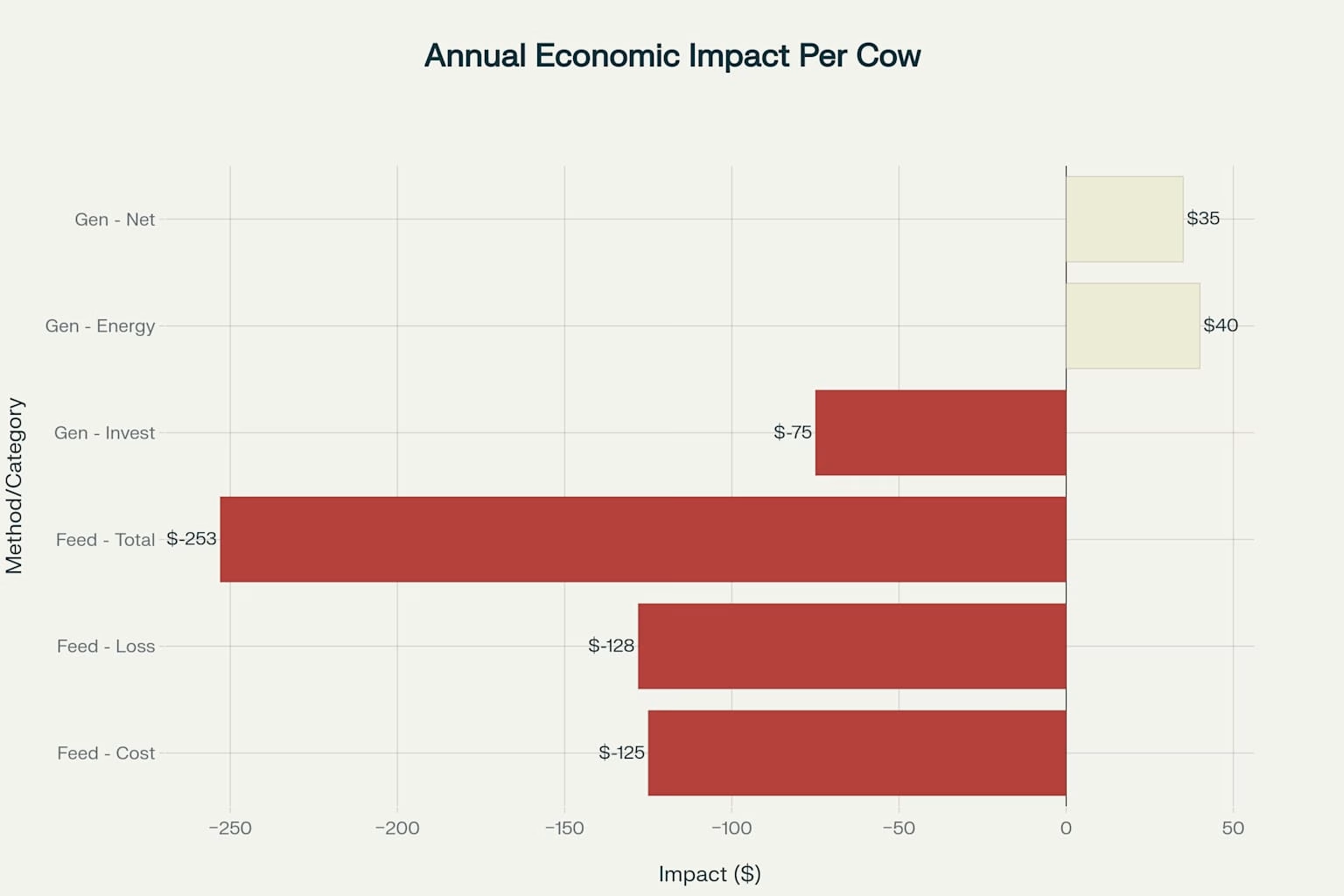
NewsSubscribe
First
Last
Consent

California’s $522 Million Secret: How Smart Dairy Farmers Turned Methane into Money While Saving the Planet

California farmers turned cow manure into $522M profit while cutting 5M tons of emissions. Here’s how they made climate action pay better than milk.

EXECUTIVE SUMMARY: California’s dairy industry has achieved a groundbreaking 5 million metric ton annual reduction in methane emissions while leveraging over $522 million in private investment, proving that environmental compliance can be more profitable than pollution itself. Through a three-pronged strategy combining methane capture via digesters (2.53 MMTCO2e), alternative manure management practices (0.254 MMTCO2e), and production efficiency improvements (2.13 MMTCO2e), farmers are now two-thirds of the way to their 2030 climate targets. The success stems from California’s innovative policy framework that created economic incentives through programs like the Low Carbon Fuel Standard (LCFS), transforming waste methane into valuable revenue streams worth more than traditional commodities. At just $9 per ton of CO2 equivalent, this approach delivers 10-60 times better cost-effectiveness than competing climate technologies while generating enough renewable energy to fuel 17,000 vehicles daily. This model demonstrates that the most effective environmental programs don’t fight economic incentives—they harness them, creating a template for profitable sustainability that other regions worldwide are now studying and attempting to replicate.

KEY TAKEAWAYS

  • Financial Performance: Achieved $522 million in private investment leverage with cost-effectiveness of $9 per ton CO2 equivalent—10-60 times better than competing climate technologies
  • Revenue Diversification: LCFS credits and renewable energy sales create predictable income streams that provide market stability beyond volatile milk prices, with digesters generating enough energy for 17,000 vehicles daily
  • Three-Pillar Strategy: Methane capture (2.53 MMTCO2e), alternative manure management (0.254 MMTCO2e), and production efficiency (2.13 MMTCO2e) combine for 5 million metric tons annual reduction
  • Policy Innovation: California’s SB 1383 framework makes environmental compliance profitable through market-based incentives rather than punitive regulations, preventing industry exodus while achieving climate goals
  • Competitive Advantage: Farms implementing these strategies gain multiple revenue streams and energy independence, positioning environmental leadership as a business opportunity rather than a compliance cost
California dairy methane reduction, profitable environmental compliance, dairy digester investment, LCFS credits revenue, agricultural climate solutions

Forget everything you think you know about environmental compliance being a cost center. California dairy farmers just proved that the biggest climate wins come when you make pollution reduction more profitable than pollution itself. With over $522 million in private investment leveraged (DDRDP data) and digesters producing enough renewable natural gas to fuel 17,000 vehicles daily, they’ve created the world’s first profitable climate action model that other regions are scrambling to copy.

Here’s what nobody’s telling you about California’s dairy methane miracle: it wasn’t achieved through farmer guilt, regulatory hammers, or feel-good sustainability pledges. It happened because California figured out how to make methane reduction more profitable than letting that biogas escape into the atmosphere. And now, with 5 million metric tons of annual CO2 equivalent reductions achieved (Dairy Cares announcement, May 2025) – putting them two-thirds of the way to their 2030 targets – they’ve created a blueprint that’s making environmental economists around the world rethink everything they thought they knew about agricultural climate policy.

The most successful environmental programs don’t rely on farmer guilt or regulatory pressure – they create irresistible economic incentives that make climate action the smart business choice. California didn’t just prove this theory. They weaponized it like a perfectly balanced TMR ration that boosts both milk production and profitability.

But here’s the uncomfortable question every dairy farmer outside California should ask: If environmental compliance can be this profitable, why are we still treating it like a necessary evil instead of a competitive advantage?

The Numbers That Changed Everything: From Lagoon Liability to Liquid Gold

Let’s start with the economics that make traditional environmentalists uncomfortable. California’s Dairy Digester Research and Development Program (DDRDP) has achieved greenhouse gas reductions at a staggering $9 per ton of CO2 equivalent (CDFA analysis). To put that in dairy terms, that’s like getting paid to manage your manure instead of treating it as a necessary evil. Most industrial carbon capture technologies cost between $100-600 per ton – California dairy farmers just made climate action 10-60 times more cost-effective than anything Silicon Valley’s been cooking up.

But here’s where it gets really interesting for your bottom line. The program requires farmers to pay at least 50% matching funds for every project, which they do enthusiastically. Why? Because Low Carbon Fuel Standard (LCFS) credits and renewable natural gas sales generate revenue streams that turn waste management from a cost center into a profit center, think of it as transforming your manure lagoon from a necessary expense into a cash cow that produces cash.

Chuck Ahlem, chair of Dairy Cares and a dairy farmer himself, wasn’t mincing words when he said: “While many countries and jurisdictions across the globe have pledged to reduce methane, California dairy farmers have demonstrated action and great success” (Dairy Cares press release, May 2025). The man’s got a point. While politicians debate and activists protest, California farmers are quietly building the most successful agricultural climate program on the planet – one that pays better than milk checks in some cases.

So why are we still waiting for someone else to figure this out?

The Three-Headed Revenue Beast: Diversification Like Your Nutritionist Never Imagined

California’s success comes from a three-pronged strategy that turns every angle of dairy operations into a potential revenue generator – like having multiple income streams from the same cow. The precise breakdown shows the power of this comprehensive approach:

Table 1: California’s Methane Reduction Strategy Breakdown (2025)

StrategyAnnual Reduction (MMTCO2e)Supporting ProgramProjects/Status
Methane Capture (Digesters)2.53DDRDP168 operational, 75 developing
Methane Avoidance (AMMP)0.254AMMP128 operational, 65 funded
Production Efficiency2.13Industry AdvancesOngoing herd optimization
Total Achievement~5.0Combined Programs270 farms total

Source: CDFA data compilation, May 2025

But here’s what’s radical: they’ve completely flipped the script on environmental compliance.

Methane Capture: The Renewable Energy Gold Rush

With 168 operational dairy digesters and 75 more under development (CARB data), California has created what amounts to a distributed renewable energy network powered by what was once considered waste. Once these projects become operational, methane will be captured from manure management systems on a total of 270 dairy farms. These aren’t your grandfather’s manure lagoons collecting flies and complaints from neighbors – they’re sophisticated biogas capture systems that turn your daily manure production into three different revenue streams.

Think of it this way: your cows already produce these systems’ feedstock daily. The digester just captures what was previously escaping and converts it into:

Renewable Natural Gas (RNG): This pipeline-quality fuel commands premium prices in California’s Low Carbon Fuel Standard market. Bar 20 Dairy in Kerman exemplifies this transformation perfectly. Their 7,000-cow operation captures over 25,000 tons of CO2 emissions annually while generating renewable electricity through advanced fuel cell technology. This demonstrates how cross-sector collaboration creates value chains that didn’t exist five years ago – imagine getting paid by energy companies for managing your manure properly.

Grid Electricity: Digesters producing renewable electricity generate enough power for over 13,500 electric vehicles daily (CDFA data). When you add the 175+ solar arrays operating on California dairy farms, you’re looking at an agricultural sector that’s become a legitimate player in the state’s renewable energy portfolio. Some operations now produce more power than they consume, creating a net energy surplus that gets sold back to the grid at premium renewable energy rates.

Renewable Hydrogen: The newest player in the energy game, with early adopters positioning themselves for what many believe will be the next major transportation fuel transition. It’s like getting the first pick in the replacement heifer market – those who move early get the best opportunities.

But here’s the question that should keep you up at night: While California farmers are turning cow manure into premium fuel contracts, what revenue opportunities are you literally letting escape into the atmosphere?

Methane Avoidance: The Efficiency Play for Every Farm Size

While digesters grab headlines like a prize-winning Holstein at the county fair, Alternative Manure Management Program (AMMP) projects contribute 254,000 metric tons of CO2 equivalent reductions annually through a completely different approach (CDFA data). Instead of capturing methane after it’s produced, these systems prevent its formation by managing manure in drier, more aerobic conditions – like the difference between making quality hay and letting it get rained on.

This includes solid-liquid separation systems (think of it as separating cream from milk, but for manure), compost bedded pack barns that turn bedding areas into active composting systems, and advanced scraping technologies that keep manure from going anaerobic. What makes AMMP particularly interesting is its accessibility to mid-sized operations. Unlike digesters, which often require 500+ head to achieve economic viability, AMMP projects can work for dairies running 200-300 cows that historically couldn’t participate in large-scale environmental programs.

With over 128 AMMP projects currently operational and an additional 65 projects funded and in development (CDFA data), it’s like the difference between buying a new combine and upgrading your tillage practices – both improve efficiency, but one requires significantly less capital investment while still delivering measurable results.

Production Efficiency: The Hidden Giant That Every Nutritionist Understands

Here’s the number that should make every dairy farmer outside California pay attention: 2.13 million metric tons of CO2 equivalent reductions achieved simply through producing more milk with fewer cows (CARB analysis via CADD database). This isn’t about installing expensive technology – it’s about a relentless focus on feed conversion efficiency, genetic selection for components, and enhanced cow comfort that results in higher yields per animal.

Legacy Ranches in Tulare County, operated by the Fernandes brothers, demonstrates this approach perfectly. They switched from Holstein to Jersey cows, which consume 30% less forage and reduce water usage significantly (industry documentation). Combined with precision feed management that reduces shrinkage by 10%, they’ve created an environmentally superior and more profitable operation – like breeding for both production and longevity instead of just focusing on peak lactation.

This trend reflects what every good dairy nutritionist knows: efficiency gains compound. National research shows that 2017, dairy production systems used only 74.8% of the cattle, 82.7% of the feedstuffs, and 79.2% of the land compared to 2007 levels while maintaining production levels.

So, here’s the uncomfortable question: If environmental benefits are just the byproduct of good management, why aren’t more of us obsessing over these efficiency metrics?

The Financial Engineering That Makes It Work: Building a Sustainable Business Model

LCFS Credits: California’s Climate Cash Cow

The Low Carbon Fuel Standard creates a market-based incentive that fundamentally changes the economics of dairy waste management – like having a futures market for your manure. By assigning carbon intensity scores to fuels and requiring suppliers to meet declining targets, the LCFS generates valuable credits for low-carbon fuels like dairy renewable natural gas.

This isn’t theoretical barn talk. These credits create real revenue streams that make digester projects financially viable beyond initial grant support. When energy companies partner with dairy operations and share LCFS credit values, you’re looking at a cross-industry value chain that transforms agricultural waste into premium transportation fuel credits. It’s like having a processor pay you extra because your milk comes from cows fed a specific ration – except, in this case, the “premium” comes from environmental attributes.

The LCFS mechanism transforms methane from a waste product and environmental liability into a marketable commodity, providing crucial revenue streams that enhance project viability beyond initial grant support.

But here’s what’s really revolutionary: California proved that environmental markets don’t have to be charity cases or compliance costs – they can be legitimate profit centers. When did you hear someone say that about any environmental program?

The 50% Match Requirement: Proving ROI Like Any Good Investment

California’s requirement that farmers contribute at least 50% matching funds serves two critical functions that any farm financial advisor would appreciate. First, it ensures that only economically viable projects get built – farmers won’t invest their own money in ventures that don’t pencil out like a sound feed investment. Second, it leverages every public dollar into $2+ of total investment, multiplying the program’s impact.

The results speak for themselves: over $522 million in private investment leveraged through the DDRDP alone (CDFA data). That’s not farmers grudgingly complying with regulations – that’s farmers seeing genuine business opportunities and investing accordingly, like upgrading to robotic milking when the ROI calculations clearly support the investment.

Think of it this way: if your bank required you to put up 50% equity for any farm improvement loan, you’d only pursue projects you were absolutely confident would generate returns. California’s program works the same way – the matching requirement acts as a natural filter, ensuring only the most economically sound projects receive support.

Cost-Effectiveness That Embarrasses Other Climate Programs

At $9 per ton of CO2 equivalent, dairy methane reduction is achieving results that make other climate investments look like buying feed at retail prices when you could get it wholesale. The DDRDP has delivered 20-28% of California’s total greenhouse gas reductions from all climate investments while using only 1.5-1.6% of total funds awarded (CARB analysis).

Compare that to electric vehicle subsidies, solar panel incentives, or industrial carbon capture programs, and you start to understand why agricultural climate solutions are attracting serious attention from policymakers and investors. It’s like discovering that improving your forage quality delivers better ROI than any other feed investment – once you see the numbers, the decision becomes obvious.

So why are we still letting other industries claim all the climate investment dollars when agriculture delivers better results for less money?

Real-World Success Stories: Where Theory Meets the Milking Parlor

Bar 20 Dairy: The Blueprint for Energy Independence

Steve Shehadey’s operation in Kerman isn’t just reducing emissions – it’s redefining what a modern dairy farm looks like, much like how robotic milking systems redefined labor management. With a timeline that reads like a clean energy roadmap, Bar 20 has systematically transformed every aspect of their energy profile:

  • 2016: 1 MW solar farm completed with LED lighting installation
  • 2017: An additional 1 MW solar capacity added
  • 2019: Electric feed mixing station eliminates diesel dependency
  • 2021: Methane digester with fuel cell technology comes online

The result? Bar 20 now produces more power than the dairy and farm consume, creating a net energy surplus that gets sold back to the grid – like having cows that pay for their feed and generate profit beyond milk sales. Their electric feed mixer uses renewable electricity instead of diesel, creating a closed-loop system where cow manure powers feed preparation for the same cows.

But here’s what makes Bar 20 truly revolutionary for the broader industry: their operation demonstrates how agricultural renewable energy can directly support transportation decarbonization. The ultra-clean renewable electricity produced without combustion creates environmental credits that support the broader clean energy transition. Its agricultural diversification taken to its logical extreme.

Steve Shehadey, the third-generation farmer who owns Bar 20 and seven family members, says, “When I was young, my grandfather told me that we make milk for people’s children. That has always stuck with us on the farm. We can’t offer anything but our best for children and the families who buy our milk. Today, that also means doing what we can to help clean the San Joaquin Valley air and be part of a climate solution.”

When was the last time you heard about a dairy farm becoming a significant renewable energy producer? That’s what happens when you stop thinking of environmental compliance as a burden and start treating it as a business opportunity.

Legacy Ranches: Efficiency Through Systematic Optimization

The Fernandes brothers – Jared, Frank, and Josh – represent a different but equally important approach to profitable sustainability. Their 4,500-cow operation focuses on systems optimization rather than energy generation, proving that environmental improvements can come from hundreds of small decisions rather than massive capital investments – like improving milk quality through better attention to detail rather than buying expensive equipment.

Their switch to Jersey cows alone creates a 30% reduction in forage consumption and water usage while maintaining similar total milk solids production per acre (verified through industry tracking). It’s like discovering that feeding higher-quality hay at a lower inclusion rate delivers better performance than feeding more mediocre forage. Combined with their feed bagging system that reduces shrinkage by 10%, conservation tillage practices, and participation in California’s Healthy Soils Program, Legacy Ranches demonstrates how operational excellence and environmental stewardship align perfectly.

What’s particularly impressive is their approach to technology adoption – they implement sustainable practices with or without incentives because the economics work. That’s the hallmark of a truly successful environmental program: farmers adopt practices to improve feed conversion efficiency and overall profitability, not because regulations require it.

But here’s the real question: If Jersey cows deliver better environmental and economic performance per acre, why are we still defaulting to Holstein thinking?

The Policy Framework That Actually Works: Like a Well-Designed Breeding Program

SB 1383: The Foundation That Changed Everything

California’s Senate Bill 1383, enacted in 2016, established the nation’s only legally binding target for livestock methane reduction – 40% below 2013 levels by 2030. But what makes SB 1383 brilliant isn’t the target itself, it’s the mechanism. Instead of mandating specific technologies or practices like prescribing a one-size-fits-all ration, it created performance standards and built financial incentives to make compliance profitable.

The law specifically requires the California Air Resources Board to consider and minimize emissions leakage to other states and countries – acknowledging that environmental programs that destroy local competitiveness simply export problems rather than solving them, like cheap milk imports that undercut domestic producers without improving overall industry sustainability.

Think about that for a moment: California wrote environmental legislation that actually protects farmer competitiveness. When was the last time you saw that kind of thinking in environmental policy?

Breaking Down Financial Barriers: The California Climate Investments Model

Funded through Cap-and-Trade auction proceeds, California Climate Investments represents a sophisticated approach to environmental finance. Rather than treating climate action as a cost, the program treats it as an investment opportunity with measurable returns – like investing in superior genetics that pay dividends for years rather than buying cheaper bulls that deliver mediocre results.

Since 2015, these programs have collectively made $356 million in grant funding available to dairy farmers (CDFA data), with the beauty of this approach being sustainability. Unlike traditional grant programs that require ongoing appropriations like annual feed budgets, Cap-and-Trade revenue provides a self-sustaining funding mechanism that grows as the carbon market develops. It’s like having a permanent endowment for farm improvements rather than depending on yearly cash flow.

LCFS: The Market Mechanism That Actually Moves Markets

The Low Carbon Fuel Standard creates a regulatory framework that harnesses market forces rather than fighting them – like using price signals to encourage better feed purchasing decisions rather than mandating specific ingredients. LCFS creates financial incentives for fuel producers to seek out the lowest-carbon alternatives by establishing declining carbon intensity targets and allowing credit trading.

For dairy farmers, this translates into a market for renewable natural gas that didn’t exist a decade ago, with credit values that provide ongoing revenue to justify initial capital investment in digester technology. LCFS credits provide ongoing revenue that creates sustainable business models rather than one-time grant dependency – like having a premium market for high-component milk rather than selling everything at commodity prices.

But here’s what should concern every farmer outside California: while you’re waiting for someone else to create these markets, California farmers are already cashing the checks.

Addressing the Critics: Environmental Justice and Industry Concerns

Let’s address the elephant in the barn: not everyone’s thrilled with California’s approach. Environmental justice advocates raise legitimate concerns about localized air quality impacts, particularly ammonia and particulate matter emissions in already disadvantaged communities – the same communities where many dairy farms operate.

These concerns deserve serious attention, much like how responsible farmers address neighbor relations and community impact. While digesters capture methane, critics argue they don’t address other pollution sources and may even exacerbate some air quality issues. Water quality impacts, especially nitrate contamination, remain a persistent challenge that methane reduction doesn’t directly solve – like fixing one aspect of a ration imbalance while ignoring others.

But here’s what the critics often miss: the alternative to incentive-based programs isn’t environmental perfection, it’s regulatory warfare that drives farmers out of business without solving underlying problems. Economic analysis suggests that direct regulation could force 20-25% of California’s small dairies to relocate to states with weaker environmental controls, potentially creating 1.43 million metric tons of emissions leakage while destroying local agricultural communities.

The University of California, Davis, and MIT study that analyzed these concerns concluded that while digesters might increase local criteria pollutant emissions, widespread adoption would likely have only minor effects on overall air quality and wouldn’t significantly harm public health. It’s like the difference between perfect and good enough – waiting for perfect solutions often prevents implementing good ones that deliver measurable benefits.

More importantly, developing the California Dairy and Livestock Database (CADD) provides data-driven insights that counter some criticisms (CARB, August 2024). Initial analysis found no statistical relationship between digester installation and dairy herd growth rates, directly addressing concerns that environmental incentives encourage industrial expansion – proving that digesters don’t lead to larger dairies any more than good genetics programs lead to larger herds.

So, here’s the uncomfortable question for environmental advocates: Is it better to have profitable programs that deliver measurable results with some limitations or perfect programs that never get implemented?

The Technology Pipeline: What’s Coming to a Dairy Near You

Enteric Methane: The Final Frontier for Feed Additives

While current programs focus primarily on manure methane, enteric emissions from cow digestion represent roughly 45-50% of total dairy methane – the equivalent of addressing only half your feed costs while ignoring the other half. Feed additives like 3-nitrooxypropanol (3-NOP, marketed as Bovaer®) have already received regulatory approval in multiple regions and show 30%+ reduction capabilities (CARB analysis).

Think of enteric methane reduction as improving feed conversion efficiency – it requires changing what happens inside the cow rather than just managing what comes out. Senate Bill 485, enacted in 2023, directs CARB to develop offset protocols for livestock feed additives by June 2025, preparing the regulatory framework for these technologies. Early projections suggest feed additives could contribute an additional 0.25-2+ million metric tons of CO2 equivalent reductions annually (CARB projections).

Several feed additives are anticipated to become commercially available for widespread use in the United States within the next few years. Products based on essential oils, garlic, and citrus extracts have shown potential for methane reductions in the 10-20% range, while more potent additives like 3-NOP have demonstrated capabilities exceeding 30%.

Advanced Digester Technologies: The Next Generation

Next-generation digesters incorporate fuel cell technology like Bar 20’s advanced systems, which produce twice as much electricity as conventional generators using the same biogas volume. These systems generate ultra-clean renewable electricity without combustion, creating premium environmental credits – like producing organic milk versus conventional in terms of market value.

Cluster projects that allow multiple smaller dairies to feed into centralized digesters are expanding access to digester technology for operations that couldn’t justify individual systems. It’s like shared equipment cooperatives that allow smaller farms to access expensive machinery – the same principle applied to renewable energy infrastructure.

The Hydrogen Economy: Positioning for the Next Energy Revolution

California’s renewable hydrogen initiative positions dairy farms as potential suppliers for what many consider the next major transportation fuel transition. Early pilot projects are testing on-farm hydrogen production using dairy biogas, potentially creating another revenue stream – like discovering a new use for a byproduct that was previously just waste.

But here’s the question that should get your attention: While California farmers are positioning themselves for the hydrogen economy, what are you doing to prepare for the next energy transition?

The Financial Reality: What This Means for Your Operation’s Bottom Line

ROI Analysis for Different Farm Sizes: Finding Your Fit

Large Operations (2,000+ cows): Digesters typically pencil out with 7-10-year payback periods when combining grant funding, LCFS credits, and renewable energy sales. Operations like Bar 20 achieve energy independence while generating surplus revenue – like having feed crops that meet your needs and generate cash crop income.

Medium Operations (500-2,000 cows): AMMP projects and cluster digester participation offer pathways to methane reduction with lower capital requirements. Focus on efficiency improvements and alternative manure management often provides the fastest returns – like upgrading milking equipment versus building a new parlor.

Smaller Operations (Under 500 cows): Production efficiency improvements and participation in regional programs offer the most accessible entry points. Jersey conversion, feed management optimization, and solar adoption can generate immediate operational savings – like improving genetics and nutrition before investing in expensive facilities.

Revenue Diversification Benefits: Multiple Income Streams Like a Well-Planned Farm

California dairy farmers report that renewable energy revenue provides market stability that traditional dairy commodities lack. While milk prices fluctuate with global markets like grain prices, LCFS credits, and renewable energy contracts offer more predictable income streams – like having both commodity crops and specialty products in your rotation.

This diversification becomes particularly valuable during market downturns. When dairy commodity prices crashed in 2014-2015, farms with renewable energy revenue maintained better cash flow and financial stability – like having custom farming income to offset poor crop years.

So, here’s the critical question: How diversified is your revenue stream, and what happens to your operation when milk prices tank again?

The Global Implications: Why the World is Watching California’s Success

California’s model attracts international attention because it solves a fundamental problem in environmental policy: achieving aggressive emission reductions without destroying industry competitiveness. The answer, it turns out, is to make environmental compliance more profitable than non-compliance – like making good animal welfare practices more profitable than cutting corners.

The Replication Challenge: Not Every Region Has California’s Advantages

European Union policymakers are particularly interested in California’s voluntary incentive approach as they grapple with methane reduction targets under their Green Deal framework. The EU’s more regulatory approach has generated significant farmer resistance, making California’s collaborative model increasingly attractive – like the difference between mandating breeding decisions versus providing incentives for genetic improvement.

New Zealand, facing similar pressure to reduce agricultural emissions, sent delegations to study California’s programs. Their challenge is adapting market-based mechanisms to a different regulatory environment and smaller-scale operations – like adapting intensive management practices to extensive grazing systems.

But here’s what every international observer asks: If California can make environmental compliance profitable, why can’t we?

The Future Funding Challenge: Scaling Success Across the Industry

DDRDP and AMMP programs are consistently oversubscribed, indicating strong farmer demand but insufficient funding. Since 2015, these programs have made $356 million in grants available while leveraging over $522 million in private investment (CDFA data) – proof that farmers will invest heavily when programs are appropriately designed.

The program’s cost-effectiveness makes a compelling case for increased funding. At $9 per ton of CO2 equivalent, dairy methane reduction delivers better environmental returns than most alternative climate investments – like getting higher milk production per dollar spent on genetics compared to other farm improvements. Industry analysts estimate that meeting the remaining reduction targets will require sustained additional investment in proven mitigation strategies.

The Bottom Line: Rewriting the Rules of Agricultural Profitability

California dairy farmers have done something remarkable: they’ve proven that the most effective environmental programs don’t fight economic incentives – they harness them like a well-designed breeding program that improves both production and profitability. By making methane reduction more profitable than methane production, they’ve created a model that achieves aggressive climate targets while strengthening rather than weakening agricultural competitiveness.

The numbers don’t lie. Five million metric tons of annual CO2 equivalent reductions. Over $522 million in private investment leveraged. Cost-effectiveness of $9 per ton – 10-60 times better than competing climate technologies. Renewable energy production sufficient for 17,000 vehicles daily. These aren’t feel-good sustainability metrics – they’re business results that prove environmental excellence, and economic success aren’t just compatible, they’re synergistic, like good nutrition programs that boost both milk production and cow health.

For dairy farmers outside California, the lesson is clear: environmental leadership isn’t about compliance costs, it’s about competitive advantage. The farmers who figure out how to profit from emission reductions will outcompete those who treat environmental requirements as unavoidable burdens – like farmers who embrace new genetics versus those who stick with outdated bloodlines.

For policymakers, California’s model demonstrates that market-based incentives consistently outperform regulatory mandates when the goal is rapid, large-scale adoption of new practices. The most successful environmental programs create situations where farmers choose sustainable practices because they improve profitability – like choosing feed additives that boost milk production while reducing environmental impact.

The global dairy industry stands at an inflection point. Consumer demands for environmental responsibility are intensifying. Regulatory pressure is increasing worldwide. Carbon border adjustments are coming. The farmers and regions that develop profitable approaches to emission reduction will thrive. Those who resist or ignore these trends will struggle like farms that ignored the shift toward higher components or failed to adopt modern breeding programs.

California dairy farmers didn’t just achieve an environmental milestone – they created a template for profitable sustainability that’s being studied and replicated worldwide. The question isn’t whether other regions will follow California’s lead. The question is whether they’ll move fast enough to remain competitive in an increasingly carbon-conscious global marketplace.

The revolution isn’t coming. It’s here. And it’s powered by cow manure, economic incentives, and farmers who proved that saving the planet can be the smartest business decision they ever make – like discovering that what’s good for the environment is also good for the bottom line.

Your move.

What This Means for Your Operation

Stop treating environmental compliance like a necessary evil and start treating it like the competitive advantage it can become. California farmers aren’t succeeding because they’re more environmentally conscious but because they figured out how to make environmental performance profitable.

Take action today:

  1. Audit your current manure management costs – What are you spending on waste handling that could generate revenue instead?
  2. Evaluate your production efficiency metrics – Are you tracking feed conversion, water usage, and energy consumption per unit of milk produced?
  3. Research regional incentive programs – What environmental incentive programs exist in your area that you haven’t explored?
  4. Connect with other innovative farmers – Who in your region is already implementing profitable sustainability practices?
  5. Challenge your assumptions – What “environmental requirements” have you been viewing as costs instead of potential profit centers?

The farmers who act on this information today will be the ones cashing environmental checks tomorrow. The question is: Will that be you, or will you be watching your competitors gain the advantage while you’re still treating climate action like charity work?

Because here’s the final uncomfortable truth: California farmers didn’t just prove that environmental compliance can be profitable – they proved that ignoring environmental opportunities is the real business risk.

Learn more:

Join the Revolution!

Join over 30,000 successful dairy professionals who rely on Bullvine Weekly for their competitive edge. Delivered directly to your inbox each week, our exclusive industry insights help you make smarter decisions while saving precious hours every week. Never miss critical updates on milk production trends, breakthrough technologies, and profit-boosting strategies that top producers are already implementing. Subscribe now to transform your dairy operation’s efficiency and profitability—your future success is just one click away.
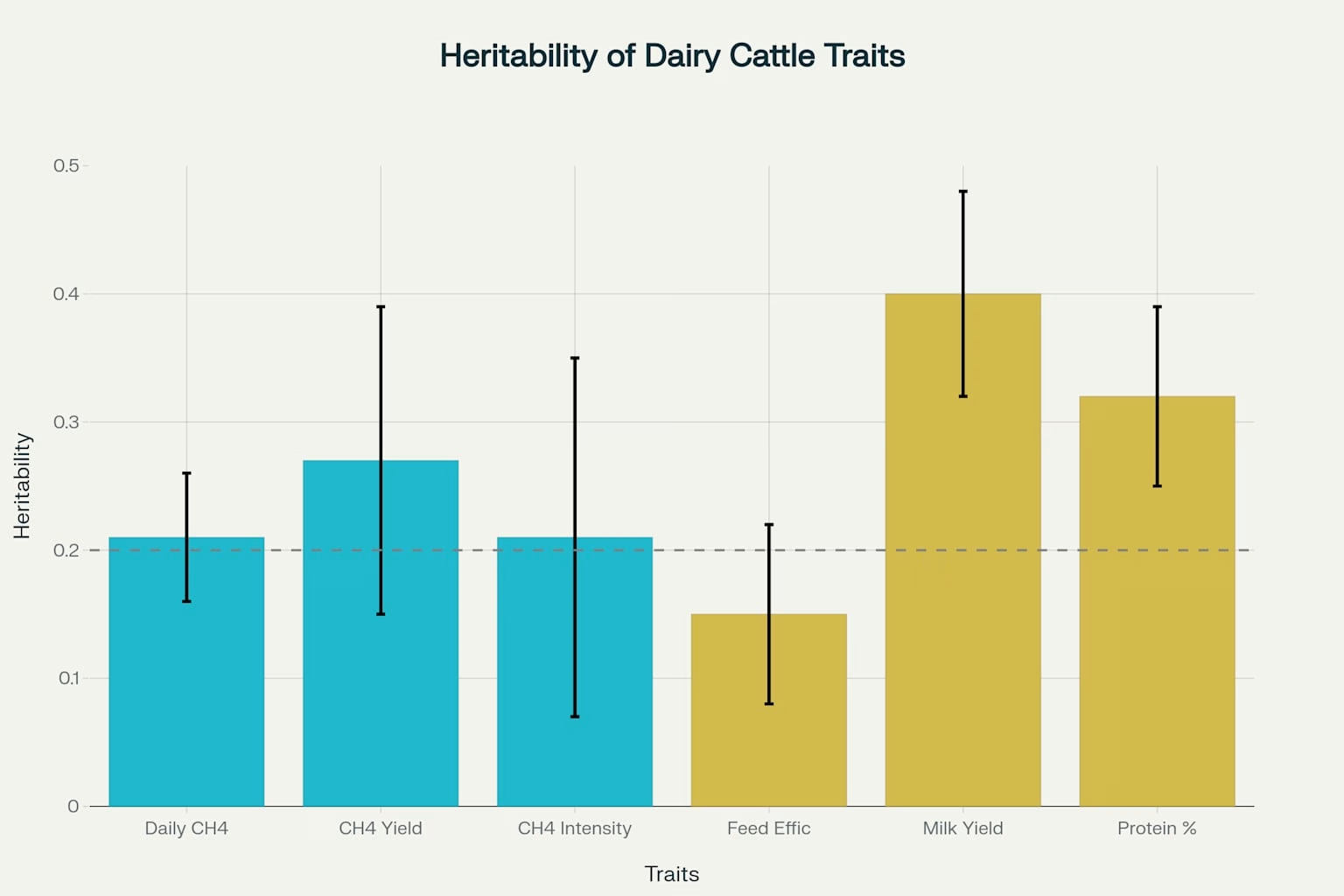
NewsSubscribe
First
Last
Consent

How Smart Dairy Farmers Are Slashing Methane While Boosting Profits

Climate zealots call your cows climate criminals, but savvy dairy farmers are turning methane reduction into cold, hard cash. Here’s how they’re doing it.

The climate crusaders have dairy in their crosshairs, but savvy farmers aren’t waiting for the regulatory hammer to drop.

While environmental zealots paint cows as climate criminals, innovative producers are discovering that fighting methane isn’t just about appeasing the green lobby—it’s about boosting efficiency and padding the bottom line.

The FDA’s approval of Bovaer on May 28, 2024, a feed additive that slashes methane emissions by 30%, has sparked excitement and controversy. Farmers face a critical question as Arla Foods rolls out trials with supermarket partners: Can these methane-busting technologies deliver profits while silencing the critics, or are they just another expensive hoop for struggling producers to jump through?

What is it? 3-Nitrooxypropanol (3-NOP), a feed additive that reduces methane production in cattle
How does it work? Targets methyl-coenzyme M reductase (MCR) in rumen archaea to reduce methane formation.
Safety status: Approved by FDA (May 2024) and approved in Great Britain, EU, Australia, and Canada.
Consumer impact: There are no safety concerns for milk consumers—”The cows metabolize the additive so it does not pass into the milk.”
Availability: Expected in the U.S. market by the third quarter of 2024
Current status: In trials with Arla and supermarket partners in Great Britain

Dairy Diet Revolution: When Your Cow’s Feed Becomes Political

Bovaer Battles: Science vs. Social Media

The latest flashpoint in dairy’s climate wars isn’t happening in Parliament—it’s happening at your local grocery store and on social media.

Arla’s rollout of Bovaer has triggered a social media firestorm. Some TikTok users post videos of pouring milk down the sink, claiming they want to prevent Arla from profiting from their purchases.

“It’s essentially another anti-vaccine campaign,” says one online commenter. “People claim this feed additive is unsafe for humans when the science is clear. Bovaer has undergone extensive safety evaluations and received regulatory approval for use in dairy cattle.”

Bovaer (3-nitrooxypropanol or “3-NOP”) works by targeting methyl-coenzyme M reductase (MCR) in rumen archaea, effectively reducing methane production in the cow’s digestive system. According to Elanco Animal Health data, this equals approximately 1.2 metric tons of CO2e reduced annually per cow.

“Milk from cows given Bovaer, a feed additive used to reduce methane emissions, is safe to drink. The cows metabolize the additive so it does not pass into the milk.” — Food Standards Agency.

Despite thorough safety assessments by the FSA that concluded “there are no safety concerns when Bovaer is used at the approved dose,” concerns have been amplified by questionable social media content, with some posts attempting to link the additive to Bill Gates—a familiar tactic in anti-science campaigns.

“The term ‘additive’ has been associated with negativity for years,” explains one industry commentator. “When consumers hear chemicals and cows in the same sentence, they panic—even though milk naturally contains thousands of chemical compounds.”

According to extensive testing reviewed by the European Food Safety Authority, 3-NOP is not detectable in a cow’s plasma, milk, or other edible tissues because the animal’s stomach rapidly breaks it down into metabolites—primarily 1,3-propanediol—which is mainly exhaled as carbon dioxide.

Silage Strategy: The Quiet Methane Fighter

While Bovaer grabs headlines, innovative farmers quietly slash emissions with a less controversial approach: upgrading their silage game.

Higher digestibility forage means less fermentation time in the rumen, which translates to fewer burps and more milk per ton of feed.

It’s about energy efficiency as much as environmental impact. Every methane molecule represents lost energy that could have gone into milk production.

“Protein content is the whole ballgame,” explains nutrition specialist Tom Wilson, a Yorkshire dairy farmer participating in emission reduction trials. “Young grass with high digestibility can dramatically reduce methane output, but you’ve got to balance the nutrition carefully.”

Better Breeding: Engineering Tomorrow’s Low-Emission Cow

Third-generation Wisconsin dairy farmer Pete Larson used to select bulls based solely on milk components and conformation. Today, he’s pioneering a different approach: breeding cows that naturally produce less methane.

“We’ve identified significantly more gas-efficient bloodlines,” Larson explains, showing off his sleek, compact Holsteins. “Smaller frame, same production, less feed, less methane—it’s not rocket science, it’s just smart breeding.”

Larson’s 350-cow operation has been working with his genetics provider on selecting bulls that produce daughters with better feed efficiency. “After implementing targeted breeding strategies for four years, our feed costs have dropped approximately 8% while maintaining milk production. The methane reduction is a bonus positioning us well for future market requirements.”

Researchers from the University of Pennsylvania School of Veterinary Medicine have confirmed what innovative farmers discovered through trial and error—low-emitting cows tend to be smaller and house different microbial communities, and these differences were not associated with reduced milk production.

“Low methane emitters are more efficient cows,” said Dr. Dipti Pitta, associate professor at the University of Pennsylvania School of Veterinary Medicine. “Methane formation is an energy-inefficient process, so reducing methane production gives that energy back to the cow for metabolic activities including improved growth rate and milk production.”

“We’re taking control of the narrative. Instead of waiting for regulations to crush us, we’re solving the problem ourselves and making more profitable cows.” — Pete Larson, Wisconsin dairy farmer.

Overcoming Obstacles: Real-World Implementation Challenges

Despite the promising potential of methane reduction technologies, dairy farmers face legitimate hurdles in implementation.

“The upfront costs of feed additives like Bovaer remain a concern for many producers,” explains Dr. Frank Mitloehner, Professor and Air Quality Extension Specialist at UC Davis. “Without processor premiums or carbon market access, producers must carefully evaluate the return on investment.”

Industry analysts point to several common barriers:

  1. Initial implementation costs without immediate financial returns
  2. Integration complexities with existing feeding systems
  3. Market uncertainty around carbon credit pricing
  4. Consumer acceptance of new technologies

The good news? Early adopters are finding these barriers surmountable. “We started with a small test group to minimize upfront costs,” explains Larson. “This allowed us to document benefits before scaling up. The key is starting small and expanding as you see results.”

Processor Power: How Milk Buyers Are Driving Change

Cooperatives and processors are quickly becoming key players in the methane reduction ecosystem. As Nestlé, Danone, and other major dairy buyers set ambitious carbon reduction targets, they’re developing incentive programs for producers.

Dairy Farmers of America (DFA), the largest U.S. dairy cooperative, has launched sustainability programs to help its 12,500 family farm owners reduce environmental impact while improving profitability.

“We’re working with partners across the value chain to develop incentives and support systems for our members who implement climate-smart practices,” explains Jackie Klippenstein, Senior Vice President of Government, Industry and Community Relations at DFA. “Our Gold Standard Dairy Program helps producers document their sustainability efforts and prepare for future market opportunities.”

Processors are increasingly linking sustainability to market access. Land O’Lakes’ Truterra sustainability program connects farmers with buyers willing to pay premiums for verified sustainable practices, creating financial incentives for methane reduction.

Methane Reduction Arsenal – Battle-Tested Solutions

StrategyMethane ReductionImplementation TimelineAdditional Benefits
Feed Additives
Bovaer (3-NOP)Up to 30%Available Q3 20241.2 metric tons CO2e/cow/year
Diet Management
Young/Digestible GrassUp to 30%Seasonal/ImmediateImproved feed efficiency
Maize Silage Increase5-10%Next harvestImproved nitrogen efficiency
Breeding Approaches
Methane-Focused GeneticsUp to 22%Long-term/Requires programMaintains production levels
Safety Assurance
Bovaer in milk/meat“No residues detected in milk or tissues”“Additive is metabolized by cows”“No safety concerns”

Natural Solutions: Alternative Approaches to Methane Reduction

While synthetic additives like Bovaer face consumer resistance, other interventions are gaining traction among organic producers looking for natural approaches to emission reduction.

“It’s a potential marketing win,” says Oregon organic dairy owner Melissa Chambers. “We’re reducing our carbon footprint while improving cow health with management practices consumers understand. There’s less pushback when the approach seems natural.”

Show Me The Money: The Economics of Low-Methane Milk

The economic reality is that methane-reduction strategies require investment. Farmers have significant support through USDA programs for Bovaer implementation. For fiscal year 2023, the department awarded more than $90 million to dairy farmer-owned cooperatives and partner organizations for innovative feed management under the Regional Conservation Partnership Program.

“Innovations such as Bovaer will help U.S. dairy farmers remain globally competitive and maintain their role as leaders in more sustainable dairy production.” — Gregg Doud, President and CEO, National Milk Producers Federation.

The financial rewards come through multiple channels. Elanco has developed a platform that helps producers connect with carbon markets, providing “an opportunity for a diversified income stream that’s not dependent on milk markets.”

Innovative producers are finding economic solutions through these emerging carbon markets. Some dairy operations sell carbon credits from documented methane reductions, generating additional revenue. Others leverage sustainability grants to modernize feed systems while cutting emissions.

“This isn’t charity,” Larson insists. “Every methane molecule we eliminate represents energy that stays in our production system. The climate benefit is just a bonus.”

Methane Math: Why Cutting Cow Gas Makes Business Sense

Methane is the second-most plentiful and potent greenhouse gas, packing a punch in the short term. When cows produce methane through their digestive process, it’s not just an environmental concern—it represents an energy loss and reduction in feed efficiency.

“Methane is 25 times more potent greenhouse gas than carbon dioxide over 100 years. Every molecule lost is wasted feed energy that could have gone into milk.”

This explains why focusing on methane reduction makes business sense: if we can keep that energy in the animal instead of losing it as gas, we may see significant efficiency gains. It’s the same reason car manufacturers work to eliminate wasted fuel as exhaust.

Getting Started: Implementation Steps for Dairy Producers

Your Methane Reduction Roadmap

1. Assess your current emissions baseline

  • Connect with your cooperative or processor about carbon measurement tools
  • Consider working with Elanco’s UpLook sustainability insights engine

2. Explore funding options

  • USDA Regional Conservation Partnership Program: $90+ million available
  • Contact your local NRCS office for application guidance
  • Explore processor sustainability incentive programs

3. Choose your strategy

  • Feed additives (Bovaer): Available Q3 2024 through Elanco
  • Breeding: Work with genetics providers on methane-efficient bloodlines
  • Feed management: Consult with a nutritionist on silage optimization

4. Monetize your reductions

  • Carbon credit verification through third parties like Athian or Truterra
  • Potential premium market access through sustainable milk programs

Expert Q&A: Straight Talk on Methane Reduction

Q: Is methane reduction economically viable for small and mid-sized dairies?

A: “Absolutely. While large operations may have more resources for implementation, smaller farms often have greater flexibility to adapt quickly. The key is choosing the right strategy for your operation size. Feed management improvements typically have the fastest ROI for smaller farms, while genetics provide long-term benefits for all herd sizes.” — Dr. Frank Mitloehner, UC Davis

Q: How soon can farmers expect to see results from methane reduction efforts?

A: “Feed additives can reduce emissions almost immediately while breeding approaches take longer—typically several years to see significant herd-wide changes. The feed efficiency benefits often appear before the full climate benefits are realized, which helps offset implementation costs.” — Dr. Dipti Pitta, University of Pennsylvania

Q: Where can producers go for implementation support?

A: “Start with your cooperative or processor, as many have sustainability teams dedicated to helping members. The Innovation Center for U.S. Dairy (www.usdairy.com) offers excellent resources, and your local extension office can connect you with regional experts.” — Jackie Klippenstein, Dairy Farmers of America

The Bullvine Bottom Line: Climate Compliance = Competitive Edge

The battle for dairy’s climate future won’t be won by government edicts or activist pressure. It will be decided by farmers who recognize that emission reduction isn’t just an environmental imperative—it’s a competitive advantage.

“The early innovators in methane reduction won’t just be climate heroes—they’ll be the ones still in business when others can’t afford to comply with inevitable regulations.”

As methane-reducing innovations move from university labs to farm feed bunks, the producers outcompeting their neighbors won’t be those who resist change but those who harness it strategically.

“Consumers worldwide demand lower-carbon foods,” notes National Milk Producers Federation CEO Gregg Doud. “Innovations like Bovaer will help U.S. dairy farmers remain globally competitive and maintain their role as leaders in more sustainable dairy production.”

Whether through breeding, feeding, or advanced additives, tomorrow’s dairy leaders will cut gas while pumping up profits today.

The climate critics don’t want you to know the truth: dairy farmers aren’t the problem. They’re pioneering the solution—one burp-free cow at a time.

Key Takeaways

  • Multiple reduction strategies exist – from immediate-impact feed additives to long-term breeding approaches, giving farmers flexibility based on their operation size and management style
  • Economic returns come through multiple channels: improved feed efficiency (8% in documented cases), access to premium markets, and carbon credit opportunities worth $20+ per cow annually.
  • Start small and document results – successful implementers recommend testing technologies on subgroups before full-scale adoption to minimize upfront costs and prove ROI
  • Cooperatives and processors are becoming gatekeepers to implementation resources and premium markets, making relationships with these partners increasingly valuable.
  • Regulations are coming either way. Early adopters will have systems in place, and costs amortized before compliance becomes mandatory, creating a competitive edge.

Executive Summary

As environmental pressure on dairy intensifies, innovative producers discover that methane reduction technologies offer substantial profit opportunities beyond climate compliance. The FDA’s recent approval of Bovaer, which cuts cow methane by 30%, joins breeding strategies and feed management approaches as tools farmers use to boost efficiency while slashing emissions. Though implementation barriers exist—from upfront costs to consumer acceptance—early adopters like Wisconsin’s Pete Larson are reporting 8% feed cost reductions while maintaining production. With processors like DFA creating market incentives and USDA offering $90+ million in support programs, methane reduction is evolving from a regulatory burden to a competitive advantage, positioning innovative farmers for long-term success in a carbon-conscious marketplace.

Learn More

Join the Revolution!

Join over 30,000 successful dairy professionals who rely on Bullvine Daily for their competitive edge. Delivered directly to your inbox each week, our exclusive industry insights help you make smarter decisions while saving precious hours every week. Never miss critical updates on milk production trends, breakthrough technologies, and profit-boosting strategies that top producers are already implementing. Subscribe now to transform your dairy operation’s efficiency and profitability—your future success is just one click away.
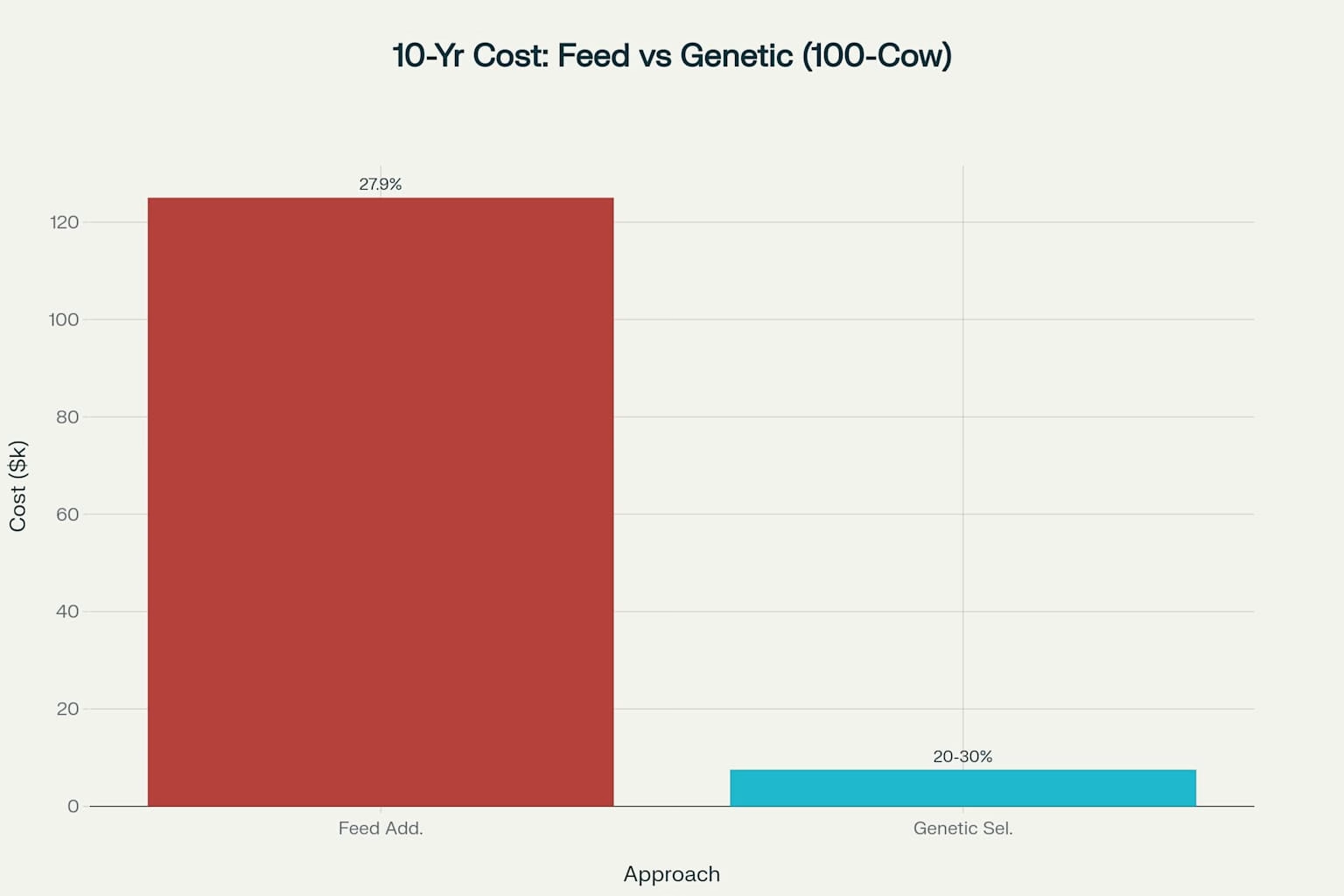
NewsSubscribe
First
Last
Consent

Flush Your Profits Down the Drain? How Manure Millionaires Are Cashing In

While you’re paying to haul away manure, smart farmers are turning the same “waste” into serious cash. Are you flushing money down the drain?

EXECUTIVE SUMMARY: Forward-thinking dairy farmers across America are revolutionizing the industry by transforming manure management from a costly necessity into a lucrative profit center through technologies like biogas production, nutrient recovery, and specialized field application. As evidenced by the EPA AgSTAR program’s data showing 400 operational anaerobic digesters nationwide, this trend has tripled its environmental impact since 2018 while simultaneously creating new revenue streams for producers. Remarkably, smaller operations (100-499 cows) are joining the revolution through community digester models, with real-world success stories like Iowa farmer Bryan Sievers achieving a 43% increase in soil organic matter while eliminating fertilizer costs across 2,000 acres. The growing divide between innovative “manure millionaires” and traditionalists demonstrates that today’s waste management decisions will determine which dairy operations thrive economically in tomorrow’s market.

KEY TAKEAWAYS

  • Community digesters make “manure millionaires” possible at any scale – While only 0.3% of small farms (100-499 cows) have on-farm digesters, thousands are participating in community models that allow them to “rent” their manure while receiving digestate back for field application.
  • Digestate delivers double benefits – Beyond generating energy revenue, farmers like Bryan Sievers have documented a 43% increase in soil organic matter (from 3.5% to 5%) over a decade while completely eliminating the need for purchased fertilizers on thousands of acres.
  • In-season application is revolutionizing nutrient delivery – Progressive farmers implementing in-season manure application systems are seeing superior results, with industry leaders predicting this approach will become the norm within a decade despite initial resistance.
  • Environmental metrics translate to economic opportunity – Manure-based digesters have more than doubled their greenhouse gas reduction impact since 2020, creating potential for additional revenue through carbon credits and sustainable agriculture premiums.
  • The technology adoption gap is widening – With 25.3% of large operations (2,500+ cows) already operating digesters compared to just 0.3% of smaller farms, early adopters are positioning themselves to outcompete traditionalists in both environmental stewardship and financial performance.
dairy manure biogas, anaerobic digesters, manure management profits, farm waste to energy, community digesters

While dairy’s old guard continues treating manure as a worthless headache, a new breed of innovative farmers is laughing all the way to the bank by transforming the same “waste” into serious cash flow.

February’s Midwest Manure Summit revealed how progressive producers are raking in multiple revenue streams from what was once considered just an environmental problem—leaving their stubborn neighbors quite literally “in the dumps.”

With biogas systems exploding across the country and even small farms finally getting a piece of the action, the manure revolution is creating a clear divide: those building wealth from waste and those who might as well be flushing dollar bills down the toilet.

THE BIOGAS BOOM: HARD NUMBERS THAT DEMAND ATTENTION

Let’s cut through the crap and get straight to the facts: as of June 2024, there are 400 manure-based anaerobic digestion systems operating in the United States, according to the EPA’s AgSTAR program.

While conventional dairy wisdom obsesses over milk production, forward-thinking producers discovered that the real gold mine might be at the other end of the cow.

“The biogas industry keeps hitting new growth records every year because, as an energy source, biogas just makes sense. It provides much-needed clean electricity, cuts pollution and emissions from transportation and provides heat-producing fuel for industries, all while managing millions of tons of waste from farms and cities alike.” — Patrick Serfass, Executive Director, American Biogas Council

“It’s a growing industry, especially the ag sector,” confirms Serfass. “Last year, agriculture became No. 2 for the number of operational projects. Agriculture is growing faster than any of the other sectors in terms of total biogas production, and that’s the growth we like to see.”

What’s driving this manure rush? Look at the meteoric rise in environmental impact: in 2023 alone, these systems reduced greenhouse gas emissions by an astounding 14.84 million metric tons of CO2 equivalent.

That’s up from just 4.19 million metric tons in 2018 – more than tripling their impact in just five years. The energy generation from these systems reached approximately 3.29 million megawatt-hours in 2023.

This isn’t just feel-good environmentalism – it’s a rapidly expanding profit opportunity that smart dairy producers are milking for all it’s worth.

SMALL FARMS: STOP MAKING EXCUSES AND START MAKING MONEY

Here’s where it gets really interesting for the thousands of mid-sized operations feeling squeezed by industry consolidation: contrary to popular belief, the biogas revolution isn’t just for mega-dairies.

In fact, Serfass dropped a bombshell at the summit that should wake up every 200-cow operation in America: “The biggest opportunity, really, is on the smaller farms.”

The American Biogas Council’s 2024 database reveals an astounding reality: 7,818 dairy farms with 100-499 cows are involved with biogas systems. Yet here’s the mind-blowing part—only 25 of these operations have on-farm digesters.

The vast majority are participating in community digester models, essentially “renting” their manure and getting paid while still receiving their digestate (the nutrient-rich leftovers) back for field application.

Farm Size (Cow Count)Total Farms Using Biogas SystemsFarms with On-Farm DigestersPercentage with On-Farm Digesters
100-499 cows7,818250.3%
2,500+ cows83421125.3%

That 84-fold difference in adoption rates isn’t just a statistic—it’s a glaring indicator of which operations are positioned to thrive in dairy’s future economy.

Meanwhile, of the 834 farms with herds exceeding 2,500 cows, 211 are already operating on-site digesters. The message couldn’t be clearer: the big boys are already cashing in while most small operators are still treating manure as a disposal problem rather than a profit center.

BEYOND BIOGAS: MULTIPLE WAYS TO CASH IN ON CRAP

Innovative producers aren’t stopping at biogas. At the Midwest Manure Summit, dairy farms showcased multiple ways to turn manure into money:

Fancy Filters That Pull Cash From Manure

University of Wisconsin-Madison researchers are developing systems that extract valuable nutrients straight from manure.

Dr. Mohan Qin from UW-Madison explained it in practical terms: “The big picture is that farms, especially in California and Wisconsin, operate like cities with a large population. Just like a city with wastewater treatment, we want to do what’s best to keep the farm running and not harming the environment.”

In plain English: these systems pull out nitrogen and other nutrients that you’d otherwise pay top dollar for at the fertilizer dealer. Why buy what you could extract from what you already have?

In-Season Application: Turning Field Fertility into Farm Profits

Producer John Schwahn boldly predicted at the summit: “Ten years down the road, I think we’re going to see in-season application the norm. Sure, there’ll be maintenance application during the spring and fall, but a majority of it will happen with that growing plant.”

Randy Ebert, owner of Ebert Enterprises, shared his 17-year journey implementing these systems despite significant community pushback: “I’m glad we stuck with it, even with the pushback.”

Those who persevered are now reaping the benefits while their close-minded neighbors are still playing catch-up.

SOIL HEALTH GOLDMINE: THE DIRT ON DIGESTATE DOLLARS

Iowa dairy farmer Bryan Sievers has been operating digesters that produce electricity since 2013. His testimony is a wake-up call for anyone still doubting the transformative power of this technology.

“We focus on a circular approach to our farming operation,” Sievers explains. “A waste product of one end of our business becomes a feedstock for the next stage.”

The results? In just one decade since implementing digesters, the soil organic matter on Sievers’ farm jumped from 3.5% to 5%. That’s a 43% increase in one of the most critical indicators of soil health and productivity.

“When you start to realize the impact that using digestate can have on your soil health… that’s a game changer.” — Bryan Sievers, Iowa Dairy Farmer

He uses this nutrient-rich byproduct as fertilizer on over 2,000 acres, completely displacing the need for synthetic fertilizers. With commercial fertilizer prices bouncing around like a cow with a new fly tag, this independence represents yet another financial advantage for digester adopters.

ENVIRONMENTAL IMPACT: NUMBERS THAT SHOULD MAKE YOU RETHINK EVERYTHING

If you’re still dismissing digesters as an environmental fad, the hard numbers should change your mind. From 2000 through 2023, manure-based anaerobic digesters have reduced direct and indirect emissions by an astounding 95.7 million metric tons of CO2 equivalent.

The acceleration is even more impressive: annual reductions have more than doubled just since 2020:

YearGHG Emissions Reduced (MMTCO2e)
202314.84
202212.36
202110.94
20207.53
20195.88
20184.96

Source: EPA AgSTAR Data and Trends

This explosive growth creates unprecedented opportunities for dairy producers to position themselves as environmental leaders while simultaneously boosting their bottom line.

THE PROFIT LOOP: PAY IT FORWARD WHILE GETTING PAID

“We’re trying to improve the quality of life not only for our families, but for the people that work for us, the people that live in our communities, but also the soil, the air, and the water.” — Bryan Sievers, Iowa Dairy Farmer

This isn’t just about profit – though the profit potential is enormous. It’s about creating a truly sustainable business model where environmental stewardship and economic success go hand in hand.

Steve Shehady, a third-generation dairy farmer from Bar20 Dairy in California, represents another success story in this rapidly evolving space. These pioneering producers are demonstrating that the path forward combines traditional dairy expertise with cutting-edge waste management technologies.

While old-school farmers keep complaining about the cost of fertilizer, these visionaries are creating their own from what others throw away.

THE BOTTOM LINE: ACT NOW OR GET LEFT BEHIND

The EPA’s AgSTAR program confirms approximately 400 anaerobic digesters are currently operating at commercial livestock farms across the United States. This number continues to grow rapidly as more farmers recognize the multiple revenue streams available from what was once considered merely a waste disposal challenge.

For dairy producers still on the fence, the message couldn’t be clearer: manure management is rapidly transforming from cost center to profit center. Those who adapt quickly stand to thrive, while those who cling to outdated practices risk getting flushed away by more innovative competitors.

The question isn’t whether your farm can afford to invest in advanced manure management—it’s whether you can afford not to. The manure millionaires are already banking their profits.

Will your farm join the manure millionaires club—or stay stuck in the past? Let us know in the comments.

Learn more

Join the Revolution!

Join over 30,000 successful dairy professionals who rely on Bullvine Daily for their competitive edge. Delivered directly to your inbox each week, our exclusive industry insights help you make smarter decisions while saving precious hours every week. Never miss critical updates on milk production trends, breakthrough technologies, and profit-boosting strategies that top producers are already implementing. Subscribe now to transform your dairy operation’s efficiency and profitability—your future success is just one click away.
NewsSubscribe
First
Last
Consent

Milking The Sun: Irish Dairy Giant Bets Big on Solar Power

Ireland’s largest dairy farm isn’t just milking cows anymore—they’re milking sunshine with a massive solar project that could power 52,000 homes.

EXECUTIVE SUMMARY: In a groundbreaking business pivot, Greenhills Farm—Ireland’s largest dairy operation with over 1,100 cows—has partnered with energy giant Ørsted to develop a 250 MW solar project on their East Cork property. While maintaining dairy production for now, the Browne family’s strategic diversification into energy generation leverages government incentives that enable solar installations to pay for themselves within three years. This landmark transformation signals a potential watershed moment for agricultural land use, where innovative dairy operations generate revenue from milk production and renewable energy, despite some local opposition concerns about the conversion of prime farmland.

KEY TAKEAWAYS:

  • With 60% government grants under TAMS 3, solar installations on dairy farms can achieve payback periods of just 3 years while creating a stable income stream unaffected by milk price volatility
  • The Browne family, known for innovation after holding one of Ireland’s largest milk quotas, is pioneering a dual-use approach where milk and megawatts become farm outputs.
  • Ireland exports approximately 90% of its dairy production, suggesting some flexibility in land use without threatening food security.
  • Solar economics for dairy farms are compelling: €12 electricity cost per 1,000 liters of milk versus potential income of 14-20 cents per kilowatt-hour from solar exports.
  • Progressive dairy operations are increasingly measuring success by milk output and total farm income diversification, suggesting a fundamental shift in farm business models.
dairy farm solar energy, farm income diversification, agrivoltaics Ireland, renewable energy farming, solar investment payback

In a move sending shockwaves through dairy circles worldwide, Ireland’s largest milk producer is swapping prime grazing land for rows of gleaming solar panels. Greenhills Farm’s partnership with energy giant Ørsted isn’t just another sustainability story—it’s a calculated business pivot that forces every dairy producer to ask: should your land be harvesting sunshine instead of just growing grass?

DAIRY POWERHOUSE PLUGS INTO THE ENERGY GRID

Greenhills Farm in Killeagh, East Cork, home to more than 1,100 dairy cows and recognized as Ireland’s largest dairy operation, has announced a landmark partnership with renewable energy powerhouse Ørsted to develop a massive 250 MW solar project.

This isn’t some token green initiative with a few panels on the milking parlor roof—we’re talking about a serious energy production facility expected to power over 52,000 homes annually.

“We are proud to have built a reputation as a leader in Irish dairy, and now we are excited to play a role in providing reliable renewable energy generation.” — Tom Browne, Greenhills Farm.

The Browne family—Tom, Elizabeth, and their son Simon—farms more than 1,100 acres of both owned and rented land, milking more than 1,100 cows and supplying Dairygold. They’ve always been agricultural innovators.

Tom Browne held one of the largest milk quotas in Ireland before quotas were abolished and was a major sugar beet producer before that industry wound down in 2005-2006. Now, they’re pioneering again—this time in energy production.

Ørsted’s Vice President of Onshore Ireland & UK, TJ Hunter, framed the partnership as a stepping stone toward Ireland’s ambitious goal of reaching 8 GW of solar energy by 2030.

But let’s be clear—this isn’t just about green energy credentials. It’s about cold, hard cash and a shrewd business family making a calculated decision about the highest and best use of their land assets.

TIMELINE AND PROJECT DETAILS

According to the announcement made on March 18, 2025, this project represents an early step in what will likely be a multi-year development process. “A landowner lease agreement is a significant milestone, but it is also a very early step on the journey to developing a renewable energy project,” said Ørsted onshore Ireland and UK vice president TJ Hunter.

The project delivery timeline will depend on securing planning approval, with Ørsted committing to “engage closely with the local community and stakeholders to establish the right approach for the area.”

This 250 MW development adds to Ørsted’s growing renewable portfolio in Ireland, which currently includes 373 MW of onshore wind across the island. In solar specifically, the company’s near-term pipeline currently stands at over 700 MW, positioning them as a major player in helping Ireland reach its ambitious 2030 renewable energy targets.

FARM AND SOLAR TOGETHER: WHAT’S THE PLAN?

One key detail that should interest dairy producers is that the Browns aren’t abandoning dairy production. According to recent reports, “Dairy farming will continue on the land for now, and the breakdown of dairying versus energy production will be made later.”

This approach of maintaining agricultural production alongside solar generation—sometimes called “agrivoltaics”—is gaining traction globally. In some solar installations, sheep grazing has proven compatible with ground-mounted panels, providing animals shade while managing vegetation without chemical intervention.

“This area has some of the country’s best solar energy generating conditions,” noted TJ Hunter, “and when completed, this project has the potential to generate enough renewable energy to power over 52,000 homes.”

BOTTOM LINE FOR YOUR FARM

Is Solar the new cash cow? Consider these facts:

  • Typical dairy farm electricity cost: €12 per 1,000 liters of milk produced
  • Solar panel payback period with 60% TAMS grant: Just 3 years
  • TAMS 3 grant ceiling: €90,000 specifically for solar (doesn’t affect other TAMS allocations)
  • Clean Export Guarantee payment: 14-20 cents per unit exported to the grid
  • Average 100-cow farm electricity use: 25,000 kWh annually

SHOW ME THE MONEY: SUNSHINE VS. MILK SOLIDS

While the Browns haven’t disclosed the financial specifics of their arrangement with Ørsted, research from Teagasc illuminates why dairy farmers nationwide are seriously considering solar.

With electricity now costing dairy farms approximately €12.00 per 1,000 liters of milk sold, power has become a significant expense category that demands attention.

The game-changer? Government support dramatically improves the economy. Teagasc researcher John Upton reports that with the new 60% grant aid proposed under TAMS 3, the payback period for solar installations shrinks to just three years.

Even better—unlike previous programs, farmers can now collect both the TAMS grant and the Clean Export Guarantee payments of 14-20 cents per kilowatt-hour sent back to the grid.

“With the new TAMS 3 provisions, solar PV systems will become a beautiful investment for farmers. The 60% grant aid means payback periods of just three years are realistic for most dairy farms.” — John Upton, Teagasc Energy Specialist

Want complex numbers to make your decision? Teagasc research outlines what you can expect from solar investments in a typical 100-cow operation. Note how dramatically the government’s 60% grant slashes payback periods – cutting wait time for return on investment from 7.5 years to just 3 years:

Table 1: Effect of SCIS on payback (100-cow farm)

ScenarioPV size (kWp)GrantBattery (kWh)Investment (Ex. VAT)Annual value generatedPayback (years)
1260%0€39,364€5,2687.5
2260%13€55,614€5,6309.9
32660%0€15,746€5,2683.0
42660%13€24,683€6,0524.1

Ask yourself: What other farm investment pays for itself in three years while reducing your carbon footprint and creating predictable income regardless of milk price?

The math is compelling for a typical 100-cow dairy farm consuming around 25,000 kWh annually. But Greenhills operates at an entirely different scale with its herd of more than 1,100 cows.

Their electricity consumption is likely ten times higher, but the solar project they’re building goes far beyond self-consumption. It is about becoming a commercial energy exporter.

TWO INCOME STREAMS: MILK AND MEGAWATTS

Greenhills Farm hasn’t abandoned dairy—their 1,100-cow herd continues operating, at least for now. But they’ve recognized something that should make every dairy producer sit up and notice: sometimes, your land might be worth more by producing something other than feed for your cows.

The East Cork location provides “some of the country’s best solar energy generating conditions,” according to Ørsted. Still, the reality is that much of Ireland’s dairyland could potentially serve this dual purpose.

This creates a fascinating tension between food production and energy generation that could reshape rural landscapes across dairy regions.

THE LOCAL REACTION: NOT ALL SUNSHINE

Not everyone is celebrating this dairy-to-solar transition. The “rampant growth” of solar farms in east Cork was raised in the Dáil by local Fianna Fáil TD James O’Connor, who highlighted developments ranging from 450 to 1,200 acres.

More pointedly, O’Connor claimed one project “will potentially remove the largest single cow herd in the country”—an apparent reference to Greenhills Farm.

“I am now extremely concerned about the rampant growth of solar farms in east Cork… there are plans for 450-1,200 acres of solar that will potentially remove the largest single cow herd in the country.” — James O’Connor TD, speaking in the Dáil.

This raises legitimate questions: Is prime agricultural land being diverted from food production at a time when global food security remains uncertain? Or is this simply the next evolution of farming—where land produces both calories and kilowatts?

Industry experts point out that Ireland ranks among the world’s most food-secure nations, exporting approximately 90% of its dairy production. This suggests some flexibility in land allocation without threatening food supply, though the debate continues about the best use of prime agricultural land.

BEFORE YOU JUMP IN: PRACTICAL CONSIDERATIONS

Before rushing into solar, Teagasc experts recommend dairy farmers maximize energy efficiency through measures like variable-speed drives and plate coolers. These technologies often have even shorter payback periods than solar installations.

For those ready to take the solar plunge, several practical considerations emerge:

  1. System sizing is critical: TAMS grants limit systems to self-consumption needs, with a formula of maximum kWp = annual consumption ÷ 950 kWh
  2. Storage options extend benefits: Electric water heaters and ice-bank bulk tanks can store energy during peak production times.
  3. Battery storage: While likely to be grant-aided under the new TAMS, alternative storage solutions may offer better returns initially
  4. Grid connection capabilities: The ESB infrastructure on your farm will determine the maximum export capacity

In terms of grid connection specifically, the mini generation scheme announced in 2022 has a maximum size of 17kWp for a single-phase supply, and while it’s 50kWp for a three-phase supply, the maximum import capacity for most farms is 29kVa.

ARE YOU BEING LEFT BEHIND?

The Browne family’s bold pivot signals a potential watershed moment for dairy producers worldwide. By leveraging their land assets for traditional dairy production and large-scale solar generation, they’re writing a new playbook for agricultural land use that combines food security with energy security.

For dairy farmers large and small, the message couldn’t be clearer: the most progressive operations are no longer solely concerned with milk production—they’re also considering total farm output and revenue diversification.

Ask yourself these hard questions:

  • Is your farm business model as forward-thinking as the Brownes’?
  • What would a solar assessment of your property reveal about untapped income potential?
  • Are you still thinking of yourself as a milk producer when you could be an energy producer, too?

The dairy industry has continuously evolved to meet changing markets and technologies. The Greenhills solar project suggests that the next evolution might not be about how we produce milk but what else we produce alongside it.

Don’t be left behind in the shadows while innovators like the Brownes milk the cows AND the sun.

Learn more:

Join the Revolution!

Join over 30,000 successful dairy professionals who rely on Bullvine Daily for their competitive edge. Delivered directly to your inbox each week, our exclusive industry insights help you make smarter decisions while saving precious hours every week. Never miss critical updates on milk production trends, breakthrough technologies, and profit-boosting strategies that top producers are already implementing. Subscribe now to transform your dairy operation’s efficiency and profitability—your future success is just one click away.
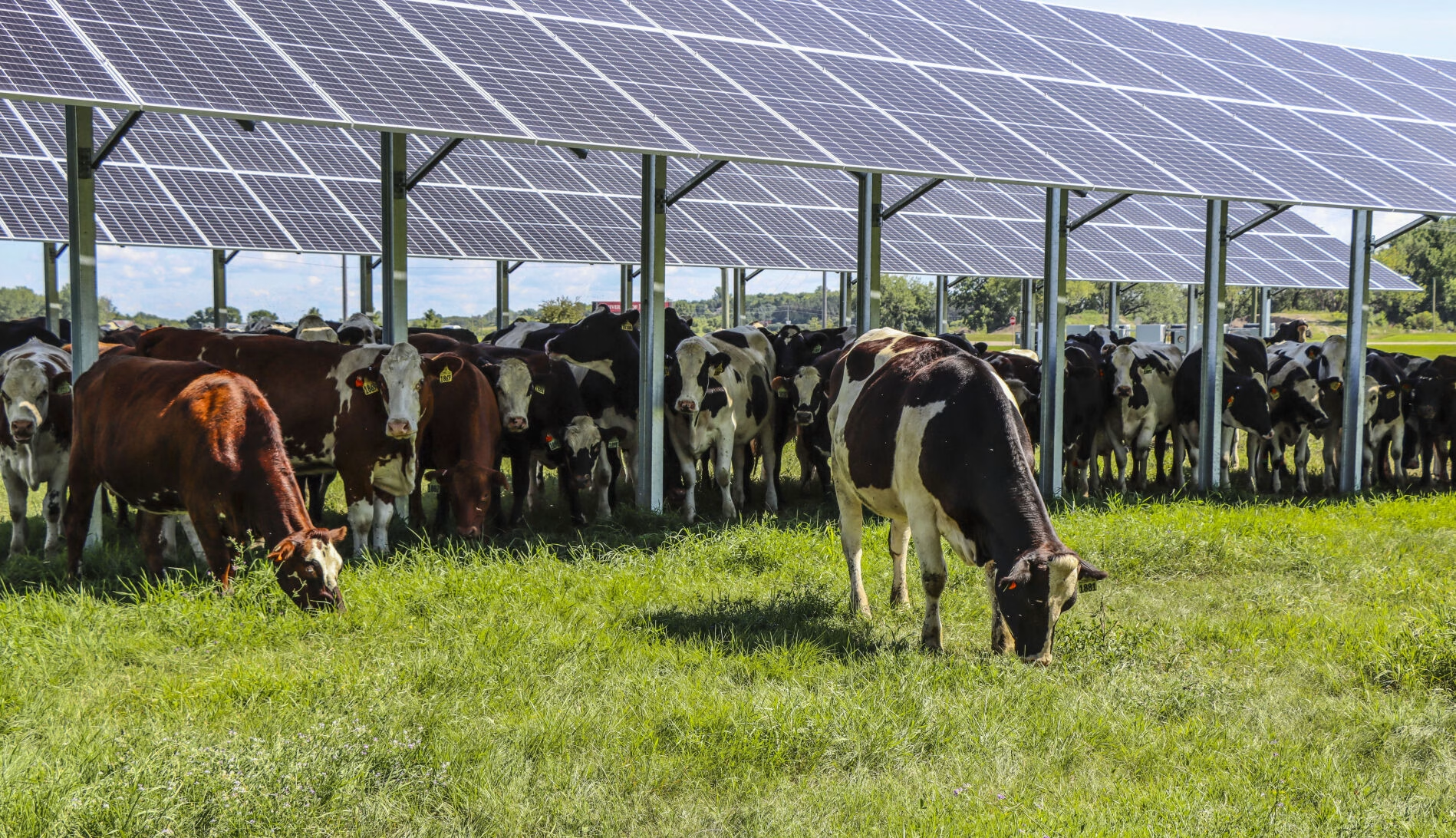
NewsSubscribe
First
Last
Consent

UC Davis Confirms Rumin8 Cuts 95% of Dairy Cattle Emissions with No Production Loss.

UC Davis bombshell: Feed additive slashes 95% of cow methane with ZERO milk loss. Dairy’s climate revolution starts NOW.

EXECUTIVE SUMMARY: A breakthrough UC Davis study validates that Rumin8’s bromoform-based feed additive reduces cattle methane emissions by 95.2% without impacting milk production, rumen health, or feed efficiency. The synthetic compound targets methane-producing microbes while redirecting hydrogen flow, offering dairy farmers a path to near-zero emissions without sacrificing profitability. With regulatory approval underway and global trials expanding, this innovation could transform dairy into a climate solution while meeting rising milk demand. The technology’s scalability and cost-efficiency position it as a game-changer for an industry facing tightening environmental regulations and consumer expectations.

KEY TAKEAWAYS:

  • 95.2% methane reduction – Largest drop ever recorded in peer-reviewed cattle trials
  • Zero production trade-offs – Milk yield, components, and rumen health remain stable.
  • Hydrogen shift – 925% surge replaces methane with low-impact byproduct
  • Global rollout pending – Regulatory approval sought across major dairy markets
  • Industry pivot – Positions dairy as climate solution, no problem, by 2050 demand surge
Rumin8 feed additive, 95.2% methane reduction, bromoform feed additive, UC Davis cattle trial, sustainable dairy farming

UC Davis bombshell: New feed additive OBLITERATES 95% of cow methane while milk production stays ROCK SOLID. This isn’t just another environmental fad – it’s a dairy revolution that could transform your farm‘s climate footprint overnight while keeping your bulk tank full. The methane massacre has begun.

Imagine slashing your dairy herd’s methane footprint by 95% overnight while your milk tanks fill at the same rate. Fantasy? Not anymore. UC Davis researchers have just confirmed what could be the holy grail of dairy sustainability – a feed additive that virtually eliminates methane emissions while maintaining every aspect of production performance. This isn’t just another incremental improvement; it’s a potential revolution for an industry that’s been taking environmental heat for decades.

BREAKTHROUGH ALERT: THE METHANE SOLUTION DAIRY FARMERS HAVE BEEN WAITING FOR

The groundbreaking study, published in Translational Animal Science on March 5, 2025, delivers results that should make every dairy producer sit up straight. Titled “The effect of Rumin8 Investigational Veterinary Product—a bromoform-based feed additive—on enteric methane emissions, animal production parameters, and the rumen environment in feedlot cattle,” the research conducted by UC Davis’s Department of Animal Science is the first peer-reviewed validation of Rumin8’s technology from a leading academic institution.

What makes this study different from the dozens of methane-reduction claims you’ve heard? The numbers are simply staggering. When Rumin8’s oil-based Investigational Veterinary Product (IVP) was added to feed, total methane emissions were slashed by 95.2%, methane yield (g/kg DMI) plummeted by 93.0%, and methane intensity (g/kg ADG) dropped by 93.4%.

The researchers seemed stunned, stating: “Compared to other studies on synthetic halogenated methane analogs, the CH4 reductions observed with Rumin8 oil IVP in this study are among the most substantial reported”.

The trial involved 24 Angus beef steers randomly assigned to three treatment groups – control, oil IVP, and powder IVP – all fed a total mixed ration (TMR). The oil IVP formulation delivered a bromoform intake of 32.2 mg per kilogram of dry matter intake, delivering a precision dose of the active compound directly to the rumen microbiome. This pharmaceutical approach ensures consistent delivery of the anti-methanogenic compound, unlike earlier technologies that struggled with variability.

NOT JUST ANOTHER FEED ADDITIVE: WHY THIS TIME IT’S DIFFERENT

Let’s talk straight – dairy farmers have seen plenty of “miracle” feed additives come and go. Remember seaweed supplements that showed promise in controlled environments but couldn’t scale? Or probiotics that delivered marginal methane reductions but couldn’t maintain them over time? What makes this different?

First, the magnitude of the reduction is unprecedented. We’re not talking about 10% or 20% reductions that barely move the needle on your operation’s carbon footprint. We’re talking about the virtual elimination of enteric methane—the single largest source of greenhouse gas emissions from dairy farms.

Second, and perhaps most critical for your bottom line, is this bombshell finding: “Neither treatment significantly affected animal production parameters or rumen environment parameters.” This technology doesn’t force you to choose between environmental performance and production economics. While slashing emissions, your cows maintain feed efficiency, dry matter intake, and growth rates.

For dairy producers, milk components, days in milk, and body condition scoring remain unaffected – the parameters that directly impact your milk check stay intact.

Third, the technology represents a fundamental shift in approach. Rather than trying to completely reshape rumen fermentation (which typically backfires on production), Rumin8’s synthetic bromoform (tribromomethane) specifically targets methanogenic archaea while leaving the beneficial fiber-digesting bacteria alone. It’s like precision surgery in the rumen, not a sledgehammer approach.

BATTLE OF THE METHANE BUSTERS: HOW RUMIN8 COMPARES

The race to solve dairy’s methane challenge has produced several competing technologies with distinct approaches and effectiveness levels. Understanding how Rumin8 stacks up against other options helps put this breakthrough in context:

3-Nitrooxypropanol (3-NOP): Commercialized as Bovaer by DSM, this compound has shown methane reductions from 20 to 80% in various trials. While impressive, the 95.2% reduction achieved by Rumin8 appears to surpass these results. Additionally, 3-NOP requires consistent daily administration, as its effects diminish rapidly when feeding stops.

Seaweed (Asparagopsis): Natural seaweed supplements containing bromoform have demonstrated 50-90% methane reductions in trials. However, challenges remain with production scalability, consistency of the active compound, and potential flavor transfer to milk. Rumin8’s synthetic approach directly addresses these consistency and scalability issues.

Essential Oils/Plant Compounds: Plant extracts have shown modest methane reductions between 10% and 25%. While generally recognized as safe, their effects are significantly lower than Rumin8 demonstrated in the UC Davis trial.

The UC Davis researchers noted Rumin8’s exceptional performance, stating the reductions were “among the most substantial reported” compared to similar approaches. This comparative context for dairy producers evaluating methane mitigation strategies shows why this breakthrough warrants attention.

RUMEN REVOLUTION: THE SCIENCE BEHIND THE METHANE MASSACRE

When you add Rumin8’s oil IVP to your TMR, something fascinating happens in the bovine rumen’s complex fermentation vat. The bromoform compound directly inhibits the final step of methanogenesis, where hydrogen and carbon dioxide are converted to methane by specialized microbes called methanogens.

What happens to all that hydrogen that would typically become methane? The UC Davis researchers documented massive increases in hydrogen production (925%), yield (934%), and intensity (858%). This metabolic shift represents hydrogen being directly emitted rather than converted to methane – a critical difference since hydrogen has minimal greenhouse warming potential compared to methane’s potent impact.

The UC Davis study documented dramatic shifts in gas production from the treated cattle, revealing the metabolic redirection in the rumen when methanogenesis is inhibited. The results speak for themselves:

Gas Production ParameterChange with Rumin8 Oil IVP (%)
Total Methane Emissions-95.2%
Methane Yield (g/kg DMI)-93.0%
Methane Intensity (g/kg ADG)-93.4%
Hydrogen Production+925%
Hydrogen Yield+934%
Hydrogen Intensity+858%

These numbers tell a remarkable story of metabolic intervention. As methane production plummets, hydrogen – a byproduct of fermentation that would usually be converted to methane – increases dramatically. Since hydrogen has minimal greenhouse warming potential compared to methane’s potent impact, this represents a massive climate win while maintaining the fundamental fermentation processes that drive milk production.

The breakthrough lies in Rumin8’s “highly scalable, consistent and cost-efficient pharmaceutical process to stabilize the target compound (tribromomethane), the most effective anti-methanogenic compound studied to date.” Instead of relying on variable natural sources, this approach ensures every cow gets the correct dose every time, which is critical for effectiveness and safety.

PRACTICAL IMPLEMENTATION: FROM LAB TO FEED ALLEY

While the UC Davis trial demonstrates Rumin8’s effectiveness, dairy producers naturally want to understand how this would work in day-to-day operations. Based on the available research information, here’s what we know about potential implementation:

Delivery Methods: The UC Davis trial tested oil-based and powder formulations mixed into TMR, with the oil-based version showing superior results. Rumin8 is also developing water-delivered formulations for grazing operations, though these weren’t included in the UC Davis trial.

Administration Frequency: The trial involved daily administration through the TMR. The research doesn’t specifically address whether less frequent dosing would maintain effectiveness, which will likely be addressed in follow-up studies.

Integration with Existing Systems: For farms already using TMR mixing equipment, integration appears straightforward – adding a precisely measured amount of the additive during the mixing process. Rumin8’s research focuses on creating a standardized dosage that delivers consistent results.

Herd Transition Considerations: The study doesn’t address whether a gradual transition period is necessary when introducing the additive, a practical question for dairy nutritionists planning implementation.

These implementation details will become more apparent as Rumin8 progresses through regulatory approval and conducts additional field trials in commercial dairy settings. The Bullvine will provide updates as more specific application protocols become available for different dairy management systems.

QUESTIONS TO ASK YOUR NUTRITIONIST

Planning for potential implementation of methane-reduction technologies like Rumin8’s? Here are key questions to discuss with your nutrition consultant:

  1. How would a methane-reducing additive interact with other ration components, particularly ionophores, direct-fed microbials, or specialized fats?
  2. What monitoring protocols would you recommend to ensure that there are no negative impacts on components, milk production, or reproductive performance?
  3. Would implementation require any adjustments to our current mineral or buffer programs?
  4. How might effects differ between our high-production groups, transition cows, and heifers?
  5. What baseline measurements should we establish now to document potential benefits when new technologies become available?
  6. How might feeding strategy and timing affect the effectiveness of methane-reducing additives?

PROFIT POTENTIAL: WHAT THIS METHANE BUSTER MEANS FOR YOUR BOTTOM LINE

You’re probably wondering: “This sounds great, but what will it cost me?” While specific pricing isn’t available yet (the product still pursues regulatory approval), let’s think through the economics logically.

First, consider what methane represents on your farm – lost energy. Every cubic foot of methane belched by your cows is essentially feed energy that didn’t make it into milk production. Some estimates suggest that enteric methane represents 2-12% of gross energy intake. The additive could partially offset its cost if even a portion of that energy is redirected to production.

Second, the market is changing rapidly. Carbon offset markets are maturing, with agricultural methane reduction projects commanding premium prices. As regulatory pressures increase, technologies that deliver verified emissions reductions could generate additional revenue streams through carbon credits or access to premium “climate-friendly” milk markets.

Third, how much would you pay for insurance against future climate regulations? As governments worldwide tighten environmental requirements, early adopters of proven methane-reduction technologies may find themselves ahead of regulatory curves – avoiding costly retrofits or penalties that could hit unprepared operations.

Have you calculated what a carbon tax would do to your production costs? Or what premium consumers might pay for verifiably low-methane dairy products? These questions will define dairy economics in the coming decade.

GLOBAL ADVANTAGE: POSITIONING YOUR DAIRY FOR FUTURE MARKETS

The global context makes this breakthrough even more significant. With milk consumption forecast to increase by 58% by 2050, the dairy industry finds itself in the challenging position of needing to grow production while dramatically reducing its environmental footprint. This isn’t just about local regulations—it’s about maintaining dairy’s competitive position in the global protein marketplace.

As countries implement carbon border adjustment mechanisms, high-carbon production systems will face increasing barriers to international trade. American dairy producers adopting technologies like Rumin8’s could gain a competitive advantage in export markets with stringent climate requirements. This isn’t theoretical – the EU’s Carbon Border Adjustment Mechanism is already phasing in, with other significant markets developing similar frameworks.

“Reducing enteric methane emissions is therefore crucial to mitigate the environmental impact of livestock systems and to achieve national and international climate goals,” noted the study authors. This statement isn’t just academic – it reflects the rapidly evolving reality of global agricultural markets where environmental performance increasingly determines market access.

Rumin8 CEO David Messina highlighted international validation, noting that “a globally renowned research institution has now validated the methane reductions Rumin8 seen in Rumin8 studies conducted in Australia, New Zealand, and Brazil.” This global approach to validation suggests the company is preparing for the worldwide deployment of this technology.

CLIMATE SCIENCE SIMPLIFIED: WHY METHANE MATTERS MORE THAN YOU THINK

Here’s something few farmers realize about methane: unlike carbon dioxide, which can persist in the atmosphere for centuries, methane breaks down relatively quickly – with an atmospheric lifetime of approximately 12 years. This creates a unique opportunity for dairy producers.

When you reduce methane emissions, you’re not just slowing warming (as with CO2 reductions) – you’re potentially reversing it. If dairy herds worldwide adopted technology like Rumin8’s, reducing atmospheric methane could create an actual cooling effect within decades – positioning dairy as part of the climate solution rather than the problem.

This matters because methane has been approximately 28 times more potent than CO2 as a greenhouse gas for over 100 years, but its impact is even more pronounced in the short term. By targeting methane, dairy farmers can make an outsized contribution to climate mitigation compared to almost any other sector – if they have the right tools.

COMING SOON TO YOUR FARM: IMPLEMENTATION TIMELINE

Rumin8 is actively pursuing regulatory approval for its feed and water-based additives, with “additional trials underway in key cattle markets globally.” While the specific timeline for commercial availability depends on regulatory processes, the strong safety profile demonstrated in the UC Davis trial—with no adverse effects on animal health or production—may help streamline approval.

For progressive dairy operators, keeping tabs on these developments should be a priority. Early adopter programs often precede full commercial availability, providing forward-thinking producers an opportunity to gain experience with breakthrough technologies before they become mainstream.

What should you be doing now? Start baseline measurements of your operation’s emissions profile. Update your nutrition team on emerging feed additive technologies. And perhaps most importantly, reframe how you think about methane – not just as an environmental liability, but as a potential opportunity to demonstrate dairy’s ability to be part of climate solutions.

THE FUTURE IS LOW-METHANE: POSITIONING YOUR DAIRY FOR SUCCESS

Let’s be clear – this isn’t just about your farm’s carbon footprint. This is about rewriting dairy’s entire climate story. With a 95.2% reduction in methane emissions and no significant impacts on production parameters, Rumin8’s bromoform-based feed additive demonstrates that dramatic environmental improvements need not come at the expense of productivity or profitability.

Dairy producers have been forced into a defensive posture on environmental issues for too long. This technology offers something different—a proactive, science-based response that addresses climate concerns while preserving dairy production’s essential nutritional and economic contributions.

The UC Davis validation represents what could be a defining moment for climate-friendly dairy production. If successfully commercialized, Rumin8’s technology could help position dairy farming as part of the climate solution rather than the problem – a transformative shift with profound implications for the industry’s future sustainability and social license to operate.

Is your operation ready to virtually eliminate its methane footprint? The science is here, and the technology is coming. The question is no longer whether dairy can dramatically reduce its climate impact but how quickly this revolution will transform the industry.

LEARN MORE:

Join the Revolution!

Join over 30,000 successful dairy professionals who rely on Bullvine Daily for their competitive edge. Delivered directly to your inbox each week, our exclusive industry insights help you make smarter decisions while saving precious hours every week. Never miss critical updates on milk production trends, breakthrough technologies, and profit-boosting strategies that top producers are already implementing. Subscribe now to transform your dairy operation’s efficiency and profitability—your future success is just one click away.
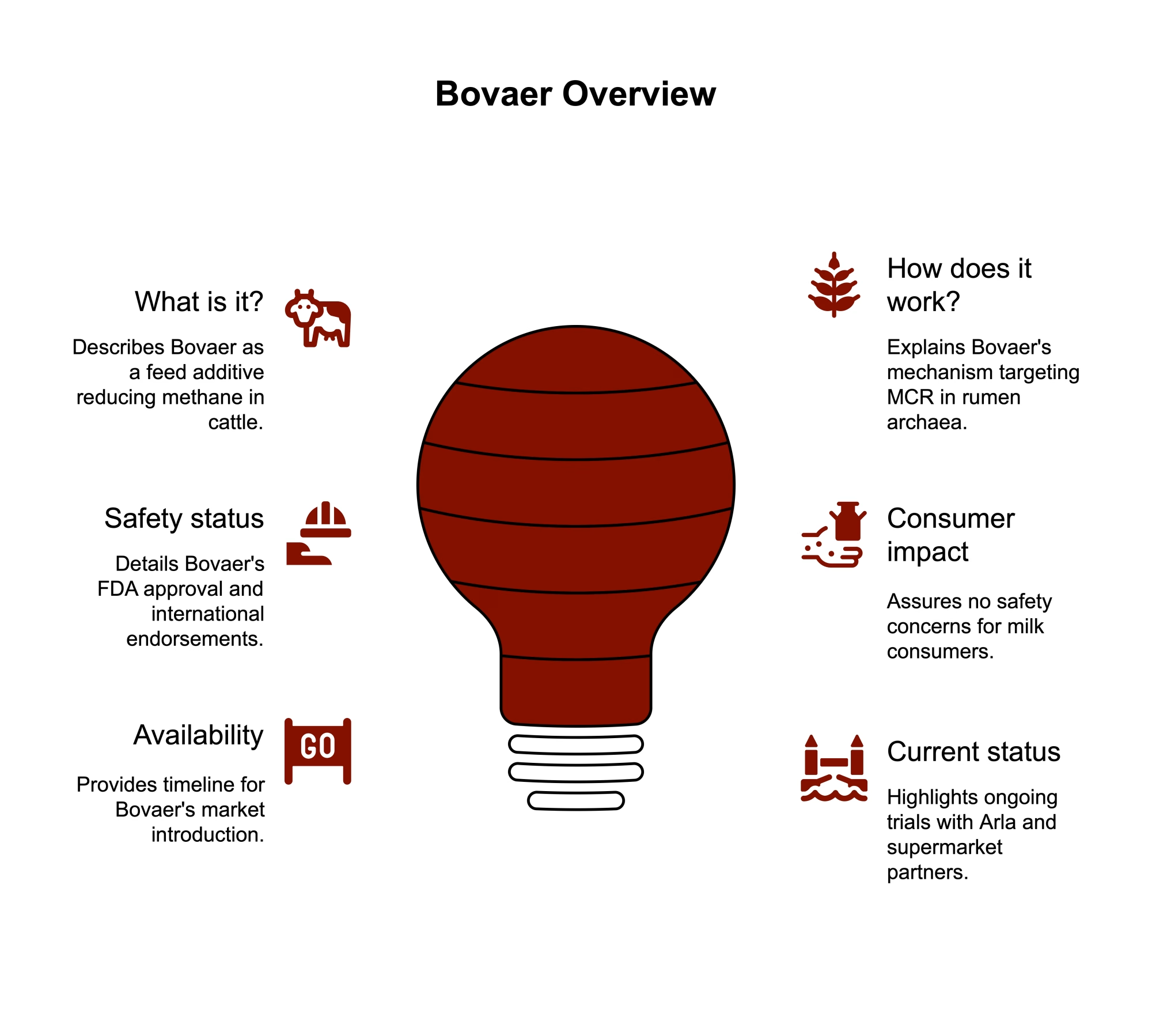
NewsSubscribe
First
Last
Consent

Dairy Cows: Climate Villain or Circular Hero? The Truth Vegan Brands Don’t Want You to Hear

Buckle up, buttercup! We’re about to spill the milk on Big Vegan’s dirtiest secrets. This isn’t your typical farm tale, from wasted crops to carbon-capturing cows. Discover why your trendy oat latte might hurt the planet and how dairy farmers are the real eco-warriors—got milk? You’ll want it after this!

Hey vegan warriors, put down that oat milk latte for a minute—we need to talk about the dirty secret behind your “planet-saving” diet. You know that “ethical” seitan burger you’re so proud of? It’s wasting 90% of the wheat plant while real cattle are out there turning agricultural trash into treasure. Yeah, I said it. And I’ve got the receipts to prove it. Listen up because this isn’t your typical “meat is murder” debate. We’re about to dive into the math that Big Vegan doesn’t want you to see. For every pristine kilo of your precious plant-based protein, there’s a whopping 4 kilos of inedible waste that even your most dedicated composting couldn’t handle. But guess who’s been quietly cleaning up this mess since agriculture began? Those “evil” cows you love to hate. Here’s the kicker that’ll grind your chickpeas: when you look at the whole picture—from field to fork—livestock might be the circular economy champions we need to save this planet. And if that makes you choke on your almond milk (which guzzles 10 times more water than dairy), buckle up, buttercup. The truth about waste, circularity, and why your meatless Monday might hurt the planet is about to get real.

The Dirty Secret Vegan Brands Won’t Admit: Waste Is Inevitable

Imagine this: They say there’s no use crying over spilled milk, but should we be crying over spilled oat juice instead? Here’s a jaw-dropper: for every kilogram of that trendy oat milk you’re pouring over your granola, 84% of the plant ends up as inedible sludge. It’s a shocking revelation about a product you thought was eco-friendly!

And seitan? This wheat-based protein powerhouse leaves 90% of its crop to rot in the fields. It’s a staggering amount of waste! But wait, there’s more! (cue infomercial voice) (cue infomercial voice) While vegan brands are busy patting themselves on the back, our bovine buddies are busy turning trash into treasure. That’s right; cows transform what we can’t eat into delicious steaks. It’s a stark contrast that’s hard to ignore!

Fork > Forage > Fuel: The Radical Math Behind Your Morning Milk

Ever wonder why your loaf of bread costs an arm and a leg? Well, for every kilogram of wheat in that crusty goodness, there’s 4 kg of straw, bran, and stalks left behind. It’s like nature’s buy-one-get-four-free deal, except we can’t eat the freebies!

Now, here’s where things get interesting. While livestock are out there being the unsung heroes of upcycling, those trendy vegan alternatives are hogging prime cropland like there’s no tomorrow. It’s enough to make a farmer cry into his overalls!

The Expert Weighs In: Are We Milking the Wrong Cow?

Our resident livestock circularity guru, Prof. Wilhelm Windisch, drops this bombshell: “We’re fighting the wrong war. Ban cows, and you’ll need 450 million new acres of chemical-soaked monocultures to replace their manure.”

Holy fertilizer, Batman! That’s a lot of land! And let’s be honest, do we want to trade our grass-munching moo-moos for endless fields of pesticide-drenched crops? I don’t know about you, but I’m starting to think we might be barking up the wrong tree… or should I say, mooing at the wrong pasture?

So, next time you choose between a glass of oat milk and a slice of cheese, remember: sometimes, the most sustainable option isn’t what you’d expect. Who knew saving the planet could be so… cheesy?

Grassland Grazing: Nature’s Hidden Ace in the Hole

Hold onto your cowboy hats, folks! We’re about to dive into a secret so big it’s been hiding in plain sight – just like that last slice of cheese you ‘forgot’ was in the fridge. Get ready to be entertained by the surprising truth about sustainable farming!

Did you know that a whopping 70% of global agricultural land is as helpful for growing crops as a chocolate teapot? I’m discussing places like Kenya’s sun-baked deserts or Germany’s rocky pastures. Trying to force soy onto this land would be like trying to teach a cow to ride a bicycle – entertaining, sure, but ultimately fruitless.

But wait! Enter the humble cow, nature’s OG upcycle. These four-legged wonders are turning scrub into steak faster than you can say “medium rare.” And as if that wasn’t enough, they’re also playing firefighter, keeping those pesky invasive brushfires at bay. Talk about a multi-tasking moo-chine!

Methane Madness: The Gas That Cried Wolf

Now, let’s clear the air about something hanging around like a bad smell – methane. Yes, cows burp it out like there’s no tomorrow. But here’s the kicker that Al Gore conveniently forgot to mention in his PowerPoint: methane breaks down faster than a politician’s promise – just 12 years!

CO₂, on the other hand? That nasty little gas is the real party pooper, sticking around for centuries like that one guest who won’t take the hint that the party’s over.

Here’s where it gets exciting. Stable herds are like friends who always pay back precisely what they borrow – no net warming. It’s a perfect circle of life, or a circle of strife?

Need proof? Let’s take a trip to Spain’s oak-studded dehesas. These pig paradises are locking away carbon faster than you can say “jamón” – we’re talking 40 tons per hectare! Meanwhile, those supposedly eco-friendly vegan almond farms are guzzling water like it’s going out of style – 10 times more than your average dairy farm.

So, next time someone tries to blame Bessie for climate change, you can tell them to put that in their plant-based pipe and smoke it! After all, the cow might have the last laugh regarding sustainable farming. Moo-ve over, vegans – the OG environmentalists are here to stay!

The Circular Dairy Playbook: How Top Herds Are Crushing Emissions

Alright, dairy devotees, gather ’round! We’re about to dive into a tale so good, it’ll make you want to hug a cow. Buckle up, buttercup – it’s time to learn how some clever farmers are turning methane madness into money-making magic in the Circular Dairy Playbook!

Germany’s Biogas Rebellion: When Life Gives You Manure, Make Electricity!

Picture this: The EU suits try to shut down German dairies faster than you can say “schnitzel.” But did our dairy heroes throw in the towel? Heck no! They flipped the script so hard, it got whiplash.

By 2025, these crafty farmers will have 60% of their dairies running on… wait for it… cow poop! That’s right, they’re turning manure into moolah with biogas plants. We’re talking about 111 tons of CO2e slashed per 1,000 cows. And the cherry on top? They’re selling excess energy at €0.18/kWh. Talk about making bank from stank!

But wait, there’s more! Check out these mind-blowing stats from EU AgriFish (2024):

MetricConventional DairyCircular Dairy
Feed Competition40% human-edible0%
Synthetic Fertilizer Use100%38%
Net GHG Emissions+2.5 tons CO2e/ha-1.8 tons CO2e/ha

Holy cow! These circular dairies aren’t just reducing emissions – they’re in the negative! It’s like they’ve put their carbon footprint on a diet, disappearing faster than ice cream on a hot day.

A Day in the Life: Wisconsin’s Carbon-Farming Maverick

Now, let’s mosey on to Wisconsin and meet Sarah Thompson, the carbon-farming queen making other farmers green with envy.

4 AM: While most of us still dream about counting sheep, Sarah’s checking her high-tech rotational grazing sensors. She’s got 12 paddocks, and her cows spend 24 hours in each one. It’s like a bovine version of musical chairs, but with more grass and less… well, music.

By noon, her Jersey girls have mowed down 20 acres of clover faster than you can say “cheese, please!” But here’s the kicker – all that dung they’re depositing? It’s not waste, it’s black gold for next month’s corn crop.

“We’re not just carbon neutral,” Sarah says with a grin that’d make the Cheshire cat jealous. “We’re net-negative. The milk’s just a bonus.”

Well, slap my udder and call me Sally! Who knew saving the planet could be so… profitable? These dairy dynamos are proving that they’re the cream of the crop when it comes to sustainable farming. So next time someone tries to blame Bessie for climate change, you can tell them to put that in their milk and chug it!

Vegan Illusions: The Land-Use Bombshell They’re Hiding

Alright, let’s cut through the fluff and get real. You’ve probably heard the rallying cry from activists: “40% of cropland feeds livestock!” Sounds terrible, right? But here’s the kicker—they’re not telling you the whole story. Let’s dig into this land-use myth and expose the truth behind that oat-milk latte.

The 86% Feed Lie: What They Don’t Want You to Know

Here’s the deal: 86% of livestock’s so-called “feed” isn’t food you’d ever see on your plate. It’s straw, bran, grass—stuff even the most hardcore vegans wouldn’t touch with a ten-foot fork. Consider it: cattle are nature’s garbage disposals, turning leftovers into milk and meat. Not bad for an animal that spends most of its day chewing!

Need proof? Take a page from Bangladesh’s playbook. Women there figured out that instead of burning rice husks (a byproduct no one eats), they could feed them to chickens. The result? A 23% boost in household incomes. That’s right—livestock are helping families thrive while putting waste to work. So, who’s being resourceful here?

Oat Milk’s Dirty Little Secret: The Truth Behind That Trendy Carton

Now let’s talk about oat milk—the darling of eco-conscious Instagrammers everywhere. Sure, it looks good in your coffee, but what’s lurking behind that “sustainable” label? Spoiler alert: it ain’t pretty.

Oat milk needs five times more oats to get the same calories as dairy milk. Yep, five times! And what does that mean? More monocrops, more pesticides, and a mountain of oat husks so useless even biogas plants don’t want ’em. It’s like buying a fancy electric car only to find out it runs on coal—looks green on the outside, but dig deeper and it’s a mess.

So next time someone tells you livestock are hogging all the cropland or oat milk is saving the planet, hit ‘em with the facts. Cows are upcycling champions, and that trendy carton might do more harm than good. Sustainability isn’t about jumping on the latest bandwagon—it’s about wisely using what we’ve got. And if that means giving cows some straw and bran to turn into steak and ice cream? Well, that sounds pretty darn smart to me!

Your Herd. Your Future. Your Move.

Alright, dairy dynamos, gather ’round! It’s time to get honest about the future of farming. You must face these four brutal truths head-on to keep your barn doors swinging and your cows mooing. Ready? Let’s dive in!

1. Fork > Forage > Fuel: The Survival Playbook

First, talk about the “fork > forage > fuel” cascade. Sounds fancy, right? But here’s the kicker: it’s not just a catchy phrase; it’s your lifeline! If you’re still feeding your cows human-edible feed like a buffet, it’s time to hit the brakes and start rationing. Think of it like this: you wouldn’t throw a party and let everyone eat all the cake before the guests arrive, would ya? Start being strategic about what goes into those troughs—your herd’s future depends on it!

2. Methane Tech: The Burp-Busting Solution

Next up, let’s tackle methane. Yes, cows burp—it’s practically their party trick! But guess what? Those burps are costing you big time. Enter 3-NOP additives: They can slash those methane emissions by 30%. It’s like giving your cows a breath mint for the planet! If you don’t get on board with this tech, you might find regulators knocking on your barn door, ready to shut things down faster than you can say “move over.”

3. Manure is Money: Don’t Let It Go to Waste

Now, let’s talk about that stuff we all love to hate—manure. You might think of it as just a smelly nuisance, but here’s the truth: manure is money! Seriously! If you miss the biogas wave, you’ll be drowning in carbon taxes faster than a cow in quicksand. So, instead of grumbling about the smell, start seeing dollar signs! Turn that waste into energy and watch your profits rise while helping the planet simultaneously.

4. Small = Mighty: Canada’s Secret Sauce

Finally, let’s give a shout-out to the little guys. You might think bigger is better, but Canada’s supply management system is flipping that idea. Herds with fewer than 200 cows are raking in a jaw-dropping $8.23 billion yearly! That’s right—small can be mighty! So please don’t underestimate your operation because it doesn’t take up half the county. Sometimes, the best things come in small packages (like those adorable mini-cows!).

The Bottom Line

Listen up, you magnificent milk mavens! We’ve just unloaded a truckload of truth bombs that’ll make any vegan influencer choke on their chia seeds. But here’s the deal: knowing is only half the battle. It’s time to grab the bull by the horns and turn this industry on its head!

Remember, while the plant-based posers are busy patting themselves on the back for their oat milk lattes, you’re doing the work. You’re not just feeding the world; you’re saving it one cow pat at a time. Your herds are turning useless scrub into prime ribeye, your biogas plants are lighting up towns, and your carbon-negative farms are making Al Gore eat his words (along with a slice of real cheese, we hope).

So, what’s next? It’s time to milk this opportunity for all it’s worth:

  • Embrace the tech: Get those methane-busting additives in your feed ASAP. Show the world that cows can burp and save the planet at the same time!
  • Turn waste into wealth: If you’re not looking at manure as liquid gold, you’re flushing money down the drain. Get on the biogas bandwagon before it leaves you in the dust.
  • Spread the word: Next time someone tries to shame you with vegan propaganda, hit ’em with the facts. You’re not just a farmer but a carbon-capturing, waste-upcycling superhero!
  • Band together: Small farms are mighty but united; we’re unstoppable. Join forces, share knowledge, and show the world what real sustainability looks like.

Remember, every time you milk a cow, you’re not just producing food – you’re proving that the most powerful solutions are often the most natural ones. So stand tall, dairy farmers! The future isn’t just bright; it’s downright luminous.

Now get out there and show those vegan naysayers what real eco-warriors look like. It’s time to make dairy great again – not that it ever stopped being awesome! Let’s turn the tide, one milk pail at a time. The move starts now!

Key Takeaways:

  • Climate change significantly impacts dairy farming through heat stress on cows and changing weather patterns.
  • Heat stress reduces dairy cows’ feed intake, production, and fertility. Even small temperature increases can lead to noticeable milk yield losses.
  • Farmers adapt with improved ventilation, feeding schedules, and water conservation strategies.
  • The economic impacts are substantial, with UK farms facing an estimated £472,539 per farm in climate resilience costs over the next decade.
  • The dairy industry is responding with initiatives like Canada’s goal for net-zero emissions by 2050.
  • Precision agriculture and advanced monitoring systems are becoming crucial for farm management in the face of climate challenges.
  • The 2025 outlook for the dairy sector is cautiously optimistic, with margins expected to remain above the five-year average despite climate pressures.
  • Collaboration between farmers, researchers, and policymakers is essential for developing sustainable practices to address climate change.
  • Regional differences in emission intensities highlight opportunities for improvement, especially in developing regions.
  • Sustainable dairy farming practices focus on balancing environmental needs, animal welfare, and farmer livelihoods.
  • Circular economy principles are being applied in dairy farming, with efforts to close nutrient cycles, reduce waste, and improve resource efficiency.
  • The Northeast U.S. dairy industry shows potential for a circular economy model due to its climate and farming practices.

Summary:

Hold onto your milk pails, folks! This eye-opening exposé will turn everything you thought you knew about sustainable agriculture on its head. We’re diving headfirst into the dirty secrets Big Vegan doesn’t want you to know, revealing how dairy cows might be the unsung heroes of circular farming. From debunking the myth of livestock feed competing with human food to exposing the wasteful truth behind trendy plant-based alternatives, we’re serving up cold, hard facts with a side of wit. You’ll discover how innovative dairy farmers are slashing emissions, turning manure into money, and proving that small herds can significantly impact. By the time you finish this read, you’ll see why those gentle grass-munchers in the field aren’t just producing your favorite foods – they’re champions of sustainability, turning agricultural waste into nutritious treasure. So grab a glass of milk and prepare to have your mind blown – this isn’t just about defending dairy; it’s about rethinking our entire approach to eco-friendly farming.

Learn more

Join the Revolution!

Bullvine Daily is your essential e-zine for staying ahead in the dairy industry. With over 30,000 subscribers, we bring you the week’s top news, helping you manage tasks efficiently. Stay informed about milk production, tech adoption, and more, so you can concentrate on your dairy operations.

NewsSubscribe
First
Last
Consent

The Energy Efficient Dairy Cow: Leveraging Genetics and Nutrition for Sustainable Dairy Farming

Explore how genetics and nutrition affect energy efficiency in lactating cows. Can improving these factors enhance your farm’s productivity and sustainability?

Are your cows using energy efficiently with the best nutrition? In today’s dairy farming, reducing methane and being eco-friendly is crucial. A cow’s genes and diet affect its energy use, which impacts milk production and farm sustainability. Recent research shows that differences between cows explain up to 42.5% of energy use changes, especially in how they make methane and use food energy. Using this can help make your herd more efficient and eco-friendly.

Decoding the Genetic Puzzle: Unveiling Energy Dynamics in Cows 

Learning about how cows use energy while making milk is essential. Each cow’s genetics and where it lives affect how well it uses energy. Differences among cows come from how much dry matter they eat, how they use energy, and how their nutrients break down. Recent studies show that these differences can explain up to 42.5% of the variation in energy use, especially in making methane and using food energy. Dr. Addison Carroll from the University of Nebraska-Lincoln explains this complex topic (Journal of Dairy SciencePartitioning among-animal variance of energy utilization in lactating Jersey cows). Carroll points out the importance of understanding differences in cows’ energy use. Although how much dry matter a cow eats matters, cows also differ in how they make methane and waste energy when adjusted for DMI. These differences come from their diet, unique genetics, and environment. 

Understanding these differences is key to making farms more productive and sustainable. Farmers can make smarter choices about breeding and managing by figuring out which cows naturally use energy better. For example, choosing genetics that improves energy efficiency can create a herd that produces more milk with less work. Also, making nutrition plans to fit each cow’s genetics can boost performance and reduce waste. Carroll’s research stresses the need to understand these natural differences to improve farming by using the natural efficiencies seen in livestock.

The Genetic Blueprint: Shaping Energy Efficiency in Cows

Genes in dairy cows play a significant role in their energy use, affecting their growth and milk production. Two critical traits are dry matter intake (DMI) and energy balance. These traits are influenced by the cow’s care and environment and are linked to its genetic makeup. The heritability of dry matter intake (DMI) is between 0.26 and 0.37. This means genes have a strong influence on it. Heritability, a measure of how much of the variation in a trait is due to genetic differences, is between 0.29 and 0.49 for energy balance, showing a strong genetic influence on how well cows use energy. 

Selective breeding has improved milk production significantly over the years. Careful selection of cow genes has boosted milk production by about 34% to 50% over the past 40 years (VanRaden, 2004; Shook, 2006). This means cows can produce more milk while eating the same amount or even less, making them more energy-efficient. Genetic selection also helps cows use nutrients more efficiently, decreasing the environmental impact of farming cows. 

The future of dairy farming looks promising, as evidenced by ongoing genetics research. Identifying specific genes that can enhance cows’ energy utilization is possible. This discovery could lead to breeding strategies focusing on these traits, thereby advancing dairy herds. Furthermore, understanding genetic factors influencing methane production could lead to more efficient energy use and reduced environmental impact. As research progresses, the dairy industry could witness significant changes toward more sustainable and efficient practices, instilling a sense of hope and optimism in dairy farmers.

Fueling the Future: Nutrition’s Role in Maximizing Cow Energy Efficiency

Efficient food utilization by cows in dairy farming greatly influences milk production and industry sustainability, affecting their energy use. A cow’s diet plays a massive role in helping them turn feed into milk efficiently, affecting their energy use. Better diets help cows get more out of what they eat, impacting their energy needs. Dry Matter Intake (DMI), the amount of feed a cow consumes that is not water, is key to how well cows use energy when making milk. Researchers at the University of Nebraska-Lincoln found significant differences in DMI among herds, affecting energy efficiency. By improving DMI with tasty and nutritious food, farmers can give cows what they need to make more milk efficiently. 

Nutrient absorption is a critical factor that should be taken into account. How well cows break down their food affects how much energy they can use. The Nebraska study showed that choosing the right feed helps cows better digest nutrients like crude protein (CP) and neutral detergent fiber (NDF). Good absorption reduces energy lost in waste, improving efficiency. 

Farmers can improve how cows use energy and cut losses by changing diets. For example, adjusting starch levels matches energy needs with milk production, and balancing fiber aids digestion, increasing energy efficiency. The study shows dairy farmers can boost productivity and reduce environmental impact by carefully planning their diets, improving digestion, and maximizing DMI.

Methane and Tissue Energy: Unlocking Energy Variance in Jersey Cows

Recent studies show that differences in methane production and tissue growth are significant factors in how lactating Jersey cows use energy. Measuring methane energy per unit of dry matter intake (DMI) increases by 4.80%, which shows that cow differences affect how much methane they produce. Methane might be a small part of energy loss in dairy farming, but it dramatically impacts the environment and farm energy use. 

There are also differences in how cows grow tissue. At first, there isn’t much variation, but once you consider DMI, variation increases. This means cows have different abilities to grow tissue using energy, which impacts efficiency and energy management in the herd. 

These findings are essential. High differences in energy use among cows can lead to inefficient resource use and more emissions. Since methane affects our economy and environment, reducing production is essential. 

There are effective strategies to reduce methane emissions in dairy farming. Genetic selection, which involves breeding cows that naturally produce less methane, is one such strategy. Studies have hinted at a link between genetics and methane, opening up opportunities to breed for better environmental efficiency without sacrificing milk production. Nutrition also plays a crucial role. By making dietary changes to improve digestion, farmers can reduce methane emissions. Feeding cows with supplements to enhance digestion or adding ingredients to reduce methane-producing bacteria could be effective. These strategies inspire and motivate dairy farmers to implement changes that significantly reduce their farm’s environmental impact. 

Although different methane and tissue energy levels pose challenges, they also provide opportunities. Dairy farmers can use genetics and diet strategies to improve energy use, lower emissions, and work towards sustainable farming.

Genetic vs. Nutritional Approaches: Navigating Energy Efficiency in Dairy Cows

The dairy industry is at a crossroads, deciding how to boost energy efficiency in milking cows. Some say that improving cow genetics is the answer to producing more milk with less waste. They believe genetic differences significantly impact energy use, primarily methane and tissue energy. Supporters of this idea think that using advanced genetics can help breed cows that use energy more efficiently. 

On the other hand, some focus on designing the right feeding plans. They think genetics matter, but how you feed the cows is what boosts productivity. They highlight the progress made through better feeding and care, showing that nutrition is crucial to farm success. 

Future research might combine both ideas, using genetic insights to improve feeding strategies and create a system that continually enhances efficiency. Studies on how intake affects energy use show the complexity and potential for discovering new ways to improve. 

These concepts are not just theoretical; they directly impact dairy farmers’ everyday decisions. Farmers must consider different approaches and apply them to their farms as the industry changes. This has a significant effect on farming, pointing to a future where data and the specific needs of each herd guide decisions. Leveraging these insights could lead to a shift from stagnant growth to enhanced farm productivity and sustainability.

Investing in Energy Efficiency: Weighing Costs and Returns 

Farmers must understand how cows use energy and how this affects their business. Improving cows through genetics and feeding can cost a lot but yield good results. Better breeding or buying high-quality cattle costs money. This includes expenses for gene tests and paying more for top cows. However, these costs might save on feed over time and improve cow energy use, which means more milk. This can increase profits and make farming more sustainable. 

Spending on good nutrition can change from farm to farm. Farmers may buy high-quality feeds and supplements or hire experts to create diets that improve energy use. While costly, the benefits can be significant. Better feeds help cows digest and absorb nutrients better, reducing methane emissions for each milking unit. This is key for sustainability; extra money might come from eco-conscious markets. Also, reducing energy waste through nutrition can increase milk production and cattle growth, cutting costs from low productivity or health issues. This approach can save on veterinary bills by preventing nutrition-related diseases. 

Ultimately, getting a return on these investments requires careful planning. Farmers should weigh the initial costs against the savings or added income. Speaking with agricultural economists can offer insights into balancing costs with financial and environmental benefits.

The Complexities of Achieving Energy Efficiency in Dairy Farming

Genes and nutrition can help make dairy farming more sustainable, but some problems must be solved first. The fact that genetic selection is hard to predict is a big problem. We can pick traits that help us use energy more efficiently, but the results aren’t always accurate. Traits like dry matter intake (DMI) and methane production are passed down in many ways. Focusing on one trait could have unintended effects on other critical areas, such as reproduction or health in general. Also, focusing too much on saving energy could hurt the genetic diversity needed for herds to be strong and healthy.

Nutritional methods also pose problems. Plans for advanced feeding can be expensive for many dairy farms. Ensuring that each cow gets the right feed, supplements, and diets for her energy needs requires a lot of money and knowledge. When feeding changes are made, cows’ health and behavior must also be considered, as these can affect how nutrients are used and how much milk is produced.

Rules and market needs may also make using genetic or feeding methods hard. People who want to buy “natural” or “organic” products might not like genetic changes or artificial supplements meant to make things use less energy. Crop quality, weather, and farm management make these efforts more difficult.

The Bottom Line

Understanding the link between a cow’s genetics and diet is key to improving energy use in dairy cows. Tailoring herd traits and feeding plans can boost milk while cutting waste like methane. A uniform approach won’t work well since every cow uses energy uniquely. Instead, creating diets based on genetic needs maximizes productivity sustainably. Some cows do better with diets that highlight their strengths and minimize weaknesses. Selective breeding can also enhance efficiency traits. Farmers can boost production and protect the environment by accepting complexity, ensuring future success. It’s time to rethink old habits and use the mix of nature and nurture for a better future.

Key Takeaways:

  • Among-animal variance significantly contributes to the variation in energy utilization, particularly in lactating Jersey cows.
  • This variance accounts for approximately 29.3% to 42.5% of differences observed in energy metrics.
  • Methane and tissue energy show increased variance when expressed per unit of dry matter intake (DMI), highlighting genetic differences among cows.
  • DMI variance is notably high, underscoring its critical role in energy efficiency and partitioning in dairy cows.
  • Advancements in feed efficiency and genetic selection could help optimize energy use, improving farm productivity and sustainability.
  • Understanding the balance of genetic and nutritional influences is essential for improving energy efficiency in dairy production.

Summary:

Can genetics and nutrition boost the energy efficiency of lactating cows? A study from the University of Nebraska-Lincoln revealed that differences between Jersey cows significantly affect energy use, especially in methane and tissue energy. These differences account for 29.3% to 42.5% of the energy variance, highlighting the role of genetics and diet in making cows more efficient. With 115 Jersey cows and over 560 data points, the study shows that focusing on genetic selection and nutrition can enhance productivity and sustainability in dairy farming. By understanding these factors, farms can reduce emissions and improve milk production, paving the way for a more eco-friendly future for the dairy industry.

Learn more:

Join the Revolution!

Bullvine Daily is your essential e-zine for staying ahead in the dairy industry. With over 30,000 subscribers, we bring you the week’s top news, helping you manage tasks efficiently. Stay informed about milk production, tech adoption, and more, so you can concentrate on your dairy operations. 

NewsSubscribe
First
Last
Consent

Bovaer and the UK Dairy Industry: Revolutionizing Sustainability or Just a PR Nightmare?

Discover Bovaer’s impact on UK dairies—revolutionary step or PR hurdle? Explore the debate and draw your conclusion.

Methane emissions have become a significant problem in the fight against climate change, especially in the dairy industry. When trapped in heat for over 100 years, methane is a greenhouse gas more than 25 times stronger than carbon dioxide. Most of it is released when cows belch. Ignoring this part of dairy farming means missing a crucial environmental puzzle. That’s where Bovaer comes in—a new feed additive that promises to significantly cut methane emissions, making it a potential game-changer for sustainability in farming. 

Some hail Bovaer as a breakthrough, a beacon of hope in the fight against climate change. With just a tiny addition to cow feed, it has the potential to reduce emissions by up to 30%. However, like any transformative idea, Bovaer has faced skepticism and consumer pushback. The ‘path to sustainability seems full of controversies as much as it is full of possibilities.’ While some see Bovaer as a hopeful step toward lessening environmental impact, others are concerned about its implications for dairy products and food safety. 

A Tiny Spoonful with a Giant Impact: Revolutionizing Dairy Sustainability with Bovaer

Bovaer is a new feed additive made by DSM to address a significant environmental issue in farming: methane emissions from dairy cows. Methane, a potent greenhouse gas, is mainly produced in the stomachs of ruminants like cows through enteric fermentation. This process involves breaking down food using microbes, producing significant methane, and contributing to climate change

Bovaer, the result of over ten years of rigorous research and testing, is a safe and effective solution. This additive targets a specific enzyme in the cow’s stomach that produces methane, reducing emissions by about 30% when used correctly. It is effective in tiny amounts—a quarter of a teaspoon per cow daily can achieve methane-reducing results, providing a reliable and practical solution to a pressing environmental issue. 

Bovaer has been embraced in more than 60 countries, including major dairy producers like the United States, demonstrating its global acceptance and potential impact. The approval process involved thorough trials and evaluations by scientific and regulatory groups, proving its effectiveness and safety for animals and humans. This widespread acceptance underscores the additive’s role in achieving worldwide sustainability goals in the dairy industry, making the audience feel part of a united global effort. 

The Double-Edged Sword of Social Media: Bovaer’s Trial and the Unleashed PR Storm

The power of social media can be both good and bad, as seen with the backlash against Arla’s plan to try Bovaer. What started as a simple press release quickly became a PR disaster, showing how fast misinformation can spread online. The trial, which included only a tiny number of Arla’s farmers, was meant to test methane reduction, but the reaction was simple. Soon after the announcement, social media, especially X, became filled with different opinions, with false information and conspiracy theories taking over. 

Some people mistakenly said Bovaer was not just a feed additive but a dangerous chemical that could make dairy products unsafe—a colossal misunderstanding. There were false claims about changes to milk and even suspicious hints of corporate wrongdoing, which fueled fears. Crazy accusations linked Bovaer to political and health conspiracy theories, dragging in people like Bill Gates without any factual basis, making mistrust and confusion worse. 

Because of this, consumers panicked and called for a boycott of Arla’s products. This reaction was based more on fear than facts, as social media gossip drowned out scientific studies and official approvals showing Bovaer’s safety. This situation shows how easily public opinion can be influenced, especially when sensational stories overshadow the truth, serving as a warning for the whole dairy industry.

Farmers at a Crossroads: Bovaer’s Promise and the Economic Reality 

The introduction of Bovaer has sparked different opinions among UK dairy farmers, highlighting the tough choices surrounding new farming technologies. Some farmers see Bovaer as a key step toward eco-friendly dairy farming. In today’s world, cutting carbon footprints is necessary, and Bovaer helps in the battle against climate change. These farmers want to be part of the global solution and make caring for the environment a central part of their work. 

However, many farmers are still unsure. Their main worry is the cost of using Bovaer. Since it doesn’t boost milk yield or quality, it’s an extra cost without a clear benefit other than less methane, which can’t be easily measured without special tools. This makes it a tough choice, especially for farmers already struggling financially. 

There is also concern about getting caught in a public relations mess. Some farmers fear that misunderstandings, like the ones during Arla’s trial announcement, might upset customers. This could damage farmers’ reputations or lead to boycotts, worsening their financial situation and hurting the relationships they’ve built with consumers. 

The disagreement over Bovaer shows a more significant issue in the industry: balancing short-term financial needs with long-term sustainability goals. As talks continue, it’s essential for everyone involved to work together and address these concerns so that projects like Bovaer provide clear and practical benefits to everyone.

Stuck Between Green Dreams and Red Bottom Lines: The Economic Tug-of-War Over Bovaer

Dairy farmers face significant financial hurdles when using Bovaer in their feeding routines. Farmers don’t see immediate profits because this new feed additive costs money. Many farmers already have tight budgets, so they must choose between being environmentally friendly and economically stable. 

The main issue is that while Bovaer cuts down on methane emissions, it doesn’t lead to more milk or better quality, which could make up for its cost. Farmers must spend money to use Bovaer without any extra income, making it hard to justify the additional expense. 

What’s more, there aren’t any strong financial incentives to help. Government programs don’t provide enough support or subsidies to help with these costs, leaving farmers to pay the price of becoming more sustainable. 

Retailers also add to the problem by not wanting to pay for sustainability efforts. They want to stay profitable and hesitate to take on extra costs for environmental reasons. This means farmers bear the full financial brunt, even though society benefits from lower emissions. Farmers face a tough challenge if retailers and others don’t pitch in. 

For Bovaer to succeed, we need to change our economic thinking. Everyone involved, including retailers and policymakers, must share responsibility and offer financial help. Only when we all work together can the goal of cutting emissions align with keeping farmers economically strong.

When Delay Spurs Doubt: The Urgent Call for Timely and Robust Regulatory Action 

The Bovaer controversy swept through the UK dairy sector like a storm, and the slow response from regulatory bodies like the UK’s Food Standards Agency was hard to ignore. In today’s world, where news (and rumors) spread as fast as a tweet, waiting too long to confirm Bovaer’s safety made public worries worse. This delay only fueled doubts as people waited for an official statement amidst rumors and false information. The situation highlights how crucial it is for trusted sources to communicate quickly and clearly when public trust is at stake. 

Another missed opportunity is the lack of government incentives to help adopt technologies that reduce methane. While everyone agrees that reducing methane is good for the environment, dairy farmers still bear the cost of these technologies. Even though reducing methane aligns with national and global sustainability goals, government policies don’t offer much support. Farmers wonder why they should pay to care for the environment without help or recognition from those in power. 

In a time when sustainability is supposedly a top government priority, not having policies to encourage the use of products like Bovaer seems like a strategy mistake. It raises the question: If the government doesn’t support essential sustainability projects, who will push for positive environmental change in the industry? This challenge remains unsolved, leaving dairy farmers stuck between wanting to be more environmentally friendly and facing the challenging economic truths of making it happen.

The Global Dairy Odyssey: Navigating the Intersection of Sustainability and Trade with Bovaer

The story of Bovaer is just one part of a more significant trend in the global dairy industry. This trend is concerned with reducing environmental impact and managing trade issues. As countries aim to make their food systems more eco-friendly, technologies like Bovaer become essential tools. However, they also face the challenge of fitting into global trade systems. 

Today, environmental issues heavily influence policies and consumer choices. Bovaer showcases a mix of innovation and necessity. It highlights the growing awareness that agricultural emissions must be reduced to meet climate goals. Yet, Bovaer is not alone in this mission. Worldwide, other technologies like Rumin8 and seaweed extracts are being explored to lower methane emissions from cattle [DSM]. The potential for these technologies to work together shows the importance of international cooperation. 

As countries update their trade deals, the movement of new products like these will become crucial. Many nations acknowledge their climate duties and add sustainability clauses to trade agreements. This could lead to shared strategies where countries exchange methane-reducing technologies and research, promoting a joint effort in cutting agricultural emissions worldwide. 

Groups like the United Nations Food and Agriculture Organization and the International Dairy Federation could support these sustainability efforts by creating consistent global policies and establishing trade rules that encourage rather than hinder innovation. For companies and dairy farmers, aligning with these global initiatives could help reduce methane emissions and improve their market position, which is increasingly focusing on sustainability. 

While Bovaer faces challenges at home, its story reflects the more significant issues and opportunities at the intersection of sustainability and global trade. The international dairy industry is poised for a new era in which collaboration, rather than competition, might lead to a greener future.

The Bottom Line

The story of Bovaer in the UK dairy industry is a tale of opposites. On one hand, it promises to reduce methane emissions, a big step towards helping the environment and fighting climate change. But, on the other hand, it’s causing many arguments, mainly because of what people think about it and how much it costs. While some farmers are eager to use Bovaer for its green promise, others worry about the cost, as it doesn’t improve production. This raises a key question: can the dairy industry balance new ideas like Bovaer with consumer concerns and financial pressure? 

Regulatory bodies have a significant role to play. They must ensure safety and openness and create an environment that helps new technologies. As the Bovaer story continues, the future is uncertain. Will people eventually support it, trusting the scientific backing it has? Can financial challenges be solved with better policies and support for farmers? All these things will shape the future of Bovaer and dairy sustainability. As someone involved in the dairy industry, you’re in the tough spot of figuring out how to mix innovation with public perception in your ongoing effort to be sustainable.

Key Takeaways:

  • Bovaer, a feed additive developed to reduce methane emissions in dairy cows, is at the forefront of sustainability efforts but is mired in controversy.
  • The backlash on social media exemplified a significant PR crisis, with misconceptions fueling public distrust and calls for boycotting brands associated with Bovaer.
  • The divide within the dairy industry reflects concerns over the cost of Bovaer without direct financial return, highlighting the economic challenges of adopting sustainable practices.
  • The lack of adequate government response and support intensifies challenges for farmers wary of embracing innovations that may not yield immediate financial benefits.
  • Global interest in sustainable dairy practices signals potential but underscores the need for comprehensive studies and strategic communication to gain consumer and industry trust.
  • Farmers must navigate the delicate balance between contributing to environmental goals and maintaining economic viability, emphasizing the need for innovative solutions that consider all stakeholders.

Summary:

Bovaer, a methane-reducing feed additive, has sparked significant controversy in the UK dairy industry. Touted as a sustainability breakthrough, it triggered a public relations storm due to consumer misunderstandings amplified by social media. The additive, which can cut emissions by 30% with just a quarter teaspoon daily per cow, has been accepted in over 60 countries. However, its implementation has divided dairy farmers; some recognize its potential for sustainable practices, while others object to its costs and lack of direct production benefits. This uproar highlights broader challenges in aligning environmental goals with economic realities. The case calls for improved regulatory communication to harmonize consumer perceptions with scientific facts. Ultimately, Bovaer’s adoption tests the dairy sector’s adaptability and engagement in global sustainability discourse, further accentuated by evolving international trade considerations.

Learn more:

Join the Revolution!

Bullvine Daily is your essential e-zine for staying ahead in the dairy industry. With over 30,000 subscribers, we bring you the week’s top news, helping you manage tasks efficiently. Stay informed about milk production, tech adoption, and more, so you can concentrate on your dairy operations. 

NewsSubscribe
First
Last
Consent

New Zealand Leads Global Charge in Methane Reduction: Insights from the Latest Dairy Innovations

Explore how New Zealand is leading the charge in cutting methane emissions in the dairy sector. Are groundbreaking vaccines and feed additives the key to a greener future?

Summary:

As global scrutiny on agricultural emissions intensifies, all eyes are on New Zealand—a leader in innovative strategies to curb the methane footprint of its dairy sector. The recent Agriculture and Climate Change conference highlighted crucial advancements in methane mitigation technologies, focusing on vaccines and bolus solutions, with experts like Dr. Harry Clark advocating for their transformative potential. Companies such as Ruminant BioTech, poised to release a bolus by 2025, and ArkeaBio, aiming for a methane-reducing vaccine within five years, represent the forefront of this shift. Their breakthroughs reinforce the importance of sustainable practices, tackling one of the most potent greenhouse gases and providing a blueprint for global adoption. While technological solutions like feed additives, vaccines, and boluses face cost, practicality, and regulatory approval challenges, New Zealand’s progress signifies a significant stride towards reducing enteric methane emissions without compromising the country’s pastoral farming ethos.

Key Takeaways:

  • New Zealand is pioneering efforts in developing a methane-reducing vaccine, targeting natural immunity against methanogenic archaea in cattle.
  • The methane vaccine aims to stimulate cows to produce antibodies in their saliva, reducing methane production without continuous chemical feed additives.
  • Challenges replicating lab successes in real-world cattle rumens, prompting increased investment and global collaboration.
  • Alternative methane reduction strategies include feed additives like Agolin and Brominata, which show promise in controlled emissions reduction.
  • This innovative approach aligns with New Zealand’s agricultural goals and presents potential global implications for reducing agricultural greenhouse gas emissions.
methane emissions, New Zealand dairy industry, climate conference, methane-inhibiting boluses, vaccine research, enteric fermentation, environmental impact, Ruminant BioTech, ArkeaBio vaccine trials, greenhouse gases

New Zealand stands at the forefront of the global mission to combat methane emissions, a critical aspect of addressing climate change that directly impacts the dairy industry worldwide. Recent explorations at the country’s Climate Conference showcased innovative enteric methane mitigation strategies, such as methane-inhibiting boluses with electronic tracking and advancements in vaccine research for natural methane suppression within cattle. These efforts highlight New Zealand’s bold resolve to tackle one of the most potent greenhouse gases, underscored by Dr. Harry Clark’s statement: “We see it as such an attractive and practical way to reduce methane emissions. It would also be cost-effective because vaccines are cheaper to manufacture than feeding something special daily.”

Shifting Gears: The Dairy Industry’s Methane Challenge 

The global dairy industry is urgently under increasing pressure to reduce its environmental impact, particularly methane emissions. Methane, a potent greenhouse gas, significantly contributes to climate change, having more than 25 times the impact of carbon dioxide over a century (EPA). This underscores the critical need for effective strategies to curb emissions in the dairy farming sector. 

The pressure is mounting on dairy farmers. Stricter regulations focusing on sustainability and consumers wanting environmentally friendly products push them to reduce methane emissions. Lowering the carbon footprint has become a competitive edge as consumers become more eco-aware. 

Methane mainly comes from enteric fermentation, a normal digestive process in animals like cows that releases methane as a byproduct. This challenges dairy farmers in terms of maintaining productivity while reducing emissions. This task seems overwhelming given the traditional methods and farmers’ limited budgets. 

Reducing methane emissions involves multiple challenges. Technological solutions such as feed additives, vaccines, and boluses are promising. However, each has hurdles, such as cost, practicality, and regulatory approval. The ongoing research into these tactics offers hope but highlights how complex it can be to put them into widespread use. 

Additionally, creating one-size-fits-all solutions is challenging due to different regional farming methods and climate conditions, which influence how successful these solutions might be. Dairy farmers must navigate these technical and regulatory challenges while staying economically viable—a tricky balancing act demanding innovation, money, and teamwork across the industry. 

To sum up, the issue of methane emissions in the dairy industry involves multiple factors, including environmental and economic pressures. While technological progress offers ways forward, achieving an absolute reduction in emissions requires ongoing effort and flexibility from everyone involved.

Innovating Pasture-Raised Solutions: New Zealand’s Groundbreaking Methane Vaccine 

New Zealand is pioneering a new method of reducing methane emissions, tackling specific issues faced by its dairy industry. Because most of its cattle feed directly from pastures, regular feed-based methods of reducing methane don’t always work well. This has driven New Zealand to innovate a new solution: a vaccine. 

This vaccine idea is promising, especially for countries like New Zealand, where grazing is common. Unlike chemical solutions that require regular feeding, this vaccine would encourage cows to produce natural antibodies that tackle methane-producing germs in their stomachs. This could change the dairy industry by cutting emissions effectively while sticking to traditional grazing methods. 

The potential impact of this vaccine is significant, not only in terms of reducing environmental damage but also in maintaining the strength of the dairy business. By leveraging the cow’s natural processes to reduce emissions, the industry could achieve substantial environmental benefits without incurring high costs. The development of this vaccine marks a significant step towards sustainable dairy farming, positioning New Zealand at the forefront of agricultural technology. As New Zealand continues investing in this promising technology, it demonstrates a clear commitment to a future where reducing farm methane is feasible and prudent.

Leading the Charge: Transformative Insights from New Zealand’s Climate Conference on Methane Mitigation 

The New Zealand Climate Conference was a pivotal event where leading experts discussed innovative ways to make farming more sustainable. A key focus was reducing methane emissions from dairy cattle, a significant environmental challenge. Experts like Dr. Rod Carr and Dr. Harry Clark shared groundbreaking ideas that inspire hope and motivation for a more sustainable future in the dairy industry. 

Dr. Rod Carr highlighted the country’s focus on innovation in farming practices, especially the potential of boluses. He discussed the upcoming tribromomethane bolus, which is expected to hit the market by 2025 and could significantly reduce methane emissions. Carr emphasized how these technologies could be crucial, particularly for New Zealand’s pasture-based farming systems. 

Dr. Harry Clark, the director of the New Zealand Agricultural Greenhouse Gas Research Centre, discussed new vaccine developments. He explained how using the cow’s biological systems could reduce methane production. He shared data showing vaccines can reduce methane by 10% to 15%, supporting the idea that this method could work. His insights highlighted the potential of natural solutions that fit New Zealand’s dairy farming style. 

Carr and Clark showcased an industry ready for significant changes through research and development. Their talks at the conference supported a vision of environmentally sustainable agriculture, balancing new ideas with real-world use in pasture-based systems.

Turning the Tide: Breakthrough Methane Mitigation Technologies Spotlighted at New Zealand Conference

At the recent Agriculture and Climate Change conference in New Zealand, new technologies focused on reducing methane emissions were highlighted. Ruminant BioTech’s methane-inhibiting bolus and ArkeaBio’s vaccine trials are two of the most promising developments. 

Ruminant BioTech is progressing with its bolus, which will soon be available on the market. This bolus uses synthetic tribromomethane inspired by seaweed, which is known to reduce methane emissions. Expected to be released by the end of 2025, the bolus effectively cuts methane emissions. It includes an electronic tag to verify whether cattle have been treated. This innovation is a significant step forward from current methods that rely on feeding cattle special diets. 

At the same time, ArkeaBio is working on vaccine trials to reduce methane emissions from cattle by using the animals’ natural processes. Reports from the conference indicate that this vaccine could cut methane emissions by 10% to 15% in vaccinated cattle. Although the vaccine is still being tested and is expected to be ready for the market within five years, the early results suggest it could change how methane is managed in pasture-raised cattle. These developments show how technology and farming can work together to fight climate change, with New Zealand leading the way in reducing methane emissions from cows. 

Unraveling the Methane Mystique: How Vaccines and Bolus Technologies Aim to Cleanse the Cow’s Breath 

Methane production in ruminants is a natural process in their unique digestive system. At the core of this process are microorganisms called methanogenic archaea. These microbes live in the oxygen-free environment of the rumen and use byproducts from fermentation. When the cow digests its feed, it breaks down carbohydrates into volatile fatty acids, carbon dioxide, and hydrogen. The methanogenic archaea use hydrogen and carbon dioxide to make methane (CH4), which the cow releases through belching, adding to greenhouse gas emissions. 

Tackling the problem of methane emissions requires innovation, such as vaccines and bolus technologies. The vaccine aims to boost the cow’s immune system to create antibodies that attack methanogenic archaea. Researchers focus on specific proteins in these archaea to make antibodies that prevent them from making methane. These antibodies enrich the cow’s saliva, and once in the rumen, they stick to and weaken the archaea, reducing methane emissions [source needed]. 

Alternatively, bolus technology uses direct chemical methods. Companies like Ruminant BioTech have developed a bolus containing synthetic tribromomethane, a compound in some seaweeds that effectively reduces methane production. When taken orally, this bolus releases the compound in the rumen, blocking key enzymes needed to produce methane. This approach suits grazing systems where regular feed additives aren’t practical. 

Both technologies use advanced biological and chemical knowledge to reduce methane emissions, a primary environmental concern in livestock farming. As these methods undergo more tests and trials, they promise to reduce the dairy industry’s carbon footprint worldwide. 

Balancing the Budget: Navigating Economic and Practical Realities in Methane Reduction for Dairy Farming

When examining the costs and practicality of reducing methane in dairy farming, significant factors must be considered. Feed additives and vaccines offer different benefits and challenges. 

Feed additives like Agolin and Brominata are cost-effective in farms where cows eat a standard diet. They help cut methane and improve output. For instance, Agolin costs 4 to 6 cents per cow daily but can save you up to 60 cents in performance boosts. But for grazing farms, like New Zealand, where cows eat as they roam, it’s hard to deliver these feed solutions consistently, making them less practical. 

On the other hand, vaccines seem promising for farms where cows roam. Given once or occasionally, they fit well with grazing patterns and help cows naturally lower methane without daily effort. Although initial research costs are high, vaccines could be a low-cost solution due to cheap manufacturing. Dr. Clark’s push for more investment shows hope for a breakthrough that could change grazing-based dairy farming worldwide. 

Bovaer, 3-NOP, works well in controlled settings but has issues in pasture environments. Its price remains unclear because it is not guaranteed to work across different systems and is waiting for more trials and approval. 

To sum up, cutting methane in dairy farming requires appropriate strategies. While feed additives are helpful in controlled settings, they face logistical problems in grazing. Vaccines, however, could be a sustainable fix for grazing farms if research overcomes its current limitations.

New Zealand’s Methane Innovations: A Global Blueprint for the Dairy Industry

New Zealand is leading the way in reducing methane, and its new ideas are a light on the global dairy industry. These changes could extend beyond New Zealand, offering new possibilities for dairy farms worldwide. Creating a vaccine for livestock that cuts methane emissions could become a helpful tool globally, aligning with growing concerns about farming’s environmental impact. 

Using these technologies in different farming areas requires careful planning. Countries with grazing systems, like New Zealand, might easily use these vaccines and bolus techniques to boost their sustainability. Feed additives could be adjusted to local diets in areas with more intensive feeding systems, effectively combining old and new methods. 

The idea of working together internationally is exciting. Partnerships between research groups and governments could speed up the use of these new ideas worldwide. By sharing research, improving vaccines for different climates, and agreeing on risk measures, a firm plan for reducing methane can be created. 

New Zealand’s achievements might encourage dairy-producing countries worldwide to form teams to share technology and align policies. This teamwork not only boosts the impact of these improvements but also strengthens the industry’s commitment to reducing greenhouse gases globally. As the world tackles climate goals, using New Zealand’s innovations could play a key role in creating a more sustainable future for global dairy farming. 

Navigating Rocky Terrain: Challenges and Innovations in Methane Reduction Technologies

The new technologies for reducing methane show promise but also present challenges. One big issue is ensuring the vaccines work well in real-life farming conditions. Although lab results look good, we must see the same results in the fields, especially in different environments where cows live and graze. 

Using bolus and feed additives is also tricky. Farmers must ensure that every cow gets the right amount, especially when cows roam over large areas. These solutions also need to be affordable for farmers. 

Researchers are working hard to solve these problems. They are trying to improve vaccines so that they work well everywhere. They are also learning more about the tiny organisms in cows that produce methane to improve these vaccines. Companies are creating new technology to ensure that boluses work well and fit into regular farming without costing too much. 

Moving forward, it’s essential to keep investing money and effort into these technologies. Everyone involved in the dairy industry must collaborate to support research and develop trust among farmers who will use these new ideas. 

By facing these challenges and pushing for new ideas, the dairy industry can lead the fight against climate change, offering solutions that could work worldwide. 

The Bottom Line

The efforts discussed in this article show New Zealand’s leading role in reducing methane, setting an example for global agricultural sustainability. The development of vaccines and bolus technologies highlights an innovative approach tailored to pasture-based farming systems. These advancements emphasize New Zealand’s proactive approach and have broader implications for dairies worldwide. As the industry deals with emissions, New Zealand’s methods offer practical solutions that can change farming practices globally. Therefore, dairy professionals must keep up with these new technologies, considering them for possible use in their operations. Doing so aligns them with trends that improve environmental responsibility and economic viability. The future of sustainable dairy farming depends on informed decisions and strategic adoption, making it crucial for stakeholders to stay engaged with ongoing advancements in this field.

Learn more:

Join the Revolution!

Bullvine Daily is your essential e-zine for staying ahead in the dairy industry. With over 30,000 subscribers, we bring you the week’s top news, helping you manage tasks efficiently. Stay informed about milk production, tech adoption, and more, so you can concentrate on your dairy operations. 

NewsSubscribe
First
Last
Consent

Sustainable Dairy Farming: Revolutionizing Practices for a Greener, Profitable Future

Sustainable dairy farming boosts profits and benefits the environment. Ready to transform your dairy operations for a greener future?

The dairy industry stands at a crossroads in an era of environmental challenges and consumer awareness. Sustainability is imperative in shaping the future of farming. As stewards of the land and providers of essential nutrition, dairy farmers play a pivotal role in this transformation. The increasing consumer demand for sustainable products is a testament to the connection between farmers and their customers. Forward-thinking strategies conserve resources, reduce environmental footprints, and boost operational efficiency—imagine harnessing practices that turn waste into energy or use water twice as efficiently. Recycling water significantly cuts usage, and efficient feed practices reduce greenhouse gases. Converting waste to energy through biogas exemplifies energy innovation. By adopting sustainable practices, dairy farmers can safeguard the environment while maintaining their competitive edge, appealing to forward-thinking professionals eager to innovate and improve their operations.

Redefining Dairy Farming: The Intersection of Ecology and Economy 

A pivotal shift is underway in the intricate world of modern dairy operations—a shift towards sustainability that intertwines economic vitality with environmental responsibility. At the core of this transformation are practices designed to mitigate impact, enhance productivity, and unlock new avenues for revenue. 

Water Conservation: Water is the lifeline of any dairy farm. Innovative farms now harness technologies like water recycling systems and efficient irrigation. Imagine systems where wastewater is treated and reused, drastically reducing consumption. In California, which is leading the charge, dairy farms report up to a 30% reduction in water use, simultaneously slicing costs and conserving this precious resource. 

Waste Management: Once a burdensome byproduct, manure is now a valuable resource. Farms adopt anaerobic digesters to transform waste into biogas. This approach cuts methane emissions and paves a profitable path; the biogas can power the farm and be sold to grid operators. According to the EPA’s AgSTAR program, farms that leverage digesters can boost revenues by embracing this circular economy practice. 

Soil Health Improvement: The land’s health reflects the business’s health. Techniques such as rotational grazing and cover cropping rejuvenate the soil and boost forage quality and yield. Picture verdant pastures that sustain herds while their root systems draw down carbon, fortifying the earth against erosion and drought—an investment in resilience for generations. 

Carbon Footprint Reduction: The carbon problem presents an opportunity. Farms can markedly shrink their carbon footprint by optimizing feed efficiency and breeding livestock with lower methane emissions. This has a compelling dual benefit: healthier animals and compliance with looming emissions regulations. Studies [Journal of Dairy Science] note a 10% decrease in emissions with these targeted nutritional strategies. 

These practices redefine what it means to farm sustainably and weave financial prudence into ecological stewardship. As these examples illuminate, the path to sustainability is a journey toward better farming and a thriving, thriving future for the dairy industry. 

Technological Innovations Paving the Way for Sustainable Dairy Farming

Technology is revolutionizing the sustainability of dairy farming, offering solutions that enhance efficiency while minimizing environmental impact. This is about reducing costs and making operations more eco-friendly and sustainable in the long run. 

Precision Agriculture: Precision agriculture uses GPS and sensor technologies to monitor crop growth, soil conditions, and weather patterns. This data-driven approach allows farmers to apply water, fertilizers, and pesticides precisely where needed, reducing waste and the environment’s footprint.

Robotic Milking systems improve animal welfare by allowing cows to be milked when they choose, reducing stress and increasing milk yield. Additionally, robotic milking significantly reduces labor costs.

Data Analytics: Big data is a game-changer in dairy farming. With advanced analytics, farmers can manage herds more effectively, monitor health, and optimize feed efficiency. This allows for better resource allocation and operational decisions, increasing productivity and reducing environmental impacts.

Genetic Advancements: Breeding technology has advanced to allow for selecting specific traits that enhance sustainability, such as improved feed conversion rates and disease resistance. These genetic improvements can drastically reduce the resources needed per unit of milk produced, contributing to the industry’s lower carbon footprint.

By integrating these technologies, dairy farmers can meet current demands and align with future sustainability goals and regulatory standards. 

Profits of Change: The Integral Role of Sustainability in Modern Dairy Farming 

The economic advantages of sustainable dairy farming cannot be overstated. For many in the industry, the appeal goes beyond ethical considerations—it resonates deeply with the fundamentals of good business. Sustainable practices reduce waste and optimize resource use, leading to significant cost savings. Imagine slashing your water usage by adopting recycling technologies or cutting down on electricity bills through efficient energy management systems. These changes preserve the environment and improve your bottom line, offering a promising future for your operations. 

Furthermore, sustainability opens doors to premium markets. Consumers today are increasingly willing to pay more for environmentally friendly products. A Nielsen report found that sustainable product sales have increased by over 20% in recent years. This trend opens lucrative pathways for dairy farmers willing to adapt their practices and position themselves as eco-friendly brands. 

Government incentives further sweeten the pot. Many regions offer subsidies, tax breaks, and grants to farms implementing sustainable methods. These incentives offset initial costs and encourage the transition to greener practices. Farmers can reduce financial risk by tapping into these resources while modernizing their operations. 

The long-term viability of sustainable operations can also not be ignored. As regulatory pressures mount, especially in Europe and North America, sustainability is no longer optional—it is becoming necessary. By getting ahead of the curve, dairy operations mitigate compliance costs and secure a competitive edge in the marketplace. 

Although the shift towards sustainability might initially seem daunting, its potential to enhance profitability is undeniable. The returns could be substantial economically and environmentally for those willing to invest in the future.

Future-Proofing Farming: Navigating the Challenges and Opportunities of Sustainable Dairy Practices 

The horizon of sustainable dairy farming suggests a dynamic era marked by evolving regulations, shifting consumer preferences, and technological innovations. Dairy farmers stand on the brink of a transformative phase, during which adherence to upcoming regulatory changes will be crucial. Governments globally are poised to impose stricter environmental regulations to reduce greenhouse gas emissions and promote animal welfare. Compliance will be mandatory and instrumental in maintaining operational licenses and qualifying for future subsidies and tax incentives. 

Consumer demand, too, is on a distinct trajectory. There’s a marked shift towards products that emphasize provenance and sustainability. Dairy products labeled “sustainably produced” command higher market prices as consumers increasingly align their purchasing decisions with environmental consciousness. This trend offers a lucrative opportunity for dairy farmers to tap into premium markets but also necessitates a commitment to transparent and certified sustainable practices. 

On the technological front, the next few years are expected to witness the proliferation of innovations like blockchain for supply chain transparency and AI-driven analytics for precision farming. These technologies will enable farmers to optimize every aspect of their operations—from feed management to waste reduction—resulting in increased efficiency and reduced environmental impact. Staying abreast of these technological advances will be essential for farmers aiming to maintain a competitive edge. 

The competitiveness of sustainable dairy practices globally cannot be overstated. Countries that adopt sustainable practices will dominate export markets and attract foreign investments. As international trade policies increasingly favor environmentally sound farming practices, dairy farms must innovate consistently to match global standards and expand their market reach. 

In summary, the path forward for dairy farmers is clear yet challenging. Anticipated changes will require agility and a proactive approach. By preparing for regulatory shifts, embracing consumer trends, and integrating emerging technologies, dairy farmers can ensure long-term sustainability and profitability, securing their place in a competitive global landscape.

The Bottom Line

The essence of sustainable dairy farming lies at the intersection of ecological responsibility and economic viability. As we’ve explored, incorporating water conservation, efficient waste management, and carbon footprint reduction into daily operations benefits the environment and enhances farm productivity and profitability. Integrating technology like precision agriculture and data analytics furthers these achievements, promising a future where dairy farming thrives on innovation. 

We urge you, our valued readers, to reflect on how adopting sustainable practices could transform your operations. Embrace these changes as a compliance requirement and a genuine opportunity to enhance your farm’s resilience and market competitiveness. Together, let’s pave the way for a brighter, more sustainable future in dairy farming.

Key Takeaways:

  • The intersection of ecological practices and economic viability is crucial for the future of dairy farming.
  • Innovations such as precision agriculture and data analytics are reshaping sustainable dairy farming.
  • Sustainable practices present economic benefits, including cost savings and access to premium markets.
  • The future of dairy farming will be influenced by changing consumer demands and evolving regulations.
  • Committing to sustainability ensures long-term success and competitiveness in global markets.

Summary:

Dairy farming stands at a pivotal point where ecological responsibility meets economic viability, driven by consumer demands and regulatory pressures. Embracing innovations in water conservation, waste management, and carbon footprint reduction allows farmers to balance high-quality milk production with environmental stewardship. Key practices include water recycling, anaerobic digestion for waste-to-energy conversion, rotational grazing for soil health, and nutritional strategies reducing emissions by 10%. Technological advancements like precision agriculture and robotic milking enhance efficiency while cutting environmental impact. Economic incentives such as cost reductions and new market opportunities further emphasize sustainability’s critical role in the future of dairy farming, positioning it as a blend of ecological responsibility and profitability.

Learn more:

Join the Revolution!

Bullvine Daily is your essential e-zine for staying ahead in the dairy industry. With over 30,000 subscribers, we bring you the week’s top news, helping you manage tasks efficiently. Stay informed about milk production, tech adoption, and more, so you can concentrate on your dairy operations. 

NewsSubscribe
First
Last
Consent

How Nutrient-Rich Diets Cut Methane Emissions

Explore how new feeding strategies can reduce methane in dairy farming. Ready to make your farm more efficient and sustainable?

In dairy farming, your actions impact your money and the planet’s future. Reducing methane emissions is critical. It’s about lowering greenhouse gases and using challenges as opportunities to make farms more efficient and profitable. Methane reduction methods can enhance farm productivity and sustainability. This article explores how reducing methane can be achieved through innovative supplements, the right diet, and proper doses. Farmers can adjust feed and additives to cut methane emissions significantly. By understanding how dose, diet, and supplements work together, dairy farms can lead to efficiency and environmental care. 

Whispers of the Pastoral Harmony: Unveiling the Hidden Greenhouse Giant 

Imagine peaceful dairy farms with cattle grazing calmly. Yet, under this calm scene, there is a significant environmental issue—methane emissions. Methane is a potent greenhouse gas, 28 times more effective than carbon dioxide at holding heat. It is about 16% of global greenhouse gas emissions (Ann. Rev. Anim. Sci.). In the U.S., most of this methane comes from livestock, especially dairy cattle. Agriculture was responsible for 10% of the country’s total greenhouse gas emissions in 2021, with a third from enteric fermentation. That year, the U.S. Environmental Protection Agency found that dairy cattle’s enteric fermentation comprised 25% of livestock emissions (USEPA). But here’s the empowering part-cutting these emissions is key to sustainable farming and climate goals. It’s not just about taking care of the planet; it’s also about saving money. Methane reduction methods can improve feed efficiency and boost productivity, providing financial and environmental gains. This goal aligns with global efforts like the Paris Agreement, which aims to control global warming. The dairy industry, including you, will have an important role. By using innovative strategies, dairy farmers can help the environment and secure their profits for the future, becoming key players in the global sustainability mission.

Methane Mitigation: The Balancing Act of Efficiency and Emissions 

StrategyStudies ReviewedMean Reduction in Daily CH4 Emission (%)Key Impact
Asparagopsis spp. (Macroalgae)529.8 ± 4.6Significantly reduces emissions when dosed properly.
3-Nitrooxypropanol1228.2 ± 3.6Highly effective, interacts with dietary fiber levels.
Nitrate718.5 ± 1.9Potentially risky without gradual adaptation.
Lipids4112.6 ± 2.0Efficacy depends on processing and dietary content.
Tannins8Minor impact on CH4 yield, variable results.
Direct-fed Microbials (DFM)3 (Bacterial), 5 (Fungal)No significant effect noted, needs further exploration.

Reducing methane is crucial for dairy farmers, who work hard to improve efficiency and reduce greenhouse gases. These strategies can make farms more sustainable and profitable. 

  • Algae, especially Asparagopsis spp., are very effective in reducing methane. They contain compounds like bromoform that disrupt methane production in the rumen. However, their success can be influenced by diet, particularly the amount of fiber they consume. 
  • 3-Nitrooxypropanol (3-NOP) is excellent at blocking methane production. It targets the enzyme needed for methane creation, redirecting hydrogen away from methane. It’s most effective with low-fiber diets. 
  • Nitrate is an alternative to hydrogen that reduces methane emissions. Its effectiveness depends on the dose and is influenced by the amount of starch in the diet, highlighting the importance of diet in reducing methane. 
  • Lipids offer energy and help reduce methane. High-fat diets can change rumen fermentation, limiting hydrogen for methane. Free oils can increase this effect. Learn more here
  • Plant secondary compounds, such as tannins and essential oils, can change rumen microbes and fermentation. Their impact changes depending on the situation, especially with more fiber in the diet. 

Understanding nutrition and methane science is essential for combining diet, supplements, and methane reduction. Farmers who do so are ready to succeed in the changing world of sustainable dairy farming.

Precision in Dosing: The Secret Ingredient in Dairy’s Methane Mitigation Recipe 

In the changing world of dairy farming, the amount of supplements like Asparagopsis spp. and 3-Nitroxypropanol (3-NOP) you use is essential. This study shows that using more Asparagopsis spp. can reduce methane by about 6.8% for each unit over an average of 5.2 g/kg DMI.  (Journal of Dairy Science – Effects of dose, dietary nutrient composition, and supplementation period on the efficacy of methane mitigation strategies in dairy cows: A meta-analysis) This highlights the importance of getting the dosage right to maximize its effectiveness. It’s about using more and the right amount at the right time. Precision in dosing is the secret ingredient in dairy’s methane mitigation recipe, and it’s a skill that every dairy farmer should master to improve efficiency and reduce emissions. 

With 3-NOP, a dosage of 82.5 mg/kg DMI can significantly reduce methane emissions. Unlike Asparagopsis spp., 3-NOP works well at this level, suggesting that using more will not necessarily yield better results. This means using the right amount to achieve the best outcome and avoid wasting resources is essential. 

The study’s main takeaway is that finding the right balance is essential. Instead of just using more and more, farmers should use precise doses based on solid information. By getting the right amounts of Asparagopsis spp. and 3-NOP, dairy farmers can improve efficiency and help reduce agriculture’s environmental impact.

Diet and Emissions: The Subtle Equation Behind the Barn Doors 

Understanding how a cow eats affects methane emissions is key to reducing them. This study shows how dietary fiber, starch, and fats impact methane production in dairy cows

  • The Fiber Factor
    Cows are commonly fed high-fiber diets, as seen in the forage-to-concentrate (F: C) ratio. However, more fiber can lessen the effectiveness of methane-reducing methods like Asparagopsis spp. and 3-NOP because they support methane-producing microbes in the stomach.
  • Starch as an Aid
    Starch helps supplements cut methane better. It also helps 3-NOP and nitrate work by using extra hydrogen to make propionate instead of methane.
  • Role of Dietary Fat
    Fats in the diet, known as ether extract, improve methane reduction strategies by 4.9% with each percentage increase. However, too much fat can slow down fiber digestion, so balance is essential. 

These insights assist dairy producers in creating diets that boost productivity while lowering emissions for sustainability. 

The Art of Patience: Mastering Supplementation Periods for Maximum Methane Reduction

Understanding how long we use supplements can help reduce methane emissions. Some additives work better when used for more extended periods. For instance, adding lipids can improve methane reduction by 0.2% daily for every kilogram of energy-corrected milk (ECM) source. This measure, ECM, accounts for the energy content of milk and helps farmers understand the energy efficiency of their production. Plant-derived bioactive compounds (PDBC) also become more effective over time, cutting down daily methane by 1.0% and yielding by 0.6% each day. These findings highlight the need for consistent, long-term feeding strategies to reduce methane more effectively. For mid-sized dairy farmers, using these practices can be essential to improve sustainability and control emissions. 

Reaping Economic Harvests from Methane Mitigation in Dairy Farming 

Exploring ways to reduce methane in dairy farming helps the environment and boosts farm profits. Feed additives like nitrates and 3-NOP or shifting to lipids can make feed more efficient. Since methane uses up to 12% of a cow’s energy, cutting it means more energy for growth and milk production. Imagine the financial gains if methane emissions are cut by 30%. Farms can use less feed while producing the same amount of milk, saving resources and improving the farm’s finances. Using 3-NOP, which cuts daily methane by 28.7%, can significantly increase the energy available for milk production, painting a promising picture for the future. 

Suppose methane emissions are cut by 30%. In that case, farms can use less feed while producing the same amount of milk, saving resources and improving the farm’s finances. Using 3-NOP, which cuts daily methane by 28.7%, can increase the energy available for milk production

For example, a farm with 100 cows could save about 0.25 kg of grain per cow daily with better feed use, leading to significant yearly savings. Better nutrient use can also mean higher profits and increased milk production. Adding lipids to feed, which cuts methane by up to 14.8%, can improve milk fat and yield without raising costs, increasing milk income. 

These strategies can help farms stand out in the market. As consumers increasingly want eco-friendly dairy products, such products can often be sold at higher prices and may receive subsidies for reducing emissions. 

In short, reducing methane emissions isn’t just good for the environment; it’s a way to boost farm efficiency and profit. By using these strategies, farmers can cut emissions and secure a more profitable future. 

Navigating the Methane Maze: Challenges in Greening Dairy Farming 

Working towards making dairy farming greener by cutting methane is challenging and full of potential. However, the price of additives like 3-NOP and Asparagopsis spp. can be too high for middle-sized farms, making farmers consider the initial costs versus long-term savings and better animal performance. 

Another challenge is getting these supplements. New supplements like macroalgae and worldwide supply chain challenges make access uncertain. 

Different farm conditions mean strategies need to be customized. Differences in feed, weather, and how the herd is managed mean that something other than what works in one place might not work in another. The farm’s setup, herd size, and local rules also affect how well a strategy works. 

Farmers must balance herd diets when using these additives. Changing fiber or starch in the feed can impact methane emissions, so careful planning is needed to keep the diet right for producing milk. 

Ongoing learning and tech support are crucial. Farmers need expert help to apply scientific discoveries practically. Working together with scientists is key to making smart, cost-effective choices. 

Despite the challenges with costs, supplies, and knowledge, reducing methane can lead to meeting regulations and a greener future for dairy farming, ultimately boosting farm earnings.

Embracing the Future: Technological Triumphs and Traditional Techniques in Methane Mitigation

New technologies and research are changing how methane emissions are controlled in dairy farming today. As the pressure to combat climate change grows, the dairy industry will blend sustainability with profitability. 

  • AI-powered precision feeding is becoming a popular method of lowering methane emissions. This technology can adjust the feed in real-time, optimizing the animals’ nutrient intake and reducing emissions, which boosts farm efficiency. 
  • Breeding programs are developing cattle that naturally emit less methane, aiming to balance sustainability and better productivity. New probiotics are being researched to change the microbes in the rumen, potentially reducing methane production. 
  • Blockchain technology can track emissions transparently, benefiting farmers financially by rewarding them for reducing emissions and increasing consumer trust in sustainable dairy products. 
  • Plant-based feed additives present another option. They contain bioactive compounds that can disrupt methane production and improve livestock health

The future of dairy farming involves integrating these innovations with traditional farming practices, moving towards eco-friendly and efficient operations. 

The Bottom Line

We’ve found key methods to cut methane: the correct dose, a balanced diet, and how long you use supplements. Using Asparagopsis spp., 3-Nitrooxypropanol, nitrates, and lipids can significantly lower emissions. Getting the dose just right is essential for these to work well. Changing how much fiber versus starch is in feed can affect how well these methods work. Using supplements for longer might give more benefits, balancing costs with what you get back. For farmers, this means helping the environment, saving money, and improving productivity. The challenge is using these strategies on the farm, which might mean changing practices, using new tools, and keeping up with policy changes and incentives. This helps both the environment and future profitability.

Key Takeaways:

  • Dairy farming must address the dual challenge of reducing greenhouse gas emissions while maintaining productivity.
  • Effective methane mitigation in dairy cows relies on specific dosing, precise dietary nutrient composition, and optimal supplementation periods.
  • Technological innovations, such as algae and chemical inhibitors, promise to reduce methane emissions significantly.
  • Dairy farmers face financial and operational challenges in adopting methane mitigation strategies but can benefit from efficiency gains and potential market advantages.
  • Research underscores the complexity of balancing dietary changes with methane reduction, highlighting trade-offs in farm management.
  • Increasing farm evaluation periods for supplements like lipids can enhance their effectiveness in reducing emissions.
  • Successful methane mitigation demands a comprehensive approach integrating advanced techniques and traditional farming knowledge.

Summary:

In the ever-evolving landscape of dairy farming, reducing methane emissions is both an environmental imperative and a pathway to increased profitability. An in-depth exploration of data from 219 studies reveals how dosage, dietary composition, and supplementation timings interact as critical elements in methane mitigation strategies for dairy cows. (Journal of Dairy Science – Effects of dose, dietary nutrient composition, and supplementation period on the efficacy of methane mitigation strategies in dairy cows: A meta-analysis) With 16% of global greenhouse gas emissions stemming from methane and dairy cattle in the U.S. contributing 10% to this figure, adopting effective practices is crucial. Innovations like Asparagopsis spp. and 3-Nitrooxypropanol (3-NOP) are leading efforts in emission reduction by altering fermentation processes, with nitrogen and lipids showing similar promise when used thoughtfully alongside strategic feed compositions. Integrating traditional wisdom and modern technology is essential for crafting a sustainable dairy ecosystem. Precision dosing and consistent, long-term feeding regimes present a roadmap for mid-sized dairy farmers aiming to enhance sustainability while maintaining operational efficiency.

Learn more:

Join the Revolution!

Bullvine Daily is your essential e-zine for staying ahead in the dairy industry. With over 30,000 subscribers, we bring you the week’s top news, helping you manage tasks efficiently. Stay informed about milk production, tech adoption, and more, so you can concentrate on your dairy operations. 

NewsSubscribe
First
Last
Consent

Sustainable Manure Management Techniques to Enhance Dairy Farm Productivity

Boost your dairy farm’s productivity with effective manure and landscape management. Want to optimize land use and nutrient application? Discover top conservation practices now.

Effective manure and landscape management turn waste into a key component of sustainable dairy production. Mastering these techniques is critical. Proper manure management promotes nitrogen cycling and soil health, decreasing the need for synthetic fertilizers and lowering water pollution and greenhouse gas emissions. Effective landscape management affects water retention, erosion control, and biodiversity. Integrating conservation measures into everyday operations is not just beneficial; it’s crucial. It protects the environment while increasing land efficiency by improving soil structure, agricultural yields, and resistance to harsh weather. Precision fertilizer application reduces operating costs, enhances farm sustainability, and drives long-term profitability. Discussing good manure and landscape management is critical for both environmental stewardship and the financial viability of your dairy farm. Adopting conservation methods is not just an option; it’s necessary in today’s agricultural world.

Diverse Manure Management: Strategies for Optimal Nutrient Use and Environmental Protection 

Each variety requires unique handling and storage procedures to maximize nutrient utilization and reduce environmental concerns. Slurry tanks, composting heaps, and covered lagoons are all examples of proper storage facilities that help to avoid nutrient runoff and leaching into water sources. This approach guarantees crops absorb nutrients rather than squandered by the 4Rs principle: correct rate (applying the right amount of nutrients at the right time), right source (using the right nutrient source that matches the crop’s needs), right time (applying nutrients when the crop needs them), and proper placement (placing nutrients where the crop can easily access them).

Furthermore, using renewable energy solutions such as biogas digesters or solar panels makes manure management a more environmentally benign undertaking, creating energy while lowering dependency on conventional electricity. Comprehensive manure management improves land use efficiency, supports sustainable agricultural techniques, and safeguards water resources against pollution. These measures allow dairy producers to balance agricultural production and environmental care.

Precision Nutrient Management: A Harmonized Approach to Manure Application and Crop Requirement 

Creating a nutrient management strategy that matches manure application to crop nutrient requirements requires a systematic approach centered on soil testing, nutrient budgeting, and exact application timing. Soil testing is a critical first step in determining current nutrient levels and deficits. This information is vital for developing correct nutrient budgets and ensuring that manure fulfills crop requirements without overdoing. This precision enhances crop yield and soil health and reduces operating costs, improving farm sustainability and driving long-term profitability.

Nutrient budgeting requires farmers to estimate the nutrient supply from manure and crop needs, considering parameters such as nutrient content and application amount. It allows for nutrient losses by leaching, volatilization, or denitrification, making applications more efficient and ecologically friendly.

Timing manure applications is critical for nutrient availability and use. Farmers may maximize nutrient absorption by matching manure treatments to crop development phases using the 4Rs: correct rate, right time, right source, and proper placement. Applying manure during active growth seasons ensures that nutrients are accessible when required, while applications during dormancy or severe weather conditions might result in losses and environmental impact.

Farmers may create a nutrient management strategy that increases crop output while protecting environmental health by combining soil testing, nutrient budgeting, and strategic scheduling. This complete method guarantees that manure is used successfully, advancing agronomic and conservation goals.

Strategic Manure Application: Tailoring Techniques for Nutrient Efficiency and Environmental Stewardship 

Application MethodProsCons
Broadcast SpreadingCost-effectiveSimple and quick to applyIncreased nutrient loss via runoffPotential for odor issues
InjectionMinimizes odorReduces nutrient runoffHigher initial costRequires specialized equipment
Spray IrrigationEven nutrient distributionCan cover large areas efficientlyPotential for nutrient loss to airRequires proper calibration
Solid Manure SpreadingIdeal for composted manureCost-effectiveRequires time for compostingUneven distribution possible

Broadcasting: This method spreads manure evenly across the field’s surface. It is simple and cost-effective but can lead to significant nutrient losses if not immediately incorporated into the soil. Suitable for well-drained fields, it is less effective in steep or highly erodible areas. 

Injection: This method directly places manure into the soil, reducing nutrient loss and odor issues. It enhances nutrient availability to plant roots and minimizes runoff. Though the equipment is costly and may compact soil, injection is excellent for maximizing nutrient retention and protecting water quality

Incorporation: Incorporating manure after broadcasting significantly reduces nutrient losses. This method improves crop nutrient uptake and reduces runoff, aiding conservation tillage systems. Although it requires additional labor and machinery, the benefits often outweigh the costs. 

Choosing the best manure application strategy requires considering field conditions, crop needs, and environmental implications. As dairy producers, you have the power to improve fertilizer application and encourage sustainable land management practices by comparing broadcasting, injection, and integration. Your choices can significantly impact the environment and the efficiency of your farm.

Composting Manure: Transforming Waste into Valuable Soil Amendments 

Composting manure is crucial for converting animal waste into a valuable soil additive. Manure is mixed with carbon-rich materials such as straw or wood chips to obtain the desired carbon-to-nitrogen ratio. This mixture is heaped or put in windrows to increase aeration and microbial activity, which is required for decomposition. Regularly moving the pile promotes uniform aeration and temperature, resulting in a flourishing microbiological habitat.

Benefits of Composting Manure 

Composting manure is essential for transforming animal waste into a beneficial soil amendment. Manure combines carbon-rich materials like straw or wood chips to achieve the carbon-to-nitrogen ratio. This mixture is piled or placed in windrows to improve aeration and microbial activity, which is required for decomposition. Regularly rotating the pile provides consistent aeration and temperature, resulting in a thriving microbial environment. The resulting compost is a valuable soil amendment that improves soil structure, water retention, and nutrient availability, thereby enhancing crop yields and reducing the need for synthetic fertilizers.

Tips for Managing the Composting Process 

To ensure effective composting, maintain a temperature of 131-149°F to eliminate germs and moisture at 50-60%, and flip the pile every 7-10 days for uniform decomposition. Aim for a carbon-to-nitrogen ratio of 25:1 to 30:1, and maintain the pile between 3-5 feet tall and broad. These techniques guarantee high-quality compost, which improves soil health and crop yields.

Landscape Management: Integrating Contour Farming, Buffer Strips, and Cover Cropping for Sustainability 

Sustainable dairy production requires effective landscape management strategies. They address soil erosion, water quality, and biodiversity loss. Contour farming, buffer strips, and cover cropping are valuable techniques for mitigating these difficulties and building a resilient agricultural environment.

Contour farming includes plowing and planting across slopes to reduce runoff and soil erosion while increasing water penetration. Buffer strips, made of grass or trees between fields and water sources, filter sediments and nutrients while safeguarding streams and providing animal habitat. Cover cropping is growing plants during the off-season to preserve and nourish the soil, reduce weeds, and increase soil nutrients.

These approaches preserve resources, safeguard the environment, and ensure agricultural production and ecological equilibrium.

Innovative Conservation Techniques for Enhanced Manure and Landscape Management 

Conservation TechniqueProsCons
Contour FarmingReduces soil erosionImproves water retentionIncreases natural infiltrationRequires careful planning and layoutCan be labor-intensive to maintain
Buffer StripsFilters runoff and reduces sedimentEnhances biodiversityProvides wildlife habitatMay reduce usable cropland areaRequires ongoing management
Cover CroppingEnhances soil health and fertilityPrevents erosionImproves water qualityCan be costly to establishRequires understanding of crop compatibility

Several critical components may be used to successfully incorporate conservation techniques with manure and landscape management, resulting in optimum land use, improved soil health, and strong water resource protection.

Cover cropping is a popular strategy that uses plants like clover, rye, or alfalfa during the off-season to provide organic matter to the soil, enhance structure, and reduce erosion. This drastically lowers fertilizer loss while improving total soil fertility.

Another practical conservation approach is the use of buffer strips. These vegetated zones between agriculture and water bodies catch silt, fertilizers, and toxins before they reach the rivers. By reducing water flow, buffer strips minimize soil erosion and ensure cleaner water, maintaining aquatic habitats.

The use of precision agricultural technology is also critical. Soil testing and GPS-guided nutrient administration provide accurate nutrient alignment with crop requirements. The 4Rs (Right rate, Right timing, Right Source, Right Placement) strategy eliminates fertilizer loss, lowers pollution risk, and increases crop output.

Contour farming, which involves planting crops following natural terrain contours, reduces soil erosion and runoff. This approach improves water penetration and soil moisture retention, promoting sustainable agriculture.

Finally, composting manure converts waste into beneficial soil additives, recycling nutrients into the soil, increasing soil organic matter, microbial activity, and general soil health. Composting also decreases greenhouse gas emissions and fertilizer runoff, providing a comprehensive solution for nutrient management and environmental stewardship.

Dairy producers may use cover crops, buffer strips, precision agriculture, contour farming, and composting to achieve a balanced manure and landscape management approach. This maximizes production, soil health, and water resource conservation for future generations.

Essential Resources for Effective Manure and Landscape Management 

  • USDA Natural Resources Conservation Service (NRCS): This agency provides comprehensive resources and financial assistance programs to support conservation practices. Visit its website at NRCS for more information.
  • Extension Services: Local university extension services, such as the Penn State Extension and the Purdue Extension, offer valuable information, workshops, and consulting on manure and landscape management.
  • Manure Management Planner (MMP): A software tool designed to help farmers create customized management plans. Access the tool through the Iowa State University Extension.
  • Environmental Protection Agency (EPA): The EPA offers guidelines and resources on nutrient management to protect water quality. For detailed information, refer to the EPA’s Nutrient Pollution page.
  • Sustainable Agriculture Research and Education (SARE): This organization provides grants and educational resources to promote sustainable farming practices. Learn more on its website.
  • Rothamsted Research offers insights and publications on innovative farming techniques, including manure management. Explore its resources at Rothamsted Research.
  • National Sustainable Agriculture Information Service (ATTRA): Provides various resources on sustainable livestock management, including manure handling. Visit ATTRA for more information.
  • Field to Market offers tools and metrics to assess the sustainability of agricultural practices. You can access their resources at Field to Market.

The Bottom Line

As dairy production advances, including complete manure and landscape management measures becomes more important. This article examines several manure management strategies, emphasizing the environmental and economic advantages. Precision procedures improve fertilizer usage, and composting converts trash into valuable additions. Contour farming, buffer strips, cover crops, and new conservation strategies all help to promote sustainable agriculture. Adopting these methods ensures that nutrient management adheres to the Four Rs—Right quantity, Right Source, Right location, and Right timing—for optimal land use and crop productivity. These solutions save expenses, decrease nutrient losses, and improve water quality. Adopting these strategies is critical for future-proofing your dairy business. To ensure a sustainable and lucrative future, evaluate present methods, identify changes, and apply effective manure and landscape management measures.

Key Takeaways:

  • Effective manure management encompasses diverse strategies tailored to specific farm needs, enhancing nutrient use while protecting the environment.
  • Precision nutrient management aligns manure application with crop requirements, promoting harmony between agricultural output and ecological health.
  • Strategic manure application techniques can substantially improve nutrient efficiency and minimize environmental impact.
  • Composting manure provides a dual benefit of waste reduction and the creation of valuable soil amendments, enriching the soil sustainably.
  • Landscape management practices such as contour farming, buffer strips, and cover cropping contribute significantly to soil health and erosion control.
  • Adopting innovative conservation techniques can further enhance the overall effectiveness of manure and landscape management strategies.
  • A wealth of resources is available to assist farmers in implementing these essential practices, ensuring both economic viability and environmental responsibility.

Summary:

Manure and landscape management are essential for sustainable dairy production, promoting nitrogen cycling, soil health, and reducing the need for synthetic fertilizers. These practices also impact water retention, erosion control, and biodiversity. Integrating conservation measures into daily operations protects the environment and increases land efficiency. Precision fertilizer application reduces operating costs, enhances farm sustainability, and drives long-term profitability. Different manure management strategies include handling and storage procedures that maximize nutrient utilization and reduce environmental concerns. Proper storage facilities like slurry tanks, composting heaps, and covered lagoons help avoid nutrient runoff and leaching into water sources. Renewable energy solutions like biogas digesters or solar panels make manure management more environmentally friendly. Precision nutrient management involves a systematic approach centered on soil testing, nutrient budgeting, and exact application timing. Landscape management strategies address soil erosion, water quality, and biodiversity loss, while precision agricultural technology like GPS-guided nutrient administration ensures accurate nutrient alignment with crop requirements.

Learn more:

World’s First Carbon-Neutral Dairy Farm: The Exciting Race to Eco-Friendly Farming

Embark on an exciting journey to determine the trailblazer in the quest to achieve the title of the world’s first carbon-neutral dairy farm. Who will emerge as the frontrunner in sustainable agriculture? Immerse yourself in the unfolding green revolution.

Imagine the roar of engines, the screech of tires, the heart-pounding anticipation of the checkered flag in an F1 race. Now, swap out the sleek, aerodynamic race cars for barns, fields, and herds of dairy cows. The competition to become the world’s first carbon-neutral dairy farm may not have the same visceral thrills as a Grand Prix. Still, it features its high-stakes drama, strategic ingenuity, and a cast of contenders who, with unwavering determination, are set on crossing the finish line first. Just like a pit crew meticulously refines every aspect of performance, these pioneering farms are examining every facet of their operations to reduce emissions, implement sustainable practices, and innovate with cutting-edge technology. It’s a race where the future of Farming—and, indeed, the planet—is the ultimate prize. 

“We’re not just milking cows; we’re milking ideas and innovations to build a sustainable future,” says one hopeful contender. And isn’t that what true racing spirit is all about?

In this high-octane chase, farms deploying renewable energy, optimizing feed efficiency, and even investing in methane-busting tech, all striving for the coveted title. So, buckle up and get ready to dive into the green revolution, transforming pastures into the racing circuits of sustainable agriculture.

The Green Revolution in Dairy Farming

As climate change impacts escalate, the urgency for sustainable agricultural practices grows. Dairy farming, often criticized for high greenhouse gas emissions, is now a leader in this green revolution. Innovative techniques, such as crop rotation and no-till farming, transform traditional dairy landscapes by improving soil health and reducing carbon footprints. The positive effects of these practices go beyond environmental benefits. They also create economic opportunities, especially in developing countries. By adopting advanced techniques, smaller farmers can increase their incomes and improve their livelihoods, promoting a regenerative farming model that can be adopted worldwide. This is not just about dairy farming; it’s about our collective responsibility to the planet. 

The positive effects of these practices go beyond environmental benefits. They also create economic opportunities, especially in developing countries. By adopting advanced techniques, smaller farmers can increase their incomes and improve their livelihoods, promoting a regenerative farming model that can be adopted worldwide. This shift towards sustainable farming is not just about reducing our carbon footprint; it’s about building a more prosperous and equitable future for all. It’s a beacon of hope in the face of climate change. 

The journey toward the world’s first carbon-neutral dairy farm highlights human ingenuity and a commitment to sustainability. It’s an inspiring example of how agricultural practices can evolve to meet modern demands, proving that productivity and environmental stewardship can thrive together. Watching RegenX lead the way restores optimism for the future of dairy farming and our planet.

Meet the Pioneers: Leading Contenders in the Race

As the quest for the world’s first carbon-neutral dairy farm accelerates, a few pioneering entities have emerged as frontrunners. Among these, RegenX stands out, actively setting new benchmarks for sustainable agriculture. Their strategy integrates advanced emissions reduction methods, renewable energy, and regenerative grazing techniques. 

RegenX’s shift towards ecological balance includes selecting species that suit farm conditions and optimizing productivity with minimal impact. They use cutting-edge technology to monitor and manage carbon outputs, fostering livestock and ecosystem harmony. 

Funding plays a crucial role in these initiatives. Grants from programs like SARE empower RegenX and other contenders to implement groundbreaking practices. These financial incentives support innovations and encourage broader participation, highlighting the relationship between economic support and environmental stewardship. 

The international stage offers diverse, sustainable practices from various regions. Whether it’s methane-capturing bio-digesters in Europe or water conservation techniques in arid areas, global collaboration emphasizes the importance of carbon neutrality in agriculture. The impact of carbon-neutral dairy farming extends far beyond individual farms, shaping the future of agriculture worldwide. 

Farm NameLocationSustainable PracticesUnique Features
Green DairyNetherlandsMethane-capturing bio-digesters, rotational grazingUses wind energy for milk processing
EcoMoo FarmsNew ZealandCover crops, organic matter additions, agroforestryPrecision irrigation system using collected rainwater
Terra PasturesUSANo-till farming, crop rotation, cover cropsSolar panels for energy, pollinator habitats

This race is more than a competition; it is a testament to the transformative power of sustainable agriculture. As pioneering farms near the finish line, the world watches, hopeful their success will chart a new course for dairy farming’s future.

Understanding Carbon Neutrality in Dairy Farming

The path to carbon-neutral dairy farming is complex, blending science, technology, and innovative techniques. Carbon neutrality means balancing the CO2 emissions a dairy farm produces with the CO2 it removes or offsets, achieving a net-zero carbon footprint. 

Key strategies are vital to this goal. Reducing methane emissions from cattle is crucial. Cows produce methane during digestion, but dietary changes like seaweed feed additives can significantly reduce these emissions. Capturing methane from manure using anaerobic digesters turns a harmful gas into renewable energy, cutting emissions and generating power. 

Best PracticePurpose
Conservation TillageReduces soil erosion and improves soil health by leaving crop residue on the field.
Cover CropsImproves soil structure, prevents nutrient loss, and supports biodiversity.
Crop RotationEnhances soil fertility and reduces pest and disease cycles.
Organic Matter AdditionsIncreases soil organic carbon, improving soil fertility and moisture retention.
Management-Intensive GrazingBoosts pasture productivity and animal health while reducing emissions.
Adjusting Cattle FoodLowers methane production from ruminant digestion.
Methane Capture from ManureConverts methane into a renewable energy source, reducing greenhouse gas emissions.
Agroforestry PracticesIntegrates trees with crops and livestock, enhancing biodiversity and carbon sequestration.
WindbreaksReduces wind erosion and provides habitat for wildlife.
Biodynamic FarmingCreates a resilient, self-sustaining agricultural ecosystem by raising livestock alongside plants.

These efforts also provide socio-economic benefits. Healthier soils yield better forage, improving livestock health and milk production and producing more robust economic returns for farmers. Reducing chemical use and pollution improves public health and environmental quality, benefiting everyone. The economic benefits of sustainable dairy farming are not just a possibility, but a reality that can transform the livelihoods of farmers and the economic landscape of agriculture. 

Achieving carbon neutrality is challenging but essential for the future of agriculture and our planet. As more farms adopt these practices, the goal of a carbon-neutral dairy farm comes closer, setting a powerful precedent for sustainable food production globally.

Challenges on the Path to Carbon Neutrality

One of the primary challenges in achieving carbon-neutral dairy farming is the complex technical and financial hurdles. Adopting sustainable practices like precision agriculture, methane capture, and renewable energy demands substantial initial investments. These costs often loom large for smaller farms, which may find it difficult to secure funding or expertise, leading to inefficiencies and added expenses. 

Adding to these challenges is the resistance rooted in traditional farming methods, which have been adhered to for generations. This cultural inertia stems from skepticism about sustainability’s effectiveness and a hesitation to stray from established routines. Advocates for carbon-neutral Farming face the difficult task of changing these deeply ingrained habits. 

Regulatory challenges also pose substantial barriers. Many current agricultural policies do not support the transition to sustainable practices, creating a lack of clear guidelines and assistance for farmers. The complex regulatory landscape can be daunting and even punitive, discouraging farms from adopting innovative, eco-friendly measures.

Economic Benefits of Going Green

By embracing sustainable farming techniques, dairy farms are reducing their carbon footprints and reaping economic benefits. Precision farming methods optimize resource use, lowering water, fertilizers, and pesticide expenses. For example, precision irrigation targets water directly to plant roots, minimizing waste and reducing water bills. 

Switching to renewable energy sources like solar or wind power decreases dependence on fossil fuels and lowers energy costs. Government incentives and subsidies further alleviate the initial investment burden for farmers. In the long term, these sustainable practices will result in significant savings and boost the financial health of farms. 

Sustainably produced dairy products also enjoy enhanced marketability. More consumers are willing to pay a premium for environmentally friendly products, creating new revenue streams for farms that can market their carbon-neutral status, attracting loyal customers and potentially higher profit margins. 

Moreover, sustainable practices improve crop productivity and resilience, enhancing soil health and stabilizing yields through techniques like crop rotation. This ensures a steady supply of raw materials for dairy production, stabilizing farmer incomes despite market fluctuations or adverse weather. 

Social benefits extend into the economic realm by promoting better salaries and working conditions for local communities, boosting the socio-economic fabric of rural areas. Higher worker incomes increase local spending power, fostering community development and prosperity. 

The economic advantages of going green in dairy farming are substantial, offering immediate cost savings and long-term financial gains. These benefits highlight the importance of sustainable practices in building a resilient and profitable agricultural sector, paving the way for future advancements in environmental stewardship and economic sustainability.

Real-Life Success Stories: Farms Making a Difference

One compelling case study involves a New Zealand dairy farm that has achieved carbon neutrality. They convert waste into renewable energy by capturing methane from cow manure with advanced biogas systems. This reduces methane emissions and supplies sustainable energy for the farm. Additionally, the farm employs carbon sequestration through extensive tree planting and maintaining healthy soil rich in organic matter. These practices highlight a balanced approach to sustainability. 

Another example is a Danish dairy farm that uses precision agriculture to optimize feed and animal health. Intelligent sensors monitor cow behavior and health metrics in real time. The farm also uses wind turbines and solar panels to generate electricity, reducing its carbon footprint significantly. This shows how technology can drive sustainability in dairy farming. 

The positive impact extends beyond the farms, benefiting local communities and ecosystems. These carbon-neutral efforts create jobs in renewable energy sectors and tech-driven agriculture. Communities enjoy cleaner air and water, while ecosystem services like pollination and water filtration are enhanced through increased cover crops and habitat conservation. This holistic approach supports farm longevity and the broader environmental and social fabric.

Steps to Transition Your Dairy Farm to Carbon-Neutral

  • Transitioning a dairy farm to carbon neutrality is no small feat, but it’s achievable with a well-structured plan. Start with a comprehensive audit of the farm’s carbon footprint, assessing all greenhouse gas emissions, from methane produced by cattle to carbon dioxide from machinery. Tools like carbon calculators can offer a detailed picture and highlight critical areas for improvement.
  • Once the baseline is established, adopt sustainable practices and technologies. To reduce methane emissions, adjust cattle feed to include additives that suppress methane, such as seaweed. Implement a manure management system that captures and repurposes methane as biogas, cutting emissions while producing renewable energy.
  • Improve soil health with regenerative practices like conservation tillage, cover cropping, crop rotation, sequestering carbon, and enhancing fertility. Integrate agroforestry and windbreaks to boost carbon sequestration and offer additional products like fruits and timber.
  • Boost energy efficiency and invest in renewables. Solar panels, wind turbines, and energy-efficient equipment can reduce reliance on fossil fuels. Upgrade to sustainable irrigation methods like drip irrigation to conserve water and energy.
  • Foster a culture of continual improvement and adaptation. Update practices based on the latest research and technological advancements to stay on the cutting edge of sustainability. Precision agriculture technologies can help optimize resource use and further reduce environmental impact.
  • Engage with experts and leverage resources, including government incentives and support programs. Education and collaboration within the farming community can foster shared knowledge and innovative solutions, making the goal of carbon neutrality more attainable.

Myths and Misconceptions About Carbon-Neutral Farming

One common myth about carbon-neutral Farming is that it equals “low yield” farming. Critics argue that reducing carbon emissions means sacrificing productivity, but this is outdated thinking. Modern techniques like precision agriculture, crop rotation, and renewable energy show that farms can maintain or even boost productivity while achieving carbon neutrality. Advanced tech, such as drones and IoT sensors, optimize resource use, leading to better crop yields and less waste. 

Another misconception is that carbon-neutral Farming is too expensive. While initial investments in sustainable infrastructure can be high, the long-term economic benefits usually outweigh the costs. Reduced reliance on synthetic chemicals, lower energy bills, and higher prices for sustainably produced goods can enhance a farm’s profitability. Many governments and organizations also offer subsidies and grants to support this transition. 

Some believe that carbon-neutral Farming is only for large-scale operations. This overlooks the fact that small and medium-sized farms can adopt sustainable practices. Techniques like cover cropping, agroforestry, and rotational grazing are scalable and can fit farms of any size. These practices help with carbon sequestration and improve biodiversity, soil health, and water retention. A more resilient ecosystem helps farms withstand climate shocks and market changes

There’s also a misconception that carbon-neutral Farming only benefits the environment. Sustainable practices promote natural pest control and organic fertilizers, resulting in healthier produce free from harmful chemicals. Additionally, these practices can revitalize rural communities by creating jobs and promoting sustainable tourism. Carbon-neutral Farming benefits the environment, the economy, and society.

The Bottom Line

As we navigate through the intricate landscape of achieving carbon neutrality in dairy farming, the critical importance of this transformation becomes starkly evident. Carbon-neutral Farming substantially reduces the agricultural sector’s ecological footprint. It lays the foundation for more resilient and climate-friendly food systems. Each step towards sustainability directly enhances environmental stewardship, fostering healthier ecosystems and more vibrant communities. 

More farms must embark on this journey towards eco-friendly practices. Collective efforts within the agricultural community can drive transformative changes that once seemed out of reach. By investing in and adopting sustainable practices, dairy farms can create a ripple effect, promoting broader acceptance and the implementation of green methodologies. The journey towards a carbon-neutral sector is not just a race but a collaborative endeavor benefiting all stakeholders. 

Looking ahead, the vision is unmistakable: a future where sustainable agriculture is not just an aspirational goal but a widespread reality. With ongoing advancements, policy support, and a growing awareness of environmental impacts, we remain hopeful that sustainable practices will become the gold standard, ensuring the agriculture industry remains viable and essential for future generations. Together, we can cultivate a future where Farming aligns harmoniously with nature, securing both our food supply and the health of our planet.

Key Takeaways:

  • Carbon neutrality in dairy farming involves comprehensive strategies to reduce and offset greenhouse gas emissions.
  • Innovative practices such as cover cropping, anaerobic digesters, and rotational grazing are crucial in this race.
  • Economic incentives play a significant role in encouraging farms to adopt sustainable practices.
  • Real-life examples and success stories serve as blueprints for other farms aiming to transition.


Summary: The global competition to become the first carbon-neutral dairy farm is a strategic initiative involving pioneering farms implementing sustainable practices and cutting-edge technology. Dairy farming, often criticized for high greenhouse gas emissions, is leading the green revolution by adopting techniques like crop rotation and no-till farming. These practices improve soil health, reduce carbon footprints, and create economic opportunities, particularly in developing countries. Funding is crucial for these initiatives, with grants from programs like SARE empowering RegenX and other contenders. The international stage showcases diverse, sustainable practices from various regions, emphasizing the importance of carbon neutrality in agriculture. Key strategies include reducing methane emissions from cattle through dietary changes and using anaerobic digesters to capture methane from manure. Transitioning dairy farms to carbon neutrality is achievable with a well-structured plan, involving sustainable practices like cover cropping, agroforestry, and rotational grazing. This resilient ecosystem helps farms withstand climate shocks and market changes.

Send this to a friend