Archive for Supply Management

$850 Million Dairy Standoff: What U.S. and Canadian Farmers Need to Know Before July 2026

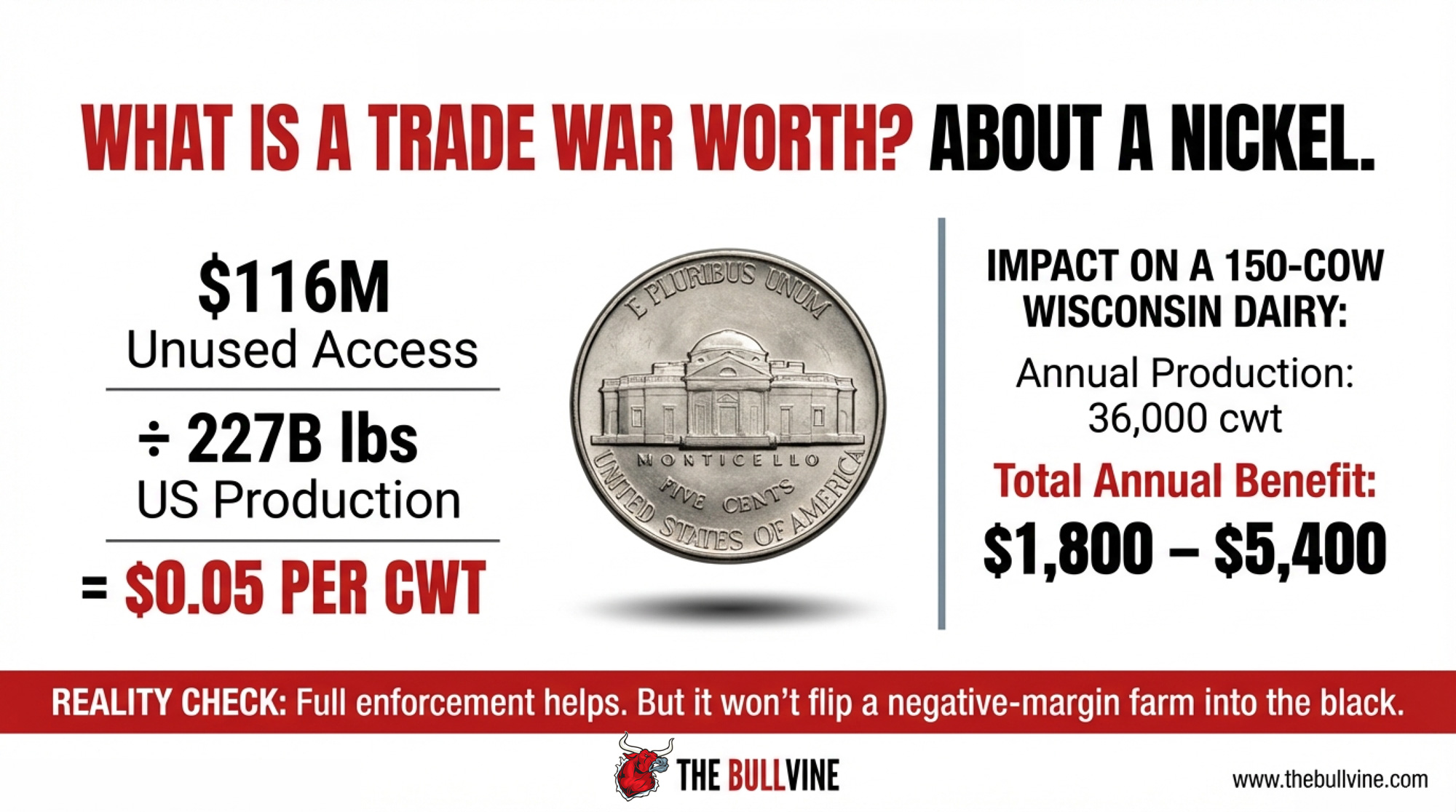
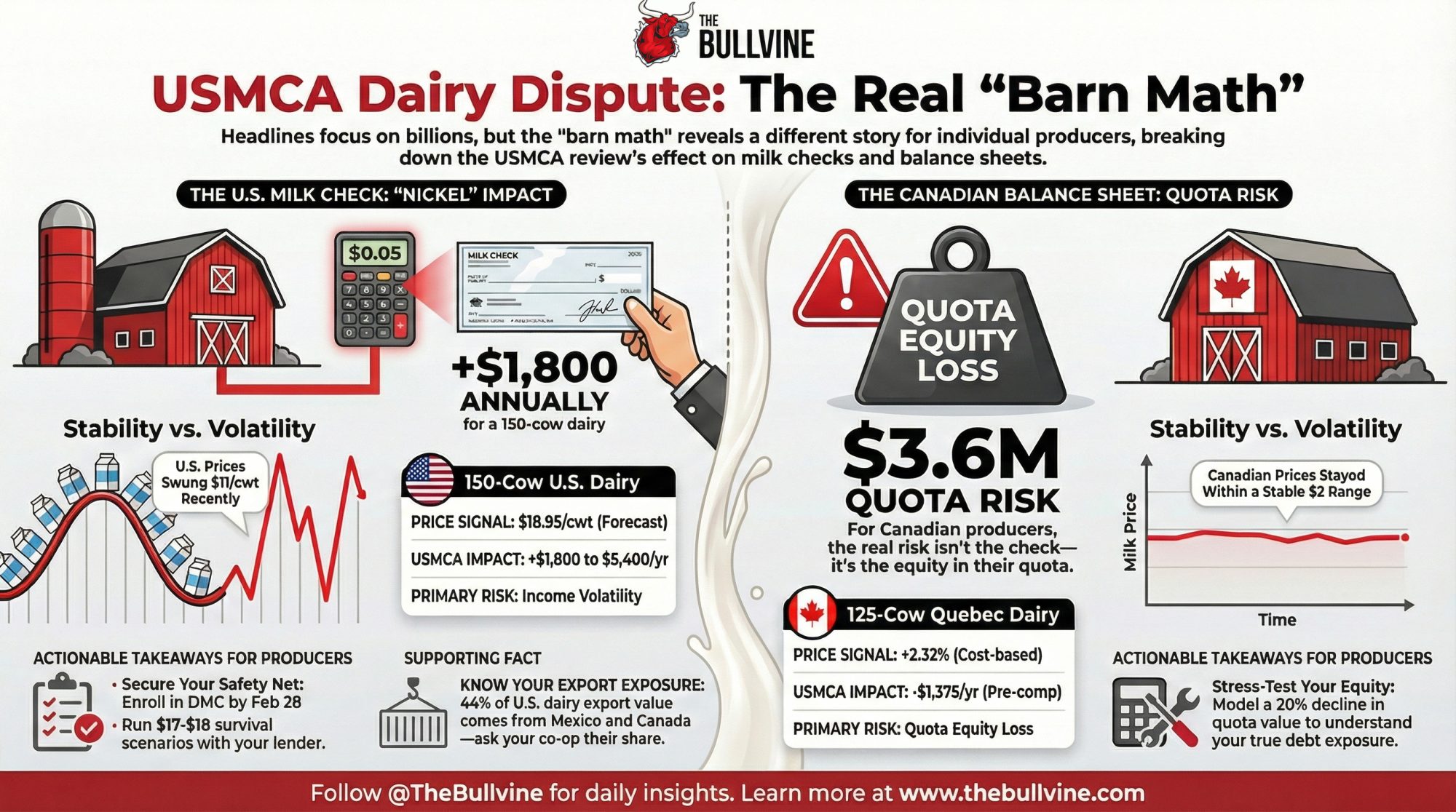
Canada won the trade panel. The U.S. has the sunset clause. July 2026 decides who blinks first in the $850M dairy standoff.

EXECUTIVE SUMMARY: Wisconsin dairy farmers are asking a simple question: Where’s the Canadian market access USMCA promised five years ago? The U.S. industry says Canada blocked $850 million in opportunities by allocating import quotas to processors who won’t use them, keeping fill rates at just 42%. Canada counters they’re following the rules—winning a November 2023 panel to prove it—and argues American dairy simply isn’t competitive in their market. With 1,420 U.S. farms closing last year while Canadian producers protect quota investments worth $30,000 per cow, both sides face existential stakes. July 2026 changes everything: the USMCA sunset clause means all three countries must actively agree to continue, or $780 billion in annual trade enters dangerous uncertainty. This analysis presents both perspectives fairly and provides specific strategies based on your farm size—because regardless of who “wins,” every North American dairy operation needs to prepare for what comes next.

USMCA dairy review

As we approach the July 2026 USMCA review, the U.S. dairy industry is building their case while Canada defends its position. Here’s what both sides are saying—and why it matters for dairy farmers across North America.

You know what’s interesting? When you talk to Wisconsin producers these days, there’s this deep frustration that just keeps coming up. Five years after the USMCA promised meaningful Canadian market access, they’re still waiting. And it’s not just Wisconsin—this sentiment’s spreading across the entire U.S. dairy belt, setting up what could be quite a showdown come July 2026.

So here’s what’s happening. The International Dairy Foods Association filed this formal complaint in October to the Trade Representative, and when you combine that with five years of trade data from both USDA and Canada’s Global Affairs department… well, the U.S. industry’s making a pretty specific case. They’re talking about roughly $850 million in export opportunities that haven’t materialized, all while 1,420 American dairy operations shut down last year, according to the USDA’s count.

But here’s the thing—and this is important—Canada sees this completely differently. They won that November 2023 dispute panel, and they’re saying they’re following the agreement just fine. Understanding both perspectives has become essential for anyone trying to make sense of what’s coming.

What the U.S. Industry Says Was Promised vs. What They Got

Let me walk you through the American dairy sector’s position. It starts with the International Trade Commission’s 2019 assessment, which projected we’d see about $227 million in additional annual exports under USMCA’s dairy provisions.

The way U.S. producers see it, they were expecting:

  • Access to 3.6% of Canada’s dairy market through 14 different quota categories
  • Complete elimination of those Class 6 and 7 pricing schemes within six months
  • Export caps keeping Canadian skim milk powder and milk protein concentrates at 35,000 metric tons annually
  • Import quotas going to actual importers, not Canadian processors

Now, according to Canada’s own Global Affairs data and those USMCA panel findings, what actually happened looks quite different.

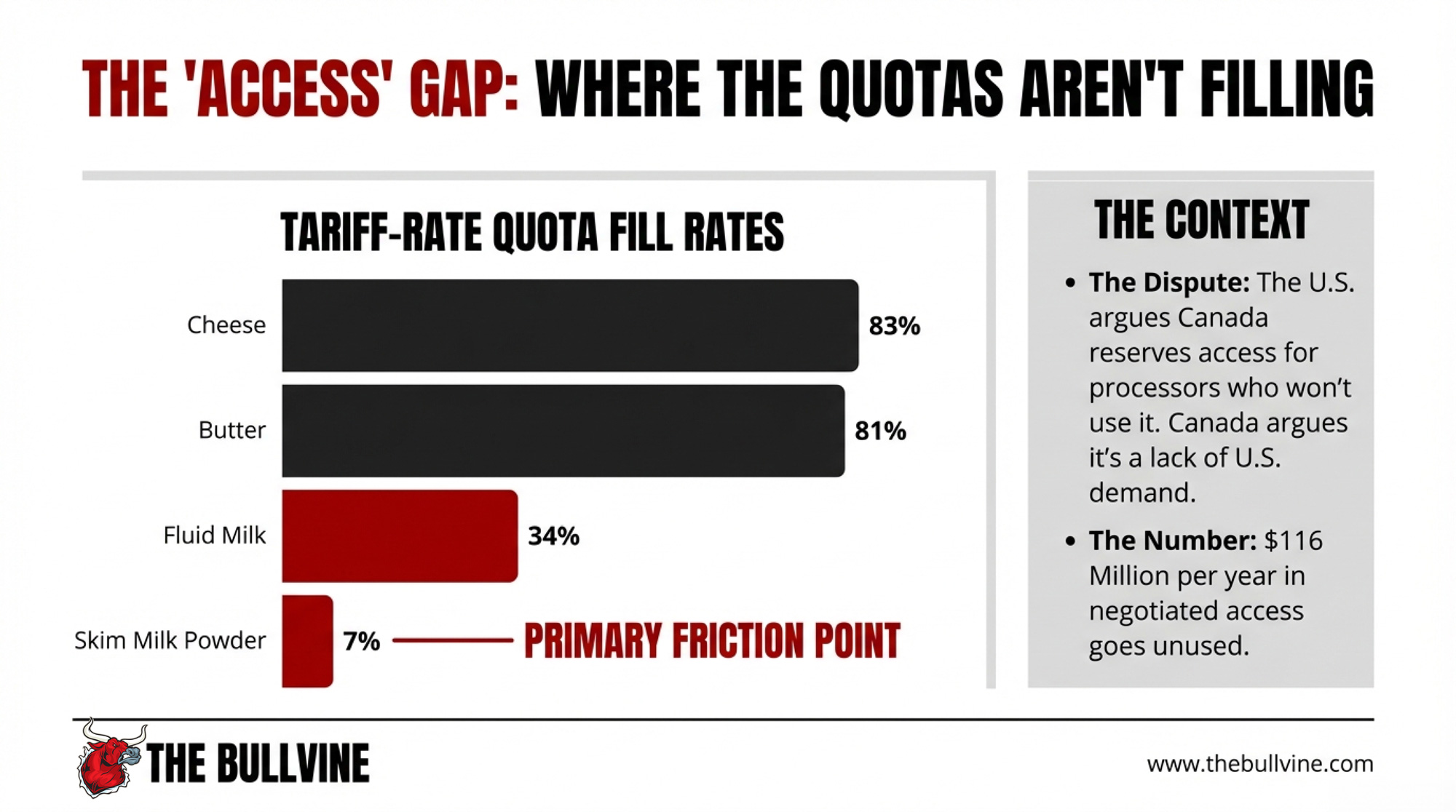
What were the average quota fill rates from 2022 to 2023? Just 42% across all categories. Nine of those 14 categories never even hit 50% utilization. And that January 2022 USMCA panel—they found that Canada had allocated between 85% and 100% of its quota shares to Canadian processors. American farmers argue these processors have about as much incentive to import competing U.S. products as… well, let’s just say not much.

Here’s what really gets American producers going—this Class 7 pricing business. Sure, Canada technically eliminated it like they promised. But then—and the University of Wisconsin’s dairy economists have documented this—similar pricing dynamics popped up under Class 4a. The U.S. sees that as a way to get around its USMCA commitments.

“You get on a phone conversation with some of these folks that have been farming for five and six generations. How do you say I can’t help you? That becomes very tough.” – Bill Mullins, Mullins Cheese

Quick Reference: Understanding Key Trade Terms

TRQ (Tariff Rate Quota): Think of it as a two-tier system. A certain amount gets in at low or zero tariffs. Above that? You’re looking at 200-315% tariffs for Canadian dairy.

Supply Management: Canada’s comprehensive dairy system since 1972—combines production quotas, price supports, and import controls.

Class Pricing: Canada’s milk classification system that sets different prices based on how the milk’s used—and this is where things get contentious.

Why Canada Defends Supply Management So Fiercely

You know, when you really look at Canada’s dairy system, you start to understand why they’re so protective of it. Agricultural economists at Université Laval have documented how it works through three integrated pieces:

First, there’s production quotas that limit what each farmer can produce. Then you’ve got price supports keeping farmgate values at about 1.5 to 2 times what we see in the U.S. And finally, those import barriers—we’re talking 200% to 315% on anything over quota.

This whole framework’s supporting about 9,000 Canadian dairy operations that generate close to CA$20 billion in annual economic activity, according to Dairy Farmers of Canada’s latest report.

Mark Stephenson over at UW-Madison’s dairy policy program explains it well: “The fundamental incompatibility is that supply management requires import control to function. Asking Canada to provide meaningful market access is essentially asking them to dismantle the system piece by piece. From their perspective, that’s existential.”

And here’s something to consider—Canadian producers have invested around CA$30,000 per cow in quota value according to their provincial milk boards. That’s not just an operating expense. That’s retirement savings, succession planning, and their kids’ inheritance. No wonder they defend it so fiercely.

How American Farmers See the Economic Stakes

For U.S. producers, the Grassland Dairy situation from 2017 is still a really raw issue. It kind of exemplifies their broader concerns about Canadian trade practices.

When Canada introduced that Class 7 pricing targeting ultra-filtered milk, Grassland Dairy had to terminate contracts affecting about a million pounds of daily production across 75 Wisconsin farms. Bill Mullins from Mullins Cheese—he took on eight of those displaced operations even though his plants were already near capacity. His words still resonate.

Here’s what keeps U.S. producers up at night:

Wisconsin Center for Dairy Profitability data shows your average 200-cow operation generates about $87,000 in annual net income. If you lost $56,000 in potential export revenue—that’d be each farm’s theoretical share of that $850 million—you’re looking at a 64% income hit.

The numbers that really worry them:

  • Chapter 12 farm bankruptcies jumped 55% in 2024, hitting 259 filings
  • Wisconsin dairy operations averaged just $0.87 per hundredweight in net margins during 2023
  • At those margins, farms facing reduced market access could hit insolvency within 30 months

New York dairy producers have been pretty vocal about their frustration, arguing they’re seeking the market access they were promised, not handouts. One Cayuga County operator mentioned how expansion decisions are basically on hold until there’s clarity about Canadian market availability.

Canada’s Counter-Argument: Why They Say They’re Complying

Now here’s where it gets really interesting—Canada’s perspective on USMCA compliance is fundamentally different from the U.S.’s.

First off, Canada won that November 2023 USMCA dispute panel ruling. The panel found 2-1 that Canada’s revised allocation methods based on market share didn’t violate USMCA provisions. That’s a big deal—it validated Canada’s position that their implementation, while maybe not what the U.S. expected, technically complies with the agreement.

The way Canadian officials see it, several key points counter U.S. arguments:

On those low quota fill rates, they argue this reflects market conditions and U.S. producers’ inability to meet Canadian market requirements, not administrative barriers. They say importers are free to source from the U.S. if the products are competitive.

On processor allocations: Canada maintains that allocating quotas based on historical market activity is legitimate and non-discriminatory. It doesn’t explicitly exclude any type of importer.

On Bill C-202: Rather than overplaying their hand, Canada sees that June 2025 legislation—where 262 of 313 MPs voted to prohibit dairy concessions—as a democratic expression of national consensus. All parties supported it. From their perspective, that’s sovereign policy choice, not a negotiating tactic.

Dairy Farmers of Canada has consistently maintained that supply management represents more than just an economic system—they see it as ensuring food security and stable farm incomes across rural Canada. Pierre Lampron, who served as DFC president through 2024, expressed confidence at their annual meeting that the government understands this broader context.

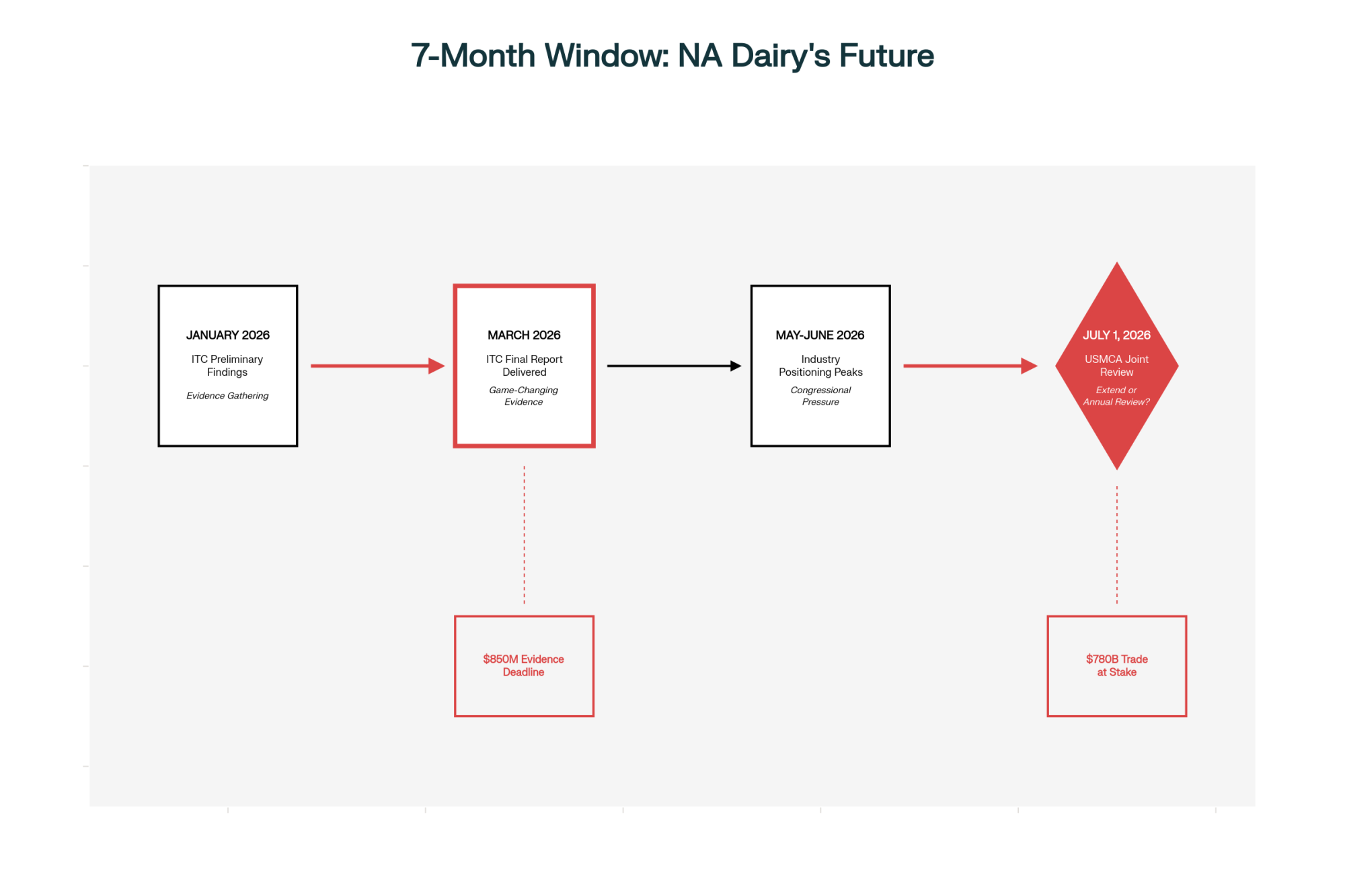
Timeline: Key Dates Leading to July 2026 Review

January 2026: Monitor for ITC preliminary findings on protein dumping investigation

March 2026: ITC final report delivers—this could be game-changing evidence

May-June 2026: Industry positioning intensifies, Congressional pressure peaks

July 1, 2026: USMCA joint review—decision on extension or annual review mode

Here is the data from the image converted into a table:

Two Countries, Two Systems

AspectU.S. SystemCanadian System
Farm Closures (2024)1,420 operations (5% decline)Stable/protected
Quota Investment per Cow$0$30,000
Price StabilityVolatile (market-based)Guaranteed (1.5-2x U.S. prices)
Market Access BarriersNone domesticallyHigh tariffs (200-315%)
Export OpportunitiesGrowing but constrained by CanadaLimited by supply management

The Political Leverage Game for 2026

Both sides are positioning themselves for July 2026 with some distinct strategic advantages.

What the U.S. Industry Has Going For It

The timing of the ITC investigation is no accident. The International Trade Commission investigation into Canadian dairy protein dumping delivers findings in March 2026. That’s just four months before the review—giving U.S. negotiators the federal agency documentation they need right when they need it.

The sunset clause creates real pressure. USMCA requires all three countries to actively confirm they want to extend the agreement in July 2026. If they don’t, we’re looking at uncertainty over $780 billion in annual bilateral trade.

Congressional backing matters. Bipartisan pressure from dairy-state legislators provides the U.S. industry with political support to push enforcement demands.

Canada’s Strategic Position

Legal victories count. That November 2023 panel ruling provides Canada with legal cover for its current practices. They can say, “Look, we went through dispute settlement and won.”

Political unity is powerful. Bill C-202’s overwhelming parliamentary support shows that protecting supply management goes beyond party politics in Canada.

The broader relationship provides leverage. Canada can point to integrated North American supply chains—especially in automotive and energy—to resist dairy-specific pressure.

Three Scenarios and What They Mean for Different Farm Sizes

Supply management has survived 30+ years of trade fights. Betting the farm on a breakthrough? That’s a 30% probability play. Smart money plans for the 45% scenario: more paperwork, same barriers, modest improvements at best

Looking at how things are shaping up, here’s what seems most likely and what it means for your operation:

Scenario 1: More Incremental Changes (45% probability, if you ask me)

Canada agrees to better reporting and maybe some monitoring mechanisms, but keeps its fundamental allocation approaches. The U.S. claims progress, Canada keeps supply management intact. Quota fill rates? They probably stay about the same.

What this means by farm size:

Under 100 cows: Focus on local markets and direct sales. Canadian access won’t materialize in meaningful ways for you anyway. Consider value-added products where you control the whole chain.

100-500 cows: Keep flexibility for quick pivots. Maybe maintain current production, but don’t expand based on export hopes. Watch Southeast Asian opportunities instead.

500+ cows: You’ve got scale to weather this, but don’t count on Canadian markets in your five-year plans. Consider leading industry advocacy efforts—you’ve got the most to gain if something breaks loose.

Scenario 2: Real Enforcement Mechanisms (30% probability)

If those ITC findings are compelling and U.S. negotiators credibly threaten not to renew, Canada might accept automatic penalties for under-utilization or mandatory non-processor allocations. That could deliver partial yet meaningful improvements in access.

Preparation steps if this happens:

  • Get your export documentation systems ready now
  • Build relationships with potential Canadian buyers
  • Understand Canadian labeling and standards requirements
  • Consider partnerships with existing exporters to learn the ropes

Scenario 3: A Standoff (25% probability)

Neither side budges much. The agreement goes into annual review mode, creating ongoing uncertainty but avoiding immediate disruption. Both industries operate under this cloud of potential future changes.

Risk management if we hit a standoff:

  • Maximum Dairy Margin Coverage enrollment becomes essential
  • Lock in feed costs wherever possible
  • Diversify buyer relationships domestically
  • Don’t make major capital investments based on export assumptions

Who’s Pushing for What: The Players Making Things Happen

Let me tell you about the organizations driving this whole thing, because understanding who’s involved helps make sense of the dynamics.

On the U.S. side, you’ve got some heavy hitters:

The International Dairy Foods Association—they’re the ones who filed that October 2025 complaint. They represent processors, and they’re pushing hard for what they call an end to protectionist measures. They want binding enforcement, and they want it now.

National Milk Producers Federation lobbied hard for that ITC investigation. They’re your farmer cooperatives, and they keep hammering on automatic penalties for non-compliance. They’ve got members losing money, and they’re not shy about saying so.

The U.S. Dairy Export Council is more technical—they document barriers, provide negotiating support, and help with the nuts and bolts. Edge Dairy Farmer Cooperative represents those Midwest producers, and they’re great at putting farm-level impacts front and center.

On Canada’s side, it’s equally organized:

Dairy Farmers of Canada maintains they’re fully complying with USMCA. They’ve got a consistent message: supply management is legitimate policy, and they’re following the rules.

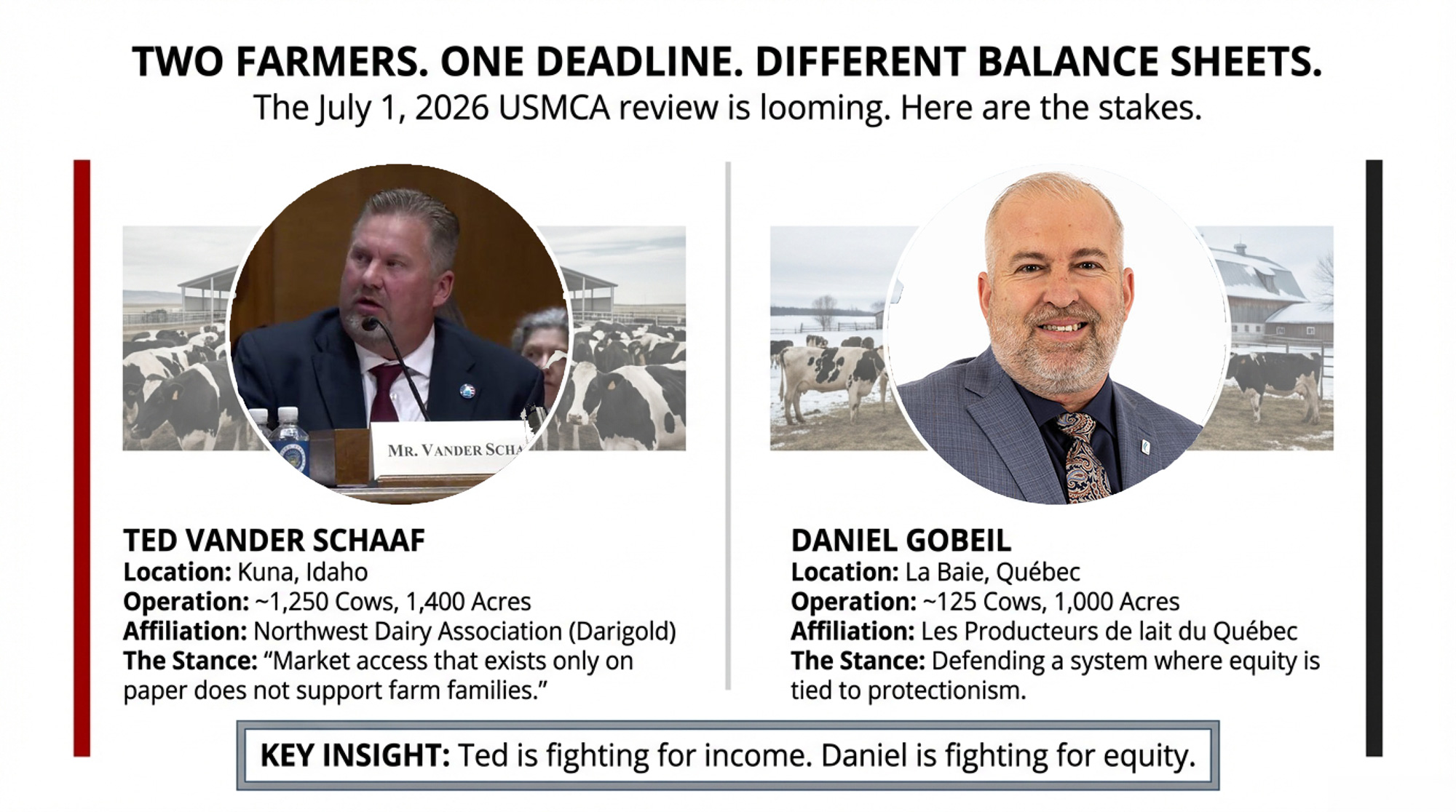
Les Producteurs de lait du Québec—now these folks have serious clout. They represent Quebec’s 4,877 dairy farms, and in Canadian federal elections, Quebec matters. A lot.

Provincial marketing boards coordinate the defense while implementing those quota allocation systems that the U.S. finds so frustrating.

Market Alternatives: What Some Smart Operators Are Doing

While this U.S.-Canada dispute dominates headlines, some American producers are zigging, while others are zagging. Take this example—a California operation recently told me they doubled their Vietnam exports in 18 months. “The middle class there is exploding,” they said. “They want quality dairy, and there’s no quota games to navigate.”

Industry data from USDEC backs this up—U.S. dairy exports to Vietnam and other Southeast Asian countries keep climbing year over year. Vietnam, Thailand, and the Philippines—they’re importing more dairy each year. No supply management system to work around. Just straightforward business based on quality and price.

You know what’s interesting about these markets? They’re growing fast enough that even mid-size operations can find niches. Specialty cheeses, high-quality milk powders, and even fluid milk in some cases. The logistics are getting better every year, too.

Seven months. Four critical milestones. $780 billion in annual trade hanging in the balance. This is how the March 2026 ITC report becomes the leverage point that forces Canada’s hand—or blows up USMCA

The Bottom Line: No Easy Resolution in Sight

That $850 million figure the U.S. dairy industry keeps citing? That’s their calculation of lost opportunities. Canada disputes both the number and the whole premise. Five years of USMCA implementation have revealed fundamental disagreements about what the agreement actually requires and what compliance entails.

Canada’s supply management system has survived more than 30 years of trade negotiations. Honestly? It’ll probably survive this challenge too. The question isn’t whether USMCA will fully open Canadian dairy markets—nobody really expects that. It’s whether the 2026 review might produce some incremental changes that partially address U.S. concerns while keeping Canada’s core system intact.

The way American producers see it, success means binding enforcement mechanisms with automatic penalties. The way Canada sees it, success is maintaining supply management’s essential structure while offering enough procedural adjustments to avoid a broader trade confrontation.

Come July 2026, we’ll see whether these positions can be reconciled—or whether North American dairy trade stays defined by promises unfulfilled and expectations unmet. Either way, it’s going to be interesting to watch. And whatever happens, we’ll all need to adapt our operations accordingly.

One thing’s for sure—whether you’re milking 50 cows or 5,000, whether you’re in Wisconsin or Quebec, this dispute affects the entire North American dairy landscape. Understanding both sides helps us all prepare for whatever comes next.

Resources for Following This Issue:

Trade Documentation:

Research Centers:

The Bullvine continues tracking developments from both perspectives as we approach the July 2026 USMCA review. For ongoing analysis, visit www.thebullvine.com.

KEY TAKEAWAYS

  • Both sides have valid arguments: U.S. proves Canada allocates 85% of quotas to processors who won’t import (42% fill rate); Canada’s November 2023 panel win says that’s technically legal
  • Real farms, real consequences: 1,420 U.S. operations closed waiting for promised access, while Canadian farmers defend $30,000/cow quota investments—everyone has skin in this game
  • July 2026 is unprecedented leverage: The sunset clause means all three countries must actively agree, or $780B in trade enters chaos—first time the U.S. can credibly threaten the whole relationship
  • History suggests incremental change: Supply management survived 30+ years of trade fights; expect minor adjustments, not market revolution
  • Your operation, your strategy: Under 100 cows = stay local; 100-500 = maintain flexibility; 500+ = lead advocacy while developing Asian markets where actual growth exists

Complete references and supporting documentation are available upon request by contacting the editorial team at editor@thebullvine.com.

Learn More:

Join the Revolution!

Join over 30,000 successful dairy professionals who rely on Bullvine Weekly for their competitive edge. Delivered directly to your inbox each week, our exclusive industry insights help you make smarter decisions while saving precious hours every week. Never miss critical updates on milk production trends, breakthrough technologies, and profit-boosting strategies that top producers are already implementing. Subscribe now to transform your dairy operation’s efficiency and profitability—your future success is just one click away.

NewsSubscribe
First
Last
Consent

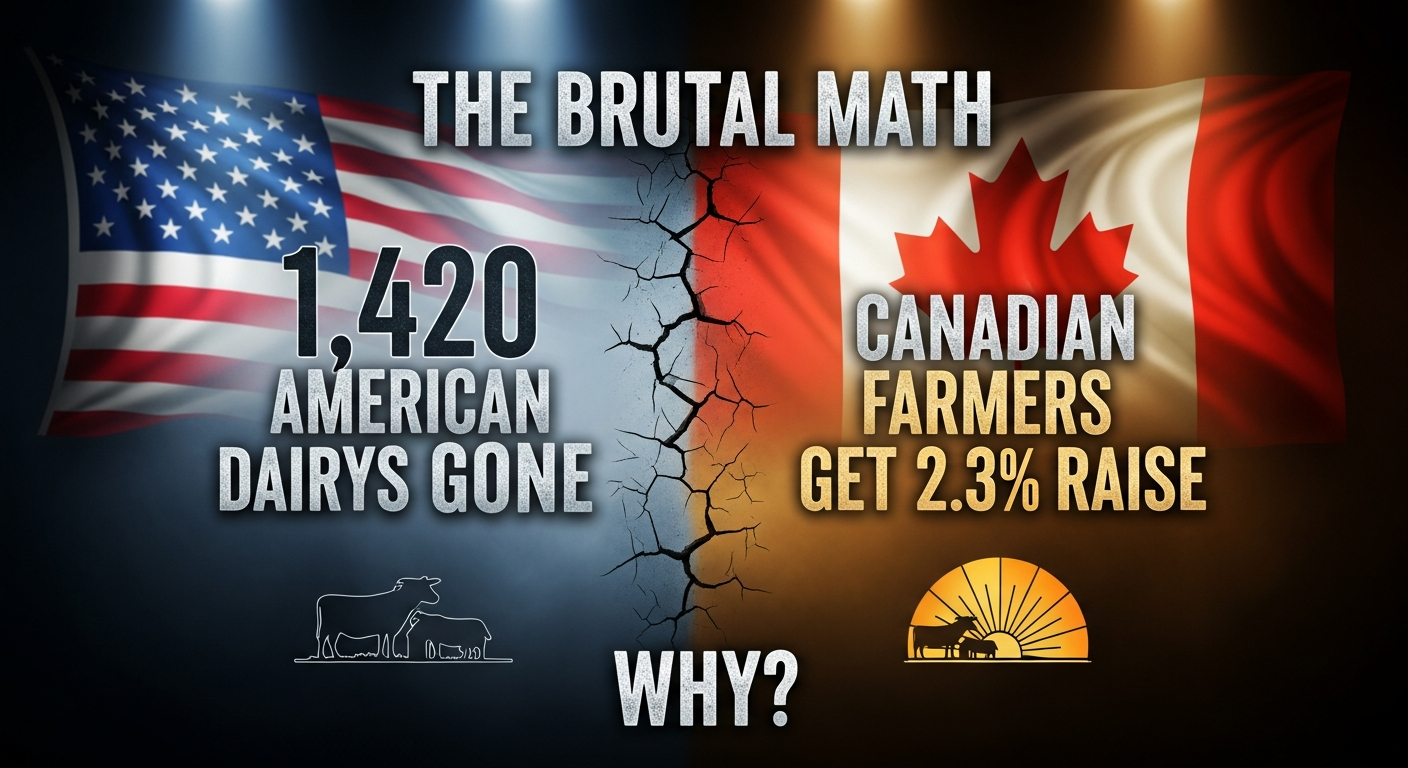
The Brutal Math: 1,420 American Dairy Farms Gone, Canadian Farmers Get 2.3% Raise – Why?

Quota costs CA$2.4M in Canada. But American farmers pay the ultimate price: their farms.

EXECUTIVE SUMMARY: Canadian dairy farmers plan five years ahead, while American producers pray to survive five months—that gap widened on October 30, when Canada announced a 2.3% price increase as U.S. prices crashed by 11.44%. Canada’s supply management system guarantees profitability but demands CA$2.4-5.8 million in entry fees, offering just 8 new-farmer positions annually per province, while 88% of farms transfer within families. America’s “free” market eliminated 1,420 farms in 2024, aided by cooperatives like DFA, which now own processing plants and profit from the same low prices that destroy their members. Both systems hemorrhage taxpayer money—Canada openly through CA$444 annual household premiums, America secretly via $2.7 billion in failing subsidies. The brutal math: by 2044, America will have fewer than 10,000 dairy farms while Canada maintains stability for an increasingly exclusive club. Solutions exist that combine Canadian predictability with American accessibility, but require farmers to stop defending broken systems and start wielding their political power like Quebec dairy did—they didn’t ask nicely; they demanded protection and got it.

Dairy Policy Analysis

You know, when the Canadian Dairy Commission announced its 2.3255% farmgate milk price increase for February 2026 last Wednesday, I couldn’t help but think about the conversations I’ve been having with producers on both sides of the border. Here’s what’s interesting—American farmers had just watched their milk prices drop 11.44% year-over-year, based on August USDA data. But this isn’t just another price comparison story, not really.

What I’ve found after digging into both systems these past few weeks is… well, it challenges a lot of assumptions we tend to make. Canadian farmers enjoy remarkable stability through supply management, that’s absolutely true. But there’s something they don’t talk about much at Holstein Canada meetings or the Royal Winter Fair—the generational entry barriers that are quietly threatening their long-term sustainability.

Meanwhile, American producers keep telling me about the “freedom” of open markets. Yet we’re watching 1,420 farms close each year, according to the latest USDA census data. At this rate—and the math here is pretty sobering—we’re looking at fewer than 10,000 U.S. dairy operations by 2044. That’s fewer farms than Canada has today, if you can believe that.

“We keep being told markets will sort it out. But after losing 400 farms in our state last year, I’m starting to wonder if the market’s solution is just to sort us out of business.” — Wisconsin dairy farmer reflecting on the 2024 closures

Part I: The Canadian System—Stability at What Cost?

How Supply Management Works: Business Planning vs. Price Taking

Canadian Farmers Plan 5-7 Years Ahead. American Farmers Pray to Survive 90 Days.

Looking at Canada’s approach, what strikes me first is the philosophical foundation. You probably know this already, but supply management—established through provincial legislation like Ontario’s Farm Products Marketing Act—operates on a straightforward principle. Dairy farmers are legitimate business enterprises deserving predictable returns.

Here’s what’s fascinating about the CDC’s quarterly cost-of-production formula. It includes everything you’d expect in a real business calculation—feed costs (which jumped 8.7% in their latest review period), labor, depreciation on that new mixer wagon you bought, interest paid on operating loans, and even return on equity. When those costs rise, prices adjust through their transparent formula: 50% of index cost changes plus 50% of consumer price trends.

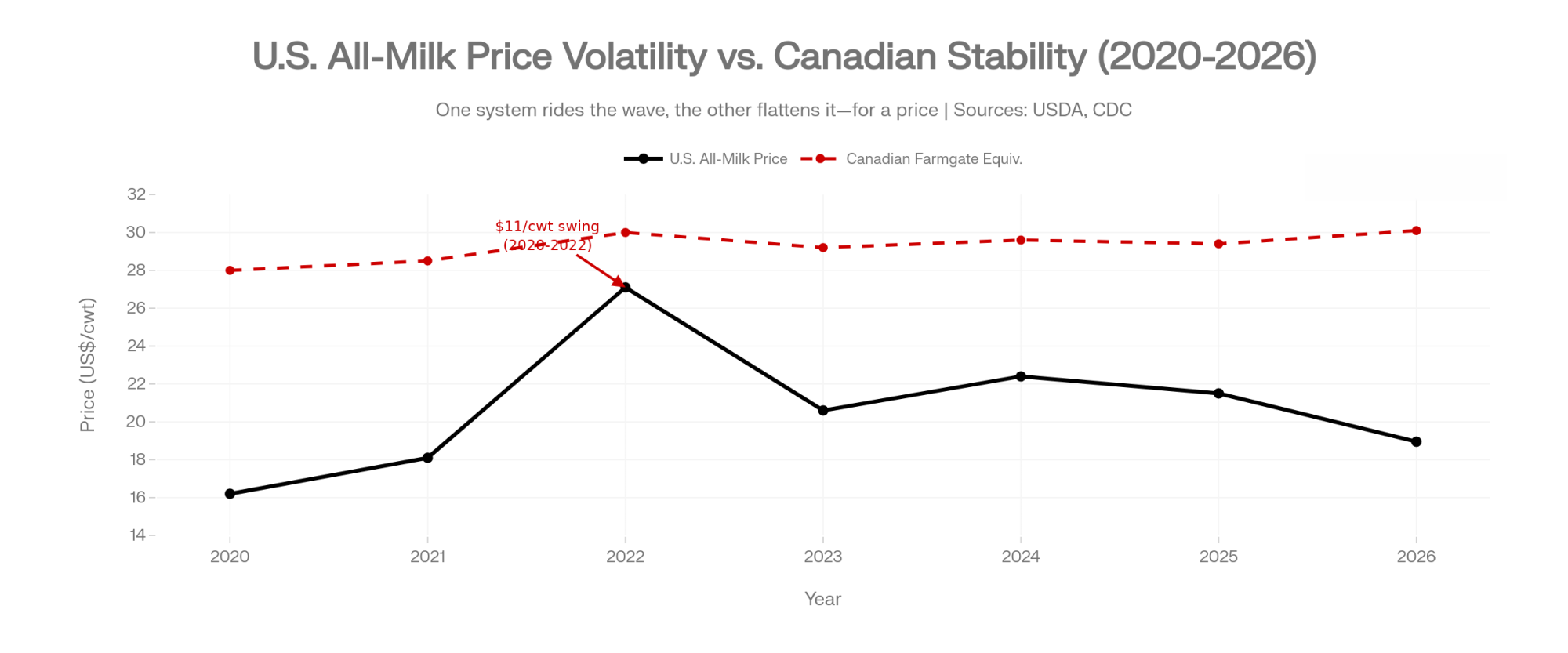
This creates dramatically different planning horizons than what we see south of the border. Research from the University of Guelph suggests that Canadian dairy farmers typically make facility upgrade decisions with a 5-7 year outlook. As many Canadian producers have told me, their milk price adjustments typically stay under 1% annually, based on CDC historical data, so they can actually plan. That guaranteed 2.3% increase? That’s the predictability American farmers can only dream about.

The Hidden Entry Crisis: When Protection Becomes Exclusion

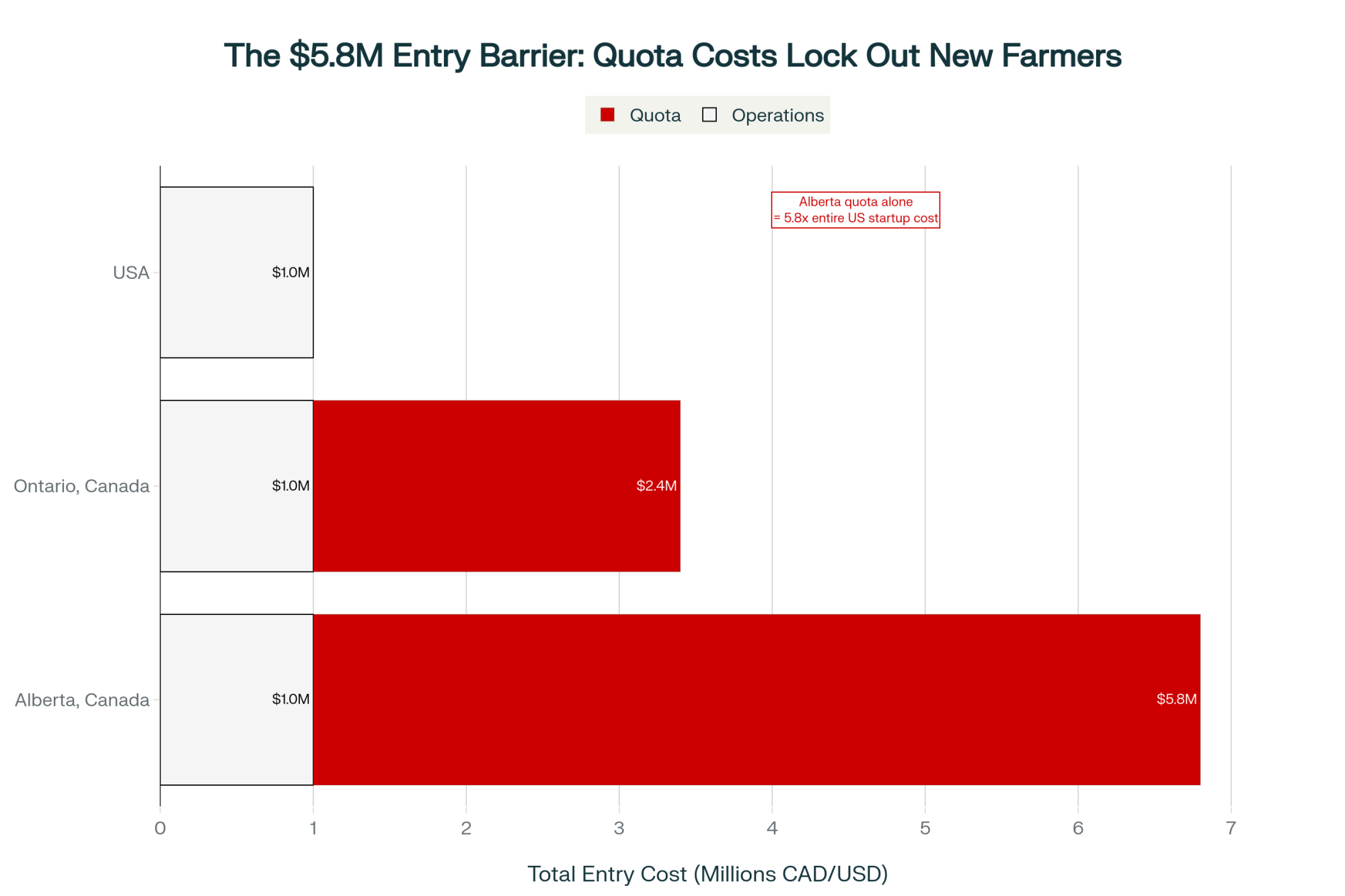
Alberta’s $5.8M Quota Barrier vs America’s $0—But ‘Free Market’ Killed 1,420 US Farms in 2024

But here’s something that doesn’t come up much at Dairy Farmers of Canada meetings—and it’s worth noting. Those quota values are running CA$24,000 per kilogram in Ontario, where it’s price-capped, according to the provincial marketing board. In Alberta? Try CA$58,000 per kilogram on the open exchange, based on Alberta Milk’s August 2025 reports.

So let me do the math for you. A modest 100-cow operation needs CA$2.4-5.8 million just for production rights. That’s before you buy a single cow or pour a single yard of concrete.

The provincial “new entrant” programs supposedly address this. Let me share what they actually offer, based on current program documents I’ve been reviewing:

  • Ontario’s NEQAP: 8 positions available annually for the entire province (and 2 of those are reserved for organic)
  • British Columbia’s GEP: They’re running an accelerated program, clearing a 20-year backlog at 8 entrants per year
  • Quebec: Similar story—limited slots, multi-year waiting lists according to Les Producteurs de lait du Québec

Farmers in BC’s program report waiting periods of 10-15 years, based on media reports and program documentation. Even then—and this is what really gets me—successful applicants often receive a quota for just 25-30 cows. That’s not exactly a path to economic viability when the provincial average is pushing 100 head.

What’s really telling is that the vast majority of Canadian dairy farms transfer within families, according to Statistics Canada’s agricultural census data. It’s becoming something you inherit rather than something you choose. Even the National Farmers Union, which generally supports supply management, admitted in their 2019 policy brief that these programs are “fundamentally inadequate and require major reforms.”

The True Cost to Consumers and Society

You know, Canadian supply management costs consumers approximately CA$444 annually per household through higher retail prices, according to the Conference Board of Canada’s 2023 dairy sector analysis. That’s a direct, transparent wealth transfer totaling about CA$3 billion yearly, based on academic estimates from the University of Saskatchewan and Fraser Institute.

Critics hate it, but at least Canada’s honest about the cost. You’re paying more for milk, and that money goes directly to keeping farmers in business. No hidden subsidies, no complex government programs—just straightforward consumer-to-farmer transfer.

Part II: The American System—Freedom to Fail

Open Access, Constant Crisis

Now, the U.S. system—no quota barriers at all. Got capital? You can start milking tomorrow. But that theoretical openness… well, let me share some numbers from USDA’s National Agricultural Statistics Service that paint a different picture:

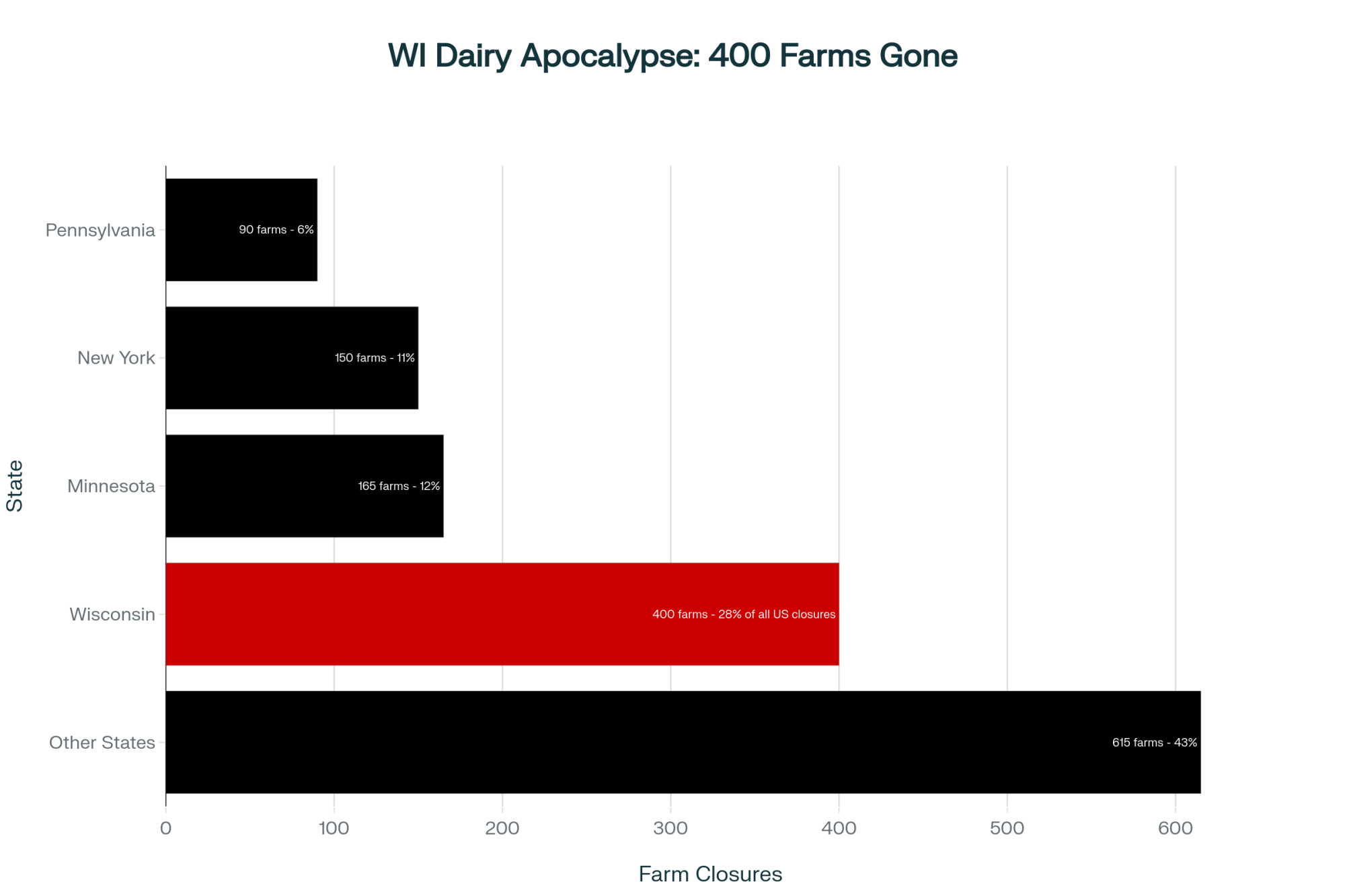
  • 2024 farm closures: 1,420 operations lost (that’s a 5% annual decline)
  • Wisconsin alone: 400 dairy farms gone, according to Wisconsin DATCP license data
  • Five-year total: Nearly 10,000 farms have disappeared since 2019
  • Chapter 12 bankruptcies: Up 55% in 2024, based on Federal Reserve agricultural finance data

As Tonya Van Slyke from the Northeast Dairy Producers Association put it in a recent interview: “Dairy farmers are price takers. The Federal Milk Market Order controls what producers get paid for their milk.”

Think about that for a minute. You can have the best somatic cell count in the county, run your repro program perfectly, and manage your transition cows like a textbook operation. But if Class III crashes because there’s too much cheese in cold storage? Well, you’re taking that hit.

I know Wisconsin producers who literally check CME cheese prices on their phones during morning milking, wondering if next month brings another crash. That’s not business planning—that’s survival mode.

The DMC Illusion: Why Safety Nets Have Holes

The Dairy Margin Coverage program—that’s supposed to be America’s safety net, right? Here’s what’s interesting: it hasn’t triggered a payment in 17 months as of October 2025, even though I know plenty of farmers facing severe financial stress.

The formula, as described in FSA’s calculation methodology, considers only corn, soybean meal, and premium alfalfa hay. Labor costs going through the roof? Fuel prices? Is California requiring new environmental compliance equipment? DMC doesn’t see any of that.

What really gets me is what’s happening with succession planning. Agricultural transition consultants report that farm kids who love agriculture, grew up showing at county fairs, have all the skills—they’re going to college and choosing ag lending or veterinary medicine instead of coming home. Why? Because they watched their parents stressed about milk prices for 20 years and thought, “I’m not putting my kids through that.”

The Structural Failure of American Cooperatives: DFA’s Transformation

Here’s where the American system reveals its most fundamental flaw—and this is something we need to talk about more openly. It’s the structural failure of the cooperative model when cooperatives become processors.

The transformation of Dairy Farmers of America illustrates exactly how the system breaks when a cooperative’s business interests as a processor diverge from its members’ interests as farmers.

In May 2020, DFA acquires 44 Dean Foods processing plants for $433 million out of bankruptcy, according to U.S. Bankruptcy Court filings. Overnight, they become both the nation’s largest milk supplier and processor. This created what multiple class-action lawsuits filed in Vermont and other states describe as an “inherent conflict of interest.”

Think about the structural contradiction here. As a cooperative, DFA theoretically exists to maximize returns to farmer-members. But as a processor, DFA profits from buying milk as cheaply as possible. The cooperative’s processing division literally benefits from the same low prices that destroy its members’ operations.

The numbers from the Vermont lawsuit reveal the scope of this structural failure. Before acquiring Dean’s plants, DFA sold over 50% of its members’ milk to third-party processors. By 2021, according to court documents, they were selling 66% of their shares to themselves. When milk prices crashed 30-40% in 2023—and USDA data confirms approximately a 35% decline—DFA’s processing plants captured margin expansion while member farmers absorbed losses.

And here’s what I think is crucial to understand: this isn’t a management failure or the work of bad actors. It’s a fundamental structural flaw. Once a cooperative owns processing assets, its economic incentives become adversarial to its own members. The business model that should protect farmers becomes the mechanism for extracting value from them.

I’ve talked to DFA members who understand this perfectly. They need market access, but their own cooperative has structurally transformed into their competitor. The organization collecting their dues and claiming to represent them profits when they suffer. That’s not a cooperative anymore—it’s a vertically integrated processor with a cooperative facade.

Regional Variations: Scale Doesn’t Save You

You know, this isn’t just a Wisconsin-Pennsylvania story. Down in the Texas Panhandle, where operations are milking 3,000-cow herds, the economics look different, but the fundamental problems persist.

Large-scale operators in that region tell me they’ve got scale, efficiency, and cost per hundredweight that beats almost anyone. But when milk prices drop below $15? Even they bleed. The only difference is that they can bleed longer than the 200-cow farm.

Looking west to California and Idaho, where some operations are milking 10,000-plus cows, these mega-dairies have negotiating power that smaller farms lack. But one Idaho producer managing 8,500 cows told me at the Western States Dairy Expo, “We’ve got economies of scale everyone talks about, but our regulatory compliance budget alone would operate five Wisconsin farms.”

And down in Arizona and New Mexico? The water rights battles are getting brutal. One New Mexico producer with 4,200 cows shared something that stuck with me: “We’re efficient as hell on paper—lowest cost per hundredweight in the nation some months. But what happens when water allocations are cut by 30% and hay prices double because everyone’s irrigation is restricted? Those efficiency numbers don’t mean much.”

Texas A&M agricultural economists have documented what happens when a 5,000-cow dairy goes under—millions in economic impact rippling through rural communities. The big operations might survive longer, but volatility eventually gets everyone.

Hidden Subsidies: The “Free Market” Myth

Here’s something we don’t talk about enough. American dairy receives billions in government support, but we just call it something else. Based on USDA Economic Research Service data:

  • Dairy Margin Coverage payments: $2.7 billion net from 2019 to 2024
  • Federal Milk Marketing Order price supports (harder to calculate, but substantial)
  • Export promotion programs through the Dairy Export Council
  • Regular disaster assistance and emergency payments
  • Subsidized crop insurance that reduces feed costs

We call these “risk management tools” rather than “subsidies.” Lets politicians claim they support “free markets” while channeling taxpayer money to agriculture.

The difference from Canada? Well, Canadian intervention actually achieves its stated goals—stable farm numbers, farmer income security, and functioning rural communities. American intervention? We keep losing farms despite billions in support. Makes you wonder who these programs really benefit.

MetricCanadian Supply ManagementU.S. ‘Free Market’
Farm Exits (Annual)100-150 (1-2%)1,420 (5%)
Entry Cost (100 cows)CA$2.4-5.8M quota + operations$800K-1.2M operations only
Price Volatility<1% annual variation30-40% swings possible
Planning Horizon5-7 years typical90 days common
Consumer CostCA$444/household/year premiumHidden via taxes/programs
New Entrants/Year50-80 nationally (limited slots)Unlimited (but unsupported)
Price Trend 2024-26+2.3% guaranteed increase-11.44% decline (volatile)
Government SupportTransparent consumer transfer$2.7B hidden subsidies (DMC)
Farm StabilityPredictable, stable incomeSurvival mode, constant crisis
Succession Rate88% family transferFarm kids choose other careers
2044 Projection~8,500 farms (stable)<10,000 farms (-60%)

Part III: Finding Common Ground—Lessons from Both Systems

What Actually Works: Three Leverage Points

Stop Begging Cooperatives for Pennies. $10/Gallon Direct Sales = 400-600% Premium in 28 States

Through all this research and talking with farmers across North America, I’m seeing three genuine leverage points for producers seeking stability without Canada’s entry barriers:

1. Direct-to-Consumer Sales Twenty-eight states now allow raw milk sales in some form, according to the Farm-to-Consumer Legal Defense Fund’s 2025 tracking. Producers engaging in direct sales report getting $8-12 per gallon—that’s a 400-600% premium over conventional farmgate prices. As many Pennsylvania producers have told me, moving 20% of production to direct sales changes the entire negotiation dynamic with cooperatives.

2. State-Level Political Organization Vermont Senator Peter Welch chairs the Senate Agriculture subcommittee specifically because dairy farmers in his state vote as a coordinated bloc. With only 300-400 dairy farms, Vermont shows what’s possible when farmers organize strategically. If Pennsylvania’s 6,130 dairy farms voted together on dairy issues, they’d own rural policy in that state.

3. Forward Contracting and Risk Management University of Wisconsin-Extension research on risk management consistently shows farms using comprehensive tools—forward contracts, futures hedging, options strategies—achieve significantly more stable margins. Yet adoption remains minimal because, honestly, when you’re checking milk prices daily just hoping to survive the month, learning about put options feels pretty theoretical.

Vermont’s Failed Organizing Attempt: The Missing Legal Framework

Back in the early 2000s, Vermont dairy farmers tried something interesting, as documented in agricultural organizing literature. The Dairy Farmers Working Together movement organized roughly 300 producers, representing about a third of Vermont’s milk production, according to Vermont Extension’s historical accounts. They thought that if they had enough milk, the co-ops would have to negotiate.

But here’s what happened—they just got ignored. No legal framework forced processors to negotiate. The movement collapsed within two years. It showed that a voluntary organization without legal teeth doesn’t work against concentrated processor power.

Learning from New Zealand: A Third Way?

Looking at international models, something is interesting happening in New Zealand. Fonterra—their massive cooperative that handles about 80% of NZ milk according to their 2024 annual report—provides forecast milk prices 18 months out without any quota system.

Their August 2025 forecast came in at NZ$10.15 per kilogram of milk solids (roughly US$21 per hundredweight), with a range of $10.10-10.20. That’s a 1% variance window. No quota to buy, no barriers to entry, just coordinated supply forecasting and transparent pricing.

The Kiwi approach demonstrates you don’t need government protection if you have collective discipline and transparent communication.

Quick Comparison: System Outcomes

MetricCanadian Supply ManagementU.S. “Free Market”
Farm Exits (Annual)~100-150 (1-2%)1,420 (5%)
Entry Cost (100 cows)CA$2.4-5.8M quota + operations$800K-1.2M operations only
Price Volatility<1% annual variation30-40% swings possible
Planning Horizon5-7 years typical90 days common
Consumer CostCA$444/household/year premiumHidden via taxes/programs
New Entrants/Year50-80 nationallyUnlimited (but unsupported)

The Projected Timeline: Where This All Leads

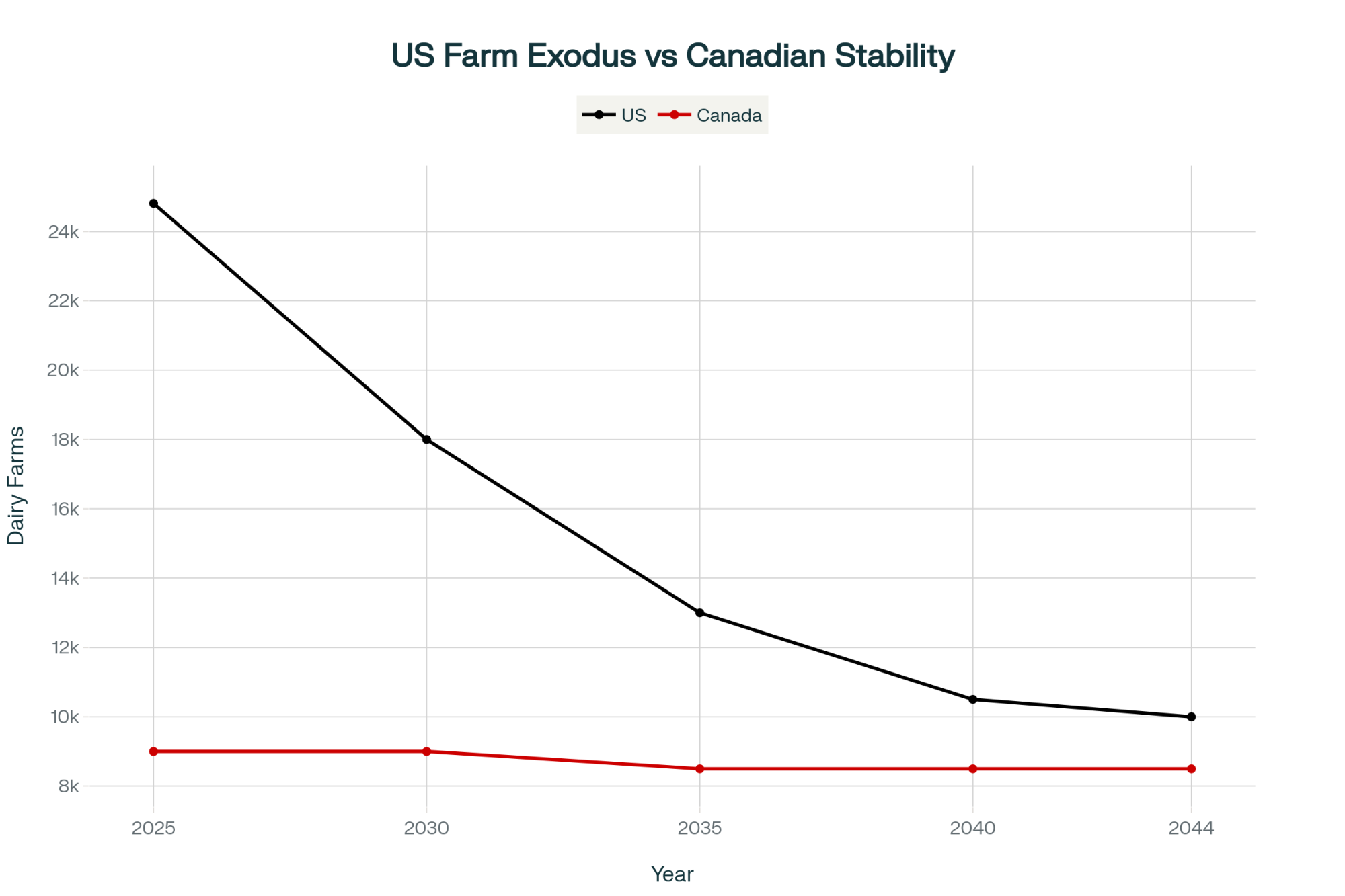
By 2044, America Will Have Fewer Dairies Than Canada—Despite 10x the Population

If current trends continue—and there’s no reason to think they won’t—here’s what we’re looking at:

U.S. Dairy Farm Projections (5% annual attrition from USDA data):

  • 2025: 24,811 farms (current)
  • 2030: ~18,000 farms
  • 2035: ~13,000 farms
  • 2040: ~10,500 farms
  • 2044: <10,000 farms

Canadian Projections:

  • Maintaining 8,000-9,000 farms through 2040
  • But increasing concentration as new entrants can’t access
  • Average herd size is climbing steadily
  • Small operations selling quota to larger neighbors

Both trajectories lead to the same place—just at different speeds and with different pain levels along the way.

Key Takeaways for Dairy Farmers

Based on everything I’ve learned researching this piece, here’s what I think farmers need to consider:

For Canadian Farmers:

  • Defend supply management hard—that 2.3% guaranteed increase is stability American farmers would kill for
  • Push for real new entrant reforms—8 positions annually won’t sustain your industry long-term
  • Consider quota leasing models instead of ownership—maintains stability without the CA$2.4 million entry barrier
  • Watch the generational transfer issue—if young farmers can’t enter, the system eventually collapses from within
  • Prepare for continued trade pressure—international partners aren’t giving up on challenging the system

For American Farmers:

  • Stop waiting for markets to fix themselves—1,420 farms closing annually proves they won’t
  • Organize politically at the state levels—300-400 farms can swing rural elections if you vote together
  • Explore direct sales aggressively—it’s your only real leverage against processor dominance
  • Demand actual DMC reform—the current formula, ignoring labor, fuel, and equipment costs, is insulting
  • Consider regional cooperative alternatives to vertically integrated giants—smaller can mean more accountable
  • Study Quebec’s political discipline—they didn’t ask nicely, they demanded protection and got it

For Both:

  • Accept that all dairy is subsidized—fight about subsidy effectiveness, not existence
  • Address succession planning now—both systems struggle with generational transfer
  • Build political coalitions beyond ag—rural community survival depends on viable farms
  • Learn from international models—New Zealand, EU systems offer valuable lessons

The Bottom Line: Learning from Both Models

What I’ve come to realize is that neither system offers a perfect solution. Canada protects existing farmers brilliantly, but basically locks out newcomers through those quota costs. America keeps the door open but provides zero meaningful protection against volatility that’s destroying multi-generational operations.

There’s potentially a “third way” that combines the best of both—cost-of-production pricing principles from Canada with leased production rights instead of owned quota, maintaining American accessibility while providing stability through collective bargaining frameworks. Something that would include transparent cost-of-production pricing that captures all real expenses (not just three feed ingredients), leased production rights to avoid multi-million-dollar barriers, democratic farmer governance through marketing boards with actual legal authority, market upside participation so farmers benefit from rallies, and real new-entrant programs offering viable scale, not token positions.

Looking at that October 30 CDC announcement giving Canadian farmers a guaranteed increase while American producers face continued uncertainty—it’s not just about prices. It’s showing us that dairy policy is a choice. Both countries are making choices, and increasingly, farmers in both systems are questioning whether those choices actually serve their interests.

That Wisconsin farmer’s observation keeps echoing in my mind: “We keep being told markets will sort it out. But after losing 400 farms in our state last year, I’m starting to wonder if the market’s solution is just to sort us out of business.”

The systems are different, the challenges are real, but the goal should be the same: dairy farms that can survive, thrive, and transfer to the next generation. Right now, neither country has fully figured that out. But understanding what works and what doesn’t in both systems? That’s the first step toward finding something better.

And maybe—just maybe—if we stop defending our respective systems long enough to learn from each other, we might find that third way that actually keeps farmers farming for generations to come.

Learn More:

  • Dairy Farm Succession Planning – Critical Conversations for a Smooth Transition – This article provides a tactical roadmap for navigating the complex family and financial conversations essential for a successful farm transition, helping ensure the operation’s legacy and long-term viability—a critical issue raised in the main analysis.
  • Navigating the Waters: Key Global Dairy Market Trends for 2025 – This analysis delivers strategic insights into the global economic and consumer trends shaping North American milk prices. It provides essential context for understanding market volatility and making informed, long-range business decisions beyond domestic policy debates.
  • The ROI of Robotics: A Producer’s Guide to Dairy Automation – This guide offers a data-driven framework for evaluating the return on investment of dairy automation. It demonstrates how robotics can directly combat rising labor costs and improve operational efficiency, offering a practical solution to the economic pressures detailed above.

The $2.46 Dairy Lesson: What Australia’s Deregulation Really Means for Canadian Dairy Farmers

$2.46 an hour. That’s what Aussie farmers earned during deregulation’s worst days. Time to talk feed efficiency?

You know what keeps me up at night sometimes? It’s this number: $2.46 an hour. That’s what some Australian dairy farmers were effectively earning during the worst stretches after their industry got deregulated back in 2000. Not their actual paycheck, mind you, but when you crunch the real numbers—milk prices, input costs, those brutal 70-hour weeks we all know too well—that’s what it amounted to for way too many operations.

As we watch trade negotiations swirl around our own supply management system up here in Canada, and as U.S. farmers deal with their own volatile markets, Australia’s quarter-century experiment offers some pretty sobering insights about what happens when you let pure market forces run the show.

I’ve been reviewing the new ABARES report on Australian dairy deregulation that was just released, and frankly, the story it tells should prompt every dairy farmer in North America to pause and think. Because what happened in Australia? It wasn’t just policy wonks moving numbers around. It was real farms, real families, real communities getting turned upside down.

When “Get Big or Get Out” Actually Happens

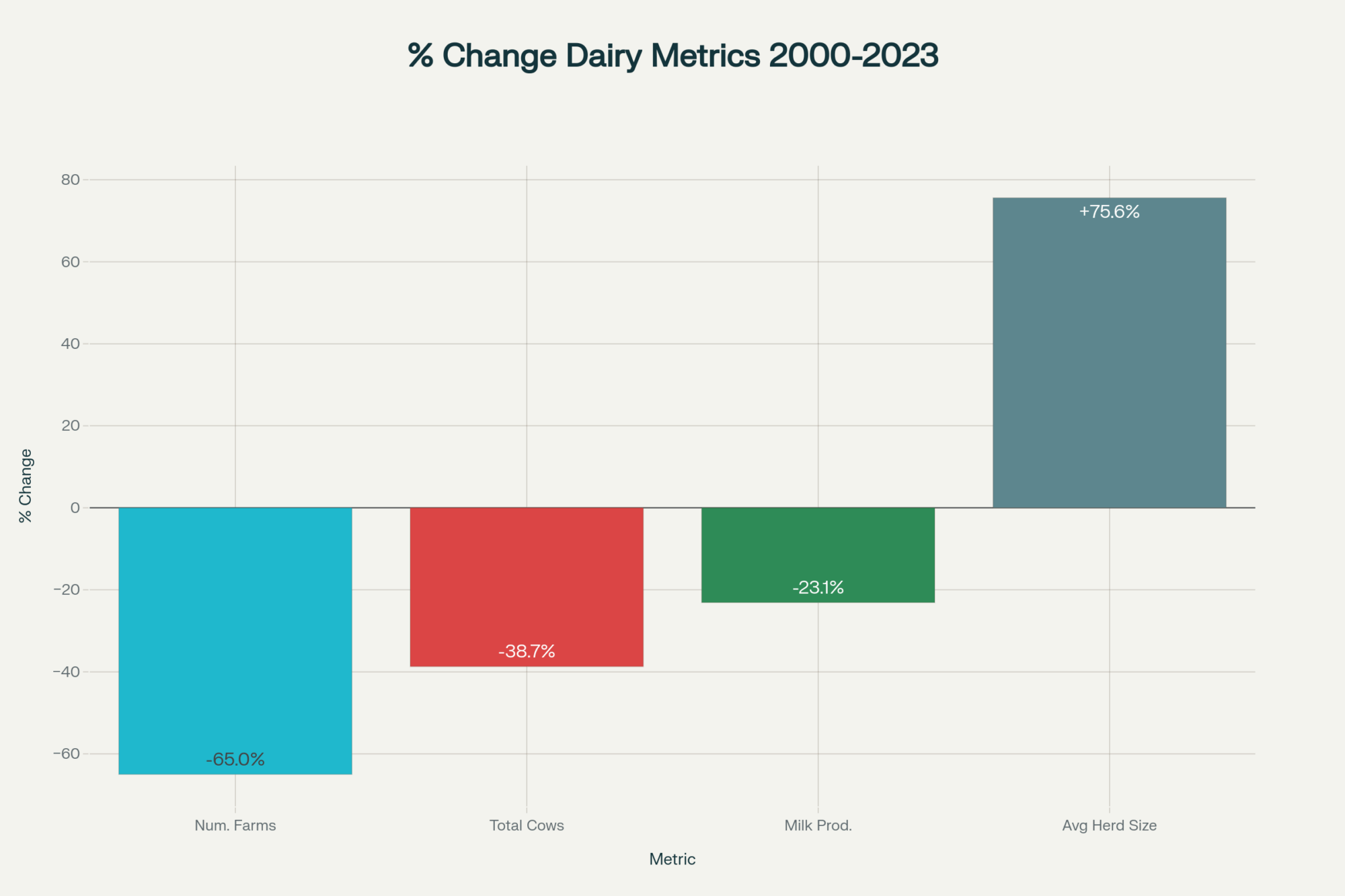
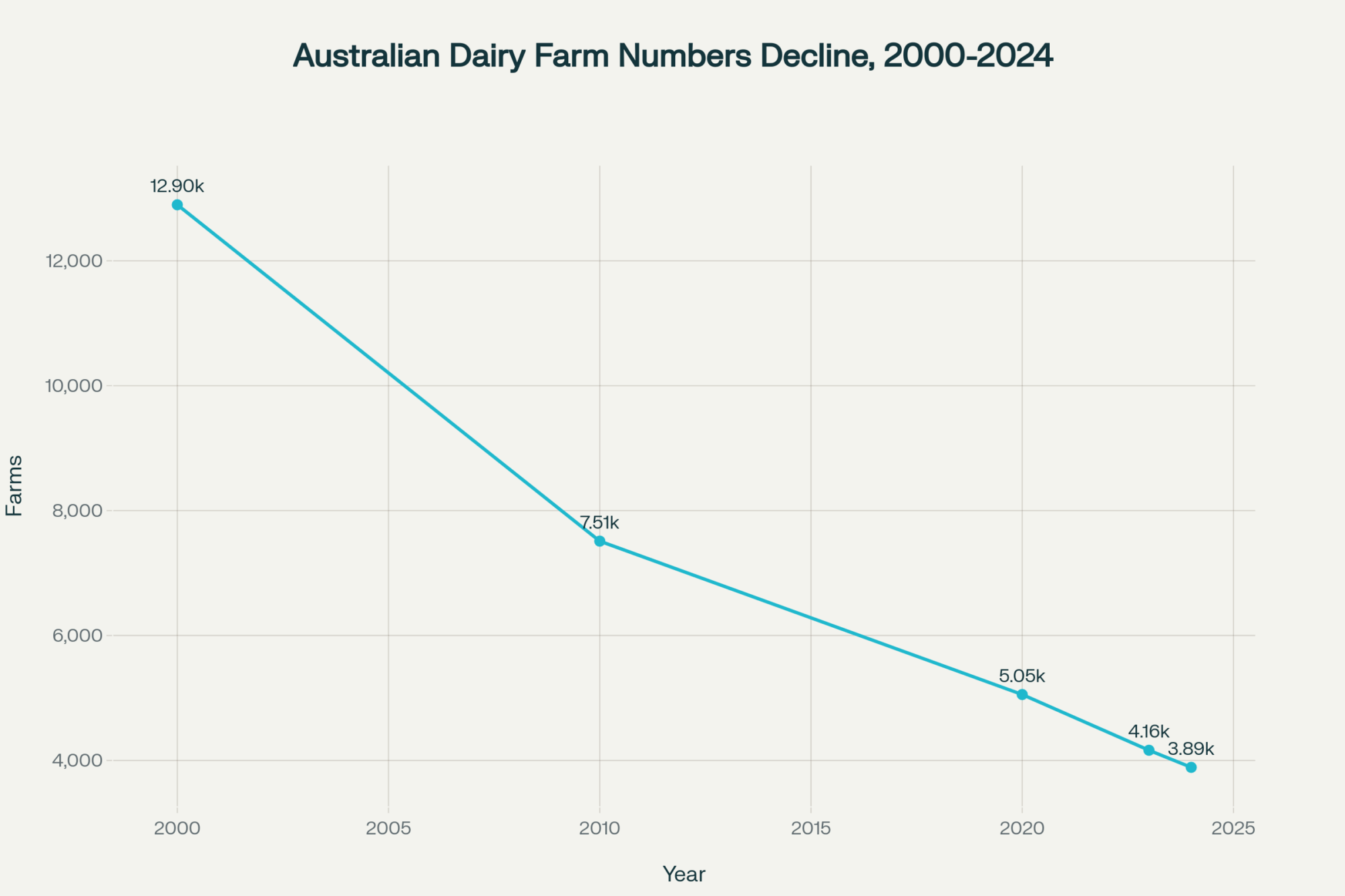
Let’s start with the raw numbers, because they’re honestly staggering. In 2000, Australia had 12,888 dairy farms. Today? They’re down to just over 4,500. That’s a 65% drop—we’re talking about more than 8,000 farm families who had to walk away from operations that, in many cases, had been in their families for generations.

Decline in Australian dairy farms from 12,896 in 2000 to 3,889 in 2024, highlighting deregulation effect

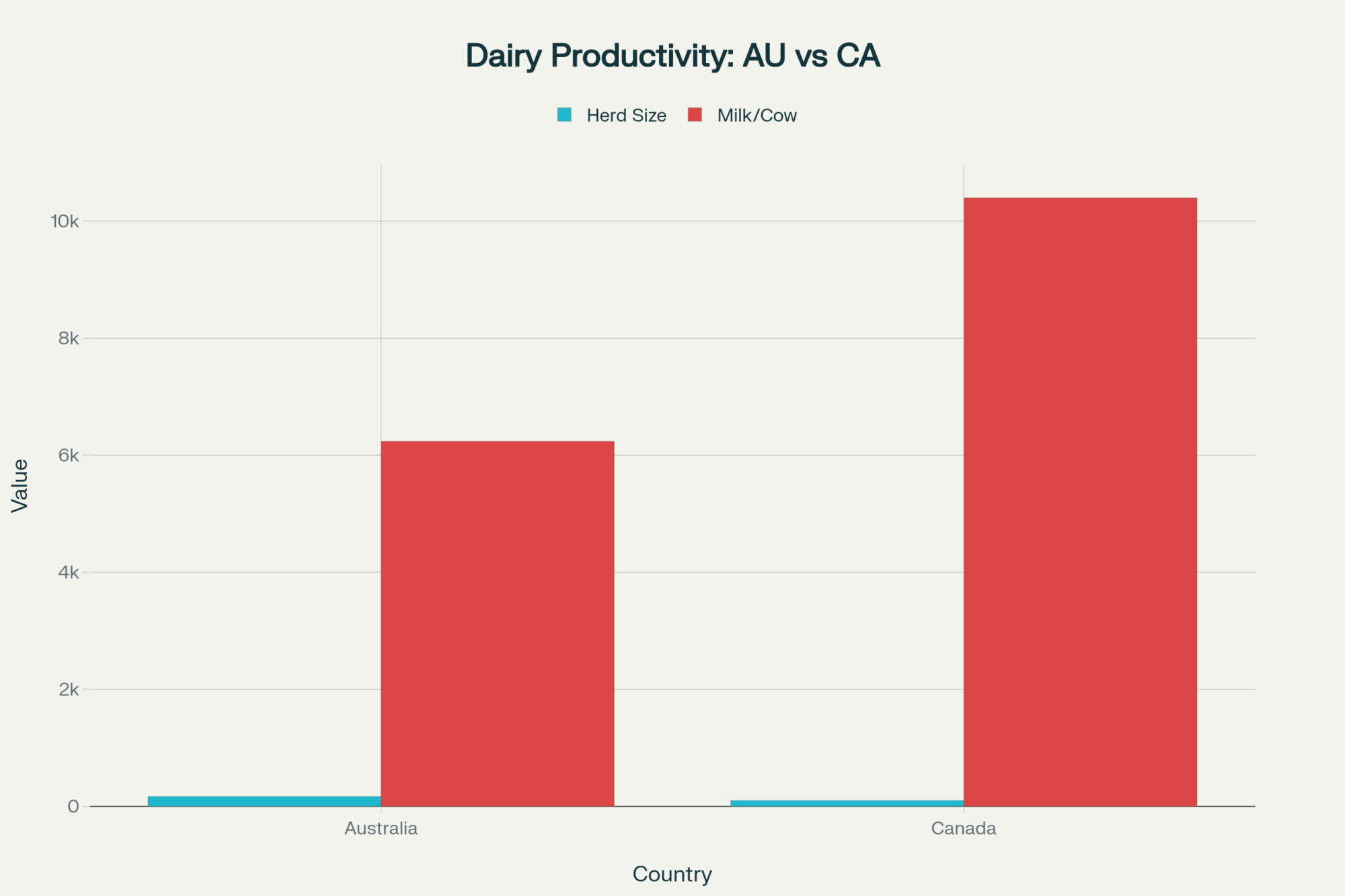
Now, the efficiency crowd will tell you this is exactly what should happen. Market forces are reallocating resources to their most productive use, and all that. And, indeed, the farms that survived became dramatically more productive. Average herd sizes went from 168 cows to 534 cows. Individual farm milk production jumped by 570% between the late ’70s and today.

But despite all this consolidation and efficiency, total milk production in Australia actually fell by 26% from its peak. You have farms that are three times bigger, cows that produce more milk per head, all the latest technology and management practices, and yet the country is producing a quarter less milk than it did 25 years ago.

That’s not efficiency—that’s an industry contracting while individual operations get more intensive just to survive.

The Power Shift Nobody Talks About

What really gets me about the Australian story isn’t just the farm consolidation—it’s what happened to the power dynamics in the supply chain. Because when you remove price supports and marketing boards, you don’t just create a “free market.” You create a vacuum that gets filled by whoever has the most leverage.

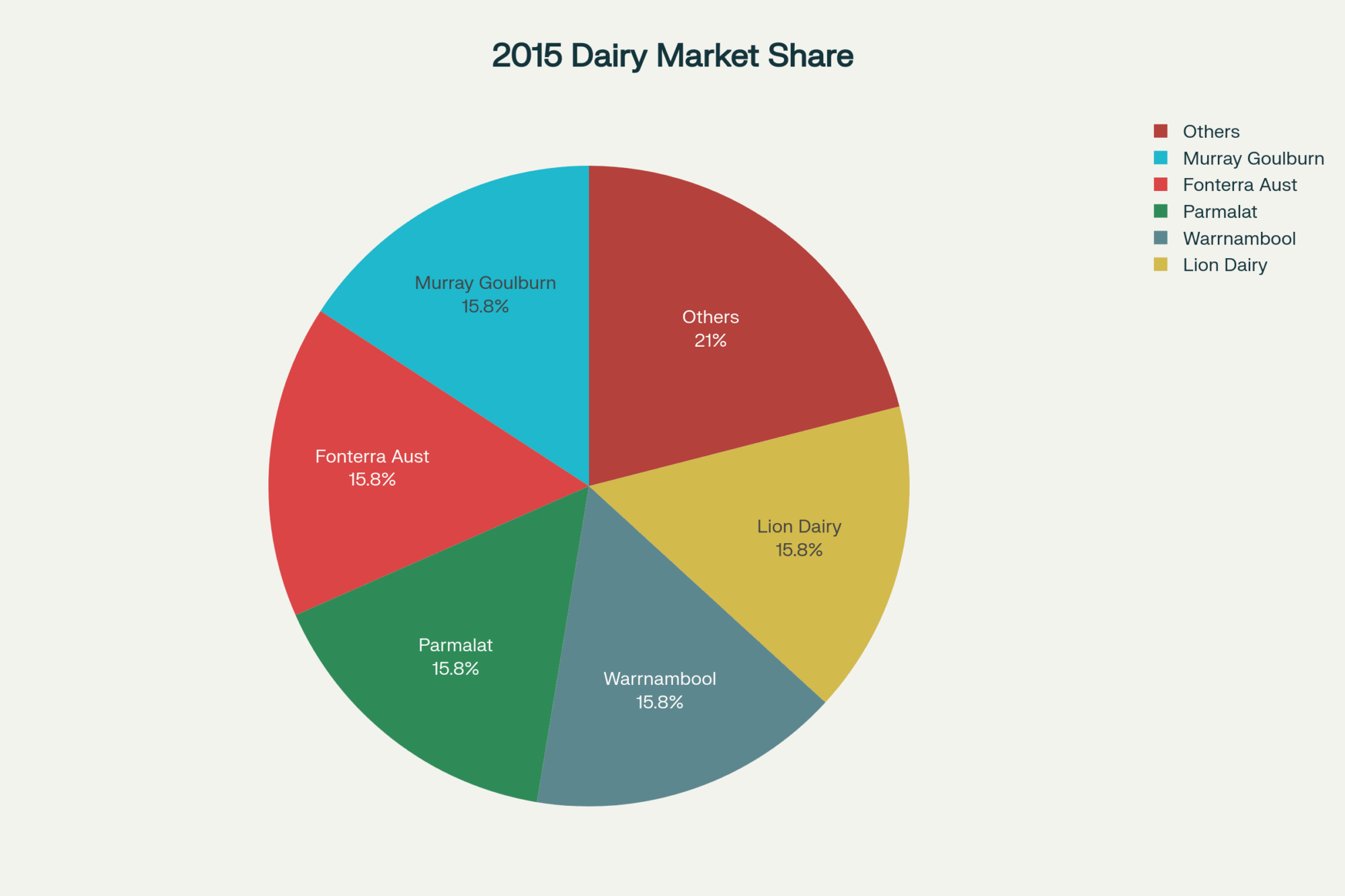
Market share distribution of Australian dairy processors showing dominance of top five companies

In Australia’s case, this meant that five major processors—Murray Goulburn, Fonterra Australia, Parmalat, Warrnambool Cheese & Butter, and Lion Dairy & Drinks—ultimately controlled 79% of the national milk supply by 2015. Meanwhile, two supermarket chains, Coles and Woolworths, account for approximately 65% of grocery sales.

Then came what Aussie farmers call the “$1 milk wars.” In 2011, Coles dropped the price of their private-label milk to just $1 per liter. Woolworths matched it immediately. And while the retailers claimed they were absorbing the discount themselves, we all know how that story ends, right?

As one Woolworths executive admitted to a Senate inquiry, those low prices inevitably “flow back to processors and farmers as new supply and pricing agreements are negotiated.” Which is exactly what happened. The Queensland Dairyfarmers’ Organisation documented that 185 of their members collectively lost more than $767,000 in just the first seven months of the price war.

This is what really worries me about the “let the market decide” mentality. Markets don’t operate in a vacuum. When you remove farmer protections, you don’t automatically achieve perfect competition—you often get a few large players using their leverage to squeeze out everyone else.

The Human Cost: When Communities Unravel

I’ve attended numerous dairy conferences over the years, and one thing I’ve noticed is how we often discuss “structural adjustment” as if it were just numbers on a spreadsheet. But every one of those farm exits represents a family that had to give up not just their livelihood, but usually their way of life as well.

Take Strathmerton, Victoria. Small town, about 300 people, built around a Bega cheese processing plant that had been there for decades. In 2022, Bega announced they were closing the facility to achieve “operational efficiencies.” Three hundred jobs—gone.

The local primary school enrollment dropped from 110 kids to 58 practically overnight. The town bakery that relied on the factory workers? Facing closure. One longtime resident told reporters it felt like signing “a death warrant for an entire rural community.” And honestly, when you look at what’s happened across rural Australia, that’s not hyperbole. It’s a pattern that has repeated itself in dairy communities across Queensland, New South Wales, and other regions that have lost their processing infrastructure.

The social fabric of these places gets shredded. Young people leave because there are no jobs. Services disappear because there aren’t enough people to support them. Property values collapse. And once that spiral starts, it’s incredibly hard to reverse.

The Productivity Paradox We Need to Understand

Now, I don’t want to paint this as all doom and gloom, because there are some genuinely impressive aspects of what Australian dairy farmers have accomplished. The individual farm productivity gains are remarkable. We’re talking about operations that have completely revolutionized how they manage everything from genetics to nutrition to labor efficiency.

The average annual milk production per cow in Australia has increased from approximately 3,340 liters in the mid-1980s to over 6,240 liters today. They’ve embraced precision agriculture, automated milking systems, advanced herd management software—all the tools that us North American farmers are familiar with, and some we’re still catching up on.

State/RegionFarm Loss % (2000-2022)Key Impact
Queensland-80% (1,545 → <300)Market milk states hit hardest
New South Wales-85% (1980-2021)Lost quota value overnight
Victoria-40% (4,268 → 2,552)Export-focused, better positioned
Tasmania+39% milk productionComparative advantage regions grew

But all this individual farm efficiency hasn’t translated into a stronger, more resilient industry overall. Production has become geographically concentrated in just a few regions—primarily the Murray-Darling Basin and Tasmania. That concentration makes the entire national supply vulnerable to regional droughts, changes in water policy, and other localized shocks.

It’s like having a smaller number of really efficient engines, but they’re all located in the same place and running on the same fuel supply. More efficient individually, but more fragile as a system.

What Canada’s Doing Right (And Why It Matters)

MetricCanada (Supply Management)Australia (Deregulated)
Farm Numbers (2000-2023)Stable (~10,000-11,000)-65% (12,888 to 4,500)
Price StabilityPredictable, regulated pricesVolatile, market-driven
Farmer Age CrisisYoung farmers still entering<6% under 35 years old
Debt LevelsManageable with stable incomeDoubled: $346K to $861K
Rural CommunitiesStable processing infrastructureWidespread plant closures
Long-term Planning3-5 year investment horizonsSurvival mode, short-term focus

This is where I think we need to step back and really appreciate what we have up here in Canada. Our supply management system is often criticized—especially in trade negotiations—but when you examine what has happened in Australia, it becomes quite clear what we’re protecting.

First off, our farm numbers have been relatively stable. We’ve seen some consolidation, sure, but nothing like Australia’s 65% crash. Statistics Canada data show that we’ve maintained roughly 10,000-11,000 dairy farms nationally, with gradual, manageable changes rather than traumatic disruptions.

More importantly, our farmers can actually plan for the future. When you know what milk prices are going to be, you can make rational decisions about herd expansion, facility upgrades, and succession planning. Australian farmers, meanwhile, are dealing with the kind of price volatility that makes long-term planning almost impossible.

I was talking to a farmer from Southwestern Ontario last month—he’s investing in a new robotic milking system, expanding his quota, and bringing his son into the operation. That kind of generational transition becomes really difficult when you can’t predict what your income will be from year to year.

And speaking of the next generation… this might be the most telling statistic of all. Less than 6% of Australian dairy farmers are under the age of 35. That’s not sustainable. That’s an industry aging out without attracting young people. Meanwhile, Canadian agriculture programs and the stability of supply management continue to draw young farmers into the industry.

Comparison of average herd sizes and milk production per cow between Australia and Canada

The Technology Factor: Why Stability Enables Innovation

One thing that really strikes me about the Australian experience is the interaction between technological advancement and market instability. You’d think that more competitive pressure would drive faster innovation, but what I’m seeing suggests the opposite might be true.

When farmers are constantly worried about whether they’ll be able to cover their costs next month, they become very conservative about major investments. Sure, they’ll adopt technologies that offer immediate payback, but the kind of long-term capital investments that really transform operations—automated milking systems, precision feeding equipment, comprehensive herd management systems—those become much riskier propositions when your milk price can swing 30% or more year-over-year.

Canadian farmers, with the price stability that supply management provides, can take a longer view. They can invest in technologies that might take three or four years to pay off, knowing that their revenue stream will be there to support the investment.

I’ve seen this firsthand, visiting farms in both countries. The Australian operations that survived and thrived tend to be those that already had significant capital reserves before deregulation took effect. The smaller farms that might have benefited most from newer technologies often couldn’t afford the risk of taking on debt for major upgrades, given their uncertain future income.

Regional Differences: Why One Size Never Fits All

Another lesson that stands out from the Australian experience is how deregulation affected different regions in varying ways. Queensland dairy farmers, who market milk premiums had protected, got hit especially hard—farm numbers there dropped by over 80%. New South Wales saw similar devastation.

Meanwhile, Victorian farmers, who were already operating primarily in the export/manufacturing milk market, initially saw some benefits. They had lower cost structures and were better positioned for the global market.

But what’s interesting about that geographic divide—it wasn’t just about efficiency or natural advantages. Queensland and NSW farmers had built their operations around a different market structure. They had smaller herds, focused on fresh milk for urban markets, and operated on different land bases. When the rules changed overnight, they couldn’t just flip a switch and become export-oriented operations.

This is something we need to keep in mind here in North America as well. A dairy farm in Vermont operates differently from one in Wisconsin or California, not just because of climate and land costs, but also due to market structures, processing infrastructure, and regulatory environments. Policies that work in one region might be disastrous in another.

Canadian supply management recognizes this reality through provincial marketing boards that can adapt to local conditions while maintaining national principles. It’s not perfect, but it acknowledges that dairy farming isn’t the same everywhere.

The Debt Trap: When Efficiency Requires Leverage

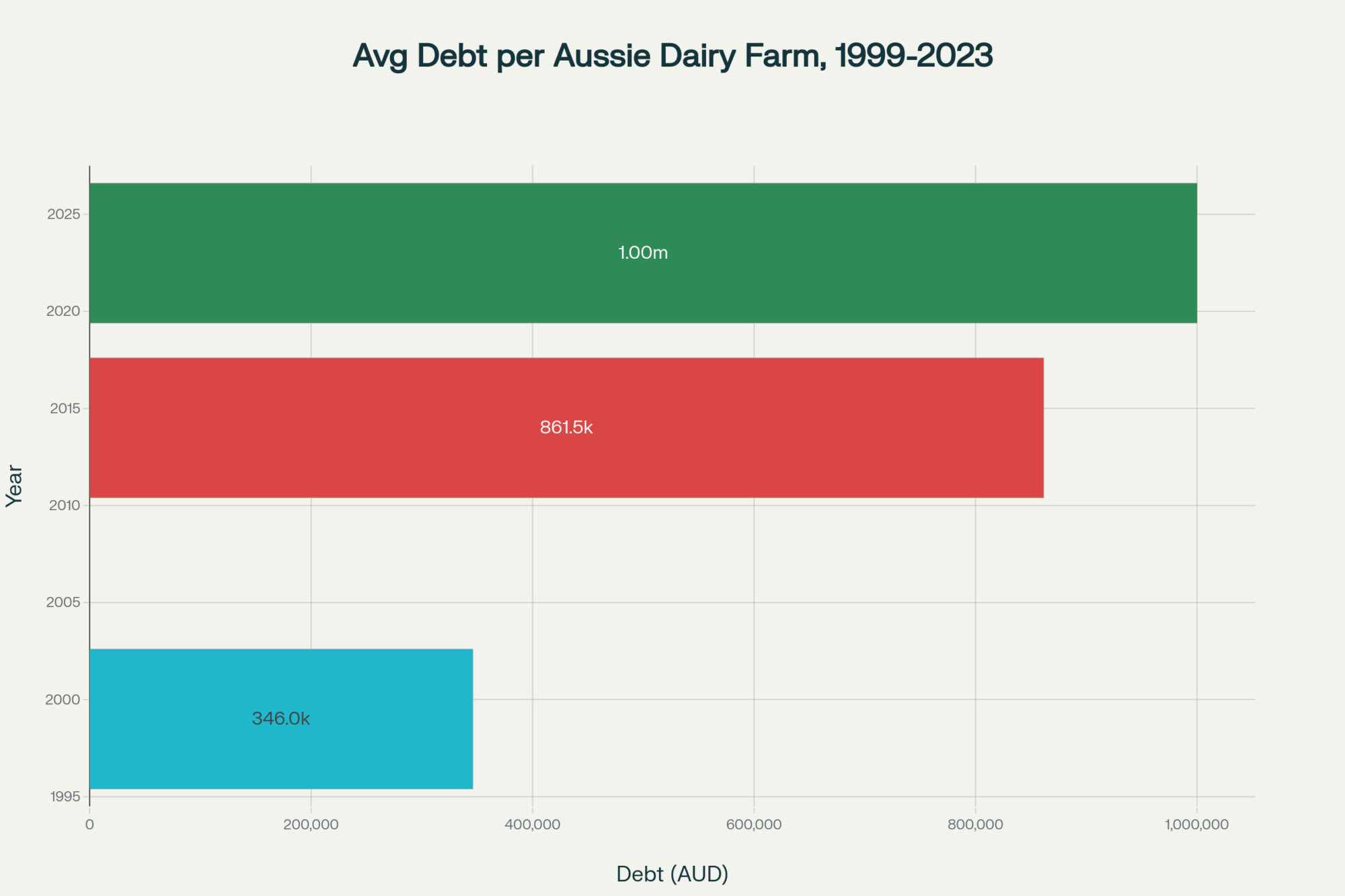
One of the most concerning trends in post-deregulation Australia has been the explosion in farm debt. Average debt per dairy farm more than doubled in real terms from $346,000 in 1999-2000 to $861,500 by 2014-15, and it’s continued climbing since then.

Average dairy farm debt in Australia increased from $346,000 in 1999 to over $861,500 in 2014, rising further by 2023
PeriodAverage Farm DebtEffective Hourly WageFarms Covering Full Costs
1999-2000$346,000Not trackedMajority profitable
2014-15$861,500$2.46 (worst periods)Unknown
2015-16Not specifiedBelow minimum wageOnly 28%
2022-23Higher (continuing trend)VariableMajority struggling

Now, some debt can be good debt, right? Investing in productivity improvements, expanding operations, and upgrading facilities. But when you’re borrowing just to maintain competitiveness in an increasingly difficult market, that’s a different story.

In Australia, farms needed to become larger and more capital-intensive just to survive, but market volatility made it incredibly risky to take on the debt required for that expansion. It created this catch-22 where you couldn’t compete without investing, but investing was increasingly dangerous.

Canadian farmers, with more predictable income streams, can manage debt more strategically. They can plan expansions around known revenue projections rather than relying on the market to cooperate.

The Labor Crisis: When Young People Don’t See a Future

This might be the most troubling long-term consequence of Australia’s deregulation experience—the demographic crisis. With fewer than 6% of farmers under 35, and farm debt levels that require massive capital investments just to get started, young people are increasingly seeing dairy farming as a dead end rather than an opportunity.

I’ve spoken with agricultural educators in Australia, and they describe a generation of rural children who grew up watching their parents struggle with volatile prices, mounting debt, and constant uncertainty. Even kids from farm families often decide it’s not worth the risk.

The labor shortage isn’t just about family succession either. Hired labor has become increasingly difficult to attract and retain, as farms struggle to offer job security or competitive wages due to margin pressure.

Canadian farms, although not immune to labor challenges, continue to attract young farmers and farm workers because the industry offers more predictable career paths. When a farm can project its income three to five years out, it can make commitments to employees that become impossible under volatile pricing.

YearEventImpact
1995National Competition Policy implementedReview of all regulations restricting competition
1997-98Market milk premium: 21¢/L higher than manufacturingDirect wealth transfer: $311M annually to farmers
July 1, 2000Full deregulation beginsState Marketing Authorities abolished
2000-2008Dairy Industry Adjustment Program$1.92B in transition funding via 11¢/L levy
2001-02Peak milk production: 11.3B litersNever exceeded again in 25 years
2011$1/L milk price war beginsColes, Woolworths devalue product
2020Dairy Code of Conduct introducedPartial re-regulation admits market failure

Practical Steps for Today’s Farmers

Alright, enough policy analysis—what can you actually do with this information on your farm right now?

Calculate Your Real Hourly Wage: Take your net farm income last year and divide it by the total hours you and your family put into the operation. Include everything—milking, feeding, fieldwork, bookkeeping, maintenance. If that number makes you uncomfortable, you’re not alone. Use it as a baseline for making decisions about labor efficiency and income diversification.

Stress-Test Your Operation: Model what would happen to your cash flow if milk prices dropped 20% for six months. How about if feed costs increased 30%? Australian farmers who survived deregulation were those who had built financial cushions for exactly such scenarios.

Invest in Flexibility: Technologies and management practices that allow you to adjust quickly to changing conditions become more valuable in volatile markets. This might mean variable-cost feed systems rather than fixed infrastructure, or diversified income streams that aren’t entirely dependent on milk prices.

Build Relationships Beyond the Farm Gate: Whether it’s processor relationships, banker relationships, or connections with other farmers, social capital becomes crucial when markets get turbulent. Australian farmers who were plugged into cooperative networks or had strong relationships with processors fared better than those with isolated operations.

Document Everything: Keep detailed records not just for tax purposes, but for strategic planning. Understanding your cost structure down to the cents per liter gives you real power in pricing negotiations and investment decisions.

Regional Strategy Matters: A farm in Prince Edward Island faces different challenges than one in Alberta or Wisconsin. Tailor your risk management and investment strategies to your specific regional conditions, including climate patterns, processing infrastructure, and local market dynamics.

Looking Forward: The Canadian Advantage

As I write this in 2025, Canadian dairy farmers are operating in an increasingly complex global environment. Trade pressures, climate change, technological disruption, shifting consumer preferences—all creating uncertainty and opportunity in equal measure.

However, we’re addressing these challenges from a position of relative strength, thanks in large part to supply management providing stability in an inherently volatile business. That stability isn’t just about guaranteed prices—it’s about being able to plan, invest, innovate, and pass farms to the next generation with confidence.

The Australian experience shows us what we have to lose. It also shows us that once you dismantle regulatory frameworks that provide stability, rebuilding them is incredibly difficult. The processors and retailers who benefited from deregulation have little incentive to give up their newly acquired market power.

Australia’s 2020 Dairy Code represents partial reregulation—an attempt to address the worst abuses without returning to the previous system. However, it’s a significantly weaker framework than what existed before deregulation, and it emerged only after considerable damage to farm families and rural communities.

Final Thoughts: Learning Without Repeating

So here we are, 25 years after Australia’s great dairy experiment began. The results are mixed at best—some remarkable individual farm success stories, but an overall industry that’s smaller, more concentrated, more indebted, and more vulnerable than before.

The lesson isn’t that markets are bad or that regulation is always good. It’s that the design of agricultural policies has consequences that ripple far beyond farm gates, and that stability and sustainability sometimes matter more than short-term efficiency.

As Canadian dairy farmers, we have something valuable—a system that provides the predictability needed for long-term planning and investment while still allowing for innovation and growth. It’s not perfect, and it will need to evolve as conditions change, but the Australian experience shows us what we could lose if we’re not careful.

The next time someone argues that “freeing the market” will solve agriculture’s problems, perhaps we should ask them to explain what happened to those 8,000 Australian dairy families who discovered that the market wasn’t particularly interested in their freedom.

Because at the end of the day, this isn’t about economics textbooks or policy theories. It’s about real farms, real families, and real communities. And sometimes, the most efficient market outcome isn’t the best human outcome.

Keep milking, keep learning, and keep fighting for the systems that work—because once you lose them, getting them back is a whole lot harder than keeping them in the first place.

The lesson? Don’t just get bigger. Get smarter. Your feed efficiency and genetic program could be the difference between thriving and just surviving.

Which aspect of Australia’s dairy struggles—farm consolidation, mounting debt, or community collapse—do you think poses the biggest threat to North American dairies? Share your thoughts below!

KEY TAKEAWAYS:

  • Scale smart, not just big: Australia’s survivors averaged 534 cows per farm (up from 168), but success came from genomic testing that improved feed conversion by 15-20%—start screening your replacement heifers now
  • Price volatility is real: When markets crashed, farmers lost 19 cents per litre overnight—build your buffer with feed efficiency programs and genetic selection for resilience traits
  • Tech pays off: Farms using precision feeding and genomic data improved profitability by 8-12% annually—invest in herd management software and genetic testing this season
  • Youth crisis hits hard: Only 6% of Aussie farmers are under 35—use stable planning tools like genomic breeding programs to create succession opportunities that actually work
  • Market power matters: When five processors controlled 79% of milk volume, farmers got squeezed—join cooperative purchasing groups and leverage genetic data to negotiate better contracts

EXECUTIVE SUMMARY:

Look, I just finished reading this massive report on what happened down in Australia after they deregulated their dairy industry 25 years ago. The numbers will shock you—65% of farms disappeared, yet the survivors tripled their herd sizes. Here’s what’s wild though: total milk production actually dropped 26% despite all that “efficiency.” Some farmers were effectively earning $2.46 an hour during the worst stretches. Yeah, you read that right. While consumers saved money on milk, processors and retailers grabbed most of the profit. The ones who made it through? They had to get smart about genomic selection, feed optimization, and managing massive debt loads. Global research backs this up—farms using advanced genomic testing and precision feeding are the ones still standing. Bottom line: if you’re not using these tools to maximize what you’ve got, you’re playing a dangerous game.

Complete references and supporting documentation are available upon request by contacting the editorial team at editor@thebullvine.com.

Learn More:

Join the Revolution!

Join over 30,000 successful dairy professionals who rely on Bullvine Weekly for their competitive edge. Delivered directly to your inbox each week, our exclusive industry insights help you make smarter decisions while saving precious hours every week. Never miss critical updates on milk production trends, breakthrough technologies, and profit-boosting strategies that top producers are already implementing. Subscribe now to transform your dairy operation’s efficiency and profitability—your future success is just one click away.

NewsSubscribe
First
Last
Consent

Trump’s Tariffs: Can History Repeat Without Repeating Mistakes?

Farmers are on edge as President Trump reaffirms 25% tariffs on Canadian dairy. While some see this as a chance to dismantle Canada’s supply management system, others worry about repeating the costly mistakes of past trade wars. Will these tariffs lead to long-term gains or just more short-term pain?

Summary

President Trump’s confirmation of 25% tariffs on Canadian dairy imports, set to take effect March 4, 2025, has ignited fierce debate within the U.S. agricultural sector. While the administration frames this move as a strategic push to break Canada’s supply management system, many farmers remain skeptical, recalling the painful aftermath of similar tariffs in 2018. That trade war resulted in a $28 billion government bailout and accelerated the decline of small dairy operations. This time, stakeholders are demanding more than just temporary measures, calling for structural reforms to address labor shortages, subsidy inequities, and global competition. As the deadline approaches, the dairy industry finds itself at a crossroads, weighing the potential for long-term market access against the risks of immediate economic disruption and retaliatory measures from Canada and Mexico. The outcome could reshape North American dairy trade for decades to come.

Key Takeaways

  • President Trump has renewed criticism of Canada’s dairy supply management system, calling it unfair to U.S. farmers and threatening tariffs.
  • The U.S. imposed 25% tariffs on most Canadian imports on February 4, 2025, with Canada retaliating with tariffs on $30 billion of U.S. goods.
  • Trump is pushing to renegotiate USMCA in 2026, potentially threatening Canada’s dairy protections.
  • Canada’s supply management system imposes high tariffs (up to 298%) on imported dairy products to protect domestic farmers.
  • The dairy dispute impacts $1.2 billion in annual trade between the U.S. and Canada.
  • Canadian farmers fear losing the stability provided by supply management, while U.S. farmers seek increased market access.
  • Canada passed Bill C-282 to protect supply management from trade concessions, but it faces challenges under U.S. pressure.
  • Some argue Canada needs to reform its dairy system to remain competitive, while others say eliminating it would devastate Canadian farmers.
  • The dispute has reignited debate over food sovereignty vs. free trade principles in agriculture.

As President Trump reaffirms 25% tariffs on Canadian dairy effective March 4, farmers face déjà vu. While the administration touts this as a decisive blow against Canada’s protectionist supply management system, critics warn of repeating 2018’s costly trade war. This $28 billion bailout debacle failed to secure long-term gains. This time, stakeholders demand structural reforms, not just short-term salvos.

Lessons From 2018: Bailouts and Broken Promises

The $28 Billion Hole

Trump’s 2018 tariffs triggered retaliatory measures that crushed U.S. agricultural exports, particularly soybeans, which plummeted from $19.5 billion in 2017 to $9 billion by 2018. To stem the bleeding, the USDA funneled $23 billion through its Commodity Credit Corporation, with soybean growers alone receiving $7.3 billion. Despite this, farm bankruptcies rose 20% in 2019, and small dairy operations collapsed at twice the national average.

Wisconsin dairy farmer Jake Mueller reflects:

“We got checks, sure—but they were Band-Aids on bullet wounds. Most neighbors sold their herds or retired. The bailouts just delayed the inevitable.”

Subsidy Inequities Exposed

While the 2018 bailouts stabilized prices, they disproportionately benefited megafarms. USDA data shows 42% of dairy revenue now comes from government support, with 70% of subsidies flowing to operations with 500+ cows. This accelerated the 40% decline of small dairies since 2000, as family farms lacked the scale to leverage robotic milking systems or methane digesters.

Proposed Fix:

  • Subsidy Caps: Limit payments to farms with <200 cows to prevent corporate consolidation.
  • Trade War Insurance: USDA-backed revenue guarantees for small producers during disruptions.

Canada’s Supply Management vs. U.S. Efficiency

The Quota Conundrum

Canada’s supply management system—described by Trade Rep Katherine Tai as “a state-sponsored cartel”—imposes 298% tariffs on dairy imports and forces farmers to discard excess milk. Since 2012, 7 billion liters of Canadian milk (worth $14.9B) have been wasted. Yet Ottawa’s lobby ensures political immunity: dairy farmers contribute 25% of federal campaign funds in rural ridings.

U.S. Competitive Edge

American dairies operate at 10x Canada’s scale, slashing per-unit costs by 34%. However, retaliatory tariffs threaten key inputs:

  • Potash: 30% of U.S. supply comes from Canada; tariffs could raise fertilizer costs by $60/acre.
  • Labor: 16% of dairy workers are undocumented migrants; visa reforms lag despite sector collapse risks.

Idaho Dairy Cooperative CEO warns:

“Without H-2A visa expansion, tariffs will starve us of workers before they squeeze Canada.”

Strategic Opportunities Amid Risks

Short-Term Realities

  • Cheese Exports: 23% of U.S. cheese heads to Canada ($650M/year). Mexico’s threat to tax Wisconsin cheddar could cost $1.5B annually—repeating 2018’s Midwest losses.
  • Inflation: Trump’s 2018 steel tariffs raised appliance prices by 12–30%; dairy inputs (feed, equipment) may follow.

Long-Term Plays

  1. USMCA Renegotiation: Demand Canada triple tariff-free quotas (currently 3% of their market).
  2. Diversification: Target China’s $12B dairy import gap, leveraging USDA’s $2B “Dairy 2030” AI initiative.
  3. Value-Added Shift: Redirect surplus milk to lactose-free/protein products—a $4.8B growth sector.

Political Crosscurrents

Rural Base Solidifies… For Now

68% of dairy farmers back tariffs in Farm Pulse polls, swayed by Canada’s 270% butter duties. Yet skepticism simmers. Iowa GOP Chair:

“We’ll tolerate short-term pain if Trump dismantles supply management—not just postures.”

Democratic Nuance

Even critics concede strategic merit. Senator Jon Tester (D-MT) notes:

“Canada’s system is rigged. But tariffs without immigration reform and subsidy caps? That’s 2018’s playbook—and we saw how that ended.”

The Road Ahead: Structural Reform or Cyclical Bailouts?

  1. March 4 Deadline: Canada could avert tariffs by expanding U.S. access to 5% of its market, creating 12K U.S. jobs.
  2. Labor Fixes: Pair tariffs with H-2A visa expansions to address 16% workforce gaps.
  3. Anti-Consolidation Measures: Tax incentives for small farms adopting robotics/AI.

Conclusion: Beyond the Tariff Bluster

Trump’s tariffs could either catalyze long-overdue reforms or repeat 2018’s cycle of bailouts and consolidation. For farmers, the stakes transcend milk quotas: it’s about proving protectionism can be dismantled without sacrificing rural America’s backbone. As Wisconsin’s StarkD_01 bluntly observes:

“Bailouts just paid for vacations. This time, we need wins—not welfare.”

Learn more

Join the Revolution!

Bullvine Daily is your essential e-zine for staying ahead in the dairy industry. With over 30,000 subscribers, we bring you the week’s top news, helping you manage tasks efficiently. Stay informed about milk production, tech adoption, and more, so you can concentrate on your dairy operations. 

NewsSubscribe
First
Last
Consent

Trump’s Criticism Reignites Debate on Canada’s Dairy Policy

Trump’s dairy battle heats up! As tariffs loom, Canada’s supply management system faces its toughest test yet. With U.S. farmers crying foul and Canadian producers digging in, milk has become a weapon in international politics. What’s at stake for farmers and consumers on both sides of the border?

Summary:

U.S. President Donald Trump has criticized Canada’s dairy supply management system, claiming it blocks American dairy products with high import tariffs and is unfair to U.S. farmers. Both countries have imposed new tariffs on each other’s goods, impacting a $1.2 billion dairy trade at risk and causing market uncertainty for farmers. While the U.S. sees it as a chance for better market access, Canadian farmers fear the loss of the system that ensures stability. With the Canada-United States-Mexico Agreement up for review in 2026, there’s a possibility of changes to Canada’s dairy policies as tensions continue to grow.

Key Takeaways:

  • Canada’s supply management system in the dairy sector remains a point of contention in U.S.-Canada trade relations.
  • Trump has criticized Canadian dairy policies, labeling them as unfair to American farmers and threatening tariffs.
  • U.S. dairy farmers seek increased market access amidst challenges of oversupply and low prices.
  • Canadian farmers are concerned about maintaining stability and income through the existing system.
  • Reforms to the system are debated, with calls for modernizing to remain competitive while protecting domestic interests.
  • The Canada-United States-Mexico Agreement (CUSMA) and TRQs are pivotal in ongoing trade negotiations.
  • Both nations face significant trade tensions, impacting future relations and market dynamics.
Trump, dairy trade, Canada tariffs, supply management, CUSMA negotiations

The ongoing clash between President Donald Trump and Canada’s dairy supply management system has reignited a long-standing contentious debate between the two nations. Since returning to the White House in 2025, Trump has intensified his criticism of Canada’s dairy policies, sparking a heated political debate.

Trump’s Renewed Attack

Trump’s recent comments have focused on what he perceives as Canada’s unfair trade practices in the dairy industry. These include high import taxes and strict production quotas that limit American dairy exports to Canada. He argues that Canada’s high import taxes create barriers that significantly hinder the sale of American dairy products in Canada, thereby placing U.S. farmers at a severe disadvantage in the Canadian market.

“Canada charges the U.S. a 270% tariff on Dairy Products! They didn’t tell you that, did they? Not fair to our farmers!” Trump tweeted.

The President has even threatened to impose tariffs on Canadian goods if the dairy system isn’t reformed. This renewed pressure comes as the Canada-United States-Mexico Agreement (CUSMA) is set for formal review in 2026, with discussions likely to ramp up in 2025.

Recent Developments Under Trump

Since taking office in January 2025, Trump has made several moves affecting trade and agricultural policies:

  1. Executive Orders: Trump has issued a series of executive orders, including those affecting trade policies, in what he has described as a “shock and awe” campaign. He has mandated reviews of all trade agreements to verify their fairness to the U.S.
  2. CUSMA Renegotiation: Trump seeks to renegotiate the CUSMA, which could threaten Canada’s dairy protections. He asserts that the current agreement inadequately supports U.S. farmers.
  3. Tariff Implementation: On February 2, 2025, the U.S. and Canada imposed 25% tariffs on each other’s agricultural imports, significantly impacting the $1.2 billion annual dairy trade.
  4. Further Escalation: On February 9, 2025, Trump announced he would unveil a 25% tariff on all steel and aluminum imports into the United States.

Impact on the Canadian Dairy Industry

The renewed pressure from the Trump administration, which threatens changes to the dairy system, is causing concern in Canada’s dairy sector:

  1. Uncertainty: Canadian dairy farmers are worried about potential changes to the system that could threaten their livelihoods. They are also increasingly concerned about their ability to stay competitive in a market flooded with U.S. dairy products.
  2. Policy Challenges: Canada’s recent Bill C-282, aimed at protecting supply management from trade deal concessions, may face challenges under increased U.S. pressure. This law was meant to prevent Canada from giving up more of its dairy market in trade talks, but Trump’s administration is pushing hard against it.
  3. Retaliatory Measures: On February 2, 2025, Canada implemented retaliatory measures by imposing tariffs on $30 billion worth of U.S. imports affected by tariffs. Additionally, Canada is preparing to impose more tariffs on $125 billion later this month.

Canadian Government’s Response

The Canadian government and the dairy industry have jointly vowed to protect the supply management system through increased lobbying efforts, strategic alliances with other dairy-producing nations, and advocacy for policy reforms safeguarding domestic dairy producers. Foreign Affairs Minister Mélanie Joly stated, “We have always said we would protect supply management. The Liberal Party put supply management in place, and we protected it during the last (free-trade) renegotiation. We’ll be there to protect it.”

The Supply Management System: A Closer Look

Canada’s supply management system operates through strict production quotas and high import tariffs. Here’s how it works:

  1. Controlling Production: The Canadian Dairy Commission (CDC) determines how much milk Canada needs and instructs farmers on production levels, helping to keep prices steady.
  2. Setting Prices: The CDC sets minimum milk prices to ensure farmers earn a sustainable income regardless of market fluctuations.
  3. Limiting Imports: Canada imposes high tariffs on imported dairy products, including 298% on butter. This makes it difficult for foreign dairy companies to compete with Canadian products.

Impact on Consumers

The dairy system in Canada brings both benefits and drawbacks to consumers. While Canadians may experience higher prices than Americans, they also enjoy a consistent milk supply, support local dairy farmers, and benefit from stringent quality control standards. However, limited access to foreign dairy products may restrict consumer choices and variety.

  1. Higher Prices: Canadians generally pay more for milk and cheese than Americans. For example, a family in Canada might spend $100 more per year on dairy products than a similar family in the U.S.
  2. Steady Supply: The system ensures a steady milk supply, regardless of price fluctuations in other countries. Canadians don’t have to worry about milk shortages.
  3. Limited Variety: Due to the import tariffs on foreign dairy, Canadians may have limited access to foreign cheeses and other dairy products in local stores.

Recent Developments and Trade Tensions

Under CUSMA, Canada committed to providing greater access to U.S. dairy exports through 14 U.S.-specific tariff-rate quotas (TRQs). However, the United States has launched multiple disputes claiming Canada is intentionally bottlenecking U.S. imports through these TRQs.

A USMCA dispute panel sided with Canada in the latest tiff over market access in 2023, leading to disappointment from the U.S. Dairy Export Council.

To provide insights into trade dynamics, the following table presents information on the import volumes and fill rates for select dairy products under CUSMA for the 2023/24 dairy year.

ProductImport VolumeFill Rate
Cheese5,457 tonnes52.5%
Fluid Milk13,697 tonnes32.9%
Cream4,465 tonnes51.0%
Butter3,048 tonnes81.3%
Milk Powder327 tonnes56.9%

Source: Global Affairs Canada

This table illustrates the current state of dairy imports under CUSMA, showing that while some products like butter have high fill rates, others like fluid milk are significantly under their quota. This data provides context for the ongoing trade tensions and the potential for increased U.S. dairy exports to Canada.

Looking Ahead

As tensions rise, American and Canadian dairy farmers are at a crossroads. The coming months are poised to witness intense negotiations and debates as both countries grapple urgently with key issues such as tariff rates, market access, and dairy product quotas in the future of the dairy trade. With the CUSMA review set for 2026 and Trump’s aggressive stance on trade, the dairy industry on both sides of the border faces an uncertain future.

The battle over Canada’s dairy system extends beyond milk. It encompasses a significant struggle over trade, livelihoods, and the future of farming industries, reflecting a multifaceted challenge. As negotiations progress, it will be paramount for both nations to navigate the delicate task of balancing safeguarding domestic industries, ensuring fair competition for local producers, and promoting equitable international trade agreements that benefit all stakeholders involved.

Learn more:

Join the Revolution!

Bullvine Daily is your essential e-zine for staying ahead in the dairy industry. With over 30,000 subscribers, we bring you the week’s top news, helping you manage tasks efficiently. Stay informed about milk production, tech adoption, and more, so you can concentrate on your dairy operations. 

NewsSubscribe
First
Last
Consent

Dairy Showdown: Canadian Quotas vs. American Free Market – Who’s Right?

Blood, milk, and money fuel North America’s dirtiest agricultural showdown. At the 49th parallel, two dairy systems face-off: Canada’s quota-cushioned farmers versus America’s free-market warriors. While they battle over borders and butter, Silicon Valley plots to make cows obsolete. Welcome to dairy’s final frontier.

Picture this: blood, milk, and money: the great North American dairy divide. Picture two dairy farmers squaring off at the 49th parallel. One’s got quota papers clutched like brass knuckles; the other’s flexing export contracts like a loaded gun. Welcome to dairy’s dirtiest fight – where Canadian stability squares off against American ambition, and neither side’s backing down. 

In one corner is Canada’s supply management system, a strict supply management that ensures farmers operate within set production limits, allowing them a sense of security akin to babies sleeping soundly, all while the value of their barns rivals that of mansions in Beverly Hills. On the other hand, America’s free-market fury is where farmers ride commodity markets like bull riders at a rodeo – eight seconds of glory or face-down in the dirt.

This isn’t just about milk – it’s about two nations’ battle for the soul of dairy farming. While Canadian farmers mock their American cousins for dumping milk in ditches, U.S. producers sneer at Canada’s strict supply management from their 5,000-cow mega-parlors. Each side thinks the other’s crazy, and both might be right. 

Strap in for dairy’s ultimate grudge match. There are no participation trophies here – just two systems locked in a fight reshaping North America’s dairy landscape one bankruptcy, merger, and trade war at a time. 

Now, let’s wade into this manure-splattered battlefield…

The Canadian Corner: Playing it Safe or Playing it Scared? 

In the frigid predawn hours across Canada’s dairy heartland, farmers aren’t just milking cows – they’re protecting a system that’s become more valuable than the farms themselves. The Canadian dairy quota system, a complex structure of production controls and price guarantees, has turned a basic milk jug into a multibillion-dollar battleground. 

  • The Golden Handcuffs: Here’s the raw truth: A single dairy cow’s quota now costs upwards of $30,000 in Ontario and Quebec and hit a staggering $58,000 in Alberta last March. For perspective, a 100-cow operation is sitting on a quota worth $3 million before considering a single acre of land or barn. “Rich on paper, poor in the bank,” as Quebec farmers put it, watching their net worth soar while scraping on $2,000 monthly salaries and pouring everything back into the farm.
  • Fighting for Their Children’s Future: The system’s defenders aren’t just protecting profits—they’re guarding their children’s inheritance. Unlike American farmers, who get 73% of producer returns from Uncle Sam, financial stability flows from a system without government subsidies. Guaranteed minimum prices based on production costs and protection from market crashes create a shield that American dairy farmers can only dream about. 
  • Market Control: The Iron Fortress: The production matches domestic demand through iron-clad quotas, while tariffs, which have soared to 298%, keep foreign competition at bay. This predictable income stream enables long-term planning and investment, creating a fortress around Canadian dairy that’s become the envy of farmers worldwide.
  • Paradise Lost: The System’s Dark Side: Yet this golden system has rust under the chrome. Young farmers face a generational genocide – try finding $3 million for quota alone before buying your first cow. The average farmer’s age climbs past 55 while family farms become too valuable to farm. Market rigidity shows its teeth during demand shifts, as COVID-19 exposed to milk dumping. Innovation suffocates under quota constraints, while regional disparities concentrate 74% of farms in Ontario and Quebec. 
  • The Last Stand: Despite these flaws, Canadian dairy farmers view supply management as their last defense against becoming like their American cousins. They watch dairy farms vanish south of the border daily, with Wisconsin losing 75 farms in a single processor’s decision. The math is brutal but clear: Would you rather have a system that guarantees survival with golden handcuffs or face the American-style freedom to fail? 

Supply management isn’t just policy for Canadian dairy farmers – it’s a bulletproof vest in an increasingly hostile agricultural world. While economists cry foul and consumers grumble about prices, farmers see their quota certificates as the only thing standing between them and the dairy graveyard that America has become. As one Quebec farmer said, watching another family farm auction: “We’re not protecting profits – we’re protecting survival.” In the end, that’s why this system, flaws and all, commands such fierce loyalty. It’s not perfect, but it’s keeping Canadian dairy farmers alive while their American counterparts vanish into history. 

Land of the Free, Home of the Brave: Why American Dairy FarmersStand by Their Market-Driven System

Welcome to America’s dairy battleground, where freedom comes with a hefty price tag, and only the strong survive. From California’s sprawling mega-dairies to Wisconsin’s family operations, U.S. dairy farmers aren’t just milking cows – they’re waging war in a system that rewards the bold and buries the timid. 

  • Raw Capitalism in Rubber Boots: The American dairy system is capitalism distilled to its purest form. Federal milk marketing orders may set the rules, but survival demands more than following them. While Canadian farmers count their quota pennies, American producers are building empires. The average U.S. dairy now milks 225 cows—nearly triple its northern neighbors’ modest 85-cow herds. 
  • The American Dream: Dairy Edition: In the land of opportunity, dairy farmers have ambitious dreams. California operations milk more cows than some Canadian provinces have citizens. These mega-dairies aren’t just farms – they’re milk factories, pumping out 15% of their production straight to export markets while their quota-bound Canadian cousins watch from behind their tariff walls.
  • Innovation or Extinction: American dairies don’t just adopt technology—they weaponize it. Robotic milkers, genomic testing, and artificial intelligence aren’t luxuries but survival tools. While Canadian farmers debate whether to invest their quota equity, U.S. producers are already testing tomorrow’s innovations.
  • The Price of Freedom: But this unrestrained capitalism extracts its pound of flesh. Since 2003, half of America’s dairy farms have vanished into memory. Milk prices swing wildly enough to give an accountant vertigo. One month, you’re expanding; the next, you’re calling the auction house. The survivors aren’t just farmers – financial acrobats, environmental compliance experts, and global market strategists rolled into coveralls. 
  • The Darwinian Dance: The numbers tell a brutal story: 1.3% of farms produce over a third of America’s milk. Small farms aren’t just dying – they’re being swallowed whole by operations that measure their herds in thousands. It’s a survival-of-the-fittest scenario in the dairy industry, akin to natural selection as proposed by Darwin.
  • Why They’ll Die on This Hill: Ask an American dairy farmer why they prefer their system to Canada’s “socialist milk scheme,” and you’ll learn about freedom, opportunity, and the American way. They prefer risking everything on their terms rather than allowing external regulation to dictate their milk production limits. 

The U.S. dairy system isn’t just a business model – it’s a battlefield where only the fittest survive. While it has led to the most efficient dairy industry globally, it has also resulted in shattered dreams and closed farms. But for those who make it, the rewards can be empire-sized. As one dairyman said, “In America, we don’t just milk cows – we milk opportunity. Sometimes it kicks back, but that’s the price of freedom.” 

Consumer Perspective: A Tale of Two Dairy Aisles 

In Canada, shoppers face a dairy dilemma: pay through the nose or go lactose-free. With milk costing 50% more than south of the border, Canadians fund a rural welfare program every time they buy a block of cheddar. But hey, at least they know their outrageously priced milk is rBST-free, and their farmers aren’t on food stamps

Meanwhile, American consumers swim in a sea of cheap dairy, with supermarkets practically giving away milk next to lottery tickets and cigarettes. The variety is mind-boggling – from Greek yogurt to artisanal moon cheese. But this dairy paradise comes with a sour aftertaste: price whiplash that could give you financial whiplash and the nagging feeling that you’re drinking the last drops of a dying industry.  While Americans enjoy cheaper prices, 72% express concern about corporate consolidation in dairy, per Pew Research.

Price Comparison 2025Canada (USD)US (USD)
Gallon of Milk$4.81$3.00
Block Cheddar (1lb)$9.61$5.99
Greek Yogurt (32oz)$6.65$4.50
Butter (1lb)$5.91$3.99
Annual Household Dairy Spend$888.00$750.00

So, what’s a conscious consumer to do? You can sleep easy in Canada knowing you’ve single-handedly supported a family farm with your $7 yogurt. In America, you can fill a bathtub with milk for the cost of a latte, but it could be hastening the decline of rural America. Pick your poison: overpriced peace of mind or cheap milk with a side of guilt. Step into the dairy aisle, where each purchase carries political weight. 

The Real Showdown 

AspectCanadaUnited States
Regulatory SystemSupply management with production quotas and minimum pricesFree-market with federal milk marketing orders setting regional price floors
Entry CostsHigh ($30,000 per cow for quota rights)Lower, but subject to market volatility
Price StabilityGuaranteed margins through cost-of-production pricingVolatile (prices ranged from $11.54 to $29.80 per hundredweight, 2005-2020)
Average Farm Size96 cows357 cows
Market ProtectionHigh (298% import tariffs)Lower exports 15% of production
InnovationCautious adoption due to quota constraintsAggressive automation to combat labor shortages
Geographic Distribution74% of production in Ontario/QuebecCalifornia, Wisconsin and Idaho
SustainabilityCarbon footprint of 0.94 kg CO2 per literHigher, facing stricter environmental regulations
Trade RelationsLimited market access under USMCA (3.6%)Pushing for increased access to the Canadian market
Future ChallengesRising costs, climate change, shifting consumer preferencesSame as Canada, plus processor consolidation
Government Subsidies$3.2 billion in compensation for trade concessions; $7.18 million for modernizationDairy margin coverage program; $30.78 billion in disaster relief for 2023-2024

The dairy battle between Canada and the US is a tale of misplaced priorities. While Canadian farmers strengthen their supply management bunkers and American producers construct dairy empires, both overlook the common threats: evolving consumer preferences, environmental regulations, and a generation that confuses oat juice with milk. Canada’s quota system guarantees margins but stifles growth. US farmers face a wild west of prices, risking it all on market whims. The result? Canadian farms average 96 cows, while US mega-dairies milk thousands.

Innovation divides them, too. US farms embrace automation like desperate men, while their Canadian counterparts move at a glacial pace constrained by quotas. Trade wars rage on. The USMCA opened Canada’s door, but the US wants to pull it down. Meanwhile, plant-based alternatives sneak in through the window. 

Both sides face rising costs, climate change, and shifting consumer preferences. Yet they’re too busy guarding quotas or outrunning bankers to notice they’re in the same sinking boat – just at opposite ends. The truth is as sharp as a hoof knife: yesterday’s war won’t win tomorrow’s market.

February 2025: The Great North American Milk Spill

During a political standoff, the U.S. and Canada weaponized dairy, causing significant economic harm. Uncle Sam slapped 25% tariffs on Canadian goods, while Maple Leaf retaliated with a CAD 155 billion counterattack. Butter became a battleground overnight, with 74% of U.S. exports to Canada facing annihilation. Meanwhile, Canadian households braced for a $1,900 annual grocery bill hike, as both nations’ consumers got a harsh lesson in the cost of crying over spilled milk. 

The consequences were swift and significant, leading to widespread economic ramifications. Agropur, Canada’s dairy giant, froze production lines as U.S. mega-dairies scrambled to reroute 18% of their suddenly homeless exports. Wisconsin hemorrhaged 75 dairy farms in February alone, while Quebec farmers dumped 2.4 million liters of milk faster than you can say “supply management.” As the canola trade imploded and beef producers bled cash, it became clear that this wasn’t just a trade war but an agricultural armageddon. 

A 30-day truce brought temporary relief, but the writing was on the barn wall. With Mexico joining the WTO dogpile and Silicon Valley securing $250 million to brew milk in labs, both nations’ dairy systems faced an existential threat. As one Wisconsin cheesemaker put it: “We’re fighting over the last drops in the pail while Silicon Valley’s building a whole new bucket.” In this high-stakes game of agricultural chicken, it seems the only winners might be the ones who aren’t playing with real cows. 

Trade War Impact 2025Before TariffsAfter Tariffs% Change
US Exports to Canada$856m$214m-75%
Canadian Dairy Revenue$7.2b$6.5b-10%
US Farm Closures325/month475/month+46%
Consumer Price Index (Dairy)100115+15%

The Bottom Line 

As the dust settles on this bovine battlefield, one thing’s crystal clear: there are no sacred cows in the fight for dairy’s future. Canada’s quota-cushioned farmers and America’s free-range risk-takers face a tsunami of change that doesn’t care about borders or tradition. 

Climate change is turning pastures into deserts. Lab-grown milk is lurking in Silicon Valley incubators. And a whole generation is ghosting dairy for oat lattes and almond milk smoothies. Meanwhile, these two dairy giants are still arguing over who has the better barn door while the cows are escaping through the back. 

Here’s the kicker: neither system is bulletproof. Canada’s dairy fortress is starting to crumble under its weight, pricing out the next generation of farmers. America’s dairy Darwinism creates milk moguls while family farms vanish faster than spilled milk on a hot sidewalk. 

The real winners? They’ll be the mavericks who can milk opportunity from chaos. The farmers look beyond quotas and commodity prices to understand and fulfill consumers’ needs. The innovators who’ll make cows fart less methane, turn manure into rocket fuel, or figure out how to 3D print a perfect cheese curd. 

So, whether you’re team Maple Leaf or team Stars and Stripes, it’s time to wake up and smell the sour milk. The future of dairy lies in integrating stability and opportunity, not in choosing between the two. 

There’s no use crying over spilled subsidies or curdled quotas in this high-stakes game of milk, sweat, and tears. Time is running out; it’s time for those brave enough to cease dwelling on past battles and begin crafting the narrative of tomorrow’s dairy industry fairy tale. 

Now, that’s food for thought. Chew on it.

Key Takeaways:

  • Canadian dairy farmers benefit from financial stability through a supply management system, ensuring predictable income but requiring costly quota investments.
  • The United States’ market-driven approach offers opportunities for rapid growth and export but often results in large-scale operations overshadowing smaller farms.
  • Both systems face significant criticisms and challenges, with Canadian farmers worried about succession and quota costs while American farmers navigate economic volatility.
  • Major influences on both systems include technological advancements, sustainability practices, and cultural expectations across the border.
  • Despite differing strategies, both countries grapple with changing consumer demands and regulatory landscapes.
  • Understanding the nuances of each system is crucial for farmers, consumers, and policymakers in shaping the future of dairy production.

Summary:

The article talks about the differences between Canadian and American dairy farmers. In Canada, strict rules mean stable prices but expensive quotas, while in the U.S., it’s a free-for-all with huge farms and lots of risks. 2025, a trade fight started over $1.2 billion in dairy tariffs. Canada’s small farms and America’s big ones think they’re winning. But really, the challenge is coming from new dairy-free products and climate change. Canadian and U.S. farmers must adapt, or they’ll be left behind while new technology takes over.

Learn more:

Join the Revolution!

Bullvine Daily is your essential e-zine for staying ahead in the dairy industry. With over 30,000 subscribers, we bring you the week’s top news, helping you manage tasks efficiently. Stay informed about milk production, tech adoption, and more, so you can concentrate on your dairy operations. 

NewsSubscribe
First
Last
Consent

Dairy Farming Showdown: Canada vs USA – Which is Better?

Explore the contrasts in dairy farming across Canada and the USA. Which nation provides superior opportunities and practices for its dairy farmers? Uncover the insights here.

Picture this: a sprawling dairy farm in rural Ontario and another in the heartland of Wisconsin. Their farming practices, regulations, and philosophies can vary dramatically despite being neighbors. This comparison reveals how geographical, economic, and regulatory factors shape dairy farming in each nation. 

Understanding these differences matters not just for farmers but also for consumers and policymakers. By examining dairy farming on both sides of the border, we uncover unique challenges, advantages, and lessons each country can learn from the other. 

We will explore: 

  • Regulations and their impact on production
  • Economic factors and dairy market trends
  • Adoption of technological advancements
  • Sustainability practices
  • Cultural influences

This comparative analysis will highlight the unique attributes of dairy farming in each country and identify opportunities for collaboration. Our journey navigates through policy landscapes, economic realities, technological advancements, and cultural nuances, providing a comprehensive understanding of this essential agricultural domain.

Tracing the Divergence: The Historical Paths of Dairy Farming in Canada and the USA 

Dairy farming in Canada and the USA evolved with distinct milestones and events shaping each country’s industry. In the USA, small-scale farms initially focused on self-sufficiency during the early colonial period. The 19th century saw significant transformation with industrialization and urbanization. Railroads allowed dairy products to reach urban markets efficiently, commercializing the industry. Key developments such as the first dairy cooperative, the cream separator, and pasteurization in the late 1800s propelled growth. 

Canada’s dairy farming history also began with small-scale, subsistence farms but took a distinctive turn with the introduction of supply management in the 1970s. This system stabilized the market by matching production with national demand, diverging from the USA’s market-driven approach. 

World War II played a critical role in both industries. In the USA, the war effort drove significant increases in dairy production, supported by technological advancements and government policies post-war. In Canada, post-war reconstruction and policies encouraged dairy farming for national food security

While both countries started with small-scale dairy farming, industrialization, innovation, historical events like World War II, and governmental policies sculpted two distinct paths. The USA’s market-driven growth contrasts Canada’s regulated approach, reflecting their unique historical contexts.

Divergent Regulatory Frameworks: Comparing Canadian and American Approaches to Dairy Farming 

Canada and the USA take notably different approaches to regulating dairy farming, each with unique mechanisms to stabilize their industries. This divergence is evident in supply management, quota systems, and government subsidies. 

Supply Management Systems: Canada operates under a stringent supply management system to balance supply and demand, ensuring farm gate prices cover production costs. This involves production quotas, controlled imports, and price adjustments, giving farmers stable prices and reduced market volatility with predictable income. 

In contrast, the U.S. dairy market operates on free-market principles, where supply and demand dictate prices. This can lead to significant price fluctuations, exposing farmers to market volatility. Fostering competitive pricing and innovation also imposes more substantial financial uncertainty. 

Quota Systems: Canada’s quota system is central to its supply management framework. Each farm is allocated a production quota, which can be bought, sold, or leased. This system prevents overproduction and stabilizes market prices, aligning output with national consumption rates. 

The U.S. lacks a nationwide quota system, relying instead on regional cooperative programs and less comprehensive state-specific initiatives. This often leads to challenges like overproduction and price suppression for American farmers. 

Government Subsidies: In the U.S., government subsidies such as the Dairy Margin Coverage (DMC) help mitigate losses due to falling milk prices and rising production costs. These subsidies provide a financial safety net for farmers during adverse market conditions. 

Canadian farmers receive government support indirectly through high tariffs on imported dairy products beyond set quotas. These tariffs protect them from competition and price undercutting, allowing them to maintain financial viability without extensive subsidies. 

These regulatory differences significantly impact farmers. In Canada, supply management and quota system stability aid long-term planning and consistent production levels, though critics argue it raises consumer prices. U.S. farmers benefit from subsidies but face greater market unpredictability. This reflects the broader agricultural policies of the two nations—Canada favors market control and domestic protection, while the U.S. leans towards market freedom and competitiveness.

Economic Dynamics of Dairy Farming: A Comparative Analysis of Canada and the USA

When comparing the economic aspects of dairy farming in Canada and the USA, numerous factors like production costs, milk prices, and profitability come into play. In Canada, the supply management system defines the economic landscape, balancing supply and demand while ensuring farm gate prices cover production costs. This system offers Canadian farmers a stable income through production quotas and import controls, shielding them from international market volatility. 

American dairy farmers, however, operate in a market-driven environment influenced by domestic and international market forces. This leads to a more volatile economic situation, which is evident in Wisconsin’s dairy crisis, where low milk prices and high production costs are standard. The USMCA aims to protect US producers, but challenges remain. 

Production costs differ notably between the two. Canadian farmers benefit from high biosecurity, animal welfare, and health standards imposed by the Canadian Food Inspection Agency, which, while costly, are offset by stable prices under supply management. American farmers often face lower regulatory costs but must invest heavily in scale and efficiency due to the lack of similar protections. 

Canadian farmers, assured by a stable pricing model, are generally better positioned against market shocks. In contrast, US farmers face fluctuating milk prices and input costs, making profitability more precarious. Thus, while Canadian dairy farmers navigate a regulated economic environment, their American counterparts deal with higher risks and potential rewards in a market-oriented system.

The Structural Composition and Scale of Dairy Farms in Canada and the USA: A Contrast in Agricultural Paradigms 

The structural composition and scale of dairy farms in Canada and the USA illustrate distinct agricultural paradigms shaped by their economic and regulatory environments. In Canada, family-owned farms thrive under a supply management system that ensures production aligns with demand and prices cover production costs. Most Canadian dairy farms have fewer than 100 cows. 

Conversely, the dairy industry in the U.S. leans towards larger, industrial-scale operations due to the lack of a supply management system. Farms in states like California and Wisconsin often house hundreds to thousands of cows to achieve economies of scale and meet market demands. 

This contrast highlights the different focuses of dairy farming in both countries. Canadian farms prioritize sustainability and local market balance, supported by strict import regulations and production quotas. In the U.S., farms face competitive pricing and global trade pressures. As a result, rural communities in Canada benefit from the stability of family-owned farms. In contrast, U.S. communities experience changes in demographics and farm labor due to the rise of industrial dairy operations

The difference in farm sizes and structures underscores distinct agricultural policies and broader socio-economic priorities, ranging from Canada’s focus on local food sovereignty to the USA’s emphasis on market competition.

Environmental Impact: Bridging Policies and Practices in Dairy Farming Across Canada and the USA 

The environmental impact of dairy farming presents intricate issues in Canada and the USA. In Canada, strict regulations set by the Canadian Food Inspection Agency shape environmental practices, covering waste management, biosecurity, and greenhouse gas emission reduction. Canadian dairy farms tend to be smaller, which can lead to easier waste management and lower emissions per farm. 

Conversely, the larger scale of American dairy farms, especially in states like Wisconsin and California, brings significant environmental challenges. However, innovative solutions like anaerobic digesters, which convert manure into biogas, are helping to manage waste and reduce methane emissions—however, the decentralized regulatory system in the US results in varied adoption of sustainable practices across states. 

Both countries aim to reduce dairy farming’s environmental footprint. Canada’s supply management system helps match production with market demand, reducing waste. Precision agriculture technologies further improve resource use efficiency. The Dairy Sustainability Alliance and federal and state programs promote practices to reduce greenhouse gas emissions and enhance nutrient management in the US. Regenerative agriculture, focusing on soil health and biodiversity, is also gaining traction. 

Though Canada and the USA face unique environmental challenges in dairy farming, their shared commitment to innovation and sustainability highlights their efforts to lessen the industry’s ecological impact. These initiatives could set new standards for dairy farming practices worldwide as global awareness grows.

Navigating Labor Dynamics in Dairy Farming: A Comparative Study of Canada and the USA 

When examining the labor dynamics in dairy farming in Canada and the USA, distinct challenges emerge, rooted in unique regulatory landscapes and economic frameworks. Both countries face a critical shortage of local labor for the demanding tasks inherent to dairy farming. 

The dairy industry largely depends on immigrant labor in the United States, especially from Latin American countries. Many workers are undocumented, exposing them to legal and job security vulnerabilities. While labor costs can be lower, this reliance on undocumented workers faces scrutiny and challenges amid tightening immigration policies. 

In contrast, Canadian dairy farms benefit from stable farm gate prices due to the supply management system, yet still encounter labor shortages driven by rural depopulation and youth disinterest in agriculture. Canada addresses this with temporary foreign worker programs, though these initiatives face criticism regarding the rights and conditions of migrant workers. 

Work conditions also vary. Under the Canadian Food Inspection Agency (CFIA), Canada mandates stringent biosecurity, animal welfare, and health standards, ensuring safer environments. The U.S. landscape is more fragmented, with labor laws differing by state, leading to varied working conditions. 

Both countries are exploring solutions to these challenges. The USA invests in automation and robotic milking systems to reduce dependence on human labor, while Canada focuses on outreach and training programs to attract young talent to agriculture. 

While there are similarities, each country’s labor dynamics in dairy farming are shaped by its socio-economic and regulatory contexts. Addressing labor shortages and improving working conditions remain critical for innovation and sustainable solutions.

Market Access and Trade Policies: Contrasting Stability and Competition in Canadian and American Dairy Farming 

Market access and trade policies shape the dairy farming landscape in Canada and the USA. Canada’s supply management system balances supply with domestic demand, insulating farmers from volatile international price fluctuations. This ensures Canadian dairy farmers receive stable income, essential for covering production costs while shielding them from foreign dairy products through steep tariffs. As a result, Canadian dairy farmers enjoy more controlled and predictable economic conditions. 

In contrast, American dairy farmers operate in a highly competitive global market, where fluctuating international prices and trade policies significantly impact profitability. The USMCA aims to protect US dairy producers, but farmers, especially in states like Wisconsin, still face immense global market pressures, often leading to financial distress. 

Canada’s regulated approach protects its dairy farmers, while the US’s market-driven model fosters competition. This divergence reflects broader economic philosophies, with each country presenting unique challenges and adaptations for their dairy farmers.

Consumer Preferences and Dairy Consumption Trends: The Dual Influence on Farming Practices in Canada and the USA

Consumer preferences and trends in dairy consumption are vital in shaping farming practices and product offerings in Canada and the USA. Canada’s demand for organic and locally produced dairy products is rising, driven by a consumer shift towards sustainability and transparency. This trend pushes Canadian dairy farmers to adopt more organic methods and adhere to stringent animal welfare standards. The supply management system supports this by ensuring local demand is met with local supply, focusing on quality.  

While there is growing interest in organic and specialty dairy products in the USA, the market is more dynamic and competitive. American consumers value sustainability and organic trends but are also driven by price sensitivity and diverse product choices. This results in various farming practices, from large-scale conventional operations to smaller niche organic farms. Economic pressures to remain competitive often lead American farmers to maximize productivity and efficiency, sometimes at the expense of smaller-scale, organic practices.  

In the USA, the impact of consumer trends on product offerings is more evident. The marketplace offers options like lactose-free, plant-based alternatives, and fortified dairy products, which compels farmers to innovate and diversify continuously. While these products are becoming popular in Canada, the regulated supply management system ensures steady production, balancing supply and demand to maintain farm gate prices and local standards.  

In summary, consumer preferences in both countries drive differences in dairy farming practices and product offerings. Canada’s regulatory framework favors stability and quality, while the USA’s market competition encourages a wide array of practices and innovation, reflecting each country’s distinct consumer bases and economic landscapes.

The Bottom Line

The landscape of dairy farming in Canada and the USA reveals a fascinating divergence shaped by historical, regulatory, and economic factors. The Canadian system’s supply management offers stability and controlled market dynamics, preventing overproduction and ensuring steady revenue. In contrast, with minimal market intervention, the American approach exposes farmers to greater volatility and potentially higher rewards through market-driven forces. 

Economically, production costs and competitive pressures differ starkly, influenced by trade policies and consumer trends. Structurally, Canadian dairy farms are generally smaller and more consistent in scale, while American farms vary widely in size due to market competition. Environmental practices also differ and are guided by regulatory frameworks and regional priorities. 

These divergent paths reflect broader agricultural paradigms and societal values, affecting farmers’ livelihoods and the wider economic and environmental landscape. As global market dynamics and consumer preferences evolve, the insights from these practices may shape future agricultural policies on both sides of the border.

Key Takeaways:

  • Canada and the USA have distinct historical paths in dairy farming, influenced by different regulatory frameworks.
  • Canada’s supply management system offers stability but raises concerns about competition and wealth distribution among farmers.
  • The US dairy market is more competitive, leading to varied economic outcomes for farmers but increased market flexibility.
  • Structural differences in farm sizes impact environmental policies, with Canada leaning towards smaller farms and the USA having larger, industrial operations.
  • Environmental regulations in both countries aim to mitigate the ecological footprint of dairy farming, although strategies differ.
  • Labor dynamics highlight the reliance on foreign labor in the USA, whereas Canada faces different labor market challenges in dairy farming.
  • Trade agreements like the USMCA play a pivotal role in shaping market access, with gradual changes anticipated in TRQs affecting both nations.
  • Consumer preferences drive farming practices, with trends in dairy consumption influencing operational decisions in both Canada and the USA.

Summary:

This analysis examines the unique characteristics of dairy farming in Canada and the USA, highlighting differences in their practices, regulations, and philosophies. The USA’s dairy farming history began with small-scale farms, followed by industrialization and urbanization in the 19th century. Canada’s dairy farming began with subsistence farms and evolved with supply management in the 1970s. World War II played a significant role in both industries, with the USA driving increased dairy production and Canada promoting it for national food security. Canada operates under strict supply management to balance supply and demand, while the USA invests in automation and robotic milking systems to reduce dependence on human labor.

Learn more:

UK Milk Prices – The Twenty Years War

The old maxim, “Divide and conquer” has been the successful strategy of war lords over the centuries. The same applies today in business and a prime example of how to devalue a national business model; destroy an industry and put thousands of small business “to the sword” was the result of the abolition of the UK Milk Marketing Boards in October 1994.

Almost twenty years ago, UK producers were receiving the same price as today, 24pence-per-litre (ppl) and the industry was on an upward trend. Farmers were making a profit and this in turn allowed reinvestment, expansion and modernisation of plant and equipment. Over the past year, milk prices have dropped from 34ppl to 24ppl and below. Costs have increased for feed, labour and equipment and loans were secured on the premise of a viable return on investment.

As every dairy producer knows, stability is the key to a business model that depends on a long-term investment, requiring a three year lead-in before a unit of production (a cow) starts to repay the investment on her semen and rearing costs. The old adage that it takes three lactations for an animal to pay for her replacement (under “normal” business financial situations it takes all the profit from two lactations – that is why genetics is important) takes a “hit” as milk prices tumble due to market volatility.

Milk Marketing Board

UK dairy farming in the 1930s was extremely volatile as producers loaded milk churns on to trains without the assurance of being paid. Many producers did not receive payment, due to an unscrupulous system and if the milk was not needed, it was sent back. Farmers were at the mercy of the individual dairies. In order to establish a fair and coherent system, the British Government established the Milk Marketing Board (MMB) system for England and Wales as well as, separate Boards for Scotland and Northern Ireland.

The 1933 government statute changed the fortunes of dairy farming. The MMB effectively became the first buyer of milk; but most importantly, became the buyer of last resort. The establishment of the Board guaranteed a minimum price for the dairy farmer, based on agreed price formulae. The system provided stability – in an unstable world – and the Board was heralded as the greatest commercial enterprise ever launched by British farmers.

The system proved successful and capable of withstanding the instability of the markets. The collective strength (remember: divide and conquer) provided a negotiation position and a pricing system that secured the liquid market price – from the instability of milk sold for manufacture. And the Board therefore provided a system of dealing with an extremely perishable product; especially in the days before refrigeration.

Parliamentary Business: House of Commons report. “The MMBs were established to resist downward pressure on producer incomes resulting from the increasing power of the dairy companies.”

The power of the MMB increased over the decades and employed over 7,000 people across its various sections including the establishment of an AI industry off-shoot, which subsequently evolved into Genus. However, the Board system had its detractors and although far from perfect, was seen by its critics at the time, as being monolithic, out of touch with the modern business world and the MMB being self-sustaining in terms of its own interests.

The Thatcher Years

There is an old saying, “If it isn’t broke- don’t fix it.” However, EU dogma and political ideology reared its ugly head as Thatcher doctrine decided that the system that had served the industry well for 60 years; should be abolished. The mantra of “deregulation” and privatisation was part of the Thatcher Government ideology.

Milk producers did not agreed with the political ideology and voted 99.9% to maintain the MMB system. Despite the overwhelming vote, Thatcher abolished the MMB in October 1994 in England, Wales and Scotland and in Northern Ireland in February 1995. As a result, thousands of dairy farmers were subsequently ruined and this in turn created the rise of division; and supermarket power.

At the time of the abolition of the MMB, there was an estimated 30,000 producers in England and Wales. Fast forward 20 years, and that figure is 10,000 or less. In December 2014, an estimated 16 dairy farmers per week were leaving the industry. For some, enough was enough.

UK PRICE CUTS

Farmers supplying Arla, one of the UK and Europe’s largest food retailers, suffered a reduction of 1.63ppl for December 2014 milk production.  Arla suppliers subsequently received a generous early Christmas present on December 23rd with the further announcement of a 2.03ppl reduction effective, 5th January 2015. The timing was perfect and some cynics would consider deliberate, with the announcement aimed at limiting producer hostility and adverse press reaction over the Christmas recess.

Another UK and European retail giant, Muller, cut its price by 1.2ppl from 10th January and Dairy Crest, the UK milk processor, announced a 1.2ppl reduction from 1st February. In a game of milk price-cut poker, First Milk, a 100% UK farmer-owned cooperative played its New Year double-hand, by announcing a milk price of 20p-per-litre from February 2015; cutting 1.6ppl to 20.1ppl for liquid pool supply, and 2.43p reduction to 20.47ppl for manufacturing.

A few days later, First Milk declared it was delaying milk cheque payments to producers by a further two weeks – the delay expecting to cause further producer chaos. The company cited a cash-flow problem for the delay albeit farmers suffering more financial pain. First Milk suppliers have incurred a minimum 12ppl drop in ten months from April 2014.

After 80 years, UK dairy farmers are once again at the mercy of dairies, processors and the supermarkets; the latter discounting milk as a “loss-leader” in order to entice consumers into their shopping aisles. The ongoing supermarket price war continues to undermine the dairy industry rather than underpin its stability, structure and long-term future.

The MMB pricing structure provided a simple solution to milk pricing and included increases for milk quality and hygiene. The dilemma facing farmers today is confounded by having approximately 50 different milk price payment structures and tied-in contracts to their buyers. Furthermore, if a farmer leaves his current buyer; there is no guarantee another buyer will purchase the milk.

According to official UK Government sources (Defra) post deregulation: “There are 130 milk purchasers and 100 processors. 65% of household consumption of liquid milk and 80% of dairy products are sold primarily through the major supermarkets.”

RETURN TO THE “BAD OLD DAYS”

Many farmers considered the “bad old days” of the 1930s had long surpassed but that has not been the case. Volatility returned in 2012, when Rock Dairies went into administration leaving 22 regional milk producers without an outlet for their future daily production. The business had supplied thousands of shops, super-markets and businesses throughout the north of England.

Rock Dairies financial collapse caused a furore amongst its former suppliers that were left without payment for milk produced in January and February 2012. Today, the furore extends to thousands of milk producers who are suffering a collapse in prices without a positive end in sight.

Morwick_Michael_Howie

Michael Howie from the award winning Morwick herd in Northumberland, England

Like many, Michael Howie from the award winning Morwick herd in Northumberland, England, is currently receiving a January milk price of 24.9ppl – well below the cost of winter production. Twenty years on from deregulation he says, “None of this would have happened if the MMB had remained functional. We no longer have a safety-net. There is too much milk being produced – and quotas are set to be abolished in April 2015.”

The UK has produced 10% more milk over the past year and this has not helped the situation. Although the UK remains 80% self-sufficient in milk production, the dairies blame the global-market for the price decline. The old “supply and demand” rule of economics has reared its ugly head with devastating consequences. China, the world’s largest importer of milk reduced imports by over 50% in the first six months of 2014.

Russia, the third largest importer banned dairy imports from the EU in August 2014 in retaliation for the sanctions imposed by the EU following Russian involvement in the Ukraine and Crimea. UK dairy farmers are clearly facing tough challenges according to Andrew Suddes, Senior Consultant with Promar International.

In an exclusive interview for The Bullvine, he said: “Promar expect this trend to continue into autumn 2015. In addition, the Russian ban on imported dairy products is due to end in August 2015 and this may release some of the pressure in the market. Dairy farmers currently face prices that are below the cost of production and long-term, this is unsustainable. The situation will have an inevitable impact on farm businesses and associated supply industries.”

However, Mr Suddes advises farmers to plan ahead. “Farm businesses need to plan carefully to manage in the short and medium term. This will involve a detailed understanding of their cost structure and potentially, a proposal to their business bankers. So far, banks have expressed sympathy with businesses in the dairy sector, but producers will require a detailed and coherent plan to get through what will inevitably be a testing period,” he states.

ECONOMIES OF SCALE

During the past 20 years, due to quotas and the MMB being abolished, the number of milk producers in England and Wales has declined by over two-thirds; although due to herd expansion, cow numbers have remained fairly stable. This global trend is set to continue – although those dairy farmers that have recently increased herd size and invested in the long-term future, face severe challenges.

Businesses will encounter, possibly for the first time in a generation, increasing losses due to economies of scale. Huge investment and large-scale expansion coupled with calls for greater levels of efficiency; have therefore perpetuated small profits on a pence-per-litre basis multiplied by volume production; and became the de-facto business model. The reverse has happened with ever increasing pence-per-litre losses multiplied by large volumes of production.

Several UK producers, who voluntarily terminated their supply contracts during 2014 with their existing dairies, at a time when the milk price dropped from 34ppl to 28ppl, have subsequently not found a new “home” for their milk with alternate dairy companies. These farmers are currently receiving 20ppl on the “spot” market with some producers rumoured to be receiving spot prices of 16ppl.

Political ideology is legitimised by actions of the state; and in a democratic world the wishes of 99.9% of UK farmers not to abolish the MMB system would, and should have, prevailed. Canada currently provides domestic food security, consumer price affordability and milk production business investment, through its provincial Milk Boards and Federal Regulation supply management system.

Inevitably, one day – calls and policies will be aired regarding the dismantling of a system, considered by some within the production community as well as, international exporters of dairy products, as being far from perfect, but a system that provides – and balances, price stability and market supply – within an unstable global marketplace.

There are many lessons to be learned for milk producers around the world from what is occurring in the UK. Within Canada, such dissension will lead to yet another “Divide and conquer” scenario. Beware: “The enemy is at the farm gate” as well as, from within.


Get original “Bullvine” content sent straight to your email inbox for free.


[related-posts-thumbnails]


Oil is thicker than Milk

Here is a quick science lesson for everyone.  It isn’t going to be like those boring chemistry classes in high school, where you were more excited about getting to use the Bunsen burner than actually learning something.  This is a political science lesson about international politics.  When it comes to world trade, Oil is far greater and more important to most countries than milk production is.

Recently there has been a great deal of talk about the removal of supply management from markets around the world.  Since most of Europe has either already removed supply management or is in the process of doing so, the writing is on the wall for remaining supply managed countries such as Canada.  It’s no wonder that there has been significant backlash from Canadian producers about this issue.

Understandably Canadian dairy producers are very uneasy with this proposition.  They have enjoyed a stable production environment where they could go to bed without having to worry about what the milk price would be the next day, next week or next month.  But all this is about to change.  As the Canadian government seeks to open world markets through international trade, Canada’s supply management is a constant sticking point.  (Read more: Why the Future of the North American Dairy Industry Depends On Supply And Demand)

Interestingly, and probably funded by those who seek to benefit the most, recent reports from the Conference Board of Canada suggest that the cost of ending milk quota is far less than expected.  (Read more: Cost of Ending Quota Much Smaller than Expected).  According to the study, the Canadian Government could buy out producers who hold quota, about 12,500 dairy farms, for as little as $3.6 Billion to $4.7 Billion.

Armed with this study over the past month, there has been significant media hype in the major publications about how this is “Good for Farmers.”  The news flash is that the Canadian economy would gain $1.2-billion a year and as many as 8,000 new dairy jobs, if the industry were freed to pursue rapidly expanding dairy markets in Asia and Africa.  The story angle is that Canada is losing ground by doing nothing.  The study estimates that Canadian dairy farmers are sacrificing $1-billion a year in lost revenue as milk is being displaced by cheaper imported dairy ingredients and substitutions by oil-based products in everything from ice cream to yogurt.  (Read more:  Canadian dairy producers can grow without monopoly and Dairy supply management costs consumers and farmers)

First let’s get real.  Most Canadian dairy producers are not in the position to compete with world markets.  This is e true if you remove quota and don’t replace it with the other forms of unacknowledged subsidies that other dairy producing countries maintain.  As a result of operating under the safe and secure quota system, many Canadian producers have not been forced to become as efficient as those in other markets such as the Western US, Australia and New Zealand.  In 1980, Canada produced 14 per cent more milk per capita than the U.S.  In 2011, Canada produced 21 per cent less.  The average Canadian dairy farm has about 76 cows while the average herd in the US is 187.  (Read more: Where have all the dairy farmers gone? In Depth Analysis of the 2013 U.S. and Canadian National Dairy Herd Statistics).  In order to compete, Canadian dairy farms would not only have to grow but they also would have to manage their operations differently.

But the real issue here is not about what effect this will have on dairy farmers.  It is about what market it opens up for other industries, specifically Oil and Pulp and Paper.  Due to the massive investments in the Oil/Tar Sands in Northern Alberta, Canada has become a significant player in the world oil market.  The potential revenues from these developments make the cost of removing the Canadian Supply Management System look like a drop in the bucket.

The Bullvine Bottom Line

The amount of money, especially political funding and taxes, that this Oil movement has behind it is far greater that any backlash that would result from removing supply management from the Dairy industry.  For the average producer, there is no question that the removal of Supply Management is a BAD thing.  There is no question that it will force many 50+ year old producers into early retirement.  Now that could be something that would cause strains on the Health Care system because a displaced dairy farmer does not do well mentally or physically.  It will also force any new young producers to be very afraid to enter the market.  You see, faced with a volatile sales price, milk production will become an uncertain career choice.  So let’s not kid ourselves.  The question of removing supply management from the Canadian dairy industry has nothing to do with what’s “best for the producers”. Removing supply management is totally about what’s best for the Canadian economy as a whole and significant industries such as Oil in particular.  For all Canadian milk producers who have the deluded notion that their concerns are enough to stop the Canadian government, never forget that “Oil is thicker than Milk.”

Get original “Bullvine” content sent straight to your email inbox for free.

[related-posts-thumbnails]

Are We Playing Hide and Seek With Supply Management?

When it comes to supply management, many proclaim to know the absolute truth. They either profess “It will never be sold out.” or they’re emphatically on the other side stating “Supply Management is dead!” (Read more: Why the Future of the North American Dairy Industry Depends On Supply and Demand) Unless you can read the minds of the politicians (and even The Bullvine won’t pretend to go that far), you are putting your future in someone else’s hands.

Come Out Come Out Wherever You Are!

The issue of supply management raised its head in the late 60s. Many think that once implemented that’s all there was to it! WRONG.  In 1976 the MSQ was decreased by 18% in response to a serious surplus of production.  RIGHT MOVE. Then later on the word was out that Supply Management was coming to an end. Some prepared instantly. WRONG.  Today many aging dairy farmers want to retire … but their children are not sure whether the “security” their parents had is going to continue.  Others worry that a closed off dairy industry will be unable to provide the opportunities they’re looking for.

In the Beginning

Supply-management was introduced by the federal government in the 1970s as a way to ensure local farmers could meet domestic demand and be rewarded fairly for their effort.  The introduction of quota levels helped to control supply while creating stable prices for Canadian consumers. Prices for milk worldwide had led to fluctuating prices and instability in Canadian markets.  The government sought to fix this by implementing a system to provide milk and poultry for the Canadian market by Canadian producers.

Is Government the Game Changer?

Why do we modern day business people never ask ourselves what our parents did to adapt to change? Unlike them – we accept that their solution is “forever”. At a certain age somewhere between 40 and 65, we assume that we have done all that there is to do and the way things are right now is the way they should remain…. full STOP.  But that’s just the problem.  Why would the next generation want to come into an industry that is fully stopped?

But back to the issue of supply management.  What if— supply management ends in the next 5 to 10 years? What if supply management stays?  How will your children continue dairying? Oh! They’re not interested you say.  Well then how will the next generation of dairy farmers get interested in getting into the industry?  We know it’s an awfully expensive entry price.  And, if we keep the status quo, the industry is shrinking from both ends of the marketplace.  Less consumption.  Fewer producers.  What’s the game changer that we MUST find?

Is Everybody Playing Fair?

Canada`s milk supply management is increasingly a hot button issue when it comes to trade negotiations.  Many quote rules of fair trade that exclude supply management never acknowledging that there are hidden subsidies supported by other players in other countries.  Subsidies accounted for only 14% of gross farm receipts (2011) in Canada.  Considerably less than the 19 per cent average of among OECD countries.  This raises the question of what would happen if in the interest of big picture trade negotiations Canadian officials eliminate farm marketing boards and subsidies while other countries were able to keep subsidizing their farmers?  In Japan, South Korea, Norway and Switzerland that means more than half of what farmers earn is from government support.  Yes! Over 50%!!

Are Governments Changing the Playing Field?

Everyone loves to throw the term “level playing field” into the discussion.  But is it really possible?  After all can you name any industry that isn’t subsidized?  And secondly, is a level field really what you want when it involves food production.  After all, without food we die.  That’s more level than I’m looking for!

True Lies

The theory is that if supply management was terminated, larger more efficient farms would readily compete against cheaper imports.  Really?  And who is prepared to deal with how “larger” farms will rile up the anti-large contingent?  But consumer prices will be lower and that makes it all worth it, right? WRONG. The cost comparison between supply management and the market-determined price is like comparing apples and oranges. When the market sets the price, the direct expense to consumers does not generally reflect the outlays incurred by the farmer.  As a result, government must provide billions of dollars worth of subsides annually to farmers if they are to stay in business. The critics of supply management do not factor these hidden taxpayer dollars into the cost of a litre of milk, no matter how critical that support may be to its production.

Is Free Trade Fair Trade?

Economists Jason Clemens and Alana Wilson of the Fraser Institute unfortunately get it wrong in their assessment of Canada’s supply-management system for dairy products in their May 15 column: “Free market for groceries is better for the poor”. Where is their proof that there is suddenly a lower retail price without supply management? A real example is the experience in New Zealand.  They once had supply-management before switching to a free-market situation in the mid-1980s. Surprisingly, to some, prices increased for consumers and a monopoly was established where one dairy controls 90 per cent of the milk farms.  A parliamentary investigation has been undertaken to determine why prices increased. Milk is known there as white gold.

It’s Better for the Consumer

Opponents claim that supply management gouges consumers at least when compared with prices set by “the market”. They talk glowingly about free trade and the positive impact of open markets on industry.  Where do they look when there are market meltdowns, rising unemployment and natural catastrophes? It’s obviously their choice to turn a blind eye to the crutch provided by governments in these “healthy” economies. Even if we could accept the global marketplace who decides the priority markets when drought devastates the food supply of your global partner?  I suspect that the home market would be highest on the list.

Who (or What) is Hiding?

There are certainly a considerable number of issues with the Canadian food system. Surface comparisons would suggest that food is much cheaper in the States.  Closer to reality, is the fact that there are 300 million more people to share the cost of subsidizing the industry. Ron Versteeg of Dairy Farmers of Canada says Canadians have nothing to hide. “We stand alone in providing, clean, consistent and transparent access to our market, while other countries hide behind phony non-tariff barriers.” There is no hidden subsidy provided by Canadian taxpayers to dairy farmers.  Each time consumers buy milk or cheese they contribute to dairy sustainability and resilience, to say nothing of this country’s food security.   By comparison, U.S. Subsides to dairy producers represent about 40 per cent of American dairy farmer incomes, when it reaches them.  These subsidies come directly from taxpayers’ pockets.  At the store, the U.S. consumer pays only a portion of the overall cost of producing milk.  The rest is paid through their taxes. Without that hidden support, American dairy products would be much more costly for consumers, and much more expensive than the equivalent Canadian product.

But You Can’t Get Into the Game!

The quota value for a small forty cow operations is over $1 million. Barrie McKenna, columnist with the Globe and Mail, suggests decline in farms is directly related to barrier of entrance in the industry. Making it impossible for young farmers to finance that in addition to cattle, land, barns and equipment.  Supporters of supply-management argue the high quota shows that the industry is healthy and, like other profitable businesses, dairying require high start-up costs, similar to purchasing franchise fees to begin operations. There are many other non-agricultural businesses that no longer have “mom and pop” operations.  Decreasing economies of scale make it difficult for small businesses to compete; this decline in numbers extends beyond the dairy industry.  Having said that, just because the problem is difficult does not mean that we should give up.

The BULLVINE BOTTOM LINE “Nowhere to Hide!”

You can hide in the bushes and hope that it will all turn out right in the end. But wouldn’t you rather be “It!”  In the past successful builders of the dairy industry did not wait for the dreaded pronouncement “You must be caught!”  Supply management was their solution.  What is ours?


Get original “Bullvine” content sent straight to your email inbox for free.


[related-posts-thumbnails]

Why the Future of the North American Dairy Industry Depends On Supply And Demand

With the recent announcements about both Canada and the US entering significant trade negotiations with the European Union (EU), there has been a great deal of discussion by breeders on both sides of the border about what this means to the future of the North American Dairy Industry (Read more:  A Nation Held Hostage By Dairy Cows and Dairy Groups Welcome Launch of U.S.-EU Negotiations).  One thing I learned in my microeconomics class is that in any competitive marketplace the price is determined by supply and demand.   As we enter into a more competitive global marketplace there is no question that the dairy industry will  depend on this economic model to determine its future.

The Future of Supply Management

It’s really pretty simple. In any industry you need a buyer and a seller.  If you have more buyers (demand) than you do sellers (supply) the price goes up.  If you have more sellers than you do buyers then price goes down.  Well, unless you are in Canada, where there is supply management and then that is  a completely different story.  In Canada the 12,700 dairy farms have been protected from this economic model because of the supply management system. It  blocks foreign competition from coming into Canada by placing elevated tariffs on milk and milk products thus making it impossible for imports to compete. Only about 5% of the Canadian dairy marketplace is supplied by imported products.  It has also controlled the level of production domestically (Quota) so that there is not an oversupply in the marketplace. This protects the price of milk so that dairy producers in Canada have been able to enjoy a stable milk price and consistent predictable revenue.

The challenge with this is that the world is very quickly moving to a global marketplace.  In addition, one of the global requirements is that there is “fair” and equal trade in all industries.  This means that systems like supply management are being removed in many countries and certainly are key issues in international trade negotiations.  Many Canadian producers have millions of dollars tied up in quota. Compare this to the $12 billion a year trade negotiations Canada is having with the EU and you can see why there is concern about  the future of supply management.  While I totally can see the benefits to Canadian farmers from the system, you simply cannot deny the benefits of world trade to the whole country. Hence you can see why these programs are severely at risk.

Canadian dairy farmers simply need to look south of the border to see what life without supply management is like.  Dairy operations have to operate very differently when sale price and production is not set by a managed system.  There you are forced to run your farm more like a corporate organization, with detailed analysis of profit and loss and all decisions dependent on the effect it will have on the bottom line instead of on emotion.  Yes it makes dairy farming more of a business than a way of life, but that is the future. The other is the past.

It also means that the marketplace will determine who stays in business and who goes under.  If there is an over production of milk, milk price will go down.  Those organizations that are having challenges will go under.  It’s simple business.  Run a good business you will succeed. Run a poor business and you will fail.  Notice how I said business and not farm.   Dairy farmers have to start looking at things differently.  Dairy farmers need to be business persons first and farmers second.  This could be a  change that many farmers are not able to make.

Demand the Other Side of the Equation

The  second part that I learned in my long and boring microeconomics class is that if you want to increase milk price and cannot decrease supply, then you need to increase demand.  According to estimates, the world population is set to reach 9.3 billion by 2100.  Much of this growth is set to come from countries like China, South America and Africa.  Very impressive numbers for sure, but let’s look at milk consumption in those regions.  China averages 28.7 kg/capita/year, most African countries average less than 50 kg/capita/year, and most South American countries average around 100 kg/capita/year.  That is nowhere near the 253.8 kg/capita/year that Americans consume, 206.83 kg/capita/year for Canadians and over 225 kg/capita/year for most EU countries.
Current Worldwide Total Milk Consumption per capita

Therefore, if population growth alone is not going to help significantly increase demand for dairy products, we then need to look at how milk and dairy products compete for market share.  As we highlighted in our recent article, Milk Marketing: How “Got Milk?” became “Got Lost”, the land of milk and money is gone.  As an industry we  forgot about the consumer, we  forgot about the product, and we forgot how to innovate!

demand variety

A simple trip to the local grocery store reveals that while products like organic foods, international foods and soft drinks are always innovating and battling for market share. Milk, for the most part, has not done anything.  Look at these pictures that show the amount of shelf space (key in driving sales) these other products have compared to milk.  We can no longer rest on our milk stools.  We have to compete for the marketplace with all the old beverages … and countless innovative new ones.  That may seem to be a daunting task but it can no longer be ignored!

The Bullvine Bottom Line

The world is changing, old systems and production models are being eliminated and new ones are being established daily.  Those that sit and try to battle to keep the old will be left behind.  We need to look to the future instead of fighting for the past.  Consumer demand is the most serious issue impacting  the future of the dairy industry.  We need to understand what the consumer wants instead of fighting for what we used to have. If you want to be part of the future, think about SUPPLY and DEMAND. There are good reasons why it is NOT called The Law of Supply and PROTECT!!


Get original “Bullvine” content sent straight to your email inbox for free.


[related-posts-thumbnails]

Send this to a friend