



Archive for milk price hedging

CME Dairy Market Report: September 15, 2025 – Butter Just Got Hammered

Butter crashed 4¢ in ONE day – that’s $0.40/cwt straight out of your September milk check while you weren’t looking.

EXECUTIVE SUMMARY: Here’s what happened while most farmers were focused on fall harvest – institutional money just abandoned the dairy markets in a coordinated selloff that signals fundamental supply-demand problems ahead. Butter plummeted 4¢ to $1.82/lb in a single session, instantly cutting $0.40/cwt from your September milk check, while U.S. production runs 1.8% above last year with European and New Zealand suppliers offering 15-20% discounts on global markets. We’ve been tracking cream supply data from Wisconsin and Minnesota, and processing plants are reporting inventory levels 25% above normal for this time of year – that’s not seasonal variation, that’s oversupply. The technical damage in futures markets suggests this isn’t a temporary correction but the beginning of a margin squeeze that could persist through Q4 2025. Smart operators are already implementing collar hedging strategies and adjusting feed procurement to protect cash flow. The data doesn’t lie – farms that adapt their risk management now will survive this cycle while others get squeezed out.

KEY TAKEAWAYS:

  • Lock in Q4 hedging now – October $17.00 puts are trading at $0.25 premium, giving you break-even protection at $16.75/cwt. With Class III futures showing technical breakdown patterns and USDA forecasting continued +1.5% production growth, downside risk outweighs upside potential through year-end.
  • Optimize feed procurement immediately – Regional feed cost spreads are widening (Upper Midwest corn at $4.24/bu vs $5.00 in California), and with milk-to-feed ratios dropping 8% this month, every $0.10/bu saved on corn adds $0.15/cwt to your margin according to Penn State extension calculations.
  • Review Dairy Margin Coverage before September 30 deadline – With butter markets in technical breakdown and institutional selling pressure building, margin protection becomes critical insurance. Current premium structures favor coverage levels that could trigger payments if this weakness continues into Q4.
  • Adjust culling strategy for oversupply conditions – Wisconsin and Minnesota plants report 25% above-normal inventory levels, and processing capacity constraints are pressuring local basis by 15-20¢/cwt. Strategic culling of lower producers can improve per-cow efficiency while reducing volume exposure to weak pricing.
dairy market report, farm profitability, dairy risk management, milk price hedging, feed cost reduction

Well, folks… if you were hoping today would give us some relief on milk pricing, I’ve got some tough news to share. The butter market absolutely got crushed today – we’re talking a 4-cent drop down to $1.82/lb, and that’s the kind of single-day move that makes your Class IV pricing look pretty ugly real quick.

Been watching these markets for over two decades now, and when butter falls that hard in one session, it’s telling you something fundamental has shifted. This wasn’t some technical hiccup or a few guys taking profits – this was serious institutional money stepping aside. Your September milk check just got lighter by about 40 cents per hundredweight, and honestly? The way the technical charts look, we might not be done yet.

Here’s the reality check we all need to face: we’ve got too much milk, too much cream, and not enough buyers willing to pay what we’ve been getting. It’s that simple, and today the market finally acknowledged it.

What Actually Happened to Prices Today

Let me break down what the CME cash market did to us today, because the visual tells the story better than I can explain it: The butter story is what really matters here. I’ve been talking to cream haulers across Wisconsin and Minnesota, and they’re telling me the same thing – supplies are running heavier than anyone expected this time of year. These cooler temps we’ve been having? Great for keeping the girls comfortable, terrible for price discovery.

What strikes me about this selloff is how the cheese complex responded. Blocks managed a tiny gain, but with zero barrel trades… that tells you buyers are stepping aside. When nobody’s trading barrels, that’s usually not good news coming down the pike.

The only bright spot? Dry whey picked up a penny. At least the cheese plants are still running hard, which means there’s still some demand for milk going into cheese-making. But one penny on whey can’t carry the whole market.

Trading Floor Signals – What the Smart Money’s Telling Us

Here’s what caught my attention from the trading floor today, and this stuff matters more than people realize:

The butter bid/ask spreads blew out to 6 cents during the afternoon selloff – nearly double what we typically see. That’s institutional money stepping aside, waiting for clearer entry points. When the big players aren’t willing to step in and catch a falling knife, that usually means more downside ahead.

Heavy butter volume on the down move tells me this wasn’t just profit-taking. This felt institutional and methodical. Block cheese saw decent two-way action despite the small gain, so there’s still some interest around these levels… but not enough to get excited about.

Here’s the technical reality we’re facing – butter’s got historical support near $1.75, but if that breaks, we could see a quick drop to $1.65. And cheese blocks? They need to hold $1.60, because a break there opens the door to $1.55, and that’s where margins get really ugly for Class III. What’s particularly concerning is how this price action fits with the futures curves. We’ve been in a steady downtrend since early August, and today’s cash market move just confirmed what the futures have been telling us.

The Global Picture – We’re Losing Our Competitive Edge

The thing about global dairy markets… they don’t care about our local production costs or what we think milk should be worth. Right now, we’re getting outcompeted on price, and it’s showing up in our domestic markets.

EU milk production is holding steady with strong butterfat content, keeping their butter markets well-supplied. Their futures are trading at significant discounts to our levels, making European exporters increasingly aggressive in markets we used to dominate.

Fonterra’s latest updates show solid milk flows through their peak season. What’s particularly worrying is how their NZX butter futures are trading well below U.S. equivalents, creating real global pricing pressure.

The strong dollar isn’t helping our cause either. When you combine already-premium U.S. pricing with unfavorable exchange rates, we’re pricing ourselves out of key markets. Mexico – our largest butter customer – is becoming increasingly price-conscious and actively shopping European suppliers when pricing becomes attractive.

Production Reality – The Supply Side Story

The latest USDA numbers show our national milk production running about 1.8% above year-ago levels. Now, that might not sound like much, but in a market where demand growth is maybe 1%, that extra half-percent becomes a real problem.

Here’s what’s happening in key regions:

Wisconsin managed a 0.1% production increase back in March despite having 5,000 fewer cows. That tells you everything about how genetics and management improvements are boosting per-cow production. The girls are giving us more milk, but the market isn’t rewarding us for it.

Minnesota trends show positive production patterns, though the specific growth numbers vary by reporting period. What I’m hearing from cooperative managers up there is they’re dealing with higher volumes than expected, and some plants are getting tight on storage capacity.

California’s been running about 1.5% above year-ago despite some late-summer heat stress issues. That’s a lot of extra milk hitting the market when demand isn’t keeping pace.

Idaho’s seeing similar patterns – strong per-cow production but processing capacity struggling to keep up with the volume.

Feed Costs and Your Bottom Line

Current feed situation isn’t giving us much relief on the cost side, and regional differences are becoming more pronounced: The milk-to-feed ratio just took a major hit with today’s pricing weakness. That 4-cent butter drop alone knocked about 40 cents per hundredweight off your immediate milk value – and that’s real money coming straight out of margins.

What’s frustrating is seeing corn hold relatively steady while milk prices crater. The Upper Midwest has decent feed costs at $4.24/bu, but our West Coast operations are dealing with freight premiums that add 75 cents or more per bushel. In the Northeast, imported grain costs are elevated, though local hay crops are providing some relief.

Risk Management – What You Should Actually Do

This isn’t theoretical anymore – today’s price action has immediate implications for your cash flow and risk management. Let me walk through some specific scenarios:

Put Option Strategy: With Class III September futures at $17.56/cwt, October $17.00 puts are currently trading around $0.25 premium. Here’s the math – if you buy protection at $0.25 and Class III drops to $16.50, you break even at $16.75 ($17.00 strike minus $0.25 premium). Anything below that, you’re protected.

Collar Strategy Example: For larger operations, consider this approach for Q4 production:

  • Sell December $18.50 calls at $0.15 premium
  • Buy December $16.50 puts at $0.30 premium
  • Net cost: $0.15 per cwt

This caps your upside at $18.35 ($18.50 strike minus $0.15 net cost) but protects against anything below $16.65 ($16.50 strike plus $0.15 net cost).

Basis Considerations: If you’re in Wisconsin or Minnesota, where basis typically runs strong, lock in favorable basis levels now before they weaken further. Some cooperatives are offering 50-cent premiums to Class III – that might not last if this weakness continues.

Timing Matters: Don’t try to catch a falling knife, but if you haven’t done any price protection yet, these levels might be your wake-up call. Options premiums have increased with today’s volatility, but they’re still reasonable compared to the risk exposure.

Forward Market Intelligence

The USDA’s latest production forecast calls for +1.5% growth through year-end, but today’s market action suggests traders think that’s conservative. Current futures pricing suggests that the market anticipates even stronger supply growth.

Class IV September futures finished at $16.84/cwt, reflecting today’s butter weakness. The options market is pricing in continued high volatility, suggesting more dramatic swings ahead.

What’s interesting is how the forward curve is shaping up. December Class III is still holding above $17.00, but barely. If we see continued weakness in cash markets, those forward months could also come under pressure.

Policy and Programs

Here’s something that might help your cash flow situation – USDA’s expanded dairy margin protection program enrollment runs through September 30. Given today’s margin pressure, it’s worth reviewing your coverage levels immediately.

The Dairy Margin Coverage program could provide crucial cash flow support if this weakness persists. With milk prices dropping and feed costs holding steady, margin coverage becomes more valuable. Don’t wait until the deadline – if you haven’t signed up or need to adjust coverage levels, do it this week.

Regional Market Spotlight – Where the Action Really Is

The Upper Midwest is driving much of today’s supply pressure. Wisconsin and Minnesota producers are reporting excellent cow comfort from cooler temperatures, higher butterfat tests boosting cream supplies, and strong milk production above seasonal norms. Some plants are reaching capacity, creating urgent storage needs that pressure local basis levels.

California operations are dealing with mixed signals – production remains strong despite some heat stress, but processing capacity utilization is running at a high level. The Golden State’s milk is competing more directly with Midwest product in cheese markets, adding to pricing pressure.

Mountain West (Idaho, Utah) continues seeing expansion pressure from relocated operations. Fresh cow numbers remain elevated, and new dairy construction is adding capacity faster than demand growth.

Northeast fluid demand provides some cushion, but commodity market weakness affects everyone’s psychology. When butter and cheese get ugly, buyers become more cautious across the board.

The Bottom Line

Look… today’s dairy market action delivered a message we can’t ignore. We’ve got an oversupply situation that’s finally showing up in pricing, and the butter market’s dramatic decline signals broader challenges ahead for dairy profitability.

This isn’t just a one-day blip. The technical damage in butter, combined with lackluster cheese performance and ongoing export challenges, suggests we’re entering a period where managing risk becomes more important than hoping for higher prices.

Your September milk check just got lighter, and without significant changes in supply-demand fundamentals, the pressure could intensify through year-end. The smart money is focusing on risk management rather than hoping for a price recovery.

Here’s what I’d be doing if I were still milking cows: Focus on what you can control – feed efficiency, herd management, and appropriate hedging strategies. Review your Dairy Margin Coverage enrollment before September 30. Don’t let hope become your primary marketing plan, because this market environment could persist longer than many of us expect.

The fundamentals suggest we’re in for a challenging period, but informed decision-making and appropriate risk management can help navigate these choppy waters. Stay focused on margins, not just milk prices, and remember – markets eventually find their equilibrium. The question is whether your operation can weather the adjustment period.

Complete references and supporting documentation are available upon request by contacting the editorial team at editor@thebullvine.com.

Learn More:

Join the Revolution!

Join over 30,000 successful dairy professionals who rely on Bullvine Weekly for their competitive edge. Delivered directly to your inbox each week, our exclusive industry insights help you make smarter decisions while saving precious hours every week. Never miss critical updates on milk production trends, breakthrough technologies, and profit-boosting strategies that top producers are already implementing. Subscribe now to transform your dairy operation’s efficiency and profitability—your future success is just one click away.

NewsSubscribe
First
Last
Consent

Dairy Powder Prices Rally, But Are Your Margins Safe?

Feed costs eating your profits? Some herds just cut expenses 26% while boosting milk yield. Here’s their secret.

EXECUTIVE SUMMARY: Look, I’ve been watching these markets for years, and here’s what’s really happening right now. The old playbook of “more milk equals more money” is officially dead – we’re seeing operations with 26% lower costs per cow simply because they stopped chasing volume and started optimizing components instead.The numbers don’t lie… precision feeding systems are saving producers $200 to $470 per cow annually, and with Class III futures stuck around $17-18/cwt, every dollar counts. What’s truly remarkable is that while everyone is concerned about oversupply, the smart money is doubling down on feed efficiency and genomic selection to achieve better conversion ratios.Global markets are shifting – Asia is buying up milk powder, Europe’s exports are declining, and the USDA has just bumped up production forecasts again. Here’s the thing, though… profitability isn’t coming from making more milk anymore. It’s coming from making better milk, more efficiently.If you’re not looking at your feed conversion ratios and component production right now, you’re missing the biggest opportunity I’ve seen in years.

KEY TAKEAWAYS

  • Reduce feed costs by $200-$ 470 per cow this year by starting with precision feeding technology and improved protein sourcing. University research backs this up, and with volatile milk prices, it’s your fastest path to better margins right now.
  • Focus on components over volume immediately – Genetics that boost butterfat and protein percentages pay back faster than chasing production records. The new TPI formula rewards efficiency, not just output.
  • Lock in your feed positions before Q4 – Corn’s forecast at $4.20/bushel through 2026, but protein markets are firming up. Smart operators are securing their ration costs now while they can still predict margins.
  • Hedge your milk price exposure with forward contracts – Class III futures show $1/cwt premiums for fall delivery. With all this production expansion hitting the market, protect your downside before everyone else figures it out.
  • Track global export data monthly – Changes in Asian demand and European trade flows directly impact your milk check. What happens in China and the EU is no longer staying there.

Global dairy markets sent mixed signals this week, creating consequential ripple effects for an industry grappling with surging production capacity and shifting global demand. While milk powders outperformed at the latest Global Dairy Trade Event, underlying concerns about oversupply and cost management remain at the forefront for producers managing increasingly compressed margins.

Key Developments and Market Context

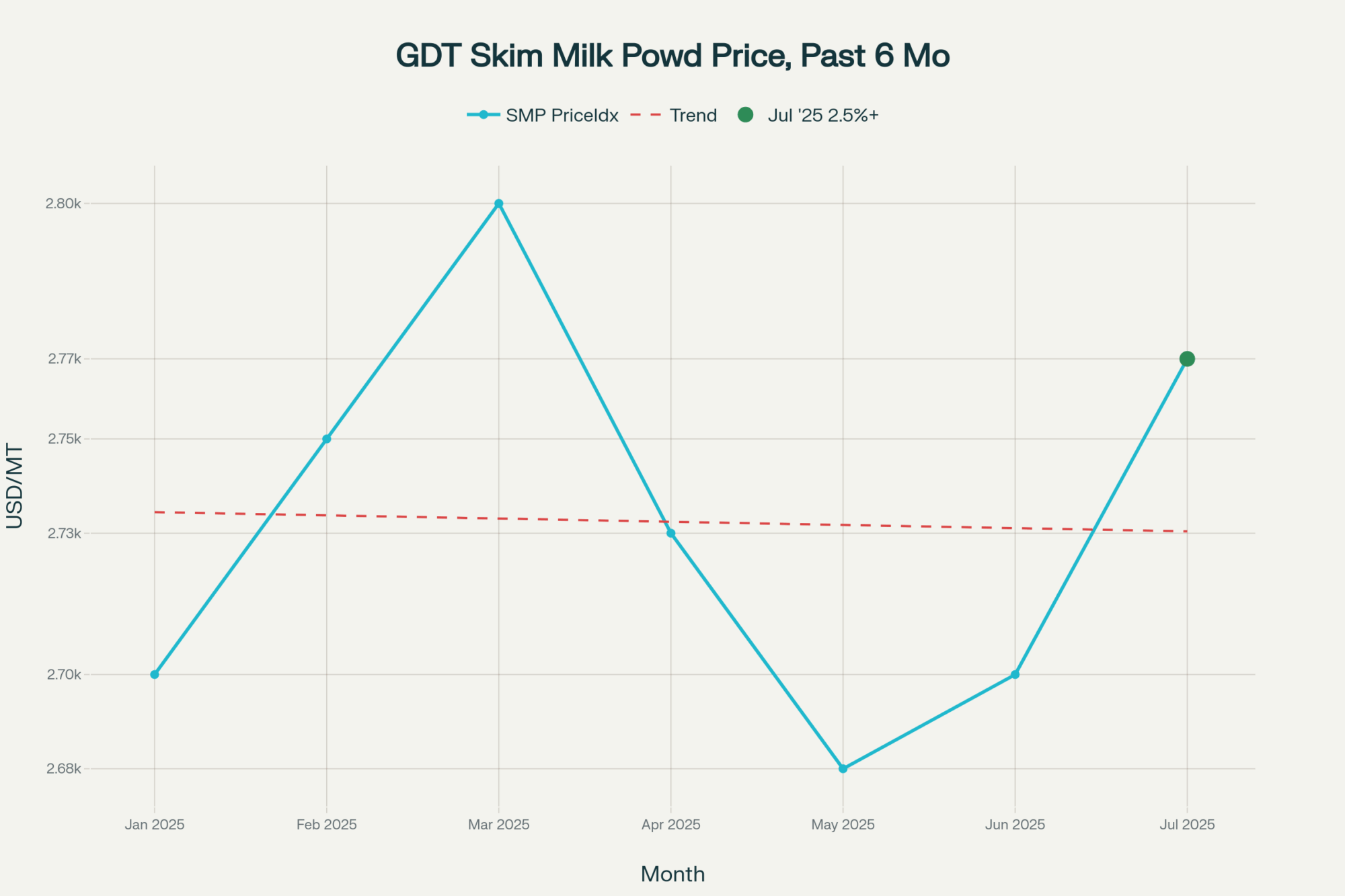
Global Dairy Trade Skim Milk Powder price index over 6 months, showing recent volatility and 2.5% gain in July 2025

The Global Dairy Trade (GDT) auction brought a touch of optimism, with skim milk powder advancing 2.5% and whole milk powder up 1.7%. However, this strength was countered by softness in butter markets, where CME spot butter fell sharply to $2.5125/lb and EEX European contracts averaged €7,099/tonne (approx. $3.70/lb USD), down 1.1% on the week. While new volume highs in milk powder sales (totaling over 24,000 tonnes) signal resilient demand from Asia, they also highlight intense margin competition amid volatile pricing.

The U.S. Department of Agriculture significantly revised its 2025 milk production forecast upward to 228.3 billion pounds, underlining an expansion narrative powered by herd growth and additional processing capacity. Europe mirrored this pattern, with EU-27+UK May collections up 0.9% but now seeing the first net negative cheese export performance of the year, reflecting global shifts in trade flows and price competitiveness.

Impact on Profitability: Strategic Cost Management Takes Center Stage

With Class III milk futures at muted levels, the upside for July and August is severely limited. Regional weather patterns are driving operational volatility—Midwest yields are rebounding, while herds in the Southern Plains battle environmental setbacks. Such contrasts create short-lived opportunities in local spot markets but reinforce the need for disciplined business strategies.

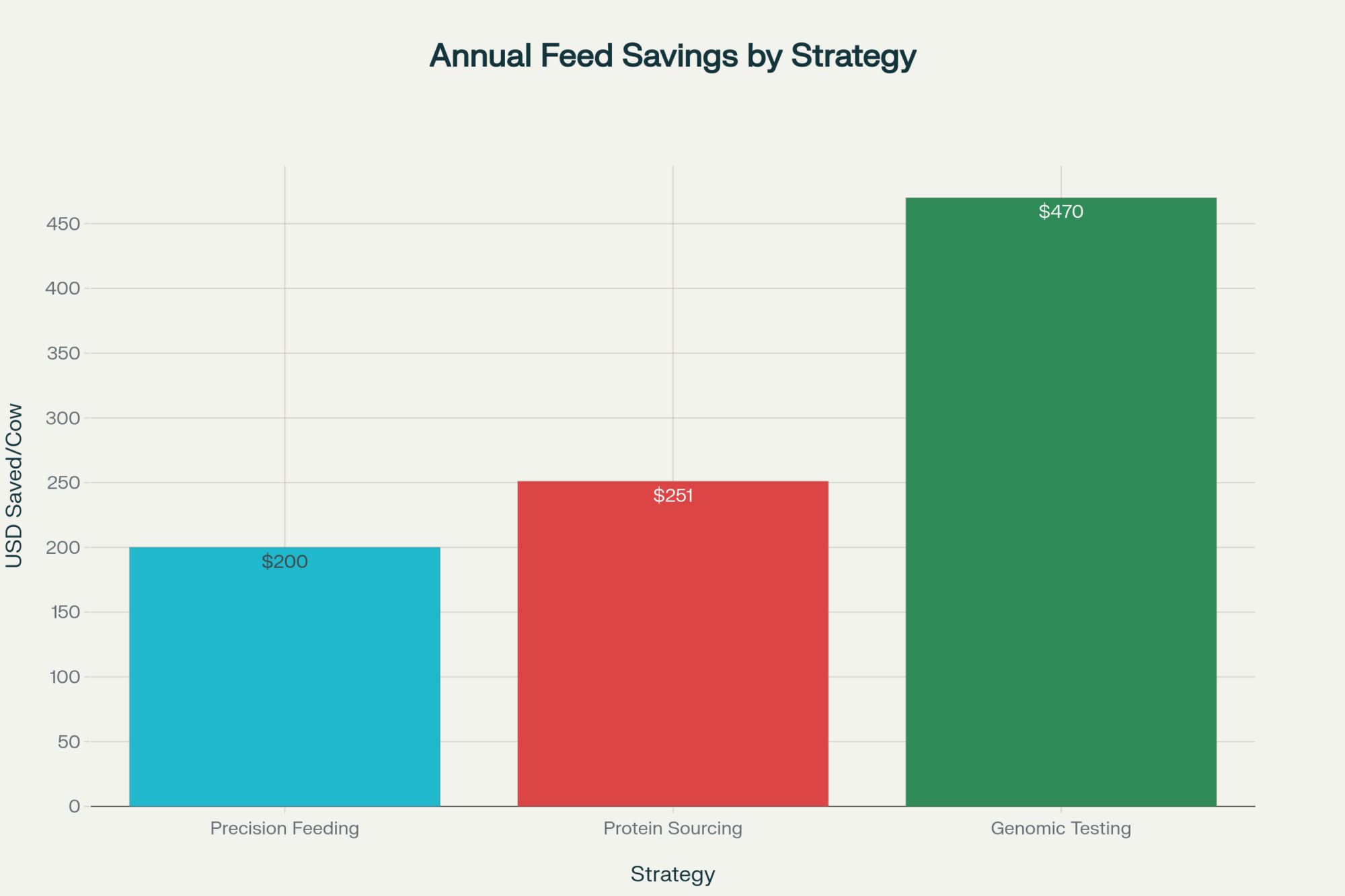
Financial performance now hinges less on volume and more on manufacturing efficiency, feed management, and risk strategy. As University of Illinois research highlights, precision feeding systems and strategic protein sourcing can result in annual cost savings of $200 to $470 per cow. While feed grain prices remain favorable for now—corn forecasts through 2026 sit near $4.20/bushel—protein markets are expected to remain firmer, requiring operations to optimize total ration economics rather than chasing ingredient bargains.

Industry Perspective and Key Risk Considerations

Katie Burgess, Dairy Market Advising Director at Ever.Ag, emphasizes this point:

“Hedging is not gambling. Hedging is when we take the risk away.”

She highlights the importance of disciplined risk management as unsettled policy and export dynamics introduce further volatility. Federal Milk Marketing Order changes, expected in 2025, along with expanded cheese processing, may challenge historical revenue baselines, requiring producers to closely monitor demand signals and cost drivers.

Consolidation trends are shifting the competitive landscape. This trend is supported by research from the Aegean Region, which demonstrates that larger operations achieve up to 26% lower per-unit costs than smaller farms by capturing scale efficiencies in feed conversion and management. Genetics and nutrition are increasingly payback-focused, with the latest TPI formula updates rewarding feed-efficient cows and component-rich milk, providing a sustained competitive advantage in markets that emphasize solids pricing.

Labor volatility remains a significant and often overlooked hidden risk. Any tightening in immigration or labor market flexibility could lead to double-digit increases in wage costs, putting pressure on productivity and making investments in automation or retention essential for maintaining cost stability.

Annual feed cost savings per cow associated with key strategies: precision feeding, protein sourcing, and genomic testing

Actionable Takeaways for Dairy Businesses

  • Prioritize component and feed efficiency: Manage for solids and optimize precision nutrition—current paybacks for technology and strategy upgrades remain strong.
  • Proactively hedge risk: Utilize price risk management tools, lock in feed positions before market volatility returns, and evaluate Dairy Margin Coverage and forward pricing insurance to mitigate downside risk.
  • Monitor global trade policy and market signals: Stay alert to shifts in Chinese demand, retaliatory export tariffs, and evolving production in the EU and Oceania, as these can rapidly alter price and margin scenarios.
  • Focus on expansions and investments that drive long-term efficiency. Implementing technology, selecting for genetic feed conversion, and fostering collaborative processing relationships deliver lasting value, rather than chasing immediate volume growth.

Outlook and Closing Perspective

As global supply trends continue to rise and cost variables remain paramount, 2025 will reward producers who align operational discipline with strategic risk management and effective cost control. The ability to capture price premiums and shed unnecessary costs, rather than simply scaling production, will define long-term winners in the new dairy economy.

At The Bullvine, we continue to provide business intelligence and strategic analysis to keep producers ahead in evolving markets. How is your operation adjusting its feed strategy for Q3? Share your insights in the comments below.

Complete references and supporting documentation are available upon request by contacting the editorial team at editor@thebullvine.com.

Learn More:

Join the Revolution!

Join over 30,000 successful dairy professionals who rely on Bullvine Weekly for their competitive edge. Delivered directly to your inbox each week, our exclusive industry insights help you make smarter decisions while saving precious hours every week. Never miss critical updates on milk production trends, breakthrough technologies, and profit-boosting strategies that top producers are already implementing. Subscribe now to transform your dairy operation’s efficiency and profitability—your future success is just one click away.
NewsSubscribe
First
Last
Consent

CME Dairy Market Report June 24th, 2025: Cheese Market Crash Delivers Another Margin-Crushing Blow

Cheese crash exposes fatal flaw in dairy risk management—$12/cwt margins despite “cheap” feed prove milk price hedging trumps input cost focus

EXECUTIVE SUMMARY: The dairy industry’s obsession with feed cost management is dangerously misguided when Class III futures crater 28 cents while corn sits comfortably below $4.50/bushel. This comprehensive CME market analysis reveals how 25 block cheese trades with zero bids created a $1.27 weekly Class III collapse, pushing income-over-feed costs below $12/cwt despite historically favorable grain prices. The brutal math exposes a 20% margin compression driven entirely by milk price destruction, not input inflation—contradicting decades of conventional wisdom that positions feed cost hedging as the primary risk management tool. Global demand destruction is overriding domestic supply fundamentals, with Mexican buyers becoming “price-selective” on $2.47 billion in annual purchases while U.S. component-adjusted production surges 3.0% year-over-year. FMMO reforms effective June 1st are creating structural pricing advantages for butterfat producers, with Class IV projected to outperform Class III by $0.60/cwt in 2026. Progressive producers implementing Dairy Revenue Protection within 48 hours and optimizing for 4.50%+ butterfat levels will capture $0.75-$1.50/cwt premiums while competitors cling to outdated volume-focused strategies.

KEY TAKEAWAYS

  • Immediate DRP Implementation Delivers Crisis Protection: With Class III below $17.00/cwt and further weakness projected, establishing Dairy Revenue Protection floors within 48 hours protects against $1.25-$1.75/cwt additional losses through August 2025—far exceeding potential feed cost savings
  • Butterfat Optimization Captures Structural Premium: Target 4.50%+ butterfat levels to access $0.75-$1.50/cwt premiums as Class IV prices maintain $0.60/cwt advantage over Class III in 2026 projections, reversing traditional protein-focused strategies
  • Component-Focused Production Trumps Volume Strategy: U.S. milk shows 3.0% component-adjusted growth versus 1.6% volume growth, yet cheese prices collapse—proving market values manufacturing solids over raw gallons, demanding strategic breeding and nutrition shifts
  • Regional FMMO Advantages Create Geographic Arbitrage: June 1st reforms increased Northeast Class I differentials to $5.10/cwt while manufacturing regions face relative disadvantages—strategic location evaluation now delivers measurable pricing benefits
  • Trading Pattern Analysis Reveals Market Paralysis: 25 block trades with zero bids versus 6 barrel bids with zero offers signals bifurcated cheese market requiring sophisticated risk management beyond traditional spot price monitoring
CME dairy futures, dairy risk management, Class III milk prices, dairy market analysis, milk price hedging

Class III milk futures plunged $0.28/cwt as cheese blocks collapsed 5.50¢ and barrels fell 4.25¢, extending a brutal week that’s pushing farm margins below break-even levels. With July Class III now at $16.98/cwt and income-over-feed costs projected to slip below $12/cwt through August, immediate risk management action is critical.

Today’s Price Action & Farm Impact

ProductClosing PriceDaily ChangeWeekly TrendDirect Impact on Farmers
Cheese Blocks$1.5950/lb-5.50¢-10.0¢ (-5.8%)Severe Class III pressure continues
Cheese Barrels$1.6150/lb-4.25¢-11.2¢ (-6.5%)Amplifies protein value destruction
Class III (JUL)$16.98/cwt-$0.28-$1.27 (-7.0%)Milk checks under severe pressure
Class IV (JUL)$18.83/cwt-$0.22-$0.44 (-2.3%)Butterfat premium maintaining
Butter$2.5350/lb+1.00¢+0.56¢ (+0.2%)Modest support for Class IV
NDM Grade A$1.2500/lb-1.00¢-1.88¢ (-1.5%)Export demand softening
Dry Whey$0.5725/lb+0.25¢+1.81¢ (+3.3%)Protein markets holding better

Market Commentary: Today’s cheese rout extends what’s becoming a devastating June for Class III valuations. Block cheese has now shed over 15¢ in two weeks, with domestic buyers reportedly “gone dark” as they await further price declines. The 25 trades in blocks today show active selling pressure, while the complete absence of bids signals market participants are stepping aside until this correction finds a floor.

Enhanced Trading Activity Analysis

Detailed Market Depth Snapshot (June 24, 2025):

ProductTradesBidsOffersBid-Ask EnvironmentMarket Sentiment
Cheese Blocks2502Sellers Only – No buying interestPanic selling
Cheese Barrels560Buyers Only – No selling interestDistressed demand
Butter022Balanced but inactiveCautious neutrality
NDM Grade A101Minimal activityDisinterest
Dry Whey232Modest interest both sidesStable engagement

Critical Market Signal: The stark contrast between blocks (25 trades, 0 bids) and barrels (5 trades, 6 bids, 0 offers) reveals a bifurcated cheese market. Block cheese is experiencing liquidation selling with no buying interest, while barrel cheese shows distressed demand with buyers present but no willing sellers. This unusual pattern suggests different end-user dynamics and potential processing disruptions affecting specific cheese formats.

Feed Cost & Margin Analysis

Current Feed Situation:

  • Corn (DEC): $4.2875/bu (down 5.5¢) – Feed costs remaining favorable
  • Soybean Meal (DEC): $295.00/ton (down $1.70) – Protein costs supportive
  • Milk-to-Feed Ratio: Severely compressed despite favorable feed prices

The Brutal Math: Despite corn trading well below $4.50 and soybean meal under $300/ton, income-over-feed costs are projected to crash below $12/cwt from March through August 2025. This represents a devastating 20% margin compression for most operations, driven entirely by collapsing milk prices rather than input cost inflation.

Production & Supply Insights

Production Surge Continues: U.S. milk production reached 19.9 billion pounds in May 2025, up 1.6% year-over-year, marking the second consecutive month of significant gains. The U.S. dairy herd expanded to 9.45 million head, the highest since August 2021.

Component Quality Rising: Fat content reached 4.31% (up 1.7% year-over-year) while protein climbed to 3.34% (up 1.2% year-over-year). Farmers are producing the highest-quality milk in years, yet the market is punishing them with lower prices – a clear signal that demand destruction is overpowering supply-side quality improvements.

Market Fundamentals Driving Prices

Domestic Demand Crisis: Retail cheese buyers have “gone dark,” holding off purchases while waiting for further declines. Domestic cheese consumption dropped 56 million pounds in Q1 2025, while weak restaurant traffic continues dampening foodservice demand.

Global Context – Mixed International Signals: Mexico remains the largest U.S. dairy export market at $2.47 billion, but Mexican buyers are “becoming more selective on pricing”. Mexico’s dairy demand was previously expected to grow 2% year-over-year in 2024, reaching over 30.4 billion pounds, but this growth is now showing signs of price sensitivity that could impact U.S. exports.

Federal Milk Marketing Order Impact Analysis

FMMO Reforms Creating New Regional Dynamics: The June 1, 2025 FMMO changes are introducing significant regional price variations:

FMMO RegionPrevious Class I DifferentialNew Class I DifferentialImpact on Regional Pricing
Northeast (Boston)$4.10/cwt$5.10/cwt+$1.00/cwt premium increase
Cuyahoga County$2.00/cwt$3.80/cwt+$1.80/cwt premium increase
Upper MidwestLower differentialsModerate increasesRegional competitiveness shifts

Key Regional Implications: The “higher-of” Class I pricing formula restoration and increased Class I differentials are creating new regional advantages for fluid milk producers. Areas with high Class I utilization will see improved pricing, while manufacturing-focused regions may face relative disadvantages as cheese markets collapse.

Forward-Looking Analysis

USDA Projections vs. Current Reality: USDA raised its 2025 milk production forecast to 227.3 billion pounds (up 0.4 billion pounds) with an all-milk price expectation of $21.60/cwt. However, with July Class III futures at $16.98/cwt, current market conditions suggest these projections may prove optimistic.

The 2026 Outlook: USDA projects milk production will grow further to 227.9 billion pounds in 2026, with the all-milk price averaging slightly lower at $21.15/cwt. Class IV prices are consistently projected to exceed Class III prices in 2026, reinforcing the butterfat premium strategy.

Regional Market Spotlight: Infrastructure Strain Intensifying

Southwest Expansion Creating Logistics Crisis: Texas milk production jumped 10.6% year-over-year, with the state adding 50,000 cows in 12 months. This rapid expansion is outpacing regional processing capacity, creating transportation bottlenecks while the trucking industry faces a record 80,000 driver shortage nationally.

Upper Midwest Processing Surge: New cheese facilities are adding 360 million pounds of annual capacity in the Upper Midwest. While positive long-term, this timing couldn’t be worse for current oversupply conditions, potentially intensifying the cheese market collapse.

Actionable Farmer Insights

Immediate Risk Management – Next 48 Hours Critical:

  • Implement DRP Coverage NOW: With Class III below $17.00 and further weakness likely, establish Dairy Revenue Protection floors for Q3/Q4 production immediately
  • Component Focus: Target butterfat levels of 4.50% or higher to capture $0.75-$1.50/cwt premiums as Class IV maintains relative strength
  • Regional Strategy: Evaluate FMMO benefits – farms in high Class I utilization areas may see improved pricing from recent reforms

Cash Flow Planning:

  • Prepare for milk checks $2.00-$3.00/cwt below budget through August
  • Lock favorable feed prices through forward contracts while corn remains below $4.50/bu
  • Establish credit lines before margins deteriorate further

Industry Intelligence

FMMO Reforms Adding Structural Changes: The June 1st Federal Milk Marketing Order changes represent the most comprehensive overhaul in over two decades. Key impacts include:

  • Updated make allowances that will generally decrease component values
  • Return to “higher of” Class I pricing providing support for fluid milk producers
  • Class I differentials increased nationwide, with significant regional variations

Processing Investment vs. Market Reality: Over $8 billion in new processing investments are coming online, with significant cheese capacity additions. This creates a dangerous timing mismatch – new supply hitting markets just as demand falters.

The Bottom Line

Today’s cheese market collapse represents a fundamental demand destruction event occurring while production reaches new highs. The stark trading patterns – 25 block trades with zero bids versus 6 barrel bids with zero offers – signal a bifurcated market in crisis.

With domestic buyers on strike and export markets becoming price-selective, traditional outlets for excess U.S. milk production are failing simultaneously. The recent FMMO reforms provide some regional relief for Class I producers, but manufacturing-focused operations face an extended period of margin compression.

Immediate Action Required: Farmers have roughly 48 hours to establish DRP protection before further Class III deterioration locks in devastating Q3 margins. Focus on butterfat optimization and regional advantages from FMMO changes – this margin compression cycle will separate survivors from casualties.

The convergence of maximum supply, minimum demand, and structural market changes creates unprecedented challenges. Those who adapt quickly to component-focused production, aggressive risk management, and regional optimization strategies will emerge stronger.

Complete references and supporting documentation are available upon request by contacting the editorial team at editor@thebullvine.com.

Learn More:

Join the Revolution!

Join over 30,000 successful dairy professionals who rely on Bullvine Weekly for their competitive edge. Delivered directly to your inbox each week, our exclusive industry insights help you make smarter decisions while saving precious hours every week. Never miss critical updates on milk production trends, breakthrough technologies, and profit-boosting strategies that top producers are already implementing. Subscribe now to transform your dairy operation’s efficiency and profitability—your future success is just one click away.

NewsSubscribe
First
Last
Consent
Send this to a friend





