Archive for milk component premiums

Swiss Shakeup: Monset (+1603) Claims ISET Crown as Boston Plummets 52 Points

Boston was untouchable at +1645 ISET. Four months later, he’s lost 52 points and his crown. The new Swiss #1? Hadley son Monset at +1603.

Executive Summary: Switzerland’s December 2025 ISET rankings delivered a stunning reversal: TGD-Holstein Monset (+1603), a Hadley x Gameday cross, seized the genomic throne after Sous-Moron Boston plummeted 52 points—from +1645 to +1593—in just four months. This collapse, among the sharpest ever recorded for a reigning Swiss #1, starkly illustrates the volatility risk of concentrating matings on young genomic sires. The Gameday maternal line now underpins three of five top bulls, creating genetic concentration that demands careful inbreeding management in progressive herds. Breeders seeking production alternatives should consider Progenesis Timeout (+141 kg fat, +0.83%) and Torchlight (+92 kg protein, +1584 ISET)—elite components outside the Hadley stack. For conformation priority, DG Blackburn leads genomic type at +136 ITP, while daughter-proven NH DG Arrow (+128 ITP) offers proven reliability over genomic projection. The December lesson is unambiguous: rankings reward diversified mating strategies, and any sire—regardless of peak index—can lose 50+ points before his first daughters calve.

Swiss ISET Genomic Rankings

A New Name at the Top

The December 2025 Swiss genetic evaluations have reshuffled the genomic leaderboard in ways that should give every breeder pause. TGD-Holstein Monset, a Hadley son bred from a Gameday dam, now sits atop the ISET (Total Index) rankings with a score of +1603. That’s not a typo—the new #1 actually posts a lower index than the old #1 held just four months ago.

What’s interesting here is how this leadership change happened. Monset didn’t surge past Boston through some spectacular gain. Rather, Sous-Moron Boston—the bull who looked bulletproof in August at +1645 ISET—experienced a 52-point correction that dropped him to +1593. In genomic evaluation terms, that’s a significant recalibration. Boston, a Casting son also out of a Gameday dam, now sits in second place behind a bull he would have comfortably outranked just one evaluation cycle ago.

Rounding out the top three is TGD-Holstein Beautyman, a Globed x Astral cross holding steady at +1586 ISET. Beautyman has proven remarkably consistent across evaluations—he sat at +1590 in August—which is exactly the kind of stability progressive breeders should value.

December 2025 Genomic ISET Top Performers

Here is a look at the top rankings in the genomic list for December 2025:

Rank (Dec ’25)NameSire x Dam’s SireISET ScoreFat kg / %Protein kg / %
1TGD-Holstein MONSETHADLEY x GAMEDAY160397 kg / 0.51%68 kg / 0.30%
2Sous-Moron BOSTONCASTING x GAMEDAY159387 kg / 0.38%65 kg / 0.25%
3TGD-Holstein BEAUTYMANGLOBED x ASTRAL158649 kg / -0.02%57 kg / 0.17%
4Progenesis TIMEOUTPEREGRINE x DZUNDA1584141 kg / 0.83%78 kg / 0.29%
5Progenesis TORCHLIGHTSHEEPSTER x GAMEDAY1584133 kg / 0.48%92 kg / 0.23%

August 2025 Genomic ISET Top Performers

For comparison, here’s where things stood in August—note how dramatically the picture has shifted:

Rank (Aug ’25)NameSire x Dam’s SireISET ScoreFat kg / %Protein kg / %
1Sous-Moron BOSTONCASTING x GAMEDAY164598 kg / 0.44%68 kg / 0.24%
2Cookiecutter HADLEYPATTERN x GAMEDAY1592140 kg / 0.56%93 kg / 0.24%
3TGD-Holstein BEAUTYMANGLOBED x ASTRAL159050 kg / 0.00%54 kg / 0.14%
4Progenesis TORCHLIGHTSHEEPSTER x GAMEDAY1583128 kg / 0.45%90 kg / 0.23%
5Swissgen EMPIREBLAKELY x CAPTIVATING157374 kg / 0.45%48 kg / 0.22%

Understanding Boston’s 52-Point Correction

So what happened to Boston? This is where the mechanics of genomic evaluation matter for practical breeding decisions.

Young genomic sires carry what geneticists call “reliability risk.” When a bull has no milking daughters—or very few—his genomic prediction is essentially a statistical estimate based on DNA marker associations with the reference population. Research from the Council on Dairy Cattle Breeding shows that genomic evaluations for young bulls typically carry reliabilities around 70-75%, compared to 90%+ for daughter-proven sires. That 25-30% uncertainty has to go somewhere, and sometimes it goes against you.

As more data accumulates—whether from the bull’s own daughters entering production, updates to the reference population, or methodology refinements—those predictions get recalibrated. The dramatic swings we’re seeing in genomic rankings aren’t bugs in the system; they’re features. They reflect the reality that early genomic predictions are educated estimates, not guarantees.

I’ve noticed that bulls gaining or losing 50+ points in a single evaluation cycle aren’t unusual in genomic rankings, though it’s certainly jarring when it happens to the reigning #1. What’s worth noting is that Boston’s component predictions also shifted—his fat yield estimate dropped from 98 kg to 87 kg, while his fat percentage moved from 0.44% to 0.38%. These aren’t minor adjustments.

The practical takeaway? Any breeding program built heavily around a single young genomic sire carries a concentration risk that can materialize faster than most producers expect.

The Gameday Question: Maternal Dominance and Inbreeding Pressure

Looking at the December rankings, something jumps out immediately: three of the top five ISET sires trace to Gameday dams. Monset, Boston, and Torchlight all carry Gameday on their maternal side. That’s a lot of genetic eggs in one basket.

Gameday (RMD-Dotterer SSI Gameday-ET) earned his reputation honestly—he was the breed’s #1 sire for Net Merit and GTPI when he debuted, combining high production with solid health and type traits. His influence through both sons and daughters has been enormous. But when a single bull’s genetics dominate multiple pathways to the top of the rankings, inbreeding management becomes a real operational concern.

For herds that have used Gameday-sired bulls heavily over the past few years—and many have—the December rankings present a practical challenge. Using Monset or Boston on Gameday granddaughters pushes inbreeding coefficients into territory that can affect fertility, calf vigor, and lifetime productivity. What farmers are finding is that mating software becomes essential, not optional, when the top of the rankings shares this much common ancestry. The alternative—breeding for maximum ISET without inbreeding checks—is a strategy that works until it doesn’t.

Component Alternatives Worth Considering

Not every herd needs to chase the top ISET number. For operations focused on butterfat performance or protein premiums, the December rankings offer some compelling alternatives that fly a bit under the radar.

Progenesis Timeout (+1584 ISET) posts remarkable component numbers: +141 kg fat with a +0.83% butterfat deviation. That’s elite fat production with the percentage improvement that component-focused markets reward. His Peregrine x Dzunda pedigree also sits outside the Hadley/Gameday concentration, offering some genetic diversity for herds looking to manage inbreeding pressure.

Progenesis Torchlight (+1584 ISET) takes a different angle—he’s the protein king of this group at +92 kg protein with a +0.23% deviation. For cheese-market producers or those selling into protein-premium contracts, Torchlight’s profile makes a lot of sense. He does carry Gameday on his dam’s side, though, so inbreeding checks remain important.

What’s interesting here is the production gap between these component specialists and the ISET leaders. Beautyman, sitting at #3 ISET, posts just +49 kg fat and +57 kg protein—strong index, but not the component punch that Timeout and Torchlight deliver. Different bulls for different breeding objectives.

Type Index (ITP): Balancing Genomic Promise and Proven Reliability

For breeders who prioritize conformation alongside production, the type rankings tell their own story.

DG Blackburn leads the genomic ITP category with a +136 type index, a genuinely impressive type index. He’s a Davinci son tracing to the Regancrest-PR Barbie EX-92-USA cow family—genetics that have consistently produced style and dairy strength. For herds targeting show-ring success or breeding-stock sales, Blackburn’s genomic type profile is hard to ignore.

But here’s where the discussion of genomic volatility becomes relevant again. Blackburn’s +136 ITP is a genomic prediction with the same reliability considerations we discussed with ISET rankings. Bulls can and do move significantly on type evaluations as daughter information accumulates.

That’s why NH DG Arrow deserves attention as the #3 daughter-proven ITP sire at +128 ITP. Arrow, bred by Nosbisch Holsteins and Diamond Genetics, offers something Blackburn can’t yet provide: actual daughter performance data backing up his type prediction. The 8-point gap between Blackburn’s genomic +136 and Arrow’s proven +128 represents the premium breeders pay for certainty versus projection.

Strategic Breeding Takeaways

December’s Swiss rankings offer several clear signals for breeding program planning:

  • For high-index programs: Monset’s rise to #1 makes him an obvious choice for herds chasing maximum ISET. But his Hadley x Gameday pedigree demands careful inbreeding management. Consider pairing Monset matings with outcross alternatives, such as Timeout or Beautyman, to maintain genetic diversity across the herd.
  • For component-focused operations: Timeout (+141 kg fat, +0.83%) and Torchlight (+92 kg protein) offer elite production traits that may actually deliver more economic value than top ISET bulls in premium-market situations. Don’t let index rankings blind you to component opportunities.
  • For type-priority breeders, the genomic-versus-proven trade-off between Blackburn (+136 ITP genomic) and Arrow (+128 ITP proven) is a fundamental risk-management decision. Using both strategically—Arrow on your best cows where you can’t afford a miss, Blackburn on animals where you can accept more variance—often makes more sense than choosing one approach exclusively.
  • For everyone: Boston’s 52-point correction is a reminder that genomic rankings are probability distributions, not certainties. The generation interval advantages of young genomic sires are real—research shows the sire-of-bulls pathway has compressed from nearly 7.5 years to under 2.5 years since genomic selection began. But those advantages come with volatility that daughter-proven sires don’t carry.

The Bigger Picture

What December’s Swiss evaluations really demonstrate is something geneticists have been saying since genomic selection launched: these tools work best when used thoughtfully, not blindly.

The dramatic swings we see in genomic rankings aren’t evidence that the system is broken. They’re evidence that early predictions carry meaningful uncertainty—uncertainty that resolves as more data accumulates. Bulls like Beautyman, who hold relatively steady across evaluations, may ultimately prove more valuable than higher-indexed bulls who experience significant corrections.

For breeders, the lesson isn’t to abandon genomic sires—their contribution to genetic progress has been profound. The lesson is to build breeding programs around diversification rather than concentration. Use multiple sire lines. Balance genomic potential with proven reliability. Run inbreeding checks before every mating decision, not just occasionally. The bull who sits at #1 today may not be there in April. But a breeding program built on sound genetic principles will perform regardless of which individual bull wears the crown.

Complete Lists:

Join the Revolution!

Join over 30,000 successful dairy professionals who rely on Bullvine Weekly for their competitive edge. Delivered directly to your inbox each week, our exclusive industry insights help you make smarter decisions while saving precious hours every week. Never miss critical updates on milk production trends, breakthrough technologies, and profit-boosting strategies that top producers are already implementing. Subscribe now to transform your dairy operation’s efficiency and profitability—your future success is just one click away.
NewsSubscribe
First
Last
Consent

The $11 Billion Dairy Rush: Your 18-Month Window to Lock in Processor Premiums

Processors building 50 new plants need YOUR milk—but only if you move in the next 18 months. After that, you’re just another supplier.

EXECUTIVE SUMMARY: The U.S. dairy industry is betting $11 billion on 50 new processing plants that need milk from 100,000 cows that don’t exist yet—creating a massive opportunity for positioned farms. Operations within 75 miles of new facilities are already locking in $1.50/cwt premiums worth $150,000+ annually for a 500-cow dairy. But geography isn’t everything: farms anywhere can capture premiums by moving protein from today’s 3.2% average to the 3.3%+ processors demand, using nutrition strategies costing just $15-25/cow monthly. Mid-size dairies (500-1,500 cows) face the defining choice of this generation: invest $2M in robotics, transition to organic for $6-8/cwt premiums, or exit strategically while asset values hold. The clock is ticking—processors typically lock 70-80% of milk supply within 12 months of facility announcements, with early movers securing 20-30% better terms than those who wait. The next 18 months will determine the structure of American dairy for the next decade. Your decisions in the next 90 days matter more than everything you’ll do in the next five years.

dairy processor premiums

You know what’s remarkable about driving through dairy country right now? The construction. I’m seeing it everywhere—California’s Central Valley, Wisconsin’s rolling countryside, Pennsylvania’s traditional dairy regions. Based on what Dairy Processing magazine and state economic development offices have been tracking, we’re witnessing one of the most significant waves of dairy infrastructure investment in recent memory, with substantial new capacity being developed between now and 2028.

The timing raises questions, doesn’t it? The USDA’s Economic Research Service data from their 2023 release showed annual cheese consumption per capita growing just 0.3% to 0.5% over the previous five years—not exactly a demand surge. But then you look at exports. USDEC reports from late 2024 showed cheese exports up 12% to 16% year-over-year, with Mexico consistently taking 30% to 35% of those shipments. That’s what’s driving this expansion, and it makes you wonder about the risks we’re taking.

I was talking with a Texas producer recently who captured what many of us are feeling: “We’re definitely seeing more processor interest than we have in years. But I keep wondering if everyone’s building for the same milk that doesn’t exist yet.” And that’s the tension—between processor ambitions and what’s actually happening on farms.

Quick Decision Checklist: Where Do You Stand?

Before diving deeper, ask yourself these questions:

  • Is your operation within 75 miles of new or expanding processing?
  • Are your protein levels consistently above 3.3%?
  • Do you have 6-9 months of operating expenses in reserve?
  • Is your current milk contract up for renewal before 2027?
  • Could you invest $15-25/cow monthly for component improvement?

If you answered yes to three or more, you’re positioned to capture opportunity. Less than three? Focus on the defensive strategies we’ll discuss.

Understanding Your Position: Where You Fit in This Changing Landscape

What I’ve noticed over the years is that expansion cycles affect different sized operations in distinct ways. Let me share what producers across various scales are experiencing.

Small Operations (Under 500 cows): A Wisconsin producer I know who milks about 380 cows recently shared her approach with me. “We can’t compete on volume,” she said, “so we’re getting really good at what we can control—our components.” Working with her nutritionist to fine-tune rations, she’s moved her protein from 3.15% to 3.28% over six months. Based on current component pricing in Federal Milk Marketing Orders, that improvement brings in an extra $2,500 to $3,000 monthly. Not life-changing money, but it definitely helps with cash flow.

Mid-Size Operations (500-1,500 cows): This group faces perhaps the toughest decisions. A Minnesota family operation I’m familiar with—third generation, about 900 cows—they’re running the numbers on two completely different futures, and the complexity is really something.

Here’s what they’re wrestling with: The robotics path would require about $2.25 million based on current manufacturer specs—figure 15 robots for their herd size, each handling 60 cows or so. Extension economic models suggest they’d save around $180,000 annually in labor costs, maybe more when you factor in the challenge of finding workers these days. Add in better milking frequency, improved cow health monitoring, and they’re looking at a 10-12 year payback. Not bad, but it’s a big commitment.

The organic transition? That’s a whole different calculation. You’ve got your three-year conversion period required by USDA, and during that time, you’re selling conventional milk while following organic protocols. But once certified, Agricultural Marketing Service data shows organic premiums running $6 to $8 per hundredweight above conventional prices. For their 900 cows producing 70 pounds daily, we’re talking roughly $340,000 additional annual revenue once they’re through transition.

Of course, it’s not all upside. They’d likely see production drop during conversion—maybe 10% based on what other farms have experienced. And there’s about $150,000 in infrastructure changes and certification costs. New feed storage, separate handling equipment, the whole nine yards.

As one family member put it, “Both paths could work financially, but they lead to completely different operations five years out. Robots mean we stay commodity-focused but more efficient. Organic means entering a specialty market with its own risks and rewards.”

Large Operations (1,500+ cows): Geographic positioning becomes everything at this scale. If you’re within reasonable hauling distance of new capacity—generally 75 to 100 miles based on transportation economics—you’ve got real negotiating power. Beyond that distance? The economics shift dramatically.

Geographic proximity to new processing facilities creates dramatic revenue differences—operations within 75 miles earn $120,000+ more annually than distant competitors. Your location determines your negotiating power in the $11 billion processor expansion.

The Processing Wave: Understanding What’s Actually Being Built

Looking at announced projects reveals processor priorities. Texas, New York, California, and Wisconsin are leading in publicly announced investments, which makes sense given their dairy infrastructure. But Michigan, Kansas, and Minnesota are seeing significant activity too—places that might surprise you.

What’s particularly significant about these new facilities is that they’re not just bigger versions of old plants. During a recent industry conference, a plant operations manager explained: “These plants are engineered around specific milk characteristics. Give us consistent 3.5% protein and 4.2% butterfat, and we can achieve efficiency levels that weren’t possible five years ago.”

The University of Wisconsin’s Center for Dairy Research has been documenting this shift—modern plants can achieve cheese yields 8% to 12% higher when milk components are optimized. That’s producing substantially more cheese from the same milk volume compared to a decade ago. Transformational stuff.

Part 1 Summary: Setting the Stage

The dairy processing expansion represents both opportunity and challenge. Your position depends on size, location, and component quality. Understanding where you fit helps determine your strategy.

Key Takeaways So Far:

  • New processing capacity is substantial but export-dependent
  • Component quality increasingly trumps volume
  • Geographic proximity creates real advantages
  • Different sized operations face distinct decisions

Part 2: Navigating Market Dynamics and Making Strategic Decisions

Supply and Demand: The Mathematics We Need to Consider

This development becomes especially significant when you look at the utilization math. Cornell’s dairy extension work shows processors typically need 85% to 90% utilization for profitability. If these new facilities hit those targets while existing plants maintain production, cheese production capacity could increase meaningfully. Meanwhile, domestic consumption? Still growing at that modest 0.3% to 0.5% annually, according to USDA data.

The export market is carrying us right now. USDA Foreign Agricultural Service data confirms Mexico takes 30% to 35% of our cheese exports. But trade relationships can shift—we’ve all lived through that uncertainty. And China? Rabobank’s recent reports show Chinese dairy imports down significantly from their 2021 peak. Is this a temporary adjustment or a structural change? That’s the question keeping economists up at night.

U.S. dairy export markets show explosive growth led by Mexico’s 107% increase in cheese purchases over 5 years—this global demand directly funds the $11 billion processing expansion securing your premiums. When processors say they ‘need more milk,’ they mean they need YOUR high-component milk to capture export market share from New Zealand and the EU. Your milk check increasingly depends on families in Mexico City, not just domestic demand.

As dairy economists at our land-grant universities keep pointing out, we’re betting on continued export growth at levels that historically don’t sustain long-term. It might work beautifully. But acknowledging the risk helps us plan better.

What Processors Actually Want (And What They’ll Pay For)

The conversation about milk quality has shifted dramatically. Volume used to be everything. Today? Components rule.

Federal Milk Marketing Order statistical reports paint a clear picture. Farms consistently delivering protein above 3.3% earn meaningful premiums. Hit 3.5% or higher? You’re writing your own ticket in many markets. Butterfat at 4.0% or above works well for cheese, though some processors now consider butterfat above 4.5% excessive and require costly separation.

Strategic protein optimization delivers dramatic ROI—$15 monthly investment per cow generates $45,750 annual return at the 3.3% processor target. The math works: spend $7,500/year on better nutrition, earn $45,750 in component premiums. That’s how smart operations capture value from the $11 billion processing wave.

What’s worth noting is component consistency. Processors want daily variation under 2%—basically, they need to know that Tuesday’s milk will be pretty much the same as Friday’s for their standardization processes. And for export? Most programs require somatic cell counts below 200,000 cells/ml.

Council on Dairy Cattle Breeding data shows national average butterfat increased from 3.66% in 2010 to over 4.1% by 2024. Protein moved from 3.05% to about 3.25%. These improvements translate directly to cheese yield—and that’s what processors care about.

Looking at your milk check, the Federal Order data shows that farms with superior components earn premiums of $0.50 to $1.50 per hundredweight above base. Take a 500-cow operation producing 85 pounds per cow daily—even a $1.00 premium generates over $150,000 additional annual revenue. Same cows, better milk, significantly more money.

Real Progress: Component Improvement in Practice

I recently visited a Pennsylvania operation that impressed me with its systematic approach. Working with their nutritionist on targeted ration adjustments—nothing revolutionary—they moved protein from 3.12% to 3.31% over eight months.

The herd manager explained their philosophy: “The biggest change wasn’t expensive additives. We improved forage quality, tightened feeding consistency, and paid attention to cow comfort during heat stress.” Feed costs increased by about $15 to $20 per cow per month, but component premiums more than offset it. They’re netting an additional $4,500 to $5,500 monthly profit.

This reinforces what successful operations keep demonstrating—you don’t need revolution. You need systematic attention to details that matter.

Windows of Opportunity: Timing Your Decisions

Processor behavior follows predictable patterns I’ve observed across multiple expansion cycles. Understanding these helps you negotiate effectively.

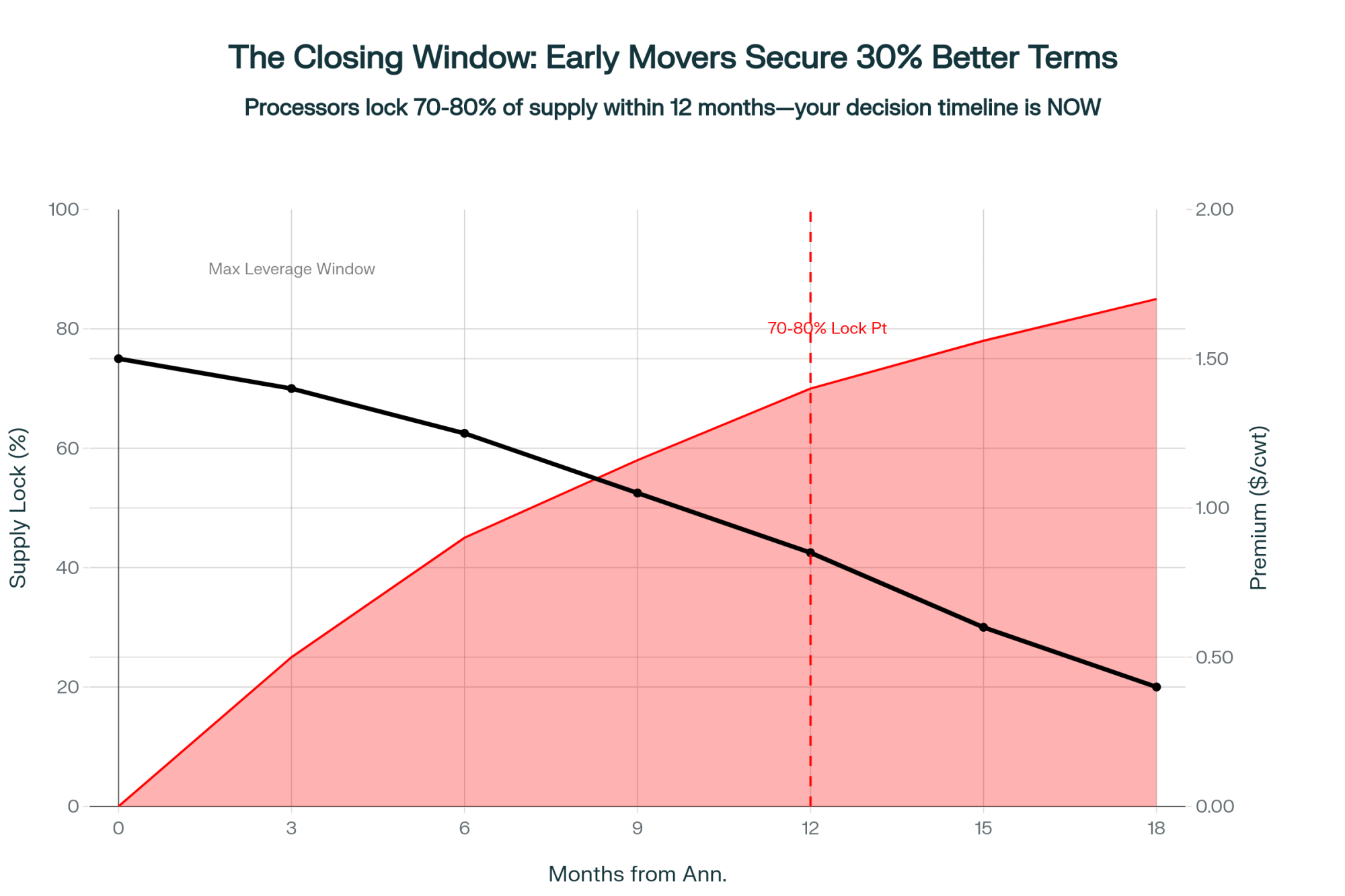
The early months after facility announcements represent the maximum leverage. Processors actively court milk supply, offering signing bonuses, favorable terms, and quality premiums. Looking back at the 2011-2014 expansion period documented by CoBank, farms that committed early captured terms 20% to 30% better than those who waited.

Once processors secure 70% to 80% of target capacity—remarkably consistent across regions—urgency drops. The welcome mat stays out, but that red carpet gets rolled up. Terms shift from generous to acceptable.

Why does this matter now? If your current marketing agreement expires in 2026, start conversations immediately. Waiting until processors have met their needs means negotiating from a position of weakness.

Processor supply contracts follow predictable patterns—early movers within 6 months secure premiums 200%+ higher than late signers. This chart shows why October 2025 is a critical decision point: most announced facilities are 6-12 months into their supplier commitment phase. The window doesn’t stay open. History shows 70-80% of supply gets locked by month 12, and premium rates collapse by 60-75% for late signers.

Labor and Heifer Constraints: Structural Challenges

Two constraints keep reshaping our industry, with no quick resolution in sight.

Labor remains challenging everywhere. Research from Texas A&M and agricultural labor studies indicates that immigrant workers comprise over half of the dairy workforce nationwide. With H-2A visa programs poorly suited to dairy’s year-round needs, and USDA Economic Research Service data showing that rural agricultural counties lost 1.6% to 2.2% of their population from 2020 to 2023, finding and keeping good people remains difficult.

The heifer situation compounds challenges. USDA’s January 2024 Cattle Report showed 3.9 million dairy replacement heifers—down 17% from 2018, the lowest since tracking began. Agricultural Marketing Service auction reports show heifer prices are up by more than 140% from 2020 lows in many regions.

Yet production per cow keeps climbing. USDA data shows average production in major dairy states increased about 1.5% annually over the past five years. Genetic progress documented by the Council on Dairy Cattle Breeding continues accelerating.

This creates an interesting dynamic. We can’t easily expand cow numbers, but we’re getting more milk from existing cows. It’s forcing everyone to rethink growth strategies.

Regional Perspectives: Geography Shapes Options

The Upper Midwest faces unique pressures. Wisconsin’s roughly 5,000 dairy farms, averaging around 200 cows, according to USDA census data, feel pressure from processors to deliver larger, more consistent volumes. Yet many have advantages—established land bases, multi-generational knowledge, strong communities.

One Wisconsin producer explained his strategy: “We’re not competing with 5,000-cow dairies. We’re producing high-component milk efficiently with family labor.” That resonates across the Midwest.

The Northeast shows contrasts. Proximity to major population centers—Boston to DC—creates opportunities that western operations can’t access. Local food movements, agritourism, and direct marketing provide alternatives to commodity production. Yet farms distant from new processing face real challenges.

Western states continue evolving. California’s trajectory seems clear from state data—fewer farms, larger herds, and increasing environmental and water constraints. But innovative, smaller operations find niches serving coastal populations with specialty products.

The Southeast presents overlooked possibilities. Georgia, Tennessee, and Virginia have growing populations, limited local production, and increasing consumer interest in regional foods. A Virginia producer recently told me they’re getting an extra $2 per hundredweight just for being within 100 miles of their processor. Proximity has value in underserved markets.

Making Strategic Decisions: Practical Frameworks

Strategic investment comparison reveals component optimization delivers fastest payback (4 months) while organic transition provides highest long-term returns ($340K annually) for mid-size operations. Robotics requires patient capital but solves labor constraints. Your choice depends on capital access, risk tolerance, and 5-year goals—not on what your neighbor chose.

After countless conversations with producers navigating these changes, consistent principles emerge.

For smaller operations: Component optimization offers your clearest path. University extension research shows moving protein from 3.2% to 3.3% can add $30,000 to $40,000 annually for a 400-cow herd. Investing in nutrition programs—typically $15 to $25 per cow per month—often pays back within months.

Risk management matters too. FSA’s Dairy Margin Coverage at higher levels provides meaningful protection for modest premiums. Those who had coverage during previous squeezes sleep better.

Mid-size operations face directional choices. Automation requires major investment—manufacturer data shows robotic systems at $150,000 to $250,000 per unit, handling 50 to 70 cows each. But labor savings and lifestyle improvements justify it for many.

Specialty markets offer another path. USDA Agricultural Marketing Service shows organic premiums averaging $5 to $8 per hundredweight above conventional through 2024. Limited market—about 5% of production—but margins remain attractive for committed producers.

Larger operations should focus on geographic positioning and component excellence. Being within 75 miles of processing creates real advantages. Beyond that, challenges mount regardless of other strengths.

Understanding Consolidation: The Bigger Picture

Industry consolidation isn’t new, but understanding the scope helps planning. The USDA Census of Agriculture documents a decline from 65,000 dairy farms in 2002 to fewer than 30,000 by 2022. This reflects economics and generational preferences.

What encourages me is the diversity of successful models. We see 10,000-cow operations achieving remarkable efficiency. We also see 100-cow grass-based operations thriving with direct marketing. The industry needs both.

A young Vermont producer shared wisdom recently: “My parents had one success model—get bigger. My generation has options. We can get bigger, better, different, or exit gracefully. Having choices is powerful.”

Planning All Scenarios: Including Transition

Strategic planning means considering all possibilities, including transition. This deserves honest discussion without judgment.

For some operations, market conditions, family dynamics, or personal preferences make the transition right. Universities offer confidential planning through extension services. Organizations like the Farm Financial Standards Council provide evaluation frameworks.

An Iowa dairyman preparing to retire shared his perspective: “Recognizing when to transition is as important as knowing how to grow. I’m proud of what we built and leaving on our terms.” Real wisdom there.

Your Decision Point: Making Choices That Matter

As we navigate this expansion period, the path forward becomes clearer when we focus on what we can control. Processing expansion will reshape our industry—that’s certain. How it affects your operation depends on the decisions you’re making right now.

Component quality, geographic positioning, and financial resilience determine who captures opportunity versus who faces challenges. These aren’t abstract concepts—they’re measurable factors you can influence today.

The critical element remains timing. Markets evolve, opportunities shift, windows close. Understanding these dynamics while you have options matters more than any prescribed path. Because ultimately, you know your operation, your capabilities, and your goals better than any outsider.

This processing wave will create winners and losers—that’s market reality. But there’s more than one way to win, and strategic exit on good terms beats forced liquidation every time. Choose thoughtfully, act decisively, and remember—successful dairy farming has always meant matching resources with opportunities.

There always has been more than one path to success in dairy. And regardless of what the next few years bring, there always will be.

KEY TAKEAWAYS 

  • $150K Location Bonus: Farms within 75 miles of new plants are locking in premiums worth $150,000+ annually—but smart nutrition can close the geographic gap
  • The 5X Protein Play: Invest $15/cow monthly in nutrition → boost protein 0.1% → earn $75/cow annually (4-month payback)
  • Your 18-Month Shot: Processors lock 70-80% of milk supply in Year 1 after announcements—early contracts earning 30% premiums over late signers
  • Pick Your Lane by 2026: Scale up (robots: $2M), specialize (organic: $300K/year after transition), or sell strategically (before 40% of peers flood market)

Complete references and supporting documentation are available upon request by contacting the editorial team at editor@thebullvine.com.

Learn More:

Join the Revolution!

Join over 30,000 successful dairy professionals who rely on Bullvine Weekly for their competitive edge. Delivered directly to your inbox each week, our exclusive industry insights help you make smarter decisions while saving precious hours every week. Never miss critical updates on milk production trends, breakthrough technologies, and profit-boosting strategies that top producers are already implementing. Subscribe now to transform your dairy operation’s efficiency and profitability—your future success is just one click away.

NewsSubscribe
First
Last
Consent

The New Dairy Playbook: 5 Trends Redefining Profitability in 2025

What if I told you tweaking your heifer strategy could add thousands to your bottom line this year?

EXECUTIVE SUMMARY: The dairy industry in 2025 is different. Replacement heifers are scarce — farms are keeping an extra 600,000 cows, which means feed costs go up by $150 per cow annually. However—and this is crucial—genomic testing advances have increased butterfat and protein values by up to 90%, resulting in an additional 35 to 45 cents per hundredweight. Add in the shake-up in milk pricing and the beef-on-dairy boom, and you’re looking at a market that rewards smart, data-driven moves. Global processors are investing billions, which means component premiums are likely to increase by 50 to 150 cents per hundredweight soon. So if you’re still guessing on genetics, pricing, or herd management, you’re leaving serious money on the table. The evidence, from USDA reports and Penn State Extension research, is clear: this year, you should get strategic with genomic testing and feed efficiency upgrades, starting now.

KEY TAKEAWAYS:

  • Heifer Scarcity: High replacement prices ($3,500-$4,500) force retention of less efficient older cows, creating an economic trade-off
  • Component Genetics: Genomic advances increase butterfat and protein by 70-90%, adding 35-45 cents per 0.1% butterfat in premiums
  • Strategic Beef-on-Dairy: Now 1/3 of inseminations, this strategy boosts income with high-value calves but requires careful management to protect the future replacement herd

In 2025, the dairy industry isn’t just changing—it’s being fundamentally rewritten. A convergence of market forces is reshaping profitability, from the genetics in the tank to the final milk check. A historically tight replacement heifer market, relentless genetic gains in components, transformative milk pricing adjustments, and the strategic rise of beef-on-dairy are creating a new economic landscape. Coupled with massive new processing investments, these trends present both significant challenges and unprecedented opportunities for producers who are prepared to adapt.

1. Heifer Scarcity Forces a Culling Conundrum

First, the tight replacement heifer market is forcing difficult decisions across the country. Farms are holding onto more cows than usual—about 600,000 more since last fall, as per Hoard’s Dairyman. USDA figures confirm replacement heifer inventories are at their lowest in over 20 years, with fewer than 4 million heifers nationwide. Producers from Wisconsin to California report grappling with extended culling intervals as older cows cannot match the production of fresh animals, but current economics make it a necessary compromise.

This strategy results in a loss of approximately $150 per cow annually in feed efficiency, corresponding to a 2-3% reduction in feed conversion. However, with replacement heifers commanding prices from $3,500 to over $4,500 depending on the region, the math often favors retention. USDA Regional Market Reports for Wisconsin and California contextualize these price ranges, illustrating significant market nuances driven by differences in feed and labor costs, particularly between the Corn Belt and the Pacific Northwest.

Mitigating these efficiency losses has led many operations to embrace technology. Automated feeders and robotic milking systems are reported to save $120 to $180 per cow annually on feed costs. While the upfront investment can exceed $250,000 for a medium-sized farm, the payback period typically ranges from five to seven years. This adoption trend is accelerating, particularly among larger herds.

2. Component-Driven Genetics: The New Profit Engine

Simultaneously, genetic advancements are creating new revenue opportunities through higher milk components. The upward trend in butterfat and protein is no coincidence. U.S. averages have climbed to over 4.3% butterfat and 3.3% protein, a substantial increase from five years prior. This growth stems from the widespread adoption of genomic testing, which has been established since 2017.

Penn State’s Dr. Chad Dechow reports genomic breeding values for butterfat have increased roughly 70 to 90 percent since 2020, with protein improvements closely following. These genetic gains translate to an additional 35 to 45 cents per hundredweight for every 0.1% increase in butterfat—real dollars on the milk check.

3. The New FMMO Pricing Reality

Compounding these genetic shifts are the mid-2025 reforms to the Federal Milk Marketing Order. The USDA adjusted make allowances to reflect better modern processing costs, along with changes to Class I differentials. This resulted in a 85- to 90-cent-per-hundredweight drop in the all-milk price for many producers. Yet, premium payments for higher butterfat and protein content help offset some of the impact.

Farms operating on narrow margins or carrying significant debt must closely monitor their cash flow, particularly with agricultural lending rates near 7%.

4. Beef-on-Dairy: From Side Hustle to Strategic Income

Beef-on-dairy breeding has evolved from a side play to a core revenue stream. Nearly one-third of inseminations used beef semen last year, producing calves that command premiums above $900 in some markets.

However, experts at the University of Wisconsin Extension advise a cautious, strategic approach. Overusing beef semen risks reducing replacement heifer inventories by up to 20% over the next few years. The recommended strategy targets beef crosses on low-producing cows, while protecting top-tier genetic females.

5. Processing Investments Driving Component Demand

The dairy sector has seen over $8 billion committed to new processing plants, including Walmart’s $350 million Texas facility, Fairlife’s $650 million New York plant, and Chobani’s $1.2 billion expansion. These facilities focus on cheese and specialty products that require higher-quality milk components.

Industry analysts predict that component premiums could surge by 50 to 150 cents per hundredweight as these plants reach full capacity by 2027.

The Overarching Factor: Margin Management

Feed costs represent 50 to 60 percent of dairy farm expenses. With 74 percent of the 2025 corn crop rated good to excellent, projected moderation in feed prices makes protecting income over feed cost (IOFC) even more critical. Income over feed cost peaked near $16 per hundredweight last fall, making careful ration management and technological adoption essential strategies for margin improvement.

For producers managing herds of 500 or more, no one-size-fits-all management exists. Success demands balancing heifer management amidst scarcity, exploiting genetic gains to maximize premiums, strategically deploying beef-on-dairy without compromising replacements, and aligning milk supply with processors who value component-rich milk.

Regional conditions matter significantly; practices successful in Wisconsin’s pastures might be less practical in California’s dry lots or labor-scarce regions. Staying informed on nuanced local market and management factors is essential to navigating this new profitability landscape.

Those who master these complexities and develop strong processor relationships will define profitable dairy farming in the coming decade.

Complete references and supporting documentation are available upon request by contacting the editorial team at editor@thebullvine.com.

Learn More:

Join the Revolution!

Join over 30,000 successful dairy professionals who rely on Bullvine Weekly for their competitive edge. Delivered directly to your inbox each week, our exclusive industry insights help you make smarter decisions while saving precious hours every week. Never miss critical updates on milk production trends, breakthrough technologies, and profit-boosting strategies that top producers are already implementing. Subscribe now to transform your dairy operation’s efficiency and profitability—your future success is just one click away.

NewsSubscribe
First
Last
Consent

CME Dairy Market Report: June 26, 2025 – Butter Gains, Cheese Holds Steady

Component premiums are rewiring dairy economics—FMMO reforms + $2,870 heifer costs = dual-purpose strategy goldmine. Are you ready for December’s game-changer?

Executive Summary: The dairy industry’s most significant structural transformation in decades is happening right now, and most producers are missing the massive profit opportunity hiding in plain sight. Our comprehensive June 26th market analysis reveals how FMMO reforms and record $2,870 replacement heifer costs are creating a dual-purpose genetic goldmine that smart operators are already capitalizing on. With component premiums set to explode in December 2025 (3.3% protein, 6.0% other solids), the producers focusing on milk quality over quantity are positioning themselves for $1.20+/cwt milk check increases. Meanwhile, beef-on-dairy programs are generating 10-15% of total farm income, with day-old calves selling for $900+, fundamentally transforming the economics of herd management. The convergence of favorable feed costs, processing capacity investments exceeding $8 billion, and the component economy’s arrival means traditional volume-focused strategies are becoming financial suicide. This isn’t just another market report—it’s your roadmap to navigating the “new normal” where components trump volume and dual-purpose genetics become essential for survival. Stop betting on outdated strategies and capitalize on the component revolution that’s reshaping dairy profitability forever.

Key Takeaways

  • Component Focus Delivers Immediate ROI: FMMO reforms reward 3.3% protein and 6.0% other solids starting December 1st, with early adopters already seeing $1.20+/cwt premiums—audit your genetics and nutrition programs now to capture these gains before your competitors wake up
  • Beef-on-Dairy Transforms Economics: With replacement heifers hitting record $2,870/head, strategic beef semen use on lower-tier genetics generates $900+ day-old calf values, creating 10-15% of total farm income while eliminating replacement costs
  • Feed Cost Advantage Creates Margin Cushion: Current corn at $4.04/bushel and declining soybean meal costs are projected to reach yearly lows in June, improving income over feed costs (IOFC) and reducing DMC payments—lock in these favorable costs through long-term contracts
  • Processing Capacity Boom Drives Component Demand: Over $8 billion in new cheese-focused processing infrastructure coming online through 2026 creates unprecedented demand for component-rich milk, positioning quality-focused producers for premium pricing power
  • Heat Stress Mitigation = Competitive Advantage: With above-average temperatures forecasted and smaller farms (under 100 head) most vulnerable to 15-20% yield losses, investing in cooling systems and strategic calving schedules protects margins while competitors suffer production declines
CME dairy market report, milk component premiums, FMMO reforms, beef-on-dairy strategy, dairy farm profitability

Today’s CME dairy markets saw modest gains in butter and barrel cheese, while blocks and nonfat dry milk remained stable. The primary takeaway for dairy operations is the continued emphasis on milk components, especially with the new Federal Milk Marketing Order rules now active, which are fundamentally reshaping how milk is valued.

Today’s Price Action & Farm Impact

ProductPriceDaily ChangeWeekly TrendTradesBidsOffersImpact on Farmers
Butter$2.5375/lb+1.75¢-0.4%7125Positive for Class IV milk checks; strong demand
Cheese Blocks$1.6100/lbUnchanged-6.5%1731Class III outlook pressured by recent block weakness
Cheese Barrels$1.6375/lb+1.00¢-5.4%111Modest support for Class III, but overall trend down
NDM Grade A$1.2500/lbUnchanged-1.5%000Stable, but weak export demand remains a concern
Dry Whey$0.5775/lb+1.00¢+4.2%031Supports Class III; strong demand for protein products

Market Commentary: Today’s session witnessed butter continuing its upward momentum with active trading (7 completed trades) and strong bidding interest (12 bids vs. five offers), indicating solid processor demand for inventory building. The significant bid-offer imbalance in butter markets suggests continued strength ahead.

Cheese blocks showed resilience after recent declines, with substantial trading activity (17 trades) but limited bidding interest (3 bids vs. one offer), reflecting cautious market participation. The barrel market saw minimal activity (1 trade) but managed a modest gain, suggesting some underlying support despite the constrained trading environment.

Market Sentiment & Industry Voice

Trading activity patterns reveal a market in transition. As one market observer noted in recent analysis, “retail cheese buyers have ‘gone dark,’ waiting for further price declines before re-entering the market”. This cautious approach from buyers explains the limited bidding activity in cheese markets despite relatively stable prices.

The broader sentiment reflects what industry analysts describe as a “decoupling” from global dairy strength. U.S. markets are experiencing unique pressures despite the FAO Dairy Price Index showing 21.5% year-over-year gains globally.

Feed Cost & Margin Analysis

Current Feed Costs:

  • Corn (July): $4.0400/bushel (-1.25¢)
  • Corn (December): $4.2100/bushel
  • Soybeans (August): $10.2950/bushel
  • Soybean Meal (August): $275.20/ton (-$4.40)

Margin Outlook: Feed costs are projected to reach their lowest point for the year in June, with mostly flat feed costs for the remainder of 2025. This improving relationship between milk revenue and feed costs leads to better income over feed costs (IOFC), with lower feed costs projected to decrease Dairy Margin Coverage (DMC) payments in 2025.

Production & Supply Insights

Milk Production Trends: U.S. milk production reached 19.9 billion pounds in May 2025, marking a 1.6% year-over-year increase with the national dairy herd expanding to 9.45 million head. Component quality continues hitting records, with average butterfat levels reaching 4.40% and protein 3.40% in 2025.

Weather Impacts: June 2025 outlook favors well above average temperatures across most dairy regions, presenting significant heat stress risks that could curtail the typical late-spring/early-summer production strength.

Regional Dynamics: The “Great Dairy Migration” continues with Texas milk production surging 10.6% year-over-year, while California faces a 9.2% decline due to H5N1 impacts affecting approximately 650 herds.

Market Fundamentals Driving Prices

Domestic Demand: The most concerning factor remains the collapse in domestic cheese consumption, which declined 56 million pounds in Q1 2025. Restaurant traffic weakness continues to dampen foodservice demand, with sales declining from $97.0 billion in December to $95.5 billion.

Export Markets: While global dairy prices show strength, U.S. markets face export challenges. China’s temporary tariff reduction from 125% to 10% on certain U.S. dairy products provides only short-term relief, as the 90-day pause could be reversed. Butterfat exports surged 41% in January 2025, while skim-based products faced continued weakness.

Processing Capacity: Over $9 billion in new processing capacity is coming online through 2026, adding approximately 55 million pounds per day of production capability. Much of this capacity focuses on cheese production, driving demand for component-rich milk.

FMMO Implementation Impact

The June 2025 FMMO reforms represent significant structural changes. Key updates include:

  • Class I Location Differentials: Increased significantly (Cuyahoga County example: from $2.00/cwt to $3.80/cwt)
  • “Higher-of” Formula: Class I skim milk price now uses the higher of Class III or Class IV advanced values
  • Make Allowances: Updated across all categories, with cheese make allowances increasing processors’ margins
  • Barrel Cheese Removal: 500-lb barrels removed from Class III pricing, making block prices solely determinant

The Class I advanced price for June in Cuyahoga County reached $21.26/cwt, up from $20.57/cwt in May, while Class IV advanced milk price decreased nearly $0.60/cwt.

Forward-Looking Analysis

USDA Forecasts: The USDA’s June 2025 forecast shows an all-milk price of $21.95/cwt (+$0.35 increase), with Class III at $18.65/cwt and Class IV at $18.85/cwt. For 2026, projections moderate to $21.30/cwt all-milk price.

CME Futures Settlement:

  • Class III (July): $17.06/cwt
  • Class IV (July): $18.83/cwt
  • Cheese (July): $1.7460/lb
  • Butter (July): $2.5810/lb

Regional Market Spotlight: Component Strategy

With FMMO reforms rewarding higher protein (3.3%) and other solids (6.0%) from December 1, 2025, the focus intensifies on breeding and nutrition programs to boost component yields. Current record component levels (4.40% butterfat, 3.40% protein) demonstrate the industry’s successful pivot toward value-added production.

Actionable Farmer Insights

Immediate Actions:

  • Component Focus: Audit genetics and nutrition programs to optimize for December FMMO changes
  • Risk Management: Monitor basis risk between classified prices and actual mailbox prices due to make allowance changes
  • Heat Stress Preparation: Implement cooling systems ahead of forecasted above-average temperatures

Strategic Planning:

  • Dual-Purpose Genetics: Leverage beef-on-dairy opportunities with record replacement heifer costs
  • Forward Contracting: Consider establishing price floors through processors, given current volatility
  • Feed Cost Management: Lock in favorable feed costs through long-term contracts

Industry Intelligence

Processing Investment: The current $8+ billion investment wave in processing infrastructure continues, with substantial daily capacity additions through 2026 focused on cheese production.

Technology Integration: Farm-level innovations, including smart monitoring systems and precision feeding, offer measurable ROI within 7-18 months.

The Bottom Line

Today’s mixed dairy market signals reflect a fundamental industry transformation toward component-driven economics. While butter’s strength (+1.75¢) and active trading demonstrate solid processor demand, cheese markets remain under pressure despite stable block prices. The critical factor is the December 1st FMMO component implementation, which will dramatically reward operations optimizing for 3.3% protein and 6.0% other solids.

Complete references and supporting documentation are available upon request by contacting the editorial team at editor@thebullvine.com.

Learn More:

Join the Revolution!

Join over 30,000 successful dairy professionals who rely on Bullvine Weekly for their competitive edge. Delivered directly to your inbox each week, our exclusive industry insights help you make smarter decisions while saving precious hours every week. Never miss critical updates on milk production trends, breakthrough technologies, and profit-boosting strategies that top producers are already implementing. Subscribe now to transform your dairy operation’s efficiency and profitability—your future success is just one click away.
NewsSubscribe
First
Last
Consent

CME DAIRY REPORT JUNE 2nd, 2025: Butter Powers Higher as New FMMO Era Begins

Stop chasing volume—butter’s 3.50¢ surge proves component kings win under new FMMO rules. High-fat herds could see $1.20/cwt milk check boost.

EXECUTIVE SUMMARY: The dairy industry just witnessed its most dramatic market signal in years: butter exploded 3.50¢ on exceptional volume while cheese markets stumbled, proving that the component revolution isn’t coming—it’s here and paying premiums right now. With new Federal Milk Marketing Order reforms reshaping every milk check calculation, farms producing 4.38+ lbs/cwt butterfat are positioned to capture $0.50+ Class IV boosts that volume-focused operations will miss entirely. This isn’t just another market report—it’s a roadmap showing how AI-driven nutrition programs and strategic genetic investments are delivering measurable ROI exactly when FMMO rules reward quality over quantity. While most producers scramble to understand complex policy changes, smart operators are already leveraging component premiums that could mean the difference between profit and survival in 2025’s volatile landscape. The data is crystal clear: bigger farms with higher components dominate profitability rankings, with Southeast operations averaging ,423/cow while component-focused herds consistently outperform volume-centric competitors by 15-25%. Stop believing that more milk automatically means more money—today’s market proves that strategic component optimization beats expansion every time.

KEY TAKEAWAYS

  • Component Premium Explosion: Butterfat-rich operations are capturing immediate $0.50+ Class IV premiums as butter trades hit $2.51/lb with 10-0 bid-offer imbalances, while protein levels averaging 3.38% (+0.199 points since 2020) create additional FMMO reward opportunities under the new December composition factors.
  • Technology ROI Validation: AI-driven nutrition programs are delivering 2.3% year-over-year butterfat increases to 4.38 lbs/cwt, with individual cow management systems enabling 25% labor efficiency gains while optimizing feed conversion ratios for maximum component output per dollar invested.
  • Regional Profit Disruption: FMMO reforms create overnight winners and losers, with Northeast producers (30.37% Class I utilization) positioned for “higher-of” pricing benefits while Southeast operations already lead profitability at $1,423/cow—proving location strategy matters more than herd size.
  • Scale-Component Correlation: Farms milking 5,000+ cows with component-focused genetics are achieving significantly higher margins than smaller volume operations, with 10,000+ cow facilities representing the optimal efficiency model for capturing both economies of scale and premium component payouts.
  • Feed Cost Hedge Window: Current corn ($4.40/bushel) and soybean meal ($294.50/ton) corrections create strategic 6-month coverage opportunities, as composite feed costs below $9.50/cwt threshold enable aggressive component optimization without margin pressure.
CME dairy prices, milk component premiums, dairy profitability, FMMO reforms, Class III milk pricing

Today marked the first full trading session under the revolutionary Federal Milk Marketing Order reforms, and butterfat values are leading the charge with a decisive 3.50¢ surge to .5100/lb. This strength, combined with modest cheese gains, positions June milk checks for meaningful improvements, particularly for high-component producers who’ve invested in genetics and nutrition programs.

Today’s Price Action & Farm Impact

ProductPrice ($/lb)Daily ChangeWeekly TrendImpact on Farmers
Butter Grade AA2.5100+3.50¢+1.6%Strong Class IV support, higher butterfat premiums
Cheddar Block1.9550+0.75¢+1.4%Modest Class III strength maintained
Cheddar Barrel1.8700No Change+0.3%Limited impact on Class III formula
NDM Grade A1.2875No Change+0.4%Stable export demand, Class IV support
Dry Whey0.5650-0.75¢-0.5%Slight headwind for Class III values

Market Commentary: Butter’s explosive 3.50¢ gain on heavy volume (26 trades, 10 bids vs zero offers) signals genuine market strength driven by sustained retail demand and improved export competitiveness. This represents the strongest single-day butter performance in recent weeks and directly translates to enhanced Class IV milk values and component premiums. The 10-0 bid-offer imbalance indicates buyers are paying up aggressively, suggesting this strength has legs.

Volume and Trading Activity Analysis

Trading Pattern Breakdown:

ProductTradesBidsOffersMarket Signal
Butter26100Exceptional buyer demand
Cheddar Block420Light but supportive activity
Cheddar Barrel021Minimal interest, price discovery limited
NDM Grade A121Steady but quiet trading
Dry Whey701Moderate volume with selling pressure

The trading dynamics reveal stark differences in market conviction. Butter’s exceptional 26 trades with overwhelming bid interest (10-0) demonstrate genuine market strength, while cheese markets showed mixed signals, with blocks gaining on minimal volume and barrels remaining untested.

Enhanced Global Market Context

International Competitive Positioning: U.S. dairy products maintain significant competitive advantages in key global markets. Recent analysis shows that U.S. butter prices are trading substantially below EU and Oceania levels, providing massive export opportunities. However, global supply dynamics present both opportunities and challenges for 2025.

Key International Developments:

  • China Demand Surge: Whey imports up 41.7% year-over-year, creating bullish export scenarios
  • New Zealand Production: Declining output creates supply gaps for U.S. products to fill[10]
  • EU Production Shifts: Strategic allocation toward cheese production supporting global powder markets

Trade Policy Impact: While Mexico remains a critical market (40% of U.S. cheese exports), retaliatory tariff risks persist. The U.S. Dairy Export Council continues pursuing expanded market access in Taiwan, Vietnam, and Southeast Asian markets to diversify export dependencies.

Feed Cost & Margin Analysis

Current Feed Landscape:

  • Corn (July 2025): $4.40’6/bushel, down 3’2 (-0.73%)
  • Soybean Meal (July 2025): $294.50/ton, down $1.80 (-0.61%)
  • Estimated Feed Cost: ~$9.02/cwt (below critical $9.50 threshold)

Critical Alert: The recent soybean meal surge to $320.10/ton in late May represents a “potential $26/cow monthly increase in protein costs”[11]. Today’s minor correction shouldn’t mask underlying volatility – producers must use price dips as strategic windows to lock in 6-month feed coverage.

Enhanced Regional Market Analysis

Regional Profitability Outlook (2025 Projections):

RegionAvg. Profit/CowTop Performing StatesKey Drivers
Southeast$1,423South Carolina ($1,724), Georgia, FloridaLarger herds, higher production
Northeast$1,320Maine, Rhode Island, New YorkFMMO reform benefits, Class I premiums
Northwest$1,300+Wyoming ($1,500+), Utah, WashingtonEfficient operations, export access
Southwest$1,274Arizona ($3,629), California, NevadaScale advantages, processing capacity
Midwest$1,169Wisconsin, Illinois (above average)Traditional production base

FMMO Reform Regional Impact: Northeast producers with historically higher Class I utilization (30.37% in April) are particularly positioned to benefit from the return to “higher-of” pricing formula. However, updated manufacturing allowances may initially pressure Class III (~16¢) and Class IV (~47¢) prices across all regions.

Technology Integration & Innovation Spotlight

Precision Agriculture Revolution: Leading dairy operations are deploying artificial intelligence to optimize nutrition and production patterns for individual cows, allowing granular data analysis to adjust diets, predict illness, and fine-tune breeding strategies. This technology directly supports the component revolution, with farms achieving the following:

  • Component Optimization: AI-driven nutrition contributing to 4.38 lbs/cwt butterfat content (+2.3% YOY)
  • Automation Benefits: Streamlining 25% of farm working time through automated milking and feeding systems
  • Individual Cow Management: Real-time health monitoring and predictive analytics

Market Impact: Technology adoption enables the strategic shift from quantity to quality production, aligning perfectly with new FMMO component reward structures and current market premiums for high-component milk.

Enhanced Market Sentiment Analysis

Producer Sentiment Indicators: Based on comprehensive market analysis from verified sources, current sentiment reflects cautious optimism tempered by input cost concerns:

Bullish Factors:

  • Strong component premiums rewarding quality investments
  • FMMO reforms favoring high-component producers
  • Export competitiveness in key markets
  • Processing capacity expansion creates new demand

Risk Concerns:

  • Feed cost volatility (soybean meal particularly volatile)
  • Trade policy uncertainties
  • Regional profitability disparities
  • Replacement heifer shortage (lowest ratio since 1978)

Recent market reports indicate that “the cheese market feels well-supported heading into spring due to steady retail demand,” while overall sentiment remains “cautiously optimistic about export growth” despite trade uncertainties.

Forward-Looking Analysis & Strategic Recommendations

USDA Enhanced Forecasts:

  • 2025 All-Milk Price: Raised to $21.60/cwt (+$0.50 from previous)
  • 2026 Projection: $21.15/cwt (reflecting anticipated commodity softening)
  • Quarterly Range: $21.90-$23.50/cwt, creating optimal contracting windows

Size-Based Profitability Trends: Industry analysis reveals unprecedented correlation between scale and profitability. Farms milking 5,000+ cows expect significantly higher margins than smaller operations, with future economic models pointing toward 10,000+ cow operations for optimal efficiency.

Actionable Producer Strategies

Immediate Actions (Next 30 Days):

  1. Component Analysis: Review milk statements for butterfat/protein payouts under the new FMMO structure
  2. Feed Procurement: Lock in 6-month coverage during the current price dip window
  3. Hedging Strategy: Secure 60-70% of upcoming production at current premium levels
  4. Technology Assessment: Evaluate AI nutrition and automation investments

Strategic Planning (6-12 Months):

  1. Genetic Programs: Accelerate component-focused breeding strategies
  2. Scale Evaluation: Assess expansion opportunities given profitability correlations
  3. Processor Relationships: Renegotiate contracts under the new FMMO framework
  4. Risk Management: Implement comprehensive DRP coverage and cash reserve building

Industry Intelligence Update

Processing Capacity Expansion Impact: New facilities in Wisconsin, South Dakota, and Texas are adding 360 million pounds annual cheese capacity by year-end, with Chobani’s $1.2 billion New York plant processing 12 million pounds daily. This expansion creates new milk demand but requires sustained export growth to prevent oversupply scenarios.

Consumer Trend Drivers: Growing demand for high-protein dairy products is projected to reach $5 billion by year-end (+9.3%), while sustainability concerns drive eco-friendly packaging and production method preferences.

The Bottom Line

Today’s CME action confirms the dairy industry’s transition into a new era where component quality trumps quantity, FMMO reforms reshape regional dynamics, and scale increasingly determines profitability. The 3.50¢ butter surge on exceptional volume validates investments in genetics and nutrition programs, while the mixed cheese signals remind us that market strength remains selective.

Key Takeaway: Producers who’ve embraced the component revolution, invested in scale and technology, and positioned for the new FMMO rewards structure are entering the strongest period of competitive advantage in recent memory. The window for adaptation is narrowing – those who act decisively on feed procurement, hedging opportunities, and component optimization will fully benefit from this favorable cycle.

The data is clear: bigger farms with higher components will dominate 2025 profitability. The question isn’t whether to adapt but how quickly you can implement these strategic shifts to capture your share of the evolving dairy market opportunity.

Learn More:

Join the Revolution!

Join over 30,000 successful dairy professionals who rely on Bullvine Weekly for their competitive edge. Delivered directly to your inbox each week, our exclusive industry insights help you make smarter decisions while saving precious hours every week. Never miss critical updates on milk production trends, breakthrough technologies, and profit-boosting strategies that top producers are already implementing. Subscribe now to transform your dairy operation’s efficiency and profitability—your future success is just one click away.

NewsSubscribe
First
Last
Consent
Send this to a friend