Archive for Holstein Inbreeding

The $4,000 Heifer Paradox: Why Record Prices Signal a Genetic Meltdown

Record $4K heifer prices hide a genetic meltdown: Holstein inbreeding jumped 167% in a decade. Are we mortgaging tomorrow for today’s profits?

dairy heifer prices, beef on dairy breeding, Holstein inbreeding, dairy replacement shortage, genetic diversity crisis

While dairy farmers celebrate $4,000 springer prices as the ultimate seller’s market, a silent crisis is brewing in the genetic backbone of American dairy. Holstein genomic inbreeding has skyrocketed from 5.7% to 15.2% in just one decade, and the beef-on-dairy revolution is accelerating this dangerous trend by concentrating all dairy breeding within an ever-shrinking nucleus of elite genetics. The very market forces creating today’s windfall profits are simultaneously engineering tomorrow’s genetic catastrophe.

Let’s cut through the industry cheerleading for a moment. If you’re selling bred heifers right now, you’re living in paradise. USDA’s National Agricultural Statistics Service reported a record national average of $2,870 per head for milk cows in April 2025—the highest figure in the history of this data series. Premium springers near freshening command over $4,000 per head at auctions nationwide.

But here’s the uncomfortable truth nobody wants to discuss while counting those commission checks: we’re witnessing the most dramatic genetic bottleneck in modern dairy history, and it’s accelerating faster than a first-calf heifer’s learning curve.

The Numbers That Should Terrify Every Progressive Dairy Operation

The data paints a story that should make every forward-thinking producer pause before their next breeding decision:

Breeding Pool Collapse:

  • Active AI Holstein bulls plummeted 61% from 2,734 to 1,079 between 2010 and 2020
  • This isn’t gradual attrition—this is the systematic elimination of genetic diversity

Genomic Inbreeding Acceleration:

  • Elite Holstein bulls: 5.7% genomic inbreeding in 2010 to 15.2% by 2020
  • Expected Future Inbreeding of Holstein base population: 7.5% (2015-born) to 9.4% (2020-born)
  • Projections suggest elite Holstein bulls could reach 18-22% genomic inbreeding by 2030

Economic Impact Per Cow:

  • Every 1% inbreeding increase costs 177-400 pounds of lifetime milk production
  • First-lactation fat and protein yields drop ~2 pounds each per 1% inbreeding increase
  • Net Merit declines $23-25 per 1% inbreeding increase

Reality Check: A Holstein cow with 15% genomic inbreeding—increasingly common in today’s elite genetics—could experience lifetime profit reductions of $1,035 to $1,890 compared to a cow with 5% inbreeding.

Ask yourself this: Are we so blinded by today’s heifer windfall that we’re willing to mortgage our genetic future?

The Economic Engine Driving Genetic Destruction

The beef-on-dairy revolution didn’t emerge from some industry boardroom—it was born from brutal economic necessity. When heifer prices crashed to $1,140 per head in April 2019, producers were hemorrhaging roughly $1,000 on every replacement they kept. Meanwhile, beef-cross calves commanded $1,000 or more than Holstein bull calves worth around $414.

The transformation has been staggering:

  • Beef semen sales to dairy farms exploded from 2.54 million units in 2017 to 7.9 million units by 2023
  • This represents 84% of total U.S. beef semen sales
  • Today, approximately 72% of U.S. dairy farms incorporate beef genetics into their breeding programs

Here’s the math that should keep you awake at night: For every 1% of dairy cows bred to beef semen, we lose approximately 95,000 dairy heifers annually. With millions of dairy cows receiving beef semen each year, we’re systematically removing potential dairy genetics from the pipeline.

The result? USDA’s January 2025 Cattle Inventory Report shows only 2.5 million dairy heifers expected to calve in 2025—the lowest number since USDA began tracking this metric in 2001.

Supply Crisis by the Numbers

MetricCurrent StatusHistorical Context
Dairy Heifers (500+ lbs)3.914 million head (Jan 2025)Lowest since 1978
Heifers Expected to Calve2.5 million head (2025)Lowest since tracking began in 2001
Year-over-Year Change-0.9% (2024 to 2025)Sixth consecutive year of decline
Average Heifer Price$2,870 (April 2025)Highest in USDA history

Sources: USDA NASS Agricultural Prices Report, USDA Cattle Inventory Report

The Beef-on-Dairy Amplification Effect: Creating Our Own Genetic Desert

Here’s where the industry’s collective decision-making becomes truly problematic. The beef-on-dairy trend isn’t just reducing heifer numbers—it’s concentrating all remaining dairy breeding within an elite subset smaller than the registered population of most heritage breeds.

When 72% of farms use beef semen on their lower-merit animals, guess what happens to dairy genetics? They get concentrated into the top-tier animals like cream rising to the surface.

This creates a vicious cycle:

  1. Lower-merit cows get bred to beef, removing their genetics from the dairy pipeline
  2. Only elite genetics remain in the dairy breeding pool
  3. Elite genetics become increasingly related due to concentrated selection pressure
  4. Genomic inbreeding accelerates within the remaining dairy population
  5. Genetic diversity plummets while runs of homozygosity soar

Industry estimates suggest that if current trends continue, the effective population size for Holsteins could fall below 50—a threshold geneticists consider the minimum for maintaining long-term adaptability.

Here’s the uncomfortable question: Are we so focused on maximizing short-term profits that we’re willing to dismantle the genetic foundation our industry was built on systematically?

Quick Assessment Tool: Evaluate Your Genetic Risk

Rate your operation’s genetic sustainability (1-5 scale):

Breeding Strategy Assessment:

  • [ ] Genomic testing usage: Do you genomically test all potential replacement females? (5=Always, 1=Never)
  • [ ] Beef semen targeting: Do you strategically apply beef semen only to lower-genetic merit cows? (5=Always strategic, 1=Random application)
  • [ ] Replacement planning: Do you breed precise numbers for your replacement needs? (5=Precisely planned, 1=No planning)

Genetic Diversity Management:

  • [ ] Inbreeding monitoring: Do you track genomic inbreeding levels in breeding decisions? (5=Always, 1=Never)
  • [ ] Sire diversity: Do you avoid overuse of popular sires? (5=Highly diverse, 1=Use same popular sires)

Score 20-25: Low genetic risk Score 15-19: Moderate risk—implement improvements Score below 15: High risk—immediate strategy revision needed

Strategic Responses: What Smart Operations Are Actually Doing

The most progressive operations aren’t waiting for industry-wide solutions—they’re implementing precision breeding programs that balance economic opportunity with genetic stewardship:

Precision Breeding Strategies

  • Using sexed dairy semen on genetically superior females to generate precise numbers of replacements
  • Applying beef semen strategically to lower-merit cows not designated for producing replacements
  • Genomic testing to identify the best candidates for each breeding strategy

Longevity Focus

  • Implementing management practices to extend productive lifespan (targeting 4-6 lactations per cow)
  • Recognizing that each additional lactation reduces replacement needs by approximately 25%
  • Investing in health protocols, nutrition, and housing to minimize involuntary culling rates

Economic Risk Management

  • Understanding that a $4,000 replacement heifer requires 18% higher milk prices to achieve breakeven compared to less expensive alternatives
  • Developing internal heifer-raising programs where current market prices exceed raising costs ($2,600-$2,900)

Action Items: Your 30-Day Genetic Sustainability Plan

Week 1: Assessment

  • [ ] Genomically test all breeding-age females in your herd
  • [ ] Calculate current replacement needs based on culling rates and expansion plans
  • [ ] Review inbreeding levels of your current AI sire lineup

Week 2: Strategy Development

  • [ ] Identify the top 30% of females for dairy breeding (based on genomic merit)
  • [ ] Map beef semen application to the bottom 40% of genetic merit
  • [ ] Calculate optimal sexed semen usage for replacement needs

Week 3: Financial Analysis

  • [ ] Compare the cost of raising vs. purchasing replacements at current market prices
  • [ ] Evaluate potential returns from extended cow longevity investments
  • [ ] Budget for genomic testing and sexed semen premiums

Week 4: Implementation

  • [ ] Adjust breeding protocols based on genetic assessments
  • [ ] Train staff on new breeding strategy protocols
  • [ ] Establish a monthly genetic progress monitoring system

The Bottom Line: Stop Mortgaging Tomorrow for Today’s Profits

The $4,000 heifer market represents a perfect storm of short-term economic thinking colliding with long-term genetic consequences. While beef-on-dairy strategies deliver immediate profits, they’re systematically dismantling the genetic foundation of American dairy.

We’re essentially conducting a massive, uncontrolled genetic experiment with the national dairy herd. The results won’t be fully visible for years, but the trajectory is clear: increasing genomic inbreeding, declining genetic diversity, and potential long-term productivity losses that could dwarf today’s replacement cost savings.

The smartest operators will find ways to profit from current market conditions while positioning themselves for genetic sustainability. That means strategic breeding decisions using both genomic testing and traditional breeding principles, investment in cow longevity, and recognition that today’s record prices reflect fundamental supply constraints that may persist longer than a typical lactation cycle.

Your Critical Decision Point

Stop and honestly assess your current breeding program right now. When did you last evaluate the genomic inbreeding levels of your breeding decisions? Can your operation sustain $4,000+ replacement costs long-term?

Here’s your challenge: For the next breeding cycle, calculate the true long-term cost of every beef-cross breeding decision. Factors include the immediate calf value, the lost genetic potential, and the increasing cost of replacement heifers.

The choice is yours, but the genetic clock is ticking. Unlike heifer prices, genetic diversity doesn’t bounce back quickly once it’s been culled from the population. Your breeding decisions today will determine whether your grandchildren operate a genetically robust dairy or struggle with the consequences of our short-sightedness.

Will you be part of the solution or part of the problem? The industry’s genetic future may depend on how you answer that question in your breeding shed next week.

Key Takeaways

  • Genetic Concentration Crisis: Holstein inbreeding has accelerated dramatically (5.7% to 15.2% in a decade) while available AI bulls dropped 61%, creating dangerous genetic bottlenecks that could cost $1,035-$1,890 per cow in lifetime profits
  • Supply-Driven Price Surge: Unlike previous peaks driven by high milk prices, current record heifer values ($2,870 average, $4,000+ premium) stem from critical scarcity—only 2.5 million dairy heifers expected to calve in 2025, the lowest since 2001
  • Beef-on-Dairy Double-Edged Sword: While generating immediate profits ($1,000+ per beef-cross calf vs. $414 for Holstein bulls), this trend systematically removes 95,000 potential dairy heifers annually for every 1% of cows bred to beef
  • Strategic Breeding Imperative: Success requires precision breeding programs using genomic testing and sexed semen on elite females for replacements while strategically applying beef semen to lower-merit cows
  • New Economic Reality: High replacement costs may persist long-term, demanding extended cow longevity (4-6 lactations), conservative culling strategies, and potential shifts toward internal heifer-raising programs where market prices exceed production costs

Executive Summary

While dairy farmers celebrate record $4,000 heifer prices driven by unprecedented scarcity, a silent genetic crisis is accelerating beneath the surface. The beef-on-dairy revolution that created today’s profitable market has simultaneously concentrated all dairy breeding within an ever-shrinking elite genetic pool, pushing Holstein inbreeding from 5.7% to 15.2% in just one decade. With active AI Holstein bulls dropping 61% and only 2.5 million dairy heifers expected to calve in 2025—the lowest since tracking began—the industry faces a genetic bottleneck that threatens long-term sustainability. Unlike the 2014 price peak driven by exceptional milk prices, today’s record valuations stem from critical supply shortages created by economic incentives favoring beef-cross calves over dairy replacements. The cumulative effect: potentially ,035-,890 in lifetime profit losses per cow due to inbreeding depression, creating a paradox where today’s windfall profits may engineer tomorrow’s genetic catastrophe. Smart operators must now balance immediate economic opportunities with strategic breeding decisions that preserve genetic diversity for future generations.

Learn more:

Join the Revolution!

Join over 30,000 successful dairy professionals who rely on Bullvine Weekly for their competitive edge. Delivered directly to your inbox each week, our exclusive industry insights help you make smarter decisions while saving precious hours every week. Never miss critical updates on milk production trends, breakthrough technologies, and profit-boosting strategies that top producers are already implementing. Subscribe now to transform your dairy operation’s efficiency and profitability—your future success is just one click away.

NewsSubscribe
First
Last
Consent

The Silent Genetic Squeeze: Is Holstein Breeding Painting Itself into a Corner?

Holstein inbreeding has tripled in a decade. Discover how hidden genomic risks threaten dairy profits and what you can do to protect your herd’s future.

The relentless pursuit of genetic advancement in Holsteins has created an uncomfortable truth the industry refuses to confront: we’re creating a narrow genetic highway with no exit ramps. While milk production has soared through genomic selection, inbreeding has silently tripled in elite lines over just one decade. This genetic narrowing threatens long-term sustainability and demands immediate action from every stakeholder in the dairy industry – including YOU.

Remarkable genetic progress in Holstein cattle has transformed dairy production, but beneath the celebrated gains lurks a concerning trend that many farmers either don’t notice or choose to ignore. The genomic revolution that accelerated genetic improvement has simultaneously accelerated inbreeding at rates unprecedented in breed history.

You’ve probably heard whispers about this at dairy conferences or read passing references in industry publications. Perhaps you’ve noticed subtle changes in the “modern Holstein” – that increasingly angular, refined animal appearing in show rings and high-ranking genomic lists. But few connect these dots to the underlying genetic squeeze right before our eyes. And why would they? The major AI companies aren’t highlighting this problem in their glossy catalogs, are they?

The Inbreeding Paradox: What the Numbers Tell Us

When did you last scrutinize the inbreeding metrics in your genetic evaluations? If you’re like most producers, you monitor Expected Future Inbreeding (EFI) values when selecting service sires. But here’s the uncomfortable truth: EFI isn’t telling you the whole story – and the organizations supplying your genetics know it.

The divergence between genomic inbreeding levels in Holstein bulls (rising to 15.2%) and the declining number of active AI bulls (down 61%) creates a dangerous genetic bottleneck.

The difference between EFI and genomic inbreeding is like comparing your TMR formulation to what the cow’s sort and consume. One gives you the big picture; the other tells you what’s happening where rubber meets road.

EFI measures a bull’s average relationship to the broader population (currently heifers born in 2020), while genomic inbreeding (F_ROH) directly measures actual homozygosity in an individual’s DNA. This distinction matters tremendously when making mating decisions in your breeding program.

What makes this particularly troubling is that the base population used to calculate EFI is becoming more inbred each year. Between 2015 and 2020, the average EFI of the Holstein base population jumped from 7.5% to 9.4%. This means the genetic “yardstick” we use to measure inbreeding is shrinking, creating the illusion of stability when inbreeding is accelerating. It’s like measuring water depth in a sinking boat – the numbers stay the same while you slowly drown.

DEBUNKED: “If a bull’s EFI is low, he’s an outcross.” This common assumption falls apart under scrutiny. A bull can show a low EFI relative to today’s highly inbred base population yet still be closely related to other elite lines. This creates a false sense of security when making breeding decisions, particularly when using multiple “elite” bulls across your herd that secretly share recent common ancestry.

Contract limitations on elite bulls further distort the picture. When high Net Merit$ sires are restricted to specific breeding programs or available only through exclusive contracts, their genetics eventually enter the broader population through sons and maternal grandsons. By then, a new generation of even more inbred sires dominates the market, continuing a cycle of intensifying homozygosity that isn’t fully captured by EFI values.

Follow the Numbers: A Decade of Genetic Narrowing

The data tells a compelling story of rapidly diminishing genetic diversity. In just one decade (2010-2020), genomic inbreeding in Holstein bulls skyrocketed from approximately 5.7% to 15.2% – a staggering 168% increase.

Meanwhile, active AI bulls declined precipitously, from 2,734 in 2010 to just 1,079 in 2020. That’s a 61% reduction in the available gene pool in just 10 years.

Let’s put this in perspective:

Metric20102020Change
Elite Genomic Sires5.7%15.2%+168%
Active AI bulls2,7341,079-61%
EFI base population7.5%9.4%+25%

You might think, “But genomic selection has dramatically improved our herds. Isn’t this just the price of progress?”

That’s partly true. Genomics allows us to identify elite genetics with unprecedented accuracy and speed. But the unintended consequence is that we’re now selecting from an increasingly narrow pool of animals that share more and more of their ancestry.

Only 75-100 top genomic young bulls enter AI programs annually today, compared to over 1,000 pedigree-selected bulls pre-2010. With three major U.S. cooperatives now controlling over 80% of semen sales, we’re essentially drinking from the same concentrated genetic well – and it’s getting more focused every year. Is anyone asking what happens when that well runs dry?

What’s Driving This Trend?

This genetic bottleneck didn’t happen by accident. Several forces are working together to squeeze our Holstein gene pool:

Genomic selection efficiency

Genomic testing has revolutionized our ability to identify genetic outliers earlier and more accurately. That’s the good news. The flip side? We’re identifying the same families repeatedly because we’re selecting for the same traits using the same algorithms. It’s like using the same filter on your DHIA sheets month after month – you’ll keep identifying the same cows as top performers. As these related animals dominate the rankings, they’re used more intensively, concentrating their genetics in the population.

Restricted access to elite genetics

Have you noticed that the most exciting new bulls often have fine-print limitations? These restrictions aren’t just marketing gimmicks- they fundamentally alter how genes flow through the population. Elite bulls primarily mate with elite cows, creating a separate genetic stream that only gradually filters down to commercial herds, by which time inbreeding has intensified further within the elite nucleus. When did you last have unrestricted access to the industry’s absolute top genomic sires? The answer is likely never.

Industry consolidation

Remember when there were dozens of competitive AI organizations, each with distinct breeding philosophies? Today’s landscape looks vastly different. Stud consolidation means fewer decision-makers directing the genetic future of the breed, often with similar selection objectives driven by identical economic indices like NM$, TPI, and JPI.

The beef-on-dairy effect

The explosive growth of beef-on-dairy breeding, 7.9 million units of beef semen used in dairy herds in 2023, means fewer dairy females contribute to the next generation of purebred Holsteins. This further shrinks the dairy genetic pool, concentrating selection on a smaller nucleus of elite cows bred to elite bulls. It’s like how keeping fewer replacement heifers intensifies selection pressure – except now we’re doing it across the entire breed.

The Real-World Impact on Your Herd

This isn’t just an abstract genetic discussion; inbreeding has tangible effects on your bottom line and day-to-day operation.

The economic impact of inbreeding rises from 10% to 20%, the lifetime profit loss per cow escalates dramatically from $450 to over $3,700, with corresponding declines in production and fertility. *

For every 1% increase in inbreeding:

  • Lifetime milk production decreases by 177-400 pounds
  • First-lactation fat and protein yields drop by about 2 pounds each
  • Productive life shortens by approximately 6 days
  • Calving interval extends by 0.19-0.34 days
  • Net Merit declines by about $23-25

These might seem like small numbers individually, but they compound quickly, much like subclinical milk fever impacts that aren’t obvious day-to-day but erode profitability over time. A cow at 15% inbreeding (now increasingly common) could face production losses of 584-730 kg of milk, extended calving intervals of 5-8.5 days, and lifetime profit reductions of $1,035-1,890 compared to a cow at 5% inbreeding.

However, perhaps the most concerning thing for some breeders is the emerging correlation with linear type traits. While research hasn’t definitively linked inbreeding directly to specific conformational changes, there’s growing evidence that our current selection path is creating a “modern type” characterized by:

  • Decreased strength scores
  • Shallower body depth
  • Higher pin placement

These trends align with recent changes to selection indices. The April 2025 update to the CDCB Net Merit formula explicitly increased emphasis on “smaller stature cattle with more focus on dairy form” while penalizing stature at -$0.45/lb.

What if… we’re selecting a dairy cow that excels on paper but lacks the physical robustness to thrive in real-world conditions? What if the next major disease outbreak targets a genetic pathway we’ve inadvertently narrowed through intense selection?

Is this the robust dairy cow we want for the future? Or are we blindly following economic indices without questioning the long-term consequences? The answer depends on your perspective and breeding goals. Still, the narrowing genetic base means we’re increasingly locking ourselves into a particular type with fewer options to course-correct if needed.

Where Are We Headed? Projecting the Future

If current trends continue unabated, with inbreeding increasing at 0.25-0.44% annually, elite Holstein bulls could reach 18-22% average genomic inbreeding by 2030. The effective population size could drop below 50, which geneticists consider the minimum threshold for maintaining long-term adaptability.

What happens after another decade of accelerating genetic concentration? The risks intensify:

Emerging recessive disorders

As homozygosity increases, so does the probability of expressing harmful recessive genes. Through testing, we’ve managed known haplotypes like HH1-6, CVM, and BLAD, but new, currently unidentified recessives will inevitably emerge as inbreeding intensifies. Without genetic diversity to provide alternative alleles, these conditions could become increasingly difficult to manage, like controlling digital dermatitis when every cow in your herd carries the same susceptibility genes.

Reduced genetic resilience

A narrow genetic base means less capacity to adapt to new challenges, whether emerging diseases, climate shifts affecting heat tolerance, or evolving consumer demands requiring different milk components. The traits we might need in the future could be the ones we’re inadvertently selecting against today. Are we removing the very genes that might help dairy cattle survive in an uncertain climate future?

Diminishing returns on genetic progress

Eventually, we hit what geneticists call the “genetic ceiling”-the point where progress slows or stalls because we’ve exhausted the available genetic variation. The very tools that accelerated our progress could ultimately limit our future options.

The economic impact compounds over time:

Inbreeding LevelMilk Yield Loss (kg)Calving Interval (+days)Lifetime Profit Loss ($)
10%259-4061.9-3.4230-450
15%584-7305.1-8.51,035-1,890
20%1,168-1,46010.2-17.02,300-3,780

Taking Control: Practical Solutions for Your Breeding Program

Despite these concerning trends, you’re not powerless. Here are practical steps you can take to balance genetic progress with maintaining diversity:

ACTION CHECKLIST: 5 STEPS TO MANAGE INBREEDING TODAY

  1. DEMAND genomic inbreeding information (F_ROH) from your genetic provider
  2. IMPLEMENT genomic audits of your replacement heifers
  3. SET a maximum acceptable inbreeding increase per generation (<0.1%)
  4. DESIGNATE 15-20% of matings to true outcross sires
  5. MONITOR linear traits for signs of reduced robustness

Look beyond EFI

When evaluating bulls, don’t just check the EFI value. Demand genomic inbreeding information (F_ROH) from your genetic provider. Some progressive AI companies now include this data, particularly for bulls marketed as “outcross” options. Understanding the homozygosity in your prospective matings gives you a more accurate picture of inbreeding risk.

Implement genomic audits

Consider genomic testing your replacement heifers, not just for selection, but specifically to monitor inbreeding levels. Pay special attention to runs of homozygosity (ROH) greater than 4 Mb, which indicate recent inbreeding that’s particularly concerning. These genomic audits can reveal inbreeding hotspots in your herd that pedigree analysis might miss, like how milk culturing identifies specific pathogens that bulk tank SCC alone doesn’t reveal.

Utilize advanced mating software

Modern mating programs like Select Mating Service (SMS), Optimal Genetic Pathways, and Genetic Audit can optimize for genetic gain and inbreeding control. Set a maximum acceptable inbreeding increase per generation (ideally <0.1%) and let the software help you balance progress with diversity. Tools like MateSel or the CDCB’s Inbreeding Calculator can help identify matings that minimize inbreeding while maximizing genetic gain.

Strategic crossbreeding

Consider structured crossbreeding systems like ProCROSS (Montbeliarde × Viking Red × Holstein) for a portion of your herd. Research consistently shows these systems maintain productivity while improving fertility, reducing calving difficulties, and eliminating inbreeding concerns in the crossbred animals. Dedicating 20% of your matings to well-planned crossbreeding can provide valuable genetic risk management, like diversifying your feed inventory rather than relying on a single forage source.

Seek true outcross genetics

Work with your genetic provider to identify bulls less related to your cow families. Sometimes these aren’t the highest-ranking bulls on popular indices, but they may offer valuable genetic diversity that pays dividends in future generations. Don’t just look at the bull’s inbreeding- examine his relationship to your specific herd’s genetic makeup.

Consider embryos from gene banks

The US National Animal Germplasm Program (NAGP) preserves 98.2% of segregating loci found in Holsteins. Access to this genetic material could provide true outcross options that are increasingly rare in commercial channels. These “genetic time capsules” represent diversity rapidly disappearing from the active population.

The Industry’s Responsibility

Individual farmers can’t solve this challenge alone. The entire dairy genetics industry needs to acknowledge the problem and take collective action:

CDCB reforms

The CDCB should report genomic inbreeding (F_ROH) alongside EFI in evaluations to provide a more complete picture. They could also implement inbreeding caps within selection indices to discourage excessive homozygosity. Making inbreeding more visible in evaluations would bring much-needed transparency to the issue.

Sire diversity quotas

AI studs should maintain genetic diversity by ensuring that 15-20% of their catalogs feature bulls with less than 8% genomic inbreeding and low kinship to the top 100 sires. This provides accessible outcross options to all breeders, not just those with the resources to seek specialty genetics. Why don’t we demand this level of transparency from our genetic suppliers?

Transparent reporting

Breed associations like Holstein Association USA should regularly publish trends in genomic inbreeding, not just in population averages, but specifically in the elite breeding nucleus where future AI sires originate. This data should be publicly available and easily understood, allowing farmers to make informed decisions.

Research incentives

Universities and the USDA-AGIL should prioritize research on optimizing the balance between genetic gain and diversity preservation, including developing selection indices that explicitly value genetic uniqueness. Current economic indices focus almost exclusively on short-term production traits without accounting for the long-term value of genetic diversity.

Education initiatives

Extension services and industry organizations must help farmers understand the full implications of inbreeding and provide practical guidance on managing it effectively. Many producers don’t realize how dramatically inbreeding has increased or how it might affect their operations over the long term.

The Bottom Line

The Holstein breed stands at a genetic crossroads. We’ve made remarkable progress in productivity, but we’re borrowing from the future to pay for today’s genetic gains. The narrowing genetic base, evidenced by skyrocketing inbreeding coefficients and a shrinking bull population, threatens the long-term sustainability and adaptability of the breed we depend on.

As one dairy geneticist bluntly stated, “We’re mining genetic capital faster than replenishing it. The bill will come due in calves born with recessive defects we can’t even name yet.”

You have the power to influence this trajectory, both through individual breeding decisions and by demanding more transparency and commitment to genetic diversity from industry organizations. The Holstein breed has thrived because of its adaptability, ensuring it maintains enough genetic variation to evolve for the next century.

Ask yourself: Are you selecting for the subsequent lactation or breeding for the next generation? Like balancing your ration for immediate milk production versus long-term cow health, your genetic strategy requires thinking beyond immediate results. The answer will determine not just your herd’s future, but the future of the Holstein breed itself.

The time for action is now. Start by examining the true inbreeding levels in your herd. Challenge your genetic provider to supply bulls with verified low genomic inbreeding. Implement mating strategies that actively manage homozygosity. And most importantly, join the conversation about genetic diversity at industry meetings, breed association gatherings, and in discussions with AI representatives.

What will you do differently in your next genetic selection decision? How will you balance your breeding program’s immediate needs with the long-term sustainability of the genetic resources we all share? What’s the ONE change you’ll make to your breeding strategy after reading this?

The time for this conversation isn’t somewhere in the future- it’s now, while we still have genetic diversity to preserve.

Key Takeaways:

  • Elite Holstein genomic inbreeding tripled (5% → 15%) in 10 years, faster than EFI metrics reveal.
  • EFI vs. reality gap: Base population adjustments mask elite subgroup risks, enabling “hidden” homozygosity.
  • Rising inbreeding correlates with -400 lbs milk/1%, +9-day calving intervals, and weaker conformation traits.
  • $1,890+/cow profit loss at 15% inbreeding; 20% levels could double losses by 2030.
  • Solutions: Crossbreeding (ProCROSS), gene banks, and industry-wide sire diversity quotas.

Executive Summary:

Modern Holstein breeding faces a silent crisis: genomic inbreeding in elite lines has surged from 5% to 15% in 10 years, driven by AI consolidation and overreliance on top sires. While industry metrics like Expected Future Inbreeding (EFI) downplay risks, true genomic inbreeding correlates with reduced milk yields, fertility issues, and a concerning “modern type” of weaker, shallower cows. With active AI bulls halved since 2010 and studs controlling 80% of genetics, unchecked trends could slash lifetime profits by $3,700/cow by 2030. The article urges immediate action, from crossbreeding to demanding genomic inbreeding (F_ROH) data, to balance genetic progress with diversity before the breed hits a genetic ceiling.

Learn more:

Join the Revolution!

Join over 30,000 successful dairy professionals who rely on Bullvine Weekly for their competitive edge. Delivered directly to your inbox each week, our exclusive industry insights help you make smarter decisions while saving precious hours every week. Never miss critical updates on milk production trends, breakthrough technologies, and profit-boosting strategies that top producers are already implementing. Subscribe now to transform your dairy operation’s efficiency and profitability—your future success is just one click away.

NewsSubscribe
First
Last
Consent

2025 U.S. Genetic Base Change: Final Values and Strategic Implications

Two thousand twenty-five genetic base shifts are most substantial for the Holsteins. Calving traits delayed amid inbreeding surge – what it means for your herd’s future.

EXECUTIVE SUMMARY: The 2025 U.S. genetic base change reveals accelerated progress but new complexities, with Holsteins facing amplified inbreeding impacts on PTAs. While most traits now reflect 2020-born cows, calving trait updates remain delayed until August due to calculation anomalies. Breed-specific adjustments demand revised selection strategies, particularly for semen use decisions. Updated Lifetime Net Merit indices reflect shifting market realities, while enhanced reliability calculations improve non-Holstein-type evaluations. This reset demands immediate breeder action to maintain genetic momentum.

KEY TAKEAWAYS:

  • Base Change Magnitude: The largest adjustment in years reflects a 5-year genetic leap, requiring recalibration of PTA benchmarks
  • Calving Traits On Hold: Phenotypic calculation quirks delay updates until August 2025 despite other traits going live
  • Holstein Inbreeding Effect: Rising inbreeding rates amplify PTA shifts, demanding revised selection thresholds
  • Economic Index Overhaul: NM$ revisions align with current milk prices and feed costs, altering sire rankings
  • Strategic Imperative: Breeders must reassess sexed/beef semen use criteria to capitalize on new genetic realities

The April 2025 U.S. genetic base change represents one of the most significant updates in recent years, reflecting unprecedented genetic progress in dairy cattle over the past five years. As the base shifts from cows born in 2015 to those born in 2020, dairy producers will need to recalibrate their genetic selection strategies. The final values reveal substantial changes across breeds, with adjustments to PTA values, breeding indices, and reference populations. Notably, calving traits have been temporarily excluded due to unexpected results when applying the base change calculations, with updates for these traits postponed until August 2025 following further investigation. The accelerated genetic progress demonstrated by this base change, combined with increasing inbreeding rates, especially in Holsteins, signals both positive advancement and new challenges for dairy breeders.

Table 1: Value of the genetic change between cows born in 2020 and cows born in 2015.

TraitUnitsAyrshireBrown SwissGuernseyHolsteinJerseyMilking Shorthorn
MilkPounds142381687523556
FatPounds3904416-7
ProteinPounds51422914-3
Productive lifeMonths0.080.90.722.311.610.37
Somatic cell score (SCS)Log base 2 units0.02-0.040-0.10.020.02
Daughter pregnancy rate%-0.99-0.61-0.45-0.21-0.39-0.53
Heifer conception rate%-0.690.14-0.320.941.41-0.52
Cow conception rate%-1.15-0.48-0.850.450.05-0.37
Cow livability%-0.860.47-0.030.410.61-0.04
Gestation length2Days0.15-0.080.16-0.650.28̶
Residual Feed IntakePounds̶̶̶-42.34̶̶
Milk fever / Hypocalcemia%̶̶̶0.070.1̶
Displaced abomasum%̶̶̶0.350.21̶
Ketosis%̶̶̶1.04-0.06̶
Mastitis%̶-0.01̶0.7-1.05̶
Metritis%̶̶̶1.02-0.02̶
Retained Placenta%̶̶̶0.01-0.11̶
Early first calvingDays-0.250.660.232.371.93-1.72
Heifer LivabilityDays̶̶̶0.460.18̶
Final ScorePoints0.20.20.3*0.50.2
StaturePoints0.50.4-0.1*0.50.2
StrengthPoints00.10.1*0.10
Dairy formPoints0.20-0.1*0.40.2
Front Teat AttachmentPoints0.30.20.2*0.20.1
Rear Legs – Side ViewPoints-0.10-0.2*0-0.1
Body depthPoints0.100*00.1
Rump anglePoints00.2-0.5*-0.30
Rump widthPoints0.20.10.2*0.30.2
Fore udder attachmentPoints0.5̶0.5̶0.7*0.90.2
Rear udder heightPoints0.4̶0.4̶0.5*0.50.2
Rear udder widthPoints0.20.20.2*0.10.1
Udder depthPoints0.60.40.6*0.70.2
Udder cleftPoints0.30.10.1*0.20.1
Front teat placementPoints0.30.30.2*0.40.2
Teat LengthPoints-0.2-0.4-0.2*0.1-0.1
Rear Legs – Rear ViewPoints̶0.10.2*00.1
MobilityPoints̶0.1̶̶00.1
Milking SpeedPoints̶0̶̶00
Rear teat placement – rear viewPoints̶0.1̶̶0.3̶
Rear teat placement – side viewPoints̶̶̶̶-0.1̶
Lifetime Net Merit**Dollars71130-15404179-12
Lifetime Cheese Merit**Dollars65117-17375166-4
Lifetime Fluid Merit**Dollars73135-13417184-15
Lifetime Grazing Merit**Dollars47104-39386151-30

– Trait not calculated and published for the breed
* Trait calculated by Holstein Association USA
** Economic weights applied to Lifetime Merit Indices are also updated in April 2025.

Understanding the Genetic Base Change Process

The U.S. genetic base update is a routine recalibration every five years to align selection tools with the current dairy herd’s genetic capabilities. Beginning April 1, 2025, the genetic evaluations produced by the Council on Dairy Cattle Breeding (CDCB) will shift their reference point from cows born in 2015 to those born in 2020. This shift resets the baseline against which all animals are measured, ensuring that genetic evaluations remain relevant in a rapidly improving population.

Every dairy animal with genetic evaluations based on CDCB and Holstein USA data is compared to this breed population average, known as the base. Traits are measured as Predicted Transmitting Abilities (PTAs) relative to this established baseline. As genetic progress continually advances, this five-year recalibration provides dairy producers with an accurate point of comparison, essentially serving as a genetic report card that demonstrates progress compared to the previous generation.

The 2025 base change is particularly notable because it’s larger than previous adjustments, directly reflecting the industry’s accelerated genetic progress in the preceding five years. Genomic evaluations and advanced reproductive technologies, including sexed semen, embryo transfer, and in-vitro fertilization, primarily drive this acceleration.

Key Adjustments and Their Implications

The genetic base change involves complex adjustments beyond measuring the genetic difference between cow populations from different years. After determining the genetic difference between cows born in 2020 and those born in 2015, inbreeding and heterosis adjustments are applied, significantly impacting the final PTA values.

In the Holstein breed particularly, the increasing rate of inbreeding over the five years has amplified the effect of these adjustments on PTA values. This means the numerical shifts in genetic evaluations reflect genetic advancement and changing population dynamics. Understanding these nuances is critical for correctly interpreting the new genetic evaluations for dairy producers.

Along with the base change, the Lifetime Net Merit (NM$) index is being revised, including updates to Cheese, Fluid, and Grazing Merit. This 2025 revision adjusts methods for estimating trait values and updates numerous income and cost variables, such as milk prices, feed requirements, and reproductive options. Such revisions ensure that selection indices reflect current economic realities and production objectives.

Breed-Specific Impacts

The magnitude of the base change adjustments varies considerably across breeds, reflecting different rates of genetic progress. These differential impacts underscore the importance of breed-specific genetic selection strategies. Dairy producers must adjust their selection thresholds accordingly, particularly when deciding which cows to breed with sexed semen versus beef semen.

Calving Traits: A Notable Exception

A significant aspect of the 2025 base change is the decision to maintain calving traits in their current base. The calving traits—Daughter Calving Ease, Sire Calving Ease, Daughter Stillbirth, and Sire Stillbirth—represent a unique category in which genetic evaluations are reported on an observed (phenotypic) scale, meaning both genetic and phenotypic bases must be updated during a base change.

Unexpected results emerged when these base updates were applied for the April evaluation. Due to the timing of this discovery, the CDCB decided to maintain calving traits using the same genetic and phenotypic bases used to calculate them in December 2024. This decision ensures reliability while allowing time for further investigation. The CDCB expects to update the bases for calving traits in August 2025 after completing a thorough analysis.

This temporary maintenance of the previous base for calving traits will not impact other characteristics in the genetic evaluations. New phenotypic data received since December will still be incorporated, ensuring the evaluations remain current despite using the previous base.

Updates to Reference Populations and Calculation Methods

Breed Base Representation Changes

In addition to the core base change, April 2025 brings significant updates to the Breed Base Representation (BBR) reference population. These updates implement refined business rules for selecting purebred bulls, made possible by increasing the availability of genotyped animals and advancements in data quality, methodologies, and technology.

The BBR reference population will now be selected from genotyped, progeny-tested bulls with at least 10 enrolled daughters (excluding bulls with status codes C and N), complete pedigrees, and are classified as purebred within each breed of evaluation. When rounded to the nearest integer, a purebred bull must have a pedigree-based heterosis value ≤ 1%.

These changes will affect the percentage of animals receiving new BBR values differently across breeds—from approximately 25% in Ayrshire to only about 1% in Holstein. Generally, the new methodology will decrease BBR values across breeds, as it improves the detection of animals with non-purebred ancestors.

Type Trait Reliability Calculations

For non-Holstein breeds, April 2025 brings a significant methodological update to type trait reliability calculations. Historically, while PTAs for type evaluations have been derived from a multiple-trait model, reliabilities were calculated using a single-trait model. The growing volume of appraisal data has prompted the alignment of both processes to follow the multiple-trait methodology.

As a result, traditional PTAs will remain unchanged. Still, reliabilities for most traits will increase, particularly those with limited data, which will now benefit from genetic correlations with other characteristics. Genomic PTAs will see more noticeable impacts as reliability adjustments affect SNP solutions and weighting factors in final calculations.

Strategic Implications for Dairy Producers

The 2025 base change presents dairy producers with a significant opportunity to reassess their genetic improvement strategies. With genetic progress accelerating, an effective selection strategy becomes increasingly crucial. Selection indices like Herd Health Profit Dollars® (HHP$®) provide efficient approaches to simultaneous improvement across multiple traits.

The adjustments coming in April mean producers will likely need to recalibrate their selection thresholds for A.I. sires and adjust criteria for determining which cows are bred to beef or sexed semen. This recalibration process is essential to maintain genetic progress and ensure that genetic selection decisions align with updated evaluations.

While potentially disruptive in the short term, the magnitude of this base change ultimately reflects the industry’s success in accelerating genetic improvement. It signals that dairy producers are making faster genetic progress than ever, necessitating corresponding evolution in genetic evaluation systems to maintain their accuracy and relevance.

Conclusion

The 2025 U.S. genetic base change represents both remarkable progress and an opportunity for strategic realignment. The substantial shifts in genetic evaluations across breeds demonstrate the dairy industry’s success in accelerating genetic improvement through advanced technologies and selection practices. While the adjustment process may temporarily disrupt established selection thresholds, it ultimately provides dairy producers with more accurate tools for genetic selection.

The special handling of calving traits highlights the complexity of genetic evaluation systems and the importance of maintaining evaluation integrity even when unexpected challenges arise. Meanwhile, the updates to reference populations and calculation methodologies further refine the precision of genetic evaluations.

This base change is a milestone for dairy producers, marking five years of genetic advancement and prompting them to reevaluate selection strategies to ensure continued progress. By understanding these changes and adjusting breeding decisions accordingly, producers can leverage this base change to enhance their herds’ genetic potential and profitability in the years ahead.

Read more:

Join the Revolution!

Join over 30,000 successful dairy professionals who rely on Bullvine Daily for their competitive edge. Delivered directly to your inbox each week, our exclusive industry insights help you make smarter decisions while saving precious hours every week. Never miss critical updates on milk production trends, breakthrough technologies, and profit-boosting strategies that top producers are already implementing. Subscribe now to transform your dairy operation’s efficiency and profitability—your future success is just one click away.

NewsSubscribe
First
Last
Consent

12 Outcross Sires to Help Control Inbreeding

With dairy breeder`s constant objective of   breeding the highest genetic index animals possible, inbreeding has become more of a problem than ever.  Looking through the top index lists you realize with each new generation of sires that the rate of inbreeding is increasing at an alarming rate.

Genetic Diversity and Inbreeding Article - September 2014-3

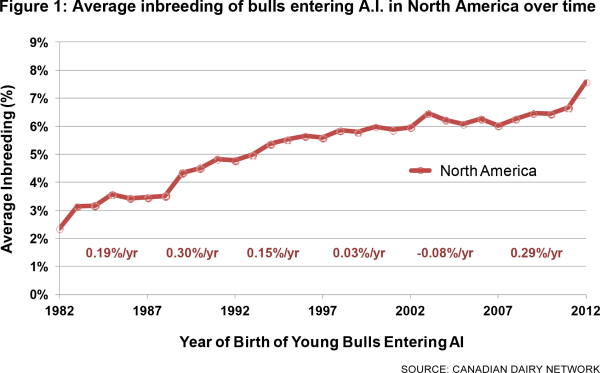
In 2011, nine bulls sired 50% of the 1,300 young bulls that entered A.I. in North America. A mere 18 bulls sired 50% of the 3,000 that entered A.I. globally.  In sires entering AI in 2011, the rate of inbreeding increased 1% that year alone and is now over 7%.  That is over 2% higher than it was in 1992 and 5% higher than it was in 1982.

In order to help breeders find outcross sires, the Bullvine has prepared this list of 12 sires that offer the greatest genetic diversity while still offering a high level of genetic gain.

Overall Performance Improvement

If you are looking for an outcross sire that offers balanced improvement for production, durability and health and fertility, you cannot go wrong with these three sires:

Dairy Bull - 014HO05936 - Coyne-Farms Bolton Dom-ETDom *BY

014HO05936
Coyne-Farms Bolton Dom-ET  BY
Bolton x Bret CV x Rudolph

DOM offers breed leading overall performance and has no Goldwyn, Shottle, Planet or Oman in the first three generations of his pedigree.  He is a carrier of Brachyspina (BY) but Brachyspina is a recessive trait, and, to be an affected calf, both sire and dam must have passed the recessive gene to their offspring. So unless you are mating him to a BY female you should be okay.  Dom is a very balanced sire offering strong overall production (+1558 lbs. milk) and solid components (+0.10 %F +0.01 %P) He is also strong for type and durability (+2.75 PTAT, +2.51 UDC, +2.92 FLC) and has solid health and fertility traits.  Dom will need to be protected on his straightness of rear legs (posty), as well as his rumps, specifically his pin width.


Dairy Bull - 029HO14142 - Coyne-Farms Dorcy-ETDorcy

029HO14142
Coyne-Farms Dorcy-ET  BY
Bolton x Bret CV x Rudolph

There is Dom`s better-known full brother Dorcy.  Dorcy is proving to be an outstanding longevity improvement sire, both through his sons and daughters. Breeders interested in a Bolton son from an outcross pedigree, top-notch udders, very good feet & legs and functional traits may consider DORCY. Dairy Strength and Rump are only slightly above breed norms.  Like Dom he will need to be protected on his straightness of rear legs (posty) as well as his pin width.


Dairy Bull - 007HO12165 - Bacon-Hill Montross-ETMontross

007HO12165
Bacon-Hill Montross-ET   TY
Mogul x Bolton x AltaRolex

If you are looking for a high genomic sire that offers overall improvement and is still an outcross, Montross will fit the bill.  Montross is a Dorcy grandson (through sire Mogul, who is a Dorcy from a Marsh).  As is typically the case with many actual outcross pedigrees, his maternal side is not that well known. However, his dam UNIQUE-STYLE BOLTON MONEY EX-91 DOM has certainly become a popular bull mother, with 15 sons at five different AI units. At +845 NM$ there is no question that MONTROSS will offer an excellent production kick and have enough durability, health and fertility to last. At over two points for UDC and FLC MONTROSS has strong functional type but should be protected for straightness of rear legs and overall frame and capacity traits. However, as we have seen from research in the past, you don’t need extreme frame traits in order to achieve extreme lifetime production. (Read more: She Ain’t Pretty – She Just Milks That Way!).


Production Improvement

For those of you that are more commercially focused or maybe those of you who have not focused enough on production and the milk check is showing it, in addition to Montross, here are our recommendations:

Dairy Bull - 029HO13991 - Kings-Ransom B RubleRuble

029HO13991
Kings-Ransom B Ruble   TY
Bolton x Boliver x Bombay

With no Goldwyn, Shottle, Planet or Oman, Ruble is a very unique high production sire.  The cow family behind RUBLE features five consecutive generations of AI bull mothers. RUBLE’s five closest dams all produced milk records in excess of 32,000 lbs. RUBLE’s grand dam, Bombay Rale was a tremendous brood cow leaving 6-VG & 4-EX daughters in the herd by seven different sires. RUBLE daughters are moderate stature and dairy. Protect for strength as they can be narrow through the chest. Udders are everything you would expect from the two popular pedigrees. High, wide rear udders, smooth blending foreudders, and a deep seam to carry their high production through many lactations. Daughters track straight with a correct foot, though you need to protect for a slight set to rear legs and protect rumps for pin width.


Dairy Bull - 097HO40076 - Claytop Js Predestine-ETPredestine

097HO40076
Claytop Js Predestine-ET   TY
Jet Stream x Toystory x Boliver

A very popular outcross production sire is Predestine. At +2657 lbs milk and solid components, Predestine offers extreme production improvement.  His daughters are durable (+2.8 PL) but not fancy (+1.63 PTAT, +1.68 UDC, +0.69 FLC).  You will have to watch him on his SCS, but if you have a low producing solid conformation heifer with a big frame that needs a quick shot of production, Predestine will do just that.


Dairy Bull - 526HO00004 - RocketRocket

526HO00004
Rocket  TL TD
Sudan x Freddie x Bolton

A genomic young sire that catches our eye is Rocket.  Rocket is a Sudan son from Vieuxsaule Freddie Tanya VG-88, who is a grand daughter of Vieuxsaule Allen Dragonfly EX-94 2E 12* (Read more: VIEUX SAULE ALLEN DRAGONFLY: 2013 Canadian Cow of the Year Nominee). While there is Oman in this pedigree (3rd generation through Freddie), given that Rocket is sired by Sudan, an extreme outcross sire, and has Bolton and Allen as the maternal great and great great grand sire, Rocket has a very low expected future inbreeding value.   Rocket should sire component improvement (+0.09 %F and +0.02 %P) and strong production (1784 lbs milk).  He also has the bonus of having very strong health and fertility traits (+3.5 PL, +2.78 SCS).  While Rocket has a solid type evaluation (+2.68 PTAT, +2.28 UDC, +2.32 FLC), he will need to be protected on his bone quality and loin strength.


Longevity Improvement

For those of you that are looking to breed cattle that last lactation after lactation or maybe you are having problems with your 2 year olds not coming back for a 2nd lactation, in addition to Dorcy, we recommend the following outcross sires:

Dairy Bull - 007HO12105 - S-S-I Mogul ReflectorReflector

007HO12105
S-S-I Mogul Reflector   TY
Mogul x Super x Ramos

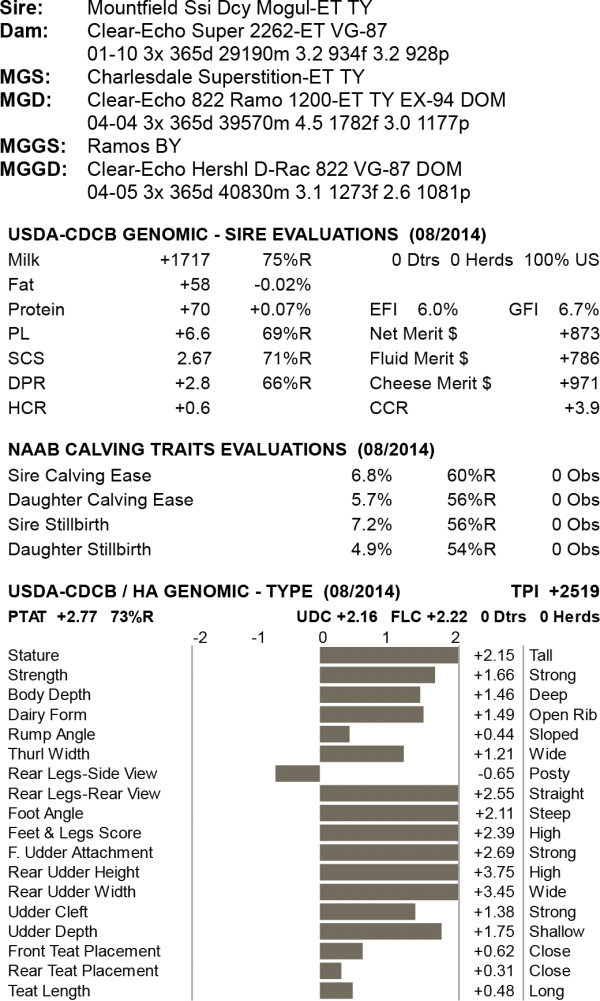
From the same family that produced Bookem, Reflector is an outcross sire that should get much attention.   Bred through the ART program at Select Sires that was designed to produce outcross sires, Reflector is a great example of this.  (Read more: Select Sires vs. Semex – A Contrast in Cooperatives  and Should A.I. Companies Own Females?).  At +6.6 for PL and over two points on all type composites (+2.77 PTAT, +2.16 UDC, +2.22 FLC) and at +2.8 DPR and +2.67 SCS, Reflector daughters are going to last. While show ring enthusiasts may not be quick to use Reflector (-7 height at front end, 0 for body depth), he will sire strong mammary systems and feet and leg improvement.


Dairy Bull - 179HO00099 - Mr Apples Mcgucci-ET

McGucci

179HO00099
Mr Apples McGucci-ET  RC TY
McCutchen x Regiment-RED x Durham

From the legendary KHW Regiment Apple-Red-ET CV EX-96 3E DOM, comes McGucci an outcross longevity improvement sire, that you should be taking a look at. (Read more: KHW Regiment Apple-Red – Beauty, performance, and even more record) When Jerry Jorgensen of Ri-Val-Re Holsteins purchased a whole flush from Apple he was looking to produce something a little different and that is exactly what he got when he crossed her on McCutchen. (Read more: BREEDING RI-VAL-RE: Where Looking Good in the Stall Is Just As Important As Looking Good On Paper).   While McGucci will not be considered an overall production improver, he does offer solid component improvement (+0.27%F and +0.16 %P), with high durability (+3.4 PL) and very high conformation (+4.03 PTAT, +3.20 UDC, +3.78 FLC), with solid health traits (+2.77 SCS, +0.01 DPR).  He will need to be protected on his shortness of teats and high pins.


Dairy Bull - 147HO02426 - Ronelee Dorcy Deligent-ETDeligent

147HO02426
Ronelee Dorcy Deligent-ET  BY
Dorcy BY x Boliver x Outside

Combining two popular outcross pedigree`s, Deligent is a longevity improvement sire that you should consider using.   His dam Ronelee Boliver Dreary-ET VG-86 2Y is a maternal sister to the popular, proven sire Domain. Deligent was bred to deliver long lasting daughters. With outstanding Herd Life/Productive Life, breed leading mammary systems scores and strong Feet and Legs scores, Deligent is a longevity specialist, though he does need to be somewhat protected for dairy strength. Look for DELIGENT to combine this longevity with reliable production and type numbers.


Health and Fertility Improvement

One area that is starting to get more attention by most breeders is health and fertility. While there is no question that every breeder knows that more pregnancies equals more profits, many of the top ranking sires actually have negative values for key health and fertility traits.   In addition to Reflector and Predestine, here are three outcross sires that will help you improve the health and fertility in your herd.

Dairy Bull - 007HO10647 - Ladinodale Aaron-Red-ETAaron-Red

007HO10647
Ladinodale Aaron-Red-ET   TY
LB P-Red x Paradox-RED x Rudolph

If you are looking for an outcross sire that will help improve the health traits in your herd, you need to consider Aaron-Red.  While he is certainly not a production improvement sire (+17 lbs Milk), he does offer some significant improvement in productive life (+3.7), DPR (+2.3) as well as calving ease (+4.8% SCE & 4.7% DCE).  Aaron offers reliable type improvement (+2.01 PTAT, +2.06 UDC and +1.53 FLC). He will need to be protected on his high pins and overall dairy strength.


Dairy Bull - 029HO13566 - Brandt-View Howard-ETHoward

029HO13566
Brandt-View Howard-ET   TY
Alton CV x Capri x Manfred

This reliably proven Alton son is from a 2E-92 Capri (by JUROR) with a top record of almost 58,000 in one lactation.  The family is consistently noted for their extreme production values, consistent type and excellent health/fitness traits.   Howard daughters are profit makers. They increase milk production while lowering SCS to qualify for milk premiums and possess outstanding health and fertility numbers (+3.3 PL, +1.2 DPR, 3.9% SCE). Typical Howard daughters are clean boned, hardworking and moderate sized and long necked, open in the rear rib and very clean through the thigh.  Rear udders are high, wide, and capacious.  He will need to be protected on his overall size and stature as well as his dairy strength.


Dairy Bull - 011HO11116 - Rosylane-Llc AltabowieAltaBowie

011HO11116
Rosylane-Llc Altabowie   TY
Bowser x Ramos x O Man

Yes there is O Man in AltaBowie`s pedigree, but considering that he is sired by Bowser (Jet Stream x Boliver) and his dam is a Ramos daughter, AltaBowie has very low expected future inbreeding values (5.9%).  From the exceptional breeding program at Rosy-Lane Holsteins (Read more: ROSY-LANE HOLSTEINS – “Don’t Follow the Herd!”), AltaBowie offers many plusses.  He is +1419 for lbs milk (though low fat %), durable type (+7.6 PL), and high DPR (+3.6) and low calving ease (4.2% SCE and 3.7% DCE).  While his conformation break down will not wow you (+1.44 PTAT, +1.67 UDC and +1.90 FLC), he is correct where he needs to be, (Udder depth, fore and rear attachments, as well as foot angle and heal depth).  He will certainly need to be protected on his dairy strength and rumps.


The Bullvine Bottom Line

Genetic diversity is a critical problem in the Holstein dairy cattle breeding industry.  Indeed the rate of genetic gain has accelerated. But so too has the rate of inbreeding.  With $23 lifetime cost per percent inbreeding, it is easy to overreact and try to avoid inbreeding at all costs. The trick is not to use sires that are inferior, but rather to have a balance of genetic improvement and enough of an outcross not to accelerate the inbreeding.   These 12 sires will do just that and help control the rate of inbreeding in your herd.


The Dairy Breeders No BS Guide to Genomics


Not sure what all this hype about genomics is all about?

Want to learn what it is and what it means to your breeding program?

Download this free guide.


[related-posts-thumbnails]

Send this to a friend