Archive for global dairy market trends

The Four Numbers Every Dairy Producer Needs to Calculate This Week

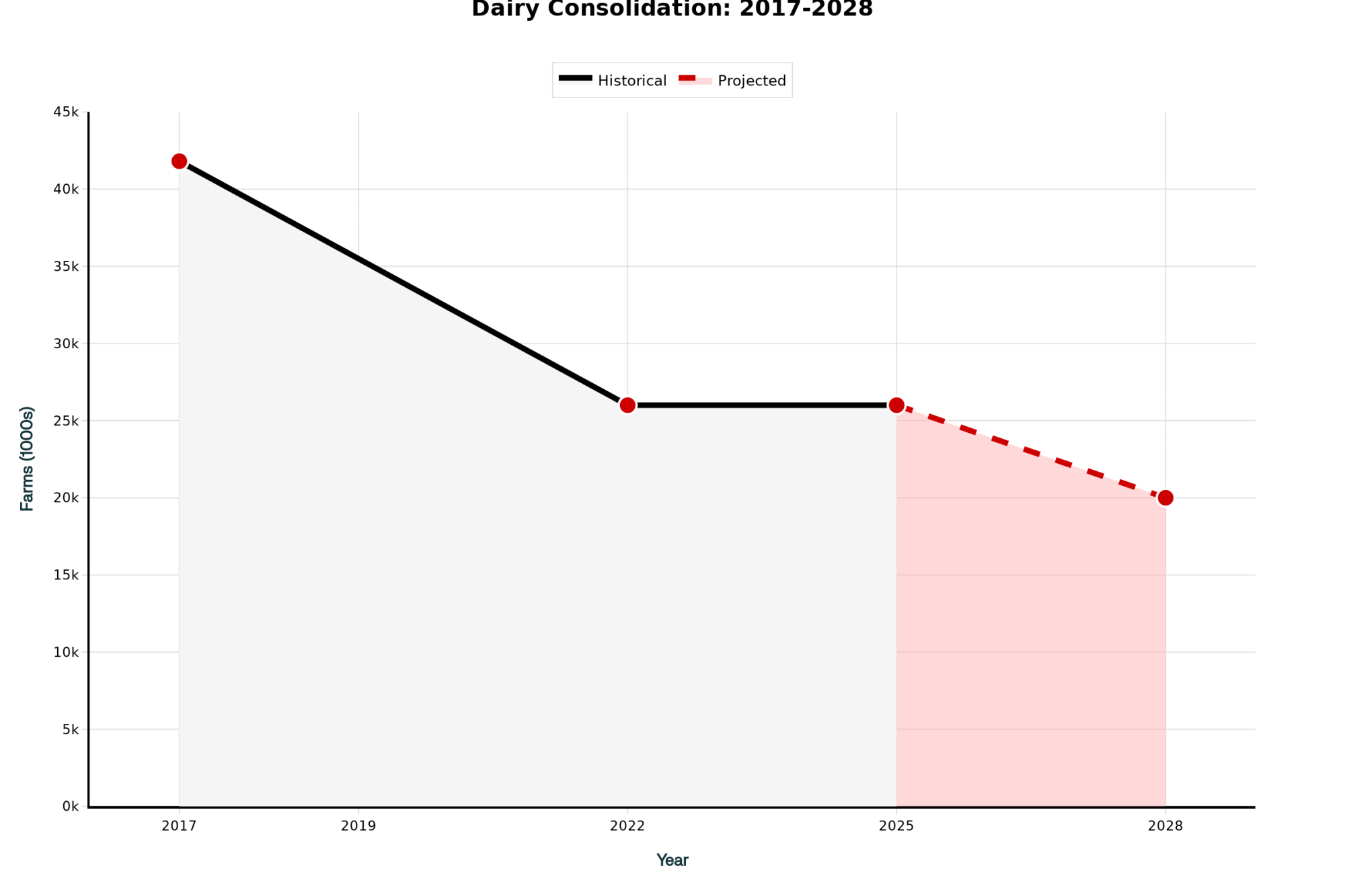
26,000 dairy farms are expected to drop to 20,000 by 2028. Which side of that line are you on? Four numbers will tell you

Executive Summary:  With milk stuck below $14/cwt through 2026 while global production rises 3-6%, this isn’t a downturn—it’s a restructuring. Five permanent changes (beef-on-dairy heifer shortage, China’s self-sufficiency, technology cost gaps, fixed-cost production traps, and processor overcapacity) mean the old recovery playbook is dead. Right now, mega-dairies operate at $13.80/cwt, niche producers capture $8-12 premiums, but mid-sized farms (500-1,500 cows) hemorrhage cash at $18-21/cwt. I’ve developed a four-number framework—true cost per cwt, liquidity runway, competitive investment ratio, and niche premium potential—that reveals your best path forward in minutes. Calculate these this week to determine whether you should expand, pivot to premium markets, or execute a strategic exit while you control the terms. The industry will shrink from 26,000 to 20,000 farms by 2028, but producers who act decisively in the next 90 days can still position themselves to thrive.

Dairy Farm Business Strategy

You know, I was checking the CME futures board this morning—Class IV milk sitting below $14/cwt all the way through February 2026—and it really got me thinking about what we’re all dealing with right now. Here’s what’s interesting: while we’re staring at these terrible prices, the production reports from early October show New Zealand’s up 3% year-over-year, Ireland’s pumping out nearly 6% more milk, and Belgium’s somehow surging 6.5%.

You’d think somebody would cut back, right? But they can’t. And that’s what makes this whole situation fundamentally different from anything we’ve weathered before.

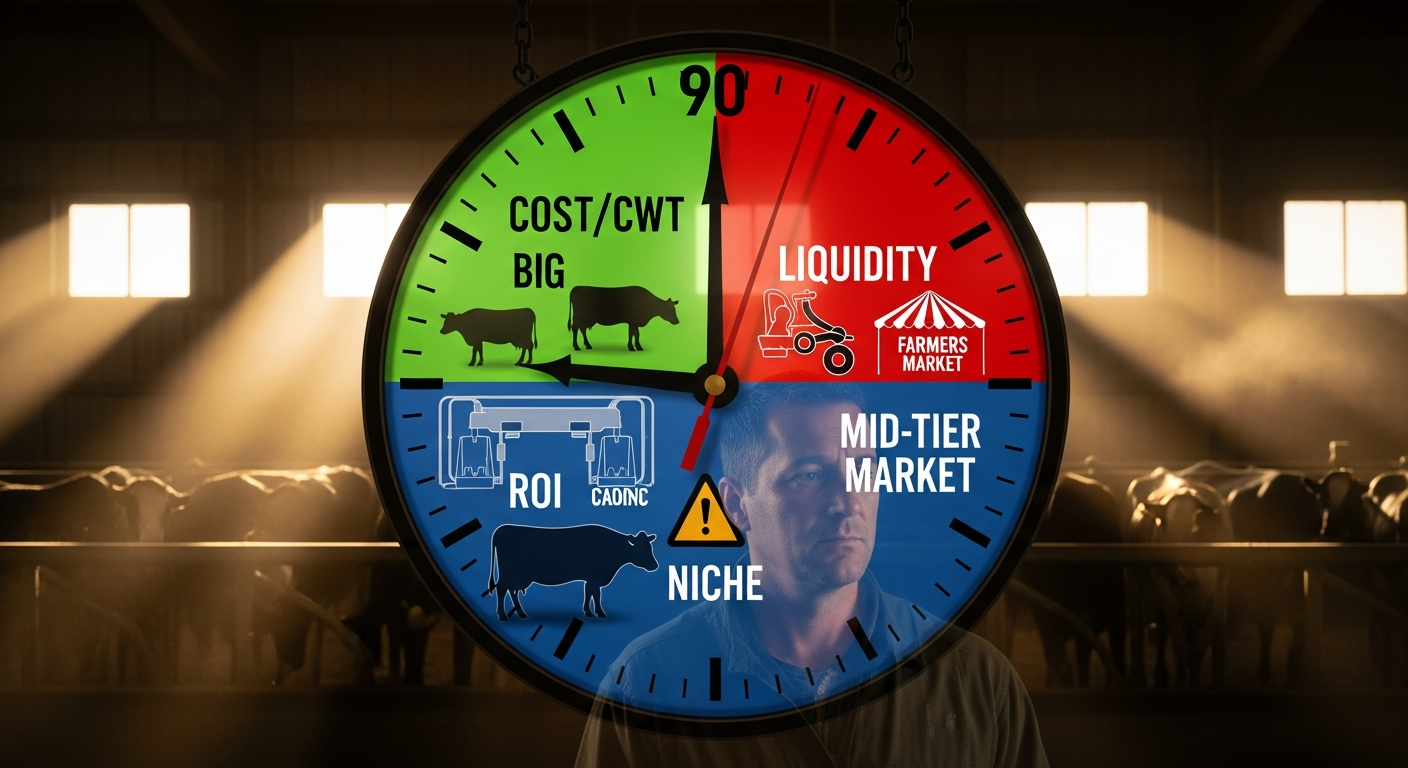
The Profitability Death Zone: Only mega-dairies survive below $14/cwt milk prices while mid-size operations hemorrhage $5-7 per hundredweight

The Five Structural Changes We’re All Navigating Together

The Beef-on-Dairy Shift That’s Bigger Than We Realized

The Beef-on-Dairy Revolution: Farmers are choosing $1,000 in 7 days over $3,850 invested for 30 months—and it’s permanently shrinking the heifer pipeline by 700,000-800,000 head

So here’s something that’s really caught my attention—and I think most of us have been surprised by how big this has gotten. The National Association of Animal Breeders’ latest sales data shows beef semen sales to dairy operations jumped almost 18% last year alone. What started as a way to manage margins has become something much more structural.

I was talking with a producer in central Wisconsin last week—third-generation operation, really sharp guy—and he walked me through his breeding decisions. With those week-old beef-cross calves bringing $800 to $1,200 at regional auctions (I saw some exceptional ones hit $1,400 at Dairyland), and compare that to the $3,200 to $4,500 it costs to raise a replacement heifer to breeding age… well, the math’s pretty clear. Penn State Extension’s budgets back this up, though honestly, if you’re in an area with higher feed costs, you might be looking at even more.

What’s particularly worth noting is how this revenue stream—often covering 12-16% of total farm income—has become essential for cash flow, especially for making those monthly debt service payments. But here’s the thing that’s really starting to bite: once you commit to this breeding strategy, you’re locked in for at least 30 months. That’s just biology—you can’t speed up getting a heifer from conception to first lactation.

I was chatting with one of CoBank’s dairy economists at a meeting recently, and they’re suggesting the US dairy heifer inventory could shrink by 700,000 to 800,000 head through 2027. Even if milk prices doubled tomorrow—and let’s be honest, we all know they won’t—we simply can’t produce replacement heifers any faster than nature allows.

China’s Role Has Completely Changed

China’s Demand Collapse: The global dairy safety valve that rescued oversupply in 2009 and 2015 has permanently closed—imports down 30% while domestic production soars past 42 million tonnes

Remember how China always seemed to bail us out? You probably know this pattern—2009, 2015… we’d get oversupplied, prices would tank, and then Chinese demand would gradually soak up the excess. Well, that playbook’s done, and we need to accept it.

The China Dairy Industry Association’s data shows their per capita consumption dropped from 14.4 kg in 2021 to 12.4 kg in 2022, and from what I’m hearing from folks in the export business, it hasn’t bounced back. Meanwhile—and this is what’s really changed the game—their domestic production hit nearly 42 million tonnes in 2023. They actually exceeded their own government targets.

Looking at the customs data from August, whole milk powder imports into China were down over 30% year-over-year, while skim milk powder imports were down about 23%. I’ve noticed many of us still talk about Chinese demand “recovering,” but honestly? They’re dealing with their own oversupply while facing declining birth rates and changing dietary preferences among younger consumers. That safety valve we used to count on… it’s gone.

The Technology Gap That’s Becoming a Canyon


Farm Size
CowsRobot InvestmentAnnual Debt ServiceProduction GainLabor SavingsNet Annual BenefitROI at $20ROI at $14
Mega-Dairy3,800$2.7M (12 robots)$220K+$684K+$840K+$1,304K✓ PROFITABLE✓ PROFITABLE
Mid-Size (TRAP)500$900K (4 robots)$85K+$90K+$280K+$285K✓ Barely profitable✗ LOSES MONEY
Small Farm180$450K (2 robots)$43K+$32K+$140K+$129K✗ Marginal✗ UNPROFITABLE

You probably already know this, but that USDA Economic Research Service report—”Profits, Costs, and the Changing Structure of Dairy Farming”—really lays it all out. Farms with 2,000+ cows are running total production costs around $23/cwt. Smaller operations with 100-199 cows? They’re looking at $32-33/cwt. That’s a $10 gap, and here’s the thing: technology is making it wider, not narrower.

My neighbor just got quotes for a robotic milking system—both DeLaval and Lely are quoting $180,000 to $230,000 per unit right now. For his 500-cow operation, he’s looking at a minimum of $900,000 for the robots alone, plus another $200,000 for barn modifications. At current Farm Credit rates—which are running 7.5-8.5% for most of us with decent credit—that’s $85,000 to $90,000 annually just in debt service.

Now, the big dairies installing these systems are seeing real gains—8-10 pounds more milk per cow daily, plus labor savings of $60,000 to $80,000 annually per robot. But here’s what nobody wants to say out loud at the co-op meetings: the return on investment only works at scale. University of Minnesota Extension did this analysis showing robots can be profitable at $20 milk but lose significant money at $15. And where are prices heading?

A producer out in California shared something interesting with me last month—they’ve got 3,800 cows, and went fully robotic two years ago. “Best decision we ever made,” he said, “but only because we had the volume to spread those fixed costs. My neighbor with 600 cows? Same robots would bankrupt him at these prices.”

Why We Keep Milking Even When We’re Losing Money

This one puzzles a lot of people outside the industry, but if you’ve been doing this a while, you get it. Cornell’s Program on Dairy Markets and Policy explained it really well in one of their recent webinars—pasture-based systems like those in New Zealand and Ireland have completely different cost structures than our confinement operations here in the States.

DairyNZ’s economic surveys show their typical operation has variable costs around NZ$4.50 per kilogram of milk solids—that works out to roughly $7/cwt for us—but fixed costs that come to about $12/cwt. Think about that for a minute. When milk drops to $12/cwt, if they stop milking, they still owe that $12 in fixed costs, but lose the $5 that’s at least helping cover some of it. So they keep milking, even at a loss.

Irish producers are in the same boat. Teagasc’s reports show that Irish dairy farmers invested over €2.2 billion in expansion after the abolition of quotas in 2015. Those loans don’t just disappear when milk prices crash. The Central Bank of Ireland’s latest data shows 64% of Irish dairy farms carrying debt averaging over €117,000. You can’t just turn that off.

Processing Plants Running Half Empty

Here’s something that doesn’t get enough attention, but it’s affecting all of us. The International Dairy Foods Association has been tracking this—US processors have invested billions in new plant capacity over the last few years, expecting the kind of production growth we saw in the 2010s. But USDA’s Milk Production reports show we’re growing at maybe 0.4-0.5% annually. They built for 2-3% growth.

I was talking with a cheese plant manager in Wisconsin last month—won’t name names, but you’d know the company—and he put it pretty bluntly: “We’ve got a $45 million plant running at 60% capacity. We need milk, but we can’t pay farmers enough to make them profitable because Walmart won’t pay us more for cheese.”

That’s creating this weird dynamic where processors actually benefit from low farmgate prices as long as they can maintain their retail contracts. It’s not some conspiracy—it’s just economics playing out in a way that hurts us at the farm level.

Looking Back: Why This Isn’t Like 2009 or 2015

The Dairy Apocalypse Timeline: 21,809 farms wiped out between 2017-2028, with the steepest decline coming in the next 3 years as milk prices crater below break-even

It’s worth looking at how we got here, because understanding the differences helps explain why the old recovery patterns won’t work this time…

2009 was actually pretty straightforward. Lehman Brothers collapsed, credit markets froze, and people stopped buying. Class III went from $20 to $9 in six months. But once the economy recovered, so did we. By 2011, we were setting price records again.

2015 was about oversupply. The EU eliminated quotas on March 31st after 31 years. European production jumped 6% almost overnight. Russia banned imports. China had too much inventory. But eventually producers cut back, China started buying again, and markets found their balance within 18 months.

This time? We’ve got five structural changes all hitting at once. The beef-on-dairy heifer shortage that’s locked in for years. China is becoming self-sufficient rather than our backstop. Technology is creating cost gaps that can’t be bridged. Fixed costs that prevent production cuts. And processors built for growth that isn’t happening. There’s no single fix because these aren’t temporary problems—they’re permanent changes to how the industry works.

Seven Leading Indicators That’ll Signal the Turn

If you want to know when this market really turns—and I mean actually turns, not just bounces around—here’s what I’m keeping an eye on:

Weekly dairy cow slaughter – USDA reports every Thursday
Looking for sustained rates 15-25% above year-ago levels for 8+ weeks. Currently running 5-8% below average. When slaughter spikes above 65,000 head weekly, that’s capitulation.

CME spot whey prices
Holding at 71-72¢ while cheese crashed from $2.20 to $1.70/lb. Breaking above 75¢ signals genuine demand recovery.

Cold storage inventories
October cheese shipments totaled 1.48 billion pounds, up 5.2% year-over-year. Need two consecutive months of meaningful drawdowns.

Export volumes
Need 8-12% year-over-year growth to signal international demand strength. Currently flat to slightly positive.

Heifer inventory reports
July 2026 USDA report will be critical—looking for the first stabilization since 2021.

Futures curve shape
Currently in contango. Shift to backwardation signals near-term tightness.

Chapter 12 bankruptcy rates
Up substantially in Q1 2025. Peak usual coincides with the market bottom.

Three Types of Operations Emerging from This

Based on what I’m seeing across the country—and USDA’s Census of Agriculture data backs this up—here’s how I think this shakes out by 2028:

The Big Operations Will Get Bigger

These operations with 5,000 to 25,000 cows aren’t just surviving—they’re actively expanding. I visited a 7,500-cow dairy near Amarillo recently that’s running all-in costs at $13.80/cwt. They’re buying herds from struggling neighbors at 60-70 cents on the dollar and integrating them pretty seamlessly.

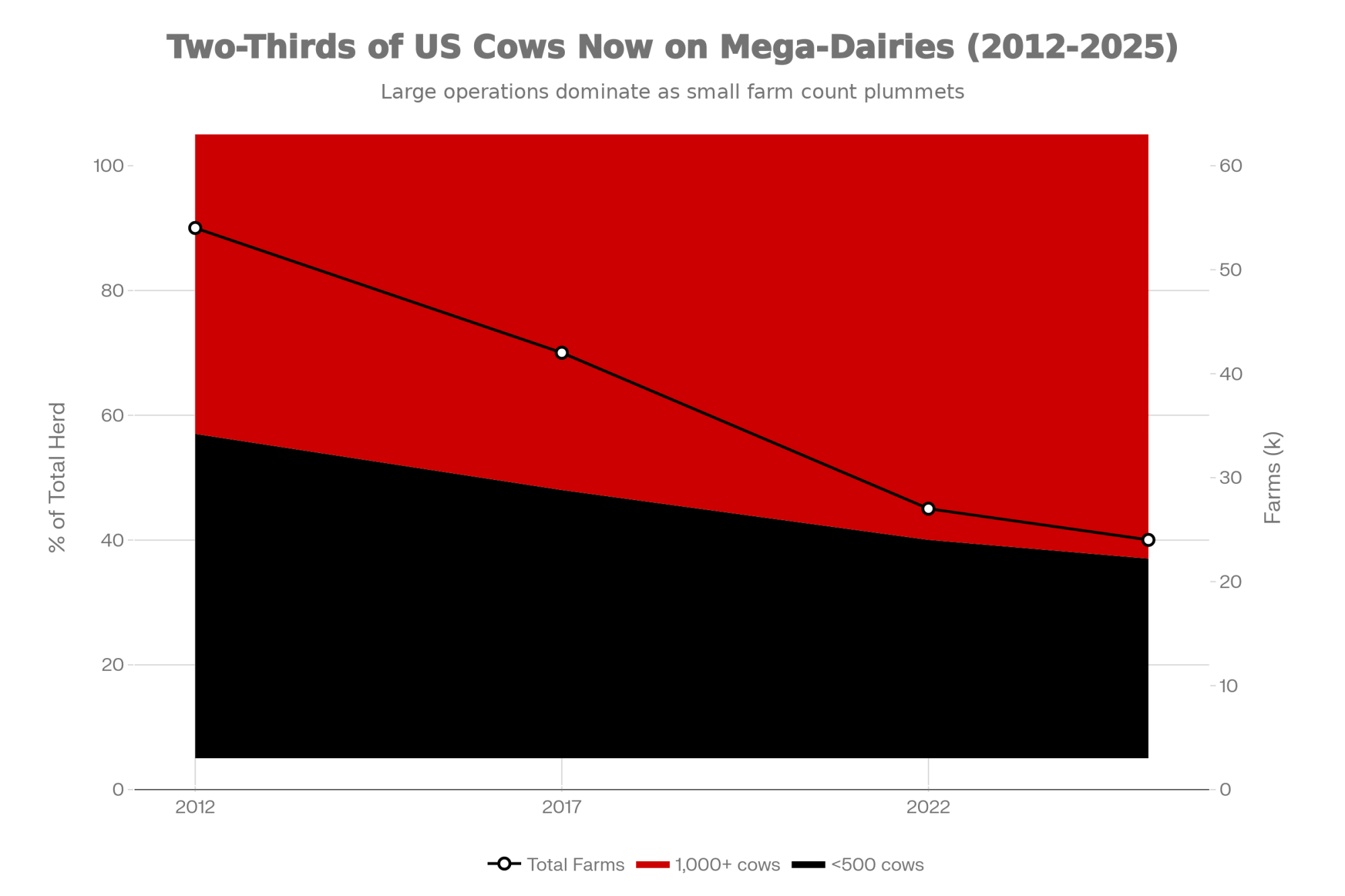
With private equity backing and professional management teams—and look, I know how we all feel about that, but it’s the reality—these operations will probably control over half of US milk production within three years. They’re not the enemy; they’re just adapting to the economic reality we’re all facing.

Premium Niche Players Will Do Just Fine

The October Organic Dairy Market News shows organic certification still pays an $8-12/cwt premium over conventional. A friend of mine in Vermont—she’s got 95 cows, beautiful grass-fed operation—is getting $45-48/cwt selling directly to consumers through her on-farm store and a handful of local restaurants.

These operations compete on story and quality, not efficiency. If you’ve got the right location, marketing skills, and family commitment to make it work, this can be really successful. But let’s be realistic—it’s maybe 1,500 to 2,500 farms nationally that can pull this off.

I know a family in Pennsylvania—180 cows—who transitioned to organic three years ago. The husband told me over coffee last month: “We’re netting more on 180 organic than we ever did on 350 conventional. But man, those three transition years nearly broke us financially and emotionally, and my wife’s at farmers markets every Saturday and Wednesday year-round. It’s a complete lifestyle change.”

The Middle Is Really Struggling

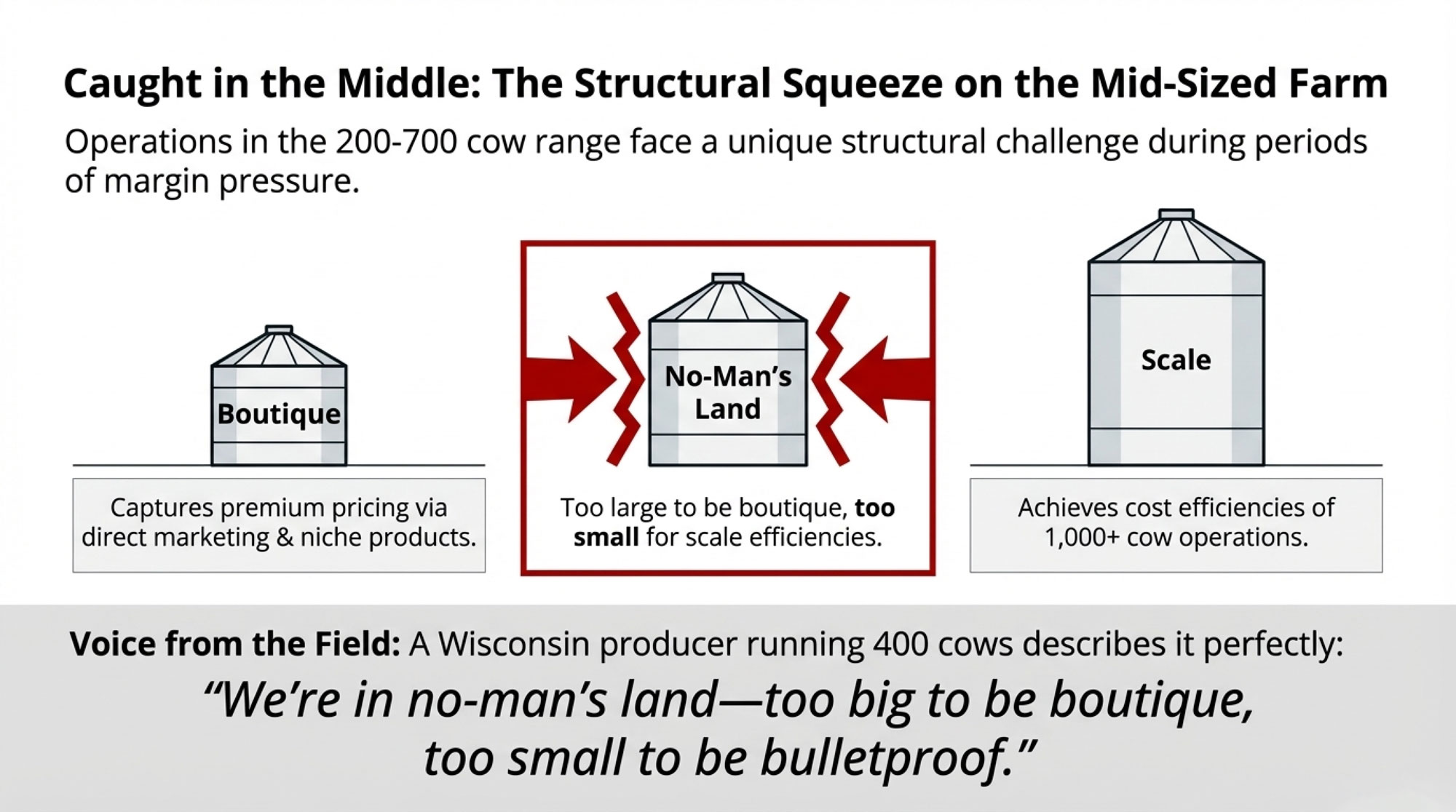
This is hard to say, but if you’re running 500-1,500 cows producing commodity milk, the math is really challenging. Farm Credit’s benchmarking across multiple regions shows operations this size averaging $18-21/cwt in total costs. You’re $5-7 above the mega-dairies but can’t access the premiums that niche markets provide.

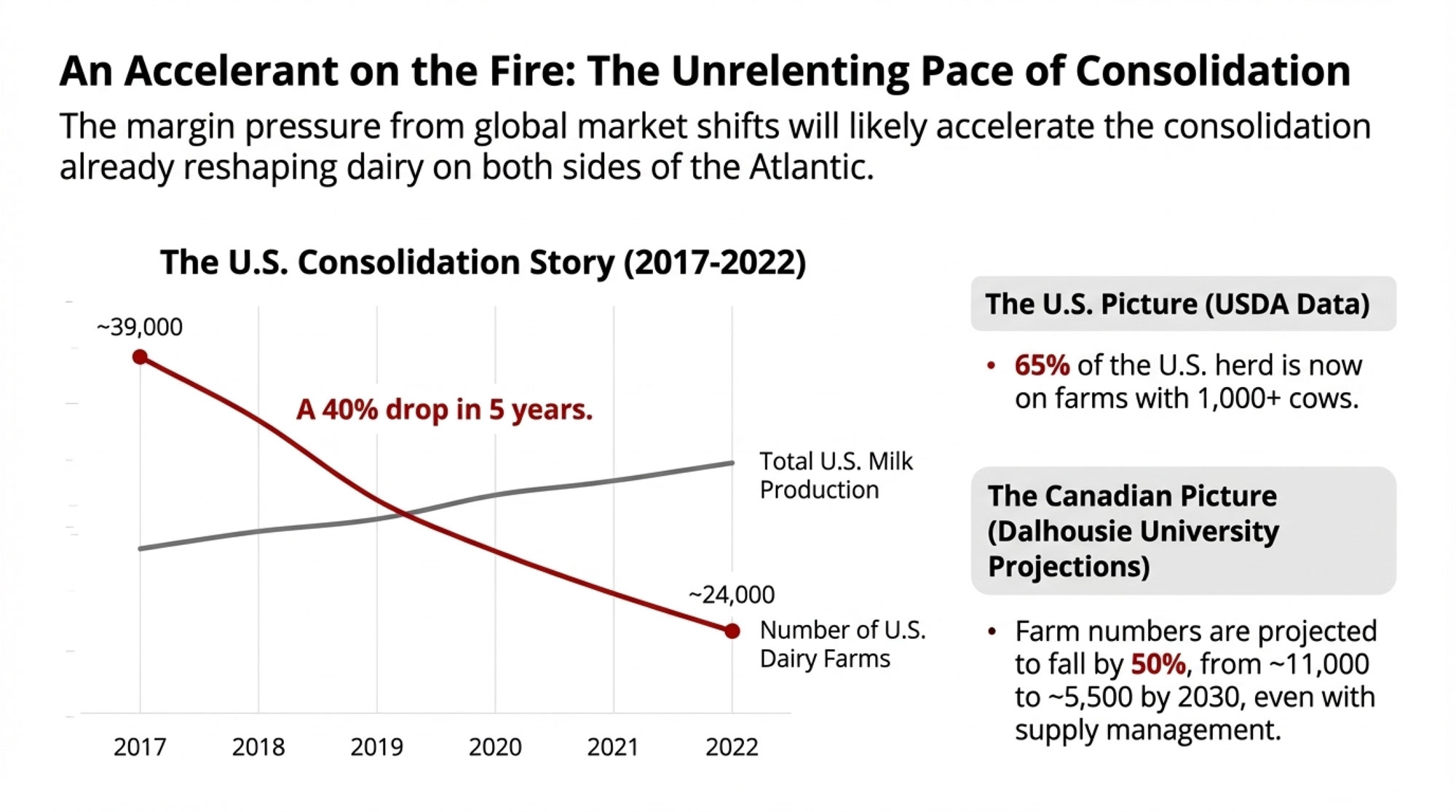
Between 2017 and 2022, USDA census data shows we lost 15,866 dairy farms while milk production increased by 5%. And honestly, that trend seems to be accelerating rather than slowing down.

Your Four-Number Reality Check

“We’ve got a $45 million plant running at 60% capacity. We need milk, but we can’t pay farmers enough to make them profitable because Walmart won’t pay us more for cheese.” – Wisconsin cheese plant manager

Look, I know nobody wants to do this kind of analysis when things are tough, but you really need to sit down—pour yourself a coffee—and work through these four calculations honestly:

1. Your True All-In Cost Per Hundredweight

Include everything—cash costs, debt service, family living draws, depreciation, and opportunity cost of your labor.

  • Under $16/cwt: You might make it work with expansion or efficiency gains
  • $16-18/cwt: You’re marginal—evaluate all options
  • $18-21/cwt: Need a transition plan within 12 months
  • Over $21/cwt: Everyday costs you equity

2. How Many Months of Runway Do You Have?

Available cash and credit divided by the monthly losses at $14 milk.

  • 6+ months: Time to be strategic
  • 3-6 months: Decide within 30 days
  • Under 3 months: Crisis mode—act immediately

3. What Would It Take to Get Competitive?

Investment required to reach $15/cwt divided by available capital.

  • Under 2.0: Expansion might work
  • 2.0-3.0: Pretty risky
  • Over 3.0: Expansion won’t save you

4. Could You Make a Niche Work?

Net premium after transition costs. The Northeast Organic Dairy Producers Alliance shows $3-7/cwt additional cost during transition.

  • Premium covers 40%+: Strong pivot candidate
  • 25-40%: Possible with passion
  • Under 25%: Math doesn’t work

Your 90-Day Action Plan

Based on where you fall in those calculations:

If You’re a Survivor (costs under $17/cwt, 6+ months liquidity):
Lock in feed costs now. Get maximum Dairy Revenue Protection. Model expansion scenarios. Position for Q2 2026 asset opportunities.

If You’re Facing an Exit (costs $18-22/cwt, limited liquidity):
Consult an attorney confidentially. Get a professional appraisal. Gauge neighbor interest discreetly. Act before banks force decisions.

If You’re Considering a Niche (strong local market, family commitment):
Start organic certification now (36-month process). Test farmers markets. Run realistic equipment costs. Ensure family buy-in.

If You’re in Crisis (under 3 months liquidity):
Call an attorney today. Cull aggressively for cash. List sellable assets. Understand personal versus farm-only debt.

The Reality We’re Facing

What makes this downturn different is that all the traditional recovery mechanisms have changed. China’s not coming to rescue us from oversupply. The advantages of technology are growing, not shrinking. Fixed costs mean producers keep producing even when they’re losing money. And processing overcapacity creates all kinds of weird incentives that work against us.

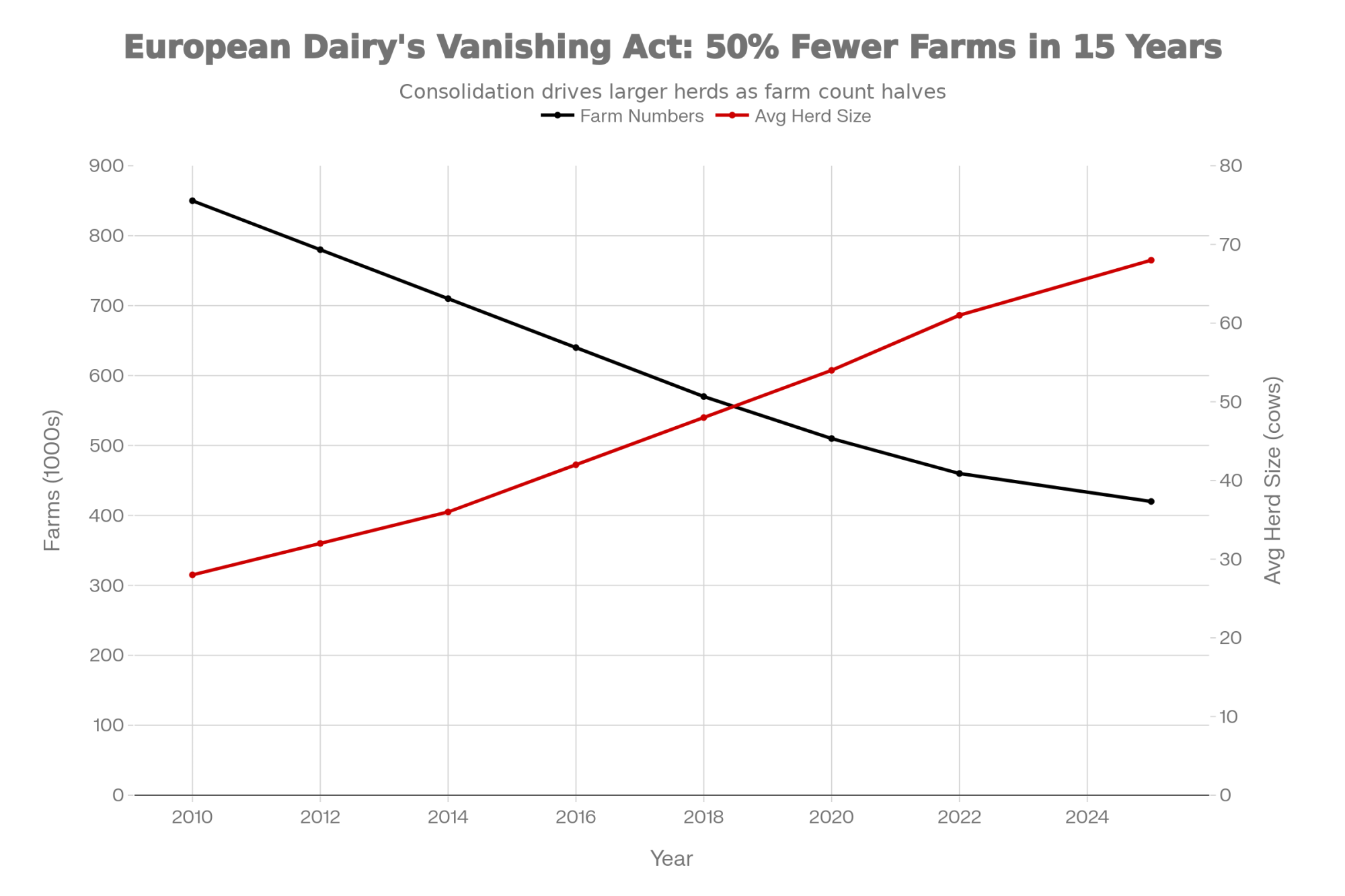
The industry that emerges by 2028 will probably have 20,000 to 22,000 farms, down from about 26,000 today. Maybe 800 mega-dairies will produce 60% of our milk. Another 2,000 or so niche operations will serve premium markets. And the middle—those 500-1,500 cow operations that have been the backbone of dairy for generations—most of them will be gone.

If you’re in that middle tier, you’ve got maybe 90 days to make a strategic decision while you still have some control over the outcome. Calculate those four numbers. Be honest with yourself about what they tell you. Make your move.

Because by March, the producers who waited will wish they’d acted sooner. And I really don’t want you to be one of them. We’ve all worked too hard, sacrificed too much, to let this restructuring take everything from us.

Look, there’s still opportunity in this industry. But it’s going to look different than what most of us grew up with. Understanding that—and adapting to it while you still have options—that’s what’s going to separate those who thrive from those who just survive.

Stay strong, make smart decisions, and remember—there’s no shame in strategic change. There’s only shame in letting pride destroy what you’ve built.

Key Takeaways:

  • Your survival depends on four numbers: Calculate your true all-in cost/cwt, months of liquidity at $14 milk, investment needed to hit $15/cwt, and net premium from going niche—this week
  • The cost gap is unbridgeable: Mega-dairies operate at $13.80/cwt, small organic farms capture $45-48/cwt, but mid-size operations bleed cash at $18-21/cwt with no fix
  • Five permanent changes killed recovery: 72% beef-on-dairy locked through 2027, China down 30% on imports, tech ROI only at 2,000+ cows, fixed costs prevent production cuts, processors 40% overcapacity
  • 90 days to choose your path: Expand to 2,500+ cows, transition to premium niche, or execute strategic exit—after March, banks choose for you
  • 20,000 farms by 2028 (down from 26,000 today), but producers who act now can position themselves on the winning side

Complete references and supporting documentation are available upon request by contacting the editorial team at editor@thebullvine.com.

Learn More:

Join the Revolution!

Join over 30,000 successful dairy professionals who rely on Bullvine Weekly for their competitive edge. Delivered directly to your inbox each week, our exclusive industry insights help you make smarter decisions while saving precious hours every week. Never miss critical updates on milk production trends, breakthrough technologies, and profit-boosting strategies that top producers are already implementing. Subscribe now to transform your dairy operation’s efficiency and profitability—your future success is just one click away.

NewsSubscribe
First
Last
Consent

The Irish Dairy Meltdown: What Every Farmer Needs to Know

1.5 billion wipeout looming — Ireland’s dairy crisis signals what’s coming for all of us

EXECUTIVE SUMMARY: The dairy world’s shifting under our feet, and we’ve got the inside story. Ireland’s facing a €1.5 billion hit with 22% herd cuts and 1.5 billion fewer litres — that’s not just Cork’s problem, that’s a preview of what environmental regulations can do to any of us. Here’s what really gets us fired up: while Irish farmers scramble, smart producers worldwide are positioning for the biggest market shuffle since quotas ended. Our research shows this stems from EU nitrates policy tightening and Ireland’s derogation ending December 2025 — but here’s the kicker, this creates massive opportunities if you’re ready to pivot. We’re seeing New Zealand ramp up capacity, Dutch processors expand, and US operations eyeing those 140+ export markets Ireland might lose. The future belongs to producers who adapt their nitrogen management, diversify markets, and treat environmental compliance as a competitive advantage. Don’t just survive this wave — ride it to profitability.

KEY TAKEAWAYS

  • Slash regulatory risk by 22% through proactive nitrogen management — Start mapping your current N usage against tightening limits now, before you’re forced into emergency herd cuts like Irish producers (Teagasc economic modeling shows this prevents €10,000+ annual income hits)
  • Capture €6.3 billion in shifting export opportunities — Engage with processors planning 2025-26 capacity expansions while Irish supply contracts; New Zealand’s already positioning with new plants (Dairy Reporter analysis confirms first-movers get premium contracts)
  • Turn environmental compliance into profit centers — Invest in precision grazing and fertilization tech that cuts nitrogen waste while boosting efficiency; 55% emissions targets by 2030 aren’t going away, so get ahead of the curve (EPA data shows compliant operations avoid penalty costs AND capture sustainable premiums)
  • Build market diversification before you need it — Ireland’s 94% export dependency made them vulnerable; don’t make the same mistake when regulations can change overnight (Bord Bia export data proves diversified operations weather policy shocks better)
  • Monitor spring production patterns like your income depends on it — Ireland’s seasonal flush system amplifies regulatory impacts; understand your own production cycles and processing capacity vulnerabilities before they bite you (AHDB seasonal analysis shows timing matters more than total volume)

I was chatting with a dairy farmer from Cork who runs about 180 cows. Smart as they come — knows his genetics, his feed, and all the quirks of grazing grass. But when I asked about the looming nitrates debacle, he dropped the hammer: “I’m out at least 40 cows if Brussels pulls the plug.”

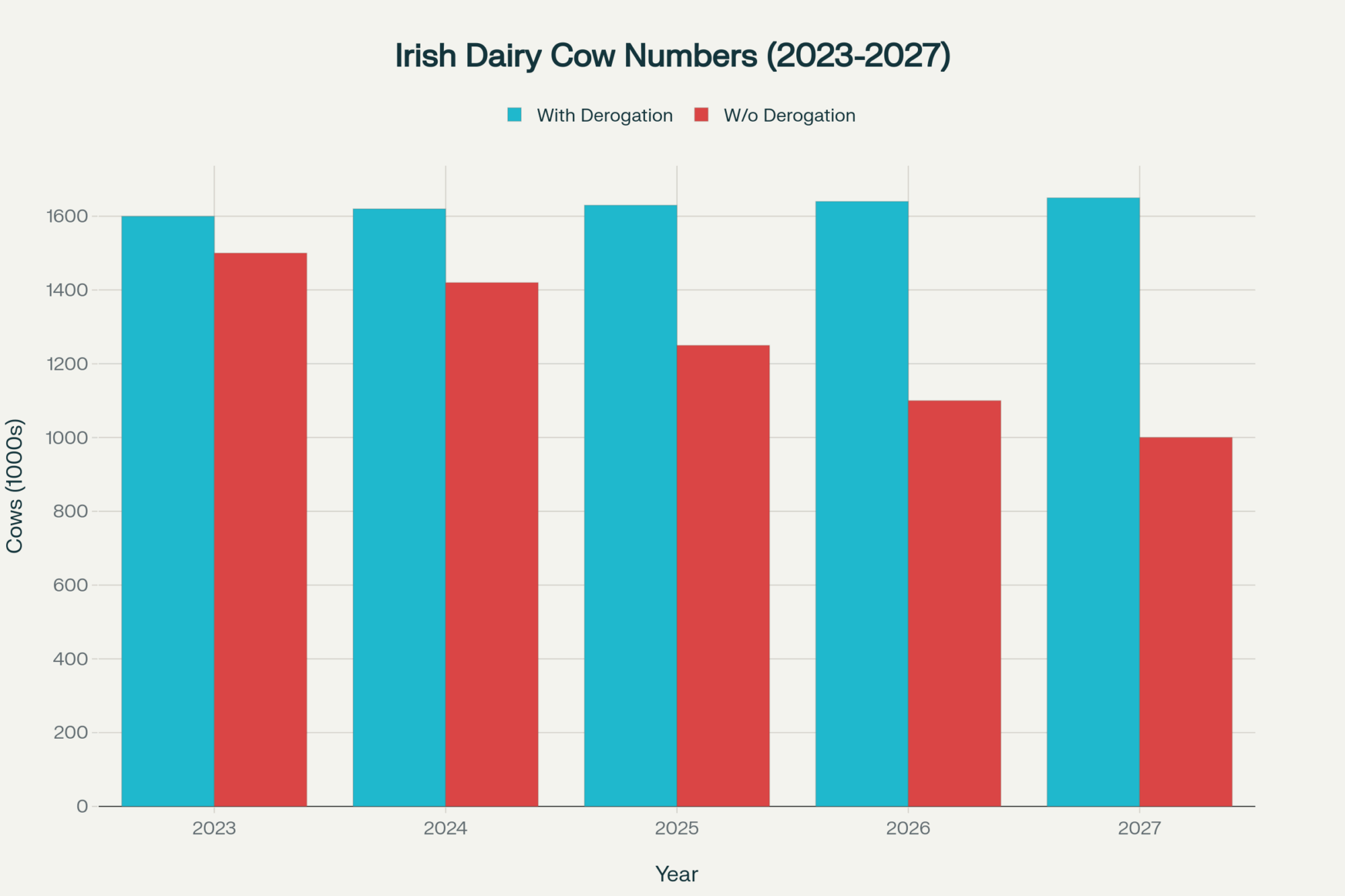
That’s the brutal reality creeping up on Irish dairy. They face a potential €1.5 billion hit (Bord Bia, 2024), with up to 22% fewer cows and a drop of around 1.5 billion liters in milk production (Teagasc, 2025). With Irish dairy shipped to over 140 countries, this will send shockwaves far beyond Ireland’s shores.

Some might shrug, but trust me, this is a big deal for all of us.

What’s this nitrates stuff all about?

Ireland’s had a bit more breathing room — farms can run up to 250 kg nitrogen per hectare, higher than the EU’s 170 kg limit (Department of Agriculture, 2025). That flexibility has powered their big leap since quotas ended.

But it’s changing fast. Some spots will drop to 220 kg this year, and the whole derogation ends at the close of 2025 (Irish Farmers Journal; Department of Agriculture, 2025).

In farming hubs like Cork and Kerry, many face serious cuts. For example, a farm with 180 cows on 90 hectares pulling 520,000 liters will likely need to reduce to around 140 cows just to stay legal.

The spring rush and the crunch

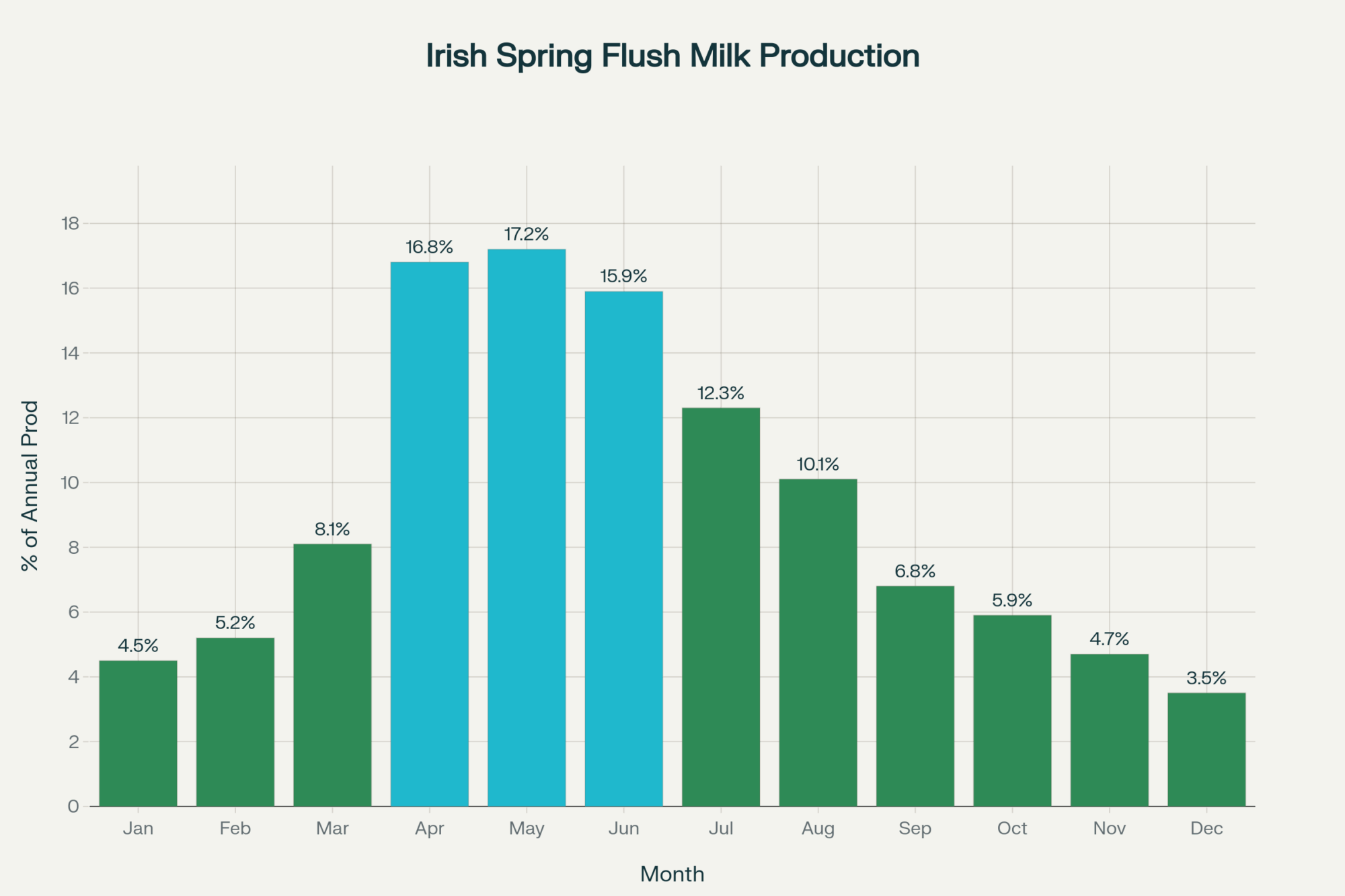
Milk’s far from steady — half the output floods in during April to June, the famous “spring flush” (AHDB, 2025). This seasonal surge is what makes Ireland’s grass-based system work, but it also creates massive vulnerability.

Processors like those in Mitchellstown and Charleville work around the clock during these months. Industry experts note serious concerns about potential processing capacity underutilization during production declines, though specific utilization rates remain confidential to individual processors.

Talked to a feed guy near Macroom, and he told me — when you lose 40 cows, there’s more than just fewer udders. Feed plans, labor demands, and cash flows all get tangled up.

A shifty game with hungry players

That €6.3 billion export haul stretches across 140 countries (Bord Bia Export Performance Report, 2024). When Irish flows shrink, others are ready to swoop.

New Zealand’s gearing up with new processing capacity ready by 2026 (Dairy Reporter, 2025). Dutch processors are edging forward, careful but ready to capitalize on Ireland’s regulatory chaos.

Markets like China and the US won’t flip overnight — brand loyalty runs deep — but cracks will open when supply gaps appear.

The green challenge

Irish waters? Not exactly pristine — about 30% of monitoring sites exceed nitrate limits (EPA Ireland, 2024). That’s Brussels’ leverage in this whole mess.

Then add the EU’s Green Deal vision for a 55% greenhouse gas reduction by 2030 (European Commission, 2024), and you see why the tightrope keeps getting thinner.

Ireland’s challenge is balancing milk production with environmental compliance — a dance every progressive dairy operation worldwide is learning.

The rare unity

In September 2024, six heavy-hitters — including IFA, ICOS, and Macra na Feirme — banded together in a joint declaration to protect the derogation (IFA, 2024).

With 17,500 farms and 55,000 jobs on the line, that’s serious muscle when Irish farm organizations usually can’t agree on the weather.

What’s your next move?

Whether you’re milking 30 or 300, in Wexford or Donegal — it’s time to hustle and prepare.

Some Irish farmers are already adapting: trimming herds strategically, adjusting calving patterns, or investing in tech to lower nitrogen outputs (Teagasc, 2025). Others are outsourcing youngstock rearing and tightening up feed efficiency.

Processors are crunching worst-case scenarios, especially for spring flush volume declines.

Across the Atlantic, US and Canadian firms watch keenly, ready to capture market share if Irish supply contracts (Dairy Reporter, 2025).

How to stay ahead

  • Don’t put all your eggs in one market or policy basket — diversify your risk
  • Overachieve on compliance; meeting minimums isn’t enough anymore
  • Invest in genetics and nutrition programs that maximize efficiency
  • Keep your ear to the ground — policy changes directly affect your bottom line

Ignore this advice at your peril.

The Bottom Line

Ireland’s dairy saga is more than a local crisis. It’s a wake-up call for dairy producers worldwide.

Markets are reshuffling fast. Capital moves even faster. Environmental regulations are becoming competitive differentiators rather than universal burdens.

The early birds will capture the opportunities this creates.

So get chatting — with your neighbors, your vet, your feed advisor. Position your operation for what’s coming.

The shift’s already here.

Complete references and supporting documentation are available upon request by contacting the editorial team at editor@thebullvine.com.

Learn More:

Join the Revolution!

Join over 30,000 successful dairy professionals who rely on Bullvine Weekly for their competitive edge. Delivered directly to your inbox each week, our exclusive industry insights help you make smarter decisions while saving precious hours every week. Never miss critical updates on milk production trends, breakthrough technologies, and profit-boosting strategies that top producers are already implementing. Subscribe now to transform your dairy operation’s efficiency and profitability—your future success is just one click away.

NewsSubscribe
First
Last
Consent

Fat Rules While Protein Drools: Global Dairy Markets Split Along Regional Lines

Fat outpacing protein: Global dairy markets fracture as European SMP plunges while Asian futures soar – component ratios reshaping the industry.

EXECUTIVE SUMMARY: The global dairy market for the week ending April 22, 2025, revealed critical divergences with fat-based products strengthening while protein markets splintered along regional lines. European and Asian dairy futures told dramatically different stories, with European SMP futures sliding 1.4% while Asian-focused contracts surged 3.4%, creating unprecedented regional price gaps. This market split occurs as European milk undergoes a fundamental transformation – fluid volume decreased 0.9% year-on-year, but milk solids increased 0.6%, driven entirely by higher fat content while protein remained flat. German processors have decisively responded by boosting butter production 10.9% at the expense of cheese output, exemplifying a strategic pivot toward capitalizing on the fat premium. Despite various regional pressures, most dairy commodities maintain substantial premiums over last year’s levels (butter +25.2%, whey +33.6%, WMP +21.8%), supporting generally positive margin outlooks for producers.

KEY TAKEAWAYS:

  • Component value trumps volume production: The EU data shows milk solids, particularly fat, driving returns despite lower fluid volume. Feeding strategies that optimize components rather than simply maximizing production volume will deliver superior margins in today’s market.
  • Regional market access increasingly critical: The stark divergence between European and Asian market sentiment for SMP and WMP highlights the importance of processor relationships. Producers selling into export-oriented plants may see completely different signals than those focused on domestic markets.
  • German manufacturing shift creating local pressure: The dramatic 10.9% increase in German butter production is creating temporary European spot price weakness despite strong global signals. This demonstrates how regional processing decisions can temporarily override broader market fundamentals.
  • Mozzarella reveals global-European disconnect: While European mozzarella prices fell 0.9%, GDT auction prices surged 5.4% – signaling booming international demand not reflected in European internal pricing. This creates premium opportunities for export-oriented producers.
  • Long-term butterfat premium persists: Despite some weekly softness, butter maintains a substantial 25.2% premium over last year, suggesting the fat-focused production strategy remains economically advantageous through at least mid-2025.
Global dairy market trends, butterfat price premium, milk component values, European dairy production, regional market divergence

European butterfat values soared to record highs while protein markets struggled in this week’s dairy trading. German processors have dramatically shifted production toward butter (+10.9%) and away from cheese as higher milkfat components reshape the manufacturing landscape.

Fat is king in today’s global dairy markets. That’s the unmistakable message from this week’s trading activity, which saw butter futures climb while SMP markets diverged sharply between regions. European milk production is undergoing a fundamental transformation – while total volume dropped 0.9%, farmers produce milk with significantly more fat content.

The resulting market impacts are creating unprecedented opportunities – and risks – for dairy producers worldwide, depending on which products their milk ultimately becomes.

THE NUMBERS TELL THE STORY

EEX dairy futures saw moderate activity, with 3,440 tonnes traded last week. Butter futures showed notable strength, gaining 1.4% to reach €7,292/tonne alongside expanding open interest – signaling traders are betting on continued butter strength.

Meanwhile, European SMP futures dropped 1.4% to €2,454/tonne despite increased open interest. When prices fall while bets increase, traders are positioning for further declines.

SGX trading volumes were substantially higher at 10,975 tonnes. The contradiction in SGX SMP sentiment was most striking, which gained 3.4% to $2,905/tonne, directly opposing the European outlook.

“We’re essentially seeing two completely different dairy worlds developing,” market analyst Thomas Weber explains. “European traders are bearish on protein while Asian buyers remain aggressively bullish.”

PROCESSORS FOLLOW THE MONEY

German dairy processors have responded decisively to these market signals. February butter production jumped 10.9% year-on-year (adjusted for leap year), while cheese output declined 0.8%.

This manufacturing pivot helps explain current market dynamics. The flood of German butter likely tempers European spot prices despite strong global demand signals from futures and GDT auction results.

European spot markets showed mostly declining prices as of April 16. The EU butter index dipped slightly (-0.2%) to €7,452/tonne, though French butter bucked the trend by rising 1.2% to €7,740/tonne.

SMP showed more pronounced weakness, with the EU index falling 1.9% to €2,385/tonne – consistent with the negative sentiment in EEX futures.

GLOBAL AUCTION SHOWS STRENGTH OUTSIDE EUROPE

The Global Dairy Trade auction painted a more optimistic picture, with the overall price index increasing 1.6% to $4,385/tonne. A substantial volume of 16,718 tonnes changed hands with strong participation from 181 bidders.

WMP made gains among major commodities, climbing 2.8% to $4,171/tonne. European-origin products commanded substantial premiums, with Solarec’s Belgian WMP selling at $4,800 compared to Fonterra’s $4,105 for the same contract period.

The most dramatic price movement came from lactose, which skyrocketed 22.0% to $1,376/tonne, signaling significant supply disruption or sudden demand surge likely related to infant formula production.

MOZZARELLA MARKETS REVEAL GLOBAL-EUROPEAN DISCONNECT

One of the most striking market divergences appeared in mozzarella. While European EEX Mozzarella dropped 0.9% to €4,225/tonne, the GDT Mozzarella index surged 5.4% to $4,763/tonne.

This dramatic contradiction points to booming international demand for pizza cheese that isn’t reflected in European internal pricing. Asian food service growth drives this export demand while domestic European consumption lags.

Most European cheese indices continued declining, with Cheddar Curd and Mild Cheddar down 0.9% and 0.8%, respectively. Only Young Gouda showed resilience with minimal gain.

MILK COMPOSITION DRIVING MARKET DYNAMICS

The February 2025 milk production data reveal a transformative shift affecting the dairy complex. While overall EU-27+UK fluid milk decreased by 0.9%, the composition improved significantly, with average fat content reaching 4.26% and protein 3.48%.

This compositional change increased total milk solids by 0.6% year-on-year despite lower fluid volume. Breaking down the components shows the increase was driven entirely by fat (+1.0%), while protein remained completely flat.

Denmark exemplifies this trend even more dramatically. Despite fluid milk falling 1.4%, Danish milk solids jumped 1.7% due to significantly higher fat content (4.65% vs. 4.46% last February).

This fundamental shift towards higher fat content provides a biological explanation for the relative price strength of butter versus SMP. There’s more fat and no additional protein entering the market than last year.

WHAT THIS MEANS FOR YOUR FARM

For dairy producers, these market signals suggest several key strategies:

Focus on fat production for maximum returns. With European butterfat values remaining 25.2% above last year despite recent softness, the economic signals favor optimizing for fat over volume.

Watch your market exposure. Processors with strong export connections to Asia are seeing dramatically different demand signals than those focused solely on European markets, particularly for products like SMP and mozzarella.

Understand your milk price formula. The growing divergence between fat and protein values means your pay formula’s component weighting will dramatically impact your bottom line this year.

Consider feed strategies that boost butterfat. With EU butter spot prices 25.2% higher than last year, feed additives and ration adjustments that enhance fat production will likely deliver strong ROI.

THE BOTTOM LINE

The global dairy market is experiencing a fundamental restructuring of relative values between fat and protein. This isn’t just a temporary price fluctuation – it reflects changing consumer preferences and biological shifts in milk composition.

Smart producers are already adapting their breeding and feeding programs to capitalize on this new reality. With fat components driving returns despite lower fluid volume, the old model of chasing maximum milk production looks increasingly outdated.

“We’re seeing a once-in-a-generation shift in how milk value is created,” notes dairy economist Maria Gonzalez. “Farmers who understand this component revolution will thrive, while those stuck in a volume mindset may struggle despite producing more milk.”

Learn More:

Join the Revolution!

Join over 30,000 successful dairy professionals who rely on Bullvine Daily for their competitive edge. Delivered directly to your inbox each week, our exclusive industry insights help you make smarter decisions while saving precious hours every week. Never miss critical updates on milk production trends, breakthrough technologies, and profit-boosting strategies that top producers are already implementing. Subscribe now to transform your dairy operation’s efficiency and profitability—your future success is just one click away.

NewsSubscribe
First
Last
Consent

Weekly Global Dairy Market Recap – March 24, 2025: Fonterra’s Profit Surge, EU Butter Prices Skyrocket, and Markets Defy Forecasts

Fonterra profits soar, EU butter prices rocket, and US markets defy forecasts—what’s next for global dairy?

EXECUTIVE SUMMARY: Fonterra’s FY25 interim results reveal an 8% net profit surge to NZ $729M and a 16% operating profit jump, driven by premium products and efficiency gains. EU butter prices exploded 33.5% YoY to €7,548/MT, while SMP stagnated, reflecting a structural shift toward fat-rich products. US Class III futures rallied to $18.53/cwt, defying USDA’s bearish outlook, as block cheese prices rebounded. Production disparities widened: New Zealand’s milk solids grew 3.7% YTD, while the EU faced declines. Strategic plays include capitalizing on the $1,106 GDT butter-AMF spread, hedging futures, and adopting precision breeding.

KEY TAKEAWAYS

  1. Fonterra’s Profit Powerhouse: NZ $729M net profit and NZ $1.07B operating profit, fueled by digital overhauls and premium protein investments.
  2. EU Butter’s Golden Run: Prices soared 33.5% YoY (€7,548/MT), outpacing SMP (€2,443/MT) and driving cheese gains (Cheddar: +19.4%, Mozzarella: +16.7%).
  3. US Markets Defy USDA: Class III futures hit $18.53/cwt (vs. USDA’s $17.95/cwt) as cream multiples crash below 1.00, signaling summer demand spikes.
  4. Production Divide: Oceania thrives (NZ: +3.7% YTD) while Europe struggles (Netherlands: -2.1% YTD).
  5. Strategic Action: Target butterfat premiums, hedge Class III futures, and adopt sexed semen (+18% GB adoption) for herd optimization.
Fonterra profits 2025, EU butter prices, global dairy market trends, US dairy futures, dairy strategic investments

The global dairy industry is buzzing with high-stakes action. Fonterra’s profits are surging, EU butter prices are breaking records, and US markets are defying USDA forecasts. Whether you’re chasing butterfat premiums or hedging Class III futures, this report cuts through the noise to deliver the intel you need to stay ahead of the herd.

Fonterra Posts Record Profits: NZ $729M Net Profit

“We’re locking in value at every turn” — Miles Hurrell, Fonterra CEO

New Zealand’s dairy powerhouse Fonterra delivered stellar FY25 interim results:

  • Net profit surged 8% to NZ $729 million (Fonterra Interim Report)
  • Operating profit jumped 16% to NZ $1.07 billion
  • Farmgate milk price midpoint held steady at NZ $10.00/kgMS

Farmers benefit from a narrowed milk price forecast range (NZ $9.70-$10.30/kgMS) and a 3.6% season-to-date production surge, driven by improved pasture conditions.

Fonterra continues to invest heavily in strategic expansions:

  1. NZ $75M high-value protein plant at Studholme
  2. NZ $150M UHT cream line at Edendale
  3. NZ $130M digital overhaul, aiming for a 12% supply chain efficiency boost

Fonterra Financial Firepower

MetricFY25 Interim ResultYoY Change
Net ProfitNZ $729M+8%
Operating ProfitNZ $1.07B+16%
Milk Price MidpointNZ $10.00/kgMSHeld
CAPEX CommitmentsNZ $130MNew

“This isn’t just profit—it’s war chest building,” says a Wellington analyst tracking Fonterra’s NZ $500M digital overhaul.

EU Butter Prices Explode: Up 31% Year-Over-Year

“SMP prices are stuck in neutral while butter drives the entire complex” — Jan De Vries, Amsterdam Dairy Trader

European butter prices continue their meteoric rise, hitting €7,548/MT (+33.5% YoY) (EC Market Reports). French butter leads the charge at €7,590/MT, while Dutch and German butter trail closely at €7,530-7,525/MT.

Cheese markets are also surging:

  • Cheddar Curd climbs to €4,858/MT (+19.4%)
  • Mozzarella rockets €618/MT higher than last year

EU Price Volcano

ProductCurrent PriceYoY ChangePrice Leader
Butter€7,548/MT+33.5%France (+€250)
SMP€2,443/MT+3.0%Germany (€2,460)
Young Gouda€4,465/MT+12.0%Netherlands
Mozzarella€4,310/MT+16.7%Italy

Production Wars: Oceania Gains vs EU Struggles

“Oceania’s efficiency is leaving Europe in the dust” — Rabobank Global Dairy Analyst

New Zealand continues to dominate with robust production growth:

  • February milk solids up 1.5% YoY (NZ Dairy Stats)
  • Season-to-date production rockets 3.7% higher

Meanwhile, Europe faces production headwinds: Dutch milk collections fell 2.6% YoY in February (adjusted for leap year), while SMP prices stalled at €2,443/MT as buyers balk at thin inventories (Rabobank 2025 Outlook).

In the US, herd dynamics are shifting as sexed semen adoption reshapes genetics and milk solids concentration reaches record highs.

Global Production Showdown

RegionFeb Milk Solids GrowthSeason Growth YTDHerd Strategy
New Zealand+1.5%+3.7%Pasture-first optimization
AustraliaFlat+0.8%Focus on fat % (4.37% avg)
EU (Netherlands)-0.2%-2.1%Slaughter rates up 4%
USA+1.1%+0.9%Sexed semen adoption +18%

US Markets Defy USDA Gloom: Class III Futures Rally

“The market smells a squeeze” — Chicago Futures Trader

While the USDA slashes its 2025 forecasts—cutting the all-milk price by to .60/cwt—traders remain bullish on Class III futures:

  • CME Class III futures hit $18.53/cwt, exceeding USDA’s Q2 projection ($17.95/cwt).
  • Block cheese prices rallied to $1.6950/lb, defying oversupply concerns.

Butter stocks are up 26%, but cream multiples have crashed below 1.00—a signal that summer demand spikes could be imminent.

Strategic Plays for Smart Operators

Butterfat Bonanza

Capitalize on the $1,106 spread between GDT butter and AMF, and focus on increasing milk fat percentages for higher returns.

Hedge the Gap

Lock in Class III futures above USDA forecasts and leverage programs like Fonterra’s Fixed Milk Price for stability.

Track the Tech

Adopt precision breeding techniques as sexed semen reshapes herd genetics across GB herds (+18%).

Fonterra’s Strategic Investments Signal Long-Term Gains

“Digital overhauls will squeeze 12% more efficiency from our supply chain” — Fonterra Board Statement

Fonterra is doubling down on innovation with major projects aimed at boosting profitability and sustainability:

Fonterra’s Strategic Investments

ProjectLocationInvestmentTimelineExpected Impact
High-Value Protein PlantStudholmeNZ $75M2026+15% protein yield
UHT Cream LineEdendaleNZ $150MQ3 202540M additional liters/year
Digital OverhaulNationwideNZ $130M2025-203012% supply chain efficiency gain
Decarbonization PushClandeboyeNZ $45M20279% emissions reduction

Is the EU Butter Bubble About to Burst?

“With butter stocks rising 26% and cream multiples crashing, the EU’s golden run may face headwinds.Amsterdam Trader

The Bottom Line

This is no time for complacency! With Fonterra printing money, EU churns maxed out, and US markets defying expectations, dairy producers who act now will be first in line when the market turns.

Strap in—the second half of 2025 could make or break operations. Those who read these tea leaves today will be tomorrow’s leaders.

Learn more

  1. Fonterra’s Digital Overhaul: How NZ Farmers Can Capitalize on Tech Advancements
  2. The Butter Bubble: Why EU Price Peaks Could Signal a Market Shift
  3. US Dairy Policy Changes: What the 2025 Federal Order Revisions Mean for Farmers

Join the Revolution!

Join over 30,000 successful dairy professionals who rely on Bullvine Daily for their competitive edge. Delivered directly to your inbox each week, our exclusive industry insights help you make smarter decisions while saving precious hours every week. Never miss critical updates on milk production trends, breakthrough technologies, and profit-boosting strategies that top producers are already implementing. Subscribe now to transform your dairy operation’s efficiency and profitability—your future success is just one click away.

NewsSubscribe
First
Last
Consent

Australian Dairy Surge: Record Milk Production Spurs Market Opportunities Amid Global Competition

Discover how Australia’s record-breaking milk production unlocks fresh market opportunities amidst global competition. Will Aussie dairy farmers leverage this surge?

Summary:

In the backdrop of a flourishing start to Australia’s 2024-25 dairy season, notable production increases in Victoria and New South Wales have positioned the country favorably in the global market despite challenges from climate variability and economic pressures. September’s 1.79 billion pound output marked a 1.4% increase from 2023, with Victoria and New South Wales accounting for 75% of national production; Victoria’s volumes rose by 2.7%, and New South Wales by 5.4% for the season’s start. However, dry October conditions stressed dairy production due to soil moisture deficits in Victoria and New South Wales, prompting calls for higher milk prices to counter feeding costs. Meteorological predictions for above-average rainfall may provide relief, although risks of excessive moisture loom, impacting pasture management. Meanwhile, strategic free-trade agreements could leverage opportunities from slowing Chinese production amidst intensified competition from the US and New Zealand, requiring a refined balance in Australian strategies toward maximizing output while adeptly navigating climatic and economic adversities. 

Key Takeaways:

  • Australian milk production has grown significantly, with the strongest start since 2021-22, led by Victoria and New South Wales.
  • Dry conditions in October have affected soil moisture, prompting calls for higher milk prices to mitigate drought impact in some regions.
  • Forecasts suggest a potential increase in rainfall, which could benefit and challenge pasture conditions in key dairy areas.
  • Global dynamics, such as China’s slowed milk production, present export opportunities, while competition remains fierce with growth in U.S. and New Zealand production.
  • Australia’s and New Zealand’s participation in free-trade agreements with China offers a competitive advantage over other global dairy suppliers.
Australia milk production, dairy farmers Australia, milk production increase September 2023, Victoria New South Wales dairy, Australian dairy exports, feed costs dairy farmers, soil moisture dairy production, Bureau of Meteorology rainfall forecast, global dairy market trends, Chinese milk production slowdown.

The milk wave is rising Down Under! As Australia’s most robust milking season in years kicks off, September alone saw a record-breaking surge, with production soaring beyond 1.79 billion pounds, surpassing last year’s output for the same period by 1.4% and setting a promising trajectory for the 2024-25 season. The first quarter marks a 1.9% upswing, reminiscent of the 2021-22 season’s strength. Victoria and New South Wales significantly contribute to this increase, accounting for 75% of the national milk pool. Victoria, the crown of Aussie milk production, boosted volumes by 2.7% from July to September, while New South Wales rose by 5.4%. This growth strengthens Australia’s global dairy position. It opens export opportunities amidst slowed Chinese production, posing the pivotal question: What does this mean for dairy farmers and industry professionals?

Dairy Dynamics Down Under A Year of Growth for Aussie Milk 

It’s been a year of growth for Aussie milk, with the Australian dairy industry witnessing a compelling turn of events. The past year has seen an impressive surge in milk production, setting a robust start to the 2024-25 season. In September alone, the total milk output surpassed 1.79 billion pounds, marking a significant 1.4% increase compared to the same month in 2023 (Dairy Australia). 

A closer examination reveals that Victoria and New South Wales have been pivotal in this upward trajectory. Victoria, which accounts for a substantial portion of national production, saw its volumes swell by 2.7% from July to September, tapping into the potential that remained dormant the previous year. Meanwhile, New South Wales has outshone expectations, with collections soaring by 5.4% during the initial months of the season. This feat underscores the state’s dynamic contribution to Australia’s dairy sector (Dairy Australia). 

These figures illuminate the scale of the improvement and offer a promising outlook for Australian dairy farmers. They remind stakeholders of the critical role that regional production plays in the broader agricultural economy. As the season progresses, monitoring these developments closely will be essential for grasping the full implications of this growth on both local and global dairy markets.

Walking the Tightrope: Australian Dairy Farmers Battle Climate Extremes 

October’s dry conditions have undeniably put pressure on Australia’s dairy production, with the Bureau of Meteorology reporting extensive soil moisture deficiencies across Victoria and parts of New South Wales. These conditions stem from average to below-average rainfall, posing a significant challenge to the dairy sector in maintaining pasture growth, which is crucial for milk production. While the southern coast of Australia received sufficient rainfall to improve soil moisture marginally, the pressing issue remains in ensuring adequate feed for cattle, primarily as feed costs continue to escalate in drought-stricken regions. This situation emphasizes calls from Victorian dairy farmers for increased milk prices to offset these rising expenses. 

The Bureau of Meteorology provides a glimmer of hope, forecasting a 60-80% likelihood of above-average rainfall from December through February in major dairy-producing areas. This prediction could replenish soil moisture and boost pasture conditions, vital for sustaining and potentially increasing milk output. However, there’s a catch: unusually wet conditions might also ensue, particularly affecting the dairy-dense southeastern part of Australia. Such an occurrence could paradoxically lead to adverse impacts, as excessive rain may degrade pasture quality and complicate milk production logistics, underscoring the industry’s inherent unpredictability. 

Farmers, therefore, face a dual challenge: navigating the repercussions of dry spells and potential overabundance of rain. Balancing drought and floods to stabilize production levels is no small task, demanding strategic planning and responsive measures. The environment’s fickle nature highlights the need for adaptive strategies in farming practices to minimize weather-related risks and ensure consistent production flow amidst climatic uncertainties, showcasing resilience and innovation in the industry.

Milking Margins: Riding the Production Wave Amidst Economic Ripples

Australian dairy farmers are witnessing a notable upturn in milk production. Yet, the economic landscape presents a complex local and global scenario. A 1.4% increase in output from September of the previous year and a 1.9% rise in collections for the season signal positive production trends. However, rising feed costs threaten to outpace the benefits of increased production. 

As Graham Forbes, President of the New South Wales Farmers’ Dairy Committee, commented, “While increased production is promising, the surge in feed prices is eroding our margins faster than we can produce. Without adequate compensation in milk prices, sustaining production at profitable levels is challenging.” [Source: Dairy Weekly, November 2024] 

On the global stage, Australia’s increased output positions it favorably as China’s milk production slows, offering the potential for expanded exports. Yet competition remains fierce with New Zealand’s and the United States’ robust production seasons. The interplay of these dynamics could lead to price fluctuations, affecting the global supply chain. 

Furthermore, the calls for higher milk prices reflect the pressures faced by farmers in drought-hit regions, accentuated by the recent dry conditions. An industry representative stated, “Our farmers are working tirelessly under these tough conditions, and fair pricing will ensure the continued viability of the dairy sector amidst these climatic and economic challenges.” [Source: Victorian Dairy Insights] 

Ultimately, while output rises and the export market beckons, the profitability for Australian dairy farmers hinges precariously on the delicate balance of production costs and competitive market pricing.

Pivot Points in the Global Dairy Shuffle: Will Australia Seize the Advantage?

The international dairy landscape is a complex web where Australia’s recent production surge could play a pivotal role. As other major producers, like China, the United States, and New Zealand, lay out their strategies, Australia stands amid a potential crossroads. China’s milk production has recently slowed, suggesting an opening for exporters. This slowdown represents a golden opportunity for Australia, especially given China’s considerable demand for dairy imports. Additionally, Australia and New Zealand benefit from free-trade agreements with China, which bolster their export appeal over other global dairy contenders. 

However, the competitive dynamics are to be considered. While China’s demand offers promise, competition from the United States and New Zealand is formidable. The United States, experiencing a resurgence in milk production, and New Zealand, launching its season with zest, both seek to capture larger export markets. This increase in global supply could potentially drive prices down, intensifying the battle for market share. However, Australia’s strategic agreements and geographic proximity to Asian markets could tip the scales in its favor, even as the situation remains as fluid as ever.

Free-Trade Agreements: Australia’s Strategic Edge in the Dairy Game

Australia’s free-trade agreements with China bolster its strategic position in the global dairy market. These agreements offer Australian dairy exporters reduced tariffs and less restrictive trade barriers, providing them with more accessible and competitive access to one of the largest dairy-consuming markets in the world. This preferential access can be a game-changer for Australia, especially given China’s recent domestic production slowdown, which has created potential gaps in supply that Australian dairy farmers could fill. 

Moreover, competition is heating up, with rivals like the United States seeing a resurgence in milk production and New Zealand enjoying a solid start to its season. However, Australia’s unique trade relationship with China presents an opportunity to secure more stable and lucrative export channels. By capitalizing on this advantage, Australian exporters can position themselves more favorably against their competition. This could involve exploiting market niches that match the strengths of Australian dairy products, such as high-quality cheese and powdered milk, which are in demand in China. 

For Australian dairy farmers, leveraging these trade agreements goes beyond merely increasing export volume—it also involves optimizing market positioning to enhance profitability. Farmers and producers might consider aligning their product offerings with the preferences of Chinese consumers, possibly tailoring production techniques or product ranges to better meet these tastes and standards. Additionally, scaling up production in anticipation of increased demand is a strategic move that requires careful planning to ensure sustainability even amidst fluctuating climatic and economic conditions. 

Ultimately, these opportunities underscore the need for robust export strategies that examine long-term market trends. Australian dairy farmers could benefit from collaborating closely with trade experts to navigate the evolving landscape of international dairy markets, thereby strengthening their position in the global supply chain. This proactive approach will help them capitalize on current opportunities and anticipate future market shifts.

The Bottom Line

The Australian dairy industry stands at a crossroads, demonstrating resilience and growth potential amidst climatic challenges and global competition. The industry is poised for a strong year, with milk production on the rise, mainly fueled by output in Victoria and New South Wales. However, dry conditions and soil moisture deficiencies threaten to dampen this trajectory. While a forecast of above-average rainfall offers hope for pasture rejuvenation, the specter of overly wet conditions looms as a double-edged sword that could disrupt productivity. 

Globally, the slowing of China’s milk production presents a silver lining for Australian exports. Yet, the resurgence in the U.S. and New Zealand dairy sectors may intensify the competition in international markets. Australia’s strategic free-trade agreements position its dairy products favorably, yet climate volatility and global market dynamics remain significant hurdles. 

The industry’s adaptability will be pivotal as the dairy farming landscape evolves. Will Australian dairy farmers capitalize on their unique advantages and solidify their standing in the global arena, or will the elements of unpredictability and fierce competition steer them off course? The future of dairy farming in Australia is ripe with possibilities and perils, beckoning stakeholders to navigate with both caution and resolve.

Learn More:

Join the Revolution!

Bullvine Daily is your essential e-zine for staying ahead in the dairy industry. With over 30,000 subscribers, we bring you the week’s top news, helping you manage tasks efficiently. Stay informed about milk production, tech adoption, and more, so you can concentrate on your dairy operations. 

NewsSubscribe
First
Last
Consent

New Zealand Milk Prices Soar Amid Global Production Shifts

High New Zealand milk prices signal changes in the dairy industry. Is your business ready?

Summary:

As New Zealand remains at the forefront of the global dairy industry, recent shifts in milk prices have brought both opportunity and challenge. The GDT index’s notable 1.2% increase underscores dynamic dairy economics influenced by global supply chains and regional consumption patterns. An estimated NZD 9.65/kg milk price highlighted by Fonterra’s forecast adjustment reflects these market shifts, requiring strategic consideration by dairy professionals. With milk prices rising to $9.68 per kg/MS, global concern mounts over potential impacts on profitability, trade agreements, and pricing strategies. The global dairy landscape, marked by varied US and EU milk production trends and increasing Asian market imports, reveals a complex interplay between declining production and rising demand, expected to persist into 2025. New Zealand’s role remains pivotal in shaping international pricing dynamics and production trends.

Key Takeaways:

  • The New Zealand milk price is estimated at around $9.65 – NZD 9.68/kg, reflecting a strong market despite mixed product performance.
  • Fonterra has adjusted its forecasted milk price range to $8.25 – $9.75, with current calculations trending toward the higher end at $9.48.
  • The Global Dairy Trade (GDT) Index increased by 1.2%, with Whole Milk Powder (WMP) being the primary driver of this growth.
  • A decrease in North Asia’s purchases, except for WMP, was offset by increased demand from Southeast Asia and the Middle East for various products.
  • New Zealand’s labor market faces challenges, including rising unemployment and a notable drop in participation, raising concerns about potential interest rate cuts by the RBNZ.
  • U.S. milk production is slightly down, though more robust milk components have offset headline declines; however, concerns rise due to the spread of bird flu.
  • EU milk production showed weaker than expected figures, with France significantly contributing to the lower output despite increased protein content.
  • Global dairy import demand significantly rose in July, especially from regions outside China, contributing to higher dairy prices.
New Zealand milk prices, global dairy market trends, milk production fluctuations, dairy farmer profitability, international trade agreements, Southeast Asia dairy imports, EU milk production decline, US milk production resilience, dairy pricing strategies, global milk supply and demand.

The sudden surge in New Zealand’s milk prices, estimated at an impressive $9.68 per kg/MS, has captured the global dairy industry’s attention, signaling potential shifts in milk production, trade, and pricing strategies. This upward trend is not just a local phenomenon. Still, it could impact everything from dairy farmer profitability to international trade agreements, sparking questions about the implications for farmer incomes, import and export flows, and strategic recalibrations by key dairy players. As the industry faces these challenges, discussing these price fluctuations becomes crucial, offering insights for those steering the dairy industry’s future.

Global Dairy Dynamics: Shaping the Future of Milk Pricing 

Over the past year, the global dairy landscape has substantially influenced milk prices internationally. Key production regions, notably the United States (US) and the European Union (EU) are experiencing nuanced milk output changes, directly impacting global supply and demand dynamics. 

In the US, milk production has demonstrated remarkable resilience despite minor fluctuations. August saw a nominal 0.1% year-over-year decrease in headline milk production, accompanied by a favorable uptick in fat and protein content. This resulted in component-adjusted production rising by 1.8% [US Department of Agriculture]. This strength in milk components has propped up the US’s overall output, instilling confidence in the industry’s stability. However, emerging threats such as the avian influenza outbreak in California might disrupt this trend in subsequent months. 

Conversely, the EU has faced a more pronounced decline across the Atlantic. The July figures revealed a 0.5% drop in headline milk production, slightly missing projections. France, a pivotal player in the EU dairy sector, experienced a mere 1.2% increase in production against an anticipated 2.3% [European Milk Board]. The EU’s struggles have been compounded by erratic weather patterns and fluctuating feed costs, contributing to lessened yields. 

These production dynamics are reverberating across global markets. Asian markets, particularly Southeast Asia and parts of the Middle East, have ramped up imports due to local shortfalls and increasing consumption demands. Despite a cooling in global dairy imports during May and June, July’s figures bounced back robustly, with an over 10% increase year-over-year, partially offsetting earlier declines. Such demand surges amid regional production challenges invariably strengthen milk prices, a trend expected to persist into 2025. 

Analyzing these trends, the interplay between declining production in critical regions and rising international demand underscores a complex dairy market landscape. Stakeholders and industry professionals must remain vigilant, as these variables will likely continue to shape pricing and availability in the foreseeable future. This alertness is critical to navigating the ever-changing market dynamics.

New Zealand: The Vanguard of Global Dairy Dynamics

New Zealand is pivotal in the global dairy market, often serving as a bellwether for international pricing dynamics and production trends. As a leading exporter, New Zealand’s dairy farms are honed to maximize efficiencies and adapt to global demand shifts. This adaptability is essential in a market characterized by fluctuating international trends. While initially renowned for its substantial rural landscape and climate conducive to extensive pastoral dairy farming, New Zealand’s position in the industry now interlaces complex strategies that reflect a global interplay of supply and demand forces. 

Recent adjustments in Fonterra’s milk price forecast offer a clear window into how external pressures influence local pricing strategies. By raising its forecasted milk price range to between $8.25 and $9.75, Fonterra’s cautious optimism indicates expectations of robust demand in the future despite recent market volatility. This shift highlights New Zealand’s responsiveness to global market signals. Fonterra’s adjustments reflect an interpretation of current and anticipated international dairy demand and production conditions. 

The Global Dairy Trade (GDT) auction results illustrate New Zealand’s interconnectedness with global markets. October’s GDT auction, showing a moderate increase in the index, underscores the high stakes of New Zealand’s dairy sector as it reacts to ongoing fluctuations in global demand. Especially noteworthy is the rise in Whole Milk Powder prices, which bolsters Fonterra’s confident pricing outlook. The auction results reveal nuanced consumer demand patterns in critical regions such as North and Southeast Asia. These regional purchases impact pricing strategies, aligning with examples from other regions like the aggressive purchasing strategy seen in the Middle East for Anhydrous Milk Fat. 

Overall, milk production strategies in New Zealand must remain fluid to fully leverage shifts in global demand. The local market’s susceptibility to international trends in employment, currency exchange rates, and global milk production analyses—as evidenced by strategist observations post-GDT events—demands an acute perception aligned with both micro and macroeconomic Dairy Market dynamics. The intersection of these multiple influences continues to challenge New Zealand to innovate and engage strategically, sustaining its premier standing in the global dairy market.

Navigating the Crosswinds: Economic and Political Influences on Milk Prices

The interplay between economic and political spheres undeniably shapes the milk price landscape. As the US election unfolds, it casts a long shadow over global market dynamics, including the dairy sector. The uncertainty surrounding the election results has already sent ripples through the currency markets. The NZD/USD exchange rate, particularly volatile in this period, reflects the market’s anticipation of potential political shifts. A potentially divided Congress could buoy the New Zealand dollar. At the same time, a decisive victory for either party in the US might spell trouble, exacerbating volatility. This volatility could impact the cost of imports and exports, potentially affecting the competitiveness of New Zealand’s dairy products in the global market. 

New Zealand’s recent employment report paints a sobering picture regarding economic indicators. A rise in unemployment paired with diminishing wage growth sets the stage for potential monetary policy shifts. Should the Reserve Bank of New Zealand opt for a substantial interest rate cut, as some speculate, this could further influence the Kiwi dollar’s performance against the US dollar. A significant interest rate cut could weaken the New Zealand dollar, making New Zealand’s dairy products more competitive globally. 

These currents of economic and political change ripple through the dairy industry, shaping market expectations and influencing milk pricing. The intertwined relationship between currency exchange rates and product pricing becomes particularly crucial for exporters reliant on competitive exchange rates to maintain margins. 

Moreover, global trade policies and the specter of increasing US tariffs inject additional complexity into the equation. Higher bond yields and protectionist measures could contract the competitive landscape, placing additional pressure on dairy exports from regions like New Zealand. Dairy professionals must navigate these uncertain waters, continuously adapting strategies to weather the political and economic headwinds that threaten to impact global milk prices. Increased tariffs could reduce the demand for New Zealand’s dairy products in the US, affecting the overall global market dynamics.

Navigating New Realities: Unpacking the Implications of Rising Milk Prices

The rising milk prices herald a complex landscape for dairy farmers in New Zealand and globally. While the immediate implication might be a promising surge in revenue owing to higher market prices per kilogram of milk solids, the path ahead is beset with challenges that demand strategic thinking and adaptability. 

For New Zealand farmers, the increase in milk prices could initially seem like a boon. The SGX/NZX MKP estimate increased to NZD 9.70/kg, underscoring a potentially profitable season. However, the narrative is full of complexities. The ongoing rise in operational costs, spurred by inflationary pressures on inputs such as feed, labor, and fuel, could erode the financial gains from higher milk prices. The essence lies in effective cost management and strategic investments within this intricate balance of costs and revenues. 

The scenario mirrors similar dynamics globally. Dairy farmers across continents are witnessing shifts in demand and supply chains, which, coupled with climatic events and trade policies, complicate the economic landscape. In regions where dairy is a significant economic activity, milk price fluctuations can also have ripple effects on rural employment and community well-being. 

Innovation within the dairy industry presents a significant opportunity. As the industry advances towards sustainability, investing in adaptive solutions like precision farming, alternative feed sources, and energy-efficient practices could mitigate rising costs. Moreover, exploring diversified income streams through dairy-based products might offer financial resilience in volatile markets. 

Readers, especially those within the industry, should consider the strategic pivots their operations might require. Could technological adoption be the key to reducing production costs? Can a cooperative approach help negotiate better prices for inputs? Ultimately, embracing a forward-thinking mindset might be the key to converting today’s challenges into tomorrow’s opportunities.

Strategic Vision: Navigating the Complex Terrain of Global Dairy Markets

As global dairy dynamics evolve, the future holds a spectrum of possibilities shaped by persistent market volatility and economic fluctuations. Present economic indicators and milk production data suggest a complex landscape for the dairy sector. With uncertainties surrounding international trade regulations and potential shifts in consumer demand, the industry must brace for varied scenarios. Geopolitical tensions and their impact on currency fluctuations further complicate the forecast. 

Dairy leaders must, therefore, engage in strategic planning more than ever. Anticipating the ebbs and flows of milk prices will require agility and foresight. Diversifying market reach, optimizing production efficiencies, and staying abreast of technological innovations could offer competitive advantages. Collaborative efforts and robust risk management strategies will be pivotal in navigating potential supply chain disruptions and sudden shifts in global demand. 

Ultimately, while challenges abound, opportunities for growth and transformation within the dairy industry are abundant. Professionals equipped with strategic foresight will not only withstand today’s uncertainties but also spearhead innovation and sustainability in dairy production for the future.

The Bottom Line

Conclusion: Summarize the key points discussed in the article. Leave the reader with a thought-provoking statement or question that encourages them to reflect on the future of the dairy industry and their role within it. Reinforce the importance of staying informed and adaptable in a rapidly changing market.

Learn more:

Join the Revolution!

Bullvine Daily is your essential e-zine for staying ahead in the dairy industry. With over 30,000 subscribers, we bring you the week’s top news, helping you manage tasks efficiently. Stay informed about milk production, tech adoption, and more, so you can concentrate on your dairy operations. 

NewsSubscribe
First
Last
Consent

Navigating Global Dairy Market Dynamics: Key Insights for October 14th, 2024

How will October 2024’s dairy market trends affect your business? Stay updated with insights and analysis.

Summary:

The global dairy market remains dynamic, with cheese and butter futures recently dipping by 1.1% and 1.9%, respectively, signaling potential pricing relief. U.S. August data from the USDA shows a mixed bag: cheese production increased to 38.630 million pounds per day, a 1.7% boost from August 2023, while Nonfat Dry Milk (NDM) and Skim Milk Powder (SMP) production dropped 10.1% year-over-year. The butter price decline stems from a production uptick and reduced demand, reflecting a market correction. Cheese prices also fell, influenced by butterfat and protein costs. Whey prices face pressure as producers shift focus to higher-protein products. This overview highlights a cautious yet optimistic atmosphere, as the complex global dairy landscape presents challenges and opportunities for stakeholders.

Key Takeaways:

  • The cheese and butter futures market is experiencing a decline, with prices dropping due to increased supply and softened demand.
  • USDA reports indicate fluctuations in dairy product production, with cheese slightly increasing while butter shows a notable rise in daily production.
  • Cheddar cheese exports have slowed, yet total U.S. cheese exports reached record levels in August due to strong demand from Mexico.
  • Whey powder production is restrained by high demand for whey protein concentrates, impacting exports and prices.
  • U.S. milk powder exports to Mexico improved dramatically despite weaker year-on-year export numbers.
  • Tight milk supplies are hindering nonfat dry milk production, with potential further reductions from factors such as avian influenza in California.
  • The U.S. corn crop yields have increased, leading to lower corn futures and affecting broader agricultural commodity prices.
  • Trading data from exchanges like EEX and SGX show mixed results, with butter and SMP futures prices declining across various markets.
  • European dairy products, particularly butter, and WMP are witnessing price decreases amidst slightly higher prices than last year.
  • New Zealand’s dairy cow slaughter numbers have dropped significantly, marking a low compared to historical records.
  • Poland continues to witness growth in milk and milk solid production, outperforming much of Europe regarding supply increases.
  • Milk collections in the EU show a slight year-over-year decline for August, with varied results among member countries.
  • New Zealand’s pasture growth index suggests favorable conditions for increased milk production in October.
Global Dairy Market Trends, Cheese and Butter Futures, Dairy Farmers Concerns, Butter Price Decline, Cheese Production Increase, USDA Dairy Products Report, Nonfat Dry Milk Production, Skim Milk Powder Trends, European Dairy Sector Challenges, New Zealand Dairy Statistics

The global dairy market has recently been all over the place, piquing the curiosity of dairy farmers and industry professionals. The six-month segments of cheese and butter futures have declined by 1.1% and 1.9%, respectively, leaving many wondering—and possibly concerned—about what will happen next. The ups and downs in pricing significantly impact everyone involved in dairy production and trading, reminding us of the adage “high prices cure high prices” as butter prices begin to fall from their record highs. How will changing prices affect dairy producers and the businesses that support them? Let’s look at the most recent data and trends to discover what techniques can be effective for adapting to this ever-changing climate.

Adjusting Sails Amid Price Shifts: Understanding the Cheese and Butter Conundrum 

The U.S. dairy sector is now seeing some pricing changes, particularly for cheese and butter. The recent significant decline in cheese and butter futures, which is unsurprising given the present market conditions, directly impacts the dairy market. This decline affects dairy farmers’ profitability and the entire industry’s cost structure.

Let’s examine what’s going on. Butter prices were initially prohibitively expensive. However, as the saying goes, ‘High prices cure high prices,’ which means that when prices are high, it encourages increased production, leading to a surplus and a subsequent decline in prices. This circumstance occurred when they increased production, resulting in more butter in stock and a slight decline in demand. Buyers expected decreased pricing and modified their plans accordingly.

Cheese prices have also been trending downward. The sophisticated Federal Milk Marketing Order calculations consider butterfat and protein costs essential in determining cheese pricing. The FMMO is a federal regulatory system that sets minimum prices for milk used in making cheese, and because cheese contains butterfat, butter prices play an essential role in these calculations. Thus, any changes in butter prices will undoubtedly impact the market.

Also, consider how these pricing changes may affect dairy farmers. The market strives for that ideal equilibrium where producing goods is feasible, but consumers still want to acquire them. Getting this balance perfect is undoubtedly challenging. The recent decline in pricing appears to indicate a modicum of calm in these chaotic times, implying that the dairy market may be in for some more accessible sailing soon.

USDA Dairy Insights: Cheese and Powder Play the Market Dance 

The USDA Dairy Products report for August provides a comprehensive overview of the dairy market’s trends, particularly in cheese and powder output. The data shows that overall cheese production is increasing, reaching 38.630 million pounds daily, a 1.7% increase from August 2023. American-style cheese output fell by 0.3% compared to the previous year but has recovered by 1.8% since July 2024.

Cheddar cheese, typically the main attraction due to its role in Federal Milk Marketing Order (FMMO) component pricing, has shown some intriguing changes. Even though daily production fell by 1.0% from last year, it increased by 3.3% from the previous month. This rise could significantly impact component costs because cheddar cheese is essential in determining protein prices. The ups and downs demonstrate how difficult pricing can be when cheese and butterfat values fluctuate.

However, powder production tells a very different story. Nonfat Dry Milk (NDM) and Skim Milk Powder (SMP) daily production fell 10.1% from the previous year. The decline in SMP output indicates weaker export demand, which could result in changes in the international market landscape.

Also, the decline in dry whey production should be monitored. With this cut, whey prices are under pressure and are already rising. They’re making a significant move to focus more on high-protein whey products, as converting production to whey protein concentrate (WPC) reduces conventional dry whey supplies. This development demonstrates that there is still a considerable demand for high-protein dairy products, which has the potential to disrupt the whey industry significantly.

Riding the Wave: U.S. Cheese Resilience and Milk Powder Challenges

The shift in U.S. cheese and milk powder exports demonstrates how the market is adapting to new demands, both domestic and international. Despite the challenges, the U.S. cheese market has shown remarkable resilience. Recently, U.S. cheese exports have been strong, with August numbers up 14% from last year and reaching record highs for the month. One primary reason for this development is the strong demand from Mexico, which imports a lot of U.S. cheese despite high domestic costs. This resilience is a testament to the adaptability of the U.S. cheese market.

Despite the challenges, there is also potential for market expansion. Due to rising domestic pricing and growing competition from Oceania’s increased milk powder production, milk powder exports could look better. So, August fell 0.4% from last year, but we expect a more significant loss of 7.9%. Once again, Mexico is critical, as its demand increases in the second half of the year, helping offset some early decreases in U.S. shipments. However, Oceania’s milk powder output has recently increased, and they are returning to those far-flung markets despite fierce competition. This rivalry from the Southern Hemisphere may continue to pressure U.S. exporters to adhere to competitive price methods while maintaining quality, which is critical for retaining and expanding market share in key foreign markets.

Crunch Time for European Dairy: Navigating Price Slumps and Market Dynamics

The European dairy sector is experiencing fascinating developments, primarily due to fluctuations in futures and pricing for essential items such as butter, SMP (Skim Milk Powder), and various cheese indices. Let’s look at these trends and what they signify for European dairy producers.

So, according to the most recent EEX futures data, butter prices have fallen by 2.0% in the October 24-May 25 strip average to €6,944. SMP futures fell by 1.1%, with the average price now at €2,602. So, the whey market has remained relatively stable.

The decline continues in Europe, with the butter index dropping 1.7% to €7,862. Interestingly, Dutch and French quotes reduced Dutch butter prices by 4.0%. SMP quotations fell 1.6%, owing primarily to declines in Germany and France.

Cheese prices followed the declining trend. The indices for Young Gouda, Mozzarella, and Cheddar Curd declined, although Mild Cheddar saw a slight increase. These changes indicate a problematic position for cheesemakers.

The position of European dairy producers is mixed. Lower futures and quote prices can reduce profit margins, so producers must tighten up their operations and possibly explore new markets. However, this situation also presents an opportunity for market share expansion. On the other hand, reducing input costs such as milk may assist in offsetting income losses, particularly for cheesemakers, as long as milk prices remain stable.

When we compare these dynamics to the U.S. market, we notice that butter and cheese prices are falling similarly, but there are some key distinctions. Despite modest declines, U.S. markets are holding up because of strong export demand, particularly for cheese, which may help stabilize prices. On the other hand, Europe’s export scene is relatively quiet, thanks partly to competition from other parts of the world, such as Oceania. European dairy producers are faced with a complex market environment. Some money-making issues are ahead, especially given the state of exports. The correct blend of savvy market positioning will be critical to navigating the current economic crisis.

Navigating New Zealand’s Evolving Dairy Dynamics: Strategic Moves Amid Emerging Trends

New Zealand’s dairy environment is constantly shifting, and the most recent statistics on cow slaughter and pasture growth are critical to the story. The decline in dairy cow slaughters in New Zealand in August, reaching a five-year low, is fascinating. A 36.8% decline in slaughter figures compared to the previous year indicates that things are changing. Dairy farmers may regard fewer slaughters as a wise approach to maintain or increase milk production, especially when pasture growth appears to be improving. The Pasture Growth Index is more significant than last year, and the five-year average suggests that milk output may increase when New Zealand’s peak season begins.

The worldwide scene is somewhat mixed. Fonterra’s Regular C2 WMP prices increased by 0.6% in the GDT Pulse Auction compared to the previous week, albeit falling slightly from earlier Pulse auction data. This shift reflects a subtle mood in the market, with buyers and sellers cautiously negotiating supply and demand fluctuations. So, the SGX Futures trade revealed some interesting trends. WMP trade was slightly firmer, but SMP suffered a drop, indicating underlying market pressures. Global trade data demonstrates an essential point: while pasture productivity impacts local production, international trade considerations continue to change the game for dairy supply chains worldwide.

The international trade scene significantly impacts market conditions when New Zealand capitalizes on pasture growth to increase milk output. This implies dairy farmers must monitor trends both locally and globally. What will the long-term implications of New Zealand’s domestic tendencies be? Will our grazing skills provide us with the advantage we require? These concerns reflect a more extensive discussion concerning the intricate links between production techniques and global market movements.

The Bottom Line

Dairy markets are dynamic, with prices fluctuating and demand constantly shifting. The cheese and butter sections demonstrate how complex the industry can be, driven by production statistics and export trends. We’ve discovered that international and domestic factors significantly alter the supply and demand curves. This circumstance requires industry professionals to remain intelligent and adaptable. Dairy professionals should closely monitor these market movements to ensure their plans align with the newest trends. Consider how your company can benefit from or respond to these changes. As you explore these findings, consider how the global dairy scene may alter if these trends continue and what changes your operations need to make to remain competitive.

Learn more:

Join the Revolution!

Bullvine Daily is your essential e-zine for staying ahead in the dairy industry. With over 30,000 subscribers, we bring you the week’s top news, helping you manage tasks efficiently. Stay informed about milk production, tech adoption, and more, so you can concentrate on your dairy operations. 

NewsSubscribe
First
Last
Consent

Decline in Dutch Milk Supply Amid Rising EU Production and Stable European Milk Prices

Find out why Dutch milk supply is dropping while EU production is growing. What does this mean for European milk prices? Check out the latest trends and market changes.

As the Dutch dairy industry struggles with falling milk production, Europe faces a curious paradox: a ‘milk lake.’ This situation, where there is an excess milk supply, highlights the complex dynamics within the European dairy market and broader agricultural trends reshaping the industry. This article examines the contrasting developments in Dutch milk supply and rising milk production across the EU, as well as the ‘milk lake’ implications on market stability and pricing mechanisms.

While the Netherlands has seen a continuous decline in milk output due to factors like the bluetongue virus and regulatory changes, countries like Poland and Germany are witnessing growth. According to ZuivelNL, the EU milk supply has grown by 1.1 percent in the first four months of this year, whereas the Netherlands’ supply has dropped by 1.3 percent. These opposing trends raise questions about supply management, market stability, and pricing mechanisms within Europe’s dairy industry.

Unraveling the Drop: Biological Strains and Regulatory Chains Impact Dutch Milk Supply

MonthMilk Supply (million kg)Change from Previous Year (%)
January 20241,100-1.2%
February 20241,050-1.0%
March 20241,200-0.9%
April 20241,180-1.5%
May 20241,150-1.6%

The decline in the supply of Dutch milk stems from biological challenges and regulatory constraints. Last year, the bluetongue virus outbreak in autumn significantly impacted livestock health, reducing milk yield. This effect is evident in the 1.6% drop in May 2023 and a 1.3% average decrease over the first five months of 2024. 

Compounding these biological issues are regulatory changes, specifically the phase-out of derogation, which historically allowed farmers to use higher manure levels to boost production. With stricter nitrogen emission and manure management rules now in place, the number of dairy cows per farm is capped, further limiting milk output. 

In summary, combining the bluetongue virus and regulatory shifts, such as the end of derogation, has led to a notable reduction in Dutch milk production.

Diverse Trends in EU Milk Supply: Poland’s Surge Amid Ireland’s Struggles

CountryMilk Supply Change (April 2024)
Poland+5%
Germany+0.6%
France0%
Ireland-8%

The European Union’s milk supply has seen a notable rise, with a 0.6% increase in April and a 1.1% growth over the year’s first four months. Poland’s impressive 5% increase and Germany’s slight uptick have significantly boosted the EU’s overall supply. However, Ireland struggles with an 8% decline, and France’s growth has stagnated. These contrasts highlight the complexities within the European dairy market.

Stability Amid Complexity: European Milk Prices Buoyed by Sustainability Initiatives and Bonuses

CompanyPrice in May (€ per 100 kg)Change (€ per 100 kg)Sustainability Premium (€ per 100 kg)
Milcobel44.100.000.78
Laiterie des Ardennes (LDA)44.10+0.500.49
DMK Deutsches Milchkontor eG44.10+0.510.50
Hochwald eG44.100.000.80
Arla44.10+0.452.44
Capsa Food44.10+0.06
Valio44.100.00
Savencia44.10-0.09
Danone44.10-0.03
Lactalis44.10-0.18
Sodiaal44.100.000.29
Saputo Dairy UK44.10+0.05
Dairygold44.10+1.08
Tirlan44.10+0.150.50
Kerry Agribusiness44.10-0.190.10
FrieslandCampina44.10+0.471.21
Emmi44.10-0.62
Fonterra44.10+0.32
United States class III44.10-0.29

Since January, European milk prices have remained stable, around 44 euros per 100 kg. In May, the average was 44.10 euros per 100 kg, a slight increase of 0.07 euros from April. This steadiness is due to sustainability premiums and bonuses, including rewards for participating in sustainability programs, GMO-free milk, and other environmentally friendly practices. Such incentives buffer producers from market fluctuations and contribute to the stability of milk prices.

Global Dairy Dynamics: Diverging Trends Highlight the EU’s Stable Milk Supply Amid Global Volatility

CountryApril 2024 Milk Supply Change (%)January-April 2024 Milk Supply Change (%)
Poland+5.0+3.8
Germany+0.8+1.1
France0.0+0.5
Ireland-8.0-6.5
Netherlands-1.6-1.3

In the global dairy market, trends vary widely among significant exporters. Australia has recently shown resilience with a 3% growth. Conversely, the United States and New Zealand faced declines, with the US seeing a slight decrease and New Zealand a more significant 4% drop

The situation is more severe in South America. Argentina’s milk production shrank by 16%, and Uruguay’s fell by 7% in April, highlighting regional challenges. In contrast, the combined volume of significant dairy exporters, including the EU, saw a modest 0.3% increase (0.35 billion kg) up to April 2024. These trends illustrate the diverse fortunes and impacts in the global dairy market.

Market Dichotomy: Butter Price Volatility Versus Skimmed Milk Powder’s Competitive Pressures

ProductDatePrice (€/100 kg)
Butter3/7/24670
Butter29/5/24668
Butteravg. 2023476
Skimmed Milk Powder3/7/24241
Skimmed Milk Powder29/5/24248
Skimmed Milk Powderavg. 2023242

The European dairy market paints a nuanced picture of butter and skimmed milk powder pricesButter prices saw significant volatility in early 2024, rising sharply from mid-May to early June before stabilizing due to unexpectedly cool summer temperatures reducing cream demand. This stabilization has introduced uncertainty into the butter market. 

Conversely, skimmed milk powder prices have been relatively stable but face competitive pressures from cheaper US and Oceania imports. Demand unpredictability, especially in Asian markets, has also contributed to minor price decreases through June, highlighting ongoing challenges in the market.

The Bottom Line

The European market presents a mix of trends as the Dutch milk supply declines due to biological and regulatory challenges. However, the EU sees growth, driven by Poland, while Ireland faces declines. European milk prices, buoyed by sustainability premiums and bonuses, remain stable amid global volatility. Globally, the EU’s stability contrasts with declines in New Zealand and Argentina. These contrasting trends underscore the potential for growth and the need for innovation and collaboration within the global dairy sector. 

The dairy sector is currently grappling with biological strains, regulatory burdens, and economic challenges, all impacting profitability and market consolidation. Smaller farms are particularly at risk. In this context, strategic adaptive measures and support systems are crucial. It’s a call to action for policymakers, stakeholders, and farmers to unite, using sustainability initiatives to counter economic strains and ensure food security. The industry’s resilience is evident, but proactive regulation, sustainability, and financial support are essential. A combined effort is needed to enhance dairy farming. This analysis underscores the need for innovation and collaboration within the global dairy sector.

Key Takeaways:

  • The Dutch milk supply has continued its downward trend, recording a 1.6 percent decrease in May 2024 as compared to May 2023, attributed to the bluetongue virus and changes in derogation policies.
  • Despite the Dutch decline, the overall milk supply in the European Union increased by 1.1 percent over the first four months of 2024, driven by significant growth in Poland and slight increases in Germany, while Ireland’s output fell sharply.
  • European milk prices have shown remarkable stability, averaging around 44 euros per 100 kg since January 2024, buoyed by various sustainability surcharges and bonuses across different countries and companies.
  • Globally, major dairy exporters illustrated mixed trends, with Australia’s supply growing, while Argentina and New Zealand experienced substantial declines.
  • The Dutch dairy product market exhibited volatility, notably in butter prices, while skimmed milk powder prices faced competitive pressures from cheaper US and Oceania products, leading to slight decreases in June.

Summary:

The Dutch dairy industry is experiencing a’milk lake’ due to a decline in production due to the bluetongue virus outbreak and regulatory changes. The EU’s milk supply has increased, with Poland and Germany contributing to the overall supply. Ireland and France are struggling with declines. Sustainability premiums and bonuses contribute to market stability and milk prices. Global dairy market trends vary among exporters, with Australia showing resilience with a 3% growth, while the US and New Zealand face declines. South America’s situation is more severe, with Argentina’s milk production shrinking by 16% and Uruguay’s falling by 7%. Policymakers, stakeholders, and farmers must unite to counter economic strains and enhance dairy farming.

Learn more:

Send this to a friend