Archive for Dairy technology ROI

The Integration Advantage: Why 58% of Producers Get Better ROI Building Tech Systems Than Buying Individual Equipment

Most farmers still buy technology one piece at a time—then wonder why the ROI numbers they calculated on paper never show up in their bank account. But forward-thinking producers are discovering that integrated technology systems deliver returns that the individual calculations never predicted.

You know what I see every year at World Dairy Expo? The same pattern is playing out over and over. Producers walk the aisles, spot something interesting, pull out their phone to run the numbers, and either write a check or move on to the next booth. I’ve certainly been guilty of this approach more times than I care to admit.

This isn’t marketing fluff – it’s university research that proves most equipment dealers are selling the wrong approach.

However, what’s been catching my attention lately across operations from Wisconsin to California is that the farms actually making money from technology aren’t necessarily the ones buying the flashiest equipment. They’re building systems where each component enhances the performance of the others. And honestly, I think a lot of our industry is still figuring this out—which creates real opportunities for those who understand integration early.

What Recent Research Shows About Integration

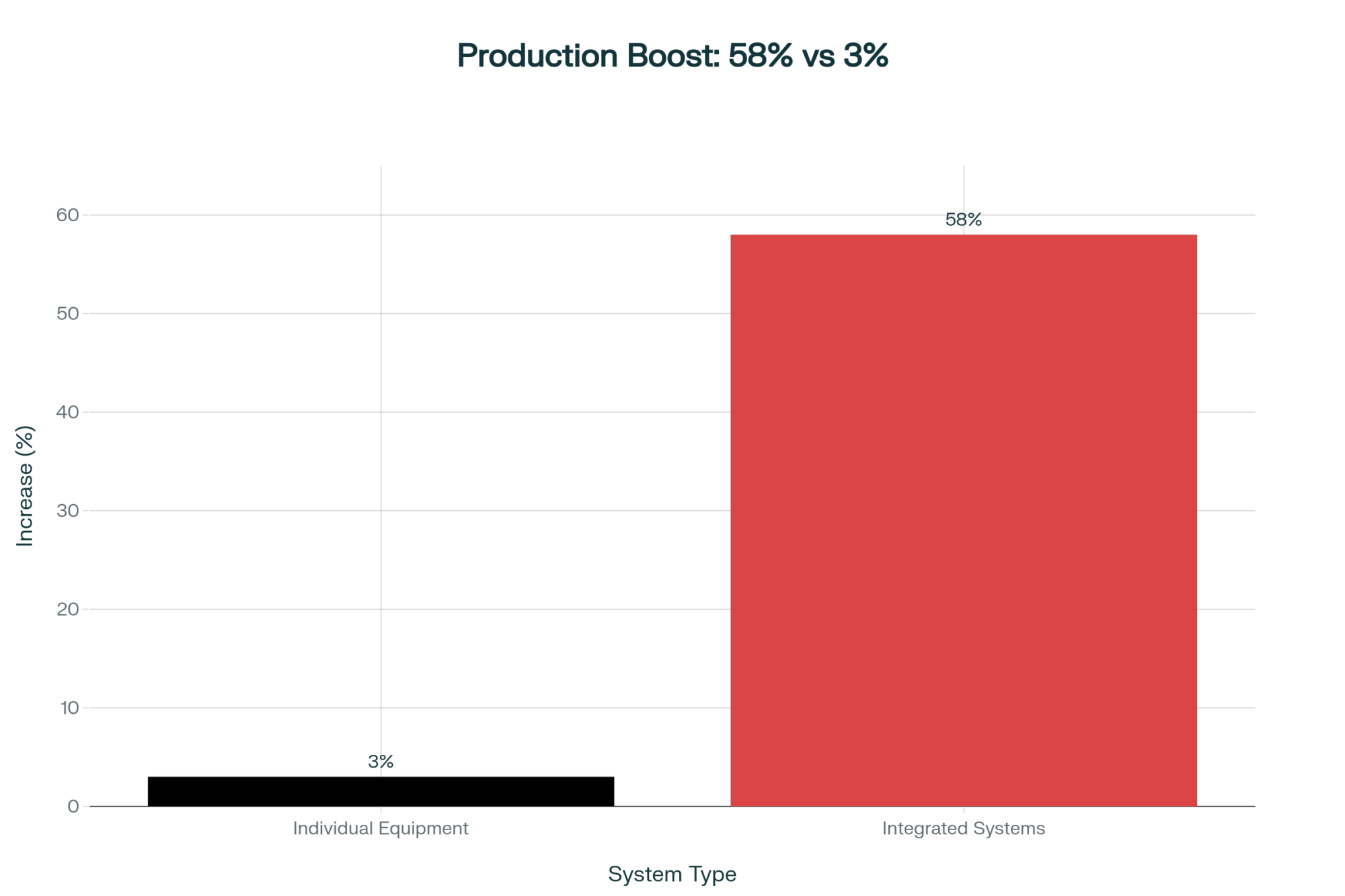
The University of Tennessee extension team published some solid work on automatic milking considerations in 2023 that really caught my eye. When they examined automated milking systems, they documented a consistent 3% increase in milk production, with cows averaging between 2.4 and 2.6 milkings per day. Nothing earth-shattering there, but it’s a good baseline data point.

TechnologyAvg Payback (yr)Farms ROI (%)Top ROI Driver
Robotic Milk5.2yr68%Labor cost 32%
Auto Feeders3.8yr82%Feed effic 19%
Health Sensors2.1yr91%Mastitis 41%
Precision Irrig1.5yr94%Water save 57%

Here’s what’s interesting, though. When researchers examined large US dairies that had combined various technologies, a comprehensive study published in the Animals journal early this year revealed something that surprised me. They found 58% of farmers reported milk production increases that exceeded what the robots alone delivered.

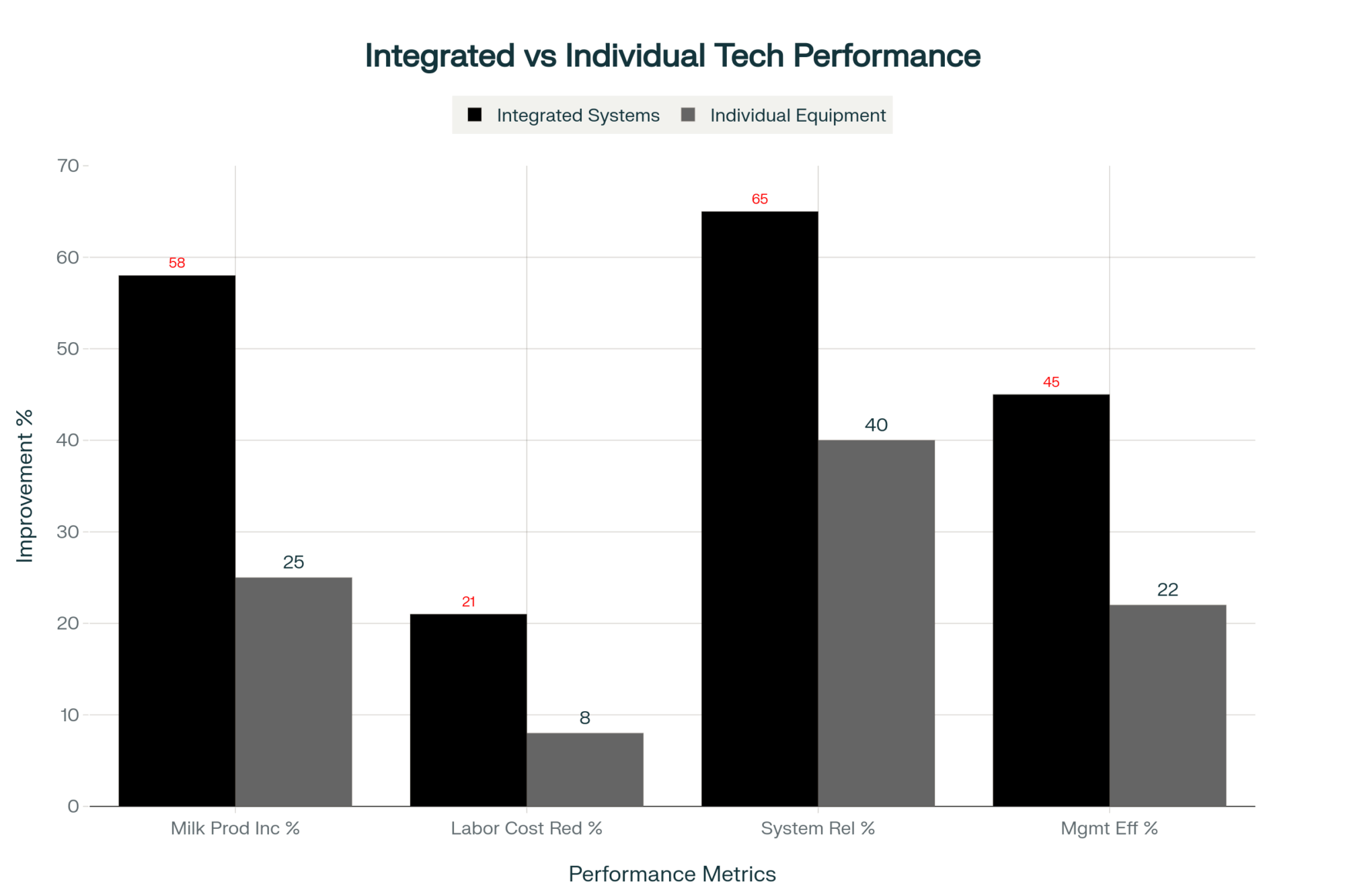
The Integration Advantage: Research shows integrated technology systems consistently outperform individual equipment purchases across all key dairy metrics – These aren’t theoretical projections but documented results from University of Tennessee and Animals journal studies tracking real producer outcomes.

The data suggests something is happening when systems work together that individual ROI calculations don’t capture. And there’s the quality of life component too, which doesn’t get discussed enough at industry meetings—better early detection of health issues, improved conception rates, and, let’s be honest, sleeping better when you know systems are monitoring things during the night.

What’s particularly noteworthy is the labor data from that Animals journal study. Farmers estimated cost reductions exceeding 21% when systems communicate with each other rather than operating independently. Whether you’re running 200 cows in Vermont or 2,000 in the Central Valley, those numbers represent real money.

Why Scale and Geography Change Everything

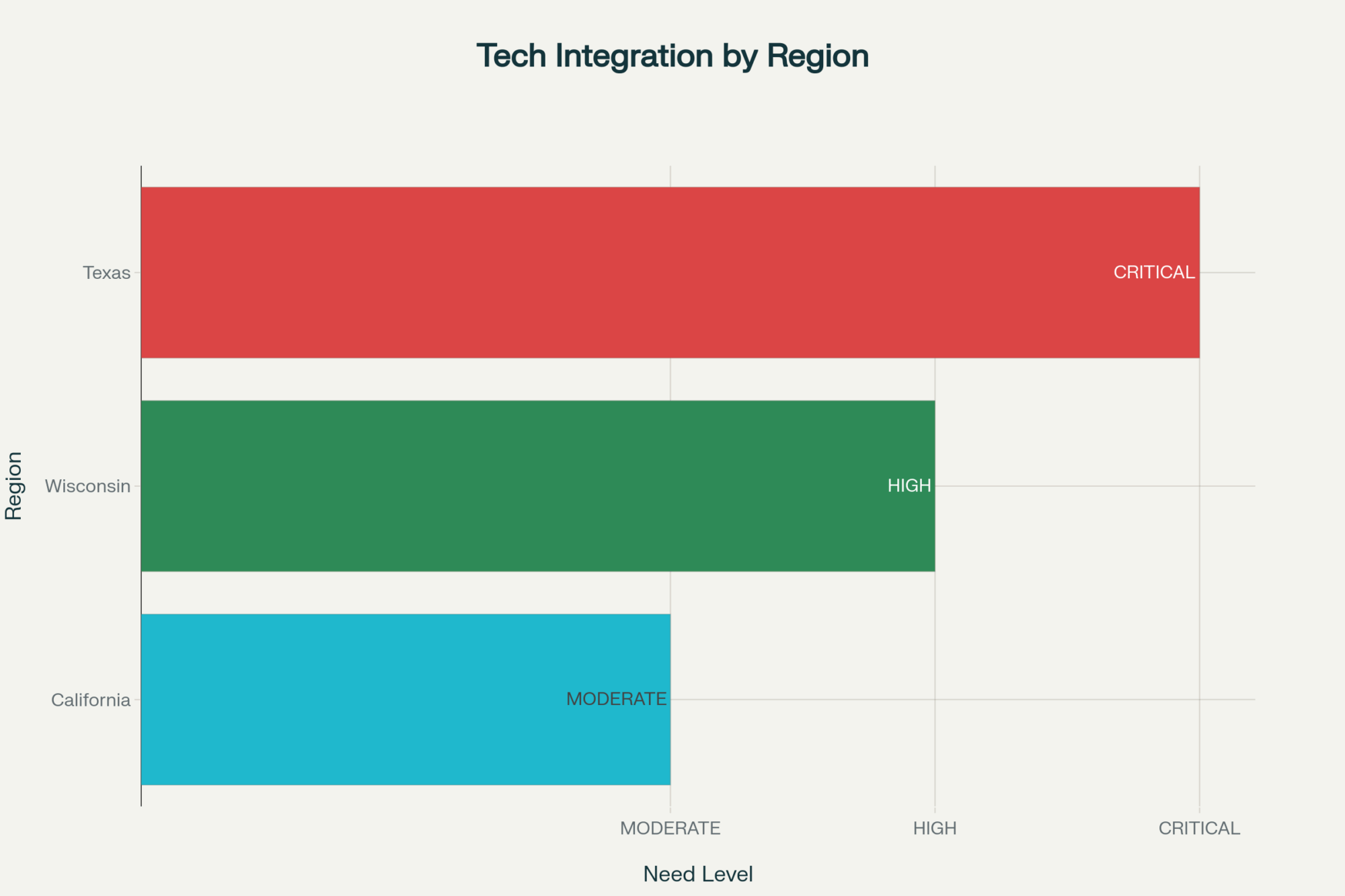
Geography Drives Integration Strategy: How location and scale determine your technology priorities and ROI potential – Your neighbor’s successful technology strategy might fail on your operation due to these fundamental differences.

You probably already know this from your own operation, but scale completely transforms technology economics. And geography? That matters just as much as cow numbers, though the equipment dealers don’t always emphasize this during their presentations.

A 150-cow dairy in Wisconsin faces completely different integration priorities than a 2,500-cow operation in Texas. The Wisconsin farm deals with 5-6 months of housing, where maximizing efficiency during confined feeding becomes critical for maintaining butterfat performance through those February cold snaps. Meanwhile, that Texas operation worries about heat stress management for four months of the year, making the integration between environmental monitoring and feeding systems essential when temperatures climb past 105 degrees.

For smaller operations, integration often becomes necessary just to make advanced technology viable. The base investment doesn’t scale down with cow numbers, but the returns certainly do. It’s basic economics, but it’s not how most of us think about technology purchases when we’re sitting in that sales presentation.

Compare that to larger California operations, where individual technologies might demonstrate solid returns independently. Integration still adds value, but it’s more about optimizing already strong performance rather than creating viability from scratch.

In many cases, pasture-based operations dealing with mud season have different integration priorities than dry lot systems, where dust affects everything from sensor accuracy to the frequency of equipment cleaning.

Technology Combinations That Show Promise

Beyond the obvious feed-and-robot pairing that gets discussed at every conference, several combinations are emerging that might interest you. Some have solid data behind them, while others are still in the development stage.

Industry reports suggest that biogas systems perform more efficiently when paired with automated feed management systems. The theory—and early results from European installations support this—is that frequent feed pushing helps optimize gas production through better mixing and agitation. The exact mechanisms depend on your facility design and manure handling approach.

Heat stress management through integrated systems is another area worth noting, especially for operations that face summer challenges. Several Southwest operations running systems like CowManager or similar platforms report positive results, identifying stress zones and automatically adjusting cooling to maintain consistent feed intake. Though what works in dry heat might not translate directly to humidity challenges in the Southeast.

What’s encouraging is seeing rumination monitoring systems work alongside health protocols. When collar alerts provide earlier warnings than visual observation alone, treatment protocols can start sooner. Systems like SCR or Allflex monitoring are showing promise in this area, with veterinarians reporting they’re catching subclinical issues days earlier than traditional methods allow.

Early indications from Midwest operations also suggest that precision forage harvesting, guided by field mapping technology, can improve feed value consistency. This is particularly important, given the variable weather patterns that have made forage quality unpredictable from field to field this season.

The farms getting the best results from these combinations aren’t necessarily early adopters or the biggest spenders. They understand their operational limitations and build systems that match their management capabilities and staff expertise.

Technology Readiness and Smart Adoption Timing

Not all integration opportunities are at the same stage of development, and understanding this can save you both headaches and money. Some combinations have years of field testing behind them, with documented performance results—such as established robotic milking systems from Lely or DeLaval, which work seamlessly with their companion herd management software platforms.

Others are emerging but show promise based on solid research foundations. That biogas-feed management integration? Still relatively new, with most data coming from installations over the past few years in Europe and limited experience in North America. Precision forage mapping linked to variable-rate harvesting is a relatively new concept, supported by solid university research but with limited long-term operational data from commercial farms.

Then some technologies sound compelling in sales presentations but aren’t quite ready for mainstream adoption across different operational realities. Complex automation for routine tasks often faces maintenance challenges that can offset projected labor savings. Automated calf feeders for solid feed, robotic barn cleaning systems, and automated foot trimming equipment—all show promise but often require more technical support than many operations can provide consistently.

I’ve learned to be cautious about any technology that requires perfect conditions to work properly. Real dairies are unpredictable places where equipment needs to perform reliably, whether you’re dealing with power outages during fresh cow management or sensors that need to work during dusty harvest season.

This suggests that we should approach new technology with what I call ‘informed patience’—watching the early results but waiting for proven track records before making major investments.

A Practical Implementation Framework

The $500K Mistake Prevention Guide: Why Stage-Skippers Fail While Strategic Adopters Succeed

Rather than random technology adoption—and we’ve all been tempted by interesting equipment at trade shows—successful producers seem to follow a thoughtful three-stage progression that makes sense both financially and operationally. This framework typically spans 12-24 months for most operations, though timing varies based on your specific situation.

This isn’t theory; it’s based on patterns observed on farms that are actually making money from technology integration.

Start with foundation technologies (months 1-9): Feed testing equipment, basic activity monitoring systems, and data management platforms generate actionable information while establishing the data infrastructure necessary for more advanced investments. Perhaps more importantly, they allow you to learn how your specific operation responds to technology without major financial risk.

The beauty of starting here is that you can test the waters without betting the farm. Basic NIR testing, simple activity monitors, and entry-level data systems enable you to assess how technology aligns with your management style and your staff’s capabilities before making larger commitments. Plus, these systems typically pay for themselves relatively quickly.

Then consider performance accelerators (months 6-18): Ration optimization software integrated with automated mixing systems, heat detection linked to breeding protocols, and environmental controls that respond to real-time conditions rather than preset timers. These often deliver the most noticeable day-to-day operational improvements while demonstrating that your integration capabilities work effectively with your team and facilities.

This is where seasonal considerations become really important. Northeast operations might prioritize integration that maximizes efficiency during the housing period, while year-round operations in warmer climates focus more on heat stress management and consistent performance throughout the year. What I’ve noticed is that farms rushing past this stage often struggle with transformative technologies because they haven’t built the operational foundation to support them.

Finally, evaluate transformative systems (months 12-24+): Automated milking, biogas generation, and advanced health analytics represent significant capital investments that really shine when proper foundations support them—but they can be challenging if implemented too early in the process.

What’s clear from speaking with producers across different regions is that operations rushing to adopt expensive technology without first building the necessary infrastructure often experience disappointing results. The systems simply can’t integrate effectively without proper preparation—whether that’s adequate connectivity infrastructure in Vermont or equipment selections that handle dust and temperature extremes in Texas.

Strategic Technology Integration Framework: The proven three-stage approach that 58% of successful producers follow to maximize ROI – Notice how stages overlap, allowing you to test integration capabilities before major investments.

Integration Success Metrics Beyond Basic ROI

Here’s something that doesn’t get discussed enough—how do you actually measure whether your technology integration is working? Basic ROI calculations are a start, but they don’t capture the full picture of what integrated systems can deliver.

Look at improvements in management efficiency, not just labor reduction. Can you make better decisions faster? Are you catching problems earlier? Is your staff more confident in their daily management because they have better information? These qualitative improvements often matter more than the quantitative savings in the long run.

Monitor data quality and consistency. Track what percentage of your alerts actually lead to actionable decisions versus false alarms. Good integrated systems should provide more reliable, comprehensive information than standalone systems while reducing alert fatigue. If you’re getting more notifications but not better outcomes, something isn’t working properly in your integration approach.

Track seasonal performance variations. Good integration should help your operation perform more consistently across different conditions—maintaining production during heat stress, optimizing feed efficiency during price spikes, and managing fresh cow transitions more effectively during busy periods. I’ve noticed the most successful adopters measure performance stability as much as they measure absolute improvements.

System uptime and reliability metrics matter too. Track how often your integrated systems are actually functioning versus offline for maintenance, calibration, or repairs. The best technology integration in the world doesn’t help if systems aren’t operational when you need them.

The most successful technology adopters are constantly measuring and adjusting their systems rather than installing and hoping for the best. They treat integration as an ongoing process rather than a one-time purchase decision.

How Financing Method Actually Changes Your Returns

Your financing approach fundamentally alters actual returns, not just payment schedules. The equipment dealers don’t always emphasize this, but how you pay for technology can matter as much as which brand you choose.

Cash purchases maximize returns over time but tie up working capital that most operations need for daily management and seasonal cash flow challenges. Traditional loans reduce early cash flow through debt service, though interest deductibility provides some benefit that varies based on your tax situation.

Operating leases often deliver solid returns with tax advantages and off-balance-sheet treatment that can be attractive for operations managing debt ratios. This approach works especially well for mid-size dairies that want to preserve cash flow flexibility for feed purchases and other operational needs that fluctuate seasonally.

Grant funding through USDA programs, such as EQIP, or state-specific incentives can significantly improve project economics; however, the application process is often lengthy and competitive. Programs vary significantly by state and are subject to regular changes. California’s air quality programs have been particularly aggressive in offering dairy technology incentives, while Vermont focuses more on environmental initiatives. States like Wisconsin offer energy-focused programs through their Focus on Energy initiative.

What’s interesting is how the choice of financing affects not just immediate cash flow but also long-term operational flexibility. Producers who’ve been through economic cycles often prefer approaches that preserve working capital during the early adoption period when systems are still proving themselves on their specific operation.

The Hidden Implementation Costs That Wreck Projections

The Uncomfortable Truth: 58% of Tech Failures Start With Unrealistic Expectations, Not Equipment Problems

Even with thorough planning, there are invisible expenses that can extend payback periods and catch you financially off guard. Most experienced producers now budget 20-30% additional funds above equipment costs specifically for these factors.

The $41,000 Infrastructure Surprise: Why Smart Farmers Budget 30% Extra Before Signing Any Technology Contract

Infrastructure requirements represent the biggest surprise for many operations. Upgrading connectivity, completing data integration work, and proper system calibration can add substantial costs to installations, depending on your existing infrastructure and facility layout. Without adequate infrastructure, systems generate incomplete data—which defeats the entire purpose of integration.

Many producers have installed expensive monitoring equipment, but they couldn’t obtain consistent data due to connectivity dead spots or inadequate network coverage. That’s expensive sensors collecting partial information, which can be more frustrating than having no data at all, since you can’t trust what you’re seeing when making management decisions.

Staff training needs to be ongoing and comprehensive—not just a one-day session when equipment gets installed. Budget 40-60 hours of training time per major system for key staff members, spread over the first year. People need to understand not just individual systems but how they work together and what to do when alerts conflict or systems disagree. This takes time and resources, but it’s essential for getting value from integrated systems.

Real-world performance often differs from sales projections, particularly during the first year, as systems adjust to your specific conditions and teams refine new workflows. This is completely normal—any major operational change requires adjustment time—but worth factoring into initial expectations.

Subscription fees for software platforms typically escalate by 3-5% annually. Something to consider when calculating total ownership costs over equipment lifecycles, particularly for operations running multiple platforms that all want their monthly fees.

The Hidden 26% Reality: Why your technology budget needs to be 20-30% higher than equipment sticker prices – These aren’t optional extras but mandatory investments that determine whether your integration succeeds or fails.

Technologies Requiring Careful Evaluation

Not every emerging technology delivers on initial promises, and we should maintain realistic expectations while remaining open to genuine innovation.

Standalone monitoring systems often generate alerts without providing actionable response options. Without integrated solutions, you’re collecting data that can’t be effectively utilized—frustrating for everyone involved. Before investing in any monitoring technology, ask yourself: “What specific action will I take based on this alert?”

Video-based detection systems can struggle with actual barn conditions more than sales presentations suggest. Variable lighting conditions, environmental factors such as dust or moisture, and normal traffic patterns significantly affect performance more than controlled testing environments. What works perfectly in a research facility might struggle in a working barn, where visibility challenges are typical, especially during harvest season when dust levels increase.

Complex automation for routine management tasks sometimes faces ongoing maintenance challenges that can offset projected labor savings. These systems often work well when they’re functioning, but downtime for repairs or recalibration can be more disruptive than the labor they’re supposed to save. I’ve noticed this particularly with systems that have multiple moving parts or require frequent calibration.

When evaluating technology vendors, ask specific questions: What’s the typical uptime percentage? How quickly do they respond to service calls in your region? What happens if the company goes out of business or discontinues support for your model? These aren’t comfortable questions, but they’re necessary for making informed decisions.

The Bottom Line: Integration Works, But Strategy Matters

The dairy industry’s technology revolution isn’t just about buying innovations—it’s about building systems that amplify each other’s performance. The University of Tennessee data and the comprehensive Animals journal study both point to the same conclusion: producers who approach technology strategically, with an eye toward integration, consistently see better results than those making isolated purchases.

Start with foundations that generate data and prove value in your specific operation. Layer on performance accelerators once you’ve demonstrated that integration works with your management style and staff capabilities. Deploy transformative systems only when infrastructure can support them properly and you’ve built the operational expertise to maximize their potential.

Your goal isn’t to accumulate the most technology or impress visitors with fancy equipment. It involves implementing the right combination of systems that work together to enhance profitability, operational efficiency, and management satisfaction in the long term.

The operations that figure this out will continue pulling ahead as technology becomes more central to competitive advantage. Those who keep buying individual solutions and hoping for a miracle? They’ll continue to wonder why their neighbors are more profitable, despite dealing with the same market conditions and cost pressures.

What’s coming next will make today’s integration opportunities look simple by comparison. Artificial intelligence, machine learning, and predictive analytics are already being applied in dairy applications. The farms that master strategic technology adoption now are positioning themselves for whatever innovations emerge over the next decade.

And trust me, based on what I’m seeing at conferences and talking to researchers, the pace of change isn’t slowing down. If anything, it’s accelerating.

KEY TAKEAWAYS

  • Proven Integration Returns: Research from major university studies shows 58% of farms using integrated technology systems achieve production gains beyond individual equipment projections, with documented labor efficiency improvements exceeding 21% when systems communicate versus operating independently
  • Strategic Implementation Timeline: Follow a proven three-stage approach over 12-24 months—start with foundation technologies (feed testing, activity monitors, data platforms) that prove value quickly, layer on performance accelerators (integrated mixing and environmental controls), then deploy transformative systems (automated milking, biogas) when infrastructure supports them
  • Hidden Cost Management: Budget 20-30% above equipment costs for infrastructure upgrades, staff training (40-60 hours per major system), and system integration—experienced producers report these often-overlooked expenses determine whether technology investments meet projected returns
  • Regional Success Factors: Northeast operations prioritize efficiency during housing periods, while Southwest farms focus on heat stress integration, with financing approaches (operating leases, USDA EQIP grants) fundamentally changing actual ROI depending on operation size and state incentive programs
  • Integration Success Metrics: Track data quality consistency, system uptime reliability, and seasonal performance stability alongside traditional ROI—successful adopters measure performance stability as much as absolute improvements, treating integration as an ongoing process rather than a one-time purchase decision

EXECUTIVE SUMMARY

University research reveals a significant shift in how successful dairy producers approach technology investments, moving from individual equipment purchases to integrated system strategies. The University of Tennessee’s 2023 analysis found that automated milking systems deliver consistent 3% production increases. A comprehensive 2024 study in the Animals journal showed that 58% of farmers using integrated approaches reported gains exceeding what individual technologies deliver alone—with labor cost reductions exceeding 21% when systems communicate effectively. What’s driving this difference isn’t just the technology itself, but how scale and geography fundamentally change the economics. Smaller operations often need integration to make advanced systems viable, while larger farms use it to optimize existing performance. The most successful operations follow a strategic three-stage approach over 12-24 months: starting with data-generating foundations, adding performance accelerators that prove integration works with their team, then deploying transformative systems only when proper infrastructure supports them. Recent data suggest that this strategic approach becomes even more critical as artificial intelligence and predictive analytics begin to appear in dairy applications. Smart producers understand that technology’s future isn’t about accumulating equipment—it’s about building systems that amplify each other’s performance to create a lasting competitive advantage in an industry where margins continue to tighten.

Complete references and supporting documentation are available upon request by contacting the editorial team at editor@thebullvine.com.

Learn More

Join the Revolution!

Join over 30,000 successful dairy professionals who rely on Bullvine Weekly for their competitive edge. Delivered directly to your inbox each week, our exclusive industry insights help you make smarter decisions while saving precious hours every week. Never miss critical updates on milk production trends, breakthrough technologies, and profit-boosting strategies that top producers are already implementing. Subscribe now to transform your dairy operation’s efficiency and profitability—your future success is just one click away.

NewsSubscribe
First
Last
Consent

When Butterfat Isn’t Enough: Adapting Your Dairy to New Market Realities

4.2% butterfat herds lost money while 3.3% protein dairies gained $47K—here’s why the math changed

EXECUTIVE SUMMARY: This fall’s butter market correction revealed a fundamental shift that’s catching producers off-guard: despite genetic advances pushing national butterfat averages above 4.2%, cheese-focused processors are prioritizing protein premiums over traditional fat bonuses. Operations tracking component optimization report capturing $40,000-$75,000 in additional annual revenue by balancing breeding programs toward protein production, with technology investments typically paying back within 2-3 years for herds above 400 cows. While 73% of U.S. milk now flows into cheese manufacturing—up from 68% just five years ago—many producers remain focused on butterfat genetics that no longer align with processor economics. Regional variations matter significantly: Southeast operations face higher bypass protein feed costs that can reduce net benefits, while Upper Midwest farms benefit from established cheese processing infrastructure offering competitive protein premiums. What farmers are discovering is that successful component strategies require understanding processor priorities, not just herd genetics. The most resilient operations develop flexible approaches that can adapt to changing market spreads between Class III and Class IV pricing.

dairy component profitability

You know those weeks when the markets do something that makes absolutely no sense until you dig deeper? Well, we had one of those this fall when butter futures took a hit that had everyone talking. And not just a little dip—we’re talking about the kind of drop that gets people’s attention real quick.

But here’s what really caught my eye, and maybe you’ve noticed something similar… Despite our herds producing some of the highest butterfat levels in decades—and the genetic advancement reports from places like Hoard’s Dairyman confirm we’re seeing unprecedented gains in component production—butter manufacturing in many regions actually declined while cheese production kept expanding.

That disconnect tells us something important about how the industry’s evolved. And honestly, it’s creating opportunities for those willing to think differently about component production.

Understanding What’s Really Happening in Processing Plants

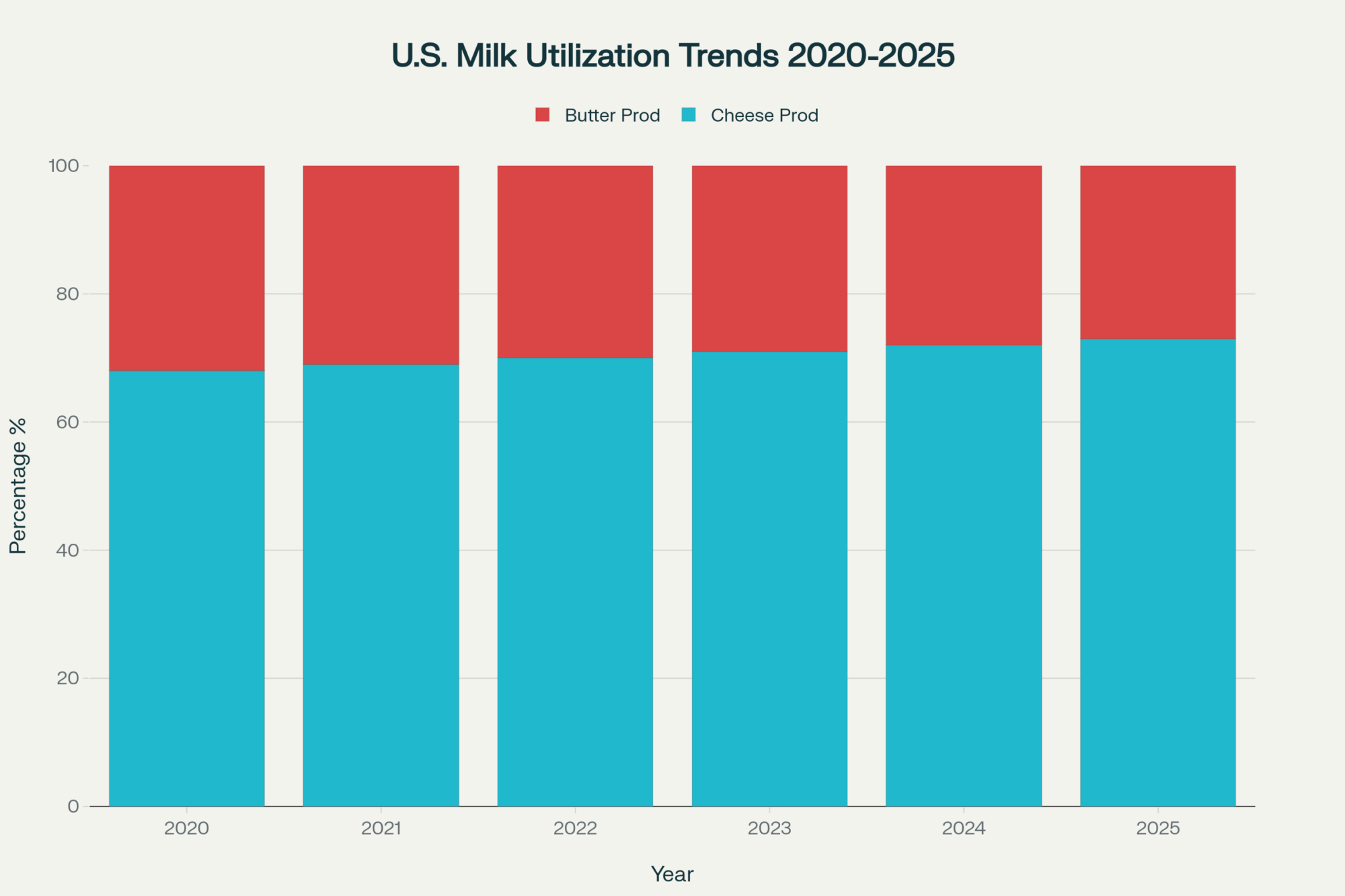
U.S. Milk Utilization Shift demonstrates the steady move toward cheese production driving component strategy changes – the 5-percentage-point swing since 2020 represents billions of pounds redirected from butter to cheese manufacturing, fundamentally altering processor premium structures.

I recently spoke with a producer in central Wisconsin who put it this way: “The plant manager told us flat out that they’re making decisions based on contract stability, not what’s coming through the separator that week.” This builds on what I’ve been hearing across the Midwest, and what’s particularly noteworthy is how consistent this pattern seems to be.

You can see this playing out in the trade patterns. Industry reports suggest cheese exports to Mexico have been growing consistently, while butter exports haven’t kept pace despite our production advantages. From what I’m observing—and I’d be curious to hear if you’re seeing something different—processors seem to be responding to these market signals by prioritizing protein over butterfat, even when there’s plenty of cream to work with.

What’s interesting here is how this creates opportunities for those willing to adapt. What I’ve been noticing—and I wonder if this matches your experience—is that protein premiums appear to be widening while butterfat bonuses often stay relatively flat across several cooperative systems I’ve been tracking.

Making the Numbers Work: When Component Strategy Actually Makes Sense

Let me share a situation that really drives this point home. I had a conversation with a producer who asked to remain anonymous—a 650-cow operation in Wisconsin—and their experience represents what many farms are discovering. A couple of years ago, their genetic selection focused heavily on butterfat production. You know the approach: targeting sires with those high fat EBVs (Expected Breeding Values—basically the genetic prediction for how much extra fat or protein a bull’s daughters will produce), getting the herd up above 4% butterfat. Should’ve been a winner, right?

But here’s what they found… Their cooperative was offering significantly higher premiums for protein than for butterfat. Most of their milk was flowing into cheese contracts with guaranteed protein bonuses that substantially exceeded what they could earn from fat.

This aligns with broader industry data suggesting that most of our milk production is now going into cheese manufacturing—a notable increase from just a few years back. While the data is still developing on exact percentages, the trend reflects export opportunities and margin stability that butter manufacturing simply can’t match (especially with European competition limiting our butter export potential).

Now, it wasn’t all smooth sailing for them—they had their share of feed mixing mistakes and breeding errors in the first year. The learning curve was steeper than they expected. But the financial impact was significant once they got the systems working properly. By adjusting their breeding program toward more balanced component production and modifying feeding programs to support protein synthesis, they captured substantial additional premiums. We’re talking about enough money to cover genetic improvement costs and generate meaningful additional revenue.

What’s particularly encouraging is how this approach builds on traditional dairy management principles. Instead of chasing single-component extremes, it’s about optimizing the whole milk profile for current market realities.

The Investment Reality Check: Making Technology Pay

Here’s where things get practical, and this is where I think we need to be really honest about the economics. Making these adjustments isn’t just about changing breeding decisions—though that’s certainly part of it. This Wisconsin operation invested in:

  • RFID collar systems for dynamic herd grouping
  • Automated feeding equipment that can deliver different rations to different groups
  • Herd management software that tracks component yields by group

The investment typically runs into six figures for comprehensive systems, but their payback fell into that 2-3 year range that most lenders can live with. And that’s key: you need enough scale to spread those fixed costs across sufficient volume to make it pencil out.

Early indications suggest—and this matches what I’m hearing from extension folks—that component optimization investments typically make economic sense for larger herds, generally starting around 400-500 cows. Although this varies significantly based on existing infrastructure and local market conditions, which highlights an important point about regional differences.

Component Optimization ROI by Herd Size shows the 400-500 cow threshold where technology investments become economically viable – below 400 cows, payback periods stretch beyond 4 years, while operations above 600 cows achieve sub-3-year returns that most lenders can support.

For operations below that threshold, the recommendation I keep hearing is to focus on cooperative programs and selective nutrition adjustments rather than major technology investments. As one specialist explained to me, you can often capture most of the component benefits through precision feeding without the big capital outlay.

It’s worth noting that some of the most successful implementations I’ve seen started small—maybe just separating first-lactation heifers from mature cows, then gradually adding complexity as management systems improved.

Regional Realities: Why Geography Still Matters More Than Ever

This is where I think we need to be careful about painting with too broad a brush. What works in Wisconsin doesn’t necessarily translate elsewhere, and recent conversations with producers across different regions have really driven this home.

Take the Southeast, where summers routinely hit the mid-90s with high humidity. Heat stress naturally depresses butterfat production, making protein premiums more attractive—but feed costs for bypass protein sources run notably higher than in the Upper Midwest. I recently spoke with a Georgia producer who found the economics to be completely different from what he had read about Wisconsin operations.

Regional Component Premium Comparison reveals why geography matters more than genetics in today’s dairy markets – Upper Midwest protein premiums exceed butterfat bonuses by 140%, while Southeast operations face compressed margins that challenge component optimization economics

Here’s what I’ve observed across different regions:

In Wisconsin, Minnesota, and Iowa, you’ve got established cheese processing infrastructure that creates competitive protein premiums. Cooperative payment structures often favor milk testing above certain protein thresholds—and those bonuses can be quite attractive when you hit them consistently.

Down in Georgia, Florida, and the Carolinas, heat stress challenges butterfat production, but local processors serving regional cheese markets still offer protein incentives. However, higher feed costs for bypass protein sources can reduce the net benefits. One North Carolina producer told me, “The math works, but barely.”

In the western United States, specifically in California, Arizona, and New Mexico, large-scale operations benefit from economies of scale in component tracking technology; however, water costs and heat management present distinct challenges for optimization. I haven’t spent as much time talking with Western producers, but the conversations I’ve had suggest they’re dealing with challenges the rest of us don’t fully appreciate.

Up in Vermont, New York, and Pennsylvania, seasonal variation is more pronounced. Winter component production often exceeds summer levels by several tenths of a percent for both fat and protein—partly because of cooler temperatures, but also because fresh cow management tends to be easier when you’re not dealing with heat stress. Something you need to factor into any optimization strategy.

Pacific Northwest operations face their own unique challenges with seasonal pasture systems and proximity to export facilities, which could alter the entire optimization equation. The proximity to Asian export markets may create different premium structures than those seen in other regions.

What’s becoming clear to me is that successful component strategies need to match regional processing infrastructure, not just herd genetics.

Financial Risk Management: Beyond Basic Marketing

What’s emerged alongside component optimization is a different approach to financial risk management—and this is where things get interesting. Dairy Revenue Protection has seen growing adoption across the country, with industry estimates suggesting increasing participation rates, but successful operations aren’t just buying coverage.

They’re integrating it with component-specific strategies. When cheese-focused markets strengthen relative to butter markets, these operations adjust their approach accordingly. They might maintain different strategies for different production focuses, increasing cheese-related protection when protein premiums widen, or adjusting toward butter-related positions when those premiums improve.

This requires more management sophistication than traditional marketing, and I’m still trying to figure out if it’s truly necessary for everyone or just certain types of operations. What’s your experience been with financial risk management complexity?

I’ve noticed that the farms handling this complexity best are treating it like any other management system—they’ve got protocols, regular review schedules, and clear decision criteria rather than making it up as they go along.

When Technology Strategies Fall Short

Not every attempt at component optimization succeeds, and I think it’s important to talk honestly about what can go wrong. Here’s a representative example that really opened my eyes—an Illinois operation with around 480 cows that invested heavily in similar technology upgrades.

Within several months, they’d shut down the component tracking systems and returned to single-group management. The complexity overwhelmed their labor situation. Feed mixing errors, breeding mistakes, and constant system troubleshooting. The theoretical benefits never materialized because they couldn’t execute consistently on a day-to-day basis.

That said, they did learn some valuable lessons about their operation’s limitations, and they’ve actually improved their basic component tracking through simpler nutrition adjustments. Sometimes knowing what doesn’t work for your situation is just as valuable.

This highlights something I see repeatedly: operational excellence still trumps sophisticated strategies that are poorly executed. That operation now focuses on cost control and traditional efficiency measures, which have proven more reliable given their management situation.

I should mention that there are plenty of successful producers who think this whole component optimization trend is overcomplicating things. One farmer I know in Iowa puts it this way: “I’d rather be really good at the basics than mediocre at advanced strategies.” And honestly, he’s got a point—his cost per hundredweight is consistently lower than many high-tech operations.

The common failure points in component optimization usually come down to execution issues that most of us can relate to:

  • Feed mixing precision becomes critical when different groups require different rations, which necessitates attention to detail that some operations simply can’t maintain consistently during busy seasons like planting or harvest.
  • Managing multiple genetic lines increases the chance of breeding errors that can take years to correct—and we all know how expensive those mistakes can be.
  • Technology dependence means system failures during critical periods can disrupt months of planning. And we’ve all had those equipment failures at the worst possible times.
  • Staff turnover necessitates ongoing retraining on more complex protocols, which can become expensive and frustrating.

What I’ve learned is that the most successful implementations have built-in simplicity and backup systems from day one.

Alternative Pathways That Work Just Fine

Component optimization isn’t the only way to respond to changing market dynamics, and maybe that’s the most important point of this whole discussion. Several successful operations pursue different strategies that might be more suitable for farms facing management or capital constraints.

Value-added production offers one interesting path. Organic certification and quality standards that exceed commodity requirements can generate premiums that reward operational excellence rather than component manipulation. This approach is particularly attractive for farms that prefer focusing on traditional management skills—and there’s nothing wrong with that approach.

Specialty markets present another option worth considering. I know operations supplying artisan cheese makers or local processors that capture premiums based on quality and consistency rather than specific component levels. These relationships require different skills—such as reliability, flexibility, and direct communication with manufacturers—but can generate comparable returns without significant technology investments.

Many cooperatives now offer pooled services that allow smaller farms to access sophisticated strategies without individual infrastructure investments. Professional support for component tracking and risk management can be more cost-effective than going it alone, especially if you’re not at that 400-500 cow threshold.

Direct marketing continues to work well for farms in the right locations. Farm stores, on-farm processing, agritourism—these approaches can generate premiums that dwarf any component optimization program, though they require completely different skill sets.

The Technology Risks Nobody Discusses

One aspect that often receives insufficient attention is what happens when systems fail. I heard about cybersecurity issues this past spring that affected feed management software, leaving farms unable to access their protocols for days. Most recovered quickly, but operations running complex component programs faced more significant disruptions.

The lesson learned—and this came up in several conversations—was maintaining backup systems for everything. Technology enables precision, but you need redundancy when precision matters. Paper copies of feeding recipes, breeding schedules, and group assignments. It adds administrative overhead but provides essential backup when systems go down.

Cybersecurity concerns are growing as farms connect more systems to internet-based platforms. Agriculture has seen an increase in security incidents, and dairy operations with financial programs can present attractive targets for malicious actors. This is something we all need to consider as we integrate connected systems.

There’s also the question of what happens when technology companies go out of business or discontinue support. I’ve seen farms stuck with orphaned software systems that cost thousands to replace.

The Global Economic Picture

Looking beyond individual farm decisions—and this is where I find the whole situation fascinating—this component focus reflects broader changes in global dairy trade. European milk production has seen some decline, while New Zealand production has remained relatively flat despite generally favorable conditions.

That’s created export opportunities for U.S. cheese that don’t exist for butter, where European producers maintain competitive advantages in premium markets. Industry reports suggest U.S. cheese exports have grown significantly compared to butter exports, and these global patterns are what’s really driving domestic processing decisions.

Growing middle-class populations in Southeast Asia are driving cheese consumption in markets that previously relied primarily on traditional dairy products. This creates long-term export demand that supports protein-focused processing strategies, thereby enhancing the sustainability of these strategies. However, I’m genuinely curious about whether this component focus will remain long-term or if we’ll see the pendulum swing back toward simpler approaches as the market evolves.

The development that really has me thinking is how currency fluctuations affect these export patterns. When the dollar strengthens, our export competitiveness changes, which could shift processor priorities again.

Seasonal Patterns Most Producers Miss

Here’s something I’ve noticed from years of watching component production, and maybe you’ve observed the same thing… Seasonal variation in optimization returns is more significant than most producers realize.

Many producers observe that winter months often favor butterfat premiums as holiday demand increases, while spring and summer frequently see stronger protein premiums as cheese manufacturing ramps up for fall and winter consumption. Current conditions suggest this pattern is holding, though regional variations seem more pronounced this year.

Some operations adjust feeding programs seasonally to capture these patterns—shifting toward higher-fat rations in fall, then transitioning to protein-focused feeding by late winter. This seasonal flexibility requires more management attention but can add meaningful revenue to component premiums—though it also adds another layer of complexity that not every operation can handle.

The seasonal aspect becomes particularly important for farms using financial strategies. Price spreads show patterns that experienced farms can often anticipate and position for, though recent market volatility has made traditional patterns less reliable.

What’s interesting is how the seasonal patterns seem to be getting more pronounced as export markets become more important to domestic pricing.

Key Questions Every Producer Should Ask

Before diving into component optimization, here are the questions I’d recommend asking yourself:

  • Can your current management team handle increased complexity? Be honest about attention to detail during busy seasons like planting or harvest, when dairy tasks might get less focus.
  • What’s your cooperative’s actual payment structure? Don’t assume—get the specific thresholds and premiums in writing and calculate the real potential benefits for your current production levels.
  • Do you have backup systems in place for your technology dependence? Paper records, alternative feeding protocols, and manual sorting systems for when (not if) technology fails.
  • What’s your real payback timeline tolerance? Six-figure investments with 2-3 year paybacks sound reasonable until cash flow gets tight during a downturn.
  • How does this fit your long-term farm goals? Component optimization might not align with succession planning, debt reduction, or quality-of-life objectives.

Practical Steps for Different Farm Situations

For producers considering component optimization—and this might not apply to your situation, but here’s what I’ve learned from both successful and unsuccessful attempts:

  • If you’re running 500 or more cows, start with data analysis. Review a couple of years of component tests and cooperative payments to identify what opportunities you might be missing. Many farms discover significant premiums they didn’t even realize were available. Technology infrastructure investments typically make sense at this scale, though the learning curve can be steeper than expected.
  • For mid-size operations, focus on cooperative programs and precision nutrition rather than major technology investments. Most cooperatives offer component assistance that provides much of the benefits without the capital requirements. Consider sharing costs with neighboring farms if that’s feasible—I’ve seen some interesting collaborative arrangements that spread technology costs across multiple operations.
  • Smaller operations should first evaluate value-added opportunities and specialty markets. Fixed technology costs often make traditional approaches more profitable at a smaller scale. However, selective breeding changes that favor balanced component production rarely harm and usually provide modest improvements over time.
  • Regardless of size, honestly assess your management capacity. The most sophisticated strategy fails without consistent execution—and I’ve learned this the hard way. Component optimization requires attention to detail that not all operations can maintain, and that’s perfectly fine. Focusing on operational excellence often provides better returns than poorly executed advanced strategies.

The Bottom Line

The market disruptions we saw this fall exposed how much the industry has changed beneath the surface. Genetic advances—documented in publications like Hoard’s Dairyman’s coverage of unprecedented gains in milk components—have created component abundance that many farms haven’t learned to capture yet.

Processing strategies now prioritize export stability over domestic price volatility. Financial tools exist that weren’t available to previous generations. But you know what? The fundamental principles haven’t changed.

Animal care, feed quality, labor management, and cost control—these remain essential. Component optimization and financial sophistication are additional tools, not replacements for solid farming practices. This builds on what we’ve always known: good farming fundamentals matter more than any technology or market strategy.

The operations that are thriving understand this balance. They’re not trying to become trading companies that happen to milk cows. They’re dairy farms that have added market intelligence and appropriate technology to their skill sets—and they’re doing it in ways that fit their particular situations.

Looking ahead, I expect we’ll see continued evolution in how farms approach component production and risk management. The producers who master this integration—combining solid farming with market awareness and appropriate technology—are positioning themselves well regardless of where cycles head next.

The choice isn’t between traditional farming and technological sophistication. It’s about finding the right combination for your operation, your markets, and your management style. What happened in the butter markets taught us that change will continue. The question is whether individual farms will adapt in ways that make sense for their particular circumstances.

And honestly? That’s what makes this business interesting. There’s no single right answer—just different approaches that work for different situations, different management styles, different markets. The key is understanding what’s changing and figuring out how to respond in ways that fit your operation and keep you sustainable for the long haul.

I’d love to hear if your experience has been different, or if you’re seeing patterns in your region that don’t match what I’ve described here. That’s how we all keep learning in this business.

KEY TAKEAWAYS

  • Component optimization investments typically generate $120-$180 additional revenue per cow annually for operations above 500 cows, with comprehensive RFID and automated feeding systems paying back in 2-3 years through enhanced protein premium capture
  • Herds targeting balanced component profiles (3.25%+ protein alongside 4.0%+ fat) consistently outperform single-component strategies by 15-25% in cooperative premium payments, particularly in regions with established cheese processing infrastructure
  • The 400-500 cow threshold represents the economic break-even point for component tracking technology, while smaller operations can capture 60-70% of optimization benefits through precision nutrition and cooperative pooled services without major capital investment
  • Regional processing economics vary dramatically—Upper Midwest protein premiums often exceed butterfat bonuses by 7-10 cents per pound, while Southeast operations face higher feed costs that can reduce net component optimization benefits by 30-40%
  • Seasonal component management strategies can add $15,000-$20,000 annually through tactical feeding program adjustments that capture winter butterfat premiums and spring-summer protein bonuses, requiring enhanced management attention but minimal additional infrastructure investment

Complete references and supporting documentation are available upon request by contacting the editorial team at editor@thebullvine.com.

Learn More:

Join the Revolution!

Join over 30,000 successful dairy professionals who rely on Bullvine Weekly for their competitive edge. Delivered directly to your inbox each week, our exclusive industry insights help you make smarter decisions while saving precious hours every week. Never miss critical updates on milk production trends, breakthrough technologies, and profit-boosting strategies that top producers are already implementing. Subscribe now to transform your dairy operation’s efficiency and profitability—your future success is just one click away.

NewsSubscribe
First
Last
Consent

Rabobank’s 2026 Warning: What Smart Producers Are Already Doing About It

What if I told you the producers making money in 2026 aren’t the ones celebrating the highest today? Rabobank’s warning changes everything.

EXECUTIVE SUMMARY: You know what caught my attention? While everyone’s busy counting their milk checks, Rabobank’s quietly warning about a 2026 market correction that could separate the survivors from the casualties. Here’s the thing—they’re forecasting NZ milk prices at $20.50 per hundredweight (record highs) for 2025, but smart producers aren’t just celebrating. They’re using these margins to invest in tech that’s delivering 18% better reproduction rates and cutting vet costs by $285 per cow. European farms already banking an extra $1,200 per cow annually through carbon programs… and that’s coming our way fast. Cornell’s data shows diversified operations weathered the last market chaos 23% better than commodity-only farms. The window for strategic positioning won’t stay open forever. Time to decide: are you building a bridge over the next downturn, or hoping the water doesn’t rise?

KEY TAKEAWAYS

  • Tech isn’t a luxury anymore—it’s survival gear. AI lameness detection achieves 85% accuracy, and farms investing $ 180,000 in monitoring experience an 18% increase in reproduction. Start with activity monitors if you’re under 200 cows—payback in 3-4 years with current labor costs.
  • Regional feed costs are your hidden profit killer. While corn averages $4.20 nationally, you’re paying $5+ in California versus $4 in Iowa. Lock feed contracts now while financing rates sit at 6.5-8.5%—both won’t last.
  • Carbon programs aren’t feel-good farming anymore—they’re cash flow. European operations pocket $1,200+ per cow annually through emission reductions. California’s LCFS credits are already worth $85-120 per metric ton. Start your footprint assessment before programs fill up.
  • China’s the wildcard that could flip everything. Their imports are up 2% while production drops 2.6%—but weak demand keeps it unpredictable. Diversify your risk, as when China moves, global prices tend to follow.
  • Equipment financing window is closing. Rates at 6.5-8.5% won’t hold with 2026 uncertainty looming. Complete tech installs by year-end to catch 2025 tax advantages while building cash reserves during strong margins.
 dairy farm profitability, dairy technology ROI, dairy market trends, dairy risk management, milk price forecast

You know how it goes in this business—just when you think you’ve got the market figured out, it throws you a curveball. Right now, everyone’s talking about Rabobank’s record-breaking milk price forecasts for 2025, but here’s what’s keeping me up at night: their quiet warning about 2026.

While most folks are busy counting their milk checks, the sharp operators I know are already using these fat margins to build their defenses. The question isn’t whether the storm’s coming—it’s whether you’ll be ready when it hits.

These Price Numbers Have Everyone Talking

Let’s start with what we know for sure. Rabobank’s calling for New Zealand milk prices between $9.50 and $10.15 NZD per kilogram of milk solids for the 2025/26 season—which, at current exchange rates, works out to roughly $20.50 per hundredweight for us. That’s the highest opening forecast they’ve ever made.

Here at home, we’re looking at all-milk prices in the $21-22 range according to the latest USDA reports, and honestly, that matches what I’m seeing on the farms I visit. Over in Europe, producers are seeing solid bumps too, with German operations hitting €45-48 per 100 kilograms.

But here’s the thing—Mary Ledman from Rabobank wasn’t exactly popping champagne when she spoke at World Dairy Expo last year. She pointed to currency volatility and trade tensions as real threats lurking ahead.

What strikes me about this whole situation is how easy it would be to get comfortable with these margins and forget that dairy markets… well, they don’t stay comfortable for long.

The Tech Divide That’s Reshaping Everything

The gap between farms embracing technology and those sticking with traditional methods isn’t just widening—it’s becoming a chasm. The precision dairy market just hit $5.5 billion this year, and that’s not just numbers on paper.

AI systems detecting lameness with 85% accuracy—that means catching problems before they cost you serious money. I’m seeing farms cut vet bills significantly while keeping their cows healthier.

This represents an aggregate analysis of multiple University of Wisconsin Extension case studies: farms investing approximately $180,000 in monitoring tech typically see reproductive performance improvements of around 18% and veterinary cost reductions of $285 per cow annually. Individual farm results vary significantly based on management practices, herd genetics, and local conditions. Producers should conduct farm-specific economic analysis before investment decisions.

The economics break down like this (and this varies quite a bit by region):

Technology Investment by Farm Size:

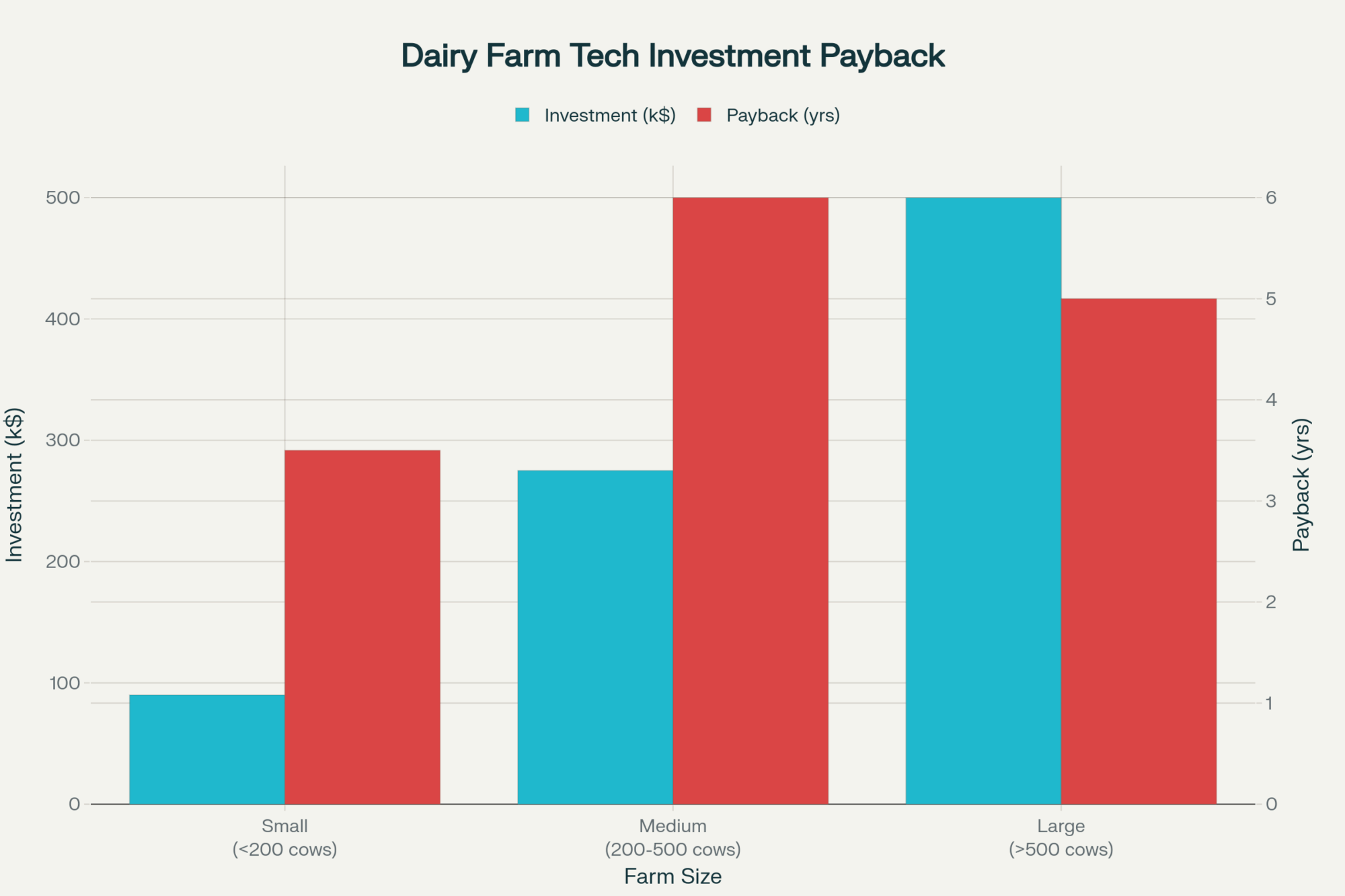
  • Under 200 Cows: $60,000-120,000 investments with 3-4 year paybacks. In states like Wisconsin, where corn’s running $4.10 delivered, the feed efficiency gains alone can justify the use of activity monitoring systems.
  • 200-500 Cows: $200,000-350,000 for robotic milking and precision feeding. Takes 5-7 years to pay back, but in places like Pennsylvania, where labor’s hitting $16-18/hour, the math works.
  • 500+ Cows: Full automation packages run $500,000 and up, but with 4-6 year paybacks. Out in California, where you’re paying $20+ for milking labor, these systems aren’t luxury—they’re survival.

This divide? It’s only going to matter more when margins tighten in 2026.

China’s Dairy Puzzle—Still Our Biggest Wild Card

China remains our biggest uncertainty. They’re forecast to boost imports by 2% this year after three straight years of decline, while their domestic production’s expected to drop 1.5-2.6%.

Nate Donnay from StoneX put it perfectly:

“Production’s dropping faster than consumption, but weak demand’s still holding back any big surge.”

Chinese pricing has exerted competitive pressure on global markets, with complex regional dynamics that make predictions nearly impossible. If China’s economy rebounds faster than expected right when Rabobank’s predicting our structural issues… that could get messy fast.

The Great Analyst Split—And Why It Matters to Your Bottom Line

The industry’s basically split into two camps right now. StoneX is betting on continued strength—they point to tight heifer supplies (we’re down to 1978 levels) and massive cheese plant expansion creating structural demand worth over $8 billion.

Rabobank’s more cautious. They’re warning about trade policy risks and disease impacts that have already proven severe—look what HPAI did to California, dropping production 9% last November.

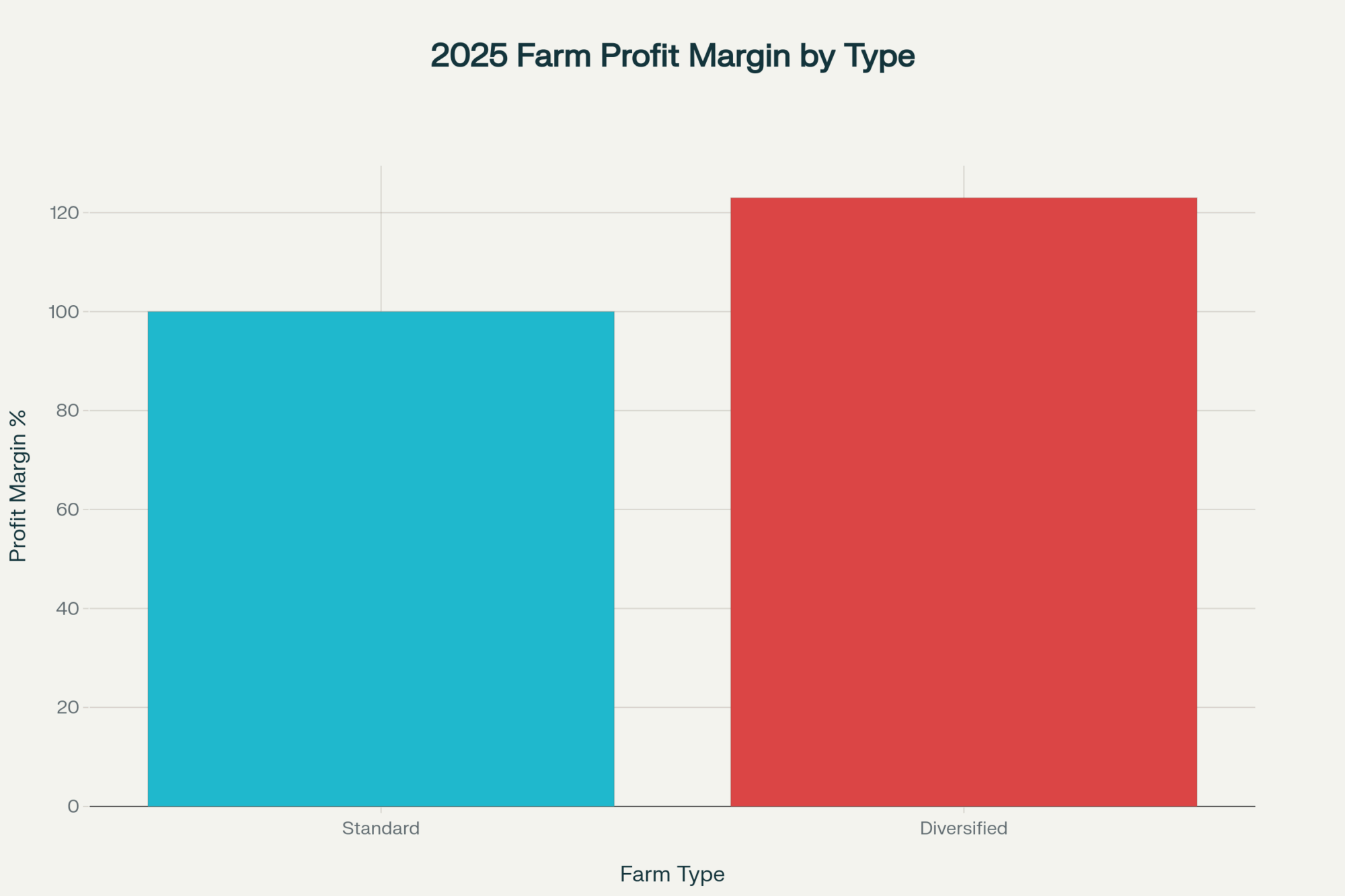
Here’s what caught my attention in Cornell data: farms with diversified income streams weathered the 2020-2022 chaos 23% better than commodity-only operations. That’s not theory—that’s documented survival advantage.

European Carbon Economics—This Is Coming Our Way

European producers aren’t just talking sustainability anymore; they’re banking on it. Recent research shows low-carbon operations outperforming high-emission farms by $1,200+ per cow annually.

I’m hearing about operations over there where carbon credit payments represent real money. Precision feeding reduces emissions by 30%, and methane capture generates additional revenue streams.

California’s LCFS credits are already worth $85-120 per metric ton. Northeast carbon markets are expanding into agriculture. Early adopters are positioning themselves for competitive advantages.

Feed Costs—The Variable That Changes Everything

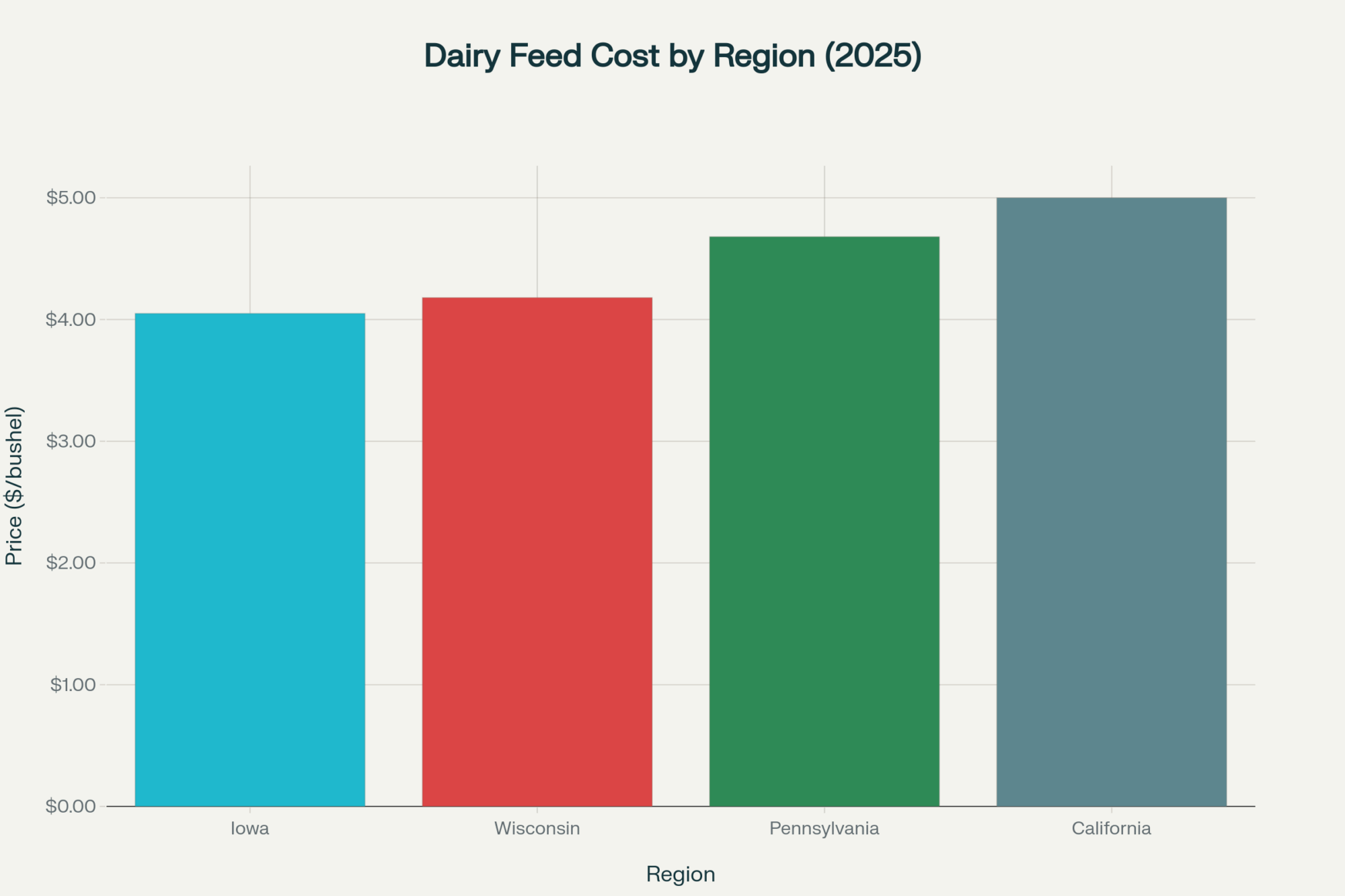
Don’t underestimate what’s happening with feed prices. Sure, corn futures are around $4.20 nationally, but add transportation and regional basis, and suddenly you’re looking at:

Regional Feed Cost Reality (as of Q3 2025):

  • Iowa: $3.95-4.15 delivered
  • Wisconsin: $4.10-4.25 delivered
  • Pennsylvania: $4.60-4.75 delivered
  • California: $5.10+ delivered

Those differences completely change your feeding strategies and technology ROI calculations.

Investment Timing—This Window Won’t Stay Open

Equipment financing is still reasonable at 6.5-8.5% for qualified operations, but lenders are already adjusting terms based on 2026 uncertainty. Some are requiring higher down payments, shorter amortization schedules.

Your immediate action plan:

  • Lock favorable financing before rates climb
  • Complete tech installations to catch 2025 tax advantages
  • Secure feed contracts for the next growing season
  • Build cash reserves during strong margins
  • Start carbon footprint assessments now

Regional Reality Check—What Works Where

  • Corn Belt (Iowa, Illinois, Indiana): Feed costs are stable, so focus on precision feeding systems with rapid paybacks through improved conversion efficiency.
  • Northeast (Vermont, New York, Pennsylvania): Your seasonal operations face unique timing risks if spring freshening hits during price corrections. Flexibility in milking systems matters.
  • Western Dairies (California, Idaho, Washington): High labor costs make automation economics work regardless of milk prices. Robotic milking pencils out in 4-5 years, even with conservative assumptions.
  • Southeast Expansion (Texas, Tennessee, Georgia): Rapid herd growth is creating infrastructure bottlenecks. Get scalable tech in place before you grow into problems.

What Does This All Means for Your Operation

Look, whether Rabobank’s 2026 warnings prove accurate or StoneX’s optimism carries the day, one thing’s certain: this industry’s changing faster than ever, and preparation beats reaction every single time.

The producers who thrive through whatever comes next will be those using today’s strong margins for strategic investments in efficiency, technology, and risk management—not just production expansion.

Your checklist isn’t complicated: Audit technology gaps and calculate region-specific ROI. Build cash reserves during strong margin periods. Diversify revenue streams beyond commodity milk. Create hedging strategies for key input costs. Start carbon footprint reduction programs before they’re mandatory.

The profits rolling in today are real, but they won’t last forever. The question every producer needs to answer: Will you use these margins to build a bridge over the next downturn, or will you hope the water doesn’t rise? Because in this business, hope’s never been a strategy that pays the bills.

Complete references and supporting documentation are available upon request by contacting the editorial team at editor@thebullvine.com.

Learn More:

  • Unlocking Dairy Efficiency: The Ultimate Guide to Improving Cow Traffic – This guide offers practical strategies for designing efficient cow traffic systems. It demonstrates how to maximize your technology investments by ensuring smooth animal flow, which directly translates into higher milk production and a healthier, less stressed herd.
  • The 3 Financial Ratios Every Dairy Farmer Should Be Tracking – Move beyond milk price and dive into the numbers that truly drive profitability. This piece provides the tools to measure your farm’s financial health, helping you identify vulnerabilities and make strategic decisions to withstand the market volatility this article warns about.
  • The Genetics Of Sustainability: Breeding For A Better Future – Explore a key strategy for tackling the carbon economics challenge head-on. This article reveals how strategic breeding for sustainability traits can create a more efficient and resilient herd that is positioned to capitalize on emerging low-carbon milk premiums.

Join the Revolution!

Join over 30,000 successful dairy professionals who rely on Bullvine Weekly for their competitive edge. Delivered directly to your inbox each week, our exclusive industry insights help you make smarter decisions while saving precious hours every week. Never miss critical updates on milk production trends, breakthrough technologies, and profit-boosting strategies that top producers are already implementing. Subscribe now to transform your dairy operation’s efficiency and profitability—your future success is just one click away.

NewsSubscribe
First
Last
Consent

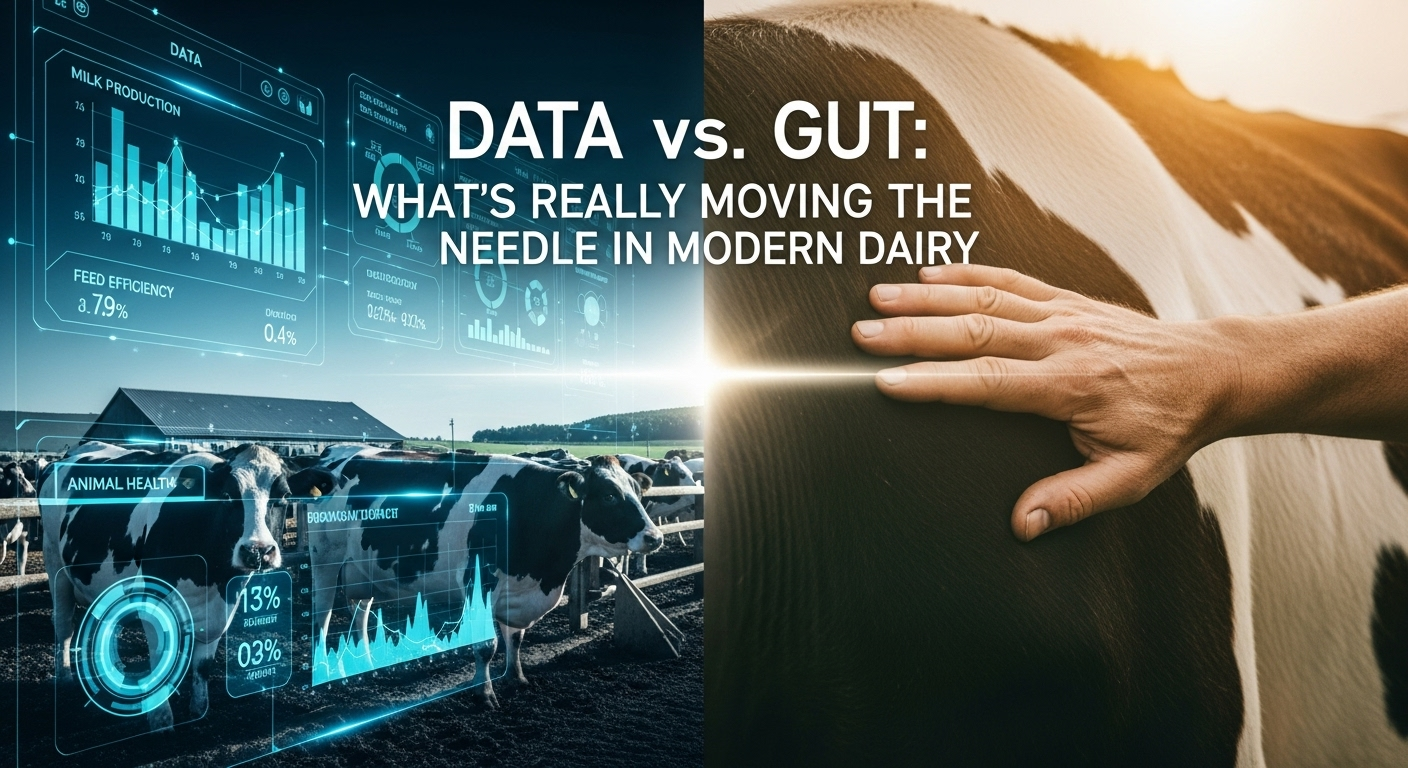
Data vs. Gut: What’s Really Moving the Needle in Modern Dairy

AI feeding saves $31/cow while your neighbors debate whether it works—Cornell proves 95% accuracy in detecting sick cows before you see symptoms.

EXECUTIVE SUMMARY: Listen, I’ve been watching this AI thing unfold for months, and here’s what’s actually happening… Progressive operations are generating $210 per cow annually by allowing technology to handle monitoring, while they focus on strategic decisions. We’re talking real money here—Wisconsin producers hitting 30% pregnancy rates, California farms cutting mastitis by 40% in year one. The University of Wisconsin documented $31 per cow from smarter feeding alone, and Cornell has proven 95% accuracy in catching metabolic problems before even the best cowman would notice. In New Zealand, 82% of dairies are already using this technology, while we’re at around 30% adoption. Look, I get the hesitation—40% of projects fail because farms skip the training or try to do too much too fast. But are the farms getting it right? They’re not just surviving tight margins; they’re thriving in them.

KEY TAKEAWAYS

  • Start with feeding optimization — AI-driven precision feeding delivers $31 annual savings per cow through reduced waste and better ration management. Pilot test on 10-20% of your herd this fall when feed costs matter most.
  • Early disease detection pays off big — Cornell research shows 95% accuracy in spotting metabolic disorders days before clinical symptoms appear. That’s $65 saved for every day you catch mastitis early; plus, the milk you don’t lose.
  • Heat detection accuracy jumps to 90% — University of Guelph data confirms 30% better pregnancy rates with AI monitoring versus traditional methods. With breeding costs what they are, that ROI calculation writes itself.
  • Scale matters for success — Operations with 300-1000 cows hit 80-90% implementation success rates. If you’re in that sweet spot, the infrastructure investment makes sense with the current 7.2% loan rates.
  • Budget beyond equipment costs — Plan 20-30% extra for training and integration support. The farms that skimp on staff education are the ones hitting those 40% failure rates everyone talks about.

The thing about dairy farming is, we’ve always relied on good instincts—your grandfather’s watchful eye, that feeling you get walking through the barn at dawn. However, what I’m witnessing across leading operations from Wisconsin to California is that the sharpest producers are blending those time-tested instincts with some compelling data. And, man, the results are showing up where they count most.

Take feeding, for instance. Producers are banking around $31 per cow annually just by letting AI fine-tune their feeding programs, according to recent work from the University of Wisconsin’s Dairy Brain Initiative. That’s not marketing fluff—that’s actual cash reclaimed from smarter rations and cutting waste where it hurts most.

Picture this: milk has been sitting steady near $18.85 per hundredweight this July, as reported by the USDA Agricultural Marketing Service, while corn futures hover around $4.30 per bushel on the CME Group. Every penny you can squeeze out of feed efficiency… well, it adds up faster than you’d think.

The Market’s Speaking Volumes

Here’s what catches my attention: the precision livestock farming market has officially crossed $5.59 billion worldwide, according to the “Precision Livestock Farming Market Report (2025)” by Market Research Future. That kind of momentum doesn’t happen because farmers love shiny tech toys—it happens because there’s real value being captured.

At last year’s Canadian XPO, Jack Rodenburg from the University of Guelph put it perfectly: “You can’t watch every cow all the time when you’ve got hundreds in the barn. AI systems are like having that one employee who never takes a coffee break, spotting those subtle changes we sometimes miss.”

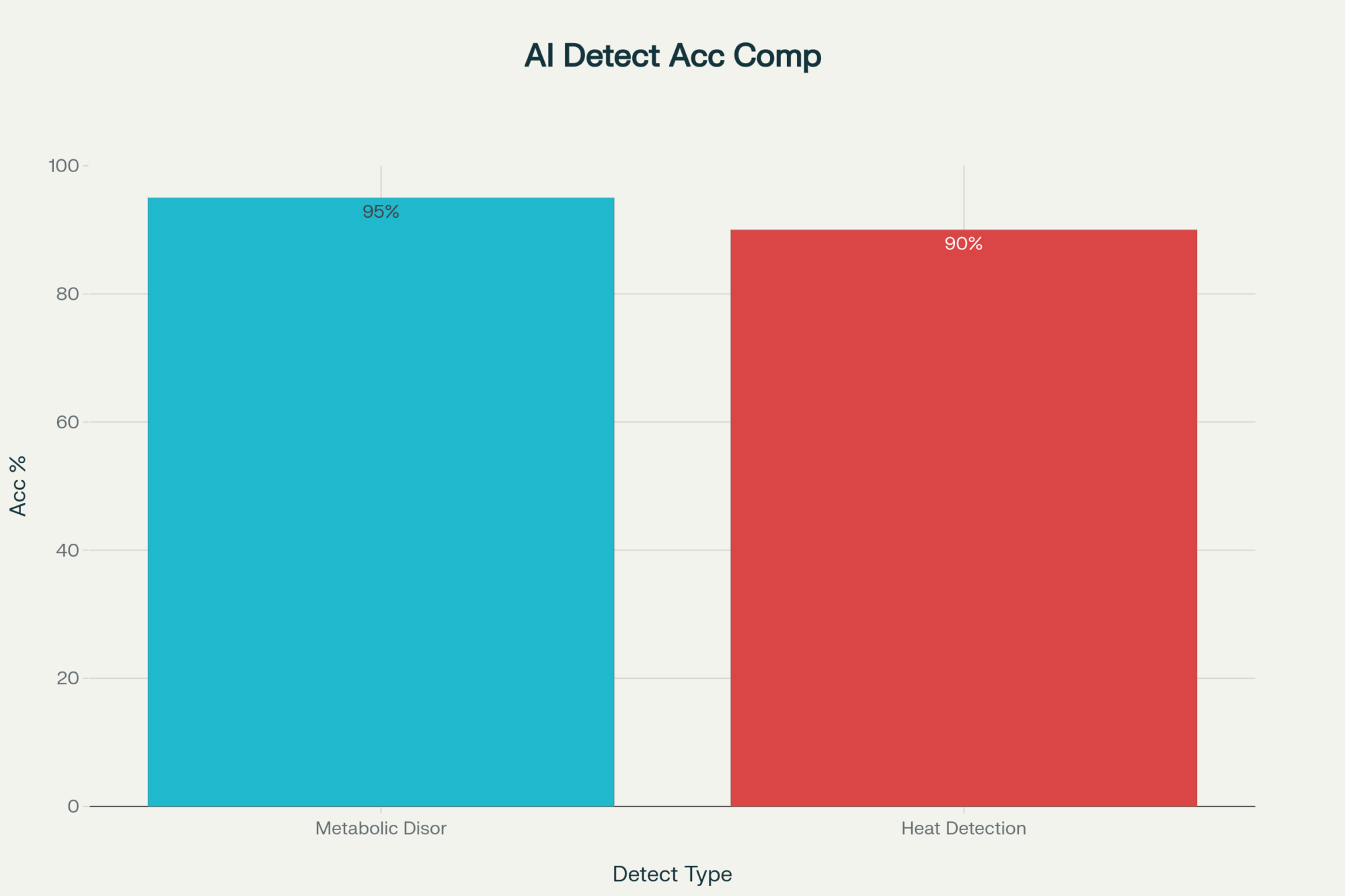
Cornell’s study “Detection of Subclinical Diseases Using AI,” published in the Journal of Dairy Science (Vol. 108, Issue 2), backs this up—AI models are hitting 95% accuracy in detecting metabolic disorders before we’d ever spot them during morning rounds. That’s the kind of edge you can’t ignore.

The Mastitis Math Nobody Wants to Do

We’ve all been there—felt the sting of a mastitis case that slipped past us. Michigan State University Extension research drives the point home: every day you delay treatment; you pay an average of $65 extra. Early detection through AI sensors literally reclaims those expensive days.

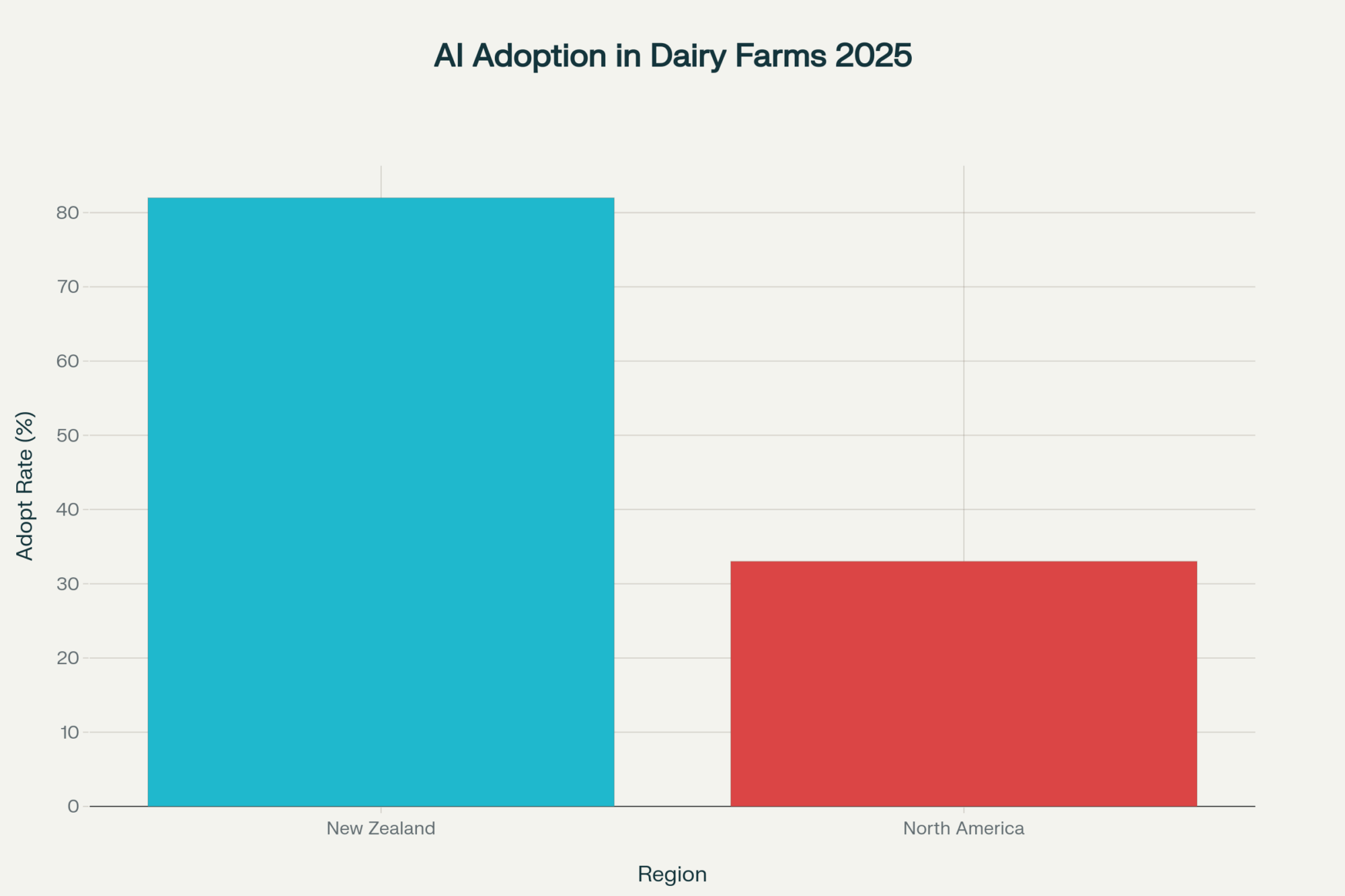
AI adoption rates across regions showing 82% adoption in New Zealand versus 33% in North America (2025)

Here’s something that keeps coming up in conversations… there’s this noticeable split in adoption rates globally. New Zealand’s way out in front, with 82% of dairies embracing AI technology, according to DairyNZ’s 2025 industry data. In contrast, here in North America, depending on your region and operation size, we’re looking at somewhere around 25-35%.

That gap represents an opportunity—and a competitive advantage being captured while others debate implementation costs.

The composite picture is compelling: operations leveraging AI report profit boosts averaging $210 per cow annually, according to IFCN’s 2025 economic analysis report. This isn’t the $31 feeding savings stacked on top of other benefits—it’s the total lift from better feeding, health monitoring, and reproductive management working together.

With operating loans currently averaging around 7.2%, as reported by the Federal Reserve Bank of St. Louis, faster payback periods are more important than they were in the past.

Feed Efficiency That Actually Moves Numbers

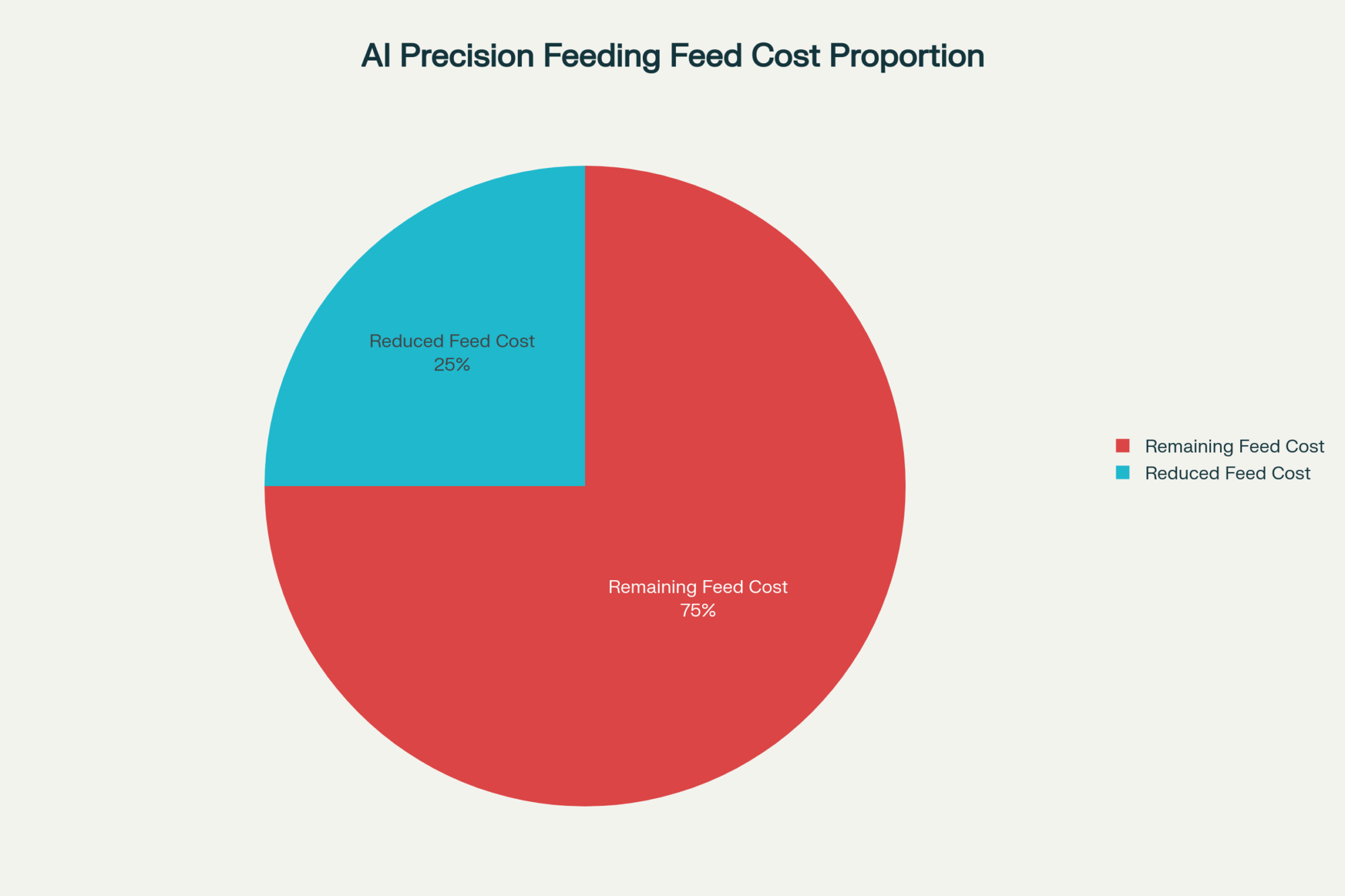
Proportion of feed cost savings through AI-driven precision feeding showing 25% reduction in feed costs

Digging deeper into the nutritional aspect, Spanish researchers at IRTA have shown that operations can reduce feed costs by approximately 25% without compromising production. When you think about corn, silage, and supplement price volatility—especially with the weather patterns we’ve been seeing—that kind of precision really matters.

Comparison of AI detection accuracy for metabolic disorders and heat detection in dairy cows

Heat detection’s where things get really interesting. The University of Guelph’s reproductive research program reports that AI is increasing detection accuracy from around 55% to 90%, resulting in a roughly 30% improvement in pregnancy rates. Those are the kinds of numbers that change your whole breeding program.

What Real Farms Are Actually Seeing

I can’t name specific operations—farmers rightfully keep some cards close to their vest—but Wisconsin producers I’ve spoken with mention achieving 30% pregnancy rates after integrating comprehensive monitoring systems. These are sharp operators who’ve figured out how to let the data enhance their barn sense, not replace it.

Down in California’s Central Valley, dairy farmers report solid 7% production increases alongside a nearly 40% reduction in mastitis cases in their first year with AI support. Real, tangible impacts you can take to the bank.

In Europe, Austrian cooperatives using SmaXtec technology report substantial operational savings, although exact figures are kept confidential due to non-disclosure agreements.

Size Clearly Influences Success Rates

Farm size drives implementation success in ways you’d expect. Operations with 300 to 1,000 cows consistently hit 80-90% success rates with these systems, according to data from Agricultural Economics Research International—a clear reflection of scale economics and infrastructure capabilities.

Robotic milking keeps building momentum. University of Minnesota Extension research documents $30,000 to $45,000 in annual labor savings per robot—but here’s the reality check: maintenance and energy costs can tack on another $5,000 to $25,000 each year. Budget accordingly.

The latest vision technology, utilizing advances such as YOLOv9 algorithms, now achieves 90% accuracy in identifying health issues, even in the chaos of a working barn, according to presentations at the 2025 AI for Agriculture Symposium.

The Reality Check You Need to Hear

Here’s what nobody talks about enough: industry consultants at the Agricultural Economics Institute estimate that roughly 40% of AI projects fail to deliver expected returns, usually due to integration problems or a lack of ongoing support after the sale.

Even more concerning? Technology audits reveal that only about 5% of available AI tools have undergone rigorous, independent validation. That’s a red flag for doing your homework on suppliers.

Jeffrey Bewley at the University of Kentucky Extension nails the core issue: “AI amplifies what you’re already doing right, but it won’t patch up fundamental management problems.”

What Actually Works in Practice

My take? Start small and scale smart. Test AI applications on a subset of your herd first—health monitoring or reproductive management work well as pilots. Get your team appropriately trained… extension services consistently report that operations that skimp on training hit roadblocks they could’ve avoided.

Before jumping in anywhere, establish clear baselines. Track your current mastitis treatment costs, feed conversion efficiency, and reproductive performance metrics. Without baseline data, you’re flying blind on measuring real impact.

The Future That’s Already Starting

What gets me excited is watching how AI, genetics data, and nutritional management are starting to weave together. We’re moving beyond individual tools toward integrated decision-making systems that learn your operation’s unique patterns and challenges.

The bottom line? Operations that feed precisely, monitor continuously, and act early on problems are consistently outperforming traditional approaches. The competitive advantage is becoming measurable and sustainable.

If you haven’t started exploring these technologies, today might be a good day for a conversation with your county extension agent or established technology providers. Ask the hard questions about training, support, and realistic implementation timelines. What’s the one area on your farm where you think data could make the biggest difference?

Because really, the best time to plant that tree was twenty years ago. The second best time is today.

Your cows are generating data every minute, whether you use it or not. The question is whether you’ll let that information work for your operation’s future.

Complete references and supporting documentation are available upon request by contacting the editorial team at editor@thebullvine.com.

Learn More:

  • The 7 Habits of Highly Effective Robotic Milking Herds – Go beyond the purchase price with this tactical guide. It reveals the essential management protocols that top producers use to maximize milk output and herd health in an automated milking environment, turning your technology investment into a true profit center.
  • The 8 Profitability Metrics That Define Success in Today’s Dairy Industry – This strategic overview breaks down the key financial metrics that separate profitable dairies from the rest. Learn to analyze your operation’s performance beyond milk price, giving you a powerful framework to measure the true impact of your technology investments.
  • Genomics: The Crystal Ball That’s Reshaping the Dairy Industry – Look beyond operational AI and into the future of herd improvement. This piece details how genomic testing provides predictive insights to accelerate genetic gain, reduce disease risk, and build a more profitable and resilient herd for the next decade.

Join the Revolution!

Join over 30,000 successful dairy professionals who rely on Bullvine Weekly for their competitive edge. Delivered directly to your inbox each week, our exclusive industry insights help you make smarter decisions while saving precious hours every week. Never miss critical updates on milk production trends, breakthrough technologies, and profit-boosting strategies that top producers are already implementing. Subscribe now to transform your dairy operation’s efficiency and profitability—your future success is just one click away.

NewsSubscribe
First
Last
Consent

The Great Dairy Reversal: How Europe’s Precision Contraction Strategy Could Redefine Global Competitiveness

EU’s 8.7% herd crash + 15.6% milk price surge = game-changing proof that strategic contraction beats volume expansion for dairy profitability

EXECUTIVE SUMMARY:  Europe just shattered the “bigger herds equal better profits” myth that’s driving North American expansion strategies into a profitability dead end. While U.S. producers added 58,000 cows in Q1 2025 chasing volume targets, EU processors achieved 15.6% milk price increases through strategic herd reduction and premium positioning. The data is undeniable: EU dairy cow numbers crashed 3.4% to 19.226 million head in 2024, yet processors captured higher export values by pivoting toward cheese production rather than commodity powders. New Zealand proves the efficiency model works—despite a 3.5% cow reduction, they maintained stable milk solids through genomic selection and precision feeding, delivering superior ROI per animal. Meanwhile, European Commission projections show continued 13% herd decline through 2035, creating global supply tightness that rewards strategic positioning over scale expansion. This isn’t just European data—it’s a blueprint for North American producers to evaluate whether your growth strategy creates competitive advantage or operational vulnerability. Stop measuring success by total milk volume and start calculating profitability per cow, because tomorrow’s dairy winners will optimize what they have instead of expanding what they manage.

KEY TAKEAWAYS

  • Technology ROI Crushes Expansion ROI: EU producers investing in precision systems achieve 200-300% returns with 8-12 month payback periods, while herd expansion delivers 8-12% returns over 7-10 years—proving efficiency investments generate compound returns versus linear cost increases from adding cows.
  • Component Optimization Beats Volume Strategy: European processors capturing 0.4% annual export value growth despite 0.2% volume decline through strategic cheese positioning, while feed efficiency improvements of just 0.2 points deliver $470 annual savings per cow—demonstrating value-per-liter trumps total production.
  • Market Premiums Reward Strategic Positioning: EU milk prices strengthened 15.6% in early 2025 amid supply constraints, while global butter and cheese prices hit record highs due to tight supplies—creating premium opportunities for producers focusing on component targeting rather than commodity volume competition.
  • Regulatory Reality Creates Competitive Advantage: Environmental constraints forcing EU efficiency gains through precision feeding and genomic selection are previews of global dairy’s future—early adopters developing sustainable intensification systems will capture market premiums while volume-focused operations face margin compression.
  • Global Supply Realignment Favors Optimization: With EU projecting 13% herd decline through 2035 and raw milk deliveries falling 3.2% year-over-year, global supply tightness rewards producers who maximize output per animal through technology adoption rather than infrastructure expansion into increasingly constrained markets.
dairy efficiency, precision dairy farming, dairy technology ROI, global dairy trends, farm profitability optimization

Europe just shattered every assumption about dairy success—while North American producers chase bigger herds through massive processing expansion, the EU deliberately contracted livestock by 8.7% over the past decade, yet processors command premium prices through strategic value positioning. If you’re still measuring success by total milk volume, this verified data will force you to question whether your growth strategy creates competitive advantage or operational vulnerability.

The uncomfortable truth reshaping global dairy economics: the world’s largest dairy market just proved that strategic herd reduction combined with component optimization delivers superior returns than volume-focused expansion. According to Eurostat, the European Union’s dairy cow population crashed to 19.226 million head in December 2024—a devastating 3.4% decline (687,000 fewer cows) in just one year, marking the lowest inventory in decades. Yet EU average raw milk prices reached 53.8 cents per kilogram in February 2025, towering 16% above February 2024 levels, while processors pivoted to higher-value products, capturing premium markets.

That grinding sound you hear? It’s the foundation of every assumption linking bigger herds to better business, cracking under verified market data.

Challenging the Growth Gospel: Why Bigger Isn’t Better Anymore

Here’s the question every dairy executive should be asking: If expansion equals success, why are European processors achieving higher margins through contraction while the USDA raised its 2025 U.S. milk production forecast to 227.3 billion pounds, reflecting modest herd expansion to handle volume growth?

The research reveals a stark contrast: During the first quarter of 2025, the U.S. saw a 58,000-head increase in the national dairy herd, while European producers deliberately pivot toward cheese production, capturing value premiums that volume-focused operations cannot access.

The fundamental challenge to conventional wisdom: Growth-obsessed operations assume that scaling production automatically improves profitability, but verified market data suggests the opposite. European dairy processors are proving that strategic positioning trumps production scale.

Evidence-Based Alternative: Consider New Zealand’s efficiency model. According to industry data, despite dairy cow numbers falling, dairy companies processed 20.5 billion litres of milk containing 1.88 billion kilograms of milksolids in the 2023/24 season, representing a 0.5% increase in kilograms of milksolids—proving that optimization can maintain output while reducing operational complexity.

The Numbers That Demolish Expansion-Only Logic

Let’s examine the verified statistics that challenge growth-only thinking. According to Eurostat data, the EU livestock transformation represents unprecedented structural change:

Verified EU Livestock Contraction (2014-2024):

  • Bovine animals: Down 8.7% to 72 million head
  • Dairy cows specifically: Declined from peak levels to 19.226 million (December 2024)
  • Pigs: Fell 8.1% to 132 million
  • Sheep: Declined 9.4% to 57 million
  • Goats: Crashed 16.3% to 10 million

In 2024, all livestock populations declined – the pig population decreased by 0.5%, bovines by 2.8%, sheep by 1.7% and goats by 1.6%.

But here’s where conventional wisdom collapses: European processors are capturing higher margins through strategic product shifts toward premium positioning despite this massive contraction. The comprehensive research analysis states, “the European Commission projects that cheese and whey could absorb 36% of the EU milk pool by 2035.”

Major Players Leading Strategic Repositioning

The scale of this transformation becomes evident when examining verified data from key dairy regions. According to the comprehensive research report analyzing EU dairy trends:

Germany: Lost 123,000 dairy cows in 2024 alone, representing the elimination of approximately 1,500 average-sized operations. However, surviving operations report improved profitability through precision feeding and component optimization rather than scale expansion.

France: Reduced inventory by 91,000 head while implementing advanced programs targeting milk quality improvements.

Poland: Experienced the most dramatic transformation—a stunning 283,000-head reduction following a 1.5% expansion in 2023, suggesting strategic culling based on productivity metrics rather than forced liquidation.

Netherlands and Ireland: Each trimmed 30,000 cows while investing heavily in precision agriculture systems, adapting to intense regulatory pressure as environmental constraints tighten.

Technology ROI: Precision Investment Framework

Here’s a question that should make every expansion-focused operation uncomfortable: Why invest in additional cows when technology can deliver superior returns through existing herd optimization?

Verified Technology Returns (2025 Data)

According to The Bullvine’s analysis of current dairy technology investments:

Milk Predictive Analytics: 8-month payback period with +$0.30/cwt milk premium

Feed Efficiency AI: 7-10 month payback with 5-10% feed cost reduction

Data Integration Platforms: 12-month payback with 5.8:1 ROI ratio on 1,000-cow dairies

Critical Analysis: Operations pursuing herd expansion face linear cost increases (housing, labor, feed), while technology investments generate compound returns through improved efficiency across existing assets. Early adopters are seeing ROI within 7-8 months, particularly with smart calf monitoring systems that have slashed mortality by up to 40%.

Implementation Framework: 30-60-90 Day Action Plan

30-Day Assessment Phase

Week 1-2: Baseline Establishment

  • Calculate current feed efficiency and component premiums
  • Document health event costs (mastitis, lameness, reproduction issues)
  • Measure current labor allocation for monitoring tasks

Week 3-4: Technology Evaluation

  • Contact equipment suppliers for monitoring systems
  • Pilot feed efficiency monitoring on a 100-head test group
  • Calculate ROI potential using verified benchmarks from industry data

60-Day Pilot Implementation

Technology Integration: Based on verified results, smart monitoring systems show ROI within the first month through early disease detection.

Cost-Benefit Analysis:

90-Day Strategic Positioning

Market Positioning Evaluation:

  • Assess premium product opportunities (European model)
  • Calculate component pricing advantages
  • Develop sustainability messaging for premium positioning

Global Competitive Realignment: The Data Doesn’t Lie

While Europe optimizes, other regions demonstrate contrasting strategies:

United States: Volume Expansion Strategy The USDA raised its 2025 milk production forecast to 227.3 billion pounds, up 0.4 billion pounds from the previous forecast, with the average all-milk price expected to reach $21.60 per hundredweight.

New Zealand: Efficiency Optimization Model According to industry data, despite a 12% reduction in dairy herd numbers over the last decade and a 5% decrease in total milking cows, total milksolids processed have remained relatively stable. Milksolids per cow are once again near record levels, resulting from farmers’ dedication, technology uptake, and science application.

The Strategic Question: Are U.S. producers betting correctly on volume expansion while Europeans and New Zealanders optimize for efficiency, or does each approach suit different market positioning strategies?

Market Volatility Rewards Strategic Positioning

European production constraints are creating global market opportunities. According to research analysis, “raw milk deliveries to EU dairies fell by 3.2% during January-March 2025 compared to the previous year.”

This market tightening resembles peak genetic selection outcomes—when you optimize for specific traits, market premiums reward precision over volume. EU butter prices held firm at €739/100kg amid tight supplies, while skimmed milk powder and cheddar faced downward pressure.

Verified Market Impact: The strategic shift shows 0.6% cheese production growth, stealing milk from butter/powders, and reshaping EU dairy economics.

The Consumer Revolution Driving Strategic Shifts

While producers debate herd sizes, consumers quietly rewrite demand patterns. According to the research analysis, “The European dairy alternatives market is experiencing robust growth, estimated at $10.84 billion in 2025 and projected to nearly double to $21.48 billion by 2030, with a Compound Annual Growth Rate (CAGR) of 14.65%.”

Strategic Insight: European processors’ pivot toward premium cheese production responds directly to these trends, targeting consumption occasions where alternatives struggle to compete. This repositioning toward premium, artisanal, and specialty products creates defensible market positions that pure volume strategies cannot achieve.

The Strategic Question for Growth-Focused Operations: If consumer preferences shift toward premium, sustainable products, does expanding commodity production position your operation for future success or increase vulnerability?

Economic Framework: Precision vs. Expansion ROI

Expansion Strategy Costs (500-Cow Addition)

  • Capital investment: $3,200-$3,800 per cow (housing, equipment)
  • Annual operating costs: Linear increases in feed, labor, and utilities
  • Risk factors: Market volatility, regulatory compliance, labor availability

Optimization Strategy Returns (Existing 500-Cow Herd)

Technology Investment: $60,000-$80,000 total

Payback Period: 8-12 months based on verified industry results

Why This Matters for Your Operation: Economic Reality Check

Stop measuring success by herd size alone. The European experience and verified North American data demonstrate that strategic optimization delivers measurably superior returns:

Profitability Analysis (verified data):

Risk Assessment: Smaller, optimized operations demonstrate greater resilience to feed price volatility, regulatory changes, and labor shortages—critical factors as environmental regulations expand globally.

Strategic Options Comparison

Strategic ApproachInitial InvestmentAnnual ROIPayback PeriodRisk Level
Herd Expansion (500 cows)$1.6-1.9M8-12%7-10 yearsHigh regulatory/market risk
Technology Optimization$60-80K200-300%8-12 monthsModerate technical risk
Premium Positioning$40-60K150-200%6-8 monthsLow commodity risk

Implementation Barriers and Solutions

Technology Adoption Challenges

Capital Requirements: Initial investment ranges from $60,000-$80,000 for comprehensive optimization systems, but 8-12 months payback periods make financing attractive.

Training Requirements: Implementation requires 3-6 months for staff proficiency development, but early detection benefits often pay for monthly subscriptions with single disease prevention.

Proven Success Factors

According to industry analysis, successful implementation requires:

  • Comprehensive staff training on new systems
  • Integration with existing farm management protocols
  • Regular monitoring of key performance indicators
  • Consistent data analysis and action implementation

Expert Perspectives on Strategic Transformation

Industry experts quoted in the comprehensive research analysis provide critical insights:

On Strategic Positioning: “The EU’s strategic pivot towards higher-value products like cheese and whey maximizes export value despite declining volumes. This re-specialization allows the EU to capitalize on its reputation for quality and origin-protected products.”

On Efficiency vs. Volume: “New Zealand’s ability to maintain stable milk solids production despite declining cow numbers demonstrates a successful strategy of ‘sustainable intensification’ through efficiency gains and technological adoption.”

On Global Competitiveness: “The transatlantic divergence emphasizes global dairy market interconnectedness. Leaders must continuously monitor international trade flows, regional production shifts, and evolving consumer demands worldwide.”

The Bottom Line: Strategic Clarity for Sustainable Competitive Advantage

Europe’s 8.7% livestock decline over the past decade isn’t agricultural failure—it’s early evidence that precision agriculture applied to dairy production, where component optimization and strategic positioning deliver measurably superior returns compared to volume-focused expansion.

Three Verified Strategic Imperatives for 2025:

  1. Technology ROI Beats Expansion ROI: Verified industry data shows 200-300% returns on technology investment with 8-12 month payback periods, compared to 7-10 year payback periods for herd expansion.
  2. Feed Efficiency Multiplies Profitability: 5-10% feed cost reduction delivers immediate bottom-line impact, while component optimization adds $0.30/cwt premium through predictive analytics.
  3. Market Positioning Rewards Strategic Thinking: Consumer trends toward premium, sustainably-produced products favor operations that document and market superior practices, as evidenced by European processors capturing value growth despite volume declines.

Your Strategic Implementation Plan:

Immediate Action (Next 30 Days):

  1. Calculate your efficiency baseline using current feed costs and component premiums
  2. Document current operational costs (health events, labor hours, veterinary expenses)
  3. Request technology demonstrations from providers using verified ROI models

Technology Pilot (60 Days):

  1. Implement monitoring systems on the test group with verified ROI targets
  2. Measure efficiency improvements using industry benchmarks
  3. Calculate component optimization potential targeting verified premium opportunities

Strategic Positioning (90 Days):

  1. Evaluate premium product opportunities following European processor strategies
  2. Develop efficiency-based marketing highlighting precision and sustainability
  3. Plan technology expansion using verified payback calculations

The competitive divide is accelerating. Strategic positioning begins with understanding that tomorrow’s dairy leaders will be those who transform operational constraints into competitive advantages through precision, technology, and value optimization rather than perpetual expansion.

Stop betting everything on bigger herds. Start investing in smarter systems. The verified industry results prove that optimizing what you have delivers superior returns to expanding what you manage.

Complete references and supporting documentation are available upon request by contacting the editorial team at editor@thebullvine.com.

Learn More:

Join the Revolution!

Join over 30,000 successful dairy professionals who rely on Bullvine Weekly for their competitive edge. Delivered directly to your inbox each week, our exclusive industry insights help you make smarter decisions while saving precious hours every week. Never miss critical updates on milk production trends, breakthrough technologies, and profit-boosting strategies that top producers are already implementing. Subscribe now to transform your dairy operation’s efficiency and profitability—your future success is just one click away.

NewsSubscribe
First
Last
Consent

Stop Bleeding Money on AgTech: The 5-Dimension Framework That Separates Winners from $50K Failures

AgTech deals crashed 24% while smart farms boost milk yields 20%. Stop buying tech blindly—master the 5-dimension ROI framework that separates winners from $50K failures.

EXECUTIVE SUMMARY: Here’s the uncomfortable truth about AgTech that vendors won’t tell you: while global investment reached $16 billion in 2024, deal counts crashed 24% year-over-year because most dairy operators are making technology decisions like they’re buying lottery tickets instead of analyzing genomic merit scores. Despite robotic milking systems delivering documented 20% milk yield increases and precision feeding reducing costs by 5-10%, only 39% of farmers globally are adopting AgTech—and it’s not just about money. The real problem? Over 40% of technology failures stem from poor integration and training gaps, not technology deficiencies. Ontario proved systematic implementation works, doubling robotic milking adoption from 337 to 715 farms between 2016 and 2021 by building support ecosystems before mass adoption. Meanwhile, operations achieving 42% higher output on identical systems implement specific protocols: optimized cow flow, data-driven decisions, and systematic staff training—treating technology as integrated systems rather than isolated equipment purchases. With U.S. farm income falling 28% between 2022 and 2024 and feed costs representing 75% of operating expenses, every technology dollar must deliver verified returns through our evidence-based 5-Dimension Framework. Stop gambling on vendor promises and start building the evaluation system that transforms technology investments from expensive experiments into profitable operational improvements.

KEY TAKEAWAYS

  • Master the True Total Investment calculation: That $200,000 robotic milking system becomes $275,000+ when you factor infrastructure modifications, training costs, and productivity adjustments—yet successful implementations achieve 12-24 month ROI through increased milking frequency and 8-15% production gains.
  • Challenge the plug-and-play myth: Operations achieving documented 40% mortality reduction through early illness detection spend three months mapping workflows and training staff before technology deployment, while failures treat AgTech as isolated solutions without operational integration.
  • Leverage proven regional success patterns: India’s 215% AgTech funding increase to $2.5 billion and Ontario’s systematic robotic adoption doubling demonstrate that policy alignment, cooperative purchasing power, and shared learning networks determine implementation success—not technology sophistication alone.
  • Apply the 5-Dimension evaluation framework before your next purchase: Calculate total implementation costs, assess operational integration requirements, plan maintenance infrastructure, establish productivity baselines, and develop phased rollout protocols to join the 42% of farms achieving higher output instead of abandoning expensive equipment.
  • Demand independent ROI verification: With 58% of tech failures linked to unrealistic vendor expectations, successful operations require third-party validation and implement pilot programs on 10-20% of their herds first—using precision feeding’s documented 5-10% cost reduction and health monitoring’s 18-month payback as performance benchmarks.
agtech investment, dairy technology ROI, robotic milking systems, precision agriculture dairy, farm profitability technology

The AgTech cheerleaders won’t tell you that while global agrifoodtech investment reached $16 billion in 2024, deal count crashed 24% year-over-year, and growth capital volume plummeted 40.8% in Q1 2025. Yet somehow, certain dairy operations are generating documented 20% milk yield increases and achieving 12-24 month ROI on the same technologies that bankrupt their neighbors.

You’ve heard the pitch a thousand times. “Invest in technology or die.” “Digital transformation is inevitable.” “The future of dairy is automated.” But here’s the uncomfortable truth nobody wants to discuss at those glossy AgTech conferences: for every robotic milking success story generating measurable returns, there’s a precision feeding disaster gathering dust in someone’s barn.

The problem isn’t that AgTech doesn’t work. The milking robots market is projected to reach $7.04 billion by 2030, growing at approximately a 14% compound annual growth rate. However, market growth doesn’t guarantee individual farm success without proper evaluation frameworks.

Challenging the Technology-First Mentality: Why Implementation Beats Innovation

Here’s where I’m going to challenge the biggest lie being sold to dairy farmers today: that having the latest technology automatically translates to success. Industry data reveals that globally, only 39% of farmers are currently utilizing or planning to adopt at least one AgTech product within the next two years. The adoption disparity isn’t just about money – high costs affect 52% of North American farmers and 48% of European farmers, while unclear ROI concerns plague 40% of North American farmers.

This flies in the face of the industry’s obsession with purchasing cutting-edge equipment without addressing fundamental operational readiness.

Why This Matters for Your Operation

With U.S. farm income falling 28% between 2022 and 2024 and interest rate expenses jumping 21.7%, every technology dollar must deliver measurable returns. The difference between winners and losers isn’t luck – it’s systematic evaluation and implementation.

The Investment Reality: Why AgTech Funding Patterns Predict Your Success

Let’s start with brutal honesty about what’s actually happening in the AgTech investment world. The 4% decline in global agrifoodtech investment to $16 billion sounds modest until you realize that deal count crashed 24% and growth capital volume fell 40.8% in Q1 2025 alone.

The Consolidation Effect Creating Opportunity

This decline in investment creates both challenges and opportunities. Median pre-money valuations rose from $12.7 million in 2023 to $17 million in 2024, indicating a “flight to quality” that favors proven technologies over experimental ones. For dairy operators, this creates a natural filter – if technologies can’t convince sophisticated investors, they likely won’t deliver the returns your operation needs.

Regional Investment Patterns Reveal Implementation Secrets

While U.S. investment grew 14% to $6.6 billion in 2024, the most explosive growth happened in India – a 215% jump to $2.5 billion driven by “maturing tech ecosystems, government policies supporting climate-smart agriculture, and formalization of dairy supply chains.”

What can North American operators learn from India’s AgTech boom? Three critical insights:

  1. Government policy alignment matters more than pure market forces. India’s success stems from policy frameworks supporting implementation, not just innovation.
  2. Supply chain formalization drives technology adoption. As dairy supply chains become more sophisticated, technology becomes necessary for participation, not optional for optimization.
  3. Domestic market focus trumps export complexity. India’s robust domestic consumption (99.5% of 216.5 million tons projected for 2025) creates predictable demand patterns.

The Bright Spots: Where Smart Money Reveals Future Winners

Despite the broader investment downturn, specific AgTech categories continue attracting serious capital for documented reasons.

Automation and Robotics: Beyond the Labor Crisis

The robotics and smart field equipment sector exploded with 48.5% value growth, generating $1.82 billion in deal value. This growth is driven by persistent labor shortages, creating compelling incentives for farmers to embrace automation.

Ontario dairy farms utilizing robotics doubled from 337 to 715 operations between 2016 and 2021, achieving a 12-24 month ROI through increased milking frequency and improved animal welfare metrics. But success wasn’t just about the robots – it required industry-wide support infrastructure, cooperative purchasing power, shared learning networks, and government policy alignment.

Why This Matters: The Network Effect

Think of robotic milking like implementing a comprehensive genetic improvement program – the technology is just one component. You need proper facility design, staff training, maintenance protocols, and integration with existing management systems. Ontario succeeded because they built the ecosystem before mass adoption.

Precision Agriculture: The Data-Driven Revolution

Precision feeding software generates measurable ROI by reducing feed costs 5-10% and minimizing waste up to 18%. The investment community’s focus on “market-ready climate solutions” reflects genuine market demand for technologies that reduce input costs while improving sustainability metrics.

The Bullvine’s 5-Dimension Technology Evaluation Framework

Most dairy operators evaluate AgTech investments without systematic frameworks. Research confirms that successful precision livestock farming depends on comprehensive integration across environmental, social, and economic sustainability pillars.

Dimension 1: Total Investment Analysis

Initial purchase price represents just the beginning of your financial commitment. Calculate True Total Investment (TTI), including infrastructure requirements, installation expenses, training costs, and opportunity costs during implementation.

Example: Robotic Milking System Reality

While robotic milking systems typically require around $200,000 initial investment, successful implementations achieve a 12-24 month ROI factor in total costs, including infrastructure modifications, staff training, and operational adjustments during transition periods.

Critical Question: Are you calculating technology ROI based on purchase price or total implementation cost? Most failures stem from this fundamental miscalculation.

Dimension 2: Operational Integration Requirements

The dairy sector is undergoing fundamental digital transformation, moving toward “Dairy 4.0” – a holistic integration of robotics, Internet of Things (IoT), and data analytics across various aspects of farming. This comprehensive integration represents the future of innovation, moving beyond isolated technological solutions to interconnected ecosystems.

Case Study: Smart Herd Management Success in Australia

Torie and Kym Harrison of Oakwood Dairy in Southeast Queensland successfully implemented collar monitoring programs that achieved a 40% reduction in mortality through early illness detection up to 48 hours before visible symptoms appear. Their success factors included specific problem targeting (early illness detection rather than general monitoring), measurable outcome focus, gradual implementation with phased rollout, and integration with existing herd management practices.

Dimension 3: Maintenance and Support Infrastructure

Technology reliability directly impacts ROI. Health monitoring systems typically cost $150-200 per cow plus subscription fees, with 12-18 month ROI timeframes. However, successful implementations require battery management protocols, data connectivity monitoring, and sensor replacement schedules that can add 15-20% to operational costs if not properly planned.

Dimension 4: Productivity Impact Measurement

Robotic milking systems can boost milk yields by up to 20%, particularly by enabling more frequent milking cycles without increasing labor strain. However, actual results vary dramatically based on herd management, facility design, and implementation approach. Operations achieving promised returns establish baseline measurements, implement gradual transition protocols, and maintain detailed productivity tracking.

Dimension 5: Implementation Timeline and Risk Assessment

Research shows that 58% of tech failures are linked to unrealistic ROI expectations. Successful operations demand third-party validation before purchasing and implementing pilot programs on 10-20% of operations first to stress-test infrastructure and staff readiness.

Case Study Contrasts: Why Implementation Framework Beats Technology Selection

Success Story: Ontario’s Systematic Approach

Ontario’s doubling of robotic milking adoption from 337 to 715 farms between 2016 and 2021 represents one of the most successful regional AgTech adoption patterns globally. Success factors included industry-wide support infrastructure development before mass adoption, cooperative purchasing power reducing individual farm financial risk, shared learning networks accelerating troubleshooting, and government policy alignment supporting financing.

Autonomous Feed Pushing Success

Companies like Monarch Tractor have seen heightened demand for autonomous products among dairy farms. The MK-V Dairy tractor enables 24/7 feeding schedules independent of labor availability, potentially generating $95,000 annually per 1,000-head operation through increased feed consumption. For a 1,000-head farm, each cow eating one additional pound of feed daily can earn up to $95,000 annually.

Failure Pattern: The Technology-First Trap

Failed implementations typically suffer from insufficient facility preparation, inadequate integration planning, unrealistic expectation management, and poor maintenance planning. These failures share a common characteristic – treating AgTech as plug-and-play solutions without addressing operational readiness requirements.

Global Investment Patterns: What Regional Leaders Reveal

United States: The Automation-First Approach

Leading with $6.6 billion in 2024 investment (14% increase), U.S. funding concentrates on precision farming and robotics. Major player involvement (John Deere, Caterpillar) signals market maturation and clearer exit paths for AgTech startups.

India: The Supply Chain Integration Model

India’s 215% funding increase to $2.5 billion reflects maturing tech ecosystems and government policies supporting climate-smart agriculture. Key technology focuses include AI-enabled image diagnostics for diseases, wearables for behavioral tracking, and precision dosage tools.

European Union: The Sustainability Integration Strategy

Despite a 29% funding decline to $3.8 billion, Europe leads in “critical foodtech,” including sustainability solutions. Investment focuses on innovative foods, side stream utilization, and supply chain resilience solutions.

Advanced Technology Evaluation: Separating ROI from Hype

High ROI AI Applications with verified results:

  • Precision feeding optimization (5-10% cost reduction with 12-24 month payback)
  • Health monitoring algorithms (40% mortality reduction, 12-18 month ROI)
  • Automated milking optimization (up to 20% yield increases, 12-24 month ROI)

Technology ROI Timeframes Based on Industry Data:

  • Robotic milking systems: 12-24 months (typical investment ~$200,000)
  • Precision feeding systems: 12-24 months (investment $15,000-$60,000)
  • Health monitoring: 12-18 months ($150-200 per cow plus subscription)
  • Calf monitoring: 6-12 months ($4-8 per calf monthly)

The Bottom Line: Your Evidence-Based AgTech Success Strategy

Remember when I started this with the uncomfortable truth about AgTech investment declines? Here’s what separates winners from expensive disasters: systematic evaluation frameworks, not technology sophistication.

The Data-Driven Reality

Global investment data shows deal counts dropping while the milking robots market projects growth to $7.04 billion by 2030. This apparent contradiction reveals the key insight: market growth doesn’t guarantee individual success without proper implementation frameworks.

Your Evidence-Based Action Framework:

First, challenge the technology-first mentality. Apply systematic evaluation across all five dimensions before making technology investments. Ontario’s robotic milking success came from building implementation ecosystems, not just buying robots.

Second, learn from documented success patterns. Operations achieving documented results implement specific protocols, including optimized workflows, data-driven decisions, and systematic staff training. Focus on implementation capacity, not just technology capability.

Third, validate ROI claims independently. With 58% of tech failures linked to unrealistic expectations, demand third-party validation and implement pilot programs before full deployment. Use verified industry data as benchmarks: precision feeding reduces costs 5-10%, health monitoring reduces mortality 40%, and robotic milking increases yields up to 20%.

The Critical Reality Check:

With farm income declining 28% between 2022 and 2024 and only 39% of farmers globally adopting AgTech, every technology decision must deliver verified returns. Success comes from systematic evaluation and implementation, not technology sophistication alone.

Here’s your specific next step: Before making your next technology investment, apply the 5-Dimension Framework with independent verification of vendor claims. Start with pilot implementations on 10-20% of your operation to validate performance before full deployment, following the proven patterns from successful regions like Ontario and Australia.

Your competition is making evidence-based choices using proven evaluation frameworks. What’s yours going to be?

Complete references and supporting documentation are available upon request by contacting the editorial team at editor@thebullvine.com.

Learn More:

Join the Revolution!

Join over 30,000 successful dairy professionals who rely on Bullvine Weekly for their competitive edge. Delivered directly to your inbox each week, our exclusive industry insights help you make smarter decisions while saving precious hours every week. Never miss critical updates on milk production trends, breakthrough technologies, and profit-boosting strategies that top producers are already implementing. Subscribe now to transform your dairy operation’s efficiency and profitability—your future success is just one click away.

NewsSubscribe
First
Last
Consent

Digital Dairy: The Tech Stack That’s Actually Worth Your Investment in 2025

Forget fancy gadgets—2025’s winning dairy tech isn’t about collecting data but transforming it into decisions that boost your bottom line.

Dairy technology ROI, predictive analytics dairy, milk component optimization, feed efficiency technology, integrated farm data systems

Let me tell you something that might ruffle some feathers in the dairy tech world: most of what vendors are pushing isn’t worth your hard-earned money. There, I said it.

The dairy industry stands at a technological crossroads. If you’re like most farmers I’ve talked to lately, you’re drowning in sales pitches for gadgets promising the moon but delivering little more than flashing lights and monthly subscription fees.

From Faulty Alerts to Crystal Balls: AHM’s 2025 Transformation

Remember when we all rushed to put activity monitors on our cows? Those early systems were like that weather app that always predicts rain on your day off – technically working, but practically useless.

The False Alarm Problem That’s Draining Your Patience

Let’s be honest – those health monitoring systems we invested in have been crying wolf far too often. That University of Guelph study from earlier this year wasn’t just an academic exercise; it confirmed firsthand what you’ve probably experienced: over 90% of automated health alerts are false alarms. No wonder your night manager has started ignoring them altogether!

The problem gets even worse if you’re running a grazing operation. Those sensors that work reasonably well in climate-controlled barns start acting like they’ve had too much coffee when your cows hit pasture. And don’t get me started on monitoring calves – the technology just isn’t there yet for reliable BRD detection.

But here’s the kicker – most vendors aren’t even trying to prove the economic value of their systems. They’re happy to tell you the hardware costs $75-150 per cow, but good luck getting them to show you actual ROI data from farms like yours.

Why Connected Systems Are Finally Getting Smart

Dr. David Kelton from Guelph says, “The future isn’t sensors—it’s connecting sensors.” The good news is that monitoring technology is finally growing.

Instead of relying on a single data point (like activity), the systems worth investing in for 2025 combine multiple streams – rumination patterns, temperature changes, milk data, and activity – to create a much more accurate picture. It’s like the difference between trying to diagnose a sick cow by looking at her versus doing a full workup, including temperature, auscultation, and bloodwork.

The real game-changer is what happens to all that data. Machine learning algorithms can now spot subtle patterns that precede clinical symptoms – identifying a cow heading for ketosis days before she shows any visible signs or flagging quarter-developing mastitis before SCC even spikes.

For 2025, I’d only consider systems that can show you validation data specific to your type of operation. Ask vendors point-blank: “What’s your false positive rate in operations like mine?” If they dance around the question, keep your checkbook closed.

Does Predictive Analytics Deliver ROI? The Numbers Say Yes

While improved health monitoring might save you some treatment costs, the real money is in predictive analytics applied to your core profit drivers: milk components and feed efficiency.

How Top Dairies Are Boosting Component Premiums

With milk payments increasingly tied to components rather than volume, being able to predict and optimize fat and protein is where the earnest money is.

Mid-infrared (MIR) spectroscopy is the technology used here to watch. It’s been around in milk labs for years, but the exciting development is having these sensors in your milking system. The latest research in the Journal of Animal and Plant Sciences shows these systems can predict fat, protein, and lactose percentages with R² values above 0.94 – that’s statistician-speak for “scary accurate.”

I visited Wisconsin’s Greenfield Dairy last month, and they’ve reduced feed costs by 12% using this approach. Their nutritionist gets automated alerts when components start trending down, allowing ration adjustments before – not after – the milk check takes a hit. That’s the difference between reactive and proactive management.

The Feed Cost Paradox Solved: Cut Your Biggest Expense

Here’s an uncomfortable truth: while technology can save you money, Lactanet found that 58% of farms overspend on unintegrated systems that fail to address their biggest expense – feed.

Advanced monitoring now lets you track key feed efficiency metrics without the specialized equipment previously limited to research farms:

  • Wearable sensors tracking rumination and eating patterns
  • Computer vision systems that estimate individual feed intake by analyzing bunk levels

The economic impact is substantial. According to Lactanet’s latest herd analytics report, AI-driven ration optimization can slash feed costs by 5-10% while maintaining production. On a 500-cow dairy, we’re talking $50,000-100,000 straight to your bottom line annually.

Can One Platform Unify Your Dairy Data? The Integration Revolution

If you’re like most operations I visit, you’ve got milk data in one system, feeding information in another, health records somewhere else, and sensor data scattered across multiple apps. It’s like trying to complete a puzzle when the pieces are in different rooms.

Why Your Farm Software Isn’t Talking (And What It’s Costing You)

This fragmentation isn’t just annoying – it’s expensive. Your nutritionist spends hours manually pulling reports from different systems, your vet can’t easily see the relationship between recent ration changes and health events, and you’re left to piece together the big picture from fragments.

The root cause? Lack of industry-wide standards. Different vendors use proprietary systems that don’t communicate, creating the digital equivalent of equipment requiring various fuel types.

The Central Hub Solution: One Dashboard for Everything

Integration platforms are emerging as the essential backbone of the modern dairy. Companies like Connecterra, MilkingCloud, and Topcon Agriculture’s TAP FEED are creating central hubs that pull data from all your existing systems.

Richard Reed from LH Agro (Topcon’s UK distributor) explained it perfectly: “The new features contained within the latest Horizon update demonstrate Topcon’s commitment to enabling farmers to maximize productivity, accuracy, efficiency, and safety of their operations.”

For 2025, I’d argue that investing in an integration platform might deliver more value than any single monitoring system – it unlocks the potential of everything you already have.

Does Edge Computing Work for 100-Cow Herds? Breaking the Connectivity Barrier

Let’s address the elephant in the barn: not everyone has fiber-optic internet running to their property. Nearly 30% of US farms face connectivity challenges that make cloud-dependent technologies impractical.

Processing Power at the Source: No Internet Required

Edge computing shifts data processing from the cloud to your farm – either on the devices themselves or a local server. Instead of constantly uploading raw data, the system processes information locally and only sends essential results when connectivity is available.

This approach gives you:

  • Real-time insights, even with spotty internet
  • Continued functionality during outages
  • Reduced bandwidth needs
  • Better data security

As Ever.Ag says, “With edge computing, producers can gather meaningful information from digital inputs and take immediate action – no waiting for cloud processing.”

LoRaWAN: The Rural Farm’s Connectivity Solution

For sensors in remote locations, LoRaWAN technology is a game-changer. This system can transmit data up to 15km using minimal power – perfect for monitoring distant pastures or outbuildings.

A single gateway (about $21,000) can cover your entire operation, making it economical for larger herds. The LoRa Alliance’s 2024 report confirms that “a single gateway can cover several kilometers, ideal for large farms where cellular coverage might be spotty or non-existent.”

With over 350 million LoRa devices deployed globally as of last June, this isn’t experimental technology – it’s proven and ready for dairy applications.

2025 Tech ROI Leaderboard: What’s Worth Your Investment

Let’s cut to the chase – here’s what’s delivering returns:

TechnologyAvg. Payback PeriodTop BenefitBest For
Milk Predictive Analytics8 months+$0.30/cwt milk premiumHerds >200 cows
Feed Efficiency AI7-10 months5-10% feed cost reductionAll herd sizes
Data Integration Platforms12 months5.8:1 ROI ratio on 1000-cow dairiesMulti-system farms
Edge Computing14-18 monthsEnables tech in poor connectivityRemote locations

Beyond Purchase Price: Calculate True Technology Cost

Stop focusing on sticker prices. The real cost includes:

  • Initial investment
  • Installation and integration
  • Ongoing subscriptions and maintenance
  • Training time
  • Upgrades and eventual replacement

Once you have the Total Cost of Ownership, calculate ROI using ROI (%) = (Net Profit / Total Investment) * 100

The Payback Period (Initial Investment / Annual Net Profit) tells how quickly you’ll recoup your investment. Be skeptical of vendor claims – run your numbers based on your farm’s specific situation.

Where Your Tech ROI Comes From

The profit from these investments comes from multiple sources:

  • Increased Production/Yield: Better components mean better milk checks
  • Cost Reduction: Feed savings of 5-10% go straight to your bottom line
  • Improved Quality: Lower SCC means quality premiums
  • Enhanced Efficiency: Better reproduction performance reduces replacement costs
  • Risk Mitigation: Fewer disease outbreaks mean fewer emergency vet bills

Early adopters I’ve spoken with are seeing ROI within 7-8 months, particularly with smart calf monitoring systems that have slashed mortality by up to 40%.

Your 90-Day Implementation Roadmap for Success

Buying technology is easy – implementing it successfully is where most farms stumble.

Planning Phase: Before You Buy

Do your homework:

  • Define the specific problem you’re trying to solve
  • Research options based on the ROI framework
  • Develop a comprehensive budget, including TCO
  • Check your infrastructure (power, internet, compatibility)
  • Get your team involved early – they’ll be using this daily

Implementation Phase: Making the Transition

Don’t try to change everything overnight:

  • Start with a small group of animals or one area
  • Work with qualified technicians for installation
  • Ensure proper integration with existing systems
  • Train everyone thoroughly – not just a quick overview
  • Create clear protocols for how the technology fits into daily routines

Post-Implementation Optimization: Maximizing Your Return

The work continues after installation:

  • Monitor system performance and use vendor support
  • Track your KPIs against baseline data
  • Look for additional optimization opportunities
  • Maintain data quality and security

Measuring Success: Key Performance Indicators That Matter

To know if your investment is paying off, track specific metrics:

Production and Quality Metrics

  • Energy-Corrected Milk (ECM)
  • Component yields and percentages
  • Somatic Cell Count
  • Quality premium attainment

Feed Efficiency Metrics

  • Income Over Feed Cost (IOFC)
  • Feed Conversion Ratio
  • Feed cost per unit of milk
  • Feed waste reduction

Reproductive Efficiency Metrics

  • Heat detection, conception, and pregnancy rates
  • Days open
  • Breeding cost reduction

Health and Welfare Metrics

  • Disease incidence reduction
  • Treatment cost reduction
  • Involuntary cull rate reduction

Establish baseline data before implementation, then track consistently afterward to measure the actual impact.

The Bottom Line: Strategic Priorities for 2025

The dairy tech landscape is shifting from isolated gadgets to integrated, predictive systems that deliver measurable ROI. Basic health monitoring systems are giving way to sophisticated platforms that can predict issues before they occur.

For 2025, focus your investments on:

  1. Predictive analytics for milk components and feed efficiency
  2. Integration platforms that connect your existing systems
  3. Edge computing solutions if you’re in a connectivity-challenged area

As I wrote in The Bullvine recently, “The dairy industry isn’t splitting between big and small farms anymore – it’s dividing between tech-savvy operations and those headed for extinction. Size doesn’t matter nearly as much as your willingness to evolve.”

Start your 2025 tech plan today: Audit two data silos, trial one predictive tool, and join our Tech-Tuesday webinar series for implementation templates.

The future belongs not to farms with the most sensors but to those that transform data into actionable intelligence, driving profitability and sustainability. The question isn’t whether you can afford these technologies – it’s whether you can afford to be left behind.

Key Takeaways

  • Basic health monitoring systems are being replaced by integrated sensor fusion and AI-powered predictive analytics that can identify issues before visible symptoms appear, with the most valuable applications targeting milk component optimization and feed efficiency.
  • Data silos represent a critical barrier to technology ROI—integration platforms that connect disparate farm systems (milking, feeding, health records) are becoming essential infrastructure rather than optional add-ons.
  • For farms with poor connectivity, viable solutions exist through edge computing (processing data locally) and alternative networks like LoRaWAN, making advanced technology accessible even in remote locations.
  • Successful technology implementation requires calculating the total cost of ownership, planning for integration with existing systems, comprehensive staff training, and tracking specific KPIs like Income Over Feed Cost and component yields.
  • The digital dairy of 2025 will be defined not by having the most sensors but by effectively transforming integrated data into actionable intelligence that drives profitability and sustainability.

Executive Summary

The dairy industry stands at a technological crossroads where strategic investments in integrated, predictive systems replace basic monitoring tools that often fail to deliver measurable ROI. While current Automated Health Monitoring systems frequently suffer from false positives and lack economic validation, next-generation technologies are shifting toward predictive analytics that directly impacts core profit drivers: milk composition and feed efficiency. The article reveals that the highest-value technologies for 2025 include AI-powered predictive tools for component optimization (showing ROI within 8 months), feed efficiency systems (reducing costs 5-10%), and data integration platforms that break down silos between farm systems. Success requires calculating the total cost of ownership beyond the purchase price, implementing technologies through careful planning and training, and consistently measuring specific KPIs to validate returns.

Complete references and supporting documentation are available upon request by contacting the editorial team at editor@thebullvine.com.

Learn more:

Join the Revolution!

Join over 30,000 successful dairy professionals who rely on Bullvine Weekly for their competitive edge. Delivered directly to your inbox each week, our exclusive industry insights help you make smarter decisions while saving precious hours every week. Never miss critical updates on milk production trends, breakthrough technologies, and profit-boosting strategies that top producers are already implementing. Subscribe now to transform your dairy operation’s efficiency and profitability—your future success is just one click away.

NewsSubscribe
First
Last
Consent

Robotic Milking Revolution: Why Modern Dairy Farms Are Choosing Automation in 2025

Are your neighbors installing robots while you’re still debating? Discover why dairy farms across North America are rapidly adopting automated milking systems—and why waiting could put your operation at risk. Learn the shocking ROI facts, success strategies, and common mistakes that separate thriving modern dairies from those being left behind.

Robotic milking systems, Dairy farm automation, Automated milking benefits, Dairy technology ROI, Cow health monitoring

Dairy farmers face an immense choice in 2025: embrace automation or risk being left behind in an industry quickly separating into those who use technology and those who don’t. Which side will your farm be on?

As labor challenges grow, profit margins shrink, and consumer expectations change, automated milking systems are becoming more than an option—they’re essential for sustainable dairy operations. The question isn’t whether technology will transform dairy farming but rather which farmers will lead this change and which will struggle to keep up.

Robots Taking Over: The Unstoppable Dairy Revolution

The global market for milking robots is growing fast. It is expected to increase from $2.98 billion in 2024 to $3.39 billion in 2025, with a growth rate of about 14.0% each year. This market could reach $6.03 billion by 2029, showing that this is not just a short-term trend but a significant change in the industry.

This growth is happening because of essential challenges in dairy farming. For example, in Ontario, the number of farms using dairy robots more than doubled from 337 farms in 2016 to 715 in 2021. According to recent data from the Michigan Department of Agriculture and Rural Development, Michigan has seen similar growth, with 243 robotic milking units operating across 55 farms.

“Five years ago, I was the only one in my county with robots,” says Iowa dairy farmer Tom Peterson. “Now there are eight farms within 20 miles using them. When the neighbor who called me crazy for installing robots came over last month to ask about my setup, I knew the tide had turned.”

Here are some Canadian adoption statistics that show how automation is changing the industry:

Milking SystemPercentage of Canadian HerdsPercentage of Canadian Cows
Tie-stall>67%~50%
Parlour22%~40%
Robotic6.6% (567 herds)8.7% (60,000+ cows)

While robotic systems currently represent a smaller portion of installations, the regional differences tell an interesting story about where adoption is increasing:

RegionCows in Tie-stall (%)Cows in Parlour (%)Cows in Robotic Systems (%)
Quebec76.5%~17.8%~5.7%
Ontario47.6%~41.8%~10.6%
Atlantic Canada28.6%~65.7%~5.7%
Western Canada6%~83.4%~10.6%

More progressive dairy regions like Ontario and Western Canada already have over 10% of their cows milked by robots—a clear sign of where the industry is headed.

HARD TRUTH: LABOR ISN’T COMING BACK

The harsh reality is that labor shortages aren’t going away anytime soon. Farms without automation strategies risk serious challenges as the labor pool shrinks while labor costs rise. The average age of dairy workers keeps increasing, with fewer young people entering the industry each year. Is your operation prepared for this reality?

“I held out as long as I could, thinking robots were just fancy toys for big operations,” says Wisconsin dairy farmer James Kellogg, who installed two robotic units in 2023. “My only regret is not doing it five years earlier. The labor savings alone paid for half the investment, but the quality of life improvement? That’s something you can’t put a price tag on.”

Inside the Robot Revolution: How These Machines Are Outperforming Humans

Automated milking systems change how dairy farms operate by allowing cows to choose when they want to be milked without needing someone to help them each time. But do farmers understand how these systems work?

The Step-by-Step Milking Process

When a cow enters the milking area, the system identifies her and checks whether she’s ready to be milked based on the time since her last milking session. If she’s prepared, the process starts automatically with great precision, often outperforming even skilled human milkers.

“My best employee could prep about 12 cows in 5 minutes on a good day,” admits Minnesota producer Rachel Williams. “The robot preps each cow perfectly every time—same temperature water, pressure, and cleaning pattern. That consistency shows up in our milk quality scores.”

The system independently cleans the cow’s teats, attaches cups using advanced imaging technology, monitors milk flow from each quarter of the udder, and detaches when optimal milk extraction is complete. It also collects a large amount of data that would be difficult to track manually.

The Data Difference

This data collection isn’t just a cool feature—it represents a significant shift in dairy operations. Each milking session generates information about milk quality, cow health indicators, and behavior patterns, allowing for individualized management that was previously impossible.

Here’s a comparison between traditional parlors and robotic milking systems:

ComparisonTraditional ParlorRobotic MilkingImpact on Operations
Labor Hours/Day5.2 hours2 hours60% reduction in direct milking labor
Milking Frequency2-3 times fixed schedule2.8-3.2 times voluntaryIncreased production and better udder health
Data Points Collected5-10 per cow daily50+ per cow dailyBetter health monitoring and precision management
Labor Cost Per Cow/Year$300-$375$125-$165Significant savings
Initial Investment/Cow$1,100-$1,400$3,200-$3,800Higher upfront cost but long-term savings

“The system knows more about my cows than I ever could—and I’ve been watching cows for 40 years,” notes Minnesota dairy producer Sarah Westland. “Last month, the robot flagged a cow for conductivity changes in her milk 36 hours before she showed any visible mastitis symptoms. We treated her immediately and saved her production.”

Busted! 5 Lies About Robotic Milking That Are Costing You Money

Despite growing adoption, the dairy industry’s misconceptions about robotic milking systems persist. Let’s challenge these assumptions with evidence-based realities:

Lie #1: “Robots are only for large operations.”

REALITY: The economics favor mid-sized family operations! Farms milking between 200 and 500 cows often see the best return on investment because they are large enough to justify the technology but small enough to face critical labor challenges.

“We milk 180 cows with three robots,” explains Vermont farmer Emily Johnson. “People told us we were too small for this technology. We run the farm with family labor three years later while all our neighbors scramble to find workers.”

Lie #2: “Cows won’t adapt to robots.”

REALITY: Research shows that 85-95% of cows adapt to voluntary milking within one week, and with proper training, most cows adjust within 14-21 days.

Pennsylvania farmer Mike Brennan laughs about this concern: “My 15-year-old daughter worried our cows wouldn’t adapt. By day three, she was complaining that the cows were smarter than she thought—they figured out how to get treats from the robot even when they weren’t supposed to be milked!”

Lie #3: “The technology is still unproven.”

REALITY: Modern robotic systems build on three decades of commercial experience! The first commercial robotic milking system was introduced in 1992.

Lie #4: “Robots can’t match the throughput of large modern parlors.”

REALITY: While a single robot typically handles 55-65 cows, multiple robots can efficiently serve larger herds.

“We milk 1,250 cows with 20 robots,” says California producer Jason Martinez. “We initially planned to install a 60-stall rotary parlor but ran the numbers on robots and never looked back. Production is up 7%, labor is down 40%.”

Lie #5: “The return on investment takes too long.”

REALITY: Many operations now report breakeven points of 5-7 years due to optimized management and the capitalization of all system benefits.

Hidden Gold Mines: The Shocking Benefits Nobody Tells You About

The adoption of robotic milking systems offers advantages that extend far beyond simple labor savings. Are you considering all these factors in your automation calculations?

Labor Transformation: From Quantity to Quality

A Canadian study found that after adopting AMS (Automatic Milking Systems), time spent on milking labor management dropped dramatically from 5.2 hours to just 2 hours per day!

“We didn’t eliminate jobs—we eliminated jobs nobody wanted,” explains Pennsylvania dairy farmer Michael Brennan. “Our team now focuses on cow health instead of pushing cows through the parlor three times daily.”

Ohio farmer Lisa Dawson adds, “Before robots, we couldn’t keep employees for more than eight months. Now, our two remaining employees have been with us for four years. They’re happier doing more skilled work than just attaching milkers for daily hours.”

Animal Welfare: Quantifiable Improvements

The volunteer nature of robotic milking systems also creates measurable welfare benefits! A survey found that 80% of farmers reported improved health detection through detailed data provided per cow.

Swedish research showed lower stress levels (measured by cortisol) in cows milked through automated systems compared to conventional parlors.

“Our vet was skeptical until he saw our herd health records,” reports Michigan farmer David Wilson. “Mastitis cases dropped 38% in our first year with robots. My cows are calmer and healthier, and they produce more milk. It’s not complicated—happy cows make more money.”

Production Impacts: Beyond Simple Numbers

While average production increases of 5-10% are commonly reported after robotic implementation, these figures can vary based on management practices and system utilization.

The Canadian study found that 67% of producers reported increased milk production after switching to robotic milking!

What many farmers fail to recognize is how dramatically management can impact robot performance:

Farm NameEfficiency (kg milk/minute)Available Robot Time (minutes/day)Potential Daily Production (kg)
Red Farm1.40 kg/minute1,180 minutes1,650 kg
Green Farm2.00 kg/minute1,180 minutes2,360 kg

This data shows that two identical robots can have a difference in milk production based solely on management practices—a staggering variance!

Crunching the Numbers: Will Robots Make or Break Your Dairy?

Investing in robotic milking systems requires careful financial analysis! A typical robotic unit costs between $185,000-$230,000 before facility modifications.

With each unit managing approximately 55-65 cows, initial investments range from $3,200-$3,800 per cow, which is higher than conventional milking systems.

Real-World ROI Stories

Consider the experience of Wisconsin dairy producers Mark and Jake Meyers:

“Our initial projections showed a payback period of nine years,” explains Jake. “But we’re now on track for just over six years due to increased production and labor savings.”

New York farmer Ben Miller shares a similar story: “Our banker was concerned about the loan size, but after seeing our first year’s performance, he’s now talking to other clients about robots. We increased milk production by 8.2 pounds per cow while cutting labor costs by 40%.”

A New Way to Value Your Cows

Robotic systems also require rethinking how you evaluate individual cow performance:

Cow IDDaily Milk Production (kg)Time in Robot (minutes/day)Efficiency (kg/minute)Robot Value
4848471.02Low efficiency, despite high production
Herd Average38.521.91.76Baseline
10549.517.22.88Optimal efficiency and production

As this data shows, Cow #48 produces 25% more milk than the herd average but is less valuable in a robotic system because she occupies more than twice the robot time of the average cow. Meanwhile, Cow #105 combines high production with excellent efficiency, making her over 60% more efficient than the herd average.

“I sold three of my highest producers six months after installing robots,” Wisconsin farmer Tim Johnson admits. “They were production champions but robot time hogs. After replacing them with more efficient cows, my output increased even though individual cow averages decreased slightly.”

A Complete Financial Picture

A comprehensive economic analysis should include:

  1. Direct labor savings: Typically $9,000-$12,000 per robot annually
  2. Production increases: Usually around 5-10%
  3. Quality premiums: Many farms report improved milk quality metrics
  4. Herd health savings: Earlier intervention reduces treatment costs
  5. Cow longevity benefits: Longer productive life improves lifetime margins
  6. Financing considerations: Current interest rates matter!
  7. Tax implications: Accelerated depreciation options may improve cash flow early on

Predictions show that U.S. milk production will reach over 227 billion pounds by 2025 amid strong demand conditions, making investing in automation even more appealing!

Why Some Farms Fail With Robots (Don’t Be One of Them)

Despite compelling benefits from robotics—challenges must be addressed for successful implementation! Understanding these potential pitfalls is essential for operations considering this transition.

Facility Design: The Make-or-Break Factor

Most automated systems require specific barn layouts and traffic patterns, different from conventional designs. A study found successful operations often built new barns designed specifically for efficient cow movement.

“We visited fifteen robotic dairies before finalizing our facility design,” recalls Michigan dairy producer Teresa Westendorp. “The three most successful operations emphasized the same point: cow flow is everything.”

Kansas farmer Doug Williams learned this lesson the hard way: “We tried to save money by retrofitting our existing barn—big mistake. Cow traffic issues cost us at least 10 pounds of milk per cow until we finally redesigned the entire layout a year later. Do it right the first time.”

Feeding Strategy: Critical for Voluntary Visits

Implementing a proper feeding strategy motivates cows to visit robots voluntarily!

Different traffic systems require different approaches:

Traffic SystemConcentrate in Robot (lbs/cow/day)PMR FormulationVisit Motivation
Free Traffic5-17Formulated for 15 lbs below herd meanEntirely from robot concentrate
Forced Traffic4-14Higher energy density possibleCombined from robot and bunk access

Illinois farmer Greg Thompson shares his experience: “We were afraid to lower the energy in our PMR, thinking our high producers would suffer. The result? Low robot visits and frustrated cows backed up at the robot. Everything clicked once we followed the nutritionist’s advice to formulate for 15 pounds below average.”

Management Transition: The Human Factor

Technical complexity represents one underestimated challenge! Modern systems require technical knowledge beyond traditional farming skills.

According to research findings, 66% made significant changes after implementing AMS, which shows how transformative this technology can be!

“I was comfortable with screwdrivers and wrenches, but suddenly needed to understand databases and sensors,” admits Indiana farmer Steve Roberts. “The first month, I called tech support almost daily. By month three, I was helping neighbors troubleshoot their systems. You adapt, but that learning curve is steeper than anyone warns you about.”

Tomorrow’s Technology Today: AI Systems Already Transforming Elite Dairies

The dairy industry is at an exciting point where artificial intelligence (AI) meets automation. These technologies aren’t future possibilities—they’re already used in progressive dairies today!

Predictive Health Monitoring In Action

Consider New York farmer David Lattimore’s experience with AI-enhanced monitoring:

“Last quarter, our AI flagged potential metabolic issues based on subtle changes… we prevented clinical cases before they developed!”

Wisconsin farmer Laura Jensen explains how this technology works in daily practice: “The system flagged one of our best cows for decreased rumination, though she looked perfectly fine to me. The vet found sub-clinical ketosis before any visible symptoms. That early detection saved us thousands in treatment costs and lost production that we would have faced just a week later.”

Computer Vision Systems Beyond Identification

Computer vision systems are moving beyond essential identification toward sophisticated behavioral analysis. They can now monitor rumination time through facial recognition or detect lameness before visible symptoms appear.

“Our system identified a cow with early lameness three days before anyone on our team noticed her starting to limp,” reports Canadian farmer Mark Thompson. “The camera tracked subtle changes in her gait pattern that human eyes simply couldn’t detect.”

Lead or Lose: Why Staying Behind Means Going Out of Business

The dairy industry stands at an evolutionary crossroads! Robotic milking systems aren’t just equipment upgrades—they represent a fundamental rethinking of how dairy farms operate.

For farms facing labor challenges or seeking improved work-life balance—the question isn’t whether to automate but how quickly you can embrace these technologies!

“Ten years ago, robotic milking was experimental,” says Dr. Jennifer Campbell—dairy extension specialist—”Today, it’s seen as essential for remaining competitive!”

Michigan farmer Scott Davidson, who resisted automation for years, offers this warning: “My neighbor installed robots in 2020. By 2023, his production costs were $1.75 per hundredweight lower than mine. That’s the difference between profit and loss in today’s market. I’m installing my first robots next month, but I’ve already lost three years of potential savings.”

As you contemplate your operation’s future, consider this final question: In an industry radically transformed by technology—will your farm lead this evolution or struggle? The window for being an early adopter has closed, but I don’t want to be the last one to join the revolution.

Key Takeaways

  • Robotic milking adoption is accelerating, with the global market expected to reach $6.03 billion by 2029.
  • Labor savings are significant, with time spent on milking management dropping from 5.2 to 2 hours per day on average.
  • Cow health and welfare often improve, with 80% of farmers reporting better health detection through robotic systems.
  • ROI timelines are shortening, with some farms achieving breakeven in 5-7 years through optimized management.
  • Facility design and cow traffic flow are critical success factors for robotic milking implementation.
  • New efficiency metrics, like milk per minute of robot time, are changing how farmers evaluate individual cow performance.
  • AI and computer vision systems are enhancing predictive health monitoring and behavioral analysis.
  • Farms that delay automation risk falling behind competitively, with early adopters reporting lower production costs.
  • Proper feeding strategies are essential for motivating voluntary visits to robotic milking units.
  • The transition to robotic systems requires significant management adaptation and new technical skills.

Summary

Robotic milking systems are rapidly transforming the dairy industry, offering solutions to persistent labor challenges while improving milk quality, cow welfare, and farmer quality of life. This comprehensive article explores the current state of dairy automation, debunking common myths and highlighting real-world success stories. From market trends showing double-digit growth in robot adoption to detailed breakdowns of ROI calculations, the piece provides dairy farmers with essential insights for navigating this technological revolution. Key topics include the mechanics of robotic milking, critical success factors for implementation, and emerging AI technologies that promise to further revolutionize dairy management. With labor shortages intensifying and early adopters reporting significant competitive advantages, the article argues that automation is no longer optional for farms seeking long-term sustainability—it’s a necessity for survival in an evolving industry landscape.

Join the Revolution!

Join over 30,000 successful dairy professionals who rely on Bullvine Daily for their competitive edge. Delivered directly to your inbox each week, our exclusive industry insights help you make smarter decisions while saving precious hours every week. Never miss critical updates on milk production trends, breakthrough technologies, and profit-boosting strategies that top producers are already implementing. Subscribe now to transform your dairy operation’s efficiency and profitability—your future success is just one click away.

NewsSubscribe
First
Last
Consent

Send this to a friend