Archive for Dairy market trends 2025

The Hidden Cost of Waiting: Why Dairy’s 2025 Crisis Response Is Breaking Historical Patterns

While you analyze, you’re losing $189/day. The 2025 dairy crisis isn’t like 2009—and waiting won’t work.

dairy crisis response strategy

EXECUTIVE SUMMARY: The average dairy farm is hemorrhaging $2,654 every two weeks through delay—not because markets are unpredictable, but because information overload has paralyzed decision-making. Unlike 2009 when producers acted within 3 weeks, today’s response time has stretched to 11 weeks despite clear crisis signals: Class IV at .50, milk production still growing 3.7% annually, and seven consecutive GDT auction declines. The hidden costs are staggering—a .50/cwt Class III-IV spread worth ,200 yearly, while booming whey protein demand from Ozempic-style medications benefits only the 35% of plants that have upgraded. Most producers don’t know their cooperative contracts contain five types of escape clauses; financial hardship provisions succeed 70% of the time, and strategic negotiations have saved farmers 0,000-plus. Your immediate action plan: request contract documents Monday morning, lock Q1 feed while corn remains under $4.40, and document everything for potential hardship claims. The stakes are clear—decisive action now means 8-month recovery; paralysis guarantees 24 months of losses.

Something different is happening in dairy country right now. If you’ve been watching the markets, you feel it in your gut: this isn’t 2009, and the old playbook isn’t working.

Here’s what’s interesting—after seven consecutive Global Dairy Trade auction declines, with prices down about 18% total according to the November 19 results, you’d expect to see the kind of swift herd adjustments we all remember from 2009 or even 2015. But that’s not what’s happening.

What really caught my attention is that U.S. milk production is still climbing—we’re talking 3.7% year-over-year based on USDA’s latest report—even with Class IV milk sitting at $13.50/cwt as of Friday’s close. Now, in any previous cycle, those numbers would’ve triggered immediate action. Instead, here we are, eleven weeks into clear deterioration signals, and most operations are still… well, they’re still thinking about it.

University of Minnesota dairy economics analysis has been running the numbers on this, and what they’ve found is sobering: the average 100-cow operation is losing somewhere between $2,500 and $2,700 every two weeks they delay making decisions. That’s not theoretical—that’s real money coming straight out of operating margins when you can least afford it.

So let me walk you through what’s actually happening here, because understanding why this response is so different from previous downturns might just save your operation tens of thousands of dollars.

When More Information Creates Less Action

It’s counterintuitive when you think about it. We’ve got more market information at our fingertips than ever before—real-time GDT results, CME futures updating constantly, and dozens of advisory services. And yet, the National Milk Producers Federation has been tracking response times, and they’ve noticed producers are taking significantly longer to act on crisis signals—sometimes more than two months compared to just a few weeks back in 2009.

What I’ve noticed, talking with producers across Wisconsin and Idaho, is that this isn’t about individual farmers making poor decisions. It’s what behavioral economists call a “decision architecture collapse.” Basically, when you’re getting conflicting signals from multiple sources, the safest action starts to feel like no action at all.

Think about what lands in your inbox on a typical Monday morning. Back in 2009—and Jim Dickrell over at Farm Journal has written about this extensively—you’d get one phone call from your co-op manager with clear guidance about cutting production. Simple, direct, actionable.

Today? Well, you’re getting GDT results showing prices down, but various newsletters suggest a possible recovery, your CME app shows futures bouncing around, and social media… let’s just say it’s all over the map. Your lender’s probably telling you to hang tight, while your nutritionist is pushing feed strategies that assume normal production levels.

The result is exactly what we’re seeing: paralysis. And here’s the thing—it’s completely understandable.

Breaking Down the Real Cost of Delay

Let’s get specific about what waiting actually costs, because these aren’t abstract numbers—they’re coming right out of your milk check. Cornell’s PRO-DAIRY team has been helping producers quantify this for a typical 100-cow operation shipping Class IV milk, producing about 210,000 pounds monthly.

Here’s what that two-week delay actually means for your bottom line:

First, there’s the feed cost acceleration. USDA’s Agricultural Marketing Service has been tracking corn futures, which have rallied from $4.38 to $4.55 per bushel over the past two weeks. Now, if you’re locking in even half your Q1 needs today versus two weeks ago, that’s an extra $260 in quarterly feed expenses. Doesn’t sound like much, but…

Then there’s insurance. LGM-Dairy premiums—and I’ve verified this with multiple insurance agents in Wisconsin—have jumped from $0.52 to $0.68/cwt between early November and now. On quarterly production of 6,300 cwt, you’re looking at another $1,008 you’re leaving on the table.

The cull cow market is where it really hits home, though. USDA’s latest reports show cull cow prices have dropped from $0.75 to $0.68 per pound as more producers finally start making those tough decisions. On a modest 10-cow cull, that’s $980 in immediate revenue that just evaporated.

Add in the milk price erosion—you’re shipping at .50 instead of potentially locking at .00 if you’d acted earlier—and we’re talking another 0 gone.

Total damage: $2,654 in just two weeks. That’s equivalent to five full days of milk production value. Think about that for a minute.

The Whey Paradox: Why Your Milk Check Isn’t Reflecting the Protein Boom

Now here’s what’s really fascinating about this crisis—and it shows how structural barriers are preventing the industry from adapting as quickly as it should. Whey protein demand is actually booming, up 12-15% year-over-year according to USDA’s latest Dairy Products report, even while cheese prices have collapsed by 30%.

The University of Wisconsin’s dairy profitability team has been digging into this, and what they’ve found is remarkable: the explosion in GLP-1 weight loss medications—you know, Ozempic, Wegovy, those medications—has created somewhere around 300-400 million pounds of additional protein demand annually. Patients need about 50% more protein to maintain muscle mass during rapid weight loss.

You’d think cheese plants would be racing to upgrade from commodity dry whey production to whey protein isolate processing. The economics are compelling—plants that make this transition could potentially generate an additional $250,000 to $380,000 annually for their milk suppliers based on current price spreads in Dairy Market News.

But here’s the thing: recent industry surveys suggest only about 35-40% of U.S. cheese plants have actually made this upgrade. Why?

In discussions with cheese plant managers across the Midwest, the barriers are more organizational than economic. One manager of a 500,000-pound-per-day plant in Wisconsin told me flat out: “We invested $30 million in upgrades between 2018 and 2022. We’re still carrying $3 million in annual debt service. Our board won’t even discuss another $15 million for WPI equipment until 2027.”

And the expertise shortage is real. University of Illinois research shows WPI processing requires specialized knowledge that commands $150,000-250,000 annually. As one extension specialist put it, “Try recruiting that talent to rural Wisconsin or Idaho. It’s nearly impossible.”

Whether this bottleneck resolves in the next year or drags on longer—honestly, that’s anyone’s guess at this point.

Understanding Your Cooperative Contract Reality

What’s keeping a lot of producers up at night—and I’m hearing this from Pennsylvania to California—is the growing spread between Class III and Class IV prices. We’re looking at Class III holding at $17.00/cwt, while Class IV is at $13.50/cwt, based on Friday’s announcement. That $3.50 spread represents $88,200 annually for a 100-cow operation. That’s not pocket change—that’s survival money.

Here’s something most producers don’t realize, and it’s worth noting: virtually every cooperative agreement contains escape provisions that farmers rarely explore. Dairy cooperative law specialists have reviewed dozens of these contracts and found common exit clauses, including financial hardship provisions—which work about 60-70% of the time when properly documented—herd-size change triggers, and buy-out provisions.

The really interesting strategy—some attorneys call it the “overpay negotiation”—is brilliantly simple. You offer your cooperative cash to exit early. Since cooperatives typically incur no actual damages when a member leaves (the milk just comes from someone else), in several documented cases, they’ve accepted $75,000-150,000 to release producers from commitments that might cost $400,000-plus over five years.

As one legal specialist who’s negotiated several of these recently told me, “Cooperatives would rather have cash now than deal with a potentially bankrupt member later.”

The Coordination Problem Nobody Wants to Talk About

Here’s where we get to the heart of why this crisis will likely last 24 months rather than 8. It’s essentially what economists call a prisoner’s dilemma, and Cornell’s dairy program explained it well in its recent analysis.

Every producer thinks the same thing: “If I reduce my herd and my neighbors don’t, I lose market share.” So nobody moves first, supply stays high, and prices stay depressed for everyone. You probably know this already, but it bears repeating.

The historical data is clear on this. University of Wisconsin research shows that when a substantial majority of producers simultaneously reduce herds by just 5%, milk prices typically recover in 4-6 months rather than 18-24 months. But creating that coordination without running afoul of antitrust laws? That’s the challenge.

What made 2009 different, according to NMPF’s economic analysis, was clear, unified messaging. Cooperative managers, extension agents, lenders—everyone was saying the same thing. Today’s fragmented information landscape has eliminated those coordination points.

Will we see that kind of unified response emerge? I have my doubts, but you know, stranger things have happened in this industry.

Regional Realities: Not All Dairy Is Created Equal

The crisis impact varies dramatically by region, and USDA’s latest Dairy Market News reports show some stark differences that are worth understanding:

In stronger positions: Wisconsin operations with access to specialty cheese markets are maintaining $0.50-0.75/cwt premiums according to the latest Federal Order data. Idaho producers near the major WPI-processing plants are capturing an extra $0.40-0.60/cwt in whey value. And Pennsylvania farms with Class I fluid contracts? They’re insulated mainly, still receiving $15.50-16.00/cwt.

But in vulnerable positions: Southwest operations are getting hammered—not just by low prices but by ongoing drought conditions that have pushed water costs up 40% year-over-year, according to USDA’s Economic Research Service. Southeast producers face limited processing options, with many plants at capacity. Small Northeast farms without cooperative bargaining power are seeing some of the worst prices in the country.

As Bob Cropp from UW-Madison put it in a recent analysis, “We’re not really in one dairy crisis—we’re in about six regional crises happening simultaneously.”

Technology Adoption: The Quiet Differentiator

Despite everything, certain farms are actually strengthening their position through strategic technology adoption. What’s encouraging is the data from last month’s Precision Dairy Conference, which shows remarkable trends.

Robotic milking systems—yes, they require $150,000-250,000 per unit according to manufacturer data—but they’re delivering labor savings of $200-300 per cow annually. University of Kentucky’s dairy program tracked 50 farms that installed robots in 2023, and their break-even point improved by $1.50/cwt within 18 months, even in this down market.

Precision feeding is another bright spot. Ohio-based nutritionist consultants have documented 8-12% reductions in feed costs through optimized ration formulation. We’re talking $0.75-1.00/cwt savings just from better feed efficiency. That’s real money.

And the genetic progress continues. USDA’s Animal Improvement Programs Laboratory reports show genomic selection is accelerating production gains by 2-3% annually in top herds. That might not sound like much, but on a 100-cow operation, it’s often the difference between breaking even and losing money.

The 2026 Recovery Path: What the Data Suggests

Based on analysis from various agricultural lenders and conversations with dairy economists at Penn State and Cornell, here’s the most likely scenario—though I’ll be the first to admit these projections could shift if global demand patterns change:

Q1 2026 will remain challenging. Class IV is likely to remain below $14/cwt based on current futures curves and global supply projections.

Q2 2026 should see initial stabilization as the delayed culling we’re seeing now finally impacts supply. USDA projections suggest cow numbers could decline by 75,000-100,000 head by April.

Q3 2026 is when recovery is likely to accelerate. Global dairy outlooks suggest tightening supplies, with Class III potentially reaching $17-18/cwt.

Q4 2026 brings market normalization, though likely at a lower equilibrium than in 2024.

As many analysts note, the operations that will emerge strongest are those that act decisively in late 2025 rather than waiting for overwhelming market signals.

Your Action Plan: From Analysis to Decision

After talking with dozens of producers, lenders, and advisors over the past month, here’s what the smart operators are doing right now:

This week’s priorities:

  • Call your cooperative and request your Membership Agreement, Milk Marketing Agreement, and Bylaws. As Sarah Lloyd from the Wisconsin Farmers Union often points out, most producers have never actually read these documents—and they contain options you don’t know exist.
  • Calculate your specific delay costs using CME forward curves. Lock Q1 2026 feed costs while December corn remains below $4.40/bushel—multiple grain merchandisers I’ve spoken with expect a rally after the first of the year.
  • Schedule a consultation with a dairy attorney now if you’re thinking about contractual changes. The good ones are already booked through December.
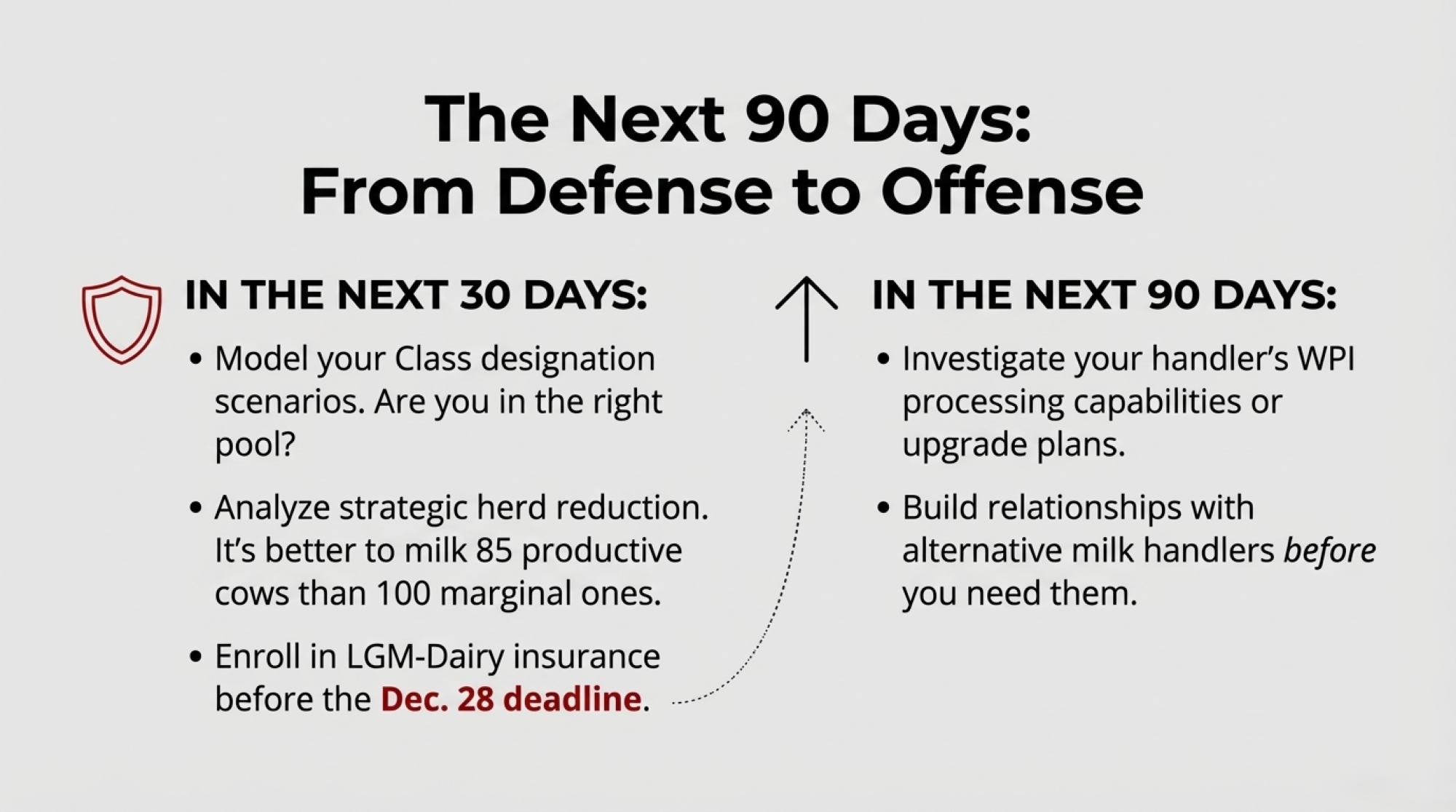
Next 30 days:

  • Take a hard look at whether your current Class designation makes sense. The University of Wisconsin’s online tools can help you model different scenarios.
  • Consider strategic herd reduction if cash flow projections show negative margins through Q2. Penn State’s extension templates are excellent for this analysis. As Iowa State Extension often teaches, it’s better to milk 85 productive cows than 100 marginal ones.
  • LGM-Dairy insurance enrollment for Q1 2026 closes December 28. With premiums still below $0.70/cwt according to RMA data, it might be worth the protection.

Next 90 days:

  • Investigate whether your milk handler has WPI processing or upgrade plans. The industry directories can tell you who’s investing in what.
  • Build relationships with alternative handlers now, not when you’re desperate. As Cornell’s dairy program likes to say, the best time to negotiate is when you don’t have to.
  • Document everything if you might claim financial hardship. Your cooperative will want to see cash flow statements, tax returns, and lender correspondence.

The Information-to-Action Challenge

What’s becoming crystal clear from this crisis is that success isn’t about having perfect information—it’s about acting on good-enough information before the window closes.

The $2,654 that disappears every two weeks through delay is real money with real consequences. For a 100-cow operation, that’s the difference between updating equipment and deferring maintenance, between keeping good employees and losing them, between staying current with your lender and starting those difficult conversations.

Cornell’s dairy crisis research—they’ve studied every major downturn since the 1980s—shows something interesting: the producers who survive aren’t necessarily the lowest-cost or highest-producing. They’re the ones who recognize reality quickly and adapt before they’re forced to.

That adaptation starts with understanding what’s actually possible. Not what you wish were possible, not what should be possible, but what your contracts, your finances, and your operation can actually execute.

The irony is that we have more information, better genetics, superior technology, and deeper market understanding than ever before. But as this crisis is proving, those advantages mean nothing if they don’t translate into timely decisions.

For most operations, the path forward isn’t about making perfect decisions—it’s about making intentional ones. The cost of waiting for certainty is becoming higher than the cost of acting with uncertainty.

As we head into what looks like a challenging 2026, remember this: The market doesn’t care about your analysis paralysis. It only responds to actual supply and demand. And right now, with production still growing while demand stagnates, that response is telling us something important.

The question isn’t whether to act anymore. It’s whether you’ll act in time to make a difference.

Market prices and data are current as of November 22, 2025. Individual situations vary significantly—consult with your advisory team before making major operational changes.

KEY TAKEAWAYS:

  • This Week’s Must-Do: Request your cooperative contracts and calculate delay costs—you’re losing $2,654 every 14 days through inaction
  • December Deadlines: Lock Q1 feed under $4.40/bushel and LGM-Dairy insurance below $0.70/cwt by December 28—premiums are climbing daily
  • The $88,200 Reality: Class III-IV spread at $3.50/cwt means escape clauses in your contract could save you $300k+ over 5 years (70% success rate with proper documentation)
  • Break the Paralysis: This isn’t 2009—more information is creating slower decisions. Trust your math, not the market consensus that isn’t coming

Learn More:

Complete references and supporting documentation are available upon request by contacting the editorial team at editor@thebullvine.com.

Join the Revolution!

Join over 30,000 successful dairy professionals who rely on Bullvine Weekly for their competitive edge. Delivered directly to your inbox each week, our exclusive industry insights help you make smarter decisions while saving precious hours every week. Never miss critical updates on milk production trends, breakthrough technologies, and profit-boosting strategies that top producers are already implementing. Subscribe now to transform your dairy operation’s efficiency and profitability—your future success is just one click away.

NewsSubscribe
First
Last
Consent

The 800,000-Heifer Shortage Reshaping Dairy: Why Some Farms Will Thrive While Others Exit

Week-old beef calf: $1,400. Replacement heifer: $4,000. Still breeding beef? You’re not crazy—you’re doing the math.

EXECUTIVE SUMMARY: What started as desperate survival in 2018 has become an irreversible trap: beef-cross revenue now provides 16% of dairy farm income, forcing farmers to keep breeding beef at $1,400 per calf even as replacement heifers hit $4,000. This has driven U.S. heifer inventory to 3.9 million—the lowest since 1978—with 800,000 fewer coming before any recovery in 2027. Simultaneously, processors who invested $11 billion expecting 2-3% growth face just 0.4% milk expansion, guaranteeing plant closures and $3-5/cwt regional price swings. The industry is restructuring into three distinct survivors: fortress farms with over 1,500 cows capturing component premiums, strategic operations with 200-500 cows in profitable niches (organic/A2A2/grass-fed), and those exiting now at peak cattle prices. Wisconsin’s 10,000-heifer gain versus Texas’s 10,000-head loss proves that processor relationships and location now matter more than size. Behind the numbers, 2,400-3,700 dairy families face elimination—transforming not just an industry but entire rural communities.

Dairy Heifer Shortage

You know something’s off when you’re seeing beef-cross calves bringing $1,000 to $1,400 at a week old while replacement heifers are hitting $4,000 at auction. It doesn’t make sense at first—but then you dig into what’s actually happening out there, and suddenly it all clicks.

We’re not looking at just another market swing here. What we’re seeing is the collision of desperate decisions farmers made back in 2018 and 2019 with billions in processing investments that assumed a completely different future. And if you’re wondering why your neighbor’s still breeding 40% of the herd to beef despite those heifer prices…well, let me walk you through what I’ve been hearing from producers across the country.

The 800,000 Heifer Crisis Timeline – From 4.8 million in 2018 to 3.4 million projected by 2027, this isn’t a market cycle—it’s industry transformation

Note: Throughout this article, some producers and industry professionals spoke on condition of anonymity to discuss sensitive business details. All financial figures and operational data have been verified against industry benchmarks.

The Numbers Paint a Picture Nobody’s Prepared For

So, CoBank released its latest dairy heifer inventory analysis in August, and the numbers are… honestly, they’re worse than most people realize. According to the USDA’s National Agricultural Statistics Service January 2025 cattle report, the national number of replacement heifers stands at 3.914 million. That’s the lowest since 1978—back when the average herd was what, 30-something cows?

But here’s the kicker that really got my attention: only about 2.5 million of those heifers are expected to actually calve into milking herds this year, based on CoBank’s projections. That’s tracking to be the lowest since the USDA started keeping those specific records in 2001. The ratio’s collapsed, too—USDA’s July calculations show we’re down to 27 heifers per 100 cows. Ten years ago? That was 31 per 100.

And it gets rougher. CoBank’s projects indicate that we’ll lose another 357,490 heifers in 2025, followed by an additional 438,844 in 2026. They’re saying maybe we’ll get back 285,387 or so in 2027, but…that’s still a massive hole. Add it up and we’re talking about 800,000 fewer replacements before any real recovery kicks in.

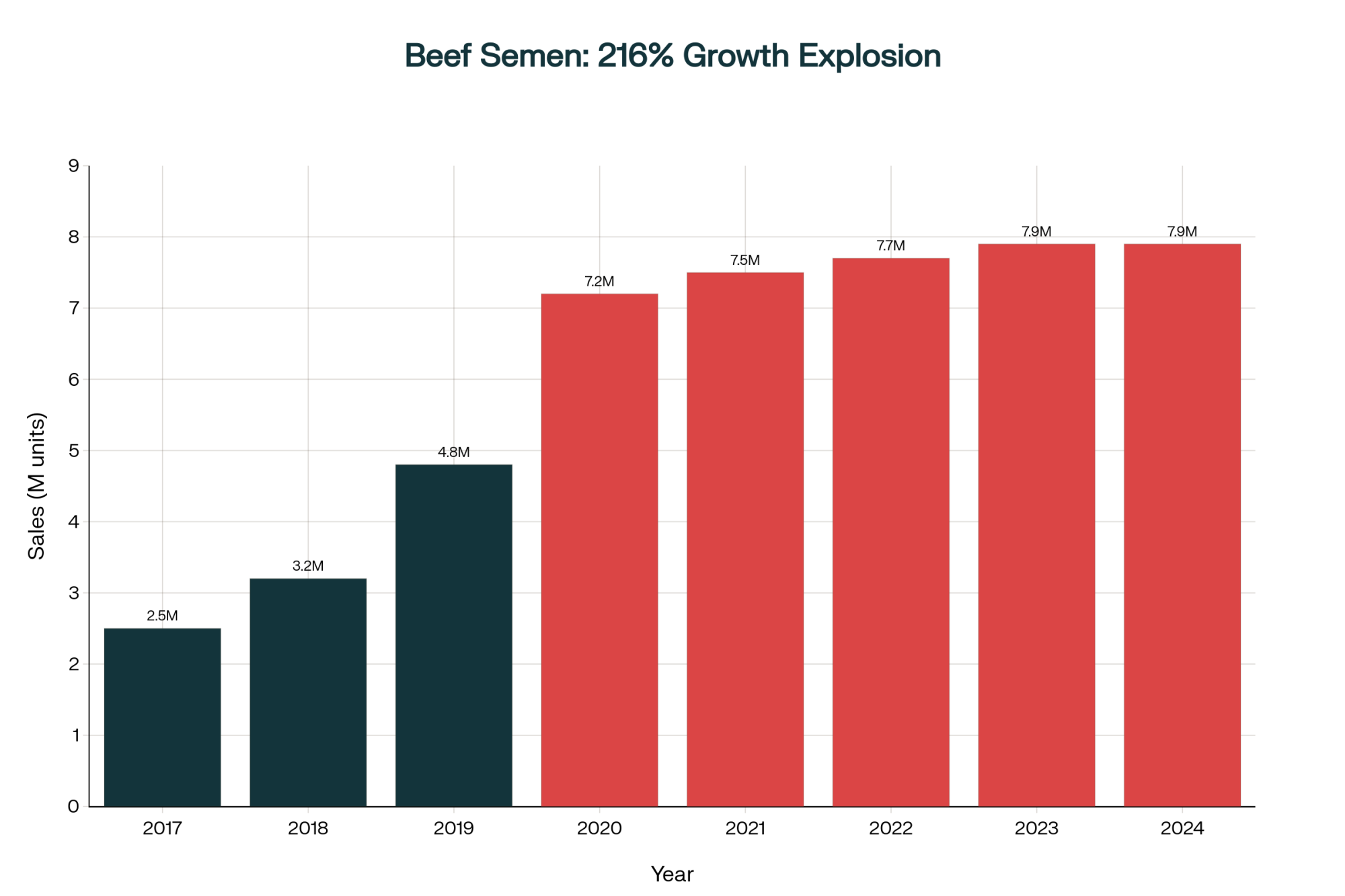
The 216% Explosion That Changed Everything – Beef semen sales to dairy farms surged from 2.5M to 7.9M units, creating the heifer shortage crisis

How Seven Years of Survival Mode Created Today’s Crisis

You can trace this whole thing back to that brutal stretch from 2015 through 2021. Class III milk prices averaged below $18 per hundredweight for most of those years—not continuously, but often enough to cause significant harm. University of Illinois dairy economist John Newton documented this period in his 2018 farmdocdaily analysis, calling it an extended period of sustained losses that fundamentally changed the industry.

By April 2019, according to the USDA’s Agricultural Marketing Service reports, replacement heifers that cost $ 2,000 or more to raise were only bringing $1,140 at market. Think about that for a second. You’re losing $860 to $1,360 on every single replacement you raise.

Then the technology all came together at once. Sexed semen finally worked reliably—industry data from Select Sires and other major AI companies shows you can get 90% female calves with 85-95% of conventional conception rates. Genomic testing through companies like Zoetis and Neogen dropped to about $40 per animal. And beef prices? Through the roof. Suddenly, those Holstein bull calves that might bring $200 on a good day were being replaced with Angus crosses worth anywhere from $600 to over $1,400, depending on genetics and your local market.

I mean, what would you have done?

The National Association of Animal Breeders has been tracking this transformation in their annual Semen Sales Reports. Beef semen sales to dairy farms went from about 2.54 million doses in 2017 to over 7.2 million by 2020. That’s nearly triple in three years. Their March 2025 industry update shows we’re now sitting at about 7.9 million units, and it’s just…stuck there. Meanwhile, conventional dairy semen sales have crashed almost 46.5% since 2020.

Why $4,000 Heifers Still Can’t Fix the Problem

Examining what doesn’t add up for many people: according to the USDA’s October 2025 Agricultural Prices report, heifers are currently worth a significant amount of money. Wisconsin’s averaging close to $2,860. Vermont’s around $2,930. Premium animals in California and Minnesota are fetching over $4,000, according to recent livestock auction reports. So why isn’t everyone breeding dairy again?

What I’m hearing from nutritionists working with Wisconsin herds is pretty consistent. Consider a typical 500-cow operation that breeds 40% of its cows for beef. They’re bringing in maybe $200,000 a year just from those beef calves. Add in cull cows at current prices, and you’re looking at $350,000 in cattle revenue.

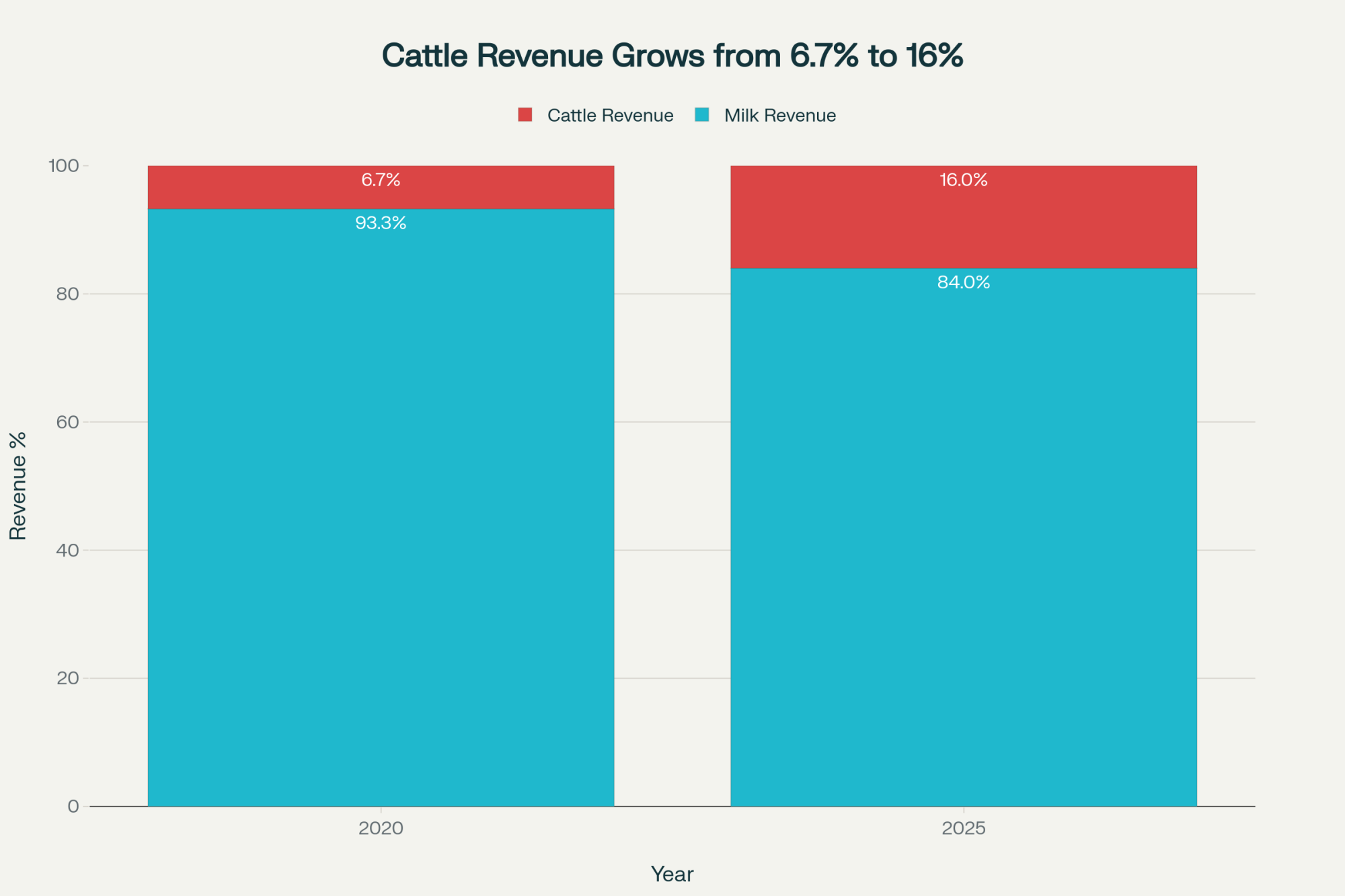
The Revenue Revolution – Cattle sales jumped from 6.7% to 16% of dairy income – this structural shift is permanent and changes everything

According to USDA Economic Research Service data, that’s approximately 16% of total farm income for many operations now. Back in 2020? Cattle sales were maybe 6.7% of dairy farm revenue.

As one nutritionist put it to me, “It’s not just extra money anymore. It’s structural. These guys can’t just flip a switch and go back. Walking away from that revenue would mean completely restructuring the operation.”

From Crisis to Gold Rush – Heifer prices crashed to $1,140 in 2019, now average $2,860 with premiums hitting $4,000

The Processing Overcapacity Challenge Coming in 2027

And here’s where it gets really messy. According to the International Dairy Foods Association’s industry investment tracking, the processing sector has invested more than $10 billion in new facilities over the past three years—some estimates put the total closer to $11 billion. New York’s Department of Agriculture reports that the state alone has $3 billion in processing investments that require an additional 10 to 12 million pounds of milk per day.

These plants were all designed assuming we would continue to grow milk production at a rate of 2-3% annually, as we have for decades, based on USDA historical data from 1995 to 2020. Instead? USDA’s October 2025 World Agricultural Supply and Demand Estimates project just 0.4% growth next year. That’s not a typo—zero point four percent.

Mike North from Ever.Ag’s Risk Management division put it bluntly at the September 2025 Milk Business Conference: “We don’t have enough cows to fill all these plants.” He thinks we’ll see inefficient plants close, and others running way under capacity. That’s billions in stranded investment.

What’s worth noting here is that we’re already seeing some policy discussions emerging. The National Milk Producers Federation has formed working groups to study the situation, though no concrete proposals have emerged. Meanwhile, some state agriculture departments are exploring incentive programs for heifer retention, but the scale of these initiatives remains small compared to the challenge.

Three Different Worlds Emerging

What’s really interesting—and I’ve been watching this develop over the past year or so—is how the industry’s basically splitting into three completely different business models.

The Big Operations (Your “Fortress Farms”)

These 1,500 to 5,000-cow dairies have basically built moats around their businesses. They’re conducting genomic testing on every single heifer through programs like Zoetis’ CLARIFIDE Plus, utilizing AI-powered systems like DairyComp for informed decision-making. According to the Penn State Extension’s 2025 component premium tracking, they’re achieving component premiums that add $1.50 to $2.50 per hundredweight.

Large Midwest operations I’ve talked with are reporting revenue per cow that’s approaching $6,000 to $7,000—numbers that would’ve been fantasy five years ago. They’re generating base milk revenue in the millions, plus substantial component premiums, and nearly a million dollars from beef calves in some cases.

What’s interesting here is something I noticed visiting a couple of these operations recently: they’re not just bigger—they’re fundamentally different businesses. One manager showed me their real-time component monitoring system. “We know within 0.1% what our butterfat’s gonna test every single day,” he said. “That consistency is worth an extra $750,000 a year to us.”

It’s worth noting that these operations are also exploring emerging technologies. Embryo transfer programs, automated calf feeding systems, precision nutrition through AI…they’re positioning themselves for whatever comes next. Some are even experimenting with automated milking systems that can handle 500-plus cows, completely changing labor dynamics.

The Strategic Middle

This is where it gets interesting for those with 200-500 cows. According to the USDA’s organic dairy market reporting, they’re finding ways to make it work through specific niches. Organic products typically sell for $7-12 more than conventional ones. University of Wisconsin extension studies on pasture-based dairy show grazing systems are cutting costs by 30-50%. Some are going direct-to-consumer and getting $4 more per gallon.

I visited an organic operation in Vermont last month, which had transitioned to organic in 2022, with 280 cows. The producer told me she’s actually more profitable now than when she had 350 conventional. The premium’s real—she’s averaging about $9.50 over conventional—and her vet bills dropped 40%.

Out in California, there’s a different approach. One Jersey producer with about 450 cows is locked into a specialized cheese contract. Between base and components, he’s getting close to $24.50 when commodity milk’s at $21. On 10 million pounds, that $3.50 spread is…well, you can do the math.

Down in Georgia—and this is something you don’t hear much about—a 300-cow operation switched to A2A2 milk production exclusively. They’re selling direct to Atlanta-area health food stores at premium prices. “It’s niche as hell,” the owner admits, “but it works for us.”

The Ones Choosing to Exit

Then there are the operations using these high cattle prices as their exit opportunity. After a decade of barely hanging on, they’re done—and honestly, who can blame them?

I caught up with a couple who recently sold their 185-cow place in Wisconsin. After accounting for debt service, living expenses, and reinvestment, they were netting maybe $18,000 a year for 70-hour weeks. Now they’ve got a solar lease on the land, bringing in $52,000 with zero labor. Can’t really argue with that decision.

 Industry Darwinism – Only 20% of small farms will survive the heifer shortage, while 95% of large operations thrive – consolidation is accelerating

Global Perspective: How Other Countries Face Similar Dynamics

What’s fascinating is seeing how this isn’t just a U.S. problem. The European Union’s dealing with their own version of this crisis, though for different reasons. Environmental regulations and nitrogen limits are forcing Dutch and German producers to reduce herd sizes, just as their processing sector has expanded to meet export market demands. According to European Dairy Association reports, EU milk production is expected to decline 1.5% annually through 2027.

New Zealand’s taking a different approach. Fonterra’s latest annual report shows they’re actually encouraging farmers to reduce production intensity and focus on value-added products. Their winter milk premiums now exceed NZ$11 per kilogram milk solids—that’s roughly equivalent to a $7/cwt premium in U.S. terms—specifically to maintain year-round supply for their specialty ingredient plants.

Brazil and India, meanwhile, are ramping up production. Brazil’s domestic consumption is growing at a rate of 3% annually, and the country is investing heavily in genetics and infrastructure. India’s cooperative model—completely different from ours—is actually expanding smallholder participation. It’s a reminder that there’s more than one way to structure a dairy industry.

What’s interesting is watching how other countries handled similar situations. Dairy Australia’s market analysis shows that in 2023, when their production hit 30-year lows, processors like Goulburn Valley Creamery started paying AUS$9.70 per kilogram milk solids—equivalent to about $28 per hundredweight U.S.—just to keep smaller farms from shutting down. We’re starting to see hints of that in the Upper Midwest—smaller co-ops offering bonuses that weren’t on the table two years ago.

Why Some Regions Are Winning While Others Lose

The shortage’s not hitting everywhere the same. USDA’s January 2025 cattle report shows Wisconsin actually added 10,000 replacement heifers last year. Meanwhile, Kansas dropped 35,000, Idaho lost 30,000, and Texas shed 10,000.

Why the difference? Extension specialists at UW-Madison point to several factors. It’s partly infrastructure, partly processor relationships, but mostly it’s about positioning. Wisconsin cheese plants require consistent, high-quality milk, and they’re willing to pay for it. They’re offering retention bonuses, multi-year contracts—things that make raising heifers actually pencil out.

Down in Texas, it’s brutal. One producer recently told me that he paid $4,200 per head for bred heifers from Wisconsin, plus an additional $380 each for trucking. “It hurt,” he said, “but dropping our ship volume would’ve cost us our quality premiums. That’s $140,000 gone.”

Out in the Mountain West states—Colorado, Wyoming, parts of Montana—they’re dealing with different challenges. Water rights, urban expansion, and feed costs… it’s pushing many smaller operations out. One Colorado producer told me, “Between Denver sprawl and water restrictions, we’re done in five years regardless of heifer prices.”

The “Obvious” Solution That’s Actually a Trap

You’d think with heifers at $4,000, somebody would be raising extras to cash in. Spend $2,400 raising them, pocket $1,600 profit. Simple, right?

Not really. The heifer management experts at UW-Madison have thoroughly reviewed this. First problem: mortality. The USDA’s 2022 Dairy Cattle Management Practices study shows you lose about 21% of heifers from birth to freshening when you factor in all causes of mortality and culling. So that $2,400 cost becomes over $3,000 per surviving heifer.

Then add labor—extension economists calculate $400-600 per head through freshening. Feed costs can fluctuate by $400 based solely on corn prices—we’ve seen a variation of $2.80 per bushel over the past 18 months. And you’re making a 24-month bet with no way to hedge the price risk.

As one extension specialist explained, “The only people successfully raising heifers for sale have paid-off facilities, family labor, and grow their own feed. That’s not a business model most can replicate.”

Industry Response: Fragmented Approaches to a Systemic Challenge

You’d think there’d be some coordinated response, but…not really. The National Milk Producers Federation has been discussing the situation, but they’re mostly focused on data collection and suggesting best practices. No real market intervention, though they are exploring potential policy recommendations for the next Farm Bill discussions.

Some cooperatives are exploring different approaches to help members finance replacement raising, though the details vary significantly by region. But as one board member mentioned in a recent meeting, the scale of what’s needed versus what’s being offered is pretty mismatched. We need hundreds of thousands, not tens of thousands, of additional heifers.

What’s encouraging is seeing some innovation at the regional level. A group of farms in Minnesota formed what they’re calling a “heifer pool”—basically sharing genetics and breeding decisions to optimize replacement production across multiple operations. It’s early days, but the concept’s interesting.

Meanwhile, some states are getting creative. Pennsylvania’s Department of Agriculture is piloting a heifer retention incentive program, offering $200 per head for farms that increase replacement numbers. It’s small—only $2 million allocated—but it’s something.

2027: The Year Everything Changes

Based on everything I’m hearing from processors, economists, and producers—plus what we’re seeing in reports from CoBank and Rabobank’s latest dairy quarterly analysis—here’s what’s probably coming:

Milk prices will diverge significantly regionally—possibly $3-5 per hundredweight between shortage and surplus areas. I’m already seeing it start. Some cooperatives in Texas are offering $2.40 location premiums for new farms near their plants.

Industry analysts suggest that processing plants will operate at 72-76% capacity, rather than the 85-90% required for profitability. Smaller regional processors will either close or get bought for significantly less than their construction cost. As one former cheese plant executive explained to me, “The consolidation is coming, it just hasn’t started yet.”

Heifer prices are likely to peak around $4,200-$4,800 in early 2027, based on historical price patterns from similar periods of shortage. They will then moderate back to $3,800-$ 4,200 as more sexed semen is used and the supply improves slightly.

According to NAAB’s projections, beef-on-dairy sales are expected to decline slightly—possibly to 6.5-7 million unitsfrom the current 7.9 million—but they are unlikely to return to pre-2020 levels. As one large-herd manager put it, “Once you’ve built those calf buyer relationships and you’re getting $1,000 to $1,400 per head, you don’t just walk away.”

The Human Cost We’re Not Calculating

What gets lost in all these numbers is what this means for actual people. Back in 2018, Agri-Mark started including suicide prevention hotline numbers with milk checks after losing three members to suicide, as documented in their member communications. The CDC’s 2020 Morbidity and Mortality Weekly Report shows farmers have the highest occupational suicide rate in America—43.7 per 100,000 workers, over 3 times the general population.

When 10-15% of dairy operations close over the next decade—that’s 2,400 to 3,700 families based on current USDA numbers—we’re not just losing businesses. These are communities that have been built around dairy farming for generations.

Researchers studying farmer mental health, such as those at the University of Illinois’ Agricultural Safety and Health Program, have found that after a decade of financial stress, decision-making processes undergo fundamental changes. As one researcher explained, “These aren’t people making strategic business decisions anymore. They’re making survival decisions from a place of chronic stress.”

I see it visiting farms. The producer who won’t look you in the eye when money comes up. The couple who stopped talking about succession because their kids made it clear they’re not coming back. The neighbor who sold out and now won’t answer calls because the shame’s too heavy.

That’s the real cost we’re not calculating.

Your Survival Playbook for the Next 18 Months

Look, every operation’s different, but here’s what seems to make sense based on what I’m seeing:

If You’re Under 200 Cows

Be honest about whether this still works for you. I know that’s hard, but extension economists have shown pretty clearly that the economics are brutal at this scale unless you’ve got a real niche.

If you’re staying, pick your lane now. Organic certification takes three years, but it adds significant premiums, according to USDA data. Grass-fed certification is faster. Direct sales need the right location. However, you have to pick one and commit to it completely. Half-measures don’t work anymore.

Consider teaming up with neighbors. I’m seeing more informal cooperatives forming—sharing equipment, coordinating breeding, even pooling milk for better bargaining power. It’s worth exploring.

If You’re 200-500 Cows

This is your moment to choose. The middle ground’s gone.

Invest smart. Extension research indicates that testing the top 30% of animals genomically costs approximately $3,000-$ 4,000 per year, but can significantly advance your genetics. Activity monitors from companies like SCR by Allflex run $150-200 per cow, but their field data shows conception rate improvements of 8-12%.

Build relationships with your processor now. The farms that’ll get premiums when things get crazy in 2027 are the ones building trust today. Consistent quality, reliable volume, good communication—that’s what processors are looking for.

And keep beef breeding at a maximum of 35-40%. Yeah, those $1,000-plus checks are nice, but you need flexibility when markets shift.

If You’re Over 500 Cows

Focus on component consistency. Penn State’s data show that farms with less than 2% daily variation are earning significant premiums—$375,000 to $750,000 annually on 50 million pounds of product.

Test everything genomically. University research consistently shows that herds testing all their females make genetic progress over twice as fast. At $40 per test, it pays for itself quickly through increased production efficiency.

Be ready to expand strategically when neighbors exit. But like one Idaho dairyman told me, “Don’t expand just because you can. Expand because it makes your operation better.”

What This All Really Means

We’re sitting at 3.914 million heifers—the lowest since 1978, according to the USDA—with 800,000 fewer expected to arrive before anything improves, based on CoBank’s modeling. We’re not going back to the dairy industry we knew.

What started as desperate survival with beef-on-dairy has triggered a complete restructuring. When cattle revenue reaches 16% of farm income, according to USDA ERS data, and large operations capture premiums that smaller farms cannot match, when $10 billion in processing investment faces milk shortages nobody predicted—this is creative destruction happening in real-time.

What’s emerging isn’t necessarily better or worse; What’s emerging isn’t necessarily better or worse. It’s fundamentally different.. The broad middle that defined dairy for generations is disappearing, replaced by high-tech large operations and strategic niche players.

The decisions you make in the next 18-24 months about breeding, technology, and positioning will determine not just profitability but survival. There’s opportunity in this chaos, but only if you recognize the game has completely changed.

The heifer shortage isn’t the crisis. It’s the catalyst exposing a transformation that was always coming. The question now is whether you’re positioned for what’s next or still trying to preserve what was.

KEY TAKEAWAYS: 

  • The Numbers: 3.9 million heifers (lowest since 1978) with 800,000 fewer coming by 2027—yet farmers won’t stop breeding beef because it’s now 16% of revenue vs 6.7% in 2020
  • The Collision: $11 billion in new processing capacity built for 2-3% growth will get 0.4%—expect plant closures and $3-5/cwt regional price swings by 2027
  • Your 18-Month Strategy: Scale to 1,500+ cows for premiums | Find your niche at 200-500 (organic/A2A2/grass-fed) | Exit under 200 while cattle prices are high

Complete references and supporting documentation are available upon request by contacting the editorial team at editor@thebullvine.com.

Learn More:

Join the Revolution!

Join over 30,000 successful dairy professionals who rely on Bullvine Weekly for their competitive edge. Delivered directly to your inbox each week, our exclusive industry insights help you make smarter decisions while saving precious hours every week. Never miss critical updates on milk production trends, breakthrough technologies, and profit-boosting strategies that top producers are already implementing. Subscribe now to transform your dairy operation’s efficiency and profitability—your future success is just one click away.

NewsSubscribe
First
Last
Consent

When July’s Market Crash Just Changed Everything

How this week’s supply tsunami exposed the industry’s biggest blind spot—and what you need to do about it

EXECUTIVE SUMMARY: Look, I just spent the weekend digging into July’s brutal market crash, and what I found will change how you think about your operation. The old “more milk, more money” playbook is officially dead – we’re now in an era where component optimization beats volume every single time. The numbers don’t lie: operations running 4.2% butterfat versus 3.8% are seeing $275-460 additional daily revenue on a 2,000-cow setup, and that gap’s only getting wider. Global markets just proved they’ll punish volume producers while rewarding those smart enough to focus on what their milk’s actually made of. With Class IV futures sitting at $19.05/cwt and Class III stuck at $18.50/cwt, the market’s screaming at you to optimize for fat and hedge against protein weakness. The producers who get this shift right now – not next year, not next month, but right now – will be the ones still standing when the dust settles.

KEY TAKEAWAYS

  • Genetic selection pivot pays immediately: Daughters of fat-plus sires are generating $150-200 more annually per cow under current pricing structures. Start evaluating your breeding program for butterfat percentage over volume metrics – your 2026 calf crop depends on decisions you make this month.
  • Component monitoring = instant profit capture: Real-time parlor monitoring lets you adjust feeding strategies daily, capturing an additional $0.20-0.30 per hundredweight just from ration timing. Pennsylvania farms already doing this are seeing results within 30-60 days, not years.
  • Risk management isn’t optional anymore: Lock in 25-30% of your fat-heavy production through Class IV futures while buying Class III downside protection through DRP programs. With that $0.55 spread, not hedging is basically gambling with your operation’s future.
  • Feed cost optimization creates double wins: Strategic fat supplementation and improved forage quality boost component returns by $0.15-0.25 per hundredweight with minimal input cost increases. Vermont producers using palmitic acid inclusion are seeing 0.15 percentage point butterfat gains in 4-6 weeks.

Look, I’ve been watching dairy markets for more than three decades, and what happened at the Global Dairy Trade auction this week… well, it’s one of those moments that fundamentally changes how we think about milk pricing. We just witnessed a brutal -4.1% crash in the GDT Price Index—the worst single-day performance in twelve months—and if you think this is just another cyclical blip, you’re missing the fundamental shift that’s happening right under our noses.

The thing about supply-driven corrections is they don’t send you a courtesy call first. When Fonterra reported their highest milk collections in five years, with May intake surging 7.5% year-over-year, and Irish collections jumped 6.5% for the month, the writing was on the wall. You simply can’t flood global markets with that much milk and expect prices to hold. Basic economics, right? But somehow our industry keeps forgetting this fundamental lesson.

This wasn’t just a bad day at the auction house either. The event ran for nearly three hours across 22 bidding rounds, with 161 participants and only 110 walking away as winners. When you see numbers like that, you know sellers were desperate to move product, and desperate sellers make for ugly prices.

But here’s what really gets me fired up about this whole situation… we’re not just dealing with lower prices. We’re looking at a fundamental restructuring of how milk components get valued, and it’s happening whether we like it or not.

The Component Split That’s Reshaping Everything

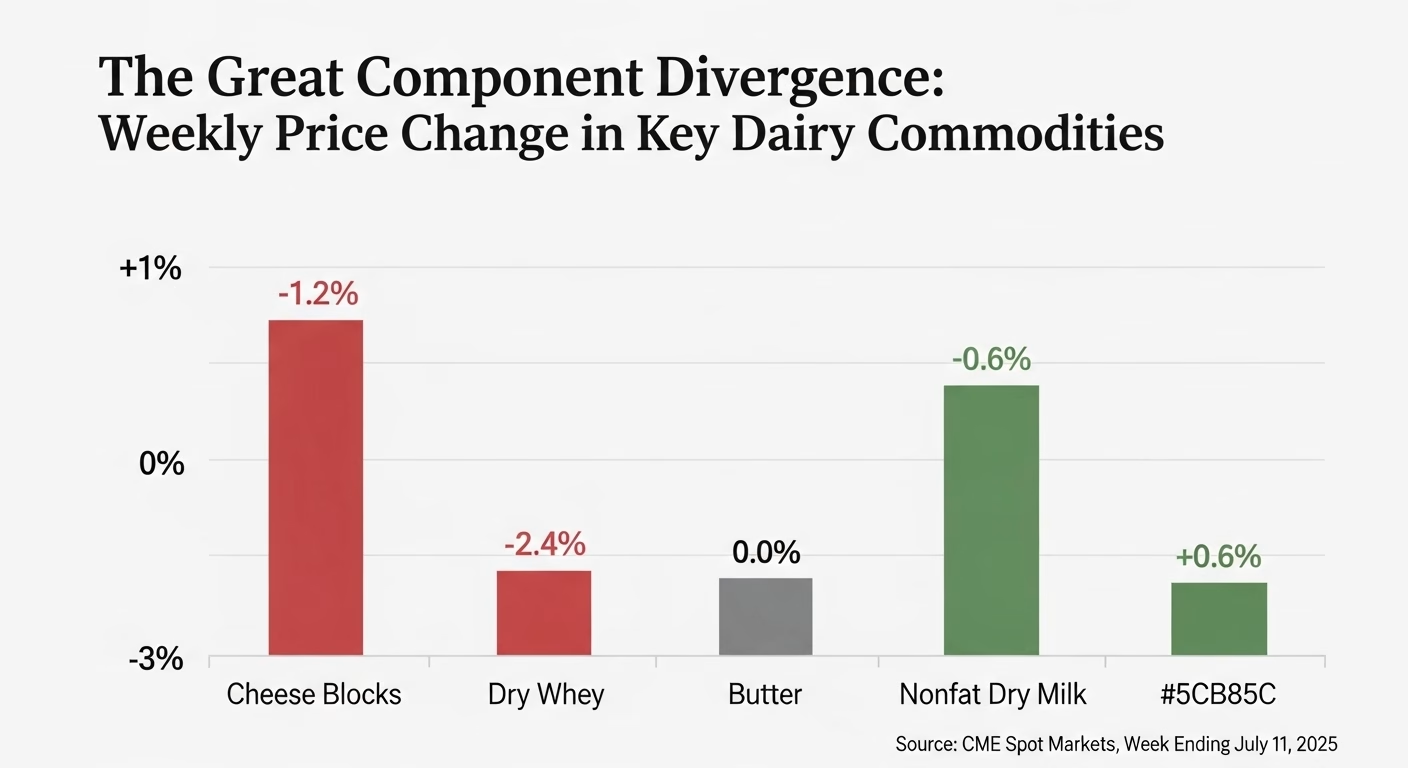
Something really caught my attention about this market break—how it’s revealing the industry’s biggest blind spot. The CME spot markets told the whole story this week. Cheese blocks dropped to $1.66/lb, dry whey collapsed to $0.5675/lb—that’s a 1.41 cent weekly decline that had whey traders wincing. But here’s the kicker: butter held steady at $2.59/lb and nonfat dry milk actually gained ground to $1.2675/lb.

That’s not random market noise, folks. That’s the market screaming at you about what it values right now.

What strikes me about this divergence is how it’s playing out differently depending on where you’re milking cows. According to recent work from the USDA’s July WASDE report, the 2025 all-milk price forecast got bumped up to $22.00 per hundredweight. That’s not pocket change; that’s the kind of revision that changes your whole year’s profitability outlook.

But here’s where it gets really interesting: Class IV futures are now trading at $19.05/cwt while Class III settled at $18.50/cwt. That’s a $0.55 spread that translates directly to your bottom line depending on your butterfat numbers.

Recent research from dairy economists at Cornell University suggests that operations with milk testing 4.2% butterfat versus 3.8% could see $0.30-0.50 per hundredweight advantages under current pricing structures. If you’re running Holstein genetics selected for high butterfat… well, you’re sitting pretty right now. But if your operation skews toward protein production? You’re feeling the squeeze, and honestly, it’s only going to get worse.

Why aren’t more producers talking about this shift? It’s like watching a slow-motion train wreck, and half the industry is still focused on the wrong track.

Regional Realities: When Geography Becomes Destiny

The fascinating thing—and a bit scary—is how global dairy markets aren’t really global anymore. They’re becoming increasingly regionalized, and that’s creating some wild opportunities for those who understand the game.

North America: The Unexpected Winner

U.S. producers are experiencing something I haven’t seen in years: genuine decoupling from global weakness. While New Zealand’s NZX futures show butter dropping from $7,660/MT in July to $6,740/MT by September—that’s a $920 drop in just two months—American producers are looking at improved margins.

The feed cost dynamics are actually working in our favor, too. According to extension specialists at the University of Wisconsin-Madison, the improved soybean meal price forecasts could translate to $25-35 less in monthly feed costs per cow for typical 500-head operations. When you’re feeding 4-6 pounds of protein supplement daily, those savings add up fast.

I was just talking to a producer in Wisconsin last week who’s already adjusting his ration strategy based on these projections. He’s calculating that with improved milk prices and cheaper protein supplements, he’s looking at roughly $40-50 per cow improvement in monthly margins. That’s the kind of swing that changes your whole year’s outlook.

But here’s what’s got me curious… how many operations are actually positioned to capture this opportunity versus getting caught flat-footed by the component shift?

Europe: Caught Between Two Worlds

European markets are fascinating right now because they’re being pulled in opposite directions. EU butter prices edged up 0.2% to €740/100kg while skim milk powder fell 1.8% to €239/100kg. That’s not market manipulation—that’s processors making strategic decisions about where to allocate their limited milk supplies.

The EU is dealing with supply constraints that are actually protective. Environmental regulations, bluetongue outbreaks (this is becoming more common across Germany and France), and demographic challenges are creating a natural supply ceiling. Sometimes regulations work in your favor… who knew?

Recent research from dairy production specialists at Wageningen University shows that EU milk output forecasts suggest minimal production growth of just 0.2% to 0.4% for all of 2025. When you’ve got that kind of constraint, every liter of milk becomes precious.

But here’s what’s interesting—the UK stands out as a major outlier. UK milk production jumped 5.7% year-over-year in May, hitting record daily volumes. While that sounds great for UK producers, it actually puts them in a tough spot. They’re producing into a weak global market without the EU’s internal supply constraints to protect them.

Oceania: Ground Zero for Pain

If you’re milking cows in New Zealand right now, you’re at the epicenter of this supply storm. The GDT results show just how brutal this correction has been: whole milk powder dropped 5.1% to $3,859/MT, butter fell 4.3% to $7,522/MT, and the forward curve suggests this pain isn’t over.

What’s really concerning is the future structure. When you see butter futures in steep backwardation—dropping over $900/MT in just two months—that’s the market pricing in sustained weakness. This isn’t a temporary blip; this is a fundamental reset that could last through the Southern Hemisphere’s peak production season.

The Genetics and Nutrition Reality Check

This component value divergence we’re seeing isn’t just a market quirk—it’s becoming a structural feature of how milk gets valued. What’s particularly noteworthy is how this is playing out for different genetic programs.

I know a producer in Vermont who’s been working with dairy geneticists at the University of Vermont Extension to optimize his breeding program for butterfat. They’ve moved away from pure volume genetics toward proven fat-plus sires, and he’s seeing results. Under current pricing, daughters of these bulls are generating about $150-200 more annually per cow than his volume-focused animals.

But genetics is only part of the equation. Feed efficiency experts from Penn State’s dairy science program are calculating that strategic fat supplementation and forage quality improvements can boost component returns by $0.15-0.25 per hundredweight with minimal additional input costs. That’s the kind of ROI that makes sense even in tight margin environments.

For a 2,000-cow operation producing 75 pounds per cow daily, optimizing from 3.8% to 4.2% butterfat translates to $275-460 additional daily revenue. Scale that across a year, and you’re talking about $100,000-168,000 in additional income just from component optimization. That’s not theoretical—that’s real money hitting your milk check every month.

Herd SizeDaily ProductionButterfat IncreaseApprox. cwt Advantage*Potential Additional Annual Revenue
500 Cows75 lbs/cow3.8% to 4.2%$0.40/cwt$54,750
1000 Cows75 lbs/cow3.8% to 4.2%$0.40/cwt$109,500
2000 Cows75 lbs/cow3.8% to 4.2%$0.40/cwt$219,000

*Based on a $0.40/cwt premium for a 0.4 percentage point increase in butterfat.

The question is… how quickly can you implement these changes, and what’s the realistic timeline for seeing results? From what I’m seeing on progressive farms, genetic improvements take 2-3 years to materialize fully, but nutritional adjustments can show results within 30-60 days.

Risk Management: Why Passive Strategies Are Dead

The current market environment is offering some of the clearest hedging signals I’ve seen in years. With Class IV futures trading at a significant premium to Class III, the market is practically screaming at you to hedge fat-based production while protecting against protein-based downside.

Here’s what I’m telling progressive operations: lock in 25-30% of your expected fat-heavy production through forward contracts while buying Class III downside protection through puts or the Dairy Revenue Protection program. The math is compelling—you’re capturing the current spread while limiting your exposure to further protein market weakness.

What’s fascinating is how this plays out differently across regions. European futures markets on the EEX are pricing similar opportunities, with July SMP contracts at €2,396/MT and butter at €7,371/MT—a spread that’s too wide to ignore for producers who understand component risk management.

The implementation timeline here is critical. Most DRP enrollment deadlines are 30-45 days before the coverage period starts, so if you’re thinking about protecting your fall production, you need to move now. Futures markets offer more flexibility, but you need the financial infrastructure in place—margin accounts, credit lines, the works.

The Technology Factor Nobody’s Talking About

Something else is happening that’s becoming increasingly clear: the producers who thrive in this environment aren’t just those with the best genetics or the cheapest feed—they’re the ones with the best data.

Component management has moved from optimization to necessity. Real-time monitoring technology isn’t a luxury anymore; it’s essential for capturing the value spreads we’re seeing. The operations that can adjust their nutritional programs based on daily component pricing are the ones that’ll come out ahead.

I was just at a farm in Pennsylvania where they’ve installed real-time component monitoring through their parlor system. The producer told me he’s adjusting his feeding strategy almost daily based on component premiums. It’s allowed him to capture an additional $0.20-0.30 per hundredweight just by optimizing his ration timing.

But here’s the thing—this technology isn’t cheap, and it requires a learning curve. The farms I’m seeing succeed with this approach are investing 12-18 months in training and system optimization before they see consistent results. Are you prepared for that commitment?

What the Next Few Weeks Will Tell Us

The upcoming July 15th GDT auction will serve as a crucial test of whether this correction has found a floor. Honestly? I’m not optimistic. Fonterra’s already announced significant volumes for the event, and if those hit the market and prices fall further, it’ll confirm that this bearish trend has legs.

But here’s the thing—the auction results are almost beside the point now. We’re operating in a fundamentally different market structure. Volume-focused strategies aren’t just outdated; they’re counterproductive in this environment.

Current trends suggest that Chinese import demand—which could provide the lifeline Oceanic markets desperately need—remains sluggish. According to agricultural trade economists at Iowa State University, without that demand recovery, New Zealand producers are looking at an extended period of painful price discovery.

The summer heat across the Northern Hemisphere is also playing a role. I’ve been getting reports from producers in Wisconsin and New York about heat stress impacting fresh cow performance. When you combine that with the seasonal decline in milk production, it could provide some support to powder markets… but probably not enough to offset the Oceanic supply tsunami.

The Bottom Line: Three Critical Takeaways

After watching this market chaos unfold, three things are crystal clear to me:

First, component management isn’t optional anymore. The fat-protein spread has become the defining feature of 2025 markets. Operations that can’t optimize for butterfat production will get left behind. Period. If you’re not tracking your component tests daily and adjusting your nutrition program accordingly, you’re missing the biggest profit lever in your operation.

This isn’t just about genetics anymore—it’s about real-time management. The producers who understand this are already implementing feeding strategies that can shift butterfat test by 0.1-0.2 percentage points within 4-6 weeks. Under current pricing, that’s $200-400 additional monthly revenue per cow.

Second, regional market dynamics are creating unprecedented opportunities. U.S. producers benefit from strong domestic fundamentals and that bullish USDA outlook. European producers have supply constraints working in their favor, creating natural price support. Oceanic producers… well, they’re learning about oversupply the hard way.

But here’s what’s particularly striking—even within regions, the opportunities vary dramatically. A producer in Vermont with high-fat genetics is in a completely different position than one in Texas focused on volume. Geography matters, but genetics and component management matter more.

Third, sophisticated risk management has moved from advanced strategy to basic survival. The market is offering clear signals about component value divergence, and passive strategies carry exceptional risk. With Class IV futures trading at such a premium to Class III, not hedging is essentially gambling with your operation’s future.

The tools are there—DRP programs, futures markets, forward contracts. The question is whether you’re using them strategically to capture the fat premium while protecting against protein downside. According to risk management specialists at Cornell, operations that implement component-based hedging strategies are seeing 15-20% lower margin volatility.

Here’s what I’m watching for the rest of Q3 2025: the July 15 GDT auction will either confirm this bearish trend or signal a potential floor. Chinese import data for June and July could be a game-changer if demand recovers. And honestly? Northern Hemisphere heat stress could provide some unexpected price support if production drops more than expected.

The question isn’t whether dairy markets will recover—they always do. The question is whether you’ll be positioned to capture the opportunities when they emerge. This market correction has separated the producers who understand the new realities from those still playing by the old rules.

And honestly? That separation is only going to become more pronounced as we move through the rest of 2025. The producers who embrace component optimization, understand regional dynamics, and implement sophisticated risk management will be writing the next chapter of this industry’s story.

The rest will just be reading about it in the market reports.

Complete references and supporting documentation are available upon request by contacting the editorial team at editor@thebullvine.com.

Learn More:

Join the Revolution!

Join over 30,000 successful dairy professionals who rely on Bullvine Weekly for their competitive edge. Delivered directly to your inbox each week, our exclusive industry insights help you make smarter decisions while saving precious hours every week. Never miss critical updates on milk production trends, breakthrough technologies, and profit-boosting strategies that top producers are already implementing. Subscribe now to transform your dairy operation’s efficiency and profitability—your future success is just one click away.

NewsSubscribe
First
Last
Consent

Butter Glut 2025: Why Your Cream Check’s About to Get Creamed

Butter stocks hit 305M lbs – highest since 2021. CME prices plunge 25¢ as spring flush threatens profits. Can farmers pivot before margins melt?

EXECUTIVE SUMMARY: The USDA reports U.S. butter stocks surged to 305.53 million pounds in February 2025, the highest February level since 2021, driven by recovering milk production and cheap cream. CME spot prices dropped 25¢ to $2.30/lb, pressuring dairy profits as spring flush threatens further oversupply. While cheese inventories remain 5.3% below 2024 levels, farmers face a critical juncture: hedge strategically, diversify into specialty cheeses, or risk margins evaporating like “a Popsicle in a calf pen.” Immediate action is urged to navigate volatile pricing and June’s federal milk formula overhaul.

KEY TAKEAWAYS:

  • Butter glut alert: 305M lbs in cold storage (+2.6% YoY) forces prices to 3-year lows ($2.30/lb).
  • Cheese breather: Stocks down 5.3% YoY, but mozzarella/parmesan hit records amid pizza demand.
  • Spring flush risk: Rising milk volumes could push butter prices below $2.00 without aggressive hedging.
  • Profit math: 1 lb butter ≈ 2 bushels corn – a margin-crushing trade for minor operations.
  • Survival playbook: Size-specific strategies from Class III futures to artisanal cheese shifts.
butter glut 2025, CME butter prices, dairy market trends 2025, spring milk production, dairy hedging strategies

February’s USDA Cold Storage report confirms what dairy farmers already knew: Butter stocks are overflowing, hitting 305.53 million pounds – the highest February level since 2021. While cheese inventories remain 5.3% below last year’s levels, the butter glut has sent CME spot prices tumbling to $2.30/lb, down 25¢ since January. Here’s how this impacts your operation – and why spring flush might worsen things.

BUTTER: THE COLD STORAGE COW IN THE ROOM

  • Stocks: 305.53 million lbs (Feb 2025) vs. 297.69 million lbs (Feb 2024)
  • Price Trend: CME spot butter at $2.30/lb, down 25¢ YTD
  • Cream Costs: Multiples below 1.00 for central region churns

Why Farmers Should Care
“That 25¢ price drop? It’s like losing a full diesel tank off your margin – every 1,000 pounds you’re hauling to market just became heavier.”

Churns are humming with cream – milk production is recovering, butterfat tests are up, and cream multiples are trading at fire-sale levels (below 1.00 in the Midwest). However, while domestic demand holds steady, consumers are increasingly reaching for imported butter. The result? U.S.-produced butter piles up faster than a spring calf gains weight.

Price Pressure Points

FactorImpact
Spring FlushMore cream = more churns = more butter
CME Rule ChangeOlder butter excluded from trading (post-12/1/24)
Consumer ShiftsImported butter displaces domestic stocks

“Tracking butter stocks is like watching a stubborn calf learn to nurse – predictable in theory, messy in practice. Here’s why…”

CHEESE: THE SILENT SPOKESPERSON

  • Total Cheese Stocks: 1.38 billion lbs (-5.3% YoY)
  • American Cheese: 783 million lbs (-5.7% YoY)
  • Italian Cheeses: 16 million lbs below forecasts (mozzarella/parmesan hit records)

Regional Reality Check
The East North Central region (IL, IN, MI, OH, WI) still holds half the nation’s specialty cheese inventory. While Italian cheeses lagged, mozzarella and parmesan posted February records – a nod to pizza chains and pasta demand.

The Silver Lining
Cheese stocks are underwhelming, not overflowing. This tightness could soften the blow of butter’s price collapse – but only if you’re diversified.

ACTION PLAN: TURNING GLUT INTO GAIN

1. Hedge Strategically

Farm SizeStrategy
Large40-50% hedging at $18.53/cwt Class III
MidForward contract 30-40% through Q2
SmallExplore specialty cheeses (e.g., artisanal gouda)

2. Monitor the Federal Order Changes
June 1, 2025, marks a milk pricing formula overhaul. Producers should:

  • Track USDA’s Q2 forecasts (e.g., cheese at $1.8200 vs. current $1.6200)
  • Prepare for volatility – stock deviations could trigger price swings

3. Profitability Math
“At $2.30/lb butter, you’re essentially trading 1 lb of butter for 2 bushels of corn – a tough math for profit margins. Hedge early or risk getting milked.”

The Bottom Line

Butter stocks aren’t just numbers—your equity is in a freezer, melting faster than a Popsicle in a calf pen. With spring flush looming and prices below $2.40/lb, 2025 demands sharp hedging and diversified risk management. Stay vigilant—the market’s about to churn harder than a fresh bulk tank lid.

Read more:

  1. CME Dairy Market Report (March 20, 2025): Class III Futures Surge Above USDA Forecast, Cheese Blocks Rally Amid Strong Dry Whey Bidding
    Delves into CME price volatility, global milk production trends, and export shifts impacting butterfat and cheese markets.
  2. USDA’s 2025 Dairy Outlook: Market Shifts and Strategic Opportunities for Producers
    Breaks down USDA’s revised forecasts for milk production, all-milk prices, and export competitiveness, with actionable strategies for farmers.
  3. Why 2025 Could Be the Most Profitable Year for Dairy Farmers Yet: Navigating the Highs and Lows of Dairy’s Global Marketplace
    Examines $8 billion in dairy processing investments, price risks from oversupply, and opportunities in component optimization.

Join the Revolution!

Join over 30,000 successful dairy professionals who rely on Bullvine Daily for their competitive edge. Delivered directly to your inbox each week, our exclusive industry insights help you make smarter decisions while saving precious hours every week. Never miss critical updates on milk production trends, breakthrough technologies, and profit-boosting strategies that top producers are already implementing. Subscribe now to transform your dairy operation’s efficiency and profitability—your future success is just one click away.

NewsSubscribe
First
Last
Consent

Dairy Markets on A Knife’s Edge: Spring 2025’s Make-Or-Break Moment for Producers

Dairy markets plunge as milk floods markets. Can producers adapt to heifer shortage and avian flu impacts?

EXECUTIVE SUMMARY: U.S. dairy markets face intense pressure as milk production surges (+1% YOY to 17.73M lbs in February) while prices plummet: butter (-4¢), cheese blocks (-9¢), and barrels (-14¢) hit multi-month lows. Despite historic heifer shortages, herds expanded to 9.405M head, driven by lower cull rates. Component production booms—cream output up 12.7M lbs YOY, milk protein +3.1%—but processors struggle with oversupply. Regional disparities sharpen due to avian influenza (California down 3.8%) and growth in Texas/Idaho. Futures indicate painful near-term margins (Class III .95/cwt), but export opportunities and feed cost savings (10.1% YOY) offer lifelines. Producers must prioritize cost control, component optimization, and strategic culling to survive the squeeze.

KEY TAKEAWAYS

  • Herd Expansion Defies Logic: 9.405M cows (+62k YOY) despite heifer shortage, driven by low cull rates.
  • Component Wars: Butterfat surges (+12.7M lbs cream) dominate, but protein growth (+3.1%) lags behind demand.
  • Regional Crisis: California production plummets (-3.8% YOY) from avian flu, while Texas/Idaho thrive.
  • Futures Forecast Pain: Class III futures at $17.95/cwt threaten margins; Q4 rebound potential hinges on exports.
  • Strategic Solutions: Lock in sub-$4.70 corn, target 3.5% butterfat herds, and consider culling low-performing cows.
dairy market trends 2025, USDA milk production, avian influenza dairy impact, dairy component pricing, Class III futures forecast

The whey market’s 5¢ rally to 50¢/lb this week fooled nobody who’s read a milk check lately. USDA’s Dairy Market News confirms what every producer knows – demand remains “lackluster” with inventories ballooning. This dead-cat bounce comes as:

  • Butter crashes 4¢ to $2.3025/lb
  • Cheese blocks nosedive 9¢ to $1.6025
  • Barrels implode 14¢ to $1.55 – an 11-month low[3]

“Buyers play hardball below 50¢,” says our Chicago floor contact. “With milk flows increasing, this whey rally has expiration date written all over it.”

MILK FLOODGATES OPEN AS HERD EXPANSION DEFIES LOGIC

USDA’s March shocker: 9.405 million head in February – highest since May 2023. How?

HERD GROWTH DESPITE HEIFER ARMAGEDDON

MetricFeb 2025Change YOY
Total Dairy Cows9.405M+62k
Heifers 500lb+3.914M-7% (1978 low)
Cull Rate (Jan-Feb)89k below historic avg

Producers are playing musical barns – 15k cows added in February alone. The result? 17.73M lbs February output (+1% YOY leap-adjusted) – biggest jump since 2023.

COMPONENT WARS: FAT’S WINNING, PROTEIN’S FUTURE UNCERTAIN

The real money’s in what’s IN your milk:

FEBRUARY COMPONENT SURGE

ComponentProduction IncreaseEquivalent Product
Butterfat+12.7M lbs cream15.5M lbs butter
Protein+3.1% YOY620k lbs cheese
Nonfat Solids+2.3% YOY9.2M lbs NFDM

“Processors are fat-hungry,” notes USDA economist Dr. Mark Svennson. “That $2.30 butter price? Still 18% above 5-year average. The fat premium’s alive.”

COAST-TO-COAST CRISIS: BIRD FLU DECIMATES WESTERN HERDS

Avian influenza isn’t just a poultry problem anymore:

STATE-LEVEL MILK PRODUCTION

RegionYOY ChangeKey Factor
California-3.8%62% herds infected
Texas+4.1%New mega-facilities
Pacific NW-2.9%Historic basis discounts
Upper Midwest+1.3%Component focus

“California’s looking at 5% production drop by June if culling continues,” warns Western United Dairies’ Janelle Hasser.

FUTURES FORECAST: PAIN BEFORE GAIN?

USDA’s revised projections paint a grim near-term picture:

2025 PRICE PROJECTIONS

MetricMarch EstimateChange vs FebProfit Threshold
All-Milk Price$21.60/cwt-$1.00$22.00+
Class III$17.95/cwt-$1.15$19.50
Class IV$18.80/cwt-$0.90$20.00
Feed Cost Savings10.1% YOYCorn $4.85/buSoymeal $395/ton

“Q4 could see $19.75 Class III,” says CME analyst Luke Torrison. “But getting from here to there will bankrupt marginal operators.”

THE BULLVINE BOTTOM LINE: ADAPT OR EXIT

  1. Cost Crunch Calculus: Lock in sub-$4.70 corn now – USDA sees 2025 feed savings offsetting 14% of milk price decline.
  2. Component Premium Play: 3.5% BF herds now capturing $0.47/cwt premium over 3.0% herds.
  3. Exit Strategy Window: Beef prices at $1.92/lb make culling profitable – 12% ROI on heifer-replacement deferral.

As one Wisconsin producer told us: “I’m feeding more haylage, culling 5% low-end cows, and praying Class IV finds its legs by June. If not? The auctioneer’s getting my Rolodex.”

LEARN MORE

  1. DAIRY MARKET WARNING: How The Egg Price Collapse Reveals Your Farm’s Hidden Vulnerabilities
    Analyzes parallels between the egg market collapse and dairy’s consumer price resistance risks, offering strategies to mitigate volatility.
  2. CME Dairy Market Analysis: Trade War Drama Sends Cheese Prices Plunging to 11-Month Lows
    Examines the impact of U.S. tariffs and international trade tensions on cheese and butter markets, with actionable producer recommendations.
  3. CME Dairy Market Report: March 17, 2025: Cheese and Butter Prices Fall Amid Seasonal Supply Increases
    Provides granular analysis of the latest CME price declines, bird flu disruptions, and plant-based competition shaping dairy’s Q2 outlook.

Join the Revolution!

Join over 30,000 successful dairy professionals who rely on Bullvine Daily for their competitive edge. Delivered directly to your inbox each week, our exclusive industry insights help you make smarter decisions while saving precious hours every week. Never miss critical updates on milk production trends, breakthrough technologies, and profit-boosting strategies that top producers are already implementing. Subscribe now to transform your dairy operation’s efficiency and profitability—your future success is just one click away.

NewsSubscribe
First
Last
Consent

CME Dairy Market Report: March 11, 2025 – Mixed Results as Feed Costs Rise

Dairy markets slump: Cheese prices crash 21¢ this week as feed costs jump 3.4%. Can producers protect shrinking margins?

EXECUTIVE SUMMARY: The CME dairy markets showed mixed results on March 11, with butter gaining 1¢ but cheese prices declining sharply (-0.5¢ blocks, -2.5¢ barrels) amid rising feed costs (corn +3.4%, soybeans +2.3%). Weekly trends reveal alarming price drops across all commodities, including a 21¢ crash for cheese blocks. While USDA forecasts project price recoveries (2025 all-milk: $22.75/cwt), current CME prices remain far below these targets. Producers face dual pressure from falling milk prices and surging input costs, requiring urgent risk management strategies like feed hedging and milk price protection to safeguard margins.

KEY TAKEAWAYS:

  • Alarming Weekly Slump: Cheese block prices plunged 21¢/lb over 7 days, with all dairy commodities declining 3-5% weekly.
  • Feed Costs Surging: Corn (+3.4%), soybeans (+2.3%), and soybean meal (+3.3%) rose sharply, threatening already thin margins.
  • Forecast vs. Reality Gap: Current CME butter ($2.31/lb) trades 32% below USDA’s 2025 forecast ($2.65/lb), signaling potential upside.
  • Actionable Hedging: Lock December 2025 corn at $4.54/bu and use Class III milk options to balance risk/reward.
  • Price Lag Advantage: USDA survey prices (used for milk checks) remain above CME spot levels, buying time to implement strategies.
Dairy market trends 2025, CME dairy prices, feed cost impact dairy, USDA milk forecasts, dairy risk management strategies

The Chicago Mercantile Exchange (CME) dairy markets showed a mixed performance on March 11, 2025, with some products declining while others held steady. According to verified data from the Daily Dairy Report, butter gained a penny while cheese prices declined, with blocks down half a cent and barrels dropping 2.5 cents. Nonfat dry milk (NDM) fell 1.25 cents, while dry whey remained unchanged. This mixed performance comes against rising feed costs that could pressure dairy margins despite recent improvements in milk price forecasts.

Key Price Changes & Market Trends

The CME dairy spot market recorded varied price movements on March 11, with only butter showing strength, while cheese, NDM, and dry whey either declined or remained flat.

ProductClosing PriceChange from Yesterday
Cheese (Blocks)$1.6225/lb-0.50¢
Cheese (Barrels)$1.6300/lb-2.50¢
Butter$2.3100/lb+1.00¢
Nonfat Dry Milk$1.1550/lb-1.25¢
Dry Whey$0.4900/lbNC

Butter managed a modest gain of one cent, continuing to find support despite being significantly below the USDA’s 2025 forecast of $2.645 per pound. Cheese prices retreated slightly, with blocks declining by half a cent and barrels dropping a more substantial 2.5 cents. This widened the block-barrel spread to -0.75 cents (barrel premium), potentially signaling some rebalancing in different cheese market segments. Nonfat Dry Milk declined by 1.25 cents amid uncertain export demand, while Dry Whey held steady after recent declines, reflecting cautious market sentiment in that segment.

Volume and Trading Activity

Trading activity data from March 11 provides essential insights into market participation and liquidity across dairy commodities.

ProductNumber of TradesBidsOffers
Butter132
Cheese (Blocks)760
Cheese (Barrels)140
Nonfat Dry Milk752
Dry Whey012

Cheese blocks saw the most active trading, with seven transactions completed alongside substantial bidding interest (6 bids with no offers), suggesting underlying support despite the day’s modest price decline. NDM similarly recorded seven trades with balanced interest from both buyers and sellers. In contrast, butter activity was surprisingly light, with just a single transaction despite its price increase, potentially indicating cautious positioning. Cheese barrels generated minimal activity with just one trade completed, while dry whey saw no transactions amid limited interest (1 bid versus two offers).

Weekly Price Comparison

Examining price movements over the past week provides valuable context for understanding recent market trends.

ProductTuesday (3/11)Current Week Avg. (Mon-Fri last week)Previous Week Avg.Weekly Change
Butter$2.3100$2.2975$2.3480-$0.0505
Cheese (Blocks)$1.6225$1.6380$1.8550-$0.2170
Cheese (Barrels)$1.6300$1.7005$1.7945-$0.0940
Nonfat Dry Milk$1.1550$1.1750$1.2065-$0.0315
Dry Whey$0.4900$0.4980$0.5280-$0.0300

The weekly comparison reveals a concerning downward trend across all dairy commodities. Cheese blocks have experienced a particularly sharp decline, dropping 21.7 cents from the previous week’s average. Cheese barrels and butter also show substantial weekly declines, while NDM and dry whey trend lower by approximately 3 cents. This broad-based weakness suggests persistent supply-demand imbalances that must be resolved for prices to stabilize and recover.

Feed Cost Pressure Intensifies

A critical factor affecting dairy farm profitability is the rising cost of key inputs, particularly feed components. Current CME futures data shows concerning upward trends in primary feed ingredients that could significantly pressure producer margins.

Feed ComponentMarch 11 SettlementWeekly Change% Change
Corn (MAR) $/BU$4.5550+$0.1500+3.4%
Soybeans (MAY) $/BU$10.2525+$0.2350+2.3%
Soybean Meal (MAY) $/TON$304.50+$9.70+3.3%
Live Cattle (APR) $/CWT$200.35+$8.08+4.2%

With feed costs representing 60-70% of dairy production expenses, these increases demand serious attention from producers. The 3.4% weekly increase in corn prices and similar rises in soybean meal create substantial margin pressure that may offset potential gains from improved milk prices. For perspective, research indicates that a 10% rise in feed costs can effectively erode approximately $1.50/cwt in milk revenue, highlighting the importance of feed risk management in the current environment.

Global Context and International Markets

International dairy market conditions continue to influence the CME’s domestic pricing and trading patterns. Understanding global price relationships provides an essential context for forecasting market direction.

ProductGlobal Reference PriceU.S. EquivalentU.S. Price Advantage
Butter (EU)$7,500/MT ($3.40/lb)$2.3100/lb+$1.09/lb (+47.2%)
SMP (Global)$2,500/MT ($1.13/lb)$1.1550/lb-$0.0250/lb (-2.2%)
WMP (EU)$3,940/MT ($1.79/lb)N/AN/A

The U.S. maintains a competitive advantage in butter, with domestic prices $1.09 per pound lower than EU futures equivalents. This substantial differential may support potential export growth for U.S. butter suppliers, assuming quality specifications align with international buyer requirements. Conversely, the NDM/SMP market shows minimal price difference, with U.S. prices slightly higher than global references, creating potential headwinds for export growth in this category.

Updated USDA Forecasts and Implications

The USDA’s latest forecasts, updated on March 6, 2025, provide important context for interpreting current market movements and planning risk management strategies.

CategoryLatest ForecastChange from PreviousImplication
All-milk price (2025)$22.75/cwt+$0.25Modestly improved revenue outlook
Milk production (2025)226.9 billion lbs-1.1 billion lbs from Dec forecastTightening supply supportive of prices
Cheese price (2025)$1.880/lb+$0.015 from Jan forecastBlock prices significantly below forecast
Butter price (2025)$2.645/lb-$0.050 from Jan forecastCurrent prices well below forecast
NDM price (2025)$1.295/lb-$0.045 from Jan forecastCurrent prices significantly below forecast
Dry Whey price (2025)$0.605/lb-$0.035 from Jan forecastCurrent prices well below forecast

These forecasts have been revised based on production constraints, with the USDA noting a tighter supply of dairy heifers than expected. The continual downward revision of milk production estimates (now 1.1 billion pounds below December’s forecast) suggests persistent limitations on milk supply growth that could eventually provide price support. However, current CME prices remain substantially below USDA’s annual forecasts across all commodities, suggesting potential for price recovery if production constraints materialize.

Recent USDA Wholesale Product Prices

The USDA National Dairy Products Sales Report (NDPSR) provides valuable data on wholesale dairy product prices that directly feed into Federal Milk Marketing Order pricing formulas. These survey prices, rather than CME spot values, ultimately determine farm milk checks.

For the week ending February 8, 2025, NDPSR reported prices for:

  • Butter: $2.5265 per pound (down 7.11 cents from January 11)
  • Cheddar cheese 40-pound blocks: $1.9153 per pound (up 3.40 cents)
  • Cheddar cheese 500-pound barrels: $1.8892 per pound (up 7.12 cents)
  • Dry whey: $0.7281 per pound (up 1.98 cents)

The substantial gap between NDPSR survey prices and current CME spot market values illustrates the lagged effect of spot market movements on-farm milk prices. For example, while CME butter trades at $2.3100, the NDPSR survey price remains over 21 cents higher at $2.5265. Similarly, survey prices for cheese and whey significantly exceed current CME levels, providing temporary buffering for farm milk prices despite spot market weakness.

CME Spot Prices vs. USDA AMS Survey Price Relationship

Understanding the relationship between daily CME spot prices and the USDA AMS survey prices determining Federal Milk Marketing Order calculations is crucial for dairy farmers’ financial planning.

Process ElementCME Spot MarketUSDA AMS Survey
FrequencyDaily tradingWeekly surveys, monthly averages
Price FormationSupply/demand at exchangeMandatory reporting from qualifying manufacturers
Price UsePrice discovery, risk managementFederal Milk Marketing Order formulas
TimingReal-timeSurvey data compiled weekly, announced monthly
ReportingPublished immediately after tradingReleased according to USDA schedule

This relationship explains why changes in CME spot prices eventually, but not immediately, affect farm milk checks. The USDA surveys manufacturers weekly about their sales of cheese, butter, nonfat dry milk, and dry whey. Only manufacturers processing and marketing 1 million pounds of dairy products per year are required to report. These surveys become the basis for the announced milk prices in the Federal Milk Marketing Order system.

Dairy producers should note that Federal Milk Marketing Order price formulas will be updated effective June 1, 2025 (except for changes to the skim milk composition factors, which will be implemented December 1, 2025). These changes will alter how product prices translate into milk values, adding another layer of complexity to 2025’s price outlook.

Market Sentiment and Industry Perspectives

The overall market sentiment appears cautious, given the mixed performance on March 11 and the broader weekly price declines. Input from market participants highlights several factors influencing current conditions.

One Midwest cheese trader observed, “Despite today’s block market decline, the lack of offers and strong bidding suggest underlying support at current price levels.” This assessment aligns with the trading activity, showing six unfilled bids for blocks with no offers, potentially setting the stage for recovery in coming sessions.

A dairy economist noted, “The persistent gap between current CME prices and USDA forecasts reflects market uncertainty about production constraints versus potential demand weakness. Feed cost increases further complicate the outlook for producer margins.” This observation captures the tension between factors that might support prices (production constraints) versus those that could weaken them (rising input costs, uncertain demand).

Regarding the feed cost situation, a risk management consultant emphasized, “With corn up 3.4% and soybean meal up 3.3% in just one week, dairy producers should strongly consider locking in a portion of their 2025 feed needs, particularly through December 2025 corn futures at $4.5425 per bushel before potentially further increases.”

Strategic Recommendations for Producers

The current market environment presents both challenges and potential opportunities for dairy producers trying to manage price risk and protect margins. Based on verified market data, several specific strategies warrant consideration:

  1. Feed Cost Management: With feed components showing significant weekly increases, hedging a portion of feed needs through December 2025 corn futures ($4.5425/bu) and December 2025 soybean meal futures ($318.30/ton) could protect against further cost escalation.
  2. Selective Milk Price Protection: Consider implementing floors on Class III milk for Q2-Q3 2025 using options strategies that maintain upside potential while protecting against further declines. With March Class III futures at $18.38, significantly below the USDA’s $19.10 forecast, this may represent value.
  3. Component Optimization: Cheese prices are projected to strengthen (USDA forecast: $1.880/lb) and are currently trading well below that level. Producers with high-component milk should evaluate processor alignment to maximize exposure to markets where component values are optimized.
  4. Staggered Risk Management: Rather than simultaneously implementing protection on all production, consider a staggered approach that protects portions of expected production at different price points, balancing downside protection with upside potential.
  5. Cost Structure Assessment: Review production costs in light of rising feed prices to identify operations where efficiency improvements could offset margin compression. According to dairy economists, each 0.1-pound improvement in feed efficiency can offset approximately $0.25/cwt in higher feed costs.

Conclusion: Navigating Price Volatility and Cost Pressure

In summary, Tuesday’s CME dairy trading session delivered mixed results, with butter showing modest strength while cheese and NDM declined. These mixed movements stand against a backdrop of more concerning weekly price trends that show substantial weakness across all major dairy commodities. Simultaneously, feed costs have increased significantly, with corn, soybeans, and soybean meal all posting 2-3% gains in the past week.

The USDA’s recent upward revision of the all-milk price forecast to $22.75 per cwt offers some optimism. Still, current CME prices remain substantially below USDA’s projected annual averages for all major dairy commodities. This divergence could indicate the potential for price recovery if production constraints materialize as expected, but rising feed costs threaten to erode any potential margin improvements from higher milk prices.

For dairy producers, understanding the relationship between CME spot prices, USDA survey prices, and eventual milk checks is essential for financial planning. While current CME weakness will eventually pressure farm milk prices, the lagged effect of the price reporting system provides some temporary buffering. This time window offers an opportunity to implement strategic risk management before the full impact of recent market moves affects cash flow.

With price volatility and cost pressure intensifying, dairy producers should focus on targeted risk management strategies that protect margins while maintaining flexibility. The most urgent priority may be hedging feed costs to lock in current levels before potential further increases, followed by selective implementation of milk price protection strategies that balance downside risk with upside potential.

Learn more:

Join the Revolution!

Join over 30,000 successful dairy professionals who rely on Bullvine Daily for their competitive edge. Delivered directly to your inbox each week, our exclusive industry insights help you make smarter decisions while saving precious hours every week. Never miss critical updates on milk production trends, breakthrough technologies, and profit-boosting strategies that top producers are already implementing. Subscribe now to transform your dairy operation’s efficiency and profitability—your future success is just one click away.

NewsSubscribe
First
Last
Consent
Send this to a friend