Archive for dairy market outlook

When Milk Checks Shrink, Pay Attention: What’s Coming in September

3.4% milk surge, but your check’s down $1.50. Here’s why.

EXECUTIVE SUMMARY: Listen, here’s what’s really going on with your milk check: July Class III dropped to $17.32/cwt—that’s $1.50 less than June, and butter just took a 13.5¢ dive in one day. Meanwhile, we’re pumping out 3.4% more milk than last year across the top 24 states… so yeah, there’s way more milk chasing fewer buyers. China’s playing a different game now—they’re buying smart, not desperate. Europe’s keeping more product at home because their internal prices are sky-high. What does this mean for you? Simple: how you hedge your bets and protect your feed costs just became make-or-break decisions. Time to get serious about locking in those income-over-feed margins before this gets worse.

KEY TAKEAWAYS

  • Watch those block prices like a hawk — when cheddar drops below $1.80, your protein payouts take a beating. Use this as your trigger for futures positions.
  • Stack your protection tools — combine Dairy Revenue Protection with CME options for 6-12 months out. It’s not optional anymore in this market.
  • The global game changed — U.S. milk up 3.4%, China buying selectively, Europe exporting less. These aren’t temporary blips—adjust accordingly.
  • Tighten up now, not later — every percentage point you gain in feed efficiency matters more when spot markets are sliding. Small improvements = big dollars.
  • Keep your banker happy — Rural Mainstreet Index is falling, covenants are tightening. Solid liquidity keeps you in the game when volatility hits.

That sinking feeling’s back. USDA locked July’s Class III price at $17.32/cwt, down $1.50 from June — a clear sign September checks are heading lower. Add a brutal week of market carnage, capped by a 13.5¢ plunge in butter, and the message for producers is stark: brace yourself.

The numbers that matter (and they’re not pretty)

On August 27, CME spot trading told a tough story: butter dropped to $2.05/lb, down 13.5 cents, and cheddar blocks slid to $1.76, down 5 cents. For farms working cheese-heavy contracts, this math is brutal. Blocks below $1.80 drag protein payouts down, and butter can only mop up so much.

Class III milk prices and spot butter prices from March to August 2025 showing recent downward trends

The supply story that’s keeping me up nights

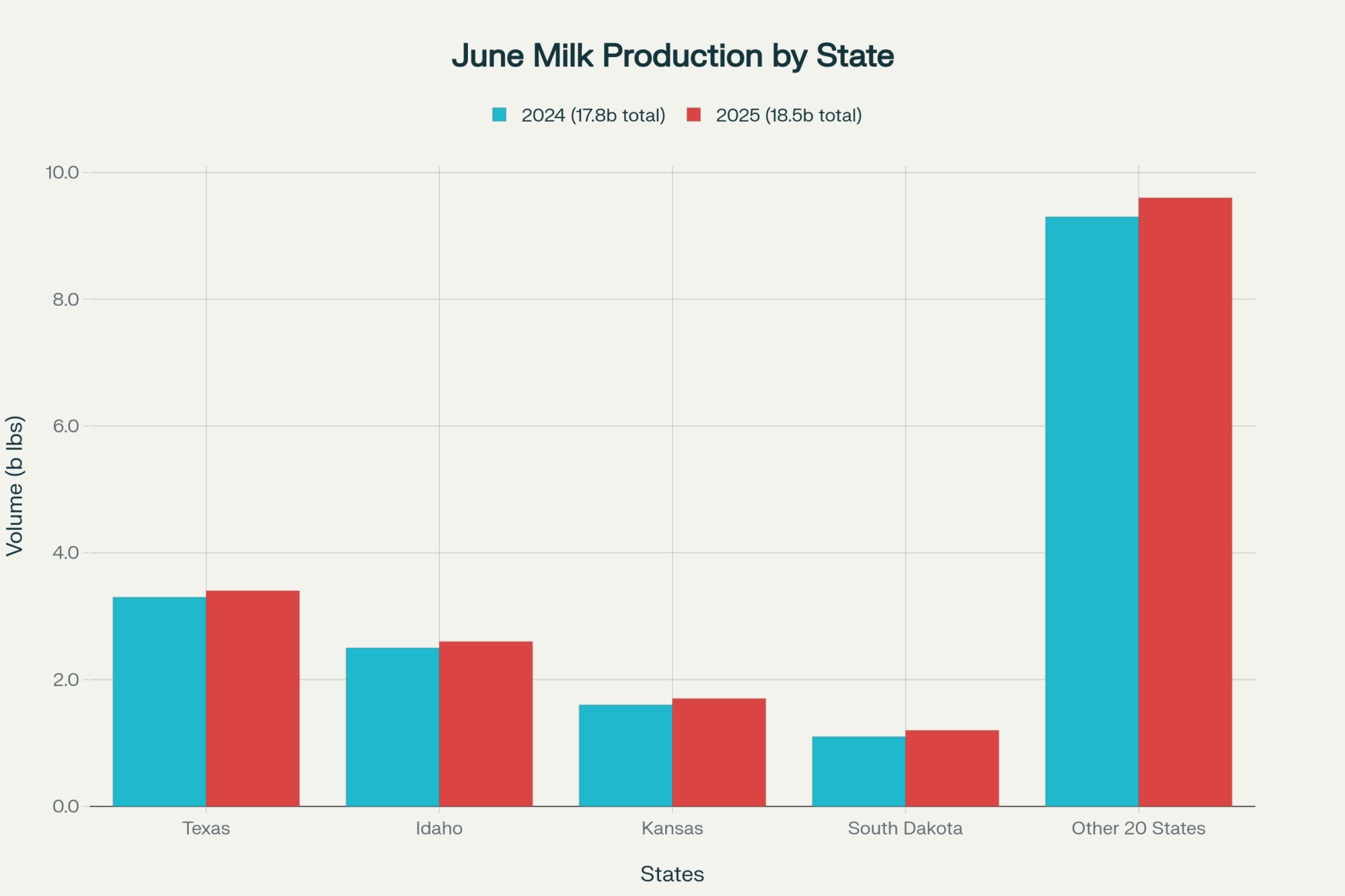
June milk production from the 24 major dairy states hit 18.5 billion pounds, up 3.4% year-over-year—the biggest jump since 2021. Dairy cow inventories rose by 146,000 head, with much of the growth concentrated in Texas, Idaho, Kansas, and South Dakota, which added 140,000 head combined. That’s a flood of milk chasing thinner buyer demand.

June milk production by major US dairy states for 2024 and 2025 showing 3.4% overall increase

The global mess we can’t ignore

China used to be our safety valve, but the game has changed. Their import appetite hasn’t vanished—in fact, imports were up for five straight months to start 2025. The real story is a structural crisis in domestic production, leading to selective, strategic buying rather than panic purchases. They’re targeting specific needs, which means they’re no longer absorbing global oversupply the way they once did. USDA’s China Dairy Annual tells the story.

Europe isn’t easing the pressure. Although Brussels’ July outlook indicates that milk deliveries are holding steady, soaring internal prices have made European products less competitive on the global stage. However, butter and powder exports are forecasted to decline in 2025, resulting in more products staying close to home rather than easing global market pressure. The Brussels July Outlook has the details.

At the August 6 Global Dairy Trade auction, about 37,000 tons changed hands. Buyers acted with discipline, not panic.

Don’t bet the farm on butter

Industry analysts called the butter market “murky.” And the August 27 drop to $2.05 confirmed their concerns. Cream is abundant, churns are stable, and butter premiums just aren’t enough to prop up payouts when cheddar keeps sliding.

The banker conversation nobody wants

The Rural Mainstreet Index numbers continue to fall, reflecting growing lender caution. Covenants are tightening, and lenders are cutting slack. Hitting a $1.50 monthly drop in Class III milk and a sharp decline in butter rings loud warning bells.

While USDA’s ERS projects 2025 milk prices near $22.00/cwt, that forecast doesn’t reflect today’s mailbox realities.

What the smart money’s doing

The smart operators aren’t just relying on milk prices—they’re locking in income-over-feed margins. They’re layering Dairy Revenue Protection, LGM-Dairy, and CME options strategies to secure coverage for 6 to 12 months out.

One Wisconsin farmer said it best: “Blocks at $1.76 and butter at $2.05 don’t pencil like June. We hedged early and tightened shrink before the checks showed the damage.”

Your move

The best bet? Watch blocks stay above $1.80 and butter steady for several weeks. That’s your early sign that things might shift.

But the longer story is about patience. China’s strategic buying, Europe’s pricing challenges, and the U.S.’s milk surge signal a longer adjustment phase.

Defend your margins, trim waste, and maintain a close liquidity position.

The operations that survive this intact will be well-positioned to capitalize on the upside when things finally turn. The difference between thriving and surviving will be decided by the risk management decisions you make in the next 90 days. Make sure you’re on the right side of that divide.

Bottom line? September’s gonna be rough, but the smart money is already positioning for 2026. Don’t get caught flat-footed.

Time to make some calls and lock in those margins. Your future self will thank you.

Recovery? More likely a 2026 story than a late 2025 one.

Complete references and supporting documentation are available upon request by contacting the editorial team at editor@thebullvine.com.

Learn More:

Join the Revolution!

Join over 30,000 successful dairy professionals who rely on Bullvine Weekly for their competitive edge. Delivered directly to your inbox each week, our exclusive industry insights help you make smarter decisions while saving precious hours every week. Never miss critical updates on milk production trends, breakthrough technologies, and profit-boosting strategies that top producers are already implementing. Subscribe now to transform your dairy operation’s efficiency and profitability—your future success is just one click away.

NewsSubscribe
First
Last
Consent

Is Your Farm Ready? What Those Record Cheese Inventories Really Mean for Your Bottom Line

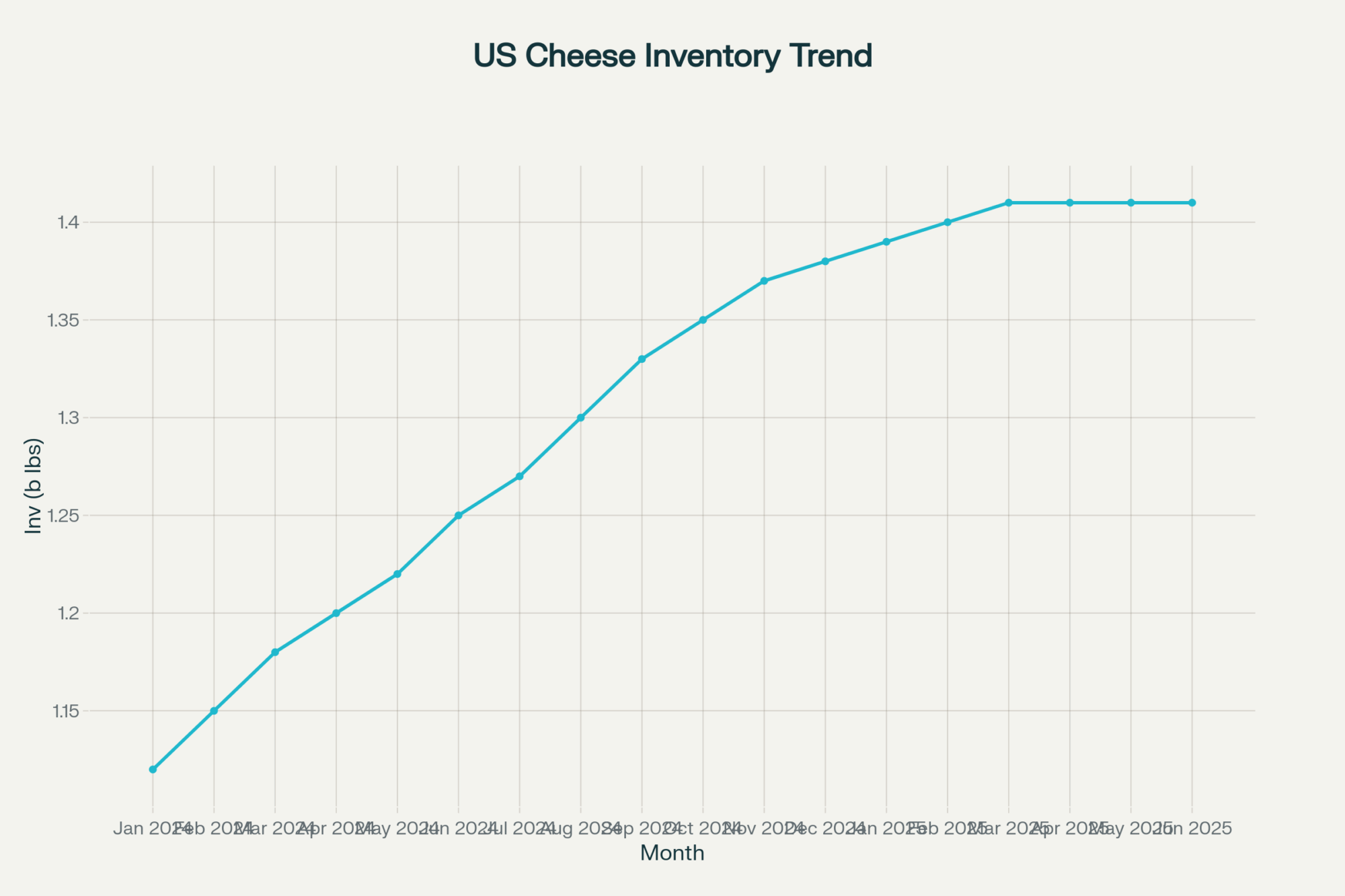
1.41 billion pounds of cheese sitting idle—here’s what that means for your milk check.

EXECUTIVE SUMMARY: Here’s the reality: We’re sitting on 1.41 billion pounds of cheese—the biggest stockpile in a century—and that’s putting serious pressure on your milk prices. CME cheddar blocks have been bouncing around $1.80 per pound, but with this kind of inventory overhang, margins are tightening fast. Income-over-feed-cost margins could squeeze from about $14.50 now to near $12.20 by early next year if current trends hold. The smart money is saying there’s a 75% chance we’ll see a market correction within six months. But here’s the thing—producers who get ahead of this with strategic hedging, feed efficiency improvements, and component optimization are going to weather this storm much better than those who just hope for the best.

KEY TAKEAWAYS:

  • Lock in feed security now — Stock 120+ days of feed and review forward contracts for corn and soy to protect against input cost spikes when margins are already tight.
  • Optimize milk components for premium capture — Target 3.8%+ protein levels to potentially capture $1.25-1.50/cwt premiums, which becomes critical income protection in a down market.
  • Use strategic risk management tools — DMC coverage kicks in around $9.50 margins, and futures contracts through December can stabilize revenue streams during this volatile period.
  • Invest in operational efficiency now — Feed efficiency technologies and precision management can potentially save $300-500 per cow annually, providing crucial margin protection when cheese markets are under pressure.

The thing about cheese prices right now? They’re getting a little unsettling. You might’ve seen CME cheddar blocks bouncing around the $1.80 mark recently—down about 9.5 cents in some volatile sessions (see CME Group data). But what really caught my attention is the sheer volume of cheese sitting idle: 1.41 billion pounds in cold storage as of June 2025, according to the USDA’s latest report (see USDA Cold Storage Report). That’s almost five months’ worth of cheese demand sitting quietly, based on average monthly disappearance data.

What’s happening? Milk production keeps humming along. The USDA reports we’re hitting about 18.9 billion pounds monthly as of July 2025, up a bit over 2% from last year (see USDA ERS report). But buyers aren’t keeping pace. Demand isn’t matching supply, and that extra cheese keeps piling up.

At the recent Global Dairy Trade auction on August 5, 2025, the overall index nudged up 0.7%. However, whole milk powder prices rose 2.1%, while lactose wasn’t offered in this round (see GDT auction results). That split is important—it shows different products face distinct supply and demand pressures.

The butter market in Europe is also telling a different story, trading about 46% higher than our CME prices—a premium highlighted in Rabobank’s Q1 2025 Dairy Quarterly (see Rabobank Quarterly). This spread often signals potential export arbitrage that could weigh on U.S. butter prices over time.

The futures market is showing backwardation, meaning prices are higher now than for future months. This means the market expects oversupply to build in the future, which could translate to lower prices for your milk checks down the line.

China’s dairy production has dipped about 2.6%, which usually would open import doors. But tariffs have hovered around 10%, following a temporary reprieve, with uncertainty over potential increases. Meanwhile, Europe’s producing roughly 10.8 million metric tons of cheese annually—mostly specialty varieties—but processing capacity limits their ability to absorb U.S. surplus.

What does this mean for your milk check? Industry prices for Class III milk recently hovered around $17.32 per hundredweight in July 2025. Projections beyond that vary, so consider this a reference point rather than a forecast. Income-over-feed-cost margins may tighten from around $14.50 now to about $12.20 early next year.

Dairy Margin Coverage programs typically trigger protections near a $9.50 margin, providing some cushion if the market dips further (see Penn State Extension).

5 Smart Moves to Protect Your Margins

  1. Stockpile feed and lock in pricing where possible. Aim for at least 120 days’ worth. Review your forward contracts and look for opportunities to secure favorable prices on key feeds like corn and soy.
  2. Forward-price your milk prudently. Futures contracts extending through December can stabilize your revenue but weigh the trade-offs carefully—locking prices also caps your potential upside if markets improve.
  3. Maintain proactive communication with your co-op or milk buyer. Discuss your anticipated volume and component levels regularly—they might offer you premiums or pricing adjustments based on that dialogue.
  4. Optimize your milk components. Target protein levels of 3.8% or higher, which have been reported to yield premiums in the range of $1.25 to $1.50 per hundredweight, depending on your market and buyer.
  5. Invest in feed efficiency technologies. Automated feeding systems, like DeLaval’s latest offerings, can significantly boost feed efficiency, leading to substantial savings on feed costs (see DeLaval). The exact financial benefit varies by operation size and management.

Bonus tip: Reevaluate culling strategies and consult your financial advisor to ensure your capital plan can withstand market volatility.

Looking Ahead

The consensus among market analysts is a roughly 75% chance of a correction hitting within the next six months. If demand remains steady, working through the surplus inventory could take close to two years according to INTL FCStone (see INTL FCStone analysis).

The key takeaway is clear: producers who act early to hedge prices, protect margins, and focus on efficient operations will be much better positioned than those who wait to react.

Markets cycle—this pattern isn’t new. But how you prepare today will shape your resilience in the months and years ahead.

Remember: this article is informational, not financial advice. Be sure to consult your personal advisors before making major decisions.

If you’re closely watching cheese prices and tightening margins, don’t delay. Stay informed, adjust your strategies, and keep evolving with the market. The dairy industry doesn’t wait—and neither should you. What steps are you taking to protect your operation?

Complete references and supporting documentation are available upon request by contacting the editorial team at editor@thebullvine.com.

Learn More:

Join the Revolution!

Join over 30,000 successful dairy professionals who rely on Bullvine Weekly for their competitive edge. Delivered directly to your inbox each week, our exclusive industry insights help you make smarter decisions while saving precious hours every week. Never miss critical updates on milk production trends, breakthrough technologies, and profit-boosting strategies that top producers are already implementing. Subscribe now to transform your dairy operation’s efficiency and profitability—your future success is just one click away.

NewsSubscribe
First
Last
Consent

Brace for Impact: Why 2025’s Dairy Price Surge Masks a $780 Billion Industry’s Perfect Storm

Stop chasing herd expansion. Smart farmers optimize components over volume—boosting profits 15% while competitors face the 2025 recalibration.

EXECUTIVE SUMMARY: The dairy industry’s current price euphoria is masking a dangerous supply-demand collision that will blindside unprepared operators by Q4 2025. While Oceania WMP hits $4,300/MT and producers celebrate record milk checks, RaboResearch warns that accelerating supply growth (326.7 million metric tons from Big 7 regions) is about to crash into crumbling consumer confidence (52.2 sentiment index, down 24.5% YoY). The most damaging myth? That bigger operations automatically mean better profits. Smart farmers are already pivoting from volume obsession to component optimization, with butterfat levels hitting a 76-year record of 4.23% nationally and milk solids production jumping 1.65% in March 2025. While 80% of dairy leaders expect volume growth above 3%, the math is brutal: a farm producing 75,000 pounds daily at 4.3% butterfat generates higher returns than one producing 80,000 pounds at 3.8% butterfat. This “recalibration” will separate the strategic operators who prepare now from those still betting on the bull run. Your move: stress-test your operation for milk prices 15-20% below current levels—because that’s exactly where the fundamentals are heading.

KEY TAKEAWAYS

  • Component Revolution Beats Volume Obsession: Farms optimizing butterfat and protein content achieve 12-15% higher income over feed costs compared to expansion-focused operations, with genetic improvements delivering 22.9% protein growth and 28.9% butterfat increases since 2011—making the “more cows, more money” mentality obsolete.
  • Technology Reality Check Saves $250K: Before adding 100 cows at $2,500 each, invest that $250K in genetic improvements and precision feeding to boost butterfat from 3.8% to 4.3%—generating higher returns with zero additional labor, feed costs, or environmental compliance while robotic milking success stories show $1.00-$1.50/cwt profitability gains only under optimal conditions.
  • Trade War Timing Creates Export Vulnerability: Strong Q1 2025 dairy exports occurred before China’s 125% retaliatory tariffs and Canada’s 25% tariffs hit full force—smart operators are diversifying market exposure now while building cash reserves during the current price strength to weather the H2 2025 recalibration.
  • Consumer Confidence Collapse Demands Strategy Shift: With 38% of consumers saying high prices have eroded their finances and affordability concerns surpassing job security worries, dairy companies face the brutal reality that passing higher costs to post-COVID inflation-weary consumers will trigger volume losses—requiring immediate focus on value propositions over premium pricing.
  • Financial Stress-Testing Reveals Survival Strategy: Operations modeling scenarios with milk prices 15-20% below current levels by Q4 2025 can identify critical weaknesses now—high-performing dairies already achieve $3.50/cwt advantage in income over feed costs through systematic resource optimization rather than scale expansion, positioning them for the coming market adjustment.
dairy market outlook, milk price forecast, component optimization, dairy profitability strategies, global dairy trends

The global dairy market’s current strength is a dangerous mirage. While commodity prices hit multi-year highs, accelerating supply growth is about to collide with crumbling consumer confidence and escalating trade wars. Smart operators who recognize this paradox and pivot their strategies now will survive the “recalibration” that’s coming – those who don’t risk getting crushed when fundamentals reassert themselves in H2 2025.

You’re probably feeling pretty good about dairy right now. Oceania whole milk powder just smashed through $4,300 per metric ton for the first time since April 2022. Fonterra’s announcing record forecast prices of NZD 10/kgMS for 2025/26. The U.S. dairy industry just flexed its economic muscle with a staggering $780 billion impact supporting over 3 million jobs.

But here’s the uncomfortable truth that’s about to blindside unprepared operators: this party’s built on quicksand.

Why Are Smart Money Managers Already Hedging Their Bets?

Here’s a question that should keep you awake tonight: If prices are so strong, why is RaboResearch warning about “downside risks emerging in the second half of the year”?

The numbers tell a story that most operators aren’t hearing over the sound of strong milk checks. RaboResearch’s latest Global Dairy Quarterly reveals a fundamental paradox that should keep every strategic planner awake at night.

Milk production across the “Big 7” exporting regions grew a modest 0.5% in Q1 2025. Sounds manageable, right? Dead wrong.

That growth is about to explode. Production will accelerate to 1.1% in Q2 and 1.4% in Q3 – the strongest quarterly increase since early 2021. We’re looking at 326.7 million metric tons of milk production from the Big 7 in 2025, representing the highest annual volume gain since 2020.

Meanwhile, consumer sentiment is cratering. The University of Michigan’s Consumer Sentiment Index hit just 52.2 in May 2025 – a brutal 24.5% decrease year-over-year from 69.1 in May 2024. About 64% of consumers expect business conditions to worsen in the year ahead, with 38% saying high prices have eroded their personal finances.

The math is simple but devastating: Accelerating supply + fragile demand = unsustainable prices.

Challenging the Expansion Obsession: Why Bigger Isn’t Always Better

In dairy thinking, let’s challenge a sacred cow: the relentless pursuit of herd expansion and volume growth. While conventional wisdom pushes farmers toward larger operations, recent data suggests this strategy is fundamentally flawed in today’s market reality.

The USDA projects U.S. cow numbers to increase by 20,000 head by year-end 2025, pushing total milk production to 226.9 billion pounds. But here’s what the expansion enthusiasts aren’t telling you: unprecedented genetic gains are making this volume-focused approach obsolete.

According to Hoard’s Dairyman analysis, butterfat levels charged to 4.23% nationally in 2024, breaking through the 4% ceiling and besting a 76-year-old record. With nearly 90% of U.S. milk valued under multiple component pricing, genetic gains in butterfat and protein are pushing milk checks higher than simple volume increases ever could.

The evidence is staggering: Milk solids production increased by 1.65% as of March 2025, demonstrating that smart farmers are already prioritizing components over raw volume. This represents a fundamental shift from the “more cows, more milk, more money” mentality that has dominated dairy thinking for decades.

Consider this scenario: Farm A adds 100 cows at $2,500 each ($250,000 investment) to increase volume by 8%. Farm B invests $250,000 in genetic improvements and precision feeding to boost butterfat from 3.8% to 4.3%. With component premiums, Farm B generates higher returns with zero additional labor, feed costs, or environmental compliance issues.

The University of Wisconsin-Madison’s Center for Dairy Profitability shows that farms focusing on component optimization rather than volume expansion achieve 12-15% higher income over feed costs compared to expansion-focused operations.

What’s Driving This Supply Explosion While Nobody’s Watching?

The United States is leading the charge with a dairy cow inventory that grew by 2,500 head to 9.349 million as of January 2025. But here’s what’s telling: this expansion is happening in the wrong places at the wrong time.

According to Hoard’s Dairyman analysis, April milk production rose 1.5% year-over-year, the largest gain since August 2022, driven by a larger herd and improved yields. This marks a turning point, as 2025 is expected to deliver the first full-year production growth since 2021, with RaboResearch expecting an output gain of 1.4% over 2024.

The European Union is taking a completely different approach. EU milk deliveries are projected to decline 0.2% to 149.4 million metric tons as farmers grapple with declining cow numbers, tight margins, and escalating regulatory costs. But, they prioritize cheese production at the expense of butter, non-fat dry milk, and whole milk powder.

Here’s the kicker: While total global milk volume increases, specific product categories like EU butter and WMP might experience tighter supply. This creates commodity-specific vulnerabilities that most operators aren’t prepared for.

Region2025 Production ForecastStrategy FocusKey Vulnerability
United States+0.5% growthHerd expansion & efficiencyTariff impacts on exports
European Union-0.2% declineCheese prioritizationRegulatory compliance costs
Australia-1.0% declineCost managementWeather & farm exits
China-1.5% declineDomestic consolidationEconomic slowdown

Why Is Consumer Demand Cracking Under Pressure?

While producers ramp up, consumers are tapping out. Mary Ledman from RaboResearch isn’t mincing words about “near-record-low consumer confidence in the US” weighing heavily on demand.

But here’s where conventional dairy marketing completely misses the mark. The University of Michigan data shows that less than half of consumers expect their own incomes to grow in the year ahead, down from nearly 60% six months ago. This represents a fundamental shift in consumer psychology that dairy companies haven’t adequately addressed.

China’s Demand Shift Changes Everything

China’s dairy consumption dropped 5.6% in 2024, with the average person consuming 41.5 kilograms of dairy. But here’s what’s really happening: China’s dairy market contracted to $49.3 billion in 2024, standing approximately at the previous year’s level after hitting a maximum of $51.7 billion in 2022.

This isn’t just a temporary blip. Chinese consumers are fundamentally reshaping their dairy preferences around snacking and fitness trends. According to IndexBox market analysis, consumption of dairy produce decreased by 3.2% to 50 million tons in 2024, marking the first decline after six years of growth.

Rabobank expects China’s net imports of dairy products to rise by a modest 2% in 2025, with most of this increase anticipated in the latter half of the year as domestic stocks weaken. New Zealand continues to dominate China’s total dairy import basket (46% in 2024), followed by the EU (31%).

The Trade War Wild Card

The elephant in the room? Escalating trade tensions that are reshaping global dairy flows in real-time.

China slapped retaliatory tariffs on U.S. agricultural products starting March 10, 2025 – beginning at 10% and rapidly escalating to 125% by April 12. Canada imposed a 25% tariff on approximately CA$30 billion worth of U.S. products, which specifically included $212 million of U.S. dairy products.

The critical timing issue is that the strong U.S. dairy exports we saw through Q1 2025 occurred before these tariffs hit full force. The real impact on export volumes and profitability will show up in Q2 and Q3 data when supply is accelerating.

According to Fortune analysis, America exported about $8.2 billion of dairy products in 2024, the second-highest on record. More than half of U.S. dairy exports are shipped to Mexico, Canada, and China, all of which have been targeted by Trump’s tariff policies.

Disrupting the “Technology Will Save Us” Narrative

Another sacred cow that needs slaughtering is the blind faith that technology automatically equals profitability. While industry publications breathlessly promote every new gadget, the reality is far more nuanced.

Consider the robotic milking revolution everyone’s talking about. Progressive Dairy research shows that robotic systems cost approximately $200,000 per machine, with experts calculating the ideal number of cows at around 500 to economically justify the switch. But the hidden costs include:

  • Staff retraining requirements that can take 6-18 months
  • Technical backup protocols when systems fail (and they will)
  • Integration challenges with existing infrastructure

However, success stories exist when properly implemented. California operations report being $1.00 to $1.50 per hundredweight more profitable with robotic milking systems when all factors are optimized. However, these cases represent carefully selected early adopters with optimal conditions – not the average dairy operation struggling with tight margins and limited technical expertise.

The key insight from Cornell University extension research is that robotic milkers make sense for small- and medium-sized farms primarily because of labor challenges and outdated infrastructure, not because the technology itself guarantees profitability.

How Are Current High Prices Setting Up the Fall?

Dairy commodity prices have surged to multi-year highs, but RaboResearch’s core message is explicit: the “current market strength [is] not sustainable.”

Mary Ledman warns that “dairy companies and downstream multinational consumer packaged goods companies will find it challenging to pass on higher dairy costs to consumers still grappling with post-COVID inflation.”

The “Recalibration” Reality Check

RaboResearch isn’t predicting a crash – they’re forecasting something potentially more dangerous: a “recalibration from recent multiyear highs – a natural correction following a period of strong performance.”

The fundamentals are clear: expanding supply is about to meet uncertain demand while trade tensions create additional volatility. High commodity prices aren’t sustainable when you’re fighting math and consumer psychology.

Supporting this thesis, the USDA has already reduced its milk production estimate for 2025 to 226.2 billion pounds, a decline of 700 million from February projections. The average all milk price is estimated at $21.60 per hundredweight, with the 2026 forecast at $21.15 per cwt.

Are you prepared for milk prices 15-20% below current levels by Q4 2025? Because that’s exactly the scenario smart operators are planning for right now.

Breaking the Commodity Mindset: The Component Revolution

Here’s where we need to fundamentally challenge how dairy farmers think about their business. The obsession with per-cow averages and total volume is a relic from an era when milk was milk. Today’s reality demands a complete strategic overhaul.

According to Hoard’s Dairyman analysis, genetic improvements fuel historic gains in key milk components needed to produce cheese, butter, and specialty dairy foods. Butterfat posted its fourth-straight annual record, charging to 4.23% nationally in 2024.

This isn’t just incremental improvement – it’s a fundamental market transformation. From 2011 to 2023, while milk production grew by just 16.2%, protein jumped by 22.9%, and butterfat catapulted by 28.9%.

The math is compelling: A farm producing 80,000 pounds of milk daily at 3.8% butterfat generates significantly less revenue than a farm producing 75,000 pounds at 4.3% butterfat. The component premiums more than offset the volume difference.

Corey Geiger with CoBank confirms this trend: “In the last three years, milk production that counts the water in it hasn’t been growing, but components have been growing two to three percent a year.”

What Should Strategic Operators Be Doing Right Now?

Smart dairy operators need to prepare for this recalibration now, not after it hits. The convergence of accelerating supply growth, fragile consumer demand, and escalating trade tensions is setting up a correction that could catch unprepared operators off guard.

Optimize for Efficiency, Not Volume

The operators who thrive will be those who focus on efficiency gains rather than volume expansion. With supply accelerating globally, the competitive advantage will go to those who can produce at the lowest cost per unit.

Research from Progressive Dairy shows that high-performing dairies achieve a $3.50 per hundredweight difference in income over feed cost compared to average operations. This gap isn’t about technology – it’s about systematic optimization of existing resources.

Focus on High-Value Milk Components

The 1.65% increase in U.S. milk solids production shows where the smart money is going. Operators should prioritize butterfat and protein content that command premiums in manufactured dairy products.

According to research by the Journal of Dairy Science, genetic improvements in butterfat and protein rank among the most heritable traits for dairy cows. The Council of Dairy Cattle Breeding reports that annual rates of genetic improvement have doubled since 2012 when genomic selection became available.

Diversify Market Exposure

The trade war data shows how quickly export markets can shift. Operators need to reduce dependence on volatile export markets and strengthen direct-to-consumer channels to capture more value.

Strengthen Financial Positioning

With a recalibration coming, operators need stronger balance sheets. This isn’t the time for aggressive expansion financing – it’s the time to build cash reserves and reduce debt exposure.

The Technology Integration Reality Check

Let’s address the elephant in the barn: Most dairy technology implementations fail not because the technology doesn’t work but because farmers approach adoption with unrealistic expectations.

Recent research on dairy management decisions shows that high-performing herds focus on optimal management practices rather than simply adopting the latest technology. A study involving 60 progressive herds nationwide from 2019 to 2024 revealed that management decisions such as voluntary waiting periods and days dry have more impact on productivity than technology alone.

Key success factors include:

  • Phased implementation starting with one system and expanding gradually
  • Staff buy-in through comprehensive training and involvement in selection
  • Data literacy development to actually use the insights technology provides
  • Backup protocols for when systems inevitably fail

The future favors farms that blend innovation with proven practices, not those that chase every technological fad.

Regional Production Strategies Create New Vulnerabilities

This regional divergence creates specific commodity vulnerabilities. EU’s focus on cheese means a tighter supply for butter, NDM, and WMP – even as total milk volume increases globally. Australia’s continued contraction is creating “dairy deserts” in some regions.

The U.S. dairy sector has demonstrated the ability to adjust and maintain competitiveness. According to Hoard’s Dairyman, U.S. cheese exports have outperformed expectations due to lower prices relative to the European Union, making U.S. products more attractive globally. But, this competitive advantage could evaporate quickly if domestic production costs continue rising or if trade barriers expand.

Here’s the critical question: Are you positioning your operation for these regional shifts, or are you still operating under outdated assumptions about global market stability?

Emerging Markets: The Overlooked Wildcard

Here’s where most analysis falls short: The focus on traditional “Big 7” regions ignores the seismic shifts happening in emerging dairy markets that could reshape global trade flows.

India’s dairy sector, while primarily domestic-focused, is experiencing rapid modernization that could impact global ingredient markets. The country’s milk production reached 231 million tons in 2024, making it the world’s largest producer. As Indian operations achieve greater efficiency, their domestic ingredient needs could reduce global demand for certain categories.

Southeast Asian markets are demonstrating explosive growth in premium dairy consumption, driven by rising middle-class incomes and changing dietary preferences. Vietnam’s dairy imports grew 23% in 2024, while Thailand and Indonesia showed similar double-digit growth patterns. These markets represent the future of dairy demand growth – but they’re increasingly sophisticated buyers who demand specific product attributes.

The implications are profound: Traditional commodity-focused strategies may miss the most profitable growth opportunities in emerging markets that prioritize quality, traceability, and specific functional properties over simple volume.

The Bottom Line

Remember that feeling of confidence when you saw Oceania WMP prices hit $4,300 per metric ton? That optimism is exactly what RaboResearch is warning against with their “Too Good to Be True?” assessment.

The current dairy market strength is built on foundations that are rapidly shifting beneath our feet. While commodity prices hit multi-year highs, the convergence of accelerating supply growth (326.7 million metric tons from Big Seven regions), fragile consumer demand (52.2 consumer sentiment index), and escalating trade tensions (125% Chinese tariffs) is setting up a “recalibration” that could catch unprepared operators off guard.

The warning signs are flashing bright red: consumer confidence is weak, supply is accelerating, and trade wars are reshaping global flows. This isn’t the time for aggressive expansion – it’s the time for strategic positioning.

The smart money isn’t betting on continued price strength – it’s preparing for the correction that’s coming. Those who recognize this paradox and adjust their strategies accordingly will emerge stronger when the dust settles.

Your immediate action plan:

  1. Run the numbers: Pull up your operation’s Q3 and Q4 2025 financial projections. Model scenarios with milk prices 15-20% below current levels. If those numbers make you uncomfortable, you know exactly what needs to change.
  2. Optimize components over volume: Shift breeding and management focus toward butterfat and protein optimization. The genetic tools exist – use them.
  3. Stress-test your cash flow: Build reserves now while prices are strong. The recalibration will reward those with financial flexibility.
  4. Diversify market exposure: Reduce dependence on volatile export markets. Strengthen local and regional relationships.
  5. Technology reality check: Evaluate tech investments based on actual ROI, not marketing promises. Focus on tools that enhance decision-making, not replace human judgment.

The dairy industry’s $780 billion economic engine will keep running – but only the operators who prepare for turbulence ahead will maintain their position when the market finds its new equilibrium.

The choice is yours: Continue riding the current wave of optimism, or position yourself for the inevitable recalibration. History shows that the farmers who survive market corrections are those who prepare while others celebrate.

Are you positioning for the recalibration, or are you still betting on the bull run?

Learn More:

Join the Revolution!

Join over 30,000 successful dairy professionals who rely on Bullvine Weekly for their competitive edge. Delivered directly to your inbox each week, our exclusive industry insights help you make smarter decisions while saving precious hours every week. Never miss critical updates on milk production trends, breakthrough technologies, and profit-boosting strategies that top producers are already implementing. Subscribe now to transform your dairy operation’s efficiency and profitability—your future success is just one click away.

NewsSubscribe
First
Last
Consent

China’s Dairy Dilemma: Navigating Milk Output Declines and Shifting Import Trends

Delve into China’s dairy woes: decreasing milk production, changing import patterns, and their effects on global markets. What does this mean for the future of the dairy industry?

Summary:

China’s once-thriving dairy industry confronts a harsh truth as milk output plunges to its lowest in 14 years, driven by unsustainable growth and economic challenges. With farmgate milk prices plummeting, dairies operate at a loss, triggering widespread farm closures. As stockpiles deplete, the world’s largest dairy importer signals shifting demands, introducing uncertainty to global markets. Experts foresee a challenging landscape, urging industry stakeholders to adapt and strategize for survival. RaboResearch anticipates a further 1.5% decline in China’s milk production for 2025, possibly disrupting global dairy prices or creating opportunities for other nations. Despite increased imports of whey products and butter, China’s dairy future remains uncertain, though potential changes in government policies, new technologies, and renewed consumer interest could provide a silver lining.

Key Takeaways:

  • China’s milk output has seen a significant decline, with key dairy provinces experiencing a drastic drop in farmgate milk prices.
  • The financial struggles are leading small and medium-sized farms to close, while larger dairies sustain losses without downsizing.
  • Despite decreased domestic production, Chinese dairy imports only recently showed signs of recovery, with increases in certain products like whole milk powder and whey.
  • China continues to import substantial quantities of dairy products, though some categories, such as skim milk powder and cheese, are lagging.
  • The interaction between local demand, dairy deficits, and import strategies is causing ripples in the global dairy market.
  • A potential recovery in Chinese dairy imports depends on improvements in consumer spending and economic conditions.
China dairy industry, milk production decline, farmgate milk prices, dairy farmers challenges, dairy market outlook, global dairy prices, dairy imports increase, small medium farms closure, RaboResearch predictions, consumer interest in milk

In a world where the demand for dairy is expanding yet evolving, China’s position as a burgeoning dairy giant stands both promising and resilient in the face of challenges. Recent developments have spotlighted the industry, most notably the dramatic dip in milk output. China’s Ministry of Agriculture and Rural Affairs reported a staggering 15.9% drop in farmgate milk prices within its top dairy provinces, marking a 14-year low. This downturn is not just numbers on a chart—it’s a reality check for China’s dairy farmers, who are demonstrating remarkable resilience in their efforts to stay afloat. 

As small and medium-sized farms shut down, larger dairy entities struggle to maintain operations without layoffs. The deficit in milk output raises a glaring question: What does this mean for the global dairy market? RaboResearch’s predictions suggest a further decline in China’s milk production by 1.5% in 2025, and the ripple effects could extend far beyond its borders, affecting global supply and demand dynamics. 

Amidst China’s internal challenges, there is a silver lining of potential for innovation and market diversification. Will these challenges disrupt the global balance, driving dairy prices to new heights or creating opportunities for other nations to step in and fill the void? The answer lies in the industry’s ability to adapt and innovate, offering a glimmer of hope in an otherwise turbulent landscape.

  • The disintegration of small dairy operations and the financial strain on larger outfits.
  • A burgeoning dairy deficit leads to depleted stockpiles of key products like whole milk powder.
  • Increased imports of whey products and butter are stirring hope amidst the downturn in milk production.

These elements form the turbulent landscape that China’s dairy industry navigates today. It’s a conundrum of immense proportions, challenging for local stakeholders and global market players. However, as the industry grapples with these trials, it also presents an opportunity for strategic adaptation. Chinese and international sectors must contemplate their options and make strategic decisions in this shifting dairy paradigm, empowering them to shape the industry’s future. 

China’s Dairy Dream: From Boom to Bust

The past decade has been a rollercoaster for China’s dairy industry. Starting in the early 2010s, China aimed to increase its milk production, driven by more people wanting to drink milk and seeing it as a healthy choice. With a growing middle class, there was a shift towards consuming more dairy products. This demand led to a massive increase in the dairy industry. 

Better farming technology and government support were key factors in this growth. New policies helped farmers use machines and improve breeding methods. Big dairy farms were set up, making them more productive and raising milk output. This period wasn’t just about more milk; it also saw better quality, making Chinese milk notable on the world stage

But this fast growth led to problems. The increased production soon overloaded the market as production surpassed what people could consume. Prices, which were initially strong, began to decline. This oversupply pushed milk prices down, making it hard for many farms to make money. 

Small and medium-sized farms had the most challenging time competing with bigger farms. Many closed down because they couldn’t keep going with low profits. Even big farms felt the pressure, losing money and changing their plans to deal with the crowded market. 

This decade also highlighted weaknesses in the industry, especially the reliance on one fast-growing market for stability. These weaknesses became clear when growth slowed, pushing industry leaders to think of new ways to grow sustainably. The key takeaway is the need for balanced growth, ensuring output matches market demand

China’s Dairy Sector: A Tale of Unsustainable Growth and Grim Realities 

The numbers in China’s dairy industry tell a serious story. Milk production, which used to grow rapidly, is now dropping. China’s Ministry of Agriculture and Rural Affairs says milk prices have fallen by 15.9% in the ten most significant dairy areas. Now, they are at a low of 3.12 yuan per kg. This price isn’t just low for recent history—it’s the lowest in 14 years. It highlights how tough it is for many farms to make money. 

Looking closer, small and medium-sized farms are shutting down quickly. The market isn’t profitable, so they have little choice but to close. Larger farms are also losing money but are hanging on for now. Still, even these bigger farms can’t ignore future financial challenges

Looking at imports makes this story even more enjoyable. Even though less milk is being made, China isn’t importing much more dairy. But this might change soon. Supplies of essential items like whole milk powder (WMP) are low, leading to a 25.1% increase in imports this November. Overall, though, WMP imports are 10.4% less than in 2023. 

Some dairy product imports, like whey from the U.S., seem strong. Yet, this could mean China is considering importing products from other countries. Interestingly, China is buying more butter, showing that people still prefer it despite other problems in the dairy industry. 

These numbers show the financial stress on Chinese dairy farms, regardless of size. To handle this crisis, the industry must rethink its strategies if it wants to cope with falling production and lose its market share.

Unpredictable Tides: Navigating China’s Shifting Dairy Demand

China’s changing dairy import habits are making waves in the global market because they affect many countries. Recently, these changes tell a story about how the international dairy trade is adapting. 

  • Whole Milk Powder (WMP): China’s WMP imports jumped by 25.1% in November. This increase comes after a long time of low imports, showing how the country adjusts to fill stockpile gaps. Despite the increase, their total annual imports are still 10.4% lower than in 2023. For suppliers, this means dealing with unpredictable demand, which affects how they manage their stock and set prices worldwide.
  • Whey Products: China’s imports grew by 3%, setting a record for November. This shows China’s need for this protein source. The U.S. is a prominent supplier, benefiting from China’s demand. But as U.S. prices rise, China might look for other suppliers, which could change trade relationships and lead to more diverse sources for whey. 
  • Butter: China’s imports soared by 95%, hitting record levels. This change points to new opportunities in the dairy market. It suggests changes in what people eat, probably due to developing tastes or more premium product availability. For international exporters, this becomes an important market segment to focus on. 
  • Cheese: Conversely, cheese imports dropped by 17%, showing selective buying. This drop suggests that while Chinese consumers try different dairy products, some, like cheese, aren’t growing as much. This could be due to price concerns or cultural tastes. Cheese exporters might need to change things up, offering new products or targeting niche markets

These changing import patterns significantly impact the global dairy trade. Exporters need to manage China’s unpredictable demand and the price changes that come with it. Being flexible has never been more critical. For producers worldwide, keeping up with these trends is key to matching production with demand, securing deals, and staying competitive in a constantly changing market.

Economic and Policy Factors: What’s Driving the Decline? 

The drop in China’s milk production is due to money, rules, and global connections. A big part of the problem is strict government rules. Recent environmental policies have made it hard for dairy farmers, especially the smaller ones, to keep up with higher environmental standards and their costs. While these rules aim to reduce pollution, they can be very challenging for smaller farms that can’t afford the extra costs. 

Consumer demand is another major factor. The COVID-19 pandemic slowed down the economy, making people spend carefully. As a result, many families are focused more on necessary items rather than luxury dairy products. With less money to spend and ongoing insecurities about the economy, most Chinese households are being careful. This leads to less demand for dairy products and less motivation for farms to produce more milk. 

Meanwhile, international trade relations add more complications. Tensions with major dairy exporters such as New Zealand and the United States have caused changing import taxes and restrictions, making it hard for Chinese dairy businesses to plan for the future. This uncertainty has changed the competitive playing field, affecting the balance between imported and local milk supplies. 

Also, China’s dairy industry has too much supply, which lowers prices and discourages production. When milk prices dropped, many farmers struggled with low incomes but high operating costs. As a result, some left the market for good, decreasing the overall amount of milk produced. 

These economic and policy issues show the tough challenges facing the dairy landscape. The Chinese government needs to find a balance between its rules and the real-world needs of the dairy industry. How they manage this will shape the future of China’s dairy farms. These issues highlight the urgent need for changes that help the industry grow sustainably while meeting consumer and environmental needs. As the world observes, how China tackles these issues could teach us a lot about handling agricultural challenges amid worldwide pressures.

Waves of Uncertainty: Global Dairy Markets Navigate China’s Ripple Effect

China’s dairy issues are causing trouble around the world. Countries like New Zealand and the U.S., which used to sell much to China, now face new challenges. Since China’s demand for products like whole milk powder and cheese is going down, these countries need to find new markets to stay stable. 

  • Opportunities for Global Producers
    The changes in China’s market bring problems and new opportunities for dairy producers worldwide. If they can quickly change their plans, producers might find new ways to make money. Diversifying is important. Producers can reduce their reliance on China’s demand by looking at new markets in Southeast Asia, Africa, and South America. These areas have growing middle-class populations and will likely need more dairy products. Also, producers who focus on high-quality and unique dairy products might find stable markets even when others fluctuate.  
  • Challenges on the Horizon
    However, challenges are ahead. China’s changing import levels can cause global price changes. Countries that depend on China might have too many dairy products, which can lower prices. This could mean producers must reduce production levels, affecting their profits. Additionally, as China looks for new suppliers or increases its production, traditional exporters might face more competition, putting their market at risk share.  

Furthermore, political issues and trade fights can disrupt regular supply chains. Global producers must be flexible and ready to change plans as international trade situations evolve. 

Global dairy producers face essential choices in this changing environment. While the difficulties are fundamental, clever strategies focused on finding new markets and adapting to changes can open up new opportunities. The evolving market requires attention, creativity, and a willingness to change.

Future Outlook: Predictions and Possibilities 

As we look back on a challenging time, experts in the dairy industry are sharing their predictions about what could happen next in China’s dairy market. Things don’t look bright, but the future isn’t fully decided. Analysts use data and trends to offer different views on what might happen. These predictions highlight the factors that could change China’s dairy industry and impact global markets. 

One favorable scenario suggests that China’s dairy sector might get back on track and improve slightly. Experts say that changes in government policies, new technologies in dairy farming, and renewed consumer interest could boost production. As Chinese consumers’ spending habits and preferences change, there’s hope for recovery in dairy consumption. This could increase imports and improve local production [source: Rabobank]. If this happens, it could ease the pressure on international suppliers and help stabilize global markets. 

On the other hand, some cautious analysts think declines might continue due to Chinese farms’ financial struggles. Low farm milk prices continue to hurt small dairies, leading to potential closures and reduced production. China’s uncertain economy could further lower local dairy output through stricter rules or reduced consumer spending [source: USDA]. This could increase global supply chain problems, forcing foreign sellers to find new markets to compensate for the drop in Chinese demand. 

Trade politics could also significantly affect the situation. The relationships between China and significant dairy-exporting countries are delicate, and any changes—whether toward cooperation or conflict—could significantly impact the trading of dairy products [source: Trade Data Monitor]. Improved diplomatic relations might allow more imports from global producers. In contrast, tensions could limit access and raise the price of foreign dairy goods. 

Ultimately, China’s dairy industry is on the brink of change. As it faces 2025 and beyond, many complex factors will influence its future. Stakeholders in the global dairy supply chains will be watching closely to adapt, whether they’re hoping for a recovery or preparing for further downturns.

Navigating Uncharted Waters: Strategies for Thriving in China’s New Dairy Landscape 

The dairy world is changing, and Chinese farmers and professionals must adapt. To succeed, they should focus on innovative strategies, such as expanding markets, trying new ideas, and finding their niche. 

  • Diversification: Exploring New Income Streams
    When milk production drops, finding new ways to make money is key. Farmers should consider creating unique dairy products like specialty cheeses or organic milk, which can attract buyers willing to pay extra. Investing in non-dairy activities like crop farming or farm tourism can also help cushion the impact of dairy market ups and downs. This diversification helps farmers manage risks and maintain financial stability
  • Innovation: Embracing Technology and Eco-Friendly Practices
    Technology can significantly boost farm productivity. Tools like automatic milking machines, resource management systems, and data analysis transform farm operations. Eco-friendly methods benefit the environment and appeal to environmentally conscious customers. By using technology and green practices, farmers can stay competitive. 
  • Market Positioning: Building Strong Brands
    A strong brand is essential in a fast-changing market. Farmers and businesses should create brands that resonate with customers by emphasizing quality, tradition, and ethical practices. Building direct customer relationships through online platforms can enhance loyalty and market share

Adapting to changes in China’s dairy industry isn’t easy. However, dairy farmers and professionals can face these changes head-on by staying informed, diversifying, using new technologies, and building strong brands. Moving forward will demand resilience and creativity, but those who adapt will survive and thrive in this ever-changing landscape.

The Bottom Line

Reflecting on the tumultuous journey of China’s dairy sector, it’s clear that the landscape is undergoing a seismic shift. From unprecedented growth to unforeseen decline, dairy professionals must navigate a market brimming with uncertainty and complexity. These are significant yet present a fertile ground for innovation and adaptation. The global ripple effects demand strategic foresight and a readiness to reinvent business models. 

It is time for those in the dairy industry to reevaluate their strategies and positions. How will you turn these challenges into opportunities? What strategies will ensure sustainability and growth in such a volatile environment? The industry awaits those who dare to reshape the future with resilience and foresight. 

As stakeholders in this crucial sector, we all have a role in charting the course for the future of China’s dairy industry. Will you rise to the occasion, challenge the status quo, and shape a dairy landscape that will endure? This is your moment to lead, and our actions will echo in the future.

Learn more:

Join the Revolution!

Bullvine Daily is your essential e-zine for staying ahead in the dairy industry. With over 30,000 subscribers, we bring you the week’s top news, helping you manage tasks efficiently. Stay informed about milk production, tech adoption, and more, so you can concentrate on your dairy operations. 

NewsSubscribe
First
Last
Consent
Send this to a friend