Archive for dairy herd profitability

Genosource Moti Cracks +420 NVI: Inside the December 2025 Dutch Sire Shakeup

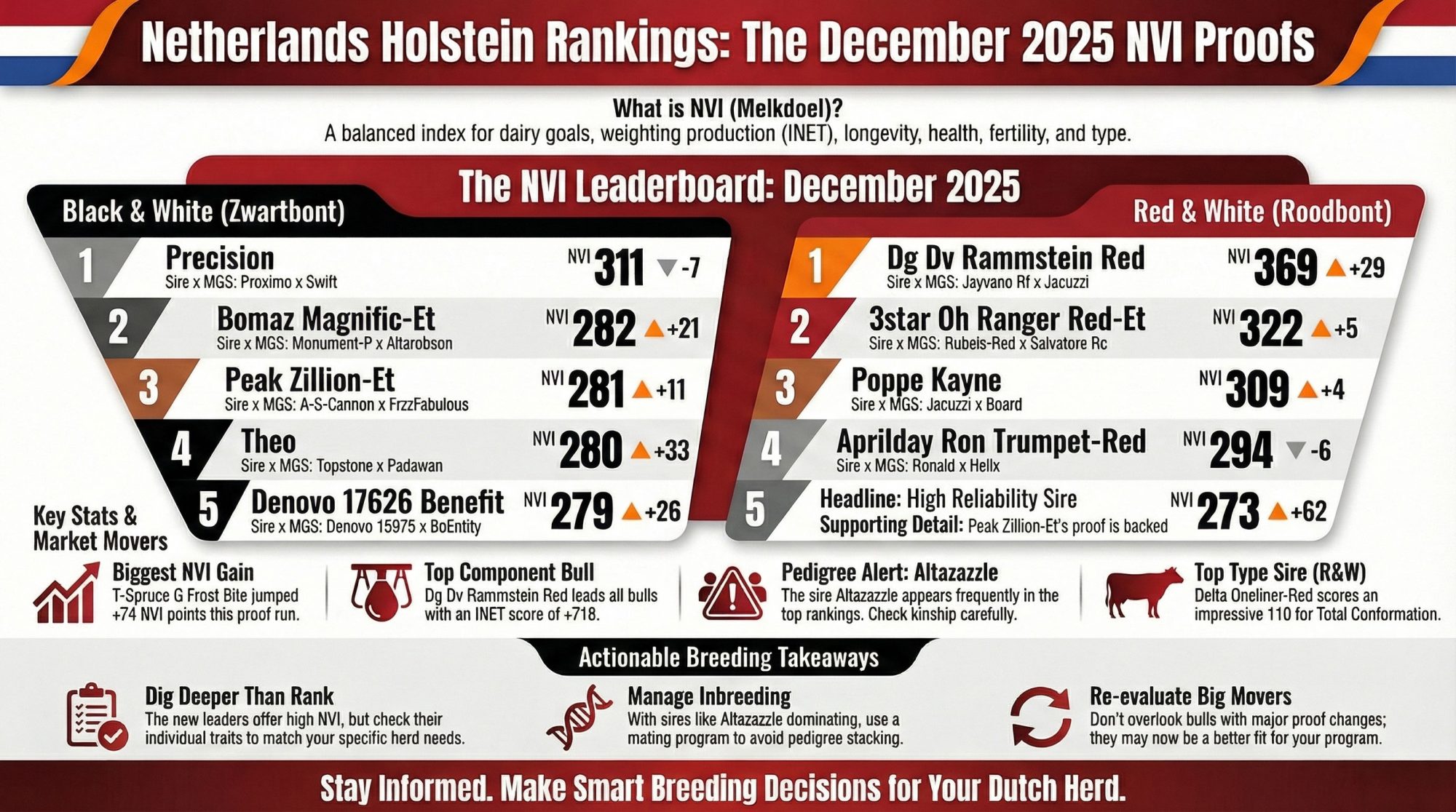
+420 NVI. A longevity score of +1,295. Altazazzle bloodlines dominating proven sires. The Dutch December 2025 rankings just raised the bar—here’s who’s setting it.

Executive Summary: The +400 NVI barrier hasn’t just been broken; it’s been shattered. Genosource Moti leads the charge at +420 NVI—a benchmark that redefines what’s achievable through genomic selection. Joining him in the top 10 are stablemates Mystro (posting the evaluation’s highest INET at +799) and Benson, whose +1,295 longevity score stands alone in this release. Among proven sires, Badger Ssi Ahead Jaffa tops the list at +358 NVI, while Altazazzle sons claim four of the top 10 spots—a concentration that underscores both the line’s commercial dominance and the breed’s narrowing genetic base. What sets this evaluation apart is balance: elite NVI bulls are simultaneously delivering on longevity, udder health, and fertility, breaking the historic trade-off between production and functionality. The Genosource and Delta programs command the genomic tier; Altazazzle defines the proven ranks. For breeders, this release offers exceptional genetic tools—with the caveat that pedigree concentration at the top makes diversity management more critical than ever.

Dutch sire rankings 2025

There’s something particularly exciting about cracking open a new proof run. The December 2025 Dutch genetic evaluation landed with some eye-catching numbers—and a few surprises worth talking through. For breeders working with Dutch and Flemish genetics, this release offers a snapshot of where the breed is heading, and honestly, the trajectory is impressive.

The NVI (Nederlands-Vlaamse Index) continues to do what it was designed to do: identify bulls capable of producing daughters that are profitable, durable, and trouble-free. It’s a total merit index that balances production with the functional traits that actually keep cows in the herd—things like udder health, fertility, and feet and legs. What I’ve noticed over the past several proof runs is how the top end of these rankings keeps climbing. We’re seeing NVI values now that would have been almost unthinkable five years ago.

Let’s dig into what this release is showing us.

The Genomic Leaders: A New Benchmark

The genomic sire rankings this round are nothing short of remarkable. We’ve crossed a threshold here that deserves attention.

Genosource Moti sits atop the list at +420 NVI—a number that genuinely made me do a double-take when I first saw it. This Matcrest Arc son out of a Stgen Cowen Tho dam combines serious production punch (+2,025 kg Milk, +130 kg Fat, +68 kg Protein) with functional longevity (+872 days). His INET of +682 signals that daughters should convert feed to profit at an elite level. At 66% reliability, he’s still a genomic prospect, but the genetic package is hard to ignore.

What’s interesting about the top of this list is the diversity of pathways to elite NVI. Halifax Delta Dawn (+414 NVI), a Hammerhead son, takes a slightly different route—he posts the highest INET among the top five genomics at +737, driven by exceptional component transmission (+138 kg Fat, +75 kg Protein). His +2,220 kg Milk puts him among the highest-volume transmitters in the evaluation.

Rise Up Real (+410 NVI) caught my attention for a different reason entirely. This Real Syn son stands out as a longevity specialist, posting +1,019 days—the highest among the top five genomic bulls. For herds where keeping cows productive across multiple lactations is a priority, that’s a significant number. His +2,422 kg Milk shows you don’t have to sacrifice production to get durability.

Top 10 Genomic Sires by NVI — December 2025 (Black & White)

RankSire NameSireMGSNVIINETMilkFatProteinLongevity
1Genosource MotiMatcrest ArcStgen Cowen Tho+420+682+2,025+130+68+872
2Halifax Delta DawnHammerheadFugleman+414+737+2,220+138+75+847
3Rise Up RealReal SynFreewood P+410+541+2,422+83+68+1,019
4Delta MillerAltamullerDolmen+407+692+2,092+119+78+1,032
5Delta Time Jump PUniverse P RfSunrise+397+570+1,985+84+74+928
6Delta Standout RFStatement RfAppetizer Rf+394+603+2,062+82+83+685
7Bento BenchBenchGigaliner+392+595+2,091+101+68+1,032
8Fis Fly PKings-Ransom S+391+643+2,096+101+79+881
9Genosource MystroMatcrest ArcHannity+386+799+2,234+146+84+665
10Genosource BensonRadicalHannity+386+656+2,064+124+66+1,295

Source: CRV Nederland, December 2025 Genetic Evaluation (Zwartbont/Black & White Holstein). Genomic sires listed at 66–75% reliability. Production values in kg.

What the Pedigrees Are Telling Us

If you scan down that top-10 list, a few patterns jump out. The Genosource program has clearly hit its stride—three bulls in the top ten (Moti, Mystro, and Benson), all built on either Matcrest Arc or Radical foundations. That’s not an accident. These pedigrees have been stacked for production efficiency, and it’s showing up in the rankings.

The Delta breeding program from CRV is equally impressive, placing Miller, Time Jump, and Standout in the upper tier. What I find notable here is the consistency—these aren’t one-hit wonders but rather the product of a coherent breeding philosophy emphasizing balanced improvement.

The Real Syn sire line deserves special mention. He appears as the sire of Rise Up Real (#3), and his influence extends throughout the evaluation. This line seems to offer a particular combination of high milk volume with above-average longevity—a balance that’s historically been tricky to achieve.

Now, here’s where I’d offer a word of caution. The genetic engine is running hot, but it’s running narrow. When you see this much concentration of specific bloodlines at the top of the rankings, it’s worth thinking carefully about genetic diversity in your own herd. These sires offer tremendous genetic potential, but smart breeders need to use these tools strategically—or risk painting themselves into a pedigree corner. Monitor inbreeding levels and maintain enough diversity to keep your herd genetically resilient for the long haul.

The Proven Sires: Where Reliability Meets Results

Genomic sires represent what’s possible. Daughter-proven bulls show us what’s been delivered. For breeders who prioritize predictability—and there are good reasons to do so—the proven sire rankings provide a different kind of value.

Badger Ssi Ahead Jaffa leads the proven list at +358 NVI. This Ahead son from an A-S-Cannon Frzz dam has built his proof on genuine daughter performance, and the numbers are compelling. His +629 INET paired with +846 days longevity demonstrates that elite profitability doesn’t have to come at the expense of durability. The component transmission is solid (+102 kg Fat, +75 kg Protein), and his daughters are showing up well for udder health (107) and frame (106).

What farmers are finding with bulls like this is consistency. When you use a proven sire with high reliability, you know what you’re getting. There’s real value in that predictability, especially for operations where managing variance matters.

Peak Altazemini (+321 NVI) represents the continued strength of the Altazazzle bloodline. This Peak Genetics bull combines +592 INET with solid component transmission (+104 kg Fat, +65 kg Protein). His daughters are proving up well for both production and type.

Kax Gladius Gazebo (+320 NVI) takes a different approach—he’s the volume specialist in this group. At +2,745 kg Milk, he posts the highest production of any proven sire in the top ranks. For herds in fluid milk markets or operations pushing for maximum throughput, that kind of volume transmission is attractive. His Superhero maternal grandsire contributes proven durability genetics.

Top 10 Daughter-Proven Sires by NVI — December 2025 (Black & White)

RankSire NameSireMGSNVIINETMilkFatProteinLongevityRel.
1Badger Ssi Ahead JaffaAheadA-S-Cannon Frzz+358+629+1,276+102+75+84675%*
2Peak AltazeminiAltazazzleAltalawson+321+592+1,341+104+65+56683%
3Kax Gladius GazeboGazeboSuperhero+320+663+2,745+92+90+50690%
4All Nure WendatEinsteinPadawan+313+531+1,976+68+76+63786%
5Peak Breaking NewsAltazazzleAltalawson+309+309+712+50+37+1,00579%
6Sunrise Superfly RioSuperflyRio+304+631+3,277+100+77+78381%
7Peak Altazingler EtAltazazzleAltarobert+303+295+857+51+33+1,01888%
8Delta ReloaderFinderG-Force+296+237+1,347+39+28+70195%
9Genosource CaptainCharlFarnear Tango S+289+645+1,970+116+69+45789%
10Peak Fugleman MWAltazazzlePositive+287+598+933+106+65+52986%

*Source: CRV Nederland, December 2025 Genetic Evaluation (Zwartbont/Black & White Holstein). Production values in kg. Genomically enhanced proof with limited daughter data reported.

The Altazazzle Story

Looking at the proven sire rankings, the story isn’t just about who is number one—it’s about who owns the board. Altazazzle bloodlines claim four of the top ten spots (Peak Altazemini, Peak Breaking News, Peak Altazingler, and Peak Fugleman). That isn’t just influence; it’s a takeover.

The market has spoken: this line delivers the “invisible cow” commercial dairies crave—moderate, functional, and invisible until you look at the milk check. Altazazzle daughters aren’t extreme in any one direction, but they’re consistently profitable. They show up, milk, breed back, and don’t create problems. In commercial operations where trouble-free cows drive the bottom line, that consistency has real value.

The Finder bloodline also continues to show well through Delta Reloader (#8), who posts +701 days longevity backed by 95% reliability. That’s a substantial proof—the kind of daughter base that gives you real confidence in the numbers.

A Note on the Red & White Rankings

This article focuses on the Black & White (Zwartbont) evaluation, but it’s worth noting that the Red & White rankings delivered their own headline: Delta Richman PP-Red leads the R&W genomic sires at +414 NVI—a remarkable figure that would have topped the B&W list just a few proof runs ago. We’ll cover the R&W evaluation in detail separately, but breeders working with red genetics should take note: the color line is producing elite genetics of its own.

Trait Leaders: Bulls for Specific Breeding Goals

Sometimes the best bull for your herd isn’t the one at the top of the overall ranking. It’s the one that fixes your specific problem or pushes your herd in a particular direction. Here’s where looking beyond NVI becomes valuable.

For Maximum Component Value

If butterfat and protein payments drive your milk check—and they do for most producers these days—these bulls deserve attention:

  • Genosource Mystro (Matcrest Arc): INET +799, +146 kg Fat, +84 kg Protein
  • Halifax Delta Dawn (Hammerhead): INET +737, +138 kg Fat, +75 kg Protein
  • Delta Miller (Altamuller): INET +692, +119 kg Fat, +78 kg Protein

Mystro, in particular, posts the highest INET in the entire genomic evaluation. For herds focused on maximizing revenue per hundredweight in component-driven markets, he’s worth serious consideration.

For Herd Life and Trouble-Free Cows

Some operations prioritize keeping cows in the herd. Replacement costs, the learning curve for first-lactation animals, the value of mature cows hitting their production stride—there are solid economic arguments for breeding bulls that transmit longevity. These genomic sires excel in that department:

  • Genosource Benson (Radical): Longevity +1,295 days, Udder Health 100, Fertility 100
  • Delta Miller (Altamuller): Longevity +1,032 days, Udder Health 106, Fertility 105
  • Rise Up Real (Real Syn): Longevity +1,019 days, Udder Health 105, Fertility 104

Benson’s +1,295 longevity figure stands out—it’s the highest among any bull in the top genomic ranks. His daughters should be the kind that stick around, lactation after lactation.

For Functional Conformation

In modern free-stall facilities, cows need to move well and have udders that hold up to the demands of robotic or parlor milking. Functional type isn’t about winning shows—it’s about keeping cows productive and comfortable. Among the proven sires:

  • Peak Altazingler Et (Altazazzle): Udder 100, Feet & Legs 91, Frame 108
  • Peak Breaking News (Altazazzle): Udder 106, Feet & Legs 91, Frame 108
  • Delta Reloader (Finder): Udder 103, Feet & Legs 103, Frame 110

Delta Reloader’s combination of strong udders and excellent feet and legs makes him particularly valuable for herds where cow mobility and udder durability are concerns.

Putting It Together: What This Means for Your Breeding Program

The December 2025 Dutch evaluation confirms several trends that have been building over recent proof runs. The genetic level at the top continues to climb—NVI values above +400 are now a reality in the genomic ranks. The balance between production and functionality seems to be improving, with several bulls combining high INET with strong longevity figures.

Here’s how I’d think about using this information:

Consider a tiered approach. Use high-NVI genomic sires like Genosource Moti or Halifax Delta Dawn on a portion of your herd—perhaps your best cows or heifers—to capture the latest genetic progress. At the same time, lean on high-reliability proven sires like Badger Ssi Ahead Jaffa for core breeding decisions where predictability matters most. This balances potential against certainty.

Use trait leaders for corrective mating. That’s what they’re there for. If you’ve got a family with udder depth concerns, reach for a bull like Delta Reloader. If fertility has been an issue, look at bulls with strong VRU scores. The overall NVI matters, but the breakdowns of individual traits matter too.

Watch your pedigree concentrations. I mentioned this earlier, but it bears repeating. With Altazazzle so heavily represented in the proven ranks and Matcrest Arc/Radical dominant in the genomics, it would be easy to stack these bloodlines inadvertently. Monitor your inbreeding levels and maintain enough diversity to keep your herd genetically resilient.

Think about your market. A high-volume bull like Kax Gladius Gazebo (+2,745 kg Milk) makes sense in certain situations—fluid milk contracts, high-throughput operations, markets where volume still drives revenue. But if you’re selling milk on components, the math might favor a bull like Genosource Mystro with his exceptional fat and protein transmission.

The Bottom Line

The Dutch genetic evaluation continues to produce bulls capable of meaningful genetic progress. What strikes me about this December 2025 release is the overall quality at the top—whether you’re looking at genomic prospects or proven sires, multiple options combine elite production potential with the functional traits that keep daughters profitable over time.

The work happening in Dutch and Flemish breeding programs is clearly paying dividends. For breeders worldwide who access these genetics, the opportunity exists to tap into some of the best Holstein genetics available.

As always, the key is matching the right genetics to your specific operation, your market, and your goals. These rankings are a tool—a useful one—but the real work happens when you apply them thoughtfully to your own breeding decisions.

KEY TAKEAWAYS

  • Genomic selection crosses +420 NVI: Genosource Moti’s December 2025 ranking isn’t incremental—it marks a new threshold in genetic potential that will reshape sire selection benchmarks globally
  • Proven genetics deliver when predictability matters: Badger Ssi Ahead Jaffa leads at +358 NVI, combining +629 INET with +846 longevity at high reliability; for core breeding decisions, daughter-proven sires remain indispensable
  • Altazazzle commands the proven ranks: Four sons in the top 10 proven sires—this bloodline continues to define what commercial profitability looks like in today’s markets
  • The production-longevity trade-off is breaking down: Genosource Benson pairs +1,295 longevity with +656 INET; elite genetics now deliver cows that stay in the herd AND fill the tank
  • Diversity management becomes a competitive advantage: With Genosource, Delta, and Altazazzle dominating both genomic and proven tiers, herds that strategically maintain pedigree breadth position themselves for long-term resilience

Top Lists:

Data throughout this article sourced from CRV Nederland, December 2025 Genetic Evaluation (Perspublicatie stierindexen Zwartbont). All NVI values, production figures, and functional trait scores reflect official December 2025 proof data for Black & White (Zwartbont) Holsteins. Reliability percentages reflect CRV’s published figures for each sire. For complete R&W rankings and additional detail, consult the full CRV evaluation reports.

Note for digital publication: Tables optimized for desktop viewing. Mobile readers may need to scroll horizontally for complete data.

Join the Revolution!

Join over 30,000 successful dairy professionals who rely on Bullvine Weekly for their competitive edge. Delivered directly to your inbox each week, our exclusive industry insights help you make smarter decisions while saving precious hours every week. Never miss critical updates on milk production trends, breakthrough technologies, and profit-boosting strategies that top producers are already implementing. Subscribe now to transform your dairy operation’s efficiency and profitability—your future success is just one click away.

NewsSubscribe
First
Last
Consent

German Rankings Upset: Saturn RDC Shares B&W Throne, Bueno Red Captures Red Crown

Veterano’s solo reign ends today. Saturn RDC ties at 164 RZG with +0.88% fat. Germany’s new genomic era starts now.

Executive Summary: Germany’s December 2025 evaluations shook up both Holstein leaderboards with new names at the top. Saturn RDC, a Shield son, rockets to 164 RZG—tying Veterano for B&W genomic supremacy—while posting an eye-popping +0.88% fat that makes him the evaluation’s standout component sire. In Red & Whites, Bueno Red seizes the genomic crown at 161 RZG, blending exceptional production (+2,159 kg M) with superior type (121 RZE). The daughter-proven lists also turned over: Precision (148 RZG) now leads B&W with elite udders (132 Eut), while Mask Red (146 RZG) commands the Reds with standout functionality (126 Fun). Sire line trends confirm Real Syn’s grip on B&W genomics, but Shield and Borax Red progeny are rising fast across both breeds. The takeaway for breeders: elite components and top indexes are no longer mutually exclusive—and this proof run proves it.

German genetic evaluations

The December 2025 German genetic evaluations have introduced several notable shifts and new high-ranking sires across both Black & White (Holstein) and Red & White (German Red Holsteins) breeds, according to the latest Interbull data. While top genomic RZG scores remain fiercely competitive, a new shared leader emerged in the B&W category, and the Red & White daughter-proven list crowned a fresh champion.

Here is a detailed report highlighting the changes and new entrants compared to the previous August 2025 rankings.

Black & White (B&W) Holsteins

Genomic Sires: Shared Leadership and Strong Components

The top of the Black & White genomic list (RZG) saw a slight overall shift in index values but welcomed a major new sire joining the former leader.

In the August 2025 evaluation, the undisputed top B&W genomic sire was Veterano (s. Vivify) with an RZG of 166. For December 2025, Veterano’s RZG moderated slightly to 164, resulting in a shared number one spot with the Shield son Saturn RDC.

  • Saturn RDC (HB-Nr 103000) debuts strongly at 164 RZG. This newcomer is a notable component specialist, boasting exceptional fat content at +0.88% F (+110 kg F) and a strong mammary score (Eut) of 126. Saturn RDC’s RZhealth of 132 is exceptional.

Other key B&W genomic sires and their movement:

  • Evenstar (s. Real Syn) dropped slightly from 164 RZG (August) to 163 RZG (December, rank 3).
  • Realpower (s. Real Syn) also fell slightly from 164 RZG (August) to 163 RZG (December, rank 4). Realpower remains an outstanding production sire with +1,986 kg M and extremely high fat percentages at +0.61% F (+154 kg F).
  • Two Real Syn sons continue to impress in the genomic charts:
    • DG Rico debuted (or was highlighted in the latest summary) at +160 RZG, noted for his +126 RZE(Type), +1,649 kgM, +0.51% F, and +0.02% P.
    • His full brother, DG Eliandro, achieved a 158 RZG and impressive type figures (+134 RZE, +1,582 kgM).

Daughter Proven Sires (Active AI Bulls, 500+ DEU Dtrs)

The Daughter Proven category saw significant turnover at the top, with bulls featuring at least 500 German daughters.

In August 2025, Mirco (s. Mick) led the domestic daughter-proven list at 144 RZG. The December 2025 evaluation introduces a new leader:

  • Precision (HB-Nr 575319), ranking #1 with 148 RZG. This sire excels in conformation, showing an RZE of 133 and a particularly high Udder score (Eut) of 132.

Other notable changes in the daughter-proven segment:

  • Zivet (s. AltaZarek), his RZG decreased slightly from 147 (August Interbull Top 1) to 146 (December, rank 2), while increasing his milk production to +2,074 kg M.
  • Mirco dropped two points, moving from 144 RZG (August #1) down to 143 RZG (December #3).
  • Sunrise also saw a slight drop in RZG, moving from 142 RZG (August Interbull #9) to 141 RZG (December #3 in the domestic list).

German Red Holsteins (R&W)

Genomic Sires: Bueno Red Takes the Lead

The Red & White genomic list also experienced a shift at the very top (RZG 161).

In August 2025, the top three Red & White genomic sires were tightly grouped at 161 RZG: Schach (s. Skat P RDC), Create P (s. CR 7 P), and Coco Red P (s. Cop Red PP).

In the December 2025 Interbull genomic rankings, the new #1 sire is Bueno Red (HB-Nr 823382, s. Borax Red) with a 161 RZG. Bueno Red stands out for excellent production figures (+2,159 kg M) and exceptional Type (RZE 121).

Key movements among the top R&W genomic sires:

  • Create P (161 RZG in August) settled at 159 RZG (December rank 2).
  • Cardiff P (160 RZG in August) landed at 159 RZG (December rank 3).
  • Coco Red P (161 RZG in August) scored 159 RZG (December rank 4).
  • Schach dropped slightly to 159 RZG (December domestic ranking #5), falling out of his shared #1 position from August.
  • A new high entry in the top 5 is Maestro (s. Shield), achieving 159 RZG and strong components including +0.83% F and +0.41% E.

Daughter Proven Sires: Mask Red Ascends

The R&W Daughter Proven category also saw a leadership change. The August 2025 Interbull list was led by Rammstein (s. Jayvano) at 145 RZG.

For December 2025, Mask Red (s. Stamkos) is confirmed as the new chart-topper in the R&W RZG Daughter Proven index with 146 RZG. Mask Red offers solid production (+1,354 kg M) and excellent Functionality (Fun 126).

The previous leader, Rammstein, moved to #2 at 145 RZG. Importantly, Rammstein increased his components proof, now showing +0.01% F and +0.15% P.

Other major movements in R&W daughter-proven rankings (500+ DEU daughters):

  • Ginger (s. Gywer RDC) saw an RZG decrease from 143 (August Interbull Rank 2) to 142 RZG (December Domestic Rank 1), but remains a strong milk bull (+2,719 kg M).
  • Money P (s. Match P) also dropped slightly from 138 RZG (August Domestic Rank 1) to 137 RZG (December Domestic Rank 2).
  • Garnier (s. Gywer RDC) decreased from 136 RZG (August Domestic Rank 2) to 135 RZG (December Domestic Rank 3).

The December 2025 German evaluation highlights the quick succession and strong performance of young genomic sires, particularly those sired by Real Syn (B&W), and the emergence of Shield and Borax Red progeny in the R&W categories. The Daughter Proven lists show Precision and Mask Red successfully capitalizing on their proof increases to claim the top spots in their respective breeds.

Key Takeaways:

  • Saturn RDC Ties for B&W Crown: Shield son debuts at 164 RZG—matching Veterano—with +0.88% fat that sets a new standard for component excellence at elite index levels
  • Bueno Red Seizes Red Leadership: New R&W genomic #1 at 161 RZG delivers both volume (+2,159 kg M) and type (121 RZE)—a rare combination
  • Proven Lists Overturn: Precision (148 RZG, 132 Eut) now leads B&W daughter-proven; Mask Red (146 RZG, 126 Fun) takes R&W top spot
  • Sire Line Trends: Real Syn continues B&W genomic dominance, but Shield and Borax Red progeny are ascending rapidly in both breeds
  • Breeder Action: High-component, high-index genetics are no longer trade-offs—these December leaders prove you can have both

Complete Lists:

Join the Revolution!

Join over 30,000 successful dairy professionals who rely on Bullvine Weekly for their competitive edge. Delivered directly to your inbox each week, our exclusive industry insights help you make smarter decisions while saving precious hours every week. Never miss critical updates on milk production trends, breakthrough technologies, and profit-boosting strategies that top producers are already implementing. Subscribe now to transform your dairy operation’s efficiency and profitability—your future success is just one click away.

NewsSubscribe
First
Last
Consent

Swiss Shakeup: Monset (+1603) Claims ISET Crown as Boston Plummets 52 Points

Boston was untouchable at +1645 ISET. Four months later, he’s lost 52 points and his crown. The new Swiss #1? Hadley son Monset at +1603.

Executive Summary: Switzerland’s December 2025 ISET rankings delivered a stunning reversal: TGD-Holstein Monset (+1603), a Hadley x Gameday cross, seized the genomic throne after Sous-Moron Boston plummeted 52 points—from +1645 to +1593—in just four months. This collapse, among the sharpest ever recorded for a reigning Swiss #1, starkly illustrates the volatility risk of concentrating matings on young genomic sires. The Gameday maternal line now underpins three of five top bulls, creating genetic concentration that demands careful inbreeding management in progressive herds. Breeders seeking production alternatives should consider Progenesis Timeout (+141 kg fat, +0.83%) and Torchlight (+92 kg protein, +1584 ISET)—elite components outside the Hadley stack. For conformation priority, DG Blackburn leads genomic type at +136 ITP, while daughter-proven NH DG Arrow (+128 ITP) offers proven reliability over genomic projection. The December lesson is unambiguous: rankings reward diversified mating strategies, and any sire—regardless of peak index—can lose 50+ points before his first daughters calve.

Swiss ISET Genomic Rankings

A New Name at the Top

The December 2025 Swiss genetic evaluations have reshuffled the genomic leaderboard in ways that should give every breeder pause. TGD-Holstein Monset, a Hadley son bred from a Gameday dam, now sits atop the ISET (Total Index) rankings with a score of +1603. That’s not a typo—the new #1 actually posts a lower index than the old #1 held just four months ago.

What’s interesting here is how this leadership change happened. Monset didn’t surge past Boston through some spectacular gain. Rather, Sous-Moron Boston—the bull who looked bulletproof in August at +1645 ISET—experienced a 52-point correction that dropped him to +1593. In genomic evaluation terms, that’s a significant recalibration. Boston, a Casting son also out of a Gameday dam, now sits in second place behind a bull he would have comfortably outranked just one evaluation cycle ago.

Rounding out the top three is TGD-Holstein Beautyman, a Globed x Astral cross holding steady at +1586 ISET. Beautyman has proven remarkably consistent across evaluations—he sat at +1590 in August—which is exactly the kind of stability progressive breeders should value.

December 2025 Genomic ISET Top Performers

Here is a look at the top rankings in the genomic list for December 2025:

Rank (Dec ’25)NameSire x Dam’s SireISET ScoreFat kg / %Protein kg / %
1TGD-Holstein MONSETHADLEY x GAMEDAY160397 kg / 0.51%68 kg / 0.30%
2Sous-Moron BOSTONCASTING x GAMEDAY159387 kg / 0.38%65 kg / 0.25%
3TGD-Holstein BEAUTYMANGLOBED x ASTRAL158649 kg / -0.02%57 kg / 0.17%
4Progenesis TIMEOUTPEREGRINE x DZUNDA1584141 kg / 0.83%78 kg / 0.29%
5Progenesis TORCHLIGHTSHEEPSTER x GAMEDAY1584133 kg / 0.48%92 kg / 0.23%

August 2025 Genomic ISET Top Performers

For comparison, here’s where things stood in August—note how dramatically the picture has shifted:

Rank (Aug ’25)NameSire x Dam’s SireISET ScoreFat kg / %Protein kg / %
1Sous-Moron BOSTONCASTING x GAMEDAY164598 kg / 0.44%68 kg / 0.24%
2Cookiecutter HADLEYPATTERN x GAMEDAY1592140 kg / 0.56%93 kg / 0.24%
3TGD-Holstein BEAUTYMANGLOBED x ASTRAL159050 kg / 0.00%54 kg / 0.14%
4Progenesis TORCHLIGHTSHEEPSTER x GAMEDAY1583128 kg / 0.45%90 kg / 0.23%
5Swissgen EMPIREBLAKELY x CAPTIVATING157374 kg / 0.45%48 kg / 0.22%

Understanding Boston’s 52-Point Correction

So what happened to Boston? This is where the mechanics of genomic evaluation matter for practical breeding decisions.

Young genomic sires carry what geneticists call “reliability risk.” When a bull has no milking daughters—or very few—his genomic prediction is essentially a statistical estimate based on DNA marker associations with the reference population. Research from the Council on Dairy Cattle Breeding shows that genomic evaluations for young bulls typically carry reliabilities around 70-75%, compared to 90%+ for daughter-proven sires. That 25-30% uncertainty has to go somewhere, and sometimes it goes against you.

As more data accumulates—whether from the bull’s own daughters entering production, updates to the reference population, or methodology refinements—those predictions get recalibrated. The dramatic swings we’re seeing in genomic rankings aren’t bugs in the system; they’re features. They reflect the reality that early genomic predictions are educated estimates, not guarantees.

I’ve noticed that bulls gaining or losing 50+ points in a single evaluation cycle aren’t unusual in genomic rankings, though it’s certainly jarring when it happens to the reigning #1. What’s worth noting is that Boston’s component predictions also shifted—his fat yield estimate dropped from 98 kg to 87 kg, while his fat percentage moved from 0.44% to 0.38%. These aren’t minor adjustments.

The practical takeaway? Any breeding program built heavily around a single young genomic sire carries a concentration risk that can materialize faster than most producers expect.

The Gameday Question: Maternal Dominance and Inbreeding Pressure

Looking at the December rankings, something jumps out immediately: three of the top five ISET sires trace to Gameday dams. Monset, Boston, and Torchlight all carry Gameday on their maternal side. That’s a lot of genetic eggs in one basket.

Gameday (RMD-Dotterer SSI Gameday-ET) earned his reputation honestly—he was the breed’s #1 sire for Net Merit and GTPI when he debuted, combining high production with solid health and type traits. His influence through both sons and daughters has been enormous. But when a single bull’s genetics dominate multiple pathways to the top of the rankings, inbreeding management becomes a real operational concern.

For herds that have used Gameday-sired bulls heavily over the past few years—and many have—the December rankings present a practical challenge. Using Monset or Boston on Gameday granddaughters pushes inbreeding coefficients into territory that can affect fertility, calf vigor, and lifetime productivity. What farmers are finding is that mating software becomes essential, not optional, when the top of the rankings shares this much common ancestry. The alternative—breeding for maximum ISET without inbreeding checks—is a strategy that works until it doesn’t.

Component Alternatives Worth Considering

Not every herd needs to chase the top ISET number. For operations focused on butterfat performance or protein premiums, the December rankings offer some compelling alternatives that fly a bit under the radar.

Progenesis Timeout (+1584 ISET) posts remarkable component numbers: +141 kg fat with a +0.83% butterfat deviation. That’s elite fat production with the percentage improvement that component-focused markets reward. His Peregrine x Dzunda pedigree also sits outside the Hadley/Gameday concentration, offering some genetic diversity for herds looking to manage inbreeding pressure.

Progenesis Torchlight (+1584 ISET) takes a different angle—he’s the protein king of this group at +92 kg protein with a +0.23% deviation. For cheese-market producers or those selling into protein-premium contracts, Torchlight’s profile makes a lot of sense. He does carry Gameday on his dam’s side, though, so inbreeding checks remain important.

What’s interesting here is the production gap between these component specialists and the ISET leaders. Beautyman, sitting at #3 ISET, posts just +49 kg fat and +57 kg protein—strong index, but not the component punch that Timeout and Torchlight deliver. Different bulls for different breeding objectives.

Type Index (ITP): Balancing Genomic Promise and Proven Reliability

For breeders who prioritize conformation alongside production, the type rankings tell their own story.

DG Blackburn leads the genomic ITP category with a +136 type index, a genuinely impressive type index. He’s a Davinci son tracing to the Regancrest-PR Barbie EX-92-USA cow family—genetics that have consistently produced style and dairy strength. For herds targeting show-ring success or breeding-stock sales, Blackburn’s genomic type profile is hard to ignore.

But here’s where the discussion of genomic volatility becomes relevant again. Blackburn’s +136 ITP is a genomic prediction with the same reliability considerations we discussed with ISET rankings. Bulls can and do move significantly on type evaluations as daughter information accumulates.

That’s why NH DG Arrow deserves attention as the #3 daughter-proven ITP sire at +128 ITP. Arrow, bred by Nosbisch Holsteins and Diamond Genetics, offers something Blackburn can’t yet provide: actual daughter performance data backing up his type prediction. The 8-point gap between Blackburn’s genomic +136 and Arrow’s proven +128 represents the premium breeders pay for certainty versus projection.

Strategic Breeding Takeaways

December’s Swiss rankings offer several clear signals for breeding program planning:

  • For high-index programs: Monset’s rise to #1 makes him an obvious choice for herds chasing maximum ISET. But his Hadley x Gameday pedigree demands careful inbreeding management. Consider pairing Monset matings with outcross alternatives, such as Timeout or Beautyman, to maintain genetic diversity across the herd.
  • For component-focused operations: Timeout (+141 kg fat, +0.83%) and Torchlight (+92 kg protein) offer elite production traits that may actually deliver more economic value than top ISET bulls in premium-market situations. Don’t let index rankings blind you to component opportunities.
  • For type-priority breeders, the genomic-versus-proven trade-off between Blackburn (+136 ITP genomic) and Arrow (+128 ITP proven) is a fundamental risk-management decision. Using both strategically—Arrow on your best cows where you can’t afford a miss, Blackburn on animals where you can accept more variance—often makes more sense than choosing one approach exclusively.
  • For everyone: Boston’s 52-point correction is a reminder that genomic rankings are probability distributions, not certainties. The generation interval advantages of young genomic sires are real—research shows the sire-of-bulls pathway has compressed from nearly 7.5 years to under 2.5 years since genomic selection began. But those advantages come with volatility that daughter-proven sires don’t carry.

The Bigger Picture

What December’s Swiss evaluations really demonstrate is something geneticists have been saying since genomic selection launched: these tools work best when used thoughtfully, not blindly.

The dramatic swings we see in genomic rankings aren’t evidence that the system is broken. They’re evidence that early predictions carry meaningful uncertainty—uncertainty that resolves as more data accumulates. Bulls like Beautyman, who hold relatively steady across evaluations, may ultimately prove more valuable than higher-indexed bulls who experience significant corrections.

For breeders, the lesson isn’t to abandon genomic sires—their contribution to genetic progress has been profound. The lesson is to build breeding programs around diversification rather than concentration. Use multiple sire lines. Balance genomic potential with proven reliability. Run inbreeding checks before every mating decision, not just occasionally. The bull who sits at #1 today may not be there in April. But a breeding program built on sound genetic principles will perform regardless of which individual bull wears the crown.

Complete Lists:

Join the Revolution!

Join over 30,000 successful dairy professionals who rely on Bullvine Weekly for their competitive edge. Delivered directly to your inbox each week, our exclusive industry insights help you make smarter decisions while saving precious hours every week. Never miss critical updates on milk production trends, breakthrough technologies, and profit-boosting strategies that top producers are already implementing. Subscribe now to transform your dairy operation’s efficiency and profitability—your future success is just one click away.

NewsSubscribe
First
Last
Consent

Trans Ova  Purchase of ReproLogix: The Genetics Consolidation Nobody’s Talking About

Think you’re choosing bulls? Think again. You’re choosing corporate platforms that own your breeding future.

EXECUTIVE SUMMARY: We’ve been tracking genetics consolidation for months, and the Trans Ova-ReproLogix acquisition just confirmed what our analysis suggested: traditional AI competition is disappearing faster than most producers realize. Recent NAAB data shows gender-selected semen sales jumped 17% to 9.9 million units while beef-on-dairy held at 7.9 million units – but here’s what matters: these aren’t just sales figures, they’re dependency indicators. When you need sexed semen for genetic elite and beef semen for everything else, you’re not buying products anymore… you’re buying into integrated platforms that control both technology and catalogs. The math is stark – USDA shows median herd size jumped from 180 to 1,260 cows between 2000-2021, creating a two-tier market where large operations negotiate custom packages while smaller farms become price takers. University of Wisconsin data proves the complexity: top herds hitting 30-40% pregnancy rates require sophisticated reproductive management, most operations can’t develop independently. We’re looking at market structures where reproductive decisions become platform selections, not product purchases. The producers who understand this shift and position themselves accordingly won’t just survive the consolidation – they’ll profit from it.

KEY TAKEAWAYS:

  • Diversify your genetic suppliers now – even if it costs 10-15% more upfront. We’re seeing operations maintain relationships with multiple companies as insurance against service disruptions and pricing changes. Start these conversations before your next breeding season while you still have negotiating leverage.
  • Invest in reproductive monitoring technology to reduce platform dependencies and enhance overall efficiency. Recent advances in estrus detection and pregnancy monitoring give you flexibility in genetic sourcing decisions. Operations using independent monitoring report 15-20% better pregnancy rates and more supplier options.
  • Build internal genomic evaluation capabilities using your own herd data. With testing costs dropping significantly, progressive farms are developing genetic databases that reduce dependence on supplier recommendations. This creates decision-making independence that becomes more valuable as consolidation continues.
  • Consider genetic marketing opportunities as consolidation creates scarcity. NAAB data shows heterospermic products doubled to 2.8 million units – operations preserving genetic diversity can profit from selling embryos and bred heifers to farms needing genetic infusion.
  • Negotiate flexible contracts that preserve switching options. Volume commitments might offer short-term savings, but flexible agreements serve as insurance in a rapidly changing market. The extra cost becomes cheap insurance against reduced choice and higher prices.
 genetics consolidation, dairy farm management, AI, dairy herd profitability, reproductive technology

Something happened on September 18th that most producers missed entirely. Trans Ova quietly completed their acquisition of ReproLogix down in Fort Scott, Kansas, and if you think this is just another corporate handshake, you’re not paying attention to what’s really happening in the genetics game.

This isn’t about two companies getting together. It’s about URUS Group – the folks who dropped $170 million on Trans Ova back in 2022 – systematically building something that’s going to change how breeding decisions get made on your farm. Whether you realize it or not.

The question isn’t whether genetic consolidation is happening. It’s whether you’re prepared for what comes next.

The NAAB Numbers Tell a Different Story

Let me show you what’s actually moving in the marketplace, because the data tells a story that most people are completely missing. Total bovine semen sales reached nearly 69 million units in 2024, representing 4% growth from the previous year. Business as usual? Not exactly.

Gender-selected dairy semen jumped to 9.9 million units – we’re talking about 1.5 million more units than last year. Meanwhile, beef semen flowing to dairy operations held steady at 7.9 million units. Think about what this means for your breeding program.

When you need sexed semen for your genetic elite (and increasingly, everyone does), you’re not just buying semen anymore. You’re buying into companies that control both the sorting technology AND the genetic catalogs. That’s a completely different negotiation than the AI rep visits we used to know.

What’s happening is that major players appear to be reshaping this entire industry: URUS/Trans Ova with their “we do everything” approach, STGen awaiting regulatory approval for their Select Sires merger, ABS Global leveraging its international reach, and Semex maintaining a strong position thanks to its ownership of Boviteq.

Why Traditional Competition Is Disappearing

Think about any mid-sized family operation – the kind that’s been the backbone of dairy production for generations. During peak breeding season, you’re making breeding decisions constantly. Used to be, you could play AI companies against each other. Get competitive quotes, negotiate volume pricing, and maybe squeeze out some extra service calls.

Those days are ending faster than most people realize.

The new reality is platform integration. Your genetic evaluation software talks to your synchronization protocols, which connect to your pregnancy monitoring system, which links back to your semen supply. It’s convenient, sure… but when everything’s bundled together, switching becomes more complex.

University of Wisconsin research demonstrates this complexity – they report average 21-day pregnancy rates of 21.6%, with the best herds hitting 30-40%. Getting those kinds of numbers requires sophisticated reproductive management that most operations can’t develop independently. So you lean on the platform providers…

The Beef-on-Dairy Factor Nobody Anticipated

What’s really accelerating this consolidation is the explosive growth in beef-on-dairy. Journal of Dairy Science research shows it becomes profitable when crossbred calf prices exceed dairy calf values by 2:1, assuming you maintain pregnancy rates above 20%.

Heterospermic beef products more than doubled to 2.8 million units just last year. We’re not dealing with simple breeding choices anymore. You need reliable conception rates from both dairy sexed semen AND beef semen to make the economics work. This complexity plays right into the hands of companies offering integrated platforms.

Think about the logistics during peak breeding season – typically May through August in many northern regions. You’ve got fresh cows needing proven genetics with sexed semen, second and third lactation animals getting your best conventional dairy genetics, and everything else getting beef semen for those premium calf values. Managing that across a lactating herd requires systems that most operations simply don’t have in-house.

Market Structure Changes Are Real

The consolidation isn’t hitting everyone the same way. Understanding these differences matters for your planning… Large operations may be able to leverage scale for direct negotiations with genetic companies, maintaining negotiating leverage that smaller operations often lack. Custom service packages become possible when you’re talking serious volume.

Seasonal factors matter too. Many regions still see concentrated breeding seasons where service availability becomes critical. When you have fewer suppliers and more platform dependencies, bottlenecks during peak demand periods become a real risk.

The USDA data backs up broader structural changes: operations under 50 cows declined 79% over two decades, while farms with 1,000+ cows increased 60%. Median herd size jumped from 180 cows in 2000 to 1,260 cows by 2021. This shift changes everything about genetic supplier relationships.

Farm SizePrimary StrategyKey ActionsInvestment LevelTimeline
300-800 cowsDiversify SuppliersMaintain 2+ genetic relationships, negotiate flexible contracts10-15% cost premiumBefore next breeding season
800-1,500 cowsPartial IntegrationInvest in reproductive monitoring, develop partnerships$15K-25K annually6-12 months
1,500+ cowsScale LeverageDirect negotiations, in-house capabilities, genetic marketing$50K+ investment12-24 months

Platform Dependencies: Innovation or Lock-In?

Companies position this as a technological advancement – and there’s truth there. Trans Ova’s integrated approach bundles IVF, embryo transfer, sexed semen, cloning, and donor housing under unified service contracts. For operations managing complex reproductive programs, that integration offers genuine value.

But most of this “innovation” focuses on platform lock-in rather than genetic improvement. Once you’re dependent on their systems for critical breeding decisions, switching becomes economically complex even when better alternatives exist.

Some operations are reportedly developing internal capabilities to maintain independence. Progressive farms are building genomic evaluation systems using their own data to maintain genetic selection independence while still accessing advanced reproductive technologies.

Strategic Responses for Different Operations

Producers who recognize these trends aren’t fighting consolidation – they’re positioning themselves to maintain negotiating leverage within the new market structure.

Mid-size operations can maintain relationships with multiple genetic suppliers despite higher costs. Negotiating flexible contracts that preserve switching options serves as insurance against service disruptions or pricing changes. Starting these conversations early in your planning cycle makes sense.

Larger operations might consider partial platform integration while preserving genetic sourcing flexibility. Investment in reproductive monitoring technology reduces service dependencies. Some are developing partnerships with similar-sized operations to leverage volume purchasing and maintain access to multiple genetic suppliers for core breeding programs.

The biggest operations can leverage scale for direct negotiations with genetics companies. Many are developing comprehensive reproductive management capabilities in-house while exploring genetic marketing opportunities as consolidation creates scarcity value for diverse genetics.

Where This Might Be Heading

Let’s be honest – regulatory intervention isn’t coming to save competitive genetics markets. These acquisitions proceed largely unchallenged while other industries face antitrust scrutiny. Current market patterns may indicate continued consolidation as remaining independent operations either scale up, find acquisition partners, or exit.

Large operations negotiate directly with genetics companies for customized services. Smaller farms become price takers in commodity markets. It creates a two-tier system where reproductive choices depend on operational scale rather than management competence.

The Real Question for Your Operation

The Trans Ova-ReproLogix acquisition signals that genetics consolidation may be far from over. We’re looking at market structures where reproductive decisions become platform selections rather than product purchases.

What keeps me thinking about this… it’s not whether consolidation will continue – the evidence makes that possibility obvious. It’s whether individual operations will maintain enough decision-making independence to optimize genetic progress for their specific circumstances.

Operations that understand these trends can position themselves advantageously. Those operating under historical competitive assumptions may find their options increasingly constrained – often without understanding why their negotiating position deteriorated.

The industry benefits from technological advancement and service integration. But it also faces risks from reduced competition and increased operational dependencies. The producers who thrive will be those who leverage the benefits of consolidation while preserving strategic flexibility.

That’s not easy to balance, but it’s becoming essential as the genetics industry continues its transformation. The question isn’t whether this consolidation serves your operation’s interests. The question is how you’re going to navigate it successfully.

Because ready or not, the genetics game just changed. Again.

Complete references and supporting documentation are available upon request by contacting the editorial team at editor@thebullvine.com.

Learn More:

  • AI and Precision Tech: What’s Actually Changing the Game for Dairy Farms in 2025? – This article provides a forward-looking perspective on how advanced technologies like AI, robotics, and sensors are changing the game. It demonstrates how these tools offer scalable, innovative solutions to labor and health challenges, complementing the main article’s focus on technological platform dependencies by offering concrete examples of how to leverage innovation for operational independence.
  • 5 Actionable Strategies to Future-Proof Your Dairy Operation – This piece is a tactical guide for producers, offering practical steps to enhance profitability and resilience. It provides actionable advice on managing everything from biosecurity to workforce protocols, giving readers the hands-on, operational insights needed to navigate a consolidating market and protect their bottom line.
  • Why ‘Profitability per Cow’ is the Wrong Metric for 2025 – This strategic article challenges traditional economic metrics and forces producers to re-evaluate their business models. It reveals how market shifts and consolidation make herd-level profitability a more valuable metric, helping readers understand the long-term implications of these trends and position themselves for sustainable success.

Join the Revolution!

Join over 30,000 successful dairy professionals who rely on Bullvine Weekly for their competitive edge. Delivered directly to your inbox each week, our exclusive industry insights help you make smarter decisions while saving precious hours every week. Never miss critical updates on milk production trends, breakthrough technologies, and profit-boosting strategies that top producers are already implementing. Subscribe now to transform your dairy operation’s efficiency and profitability—your future success is just one click away.

NewsSubscribe
First
Last
Consent

Genetic Gatekeepers: The High-Stakes Gamble of Dairy’s Elite Bloodlines

Every 1% increase in inbreeding costs you $23 per cow—and most herds don’t even know their levels.

We’ve uncovered something that’ll make you rethink every breeding decision you’re making. Genomic selection doubled our genetic gains to per cow annually, but it’s created a billion inbreeding tax that’s quietly draining operations nationwide. Here’s the math that matters: every 1% increase in genomic inbreeding costs about per cow in lost lifetime profit, and Holstein levels have jumped from 5% to over 15% in just fifteen years. Meanwhile, five companies now control nearly 90% of the elite genetics market, using restrictive contracts to keep the best bloodlines in their own pipelines. The producers who start building genetic independence now, while outcross options are still available, will have the most resilient and profitable herds by 2030. Time to stop following the crowd and start protecting your genetic future.

Rising inbreeding coefficients in Holstein cattle since genomic selection began in 2009, with corresponding economic costs calculated at $23 per 1% inbreeding increase

Three Critical Things Every Producer Needs to Know Right Now

  • Genomic selection doubled our genetic gains from $40 to $85 annually per cow in Net Merit—sounds great, right? But here’s what nobody talks about…
  • Genomic inbreeding levels shot from 5% to over 15% in just fifteen years, creating a hidden tax of $23 per cow per percentage point. That’s potentially $230 lost per cow over her lifetime.
  • Five companies now control nearly 90% of elite genetics, yet they’re all selling us essentially the same bloodlines under different names.

The math is brutal when you scale it up. A 500-cow herd averaging 12% inbreeding is bleeding roughly $80,500 annually compared to herds maintaining 5% inbreeding levels. That’s real money walking out your barn door every day.

The coffee-break test: are the same grandsires showing up everywhere?

Grab the last 50 breedings and map sires back two generations; if “Captain,” “Lionel,” “Frazzled,” or “Medley” keep popping up, that déjà vu isn’t a coincidence—it’s what concentrated genomic selection looks like when the whole market chases the same leaderboard. The financial math is simple enough to make a nutritionist wince: at $23 per 1% inbreeding, a 300-cow herd moving from 5% to 12% is quietly leaving roughly $48,300–$69,000 on the table over those cows’ lifetimes, and that’s before counting the drag on productive life and calving intervals that comes with each tick upward.

How the genomic promise became a trap—fast

The thing about 2009–2010 is that progeny testing’s long wait time suddenly became, well, optional: hair sample in, predictions out, generation intervals shrank, and selection intensity went through the roof, which is exactly why genetic gain jumped from ~ to ~ per year. What strikes many producers in hindsight is how standardized indices and the speed of genomic turnover trained everyone on the same targets at the same time, so the “best” bulls were used everywhere—by design—driving a rapid, global convergence around a narrow set of families.

The genomic selection revolution doubled annual genetic gain in Holstein cattle but came at the cost of reduced effective population size, highlighting the fundamental trade-off between rapid progress and genetic diversity

Follow the incentives: concentrated suppliers, concentrated pedigrees

Here’s what’s interesting when you line up the genomic NM$ lists: STgenetics now commands about 53.5% of the genomic NM$ sire share, with the other majors making up most of the rest—a pretty strong signal that the elite sire stream runs through just a few gates. Price reinforces the funnel: value-based pricing ties semen cost to index standing, so rational buyers who want higher herd profitability are nudged to pile into the same top sires—again and again—tightening pedigree overlap as a side effect of “doing the smart thing.”

The contract loop: control doesn’t end at the tank

What’s particularly noteworthy is how early-access or VIP semen agreements can limit resale, restrict use to the buyer’s herd, and even reserve first option on exceptional progeny, which keeps the very best genetics circling back to internal pipelines while everyone else gets the later waves. It creates a two-speed market: a nucleus racing ahead on the newest lines and a broader commercial base buying in after those lines already saturate—pushing inbreeding faster within and across regions than pedigree tools alone will show.

The regional reality check producers keep bringing up

Upper Midwest: large Wisconsin and Minnesota herds often show eerily similar sire stacks despite different nutritionists and management styles—proof of how the same handful of bull families can dominate selection decisions regionally when everyone buys off the same lists. Central Valley: California operations battling heat and water variability point out that many top-index bulls weren’t bred for their climate; producers who need “slick”/heat-tolerant or pasture-efficient genetics still find the elite commercial stream light on those outcross options. Southeast: Georgia and Florida dairies working through heat, humidity, and parasites are increasingly experimenting with crossbreeding and genuine outcross bulls—quietly—because the high-input, confinement-optimized mainstream isn’t built for their reality.

The case that should still give everyone pause: Pawnee Farm Arlinda Chief

The legendary sire Pawnee Farm Arlinda Chief. His genetics advanced production for millions, but his widespread use also spread a lethal recessive gene, highlighting the costly hidden risks of a narrow gene pool.

Chief’s influence was historic—16,000 daughters and millions of descendants—but baked into that legacy was HH1, a lethal APAF1 nonsense mutation that, when homozygous, produced a devastating number of spontaneous abortions across the breed. Between 2016 documentation and subsequent reporting, the best estimates now peg global losses at roughly half a million calf abortions and hundreds of millions of dollars in cost—while his production upside still made him a net positive, which is exactly the cultural trap: normalize the risk as “manageable.” (Read more: The $4,300 Gamble That Reshaped Global Dairy Industry: The Pawnee Farm Arlinda Chief Story)

Why pedigree tools understate today’s risk—and how genomic F_ROH tells the real story

EFI and F_ROH represent two fundamentally different approaches to measuring inbreeding that dairy breeders need to understand and use together for optimal breeding decisions. EFI (Expected Future Inbreeding) is a relative, forward-looking measure that estimates how inbred offspring would be if an animal were mated to the general population—essentially measuring how related that animal is to today’s breed average. However, EFI has a critical flaw: it uses a constantly shifting baseline that becomes more inbred each year, meaning an animal can appear “low inbreeding” simply because the entire population has become more inbred around it. In contrast, F_ROH measures the actual homozygosity present in an individual’s DNA right now—the real stretches of identical genetic material that indicate true genomic inbreeding, regardless of population trends. For practical breeding decisions, savvy dairy producers should use EFI for population-level planning and relative comparisons within their current genetic pool, while relying on F_ROH to understand the absolute genomic risk and long-term genetic health of their animals. Think of EFI as your “how does this bull compare to others available today” tool, while F_ROH tells you “how much genetic diversity has this animal actually lost”—and with Holstein genomic inbreeding having tripled from 5% to 15% in just 10 years while EFI metrics lagged behind, using both measures together gives breeders the complete picture they need to avoid painting themselves into a genetic corner.

Low Inbreeding Sires in the top 200 gTPI to consider:

Naab CodeReg Name TPINet MeritPTA MilkPTA Fat% FatPTA Pro% ProPTA TypeSire x MGS x MGGS
515HO00587Ruann Northstar-ET34279111323990.16590.061.01Gen Percival x Gameday x Rapid
250HO17387Aurora Sheepster POplar-ET3421829862900.2430.051.05Sheepster x Ahead x Medley
014HO17945Wet Sheepster Madcap-ET3415945683930.24480.090.62Sheepster x Gameday x Renegade
007HO17807Matcrest Sundance Ledger-ET33999668091040.26470.080.84Sundance x Payload x Renegade
200HO13425Beyond Nightingale3397857680830.2460.091.17Harmony x Esquire x Parsly
200HO13174Adaway Beyond Fitness-ET33929081153920.16600.080.63Sheepster x Parsly x TRy Me
007HO17380Melarry Sheepster Dijon-ET338193716121050.14680.050.52Sheepster x Drive x TRy Me
202HO02006TRophy-ET3380742394730.21430.110.94TRooper x Spot Lite x Renegade
551HO06233Genosource Maritime-ET338010191301970.16540.040.58Undertone x Upside x Captain
029HO22342Pine-TRee Mervyn-ET337898912641130.22570.060.02Mirrorimage x Foxcatcher x Legendary

The reality is that most of today’s highest-ranking sires likely have elevated F_ROH values because 90% of the top genomic bulls trace back to Oman, Planet, or Shottle in their first few generations. This concentration means finding truly outcross sires among the elite ranks is increasingly difficult.

Producers who believe they’re “mixing it up” with pedigrees are often shocked when genomic runs of homozygosity (F_ROH) uncover more overlap than expected, especially post-2010, as generation intervals tightened and popular sires cycled faster. Studies show that pedigree-based inbreeding underestimates true autozygosity. Meanwhile, ROH trends in North American Holsteins rose sharply through the genomic era—resulting in more small ROH per year—and the last five years of the 1990–2016 period nearly doubled prior rates.

The hidden ledger lines producers actually feel—every season

From industry observations and Holstein/extension economics, each 1% inbreeding pings profitability by about $23 per cow in lifetime Net Merit, while correlated effects—milk yield drags, shorter productive life, and stretched calving intervals—compound quietly across cohorts. When you aggregate that across 500–1,000 cows, the numbers move from “annoying” to “we should fix this now,” especially if replacements are tight and every fresh cow’s butterfat checks are paying the feed bill this month.

A practical 30-day audit producers are using this fall

  • Week 1: Pull 100 recent services and map three generations; flag repeat grandsires and calculate genomic inbreeding if available through herd tools or nominator portals tied into CDCB pipelines.
  • Week 2: Run the inbreeding tax math at $23 per 1% and project five-year costs; identify the top five most related families in the herd and where they sit in production and health.
  • Week 3: Shortlist genuine outcross sires (yes, some will be 100–200 points lower on index) and heat/pasture-adapted options for stress seasons; check cooperative or European sources where appropriate.
  • Week 4: Set genomic inbreeding targets (<8% herd average is a good working mark), define a portfolio breeding plan for the next 90 days, and lock in performance tracking beyond yield—DPR, mastitis events, days open.

The portfolio breeding approach—used by herds that won’t trade tomorrow for today

What’s working in the field is a 40–40–20 split: forty percent “income insurance” on proven, high-index bulls for the best cows in optimal windows; forty percent balanced performers from less-related families; and twenty percent true diversity builders—outcross or strategic crossbreeding to bank hybrid vigor. On timing, spring is a great window for diversity (fresh cows, better heats); in summer heat, some herds test heat-tolerant outcrosses precisely because conception is lower anyway; and in fall, producers blend a higher percentage of index leaders to set up spring calving while keeping 30–40% in the diversity lane.

The tech curve by 2030—what actually looks useful on-farm

CDCB and national partners continue to expand trait coverage and data quality in the National Cooperator Database—now powering evaluations on tens of millions of animals—which is the backbone for making inbreeding and diversity metrics more visible in everyday tools. Expect two practical shifts: breeder-facing dashboards that surface F_ROH and “relatedness risk” at mating-time, and multi-objective AI suggestions that trade a modest drop in index points for measurable herd-level gains in fertility, livability, and inbreeding control.

The Bottom Line

First, write a hard target for genomic inbreeding and enforce it at mating-time with tools tied to CDCB-powered data; don’t let the last click be a guess. Second, treat outcross doses like an insurance premium: they don’t always top the list, but they pay when volatility hits—heat waves, disease pressure, or a hidden recessive hiding in plain sight like HH1 did. Third, negotiate “diversity bundles” or step outside the usual catalogs—cooperative and European options exist—and remember that saving $115 per cow by avoiding 5% extra inbreeding beats chasing 100 index points that never make it to your milk check.

Why this matters more than it feels like it should

Producers don’t feel inbreeding depression in one big wreck; it shows up in a few more open cows, a mastitis flare that pushes great cows out a lactation early, or a herd that just doesn’t breed back like it used to—and by the time it’s obvious, it’s expensive to unwind. The evidence points to a simple truth: a little less index today, with diversity baked in, often pays more in three years than another lap around the same pedigrees ever will.

KEY TAKEAWAYS

  • Your inbreeding level is costing you real money right now — Calculate your herd’s genomic inbreeding using CDCB-linked tools, then multiply each percentage point above 5% by $23 per cow to see what you’re losing annually
  • Break free from the genetic funnel with portfolio breeding — Mix 40% proven high-index bulls, 40% solid performers from different families, and 20% true outcross genetics to hedge your bets and boost long-term profitability
  • Demand transparency from your AI providers — Ask for genomic relationship data, challenge restrictive contracts, and consider cooperative breeding programs that put farmer interests ahead of corporate profits
  • Track what actually pays the bills long-term — Monitor fertility rates, productive life, and mastitis alongside milk weights because the cows that stay healthy and breed back are the ones generating real profit per stall

Join the Revolution!

Join over 30,000 successful dairy professionals who rely on Bullvine Weekly for their competitive edge. Delivered directly to your inbox each week, our exclusive industry insights help you make smarter decisions while saving precious hours every week. Never miss critical updates on milk production trends, breakthrough technologies, and profit-boosting strategies that top producers are already implementing. Subscribe now to transform your dairy operation’s efficiency and profitability—your future success is just one click away.

NewsSubscribe
First
Last
Consent

Learn More:

  • Boost Your Dairy Profits: Proven Breeding Strategies Every Farmer Must Know – This article provides tactical advice on sire selection, heat detection, and using sexed and beef semen. It offers practical strategies for improving conception rates and calf value, directly complementing the main article’s call for a more diverse breeding portfolio.
  • Unlock Hidden Dairy Profits Through Lifetime Efficiency – Shifting to a strategic, long-term view, this piece reveals how integrating genetics with precision nutrition creates significant financial gains. It demonstrates how to cut feed costs and boost margins, reinforcing the main article’s theme of finding profitability beyond index chasing.
  • Genomics Meets Artificial Intelligence: Transforming Dairy Cattle Breeding Strategies – Looking to the future, this article explores how AI is revolutionizing genomic data analysis. It details how emerging technologies can help execute the complex, multi-objective breeding strategies needed to manage inbreeding risk and enhance long-term herd resilience and profitability.

Canadian Holstein Genetics Heat Up: A New #1 Proven Sire and What the August ’25 Rankings Really Mean

The August ’25 proofs just dropped & the rankings are shaken up! A new sire takes the proven crown & a genomic superstar claims #1. See who’s making moves.

EXECUTIVE SUMMARY: The August 2025 Canadian Holstein genetic evaluations signal significant shifts in sire leadership, headlined by Stantons Remover PP’s notable ascent to the #1 daughter-proven LPI position at +3897, a substantial leap from his #7 rank in April. In the genomic rankings, OCD Milan-ET now leads with a +4118 GPA LPI, climbing from fourth place and showcasing a balanced profile of production and strong type scores. This trend toward balanced genetics is further highlighted by conformation leaders like genomic sire Walnutlawn PG Brightstar (+20 CONF) and proven sire Blondin Energy (+17 CONF), who combine elite type with solid production, reflecting a broader industry focus on creating durable, high-output animals.

Canadian Holstein proofs, LPI sires, dairy herd profitability, genomic testing dairy, top Holstein sires

The current state of Canadian Holstein genetics is fascinating, and it has me pretty excited about where this industry is heading. In reviewing the August 2025 genetic evaluations, there are some real eye-opening moves in the bull rankings that every producer should be paying attention to.

The Proven Sires: A New King Is Crowned

Let’s start with the heavyweights. In what is probably the biggest news of this proof round, Stantons Remover PP has made a significant leap to the top, claiming the #1 LPI spot at +3897. This is a huge jump from his #7 position just back in April. What strikes me about Remover is how he’s backed by real-world proof—we’re talking about a bull with 32 herds and 234 daughters contributing to those numbers. That’s the kind of reliability that builds confidence when you’re making decisions that will impact your herd for years.

Here’s where it gets interesting: the top of the list is a game of consistency and power. Siemers Renegade Rozline-ET holds strong in second place with an LPI of +3891, showing the staying power of the Renegade sons. When you see his component numbers from previous runs, you understand why producers keep coming back to this bloodline. Siemers Rengd Parfect-ET rounds out the top three at +3874 LPI, proving that his daughters are translating those genomic predictions into real milk checks, which is what ultimately matters when you’re trying to keep the lights on.

Young Bulls Making Waves

Now, the genomic young bull rankings… this is where the future is forged. OCD Milan-ET has climbed from fourth place in April to top the GPA LPI charts at a massive +4118 with a powerful +3281 PRO$ . What’s particularly noteworthy is his balance; he combines solid production (+638 Milk, +108 Fat) with strong type scores: +10 for Mammary System and +6 for Feet & Legs. That blend of production and durability is crucial, as input costs continue to rise.

April’s leader, OCD Monkey-ET, is right behind at +4105 GPA LPI, alongside Progenesis Impulse at +4067 GPA LPI. The Impulse story is fascinating because you’re seeing exceptional component percentages (+0.38% Protein) combined with a reasonable milk volume. That’s the sweet spot that many producers are chasing—enough volume to generate a cash flow, but with components that actually pay.

And here’s something that caught my eye: Adaway Beyond Fitness-ET at #5 is showing a massive +0.42% Protein. Those are the kinds of numbers that make your milk check smile.

Conformation Leaders Tell a Story

The conformation rankings reveal a telling shift. Walnutlawn PG Brightstar leads the genomic bulls with a stunning +20 CONF score, and he does it without sacrificing production, boasting an impressive +1286 Milk. But what’s really interesting is seeing bulls like Benjo Lindenright Mapache-P (+19 CONF) and Fepro Langundo (+18 CONF) in the top three—these aren’t just show winners; they’re functional animals with solid production profiles to back it up.

Among the proven bulls, familiar names are holding strong. Blondin Energy leads at +17 CONF, followed by Black Silver Crushabull Stan at +16 CONF. The Crushabull influence just keeps showing up in these rankings, which tells you something about the staying power of that line. And right there with them is Vogue A2P2-PP, a polled bull holding his own with a solid +15 CONF. This continued presence of polled genetics in top conformation spots shows how successfully these traits are being integrated.

Quality Over Quantity: Revolutionary Approaches to Dairy Replacement Management

Healthy replacements are the future of dairy! Learn how smarter management can boost growth, cut costs, and improve herd performance.

EXECUTIVE SUMMARY: Dairy replacements are the backbone of a productive herd, and their management begins long before birth. This article explores how better nutrition, biosecurity, and calving protocols can lead to healthier replacements with higher genetic potential. By focusing on colostrum quality, proper feeding strategies, and disease prevention, producers can reduce losses, improve growth rates, and ensure earlier entry into the milking herd. The piece also highlights the importance of managing dry periods, addressing digestive disorders, and leveraging modern tools like thermal imaging for early health detection. With actionable insights and data-driven strategies, this guide empowers farmers to raise replacements that are not only cost-effective but also capable of delivering superior milk production.

KEY TAKEAWAYS:

  • Start Before Birth: Proper nutrition and biosecurity for dry cows ensure healthier calves with better immunity and survivability.
  • Colostrum is Critical: High-quality colostrum given promptly after birth boosts disease resistance and long-term performance.
  • Manage Dry Periods: A minimum 6-week dry period is essential for producing high-quality colostrum and preparing cows for lactation.
  • Prevent Digestive Disorders: Address overeating diarrhea during liquid feeding phases to avoid growth setbacks in replacements.
  • Leverage Technology: Tools like thermal imaging and video monitoring can detect early health issues and optimize management practices.
dairy replacement management, heifer health strategies, colostrum quality, calf hygiene protocols, dairy herd profitability

Hey there! It’s fascinating how much the dairy world has changed in the last few years. Remember when everyone thought success meant raising as many heifers as possible? Boy, have times changed! I’ve been watching this shift toward quality over quantity, and the results are impressive.

Did you see those numbers from the Northeast? Milk production is up 27%, while greenhouse gas emissions dropped 24% between 1971 and 2024! I was shocked when I first read that in the Journal of Dairy Science. They’re attributing a 42% decrease in carbon intensity partly to more competent replacement management, all while cow production has jumped 150%. That’s not just good farming—that’s revolutionary.

The Evolution of Heifer Programs: Strategic Right-Sizing

Let’s be honest—most of us grew up with the “keep every heifer” mentality. It made sense back then, right? You’d maintain a big replacement inventory as insurance against herd fluctuations and keep your expansion options open.

But that old approach doesn’t cut it anymore. My friend at Wisconsin-Madison says, “The goals of a dairy replacement management program are to rear heifers at a low economic and environmental cost without compromising future lactation performance.” That’s fancy talk for “raise better heifers, not more heifers.”

Why the change? Well, sexed semen technology has been a game-changer. Plus, we’ve gotten way better at reproductive efficiency, and—let’s face it—we finally did the math on replacement costs. When it takes $2,500 to raise a heifer from birth to freshening (with feed eating up half that cost!), you start looking at each replacement decision more carefully.

Have you seen the latest USDA numbers? They’re eye-opening:

Table 1: U.S. Replacement Dairy Heifer Inventory Trends

Time PeriodNumber of Heifers (millions)Notes
January 20253.914Lowest since 1978
January 20243.951Revised down by 108,000 head (2.7%) from original estimate
January 20234.073Revised down by 263,600 head (6.1%) from original estimate

We haven’t seen numbers this low since disco was popular! With fewer heifers in the pipeline, each animal matters more than ever. Think about it—if you’re raising fewer replacements, doesn’t it make sense to do everything possible to ensure they’re top quality?

Colostrum Management: The First 24 Hours That Determine Lifetime Success

I can’t stress this enough—if you get colostrum management right, you’ve won half the battle. Dr. Sandra Godden from Minnesota nailed it when she called colostrum management “the single most important factor determining calf health and survival.”

It’s wild when you think about it. These calves have no immune protection because the cow’s placenta prevents antibody transfer during pregnancy. These little guys depend entirely on colostrum to provide those critical immunoglobulins. And here’s the kicker—they can only absorb those antibodies during their first 24 hours of life!

You’ve probably heard about the “3 Qs” of colostrum management, but they’re worth repeating:

Quality: You want colostrum with at least 50 g/L of IgG. If you have a Brix refractometer, you’re looking for at least 22 percent.

Quantity: Give calves about 10% of their birth weight. For your average Holstein calf weighing around 85 pounds, that’s about 4 quarts.

Quickly: This is where many farms drop the ball. Those first four hours are golden for antibody absorption. It falls dramatically after 12 hours and stops completely by 24 hours. Don’t wait!

I’ve seen the difference proper colostrum management makes. Calves hit their growth targets faster, get sick less often, and—this is the real payoff—produce more milk in their first lactation. If that’s not worth setting your alarm for 2 AM colostrum feeding, I don’t know what is!

Advanced Manure Management: Turning Waste Into Profitability

Let’s talk about something we all deal with—manure. Lots and lots of manure! According to EPA figures, a 2,000-cow dairy produces more than 240,000 pounds of manure DAILY. That’s over 90 MILLION pounds annually! Mind-blowing when you think about it, isn’t it?

But here’s what’s exciting—some forward-thinking producers are turning this challenge into an opportunity. Have you seen those advanced separation technologies? Research from Frontiers in Animal Science shows that implementing solid-liquid separation systems can reduce methane emissions from storage by up to 87%. That’s not just good for the environment—it’s smart business.

The concept is straightforward: separate manure into a nutrient-rich solid portion and a liquid fraction with fewer nutrients. The solids can be hauled to distant fields cost-effectively, while the liquid portion works for adjacent land. It’s a win-win—less hauling cost and more precise nutrient application.

I was reading about Edaleen Dairy Farm in Washington State. Their 1,800 Holstein cows use anaerobic digestion to produce energy, bedding for stalls, nutrient-rich fertilizer cakes, and “tea water” for irrigating feed crops. Talk about making the most of what you’ve got!

Hygiene Protocols: Why Clean Matters More Than You Think

You know what keeps me up at night? Thinking about all the calves suffering from preventable illnesses. I love how Erik Brettingen from Crystal Creek puts it: “When a calf’s exposure to pathogens ‘outweighs’ its immune resources, the results are clinical illness.”

Let’s get real for a second—whether we like it or not, we’re in the hygiene business. Those first few weeks of a calf’s life set the stage for everything that follows, and cleanliness plays a starring role. The way I see it, there are three critical control points where pathogens love to hang out:

  1. Maternity pens
  2. Calf housing
  3. Feeding equipment

I was surprised by some recent research on maternity housing practices. Check this out:

Table 2: Percentage of Operations with Separate Maternity Housing by Herd Size

Herd Size (Number of Cows)PercentageStandard Error
Small (Fewer than 100)51.5%1.7%
Medium (100-499)80.8%1.8%
Large (500 or More)90.4%2.0%
All Operations60.0%1.3%

Isn’t that eye-opening? Almost half of smaller operations don’t have separate maternity housing! That’s a massive opportunity for improvement, especially considering these smaller farms make up most of the dairy operations.

For my money, there’s nothing better than 25 pounds of long-stem straw per 1,000 pounds of animal weight daily for maternity bedding. It seems like a lot, but can you put a price on giving calves the best possible start?

As for calf-feeding equipment—don’t get me started! I’ve walked onto farms where the bottles and nipples looked like science experiments. Chlorine dioxide-based sanitizers are your friend here. They’ll knock out even the toughest pathogens when used correctly. And please write down your cleaning protocols! Even the best employees can’t read your mind.

Understanding Slippage Rates: The Hidden Costs Draining Your Bottom Line

Have you ever heard of “slippage rates”? If not, you should—they might be costing you a fortune! These are the non-completion rates or the percentage of potential replacements that never reach the milking herd. It’s like watching dollar bills float away with every heifer that doesn’t complete the journey.

The troubles start at birth with stillbirths and dystocia complications and continue through scours and respiratory diseases. Look at what the national research tells us:

Table 3: Primary Causes of Dairy Heifer Mortality

StagePrimary CausePercentage
Preweaned heifersScours/digestive problems56.5%
Weaned heifersRespiratory disease46.5%

Isn’t it interesting how the disease pattern shifts? Before weaning, it’s all about the gut. After weaning, it’s the lungs. That means your prevention strategies need to evolve as your heifers grow.

And here’s the real gut punch—according to Teagasc research, “Each one-day slippage in calving date reduces net profit by €3.81 per cow per day.” Do the math across your herd and over weeks or months. Ouch!

The industry benchmark for non-completion rates is under 10%. How’s your operation measuring up? Money is left on the table if you’re over that number (and many farms are).

Sustainability Initiatives: How Modern Dairies Are Leading Environmental Innovation

I’ve got to tell you—I’m genuinely impressed by how far the dairy industry has come regarding sustainability. Between 1971 and 2024, the carbon footprint of producing a gallon of milk in the Northeast decreased by 42%. That’s while using significantly less land! If that’s not efficiency, I don’t know what is.

Have you heard about the U.S. Dairy Net Zero Initiative? This collaborative effort aims to make sustainability practices more accessible and affordable to farms of all sizes. It focuses on four key areas: feed production, enteric methane reduction, manure management, and energy efficiency.

What really blew my mind was learning that advances in dairy nutrition science alone could reduce enteric methane emissions by up to 60% in the coming years—just by changing what we feed! That tells me our industry isn’t just talking about sustainability—we’re actually doing something about it.

The Economics of Excellence: Why Better Management Pays Off

Let’s talk money—because that keeps the barn lights on at the end of the day. The economic benefits of raising quality replacements aren’t just theoretical; they’re hitting bank accounts across the country.

Check out these numbers comparing efficient and inefficient heifer-raising operations:

Table 4: Cost Comparison Between Efficient and Inefficient Heifer Management

ParameterEfficient FarmsInefficient FarmsDifference
Feed cost per heifer$1,137.40$1,364.27+$226.87
Labor cost per heifer$140.62$218.43+$77.81
Age at first calving23.7 months25.3 months+1.6 months
First lactation milk production*88.42%Not specified

*Percentage of milk produced compared to multiparous cows in the herd

Would you look at that? The efficient farms save over $300 per heifer on feed and labor alone! And they’re getting heifers into production 1.6 months earlier. Multiply that across your entire replacement program; we’re talking serious money.

I’ve visited farms that transitioned to more comprehensive management practices, and the results speak for themselves—lower treatment costs, fewer dead calves, and better growth. Yes, there’s an upfront investment in equipment, supplies, and maybe additional labor, but the return is undeniable.

Conclusion: The Future Belongs to Quality-Focused Dairy Producers

So, where does all this leave us? I think we’re in the middle of a fundamental shift in how we approach dairy replacement management. The days of raising every heifer calf that hits the ground are behind us. Tomorrow’s success stories will come from those who focus on quality over quantity.

Do you know what I find most encouraging? The path forward combines cutting-edge technology with good old-fashioned animal husbandry. From sophisticated manure separation systems to improved genetics, we have more tools than ever to develop replacement programs that produce healthy, productive animals while optimizing resources.

While everyone else argues whether bigger is better or small is sustainable, the real innovators ask a different question: “How can we raise fewer, healthier replacements that produce more milk with less environmental impact?”

What do you think? Are you ready to make the shift? From where I’m standing, the future of dairy looks bright for those willing to embrace these changes. After all, in today’s dairy world, it’s not about how many heifers you raise—it’s about growing the right ones right.

LEARN MORE

Join the Revolution!

Join over 30,000 successful dairy professionals who rely on Bullvine Daily for their competitive edge. Delivered directly to your inbox each week, our exclusive industry insights help you make smarter decisions while saving precious hours every week. Never miss critical updates on milk production trends, breakthrough technologies, and profit-boosting strategies that top producers are already implementing. Subscribe now to transform your dairy operation’s efficiency and profitability—your future success is just one click away.

NewsSubscribe
First
Last
Consent

Send this to a friend