Archive for dairy herd expansion

Walmart’s Second Milk Plant Is Open. For Mid-Size Dairies, the Clock Is Ticking.

18 months after Walmart opened its first milk plant, Dean Foods filed for bankruptcy. Plant #2 is now open. Mid-size dairies—what’s your move?

Executive Summary: Walmart’s second milk plant opened in Valdosta, Georgia, on December 2, 2025—and history offers a sharp warning. Dean Foods filed for bankruptcy just 18 months after Walmart launched its first plant. For mid-size dairies, this isn’t background noise; it’s a decision point. Three paths forward exist: scale to 1,500+ cows with processor commitments in writing, pivot to specialty markets with buyer agreements secured upfront, or exit strategically while cattle and land values hold. Your timeline isn’t set by milk prices alone—your lender’s risk appetite and your region’s Class I dependency matter just as much. Southeast producers face tighter constraints than Upper Midwest operations with cheese plant alternatives. The dairies that navigated the Fort Wayne transition successfully weren’t the biggest; they were the ones asking hard questions while everyone else was still waiting for news.

While the ribbon-cutting in Valdosta was all smiles and corporate handshakes, the silence in Georgia’s milking parlors was deafening. Walmart just cut another slice out of the middleman’s pie by opening its second owned-and-operated milk plant and sourcing directly from regional farms, and producers are rightfully asking: “Am I next?”

When Walmart opened its $350 million milk processing facility in Valdosta, Georgia, on December 2, 2025, it didn’t generate the national headlines you might expect for a project of this scale. But for those of us watching the dairy supply chain closely, it’s a development worth understanding.

This is Walmart’s second owned-and-operated dairy facility, following Fort Wayne, Indiana, back in 2018. A third plant in Robinson, Texas, is set to open in 2026. According to Walmart’s corporate announcement, the Valdosta plant will serve more than 650 stores and Sam’s Clubs across the Southeast under the Great Value and Member’s Mark labels.

What does this mean for producers? Well, that depends on your situation, your region, and your position in the supply chain. Let me walk through what we know and what it might suggest.

Dr. Mark Stephenson—who spent years as Director of Dairy Policy Analysis at the University of Wisconsin-Madison before his recent retirement—offers a useful perspective here. “We’re watching the supply chain reorganize in real time,” he’s noted. “When retailers capture processing margin internally, it changes the economics for everyone else in the chain.”

That’s neither inherently good nor bad—it’s a structural shift that creates both challenges and opportunities depending on where you sit.

I reached out to both Walmart and Dairy Farmers of America for their perspectives on this piece. Walmart pointed us to their public statements about the Valdosta facility. DFA didn’t respond to our request.

What We Learned from the Fort Wayne Transition

The pattern that emerged after Walmart’s Fort Wayne plant came online in 2018 offers a useful case study—both in terms of what went sideways for some producers and what went right for others.

Dean Foods, then America’s largest fluid milk processor, lost substantial Walmart volume when Fort Wayne opened. The company filed for Chapter 11 bankruptcy protection in November 2019—about 18 months later—in the Southern District of Texas under Case No. 19-36313. Now, it’s worth remembering that Dean was already facing significant headwinds: declining fluid milk consumption, aging infrastructure, and substantial debt. The Walmart contract loss accelerated an existing trajectory rather than creating it from scratch.

What happened next reshaped the cooperative landscape considerably. Dairy Farmers of America acquired 44 Dean Foods processing facilities for approximately $433 million in May 2020, according to DOJ filings related to the transaction. Industry analyses at the time suggested this significantly expanded DFA’s processing footprint—on the order of one-third more capacity, though the exact figure depends on how you measure it.

I’ve spoken with producers in Indiana and Ohio who experienced this transition firsthand, and their perspectives vary widely. One producer—who asked to remain anonymous because he still ships through a DFA-affiliated handler—described the compressed timeline: “We had maybe six months of warning before everything changed. Guys who moved fast found alternatives. Guys who waited got whatever terms were left.”

But I also spoke with Mike (not his real name), who runs about 900 cows in northeast Indiana and came through the transition in good shape. His approach was instructive. When Dean started showing financial stress in early 2019, he didn’t wait for official announcements. He spent three months building relationships with regional processors—before he needed them.

“By the time Dean went under, I had two backup options lined up,” he told me. “The difference wasn’t herd size or butterfat performance or who had the best fresh cow protocols. It was just who started making phone calls earlier.”

That’s a lesson worth holding onto: early information gathering creates options that may not exist later.

Regional Market Structures: Why Location Matters So Much

Here’s something that deserves more attention in industry discussions: the same consolidation trend creates very different situations depending on where you’re located.

The USDA Agricultural Marketing Service tracks Class I utilization—the percentage of milk going to fluid beverage use versus manufacturing—by Federal Order. The numbers tell an interesting story about regional market structure:

  • Florida Federal Order: Class I utilization runs around 82%, meaning the vast majority of milk goes to fluid products
  • Southeast Federal Order: Generally in the mid-to-high 70s for Class I utilization
  • Upper Midwest Federal Order: Roughly 8-10% Class I utilization—almost all the milk goes to cheese, butter, and powder
Geography isn’t destiny, but it sure shapes your options. Florida and Southeast producers face 75-82% Class I dependency with 2-3 regional processors. Lose one buyer and you’re scrambling. Upper Midwest operations live in a different world—9% Class I utilization, dozens of cheese plants competing for milk within trucking distance. Same consolidation trend, completely different exposure.

Think about what this means practically. A Wisconsin producer in the I-29 corridor has remarkable market flexibility. Dozens of cheese plants, butter manufacturers, and powder processors compete for milk within a reasonable trucking distance. If one buyer changes terms, alternatives exist. You might take a hit on hauling costs or accept different component premiums, but you’ve got options.

A Georgia producer faces a fundamentally different situation. According to UGA Extension’s most recent data, Georgia currently has on the order of 75-80 dairy farms, averaging roughly 1,000-1,050 cows each. Georgia Farm Bureau reports those farms produced about 227 million gallons of milk in 2024. And before Valdosta opened, Georgia Milk Producers confirms the state had exactly two commercial milk processing plants—in Atlanta and Lawrenceville.

“We’re working with a more concentrated market,” one South Georgia producer explained to me last month. “When your milk has to go to fluid processing, and there are limited plants in the region, the negotiating dynamics are just different than what our friends in Wisconsin experience.”

This isn’t about one region being better than another—it’s about understanding how market structure shapes your strategic options. A trucking constraint of roughly 300 miles for fluid milk (where economics start to get challenging) means Southeast producers can’t easily access Midwest cheese markets as an alternative outlet.

Understanding the Cooperative Landscape

This topic generates strong opinions, and I want to approach it thoughtfully. DFA’s position in the market is complex, and reasonable people can disagree about what it means.

When DFA acquired those 44 Dean Foods plants in 2020, it created something unusual: an organization that simultaneously represents milk producers as a cooperative and purchases milk from producers as a processor. The USDA Packers and Stockyards Division has examined this dual structure.

This arrangement has faced legal scrutiny over the years. A federal lawsuit filed by Food Lion and the Maryland-Virginia Milk Producers Cooperative in May 2020 (Middle District of North Carolina, Case No. 1:20-cv-00442) raised questions about market practices. DFA has also paid or agreed to pay settlements in various pricing cases: $140 million in a Southeast settlement back in 2013, $50 million in a Northeast settlement in 2015, and most recently about $34.4 million (combined with Select Milk Producers) in July 2025, according to Reuters coverage of that agreement.

So how should producers think about this? Here’s my read on the tradeoffs:

The case for cooperative membership is genuine:

  • Guaranteed milk pickup provides real security, especially in volatile markets
  • An extensive processing network offers market access across regions
  • Collective bargaining can deliver input cost advantages
  • For producers without strong independent processor relationships, membership provides a reliable home for their milk

The considerations are also worth weighing:

  • Various fees and deductions typically reduce effective milk prices—I’ve reviewed producer milk checks showing $1.50-4.00/cwt below Federal Order minimums, though this varies considerably by situation
  • Equity contributions may be locked for extended periods with limited liquidity
  • Governance structures naturally give larger members more influence
  • The processing division’s interests don’t always align perfectly with member pricing

The right answer depends entirely on your specific situation. For some operations, cooperative membership is clearly the best choice. For others with strong independent relationships, different arrangements make more sense. The key is evaluating your actual options rather than making assumptions either way.

AspectMembership UpsideMembership Considerations
Milk pickupGuaranteed pickup, logistical securityHauling and service fees reduce net price
Market accessExtensive processing networkLimited ability to pursue independent buyers
Milk priceCollective bargaining benefits$1.50–4.00/cwt below Federal Order minimums
EquityOwnership stake in systemEquity locked, limited short‑term liquidity
GovernanceVoice through member structureLarger members hold more influence
Processor alignmentShared interest in volumeProcessing margin may not align with member pricing

The Economics of a Mid-Size Operation

Let me walk through some representative numbers, because I find concrete figures help clarify the discussion.

A 600-cow dairy—fairly typical for a mid-size operation in the Southeast or Mid-Atlantic—produces roughly 150,000 hundredweight of milk annually at 25,000 pounds per cow. That’s achievable with good genetics, solid fresh-cow management, and attention to transition-period health.

At $23/cwt milk prices, a 600-cow operation nets just $287,500 annually—8% margin. But here’s the gut punch: every $1/cwt price drop erases $150,000 in annual income. Drop to $19/cwt for 12-18 months and working capital starts bleeding out. The math doesn’t care how good your management is.

Current economics, as best we can estimate:

  • All-milk prices have been running in the $22-24/cwt range, depending on region and components, with USDA’s December 2024 figure coming in around $23.30/cwt, according to Brownfield Ag News
  • Gross revenue at $23/cwt: roughly $3.45 million
  • Many university and FINBIN-type benchmarks suggest total costs for mid-size commercial dairies commonly fall in the high-teens to low-$20s per cwt, depending on feed costs, labor markets, and debt structure
  • Annual margin: perhaps $300,000-450,000 in favorable conditions

It’s worth noting that feed costs remain a significant variable right now. Corn and soybean meal prices have moderated from their 2022 peaks, but purchased feed still represents 40-50% of total costs for most operations. And labor—particularly finding reliable, skilled help for milking and fresh cow protocols—continues to challenge operations across most regions. These factors can swing your actual cost of production by $1-2/cwt in either direction.

That margin covers debt service, family living expenses, capital reserves, equipment replacement, and taxes. It works—but it doesn’t leave much buffer for extended downturns, as many of us have experienced firsthand.

The sensitivity is worth understanding: every $1/cwt price decline reduces this operation’s annual income by $150,000. That’s $12,500 monthly. For a 600-cow barn at these benchmarks, at $19/cwt milk, margins get tight. At $18/cwt sustained over 12-18 months, working capital generally starts to deplete.

Here’s what keeps 600-cow operators up at night: a 3,000-cow operation makes $6.33/cwt more on the same milk check—purely from spreading fixed costs. You can have perfect transition cow protocols and 4.2% butterfat, and still get crushed by economies of scale. The $4-6/cwt structural gap isn’t about management—it’s math

Now, here’s some important context: larger operations often achieve meaningfully lower production costs meaningfully. Highly efficient herds in the 2,500-cow-and-up range can, in some documented cases, drive total costs into the mid-teens per cwt—say $14.50-16.00. That advantage comes from spreading fixed costs, volume purchasing power, dedicated transition facilities, and automation investments that require scale to justify.

This isn’t a criticism of mid-size management—many mid-size operations are exceptionally well-run. It’s simply the mathematics of fixed cost allocation. Understanding this dynamic helps inform strategic thinking.

Dimension600‑Cow Mid-Size Herd2,500‑Cow+ Large Herds
Annual milk per cow~25,000 lbsSimilar or slightly higher
Total cost per cwtHigh‑teens to low‑$20s$14.50–16.00 per cwt
Fixed cost per cowHigher per cowLower per cow via scale
Purchasing powerStandard feed and input pricingVolume discounts, stronger vendor leverage
Automation investmentLimited by capitalMore justified: robots, rotary parlors, tech
Margin resilienceTight margins, less downturn bufferMore buffer to ride price dips

The Credit Dimension

Here’s an aspect of industry economics that deserves more discussion: how agricultural lenders respond to sector-wide changes.

A Farm Credit loan officer shared his perspective with me recently (off the record, as is typical for these conversations): “We’re not predicting which farms will succeed. But we are required to manage portfolio risk. When we see structural shifts in an industry, our credit committees ask harder questions about renewals and terms.”

This matters because agricultural lenders operate under regulatory requirements—Farm Credit Administration examination standards and Basel III provisions—that mandate risk management responses to changing sector conditions.

The practical implications:

  • When industry consolidation becomes visible, lenders flag portfolios for review
  • Credit line renewals may face additional documentation requirements
  • Covenant thresholds (typically 45-50% debt-to-asset ratios) get enforced more carefully
  • Operations near covenant limits may face restructuring conversations

Dr. David Kohl—Professor Emeritus of Agricultural Finance at Virginia Tech, who’s consulted with farm lenders for decades—makes an important observation: producers sometimes don’t realize their decision timeline is partly defined by their lender’s risk tolerance, not just their own cash flow.

This isn’t about lenders being difficult—it’s about understanding how institutional constraints shape available options. Knowing this in advance lets you plan accordingly.

Three Strategic Directions Worth Considering

Based on current conditions and conversations with producers who’ve navigated similar transitions, three general pathways emerge. Each has different requirements and realistic odds of success.

Pathway 1: Scaling to 1,500-2,500+ Cows

What this typically requires:

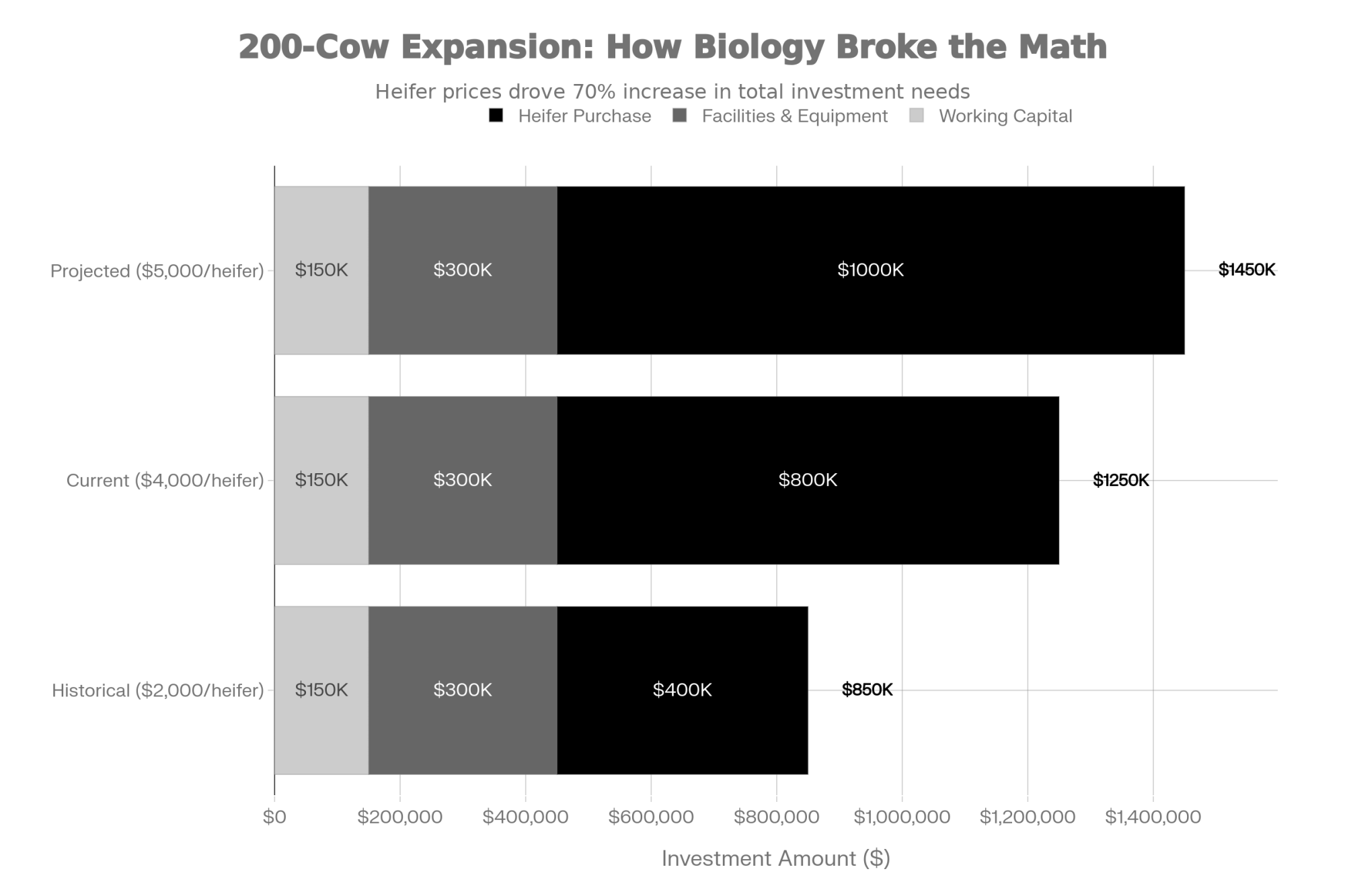
  • Capital investment of $3.5-7.5 million for facilities, animals, and working capital
  • Processor commitment (in writing) before lenders will typically approve expansion financing
  • Current debt-to-asset ratio below 50%—many mid-size operations run higher
  • Access to replacement heifers in a constrained market

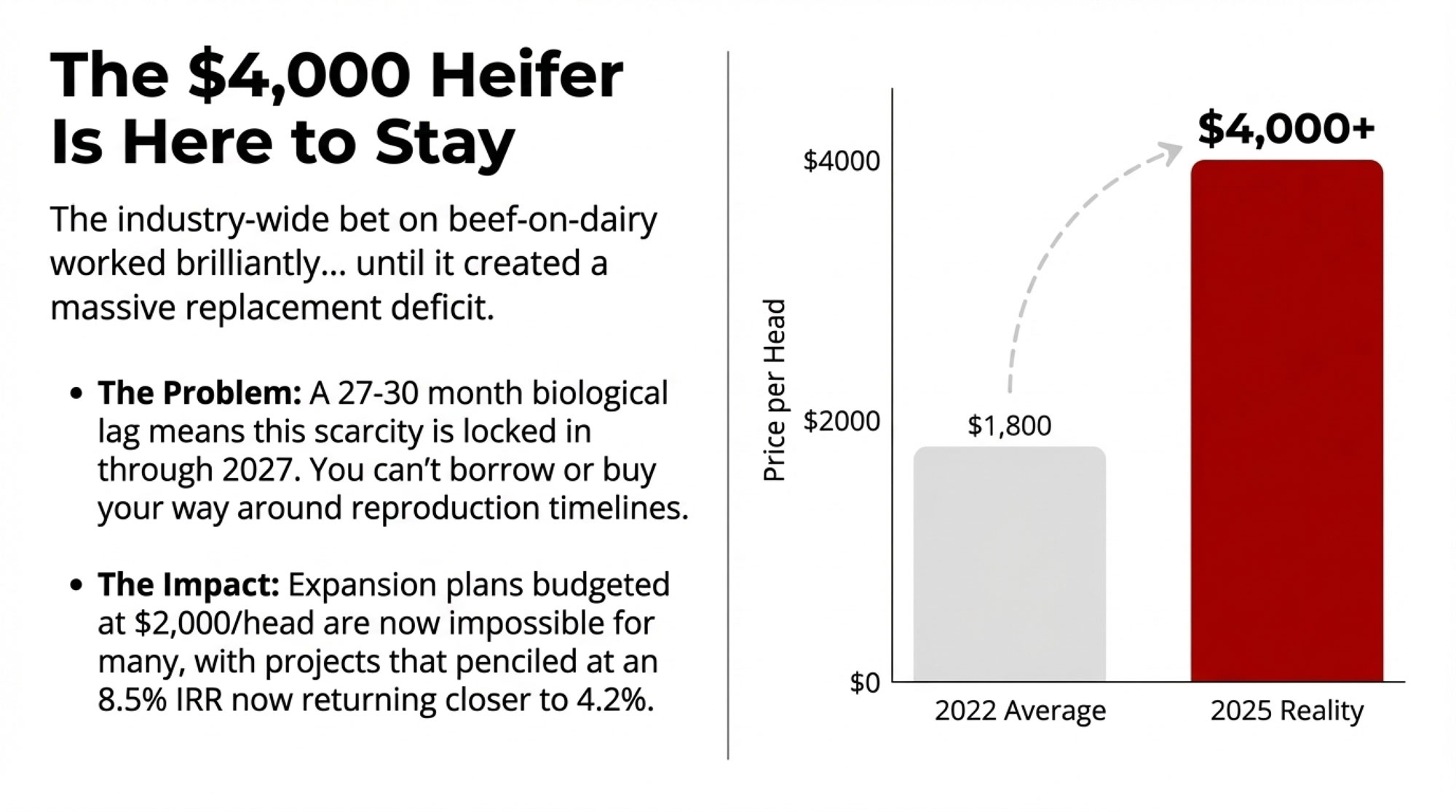
Regarding heifers: USDA data shows the national replacement heifer inventory has declined about 18% from 2018 levels, to around 3.92 million head. Premium springers at California and Minnesota auction barns have been bringing $3,500-4,000 per head, while USDA’s mid-2025 national average is around $3,010. This creates a real constraint on expansion timelines.

There’s another factor that doesn’t get enough attention: regulatory and permitting requirements. Depending on your state and county, expanding from 600 to 2,000 cows may trigger new CAFO permitting thresholds, nutrient management plan requirements, and neighbor notification processes. In some regions—particularly parts of the Upper Midwest and Northeast—these timelines can add 12-18 months to an expansion project. I’ve seen producers budget the capital and line up the heifers, only to spend a year and a half working through environmental review. Factor this into your planning if you’re seriously considering this path.

Realistic assessment: This pathway generally works best for operations with existing scale infrastructure, strong lender relationships, and confirmed processor partnerships. From what I’m seeing, success probability runs maybe 30-40% for operations currently in the 500-800 cow range, based on capital access constraints and market conditions.

Pathway 2: Specialty Market Transition

Options worth evaluating:

  • Organic certification: 36-month transition absorbing higher input costs before receiving organic premiums. Current organic prices are $26-28/cwt, according to USDA data, but buyer capacity is limited in many regions.
  • A2 milk: Requires 5-7 years of genetic transition through breeding and culling. Buyer infrastructure is still developing, particularly outside major metro areas.
  • Grass-fed/regenerative: 2-3 year infrastructure development for rotational grazing. Works better in some climates than others—those July temperatures in South Georgia make intensive grazing pretty challenging compared to, say, Vermont or Wisconsin.

I spoke with a producer in Pennsylvania—she asked me not to use her name—who completed an organic transition in 2021 after three years of planning. “The transition period was brutal financially,” she told me. “But I had my buyer commitment from Organic Valley before I started, and that made all the difference. Neighbors who converted without a commitment lined up… some of them waited eight, nine months for a market. You can’t cash flow that.”

Realistic assessment: Specialty markets can transform mid-size economics when accessible. The key is securing buyer commitment before incurring transition costs. With a confirmed buyer in place, the success probability runs perhaps 50-65%. Without pre-transition commitment, it’s considerably lower.

Pathway 3: Strategic Exit

This option deserves serious consideration rather than dismissal. For some families, it’s the path that best serves long-term financial security.

What orderly exit typically preserves:

  • Cattle values at current market prices (quality milking cows around $2,000/head per recent USDA livestock reports)
  • Land values before any consolidation-related softening
  • Equipment values through private sale versus auction liquidation

As an illustrative example—and I want to be clear, these numbers are scenario-based rather than universal—a 600-cow operation with 800 acres in a reasonably strong land market might preserve something like $5.5-6.0 million in net equity with a carefully planned 12-18-month exit after debt payoff.

What pressured liquidation often costs:

  • Cattle at distress prices: typically 75-80% of normal market value
  • Land under time pressure: often 80-85% of fair value
  • Equipment at auction with other distressed sellers: sometimes 45-55% of book value
  • Potential recovery in this scenario: perhaps $3.5-4.0 million
DimensionOrderly 12–18‑Month ExitForced / Distress Liquidation
Cattle pricesAround current market ($2,000/head)75–80% of normal value
Land saleNear full fair market value80–85% of value under pressure
Equipment valueBetter via private sale45–55% of book at auction
Net equity example$5.5–6.0M preserved$3.5–4.0M recovered
Decision timingProactive, with planning runwayReactive, after cash and credit crunch

The difference—potentially $1.5-2.5 million in preserved family wealth—is substantial. Your specific numbers will vary based on region, debt load, and market timing, but the principle holds.

A Wisconsin producer I know—he’s given me permission to share this—made the exit decision in 2022 with 650 cows and came out with enough to pay off all debt, set up his son in a different agricultural enterprise, and retire comfortably. “Hardest decision I ever made,” he told me. “But waiting another three years would have cost us at least a million dollars. The numbers don’t lie.”

Dr. Kohl has worked with families on both sides of this decision. His observation: “The ones who made proactive decisions came out in far better financial position than those who waited until circumstances forced their hand. The hardest part is accepting that exiting strategically isn’t giving up—it’s making the best decision with available information.”

PathwayCore RequirementsKey AdvantagesMajor Risks / Constraints
Scale to 1,500–2,500+$3.5–7.5M capital, written processor commitmentLower cost per cwt, stronger plant leverageHeifer shortage, permitting delays, lender appetite
Specialty marketsBuyer agreement before transition, multi‑year planningPremium prices (organic, A2, grass‑fed)Limited buyer capacity, tough transition cash flow
Strategic exit12–18‑month planned wind‑down, asset valuation workPreserves $1.5–2.5M more equityEmotional difficulty, timing decisions

Looking Toward 2030

Industry projections suggest continued structural evolution, though the pace and extent remain uncertain. USDA Economic Research Service data and academic analyses from places like Wisconsin and Cornell point toward some likely trends:

  • Continued farm count decline: If current closure and consolidation rates continue, several credible analyses suggest U.S. dairy farm numbers could fall into the mid-teens of thousands by 2030—perhaps 15,000-18,000 operations, compared to higher numbers today
  • Increasing herd concentration: Rabobank analysis shows roughly 65% of the national dairy herd already lives on 1,000+ cow operations. That share could reach perhaps three-quarters of cows by decade’s end if trends continue
  • Processing evolution: Continued shifts in processing ownership and structure, with remaining capacity increasingly concentrated

Regional variation matters considerably here. The Southeast and Mid-Atlantic, with their reliance on Class I markets, may see faster adjustment than the Upper Midwest, with its diverse cheese and manufacturing base.

This isn’t necessarily negative—the remaining operations will likely be financially strong and highly capable. But the structure is evolving, and mid-size operations occupy a challenging position in that evolution.

The Value of Early Information

What I keep coming back to is timing. The producers who successfully navigated the Fort Wayne transition were generally the ones who started asking questions before the answers became obvious to everyone.

Here are conversations worth having in the next month or two:

With your lender:

  • What’s our current debt-to-asset position relative to your covenant thresholds?
  • How would an expansion proposal be received in the current environment?
  • What scenarios would trigger concern about our operating line?

With your processor or cooperative:

  • How do you see your capacity and operations evolving through 2027-2028?
  • Are there volume commitments or contract structures worth discussing?
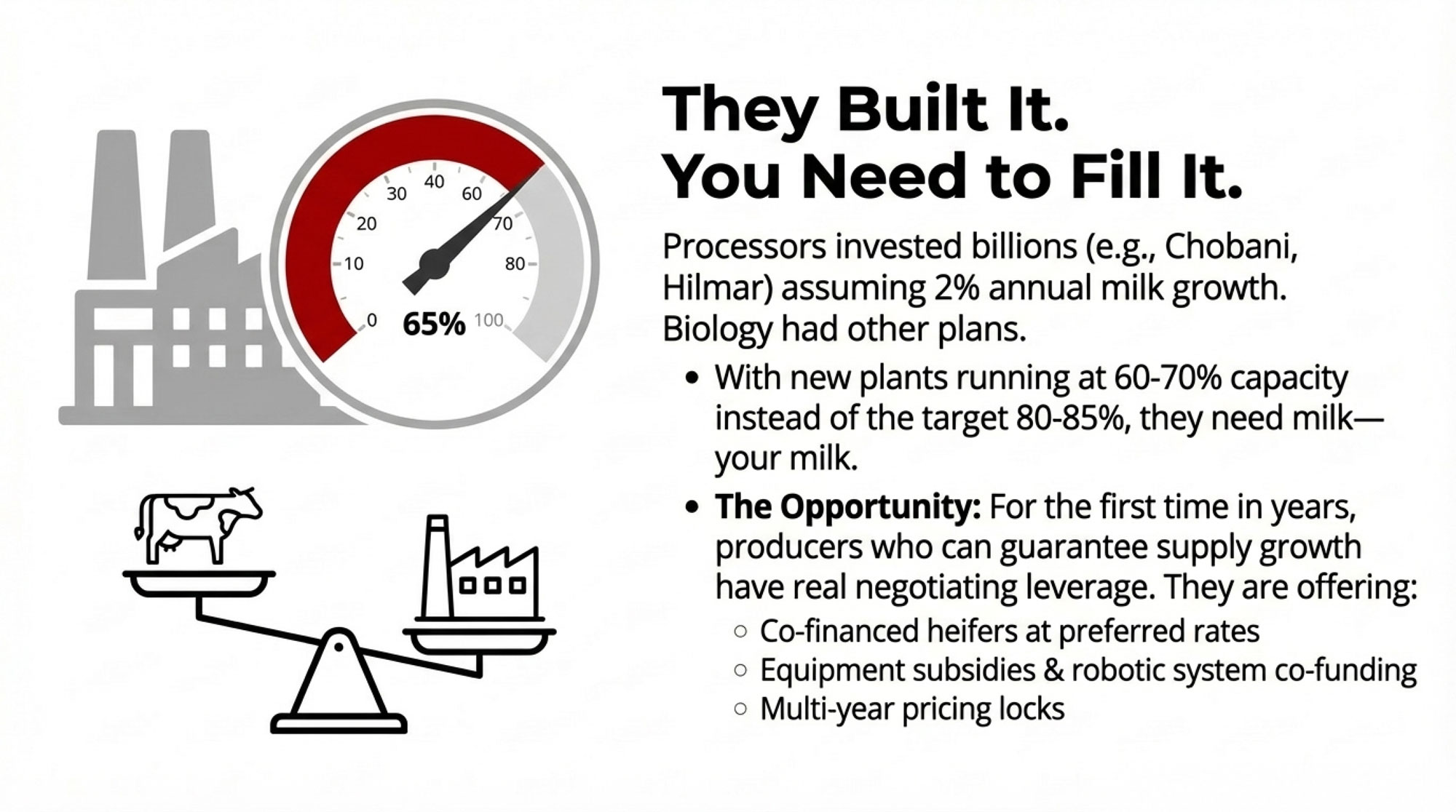
  • How is retail processing expansion affecting your planning?

With trusted advisors:

  • What are realistic current valuations for our assets?
  • What’s the tax-optimized approach for different strategic directions?
  • What are we not considering that we should?

The goal isn’t rushed decisions—it’s gathering information while options remain open.

FactorEarly Movers (Prepared)Late Movers (Waited)
TimelineBackup options lined up ~6 months aheadWaited for official announcements
Processor relationshipsProactively built with regional plantsScrambled after Dean collapse
Contract termsNegotiated better hauling and price termsAccepted remaining, less favorable deals
Stress levelMore control, planned changesHigh stress, limited leverage
OutcomeGenerally maintained stable marketsHigher risk of poor terms or stranded milk

The Bottom Line

What I see in the current environment is a transition, not a crisis. Those are different things. Transitions allow preparation time for those who use it.

The market reality:

  • Retail vertical integration is changing how processing margin flows through the supply chain
  • Regional market structures create meaningfully different situations for different producers
  • Cooperative membership involves tradeoffs worth evaluating for your specific situation

What this suggests for planning:

  • Understand where you sit on the cost curve and what that implies for your operation
  • Know your credit position and how your lender likely views sector conditions
  • Think through which strategic direction genuinely fits your operation, capital position, and family goals

On timing:

  • Information gathered now creates options later
  • Decision windows narrow gradually but persistently
  • Strategic choices made proactively typically preserve more value than reactive ones

On risk management:

  • Whatever pathway you’re considering, don’t overlook the tools available through USDA’s Dairy Margin Coverage program and Livestock Gross Margin for Dairy (LGM-Dairy). They won’t solve structural challenges, but they can provide a floor during the transition period while you’re executing your strategic plan. Your local FSA office or a crop insurance agent familiar with dairy can walk you through the current coverage options and premium costs.

The dairy industry has navigated significant transitions before and will do so again. Operations that approach current conditions with clear information, realistic assessment, and thoughtful timing will be well-positioned—regardless of which path they choose.

The least favorable outcome isn’t choosing Path 1, 2, or 3. It’s deferring the evaluation until circumstances make the choice for you.

For additional resources on dairy operation analysis and planning, contact your state extension service. The University of Wisconsin’s Dairy Marketing and Risk Management Program at dairymarkets.org offers valuable tools for price risk analysis, and the USDA’s Dairy Margin Coverage information is available at fsa.usda.gov

Key Takeaways:

  • 18 months—that’s the precedent: Dean Foods filed bankruptcy 18 months after Walmart’s first plant opened. Plant #2 launched on December 2, 2025.
  • Three paths, three price tags: Scaling requires $3.5-7.5M and processor commitments in writing. Specialty markets need buyer agreements before you transition. Strategic exit preserves $1.5-2.5M more equity than forced liquidation.
  • Your region shapes your risk: Southeast Class I markets have 2-3 processor options. Upper Midwest cheese country has dozens. Same trend, completely different exposure.
  • Lenders may move before you do: At 45-50% debt-to-asset ratios, credit committees tighten terms regardless of milk prices. Your timeline isn’t just about cash flow.
  • Early movers had options; late movers got leftovers: The producers who navigated Fort Wayne had backup relationships six months before the headlines hit. By then, the best deals were gone.

Complete references and supporting documentation are available upon request by contacting the editorial team at editor@thebullvine.com.

Learn More:

Join the Revolution!

Join over 30,000 successful dairy professionals who rely on Bullvine Weekly for their competitive edge. Delivered directly to your inbox each week, our exclusive industry insights help you make smarter decisions while saving precious hours every week. Never miss critical updates on milk production trends, breakthrough technologies, and profit-boosting strategies that top producers are already implementing. Subscribe now to transform your dairy operation’s efficiency and profitability—your future success is just one click away.

NewsSubscribe
First
Last
Consent

The 3.5-Hour Bottleneck: Why Smart Farms Track Parlor Time, Not Cow Count

Bigger isn’t better. 2,500+ cow farms plateau. 1,200-cow farms thrive. Here’s the math nobody talks about.

EXECUTIVE SUMMARY: The 3.5-hour rule changes everything: when cows spend more than 3.5 hours away from pens for milking, even ‘successful’ expansions fail. A Wisconsin producer who added 150 cows without upgrading infrastructure now hemorrhages $4,000 daily—a pattern replicated across farms that put cows before concrete. The industry data is unforgiving: proper expansion requires 18-24 months of infrastructure-first planning, $50,000-100,000 in management development, and debt-to-equity ratios under 0.50. Those who expand backwards face average first-year losses of $654,000 and 18-month recovery periods that many don’t survive. With 15,000 dairy farms already gone and processors building for mega-operations, mid-sized farms face a stark choice: master the expansion paradox of building for tomorrow’s herd today, or join the 2,500-3,000 operations projected to close in 2025. The survivors won’t be those who grew fastest, but those who counted minutes, not just cows.

Dairy Herd Expansion

As we head into winter planning season, I was talking with a producer the other day—a guy up near Eau Claire who expanded last spring—and his story really got me thinking. He went from 450 to 600 cows, following that logic we’ve all considered at some point: more cows equals more milk equals more revenue. Makes perfect sense on paper, doesn’t it?

Adding cows without infrastructure hemorrhages $654,000 in Year 1 alone—the mistake replicated across mid-sized farms. Infrastructure-first expansions recover within 18 months

But here’s what’s interesting… those extra 90 minutes his cows are now spending cycling through the parlor? It’s creating challenges he never anticipated. And from what I’m hearing at meetings and co-op discussions, he’s far from alone.

The 3.5-hour threshold: Parlor time over 3.5 hours triggers exponential losses in milk production and lameness rates—the single metric that predicts expansion failure

Quick Reference: The 3.5-Hour Rule

  • When cows spend over 3.5-4 hours away from pens, profitability declines
  • Each extra hour of rest can mean 2-3 pounds more milk per cow daily
  • $150+ daily losses are common when rest time drops by 90 minutes
  • Recovery from expansion problems typically takes 18 months, not 6
  • Smart operators build infrastructure before adding cows

A lot of folks—could be 40 percent or more based on recent industry conversations—are thinking about expansion right now. With all the investment flowing into processing facilities, we’re learning something that maybe should’ve been obvious all along. The difference between profitable growth and just getting bigger often comes down to something we haven’t traditionally measured: how long our cows spend away from their pens.

What’s fascinating is the work coming out of places like Cornell and Wisconsin’s extension programs (particularly their 2024 dairy expansion guides). They’re suggesting that when cows spend more than about 3.5 to 4 hours away from their pens for milking, something shifts. The economics change. Some folks are calling it the “3.5-hour rule,” and honestly, it’s making a lot of us rethink our expansion plans.

What Time Away Really Costs

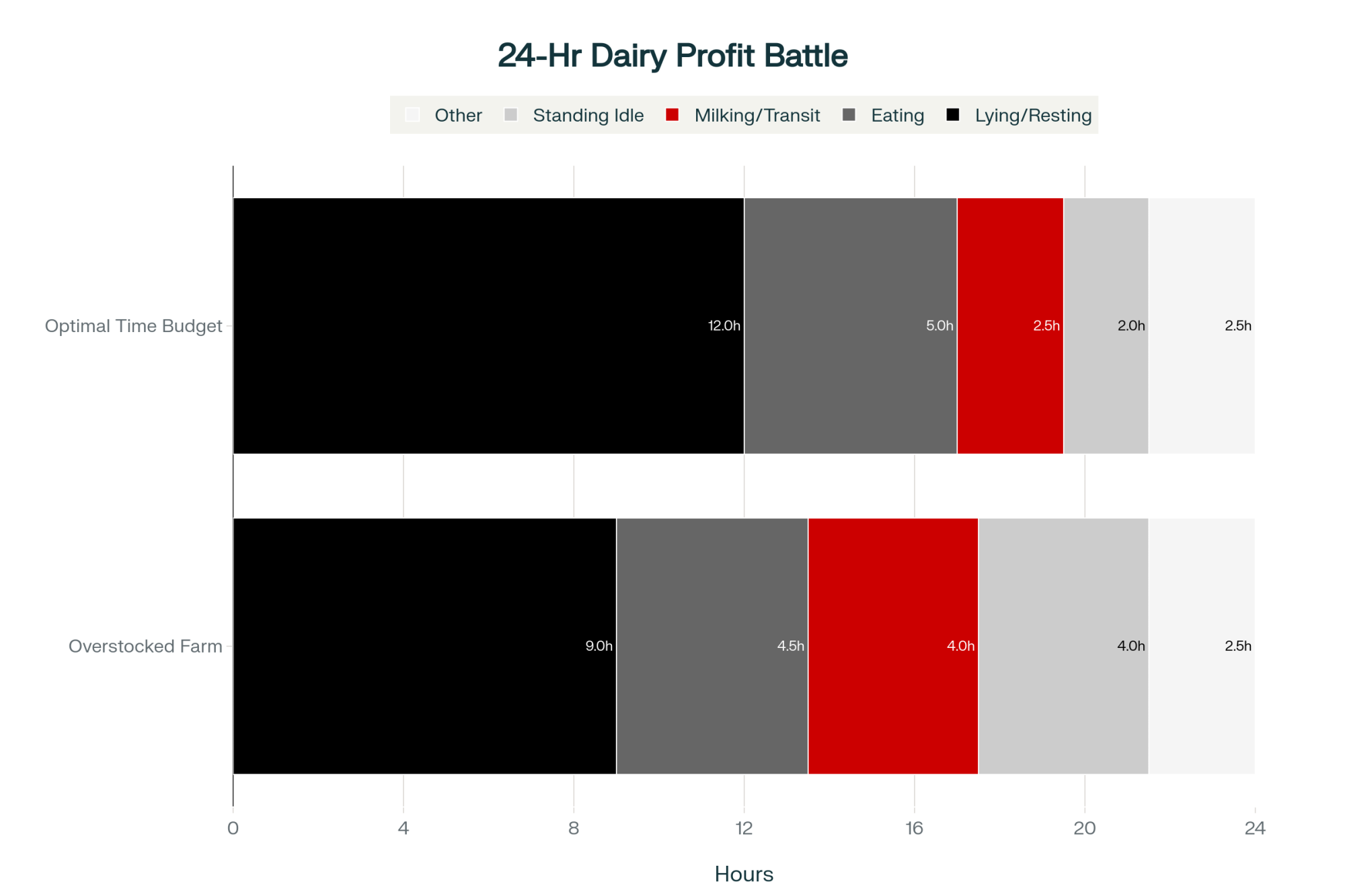
Overstocked farms sacrifice 3 hours of cow lying time for extended parlor waits—costing 6 pounds of milk per cow daily. Time is literally money: $150+/day for 500-cow operations

I’ve been reading research from folks at the Miner Institute and other dairy research centers, and what they’re finding is eye-opening. You probably sense this intuitively, but they’re putting numbers to it—every additional hour of rest can mean significant production gains. We’re talking potentially 2-3 pounds per cow per day, maybe more. Sometimes up to 3.7 pounds, according to some studies, though your mileage may vary.

Think about it—when your girls are standing in the holding area instead of lying down, that’s lost production time. And it compounds.

Here’s what extension folks are telling us happens when operations run their parlors for more than 20 hours a day: everything gets compressed. Milking routines get rushed. Holding areas get crowded. The cows get stressed. Your people get stressed. It all adds up.

Let’s walk through the math, because this is where it gets real. Say you’ve got 500 cows losing even 90 minutes of rest time. That could mean 750 pounds less milk daily.

At today’s prices—what, around $20/cwt?—that’s $150 or more walking out the door every single day. And that’s just the beginning.

From what extension services documented in their 2023-2024 research, here’s what tends to happen:

  • Lameness that normally runs, maybe 15 percent? It can climb to 25-30 percent over a few months
  • Cell counts start creeping up past 300,000, and there go your quality premiums
  • Fresh cow problems—instead of 12 percent, you might see 20-25 percent or higher
  • And culling… well, that tends to jump 8-12 percent above normal

What Wisconsin’s Teaching Us

What’s happening in Wisconsin really tells the story. According to Wisconsin Extension’s 2024 dairy statistics, average herd sizes have grown from around 140 to over 200 cows in recent years—that’s roughly a 45 percent jump. And honestly? Most of us weren’t ready for it.

I’ve walked through a lot of these expanded operations, and you can see the challenges. These parlors—many built decades ago for different herd sizes—they’re showing the strain. The cows bunch up in holding areas. The milkers look frustrated. Everyone’s feeling it.

What the university folks have documented makes sense when you see it firsthand. When holding areas get tight—less than 15-20 square feet per cow—things happen physiologically. Stress hormones go up. That oxytocin we need for good letdown? It gets suppressed.

Cows stand on concrete for hours, and we all know where that leads.

First-lactation heifers have it worst. They’re still figuring out the routine, and now they’re competing with mature cows in tight spaces. Some research suggests they might produce 2 pounds less daily just from that stress. That’s potential walking away before it ever hits the tank.

As veterinarians keep reminding us, this isn’t just about cow comfort—though that matters. It’s about profitability. Some extension models suggest that operations expanding without proper infrastructure could face significant losses in the first year. We’re talking potentially hundreds of thousands, depending on your situation.

Rethinking What “Big Enough” Means

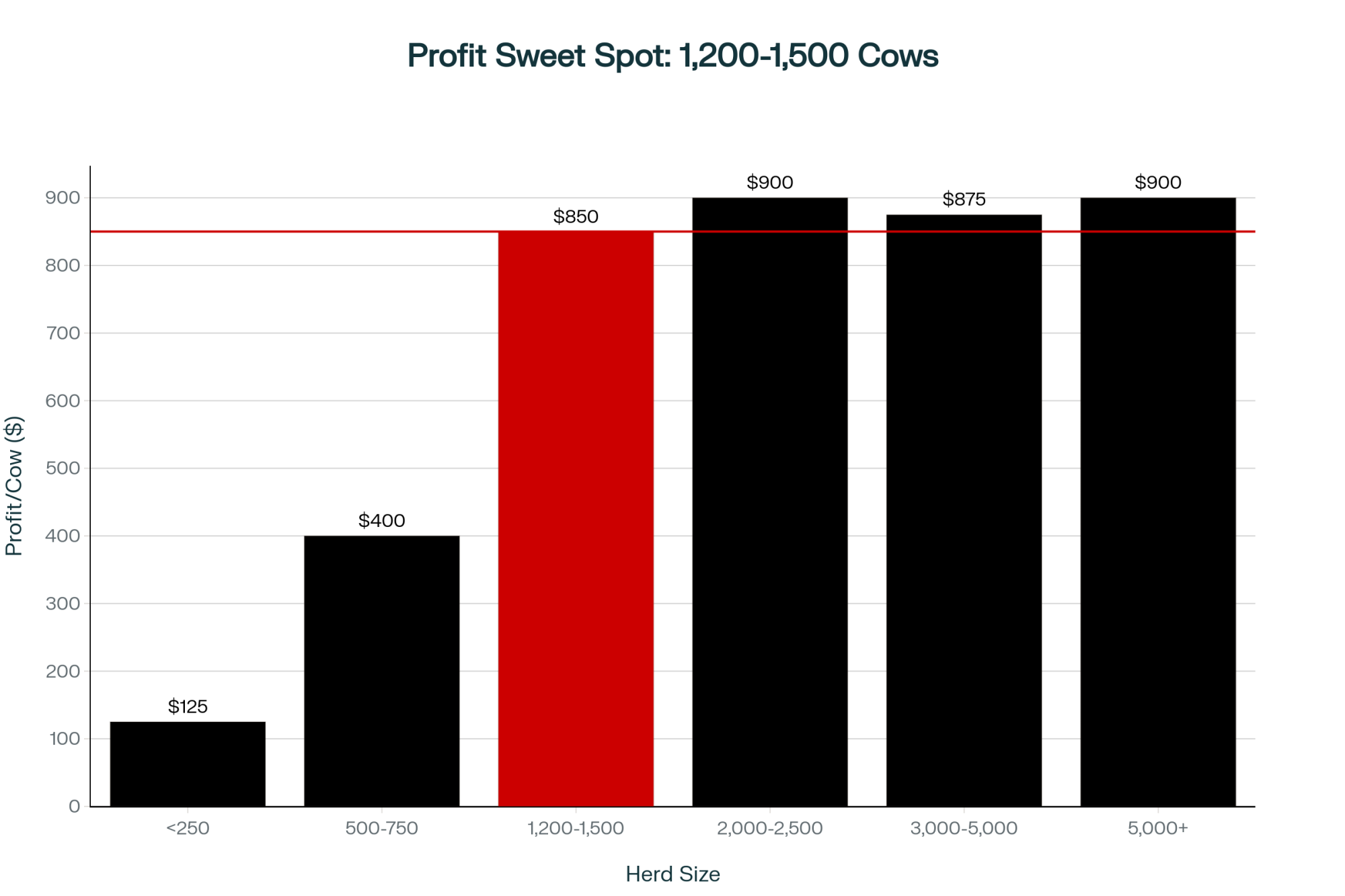
The controversial truth: Operations milking 1,200-1,500 cows achieve $850/cow profit—nearly matching mega-dairies while maintaining individual cow management. Scale doesn’t guarantee success

Here’s something that surprised me when I started digging into recent data. You’d think bigger is always more profitable, right? But profitability seems to level off around 2,000-2,500 cows, and sometimes even declines in really large operations.

Profitability by Herd Size (Typical Ranges)

Herd SizeProfit per CowKey Characteristics
< 250$125-$250Family ops, scale challenges
500-750$350-$450Sweet spot for independents
1,000+$600-$800Economies of scale emerge
2,500+$750-$900Efficiency gains plateau
5,000+$900-$1,000Complexity offsets benefits

Source: USDA Economic Research Service data and industry analyses, 2023-2024

Sure, total profit keeps going up with size. But the efficiency gains? They really taper off after a certain point.

What management experts point out—and this makes sense when you think about it—is that once you get past 3,000 cows, you can’t manage individuals anymore. You’re managing pens. That’s a fundamental shift, and it means accepting different realities about health, variation, and even mortality rates.

What I find really interesting is that the sweet spot for many operations seems to be around 1,200-1,500 cows. Big enough for real economies of scale, but you can still use technology to manage individual animals. That feels like the best of both worlds.

Learning from Folks Who’ve Done It Right

I’ve had the chance to work with several operations that successfully increased from 500 to over 1,200 cows and improved profitability. What’s striking? They all did pretty much the same things.

Getting the Finances Right First

Every successful expansion I’ve seen started from a strong financial position. Debt-to-equity ratios under 0.50, often down around 0.35-0.40. These folks had reserves for at least a year, sometimes 18 months, of potential negative cash flow.

As financial advisors keep telling us—and they’re right—if you’re not testing your plans against milk at $17/cwt for two years, you’re probably being too optimistic.

Building the Team Before the Barn

This one’s huge. I know of operations that spent a year and a half preparing their management systems before pouring any concrete. Hiring people, training them, making sure there’s backup for every critical job.

One producer told me he spent probably $75,000 on management development before construction started. “Best investment we made,” he said, and I believe him.

Actually Talking to Your Milk Buyer

This gets missed so often. You really need to sit down with your processor—really talk about capacity, hauling, components, everything—before you add a single cow.

I know several Wisconsin operations that found out their processor would need to charge significantly more for hauling additional volume. That completely changed their expansion math.

Growing in Stages

The smartest folks I know don’t try to do it all at once anymore. They phase it:

  • First, build for maybe 80 percent of where you want to be, and get it running smooth
  • Then optimize for a year or so—this is crucial
  • Only then finish the expansion

A guy near Fond du Lac told me this approach saved them when milk prices dropped. They could stay at their intermediate size without drowning in debt. Smart.

If You’re Already in a Tight Spot

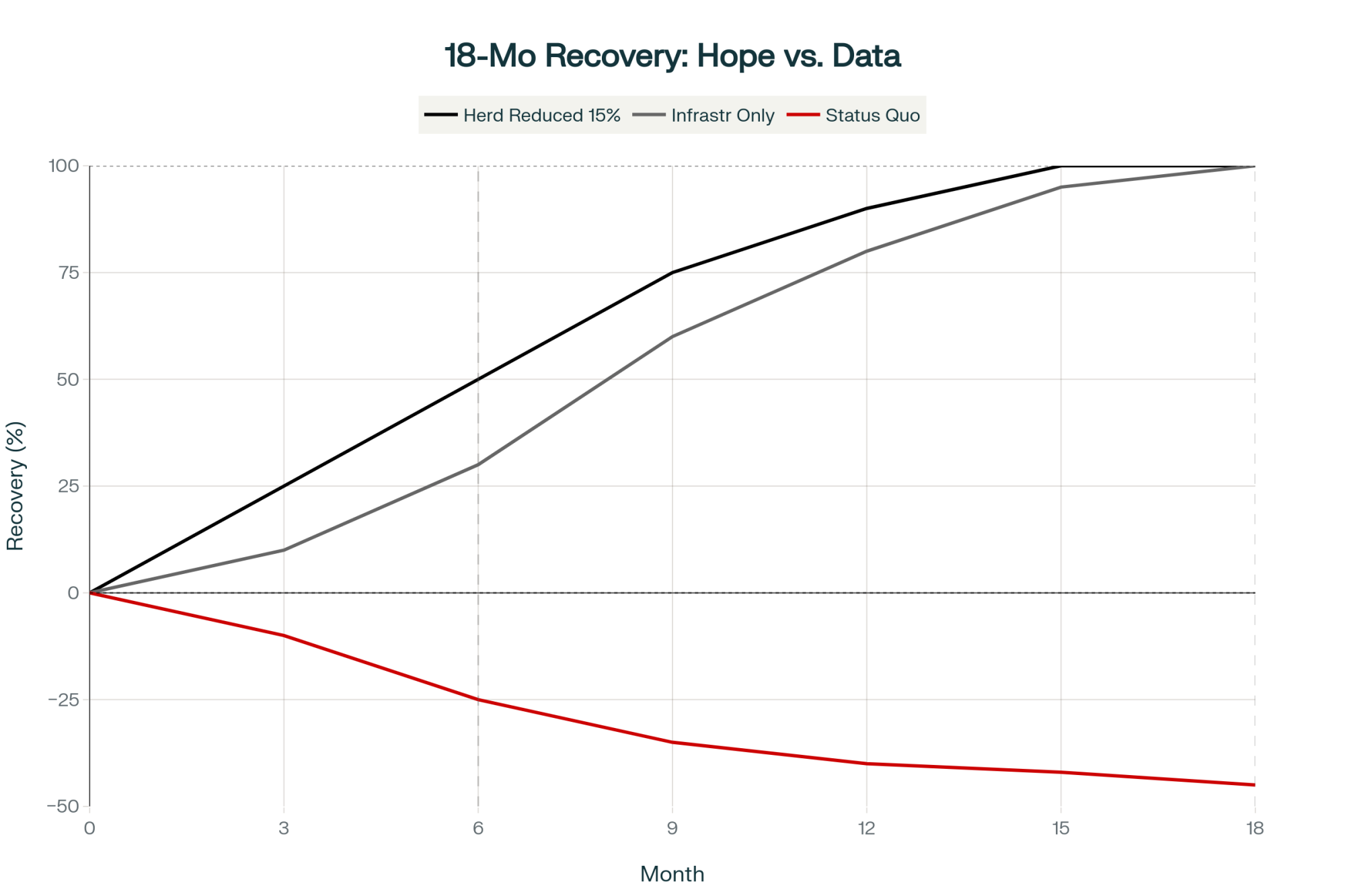
Recovery takes 18 months minimum, not the 6 months most producers expect—and only with aggressive action. Status quo operations face 45% decline, explaining why 2,500+ farms will close in 2025

Look, I realize some of you reading this are thinking, “Great, but I’m already in it up to my neck.” Recovery is possible, but it depends on where you are in the process.

Warning Signs You’re in Trouble:

  • Parlor running over 20 hours
  • More than 90 minutes in the holding area
  • Lameness creeping above 20 percent
  • Cell counts are consistently high
  • Fresh cow problems over 20 percent
  • Your best people are looking burned out

Early Stage Recovery (First Few Months)

If your parlor time is around 90-120 minutes and lameness is still under 20 percent, you can turn this around. According to the University of Minnesota Extension’s 2024 parlor efficiency guide, some quick wins include:

  • Automated crowd gates or better cow flow—might save 10-15 minutes right away ($5,000-$15,000 investment)
  • Vacuum adjustments—another 5-10 minutes sometimes
  • Just splitting into two feeding groups instead of one—that alone can add $400-$500 per cow annually

But here’s the thing—you’ve got to move fast. Every month you wait, it gets harder.

When Problems Are Building (Months 3-6)

If parlor time’s over 2 hours and lameness is approaching 25 percent, you need bigger moves:

  • Maybe reduce the herd by 10-15 percent—I know, it hurts, but it works
  • Get some ventilation and cooling in that holding area ($30,000-$50,000 typically)
  • Consider bringing in outside help for a few months

Recovery takes time—18 months usually, not the 6 months we all hope for.

A producer I know from Marathon County told me, “We sold 80 of our lowest producers. Felt like failure at first. But the rest of the herd jumped 5 pounds per day. Math actually worked out better.”

When You Need Major Changes (Beyond 6 Months)

If you’re running over 3 hours in the parlor with lameness near 30 percent, the options get limited:

  • Permanent reduction to sustainable size
  • Major infrastructure investment—we’re talking $400,000+
  • Sitting down with your lender for some honest conversations
  • Maybe looking at bringing in a partner or succession planning

The Bigger Picture

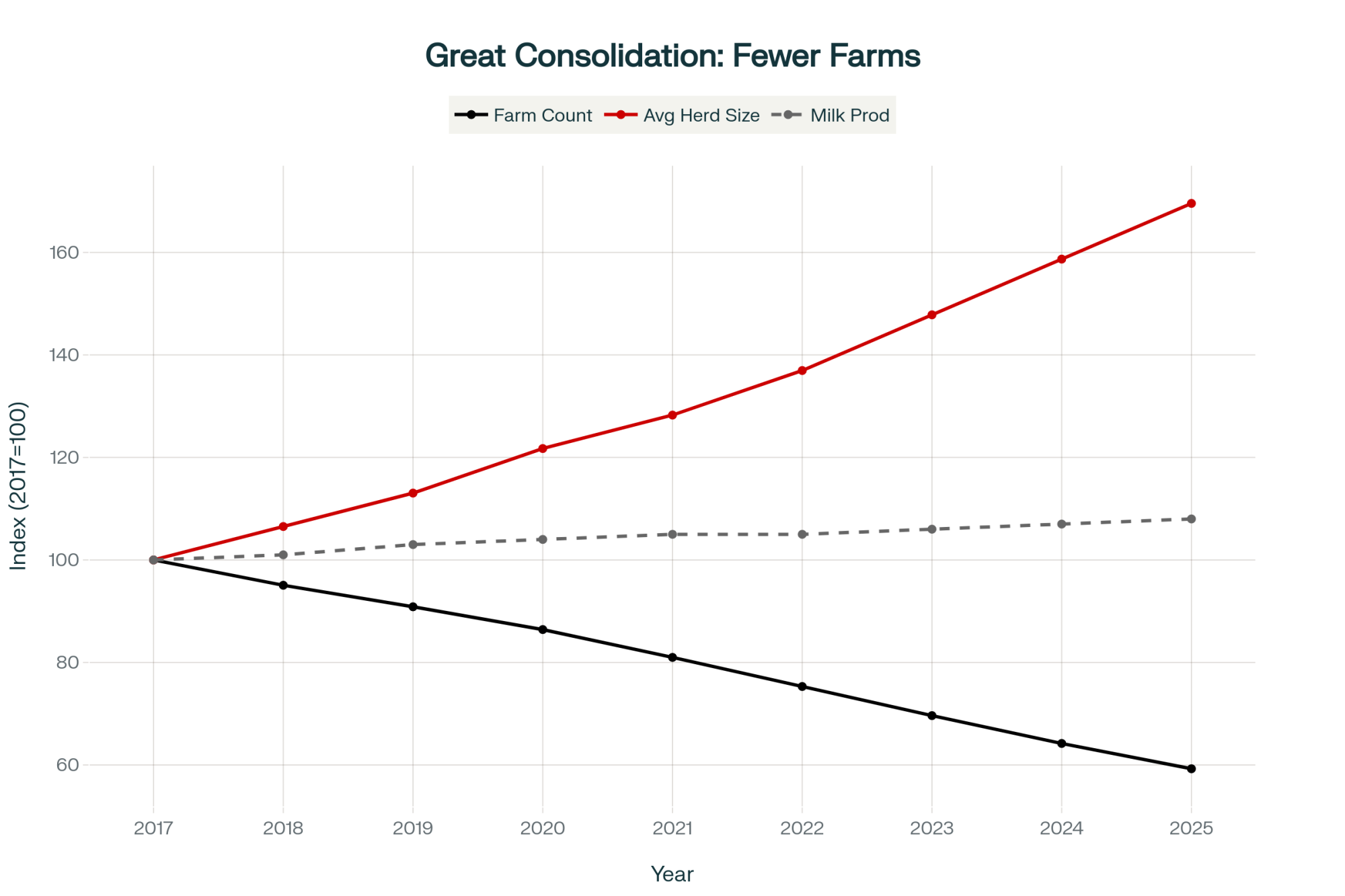
Since 2017, the U.S. lost 16,500 dairy farms (-41%) while milk production rose 8% and average herd size jumped 70%. With 2,500+ more exits projected for 2025, mid-sized farms face extinction without strategic transformation

Looking at the industry broadly, we’re in for continued change. Various analyses suggest we might see 2,500-3,000 farms exit in 2025—that’s maybe 7-9 percent of what’s left.

USDA data shows we lost around 15,000-16,000 farms between 2017 and 2022, while milk production increased by 5 percent.

The big operations—over 2,500 cows—now produce nearly half our milk. And all that processor investment? It’s generally aimed at working with larger suppliers, not mid-sized folks like many of us.

The pace varies by region. Wisconsin’s been losing 400-500 farms yearly, according to state ag statistics. Pennsylvania and New York, similar stories. It’s reshaping dairy country as we know it.

Making the Math Work for You

Before any expansion, here’s the one calculation that matters: What’s your actual cost per hundredweight right now, and what happens to that if you add 20 percent more cows without upgrading infrastructure?

Cost Calculation Framework:

  1. Add up all your annual costs—feed, labor, facilities, health, everything
  2. Divide by your annual production in hundredweights
  3. Model what happens with more cows but no infrastructure upgrades:
    1. Labor costs typically increase 15-20 percent
    1. Health costs often rise 15-25 percent
    1. Production might drop 2-3 pounds per cow daily
    1. Quality premiums could be affected

Say you’ve got 500 cows producing 75 pounds per day. That’s 375 cwt. At $8,250 per day, you’re at $22/cwt.

Add 100 cows without infrastructure? Production might drop to 72 pounds per cow, and costs could rise to about $9,500 per day. Suddenly, you’re looking at $26/cwt.

If expansion pushes you from $22 to $25-26/cwt, that should make you pause.

It’s Different Depending on Where You Farm

These dynamics play out differently across regions, and that matters.

Texas and New Mexico operations often started big with appropriate infrastructure. But in the Upper Midwest? We’re adapting facilities built for our grandparents’ 50-cow herds.

California’s got its own challenges—water, regulations, land costs. A producer there told me that compliance alone can run into the hundreds of thousands.

Even within Wisconsin, it varies. Being near a cheese plant in Green County is different from shipping fluid milk from up north. And summer heat? That can easily add 30-45 minutes to your parlor time when cows move more slowly and need extra cooling.

What Really Seems to Matter

After looking at all this, here’s what I keep coming back to:

Build for where you’re going: Get the infrastructure right before adding cows. Yes, it takes longer and costs more upfront. But it’s often the difference between thriving and just surviving.

Watch that time clock: When cows spend over 3.5-4 hours away from pens, things tend to go sideways. Make that your benchmark.

Management matters most: Can your team handle 25 percent more complexity? If not, invest in people first—maybe $50,000-$100,000 in management development.

Know your real costs: Most of us don’t actually know our true cost per hundredweight. Without that, expansion is just gambling.

Consider other paths: Maybe the answer isn’t more cows. Maybe it’s robots for better labor efficiency, or genetic improvement for 10 percent more production, or capturing premium markets for A2A2 or grassfed milk.

The industry’s changing fast—fewer, bigger operations emerging. But bigger isn’t automatically better.

The operations I see thriving are making careful, infrastructure-first decisions based on real analysis. As one successful producer put it to me: “We spent a year planning before adding a single cow. Neighbors thought we were too slow. Now they’re asking how we stayed profitable.”

That conversation brings us full circle, doesn’t it? Remember that producer near Eau Claire I mentioned at the start? He’s working through his challenges now, looking at some of these same solutions. Had another coffee with him last week, actually. And what’s encouraging is he’ll probably come out stronger for it, because he’s learned what many of us are discovering: real growth isn’t about pushing more cows through your existing setup.

It’s about doing right by every cow you milk, keeping them healthy and productive for the long haul. In today’s dairy world—with all its complexity, consolidation, and change—that philosophy might be the smartest expansion strategy of all.

Don’t just count your cows. Count the minutes they stand waiting. The former feeds your ego; the latter feeds your bank account.

KEY TAKEAWAYS

  • Count Minutes Before Cows: Parlor time over 3.5 hours = automatic profit loss. Your next cow costs nothing; your next hour costs $150+/day
  • $22→$26/cwt = STOP: Before adding even one cow, calculate if expansion increases your cost/cwt by $3+. If yes, you’re planning bankruptcy, not growth
  • Build at 0.50 Debt-to-Equity or Don’t Build: Successful expansions require 18-24 months planning, $75K management investment, and reserves for 18 months of negative cash flow
  • 1,200-1,500 Cows = Profit Sweet Spot: Beyond 2,500, complexity kills margins. Below 500, scale limits competitiveness. Plan for the middle
  • Recovery Takes 18 Months + 15% Herd Cut: If you’re already bottlenecked (20+ hour parlor, 25%+ lameness), reduce first, rebuild second

Complete references and supporting documentation are available upon request by contacting the editorial team at editor@thebullvine.com.

Learn More:

Join the Revolution!

Join over 30,000 successful dairy professionals who rely on Bullvine Weekly for their competitive edge. Delivered directly to your inbox each week, our exclusive industry insights help you make smarter decisions while saving precious hours every week. Never miss critical updates on milk production trends, breakthrough technologies, and profit-boosting strategies that top producers are already implementing. Subscribe now to transform your dairy operation’s efficiency and profitability—your future success is just one click away.

NewsSubscribe
First
Last
Consent

THE GREAT DAIRY MIGRATION: April’s Production Surge Reveals Who’s Winning and Losing in America’s New Milk Map

Texas herds surge 10.6% as US milk production hits 3-year high. Component-adjusted output up 3% – what it means for dairy margins.

EXECUTIVE SUMMARY: April 2025 saw U.S. milk production jump 1.5% year-over-year – the largest gain since 2022 – driven by a 89,000-cow herd expansion and rising yields. Texas dominated growth with a 10.6% output surge, while Idaho’s 4.2% rise faced emerging H5N1 risks. Component-adjusted production soared 3%, amplifying manufacturing potential despite California’s lingering avian flu challenges. Markets reacted bearishly as Class III futures dropped 20¢, signaling concerns about sustained oversupply. The data reveals a geographic shift, with Southern Plains states outpacing traditional dairy regions.

KEY TAKEAWAYS:

  • Historic expansion: 102K cows added in 10 months, pushing herds to 9.4M head – highest since mid-2021.
  • Texas powerhouse: 50K new cows + 55 lb/cow yield gain = 10.6% production spike.
  • Component revolution: 4.31% fat (+1.7%) and 3.34% protein (+1.2%) created 3% manufacturing value surge.
  • Regional realignment: Kansas (+11.4%) and South Dakota (+9.2%) boom as Washington (-4.5%) and Florida (-3.7%) contract.
  • Market warning: Bearish price reactions signal oversupply risks if demand doesn’t match 2%+ component-adjusted growth.
U.S. milk production, dairy herd expansion, milk components, Texas dairy, April 2025 dairy report

April 2025’s milk production statistics aren’t just another monthly data point—they’re the smoking gun confirming a fundamental restructuring of America’s dairy landscape. The 1.5% production surge (3.0% on a component basis) reveals how rapidly production power is shifting south and west, creating winners and losers in an industry transformation many producers aren’t prepared to acknowledge, much less address. USDA’s latest data confirms that the production center is shifting dramatically away from traditional dairy states toward regions that many “experts” dismissed as unsustainable just a decade ago.

The Numbers That Shatter Conventional Wisdom

Let’s be brutally honest about what April’s milk production report tells us. The nationwide 1.5% production increase compared to April 2024 doesn’t just mark the fourth consecutive month of rising output—it represents the most substantial year-over-year percentage gain since August 2022, according to USDA data released May 21, 2025.

What should make you sit up straight is the component-adjusted production increase of 3.0% that vastly outpaced the raw volume growth. This isn’t just more milk—it’s dramatically more valuable milk, with fat content reaching 4.31% (up 1.7% from last year) and protein climbing to 3.34% (up 1.2%).

When was the last time anyone in your cooperative meeting mentioned that component-adjusted production was growing at double the volume rate? It’s like celebrating a 200-bushel corn crop while ignoring that the test weight jumped from 56 to 58 pounds per bushel. The manufacturing value of America’s milk supply is expanding at a rate that’s reshaping processing economics in ways many industry observers seem determined to ignore.

This wasn’t supposed to happen. Market analysts had predicted a modest 1.2% growth. Instead, producers delivered an expansion that sent Class III futures and cheese prices tumbling approximately 20 cents in nearby months. When the market pundits and economists consistently underestimate production growth for four consecutive months, it’s not just a miscalculation—it’s a failure to recognize fundamental structural changes in the industry.

The Triple-Threat Expansion That Nobody Saw Coming

The April data exposes an industry expanding through three simultaneous vectors, creating a multiplier effect that catches even experienced market watchers flat-footed.

Heifers Stay Home: The Return of National Herd Expansion

For years, conventional wisdom claimed that the national dairy herd would remain flat, or contract as consolidated operations focused on efficiency rather than cow numbers. That narrative just collided head-on with reality. According to USDA’s National Agricultural Statistics Service, the April milking herd reached 9.425 million head, up 89,000 compared to April 2024 and adding 5,000 just since March.

This isn’t a statistical anomaly. U.S. dairy farmers have added 102,000 cows to the national herd in just 10 months—a 1.1% increase that has brought the milking population to its highest level since mid-2021, with the exception of that single month in March 2023.

What makes this expansion truly remarkable is its timing. Producers are actively growing herds despite cull cow prices that would typically have them backing up the trailer to the freestall barn every time a cow shows the slightest sign of trouble. When dairy producers choose milk production over $1,500+ cull checks, it signals they’ve run the numbers and see substantially more long-term value in keeping those animals in the parlor than in the beef supply chain.

We should ask whether this herd growth is driven by confidence in dairy fundamentals or by producers chasing more substantial cash flow in regions where cowside margins remain artificially inflated by unsustainable subsidies or environmental regulatory forbearance? The geographic distribution of this growth suggests the latter may be more significant than industry cheerleaders care to admit.

From Good to Great: Yield Climbs Despite Dilutive Factors

As the national herd grows, individual cow productivity isn’t reduced by first-lactation heifers and held-over cull candidates. It’s improving. USDA reports milk per cow averaged 2,055 pounds in April, 11 pounds more than April 2024, representing a 0.6% increase.

This yield improvement is particularly telling because it’s happening simultaneously with herd expansion. The industry’s conventional wisdom holds that you can grow aggressively or improve per-cow production, not simultaneously. The USDA data directly contradicts this assumption.

Typically, rapid herd growth involves bringing in younger, first-lactation animals and retaining older cows longer, which drag down average productivity. Yet national yields are still climbing, suggesting that the genetic advancement curve is steepening rather than flattening, despite widespread complaints about genetic diversity constraints. The annual rate of genetic improvement appears to be outpacing the dilutive effects of herd expansion—a phenomenon that undermines decades of dairy management assumptions.

The Component Revolution Nobody’s Talking About

Perhaps the most significant trend in the April data—and the one getting the least industry attention—is the continued improvement in milk components. Analysis shows fat content reached 4.31% (up 1.7% from last year) while protein rose to 3.34% (up 1.2%).

This component boost is why the true expansion of U.S. milk production is double what the fluid numbers suggest. While raw volume increased 1.5%, component-adjusted production surged 3.0%. This means processors receive substantially more manufacturing material from each tanker, dramatically expanding the dairy solids available for cheese, butter, and powder production.

For farmers in Federal Orders with component pricing, this represents a significant revenue multiplier beyond simple volume growth. For processors, it means substantially improved manufacturing efficiency. Yet how many producer meetings have you attended where the focus was entirely on hundredweight volume rather than component yield? The industry’s fixation on fluid metrics is increasingly disconnected from the economic reality of modern milk production.

MYTH BUSTER: The Expansion/Efficiency Trade-Off Is Dead

Dairy advisors and economists have repeated the same mantra for decades: “Rapid herd expansion inevitably dilutes per-cow productivity.” The April data completely demolishes this long-held belief. Despite adding 89,000 cows nationally and expanding the dairy herd at the fastest rate in years, milk per cow still increased 0.6% year-over-year, according to the USDA’s official report.

This wasn’t supposed to happen. The traditional wisdom suggests that when operations add significant numbers of younger animals and retain marginal older cows longer, average production should decline or at best remain flat. But the evidence is clear—we’re simultaneously experiencing both quantity (more cows) AND quality (more milk per cow) expansion.

What changed? And why aren’t industry advisors acknowledging this new reality? The data suggests genetic advancement is accelerating faster than previously recognized. Modern genetic selection tools, genomic testing, and AI-driven breeding decisions deliver productivity gains that outpace the natural dilutive effects of herd turnover.

This has profound implications for dairy business planning. Suppose you’re still operating on the old assumption that you must choose between expansion and efficiency. In that case, you’re using an outdated playbook that places your operation at a significant competitive disadvantage against producers who recognize and leverage this new reality.

America’s Dairy Geography Revolution: The New Powerhouses Emerge

The national production increase masks the most important story in the April data: a fundamental geographic restructuring of America’s dairy industry happening faster than most industry veterans believed possible.

Texas: The Undeniably New Dairy Capital

If you’re still thinking of Wisconsin as America’s Dairyland, it’s time to update your mental map. According to USDA figures, Texas’s milk production surged an astonishing 10.6% year-over-year in April, reaching 1.511 billion pounds. This extraordinary expansion wasn’t just incremental growth but a seismic shift in production capacity.

Texas added 50,000 cows to its dairy herd in just 12 months, growing from 640,000 to 690,000 head. That single-state expansion accounts for 56% of the entire national herd growth, as verified by the USDA’s state-level data. Even more impressively, milk per cow jumped from 2,135 to 2,190 pounds, demonstrating that Texas isn’t just adding cows—it’s continuously improving productivity.

Let’s put this in perspective: Texas alone accounted for more than half of America’s net dairy herd expansion. The state is no longer merely an emerging dairy power; it has established itself as the epicenter of U.S. dairy growth with a production model that combines aggressive expansion with improving efficiency.

This rapid growth raises uncomfortable questions about resource allocation. When a single state adds more cows in one year than many traditional dairy states’ milks, how sustainable is the resulting concentration of animals, manure nutrients, and water demand? Texas’s growth model depends on groundwater from the rapidly depleting Ogallala Aquifer and cheap feed grain production subsidized by federal crop programs. Is this the sustainable future of American dairying, or are we witnessing a resource bubble that will eventually burst with devastating consequences?

Idaho: Growth Despite Disease Shadows

According to the USDA’s April report, Idaho posted a robust 4.2% milk production increase in April, reaching 1.471 billion pounds. Unlike Texas, however, Idaho’s growth came entirely from herd expansion. The state added 28,000 cows year-over-year while milk per cow remained flat at 2,110 pounds.

This reliance on herd growth rather than productivity improvement creates potential vulnerability, particularly as The Bullvine reports new cases of H5N1 avian influenza have begun to emerge in Idaho. While the impact was described as “limited” in April, this development warrants close attention. Have we learned nothing from California’s experience with H5N1? When an industry builds growth projections entirely on herd expansion without concurrent productivity improvements, it’s creating a house of cards that can collapse with the first strong biological headwind.

Idaho’s production model—focusing on cow numbers rather than cow efficiency—resembles a crop farmer expanding acreage without improving yield. When margins tighten or disease challenges emerge, operations without productivity improvements to buffer against herd reductions become disproportionately vulnerable. Is Idaho making the same strategic error that cost California its production dominance?

California: Beyond Bird Flu

California, America’s largest milk-producing state, continued to feel the effects of H5N1 with April production falling 1.4% year-over-year to 3.480 billion pounds, according to USDA data. However, analysts note this represents improvement from March’s 2.7% decline and outperformed their forecast of a 1.7% reduction.

Interestingly, California’s struggles stem primarily from reduced productivity rather than herd contraction. The state’s cow numbers increased slightly by 1,000 head year-over-year, but milk per cow fell by 30 pounds. This suggests H5N1’s primary impact has been on cow health and productivity rather than triggering widespread culling—an object lesson in the differential effect of disease on production parameters versus herd demographics.

The recovery trend in California and the stronger-than-expected performance elsewhere create a dichotomy of negative milk production in California and strong recovery in the rest of the country. This divergence has significant implications for regional milk pricing and product flows that FMMO reform advocates have yet to address adequately.

The Reshuffling of America’s Dairy Map

Beyond these major players, USDA’s state-level data revealed several other states posted dramatic production shifts that further illustrate the geographic redistribution of U.S. dairy capacity:

  • Kansas: +11.4% (emerging as another major growth center)
  • South Dakota: +9.2% (continuing its multi-year expansion trend)
  • Georgia: +7.2% (showing surprising strength in a traditionally shrinking region)
  • Washington: -4.5% (accelerating contraction in the Pacific Northwest)
  • Florida: -3.7% (continuing its long-term decline)
  • Wisconsin: +0.1% (essentially flat production from America’s traditional dairy heartland)

This pattern reveals a fundamental restructuring of U.S. dairy geography that’s happening regardless of whether industry leaders choose to acknowledge it. The traditional Upper Midwest and Pacific Northwest regions show minimal growth or outright contraction, while the Southern Plains and certain parts of the Southeast are experiencing explosive expansion.

Regional Production Shifts Reshaping the U.S. Dairy Landscape

StateApril 2025 Production (million lbs)YoY ChangeKey DriversFuture Implications
Texas1,511+10.6%+50,000 cows, +55 lbs/cowEmerging dominant production center requiring massive processing expansion
Idaho1,471+4.2%+28,000 cows, flat yieldGrowth is vulnerable to the emerging H5N1 situation
California3,480-1.4%+1,000 cows, -30 lbs/cowGradual recovery from H5N1 impact, primarily yield-driven
Wisconsin2,713+0.1%+7,000 cows, +15 lbs/cowThe traditional dairy heartland is showing minimal growth
Kansas382+11.4%+16,000 cows, +40 lbs/cowEmerging as a significant growth center in the Central Plains
South Dakota440+9.2%+16,000 cows, +30 lbs/cowSustained multi-year expansion continuing

This geographic shift has profound implications for processing capacity, transportation logistics, and regional price relationships that industry planners seem determined to ignore. The industry’s infrastructure was built around historical production centers, but milk is increasingly produced in regions lacking adequate processing capacity.

Who’s asking the tough questions about this mismatch? When milk production growth is concentrated in regions without proportional processing expansion, the result is inefficient transportation, pressure on class prices, and increased vulnerability to market disruptions. Is anyone planning for a dairy industry where Texas and Kansas collectively produce more milk than Wisconsin? Because that’s the trajectory we’re on, according to the multi-year trend in USDA production data.

H5N1: Managing Through Rather Than Solving

The emergence of H5N1 avian influenza in dairy herds created significant uncertainty for the industry over the past year. While still a concern, the April data suggests producers are developing effective management strategies to limit its impact on production, managing through rather than solving the underlying problem.

California, which was hit hardest by H5N1, is showing signs of recovery with the production decline rate moderating from -2.7% in March to -1.4% in April. This improvement, coupled with the slight increase in California’s cow numbers, indicates farmers are adapting to manage through the challenge rather than reducing herd size.

Analysts note that “most H5N1 cases in dairy cattle are being reported as subclinical, and many affected producers have not reported a decline in milk production on the farm.” But let’s be clear: ‘subclinical’ doesn’t mean ‘inconsequential.’ Subclinical infections can still compromise long-term health, reproduction, and lifetime productivity. The industry’s apparent satisfaction with “managing through” rather than solving the H5N1 challenge reflects a troubling pattern of addressing symptoms rather than root causes.

Are we witnessing another example of the dairy industry adapting to a new normal rather than solving a fundamental problem? Just as we’ve collectively accepted declining reproductive performance, shortened productive life, and escalating transition cow challenges as “normal,” the industry appears to be normalizing endemic H5N1 as just another management variable rather than a solvable problem.

Market Implications: Reality Check Coming

The April production report triggered immediate bearish reactions in dairy markets. Class III milk and cheese prices dropped approximately 20 cents soon after release. Market volatility was evident, as “at one point Class III was limit up (+75 cents) after the spot session” before settling lower.

What makes this production boom particularly significant is that it’s being driven by multiple simultaneous factors: expanding herd size, improving yields, and rising component levels. This multi-pronged expansion creates sustained upward pressure on supply that could continue through mid-2025, potentially crushing producer margins if demand doesn’t keep pace.

Analysts project that “component-adjusted growth could remain above 2% through June” if current trends persist. This suggests the supply pressure in the market could intensify in the coming months.

The embedded momentum in the system—102,000 additional cows added in just 10 months, according to USDA—creates production inertia that will continue even if expansion decisions slow. These newly added cows will continue contributing to the milk supply for multiple lactation cycles, maintaining elevated production levels even if farmers pause further expansion.

Is the industry headed for another self-inflicted oversupply crisis? When milk production substantially outpaces domestic consumption growth and exports fail to absorb the difference, the result is predictable: inventory buildups, price pressure, and eventual margin compression that forces painful contractions. Have we learned nothing from the cyclical boom-bust patterns of the past two decades?

Your Strategic Response: Five Critical Adjustments

How should dairy farmers respond to this rapidly changing production landscape? Here are key considerations for producers looking to maintain profitability in this environment:

1. Make Components Your Production North Star

With component-adjusted production growing at double the rate of fluid volume (3.0% vs 1.5%), the economic return on component improvement has never been clearer. Stop fixating on tank volume and start obsessing over component yield. Evaluate your feeding program, genetic selection, and management practices focusing on fat and protein optimization.

DHIA records can be invaluable for identifying your highest component producers for breeding decisions. Consider strategic culling based not just on volume but on component production efficiency. A 65-pound cow producing 4.5% butterfat and 3.6% protein might be more profitable than an 85-pound cow with 3.5% fat and 3.0% protein, especially in component-based payment systems.

When did you last sort your herd list by fat and protein pounds rather than milk volume? If you’re still selecting primarily for milk volume in your breeding program, you’re fighting yesterday’s economic battle while your competitors focus on today’s profit drivers.

2. Understand Your Regional Vulnerabilities

The dramatic regional disparities in the April data highlight how local conditions increasingly determine dairy success. Texas producers face very different challenges and opportunities from those in Wisconsin or California.

Have you honestly assessed whether your region is a long-term winner or loser in this geographic redistribution? If you’re in a contracting region, what competitive advantages can you leverage to overcome the structural headwinds? If you’re in an expansion area, are you prepared for the inevitable infrastructure constraints and environmental scrutiny that follow rapid growth?

Areas to critically evaluate include:

  • Local processing capacity trends and expansion plans
  • Regional feed cost and availability projections
  • Water access guarantees and regulatory trajectory
  • Labor market stability and cost escalation
  • Land base constraints and nutrient management limits

These factors are increasingly divergent across regions and will determine which areas can sustainably support continued growth. Many producers are making long-term capital investments based on outdated assumptions about regional competitiveness that the April USDA data directly contradicts.

3. Prepare for Price Pressure Now, Not Later

The sustained production expansion, particularly on a component-adjusted basis, creates the potential for inventory buildups and price pressure if demand doesn’t keep pace. Strategic risk management isn’t optional in this environment—it’s essential for survival.

Consider:

  • Forward contracting opportunities through your co-op or private buyers
  • Options strategies to protect downside risk
  • Building financial reserves while margins remain positive
  • Stress-testing your operation against potential Class III and component value scenarios

Are you budgeting based on the current milk price or the cost when your newest heifer group enters the milking string? The Federal Order system’s classified pricing means different producers will experience this market pressure differently. Understanding how your milk is utilized and priced becomes increasingly critical in this environment of growing supply.

4. Rethink Your Culling Strategy

The trend of slowed culling rates suggests that many producers retain older cows longer than usual due to favorable margins. While this maximizes short-term production, it could create vulnerability if margins tighten.

Are you keeping unprofitable cows in your herd because they’re still producing milk? Evaluate your culling decisions based on:

  • Individual cow profitability accounting for component production
  • Reproductive status and projected productive life
  • Current beef market opportunities (cull cow prices remain historically strong)
  • Replacement availability and costs

A clear culling strategy—rather than simply retaining all cows—will provide flexibility if market conditions change rapidly. This is the dairy equivalent of a crop farmer’s harvest strategy—knowing when to take profits rather than hoping for ever-higher yields.

5. Plan for H5N1 as Endemic, Not Temporary

While H5N1’s impact appears moderate, its continued presence creates ongoing risk. The experience in California shows how quickly production can be affected when disease challenges emerge.

Hoping H5N1 will simply disappear is not a strategy. Instead, develop comprehensive management protocols:

  • Robust biosecurity measures beyond basic visitor logs
  • Early detection systems and regular surveillance testing
  • Staff training on disease identification and management
  • Contingency plans for potential outbreaks, including segregation strategies

Have you calculated the economic impact of a 2% drop in herd productivity from subclinical H5N1 infection? For most operations, this “invisible” loss would significantly erode profitability. Yet, few have quantified this risk or developed specific mitigation strategies, despite the numerous cases documented by the USDA and reported in agricultural publications like The Bullvine.

The Bottom Line: Adapt or Be Left Behind

April’s milk production data from the USDA reveals an industry fundamentally transforming itself through geographic redistribution, component enhancement, and overall expansion. The 1.5% increase in raw volume—amplified to a 3.0% boost in component-adjusted terms—signals strengthening supply pressure that will challenge milk prices in the coming months.

The regional divergence in production performance—from Texas’s 10.6% surge to California’s ongoing struggles—highlights how local conditions increasingly determine dairy success. Producers must recognize that geography, processing capacity, and biological resilience now play outsized roles in determining competitive position.

The U.S. dairy landscape is evolving rapidly, with the dramatic growth in Texas and other Plains states shifting the center of gravity for American milk production. Traditional dairy regions like Wisconsin and the Pacific Northwest see their relative influence diminish as the Southern Plains emerges as the new growth engine.

For dairy farmers, now is the time to honestly reassess your strategic position in this changing environment:

  • Are you optimizing for components or still chasing volume?
  • Does your region have the infrastructure to support profitable dairy production in the long term?
  • Are you prepared for the price pressure inevitably following this supply expansion?
  • Have you developed a reproductive program to maintain herd size without retaining unprofitable cows?
  • Is your operation structured to withstand the biological challenges that appear increasingly endemic?

The winners in this new environment won’t necessarily be the largest producers, but rather those who best align their operations with the emerging realities of America’s restructured dairy map. The geographic revolution beneath the surface of these production numbers will reshape competitive dynamics for years to come.

Take a hard look at where your operation fits in this changing landscape. Are you positioned in a growth region with the right cows producing the right components for your market? Or are you holding onto outdated production models in regions facing structural decline?

The April production report isn’t just another data point—it’s a roadmap to the industry’s future. Those who read it correctly and adjust accordingly will thrive. Those who dismiss it as just another monthly fluctuation may wonder why their business model no longer works in an industry that’s moved on without them.

What specific change will you implement this month to align your operation with these emerging realities? Your answer to this question may determine whether you’re leading this transformation or being left behind by it.

Learn more:

Join the Revolution!

Join over 30,000 successful dairy professionals who rely on Bullvine Weekly for their competitive edge. Delivered directly to your inbox each week, our exclusive industry insights help you make smarter decisions while saving precious hours every week. Never miss critical updates on milk production trends, breakthrough technologies, and profit-boosting strategies that top producers are already implementing. Subscribe now to transform your dairy operation’s efficiency and profitability—your future success is just one click away.

NewsSubscribe
First
Last
Consent

Defying Gravity: Why U.S. Dairy Keeps Growing Despite Market Meltdown

U.S. dairy herds keep growing-but China’s 150% tariffs and plunging milk prices threaten profits. Can farmers adapt?

EXECUTIVE SUMMARY: Let’s face it-America’s dairy sector is defying logic. Herd sizes and milk output keep rising despite China slapping 150% tariffs on U.S. whey, collapsing export demand, and USDA slashing 2025 milk price forecasts by $1.50/cwt. While feed costs stay stable, plunging Class III/IV prices and new FMMO reforms squeeze margins further. The kicker? Farmers are doubling down on beef-on-dairy calves at $1,100/head to survive. This high-stakes paradox demands aggressive risk management and market diversification-fast.

KEY TAKEAWAYS

  • Production vs. Profit: Herds grew 72k head year-over-year, but milk prices hit 3-year lows under $18/cwt.
  • China Crisis: 150% tariffs obliterated whey exports, forcing global trade reroutes and domestic price crashes.
  • Risk Radar: USDA forecasts warn of $21.10/cwt average milk prices-use DMC, DRP, and futures to hedge.
  • Beef Saves: Crossbred calves now deliver $1,100+/head, propping up dairy revenues amid chaos.
  • Regulatory Roulette: June’s FMMO changes will cut milk checks via higher processor “make allowances.”

Let’s face it: The U.S. dairy industry is living in a paradox. Farmers keep adding cows and pumping out more milk even as prices plummet, exports crash, and Chinese tariffs slam shut our biggest whey market. It’s like watching someone build a bigger boat while the harbor drains. What’s driving this disconnect between production and economic reality?

The USDA’s latest numbers tell an impressive and concerning story. Milk production in the 24 major dairy states jumped 1.0 percent in March 2025 compared to last year, while the national dairy herd grew by 72,000 head. That’s right- we’re adding cows when prices are headed south.

This growth continues even as April’s Class III milk price dropped to .48 per hundredweight and Class IV to $ 17.92- the first time both prices have fallen below since October 2021. Haven’t we seen this movie before?

Trade War Throws Dairy into Chaos

China isn’t playing nice anymore. They’ve slapped retaliatory tariffs of 135% to 150% on U.S. dairy products, slamming the door to one of our most critical export markets. Remember when we thought a 25% tariff was bad back in 2019? Those were the good old days.

Industry insiders aren’t mincing words, calling the situation “market destruction” and forcing a “global recalibration of dairy trade flows.” While China shops around Europe and Oceania for new suppliers, our exporters scramble to find homes for products that suddenly have nowhere to go.

Why is this hitting whey markets so hard? Simple-China has historically swallowed over 50% of U.S. production for specific whey components. The last time we faced Chinese tariffs in 2019, a modest 25% charge caused whey exports to China to plummet by 55% and domestic prices to tank by 35%. And today’s tariffs make those look like a gentle nudge.

Milk Prices Under the Gun

The USDA isn’t sugarcoating things. Since February, they’ve slashed their milk price forecasts for 2025 by about $1.50 per hundredweight. They now project an all-milk price of just $ 21.10- a painful drop from earlier expectations.

Class III and Class IV projections took similar hits. The latest outlook knocked the projected average Class III price down to $17.60 and Class IV to $18.20. How much lower can these prices go before we see a production response?

These falling prices hit producer margins directly. The milk margin over feed cost reported by the Dairy Margin Coverage (DMC) program fell to $11.55 per hundredweight in March, dropping $1.57 from February and more than $4 below last September’s peak. That’s a lot of money vanishing from dairy farmers’ pockets in six months.

Spot Markets Send Mixed Signals

Curiously, spot markets for dairy commodities showed surprising strength in early May, swimming against bad news. The CME spot cheese market rallied for multiple days, with Cheddar blocks reaching $1.76 per pound and barrels hitting $1.755 per pound by May 2.

Butter prices firmed to $2.33 per pound despite cream flowing like water, and nonfat dry milk rose to $1.195 per pound- its highest price since early March. Even dry whey climbed to 52¢ per pound, which seems counterintuitive given the trade tensions.

But don’t be fooled by this temporary bump. The spot market rally provides a momentary bright spot but contradicts longer-term indicators and futures markets that align with USDA’s lower price forecasts. Is this just a dead cat bounce, or could it signal something more positive?

Feed Costs Offer Little Comfort

One silver lining in this storm cloud: feed costs remain relatively stable. The DMC program reported feed costs held nearly unchanged in March at $10.45 per hundredweight, just 3¢ lower than in February. That’s something, right?

Crop planting has made encouraging progress, which might keep feed costs reasonable throughout 2025. Farmers planted approximately 24% of their corn by April 27, slightly ahead of the five-year average, and 18% of soybeans, beating the five-year average of 12%.

This planting progress has helped keep feed prices in check, with July 2025 corn futures settling at $4.72 per bushel and December corn at $4.47 per bushel. But let’s be honest- these modest feed savings can’t offset the massive milk revenue losses hitting dairy farms nationwide.

Alternative Revenue Becomes Critical

Thank goodness for beef prices! They’re still hitting record highs, and crossbred calves headed for feedlots regularly fetch upwards of $1,100 per head. That’s not chump change.

These strong values have become an essential income source and are pushing more producers toward beef-on-dairy breeding strategies, which also helps limit heifer supplies. Who thought your cull cows might save your dairy during challenging times?

The robust cull cow market provides a financial buffer during lower milk prices and now represents a crucial piece of dairy farm revenue. Are you maximizing this opportunity on your farm?

FMMO Reforms Add More Complications

As if things weren’t challenging enough, the Federal Milk Marketing Order system changes are coming down the pike. Most of these changes kick in on June 1, 2025, with adjustments to milk component factors taking effect on December 1.

Key amendments include updated manufacturing allowances (“make allowances”), which will increase from current levels. For example, the cheese make allowance will jump from $0.2003 to $0.2519 per pound. Talk about bad timing!

These higher allowances get subtracted from wholesale product prices when calculating milk component values, effectively lowering the minimum prices paid to producers. Did we need another downward force on milk prices right now?

The Bottom Line: What You Need to Do Now

You can’t afford a passive approach if you’re running a dairy operation in this environment. Aggressive risk management needs to top your priority list. Consider DMC participation, Dairy Revenue Protection, and potentially using futures and options markets to hedge price risk. When was the last time you reviewed your risk management strategy?

Don’t just chase volume-focus on efficiency and high-value milk components. With butterfat and protein maintaining relatively stronger values, adjusting your feeding and breeding programs accordingly could make the difference between profit and loss this year.

For processors and exporters, market diversification beyond China isn’t just lovely- it’s necessary. How quickly can you develop alternative international markets to reduce your vulnerability to future trade disruptions?

The U.S. dairy industry faces a severe test as production growth collides with significant market headwinds. Future markets hint at modest price improvement later in 2025, but let’s face it- the coming months will demand strategic adaptation and careful financial management as the market struggles to balance supply with accessible demand. Is your operation prepared to weather this storm?

Learn more:

Join the Revolution!

Join over 30,000 successful dairy professionals who rely on Bullvine Weekly for their competitive edge. Delivered directly to your inbox each week, our exclusive industry insights help you make smarter decisions while saving precious hours every week. Never miss critical updates on milk production trends, breakthrough technologies, and profit-boosting strategies that top producers are already implementing. Subscribe now to transform your dairy operation’s efficiency and profitability—your future success is just one click away.

NewsSubscribe
First
Last
Consent

U.S. Milk Production Report – February 2025: Strong Growth Amid Seasonal Flush

US milk surges 1.0% YoY as herds expand by 82,000 head since June! Component-adjusted output is up a massive 3.5% while California struggles with HPAI recovery.

Executive Summary:

The February 2025 US milk production report reveals more substantial than anticipated growth of 1.0% year-over-year (after leap year adjustments), significantly exceeding analyst expectations of 0.6% and indicating robust supply as the industry enters peak season. When factoring in milk components, the adjusted production increase reaches an impressive 3.5% year-over-year—the most vigorous growth since mid-2021—highlighting substantial improvements in valuable milk solids content. The national dairy herd continues to expand, with producers adding another 15,000 head in February, bringing total recovery to 82,000 head since June 2024, while regional disparities show California struggling with avian flu impacts (-3.7%) as the rest of the country demonstrates robust growth (+2.0%). This production surge amid weakening demand creates potential price pressure heading into spring flush, suggesting producers may need to emphasize component optimization and risk management strategies to navigate a challenging price environment in the coming months.

Key Takeaways:

  • National milk production grew 1.0% YoY in February (leap-year adjusted), but the component-adjusted increase of 3.5% reveals producers are strategically maximizing valuable milk solids.
  • Herd expansion continues, with 15,000 heads added in February. The herd has recovered 82,000 heads since June 2024, indicating producer confidence despite market challenges.
  • Regional disparities remain significant—California’s avian flu recovery lags expectations (-3.7% vs. forecasted -3.0%) while other states show strong growth (+2.0% vs. forecasted +1.4%).
  • Expanding production and stagnant demand could create downward price pressure, potentially similar to May 2023, when Class III prices fell sharply by $2.41.
  • Producers should consider risk management strategies similar to those used in early 2023 when DMC payments became crucial for enrolled operations as margins tightened.
U.S. milk production growth, dairy herd expansion, component-adjusted production, regional dairy disparities, milk price outlook

The February 2025 U.S. Milk Production Report reveals stronger than anticipated growth, with production increasing 1.0% year-over-year after adjusting for the leap year. This exceeded analyst expectations of 0.6% growth and suggests robust supply as the industry enters peak production season. After adjusting for components, production showed an impressive 3.5% year-over-year increase, marking the most substantial growth since mid-2021. Meanwhile, the national dairy herd continues its expansion trajectory, with significant regional variations in production patterns.

National Production Overview and Herd Dynamics

February 2025 milk production exceeded expectations with a 1.0% year-over-year increase after leap year adjustments, significantly surpassing the forecasted 0.6%. The January 2025 production figures received an upward revision from an initial report of 0.1% growth to 0.5% growth, accompanied by a substantial adjustment in the January herd size numbers, which increased by 25,000 head.

The national dairy herd continued its expansion in February, with producers adding another 15,000 head during the month. This brings the total herd recovery to 82,000 heads since June 2024, demonstrating a significant rebuilding period after previous contractions. This expansion pattern resembles trends in early 2023, when the February Milk Production report showed an increase of 0.8%, with cow numbers up 37,000 from the previous year and 12,000 head from the last month.

Production per cow in February 2025 aligned with forecasts, indicating that increased total production stems primarily from larger herd size rather than productivity gains. This represents a shift from historical patterns where productivity improvements often contributed more significantly to production growth. When factoring in the component composition of milk, the adjusted production increase of 3.5% highlights significant improvements in milk solids content.

Regional Production Disparities

The February data reveals substantial regional variations in milk production patterns nationwide. California continues to recover from avian flu impacts but at a slower pace than anticipated, showing a 3.7% decrease compared to February 2024. This decline exceeded the forecasted 3.0% decrease, suggesting extended recovery challenges for the nation’s largest milk-producing state.

In contrast, the rest of the country demonstrated robust growth, with production up 2.0% compared to the forecasted 1.4%. This strong performance outside California effectively counterbalanced the Golden State’s slower recovery, resulting in an overall 1.0% national increase.

Historical data from March 2023 shows that regional production patterns often vary significantly, with states like Texas (+4.7%), Idaho (+3.1%), New York (+2.1%), and Michigan (+2.9%) showing strong growth while Wisconsin experienced more modest increases (+0.4%). This regional diversification has become increasingly important to national production stability, particularly when central-producing states face challenges.

Top States Production Trends

Looking at the historical context helps understand current regional patterns. In early 2023, the top six dairy states (Wisconsin, Texas, Idaho, New York, California, and Michigan) accounted for 52% of total U.S. production. Texas and Idaho led growth rates then, with Texas adding 22,000 cows and Idaho adding 15,000 cows between February 2022 and February 2023.

The 2025 regional distribution reflects the continuation of these trends and new developments, with California’s avian flu situation creating a significant divergence from historical patterns. If California’s recovery accelerates to -0.5% growth by April while the rest of the country maintains approximately 1.9% growth, national headline production could get 1.4% year-over-year growth before component adjustments.

Component Analysis and Production Value

A particularly noteworthy aspect of the February 2025 report is the significant difference between the headline production increase (1.0%) and the component-adjusted increase (3.5%). This 2.5 percentage point differential indicates substantial improvements in milk composition, reflecting higher concentrations of valuable milk solids like protein and butterfat.

Historically, component prices have significantly impacted producer returns. In early 2023, the protein was valued at around $2.40 per pound, butterfat at approximately $2.73 per pound, and other solids at about $0.23 per pound. The current component-rich production likely reflects producer adaptations to pricing structures that reward milk composition rather than just volume.

This shift toward component-focused production represents a strategic response by dairy producers to maximize returns in challenging market conditions. The significant increase in component-adjusted production suggests that even if fluid volume growth moderates, milk solids entering the market could continue increasing substantially, with implications for manufacturing capacity and product mix.

Market Implications and Pricing Outlook

The strong production growth indicated in the February report enters a market characterized by stagnant to weakening demand, potentially creating price pressure as we move deeper into the spring flush season. While the report is likely already priced into current markets, continued strong growth through spring could create additional downward price pressure if production outpaces demand.

Historical patterns provide context for potential market impacts. In May 2023, the Class III price fell sharply by $2.41 from April, reaching $16.11, $9.10 lower than the previous year’s record high. Similar price pressures could emerge if the current production trends continue without corresponding demand growth.

Risk Management Considerations

When margins tightened in early 2023, Dairy Margin Coverage (DMC) payments became significant for enrolled producers. In April 2023, producers enrolled at the $9.50 coverage level received indemnity payments of $3.66/cwt, equating to $2,735.38 for each million pounds after sequestration. For March 2023, producers with the same coverage realized payments of $2,551.48 per million pounds enrolled.

The current production environment, with strong growth amid potentially weaker demand, could create similar margin challenges for producers in 2025, making risk management strategies increasingly vital as the year progresses.

Production Outlook and Seasonal Expectations

The industry appears positioned for continued strong growth through the spring months. If California improves to a -0.5% growth rate by April while the rest of the country maintains approximately 1.9% growth, national production could reach 1.4% year-over-year growth before component adjustments.

The report suggests that producers are overcoming previously limited growth issues, potentially setting the stage for even more substantial production numbers during the peak spring flush. This timing raises concerns about market balance, as increased production typically coincides with seasonal demand patterns that may not absorb the additional supply without price concessions.

Conclusion

The February 2025 U.S. Milk Production Report reveals more substantial than expected growth in milk production, with significant increases in herd size and component-adjusted output. The 1.0% year-over-year increase in headline production and the remarkable 3.5% increase in component-adjusted output suggest robust supply conditions as the industry enters the spring flush period.

Regional disparities remain significant, with California’s slower recovery from avian flu dampening overall growth while the rest demonstrates substantial production increases. The continued expansion of the national dairy herd, which has recovered 82,000 head since June 2024, indicates producer confidence despite potential market challenges ahead.

As production is projected to remain strong through spring 2025, the industry may face downward price pressure if demand does not increase. Producers may need to focus on efficiency, component optimization, and risk management strategies to navigate what could be a challenging price environment in the coming months.

Read More:

Join the Revolution!

Join over 30,000 successful dairy professionals who rely on Bullvine Daily for their competitive edge. Delivered directly to your inbox each week, our exclusive industry insights help you make smarter decisions while saving precious hours every week. Never miss critical updates on milk production trends, breakthrough technologies, and profit-boosting strategies that top producers are already implementing. Subscribe now to transform your dairy operation’s efficiency and profitability—your future success is just one click away.
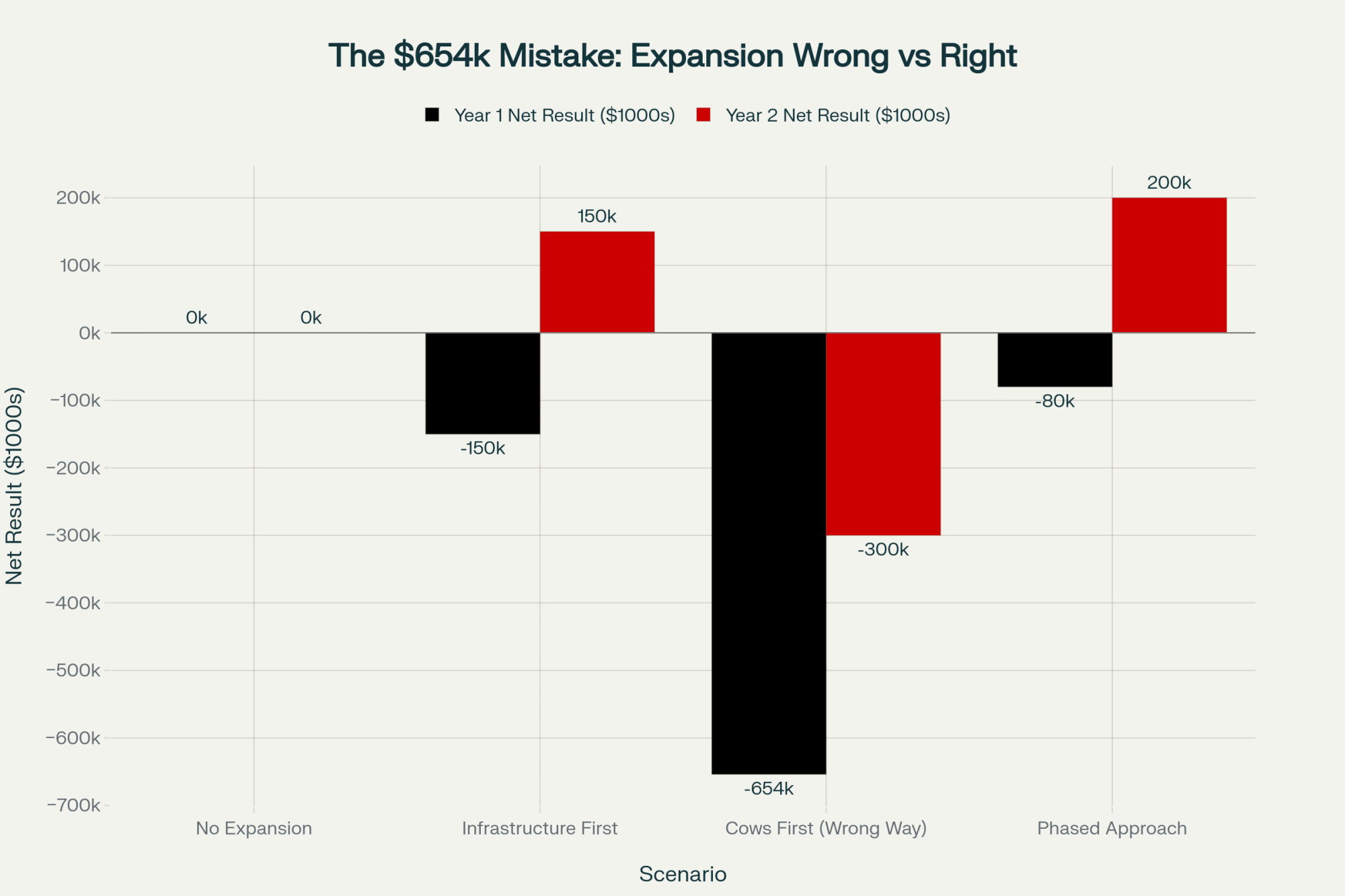
NewsSubscribe
First
Last
Consent

U.S. Milk Production Report—January 2025: Navigating Avian Flu Impacts and Market Dynamics

U.S. milk production increased by 0.1% in January 2025, with component-adjusted output jumping 2.2% amid higher fat/protein yields. California’s 5.7% decline underscores persistent avian flu pressures, while USDA herd revisions reveal unexpected dairy cow expansion and evolving market risks.

Summary:

U.S. milk production in January 2025 saw a marginal 0.1% year-over-year increase, with component-adjusted output rising 2.2% due to higher fat and protein yields, signaling improved herd efficiency. The USDA revised the upward October–November 2024 production and reported an unexpected 10,000-head dairy herd expansion, countering earlier contraction forecasts. California’s output fell 5.7% as H5N1 avian flu outbreaks disrupted supply chains, contrasting with a 1.4% growth in other states like Wisconsin and Texas. Federal pricing mechanisms stabilized farmgate milk prices at $21.75/cwt, though Class I utilization hit record lows (20%) amid plant-based competition. Retail dairy inflation surged 7.7%, driven by biosecurity costs and labor shortages, while H5N1’s spread to raw milk consumers underscored public health risks. Medium-term projections suggest cautious optimism, balancing feed cost relief against ongoing avian flu threats and climate-driven feed instability.

Key Takeaways:

  • U.S. milk production inched up 0.1% year-over-year in January 2025
  • Component-adjusted production jumped 2.2% due to higher fat and protein content
  • The USDA unexpectedly reported a 10,000-head increase in the national dairy herd
  • California’s output plummeted 5.7%, mainly due to ongoing avian flu (H5N1) impacts
  • The rest of the country saw steady growth at 1.4%, led by states like Wisconsin and Texas
  • Farmgate milk prices stabilized at $21.75/cwt under Federal Milk Marketing Orders
  • Class I (fluid milk) utilization hit a record low of 20%, pressured by plant-based alternatives
  • Retail dairy prices rose 7.7% year-over-year, outpacing overall food inflation
  • H5N1 outbreaks in dairy operations raised concerns about cross-species transmission
  • Raw milk consumption led to some human H5N1 cases, prompting FDA warnings
  • The medium-term outlook suggests cautious expansion, pending avian flu containment
  • Labor shortages and climate-driven feed instability remain key challenges for the sector
U.S. milk production, avian flu impact, dairy herd expansion, retail dairy inflation, federal pricing mechanisms

The U.S. milk production landscape in January 2025 reflects a delicate balance between modest growth and persistent challenges from avian influenza (H5N1). Nationwide milk production increased 0.1% year-over-year, with component-adjusted output rising 2.2% due to higher fat and protein content. However, regional disparities persist: California’s output fell 5.7% amid ongoing bird flu outbreaks, while the rest of the U.S. grew 1.4%. The USDA revised October–November 2024 production upward and reported a 10,000-head dairy herd expansion between December 2024 and January 2025, signaling cautious optimism for medium-term recovery. This report analyzes the interplay of avian flu disruptions, federal pricing mechanisms, and consumer market trends shaping the dairy sector.

National Milk Production Trends

Modest Growth Amid Component Adjustments

U.S. milk production in January 2025 increased by 0.1% compared to the previous year, aligning with pre-report forecasts. The growth was driven by higher fat (+1.8%) and protein (+2.4%) content, which boosted component-adjusted production by 2.2%. This aligns with long-term trends of genetic improvements in dairy herds and optimized feed efficiency. The USDA’s upward revisions to October–November 2024 milk output—by 0.3% and 0.5%, respectively—highlight improved data granularity and reduced volatility in herd health reporting.

Herd Dynamics and Expansion Pressures

Quarterly Herd Dynamics (2024-2025)

Table 1. National Dairy Herd Composition 

QuarterAvg. Milk Cows (1,000)Milk/Cow (lbs)Production (B lbs)
Q1 20249,3386,09856.94
Q4 20249,3605,93055.51
Q1 20259,3426,01256.16 (est.)

Contrary to earlier projections of herd contraction, the USDA estimated a 10,000-head increase in the national dairy herd between December 2024 and January 2025. This expansion reflects improved feed costs and more substantial cheese prices, which are incentivizing farmers to retain heifers. However, feed quality concerns persist: Drought-reduced alfalfa yields in the Midwest have forced reliance on less nutritious silage, potentially dampening future productivity gains.

Regional Disparities: California’s Avian Flu Challenge

State-Level Milk Output (January 2025 vs. 2024)

Table 2. Milk Production in Key States 

State2024 Cows (1,000)2025 Cows (1,000)2024 Milk/Cow (lbs)2025 Milk/Cow (lbs)% Change
California1,7251,6262,3102,178-5.7%
Wisconsin1,2681,2792,1052,121+1.4%
Texas6476622,0802,095+2.3%
New Mexico3423352,2502,210-1.8%

Production Declines and Recovery Delays

California’s milk production fell 5.7% year-over-year in January 2025, extending an 8% decline in December 2024. The state’s dairy sector remains disproportionately affected by H5N1 avian influenza, which has infected over 14 million birds in commercial poultry operations since December 2024. While the virus’s mortality rate in cattle remains low (2–5%), mandatory quarantines and milk dumping protocols have disrupted supply chains. For example, a San Francisco dairy farm reported a 30% drop in output after culling 1,200 cows exposed to infected poultry.

Biosecurity and Cross-Species Transmission Risks

The H5N1 strain’s jump to mammals—including 67 confirmed human cases in the U.S. as of January 2025—has intensified scrutiny of dairy farm practices. Genetic sequencing revealed mutations in the PB2 protein (E627K) that enhance viral replication in mammalian cells, raising concerns about potential human-to-human transmission. California’s dense dairy-poultry interface (e.g., shared water sources and feed trucks) has facilitated cross-species spread, with 38% of the state’s H5N1 cases linked to dairy operations.

Avian Flu’s Economic Impact on Dairy

Compensation Programs and Supply Chain Costs

The USDA’s indemnity program paid $1.46 billion to poultry and dairy producers in January 2025 for culling infected animals, up from $890 million in 2024. For dairy farmers, compensation covers 70% of a cow’s market value but excludes long-term losses from herd rebuilding. A typical 1,000-cow farm faces $2.1 million in lost revenue during a 6-month quarantine, compounded by rising insurance premiums (up 22% year-over-year).

Retail Price Inflation and Consumer Behavior

Egg prices surged to $5 per dozen in January 2025, a 150% increase from 2021, while whole milk reached $4.15 per gallon. Consumer demand remains inelastic (-0.2 price elasticity), with 80% of households prioritizing dairy purchases despite cost hikes. However, discount retailers like Aldi and Lidl have gained market share by offering private-label dairy at 15–20% below national brands, squeezing mid-tier producers.

Federal Milk Marketing Orders and Price Controls

Class I Fluid Milk Pricing Mechanisms

The Federal Milk Marketing Order (FMMO) system stabilized farmgate milk prices at $21.75/cwt in January 2025, a 4% increase from 2024. Class I (fluid milk) premiums reached $7/cwt in Florida but averaged $1.60/cwt in the Upper Midwest, reflecting regional disparities in bottling capacity and consumer demand. However, Class I utilization fell to 20% of total production—down from 65% in 1950—as plant-based alternatives captured 18% of the beverage market.

Cheese and Butter Stockpiles

Government cheese inventories hit 600 million kg in January 2025, a 12% year-over-year increase, as weak export demand and tariff wars with China (25% retaliatory duties) stifled trade[15]. The USDA’s Dairy Management Inc. has redirected 8% of surplus butter to fast-food partnerships, notably McDonald’s “ButterBurgers,” but stockpile storage costs now exceed $120 million annually.

Consumer Price Trends and Forecasts

Short-Term Volatility and Long-Term Pressures

Retail dairy prices rose 7.7% year-over-year in January 2025, outpacing overall food inflation (5.2%). Analysts project a 20.3% increase in egg prices and 8–10% milk price hikes through mid-2025, assuming H5N1 outbreaks persist at current rates. However, futures markets indicate moderation: CME Class III milk contracts for July 2025 trade at $18.25/cwt, suggesting traders anticipate production rebounds in H2 2025.

Labor Costs and Automation Adoption

Dairy farms face a 14% wage inflation rate for skilled labor (e.g., milking technicians), driven by H-2A visa shortages and competition from the construction sector. In response, 32% of large-scale operations have deployed robotic milking systems, which reduce labor costs by 40% but require upfront investments of $250,000–$500,000.

Public Health and Food Safety Concerns

Raw Milk and Viral Transmission Risks

The CDC confirmed 38 human H5N1 cases in California as of January 2025, including a San Francisco resident who consumed raw milk from an infected herd. Viral loads in raw milk reached 1.2×10⁶ RNA copies/mL, prompting the FDA to issue nationwide advisories against unpasteurized dairy. Despite this, raw milk sales rose 18% in Q4 2024, fueled by anti-vaccine rhetoric and RFK Jr.’s advocacy for “natural immunity.”

Pasteurization Efficacy and Regulatory Gaps

Studies confirm that standard HTST pasteurization (161°F for 15 seconds) reduces H5N1 infectivity by 99.99%, but 9% of small processors fail to meet thermal profiling standards. The FDA’s January 2025 recall of 240,000 gallons of milk from 12 underprocessed batches underscores persistent gaps in oversight.

The Bottom Line

The January 2025 milk production report underscores the U.S. dairy sector’s resilience amid unprecedented challenges. While component-adjusted output growth and herd expansion signal medium-term stability, avian flu remains a wildcard. Proactive measures—such as mRNA poultry vaccines (95% efficacy in trials) and dairy farm compartmentalization protocols—could mitigate future outbreaks. However, rising input costs, labor shortages, and climate-driven feed instability demand policy innovation, including FMMO reforms to address Class I utilization declines and carbon credit programs for methane-reducing feed additives. As H5N1 continues evolving, bridging the gap between agricultural viability and public health safeguards will define the industry’s trajectory through 2025 and beyond.

Learn more:

Join the Revolution!

Bullvine Daily is your essential e-zine for staying ahead in the dairy industry. With over 30,000 subscribers, we bring you the week’s top news, helping you manage tasks efficiently. Stay informed about milk production, tech adoption, and more, so you can concentrate on your dairy operations. 

NewsSubscribe
First
Last
Consent

The Grinch’s Effect: Milk Prices Plummet Amid Dairy Market Turmoil

Explore the impact of plummeting milk prices on dairy farmers. How will market shifts and production changes shape the future of the dairy industry?

Summary:

In an unexpected turn of events, the dairy market is tumultuous as milk prices tumble, raising eyebrows across the industry. The recent decline in Class III futures, amidst stagnant cheese trade and fluctuating butter markets, paints a complex picture for stakeholders. As futures volumes show mixed signals, investors grapple with understanding the intricacies behind these shifts. Meanwhile, the November Milk Production report promises to provide crucial insights into regional production dynamics, mainly as California deals with bird flu impacts and other states ramp up cow numbers. From interest rate cuts by the Federal Reserve to global pricing trends, each factor is critical in shaping dairy markets’ current and future landscape. The dairy industry faces a significant drop in milk prices, causing lower earnings and market disruptions. The drop in milk prices is mainly due to market and environmental factors, with California’s milk output dropping by 3.8% from the previous year. Planned farm expansions and the growth of dairy herds are helping offset some of these issues, as US dairy farms added about 46,000 cows between July and October, a 0.5% increase.

Key Takeaways:

  • Class III futures experienced a notable decline, indicating market volatility and the potential impact on dairy pricing for farmers.
  • The California bird flu outbreak led to a significant drop in milk production, highlighting regional challenges affecting the national dairy market.
  • Strategic farm expansions to fill new cheese plants signify possible growth despite high costs and interest rates.
  • Global price disparities in cheese and butter position the U.S. as a competitive exporter, potentially influencing trade dynamics.
  • Market signals, such as declining open interest in futures, may suggest profit-taking rather than long-term bearish trends.
  • Despite market challenges, opportunities for innovation and expansion in U.S. dairy production remain strong.
dairy industry trends, milk price drop, Class III futures, California bird flu impact, spot cheese market, dairy herd expansion, milk production forecast, US dairy farms, global dairy market analysis, economic viability in dairy

As the holiday season nears, the dairy industry is grappling with a significant drop in milk prices, reminiscent of the Grinch stealing the season’s cheer. This decline leads to lower earnings and significant market changes for dairy farmersand supply chain workers. However, the industry’s strategic planning and resilience are key in navigating these challenges. An industry expert noted, “The unexpected drop in milk prices has thrown the industry into chaos, posing a major challenge for those who depended on steady and predictable markets.” This situation prompts us to delve into the causes of these market disruptions and how the dairy industry will manage this volatility. Pursuing these answers is crucial as they may reshape strategies and plans for 2025, instilling a sense of reassurance and confidence in the industry’s future.

Navigating the Choppy Waters of the Dairy Market: Trends and Signals for 2025 

The dairy market is experiencing many ups and downs. One leading indicator, Class III futures, which help predict milk prices, recently dropped to $19.85, indicating some uncertainty. This change is partly due to issues like the bird flu in California, which has reduced milk production in that area. 

Spot cheese sessions are adding to the market’s complexity. A recent quiet session saw no block trades, even though there were offers. This lack of activity suggests that traders may have less interest or uncertainty because they are waiting for essential reports, such as the USDA’s monthly milk production report, or reacting to economic signals like interest rate changes from the Federal Reserve. These reports and signals can provide crucial information about the current and future state of the market, influencing traders’ decisions and market activity. 

Other essential factors include changes in the spot markets for butter, nonfat dry milk (NDM), and dry whey. Recently, prices for NDM and dry whey went down, along with small reductions in butter prices. Globally, US butter and cheese prices are more competitive than international options, which affects both spot prices and futures here at home. 

These trends are significant because they impact milk pricing. Class III futures help predict milk revenue. Their decline suggests possible challenges for dairy farmers managing their profits. Similarly, the prices of cheese and butter can show the balance—or lack of it—between supply and demand in the market. 

This blend of futures, spot trading, and production factors shapes the current market outlook. As traders and farmers await key reports on milk production and other economic indicators, these trends underscore the need for vigilant monitoring in the dairy industry. This careful observation of market trends will ensure that everyone in the industry is alert and prepared for potential changes.

From Bird Flu to Barn Boosts: Navigating the Challenges and Opportunities in the Dairy Industry

The drop in milk prices is mainly due to several market and environmental factors affecting today’s dairy industry. One big issue is the California bird flu outbreak, which has cut down the state’s milk production. This outbreak has significantly reduced the number of cows available for milking, thereby reducing the overall milk output. In October, California’s milk output dropped by 3.8% from the previous year, and it’s expected to fall further, possibly between 7% and 10%, in November. This sharp drop shows how sudden health problems can disrupt milk production. 

On the other hand, planned farm expansions and the growth of dairy herds are helping to offset some of these issues. US dairy farms added about 46,000 cows to their herds between July and October, a 0.5% increase. This shows that dairy producers are eager to scale up despite challenges like raising interest rates and high costs for replacement cows. These expansions are critical to meet the demand from new cheese processing plants, which will need many more cows to run efficiently. These changes might lead to more milk being available next year, which could keep prices stable or even lower them if more milk is needed. 

The market is becoming unpredictable, with California producing less milk and adding more cows due to farm expansions and new processing requirements. The ability to produce more milk suggests that, at least for now, milk prices could stay low as more milk hits the market. Those in the dairy industry watch these changes closely, paying attention to upcoming data and reports for more clues about what’s happening. Whether these factors will work together to help dairy farmers or if supply and demand problems will continue to cause price stability issues.

Decoding the Global Dairy Maze: Navigating Price Disparities and Market Dynamics

The US dairy market offers lower prices for key products like cheese, butter, and NDM/SMP than other countries. For example, the US offers lower prices for cheese: $1.82 per pound, compared to New Zealand’s $2.12 and Europe’s $2.24. This makes US cheese more appealing to international buyers, boosting its exports and market presence globally. 

But the story changes with butter. US butter prices are much lower at $2.51 per pound compared to Europe’s $3.54 and New Zealand’s $2.93. This price gap helps the US attract buyers who want cheaper butter and might not choose more expensive options from Europe or New Zealand. 

Global prices are dropping in the NDM/SMP market, but the US maintains a steady margin. New Zealand and Europe saw their prices drop by 3% and 2%, respectively. With the US price at $1.22 per pound, this global price drop may challenge US exports, possibly squeezing profits for producers trying to keep or grow their market share worldwide. 

These price differences impact US dairy exports in many ways. While reasonable prices in cheese and butter offer export opportunities, changes in NDM/SMP prices need to be closely monitored. US dairy producers must adapt to global price trends to maintain their competitive edge in changing international markets. 

Federal Reserve’s Role: Examine the Federal Reserve’s recent interest rate cuts and their implications for the dairy industry. Discuss how changes in interest rates influence farm operations, expansion plans, and overall market sentiment.

The Futures Market: A Meticulous Compass

The futures market acts like a barometer, helping us gauge sentiments and predict future trends in the dairy industry. Let’s examine the recent changes in open interest and trading volumes for Class III, Cheese, and Dry Whey futures. 

  • Open Interest Dynamics: Open interest reflects the number of active contracts and offers key insights into market sentiment. Recently, Class III open interest went up by 233 contracts, while Cheese futures saw a decrease of 59 contracts. This mix can indicate different views in the market, but it might also suggest traders are cashing in after a strong trend. Falling open interest and prices don’t always signal a negative outlook. Instead, it could mean traders balance their investments after a price increase, showing trust in the market’s potential.
  • Trading Volumes and Market Signals: Trading volumes spiked, with over 2,700 Class III and 1,100 Cheese futures traded, highlighting increased interest. This activity matches a day without spot price changes, which might cause future price changes once bidding starts again actively. Interestingly, the Cheese market’s fall in open interest, particularly in January, may show long positions exiting, indicating a settling down after a substantial price surge. 
  • Potential Bullish Indicators: Looking at the big picture, the Class III and Cheese futures scene suggests positive signals might be just under the surface. Although prices have dropped recently, the strategic shifts and open interest changes reflect a temporary pause instead of a complete decline. This ‘long liquidation,’ as it’s called, can often lead to a rebound if the market’s basics are sound. 
  • Market Consolidation Trends: The current phase seems to be one of settling down, with prices stabilizing after big swings. This balance paves the way for future rallies, supporting the idea of continued interest in Class III and Cheese futures as long as market conditions stay favorable. On the other hand, Dry Whey futures increased in open interest. Still, they saw a price decline, hinting at possible challenges if market support weakens. 

The futures market is ever-changing, where shifts in open interest and trading volumes reflect and impact market sentiment. Understanding these nuances gives us a glimpse into potential positive trends and settling phases, which are crucial for predicting the future path of the dairy market.

Riding the Milk Wave: Regional Shifts and Strategic Expansions in US Dairy Production

The milk production scene is changing fast, with different regions facing unique challenges and opportunities to expand herds. On one hand, California is experiencing a drop in production due to droughts and issues like bird flu. Reports show a 7% to 10% decrease in monthly production, highlighting the area’s struggles with environmental and health issues, which threaten the supply stability in the western dairy belt. 

Meanwhile, dairy operations in Texas, Kansas, and South Dakota are growing. This is mainly due to strategic expansions to meet the increasing demand for cheese, boosted by new processing plants with higher milk absorption capacity. The addition of 46,000 dairy cows over three months shows a strong push to enhance milk production. As these areas grow, we wonder: Can this rise balance California’s shortfall, and how will this affect the broader dairy scene? 

The prospects for adding more cows look good, but there are hurdles. The industry’s ability to bring 350,000 cows to use new processing facilities entirely depends on expansion costs, heifer availability, and the economy. Interest rates, construction costs, and heifer supply are key in deciding the expansion’s pace and scale. Despite these challenges, ongoing expansions show farmers are actively working to take advantage of market shifts

Looking forward, the expected increase in cow numbers might help stabilize supply and ease the variations caused by regional production differences. However, this potential growth could also impact milk prices. As herds grow and production capacity rises, there’s a chance of oversupply, possibly pushing prices down if demand doesn’t match. This situation calls for careful planning as industry players balance increasing production to meet new processing needs while keeping prices stable for profitability and sustainability. 

Ultimately, the future of milk production and prices will depend on how well the industry adapts to these changing conditions, balancing regional production, herd expansions, and market demand to ensure growth without losing economic viability.

Pushing Boundaries: Turning Dairy Farming Challenges into Catalysts for Innovation and Growth 

There are several significant challenges in dairy farming. One major issue is the high cost of replacement cows and the lack of heifers. Farmers face high prices that are pushing their budgets. Buying replacement cows has become expensive because there aren’t enough to meet demand. Also, not having enough heifers makes it hard for farmers to grow and improve their herds. 

Despite these challenges, there are opportunities for growth and change. The market’s uncertainty can encourage farmers to rethink their business methods. New technologies in dairy management can make operations more efficient and cut costs. Innovations in feed and herd management can help farmers get the most out of what they already have, allowing them to manage high costs better. 

Additionally, farmers can earn more by making value-added products like artisan cheeses, butter, and yogurt. Creating products that cater to the rising demand for organic and local dairy presents more ways to make money. Working together through partnerships and cooperatives can share resources, reduce financial risks, and take advantage of economies of scale. While the challenges are significant, farmers can succeed by adapting strategically and using innovation. 

The Bottom Line

The complex world of dairy dynamics, driven by bird flu issues, strategic cow increases, and unstable cheese futures, presents a mix of uncertainty and opportunity. The ups and downs in Class III futures and changing global dairy prices show the worldwide threats and opportunities facing US dairy producers. This interconnectedness raises essential questions: Are our current plans strong enough to face future crises at home and abroad? Can we use new herd management techniques and market predictions to create a steady future for players in the dairy industry? As we look ahead to the coming year, the challenge is to use these insights to navigate the ups and downs, ensuring sustainability and growth. We’re eagerly awaiting market changes and strategic moves—will the dairy sector prepare in advance or handle things carefully as they come? 

Learn more:

Join the Revolution!

Bullvine Daily is your essential e-zine for staying ahead in the dairy industry. With over 30,000 subscribers, we bring you the week’s top news, helping you manage tasks efficiently. Stay informed about milk production, tech adoption, and more, so you can concentrate on your dairy operations. 

NewsSubscribe
First
Last
Consent

The Future Looks Bright for U.S. Dairy Farmers – But Are You Ready for the Hidden Hurdles?

Can U.S. dairy farmers thrive despite growth challenges and high costs? Discover their strategies and the role of export markets in our latest article.

Summary: Have you ever wondered what the future holds for the U.S.? While many dairy farmers are turning profits, high costs and short supplies of heifer replacements could pose roadblocks. As the demand for milk in the U.S. grows, it becomes increasingly vital. The central is buzzing with opportunities, thanks to projects like the Lupino factory in Lubbock, Texas, and the Hilmar facility in Dodge City, Kansas. One potential solution is using breeding technology to increase heifer calves, though the costs and development time remain concerns.

  • Most dairy farmers turned profits over the past 5 years, and many plan to expand operations within the next five years.
  • Heifer replacements are in short supply, posing challenges to increased milk production.
  • Export markets have become critical due to the anticipated surge in milk processing capabilities.
  • Dairy farmers are optimistic and adaptable, willing to meet the market demands head-on.
  • Increased competition from the European Union and New Zealand globally.
U.S. dairy industry, rapid growth, expansion, producers, profits, challenges, high cost, scarcity, heifer replacements, threat, southern area, shortfall, milk production, new facilities, central United States, opportunities, Lupino factory, Lubbock, Texas, Hilmar facility, Dodge City, Kansas, breeding technology, sexed semen, heifer calves, investment, time, concern, Michael Dykes, President and CEO, International Dairy Foods Association (IDFA), adaptation, resilience, market pressures, fulfilling expanding need, optimizing feeding procedures, working with rations.

Did you know that, despite the volatility, many dairy producers in the United States have generated a profit in the last five years? This resiliency demonstrates the industry’s strength and reassures us about its future. But what comes next for the U.S. dairy industry? Many dairy producers plan to expand in the following years, using billions of dollars set aside for development. However, the route has hurdles. The high cost and scarcity of heifer replacements threaten to impede this promising trend.

Furthermore, rising production capacity highlights the dairy industry’s potential for significant expansion in the United States. This optimism is bolstered by the significance of expanding beyond home boundaries and entering foreign markets. The southern area, in particular, will experience a shortfall. Millions of pounds of milk must be produced every day to serve new facilities opening in that area. Are you prepared to negotiate future growth, impending hurdles, and the importance of export markets? The future of U.S. dairy is packed with opportunities, but it also presents challenges that need strategic preparation and resilience.

U.S. Dairy’s Golden Era: Growth, Challenges, and Global Opportunities

The dairy business in the United States is undergoing rapid development and expansion. In recent years, profitability has been a notable trend among dairy producers, with over 70% reporting profits in the last five years. This favorable economic climate is paving the way for big growth ambitions. Over half of the dairy farmers polled want to expand their operations during the next five years, citing the industry’s strong market demand and bright future.

Substantial financial investments support the commitment to growth. Billions of dollars are invested in the business and allocated for future development projects and advancements. These investments are projected to boost production capacities, increase efficiency, and help create new processing units. Significant increases are on the horizon in crucial places such as Texas and Kansas, where large-scale industries use millions of pounds of milk every day. This implies a planned effort to expand operations and fulfill market needs, which might improve the overall competitiveness of the U.S. dairy business on both local and international levels.

The central United States is bustling with possibilities, thanks to huge developments such as the Lupino factory in Lubbock, Texas, and the Hilmar facility in Dodge City, Kansas. These initiatives are more than expansions; they reflect a daily demand for millions of pounds of milk. Consider the logistical challenges, the quantity of cows required, and the revolutionary effect this may have on local economies. For dairy producers, this means opportunity. Can you imagine the size of operations necessary to provide an extra 8 million pounds of milk every day? These places have a strong feeling of momentum, ready to reshape the dairy landscape.

Facing the Heifer Hurdle: The Challenge of Expanding U.S. Dairy Herds

One of the most critical issues confronting the U.S. dairy business is the high cost and scarcity of heifer replacements. These young female cows, known as heifers, are vital to sustaining and increasing herds. However, their supply is now restricted, posing a barrier to increasing milk output.

Imagine planning a significant expansion only to discover that the crucial components—heifers—are rare and costly. This puts an extra financial burden on farmers and hinders the expansion process. Even the best-equipped farms cannot scale up productivity as intended unless they get a consistent supply of heifers.

One possible answer to the heifer replacement challenge is modern breeding technology, such as sexed semen. This technology allows for the selection of the sex of the calf, increasing the likelihood of heifer calves being born. While this may alleviate the problem somewhat, there are more effective remedies. Given the investment in such technology and the time it takes for heifers to develop, this dilemma will likely remain a significant worry in the immediate future.

Unyielding Optimism: How U.S. Dairy Farmers Rise to Market Demands

Michael Dykes, President and CEO of the International Dairy Foods Association (IDFA), is optimistic about dairy farmers’ adaptation and resilience in the face of market pressures. “I know dairy farmers; if the market is there, they will grow,” he firmly claims, emphasizing the industry’s proactive approach. Large dairy producers, mainly, are keen to grow as demand rises.

Dykes discusses numerous options that farmers might use to fulfill this expanding need. “If there’s a market demand for the milk, they’ll find a way to start producing more heifers with sexed semen,” he suggests. This new reproductive technique enables more female calves, critical for improving milk production. Furthermore, farmers will change their feeding procedures to optimize diets and increase cow milk production.

The combination of these tactics exemplifies the inventive spirit of American dairy producers. “They’ll find a way to make the terms they will work with rations; they’ll increase the milk production per cow,” Dykes elaborates. His steadfast faith in the dairy industry’s inventiveness shines through: “I’m a firm believer that dairy farmers respond to market signals, and I believe the milk will be there.”

Export Markets: The Lifeline for U.S. Dairy’s Future Growth

The significance of export markets cannot be emphasized, particularly given the expected rise in milk output. Stephen Cain, Senior Director of Economic Research and Analysis at the National Milk Producers Federation (NMPF), echoes this opinion, stating that the growing ability to process milk locally may soon outpace local demand. Therefore, The industry needs to look towards the export market to move some of this additional capacity.

Finding new overseas markets is not simply a strategy for dairy producers in the United States; it is a need. Cain underlines that in the absence of these markets, domestic processing facilities may need to improve operational efficiency. Plants may be required to shorten runtimes or even close if they cannot perform properly. This is especially problematic considering the quantity of additional processing capabilities predicted to become available shortly.

Furthermore, Cain cautions that failure to establish a significant presence in the global market may result in prematurely closing less efficient operations. He clarifies: “The export market will be key for moving some of this product overseas.” The dairy sector in the United States may maintain its expansion while mitigating overproduction concerns by expanding into overseas markets. This strategy shift will be critical as America confronts stiffer competition from dairy farmers in the European Union and New Zealand.

Turning the Tide: How U.S. Dairy Can Win on the Global Stage

The worldwide stage is unquestionably competitive, with the European Union and New Zealand dominating the dairy business. Both locations have long-established marketplaces and are recognized for their efficient manufacturing processes. This creates a double challenge for U.S. dairy: not only must they achieve rigorous international standards, but they must also outperform well-established rivals.

However, this competition is not impossible. The U.S. dairy business has distinct advantages that may be used to carve out and grow market share abroad. For example, technology developments and production process innovations give dairy farmers in the United States a considerable advantage in terms of efficiency and productivity. Integrated supply chains, aided by cutting-edge agricultural technology, simplify operations, save prices, and improve quality control.

To summarize, although competition from the E.U. and New Zealand is fierce, the U.S. dairy business has plenty of opportunities to overcome these obstacles. Embracing innovation, pushing for favorable regulations, and emphasizing their dedication to quality and sustainability will help U.S. dairy farmers compete and grow worldwide.

Consumer Trends: How Dairy Farmers Are Adapting to the Rise of Plant-Based and Organic Products

Consumer patterns rapidly change, and the U.S. dairy business feels the effects. Have you seen the increasing availability of plant-based milk substitutes and organic dairy products? This isn’t a passing trend. According to a Plant-Based Foods Association estimate, the plant-based milk industry increased by 6% in 2020, reaching a remarkable $2.5 billion in sales [PBFA Report]. Furthermore, the organic dairy business is developing significantly, with sales expected to increase by 5.5% in 2020 to $6.8 billion[OTA Report].

So, how does this affect conventional dairy farmers? So, adaptability is the name of the game. Assume you’ve been a dairy farmer for decades and must broaden your offerings. The good news is that many farmers are rising to the occasion. To meet increasing customer demand, several businesses are transitioning to organic systems. Others are even turning to plant-based alternatives, such as oat or almond milk, to remain competitive in this changing market.

But it’s more than simply diversifying offerings; it’s also about recognizing customer preferences. Consumers nowadays are increasingly aware of environmental issues and animal welfare. According to a Nielsen poll, 73% of worldwide consumers would definitely or probably modify their purchase patterns to decrease their ecological effects [Nielsen Survey]. This change encourages dairy producers to use more sustainable techniques and technologies to increase efficiency and reduce carbon emissions.

The Human Factor: Why Workforce Development is Crucial for the Dairy Industry

One of the most significant concerns facing the dairy sector in the United States as it prepares to expand is a workforce shortage. Have you ever wondered who would manage the growing herd of cows or run the sophisticated gear on these expanding farms? According to recent research, more than 60% of dairy farms have a significant scarcity of experienced staff. This scarcity is more than a minor glitch; it may drastically delay development and reduce productivity.

So, what is being done to remedy this? Various efforts are targeted at training and keeping talented workers. The Dairy Workforce Training Initiative, a University of Wisconsin-Madison initiative, is making waves. “Our goal is to equip future dairy workers with the skills needed to excel in a modern dairy farm setting,” says Dr. Emily Walker, program coordinator [UW Madison].

Furthermore, teamwork is necessary. Industry leaders collaborate with educational institutions to provide hands-on training modules that include old methodologies, modern technology, and sustainable practices. Jim Collins, CEO of Collins Dairy Farms, highlights the importance of technology in maintaining competitiveness. According to Collins Dairy, technology is only as effective as its operators. Programs like this are helpful now and are laying a solid basis for the future of U.S. dairy by investing in human capital and assuring long-term success.

The Bottom Line

The U.S. dairy sector is poised for significant development, propelled by new investments and the building of large-scale processing units. However, this hopeful future is challenging. Dairy producers face considerable hurdles due to the high cost of heifer replacements and the need to boost milk output. However, the tenacity and flexibility of U.S. dairy farmers come through since they are recognized for efficiently responding to market needs. Furthermore, as local production capacity increases, finding overseas markets for excess milk and dairy products becomes critical. To compete with global players such as the European Union and New Zealand, dairy producers in the United States must be strategic, inventive, and collaborative. Are you prepared to grab these possibilities while navigating the challenges? The future of dairy is in your hands.

Learn more:

Send this to a friend