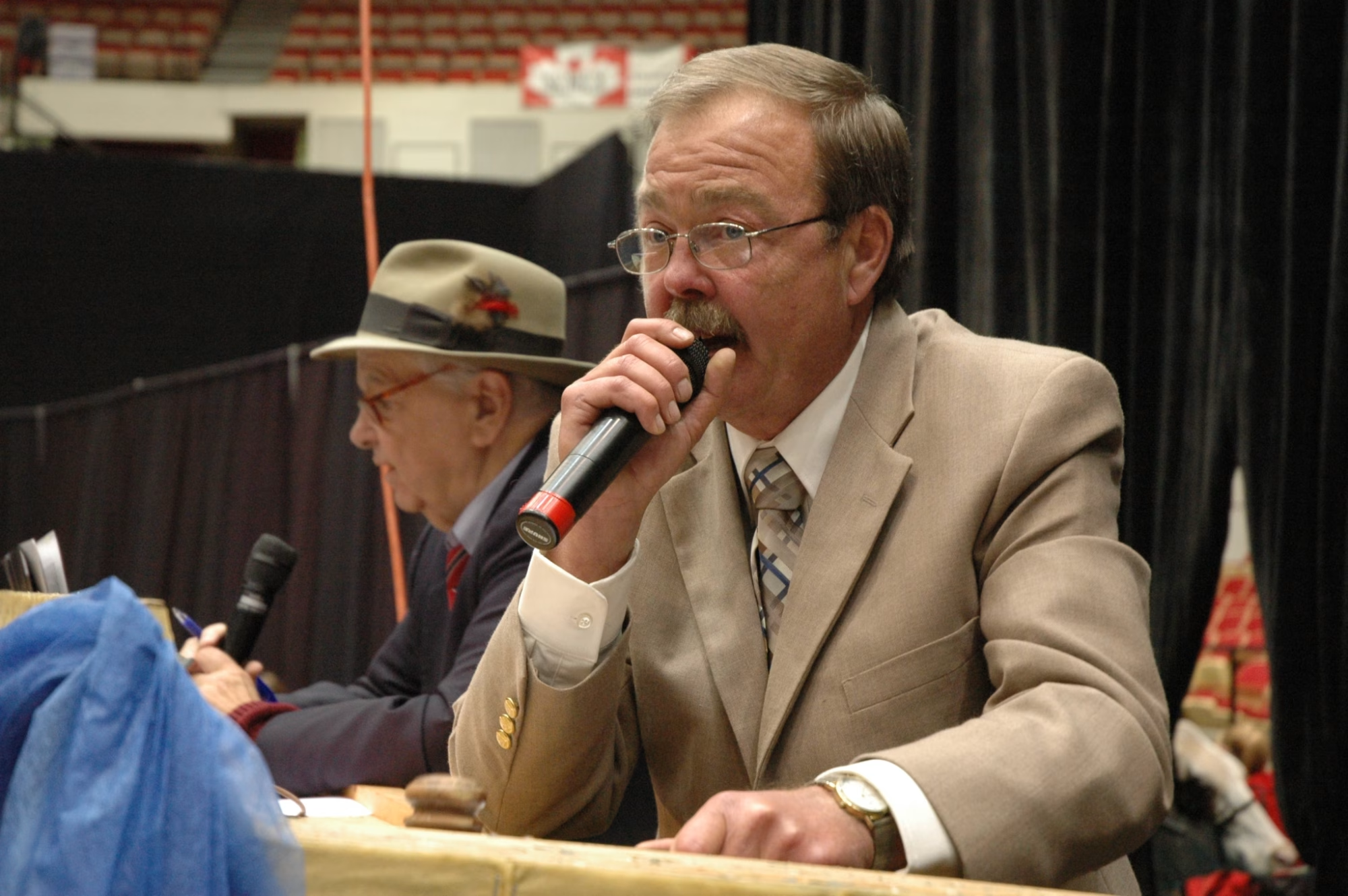
At 6:00 p.m. on Wednesday, September 30, the gavel falls in The Tanbark for the 37th and final time under the management of Tom and Sandy Morris.
Seventy-two years earlier, a red ribbon was hung at Deronda Farm near Amery, Wisconsin—won by a 2-year-old Holstein from Arden and Maldwyn Morris’s Arwyn Farms at the 1954 Royal Agricultural Winter Fair. Today, World Dairy Expo’s official sale directory lists the manager of the World Classic ’26 Holstein Sale as Tom Morris Ltd. (Read our feature interview – A Lifetime in the Ring: Tom Morris and the Evolution of a Dairy Dynasty)
Between that Royal ribbon and Wednesday night’s finale sits the longest continuous act of price discovery in the North American registered dairy business—built, calculated, and executed every step of the way by Tom and Sandy together. The Bullvine combed through World Dairy Expo’s archives to reconstruct that legacy in full.
What we found: 21 documented World Classic sales between 1999 and 2024 moved $24.1 million across 955 lots.That is a Bullvine calculation from Expo’s own published summaries, marking the first time these numbers have been audited and totaled in one place.
The Arithmetic Nobody Ran
Start with the figure leading every tribute this month: thirty-eight years.
It is accurate chronologically, but it does not represent the sale count. Tom and Sandy took the reins of the World Classic in 1989. When World Dairy Expo canceled the 2020 show, the calendar and the gavel drifted apart by a year.
Run the timeline forward from that inaugural 1989 auction: Wednesday night marks the 37th World Classic in 38 years.
That distinction matters to anyone who has consigned or bid there. A sale manager’s record is their ledger, and the industry has spent a decade casually rounding off the Morrises’ numbers. Over their joint career, Tom and Sandy have orchestrated more than 500 sales, including nine National Holstein Convention Sales.
Tom’s own perspective cuts through the estimates. “I wish I had a tally of the number of animals I’ve sold, or the total gross,” he told Dairy Star. “It would be mind-boggling.”
What 21 Sales Actually Show
Lot counts marked with an asterisk are calculated from the reported gross divided by the published average where Expo’s archived summaries omitted the lot tally.
| Year | Gross | Lots | Reported Average | Top Lot |
| 1999 | $340,000 | 47* | $7,234 | $17,400 — Nosawa & Co., Japan |
| 2000 | $392,600 | 45 | $8,724 | $82,000 — C Laduc Broker Mandy clone |
| 2002 | $421,900 | 36* | $11,719 | $42,000 — choice of Tri-Day Ashlyn-ET |
| 2004 | $588,800 | 40 | $14,720 | $50,000 — Rosedale-L SS Rose-Red-ET |
| 2005 | $619,400 | 42* | $14,748 | $51,000 — Budjon-JK Champ Elianna-ET |
| 2006 | $725,500 | 41 | $17,695 | $135,000 — Rosedale Adventageous-Red-ET, England |
| 2007 | $781,300 | 38 | $20,561 | $85,000 — Budjon Redmarker Desire RC |
| 2009 | $832,200 | 42 | $19,814 | $95,000 — Harvue Roy Frosty choice, Mexico |
| 2010 | $835,300 | 44 | $19,666 | $87,000 — RMW Super Anane-ET |
| 2011 | $1,173,700 | 43 | $27,295 | $82,000 — Lookout Pesce Magna P Sarah-Red |
| 2012 | $1,490,000 | 45 | $33,111 | $122,000 — Elm-Park Geisha PP-Red-ET, UK |
| 2013 | $1,264,600 | 48 | $26,262 | $131,000 — Oconnors Aikman Scarlet-Red, Ontario |
| 2014 | $1,208,200 | 52 | $23,234 | $74,000 — De-Sue 1912-ET |
| 2015 | $1,304,600 | 47 | $27,757 | $117,000 |
| 2016 | $1,364,100 | 44 | $31,002 | $270,000 |
| 2018 | $1,748,300 | 50 | $34,966 | $205,000 — Lexvold Rolan Anne-ET, BC |
| 2019 | $1,330,750 | 47 | $28,314 | $145,000 |
| 2020 | — | — | Expo canceled | — |
| 2021 | $2,168,200 | 49 | $44,249 | $220,000 |
| 2022 | $2,086,750 | 53 | $39,373 | $170,000 — JX FB Verstappen {6}-ET |
| 2023 | $1,760,800 | 47 | $37,464 | $170,000 |
| 2024 | $1,663,475** | 55 | $30,245 | $205,000 — OCD Sheepster 23614 IVF, Semex |
*Estimated lot count based on published average and gross.
2024 gross implied from 55 lots at the published $30,245 average.
Note: 2001, 2003, 2008, 2017, and 2025 are excluded due to incomplete or unverified official World Dairy Expo settlement records.
The Book Barely Grew. The Money Tripled.
This is the reality pedigree breeders must digest:
- 1999–2009 (8 documented sales): Average gross of $587,712, average 41.4 lots, mean average price of $14,402.
- 2021–2023 (3 documented sales): Average gross of $2,005,250, average 49.7 lots, mean average price of $40,362.
Over two decades, the catalog grew by barely eight head, yet the gross multiplied 3.4 times and the sale average climbed 2.8 times.
That increase did not come from bloat. It came from demanding that the same tight, curated lineup carry an exponentially higher density of genetic capital—the hallmark of an elite auction functioning at its peak.
The mechanics behind that growth were deliberate: “a limited offering of the world’s most sought-after genetics,” as Tom noted, staged with the lighting, pacing, and presence of a premier entertainment event. Scarcity, presentation, and timing converged on a week when every decision-maker in dairy breeding was already in Madison.
Tom’s public benchmark—that the World Classic exceeded $1 million fourteen times and cracked $2 million three times—matches the historical record. Our data independently verifies 12 of those million-dollar nights and two $2-million benchmarks, with the unrecovered 2017 and 2025 catalogues accounting for the variance. Notably, the 2021 renewal—49 lots, $2,168,200 gross, and a $44,249 average—remains the highest-grossing sale ever held on the grounds of World Dairy Expo.
Leaving the Coliseum Floor
The historical progression of the auction venues tells its own story.
Accounting for the uninterrupted run since 1989 alongside the 2020 cancellation, 2022 marked the 33rd and final World Classic staged under the iconic roof of the Veterans Memorial Coliseum. In 2023, the event transitioned to The Tanbark.
The change in setting closed a distinct chapter in show-ring culture. “We used to have a huge crowd on the Coliseum floor,” Tom told Dairy Star. “It was the big event and every Holstein enthusiast in the world was there.”
Anyone who sat shoulder-to-shoulder on those concrete steps during the 1990s understands the gravity of that setting. It was a tangible, electric atmosphere where every bid echoed across the show arena.
First Through the Ring
Those who view the World Classic purely as a showcase for exhibition cows misjudge its historical function. It served as a proving ground for commercial and genetic innovations:
- Contract flushes and early frozen embryo packages before they became industry standards.
- The first cloned dairy animal ever sold at a public livestock auction.
- Consolidated consignments featuring elite breeders from five European nations on a single night.
- Live calves imported directly from Europe, including two German heifers that completed a mandatory summer-long quarantine off the Atlantic coast before stepping into the sale ring.
That agility is why the sale mastered the genomic shift rather than being sidelined by it. By 2024, the marquee lot was an IVF session on OCD Sheepster 23614—then the breed’s top GTPI female—commanding $205,000 from Semex.
An auction outfit that began selling conventional milking cows in the 1970s evolved to market high-indexing donor flush contracts to international AI studs. That degree of commercial range is unmatched in modern pedigree sales.
The Physical Toll
Tributes frequently focus on the gavel and skip the mileage. The Morrises never romanticized the labor.
“In the old days, some weeks there were seven sales, or nine sales in 10 days in four states,” Tom recalled. “You’re sleeping in the back of the car or taking a red-eye out of Seattle to get back to Rockford to sell the next morning.”
The road to the World Classic was paved with landmark events: the 1984 Southfork Sale in Plano, Texas—hosted by Price’s Dairies, grossing $13 million with Charley Pride entertaining the crowd—and the 1988 Satellite Adventure Sale in Orlando, linking regional bidding rooms across three time zones via live feed a full decade ahead of the consumer web.
Underneath the technical logistics was an unwavering baseline of professional accountability: “When a family entrusts their lifetime of work and their retirement to your hands, you have got to be on your A game, as there are no do-overs.”
Why Sandy’s Name Belongs on the Marquee
Since marrying in 1975, Tom and Sandy built three pillar organizations side-by-side: Deronda Farm, Tom Morris Ltd., and The Cattle Connection.
Deronda bred or developed more than 200 Excellent cows, and its three complete dispersals across the 1980s each finished as the highest-averaging herd dispersal in the nation for its respective year.
The Cattle Connection became the highest-circulation dairy breed sales publication in North America, serving breeders across the continent for more than three decades before its acquisition by Holstein International.
Tom has never hesitated to credit where credit is due: “There’s no question the best thing that ever happened to me is having Sandy as a partner, in every way and in everything that we have ever done, for over a half century.”
Their family roots run parallel with World Dairy Expo itself. Both the Morris and Mayer families consigned heifers to the inaugural 1967 donation sales that raised $21,156 across 78 head to capitalize the very first show.
The Morrises represent the unbroken line connecting those initial $200 foundation heifers to modern $2 million pedigree sales.
Looking to the future, the mandate is clear: “I believe it is time for the next generation to step up,” Tom noted regarding the transition. “Change is hard… to step back and let them do their thing.”
One More Card
For fifty consecutive summers, Tom has also volunteered his voice to call the junior livestock auction at the Polk County Fair—selling 4-H steer and heifer projects with the same commanding cadence heard at the World Classic.
He also helped establish World Dairy Expo’s Merle Howard Award, a fixture recognizing youth leadership that reached its 20th year in 2025.
At 6:00 p.m. Wednesday, the overhead lights will illuminate The Tanbark, and the sale will open one last time.
“Great cows come and go,” Tom once observed, “but it’s the great friendships that last a lifetime.”
The consignments passing through the ring on Wednesday will scatter to barns across the globe. But for the first time in 38 years, the enduring ledger of what Tom and Sandy Morris built stands documented in one place.
 The Sunday Read Dairy Professionals Don’t Skip.
 The Sunday Read Dairy Professionals Don’t Skip.
Every week, thousands of producers, breeders, and industry insiders open Bullvine Weekly for genetics insights, market shifts, and profit strategies they won’t find anywhere else. One email. Five minutes. Smarter decisions all week.