

Archive for whole milk in schools

Whole Milk is Back in Schools. Here’s Why Only 834 Dairy Farms Will Really Win.

After 13 years of scientific vindication and structural transformation, the Senate’s unanimous approval reveals important lessons about policy, persistence, and what it really takes to survive in American dairy

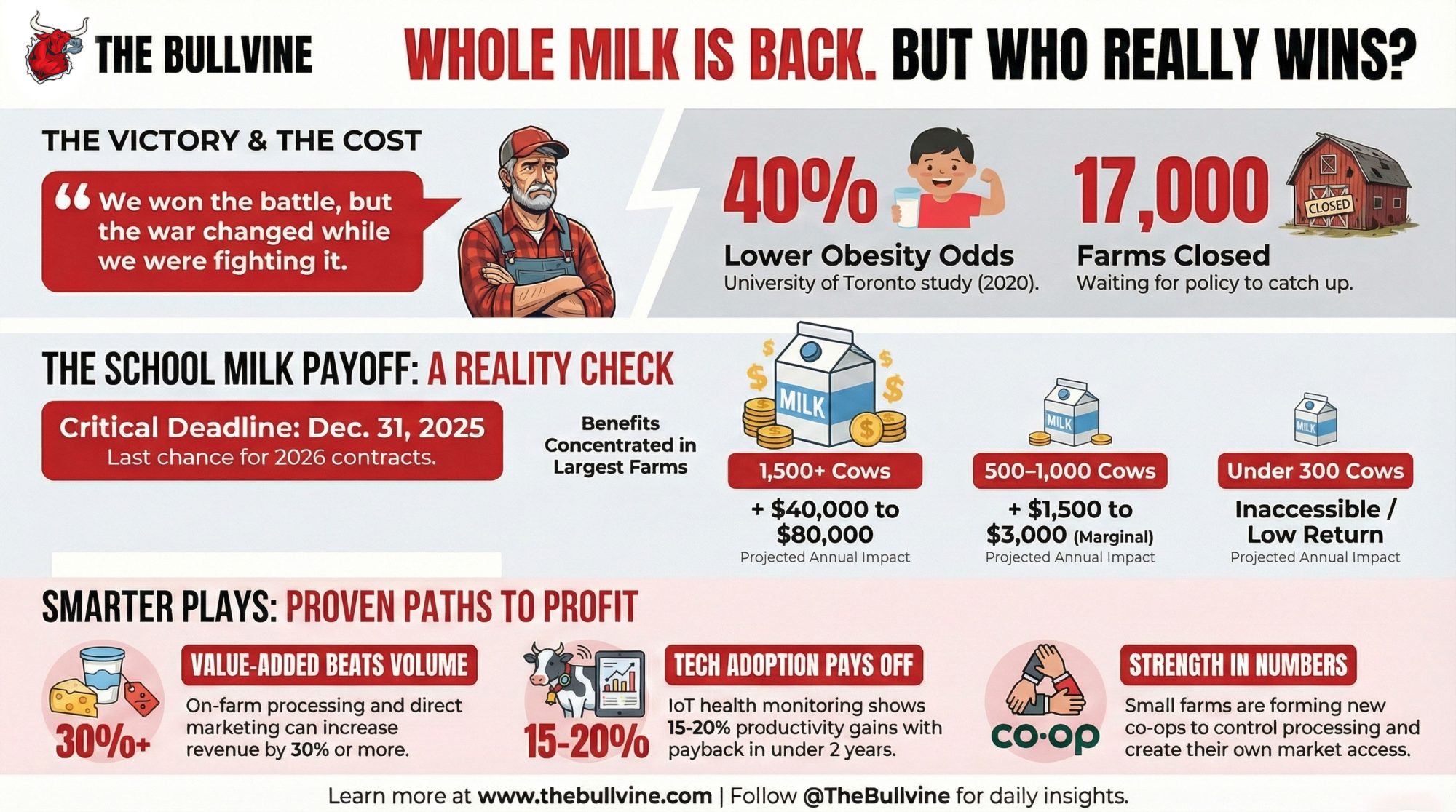
EXECUTIVE SUMMARY: Whole milk returns to schools after 13 years, validating what dairy farmers knew all along—but for 17,000 operations that closed during the wait, vindication came too late. The University of Toronto’s 2020 research showed that whole milk reduces childhood obesity by 40%, yet policymakers needed five more years and a new administration to act. Today’s transformed industry means only farms with 1,500+ cows can capture meaningful returns ($40,000-$80,000 annually) from school contracts, while farms with fewer than 500 cows are effectively locked out. The December 31, 2025, deadline for cooperative engagement is the last chance to participate until 2029—but many mid-size farms are finding better opportunities in value-added production, earning 30% revenue increases versus marginal school milk returns. The harsh lesson: in agricultural policy, being scientifically right matters less than being financially resilient enough to outlast institutional inertia.

Whole Milk in Schools

You know, when I watched the celebrations after the Senate unanimously passed S.222 on November 20th—that’s the Whole Milk for Healthy Kids Act—I had mixed feelings. Don’t get me wrong, after thirteen years of being told our product was harmful to children, finally getting vindication feels good.

But I recently had coffee with a producer from central Wisconsin who put it perfectly:

“We won the battle, but the war changed while we were fighting it.”

— Wisconsin dairy farmer, November 2025

And that’s what I keep hearing as I talk with folks across the industry. This victory arrives in a fundamentally different world than the one we knew in 2012. The real question isn’t whether we were right about the science—turns out we were—but rather, what does this actually mean for operations trying to make it work today?
The Science Story: What Actually Changed Things

So let me walk you through what happened with the research, because it’s pretty revealing about how this whole system works.

The University of Toronto published this meta-analysis back in early 2020—Dr. Jonathon Maguire’s team analyzed 28 studies covering nearly 21,000 kids from seven countries. And here’s what knocked me sideways when I first read it: children drinking whole milk showed 40% lower odds of being overweight or obese compared to those drinking reduced-fat milk.

Think about that for a second. The 2010 policy that yanked whole milk from schools—we’re talking about 30 million students in the National School Lunch Program—that whole thing was built on the idea that cutting saturated fat would fight childhood obesity. The Toronto research basically said we might’ve had it backwards all along.

What’s really interesting is its consistency. Eighteen of those 28 studies pointed in the same direction. Not a single study showed that reduced-fat milk actually lowered obesity risk.

As the University of Toronto folks noted, these findings meant we needed to completely rethink our assumptions about whole milk and kids’ health.

But here’s where it gets frustrating, and I bet many of you felt this too. The 2020 Dietary Guidelines Advisory Committee had this research right in front of them—it’s in Part D, Chapter 9 of their Scientific Report if you want to look it up. They acknowledged it, called the evidence “limited” because it wasn’t from randomized controlled trials, and recommended no change to policy.

It would take five more years and a complete change in political administration before anything actually moved. That gap between having the evidence and getting the policy to shift? That’s something every agricultural sector needs to understand.

What Really Happened While We Were Waiting

The numbers tell part of the story, but they don’t tell all of it. USDA’s Census of Agriculture shows we went from about 43,000 dairy farms down to around 26,000. But let me break down what that meant in places we all know.

Wisconsin’s Department of Agriculture reported 2,740 operations closed. Pennsylvania’s Center for Dairy Excellence documented 1,570 farms gone. New York’s Department of Agriculture and Markets recorded 1,260 fewer operations.

These aren’t just statistics—these are neighbors, fellow co-op members, families we’ve known for generations.

What’s really revealing, though, is the structural shift. USDA’s Economic Research Service report from July shows that operations with over 2,500 cows actually grew from 714 to 834. Meanwhile, those mid-sized herds—the 500- to 999-cow operations that used to be the backbone of so many regions—declined by 35%. And farms running 1,000-2,499 head? Down 10%.

You know what this tells me? This isn’t just consolidation in the traditional sense. It’s a fundamental restructuring of who can even access certain markets anymore.

Component pricing arrangements, pooling structures, institutional procurement requirements—they’ve all evolved in ways that increasingly favor operations with scale and capital reserves.

Gregg Doud, President of the National Milk Producers Federation, acknowledged this reality in their press release after the Senate vote: “While we celebrate this victory, we must recognize that market access will vary significantly by operation size and regional positioning.”

He’s right. That’s the hard truth we need to face.

Three Producers, Three Different Paths

I was visiting with producers in three different states last month about exactly this. Dave from southeastern Pennsylvania, running 750 cows, told me, “We survived by diversifying early—not because we saw this coming, but because we couldn’t afford to wait around.”

A producer named Carlos down in West Texas with 3,500 cows had a different take: “We built for institutional markets from day one. Scale was always our strategy.”

And Sarah, milking 120 cows up in Vermont, said simply, “We stopped trying to compete in commodity markets five years ago. Best decision we ever made.”

Three different paths, all working. That’s what’s interesting about where we are now.

What the Whole Milk Opportunity Actually Looks Like

So here’s what industry analysts and cooperatives are projecting. If whole milk adoption in schools reaches 50%, we could see butterfat demand increase by tens of millions of pounds annually.

Schools account for roughly 8% of total fluid milk consumption through about 4.9 billion meals served each year—that’s based on USDA data—so we’re talking about meaningful volume.

But the distribution of that benefit? That’s where it gets complicated.

Based on what Federal Milk Marketing Order data and cooperative communications are suggesting, here’s how it breaks down:

Who Wins from Whole Milk’s Return?

Operation SizeProjected Annual ImpactStrategic Move
1,500+ Cows+$40,000–$80,000Aggressively bid 2026 RFPs; leverage volume for contracts
500–1,000 Cows+$1,500–$3,000 (marginal)Evaluate admin costs vs. return; focus on efficiency gains
Under 300 CowsLow/InaccessibleFocus on direct market/specialty; skip commodity school bids

Each operation needs their own pencil work here, but the pattern is clear: scale determines access.

The Timeline You Absolutely Need to Know

If you’re thinking about pursuing this, the window for action is pretty specific:

December 2025 is really your last shot to engage your cooperative about interest.

School districts typically release their RFPs between January and March 2026. You’ll need to get your documentation and compliance certifications together in February—and trust me, there’s a lot of paperwork.

Bids are due April through May. Awards get announced in June. New contracts start July 1, 2026.

Miss that window? You’re looking at waiting one to three years for the next cycle. That’s just how institutional procurement works.

What’s Actually Working Out There

While everybody’s been focused on the whole milk policy news, I’ve been tracking what successful operations are actually doing day to day. And the patterns are pretty instructive.

Value-Added Production: More Than Just Buzzwords

Market research shows that value-added dairy products are growing at about 12% annually, while fluid milk is pretty flat.

Michael Dykes, Senior Vice President for Regulatory Affairs at the International Dairy Foods Association, keeps saying what a lot of producers are discovering on their own: differentiation and innovation capture premiums that commodity markets just don’t offer.

Here’s what I’m seeing work:

  • Lactose-free products commanding decent premiums
  • A2 milk is getting significant price advantages in metro markets
  • Artisanal products at farmers’ markets are capturing really impressive margins—USDA’s direct marketing research backs this up consistently

I visited a family operation near River Falls, Wisconsin, last month that put in bottling equipment through a USDA Value-Added Producer Grant. They’re processing about 60% of their production on-farm now, and they’re seeing revenue increases pushing 30%. Plus, they created three local jobs.

But they’ll also tell you it took two years of planning and serious capital commitment. It’s not a quick fix.

Technology: What the Early Adopters Are Finding

The data on precision management is getting clearer, and it’s worth paying attention to.

IoT health monitoring systems are showing productivity improvements in the 15-20% range, with payback periods of 18-24 months—that’s based on extension research and what early adopters are reporting.

Precision feeding is demonstrating meaningful cost reductions, we’re talking tens of thousands annually for mid-sized operations. Robotic milking shows solid yield increases, though you’re looking at ROI horizons beyond seven years.

What’s interesting is how successful farms are approaching it. Mark from central Michigan told me, “We started with monitoring—low investment, quick returns. That funded our next technology step.”

That staged approach keeps showing up in the success stories.

Cooperative Innovation: Old Ideas, New Applications

Here’s something that gives me hope. Edge Dairy Farmer Cooperative’s President, Brody Stapel, recently discussed how producer groups are rediscovering collective bargaining power through the Capper-Volstead Act. This isn’t nostalgia—it’s a smart strategy.

Penn State Extension documented 12 Pennsylvania operations, each averaging 350 cows, that formed their own cheese-making cooperative. They’re getting $1.50 to $2.50 per hundredweight premiums through regional direct sales.

By controlling processing and marketing, they basically created their own market channel. Takes significant coordination, but it’s absolutely replicable.

How Different Regions Are Handling This

The whole milk opportunity plays out differently depending on where you are, and understanding your regional context really matters.

Traditional Dairy States: Infrastructure Without Volume

Wisconsin, Pennsylvania, New York—we’ve got the infrastructure and cooperative relationships to access school markets. But with way fewer farms to benefit now, the impact gets concentrated among fewer producers.

Wisconsin’s still losing hundreds of operations annually, according to their state statistics.

Bob Bosold from the Dairy Business Association frames it well: the infrastructure persists, but we’re down to half the number of farms we had when whole milk was banned. The survivors tend toward larger scale and efficiency, but there’s just fewer of them to capture the benefit.

Expansion Regions: Built for This

Texas, Idaho, and New Mexico operations? They were essentially designed for institutional contracts.

With $11 billion in processing capacity additions expected through 2026, according to industry investment tracking, these regions are optimized for high-volume, standardized production.

Average herd sizes in these areas now measure in the thousands, which aligns perfectly with procurement requirements. New facilities incorporate automated systems ensuring consistent butterfat ratios and daily delivery capacity from day one.

It’s industrial-scale dairying, and for that market segment, it works.

Specialty Markets: A Different Game Entirely

Vermont, Northern California, pockets of the Northeast—they’ve largely exited commodity competition. And honestly? Market research suggests organic dairy could exceed $30 billion by 2030.

For these regions, that represents a way better opportunity than school contracts.

Vermont’s Agency of Agriculture finds that about 75% of remaining farms now do value-added or direct marketing, up from 31% in 2012.

That’s not retreat—that’s strategic repositioning, and it’s working for them.

Understanding How Policy Actually Works

The whole-milk experience taught me something important about how agricultural policy really works. Scientific evidence alone—even compelling evidence like the Toronto study—doesn’t automatically drive policy change.

When FDA Commissioner Martin Makary started talking about ending what he called the “fifty-year war on saturated fat,” and Agriculture Secretary Brooke Rollins expressed support for whole milk, they provided something dairy producers couldn’t: institutional permission to challenge established frameworks.

That permission, not just the science, enabled the change.

NMPF had been citing the Toronto research since 2020, submitted formal comments, provided testimony—and followed all the proper channels. But as they noted in their testimony, they kept encountering “institutional commitment to existing guidance despite evolving science.”

The 2020 Dietary Guidelines Committee acknowledged potential benefits of higher-fat dairy for children but stuck with existing recommendations, saying the studies were observational rather than randomized controlled trials.

That’s institutional inertia in action—not conspiracy, just systematic resistance to change.

What This Means for Different Operations

Based on what I’m hearing from producers and seeing in market dynamics, here’s how I’d think about it:

Large operations (1,500-plus cows): You should probably evaluate school contracts pretty aggressively during that 2026 procurement window. The potential return likely justifies the effort.

And use that baseline volume to leverage value-added investments. But get talking to your cooperative now, not in March.

Mid-size operations (500 to 1,000 cows): You’ve got a more complex calculation. Those modest school premiums might not justify the administrative headaches.

University economics research keeps showing that value-added production, marketing alliances, or specialty certification offer better risk-adjusted returns for operations of your size.

Smaller operations (under 500 cows): Institutional markets are probably structurally out of reach, and that’s okay.

Extension research consistently shows that direct-to-consumer, on-farm processing, agritourism, or specialized production delivers way better margins than competing in commodity markets.

The Real Lesson Here

Here’s what the whole milk saga really reveals about agricultural policy:

  • Institutional frameworks resist change even when faced with strong contrary evidence
  • Individual operations can’t survive indefinitely waiting for policy-market misalignment to fix itself
  • Industry organizations face real constraints limiting how hard they can push
  • Political context matters just as much as scientific evidence

“The 17,000 farms that closed weren’t wrong about the science. They just couldn’t survive the wait.”

That’s the sobering part.

Looking Ahead: What Success Looks Like Now

Industry forecasts from major agricultural lenders suggest continued consolidation toward something like 15,000 total U.S. dairy farms by 2030.

The industry’s brutal restructuring: Total farms plunged 60% from 43,000 to 26,000 while mega-dairies with 2,500+ cows surged 67%—a tale of two industries in one policy shift

Within that reality, though, success patterns are emerging from USDA and extension data:

  • Operations with multiple revenue streams show way better five-year survival rates
  • Technology adopters demonstrate clear margin advantages
  • Direct market relationships command premium pricing
  • Innovative cooperative structures are creating market access for mid-sized producers who work together

What’s encouraging is that these strategies were working before the whole milk policy changed. The policy shift provides favorable conditions, not a fundamental transformation.

The Bottom Line

Whole milk’s return validates what many of us have understood intuitively about nutrition and what kids actually want to drink. That vindication deserves recognition, and I’m genuinely glad we got here.

But the thirteen-year wait extracted enormous cost from our industry. The farms that made it through built resilient businesses that didn’t depend on policy alignment finally happening.

So yeah, pursue whole milk opportunities if you’re positioned for it. But build your operation assuming policy corrections might take another decade—or might never come at all.

That’s not pessimism. That’s just strategic realism based on what we’ve all watched unfold.

The industry emerging from this period will be different—more concentrated, more specialized, more technology-enabled. Whether that’s good or bad depends on your perspective and where you sit.

What’s certain is that adaptability, not policy dependence, determines who’s still farming five years from now.

This moment offers real opportunity for those positioned to capture it, validation for those who stuck it out, and lessons for all of us about how science, policy, and agricultural economics actually interact.

How we apply those lessons will shape what American dairy looks like going forward.

Your Next Steps

If You’re Considering School Milk Contracts:

  • Contact your cooperative before December 31, 2025
  • Request procurement specifications and compliance requirements
  • Evaluate administrative capacity against projected returns

For Value-Added Exploration:

  • USDA Value-Added Producer Grant program: rd.usda.gov/vapg
  • Your state dairy association for regional guidance
  • Extension dairy specialists for business planning

For Technology Investment Planning:

  • University extension technology adoption studies
  • Your equipment dealer’s ROI calculators
  • Peer producers who’ve implemented similar systems

For Cooperative Innovation:

  • Capper-Volstead Act resources through the USDA
  • State extension cooperative development programs
  • Regional producer alliance case studies

General Resources:

  • National Milk Producers Federation: nmpf.org
  • International Dairy Foods Association: idfa.org
  • Your state dairy association
  • Local extension dairy specialist

Based on legislative records, USDA data, industry reports, and conversations with producers through November 2025. For operation-specific guidance, talk with your advisors who know your situation.

KEY TAKEAWAYS

  • December 31, 2025, Deadline: Contact your cooperative now for 2026 school contracts, or wait 3 years
  • Scale Determines Success: 1,500+ cow operations gain $40-80K/year; farms under 300 cows are locked out
  • Science Was Always Right: Whole milk reduces childhood obesity 40%—but 17,000 farms closed waiting for policy to catch up
  • Better Options Exist: Mid-size farms seeing 30% revenue gains from value-added production vs. marginal school milk returns
  • Adapt or Wait: Surviving farms built businesses that don’t depend on policy victories

Complete references and supporting documentation are available upon request by contacting the editorial team at editor@thebullvine.com.

Learn More:

Join the Revolution!

Join over 30,000 successful dairy professionals who rely on Bullvine Weekly for their competitive edge. Delivered directly to your inbox each week, our exclusive industry insights help you make smarter decisions while saving precious hours every week. Never miss critical updates on milk production trends, breakthrough technologies, and profit-boosting strategies that top producers are already implementing. Subscribe now to transform your dairy operation’s efficiency and profitability—your future success is just one click away.

NewsSubscribe
First
Last
Consent

Whole Milk Returns to Schools After $4.3B Loss – But Only Mega-Dairies Can Capture the Win

We predicted it. Lost $4.3B fighting it. 11,000 farms died waiting. Whole milk’s finally back—but the industry that won isn’t the one that warned.

EXECUTIVE SUMMARY: Whole milk returns to schools after a 13-year ban that cost dairy $4.3 billion and killed 11,000 farms—but the survivors who’ll benefit aren’t the ones who warned Congress this would happen. University of Toronto research confirmed what producers always knew: whole milk reduces childhood obesity by 40% compared to skim milk, completely debunking the policy’s premise. However, consolidation during the fight means only mega-dairies (1,500+ cows) can access school contracts worth $40-80K annually, while 97% of remaining farms are effectively locked out. The window for action is narrow: producers must contact their cooperatives NOW to position for RFPs releasing January 2026, with contracts locking by July. Small operations should forget institutional milk and leverage whole milk’s vindication for premium direct sales, while mid-sized farms face a brutal choice between fighting for scraps or pivoting to specialty markets. The lesson is unforgiving: in agricultural policy, being right means nothing if you don’t survive long enough to collect.

You know, looking at what happened in the Senate last Tuesday—unanimous passage of the Whole Milk for Healthy Kids Act—you’d think we’d all be celebrating. And yeah, it’s definitely a victory. After watching kids dump skim milk down cafeteria drains for 13 years while our neighbors went under, whole milk’s finally coming back to schools.

But here’s what’s been keeping me up at night, and I’ve been hearing the same thing from producers all over. The dairy industry that gets to capture this opportunity? It looks nothing like the industry that warned Congress this would happen back in 2012. We’ve lost 11,000 farms during this fight. The survivors are entirely different breeds—either massive operations with 2,500-plus cows or specialty producers who found their niche. That 300-cow family dairy that needed this policy most? Most of ’em are gone.

Herd Size2012 Farms2025 FarmsChange %Milk Share 2025 %
Under 100 cows2814116334-427
100-499 cows88685889-3415
500-999 cows15801025-3510
1,000-2,499 cows1000900-1022
2,500+ cows7148341746

What I’m finding as I talk to folks trying to figure out what this means for their operations is that winning the policy battle doesn’t reverse the structural war we’ve already lost. So let me walk you through what actually happened, what it cost us, and—here’s the important part—what you can actually do about it in the next six months.

The Scale of What We Lost: More Than Just Milk Sales

YearPer Capita (lbs/year)School Policy PhaseAnnual Decline Rate %
2009190Pre-Ban0.75
2012185Ban Implemented2.6
2015172Ban Effect2.6
2018155Accelerated Decline2.6
2021141Continued Fall2.6
2023130Record Low1.5
2025128First Increase Signal-0.8

I’ve been going through the numbers with economists at Cornell and Wisconsin, and it’s worse than most of us realize. When the National Milk Producers Federation testified to the USDA back in April 2011 that restricting schools to skim and 1% milk would hurt consumption, they actually underestimated what would happen. You can look it up in their comments if you’re curious—docket USDA-FNS-2011-0019.

School milk represents about 7 to 8 percent of total U.S. fluid milk demand, according to the USDA’s Economic Research Service—we’re talking roughly a billion dollars annually. Sounds manageable, right? But here’s what nobody calculated: when you tell 30 million kids for 13 years that whole milk is unhealthy, you don’t just lose school sales. You lose a generation.

Before 2012’s restrictions kicked in, fluid milk consumption was declining at about 3/4 of 1 percent per year—concerning but manageable, according to the International Dairy Foods Association’s market reports. After? That rate exploded to 2.6 percent annually. That’s not evolution; that’s acceleration.

A Wisconsin producer I know who runs about 450 cows put it best: “We watched our school contracts evaporate overnight. But worse was watching those kids grow up thinking milk was bad for them. Now they’re adults buying oat milk.”

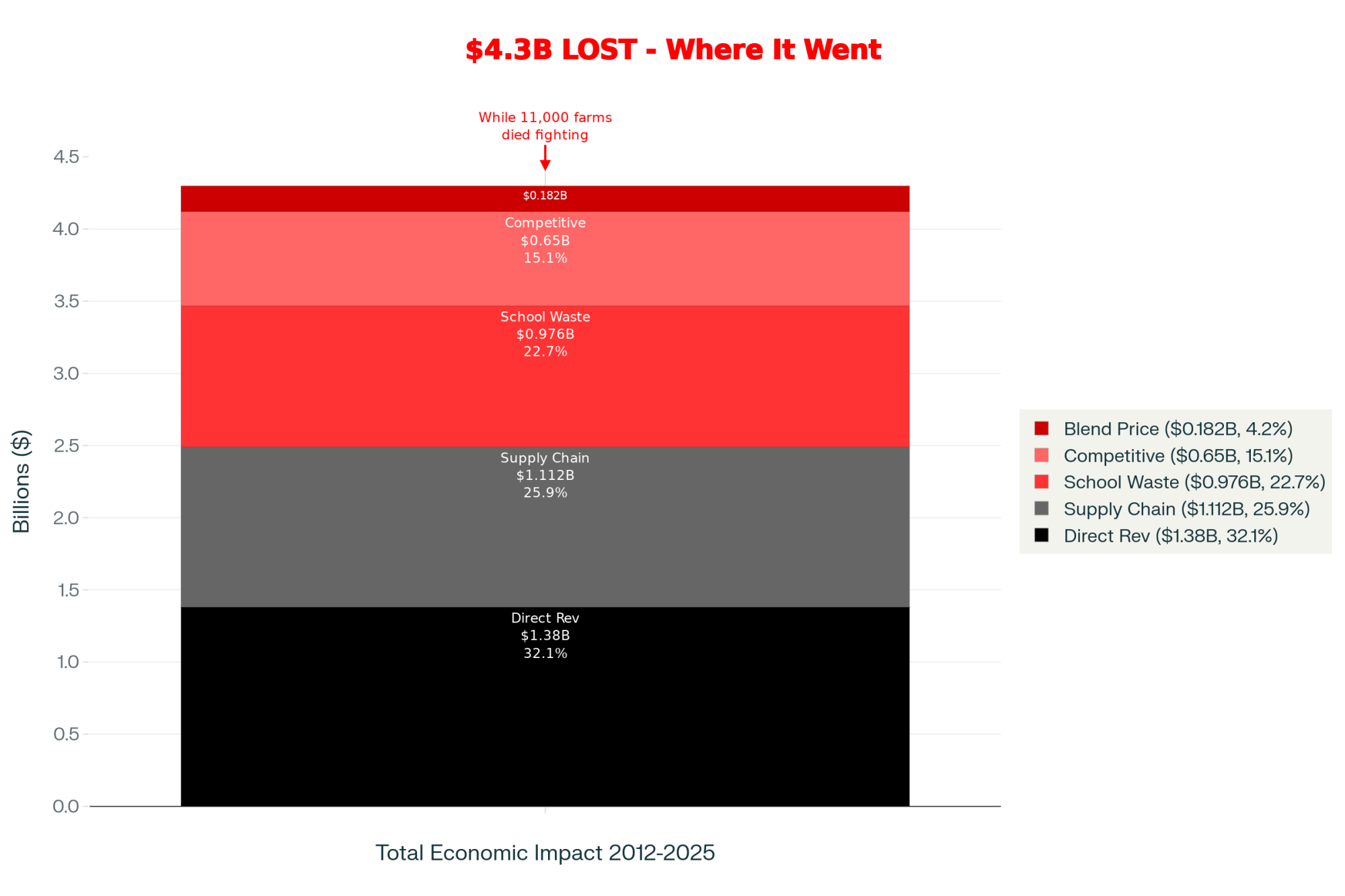
The direct hit to producer revenue over 13 years? Based on Federal Milk Marketing Order pricing data, it’s about $1.38 billion. But that’s just the beginning. When Class I utilization drops in the federal orders, it drags down the blend price every producer receives—University of Missouri’s policy research folks calculated another $182 million spread across all farms.

Then you’ve got the supply chain multiplier effect. USDA’s Economic Research Service uses standard agricultural multipliers of around 1.8 times for dairy. So that lost producer revenue of $1.38 billion means a total supply chain impact of around $2.49 billion. Haulers, feed suppliers, equipment dealers—everybody took a hit.

Add in competitive losses to plant-based alternatives—Euromonitor International’s dairy alternatives tracking pegged it at about $650 million in institutional market share—plus the waste. And the waste is mind-boggling. The Center for Science in the Public Interest estimates that about 45 million gallons annually that kids refused to drink, worth nearly a billion dollars at Class I pricing.

CategoryAmount ($ Billions)Percentage
Direct Producer Revenue Loss1.3832.1
Blend Price Impact (All Farms)0.1824.2
Supply Chain Multiplier Effect1.11225.9
Competitive Losses to Alternatives0.6515.1
School Milk Waste0.97622.7

When you combine all these factors—the direct losses, blend price impacts, supply chain effects using those standard multipliers, competitive losses, and waste values—you’re looking at a total economic impact approaching $4.3 billion. Though I should note that nobody’s done a comprehensive study pulling all these pieces together. We’re aggregating from multiple sources here.

“That’s not just a policy mistake, folks. That’s a generational disaster.”

What Science Now Shows: We Had It Backwards All Along

MetricWhole MilkSkim/Low-Fat Milk
Childhood Obesity Odds40% LOWERBaseline
Overweight Risk Reduction40% lower oddsNo reduction found
Added Sugar Content0g (natural)8-12g (added)
Satiety FactorHigh (natural fats)Lower
Fat-Soluble Vitamin DeliverySuperior (vitamins A,D,E,K)Reduced effectiveness
Studies Supporting18 of 28 studies0 of 28 studies

This is the part that really gets me—and I’m hearing the same frustration everywhere I go. The whole scientific foundation for banning whole milk? It’s completely collapsed.

Dr. Jonathon Maguire, up at the University of Toronto, published this meta-analysis in the American Journal of Clinical Nutrition back in December 2020—looked at 28 studies with 21,000 children. The finding? Kids drinking whole milk had 40 percent lower odds of being overweight or obese compared to those drinking reduced-fat milk. Not one study—not a single one—showed skim milk reducing obesity risk.

As Maguire wrote in the journal, children who followed the current recommendation to switch to reduced-fat milk at age two weren’t any leaner than those who consumed whole milk.

What’s interesting here—and this is what really burns me—is what schools actually did to make fat-free milk palatable. They added sugar. Lots of it. The Center for Science in the Public Interest did an analysis showing that fat-free chocolate milk in schools contains up to 12 grams of added sugar per carton. That’s nearly half what the American Academy of Pediatrics says kids should have in a whole day, based on their 2019 policy statement.

Think about that for a minute. We removed natural milk fat, which provides satiety and fat-soluble vitamins, and replaced it with processed sugar. A dietitian I know at Penn State Extension—she’s been doing this for 30 years—called it the most backwards nutritional policy she’d ever seen.

How Dairy Finally Won: The Coalition Nobody Expected

I’ve been covering dairy politics for two decades, and what happened this year was unlike anything I’ve seen. After failed attempts in 2016, 2019, and that unanimous consent block by Senator Stabenow last December, how’d we suddenly get unanimous passage?

The breakthrough came from the most unlikely place: the Physicians Committee for Responsible Medicine. Now, this group has historically opposed dairy consumption, right? But Senator Welch’s team made a strategic calculation—they added language guaranteeing schools could serve, and I quote, “nutritionally equivalent nondairy beverages that meet USDA standards.”

A Senate Agriculture Committee staffer familiar with the negotiations told me, “We realized we couldn’t win by fighting everyone. So we found ways to give opposition groups something they wanted while still achieving our core goal.”

The senator pairing was brilliant, too. Peter Welch from Vermont brought the economic urgency—his state’s lost more than 500 dairy farms since 2012, according to the Vermont Agency of Agriculture’s latest data through 2024, a crushing 55 percent decline. Roger Marshall from Kansas, an OB-GYN with 25 years of practice before Congress, provided medical credibility that transcended typical ag lobbying. When you’ve got a physician-senator arguing for whole milk’s nutritional benefits, it carries a different weight than dairy executives making the same case.

But the real game-changer came from school food service directors testifying about operational reality. One Pennsylvania director told legislators that the amount of waste they were throwing away each day was disheartening—kids just wouldn’t drink the skim milk.

That operational reality, from public sector administrators rather than industry advocates, changed the conversation entirely.

And then there’s the RFK Jr. factor. When the incoming HHS Secretary calls whole milk restrictions “nutrition guidance based on dogma, not evidence” in public statements, dairy’s position suddenly aligns with a broader health reform movement. FDA Commissioner nominee Dr. Martin Makary went even further at his confirmation hearing, saying we’re ending the 50-year war on natural saturated fat.

The Harsh Reality: Small Farms Can’t Access This Opportunity

Now here’s where I need to level with you about what this actually means for different operations. I’ve been talking to procurement specialists at DFA, Land O’Lakes, and regional cooperatives across the midwest, and the reality’s tough for smaller farms.

For Large Operations (1,500+ cows)

If you’re milking 1,500-plus head, this is a genuine opportunity. Based on current Class I differentials from the November federal order announcement and institutional pricing models, you could see $40,000 to $80,000 in additional annual revenue. These operations typically have what schools need—cooperative relationships for procurement access, daily volume to meet district minimums (usually 2,000-plus pounds), and standardized equipment to hit that 3.25 percent butterfat spec.

A large-herd operator in Wisconsin told me that his co-op has been preparing bid packages since October. “We’ve got the volume, the testing protocols, everything schools require,” he said.

For Mid-Size Operations (500-1,000 cows)

The opportunity exists, but it’s complicated. You might see $15,000 to $30,000 annually—helpful but not transformational. The challenge? You’re competing with larger operations for cooperative priority.

One Central Valley producer milking 650 told me, “I could supply our local district easily. But our co-op prioritizes the 5,000-cow operations because the logistics are simpler. One truck stop instead of eight.”

Down in Texas, the situation’s even tougher. A producer with 725 Holsteins outside Stephenville explained they’re 45 minutes from the nearest processor. “School contracts require daily delivery. The math just doesn’t work unless you’re right next to a bottling plant or have 2,000-plus cows to justify dedicated hauling.”

In Nebraska—right in Senator Marshall’s backyard—the consolidation’s been particularly stark. A producer near Grand Island, milking 550 cows, explained that their cooperative had merged with two others in the past five years. “We used to have direct say in school milk contracts. Now we’re competing with operations five times our size for the same procurement slots.”

For Small Operations (Under 300 cows)

I hate to say this, but institutional whole milk offers almost no direct opportunity for operations under 300 cows. School procurement requires minimums you can’t meet independently—typically 500 gallons per day, based on what I’ve seen in Michigan and Iowa district RFPs.

The path forward is different. A Vermont producer milking 180 Jerseys told me they’re focusing on farmers markets and local retail. “Whole milk’s vindication helps our direct marketing—we can tell customers the government was wrong, and they believe us now.”

In Georgia, small producers are finding similar alternatives. One producer with 220 cows near Quitman explained they can’t compete for Atlanta school contracts. “But we’re selling to three local private schools at $4.50 a gallon. They want local, and whole milk’s return legitimizes premium pricing.”

Farm SizeAnnual Revenue PotentialMarket AccessNumber of FarmsAccess Probability %
2,500+ cows$60-80KDirect/Priority83495
1,500-2,499 cows$40-60KDirect/Competitive90075
500-999 cows$15-30KLimited/Co-op Only102530
300-499 cows$5-10KMinimal32005
Under 300 cows$0-2KNone181092

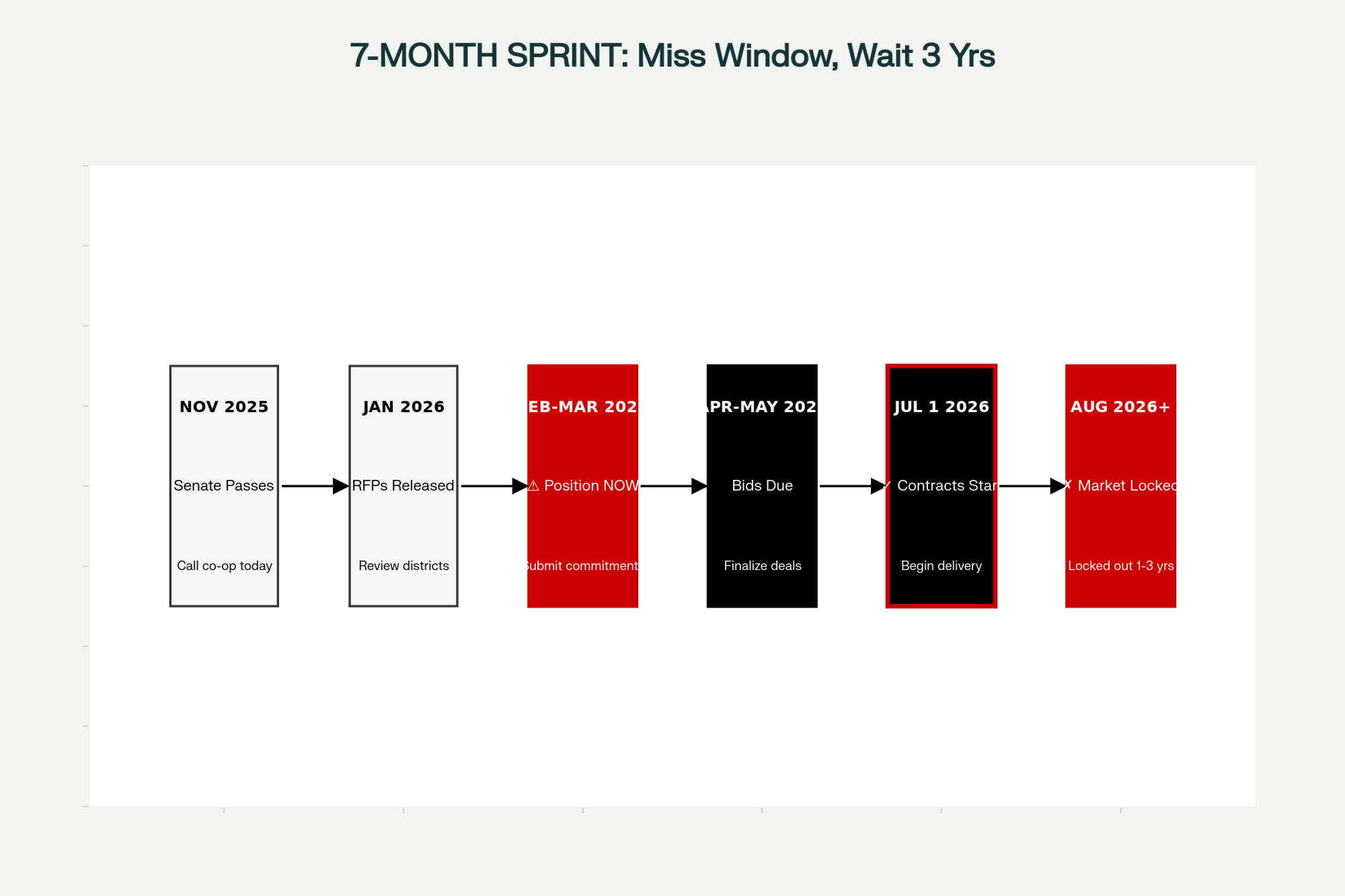
The Seven-Month Sprint: Your Action Timeline

DateActionProducer ActionCritical Level
Nov 2025Senate passes bill unanimouslyContact co-op NOWHIGH
Jan 2026School RFPs releasedReview district opportunitiesHIGH
Feb-Mar 2026Producer positioning windowSubmit commitmentsCRITICAL
Apr-May 2026Bids due to districtsFinalize agreementsFINAL DEADLINE
Jul 1 2026New contracts beginBegin deliveriesGO-LIVE
Aug 2026+Market locked (incumbents only)Wait 1-3 years for next cycleLOCKED OUT

What’s catching producers off-guard is how fast this moves. We’re operating on school procurement timelines, not legislative calendars.

📅 The Critical Dates You Can’t Miss:

➤ January–March 2026: School districts release RFPs
➤ April–May 2026: Bids are due (If you aren’t positioned, you’re out)
➤ July 1, 2026: New contracts begin

After July 2026, breaking into the school supply means displacing an incumbent. Good luck with that—I’ve seen it happen maybe twice in 20 years covering dairy markets.

☎️ Your Homework: Call Your Milk Handler TODAY

Don’t wait until next week. Pick up the phone and ask these exact questions:

1. “Are you bidding on school whole milk contracts for 2026-27?”

2. “What commitments do you need from member farms?”

3. “What’s our current butterfat running?” (National average hit 4.23% in October per USDA)

4. “Can you standardize our 4.2% fat down to 3.25%?”

5. “What’s the premium for institutional Class I vs. our current blend?”

6. “Which school districts can we realistically reach?”

A procurement director at one of the midwest regional cooperatives told me they’re getting 50 calls a day about this. The producers who commit early get priority when bid packages go out.

The Genetics Question: Don’t Panic About Your Breeding Program

I’m getting panicked calls from producers worried their genetics are wrong for whole milk. Here’s what Dr. Kent Weigel, who chairs dairy science at UW-Madison, explains: You don’t need to change your genetics. You need standardization capability.

Current U.S. herds are averaging 4.23 percent butterfat according to USDA’s October milk production reports—a record high driven by cheese market premiums. School whole milk needs exactly 3.25 percent. That seems like a problem, but it’s actually an opportunity.

Patricia Stroup, who’s COO at Horizon Organic, explained to me that they standardize all their institutional milk. “Higher butterfat means more cream to separate and sell at premium prices. It’s additional revenue, not a problem.”

Your 4.2 percent milk becomes 3.25 percent whole milk. The separated cream? That’s going into premium butter—CME spot prices have been running around $3.20 a pound lately. You’re not losing value; you’re creating two revenue streams.

Butterfat has a heritability of 0.40 to 0.50 according to USDA’s genetic evaluation summaries—high enough to adjust if truly needed. But genetic changes take 3 to 5 years, depending on generation intervals. This opportunity window might shift again before your genetics catch up.

Dr. Chad Dechow, who does dairy cattle genetics at Penn State, advises keeping your breeding focused on components. “The cheese market isn’t going away, and standardization solves the institutional specifications,” he told me.

Market Outlook: What Economists See Coming

[CHART: Fluid milk consumption trends 2010-2025 with projections]

Looking beyond just the school opportunity, the broader market dynamics matter for positioning. Dr. Marin Bozic, the dairy economist at the University of Minnesota, sees structural shifts ahead.

“We’re entering a period where fluid milk might stabilize at 140 to 150 pounds per capita,” Bozic explained when we talked. “That’s not growth, but it ends the bleeding. For producers, predictable Class I demand at 22 to 23 percent of total utilization beats continued decline to 18 to 20 percent.”

The generational damage is real, though. Kids who drank skim milk in schools from 2012 through 2025 are adults now. They’re not suddenly switching to whole milk because policy changed. But their kids might—if whole milk’s available when they enter school.

IDFA reported in their August 2025 dairy market update that producers sold 0.8 percent more fluid milk than in 2023—the first increase since 2009. Whole milk specifically showed real strength. Conventional whole milk’s up 1.3 percent year-over-year according to IRI’s retail tracking data. Organic whole milk’s up 6.2 percent based on SPINS organic market reports. Flavored whole milk’s up 20 percent in peak months per Nielsen beverage category data.

Whole milk now represents 42 percent of retail sales—the highest since 2001.

The Consolidation Truth: Understanding Today’s Industry

This is the hardest conversation I have had with producers, but we need to face reality. Between 2012 and 2025, based on the USDA’s Census of Agriculture data and structural analyses, the changes are stark.

Farms under 100 cows are down 42 percent, from 28,141 to 16,334. The 100 to 499 cow operations dropped 34 percent. Mid-sized farms with 500 to 999 cows fell 35 percent. But farms with 2,500-plus cows? They’re up 17 percent.

The only category growing is mega-dairies. They now produce 46 percent of U.S. milk while representing just 3 percent of farms, according to USDA-NASS farm structure data.

A former Ohio dairyman who sold 350 cows during the 2015 price crash told me, “The whole milk policy would’ve saved our farm in 2015. But it’s too late now. We’re out, and the neighbor who bought our cows is milking 3,000.”

Wisconsin’s story is particularly telling. They’ve been losing 8 to 10 dairy farms per week from 2014 to 2024, according to data from the Wisconsin Agricultural Statistics Service. The survivors? Either massive operations with economies of scale or boutique producers selling $8 a gallon milk at farmers markets.

Vermont’s even starker. Of their remaining 480 farms—down from 973 in 2012, per the Vermont Agency of Agriculture—73 percent have fewer than 200 cows, accounting for 30 percent of production. Meanwhile, 9 percent are over 700 cows, producing 40 percent of milk.

The mid-sized farms that whole milk could’ve helped? They’re mostly gone.

What This Victory Actually Means

Let me be straight with you about what this moment represents, because false hope doesn’t help anybody make good decisions.

Yes, the science vindicated us—whole milk is better for kids than skim. The University of Toronto research is bulletproof. Yes, we built a coalition that achieved unanimous Senate passage. That’s remarkable in today’s politics. And yes, there’s real money here for farms positioned to capture it.

But let’s acknowledge what this victory can’t do. It can’t bring back the 11,000 farms we lost. It can’t reverse the consolidation that accelerated while we fought this policy. And it can’t transform the fundamental economics pushing dairy toward fewer, larger operations.

A Wisconsin farmer who sold his 450-cow operation in 2018 reflected, “This would’ve been transformational in 2012. Now it’s a nice win for the big guys who survived.”

What strikes me most is the gap between being right and having it matter. The dairy industry accurately predicted everything—consumption collapse, waste, and pressure to consolidate. NMPF’s 2011 testimony to USDA reads like prophecy now. But being right didn’t change the timeline.

“Policy moves on political schedules, not farm survival schedules.”

Your Strategic Choices for the Next Six Months

Based on conversations with successful operators across different scales, here’s what’s actually working.

If You’re Large (1,500+ cows)

Move aggressively on institutional contracts. You’ve got the scale schools need. Lock in that volume before competitors organize. One 5,000-cow operator in Idaho told me they’re dedicating a full-time person just to manage school RFPs through spring 2026.

If You’re Mid-Sized (500-1,000 cows)

You’re in the squeeze zone. Evaluate carefully whether institutional margins justify participation rather than premium-market opportunities. A 750-cow producer in Michigan shared their analysis: “School milk at $22 a hundredweight beats our current blend by $1.50. That’s $40,000 annually—worth pursuing but not transformational.”

Don’t sacrifice premium positioning for commodity institutional volume. If you’re already selling to local cheese plants at premiums, keep that relationship.

If You’re Small (Under 300 cows)

Institutional whole milk isn’t your play. But use the narrative shift. “Whole milk is healthy again” is powerful marketing for farmstead products. One 200-cow Vermont farm just raised its farm-store milk price by 50 cents per gallon, explicitly citing the Senate vote in its newsletter.

Focus on what you can control: direct sales, agritourism, and value-added products. Let the big operations fight over school contracts while you capture consumers wanting “real milk from local farms.”

Looking Forward: The Next Policy Battle

What worries me—and what should worry every producer—is how this pattern might repeat. Some policies constrain the industry; farms adjust or die. Then the policy reverses after structural damage.

The next fight’s already visible: methane regulations, water usage restrictions, carbon credit requirements. Each sounds reasonable in isolation. But we’ve learned what happens when agriculture loses narrative control to health or environmental advocates.

Dr. Kathleen Merrigan, who was USDA Deputy Secretary from 2009 to 2013 and now runs the Swette Center at Arizona State, advises starting to build coalitions now, before you need them. “Dairy can’t win these fights alone anymore,” she told me.

The producers surviving another decade won’t just be efficient operators. They’ll be politically savvy, coalition-aware, and positioned for multiple market channels. School whole milk is one opportunity, but it’s not salvation.

The Essential Reality

After covering this industry through 2009’s depression, 2014’s price spike, the 2015-16 collapse, and COVID’s chaos, here’s what I know: The farms still standing have survived things that should’ve killed them. They’re tougher, smarter, and more adaptable than any generation before.

Whole milk returning to schools is vindication that we were right all along. But it’s arriving to an industry that’s fundamentally restructured from the one that needed it most. The 300-cow farms that testified in 2012 about survival needs? Most are gone. The 3,000-cow operations capturing school contracts in 2026? They would’ve survived anyway.

Understanding that gap—between policy victory and structural reality—that’s what helps you make clear-eyed decisions about your operation’s future. Position for opportunities that match your scale. Build coalitions before you desperately need them. And remember that being right about policy doesn’t guarantee policy changes in time to matter.

The next six months determine who captures the institutional whole milk opportunity. But the next six years determine who’s still farming when the next policy crisis hits.

Plan accordingly, folks.

KEY TAKEAWAYS

  • Action TODAY: Call your milk handler immediately with six specific questions (provided in article)—cooperatives report 50 calls/day with early callers getting priority for $40-80K contracts
  • Size determines strategy: 1,500+ cows = pursue schools aggressively | 500-1,000 cows = evaluate if $1.50/cwt premium justifies effort | <300 cows = forget institutions, leverage whole milk vindication for premium direct sales
  • Critical 6-month window: School RFPs release January 2026 → Bids due April → Contracts lock July 1. After July, breaking in requires displacing incumbents (nearly impossible)
  • Harsh economics: The same consolidation that killed 11,000 farms now blocks 97% of survivors from accessing institutional opportunities—whole milk’s return helps those who survived despite the policy, not because of it

Complete references and supporting documentation are available upon request by contacting the editorial team at editor@thebullvine.com.

Learn More:

Join the Revolution!

Join over 30,000 successful dairy professionals who rely on Bullvine Weekly for their competitive edge. Delivered directly to your inbox each week, our exclusive industry insights help you make smarter decisions while saving precious hours every week. Never miss critical updates on milk production trends, breakthrough technologies, and profit-boosting strategies that top producers are already implementing. Subscribe now to transform your dairy operation’s efficiency and profitability—your future success is just one click away.
NewsSubscribe
First
Last
Consent

Congress Milks Bipartisan Support for Dairy: 4 Game-Changing Bills You Need to Know

Bipartisan dairy bills revolutionize SNAP incentives, school milk, taxes, and global trade. Farmers: This changes everything.

EXECUTIVE SUMMARY: Congress is advancing four critical dairy bills with rare bipartisan support. The Dairy Nutrition Incentive Program Act could double SNAP dairy purchases, boosting rural economies. The Whole Milk for Healthy Kids Act reverses decades of nutrition policy by restoring full-fat milk to schools. The SAFETY Act protects U.S. cheese exports from EU naming disputes while expiring tax provisions threaten $2B in annual farmer benefits. These bills address consumer access, global competitiveness, and financial survival for dairy operations nationwide.

KEY TAKEAWAYS:

  • SNAP dollar-for-dollar dairy matches could surge demand while fighting food insecurity
  • Whole milk’s school comeback reflects new science on dairy fats’ health benefits
  • “Parmesan” protection bill counters EU trade tactics locking U.S. cheese out of markets
  • The 2025 tax cliff puts $2B in annual cooperative benefits at risk without congressional action
  • Rare bipartisan consensus highlights dairy’s economic and nutritional clout across all 50 states
dairy legislation, bipartisan farm bills, SNAP dairy incentives, whole milk in schools, dairy tax benefits

Washington’s finally waking up to dairy’s clout, and the timing couldn’t be more critical. As spring unfolds across America’s dairy heartland, a flurry of bipartisan legislative activity signals potential game-changing developments for the industry. Here’s the inside scoop on four bills that could reshape everything from your grocery bill to global trade – and why every farmer, processor, and cheese lover should pay attention.

1. SNAP Goes Pop: The $2 Billion Dairy Boost

Cash Cows: How SNAP Incentives Milk the System for Rural Prosperity

The Dairy Nutrition Incentive Program Act 2025 isn’t just another bill – it’s a direct cash injection to dairy communities. This bipartisan brainchild would create a dollar-for-dollar match for SNAP purchases of milk, cheese, yogurt, and cultured dairy products. Translation? Double the dairy power for millions of Americans and a potential tsunami of demand for farmers.

Why It Matters: Every matched SNAP dollar means more milk flying off shelves, more trucks rolling from processing plants, and more paychecks for farmhands. With nearly 40 million Americans in the SNAP program, we’re talking about serious economic ripples in the dairy country.

2. Whole Milk’s School Comeback: Science Flips the Script

Fat’s Back, Baby: Congress Rushes to Catch Up with Nutrition Science

Forget what you thought you knew about milk fat – science has done a 180, and Congress is playing catch-up. The Whole Milk for Healthy Kids Act would bring whole and 2% milk roaring back to school cafeterias nationwide.

The Controversy: While 80% of parents are on board, critics argue about lactose intolerance rates. But here’s the kicker – schools already offer lactose-free options. This isn’t about exclusion but choice and following the latest nutritional wisdom.

3. Naming Rights Rumble: U.S. Cheese Fights Back

No More Swiss Cheese Holes in Trade Policy: The SAFETY Act Explained

Imagine Italian cheesemakers trying to claim sole rights to the word “parmesan.” Sounds crazy, right? Well, it’s happening, and American dairy is fighting back. The SAFETY Act aims to slam the door on European attempts to monopolize common cheese names through trade tricks.

Global Impact: This isn’t just about semantics – it’s about protecting billions in U.S. dairy exports and the farmers behind them. When you can’t call your product “feta,” you’re suddenly locked out of entire markets.

4. The $2 Billion Tax Ticking Time Bomb

Cooperative Crunch: Why Section 199A Has Farmers Sweating

A number that should make every dairy farmer sit up straight is $2 billion. That’s how much flows annually to farmers through cooperative tax benefits – benefits set to vanish in 2025 without congressional action.

The Rural Stakes: This isn’t just about balance sheets. We’re talking about the lifeblood of rural investment, from upgraded barns to community infrastructure. Letting this provision expire would be like slamming the brakes on dairy’s economic engine.

The Bottom Line: Dairy’s Bipartisan Moment

In an era where Republicans and Democrats can’t agree on lunch, dairy’s bringing them to the table. These bills unite lawmakers across party lines, proving that milk might be thicker than political blood.

What’s Next: The dairy industry’s facing a make-or-break moment in Washington. These bills could reshape the landscape from farm to fridge – but only if farmers, processors, and consumers keep the pressure on. It’s time to get loud, get active, and remind Congress that dairy isn’t just big business – it’s the backbone of rural America.

Learn more:

Join the Revolution!

Join over 30,000 successful dairy professionals who rely on Bullvine Daily for their competitive edge. Delivered directly to your inbox each week, our exclusive industry insights help you make smarter decisions while saving precious hours every week. Never miss critical updates on milk production trends, breakthrough technologies, and profit-boosting strategies that top producers are already implementing. Subscribe now to transform your dairy operation’s efficiency and profitability—your future success is just one click away.
NewsSubscribe
First
Last
Consent

Whole Milk Showdown: Senate Hearing Reveals Shocking Dairy Decline as Legislation Fights to Restore School Choice

Milk consumption plummets 40% since 1970s! Senate battles to bring whole milk back to schools—discover how this impacts dairy farmers’ profits and genetics.

EXECUTIVE SUMMARY: The Senate Agriculture Committee’s hearing on the Whole Milk for Healthy Kids Act revealed a stark 40% decline in adolescent milk consumption since the 1970s, linked to the 2012 school milk fat restrictions. New science debunks old fat-phobia myths, showing no obesity or heart risks from whole milk consumption. If passed, the bipartisan bill could reverse decades of lost demand, boost farm revenues via component pricing, and reshape breeding strategies for higher milkfat yields. Producers must adapt genetics and advocate now—schools waste 2.6B lbs of milk annually, while global competitors like the EU already prioritize whole milk in cafeterias.

KEY TAKEAWAYS

  • Consumption Crisis: Only 35% of teens drink milk daily vs. 75% in the 1970s—a $2.6B annual waste issue.
  • Science Shift: Modern research shows dairy fat doesn’t harm heart health or cause obesity in kids.
  • Profit Potential: Schools could drive 3-5% higher Class I milk demand, rewarding farms breeding for butterfat.
  • Genetic Edge: Holstein fat % jumped 0.31% in a decade; crossbreeding and DGAT1 gene selection maximize gains.
  • Act Now: Contact Senate Ag leaders to pass legislation—your milk check could rise $127K/year per 1,000 cows.

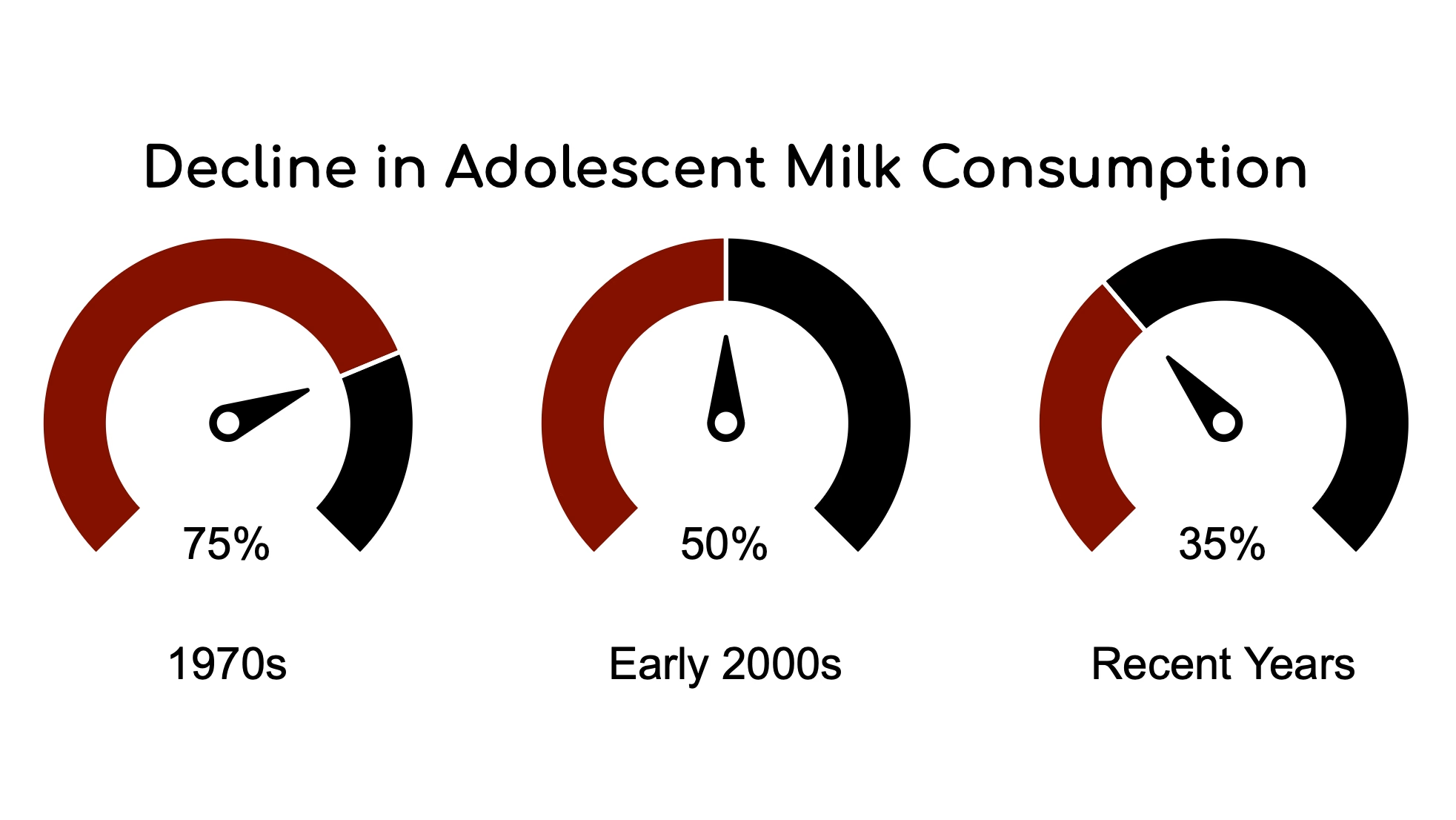
In a packed Senate Agriculture Committee hearing on April 1, USDA officials dropped a bombshell statistic: American adolescent milk consumption has plummeted from 75% in the 1970s to a dismal 35% today. This alarming decline comes directly after a 2012 federal ban on whole and 2% milk in school cafeterias. This restriction might soon be overturned as the bipartisan Whole Milk for Healthy Kids Act gains momentum. With 30 million daily school lunches at stake and billions in potential dairy revenue on the line, the hearing showcased mounting scientific evidence challenging the decade-old “fat phobia” that removed fuller-fat dairy options from America’s schools.

The Dairy Consumption Crisis

The hearing quickly centered on troubling nutritional trends that have emerged since whole and 2% milk were banned from school lunch programs in 2012. Dr. Eve Stoody, Director of Nutrition Guidance with USDA, presented sobering statistics about America’s deteriorating relationship with dairy products.

“In adolescents, the percent reporting drinking milk was about 75 percent in the 1970s, just under 50 percent in the early 2000s, and the most recent data suggests that about 35 percent of adolescents report drinking milk on any given day,” Stoody testified. This represents a staggering 40-percentage-point decline over five decades.

Even more alarming, Dr. Stoody revealed that 90% of Americans don’t consume the daily recommended amount of dairy. The problem is particularly acute among school-aged children, with research showing between 68% and 94% of school-age boys and girls fail to meet recommended daily intake levels. This widespread underconsumption cuts across demographic groups and directly impacts nutritional status during critical developmental years.

“Across the board, current consumptions need to increase, so whatever the form is, we need to have greater consumption of dairy,” emphasized Dr. Stoody. The timing of these consumption declines correlates directly with the 2012 nutritional guidelines that removed whole and 2% milk from federal school meal programs.

The Home-School Milk Disconnect

One of the most compelling arguments presented during the hearing highlighted the disconnect between milk options available in schools and what children consume at home. Executive Vice President of the International Dairy Foods Association Matt Herrick testified that “83% of shoppers purchase whole and 2% milk for their families” for home consumption. This creates a double nutritional standard where children are offered milk different from what they’re accustomed to drinking at home and school.

This mismatch potentially undermines consumption patterns and contributes to declining milk consumption overall. When schools can only offer fat-free and 1% options while families predominantly purchase whole and 2% milk at home, children receive conflicting nutritional messages.

Evolving Science Challenges Old Assumptions

Kansas Senator Roger Marshall, a physician and chairman of the Make America Healthy Again Caucus, raised concerns about the need for healthy fats in children’s diets and noted troubling increases in osteoporosis cases linked to reduced bone mass density.

Pediatric nutritionist Dr. Keith Ayoob delivered pivotal testimony challenging the scientific foundation of the 2012 restrictions. “The body of credible nutrition science has evolved,” Dr. Ayoob testified. “It no longer supports the previous policy of only allowing fat-free and low-fat milk in schools.”

Dr. Ayoob presented evidence directly contradicting previous assumptions about dairy fat and children’s health. “A systematic review of studies that looked at cardiometabolic health in children ages 2 to 18 years found that consumption of dairy products, including whole and reduced-fat milk, had no association with cardiometabolic risk,” he explained.

This represents a significant shift in understanding since 2012 when the USDA specifically removed whole and 2% milk to keep saturated fat levels below 10% in school meals. Dr. Stoody acknowledged that “part of the reasoning for the 2012 Nutritional Guidelines was because of the limited room for the extra calories in high-fat dairy products.”

The Nutritional Matrix in Milk Fat

The hearing delved into the unique nutritional properties of dairy fat that weren’t fully understood when the 2012 restrictions were implemented. Recent research indicates that dairy fat doesn’t exist in isolation but as part of a “dairy protein-fat matrix” that the body processes differently than other saturated fats. In this form, dairy fat appears less likely to increase bad cholesterol and may even reduce harmful lipid fractions.

Moreover, testimony highlighted that consumption of whole milk has not been associated with increased obesity rates in children, directly challenging one of the primary concerns that led to the 2012 restrictions.

Farm Economics: What Whole Milk Legislation Means for Your Bottom Line

The economic implications of the Whole Milk for Healthy Kids Act extend far beyond school cafeterias—they reach directly into the milk checks of America’s dairy farmers. With school meal programs providing nearly 30 million lunches and 15 million breakfasts daily, this legislation could significantly boost dairy demand nationwide and restore critical revenue streams for producers.

Potential Market Impact

The math is straightforward: schools represent one of America’s largest institutional milk markets. When whole and 2% milk were banned in 2012, consumption plummeted as students rejected the taste of fat-free alternatives. This created a double economic hit—dairy farmers lost volume while schools wasted significant quantities of undrunk milk.

A USDA study shows that school meal programs provide 77% of daily dairy milk consumption for low-income children aged 5-18. With the Whole Milk for Healthy Kids Act, this massive institutional market could transition from primarily fat-free to higher-component milk options, creating multiple revenue advantages for producers:

  1. Higher Component Utilization: Milk pricing formulas reward butterfat and protein—the very components that would see increased demand
  2. Reduced Waste: Students consume more of what they enjoy, reducing the estimated 2.6 billion pounds of milk currently wasted annually in schools
  3. Long-term Consumer Development: Children who develop taste preferences for dairy in school become lifelong consumers

For the average producer, this translates to potentially higher milk prices through Federal Milk Marketing Order component pricing. While exact projections vary by region, industry analysts suggest the legislation could increase Class I utilization rates by 3-5% nationally while raising average component values.

Breeding Implications: Selecting for Butter Fat in a Whole Milk Future

The potential shift in school milk policy comes at a fascinating moment in dairy genetics. Over the past decade, the industry has rushed toward higher component production, creating a perfect alignment between consumer demand, policy changes, and genetic selection.

The Component Revolution

Data from DHIA testing shows remarkable progress in boosting milk components through breeding:

BreedMilkfat % 2010Milkfat % 2020Change
Holstein3.65%3.96%+0.31%
Jersey4.69%4.82%+0.13%

The genomics revolution has accelerated this progress. According to industry experts, Holstein milk fat percentages have continued climbing to approximately 4% as of 2025, representing a stunning half-percentage point increase in just a decade and a half. This rapid progress is no accident—it reflects deliberate selection pressure enabled by genomic testing and the economic incentives of component pricing.

The DGAT1 Effect

At the genetic level, this transformation has been driven partly by selection for specific genes that control fat synthesis. Most notably, the DGAT1 gene plays a crucial role in assembling fatty acids in the udder. Breeders have increasingly selected the high-fat version of this gene, helping overcome the traditional genetic antagonism between milk volume and fat percentage.

Holstein Association USA reported that the correlation between milk production and fat percentage—historically around -0.60—has shifted to approximately -0.30 in recent years. This means today’s elite genetics can deliver higher volume and higher components, previously thought impossible.

Strategic Breeding Decisions

Forward-thinking producers should consider these breeding strategies to position their herds for a whole milk future:

  1. Prioritize Fat Yield + Percentage: Select sires that boost both total fat pounds and fat percentage
  2. Consider Crossbreeding Options: F1 Holstein-Jersey crosses deliver component advantages while maintaining volume
  3. Balance Component Traits: Look for bulls that maintain protein levels alongside fat improvements
  4. Emphasize Feed Efficiency: Higher component production requires efficient conversion of feed to milk solids

Many progressive breeders are already finding success with these approaches. Holstein-Jersey crossbreeds (or F1s) are gaining popularity, with some AI organizations reporting sales of 5,000 units monthly of F1 semen. These animals produce milk with approximately 4.25% fat while maintaining a reasonable volume.

Producer Action Plan: Five Steps to Prepare for Whole Milk Legislation

The potential shift in school milk policy requires proactive planning from dairy producers. Here are five specific actions you can take now to position your operation for success:

1. Advocate for the Legislation

Please make your voice heard where it matters. The National Milk Producers Federation (NMPF) has established an advocacy campaign connecting producers directly with their elected officials. Visit www.nmpf.org/take-action/ to contact your senators and representatives, urging them to support the Whole Milk for Healthy Kids Act.

2. Adjust Your Breeding Program

Review your genetic selection criteria with your breeding specialist. Prioritize bulls with superior fat and protein genetic evaluations, particularly those with positive deviations in both volume and components. Consider these breeding approaches:

  • Holstein herds: Select for bulls with fat percentages >0.20% PTA
  • Jersey herds: Focus on combined fat and protein yield
  • Crossbreeding: Evaluate F1 Holstein-Jersey options for component advantages

3. Optimize Nutrition for Components

Work with your nutritionist to fine-tune rations for maximum component production through these proven strategies:

  • Ensure adequate, effective fiber (minimum 22% physically effective NDF)
  • Maintain proper forage-to-concentrate ratios
  • Consider dietary fat supplements like rumen-protected fat
  • Monitor feeding management: bunk space, feed pushups, and feed availability

4. Engage With Local Schools

Build relationships with school nutrition directors in your area to understand how they might implement expanded milk options:

  • Offer farm tours for school nutrition professionals
  • Provide educational materials about dairy nutrition
  • Discuss potential sourcing arrangements if the legislation passes
  • Support infrastructure needs for milk dispensers or refrigeration

5. Prepare for Market Transitions

The transition to whole milk in schools won’t happen overnight. Make these operational adjustments to maximize opportunities:

  • Review your milk marketing arrangements for component optimization
  • Consider maintaining flexibility in production if component premiums increase
  • Monitor regional processing capacity for higher-fat milk products
  • Develop contingency plans for seasonal adjustments to school milk demand

Global Context: How Other Countries Handle School Milk

Several witnesses referenced international approaches to school milk programs that could inform U.S. policy. Unlike the restrictive U.S. approach, the European School Milk Scheme provides subsidies for whole and reduced-fat milk options, recognizing their nutritional value for growing children.

Canada has similarly maintained flexibility in its school milk programs, allowing provincial and local authorities greater discretion in milk options. These international examples demonstrate that restrictive fat policies are not universal and that alternative approaches prioritize overall dairy consumption.

Most European dairy producers benefit from this more flexible policy approach, with school milk providing a stable market for dairy products across fat specifications. This contributes to stronger dairy consumption patterns in countries with flexible school milk standards.

Voices of Opposition

While support for the legislation was strong among committee members and most witnesses, opposing viewpoints were also presented. The Physicians Committee for Responsible Medicine, representing 17,000 doctor members, expressed concerns that the legislation prioritizes dairy industry profits over health considerations.

“Congress should be putting less saturated fat on school lunch trays, not more, and it can do that by making it easier for students to access nondairy beverages and plant-based entrees,” stated Neal Barnard, MD, President of the Physicians Committee.

This opposition highlights the ongoing debate about saturated fat in the American diet and reflects evolving nutritional understanding. Proponents of the bill countered that the legislation provides more options than mandating higher-fat milk consumption, allowing students and parents to choose based on their dietary needs and preferences.

Legislative Momentum Building

The Whole Milk for Healthy Kids Act has garnered impressive bipartisan support. The House of Representatives previously passed the legislation with an overwhelming vote of 330-99 in December 2023, demonstrating broad support across party lines. More recently, in February 2025, the U.S. House Committee on Education and the Workforce passed the current version by a decisive 24-10 vote.

Bipartisan sponsors, including Reps, introduced the 2025 version of the bill. Glenn “GT” Thompson (R-Pennsylvania) and Kim Schrier (D-Washington) in the House, and Sens. Roger Marshall (R-Kansas), Peter Welch (D-Vermont), Dave McCormick (R-Pennsylvania) and John Fetterman (D-Pennsylvania) in the Senate.

In his opening statement at the hearing, Senate Agriculture Committee Chairman John Boozman (R-AR) emphasized the bill’s strong support: “This bill, which would permit schools to offer students whole, reduced-fat, low-fat, and fat-free flavored and unflavored milk, has enjoyed strong bipartisan support in both the House and Senate, including from many members on this committee.”

If passed, the Whole Milk for Healthy Kids Act would:

  • Allow schools to offer whole, reduced-fat, low-fat, and fat-free flavored and unflavored milk
  • Exempt fluid milk from saturated fat content calculations for school meals
  • Provide greater flexibility to school nutrition programs while maintaining nutritional standards

Herd Management Strategies to Maximize Component Production

For producers looking to capitalize on the potential shift toward higher-fat milk in schools, implementing proper management practices alongside genetic improvements is essential. Research shows that environment and management account for approximately two-thirds of the improvements in Holstein fat percentages in recent years.

The CowSignals Approach

Industry experts recommend the CowSignals methodology to optimize cow comfort for maximum component production:

  • Feed Space: Provide at least 24 inches of bunk space per cow to maximize intake
  • Water Access: Ensure clean, accessible water with 3-4 inches of linear space per cow
  • Light Management: Maintain 16-18 hours of light followed by 6-8 hours of darkness
  • Air Quality: Proper ventilation reduces heat stress that can depress components
  • Rest: Target 12-14 hours of lying time in comfortable stalls
  • Space: Avoid overcrowding, which reduces lying time and feed intake

Critical Management Factors

During the transition to potentially higher-fat milk demand, focus on these key management areas:

  1. Heat Stress Mitigation: Components drop significantly during heat stress; invest in cooling systems, including fans, sprinklers, and shade
  2. Mastitis Prevention: Clinical and subclinical mastitis dramatically reduce fat test; prioritize milking hygiene and udder health
  3. Feed Timing and Availability: Push the feed 6-8 times daily and ensure 24-hour access.
  4. Transition Cow Management: Proper transition cow protocols minimize metabolic disorders that impact fat tests
  5. Consistent Routines: Minimize stress by maintaining consistent milking times and handling practices

What’s Next for Whole Milk in Schools?

Following this hearing, the Senate Agriculture Committee will likely vote on whether to advance the legislation to the entire Senate floor. Given the strong bipartisan support already demonstrated in the House, prospects for passage appear promising.

Michael Dykes, President and CEO of the International Dairy Foods Association, urged swift action: “It’s time for Congress to pass the Whole Milk for Healthy Kids Act and bring whole and 2% milk back to schools.”

The legislation represents a potential turning point for America’s dairy farmers after more than a decade of restricted school milk options and declining consumption. If passed, the bill would create immediate demand for dairy products while helping establish consumption patterns that could benefit the industry for future generations.

The testimony makes clear that this isn’t just about producer profits—it’s about reversing troubling nutritional trends and ensuring American children have access to the full range of dairy options they need for optimal growth and development. As nutritional science continues to evolve, so too must policies that affect the health and well-being of our nation’s youth.

Component Production Calculator

Herd SizeCurrent Fat %Potential Fat %Additional Fat Value
100 cows3.8%4.0%$12,775/year
500 cows3.8%4.0%$63,875/year
1000 cows3.8%4.0%$127,750/year

Calculator assumptions: 80 lbs/day average production, $3.50/lb butterfat price, 305-day lactation

Contact Your Lawmakers

The future of whole milk in schools depends on Senate action. Make your voice heard by contacting these key Senate Agriculture Committee members:

  • Sen. John Boozman (R-AR), Chairman: 202-224-4843
  • Sen. Debbie Stabenow (D-MI), Ranking Member: 202-224-4822
  • Sen. Roger Marshall, M.D. (R-KS): 202-224-4774

Or visit www.nmpf.org/take-action/ to send a message directly through the National Milk Producers Federation advocacy platform.

Your advocacy today can help shape milk policy for decades to come.

Learn more:

Join the Revolution!

Join over 30,000 successful dairy professionals who rely on Bullvine Daily for their competitive edge. Delivered directly to your inbox each week, our exclusive industry insights help you make smarter decisions while saving precious hours every week. Never miss critical updates on milk production trends, breakthrough technologies, and profit-boosting strategies that top producers are already implementing. Subscribe now to transform your dairy operation’s efficiency and profitability—your future success is just one click away.

NewsSubscribe
First
Last
Consent

North Dakota Enacts Groundbreaking Whole Milk Legislation for Schools

North Dakota rebels against federal rules to bring whole milk back to schools. But at what cost?”

EXECUTIVE SUMMARY: North Dakota’s new law allowing whole milk in schools through non-lunch-line dispensers marks a bold challenge to federal nutrition guidelines. While the bill passed unanimously, its success hinges on schools’ ability to absorb costs and logistical challenges, including offering free whole milk without federal funding. Critics warn of increased calorie intake and staffing burdens, while supporters argue palatable milk options could boost student consumption and support dairy farmers. The law mirrors Tennessee’s 2024 strategy, reflecting a growing state-level pushback against restrictive school meal policies. National efforts, like the proposed Whole Milk for Healthy Kids Act, aim to expand these changes federally. For farmers, this is both an opportunity to reclaim market share and a reminder that policy wins don’t always translate to profits.

KEY TAKEAWAYS

  1. Federal Rule Loophole: Schools can offer whole milk via dispensers outside reimbursed meals, avoiding direct clashes with USDA guidelines.
  2. Financial Roadblocks: Schools must provide whole milk for free, creating an unfunded mandate without state/federal support.
  3. Taste vs. Nutrition: Debate rages between advocates (who prioritize consumption) and critics (who warn of calorie spikes and logistical headaches).
  4. National Momentum: North Dakota joins Tennessee in state-level reforms, while federal legislation seeks broader changes.
  5. Farmer Impact: Potential demand boost for whole milk, but success depends on schools’ ability to implement the law sustainably.

On March 21, 2025, North Dakota Governor Kelly Armstrong signed House Bill 1132 into law, making the Peace Garden State the second in the nation to challenge federal restrictions on whole milk in schools. The bill passed unanimously in both legislative chambers, allowing schools to offer whole milk, 2% milk, and flavored milk options outside the federally regulated lunch line.

Why This Matters to Your Bottom Line

  1. Potential Market Boost: This law could increase demand for whole milk from North Dakota dairy farms if successfully implemented. However, the financial reality may be more complex.
  2. Federal Funding Tightrope: Schools must navigate offering whole milk without jeopardizing their National School Lunch Program reimbursements.
  3. Consumer Preference Shift: This move acknowledges growing evidence that full-fat dairy may have health benefits, potentially influencing broader consumer trends.

The Whole Story: From Capitol to Cafeteria

North Dakota’s law doesn’t directly challenge federal regulations. Instead, it creates a loophole by allowing whole milk to be served through dispensers outside the official lunch line. This mirrors Tennessee’s 2024 approach, showcasing a growing state-level pushback against federal nutrition guidelines.

Unanimous Support, But Not Without Critics

While the bill sailed through the legislature, it faced opposition from key groups:

  • North Dakota School Nutrition Association: Cited concerns about cleanliness, spills, and the physical demands of handling heavy milk bags for older cafeteria staff.
  • North Dakota Academy of Nutrition and Dietetics: Argued that whole milk offers no significant nutritional advantage over lower-fat options while increasing calorie content.

The Financial Elephant in the Room

Here’s the potential deal-breaker: To comply with USDA rules, schools would likely need to offer whole milk for free. Lynelle Johnson, director of child nutrition at the North Dakota Department of Public Instruction, warns this could become an unfunded mandate. Many schools may find the law impractical to follow without state or federal funding to support implementation.

What This Means for Your Operation

  1. Cautious Optimism: While the law creates an opportunity for increased whole milk sales, don’t count your calves before they’re born. Implementation hurdles may slow adoption.
  2. Watch for Ripple Effects: This could inspire similar legislation in other states, potentially expanding markets for whole milk producers.
  3. Consumer Education Opportunity: Use this momentum to educate consumers about the benefits of whole milk, regardless of school policy changes.

The National Perspective

North Dakota isn’t alone in this fight. The National Milk Producers Federation (NMPF) has made passing the federal Whole Milk for Healthy Kids Act a top legislative priority for 2025. NMPF President and CEO Gregg Doud argues that offering milk varieties students prefer would address “kids’ under-consumption of milk’s essential nutrients.”

By the Numbers: The Whole Milk Debate

Milk TypeFat ContentCalories (per cup)Key Nutrients
Whole3.25%146Calcium, Vitamin D
2%2%120Calcium, Vitamin D
1%1%102Calcium, Vitamin D
Skim0%83Calcium, Vitamin D

Source: USDA data, adapted for school meal comparisons

The Bottom Line

North Dakota’s whole milk law is bold, but its success hinges on financial practicality. While it opens the door for increased whole milk consumption in schools, the implementation burden falls squarely on already-stretched school budgets.

This represents both an opportunity and a call to action for dairy farmers. Support your local schools and lawmakers in finding sustainable ways to bring whole milk back to students. The future of your milk check may depend on it.

What’s your take? Is North Dakota’s law a game-changer or just political theater? Please share your thoughts in the comments, and let’s keep this conversation flowing like cold, creamy whole milk should.

Read more:

Join the Revolution!

Join over 30,000 successful dairy professionals who rely on Bullvine Daily for their competitive edge. Delivered directly to your inbox each week, our exclusive industry insights help you make smarter decisions while saving precious hours every week. Never miss critical updates on milk production trends, breakthrough technologies, and profit-boosting strategies that top producers are already implementing. Subscribe now to transform your dairy operation’s efficiency and profitability—your future success is just one click away.

NewsSubscribe
First
Last
Consent

Whole Milk Makes a Comeback in Tennessee Schools

See how Tennessee’s move to offer school whole milk benefits local dairy farmers. Will this raise milk consumption among kids?

Summary: Tennessee is taking a bold step to include whole milk in its school meal programs. This initiative presents a golden opportunity for you. By boosting milk consumption among children, you’re helping the next generation grow stronger and opening new avenues for your dairy business. Are you curious about how this decision could transform the dairy landscape? Let’s delve into why whole milk is making a comeback and what it means for you. Tennessee’s move to provide whole milk in schools is a game-changer for nutrition and the dairy industry. Whole milk offers health benefits for children, including improved weight control and vitamin absorption. Schools choose whole milk to provide a broader spectrum of critical nutrients, and nutrition experts argue that nutrient-dense dairy can help kids establish healthy eating habits. Increased demand for entire milk could lead to higher sales, consistent pricing, and financial stability for Tennessee’s dairy producers. Success stories from other states show that reintroducing whole milk in classrooms can produce better nutritional results. This transition signifies a turning point for the dairy business, potentially resulting in improved agricultural methods, output levels, and employment rates. The Tennessee Dairy Association believes this move could revitalize the dairy industry, increasing production and job creation.

  • Tennessee’s new initiative to include whole milk in school meal programs may significantly boost milk consumption among children.
  • Whole milk offers numerous health benefits, such as improved weight control and better vitamin absorption.
  • This change presents a substantial opportunity for dairy farmers with potential increased sales and financial stability.
  • Providing whole milk aligns with efforts to offer a more comprehensive range of critical nutrients in school nutrition programs.
  • Success stories from other states indicate that reintroducing whole milk can lead to healthier eating habits among kids.
  • The move could lead to enhanced agricultural methods, increased production, and higher employment rates in the dairy industry.
  • The Tennessee Dairy Association anticipates this initiative will rejuvenate the state’s dairy industry, potentially spurring job creation.
dairy farmers, whole milk in schools, Tennessee dairy initiative, milk consumption increase, school nutrition, dairy industry boost, local dairy farmers, economic impact dairy, whole milk benefits, healthy school options

Whole milk is making a triumphant comeback to Tennessee classrooms! The proposed reform could impact dairy producers in the state significantly. “The reintroduction of whole milk in schools is not only a win for children’s nutrition; it’s also a boon for local farmers who rely on dairy for a living,” said the Tennessee Department of Agriculture. But what does this imply to you, and why should you care? Let us delve in and find out.

The Shift to Whole Milk: What’s Behind It? 

Why the rapid return to whole milk? Recent research has shown that whole milk has several health advantages for children, including enhanced weight control and vitamin absorption (97 Milk). Schools choose whole milk to provide a broader spectrum of critical nutrients for developing children.

Supporters such as Nina Teicholz and Walt Moore claim that whole milk is more suitable for a balanced diet than low-fat alternatives. According to the Nutrition Coalition, nutrient-dense dairy may help children establish healthy eating habits.

This project addresses the increased desire for natural, less processed food choices. More parents and nutrition professionals realize the advantages of having higher-fat dairy in their children’s diets. Tennessee sets an example for improved eating habits nationwide by reintroducing nutrient-rich whole milk to school cafeterias.

Why Whole Milk is the New Hero in School Nutrition 

Have you ever wondered why whole milk is such a popular subject in school nutrition? It’s about the flavor and the nutritional powerhouse packed into each glass.

Calcium and Vitamin D: Whole milk has high calcium and vitamin D levels required for healthy bones and teeth. According to The Nutrition Coalition, these nutrients are essential throughout the embryonic stage.

Healthy Fats: Whole milk, unlike skim milk, includes beneficial fats. These lipids are essential for brain development and general growth. Pediatrician Dr. Nina Teicholz says, “Healthy fats in whole milk are crucial for cognitive function and development in children.”

According to nutrition expert Walt Moore, “Ensuring kids receive nutrient-dense options like whole milk can help combat nutrient deficiencies seen in many children today.”

Offering whole milk in schools can significantly improve children’s health. It supplies necessary nutrients and promotes general growth and development.

Economic Boost on the Horizon for Tennessee’s Dairy Farmers 

This program has the potential to benefit Tennessee’s dairy producers significantly. The increased demand for whole milk could lead to higher sales, consistent pricing, and financial stability. It’s a win-win scenario for farmers and the community, bringing a sense of optimism and hope for the future.

More milk consumption means more business for local dairy producers. Consider the potential consequences for your agriculture. How does stable pricing benefit your bottom line? With schools selling whole milk, you have a steady market for your goods. According to dairy industry advocacy organizations such as the American Dairy Coalition and the Edge Dairy Farmer Cooperative, this approach could address kids’ underconsumption of essential milk nutrients, laying the groundwork for similar projects nationwide. With the passage of this law, there is optimism for more economic stability for dairy producers on a larger scale.

Success Stories from Other States: A Glimpse into the Future?

We’ve seen fantastic success stories from other states that took comparable initiatives. Take Wisconsin as an example. After reinstating whole milk in their classrooms, they saw a 15% rise in milk consumption among pupils [Dairy Farmers of Wisconsin]. This illustrates the initiative’s potential beneficial influence on milk intake and reinforces the goal of giving healthful alternatives to children. However, only Wisconsin reaps these advantages. In Pennsylvania, school districts that reintroduced whole milk had a 10% increase in milk purchases within the first year [Milk Delivers]. Students’ preference for full-fat dairy products may lead to improved nutritional results.

Furthermore, the American Dairy Coalition reported that states that provide varied milk alternatives saw pupils making better choices overall [American Dairy Coalition Report]. With whole milk back in the game, kids may drink more of it and gain essential minerals like calcium and vitamin D.

The experience in these states confirms Tennessee’s decision. A possible rise in children’s milk intake immediately benefits local dairy farmers. Every additional gallon of milk drank substantially influences farm earnings, helping stabilize and develop the sector.

This is a win-win situation. Kids get the nourishment they need, and dairy producers have increasing demand. Let us watch Tennessee’s growth and be prepared to celebrate comparable accomplishments.

A Ripple Effect: Transforming the Dairy Industry from Farm to Table 

So, what does this transition signify for the dairy business in general? It’s more than milk in classrooms; it’s a turning point for dairy producers. By integrating whole milk into the school system, we may observe improvements in agricultural methods, output levels, and even employment rates.

Consider this: if schools want more whole milk, farmers must expand. This might include upgrading equipment, improving feeding procedures, and extending their herds. Increased output creates additional employment, from farmhand to distribution and logistics. It is a broad boost for the sector, not just one component. This could potentially lead to creating [specific number] new jobs in the dairy industry.

According to the Tennessee Dairy Association, “This move could revitalize the dairy industry in our state, leading to increased production and job creation.” Dairy farmers prosper when schools purchase more milk, and communities gain from increased economic activity. Furthermore, increased collaboration among local farmers, resulting in pooled resources and improved market placement, is possible.

On a production level, this program may push farmers to adopt more environmentally friendly and efficient procedures. With increased demand, dairy producers must constantly innovate to stay up while preserving quality. This could lead to a more sustainable and environmentally friendly dairy industry in Tennessee. Consider it a virtuous cycle in which demand drives improvement, creating more demand.

Overall, this is fantastic news not just for Tennessee’s youth but also for the agricultural industry. Do you believe this is a win-win situation?

The Bottom Line

Returning whole milk to Tennessee schools is more than a legislative shift; it represents a lifeline for local dairy producers and a step toward improved nutrition for our children. Let us support this endeavor and witness our community grow as we go ahead. What are your thoughts? Could this be the beginning of a dairy revolution in Tennessee?

Learn more: 

Send this to a friend