Archive for US Dairy Industry

Shutdown Reality: Why Every Dairy Farmer Faces a $60,000 Decision in the Next 90 Days

While you’re checking frozen FSA payments, processors know exactly what your milk is worth. The game is rigged.

Executive Summary: A Wisconsin farmer told me: ‘I check my frozen FSA account every morning, but what keeps me up at night is the $20,000 in equity I’m burning monthly.’ He’s not alone—half of dairy farms have vanished since 2013, and this October shutdown exposed what processors already knew: most operations face impossible economics. But farmers who act within 90 days can still preserve 85-90% of their equity through three proven paths: scaling to 3,500+ cows ($4M required), transitioning to premium markets (3-7 year commitment), or strategic exit (the difference between keeping $700K versus losing everything). Every month you delay costs $20,000 in family wealth that you’ll never recover. The math is harsh but clear—the only wrong choice is no choice.

Dairy Farm Survival Strategies

You know, I was talking with a dairy farmer from Winnebago County last week—seventh generation, milking about 450 head—and he said something that stuck with me. “I’ve been checking my FSA account every morning for 28 days. Same result. Nothing.”

The government shutdown of October 2025 has frozen billions in farm payments, and that’s creating real stress during harvest season when cash flow matters most. But here’s what’s interesting… as I’ve been talking with producers across the Midwest, what we’re discovering goes way beyond payment delays.

After digging through recent market analyses and comparing notes with dairy economists, there’s a pattern emerging that—honestly—changes how we need to think about survival in this industry. And the farmers who are grasping this, really understanding what it means for their operations, they’re making some tough decisions right now. Decisions that’ll determine whether their families thrive or… well, whether they have to walk away with nothing in three years.

When the Math Just Doesn’t Work Anymore

So here’s a conversation I keep having. A producer in southern Wisconsin—runs about 650 cows, good operation—told me: “When the shutdown started, I was right in the middle of filing our production reports. Now? I’m flying blind on pricing while my milk buyer somehow knows exactly what to offer me.”

Sound familiar?

What many of us are realizing is that this shutdown has pulled back the curtain on something that’s been building for years. The cost structure in dairy… it just doesn’t pencil out for most operations anymore. And I mean most.

The USDA Census of Agriculture data tells a sobering story. We’ve lost about half our dairy farms since 2013. Half. That’s not gradual change—that’s acceleration. The historical attrition rate used to hover around 4% annually, based on USDA tracking. Industry analysts I’ve talked with are suggesting it could hit 7-9% over the next couple years. Do the math on that… we could be looking at maybe 12,000 operations by 2035. We’re at about 24,000 now, according to USDA’s latest count.
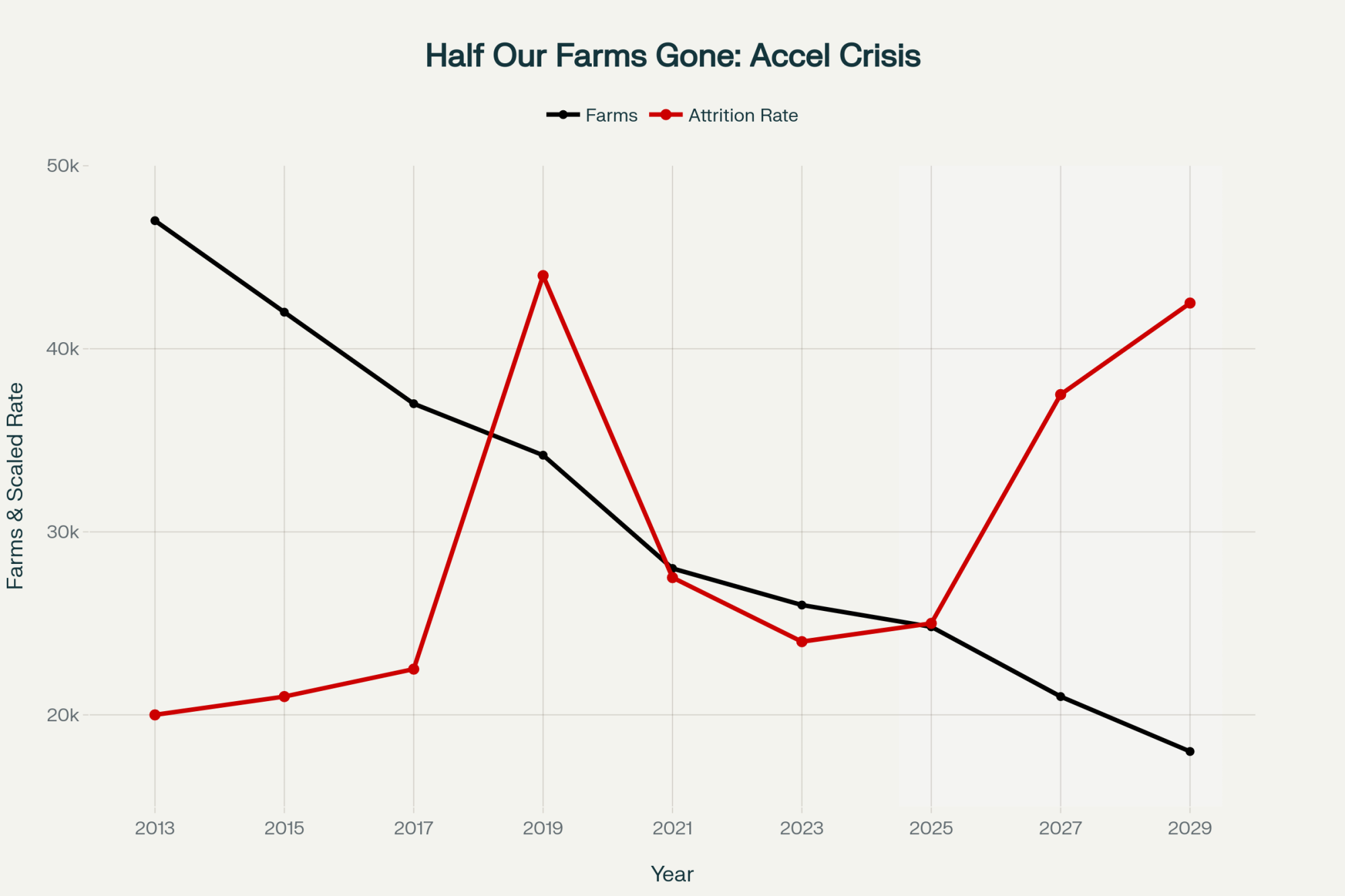
We’re not just losing farms at the historic 4% rate—we’re accelerating toward 7-9% annual losses. If you’re hanging on hoping it gets better, understand this: the industry is consolidating faster than ever, and your window to exit strategically is closing.

Mark Stephenson over at UW-Madison’s Center for Dairy Profitability, he’s been tracking these trends for years. What he and his team have documented is eye-opening. The cost gap between a 500-cow operation and one milking 3,500? It’s massive—we’re talking hundreds of thousands of dollars annually in structural disadvantage. You can optimize feed efficiency, maybe save 5%. But when the big operations are running three to four dollars per hundredweight lower in total costs? That’s not a gap you close with better management.
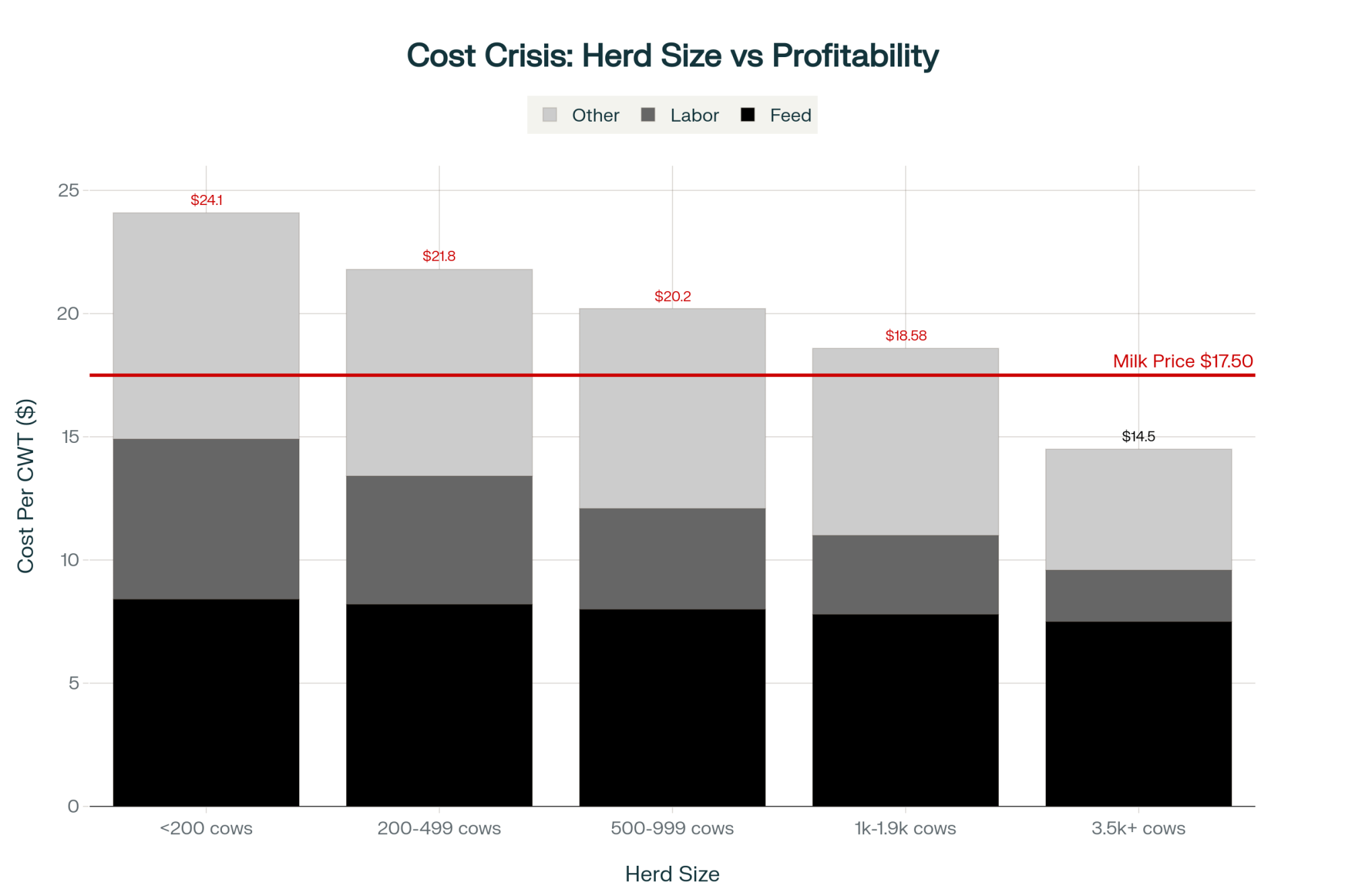
The cost gap that’s destroying family farms: small operations lose $6.60/cwt while large dairies profit $3/cwt. At 650 cows producing 80 lbs/day, that’s $34,320 monthly—enough to burn through your equity in 25 months.

“I dropped $180,000 on robotic milkers last year. Thought I was crazy at the time. But with agricultural labor costs running north of twenty bucks an hour—if you can even find people—that investment’s already cash-flowing positive.” — Dairy farmer, Eau Claire area, 1,100 cows

And here’s the thing he pointed out: feed costs are only about 35-40% of his total expenses now. It’s everything else that’s killing margins.

The Information Game During Shutdowns (And Why We’re Losing It)

What this shutdown has really exposed is something we haven’t wanted to acknowledge about modern dairy economics. While government data collection sits frozen, the processors? They’re operating with full market intelligence through their private channels.

Take a look at what’s been happening in Chicago trading. Butter’s been bouncing around $1.60 per pound. Cheese blocks are pushing toward $1.80. The spread between Class III and Class IV pricing? It’s wider than we’ve seen in years, based on CME data.

Now, if you’re a processor with trading desk access and those expensive market analytics subscriptions—you know exactly what’s happening in real-time. But farmers without the weekly USDA Dairy Market News reports we usually rely on? We’re negotiating in the dark.

And it gets worse. The Federal Milk Marketing Order formulas—you probably know this already—they’re still using butterfat standards from 2000. Three and a half percent. But today’s milk? Based on USDA testing data, most of us are running 3.9 to 4.1 percent butterfat, especially with the genetics we’ve selected for. That gap between what we produce and what the formulas recognize? It’s real money left on the table. Every load.

Marin Bozic, assistant professor of dairy economics at the University of Minnesota, has been analyzing these formula issues. “The disconnect between current milk composition and FMMO standards represents a significant value transfer from producers to processors,” he noted in recent extension materials. “We’re talking millions annually across the industry.”

Three Paths That Actually Work (And One Nobody Talks About)

After comparing notes with producers from California to Vermont, here’s what I’ve found: there are basically three business models that can work in today’s dairy. Everything else is just… different speeds of losing money.

Path 1: Going Big—Really Big

I know a producer in Idaho who made this jump two years back. Went from 800 cows to 3,600. “The math is brutal but simple,” he told me. At 800 cows, he was bleeding money—losing close to two hundred grand a year. At 3,600? He’s profitable. Same milk price, totally different economics.

But—and this is important—it took over four million in expansion capital. Complete management restructure. And what he calls “two years of hell” getting it all to work. Industry lenders I’ve spoken with suggest relatively few current operations could access that kind of financing. Very few.

What’s encouraging, though, is that those who do make this transition successfully often find unexpected benefits. Better animal welfare through modern facilities. Ability to attract skilled management talent. Even environmental improvements through precision nutrient management at scale.

Path 2: Premium Markets (If You’re in the Right Spot)

There’s an organic producer I know in Vermont, transitioned about four years ago. She’s refreshingly honest about it: “First three years, we lost money. Years four through six, broke even. Year seven—this year—we’re finally profitable.”

She’s getting close to forty dollars per hundredweight through her organic co-op, compared to the seventeen or so conventional farmers are seeing based on current Class III pricing. But here’s the catch—she’s 40 minutes from Burlington. Close to those premium consumers.

Research from Cornell’s dairy program shows something interesting: organic transition success rates tend to drop the further you get from metro markets. The market access piece is crucial. SARE grant applications for transition support typically close in March, so timing matters if you’re considering this path.

One success story worth noting: A group of five farms in Ohio pooled resources to create a shared organic processing facility. By working together, they reduced individual transition costs by about 40% and secured contracts before making the leap. That kind of innovation is what gives me hope.

Path 3: The Strategic Exit Nobody Wants to Discuss

And then there’s the third path. The one we don’t talk about at co-op meetings.

“I had about $850,000 in equity. Could’ve kept fighting, probably lasted three more years. Maybe walked away with a hundred grand if I was lucky. Instead? I sold strategically. Walked away with over seven hundred thousand.” — Recently retired dairyman, Marathon County, Wisconsin

He’s consulting now, helping younger farmers with business planning. His daughter started an agritourism venture. And you know what? He doesn’t regret it. “People think I gave up. I didn’t give up—I looked at the math and protected my family’s future.”

Agricultural financial advisors I’ve talked with suggest strategic exits generally preserve most of your equity—85-90% isn’t uncommon. Forced liquidations after years of losses? They tell me you’re lucky to see 20-30% recovery.

Your Three Options

Path 1 – Scale Up: Requires $3-5 million capital, 3,500+ cows, complete management restructure. Success rate high IF you can access financing (less than 5% of farms can). But those who succeed often thrive with modern efficiency.

Path 2 – Premium Markets: Organic/specialty transition needs 3-7 years losses before profitability, proximity to metro markets critical, $600K-1M transition capital required. SARE grants available (apply by March 2026).

Path 3 – Strategic Exit: Preserves 85-90% of equity NOW versus 20-30% in forced liquidation later. Allows family financial security and new opportunities. Not failure—strategic business decision.

Timeline: Next 90 days critical for decision-making while equity remains.

The Next 90 Days Matter More Than You Think

Let me share something a Fond du Lac County dairyman told me—runs about 650 cows, right in that tough middle ground:

“Every month I keep going, I’m burning through twenty-some thousand in equity. That’s college funds. That’s retirement. That’s the down payment on whatever comes next.”

That “twenty-some thousand in equity” burn isn’t just a number—it’s the cost of indecision. In 90 days, that’s over $60,000 gone. That $60,000? It’s the difference between a strategic exit where you keep most of your wealth and a forced liquidation where you’re lucky to walk away with anything. That’s your window.

The brutal math of delay: Each month burns $15K-$20K in equity while you decide. By January, indecision costs your family $60,000 in lost wealth—money you’ll never recover.

His monthly cash needs? About eighteen grand just for essentials—feed, supplies, utilities. The frozen government payments are creating a gap he can’t bridge much longer.

Wisconsin’s Farm Center, which provides financial counseling to farmers, my conversations with their staff suggest they’re getting 40-50 calls daily now. Before the shutdown? Maybe 10-15. One of their senior counselors told me something that really hit home: “We’re watching 30 years of equity disappear in 18 months. The farmers who recognize it early and make strategic decisions—they keep most of their wealth. The ones who wait? They lose everything.”

The Conversation We Need to Have

Can we talk honestly about what this stress is doing to farm families?

Multiple studies in agricultural psychology journals show farmers face significantly elevated stress and mental health challenges compared to other professions. Financial pressure is consistently identified as the primary trigger. According to conversations with Farm Aid staff, their hotline has seen a notable increase in calls this year.

Several farmers shared with me—they asked to remain anonymous—about the mental toll. One said: “I wake up at 3 AM doing the same math. How many months until we’re broke. My wife pretends she’s asleep, but I know she’s running the same numbers.”

The narrative that equates strategic exit with failure? It’s literally destroying people. As agricultural mental health professionals have been saying, recognizing an unwinnable situation and protecting your family isn’t giving up—it’s wisdom.

Resources That Can Actually Help

For those evaluating options, here are organizations that farmers have found helpful:

Financial Planning:

  • Farm Financial Standards Council offers free cash flow analysis tools
  • UW-Madison’s Center for Dairy Profitability provides quarterly benchmarks
  • Agricultural financial advisors can help with exit strategy planning

Transition Support:

  • SARE offers grants up to $15,000 for transition planning (March deadline)
  • Organic Valley has specific regional openings for new members
  • Farm Credit Services offers 18-month interest-only transition financing

Mental Health:

  • Farm Aid Hotline: 800-FARM-AID
  • 988 Suicide & Crisis Lifeline
  • Rural Minds offers online support specifically for agricultural communities

The Bottom Line

After weeks of analyzing this situation and talking with farmers from every angle, something’s clear: the question isn’t whether you can survive another year. It’s whether that fight serves your actual goals.
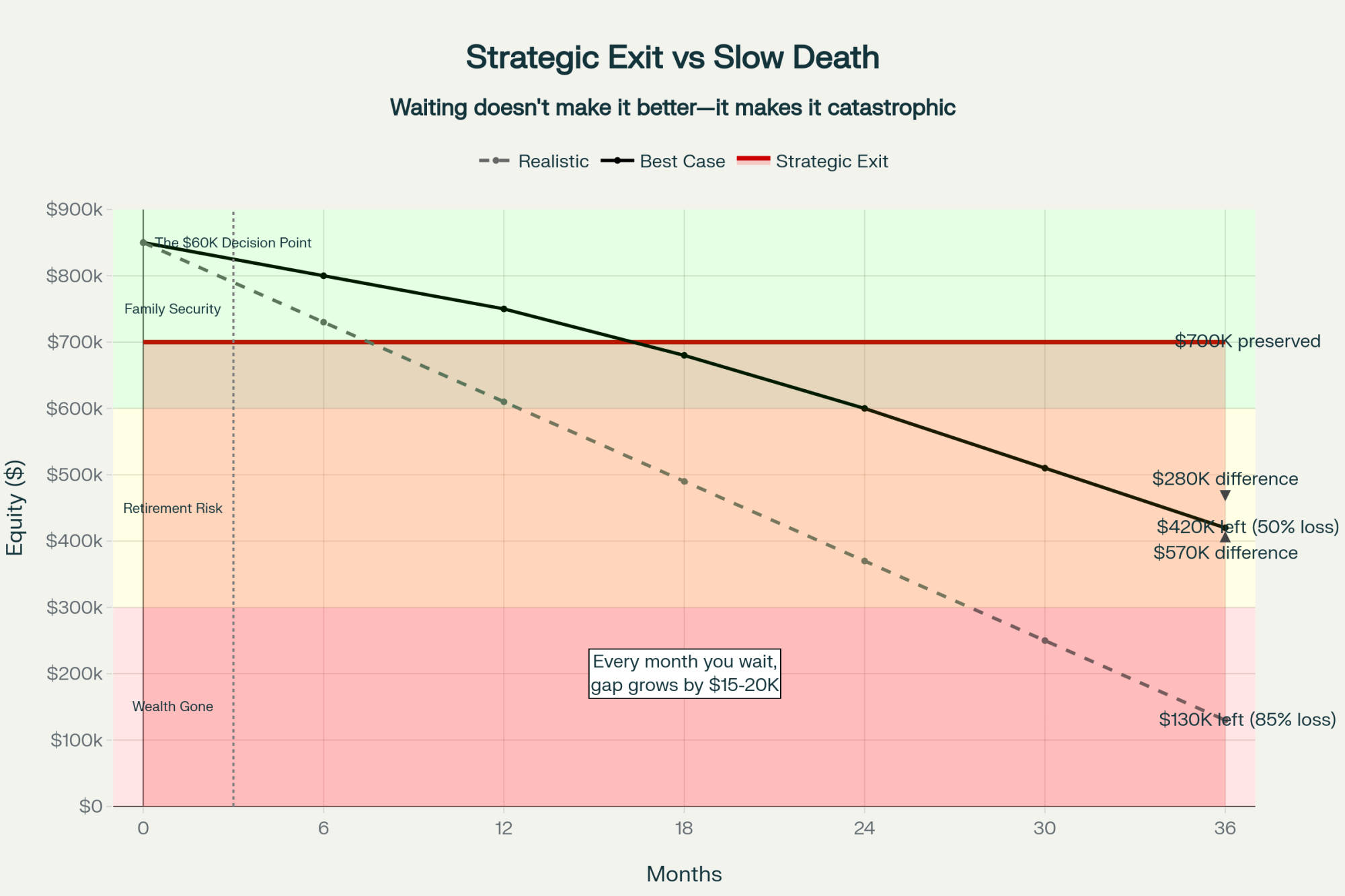
The brutal reality: exit today with $700K or wait three years and leave with $130K-$420K. That’s not a range—that’s the difference between securing your family’s future and losing everything your family built.

A fourth-generation producer from Dodge County who sold recently framed it well: “My grandfather would understand I’m protecting what he really valued—the family’s security. He adapted to his era’s challenges. I’m adapting to mine.”

You know what I find encouraging? Farmers who make peace with transition often discover unexpected opportunities. Consulting for younger farmers. Mentoring organic transitions. Exploring agrivoltaics. One former dairyman is now helping beginning farmers with direct marketing—found his passion in a completely different aspect of agriculture.

The dairy industry will survive this transformation, but it’s probably going to look quite different. Maybe 8,000-12,000 large operations. Perhaps a couple thousand premium niche producers. That seems to be where trends are pointing.

Your job—whether you’re milking 50 cows or 5,000—is to honestly assess where you fit in that future. Make decisions based on your family’s actual needs, not what you think a “real farmer” should do. Because at the end of the day, your kids need a parent more than they need a farm. Your spouse needs a partner, not a martyr.

The next 90 days… that’s your window, from what I’m seeing. Make decisions based on math and family priorities, not mythology and peer pressure. That’s the wisdom this moment demands.

And if you need to talk to someone—really talk—don’t wait. Pick up the phone. Call Farm Aid. Call a counselor. Call a friend. Because whatever path you choose, you don’t have to walk it alone.

Key Takeaways:

  • The $60,000 question: You’re burning $20K in equity monthly—by February, that’s $60K gone forever
  • Path 1 – Go Big: Scale to 3,500+ cows. Requires $4M capital. Only works if you’re in the 5% who can get financing
  • Path 2 – Go Premium: Organic/specialty markets. Expect 3-7 years of losses. Must be within 50 miles of metro markets
  • Path 3 – Get Out Smart: Exit now keeping $700K vs. waiting 3 years and walking away with $100K
  • Hard truth: No decision IS a decision—it defaults to Path 3, just costs you $600K more

Complete references and supporting documentation are available upon request by contacting the editorial team at editor@thebullvine.com.

Learn More:

Join the Revolution!

Join over 30,000 successful dairy professionals who rely on Bullvine Weekly for their competitive edge. Delivered directly to your inbox each week, our exclusive industry insights help you make smarter decisions while saving precious hours every week. Never miss critical updates on milk production trends, breakthrough technologies, and profit-boosting strategies that top producers are already implementing. Subscribe now to transform your dairy operation’s efficiency and profitability—your future success is just one click away.

NewsSubscribe
First
Last
Consent

The $100 Per Cow You Never See: How Foreign Subsidies Are Reshaping American Dairy

Three dairy farms close every day while Europe pays their farmers to compete against you.

You know that frustration when milk prices just don’t reflect the work you’re putting in? I was talking with a Wisconsin dairyman last week who nailed it: “I can handle weather variability and market cycles—we’ve done that for generations. What’s harder to navigate is when other governments are actively supporting our competitors.”

Here’s what’s interesting—this concern is popping up everywhere I go. Cornell’s dairy economist, Andrew Novakovic, ran some modeling earlier this year that suggests foreign subsidies might be extracting approximately $90 to $100 per cow annually from your operations through price suppression.

Now, for a typical 500-cow dairy? We’re talking about $45,000 to $50,000 in potential revenue that just…vanishes. Never shows up in the milk check.

What I’ve noticed is this pattern holds whether you’re running 200 cows on pasture in Vermont or milking 2,500 head in a New Mexico dry lot. The dynamics stay remarkably consistent.

Understanding What You’re Up Against

The global dairy market has undergone significant changes, and it’s worth taking a moment to understand how other governments are influencing the playing field.

The European Union has an intervention purchasing system—they actually buy up butter and skim milk powder when prices drop, holding them at levels above where the market would naturally clear. Their own Court of Auditors looked at this back in 2021 and basically said, “Hey, this is causing market distortions.” They even referred to it as “destabilizing.”

European Commission intervention stocks directly suppress US milk prices—when EU stockpiles peaked at 380,000 MT in 2016, American producers lost $0.80/cwt, costing the industry an estimated $2.2 billion in farm income over two years.

But here’s the thing—it continues anyway. Mark Stephenson, over at Wisconsin’s dairy policy program, figures that these interventions might be costing U.S. dairy hundreds of millions of dollars annually in lost competitiveness.

Then you have China doing something different, but equally challenging. They’re offering VAT rebates to processors in special economic zones—we’re talking 8 to 13 percent back on dairy exports, specifically through their State Council Directive 2024-15, which expanded these zones. So, when a buyer in Nigeria or Saudi Arabia is comparing bids? That Chinese supplier has an automatic advantage that has nothing to do with efficiency.

I was chatting with an Idaho producer who runs a pretty sophisticated operation—robotics, precision feeding, the whole nine yards. He said something that stuck with me: “We can match anybody on production metrics. But when their government picks up 8-13% of the tab? That’s a whole different ballgame.”

When Theory Meets Reality: What Happened in Michigan

You want to see how this plays out in real life? Look at what Michigan dairy cooperatives documented in their recent annual report. They lost significant contracts to European suppliers when Algerian buyers shifted their sourcing.

Here’s why: Under the EU-Algeria trade agreement, European dairy products enter the market duty-free. Meanwhile, U.S. exports? We’re looking at tariffs of 25% or more.

Based on typical market pricing with these tariff differences, European suppliers can deliver powder at prices we literally can’t match—not because they’re better, but because the trade structure gives them that advantage.

And when co-ops lose those export contracts, the impact is immediate. Phil Durst, who does dairy education for Michigan State Extension, has been tracking this. Milk prices can drop more than a dollar per hundredweight. Producers start culling—often 10-15% of the herd goes. Processing plants start wondering if they can stay open.

A third-generation Michigan producer told me recently, “Our somatic cell count runs under 150,000 consistently. Components are excellent. We’ve got reproduction dialed in. But being good at your job has limits when the playing field’s this tilted.”

Breaking Down What This Means for Your Operation

Let’s talk real numbers here. A price suppression of $0.35 to $0.40 per hundredweight might not sound like much at first…

The hidden subsidy impact ranges from $17,000-$19,000 for a 200-cow dairy to $212,000-$237,000 for a 2,500-cow operation—money that never appears in your milk check but represents 25-50% of typical operating margins

But think about it this way. Your average cow produces around 240 hundredweight annually—that’s pretty standard, based on the USDA’s latest numbers. Multiply that potential price impact out, and you’re looking at $85 to $95 per cow that could be missing.

Scale it up to your operation:

  • Running 200 cows? That’s potentially $17,000 to $19,000 annually
  • Got 500 cows? We’re talking $42,500 to $47,500
  • Thousand-cow operation? Could be $85,000 to $95,000
  • One of those 2,500-cow facilities? They might be missing $212,000 to $237,000

What really gets me is when you consider that most operations—according to USDA’s economic research—are running margins of maybe $200 to $400 per cow in good years. So, what’s the potential $90-100 impact? That’s 25 to nearly 50 percent of your profit margin. Gone.

How This Changes Investment Decisions

This entire dynamic completely shifts how you view capital investments.

I was working with a California producer near Tulare recently—she has 3,200 cows, a really sharp operator. She ran the numbers on a robotic milking system under different price scenarios, and what she found was eye-opening.

“We did sensitivity analysis on three different parlor upgrade options,” she explained. “The difference between current pricing and what we’d see with even partial relief from these subsidies changed our internal rate of return by nearly 40 percent. That’s literally the difference between our lender saying yes or no.”

At current subsidy-suppressed prices, critical investments like environmental compliance show negative returns and facility upgrades don’t meet lending thresholds—but even partial price recovery (+$0.20/cwt) makes most investments viable, explaining why your banker needs to see the full competitive picture.

Think about that. Agricultural lenders base everything on debt service coverage ratios tied to your operating margins. For a 500-cow operation, if you’re missing $45,000 annually due to price suppression, that could mean $200,000 less borrowing capacity.

That’s your parlor upgrade. That’s your environmental improvements. That’s the difference between modernizing or watching things slowly fall apart.

And succession planning? Boy, that’s where it really hits home. Iowa State Extension keeps data on this, and there’s a clear correlation—when margins look thin, the next generation looks elsewhere.

I know several Vermont families right now where kids with ag degrees are wondering if it makes sense to take on the farm debt or just go work for Land O’Lakes corporate. Can’t say I blame them for thinking it through.

Where We’re Headed: The Long View

Looking at the bigger picture, USDA data shows we’ve gone from over 70,000 dairy farms in 2003 to about 26,500 today.

U.S. dairy farms have collapsed from over 70,000 in 2003 to 24,810 today, with projections showing a potential decline to just 17,000 operations by 2035—that’s three farms closing every single day

Marin Bozic, who does dairy economics at the University of Minnesota, presented some modeling at the industry meetings last year. He projects that we could drop to somewhere between 17,000 and 20,000 operations by 2035. That’s another quarter to a third gone.

What’s really interesting is how this plays out regionally:

  • Traditional dairy states in the Northeast? Could see losses over 50-60 percent
  • The Upper Midwest might drop 40-55 percent
  • But certain Western and Southern states keep growing

Here’s what’s happening—at really large scale, say 3,000-plus cows, you can sometimes absorb these competitive disadvantages through sheer volume and efficiency.

But those mid-scale operations, the 300 to 1,000 cow dairies? They’re in a tough spot.

The consolidation pattern is stark: operations under 1,000 cows are exiting at rates of 5.5% to 12% annually, while farms with 1,000+ cows are actually growing at 2%—demonstrating the brutal economics of mid-scale dairy farming in a subsidized global market.

Bozic figures that these trade-related factors might accelerate consolidation by 15-25 percent beyond natural market evolution. Some consolidation makes sense—technology improves, efficiencies develop. But acceleration driven by trade distortions? That’s a different conversation.

You know what’s interesting? When apple producers faced similar subsidy competition from China a few years ago, they documented the situation, presented the economic harm, and had Section 301 tariffs implemented. Within two years, U.S. apple exports to key Asian markets recovered by nearly 30 percent. There may be lessons to be learned from dairy.

Three Ways Producers Are Responding

What I’ve found talking with producers around the country is that folks are generally taking one of three approaches—and here’s the key thing, these aren’t mutually exclusive. Plenty of operations are combining strategies.

Making the Scale Decision

If you’re between 500 and 1,000 cows right now, you’re facing some tough choices.

Several Wisconsin producers I know are crunching the numbers on borrowing to acquire 1,500-plus cows. They’re basically betting scale can overcome the subsidy disadvantage.

Others are choosing to exit while they’ve still got equity. One Pennsylvania dairyman put it to me this way: “I can get $1,500 per head in an orderly sale today. Wait three years if margins stay compressed? Maybe it’s $800 in a fire sale. That’s $350,000 difference on 500 cows.”

Finding Premium Markets

Some operations are successfully capturing premiums—organic, A2/A2, grass-fed—that help offset these competitive challenges.

A Vermont producer who went organic shared his experience: “Took 18 months of disrupted cash flow during transition. About $280,000 in market development over three years. We’re capped at 400 cows because of pasture requirements. Works for us—we’re close to Boston. But it’s not for everyone.”

USDA’s marketing service data suggests that maybe 10-15 percent of operations have the right location and resources to make premium strategies work.

Interestingly, some of these individuals are also among the loudest voices in advocacy, using their privileged position to highlight how conventional dairy faces unfair competition.

Getting Organized and Speaking Up

Groups are becoming more savvy about documenting their impacts and communicating with policymakers using real data.

The Wisconsin Dairy Business Association compiled member data showing over $45 million in annual trade-related losses across their membership. Their executive director told me, “Generic complaints don’t move policy. But when you show up with spreadsheets documenting specific economic harm? That gets attention.”

Many operations pursuing scale or premiums are also participating in these advocacy efforts. They recognize that addressing structural disadvantages benefits everyone, regardless of the strategy.

Here’s an encouraging example: A group of Michigan producers recently met with their congressional delegation, armed with specific documentation of lost contracts and price impacts. Within three months, they had both senators co-sponsoring legislation to examine dairy trade enforcement. It’s not a solution yet, but it’s a movement.

What Recovery Might Look Like

If we achieve policy adjustments similar to those in other agricultural sectors, recovery probably wouldn’t happen overnight.

The modeling from Texas A&M’s policy center suggests that we might see initial improvements within 12-18 months, with more comprehensive adjustments over 2-3 years. For that 500-cow operation we keep talking about? Even a partial improvement could mean tens of thousands of dollars in additional revenue.

Various analyses suggest addressing these imbalances might help preserve several thousand dairy operations through 2035. Won’t stop all consolidation—technology and efficiency gains are real. But it might slow things down to a more natural pace.

Practical Considerations for Your Operation

After all these conversations with producers and lenders, here’s what seems to be working:

When you’re evaluating break-even, run scenarios both ways—current conditions and with potential trade improvements. If you’re struggling now but would be profitable with modest price improvements, maybe the problem isn’t your operation.

Document everything for your lender. Several Farm Credit personnel have informed me that they’re more flexible with covenants when producers can demonstrate that market distortions, rather than management problems, are driving the pressure.

For investments, model three scenarios:

  • Keep going as is (baseline)
  • Partial improvement ($0.20/cwt better)
  • More normalized pricing ($0.40/cwt improvement)

Focus on investments that work in at least two scenarios. Gives you flexibility.

And on the advocacy side? Specifics matter. Document your impacts, work with neighbors to aggregate data. Ten farms speaking together carry more weight than ten separate complaints.

The Bigger Picture

What strikes me most about all this is how subtle it is. The normal fluctuations in milk prices often mask these impacts. Easy to overlook if you’re not paying attention.

We get our milk checks, maybe grumble about prices, and get back to work. Meanwhile, these complex trade structures may be systematically affecting everyone of us.

The co-ops losing export contracts, generational farms closing, kids choosing other careers—maybe this isn’t just efficiency sorting things out. Maybe it’s what happens when trade structures tilt the playing field.

An old-timer in Wisconsin—fourth generation, been milking since the ’70s—said something that really resonated: “I’ve managed through weather, disease, market cycles for four decades. That’s dairy farming. But competing against foreign treasuries? That’s not something you fix by working harder.”

Understanding this concept changes how you view everything—investments, debt, succession, and daily decisions. We probably need both operational improvements and engagement on trade policy. Neither alone seems sufficient.

Current projections suggest we might drop to 17,000-20,000 dairy farms by 2035. With more balanced trade conditions? Maybe we keep a few thousand more. Those farms aren’t just businesses—they’re the difference between rural communities thriving or hollowing out.

These aren’t abstract policy debates. This is about whether you can justify that parlor upgrade, whether your kids see opportunity in dairy, and whether your town keeps its feed mill.

How we respond—through strategic planning, working together on advocacy, or just adapting to what is—will shape not just individual farms, but American dairy for the next generation.

Understanding what we’re up against, challenging as it may be, might be the first step toward taking action. Because at the end of the day, we’re all trying to produce quality milk, support our families, and keep viable operations going. Recognizing the full competitive landscape enables us to make more informed decisions about the path forward.

KEY TAKEAWAYS 

  • Your missing revenue: Foreign subsidies suppress milk prices by $90-100/cow annually—that’s $46,000 for a 500-cow dairy that never reaches your milk check
  • Capital access crisis: This hidden loss reduces borrowing capacity by $200,000+, explaining why your banker says no to viable improvements
  • Three strategic paths: Operations are successfully (1) scaling past 1,500 cows for efficiency, (2) capturing premium markets, or (3) documenting losses for collective policy action
  • Smart investment framework: Model every decision using three scenarios—current prices, partial recovery (+$0.20/cwt), and normalized pricing (+$0.40/cwt)
  • The opportunity: Documented advocacy is working—apple producers secured relief in 2019, and Michigan dairy has senators engaged. Your specific data matters.

Complete references and supporting documentation are available upon request by contacting the editorial team at editor@thebullvine.com.

Learn More:

  • The Dairy Producer’s Guide to Navigating High Input Costs – While the main article explains lost revenue, this guide provides tactical strategies to protect your margins from the other side. It reveals proven methods for reducing feed, labor, and energy expenses to build operational resilience against price suppression.
  • Navigating the Tides: A Deep Dive into the 2024-2025 Dairy Market Outlook – To make informed strategic decisions, you need the full picture. This analysis expands on the main article’s trade focus, breaking down all key global and domestic market drivers, from consumer demand to supply-side trends, impacting your milk check.
  • Unlocking Efficiency: The Real ROI of Robotic Milking Systems – The main article highlights how suppressed prices threaten modernization. This piece demonstrates exactly what’s at stake, providing a detailed framework for calculating the true ROI of automation and making data-driven decisions on major capital investments for long-term viability.

Join the Revolution!

Join over 30,000 successful dairy professionals who rely on Bullvine Weekly for their competitive edge. Delivered directly to your inbox each week, our exclusive industry insights help you make smarter decisions while saving precious hours every week. Never miss critical updates on milk production trends, breakthrough technologies, and profit-boosting strategies that top producers are already implementing. Subscribe now to transform your dairy operation’s efficiency and profitability—your future success is just one click away.

NewsSubscribe
First
Last
Consent

The 800,000-Heifer Shortage Reshaping Dairy: Why Some Farms Will Thrive While Others Exit

Week-old beef calf: $1,400. Replacement heifer: $4,000. Still breeding beef? You’re not crazy—you’re doing the math.

EXECUTIVE SUMMARY: What started as desperate survival in 2018 has become an irreversible trap: beef-cross revenue now provides 16% of dairy farm income, forcing farmers to keep breeding beef at $1,400 per calf even as replacement heifers hit $4,000. This has driven U.S. heifer inventory to 3.9 million—the lowest since 1978—with 800,000 fewer coming before any recovery in 2027. Simultaneously, processors who invested $11 billion expecting 2-3% growth face just 0.4% milk expansion, guaranteeing plant closures and $3-5/cwt regional price swings. The industry is restructuring into three distinct survivors: fortress farms with over 1,500 cows capturing component premiums, strategic operations with 200-500 cows in profitable niches (organic/A2A2/grass-fed), and those exiting now at peak cattle prices. Wisconsin’s 10,000-heifer gain versus Texas’s 10,000-head loss proves that processor relationships and location now matter more than size. Behind the numbers, 2,400-3,700 dairy families face elimination—transforming not just an industry but entire rural communities.

Dairy Heifer Shortage

You know something’s off when you’re seeing beef-cross calves bringing $1,000 to $1,400 at a week old while replacement heifers are hitting $4,000 at auction. It doesn’t make sense at first—but then you dig into what’s actually happening out there, and suddenly it all clicks.

We’re not looking at just another market swing here. What we’re seeing is the collision of desperate decisions farmers made back in 2018 and 2019 with billions in processing investments that assumed a completely different future. And if you’re wondering why your neighbor’s still breeding 40% of the herd to beef despite those heifer prices…well, let me walk you through what I’ve been hearing from producers across the country.

The 800,000 Heifer Crisis Timeline – From 4.8 million in 2018 to 3.4 million projected by 2027, this isn’t a market cycle—it’s industry transformation

Note: Throughout this article, some producers and industry professionals spoke on condition of anonymity to discuss sensitive business details. All financial figures and operational data have been verified against industry benchmarks.

The Numbers Paint a Picture Nobody’s Prepared For

So, CoBank released its latest dairy heifer inventory analysis in August, and the numbers are… honestly, they’re worse than most people realize. According to the USDA’s National Agricultural Statistics Service January 2025 cattle report, the national number of replacement heifers stands at 3.914 million. That’s the lowest since 1978—back when the average herd was what, 30-something cows?

But here’s the kicker that really got my attention: only about 2.5 million of those heifers are expected to actually calve into milking herds this year, based on CoBank’s projections. That’s tracking to be the lowest since the USDA started keeping those specific records in 2001. The ratio’s collapsed, too—USDA’s July calculations show we’re down to 27 heifers per 100 cows. Ten years ago? That was 31 per 100.

And it gets rougher. CoBank’s projects indicate that we’ll lose another 357,490 heifers in 2025, followed by an additional 438,844 in 2026. They’re saying maybe we’ll get back 285,387 or so in 2027, but…that’s still a massive hole. Add it up and we’re talking about 800,000 fewer replacements before any real recovery kicks in.

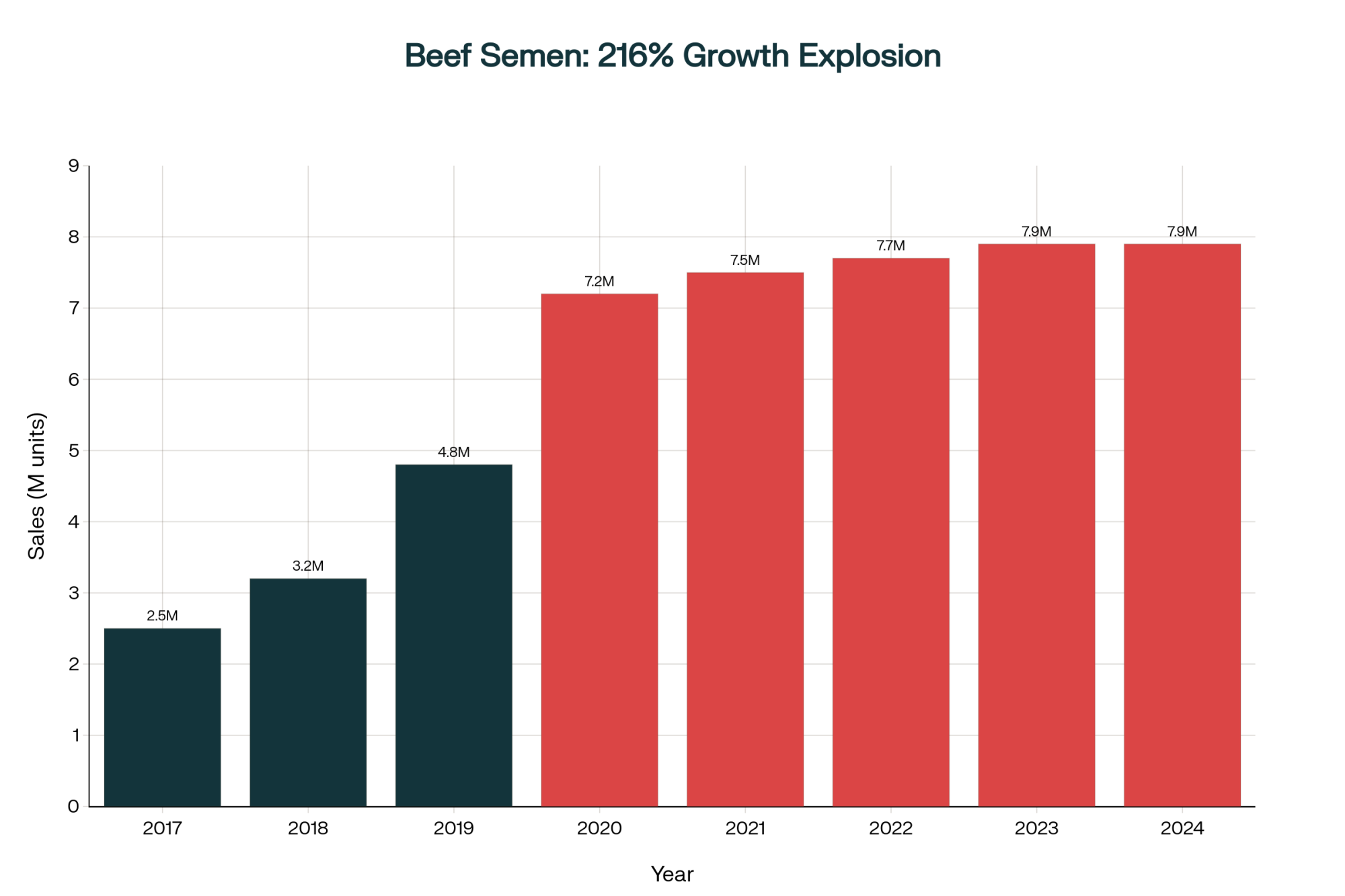
The 216% Explosion That Changed Everything – Beef semen sales to dairy farms surged from 2.5M to 7.9M units, creating the heifer shortage crisis

How Seven Years of Survival Mode Created Today’s Crisis

You can trace this whole thing back to that brutal stretch from 2015 through 2021. Class III milk prices averaged below $18 per hundredweight for most of those years—not continuously, but often enough to cause significant harm. University of Illinois dairy economist John Newton documented this period in his 2018 farmdocdaily analysis, calling it an extended period of sustained losses that fundamentally changed the industry.

By April 2019, according to the USDA’s Agricultural Marketing Service reports, replacement heifers that cost $ 2,000 or more to raise were only bringing $1,140 at market. Think about that for a second. You’re losing $860 to $1,360 on every single replacement you raise.

Then the technology all came together at once. Sexed semen finally worked reliably—industry data from Select Sires and other major AI companies shows you can get 90% female calves with 85-95% of conventional conception rates. Genomic testing through companies like Zoetis and Neogen dropped to about $40 per animal. And beef prices? Through the roof. Suddenly, those Holstein bull calves that might bring $200 on a good day were being replaced with Angus crosses worth anywhere from $600 to over $1,400, depending on genetics and your local market.

I mean, what would you have done?

The National Association of Animal Breeders has been tracking this transformation in their annual Semen Sales Reports. Beef semen sales to dairy farms went from about 2.54 million doses in 2017 to over 7.2 million by 2020. That’s nearly triple in three years. Their March 2025 industry update shows we’re now sitting at about 7.9 million units, and it’s just…stuck there. Meanwhile, conventional dairy semen sales have crashed almost 46.5% since 2020.

Why $4,000 Heifers Still Can’t Fix the Problem

Examining what doesn’t add up for many people: according to the USDA’s October 2025 Agricultural Prices report, heifers are currently worth a significant amount of money. Wisconsin’s averaging close to $2,860. Vermont’s around $2,930. Premium animals in California and Minnesota are fetching over $4,000, according to recent livestock auction reports. So why isn’t everyone breeding dairy again?

What I’m hearing from nutritionists working with Wisconsin herds is pretty consistent. Consider a typical 500-cow operation that breeds 40% of its cows for beef. They’re bringing in maybe $200,000 a year just from those beef calves. Add in cull cows at current prices, and you’re looking at $350,000 in cattle revenue.

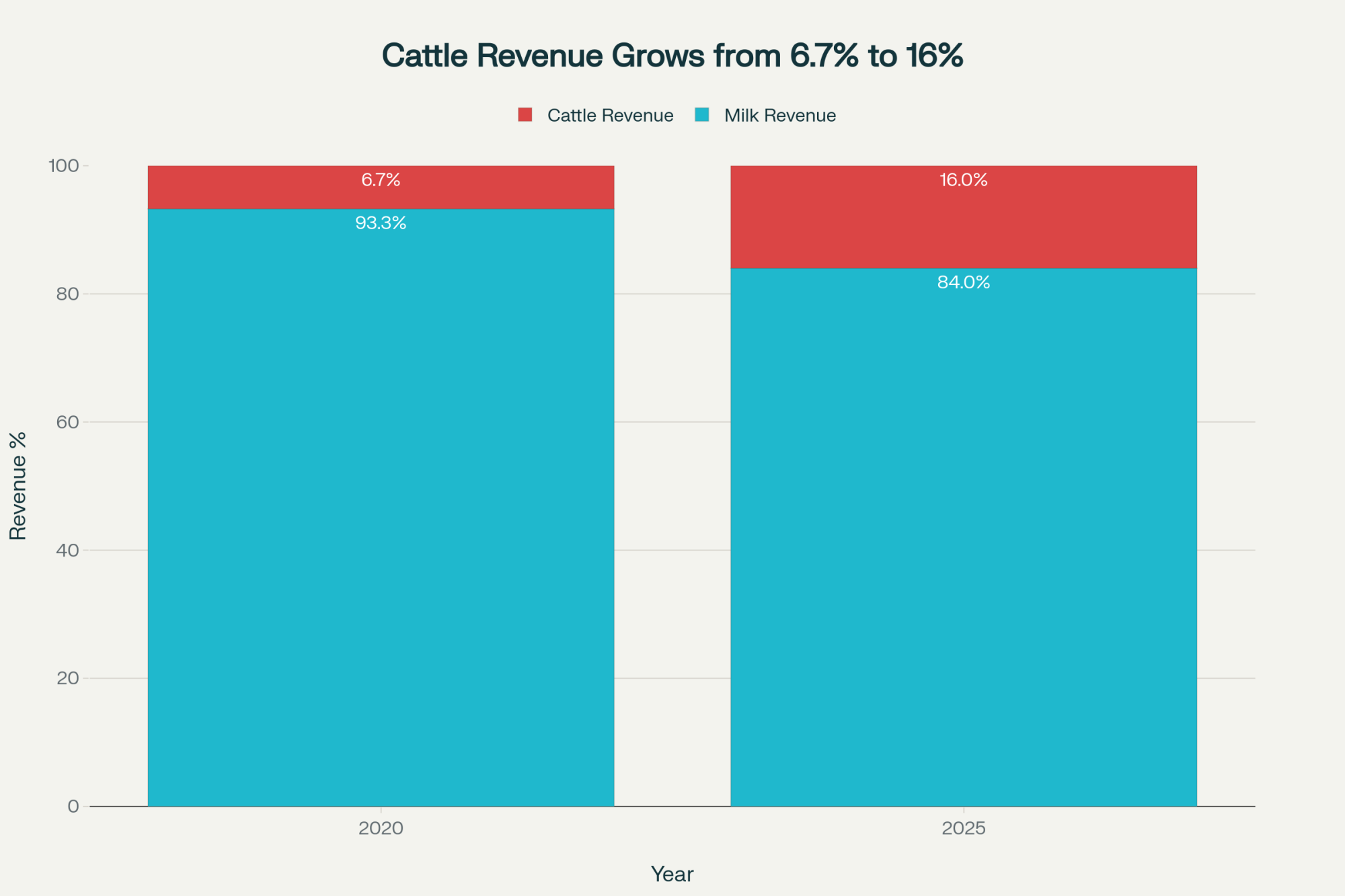
The Revenue Revolution – Cattle sales jumped from 6.7% to 16% of dairy income – this structural shift is permanent and changes everything

According to USDA Economic Research Service data, that’s approximately 16% of total farm income for many operations now. Back in 2020? Cattle sales were maybe 6.7% of dairy farm revenue.

As one nutritionist put it to me, “It’s not just extra money anymore. It’s structural. These guys can’t just flip a switch and go back. Walking away from that revenue would mean completely restructuring the operation.”

From Crisis to Gold Rush – Heifer prices crashed to $1,140 in 2019, now average $2,860 with premiums hitting $4,000

The Processing Overcapacity Challenge Coming in 2027

And here’s where it gets really messy. According to the International Dairy Foods Association’s industry investment tracking, the processing sector has invested more than $10 billion in new facilities over the past three years—some estimates put the total closer to $11 billion. New York’s Department of Agriculture reports that the state alone has $3 billion in processing investments that require an additional 10 to 12 million pounds of milk per day.

These plants were all designed assuming we would continue to grow milk production at a rate of 2-3% annually, as we have for decades, based on USDA historical data from 1995 to 2020. Instead? USDA’s October 2025 World Agricultural Supply and Demand Estimates project just 0.4% growth next year. That’s not a typo—zero point four percent.

Mike North from Ever.Ag’s Risk Management division put it bluntly at the September 2025 Milk Business Conference: “We don’t have enough cows to fill all these plants.” He thinks we’ll see inefficient plants close, and others running way under capacity. That’s billions in stranded investment.

What’s worth noting here is that we’re already seeing some policy discussions emerging. The National Milk Producers Federation has formed working groups to study the situation, though no concrete proposals have emerged. Meanwhile, some state agriculture departments are exploring incentive programs for heifer retention, but the scale of these initiatives remains small compared to the challenge.

Three Different Worlds Emerging

What’s really interesting—and I’ve been watching this develop over the past year or so—is how the industry’s basically splitting into three completely different business models.

The Big Operations (Your “Fortress Farms”)

These 1,500 to 5,000-cow dairies have basically built moats around their businesses. They’re conducting genomic testing on every single heifer through programs like Zoetis’ CLARIFIDE Plus, utilizing AI-powered systems like DairyComp for informed decision-making. According to the Penn State Extension’s 2025 component premium tracking, they’re achieving component premiums that add $1.50 to $2.50 per hundredweight.

Large Midwest operations I’ve talked with are reporting revenue per cow that’s approaching $6,000 to $7,000—numbers that would’ve been fantasy five years ago. They’re generating base milk revenue in the millions, plus substantial component premiums, and nearly a million dollars from beef calves in some cases.

What’s interesting here is something I noticed visiting a couple of these operations recently: they’re not just bigger—they’re fundamentally different businesses. One manager showed me their real-time component monitoring system. “We know within 0.1% what our butterfat’s gonna test every single day,” he said. “That consistency is worth an extra $750,000 a year to us.”

It’s worth noting that these operations are also exploring emerging technologies. Embryo transfer programs, automated calf feeding systems, precision nutrition through AI…they’re positioning themselves for whatever comes next. Some are even experimenting with automated milking systems that can handle 500-plus cows, completely changing labor dynamics.

The Strategic Middle

This is where it gets interesting for those with 200-500 cows. According to the USDA’s organic dairy market reporting, they’re finding ways to make it work through specific niches. Organic products typically sell for $7-12 more than conventional ones. University of Wisconsin extension studies on pasture-based dairy show grazing systems are cutting costs by 30-50%. Some are going direct-to-consumer and getting $4 more per gallon.

I visited an organic operation in Vermont last month, which had transitioned to organic in 2022, with 280 cows. The producer told me she’s actually more profitable now than when she had 350 conventional. The premium’s real—she’s averaging about $9.50 over conventional—and her vet bills dropped 40%.

Out in California, there’s a different approach. One Jersey producer with about 450 cows is locked into a specialized cheese contract. Between base and components, he’s getting close to $24.50 when commodity milk’s at $21. On 10 million pounds, that $3.50 spread is…well, you can do the math.

Down in Georgia—and this is something you don’t hear much about—a 300-cow operation switched to A2A2 milk production exclusively. They’re selling direct to Atlanta-area health food stores at premium prices. “It’s niche as hell,” the owner admits, “but it works for us.”

The Ones Choosing to Exit

Then there are the operations using these high cattle prices as their exit opportunity. After a decade of barely hanging on, they’re done—and honestly, who can blame them?

I caught up with a couple who recently sold their 185-cow place in Wisconsin. After accounting for debt service, living expenses, and reinvestment, they were netting maybe $18,000 a year for 70-hour weeks. Now they’ve got a solar lease on the land, bringing in $52,000 with zero labor. Can’t really argue with that decision.

 Industry Darwinism – Only 20% of small farms will survive the heifer shortage, while 95% of large operations thrive – consolidation is accelerating

Global Perspective: How Other Countries Face Similar Dynamics

What’s fascinating is seeing how this isn’t just a U.S. problem. The European Union’s dealing with their own version of this crisis, though for different reasons. Environmental regulations and nitrogen limits are forcing Dutch and German producers to reduce herd sizes, just as their processing sector has expanded to meet export market demands. According to European Dairy Association reports, EU milk production is expected to decline 1.5% annually through 2027.

New Zealand’s taking a different approach. Fonterra’s latest annual report shows they’re actually encouraging farmers to reduce production intensity and focus on value-added products. Their winter milk premiums now exceed NZ$11 per kilogram milk solids—that’s roughly equivalent to a $7/cwt premium in U.S. terms—specifically to maintain year-round supply for their specialty ingredient plants.

Brazil and India, meanwhile, are ramping up production. Brazil’s domestic consumption is growing at a rate of 3% annually, and the country is investing heavily in genetics and infrastructure. India’s cooperative model—completely different from ours—is actually expanding smallholder participation. It’s a reminder that there’s more than one way to structure a dairy industry.

What’s interesting is watching how other countries handled similar situations. Dairy Australia’s market analysis shows that in 2023, when their production hit 30-year lows, processors like Goulburn Valley Creamery started paying AUS$9.70 per kilogram milk solids—equivalent to about $28 per hundredweight U.S.—just to keep smaller farms from shutting down. We’re starting to see hints of that in the Upper Midwest—smaller co-ops offering bonuses that weren’t on the table two years ago.

Why Some Regions Are Winning While Others Lose

The shortage’s not hitting everywhere the same. USDA’s January 2025 cattle report shows Wisconsin actually added 10,000 replacement heifers last year. Meanwhile, Kansas dropped 35,000, Idaho lost 30,000, and Texas shed 10,000.

Why the difference? Extension specialists at UW-Madison point to several factors. It’s partly infrastructure, partly processor relationships, but mostly it’s about positioning. Wisconsin cheese plants require consistent, high-quality milk, and they’re willing to pay for it. They’re offering retention bonuses, multi-year contracts—things that make raising heifers actually pencil out.

Down in Texas, it’s brutal. One producer recently told me that he paid $4,200 per head for bred heifers from Wisconsin, plus an additional $380 each for trucking. “It hurt,” he said, “but dropping our ship volume would’ve cost us our quality premiums. That’s $140,000 gone.”

Out in the Mountain West states—Colorado, Wyoming, parts of Montana—they’re dealing with different challenges. Water rights, urban expansion, and feed costs… it’s pushing many smaller operations out. One Colorado producer told me, “Between Denver sprawl and water restrictions, we’re done in five years regardless of heifer prices.”

The “Obvious” Solution That’s Actually a Trap

You’d think with heifers at $4,000, somebody would be raising extras to cash in. Spend $2,400 raising them, pocket $1,600 profit. Simple, right?

Not really. The heifer management experts at UW-Madison have thoroughly reviewed this. First problem: mortality. The USDA’s 2022 Dairy Cattle Management Practices study shows you lose about 21% of heifers from birth to freshening when you factor in all causes of mortality and culling. So that $2,400 cost becomes over $3,000 per surviving heifer.

Then add labor—extension economists calculate $400-600 per head through freshening. Feed costs can fluctuate by $400 based solely on corn prices—we’ve seen a variation of $2.80 per bushel over the past 18 months. And you’re making a 24-month bet with no way to hedge the price risk.

As one extension specialist explained, “The only people successfully raising heifers for sale have paid-off facilities, family labor, and grow their own feed. That’s not a business model most can replicate.”

Industry Response: Fragmented Approaches to a Systemic Challenge

You’d think there’d be some coordinated response, but…not really. The National Milk Producers Federation has been discussing the situation, but they’re mostly focused on data collection and suggesting best practices. No real market intervention, though they are exploring potential policy recommendations for the next Farm Bill discussions.

Some cooperatives are exploring different approaches to help members finance replacement raising, though the details vary significantly by region. But as one board member mentioned in a recent meeting, the scale of what’s needed versus what’s being offered is pretty mismatched. We need hundreds of thousands, not tens of thousands, of additional heifers.

What’s encouraging is seeing some innovation at the regional level. A group of farms in Minnesota formed what they’re calling a “heifer pool”—basically sharing genetics and breeding decisions to optimize replacement production across multiple operations. It’s early days, but the concept’s interesting.

Meanwhile, some states are getting creative. Pennsylvania’s Department of Agriculture is piloting a heifer retention incentive program, offering $200 per head for farms that increase replacement numbers. It’s small—only $2 million allocated—but it’s something.

2027: The Year Everything Changes

Based on everything I’m hearing from processors, economists, and producers—plus what we’re seeing in reports from CoBank and Rabobank’s latest dairy quarterly analysis—here’s what’s probably coming:

Milk prices will diverge significantly regionally—possibly $3-5 per hundredweight between shortage and surplus areas. I’m already seeing it start. Some cooperatives in Texas are offering $2.40 location premiums for new farms near their plants.

Industry analysts suggest that processing plants will operate at 72-76% capacity, rather than the 85-90% required for profitability. Smaller regional processors will either close or get bought for significantly less than their construction cost. As one former cheese plant executive explained to me, “The consolidation is coming, it just hasn’t started yet.”

Heifer prices are likely to peak around $4,200-$4,800 in early 2027, based on historical price patterns from similar periods of shortage. They will then moderate back to $3,800-$ 4,200 as more sexed semen is used and the supply improves slightly.

According to NAAB’s projections, beef-on-dairy sales are expected to decline slightly—possibly to 6.5-7 million unitsfrom the current 7.9 million—but they are unlikely to return to pre-2020 levels. As one large-herd manager put it, “Once you’ve built those calf buyer relationships and you’re getting $1,000 to $1,400 per head, you don’t just walk away.”

The Human Cost We’re Not Calculating

What gets lost in all these numbers is what this means for actual people. Back in 2018, Agri-Mark started including suicide prevention hotline numbers with milk checks after losing three members to suicide, as documented in their member communications. The CDC’s 2020 Morbidity and Mortality Weekly Report shows farmers have the highest occupational suicide rate in America—43.7 per 100,000 workers, over 3 times the general population.

When 10-15% of dairy operations close over the next decade—that’s 2,400 to 3,700 families based on current USDA numbers—we’re not just losing businesses. These are communities that have been built around dairy farming for generations.

Researchers studying farmer mental health, such as those at the University of Illinois’ Agricultural Safety and Health Program, have found that after a decade of financial stress, decision-making processes undergo fundamental changes. As one researcher explained, “These aren’t people making strategic business decisions anymore. They’re making survival decisions from a place of chronic stress.”

I see it visiting farms. The producer who won’t look you in the eye when money comes up. The couple who stopped talking about succession because their kids made it clear they’re not coming back. The neighbor who sold out and now won’t answer calls because the shame’s too heavy.

That’s the real cost we’re not calculating.

Your Survival Playbook for the Next 18 Months

Look, every operation’s different, but here’s what seems to make sense based on what I’m seeing:

If You’re Under 200 Cows

Be honest about whether this still works for you. I know that’s hard, but extension economists have shown pretty clearly that the economics are brutal at this scale unless you’ve got a real niche.

If you’re staying, pick your lane now. Organic certification takes three years, but it adds significant premiums, according to USDA data. Grass-fed certification is faster. Direct sales need the right location. However, you have to pick one and commit to it completely. Half-measures don’t work anymore.

Consider teaming up with neighbors. I’m seeing more informal cooperatives forming—sharing equipment, coordinating breeding, even pooling milk for better bargaining power. It’s worth exploring.

If You’re 200-500 Cows

This is your moment to choose. The middle ground’s gone.

Invest smart. Extension research indicates that testing the top 30% of animals genomically costs approximately $3,000-$ 4,000 per year, but can significantly advance your genetics. Activity monitors from companies like SCR by Allflex run $150-200 per cow, but their field data shows conception rate improvements of 8-12%.

Build relationships with your processor now. The farms that’ll get premiums when things get crazy in 2027 are the ones building trust today. Consistent quality, reliable volume, good communication—that’s what processors are looking for.

And keep beef breeding at a maximum of 35-40%. Yeah, those $1,000-plus checks are nice, but you need flexibility when markets shift.

If You’re Over 500 Cows

Focus on component consistency. Penn State’s data show that farms with less than 2% daily variation are earning significant premiums—$375,000 to $750,000 annually on 50 million pounds of product.

Test everything genomically. University research consistently shows that herds testing all their females make genetic progress over twice as fast. At $40 per test, it pays for itself quickly through increased production efficiency.

Be ready to expand strategically when neighbors exit. But like one Idaho dairyman told me, “Don’t expand just because you can. Expand because it makes your operation better.”

What This All Really Means

We’re sitting at 3.914 million heifers—the lowest since 1978, according to the USDA—with 800,000 fewer expected to arrive before anything improves, based on CoBank’s modeling. We’re not going back to the dairy industry we knew.

What started as desperate survival with beef-on-dairy has triggered a complete restructuring. When cattle revenue reaches 16% of farm income, according to USDA ERS data, and large operations capture premiums that smaller farms cannot match, when $10 billion in processing investment faces milk shortages nobody predicted—this is creative destruction happening in real-time.

What’s emerging isn’t necessarily better or worse; What’s emerging isn’t necessarily better or worse. It’s fundamentally different.. The broad middle that defined dairy for generations is disappearing, replaced by high-tech large operations and strategic niche players.

The decisions you make in the next 18-24 months about breeding, technology, and positioning will determine not just profitability but survival. There’s opportunity in this chaos, but only if you recognize the game has completely changed.

The heifer shortage isn’t the crisis. It’s the catalyst exposing a transformation that was always coming. The question now is whether you’re positioned for what’s next or still trying to preserve what was.

KEY TAKEAWAYS: 

  • The Numbers: 3.9 million heifers (lowest since 1978) with 800,000 fewer coming by 2027—yet farmers won’t stop breeding beef because it’s now 16% of revenue vs 6.7% in 2020
  • The Collision: $11 billion in new processing capacity built for 2-3% growth will get 0.4%—expect plant closures and $3-5/cwt regional price swings by 2027
  • Your 18-Month Strategy: Scale to 1,500+ cows for premiums | Find your niche at 200-500 (organic/A2A2/grass-fed) | Exit under 200 while cattle prices are high

Complete references and supporting documentation are available upon request by contacting the editorial team at editor@thebullvine.com.

Learn More:

Join the Revolution!

Join over 30,000 successful dairy professionals who rely on Bullvine Weekly for their competitive edge. Delivered directly to your inbox each week, our exclusive industry insights help you make smarter decisions while saving precious hours every week. Never miss critical updates on milk production trends, breakthrough technologies, and profit-boosting strategies that top producers are already implementing. Subscribe now to transform your dairy operation’s efficiency and profitability—your future success is just one click away.

NewsSubscribe
First
Last
Consent

America’s Dairy Map Is Moving: Why the Plains Are Winning the Profitability Battle

Where should you really be milking in 2025? Hint: It’s not where you think.

EXECUTIVE SUMMARY: Here’s the deal: dairy’s economic heart is shifting to the Plains, fast. Kansas milk production jumped 18.64%, South Dakota’s rose 10.64%, and the combined investment in processing has topped $2 billion since 2020. Those numbers aren’t just stats—they mean smaller hauling costs, stronger margins, and better feed efficiency according to Kansas State’s latest research. Meanwhile, Wisconsin lost over 300 farms, but milk production’s holding steady by consolidating on bigger, more efficient farms. Globally, efficiency and cost advantages drive production shifts—and the US Plains are no exception. If you’re considering where to grow or reinvest, it’s time to examine the economics, from water reliability to mailbox prices. This isn’t about tradition—it’s about profitability. You should be watching these trends closely and adapting now.

KEY TAKEAWAYS:

  • Kansas and South Dakota reported milk production gains of over 10% in 2025, driven by infrastructure investments. Producers should evaluate nearby processing plants to reduce hauling costs and boost margins in today’s volatile market.
  • Feed conversion improvements in new Plains dairies give a measurable cost advantage—start tracking feed efficiency with DairyComp and compare to regional benchmarks for better ROI.
  • California faces high regulatory costs (~$245/cow) but offsets some with digester and LCFS credits—producers should assess environmental programs’ ROI and explore similar revenue streams.
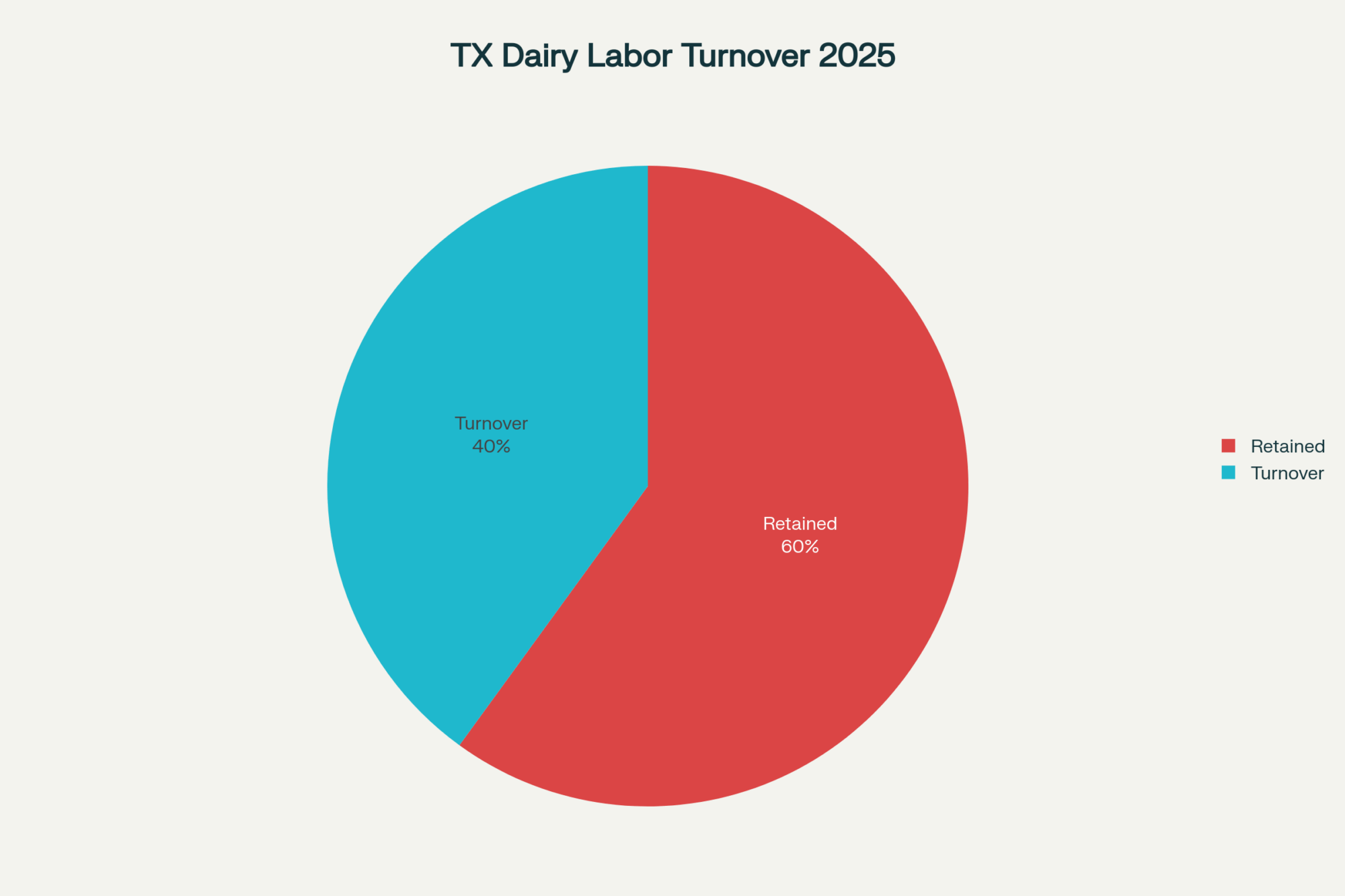
  • Labor turnover exceeds 40% in parts of Texas; implementing effective retention practices can help stabilize operations, reduce costs, and improve herd performance in the 2025 tight labor market.
  • Land values in key Plains expansion areas jumped 22%, so timing land purchases carefully and monitoring cropland prices are vital for strategic growth and profitability.

While traditional dairy states grapple with rising costs and regulatory pressures, a new economic reality takes hold in America’s heartland. According to August 2025 data from USDA-NASS, Kansas posted an 18.64% jump in milk production from the previous year, with South Dakota following at 10.64%. Since 2020, milk output has grown the fastest in Texas, South Dakota, and Kansas, while legacy states like Wisconsin and California have maintained their volume through consolidation, rather than by adding farms. The net effect is more milk being produced closer to new processing plants — and farther from some older ones.

The Data Driving the Shift

The numbers from Kansas are striking, with the state delivering an 18.64% increase in milk production from the previous year, followed closely by South Dakota at 10.64%. Texas continues to cement its position, producing 1.51 billion pounds in July while steadily expanding its herds.

What really stands out is how these newer Plains dairies are improving feed conversion. Agricultural economists at Kansas State University reported meaningful efficiency gains, meaning these farms get more milk from every pound of feed compared to older operations — a critical advantage when feed costs remain stubbornly high.

South Dakota’s growth is similarly well-founded. Herd numbers are up, and the state has seen substantial investment in infrastructure and feed supply, supporting sustained expansion.

Meanwhile, Wisconsin faced the closure of 313 dairy farms in 2024, highlighting the pressure on producers in traditional regions. However, production has remained resilient as dairy cows are consolidated on fewer, more efficient farms, helping maintain output and profitability.

California faces similar challenges — but with key advantages. California dairy producers benefit from proximity to major processors, higher milk solids, and revenue streams from digester-generated energy and Low Carbon Fuel Standard (LCFS) credits, which can offset some regulatory costs.

The Core Economics: Water, Labor, and Regulation

Water adds considerable complexity. Parts of the High Plains, particularly western Kansas and the Texas Panhandle, rely heavily on the Ogallala Aquifer, where water levels are declining rapidly. However, other regions, like eastern South Dakota and Nebraska, experience more stable groundwater supplies. For long-term investments, reliability and costs — including heat stress-related cooling — must factor heavily into planning.

California producers face strict water regulations, which drive up costs and incentivize innovative solutions. Regulatory costs are high, but partly offset by additional revenue from environmental credits and proximity to processing facilities.

Labor is another hurdle. Automation and efficient facility design help newer Plains dairies reduce labor per hundredweight of milk. Wisconsin and California are adapting—but the learning curves and capital needs remain significant.

Regulatory compliance costs in California are among the highest in the country — estimated at roughly $245 per cow annually, compared with $70 per cow in Plains regions. But environmental credits help some producers offset these expenses. Still, overall operational costs remain a significant factor in expansion decisions.

Where the Smart Money Is Flowing

Since 2020, investors have poured over $2 billion into dairy processing infrastructure across Kansas, Texas, and South Dakota, including expansions at the Hilmar Cheese plant in Kansas, Leprino Foods facilities in Texas and Colorado, and Valley Queen Cheese’s plant in South Dakota. These investments support and attract growing milk supplies in the region.

One 1,800-cow Plains dairy operator, speaking on the condition of anonymity, said, “The cost advantages out here allow us to reinvest and grow in ways that weren’t possible back East.”

Access to favorable financing tends to favor larger operations, though exact rates vary and are often proprietary.

Automation investments, such as milking systems, typically pay back in 18-24 months on average in these growth areas, driven by increased production and labor savings.

Proximity to processing plants is also a game-changer. The Plains benefit from facilities like Hilmar Cheese in Kansas, Leprino’s operations in Texas and Colorado, and Valley Queen in South Dakota. Herds delivering milk over shorter distances avoid the margin erosion caused by long-distance hauling.

Growth Pains: Risks to Watch

The National Weather Service highlights increasing weather variability in the Plains, posing risks to feed costs and cow comfort management.

Labor challenges persist, with turnover rates exceeding 40% at Texas dairies, according to the Texas Association of Dairymen.

Export demand appears promising, with the USDA projecting 4-6% growth for 2025; however, trade policies pose risks to maintaining this momentum.

Land prices are climbing rapidly. The Kansas City Fed reports a 22% increase in cropland values in Western Missouri over the past year, restricting the window for affordable expansion.

Disease outbreaks, animal movement restrictions, and gaps in insurance coverage for extreme weather add additional risk layers.

Why Scale Matters

Research by Cornell University confirms that dairies running more than 2,000 cows achieve significant economic advantages across geographies.

Your Strategic Takeaways

Monitor mailbox pricing and basis differences carefully, as these swings impact profitability more than volume changes. Track feed and forage costs, including sourcing silage and alfalfa locally versus transporting feed into expanding regions. Factor hauling distances and processing capacity availability into your cost analysis.

Consider potential impacts from upcoming federal milk marketing order reforms, which may alter class price relationships and influence regional payouts.

Test the sensitivity of your operation to 15% variations in feed costs, $1 modifications in milk prices, and additional cooling hours due to heat stress to refine strategic plans.

Look, I know change isn’t easy in this business. But the numbers don’t lie—and neither do your margins. Whether you’re considering expansion, exploring new technology, or simply trying to stay competitive, these shifts are happening whether we like it or not.

What do you think? Are you witnessing any of this unfold in your area?

Complete references and supporting documentation are available upon request by contacting the editorial team at editor@thebullvine.com.

Learn More:

  • The Unseen Costs of Employee Turnover on Your Dairy – Our analysis flags the 40% turnover in Texas as a major risk. This article breaks down the hidden financial drain of that churn and provides practical strategies for improving employee retention to cut costs and stabilize your workforce.
  • Brace for Impact: Why 2025’s Dairy Price Surge Masks a $780 Billion Industry’s Perfect Storm – Go beyond regional shifts and explore the global market volatility impacting your bottom line. This strategic analysis reveals how to interpret complex market signals and position your operation to withstand the economic pressures of 2025 and beyond.
  • Is Your Dairy Ready for the AI Revolution? – We’ve established efficiency as a key driver for growth. This piece explores the next frontier: artificial intelligence. It demonstrates how to leverage predictive analytics for superior herd health, reproductive performance, and enhanced profitability in a competitive future.

Join the Revolution!

Join over 30,000 successful dairy professionals who rely on Bullvine Weekly for their competitive edge. Delivered directly to your inbox each week, our exclusive industry insights help you make smarter decisions while saving precious hours every week. Never miss critical updates on milk production trends, breakthrough technologies, and profit-boosting strategies that top producers are already implementing. Subscribe now to transform your dairy operation’s efficiency and profitability—your future success is just one click away.

NewsSubscribe
First
Last
Consent

How a Trade War with Mexico Could Devastate the US Dairy Industry: Expert Analysis and Insights

Can a trade war with Mexico threaten US dairy? Explore expert views on impacts and strategies to protect your dairy business.

Summary:

The U.S. dairy industry faces a critical challenge from potential trade tensions with Mexico, a key purchaser of American dairy products, accounting for 25% of U.S. dairy exports valued at $5.5 billion last year. With 84% of Mexico’s dairy imports sourced from the U.S., retaliatory tariffs could slash farm-gate revenue by $16.6 billion, severely destabilizing the industry’s economic foundation. These tariffs have previously affected the competitiveness of U.S. dairy products, especially cheese and butter, making them more expensive in the Mexican market and leading to a noticeable decline in sales. Mexico remains an indispensable customer, purchasing one in four dairy products exported from the U.S. This precarious situation underscores the need for the U.S. dairy sector to remain vigilant regarding trade policy shifts and to advocate for strategies that safeguard and enhance market access, particularly in critical regions like Mexico.

Key Takeaways:

  • A potential trade war with Mexico could severely impact the U.S. dairy industry, as Mexico is the largest importer of U.S. dairy products, accounting for 84% of its dairy imports.
  • Tariffs and trade barriers previously affected farm-gate revenue, with similar tariffs projected to reduce it by $16.6 billion between 2018 and 2023.
  • Consumer demand for butter is rising despite increased domestic production, with imports soaring to meet consumer preferences for high-butterfat European styles.
  • A shift in Dairy farming trends shows a blending with beef farming; dairy replacements are at a two-decade low, highlighting a shift towards beef crossbreeding due to higher profits.
  • Optimized use of gender-sorted semen and strategic planning is crucial for dairy farms seeking to expand or adapt to market demands.
  • Low feed costs and a rise in consumer demand for high-quality protein products position the dairy industry potentially for a prosperous 2025. However, the ongoing concern remains tied to potential shifts in trade policies under a new administration.
US dairy industry, trade war with Mexico, dairy exports to Mexico, tariffs on dairy products, financial losses for dairy farmers, impact of trade policies, dairy supply chain challenges, innovative plans for dairy farmers, diversifying trade relationships, market fluctuations in dairy industry

Imagine waking up one morning to find that 25% of your most significant export market has disappeared overnight. This scary scenario could happen to the US dairy industry if a trade war with Mexico starts. Given that Mexico is the largest purchaser of American dairy products, any disruptions could result in significant financial losses for farms and jeopardize the livelihoods of numerous dairy farmers nationwide. The potential financial losses are staggering, and the urgency to address this issue is paramount. This industry’s stakes are incredibly high, and its success depends significantly on Mexico’s need for US dairy exports. 

The Importance of Mexico to US Dairy: Mexico is a major buyer of US dairy products. The US Dairy Export Council reports that about 84% of Mexico’s dairy imports are from the US, accounting for approximately 25% of US dairy exports, valued at $5.5 billion last year. Losing this market would be a big problem for the US dairy industry.

Mexico: The Keystone of US Dairy Exports or Achilles’ Heel? 

The difference between the US dairy trade and Mexico and China is evident when considering possible trade wars. About 84% of Mexico’s dairy imports come from the US, which means about 4.5% of all US milk production is sent to Mexico [source]. On the other hand, China buys less than 1% of dairy products from the US, making it a minor player in this market [source]

Based on these facts, a trade war with Mexico would hurt the US dairy industry much more than with China. US dairy farmers depend heavily on sales to Mexico, so any trade problems could be a big deal. Even though China is a big country, its low level of dairy imports from the US means a trade conflict wouldn’t affect us much. 

Looking at past events helps us understand better. When tariffs were in place, the US Dairy Export Council found that tariffs on Mexican goods might have cut farm revenue by up to $16.6 billion from 2018 to 2023. However, tariffs on China didn’t affect the dairy business much [source]. Because the US relies on Mexico, trade problems could threaten our dairy industry.

During the first Trump administration, tariffs were a key change for the US dairy industry. These tariffs were introduced to fix trade issues with countries like Mexico and China. However, they caused significant problems, especially for businesses like Dairy that sell products overseas. 

In 2018, the US Dairy Export Council found that tariffs on Mexican and Chinese goods could cut farm revenue by $16.6 billion through 2023. This figure underscores the heavy reliance of the US dairy industry on foreign trade. Due to this heavy reliance, particularly on exports to Mexico, where most dairy imports originate from the US, the dairy industry faces significant challenges. A disruption in this trade relationship, such as a trade war, could lead to a substantial decrease in farm revenue and threaten the stability of the entire industry. 

When Mexico imposed tariffs on US products in return, these challenges worsened. This affected raw milk and processed foods like cheese and butter. The tariffs made US dairy products more expensive and less competitive in the Mexican market, causing a significant drop in sales. These financial challenges impacted the dairy business, affecting everything from the supply chain to the farmers, who saw a direct impact on their income and livelihood. 

These tariffs affected more than just money. They forced the industry to rethink its export plans and highlighted the importance of good trade talks, considering the balance of selling and buying goods across countries. In the future, the US dairy industry needs to stay alert to changes in trade policies and push for policies that protect or grow its chances of selling in essential markets.

The Butter and Cheese Boom: A Double-Edged Sword in US Dairy Dynamics

The current state of the US dairy market shows a significant demand for butter and cheese, indicating a change in consumer preferences. Despite past arguments about its health effects, butter has become popular again, with record-breaking US production. Cheese is also being eaten more, making it the top choice in dairy products. However, this high demand could be affected by international trade issues. 

If a trade war with Mexico occurs, it could have a significant impact. Butter and cheese exports help balance what’s made in the US with global needs. Any problems in this trade could lead to too much supply in the US. Mexico is a key buyer of US dairy exports. If tariffs are implemented, these products might flood the local market and not have enough demand. 

This potential oversupply could lead to price drops. Dairy producers may face challenges when new production levels and strong consumer interest are affected by political issues. This situation calls for careful planning from everyone involved, pushing them to look beyond Mexico for business and use risk management strategies like forward contracts and hedging to protect against financial problems. Forward contracts and hedging allow dairy farmers to lock in prices for their products or inputs, protecting their income from market fluctuations.

Breeding Dilemma: The Double-Edged Sword of Beef-Dairy Crosses and Dairy Replacement Shortages

Today, US dairy producers face significant challenges, such as the shortage of dairy replacements and the growing popularity of beef-dairy crosses. These issues make it difficult for the industry to adjust to changing markets

This shortage of dairy replacements is a serious problem, making it challenging for the industry to expand or maintain current production levels. The shortage is mainly due to fewer dairy cows being kept, and more farmers prefer beef-dairy crosses, which immediately bring in more money. This shift has made it hard to find enough purebred dairy calves

The effects of this situation are enormous, casting a long shadow over the future of the US dairy industry. The choice by many farmers to prioritize more valuable beef-dairy crosses over traditional dairy replacements is creating a daunting supply gap. This trend, driven by short-term financial incentives, could lead to a significant contraction in milk production capabilities. Unfortunately, resolving these issues is neither quick nor inexpensive. Rebuilding herds to meet demand involves time and substantial financial investment, pushing farmers into a precarious position where rapid adaptation to market fluctuations becomes nearly impossible.

This lack of replacement heifers makes it harder for the industry to keep up with changing consumer needs or new export opportunities. To address these problems, the US dairy sector needs good planning to manage immediate pressures and ensure future growth and stability.

Navigating the Storm: Strategic Planning as Dairy’s Lifeline

Making innovative plans could help dairy farmers handle possible trade issues in these uncertain times. By locking in feed prices, farmers can protect their profits from changes in market trends. Right now, low prices for corn and soybean meal offer a good chance for farmers to fix their feed costs and protect their income. 

Finding new markets is also a smart move that could reduce the effects of possible trade barriers. Offering various dairy products, such as advanced cheese and whey protein, can create new opportunities and lower risks linked to depending too much on certain trade partners. Farmers and dairy businesses might consider boosting their marketing in fast-growing areas or even at home, where demand for new dairy products like high-protein supplements is rising. 

However, diversification extends beyond products to encompass markets, underscoring the holistic approach needed for strategic growth in the dairy industry. Diversifying trade relationships and entering new markets helps the dairy industry reduce the impact of market fluctuations or political changes in any single market. This strategy requires good strategic planning and studying new markets, but it can strengthen the industry against global changes. 

Strategic planning is crucial for the future success of the US dairy industry. As we look towards 2025, being quick to adapt can make the difference between doing well and just getting by if a trade war happens. While political situations change and economic conditions vary, businesses focusing on planning will be best positioned to succeed.

The Bottom Line

The US dairy industry is at a critical crossroads. The trade relationship with Mexico is crucial as 84% of Mexico’s dairy imports originate from the US. Therefore, we need to think about our trade policies carefully. One example of how tariffs have previously affected farm income in the dairy industry is the analysis by the US Dairy Export Council on the tariffs during past trade tensions with Mexico and China. These tariffs, ranging from 25% to 27.5% on US dairy exports, had a substantial financial impact, potentially reducing farm-gate revenue by up to $16.6 billion by 2023. For instance, when tariffs were put on cheese exports to Mexico during the first Trump administration, it led to a drop in demand, which meant less income for US farmers from one of their biggest foreign customers. Furthermore, retaliatory tariffs from China severely affected exports of whey products and milk powders, essential parts of US dairy exports. These examples show how trade policy can directly impact farm income, as tariffs block export routes and cut potential earnings that dairy farmers depend on [USDA Economic Research Service]. 

While demand for butter and cheese is rising at home, it also brings problems, especially with a shortage of dairy cows to replace older ones. Understanding the potential impacts of disputes and tariffs on global trade is crucial for comprehending their effects on the market and people’s daily lives. The ongoing battle between beef and Dairy farming makes things even more complicated. How will you handle these changes as dairy professionals? These challenges also bring opportunities to create new ideas and support policies that protect jobs. Working with lawmakers, understanding global markets, and careful planning could be part of the solution. Taking decisive action and making meaningful contributions is imperative to drive positive change in the dairy industry.

Learn more:

Join the Revolution!

Bullvine Daily is your essential e-zine for staying ahead in the dairy industry. With over 30,000 subscribers, we bring you the week’s top news, helping you manage tasks efficiently. Stay informed about milk production, tech adoption, and more, so you can concentrate on your dairy operations. 

NewsSubscribe
First
Last
Consent

U.S. Milk Production Decline Continues for 14th Consecutive Month

Why has U.S. milk production declined for 14 consecutive months? What challenges are dairy farmers facing, and how can they adapt to sustain their operations?

Summary:

August marked the 14th consecutive month of falling U.S. milk production compared to the previous year, with output dipping by 0.1%  despite a slight uptick in butterfat production. This ongoing decline raises questions about the sustainability of current practices and the resilience of dairy farms facing fewer heifers and harsher climate conditions. While dairy producers strive to keep barns full, the average dairy cow is older and less productive, indicating the need for innovative solutions. Though regional outputs show gains—California at 2%, Texas at 7.8%, and Florida at 0.6%—national yields continue to fall short, emphasizing the challenges ahead.

Key Takeaways:

  • U.S. milk production in August dropped 0.1% compared to the previous year, marking the 14th consecutive month of decline.
  • The decline in August was the smallest within the 14-month span, but it still marks a problematic trend.
  • Despite holding steady cow numbers from July to August, the U.S. had 40,000 fewer milk cows compared to the previous year.
  • Arizona experienced a decrease in milk yields, while California, Texas, and Florida showed improvements.
  • Nationally, the average U.S. milk cow produced 4 lbs. less milk in August than in the same month in 2023.
  • Persistent low dairy slaughter and avian influenza have resulted in an older and less productive dairy herd.

The consistent decline in milk output over the past fourteen months is not just a statistic; it’s a pressing issue that demands our attention. This prolonged slump is more than a blip on the radar; it’s a wake-up call for dairy farmers and industry experts. This article delves into the figures and trends affecting dairy operations, including cow numbers and milk output, as well as the more significant ramifications for processors and the supply chain. Understanding these trends is critical for dairy farmers trying to adapt and prosper; the more you know, the more prepared you will be to protect your future.

MonthMilk Production (Billion Pounds)Production Change (% YoY)
July 202318.5-0.3%
August 202318.8-1.0%
September 202318.3-0.4%
October 202318.6-0.7%
November 202318.1-0.5%
December 202318.7-0.2%
January 202418.4-0.8%
February 202417.9-0.6%
March 202419.1-0.5%
April 202418.2-0.9%
May 202418.9-0.3%
June 202418.4-0.7%
July 202418.6-0.1%
August 202418.8-0.1%

Milk Production: A Deep Dive into the Numbers 

To understand the present situation of milk production in the United States, we must examine the most recent data. In August, the United States produced 18.8 billion pounds of milk, representing a 0.1% decrease from the previous year. This statistic is part of a troubling pattern since August was the 14th month in which milk output fell short of the previous year’s amounts.

In context, the August decline is the smallest in this downward trend. However, it is essential to note that milk output was already 1% lower in August 2022 than the previous year. This identifies a recurring problem in the industry.

Furthermore, although higher milk component levels indicate that processors may have more dairy nutrients, this is not all good news. Butterfat production may have reached August 2022 levels, but milk solids output is expected to remain lower than two years ago. This raises concerns about dairy farms’ long-term sustainability and production throughout these changes.

From 2018 to 2022, milk output increased by around 2% yearly. This recent departure from the trend suggests that the sector may need to rethink its tactics and processes to maintain sustainable development. However, this also presents an opportunity for innovation and growth in the industry.

Regional Milk Production: Climate as a Silent Player

Examining geographical differences in milk production reveals some fascinating tendencies. California recorded a 2% increase in milk production, Texas experienced a staggering 7.8% increase, and even Florida, with its traditionally challenging environment, produced a slight 0.6% gain. These advances contrast significantly with the drop in Arizona, where milk production fell below the previous year’s.

So, what’s driving these geographical differences? It all comes down to climatic circumstances. The South and West saw extreme heat last year, significantly affecting milk output. This year’s heat was not without challenges, but it paled compared to the high temperatures predicted for 2022. The warmer environment allowed cows to produce more milk year after year, particularly in Texas and California.

However, the continued high temperatures in Arizona strained the dairy animals, resulting in lower milk output. This clearly demonstrates how regional climates may make or break output rates. Warmer-climate producers may need to spend more on cooling systems and other heat-mitigation techniques to maintain or increase future milk output.

These regional differences remind us that although national averages give a broad picture, local realities can reveal a more complex narrative. Understanding these variances may help dairy farmers and other companies better adjust their tactics to regional demands.

Decoding the Decline: Why Are Milk Yields Falling? 

We must ask ourselves: What variables are causing the decline in milk yields? It’s not just one issue; it’s a slew of obstacles. First, let us examine the scorching weather. Cows do not tolerate heat well, especially when it is hot for an extended period. The weather fluctuates, but milk production suffers when temperatures are continuously high. It’s like a marathon runner attempting to compete without a good diet; it’s unsustainable.

Then there’s the scarcity of heifers. I don’t need to remind you that maintaining, let alone increasing, milk output is complex without a consistent intake of young cows. Let’s speak about statistics. Heifer supplies have decreased. Thus, farmers depend on older cows.  And speaking of older cows, the average age of dairy cows has increased. Who implies we’re dealing with animals who are inherently underproductive. It’s more than simply having fewer gallons per cow; it’s also about the quality and consistency of those yields.

Finally, we cannot dismiss the importance of avian influenza. You may question, “What does bird flu do with cows?” But consider the interconnectedness of agricultural life. Avian influenza may wreak havoc on agricultural ecosystems. Health scares may alter management techniques and impact milk production, either directly or indirectly.

So we’ve got the ideal storm: hot weather, fewer heifers, aged cows, and avian influenza. It is, without question, a challenging atmosphere. However, recognizing these elements will allow us to plan more successfully in the future. We’re all in this together, and it’s time to think critically about overcoming these challenges.

What These Trends Mean for Dairy Farmers 

So, how do these developments affect dairy farmers? The implications are far-reaching. At the same time, an aged herd may indicate more experience and lower output. Milk yields are directly affected by the number of heifers and the age of the cattle. For many, this means a daily fight to sustain output levels.

Consider the economic impact: Reduced milk yields result in less product to sell. Farmers are dealing with the challenges of lower income and growing operating expenditures. Inflation needs to help, too. Feed costs have risen, and utilities show no indications of dropping. This economic downturn may make breaking even tricky, especially when generating a profit alone.

Despite these challenges, dairy producers are famed for their perseverance. They are not just facing these issues but actively finding solutions. Some are using modern farming methods. For example, automating milking and feeding systems may improve efficiency while lowering labor expenses. Others prioritize herd management tactics, refining feeding planning, and investing in cow comfort to increase output. Some even diversify their revenue sources by offering value-added goods such as cheese, yogurt, and agritourism. Their resilience and adaptability are truly commendable.

However, these adjustments have their own set of obstacles. Technological investments involve substantial resources, and rapid profits are rarely assured. Furthermore, diversifying might reduce resource availability. Some farmers, however, can survive because of government aid programs and cooperative initiatives.

Ultimately, these patterns are more than numbers on a page. They illustrate the real-world issues and changes that dairy producers confront every day. The industry can overcome this challenging moment by being inventive and adaptable.

Strategies for a Sustainable Future in U.S. Milk Production 

Looking forward, the future of U.S. milk production is dependent on many crucial elements. First and foremost, every approach should focus on improving cow health and production. Implementing sophisticated veterinarian care and unique breeding strategies may dramatically improve herd health. Regular health checks, appropriate diet, and ideal living circumstances are critical for sustaining a profitable dairy herd.

Another method worth examining is expanding heifer availability. Supply constraints have hampered herd replacements, directly affecting milk output. Dairy producers may boost their heifer population and milk output by investing in reproductive technology and increasing breeding efficiency. Embryo transfer and in-vitro fertilization are two methods that, although initially expensive, may provide long-term advantages by maintaining a consistent supply of high-quality heifers.

Technology and data analytics may have a transformational impact. Precision dairy farming tools, which monitor numerous real-time health and production data, enable early problem diagnosis and better decision-making. Embracing these technologies may result in more sustainable and productive operations.

Market dynamics also need consideration. Dairy producers must remain adaptable, responding to changing market needs and seeking new income sources such as organic milk or specialty dairy products. Engaging with policymakers to establish supportive agriculture policies may offer the needed buffer against market volatility.

Strategic cooperation and information exchange among dairy farmers, academics, and agricultural technology businesses may spur innovation and best practices. Associations and cooperatives may be essential in creating a collaborative environment by ensuring that critical resources and information are available to all stakeholders.

Finally, correcting the present fall in U.S. milk output requires a diversified strategy that seeks higher efficiency and sustainability. With determined effort and wise investments, the sector may survive and prosper in the following years.

The Bottom Line

The future of milk production in the United States is still being determined. We’ve witnessed 14 consecutive months of dropping milk output, posing severe issues for dairy producers nationwide. Significant contributors are to regional climatic variations and an aged cow herd owing to fewer heifers. While some states, such as California and Texas, have managed to raise production, the overall national picture remains a worry.

Why does this matter? Reduced milk yields indicate smaller profit margins for producers and possibly higher consumer costs. The pressure on current dairy cows to produce more can only go so far, primarily when they work in less-than-optimal circumstances.

So, where are we going from here? Dairy producers must innovate and adapt to ensure long-term production. Can the industry find the strength to overcome these obstacles, or are we on the verge of a significant shift in dairy farming?

Learn more:

Join the Revolution!

Bullvine Daily is your essential e-zine for staying ahead in the dairy industry. With over 30,000 subscribers, we bring you the week’s top news, helping you manage tasks efficiently. Stay informed about milk production, tech adoption, and more, so you can concentrate on your dairy operations. 

NewsSubscribe
First
Last
Consent

Surprising Trends in US Dairy Production: Cheese Surges, Whey Declines, and More – July 2024 Report

July 2024 Dairy Report: Cheese up, whey down. What does this mean for your farm business? Find out now.

Summary: The July 2024 US Dairy Production report reveals significant shifts in production patterns, from unexpected hikes in cheese production to surging butter levels. Cheese production exceeded forecasts by 11 million lbs., though cheddar dipped 5.8% from last year, indicating fluctuating consumer demand. Butter production, up by 2.2%, highlights stronger-than-expected consumption. NFDM and SMP production exceeded expectations despite weak domestic sales, leading to elevated stock levels. Whey production was disappointing, falling 12 million lbs. below projections due to plant issues and strategic milk allocation. These trends underscore a volatile market, urging dairy farmers and industry professionals to adapt and rethink their strategies.

  • Cheese production exceeded forecasts, but cheddar postings show a decline.
  • Butter production continues to rise, driven by stronger-than-expected consumption.
  • NFDM and SMP production surpassed expectations, resulting in high stock levels due to weak domestic sales.
  • Whey production fell below projections, impacted by plant issues and milk reallocation.
  • Market volatility signifies the need for dairy farmers and industry professionals to reassess strategies.

July 2024 offered a variety of shocks to the US dairy business. Consider a scenario in which cheese output increased suddenly by 11 million pounds, outperforming expectations and boosting consumption. However, whey production took a different course, falling far below expectations. How does this affect dairy farmers and industry professionals like you? How do these patterns influence your operations and decision-making? This essay delves deeply into the specifics of these changes, giving insights and information to help you manage the ever-changing dairy market.

ProductJuly 2024 Production (lbs)Forecast (lbs)% Change from Last Year
Cheese1,050 million1,039 million+1.9%
Cheddar Cheese375 million398 million-5.8%
Butter150 million147 million+2.2%
NFDM (Non-Fat Dry Milk)250 million241 million+3.7%
SMP (Skim Milk Powder)180 million172 million+4.7%
Whey120 million132 million-9.1%

Cheese Production Trends: What You Need to Know 

Regarding cheese production, we’re witnessing some exciting trends in July. Cheese output grew by 11 million pounds, or 1.9%, compared to the previous year. This increase, a sign of high demand and an abundant milk supply, could increase dairy farmers’ profits. However, let’s also take note of the significant reduction in cheddar output, down 5.8% from last year.

What does this imply to you, our readers? On the one hand, increased cheese production across the board may indicate a negative trend, as more cheese may enter the market. However, the decreased cheese inventories — far lower than expected and considerably below last year’s levels — convey a different narrative. These figures point to higher-than-expected consumption.

Simply put, we eat more and produce more cheese. The decreased stockpiles indicate that customers and potentially overseas purchasers pick up cheese quicker than expected. This delicate balance of supply and demand demonstrates the dairy market’s ever-changing dynamics. So, while we traverse these figures, examining how these changes may affect your operations and market plans is crucial. After all, strategic planning and adaptability are essential for success in a competitive environment.

Butter Production Surges: Why You Should Pay Attention 

Butter output continues to grow, with a 2.2% rise over the previous year. This steady increase presents a bright future for dairy producers and the supply chain. Despite this increase, equities ended weaker than expected in July.

So, what does all this mean? More essential output combined with lower-than-expected inventories suggests strong butter consumption. Consumers aren’t only buying; they’re purchasing more than expected. This tendency might boost demand and enhance market prices.

For those looking at market trends, these numbers show a healthier butter migration from farmers to end consumers. Lower stock prices indicate higher turnover rates, which is good for market stability. It clearly shows that, although supply is increasing, demand is not lagging—it’s exploding, resulting in a volatile but positive market situation.

NFDM and SMP Production: A Strategic Shift or Market Alarming?

The dairy industry had an unexpected twist, with NFDM and SMP output increasing by 9 million pounds. This increase did not come out of nowhere. In recent months, we’ve seen a significant trend of milk being transferred from NFDM to SMP manufacturing. This move isn’t an accident; it results from manufacturers’ purposeful efforts to align with market expectations.

But how does this affect our industry? Despite solid exports, higher-than-expected NFDM inventories indicate a worrying trend: domestic sales have dropped. It’s a dramatic contrast that is difficult to overlook. While we may applaud our success in overseas markets, the stagnant local market presents serious concerns. Are customers being priced out, or is it just a question of shifting preferences? The shift from NFDM to SMP production is a strategic move by manufacturers to align with market expectations. However, this shift has led to a surplus in NFDM inventories, highlighting the need for the industry to balance supply and consumption more effectively.

The 30 million lbs. increase in NFDM inventories highlights a significant issue: the balance of supply and consumption. This month’s robust exports couldn’t compensate for lower domestic sales, resulting in a surplus. As we go forward, the industry must rectify this disparity. Could targeted marketing or changes in pricing methods revive domestic interest? This is still a significant topic of debate among dairy specialists. One potential solution is to promote the health benefits of dairy products to increase domestic consumption. Another approach could be to adjust pricing strategies to make dairy products more affordable for local consumers.

Whey Production: Unexpected Drop and Strategic Shifts 

Many industry participants were surprised by the sudden drop in whey output. While such swings are expected, the June adjustments, which showed an almost nine million-pound reduction, paved the way for July’s more dramatic 12 million-pound deficit below projections.

Several causes led to the fall. First, anecdotal reports indicate that specific processing factories have had operational challenges, such as equipment breakdowns and labor shortages, limiting their ability to produce whey regularly. Picture this: A single problem at a significant factory may spread across the sector, resulting in severe output decreases.

Second, changed objectives within the dairy industry had a significant influence. Milk that was formerly used to make whey was repurposed into various products. This strategy move is likely due to market needs and the desire for increased profitability in alternative dairy categories. Firms may have channeled milk to cheese or butter, where margins were more attractive, particularly given the strong demand trends in those regions.

This reallocation has actual consequences. Dry whey inventories fell more than 7 million pounds short of expectations and are currently about 27% lower than the previous year. This significant fall in stocks demonstrates the concrete consequence of these production adjustments. Lower whey output may seem worrying on the surface, but it also indicates a dynamically flexible sector. Companies that travel between production lines to optimize profits demonstrate resilience and strategic adaptability, which might help the whole market in the long term.

The Ripple Effect: What Current Trends Mean for Your Dairy Farm 

These changes have a substantial economic impact on dairy producers and the industry. A boost in cheese and butter production and fewer inventories often suggest a tighter supply-demand balance. What does this mean for you as a dairy farmer? Increased production and lower inventory may result in higher market prices. When production rises, and stocks stay below expectations, it implies robust consumption. This dynamic often increases prices as buyers compete for limited supply stockpiles. The more excellent market price may increase dairy farmers’ earnings, resulting in a greater return on investment and allowing for more investments in technology or herd development.

However, there are various considerations to consider. Higher prices may stimulate additional production from other regions or countries, boosting competition. Furthermore, regulating the expenses of feed, labor, and other inputs will be critical to maintaining profitability. The supply-demand balance is complicated, and market instability may remain. Operational efficiency is also essential. Farmers must continue to improve their production practices as demand for higher-value dairy products like cheese and butter grows. Investing in quality feed and novel milking techniques may be necessary to sustain high production levels and ensure product quality, enhancing market competitiveness.

Contemporary developments in dairy farming provide both opportunities and challenges. Higher market prices may increase profitability, but they need careful planning. Farmers might diversify their offerings since various dairy products have variable demand and price dynamics. Shifting some milk to high-demand goods like butter or gourmet cheese might hedge against market volatility and offer more consistent income streams. Maintaining your knowledge and skills will allow you to handle these economic implications more effectively, guaranteeing your farm’s long-term profitability and growth.

Global Impacts: Navigating the Complexities of the Dairy Ecosystem 

The global dairy industry operates as a finely tuned ecosystem, with changes in one sector resonating across continents. The United States has seen significant changes in dairy production patterns lately, with cheese and butter outperforming forecasts. These trends are significant because they relate to global dynamics influenced by international demand, trade policy, and other economic factors.

International demand for US dairy products fluctuates based on global economic circumstances. Strong economies in Asia and the Middle East drive greater dairy consumption. US cheesemakers and butter manufacturers are anxious to reach these markets, but overseas demand varies. Meanwhile, trade policy may help or hamper these chances. Recent tariffs and trade agreements have raised or lowered the price of US dairy products for international buyers. While the USMCA has helped to calm North American trade, continued conflicts with the European Union might significantly impact cheese exports.

Global economic variables worsen the problem, particularly those influencing currency exchange rates and commodities prices. A strong US dollar may make American dairy goods more expensive overseas, reducing exports. In contrast, a weaker currency may increase global sales while limiting profits for US firms. Furthermore, fluctuations in global feed prices and energy costs affect downstream production costs and pricing tactics. Although local production patterns in the United States show a robust and diverse dairy industry, the global market environment presents opportunities and problems.

The Bottom Line

In July 2024, the US dairy landscape saw significant changes: cheese output exceeded estimates, but cheddar production lagged, butter output remained high due to strong consumer demand, increased NFDM and SMP production raised concerns about oversupply, and a decrease in whey output suggested issues with plant operations or strategic milk allocation, highlighting the necessity for dairy farmers to adapt and anticipate market expectations to manage these shifts and seize opportunities.

Learn more:

Join the Revolution!

Bullvine Daily is your essential e-zine for staying ahead in the dairy industry. With over 30,000 subscribers, we bring you the week’s top news, helping you manage tasks efficiently. Stay informed about milk production, tech adoption, and more, so you can concentrate on your dairy operations. 

NewsSubscribe
First
Last
Consent

May 2024 Milk Prices: A State-by-State Earnings Comparison for US Dairy Farmers

Learn how May 2024 milk prices differed across the US. Which states gave dairy farmers the best earnings? Check out our state-by-state comparison.

Have you ever wondered why milk prices vary from state to state? It’s not just a simple question—it’s essential for understanding the economic landscape that dairy farmers navigate. This article, set against the backdrop of the US dairy farming sector, delves into the May 2024 milk prices across the United States. 

Comparing milk prices isn’t just about numbers; it reveals the pressures and opportunities shaping the dairy industry. Examining these differences gives you a clearer picture of how factors like local demand, production costs, and state policies impact farmers. 

Understanding the disparity in milk prices helps farmers and sheds light on trends affecting the entire country. 

This article explains why these price differences matter and what they reveal about the U.S. dairy farming sector. You’ll find comparisons and insights illuminating the economic realities facing dairy farmers today. 

Sourcing and Accuracy: Behind the May 2024 Dairy Price Analysis 

Our analysis of May 2024 milk prices draws on multiple reliable sources. We gathered data from Illinois Farm Business Farm Management (FBFM) Association records, USDA reports, and state agricultural departments. This data was then cross-referenced with regional market reports and verified with dairy producers nationwide to ensure accuracy. 

We surveyed dairy producers nationwide and cross-referenced with regional market reports. To ensure data accuracy, we clarified any discrepancies directly with producers. 

Inflation adjustments were made using the Consumer Price Index (CPI) for dairy products, ensuring that current market conditions were reflected. 

We focused on states like California, Wisconsin, and New York for their significant milk production. States with varied regional pricing trends were also included for a comprehensive national view. 

Rest assured, our robust data sources, diligent data collection, inflation adjustments, and strategic state selection ensure the reliability of our May 2024 milk price analysis. You can trust the insights and recommendations we provide to navigate the dairy market.

Milk Price Trends in May 2024: A Beacon of Economic Optimism for Dairy Farmers 

RegionMay 2024 Milk Price ($ per cwt)May 2023 Milk Price ($ per cwt)YoY Change (%)
Northeast21.5019.758.86%
Midwest21.0019.209.38%
South20.7518.909.79%
West20.9519.109.69%

In May 2024, average milk prices in the U.S. increased, reflecting significant market shifts. The national average hit $20.30 per hundredweight (cwt), up from $18.75 in May 2023 and $19.50 in April 2024. This rise is attributed to reduced cow culling and better export performance. 

Increased domestic consumption has also boosted milk prices, signaling a potential opportunity for dairy farmers. This demand surge began in late 2023 and continued into 2024, driven by household and food service needs. The milk market remains resilient despite a drop in cheddar cheese and mozzarella prices, offering a glimmer of hope in these challenging times. 

Regional variances show some states with sharper price rises due to localized supply issues and varying production costs. Overall, the trend looks promising for dairy farmers. 

These changes suggest cautious economic optimism for the U.S. dairy market, which faces challenges like regional production differences and fluctuating domestic demand. Looking ahead, factors such as weather conditions, global trade policies, and consumer preferences will continue to influence milk prices, making it crucial for dairy farmers to stay informed and adaptable.

Regional Breakdown of May 2024 Milk Prices: Climate, Costs, and Market Impact 

RegionAverage Milk Price (per cwt)Key Influencing Factors
Northeast$21.50Cold climate, High production costs
Midwest$20.20Favorable climate, Low production costs
West$19.80Drought conditions, Export demand
Southeast$20.75High feed costs, Moderate climate
Southwest$20.00Tight milk supplies, Strong domestic use

When looking at May 2024 milk prices across the U.S., we see apparent regional differences: 

Northeast: Milk prices here are higher. The cold climate raises heating costs and affects feed quality. Plus, proximity to big cities like New York drives demand and prices. 

Midwest: Prices are stable thanks to robust dairy infrastructure and ample feed resources. While cheese prices, particularly cheddar, dropped by 8.5%, diversified dairy production keeps incomes steady. 

South: Lower milk prices are seen here due to the hot climate, which increases cooling costs and stresses dairy cows. Higher feed costs and lower demand also play a role, though better export performance offers some hope. 

West: California’s dairy farmers face moderate prices influenced by high feed and water costs from ongoing drought conditions. However, rising butter stocks help stabilize prices. 

These regional prices are shaped by climate, feed costs, and market demand, showing how important it is for dairy farmers to adapt to changing conditions.

Unpacking May 2024 Milk Prices by State: Key Patterns and Outliers 

Grasping the milk prices by state for May 2024 is essential to understanding the broader trends and economic impacts on dairy farmers. Let’s examine the data from different states and spot key patterns and outliers.

StateMay 2024 Price per cwt ($)April 2024 Price per cwt ($)TrendAnalysis
California21.3020.85▲ 2.2%Strong export markets and stable production.
Wisconsin22.1021.50▲ 2.8%Increased output per cow and regional demand stability.
New York20.7520.20▲ 2.7%Higher domestic use and tight supplies.
Texas19.8019.50▲ 1.5%Recovering from regional production declines.
Idaho21.0020.60▲ 1.9%Stable production and export performance.
Pennsylvania20.6020.05▲ 2.7%Increase in local demand and tighter supplies.

Milk prices in May 2024 vary by region. California, a key dairy producer, charges $3.75 per gallon, while Florida charges the highest, $3.90 per gallon. This difference stems from production costs, climate, and market demand.

Understanding the Economic Impact of Milk Prices on Dairy Farmers 

Understanding the economic impact of milk prices on dairy farmers is crucial. Variations in milk prices can affect profitability, sustainability, and the long-term viability of dairy farms across states. 

Higher milk prices often lead to improved incomes and more significant investment in farm infrastructure. This can mean better herd health management and higher productivity. Conversely, lower prices may reduce profitability, making it difficult for farmers to cover costs and potentially leading to smaller herds or delayed updates. 

Profitability impacts sustainability, too. Higher revenue can help farmers adopt sustainable practices like advanced feed systems or better waste management, benefiting both efficiency and the environment. Lower prices might force cost-cutting, compromising sustainability efforts and posing long-term risks. 

Varying milk prices also affect the long-term viability of dairy farms. Consistently higher prices encourage farmers to pass their operations to future generations, preserving farming traditions. Persistent low prices, however, could force exits from the industry, reducing the number of operational dairy farms. 

In conclusion, while higher milk prices generally support dairy farmers’ profitability, sustainability, and viability, lower prices create significant challenges. Balancing these fluctuations is vital for the overall health of the dairy sector. To navigate these price variations, dairy farmers can consider strategies such as diversifying their product offerings, improving operational efficiency, and exploring new markets.

Dairy Farmer Journeys: A Glimpse Into State-Specific Innovations 

Every dairy farmer’s journey is unique, and in May 2024, milk prices have impacted them differently. Here’s a look at a few of their stories: 

Case Study 1: Illinois – The Adaptive Farmer 

For over two decades, John Miller, a dairy farmer in Illinois, saw a revenue boost in May 2024 with improved milk prices. “This year, prices help us reinvest in better feed and expand our herd,” he says. Enrolled in the Illinois Farm Business Farm Management (FBFM) Association, John uses essential data to make informed decisions, seeing a brighter, more sustainable future

Case Study 2: California – The Sustainable Visionary 

Maria González, running a mid-sized organic dairy farm in California, is a champion of sustainable farming. The rise in butter stocks and strong export performance in May 2024 boosted her farm’s profitability. “Higher prices allow us to maintain organic certifications and invest in eco-friendly tech,” Maria shares. Still, she is cautious due to regional production disparities and slower domestic demand. 

Case Study 3: Wisconsin – The Technological Innovator 

Wisconsin’s Ryan Thompson embraces technology at his family’s dairy farm. Improved milk prices in May 2024 enabled advanced herd management tools, including the Livestock Indemnity Program (LIP) decision tool by the USDA. “These tools help with loss documentation, saving time and reducing stress,” says Ryan. Milk prices offer operational stability and growth despite a slight dip in cheese prices. 

These stories highlight the diverse experiences of dairy farmers across the United States. May 2024, milk prices have provided relief and optimism, enabling farmers to adapt, innovate, and invest in their operations.

Understanding Milk Price Dynamics: Policies, Subsidies, and Market Forces at Play 

Understanding milk price dynamics involves evaluating policies, subsidies, and market forces. These measures provide stability, helping farmers withstand market fluctuations. In May 2024, several factors stood out. 

The USDA introduced a new online Livestock Indemnity Program (LIP) decision tool and farm loan resources. This initiative aids farmers with loss documentation and financial aid, potentially stabilizing milk prices by reducing financial strain and preventing abrupt market exits. 

Market forces were also crucial. Early May saw a significant reduction in cow culling, with slaughter volumes dipping below 50,000 head for the first time in nearly eight years. This shift points to altered herd management strategies, likely influenced by improving milk prices and more robust export performance. Stable cheese inventories and rising butter stocks also supported a favorable pricing landscape. 

External market conditions, such as changes in domestic use, also impacted supply and demand dynamics. Increased domestic use due to higher disappearance rates in late 2023 and into 2024 shaped the pricing environment. 

The interplay of these policy tools and market adaptations highlights the complexity behind dairy pricing. While higher milk prices brought economic optimism, the ongoing balance of production and demand continued to define the financial landscape for dairy farmers in May 2024.

Embracing the Future: Insights from May 2024’s Dairy Price Data

Looking ahead, May 2024 data offers insights into future milk price trends. With a significant drop in cow culling, herd management is shifting. This trend could lead to more stable herd sizes, impacting supply and prices positively. 

Strong export performance and better domestic use create dual opportunities for farmers. Exports provide a lucrative market while growing domestic consumption signals further potential. 

Yet, challenges remain. Regional production disparities and slower domestic demand in some areas create economic imbalances. States like Illinois may innovate, but others might need help with these issues. 

Price drops in essential dairy products like cheddar and mozzarella hint at market volatility. Farmers may need to adjust production strategies to stay competitive. 

On a positive note, tools like the USDA’s online Livestock Indemnity Program (LIP) decision tool offer valuable risk management and planning resources. 

In summary, May 2024 promises better milk prices and strong exports. However, balancing these opportunities with ongoing challenges is critical to profitability and sustainability in milk production.

The Bottom Line

May 2024’s dairy price analysis shows a mix of optimism and challenges for dairy farmers. While improved prices and robust exports are positive, regional disparities and varying market forces bring different hurdles and opportunities. State-by-state variations in climate, operational costs, and market conditions significantly affect milk prices. 

Staying informed about policy changes, market trends, and regional insights is crucial. Embracing innovative practices, adjusting herd management, and leveraging new technologies can enhance sustainability and profitability. By being adaptable and informed, the dairy industry can better navigate economic fluctuations and seize emerging opportunities.

Key Takeaways:

  • National Price Increase: The national average milk price rose to $20.30 per hundredweight (cwt), a significant boost for dairy farmers.
  • Regional Variations: Prices experienced notable differences across states due to localized supply issues and production costs.
  • Economic Drivers: Factors such as reduced cow culling, better export performance, and increased domestic consumption contributed to the price surge.
  • Climate Impact: Weather conditions played a crucial role, with colder climates in the Northeast leading to higher prices, and hotter Southern climates contributing to lower prices.
  • Technological and Sustainable Advances: Dairy farmers in states like Wisconsin and California are leading the way with tech innovations and sustainable practices, respectively.

Summary: Milk prices in the US have risen significantly in May 2024, reaching $20.30 per hundredweight (cwt), reflecting the challenges and opportunities in the dairy industry. This rise is attributed to reduced cow culling, improved export performance, and increased domestic consumption. Regional variations show some states with sharper price rises due to localized supply issues and varying production costs. However, the trend is promising for dairy farmers, suggesting cautious economic optimism. Factors such as weather conditions, global trade policies, and consumer preferences will continue to influence milk prices, making it crucial for farmers to stay informed and adaptable. Regional breakdowns show Northeast experiences higher prices due to cold climate, Midwest prices remain stable due to robust infrastructure, South experiences lower prices due to hot climate, higher feed costs, lower demand, and better export performance, and West farmers face moderate prices due to drought conditions.

Say Good-Bye to Supply Management

For years the topic of Supply Management has been a hot button issue for dairy producers around the world.  Those who operate under a supply management system, such as the one in Canada, are strong advocates for the program.  While those that do not, such as New Zealand, Australia, and the US, tend to look at it with envy and even disdain. Recently there has been a lot of international talk about supplying of the supply management in the dairy sector.  The EU is removing supply management and the US government, who was  proposing a supply management system,   removed it in their most recent farm bill (Read more:  Dairy Farmers from Across the Nation Oppose Supply Management and  Compromise Reached: Supply Management OUT of Dairy Policy in Farm Bill).  With world trade becoming a greater and greater reality for all countries, it is only a matter of time before supply management, as we know it, no longer exists.

With that in mind we decided to take a look at the Canadian Supply Management System and the resulting impact, if it were removed.  Canada’s Milk Supply Management System was created to solve milk surpluses and low returns to farmers.  Understanding how this policy originally came into practice helps explain its longevity.  And understanding how the system works in practice points to the pressures it faces today.  These include astronomical quota costs, unanticipated dairy imports and globally uncompetitive pricing.  The system has had to evolve to address a range of domestic and trade changes.  The current milk supply management operates under three “pillars”: production controls (quota), administered pricing, and import controls.  As conditions have changed, regulations under supply management have changed.  It has been broadly successful in doing so, but its complexity has created operating costs and burdens for government and the dairy industry. Furthermore, with a more global economy, it has recently become a stumbling block in Canadian government world trade talks.  (Read more: Are We Playing Hide and Seek With Supply Management? and  Why the Future of the North American Dairy Industry Depends on Supply And Demand).

What’s the Story around the World?

Comparing Canada to the rest of the world, we find that New Zealand and Australia are at the highly market-oriented end of the continuum.  Canada is at the highly protectionist end. The U.S. and Netherlands/EU are in between.

Canadian milk production has been essentially constant since the mid-1970s and is actually down compared with the early 1960s.  At the same time, milk production in the U.S. has increased steadily.  In Australia, it has increased markedly following policy changes, prior to recent years when widespread drought limited production.  Netherlands dairy production increased steadily before quota controls were imposed in the 1980s and it has been relatively steady since, with a recent increasing trend.  New Zealand’s milk production is significantly up.

And what about milk pricing?  The national patterns diverge to a degree.  The available data suggests that prior to the mid-1980s, milk prices in the countries considered here broadly increased.  Canadian milk prices have continued to increase since the 1980s.  In the U.S. prices abandoned their trend of increases in the 1980s and have since become more volatile, consistent with the reduction in support pricing.  Similarly, in the Netherlands, the increasing price trend ended in the late 1980s.  Milk prices in Australia increased through the 1980s and plateaued in the 1990s. However, with the recent super market price wars, the price for milk in Australia has been extremely volatile.  New Zealand has seen a trend of higher prices and increased volatility, with some similarity to Australia.

Say Good- Bye to Supply Management - figure 1

Figure 1 presents divergences in milk pricing, using the U.S. as a reference.  The chart plots monthly P5 Eastern Milk Pool27 (Canada) blend milk prices versus U.S. Federal Order blend prices for New York/New Jersey and for the Upper Midwest since 1997.  Milk prices in Canada are generally much higher than those in the U.S. Over that period, the eastern Canadian price averaged $C63.05/hl, while the U.S. Midwest price averaged $C39.42/hl and New York/New Jersey averaged $C44.31/hl.  Moreover, because U.S. milk prices are much more volatile than those in Canada, the price differential is commonly wider than these averages suggest.  For example, the price spread between eastern Canada and the Upper Midwest U.S. has frequently exceeded $C40/hl— more than the average value of the Upper Midwest price itself. (Read more: Canada’s Supply-Managed Dairy Policy: How Do We Compare?)

The key advantage that Canadian producers have enjoyed over its peer countries is that fluid milk markets are characterized by seasonality that creates surpluses, which are diverted to industrial milk markets and thus result in lower industrial milk prices.  Sudden losses of export markets exacerbate domestic surpluses and depress milk prices.  Under persistent surpluses, with their associated inequities and low returns to farmers, the initial response is to mitigate adjustment through 27 The P5 Eastern Milk Pool is an interprovincial pooling agreement among Canada’s eastern provinces (Ontario, Quebec, Nova Scotia, New Brunswick, and Prince Edward Island) mandated pooling systems and more interventionist policies, such as price supports, product surplus removal programs, and production quotas.  These are eventually reduced or eliminated due to their cost burden.  The industry then adjusts, resulting in market growth.  Canada has not experienced the same pressures to reduce or eliminate interventionist policy that its peer countries have, so Canada continues to use certain approaches that its peers have dropped.  Nevertheless, industry adjustment has occurred in Canada, but without the market growth seen elsewhere.

Therefore, while Canada has not seen the growth that other world markets have, it also has not seen the extreme volatility that those other markets experience.  This stability is very much appreciated by Canadian milk producers, despite the high cost of entry and production (Quota, and Quota financing costs).

The World is Changing!

After 30 years in a supply management system the UK has now abandoned it.  Moreover, the EU as a whole is pushing for other countries to remove supply management as well.  (Read more: Canada May Drop Cheese Tariffs to Access EU Beef Market and Canada’s dairy farmers ‘angered and disappointed’ by EU trade deal that would double cheese imports).  This is causing great pressure for Canada to follow suit.  As the Canadian government seeks to open trade for all industries, especially Oil, Lumber and Beef, that access often comes at a cost. In Canada’s case that cost is opening up the Canadian dairy market.  More competition will mean that Canada’s high milk costs will have to go down thus decreasing the net return to producers.  While I don’t foresee the abolishment of the quota system immediately, it will happen.  As Canada opens up its markets to the world, that means that the Canadian government will have to further subsidize the milk price or allow the milk price to drop.  As the Canadian government is already running tight on its fiscal position, they are not likely to subsidize this system for very long.

While no one is arguing the benefits that supply management has had for the Canadian dairy farmer, that protection has come at a cost.  One of the greatest costs that I don’t think many realize is that it has allowed many producers to become complacent about their operations.  They have not been forced to be as efficient as possible.  Those that have been the most complacent are the ones who are going to feel the greatest hurt as Canada continues to open up access to world markets.  For those Canadian dairy farmers who think that the Canadian government will protect them till the end….what about the beef farmers, lumber and oil industry?  How can the Canadian government afford to protect and grow the market for all of them?  Everything has a price. (Read more: Save Frank & Marjorie Meyers Farm – The Army Is At The Gate & This Farmers Number Is Up!)

As a clarification point, while supply management as we know it is threatened, there is no question that the Canadian government is committed to a strong domestic agricultural industry.  Many other countries, including the European Union and the United States enact policies that subsidize (directly or indirectly) domestic production. This is something Canada does not currently do.  As the world market evolves, the Canadian system may have to move toward global markets and away from supply management.  It is also important to note that Canada gives more access to imported products than many other countries give in any single sector. Canada currently imports over 6% of the market for dairy products and more than 7.5% for poultry.  In contrast, the United States gives only 2.75% access to their market for dairy products and Europe offers a mere 0.5% for poultry. These will all be areas that will be addressed as world trade evolves.

The Bullvine Bottom Line

The world is rapidly moving to a free market economy.  This highly market oriented system will mean that those producers who can produce milk the most cost effectively will excel and those that are not efficient will perish.  Canada and its quota system that has done an amazing job at protecting its producers are most likely to be the hardest hit by these global forces.  Producers that are looking to the next generation need to seriously evaluate their operations and become as efficient as possible as fast as possible.  The message is clear.  Canada will be saying goodbye to the current supply management system.


Get original “Bullvine” content sent straight to your email inbox for free.


[related-posts-thumbnails]

Send this to a friend