Archive for precision feeding ROI

The Feed Price Paradox Crushing Dairy Margins

Feed dropped 23% but 68% of farms report worse margins—labor up 30%, equipment up 25%, co-op fees eating $1-3/cwt

EXECUTIVE SUMMARY: Here’s what’s keeping dairy producers up at night: despite feed costs dropping roughly 23% from recent peaks, land-grant university analyses show the majority of operations are experiencing their tightest margins in years. The disconnect stems from the feed’s shrinking role in total costs—now just 35-40% of expenses, compared to the historic 50%, according to extension economists at Cornell, Wisconsin, and Penn State. Labor costs have increased by approximately 30% since 2021, with wages commonly exceeding $20 per hour. Meanwhile, equipment financing has essentially doubled, and cooperative assessments are now taking $1-3 per hundredweight, a figure that didn’t exist five years ago. What farmers are discovering is that the traditional safety nets, including the Dairy Margin Coverage program, often miss these non-feed pressures entirely—the formula still assumes an economic structure from decades past. Looking ahead, operations that adapt through strategic diversification—whether that’s beef-on-dairy genetics capturing premiums of $800-$ 1,000, targeted technology investments, or collaborative marketing approaches—are finding paths forward despite the pressure. The key is understanding that waiting for old economic relationships to reassert themselves is no longer a viable strategy; successful operations are already rewriting their playbooks for this new reality.

dairy cost reduction strategy

What’s been puzzling everyone at the co-op meetings lately? Feed prices have come off their highs—grain markets have softened quite a bit, and protein sources are more reasonable than they’ve been in a while. But here’s the thing that doesn’t add up… many producers I talk with are actually seeing tighter margins now than when feed was more expensive.

I’ve been chewing on this for a while, talking with folks from different regions, and what’s becoming clear is that something fundamental has shifted in how dairy economics work. Land-grant university analyses from Wisconsin, Cornell, and Penn State in recent months all point to the same thing—the traditional relationships between feed costs and margins have broken down. Check your state extension’s dairy enterprise analysis tools for tracking these costs, because understanding what’s happening might help us all figure out how to navigate what’s ahead.

The Broken Feed-Margin Relationship

For generations, we all operated on this principle: when feed costs drop, margins improve. Simple as that, right? However, that relationship appears to have deteriorated, and it’s affecting everyone, from small grazing operations in the Southeast to mega-dairies in Idaho and the Pacific Northwest.

A producer from central Wisconsin put it to me this way recently: “Twenty years ago, if someone told me I’d have cheaper feed but worse margins, I’d have thought they were crazy.” And yet… here we are.

Feed costs dropped from 52% to 36% of total expenses while labor climbed to 28% – revealing why cheaper feed isn’t translating to better margins

What’s striking is the disconnect between the USDA Dairy Margin Coverage program’s calculations and the actual cash flow pain producers are experiencing. The DMC formula—based on corn, soybean meal, and alfalfa prices compared to the all-milk price—often shows acceptable margins. Meanwhile, extension economists note the DMC margin can diverge significantly from on-farm cash flow when non-feed costs rise, which is exactly what we’re seeing now.

Multiple land-grant analyses indicate that the feed’s share of total costs has declined from the historic 50% range to the mid-30s to low-40s in many systems. When your biggest historic cost shrinks that much, relief from lower feed prices just doesn’t move the needle like it used to.

Quick Cost Reality Check:

  • Labor: Up approximately 30% since 2021
  • Equipment: Up 20-25% since 2021
  • Interest rates: Doubled from 2021 lows
  • Co-op assessments: $1-3/cwt (new for many)

The Hidden Costs Eating Away at Margins

Labor: A New Competitive Landscape

We’re no longer just competing with other farms for labor. Amazon warehouses, manufacturing plants, and retail operations are all in the game, offering comparable pay and easier schedules.

USDA farm labor surveys in 2025 show wage rates across all dairy regions commonly approaching or exceeding $20 per hour—and that’s if you can find people. Extension field reports describe elevated turnover rates that significantly impact training and productivity. Every time someone new comes on board, there’s that learning curve… equipment doesn’t get maintained quite right, routines change, cows get stressed. It all adds up.

The stress isn’t just financial either. I know many operators who are working 80-hour weeks because they can’t find reliable help, and that takes a toll on their families, health, and ability to think strategically about the future. A producer in Washington state mentioned to me that he has started exploring different shift schedules, trying to make the job more appealing to individuals who prefer non-traditional dairy hours.

Equipment: Sticker Shock and Hard Decisions

Industry indices indicate notable increases in dairy equipment costs since 2021, with significant jumps in certain areas. At the same time, the Federal Reserve’s data shows prime rates have more than doubled from their 2021 lows. Current dealer quotes and recent lender reports suggest financing rates that would’ve been unthinkable just a few years ago.

Now, rebuilding or limping equipment along often beats financing new gear for many smaller farms. It’s not ideal, but when you’re looking at those payment schedules… well, you make do. I’ve seen some creative solutions out there—neighbors sharing equipment more often than they used to, people becoming really skilled at creating YouTube repair videos, and even some groups buying used equipment together to spread the risk.

Cooperative Fees: The Bite Gets Bigger

Several large cooperatives implemented capital retains or assessments between roughly $1 and $3 per hundredweight in 2024-2025, according to producer notices and regional reports. These weren’t a monthly concern five years ago. Now, they can turn a breakeven month into a loss, and there’s not much individual producers can do about it.

What’s interesting here is the timing—these assessments are coming when producers are least able to absorb them. But from the co-op perspective, they need to modernize facilities to stay competitive with private processors. It’s a tough situation all around.

Component Pricing: The Traditional Math is Failing

Butterfat jumped from 47% to 58% of milk value while volume plummeted to just 7% – rewarding quality over quantity producers

Component pricing under Federal Orders pays for pounds of butterfat, protein, and other solids, not just milk volume. Butterfat value especially has jumped. According to the USDA’s October 2025 component price announcement, butterfat reached $3.21 per pound, representing nearly 60% of the total Class III value, up from around 47% just five years ago.

But here’s the tricky part that extension specialists keep explaining at meetings: because of the pricing formulas, higher butterfat prices often correspond with lower protein values. It’s not a simple win. As dairy economists note, high-component milk takes years of genetic and nutritional investment—and the price swings for one component can erode gains in another.

Jersey herds typically test higher for butterfat and protein than Holsteins, which helps in this pricing environment. But transitioning your genetics? That’s expensive and takes time. The folks doing well with components started that journey years ago. A producer in Georgia recently told me he wishes he’d started crossbreeding five years earlier—now he’s playing catch-up while margins are tight.

Processors’ Confidence vs. Producers’ Reality

It seems almost every month brings news of new or expanded processing plants. The International Dairy Foods Association has documented over $11 billion in announced capacity investments since January 2023.

Why so much expansion when farms are hurting? Industry experts at Cornell and other universities explain that modern cheese plants need 2.5 to 3.5 million pounds of milk per day to run efficiently. Mega-dairies can supply that volume directly, and processors prefer dealing with fewer, larger suppliers for consistency and logistics.

So capital keeps flowing into processing, but on the farm side, it’s a different world—shrinking margins, steeper costs, and big questions about who gets to supply milk to these facilities in five years. The discussions surrounding the upcoming Farm Bill negotiations suggest that these structural issues are finally getting attention, but meaningful change takes time.

When Safety Nets Don’t Catch You

DMC margins stay safely above $9.50 trigger while actual farm margins hover near breakeven – exposing the formula’s blind spots

Dairy Margin Coverage insurance was designed as a lifeline. However, with feed now accounting for a smaller share of costs, labor, energy, and fees are climbing, making it frequently miss the mark.

DMC margins remained above the $9.50 trigger throughout much of late 2025, according to Farm Service Agency data, while many farms reported cash flow strain. Key expenses, such as labor, energy, and new co-op assessments, are not included in the formula. It’s like having insurance that covers your roof but not your foundation—helpful, but not when the real problem’s underground.

What Producers Are Trying

California dairies capture $340 premiums per crossbred calf while adoption rates surge past 40% in progressive regions

Beef Genetics—A New Revenue Stream

Beef-on-dairy crosses remain a bright spot for many. USDA market reports from various auction centers show beef-cross calves bringing $800 to $1,000 premiums over straight Holstein bulls. Extension specialists at Wisconsin and other universities commonly recommend keeping it to 25-30% of breedings to avoid running short on replacements—especially with quality replacement heifers now approaching $3,000 each according to market reports.

I’ve noticed operations in the Mountain West have been particularly successful with this strategy, partnering with local beef producers who value the consistency of dairy-beef crosses for their feeding programs. One Colorado operation told me they’ve built relationships with three different feedlots, ensuring steady demand for their crosses.

Direct Marketing—Potential and Pitfalls

Direct-to-consumer sales are gaining traction in areas such as Vermont and other regions near population centers. But feasibility studies suggest startup costs can easily run into the hundreds of thousands. Margins can be impressive for those who make it work, but it’s no small risk, and many who try it find that selling isn’t their passion.

One thing that’s working for some smaller operations is collaboration—several farms working together on processing and marketing, sharing the investment and the workload. It doesn’t eliminate the challenges, but it spreads them around. I know of a group in Oregon—five farms, none with more than 200 cows—who invested in a bottling line together and now supply three school districts, as well as a handful of stores.

Technology—Promise and Payback

Peer-reviewed studies and land-grant extension trials report labor savings and modest production gains with robotic milking, depending on management and herd size. However, with robots costing well into six figures per unit, according to current dealer quotes, payback periods stretch out considerably. Michigan State’s dairy financial tools and similar extension models often show payback periods of 8-12 years under current margins.

The operations that make these technologies work tend to be larger, with better access to capital and sometimes special arrangements with processors that provide pricing stability, which most of us can’t access. However, I’ve also seen smaller operations make strategic tech investments work—focusing on one area, such as feed management or reproduction, rather than trying to automate everything at once.

The Realities of Scale
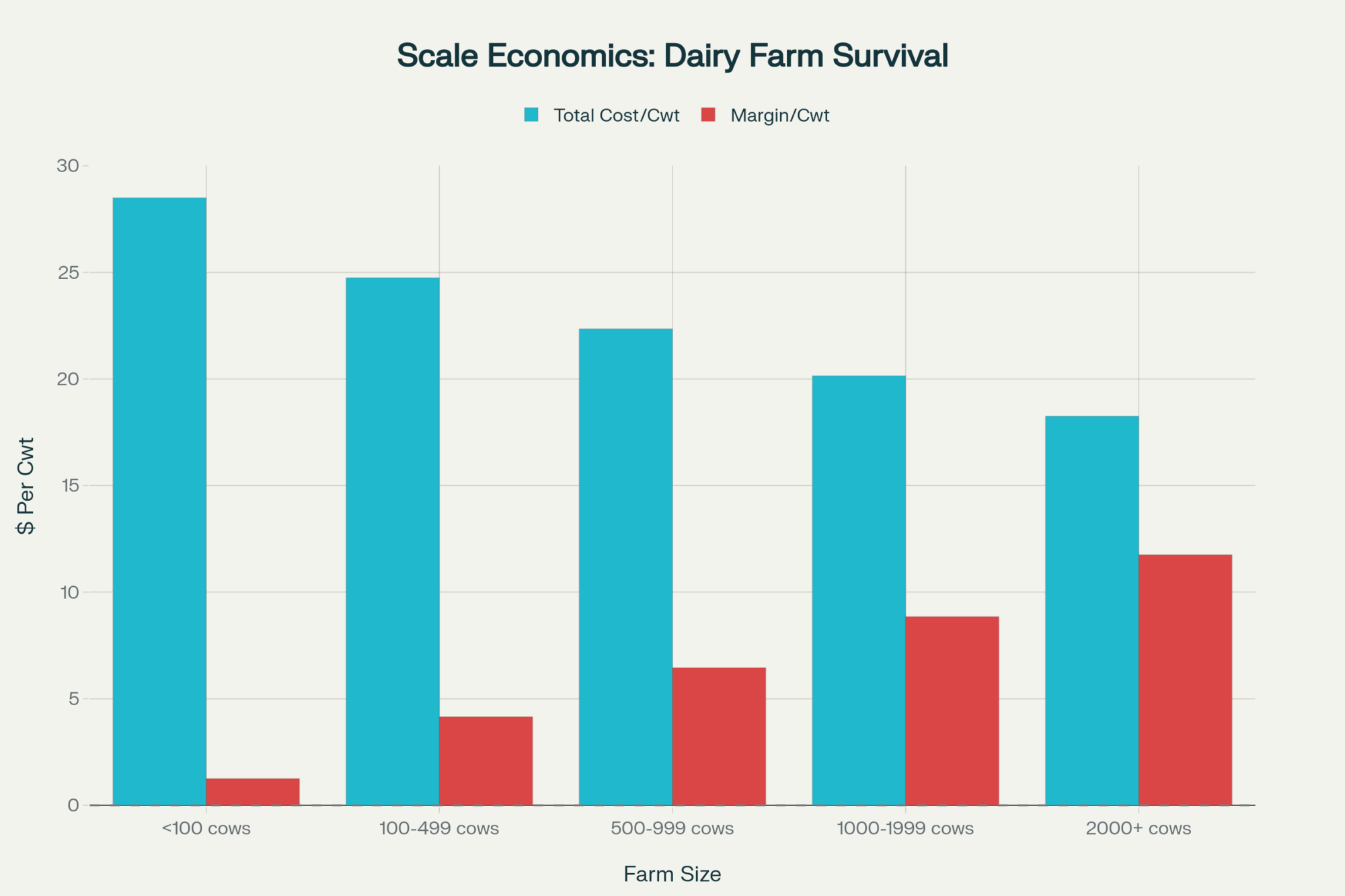
Mega-dairies (2000+ cows) generate $11.75/cwt margins while farms under 100 cows barely break even at $1.25/cwt

Here’s something we need to acknowledge, even if we don’t like it. The USDA’s Agricultural Resource Management Survey consistently shows multi-dollar-per-hundredweight cost advantages for herds with over 2,000 cows relative to those with fewer than 500. It’s not about who’s working harder—it’s economies of scale, volume discounts, and spreading overhead.

That doesn’t mean small and mid-sized farms can’t survive; some do through niche marketing, ultra-efficient operations, or creative partnerships. However, the economics become increasingly challenging each year, and agility and specialization are more crucial than ever.

Looking Forward

For many, 2025 feels like a tipping point. Agricultural economists at land-grant universities and the USDA anticipate further consolidation alongside rising total milk output in their long-term outlooks. Perhaps your best fit is ramping up efficiency, diving into specialty markets, partnering up, or, for some, exiting while retaining equity.

Mid-sized farms—say 300 to 1,000 cows—you’re in a particularly tough spot. Often too big for niche markets but not big enough for maximum efficiency. The path forward isn’t always clear. Some are exploring renewable energy opportunities, others are diversifying with agritourism, and yes, some are planning their exit.

Larger operations have their own unique challenges, including workforce management, environmental compliance, and community relations. Success increasingly requires professional management approaches that extend far beyond simply knowing how to produce milk.

Key Takeaways for Your Operation

  • Don’t trust old formulas: Lower feed costs alone won’t deliver profit—track all expenses, especially labor, equipment, and fees, using tools from your extension service or lender.
  • Diversify strategically: Explore genetics, marketing, and tech that fit your herd size and mindset—but go slow and seek input from others who’ve tried it before making major investments.
  • Stay proactive: Communicate regularly with your co-op, lender, and local extension agent to ensure a smooth process. Prepare business scenarios for best, worst, and base case situations, and plan changes deliberately, not reactively.

The Bottom Line

What we’re experiencing goes beyond feed and milk prices. The whole structure of dairy farming is shifting. That paradox—cheaper feed and tighter margins—is only one symptom of an industry in transition.

There’s no silver bullet. What works for a mega-dairy out West won’t always work on 300 acres in Wisconsin. What makes sense for 3,000 cows in Texas might be completely wrong for 150 cows in Vermont or a grazing operation in Missouri.

The key is understanding these dynamics, knowing the numbers for your own barn, and making changes that fit your future—not chasing the past. Because from everything the data shows and everything we’re experiencing… the old rules aren’t coming back.

But here’s what I’ve learned after all these conversations: dairy farming’s never been easy, but resilience runs deep in this community. We adapt, we help each other, and—whatever the industry throws at us—there’s always another way to move forward. It might look different than what we expected. It might mean some tough decisions. But we’re still here, still producing food, still figuring it out together.

And that’s worth something, even when the margins don’t show it.

KEY TAKEAWAYS

  • Track the real cost drivers: With feed now just 35-40% of total expenses (down from 50%), monitor labor costs (up ~30%), equipment financing (rates doubled since 2021), and co-op assessments ($1-3/cwt) using your extension service’s dairy enterprise analysis tools—these hidden costs are what’s actually driving your margins.
  • Diversify revenue strategically: Beef-on-dairy crosses are bringing $800-1,000 premiums per calf at auction, but keep it to 25-30% of breedings to maintain replacements—especially with quality heifers now approaching $3,000 each according to market reports.
  • Right-size technology investments: Michigan State’s financial models show 8-12 year payback periods for robots under current margins, so focus on targeted improvements (feed management or reproduction systems) that match your herd size and capital access rather than wholesale automation.
  • Collaborate for market access: Small operations in Oregon, Vermont, and other regions are successfully sharing processing facilities and marketing costs—five 200-cow farms together can achieve economies that none could manage alone, particularly for direct-to-consumer sales, capturing those premium margins.
  • Prepare for structural change: USDA data shows that operations with over 2,000 cows achieve multi-dollar per hundredweight cost advantages. Therefore, mid-sized farms (300-1,000 cows) need clear strategies—whether that involves efficiency improvements, niche market development, strategic partnerships, or planned transitions while maintaining strong equity.

Complete references and supporting documentation are available upon request by contacting the editorial team at editor@thebullvine.com.

Learn More:

Join the Revolution!

Join over 30,000 successful dairy professionals who rely on Bullvine Weekly for their competitive edge. Delivered directly to your inbox each week, our exclusive industry insights help you make smarter decisions while saving precious hours every week. Never miss critical updates on milk production trends, breakthrough technologies, and profit-boosting strategies that top producers are already implementing. Subscribe now to transform your dairy operation’s efficiency and profitability—your future success is just one click away.

NewsSubscribe
First
Last
Consent

Why Your Milk Check Math Doesn’t Work Anymore (And 5 Ways Dairy Farmers Are Fighting Back)

The $3 drop from January’s $20.34 to today’s $17.59 milk price costs a 500-cow dairy $1,800 daily

EXECUTIVE SUMMARY: What farmers are discovering right now is a fundamental disconnect between milk prices and production costs that goes beyond normal market cycles—the September Class III price of $17.59 represents a $3 drop from January’s highs, costing typical Midwest operations roughly $135 per cow monthly. Recent USDA data confirm that we’ve lost 15,532 dairy farms (nearly 40%) between 2017 and 2022, yet milk production increased by 8%. As a result, the largest 3% of operations now produce over half of our milk supply. Cornell and Penn State research shows that successful adaptations are emerging: direct marketing captures $2-4 premiums per gallon, precision feeding delivers 8-12% efficiency gains with sub-two-year paybacks, and strategic breed shifts to Jerseys improve component economics. The $5-8 billion in processor investments signals continued consolidation ahead, but innovative mid-sized operations are finding profitable niches through differentiation, technology adoption, and regional market advantages. Here’s what this means for your operation: understanding these structural shifts—not waiting for prices to “return to normal”—becomes essential for making informed decisions about expansion, technology investments, or alternative marketing strategies that align with your farm’s specific strengths and local opportunities.

You know how it is at 4:30 AM—there’s something about that quiet time in the parlor that gets you thinking. Recently, I’ve been giving a lot of thought to where we stand with milk prices and what it means for all of us trying to make a living in the dairy industry.

I’ve spent the past few weeks reviewing the latest market data and, more importantly, speaking with producers from Wisconsin to Pennsylvania, California, and even the Southeastern United States. What’s emerging is… well, it’s complicated. However, it’s worth understanding because it affects each of us differently.

Where Prices Stand Right Now

So here’s where we are. The USDA announced in early October that September’s Class III came in at $17.59 per hundredweight—that’s up thirty-five cents from August. Now, if you’re like me, you probably remember those January and February prices this year—$20.34 and $20.18, according to the Federal Milk Marketing Order announcements. That three-dollar difference? You’re feeling it in your milk check, I guarantee it.

The disconnect between costs and prices becomes even clearer when you look at this historically. The Bureau of Labor Statistics’ inflation calculators indicate that if milk prices had kept pace with general inflation since the 1970s, we’d be looking at significantly higher prices today. The gap represents something deeper happening in our industry.

At a co-op meeting last month, I heard a producer from central Wisconsin say it perfectly: “My dad used to be able to predict milk prices within reason based on feed costs and what was happening in the general economy. That relationship? It’s just gone now.” And you know what? He’s absolutely right.

As we head into the winter feeding season—with concerns about feed inventory on everyone’s mind after the variable growing conditions this past summer—that disconnect between costs and prices feels even more pronounced. Many of us are already planning for the spring flush, wondering whether to push production or hold back, given the potential direction of prices.

Quick Reference: Key Numbers to Know

  • Current Class III: $17.59/cwt (September 2025)
  • Make Allowances (June 1, 2025): Cheese $0.2504/lb, Butter $0.2257/lb
  • Farms Lost (2017-2022): 15,532 operations (39.5% decline)
  • Typical Robot Cost: $180,000-250,000
  • Organic Premium Range: $35-40/cwt
  • Beef-on-Dairy Premium: $200-400/calf

The Processing Side of Things

What many of us are realizing is how dramatically the processing landscape has shifted. Remember when you had four or five plants competing for your milk? According to USDA Agricultural Marketing Service data, most regions now have just one or two buyers. That’s a dramatic shift in negotiating power.

Those Federal Milk Marketing Order changes that took effect on June 1—the make allowances increased as documented in the Federal Register. Cheese to $0.2504 per pound, butter to $0.2257. Now, these might sound like small adjustments, but multiply them across your production… For those Upper Midwest operations shipping anywhere from 35,000 to 45,000 pounds daily—which is pretty typical for a 400 to 500-cow herd with decent production—that’s real money coming right out of the milk check.

The regional differences are striking, too. Northeast producers often have access to those fluid markets—though university extension reports from Cornell show the premiums aren’t what they used to be, averaging just $2-3 above manufacturing milk. Meanwhile, those of us in the Midwest are primarily dealing with fluctuating milk prices.

RegionAverage Herd SizeFluid Market AccessHeat Stress CostsProcessing OptionsDirect Marketing PotentialLabor AvailabilityFeed Cost Advantage
Upper Midwest400-500 cowsLimited$01-2 buyersModerateChallengingCorn/soy belt
Northeast200-300 cowsGood ($2-3 premium)$25-35/cow3-4 buyersHigh ($2-4/gal premium)Very challengingHigher costs
California1,300+ cowsManufacturing focus$35-50/cowMultiple co-opsLowModerateVariable
Southeast300-400 cowsSome fluid access$50-75/cow2-3 buyersGrowingChallengingHeat stress offset

California’s situation is unique, too. They’ve been in the Federal Order system since November 2018, but with average herd sizes over 1,300 head according to California Department of Food and Agriculture data, they’re operating at a completely different scale. And down in the Southeast? Those folks are dealing with heat stress management costs that can range from $50 to $ 75 per cow annually, according to University of Georgia research, which eats into any fluid premiums they might capture.

Looking at processor investments, we’re seeing announcements totaling $5-8 billion in new facilities coming online by 2026, based on industry reports and construction permits. For example, Dairy Farmers of America alone announced over $1 billion in processing expansions this year. They’re clearly betting on continued consolidation.

Farm Size Category2017 Farms2022 FarmsChange (%)Milk Production Share 2022Survival Strategy
Under 100 cows2317014129-39%7%Niche marketing/Exit
100-499 cows110007326-33%17%Efficiency/Technology
500-999 cows20541434-30%16%Scale up or specialize
1,000-2,499 cows13651179-14%31%Continued expansion
2,500+ cows714834+17%29%Market dominance

Learning From Our Neighbors North

It’s worth examining what’s happening in Canada with their supply management system. Statistics Canada reports show that their dairy farms maintain more predictable margins, with average net farm income significantly higher than that of comparable U.S. operations. Their farms tend to have debt-to-asset ratios of around 20%, according to Farm Credit Canada, compared to the 35-40% range reported by the USDA Economic Research Service for U.S. dairy operations.

They pay more for milk in Canada, no question—retail prices run about 30% higher according to comparative price studies. However, they have been chosen by a society that expects farms to be profitable enough to survive and pass on to future generations. We’ve made different choices here, and… well, we’re living with the consequences of those choices.

I was talking with a producer at the Pennsylvania Farm Show who said, “We keep looking for the perfect system, but maybe it’s about finding what works for each operation within the system we’ve got.” That really resonates with me.

What Producers Are Doing to Adapt

Despite all these challenges, I’m seeing some really creative adaptations out there. And it’s worth sharing because even if something doesn’t work for your operation, it might spark an idea that does.

Direct marketing is one path that’s gaining traction, especially for farms near population centers. Penn State Extension’s research shows that operations successfully transitioning to direct marketing can capture margins of $2 to $ 4 per gallon above commodity prices. I am aware of a typical mid-sized operation in Pennsylvania—approximately 300 cows—that invested around $800,000 in a bottled milk processing facility a few years ago. They’re now capturing significantly better margins on about a third of their production and expect to hit payback within four to five years. The capital requirements are substantial—USDA’s Value-Added Producer Grant program data shows typical processing facility investments range from $500,000 to $2 million. But those who make it work? They’re capturing margins that completely change the equation.

The organic market has gotten more complex. USDA Agricultural Marketing Service Organic Dairy Market News reports indicate that premiums are currently running $35-40 per hundredweight, but as more producers convert, those premiums are being squeezed. And we’ve seen major processors like Horizon Organic dropping dozens of farms when they have oversupply, so it’s not the guaranteed path it might have looked like a few years back.

Speaking of different approaches, I’ve noticed Jerseys making more economic sense for some operations lately. With butterfat premiums where they are and lower feed requirements per pound of components, a neighbor switched half his herd and says it’s working out better than expected.

The Technology Conversation

TechnologyInitial InvestmentAnnual Savings/RevenuePayback PeriodKey Success FactorRisk Level
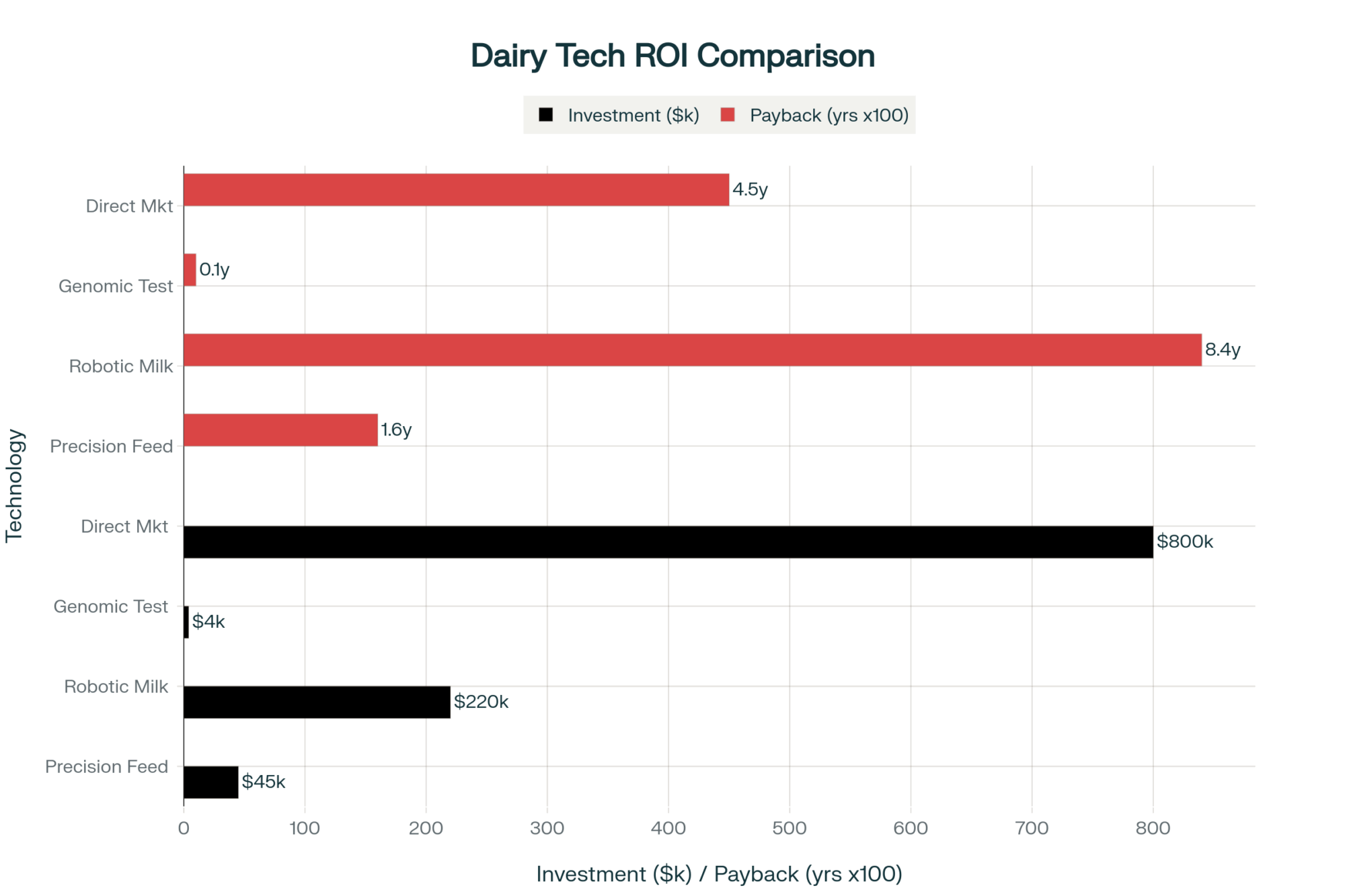
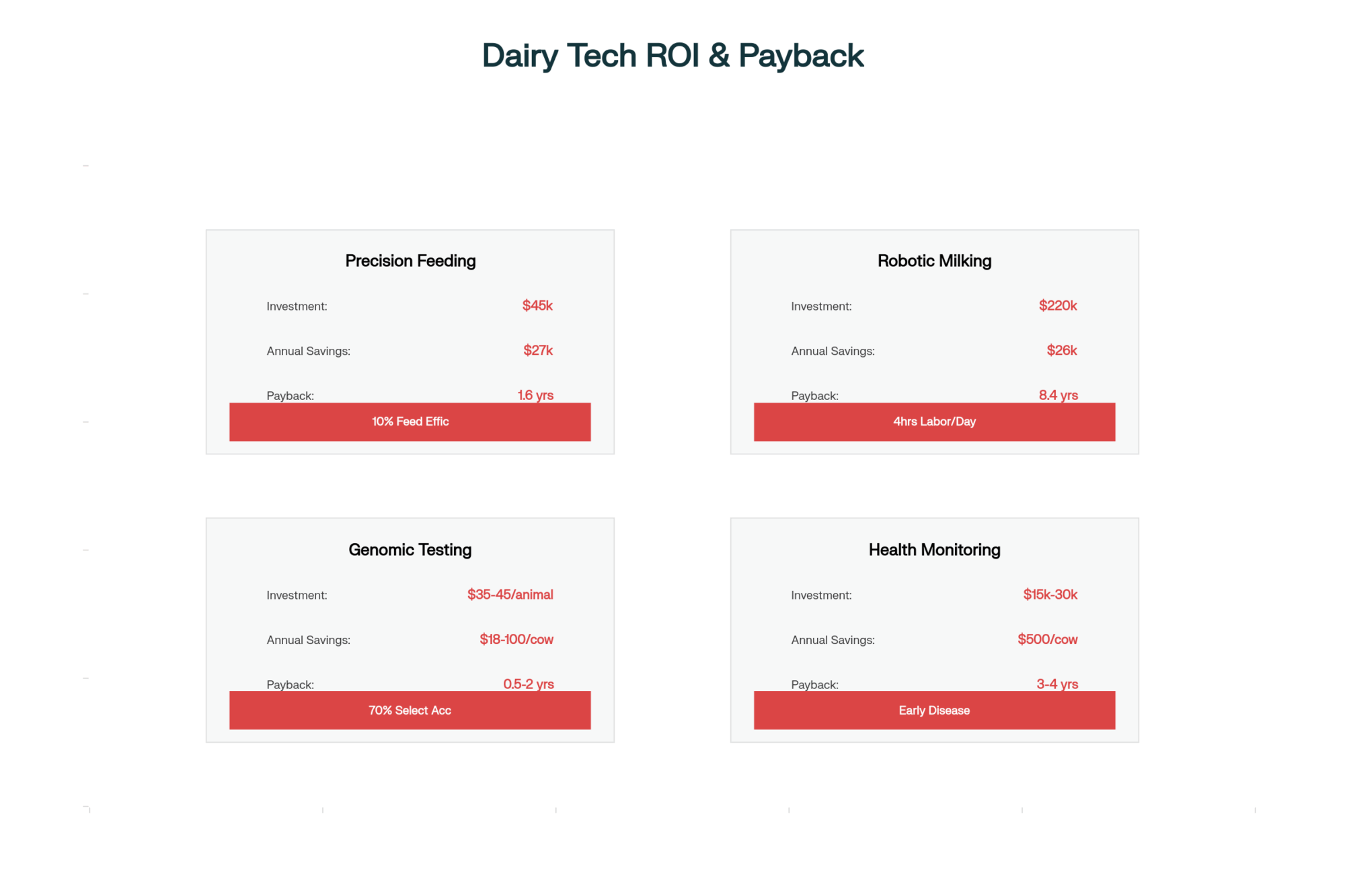
Precision Feeding (120 cows)$45,000$27,3601.6 years10% feed efficiency gainLow
Robotic Milker (120 cows)$220,000$26,2808.4 yearsConsistent protocols + labor shortageMedium-High
Genomic Testing (per animal)$35-45$18-100/cow0.5-2 years70% selection accuracyVery Low
Health Monitoring (120 cows)$20,000$500/cow2-4 yearsEarly disease detectionLow
Direct Marketing Setup$800,000$2-4/gal premium4-5 yearsNear population centersHigh

Here’s a discussion I’m having everywhere I go: should you invest in technology when margins are this tight?

Penn State Extension’s dairy team has done excellent work showing that precision feeding systems can deliver real returns—typically 8-12% improvement in feed efficiency. Cornell’s Dairy Farm Business Summaries indicate that feed costs typically range between $8 and $11 per hundredweight of milk produced, making significant efficiency gains.

Let me give you a concrete example: A 120-cow operation investing $45,000 in precision feeding, saving 10% on feed at $9.50/cwt, producing 24,000 pounds per cow annually—that’s about $27,360 in annual savings. You’re looking at less than two years payback if everything goes right.

Robotic milkers? That’s even more complex. University of Wisconsin research shows labor savings of three to four hours daily per robot, which, at $15-$ 20 per hour, adds up. Take that same 120-cow operation: one robot at $220,000, saving 4 hours daily at $18/hour equals $26,280 annual labor savings. Before any production increases or milk quality improvements, you’re looking at 8+ years for payback. Most extension analyses indicate that total payback periods typically range from 5 to 8 years when factoring in all costs.

A producer from Michigan, whom I met at World Dairy Expo, put it well: “Technology is a tool, not a solution. It works when it fits your operation, your finances, and your management style.”

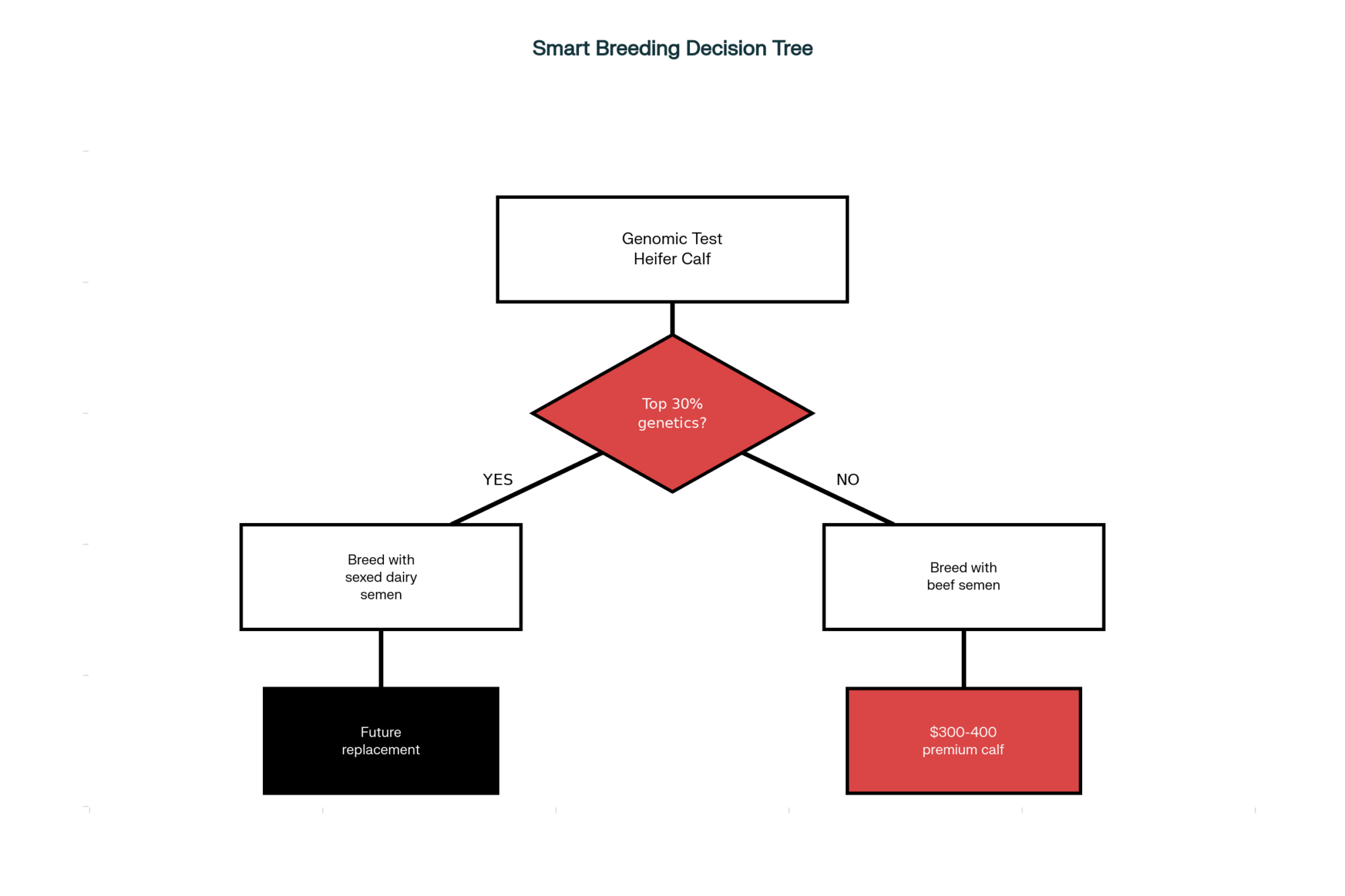
And speaking of management, the heifer side of things is getting interesting too. With replacement heifer values where they are and beef-on-dairy premiums running $200-$ 400 per calf, according to recent market reports, more operations are rethinking their entire replacement strategy. Add in genomic testing at $35-45 per animal (companies like Zoetis CLARIFIDE or STgenetics), and you can really target which heifers to keep. Do you raise every heifer, or do you breed your best cows for replacements and use beef semen on the rest? It’s a conversation worth having.

Where We’re Heading

The 2022 Census of Agriculture numbers were eye-opening. We went from 40,002 dairy farms in 2017 to just 24,470 in 2022. That’s… that’s nearly 40% of our dairy farms gone in just five years. But here’s what’s really telling: USDA National Agricultural Statistics Service data shows milk production actually went up 8% during that same period.

The larger operations are picking up that production and then some. Economic Research Service analysis shows that the largest 3% of dairy farms now produce over 50% of our milk. The economics increasingly favor these bigger dairies, and you can see processors positioning themselves for a future with fewer, larger suppliers in their capital investment patterns.

The mid-sized dairies—those 200 to 500-cow operations that are too big for niche marketing but don’t have the scale of the really large operations—they’re in a particularly tough spot, according to most agricultural economists. But I’m still seeing innovative mid-sized farms finding ways through differentiation, efficiency improvements, or strategic partnerships.

Geography matters more than ever now. A 200-cow dairy near Madison or Burlington might actually have opportunities that a 1,000-cow operation in northern Minnesota doesn’t have. It’s all about understanding and leveraging what advantages you do have.

Making Sense of Your Own Situation

Every operation is different—your debt structure, your family situation, where you’re located, what you’re good at managing. There’s no one-size-fits-all answer here, but there are some things worth thinking about as we head into the winter planning season.

If you’ve got kids who genuinely want to farm, that changes your whole calculation compared to someone whose kids are happily working in town. And that’s okay—there’s no judgment there. It’s just about being honest about what makes sense for your family.

Your financial structure significantly determines your flexibility. Cornell’s Dairy Farm Business Summaries consistently show operations with debt-to-asset ratios under 30% have significantly more options during tough times. As that ratio climbs above 40%, your options narrow pretty quickly. Every month of losses eats into that equity cushion you’ve built up over the years.

Location and market access create opportunities or constraints that you can’t ignore. Being within 50 miles of a city with over 100,000 people, having multiple processing options, and understanding your local food economy —all of these factors go into what strategies might work for you.

Looking Forward with Clear Eyes

Despite all these challenges, I’m actually encouraged by a lot of what I see. The innovation, the willingness to try new approaches while building on proven management practices, is a testament to the resilience in this industry that shouldn’t be underestimated.

I was at a young farmer meeting in Ohio where someone made a comment that really stuck: “We can’t control milk prices or feed costs, but we can control how we respond. That’s where our opportunity is.”

As we approach the spring flush, with all the management decisions that entail, such as breeding, culling, and production planning, the mindset of controlling what we can control becomes even more crucial. How we handle transition cows, fresh cow management, and even which bulls we’re using… these decisions matter more when margins are tight.

The industry’s going to keep evolving—global markets, consumer preferences, technology advances, policy changes—it’s all part of the mix. But farmers have always adapted. We’ve always found ways to make it work, even when “making it work” means making tough decisions about the future.

The Bottom Line

The economic pressures we’re facing—they’re real and they’re structural. Understanding them without sugar-coating but also without doom and gloom helps us make better decisions.

For some operations, expansion to capture scale economies makes sense. Others might find their path in differentiation or adding value to their product. And yes, for some, transitioning out of dairy might be the right decision for their family. Each choice reflects individual circumstances and priorities.

What matters is making informed decisions based on a realistic assessment of the situation. The dairy farmers I respect most look at their situation honestly, thoroughly explore options, and make decisions aligned with their family’s long-term well-being.

Whatever path you choose, make it with clear eyes about what’s happening in our industry. The decisions we make today—whether about technology, herd expansion, replacement strategies, or succession planning—shape not just our own operations but also the future of dairy farming.

The conversation continues, and your voice and experience are part of it. That’s what makes this industry worth being part of, even in these challenging times.

As my old neighbor used to say, “Dairy farming isn’t just about making milk—it’s about making decisions.” And right now, those decisions matter more than ever.

KEY TAKEAWAYS:

  • Technology ROI varies dramatically by operation: Precision feeding systems ($45,000 investment) can deliver $27,360 annual savings on a 120-cow farm through 10% feed efficiency gains, achieving payback in under two years—while robotic milkers require 5-8 years for full ROI when factoring production increases and quality premiums
  • Geographic advantage matters more than size: Operations within 50 miles of cities over 100,000 people can capture direct marketing premiums of $2-4/gallon, making a 200-cow dairy near Madison potentially more profitable than a 1,000-cow operation in remote Minnesota
  • Debt structure determines flexibility: Cornell’s Farm Business Summaries show operations with debt-to-asset ratios under 30% maintain multiple adaptation options, while those above 40% face rapidly narrowing choices—making equity preservation as important as operational efficiency
  • Heifer strategies are shifting fundamentally: With beef-on-dairy premiums at $200-400 per calf and genomic testing at $35-45 per animal, breeding only the top 30% of cows for replacements while using beef semen on the rest can add $15,000-30,000 annually to a 100-cow operation’s bottom line
  • Regional processing dynamics create different realities: Southeast operations face $50-75 per cow in annual cooling costs that offset fluid premiums, while Upper Midwest farms shipping to single buyers lose negotiating power but benefit from lower operating costs—understanding your regional context shapes which strategies actually work

Complete references and supporting documentation are available upon request by contacting the editorial team at editor@thebullvine.com.

Learn More:

Join the Revolution!

Join over 30,000 successful dairy professionals who rely on Bullvine Weekly for their competitive edge. Delivered directly to your inbox each week, our exclusive industry insights help you make smarter decisions while saving precious hours every week. Never miss critical updates on milk production trends, breakthrough technologies, and profit-boosting strategies that top producers are already implementing. Subscribe now to transform your dairy operation’s efficiency and profitability—your future success is just one click away.

NewsSubscribe
First
Last
Consent

Feed Costs Just Rewrote the Dairy Playbook—and Your ZIP Code’s Calling the Shots

Forget what you think you know about feed costs—geography just became the biggest profit killer in dairy.

EXECUTIVE SUMMARY:  Look, I’ve been talking to producers from Texas to Saskatchewan, and here’s what nobody’s saying out loud: your farm’s location now drives profitability as much as your genetics program. We’re seeing feed costs slam 50-55% of milk revenue in drought zones while Midwest operations cruise at 35-45%—that’s not market volatility, that’s structural change. Take Jake in Texas… he’s paying $245 a ton for decent alfalfa, while his Wisconsin cousin has options ranging from $106 to $292, depending on what he needs. Meanwhile, New Zealand keeps feed at just 23-30% of expenses through smart pasture management and tech. The gap’s real, but it’s not permanent—precision feeding, alternative proteins like field peas, and cooperative buying are leveling the field. If you want to stop hemorrhaging money on feed in 2025, these strategies aren’t optional anymore.

KEY TAKEAWAYS

  • Precision feeding delivers 15-25% efficiency gains and saves $28 per cow monthly—University of Wisconsin research proves it pays for itself in under 24 months. Get your IOFC baseline first, then start tracking individual cow intake data.
  • Field peas can cut protby ein costs 12% without touching milk quality—UC Davis studies back this up completely. Call your nutritionist this week and run the numbers on switching from soybean meal.
  • Transport’s killing you at 10-15% of feed costs in remote areas versus 5% in Europe—time to talk storage co-ops with neighbors. One group I know cut trucking 25% first year.
  • Danish co-ops save 3% on feed through group buying power—60 farms pooling purchases beats going solo every time. Start small with even 15-20 neighbors for real leverage.
  • Track your IOFC like your life depends on it—because in drought regions where feed hits 55% of revenue, it literally does. Hoard’s data shows this is the new normal, not a temporary squeeze.
dairy feed costs, dairy profitability, IOFC management, precision feeding ROI, regional feed prices

There I was, chatting with some folks last week, when someone mentioned their neighbor is pulling decent alfalfa priced just over $230 a ton, while some around here are staring down near $280. Sounds like small talk, but it’s the reality dragging our dairy business apart.

Here’s the deal — your farm’s location now influences your profitability as much as your genetics program or your management style. In the drought-prone parts like Texas, feed eats up 45-55% of the milk check, while dairy operators in the Midwest are running closer to 35-45%. That spread? It’s causing some farms to thrive while others barely hang on.

When Your Location is the Real Boss

Take Jake, for one. He’s a composite of High Plains producers I’ve chatted with. Jake runs a 1,200-cow Holstein herd near Amarillo, Texas. This summer, he locked in alfalfa at $245 a ton, according to recent USDA figures from August 2025. Not perfect hay, but decent enough — testing around 18.2% protein and 34% fiber.

“The story’s different up north,” Jake says as he sorts through his feed receipts. “My cousin in Wisconsin has more options — alfalfa prices anywhere from $106 to $292 a ton, depending on whether it’s large rounds or premium small squares.”

USDA data backs this up — big price swings state to state.

Saskatchewan farmers face alfalfa-grass mix prices between $142 and $210 per ton, records from their forage council show. Europe’s premium alfalfa goes for €220-270 per ton or about $230-$290 U.S., depending on where you are and the quality.

What’s real eye-opening? New Zealand dairy farmers typically spend 23-30% of their total farm expenses on feed, thanks to strong pasture systems and smart feed management. Compare that with feed eating 45-55% in harsher U.S. regions, and you see why geography could make or break farms.

Quick Terms to Know

  • Income Over Feed Cost (IOFC): Milk sales minus feed bills — your key profit indicator.
  • Basis Level: The gap between your local feed price and futures market prices.
  • Relative Feed Value (RFV): A number that blends protein and fiber to rate your hay quality.

Paying the Freight: Transport Costs Hurt

Sticker prices aren’t the whole story. Randy, an Alberta dairy operator managing 950 cows, hauls feed 400 miles from Saskatchewan. Although exact figures vary, transportation adds around 10-15% to total feed costs there. Europe maintains a much lower rate — around 5% — with better transportation logistics.

Pooling resources, Randy and some neighbors built a 10,000-ton shared storage facility. “That cut our trucking costs by almost 25% the first year,” he says. “It’s made a big difference, especially in tight times.”

Precision Feeding: Big Investment, Big Payoff

West of the Rockies, Tom runs 2,400 cows in Idaho. About 18 months ago, he dropped nearly $87K on precision feeding tech.

“It was rough the first few months,” Tom says honestly. “But by a year and two months in, the system was paying for itself.”

Supported by research from the University of Wisconsin, farms of his size see feed efficiency jumps of 15-25%. Tom tracks intake per cow and tweaks rations by the hour, saving roughly $28 per head monthly, aiming to recoup his investment under two years.

His neighbor Bill used to poke fun at the “fancy gadgets”—now he’s following suit this fall.

Mixing Up the Rations: California’s Alternative Proteins

California farms loosen tight budgets by mixing in peas, distillers’ grains, and canola meal. UC Davis studies show that swapping soy meal for peas reduces protein feed costs by 8-12% without compromising milk output or quality.

Some producers are even reporting small bumps in butterfat.

Breed Matters: Holsteins and Jerseys

Feed cost hits breeds differently. Holsteins hitting 85 lbs/day need a minimum 18% crude protein, making them more sensitive to protein price swings.

Jerseys convert feed more efficiently at 1.3 pounds of feed per pound of milk, but require mineral packages that add to the costs.

Danish Dairy Co-ops: Strength in Buying Together

Across the Atlantic, about 60 Danish farms combine forces for feed buying, scoring about 3% savings versus solo purchases.

“It’s all about buying power,” says Lars Pedersen with the Danish Ag Council.

Lessons from New Zealand and Australia

Dairy producers in the region enjoy longer grazing seasons and smart technology integration, which helps keep feed costs lower.

Fonterra expects farm gate prices to hover just above NZ$10/kg of milk solids (~$7 USD) in 2025.

Midwest and Northeast: Different Pressures

In Wisconsin, Tom buys alfalfa ranging $106 to $292 per ton, depending on bale and season. Labor and stricter environmental regs push costs higher than in the Plains.

Pennsylvania dairies often offset those costs by marketing premium specialty milk locally.

Montana’s Fight Against Climate Pressure

Montana dairies using drought-tolerant alfalfa varieties report better feed reliability in dry spells, though exact numbers vary by farm.

What’s Next? Real Talk

Winners will be producers who regularly check their IOFC, experiment with alternative proteins, build group buying power, and adopt technology sensibly.

Start by getting your IOFC numbers down, try that alternative protein, talk to your neighbors about buying groups, and investigate precision feeding if you’re running a bigger herd.

Bottom Line

Location isn’t everything, but it sure plays a significant role these days. Smart management, effective partnerships, and well-placed tech investments can level the field.

The consolidation wave has already rolled through. Are you riding it or left behind? Your next few months will say a lot.

Your move.

Complete references and supporting documentation are available upon request by contacting the editorial team at editor@thebullvine.com.

Learn More:

  • Precision Feeding: 5 Ways to Make it Work on Your Dairy – This tactical guide dives into the practical application of the technology discussed in the main article. It reveals specific, actionable strategies for implementing precision feeding to maximize your ROI, cut waste, and boost your herd’s efficiency.
  • Don’t Let High Feed Costs Derail Your Dairy Farm’s Profitability – This piece provides a strategic financial perspective, focusing on key performance indicators beyond just the feed bill. It demonstrates how to analyze your IOFC and other metrics to make smarter, long-term business decisions in a volatile market.
  • The 5 Biggest Mistakes Dairies Make When Adopting New Technology – Before you invest in precision tech, read this. This innovative-focused article explores the common pitfalls of tech adoption, helping you future-proof your investment by ensuring smooth integration, proper training, and a clear path to profitability.

Join the Revolution!

Join over 30,000 successful dairy professionals who rely on Bullvine Weekly for their competitive edge. Delivered directly to your inbox each week, our exclusive industry insights help you make smarter decisions while saving precious hours every week. Never miss critical updates on milk production trends, breakthrough technologies, and profit-boosting strategies that top producers are already implementing. Subscribe now to transform your dairy operation’s efficiency and profitability—your future success is just one click away.

NewsSubscribe
First
Last
Consent

Fonterra Puts Iconic Brands on the Block: What It Means for Your Milk Check

Fonterra’s about to pocket 5x more revenue per dollar by ditching consumer brands. Smart move or missed opportunity?

EXECUTIVE SUMMARY: Look, here’s what’s really happening with Fonterra’s potential consumer brand sale… They’ve figured out something most co-ops haven’t: ingredients make 5x more money per dollar than consumer products. We’re talking NZ$17.4 billion from ingredients versus just NZ$3.3 billion from brands like Anchor.Meanwhile, European giants are consolidating into €19 billion powerhouses, and sustainability programs are paying farmers up to 25 cents extra per kg of milk solids. The kicker? Precision feeding tech is saving farms $180-220 per cow annually with payback in 18-24 months.Bottom line — whether you’re milking 200 cows or 2,000, this shift toward specialization and tech adoption isn’t optional anymore. You need to pick your lane and dominate it.

KEY TAKEAWAYS

  • Focus pays off big: Fonterra’s ingredients-first strategy delivers 500% better returns than trying to do everything — time to audit where your farm really makes money
  • Sustainability = serious cash: Programs now paying up to 25c/kg milk solids for verified environmental practices — audit your practices this month to capture these premiums
  • Tech ROI is proven: Precision feeding delivers 8-12% better feed conversion, saving $180-220 per cow annually — calculate your payback today (hint: it’s under 2 years)
  • Size determines strategy: Small farms (<200 cows) should focus on niche markets, medium operations (200-800) need to modernize or specialize, large farms (>800) should lead with AI and robotics
  • Consolidation creates opportunity: With fewer but bigger buyers, quality producers finally have leverage again — now’s the time to position as a preferred supplier
dairy industry trends, dairy farm profitability, precision feeding ROI, dairy cooperative strategy, milk production efficiency

Have you ever had one of those mornings where the coffee and the news combine to make you stop and say, ‘Wait — did everything just shift?’ That’s the vibe right now as Fonterra explores selling their consumer portfolio, including household names like Anchor and Mainland. This isn’t a done deal yet, but the portfolio’s worth billions, and the shakes are starting in the industry.

Now, potential buyers — including giants like Lactalis — could be gearing up to make a massive move, signaling a big shift in how milk gets from your parlor to global markets. It’s a move that redefines the dairy playbook.

Fonterra’s ‘Ingredients First’ Strategy: Why Focus Pays Off

Let me tell you, Fonterra’s leadership isn’t reacting out of fear. The data from their latest report shows that the ingredients division moves about 80% of their milk and pulls in close to NZ$17.4 billion — dwarfs the consumer segment that grabbed around NZ$3.3 billion and has struggled with impairments, as detailed in The Bullvine’s coverage of Fonterra’s financial turnaround.

This paints a clear picture: ingredients deliver more than five times the revenue per dollar compared to consumer products. So doubling down on what pays and letting specialists handle the rest is smart business widely seen in boardrooms right now.

Interestingly, the consumer division isn’t a deadbeat. It actually showed a 103% profit jump in Q3, FY24. No panic selling here — more like strategic repositioning.

Across Midwest co-ops, there’s a buzz about this partner/not-own model. The recipe? Really scrutinize where value is created, plug the complex bits into partners’ hands, and prioritize returning capital to your producers instead of chasing too much growth.

But it won’t be easy. Transitioning ownership is rarely seamless. Industry estimates show retention is about 85-90%, and merging a Kiwi cooperative culture with the corporate efficiency of a French multinational will present significant hurdles.

Graduating to the Big League: Consolidation and Supply Crunch

Out on the European front, dairy is consolidating fast. Cooperatives are merging into mega players valued over €19 billion, as covered in The Bullvine’s analysis of the Arla-DMK merger. That means fewer but much mightier players, shifting power dynamics completely.

“The leverage is shifting back to quality producers for the first time in years,” according to a leading dairy market analyst we spoke with.

At the same time, environmental rules and shrinking herds are tightening supply, pushing prices higher and sending premiums into overdrive. Premium dairy is growing at somewhere between 7-12% CAGR, while commodity milk grows just 2-4%.

How Sustainability Delivers Payday

Speaking of cash, Fonterra’s now paying producers up to 25c/kg of solids for verified sustainability improvements, part of broader industry trends explored in The Bullvine’s sustainability coverage. If you’re not factoring that in, you’re leaving potential revenue on the table.

How Dairy Tech Delivers Real ROI

Recent studies show precision feeding improves feed conversion 8-12%, saving $180-220 per cow annually with investments typically paid off within 18-24 months, as detailed in The Bullvine’s precision technology analysis.

AI systems for lameness detection are no gimmick, reaching over 99% accuracy and helping save thousands in treatment and lost production on farms around the world. The Bullvine has extensively covered how this technology is revolutionizing herd health management.

What This Means By Farm Size

Farm SizeFinancial ImpactOperational ChangesTech Uptake
Small (<200 cows)Indirect benefits, price stabilitySteady contracts, minimal changeTech adoption limited by cost
Medium (200-800)Moderate gains, modernization pressureAdjust supply relationshipsGrowing tech adoption
Large (>800)High returns, premium accessComplex contract managementLeading in AI and robotics

“The middle ground is disappearing—either scale or carve out a niche,” said a leading dairy analyst.

A Practical Plan For Your Farm

Next 30 days

  • Benchmark milk quality and components against DHIA data
  • Calculate potential tech ROI and prioritize investments
  • Audit sustainability programs and capture incentives

Next 90 days

  • Refine investments and partnerships based on updated strategy
  • Update sales approaches aligned with market shifts

Next Year

  • Track and grow sustainability premium income
  • Collaborate with regional farms to reduce costs
  • Monitor regulatory changes impacting dairy markets

Your Final Takeaway: Adapt or Get Left Behind

Consolidation isn’t coming; it’s here. The question isn’t if you’ll benefit, it’s when. Those who double down on their strengths, invest in smart tech, and lead on sustainability will thrive.

“The question isn’t whether consolidation will continue—it’s whether you’ll be ready when the dust settles,” says one industry expert.

How will you respond? The dairy industry’s playbook is being rewritten, and your farm’s future depends on how quickly you adapt to these new rules.

Complete references and supporting documentation are available upon request by contacting the editorial team at editor@thebullvine.com.

Learn More:

Join the Revolution!

Join over 30,000 successful dairy professionals who rely on Bullvine Weekly for their competitive edge. Delivered directly to your inbox each week, our exclusive industry insights help you make smarter decisions while saving precious hours every week. Never miss critical updates on milk production trends, breakthrough technologies, and profit-boosting strategies that top producers are already implementing. Subscribe now to transform your dairy operation’s efficiency and profitability—your future success is just one click away.

NewsSubscribe
First
Last
Consent
Send this to a friend