Archive for heifer replacement cost

The $3,500 Calf Question: What Dairy Farmers Need to Know About April 2026’s New CDCB Calf Health Evaluations

6% calf mortality = $350K annual loss. New genomics launching April 2026. Your cost? Maybe nothing if you’re already genomic testing, up to $40K if starting fresh.

You know that sinking feeling when you walk into the calf barn and spot another one with scours? And these days—with replacement heifers running $3,000 to $4,000 according to the latest USDA market reports—every sick calf feels like watching money evaporate.

Here’s what’s got my attention: we’re still losing about 6% of our calves before weaning, at least according to the last comprehensive USDA survey from 2014. Canadian research from just a couple years back shows similar numbers, which tells me we haven’t made much progress despite all our management improvements. It’s frustrating, honestly.

So when I heard about the April 2026 launch of national genomic evaluations for calf health traits at the CDCB meeting on October 1st in Rosemont, I had to dig deeper. The Council on Dairy Cattle Breeding and USDA’s genetics lab have been working on this for years, and they’re targeting exactly what’s killing our calves—scours and respiratory disease. Those two culprits are responsible for about 75% of our pre-weaning deaths, based on research published in the Journal of Dairy Science (Urie et al., 2018).

What I’ve found is that for many of us running typical 1,000-cow operations, the economics of calf losses are worse than we probably realize. When you do the math—and I’ll walk through this with you—we’re looking at significant potential here. But there’s also a lot to consider before jumping in.

Click the link to view the presentation.

Genetic Tools for Healthier Calves
John Cole, Ph.D., CDCB Chief Research and Development Officer
Slides

What They’re Actually Measuring (And Why It Matters)

Decision Flowchart: Should Your Dairy Invest in Genomic Calf Health Testing? Follow this evidence-based decision tree to determine your optimal investment strategy based on current mortality rates. Red paths indicate caution zones where management improvements should precede genetic investments.

Let me be clear about something: these aren’t treatment protocols or management recommendations we’re talking about. These are genetic predictions—basically, which bloodlines tend to produce calves that stay healthier.

The data foundation is pretty impressive. CDCB researchers analyzed over 200,000 diarrhea records and nearly 700,000 respiratory disease records spanning the last decade. That’s a lot of sick calves, unfortunately. What’s interesting is how the breeds compare—Holstein calves made up about 80% of the dataset, with Jerseys at 17%. And here’s something worth noting: Jersey calves in this dataset showed slightly higher disease rates. We’re talking 17.8% for scours and 23.7% for respiratory disease, compared to 13.5% and 14.5% for Holsteins.

Now, the heritability numbers—2.6 for diarrhea resistance and 2.2 for respiratory disease resistance—those might seem pretty low if you’re used to seeing 30 or 40 percent for production traits. But as Dr. John Cole from CDCB pointed out at the October meeting, you can’t really compare them that way. He basically said, “Don’t worry about the lower heritability—it’s about getting started and making progress where we can.”

What really piques my interest, though, is that these calf health traits appear to be genetically independent from the other stuff we select for. The correlations with production, fertility, and longevity are hovering near zero based on the preliminary research. If that holds up—and it’s still early days—we might not face those painful trade-offs we’ve dealt with before. You know, like what happened with milk yield and fertility over the past few decades.

Let’s Talk Real Economics (The Cost Depends on You)

So here’s where it gets interesting—and more nuanced than you might think. Based on current market conditions and what we’ve seen in other countries, your actual investment could range from zero to $40,000.

The True Cost of Calf Losses: Most producers only calculate replacement value ($189K), but feed, labor, veterinary care, and reduced lifetime production from sick calves that survive push total annual losses above $350,000 for a typical 1,000-cow operation at 6% mortality.

First, the losses we’re all facing. For a typical 1,000-cow dairy, you’re probably losing around 54 calves annually at current mortality rates. That’s roughly $189,000 just in replacement value at today’s prices. Then you’ve got what you already invested in those calves before they died—feed, labor, vet care—probably another $15,000 to $20,000 based on typical rearing costs through weaning.

And that’s just the ones that die.

The survivors that got sick? They’re costing you too. Research from the University of Guelph (Winder et al., 2022, Journal of Dairy Science) shows these calves produce significantly less milk in their first lactation—we’re talking over 700 kilograms less. Plus, they tend to calve later and leave the herd earlier. Add it all up, and the total annual hit from calf health problems could easily exceed $350,000 for a 1,000-cow operation.

Your Investment Options – Quick Cost Breakdown

Your Current SituationYour Cost for Calf Health Evaluations
Already genomic testing$0 (Free on existing tests)
Never tested – heifers only$18,000 (450 animals)
Never tested – full herd$40,000 (1,000 animals)
Gradual approach$4,000-6,000 per year

Now, here’s where it gets interesting on the investment side. Your costs depend entirely on your current genomic testing status:

If you’re already genomic testing: Based on what happened in Canada, Australia, and other countries when new traits were added, you’ll likely get these calf health evaluations for free on all previously tested animals. That’s potentially thousands of animals with zero additional cost. You’d only pay for new animals going forward, and even then, the per-test cost shouldn’t increase.

If you’ve never genomic tested: That’s where the $40,000 figure comes from—testing your entire cow herd plus replacement heifers (roughly $40 per test for 1,000 animals), plus the premium for genetically superior semen (maybe $10-15 more per unit), and getting your data systems up to speed.

The smart middle ground: Start with just your replacement heifers. That’s maybe 450 animals at $40 each—$18,000instead of $40,000. You’ll still get valuable information for breeding decisions while keeping costs manageable.

Here’s the reality check, though—and this is important—the first-year returns are modest regardless of your testing approach. Maybe $12,000 to $15,000 in reduced mortality and morbidity. You’re not breaking even until somewhere between 24 and 30 months if everything goes right. By year five, though, the modeling suggests annual benefits of around $60,000 with a pretty decent return on investment.
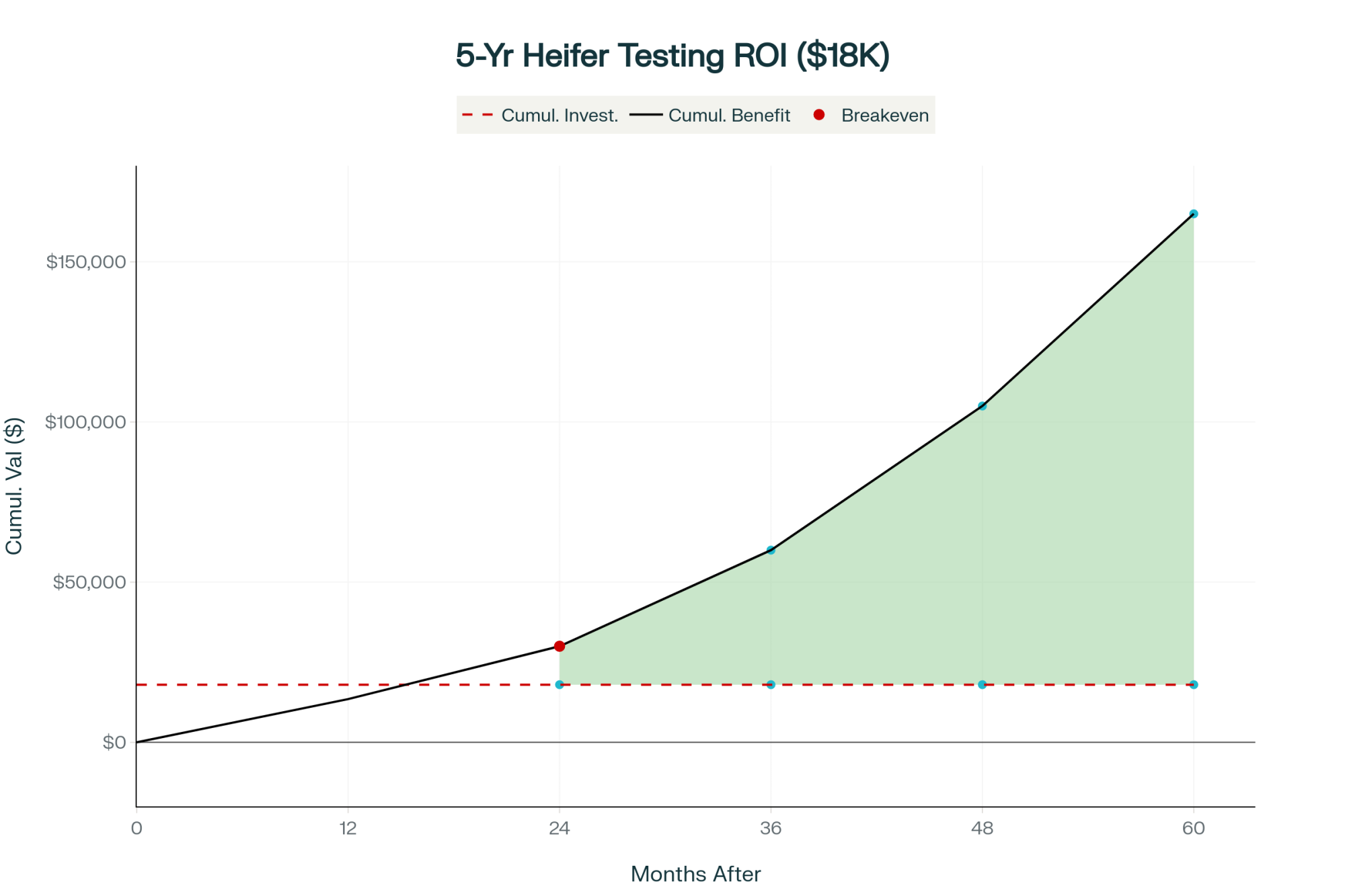
The Long Game Pays Off: While genomic calf health testing requires patience—hitting breakeven around 24-30 months—the compounding benefits reach $60K annually by year five as improved genetics permeate your herd. This assumes heifer-only testing strategy starting at $18K investment.

But—and this is a big but—these projections assume you’re already doing a decent job with management. If you’re at 3-4% mortality through solid protocols, genetic improvement might push you toward that elite 1-2% range. If you’re struggling at 8-10% mortality? Fix your management first. The genetics won’t overcome broken systems.

Smart Entry Strategies (You Don’t Need to Go All-In)

Here’s what many producers don’t realize: you have options beyond the all-or-nothing approach.

Option 1: The Free Ride
If you’ve been genomic testing for years, you’re sitting pretty. When April 2026 rolls around, all your historical data should automatically get calf health evaluations. No additional investment needed.

Option 2: Heifer-Only Testing
Never tested before? Start with your 450 replacement heifers. At $40 each, that’s $18,000—less than half the full-herd cost. You’ll get genetic information on your future cows and can make smarter sire selection decisions immediately.

Option 3: The Gradual Build
Test 100-150 animals per year. Spread the cost over 3-4 years while you validate whether the technology works in your herd. This approach costs $4,000-6,000 annually—much more manageable.

Option 4: Bulls Only
Just focus on selecting better sires using the published evaluations. Zero testing cost, though you won’t know which of your cows to breed to which bulls for optimal results.

The Zoetis Factor (Competition Already Exists)

Here’s something many producers don’t realize: we’re not waiting in a vacuum for CDCB’s launch. Zoetis has been selling wellness trait evaluations since 2016. Nearly a decade head start.

Their system draws from hundreds of thousands of health records and genotyped animals, based on research they’ve published in JDS (Vukasinovic et al., 2019). And from what I’m hearing from producers who use it—especially those larger operations in California and the upper Midwest—it works reasonably well. The wellness traits are already integrated into most AI stud catalogs, and the genomic prediction reliabilities are pretty solid for young animals.

Rosy Lane Holsteins 12-Month Study

Health MetricBottom 25% GeneticsTop 25% GeneticsImprovement
Scours Cases (per 100 calves)28 cases14 cases50% reduction
Pneumonia Cases (per 100 calves)44 cases30 cases32% reduction
Treatment Costs (per 100 calves)$4,200$2,100$2,100 saved
Overall Calf Mortality6.5%4.0%38% reduction

Based on Zoetis Calf Wellness Index data (similar methodology to CDCB)

So, where might CDCB have advantages? Well, they’re drawing from a broader population through the national database—we’re talking millions of genotypes from over 15,000 DHI herds. The methodology is transparent and peer-reviewed. And if you’re already on DHI, there’s no premium pricing.

Something that’s puzzling folks is the difference in heritability. Zoetis reports about 4.5 for scours, while CDCB shows 2.6. That’s not necessarily a contradiction—different statistical approaches, different populations, different ways of measuring. Both might work fine; they’re just looking through different lenses.

My guess? Both systems will coexist. Smart producers will probably compare them once CDCB launches. If the bull rankings correlate strongly, they’re telling you the same thing. If not… well, that’s when it gets interesting.

The Data Challenge Nobody Wants to Talk About

The Uncomfortable Truth: Only 12% of dairy farms contribute calf health data to genetic evaluations—and they’re mostly large, well-managed operations. This selection bias means CDCB’s predictions might not work as well for smaller dairies or different management systems. Know your risk before investing.

Here’s what really concerns me, and it’s barely mentioned: only about 12% of dairy farms systematically record calf health data, according to Canadian research (Renaud et al., 2023) that probably reflects our situation too. And those 12%? They tend to be the larger, better-managed operations that already have lower mortality.

This creates what’s called selection bias. The genetic evaluations end up being optimized for farms that look like the ones contributing data. So if you’re running a large operation with dedicated calf managers and automated systems, these predictions will probably work great. But what about smaller operations with different management styles? Or those grazing operations in Vermont compared to the freestall operations in Idaho?

What farmers are finding in states like Iowa and South Dakota is that their management systems—often smaller herds with different housing approaches—might not match what’s in the database. That’s a real concern.

What’s more, you need to actively authorize your Dairy Records Processing Center to transmit health data to CDCB using Format 6. No permission, no data contribution. And if farms like yours aren’t contributing data, the evaluations might not predict well in your environment. It’s a bit of a catch-22.

From conversations with DRPC folks, participation is growing but still lower than ideal. We need more farms sharing data before these evaluations become truly representative of the industry as a whole.

How to Know If It’s Actually Working

If you’re thinking about jumping in, you need concrete checkpoints. Here’s what I’d be watching:

Around 12-18 months after you start (late 2027), compare disease rates between calves from your top genetic sires versus your average ones. You should see the better genetics showing noticeably lower disease—maybe 20-30% lower—once you’ve got enough calves to compare. If you don’t see that difference, the evaluations aren’t predicting right in your barn.

At 24-30 months, check your financials. If you’re still deep in the red, it might be time to reconsider. Also, watch for unexpected issues—are those “healthier” calves growing slower? Birth weights creeping up? I’ve seen this with other traits where unexpected correlations pop up after a few generations.

By 36-42 months, your first heifers from high-health sires are entering the milking string. If their production is way below genetic predictions or fertility is tanking, you might be seeing those dreaded antagonistic correlations emerging.

The kicker is that all this requires obsessive record keeping. If you can’t document every health event consistently—including the healthy calves—you’ll never know if it’s working. And let’s be honest, that’s a challenge for a lot of us.

A Practical Approach to Implementation

Based on what I’ve learned from producers who’ve adopted genomics for other traits, here’s what makes sense:

Right now, through April 2026, take an honest look at your situation. Can your team consistently record health data? Is management or genetics your bigger constraint? Either way, start recording health data now—you’ll need that baseline. And call your DRPC to get the Format 6 data transmission authorized. Ask specifically about fields like “calf health event,” “treatment date,” and “disease code”—those are the critical ones.

If you’re already genomic testing: Relax. You’re likely getting these evaluations for free on all your tested animals. Focus on understanding how to use the new information effectively.

If you’ve never tested: Consider starting with just your heifers. It’s a $18,000 investment instead of $40,000, and you’ll learn whether this technology works for you before going all-in.

When April 2026 rolls around, don’t go all-in with your breeding decisions either. Start with maybe 20-30% of your breedings using top calf health sires. Keep detailed records. See if performance matches predictions. And stick with proven bulls with decent reliabilities—this isn’t the time to gamble on unproven young sires with reliabilities under 50%.

By the end of 2027, you’ll have enough data to make a decision. Seeing good improvement and approaching breakeven? Expand to more of your breedings. Mixed results? Stay conservative. No improvement or weird trade-offs? Maybe redirect that investment to management improvements.

The Bigger Industry Picture

What we’re seeing goes beyond just another trait to select for. Based on how genetic trends have evolved since genomic selection became available in 2009, this technology might widen the gap between large and small operations.

Research tracking genetic progress over the past couple of decades shows that large herds (over 500 cows) have achieved significantly faster improvement than small herds (under 100 cows) since the advent of genomics. The genetic merit gap has actually widened, not narrowed.

The same dynamics will probably play out here. Operations in Wisconsin’s Central Sands region, with their large-scale calf-raising facilities, will likely benefit more than small grazing operations in Vermont’s Northeast Kingdom. Down in Texas and New Mexico, those big dairies with automated calf feeding systems are positioned differently than the traditional tie-stall barns still common in parts of Pennsylvania and New York’s North Country.

Looking at this trend more broadly, what’s happening in the Midwest—particularly in states like Michigan and Ohio, where you’ve got a mix of farm sizes—might be most telling. The mid-sized operations (300-800 cows) are the ones really wrestling with whether this technology makes sense for them.

It’s not that the technology is biased—it’s that successful implementation requires resources that aren’t equally distributed. But here’s the silver lining: if you’re already genomic testing, you’re not at a resource disadvantage for this new trait.

Three Key Questions for Your DRPC

Before making any decisions, here’s what to ask at your next DRPC meeting:

First, what percentage of herds in your region are contributing health data? If it’s below 20%, the evaluations might not accurately reflect your management system.

Second, can they show you how CDCB and Zoetis rankings compare for bulls you’re currently using? This tells you whether the systems agree or if you’re looking at conflicting information.

Third, what’s the actual process and cost for setting up data transmission from your herd management software? Some systems need upgrades—better to know upfront. DairyComp 305 users might need different modules than PCDART folks, for instance.

And here’s the new critical question: If I’m already genomic testing, will my historical tests automatically get calf health evaluations in April 2026? Get this in writing.

The Bottom Line for Your Operation

After digging through all this, here’s my take:

If your mortality is over 5%, focus on management first. Whether genomic testing costs you nothing or $40,000, it won’t fix broken protocols.

If you’re at 3-4% mortality, you’re in the sweet spot. If you’re already genomic testing, you’ll get free evaluations to work with. If not, start with heifer testing at $18,000 to validate the technology.

If you’re already under 3%, you’re bumping against biological limits. These evaluations might be exactly what you need to get to that elite level—and if you’re already testing, it’s free value.

What concerns me is how much your success depends on other producers’ data. It’s a collective challenge that individual farms can’t solve alone. And remember—genetic selection and good management work together. They’re not either/or propositions.

At current replacement prices, we can’t afford historical mortality rates. These genomic tools offer one path forward, but only for operations positioned to use them effectively. The technology is real. Whether it revolutionizes your operation depends on matching these tools to your specific situation—and your cost of entry might be much lower than you think.

The economics are compelling if you get it right. But genomic selection can create problems as easily as it solves them if applied incorrectly. Take your time, validate carefully, and don’t let anyone convince you there’s a one-size-fits-all solution to something as complex as calf health.

What’s your take on all this? Are you planning to jump in early, or taking more of a wait-and-see approach? I’d be interested to hear what other producers are thinking as we head toward this launch. Send your thoughts to editorial@thebullvine.com—these conversations help us all make better decisions.

Key Takeaways

  • Your mortality rate dictates your path: Under 3% = invest in genomics | 3-4% = test cautiously | Over 5% = fix management first—any investment is wasted on broken basics
  • The real cost varies wildly: Free for existing genomic testers based on international precedent | $18,000 for heifer-only testing | Up to $40,000 for full-herd startup
  • Data bias could sink you: Only 12% of farms (mostly large operations) contribute health data, meaning these predictions might fail in your specific environment
  • Start smart, not big: Test heifers only ($18,000) or use free evaluations on existing tests, validate for 18 months, then decide whether to expand

Executive Summary: 

Your sick calves drain $350,000 annually, but April 2026’s genomic fix isn’t a silver bullet. CDCB’s new calf health evaluations could cost you nothing if you’re already genomic testing (based on precedent from other countries), or up to $40,000 if starting from scratch—farms above 5% mortality should invest in basics first regardless. The genetics target scours and respiratory disease with modest heritabilities of 2.6 percent and 2.2 percent, meaning gradual multi-generational progress, not instant transformation. Here’s the catch: only 12% of farms share health data, so predictions favor large operations and may not work for your specific system. With Zoetis already dominating this space since 2016, producers must choose between competing evaluations while validating what actually works in their barns. Bottom line: this technology amplifies excellent management but won’t salvage broken protocols—know which category you’re in before writing any check.

Complete references and supporting documentation are available upon request by contacting the editorial team at editor@thebullvine.com.

Learn More:

Join the Revolution!

Join over 30,000 successful dairy professionals who rely on Bullvine Weekly for their competitive edge. Delivered directly to your inbox each week, our exclusive industry insights help you make smarter decisions while saving precious hours every week. Never miss critical updates on milk production trends, breakthrough technologies, and profit-boosting strategies that top producers are already implementing. Subscribe now to transform your dairy operation’s efficiency and profitability—your future success is just one click away.

NewsSubscribe
First
Last
Consent

Your Genetics Rep Has Bad News – But Won’t Tell You Until January

Your genetics supplier might not exist in 12 months. Here’s why

You recall the conversation with your genetics representative about two-year contracts at “special pricing”? Those field service delays that keep cropping up?

There’s a bigger story here, and honestly, it caught me off guard, too.

What farmers are discovering is that the global genetics market just shifted in ways we haven’t seen before. The Eurasian Economic Commission’s October report dropped a bombshell—Russia, Belarus, Kazakhstan, Armenia, and Kyrgyzstan cut their breeding animal imports by 64% between 2022 and 2024. Russia alone boosted domestic poultry breeding production by 9.1 million head while cutting imports by 70%.

These aren’t temporary adjustments, folks. These markets are gone.

I’ve been digging into this with producers across different regions, and what I’ve found is… the ripple effects are way bigger than anyone expected.

The Numbers Tell a Wild Story

So here’s what’s interesting. Examining the National Association of Animal Breeders’ latest 2024 data, something doesn’t add up at first. Total U.S. bovine semen sales actually grew 4%, hitting nearly 69 million units. That’s a comeback after two years sliding backward.

But dig deeper—dairy exports reached 30.8 million units, up 5% from 2023, with a record value of $326 million according to NAAB’s March report. China’s still buying big, Brazil’s second, but companies are scrambling. They’re expanding into Western Europe, Central Asia, the Middle East… essentially anywhere to replace their Eastern European business.

And get this—gender-selected dairy semen jumped 18% to 9.9 million units, while beef-on-dairy hit 7.9 million units. Here’s the connection most folks are missing: The loss of volume in Eastern markets is forcing genetics companies to chase premium domestic sales, which—combined with record-high replacement costs—has created a perfect storm. We’re seeing semen price hikes and a surge in sexed semen demand because, let’s face it, producers can’t afford mistakes at these heifer prices.

The $4,000 Heifer Reality

Your replacement heifers now cost more than a new pickup truck – and the pain is just beginning

I nearly spit out my coffee when I saw the July USDA numbers. Dairy replacements averaged $3,010 per head. You probably know this already, but back in April 2019? We paid $1,140. That’s nearly triple in six years.

But those are just averages. California and Minnesota auction reports from August show quality heifers bringing over $4,000. Four grand for a heifer that hasn’t even freshened yet!

Think about what that means for your breeding program… every straw matters now. Every conception counts. No wonder sexed semen sales are exploding, even with the premium pricing.

How Companies Are Scrambling

Let me share what’s happening with genetics companies—because as many of us have seen, their moves directly affect our breeding decisions.

Select Sires and STgen announced their intent to combine back in August 2023. They signed a letter of intent to create a new company that’ll combine production and R&D while maintaining independent sales networks. The companies stated that they’re working through regulatory approvals, although the current status is not entirely clear. What’s worth noting is this isn’t your typical business combination—it’s STgen’s sexed semen technology meeting Select’s distribution network.

Alta Genetics (URUS) made a significant investment in international markets. When URUS bought Genex in 2020, that was the canary in the coal mine. Industry observers suggest their international focus could be challenging with these market shifts—and that makes sense when you think about it. I’m hearing from Midwest producers that Alta service territories are already being restructured.

STgen built their business around sexed semen technology and premium pricing. They focused on innovation over volume, which… honestly, seems to be paying off now.

ABS Global—owned by Genus plc since ’99—has been pushing what they call an “industrial genetics model.” Basically, treating dairy more like their pig and poultry operations. But you and I both know dairy doesn’t work that way. We manage individual cows, not pens. With markets shrinking, their high-volume approach faces new challenges. Several California producers mentioned they’re seeing fewer ABS reps lately.

Your Monthly Genetics Bill Is About to Get Interesting

Here’s where global disruption hits your checkbook. Industry reports suggest premium Holstein semen prices have been climbing steadily. What cost in the mid-thirties to mid-forties per dose eighteen months ago? Many producers are now seeing upper forties to low fifties. Top genomic bulls? Some markets report prices of $60 to $75 per dose.

Add sexed semen—generally running another fifteen to twenty bucks per dose, depending on your supplier. A 500-cow operation utilizing enhanced genetics could easily see breeding costs increase by thousands of dollars annually. The exact amount depends on your program, but… we’re talking serious money here.

And if that Select-STgen combination goes through? The worldwide battle will become even more deadly.

What Other Regions Figured Out (That We Didn’t)

The Journal of Dairy Science has published fascinating research on Brazilian Gyr cattle, which maintain production when Holsteins struggle with heat stress. What’s encouraging is that Australia’s DataGene introduced genomic breeding values for heat tolerance back in 2017. They saw climate change coming and took action.

Now, I’m not saying dump your Holsteins—that’d be crazy. But while we chased production records, others developed solutions for real-world challenges. There’s something to learn there.

90-Day Action Plan

Weeks 1-2: Know Your Supplier

  • Evaluate their technology position (proprietary vs. distribution)
  • Check international exposure and market focus
  • Assess financial stability indicators

Weeks 3-4: Do the Math

  • Calculate true breeding costs, including replacements
  • Factor in potential market changes
  • Build scenarios for different pricing levels

Month 2: Find Your Tribe

  • Contact neighbors about buying groups
  • Explore state dairy association programs
  • Pool for 10,000+ dose volume discounts

Month 2-3: Lock It Down (Carefully)

  • Negotiate while companies need cash flow
  • Prioritize technology and stability over price
  • Consider 18-36 month contracts

Month 3: Tech Up

  • Evaluate automated heat detection (18-24 month ROI)
  • Reduce dependence on external service
  • Build on-farm breeding capability

Regional Reality Check

This hits different depending on where you farm:

Wisconsin, California, Pennsylvania—you’ve got genetics infrastructure. Service will probably stay decent. These companies can’t afford to abandon major dairy regions.

Expansion areas, remote locations—brace yourself. Changes often show up there first. If service has always been marginal… well, time for Plan B.

Southern operations—here’s the silver lining. This disruption might accelerate heat tolerance research you’ve needed for years. I’m hearing increased interest in adapted genetics from producers dealing with heat stress, especially in Texas and Florida.

The Bottom Line

The genetics market we’ve known for decades just shifted fundamentally. That’s not pessimism—it’s reality. We’re watching the restructuring of how genetics gets developed, priced, and delivered. The Select-STgen combination, if it is approved, is likely just the beginning.

But here’s what thirty years in this industry taught me—dairy farmers adapt better than anyone when we understand what’s happening. And now you do.

Those waiting for “normal” to return? They’ll be waiting a long time. Those who recognize this shift and position accordingly? They’ll look back at this moment as when they secured a competitive advantage.

Your breeding decisions over the next few months matter more than usual. Not just which bulls you use, but which companies you bet your future on.

What you do with this information… that’s your call. But at least now you’re making it with eyes wide open.

Resources & Next Steps

Keep Learning

You’ll find NAAB market statistics and annual reports at naab-css.org, which is great for tracking trends. For those interested in heat tolerance research, the Journal of Dairy Science papers are a valuable resource.

Get Connected

Your state Extension dairy specialist offers free genetics strategy consultations—seriously, use them. They’re a great resource. Consider joining or forming a buying group through your state dairy association. Many Midwest producers report good results with this approach. Keep an eye on the Select-STgen combination for regulatory updates… it could change everything. And those ROI calculators at Penn State and Wisconsin Extension websites? They’re actually pretty helpful for running scenarios.

Share What You’re Seeing

The industry needs producers talking about these changes. Your insights could help another farm navigate this disruption. Connect with your regional dairy organizations or reach out through industry forums. We’re all in this together, after all.

KEY TAKEAWAYS: 

  • Your breeding program costs could increase by $12,000 annually starting in January.
  • Your genetics supplier might not exist in 2026—Alta’s restructuring, Select needs a merger to survive, ABS model failing
  • You have 90 days to act before January price explosions: smart producers locking contracts and forming buying groups NOW
  • The $100M question: Russia/China stopped buying genetics—guess who’s paying to fill that hole? (Hint: Check your mirror)
  • Your action plan: Evaluate supplier stability TODAY, join buying group THIS WEEK, lock contract THIS MONTH

EXECUTIVE SUMMARY: 

Your genetics rep has bad news they won’t share until January: Russia and five other nations stopped buying American genetics, creating a $100 million hole that YOU’RE filling through higher prices. With heifers at $3,010 (triple 2019) and beef and dairy calves at record prices, your breeding costs could jump $12,000 annually—and that’s before the Select-STgen merger reduces competition further. Alta’s restructuring after international losses, ABS is hemorrhaging market share, and three suppliers might not exist by 2026. Wisconsin producers pooling 10,000-dose orders are locking 15% discounts NOW, while those waiting will pay premium prices to fewer suppliers. Your 90-day action window: evaluate supplier stability, join buying groups, and lock contracts before this hidden disruption becomes your financial crisis.

Complete references and supporting documentation are available upon request by contacting the editorial team at editor@thebullvine.com.

Learn More:

  • Beef-on-Dairy: Real Talk on Turning Calves into Serious Profit – This guide reveals how to implement the strategic shift mentioned in the main article, providing a practical playbook for using sexed semen on top genetics and beef on the rest. Learn the financial sweet spot and how to net an extra $90,000 annually by transforming calf revenue.
  • Genetic Gatekeepers: The High-Stakes Gamble of Dairy’s Elite Bloodlines – Extends the market consolidation analysis by exposing the hidden $1 billion inbreeding tax caused by narrow genetics and restrictive contracts among the five major suppliers. It provides strategies for building genetic independence and reducing the $23 per cow loss from rising inbreeding.
  • The Digital Dairy: How Precision Agriculture is Redefining Farm Profitability – This article provides a strategic look at how technology mitigates market risk, detailing the ROI of precision agriculture and automated systems. It breaks down how data-driven tools, including health monitoring and feed efficiency, drive gains that buffer against the cost hikes discussed in the main piece.

Join the Revolution!

Join over 30,000 successful dairy professionals who rely on Bullvine Weekly for their competitive edge. Delivered directly to your inbox each week, our exclusive industry insights help you make smarter decisions while saving precious hours every week. Never miss critical updates on milk production trends, breakthrough technologies, and profit-boosting strategies that top producers are already implementing. Subscribe now to transform your dairy operation’s efficiency and profitability—your future success is just one click away.

NewsSubscribe
First
Last
Consent

The $4,000 Heifer: Navigating America’s Worst Replacement Crisis in 47 Years

Ready to pay mortgage money for a springer? The heifer shortage is here, and it’s not going anywhere.

EXECUTIVE SUMMARY: The U.S. dairy replacement pipeline just hit the wall—we’re down to 3.914 million heifers, the lowest count since 1978. Meanwhile, $10 billion in new processing capacity is coming online, which will demand significantly more milk than we can currently supply. Here’s the kicker: replacement costs have more than doubled, and CoBank’s data shows we’ll lose another 800,000 heifers before any recovery starts in 2027. Farms that keep betting on cheaper replacements are playing with fire. The smart money’s on extending cow longevity by just one month to cut replacement needs by 2.8%—that’s $84 saved per cow annually at today’s prices. Add precision breeding with sexed semen (90% success rate beats the 50-50 gamble), and you’ve got a playbook that actually works. Based on USDA reports and university research, the farms implementing this three-pronged approach currently will own the market, while others struggle with yesterday’s math.

KEY TAKEAWAYS

  • Cut replacement costs 2.8% per extra month of cow longevity—focus on transition nutrition and repro management to save $84+ per cow annually while everyone else scrambles for expensive replacements
  • Deploy sexed semen strategically on your top 25% genetics—yes, it costs $15 more per straw, but that 90% female success rate beats conventional breeding’s coin flip when heifers cost $4,000+
  • Cash in on beef-cross calves from bottom-tier cows—those $1,000+ beef calves pay for your breeding program while you save dairy genetics for actual replacements
  • Budget $4,000+ per heifer through 2027—CoBank’s projections show no relief until then, so negotiate group purchases with neighbors and secure flexible credit lines now before cash flow gets tight
  • Start culling fewer cows immediately—operations reducing slaughter by 600,000+ head nationally are keeping milk flowing despite the heifer drought, and you need to join them before your competitors do
heifer replacement cost, dairy farm profitability, cow longevity, sexed semen strategy, dairy cattle prices

Walk into a cattle auction anywhere from Bakersfield to Green Bay these days and you’ll witness something that stings like a winter chill—springers hitting $4,200 or more. At a sale in Wisconsin last week, a seasoned dairyman shook his head, watching those prices climb. The young guy next to him just kept his paddle raised. “Either buy now or quit growing,” he said.

This isn’t just another bump in the road or a flash in the pan. The numbers don’t lie; this is a fundamental market reset.

The situation is stark: CoBank’s August 2025 report confirms we’re sitting with the smallest U.S. dairy replacement herd since 1978—3.914 million head as of January 2025. And with $10 billion being poured into new processing plants that demand milk through 2027, while heifer numbers continue to decline by another estimated 800,000 head, every dairy has to rethink its expansion and breeding strategy.

The numbers that change the game

Let’s break down the tough facts. USDA data shows an 18% drop in heifer inventories since 2018—from 4.77 million to just 3.914 million by early 2025. Looking even deeper, the number of heifers expected to calve this year is just 2.5 million—the lowest the USDA has seen in 24 years.

Prices? USDA’s July 2025 reports put the average replacement heifer at $3,010 nationwide—up a whopping 75% from April 2023. However, averages only tell half the story when premium springers are bringing $4,200 or more in Wisconsin or $4,500 or more in central California.

Consider a real-world example: an Eau Claire-area farm added 200 cows a few years ago, budgeting roughly $360K just for replacements. Today, that same addition would require more like $800K, and that’s without factoring in feed, labor, or facility costs.

CoBank doesn’t sugarcoat it—the forecast is for inventories to shrink even more over the next couple of years before any meaningful recovery in 2027.

How we dug this hole

Blame it on the beef market, if you will. When U.S. beef cattle numbers hit historic lows, beef-cross calves became a gold mine. Dairy farmers began breeding more bottom-tier animals to serve as beef sires, and as a result, calf prices soared while replacement heifer values lagged behind.

According to the National Association of Animal Breeders, dairy farmers snagged 7.9 million of the 9.7 million beef semen units sold in 2024—over 80% of all beef semen sales. That’s a far cry from just a few years ago, when beef semen was a small part of their breeding plan.

A good example comes from a Central Valley operation that increased its beef breeding from 20% of its herd in 2019 to nearly 65% by 2022, in an effort to chase calf revenue and stay afloat. Fast forward, and the farm grapples with a dwindling replacement herd and sky-high heifer prices.

The lesson? It wasn’t a conspiracy—it was a thousand individually smart but collectively expensive decisions. When everybody zigged into beef semen, the dairy replacement pipeline zagged.

The $10 billion squeeze: New plants demand milk that heifers aren’t here to make

Just when heifer numbers nose-dived, the industry bet big on new processing plants. Hilmar Cheese’s Dodge City facility is built to process approximately 8 million pounds of milk daily once fully operational. Chobani’s new Rome, NY, plant is targeting a massive 12 million pounds of production daily.

CoBank’s economist Corey Geiger puts it plainly: “Those plants need more milk and better components, especially butterfat and protein. To meet that demand, we need many more replacement heifers in the next few years than we have right now.”

Texas is feeling the heat especially hard. According to the Texas Dairy Association industry analysis, the state’s expanding processing capacity will require significant increases in regional milk supply, putting additional pressure on producers already dealing with tight heifer availability. However, with shrinking heifer inventories, finding those replacement animals is squeezing producers who are already juggling tight margins.

The new playbook: A three-pronged strategy for survival and growth

Prong 1: Master cow longevity

The farms weathering this storm best are pulling cow longevity into sharp focus. According to University of Wisconsin dairy management research, extending productive cow life significantly reduces annual replacement needs, with economic benefits of approximately $84 per cow per year in avoided replacement costs at current market prices.

For example, a dairy planning to add 800 cows might face an expansion cost soaring from $1.44 million in replacements five years ago to over $3.2 million today. Instead of scrapping growth plans, some farms are opting to keep more cows longer—raising the average productive life from 4.2 to 4.8 years and reducing replacement rates from 35% to 28% annually.

This strategy is catching on nationwide. Producers sent 611,600 fewer cows to slaughter than usual between late 2023 and mid-2025—a huge shift helping stabilize milk supply despite fewer heifers.

Prong 2: Leverage genetic horsepower

Many producers don’t realize we’ve been riding a genetics train that’s making the heifer shortage less painful than it could’ve been.

Since 2010, genetic improvement has accelerated, doubling the annual gains in Lifetime Net Merit from $40 to $ 80 per cow. Butterfat content climbed to 4.23% nationally in 2024—shattering decades-old ceilings. Protein jumped from 3.04% in 2004 to 3.29% in 2024.

USDA geneticist Paul VanRaden puts it simply: “A tenth-point bump in butterfat adds approximately $23 per cow per year at current component prices. Farms raising 850 cows just bumped their component premiums by close to $850 a month on the check.”

Prong 3: Execute a precision breeding strategy

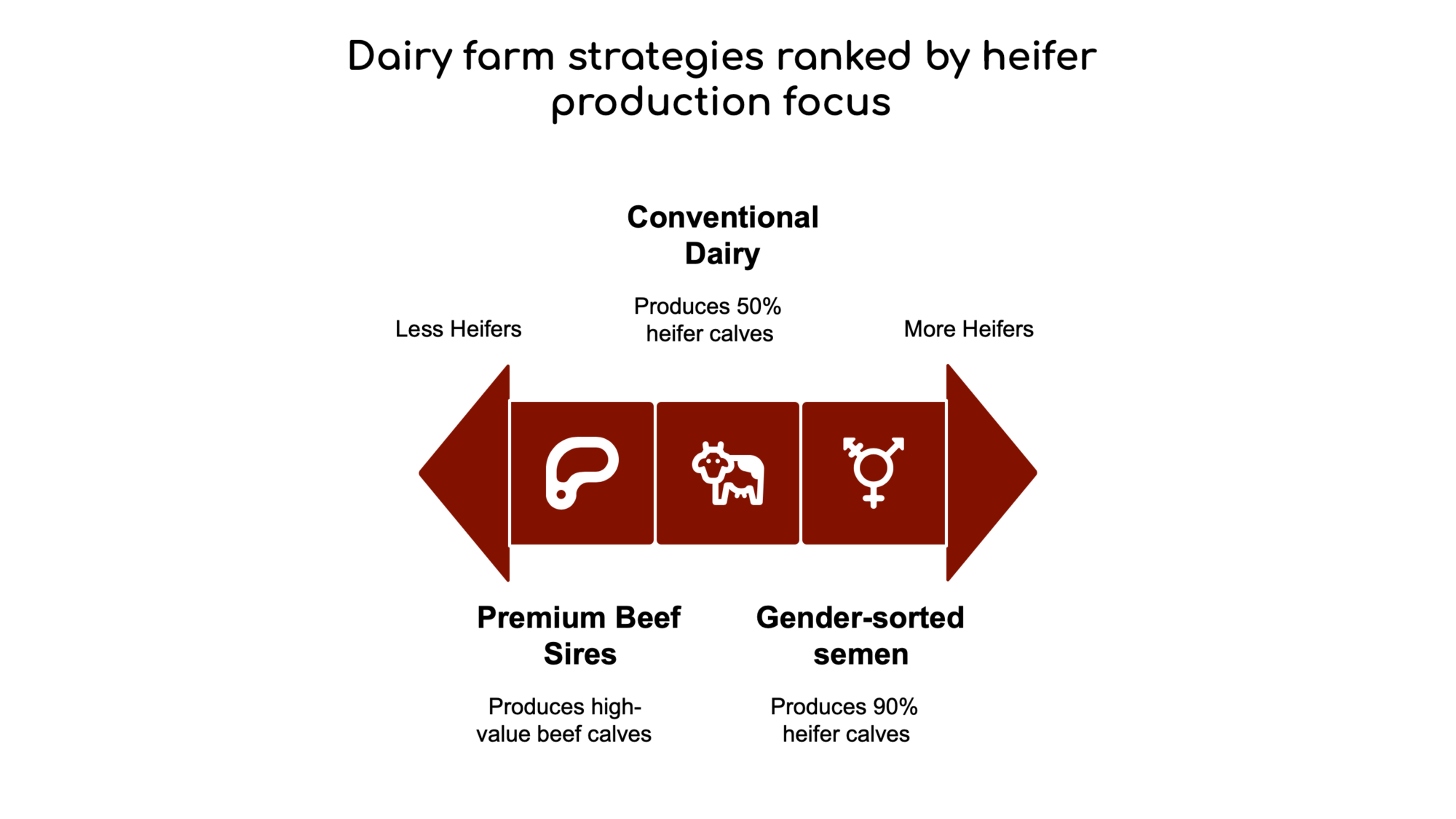
Gender-sorted semen sales jumped 17.9% in 2024 to almost 10 million units, while conventional dairy semen slipped. The shift makes sense financially.

Dr. Jim Ferguson, Penn State Extension, notes: “Though sexed semen straws run $8-12 more and have slightly lower conception rates, the guaranteed outcome—90% female calves versus 50% conventional—makes them the most cost-effective heifer production strategy in today’s market.”

Here’s how a tiered breeding strategy looks in practice:

Quick Decision Matrix

Cow GroupStrategyStraw CostResult
Top 25% GeneticsGender-sorted semen$35-$4590% Heifer success
Middle 50%Conventional Dairy$20-$2550% Heifer success
Bottom 25%Premium Beef Sires$25-$30High-value beef calves

When can we expect relief?

CoBank’s modeling, considering 30 months from breeding to milking, shows that pressure will build through 2026, reaching a low point before a modest rebound begins in 2027.

Expect roughly 357,000 fewer fresh heifers in 2025 and 438,000 fewer in 2026. Recovery begins in 2027 as replacements bred in 2024 hit the milking herd, increasing numbers by about 285,000.

Regional winners and losers

Texas is building herds, while others are shrinking. The Lone Star State added 28,000 cows in early 2025 and benefits from lower land costs ($3,850/acre) than Wisconsin ($5,900/acre), along with fewer regulations to slow growth.

Wisconsin lost over 300 dairy farms in 2024, mostly smaller operations folding, but herd size overall stayed steady through consolidation.

In contrast, California’s environmental programs can add significant revenue for participating operations. LCFS credits can add $60-$75 per metric ton of CO2 reduced for qualifying dairies, and combined with renewable energy incentives, can add over $200 per cow annually to the check.

Regional Breakdown Table:

RegionLand Cost/AcreAvg Milk Price (July 2025)Regulation LevelKey Growth Driver / Challenge
Texas$3,850$19.20LowLower regulatory hurdles & land cost
Wisconsin$5,900$18.80MediumHigh land costs challenge consolidation
California$8,200$20.40HighLCFS credits & high milk price vs. strict regulation

What you can do today

Here’s a simple checklist to get you ready:

  • Calculate your replacement cost (likely well over $4,000 per heifer).
  • Segment your herd: Use sexed semen on your top cows and breed the rest to beef sires.
  • Focus on cow longevity: Nail transition cow nutrition, hoof care, and repro management.
  • Explore cooperative heifer-sharing or custom raising to spread risk.
  • Protect cash flow: Budget for longer-term heifer contracts and consider mortality insurance.

An important co-benefit

Fewer replacements mean fewer emissions. Cornell research shows cutting heifer numbers reduces methane emissions by over 12%. Meanwhile, keeping cows longer results in lower emissions per pound of milk, thanks to improved feed efficiency.

The Bottom Line

The $4,000 heifer isn’t a blip. It’s a full reset of dairy economics. If you’re waiting for prices to drop, you’re playing a dangerous game.

Get your cow longevity right, embrace precision breeding, and budget like replacements cost $4,000. The processors betting billions on increased milk production by 2027 aren’t waiting around.

Your breeding decisions today will have a significant impact on your milk situation in three years. It’s time to get serious.

Complete references and supporting documentation are available upon request by contacting the editorial team at editor@thebullvine.com.

Learn More:

Join the Revolution!

Join over 30,000 successful dairy professionals who rely on Bullvine Weekly for their competitive edge. Delivered directly to your inbox each week, our exclusive industry insights help you make smarter decisions while saving precious hours every week. Never miss critical updates on milk production trends, breakthrough technologies, and profit-boosting strategies that top producers are already implementing. Subscribe now to transform your dairy operation’s efficiency and profitability—your future success is just one click away.

NewsSubscribe
First
Last
Consent
Send this to a friend