Archive for farm business management

What Lactalis’s 270-Farm Cut Really Means for Every Producer

Only 11% of dairies under 300 cows are profitable. But three paths still work—if you move in the next 18 months.

EXECUTIVE SUMMARY: Lactalis cutting 270 dairy farms while investing $11 billion in processing isn’t a contradiction—it’s the clearest signal yet that commodity milk is finished and component quality now rules everything. The stark reality: 89% of dairies over 1,000 cows are profitable while only 11% under 300 cows make money, and this isn’t about management skill—it’s structural economics you can’t overcome with hard work alone. Three converging crises (interest rates doubling to 8%, heifer inventory at 20-year lows, and labor costs up 73%) have compressed what was once a gradual 5-year industry shift into an urgent 18-month decision window. Every dairy faces three paths: invest $6.75-10.25 million to scale beyond 1,000 cows, transition to premium markets (organic/specialty) despite 3-year losses, or exit strategically while you can still preserve family wealth. Real farmers are already choosing—a Minnesota couple successfully scaled to 1,100 cows, Vermont neighbors transitioned to organic, and a Wisconsin family preserved $2.1 million through strategic sale. The difference between 3.6% and 4.2% butterfat is now worth $529,000 annually for a 500-cow operation, making component performance literally the difference between survival and closure. Your window to control this decision closes in 18 months—after that, circumstances decide for you.
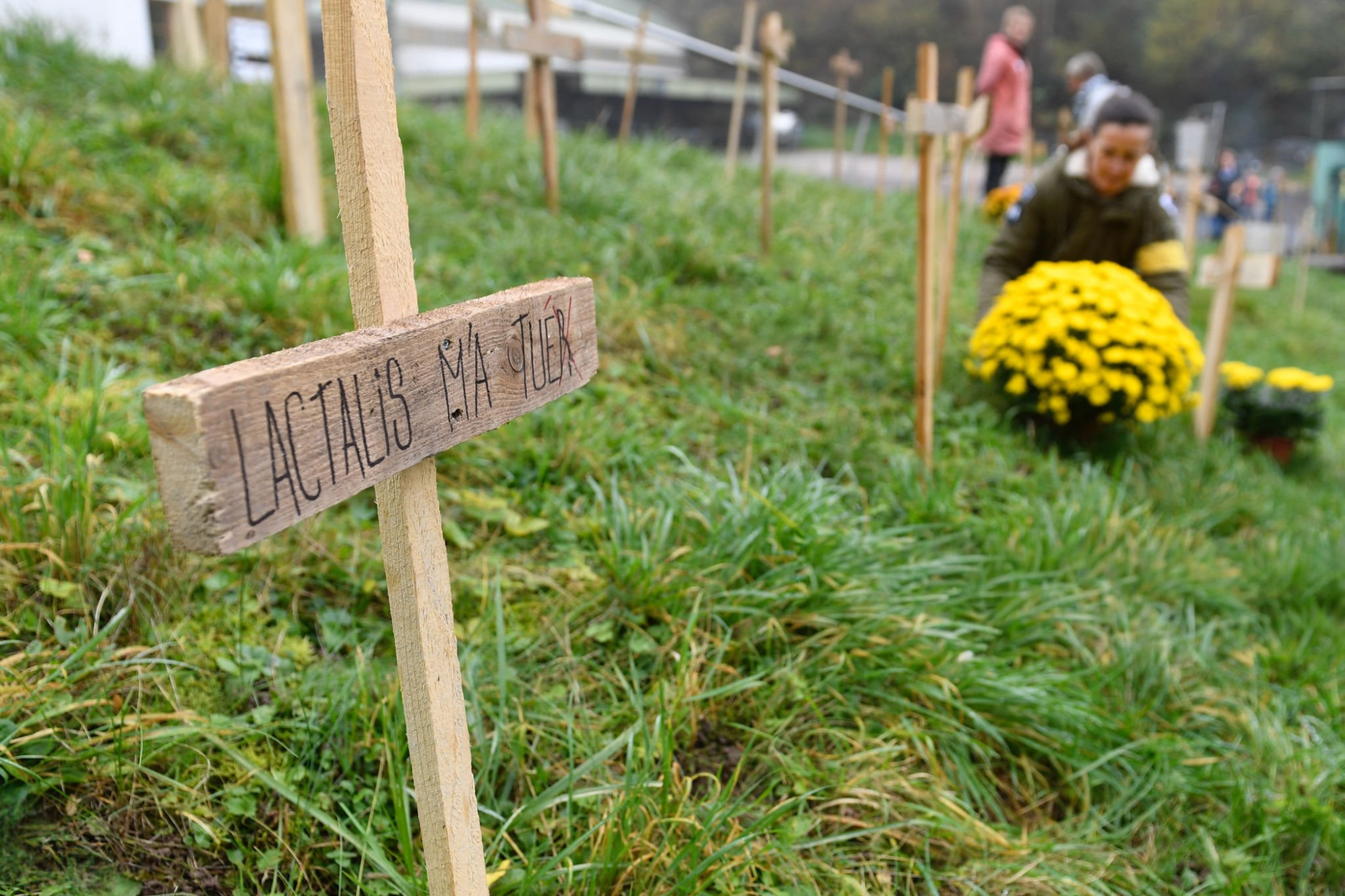
You know, when Lactalis—the world’s largest dairy processor—announces they’re cutting 450 million liters and ending contracts with 270 French farmers, we should probably pay attention. I’ve been digging into this, talking with producers, looking at the numbers… and what’s interesting is this isn’t just another market cycle. We’re seeing something bigger here, something that’s going to affect all of us, whether we’re milking 50 cows or 5,000.

What I’ve found is that the traditional commodity dairy model—you know, the one most of us grew up with—it’s changing faster than anyone expected. And the timeline to adapt? Well, that’s gotten surprisingly short.
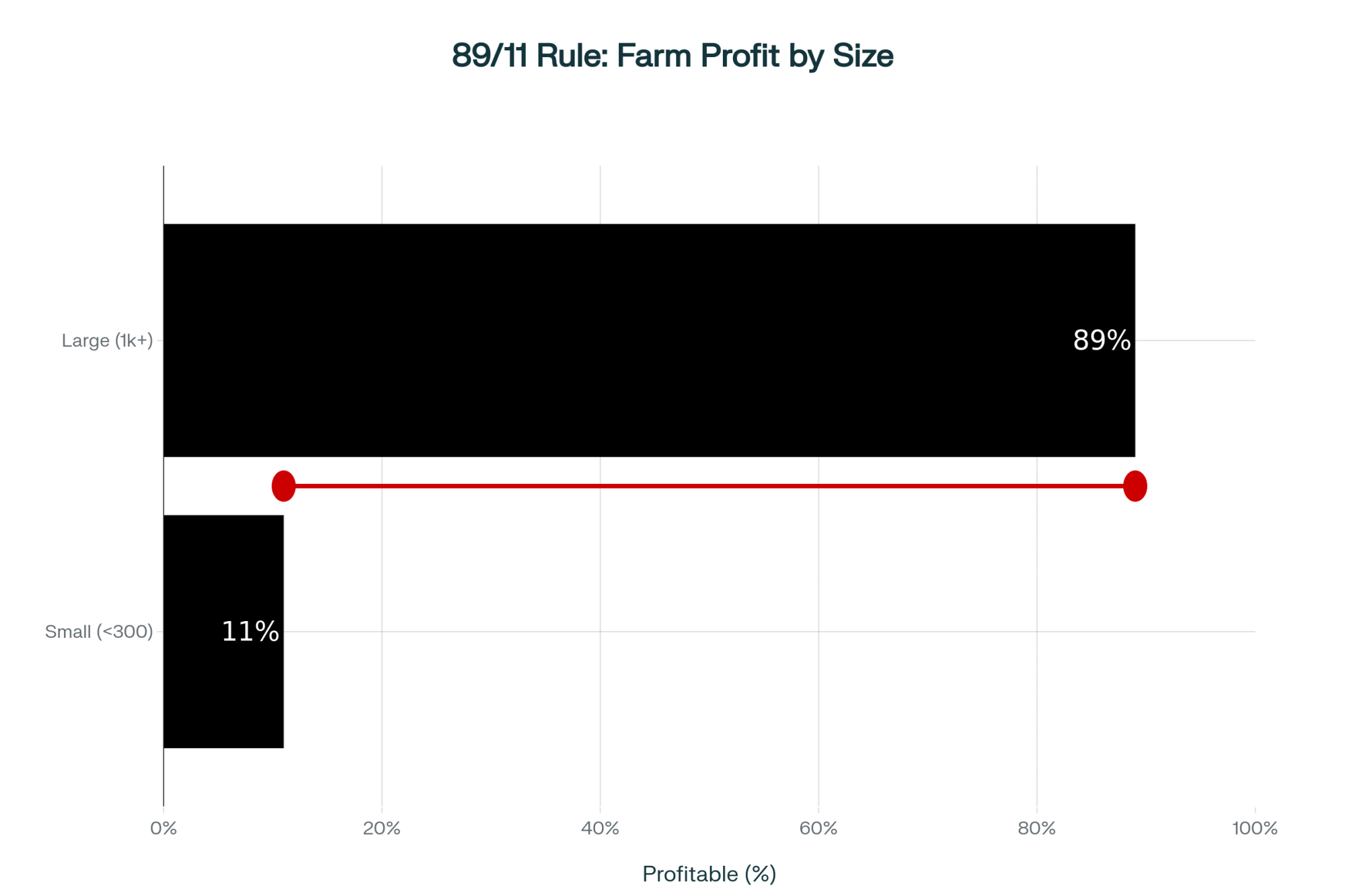
The 89/11 Rule reveals the stark reality: structural economics, not management quality, determines survival in modern dairy

Understanding Why Processors Are Making These Moves

So here’s what caught my attention in Lactalis’s 2024 financials: €30.3 billion in revenue, but only 1.2% net profit margins. That’s down from 1.45% the year before. Now compare that to their premium products—the yogurt division they bought from General Mills is generating 15-20% operating margins. Premium cheese? Consistently 8-12% margins.

Lactalis’s supply director explained in their October statement that the valuation of excess milk is often very low and subject to market volatility—language that really reflects how processors are viewing commodity markets these days. When a processor that size essentially says commodity milk isn’t worth the trouble… well, that’s not just complaining, is it?

FrieslandCampina’s been going through similar challenges. They’ve talked about timing mismatches—buying milk at one price, processing it, then having to sell into a lower market. That kind of volatility makes it really tough to plan, and shareholders don’t like uncertainty.

The Component Game Has Changed Everything
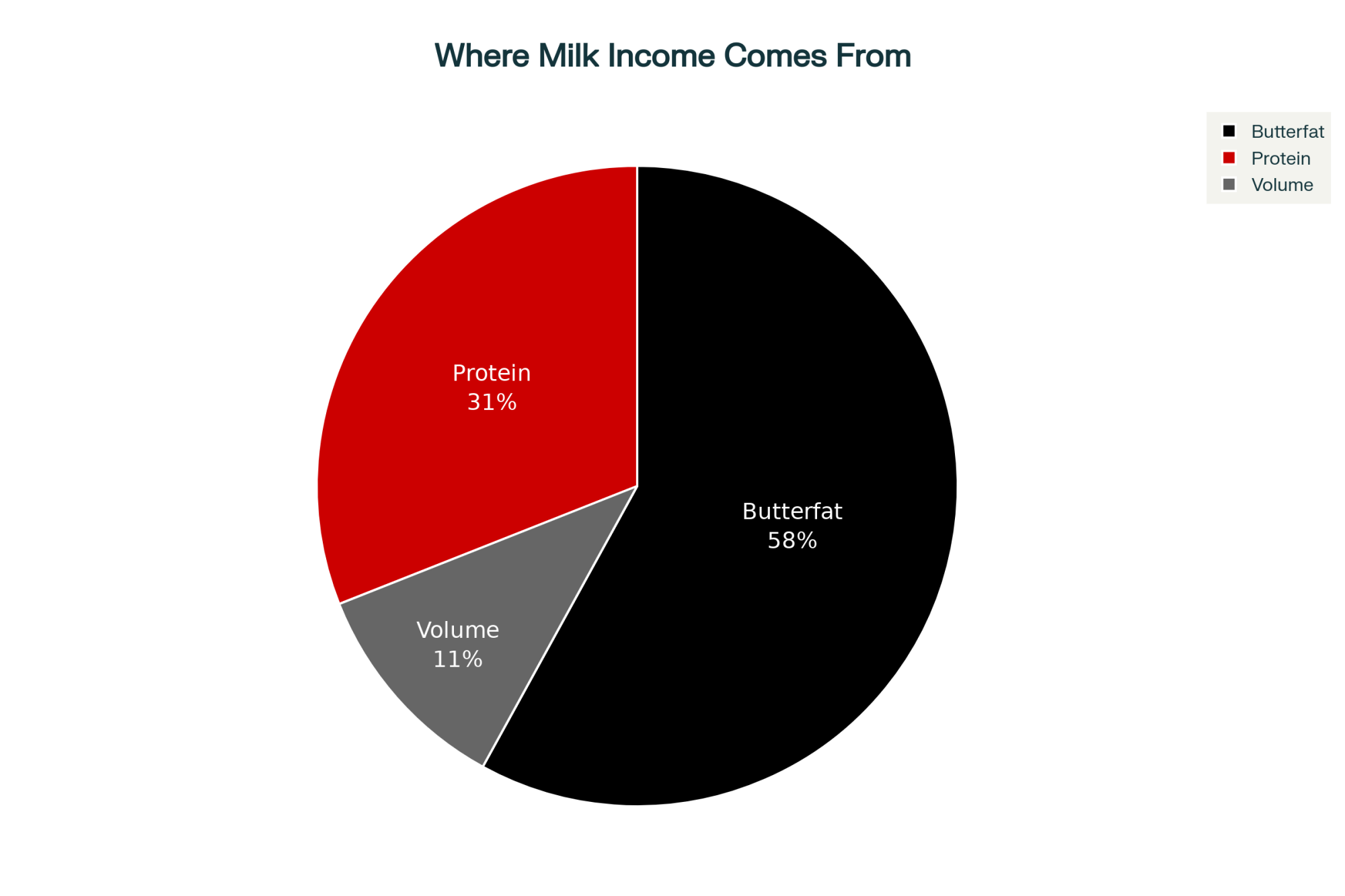
Component performance is now non-negotiable—volume alone won’t pay the bills anymore

I was talking with a Wisconsin producer last week—he’s running 650 cows near Fond du Lac—and he helped me understand just how much components have shifted the whole economics of dairy farming. USDA data from November shows butterfat now represents 58% of your milk check value, and protein adds another 31%. Think about that… 89% of your income comes from components, not volume.

His neighbors who consistently hit 4.23% butterfat compared to the regional average of 3.69%? They’re capturing about $4.60 more per hundredweight. For a 500-cow operation producing 23,000 pounds per cow annually, that works out to roughly $529,000 in additional revenue—though your actual numbers will vary with production levels and regional premiums, of course.

Cornell’s latest farm business data shows some interesting patterns:

  • The big operations—1,000+ cows—they’re hitting 4.0-4.3% butterfat with 3.3-3.5% protein pretty consistently
  • Mid-sized farms, say 300-500 cows, generally average 3.6-3.8% butterfat, 3.0-3.1% protein
  • And here’s what’s telling: large farms maintain about 2% daily variation in components while smaller operations see 5-10% swings

Now, getting those high components isn’t just about genetics. You need systematic management—a good nutritionist runs $80,000 to $120,000 a year, based on what I’m hearing. Feed testing programs add another $15,000 to $25,000. Those precision feeding systems? Dealers are quoting $250,000 to $500,000, depending on what you need.

The math gets tough for smaller operations. When you spread the combined cost of nutritionist, vet services, and consultants across a thousand-cow operation, it might come to $0.08-0.12 per hundredweight. But for a 200-cow farm? You’re looking at $0.40-$0.60 per hundredweight for the same level of professional support. That’s a huge competitive disadvantage.

Three Things Hitting Us All at Once

Cornell’s dairy economics team has been documenting what they’re calling a compressed decision timeline, and I think they’re onto something. Three things have converged, forcing us to make decisions faster than we’re used to.
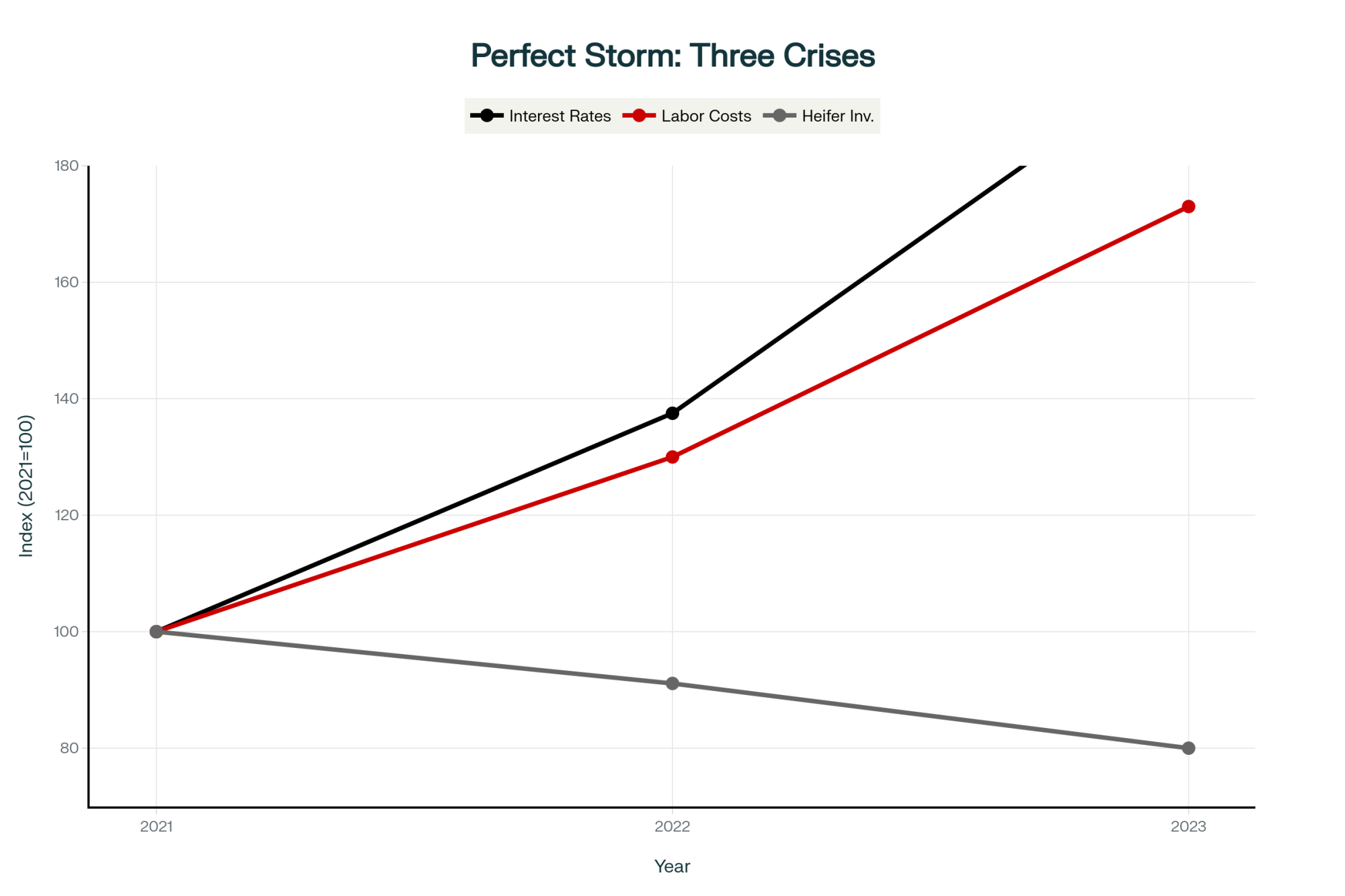
Three converging crises compressed a gradual 5-year industry shift into an urgent 18-month decision window

Interest Rates Hit Like a Hammer

Federal Reserve data shows operating loan rates doubled—went from about 4% in 2021 to over 8% by late 2023. Haven’t seen rates like that in 20 years. A lender in Pennsylvania told me that operations that were barely profitable at 4% are now losing $3,000 to $5,000 monthly.

The Illinois farm management folks found that farms carrying significant debt saw interest costs per tillable acre jump from $33 to $60 in three years. That’s 82% more in fixed costs, and you can’t pass that along to your milk buyer.

What really concerns me is the Q3 2024 ag lending data—operating loan volumes are up over 30% for the third quarter in a row. A Wisconsin banker friend put it best: “This isn’t growth borrowing, it’s survival borrowing.”

The Heifer Shortage Nobody Saw Coming

CoBank’s August report lays out a fascinating situation—dairy heifer inventory’s at a 20-year low just when we need expansion for all this new processing capacity.

Here’s how we got here: the breeding data shows beef semen sales to dairy farms tripled from 2.5 million units in 2017 to 7.2 million by 2020. Last year? 7.9 million of the 9.7 million total units were beef semen.

Can’t blame anyone really. When beef calves were bringing $1,000 to $1,500 last October, while it costs $2,200 to $2,500 to raise a heifer worth maybe $1,600… the math was obvious. Problem is, we all did the same math at the same time.

CoBank thinks we’ll lose another 800,000 head before things turn around in 2027. An Idaho producer told me he’s been offered $3,200 for breeding-age heifers—if he had any. “Five years ago at $1,400, I had too many,” he said. “Now I can’t find them at any price.”

Labor Is Getting Impossible

Texas A&M’s 2024 research shows that immigrant workers make up 51% of dairy labor and milk 79% of our cows. Their models suggest losing that workforce would cut U.S. milk production by 48.4 billion pounds annually. That’s not a typo.

And it’s not just finding workers—it’s affording them. USDA data shows dairy wages went from $11.54 an hour in 2015 to $18-20 by 2024. A large operations manager in New Mexico told me they’re at $28 an hour when you factor in housing, benefits, and recruitment. “And we still can’t stay fully staffed,” he added.

Three Producers Who Found Their Way Through

Despite all these challenges, I’ve met several operations that have successfully navigating this transition. Let me share what they did differently.

Smart Scaling in Minnesota

There’s a couple in central Minnesota who expanded from 350 to 1,100 cows between 2019 and 2023. They saw their co-op’s base program would limit growth for mid-sized farms, so they moved early. Got financing at 3.5% before rates spiked, used sexed semen exclusively for three years to build internally, and partnered with an experienced Venezuelan family.

What’s smart is they expanded in phases over four years—each phase had to cash flow before they moved to the next. They’re now shipping butterfat at 4.1% consistently and have signed a five-year contract with a cheese plant 40 miles away. Their breakeven’s around $17.50 per hundredweight, so they’ve got a cushion even when markets get tough.

Going Organic in Vermont

A Vermont family with 480 cows went organic in 2021—right when everyone said that market was full. Key thing? They got Organic Valley’s commitment in writing before starting the transition. They lost $210,000 over three years, but off-farm income and some timber sales bridged the gap.

Today, they’re netting $3.80 per hundredweight after all costs. “We focused on keeping cows healthy and production steady rather than trying to expand during transition,” the son told me. They maintained 92% of conventional production throughout the transition—well above the 85% average.

Making the Tough Call in Wisconsin

This one’s harder to talk about. A couple near Eau Claire sold their 280-cow operation in March 2024 after recognizing they were in what economists call the 18-month window—sustained losses with limited options. At 58, with kids established off-farm, expanding to a competitive scale meant $6 million in new debt.

They sold into a strong cull market, leased the cropland to a neighbor, and kept the house and 40 acres. The husband’s now using his 30 years of experience as a co-op field rep. “I sleep better, my wife’s happier, and financially we’re ahead,” he told me. They preserved about $2.1 million in equity that probably would’ve disappeared if they’d hung on another year.

Where All This New Processing Investment Is Going
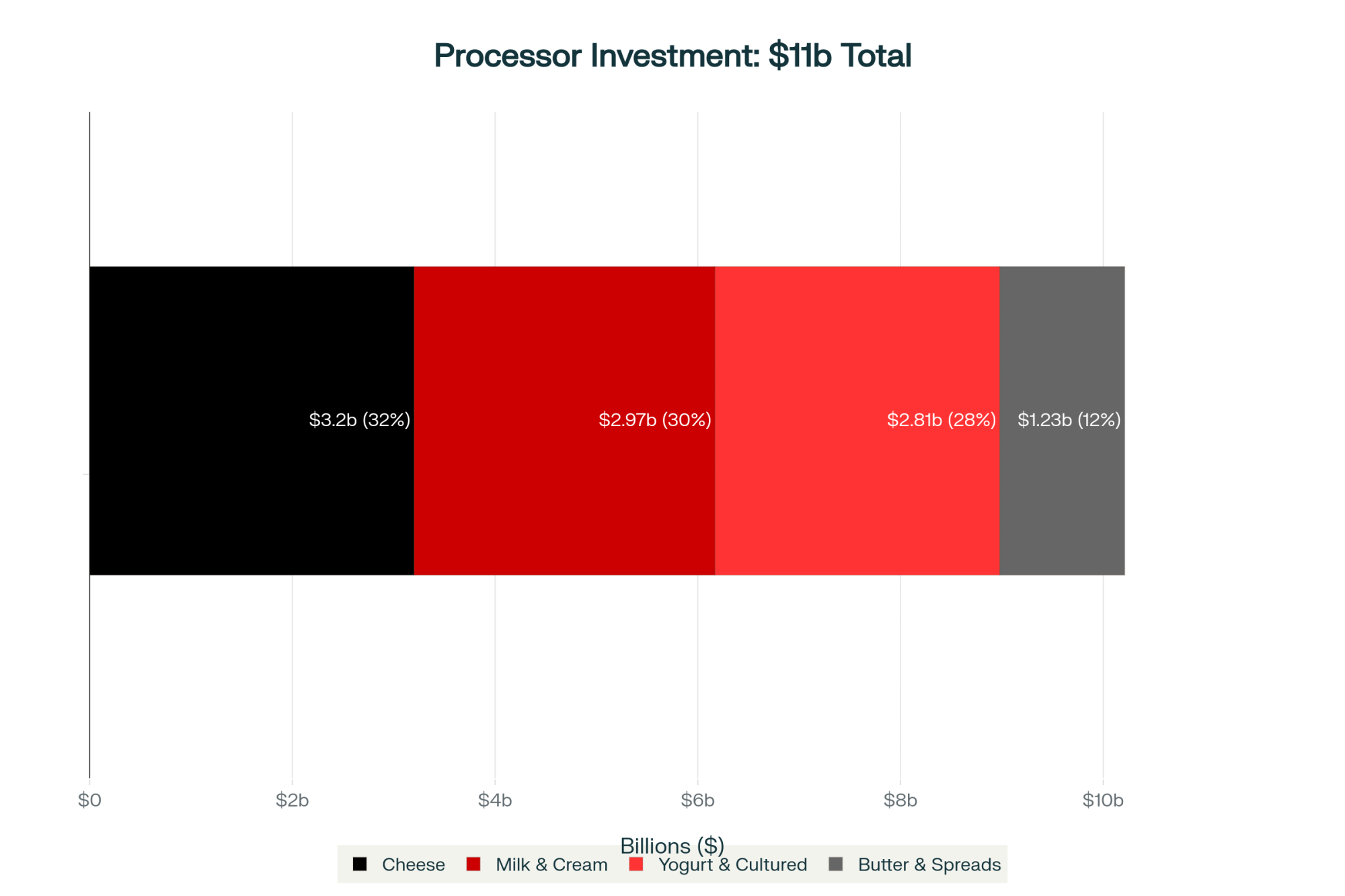
Processors already chose their future—understand their strategy to predict yours

IDFA announced $11 billion in new processing capacity, and where that money’s going tells you everything about industry direction. Their October breakdown shows:

  • Cheese gets $3.2 billion—32% of everything
  • Milk and cream processing: $2.97 billion—30%
  • Yogurt and cultured products: $2.81 billion—28%
  • Butter and spreads: $1.23 billion—12%

Three new cheese plants in the Texas Panhandle need 20 million pounds of milk daily by mid-2025. But these aren’t commodity operations—they’re component extraction facilities making mozzarella for export while capturing valuable whey proteins.

What they’re NOT building? Commodity powder plants or basic fluid bottling. A processing engineer in Wisconsin explained it well: “We’re maximizing value from every component now. Just removing water to make powder doesn’t cut it anymore.”

And here’s something else—up in the Northeast, a couple of smaller specialty cheese operations just expanded. They’re not huge, but they’re finding success focusing on local markets and agritourism. Different model entirely from the big Texas plants, but it shows there’s more than one way forward. Out in California’s Central Valley, I’m seeing similar patterns with artisan operations carving out niches even as the big players consolidate.

The Cooperative Evolution We Need to Talk About

This is uncomfortable for many of us, but cooperatives have changed dramatically since DFA was formed in 1998 through regional mergers. They now control 30% of U.S. milk production, and after buying 44 Dean Foods plants in 2020, they’re both the biggest milk marketer AND processor.

A former board member explained how this creates tension: “When your co-op owns processing plants, optimizing those facilities becomes as important as your milk check—sometimes more important.”

Base-excess programs show this complexity. Cornell’s research indicates these programs typically use your best three consecutive months over three years as “base.” Milk over that? You might pay penalties of $5 to $13.30 per hundredweight.

A Vermont producer shared his frustration: “We wanted to add 50 cows to get more efficient, but overbase penalties would’ve killed any benefit. We’re locked at the current size.”

Meanwhile, operations that were already large when base programs started? They’re fine. It’s the 300-cow farms trying to grow to 500 that get squeezed.

Your Three Paths Forward—Let’s Look at Real Numbers

Path Comparison at a Glance

FactorScale UpGo PremiumStrategic Exit
Investment$6.75-10.25M$210-275K lossesPreserve equity
Timeline4-5 years3-year transition8-10 months optimal
Success Rate~20%Varies by market100% if timed right
Key RiskDebt burdenMarket saturationWaiting too long

Extension economists from Cornell and Wisconsin show that farms with sustained losses typically face critical decisions within 12-18 months. So what are your actual options?

Path 1: Scale Up to Compete

Investment Required: $6.75-10.25 million total

  • Buildings and infrastructure: $3.5-5.0 million
  • Cattle at current prices: $2.25-3.0 million
  • Feed base expansion: $500,000-1.5 million
  • Working capital: $500,000-750,000

Success Rate: According to lending industry estimates, about 20% achieve projected returns. Key Factor: Usually need family money for unexpected challenges. Financing Options: USDA FSA offers beginning farmer programs and guaranteed operating loans through participating lenders, though eligibility and terms vary by operation and region. Some states also have specific dairy expansion programs worth exploring.

Path 2: Find Your Premium Market

Organic Transition Example:

  • Typical losses: $210,000-275,000 over 3 years
  • Pay organic feed prices (30-50% higher) while getting conventional prices
  • Need written buyer commitment before starting
  • Must maintain 85%+ production through transition

Potential Returns: $2.45/cwt net (vs. -$5.29 for conventional, based on USDA 2023 data). Reality Check: Most regions aren’t currently seeking new organic production. Alternative Options: Consider grassfed certification, A2A2 markets, or local/regional branding

Path 3: Strategic Exit While You Can

Timing Matters—Example for 300-cow operation with $2M debt:

Exit at 8-10 months:

  • Assets bring ~$4.65 million
  • After $2M debt and costs ($230,000-390,000): $2.26-2.42 million preserved

Forced sale at 16-18 months:

  • Assets bring ~$3.4 million (discounted)
  • After everything: $650,000-970,000 retained

The difference: Over $1.4 million in family wealth
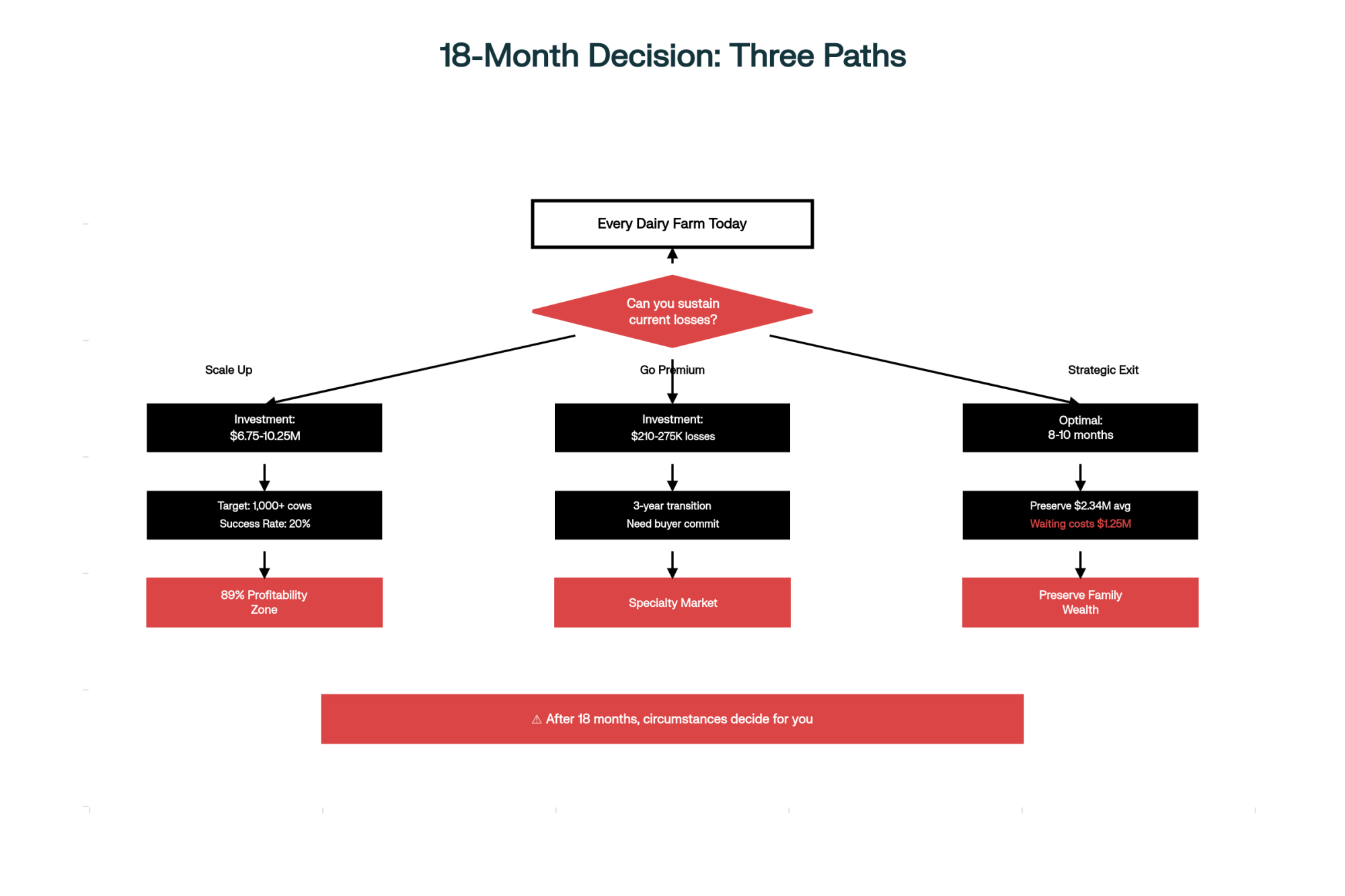
Three paths still work—but only if you move in the next 18 months. After that, circumstances decide for you

The Technology Wave is Coming Fast

I attended the Protein Industries Summit in Chicago last month, and what I heard was eye-opening. McKinsey’s early 2025 biotech analysis shows precision fermentation has already hit cost parity for certain dairy proteins. Boston Consulting thinks these proteins will be five times cheaper than ours by 2030.

Here’s what’s already happening—Perfect Day’s animal-free whey is in Ben & Jerry’s ice cream right now. Not someday. Today. Fonterra’s partnerships with Superbrewed Food and Nourish Ingredients show where big players are heading. Fonterra indicated in its August 2024 announcements that ingredients from these technologies can be used alongside traditional dairy products. Translation: they’re building systems that can use proteins from cows or fermentation tanks—whatever’s cheaper.

And it’s not just startups anymore. I’m seeing major food companies quietly building fermentation capacity. They’re hedging their bets, preparing for a world where they can source proteins from multiple streams.

How This Hits Different Regions

This transformation affects regions differently, and understanding your local dynamics matters.

California: UC Davis research shows farms with less than 22% quota coverage pay more into the system than they get back. “We’re subsidizing the big quota holders,” a Tulare County producer told me.

Southeast: Maintains higher Class I fluid use—over 60% according to Federal Orders—which provides some buffer since processors need consistent daily deliveries. But even there, consolidation pressure is building.

Upper Midwest: All about cheese, so components rule everything. Wisconsin processors consistently tell me 4% butterfat is their practical minimum for preferred suppliers.

Plains States: Seeing aggressive expansion with new processing, but these plants want a minimum of 50,000+ pounds daily per farm. Can’t deliver that volume? You won’t get a contract.

Pacific Northwest: Interesting developments with smaller operations finding niches in farmstead cheese and direct marketing. Not for everyone, but it’s working for some.

Northeast: Beyond the specialty cheese operations, there’s also growth in agritourism and on-farm processing. Entirely different economics, but viable for the right location.

Western States: Water rights and environmental regulations adding another layer of complexity to expansion decisions.

Questions to Ask Yourself Right Now

Before you make any big decisions, honestly assess:

  • Are you covering all costs, including family living?
  • Can you achieve 4%+ butterfat consistently?
  • Do you have succession lined up?
  • What’s your debt-to-asset ratio?
  • Could you survive another year like 2023?
  • What would happen if you lost two key employees tomorrow?
  • Is your processor investing in commodity or specialty capacity?
  • Are there emerging environmental regulations that could affect you?

What This All Means for Your Planning

After looking at all this, here’s what I think matters most:

Component performance isn’t negotiable anymore. The difference between 3.6% and 4.2% butterfat can mean hundreds of thousands annually for a 500-cow operation. That fundamentally changes farm economics.

That 12-18 month window Cornell documented? It’s real. Interest rates, heifer availability, and labor costs compressed what used to be a multi-year adjustment into a much shorter period. Within the next 12-18 months—essentially by mid-2026, based on the timeline Cornell economists have documented—many operations will have made their choice, voluntarily or not.

Scale economics show clear breaks. USDA data showing 89% profitability for 1,000+ cow operations versus 11% for under 300 cows… that’s not about who’s a better manager. It’s structural advantages smaller operations can’t overcome.

Your processor’s strategy matters more than ever. If they’re investing in commodity powder, you’ve got time. If they’re building component extraction or specialty facilities, that tells you something different.

Technology adoption keeps accelerating. The Good Food Institute tracked $840 million in precision fermentation investment last year. Alternative proteins are moving from the experimental to the commercial stage faster than most of us expected.

Risk management tools—like Dairy Margin Coverage and Dairy Revenue Protection—might buy you time but won’t change the fundamental economics. They’re Band-Aids, not cures.

The Bottom Line

What Lactalis is doing—cutting 450 million liters while investing in premium capacity—makes sense when you understand their strategy. They’re consolidating relationships with farms that can deliver consistent, high-component milk at scale while preparing for fermentation-derived proteins.

The Minnesota couple who scaled smart, the Vermont family succeeding in organic, the Wisconsin couple who preserved wealth through planned exit—they all made different choices. But they shared a realistic assessment of where things are heading and made decisions accordingly.

For those of us still figuring out our path, an honest assessment of where we fit in this evolving structure is critical. Whether that means pursuing scale, finding premium markets, or planning transition, the key is making informed decisions while we still have options.

And if you’re wondering about the next generation—I talked with several young farmers recently. The ones succeeding are incredibly sharp, using technology in ways we never imagined, and they’re not afraid to try completely different models. That gives me hope, even as things change.

The dairy industry will keep producing milk—consumers guarantee that. But who produces it, how it’s valued, and what matters most? That’s changing fundamentally. Understanding where your operation fits in that transformation might be the most important analysis you do this year.

Because waiting for things to “go back to normal”? Well, I think we all know that ship has sailed.

The Bullvine provides ongoing analysis and resources at www.thebullvine.com. Cornell’s Dairy Markets and Policy program and Wisconsin’s Center for Dairy Profitability offer valuable planning tools. The producer experiences shared here reflect confidential discussions, with identifying details modified for privacy.

KEY TAKEAWAYS

  • You Have 18 Months to Decide: Cornell economists confirm sustained losses trigger forced decisions within this window—control your choice now or lose that option forever
  • Three Paths Still Work: Scale to 1,000+ cows ($6.75-10.25M investment, 20% success rate) | Go premium (organic/A2/grassfed, 3-year transition) | Exit strategically (preserves $1.4M more than waiting)
  • Components = Survival: The 0.6% butterfat difference between average and top herds is worth $529,000/year, and processors are making this gap the entry requirement
  • The 89/11 Rule: 89% of 1,000+ cow dairies profit while only 11% under 300 cows survive—this is structural economics, not management quality
  • Processors Already Chose: They’re investing $11B in component extraction while cutting commodity suppliers—understand their strategy to predict your future

Complete references and supporting documentation are available upon request by contacting the editorial team at editor@thebullvine.com.

Learn More:

Join the Revolution!

Join over 30,000 successful dairy professionals who rely on Bullvine Weekly for their competitive edge. Delivered directly to your inbox each week, our exclusive industry insights help you make smarter decisions while saving precious hours every week. Never miss critical updates on milk production trends, breakthrough technologies, and profit-boosting strategies that top producers are already implementing. Subscribe now to transform your dairy operation’s efficiency and profitability—your future success is just one click away.

NewsSubscribe
First
Last
Consent

December’s 6ppl Cut Exposes UK Dairy’s Reality: Why 800 Farms Face Impossible Math While Processors Invest Billions

Farmer loses £17k/month. Processor makes £20.5M/year. December’s 6ppl cut forces UK dairy to its moment of truth. Math doesn’t lie.

Editorial Note (Updated November 10, 2025): Following feedback from AHDB, we have updated this article to clarify data sources and correct a attribution error. Where data was previously attributed to AHDB without verification, we have now cited the correct sources or clarified these as industry estimates. Production cost figures vary significantly by source, region, and methodology—we’ve added context to reflect this complexity. We value accuracy and transparency in our reporting and welcome continued dialogue about UK dairy economics.

Executive Summary: Jack Emery asked the BBC if it’s worth getting up at 4 AM anymore—a question now haunting 7,040 UK dairy farms facing £17,000 monthly losses from December’s 6ppl cut. Meanwhile, processors post record profits: First Milk’s £20.5M is called “exceptional.” With farmgate prices at 35.85ppl against estimated 49p/liter production costs (based on industry benchmarking), the math has become impossible. Five strategic paths exist—organic conversion, scaling up, diversification, cooperation, or exit—but most demand capital and time that hemorrhaging farms simply don’t have. Irish farmers reversed similar cuts in 47 days through cooperative ownership; the UK’s different structure blocks that option. The next 90 days determine whether UK dairy finds an unprecedented collective response or accelerates toward just 4,200 farms by 2030, down from today’s 7,040. Behind every statistic, farm families face math that doesn’t work anymore—in an industry where suicide rates already run 3.5 times the national average.

You know that feeling when you open a letter you’ve been dreading? That’s what Jack Emery was describing to the BBC last month. He runs Thistle Ridge Farm down in Hampshire—about 5,000 liters daily, same as a lot of operations I talk with. When he calculated that First Milk’s 6 pence cut means over £100,000 gone from his annual revenue, then asked whether it’s even worth getting up at 4 AM anymore… well, that resonated with pretty much everyone I’ve spoken to since.

The revealing part is how December’s announcement is forcing us to confront something we’ve been dancing around for years. After digging through processor reports, talking with farmers from Scotland to Devon, and watching what happened with those Irish producers in September—I’m convinced we’re seeing the whole structure of UK dairy that’s evolved since the Marketing Board ended in ’94 finally showing which farms have a path forward and which ones honestly don’t.

The Numbers We’re All Running

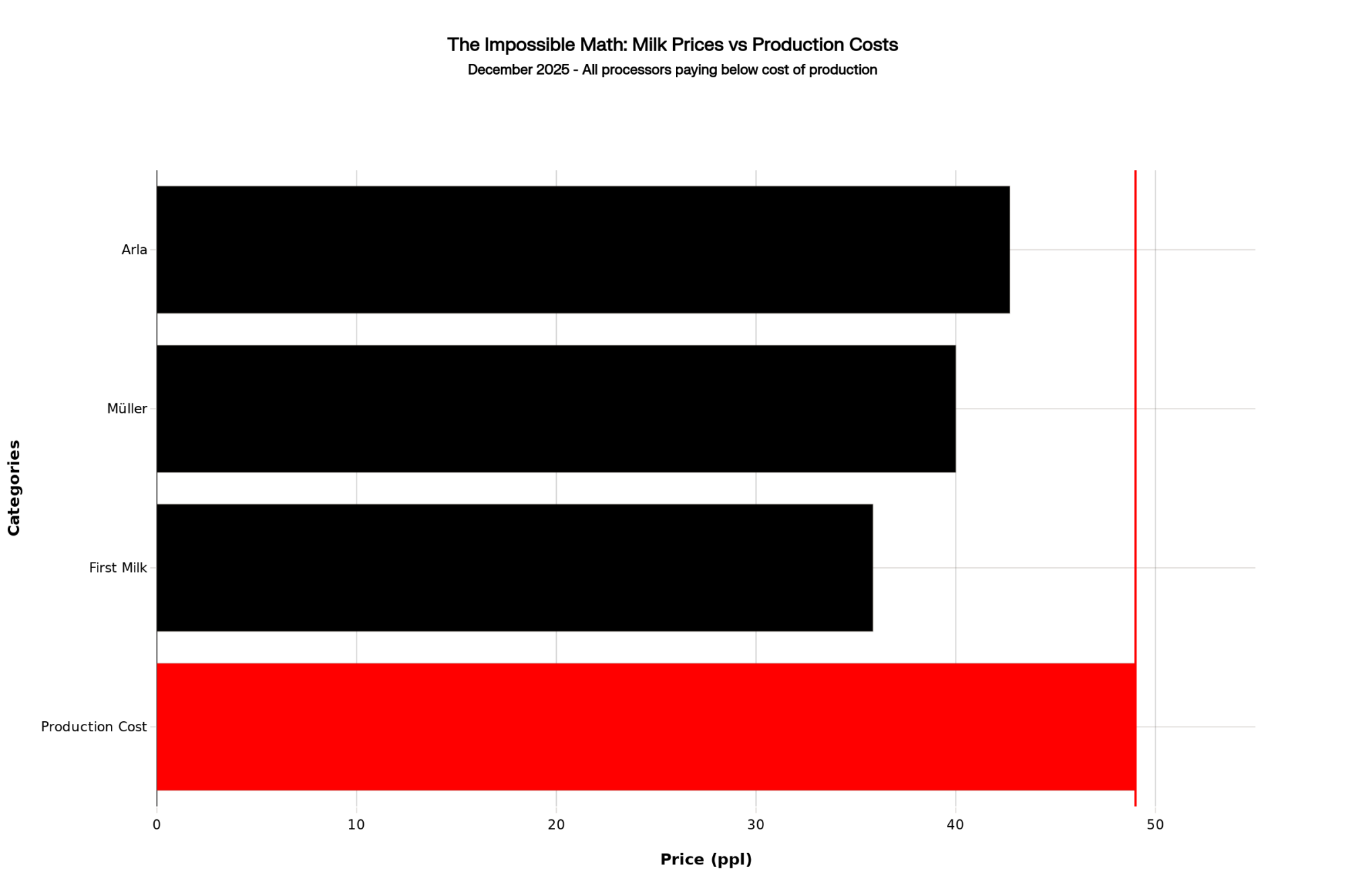
So let’s talk about the math that’s keeping everyone up at night—because I know you’re doing the same calculations I am. First Milk announced a price of 35.85 pence per liter, effective December 1st, including the member premium. Müller’s Advantage program drops to 40ppl. Arla sits at 42.71ppl from November.

Now, industry benchmarking from various sources suggests average production costs running 48-50 pence per liter, though these figures vary significantly by region and farm type. While AHDB provides valuable market data, comprehensive production cost averages come from multiple sources including Kingshay’s annual Dairy Costings Focus report and regional farm business surveys. That matches what I’m seeing in actual farm accounts, though, as a couple of Scottish producers reminded me recently, if you’re dealing with Highland transport or you’re way off the main tanker routes, add another 2-3ppl just for getting milk to market. Down in Wales, First Milk’s members in Pembrokeshire face similar transport premiums. And operations in Cornwall? They’re looking at some of the highest logistics costs in the country.

Here’s where it gets rough. At First Milk’s 35.85ppl against estimated production costs around 49p (based on industry benchmarking and producer interviews, not a single national average), you’re potentially losing about £13 per liter. For a modeled 250-cow operation doing 1.6 million liters annually—that could mean monthly losses approaching £17,000. This is an illustrative calculation based on reported cost ranges—individual farm economics vary significantly. Not sustainable. Not even close.

The structural challenge of UK dairy economics: Based on industry benchmarking, processors pay farmers significantly below estimated production costs of 48-50ppl, with First Milk’s 35.85ppl potentially creating substantial monthly losses for typical 250-cow operations. This represents systematic market pressure rather than temporary adjustment.

The timing couldn’t be worse. We all lived through this spring’s drought—the Met Office confirmed it was the driest of the century. I was talking with Cumbria farmers who’d already fed a third of their winter silage by August. Down in Somerset, a 180-cow producer I know went through 40% of his reserves. Now they’re buying concentrate feed at £310-340 per tonne for dairy compounds, according to recent market reports, though forage costs vary widely—AHDB reports large bale hay averaging around £120 per tonne. The combined impact of both concentrate and forage costs, while milk checks are about to drop by thousands monthly, creates severe pressure.

Jack Emery mentioned there’s a two-million-liter surplus in the UK. What he didn’t say—but we all know—is that surplus happened because UK production jumped over 6% this year just as global commodity markets started sliding. Classic timing, right?

What Processors Aren’t Telling Us

You know what makes these cuts particularly hard to swallow? First Milk just reported their best year ever. Turnover up 20% to £570 million. Operating profit is hitting £20.5 million. CEO Shelagh Hancock called it “exceptional” in their August report.

The great dairy wealth transfer: First Milk’s ‘exceptional’ £20.5M profit represents systematic extraction from 700 members now facing collective £146M annual losses. When processors profit while suppliers fail, this isn’t market forces—it’s market power abuse worthy of regulatory scrutiny.

So I spent time really understanding processor economics, and what I found is enlightening. Sure, First Milk reports a 3.6% operating margin—doesn’t sound like much. But that number masks what’s actually happening between the farmgate and the final sale.

When processors buy our milk at 35.85ppl, they’re getting basic commodity input. But look what they’re producing—First Milk’s got commodity cheddar going to Ornua, yes, but they’re also making whey protein concentrates that command serious premiums. They’ve got specialty products through BV Dairy, which they bought in February. And their Golden Hooves regenerative cheddar? That’s capturing 50-75% premiums according to their sustainability reporting.

The company line is that commodity markets weakened—AHDB wholesale data shows butter fell £860 per tonne and cheese dropped £310 per tonne between specific trading periods in late summer/autumn—so they need competitive pricing to maintain market access. Note these are short-term price movements, not necessarily indicative of longer trends. We attempted to reach First Milk for additional comment, but received no response by publication.

What really tells the story is where they’re putting their money. Arla announced £179 million for Taw Valley mozzarella capacity in July. Müller’s investing £45 million at Skelmersdale for powder and ingredients. These aren’t maintenance projects—they’re building capacity for global markets that bypass UK retail’s stranglehold on liquid milk.

Kite Consulting’s September 2025 report “Decoding Dairy Disruption” lays it out pretty clearly—processors can achieve much higher margins on specific product lines while reporting modest overall margins. That BV Dairy acquisition is particularly clever… it lets First Milk redirect commodity milk into specialty channels while still pricing our milk based on bulk markets.

Here’s the thing that stands out: this situation isn’t unique to the UK. In New Zealand, Fonterra’s dealing with similar processor-farmer tensions, while U.S. dairy continues its decades-long consolidation, with operations above 5,000 cows becoming the norm rather than the exception. The difference? Those markets have different support structures and scale economics.

Why Ireland’s Success Won’t Work Here

In September, 600 Irish dairy farmers organized through WhatsApp and reversed Dairygold’s price cuts within 47 days. The Irish Farmers Journal covered it extensively, and I’ve had plenty of UK farmers asking, ‘Why can’t we do that?’

It’s not about courage or determination. It’s about structure, and this is crucial to understand.


Factor
Ireland: DairygoldUK: First Milk
Ownership StructureTrue cooperative — farmers own equityCorporate co-op with professional management
Farmer PowerDirect voting rights, board controlLimited influence, no true ownership
Member Base~3,000+ farmer-shareholders~700 members (supplier relationship)
Reversal Timeline47 days via WhatsApp coordinationNO ACTION after 30+ days
Legal FrameworkEstablished Cooperative Society ActNew Fair Dealing Obligations (July 2025—untested)
Organizational Cost£0 (infrastructure existed)£10k+ legal fees + 6 months coordination
Key DifferenceSHAREHOLDERS with legal powerSUPPLIERS with petition power

When those Irish farmers confronted Dairygold management at Mitchelstown, they weren’t suppliers asking for mercy—they were shareholders demanding accountability from a company they legally own. Dairygold, like most Irish processors, operates as a true farmer cooperative, with members holding actual equity and voting rights. The Irish Co-operative Organization Society shows it has 130 enterprises structured this way.

Compare that to us. First Milk claims cooperative status with about 700 members, but check their Companies House filings—it operates more like a traditional company with professional management. Arla UK? We’ve got 2,300 British farmer-owners, but we’re a minority within a 9,500+ member European cooperative historically dominated by Danish and Swedish interests.

Several First Milk members in Scotland and northern England have pointed this out to me: we’ve had the same Fair Dealing Obligations regulations for forming Producer Organizations since July. Same legal framework as Ireland. But forming a PO requires lawyers, coordination, months of work—all while you’re hemorrhaging money and working 90-hour weeks. The Irish? They just activated what already existed.

Five Options—And Why Most Won’t Work

Industry advisors keep presenting these strategic options. After examining each through actual farm finances and talking with producers trying different approaches, let me share what’s actually realistic.

Premium differentiation sounds great at conferences. Organic and regenerative systems can capture the 50-75% premiums reported by the Soil Association. First Milk’s got their Golden Hooves programme. But here’s what nobody mentions: organic conversion takes 3 years at zero premium, while you’re paying 20-30% higher costs, according to the Organic Milk Suppliers Cooperative. Capital requirement? Based on SAC Consulting and Promar International estimates, organic conversion for a 250-cow operation typically requires £500,000-750,000, though it varies by system. Timeline to positive returns? Five to seven years minimum.

Let’s be realistic… show me a farmer losing £17,000 monthly who has half a million pounds and seven years to wait.

The strategic impossibility matrix: Based on modeled calculations showing potential £17,000 monthly losses, typical UK dairy farms face a brutal reality—five of six strategic options require capital and timelines that lie beyond survival horizons. Only strategic exit sits in the viable zone, preserving £300-400k equity before forced liquidation eliminates it. This isn’t pessimism—it’s mathematical reality driving 40% toward exit by 2030.

Scaling for efficiency absolutely works—if you’ve got millions. Industry consultancy benchmarking and international case studies suggest operations over 3,500 cows achieve much lower per-unit costs. But expanding from 250 to 3,500 cows? You’re looking at £26-39 million at current development costs of £8,000-12,000 per cow. Banks want 18 months of positive cashflow before discussing expansion. Current trajectory? Negative £17,000 monthly.

Strategic diversification offers possibilities, but timeline matters. UK Agricultural Finance research shows that glamping units cost £15,000-30,000 each and take 12-18 months to develop, including planning. On-farm processing? That’s £50,000-100,000 minimum plus all the Food Standards Agency requirements. Solar installations take 18-24 months from agreement to the first payment. These might help in the long term, but December’s cash flow crisis needs immediate solutions.

Cooperative formation could theoretically work. The Fair Dealing Obligations regulations, effective in July, provide the framework for Producer Organizations. But NFU Legal Services estimates £5,000-15,000 just for setup, plus coordination and months of organizing. I know of attempts in northern England that stalled because farmers simply didn’t have bandwidth while managing daily crises.

Strategic exit—nobody wants to discuss this, but it’s increasingly the only rational choice for some. A 250-cow operation might extract £300,000-400,000 in equity through planned liquidation now, based on current values. Wait until forced insolvency? That equity evaporates. Solar leases generate £800-1,200 per acre annually according to Solar Energy UK. Environmental schemes offer £200-400 per hectare under Countryside Stewardship. The math is harsh but clear.

What the Next 90 Days Will Tell Us

Key Dates to Watch:

  • December 1: First Milk price cut takes effect
  • January 15: Deadline for meaningful PO formation activity
  • Late January: Processor pricing announcements for February
  • March: AHDB quarterly producer numbers released
Mark your calendar—these six dates determine everything: From December’s price cut through March’s revealing producer numbers, this 90-day window will expose whether UK dairy mounts unprecedented collective resistance or accelerates toward 40% farm losses by 2030. Watch cull volumes (liquation signal), PO registrations (organization capacity), and Q1 exits (acceleration confirmation)—The Bullvine will track each milestone.

December through February’s going to be critical. Looking at historical patterns and current dynamics, here are the indicators I’m watching:

Producer Organization registrations with DEFRA—if farmers are organizing, we should see applications by mid-January. The public registry’s accessible, and as of early November, there’s been nothing significant since October’s announcements.

Cull cow markets are telling. AHDB data shows volumes typically rise 10-15% in winter normally. While some regional auctioneers report elevated activity, AHDB’s national data through early November does not show significant increases above seasonal averages. December data will tell the full story of whether localized reports translate to national trends.

January processor pricing will signal direction. If First Milk, Müller, and Arla maintain or cut further, they’ve calculated that we lack the capacity to respond. Movement toward 40-42ppl might suggest they see organizational stirrings worth heading off.

The Agricultural Supply Chain Adjudicator can impose penalties of up to £30 million under the 2024 regulations. Their annual report shows that UK dairy receives maybe 1 or 2 complaints per year from 7,000+ producers. If that doesn’t change by February despite this crisis… well, it confirms we’re too stretched to fight.

Come March, AHDB publishes Q1 producer numbers. If exits accelerate beyond 190 farms annually toward 240-320, December becomes an inflection point—just not the kind we’d hope for.

Family dairy farming’s extinction timeline: If December’s price cuts trigger projected exit rates, UK dairy contracts from 7,040 to 4,200 operations by 2030—a 40% industry wipeout in five years. Each data point represents 450+ farm families facing impossible decisions, with 2029-2030 showing crisis acceleration as remaining farms hit breaking point.

The Human Side Nobody Talks About

What statistics miss is what’s happening in farm kitchens right now. The Farm Safety Foundation’s research shows farmers are 3.5 times more likely to die by suicide than the general population. But that’s not just a number—it’s about identity.

When you’re third-generation dairy, when your kids show calves at county shows, when your whole sense of self is wrapped in being a good farmer—losing the farm isn’t just business failure. A study in the Journal of Rural Mental Health found that farmers couldn’t separate their personal identity from their farm identity. When the farm failed, they felt they’d failed as humans.

The University of Guelph’s agricultural mental health research documents the progression. First comes problem-solving—cutting costs, deferring maintenance, and longer hours. Then isolation. Farmers stop attending meetings, skip social events, and withdraw. When cognitive distortions take hold—every option looks impossible, exit feels like complete failure—intervention becomes critical.

I’ve noticed that December’s cuts aren’t hitting farmers in isolation. They’re hitting operations already stressed by drought, inflation, and the watching of neighbors exit. For someone already questioning whether it’s worth continuing, that £600 monthly loss can accelerate a psychological crisis dramatically.

What Success Actually Looks Like

Not every story ends in exit, and that’s important to remember. I’ve been talking with operations, finding ways through this that deserve attention.

One farm in Cheshire I visited started transitioning to artisan cheese three years ago—began at local farmers’ markets and now supplies regional delis. Over those three years, they invested about £85,000 total, but they’re now achieving £1.20-1.40 per liter equivalent on cheese versus 36p farmgate. The key was starting small, reinvesting profits, and growing gradually.

Five farms near Dumfries formed an informal buying group last year—nothing fancy, just neighbors coordinating feed orders through WhatsApp for 8-12% better pricing. As the organizer told me, “We can’t control milk prices, but we can optimize what we spend.”

Several farms moved into contract heifer rearing, maintaining dairy expertise while reducing capital requirements and price exposure. Margins are lower—typically £350-400 per heifer based on current arrangements—but it’s predictable income with less stress. One farmer who made the switch two years ago told me simply: “I sleep at night now. Can’t put a price on that.”

What’s encouraging is that these aren’t following standard strategic paths exactly—they’re hybrid approaches that match specific circumstances, available capital, and family goals.

Where This Is Probably Heading

Looking at current industry exit patterns and talking with dairy economists at Harper Adams and Reading… if trends continue, UK dairy by 2030 would likely have 4,200-4,800 operations, down from today’s 7,040. Average herds approaching 300-350 cows. The middle tier—150-400 cow operations—is largely disappearing, replaced by either large-scale operations or small niche producers.

This doesn’t necessarily mean milk shortage. The UK will maintain production, keep shelves stocked, and meet demand. But through a fundamentally different structure than even five years ago.

What December represents isn’t the breaking point—it’s more like the revelation point. When we can’t pretend anymore that working harder, cutting costs, or waiting for recovery will save operations that are structurally challenged in this system.

Practical Guidance for Right Now

If you’re looking at impossible math, here’s what I’d suggest based on conversations with advisors and farmers who’ve navigated this:

First, calculate the true break-even point, including family living. Not just production costs—everything, including realistic family drawings. If that’s above 45 ppl, act immediately rather than hope for recovery.

Second, assess a realistic timeline. How many months can you sustain current losses? Not theoretical credit or hoped-for recovery—actual reserves against actual losses. Most operations I’ve analyzed have lasted no more than 3 to 6 months.

Third, if considering exit, move quickly. Asset values are highest in planned liquidation, not in forced sales—any auctioneer will confirm this. Farms exiting in 2026 will find stronger January markets than June.

Fourth, if staying, commit fully. Half-measures don’t work now. Whether diversification, scale, or differentiation, successful transitions require complete commitment and adequate capital. Without both… it might be time to reconsider.

Finally—and this really matters—remember this isn’t personal failure. The UK dairy’s structure creates these outcomes. You didn’t fail. You’re operating in a system where structural forces favor consolidation, and margin capture happens downstream. Understanding that won’t change outcomes, but it matters for how you frame what comes next.

Support When You Need It

For those struggling with these decisions, support exists. RABI’s 24-hour helpline (0800 188 4444) offers confidential assistance from counselors who understand farming. The Farming Community Network (03000 111 999) provides practical and emotional support from staff with agricultural experience. Rural Support combines business planning with mental health resources.

These aren’t just numbers—they’re staffed by people who understand losing a farm isn’t just losing business. It’s losing identity, legacy, purpose. No shame in needing support through that.

The Bottom Line

December’s 6ppl cut isn’t really about December. It’s about whether the UK dairy’s structure can sustain family-scale farming or whether consolidation toward fewer, larger operations is simply inevitable. Looking at processor investments, organizational challenges, and the mathematics… the direction seems increasingly clear.

Yet within that larger story, individual farmers are writing their own chapters. Some will find innovative adaptations. Others will make dignified exits, preserving family wealth for different futures. Maybe some will catalyze collective action that could still influence the narrative.

What matters now isn’t predicting which unfolds—it’s ensuring farmers have clear, honest information for family decisions. Because behind every statistic, market report, price announcement, there’s a family at their kitchen table, doing math that doesn’t work anymore, trying to figure out what comes next.

That’s the real story for December 2025. Not the 6ppl cut itself, but what it reveals about who has options and who’s running out of time.

A Note on Data Sources UK dairy production costs vary significantly based on source, methodology, and sample. This article draws from multiple sources including:
• Industry benchmarking reports (Kingshay, Promar, SAC Consulting)
• Producer interviews and farm business accounts
• AHDB market price data (where specifically cited)
• Processor annual reports and public statements
• Academic research from UK agricultural universities

We encourage readers to examine multiple data sources when making business decisions. Cost figures presented here represent reported ranges and modeled examples, not definitive national averages. Individual farm circumstances vary considerably. The core analysis and conclusions remain unchanged—UK dairy farmers face severe economic pressure requiring urgent attention and structural solutions.
We welcome input from all industry stakeholders, including AHDB, processors, and producers, to refine our understanding of UK dairy economics. If you have additional data or perspectives to share, please contact editorial@thebullvine.com.

Key Takeaways:

  • December’s Impossible Math: Based on industry cost estimates, many farms face potential losses of £17,000 monthly (35.85ppl milk vs estimated 49p/liter costs) while First Milk reports “exceptional” £20.5M profits—this gap won’t close without structural change
  • Why Ireland’s Fix Won’t Work Here: Irish farmers reversed cuts in 47 days through cooperative ownership UK doesn’t have—forming Producer Organizations requires lawyers, time, and bandwidth you lack while hemorrhaging money
  • Your Real Options: Of five paths forward, only planned exit guarantees equity preservation; organic needs £750k and 7 years; scaling requires £26-39M; diversification takes 18-24 months; cooperation needs resources you don’t have
  • The 90-Day Test: Watch DEFRA PO registrations by January 15, processor pricing late January, AHDB Q1 numbers in March—if nothing shifts, UK dairy accelerates from 7,040 to 4,200 farms by 2030

Learn More:

Join the Revolution!

Join over 30,000 successful dairy professionals who rely on Bullvine Weekly for their competitive edge. Delivered directly to your inbox each week, our exclusive industry insights help you make smarter decisions while saving precious hours every week. Never miss critical updates on milk production trends, breakthrough technologies, and profit-boosting strategies that top producers are already implementing. Subscribe now to transform your dairy operation’s efficiency and profitability—your future success is just one click away.

NewsSubscribe
First
Last
Consent

The $11 Billion Betrayal: Your Processor Is Building Your Replacement Right Now

If you can’t write a $3M check tomorrow, you’re already extinct. The industry just hasn’t told you yet.

Okay, so I’m at World Dairy Expo last week—you know, wandering around trying to avoid the robot salesmen—and I run into this producer from Iowa. Guy’s been milking for thirty years; it’s a good operation, with about 300 head. And he tells me something that just… it stopped me cold.

He says, “I just spent $650,000 on robots, and I think I just financed my own funeral.”

Look, we need to discuss what’s really going on here. Because while you’re trying to figure out how to make your milk check cover feed bills—corn’s what, $4.50 now if you can find a decent load?—the processors are playing a completely different game. The International Dairy Foods Association is tracking over $11 billion in new processing capacity through 2028. Eleven billion. Meanwhile, they’re quietly partnering with these lab-grown protein companies that want to make you obsolete.

But here’s what makes me want to throw my coffee mug at the wall… North Dakota had 1,810 dairy farms when I started covering this industry back in 1987. The Census just came out—they’ve got twenty-four left. Twenty-four! I knew some of those guys who quit. Good farmers, smart operators. Didn’t matter.

(Read more “1,810 Dairy Farms to 24: Inside North Dakota’s Collapse,” this isn’t just a regional problem—it’s coming for everyone.)

And you know what? Your banker made money on every one of those exits. So did your co-op. Your processor? They just consolidated their routes and kept rolling.

So About All These New Plants Going Up…

So I’ve been following the Fairlife Webster, New York project—the one Governor Hochul showed up for at the groundbreaking back in April. They’re spending $650 million on this thing. When you read the press releases, Coca-Cola executives are talking about innovation and efficiency, and… honestly, reading between the lines, it sounds like a funeral for small dairy.

Here’s the deal—and Multiple sources familiar with the project tell me, but he doesn’t want his name associated with it—these plants are designed for one thing: mega-dairies that can deliver tank after tank of identical milk. Same butterfat, same protein, day after day. Less than 2% variation, he said.

You running 300 cows like my Iowa friend? Maybe you’re testing components once a month if you’re lucky? Brother, you’re not even on their radar.

The math is what bothers me… (hold on, let me find my notes from that Wisconsin conference)… Okay, so these plants need to run at basically full capacity to make a profit. Below 75% utilization, and they’re hemorrhaging cash. But—and here’s the kicker—milk production is actually going DOWN. The USDA says we’re off by about a quarter of a percent this year.

So what happens when you build all this capacity but there’s no milk to fill it?

Actually, I know what happens. I was talking to Mike Guenther—dairy farmer up in Nebraska, good guy, been through hell with his processor—and he told me flat out: “My infrastructure would be worth almost nothing if I tried to sell.” That’s because when there’s only one buyer in your region… well, you do the math.

The Robot Scam (And Why My Neighbor’s Wife Won’t Talk to Me Anymore)

Alright, so… robots. God, where do I even start?

My neighbor just put in a Lely system. Beautiful thing, all bells and whistles. His wife won’t talk to me anymore because I asked him—at his open house, with the Lely rep standing right there—”So what’s your exit strategy when this thing doesn’t pencil out?”

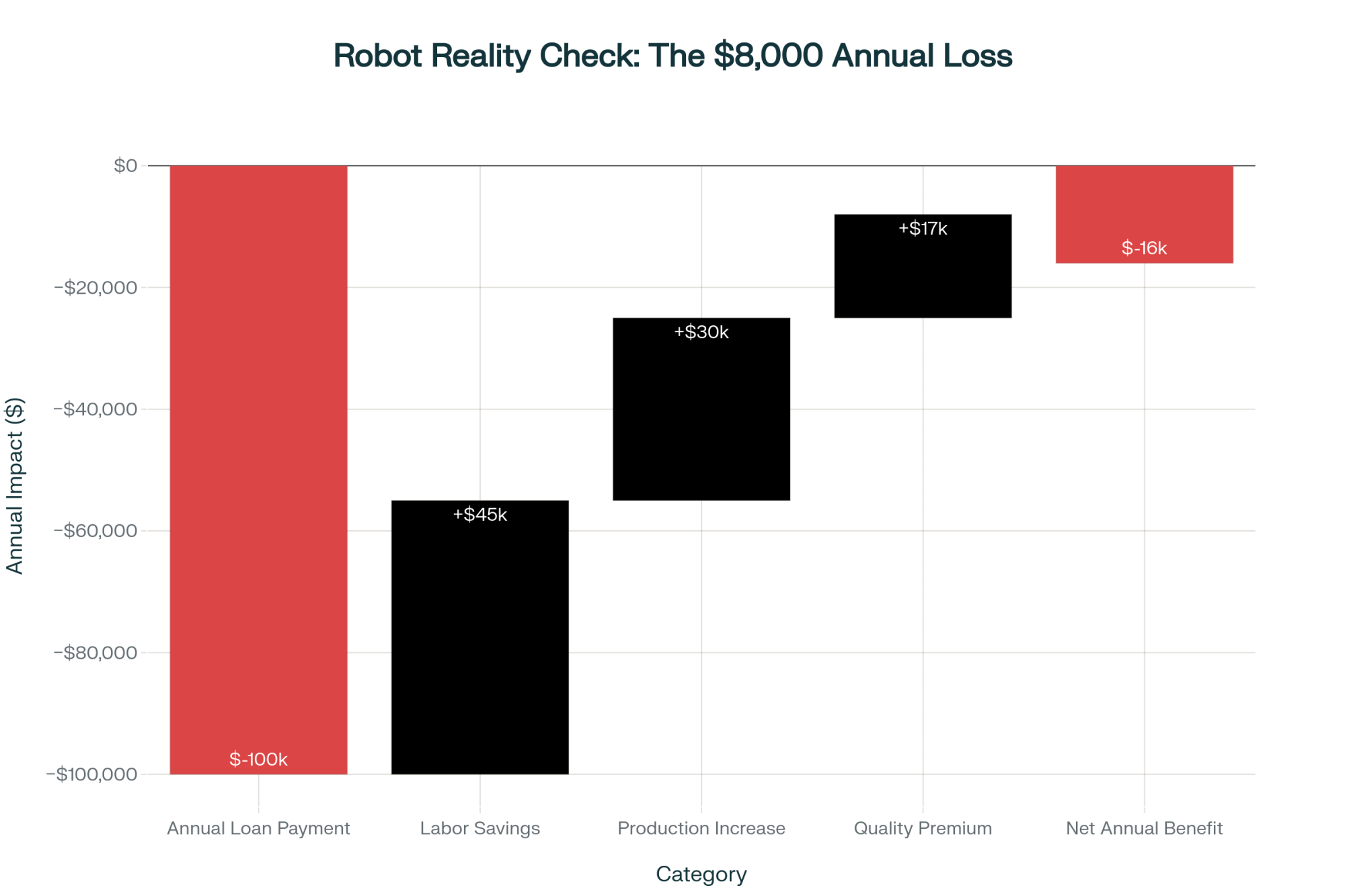
Look, I’ve seen the actual numbers from Wisconsin’s dairy center. Best case—and I mean absolute fairy-tale best case—you might save $38,000 a year on labor. Might. That’s if nothing breaks, which… have you seen the maintenance bills on these things? My cousin in Minnesota; his robot has been down three times since August. Three times!

Your components might improve—the sales team loves to talk about this—maybe even get you another twenty thousand if you’re shipping to someone who actually pays quality premiums. (Good luck finding that unicorn this time of year.) Production bump? Sure, maybe 8%, call it fifty thousand in a good year.

But that loan payment? You’re looking at damn near a hundred grand annually on $650,000. And that’s if you got decent terms, which… with milk prices where they are?

The thing that really gets me—and I was just discussing this with some folks at Penn State—is that the 2,000-cow operations don’t need robots to achieve these efficiencies. They get them automatically through scale. You’re literally paying three-quarters of a million dollars to achieve what the big guys get for free.

But hey, at least the robot dealer got his commission, right?

The Organic Mess (Or: How to Lose Money Even Faster)

Speaking of bad decisions… let me tell you about organic.

I was at a meeting in Vermont last month—beautiful country up there, with the leaves just starting to turn—and Ed Maltby from the Northeast Organic Group got up and said something that made half the room go silent: “We’ve been underwater on cost of production since 2018.”

Since 2018! Can you believe that?

Here’s how the organic trap works, and I’ve watched too many good farmers fall for this… You decide to transition, right? Takes three years. Three years of paying organic feed prices—last time I checked, depending on your region, we’re talking something like three hundred, three-fifty a ton for corn—while still getting paid conventional prices for your milk.

This producer I know in Wisconsin—she’s a smart woman who really knows her stuff—just finished her transition last spring. Guess what? Organic Valley’s not taking new producers. Horizon? They told her maybe next year, if she can guarantee 30,000 pounds daily. She’s doing 18,000.

The UK recently reported (I was reading this on the plane back from California) that it lost 7% of its organic herds in one year. One year! The USDA’s tracking similar numbers here—we’ve lost about a fifth of our organic dairies in the past five years.

And it’s not because they can’t produce organic milk. They can. It’s because nobody will buy it at a price that covers costs. The processors cherry-pick who they want, when they want.

Meanwhile, the certification consultants received their fees—ten to fifty thousand dollars, depending on the operation. The feed companies locked you into those premium contracts. Everyone made money except the farmer. Sound familiar?

Your Co-op Isn’t Your Friend Anymore

This is gonna piss some people off, but… whatever. It needs saying.

You know that DFA antitrust case? The one they settled for $50 million back in 2015? (Dean Foods kicked in another $30 million, by the way.) I was covering those hearings in Tennessee—what a circus that was. The stuff that came out about market manipulation…

But here’s what really matters: The practices they were accused of? That’s basically standard operating procedure now. Your average milk supply contract—and I’ve read dozens of these—requires 12 to 24 months’ notice if you want to leave. Some have these “loyalty bonuses” that turn into penalties if you exit.

I was talking to this farmer in Ohio last week… he wanted to switch processors, found someone offering fifty cents more per hundredweight. You know what his co-op told him? The additional hauling would eat up seventy cents. Take it or leave it.

Look at your co-op board sometime. Really look at them. How many are running mega-operations? A colleague who covers DFA meetings in the Midwest told me that at one regional meeting in Kansas, eight of twelve board members were shipping over 50,000 pounds daily. You think they care about the guy milking 150 cows?

They’re not representing you anymore. They’re managing your decline while protecting their own operations.

The Precision Fermentation Thing Nobody Wants to Talk About

Okay, this is where it gets really interesting… or terrifying, depending on how you look at it.

So, Leprino Foods—and if you don’t know, they basically own the pizza cheese market, with a market share of around 85%—announced on July 16, 2024, that they’re partnering with a Dutch company, Fooditive, to produce lab-grown casein.

Not researching it. Not thinking about it. Actually producing it. Their president, Mike Durkin, said they’re planning hundreds of thousands of tons. Starting next year.

Now, I was just reading the Good Food Institute’s latest report (fascinating stuff if you can’t sleep)… these lab proteins still cost way more than real dairy. We’re talking two to five times more expensive. But—and this is the part that should scare you—costs are dropping fast. The projections indicate that they will capture approximately 15% of the high-value protein market by 2030.

Why does that matter? Because those specialty proteins, those functional ingredients… that’s what’s been subsidizing your commodity milk price all these years. When that goes away…

Industry analysts are saying, but they work for one of the big dairy investment firms—and they told me straight up: “Traditional dairy will keep the volume markets, the cheap commodity stuff. But is everything profitable? That’s going to fermentation.”

The processors aren’t stupid. They see this coming. That’s why they’re building $11 billion in infrastructure for maybe 300 mega-farms while letting everyone else twist in the wind.

Why Everyone Needs You to Keep Losing Money

You want to know something that’ll make you sick?

Cornell’s farm management people did this study—I actually know Wayne Knoblauch, good guy, tells it straight—and they found that if you’re living off equity (basically burning through your farm’s value to cover losses), every year you wait to exit costs you fifty to a hundred grand in destroyed wealth.

But nobody’s gonna tell you to quit. Know why?

Your lender needs active loans on their books. I was talking to a Farm Credit loan officer at a bar in Madison—after a few beers, he admitted it—they’d rather restructure a bad loan five times than have a foreclosure on their report.

Your processor? They need volume. Lose half of their suppliers, and their entire system falls apart. I’ve seen the efficiency studies from Wisconsin—it’s brutal what happens to their costs when volume drops.

Extension can’t tell you to quit either. Too political. I know extension agents who’ve been pulled aside and told to focus on “farm viability strategies” not “transition planning.” Can you believe that?

What’s Really Coming (And It Ain’t Pretty)

People keep asking me about the future of dairy. There are three possible scenarios, or something.

There’s not. There’s one. And we’re already most of the way there.

The USDA’s latest numbers, which I just pulled yesterday, show that operations with more than 1,000 cows control about two-thirds of production now. Back in 2017? It was barely over half. The Census shows farms with 2,500 or more cows went from 714 to 834.

(Read more: “Pick Your Lane or Perish: The 18-Month Ultimatum”—the middle is disappearing.)

We’re not “heading toward” consolidation. We’re in year 15 of a 25-year comprehensive restructuring. By 2030? The International Farm Comparison Network projects we’re down to maybe 18,000 total dairy farms. By 2035? We’re looking at something like the poultry industry—vertical integration, contract production, three or four companies controlling everything.

You’ve got maybe two years to figure out where you fit in this picture. After that? The decision gets made for you.

The Bird Flu Wild Card That Has Everyone Spooked

But just as the mega-dairies feel invincible, an entirely new risk has emerged—a biological one that turns their efficiency into a vulnerability. And then there’s this H5N1 thing…

Nobody wants to discuss this at industry meetings, but I was just reviewing USDA’s latest report—we now have infected herds in 17 states. California alone had 475 confirmed cases as of December, according to that Congressional Research Service report. Wisconsin’s been testing thousands of milk samples since April.

Here’s what scares me: CDC research indicates that this virus can spread through milking equipment. You know what that means for these 2,500-cow operations? They’re basically petri dishes. One infected cow, and it spreads to the whole herd within days.

Meanwhile, that 50-cow farm everyone says isn’t viable? Suddenly, their isolation looks pretty smart, doesn’t it?

I was talking to a veterinarian in Arizona—they’re modeling this stuff now—and she thinks if this escalates… I mean, imagine consumers finding out there’s viral material in milk. Even if pasteurization makes it safe, which it does, the demand hit could be catastrophic.

But hey, don’t count on bird flu to save small dairy. That’s not a business plan.

The Exit Math Nobody Will Show You

Alright, let’s talk about getting out. Because for a lot of you, that’s the smartest move, and I’m tired of pretending otherwise.

Wisconsin’s farm center won’t publish this directly—too controversial—but if you read between the lines… Say you’re running 200 cows and losing $75,000 a year after accounting for family living expenses. Pretty common scenario these days.

Keep going for five years? You burn through $375,000 in equity. By the time you finally quit, you’re down to maybe $1.1 million in assets. At 4% returns—if you’re lucky—that’s $45,000 a year in retirement.

But if you exit now with $1.5 million still intact? Same 4% gets you $60,000. That’s fifteen grand more every year for the rest of your life.

Signs You Should Exit Now

  • Losing more than $50,000 annually after family living expenses
  • Over 55 with no succession plan
  • Debt-to-asset ratio above 60%
  • Single processor within 50 miles
  • Can’t afford $500,000 in upgrades
  • Working 80+ hours weekly with no vacation in 3 years

I know appraisers who’ll tell you—off the record—selling separately gets you way more than selling as a complete dairy. Land to crop farmers, cows to other dairies, equipment at auction. You might get 30-50% more that way. Stage it over 18-24 months for tax purposes, and watch the Class III futures for timing.

But your banker won’t run these numbers for you. Your co-op sure as hell won’t. And extension? They can’t even have this conversation without risking their funding.

The Bottom Line (Or: What I’d Tell My Own Son)

Look… I’ve been covering this industry for almost forty years. I’ve seen good farmers, smart people, hardworking families get absolutely destroyed by forces beyond their control.

The consolidation we’re seeing? It’s 70% done already. The infrastructure being built isn’t for family farms—it’s for their replacement. Every “solution” they’re pushing—robots, organic, value-added—it’s designed to extract what value you have left before you’re forced out anyway.

If you’re under 500 cows without a clear path to premium markets? You need millions to scale up (good luck with that), or years of off-farm income to transition to specialty markets (also good luck), or… you need to think about exiting while you still have something to exit with.

If you’re my age—late 50s, early 60s—without someone to take over? Every day you wait is lighting money on fire. Simple as that.

Thinking about robots? That $650,000 might buy you five to seven years of life. Then what? If you don’t have a ten-year plan after the robot, you’re just financing your own extinction with interest.

The hardest truth—and I’ve looked at enough financial data to feel pretty confident about this—probably 60-70% of current dairy farmers would be better off financially by selling tomorrow. Not next year. Not after corn harvest. Tomorrow.

But nobody in this industry will tell you that. They need you operating, even at a loss. Your losses keep their system running.

You know what you are now? You’re not a dairy farmer. You’re an unwitting participant in your own wealth extraction. The only question is whether you’ll recognize it before it’s too late.

I’m not sure… maybe I’m wrong. Maybe there’s some miracle coming that’ll save small dairy. But I was at an auction last month—good family, who had farmed that land for four generations—and watching them sell off everything piece by piece… The old man was trying not to cry, and his son just looked angry…

That’s not how this is supposed to end. But for most of us, that’s exactly how it will end unless we face reality now.

Look, make your own decision. But make it with your eyes open. Because in about 24 months, maybe less, the decision gets made for you.

And trust me—you want to be the one making that call, not having it forced on you.

Share this with every dairy farmer you know. They deserve the truth.

The decision is coming. The only power you have left is to make it yourself.

Key Takeaways:

  • Your 24-Month Countdown Starts Now: $11B in processor overcapacity will crash prices by 2027—only 300 mega-farms survive the engineered consolidation
  • The $375,000 Decision: Exit today = $60k/year retirement. Bleed equity five more years = $45k/year. Your banker won’t show you this math
  • Robot Truth: You pay $100k annually to save $38k in labor—meanwhile, 2,000-cow operations get same efficiency free through scale
  • The Betrayal Is Complete: Processors partnered with lab-protein companies (Leprino/Fooditive, July 2024) while selling you “growth solutions”
  • Three Options Left: Find $3M to scale past 1,000 cows, secure premium markets with off-farm income, or exit while assets have value

Executive Summary:

An Iowa dairy farmer told me last week: “I spent $650,000 on robots and just financed my own funeral.” He’s absolutely right—and the betrayal runs deeper than you know. Processors are investing $11 billion in infrastructure designed exclusively for 300 mega-dairies while partnering with lab-protein companies (Leprino/Fooditive, July 2024) to replace traditional dairy’s profitable products. The math reveals everything: farmers losing $75,000 annually would save $375,000 by exiting today versus operating for five more years, yet every institution—your bank, co-op, processor—needs you to bleed equity to maintain their economics. With 24 months until processing overcapacity crashes milk prices and forces mass consolidation, you face three options: find $3 million to scale beyond 1,000 cows, secure premium markets with off-farm income support, or exit strategically while assets retain value. For 60-70% of current operations, immediate exit preserves the most family wealth—but nobody will tell you this because your losses subsidize their entire business model.

Join the Revolution!

Join over 30,000 successful dairy professionals who rely on Bullvine Weekly for their competitive edge. Delivered directly to your inbox each week, our exclusive industry insights help you make smarter decisions while saving precious hours every week. Never miss critical updates on milk production trends, breakthrough technologies, and profit-boosting strategies that top producers are already implementing. Subscribe now to transform your dairy operation’s efficiency and profitability—your future success is just one click away.

NewsSubscribe
First
Last
Consent

Learn More:

Complete references and supporting documentation are available upon request by contacting the editorial team at editor@thebullvine.com.

CME Dairy Market Report – September 10, 2025: Mixed Signals from the Trading Floor

Everyone’s celebrating today’s cheese rally. We dug deeper – here’s what the trading floor isn’t telling you.

EXECUTIVE SUMMARY: We’ve been tracking something interesting in today’s CME session that most market reports are missing completely. Sure, cheese blocks rallied 0.75¢ and Class III futures exploded 73¢ higher – but here’s what caught our attention: butter got absolutely hammered (down 4¢) while NDM continues pricing us out of global markets at a 6-14¢ premium over competitors.This isn’t just mixed signals… it’s revealing a fundamental shift in how the dairy complex is splitting apart. With milk production up 3.4% in major states and cow inventories at 2021 highs, we’re looking at an abundant supply hitting selective demand. The cheese plants still need your milk, but export markets? That’s where the real profit erosion is happening.What’s fascinating is how trading volume backed up today’s moves – heavy selling in butter (14 transactions) versus light buying in cheese (just two trades). Our analysis of the futures curve suggests this cheese rally might have more staying power than previous head fakes, especially with seasonal demand patterns shifting toward holiday production.Here’s the bottom line: the market is telling us to focus on domestic cheese demand while export competitiveness continues to deteriorate. Smart producers are using today’s Class III jump to lock in October-November pricing around $17.50+. Don’t wait for perfect signals – they don’t exist in dairy markets.

KEY TAKEAWAYS

  • Lock in 25-30% of remaining 2025 production NOW – Today’s 73¢ Class III surge creates pricing opportunity at $17.50+ levels, but futures volume was light, suggesting limited upside momentum. Use Dairy Revenue Protection or forward contracts while this window exists.
  • Export markets are broken for powder, focus domestic – U.S. NDM running 6-14¢/lb premium over European and New Zealand competitors means export profits are gone. Redirect marketing strategy toward domestic cheese demand, where we still have a competitive advantage.
  • Feed cost relief is real but temporary – Corn at $3.99/bu and soybean meal at $281/ton improve milk-to-feed ratios, but harvest pressure won’t last forever. Contract for 6 months of feed-forward while basis relationships favor buyers.
  • Production efficiency beats volume expansion – With 18.5 billion pounds produced in major states (up 3.4% YoY) and cow numbers at 2021 highs, margins come from per-cow productivity, not herd growth. Focus rations on components, cull bottom quartile performers.
  • California’s model shows the future – Down 3% in cow numbers but ahead on per-cow production proves efficiency wins over scale. Their forced optimization from HPAI and regulations demonstrates profit potential through targeted culling and technology adoption.

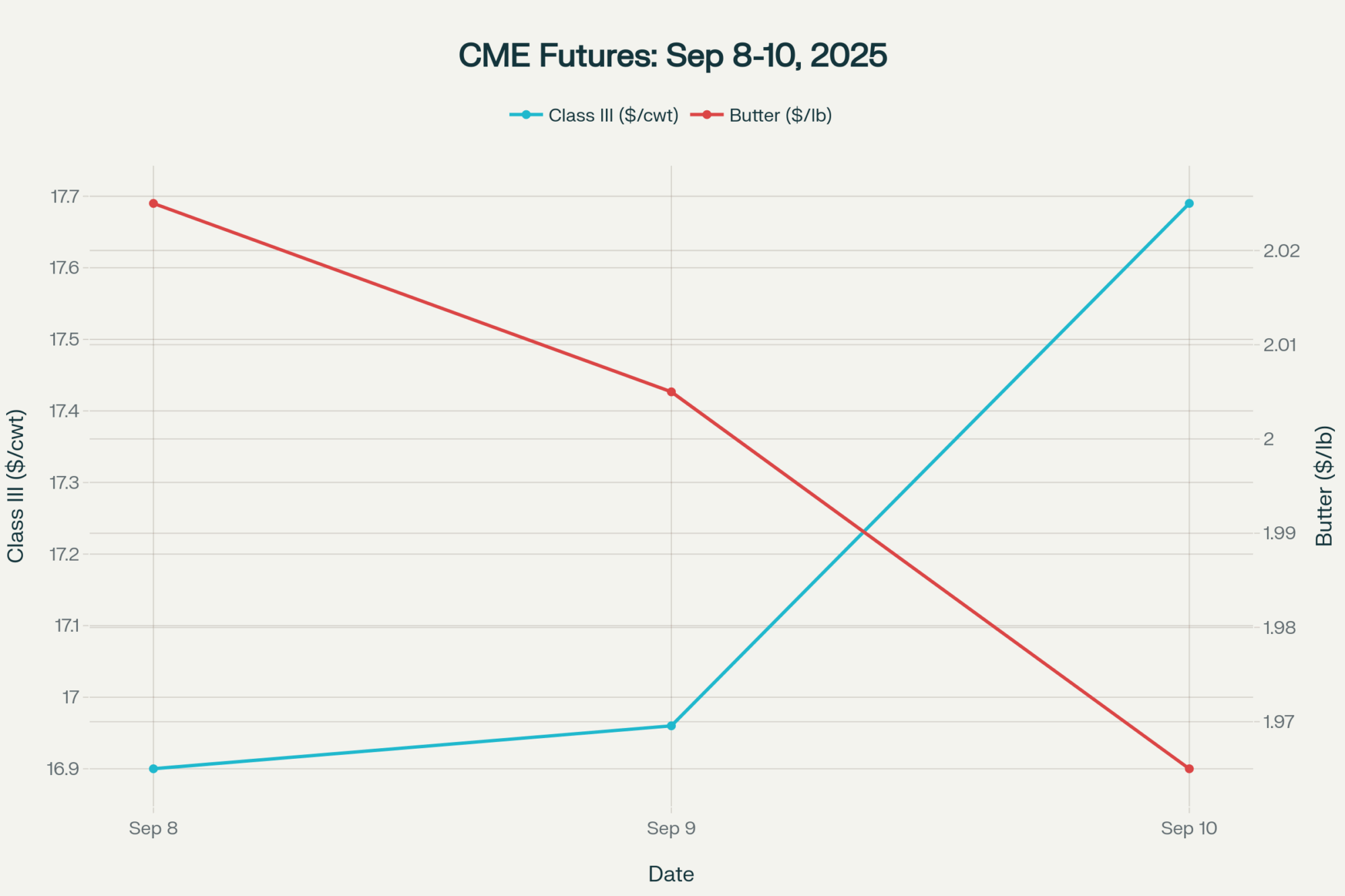
Well, that was quite a session today. After getting hammered for two weeks straight, we finally saw some life in the cheese block market – up 0.75¢ to close at $1.6725/lb. Not exactly cause for celebration, but when you’ve been watching your projected milk checks shrink daily, you’ll take any green you can get.

The real story was in the futures pit. Class III September contracts jumped 73¢ to settle at $17.69/cwt, according to CME data. That’s the kind of move that gets your attention, especially when you’re trying to figure out what September’s milk check might look like.

But here’s where it gets complicated – and you know how dairy markets love to be complicated. While cheese gave us hope, butter got absolutely crushed, dropping 4¢ to $1.9650/lb. NDM wasn’t much better, falling 1.25¢ to $1.1875/lb.

So we’re sitting here with one foot on the gas pedal and one on the brake. Classic dairy market stuff.

Today’s Numbers – The Real Story

Let me break down what actually moved today and what it means for those of us shipping milk:

Cheese Blocks: $1.6725/lb (+0.75¢) Finally, some buying interest. This happened mostly in the last hour – probably some short covering, but buying is buying. The cheese plants still need our milk to make product, and this price action suggests they’re willing to pay for it.

Cheese Barrels: .6750/lb (-0.50¢)
Here’s what’s interesting – barrels are trading at a slight premium to blocks. That’s not normal, and it usually means processors aren’t sure which format they prefer right now. Could signal some uncertainty in the cheese complex.

Butter: $1.9650/lb (-4.00¢) This hurt. A 4¢ drop in one day tells you inventories are building, and demand just isn’t there. Class IV outlook took a hit with this move.

NDM Grade A: $1.1875/lb (-1.25¢) Export competitiveness continues to erode. We’re pricing ourselves out of international markets, which puts more pressure on domestic demand.

The trading volume backed up the price moves. Butter saw 14 transactions on a down day – that’s heavy volume, suggesting real selling pressure. Cheese blocks managed just two trades despite the rally, which makes you wonder if this bounce has staying power.

Where We Stand Globally

This is where things get uncomfortable for us as U.S. producers. Our NDM is currently trading well above that of international competitors, making it challenging to move the product overseas.

According to recent Global Dairy Trade data and international price comparisons, U.S. nonfat dry milk prices are running 6 to 14 cents per pound higher than European skim milk powder and New Zealand equivalents. When you’re the high-cost supplier in a commodity market, that’s never a good spot to be in.

The European situation isn’t helping either. Ireland’s having a strong production year despite overall EU output being slightly down. Their processors are remaining aggressive on pricing, especially in Southeast Asian markets where we used to have a stronger foothold.

Mexico remains our strongest export partner – CoBank and USDA data show Mexico purchasing about 4.5% of total U.S. milk production through various dairy products. However, even there, we’re seeing increased competition from European suppliers, who are getting creative with freight arrangements.

Feed Costs – Finally Some Relief

Here’s one bright spot in all this. Corn futures settled near $3.99/bushel today, and soybean meal is around $281/ton, according to AMS grain reports. That’s manageable compared to where we were earlier this year.

The milk-to-feed price ratio is still below where you’d want it for comfort, but it’s trending in the right direction. Every dollar saved on feed costs goes straight to your bottom line when milk prices are under pressure like this.

Regional differences are still significant, though. Upper Midwest operations are experiencing some harvest logistics issues that are driving up corn basis. Western producers are still managing through higher hay costs from this summer’s drought conditions.

Production Reality Check

The latest USDA data from July shows milk production in the 24 major dairy states totaled 18.5 billion pounds, up 3.4% from June 2024. That’s a lot of additional milk looking for a home.

Dairy cow inventories have increased by approximately 114,000 to 159,000 head as of mid-2025, representing the highest population since 2021, according to USDA and CoBank reports. Texas and South Dakota continue leading the expansion, while some traditional dairy regions are holding steady or declining slightly.

The processing capacity situation is actually pretty healthy. Most plants are running at 90-95% utilization – busy enough to be efficient, but not so maxed out that quality suffers or maintenance gets deferred.

California’s Unique Situation

California deserves special mention because what happens there affects everyone. The state’s cow numbers are down about 3% from peak levels, but per-cow production is running ahead of historical norms, according to ERA Economics and California Department of Food & Agriculture data.

The surviving operations out there tend to be the most efficient ones. HPAI essentially forced the industry to cull the bottom quartile performers, leaving behind the higher-producing herds.

Water costs remain a significant factor in the Central Valley. Regulatory pressures around methane reduction are actually driving some interesting technological adoption that’s improving efficiency, even if the initial compliance costs were substantial.

The challenge for California operations is that their higher cost structure makes them vulnerable when milk prices drop. They need stronger milk prices than Midwest operations to maintain similar margins.

What the Fundamentals Are Telling Us

Domestic demand patterns are holding up reasonably well. Cheese consumption stays pretty steady, which explains why the cheese complex is performing better than butter and powder. But retail inventory builds are becoming more noticeable, which puts pressure on spot prices.

Export markets face multiple headwinds – a stronger dollar, competitive international pricing, and logistics challenges. Southeast Asian markets show growth potential, but the U.S. market share is under pressure from New Zealand and European suppliers.

The supply side story is straightforward – we’ve got abundant milk, processing capacity is adequate, and this shifts negotiating power toward the processors. That’s not great news for milk prices in the near term.

Risk Management Considerations

Current market conditions demand a strategic approach to pricing. Today’s cheese rally created an opportunity to lock in some October-November production around $17.50+ levels.

Dairy Revenue Protection enrollment is running higher than last year – producers learned from previous market cycles about the importance of having some price floor protection. The program changes have tightened some premium subsidies, but it remains a valuable risk management tool.

For production decisions, the focus has shifted toward efficiency over volume. With margins under pressure, maximizing milk components and minimizing costs per hundredweight makes more sense than just pushing for maximum volume.

Regional Variations Matter

Upper Midwest operations are seeing relatively stable basis relationships compared to national averages. Cheese plant utilization is running around 94% capacity, which is healthy for the region.

Several major cooperatives are implementing seasonal pricing programs to help smooth cash flow volatility for members. If you’re not already enrolled in something like that, it’s worth investigating.

The Northeast continues dealing with higher labor costs and regulatory pressures, but fluid milk markets provide some pricing stability that other regions don’t enjoy.

Southwest expansion continues, particularly in Texas, where feed costs are manageable, labor is available, and processing capacity is growing to match increased production.

Looking Ahead

The next few weeks will be critical for determining whether today’s cheese rally has staying power. Weekly cold storage data on Friday could provide more insight into inventory levels.

Seasonally, we’re entering the period where milk production typically peaks while demand patterns shift toward holiday products. The question is whether processing capacity can handle the seasonal surge without additional price pressure.

Current price levels sit in the lower third of the past three years’ range. While that suggests potential upside, it also reflects fundamental challenges that won’t disappear overnight.

For your immediate decisions, focus on what you can control – production efficiency, cost management, and smart risk management. The volatility isn’t going away anytime soon.

Bottom Line

Today’s mixed session captured where the dairy industry sits right now – domestic demand holding up reasonably well, but international competitiveness is under serious pressure.

The cheese rally was encouraging, and that 73¢ jump in Class III futures suggests the market thinks we may have found a floor around these levels. But the weakness in butter and powder reminds us that fundamental challenges remain.

Stay disciplined with risk management, focus on efficiency over volume, and remember – we’ve weathered tougher markets than this before. The key is making smart decisions with the information we have and not getting caught up in the daily volatility.

This industry has a way of humbling you just when you think you’ve got it figured out. Today offered a small ray of hope, but the real work happens in the barn and the feed alley, not on the trading floor.

Learn More:

  • Tips from the Sports Pros to Improve Your Dairy Herd’s Efficiency – This article provides a tactical, on-farm perspective on how to achieve the production efficiency gains mentioned in the market report. It offers practical strategies for optimizing herd health, nutrition, and management, helping producers improve per-cow productivity and profitability in a challenging market.
  • Dairy Profit Squeeze 2025: Why Your Margins Are About to Collapse (And What to Do About It) – Go deeper into the strategic market forces driving the issues highlighted in the report. This piece offers a hard-hitting look at the long-term implications of China’s tariffs, export challenges, and regional disadvantages, providing a crucial context for why a domestic focus is essential.
  • Future-Proof Your Dairy Farm: Tackling the Top 3 Challenges of 2050 – Look beyond the daily market swings and explore the innovative solutions that will define the dairy industry’s future. This article reveals how technological advancements in methane reduction, animal welfare, and data-driven management are not just future trends but actionable strategies for long-term sustainability and success.

Join the Revolution!

Join over 30,000 successful dairy professionals who rely on Bullvine Weekly for their competitive edge. Delivered directly to your inbox each week, our exclusive industry insights help you make smarter decisions while saving precious hours every week. Never miss critical updates on milk production trends, breakthrough technologies, and profit-boosting strategies that top producers are already implementing. Subscribe now to transform your dairy operation’s efficiency and profitability—your future success is just one click away.

NewsSubscribe
First
Last
Consent
Send this to a friend