4 FARM Award Winners Prove the Decision That Matters Most Costs Nothing
Executive Summary: They decided who they were before they could afford it. That’s the pattern connecting the four 2025 FARM Excellence Award winners—and it’s not what most dairy success stories emphasize. Bar E Dairy bet on activity monitoring, even as its neighbors in California called it overkill. The Noll brothers maintained 119 contoured Wisconsin fields while consultants said scale up or get out. Scott Glezen designed employee housing around what workers actually need, not legal minimums. Lisa Ford spent 11 years proving that evaluators could serve farmers rather than just score them. All four have structural advantages that most operations don’t—family backing, generational equity, cooperative support. But the decision that preceded everything else costs nothing: figure out who you are first. The awards came later. They always do.
There’s a moment in every dairy farmer’s life that has nothing to do with milk prices.
Nothing to do with equipment costs. Nothing to do with what the bank will approve.
It’s the moment you have to decide: Who am I going to be?
If you’ve ever sat at your kitchen table feeling trapped between who you want to be and what you can afford—these four stories are for you. Because what I’ve learned watching these families has changed how I think about everything.
For Matthew and Lauren Evangelo, that moment came in 2015. The quote for activity collars sat between them at their Kingsburg, California, farmhouse—tens of thousands of dollars for technology most of their neighbors hadn’t even heard of yet. They had a decision to make, and unlike most dairy families facing equipment investments, they had something unusual: Lauren could actually run the numbers.
A thousand miles east in Alma, Wisconsin, Scott Noll stood on the bluffs overlooking the Mississippi River with his brothers Curtis and Mark. Below them, the river caught the last of the daylight. Above them, 119 contoured fields carved the hillside in patterns their father had started designing back in 1954. They were talking about whether to keep going, whether to build another earthen dam when nobody was requiring them to.
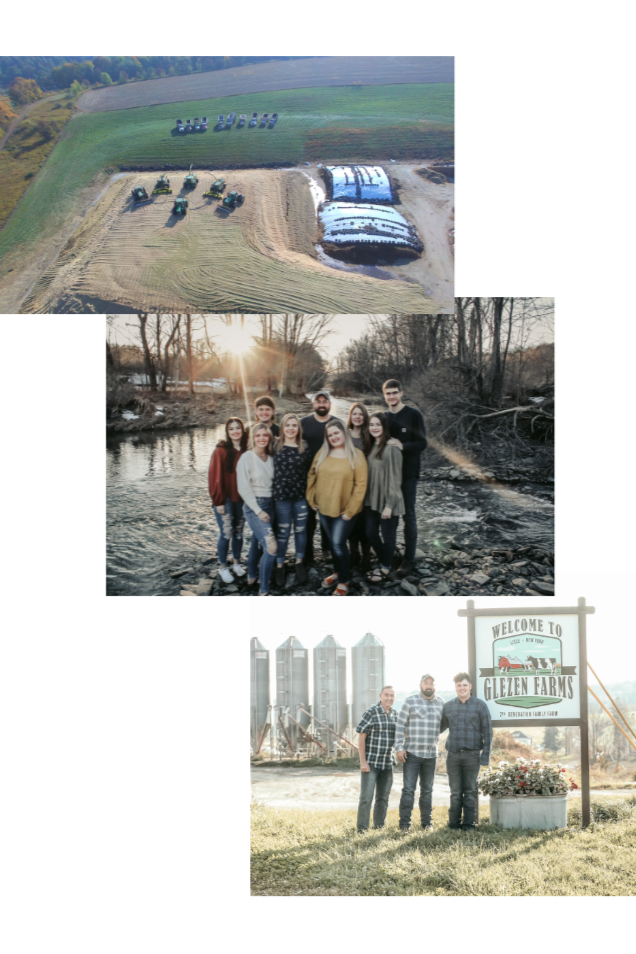
And in Lisle, New York, Scott Glezen was working through floor plans for employee housing with a design most people wouldn’t think about: separate wings for day-shift and night-shift workers, so nobody’s sleep got disrupted by the opposite crew coming and going. It was the kind of detail that would never show up on a milk check.
He did it anyway.
On November 11, 2025, all three operations collected National Dairy FARM Excellence Awards at the Joint Annual Meeting in Arlington, Texas. When Dr. Meggan Hain called their names, these families heard what their communities had been saying for years: these people are different.
But here’s what moves me most about these stories. It isn’t the awards.
It’s what happened in the years before anyone was watching—the quiet decisions made in kitchens and on hillsides and in conversations that nobody recorded.
These families didn’t pursue excellence to win awards. They decided who they were first. The recognition came later.
And that distinction? It matters more than any trophy ever could.
The Young Couple Who Bet Everything on Data
Matt Evangelo grew up with dirt under his fingernails and Holsteins in his blood. His parents ran D & E Dairy in Hanford, California—a registered operation where excellence wasn’t discussed, it was expected.
When Matt was eight, his dad brought Jerseys to the farm as project heifers for the boys. Holsteins were the family business, but those brown cows became Matt’s obsession. There’s no explaining why some people fall for Jerseys—you either understand it or you don’t.
Lauren’s path crossed his at World Dairy Expo in 2004. He was competing with the Cal Poly dairy judging team. She was there with family and friends. The next year, their paths crossed again—this time with Lauren judging for Cal Poly.
By 2008, they were married.
Their first big investment as newlyweds? A heifer calf named Tiaro Nevada Jazzle, bought with their friend Blake Renner from the Spring Valley 7th Edition sale.
I keep coming back to that moment. Two young people, pooling resources with a friend to buy a single animal because they believed in what she could become. That kind of faith is either naive or visionary.
Turns out, it was visionary.
Jazzle became a Junior Champion of Honor at the World Dairy Expo in 2009, earning an Excellent-93% appraisal. She validated everything Matt and Lauren believed about trusting their instincts.
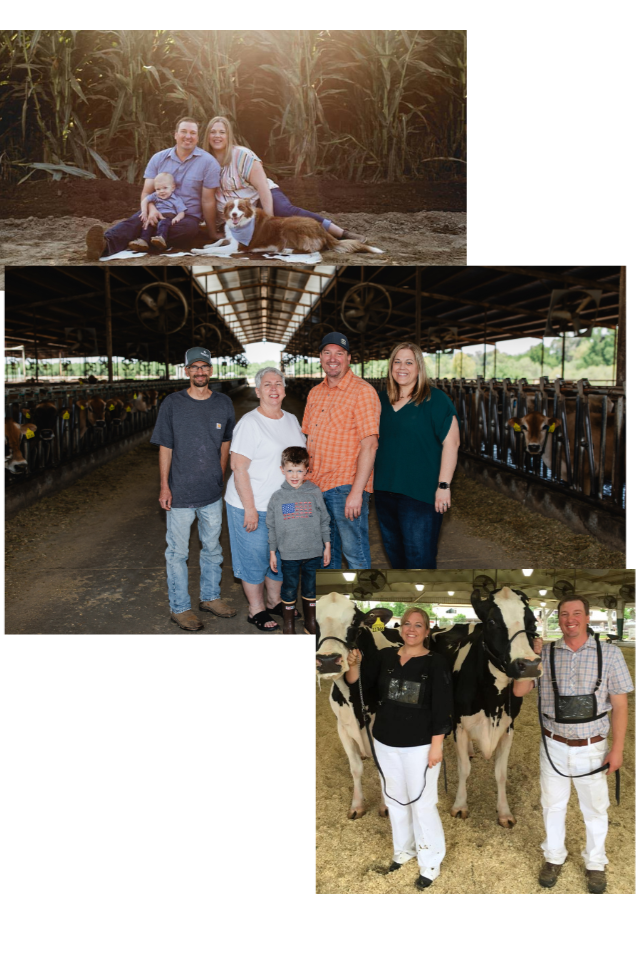
But here’s what made Bar E Dairy different from the start: Lauren wasn’t just a dairy farmer’s wife learning the business. She spent her days at AgWest Farm Credit calculating equipment ROI for other people’s operations. By 2023, she’d risen to Senior Vice President of Equipment Finance.
When Matt came home talking about activity collars that would track behavioral patterns, rumination, reproduction, and movement 24/7, Lauren didn’t roll her eyes or worry about the cost.
She opened a spreadsheet.
Most dairy families making technology investments do gut-feel math. This feels expensive. Will it pay back? I don’t know. My neighbor says it’s not worth it.
Lauren could model depreciation schedules. Expected treatment cost reductions. Labor savings from early detection. Payback timelines. She wasn’t a dairy farmer trying to understand finance. She was a finance professional who happened to own a dairy.
When they established Bar E in 2014 as a partnership with Matt’s parents, their approach was pragmatic from day one: embrace new technology, measure results, and adjust based on data—not sentiment.
But they didn’t just buy collars and call it innovation.
What struck me was how they completely rebuilt their mastitis treatment protocol around the data. They worked with their veterinarian to develop a system for sampling and culturing milk from affected cows—identifying the specific cause of infection before initiating treatment. Pathogen identification drives decisions rather than symptoms.
The result? Significantly decreased antibiotic usage while maintaining excellent udder health.
And then they did something that tells you exactly who they are.
They volunteered to participate in the Remote Animal Welfare Monitoring Project—a collaboration among Land O’Lakes, Merck Animal Health, and the FARM Program —testing whether automated cow monitoring could improve animal welfare assessments across the entire industry.
That’s not “let’s win an award” thinking.
That’s “let’s prove this works for everyone” thinking.
When the 2025 FARM Excellence Award for Animal Care & Antibiotic Stewardship was announced, it validated what Matt and Lauren’s California dairy community already knew: they’d bet on technology when it wasn’t popular, weathered whatever messy middle came between purchase and payoff, and proven it worked.
The award didn’t make them excellent. The decision did.
Three Brothers and Nearly a Century of Keeping Faith with the Land
If you ever drive Highway 35 along Wisconsin’s western border, slow down near Alma. Look up toward the bluffs.
You’ll see something you don’t expect.
Four hundred acres of crops are divided into 119 contoured fields, strip after strip following the natural curves of the land. It looks like someone painted it.
Someone did, in a way. Four generations of Nolls, working with the hillside instead of against it.
Curtis, Mark, and Scott Noll don’t talk about conservation as if it were a program they enrolled in. They talk about it like it’s who they are.
“Keeping the topsoil in place is the most important thing we do,” Scott has said. “You can’t just go to town and buy new topsoil. Once it’s gone, you never get it back.”
Those words land differently when you’ve watched topsoil wash away. When you’ve seen neighbors lose what took generations to build in a single storm.
The Nolls chose differently. They’ve been choosing differently since 1929.
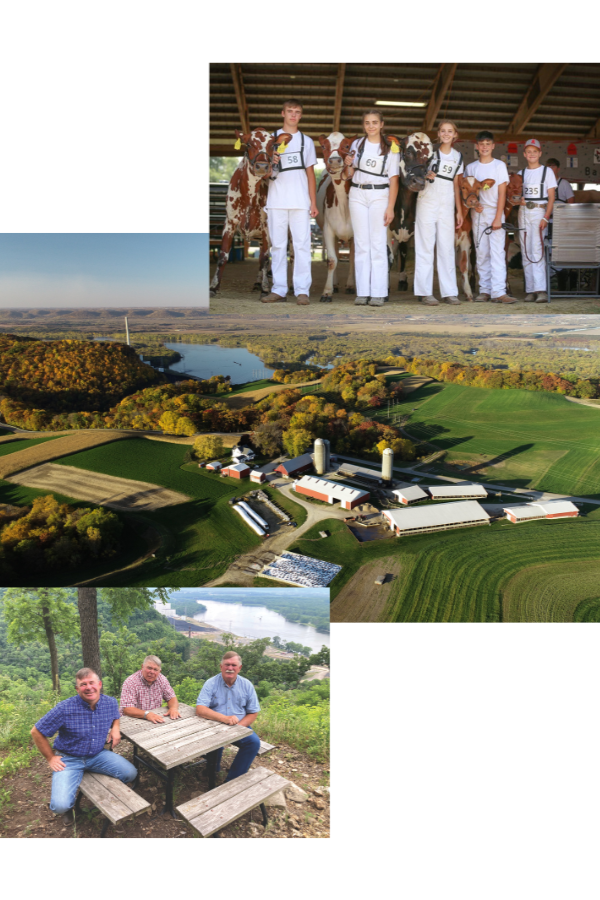
Today, Five Star Dairy Farm LLC milks 115 cows three times a day. That’s tiny by 2025 standards. Industry consultants would tell them to 10x their size or get out.
But standing on those bluffs—even just imagining that view from Highway 35—you start to realize something.
The consultants are measuring the wrong thing.
The Nolls don’t have 115 cows. They have 850 acres of responsibility—400 in crops, 450 in forest, oak savanna, and remnant prairie that provide crucial wildlife habitat and erosion control. They steward one of the largest dry bluff prairie remnants in Buffalo County.
More than 40 conservation practices. No-till on 90% of crops. Cover crops. Variable-rate fertilizer. Numerous earthen dams were built across decades of patient, deliberate stewardship.
Here’s what struck me about their pragmatism: they used revenue from selectively harvesting mature timber to finance their manure storage facility. Conservation and economics, working hand in hand. That’s the Noll approach in a sentence.
Manure is returned to fields as fertilizer—a closed-loop system their grandfather would recognize, and their grandchildren will inherit.
“When you’re in a generational farm, you don’t always agree,” Scott has acknowledged. “But conservation, our love for the land and animals, is something we’ve always agreed on.”
Three brothers. Nearly a century. 119 fields. A shared commitment that survived every disagreement, every margin crisis, every voice telling them to abandon what made them who they are.
In 2023, they received the Wisconsin Leopold Conservation Award—a $10,000 prize presented at the Wisconsin Board of Agriculture, Trade, and Consumer Protection meeting in Madison. When the 2025 FARM Excellence Award for Environmental Stewardship followed, it validated what Buffalo County already knew.
You can balance productivity with stewardship. You just have to decide that’s who you are—and refuse to let anyone talk you out of it.
The Eighth Generation That Remembers What Matters
Scott Glezen knows what it feels like when something you believe in gets torn away.
In May 2025, the USDA canceled his five-year conservation contract mid-term. He’d entered an agreement to receive approximately $192,000 to cultivate winter wheat on part of his property—not for financial gain, the grant offered him nothing personally—but because it was “the right thing to do” for soil conservation. He’d already planted the crops. They’d already absorbed significant rainfall that spring.
And then, without warning, the contract was gone.
“I just don’t understand how sustainable and conservation practices have become politicized,” Scott said at the time. “It genuinely surprises me.”
There’s something in those words that stays with me. Not anger. Bewilderment. The genuine confusion of someone who did the right thing and still got punished for it.
Congressman Josh Riley intervened. The federal funding was fully restored. Riley introduced bipartisan legislation—the Honor Farmer Contracts Act—to prevent it from happening to other farmers.
But here’s what that story reveals about Scott Glezen: he does the right thing even when it costs him. Even when it doesn’t make financial sense. Even when forces beyond his control try to take it away.
That’s the same philosophy behind the employee housing currently under construction at Glezen Farms in Lisle, New York.
This isn’t your typical farm housing. Scott designed the building to be strategically divided into day-shift and night-shift wings—so employees on opposite schedules can actually sleep without being disrupted by coworkers coming and going.
Think about what that means.
Someone sat down with floor plans and asked, “What do the people who work here actually need?” Not What’s the minimum we can provide? Not What will keep them from complaining? But genuinely: How do we help them rest?
Glezen Farms is an eighth-generation operation. Eight generations. That means somewhere around 1810, Scott’s family started farming that land in upstate New York.
When you carry that kind of history, you’re not building a business. You’re stewarding a legacy. And I believe Scott asks himself a question that most operators don’t: “What kind of farm do I want to hand to generation nine?”
The multilingual employee handbook. The annual performance evaluations. The sexual harassment prevention training is designed to ensure employees feel valued, protected, and empowered. None of it is required by law or program.
All of it is required by who Scott Glezen decided to be.
With 2,400 milking cows and 4,270 total head, he could structure this as a corporate operation. Treat labor as a commodity. Maximize margins. Extract cash.
Instead, he’s investing in people like they matter. Because to Scott, they do.
When the 2025 FARM Excellence Award for Workforce Development was announced, it validated what the Maola Local Dairies community already knew: the Glezens don’t just hire employees. They invest in human beings.
The Evaluator Who Chose Service Over Enforcement
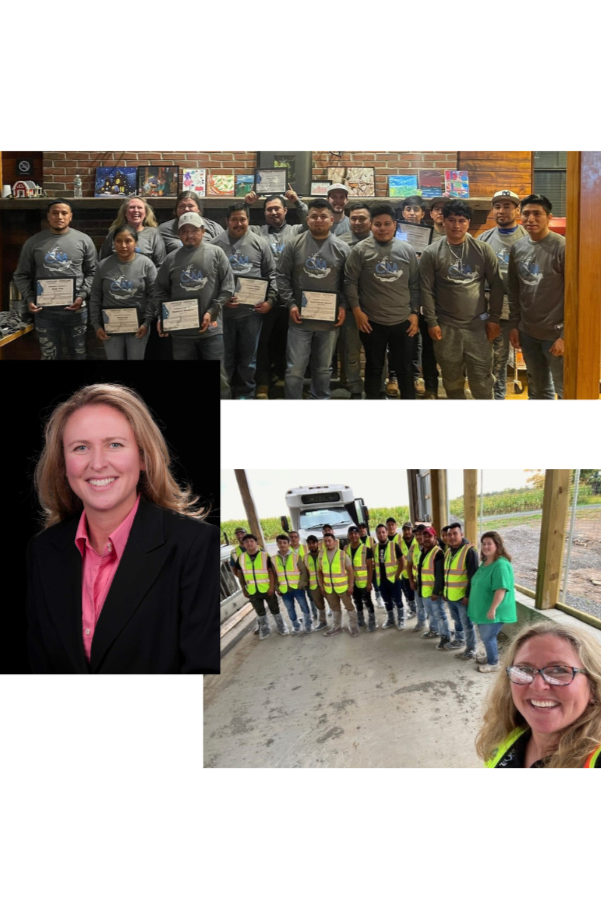
Lisa Ford didn’t grow up on a dairy farm.
She’d never touched a bulk tank or walked a pen until a sustainable agriculture class at the University of Maine opened a door she didn’t know existed. She graduated in 1996 with a degree that would lead her somewhere she never expected.
Since 2014, she’s served as Member Programs Manager for Cayuga Marketing in New York. Eleven years of showing up for farmers. Eleven years of answering the phone when someone needs help.
There’s a reason Cayuga members call Lisa before problems develop—she’s proven, farm after farm, that she’s in their corner.
Here’s what makes Lisa different: most FARM evaluators show up with clipboards. They check boxes, find non-compliances, write up corrective actions, and leave. The farmer watches the truck disappear down the driveway and exhales.
Lisa chose differently.
Questions about training resources? Call Lisa. Stockmanship advice? Call Lisa. Proper antibiotic storage protocols? Call Lisa—even late in the evening, she’s likely still working.
By the time Lisa conducts a FARM evaluation, she’s already been helping that farm for months or years. She’s not the inspector. She’s the person they trust.
Her colleagues describe her as “meticulous, detail-oriented, and known for having a keen eye.” But what strikes me is how she uses that eye—not to catch farms doing something wrong, but to help them get better.
“Her dedication to continuous improvement is evident through her time spent with Cayuga Marketing members, always offering her time, resources, and above all, her complete dedication to improving the dairy industry at large,” the FARM Program noted in announcing her award.
She built two internal programs—CREATE (Cayuga’s Responsible and Ethical Animal Treatment Endeavor) and CM Team—that use FARM standards as baselines but help members exceed minimum requirements. Nobody asked her to do that. Nobody required it.
Lisa saw farms that wanted to improve and built systems to help them succeed.
She also sits on the NMPF Animal Health and Wellbeing Committee. She could use that position to tell farmers what national standards require. Instead, she uses it to tell the committee what real farms actually need to make those standards work.
She’s not representing standards to farmers. She’s representing farmers to standards.
When the 2025 FARM Evaluator Excellence Award was announced, it recognized something Cayuga Marketing members already knew: Lisa had been choosing them, every day, for eleven years.
The Pattern That Connects Them All
Four operations. Four different paths. But the same sequence: identity first, economics second.
That pattern is undeniable.
So is what I have to tell you next.
The Uncomfortable Truth We Need to Talk About
Here’s where I have to be honest with you—and with myself about what these stories really mean.
All four winners have structural advantages that most dairy farms don’t have.
Bar E had family backing, dual professional income, and insider ag lending expertise. Five Star has 850 acres, multiple revenue streams, and decades of participation in conservation programs. Glezen has eight generations of equity and scale to invest in infrastructure that smaller operations can’t afford. Lisa has a cooperative structure that funds her position and values her approach.
The industry is holding up these examples and saying, “See?” Excellence is possible!
And it is. But it’s easier with capital, scale, family support, and cooperative structure.
So what does that mean for the 200-cow operation just trying to survive?
I’ve wrestled with this question. Because if you’re reading this at your kitchen table after a day that started at 4 AM, the last thing you need is another story about people with advantages you don’t have. That’s not inspiration. That’s just another reminder of the gap.
So let me be honest about what I actually learned from these four stories:
What Actually Transfers to Your Kitchen Table
- Bar E decided “we want to be farmers who use data to reduce antibiotics” FIRST. Then they figured out how to afford it.
- Five Star decided “keeping topsoil matters more than maximizing production” FIRST. Then they built a business model that made that viable.
- Glezen decided “we’re accountable to generation nine” FIRST. Then they built workforce systems that reflected that identity.
- Lisa Ford decided, “I’m here to serve farmers, not police them” FIRST. Then she built programs that made that possible.
Every one of them decided WHO THEY WERE before they figured out HOW TO PAY FOR IT.
Most struggling operations do it backwards. What can we afford? What does the bank allow? What’s the minimum we can get away with? Then they try to build an identity around those constraints.
And they wonder why they’re exhausted and losing ground.
What This Means for All of Us
You might not have Lauren’s finance background. You might not have eight generations of equity. You might not have 850 acres or a cooperative that funds your position.
But you can ask yourself one question: “What’s the one thing I’m willing to sacrifice everything else to protect?”
For Bar E, it was data-driven animal care. For Five Star, it was topsoil and land stewardship. For Glezen, it was treating people with dignity across generations. For Lisa, it was serving farmers authentically.
Maybe for you it’s:
- Being the farm kids visit to learn where milk comes from
- Having employees who’ve stayed through the labor shortage—not because they couldn’t leave, but because they chose to stay
- Leaving soil better than you found it, even when conservation programs get canceled
- Raising cows healthy enough that your antibiotic costs dropped while your neighbors’ rose
- Being the operation processors call when they need a farmer who’ll speak at their sustainability summit
Not sure where to start? Answer this: What would make you proudest to tell your grandchildren about this operation?
Pick one thing. Make it non-negotiable. Then build everything else around making that economically viable.
The 200-cow farms that survive the next decade won’t be the ones with the most resources. They’ll be the ones who decided what they stood for, then refused to compromise—even when it was expensive, even when neighbors were skeptical, even when consultants said it was wrong.
That decision costs nothing.
It just requires courage.
Bar E, Five Star, Glezen Farms, and Lisa Ford made that decision years ago—before anyone was watching, before anyone was handing out awards, before anyone told them it was the right choice.
I don’t know if it will work for everyone. I don’t know if it will work for you.
But I know this: You decide first. Then you find out if you were right.
Maybe that’s the only way it ever works.
The awards? They came later. They always do.
Key Takeaways
- One pattern, four paths: Bar E bet on technology, neighbors dismissed. The Nolls kept 119 fields that consultants called inefficient. Glezen built employee housing that nobody required. Ford served farmers for 11 years when evaluating them would’ve been enough. All decided who they were before they could afford it.
- Advantages acknowledged: These winners have family backing, generational equity, scale, and cooperative support that most operations don’t. The framework still transfers.
- The identity question: “What would I refuse to compromise even if it hurt my margins?” Your answer reveals operational identity more than any business plan.
- The decision is free: You can decide who you are tonight. Whether the economics follow—you find out after. That’s how it worked for them, too.
The 2025 FARM Excellence Awards were presented on November 11, 2025, at the Joint Annual Meeting in Arlington, Texas. The FARM Program, administered by the National Milk Producers Federation, is open to all U.S. dairy farmers, cooperatives, and processors. For information about program participation and future nominations, visit nationaldairyfarm.com.
Learn More
- Tech Reality Check: The Farm Technologies That Delivered ROI in 2024 (And Those That Failed) – Arms you with specific payback timelines for robotic milkers and health sensors. It delivers the hard data you need to separate vendor hype from on-farm reality, ensuring your next tech investment solves a bottleneck rather than creating a new debt trap.
- 2025 Dairy Year in Review: Ten Forces That Redefined Who’s Positioned to Thrive Through 2028 – Reveals the structural shifts in replacement heifer inventories and capital allocation that will dictate winner and loser status over the next three years. It positions your operation to navigate the “heifer hole” and culling math that most neighbors are still ignoring.
- Revolutionizing Dairy Farming: How AI, Robotics, and Blockchain Are Shaping the Future of Agriculture in 2025 – Exposes the 99.8% precision revolution in AI-powered genetics and blockchain transparency. It breaks down how maverick producers are weaponizing tradition with Silicon Valley tech to capture premium margins and slash mastitis costs before symptoms even appear.
 The Sunday Read Dairy Professionals Don’t Skip.
 The Sunday Read Dairy Professionals Don’t Skip.
Every week, thousands of producers, breeders, and industry insiders open Bullvine Weekly for genetics insights, market shifts, and profit strategies they won’t find anywhere else. One email. Five minutes. Smarter decisions all week.