Archive for dairy trade policy

$850 Million Dairy Standoff: What U.S. and Canadian Farmers Need to Know Before July 2026

Canada won the trade panel. The U.S. has the sunset clause. July 2026 decides who blinks first in the $850M dairy standoff.

EXECUTIVE SUMMARY: Wisconsin dairy farmers are asking a simple question: Where’s the Canadian market access USMCA promised five years ago? The U.S. industry says Canada blocked $850 million in opportunities by allocating import quotas to processors who won’t use them, keeping fill rates at just 42%. Canada counters they’re following the rules—winning a November 2023 panel to prove it—and argues American dairy simply isn’t competitive in their market. With 1,420 U.S. farms closing last year while Canadian producers protect quota investments worth $30,000 per cow, both sides face existential stakes. July 2026 changes everything: the USMCA sunset clause means all three countries must actively agree to continue, or $780 billion in annual trade enters dangerous uncertainty. This analysis presents both perspectives fairly and provides specific strategies based on your farm size—because regardless of who “wins,” every North American dairy operation needs to prepare for what comes next.

USMCA dairy review

As we approach the July 2026 USMCA review, the U.S. dairy industry is building their case while Canada defends its position. Here’s what both sides are saying—and why it matters for dairy farmers across North America.

You know what’s interesting? When you talk to Wisconsin producers these days, there’s this deep frustration that just keeps coming up. Five years after the USMCA promised meaningful Canadian market access, they’re still waiting. And it’s not just Wisconsin—this sentiment’s spreading across the entire U.S. dairy belt, setting up what could be quite a showdown come July 2026.

So here’s what’s happening. The International Dairy Foods Association filed this formal complaint in October to the Trade Representative, and when you combine that with five years of trade data from both USDA and Canada’s Global Affairs department… well, the U.S. industry’s making a pretty specific case. They’re talking about roughly $850 million in export opportunities that haven’t materialized, all while 1,420 American dairy operations shut down last year, according to the USDA’s count.

But here’s the thing—and this is important—Canada sees this completely differently. They won that November 2023 dispute panel, and they’re saying they’re following the agreement just fine. Understanding both perspectives has become essential for anyone trying to make sense of what’s coming.

What the U.S. Industry Says Was Promised vs. What They Got

Let me walk you through the American dairy sector’s position. It starts with the International Trade Commission’s 2019 assessment, which projected we’d see about $227 million in additional annual exports under USMCA’s dairy provisions.

The way U.S. producers see it, they were expecting:

  • Access to 3.6% of Canada’s dairy market through 14 different quota categories
  • Complete elimination of those Class 6 and 7 pricing schemes within six months
  • Export caps keeping Canadian skim milk powder and milk protein concentrates at 35,000 metric tons annually
  • Import quotas going to actual importers, not Canadian processors

Now, according to Canada’s own Global Affairs data and those USMCA panel findings, what actually happened looks quite different.

What were the average quota fill rates from 2022 to 2023? Just 42% across all categories. Nine of those 14 categories never even hit 50% utilization. And that January 2022 USMCA panel—they found that Canada had allocated between 85% and 100% of its quota shares to Canadian processors. American farmers argue these processors have about as much incentive to import competing U.S. products as… well, let’s just say not much.

Here’s what really gets American producers going—this Class 7 pricing business. Sure, Canada technically eliminated it like they promised. But then—and the University of Wisconsin’s dairy economists have documented this—similar pricing dynamics popped up under Class 4a. The U.S. sees that as a way to get around its USMCA commitments.

“You get on a phone conversation with some of these folks that have been farming for five and six generations. How do you say I can’t help you? That becomes very tough.” – Bill Mullins, Mullins Cheese

Quick Reference: Understanding Key Trade Terms

TRQ (Tariff Rate Quota): Think of it as a two-tier system. A certain amount gets in at low or zero tariffs. Above that? You’re looking at 200-315% tariffs for Canadian dairy.

Supply Management: Canada’s comprehensive dairy system since 1972—combines production quotas, price supports, and import controls.

Class Pricing: Canada’s milk classification system that sets different prices based on how the milk’s used—and this is where things get contentious.

Why Canada Defends Supply Management So Fiercely

You know, when you really look at Canada’s dairy system, you start to understand why they’re so protective of it. Agricultural economists at Université Laval have documented how it works through three integrated pieces:

First, there’s production quotas that limit what each farmer can produce. Then you’ve got price supports keeping farmgate values at about 1.5 to 2 times what we see in the U.S. And finally, those import barriers—we’re talking 200% to 315% on anything over quota.

This whole framework’s supporting about 9,000 Canadian dairy operations that generate close to CA$20 billion in annual economic activity, according to Dairy Farmers of Canada’s latest report.

Mark Stephenson over at UW-Madison’s dairy policy program explains it well: “The fundamental incompatibility is that supply management requires import control to function. Asking Canada to provide meaningful market access is essentially asking them to dismantle the system piece by piece. From their perspective, that’s existential.”

And here’s something to consider—Canadian producers have invested around CA$30,000 per cow in quota value according to their provincial milk boards. That’s not just an operating expense. That’s retirement savings, succession planning, and their kids’ inheritance. No wonder they defend it so fiercely.

How American Farmers See the Economic Stakes

For U.S. producers, the Grassland Dairy situation from 2017 is still a really raw issue. It kind of exemplifies their broader concerns about Canadian trade practices.

When Canada introduced that Class 7 pricing targeting ultra-filtered milk, Grassland Dairy had to terminate contracts affecting about a million pounds of daily production across 75 Wisconsin farms. Bill Mullins from Mullins Cheese—he took on eight of those displaced operations even though his plants were already near capacity. His words still resonate.

Here’s what keeps U.S. producers up at night:

Wisconsin Center for Dairy Profitability data shows your average 200-cow operation generates about $87,000 in annual net income. If you lost $56,000 in potential export revenue—that’d be each farm’s theoretical share of that $850 million—you’re looking at a 64% income hit.

The numbers that really worry them:

  • Chapter 12 farm bankruptcies jumped 55% in 2024, hitting 259 filings
  • Wisconsin dairy operations averaged just $0.87 per hundredweight in net margins during 2023
  • At those margins, farms facing reduced market access could hit insolvency within 30 months

New York dairy producers have been pretty vocal about their frustration, arguing they’re seeking the market access they were promised, not handouts. One Cayuga County operator mentioned how expansion decisions are basically on hold until there’s clarity about Canadian market availability.

Canada’s Counter-Argument: Why They Say They’re Complying

Now here’s where it gets really interesting—Canada’s perspective on USMCA compliance is fundamentally different from the U.S.’s.

First off, Canada won that November 2023 USMCA dispute panel ruling. The panel found 2-1 that Canada’s revised allocation methods based on market share didn’t violate USMCA provisions. That’s a big deal—it validated Canada’s position that their implementation, while maybe not what the U.S. expected, technically complies with the agreement.

The way Canadian officials see it, several key points counter U.S. arguments:

On those low quota fill rates, they argue this reflects market conditions and U.S. producers’ inability to meet Canadian market requirements, not administrative barriers. They say importers are free to source from the U.S. if the products are competitive.

On processor allocations: Canada maintains that allocating quotas based on historical market activity is legitimate and non-discriminatory. It doesn’t explicitly exclude any type of importer.

On Bill C-202: Rather than overplaying their hand, Canada sees that June 2025 legislation—where 262 of 313 MPs voted to prohibit dairy concessions—as a democratic expression of national consensus. All parties supported it. From their perspective, that’s sovereign policy choice, not a negotiating tactic.

Dairy Farmers of Canada has consistently maintained that supply management represents more than just an economic system—they see it as ensuring food security and stable farm incomes across rural Canada. Pierre Lampron, who served as DFC president through 2024, expressed confidence at their annual meeting that the government understands this broader context.

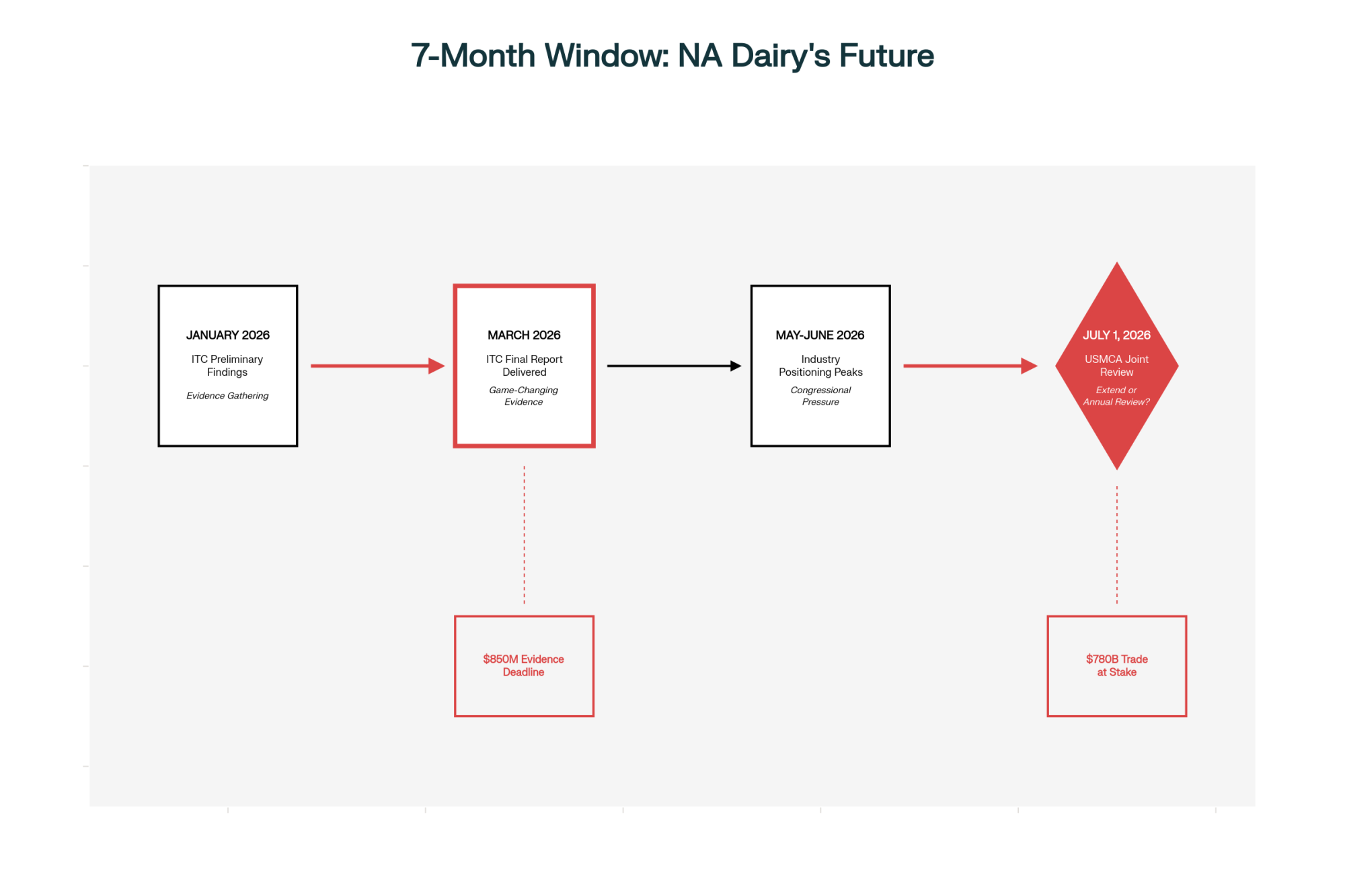
Timeline: Key Dates Leading to July 2026 Review

January 2026: Monitor for ITC preliminary findings on protein dumping investigation

March 2026: ITC final report delivers—this could be game-changing evidence

May-June 2026: Industry positioning intensifies, Congressional pressure peaks

July 1, 2026: USMCA joint review—decision on extension or annual review mode

Here is the data from the image converted into a table:

Two Countries, Two Systems

AspectU.S. SystemCanadian System
Farm Closures (2024)1,420 operations (5% decline)Stable/protected
Quota Investment per Cow$0$30,000
Price StabilityVolatile (market-based)Guaranteed (1.5-2x U.S. prices)
Market Access BarriersNone domesticallyHigh tariffs (200-315%)
Export OpportunitiesGrowing but constrained by CanadaLimited by supply management

The Political Leverage Game for 2026

Both sides are positioning themselves for July 2026 with some distinct strategic advantages.

What the U.S. Industry Has Going For It

The timing of the ITC investigation is no accident. The International Trade Commission investigation into Canadian dairy protein dumping delivers findings in March 2026. That’s just four months before the review—giving U.S. negotiators the federal agency documentation they need right when they need it.

The sunset clause creates real pressure. USMCA requires all three countries to actively confirm they want to extend the agreement in July 2026. If they don’t, we’re looking at uncertainty over $780 billion in annual bilateral trade.

Congressional backing matters. Bipartisan pressure from dairy-state legislators provides the U.S. industry with political support to push enforcement demands.

Canada’s Strategic Position

Legal victories count. That November 2023 panel ruling provides Canada with legal cover for its current practices. They can say, “Look, we went through dispute settlement and won.”

Political unity is powerful. Bill C-202’s overwhelming parliamentary support shows that protecting supply management goes beyond party politics in Canada.

The broader relationship provides leverage. Canada can point to integrated North American supply chains—especially in automotive and energy—to resist dairy-specific pressure.

Three Scenarios and What They Mean for Different Farm Sizes

Supply management has survived 30+ years of trade fights. Betting the farm on a breakthrough? That’s a 30% probability play. Smart money plans for the 45% scenario: more paperwork, same barriers, modest improvements at best

Looking at how things are shaping up, here’s what seems most likely and what it means for your operation:

Scenario 1: More Incremental Changes (45% probability, if you ask me)

Canada agrees to better reporting and maybe some monitoring mechanisms, but keeps its fundamental allocation approaches. The U.S. claims progress, Canada keeps supply management intact. Quota fill rates? They probably stay about the same.

What this means by farm size:

Under 100 cows: Focus on local markets and direct sales. Canadian access won’t materialize in meaningful ways for you anyway. Consider value-added products where you control the whole chain.

100-500 cows: Keep flexibility for quick pivots. Maybe maintain current production, but don’t expand based on export hopes. Watch Southeast Asian opportunities instead.

500+ cows: You’ve got scale to weather this, but don’t count on Canadian markets in your five-year plans. Consider leading industry advocacy efforts—you’ve got the most to gain if something breaks loose.

Scenario 2: Real Enforcement Mechanisms (30% probability)

If those ITC findings are compelling and U.S. negotiators credibly threaten not to renew, Canada might accept automatic penalties for under-utilization or mandatory non-processor allocations. That could deliver partial yet meaningful improvements in access.

Preparation steps if this happens:

  • Get your export documentation systems ready now
  • Build relationships with potential Canadian buyers
  • Understand Canadian labeling and standards requirements
  • Consider partnerships with existing exporters to learn the ropes

Scenario 3: A Standoff (25% probability)

Neither side budges much. The agreement goes into annual review mode, creating ongoing uncertainty but avoiding immediate disruption. Both industries operate under this cloud of potential future changes.

Risk management if we hit a standoff:

  • Maximum Dairy Margin Coverage enrollment becomes essential
  • Lock in feed costs wherever possible
  • Diversify buyer relationships domestically
  • Don’t make major capital investments based on export assumptions

Who’s Pushing for What: The Players Making Things Happen

Let me tell you about the organizations driving this whole thing, because understanding who’s involved helps make sense of the dynamics.

On the U.S. side, you’ve got some heavy hitters:

The International Dairy Foods Association—they’re the ones who filed that October 2025 complaint. They represent processors, and they’re pushing hard for what they call an end to protectionist measures. They want binding enforcement, and they want it now.

National Milk Producers Federation lobbied hard for that ITC investigation. They’re your farmer cooperatives, and they keep hammering on automatic penalties for non-compliance. They’ve got members losing money, and they’re not shy about saying so.

The U.S. Dairy Export Council is more technical—they document barriers, provide negotiating support, and help with the nuts and bolts. Edge Dairy Farmer Cooperative represents those Midwest producers, and they’re great at putting farm-level impacts front and center.

On Canada’s side, it’s equally organized:

Dairy Farmers of Canada maintains they’re fully complying with USMCA. They’ve got a consistent message: supply management is legitimate policy, and they’re following the rules.

Les Producteurs de lait du Québec—now these folks have serious clout. They represent Quebec’s 4,877 dairy farms, and in Canadian federal elections, Quebec matters. A lot.

Provincial marketing boards coordinate the defense while implementing those quota allocation systems that the U.S. finds so frustrating.

Market Alternatives: What Some Smart Operators Are Doing

While this U.S.-Canada dispute dominates headlines, some American producers are zigging, while others are zagging. Take this example—a California operation recently told me they doubled their Vietnam exports in 18 months. “The middle class there is exploding,” they said. “They want quality dairy, and there’s no quota games to navigate.”

Industry data from USDEC backs this up—U.S. dairy exports to Vietnam and other Southeast Asian countries keep climbing year over year. Vietnam, Thailand, and the Philippines—they’re importing more dairy each year. No supply management system to work around. Just straightforward business based on quality and price.

You know what’s interesting about these markets? They’re growing fast enough that even mid-size operations can find niches. Specialty cheeses, high-quality milk powders, and even fluid milk in some cases. The logistics are getting better every year, too.

Seven months. Four critical milestones. $780 billion in annual trade hanging in the balance. This is how the March 2026 ITC report becomes the leverage point that forces Canada’s hand—or blows up USMCA

The Bottom Line: No Easy Resolution in Sight

That $850 million figure the U.S. dairy industry keeps citing? That’s their calculation of lost opportunities. Canada disputes both the number and the whole premise. Five years of USMCA implementation have revealed fundamental disagreements about what the agreement actually requires and what compliance entails.

Canada’s supply management system has survived more than 30 years of trade negotiations. Honestly? It’ll probably survive this challenge too. The question isn’t whether USMCA will fully open Canadian dairy markets—nobody really expects that. It’s whether the 2026 review might produce some incremental changes that partially address U.S. concerns while keeping Canada’s core system intact.

The way American producers see it, success means binding enforcement mechanisms with automatic penalties. The way Canada sees it, success is maintaining supply management’s essential structure while offering enough procedural adjustments to avoid a broader trade confrontation.

Come July 2026, we’ll see whether these positions can be reconciled—or whether North American dairy trade stays defined by promises unfulfilled and expectations unmet. Either way, it’s going to be interesting to watch. And whatever happens, we’ll all need to adapt our operations accordingly.

One thing’s for sure—whether you’re milking 50 cows or 5,000, whether you’re in Wisconsin or Quebec, this dispute affects the entire North American dairy landscape. Understanding both sides helps us all prepare for whatever comes next.

Resources for Following This Issue:

Trade Documentation:

Research Centers:

The Bullvine continues tracking developments from both perspectives as we approach the July 2026 USMCA review. For ongoing analysis, visit www.thebullvine.com.

KEY TAKEAWAYS

  • Both sides have valid arguments: U.S. proves Canada allocates 85% of quotas to processors who won’t import (42% fill rate); Canada’s November 2023 panel win says that’s technically legal
  • Real farms, real consequences: 1,420 U.S. operations closed waiting for promised access, while Canadian farmers defend $30,000/cow quota investments—everyone has skin in this game
  • July 2026 is unprecedented leverage: The sunset clause means all three countries must actively agree, or $780B in trade enters chaos—first time the U.S. can credibly threaten the whole relationship
  • History suggests incremental change: Supply management survived 30+ years of trade fights; expect minor adjustments, not market revolution
  • Your operation, your strategy: Under 100 cows = stay local; 100-500 = maintain flexibility; 500+ = lead advocacy while developing Asian markets where actual growth exists

Complete references and supporting documentation are available upon request by contacting the editorial team at editor@thebullvine.com.

Learn More:

Join the Revolution!

Join over 30,000 successful dairy professionals who rely on Bullvine Weekly for their competitive edge. Delivered directly to your inbox each week, our exclusive industry insights help you make smarter decisions while saving precious hours every week. Never miss critical updates on milk production trends, breakthrough technologies, and profit-boosting strategies that top producers are already implementing. Subscribe now to transform your dairy operation’s efficiency and profitability—your future success is just one click away.

NewsSubscribe
First
Last
Consent

The $100 Per Cow You Never See: How Foreign Subsidies Are Reshaping American Dairy

Three dairy farms close every day while Europe pays their farmers to compete against you.

You know that frustration when milk prices just don’t reflect the work you’re putting in? I was talking with a Wisconsin dairyman last week who nailed it: “I can handle weather variability and market cycles—we’ve done that for generations. What’s harder to navigate is when other governments are actively supporting our competitors.”

Here’s what’s interesting—this concern is popping up everywhere I go. Cornell’s dairy economist, Andrew Novakovic, ran some modeling earlier this year that suggests foreign subsidies might be extracting approximately $90 to $100 per cow annually from your operations through price suppression.

Now, for a typical 500-cow dairy? We’re talking about $45,000 to $50,000 in potential revenue that just…vanishes. Never shows up in the milk check.

What I’ve noticed is this pattern holds whether you’re running 200 cows on pasture in Vermont or milking 2,500 head in a New Mexico dry lot. The dynamics stay remarkably consistent.

Understanding What You’re Up Against

The global dairy market has undergone significant changes, and it’s worth taking a moment to understand how other governments are influencing the playing field.

The European Union has an intervention purchasing system—they actually buy up butter and skim milk powder when prices drop, holding them at levels above where the market would naturally clear. Their own Court of Auditors looked at this back in 2021 and basically said, “Hey, this is causing market distortions.” They even referred to it as “destabilizing.”

European Commission intervention stocks directly suppress US milk prices—when EU stockpiles peaked at 380,000 MT in 2016, American producers lost $0.80/cwt, costing the industry an estimated $2.2 billion in farm income over two years.

But here’s the thing—it continues anyway. Mark Stephenson, over at Wisconsin’s dairy policy program, figures that these interventions might be costing U.S. dairy hundreds of millions of dollars annually in lost competitiveness.

Then you have China doing something different, but equally challenging. They’re offering VAT rebates to processors in special economic zones—we’re talking 8 to 13 percent back on dairy exports, specifically through their State Council Directive 2024-15, which expanded these zones. So, when a buyer in Nigeria or Saudi Arabia is comparing bids? That Chinese supplier has an automatic advantage that has nothing to do with efficiency.

I was chatting with an Idaho producer who runs a pretty sophisticated operation—robotics, precision feeding, the whole nine yards. He said something that stuck with me: “We can match anybody on production metrics. But when their government picks up 8-13% of the tab? That’s a whole different ballgame.”

When Theory Meets Reality: What Happened in Michigan

You want to see how this plays out in real life? Look at what Michigan dairy cooperatives documented in their recent annual report. They lost significant contracts to European suppliers when Algerian buyers shifted their sourcing.

Here’s why: Under the EU-Algeria trade agreement, European dairy products enter the market duty-free. Meanwhile, U.S. exports? We’re looking at tariffs of 25% or more.

Based on typical market pricing with these tariff differences, European suppliers can deliver powder at prices we literally can’t match—not because they’re better, but because the trade structure gives them that advantage.

And when co-ops lose those export contracts, the impact is immediate. Phil Durst, who does dairy education for Michigan State Extension, has been tracking this. Milk prices can drop more than a dollar per hundredweight. Producers start culling—often 10-15% of the herd goes. Processing plants start wondering if they can stay open.

A third-generation Michigan producer told me recently, “Our somatic cell count runs under 150,000 consistently. Components are excellent. We’ve got reproduction dialed in. But being good at your job has limits when the playing field’s this tilted.”

Breaking Down What This Means for Your Operation

Let’s talk real numbers here. A price suppression of $0.35 to $0.40 per hundredweight might not sound like much at first…

The hidden subsidy impact ranges from $17,000-$19,000 for a 200-cow dairy to $212,000-$237,000 for a 2,500-cow operation—money that never appears in your milk check but represents 25-50% of typical operating margins

But think about it this way. Your average cow produces around 240 hundredweight annually—that’s pretty standard, based on the USDA’s latest numbers. Multiply that potential price impact out, and you’re looking at $85 to $95 per cow that could be missing.

Scale it up to your operation:

  • Running 200 cows? That’s potentially $17,000 to $19,000 annually
  • Got 500 cows? We’re talking $42,500 to $47,500
  • Thousand-cow operation? Could be $85,000 to $95,000
  • One of those 2,500-cow facilities? They might be missing $212,000 to $237,000

What really gets me is when you consider that most operations—according to USDA’s economic research—are running margins of maybe $200 to $400 per cow in good years. So, what’s the potential $90-100 impact? That’s 25 to nearly 50 percent of your profit margin. Gone.

How This Changes Investment Decisions

This entire dynamic completely shifts how you view capital investments.

I was working with a California producer near Tulare recently—she has 3,200 cows, a really sharp operator. She ran the numbers on a robotic milking system under different price scenarios, and what she found was eye-opening.

“We did sensitivity analysis on three different parlor upgrade options,” she explained. “The difference between current pricing and what we’d see with even partial relief from these subsidies changed our internal rate of return by nearly 40 percent. That’s literally the difference between our lender saying yes or no.”

At current subsidy-suppressed prices, critical investments like environmental compliance show negative returns and facility upgrades don’t meet lending thresholds—but even partial price recovery (+$0.20/cwt) makes most investments viable, explaining why your banker needs to see the full competitive picture.

Think about that. Agricultural lenders base everything on debt service coverage ratios tied to your operating margins. For a 500-cow operation, if you’re missing $45,000 annually due to price suppression, that could mean $200,000 less borrowing capacity.

That’s your parlor upgrade. That’s your environmental improvements. That’s the difference between modernizing or watching things slowly fall apart.

And succession planning? Boy, that’s where it really hits home. Iowa State Extension keeps data on this, and there’s a clear correlation—when margins look thin, the next generation looks elsewhere.

I know several Vermont families right now where kids with ag degrees are wondering if it makes sense to take on the farm debt or just go work for Land O’Lakes corporate. Can’t say I blame them for thinking it through.

Where We’re Headed: The Long View

Looking at the bigger picture, USDA data shows we’ve gone from over 70,000 dairy farms in 2003 to about 26,500 today.

U.S. dairy farms have collapsed from over 70,000 in 2003 to 24,810 today, with projections showing a potential decline to just 17,000 operations by 2035—that’s three farms closing every single day

Marin Bozic, who does dairy economics at the University of Minnesota, presented some modeling at the industry meetings last year. He projects that we could drop to somewhere between 17,000 and 20,000 operations by 2035. That’s another quarter to a third gone.

What’s really interesting is how this plays out regionally:

  • Traditional dairy states in the Northeast? Could see losses over 50-60 percent
  • The Upper Midwest might drop 40-55 percent
  • But certain Western and Southern states keep growing

Here’s what’s happening—at really large scale, say 3,000-plus cows, you can sometimes absorb these competitive disadvantages through sheer volume and efficiency.

But those mid-scale operations, the 300 to 1,000 cow dairies? They’re in a tough spot.

The consolidation pattern is stark: operations under 1,000 cows are exiting at rates of 5.5% to 12% annually, while farms with 1,000+ cows are actually growing at 2%—demonstrating the brutal economics of mid-scale dairy farming in a subsidized global market.

Bozic figures that these trade-related factors might accelerate consolidation by 15-25 percent beyond natural market evolution. Some consolidation makes sense—technology improves, efficiencies develop. But acceleration driven by trade distortions? That’s a different conversation.

You know what’s interesting? When apple producers faced similar subsidy competition from China a few years ago, they documented the situation, presented the economic harm, and had Section 301 tariffs implemented. Within two years, U.S. apple exports to key Asian markets recovered by nearly 30 percent. There may be lessons to be learned from dairy.

Three Ways Producers Are Responding

What I’ve found talking with producers around the country is that folks are generally taking one of three approaches—and here’s the key thing, these aren’t mutually exclusive. Plenty of operations are combining strategies.

Making the Scale Decision

If you’re between 500 and 1,000 cows right now, you’re facing some tough choices.

Several Wisconsin producers I know are crunching the numbers on borrowing to acquire 1,500-plus cows. They’re basically betting scale can overcome the subsidy disadvantage.

Others are choosing to exit while they’ve still got equity. One Pennsylvania dairyman put it to me this way: “I can get $1,500 per head in an orderly sale today. Wait three years if margins stay compressed? Maybe it’s $800 in a fire sale. That’s $350,000 difference on 500 cows.”

Finding Premium Markets

Some operations are successfully capturing premiums—organic, A2/A2, grass-fed—that help offset these competitive challenges.

A Vermont producer who went organic shared his experience: “Took 18 months of disrupted cash flow during transition. About $280,000 in market development over three years. We’re capped at 400 cows because of pasture requirements. Works for us—we’re close to Boston. But it’s not for everyone.”

USDA’s marketing service data suggests that maybe 10-15 percent of operations have the right location and resources to make premium strategies work.

Interestingly, some of these individuals are also among the loudest voices in advocacy, using their privileged position to highlight how conventional dairy faces unfair competition.

Getting Organized and Speaking Up

Groups are becoming more savvy about documenting their impacts and communicating with policymakers using real data.

The Wisconsin Dairy Business Association compiled member data showing over $45 million in annual trade-related losses across their membership. Their executive director told me, “Generic complaints don’t move policy. But when you show up with spreadsheets documenting specific economic harm? That gets attention.”

Many operations pursuing scale or premiums are also participating in these advocacy efforts. They recognize that addressing structural disadvantages benefits everyone, regardless of the strategy.

Here’s an encouraging example: A group of Michigan producers recently met with their congressional delegation, armed with specific documentation of lost contracts and price impacts. Within three months, they had both senators co-sponsoring legislation to examine dairy trade enforcement. It’s not a solution yet, but it’s a movement.

What Recovery Might Look Like

If we achieve policy adjustments similar to those in other agricultural sectors, recovery probably wouldn’t happen overnight.

The modeling from Texas A&M’s policy center suggests that we might see initial improvements within 12-18 months, with more comprehensive adjustments over 2-3 years. For that 500-cow operation we keep talking about? Even a partial improvement could mean tens of thousands of dollars in additional revenue.

Various analyses suggest addressing these imbalances might help preserve several thousand dairy operations through 2035. Won’t stop all consolidation—technology and efficiency gains are real. But it might slow things down to a more natural pace.

Practical Considerations for Your Operation

After all these conversations with producers and lenders, here’s what seems to be working:

When you’re evaluating break-even, run scenarios both ways—current conditions and with potential trade improvements. If you’re struggling now but would be profitable with modest price improvements, maybe the problem isn’t your operation.

Document everything for your lender. Several Farm Credit personnel have informed me that they’re more flexible with covenants when producers can demonstrate that market distortions, rather than management problems, are driving the pressure.

For investments, model three scenarios:

  • Keep going as is (baseline)
  • Partial improvement ($0.20/cwt better)
  • More normalized pricing ($0.40/cwt improvement)

Focus on investments that work in at least two scenarios. Gives you flexibility.

And on the advocacy side? Specifics matter. Document your impacts, work with neighbors to aggregate data. Ten farms speaking together carry more weight than ten separate complaints.

The Bigger Picture

What strikes me most about all this is how subtle it is. The normal fluctuations in milk prices often mask these impacts. Easy to overlook if you’re not paying attention.

We get our milk checks, maybe grumble about prices, and get back to work. Meanwhile, these complex trade structures may be systematically affecting everyone of us.

The co-ops losing export contracts, generational farms closing, kids choosing other careers—maybe this isn’t just efficiency sorting things out. Maybe it’s what happens when trade structures tilt the playing field.

An old-timer in Wisconsin—fourth generation, been milking since the ’70s—said something that really resonated: “I’ve managed through weather, disease, market cycles for four decades. That’s dairy farming. But competing against foreign treasuries? That’s not something you fix by working harder.”

Understanding this concept changes how you view everything—investments, debt, succession, and daily decisions. We probably need both operational improvements and engagement on trade policy. Neither alone seems sufficient.

Current projections suggest we might drop to 17,000-20,000 dairy farms by 2035. With more balanced trade conditions? Maybe we keep a few thousand more. Those farms aren’t just businesses—they’re the difference between rural communities thriving or hollowing out.

These aren’t abstract policy debates. This is about whether you can justify that parlor upgrade, whether your kids see opportunity in dairy, and whether your town keeps its feed mill.

How we respond—through strategic planning, working together on advocacy, or just adapting to what is—will shape not just individual farms, but American dairy for the next generation.

Understanding what we’re up against, challenging as it may be, might be the first step toward taking action. Because at the end of the day, we’re all trying to produce quality milk, support our families, and keep viable operations going. Recognizing the full competitive landscape enables us to make more informed decisions about the path forward.

KEY TAKEAWAYS 

  • Your missing revenue: Foreign subsidies suppress milk prices by $90-100/cow annually—that’s $46,000 for a 500-cow dairy that never reaches your milk check
  • Capital access crisis: This hidden loss reduces borrowing capacity by $200,000+, explaining why your banker says no to viable improvements
  • Three strategic paths: Operations are successfully (1) scaling past 1,500 cows for efficiency, (2) capturing premium markets, or (3) documenting losses for collective policy action
  • Smart investment framework: Model every decision using three scenarios—current prices, partial recovery (+$0.20/cwt), and normalized pricing (+$0.40/cwt)
  • The opportunity: Documented advocacy is working—apple producers secured relief in 2019, and Michigan dairy has senators engaged. Your specific data matters.

Complete references and supporting documentation are available upon request by contacting the editorial team at editor@thebullvine.com.

Learn More:

  • The Dairy Producer’s Guide to Navigating High Input Costs – While the main article explains lost revenue, this guide provides tactical strategies to protect your margins from the other side. It reveals proven methods for reducing feed, labor, and energy expenses to build operational resilience against price suppression.
  • Navigating the Tides: A Deep Dive into the 2024-2025 Dairy Market Outlook – To make informed strategic decisions, you need the full picture. This analysis expands on the main article’s trade focus, breaking down all key global and domestic market drivers, from consumer demand to supply-side trends, impacting your milk check.
  • Unlocking Efficiency: The Real ROI of Robotic Milking Systems – The main article highlights how suppressed prices threaten modernization. This piece demonstrates exactly what’s at stake, providing a detailed framework for calculating the true ROI of automation and making data-driven decisions on major capital investments for long-term viability.

Join the Revolution!

Join over 30,000 successful dairy professionals who rely on Bullvine Weekly for their competitive edge. Delivered directly to your inbox each week, our exclusive industry insights help you make smarter decisions while saving precious hours every week. Never miss critical updates on milk production trends, breakthrough technologies, and profit-boosting strategies that top producers are already implementing. Subscribe now to transform your dairy operation’s efficiency and profitability—your future success is just one click away.

NewsSubscribe
First
Last
Consent

When Trade Wars Hit Your Milk Check: What That 35% Tariff Really Means for Your Operation

Think export markets are too risky? Tell that to the Vermont producer getting $3.50/lb premiums on Canadian specialty cheese sales.

EXECUTIVE SUMMARY: Look, I’ve been watching this Canadian trade situation for months, and here’s what’s got me fired up. We’re only capturing 42% of the quota access we already negotiated, while our northern neighbors are practically begging for our premium products. That $1.14 billion in exports we hit last year? That’s just scratching the surface when you consider Canada’s got 241% tariffs on liquid milk and 298% on butter – yet we’re still making money up there. With Class III futures sitting around $17.32 and corn pushing $4.12 per bushel, every revenue stream matters more than ever. The smart operators are already building relationships with Quebec distributors and banking those $3.50 per pound premiums on specialty cheeses. Global trade wars are creating opportunities for the prepared and closing doors for everyone else. You need to read this piece and figure out your export strategy before August 1st hits.

KEY TAKEAWAYS

  • Immediate cash flow opportunity: Start building Canadian distributor relationships now – one Vermont producer is already banking $3.50/lb premiums over domestic pricing, which adds up to serious money when you’re moving specialty products across the border regularly.
  • Scale-specific strategies that work: Small operations under 500 cows should focus on artisanal products (think specialty yogurts, aged cheeses), while mid-size farms (500-1,500 cows) can leverage cooperative arrangements to share transportation costs and relationship-building efforts with current market volatility.
  • Financial positioning for 2025: Maintain 90-day cash reserves before making any Canadian market investments – with USDA lending rates hitting 5.875% for ownership loans and transportation costs climbing, you need buffer money to weather the quota allocation bureaucracy.
  • Risk management reality check: Diversify beyond Canada immediately – Mexico and Southeast Asia offer export opportunities without the political complications we’re seeing, especially crucial as financing costs push toward 6% for equipment loans.
  • Timeline urgency: The August 1st tariff deadline isn’t just political theater – it’s going to reshape North American dairy trade, and the producers who position themselves now will capture market share when the dust settles.
dairy export markets, dairy trade policy, dairy farm profitability, US Canada dairy trade, dairy market strategy

You know what really gets under my skin? Just when we thought we had some real momentum building with our Canadian neighbors, here comes another political curveball that’s going to mess with export strategies across the entire industry. I’ve been watching this trade situation develop for months now, and honestly… the timing couldn’t be worse for those of us trying to make sense of cross-border opportunities.

The thing about trade disputes is they never happen when you’re ready for them. Right now, we’re looking at Class III futures hovering around $17.32/cwt for July – already putting serious pressure on margins – and now Trump’s dropping a 35% tariff on Canadian imports effective August 1st. That export strategy you’ve been planning? Time for a complete rethink.

What’s Actually Going Down – And Why It Matters

Here’s what strikes me about this whole mess… we finally had some real momentum building. U.S. dairy exports to Canada hit $1.14 billion in 2024, making them our second-biggest customer after Mexico. That’s serious money flowing to American operations – money that’s now sitting in political limbo while politicians play their games.

What’s fascinating – and frustrating – is that this growth happened despite Canada’s supply management system being… well, let’s just say it’s not exactly designed with American producers in mind. The Canadians maintain over-quota tariffs of 241% on liquid milk and 298% on butter. Think about that for a second – nearly 300% tariffs. It’s like they built a fortress around their dairy market and then charged us admission to look at the walls.

But here’s the real kicker… even with those brutal tariffs, recent analysis from the University of Wisconsin Extension shows American producers are only accessing about 42% of their negotiated quota allocations. The allocation system makes your annual tax filing look straightforward by comparison.

According to work from the Journal of Dairy Science, researchers examining North American trade patterns, the bureaucratic hurdles are often more effective than the tariffs themselves at keeping American products out. This development is fascinating from a policy perspective – it’s not just about price competition anymore, it’s about navigating administrative complexity that would make a government contractor blush.

The Reality Check Nobody’s Discussing

I was talking to producers from Wisconsin, New York, and Vermont last week, and the picture that’s emerging isn’t pretty. With corn trading around $4.12 per bushel and input costs staying elevated, margins are already squeezed before you factor in any trade disruption. The July heat in the Midwest isn’t helping either – when you’re dealing with heat stress and reduced milk production, every penny counts.

Here’s what’s particularly noteworthy… the Canadian market looked promising because Canadian consumers genuinely want our products. They’re seeking specialty yogurts, artisanal cheeses, and premium dairy products that their domestic suppliers just aren’t providing. There’s real demand there – if you can navigate the red tape.

The political reality? Canada’s position on supply management isn’t budging. Recent statements from government officials make it clear that supply management remains “off the table” in any trade discussions. That’s the hand we’re dealt, whether we like it or not.

What’s interesting is that smaller operations (say, 200-500 cows) might actually have more flexibility here than the big guys. The quota allocation system favors relationship-building over volume, which… well, it’s not necessarily bad news if you’re willing to play the long game. I know a producer in Franklin County, Vermont, who’s been building relationships with Quebec distributors for three years now – slow progress, but he’s seeing results with specialty cheeses commanding $3.50 premiums per pound over domestic pricing.

What This Means for Your Operation – The Numbers That Matter

Let me get practical for a minute. If you’re looking at expansion or export opportunities, the financing landscape is challenging. Current USDA lending rates hit 5.000% for operating loans and 5.875% for ownership loans as of July. That’s up from where we were earlier this year, and it’s making expansion math more complicated when you’re already dealing with tight margins.

Recent USDA Agricultural Research Service analysis shows the industry response has been significant – dairy processors have invested heavily in new capacity specifically targeting export markets. But here’s what caught my attention… capacity utilization across much of the industry is still running below 80%, which means we could handle increased exports without major new capital investment – if the politics cooperate.

Here’s something that fascinates me from the USMCA framework… Canada committed to providing 3.5% of their domestic market to U.S. producers through specific tariff-rate quotas. The quotas grow annually: fluid milk reaches 50,000 MT by year six, cheese hits 12,500 MT, and other products follow similar trajectories. For context, that’s real volume – enough to matter for operations that can access it.

The International Dairy Federation’s latest North American trade report confirms what many of us suspected – the growth potential is substantial, but implementation remains the challenge. According to their analysis, Canadian demographic trends strongly favor premium dairy demand, particularly in urban markets where consumers are willing to pay for quality and variety.

For different operation sizes, the math works out differently…

If you’re running a larger operation (1,000+ cows), the volume potential is significant enough to justify dedicated export infrastructure. For mid-size farms (500-1,000 cows), partnering with processors or cooperatives makes more sense. Smaller operations might focus on specialty products where relationship-building and quality trump volume.

The Logistics Reality – And It’s Getting Complicated

What nobody’s talking about enough is the operational complexity. Transportation costs have climbed, refrigerated trucking capacity is constrained across the Great Lakes region (this is becoming more common), and labor shortages are affecting both sides of the border. When you’re dealing with fresh milk and compressed margins, those operational details matter as much as the politics.

I’ve been hearing from producers in the Champlain Valley and Western New York that the quota allocation system requires sustained relationship-building, not just transactional approaches. You need Canadian distributors, you need to understand their regulatory compliance requirements, and you need patience. That’s a tough sell when margins are already under pressure and financing costs are pushing close to 6% for equipment loans.

The thing is… recent data suggests that transportation efficiency has actually improved in some corridors, particularly between Vermont and Quebec. But that efficiency gets eaten up by administrative delays at border crossings. It’s like gaining two steps forward and taking one step back – progress, but frustrating progress.

Take the I-89 corridor between Vermont and Quebec – truckers are reporting 15-20% longer wait times at border crossings since the new documentation requirements kicked in. That’s product sitting in trailers, quality degrading, and costs mounting. When you’re dealing with Class A milk that needs to maintain its premium status, every hour matters.

Looking at the Strategic Picture – What This Really Means

This development fascinates me from a long-term perspective. The fundamentals actually favor increased U.S. market access – Canadian demographic trends support premium dairy demand, consumer preferences are shifting toward products we’re good at making, and the legal framework exists for expanded trade.

What’s particularly noteworthy is that even with all these political headwinds, the USMCA framework includes built-in expansion mechanisms. Quotas increase annually through the year 19, and agricultural economists project cumulative opportunities that could be substantial – if implementation actually works.

But here’s the thing, though… market access improvements require sustained investment in relationships, regulatory compliance, and operational flexibility. These aren’t short-term plays that generate immediate returns, especially given current market volatility.

Take that producer I mentioned in Washington County, New York – he’s been working the Canadian market for two years now, mainly specialty cheeses. Small volumes, but consistent premiums. The relationship-building paid off, but it took time and patience that not everyone has, especially when you’re managing cash flow with current milk prices bouncing around like they are.

What You Can Actually Do Right Now

For operations considering Canadian market entry, the smart money suggests maintaining a minimum of 90-day cash reserves and establishing distributor relationships before making infrastructure investments. The quota system rewards persistence and relationship-building over pure transactional efficiency.

If you’re already export-focused, diversification becomes even more critical. Don’t put all your eggs in the Canadian basket, regardless of proximity and market size. Mexico, Southeast Asia, and other markets offer opportunities without the political complications (producers are seeing this everywhere).

The approach varies significantly depending on your operation size and current setup…

Small operations (under 500 cows): Focus on specialty products and direct relationships with Canadian distributors. The volume requirements are manageable, and quality can trump quantity. Think artisanal cheeses, organic products, specialty yogurts – items where Canadian consumers will pay premiums. A producer I know in Addison County, Vermont, is getting $4.25 per pound for his aged cheddar in Montreal – that’s double his domestic price.

Mid-size operations (500-1,500 cows): Consider cooperative arrangements or processor partnerships. The volume potential justifies investment, but shared risk makes sense. Pool resources with neighboring operations to share transportation costs and relationship-building efforts. The Cabot Cooperative model works well here – they’ve been building Canadian relationships for decades.

Large operations (1,500+ cows): You might have the scale to justify dedicated export infrastructure, but diversify your market exposure. Don’t bet the farm on any single cross-border relationship. Build redundancy into your export strategy. Think about fluid milk contracts for processing into cheese and butter – that’s where the real volume opportunities exist.

The Bottom Line – And It’s More Complicated Than You Think

This trade war escalation represents both significant risk and potential opportunity, but the timeline for resolution is… well, your guess is as good as mine. The underlying market dynamics favor increased U.S. dairy access to Canada – the demand is real, our production efficiencies are documented, and the legal framework exists.

But politics is politics, and dairy has been a political football for decades. What strikes me is that the smart play right now is positioning yourself for opportunities while maintaining operational flexibility. With current financing costs and market volatility, this isn’t the time for major capital investments based solely on export projections.

The next several months will determine whether this dispute results in further restrictions or ultimately opens new pathways. From industry observations, the Canadian market will remain attractive once the political dust settles – consumer demand isn’t going away, and our competitive advantages in certain product categories are real.

What’s certain is that the North American dairy market is changing, and those changes will create winners and losers. The question isn’t whether opportunities will emerge – current trends suggest they will. The question is whether you’ll be positioned to capitalize when the political noise dies down and the real business of feeding people can resume.

This whole situation reminds me why diversification matters so much in this business. Whether it’s markets, products, or revenue streams… putting all your eggs in one basket rarely ends well, especially when politicians are involved. The producers who weather this storm best will be the ones who stay flexible, maintain strong balance sheets, and keep building relationships even when the politics get messy.

The dairy industry has survived trade wars before – we’ll survive this one too. But the operations that thrive will be the ones that adapt quickly, think strategically, and never lose sight of the fact that we’re in the business of feeding people, not playing political games.

Complete references and supporting documentation are available upon request by contacting the editorial team at editor@thebullvine.com.

Learn More:

Join the Revolution!

Join over 30,000 successful dairy professionals who rely on Bullvine Weekly for their competitive edge. Delivered directly to your inbox each week, our exclusive industry insights help you make smarter decisions while saving precious hours every week. Never miss critical updates on milk production trends, breakthrough technologies, and profit-boosting strategies that top producers are already implementing. Subscribe now to transform your dairy operation’s efficiency and profitability—your future success is just one click away.

NewsSubscribe
First
Last
Consent

Weekly Dairy Market Report –  July 11, 2025:  When Export Records Can’t Hide the Market’s Dangerous Split

Think export success means we’re safe? Wrong. The $6B loss projections tell a different story about market diversification.

EXECUTIVE SUMMARY: You know that feeling when something looks too good to be true? That’s exactly where we are with dairy exports right now. The biggest mistake producers are making is celebrating record cheese exports while ignoring the whey market collapse that’s about to hit their bottom line. We’re talking about a 70% drop in Chinese whey demand while cheese production jumped 9.6%—that’s a lot of whey with nowhere to go.Cornell’s economists aren’t sugar-coating it: $6 billion in potential losses over four years if these trade tensions keep escalating. Sure, feed costs are giving us some breathing room—about $150-200 savings per cow annually—but that won’t matter when processors start cutting milk prices due to whey backing up in their system.The smart money is already pivoting: production flexibility, market diversification beyond NAFTA, and building what I call “optionality” into operations. You should be doing the same thing before August 1st changes everything.

KEY TAKEAWAYS

  • Margin compression is coming fast — Whey processors face $40-60 per ton losses, translating to $0.15-0.25 per hundredweight impact on milk prices. Start negotiating your contracts now with processors who have production flexibility.
  • Geographic diversification isn’t enough anymore — Japan and South Korea imports surged 59% and 34% respectively, but trade policy “risk migration” threatens these safety nets. Push your co-op to develop Southeast Asian and Middle Eastern markets immediately.
  • Feed cost advantage is temporary — That $150-200 annual savings per cow from corn at $4.20/bushel won’t last if export markets collapse and domestic inventories build. Lock in feed contracts while prices are favorable.
  • Production flexibility pays premium returns — Operations with dual-purpose drying equipment and multiple product streams showed 23% less price volatility during the 2018-2019 trade disputes. Invest in systems that let you pivot between cheese, powder, and whey products based on market conditions.
  • August 1st deadline creates planning urgency — Whether it brings policy clarity or more disruption, operations preparing for multiple scenarios will outperform those stuck in single-product, single-market thinking by 15-20% in profitability.

You know what’s been keeping me up at night? It’s seeing our industry post record numbers while, underneath, there’s this gnawing sense that something’s off. The May trade data just dropped, and honestly… it’s both exhilarating and a little terrifying.

The Numbers That Tell Two Different Stories

US dairy export performance shows stark contrasts between commodity categories in May 2025

The thing about this week’s numbers is how they capture the split personality of our market right now. Cheese exports? We’re talking 113.4 million pounds in May—an all-time record. That’s got folks from Wisconsin to California grinning ear to ear. Butterfat shipments? Up more than 150% year-over-year. These aren’t just good numbers; they’re the kind that make you check if you’ve misread the report.

But here’s where it gets interesting—and yeah, a bit concerning. While cheese plants are running flat-out and butterfat is flying off the loading docks, whey processors are getting absolutely hammered. According to recent work from Cornell’s ag economics team, we could be looking at $6 billion in cumulative dairy losses over four years if these trade tensions keep escalating. That’s not just some academic exercise—that’s real money coming out of real operations, and producers are seeing this everywhere.

Whey numbers? Brutal. Dry whey exports dropped 19.9%, modified whey fell 16.5%, and whey protein concentrates under 80% crashed by 35.6%. When you ramp up cheese production like we did with Cheddar in May (up 9.6%), you’re generating about nine pounds of liquid whey for every pound of cheese. Where’s all that whey going when Chinese demand is down 70%? It’s backing up in the system, and that’s putting serious margin pressure on processors.

US dairy production showed mixed performance in May 2025, with strong growth in specialty products but declining milk powder output

What’s Really Happening in the Heartland

I was chatting with a processor in Wisconsin last week—thirty years in the business. His cheese lines are humming six days a week, but his whey drying operation? Barely covering variable costs. That’s the reality of this two-speed market.

What’s particularly noteworthy: Mexico actually cut cheese purchases by 12% from last year’s record, but we still hit all-time export highs because savvy exporters pivoted to Japan and South Korea. That kind of market diversification used to be your insurance policy against trade disruptions.

But now, we’re seeing what I’d call “risk migration.” From what industry sources are telling me, there’s been increased scrutiny and pressure on key dairy export partners through various trade channels. Whether it’s formal policy or backdoor diplomacy, the message is clear—the same markets that saved our bacon when China went south are now feeling the heat. It’s like a game of whack-a-mole with trade policy. And nobody’s sure which hole the next hammer will come down on.

The Feed Cost Lifeline (While It Lasts)

One thing keeping margins healthy right now? Feed costs. The July WASDE numbers came in pretty favorable—corn’s holding at $4.20 a bushel, even after a 115 million bushel production cut, and soybean meal dropped $20 per short ton to $290. That’s translating to real annual savings per cow compared to 2024. In places like the Central region, where butter production jumped 7.6% in May, those feed savings are letting producers keep the throttle open even with all this trade uncertainty swirling.

But here’s the thing about feed costs—they’re a trailing indicator, not a leading one. What looks good today might not look so good if exports stumble and inventories start piling up. I’ve seen it before: margins look great… until they don’t.

Regional Realities You Can’t Ignore

This summer’s heat isn’t doing us any favors. I’ve heard from producers in Texas and Arizona—cow comfort is becoming a real issue, and milk per cow is starting to slip in some herds. Compare that to the Upper Midwest, where temperatures have been a little more forgiving, but some whey-focused plants are struggling to find a home for their product.

Meanwhile, in California’s Central Valley, cheese plants are running hard, and there’s plenty of cream for churning. That’s part of why we’re seeing such explosive growth in butterfat exports—over 200% for anhydrous milkfat. The Golden State’s feeling good about their butterfat numbers right now, no question.

What the CME Is Really Telling Us

This week’s trading? It’s a snapshot of all this uncertainty. The ongoing trade policy drama is making the markets twitchy. Cheese blocks closed at $1.66 per pound (down 2.5 cents), barrels at $1.6750 (down 4.5 cents). And get this: 42 loads—each about 40,000 pounds—changed hands. That’s a lot of cheese moving, and it tells you the market’s trying to find its footing.

The cheese complex feels trapped between $1.60 (where export demand props things up) and $1.90 (where domestic buyers just won’t go). Any big trade policy move could break us out of this range, but nobody’s betting the farm on which way it’ll go.

Dry whey? Down another 4 cents to 56.75 cents per pound. Processors are shifting gears—cutting whey protein concentrate output by 6.6%, boosting dry whey production by 10.1%. They’re looking for any outlet, but it’s just flooding an already oversupplied market.

The Academic Perspective on Market Dynamics

Here’s something that caught my eye: research from the University of Wisconsin’s Center for Dairy Profitability has been tracking these market dynamics. Their latest analysis points out that while geographic diversification reduces single-market risk, it doesn’t shield us from the bigger risk of global trade policy shakeups.

And Cornell’s ag economics program? Their recent work suggests that integrated operations—those with the flexibility to shift milk between cheese vats and powder towers—are in a much better spot to weather these storms than single-product plants. That’s a trend I’m seeing more and more: flexibility is the new king.

Bottom Line: Strategic Imperatives for Different Operations

If you’re running cheese or butter operations, this export boom isn’t luck. It’s the payoff from years of aggressive market diversification. Keep at it, but don’t get comfortable. Risk migration means no export market is safe forever. Keep building those relationships in Southeast Asia, but make sure your distribution can pivot if things go sideways.

For whey-dependent plants, flexibility isn’t optional anymore. If you can’t pivot between low-protein dry whey and higher-value isolates, you’re on borrowed time. I’ve seen plants in Iowa and Minnesota investing in dual-purpose dryers—smart move, but the window for adaptation is closing fast.

If you’re running an integrated operation, your diversity is your superpower. Being able to shift milk flows between cheese and powder based on what the market’s doing? That’s the kind of agility that’ll keep you in the game. If you’re still single-product, maybe it’s time to think about partnerships or new capital investment.

And for everyone: trade policy uncertainty isn’t just another headline—it’s a business planning catalyst. The folks who get up and act on it will be the ones still standing when this all shakes out.

The Road Ahead

Look, dairy’s always been a resilient business. We’ve survived everything from oil shocks to financial meltdowns. What’s different now is the speed—things can change overnight with a single policy announcement.

The August 1 deadline—whatever it ends up meaning—has become a symbol of the bigger uncertainty that’s hanging over us. Whether it brings clarity or more confusion, one thing’s for sure: the operations that have been prepared for multiple scenarios are the ones that’ll still be here when the dust settles.

What keeps me optimistic? The innovation I’m seeing out there. Wisconsin cheese makers breaking into Asian markets, California processors investing in flexible production lines—this is the kind of thinking that’s going to get us through.

The export records we’re posting aren’t just numbers—they’re proof that American dairy can compete and win globally. The challenge now? Making sure short-term policy chaos doesn’t undermine the long-term strengths we’ve worked so hard to build.

Complete references and supporting documentation are available upon request by contacting the editorial team at editor@thebullvine.com.

Learn More:

Join the Revolution!

Join over 30,000 successful dairy professionals who rely on Bullvine Weekly for their competitive edge. Delivered directly to your inbox each week, our exclusive industry insights help you make smarter decisions while saving precious hours every week. Never miss critical updates on milk production trends, breakthrough technologies, and profit-boosting strategies that top producers are already implementing. Subscribe now to transform your dairy operation’s efficiency and profitability—your future success is just one click away.

NewsSubscribe
First
Last
Consent

Your Milk Check Just Got Political: Why Trade Wars Are About to Hit Your Bank Account Harder Than Ever

The thing about global trade? It’s not happening “over there” anymore—it’s happening in your mailbox every single month, and most producers still don’t get it

dairy trade policy, farm profitability protection, milk price volatility, dairy export markets, agricultural risk management

EXECUTIVE SUMMARY: Look, I’ve been tracking this stuff for two decades, and here’s what’s keeping me up at night—most producers are treating trade policy like it’s someone else’s problem when it’s actually the biggest threat to their milk check they’ve never planned for. We’re shipping 18% of our production overseas worth $8.2 billion, which means every time China throws a tariff tantrum or Mexico changes import rules, it hits your bank account within weeks. That Wisconsin farmer I talked to? He’s watching his Class III futures like a hawk because he learned the hard way that a $2.33 per cwt swing from trade wars can cost a 500-cow operation about $65,000 annually. While everyone’s focused on feed efficiency and genomic gains, smart producers are already diversifying their processor relationships and positioning for the premium markets that’ll survive the next trade meltdown. You need to start treating trade policy like you treat your breeding program—as a core business strategy, not background noise.

KEY TAKEAWAYS

  • Know your export exposure by September 2025 — If 80% of your milk goes to one plant, you’re risking $27,000-$56,000 in potential income losses when trade disputes hit (ask your co-op about their market diversification before the 2026 planning cycle starts)
  • Quality premiums are your trade insurance — Organic certification started by December 2025 positions you for premium markets worth 15-20 cents extra per hundredweight; specialty products maintain pricing power even when commodity markets face 125% tariffs
  • Currency swings matter more than you think — A 10% dollar move can offset or amplify tariff impacts by 15-20 cents per cwt within months; some cooperatives now offer basic hedging tools to protect against exchange rate volatility
  • Feed efficiency still beats politics — While trade chaos rages, improving feed conversion by 0.1 kg dry matter per liter saves $0.35/cwt consistently; focus on what you can control while positioning for what you can’t
  • Information is your edge — Set up Google alerts for “dairy trade” and “agricultural tariffs” (takes 5 minutes); trade policy decisions now impact your bottom line faster than weather affects your feed costs

You know what’s been eating at me lately? I keep running into producers who got completely blindsided by trade policy changes they never saw coming. Just last week, I’m talking to this guy in Wisconsin—been milking for 30 years, solid operation, runs about 650 head. Never paid much attention to Washington politics, figured it was all background noise.

Now? He’s got tariff alerts on his phone like they’re weather warnings because they hit his milk check that hard. And honestly… it’s about time more producers started paying attention to this stuff.

Here’s what really gets me fired up about this whole mess—we’re shipping out roughly one-fifth of everything we produce these days. That’s massive when you think about it, and it still catches me off guard sometimes. According to recent data from the International Dairy Foods Association, we’re sending 18% of our total milk production overseas, worth about $8.2 billion annually. What’s particularly wild is how this export dependency has completely flipped the script on price discovery.

Think about it this way—when export markets sneeze, your milk price catches pneumonia. And right now? Some of these markets are flat-out in the ICU.

What’s Actually Happening Out There

The trade landscape has gotten… well, let’s just say it makes a fresh heifer look predictable. Just this past March, China slapped a 10% additional tariff on our dairy products starting March 10th—and man, the reaction was immediate. We’ve seen this movie before, though. Back in 2018, when tensions first escalated, our dairy exports to China dropped 43%, and Class III prices fell from $16.64 per hundredweight to $14.31 by year-end.

That’s real money walking out the barn door—we’re talking about roughly $2.33 per cwt that just… disappeared. For a 500-cow herd averaging 75 pounds per day, that’s about $65,000 less revenue annually. You can’t absorb that kind of hit without feeling it in your bones.

But here’s the thing, though—while we were losing ground in China, Mexico quietly became our absolute lifeline. According to CoBank’s latest analysis, bilateral trade with Mexico hit $2.47 billion last year, representing nearly 30% of everything we export. Mexico is now buying 4.5% of our total milk production. This relationship has been building since NAFTA, and it’s proven remarkably resilient.

What strikes me about this whole situation is how different regions are handling this shift. I was up in Minnesota a few months back, talking to guys whose plants were heavily focused on China for dry whey exports—they had to scramble fast. Some pivoted to cheese (which, honestly, given the plant investments, wasn’t easy), others found new Asian customers. Meanwhile, California operations with established Mexico relationships? They kept humming along like nothing happened.

The USMCA promised us better access to Canada… and here’s where things get really interesting. The US actually won a landmark USMCA dispute panel ruling in January 2022, finding that Canada was improperly restricting access to its market. But even after winning that case? Canadian market access remains limited. It’s bureaucratic protection disguised as administration—a persistent challenge that continues to frustrate exporters across the northern tier states.

The Direct Hit to Your Bottom Line—And It’s Getting Worse

What really gets my blood boiling is how directly this translates to farm-level economics. Recent modeling work from University of Wisconsin economist Charles Nicholson shows that significant tariff increases could reduce US dairy farm income by billions and milk prices by $0.80 to $1.20 per cwt, depending on the scenario. That’s not just numbers on a spreadsheet—that’s the difference between a decent year and struggling to make payments.

Now here’s the kicker—that’s roughly what separates breaking even from having breathing room for most operations. I keep hearing from producers in Pennsylvania, Ohio, even down in Virginia… they’re saying trade policy uncertainty is what keeps them staring at the ceiling at 3 AM instead of sleeping soundly.

Let me break this down in practical terms. If you’re running a 400-cow operation averaging 70 pounds per day, a $1.00 per cwt hit means you’re looking at roughly $102,000 less annual revenue. That’s… well, that’s your equipment payment, or your feed bill for two months, or your son’s college tuition.

The mechanism is pretty straightforward, but it’s brutal in its efficiency. Export markets have become the swing factor for milk pricing. Since 2005, more than 70% of our new skim production has been heading overseas. When export demand drops, we get domestic oversupply fast, and that shows up in your milk check within weeks, not months.

What strikes me about this whole situation is how vulnerable we’ve become without really thinking about it. We built this export dependency gradually… but when it unravels, it happens fast. And most producers don’t even realize how exposed they are until it’s too late.

Different Strategies, Different Outcomes

Here’s what’s fascinating about how different regions are handling this mess—and believe me, I’ve been watching this closely. Mexico’s success story really demonstrates what happens when trade relationships actually work. According to the latest USDA export data, Mexico purchased $2.47 billion in our dairy products last year, and we’ve grown from supplying 18% of their dairy imports in 1995 to 83% today. That’s sustained market access paying dividends over decades.

I was down in Texas a few months back, talking to guys who’ve been shipping cheese south for years. They’re not sweating the China situation nearly as much because they’ve got those established relationships. You can see it in their faces—they’re concerned, sure, but not panicked. Meanwhile, some Midwest operations that went all-in on Asian powder markets? They’re hurting, and it shows.

The EU’s taking a completely different approach—they’re going for premium positioning with their geographical indications strategy. Industry analysts note that European producers maintain premium pricing for specialty products even when commodity markets face pressure. Smart strategy, really… if you can’t compete on volume, compete on value.

What’s interesting is how this plays out at the farm level. European producers I’ve talked to aren’t necessarily more efficient than us—they’re just positioned differently. They’re getting paid for the story, for the origin, for the tradition. We’re getting paid for volume and efficiency.

But Canada? That’s the one that really gets under my skin. Even after winning that USMCA dispute panel ruling, their supply management system continues to limit meaningful market access through administrative barriers. Their quota allocation system requires 12-month market share calculations and different criteria based on who’s applying—it’s a maze designed to keep us out.

The Hidden Costs Nobody Talks About

What’s really eating into margins are these compliance costs that most producers never see directly. The facility registration requirements vary dramatically by market, and the paperwork alone can drive you crazy. I’ve talked to processors who have dedicated staff just to handle trade compliance—that’s overhead that wasn’t there 10 years ago.

These costs flow back to farmers through lower milk prices, even if you’re not directly exporting. Your cooperative or processor is dealing with this stuff, and it shows up in their cost structure… which means it shows up in your pay price. It’s death by a thousand cuts.

This trend is becoming more common across all our export markets—each one has its own hoops to jump through, its own bureaucratic maze to navigate. Even close trading partners need extensive negotiation just to simplify basic facility approvals. That’s overhead that ultimately comes out of everyone’s margins.

What This Means for Your Operation – And When You Need to Act

So what can you actually do about this? The producers who are navigating this successfully aren’t treating trade policy as something that happens to them—they’re managing it as a business variable. Let me give you some specific timelines and actions, because timing matters here…

First thing—know your processor’s export exposure by September 2025. If 80% of your milk is going to one plant, you need to understand their market mix before we get into the 2026 planning cycle. Here’s what to ask at your next board meeting or processor meeting:

  • What percentage of their production goes to which export markets?
  • Do they have long-term contracts or spot sales?
  • How are they hedging currency risk?
  • What’s their backup plan if major markets close?

This matters more than most producers realize, and it’s going to matter even more next year. I’m seeing some cooperatives starting to share more market intelligence with their members, finally. If yours isn’t, start asking pointed questions.

Step 2: Quality Systems Are Your Insurance Policy Second—quality systems are becoming your hedge, and the window’s closing fast. Higher-value products maintain pricing power even when commodity markets face trade pressure. Organic certification, specialty product streams, and functional ingredients create some insulation from trade volatility.

But here’s the thing—if you’re thinking about organic, you need to start the transition process by December 2025 to be positioned for the premium markets coming online in 2027. The three-year transition period means you’re looking at 2028 for full organic pricing if you start now.

Step 3: Information is Power Third—stay plugged into policy developments through multiple channels. I know it’s not fun reading trade policy updates, but these decisions directly impact your profitability. Set up Google alerts for “dairy trade” and “agricultural tariffs”—takes five minutes, could save you thousands.

Industry associations do a decent job, but you need to be paying attention to both domestic and international news. The Wall Street Journal, Reuters, even Bloomberg Agriculture—these aren’t just for traders anymore.

The Currency Wild Card—And Why It Matters More Than You Think

Here’s something that doesn’t get enough attention in the farm press—exchange rates can amplify or offset trade policy effects in ways that’ll make your head spin. Currency hedging is essentially locking in an exchange rate for a future transaction to protect against unfavorable currency swings. For a dairy exporter, this might mean securing today’s dollar-peso exchange rate for cheese shipments you’ll deliver to Mexico in six months.

What’s particularly noteworthy is how dairy price changes can actually impact exchange rates—it’s wild to watch. A strong dollar makes our exports less competitive, even without tariff changes. I’ve been tracking this since 2018, and currency swings can be worth 15-20 cents per hundredweight in either direction within a couple of months.

The scale of impact? A 10% currency move can completely offset or amplify a modest tariff change. Some of the bigger cooperatives are starting to offer basic hedging tools to their members… if yours doesn’t, that might be worth bringing up at the next board meeting.

Let me give you a practical example. Say you’re getting $18.50 per cwt for your milk today. If the dollar strengthens 10% against the peso, that Mexican cheese that was competitive at $18.50 might not be competitive at $19.50. Your processor either takes a margin hit or passes it back to you through a lower milk price.

Looking Ahead—What’s Coming Down the Pike

The WTO negotiations remain stuck on fundamental agricultural support issues that haven’t budged since I started covering this beat. Don’t expect multilateral solutions anytime soon—we’re looking at bilateral deals and regional agreements for the foreseeable future. That means more complexity, more uncertainty, more risk.

Climate policy integration is the emerging risk factor that’s got me really concerned. Environmental requirements are getting woven into trade agreements, potentially constraining production growth in major exporting regions. New compliance costs are coming… the question is how quickly and how much they’ll cost operations like yours.

But here’s what gives me hope—there’s still massive growth potential in global dairy markets, especially in Southeast Asia. That’s an opportunity for producers who position themselves strategically. Most US producers aren’t even thinking about these markets yet, which means there’s still a first-mover advantage available.

What’s particularly interesting is how technology is starting to play into this. Blockchain for supply chain transparency, IoT for quality tracking, AI for logistics optimization—these aren’t just buzzwords anymore. They’re becoming trade tools.

The Bottom Line—Where This Leaves You

Here’s what I keep coming back to after 20 years of covering this industry: trade policy isn’t background noise anymore. It’s a core business variable that requires active management, just like feed costs or breeding decisions. The math is pretty stark: producers who ignore this stuff are leaving money on the table, while those who engage are positioning themselves for opportunities.

The producers who recognize this are building resilience into their operations. I’m seeing farms that have diversified their processor relationships, invested in quality systems, and stayed informed about policy developments… they’re not just surviving this trade chaos, they’re finding ways to thrive.

Your milk check depends on decisions made in Washington, Beijing, and Brussels, but that doesn’t mean you’re powerless. Strategic positioning, quality focus, and staying informed about policy developments… these turn vulnerability into competitive advantage.

The question isn’t whether trade policy will keep disrupting dairy markets—it absolutely will. The question is whether you’re positioned to profit from the opportunities this creates while managing the risks through smart planning and diversification.

What strikes me most about successful operations I’ve visited recently is that they’re not waiting for trade policies to stabilize. They’re adapting to volatility as the new normal and building resilience into their business models. That’s the mindset that’s going to separate the winners from the survivors in this new trade environment.

And honestly? That’s exactly the kind of forward-thinking approach this industry needs right now. Because the alternative—hoping things go back to the way they were—just isn’t a business strategy anymore. The world’s changed, and we need to change with it.

The producers who get this… they’re going to be the ones still standing when this all shakes out.

Complete references and supporting documentation are available upon request by contacting the editorial team at editor@thebullvine.com.

Learn More:

Join the Revolution!

Join over 30,000 successful dairy professionals who rely on Bullvine Weekly for their competitive edge. Delivered directly to your inbox each week, our exclusive industry insights help you make smarter decisions while saving precious hours every week. Never miss critical updates on milk production trends, breakthrough technologies, and profit-boosting strategies that top producers are already implementing. Subscribe now to transform your dairy operation’s efficiency and profitability—your future success is just one click away.

NewsSubscribe
First
Last
Consent

Trade War Reality Check: Why Smart Dairy Exporters Are Banking Partnership Profits While Tariff Warriors Face Margin Collapse

Tariff wars cost dairy farmers $6B while smart operators bank 20% yield gains through precision ag partnerships. Stop fighting – start profiting.

EXECUTIVE SUMMARY:  The dairy industry’s obsession with tariff protection is the biggest strategic mistake since believing export subsidies create sustainable profitability – and it’s costing farmers billions in real profits. Cornell University projects that new tariffs combined with trade retaliation could cost U.S. dairy farmers $6 billion in lost profits over four years, while Mexico and Canada – representing 40% of U.S. dairy exports worth $8.2 billion – face potential 25% tariff threats that guarantee devastating retaliation. Meanwhile, forward-thinking operations are capturing the real opportunity: the $5 billion global precision dairy farming market where AI-powered equipment boosts milk yields by 20% and technology partnerships generate sustainable revenue streams immune to political volatility. While tariff warriors fight yesterday’s battles, smart operators are exporting expertise through precision agriculture solutions, genomic testing partnerships, and feed efficiency consulting that deliver consistent margins regardless of commodity price swings. The question isn’t whether tariffs will protect your operation – it’s whether you’ll pivot to partnership strategies that turn your technological advantages into premium revenue streams while competitors lose billions fighting unwinnable trade wars.

KEY TAKEAWAYS

  • Technology Partnership Premium: Precision agriculture partnerships in the $5 billion global market deliver AI-powered equipment that boosts milk yields by 20%, creating sustainable revenue streams that bypass tariff volatility entirely – while commodity exports remain subject to political disruption costing the industry a projected $6 billion over four years.
  • Export Dependency Reality Check: With 16% of U.S. milk solids exported for $8.2 billion in revenue and Mexico/Canada representing 40% of exports, threatened 25% tariffs on these critical markets guarantee retaliatory destruction of relationships that took decades to build – making partnership diversification an immediate survival strategy.
  • Feed Efficiency Consulting Opportunity: U.S. operations achieving 1.35 lbs milk per lb DMI versus global averages of 0.85 lbs represent a 60% efficiency advantage that creates premium consulting opportunities in international markets, generating consistent margins while commodity exports face political manipulation and price volatility.
  • Genomic Testing Export Strategy: With U.S. genomic testing rates at 89% versus 8% globally, American dairy expertise in genetic merit optimization represents a massive technology transfer opportunity that generates premium margins through knowledge exports rather than politically vulnerable product shipments.
  • Market Timing Advantage: Class III milk projected at $18.15 in Q2 2025 creates urgency for developing tariff-resistant partnership revenue streams, as operations that diversify into technology consulting and precision agriculture exports position themselves for sustainable growth while commodity-dependent farms face margin collapse from trade war fallout.
 dairy export strategy, dairy trade policy, dairy profitability, precision agriculture partnerships, farm technology partnerships

The uncomfortable truth about 2025 dairy markets: while producers fixate on tariff battles that destroy more value than they create, forward-thinking operations are capturing technology partnership premiums that deliver sustainable returns. The biggest winners aren’t shipping cheese to protected markets – they’re exporting expertise and precision agriculture solutions to solve global productivity crises.

Here’s the contrarian take that challenges everything: the entire “tariff protection” obsession is the dairy industry’s biggest strategic mistake since believing export subsidies create sustainable profitability. Smart money stopped fighting trade wars and started banking partnership revenues.

The 2025 Market Reality: Exports Carry U.S. Dairy Despite Domestic Weakness

Let’s demolish the most dangerous myth in modern dairy trade: that tariff wars protect American farmers.

The Current Market Dynamic reveals a stark reality. Two of the world’s largest cheese plants fired up in the first half of 2025, unleashing massive new processing capacity. Yet domestic demand remains sluggish – Pizza Hut sales down 5%, Papa John’s off 3% – making export performance absolutely critical.

The silver lining? U.S. dairy exports have defied the gloom. The U.S. is on pace to establish a new butter export record this year, with 20 million more pounds of cheese exported in the first quarter alone. Global buyers increasingly refer to U.S. dairy suppliers as “strategic partners,” fueled by billions of cutting-edge plant investments.

But here’s where conventional thinking gets dangerous: more than 16% of U.S. milk solids were exported in 2024, generating $8.2 billion in revenue, making exports absolutely essential to farm profitability. Yet tariff policies are systematically destroying these relationships.

The Tariff Trap: How Protection Politics Devastate Dairy Profits

Here’s the controversial stance backed by verified industry data: protectionist tariff strategies actively destroy U.S. dairy competitiveness and farmer profitability.

The Mathematical Devastation is quantifiable and terrifying. Cornell University’s Charles Nicholson projects that new tariffs combined with trade retaliation could cost U.S. dairy farmers $6 billion in lost profits over the next four years. Speaking at the 2025 Dyson Agricultural and Food Business Outlook conference, Nicholson warned: “If you pick a trade fight with our major export destinations – Mexico, Canada, and China – and they decide to retaliate, that has some substantive negative implications for dairy farms and processors.”

The Current Stakes Are Enormous. According to verified USDA data reported by IDFA, our primary tariff targets represent a massive dairy market share:

  • Mexico: $2.47 billion (record value, representing 25% of U.S. dairy exports)
  • Canada: $1.14 billion (record value, expanded 63% over the past decade)
  • China: Lowest imports since 2020 due to existing trade tensions

Mexico and Canada alone account for more than 40% of U.S. dairy exports and represent the top two U.S. agricultural export markets at approximately $30 billion each. With 25% tariffs threatened on Mexico and Canada, plus 10% on China, the potential for devastating retaliation is massive.

What smart operators recognize: While tariff advocates promise protection, the mathematical reality is value destruction on an unprecedented scale.

The Partnership Goldmine Hidden Behind Trade War Headlines

While the industry obsesses over tariff rates, the real money flows toward technology partnerships and productivity solutions.

The Cheese Success Story demonstrates what’s possible when trade relationships work. Cheese exports to Mexico have more than doubled since 2020, making Mexico the cornerstone of U.S. cheese export growth. This success came through relationship building and strategic partnerships, not tariff manipulation.

The Technology Partnership Opportunity represents the future of dairy profits. AI-powered precision dairy farming equipment is projected to boost milk yields by up to 20% by 2025, with the global precision dairy farming market expected to surpass $5 billion in value. This massive market represents partnership opportunities that bypass tariff volatility entirely.

The Component Reality shows both the risk and opportunity. While milk powder exports have declined 16% since 2021, cheese exports continue setting new record highs. The difference? Cheese exports often involve deeper processing partnerships and technology sharing arrangements that create sustainable competitive advantages.

Why This Matters for Your Operation: Partnership strategies create premium value streams that bypass commodity price swings and tariff volatility entirely, while commodity exports remain subject to political disruption.

Critical Analysis: The Three Strategic Pivots Smart Operations Are Making

1. Mexico Partnership Strategy Over China Tariff Wars The verified data shows cheese exports to Mexico have doubled since 2020, while Chinese dairy imports hit their lowest level since 2020. Forward-thinking operations are deepening Mexican relationships through processing partnerships, supply chain integration, and technology sharing rather than fighting unwinnable tariff battles.

2. Technology Export Over Commodity Export
With the global precision dairy farming market approaching $5 billion and AI equipment boosting yields by 20%, smart operators are positioning to export expertise, not just products. Technology licensing agreements generate consistent revenue streams immune to tariff volatility.

3. Strategic Market Focus Understanding that Mexico alone purchases 576,000 metric tons of U.S. dairy products annually while supplying over 80% of Mexico’s dairy deficit, leading operations are developing deeper strategic partnerships rather than diversifying into volatile, politically sensitive markets.

The Bottom Line: Stop Fighting Yesterday’s War

The tariff myth is fully exposed: protectionist policies are the participation trophy of dairy trade – they make producers feel protected while destroying the export relationships that determine long-term profitability.

Three data-verified takeaways that reshape everything:

Partnership Revenue Beats Tariff Protection: Mexico cheese exports have doubled since 2020, while China trade deteriorates, proving that relationship-based strategies deliver superior returns to confrontational approaches. Technology partnerships in the $5 billion precision agriculture market offer sustainable revenue streams immune to political volatility.

Export Dependency Demands Smart Strategy: With 16% of U.S. milk solids exported for $8.2 billion in revenue, and Cornell projecting $6 billion in potential losses from tariff wars, smart operations are building tariff-resistant partnership revenue streams rather than betting on commodity flows.

Market Timing Advantage: Class III milk is projected at $18.15 in Q2 2025, which creates urgency for developing value-added partnerships that maintain margins despite commodity price pressures and trade volatility.

Your strategic question isn’t whether tariffs will protect your operation – it’s whether you’ll adapt to the reality where verified partnership profits trump trade war rhetoric.

Audit your operation’s partnership readiness: Are you developing technology capabilities that justify premium pricing? Can you document the advantages of efficiency that international operations need? Are you positioned to export knowledge and precision agriculture solutions, not just products?

The operations that embrace partnership over pressure will capture the growth markets that define the next decade of dairy profitability. The question for your operation: Will you keep fighting the tariff war while competitors bank the partnership profits from the $5 billion precision agriculture boom?

Complete references and supporting documentation are available upon request by contacting the editorial team at editor@thebullvine.com.

Learn More:

Join the Revolution!

Join over 30,000 successful dairy professionals who rely on Bullvine Weekly for their competitive edge. Delivered directly to your inbox each week, our exclusive industry insights help you make smarter decisions while saving precious hours every week. Never miss critical updates on milk production trends, breakthrough technologies, and profit-boosting strategies that top producers are already implementing. Subscribe now to transform your dairy operation’s efficiency and profitability—your future success is just one click away.

NewsSubscribe
First
Last
Consent

Canada’s Dairy Fortress: Protectionism vs. Innovation

Stop believing the “competitive markets drive innovation” myth. Canada’s $28B protected dairy system proves higher farmer profits AND better tech adoption rates.

EXECUTIVE SUMMARY: What if everything you’ve been told about “free markets” driving dairy success is completely backwards? Canada just legally handcuffed its own trade negotiators with Bill C-202, protecting their $28 billion dairy fortress—and the results challenge every assumption about competition versus protection. Canadian dairy farmers earn an average net income of $246,264, nearly double their U.S. competitors operating in “competitive” markets, while achieving 7% Automated Milking System adoption rates compared to just 3% in the supposedly innovation-driven United States. Yet this stability comes at a steep consumer cost: Canadian families pay $276-560 more annually for dairy products. This isn’t just Canadian policy—it’s a revolutionary template that could reshape global agricultural trade and force every dairy strategist to recalculate their competitive positioning. Are you prepared for the trade war implications and market disruptions that could impact your operation’s feed costs, export opportunities, and long-term strategic planning?

KEY TAKEAWAYS

  • Protection Enables Strategic Investment: Canadian farms demonstrate 7% AMS adoption rates versus 3% in the U.S., proving stable cash flow can drive technology adoption more effectively than survival-based competitive pressure—challenging the fundamental assumption that open markets drive innovation faster.
  • Economic Reality Check Required: Canadian dairy farmers average $246,264 net income (double U.S. competitors) through guaranteed cost-plus pricing, but consumers pay $276-560 more annually per family—revealing the true cost of agricultural stability and forcing strategic questions about market structure optimization.
  • Sustainability Paradox Exposed: Canada achieves 0.94 kg CO2 equivalent per liter (half the global average) yet systematically wastes up to 6% of production due to quota constraints—demonstrating how different market structures create vastly different efficiency patterns that affect environmental stewardship approaches.
  • Trade War Positioning Critical: With Bill C-202 legally prohibiting future dairy concessions and U.S. exports to Canada reaching $1.14 billion annually, potential retaliation could impact Canada’s $45 billion agricultural export sector—requiring immediate strategic planning for multiple trade scenarios affecting feed costs and market access.
  • Innovation Investment Strategy Rethink: Canadian quota costs of $27,640 per cow create asset preservation priorities that may reduce genetic risk-taking, yet enable long-term technology investments—forcing dairy operators to evaluate whether their innovation decisions are driven by survival necessity or strategic positioning for future competitive advantage.
 dairy trade policy, supply management system, Canadian dairy strategy, agricultural protectionism, dairy competitive positioning

Here’s a question that’ll shake up your strategic planning: What if everything the industry’s told you about “competitive markets” driving dairy success is completely backwards? Canada just proved it with a $28 billion decision that’s about to turn North American dairy strategy on its head.

While you’ve been optimizing production efficiency and managing market volatility, Canada just made the most audacious move in modern agricultural trade policy. On June 18, 2025, Bill C-202 sailed through both the House and Senate, making it illegal—not just politically difficult, but actually illegal—for Canadian trade negotiators to reduce dairy tariffs or increase import quotas in future trade deals.

Think about that strategic bombshell for a moment. Canada didn’t just say “we prefer to protect our dairy farmers.” They literally handcuffed their own negotiators with legislation that survives political changes. And here’s the kicker that should grab every dairy operator’s attention: it’s working brilliantly.

The numbers don’t lie. Canadian dairy farmers pocket an average net income of $246,264—nearly double what many U.S. competitors earn in our supposedly “superior” competitive market. Meanwhile, U.S. dairy exports to Canada hit $1.14 billion in 2024, but American producers have captured only 42% of their negotiated quota access because Canada’s over-quota tariffs reach 298% for butter.

Why Should This Keep You Up at Night?

Are you prepared for the trade war that’s coming? Canada just threw down the gauntlet in a way that could reshape everything you think you know about North American dairy markets. They’re heading into USMCA renewal talks this summer with their negotiators legally prohibited from making dairy concessions. This isn’t just political positioning—it’s a constitutional-level commitment that trading partners must now navigate around, not through.

The U.S. Trade Representative’s office has already filed multiple dispute cases against Canada’s dairy practices, winning some and losing others. But here’s the strategic intelligence you need: in November 2023, a dispute resolution panel ruled “clearly in favour of Canada” in the latest trade dispute, rejecting three of four principal U.S. claims. Canada’s sophisticated market protection strategies allow technical compliance with trade agreements while limiting actual market penetration.

Why This Matters for Your Operation: If you’re competing with Canadian dairy imports or positioning for Canadian market access, understand that the rules just became legally immutable. Your competitive advantages now need to work within this permanently altered landscape, not wait for policy changes that can no longer happen.

What’s This “Innovation Under Protection” Story Really About?

Is everything you’ve been told about protected markets stifling innovation dead wrong? The evidence might shock you. Critics have argued for years that Canada’s quota system—with costs reaching $27,640 per cow—creates “genetic stagnation traps” where farmers prioritize asset preservation over productivity breakthroughs.

Yet here’s the data that’ll make you rethink everything: Canadian dairy farms using modern technology have seen up to 30% increases in milk production efficiency. Canadian farms demonstrate a 7% adoption rate for Automated Milking Systems, which is actually higher than the U.S. rate of 3%.

Wait—what? The supposedly “competitive” U.S. market is slower to adopt labor-saving technology than the “protected” Canadian system?

Here’s the strategic insight that changes everything: Lower U.S. milk prices and labor costs actually deterred AMS adoption because the return on investment didn’t justify the expense. Canada’s stable cash flow from protected pricing enabled strategic technology investments that survival-focused competitive markets discouraged.

Why This Matters for Your Strategic Planning: Are your innovation decisions driven by survival necessity or strategic positioning? Canadian producers prove that stable cash flow can enable longer-term technology investments that competitive pressure might prohibit. Understanding these different innovation drivers helps you position your operation’s technology strategy for maximum impact.

How Much Are Consumers Really Paying for This “Stability”?

What if I told you that Canadian families pay between $276 to $560 annually more for dairy products than their international counterparts? The Conference Board of Canada and Fraser Institute studies consistently show this consumer burden.

But here’s where the sustainability debate gets really controversial. Research from Dalhousie University reveals that Canadian dairy farms dumped 6-10 billion litres of perfectly good milk since 2012—worth approximately $15 billion. That’s enough milk to feed over 4 million Canadians annually, literally poured down the drain due to quota constraints.

Dr. Sylvain Charlebois, who co-authored the study, calls this “not just a problem of inefficiency, it’s a critical sustainability issue” that “reflects an outdated system that misaligns with today’s environmental imperatives and market demands.”

Yet here’s the paradox that should grab your attention: Canadian dairy production achieves a carbon footprint of 0.94 kg CO2 equivalent per liter—less than half the global average of 2.5 kg calculated by the FAO.

Why This Matters for Your Operation: This reveals how different market structures create different optimization patterns. Protected markets may optimize for per-unit efficiency while tolerating system waste. Competitive markets may optimize for system efficiency while accepting per-unit variations. Your strategic positioning should account for these different optimization patterns when competing across market structures.

What Does This Mean for Your 200-Cow Operation Right Now?

Let’s get specific about how this affects your operation. If you’re running a 200-cow operation, here’s your strategic intelligence breakdown:

Competitive Advantage Analysis: Canadian 200-cow operations operate with guaranteed profit margins despite quota costs of roughly $5.5 million for production rights. Your advantage lies in operational efficiency and scale economics that protected markets can’t easily replicate.

Technology Investment ROI: Canadian farms demonstrate that stable cash flow enables strategic technology investments. Calculate whether your AMS or precision agriculture investments are driven by survival necessity or strategic positioning for future opportunities.

Market Access Strategy: U.S. exports to Canada grew 34% since USMCA implementation, reaching $1.14 billion in 2024. However, over-quota tariffs of 241-298% effectively price out additional market penetration. Focus on maximizing efficiency within current access rather than expecting expansion.

90-Day Strategic Response Plan:

  • Days 1-30: Complete vulnerability assessment of your operation’s exposure to Canadian markets and cross-border supply chains
  • Days 31-60: Develop contingency plans for three trade scenarios: status quo, escalated tensions, breakthrough agreements
  • Days 61-90: Implement risk mitigation strategies and establish alternative supplier/buyer relationships

Are You Ready for the Trade Retaliation That’s Coming?

What happens when the U.S. decides to hit back hard? Trade experts warn of potential “massive retaliation” during the 2026 USMCA review, potentially leading to “fragmentation of North American agriculture.” Such retaliation could involve the U.S. targeting other Canadian agricultural exports, which are valued at $45 billion annually.

Strategic Risk Assessment Framework:

Scenario 1 – Status Quo: Current trade tensions continue with periodic disputes but no major escalation. Impact: Gradual increase in compliance costs, stable but limited market access.

Scenario 2 – Trade Escalation: U.S. targets broader Canadian agricultural exports. Impact: Potential feed cost increases, supply chain disruptions, equipment pricing volatility.

Scenario 3 – Breakthrough Agreement: Negotiated solution that respects Canadian legal constraints while providing alternative concessions. Impact: New competitive dynamics in non-dairy agricultural sectors.

Why This Matters for Your Bottom Line: If trade tensions escalate, the interconnected nature of North American agriculture means impacts won’t stop at borders. Feed costs, equipment pricing, and export opportunities could all face disruption. The operations that thrive will be those prepared for multiple scenarios.

The Bottom Line: Your Competitive Intelligence Advantage

Remember that provocative question about competitive markets being backwards? Canada just provided the definitive strategic answer: legislative protection can work when properly designed and politically sustained. The unanimous passage of Bill C-202 proves that even in 2025, agricultural protectionism remains not just viable but politically bulletproof when it delivers tangible benefits to producers.

Your Strategic Advantage: The North American dairy landscape just became permanently more complex. Canadian producers gained unprecedented legal protection but face potential trade isolation. American producers have structural competitive advantages but must navigate potential retaliation effects.

The operations that will thrive: Those who understand that innovation under protection follows different patterns than innovation under competition. Competitive markets drive innovation through survival necessity. Protected markets can enable innovation through stable cash flow. Your optimal strategy combines both approaches.

Intelligence-Based Action Plan:

  1. Vulnerability Assessment (Complete within 30 days): Calculate your operation’s exposure to Canadian markets, North American supply chains, and cross-border trade dynamics. Compare your cost structure against both competitive and protected market models.
  2. Technology Strategy Audit (Month 2): Evaluate whether your innovation investments combine competitive-market urgency with protected-market investment capacity. Canadian farms prove that stable cash flow can enable transformative technology adoption.
  3. Scenario-Based Planning (Month 3): Develop strategic positioning for status quo, escalated trade tensions, and breakthrough agreements. The farms that succeed will be those prepared for multiple futures rather than betting on current conditions continuing.

Ready to turn this intelligence into competitive advantage? Start with your vulnerability assessment this week. The dairy fortress just got legally reinforced, and the strategic aftershocks are only beginning. Position your operation to thrive regardless of which trade scenario unfolds—because the landscape just shifted permanently, and the smartest operators are already adapting.

Your Next Move: Download our free Trade Exposure Assessment Worksheet and calculate exactly how these changes affect your operation’s profitability over the next 24 months. Don’t wait for the trade wars to hit—start positioning now.

Complete references and supporting documentation are available upon request by contacting the editorial team at editor@thebullvine.com.

Learn More:

Join the Revolution!

Join over 30,000 successful dairy professionals who rely on Bullvine Weekly for their competitive edge. Delivered directly to your inbox each week, our exclusive industry insights help you make smarter decisions while saving precious hours every week. Never miss critical updates on milk production trends, breakthrough technologies, and profit-boosting strategies that top producers are already implementing. Subscribe now to transform your dairy operation’s efficiency and profitability—your future success is just one click away.

NewsSubscribe
First
Last
Consent

Forget the Past: U.S. Dairy’s Future is Forged in Global Fire – Are Your Components Ready to Cash In?

Global markets crave US dairy components—not just volume. Is your herd optimized for tomorrow’s protein-driven export boom or stuck in yesterday’s milk mindset?

EXECUTIVE SUMMARY: The U.S. dairy industry is pivoting from domestic volume battles to capitalize on surging global demand for cheese and high-value proteins. With 75% of nonfat dry milk and 50% of dry whey exported, farmers must prioritize component quality over raw production. While tariffs and trade barriers pose risks, strategic shifts—like breeding for protein variants and advocating for smart trade deals—offer transformative profit potential. The article challenges producers to abandon outdated volume-centric models, arguing that optimizing for export-driven components is now essential for survival. Failure to adapt risks being left behind as the industry enters a new era of global competition.

KEY TAKEAWAYS:

  • Components trump volume: Global markets reward protein/fat quality, not fluid milk quantity.
  • Exports are non-negotiable: 18% of U.S. milk production now flows overseas, balancing prices.
  • Trade policy = milk check policy: Tariffs and agreements directly impact profitability (e.g., China’s 34% whey tariff).
  • Genetic strategy matters: Breeding for A2A2 beta-casein and kappa-casein BB variants boosts cheese yield value.
  • Adapt or perish: Dairy’s future hinges on aligning operations with international demand, not domestic tradition.
U.S. dairy exports, global cheese demand, dairy protein market, dairy trade policy, farm profitability

The U.S. dairy industry is at a seismic turning point, driven by an explosive global demand for cheese and high-value protein components. This shift demands a radical rethinking of on-farm strategies, moving beyond outdated volume-centric models to embrace component-driven production for a worldwide market that increasingly values what’s in your milk, not just how much you produce.

Like a cow that’s finally broken through a stubborn case of ketosis, the U.S. dairy industry is showing signs of renewed vigor. Are you tired of living and dying by the Class III/IV price swing and watching milk checks that never quite cover your TMR costs? Good. Because the narrative is changing faster than a fresh heifer’s metabolism after calving.

For too long, we’ve been sold the myth that domestic market growth is the backbone of American dairy’s future. But what if that’s been dead wrong all along? What if the real opportunities that can transform your operation from a constant battle with feed costs to a sustainable business lie beyond our borders in component-driven markets?

For decades, the comfort of a known domestic buyer made sense—stable markets, predictable demand, and relatively consistent pricing created a framework that producers could build around. But this approach hasn’t delivered. The average U.S. dairy farm turned a profit just three times in 20 years, and one of those times was by a measly penny per hundredweight. That wouldn’t cover the cost of a single teat dip. We’ve lost over 61% of our dairy farms even as production has climbed through consolidation and relentless efficiency gains. It’s been a brutal game of survival, like trying to manage a herd through a summer with corn silage testing at 28% dry matter and 25% starch.

William Loux, the straight-shooting Senior Vice President of Global Economic Affairs for the National Milk Producers Federation (NMPF) and the U.S. Dairy Export Council (USDEC), is a numbers guy. He’s paid to analyze milk solids movement like you watch body condition scores. So when he says he’s “pretty optimistic,” you should give it the same attention as your nutritionist reporting improved butterfat tests. “I actually see a lot of reasons for optimism,” Loux states, pointing to improving farm-level profitability directly linked to international demand catching fire.

But here’s the uncomfortable truth our industry needs to face: We’ve been producing the wrong product for the wrong market for decades. We’ve been flooding a saturated domestic market with fluid milk while global consumers have been screaming for high-quality cheese and protein components. How much longer can we afford to ignore this disconnect?

The Global Cheese Tsunami: Riding the Crest While Others Tread Water

Forget everything you thought you knew about cheese sales. While domestic Class III utilization might be as flat as a freshly leveled freestall bed, the global appetite for cheese is exploding faster than milk production during the spring flush. We’re talking about a full-blown international phenomenon, and U.S. cheesemakers are, for once, leading the charge.

In 2024, U.S. cheese exports didn’t just grow; they shattered records, blasting past the billion-pound mark to hit 508,808 metric tons. That’s a staggering 17% jump year-over-year, officially crowning the United States as the world’s number one cheese supplier. Think about that. In a world where New Zealand, Australia, and the European dairy Goliaths are all fighting for a piece of the pie, America is out front, growing faster than any other exporter on the planet.

According to the U.S. Dairy Export Council, “With more than 450,000 MT of U.S. cheese production coming online between 2023 and 2026, U.S. cheese exports are ramping up at a perfect time. The United States is already the No. 1 cheese supplier to the world, and we know we can strengthen our position in the years ahead.”

Why This Matters For Your Operation: This isn’t just good news for the big cheese processors. This global demand surge is as fundamental to your business as your days-to-pregnancy interval. It means the components you produce—particularly those protein and fat percentages you scrutinize on your DHIA test day reports—are becoming more valuable on the world stage.

The question you must ask yourself is blunt: Are your breeding decisions, nutrition program, and long-term genetic strategy aligned with this global reality? Are you selecting for the A2A2 beta-casein and kappa-casein BB variants that optimize cheese yield, or are you still chasing raw volume like it’s 1995?

So, what’s fueling this cheesy gold rush? It’s not just more of the same. It’s innovation and adaptation. International restaurants are getting creative, weaving cheese into menus in ways that tantalize local palates. Loux points to a fascinating example: cheese dips are standard fare in traditional Korean barbecue joints. That’s not just exporting a product; it’s embedding it into a culture, like successfully transitioning from a conventional to a robotic milking system—it’s not just about the technology but adapting the entire management approach. And guess who’s getting some credit for this savvy marketing? The U.S. Dairy Export Council’s international cheese program. This is targeted, intelligent market development, and it’s paying off like a well-timed pregnancy on your highest genomic heifer.

The sheer scale of this demand is what’s truly mind-boggling. We’re not talking about one or two hot markets. Over the last year, 12 out of the top 13 global cheese markets have ramped up their demand. That’s almost unheard of. And the speed? Demand is growing at twice the rate we saw before the pandemic. This isn’t a gentle recovery; it’s a rocket launch, and it’s providing a desperately needed lift to global dairy prices.

Domestically, cheese consumption is still growing, with USDA data showing per capita consumption reaching approximately 41 pounds in 2024. Over the past 10 years, cheese consumption in the United States has increased nearly 20 percent. But this domestic growth pales in comparison to the international opportunity.

To meet this, the industry is doubling down like a farmer upgrading from a double-8 herringbone to a double-24 parallel parlor. Between 2023 and 2026, over 450,000 metric tons of new cheese production capacity is slated to come online in the U.S. That’s a massive vote of confidence in the future of global cheese demand.

Beyond the Big Cheese: The Protein Revolution Your Feed Ration Can’t Ignore

If you think this is just a cheese story, you’re missing half the picture—and potentially half the opportunity. U.S. dairy proteins, specifically whey and milk proteins, are carving out their own impressive path in international markets, especially across Asia.

For years, dairy proteins were pigeonholed, seen primarily as ingredients for the niche markets of sports nutrition and infant formula. Important, yes, but limited—like only using sexed semen on your top 10% of heifers and missing the genetic opportunity across your whole herd. That’s changing and fast. Loux highlights a game-changing trend: these high-value proteins ” appear in everyday products like cookies and soups in Japan.”

The USDA’s Foreign Agricultural Service states, “The United States remains the largest global supplier of high-protein whey, accounting for approximately 47 percent of the global export market.” This dominant position gives U.S. producers a significant advantage as global demand for dairy-based proteins rises, particularly in Southeast Asian countries like Vietnam and Indonesia.

What This Means For Your Operation: This mainstreaming of dairy proteins is HUGE. We’re talking about moving from specialized, smaller-volume applications to everyday consumer goods consumed by billions. If your milk components are optimized for high—quality, functional protein production, you’re sitting on a goldmine. This isn’t just about volume; it’s about the value of those proteins in a global market that’s waking up to their benefits in everyday foods.

Have you ever questioned why we still pay for milk volume when the world demands specific components? Are you selecting for the CSN2 and CSN3 genes that influence protein composition? Are you balancing your ration for metabolizable protein, not just crude protein? The global market is increasingly rewarding these attributes.

This isn’t just a fad; it’s a fundamental shift in consumer demand. People want more protein; they want it in convenient forms, and U.S. dairy is perfectly positioned to deliver. If this trend continues to ripple out from Japan across the globe, the demand for U.S. dairy proteins could dwarf anything we’ve seen before.

Now, it’s not all smooth sailing—like trying to harvest haylage in a wet spring, there are challenges. The market is “mixed,” as Loux realistically points out. Non-fat dry milk (NFDM) looks “a little soft,” and dry whey is tangled up in “trade issues with China.” The Chinese situation is a thorny one. A new 34% retaliatory tariff on U.S. imports slapped on in April 2025 is a serious headache, especially considering over half our dry whey production typically heads overseas, with China as the top buyer.

According to The Bullvine’s recent reporting, China’s 84% tariffs “make U.S. dairy exports to China 104% more expensive than New Zealand’s duty-free shipments,” while “New Zealand controls 46% of China’s import market—their FTA advantage is irreversible without policy shifts.” This could definitely roil the markets for dry whey and knock-on to milk prices. It’s a stark reminder that global trade is a high-stakes game, where geopolitics can impact your milk check faster than a mycotoxin outbreak can tank your component tests.

Exports: Not Just Nice, But Necessary for Your Milk Check’s Survival

Let’s shatter a persistent myth right now: Exports aren’t just some bonus or nice-to-have for the U.S. dairy industry. They are the bedrock, the absolute economic necessity that keeps the whole system from collapsing under the weight of its own productivity—as essential to your operation’s viability as your replacement heifer program is to your herd’s future. If you’re not thinking globally, you’re not thinking strategically about the future of your farm.

William Loux says that exports are crucial for “balancing the milk check.” Why? Because your cows, bless their hearts, don’t produce pure cream or perfectly proportioned components for a solely domestic market. The “skimmed side”—the proteins and caseins—and international markets are clamoring for these.

The numbers don’t lie. A whopping 75% of U.S. nonfat dry milk and 50% of U.S. dry whey goes overseas. Let that sink in. Without those international buyers, we’d be drowning in these co-products, and your mailbox price would plummet faster than milk production after a summer power outage knocks out your cooling fans. Exports are “fundamentally needed to keep prices balanced.” It’s that simple and that critical.

But it’s more than just a balancing act. Exports are the engine of long-term growth. Consider this: “Over recent years, the U.S. has increased its cheese exports more than its domestic cheese consumption.” Our growth isn’t coming from trying to convince Americans to eat even more cheese (though we’re trying!). It’s coming from markets like Mexico, which has been a “robust market,” and increasingly, from Asia.

According to the latest data from Dairy Foods, “Mexico and Canada, U.S. dairy’s top two global trading partners representing more than 40% of U.S. dairy exports, each imported record values of dairy at $2.47 billion and $1.14 billion respectively.” Despite a recent slowdown in Mexico, the strategic push into multiple markets means U.S. cheese exports are still on track for another record year.

Today, exports account for a solid 18% of all U.S. milk production, up from 16% in previous years, according to CoBank’s recent report. That’s nearly one-fifth of every gallon leaving your bulk tank, eventually finding its way to a global consumer. This isn’t a niche play; it’s a core component of our industry’s economic DNA, as fundamental as your reproductive program or mastitis prevention protocol.

When did you last evaluate your farming operation through a global market lens? Are you still making decisions as if your milk only serves the local market, or have you recognized that you’re competing in—and benefiting from—a worldwide dairy economy?

The Global Chessboard: Where to Play and Where to Pass

The world is big, and not all markets are created equal. U.S. dairy needs to be smart, strategic, and sometimes, brutally realistic about where to invest its energy and resources—just like you need to be with your breeding and culling decisions.

The Heavy Hitters: Mexico & Asia Mexico remains a cornerstone, a reliable, high-volume customer that saw U.S. dairy exports grow another 7% in 2024. According to USDEC, “U.S. dairy exports to Mexico grew to 1.38 billion pounds on a milk solids basis in 2023, representing over one-fourth of all U.S. dairy exports.” And Asia? It’s the rising giant, with “increased demand across Asia” for those valuable U.S. dairy proteins. The focus on diversifying within Asia is a savvy move, ensuring that our cheese export growth continues its record-breaking trajectory.

The New Suitor: The United Kingdom – All Dressed Up, But Where’s the Party? There’s been a lot of buzz about a “recent trade agreement announcement” with the United Kingdom, sparking “cautious hope.” The UK is the world’s largest cheese importer—a billion dairy import market last year alone—so the potential is undeniably massive. Gregg Doud, President and CEO of NMPF, called the framework for negotiations “an important step in the right direction.”

But hold your horses. William Loux brings a dose of reality: “Not a whole lot has actually been completed,” and real dairy access “isn’t significant yet.” Around 90% of the UK’s cheese currently comes from European suppliers, who have proximity and history on their side. Cracking that nut won’t be easy, like introducing a new TMR formula to a high-producing herd without disrupting production. The UK also “needs proteins,” and the U.S. is the “fastest-growing exporter” of those, so there’s an angle. But everything hinges on the “fine print” of any final deal.

Why This Matters For Your Operation: New trade deals like the potential UK agreement can open up lucrative new avenues for your milk, especially for value-added components like protein and butterfat destined for cheese and specialized proteins. But “potential” is the operative word. It underscores the importance of industry advocacy (like NMPF and USDEC’s work) to ensure these deals deliver real, commercially viable access, not just headlines. It also means the U.S. dairy industry needs to be ready with products that can compete on quality, innovation, and price in sophisticated markets. This means staying focused on component optimization for your farm, just as you’d focus on genomic testing to improve your herd’s genetic base.

The Forbidden Fruit: India – The Billion-Consumer Market That’s Likely to Stay Locked Then there’s India. The world’s biggest dairy consumer. The ultimate “what if” market. The potential is astronomical. The reality? Fuggedaboutit. “Trade with India is likely to remain out of reach,” says Loux bluntly. The reasons are complex and deeply entrenched: “non-tariff barriers and political sensitivity around dairy.” This isn’t a new problem. The U.S., New Zealand, and Canada have banged their heads against this brick wall for 20-30 years with zero success. Loux has “no expectations that we’re getting any sort of real access into India.”

It’s frustrating, yes—like having a cow with perfect conformation, outstanding production genetics, and impeccable A2A2 status that consistently throws problematic calves. But this kind of clear-eyed realism is strategically vital. Why waste precious resources chasing a ghost when real, tangible opportunities exist elsewhere?

The China Conundrum: Whey-ing Down Our Options And let’s not forget the “trade issues with China” for dry whey. While Asia is a growth story, specific bilateral relationships can throw a wrench in the works. That 34% tariff is a problem; no two ways about it. According to recent reporting in The Bullvine, “China’s dairy production is plummeting (-9.2% in 2025), but U.S. farmers face insurmountable barriers: 84% retaliatory tariffs, New Zealand’s duty-free dominance, and China’s lactose-intolerant population.”

This highlights the volatility of relying too heavily on any single market for specific products, even within a generally booming region. Diversification isn’t just a buzzword; it’s a survival strategy—like not relying on a single bull in your breeding program, no matter how impressive his PTA numbers might be.

Is your operation prepared for market disruptions like the China tariff situation? How would a sudden drop in dry whey or NFDM prices affect your bottom line? These are the questions that forward-thinking dairy producers must consider in today’s globally connected market.

Trade Wars or Trade Wins? Navigating the Tariff Tightrope

So, how do we secure and expand these vital global markets? This is where trade policy comes in, and it’s a minefield of tariffs, agreements, and intense international competition. Get it wrong, and we could choke off this nascent recovery. Get it right, and U.S. dairy could be looking at a golden age.

William Loux is a “free trader” at heart, but he’s no Pollyanna. He sees tariffs as sometimes a “necessary part of the conversation” to combat unfair practices but absolutely “not a long-term solution.” Blanket tariffs? Those are a dangerous game. Loux worries about their “inflationary aspect,” which could hit U.S. consumers in the wallet, forcing them to cut back on things like dining out. And where do dairy products, especially cheese, shine? Foodservice. So, tariffs aimed elsewhere could boomerang and whack U.S. dairy by depressing domestic demand.

Of course, a heavier reliance on exports isn’t without its own headaches – geopolitical winds can shift faster than a feed price, and domestic food security narratives always loom large in policy discussions. The recent China situation proves that even established trade relationships can unravel quickly, leaving producers scrambling to find new markets. However, despite these risks, the opportunity is too significant to ignore, particularly given the stagnant domestic fluid milk market.

Think about that irony—like treating a mild case of mastitis with such a strong antibiotic that you end up with a drug residue violation and have to dump milk for a week.

What This Means For Your Operation: Trade policy isn’t some abstract debate for Washington insiders. It directly impacts your milk check, such as butterfat differentials and somatic cell count premiums. Punitive tariffs can disrupt established trade flows for key commodities like dry whey, hitting your bottom line. According to USDA data, the recently imposed tariffs could impact as much as $584 million in U.S. dairy exports, forcing urgent shifts to alternative markets like Mexico and Southeast Asia.

Conversely, well-negotiated trade agreements can open up new, high-value markets for your components. Supporting industry organizations that advocate for smart, reciprocal trade deals is an investment in your own farm’s future—as important as your genetic selection program or feed efficiency strategies.

The real path forward, Loux argues, is through smart trade agreements—deals that “promote open access and growth.” He’s a fan of “exports and consumer choice.” A major frustration? The “lack of reciprocal trade, particularly with Europe.” We need a level playing field, like uniform somatic cell count standards that don’t put U.S. producers at a disadvantage.

The beauty of good trade deals—like those with Korea, Japan, or Central America—is that they can “actually grow overall demand.” It’s not about stealing market share; it’s about making the whole pie bigger. More demand, more consumption, for everyone. That’s the economic Holy Grail.

Have you considered how your cooperative or processor is positioned to capitalize on these trade agreements? Are they investing in the right processing capacity for export markets, or are they still primarily focused on domestic consumption? These questions should inform your long-term planning and even your choice of milk marketing partners.

The Horizon: Is U.S. Dairy Truly Positioned for a Global Renaissance?

So, after all the turbulence and gloomy forecasts, is the U.S. dairy industry genuinely on the cusp of something big? William Loux, despite acknowledging potential headwinds in 2025, is encouraged. He sees the U.S. as “well-positioned for growth,” citing our “recent export success, potential opportunities like the UK market, and the industry’s adaptability.”

That “adaptability” is key. It’s not just about producing more milk—we’ve covered that like abundant alfalfa in a perfect growing season. It’s about the innovative spirit that leads to cheese in Korean BBQ, proteins in Japanese cookies, and a relentless pursuit of quality and efficiency on your farms.

Looking to 2025, Loux still sees strong domestic underpinnings. “While economic headwinds and inflation have certainly dampened consumer spending, dairy has persisted in being a dietary staple,” he notes. With the U.S. economy finding its feet and wage growth hopefully outpacing inflation, domestic dairy consumption could see a solid year.

But the real fireworks? They’re likely to be international. “From my perspective, U.S. dairy still has plenty of untapped potential to grow demand, particularly in international markets for U.S. cheese and proteins,” Loux asserts. And we’re putting our money where our mouth is: an eye-popping $8 billion in new processing capacity is coming online over three years, much of it geared towards cheese and high-value whey proteins—precisely what the global market is screaming for.

Component Check-Up: Ask Yourself These Critical Questions

  1. What’s your current milk component profile? Do you know your herd’s average protein and fat percentages and how they compare to what cheese and protein manufacturers are seeking?
  2. Are you selecting sires based on component traits? How many of your cows carry the kappa-casein BB variant that improves cheese yield by up to 8%?
  3. Is your feeding program designed for component optimization or just volume? Have you worked with your nutritionist to specifically target butterfat and protein production?
  4. Are you being paid appropriately for your components? Does your milk marketing agreement reward the most valuable components in today’s global market?

The Bottom Line: Ditch the Volume Mentality, Embrace the Component Value

The message is loud and clear: the U.S. dairy industry is at a pivotal moment, like a heifer at 12 months of age—decisions made now will determine profitability for years to come. The years of hunkering down, focusing solely on production per cow, and hoping for the best might finally give way to an era of proactive, aggressive global engagement with a laser focus on components the world wants.

The insatiable international appetite for U.S. cheese and dairy proteins is not a fleeting fad. It reflects changing global diets, innovative product applications, and the sheer quality and reliability that U.S. dairy brings to the table. Exports are no longer a sideline; they are the main event, crucial for balancing your milk check, stabilizing domestic prices, and powering long-term growth for your farm and the entire sector.

Your Call to Action: This isn’t a spectator sport. This global wave of demand requires a response from every level of the industry, right down to your farm gate.

StrategyOld ThinkingNew Global Reality
Breeding FocusMaximum milk volumeOptimal component percentages with emphasis on protein variants favorable for cheese and specialty products
Feeding ProgramLowest cost per cwt producedStrategic ration balancing for component optimization and feed efficiency
Business PlanningDomestic market focus, competing on volumeComponent value alignment with export market demands
Industry AdvocacyMinimal engagementActive support for trade policy that enhances global market access
  1. Think Components, Not Just Volume: Are your breeding and feeding decisions maximizing the production of high-value cheese and protein components that the world wants? Have you considered A2A2 certification or specialty components that command premiums? It’s time to evaluate your herd through the lens of component quality, not just volume.
  2. Embrace Innovation: The global market rewards adaptability. Support industry efforts in product development and creative marketing that open new doors. Consider how your milk quality can support higher-value products. Challenge yourself to look beyond traditional measures of success and explore how your operation can contribute to innovative dairy applications.
  3. Advocate for Smart Trade: Understand that your prosperity is linked to smart trade policy. Support organizations fighting for fair, reciprocal access to global markets and opposing self-sabotaging protectionism. This is as important as your decisions about what bulls to use or what seed varieties to plant. Get involved. Your voice matters in shaping the policies that determine your future.
  4. Stay Informed, Stay Agile: The global market is dynamic. What’s hot today might cool tomorrow, and new opportunities will emerge. Keep learning and adapting as you would with your herd health protocols or crop management strategies. Subscribe to global market reports, attend international dairy conferences, and develop a global mindset that transcends your local market.

The fundamental question facing every U.S. dairy producer today is brutally simple: Will you continue to produce for yesterday’s market, or will you position your operation for tomorrow’s global opportunities? The choice is yours, but the consequences of inaction are becoming increasingly clear.

The U.S. dairy industry has the capacity, the innovation, and, increasingly, the global demand to forge a prosperous new future. The challenges—trade friction, stubborn market access in some regions, and the ever-present threat of misguided tariffs—are real. But so is the opportunity. With a smart trade strategy, a relentless focus on meeting global consumer needs through optimized components, and the inherent grit of the American dairy farmer, we can ride this wave to recovery and to a new era of global leadership.

The world is hungry for what you produce. But not just any milk—they want specific components delivered consistently and with quality. Are you ready to meet that demand?

Learn more:

Join the Revolution!

Join over 30,000 successful dairy professionals who rely on Bullvine Weekly for their competitive edge. Delivered directly to your inbox each week, our exclusive industry insights help you make smarter decisions while saving precious hours every week. Never miss critical updates on milk production trends, breakthrough technologies, and profit-boosting strategies that top producers are already implementing. Subscribe now to transform your dairy operation’s efficiency and profitability—your future success is just one click away.

NewsSubscribe
First
Last
Consent

US Dairy Prices on the Rise: What Farmers Should Know

Discover how rising dairy prices could benefit farmers. Will strong demand and reduced supply keep prices high through 2025? Learn more.

Summary:

Are you ready for a deep dive into the current state of the dairy market? Today, we’ll explore the forces driving dairy prices upwards and what they mean for your farm. With no expected increase in milk production through at least 2025, the USDA forecasts a promising future for dairy farmers. The USDA has raised the all-milk price for this year by 75 cents to $23.05 per hundredweight and expects further strength into 2025 with a forecast of $23.45 per hundredweight. Dairy prices are rising, with stable prices and robust demand beyond 2025. This tightening supply means higher butter, cheese, nonfat dry milk, and whey prices, including Class III and Class IV. Reduced cow numbers and slower output growth per cow are likely contributors. Additionally, global market patterns, trade policy, and geopolitical events significantly impact dairy pricing, while tariffs and new trade agreements play crucial roles. To capitalize on these market shifts, farmers should monitor milk production trends and adjust their strategies accordingly, incorporating technological advancements and staying compliant with evolving regulations.

Key Takeaways:

  • The USDA predicts no increase in milk production until at least 2025 due to lower cow numbers and slower production growth per cow.
  • Butter, cheese, nonfat dry milk, and whey prices are expected to remain strong into 2024 and 2025.
  • The Class III and Class IV milk prices have been raised in response to recent price strength and reduced milk supply.
  • The all-milk price forecast for 2024 improved by 75 cents, reaching $23.05 per hundredweight, with a further 60-cent increase anticipated for 2025.
  • Strong demand is projected to persist, positively impacting milk product prices and benefiting farmers financially.

Dairy prices are rising, and if you work in the business, you’ve seen an increase in your bottom line. Recent USDA data supports this trend, with an eye-opening analysis indicating stable pricing and robust demand long beyond 2025. This isn’t a blip; it’s a substantial change that might influence the future of dairy production. The USDA reports, “Expectations for butter, cheese, nonfat dry milk, and whey prices were raised for 2024 due to recent price strength and a reduced milk supply”. The paper identifies various variables contributing to the hopeful forecast, including reduced cow numbers, slower output growth per cow, and robust demand for dairy products. So, how can a dairy farmer benefit from these trends? What tactics can help your farm succeed in this changing market landscape?

Dairy Product2024 Price Forecast2025 Price Forecast
Cheddar Cheese$1.620 per lb$1.680 per lb
Dry Whey$0.425 per lb$0.440 per lb
Butter$2.925 per lb$3.000 per lb
Nonfat Dry Milk (NDM)$1.180 per lb$1.200 per lb
All Milk Price$23.05 per cwt$23.45 per cwt

Decoding the Dairy Market Surge: Understanding the Forces Behind Rising Prices 

When we look at the present status of the dairy market, it’s clear that we’re in the middle of a period of rising prices. According to the most recent USDA data, a substantial and credible source, the cost of all milk has increased significantly, hitting $23.05 per hundredweight. This is a significant milestone for dairy producers who have lately faced changing market circumstances.

Several causes contribute to this upsurge. First, there is a decrease in cow numbers, which naturally decreases total milk output. But there are other issues: production per cow isn’t rising as quickly as previously. These variables combine to generate a tighter supply situation, an essential feature in the present market dynamics.

Why are cow numbers decreasing? Several factors, including aging herds and economic constraints, prompted some farmers to cut herd size. Then, you see slower increases in productivity per cow. Advances in technology and dairy practices need to translate into significant output gains, thus limiting supplies.

This cycle of limiting supply against stable or growing demand creates the conditions for increased pricing. Farmers now benefit from the strength of the price, which may help offset other operational concerns. Understanding these essential characteristics offers a better view of the dairy market’s current state and what may lie ahead.

Global Market Trends: Navigating International Demand and Supply Dynamics 

When we look outside our boundaries, global dairy market patterns provide a plethora of information on the causes of price swings. Understanding the worldwide demand and supply dynamics is critical. For example, developing regions in Asia and Africa are witnessing a rapid rise in dairy consumption. This encourages more exports from major dairy producers such as the United States, New Zealand, and the European Union, resulting in higher prices overall.

However, trade policy and geopolitical events considerably impact dairy pricing. Consider the current trade tensions between the US and China. Tariffs may establish obstacles to market entry, resulting in domestic excess supply and reduced pricing. Alternatively, new trade agreements might provide opportunities and boost demand. Monitor changing trade environments for possible effects on dairy pricing.

In addition, geopolitical volatility complicates matters. Conflict zones may disrupt supply networks, generating shortages and pushing prices higher. Consider the current tensions in Ukraine and their impact on global food prices. Such instances highlight the complex network of forces affecting dairy pricing. To navigate these challenges, it’s crucial to diversify your supply sources and maintain a robust risk management strategy.

Staying informed about global market patterns, trade regulations, and geopolitical events can offer a broader perspective on the increase in dairy prices. Not only do local variables influence our terrain, but so does a complex, linked global economy. How prepared are you for navigating these rough waters? By staying informed, you can feel empowered and knowledgeable, ready to make the best decisions for your business.

Preparing for the Future: Navigating Challenges and Seizing Opportunities in the Dairy Market 

The dairy market landscape suggests a mix of challenges and opportunities. Farmers should closely monitor several key indicators to make informed decisions about their operations and investments. 

  • Milk Production Trends: The USDA has signaled that milk production will not surge significantly through at least 2025 due to lower cow numbers and slower productivity growth per cow. Monitoring these trends will help farmers anticipate supply constraints and adjust their production strategies accordingly.
  • Price Projections: As recently evidenced, expectations for butter, cheese, nonfat dry milk, and whey prices have been raised, reflecting current price strength and reduced supply. Farmers should consistently review price forecasts for these products to align their pricing strategies and maximize profitability.
  • Feed Costs: Another crucial factor is feed cost, which directly impacts production costs. Fluctuations in feed prices can erode margins, so monitoring feed market trends and exploring cost-efficient feed solutions will be essential.
  • Global Demand: The international market plays a vital role in the dairy industry’s dynamics. Keeping abreast of global demand trends, trade policies, and currency exchange rates will help farmers better position their products worldwide.
  • Regulatory Changes: Stay informed about upcoming regulations affecting dairy farming practices, including environmental policies, labor laws, and animal welfare standards. Proactively adapting to these changes can ensure compliance and sustainability in operations.
  • Technological Advancements: Innovations in dairy farming technology, from automated milking systems to advanced data analytics, can drive efficiencies and reduce costs. Investing in and adopting these technologies could provide a competitive edge.

By staying vigilant and informed about these critical indicators, dairy farmers can navigate the market’s complexities, seize growth opportunities, and sustain their operations through the industry’s ups and downs.

Rising Dairy Prices: Beyond the Chart, Real Benefits for Farmers 

The sustained high dairy prices are more than simply a statistic on a graph; they provide significant advantages to dairy producers. Have you considered how this pricing strength may affect your bottom line? Higher butter, cheese and nonfat dry milk prices enhance income from farm to market. For instance, a 10% increase in dairy prices could lead to a 15% increase in your farm’s revenue. The USDA’s anticipated increase in all milk prices to $23.45 per hundredweight by 2025 is a statistic we cannot ignore [USDA Report].

Higher pricing may boost profits, enabling you to invest more in your business. Are you contemplating improving your equipment or growing your herd? With increased money, these possibilities become more viable. However, it is also necessary to think strategically. How would these prospective income increases impact your long-term sustainability? Will you invest in technology to improve efficiency or save for future uncertainties?

A balanced approach is required while making decisions under favorable market circumstances. Consider how increased income may assist you in managing obligations, such as loans for equipment or land. By optimizing your cash flow, you may better fulfill your existing responsibilities and prepare for future development. What modifications to your operations make the most sense right now? Perhaps expanding your product line or improving your marketing efforts? Remember, a balanced approach gives you control and reassurance in these changing times.

Addressing Hurdles Amid Optimism: Rising Costs, Labor Shortages, and Market Volatility 

Despite the optimistic forecast for dairy prices, several issues might dampen this confidence. Rising feed prices remain a significant worry. With global commodity prices shifting, the cost of feed materials like maize and soybeans may increase abruptly. Have you thought about how to control these expenses? Exploring other feed sources or locking in prices via futures contracts might assist.

Labor shortages are another serious concern. Many dairy farms struggle to attract and keep qualified workers. Are you experiencing this on your farm? Investing in automation and technology may help you alleviate specific labor difficulties, but bear in mind the upfront expenses and learning curve involved with these solutions.

Finally, market turbulence looms over the agriculture industry. Consumer tastes, trade policy, and changes in the global economic situation may significantly influence pricing. How prepared are you for unexpected market shifts? Diversifying your product offerings and building strong client connections might give some protection against these unpredictability shifts.

As we traverse these possible roadblocks, proactivity and flexibility are essential. Staying knowledgeable and open to new tactics can help protect your farm’s future in an ever-changing world.

The Bottom Line

As we negotiate the changing environment of the dairy sector, it is evident that the current market rise presents both possibilities and challenges. Strong demand and limited supply have raised butter, cheese, nonfat dry milk, and whey prices, giving dairy producers a nice financial boost. The USDA’s updated predictions emphasize this possibility, predicting a continuous increase in Class III and Class IV prices through 2025.

However, while we celebrate these achievements, we must stay alert. Rising operating expenses, workforce constraints, and market volatility present substantial difficulties requiring strategic planning. The advantages of these price rises may be temporary if we are not prepared to confront these challenges head-on.

So, how do you plan to prepare your farm for the future? Consider broadening your product offers, investing in efficient technology, and hiring dependable employees. Today’s choices may be the key to success in tomorrow’s market. Let us use these findings to take action and secure our farms’ long-term success.

Learn more: 

Join the Revolution!

Bullvine Daily is your essential e-zine for staying ahead in the dairy industry. With over 30,000 subscribers, we bring you the week’s top news, helping you manage tasks efficiently. Stay informed about milk production, tech adoption, and more, so you can concentrate on your dairy operations. 

NewsSubscribe
First
Last
Consent
Send this to a friend