Archive for dairy farm sustainability

Your Data, Their Premium: The Sustainability Math Every Dairy Farmer Needs to See

Retailers get sustainability claims. Processors land premium contracts. Farmers get… a benchmarking report.

EXECUTIVE SUMMARY: Retailers want sustainability data. Processors are landing premium contracts. Farmers are doing the assessments—and asking a fair question: what’s coming back to the farm? The economics reveal a structural gap worth understanding. Programs like FARM Environmental Stewardship deliver genuine environmental progress, but while producers absorb the time investment and compliance costs, the marketing value and buyer relationships flow primarily upstream to cooperatives and processors. Technology economics follow a similar pattern: digesters can pay back in under five years for large operations in favorable policy states, but mid-size farms elsewhere often find lower-capital alternatives offer more practical returns. This analysis breaks down the real costs, maps where value flows, and provides a framework of questions to work through—helping farmers evaluate which sustainability opportunities actually make sense for their operation.

You know that feeling when your co-op asks you to complete another assessment, and you’re already behind on breeding decisions, that heifer pen needs attention, and you haven’t caught up on feed inventory in two weeks? You’re certainly not alone in feeling that tension.

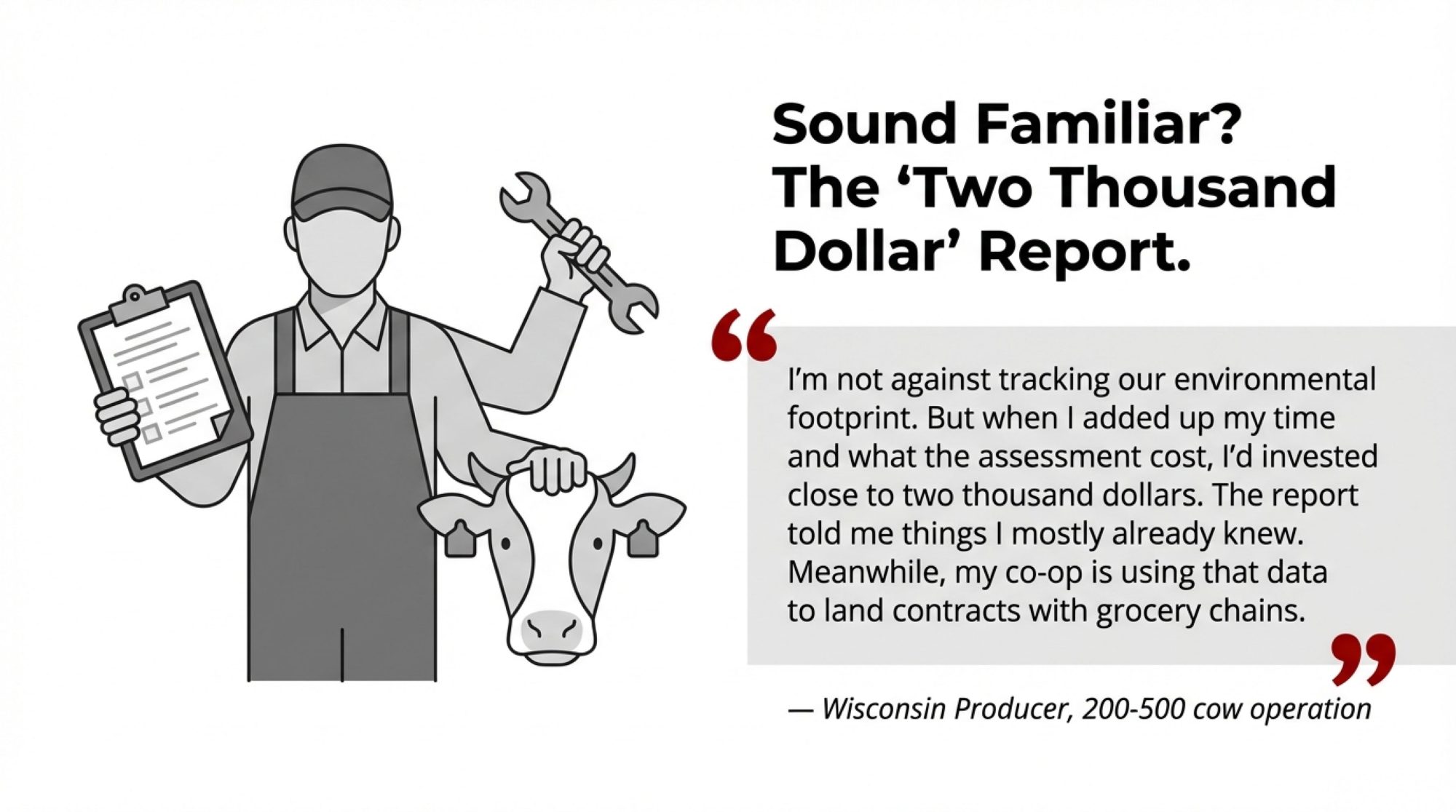
I’ve been talking with producers across the Midwest and Northeast who are running mid-size operations—the 200- to 500-cow range—and hearing remarkably similar stories. One Wisconsin producer I spoke with recently shared his experience: he spent the better part of three days pulling together feed records, energy bills, manure management documentation, and herd data for his cooperative’s sustainability assessment. His co-op got metrics to share with their retail partners. He got a benchmarking report and a request to do it again next year.

“I’m not against tracking our environmental footprint,” he told me. “But when I added up my time and what the assessment cost, I’d invested close to two thousand dollars. The report told me things I mostly already knew. Meanwhile, my co-op is using that data to land contracts with grocery chains.”

That’s the heart of the issue. These programs aren’t inherently problematic—many drive genuine environmental improvements that benefit the entire industry’s reputation. But the economics work differently than farmers sometimes expect. Retailers get sustainability claims for their marketing. Processors get preferred supplier status. And farmers get… a benchmarking report.

Understanding that dynamic matters when you’re making decisions about your operation.

The Real Cost of Participation

Let me walk you through what these programs actually cost when you add everything up—not just the line items that show up on invoices.

The FARM Environmental Stewardship program has completed more than 4,000 on-farm assessments across 42 states since it launched, with the broader FARM Animal Care program covering approximately 99% of U.S. milk production. That’s according to the National Dairy FARM Program’s 2023 Year in Review, which notes that assessments cover operations ranging from 10 to over 35,000 lactating cows. Direct assessment costs vary by region and evaluator, but producers I’ve spoken with report fees ranging from a few hundred dollars for basic assessments to well over a thousand for comprehensive lifecycle evaluations.

But here’s what often gets overlooked: the time investment.

Dr. Greg Thoma, who directs the Agricultural Modeling and Lifecycle Assessment program at Colorado State University’s AgNext initiative, has noted that comprehensive farm-level data collection requires significant farmer involvement. We’re not talking about clicking a few buttons. Initial assessments typically run from half a day to two full days of farmer time for data gathering, verification, and review—depending on how your record-keeping systems are organized.

What’s that time actually worth? If you value your management hours at fifty to seventy-five dollars—and honestly, that’s conservative for someone juggling fresh cow protocols, transition period monitoring, feed inventory, and labor scheduling—you’re looking at several hundred to over a thousand dollars in opportunity cost before counting direct fees.

A farm business consultant who works with dairy operations across the Upper Midwest put it plainly: “The assessment process is useful for industry positioning, but provides limited direct benefit for the farmer completing it.”

Who Captures the Value You Create?

This brings me to something worth understanding, regardless of how you feel about sustainability initiatives generally.

When a cooperative aggregates sustainability data from member farms, they create several distinct value streams. According to the FARM ES Program documentation, aggregated data helps “demonstrate dairy’s environmental benefits to customers and consumers” and supports “cooperative, processor and national level” sustainability claims.

Let’s be direct about what that means: your operational data—the information you spent days compiling between morning milking and dealing with that problem fresh cow—becomes raw material for marketing claims that help your processor land contracts with Walmart, Kroger, and institutional buyers. It feeds into ESG reports that satisfy institutional investors. It supports premium positioning that benefits everyone in the supply chain above you.

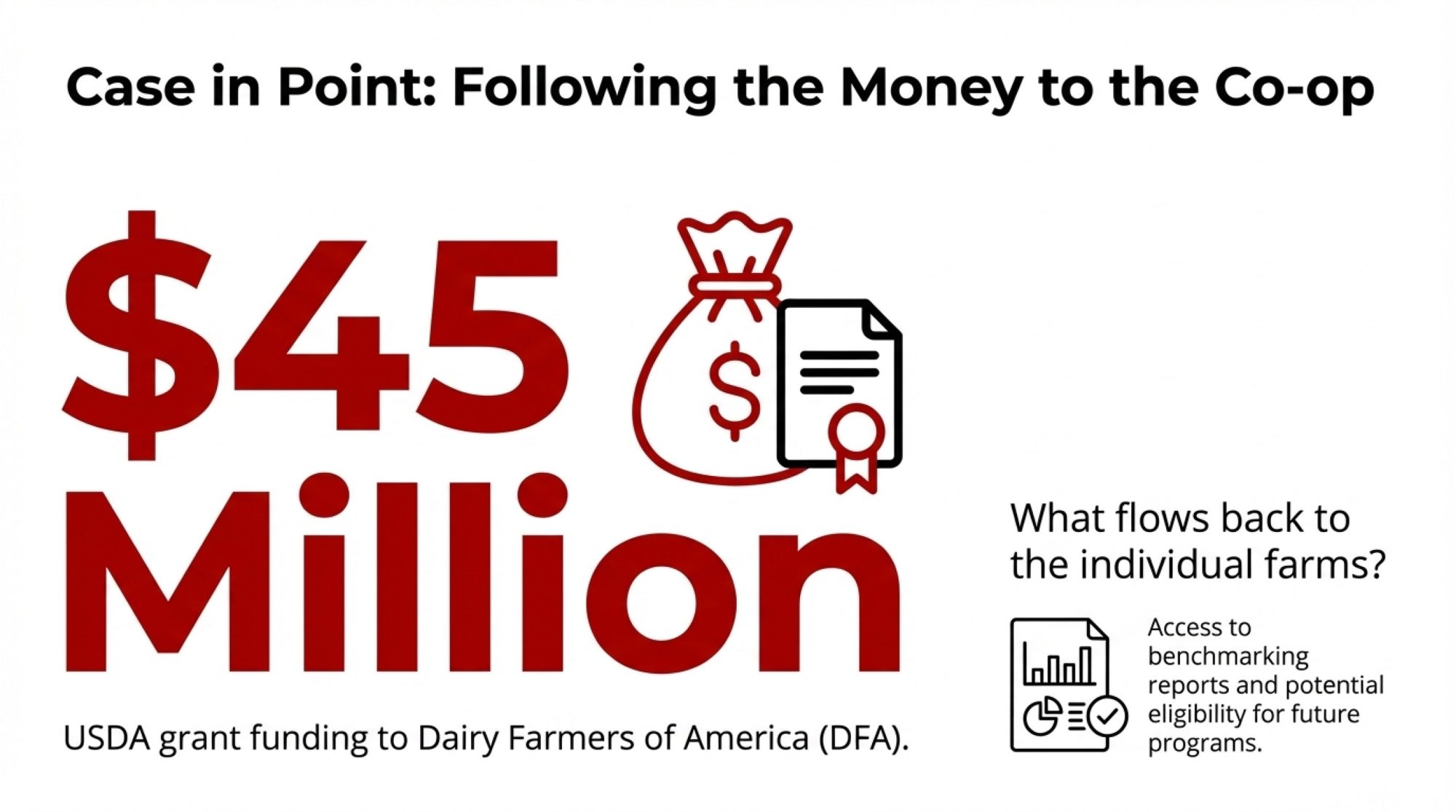
Here’s a concrete example. In August 2020, Dairy Farmers of America became the first U.S. dairy cooperative to have emissions targets validated by the Science Based Targets initiative. DFA is committed to reducing greenhouse gas emissions across its supply chain by 30% by 2030, relative to a 2018 baseline. That’s built on data from member farms. Then, in September 2022, DFA received up to $45 million in USDA grant funding through the Partnerships for Climate-Smart Commodities program.

That represents real industry progress. But $45 million flowed to the cooperative level. What flowed back to the farms that provided the data and implemented the practices? Access to benchmarking reports and potential eligibility for future incentive programs.

I should be fair here: cooperatives are responding to legitimate market pressures. Retailers have made sustainability documentation a condition of doing business, and someone has to aggregate and verify that data. The question isn’t whether this work should happen—it’s whether the current value distribution makes sense for farmers.

Technology Economics: Finding What Actually Pencils Out

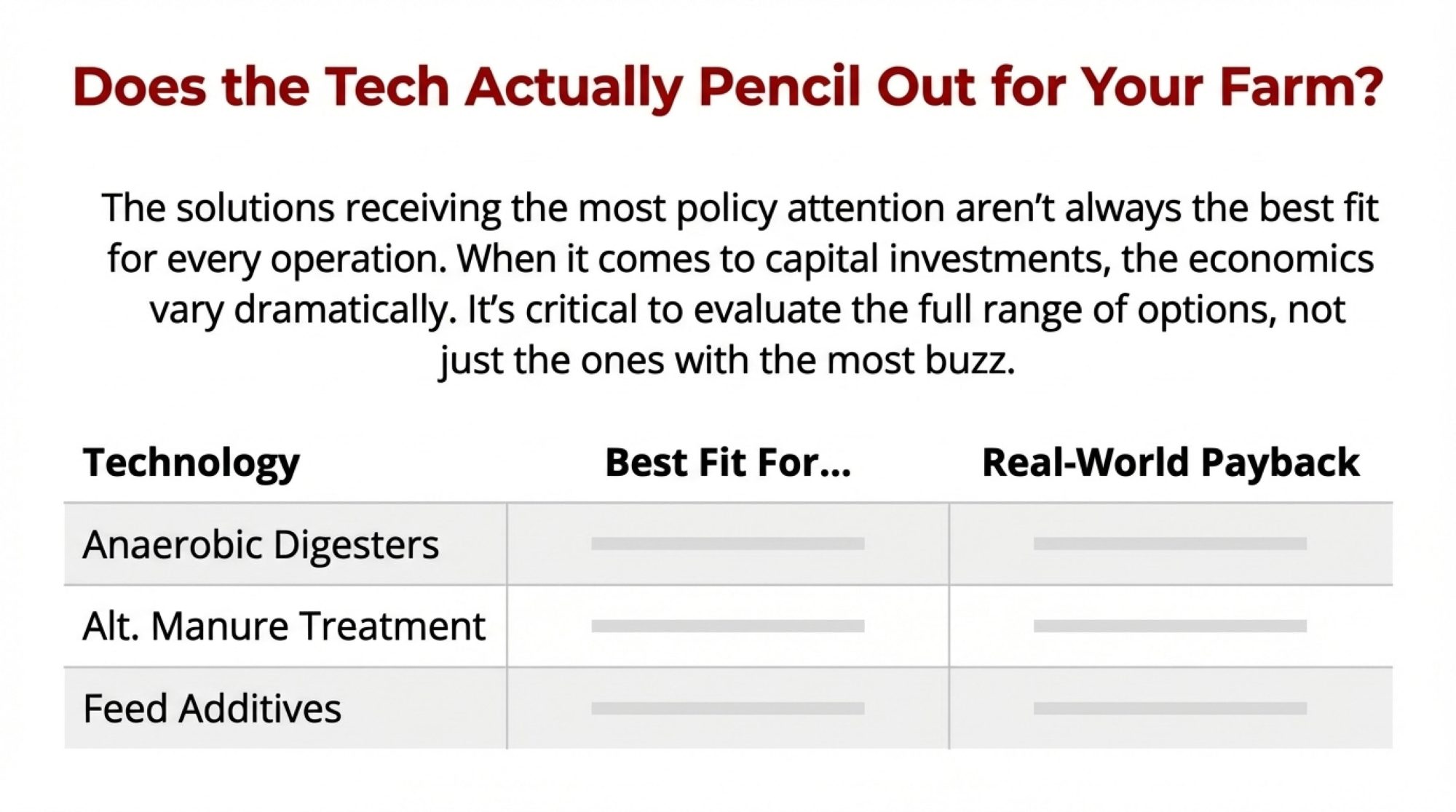
When it comes to capital investments for emissions reduction, the economics vary dramatically. And here’s what I’ve noticed: the solutions receiving the most policy attention aren’t always the best fit for every operation.

Technology Comparison at a Glance

Anaerobic Digesters

  • Capital: $2-5 million full-scale; $125K-500K mini systems
  • Operating: $20,000-51,000 annually
  • Methane reduction: 25-35% from storage
  • Payback without grants: Can exceed 22 years
  • Payback with full grants: Under 5 years possible
  • Best fit: 500+ cow operations in LCFS states

Alternative Manure Treatment Systems

  • Capital: Varies significantly; generally lower than digesters
  • Operating: Lower ongoing costs
  • Methane reduction: Up to 97-99% from treated streams
  • Payback without grants: Generally 4-7 years
  • Payback with grants: 3-5 years
  • Best fit: Various sizes, most regions

Feed Additives (3-NOP)

  • Capital: Minimal infrastructure
  • Operating: $40-60 per cow annually
  • Methane reduction: 25-30% enteric
  • Payback: Ongoing operational cost
  • Best fit: Any size, immediate impact

Sources: Penn State Extension, March 2025; Bioresource Technology Reports, June 2022

The Digester Reality Check

Digesters have dominated the sustainability technology conversation, and for good reason—they can generate meaningful revenue streams on the right operation. But the financial threshold is steeper than many producers initially realize.

Penn State Extension’s March 2025 analysis—titled “Enhancing Digester Profitability: Strategies for Farmers”—lays out the numbers clearly. Without grant funding, payback periods can stretch to 22 years or more. In challenging scenarios, payback could exceed 50 years. That’s longer than most of us plan to be milking cows.

With substantial grant funding, the picture changes dramatically. Payback can drop to under five years, and under optimal conditions with full grant coverage, Penn State documented payback periods as short as 1.3 years.

So the practical question becomes: can your operation access that level of grant funding? Farms in California benefit from Low Carbon Fuel Standard credits that create additional revenue streams. Operations in Wisconsin, New York, or Pennsylvania are working with a different policy landscape entirely.

The result is that digester economics work particularly well for larger operations—generally 500 cows or more—in favorable policy environments. For everyone else, the math often doesn’t work.

Looking at Economic Alternatives

This is where mid-size operations need to think creatively. Research published in Bioresource Technology Reports in June 2022 found that alternative manure treatment approaches—including biological systems—can achieve 97-99% methane reduction from treated streams at substantially lower capital requirements. The California Dairy Research Foundation has funded multiple demonstration projects through CDFA’s Alternative Manure Management Program with promising results.

Payback periods for these systems generally range from 4 to 7 years, often achievable without major subsidies.

The point isn’t that one technology is universally better than another—it’s that farmers should evaluate the full range of options rather than defaulting to whatever solution has the most policy momentum. For mid-size operations in states without LCFS programs, lower-capital alternatives may offer more practical economics. It’s worth exploring what actually fits your situation rather than what fits the policy conversation.

Government Support: Helpful, But Don’t Build Your Strategy Around It

Federal sustainability funding has expanded significantly. The Partnerships for Climate-Smart Commodities program allocated $2.8 billion across 70 projects, with USDA announcing support reaching more than 50,000 farms.

Those are meaningful numbers. But here’s the context that matters for individual operations.

Of that $2.8 billion, dairy-specific allocation represents roughly $500-600 million—the remainder flows to row crops, beef, specialty crops, and other commodities. Divide dairy funding across approximately 24,000 U.S. dairy farms (USDA NASS data), and you get a theoretical availability of around $22,000 per farm.

In practice, several factors reduce that figure. Program administration requires resources. Competition for applications means not every eligible farm accesses available support. And let’s be honest—grant-writing capacity matters. Larger operations with professional staff have real advantages in navigating application processes that 200-cow family operations simply don’t have.

Government support can help on the margins. But building your sustainability strategy around grant funding you may or may not receive is a risky proposition.

Corporate Partnerships: Read the Fine Print

Major food companies are investing substantial resources in the sustainability of the dairy supply chain. In February 2025, Mars announced a $27 million commitment over five years to support Fonterra’s farmer sustainability initiatives in New Zealand, with Nestlé backing additional incentive payments through the same partnership. The stated goal: reduce dairy-related emissions by 150,000 metric tons by 2030.

According to ESG News reporting, farmers who achieve significant emissions reductions—30% or more compared to the industry average—become eligible for per-kilogram incentive payments ranging from NZ$0.10 to NZ$0.25 per kgMS. That’s meaningful compensation for documented environmental improvements.

But there’s a structural element worth understanding. When these programs involve carbon “insetting”—where farmers sell their emissions reductions to their processor rather than on open markets—you permanently transfer that environmental attribute. You can’t sell the same carbon reduction to another buyer. You can’t use it to market your operation independently.

The processor gets to claim the carbon reduction in their corporate sustainability reports. You get a per-kilogram payment. Whether that’s a fair exchange depends on how the market develops—but it’s worth understanding before you sign.

What Happens When Corporate Priorities Shift

In August 2021, 89 organic dairy farmers across Maine, Vermont, New Hampshire, and parts of New York received termination letters from Horizon Organic, with their contracts set to end by August 2022. Around the same time, another 46 farms were dropped by Maple Hill Creamery—documented by Dairy Reporter and the Northeast Organic Dairy Producers Alliance.

These were established operations—multi-generational family farms that had invested substantially in organic certification, infrastructure changes, and the three-year transition period. They’d met all program requirements. They’d done everything asked of them.

When Danone decided to consolidate supply around fewer, larger operations closer to processing facilities, none of that mattered. The terminations reflected corporate supply chain optimization, not farmer performance.

What happened next offers an encouraging counterpoint. Organic Valley—the farmer-owned cooperative with more than 1,600 member farms producing over 30% of U.S. organic milk—stepped in. According to their reporting, 50 farms from the affected states joined as new members, with another 15 farms joining earlier that year.

Two lessons here. First, concentrated market relationships create real vulnerability. Second, farmer-controlled alternatives can provide meaningful options when corporate priorities shift.

Models Worth Understanding

Not every sustainability structure concentrates value away from farmers.

Organic Valley’s cooperative ownership structure shapes how they respond to challenges. When feed costs increased significantly during 2021-2023, they mobilized member support through task forces, deployed field staff for technical assistance, and invested in tools helping farmers maximize on-farm feed production. Their sustainability programs include farmer compensation for sequestration and avoided emissions, with farmer governance over program evolution.

In Europe, farmer-controlled data cooperatives offer another model. The JoinData approach in the Netherlands allows farmers to retain ownership of their operational data, authorize each use individually, and receive compensation when their data generates commercial value.

These aren’t the only valid approaches—conventional cooperative relationships and corporate partnerships provide real value for many operations. But knowing alternatives exist helps you evaluate what structure works best for your situation.

Questions to Work Through Before Signing

Based on conversations with producers who’ve navigated these decisions:

On costs and time:

  • What’s the total annual commitment—assessment fees, data platform costs, and your time at realistic hourly rates?
  • Does the potential return justify that investment?
  • How does timing align with your busiest seasons?

On value distribution:

  • Who captures the marketing value from your participation?
  • What specific benefits are guaranteed versus contingent on future development?
  • Are you comfortable with the exchange you’re making?

On data:

  • What do contract terms say about data ownership and use?
  • Can your data be aggregated for purposes beyond your direct benefit?
  • What compensation exists when your data supports others’ sustainability claims?

On technology:

  • Does the promoted solution match your operation’s scale and capital access?
  • What alternatives might offer better economics?
  • Does the investment make sense without grant funding?

On market relationships:

  • What notice period does your buyer have for relationship changes?
  • How dependent are you on a single market channel?
  • What options exist if current arrangements become unfavorable?

The Bottom Line

The dairy industry’s sustainability transformation is real and likely to continue. Consumer expectations, retailer requirements, and regulatory pressures create market dynamics that aren’t going away. Farms that can document and improve their environmental performance will generally have better positioning over time.

But how you participate matters enormously.

Right now, a lot of the sustainability conversation asks farmers to provide data, implement practices, and absorb costs—while the marketing value and premium positioning flow primarily to other parts of the supply chain. That’s not necessarily wrong, but it’s worth seeing clearly.

The producers who feel good about their sustainability investments share some common approaches. They understood the full economics before committing. They maintained diverse market relationships. They chose technologies that fit their scale and geography. And they asked direct questions about value distribution before signing anything.

That’s not cynicism—it’s the same analysis that characterizes good management decisions in any area of the operation. What does this cost? What do I receive? Who else benefits, and by how much?

The sustainability conversation doesn’t change those fundamentals. If anything, it makes asking them more important than ever.

Have experiences with sustainability programs that might help other producers? We’re interested in hearing what’s working—and what isn’t—across different operations and regions.

KEY TAKEAWAYS:

  • Know the exchange you’re making: Your data and compliance work enable sustainability claims that benefit the entire supply chain—be clear on what returns to your farm before committing
  • Technology economics are operation-specific: Digesters pay back quickly for 500+ cow farms in favorable policy states; mid-size operations elsewhere often find lower-capital alternatives pencil out better
  • Build strategy around economics, not grants: Federal programs are competitive and favor operations with professional staff—assume you won’t get funding and be pleasantly surprised if you do
  • Market concentration creates vulnerability: When Horizon and Maple Hill dropped 135 organic farms in 2021-2022, performance wasn’t the issue—farms with multiple buyer relationships recovered fastest
  • Programs deliver real value; distribution is the question: Sustainability initiatives drive genuine environmental progress—the issue worth examining is whether farmers share fairly in the value they help create

Complete references and supporting documentation are available upon request by contacting the editorial team at editor@thebullvine.com.

Learn More:

  • Profitability vs. Sustainability: Can You Have Both? – Challenges the assumption that environmental goals must come at the expense of your bottom line. This analysis breaks down strategies for aligning green initiatives with black ink, ensuring your operation remains financially viable while meeting modern market demands.
  • Feed Efficiency: The Single Greatest Opportunity to Improve Profitability and Sustainability – Moves beyond the hype to practical genetics. This guide demonstrates how selecting for feed efficiency reduces input costs and methane output simultaneously, offering a proven, low-capital tactic to improve your sustainability metrics without massive infrastructure investments.
  • Is Technology the Answer to the Labor Crisis? – Examines the ROI of automation beyond just milking cows. Learn how data-driven systems can reclaim the management hours lost to manual record-keeping—directly addressing the “opportunity cost” of time highlighted in our sustainability analysis.

Join the Revolution!

Join over 30,000 successful dairy professionals who rely on Bullvine Weekly for their competitive edge. Delivered directly to your inbox each week, our exclusive industry insights help you make smarter decisions while saving precious hours every week. Never miss critical updates on milk production trends, breakthrough technologies, and profit-boosting strategies that top producers are already implementing. Subscribe now to transform your dairy operation’s efficiency and profitability—your future success is just one click away.

NewsSubscribe
First
Last
Consent

The Carbon Credit Conversation: What’s Really Happening on Dairy Farms Today

Could your dairy benefit from $130/acre tax credits starting 2025? New programs are changing the carbon conversation.

EXECUTIVE SUMMARY: What farmers are discovering across the Northeast and Midwest is that carbon reduction strategies are delivering real cash flow benefits, not just environmental compliance. Recent data from Vermont’s Ben & Jerry’s Low Carbon Dairy program shows participating farms achieving 16% greenhouse gas reductions without sacrificing production, while generating measurable revenue improvements. Feed additives like 3-NOP are proving their worth at $93-$105 per cow annually, delivering 22-35% methane reductions and up to 5% feed efficiency gains that translate to potential savings of $14,000-$25,000 per 1,000-cow operation. Australian dairy operations demonstrate solar’s impact with 70% electricity bill reductions and two-year payback periods, while California digesters—despite $8.6 million investments for 2,500-cow operations—generate returns through $60 per metric ton carbon credits plus renewable gas sales. Government support is substantial, with USDA programs covering up to 75% of implementation costs and the new 45Z tax credit offering over $130 per acre starting in 2025. The key insight emerging from successful operations is that a phased approach works best—starting with operational improvements and feed additives, then adding solar and eventually digesters—allowing farms to build cash flow while positioning for an evolving market that increasingly rewards measurable carbon reduction.

KEY TAKEAWAYS

  • Proven returns from feed efficiency: 3-NOP additives reduce methane emissions 22-35% and improve feed efficiency up to 5%, potentially saving $14,000-$25,000 annually per 1,000 cows, with Ohio State Extension confirming costs at $93-$105 per cow yearly.
  • Solar delivers quick payback: Australian dairy operations report 70% electricity bill reductions with systems paying for themselves in two years, making the $140,000-$200,000 investment for 70kW systems increasingly attractive with federal incentives through 2032.
  • Government programs provide substantial support: USDA’s EQIP and CSP programs cover up to 75% of implementation costs, while the 2025 launch of the 45Z tax credit offers over $130 per acre for carbon intensity reduction without complex contract requirements.
  • Regional strategies matter: European mandatory carbon pricing creates different dynamics than North American voluntary markets, requiring tailored approaches whether you’re in California (with LCFS credits), the Midwest (with ethanol partnerships), or the Northeast (with compliance advantages).
  • Phased implementation maximizes success: Start with operational improvements and feed additives for immediate returns, add solar when ready, then consider digesters for long-term revenue—allowing farms to build cash flow progressively while adapting to evolving carbon markets.
dairy farm sustainability, carbon credits, dairy profitability, methane reduction, farm efficiency

You know, there’s been a ton of chatter about going carbon neutral in dairy—with so many folks thinking you need huge investments, like $50,000 or more—but here’s what I’ve found from chatting with friends across the Northeast and Midwest: it’s a pretty different story. And honestly, it’s encouraging.

I talked with a dairy farmer in Vermont who’s part of the Ben & Jerry’s Low Carbon Dairy program. Across seven farms, they manage to cut greenhouse gases by around 16%, without dropping production.

What’s really interesting is they’re seeing actual cash flow benefits too—that was featured in Dairy Herd Management last year. Funny how what we hear in the milkhouse doesn’t always match the cold, hard numbers coming out of the barns.

What Does It Really Cost?

Feed additive investments of $93-$105 per cow annually can generate $14,000-$25,000 in feed savings for 1,000-cow operations, demonstrating compelling return potential.

Let’s get down to numbers. Take feed additives—like 3-NOP, commercially called Bovaer. According to Ohio State Extension’s 2024 research, they’ve got a price tag of about $93 to $105 per cow per year. At first glance, that might seem like a lot. But with methane reductions averaging between 22 and 35%, and feed efficiency improvements up to 5% (though these vary based on your transition period management and your ration), it starts to make sense.

I ran these numbers by some nutritionists in Wisconsin and Ohio. They said potential feed savings could come in between $14,000 and $25,000 annually on a 1,000-cow farm, though your results will definitely depend on your baseline efficiency and management style.

Speaking of Wisconsin operations, I recently heard from a farm that was able to boost butterfat performance and overall feed conversion by tightening rations and cutting refusals—all with additives and some smart fresh cow management. What’s worth noting is how much your existing setup affects these results… a producer running an already efficient program might see more modest gains than someone with room for improvement.

Down under in Australia, dairies have been slashing their electric bills by as much as 70%. Those solar systems, typically around 70kW and costing $140,000 to $200,000 before incentives, can save between $45,000 and $100,000 per year. One dairy in Victoria got their initial investment back in just two years, according to Dairy Global.

For the Big Players

Let’s not forget digesters. EPA AgSTAR data puts the cost of setting one up on a 2,500-cow farm at about $8.6 million. But here’s where it gets interesting—California’s Low Carbon Fuel Standard currently values methane reduction credits closer to $60 per metric ton. That’s a far cry from some of the historic highs we heard about, but when you toss in renewable gas sales and RIN credits, the payback tends to be between seven and ten years.

From what I hear, many farms take a phased approach here. Get started with feed additives for earlier returns, add solar systems when the timing feels right, and think about digesters as a longer-term play.

Don’t Overlook Government Help

One thing worth noting is the scale of support out there. USDA programs like EQIP and Conservation Stewardship Program can cover up to 75% of your implementation costs, which is serious help, per NRCS documentation. And last year, the Regional Conservation Partnership Program set aside $25 million for projects focused on emissions near ethanol plants.

Big news for 2025—the 45Z tax credit is rolling out, expected to pay upwards of $130 an acre to farms lowering their carbon intensity. And it doesn’t come with the same red tape or exclusive contracts that carbon markets often require.

That said, watch out: these programs tend to get oversubscribed. A lot of farms are lining up, sometimes three for every dollar available. Your local NRCS office can walk you through applications—I’d suggest calling them sooner rather than later.

What’s Going on in Carbon Markets?

: The carbon credit market divides between commodity credits ($20-$60/ton) and premium credits ($80-$120+/ton), with premium opportunities becoming increasingly limited.

Carbon credits break down into two tiers. The commodity credits typically trade in the $20 to $60 range per ton, while premium credits fetch $80 to $120 or more.

Ben & Jerry’s participants often secure those premium prices and keep around 75% of their revenue, though exact cuts vary with each contract. But the program’s mostly closed now to newcomers.

If you’re outside that circle, there are secondary markets, often through groups like Truterra—they’ve paid farmers over $21 million for carbon sequestration in recent years—but they’re paying less attractive rates while still providing value.

Small Yet Mighty Steps

Here’s what I find most encouraging—the biggest wins often come from simple changes. Better ration balancing, consistent TMR management, and cutting refusals can boost overall feed conversion and milk components, though the degree varies quite a bit based on your starting point and facility setup.

These improvements don’t cost much, usually a few thousand dollars. But the return? Often solid when you get the management details right.

I recently spoke with a 300-cow operation in Pennsylvania where they focused on reducing feed waste and improving their dry lot management. Their investment was under $5,000, but they’re seeing measurable improvements in both feed efficiency and butterfat levels.

Solar’s still a strong pick. Federal incentives through 2032 make the decision easier, and newer methane capture tech is promising—we’re watching those closely as they develop.

Regional Realities

Critical dates for dairy carbon programs include the 45Z tax credit launch in January 2025, extended federal solar incentives through 2032, and Europe’s carbon pricing escalation starting in 2030.

Europe, including Denmark, is preparing for mandatory carbon pricing, with a target of €40 per ton in 2030, rising to €100 by 2035. That creates certainty but also unavoidable costs.

Here in North America, voluntary markets dominate, but corporate buyers are tightening requirements. Farmers in Pennsylvania and New York, facing stricter environmental requirements, are finding these programs help them get ahead of compliance while improving margins. Wisconsin producers often have better access to ethanol plant partnerships. And California farmers are capitalizing on the Low Carbon Fuel Standard—a unique state-level program with real financial teeth.

Let’s Talk Challenges

Cash flow timing challenges are real. Additives show returns fast—often within months—but solar installations and carbon credit revenue take longer to materialize.

Supply chains are tight, too. I’ve heard producers waiting months for additive supplies or solar installation slots. The documentation requirements for carbon programs can be more intensive than expected.

And paperwork—don’t underestimate it. One Pennsylvania farmer told me, “You’ve got to have your records in order or the whole effort stalls.”

Results vary hugely, too. One Ohio operator shared that adjusting his ration made all the difference in maximizing additive benefits. It’s those fresh cow protocols and transition period tweaks that often tip the scales.

What’s Working

If you want real success stories, California’s digesters are becoming cash engines, supported by both public funds and market credits to create predictable income streams.

Natural Prairie Dairy’s comprehensive approach achieves a 96% reduction in CO2 while generating substantial operational savings, a notable achievement for a large-scale operation with significant capital investment.

Vermont’s Ben & Jerry’s farms have done a remarkable job balancing profitability while cutting emissions across different operation sizes.

What’s Next?

Thinking about jumping in? Here’s what I’d suggest based on what I’m seeing work:

  • Keep an eye on the 45Z tax credit rolling out in 2025—could be significant for many operations
  • Act early on government cost-share programs—they fill fast, but the support is real
  • Consider proven feed additives as a practical first step with documented returns
  • Explore solar options while federal incentives and utility rebates are available
  • Stay tuned to emerging methane capture technologies as they develop

Timing matters. Early adopters often find they’re best positioned for whatever regulatory changes come next.

The Bottom Line

Carbon neutrality isn’t some far-off ideal anymore. It’s becoming a practical business strategy for operations that approach it thoughtfully.

The farms I know that are making the greatest headway start small, sharpen their management, and then add technology in phases that fit their cash flow and operational style.

The producers generating returns from carbon reduction aren’t necessarily running the largest operations or using the most expensive technology. They’re the ones who balanced learning with action, adapted strategies to their specific circumstances, and didn’t wait for perfect information.

Waiting for perfect data or the perfect check book usually costs more than moving on with what you know today.

The biggest winners are those who learn quickly, monitor their results, and act decisively based on what works for their operation.

And that, just might be the best advice I can share over a cup of coffee.

What’s the one small step you could take this week to get the carbon conversation started on your farm?

For grant help, check your local NRCS office or visit farmers.gov. To explore carbon credits, look to Truterra and other platforms. Remember, every farm’s different—so work with your nutritionist, extension agent, or trusted advisors before making big changes. Individual results will vary based on management, facilities, and local conditions.

Complete references and supporting documentation are available upon request by contacting the editorial team at editor@thebullvine.com.

Learn More:

Join the Revolution!

Join over 30,000 successful dairy professionals who rely on Bullvine Weekly for their competitive edge. Delivered directly to your inbox each week, our exclusive industry insights help you make smarter decisions while saving precious hours every week. Never miss critical updates on milk production trends, breakthrough technologies, and profit-boosting strategies that top producers are already implementing. Subscribe now to transform your dairy operation’s efficiency and profitability—your future success is just one click away.

NewsSubscribe
First
Last
Consent

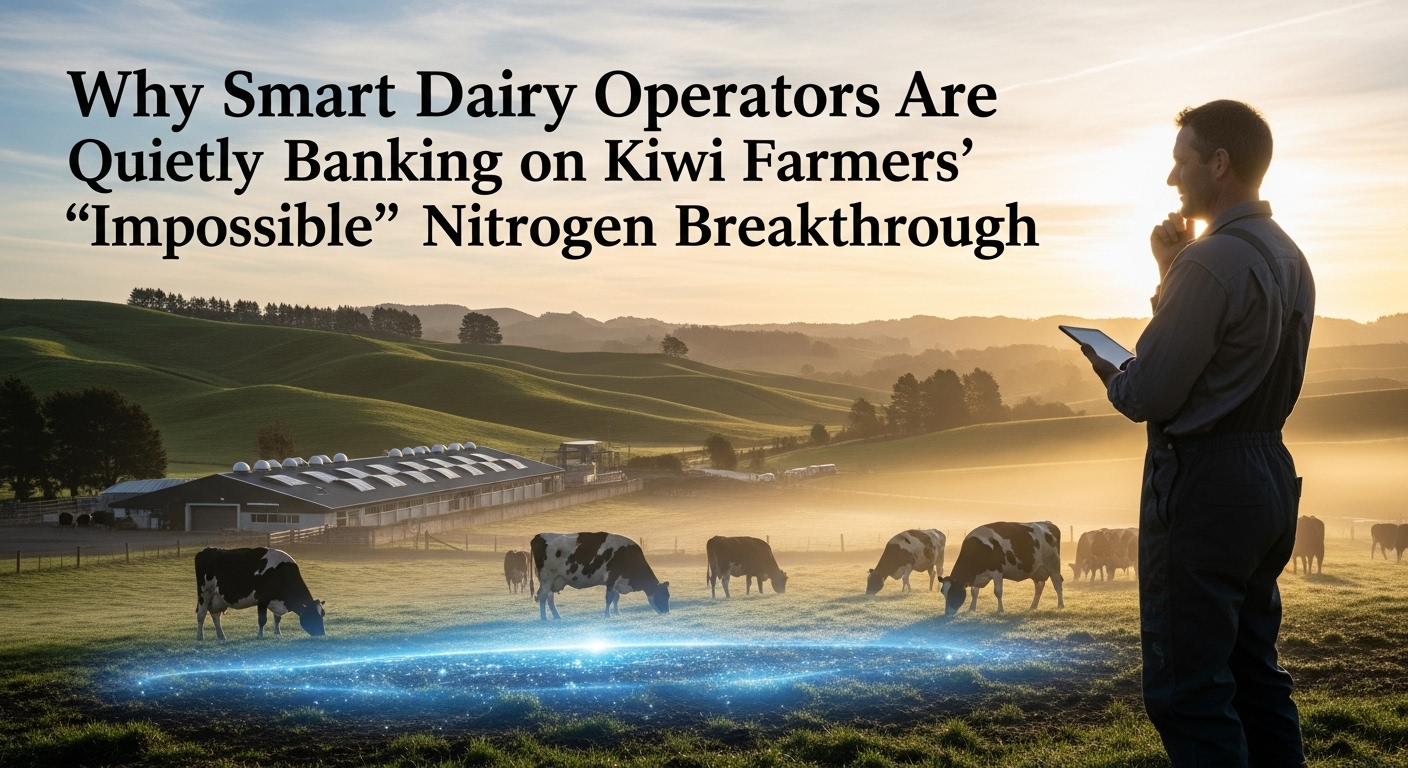
Why Smart Dairy Operators Are Quietly Banking on Kiwi Farmers’ “Impossible” Nitrogen Breakthrough

New Zealand farmers cut nitrogen losses 50% while boosting profits. Their secret? A simple plant most producers walk right past.

EXECUTIVE SUMMARY: Listen, I’ve been watching this New Zealand story unfold, and it’s got me fired up. These guys figured out how to slash nitrogen losses while actually protecting their bottom line—something most of us thought was impossible just five years ago. We’re talking about real operations dealing with 8.25-9.45% operating loans, same as us, but they’re capturing up to 10 cents per kilogram milk solids in environmental premiums through Fonterra’s payment system. The breakthrough? Plantain integration at just 20-30% of pasture mix, plus using bulk milk urea as a real-time management tool instead of just another test result. With 101 farms already running 3,189 hectares of plantain-mixed pastures, this isn’t research anymore—it’s commercial reality. The economics work, the science is solid, and while we’re still debating compliance costs, they’re already capturing competitive advantages. You need to understand what they’re doing because similar regulatory pressures are heading our way, and the early adopters always win.

KEY TAKEAWAYS

  • Real-time nitrogen management through bulk milk urea monitoring — Lincoln University research shows you can optimize dietary protein and catch forage quality issues before they hit your tank. Implementation: start tracking your bulk milk urea trends weekly instead of just meeting regulatory requirements.
  • Plantain integration delivers 20-60% nitrogen leaching reductions — 101 New Zealand farms are seeing results in their first full season with establishment costs offset by environmental credits. Next step: evaluate your pasture renewal schedule and consider incorporating plantain varieties suited to your climate zone.
  • Environmental premiums are becoming standard globally — Fonterra’s paying 10 cents per kg milk solids for documented performance, and US processors are starting similar programs. Action item: document your current nitrogen management practices now to position for premium opportunities.
  • Systems approach beats single interventions every time — Farms combining pasture diversification, precision monitoring, and strategic feed management are building operational resilience against both regulatory and market pressures. Start with one component but plan the integrated system from day one.
  • Transition timing matters with current interest rates — At 8.25-9.45% operating loans, early adopters capture government support and co-op premiums while building capabilities for whatever regulations come next. The window for first-mover advantages won’t stay open forever.
Dairy farm sustainability, Nitrogen reduction strategies, Dairy profitability, Sustainable dairy farming, Pasture management techniques

You know what caught my attention at the last few industry meetings? It’s hearing producers whisper about New Zealand farmers doing something most of us thought was flat-out impossible just a few years back—achieving substantial nitrogen reductions while maintaining farm profitability.

What gets me fired up about this story is that this isn’t some academic exercise that sounds brilliant in a research paper but falls apart when the bills come due. We’re discussing real-world operations that involve 8.25-9.45% operating loans, depending on the loan type and lender, as well as volatile feed costs and the same regulatory pressures we’re all facing. Yet somehow, they’ve cracked the code on making environmental compliance a competitive advantage.

What’s happening down there should have every progressive dairy manager paying attention. While we’re still debating whether environmental compliance has to hurt our bottom line, New Zealand farmers are already proving that it doesn’t.

The Story That’s Rewriting the Rulebook

What strikes me most about DairyNZ’s Low N Systems research programme is how they completely flipped the conversation. Instead of asking “how much will this compliance cost us,” they asked “how can we turn this into profit?”

The ongoing trials at Lincoln University Research Dairy Farm are delivering results that honestly make you question everything we thought we knew about the profit-environment trade-off. Research demonstrates significant nitrogen leaching reductions while maintaining farm business viability—something that would’ve been dismissed as fantasy talk at any industry conference five years ago.

What really caught my attention was the recent analysis of Canterbury and Southland dairy operations following New Zealand’s mandatory 190 kg nitrogen per hectare fertilizer cap. Most farms didn’t just collapse under the pressure—they maintained economic viability despite transition costs, even after accounting for increased feed costs during what’s typically the toughest season on cash flow.

RegionNitrogen LimitApproachIntegration with Farm Economics
New Zealand190 kg N/ha fertilizerSystems-based with incentives✅ Built-in economic support
EU (Nitrates Directive)170 kg N/ha manureRegulatory compliance focused⚠️ Limited economic integration
US StatesVaries by NPDES permitsPermit-based, inconsistent❌ Minimal economic support

New Zealand’s integrated approach contrasts with purely regulatory models elsewhere

This regulatory approach mirrors what we’re seeing globally… The EU’s Nitrates Directive caps manure nitrogen at 170 kg per hectare, while various US states are implementing similar water quality programs through NPDES permits. The key difference is that New Zealand didn’t just impose regulations on farmers; it built an integrated system that actually works in conjunction with farm economics rather than against them.

And that’s exactly the kind of systems thinking that separates the operations that thrive from those that just survive.

The Plant Everyone Walked Past (Until Now)

This is where things get really interesting—and I’ll be honest, when I first heard about this, I was skeptical. The breakthrough technology isn’t some expensive gadget or complicated system that requires an engineering degree to operate.

It’s a plant. Plantain, specifically.

I know, I know… sounds too simple to be revolutionary, right? But stick with me here because the numbers don’t lie.

DairyNZ’s Plantain Potency and Practice Programme has documented significant reductions in nitrogen leaching by incorporating plantain into pasture mixes at a rate of 20-30%. Industry reports suggest the establishment costs are typically offset by environmental compliance benefits and potential regulatory credits, which is exactly the kind of ROI math that gets producers’ attention.

What fascinates me about this development is that plantain naturally reduces nitrogen concentration in cow urine while maintaining—sometimes even improving—milk production and pasture quality. It’s elegant in its simplicity, which probably explains why it’s spreading like wildfire once producers see the results.

The Tararua Plantain Rollout project shows what commercial-scale adoption looks like. The project encompasses 101 dairy farms covering 3,189 hectares of land planted in mixed pastures with plantain. That’s no longer a research project—it’s industry transformation happening in real time.

And the beauty of it? Most of these farms are seeing results in their first full season. How often do we get to say that about new management practices?

Now, before you start thinking “that’s great for New Zealand, but what about here?”—the biological mechanisms that make plantain effective for nitrogen management show potential for adaptation to other temperate grazing regions. The science isn’t geography-specific, even if the specific cultivars might need local adaptation.

The Dashboard Most Producers Don’t Know They Already Have

What’s particularly exciting is how precision management systems are enabling farmers to optimize nitrogen efficiency while maintaining production. Here’s a remarkable insight from recent DairyNZ research: operations can use bulk milk urea as a near real-time indicator of herd dietary nitrogen surplus.

Think about that for a minute… you’re essentially getting real-time feedback on your herd’s nitrogen utilization through something you’re already testing with every pickup. It’s like discovering you’ve had a nitrogen efficiency dashboard built into your milk quality program this whole time.

For instance, consistently high readings can signal excess protein in the diet that’s being wasted, while a sudden dip might indicate an issue with forage quality. It’s about turning a routine test into a powerful management signal.

The precision application systems—variable-rate irrigation coupled with soil nitrogen sensors—are helping New Zealand farms target fertilizer applications with surgical precision. Agricultural consultants across the country are noting that these technologies transform nitrogen management from a reactive compliance approach to a proactive optimization strategy.

However, let’s be realistic about implementation… it’s not always smooth sailing. Industry professionals emphasize that plantain establishment success rates vary significantly depending on soil conditions and seasonal timing. Some operations experience establishment challenges that require management adjustments during what’s typically a transition period that can extend over multiple seasons.

The question is: can you afford to wait while your competitors are already capturing these advantages?

The Economics That Actually Work (Even at Today’s Interest Rates)

This is where the rubber meets the road—and where this story gets really compelling for anyone watching their cash flow like a hawk these days.

With farm operating loan rates ranging from 8.25% to 9.45% depending on the loan type and lender (and we all know how that’s affecting expansion plans), return on investment timing becomes absolutely critical for any system upgrades. What’s compelling about the New Zealand model is how Fonterra’s Co-operative Difference payment structure provides up to 10 cents per kilogram milk solids for documented environmental performance.

For typical operations, that translates to meaningful annual premiums when you factor in reduced fertilizer costs and improved feed efficiency. Industry reports suggest farms implementing precision feeding protocols are seeing improved cost structures while maintaining production levels.

Here’s what’s interesting… similar premium structures are emerging globally. Some US processors are offering sustainability premiums, and EU milk buyers are increasingly factoring environmental performance into pricing. The New Zealand approach is becoming a template, not an outlier.

Agricultural economists project that operations achieving documented nitrogen efficiency improvements will maintain competitive advantages regardless of future regulatory changes or market volatility. The operational flexibility gained through diversified pasture systems provides resilience against both regulatory and economic pressures.

Which, let’s be honest, is exactly what we need right now with everything that’s happening in our markets.

The Reality Check Nobody Talks About

I need to be straight with you about the challenges… because if you’re thinking this sounds too good to be true, you’re asking the right questions.

Financial risk profiles vary considerably by current management intensity and farm scale. If you’re already applying nitrogen at or near regulatory limits, transition costs are minimal. But if you’re historically intensive—and many of us are—you may require substantial system modifications and interim production adjustments.

The technology adoption learning curve can be significant as farms optimize their management protocols. During transition periods, some operations experience temporary production variability as systems stabilize, making adequate working capital essential for successful transitions.

Industry professionals emphasize that success depends on the integrated implementation of multiple technologies rather than the isolated adoption of individual technologies. Farms that combine pasture diversification with precision monitoring and strategic feed management achieve superior results compared to those using single-intervention approaches.

However, what’s interesting is that the farms adopting the systems approach are seeing compound benefits that extend far beyond just nitrogen management. They’re building operational resilience that serves them regardless of what regulatory curveball gets thrown next.

What This Means for Your Operation This Week

Three critical insights emerge from New Zealand’s experience—and every one of them applies whether you’re milking in Wisconsin, California, or anywhere else dealing with environmental pressures.

First, stop thinking about environmental compliance as a cost center. The most successful operations are treating these challenges as integrated business opportunities rather than isolated compliance headaches. The documented economic performance demonstrates that strategic environmental investments yield operational improvements that extend far beyond merely meeting regulatory requirements.

Second, early technology adoption isn’t just about getting ahead of regulations—it’s about capturing competitive advantages while support programs are still available. Farms implementing these systems are now building operational capabilities for whatever market conditions may come next.

Third—and this is what gets me most excited about these developments—is that real-time monitoring systems enable management optimization that benefits both environmental and economic performance simultaneously. These tools transform nitrogen management from reactive compliance to strategic farm optimization.

Why are we still debating whether we can afford to implement these approaches when the real question is whether we can afford not to?

What You Need to Do Right Now

StrategyBenefitImmediate ActionTimeline
Bulk Milk Urea MonitoringReal-time nitrogen optimizationStart weekly trackingWeek 1
Plantain Integration20-60% leaching reductionEvaluate pasture renewalMonth 1
Environmental DocumentationPremium qualificationDocument current practicesMonth 1
Systems IntegrationCompound benefitsPlan integrated approachMonth 2
Early AdoptionGovernment/co-op premiumsBegin transition nowMonth 3

What keeps me optimistic about where this industry is heading—and why I think this is the most important story in dairy right now:

The numbers actually work. New Zealand’s proving you can achieve dramatic environmental improvements with minimal profit impact through strategic systems integration, not just input reduction. The validated performance data from Lincoln University demonstrate that this isn’t marketing speak—it’s measurable, farm-level success.

The technology is accessible. Plantain integration and precision management systems provide cost-effective pathways to enhanced efficiency and improved environmental performance. You don’t need a PhD or a million-dollar budget to start capturing these benefits.

The timing is everything. Operations implementing these systems now capture early-adopter advantages, including government support, co-op premiums, and competitive positioning for whatever regulations come next. But that window won’t stay open forever.

The approach transfers. While specific techniques may vary by region, the principles of integrated systems thinking and precision management apply regardless of where you’re milking.

What’s happening globally is a fundamental shift where environmental leadership and business performance are becoming complementary rather than competing priorities. We’re not just talking about compliance anymore—we’re talking about competitive advantage through environmental efficiency.

The producers who understand this and act on it will be the ones defining what successful dairy operations look like in the next decade. The research is there, the tools are available, and the economics make sense.

The question isn’t whether this technology works—it’s whether you’ll be implementing it first or watching your competitors gain the advantage while you’re still deciding.

Because while we’re debating, operations like those in New Zealand are already capturing the premium. And that gap? It’s growing every month.

Your move.

Complete references and supporting documentation are available upon request by contacting the editorial team at editor@thebullvine.com.

Learn More:

Join the Revolution!

Join over 30,000 successful dairy professionals who rely on Bullvine Weekly for their competitive edge. Delivered directly to your inbox each week, our exclusive industry insights help you make smarter decisions while saving precious hours every week. Never miss critical updates on milk production trends, breakthrough technologies, and profit-boosting strategies that top producers are already implementing. Subscribe now to transform your dairy operation’s efficiency and profitability—your future success is just one click away.

NewsSubscribe
First
Last
Consent

Automated Milk Feeders and Genetic Selection: The Secret to Unstoppable Dairy Calves

Explore how automated milk feeders and genetic selection enhance calf resilience. Ready to unlock your herd’s potential?

Dairy farming is a key part of agriculture, facing changes due to climate shifts and the need for more production. Resilience, or the ability to bounce back from problems, is crucial for growing dairy calves. Automated milk feeders (AMF) have become essential tools, making calf care easier and saving labor through precise farming techniques. By focusing on genetic traits that boost resilience, AMFs point to a future where technology and genetics help shape herds that can handle environmental challenges. A study,  Trait development and genetic parameters of resilience indicators based on variability in milk consumption recorded by automated milk feeders in North American Holstein calves, on 10,076 Holstein calves shows how using AMF data and genetic findings can improve resilience in young calves, helping create a more sustainable future in dairy farming.

The AMF Revolution: Breeding Healthier, Resilient Calves with Cutting-Edge Precision 

Automated milk feeders (AMFs) are changing how we take care of calves on dairy farms, making it easier and better. These machines use technology to monitor how much milk calves drink and adjust it as needed, which is a big step from old methods. 

AMFs have advanced sensors and software that track every calf’s milk intake. This helps farmers detect health problems before they get worse. 

One of the best things about AMFs is that they give each calf the right amount of milk. This setup is more like a natural nursing process than feeding by hand. With AMFs, calves can drink milk several times a day, which helps them grow steadily and develop their stomachs properly. 

AMFs help with calf health and save farmers time and effort. Since these machines handle much of the work, farmers can focus on other essential aspects of herd management. This time savings also means farmers can save money, especially those with many calves to care for. 

AMFs significantly improve calf welfare by supporting healthy growth and resilience, leading to a healthier herd overall. A study of over 10,000 Holstein calves showed that better resilience and welfare lead to better outcomes, making a strong case for farmers who use this technology.

Resilience Redefined: Crafting Resilient Calves for Unpredictable Conditions 

In dairy farming, resilience refers to how well an animal handles stress or health problems and returns to normal quickly. This is important for calves because they face different challenges on the farm, and resilience helps them grow healthy. 

A few key traits in resilience include amplitude, perturbation time, and recovery time. Amplitude measures how much a calf’s feeding changes when stressed. If a calf has a lower amplitude, it means it is less affected by stress, which indicates that it is more substantial. Perturbation time measures how long a calf stays in a stressful state. Shorter perturbation times mean the calf deals with stress better and faster. 

Recovery time is another vital trait that shows how quickly a calf can return to regular feeding after being disturbed. Calves that recover quickly are often better at dealing with illnesses or changes in their surroundings. Together, these traits help us understand how well a calf can handle challenges, which helps breed stronger, healthier livestock. 

Breeding for Resilience: Harnessing Genetic Insights for Future-Ready Dairy Herds

Genetic selection for toughness in dairy calves is a new trend in the industry. It could benefit animal health and farm success in the long term. This study examines genetic factors that influence these toughness traits and offers a plan for future breeding programs. 

In this context, toughness means how well a calf can keep growing and stay healthy despite challenges. The study discusses the heritability of different toughness traits like amplitude (AMP), time of reaction (PT), and recovery time (RT). Although these traits don’t pass down much from parent to calf, ranging from 0.01 to 0.05, they still have some genetic impact. This means that while environmental factors are essential, there’s a chance to make a difference through genetics. 

One interesting finding is the link between the size of a reaction and the speed at which a calf recovers. This suggests that some calves naturally bounce back from stress quickly. Such findings show the possibility of choosing traits that make calves more challenging without affecting important qualities like milk production

The study also points out new genetic signs, such as variance (DV) and log variance (LnDV), that could help measure calves’ toughness. Targeting these new signs in breeding programs could change how breeders tackle issues like bovine respiratory disease and changing weather

The findings of this study are essential for breeding. By focusing on traits that make calves more challenging, farmers could have substantial herds when facing problems and be productive in different environments. Such breeding strategies could lower disease treatment costs, improve herd health, and boost the sustainability of dairy operations over time. 

Resilience TraitMeanStandard DeviationHeritabilityRepeatability
Amplitude of Deviation (L)5.633.700.0470.077
Perturbation Time (days)2.921.820.0110.012
Recovery Time (days)3.232.260.0250.027
Maximum Velocity of Perturbation (L/d)1.430.980.0390.13
Average Velocity of Perturbation (L/d)0.980.670.0380.12
Area Between Curves28.9433.520.0390.042
Recovery Ratio0.960.0240.053
Deviation Variance (L²)3.324.680.0490.095
Deviation Log-Variance0.471.430.0270.056
Deviation Autocorrelation0.0050.390.0100.012

Embarking on the Resilience Frontier: Decoding Dairy Calves’ Robust Future

The study takes a bold step into understanding how calves handle stress, using detailed data and thoughtful analysis techniques. At the center of this project are Förster-Technik automated milk feeders (AMF). These advanced machines are great at recording how much milk each calf drinks. With information from 10,076 North American Holstein calves collected over several years, this study has plenty of data to uncover calf resilience and health patterns. 

A big part of this analysis is quantile regression. This fancy method helps predict patterns in how much milk calves drink, even when they are stressed or sick. It’s different from methods that look at averages because it can reveal more about the calves’ milk intake. 

Along with these analytics, genomic evaluation plays a key role. By examining the DNA of 9,273 calves, researchers can determine whether milk consumption and health traits are linked through genetics. This information can help breed stronger dairy cows in the future. 

Working with such a large data set is not just about collecting numbers—it’s hugely important. The data makes results reliable and accurately depicts Holstein’s calves. It also helps make better future predictions and ensures accurate genetic evaluations, giving a clear view of resilience traits.

Unleashing the Genetic Potential: How AMF Innovation Shapes Future Dairy Herds 

The study investigates how calves can be more resilient and shows how automated milk feeders (AMF) can significantly help. Key results show that genetics influences traits like amplitude (AMP), the time it takes for changes to happen (PT), and the time it takes to recover (RT), although this influence is modest. A strong genetic link between AMP and RT suggests that recovery time is more genetically controlled. 

These findings are helpful for dairy farmers. They can use AMF technology to monitor and optimize calves’ milk consumption, improving resilience and welfare. Breeding strategies can also focus on traits like recovery time, a sign of resilience. This aligns with growing evidence that supports the genetic links to health and productivity, helping create breeding programs for strong and adaptable dairy herds

The impacts are significant: Farmers can use these genetic insights to improve calf health and productivity. Focusing on resilience can increase yield and efficiency while boosting disease resistance and herd stability. As farming faces unpredictable climate and economic challenges, informed breeding is key for sustainable dairy production and long-term farm success.

Resilience Against the Odds: Navigating the Complex Terrain of Genetic and Environmental Interactions 

Breeding dairy calves that can handle stress is not easy. To do this, scientists need to understand genetics and how the environment affects those genetics. The environment can affect the genetics significantly, depending on where the calves are raised. 

One big challenge is finding the signs of resilience in calves. This study uses cumulative milk intake (CMI) to assess calves’ resilience. But looking at milk intake alone can be tricky. Many things, like how much food is available or any health treatments given, can change milk intake patterns, making it hard to see what’s due to genetics. 

Another issue is determining how much resilience is passed down genetically. This study shows negligible heritability, meaning genetics only plays a small part. However, with the right new strategies, selective breeding could still help improve resilience, even if challenging. 

The study has some limitations. It used data from just one farm, which means its findings might only apply to some farms. Different farms manage animals and environments differently. The study only examined calves for 32 days, which isn’t enough time to see their resilience throughout their development. Observing them for longer could show more about how resilience appears over time. 

This study is essential for the dairy industry. Making calves more resilient improves herd health, productivity, and profits. Resilient animals are key to sustainability in an industry facing climate change and trade challenges. Breeding for resilience could help keep milk production steady and improve animal welfare even as conditions change. 

To turn these scientific findings into real-world breeding programs, the dairy industry must collaborate across different areas and combine new tech with traditional methods. By solving these challenges and broadening research, the industry can work toward a future where livestock survive and thrive. 

Navigating the Genetic Labyrinth: Unraveling Dairy Calf Resilience for a Decisive Leap Forward 

The journey to understand resilience in dairy calves is just starting, and future research should dig deeper into the genes that create these essential traits. Examining the parts of the genome that control resilience can help create targeted breeding plans, strengthening dairy herds. Using genetic tools, researchers could find specific genetic markers linked to resilience, giving breeders a clear guide to selecting these traits more effectively. 

Studying more than one farm is essential. Research on farms with various climates and management styles can help scientists understand how resilience appears in different conditions. These studies could show how genetics and environment work together, giving insights into how different factors affect recovery times and overall calf health. 

In addition to genetics, combining Automated Milk Feeder (AMF) data with other precision livestock technologies offers excellent potential. AMF data, real-time health monitors, environmental sensors, and nutrient trackers can give a complete view of calf development. This combination would help farmers spot and respond to stressors quickly, improving animal welfare and productivity. 

These integrated systems also allow for personalized management plans, tailoring feeding and care to each calf based on their unique resilience profiles. The dairy industry can use big data and advanced analytics to innovate precision farming and set higher standards for calf care worldwide.

The Bottom Line

In the fast-changing world of dairy farming, staying strong is essential to keep things running smoothly. Automated Milk Feeders (AMFs) and choosing the right genetics can help improve this strength, offering a solid way to breed calves that do well even when things get tough. By focusing on traits like how quickly a calf bounces back, farmers can raise herds that can handle stress better, helping ensure a strong future for dairy farming. As farmers explore these new ideas, they should consider using AMFs and genetic selection as part of their routine, checking out all available resources and sharing what they learn to move dairy farming forward sustainably. 

Key Takeaways:

  • The study emphasizes the potential of automated milk feeders (AMF) in improving calf resilience by monitoring deviations in milk consumption patterns.
  • Genetic parameters like amplitude, perturbation time, and recovery time of milk intake suggest a moderate heritable component, highlighting genetic factors in resilience.
  • Findings suggest prioritizing genetic selection based on recovery time as it signifies stronger genetic control and resilience against stressors.
  • There’s a noteworthy genetic correlation between recovery traits and general calf health, indicating potential for breeding more resilient dairy calves.
  • The research underscores the need for precision farming to manage large herds effectively amidst environmental challenges such as climate change.
  • Data from the AMF system, paired with genomic insights, creates a robust framework for breeding programs focusing on resilience.
  • The study calls for long-term data collection post-weaning to better understand these resilience traits in mature dairy cows.
  • Diversification of study farms could give broader insights into managing calf resilience across different environmental and management conditions.

Summary:

Automated milk feeders (AMFs) have revolutionized dairy farming by precisely managing Holstein calves and enhancing their resilience to environmental stressors. A study of over 10,000 calves identified genetic traits like recovery time, heritability, amplitude, perturbation time that correlate with improved stress responses, particularly against bovine respiratory disease. Despite lower than anticipated genetic influence, these traits highlight opportunities for selective breeding. AMFs enhance calf care and save labor by monitoring milk intake, allowing timely intervention for health issues and optimal nutrition. The trend of genetic selection for resilient calves promises long-term benefits for animal health and farm productivity. Although limited by single-farm data, this research paves the way for breeding programs focused on resilience, aiding in future-proofing global dairy operations. Collaborative efforts integrating advanced technologies with traditional methods are essential for the dairy industry to implement these findings effectively.

Learn more:

Join the Revolution!

Bullvine Daily is your essential e-zine for staying ahead in the dairy industry. With over 30,000 subscribers, we bring you the week’s top news, helping you manage tasks efficiently. Stay informed about milk production, tech adoption, and more, so you can concentrate on your dairy operations. 

NewsSubscribe
First
Last
Consent

How a Virtual Farm Model Can Save You Thousands on Feed Costs

Learn how a virtual farm model can save you thousands on feed costs. Ready to boost your dairy farm’s profits and sustainability?

Have you ever considered how much you might save if you streamlined your feed costs? For dairy producers, feed expenditures are the most major expense. Effective cost management may differ between a prosperous and a struggling organization. This is where creative solutions, such as virtual farm models, come into play. This research looked at two agricultural rotations: injected manure with reduced herbicide (IMRH) and broadcast manure with standard herbicide (BMSH). Producing crops rather than buying them might result in significant savings and better efficiency. IMRH had an average production cost of $17.80 per cwt.

On the other hand, BMSH had an average of $16.26 per cwt, leading to significantly reduced feed expenses per cow. In this comparison, the use of virtual farm models vividly demonstrated the potential for substantial cost reductions and enhanced efficiency, offering a promising path to improving your farm’s financial health. Farmers can employ these strategies to cut feed costs and improve farm sustainability and profitability, instilling a sense of optimism for the future.

Slashing Feed Costs: The Secret to Dairy Farm Survival? 

Feed costs are unquestionably the most paramount concern for dairy producers, accounting for many total expenditures. Have you examined how far these expenses reduce your profitability? It’s surprising but true: mismanaging feed costs may make or ruin your dairy business. So, how do you manage your feed costs?

Imagine maintaining a delicate equilibrium where every crop and feeding strategy choice directly influences your bottom line. When feed prices spiral out of hand, it affects your pocketbook and your farm’s long-term viability. That’s why fine-tuning every part of your feeding program, including virtual farm models, may help you save money while keeping your farm competitive. Proper management guarantees cost savings and is consistent with the farm’s overall financial health and efficiency.

Long-term survival depends on adequately managing these expenses across the agricultural system. Every method, whether cultivating forages or using novel agricultural rotations, helps to make your farm more sustainable and lucrative. In the long term, those who monitor and optimize their feed regimens may survive and prosper in a competitive dairy market. How do you intend to manage your feed expenses today?

Farming in the Digital Age: How Virtual Models are Revolutionizing Dairy Farms

A virtual farm model is simply a sophisticated computer simulation tool that enables farmers to test various agricultural practices without risking their livelihood. Consider it an advanced agricultural video game but with accurate data and repercussions. This unique technology allows farmers to assess the possible effects of their actions on anything from crop production to financial results. Using actual data from their farms, they can test numerous scenarios and make educated decisions that significantly improve their sustainability and profitability.

Manure Injection vs. Broadcast: Which Crop Rotation Wins for Sustainable Profits?

MetricInjected Manure with Reduced Herbicide (IMRH)Broadcast Manure with Standard Herbicide (BMSH)
Cost of Production (per cwt)$17.80 ± 1.663$16.26 ± 1.850
Total Feed Cost (per cow)$1,908 ± 286.270$1,779 ± 191.228
Average Crop Sales (over six years)$51,657$65,614
t-statistic (Crop Sales)1.22791.2279
P-value (Crop Sales)0.24690.2469
t-statistic (Cost of Production)-0.42224-0.42224
P-value (Cost of Production)0.68030.6803

The research examined how two crop rotations affected dairy farm sustainability. First, the Injected Manure with Reduced Herbicide (IMRH) approach includes injecting manure directly into the soil using as few herbicides as possible. This strategy seeks to improve soil health, minimize chemical use, and increase forage quality. On the other hand, the Broadcast Manure with Conventional Herbicide (BMSH) approach involves spreading manure over the soil surface and using conventional herbicide procedures to suppress weeds. While this strategy is more traditional, it may increase crop production due to more comprehensive weed control.

Comparing these two strategies is crucial as it helps us understand their financial and environmental implications. IMRH emphasizes sustainability by reducing chemical inputs and enhancing soil and crop health. Meanwhile, BMSH prioritizes agricultural output, potentially increasing immediate income. The study aims to explore how dairy producers can strike a balance between profitability and sustainability. The results of these comparisons provide valuable insights to guide feed management decisions and ensure long-term farm profitability, offering reassurance about the soundness of their management decisions.

Decoding Dairy Farm Profitability: Inside a 6-Year Virtual Farming Experiment

The research used a virtual farm model to evaluate the sustainability of different cropping and feeding practices. Researchers tested two different 6-year no-till crop rotations on a simulated farm of 240 acres with a 65-milking cow herd. They gathered extensive crop and feed quality data, financial parameters, and thorough records for lactating and dry cows and young animals. The critical criteria were production costs, feed expenses per cow, and crop sales income. This technique allowed for a comprehensive assessment of agricultural efficiency and profitability.

Revealing Critical Insights: Key Findings from the Sustainability Study 

The study revealed several key findings essential for dairy farmers aiming for sustainability: 

  • Average cost of production per hundredweight (cwt) for BMSH was $16.26 + 1.850, while IMRH was $17.80 + 1.663.
  • Total feed cost per cow was $1,779 + 191.228 for BMSH and $1,908 + 286.270 for IMRH.
  • BMSH demonstrated a financial advantage due to increased revenue from crop sales, averaging $65,614 in sales compared to $51,657 for IMRH over six years.

Farm-Grown Feeds: The Game-Changer for Your Dairy’s Bottom Line 

MetricBMSHIMAGE
Cost of Production/cwt$16.26 ± 1.850$17.80 ± 1.663
Total Feed Cost per Cow$1,779 ± 191.228$1,908 ± 286.270
Average Crop Sales Over 6 Years$65,614$51,657

Consider minimizing one of your most significant expenses—feed costs—by producing your own forages and corn grain instead of purchasing them. That is precisely what a recent research discovered. Farms utilizing the BMSH cycle had an average output cost per hundredweight (cwt) of $16.26, whereas the IMRH rotation cost $17.80. What does this mean to you?

Feeding your cows with local forages and grains might help you save money while possibly increasing milk output. BMSH farms had a total feed cost per cow of $1,779, much lower than the $1,908 for IMRH farms. This is more than simply an agricultural ideal; it’s also a sensible business decision.

Furthermore, selling extra feed resulted in additional profit. Crop sales on BMSH farms averaged $65,614, while IMRH farmers earned $51,657. This additional income has the potential to boost your total profitability significantly. Tailoring your cropping plan to the demands of your herd is not only environmentally responsible but also an intelligent business decision, motivating dairy producers to optimize their feed management.

Breaking it down, the BMSH cycle saved farmers an average of $1,779 per cow in feed expenses, compared to $1,908 for IMRH, a $129 savings per cow. On a 65-cow farm, it equates to around $8,385 in yearly savings. Over six years, these savings add up dramatically. Furthermore, BMSH farmers earned an additional $13,957 annually from selling surplus feed.

Aligning your crop and herd demands is not just healthy for the environment; it’s also a wise decision for long-term profitability.

Crunching Numbers: What Does the Data Say About Crop Rotation and Profitability? 

The research used extensive statistical analysis to assess the performance of two cropping rotations: broadcast manure with standard herbicide (BMSH) and injected manure with reduced herbicide (IMRH). Specifically, t-tests were used to compare the two cycles’ crop sales data and production costs. The t-test on crop sales data produced a t-statistic of 1.2279 and a P-value of 0.2469, showing no significant difference in means between BMSH and IMRH. The t-test on production costs revealed a t-statistic of -0.42224 and a P-value of 0.6803, showing no significant difference between treatments. According to statistical analysis, crop rotations had comparable sales and production costs despite differences in feed cost reductions and crop sales income.

Navigating the Study’s Implications: Actionable Strategies for Dairy Farmers 

The implications of this study for dairy farmers are significant and achievable. Let’s break down some actionable strategies: 

  1. Monitor Feed Costs: Feed is the most significant dairy expenditure. The research emphasizes the necessity of cultivating fodder and maize grain, which may result in substantial savings. For example, the overall feed cost per cow was much lower on farms that used broadcast manure with standard herbicide (BMSH) rotation.
  2. Employ No-Till Crop Rotations: Adopting a no-till technique with the suggested crop rotations may improve sustainability and profitability. No-till farming promotes soil health, reduces erosion, and saves time and effort. Consider establishing a six-year no-till crop rotation strategy like the one used in the research.
  3. Match Acreage to Herd Size: Make sure your farm’s agricultural acreage matches your herd size. This alignment enables the optimal production of both forage and maize grain. According to the research, small farms may become profitable by balancing crop acreage and cow numbers.
  4. Evaluate Manure Management: Experiment with several management approaches, such as IMRH and BMSH, to see which best fits your farm. While the research found no substantial difference in crop sales, each technique may offer distinct advantages in various settings.
  5. Leverage Financial Data: Use precise financial records to monitor the effectiveness of your cropping and feeding programs. The virtual farm model employed in the research was mainly based on reliable economic data. Use comparable tools or software to assess your farm’s performance and make smarter decisions.

You may increase your dairy farm’s sustainability and profitability using these measures. Remember, using data-driven insights, the goal is to monitor, adjust, and steer your agricultural techniques carefully.

Frequently Asked Questions 

How much does a virtual farm model cost? 

The costs vary greatly depending on the complexity of the model and the particular data inputs needed. However, several institutions and agricultural extension programs provide free or low-cost access to essential virtual farm modeling software. Professional software for more powerful models might cost between a few hundred and several thousand dollars annually.

How accurate are these simulations? 

Virtual farm models employ real-world data and have been proven to be very accurate in forecasting results. Studies such as the one presented in this article evaluate the accuracy of these models by comparing simulation results to accurate farm data over long periods. For example, our six-year research found that the virtual farm model could accurately anticipate financial and agricultural output results (Lund et al., 2021).

Can smaller farms benefit from using virtual farm models? 

Absolutely. Virtual farm models may be tailored to the needs and scope of smaller organizations. They assist small farms in optimizing feed costs, crop rotations, and general farm management, making them an invaluable resource for any dairy farmer striving for sustainability.

What are the main benefits of using a virtual farm model? 

The primary advantages include excellent decision-making help, cost reductions, and enhanced agricultural management. Farmers may reduce risk and increase revenue by modeling numerous situations before executing them in the real world.

The Bottom Line

The research emphasizes the enormous potential of using virtual farm models to reduce feed costs and increase farm sustainability. Analyzing two different crop cycles made it clear that strategic choices about manure application and pesticide usage might influence the bottom line. For dairy producers, embracing technological improvements is more than just a pipe dream; it’s a realistic way to secure long-term sustainability and financial stability. The virtual farm experiment proved that rigorous feed production management and data-driven insights may assist small farms in achieving profitability despite the hurdles they encounter. As the agricultural environment changes, it’s worth considering using such new models to help manage the complexity of contemporary farming. Could this be the secret to making your dairy farm more sustainable and lucrative?

Key Takeaways:

  • Feed cost is the most significant expense in dairy farming, making its management crucial for long-term viability.
  • A virtual farm model tested two cropping and feeding strategies over six years.
  • The study showed significant savings in feed costs when growing all forages and corn grain on the farm.
  • Two crop rotations were compared: IMRH (injected manure with reduced herbicide) and BMSH (broadcast manure with standard herbicide).
  • The BMSH rotation had a lower average cost of production and higher revenue from crop sales compared to IMRH.
  • No significant difference was found between IMRH and BMSH in terms of crop sales and cost of production, statistically speaking.
  • Small farms can achieve profitability by closely monitoring milk production and feed costs.
  • Aligning crop acreage with cow numbers is essential for effectively growing both forages and corn grain.

Summary:

Curious about how you can ensure the long-term sustainability of your dairy farm? This article delves into a groundbreaking study that evaluated cropping and feeding strategies using a virtual farm model. Over six years, the study compared two crop rotation methods—manure injection with reduced herbicide (IMRH) and broadcast manure with standard herbicide (BMSH). Findings reveal that growing your forages and corn grain can dramatically slash feed costs and boost your farm’s profitability. For a simulated 65-milking cow herd, BMSH had an average cost of production per hundredweight (cwt) of $16.26, while IMRH had a cost of $17.80. The total feed cost per cow was $1,779 for BMSH and $1,908 for IMRH. The study emphasizes that small farms can achieve profitability through effective cost management, particularly in feed costs, by focusing on sustainable practices and using virtual farm models to balance profitability and sustainability.

Learn more: 

Join the Revolution!

Bullvine Daily is your essential e-zine for staying ahead in the dairy industry. With over 30,000 subscribers, we bring you the week’s top news, helping you manage tasks efficiently. Stay informed about milk production, tech adoption, and more, so you can concentrate on your dairy operations. 

NewsSubscribe
First
Last
Consent
Send this to a friend