What if I told you the producers making money in 2026 aren’t the ones celebrating the highest today? Rabobank’s warning changes everything.
EXECUTIVE SUMMARY: You know what caught my attention? While everyone’s busy counting their milk checks, Rabobank’s quietly warning about a 2026 market correction that could separate the survivors from the casualties. Here’s the thing—they’re forecasting NZ milk prices at $20.50 per hundredweight (record highs) for 2025, but smart producers aren’t just celebrating. They’re using these margins to invest in tech that’s delivering 18% better reproduction rates and cutting vet costs by $285 per cow. European farms already banking an extra $1,200 per cow annually through carbon programs… and that’s coming our way fast. Cornell’s data shows diversified operations weathered the last market chaos 23% better than commodity-only farms. The window for strategic positioning won’t stay open forever. Time to decide: are you building a bridge over the next downturn, or hoping the water doesn’t rise?
KEY TAKEAWAYS
Tech isn’t a luxury anymore—it’s survival gear. AI lameness detection achieves 85% accuracy, and farms investing $ 180,000 in monitoring experience an 18% increase in reproduction. Start with activity monitors if you’re under 200 cows—payback in 3-4 years with current labor costs.
Regional feed costs are your hidden profit killer. While corn averages $4.20 nationally, you’re paying $5+ in California versus $4 in Iowa. Lock feed contracts now while financing rates sit at 6.5-8.5%—both won’t last.
Carbon programs aren’t feel-good farming anymore—they’re cash flow. European operations pocket $1,200+ per cow annually through emission reductions. California’s LCFS credits are already worth $85-120 per metric ton. Start your footprint assessment before programs fill up.
China’s the wildcard that could flip everything. Their imports are up 2% while production drops 2.6%—but weak demand keeps it unpredictable. Diversify your risk, as when China moves, global prices tend to follow.
Equipment financing window is closing. Rates at 6.5-8.5% won’t hold with 2026 uncertainty looming. Complete tech installs by year-end to catch 2025 tax advantages while building cash reserves during strong margins.
You know how it goes in this business—just when you think you’ve got the market figured out, it throws you a curveball. Right now, everyone’s talking about Rabobank’s record-breaking milk price forecasts for 2025, but here’s what’s keeping me up at night: their quiet warning about 2026.
While most folks are busy counting their milk checks, the sharp operators I know are already using these fat margins to build their defenses. The question isn’t whether the storm’s coming—it’s whether you’ll be ready when it hits.
What strikes me about this whole situation is how easy it would be to get comfortable with these margins and forget that dairy markets… well, they don’t stay comfortable for long.
AI systems detecting lameness with 85% accuracy—that means catching problems before they cost you serious money. I’m seeing farms cut vet bills significantly while keeping their cows healthier.
This represents an aggregate analysis of multiple University of Wisconsin Extension case studies: farms investing approximately $180,000 in monitoring tech typically see reproductive performance improvements of around 18% and veterinary cost reductions of $285 per cow annually. Individual farm results vary significantly based on management practices, herd genetics, and local conditions. Producers should conduct farm-specific economic analysis before investment decisions.
The economics break down like this (and this varies quite a bit by region):
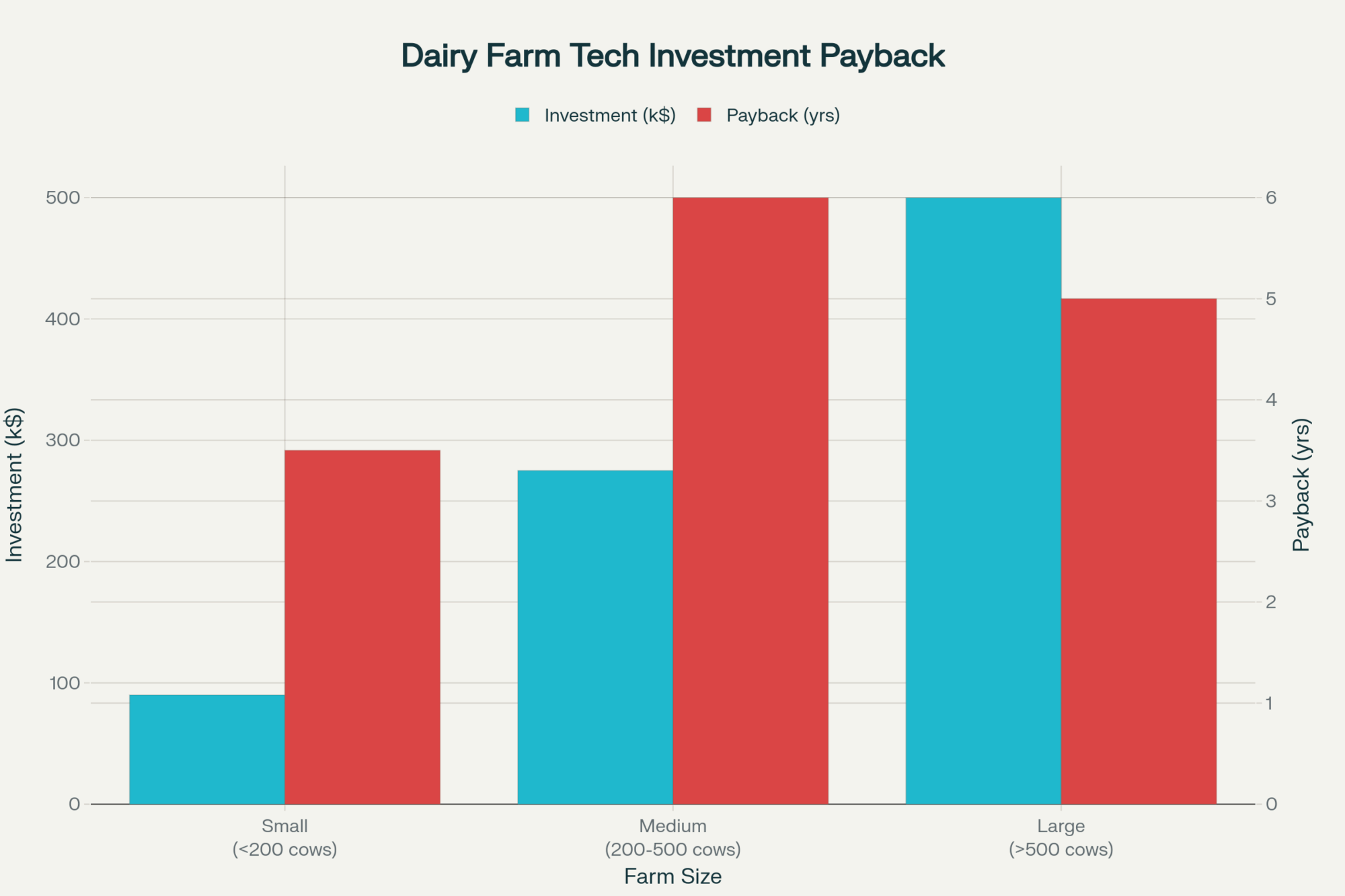
Technology Investment by Farm Size:
Under 200 Cows: $60,000-120,000 investments with 3-4 year paybacks. In states like Wisconsin, where corn’s running $4.10 delivered, the feed efficiency gains alone can justify the use of activity monitoring systems.
200-500 Cows: $200,000-350,000 for robotic milking and precision feeding. Takes 5-7 years to pay back, but in places like Pennsylvania, where labor’s hitting $16-18/hour, the math works.
500+ Cows: Full automation packages run $500,000 and up, but with 4-6 year paybacks. Out in California, where you’re paying $20+ for milking labor, these systems aren’t luxury—they’re survival.
This divide? It’s only going to matter more when margins tighten in 2026.
“Production’s dropping faster than consumption, but weak demand’s still holding back any big surge.”
Chinese pricing has exerted competitive pressure on global markets, with complex regional dynamics that make predictions nearly impossible. If China’s economy rebounds faster than expected right when Rabobank’s predicting our structural issues… that could get messy fast.
The Great Analyst Split—And Why It Matters to Your Bottom Line
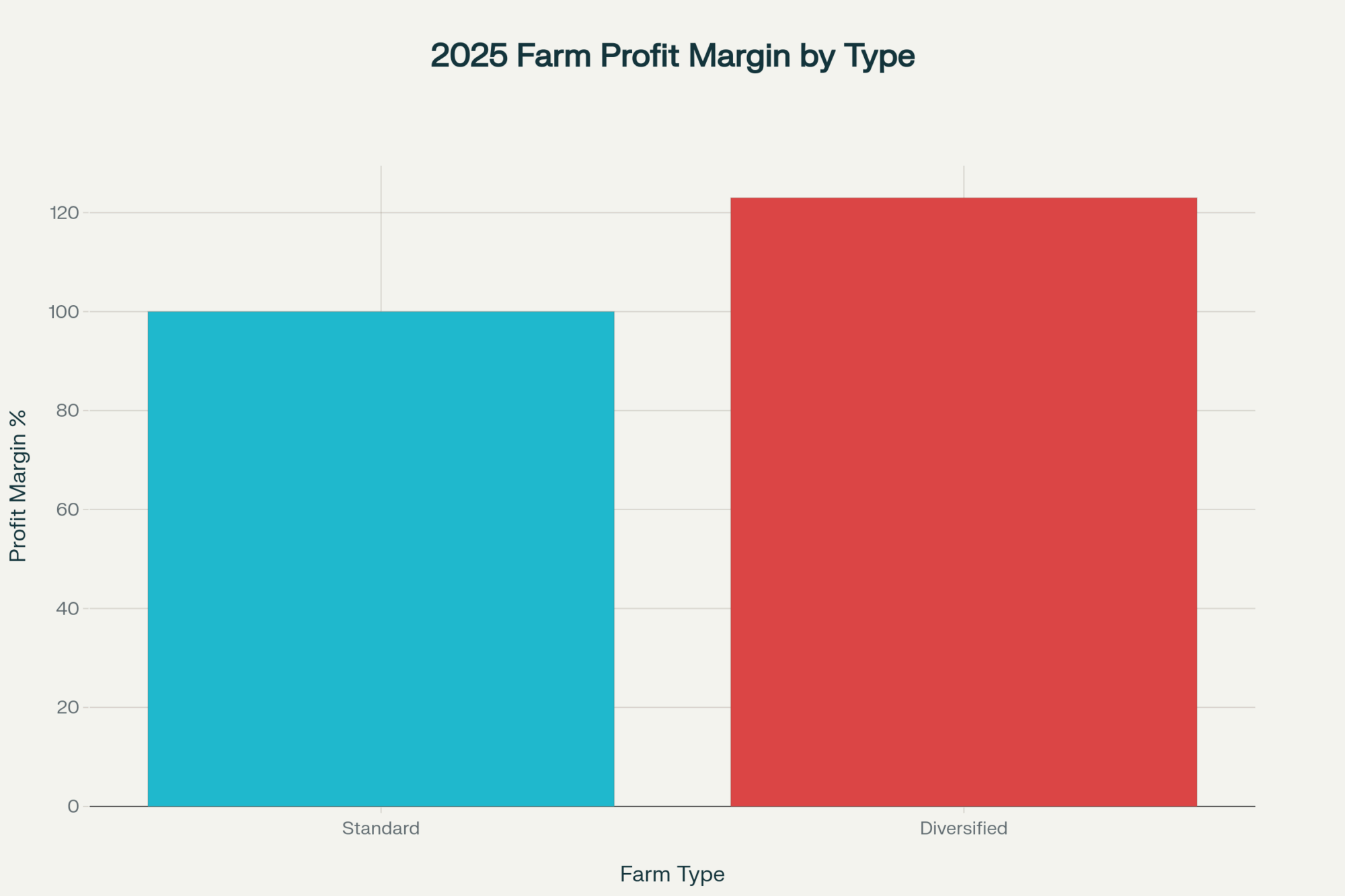
Here’s what caught my attention in Cornell data: farms with diversified income streams weathered the 2020-2022 chaos 23% better than commodity-only operations. That’s not theory—that’s documented survival advantage.
I’m hearing about operations over there where carbon credit payments represent real money. Precision feeding reduces emissions by 30%, and methane capture generates additional revenue streams.
California’s LCFS credits are already worth $85-120 per metric ton. Northeast carbon markets are expanding into agriculture. Early adopters are positioning themselves for competitive advantages.
Feed Costs—The Variable That Changes Everything
Don’t underestimate what’s happening with feed prices. Sure, corn futures are around $4.20 nationally, but add transportation and regional basis, and suddenly you’re looking at:
Regional Feed Cost Reality (as of Q3 2025):
Iowa: $3.95-4.15 delivered
Wisconsin: $4.10-4.25 delivered
Pennsylvania: $4.60-4.75 delivered
California: $5.10+ delivered
Those differences completely change your feeding strategies and technology ROI calculations.
Complete tech installations to catch 2025 tax advantages
Secure feed contracts for the next growing season
Build cash reserves during strong margins
Start carbon footprint assessments now
Regional Reality Check—What Works Where
Corn Belt (Iowa, Illinois, Indiana): Feed costs are stable, so focus on precision feeding systems with rapid paybacks through improved conversion efficiency.
Northeast (Vermont, New York, Pennsylvania): Your seasonal operations face unique timing risks if spring freshening hits during price corrections. Flexibility in milking systems matters.
Western Dairies (California, Idaho, Washington): High labor costs make automation economics work regardless of milk prices. Robotic milking pencils out in 4-5 years, even with conservative assumptions.
Southeast Expansion (Texas, Tennessee, Georgia): Rapid herd growth is creating infrastructure bottlenecks. Get scalable tech in place before you grow into problems.
What Does This All Means for Your Operation
Look, whether Rabobank’s 2026 warnings prove accurate or StoneX’s optimism carries the day, one thing’s certain: this industry’s changing faster than ever, and preparation beats reaction every single time.
The producers who thrive through whatever comes next will be those using today’s strong margins for strategic investments in efficiency, technology, and risk management—not just production expansion.
Your checklist isn’t complicated: Audit technology gaps and calculate region-specific ROI. Build cash reserves during strong margin periods. Diversify revenue streams beyond commodity milk. Create hedging strategies for key input costs. Start carbon footprint reduction programs before they’re mandatory.
The profits rolling in today are real, but they won’t last forever. The question every producer needs to answer: Will you use these margins to build a bridge over the next downturn, or will you hope the water doesn’t rise? Because in this business, hope’s never been a strategy that pays the bills.
Complete references and supporting documentation are available upon request by contacting the editorial team at editor@thebullvine.com.
Learn More:
Unlocking Dairy Efficiency: The Ultimate Guide to Improving Cow Traffic – This guide offers practical strategies for designing efficient cow traffic systems. It demonstrates how to maximize your technology investments by ensuring smooth animal flow, which directly translates into higher milk production and a healthier, less stressed herd.
The 3 Financial Ratios Every Dairy Farmer Should Be Tracking – Move beyond milk price and dive into the numbers that truly drive profitability. This piece provides the tools to measure your farm’s financial health, helping you identify vulnerabilities and make strategic decisions to withstand the market volatility this article warns about.
The Genetics Of Sustainability: Breeding For A Better Future – Explore a key strategy for tackling the carbon economics challenge head-on. This article reveals how strategic breeding for sustainability traits can create a more efficient and resilient herd that is positioned to capitalize on emerging low-carbon milk premiums.
Join the Revolution!
Join over 30,000 successful dairy professionals who rely on Bullvine Weekly for their competitive edge. Delivered directly to your inbox each week, our exclusive industry insights help you make smarter decisions while saving precious hours every week. Never miss critical updates on milk production trends, breakthrough technologies, and profit-boosting strategies that top producers are already implementing. Subscribe now to transform your dairy operation’s efficiency and profitability—your future success is just one click away.
Feed efficiency up, corn down. A $1/bu drop is $14.70/cow/month—plus better milk yield if you dial rations tight.
EXECUTIVE SUMMARY: Here’s the straight of it. Cheap corn, combined with tighter feed efficiency, is the fastest way to lift margins right now, faster than most “big” upgrades. A $1/bu corn drop pencils at about $14.70/cow/month—so a 500-cow herd is looking at roughly $7,350 every month that doesn’t leave the farm. USDA’s record crop and sub-$4 futures set the table, while the milk-to-corn ratio near 6.4:1 gives you room to breathe and plan. Layer in the science: automated feed management has shown around $0.85/cwt margin gains when grain is cheap (Journal of Dairy Science backs the mechanism), and genomic testing helps sort cows that convert feed better—small edges that stack into real money. Global demand (China buying, Ukraine uncertain) keeps a floor under corn, so this isn’t “free forever,” but it’s a window worth using. Lock some feed, tune the ration, and—no joke—redirect part of those savings into tech or protocols that keep the gains coming. If there’s a time to try precision feeding in your own barn, it’s now.
KEY TAKEAWAYS:
Save $14.70/cow/month per $1/bu corn drop (≈$7,350/month on 500 cows)
Add ≈$0.85/cwt margin with precision feeding during low-grain cycles
Cut protein costs $18–$25/cow/month via ration reformulation
Reduce risk of $1.50–$2.50/bu harvest spikes
Turn savings into durable efficiency
The thing about this year’s grain markets? They’re not whispering—they’re yelling. We have futures trading under $4, basis tightening in pockets, and a milk-to-corn ratio that hasn’t been seen since 2014. If you’ve been around a while, you know these windows don’t stay open. What strikes me about 2025 is how the savings accumulate quickly enough actually to change decisions on-farm—not just tweak them.
What’s Happening in the Fields (And Why It Matters at Your Bunk)
USDA’s August outlook points to a record corn crop—16.74 billion bushels with yield pegged around 188.8bu/acre, and planted acres near 97.3 million, the highest in over a decade. Markets did what markets do: December corn slid below $4. Here’s the interesting part—when corn breaks like this, feed efficiency improvements don’t just look good on paper; they show up in the milk check.
The Corn Math You Can Bank On
Typical lactating cow: 55lb DMI with ~50% from corn.
For every $1/bu drop in corn: ~$14.70/month saved per cow.
Scale that impact:
200 cows ≈ $2,940/month
500 cows ≈ $7,350/month
1,000 cows ≈ $14,700/month
This aligns with what we’re seeing in program margins: DMC calculations at their strongest since launch, with total feed cost down more than $3/cwt from a year ago. Current trends suggest a milk-to-corn price ratio near 6.4:1—the best efficiency environment in years. It’s not glamorous, but it’s profitable.
Price Isn’t Just Futures: Basis Will Make or Break You
Regional Basis Reality (Don’t Skip This)
East-central Wisconsin: basis tightened 10–15¢ inside a month last harvest as elevators filled.
Western New York: 15–20¢ swings when on-farm storage ran out and trucking added a bump.
Texas Panhandle: feedlot pull firms on a firm basis sooner than you’d like.
Here’s the thing, though… if local space starts to choke, the “cheap” futures price gets quietly eaten by a firmer basis. Timing matters more than bravado.
What Smart Operators Are Doing This Month
Hedging And Layering (Practical Play)
Forward contract roughly covers 60–70% of corn needs for the next 2–3 quarters.
Layer basis when it’s in your favor; a 25¢/bu premium today can still insure against $1.50–$2.50/bu pops during harvest hiccups or storage tightness.
Keep 10–20% unpriced for flexibility.
Turn Savings into Structural Wins
Precision feed management systems are paying back faster—call it 14–18 months—because every 0.1lb butterfat and every 1–2lb of milk reclaimed from consistency and shrink shows up when grain is cheap. In favorable grain environments, you can see about $0.85/cwt margin lift when rations are managed to targets daily, not “most days.” If you’ve been on the fence, this is when the spreadsheet finally turns green.
Protein Is the Curveball (Watch MUN Like a Hawk)
Tactical Protein Moves
Soybean acreage is lighter; protein prices stay sticky.
Nutritionists (WI/PA) are leaning into corn gluten feed/meal—often 15–20% cheaper than soybean meal—for mid-lactation cows without losing amino balance.
Producers are seeing $18–$25/cow/month savings with careful substitution.
The critical factor is MUN. Over-trim protein, and you’ll give back more in lost milk than you saved at the mixer. Aim for MUN in that 10–14mg/dL range (herd and stage-of-lactation dependent), and let tank data—not a spreadsheet—tell you when you’ve gone too far.
Two Real-World Playbooks
Upper Midwest, 450 Cows, Limited Storage
Lock 50% now on futures + 20% on the basis when the elevator’s number works.
Add 10–15% for physical storage if you can accommodate temporary storage (such as grain bags or rented space).
Ration: pull 2–3lb/cow/day from soybean meal into corn gluten feed; watch MUN weekly for a month; adjust.
Idaho, 2,800 Cows, Better Storage and Freight
Lock 70% needs on futures in tranches over two weeks.
Capture basis early with your preferred merchandiser before regional draws tighten it.
Lean into precision feeding—daily DMI tracking, tighter push-up cadence, and feed shrink control (this is becoming more common).
Use savings to bring forward a mixer or feed center upgrade while rates are still manageable.
Weather And Risk (Because This Is Still Farming)
Late-season heat and dryness in parts of the eastern Corn Belt can still result in a yield loss of 8–12 bu/acre. That’s not panic material, but it’s enough to snap futures and basis together for a week and erase your “I’ll wait” advantage.
Market Floor Signals
China’s demand, combined with Ukrainian uncertainty, keeps a floor under exports.
Domestic ethanol grind remains steady.
Translation: this looks like an opportunity, not a new normal.
Ration Targets Worth Taping to The Feed Room Door
Starch: mid- to high-20s% of diet DM, matched to forage digestibility.
NDF: 30–34% of DM with adequate effective fiber; uNDF240 in a range your cows tolerate without butterfat penalties.
MUN: 10–14mg/dL as a sanity check on protein balance (tighter for fresh cows).
Shrink: If you’re not measuring yard-to-mouth shrink, assume 6–8% and work it down—cheap corn makes shrink invisible until it doesn’t.
Financing Reality: Price Tech With Today’s Rates
If you’re looking at a $120,000 feed system upgrade, price it with today’s money, not last year’s. At 8–9% interest, a 16-month payback still clears—if you actually capture the $0.85/cwt and reduce shrink by 2–3 points.
Build A Downside Case
Trim 25% off the projected gains and see if it still pencils out.
If it does, move.
If it doesn’t, fix day-to-day management first; technology amplifies habits.
Fresh Cows, Butterfat Checks, And Your Fall Milk
Cheap starch can tempt folks into pushing energy too hard. Keep fresh-cow protocols tight—DKAs and off-feed days erase everything you “saved” on corn.
Small, Boring, Daily Wins… They Stack
Butterfat still pays. Every 0.1lb bump at current component prices more than covers the extra push-up cycle and better stockpile plan.
Consistency in feed delivery and push-ups beats heroics.
Alright, So What’s The Move This Week?
Four Practical Steps
Contact your merchandiser and price 60–70% of your Q4–Q1 corn needs; reserve 10–20% for unpriced options to stay flexible.
Sit down with your nutritionist for a 30-minute MUN-and-protein audit; outline a measured shift toward corn gluten feed/meal if it fits your cows.
Walk your feed center with a shrink lens: wind, spills, loader routes, push-up cadence, face management. Fix the obvious stuff first.
Price the technology you already know you need. If the ROI holds under a conservative milk price and a haircut to the gains—sign it.
The Bottom Line
Here’s what’s particularly noteworthy: this isn’t just “cheap feed.” It’s the kind of margin environment that lets you fix structural problems—feed consistency, storage bottlenecks, ration precision—without starving cash flow. Current trends suggest we’ll look back at late summer ’25 as the stretch when the best dairies got noticeably better. Not louder. Better.
If you want the bottom line without the fluff: lock a good chunk now, don’t get basis-blindsided, tune protein with MUN, and reinvest some of the savings into the places your cows tell you are holding them back. Do that, and you won’t need to time the top—or the bottom. You’ll just keep milking through it.
Complete references and supporting documentation are available upon request by contacting the editorial team at editor@thebullvine.com.
Learn More:
The TMR Audit: Are You Feeding the Ration You Formulated? – This tactical guide reveals how to conduct a TMR audit on your own operation. It provides practical strategies for closing the gap between the ration on paper and what cows actually eat, ensuring you capture the full value of your feed.
Is Your Break-Even Cost Lying to You? A New Model for Dairy Profitability – Move beyond temporary gains with this strategic analysis. This article challenges traditional break-even calculations and demonstrates a new model for understanding your dairy’s true profitability, ensuring today’s feed savings build long-term financial resilience.
Feed Efficiency: The Genomic Trait That Pays the Bills – This piece explores the future of herd improvement by revealing methods for using genomic data to select for feed efficiency. It shows how to breed a more profitable herd that converts cheap feed into more components, creating a durable competitive advantage.
Join the Revolution!
Join over 30,000 successful dairy professionals who rely on Bullvine Weekly for their competitive edge. Delivered directly to your inbox each week, our exclusive industry insights help you make smarter decisions while saving precious hours every week. Never miss critical updates on milk production trends, breakthrough technologies, and profit-boosting strategies that top producers are already implementing. Subscribe now to transform your dairy operation’s efficiency and profitability—your future success is just one click away.
“Playing it safe” with milk prices? That’s the riskiest move you can make in 2025. Here’s why the old playbook will crush your margins.
You know what happened while most of us were arguing with feed dealers over spring contracts? $22 billion in potential dairy export value just… vanished from industry forecasts. And I’m betting half the producers in your neck of the woods still don’t get how this connects to their next milk check—or what the sharpest operators are already doing about it.
Look, those 3 AM worry sessions you’ve been having? They’re not in your head. USDA took a machete to 2025 milk price forecasts, slashing them to $21.60 per hundredweight. For your typical 500-cow operation, that’s about $125,000 in lost annual revenue—real money that was sitting there in March planning meetings and disappeared by June.
But here’s what’s really keeping folks like me awake at night: this is just the warm-up act. Trade tensions are building like one of those late-July storms that rolls across Wisconsin dairy country, Chinese import patterns are more unpredictable than spring weather in Vermont, and those same market forces that created brutal 150% price swings back in the day? They’re now supercharged by algorithms that trade faster than you can get from the parlor to the office.
Breaking Down That $175,400 Number (Because You Asked)
Let me be straight about that headline figure—because producers like you deserve the real math, not marketing fluff. That $175,400 represents the combined annual profit optimization potential for a typical 500-cow operation that actually implements comprehensive risk management. Here’s how it breaks down:
Labor automation gets you about $40,000 annually per robotic milking system (most 500-cow operations need two systems). Feed efficiency programs can save $18,750 at $1.25 per hundredweight improvement on 1.5 million pounds annually. Component optimization adds another $18,150 from just a 0.1% butterfat improvement. Risk management tools reduce income volatility by $15,000-25,000 through blended strategies. Technology integration brings $25,000 in operational efficiencies. Infrastructure improvements save $12,000-15,000 from reduced feed waste alone.
That’s not pie-in-the-sky thinking—it’s what forward-thinking operations are already banking while traditional dairies keep playing defense.
The Thing About Playing It Safe? It’s Become the Most Dangerous Game
What strikes me about this industry after twenty-plus years is that the old playbook of crossing your fingers for stable prices and just focusing on production has become a recipe for getting steamrolled.
Current market conditions make this crystal clear. U.S. cattle inventory has shrunk to 86.7 million head—the lowest in decades. Replacement dairy heifers? Down to levels we haven’t seen since 1978. These supply constraints create the kind of price volatility that unprepared operations simply can’t weather.
According to recent research published in the Journal of Dairy Science, farms operating without structured risk management strategies experience 40% greater income volatility compared to those with comprehensive approaches. What’s particularly noteworthy is how this research quantifies what many of us have been observing… that the performance gap between prepared and unprepared operations keeps widening.
What “Hoping for the Best” Actually Costs You
Here’s the reality check: Farm labor costs are expected to rise by 3.6% in 2025 according to USDA projections, and with industry turnover averaging 30-38.8%, operations without automation strategies face annual swings of $45,000 per critical position. I was just talking to a producer in central Wisconsin who lost his experienced herdsman during breeding season—it cost him more than what a new robot would have run.
Meanwhile, farms implementing automated milking systems capture $32,000-$45,000 in annual labor savings per robot with payback periods of 18-24 months. The DeLaval and Lely systems I’ve seen basically pay for themselves in labor savings alone—and that’s before you factor in the data advantages.
Feed cost reality: Corn hit $4.58 per bushel in Q1 2025, and without precision nutrition programs, you’re accepting whatever feed efficiency your current system delivers. But here’s what’s interesting… producers using data-driven ration formulation are saving significant money per hundredweight—money that flows straight to your bottom line regardless of what milk prices do.
The Risk Management Revolution Most Producers Are Missing
Here’s what’s fascinating about our industry right now… dairy has undergone this quiet revolution in risk management tools, but adoption remains surprisingly low. Research from the USDA Economic Research Service shows only about 20% of producers use any form of price risk management, meaning 80% are operating without protection against market volatility. And honestly? That number hasn’t budged much in five years.
This isn’t about complicated financial instruments that require a Wall Street background. It’s about practical tools that successful producers already use to stabilize operations and capture opportunities that volatility creates.
The Blended Approach That’s Actually Working
The most successful producers aren’t trying to eliminate risk entirely—they’re using blended risk management strategies that provide stability while preserving flexibility to capture favorable movements.
The winning formula? Successful operations typically contract about 40% of production six months ahead, 30% three months ahead, and leave 30% exposed to cash markets. This approach keeps milk revenue within 5% of budgeted projections while maintaining upside potential. Think of it like having crop insurance while still being able to benefit from a bumper year.
According to University of Wisconsin Extension research, covering the first 5 million pounds of production with DMC at the $9.50 margin would have generated positive net benefits in 13 of 15 years. That’s an 87% success rate—better than most investment strategies you’ll find.
Technology Integration: Where the Real Money Lives
The precision dairy farming revolution is happening whether you’re part of it or not. According to the latest Global Dairy Equipment Market Report, the market reached $12.05 billion in 2025, representing a 6.8% compound annual growth. This growth reflects increasing automation adoption across the industry, and early adopters are capturing the biggest advantages.
Real-world example: Last spring, I visited an 850-cow operation outside Fond du Lac that implemented comprehensive technology over three years. The producer—let’s call him Jim since he doesn’t want his exact numbers floating around—started with automated milking systems in 2022, added precision nutrition monitoring in 2023, and integrated comprehensive data analytics in 2024.
Here’s what happened: Labor costs dropped 35% despite wage increases. Feed efficiency improved 12%. Most importantly, milk revenue stayed within 3% of budgeted projections throughout 2024’s price volatility, while neighboring operations without risk management saw 15-20% swings.
“The data from our AMS systems revealed production patterns we never would’ve spotted otherwise,” Jim explained during my visit. “We’re making breeding, feeding, and culling decisions based on individual cow data rather than gut feelings. It’s like having X-ray vision into your herd.”
Automated milking systems do more than save labor—they generate valuable individual cow performance data that enables management decisions you simply can’t make with traditional systems. The technology creates feedback loops where better data leads to better decisions, which leads to better financial outcomes.
Precision nutrition programs transform your largest operational expense into a competitive advantage. According to Penn State’s dairy extension team, farms with covered feeding areas show 8-12% better feed conversion rates with payback periods averaging 4-6 years.
What’s Happening in Global Markets (And Why You Should Care)
While you’re focused on daily operations—and rightfully so—global market forces are directly impacting your operation. China’s role as the world’s largest dairy importer means their policy decisions affect your milk price. According to Rabobank’s latest analysis, Chinese dairy imports are expected to grow by 2% in 2025, creating opportunities for global suppliers.
But here’s where it gets concerning… recent research from Cornell’s Agricultural Economics department shows that potential retaliatory tariffs could cost dairy farmers $6 billion in profits over four years. The U.S. exports nearly one-fifth of its dairy production, making trade policy a real risk factor that most producers aren’t prepared for.
What’s particularly noteworthy is how quickly these global shifts translate to local markets. When Chinese buying patterns change, it affects New Zealand export patterns, which influences global commodity prices, which shows up in your milk check within weeks. It’s like dominoes falling, except each domino is worth millions of dollars in market value.
Regional Variations That Matter
The thing about risk management strategies is that they don’t work the same everywhere. What pencils out for a 2,000-cow operation in the Central Valley might not make sense for a 300-cow farm in Vermont.
In the Upper Midwest—Wisconsin, Minnesota, Iowa—I’m seeing a lot of focus on automation and efficiency gains. Labor’s getting harder to find, and the seasonal challenges of feeding in those barns during winter make precision nutrition systems more valuable.
Southwest operations—Arizona, New Mexico, parts of California—tend toward scale advantages and component optimization. The consistent climate and feed access allow for different strategies than what works when you’re dealing with snow and mud seasons.
Northeast producers often pursue premium strategies—organic, grass-fed, direct-to-consumer—that provide protection from commodity volatility. A 150-cow organic operation in Pennsylvania might be more profitable than a 500-cow conventional farm in Iowa, depending on how they manage their risks.
How Risk Management Tools Actually Work
Let me walk you through the practical options without all the financial jargon…
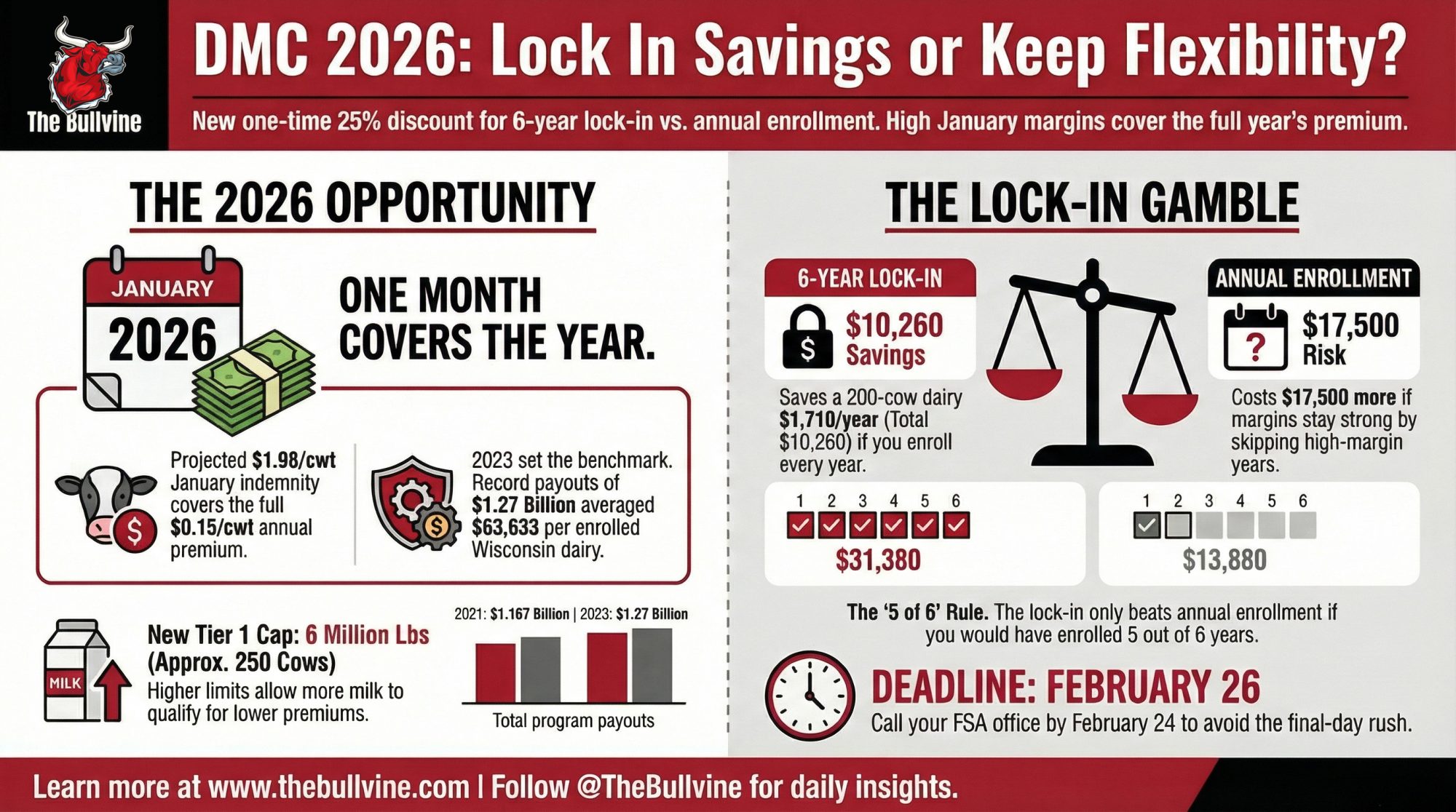
Dairy Margin Coverage (DMC) is basically insurance for the gap between what you get paid for milk and what you pay for feed. At the $9.50 margin level, it costs about $0.155 per hundredweight but pays out when margins get squeezed. University of Wisconsin research shows it would have paid out in 13 of the last 15 years.
Class III futures let you lock in a milk price you’ll produce months from now. It’s like forward contracting your grain, except for milk. The minimum contract is 200,000 pounds, so it works for most commercial operations.
Livestock Gross Margin (LGM-Dairy) protects against the relationship between milk prices and feed costs, both corn and soybean meal. This one’s particularly useful when feed prices are volatile, which… let’s be honest, they always are.
Here’s a comparison that might help:
Tool
Best For
What It Protects
Typical Cost
When It Pays
DMC ($9.50 margin)
Most farms
Income margin
$0.155/cwt
When margins drop below $9.50
Class III Futures
Larger operations
Milk price
Variable
Price protection at the chosen level
LGM-Dairy
Feed cost exposure
Gross margin
$0.50-$1.00/cwt
When margins compress
Revenue Protection
Income stability
Quarterly revenue
Premium varies
Revenue drops below coverage
Assessing Where Your Operation Really Stands
Financial vulnerability check: How sensitive is your cash flow to a $2 per hundredweight milk price drop? If that creates serious stress, you need stronger risk management. What percentage of your revenue comes from base milk prices versus premiums? The higher the base percentage, the more exposed you are to commodity volatility.
I was working with a 400-cow operation in Pennsylvania last month, and we ran through this exercise. Turns out they were getting 85% of their revenue from base milk prices—no component premiums, no quality bonuses, nothing. That’s like driving without a seatbelt in a snowstorm.
Operational efficiency reality: What’s your feed conversion efficiency compared to regional averages? If you’re not measuring it precisely, you’re probably leaving money on the table. How much individual cow data do you collect and analyze? Manual systems miss optimization opportunities that automated systems capture every day.
Technology adoption status: Are you using precision feeding systems? Do you have automated monitoring for cow health and reproduction? How quickly can you identify and respond to production changes? Slow response times cost money in today’s competitive environment.
Your Next Steps: Moving from Knowledge to Action
Here’s where the rubber meets the road… knowing what to do and actually doing it are two different things.
This week: Get yourself enrolled in DMC coverage at the $9.50 margin level through your local FSA office. Takes about an hour and costs pennies compared to the protection. Request a feed efficiency analysis from your nutritionist—if you don’t have baseline data, you can’t improve. Start tracking butterfat and protein percentages by individual cow if you’re not already.
This month: Complete that financial vulnerability assessment I mentioned earlier. Schedule a sit-down with your banker to discuss cash reserve strategies (most successful operations keep 3-6 months of operating expenses in reserve). Contact at least two equipment dealers about automation options—even if you’re not ready to buy, understanding your options is crucial for planning.
This quarter: Implement at least one precision nutrition improvement based on your feed efficiency analysis. Establish forward contracting relationships with your milk handler or co-op. Complete a comprehensive risk assessment with an agricultural specialist—many extension services offer this for free or low cost.
Key resources you need to know about: Your local Farm Service Agency office handles DMC enrollment and can walk you through the process. University extension dairy specialists provide operational guidance and often have benchmarking data for your region. Agricultural risk management consultants can help develop comprehensive strategies tailored to your operation.
The thing is… every operation is different, and what works for that 3,000-cow dairy in Arizona might not be the right approach for a 150-cow operation in Vermont. But the principles remain the same: measure what matters, protect against catastrophic losses, and continuously improve your operational efficiency.
What’s Coming Down the Pike
Looking ahead, several trends are going to reshape how we think about risk management…
Continued consolidation means the efficiency gap between large and small operations will keep widening. This doesn’t mean small farms can’t succeed, but it does mean they need clear competitive advantages—whether that’s location, premium products, or exceptional efficiency.
Technology integration will become standard rather than optional. Operations not adopting precision dairy technologies will find themselves at increasing disadvantage. The question isn’t whether to automate, but how quickly and effectively you can implement these systems.
Climate variability is creating new operational challenges. Heat stress management, feed security planning, and weather-related disruptions require different risk management approaches than we’ve traditionally used.
What’s particularly interesting is how global market integration continues to accelerate. Dairy markets will become increasingly connected to international trade, currency fluctuations, and global economic conditions. Local operations need to understand these trends and their implications.
The Industry’s Economic Reality
Here’s something that doesn’t get talked about enough… the dairy industry’s economic impact extends far beyond individual farms. According to the International Dairy Foods Association, dairy supports over 3 million American jobs, $198 billion in wages, and nearly $780 billion in total economic impact. This massive economic footprint underscores why industry stability and growth matter—not just for individual producers, but for entire rural communities.
Supply chain integration means that what happens on your farm affects feed suppliers, equipment dealers, veterinarians, truckers, processors, and retailers. When dairy operations struggle, it ripples through the entire economy. When they thrive, everyone benefits.
The Bottom Line: Your Competitive Future
The dairy producers who emerge strongest from current market volatility will be those who embrace comprehensive risk management as a competitive advantage rather than viewing it as a necessary cost center.
Every day you delay implementation, you’re essentially choosing to accept whatever market conditions deliver rather than actively managing your operation’s financial future. In an industry where margins are thin and volatility is increasing, that’s a choice you literally can’t afford to make.
Here’s the thing I’ve learned after working with hundreds of dairy operations: the producers who wait for perfect conditions never get started. The ones who take action with the information they have are the ones who succeed. Your operation’s financial future depends on decisions you make today, not tomorrow.
The tools are available, the strategies are proven, and the window for implementation is wide open. The $175,400 in profit optimization opportunities we discussed aren’t going away—but they might go to your more prepared competitors if you don’t act.
Will you be ready for the next market disruption? Or will you be another casualty of volatility that could have been managed?
The choice, as always, is yours. But choose quickly—the industry isn’t waiting.
KEY TAKEAWAYS
Automate your labor headaches away – Robotic milking systems deliver $32,000-$45,000 annual savings per unit with 18-24 month payback periods. Start by contacting two equipment dealers this month to understand your options, especially with 2025’s 30-38% industry turnover rates crushing labor budgets.
Turn feed costs into competitive advantage – Precision nutrition programs save $0.75-1.25 per hundredweight through data-driven ration formulation. Get a feed efficiency analysis from your nutritionist immediately – if you’re not measuring conversion rates precisely, you’re bleeding money with corn futures swinging from $3.94 to $4.80 per bushel.
Lock in DMC coverage before you regret it – The $9.50 margin level costs just $0.155 per hundredweight but historically pays out 87% of the time. Enroll at your local FSA office this week – it’s cheap insurance that successful operations use as their safety net foundation.
Optimize components for instant cash flow – Every 0.1% butterfat increase adds $0.15-0.20 per hundredweight, translating to $18,150 annually for a 500-cow operation. Start tracking individual cow butterfat and protein percentages now – component premiums are your buffer against commodity price volatility.
Implement blended risk strategies like the pros – Contract 40% of production six months ahead, 30% three months ahead, leave 30% exposed to capture upside. This approach keeps revenue within 5% of budget projections while global trade tensions threaten $6 billion in dairy farmer profits over four years.
EXECUTIVE SUMMARY
Look, I get it – you’re busy milking cows and don’t have time for fancy financial instruments. But here’s what caught my attention: while 80% of producers are flying blind without risk management protection, the smart ones are systematically capturing $175,400 in annual profit optimization. We’re talking real money here – $40,000 per robotic milking system, $18,750 from feed efficiency improvements, another $18,150 just from bumping butterfat by 0.1%. With USDA slashing 2025 milk forecasts to $21.60 per hundredweight and trade tensions building like a summer storm, the old “hope and pray” approach isn’t cutting it anymore. Global market forces – especially China’s shifting import patterns – are creating volatility that’ll steamroll unprepared operations. You need to start implementing these risk management strategies this week, not next year.
Complete references and supporting documentation are available upon request by contacting the editorial team at editor@thebullvine.com.
Join over 30,000 successful dairy professionals who rely on Bullvine Weekly for their competitive edge. Delivered directly to your inbox each week, our exclusive industry insights help you make smarter decisions while saving precious hours every week. Never miss critical updates on milk production trends, breakthrough technologies, and profit-boosting strategies that top producers are already implementing. Subscribe now to transform your dairy operation’s efficiency and profitability—your future success is just one click away.
Milk yield jumped 3.4% but cheese hit $1.85—are you maximizing component value
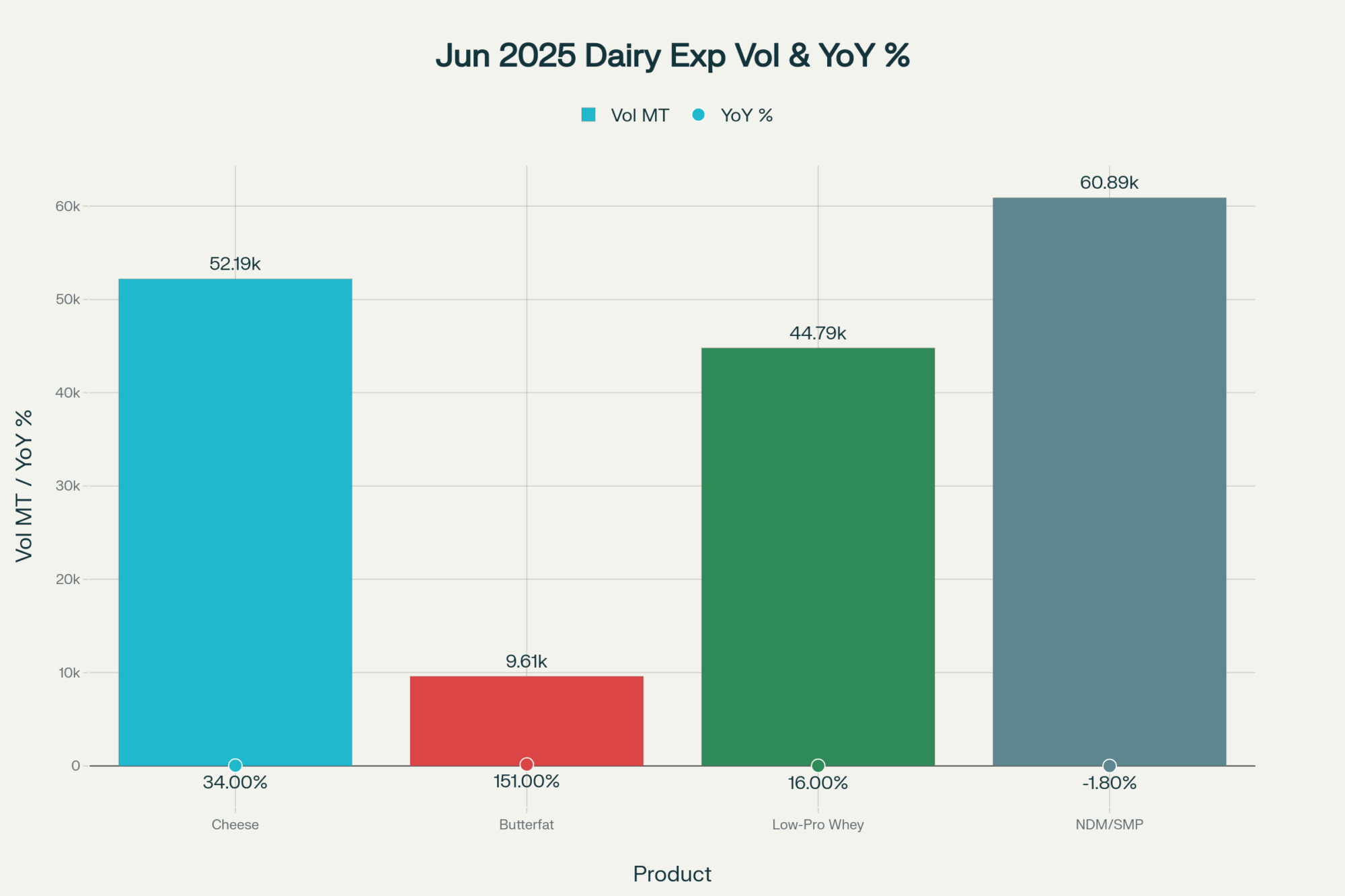
EXECUTIVE SUMMARY: You’ve probably noticed something’s different out there. The old milk pricing playbook just got tossed out the window. Latest USDA numbers show we’re cranking out 3.4% more milk—cows hitting 2,045 pounds monthly—but here’s where it gets interesting. Cheddar blocks jumped to $1.85/lb while butter dropped 4.3% in the same week. That’s not a typo… it’s the new reality. Cheese exports smashed records at 52,191 metric tons (up 34%), and butterfat exports doubled. Meanwhile, feed costs are finally giving us a break with corn near $4.05/bushel, potentially boosting margins by $12/cwt. Bottom line? If you’re not targeting component-specific marketing and genomic selection for feed efficiency, you’re leaving serious money on the table.
KEY TAKEAWAYS
Genomic testing isn’t optional anymore—select for higher PTA fat and protein to ride the cheese wave. With cheddar up 3.93% recently, every percentage point of butterfat matters. Start reviewing your bull lineup today.
Hedge smart, not hard—lock in 25-30% of fall milk using Class III futures at current $17.50/cwt levels. The cheese market’s on fire, and you want in on this action before it cools.
Feed costs are your friend right now—corn futures sitting pretty at $4.05/bushel with soybean meal declining. Forward contract now to bank those savings worth up to $12/cwt through 2025.
Export dependency is real—cheese exports up 34%, butterfat 151%. Your milk check depends on keeping foreign buyers happy, so watch those trade numbers like a hawk.
Geography matters more than ever—Plains states like Kansas are crushing it with 19% growth while Washington’s down 9.4%. Know your region’s trajectory and plan accordingly.
Look, I’ll cut to the chase here — this week’s numbers aren’t just another set of monthly reports. We’re watching the dairy market rewrite its own rulebook in real-time, and if you’re still pricing milk like it’s 2020, you’re about to get a very expensive education.
The thing is, most producers I talk to are still thinking in terms of the old Class III versus Class IV relationship… but that relationship just died. And what’s replacing it? Well, that’s what’s keeping me up at night.
The Numbers That Don’t Make Sense (Until They Do)
So here’s what happened in June — and trust me, this matters more than you think. Milk production jumped 3.4% to hit 18.5 billion pounds across the 24 major dairy states. More cows, better per-cow productivity (we’re talking a 2,045-pound monthly average), and yet…
Cheese prices are climbing like they’re rocket-powered while butter is sliding down a greased hill. Makes no sense, right?
Well, here’s where it gets interesting. I was chatting with some folks out in Wisconsin last week — spots that were trading at discounts to Class III just fourteen days ago are now commanding premiums. That’s not seasonal fluctuation, folks. That’s demand that’s so tight it’s changing the fundamental economics of spot milk pricing.
What strikes me about this is how quickly processors are adapting. When you’ve got CME cheddar blocks jumping to $1.85/lb while butter drops to $2.36/lb in the same week… that tells you something fundamental has shifted in how the market values different components of our milk.
The Export Dependency That Should Concern You
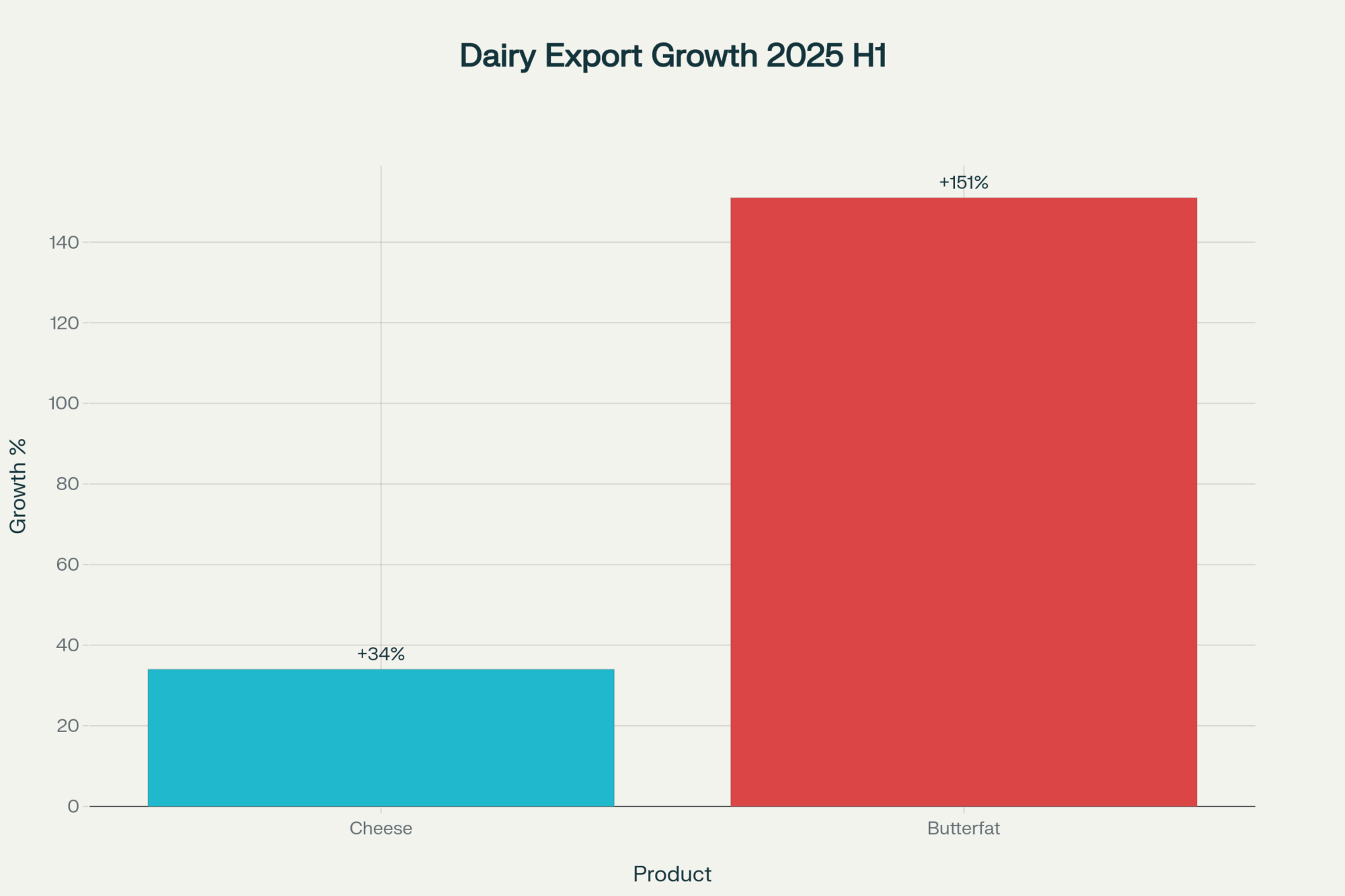
Here’s what really caught my attention in the latest numbers: cheese exports hit 52,191 metric tons in June. That’s not just strong — that’s a 34% jump over last year and an all-time monthly record.
But here’s the kicker… we’re now exporting close to 9% of our total cheese production. A decade ago? That number was around 5%.
The butterfat story is even more dramatic. Exports surged 151% year-to-date, and we’re trading at massive discounts to European benchmarks — sometimes 40% gaps.
[Insert chart here: Bar chart showing 34% growth in cheese exports and 151% growth in butterfat exports for first half 2025 vs 2024]
I keep asking myself: what happens if those international buyers suddenly decide they don’t need our cheese? Because right now, with domestic demand basically flat, those export markets are literally the only thing standing between current prices and a complete collapse.
Think about that for a minute. When did we become so reliant on selling our milk overseas?
Geographic Reality Check: The Great Dairy Migration
This isn’t random market forces — it’s strategic capital allocation happening in real-time. The Plains and Mountain West offer modern processing infrastructure, lower regulatory burdens, and what economists call a “processing-production feedback loop.”
And for traditional dairy regions? When you’ve got operations running on infrastructure built in the 1980s competing against facilities designed for today’s efficiency standards… well, the economics get pretty brutal pretty fast.
I’ve been to some of these new facilities, and the difference is staggering. We’re talking about processing capacity that can handle today’s milk volumes with half the labor and twice the efficiency.
The Policy Curveball That Blindsided Everyone
Here’s something that caught even the sharpest market watchers off guard: those Federal Milk Marketing Order reforms that kicked in during June.
Let me walk you through what actually changed, because this matters more than most people realize. The pricing formula for Class I (fluid milk) now uses the “higher-of” Class III or Class IV skim milk prices. Previously, Class IV often led because it typically carried a premium.
Now that premium has evaporated. So when Class III is at $17.37 and Class IV drops to $17.20, suddenly Class III is setting your fluid milk floor instead.
What’s particularly noteworthy is how this demonstrates that in dairy, there’s always another variable lurking in the background. Just when you think you understand the pricing structure, policy changes interact with market dynamics in ways nobody anticipated.
Risk management professionals across cooperatives are telling me they’re having to rewrite their entire hedging models because the old relationships just don’t work anymore.
Feed Markets: Finally Some Good News
The feed situation is actually offering genuine relief, which honestly couldn’t come at a better time. December corn futures are trading around $4.05/bushel, well below recent peaks. Soybean meal has backed off toward $285/ton for December delivery.
Current margin calculations show income-over-feed-cost averaging $8.50/cwt, with some projections suggesting annual averages could reach $12.99/cwt. Those are levels that historically support herd expansion and reinvestment — which explains some of the production growth we’re seeing.
But here’s the uncomfortable truth… improved margins from lower feed costs might actually make our export dependency problem worse by encouraging even more production. It’s like we’re trapped in this cycle where good news becomes bad news.
What This Means for Your Operation Starting Monday
Look, the reality is that traditional All-Milk price hedging strategies just became obsolete overnight. You need to understand your specific component exposure because this market bifurcation isn’t going away.
If your milk flows primarily to cheese plants, you’re sitting in the sweet spot right now. Class III futures for fall delivery are holding above $17.00/cwt, and the export momentum shows no signs of slowing. I’d seriously consider locking in 25-30% of fall production using current futures contracts.
For operations in butter/powder regions… this environment demands way more defensive positioning. Butter inventories continue building despite record exports, which suggests prices may need to fall further before finding sustainable support.
The feed cost outlook presents clear opportunities. Forward contracting corn and soybean meal at current levels could lock in these improved margin opportunities for months ahead.
Bottom Line: Five Things You Must Do This Week
Component-specific risk management is mandatory. Generic All-Milk hedging strategies won’t cut it anymore. You need to understand exactly where your milk goes and price accordingly.
Export performance has become your most important leading indicator. Monthly trade data deserves more attention than production reports. If you’re not tracking these numbers, you’re flying blind.
Feed cost advantages create strategic opportunities for forward contracting that could lock in improved margins through volatile periods. Don’t let this window close because you’re overthinking it.
Geographic production shifts are accelerating. If you’re in a declining region, you need to think seriously about your long-term positioning. The data is clear about where this is heading.
Market dependency on exports creates vulnerability that requires constant monitoring of global competitive positioning. This isn’t set-it-and-forget-it territory anymore.
The Hard Truth About What Comes Next
What keeps industry veterans like me awake at night? Our entire price structure now balances on export competitiveness. Domestic demand simply can’t absorb current production levels at profitable prices.
The cheese complex demonstrates this perfectly. Those record export volumes are literally the only thing preventing inventory accumulation and price collapse. Remove that export demand, and the math gets ugly real fast.
This development is fascinating from a market structure perspective, but it’s also concerning. We’ve never been this dependent on global buyers for price stability. The U.S. dairy industry has essentially become an export-driven business without most producers fully realizing it.
The producers who understand their specific component exposure, adapt risk management accordingly, and capitalize on feed cost advantages will navigate this successfully. Those clinging to traditional approaches? They’re going to learn some expensive lessons about how markets evolve.
This is the new reality every dairy operation needs to plan for. The sooner you adapt, the better positioned you’ll be for whatever comes next — because if there’s one thing I’m certain about, it’s that this market evolution is just getting started.
Complete references and supporting documentation are available upon request by contacting the editorial team at editor@thebullvine.com.
5 Technologies That Will Make or Break Your Dairy Farm in 2025 – Looking to the future, this article explores the innovative technologies that enable the strategies discussed in the main report. It details how tools like smart calf sensors and advanced health monitoring can build a more resilient and profitable operation.
Join the Revolution!
Join over 30,000 successful dairy professionals who rely on Bullvine Weekly for their competitive edge. Delivered directly to your inbox each week, our exclusive industry insights help you make smarter decisions while saving precious hours every week. Never miss critical updates on milk production trends, breakthrough technologies, and profit-boosting strategies that top producers are already implementing. Subscribe now to transform your dairy operation’s efficiency and profitability—your future success is just one click away.
That July report just flipped the script—but here’s what most producers are missing about what comes next.
You know that feeling when you’re scrolling through your phone over morning coffee and suddenly stop mid-sip? That’s exactly what happened when the USDA’s July 2025 WASDE report hit my desk last week. After months of producers bracing for financial pain, milk prices got a significant boost that should have every dairy operation rethinking their entire strategy.
Here’s the thing, though—and I’ve been mulling this over since the numbers dropped—while everyone’s celebrating the all-milk price forecast jumping to $22.00 per hundredweight for 2025 (up from those dire earlier projections), most folks are missing the real story. Sure, 2026 forecasts at $21.65 per hundredweight look decent too, but what strikes me about this latest data is how perfectly it demonstrates the kind of market whiplash that’s become our new normal.
Just think about it… months ago, producers across Wisconsin and Iowa were making contingency plans for $19-20 milk. Now we’re looking at $22+ projections. For your typical 500-cow operation, that’s not just numbers on a spreadsheet—that’s the difference between scraping by and actually having room to breathe.
But here’s what’s got me both excited and concerned: the USDA raised milk production forecasts for both 2025 and 2026 based on higher cow inventories and increased milk per cow. According to recent analysis from the University of Wisconsin’s dairy markets program, this kind of supply response to improved pricing often sets us up for the next volatility cycle. The industry learns to respond to good news… sometimes a little too well.
What’s particularly fascinating—and this might surprise you—is that these price improvements actually reinforce why building what I call “financial fortresses” has become more critical than ever. The operations that will thrive aren’t just those riding the good news cycles; they’re the ones using this window to build systems that can handle whatever volatility comes next.
Because let’s be honest—if markets can swing from pessimistic to optimistic this fast, they can swing back just as quickly.
What’s Really Driving These Numbers
The thing about the July WASDE report is that it tells a story that’s both encouraging and complex, and frankly, most of the trade press is missing some crucial details that could impact your decision-making over the next 18 months.
The Milk Price Reality Check
The latest WASDE data shows some genuinely positive developments. That $22.00 per hundredweight forecast for 2025 represents a meaningful improvement, but here’s what’s particularly interesting—and this is where my conversations with dairy economists get really valuable—the breakdown across different classes tells us where the real strength is coming from.
Dr. Mark Stephenson from Wisconsin’s Program on Dairy Markets and Policy recently pointed out in his monthly outlook that the Class IV price increase is being driven by higher butter and nonfat dry milk prices, while Class III actually got lowered due to cheese price adjustments. For 2026, butter, NDM, and whey prices are all projected higher, suggesting strength in component markets that smart producers can leverage.
What’s really exciting—and I’ll admit, I get a bit nerdy about export data—is that commercial dairy exports are being raised for both 2025 and 2026 on both fat and skim-solids basis. According to the USDA’s Foreign Agricultural Service, this indicates stronger international demand that’s supporting domestic pricing. This export strength provides some foundation for optimism that goes beyond just domestic supply-demand dynamics.
But here’s where it gets interesting… and a little concerning. Recent research from Cornell’s dairy program suggests that rapid price improvements often coincide with production expansions that can create oversupply situations down the road. We’re seeing exactly that pattern in the current forecasts.
Feed Costs: The Other Half of the Equation
While everyone’s celebrating milk prices, the feed cost story is equally important—and honestly, it might be even better news for your bottom line. The July report shows corn production forecast at 15.705 billion bushels for 2025/26, down 115 million bushels from June projections due to lower planted and harvested area.
Now, you might think lower corn production means higher feed costs, but here’s the interesting part: the season-average farm price for corn is staying put at $4.20 per bushel. Feed and residual use was actually cut by 50 million bushels based on lower supplies, which suggests we’re looking at relatively stable input costs for the immediate future.
What’s got me particularly optimistic is how soybean meal prices were lowered $20 to $290 per short ton. For dairy operations—especially those in the Midwest, where transportation costs are lower—this combination of stable corn and cheaper soybean meal could improve feed cost margins by $0.30-0.50 per hundredweight when combined with the higher milk price forecasts.
I was talking with a nutritionist friend in Ohio last week (this is becoming more common in our industry), and she mentioned that operations implementing precision feeding systems are seeing even better results when input costs stabilize like this. The technology works best when you’re not constantly adjusting for wild price swings.
Market Volatility: The New Constant
Here’s what really gets me thinking… the rapid shift from pessimistic to optimistic forecasts demonstrates exactly why resilient planning systems have become essential. Markets that can swing from concern to optimism within a few months—well, they’re going to swing back eventually.
Current milk production forecasts are being raised based on higher cow inventories and increased milk productivity per cow. Industry experts I’ve spoken with suggest that this reflects improved margins, encouraging expansion, but it also means we could be setting ourselves up for oversupply situations if demand doesn’t keep pace.
According to recent work from UC Davis’s dairy economics group, this pattern of supply response to price improvements has historically led to market corrections within 18-24 months. Not trying to be a pessimist here, but the data suggests we should use this favorable window strategically.
Building Financial Resilience: What Smart Producers Are Doing Now
The improved price outlook creates opportunities, but the producers I know who’ve survived multiple market cycles aren’t just celebrating—they’re using this period to strengthen their operations for whatever comes next.
USDA Dairy Margin Coverage program performance showing the dramatic swing from record highs in late 2024 to projected compression in 2025
Government Programs: Strategic Leverage
The Dairy Margin Coverage program becomes even more valuable as a strategic tool when markets are improving. Brian Gould from Wisconsin’s dairy markets program recently noted that with current price forecasts showing stronger margins, this is actually the optimal time to evaluate whether your coverage levels are positioned for the new market reality.
Here’s what’s interesting about the Dairy Revenue Protection program—it offers quarterly revenue protection that becomes particularly valuable when you’re operating with higher baseline revenues. I’ve been talking with producers who are using this combination to provide both margin protection and revenue stability, which honestly has become essential regardless of whether markets are moving up or down.
What many producers don’t realize—and this came up in a conversation with a risk management consultant in Minnesota—is that strong market periods are actually the best time to implement protective strategies. When cash flows are better, operations have more flexibility to invest in systems that will protect them when markets inevitably turn challenging again.
Advanced Risk Management: Capitalizing on Opportunity
The improved price outlook creates opportunities for more sophisticated hedging strategies. With milk prices at $22.00 per hundredweight for 2025, operations can consider forward contracting strategies that lock in profitable margins while maintaining exposure to potential upside.
Options trading becomes particularly attractive in improving markets because it allows producers to maintain upside potential while protecting against downside risk. Recent analysis from the Chicago Mercantile Exchange shows that current price environments provide opportunities to implement protective strategies at relatively attractive premium costs.
What’s working in practice—and I’ve seen this across operations in different regions—is using the improved market outlook to implement blended strategies. Smart producers are contracting maybe 40% of production to guarantee profitable margins while leaving exposure to capture additional gains if markets continue strengthening.
Operational Excellence: The Foundation
You can’t hedge your way to long-term success without operational excellence, and improving markets provide the cash flow flexibility to invest in productivity improvements that create enduring value.
Feed Efficiency in the Current Environment
With corn prices stable at $4.20 per bushel and soybean meal costs declining to $290 per short ton, precision feeding systems can deliver enhanced returns. Research from Penn State’s dairy nutrition program shows that operations implementing advanced feed management systems can potentially save $0.75-1.25 per hundredweight in production costs while optimizing milk components.
I visited a 1,200-cow operation near Lancaster last month that’s been running precision feeding for about 18 months. “The ROI is real,” the manager told me, “but the consistency is what really matters. We’re hitting our butterfat targets every month now, not just when everything goes right.”
The combination of stable feed costs and improved milk prices creates favorable conditions for these investments. Operations that implement precision ration formulation during this period can build sustainable advantages that serve them well, regardless of future market conditions.
Component Optimization Strategy
Current market conditions show particular strength in butter and NDM prices, making component optimization especially valuable. Each 0.1% increase in butterfat content can add $0.15-0.20 per hundredweight to milk checks, and the current price environment may provide even better returns.
Here’s what’s working: I know a 350-cow operation in Vermont that worked systematically with their nutritionist to optimize components while maintaining overall production efficiency. They adjusted their TMR formulation, modified their breeding program to emphasize component traits, and invested in better feed storage. The result? Their average butterfat increased from 3.65% to 3.82% over 18 months, adding approximately $0.34 per hundredweight to their milk check.
Operations that focus on component optimization during favorable market periods often maintain those advantages even when overall market conditions become more challenging.
Climate Adaptation: Building for the Long Haul
Comparison of annual return on investment per cow for different climate adaptation and efficiency strategies
Improved market conditions provide the financial flexibility to invest in climate resilience, positioning operations for sustained success regardless of weather challenges. And frankly, with the summers we’ve been having…
Heat Stress Management: The Numbers Don’t Lie
Current price forecasts make cooling system investments even more attractive from an ROI perspective. With milk prices at $22.00 per hundredweight, the revenue maintained through effective heat stress management becomes more valuable.
Research from the University of Florida shows that properly designed cooling systems typically pay for themselves within 18-24 months through maintained milk production, but higher milk prices accelerate these payback periods. I know operations investing in these systems during favorable market periods that are seeing payback in 12-18 months while creating enduring operational advantages.
A 500-cow operation in Texas that I worked with last year invested $125,000 in a comprehensive cooling system. The manager told me, “We wish we’d done this five years ago. Summer milk production increased by 8%, breeding efficiency improved by 15%, and our vet costs dropped by 20%. The investment paid for itself in less than two years.”
Genetic Selection: The Long Game
The integration of heat tolerance into breeding programs becomes more attractive when cash flows support long-term investments. Holstein Association USA’s genomic evaluations for heat tolerance allow producers to select for climate resilience without sacrificing production traits.
What’s particularly interesting—and this comes from recent research at the University of Georgia—is how heat tolerance traits are being incorporated without sacrificing production or component quality. The SLICK gene, which creates a short, sleek hair coat that enhances heat dissipation, is being used in crossbreeding programs across the South with impressive results.
Current market conditions provide the financial stability to implement breeding programs focused on long-term sustainability rather than just immediate production gains. These investments pay dividends over multiple market cycles.
Technology Integration: Investing for the Future
Favorable market conditions create opportunities to implement technology solutions that provide persistent operational benefits. But here’s the thing—not all technology investments are created equal.
Precision Agriculture: What’s Actually Working
The current price environment makes precision agriculture investments more attractive from a cash flow perspective. Wearable sensors, automated monitoring systems, and precision feeding technologies require initial investments but deliver ongoing advantages.
According to recent surveys from Progressive Dairy, operations implementing precision agriculture during favorable market periods can develop systems that enhance efficiency and reduce costs, regardless of future market conditions. The key is selecting technologies that address specific operational challenges, rather than pursuing technology for its own sake.
I’ve been tracking adoption rates across different regions, and what’s fascinating is how the Midwest and Northeast are seeing faster uptake due to labor constraints, while Western operations are focusing more on resource efficiency technologies. Current milk price forecasts provide the financial flexibility to invest in integrated systems that combine multiple technologies for maximum operational benefit.
Data Analytics: Making Sense of Information
Improved cash flows enable investments in data analytics platforms that track production trends and identify opportunities for efficiency. The most successful systems integrate seamlessly with existing management practices, providing valuable insights that support informed decision-making.
An 800-cow operation in Michigan that I know implemented a comprehensive herd management system integrating feed management, reproduction, and financial tracking. “The system helped us identify patterns we never would have seen otherwise,” the manager explained. “We discovered that our reproduction efficiency was directly correlated with feed delivery timing—something we’d never connected before.”
Regional Strategies: Adapting to Local Realities
The improved national price outlook affects different regions differently, and understanding these regional variations is crucial for effective strategy development. Because let’s face it—dairy farming in Wisconsin is different from dairy farming in California.
Midwest Opportunities
Midwest operations benefit from both improved milk prices and relatively stable feed costs. The combination of $22.00 per hundredweight milk prices and $4.20 per bushel corn creates favorable margins for efficiency improvements and technology investments.
Regional feed cost advantages in the Midwest become more pronounced when national milk prices improve. I recently spoke with an operator in Iowa who is leveraging these advantages to invest in productivity improvements that capitalize on their natural cost benefits. Corn costs typically run $0.25-0.50 per bushel below national averages, while soybean meal costs are often $15-25 per ton lower.
The weather volatility is real, though. Spring flooding and summer droughts are becoming more frequent, making feed storage and climate adaptation investments increasingly important. Operations that have invested in climate-controlled storage and comprehensive drainage systems are maintaining more consistent performance.
Western Adaptation
Western operations face unique challenges, including water costs and extreme climate conditions, but improved milk prices provide better margins to invest in solutions. The higher price environment makes water-efficient technologies and advanced cooling systems more economically attractive.
Scale advantages in Western operations become more pronounced during favorable market periods. Operations with 1,000+ cows can justify technology investments that smaller operations can’t, including robotic milking systems, precision feeding, and comprehensive environmental monitoring.
Water costs and availability create unique constraints, though. In California, water costs can add $0.15-$ 0.25 per hundredweight to production costs, making water-efficient technologies and management practices essential.
Northeast Premium Markets
Northeast operations benefit from both improved national pricing and continued opportunities for premium pricing through direct marketing channels. The combination creates opportunities for value-added processing and direct sales that capture additional margins beyond commodity pricing.
Direct marketing opportunities are particularly strong in the Northeast. Operations with access to metropolitan markets can often capture premiums of $3 to $ 5 per hundredweight through direct sales to processors serving premium retail channels.
The key is balancing these opportunities with risk management. Higher costs mean less margin for error, making programs like DMC and DRP particularly valuable for smaller operations that can’t absorb major market swings.
Implementation: Making It Work in Practice
Improved market conditions create opportunities, but successful implementation requires systematic approaches that build on favorable conditions rather than simply hoping they continue. Here’s what I’m seeing work across different types of operations…
Quick Wins in a Stronger Market
DMC and DRP Optimization: This is something you can tackle this month. Review and optimize coverage levels based on current price forecasts and margin projections. Higher baseline prices may justify different coverage strategies than were appropriate during lower price periods.
The key is analyzing your actual feed costs and production levels to determine optimal coverage. Operations with lower feed costs (typically Midwest) often benefit from higher coverage levels, while operations with higher feed costs might optimize at lower coverage levels with supplemental private insurance.
Component Premium Analysis: Evaluate component premiums across multiple buyers to capture the full benefit of current market strength in butter and NDM pricing. Market improvements often create premium opportunities that weren’t available during weaker periods.
I know this sounds basic, but premium differences of $0.30-0.50 per hundredweight for the same milk in the same region are more common than you might think. It’s worth a few phone calls to make sure you’re getting paid fairly for what you’re producing.
Feed Efficiency Quick Wins: With stable corn prices and lower soybean meal costs, implement feeding improvements that deliver immediate returns while establishing long-term efficiency gains. Working with your nutritionist to evaluate current feeding practices often identifies immediate opportunities.
Simple changes like improving TMR mixing consistency, adjusting feeding schedules, or optimizing bunk management can deliver returns of $0.25-0.50 per hundredweight within 30-60 days.
Medium-Term Strategic Investments
Technology Integration: Use improved cash flows to implement precision agriculture and automation systems that provide enduring operational benefits. Current market conditions make these investments more attractive from both cash flow and ROI perspectives.
The most successful implementations I’ve seen start with specific problems—such as improving reproduction efficiency, reducing feed waste, or optimizing component levels—and then select technologies that address those problems. Operations that try to implement everything at once typically struggle with integration and training challenges.
Current implementation costs vary significantly by technology and operation size. Precision feeding systems typically run $15-25 per cow for smaller operations (under 500 cows) and $8-12 per cow for larger operations. Wearable monitoring systems cost $40-60 per cow initially, with ongoing costs of $8-12 per cow annually.
Infrastructure Development: Invest in climate adaptation systems, feed storage improvements, and facility upgrades that address multiple operational challenges while market conditions support capital investments.
The key is prioritizing investments that address multiple challenges simultaneously. A climate-controlled feed storage facility addresses feed quality, waste reduction, and weather resilience. Comprehensive cooling systems enhance animal comfort, improve milk quality, and increase reproduction efficiency.
Market Diversification: Explore direct marketing opportunities and value-added processing options that can provide revenue stability and premium pricing beyond commodity markets.
The key is to start small and build based on market response and operational capacity. Many successful diversification efforts begin with 10-15% of production and expand based on demonstrated success.
Long-Term Competitive Positioning
Genetic Improvement Programs: Implement breeding strategies focused on climate tolerance, feed efficiency, and component quality that deliver advantages across multiple market cycles.
The most successful programs integrate heat tolerance with production traits and component quality. Current genetic evaluation tools make it possible to select for multiple traits simultaneously without sacrificing overall performance.
Research from various land-grant universities suggests that operations selecting for heat tolerance genetics are seeing 10-15% better summer performance compared to conventional genetics, with some programs reporting even better results during extreme heat events.
Operational Scaling: Evaluate expansion opportunities or efficiency improvements that leverage improved market conditions while establishing long-term competitive positioning.
Whether expanding or optimizing existing facilities, scaling decisions require a comprehensive analysis of market conditions, financing, and management capacity. The most successful expansions I’ve seen are those that maintain focus on operational excellence while growing.
Where the Industry Goes from Here
The improved milk price forecasts in the July WASDE report provide welcome relief for dairy producers, but they also reinforce the importance of building operations that can thrive regardless of market conditions. And honestly, that’s what separates the survivors from the thrivers in this business.
Success Patterns in Volatile Markets
The most successful operations treat improved market conditions as opportunities to invest in systems that provide advantages during both good times and challenging periods. They’re not just celebrating better prices—they’re using the improved cash flows to create sustainable operational benefits.
What’s particularly interesting is how these operations approach market improvement. They recognize that favorable conditions are temporary and use them strategically to strengthen their foundations for whatever comes next. According to research from several dairy economics programs, operations that invest during favorable periods consistently outperform those that simply ride the cycles.
I’ve been tracking patterns across different regions and operation sizes, and the farms that consistently perform well share several characteristics: they treat risk management as a core business function, invest in people and systems that can adapt to changing conditions, maintain focus on operational excellence while implementing new strategies, and build relationships with service providers who understand their specific challenges.
Building Sustainable Advantages
The dairy operations that will thrive over the long term are those that use favorable market periods to invest in operational excellence, technology adoption, and protective systems that provide advantages regardless of market conditions.
Current price improvements create opportunities, but smart producers are using this period to build resilient operations that can handle whatever volatility the future brings. Because if there’s one thing we know for certain about dairy markets, it’s that they’ll keep changing.
Your Strategic Decision Point
The question isn’t whether to celebrate the improved milk price forecasts—it’s whether you’ll use this opportunity to create enduring operational advantages or simply hope that favorable conditions continue. And frankly, hope isn’t much of a business strategy.
The July WASDE report shows all-milk prices at $22.00 per hundredweight for 2025, providing improved margins that create strategic opportunities. But markets that can swing from pessimistic to optimistic forecasts within months will inevitably swing back, and the operations that prepare for that reality will be the ones that thrive long-term.
Here’s what I keep coming back to in conversations with producers across the country: the tools, strategies, and support systems exist today to build resilient, profitable operations that can prosper in any market environment. The question is whether you’ll implement these strategies while market conditions provide the cash flow flexibility to do so effectively.
Current market improvements provide a window of opportunity to build operational resilience, but that window won’t stay open indefinitely. The operations that recognize this reality and act strategically now will be positioned to thrive regardless of what market conditions emerge next.
Are you building operational resilience with the improved resources these market conditions provide, or are you simply hoping that good times continue? The choice is yours, but the opportunity to create sustainable advantages may not present itself again soon.
Because at the end of the day, the producers who build financial fortresses during good times are the ones who sleep well during bad times. And in this business, that peace of mind is worth more than any short-term price improvement.
Strategic Action Guide for Current Market Conditions
Immediate Opportunities (Next 30 Days): Start by optimizing your DMC and DRP coverage based on that $22.00 per hundredweight baseline pricing. Take a hard look at component premium capture with current butter and NDM strength—you might be surprised what you find. Implement feed efficiency improvements while corn costs are stable, and honestly assess technology investment opportunities now that cash flow has improved.
Strategic Investments (Next 3-6 Months): This is the time to develop those integrated protection systems we’ve been talking about. Build climate adaptation infrastructure that’ll serve you for decades. Integrate precision agriculture technology that addresses your specific challenges, not just the latest gadgets. Evaluate market diversification opportunities that make sense for your operation and region.
Long-Term Competitive Positioning (6-24 Months): Establish genetic selection programs for climate resilience and efficiency—this is a marathon, not a sprint. Complete operational scaling or efficiency optimization projects while financing is favorable. Implement advanced automation and data analytics that’ll give you an edge for years to come. Develop sustainable operational advantages that’ll serve you through multiple market cycles.
Key Performance Metrics: Monitor margin stability across market cycles, track operational efficiency improvements, measure component optimization progress, and evaluate technology ROI achievement. But remember—the best metrics are the ones that help you make better decisions, not just track what happened.
KEY TAKEAWAYS
Lock in profitable margins while you can: With DMC and DRP programs, you can optimize coverage levels based on $22/cwt baseline pricing—higher baseline prices justify different strategies than what worked during $19-20 milk, potentially saving thousands in premium costs while improving protection
Feed efficiency pays double right now: Precision ration formulation delivers $0.75-1.25/cwt savings when corn’s stable at $4.20/bushel and soybean meal dropped $20 to $290/ton—implement these systems during favorable cash flow periods for 18-24 month paybacks that compound over time
Component optimization hits different in this market: Butter and NDM strength means each 0.1% butterfat increase adds $0.15-0.20/cwt to milk checks—work with your nutritionist now to capture these premiums while markets support the investment in better genetics and feeding programs
Climate adaptation ROI accelerates with higher milk prices: Cooling systems that normally pay for themselves in 18-24 months are hitting 12-18 month paybacks when milk revenue per cow increases—invest in heat stress management while cash flows support the capital expenditure
Regional advantages compound during price improvements: Midwest operations with $0.25-0.50/bushel corn advantages and Northeast farms capturing $3-5/cwt direct marketing premiums should leverage these natural benefits to implement technology and infrastructure that smaller margins couldn’t justify
EXECUTIVE SUMMARY
Look, I get it—seeing $22.00 per hundredweight for 2025 milk prices feels pretty good after the doom and gloom we’ve been hearing. But here’s the thing most producers are missing: the smart money isn’t celebrating these WASDE numbers, they’re using this window to build operations that can handle whatever volatility comes next. We’re talking about precision feeding systems that can save you $0.75-1.25 per hundredweight while corn sits stable at $4.20 per bushel, and component optimization strategies that add $0.15-0.20 per hundredweight for every 0.1% butterfat increase. The global dairy markets are showing us that what goes up comes down fast—just look at how we swung from pessimistic to optimistic forecasts in months. European producers learned this lesson the hard way after milk quotas ended, and the ones who survived built fortress operations during good times, not bad ones. You’ve got maybe 18 months of favorable conditions to implement the risk management systems, climate adaptation, and operational improvements that’ll keep you profitable when markets inevitably swing back—don’t waste it hoping good times continue.
Complete references and supporting documentation are available upon request by contacting the editorial team at editor@thebullvine.com.
Join over 30,000 successful dairy professionals who rely on Bullvine Weekly for their competitive edge. Delivered directly to your inbox each week, our exclusive industry insights help you make smarter decisions while saving precious hours every week. Never miss critical updates on milk production trends, breakthrough technologies, and profit-boosting strategies that top producers are already implementing. Subscribe now to transform your dairy operation’s efficiency and profitability—your future success is just one click away.
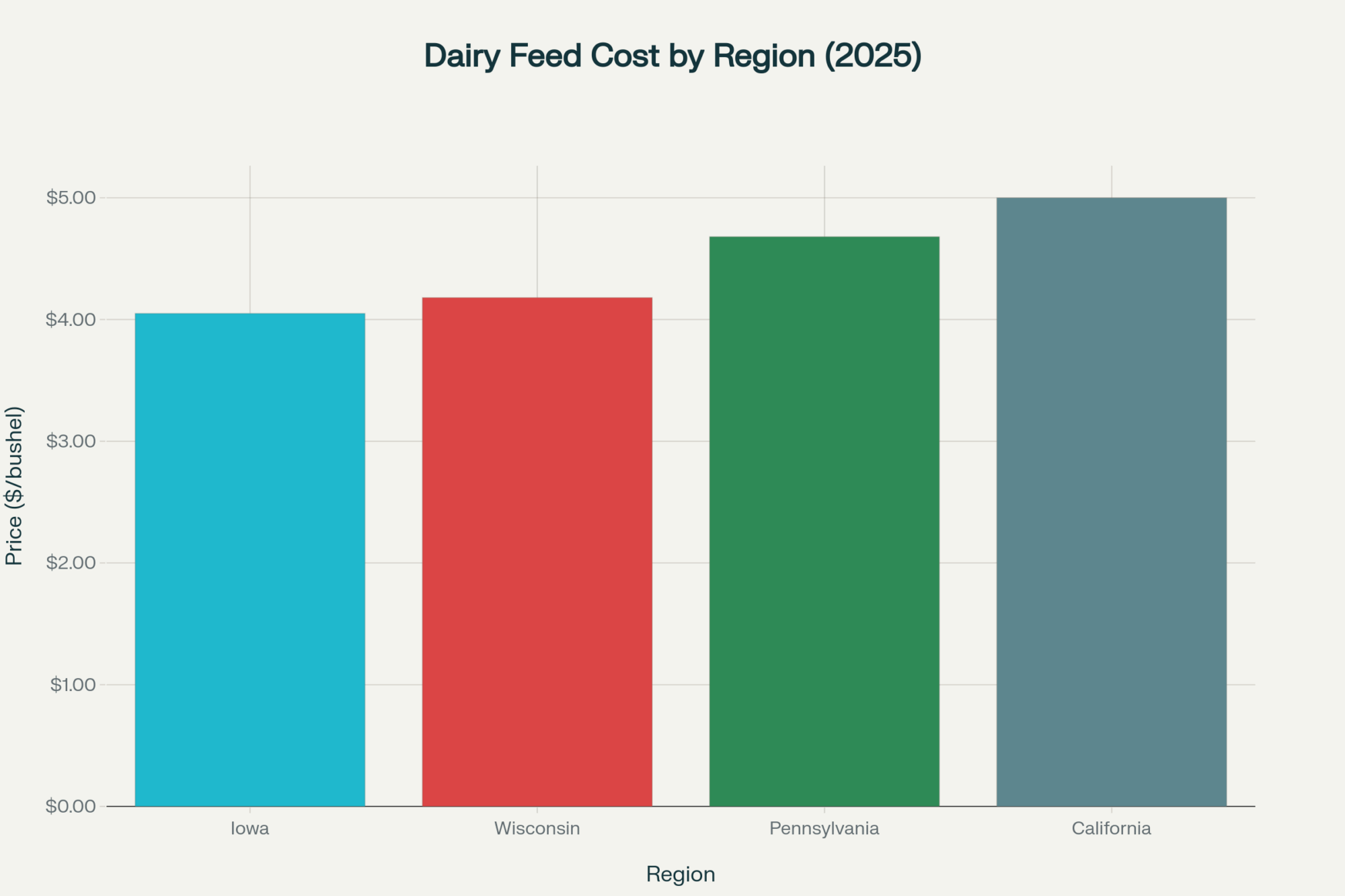
Forget China dependency. Feed efficiency data shows Mexican markets pay better margins than Asia ever did
EXECUTIVE SUMMARY: You know what’s wild? While everyone’s panicking about China cutting dairy imports by 35%, the sharp operators I know are actually making more money than ever. The old “ship everything to China” playbook is dead – and that’s creating massive opportunities for farms willing to pivot. We’re talking about Mexico paying record premiums that put an extra $2.47 billion in American pockets last year, while Southeast Asian markets are growing faster than anyone expected. Current milk prices might be sitting at $18.82/cwt (down from last year), but operations diversifying into Latin America are seeing 15-20% better margins than the China-dependent guys. The USDA’s forecasting $21.60/cwt averages for 2025, and honestly? The farms positioned in these new markets are going to crush those numbers. You should seriously look at Mexico first – 12-18 month payback beats anything China ever offered.
KEY TAKEAWAYS
Mexico’s paying 15-20% premium margins over China rates – Start trucking south instead of shipping west. With USMCA benefits and $4.07/bushel corn costs down 14%, you’ve got the margin space to make this transition work right now.
Southeast Asia wants your milk powder at 16.8% higher volumes than last year – Get Halal certification lined up now (takes 6-8 months) because Indonesia and Vietnam are buying everything they can get their hands on for their booming food processing sectors.
Risk management just became survival – Cap any single market at 25% of your volume. With Class I futures ranging $15-23.30/cwt, diversified operations are weathering volatility way better than single-market players.
Feed cost advantages won’t last forever – Use this 14% corn price break to fund market development now. Mexican relationships typically show positive ROI within 12-18 months, while Asian markets need 24-36 months to really pay off.
Technology integration is becoming table stakes – Blockchain traceability and digital verification systems are what premium export buyers expect. Get your documentation systems upgraded before your competitors do.
You know what’s got me fired up lately? The whole China situation. One day they’re buying everything we can ship, and the next… crickets. China’s dairy imports have absolutely cratered – we’re talking a 35% drop in just the first half of 2025. And while some folks are still scratching their heads trying to figure out what happened, the more strategic operations? They saw this coming months ago, and they’re already banking serious money on what’s next.
The thing is – this isn’t just another market hiccup. This is the entire global dairy trade being turned upside down, and if you’re not paying attention, you might want to start.
The Numbers Tell a Story Nobody Wants to Hear
Let me paint you a picture of what’s really happening out there. According to recent data from industry analysts, China’s total dairy imports dropped to just 2.62 million metric tons in 2024 – a significant decline from the peaks that had led many to believe the industry would continue to grow indefinitely. However, here’s where it becomes concerning: the decline reached 14.8% in 2024, and then it plummeted sharply in early 2025.
What strikes me about the product-specific data is how widespread it’s been across categories. Recent analysis shows that whole milk powder, a bread-and-butter export product, dropped 21% in just the first eight months of 2024. And infant formula? Don’t even get me started – 48.5% decline in Q1 2024 alone. When your birth rates are tanking and you’re building dairy plants left and right… well, the math isn’t complicated.
The drivers behind this retreat make sense when you think about it. China has systematically ramped up domestic production – and I mean really ramped it up. Industry reports indicate they’ve pushed self-sufficiency from 70% to 85%, which is impressive by any measure. Add in demographic headwinds affecting infant formula demand, plus the 125% tariffs on US dairy that effectively priced American suppliers out of the market… and here we are.
Why Every Producer Should Care (Even If You Don’t Export)
“I don’t export, so why should this matter to me?” – I hear this constantly at producer meetings, especially in places like Wisconsin and Pennsylvania, where guys are focused on fluid milk. Here’s why it matters: According to export data, 18% of U.S. milk production is exported to international markets. When those markets get squeezed, guess what happens to your milk check?
Current pricing data shows we’re already seeing the impact. Class I prices are currently at $18.82/cwt for July, which is $2.29 below the level we reached last year. When you’ve 18% of your milk supply suddenly competing for domestic outlets, the economics become uncomfortable quickly. (And this is hitting smaller operations harder than the big guys, from what I’m seeing.)
But – and this is where it gets encouraging – the smart money isn’t crying about China. They’re making moves in markets that’re actually growing. And some of these opportunities? They’re better than what China ever offered.
The broader Latin American story is even more compelling. Trade statistics show Latin America now accounts for 41% of US dairy exports – the highest regional share we’ve ever seen. Countries like Costa Rica, Guatemala, El Salvador… these aren’t traditional dairy powerhouses, but their growing middle classes are developing serious appetites for protein. (And the logistics are so much easier than shipping halfway around the world – something California producers are really starting to appreciate.)
The transformation of the cheese sector has been fascinating to watch. Export data indicate that American cheese exports reached 1.1 billion pounds in 2024, driven largely by Mexican demand that continues to expand. We’re talking about 36.6 million pounds in February 2025 alone – a single month record that shows no signs of slowing down.
Southeast Asia: The Opportunity Most People Are Missing
Here’s where things get really intriguing, and most producers I talk to haven’t caught on yet. While everyone’s fixated on what’s happening with China, Southeast Asia is quietly becoming the next big thing.
Recent export data shows some impressive trends. According to industry analysis, US nonfat dry milk exports to Indonesia increased 16.8% year-over-year, and Vietnam purchased 13.5 million pounds – the largest monthly volume since 2021. What’s driving this? Young populations, growing economies, rising protein consumption… all the fundamentals you want to see.
Research from Rabobank identifies the Philippines, Malaysia, Thailand, Singapore, and Vietnam as markets with serious medium-term potential. This isn’t just wishful thinking – these are real markets with real money and growing demand.
The demographic trends in Southeast Asia are compelling. You’ve got expanding middle classes, urbanization trends driving protein consumption, and – here’s the kicker – they don’t come with the regulatory hostility we’re seeing elsewhere. (Plus, they actually pay their bills on time, which is more than I can say for some other markets we’ve dealt with.)
Getting Into These Markets (It’s Trickier Than You Think)
The key aspect of market diversification is not just about finding new buyers. Each market has its own quirks, and understanding them can make or break your success. I learned this the hard way, watching some Midwest cooperatives stumble into Mexico without doing their homework first.
Mexico’s story makes sense when you break it down. Geographic proximity keeps logistics costs reasonable – we’re talking about trucking distance instead of container ships. Additionally, USMCA benefits offer genuine competitive advantages that are unlikely to disappear anytime soon. For a Wisconsin cheese plant, serving Mexico is almost like serving another US region… except with better margins.
Southeast Asian markets… that’s where it gets more complex. Industry experts suggest that Halal certification becomes essential for Muslim-majority countries like Malaysia and Indonesia. (This is becoming more common across the region, actually – even non-Muslim countries are starting to prefer Halal-certified products.) Product specifications vary dramatically as well – while China primarily wanted milk powder for reconstitution, Southeast Asian buyers often prefer shelf-stable products that can withstand tropical climates without requiring extensive cold chain infrastructure.
What’s interesting is how product preferences differ by region. Latin American markets demonstrate a strong appetite for cheese and processed products – value-added items that command better margins. Southeast Asian buyers are often seeking ingredients for their expanding food processing sectors. (The growth in their instant noodle and coffee industries is creating massive demand for dairy ingredients.)
The Risk Management Reality Check
The China experience taught us something that should have been obvious: putting all your eggs in one basket creates unacceptable vulnerability. The operations that are thriving now? They started spreading risk across multiple markets years ago. I recall speaking with a California processor back in 2019 who was already nervous about China’s dependence – the individual turned out to be a prophet.
Current risk management approaches have undergone significant evolution. Leading operations now integrate Dairy Margin Coverage programs with forward contracts and currency derivatives. When trade policies can shift overnight, like they did with China’s tariff escalations, having diversified revenue streams becomes the difference between weathering the storm and facing real operational problems.
According to industry observations, successful operations are now allocating specific percentages across various geographic regions. The rule of thumb I’m hearing? Avoid concentration above 25% in any single market. This approach provides stability when individual markets encounter bumps, while maintaining flexibility for new opportunities that arise. (Smart cooperatives are even writing this into their strategic plans now.)
What This Means for Your Operation (The Real Numbers)
Current market conditions are creating some implementation opportunities, but you must be strategic about timing. USDA forecasts indicate that in 2025, all-milk prices will average $21.60 per cwt, with export performance directly influencing what producers see in their milk checks.
Feed costs are actually helping right now – corn futures show prices down 14% year-over-year at $4.07/bushel. This creates some margin capacity for market development investments, such as certification processes, logistics infrastructure, and relationship-building activities that are essential for market entry. (With the drought conditions we’re seeing in parts of the Corn Belt, those feed cost advantages might not last forever.)
Here’s the reality about timing, though. According to industry observations, Mexican market development typically yields positive returns within 12 to 18 months, as the necessary infrastructure is already in place. Southeast Asian markets? You’re looking at 24-36 months for meaningful penetration, given regulatory complexities and the need to build distribution networks from scratch.
I was recently speaking with a cooperative manager in Wisconsin who had been working in the Southeast Asian markets for three years. “Year one was all about learning the regulations,” he told me. “Year two was building relationships. Year three is when we started seeing real volume.” That’s pretty typical, based on what I’m seeing across the industry.
Regional Differences That Actually Matter
Not all U.S. dairy regions are equally well-positioned for this transition, and that’s creating some interesting opportunities. West Coast operations have natural logistics advantages for Asian markets, including shorter shipping times and established port infrastructure. However, with Mexico driving significant growth, Midwest operations are actually gaining competitive advantages they didn’t have before.
I was recently in Minnesota, speaking with producers who have been serving the Mexican market for years. Their perspective? “It’s like having another domestic market, but with better margins.” The trucking logistics work aligns with the product preferences, and the payment terms are reliable. (Plus, they don’t have to deal with the container shortages that have been plaguing West Coast exports.)
California’s story is more complex. They’ve been heavily China-focused, especially on the powder side. However, savvy operators are already adapting. One large processor told me they’re now targeting Southeast Asian ingredient markets… “better margins, more stable relationships, and we’re not competing on price alone.” Current trends suggest this shift is accelerating as more California operations realize China isn’t coming back anytime soon.
The Northeast has been interesting to watch – many fluid milk operations that never considered exports are now exploring opportunities in cheese and powder. Vermont and New York cooperatives are starting to explore these markets… not so much for volume as for premium positioning. (Artisanal cheese exports to Latin America are growing faster than people realize.)
The Technology Angle Nobody’s Talking About
What’s particularly fascinating is how technology is changing market entry dynamics. Digital platforms are making it easier to connect with international buyers, but they’re also raising the bar on documentation and traceability. (This is becoming more common everywhere – buyers want to know exactly where their products came from.)
Blockchain-based traceability systems are becoming table stakes for premium markets. Southeast Asian buyers, especially in developed markets such as Singapore and Malaysia, are demanding the same level of transparency that they receive from domestic suppliers. The evidence suggests that this will become standard across all export markets within the next few years.
The certification landscape is also evolving rapidly. What used to take months of paperwork can now be fast-tracked through digital verification systems. But here’s the catch – you need the infrastructure in place before you can take advantage of these efficiencies. (Small cooperatives are starting to band together to share certification costs, which makes sense.)
Bottom Line: The Future Belongs to the Flexible
What’s happening right now isn’t just another market cycle – it’s a fundamental reshaping of global dairy trade. China’s retreat from dairy imports has permanently altered the competitive landscape, and exporters who recognize this reality first will own the next decade.
The opportunities are substantial if you know where to look. Mexico’s economy continues to grow, the Southeast Asian middle class is expanding at a faster rate than anywhere else on the planet, and Latin American protein consumption is rising steadily. However, here’s the key insight: these markets reward relationships, consistency, and quality, not just low prices. (Which is actually better for producers in the long run.)
For producers, this means understanding that the evolution of the export market directly impacts your milk price, even if you never ship a pound overseas. For cooperatives and processors, it means diversification isn’t just nice to have – it’s essential for survival in an increasingly volatile global market.
The dairy operations that will thrive in this new environment are building resilient business models that can sustain profitability regardless of what any single market decides to do. Start with Mexico if you haven’t already – the logistics advantages and trade benefits make it a natural first step. Build relationships in Southeast Asia for longer-term growth. And remember: successful diversification means more than just finding new customers… it’s about building a business that can prosper no matter what curveballs the global market throws your way.
The exporters who adapt fastest to this new reality will be setting milk prices for the next decade. The ones who don’t? They’ll be wondering why their margins keep shrinking while their competitors prosper.
The smart money has already moved. The question is: have you?
Complete references and supporting documentation are available upon request by contacting the editorial team at editor@thebullvine.com.
Learn More:
How the U.S. Can Become the World’s No. 1 Dairy Exporter – Reveals practical strategies for building trade relationships and developing emerging market connections, demonstrating actionable steps producers can take to capitalize on specific export opportunities and overcome regulatory barriers.
5 Technologies That Will Make or Break Your Dairy Farm in 2025 – Explores cutting-edge farm technologies that boost efficiency and quality standards necessary for competing in demanding international markets, showing how tech adoption creates competitive advantages in export positioning.
Join the Revolution!
Join over 30,000 successful dairy professionals who rely on Bullvine Weekly for their competitive edge. Delivered directly to your inbox each week, our exclusive industry insights help you make smarter decisions while saving precious hours every week. Never miss critical updates on milk production trends, breakthrough technologies, and profit-boosting strategies that top producers are already implementing. Subscribe now to transform your dairy operation’s efficiency and profitability—your future success is just one click away.
2025’s dairy crisis is coming. Will your farm survive? Discover the risk management strategies separating thriving dairies from failing ones.
Is your dairy operation truly prepared for the storm that 2025 is brewing? Or are you still hoping yesterday’s playbook will see you through today’s volatility? Let’s cut to the chase: the difference between thriving and barely surviving this year will come down to how you manage risk-not just in theory, but in the gritty reality of your daily decisions.
The 2025 Dairy Risk Landscape: A Confluence of Pressures
Let’s be honest-2025 isn’t the year to wing it. We’re staring down a perfect storm: milk prices are as unpredictable as a fresh heifer, feed costs are one drought away from spiking, and the threat of Highly Pathogenic Avian Influenza (HPAI) is lurking in the background. Add in labor shortages, shifting consumer demands, and regulatory curveballs, and you’d have to be milking with your eyes closed not to see the risks.
Are you really willing to bet your farm’s future on a single forecast or a “wait and see” approach?
Milk and feed markets are volatile – and as a result, on-farm margins can swing widely. And, when considering hedging strategies, the best time to secure milk prices might not be the same as the time lock in feed costs. And, with the news constantly changing, it’s hard to keep track of all the market drivers. As such, working with a trusted risk management team is the cornerstone of a successful hedging program.
Let’s face it-hoping for the best is not a strategy. The USDA’s all-milk price forecast has already been revised downward to $21.10/cwt, and feed costs, while projected to ease, remain one bad weather event away from chaos. If you’re not layering your risk management tools, you’re playing Russian roulette with your bottom line.
Your Financial Toolkit-Are You Using All the Tools?
Dairy Margin Coverage (DMC): This is your foundation. It’s triggered payments in 66% of months since 2018, and it’s cheap insurance against margin collapse.
Dairy Revenue Protection (DRP): Lock in revenue floors when the market gives you a chance. DRP is flexible and subsidized-don’t leave this tool in the shed.
Livestock Gross Margin (LGM-Dairy): Layer this with DMC for extra protection, especially if your margins track Class III/corn/soybean meal futures.
Forward Contracts (DFPP): If your handler offers them, use them to lock in prices for a portion of your milk.
Futures and Options: For those comfortable with the CME, these tools let you hedge both milk and feed, but don’t forget the margin calls.
Every dairy is different – so there’s no one size fits all approach. It’s important to work with an experienced risk management team that understands your risks and can help you pick the right tools to protect against volatility. And, it’s not just one and done – with changing markets, the ideal strategy changes too. So it’s an important to have a trusted advisor watching out for your dairy.
Don’t wait for the “perfect” price. Lock in protection when you can.
Securing Your Production: Disease and Climate Challenges
How robust is your biosecurity-really? If HPAI or another disease hits your herd, will your protocols hold up, or are you just checking boxes?
Biosecurity: Pasteurize all milk and colostrum, quarantine new animals, sanitize equipment like your operation depends on it-because it does.
Climate Adaptation: Are you investing in fans, sprinklers, and shade, or just hoping for a cool summer? Are you optimizing irrigation and planting drought-tolerant forages, or gambling with your feed supply?
Will you be caught off guard by the next heatwave or disease outbreak, or will your herd keep producing while others scramble?
Robotic Milking Systems: Cut labor by 60-75%. Yes, it’s a big investment, but so is losing your best employee during corn silage.
Automated Feeding and Wearable Sensors: Save time, spot health problems early, and let your best people focus on what matters.
Precision Feeding: Are you still eyeballing rations, or using data to drive decisions? The difference is $0.75 to $1.50/cwt in production costs.
Every dollar you save on feed or labor is a dollar you keep when prices drop.
Adapting to Market Shifts
Are you producing what the market wants, or what you’ve always produced? Consumer trends are shifting. If you’re not focusing on milk components, sustainability, and animal welfare, you’re leaving money on the table. On-farm processing, agritourism, beef-on-dairy, renewable energy-these aren’t just buzzwords. They’re proven ways to spread risk and capture new income. Have you diversified your revenue streams?
Staying informed on policy and regulation: Farm Bill, FMMO, environmental and animal welfare standards.
The Bullvine Bottom Line
Let’s not sugarcoat it: many dairies won’t survive this decade-not because they aren’t good farmers, but because they’re poor risk managers. Are you one of them?
The dairies that thrive will be those that are vigilant, adaptable, and relentless about improvement. They’ll use data, technology, and financial discipline to stay ahead. They’ll be honest about their weaknesses and ruthless about fixing them.
Don’t wait for a crisis to rethink your approach. Schedule a risk management audit with your team and your Ever.Ag advisor. Identify your vulnerabilities. Build a plan. Act.
What action will you take today to secure your dairy’s future tomorrow?
Key Takeaways:
Layer financial protections: Combine DMC, DRP, and forward contracts to hedge against price collapses
Automate or stagnate: Robotics and sensors cut labor costs by 60%+ while improving herd health monitoring
Secure feed strategically: Lock in 60-70% of needs during price dips but preserve flexibility
Biosecurity = profitability: HPAI protocols prevent outbreaks that could cripple production
Milk components matter: Prioritize butterfat/protein to capture premiums in shifting markets
Executive Summary:
Dairy producers face unprecedented volatility in 2025 from market swings, HPAI threats, climate disruptions, and labor shortages. This article outlines essential strategies including layered financial protections (DMC, DRP, forward contracts), biosecurity overhauls, climate-resilient practices, and labor-saving automation. Emphasizing data-driven decisions and proactive risk management, it challenges farmers to abandon outdated approaches and adopt precision feeding, market diversification, and rigorous financial planning. Expert insights from Ever.Ag‘s Jim Matthews stress decisive action over wishful thinking, arguing that survival depends on embracing technology and strategic contracting rather than relying on tradition.
Join over 30,000 successful dairy professionals who rely on Bullvine Weekly for their competitive edge. Delivered directly to your inbox each week, our exclusive industry insights help you make smarter decisions while saving precious hours every week. Never miss critical updates on milk production trends, breakthrough technologies, and profit-boosting strategies that top producers are already implementing. Subscribe now to transform your dairy operation’s efficiency and profitability—your future success is just one click away.
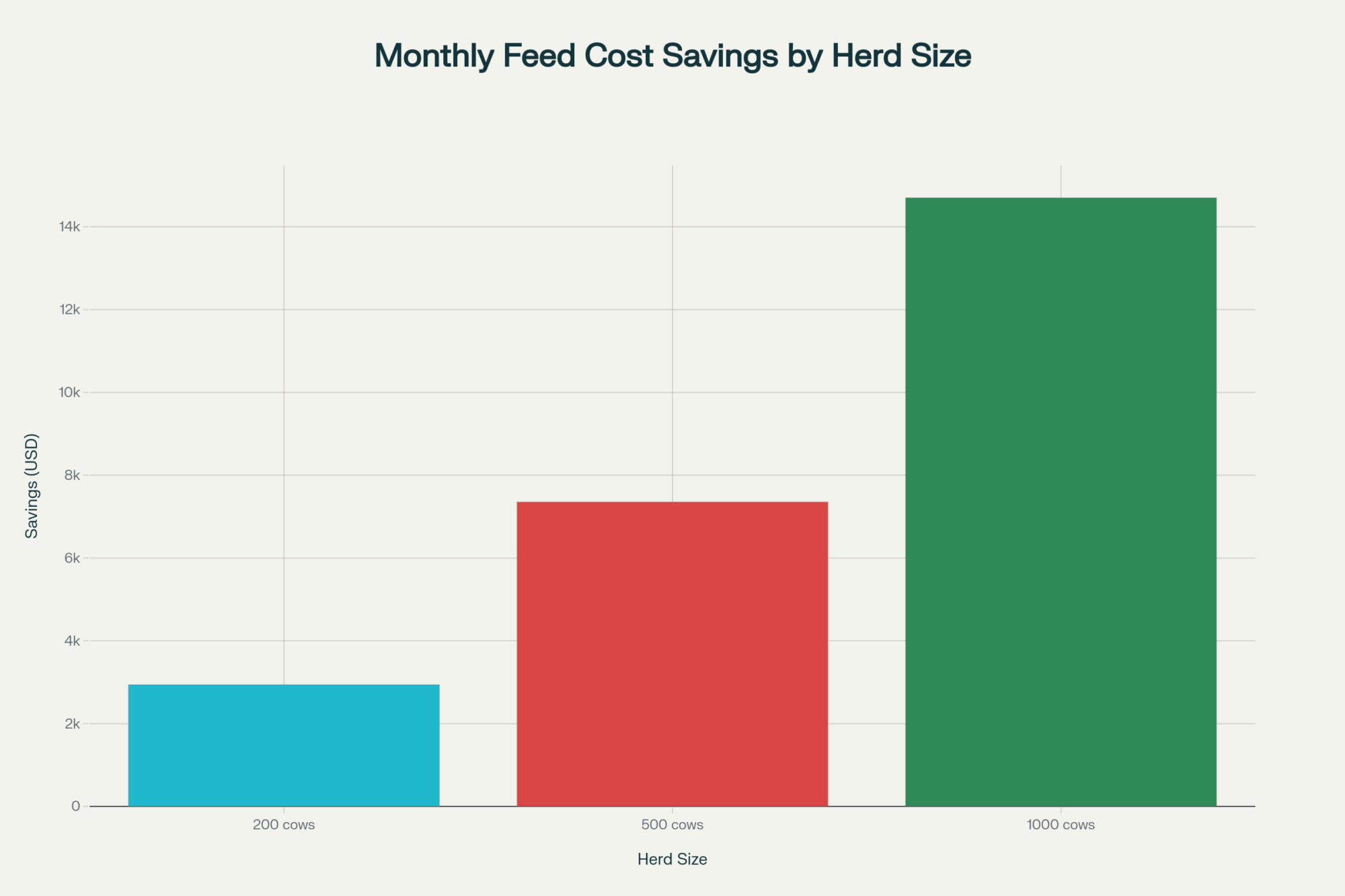
Discover practical risk management strategies for US dairy farmers in our comprehensive guide. Can you afford not to safeguard your dairy farming business?
As a dairy producer, managing risk is undoubtedly one of your top considerations. Perhaps you’ve even found yourself losing sleep to thoughts of fluctuating milk prices or sudden changes in government regulations. If that’s the case, you’re not alone. Every facet of dairy farming harbors potential risk, some within your control, and others far beyond it.
Fretting over milk price volatility might sound all too familiar. However, it’s important to realize that it’s a risk that can be managed to some extent. There are various available programs—like the dairy margin coverage, dairy revenue protection, and livestock gross margin – dairy—to assist in milk marketing, which can help curtail the effects of price fluctuations.
“Year 2023 exemplified this volatility, with milk prices plummeting during the summer before rebounding in the fall. Operations with robust risk management strategies in place not only safeguarded their bottom line but also ensured profitability. The key is not to rely solely on hopeful price stability, which is an ineffective strategy.”
Instead, establishing the true cost of production should form the cornerstone of a solid risk management plan. This approach allows you to secure margins and ensure profitability by facilitating rational, emotion-free decision-making. It’s clear that in today’s commodity markets—which inherently exhibit high volatility—a thorough understanding of production costs and the adept management of these risks can make the difference between profitability and losses.
Now, more than ever, leveraging multiple risk management tools together can provide solid milk price protection, making active milk price risk management a critical focus for every dairy producer.
Dairy Margin Coverage
When considering methods to effectively manage your dairy farm’s risks, the Dairy Margin Coverage (DMC) program stands out as a particularly attractive option. Offered through your local USDA Farm Service Agency (FSA) office, DMC can function as a crucial part of your dairy farm’s risk management toolkit, regardless of production size.
At its core, DMC serves to suppress the margin between the all-milk price and the average feed price, all at a margin threshold set by you, the producer. Contribution to peace of mind can come in the form of Tier 1 coverage, where you can insure up to 5 million pounds of your milk production for a margin level of $9.50 per hundredweight (cwt). Considering this adjustable protection, the cost of coverage can be seen to be reasonable amidst potential market instabilities.
Need more extensive coverage? Tier 2 comes into play here offering additional coverage beyond the 5 million pound limit, albeit at a slightly higher price. It’s important to remember that DMC payments are calculated monthly, ensuring more frequent compensation. While Tier 1 coverage promises reliable refuge in the event of catastrophic market circumstances, dairy operations churning out more than 5 million pounds of milk annually might find it beneficial to explore supplemental risk management strategies.
Forecasts hint at the possibility of tighter margins on the horizon for 2023, making risk management an even more pressing concern for dairy farmers. Therefore, having a dynamic and tailored risk management plan in place, with DMC constituting a core tool, can help ensure profitability and resilience in the fluctuating dairy markets.
Dairy Revenue Protection
While Dairy Margin Coverage (DMC) provides a first level of protection, Dairy Revenue Protection (DRP), or Dairy-RP, serves as another powerful instrument for dairy farmers to manage milk price risk. This particular approach allows producers to safeguard against potential declines in milk prices across quarterly periods. The anticipated revenue under this plan is heavily influenced by both futures prices for milk, as well as those of dairy commodities. Moreover, the level of coverage chosen by the producer plays a crucial role in this strategy.
When leveraging DRP, producers are given the freedom to select coverage centered around class milk price options or commodity price options. Moreover, this flexibility extends to the amount of anticipated milk revenue a producer can cover. With DRP, producers can be confident in shielding up to an impressive 95% of their predicted milk revenue. This level of protection holds steadfast, regardless of the milk prices that processors will ultimately pay out.
An essential feature of DRP is its focus on quarterly loss calculations. This facet of the program allows producers to counteract potential losses incurred within a specific month effectively. Fundamentally, DRP establishes a ‘price floor’ for insured pounds of milk. This floor safeguards producers while simultaneously leaving room for them to capitalize on any potential rises in market prices.
Diversification is key when managing risk. With this in mind, many savvy producers strategically combine DRP with DMC, successfully uniting these two tools in their milk price risk management arsenal. This fusion of strategies ensures that producers can not only survive but thrive, amidst market fluctuations and industry uncertainties.
Livestock Gross Margin Dairy
Delving deeper into the realm of dairy risk management, we come across the Livestock Gross Margin Dairy (LGM-Dairy), a tool that hinges on a more complex strategy compared to the DMC and DRP. Intriguingly, the LGM-Dairy leverages future of prices commodities like corn, soybean meal, and milk to forecast gross revenue. This projected revenue is then juxtaposed with the actual gross margin, and the difference—or lack thereof—informs the extent of indemnity payments. Notably, the pricing is hinged on the simple average of daily settlement prices for these commodities on the Chicago Mercantile Exchange.
It’s crucial to note that as a producer, you must insure a minimum of two months within an 11-month insurance period to qualify for program subsidies. Additionally, computations for the gross margin involve a fixed per-hundredweight deductible and the feed cost. If your actual gross margin plunges below the expected gross margin—after deducting the deductible—for the insurance period, then you may be eligible for indemnity payments.
What’s more, the LGM-Dairy program allows for a high level of flexibility. Producers have the chance to enroll in LGM-Dairy on a weekly basis. Not only that, it affords you the convenience of concurrently ensuring your milk under both the DMC and LGM-Dairy.
Additionally, there’s room for integration with your existing risk management tools—you can harmonize LGM-Dairy and DRP in the same crop fiscal year. This, however, comes with a clause: only one policy, either LGM-Dairy or DRP, can be reinforced with endorsements for a specified quarterly insurance period. Furthermore, the trio—DMC, DRP, and LGM-Dairy—can potentially supplement direct contracts with milk processors, paving the way for dairy operations to lock-in prices per hundredweight.
Lastly, consider exploring futures and options trading to take your risk management strategies further. This additional technique could potentially fortify your farm’s financial equation and make it more resilient in the face of volatile market conditions.
Risk management plans are not one-size-fits-all
Risk management for dairy farmers isn’t a universal answer that fits every dairy farm’s unique situation. Each dairy enterprise needs to evaluate its specific risks and then define its priorities accordingly. With the continued unpredictability in commodity markets, it’s crucial to take income risk seriously. Thankfully, there is an array of tools available to help curb milk price volatility.
By strategically harnessing a mix of Dairy Margin Coverage (DMC), Dairy Revenue Protection (DRP), Livestock Gross Margin Dairy (LGM-Dairy), direct contracting, and futures and options trading, dairy farmers can efficiently curtail milk pricing risk and bring down some of the instability. The positive outcome? This assures that your bills are paid timely, promoting a healthy environment for future triumphs. It brings a sense of security, much like insuring your barns, vehicles, tractors, and crops.
Consider this: Insuring your income through these mechanisms is as judicious as insuring your tangible assets. Think of these tools as your farm’s safety net, ready to break any financial fall. They aren’t there just for the bounce; they’re there to catch you, to propagate resilience, and instill a sense of certainty in a world of unknowns.
The Bottom Line
In essence, effective risk management for dairy farmers goes beyond mere financial instruments. It constitutes a blend of understanding cow behavior, employing effective processing methods, utilizing cover crops and joining cooperatives for smaller contracts. In an unknown marketplace that teeters on the edge, due to factors like high inflation, economic instability, risk of recession, and global conflicts, it’s crucial to have strategies in place to lessen potential blows. Despite the projected drop in prices and demand after holiday seasons, targeted strategies coupled with an above 70% goal can ensure sustained growth and productivity in your dairy farm business. Always remember, varied solutions are the pathway to resilience in this unpredictable industry.
Summary: Milk price volatility is a significant risk for dairy producers, necessitating effective risk management strategies. Dairy Margin Coverage (DMC) is an attractive option for dairy farmers, suppressing the margin between the all-milk price and the average feed price. Tier 1 coverage offers up to 5 million pounds of milk production at a margin level of $9.50 per hundredweight (cwt), while Tier 2 offers additional coverage beyond the 5 million pound limit. For dairy operations producing more than 5 million pounds of milk annually, exploring supplemental risk management strategies may be beneficial. Dairy Revenue Protection (DRP) or Dairy-RP is another powerful instrument for dairy farmers to manage milk price risk. It allows producers to safeguard against potential declines in milk prices across quarterly periods, heavily influenced by futures prices for milk and dairy commodities. Livestock Gross Margin Dairy (LGM-Dairy) is a complex tool used in dairy risk management that uses future prices of commodities like corn, soybean meal, and milk to forecast gross revenue. It offers high flexibility, allowing producers to enroll weekly and simultaneously ensure their milk under both the DMC and LGM-Dairy.
To provide the best experiences, we use technologies like cookies to store and/or access device information. Consenting to these technologies will allow us to process data such as browsing behavior or unique IDs on this site. Not consenting or withdrawing consent, may adversely affect certain features and functions.
Functional
Always active
The technical storage or access is strictly necessary for the legitimate purpose of enabling the use of a specific service explicitly requested by the subscriber or user, or for the sole purpose of carrying out the transmission of a communication over an electronic communications network.
Preferences
The technical storage or access is necessary for the legitimate purpose of storing preferences that are not requested by the subscriber or user.
Statistics
The technical storage or access that is used exclusively for statistical purposes.The technical storage or access that is used exclusively for anonymous statistical purposes. Without a subpoena, voluntary compliance on the part of your Internet Service Provider, or additional records from a third party, information stored or retrieved for this purpose alone cannot usually be used to identify you.
Marketing
The technical storage or access is required to create user profiles to send advertising, or to track the user on a website or across several websites for similar marketing purposes.
To provide the best experiences, we and our partners use technologies like cookies to store and/or access device information. Consenting to these technologies will allow us and our partners to process personal data such as browsing behavior or unique IDs on this site and show (non-) personalized ads. Not consenting or withdrawing consent, may adversely affect certain features and functions.
Click below to consent to the above or make granular choices. Your choices will be applied to this site only. You can change your settings at any time, including withdrawing your consent, by using the toggles on the Cookie Policy, or by clicking on the manage consent button at the bottom of the screen.
Functional
Always active
The technical storage or access is strictly necessary for the legitimate purpose of enabling the use of a specific service explicitly requested by the subscriber or user, or for the sole purpose of carrying out the transmission of a communication over an electronic communications network.
Preferences
The technical storage or access is necessary for the legitimate purpose of storing preferences that are not requested by the subscriber or user.
Statistics
The technical storage or access that is used exclusively for statistical purposes.The technical storage or access that is used exclusively for anonymous statistical purposes. Without a subpoena, voluntary compliance on the part of your Internet Service Provider, or additional records from a third party, information stored or retrieved for this purpose alone cannot usually be used to identify you.
Marketing
The technical storage or access is required to create user profiles to send advertising, or to track the user on a website or across several websites for similar marketing purposes.