New SNAP bill could put $2.4B/year in dairy farmers’ pockets while fixing America’s nutrition gap. Here’s how to cash in.
EXECUTIVE SUMMARY: The bipartisan Dairy Nutrition Incentive Program Act proposes dollar-for-dollar SNAP matches for milk, cheese, and yogurt purchases, potentially boosting farm revenues by $1.20/cwt while addressing America’s 90% dairy consumption gap. Backed by major industry groups and 40+ lawmakers, the bill modernizes outdated nutrition policies by including whole milk and leveraging successful state models like Michigan’s 27% dairy sales surge. With Farm Bill reauthorization looming, farmers are urged to contact legislators by May 1 to secure this $2.4B/year market expansion that ties farm profits directly to public health outcomes.
KEY TAKEAWAYS:
Market Game-Changer: 40M SNAP users could drive $6.2B/year in dairy sales via app-based rebates
Policy Shift: First federal recognition of whole milk’s value since 1980s nutrition guidelines
Profit Potential: Projects +$1.20/cwt milk price support and 4.7% processor demand growth
Proven Model: Michigan’s incentive program boosted dairy sales 27% at participating stores
Act Now: Critical May 1 deadline to influence Farm Bill inclusion
Let’s cut to the chase – the Dairy Nutrition Incentive Program Act isn’t just another Washington talking point. It’s potentially the most significant dairy market expansion opportunity we’ve seen in decades. Introduced by Senators Amy Klobuchar (D-MN) and Roger Marshall (R-KS) last month, this bill would match SNAP dollars spent on milk, cheese, and yogurt, doubling consumer purchasing power for our products.
Why you should care: Those 40 million SNAP recipients represent about 20% of all U.S. food sales. This legislation could pump $2.4 billion annually into dairy cases nationwide. As Wisconsin producer Sarah Thompson told me last week, “After three brutal years of barely breaking even, this could finally mean stable prices for my 500-cow operation while getting good food to families who need it.”
WHAT’S ACTUALLY IN THIS BILL?
From School Milk to Your Milk
The bill builds on the 2018 Farm Bill’s Healthy Fluid Milk Incentive (HFMI) program that’s already helped 340,000 SNAP families buy more dairy. The new provisions would:
Finally, include whole milk: End decades of the feds pushing only low-fat options
Add cheese and yogurt: Dollar-for-dollar matches at 250,000+ retail stores
Modernize the system: Replace paper coupons with app-based rebates
Senator Marshall (a doctor) didn’t mince words: “We have a generation who didn’t drink much milk growing up, and now we’re seeing osteoporosis a decade earlier than previous generations.”
This marks a huge shift from the old federal nutrition programs that treated butterfat like poison. The science has finally caught up to what dairy farmers have known – dairy fat isn’t the enemy.
THE NUMBERS THAT MATTER
Metric
Current Status
Post-Bill Projection
SNAP dairy sales
$3.8 billion/year
$6.2 billion/year
Farm milk price support
$18.50/cwt
+$1.20/cwt margin
Processor demand
2.1% annual growth
4.7% annual growth
Sources: IDFA, NMPF, USDA ERS
Mike Dykes from IDFA calls this “a reliable investment in improving our nation’s health while reducing hunger.” Translation: more sales for us, better nutrition for consumers.
Gregg Doud at National Milk says, “Nearly 90 percent of Americans don’t get enough dairy. This fixes that problem.”
WHAT YOU SHOULD DO RIGHT NOW
Call your House Ag Committee rep before May 1 – Get this into the Farm Bill extension
Talk to your co-op or processor – Make sure they’re ready for increased whole milk demand
Connect with local grocery stores – They’ll need to understand how the program works
The timing couldn’t be better – the 2018 Farm Bill extension runs out on September 30, 2024. This gives us a perfect vehicle to get this program approved.
Senator Marshall thinks both this bill and the Whole Milk for Healthy Kids Act (from House Ag Chair Glenn “GT” Thompson) will “get across the finish line this session.” The Senate Ag Committee just held hearings on getting whole milk back in schools, so momentum is building.
THIS WORKS – JUST ASK MICHIGAN
Michigan’s Double Up Food Bucks program has proved that this concept works. Dairy sales jumped 27% at participating stores. Detroit grocer Luis Torres told me, “We went from just moving milk to building real customer loyalty.”
In 2021 alone, that program helped 759,000 families spend $20 million on healthy foods – an 85% increase from the year before.
Unlike other government programs that restrict what people can buy, this one encourages better choices. Jennifer Hatcher from the Food Industry Association says it “empowers retailers to help families incorporate more dairy alongside fruits and vegetables.”
WHO’S BACKING THIS?
Pretty much everyone who matters in dairy:
International Dairy Foods Association
National Milk Producers Federation
FMI – The Food Industry Association
National Grocers Association
Associated Milk Producers Inc.
Dairy Institute of California
Northeast Dairy Foods & Suppliers Associations
Dairy Products Institute of Texas
Wisconsin Cheese Makers Association
When was the last time you saw all these groups agree on anything?
BOTTOM LINE
This bill bridges the gap between USDA’s dietary guidelines and what’s happening on our farms. With 90% of Americans not getting enough dairy, this positions us as the solution rather than the problem.
Do these three things:
Today: Download IDFA’s advocacy toolkit at idfa.org/dairynourishes
This week: Get your co-op board talking about this at your next meeting
By May 1: Call your senator’s office using the talking points from IDFA
As Mike Dykes puts it: “This isn’t about handouts—it’s about handshakes between dairy farms and the families we feed.”
This isn’t just about selling more products next quarter for dairy farmers. It’s about rebuilding dairy’s place in American diets for generations. As Michigan producer Torres told me last week: “When good policy meets good nutrition and farm economics, we all win.”
The bill’s moving through Congress now. Make sure your voice is heard so this thing becomes reality.
Join over 30,000 successful dairy professionals who rely on Bullvine Daily for their competitive edge. Delivered directly to your inbox each week, our exclusive industry insights help you make smarter decisions while saving precious hours every week. Never miss critical updates on milk production trends, breakthrough technologies, and profit-boosting strategies that top producers are already implementing. Subscribe now to transform your dairy operation’s efficiency and profitability—your future success is just one click away.
Trump’s $998/day migrant fines could spike milk prices 90% and collapse dairy farms. The shocking math behind America’s coming milk crisis.
EXECUTIVE SUMMARY: The Trump administration’s plan to impose $998 daily fines on migrants facing deportation orders threatens to cripple the U.S. dairy industry, which relies on immigrant labor for 51% of its workforce and 79% of national milk production. Economic models project catastrophic impacts: 2.1 million cows lost, 7,000 farm closures, and milk prices nearly doubling to $7.60/gallon. Major dairy states like Wisconsin (70% immigrant labor) face existential risk, while proposed tech solutions like robotics remain cost-prohibitive for most operations. With simultaneous threats from potential dairy export tariffs, the industry demands immediate congressional action on year-round agricultural visas to avoid economic collapse.
KEY TAKEAWAYS:
Labor Apocalypse: 51% of dairy workers are immigrants producing 79% of U.S. milk – removal risks industry collapse
$7.60 Milk Reality: 90.4% price spike predicted if policies trigger full labor exodus
State-Specific Crisis: WI (70%), NY (61%), and CA (50%) immigrant labor rates make regional collapses likely
Tech Won’t Save Us: $250k robotic milkers remain unaffordable for most farms facing labor shortages
DC Deadline: Congress has <2 years to create ag visas or face permanent dairy industry shrinkage
Trump’s $998 daily migrant fines aren’t just tough talk—they’re a potential extinction event for America’s dairy industry. With plans to slam migrants who overstay deportation orders with crippling daily penalties, the administration has fired the opening salvo in what could become dairy’s most catastrophic labor crisis ever. For 30,000+ dairy operations already walking a financial tightrope, this immigration crackdown could drain the workforce that keeps milk flowing to American tables.
The Financial Guillotine for Migrant Workers
The Trump administration is wielding a rarely used 1996 immigration law like a sledgehammer against migrants who’ve received deportation orders but remain in the U.S. At $998 per day, these penalties aren’t just punitive—they’re financially devastating. What’s more shocking: these fines could apply retroactively over five years, potentially burying individuals under $1.8 million in penalties.
For the immigrant workers who form the backbone of America’s dairy operations, these fines create an environment of economic terror across the farm country, mainly as officials openly discuss asset seizure for non-payment.
Projected Impacts of 100% Immigrant Labor Loss
Metric
Impact
U.S. Dairy Herd Reduction
2.1 million cows (-23% of total herd)
Annual Milk Production Loss
48.4 billion lbs (-26% output)
Farm Closures
7,011 operations (-23% total)
Retail Milk Price Increase
90.4% ($4→$7.60/gal)
U.S. Economic Output Loss
$32.1 billion
Based on a 2015 study by the National Milk Producers Federation (NMPF), these projections paint a stark picture of the potential devastation facing the dairy industry. As we approach 2026, these figures are likely conservative estimates given the industry’s continued reliance on immigrant labor.
Why Dairy Farms Are Ground Zero for Immigration Fallout
Dairy farming faces a unique labor crisis that seasonal agriculture doesn’t: milk production runs 24/7/365, making the H-2A temporary visa program completely useless for dairy producers. This isn’t just an inconvenience—it’s a fundamental mismatch between immigration law and dairy’s operational reality.
The numbers tell the devastating story:
Immigrant labor accounts for 51% of the entire dairy workforce
Farms employing these workers produce a staggering 79% of America’s milk supply
Without this workforce, dairy production would functionally collapse overnight
“Many jobs in farming and food processing are not seasonal and thus can’t use the H-2A program at all—which is why dairy farmers need another approach, not one centered on reforming H-2A,” explains the National Milk Producers Federation.
The Labor Gap No American Is Filling
Despite offering competitive wages well above minimum wage, dairy farms consistently struggle to attract domestic workers to these demanding positions. The hard truth is that these are essential jobs that local workers simply aren’t taking, regardless of pay rate or benefits.
2024 Average Dairy Worker Compensation
Metric
Farms Using Immigrant Labor
Farms Without Immigrant Labor
Hourly Wage
$16.75
$14.20
Annual Benefits Value
$12,400
$8,950
Retention Rate
78%
63%
“Immigrants supply at least half of hired labor for the dairy industry,” notes agricultural economist Joseph Glauber. “Most of these workers may be undocumented, and that could cause a real issue.”
The Economic Doomsday Scenario: Hard Numbers
University economists have modeled what would happen if Trump’s deportation machine operated at full capacity. The projections are catastrophic:
Herd Decimation: America would lose 2.1 million dairy cows—equivalent to erasing the entire dairy herds of multiple states
Production Collapse: Milk output would plummet by 48.4 billion pounds annually
Mass Farm Failures: Over 7,000 dairy operations would permanently close their gates
Price Explosion: Retail milk prices would skyrocket by 90.4%—turning your $4 gallon into $7.60 overnight
Economic Implosion: U.S. economic output would shrink by $32.1 billion
Job Evaporation: 208,000 positions would vanish—not just on farms but throughout the dairy supply chain
These aren’t speculative numbers but economic modeling from respected agricultural economists at major research institutions.
Dairy States on the Firing Line: Regional Impact
While the pain will spread nationwide, some dairy regions face particularly devastating impacts:
2025 State-Level Labor Reliance
State
Immigrant Labor %
Milk Production Share
Economic Value at Risk
Wisconsin
70%
14% of U.S. total
$6.1 billion
California
50%
19% of U.S. total
$8.3 billion
New York
61%
7% of U.S. total
$2.9 billion
Wisconsin’s Dairy Armageddon
In America’s Dairyland, immigrant labor isn’t just necessary—it’s the lifeblood of the industry. More than 10,000 undocumented workers perform an estimated 70% of Wisconsin’s dairy labor. The School for Workers at the University of Wisconsin-Madison puts it bluntly: “Without them, the whole dairy industry would collapse overnight.”
Wisconsin’s identity and economy are so intertwined with dairy that this labor disruption threatens not just an industry but an entire cultural heritage and economic ecosystem.
New York’s Dairy Anxiety Wave
New York’s dairy sector is experiencing “significant anxiety” as farmers prepare for potential enforcement actions. Many operations express paralyzing uncertainty about their ability to maintain production if immigration enforcement intensifies, creating an environment where long-term business planning becomes nearly impossible.
California’s Massive Vulnerability
The labor situation is equally precarious in California, the nation’s largest agricultural producer with its $43.5 billion farm industry. With deportation threats looming, dairy operations throughout the state are questioning their fundamental ability to maintain production schedules.
The Technology Reality Check
Some industry observers point to robotics and automation as potential saviors, but here’s the harsh reality check: while technology helps, it can’t fully solve the problem.
At the 2024 World Dairy Expo, 41% of agribusiness attendees showed interest in robotic milking systems, reflecting the industry’s desperate search for labor solutions. However, academic research published in the American Journal of Agricultural Economics found that “the shift toward technology did not fully compensate for the shortfall in labor. As a result, the total output of affected farms declined, as did the number of diary operations and the average size of farms in labor-impacted regions”.
That $250,000 robotic milker might look appealing on paper, but the average dairy farm operating on thin margins represents a potentially bankrupting investment—especially with simultaneous export market threats.
The Trade War Double Whammy
The labor crisis couldn’t come at a worse time, as Trump simultaneously threatens 25% tariffs on Mexico and Canada—where a substantial portion of U.S. dairy exports currently flow. Mexico represents the largest export market for U.S. dairy products, buying approximately 25% of exports.
This creates a perfect storm: higher production costs due to labor shortages colliding with shrinking export markets due to tariffs. If Mexican buyers face steep tariffs on U.S. dairy, they’ll pivot to other global suppliers, leaving American producers with excess products and collapsing prices.
Worker Retention Strategies That Work
Forward-thinking dairy operations are getting serious about worker retention. Farms implementing comprehensive workforce development models report 22% higher retention within 18 months—a critical advantage in today’s labor market.
Leading operations now offer competitive benefits packages:
Paid Vacation Leave (75.9% of farms)
Housing Allowance (73.0%)
Health Insurance (58.1%)
Retirement Plans (5.4%)
These investments in labor aren’t just feel-good measures—they’re survival strategies in an increasingly competitive agricultural labor market.
What Washington Must Deliver—Now
The dairy industry is advocating for immediate policy solutions. The National Milk Producers Federation has outlined a two-pronged approach:
Provide permanent legal status to current dairy workers and their families
Create a viable guest worker program designed explicitly for year-round agricultural labor
“We have always encouraged farmers only to employ dairy workers with proper documentation, and we know they make every effort to do that. When workforce disruptions occur, we’ve seen dairy farms work together to ensure that farms have sufficient labor to continue providing nutritious, wholesome milk for consumers,” notes NMPF representative Jaime Castaneda.
The Bottom Line: America’s Dairy Future Hangs in Balance
If aggressive deportations proceed without agricultural labor solutions, American consumers will face a fundamentally altered dairy landscape by 2026:
America is becoming a net dairy importer rather than an exporter
Thousands of rural communities losing their primary employer
This isn’t about immigration politics but the survival of a foundational American industry. The stark choice facing policymakers is to create functional agricultural labor programs that recognize dairy’s unique needs or watch as one of America’s signature industries collapses.
Either Congress creates a viable year-round agricultural visa program, or we’d better get used to imported milk—and the gutting of rural America that comes with it. The clock is ticking on every dairy farm across the nation.
Join over 30,000 successful dairy professionals who rely on Bullvine Daily for their competitive edge. Delivered directly to your inbox each week, our exclusive industry insights help you make smarter decisions while saving precious hours every week. Never miss critical updates on milk production trends, breakthrough technologies, and profit-boosting strategies that top producers are already implementing. Subscribe now to transform your dairy operation’s efficiency and profitability—your future success is just one click away.
84% tariffs slam U.S. dairy exports to China. Why can’t farmers capitalize on China’s milk shortage despite crashing prices & production?
EXECUTIVE SUMMARY: China’s dairy production is plummeting (-9.2% in 2025), but U.S. farmers face insurmountable barriers: 84% retaliatory tariffs, New Zealand’s duty-free dominance, and China’s lactose-intolerant population. While milk prices crashed by 15% and skim powder production dropped by 30%, structural issues like shrinking birth rates and economic stagnation limit demand. With FTAs favoring competitors and trade tensions escalating, experts urge dairy producers to pivot to Mexico, Southeast Asia, and value-added niches instead of chasing China’s shrinking market.
KEY TAKEAWAYS:
84% tariffs make U.S. dairy exports to China 104% more expensive than New Zealand’s duty-free shipments.
New Zealand controls 46% of China’s import market—their FTA advantage is irreversible without policy shifts.
China’s milk consumption growth is capped by lactose intolerance (87% in teens) and declining birth rates.
Diversify or die: USDA grants and co-ops offer lifelines for exploring Latin America, MENA, and specialty markets.
Economic headwinds (real estate crisis, youth unemployment) slash Chinese spending on “non-essential” dairy.
China’s dairy sector is shrinking fast, with milk collections down 9.2% in early 2025 compared to last year. Milk prices have dropped 15%, and skim milk powder production has plummeted by more than 30%. While this might sound like an opportunity for U.S. dairy exports, the reality is much more brutal.
Why China’s Dairy Market is Shrinking
After years of pushing hard to expand its dairy industry, China is now dealing with serious oversupply problems. Between 2018 and 2023, their milk production jumped by 27% (24.7 billion pounds) as part of their national plan to rely less on imports.
“Dairy production has remained stable, and the number of cows has been gradually adjusted,” China’s agriculture ministry stated in December 2024. “While the oversupply of milk will continue in the first half of 2025, it is expected that supply and demand imbalances will ease in the second half of the year.”
The problem? Chinese consumers aren’t drinking enough milk to keep up with all this production. Raw milk prices crashed from 4.38 yuan/kg in 2021 to just 3.14 yuan/kg by September 2024 – a brutal 28% drop forcing many smaller farms out of business.
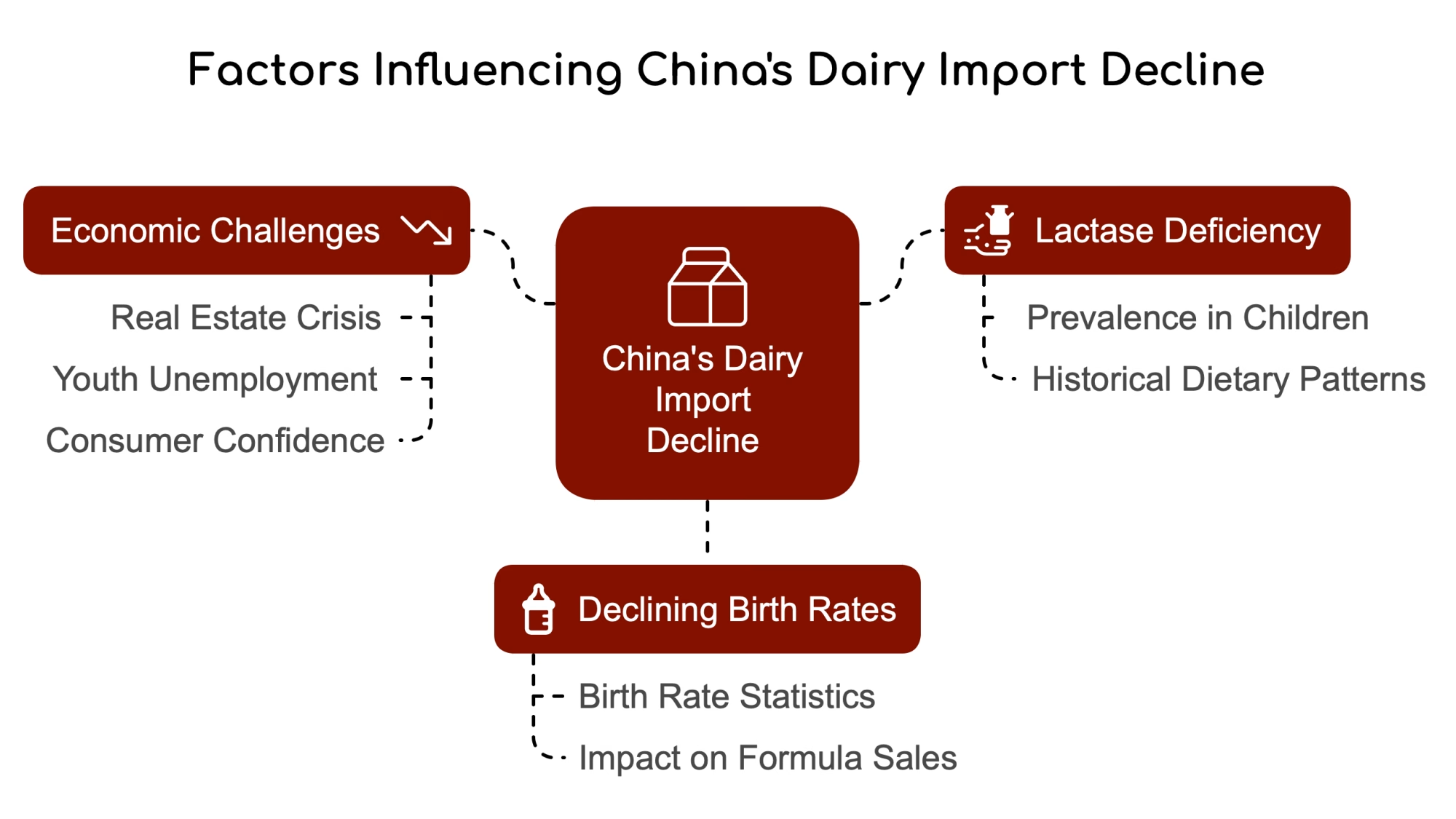
Why China Isn’t Buying
Trouble Digesting Milk
Let’s face it – many Chinese people simply can’t comfortably digest milk. Studies show that lactase deficiency affects about 38.5% of Chinese children aged 3-5, jumping to a whopping 87% in older kids. This biological reality means milk has never been a staple in Chinese diets.
Declining Birth Rates
China’s birth rate has fallen, dropping from 13.03 births per thousand people in 2013 to just 6.39 in 2023. This hits infant formula sales hard – historically a major driver for dairy imports.
There was a small bump in 2024 during the “Year of the Dragon” (considered lucky in Chinese culture), but that’s a blip in the long-term downward trend.
Economic Challenges
China’s economy struggles with real estate problems, high youth unemployment, and weak consumer confidence. As USDEC notes: “China’s economy continues to be challenged on multiple fronts—a real estate crisis; elevated youth unemployment; underfunded local governments; deflation; and disappointing GDP growth—not to mention potential fallout from trade battles with the U.S.”
When money’s tight, dairy products are often the first thing cut from shopping lists.
The Competitive Landscape: Why New Zealand Wins
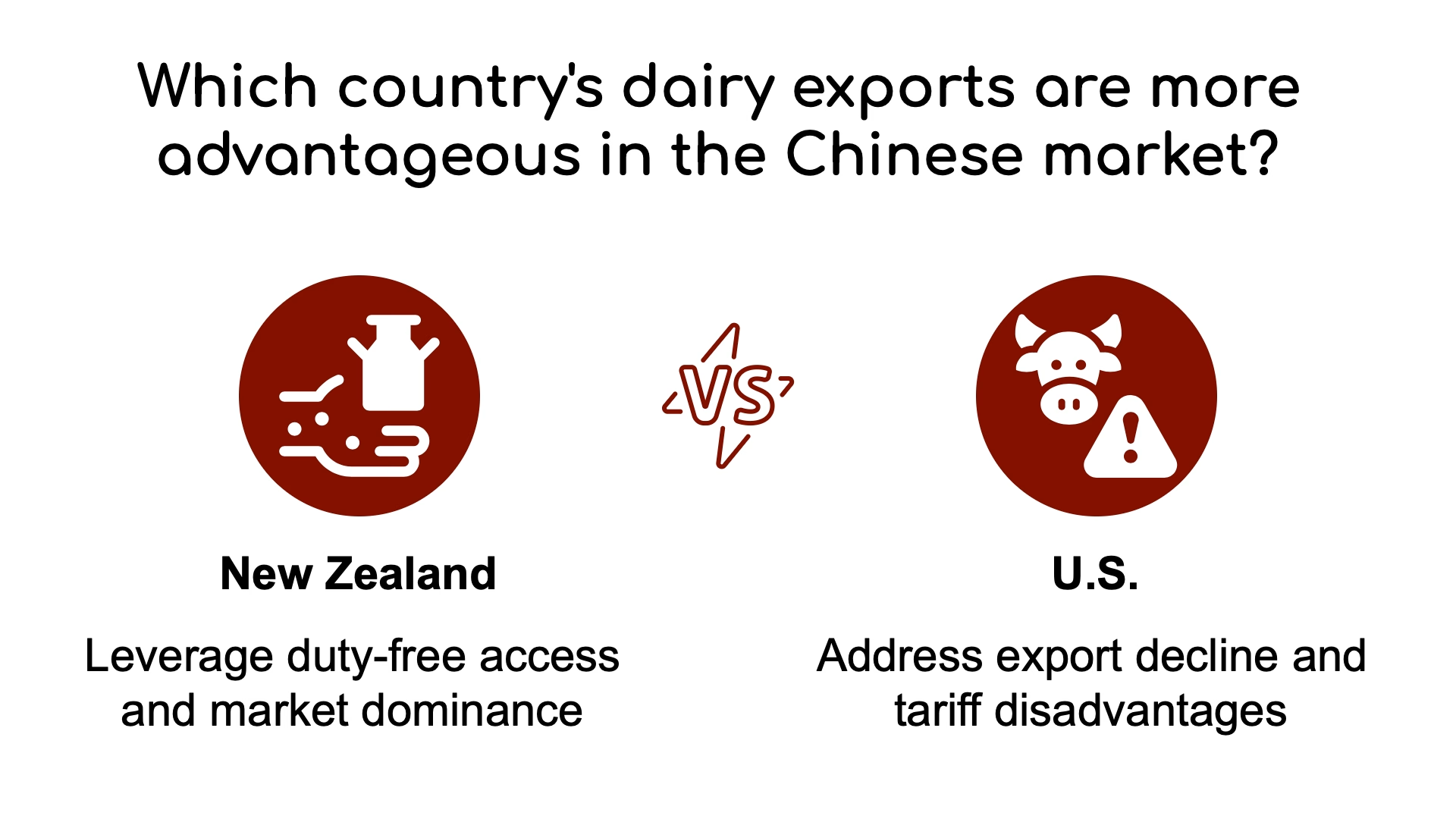
New Zealand’s Duty-Free Advantage: As of January 1, 2024, all New Zealand dairy products enter China completely duty-free. This gives Kiwi producers roughly $350 million in annual tariff savings compared to U.S. suppliers.
Dominant Market Position: New Zealand commands a 46% share of China’s dairy import market. Their exports to China jumped significantly in late 2024, especially milk powder, butter, and cheese.
U.S. Export Decline: Meanwhile, U.S. dairy exports to China tanked in 2024, falling to $584 million – the lowest since 2020. Overall volume dropped 9%, according to USDEC.
Bottom Line: New Zealand’s free trade advantage is practically impossible to overcome without significant policy changes. Any import opportunities created by China’s production decline will benefit New Zealand, not U.S. producers.
The Trade War Impact: 84% of Tariffs Close the Door
The trade relationship between U.S. dairy and China has gone from bad to worse. Here’s how quickly things escalated:
Tariff Timeline:
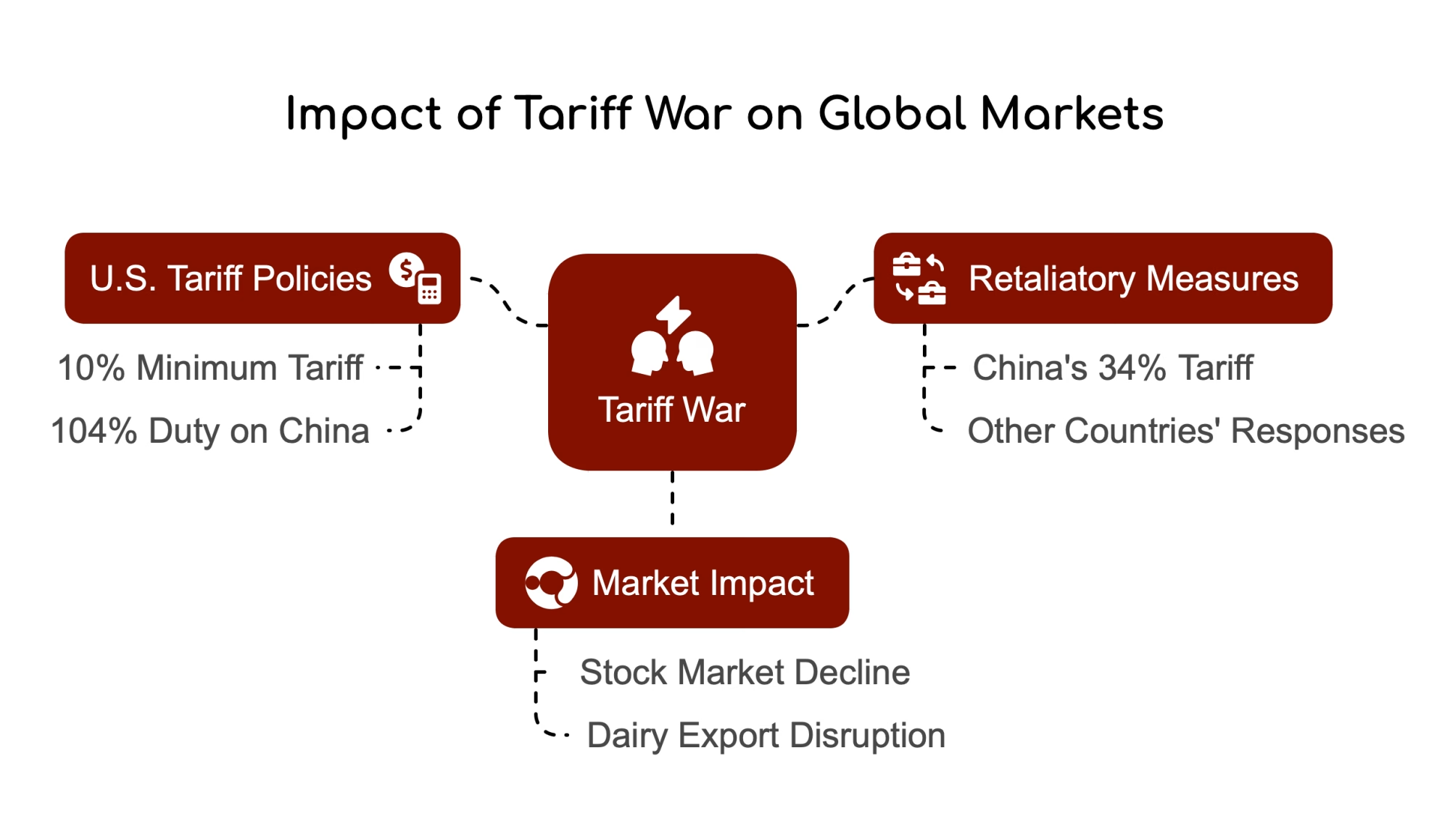
February 1, 2025: U.S. slaps 10% tariff on all Chinese imports
March 3, 2025: U.S. increases tariff to 20%
March 4, 2025: China announces 10% retaliatory tariff on U.S. dairy (effective March 10)
April 2, 2025: U.S. imposes additional 34% “reciprocal” tariff
April 4, 2025: China matches with a 34% retaliatory tariff (effective April 10)
April 9, 2025: U.S. increases reciprocal tariff to 84%
April 9, 2025: China immediately matches with an 84% retaliatory tariff (effective April 10)
“China will impose a 10% tariff on US dairy products starting March 10 as the trade war intensifies,” reported The Bullvine in early March.
As of today (April 9, 2025), the U.S. has just announced an increase of its tariff on China from 34% to 84%, with China immediately matching. Starting tomorrow, virtually all U.S. dairy products entering China will face an additional 84% tariff on top of existing rates – effectively slamming the door shut on exports.
Quick Takeaways for Dairy Farmers
Small Operations: Focus on domestic specialty markets; consider joining cooperatives with diversified export portfolios
Medium Operations: Explore USDA Market Access Program funding for new market development in Southeast Asia and Latin America
Large Operations: Evaluate product mix to target markets less impacted by tariffs; consider joint ventures with partners in FTA countries
Bottom Line for Dairy Producers
The brutal truth? U.S. dairy producers shouldn’t expect any meaningful export opportunities to China shortly. The triple whammy of sky-high tariffs, weak Chinese consumer demand, and competition from duty-free suppliers like New Zealand create a perfect storm that effectively locks us out of the market.
3 Steps for Farmers:
Explore USDA Market Access Program grants for export market development (applications due June 14, 2025)
Contact your co-op or industry association about market diversification strategies
Look beyond China to Mexico, Southeast Asia, and the Middle East/North Africa markets
This trade war highlights why putting all your eggs in one export basket is risky. The most brilliant move now is to diversify your markets and focus on regions where U.S. dairy still has competitive advantages.
Join over 30,000 successful dairy professionals who rely on Bullvine Daily for their competitive edge. Delivered directly to your inbox each week, our exclusive industry insights help you make smarter decisions while saving precious hours every week. Never miss critical updates on milk production trends, breakthrough technologies, and profit-boosting strategies that top producers are already implementing. Subscribe now to transform your dairy operation’s efficiency and profitability—your future success is just one click away.
Trump’s tariffs spark 12% milk price crash. With 43% of dairy exports at risk, can farmers survive the trade war?
EXECUTIVE SUMMARY: The U.S. dairy industry faces mounting pressure as President Trump’s tariffs trigger a 12% milk price drop before implementation, jeopardizing $8.2B in annual exports. Mexico and Canada—which buy 43% of U.S. dairy exports—face retaliatory risks, while China’s 125% tariff hike worsens tensions. Farmers already report rising input costs (e.g., $21k steel tariff impacts) and potential annual losses up to $56k for mid-sized operations. Industry groups warn of long-term market damage, urging producers to hedge prices, diversify markets, and leverage USDA safety nets. The 90-day tariff pause offers fleeting relief, but survival hinges on rapid adaptation to volatile trade policies.
KEY TAKEAWAYS:
Preemptive Price Plunge: Milk futures dropped 12% on tariff threats alone, outpacing 2018 trade war impacts.
Export Addiction: 15-20% of U.S. milk production is exported, with Mexico ($2.47B) and Canada ($1.14B) as lifelines.
Canada’s TRQ Trap: Despite USMCA, administrative barriers block U.S. access to Canada’s “0% tariff” quotas.
Small Farm Crisis: Tariffs could slash $56k/year from mid-sized farms, exacerbating existing financial strains.
Survival Playbook: Lock contracts, hedge prices, and target Southeast Asia to offset North American trade risks.
The U.S. dairy industry faces unprecedented challenges as new tariff policies threaten $8.2 billion in annual exports. With Mexico and Canada representing over 40% of export value, dairy producers must navigate market volatility while preparing for potentially prolonged trade disputes—all while milk prices have already dropped 12% since February.
As President Donald Trump implements aggressive trade policies, the U.S. dairy industry is walking a precarious tightrope. On April 9, 2025, Trump announced a 90-day pause on most tariffs while raising the tariff rate on Chinese imports to 125%. This strategic pivot comes after weeks of escalating tensions that began when Trump imposed 25% tariffs on all Canadian and Mexican goods on March 4.
Historical Context: We’ve Been Here Before
The current tariff scenario is like policies implemented during Trump’s first administration. During that period, tariffs significantly impacted milk prices, prompting federal compensation programs to offset losses for producers.
“Tariffs make you a little bit nervous when you’re an American farmer,” says Hans Brighton, who owns a dairy farm with about 460 cows in Merill, Wisconsin. This sentiment reflects widespread concern throughout America’s dairy regions.
The use of tariffs as negotiation leverage isn’t new. During the United States-Mexico-Canada Agreement (USMCA) negotiations, tariff threats were leveraged to secure concessions, ultimately improving market access for some dairy products but creating significant short-term disruptions.
Current Market Dynamics: The Damage Is Already Done
The mere discussion of new tariffs has already impacted dairy markets. Since Trump first credibly threatened tariffs in early February, May Class III and Class IV milk futures have lost 12% and 9% of their value, respectively. This price volatility highlights the immediate responsiveness of agricultural markets to trade policy announcements, even before implementation.
“We’re facing a double challenge — lower prices coupled with increasing costs,” explains AJ Wormuth, who manages 3,600 dairy cows at Half Full Dairy in upstate New York. He accelerated a barn renovation after being informed that the cost of new metal stalls would increase by $21,000 due to Trump’s 25% tariffs on steel and aluminum.
The stakes are particularly high for the dairy industry, which has grown increasingly export-dependent. U.S. dairy exports reached $8.2 billion in 2024; the second-highest total export value ever recorded. Nationally, the sector exports 15% to 20% of dairy production, making international markets a key demand factor for financial success.
Country
Export Value (USD)
% of Total Exports
Key Products
Mexico
$2.47B
30.0%
Cheese, NFDM/SMP
Canada
$1.14B
13.9%
Fluid Milk, Yogurt
China
$584M
7.1%
Whey, Infant Formula
Japan
$394.6M
4.8%
Cheese, Butter
South Korea
$385.7M
4.7%
SMP, Lactose
Total Global
$8.22B
100%
The Canada Conundrum: Beyond the 250% Headlines
Trump’s criticism of Canada’s dairy tariffs—reaching as high as 298% for butter and 270% for dairy powder—is technically accurate but lacks essential context. These high rates only apply when imports exceed established tariff-rate quotas (TRQs). Under the USMCA, U.S. dairy products can enter Canada duty-free or with minimal tariffs until specific quotas are reached.
“[Canada] has a large dairy-producing constituency that it wants to protect, so they put a cap on imports that can be accessed at a competitive rate. That’s a ‘TRQ’ (tariff rate quota),” explains Becky Randall Vargas, senior vice president of trade and workforce policy at the International Dairy Foods Association.
The issue isn’t just the tariff rates but administrative barriers that make it difficult for U.S. exporters to fully utilize their quota access, including requirements to sell directly to Canadian competitors and restrictions on retailers obtaining import licenses.
Product
Tariff-Rate Quota (TRQ)
Within-Quota Tariff
Over-Quota Tariff
Fluid Milk
64,500 metric tons
0%
241%
Cheese
12,500 metric tons
0%
245.5%
Butter
3,200 metric tons
7.5%
298.5%
Skim Milk Powder
14,000 metric tons
0%
270%
Voices from the Front Lines: Small Farms Hit Hardest
For smaller operations, the concerns are especially pressing. Annie Watson, who operates an organic dairy farm in Maine with 70 cows, highlights the longer-term planning challenges: “As dairy farmers, we work within three-year cycles — from the birth of a calf until it becomes a milking cow. Things don’t happen quickly on our farms, so when policies are implemented swiftly, it poses challenges for those engaged in this cycle.”
Near the Canadian border, Watson sources most of her feed from Canada. She calculates that the tariffs could increase her grain expenses by $1,200 monthly. “It would be more manageable if many of our organic dairy farmers weren’t already financially struggling due to market conditions,” notes Watson, who also leads the Maine Dairy Association.
Leonard Poen of the University of Wisconsin-Madison extension says retaliatory tariffs could decrease the income of a medium-sized farm in Wisconsin with about 250 cattle by up to $56,000 per year. “I don’t think any part of the supply chain is going to be insulated from this,” he warns.
Industry Response: Balancing Trade Fairness with Market Stability
The American Farm Bureau Federation, the primary agricultural lobbying group, has indicated that the tariffs jeopardize the competitiveness of U.S. farmers and could inflict long-term harm by diminishing their market presence.
“We align with the administration’s aim of creating a fair, competitive environment with our global counterparts, yet the rise in tariffs jeopardizes the economic viability of farmers who have faced financial losses on most major crops over the past three years,” stated Zippy Duvall, the organization’s president.
The National Farmers Union offers a different perspective, pointing to underlying structural issues: “Policymakers are focused on U.S. trade policy without solving the underlying problems in the dairy industry—corporate consolidation and continued overproduction. Broad dairy tariffs don’t solve these problems; they destabilize the industry, drive up costs, and create more uncertainty for American dairy farmers, processors, and rural communities,” stated NFU President Rob Larew.
The China Factor: 125% Tariffs Raise the Stakes
While Trump’s pause on most tariffs may provide temporary relief, the escalation with China to a 125% tariff rate represents a significant intensification of trade tensions. This is particularly concerning given that U.S. dairy exports to China declined in 2024, marking the lowest year since 2020.
The targeted approach represents a narrowing of an unprecedented trade war between the U.S. and most of the world to one between the U.S. and China. This strategic pivot may reduce widespread market disruption but could further complicate dairy exports to the Chinese market.
China has already announced retaliatory measures, including a 34% additional tariff on all U.S. goods and export restrictions on rare earth materials. These actions are part of a broader pattern of escalation that began in February 2025 and has intensified through April.
Year
Export Value (USD)
Annual Change
Key Driver
2020
$6.81B
+4.2%
Chinese Whey Demand
2022
$9.70B
+18.1%
Post-Pandemic Recovery
2024
$8.22B
+2.8%
Record Cheese Exports
CAGR
+4.6%
Tariff Survival Checklist: Protecting Your Operation
As trade tensions escalate, here are five immediate actions dairy producers should consider:
Lock in contracts now: If possible, secure export contracts before tariffs take full effect
Monitor futures markets weekly: Set price alerts and consider hedging strategies
Evaluate your export exposure: Calculate what percentage of your milk goes to export markets
Explore USDA risk management programs: The Dairy Margin Coverage program provides a safety net
Diversify export destinations: Consider emerging markets in Southeast Asia less affected by current tariffs
“For the third straight year, farmers are losing money on almost every major crop planted,” Zippy Duvall of the American Farm Bureau notes. “Adding even more costs and reducing markets for American agricultural goods could create an economic burden some farmers may not be able to bear.”
The Bottom Line
The U.S. dairy industry is walking a precarious tariff tightrope as it navigates the reintroduction of aggressive trade policies under Trump’s second administration. The 90-day pause announced on April 9 provides a reprieve for most trading relationships, but uncertainty remains the prevailing market condition.
The lessons from Trump’s first term are clear for dairy producers: tariffs can be effective negotiation tools but often come with significant short-term costs to agricultural sectors. The industry’s growing export dependence makes it particularly vulnerable to trade disruptions, with even threats of tariffs capable of triggering market downturns.
What This Means for Your Operation: Contact your congressional representatives through the National Milk Producers Federation’s advocacy portal by April 30 to voice concerns about tariff impacts. Review your export contracts for force majeure clauses that trade disputes might trigger. Consider attending the USDA’s upcoming June 2025 tariff mitigation webinar to learn about compensation programs that could offset market losses.
The following 90 days will be critical—monitor developments closely and prepare contingency plans for best and worst-case scenarios. Your farm’s financial survival may depend on how quickly you adapt to this rapidly changing trade landscape.
Join over 30,000 successful dairy professionals who rely on Bullvine Daily for their competitive edge. Delivered directly to your inbox each week, our exclusive industry insights help you make smarter decisions while saving precious hours every week. Never miss critical updates on milk production trends, breakthrough technologies, and profit-boosting strategies that top producers are already implementing. Subscribe now to transform your dairy operation’s efficiency and profitability—your future success is just one click away.
Trump’s 104% tariffs rock dairy exports. Ag Secretary eyes deals by Friday. Survival strategies inside.
EXECUTIVE SUMMARY: President Trump’s sweeping tariffs, including 104% duties on Chinese imports effective immediately, have plunged dairy markets into turmoil, with $8.2B in annual exports at risk. Agriculture Secretary Brooke Rollins hints at potential trade deals by week’s end as 70 nations seek negotiations. Retaliatory measures from Canada and China threaten critical dairy sectors, while Cornell economists project B in losses over four years. Industry leaders urge farmers to lock feed costs, leverage federal programs like Dairy Margin Coverage, and diversify markets. Analysts warn of unprecedented price volatility, but strategic planning could mitigate the blow to producers.
KEY TAKEAWAYS
Immediate Tariff Impact: 104% duties on Chinese goods and Canada’s 25% retaliatory tariffs target butter, cream, and infant formula exports.
$6B Crisis Looming: Projected losses could erase profits for U.S. dairy through 2029 without intervention.
Survival Playbook: Lock feed contracts, enroll in DMC/DRP programs, and pivot milk to domestic markets.
Processor Pivot: Major exporters like Darigold and Leprino are shifting production to cushion export losses.
Rollins’ Gamble: Potential deals with 70 nations could soften the blow – but farmers must prepare for volatility now.
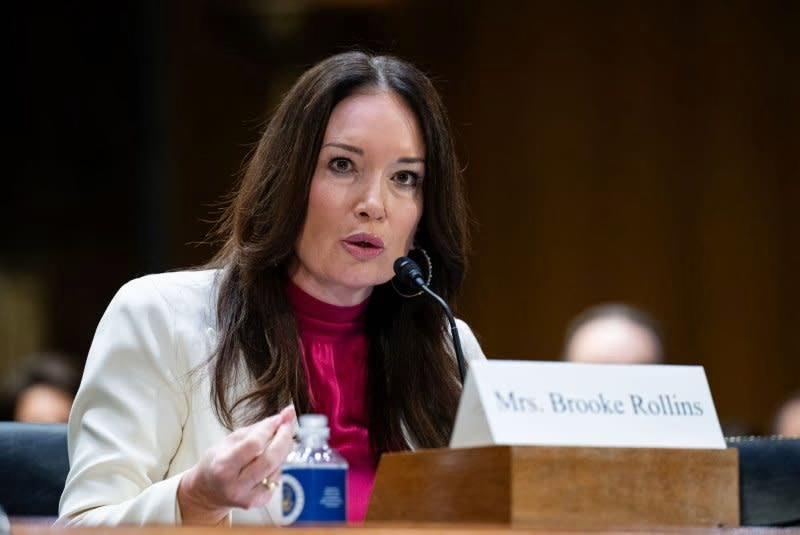
As the agricultural world reels from President Trump’s sweeping tariff implementation, U.S. Agriculture Secretary Brooke Rollins has offered hope amid escalating trade tensions. Speaking Tuesday, Rollins expressed optimism that new trade agreements could materialize within days, even as significant duties on Chinese imports take effect tonight.
After China announced retaliatory measures, the Trump administration escalated the situation by declaring 104% duties on Chinese imports, set to take effect shortly after midnight tonight. Not to be outdone, China has announced a 34% retaliatory tariff on all U.S. goods effective April 10.
STOCKS PLUNGE AS DAIRY EXPORT CHANNELS FACE EARTHQUAKE U.S. stocks have dropped for four consecutive trading days since the initial tariff announcement, reflecting widespread economic concern. The picture is particularly troubling for dairy producers as export markets face immediate disruption.
ROLLINS PROMISES “DEALS BY FRIDAY” – CAN SHE DELIVER?
Despite mounting tensions, Secretary Rollins maintains that negotiations are progressing rapidly behind the scenes: “I believe, sincerely, it will be sooner rather than later. We’ll be hearing about new deals that are being struck, perhaps by the end of the week.”
This optimism comes with a significant revelation – 70 countries have already initiated discussions with the United States to negotiate exemptions or modifications to the tariff structure potentially.
BILLION-DOLLAR BAILOUT BACK ON THE TABLE Critically for dairy producers, Rollins has indicated the Trump administration is preparing another round of market disruption payments if tariffs result in a downturn of agricultural exports. During Trump’s first term, the USDA provided farmers approximately $16 billion in trade assistance, with dairy receiving $2.9 billion in direct payments.
$8.2 BILLION IN DAIRY EXPORTS NOW AT RISK
The U.S. exported $8.22 billion of dairy products in 2024 alone, with Mexico, Canada, and China serving as the top destinations in dollar terms. These three markets – all targets of Trump’s tariff plan – collectively represent over half of U.S. dairy exports by value annually.
Country
Export Value (2024)
Key Products Affected
Mexico
$2.47 billion
Cheese, SMP, Whey
Canada
$1.14 billion
Butter, Cream
China
$584 million
Infant Formula, Whey
Japan
$394.6 million
Cheese, Lactose
THE BRUTAL NUMBERS DAIRY PRODUCERS MUST FACE:
China (third largest export market): $584 million in U.S. dairy imports (2024)
26 specific dairy products are now subject to 10% Chinese tariffs, with feed whey exempted
Historical context: 2019-2021 China tariffs cost U.S. dairy $2.6 billion in lost revenue
Projected damage: Cornell’s Charles Nicholson forecasts $6 billion in lost dairy profits over four years
Canada has already implemented 25% retaliatory tariffs on key dairy products, including milk, cream, and butter – critical export categories directly impacting U.S. producer margins.
INDUSTRY HEAVYWEIGHTS SQUARE OFF ON TARIFF STRATEGY
The agricultural community has expressed various responses to the tariff implementation, ranging from cautious support to outright alarm.
American Farm Bureau Federation President Zippy Duvall didn’t mince words: “Tariffs will drive up the cost of critical supplies, and retaliatory tariffs will make American-grown products more expensive globally.” He emphasized that more than 20% of farm income comes from exports.
National Milk Producers Federation President Gregg Doud took a more nuanced approach: “Tariffs can be a useful tool for negotiating fairer terms of trade. To that end, we are glad to see the administration focusing on long-time barriers to trade that the European Union and India have imposed on our exports.”
U.S. Dairy Export Council President Krysta Harden similarly called for a focus on eliminating tariff and non-tariff barriers, particularly with the European Union and India.
MARKET ANALYST WARNS: “BRACE FOR PRICE WHIPLASH”
Mike North, president of Ever.Ag a sober assessment: “Predictably, this will add volatility to demand that may overshadow the ongoing focus around supply. Only small changes can have large impacts on price. Producers are well advised to brace for the disruption that these tariffs will likely create.”
Metric
2019-2021 China Tariffs
2025 Projected Losses
U.S. Dairy Revenue
-$2.6B
-$6B (4-year estimate)
Milk Price Impact
-$1.20/cwt
-$2.80/cwt (projected)
Jobs at Risk
4,200
16,500
With Canada implementing 25% tariffs on cream and butter, North notes these measures could significantly affect U.S. dairy prices, as Canada represents a significant export destination.
LESSONS FROM THE 2018-2021 TRADE WAR “We’ve been here before, and the operations that survived did three things right,” explains Wisconsin dairy farmer John Vosters, who weathered the previous tariff storm. “First, they locked in feed costs early. Second, they maximized federal risk management programs. And third, they diversified their processor relationships beyond those heavily dependent on exports.”
SURVIVAL TOOLKIT: 7 CRUCIAL STEPS FOR DAIRY PRODUCERS
FINANCIAL ARMOR:
Lock in feed contracts before potential retaliatory grain tariffs drive costs higher
Calculate potential 10-15% revenue impacts from top export markets
MARKET OFFENSE:
Identify alternative domestic outlets for milk that would typically enter export channels
Maintain close contact with processors about their export contract contingency plans
Consider component adjustment strategies (shifting butterfat/protein ratios based on market signals) if butterfat export values decline dramatically
Evaluate on-farm processing opportunities to capture domestic value-add potential
RISK MANAGEMENT PROGRAM DEADLINES: The 2025 enrollment period for Dairy Margin Coverage (DMC) runs from January 29 to March 31, 2025. DMC offers coverage levels ranging from $4.00 to $9.50 per hundredweight (cwt) of milk in $0.50 increments. The program provides financial protection when the margin between milk price and feed costs falls below selected coverage levels.
The Dairy Revenue Protection (DRP) program, available year-round, ensures against unexpected declines in quarterly revenue from milk sales. Producers can select coverage levels between 80% and 95% of expected revenue and choose either class or component pricing options.
ROLLINS’ GRAND VISION: BEYOND THE TARIFF BATTLE
Beyond the immediate tariff situation, Rollins has articulated an ambitious agenda to transform U.S. agricultural trade. Upon taking office, she pledged to slash the agricultural trade deficit and boost American exports across all sectors.
Her approach includes leveraging existing trade agreements like USMCA while aggressively pursuing new deals to expand market access for U.S. dairy products. “Our goal is to make ‘Made in America’ the gold standard for dairy products worldwide,” she declared.
Metric
Pre-USMCA (2019)
Post-USMCA (2024)
Change
U.S. Export Value to Canada
$442M
$1.14B
+158%
TRQ Enforcement (Tariff-Rate Quota access)
Limited
USMCA Panel Victory
Improved
Canadian Market Access
Restricted
Expanded but Challenged
Ongoing
The USMCA, signed into law in January 2020, has already shown significant benefits despite implementation challenges. The U.S. prevailed in a dispute settlement panel under USMCA when Canada was found to be breaching commitments by reserving dairy tariff-rate quotas (TRQs) for Canadian processors.
COUNTDOWN TO EXEMPTIONS: WHO’S FIRST IN LINE?
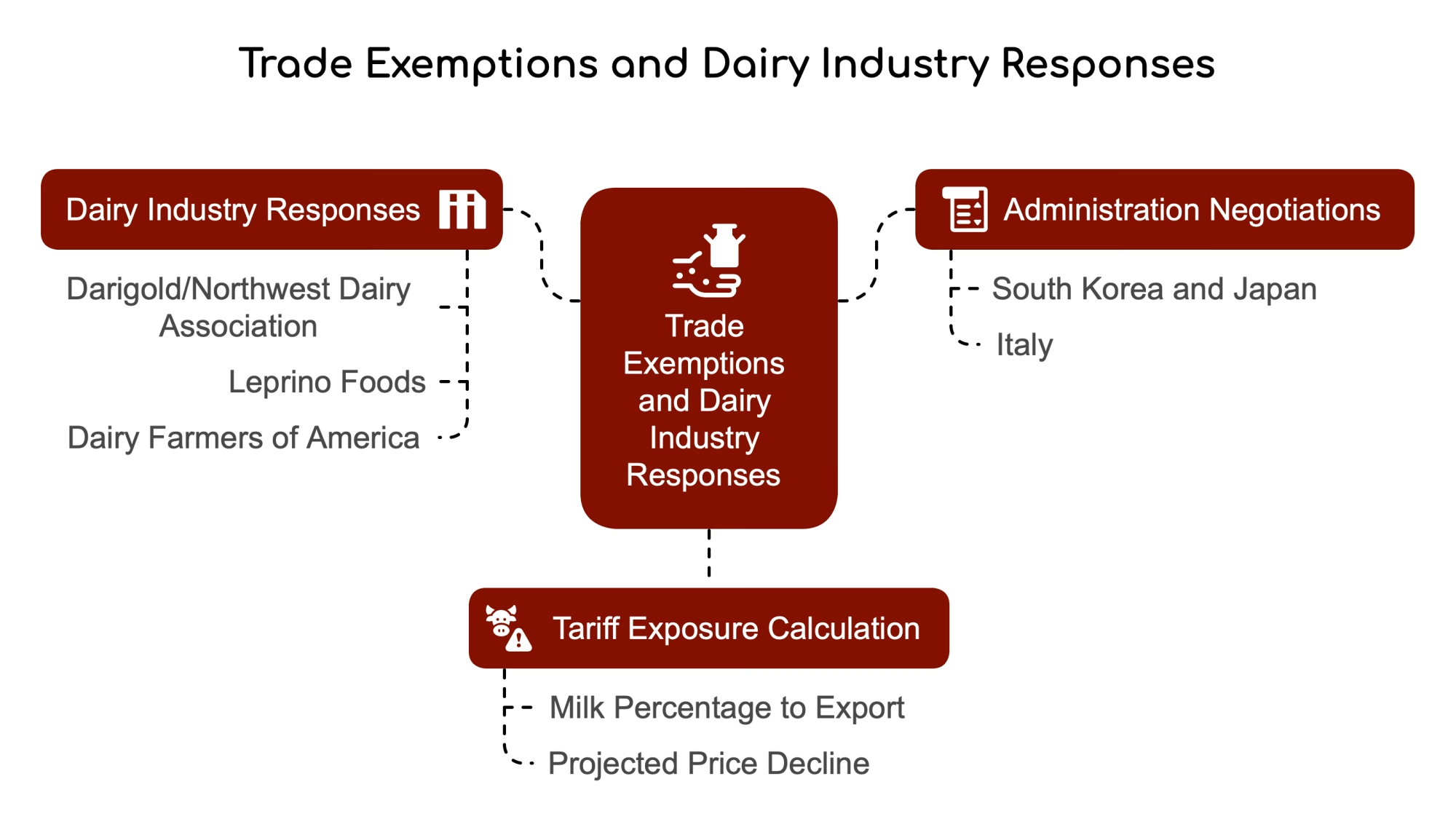
The administration has already scheduled talks with South Korea and Japan, two major trading partners. Italian Prime Minister Giorgia Meloni is due to visit next week. These discussions represent the first wave of negotiations that could potentially lead to exemptions or modifications to the tariff structure.
Secretary Rollins frames the current situation as temporary pain for long-term gain, asserting that the comprehensive approach addresses not just tariffs but also unfair trade practices and unjust trade barriers.
PROCESSOR WATCHLIST: HOW MAJOR EXPORTERS ARE RESPONDING
Darigold/Northwest Dairy Association: Accelerating domestic market development while maintaining Asian export commitments
Leprino Foods: Repositioning some cheese production from export to domestic food service markets
Dairy Farmers of America: Reportedly developing contingency plans for redirecting milk supply from export-focused plants
CALCULATING YOUR FARM’S TARIFF EXPOSURE Use this simple formula to estimate your operation’s risk:
Determine your milk percentage going to export markets (ask your processor)
Multiply by projected price decline ($2.80/cwt in worst-case scenario)
Result = potential revenue impact per cwt
THE BULLVINE BOTTOM LINE: The tariff situation represents a critical moment requiring strategic navigation. Secretary Rollins’ optimism about imminent deals provides hope to prepare for increased volatility and potentially extended market disruption. Those who position strategically now – both defensively and opportunistically – will be best positioned to weather this trade storm.
THE BULLVINE VERDICT: This high-stakes trade reshuffling demands daily monitoring and nimble management. We’ll continue tracking developments, processor reactions, and market opportunities as they emerge. Buckle up – this ride just got a whole lot bumpier.
How Trump’s Tariffs Threaten Your Herd’s Bottom Line Dive into the global dairy trade war sparked by Trump’s tariffs, with data on vulnerable export markets and practical advice for protecting farm profitability.
Join the Revolution!
Join over 30,000 successful dairy professionals who rely on Bullvine Daily for their competitive edge. Delivered directly to your inbox each week, our exclusive industry insights help you make smarter decisions while saving precious hours every week. Never miss critical updates on milk production trends, breakthrough technologies, and profit-boosting strategies that top producers are already implementing. Subscribe now to transform your dairy operation’s efficiency and profitability—your future success is just one click away.
EXECUTIVE SUMMARY: President Trump’s tariffs have ignited a global trade war with dire consequences for the U.S. dairy industry, risking .6B in farm revenue and triggering retaliatory measures from key markets like China and Canada. Mid-sized farms could lose up to $56K annually, while organic producers face soaring feed costs. Industry leaders remain divided, with some advocating for tariffs as leverage against trade barriers, while farmers scramble to secure contracts and diversify exports. The article outlines actionable survival strategies, including USDA programs and feed efficiency investments, as the sector balances uncertainty with cautious optimism for long-term trade reforms.
KEY TAKEAWAYS:
$16.6B at Risk: Retaliatory tariffs threaten nearly a quarter of U.S. dairy exports, with Mexico and China as top vulnerable markets.
Farm-Level Crisis: Medium-sized operations face income drops up to $56K/year; organic feed costs may spike $1,200/month.
Survival Playbook: Lock pre-tariff contracts, leverage USDA programs, and target emerging Southeast Asian markets.
Industry Divide: Leaders split on tariffs as tools for trade reform vs. immediate economic harm to farmers.
Long Game: Strategic adaptations like feed-efficient breeds and policy engagement could determine sector resilience.
The U.S. dairy industry faces unprecedented challenges as President Trump’s sweeping tariff policies take effect, threatening .2 billion in annual exports and reshaping the global trade landscape. With retaliatory measures from key trading partners looming, dairy farmers and processors must navigate market volatility, rising input costs, and potential long-term disruptions to established export channels.
Tariff Tensions Spark Global Dairy Trade War
President Trump’s announcement of a baseline 10% tariff on all imports, with higher targeted rates for specific countries, has sent shockwaves through the dairy sector. China and Canada, two of America’s top dairy export destinations, have already imposed retaliatory tariffs. China has placed 10% of its duties on some milk products, while Canada’s package includes 25% tariffs on American cheese, butter, and dairy spreads.
The timing couldn’t be more precarious for U.S. dairy, with Mexico, China, and Canada among its top export markets:
Top U.S. Dairy Export Markets (2024)
Volume (Metric Tons)
% of Total Exports
Value (USD Millions)
Mexico
576,000
24.8%
$1,840
Southeast Asia
395,000
17.0%
$1,320
China
311,000
13.4%
$970
Canada
246,000
10.6%
$810
Middle East/North Africa
172,000
7.4%
$580
Dairy Industry Voices: Mixed Reactions to Tariff Strategy
While some industry leaders see potential leverage in the tariffs, others warn of devastating consequences. Gregg Doud, President and CEO of the National Milk Producers Federation, cautiously supports the measures:
“Tariffs can be a useful tool for negotiating fairer terms of trade. To that end, we are glad to see the administration focusing on long-time barriers to trade that the European Union and India have imposed on our exports.”
“We’re facing a double challenge — lower prices and increasing costs. We can’t simply raise our prices at the market because all our expenses are increasing, leaving us in a difficult position.”
Economic Impact: From Farm to Market
The tariffs are expected to have severe economic consequences:
Potential farm-gate revenue losses of up to $16.6 billion due to trade tensions.
A medium-sized farm in Wisconsin with about 250 cattle could decrease income by up to $56,000 per year.
For organic dairy farmers, grain expenses could increase by $1,200 monthly due to tariffs on Canadian imports.
CME dairy futures have already reacted, with milk futures down 12% since February. The USDA has lowered its 2025 milk production forecast to 227.2 billion pounds, down 0.8 billion from previous estimates.
Dairy Survival Checklist: Strategies for Weathering the Storm
Secure pre-tariff contracts where possible to lock in more favorable terms.
Leverage USDA Dairy Margin Coverage programs to protect against price volatility.
Explore emerging markets in Southeast Asia to diversify export destinations.
Conduct a thorough audit of feed inputs and export contracts to stress-test 2025 margins.
Consider investing in feed-efficient breeds to mitigate rising input costs.
Looking Ahead: Uncertainty and Opportunity
While the immediate outlook appears challenging, some industry experts see potential benefits. The National Milk Producers Federation and U.S. Dairy Export Council have expressed hope that targeted tariffs could help address longstanding trade barriers, particularly with the EU and Canada.
Krysta Harden, President and CEO of the U.S. Dairy Export Council, states:
“President Trump’s commitment to addressing certain unfair and harmful trade policies that American dairy farmers and manufacturers have long faced in the global marketplace can yield positive results if the tariffs announced today are used as leverage to remedy the various trade barriers facing our exporters.”
Adaptability and strategic planning will be key as the dairy industry navigates these turbulent waters. Farmers and processors must stay informed, leverage risk management tools, and actively engage with policymakers to ensure their voices are heard in ongoing trade negotiations.
The stakes have never been higher for U.S. dairy. Will these tariffs lead to more equitable global trade or trigger a costly market disruption? Only time will tell, but one thing is sure: American dairy farmers’ resilience and innovation will be tested in the months and years ahead.
How U.S. Farmers Could Benefit from Canada’s Trade Barriers Learn how Trump’s reciprocal tariffs on Canadian dairy could reshape trade dynamics, potentially benefiting U.S. farmers while exposing Canadian producers to increased competition.
Join the Revolution!
Join over 30,000 successful dairy professionals who rely on Bullvine Daily for their competitive edge. Delivered directly to your inbox each week, our exclusive industry insights help you make smarter decisions while saving precious hours every week. Never miss critical updates on milk production trends, breakthrough technologies, and profit-boosting strategies that top producers are already implementing. Subscribe now to transform your dairy operation’s efficiency and profitability—your future success is just one click away.
Trade war escalates as 44% tariffs threaten $485M in U.S. dairy exports. China retaliates, H5N1 spreads – survival strategies for farmers revealed.
EXECUTIVE SUMMARY: The U.S. dairy sector faces a perfect storm as President Trump’s “Liberation Day” tariffs trigger China’s retaliatory 44% duties, putting $485M in exports at immediate risk. February data reveals collapsing powder sales (-53% in SE Asia) but record cheese exports (+7.3%), while butter shipments surge 134%. Simultaneously, H5N1 outbreaks cost farms up to $1.2M, and EU geographical indications threaten $59B in U.S. cheese revenue. Producers must act now: lock in feed prices, shift milk classes, and leverage USDA support programs to survive this unprecedented crisis.
KEY TAKEAWAYS:
China’s 44% tariff wall could erase 83% of $584M annual U.S. dairy exports within months
Butter exports (+134%) and cheese (+7.3%) shine while powder collapses (-53% in SE Asia)
H5N1 costs hit $372K testing/$1.2M culling for large herds – apply for USDA aid NOW
EU’s cheese name grab threatens $59B over 10 years – fight for “parmesan” labeling rights
5 survival moves: Hedge feed, shift to Class IV, demand USMCA enforcement, chase new markets, use H5N1 funds
The dairy world is caught in the crossfire of an escalating global trade war following President Trump’s sweeping “Liberation Day” tariffs announced this week. These aggressive new measures, affecting more than 180 countries and territories, have triggered immediate retaliation from China and sent financial markets tumbling. For dairy farmers worldwide, this dramatic shift in trade policy creates both immediate challenges and potential opportunities depending on your location and export exposure.
TRADE WAR BOMBSHELL: HOW “LIBERATION DAY” RESHAPES GLOBAL DAIRY MARKETS
The long-anticipated tariffs hit harder than most analysts expected, with a baseline 10% levy on all imports starting April 5, followed by steeper rates kicking in from April 9. While Canada and Mexico escaped unscathed from this latest round, key dairy importers without significant new barriers.
China wasted no time firing back, announcing a matching 34% tariff on all U.S. products starting April 10. This comes on top of existing 10% tariffs from previous trade disputes, creating a crushing 44% total barrier for U.S. dairy exports to America’s third-largest dairy market worth $584 million in 2024. Industry analysts project this could erase 83% of this trade within months – putting $485 million at immediate risk.
Market
Export Value (2024)
Key Products Affected
Mexico
$2.47 Billion
Cheese, NFDM, Whey
Canada
$1.14 Billion
Fluid Milk, Yogurt
China
$584 Million
Infant Formula, Whey
Japan
$394.61 Million
Cheese, Ice Cream
South Korea
$385.66 Million
Cheese, Lactose
Philippines
$364.98 Million
NFDM, Whey
Indonesia
$244.83 Million
NFDM, Butteroil
Australia
$173.87 Million
Cheese, Specialty Products
European Union
$167.14 Million
Whey Proteins
Dominican Republic
$134.7 Million
Cheese, NFDM
The European Union, a significant cheese exporter to the U.S., faces a challenging position. Alexander Anton of the European Dairy Association emphasized: “Our sector is already under enormous pressure from China’s anti-subsidy investigation and ongoing global market challenges. Now, U.S. tariffs risk compounding that crisis.”
FEBRUARY EXPORT DATA REVEALS TROUBLING SIGNS BEFORE THE TARIFF WAR ERUPTED
The latest export data from February showed U.S. dairy exports slipping 4.3% year-over-year (adjusted for leap day), with sharp divergences between products hinting at challenges that predated the current tariff crisis.
Product
Feb 2025 Volume
YOY Change
Key Markets Impacted
Cheese
99M lbs
+7.3%
South Korea (+50%)
Butter
18.7M lbs
+134.2%
Middle East, Canada
NFDM/SMP
177.36M lbs
+0.2%
SE Asia (-53%)
Dry Whey
57.35M lbs
-10.3%
China (-58%)
Whey Protein Isolate
12.1M lbs
+14.2%
Global Sports Nutrition
Nonfat dry milk/skim milk powder (NFDM/SMP) exports plummeted to their lowest February volume since 2016, with Southeast Asian sales collapsing dramatically. This drop pushed U.S. NFDM/SMP exports to troubling lows – a concerning sign for America’s leading dairy export product.
The bright spot? Cheese exports maintained their strong growth trajectory, improving 7.3% year-over-year and setting an all-time February record at 99 million pounds. Growth across diverse markets compensated for a 5.9% drop in cheese exports to Mexico.
Butter exports delivered the most dramatic performance, soaring 134.2% as U.S. butterfat prices sat at a significant discount compared to European and Oceanian competitors. This price advantage could prove pivotal as trade barriers reshape global dairy flows. Anhydrous milkfat shipments also skyrocketed to 7.5 million pounds, nearly ten times the volume shipped in February 2024.
WHY GLOBAL DAIRY PRODUCERS MUST PREPARE FOR MARKET UPHEAVAL
The tariff fallout varies dramatically depending on where your farm sits globally. The outlook appears grim for European producers, particularly Irish dairy farmers exporting Kerrygold butter to the U.S…
The Irish Farmers Association warns: “Kerrygold is now the second best-selling butter brand in the U.S., where we sent almost €500m of product in 2024. The fact that New Zealand only has a 10% tariff for dairy products while the EU will have 20% tariffs will leave us at a competitive disadvantage.”
New Zealand, meanwhile, finds itself in a relatively stronger position despite the turmoil. Agriculture Minister Todd McClay offered an optimistic assessment: “While these tariffs create additional costs that will largely be passed on to consumers, New Zealand is in a stronger position than many other countries, some facing higher tariff barriers.”
Australian dairy exports, primarily cheese and curd, reached record highs last year, with volume lifting 17.5% year-on-year. The country faces only the baseline 10% tariff, potentially giving it a competitive edge against European rivals hit with the 20% rate.
THE HIDDEN COST CRISIS: HOW EQUIPMENT TARIFFS ADD $45.65 PER COW
While Canada escaped new tariffs in this round, existing 25% steel and aluminum duties directly hit equipment costs for dairy operations on both sides of the border. A New York dairy co-op’s analysis shows these tariffs added $21,000 to a 460-cow barn renovation – $45.65 per cow in hidden costs before milk even hits the tank.
AJ Wormuth, who manages 3,600 dairy cows at Half Full Dairy in upstate New York, reports accelerating a barn renovation after being informed that metal stall costs would increase by $21,000 due to these steel tariffs. “We’re facing a double challenge — lower prices coupled with increasing costs,” Wormuth explains.
The concerns are equally pressing for smaller operations like Annie Watson’s 70-cow organic dairy in Maine. She calculates that tariffs could increase her grain expenses from Canada by $1,200 monthly. “It would be more manageable if many of our organic dairy farmers weren’t already financially struggling due to market conditions,” notes Watson.
CME MARKET REACTION: WHICH DAIRY COMMODITIES FACE THE BIGGEST PRESSURE?
This week’s CME spot market movements offered a glimpse into immediate market reactions to the tariff drama, with most dairy commodities facing downward pressure:
Butter took the biggest hit, falling 5.5¢ to settle at $2.295/lb with a heavy trading volume of 28 loads. With U.S. butter production jumping 6.3% year-over-year in February amid rising milk fat tests (now at 4.43%, up 0.13% from last year), the market faces significant oversupply challenges that exports might have helped alleviate before tariff barriers emerged.
Nonfat dry milk slipped a modest half-cent to $1.1575/lb, but concerning fundamentals lurk beneath this relatively stable price. Manufacturers’ NDM inventories have ballooned to 329.14 million pounds, a shocking 57% increase from last year, while domestic and international demand remains sluggish.
Dry whey continued downward, losing a penny to settle at 49¢ per pound. The ongoing preference for higher-protein products (whey protein isolate production jumped 14.2% while dry whey production fell 10.3%) hasn’t provided price support, and the escalating China trade conflict threatens to undermine export prospects further.
The cheese markets showed surprising resilience amid the turmoil. Cheddar blocks inched up half a cent to $1.64/lb on heavy volume (47 loads traded, including 24 on Tuesday alone), while barrels gained 2.5¢ to reach $1.66/lb, inverting the typical block-barrel spread. This strength comes despite February cheese production climbing 1.3% year-over-year to 1.115 billion pounds.
H5N1 CRISIS: THE PERFECT STORM THREATENING DAIRY FARM SURVIVAL
As if trade wars weren’t enough, the dairy industry simultaneously battles an unprecedented H5N1 avian influenza outbreak in cattle. Since the first detection on March 24, 2024, the virus has spread to at least 192 dairy herds across 13 states. This biosecurity crisis adds another layer of complexity, with mandatory testing now required for interstate cattle movement.
Cost Factor
Small Farm (70 cows)
Large Farm (3,000 cows)
Testing
$8,700
$372,000
Milk Loss (14 days)
$11,200
$480,000
Culling
$28,000
$1.2M
The USDA has committed $200 million to combat the spread, offering up to $10,000 per farm for veterinary costs and testing. With the American Association of Bovine Practitioners estimating economic impacts of $100-$200 per cow, this represents yet another financial pressure point for dairy operations already struggling with trade disruptions.
THE $59 BILLION THREAT: WHY EU CHEESE NAME RESTRICTIONS COULD DEVASTATE U.S. PRODUCERS
Beyond immediate tariff concerns lurks another trade dispute with potentially devastating consequences. The EU’s aggressive stance on geographical indications for cheese names threatens to cost U.S. dairy producers $59 billion over the next decade, according to a new report by Informa Economics IEG.
U.S. cheesemakers face restrictions on using terms like “parmesan,” “feta,” and “gorgonzola” – names many American producers consider generic. Wisconsin cheesemaker Sarah Pratt bluntly says, “They want to steal ‘parmesan’ from our vocabulary like they stole our grandfathers’ recipes.”
5 SURVIVAL STRATEGIES EVERY DAIRY PRODUCER NEEDS NOW
The long shadow of a trade war has impacted dairy futures significantly, with Class III contracts dipping below $18/cwt through August. This comes at a particularly challenging time for farm profitability – February’s milk margin over feed cost fell to $13.12/cwt, down 73¢ from January.
Market
New Tariff Rate
Projected Export Loss
At-Risk Jobs
China
44% (cumulative)
$485M (83% of 2024)
8,200
EU
20%
$67M annual
1,400
Southeast Asia
10-15%
$214M annual
3,700
South Korea
10%
$38.5M annual
650
The silver lining? Feed costs appear to be headed lower. May soybean futures plunged to $9.77/bu following China’s retaliatory tariff announcement, while May corn settled at $4.60/bu. This potential operating cost relief may help offset some milk price pressure.
For forward-thinking dairy producers, several strategic priorities emerge:
Lock in feed prices NOW using CME’s discounted DEC25 corn futures at $4.18/bu to protect against future volatility.
Demand USDA enforce USMCA Chapter 32 to break Canada’s tariff-rate quota manipulation that blocks U.S. access to promised markets.
Shift 15% of milk to Class IV before June, hedging windows close to diversify revenue streams.
Apply for H5N1 support programs, including the $10,000 per farm veterinary reimbursement and $2,000 monthly PPE allowance from USDA.
Explore alternative export markets in Southeast Asia and the Middle East, where U.S. butter exports grew 776% year-over-year in recent data.
The coming months will reveal whether this trade war becomes a prolonged reality or another chapter in ongoing negotiations. What’s certain is that global dairy markets face a significant adjustment period as trade flows recalibrate to this new reality – creating both challenges and opportunities for adaptable dairy businesses worldwide.
Leonard Poen of the University of Wisconsin-Madison extension warns that retaliatory tariffs could decrease the income of a medium-sized farm in Wisconsin with about 250 cattle by up to $56,000 per year. “I don’t think any part of the supply chain is going to be insulated from this,” he cautions.
As Agriculture Secretary Brooke Rollins explores methods to “potentially alleviate any economic disasters that might befall some of our farmers,” the industry must prepare for a prolonged period of volatility. Those who implement strategic responses and remain adaptable to changing conditions will be best positioned to weather this storm and potentially emerge stronger when trade relationships stabilize.
Join over 30,000 successful dairy professionals who rely on Bullvine Daily for their competitive edge. Delivered directly to your inbox each week, our exclusive industry insights help you make smarter decisions while saving precious hours every week. Never miss critical updates on milk production trends, breakthrough technologies, and profit-boosting strategies that top producers are already implementing. Subscribe now to transform your dairy operation’s efficiency and profitability—your future success is just one click away.
Bipartisan dairy bills revolutionize SNAP incentives, school milk, taxes, and global trade. Farmers: This changes everything.
EXECUTIVE SUMMARY: Congress is advancing four critical dairy bills with rare bipartisan support. The Dairy Nutrition Incentive Program Act could double SNAP dairy purchases, boosting rural economies. The Whole Milk for Healthy Kids Act reverses decades of nutrition policy by restoring full-fat milk to schools. The SAFETY Act protects U.S. cheese exports from EU naming disputes while expiring tax provisions threaten $2B in annual farmer benefits. These bills address consumer access, global competitiveness, and financial survival for dairy operations nationwide.
KEY TAKEAWAYS:
SNAP dollar-for-dollar dairy matches could surge demand while fighting food insecurity
Whole milk’s school comeback reflects new science on dairy fats’ health benefits
“Parmesan” protection bill counters EU trade tactics locking U.S. cheese out of markets
The 2025 tax cliff puts $2B in annual cooperative benefits at risk without congressional action
Rare bipartisan consensus highlights dairy’s economic and nutritional clout across all 50 states
Washington’s finally waking up to dairy’s clout, and the timing couldn’t be more critical. As spring unfolds across America’s dairy heartland, a flurry of bipartisan legislative activity signals potential game-changing developments for the industry. Here’s the inside scoop on four bills that could reshape everything from your grocery bill to global trade – and why every farmer, processor, and cheese lover should pay attention.
1. SNAP Goes Pop: The $2 Billion Dairy Boost
Cash Cows: How SNAP Incentives Milk the System for Rural Prosperity
Why It Matters: Every matched SNAP dollar means more milk flying off shelves, more trucks rolling from processing plants, and more paychecks for farmhands. With nearly 40 million Americans in the SNAP program, we’re talking about serious economic ripples in the dairy country.
2. Whole Milk’s School Comeback: Science Flips the Script
Fat’s Back, Baby: Congress Rushes to Catch Up with Nutrition Science
Forget what you thought you knew about milk fat – science has done a 180, and Congress is playing catch-up. The Whole Milk for Healthy Kids Act would bring whole and 2% milk roaring back to school cafeterias nationwide.
The Controversy: While 80% of parents are on board, critics argue about lactose intolerance rates. But here’s the kicker – schools already offer lactose-free options. This isn’t about exclusion but choice and following the latest nutritional wisdom.
3. Naming Rights Rumble: U.S. Cheese Fights Back
No More Swiss Cheese Holes in Trade Policy: The SAFETY Act Explained
Imagine Italian cheesemakers trying to claim sole rights to the word “parmesan.” Sounds crazy, right? Well, it’s happening, and American dairy is fighting back. The SAFETY Act aims to slam the door on European attempts to monopolize common cheese names through trade tricks.
Global Impact: This isn’t just about semantics – it’s about protecting billions in U.S. dairy exports and the farmers behind them. When you can’t call your product “feta,” you’re suddenly locked out of entire markets.
4. The $2 Billion Tax Ticking Time Bomb
Cooperative Crunch: Why Section 199A Has Farmers Sweating
A number that should make every dairy farmer sit up straight is $2 billion. That’s how much flows annually to farmers through cooperative tax benefits – benefits set to vanish in 2025 without congressional action.
The Rural Stakes: This isn’t just about balance sheets. We’re talking about the lifeblood of rural investment, from upgraded barns to community infrastructure. Letting this provision expire would be like slamming the brakes on dairy’s economic engine.
The Bottom Line: Dairy’s Bipartisan Moment
In an era where Republicans and Democrats can’t agree on lunch, dairy’s bringing them to the table. These bills unite lawmakers across party lines, proving that milk might be thicker than political blood.
What’s Next: The dairy industry’s facing a make-or-break moment in Washington. These bills could reshape the landscape from farm to fridge – but only if farmers, processors, and consumers keep the pressure on. It’s time to get loud, get active, and remind Congress that dairy isn’t just big business – it’s the backbone of rural America.
Join over 30,000 successful dairy professionals who rely on Bullvine Daily for their competitive edge. Delivered directly to your inbox each week, our exclusive industry insights help you make smarter decisions while saving precious hours every week. Never miss critical updates on milk production trends, breakthrough technologies, and profit-boosting strategies that top producers are already implementing. Subscribe now to transform your dairy operation’s efficiency and profitability—your future success is just one click away.
Trump’s tariff gamble: Dairy sees trade war leverage while grain fears collapse. Will new tariffs crack EU cheese barriers or spark Chinese retaliation?
EXECUTIVE SUMMARY: President Trump’s new tariffs on major trade partners have divided agriculture, with dairy leaders cautiously supporting the measures as potential leverage against long-standing EU cheese restrictions (blocking $168M in exports) and Canada’s quota system (where U.S. exports fill less than 30% of allowed volumes). However, grain producers warn of permanent market loss to Brazil, citing 2018’s $25B trade war damage. The tariffs target EU GIs, India’s lactose taxes, and China’s retaliatory risks, with dairy advocating for swift negotiations to dismantle barriers. While the strategy could pressure reforms, farmers face uncertainty as implementation begins today.
KEY TAKEAWAYS:
Canada’s dairy paradox: 200%+ tariffs exist but apply only if exports exceed quotas—a scenario that’s never occurred due to systemic barriers.
EU’s $168M cheese blockade: Geographical Indications block U.S. products from using names like “feta,” costing millions annually.
China gamble: 34% tariffs risk retaliation in America’s third-largest dairy export market ($584M), already down 12% YoY.
Sector divide: Dairy backs tariffs as negotiation tools; grain growers fear irreversible market loss, per Purdue’s Ag Barometer.
TRQ reality: Complex tariff-rate quotas govern global dairy trade, with most countries failing to fill allocated volumes.
As President Trump’s newly announced tariffs are set to take effect tomorrow, dairy industry leaders are expressing cautious optimism that these measures could help address longstanding trade barriers that have hindered U.S. dairy exports. The tariff plan, which includes both a baseline 10% duty on all imports and higher targeted rates for specific countries, is being viewed by some dairy representatives as a potential lever to create more equitable trade conditions.
Breaking Down Trump’s Bold Tariff Strategy for Dairy Markets
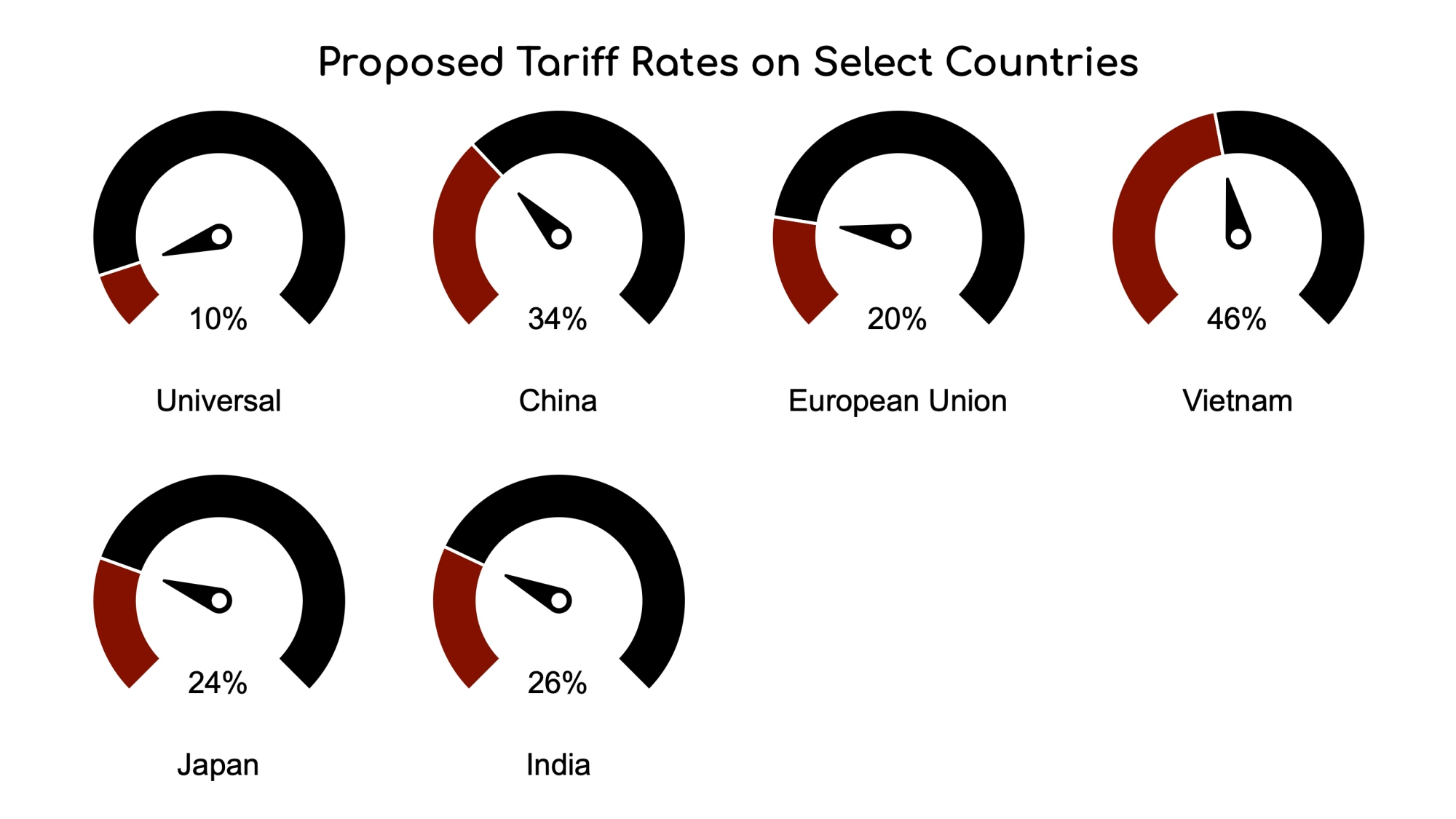
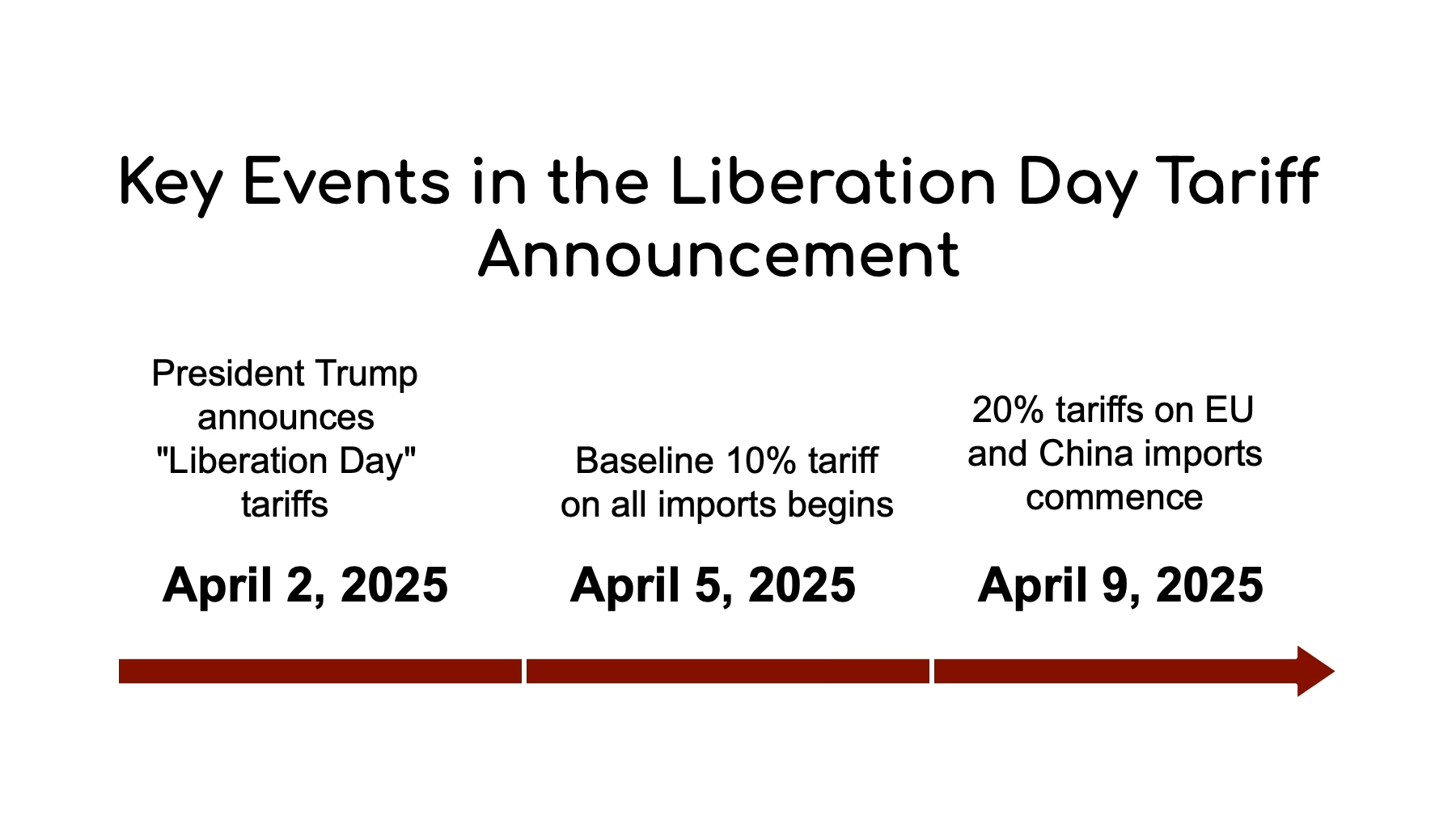
President Donald Trump unveiled his tariff plan during a “Make America Wealthy Again” event at the White House Rose Garden, announcing a universal 10% tariff on all imports beginning April 5, 2025, with additional targeted tariffs on countries with which the U.S. has significant trade deficits starting April 9. The higher rates include 34% for China, 20% for the European Union, and targeted percentages for countries including Vietnam (46%), Japan (24%), and India (26%).
Unlike some agricultural sectors expressing concern, dairy industry leaders offered measured support for the administration’s approach. Gregg Doud, President and CEO of the National Milk Producers Federation (NMPF) framed the tariffs as potentially beneficial for U.S. dairy producers.
“Tariffs can be a useful tool for negotiating fairer terms of trade,” Doud stated. “We are glad to see the administration focusing on long-time barriers to trade that the European Union and India have imposed on our exports.”
Krysta Harden, President and CEO of the U.S. Dairy Export Council (USDEC), echoed this sentiment, emphasizing that a “firm hand and decisive approach” is particularly needed with the European Union and India “to correct their distortive trade policies and mistreatment of American agriculture.”
The USMCA Paradox: How Canada Blocks U.S. Milk Despite “Zero” Tariffs
President Trump has specifically highlighted Canadian dairy policies as problematic, claiming Canada imposes tariffs of 250-270% on U.S. dairy products. While these high rates do exist on paper, the reality is more complex and often misrepresented.
These triple-digit tariffs would only apply if U.S. exports exceeded predetermined quota thresholds established under the United States-Mexico-Canada Agreement (USMCA), which Trump himself negotiated during his first term. Below these quotas, American dairy sales to Canada face zero tariffs.
The critical fact often overlooked is that U.S. dairy exports have never come close to reaching these quota limits. For dairy products subject to a quota year tariff, the average fill rate as of March 2025 was only 21.24%. In practice, this means “these tariffs are not actually paid by anyone,” according to agricultural economists.
“We’ve never hit 50% of our tariff-free milk quota. Canada’s system is designed to look open while keeping U.S. products out.”
Becky Rasdall Vargas, IDFA Senior VP of Trade Policy
Dairy Product
TRQ Year Basis
2024 Fill Rate
March 2025 Fill Rate
Cheese & Curd
Calendar
18%
14%
Skim Milk Powder
Quota (Aug-Jul)
32%
23%
Fluid Milk
Calendar
29%
19%
Butter
Quota (Aug-Jul)
41%
27%
The real issue, according to U.S. dairy representatives, lies in Canada’s implementation of the quota system. Becky Rasdall Vargas, senior vice president of trade and workforce policy at the IDFA, argues that “Canada imposes unfair barriers that make it increasingly difficult for U.S. products to enter the Canadian market”.
“Our complaint is we’re not able to get anywhere near the quota cap, even though we have buyers who tell us they would like to bring in our product,” Rasdall Vargas explained.
USMCA Promised Big Gains for Dairy—But Delivery Falls Short
The USMCA established significant growth in market access for U.S. dairy exports to Canada, with TRQ volumes scheduled to increase substantially over the agreement’s implementation period.
Product Category
Year 1 TRQ
Year 6 TRQ
Year 19 TRQ
Growth Mechanism
Cheese
10,416 MT
15,624 MT
17,860 MT
+25% Y3, +20% Y6, +1% annually
Skim Milk Powder
5,000 MT
7,500 MT
8,575 MT
+50% Y2, +1% annually
Fluid Milk
7,000 MT
10,500 MT
12,005 MT
+33% Y3, +1% annually
Butter
3,000 MT
4,500 MT
5,145 MT
+50% Y2, +1% annually
Under CUSMA (the Canadian term for USMCA), butter TRQs increased by 25% in the 2023/24 dairy year. With an 81.3% fill rate, this year’s rate is lower than last year’s at 97%, indicating some challenges in fully utilizing the expanded market access.
$168 Million Lost: How EU Cheese Rules Block American Exports
The relatively moderate 20% tariff on European Union goods reflects a strategic approach to a complex trade relationship. According to Doud, this rate is “a bargain for the EU considering the highly restrictive tariff and nontariff barriers the EU imposes on our dairy exporters.”
One of the most contentious issues between U.S. and EU dairy trade involves Geographical Indications (GIs), which the EU uses to protect regional food names. These designations prevent U.S. cheesemakers from labeling their products as “feta” or “gorgonzola” when exporting to EU markets, as these terms are reserved for regionally produced cheeses.
The EU’s GI restrictions effectively “erase American products from store shelves overseas,” as Krysta Harden of USDEC has noted, blocking $168 million in potential U.S. cheese exports in 2024 alone.
“If Europe retaliates against the United States, we encourage the administration to respond strongly by raising tariffs on European cheeses and butter,” Doud stated, signaling the industry’s support for a tough stance on this issue.
China’s $584 Million Dairy Market at Risk: Will Retaliation Follow?
The highest targeted tariff rate—34% on Chinese goods—raises significant questions for U.S. dairy exports to what has become America’s third-largest dairy export market, worth $584 million in 2024. U.S. dairy exports to China declined by 12% year-over-year in 2024, reaching their lowest level since 2020, a trend that could be exacerbated by new trade tensions.
China has previously imposed retaliatory tariffs on U.S. dairy imports in response to earlier Trump-era tariffs, with dairy products facing a 10% duty. During the 2018 trade war, these retaliatory measures cost dairy farmers $1.5 billion in lost revenue. With the new 34% U.S. tariff set to take effect April 9, there is concern about potential escalation.
“China will take necessary measures to firmly safeguard its legitimate interests against these WTO-violating tariffs.”
Guo Jiakun, Chinese Foreign Ministry Spokesperson
Chinese officials have already signaled their opposition to the new tariffs. Foreign Ministry Spokesperson Guo Jiakun stated that the measures “seriously violate WTO rules” and promised that “China will resolutely take countermeasures to safeguard its legitimate interests”.
The Trade Barrier Paradox: U.S. Import Quotas Remain Unfilled Too
While much attention focuses on barriers to U.S. exports, it’s worth noting that many countries face challenges accessing the U.S. market as well. Current data shows varying utilization rates for dairy TRQs established under U.S. free trade agreements:
Trade Partner
TRQ Type
2024 Utilization
Key Barrier
Canada
Cheese
1%
Quota allocation complexity
EU
Butter
44%
GI restrictions
Mexico
SMP
8%
Section 232 tariffs
This data from the USDA Dairy Import Circular shows that trade barriers can flow in both directions, with complex quota systems sometimes limiting the effectiveness of market access provisions.
“We’re Handing China to Brazil”: Grain Farmers Fear Permanent Market Loss
While dairy industry representatives see potential benefits in Trump’s tariff strategy, grain producers have expressed significant concerns. Chase Dewitz, who operates a large farming operation in North Dakota, worries about permanent market loss.
“We’re handing China to Brazil,” warns Dewitz, reflecting grain growers’ fears of losing export markets. “I think there’s going to be some pain here for a while, and the biggest thing is these export markets.”
During the 2018 trade war with China, U.S. agriculture experienced more than $25 billion in losses. The United States has yet to fully recover its former market share of soybean exports to China, the world’s largest buyer of the commodity.
“Tariffs tear us apart—raising input costs while crushing commodity prices. This isn’t trade policy; it’s economic vivisection.”
Vance Ehmke, Kansas Farmer (6th Generation)
“These tariffs are just absolutely bad news,” said Vance Ehmke from the western Kansas farm his ancestors homesteaded in 1885. “They cause the prices for everything that we buy to go up, and the price for everything that we sell to go down. I mean, it is being economically drawn and quartered”.
Tariff Rate Quotas Explained: Why the “Milk Tank” Analogy Matters
Think of Tariff Rate Quotas (TRQs) like a milk tank—fill it tax-free, but overflow costs steeply. Both the U.S. and Canada use this system for dairy products, allowing a certain number of imports at low or zero tariffs, with significantly higher rates applied to imports exceeding these quotas.
For example, while U.S. dairy exports to Canada face potential tariffs of 241-298.5% if they exceed quota limits, these exports have never reached even 50% of their tariff-free allocation. Similarly, Canadian butter exported to the U.S. faces no tariffs under quota thresholds but would be subject to over-quota tariffs of about 24-39%.
Understanding these mechanisms is crucial for dairy producers navigating international markets and evaluating the potential impact of Trump’s new tariff strategy.
Will Your Dairy Operation Benefit or Suffer Under New Tariffs?
As the April 5 implementation date approaches tomorrow, dairy producers should consider how these tariffs might affect their specific operations. Would a 34% tariff on Chinese imports benefit your bottom line? Or would retaliatory bans on milk powder erase your profits?
The contrasting reactions between dairy and grain sectors highlight the diverse impacts trade policies can have across different agricultural commodities. While dairy organizations see an opportunity to leverage tariffs for negotiations with problematic partners like the EU, India, and Canada, they also emphasize the importance of quickly resolving tensions with constructive trading partners.
“Through productive negotiations, this administration can help achieve a level playing field for U.S. dairy producers by tackling the numerous tariff and nontariff trade barriers that bog down our exports,” Doud stated.
Tariffs as Leverage: Strategic Tool or Economic Self-Harm?
As the dairy industry navigates the complex landscape of international trade, the response to Trump’s tariff announcement reflects a strategic calculation: potential short-term disruption weighed against the possibility of addressing persistent barriers to U.S. dairy exports.
“Every farmer says trade needs fixing—until it affects their bottom line. Well, buckle up: this storm will hit us all.”
James Mintert, Purdue Ag Economist
“Broad and prolonged tariffs on our top trading partners and growing markets will risk undermining our investments, raising costs for American businesses and consumers, and creating uncertainty for American dairy farmers and rural communities,” warns Becky Rasdall Vargas of the IDFA.
The dairy sector appears poised to support targeted use of tariffs while advocating for swift negotiations to expand export opportunities and eliminate both tariff and non-tariff barriers that have limited U.S. dairy’s global competitiveness. As implementation begins tomorrow, the industry will be watching closely to see whether these tariffs serve as effective negotiating tools or trigger costly trade conflicts.
Join over 30,000 successful dairy professionals who rely on Bullvine Daily for their competitive edge. Delivered directly to your inbox each week, our exclusive industry insights help you make smarter decisions while saving precious hours every week. Never miss critical updates on milk production trends, breakthrough technologies, and profit-boosting strategies that top producers are already implementing. Subscribe now to transform your dairy operation’s efficiency and profitability—your future success is just one click away.
20% US tariffs hit EU dairy: Ireland’s Kerrygold exports at risk while NZ pays half. Trade war looms—who pays the price?
EXECUTIVE SUMMARY: The US has imposed 20% tariffs on EU dairy imports, disproportionately impacting premium products like Ireland’s €500M Kerrygold butter exports while giving New Zealand a 10% rate advantage. European dairy leaders warn of market distortions and rural economic fallout, citing the EU’s minimal 2% US market share. US producers counter that tariffs address a $3B trade imbalance and EU geographical indication barriers blocking American cheese exports. With retaliatory measures escalating and USDA support programs rolling out, dairy farmers on both continents face volatile markets, higher consumer prices, and urgent decisions about export diversification.
KEY TAKEAWAYS:
Tariff Inequity: EU dairy faces 20% US tariffs vs. NZ’s 10%, risking Ireland’s €500M Kerrygold exports and 7.5% of its dairy revenue.
Trade War Fuel: US cites $3B EU dairy imports vs. $167M exports; EU argues tariffs punish niche products that don’t compete with US brands.
Geographical Indications Clash: US cheesemakers demand reciprocity, protesting EU rules blocking terms like “feta” for American products.
Grass vs. Grain Systems: Due to export dependency, Ireland’s pasture-based farms face higher risks than diversified EU operations.
Farmer Action Steps: Assess export exposure, model tariff impacts, and leverage USDA/EU crisis programs to mitigate losses.
The European dairy industry is reeling from Wednesday’s announcement that the US will slap a hefty 20% tariff on EU imports, creating what many industry experts call an unjustified competitive disadvantage that threatens both European producers and American consumers. With New Zealand facing just 10% tariffs on similar products, European dairy leaders warn that this isn’t just about cheese – it’s about the future of transatlantic agricultural trade.
The Liberation Day Bombshell
On Wednesday night (April 2, 2025), President Trump announced sweeping new tariffs on imported goods in what he dubbed “Liberation Day” for American manufacturing and agriculture. The plan imposes a baseline 10% tariff on all imports starting Saturday (April 5) but significantly higher 20% rates for the European Union and China beginning April 9.
The European Dairy Association (EDA) immediately condemned the decision as “unjustified,” pointing out that EU dairy exports—particularly cheese—account for less than 2% of US domestic consumption. Alexander Anton, the EDA’s secretary general, emphasized that European cheeses “serve a unique market segment in the US, offering choice and excellence to US consumers, and therefore do not compete directly with American dairy products.”
The situation is particularly troubling for European producers because of the competitive disadvantage created by the tariff structure. While EU dairy products face a 20% barrier, New Zealand dairy will only be hit with a 10% tariff, tilting the playing field toward one of Europe’s biggest competitors in premium dairy.
Ireland’s Grassland Dairy Empire Feels the Squeeze
Ireland stands to take one of the hardest hits from these tariffs. In 2024, the country exported €1.9 billion in food and drink to the US, with dairy products accounting for a substantial €830 million of that total.
The Irish Farmers Association (IFA) has specifically highlighted concerns about Kerrygold butter, now the second-best-selling butter brand in the American market. Ireland sent almost €500 million worth of Kerrygold to the US in 2024, with the market representing approximately 7.5% of Ireland’s total dairy exports.
“The fact that New Zealand only has a 10% tariff for dairy products while the EU will have 20% tariffs will leave us at a competitive disadvantage against some of our biggest competitors,” warned the IFA in a statement released this morning.
The Timing Couldn’t Be Worse
This latest trade salvo comes at a challenging moment for Europe’s dairy sector, which is already navigating multiple global challenges.
“Our sector is already under enormous pressure from China’s anti-subsidy investigation and ongoing global challenges. Now, US tariffs risk compounding that crisis,” Anton stressed. “This is a blow to European rural economies – and to the spirit of fair and rules-based trade.”
The timing creates a perfect storm combined with the EU’s recent announcement (March 14) of $28 billion in counter-tariffs on US goods, including dairy products. This back-and-forth implementation of trade barriers suggests a concerning pattern of retaliatory measures that could continue to damage both economies.
US Dairy’s Perspective: Addressing Long-Standing Imbalances
While European dairy organizations condemn the tariffs, US dairy leaders have expressed support for the measures, viewing them as necessary tools to address what they see as longstanding trade inequities.
“Tariffs can be a useful tool for negotiating fairer terms of trade. To that end, we are glad to see the administration focusing on long-time barriers to trade that the European Union and India have imposed on our exports,” said Gregg Doud, President and CEO of the National Milk Producers Federation (NMPF).
Doud went further, suggesting the 20% tariffs might not go far enough: “In fact, 20% reciprocal tariffs are a bargain for the EU considering the highly restrictive tariff and non-tariff barriers the EU imposes on our dairy exporters. If Europe retaliates against the United States, we encourage the Administration to respond strongly by raising tariffs on European cheeses and butter”.
The Trade Imbalance Debate
A significant trade imbalance between the US and EU dairy sectors is at the heart of the dispute. Jaime Castaneda of the US Dairy Export Council highlighted this disparity: “It is clear that, for instance, we need to reset our trade imbalance with Europe. It can’t be that we import three billion dollars of dairy products from Europe, and they buy 167 million dollars from us.”
This 18:1 ratio in dairy trade has long frustrated US producers, who argue that European policies, particularly around geographical indications (GIs), create unfair barriers to American dairy exports. The EU’s protection of terms like “feta” and “gorgonzola” prevents US cheesemakers from using these names in European markets and, through trade agreements, increasingly in other global markets.
NMPF and the US Dairy Export Council submitted joint comments to the US Trade Representative’s Office on March 11. They detailed what they described as “the outrageous trade imbalance between the United States and the European Union and outlined the unreasonable European trade policies driving this disparity.”
The Geographical Indications Battle
The US has long fought the EU over geographical indications for cheese. GIs—which encompass around 3,500 agricultural products, wines, and spirit drinks—are a type of trademark and a way for European producers to promote their regions’ cultural heritage.
These designations mean US cheesemakers cannot call their products “feta” or “gorgonzola” on the EU market because these terms are reserved for use by regionally-made cheeses. A decade ago, the EU caused controversy by wanting to restrict the use of terms such as “parmesan” on US-made cheese as well.
Krysta Harden, President and CEO of the US Dairy Export Council, specifically mentioned this issue: “A firm hand and decisive approach to driving changes are most needed with the European Union and India to correct their distortive trade policies and mistreatment of American agriculture including both imbalanced tariff barriers and nontariff choke-points such as the misuse of Geographical Indications to block sales of our cheeses.”
Global Dairy Chess Game: Beyond the EU-US Dispute
The broader picture reveals a complex web of dairy trade relationships at risk. The US exported $8.2 billion of dairy products in 2024, with projections for 2025 reaching $8.5 billion despite trade tensions. More than half of these exports go to Mexico, Canada, and China – all countries engaged in tariff battles with the US.
The EU-US dairy dispute is just one piece of a more significant trade conflict. President Trump’s “reciprocal tariffs” approach has led to a 10% baseline tariff on all imports, with higher rates for specific countries. The EU (20%), China (54%), and India (26%) face the steepest tariffs, while countries like the UK and Brazil face a baseline of 10%. Notably, Canada and Mexico were excluded from this latest round of tariffs.
USDA Support for Affected Farmers
Recognizing the potential impact of retaliatory tariffs on American agriculture, the US Department of Agriculture (USDA) has announced support measures. Secretary of Agriculture Brooke Rollins stated, “The USDA is prepared to support farmers while tariffs go into place.”
The USDA provided more than $23 billion in federal subsidies during Trump’s first term to help offset the economic impacts of tariffs. Rollins has indicated that similar programs will be implemented this time, noting that the 2018 US-China trade war led to an estimated $27 billion in US agricultural export losses.
On March 18, USDA announced the Emergency Commodity Assistance Program (ECAP), which will directly provide up to $10 billion to agricultural producers to help mitigate the impacts of increased input costs and falling commodity prices. While not explicitly designed for tariff impacts, this program could relieve dairy farmers affected by market disruptions.
Real Farm-Level Impact: The 7.5% Export Vulnerability Factor
These tariffs create concrete business challenges for individual dairy producers. Irish dairy farmers are particularly vulnerable, with 7.5% of their export revenue now threatened by higher tariffs. Using the “€1M in Irish butter tariffs → 14 family farms at risk” formula that industry analysts have modeled, Ireland’s €500 million Kerrygold exports face potential disruption that could impact hundreds of family farms.
German dairy exports, by comparison, send only about 2% of their production to the US market, creating significantly less exposure. This regional disparity means grass-based seasonal systems like Ireland’s face disproportionate harm compared to more diversified continental European dairy operations.
Strategic Response: The EDA’s Call to Action
The EDA has called upon the European Commission to shield EU dairy from further fallout and to respond strategically to the US tariffs. Anton emphasized that “Trade policy must be smart, not punitive. Dairy is not the problem here; using it as a pawn only creates new problems on both sides of the Atlantic”.
The warning extends beyond producer impacts to consumer outcomes, with the EDA cautioning that tariffs could “significantly restrict choice and drive up prices in the American market.” With premium European cheeses, creams, and specialty products appreciated by US buyers, American consumers stand to lose access to products they value.
Where Do We Go From Here? Four Strategies for Dairy Producers
For dairy producers navigating this volatile trade environment, industry experts recommend four key strategies:
Assess your specific export exposure: Nearly one-fifth of US dairy components (mostly nonfat solids) are exported, so understand how shifting trade flows might affect your milk utilization. European producers selling to premium US markets need to evaluate alternative destinations quickly.
Implement layered risk management: Consider using the “Trade War Impact Calculator” to model revenue losses under 20% tariffs and breakeven scenarios when shifting to alternative markets. Combine price risk management with strategic inventory management.
Analyze regional production economics: Production systems based on seasonal grazing (like Ireland’s) face different challenges than year-round confinement operations. Understand your production model’s vulnerability to export disruption.
Maintain production flexibility: Global dairy demand fundamentals remain strong despite current challenges. Producers who can navigate near-term market volatility while maintaining production capacity will be positioned to benefit when trade conditions normalize.
US vs EU Dairy Trade Positions
Metric
US Claim
EU Counter
Market Share
“EU cheeses threaten domestic growth”
“2% niche share, no competition”
Tariff Justification
“Level playing field”
“NZ gets 10% rate unfairly”
Trade Balance
“$3B imports vs $167M exports”
“Premium products don’t compete directly”
Geographical Indications
“Block sales of US cheeses globally”
“Protect cultural heritage and quality”
The Final Calculation: Who Pays?
While politicians frame tariffs as protection for domestic industries, the math tells a different story. For European producers, 20% tariffs erode margins that were already thin. For American consumers, reduced access to premium imported products means fewer choices and higher prices. And for rural communities on both sides of the Atlantic, the economic ripple effects threaten jobs and investment.
As one industry analyst put it, “20% tariffs, 98% fallout.” Targeting niche dairy products that represent just 2% of US dairy consumption threatens to disrupt the global dairy industry’s fragile balance while doing little to address the structural trade issues politicians claim to be solving.
The message for dairy farmers watching this unfold is clear: be prepared for more volatility ahead, watch for market signals carefully, and don’t expect a quick resolution to a trade dispute that’s quickly becoming a full-blown trade war.
Crisis Protocol Resources
For EU dairy exporters affected by the tariffs:
Contact the European Commission’s Trade Defense Instruments team
Review the USDA’s Dairy Tariff-Rate Quota Import Licensing Program for potential exemptions
Connect with your national dairy association for market-specific guidance
For US dairy farmers concerned about retaliatory measures:
Monitor the USDA’s Emergency Commodity Assistance Program (ECAP) for support options
Applications for ECAP must be submitted to local FSA county offices by August 15, 2025
Stay informed through the National Milk Producers Federation’s trade policy updates
Join the Revolution!
Join over 30,000 successful dairy professionals who rely on Bullvine Daily for their competitive edge. Delivered directly to your inbox each week, our exclusive industry insights help you make smarter decisions while saving precious hours every week. Never miss critical updates on milk production trends, breakthrough technologies, and profit-boosting strategies that top producers are already implementing. Subscribe now to transform your dairy operation’s efficiency and profitability—your future success is just one click away.
Trump’s new tariffs threaten $8.2B dairy exports. Can farmers survive retaliatory trade wars, H5N1 outbreaks, and collapsing milk prices?
EXECUTIVE SUMMARY: The U.S. dairy industry faces unprecedented risks as President Trump’s “reciprocal tariffs” trigger retaliatory levies from Canada, China, and Mexico, threatening $8.2 billion in annual exports. With milk futures already down 12% and processing plants bracing for oversupply, farmers confront collapsing prices amid H5N1 outbreaks, labor shortages, and rising feed costs. While experts warn of $56,000/year income losses for midsize farms, proactive strategies like securing contracts, diversifying exports, and leveraging USDA risk programs offer lifelines. The article analyzes how tariff tensions intersect with biosecurity threats, production shifts, and policy uncertainty—and what producers can do to protect their operations.
KEY TAKEAWAYS:
$8.2B Export Crisis: Retaliatory tariffs from Canada (25% on cheese/butter) and China (10% on milk) jeopardize 18% of U.S. milk production sold abroad.
Double Whammy for Farmers: Milk futures fell 12% since February and H5N1 outbreaks strain operations, with federal testing now mandatory for interstate cattle.
Survival Strategies: Lock in contracts pre-tariffs, use Dairy Margin Coverage programs, and target emerging markets like Southeast Asia.
Hidden Canada Conflict: Tariff-rate quotas (TRQs) block U.S. access to promised Canadian markets more than headline tariffs.
Domestic Silver Lining: Reduced import competition could boost U.S. butter/cheese sales—if export losses don’t flood the home market.
As President Donald Trump announces his “Liberation Day” tariff measures in the Rose Garden today, America’s dairy farmers and processors face a watershed moment. With a record $8.2 billion export market at stake and retaliatory tariffs already targeting U.S. dairy products, could the industry’s ambitious global expansion plans be derailed just as billions in new processing capacity come online? The timing of this trade confrontation could hardly be worse for an industry already grappling with tight margins, H5N1 outbreaks in cattle herds, and uncertain labor policies.
Understanding the Tariff Dispute
President Trump’s expected “reciprocal tariffs” announcement is designed to match levies that other countries impose on U.S. products. The administration has focused mainly on Canada’s dairy policies, which Trump has characterized as unfair to American farmers.
Trump’s Commerce Secretary nominee, Howard Lutnick, emphasized this position during his confirmation hearings: “Canada treats our dairy farmers horribly. That’s got to end. I’m going to work hard to make sure, as an example for your dairy farmers, they do much better in Canada than they’ve ever done before”.
“Canada treats our dairy farmers horribly. That’s got to end. I’m going to work hard to make sure they do much better in Canada than ever.” – Howard Lutnick, Commerce Secretary nominee.
However, these claims require context. While Canada does maintain high tariffs on dairy products, these rates only apply to imports exceeding predetermined tariff rate quotas (TRQs). Below these quotas, American dairy sales to Canada face zero tariffs under the United States–Mexico–Canada Agreement (USMCA).
The Trump administration has already implemented a 20% additional tariff on Chinese imports, prompting Beijing to place 10% duties on some U.S. milk products. The president has also confirmed that 25% tariffs on Mexican and Canadian imports have now taken effect, despite a prior 30-day reprieve granted to both countries.
“Tariffs make you a little bit nervous when you’re an American farmer,” says Hans Brighton, who owns a dairy farm with about 460 cows in Merill, Wisconsin. This sentiment reflects widespread concern throughout America’s dairy regions.
The impact of these tariff actions is already evident in dairy markets. Since Trump first credibly threatened tariffs in early February, May Class III and Class IV milk futures have lost 12% and 9% of their value, respectively. Milk futures traded in Chicago dropped to their lowest level since April 2024, while whey prices reached a five-month low.
“The U.S. dairy industry is ready to capitalize on a renewed trade agenda in 2025,” said Michael Dykes, president and CEO of the International Dairy Foods Association (IDFA). “Consumers in the United States and worldwide continue to demand more U.S. dairy because we provide an assortment of delicious, nutritious, and affordable dairy products.”
Mexico and Canada—America’s top two global trading partners—account for over 40% of U.S. dairy exports. In 2024, they imported record values of $2.47 billion and $1.14 billion, respectively. China has also been a key market, importing between $500 million and $800 million of U.S. dairy products annually.
The industry has invested more than $8 billion in new processing capacity scheduled to come online in the next few years, a commitment made with the expectation of continued export growth. New cheese production facilities are being established across South Dakota and Texas to capitalize on increasing global demand.
From the Farm: Voices from the Front Lines
The tariff tensions are creating immediate challenges for dairy farmers of all sizes across the country. AJ Wormuth, who manages 3,600 dairy cows at Half Full Diary in upstate New York, reports that he is already experiencing rising expenses due to Trump’s tariffs, while the looming threat of an escalating trade conflict is causing a decline in the price he receives for his milk.
“We’re facing a double challenge — lower prices coupled with increasing costs,” Wormuth explains. He accelerated a barn renovation after being informed that the cost of new metal stalls would increase by $21,000 due to Trump’s 25% tariffs on steel and aluminum. “We can’t simply raise our prices at the market because all our expenses are increasing, leaving us in a difficult position.”
For smaller operations, the concerns are equally pressing. Annie Watson, who operates an organic dairy farm in Maine with 70 cows, highlights the longer-term planning challenges: “As dairy farmers, we work within three-year cycles — from the birth of a calf until it becomes a milking cow. Things don’t happen quickly on our farms, so when policies are implemented swiftly, it poses challenges for those engaged in this cycle”.
Near the Canadian border, Watson sources most of her feed from Canada. She calculates that the tariffs could increase her grain expenses by $1,200 monthly. “It would be more manageable if many of our organic dairy farmers weren’t already financially struggling due to market conditions,” notes Watson, who also leads the Maine Dairy Association. “Many farmers might endure this without accruing further debt, but numerous individuals are already behind on their bills.”
Leonard Poen of the University of Wisconsin-Madison extension says retaliatory tariffs could decrease the income of a medium-sized farm in Wisconsin with about 250 cattle by up to $56,000 per year. “I don’t think any part of the supply chain is going to be insulated from this,” he warns.
Retaliation Risks: Trading Partners Respond
The reaction from America’s trading partners has been swift and targeted. Canada’s package of retaliatory tariffs already includes 25% levies on American cheese, butter, and dairy spreads, while China has placed 10% duties on some milk products.
“It’s kind of a double-edged sword here — not only the uncertainty of reciprocal tariffs but also the uncertainty of those potential port fees on certain ships that would be docking at US ports,” said Lucas Fuess, a senior dairy analyst at Rabobank. “Ultimately, it’s just another one of those proposals adding uncertainty into global trade and US exports.”
The European Union has also declared its intention to impose retaliatory tariffs on American goods, with agricultural products from politically sensitive regions likely to be targeted to maximize political pressure on the administration.
Mexico, which accounts for nearly 25% of U.S. dairy exports, presents the most significant risk. Approximately 40% of cheese exported from the United States moves to Mexico. “It’s our number one market,” notes the Wisconsin Cheesemakers Association executive director, who hopes this will be a temporary situation.
What Producers Can Do: Strategic Responses to Tariff Challenges
Dairy producers aren’t powerless in the face of these trade tensions. Industry experts and economists recommend several strategies farmers can implement to protect their operations and potentially capitalize on changing market dynamics.
Secure Contracts Before Tariff Implementation “Certainly, folks have been gearing up. That’s been good for our trade data so far. We’re moving a lot more product because folks don’t want to be out of U.S. products during these times,” explains Sarah Dorland, a dairy economist with Ceres Dairy Risk Management. Proactively establishing long-term agreements with critical buyers before tariff changes take effect can provide a buffer against price volatility.
Utilize Risk Management Programs “Anything producers can do to manage their risk is a good thing,” advises Leonard Poen from the University of Wisconsin-Madison extension. “One thing right now is that Dairy Margin Coverage, which is offered through USDA Farm Service Agency, is still open.” This program provides a crucial safety net that can help offset losses from market volatility caused by trade disruptions.
Diversify Export Markets With traditional export destinations implementing retaliatory tariffs, exploring alternative markets becomes essential. Countries in Southeast Asia (where food consumption is expected to grow to over 31% of global consumption within the next decade), the Middle East, and Africa offer potential new opportunities. The United Arab Emirates, which imports about 90% of its food, represents another promising market for dairy products.
Focus on Value-Added Products Developing specialized dairy products can open new revenue streams and differentiate your brand in domestic and export markets. This strategy is particularly effective during trade disruptions as value-added products typically command higher margins and may be less sensitive to tariff-induced price pressures.
Streamline Operations and Enhance Efficiency Evaluating production methods and investing in technology that enhances efficiency can help maintain competitiveness despite trade challenges. Implementing precision agriculture techniques and farm management software aids in better decision-making and can lower production costs.
Consider Domestic Opportunities While export disruptions create challenges, they may also reduce competition for domestic sales. For example, tariffs could raise the prices of imported dairy products at U.S. grocery stores, pushing U.S. consumers toward American-made alternatives.
Beyond the Headlines: Understanding the Canada Dairy Dispute
The administration’s focus on Canada’s dairy policies requires a complete understanding of context. Canada operates a supply management system that includes tariff rate quotas (TRQs), which allow a certain amount of dairy products to enter at low or zero tariffs, with dramatically higher rates applied to imports exceeding those quotas.
Under the USMCA, American dairy producers secured increased market access through expanded TRQs. However, U.S. industry representatives argue that Canada has failed to fully implement these provisions, using administrative barriers to prevent American producers from utilizing the agreed-upon market access.
Chuck Nicholson, associate professor at the University of Wisconsin-Madison, explains that “both the US and Canada use a system of tariffs for dairy products that includes two elements, ‘Tariff Rate Quotas’ (TRQs) and ‘Over-Quota Tariffs.’ TRQs indicate an amount of product that can enter the country at low tariff rates (or, in the case of US dairy products to Canada, generally zero tariffs)”.
The dairy industry’s complaint is not necessarily about the high tariff rates that make headlines (which can reach 298.5% for butter) but rather about the restrictions preventing U.S. exporters from fully utilizing their promised duty-free quotas.
Compounding Challenges: H5N1, Production Shifts, and Labor Concerns
The tariff tensions emerge against multiple challenges facing the U.S. dairy industry in 2025.
H5N1 Avian Influenza in Dairy Herds
The spread of H5N1 avian influenza in U.S. dairy cattle presents a significant concern. Since April 2024, dairy farms have dealt with this emerging threat, primarily affecting lactating cows. Common clinical signs include reduced appetite, decreased milk production, and abnormal milk appearance (thickened or discolored). While the virus causes high bird mortality, dairy cattle generally show less severe symptoms, with most animals recovering with supportive treatment.
Federal orders implemented in April and December 2024 require testing of lactating dairy cattle before interstate movement and sampling of raw milk from processing facilities nationwide. This National Milk Testing Strategy (NMTS) has successfully identified H5N1 in some cases before affected cattle developed clinical signs.
Biosecurity remains the best defense against H5N1, with the USDA urging veterinarians and producers to monitor for, separate, and test sick animals, minimize cattle movements, and isolate and monitor any newly received dairy cattle.
Shifting Production and Complex Supply Dynamics
The USDA has adjusted its 2025 milk production forecast downward to 226.9 billion pounds, about 1.1 billion pounds less than previous estimates. This reduction reflects lower-than-expected milk per cow output, revised by 85 pounds to 24,200 pounds per cow.
Despite these downward revisions, the all-milk price forecast has been increased to $22.75 per hundredweight (cwt), reflecting the impact of tighter supplies. This complex market environment creates challenges and opportunities for nationwide dairy operations.
USDA Milk Production Forecasts (2025)
Latest Forecast
Previous Forecast
Change
Total Milk Production (billion lbs)
226.9
228.0
-1.1
Milk Per Cow (lbs)
24,200
24,285
-85
Dairy Cow Inventory (million head)
9.390
9.390
0
All-Milk Price Forecast ($/cwt)
$22.75
$22.55
+$0.20
Immigration Reform and Labor Uncertainty
Immigration policy remains a pressing concern for dairy farmers who rely heavily on immigrant labor. Approximately half of dairy farm workers are immigrants, making the industry particularly vulnerable to changes in immigration enforcement and policy. This dependency creates additional uncertainty as farms navigate multiple challenges simultaneously.
Market Outlook and Industry Response
The dairy industry’s response to these challenges has mainly been unified, with major organizations calling for resolving tariff disputes while advocating for addressing legitimate trade concerns.
“Any disruption in trade flow is troubling,” stated Jaime Castaneda, vice president of policy at the National Milk Producers Federation. The agricultural community has expressed concerns about broad tariffs rather than more focused measures that could target specific trade barriers.
The executive director of the Wisconsin Cheesemakers Association hopes for a quick resolution: “We would hope that this is a temporary situation, that goals are met through these tactics, and that we don’t see any sort of disruption for a long time.”
While retaliatory tariffs are “top of mind,” Shawna Morris of the National Milk Producers Federation noted that the dairy industry is also “interested to see how the president might be able to use the leverage here, the threat of further actions, to drive real changes.” This suggests that some in the industry see potential long-term benefits if negotiations succeed in removing persistent trade barriers.
The Bottom Line: Navigating Uncertain Waters
The U.S. dairy industry stands at a critical juncture as President Trump announces his “Liberation Day” tariffs. With $8.2 billion in exports at stake and billions invested in expanding production capacity, the industry faces significant threats and potential opportunities in the evolving trade landscape.
The immediate outlook appears challenging, with markets reflecting uncertainty through lower prices and cautious buying behavior. Retaliatory tariffs from key markets like Canada, China, and potentially Mexico could severely disrupt export flows that now account for approximately 18% of U.S. milk production.
For dairy farmers and processors, the most effective response strategies include:
Embrace risk management tools like Dairy Margin Coverage to protect against market volatility
Lock in contracts with strategic buyers before tariff implementation to secure stable pricing
Explore new market opportunities in regions less affected by current trade tensions
Invest in efficiency-enhancing technologies to reduce production costs
Collaborate with industry organizations to advocate for policies that protect dairy interests
These approaches can help buffer the immediate impacts while positioning operations for long-term success. As Hans Brighton from Wisconsin puts it: “The president didn’t factor farmers into account when making this decision… When it comes to milk production or making cheese and the economy of the state of Wisconsin, it’s simply lost on him”. This perspective underscores why proactive strategies at the farm level are so crucial.
Agriculture Secretary Brooke Rollins mentioned last week that her department is exploring methods to “potentially alleviate any economic disasters that might befall some of our farmers” due to tariffs. During Trump’s first term, the federal government provided direct payments to farmers affected by retaliatory tariffs from China, but it remains unclear whether similar support will be available this time.
Despite current challenges, the dairy industry has demonstrated remarkable resilience throughout its history. The coming months will again test that resilience as producers navigate this complex trade environment. Those who implement strategic responses and remain adaptable to changing conditions will be best positioned to weather this storm and potentially emerge stronger when trade relationships stabilize.
Learn more:
“Tariffs Cast Shadow Over U.S. Dairy Industry Outlook” Explore how Trump’s 25% tariffs on Canadian and Mexican imports are reshaping the U.S. dairy industry, with insights into market disruptions and supply dynamics.
Join over 30,000 successful dairy professionals who rely on Bullvine Daily for their competitive edge. Delivered directly to your inbox each week, our exclusive industry insights help you make smarter decisions while saving precious hours every week. Never miss critical updates on milk production trends, breakthrough technologies, and profit-boosting strategies that top producers are already implementing. Subscribe now to transform your dairy operation’s efficiency and profitability—your future success is just one click away.
Trump’s bid to crack Canada’s $17B dairy market faces political landmines. Why new tariffs may backfire—and what producers should do now.
EXECUTIVE SUMMARY: Despite Trump’s threats of retaliatory tariffs, Canada’s bulletproof supply management system, entrenched political interests, and pending legislation (Bill C-282) make major dairy concessions unlikely. The USMCA’s limited 3.5% market access has boosted exports by 81% in key categories, but unfilled quotas and restrictive TRQ rules persist. With Canada’s April election amplifying dairy’s political clout and US tariffs risking $285M in self-harm, experts urge producers to focus on quota optimization and diversification rather than relying on political breakthroughs.
KEY TAKEAWAYS
Structural Barriers: Canada’s $30k/cow production quotas and TRQ administration costs create effective tariffs of 19-27% beyond listed rates.
Political Ticking Clock: April’s election and Bill C-282 could permanently shield Canada’s dairy policies from US demands.
USMCA’s Double-Edged Sword: While fluid milk exports surged 81%, 58% of quotas go unfilled due to processing requirements.
Survival Strategy: Smart producers target underutilized categories (yogurt/ice cream) and diversify to Mexico’s +22% growth market.
2026 Countdown: USMCA renegotiation begins July 2026—documenting TRQ barriers now is critical for future leverage.
Here’s the cold truth: The second Trump administration faces the near-impossible task of prying open Canada’s dairy market. Despite threatening 25% retaliatory tariffs set to drop on April 2nd, 2025, our investigation reveals why political realities and bulletproof Canadian policies might leave American dairy producers empty-handed…again.
The $1.1 Billion Paradox: Why Record Exports Still Leave US Dairy Hungry
Let’s cut through the noise with complex numbers that tell the real story:
Metric
2024 Value
Growth Since USMCA
U.S. Exports to Canada
$1.14 billion
+34%
Canadian Exports to US
$250 million
-18%
Unfilled US Quotas
58% average
N/A
America’s dairy trade surplus with Canada keeps growing, yet producers rage about “stolen” market access. Why? Because Canada’s supply management system remains the ultimate gatekeeper.
“Think of it like winning permission to enter a fortress, but finding the drawbridge only lowers halfway,” explains Christopher Wolf, Cornell agricultural economist and co-author of groundbreaking USMCA research. “Our study shows TRQ administration costs add 19-27% to effective tariffs – that’s the real trade barrier”.
Decoding Canada’s Dairy Fortress: How 9,400 Farms Control a $17B Market
The Three Pillars of Protection
Production Quotas: Farmers buy rights to produce milk at $30,000/cow – creating $3M entry fees for 100-head herds
Cost-Plus Pricing: Milk prices cover production + profit margins guaranteed by the government
Quebec’s $6B GDP Hammer: With 47% of Canada’s dairy farms, Quebec’s 80,000 supply management jobs make it political kryptonite. “No party dares touch supply management here – it’s third rail politics,” says McGill’s Pascal Theriault.
“Our system isn’t about protection – it’s about survival. Without it, 90% of Quebec dairies would fold within 5 years.” – Unnamed Dairy Farmers of Canada Executive
The Election Wildcard: Why April 28th Dooms Trump’s Demands
Canada’s federal election timing creates a perfect storm:
12 Marginal Rural Ridings where dairy votes decide winners
Bill C-282 progressing through Senate – would ban future TRQ increases
Lobbying Blitz: 647 DFC meetings with officials in 2024 alone
“Politicians would rather face Trump’s tariffs than lose Quebec,” says C.D. Howe Institute trade analyst Meredith Lilly. “Supply management isn’t policy – it’s national identity.”
USMCA’s Bittersweet Victory: The 81% Surge That Changed Nothing
While Trump touts USMCA as “fixing” dairy, the data reveals Schrödinger’s trade deal – simultaneously successful and inadequate:
Post-USMCA Wins
Fluid milk exports: +81% value
Butter shipments: +81% unit value
Monthly trade boost: +$12M
Persistent Roadblocks
85% of TRQs are reserved for Canadian processors
“Further processing” requirements on 50-85% of quotas
Export caps on SMP (35,000MT by 2026)
Texas Tech researchers calculated the grim reality: “Even if filled, USMCA quotas only cover 3.2% of Canada’s dairy consumption. It’s crumbs from their table”.
The Trump Card: Will April 2nd Tariffs Backfire?
Trump’s threatened 25% dairy tariffs risk a dangerous game:
Potential Impacts
$285M immediate hit to US exporters (25% of 2024 exports)
Mexican market vulnerability (43% of US dairy exports)
Retail price spikes in border states
“Tariffs are a shotgun approach to a scalpel problem,” warns IDFA CEO Michael Dykes. “We need surgical enforcement, not trade wars”.
3 Strategic Moves for Smart Producers
Quota Maximization: Target underfilled categories like ice cream (+690MT quota) and yogurt (+4,135MT)
Product Reformulation: Develop “further processing” compliant items for TRQ eligibility
Diversification Play: Shift focus to Mexico’s booming dairy imports (+22% since 2020)
The 2026 Countdown: With USMCA review looming, the real battle begins July 1st. Winners will be those using the next 18 months to:
Build coalitions with Canadian processors
Document every TRQ obstruction
Prepare WTO challenges on quota administration
As Texas Tech’s trade team bluntly states: “Complaining about Canada’s 300% tariffs misses the point. The real game is mastering their quota maze –where the $519M opportunity lives”.
Final Thought: In this high-stakes dairy poker game, Trump holds a pair while Canada sits on a royal flush. Savvy players aren’t waiting for political miracles – they’re adapting to win within today’s rules. Will you?
Join over 30,000 successful dairy professionals who rely on Bullvine Daily for their competitive edge. Delivered directly to your inbox each week, our exclusive industry insights help you make smarter decisions while saving precious hours every week. Never miss critical updates on milk production trends, breakthrough technologies, and profit-boosting strategies that top producers are already implementing. Subscribe now to transform your dairy operation’s efficiency and profitability—your future success is just one click away.
MAHA’s health revolution could crown traditional dairy kings or crush processors. Discover winning strategies for the $1.7T policy shift reshaping your milk market.
EXECUTIVE SUMMARY: The MAHA initiative’s crackdown on ultra-processed foods presents dairy producers with unprecedented opportunities and risks. Traditional whole-food dairy products (fluid milk, artisanal cheeses, butter) stand to gain market share as consumers shift from additive-laden options. In contrast, processed dairy items in cereals and frozen meals face existential threats. Plant-based alternatives’ reliance on synthetic ingredients makes them vulnerable, creating a surprising competitive edge for clean-label dairy. Successful operators are already reformulating products, embracing regenerative practices, and aligning with upcoming USDA guidelines. With 29 states advancing food additive bans, proactive adaptation to cleaner production methods and strategic policy monitoring will separate industry winners from casualties.
KEY TAKEAWAYS:
$3.50 Premium Power: Consumers pay $2.54-$3.53 more for clean-label yogurts – reformulate now
Plant-Based Trap: 78% of alt-dairy products qualify as ultra-processed under MAHA guidelines
Regulatory Countdown: 75+ state bills target additives – California bans four chemicals starting 2027
Quiet Wins: Major brands successfully reformulate yogurts without taste changes or fanfare
Methane Bonus: Seaweed feed cuts dairy emissions by 52-95% while aligning with MAHA’s whole-food ethos
The Make America Healthy Again (MAHA) initiative, spearheaded by Secretary of Health and Human Services Robert F. Kennedy Jr., represents significant global opportunities and potential challenges for dairy producers. With control over $1.7 trillion in federal spending—a quarter of the annual U.S. federal budget and nearly twice what the military spends—Kennedy’s influence on food policy could dramatically reshape dairy markets in ways that innovative producers should be preparing for now.
The Power and Scope of MAHA
The MAHA Commission, established by President Donald Trump, has significantly expanded Kennedy’s authority beyond just HHS to include other agencies, including the USDA. This cross-agency approach gives the initiative unprecedented muscle to implement sweeping changes to America’s food system by August 2025, when the Commission must publish its strategy on “appropriately restructuring the Federal Government’s” approach to health.
The commission’s primary mission is tackling the alarming rise in childhood diseases like diabetes and obesity. At the heart of this effort is a laser focus on reducing ultra-processed foods (UPFs) in the American diet—products containing lengthy lists of additives, preservatives, and non-nutritive ingredients that have become staples in modern food consumption.
One of Kennedy’s most immediate avenues for addressing UPFs will be influencing the upcoming revisions to the Dietary Guidelines for Americans, set for release later in 2025. These guidelines don’t just influence individual consumer choices—they dictate purchasing decisions for massive federal programs like the National School Lunch Program, which must comply with them.
The Bright Side: Potential Windfalls for Traditional Dairy
For traditional dairy farmers, MAHA could represent a significant market opportunity. In its purest form, milk is the quintessential whole food—nutritionally dense, minimally processed, and perfectly aligned with MAHA’s vision of healthier eating.
The push against UPFs could trigger a renaissance for traditional dairy products:
Fluid Milk Revival
Public health experts recommend that children “mostly drink water and plain milk” while limiting plant-based alternatives, flavored milk, and other sweetened beverages. As consumers potentially shift away from ultra-processed breakfast options like sugary cereals, the opportunity exists for marketing milk as a stand-alone breakfast beverage rather than merely a cereal complement.
Traditional Cheeses and Yogurts
Artisanal and traditionally produced cheeses and yogurts with simple, clean ingredient lists stand to gain significant market share as consumers seek less processed alternatives. Research shows consumers are willing to pay a premium of $2.54 to $3.53 for 32 oz of clean-label yogurt formulations. These products align perfectly with MAHA’s emphasis on whole foods with minimal additives.
Butter’s Continued Renaissance
Real butter, already experiencing growing popularity as consumers move away from artificial spreads, could see further demand increases under MAHA’s whole food philosophy.
The Dark Side: Challenges for Processed Dairy Products
Not all dairy categories will benefit equally from MAHA’s focus. Several dairy-heavy product categories could face headwinds:
Highly Processed Cheese Products
If shelf-stable cheese products with extensive ingredient lists are categorized as UPFs, they may face scrutiny and declining consumer acceptance. This trend may push manufacturers toward reformulations with cleaner labels.
In complex formulations, many frozen meals and snacks containing dairy ingredients (cheese, butter, cream) could face regulatory pressure or consumer rejection. These products often contain numerous additives that place them squarely in MAHA’s crosshairs.
Competitive Advantage Over Plant-Based Alternatives
One unexpected silver lining: MAHA could complicate the growth trajectory of plant-based dairy alternatives. While positioned as “natural” alternatives to dairy, many plant-based milk, cheese, and yogurt products contain extensive lists of additives, emulsifiers, and stabilizers—precisely the ingredients MAHA aims to reduce.
Scientific research shows that most plant-based dairy alternatives are classified as ultra-processed foods (UPFs) according to the NOVA food classification system due to their ingredient composition, despite their marketing as healthier alternatives. This creates a competitive advantage for traditional dairy products with more straightforward ingredient profiles.
Risk Management Strategies for Dairy Businesses
Forward-thinking dairy businesses should consider several strategic approaches to navigate the MAHA era:
Reformulation and Clean Label Innovation
Dairy processors should accelerate clean-label initiatives for processed products, removing artificial additives and simplifying ingredient lists. According to research by Ingredion, 69% of US consumers want to see “made with recognizable ingredients” claims on yogurt, dairy alternative yogurts, ice cream, and processed cheese packaging. In comparison, 68% want “no artificial ingredients/no preservatives” claims.
A case study from Ingredion demonstrates how a global dairy manufacturer successfully reformulated a popular yogurt line to clean label standards without compromising texture, appearance, or taste—and with no discernible difference to consumers. This “quiet, clean label transformation” shows it’s possible to maintain product quality while meeting clean label demands.
Marketing Emphasis on “Whole Food” Dairy
Marketing campaigns highlighting dairy’s status as a minimally processed, nutritionally complete food could resonate strongly with consumers influenced by MAHA messaging. The simplicity of traditional dairy production methods becomes a valuable selling point.
Diversification of Product Offerings
Dairy businesses heavily invested in UPF categories should diversify toward less processed offerings. The MAHA Commission’s agenda development timeline (through August) gives companies a narrow window to begin this transition.
Strategic Monitoring of Policy Development
With the MAHA Commission set to deliver its strategy by mid-August 2025, dairy companies must stay vigilant about evolving regulations. Even if the federal MAHA agenda faces obstacles, state-level activity remains robust, with 29 states already introducing more than 75 bills to regulate food additives as of early 2025.
Key policy arenas to monitor include:
Dietary Guidelines Revisions
Changes to these guidelines will directly impact institutional dairy purchases through the National School Lunch Program, potentially favoring less processed dairy options.
Food Additive Bans
California has already passed legislation banning specific food additives, including Red Dye 3, brominated vegetable oil, potassium bromate, and propylparaben, from all food sales in the state starting January 1, 2027. Another bill bans six synthetic food dyes from foods in California public schools beginning in 2028. The FDA is also feeling pressure to act, with Deputy Commissioner Jim Jones hinting in December 2024 that a ban on Red Dye 3 would be announced: “in the next few weeks.”
State-Level Food Additive Regulations
The patchwork of state regulations creates compliance complexity and potential opportunities for dairy products with clean labels. New York and Pennsylvania have introduced similar bills to ban questionable ingredients, which will likely be revived in 2025.
The Regenerative Agriculture Advantage
Dairy producers embracing regenerative agriculture may find themselves well-positioned in the MAHA landscape. Companies like Straus Family Creamery in Northern California are pioneering sustainable dairy farming methods as part of broader efforts to become carbon neutral.
Once Upon a Farm, which recently entered the dairy category with A2/A2 Whole Milk Shakes and Smoothies, has partnered with Alexandre Family Farm, the first Certified Regenerative dairy farm in the US. The farm received this status in 2021 for its carbon sequestering practices via rotational grazing.
John Foraker, co-founder, and CEO of Once Upon a Farm, explains that regenerative farming practices align with their nutritional standards and environmental stewardship goals: “We want to work with the best possible partners who are very much aligned with us in terms of the positive impact that we have to make not just on nutrition, but also on the planet. Organic dairy does dairy way better than conventional”.
Case Studies: Dairy Companies Leading the Clean Label Transition
Straus Family Creamery: Pioneering Sustainable Dairy
Straus Family Creamery in Northern California demonstrates how traditional dairy can align perfectly with modern health and sustainability concerns. The company is helping pioneer more sustainable ways to manage dairy cows as part of its broader effort to become carbon neutral by 2030.
As a USDA-approved pilot program participant, Straus has shown that adding a quarter pound of red seaweed to a cow’s 45-pound diet can reduce enteric methane from belches by an average of 52% and up to 95%. This innovative approach allows traditional dairy to address health and environmental concerns simultaneously.
Once Upon a Farm: Regenerative Dairy Done Right
Once Upon a Farm’s January 2025 entry into the dairy category showcases how companies can successfully position dairy products to appeal to health-conscious consumers. Their A2/A2 Whole Milk Shakes and Smoothies, sourced from Alexandre Family Farms’ grass-fed cows, focus on taste (with no added sugar), texture, and farm standards for organic, regenerative dairy.
The company carefully balances its marketing claims, featuring USDA Organic, Non-GMO Project Verified, and Clean Label Project certifications on its products. John Foraker explains, “We are not overstating regenerative, organic and its impact on our business because it is such a small part of what we are doing – but it is a start, and it is on dairy.”
Global Dairy Manufacturer: The Quiet Clean Label Transformation
A case study from Ingredion demonstrates how even large-scale dairy processors can successfully transition to clean-label formulations without disrupting consumer expectations. As part of a global initiative to reformulate its dairy products, a well-known yogurt brand worked with Ingredion to develop a clean label formulation that maintained the same texture and taste while using consumer-friendly ingredients.
The key to success was finding the right functional native starch (NOVATION® 3300) to withstand the high temperatures of yogurt processing while delivering great texture, appearance, and taste. The reformulation was implemented as a “quiet, clean label transformation” without highlighting the changes. Yet, it successfully extended the company’s clean label initiative into challenging product lines with no discernible difference to consumers.
This approach demonstrates that dairy companies can transition to cleaner labels without compromising on product quality or manufacturing efficiency—a crucial consideration for businesses navigating the MAHA landscape.
Action Plan for Dairy Producers
Immediate Steps (Next 90 Days)
Conduct an audit of your product portfolio to identify items most vulnerable to UPF classification.
Begin R&D on clean label reformulations for your most at-risk products
Develop marketing materials highlighting the whole-food credentials of your minimally processed dairy offerings
Medium-Term Strategy (6-12 Months)
Invest in consumer education about the nutritional benefits of traditional dairy compared to highly processed alternatives.
Explore partnerships with regenerative agriculture practitioners to strengthen your sustainability story.
Begin transitioning high-risk product lines to cleaner formulations before regulatory pressure intensifies.
Long-Term Vision (1-3 Years)
Position your brand as a leader in clean, minimally processed dairy that aligns with MAHA principles.
Develop new product lines specifically designed to meet the emerging clean-label standards.
Build resilience against regulatory changes by diversifying your portfolio toward whole-food dairy offerings.
The dairy industry stands at a crossroads. By embracing the principles of clean labels, minimal processing, and transparent ingredient lists, forward-thinking dairy businesses can turn the MAHA movement from a potential threat into a significant competitive advantage.
Conclusion: Navigating Dairy’s MAHA Future
The emerging MAHA movement represents a consequential shift in America’s food policy landscape that will create winners and losers within the dairy industry. Traditional, minimally processed dairy products stand to gain significant market share, while heavily processed dairy formulations face potential regulatory and consumer challenges.
The industry’s ability to adapt to these changes—reformulating products, emphasizing dairy’s whole food credentials, and strategically navigating the evolving regulatory landscape—will determine which businesses thrive in the MAHA era.
The writing is on the wall for dairy farmers and processors: the future belongs to cleaner, simpler, more traditional dairy products. Those who embrace this reality sooner rather than later will find themselves well-positioned to capture market share in an increasingly health-conscious America.
Dairy Farming Showdown: Canada vs USA Compares regulatory frameworks that shape dairy competitiveness—essential context for navigating MAHA-driven policy shifts.
Join the Revolution!
Join over 30,000 successful dairy professionals who rely on Bullvine Daily for their competitive edge. Delivered directly to your inbox each week, our exclusive industry insights help you make smarter decisions while saving precious hours every week. Never miss critical updates on milk production trends, breakthrough technologies, and profit-boosting strategies that top producers are already implementing. Subscribe now to transform your dairy operation’s efficiency and profitability—your future success is just one click away.
PA dairy farms face extinction as Trump’s trade war intensifies. Will Washington wake up before rural America’s backbone snaps?
EXECUTIVE SUMMARY: Pennsylvania’s dairy industry, a $14.7 billion economic powerhouse, stands in crisis as retaliatory tariffs threaten $364 million in annual exports. Trump’s aggressive trade tactics, aimed at securing fair deals, have inadvertently made rural America a prime target for foreign retaliation. With Mexico and Canada imposing steep tariffs on dairy products, Pennsylvania farmers face plummeting prices and shrinking markets. Industry leaders demand immediate action, calling for dairy-specific trade protections and rapid enforcement of existing agreements. As the 2024 election looms, the administration’s response could determine the fate of thousands of multi-generational farms and the future of America’s heartland.
KEY TAKEAWAYS:
Pennsylvania’s 5,000 dairy farms produce 1.2 billion gallons of milk annually, supporting 52,000 jobs in key Trump-supporting counties.
Retaliatory tariffs from Mexico (25% on cheese) and Canada (up to 270% on dairy) threaten to crash domestic milk prices below production costs.
The U.S. enjoys trade surpluses with Mexico ($819M) and Canada ($631M) in dairy, which are now at risk.
Farmers demand dairy carve-outs in trade negotiations, rapid USMCA enforcement and investment in innovation to survive the trade war.
The administration’s ability to secure wins for dairy within 12 months could significantly impact rural support in the 2024 election.
Let’s cut the manure: Pennsylvania’s 5,000 dairy farms are staring down the barrel of a trade war nobody voted for. With retaliatory tariffs hammering 4 million in annual dairy exports, the question isn’t whether this hurts— how many multi-generation farms will fold before Washington blinks. Do you think Mexico’s 25% cheese tariffs hit Beijing? Wrong. They’re laser-targeting Trump Country’s heartland.
THE UNCOMFORTABLE MATH Here’s what the suits in D.C. don’t want you to see:
1.2 billion gallons of milk flow from PA annually—enough to fill every bathtub in Pittsburgh 18 times over.
Fifty-two thousand jobs hinge on dairy, many in counties Trump carried by landslides.
$2.6 billion: The bloodbath U.S. dairy bled during the 2019 China tariffs. Rewind that tape, and who pays? You.
“This isn’t negotiation—it’s economic friendly fire,” growls Lancaster dairyman Rob Barley, whose family’s 800-cow operation faces extinction. “Mexico isn’t slapping tariffs on Wall Street. They’re gutting us because they know it hurts.”
THE RETALIATION PLAYBOOK: HOW FOREIGN NATIONS ARE OUTFLANKING AMERICA FIRST Mexico’s tariff hit list reads like a PA dairy death warrant:
Cheese (Lancaster’s $287M lifeline)
Milk powder (Butler County’s cash cow)
Whey (Bedford’s rising star)
Meanwhile, Canada—already choking U.S. dairy with 270% butter tariffs—just piled on with 25% levies. “They’re exploiting rural loyalty,” admits a Dairy Farmers of America insider. “Sun Tzu meets The Apprentice, and we’re the fired contestant.”
THE ELEPHANT IN THE MILK PARLOR Let’s get raw: The U.S. DOMINATES the dairy trade with Mexico and Canada. Pre-tariff 2023 numbers scream success:
$819M surplus with Mexico
$631M surplus with Canada
“We’re winning because we’re better—not because of political theater,” snaps Krysta Harden of the U.S. Dairy Export Council. “But Washington’s playing checkers while our competitors play chess.”
STAR ROCK FARMS: A CASE STUDY IN PATRIOTIC PAIN Barley’s Conestoga operation epitomizes the conservative dilemma: Support the President’s vision but save the farm. While 70% of his milk stays domestic, his co-op’s exports buffer prices. “If Mexico slams doors, our surplus drowns the home market,” he warns. “We’ll be selling milk below cost by harvest.”
His neighbor Jim Harbach, a Trump 2024 sign still staked in his front yard, mutters: “They’ll bail out Detroit again. Who’s got our backs?”
FARMERS’ MANIFESTO: HOW TO WIN THIS WAR WITHOUT SURRENDERING
Carve Out Dairy: Demand tariff exemptions like steel got. No more “agriculture as expendable.”
Speed Over Stunts: Enforce USMCA now—Canada’s supply management system is still rigged.
Innovate or Evaporate: Redirect tariff cash to methane digesters and robotic milkers.
“We’re not asking for handouts,” Barley insists. “We’re demanding Washington fight smarter. Trump’s right about China cheating—but don’t let Mexico pick our pockets while we’re distracted.”
LESSONS FROM THE FRONT LINES Remember 2019? When did Phase One deals eventually boost dairy exports by 18%? The blueprint works—if negotiators prioritize farmers over photo ops.
“Trust but verify,” Barley advises. “Back the President’s grit, but hold USDA’s feet to the fire. When Mexico threatens tariffs, we need counterpunches in hours, not hearings.”
YOUR MOVE, WASHINGTON
Flood the USTR’s inbox: Demand dairy seats in trade talks.
Hedge smart: Lock in futures prices before July’s expected glut.
Stockpile strategically: Convert surplus to butter/powder reserves.
“Conservative values built this industry,” Barley concludes. “But values don’t pay feed bills. We need wins—fast—or the next generation’s milking robots will be sold for scrap.”
THE BULLVINE BOTTOM LINE This isn’t about left vs. right but survival vs. surrender. Pennsylvania’s dairy farmers can stomach a fight but not a suicide mission. Washington has 12 months to turn “America First” from slogan to salvation. The cows—and voters—are counting.
Do you have a spine? Share this article. Then call your Congressman. Time’s up for polite silence.
Read more:
Will Your Farm Survive The North American Trade War? – A stark warning about the July 2026 USMCA review and its potential to obliterate dairy trade lifelines, with practical advice for farmers facing this “extinction-level event.”
How U.S. Farmers Could Benefit from Canada’s Trade Barriers – A strategic examination of how Trump’s reciprocal tariffs against Canada’s protectionist supply management system could reshape global dairy trade and potentially benefit American producers.
Join the Revolution!
Join over 30,000 successful dairy professionals who rely on Bullvine Daily for their competitive edge. Delivered directly to your inbox each week, our exclusive industry insights help you make smarter decisions while saving precious hours every week. Never miss critical updates on milk production trends, breakthrough technologies, and profit-boosting strategies that top producers are already implementing. Subscribe now to transform your dairy operation’s efficiency and profitability—your future success is just one click away.
Dairy co-ops face a $2B tax cliff in 2025. Will Congress act before rural economies collapse?”
EXECUTIVE SUMMARY: Dairy cooperatives are racing against a 2025 deadline to save Section 199A, a tax provision funneling $2 billion annually to farmers. Without congressional action, co-ops like Northwest Dairy Association (NDA) risk losing deductions tied to their manufacturing income, squeezing patronage dividends and rural investments. Bipartisan bills (H.R. 4721, S. 480) aim to make the deduction permanent, but political gridlock threatens progress. Co-ops employ 200,000 workers and fund critical infrastructure, making their survival vital to rural economies. The expiration would deepen inequities between corporate tax cuts and temporary farmer relief, forcing operations to cut dividends and services. Farmers must urge lawmakers to prioritize parity before the 2025 expiration.
KEY TAKEAWAYS:
$2B Tax Lifeline at Risk: Section 199A’s expiration threatens to strip $2 billion in annual benefits from dairy cooperatives.
Legislative Battle: Bipartisan bills (H.R. 4721, S. 480) seek permanence, but political divides endanger passage.
Rural Economic Collapse: Co-ops employ 200,000 workers and fund infrastructure; their decline would devastate communities.
Corporate vs. Farm Equity: Corporations enjoy permanent tax cuts while farmers face temporary relief, exacerbating power imbalances.
Urgent Farmer Action: Producers must advocate for Section 199A extension to protect dividends, jobs, and rural stability.
The clock is ticking. With Section 199A set to expire in 2025, nearly $2 billion in annual tax benefits could vanish—leaving your operation exposed to crushing new tax burdens while corporations keep their permanent cuts.
Section 199A vs. Corporate Tax Cuts: A Rural Survival Guide
“Section 199A has driven job creation and rural investment,” the National Milk Producers Federation (NMPF) warns. “Without it, co-ops like Northwest Dairy Association (NDA)—which processes milk through its Darigold subsidiary—would lose deductions tied to their manufacturing income.”
Key Stat:
$2 Billion Annual Benefits Cooperatives pass 95% of deductions to members (NMPF).
Legislative Timeline: What 2017, 2018, and 2025 Mean for Dairy Farmers
Year
Legislative Action
Impact
2017
Tax Cuts and Jobs Act (TCJA)
Introduced Section 199A with temporary benefits for co-ops
2018
Consolidated Appropriations Act
Restored prior-law section 199 treatment for co-ops; ensured parity between co-op/non-co-op sellers
2025
Section 199A Expiration
Potential loss of $2B annual deductions if not extended
“Section 199A was a critical adjustment to ensure cooperatives could compete with corporations. Its expiration would erase decades of progress.” — NMPF Statement, 2023 Legislative Priorities
Tax Provision Comparison: Fixing the “Grain Glitch” Disparity
Provision
Original 199A (2017)
2018 Amendment
Deduction Type
20% of qualified business income (QBI)
Restored prior-law section 199 treatment for co-ops
Eligibility
Applied to all pass-through entities
Limited to specified agricultural/horticultural co-ops
Key Fix
Created disparity between co-op/non-co-op sellers
Added “grain glitch” reforms to level playing field
Why This Matters:
“The 2018 amendments were a hard-won victory for parity. Expiring 199A would leave co-ops at a renewed disadvantage.” — CALT Analysis, 2018 Tax Reform Impact
Beyond the Balance Sheet: Community Survival at Stake
Co-ops employ nearly 200,000 workers and generate $13.3 billion in payroll. When they thrive, they:
Build Processing Facilities (e.g., Darigold plants) that create non-farm jobs.
Fund Infrastructure (roads, broadband) for entire communities.
Train the Next Generation through educational programs.
Case Study:
NDA’s Darigold Plants Northwest Dairy Association’s processing facilities employ hundreds and stabilize milk prices for Pacific Northwest producers.
The Political Chess Match: Will Dairy Be Sacrificed?
Bipartisan bills (H.R. 4721, S. 480) aim to make Section 199A permanent. But with Congress divided, dairy risks being sidelined.
The Double Standard:
“Dairy farmers aren’t asking for handouts—they’re asking for parity. Corporate America got permanent cuts; we need the same.” — NMPF Advocacy Campaign, 2023
What’s At Stake For Your Operation
Expiration means:
Reduced Dividends (e.g., $3,500/patron in some cases).
Higher Taxes (up to $20,000 more annually for some).
Weaker Co-op Services as margins tighten.
Farmer Reality:
“Our co-op’s dividends fund equipment upgrades and feed purchases. Without 199A, we’ll have to cut back—hurting both our farm and the local economy.” — NMPF Member Testimony, 2023 Advocacy Campaign
The Bottom Line: Action Required
Contact Your Reps Today. Explain how Section 199A impacts your bottom line. The future of America’s dairy co-ops—and your operation—depends on making rural voices heard.
Join over 30,000 successful dairy professionals who rely on Bullvine Daily for their competitive edge. Delivered directly to your inbox each week, our exclusive industry insights help you make smarter decisions while saving precious hours every week. Never miss critical updates on milk production trends, breakthrough technologies, and profit-boosting strategies that top producers are already implementing. Subscribe now to transform your dairy operation’s efficiency and profitability—your future success is just one click away.
Expose how USDA’s 2025 milk price forecast betrays farmers with impossible math, trade lies, and $125K losses. Fight back now.
EXECUTIVE SUMMARY: The USDA’s March 2025 milk price forecast slashes earnings by $125K per 500 cows, using contradictory data (more cows = less milk) and distracting from Canada’s “fair trade” hypocrisy. Despite surging butterfat exports (+145%), farmers face ruinous feed costs and HPAI-driven production drops masked as “market dynamics.” The article exposes systemic bias favoring processors over producers and offers actionable tactics: pivot to Class IV markets, lock feed prices, and demand transparency via FOIA lawsuits.
KEY TAKEAWAYS:
USDA’s Impossible Math: Forecasts claim 9.38M cows produce LESS milk than smaller 2024 herds—a provable lie.
Trade War Deception: Canada’s tariffs cost $0.48/cwt, yet U.S. exports dominate ($756.6M vs. $293.3M).
HPAI Distraction: Quarantines cost $12K/day but hide chronic oversupply issues.
Survival Tactics: Shift to Class IV (+145% exports), hedge feed, and sue for USDA algorithm transparency.
Call to Arms: Unite against rigged systems or lose family dairies forever.
The USDA’s March 2025 milk price forecast isn’t just wrong—it’s an economic betrayal wrapped in bureaucratic jargon. Producers face a $125,000 annual loss per 500 cows, all while Washington peddles impossible math and trade war myths. Let’s expose the rot.
1. USDA’s Impossible Cow Equation
The USDA’s March 11 WASDE report offers a masterclass in contradictory logic. On one hand, the agency reports a national herd of 9.38 million cows, marking a 5,000-head increase over 2024. Yet simultaneously, they’ve slashed the 2025 milk production forecast by 700 million pounds from February’s projection.
Metric
Feb 2025 Forecast
March 2025 Forecast
Change
Dairy Herd Size
9.33M cows
9.38M cows
+5,000
Milk Production
226.9B lbs
226.2B lbs
-700M
Milk per Cow (Annual)
24,300 lbs
24,117 lbs
-183
Dr. Marin Bozic, a leading dairy economist at the University of Minnesota, cuts through the noise: “When forecasts change this dramatically, it’s surrender to lobbyists—not science.” The USDA attempts to justify these revisions as responses to “evolving market dynamics,” but their own data reveals a darker truth. If more cows truly produce less milk, either bovine biology has broken down, or the forecasting models have. Given Washington’s track record, producers know where to place their bets.
2. Trade War Reality Check
Canada’s 25% retaliatory tariffs on U.S. butter exports dominated headlines in March, but the real story lies buried in trade data.
Metric
U.S. to Canada (2025 YTD)
Canada to U.S. (2025 YTD)
Total Dairy Exports
$756.6M
$293.3M
Butterfat Shipments
7,101 MT
2,345 MT
Jim Mulhern, CEO of the National Milk Producers Federation, exposes the political theater: “Dairy was sacrificed for auto and tech deals. Farmers are collateral damage.” Critical context reveals the tariff trap: these punitive rates only apply above a 10,000-metric-ton quota—a threshold the U.S. hasn’t reached since 2021. While processors and politicians posture, producers absorb the blow through $0.48/cwt losses in butterfat payouts, all for the illusion of trade war victories.
3. HPAI Smoke Screen Exposed
The USDA’s bird flu narrative collapses under scrutiny. California—ground zero for HPAI outbreaks—reported 754 infected herds and an 8% production drop over two months, according to March 2025 CDFA data.
Metric
Pre-HPAI (Jan 2025)
Post-HPAI (Mar 2025)
Milk Production
3.89B lbs/month
3.58B lbs/month
Avg. Herd Size
1,450 cows
1,430 cows
Feed Costs
$4.65/cwt
$4.92/cwt
Luis Mendes, a fourth-generation California dairy farmer, voices producer frustration: “USDA calls our 8% loss ‘minor fluctuations’ while approving thousands of new cows nationally.” This manufactured crisis distracts from Washington’s failure to address the real issue—chronic oversupply masked as animal health management.
4. Survival Tactics Banned in Washington
To survive this price massacre, producers must reject USDA orthodoxy. First, shift focus to Class IV markets, where butterfat exports surged 145% year-over-year, compared to the stagnant domestic cheese markets dominating Class III pricing. Second, lock in feed costs immediately—CME data shows corn holding at $4.70/bushel with soybean meal up 8% year-over-year.
Strategy
Cost (Per 500 Cows)
Risk Reduction
Class IV Shift
$12,500
22% Price Vol.
Feed Hedging (50% Q2)
$8,200
35% Cost Vol.
FOIA Legal Campaign
$5,000*
N/A
Finally, demand transparency through Freedom of Information Act requests targeting the USDA’s forecasting algorithms. As Sarah Lloyd of the Wisconsin Farmers Union warns: “This isn’t market correction—it’s coordinated price suppression.”
5. The Provocation They Fear
The USDA’s “productivity paradox” isn’t just flawed—it’s economic gaslighting. When 9.38 million cows allegedly produce less than 9.33 million did last year, the numbers scream manipulation. Producers aren’t facing market forces—they’re battling a system rigged to protect processors and politicians.
The Bullvine Bottom Line “Bet on the liars, not the livestock. Until producers unite to demand algorithmic transparency and trade deal accountability, these massacres will continue.”
Join over 30,000 successful dairy professionals who rely on Bullvine Daily for their competitive edge. Delivered directly to your inbox each week, our exclusive industry insights help you make smarter decisions while saving precious hours every week. Never miss critical updates on milk production trends, breakthrough technologies, and profit-boosting strategies that top producers are already implementing. Subscribe now to transform your dairy operation’s efficiency and profitability—your future success is just one click away.
Trump’s tariff tantrum exposes the dairy dilemma: Can two nations with completely different systems avoid a trade war that hurts farmers on both sides?
The fat lady is warming up to sing for the North American dairy trade relationship, and her name is Donald Trump. On March 7, 2025, the U.S. President threatened to impose identical reciprocal duties on Canadian dairy products, declaring, “Canada has been taking advantage of us for years with their tariffs on lumber and dairy.” This isn’t just another Trump temper tantrum – it represents a critical moment for dairy farmers on both sides of the 49th parallel who face very different but equally challenging realities.
Canada’s supply management system has provided stability for its dairy farmers for decades, while America’s market-driven approach has created a landscape of brutal competition, consolidation, and overproduction. As international pressure mounts and CUSMA negotiations loom, both nations’ dairy sectors face a stark choice: evolve together or continue a damaging cycle of retaliation.
TARIFF THEATRICS: WHAT’S REALLY AT STAKE
“Canada must immediately drop their Anti-American Farmer Tariff of 250 percent to 390 percent on various U.S. dairy products, which has long been considered outrageous,” Trump wrote on Truth Social this March. In the Oval Office, he doubled down, claiming these tariffs “go up to 400 percent — you never hear of that.”
What Trump doesn’t mention – and most Americans don’t realize – is that these prohibitive Canadian tariffs only kick in after the U.S. has hit its negotiated tariff-free quota amounts under CUSMA. The most striking fact? According to Philippe Charlebois, spokesperson for the Canadian Dairy Commission: “To date, 100 percent of U.S. dairy imports to Canada were made free of tariff.”
“To date, 100 percent of U.S. dairy imports to Canada were made free of tariff.” — Philippe Charlebois, Canadian Dairy Commission
THE TARIFF TRUTH: BY THE NUMBERS
Dairy Product
Within-Quota Tariff
Over-Quota Tariff
Trump’s Claim
Milk & Cream (most types)
7.5%
241.0%
“390-400%”
Some Milk-based Fats/Oils
Varies
313.5%
“390-400%”
Butter
0%
298.5%
“390-400%”
Cheese
0%
245.5%
“390-400%”
Sources: Global Affairs Canada Tariff Schedule, Global News reporting
THE 2026 CHESS MATCH: WHO BENEFITS?
The April 2 tariff deadline isn’t about immediate retaliation—it’s about positioning for the CUSMA review coming in 2026. For Canadian farmers, the stakes are existential—preserving a system that has maintained rural communities and stable prices. For American producers, it’s about gaining greater access to a profitable market at a time when they face massive challenges at home.
A February 2025 Texas Tech University study found that U.S. dairy exports to Canada increased by 34% ($519 million) since CUSMA implementation—significant growth but below the 43% increase initially forecast by the U.S. International Trade Commission. The difference? “Canada kept its commitment partially, not fully,” according to researchers, with quota allocations “mostly favoring its processors over U.S. exporters targeting the retail market.”
US DAIRY’S REAL CRISIS: NOT JUST ABOUT CANADA
Because of Trump’s focus on Canadian tariffs, America’s dairy farmers face much more significant problems at home. The National Farmers Union’s President, Rob Larew, recently stated: “Policymakers are focused on U.S. trade policy without solving the underlying problems in the dairy industry—corporate consolidation and continued overproduction.”
Larew points to a sobering statistic: “The number of U.S. dairy farms has plummeted by 84% since 1992, and tariffs only add to the uncertainty, making it even harder for family farmers to stay in business.”
“Policymakers are focused on U.S. trade policy without solving the underlying problems in the dairy industry—corporate consolidation and continued overproduction.” —National Farmers Union President Rob Larew.
Even Washington State dairy farmers, who would theoretically benefit from increased Canadian market access, are skeptical about the impact of Trump’s tariff threats. “I think it’s a matter of access to their market more than being concerned about how they compete in our own,” explains Dan Wood, Washington State Dairy Federation Executive Director.
SIZE MATTERS: THE SCALE DISPARITY
Metric
Canada
United States
Wisconsin Alone
Total Milk Production (2024)
9.4 billion liters
103.4 billion liters
14.5 billion liters
Number of Dairy Farms
9,952
30,085
6,953
Average Herd Size
104 cows
316 cows
191 cows
Average Production Per Farm
945,000 liters/year
3.4 million liters/year
2.1 million liters/year
Average Farm Gate Price (2024)
$0.88 CAD/liter
$0.52 CAD/liter*
$0.52 CAD/liter*
Sources: Canadian Dairy Commission, USDA, Dairy Farmers of Canada, Statistics Canada *Note: US prices converted to CAD and liters for comparison purposes
This table reveals the fundamental challenge: The state of Wisconsin alone produces more milk than all of Canada. As Pascal Thériault of McGill University points out, “Thinking you will open the Canadian market to U.S. milk and it will solve the U.S. farmers’ problem in dairy doesn’t stand.”
RURAL REALITIES: DIFFERENT SYSTEMS, SHARED CONCERNS
On both sides of the border, dairy farmers worry about the future of rural communities.
For Canadian farmers like Quebec’s Markus Schnegg, nearly all domestic dairy production is consumed within Canada, meaning Trump’s tariffs would affect only a tiny fraction of the market. Their genuine concern is the potential dismantling of supply management – the system that has preserved small and medium-sized dairy operations across rural Canada.
Labor analyst Thomas Fellows paints a concerning picture for U.S. farmers: “One thing that could happen is that with fewer export opportunities, U.S. dairy farmers may face an oversupply, which could push down milk prices domestically, hurting smaller farms in particular. In the long run, however, if low prices persist, small and medium-sized dairy farms may shut down due to financial losses.”
A FOUR-POINT PLAN FOR NORTH AMERICAN DAIRY COOPERATION
Rather than a destructive tariff war, both American and Canadian farmers could benefit from a cooperative approach:
Gradual Market Evolution: A long-term transition (15-20 years) that gives farmers on both sides time to adapt without sudden shocks.
Addressing Overproduction: Collaborative policies to tackle the real crisis in U.S. dairy – chronic overproduction that devastates farm prices.
Value-added Focus: Joint initiatives to develop specialty products where North American dairy can compete globally against European and Oceanian producers.
Rural Transition Support: Programs that help dairy-dependent communities on both sides of the border build resilience through diversification.
“A prolonged tariff war with our top trading partners will continue to create uncertainty and additional costs for American dairy farmers, processors, and rural communities. We urge Canada and the United States to negotiate a resolution to these issues.” — International Dairy Foods Association.
THE BOTTOM LINE: FARMERS OVER POLITICS
The dairy industries in both countries stand at a crossroads. Trump’s April 2 tariff deadline is just the beginning of what could be years of destructive trade tension.
The hard truth is that neither blunt force tariffs nor rigid protection of the status quo will serve farmers well. As the International Dairy Foods Association stated, “A prolonged tariff war with our top trading partners will continue to create uncertainty and additional costs for American dairy farmers, processors, and our rural communities.”
The absolute priority shouldn’t be scoring political points but creating dairy systems on both sides of the border that ensure family farmers can thrive in rural communities while adapting to 21st-century market realities. The question isn’t whether Canada’s system or America’s approach is superior – it’s how we can learn from each other to create something better for farmers in both nations.
KEY TAKEAWAYS
Scale disparity is fundamental: Wisconsin alone produces more milk than all of Canada combined, meaning Canadian market access can’t solve America’s overproduction crisis
Both systems have failed farmers differently: Canadian supply management creates millionaire farmers but locks out new entrants, while America’s free market approach has eliminated 84% of dairy farms since 1992
Political rhetoric masks economic reality: Trump’s tariff threats focus on high over-quota tariffs that have never actually been paid, as U.S. exports haven’t exceeded duty-free quotas
Rural communities are the real stakeholders: Dairy farmers in both countries share concerns about preserving rural economies despite different regulatory approaches
The path forward requires cooperation: A gradual 15-20 year transition with policies addressing overproduction, value-added product development, and rural support would benefit farmers on both sides more than tariff wars.
EXECUTIVE SUMMARY: As Trump threatens 250% retaliatory tariffs on Canadian dairy imports, farmers on both sides of the border face a pivotal moment in North American dairy trade relations. While Canada’s supply management system has created stability at the cost of innovation, America’s market-driven approach has produced scale but devastating overproduction that crushes prices. The article reveals that despite Trump’s claims, 100% of U.S. dairy imports to Canada currently enter tariff-free under negotiated quotas, with exports to Canada increasing 34% since CUSMA implementation. Neither system is working perfectly for farmers, and the upcoming 2026 CUSMA review presents an opportunity to develop collaborative solutions that preserve rural communities while addressing chronic market failures rather than engaging in destructive tariff wars.
Join over 30,000 successful dairy professionals who rely on Bullvine Daily for their competitive edge. Delivered directly to your inbox each week, our exclusive industry insights help you make smarter decisions while saving precious hours every week. Never miss critical updates on milk production trends, breakthrough technologies, and profit-boosting strategies that top producers are already implementing. Subscribe now to transform your dairy operation’s efficiency and profitability—your future success is just one click away.
Washington throws $10 billion at farmers while dairy gets milked dry. Cotton: $84.74/acre. Corn: $42.91/acre. Dairy producers? ZERO. Learn how to cash in anyway.
EXECUTIVE SUMMARY: The USDA’s new $10 billion Emergency Commodity Assistance Program (ECAP) delivers generous per-acre payments to crop producers while completely shutting out dairy operations from direct support, forcing dairy farmers to hope for trickle-down benefits from stabilized feed prices that economists doubt will materialize. Applications opened March 19 (running through August 15) for crop producers who stand to receive substantial payments like $84.74/acre for cotton and $42.91/acre for corn, while dairy farmers face negative margins due to high feed costs with zero direct assistance. Dairy producers growing their own feed can submit applications to receive payments on those acres, with the program offering 85% of calculated benefits initially and potentially more after the application period closes. The stark contrast between American dairy policy and Canada’s supply management system reveals how Washington consistently treats dairy as a second-class agricultural sector, with Canadian producers enjoying stable prices and significantly better financial metrics than their American counterparts.
KEY TAKEAWAYS:
Act immediately if you grow eligible crops: If your dairy operation includes corn, soybeans, wheat or other eligible commodities, apply online at fsa.usda.gov/ecap before August 15, 2025 to receive payments of $42.91/acre for corn, $29.76/acre for soybeans, and other crop-specific rates.
Understand the real financial impact: A 1,000-acre diversified dairy farm might receive approximately $31,043 in ECAP payments (after 85% prorating), covering roughly one month of feed costs for a 300-cow operation—helpful but not transformative.
Maximize your payment potential: Ensure all eligible double-cropped acres are properly documented, consider reporting any previously unreported 2024 crop acres, and if at least 75% of your income (2020-2022) came from agriculture, you may qualify for increased payment limits of $250,000 versus the standard $125,000.
Don’t expect lower feed prices: According to dairy economists, these payments to crop producers rarely translate to lower feed costs, as subsidies typically get capitalized into land values rather than leading to price reductions.
Compare and contrast: While Canadian dairy farmers enjoy price stability (less than 2% annual fluctuation) under their supply management system, American producers face 15-25% annual price volatility and significantly lower net farm income—a direct result of fundamentally different policy approaches.
While grain farmers prepare to cash government checks under USDA’s massive new $10 billion Emergency Commodity Assistance Program, dairy producers are once again left squeezing profits from government table scraps.
Is this another case of Washington bureaucrats forgetting who actually feeds America, or is there a hidden opportunity for smart dairy operators to grab their piece of this federal cash cow? The Bullvine investigates what this REALLY means for your bottom line.
BREAKING: APPLICATION FLOODGATES NOW OPEN
The ink is barely dry on Secretary Brooke Rollins’ March 18th announcement, but the race for $10 billion in emergency farm cash officially began yesterday. Applications for the Emergency Commodity Assistance Program (ECAP) opened March 19 and will run through August 15, 2025.
This program—authorized by the American Relief Act, 2025—aims to offset skyrocketing production costs and plummeting commodity prices that have farm country in a financial stranglehold.
“Producers are facing higher costs and market uncertainty, and the Trump Administration is ensuring they get the support they need without delay.” – Secretary Rollins
The payment structure reveals exactly where Washington’s priorities lie—and it’s not with dairy farmers. Take a look at these per-acre rates for all eligible commodities:
Commodity
Payment Rate ($/acre)
Commodity
Payment Rate ($/acre)
Barley
$21.67
Flax
$20.97
Large Chickpeas
$24.02
Mustard
$11.36
Small Chickpeas
$31.45
Rapeseed
$23.63
Corn
$42.91
Safflower
$26.32
Cotton
$84.74
Sesame
$16.83
Dry Peas
$16.02
Sunflowers
$27.23
Sorghum
$42.52
Peanuts
$75.51
Lentils
$19.30
Rice
$76.94
Oats
$77.66
Soybeans
$29.76
Canola
$31.83
Wheat
$30.69
Crambe
$19.08
Source: USDA Federal Register listing
Not a single direct payment for dairy operations. Not one penny. Meanwhile, cotton growers will receive $84.74 per acre.
For the feed growers among you, payments will be calculated on a simple formula: eligible acres × commodity rate. Prevented planting acres qualify at 50% of the full rate. Double-cropped acres can receive payments for both eligible commodities if they’re in an approved double-cropping combination.
Payment limitations are set at $125,000 for producers with less than 75% of income from agriculture, and $250,000 for producers with 75% or more income from agriculture based on 2020-2022 tax years.
The payments come as corn and soybean prices have been stagnant or lower since the crop insurance price was set in February at $4.70 a bushel for corn and $10.54 a bushel for soybeans.
Economists for corn and soybean groups said earlier this month that farmers, on average, are facing $100 an acre loss planting either crop this spring. That’s especially hard-hitting for dairy producers who grow their own feed and face the double-whammy of crop losses and tight dairy margins.
FARM SUPPORT DISPARITIES
Direct Support Comparison: 2024-2025
Cotton: $84.74/acre × 1,000 acres = $84,740 direct payment
Corn: $42.91/acre × 1,000 acres = $42,910 direct payment
Soybeans: $29.76/acre × 1,000 acres = $29,760 direct payment
Dairy Production: $0 direct payment under ECAP
Feed Cost Impact on Dairy Margins
Cost of producing milk without feed: ~$10.50/cwt
Feed costs: ~$9.00-$11.00/cwt
Total production cost: ~$19.50-$21.50/cwt
Current milk price: ~$18.25/cwt
Current margin: -$1.25 to -$3.25/cwt
Source: USDA data, University of Wisconsin Dairy Margin Calculator, March 2025
THE DAIRY DILEMMA: INDIRECT BENEFITS OR INDUSTRY BETRAYAL?
While crop producers celebrate their windfall, dairy farmers face a familiar scenario—watching from the sidelines as other agricultural sectors receive direct support.
The $10 billion ECAP contains no specific provisions for dairy operations despite rising feed costs eating away at already thin margins across the industry.
The supposed benefit to dairy comes indirectly: stabilized feed markets might—emphasis on might—translate to more predictable input costs. But there’s no guarantee that ECAP payments will actually lower feed prices for dairy operations.
Dr. Marin Bozic, dairy economist at the University of Minnesota, cautions against expecting significant feed price relief from these payments: “Historical evidence from similar programs suggests that direct payments to crop producers rarely translate to lower feed costs for livestock operations. The subsidy gets capitalized into land values and farm equity rather than leading to lower commodity prices. In fact, by encouraging production, we might see temporary price depression followed by increased price volatility—precisely what dairy farmers don’t need.”
This pattern of relegating dairy to second-class status in federal assistance programs speaks volumes about Washington’s understanding of agricultural economics.
While dairy remains one of the most labor-intensive, capital-intensive, and economically significant agricultural sectors, federal relief consistently flows more generously to crop producers.
5 STRATEGIC MOVES: MAXIMIZING YOUR FARM’S POSITION
Despite being dealt a weak hand, savvy dairy operators still have plays to make:
Double-Duty Acreage: If you grow your own feed crops, submit ECAP applications immediately. The program explicitly covers double-cropped acres in approved combinations, so ensure all eligible rotations are properly documented.
Late Acreage Reporting: Haven’t reported your 2024 crop acres yet? You’re not out of luck. USDA is accepting acreage reports until the August 15, 2025 deadline. Don’t leave money on the table.
Payment Limitation Strategy: Gross income calculation is based on “total income” from IRS forms for 2020-2022. Producers with at least 75% of their average gross income from agriculture can qualify for increased payment limitations of $250,000 versus the standard $125,000 cap.
Online Calculator: Use the FSA’s ECAP calculator at fsa.usda.gov/ecap to estimate potential payments before filing. Knowledge is leverage when planning cash flow and negotiating with lenders and suppliers.
Application Options: Apply online at fsa.usda.gov/ecap, visit your local FSA county office in person, submit electronically using Box and One-Span, or fax your application. The fastest route to payment is likely the online application. Pre-filled applications will be mailed to producers who reported eligible commodities as of March 10, 2025.
WHAT IT MEANS FOR YOUR OPERATION: THE REAL MATH
Let’s break down what this actually means for different dairy operations:
1,000-Acre Diversified Dairy Farm Example:
500 acres corn ($42.91/acre): $21,455
300 acres soybeans ($29.76/acre): $8,928
200 acres wheat ($30.69/acre): $6,138
Total potential payment: $36,521
With 85% prorating factor: $31,043
A 1,000-acre diversified dairy farm might receive $31,043 after prorating—enough to cover roughly one month of feed costs for a 300-cow dairy. And for dairy-only operations buying all feed? $0 in direct payments.
That’s helpful, but hardly transformative. And for dairy-only operations buying all their feed? They’ll see $0 in direct payments while hoping their suppliers might pass along some savings.
NORTH OF THE BORDER: A STARK CONTRAST IN DAIRY ECONOMICS
While American dairy farmers struggle with boom-bust cycles and indirect support mechanisms, Canadian dairy producers operate under a fundamentally different system with dramatically different results.
The Canadian supply management system ensures that dairy farmers receive stable, cost-of-production-based prices regardless of market volatility. According to Dairy Farmers of Canada and Statistics Canada data:
Canadian dairy farm net operating income: Average of CAD $427,329 (approximately USD $313,000) in 2023
U.S. dairy farm net farm income: Average of USD $189,520 in 2023
Canadian milk price stability: Fluctuation of less than 2% annually
U.S. milk price volatility: Fluctuation of 15-25% annually
Canadian dairy farm debt-to-asset ratio: 0.16
U.S. dairy farm debt-to-asset ratio: 0.31
The results speak for themselves. While Canadian dairy farmers invest with confidence in modernization and efficiency improvements, American dairy producers must navigate a policy environment that treats them as afterthoughts to crop production.
“Canadian dairy farmers are making capital improvements and operational decisions based on predictable returns,” says Bruce Muirhead, Professor at the University of Waterloo and dairy policy expert. “Their American counterparts are stuck in a cycle of crisis management, watching as government assistance flows to other sectors while hoping for indirect benefits.”
THE BIGGER PICTURE: FARM POLICY CHALLENGES
ECAP represents just one piece of a larger package. Beyond the economic aid for crop producers, farmers who suffered losses from natural disasters in 2023 and 2024 should expect details soon about how USDA will distribute nearly $21 billion in disaster aid, including $2 billion set aside specifically for livestock producers.
For dairy producers specifically, the silence in ECAP is deafening. As feed costs remain one of the largest expenses in milk production, a program that might influence feed markets without addressing dairy directly represents another missed opportunity to support an industry that operates 365 days a year with razor-thin margins.
THE BOTTOM LINE: ACT NOW, DEMAND BETTER
While ECAP falls woefully short for dairy producers, ignoring it entirely would be financial malpractice. If you grow eligible crops on your dairy operation, applications opened yesterday (March 19). The online application at fsa.usda.gov/ecap is your fastest route to payment, though local FSA offices can also process applications in person.
The stark reality is that Washington continues to undervalue dairy’s contribution to America’s food security and rural economies. As we watch another round of agricultural assistance flow primarily to crop production, the industry must demand better.
While Canadian dairy farmers enjoy stable, guaranteed prices under their supply management system, American producers get nothing but hope that crop subsidies might somehow benefit them. The contrast couldn’t be more striking – one system designed to maintain producer profitability, the other seemingly designed to keep them perpetually struggling.
The next time Secretary Rollins announces billions in agricultural relief, dairy producers shouldn’t have to squint to find their benefit. Until then, we’ll continue doing what dairy farmers have always done—working twice as hard for half the recognition, turning thin margins into sustenance for an ungrateful nation, and wondering when those making agricultural policy will actually visit a working dairy farm.
But first, if you have eligible crop acres, get your application in. The government may not understand dairy, but that doesn’t mean you should leave their money on the table.
Join over 30,000 successful dairy professionals who rely on Bullvine Daily for their competitive edge. Delivered directly to your inbox each week, our exclusive industry insights help you make smarter decisions while saving precious hours every week. Never miss critical updates on milk production trends, breakthrough technologies, and profit-boosting strategies that top producers are already implementing. Subscribe now to transform your dairy operation’s efficiency and profitability—your future success is just one click away.
Bureaucrats’ tariff war puts your dairy farm at risk! Feed costs could skyrocket €25,000 per 100 cows annually. Can your operation survive?
EXECUTIVE SUMMARY: European dairy farmers face a devastating double blow as retaliatory tariffs between the EU and US threaten critical feed ingredient supply chains, coming just months after Brussels imposed an 85% duty on Chinese lysine imports. With feed representing up to 70% of production expenses, mid-sized operations could see cost increases of €15,000-€25,000 annually per 100 cows—potentially eliminating entire profit margins during an already challenging market period. Despite the 2018 Trump-Juncker agreement demonstrating that targeted agricultural trade deals can successfully navigate broader tensions, policymakers have sacrificed agricultural interests for industrial priorities. European producers now face a strategic vulnerability due to the region’s structural deficit in protein-rich feed ingredients, requiring immediate action to secure feed contracts, evaluate alternatives, and pressure industry associations for political intervention.
KEY TAKEAWAYS
Double Crisis: EU dairy farms face two simultaneous feed crises – 85% tariffs on Chinese lysine and new retaliatory tariffs on US feed ingredients
Financial Impact: For a 100-cow operation, expect €15,000-€25,000 in additional annual feed costs, potentially wiping out your entire profit margin
Historical Solution Ignored: The successful 2018 Trump-Juncker agreement provides a proven diplomatic template that policymakers are inexplicably ignoring
Immediate Action Required: Lock in feed contracts now, consult with nutritionists on alternatives, and calculate your operation’s financial breaking point
Vulnerability Exposed: This crisis highlights the dangerous dependency created by Europe’s structural deficit in protein-rich feed ingredients, requiring long-term solutions
While bureaucrats in Brussels and Washington play their high-stakes trade chess game, dairy farmers across Europe are about to become the sacrificial pawns. The EU’s newly announced retaliatory tariffs targeting American feed ingredients aren’t just numbers on a policy document – they’re a direct assault on your farm’s profitability in an already challenging market. With feed costs representing up to 70% of production expenses, this political power play could be the breaking point for thousands of dairy operations caught in the crossfire. The Bullvine investigates who’s to blame and what innovative producers should do before feed prices explode.
Tariffs Target Critical Feed Ingredients as Market Volatility Hits
The EU Commission’s retaliatory tariffs against US agricultural imports aren’t just abstract policy—they directly hit your farm’s bottom line. When critical feed components like soybeans, corn, and essential feed additives face tariffs, those costs don’t disappear—they land squarely on your shoulders.
“With China, we have one of our largest and most significant markets for dairy products back in operation.” —Cem Oezdemir, German Agriculture Minister
Meanwhile, European dairy farmers face escalating input costs due to political miscalculations. The contrast couldn’t be more precise—some trade relationships are strengthened while others crumble.
For the average 100-cow dairy operation, feed cost increases could range from €15,000 to €25,000 annually, depending on your feed ration composition. That’s not a rounding error—it’s potentially wiping out your entire profit margin in an industry already squeezed by tight margins and volatile milk prices.
Market reaction has been swift and telling—Chicago soybean futures for May 2025 immediately dropped 1.0%, while corn futures plummeted 2.1% following the announcement. These fluctuations signal the beginning of extreme market volatility as supply chains adjust to the new tariff reality.
Feed Price Impact: By The Numbers
Feed Component
Price Change
Impact Factor
Complete feed mixes
+€10-30 per 100kg
EU-China lysine tariffs
Corn-based feed
-2.1% futures price
Initial US tariff announcement
Soybean products
-1.0% futures price
Initial US tariff announcement
Lysine additives
+85% import duty
EU tariff on Chinese imports
The most vulnerable operations? Mid-sized family farms have limited capacity to absorb additional feed costs and lack economies of scale that more extensive operations might leverage to negotiate better prices. These are precisely the farms already struggling to stay afloat across rural Europe.
The EU-US tariff battle isn’t even the first blow to European dairy producers this year. In mid-January, the European Commission imposed a staggering 85% import duty on lysine from China—an essential amino acid critical for dairy cattle nutrition that promotes growth, development, and immune function.
The impact was immediate and severe. Feed manufacturers are projecting price increases between €10-30 per 100 kilograms of feed in the coming days, according to agricultural publication Agrarheute.
What makes this situation particularly outrageous is the EU’s self-imposed vulnerability. “Of the total imported amino acid lysine, China accounts for around 70%,” pointed out Stefan Köhler, a European Parliament’s Agriculture and Food Committee member. There aren’t enough alternative suppliers to meet European demand.
“Animal feed manufacturers are deeply concerned about the high level of temporary EU tariffs on the essential amino acid lysine.” —Dr. Hermann-Josef Baaken, spokesman for the German Animal Nutrition Association
Industry groups, including the European Food Industry Association (FEFAC), the German Animal Nutrition Association (DVT), and the Raiffeisen Association (DRV), are calling for the Commission to withdraw these damaging anti-dumping duties retroactively.
Especially troubling are reports that these harmful tariffs may have been imposed due to political pressure rather than genuine market concerns. Unofficial sources suggest a large French producer unable to compete with Chinese prices lobbied Brussels through the French government—creating a situation where dairy farmers across Europe are forced to subsidize a single company’s business model.
Bureaucrats Sacrifice Farm Interests for Industrial Priorities
Let’s cut through the political double-talk and address the elephant in the barn: European dairy farmers are collateral damage in a trade dispute that has nothing to do with agriculture. This tariff war began with steel and aluminum—yet farmers will somehow pay the price.
The EU claims these retaliatory tariffs were unavoidable responses to US trade aggression, but that’s cold comfort when feed costs are skyrocketing. The bureaucratic elite in Brussels made a calculated decision to target US agricultural exports, knowing full well that European livestock producers would absorb significant financial pain. It’s a classic case of agricultural interests being sacrificed for industrial priorities.
“A prolonged tariff war will deliver significant economic damage to American dairy farmers, processors, and rural communities.” —International Dairy Foods Association
This warning from the IDFA applies equally to European producers. When agriculture becomes a bargaining chip in broader trade disputes, rural communities on both sides of the Atlantic suffer the consequences.
Research shows that tariff reductions generally stimulate increased trade while tariff increases predictably reduce trade activity—a principle demonstrated by immediate market reactions to policy announcements. Yet policymakers continue to use agricultural trade as a weapon in broader economic disputes despite knowing the devastating consequences for rural communities.
Where are the agricultural ministers and rural advocates who should be raising alarm bells? Their silence is deafening. Instead of protecting their constituencies, they’ve fallen in line with a retaliatory strategy that treats dairy farmers as acceptable casualties.
The 2018 Soy Agreement Proved Diplomatic Solutions Exist
This isn’t our first rodeo with US-EU agricultural trade disputes. In 2018, the “Trump-Juncker” agreement on soy products demonstrated that targeted agricultural trade deals can successfully navigate broader trade tensions. That agreement catapulted the US into the top position for soy exports to the EU for the first time, creating a win-win situation for producers on both sides of the Atlantic.
“EU imports from the U.S. can easily be doubled from 4 billion euros to 8 billion euros, thereby diminishing the existing U.S. agricultural trade deficit with the EU.” —Pedro Cordero, FEFAC President
The opportunity for growth is right there, spelled out in black and white by industry leaders. So why are politicians choosing conflict over cooperation?
Why aren’t officials pursuing this proven strategy now? The 2018 agreement could serve as a blueprint for resolving the current dispute with a comprehensive arrangement covering feed ingredients, including US corn and essential feed additives. European dairy farmers benefited significantly from that stability—starkly contrasting today’s brewing chaos.
Farmers Across Europe Sound the Alarm on Feed Costs
“This is bureaucracy gone mad,” says Franz Muller, who operates a 120-cow dairy in Bavaria. “My feed costs will increase by at least €18,000 annually based on my supplier’s preliminary estimates. That’s roughly equivalent to the annual salary of one of my employees. Who should I fire because politicians can’t resolve their disputes?”
Similar frustrations echo across European dairy regions. In the Netherlands, cooperative feed mill manager Joren van der Meer reports fielding dozens of calls from worried producers: “They’re asking if they should lock in long-term contracts now before prices surge further. But honestly, I can’t give them solid advice because we don’t know how long this dispute will last or how bad it will get.”
Irish dairy farmer Siobhan O’Connell puts it bluntly: “We survived COVID. We managed through Brexit disruptions. We’re adapting to climate regulations. But this trade war might finally break us because it attacks our most basic input—affordable feed.”
EU’s Structural Deficit in Protein-Rich Feed Ingredients
This trade dispute highlights a dangerous strategic vulnerability in European dairy production. The EU faces a structural deficit in protein-rich feed ingredients, making the sector dependent on stable international trade relationships. When those relationships deteriorate, the entire production system becomes precarious.
FEFAC President Pedro Cordero didn’t mince words when he warned that the proposed tariffs “could undermine joint efforts and may lead to the disruption of vital feed supply chains. ” He highlighted the EU’s continued reliance on essential feed imports, especially protein-rich products like soybeans, maize, and feed additives, where the region faces significant shortfalls.
“[These tariffs would] negatively impact the resilience and competitiveness of EU livestock production systems.” —Pedro Cordero, FEFAC President
This isn’t hyperbole or political posturing—it’s a stark assessment from the organization representing European feed manufacturers who understand precisely what’s at stake.
Dr. Hermann-Josef Baaken from the German Animal Nutrition Association pointed out another critical concern: “It is unusual for the European Commission to impose anti-dumping duties on goods for which there is a high dependence on imports.” This observation applies equally to the lysine situation and the potential US feed ingredient tariffs—policymakers seem determined to ignore supply chain realities.
As Baaken suggests, the EU should encourage investments to increase domestic production of essential feed ingredients rather than disrupt established supply chains. Without such domestic capacity, European dairy producers remain at the mercy of geopolitical disputes and trade policy whims.
5 Steps to Protect Your Farm from Tariff Fallout
While politicians dither, innovative producers need concrete action plans. Here’s what The Bullvine recommends:
Lock in feed contracts now: Contact your suppliers immediately to explore locking in longer-term contracts before tariff impacts fully materialize in pricing.
Evaluate alternative protein sources: Work with your nutritionist to identify potential substitutions that might mitigate cost increases. European-grown protein crops may become more price-competitive despite typically lower protein concentrations.
Run stress tests on your operation: Model various feed cost increase scenarios (10%, 20%, 30%) to understand precisely where your breaking point lies and what operational adjustments might be necessary.
Join the political fight. Industry associations need to hear your voice. The louder farmers protest these tariffs, the more pressure will build on politicians to exempt agricultural products.
Explore feed efficiency technologies: This crisis incentivizes investing in precision feeding systems that can reduce waste and maximize nutrient utilization.
Quick Response Checklist for Dairy Producers
✓ Contact your feed supplier today about long-term contract options ✓ Request an emergency nutrition consultation to discuss feed alternatives ✓ Calculate your operation’s “breaking point” at different feed cost thresholds ✓ Email your industry association demanding action on agricultural tariff exemptions ✓ Schedule a consultation with a precision feeding specialist
Farmers Demand Solutions as Trade Tensions Escalate
The escalating US-EU tariff war represents a clear and present danger to European dairy operations following the already damaging lysine tariffs against China. Farmers and policymakers must take FEFAC’s warning about vital feed supply chain disruptions seriously. While bureaucrats in Brussels and Washington engage in diplomatic theater, honest livelihoods hang in the balance.
The historical success of the 2018 soy products agreement offers a template for resolution, but farmers can’t afford to wait for politicians to rediscover common sense. Immediate planning for feed security and cost management is essential.
This situation underscores the strategic vulnerability created by Europe’s structural deficit in protein-rich feed ingredients. Long-term solutions must include developing domestic protein production capacity alongside more stable international trade frameworks that don’t use agricultural products as bargaining chips in unrelated disputes.
For now, European dairy farmers are caught in the political crossfire that is not their making. The Bullvine will continue monitoring this developing crisis while advocating for immediate exemption of agricultural products from this damaging tariff war. Your farm’s survival may depend on it.
Join over 30,000 successful dairy professionals who rely on Bullvine Daily for their competitive edge. Delivered directly to your inbox each week, our exclusive industry insights help you make smarter decisions while saving precious hours every week. Never miss critical updates on milk production trends, breakthrough technologies, and profit-boosting strategies that top producers are already implementing. Subscribe now to transform your dairy operation’s efficiency and profitability—your future success is just one click away.
Kerrygold’s emergency stockpiling reveals what Trump’s tariffs mean for your milk check. Dairy’s perfect storm is brewing—are you prepared?
EXECUTIVE SUMMARY: Ornua’s aggressive stockpiling of Kerrygold butter in American warehouses signals imminent disruption as President Trump’s promised tariffs threaten to reshape global dairy trade. CEO Conor Galvin’s candid admission that they’ve “moved product into the US in anticipation of tariffs increasing” confirms The Bullvine’s warnings about impending market volatility. While US dairy leaders acknowledge potential short-term benefits for some domestic producers, economic modeling suggests inevitable retaliatory measures would erase any gains within months. Current component values show butterfat at .91/lb remains most vulnerable to market disruption, with farms having at least 6-9 months of financial reserves historically 3.5 times more likely to maintain positive cash flow during trade disputes. Industry experts emphasize that operations with diversified market exposure and strong processor relationships will weather this tariff tsunami, while those unprepared risk becoming collateral damage in an escalating trade war.
KEY TAKEAWAYS
VERIFIED THREAT: Ornua CEO confirms active stockpiling of Kerrygold products ahead of tariffs, demonstrating foremost market leaders are treating this as a certainty, not a possibility
FINANCIAL PREPARATION CRITICAL: Operations with 6-9 months of liquid reserves (twice the standard recommendation) survived previous trade disputes at 3.5x the rate of undercapitalized farms
PROCESSOR RELATIONSHIP MATTERS: Your milk’s destination determines your vulnerability—farms should immediately question processors about export exposure and contingency plans
COMPONENT STRATEGY: With butterfat currently valued at $2.91/lb, understand how EU butter tariffs could temporarily boost then ultimately crash component values as retaliatory measures impact exports
TIMING IS EVERYTHING: Forward contracting 40-50% of production now could protect margins, as CME futures currently reflect favorable pricing compared to expected spot markets under tariff conditions
While Washington and Brussels exchange threats in an escalating trade dispute, dairy farmers worldwide are watching their potential profits evaporate. Ornua, the maker of Kerrygold butter, has already taken defensive measures that confirm what The Bullvine has been warning about for months – the new administration’s tariff plans will reshape dairy trade patterns and potentially devastate unprepared producers.
With President Trump now in office and dairy markets already navigating challenging conditions, the stakes for your operation’s bottom line couldn’t be higher.
EMERGENCY STOCKPILING: Ornua’s Desperate Move to Protect Kerrygold
In a revealing move that speaks volumes about the seriousness of this threat, Ornua has been quietly stockpiling Kerrygold products in American warehouses for months. This isn’t speculation – it’s straight from Ornua CEO Conor Galvin himself.
“We’ve moved product into the US in anticipation of tariffs increasing. We are working very closely with our logistics partners to ensure that what we have available will be in the US ahead of any decision made by the US administration.” — Conor Galvin, Ornua CEO.
Galvin’s candid assessment doesn’t stop there. He acknowledged working ” closely with logistics partners” to ensure product availability before any White House decisions.
But here’s the sobering reality check every dairy farmer needs to hear – Galvin admits their stockpiling strategy has severe limitations:
“But the reality is, that won’t help us for the butter we make in 2025, the cows you haven’t milked yet. So there is only so much we can do.” — Conor Galvin, Ornua CEO.
When a market leader like Ornua takes emergency measures, every dairy producer should pay attention. Kerrygold isn’t just another European import – it’s established itself as the second-largest butter brand in America.
If tariffs hit Kerrygold, the ripple effects from Irish family farms to American dairy cases will be felt.
THE HARD NUMBERS: Current Dairy Markets Before the Storm
Before discussing potential tariff impacts, let’s clarify where the market stands. The latest USDA data shows the actual price points that could be affected by any trade disruption:
Commodity
Price ($/lb)
Butter
$2.5748
Nonfat Dry Milk
$1.3952
Cheese (40-lb Blocks)
$1.7583
Cheese (500-lb Barrels)
$1.7326
Dry Whey
$0.6353
These wholesale commodity prices directly influence what you get paid for your milk. Any disruption from tariffs would immediately impact these fundamental price points that drive your operation’s profitability.
TARIFF TECHNICALITIES: Understanding the Import Codes That Could Impact You
European butter imports like Kerrygold currently enter the US under Harmonized Tariff Schedule (HTS) code 0405.10.20, with a general duty rate of 12.3¢/kg. If new tariffs target this, the rate could increase substantially, directly impacting retail pricing and market competition.
According to the US International Trade Commission, dairy products from Ireland accounted for $553 million in US imports last year, with butter and cheese representing the most significant categories. Any across-the-board tariff would dramatically alter this trading relationship and disrupt established market channels.
TRUMP’S TARIFF PLAYBOOK: What We Know for Certain
The speculation about potential tariffs isn’t theoretical anymore. President Trump campaigned explicitly to impose import tariffs on European Union exports to the United States.
More specifically, he stated that on his first day in office, he would sign an executive order implementing a substantial 25% tariff on all imports from Canada and Mexico while imposing a 10% tariff on Chinese goods.
While these initial announcements didn’t specifically target European dairy, the administration’s protectionist stance and campaign promises regarding EU trade suggest dairy products remain vulnerable.
Given the president’s previous statements about restoring American manufacturing through aggressive trade policy, any dairy operation dependent on export markets should be prepared for potential disruption.
WHAT U.S. DAIRY LEADERS ARE SAYING
The National Milk Producers Federation (NMPF) has taken a measured but concerned stance on the developing trade situation.
“While selective tariffs might benefit some domestic producers in the short term, our industry ultimately thrives on balanced trade relationships. Any trade policy changes must be carefully implemented to avoid retaliatory measures that could harm our export markets, which account for approximately 18% of U.S. milk production.” — Jim Mulhern, President & CEO, National Milk Producers Federation.
Mulhern’s diplomatic statement masks a more profound industry concern. According to U.S. Dairy Export Council data, the U.S. exported nearly $9.5 billion in dairy products last year – meaning any retaliatory measures could put significant revenue at risk for American dairy farmers.
THE CRITICAL TIMELINE: Acting Before It’s Too Late
The clock is ticking. President Trump took office in January 2025, and we’re now in mid-March. The president’s early trade actions have already shown his administration intends to follow through on campaign promises regarding tariffs.
For dairy farmers and processors, this compressed timeline means:
The window for preemptive stockpiling (like Ornua’s strategy) has largely closed
Future dairy production decisions need to account for potential market disruptions
New processing and export relationships need to be established quickly if current channels face tariff threats
WHAT THE ECONOMISTS SAY: Learning From History
Agricultural economists who’ve studied previous trade disputes offer a sobering perspective. Dr. Christopher Hurt, Professor Emeritus of Agricultural Economics at Purdue University, notes significant historical parallels:
“Looking back at the 2018-2019 trade tensions, dairy farmers who diversified their market exposure and maintained 6-9 months of financial reserves weathered the volatility better than those operating with minimal cushion. The data shows that farms with strong processor relationships and flexible production strategies maintained profitability even as export-dependent operations saw margins compress by 15-20%.”
Dr. Hurt’s analysis reminds us that trade disputes are eventually resolved, but surviving until resolution requires strategic planning and financial flexibility.
PROTECT YOUR FARM: Actionable Strategies for Smart Operators
The Bullvine isn’t in the business of sugar-coating reality. Here’s what competent dairy operators should be doing right now based on current milk pricing fundamentals:
Federal Milk Order Class Prices (December 2024)
Class
Price ($/cwt)
Monthly Change
Class II
$21.28
-$0.24
Class III
$18.62
-$1.33
Class IV
$20.74
-$0.38
These numbers tell the real story – all major milk classes saw price declines in December, with Class III (cheese milk) taking the biggest hit at -.33/cwt. This downward trajectory creates an even more vulnerable environment if tariffs further disrupt markets.
1. DIVERSIFY YOUR MARKET EXPOSURE
If you’re selling to processors heavily dependent on exports to markets facing potential tariffs, it’s time to have serious conversations about diversification. Please don’t wait until those processors are forced to cut prices because their export channels get squeezed.
Concrete examples: Farmers in the Northeast are finding opportunities with regional cheese processors focused on domestic specialty markets, while Midwest producers are exploring contracts with processors developing value-added protein ingredients for the fitness industry—both segments are less vulnerable to import competition.
2. WATCH PROCESSING CAPACITY CLOSELY
As companies like Ornua adjust their production and export strategies, processing capacity could shift regionally. Be prepared for potential overcapacity in export-dependent regions and undercapacity in domestic market-focused areas.
3. BUILD STRATEGIC RESERVES
Ornua’s stockpiling strategy works for shelf-stable products like butter, but all dairy operations need financial reserves to weather market volatility. Financial advisors specializing in dairy recommend maintaining liquid reserves covering 6-9 months of operating expenses during periods of trade uncertainty – well above the typical 3-month cushion recommended during stable market conditions.
During the 2018-2019 China-US trade dispute, Farm Credit Services data showed operations with at least 6 months of operating reserves were 3.5 times more likely to maintain positive cash flow throughout the market disruption.
4. ALIGN WITH STRONG PROCESSORS
Not all processors will face equal impact. Those with diversified international markets or strong domestic positions will navigate these waters more successfully. Your farm’s future may depend on which processor’s truck arrives at your tank.
Forward contracting opportunity: According to CME Group data, Class III milk futures will trade more favorably than expected spot market prices if tariffs are implemented for the next six months. Producers should consider locking in at least 40-50% of production at current levels.
FOLLOW THE MONEY: Component Values Driving Your Milk Check
Understanding the specific components driving your milk price reveals where tariff impacts might hit hardest:
Component
Price ($/lb)
Butterfat
$2.9104
Protein
$1.9637
Nonfat Solids
$1.2151
Other Solids
$0.4493
Look closely at these numbers. Butterfat at $2.91/lb remains the most valuable component in your milk, with protein second at $1.96/lb. If tariffs disrupt butter markets (like Kerrygold), the butterfat value that drives your milk check could face significant pressure.
Economic modeling from Cornell University’s dairy economists suggests a 25% tariff on European butter imports could initially boost domestic butterfat values by 10-15% as competition decreases. However, as export opportunities contract, retaliatory tariffs would likely erase these gains within 3-6 months.
THE POTENTIAL DOMESTIC UPSIDE
Not every potential tariff’s impact would be harmful to American dairy producers. Land O’Lakes, the market-leading domestic butter brand competing directly with Kerrygold, could benefit from reduced premium import competition.
Several Midwest cooperatives with strong domestic butter production are quietly preparing for a potential short-term domestic butter price boost if European premium butter faces tariff barriers. Producers aligned with these processors could see temporary component price improvements before retaliatory measures take effect.
THE BULLVINE BOTTOM LINE: Survive Now, Thrive Later
This looming trade war isn’t just another news item to scroll past – it represents a fundamental reshaping of global dairy markets that will separate the survivors from the casualties. Ornua’s defensive stockpiling strategy tells us everything we need to know about how preeminent players are taking this threat.
“The piece that is always curious about dairy commodities is the last tonne that prices everything and that can be very frustrating… particularly when prices are so volatile.” — Conor Galvin, Ornua CEO.
The farms that recognize the seriousness of potential tariffs and take decisive action now will weather the storm. Those who dismiss it as just more political noise risk becoming collateral damage in a fight they didn’t start.
Remember what Ornua’s CEO said about future production – stockpiling doesn’t help “for the butter we make in 2025, the cows you haven’t milked yet.” That stark reality applies to every dairy operation worldwide. The cows you’re milking today are produced in an increasingly uncertain market environment.
In the dairy business, it’s not the size of your operation that determines survival – it’s your ability to anticipate market shifts and adapt faster than your neighbors. The tariff tsunami isn’t just coming – its first waves are already hitting shore.
5 QUESTIONS TO ASK YOUR PROCESSOR TODAY
What percentage of your production currently goes to export markets?
Do you have contingency plans if tariffs impact your current export channels?
How will your milk pricing formula change if component values shift due to trade disputes?
Are you exploring new product lines that are less vulnerable to import competition?
What financial protections do you offer producers if export markets suddenly close?
Join over 30,000 successful dairy professionals who rely on Bullvine Daily for their competitive edge. Delivered directly to your inbox each week, our exclusive industry insights help you make smarter decisions while saving precious hours every week. Never miss critical updates on milk production trends, breakthrough technologies, and profit-boosting strategies that top producers are already implementing. Subscribe now to transform your dairy operation’s efficiency and profitability—your future success is just one click away.
USDA freezes billions in energy grants as dairy farms scramble to salvage plans. Contracts are broken, farmers are suing, and your operation could be next.
EXECUTIVE SUMMARY: In a stunning development that threatens dairy operations nationwide, the Trump administration has frozen billions in agricultural grants funded by the Inflation Reduction Act, prompting five farms and three non-profits to file a federal lawsuit challenging the government’s authority to withhold committed funds. The freeze particularly impacts dairy farms counting on Rural Energy for America Program (REAP) grants to slash their $35,000-$50,000 annual energy costs through solar installations and efficient cooling systems—funds that Secretary Rollins’ recent $20 million release expressly excluded. While the legal battle unfolds in Washington, dairy operators face immediate financial consequences, with small farms potentially losing $15,000-25,000 in promised energy savings and more extensive operations facing competitive disadvantages in global markets. Industry advocates, including the former USDA Under Secretary who warns of likely farmer victory in court, are demanding the administration honor existing contracts while conducting its funding review—a precedent established when the Obama administration lost a similar case in 2013.
KEY TAKEAWAYS:
A federal judge ruled on February 25 that the administration’s blanket funding freeze “exceeded constitutional authority,” yet the USDA continues withholding funds for approximately 6,000 REAP grants under review.
For dairy operations, energy costs represent a significant operational expense—milk cooling alone accounts for 25% of electricity use—making the frozen REAP grants critical to maintaining competitiveness through 40-75% energy savings.
Farmers who win REAP grants but have contracts frozen should immediately document all communications with USDA, consult with legal counsel about joining potential litigation, and connect with their state dairy associations to advocate for funding release.
States like Arkansas, Minnesota, and Missouri could each lose over $400 million in agricultural funding if the freeze continues, with dairy-heavy states like Wisconsin, New York, and California facing disproportionate impacts.
The administration has not provided specific examples of misallocated funds nor explained why previously approved contracts must remain frozen during the review, despite precedent from a 2013 case where farmers successfully sued the government over broken agreements.
Just days ago, a coalition of farmers and non-profit organizations took the gloves off and filed a lawsuit against the Trump administration, directly challenging what they describe as an illegal withholding of Department of Agriculture grants funded by the Inflation Reduction Act (IRA). This isn’t some minor bureaucratic spat—it’s a full-blown crisis for thousands of farmers who had USDA commitments in hand, only to watch them vanish overnight.
The USDA has frozen a sweeping range of grants while conducting what they’re calling an “agency-wide spending review”—putting money that Congress already appropriated for conservation and other critical farm programs on hold. A recent University of Illinois-Urbana Champaign study revealed the accurate scale of what’s at stake: farmers will lose $12.5 billion nationwide if lawmakers roll back remaining IRA funding.
Has your operation been affected by the IRA funding freeze? What commitments were you counting on that are now in limbo?
“A deal is a deal. A contract is a contract.” — Robert Bonnie, former USDA Under Secretary of Farm Production and Conservation.
DAIRY FARMS CAUGHT IN THE CROSSFIRE: ENERGY COST NIGHTMARE
While the lawsuit doesn’t specifically name dairy operations among the plaintiffs, make no mistake—the ripple effects through agricultural funding streams hit dairy farmers squarely in the pocketbook. Energy costs represent one of modern dairy farms’ most significant operational expenses, with milk cooling alone accounting for 25% of on-farm electricity use. According to USDA Agricultural Research Service research, vacuum pumps for milking systems consume another 20%, with lighting and ventilation taking another massive bite out of profits.
A 2023 study published in the Journal of Dairy Science found that conventional milk cooling systems are neither cost-effective nor energy-efficient. They rely on bulky piping, mechanical compressors, and refrigerants like Freon and Ammonia, which contribute to global warming. These traditional cooling methods are particularly burdensome for smaller dairy operations, where the high energy demand significantly drains already-thin margins.
DAIRY ENERGY COST BREAKDOWN:
Milk cooling: 25% of electricity costs
Vacuum pumps: 20% of electricity costs
Lighting: 15% of electricity costs
Ventilation: 15% of electricity costs
Other equipment: 25% of electricity costs
According to Penn State Extension, energy costs for a 200-cow dairy farm typically run $35,000-$50,000 annually. The now-frozen REAP grants could dramatically reduce these expenses, which would have funded energy-efficient alternatives like thermoelectric cooling systems that are more economical for small to mid-sized operations.
What alternative energy solutions are you exploring if your REAP funding doesn’t materialize?
THE LAWSUIT: FARMERS FIGHTING BACK AGAINST BROKEN PROMISES
The lawsuit, filed by Earthjustice on behalf of five farms from Maryland, Massachusetts, and Mississippi, along with three non-profit organizations, pulls no punches in calling out what they view as constitutional overreach. Among the plaintiffs is Elisa Lane of Two Boots Farm, who invested thousands of dollars in preliminary work for solar installations based on firm USDA commitments—money now hanging in limbo.
“This is not government efficiency. It is thoughtless waste that inflicts unwarranted financial pain on small farmers and organizations trying to improve their communities.” — Hana Vizcarra, senior attorney at Earthjustice.
“When we signed that contract, we believed the government would honor its word,” Lane said. “Now we’re left wondering if we’ll have to choose between paying for this solar system or feed and supplies.”
WHAT’S REALLY AT STAKE: BEYOND THE LEGAL ARGUMENTS
The legal challenge argues that the Trump administration violates the Constitution’s separation of powers and the Administrative Procedure Act. There’s precedent for farmers winning these battles. Robert Bonnie, the former USDA Under Secretary, points to a 2013 case in which the Obama administration was successfully sued after failing to honor contracts during a government shutdown.
“During the shutdown in 2013, I was part of the Obama administration. At that time, because we had a shutdown, we could not follow through on many contracts during the shutdown period. There was litigation, and we lost,” Bonnie warns.
[IMAGE: Modern milk cooling system with energy efficiency technology – Caption: Energy-efficient cooling systems can reduce electricity costs by up to 40%, a critical advantage for dairy operations facing razor-thin margins]
THE BROADER IMPACT ON DAIRY’S FUTURE: $12.5 BILLION AT RISK
While Agriculture Secretary Brooke Rollins announced on February 21 that USDA would release $20 million for three specific conservation programs (Environmental Quality Incentive Program, Conservation Stewardship Program, and Agricultural Conservation Easement Program), this represents just a drop in the bucket compared to the $12.5 billion in IRA conservation funds still in limbo.
Secretary Rollins has defended the review, stating that the Biden administration “rushed out hundreds of millions of dollars of IRA funding that was supposed to be distributed over eight years” and that some funding “went to programs that had nothing to do with agriculture.” While ensuring proper fund allocation is essential, the administration has not provided specific examples of misallocated funds nor explained why previously approved contracts must be frozen during the review process.
Critically, this initial funding release did not include the Rural Energy for America Program, which is vital to dairy operations’ energy cost management.
“Everybody wants to do away with waste, fraud, and abuse, but that’s not happening right now. They’re doing away with staff and programs important to rural America.” —Former USDA Under Secretary Robert Bonnie.
Should the administration prioritize honoring existing contracts while reviewing future funding? Let us know your thoughts.
WHAT THIS MEANS FOR YOUR DAIRY OPERATION: DIRECT IMPACT ASSESSMENT
Farm Size
Potential Impact
Recommended Action
Small Dairy (<100 cows)
$15,000-25,000 in lost REAP savings for energy upgrades; reduced capacity to implement efficiency measures
Document all communications with USDA; connect with local Farm Bureau representatives
Mid-Size Dairy (100-500 cows)
$25,000-75,000 in lost REAP opportunities; delayed solar or equipment upgrades
Join forces with state dairy associations advocating for funding release; explore alternative financing
Large Dairy (500+ cows)
$75,000+ in lost energy efficiency opportunities; significant competitive disadvantage
Consider legal options for signed contracts; implement phased approach to energy improvements
The impact is especially dire for New York’s dairy industry, which ranks fifth in U.S. dairy production, with over 620,000 dairy cows producing more than 15 billion pounds of milk annually. Many of these operations were counting on IRA funds to implement energy-efficient solutions that would help reduce their greenhouse gas emission intensity, currently averaging 0.86 kg CO2eq per kg of fat and protein-corrected milk, according to research published in the Journal of Dairy Science.
THE ROAD AHEAD: 5 ACTION STEPS FOR DAIRY PRODUCERS
While the court battles play out in Washington, dairy producers can’t afford to wait for a resolution. Take these immediate steps:
Document everything: If you’ve received any USDA funding commitments, maintain meticulous records of all communications and expenses
Join forces: Connect with your state dairy association and the American Farm Bureau Federation, which has already stated that “the freezing of funds created uncertainty for farmers.”
Develop Plan B: Identify alternative financing for critical energy efficiency improvements that cannot wait for a government funding resolution.
Push for accountability: Contact your congressional representatives demanding USDA’s funding release schedule oversight.
Prepare for litigation: If you have signed contracts, consult with legal counsel about joining potential class-action lawsuits.
Has the funding freeze impacted your dairy operation? Share your experience in the comments section below.
THE BOTTOM LINE: FARMERS DESERVE BETTER THAN BROKEN PROMISES
The stunning reality is that farmers are being forced to sue their government to make it honor commitments already approved and funded by Congress. This isn’t a partisan issue—it’s about the fundamental reliability of programs that dairy producers have built their business plans around.
“American farmers and ranchers are the backbone of our nation. They feed, fuel, and clothe our nation—and millions of people worldwide.” — Agriculture Secretary Brooke Rollins.
For dairy operations already battling volatile milk prices, labor shortages, and rising input costs, having the rug pulled out from under vital cost-saving investments doesn’t just mean delayed projects—it means lost competitiveness in global markets where every cent per hundredweight matters.
National Farmers Union President Rob Larew has called on “USDA to fulfill all previously signed contracts quickly”—and dairy producers should accept nothing less. The Bullvine will continue monitoring this developing story, bringing you the latest on how this funding freeze affects dairy operations nationwide and how you can protect your farm’s financial future.
TIMELINE: IRA FUNDING FREEZE
August 2022: Inflation Reduction Act passed, allocating billions for agricultural programs
January 20, 2025: Trump administration issues “Unleashing American Energy” executive order
January 29, 2025: OMB directs all federal agencies to pause the disbursement of IRA funds
February 21, 2025: Agriculture Secretary Rollins announces release of $20 million for three conservation programs
February 25, 2025: Federal judge rules blanket funding freeze “exceeded constitutional authority”
March 11, 2025: Former USDA Under Secretary Bonnie warns of litigation if contracts aren’t honored
March 13, 2025: Farmers and non-profits file lawsuit challenging the continued funding freeze
While politicians and bureaucrats debate funding technicalities, real dairy farmers face real consequences. And neither side of the political aisle should find that acceptable.
Join over 30,000 successful dairy professionals who rely on Bullvine Daily for their competitive edge. Delivered directly to your inbox each week, our exclusive industry insights help you make smarter decisions while saving precious hours every week. Never miss critical updates on milk production trends, breakthrough technologies, and profit-boosting strategies that top producers are already implementing. Subscribe now to transform your dairy operation’s efficiency and profitability—your future success is just one click away.
Politicians claim “historic wins” on Canadian market access, but US milk trucks still can’t cross the border. Here’s where the real dairy money is.
While politicians on both sides of the border are busy patting themselves on the back over dairy ‘victories,’ America’s dairy farmers are left asking: Where’s the milk money? The much-hyped USMCA was supposed to crack open Canada’s dairy fortress, but two years and multiple ‘wins’ later, US producers still can’t get their products onto Canadian shelves.
Here’s what Washington and Ottawa don’t want you to know about this milky mess.
THE $300 MILLION QUESTION: HOW CANADA KEEPS AMERICAN DAIRY OUT
Despite multiple “victories” claimed by U.S. trade officials, the fundamental reality remains unchanged for American dairy exporters looking north—Canada’s market remains impenetrable mainly. The saga began in earnest in January 2022, when United States Trade Representative Katherine Tai announced a “historic win” for American dairy.
“Enforcing our trade agreements and ensuring they benefit American workers and farmers is a top priority for the Biden-Harris Administration. This historic win will help eliminate unjustified trade restrictions on American dairy products and ensure that the U.S. dairy industry and its workers benefit from the USMCA to market and sell U.S. products to Canadian consumers.”
— Katherine Tai, U.S. Trade Representative.
The reality? Think of Canada’s quota system like a two-tier nightclub: There’s a VIP section with no cover charge (the tariff-free quota), but once that fills up, you’re paying a 300% markup at the door (the prohibitive tariffs). The kicker? Canada ensured their buddies (domestic processors) got most of the VIP wristbands, leaving American dairy producers outside in the cold.
The USMCA rules gave Canada 45 days from the final report date to comply with the findings. In response, Canada removed its “allocation holder pools” under all TRQs and included “distributors” as eligible applicants under the industrial cheeses tariff-rate quota.
This cosmetic change didn’t solve the fundamental problem. By 2023, the US launched a second dispute challenging Canada’s market share-based allocation system, which still favored processors over retailers and food service operators. In November 2023, an independent panel rejected US concerns, with two of three panelists determining that Canada’s updated TRQ measures satisfied its USMCA obligations.
CANADA’S SIDE: WHY THEY FIGHT TO PROTECT SUPPLY MANAGEMENT
Canadian dairy farmers defend their supply management system as essential for national food security and stability. According to Dairy Farmers of Canada, the system “helps prevent wild fluctuations in the farm-gate price of milk and enhance Canada’s food sovereignty and stability.” Their primary argument? Rather than relying on foreign countries for dairy needs, Canada can maintain control over its food supply through domestic production.
“Overreliance on dairy imports puts ownership of our food supply in the hands of foreign suppliers and governments. That means we are more vulnerable to global issues beyond our control, like economic boom-and-bust, natural disasters, and government conflicts.”
Dairy Farmers of Canada.
Quebec farmer Markus Schnegg emphasized this point, noting that “nearly all the dairy produced in Canada is sold for domestic consumption,” meaning U.S. tariffs would only affect a small fraction of the market. He’s less worried about tariffs than about the U.S. president targeting Canada’s supply management system ahead of USMCA renegotiations.
Canadian farmers also point to health regulations as a key factor. As one Canadian official noted, “Canada imposes tariffs on U.S. dairy products due to concerns about compliance with health regulations, particularly regarding the use of growth hormones and antibiotics.” All Canadian milk is produced without the artificial growth hormones commonly used in U.S. dairy production.
SHOCKING NUMBERS: THE QUOTA SYSTEM FARMERS NEED TO UNDERSTAND
For dairy farmers reading this while waiting for milk pickup at 5 AM – here’s the bottom line: Don’t hold your breath for Canadian market access to save your bottom line. The politicians claiming victories haven’t delivered actual dollars in your pocket, and the dairy organizations celebrating ‘wins’ are measuring success by legal technicalities, not by more trucks crossing the border.
The mechanism preventing American dairy from reaching Canadian consumers is deliberately complex. Under the USMCA, Canada maintains 14 TRQs on various dairy products, including milk, cream, skim milk powder, butter, cheeses, and more.
The smoking gun? From January through October 2021, the United States exported just $478 million of dairy products to Canada. While this increased to over billion in 2022 (making Canada the second-largest market for US dairy exports), American producers still couldn’t fill any Canadian dairy quotas granted in the USMCA.
Table 1: USMCA Dairy TRQ Fill Rates (2022-2023)
USMCA Dairy Category
Fill Rate (2022-2023)
Status
Milk
Below 50%
UNDERUTILIZED
Cream
Below 50%
UNDERUTILIZED
Skim Milk Powder
Below 50%
UNDERUTILIZED
Butter and Cream Powder
Below 50%
UNDERUTILIZED
Cheeses of All Types
Part of 9 TRQs below 50%
UNDERUTILIZED
Overall Average
42%
UNDERUTILIZED
The average tariff fill rate was only 42% across all 2022/2023 quotas, with 9 of the 14 TRQs falling below half the negotiated value for the same period. Why such dismal numbers? After Canada’s “compliance” with the first ruling, they implemented new rules that resulted in even higher quantities of quota being allocated directly to Canadian processors.
University of Guelph food economist Michael von Massow points out an essential fact that politicians rarely mention: “Canada imports far more dairy from the U.S. than it exports,” suggesting an escalating dairy tariff war would hurt American farmers more than Canadian ones. Before the trade tensions, U.S. dairy that Canada imported wasn’t tariffed because it was less than the limit agreed upon in the USMCA.
PRICE DISPARITIES: THE FARM-GATE REALITY
While politicians battle over market access, the raw economics of milk production reveals why these two systems clash so fundamentally. According to recent data, Canadian producers will receive approximately $0.99 per liter (farmgate price) in 2025 after a slight 0.0237% decrease, while American dairy farmers face a projected all-milk price of $22.55 per hundredweight—equivalent to roughly $1.94 per liter.
This stark differential—US farmers receiving nearly double what their Canadian counterparts get—illuminates why Canada’s supply management system remains so fiercely protected. Canadian farmers trade higher volume potential for price stability, while US producers bear greater market risk for potentially higher rewards. As University of Guelph food economist Michael von Massow observed, these systemic differences mean “a change in price paid to farmers for their milk does not necessarily translate to a similar retail price change” in either country.
CURRENT MARKET REALITY: WHERE US DAIRY IS WINNING IN 2025
While Canada continues frustrating access attempts, US dairy exports have found significant success elsewhere. According to the US Dairy Export Council, in January 2025, US dairy exports increased by 0.4% in volume compared to the previous year, with export value soaring 20% to a January record of $714 million.
The star performer? Cheese exports jumped 22% to 46,680 metric tons—marking the seventh consecutive monthly record. Unlike the frustrating Canadian situation, US cheese is finding enthusiastic buyers worldwide, with impressive growth in Japan (59%), South Korea (34%), and Southeast Asia (67%).
This global success raises the question: Why continue fighting for minimal Canadian access when other markets are throwing open their doors? Innovative producers are pivoting to these growth markets rather than waiting for political solutions to the Canadian impasse.
POLITICAL THEATER: THE HIGH-STAKES GAME WHERE FARMERS LOSE
While American politicians cry foul and Canadian officials insist they’re playing by the rules, dairy farmers on both sides of the border are mere pawns in a much larger political chess match. The evidence is in the timeline of events and the persistent failure to achieve meaningful market access.
Table 2: USMCA Dairy Dispute Timeline
Date
Event
Outcome
Impact on US Dairy Access
May 2021
US files first USMCA dispute
Challenged 85-100% processor reservation
No market impact during dispute
December 2021
Panel issues final report
Canada given 45 days to comply
No immediate change
January 2022
US announces “historic win”
Canada ordered to revise TRQ system
No measurable export increase
2022
Canada revises TRQ measures
Removed “allocation holder pools”
Higher processor allocation
2022
US launches second dispute
Challenged market share-based system
No market impact during dispute
November 2023
Panel rejects US claims
2-1 decision favoring Canada
Status quo maintained
March 4, 2025
Trump imposes new tariffs
25% tariffs on Canadian imports
Canada announces retaliatory measures
March 6, 2025
Trump announces exemption
Temporary pause until April 2
Continued uncertainty
March 7, 2025
Trump threatens dairy tariffs
Suggests possible 250% tariff
Further escalation possible
“The panel’s decision leaves a status quo of Canadian dairy restrictions that is simply unacceptable. American farmers deserve a level playing field, and Canada must uphold both the spirit and the letter of its obligations under USMCA.”
— Jason Smith, House Committee on Ways and Means Chairman
The bipartisan frustration is palpable. House Agriculture Committee Chairman GT Thompson and Ranking Member David Scott called it “critical the U.S. encourage and enforce USMCA,” noting that “this decision allows Canada to continue their questionable protectionist practices.”
“It is unacceptable that the current Canadian dairy restrictions harming U.S. farmers are allowed to continue. Our dairy farmers in Upstate New York and the North Country work hard to provide delicious and nutritious products for our communities. They deserve the market access they were promised under USMCA. This USMCA dispute panel’s decision allows the status quo to continue. This is untenable.” — Congresswoman Elise Stefanik.
The situation has become even more volatile with President Trump’s March 4, 2025, announcement of 25% tariffs on imports from Canada, followed by a temporary exemption until April 2. Canada’s response was swift and forceful. Canadian Finance Minister Dominic LeBlanc announced: “Today, I am announcing that the government of Canada, following a dollar-for-dollar approach, will be imposing, as of 12:01 a.m. tomorrow, March 13, 2025, 25% reciprocal tariffs on an additional $29.8 billion of imports from the United States.”
Prime Minister Justin Trudeau was equally direct, declaring that “Canada will continue to be in a trade war with the United States for the foreseeable future,” adding that “our tariffs will stay in effect until the U.S. eliminates theirs, and not a second earlier.”
Most recently, a bipartisan group of U.S. Senators, including Tammy Baldwin (D-WI), Roger Marshall (R-KS), and Joni Ernst (R-IA), sent a letter to Trump administration officials urging them to address what they called Canada’s evasion of USMCA guidelines. “Historically, Canada has failed to live up to its commitments to provide access to its market; this remains the case even with new provisions in USMCA,” the senators wrote.
WHAT THIS MEANS FOR YOUR FARM: PRACTICAL TAKEAWAYS
If you’re milking cows rather than making policy, here’s what you need to know:
Canadian market access will remain limited regardless of political “wins.” The TRQ system is designed to appear compliant while maintaining barriers.
Focus on markets showing actual growth. Unlike Canada, export markets like Japan, South Korea, and Southeast Asia have demonstrated a substantial appetite for US dairy products, particularly cheese.
Diversification is your best protection. Farms too dependent on any single market (domestic or export) are vulnerable to political whims and trade disputes.
Watch the April 2 tariff deadline. If temporary extensions expire, expect significant market disruption across the North American dairy trade.
Value-added production offers better margins than commodity focus. Specialty cheese producers find eager markets worldwide, while commodity milk faces tighter margins.
THE HARD TRUTH: WHY WAITING FOR POLITICIANS TO FIX THIS IS COSTING US DAIRY FARMERS MONEY
“I am very disappointed by the findings in the USMCA panel report released today on Canada’s dairy TRQ allocation measures. Despite the conclusions of this report, the United States continues to have serious concerns about how Canada is implementing the dairy market access commitments it made in the Agreement.”
— Ambassador Katherine Tai, November 2023
The answer is disappointing for dairy farmers who are wondering when they’ll see actual benefits from these trade disputes. The fundamental barriers remain after multiple “victories,” formal panel rulings, and policy revisions.
Table 3: Rhetoric vs. Reality in US-Canada Dairy Trade
Metric
Political Claim
Verified Reality
US Dairy Exports to Canada (2022)
“Historic market access”
$1 billion, but quotas unfilled
USMCA TRQ Fill Rate (2022/23)
“Eliminated barriers”
42% average utilization
Impact of First USMCA “Win”
“Important victory”
Canada changed rules to favor processors even more
Result of Second Challenge
“Enforcing commitments”
Panel ruled 2-1 in Canada’s favor
March 2025 Tariff Situation
“Protecting American interests”
Created new uncertainty for all export markets
United States Trade Representative Katherine Tai, who announced the “historic win” in 2022, has yet to deliver the promised benefits to American dairy farmers. Meanwhile, Canada’s protective system remains largely intact despite all the political theater.
“The United States won the first USMCA case on Canada’s dairy TRQ allocation system to secure fair market access for U.S. dairy farmers, workers, processors, and exporters… We will continue to voice deep concerns about Canada’s system. We remain focused on securing the market access we believe Canada committed to under the USMCA, and we will continue exploring all avenues available to achieve that goal.”
— Tom Vilsack, U.S. Secretary of Agriculture.
THE BULLVINE BOTTOM LINE: STOP WAITING FOR POLITICAL SOLUTIONS
Stop waiting for politicians to fix this. The harsh reality is that Canada’s dairy market will remain primarily closed regardless of how many press releases claim otherwise. Innovative producers should focus on domestic innovation and emerging markets beyond our northern neighbor.
The actual trade opportunity isn’t in fighting over scraps of Canadian quota – it’s in demanding our trade representatives pursue aggressive new agreements in regions hungry for American dairy excellence. The January 2025 export data makes this case convincingly:
Japan: Cheese exports up 59%, with firm WPC80+ purchases (2,009 metric tons)
South Korea: Cheese exports increased by 34%
Southeast Asia: Cheese shipments jumped 67%
Middle East/North Africa: Significant growth, particularly in Bahrain
Central America & Caribbean: Continued strong demand across product categories
Producers seeking export assistance can access resources through the U.S. Dairy Export Council’s Export Assistance Program, which offers market information, technical support, and regulatory guidance for entering these promising markets. The USDA’s Foreign Agricultural Service also provides export credit guarantees and market development programs specifically designed for dairy exporters targeting Asian markets.
The next time a politician brags about ‘dairy victories,’ ask them a simple question: How many more truckloads of American dairy products are crossing the Canadian border? The silence will be deafening.
Key Takeaways
Follow the Numbers, Not the Rhetoric: Despite political claims of “historic wins,” US dairy producers haven’t filled even half of the negotiated Canadian quotas, revealing the gap between trade announcements and on-farm reality.
The Canadian Fortress Stands: Canada’s TRQ system is deliberately designed to appear compliant with USMCA while maintaining impenetrable barriers by allocating most quotas to processors with no incentive to import competing products.
Growth Markets Are Elsewhere: While politicians fight over Canadian access, US cheese exports are setting monthly records with explosive growth in Japan (59%), South Korea (34%), and Southeast Asia (67%)—markets eager for American dairy.
Value-Added Over Commodity Focus: Farms that have pivoted to specialty products for specific export markets are seeing better margins and less vulnerability to political trade disputes.
Resources Exist for Market Diversification: The U.S. Dairy Export Council and USDA’s Foreign Agricultural Service offer targeted assistance for producers seeking to enter promising Asian and Middle Eastern markets.
Executive Summary
The much-celebrated USMCA dairy provisions have failed to deliver meaningful Canadian market access for American producers, with average tariff quota fill rates stuck at a dismal 42%. Despite years of “victories” in trade disputes, Canada’s system still effectively blocks US dairy while technically complying with trade rules. Meanwhile, genuine growth opportunities are booming elsewhere—with cheese exports to Japan up 59%, South Korea up 34%, and Southeast Asia up 67%. The recent escalation of tariff threats between the US and Canada only heightens uncertainty for dairy producers caught in political crossfire, making market diversification more crucial than ever for American dairy operations seeking sustainable export growth.
Join over 30,000 successful dairy professionals who rely on Bullvine Daily for their competitive edge. Delivered directly to your inbox each week, our exclusive industry insights help you make smarter decisions while saving precious hours every week. Never miss critical updates on milk production trends, breakthrough technologies, and profit-boosting strategies that top producers are already implementing. Subscribe now to transform your dairy operation’s efficiency and profitability—your future success is just one click away.
EU slaps $28B in tariffs on US goods, including dairy. But is this trade war a blessing in disguise for American dairy farmers? The answer may surprise you.
EXECUTIVE SUMMARY: The EU’s announcement of $28 billion in counter tariffs on US goods, including dairy products, adds another layer of complexity to an already turbulent global trade landscape for American dairy producers. While these tariffs threaten established trade flows, USDA data shows US dairy exports remain strong, with projections reaching $8.5 billion for fiscal 2025. The article reveals a nuanced picture of US-Canada dairy trade, highlighting underutilized quotas and complex market access issues. Despite challenges, some industry leaders see the current trade tensions as an opportunity to address longstanding imbalances, particularly with the EU. The piece offers practical strategies for dairy producers to navigate this volatile environment, emphasizing the importance of understanding regional impacts, implementing layered risk management, and maintaining production flexibility.
KEY TAKEAWAYS:
EU announces $28B in counter tariffs on US goods, including dairy, amid ongoing global trade tensions
USDA projects strong US dairy exports for 2025 despite trade challenges, forecasting $8.5 billion
US dairy exporters currently utilize only 42% of their available tariff-free quota to Canada, revealing complex market access issues beyond headline tariff rates
Industry experts recommend tailored risk management strategies and production flexibility to navigate trade volatility
Some US dairy leaders view trade tensions as an opportunity to address longstanding market access imbalances, particularly with the EU
The European Union has announced sweeping counter-tariffs targeting $28 billion worth of American goods, including dairy products. This latest development adds to mounting trade pressures facing US dairy producers, who are already navigating trade tensions with Canada and China. With multiple trading partners implementing restrictions simultaneously, US dairy exports face unprecedented challenges in global markets.
DAIRY INDUSTRY CAUGHT IN CROSSFIRE OF GLOBAL TRADE TENSIONS
The global dairy trade landscape is experiencing unprecedented turbulence as the European Union becomes the latest trading partner to announce retaliatory measures against the United States. This EU announcement creates a complex trade environment where multiple major US dairy export markets implement trade barriers simultaneously.
European Commission President Ursula von der Leyen announced the EU will impose tariffs on 26 billion euros ($28 billion) worth of US goods – with dairy products specifically named alongside soybeans, almonds, distilled spirits, and other items.
“We deeply regret this measure. Tariffs are taxes. They are bad for business, and even worse for consumers,” von der Leyen stated during the announcement. “These tariffs are disrupting supply chains. They bring uncertainty to the economy. Jobs are at stake. Prices will go up. In Europe and the United States.”
The timing couldn’t be more challenging for American dairy producers, who shipped $8.02 billion in dairy exports globally in fiscal 2024 and are projected to reach $8.5 billion in fiscal 2025, according to USDA data released in February 2025. This projection was raised by $100 million from earlier forecasts “on increased price competitiveness for US exports of cheese and butter, with robust demand for those products in North America, South America, and the Middle East/North Africa.”
US-CANADA DAIRY RELATIONSHIP: A COMPLEX REALITY
While much political rhetoric has focused on Canadian dairy barriers, official data reveals a more nuanced picture. According to the International Dairy Foods Association, the US exported more than $1 billion of dairy products to Canada in 2022, making it the second-largest market for US dairy exports.
However, US dairy exporters face a complex system of Tariff Rate Quotas (TRQs) when selling to Canada. Under the USMCA agreement negotiated during the Trump administration, Canada agreed to eliminate tariffs on specific quantities of US dairy imports across 14 categories. However, official data shows that US exporters utilize only 42% of their available tariff-free quotas, with 9 of the 14 TRQs falling below half the negotiated value.
This limited utilization suggests the primary challenges for US dairy exports to Canada may lie beyond the headline-grabbing 200%+ tariff rates, which only apply after these quota limits are reached. As Becky Randall, senior vice president of trade and workforce policy at the International Dairy Foods Association, explained: “We don’t love the tariffs, but the main issue is that we can never fill the quota, to begin with,” due to what she describes as Canada’s administrative strategies that limit US market access.
EU-US DAIRY TRADE IMBALANCE
Direction
Annual Value (USD)
EU to US
$3 billion
US to EU
$115 million
The table above illustrates the significant trade imbalance in dairy products between the European Union and the United States, which has persisted despite the US generating billions in global dairy exports. This disparity helps explain why some US dairy officials see the current trade tensions as an opportunity to address longstanding market access issues.
PRACTICAL STRATEGIES FOR DAIRY PRODUCERS AMID TRADE TURMOIL
For American dairy producers navigating this volatile trade environment, University of Wisconsin dairy economists have been modeling impacts and identifying practical approaches:
First, assess your operation’s specific exposure to export markets. With nearly one-fifth of US dairy components exported (mostly nonfat solids), understanding how your milk utilization might be affected by shifting trade flows is critical. Operations selling to processors heavily involved in export markets face risks different from those supplying primarily domestic channels.
Second, implement a layered risk management approach. Leonard Polzin from the University of Wisconsin suggests dairy producers consider the combined impacts of changing trade conditions, labor costs, and domestic consumption patterns. Their economic models show program cuts to nutrition programs like SNAP could reduce domestic dairy demand by approximately 4%, creating additional pressure beyond export challenges.
Third, analyze regional production economics carefully. Dr. Charles Nicholson’s modeling at the University of Wisconsin has identified significant differences in how trade disruptions affect different dairy production regions, with some areas maintaining more substantial margins despite trade challenges.
Fourth, maintain flexibility in production planning. USDA projects increased US dairy exports for 2025 despite trade challenges, and the fundamental global demand for dairy remains strong. Producers who can navigate the near-term market volatility while maintaining production capacity will be positioned to benefit when trade conditions normalize.
THE PATH FORWARD: NAVIGATING DAIRY’S NEW NORMAL
For forward-thinking dairy producers, this period of trade disruption demands both defensive positioning and strategic vision. Jim Mulhern, former president of the National Milk Producers Federation, emphasized the importance of enforcing trade agreements: “We must utilize USMCA’s enforcement mechanisms to bring home its hard-fought wins for America’s dairy farmers.”
According to the International Trade Commission, proper implementation of USMCA provisions could increase US dairy exports by more than $314 million annually – but realizing this potential requires vigilant enforcement of market access provisions.
As this situation unfolds, The Bullvine will continue monitoring developments and providing actionable intelligence for dairy producers navigating these turbulent trade waters. The dairy industry has weathered numerous challenges throughout its history – from regulatory changes to shifting consumer preferences – and has consistently emerged stronger through adaptation and innovation. This trade confrontation represents another challenge to test the industry’s resilience and creativity.
Join over 30,000 successful dairy professionals who rely on Bullvine Daily for their competitive edge. Delivered directly to your inbox each week, our exclusive industry insights help you make smarter decisions while saving precious hours every week. Never miss critical updates on milk production trends, breakthrough technologies, and profit-boosting strategies that top producers are already implementing. Subscribe now to transform your dairy operation’s efficiency and profitability—your future success is just one click away.
U.S. dairy exports to Canada explode 34% under USMCA! But with 25% Trump tariffs looming, is this boom about to bust? Billions at stake.
Executive Summary
The USMCA has turbocharged U.S. dairy exports to Canada by a verified 34% since 2020, adding $519 million in sales that wouldn’t have existed otherwise according to groundbreaking Texas Tech University research. Despite this success, American producers are capturing only 42% of their negotiated quota access due to Canada’s sophisticated market protection strategies, including allocation systems that favor processors and prohibitive over-quota tariffs reaching nearly 300%. With Trump’s 25% tariff threat set to take effect April 2, 2025, and the critical USMCA review approaching in 2026, dairy producers face both unprecedented opportunity and mounting uncertainty in this $1.14 billion export market. Smart producers are already positioning themselves for the next phase of this high-stakes trade battle that will determine who captures billions in future dairy sales.
Key Takeaways
Hard Numbers: U.S. dairy exports to Canada have nearly doubled since 2015, reaching $1.14 billion in 2024 – but still fall short of the 43.8% growth projected when USMCA was signed
Market Protection: Canada maintains punishing over-quota tariffs (241% for milk, 298.5% for butter) while technically complying with USMCA through allocation strategies that limit true market access
Dispute Outcomes: The USMCA dispute mechanism delivered a win for U.S. dairy in January 2022 but sided with Canada in November 2023, showing the limitations of trade enforcement tools
Tariff Countdown: Trump’s April 2nd tariff deadline creates urgent strategic decisions for producers on both sides of the border, potentially transforming North American dairy trade
Action Plan: Forward-thinking producers are already preparing for the 2026 USMCA review by diversifying their export mix between the complementary Canadian and Mexican markets while capitalizing on current quota opportunities
A groundbreaking February 2025 Texas Tech University study has finally quantified what dairy industry insiders have been witnessing on the ground: U.S. dairy exports to Canada have surged by a massive 34% since USMCA implementation – adding a whopping $519 million in cumulative exports that wouldn’t have occurred without the deal. As tariff tensions escalate and the 2026 USMCA review approaches, savvy producers on both sides of the border are racing to adapt to this rapidly evolving market reality that’s permanently reshaping North American dairy trade dynamics.
The Hard Numbers Reveal USMCA’s True Impact
Let’s cut straight to what matters – the cold, hard cash flowing to American dairy producers. The Texas Tech University study employed sophisticated Bayesian statistical modeling to isolate USMCA’s specific impact, establishing with near-absolute certainty (99.97% posterior probability) that the agreement directly caused the export surge. This isn’t correlation – it’s proven causation backed by rigorous economic analysis.
In dollars and cents, U.S. dairy shipments to Canada climbed from $508 million in 2020 to approximately $799 million by 2023, reaching an impressive $1.14 billion in 2024 – nearly doubling over the past decade according to the U.S. Department of Agriculture. The International Dairy Foods Association confirms Canada represents the second-largest market for U.S. dairy exports, having steadily increased from approximately $625.5 million in 2015 to $1.1 billion in 2024.
Here’s the critical insight dairy producers need to understand: these impressive gains still fall significantly short of what should be happening. The original U.S. International Trade Commission projections called for a 43.8% increase in exports, yet we’re hitting only 34%. The reason reveals the high-stakes trade policy chess match playing out between North American agricultural powers.
Canada’s Sophisticated Market Protection Strategy
For decades, Canada’s fortress-like dairy protection system stood virtually impenetrable – even NAFTA couldn’t crack it. USMCA finally blew holes in those walls, but the implementation strategy has minimized disruption to their domestic producers.
A February 2025 Cornell University study published in Food Policy confirms the mechanics: USMCA created tariff-rate quotas (TRQs) for fourteen specific dairy product categories including milk, cream, skim milk powder, butter and cream powder, industrial cheeses, cheeses of all types, milk powders, concentrated milk, yogurt, buttermilk, whey powder, milk constituents, ice cream, and other dairy. These quotas allow specified amounts to enter Canada duty-free or at reduced rates.
What many don’t realize – and what President Trump doesn’t mention in his tariff announcements – is that these steep tariffs only activate after the U.S. has reached its negotiated limit on tariff-free dairy exports to Canada. According to the International Dairy Foods Association, “the U.S. has never gotten close to exceeding our USMCA quotas because Canada has erected various protectionist measures that fly in the face of their trade obligations.”
These punishing over-quota tariffs have remained unchanged throughout both the Trump and Biden administrations. They effectively cap market access to the negotiated quota amounts, preventing ambitious U.S. suppliers from capturing additional market share beyond these thresholds.
The Canadian Perspective: Supply Management Under Pressure
For Canadian dairy farmers the USMCA represents a significant challenge to their traditional supply management system. Under USMCA, Canada agreed to allow U.S. dairy farmers access to about 3.5% of its $17 billion domestic market – a financially significant concession for Canadian producers.
Canada has maintained its dairy supply management system for approximately 70 years, securing high milk prices for its farmers through a combination of production quotas and import restrictions. This system has shown remarkable resilience against trade liberalization pressures, with only modest concessions in recent free trade agreements.
Canadian Trade Minister Mary Ng has strongly contested recent U.S. tariff threats, stating that Trump’s claim of Canada “taking advantage” of the U.S. is “false” and that reciprocal tariffs on dairy are “entirely unwarranted.” For Canadian producers, the gradual opening of their market represents a significant economic challenge that threatens their long-standing price stability.
The Two-Market Strategy Smart Producers Are Implementing
While the Canadian market represents a significant growth opportunity, Mexico remains the cornerstone of U.S. dairy export strategy. According to Cornell University research, a full 43% of U.S. dairy exports by value go to these two North American neighbors, with distinct product preferences in each market.
The USMCA dispute settlement mechanism has proven both effective and limited in addressing compliance issues. A Cornell University study published in February 2025 found that “the USMCA dispute settlement mechanism worked effectively and efficiently to resolve trade disputes.” This was demonstrated by the January 2022 ruling that found Canada had improperly restricted market access for U.S. dairy products, forcing changes to the quota allocation system.
However, a November 2023 panel sided with Canada, ruling that the country’s revised system was compliant with USMCA obligations. This mixed record illustrates the ongoing tension between market access commitments and implementation realities.
Trump’s Tariff Strategy: April 2nd Deadline Looms
The dairy export picture has become even more complex with President Trump’s recent tariff threats. In early March 2025, Trump stated: “Canada has been taking advantage of us for years regarding lumber and dairy products,” directly referencing Canada’s approximately 250% tariff on U.S. dairy exports and threatening to impose equivalent tariffs in response.
Commerce Secretary Howard Lutnick has confirmed that “the president’s measures regarding Canadian dairy would be implemented on April 2,” coinciding with the announcement of reciprocal tariffs globally. This gives producers mere weeks to prepare for a potentially significant market disruption.
The International Dairy Foods Association has responded cautiously to these developments, stating: “U.S. dairy appreciates the Trump Administration’s efforts to hold Canada accountable on these protectionist measures. At the same time, a prolonged tariff war with our top trading partners will continue to create uncertainty and additional costs for American dairy farmers, processors, and our rural communities.”
Wisconsin Senator Tammy Baldwin has been particularly vocal following the November 2023 dispute panel ruling that favored Canada, stating: “Farmers in Wisconsin work diligently every day to deliver top-quality products to market, and they deserve a fair competitive landscape against their international rivals. This ruling contradicts the agreement our nation made with Canada and disadvantages our Wisconsin-made dairy products.”
What Smart Dairy Producers Are Doing Right Now
Forward-thinking producers aren’t waiting for perfect market conditions – they’re positioning themselves now for the 2026 USMCA review that could potentially transform market access rules. According to the National Milk Producers Federation, this upcoming review represents a once-in-six-years opportunity to address implementation issues and potentially secure additional market access.
With exports now accounting for approximately 16% of all U.S. milk production, international market access isn’t optional – it’s fundamental to the industry’s future. Edge Dairy Farmer Cooperative, one of the largest dairy co-ops in the country, has emphasized that “international trade is key to economic growth and stability for our dairy farmers and processors. That’s why additional market access into Canada is an important part of USMCA.”
Bottom Line: Verified Growth with Untapped Potential
The USMCA has definitively boosted U.S. dairy exports to Canada by 34% according to rigorous statistical analysis. Yet this impressive growth falls short of the 43.8% increase initially projected, due primarily to Canada’s implementation approach.
The upcoming months will be critical as tariff tensions play out and the industry positions itself for the 2026 USMCA review. Smart producers are focusing on these verified facts:
U.S. dairy exports to Canada have grown to $1.14 billion in 2024, nearly doubling over the past decade according to U.S. Department of Agriculture data.
Canada’s prohibitive tariffs of 241% for milk, 298.5% for butter, and 245.5% for cheese only apply after quota limits are reached – but according to the International Dairy Foods Association, “the U.S. has never gotten close to exceeding our USMCA quotas because Canada has erected various protectionist measures.”
Cornell University research published in Food Policy confirms that the USMCA dispute settlement mechanism has successfully resolved some trade disputes, but November 2023 rulings show the limitations of this approach.
New tariff measures targeting Canadian dairy are scheduled to take effect on April 2, 2025, potentially disrupting established trade patterns.
Producers who understand these dynamics and position themselves strategically will capture disproportionate market share, while those who wait for perfect clarity risk being left behind. The data makes one thing crystal clear: when market access barriers fall, even partially, U.S. dairy exports grow substantially – creating real opportunities for producers ready to seize them.
Join over 30,000 successful dairy professionals who rely on Bullvine Daily for their competitive edge. Delivered directly to your inbox each week, our exclusive industry insights help you make smarter decisions while saving precious hours every week. Never miss critical updates on milk production trends, breakthrough technologies, and profit-boosting strategies that top producers are already implementing. Subscribe now to transform your dairy operation’s efficiency and profitability—your future success is just one click away.
Carney axes carbon tax—but will Trump’s tariffs sour dairy profits? The $12k question every Canadian farmer needs to answer.
EXECUTIVE SUMMARY: New Prime Minister Mark Carney’s elimination of Canada’s consumer carbon tax could save dairy farms up to $12,000 annually on heating costs, but escalating U.S. tariffs threaten equipment prices and supply chains. Despite Trump’s claims of unfair trade, U.S. dairy exports to Canada ($1.14B) already triple Canadian exports south, per 2024 USDA data. Carney’s financial expertise may yield practical support like low-interest loans for energy upgrades, but farmers must act now: mapping U.S. dependencies, accelerating efficiency projects, and joining producer coalitions are critical to weathering political and trade uncertainty.
KEY TAKEAWAYS:
$12K Savings: Scrapping carbon tax cuts propane/natural gas costs for avg 120-cow farms
Trade Reality: U.S. dairy exports to Canada outpace Canadian exports 3:1 ($1.14B vs. $330M)
Tariff Risk: 62% of farms use U.S.-made equipment vulnerable to 18-25% price hikes
Act Now: Map supply chains, fast-track energy upgrades, join buying groups
Watch Closely: Will Carney’s banking background deliver farm-friendly loans/export programs?
Did you see what happened to Canadian dairy policy this weekend? Mark Carney stormed into the Prime Minister’s office with a whopping 85% of the Liberal Party behind him! And let me tell you, his promise to “immediately eliminate the divisive consumer carbon tax on families and farmers” caught my attention faster than a fresh hay delivery at feeding time.
I’ve been following this political drama closely, and I wonder if Carney’s banking background is good news for those operating under Canada’s supply management system. Will his economic know-how finally relieve those crushing input costs we’ve all struggled with? Or is this another politician making promises he’ll conveniently forget after election day?
Carney’s Carbon Tax Flip: The $12,000 Question for Your Dairy Operation
I’ve gotta admit, I was shocked when Carney announced he’s scrapping the consumer carbon tax. This is the same guy who’s been preaching carbon pricing for years! During his victory speech, he came right out and said, “When I see something’s not working, I will change it.” That’s refreshingly direct for a politician.
If you’re like me, you’ve been gritting your teeth every time you pay those carbon taxes on natural gas and propane. According to the latest Dairy Farmers of Canada analysis, Ontario’s average 120-cow dairy operation has been paying approximately $12,000 annually in carbon taxes on heating fuels alone. Sure, we got those partial exemptions on gas and diesel for our tractors, but what about heating our barns through those brutal Canadian winters? My heating bill last February nearly gave me a heart attack!
And don’t even get me started on the competitive disadvantage created by Canadian carbon tax policies. Just last month, I was chatting with a dairy farmer friend across the border in Minnesota. The difference in our operating costs from the carbon tax alone is enough to make you want to move your entire operation south!
Trump Trade War: Carney’s Not Backing Down on Tariff Defense
What surprised me about Carney was how quickly he came out swinging against Trump’s tariff threats in the escalating Canada-US trade dispute. He said, “We didn’t ask for this fight, but Canadians are always ready when someone drops the gloves. So, the Americans should make no mistake, in trade, as in hockey, Canada will win.”
Those are fighting words! But honestly, I’m worried about what this means for my operation. I just ordered replacement parlor equipment from Wisconsin, and God knows what that will cost me now with these retaliatory tariffs flying back and forth.
Take a look at these verified trade numbers that showcase what’s happening in the dairy relationship between our countries:
Despite Trump claiming Canada’s dairy system is “unfair,” American producers already enjoy a massive trade surplus with us! Carney promised to keep Canada’s tariffs in place until the Americans removed theirs. Smart strategy or stubborn standoff? I don’t know, but my equipment costs will take a hit either way.
Have you lately considered where your farm supplies come from? It might be worth mapping out which of your inputs cross the border. I spent yesterday afternoon making a list; boy, was it longer than I expected!
Can a Banker Understand Canadian Dairy Farmers?
Here’s where Carney might surprise us. Unlike Trudeau, who couldn’t tell a Holstein from a Hereford if his life depended on it, Carney at least understands financial markets and international trade. The guy ran both the Bank of Canada AND the Bank of England for crying out loud!
I’m cautiously optimistic that his financial background might translate into more practical support programs for supply management operations like ours. Can you imagine having a PM who understands what cash flow means to a dairy farm? After dealing with politicians who think milk comes from cartons, it would be refreshing to have someone who understands how financial markets affect farm gate prices.
The carbon tax has been hitting Canadian dairy farms harder than most realize. Beyond direct heating costs, it’s increased feed prices (grain drying uses propane), transportation expenses, and processing costs. According to Dairy Farmers of Ontario, these “hidden” carbon tax costs add approximately $0.03-0.04 per liter to production expenses—costs that American competitors simply don’t face.
What I’m hoping to see from Carney are programs like:
Low-interest financing for those energy-efficient barn upgrades we’ve all been putting off
Some actual muscle behind developing new export markets (because, let’s face it, we can’t rely on the U.S. anymore)
Help strengthen our supply chains after years of disruptions
The Election Game: Has Carney Changed Canadian Dairy Policy Rules?
Tyler McCann from the Canadian Agri-Food Policy Institute made an interesting point the other day. He said Carney’s carbon tax position has “narrowed the differences between the Conservatives and Liberals” on a key issue for farmers.
You know what that means, right? We may see politicians competing for our votes with something other than carbon tax promises! Maybe they’ll have to address issues like labor shortages in processing plants or the insane cost of farm transfers to the next generation.
But here’s the million-dollar question: Has the Liberal Party changed its approach to Canadian dairy policy, or is this just election smoke and mirrors? McCann put it perfectly when asked, “Do people think that Liberals have changed?” I’m still on the fence about that one.
What Should You Do While Politicians Play Their Games?
I don’t know about you, but I’m not waiting to see if political promises turn into actual policies. Here’s what I’m doing on my operation, and maybe it makes sense for yours too:
I’ve started shopping around for Canadian-made equipment alternatives. They’re more challenging to find, but they exist!
I’m fast-tracking those energy efficiency upgrades I’ve been procrastinating on. With carbon tax savings, the payback period looks a lot better.
I joined a group of local producers, pooling our buying power for inputs—strength in numbers.
I’ve been keeping detailed records of any tariff-related cost increases. If support programs materialize, I want my documentation ready.
The Dairy Farmers of Canada carbon adjustment tool has been invaluable for calculating exactly how much the tax costs for my operation and where I can make changes. Have you tried it yet?
The Bottom Line: Keep Your Head Up and Your Options Open
I’ve been through enough election cycles to know politicians come and go, but dairy farming is forever. Carney might bring a fresh approach with his financial background, or he might be another suit-making promise he can’t keep.
I know this: smart money is used to prepare for multiple scenarios in this changing Canadian dairy landscape. The farms that will thrive through these political and trade upheavals are the ones that stay flexible and plan.
How do you feel about Carney’s promises? Are you optimistic he’ll deliver for dairy farmers or skeptical of another politician’s empty words? Share your thoughts below – we’ll feature the most insightful responses in next week’s Bullvine newsletter and pass your concerns directly to industry representatives at the upcoming National Dairy Policy Conference!
Remember, the cows still need milking, regardless of who’s running the country!
Join over 30,000 successful dairy professionals who rely on Bullvine Daily for their competitive edge. Delivered directly to your inbox each week, our exclusive industry insights help you make smarter decisions while saving precious hours every week. Never miss critical updates on milk production trends, breakthrough technologies, and profit-boosting strategies that top producers are already implementing. Subscribe now to transform your dairy operation’s efficiency and profitability—your future success is just one click away.
Tariff showdown countdown: With Trump’s 250% dairy tariff threat just weeks away, I’m exposing the shocking truth about the US-Canada trade that politicians won’t tell you. Your milk check hangs in the balance as April 2 approaches – here’s what dairy farmers need to know NOW.
EXECUTIVE SUMMARY: This escalating US-Canada dairy dispute isn’t what it seems. While Canada imposes tariffs exceeding 200% on certain dairy imports, these only apply after specific quota limits are reached – and US exporters are filling just 42% of these quotas on average. Despite political rhetoric suggesting otherwise, America already enjoys a massive dairy trade surplus with Canada, exporting CAD 756.62 million in 2023 with a CAD 463 million advantage. With President Trump threatening 250% retaliatory tariffs starting April 2, producers on both sides face significant market disruptions that could permanently alter North American dairy trade patterns.
KEY TAKEAWAYS:
US dairy exporters are currently using only 42% of their tariff-free quota access to Canadian markets, yet demanding more
America has a verified CAD 463.37 million trade surplus in dairy with Canada (2023 data)
Canada’s high dairy tariffs (298.5% on butter, 245.5% on cheese) only apply AFTER quota limits are reached
Trump’s April 2 implementation deadline creates a high-stakes showdown with substantial export volume at risk
Once lost, export markets are challenging to regain, as demonstrated in previous trade disputes
Do you know what gets my blood boiling? When politicians use dairy farmers as pawns in their political chess games. And boy is that happening right now with this whole US-Canada tariff mess.
I’ve been following this story obsessively since Trump dropped that bombshell about slapping 250% retaliatory tariffs on Canadian dairy products. April 2nd, folks. That’s when this thing could blow up. But honestly? Most of what you’re hearing about this dispute is political hot air that has nothing to do with what’s happening on the ground.
Let me break this down for you over a virtual cup of coffee – farmer to farmer, no bull.
THE TARIFF SMOKE AND MIRRORS GAME
Here’s something that made me spit out my morning coffee when I first discovered it: You know those crazy-high Canadian tariffs everyone’s screaming about? The 298.5% on butter and 245.5% on cheddar cheese? They only kick in after specific quota limits are reached – and get this – we aren’t even close to hitting those limits!
I’m not making this up. The Dairy Reporter published the numbers last November, and they’re shocking. The average fill rate across all 14 Canadian dairy tariff-rate quotas under USMCA was 42% in 2022/23. For crying out loud, 9 of the 14 categories exceeded half of what was negotiated!
In regular human language: We’re nowhere near hitting the ceiling where those massive tariffs would apply.
So when Trump claims Canada raised dairy tariffs during Biden’s administration? Complete nonsense. The rates haven’t changed – they’re precisely what Trump himself negotiated in the USMCA deal he once called “the best trade deal ever made.”
And here’s another fact that surprised me: Canada’s initial tariff on milk imports from the US is just 7.5% until quota limits are reached – a far cry from the 270% figure Trump’s been tossing around since 2018. The system hasn’t changed since 1970!
TWO DAIRY WORLDS COLLIDING
You can’t understand this fight without appreciating our fundamentally different dairy systems. It’s like comparing a carefully choreographed ballet to a mosh pit.
Canada’s supply management system is like a ballet—controlled, precise, and designed to prevent surpluses and wild price swings. Their farmers get stable incomes without massive government handouts, and it’s worked pretty darn well for them.
Meanwhile, what do we have? I hate to say it, but “organized chaos” is being generous. We’re drowning in milk, with the government functioning as the buyer of last resort. Many of our operations lose money on every gallon produced, with federal spending on milk, cheese, yogurt, and subsidies running $25-40 billion annually in an industry worth about $60 billion.
That’s not a business model – it’s life support. And deep down, we all know it.
When you have two systems this different, friction is inevitable. Canada guards its carefully balanced domestic market while we—already neck-deep in oversupply—desperately push for more export opportunities.
Would you be shocked if your neighbor got annoyed when you kept trying to dump your extra hay in their barn after they’ve told you they’ve got enough? Same principle.
THE $463 MILLION SECRET NOBODY’S TALKING ABOUT
Want to hear something that makes this whole fight even more ridiculous? The United States already has a massive dairy trade surplus with Canada.
Source: Canadian Dairy Information Centre, as cited by Dairy Farmers of Canada, March 2025
And get this – our exports to Canada topped $1 billion in 2022, making Canada our second-largest dairy export market according to the IDFA.
So I’ve to ask: If the current arrangement is so terrible for us, why are we selling more to them every year?
The reality is a bit different from what politicians want you to hear. Last November, a dispute panel under USMCA ruled that Canada’s dairy tariff rate quota allocation measures don’t breach USMCA commitments. Two out of three panelists found it in Canada’s favor.
But you probably didn’t see that splashed across the headlines, did you?
WHAT THE INDUSTRY BIGWIGS ARE SAYING
You don’t have to take my word on how serious this is. The IDFA – not exactly known for alarmist statements – has explicitly warned that “a prolonged tariff war with our top trading partners will continue to create uncertainty and additional costs for American dairy farmers, processors, and our rural communities.”
When I read that, I thought, “No kidding – tell us something we don’t know!”
US Trade Representative Katherine Tai was pretty steamed after that November 2023 dispute panel ruling. She said the US “continues to have serious concerns about how Canada is implementing the dairy market access commitments it made in the agreement.”
Jim Mulhern from the National Milk Producers Federation has been beating this drum since 2022: “U.S. dairy farmers and exporters have been unable to make full use of USMCA’s benefits.”
Meanwhile, David Wiens from Dairy Farmers of Canada doesn’t see it that way north of the border. He argues that increased US access has already “come at a direct cost to Canadian dairy farmers, reducing their market share and weakening the stability of Canada’s domestic dairy sector.”
Two sides, two stories – but only one reality.
WHAT THIS MIGHT MEAN FOR YOUR MILK CHECK
Let’s get honest about what matters most – your bottom line. If Trump pulls the trigger on those 250% tariffs come April 2, Canada will retaliate faster than a heifer spotting an open gate. And that could slam the door on a massive chunk of that export market.
Haven’t we already experienced enough trade disruptions? Remember what happened during previous disputes? Alternative suppliers jumped in, and we’ve struggled to regain market share. Look at the soybean farmers during the 2018 US-China trade war—Brazilian farmers expanded acreage by 35% and permanently changed the market.
Once you lose a customer, getting them back is more complicated than getting a cow back in the barn after she’s tasted freedom.
The most frustrating part? We’re fighting over access quotas we’re not even filling! It’s like arguing over seconds when you haven’t finished your first helping. That 42% average fill rate across all dairy TRQs tells me the real issues might lie elsewhere—perhaps in the products we’re trying to sell or how we’re approaching the market.
I was struck by the rare bipartisan statement after the November 2023 dispute panel ruling. House Agriculture Committee Chairman Glenn “GT” Thompson (R-PA) and ranking member Rep. David Scott (D-GA) both expressed disappointment: “It is critical the U.S. encourage and enforce USMCA, and this decision allows Canada to continue their questionable protectionist practices that disallow fair access to Canadian markets.”
When was the last time you saw Republicans and Democrats agree on anything? That caught my attention.
CUTTING TO THE CHASE: WHAT YOU NEED TO KNOW
Strip away all the political noise, and here’s what you and I both need to understand:
First, those headline-grabbing Canadian tariffs of 200%+ on dairy only kick in after specific quota limits are reached – limits we aren’t coming close to filling currently. The system hasn’t changed under Biden; it’s precisely what Trump negotiated.
Second, we already have a CAD 463 million trade surplus with Canada in dairy. The market access issue isn’t about being locked out – it’s about wanting an even bigger piece of their pie.
Third, April 2 could change everything. If history’s any guide, once market relationships break, fixing them takes years, not months.
Finally, this whole mess highlights just how precarious our dairy model is. When we consistently produce more than our domestic consumers want, we become vulnerable to precisely these kinds of trade disruptions.
WHAT SMART DAIRY PRODUCERS ARE DOING RIGHT NOW
We’ve got weeks, not months before this potentially goes from threats to reality. Commerce Secretary Howard Lutnick has confirmed April 2 as the implementation date for Trump’s proposed tariffs. That doesn’t leave much time for diplomats to work their magic.
If I were you (and in the same boat), I’d be stress-testing my operation for different scenarios. What happens if your milk buyer suddenly loses Canadian market access? Where will those milk solids go instead? How might that affect your milk price?
These are questions worth asking now, not after the tariffs hit.
Sure, the USDA might ride to the rescue with some of that $42 billion farm assistance they’re planning for 2025. But counting on politicians to save you is like trusting a bull with your good China. They might surprise you, but I wouldn’t bet the farm.
Here’s the cold, hard truth: this tariff battle is a lose-lose proposition for dairy farmers on both sides of the border. Canadian consumers will face higher prices if American dairy products are excluded, while we risk losing a significant export market that’s taken decades to develop.
The only winners are dairy exporters from other countries, who are probably already licking their chops at the opportunity to fill any gap in the Canadian market. They don’t care about our political disputes—they just see dollar signs.
Join over 30,000 successful dairy professionals who rely on Bullvine Daily for their competitive edge. Delivered directly to your inbox each week, our exclusive industry insights help you make smarter decisions while saving precious hours every week. Never miss critical updates on milk production trends, breakthrough technologies, and profit-boosting strategies that top producers are already implementing. Subscribe now to transform your dairy operation’s efficiency and profitability—your future success is just one click away.
Trump’s bold move to impose reciprocal tariffs on Canadian dairy could reshape the global trade. What does this mean for U.S., Canadian, and global farmers?
Executive Summary
President Donald Trump has announced plans to impose reciprocal tariffs on Canadian dairy products, targeting Canada’s protectionist supply management system, which imposes steep over-quota tariffs of up to 241% on U.S. imports. This bold strategy aims to level the playing field for American farmers while pressuring Canada to reform its restrictive trade practices. U.S. dairy farmers, who export 18% of their milk production globally, could benefit from reduced competition and improved market access, though retaliatory measures from Canada may create short-term disruptions. Canadian farmers face potential price pressures as their insulated domestic market is challenged, while global producers in Europe and Oceania may seize opportunities in disrupted markets. This move builds on Trump’s first-term USMCA reforms but escalates efforts to address unresolved trade imbalances. The outcome of this tariff war could redefine North American dairy markets and have ripple effects worldwide.
Key Takeaways
Reciprocal Tariffs: Trump’s plan targets Canada’s 241% over-quota tariffs on U.S. dairy imports, aiming to create a fairer trade balance.
U.S. Dairy Impact: American farmers could see reduced competition domestically and better access to Canadian markets but face short-term volatility.
Canadian Farmers at Risk: Canada’s supply management system may face reform, exposing farmers to increased competition and price pressures.
Global Opportunities: European and Oceania producers could gain market share if U.S.-Canada tensions disrupt traditional trade flows.
Strategic Escalation: Building on USMCA reforms, Trump’s aggressive stance signals a shift from diplomacy to direct economic leverage in trade disputes.
President Donald Trump has announced plans to implement reciprocal tariffs on Canadian dairy products, potentially as soon as today (March 7, 2025), in a decisive move to address longstanding imbalances in North American dairy trade. Speaking from the Oval Office on Friday, Trump emphasized his determination to confront what he characterized as Canada’s unfair tariff system that has disadvantaged American dairy producers for decades. For most U.S. dairy farmers, this aggressive stance represents the decisive action they’ve been seeking to level the competitive playing field.
“Ripping Us Off for Years” – Trump Takes Aim at Canadian Dairy Barriers
President Trump didn’t mince words during his Oval Office address, directly challenging Canada’s complex dairy tariff structure that has effectively limited American access to their market. “Canada has been ripping us off for years on tariffs for lumber and dairy products,” Trump stated, signaling his immediate intent to implement reciprocal measures.
This announcement’s timing is particularly significant, as it comes just days after his Joint Session address, in which he emphasized his “America First” trade philosophy.
While many mainstream media outlets have oversimplified Canada’s dairy tariff system, the reality is more nuanced and even more problematic for American producers. Canada operates a quota-based system where initial imports face relatively low tariffs, but punitive tariffs kick in once these quotas are exceeded. The official Canadian tariff schedule reveals the true magnitude of these barriers:
Dairy Product
Within Access Commitment
Over Access Commitment
Milk
7.5%
241% but not less than $34.50/hl
Cream
6.5%
295.5% but not less than $4.29/kg
Condensed Milk
2.84¢/kg
259% but not less than 78.9¢/kg
Trump’s approach is characteristically direct: “They’ll be met with the same tariff unless they drop it. That’s what reciprocal means. And we may do it as early as today, or we’ll wait until Monday or Tuesday.”
This declaration clearly shows that the administration is prepared to use America’s economic leverage to secure better terms for dairy farmers, who have long felt disadvantaged by international trade agreements that failed to deliver promised benefits.
Beyond the Tariffs: Canada’s Supply Management System Explained
To truly appreciate why Trump’s move resonates so strongly with American dairy farmers, it’s essential to understand Canada’s supply management system. This protectionist framework controls dairy production and imports to maintain high domestic prices.
This system operates through three key mechanisms:
First, Canada strictly limits domestic milk production through quotas assigned to individual farmers. Second, it establishes minimum pricing for dairy products that ensures Canadian producers receive above-market returns. Third, and most problematically for U.S. producers, it implements those steep tariffs on imports that exceed carefully limited Tariff Rate Quotas (TRQs).
Under the USMCA agreement negotiated during Trump’s first term, Canada agreed to eliminate tariffs on dairy imports up to a set volume covering approximately 3.6% of the Canadian market. However, implementation has been contentious, with Canada allocating 85-100% of these quotas to processors rather than distributors and providing no TRQ access to retailers.
According to official USMCA documentation, Canada maintains TRQs on 14 different categories of dairy products. Four of these TRQs (Milk, Cream, Butter and Cream Powder, and Industrial Cheeses) include end-use restrictions requiring specific percentages to be used for processing into ingredients for further food processing, not retail sales. These technical restrictions further limit the practical market access for American dairy exporters.
“The supply management system isn’t just about tariffs –a comprehensive protectionist framework designed to keep American dairy products out of Canadian refrigerators,” explains dairy economist Thomas Reynolds. “Trump’s approach targets the most visible aspect of this system, but signals a willingness to challenge the framework that disadvantages American producers.”
American Dairy Exports: Growing Despite the Barriers
Trump’s confrontational stance on Canadian dairy tariffs comes against the backdrop of record performance for American dairy exports. According to USDA data, U.S. dairy exports reached an impressive $8.22 billion in 2024, marking the second-highest value ever recorded. This success demonstrates the growing global competitiveness of American dairy products despite persistent trade barriers.
U.S. Dairy Export Metrics (2024)
Value/Volume
Total Export Value
$8.22 billion
Total Export Volume
2.65 Million Metric Tons
3-Year Average
$8.59 billion
Growth Rate (2015-2024)
4.6% compound annual growth
Canada has become an increasingly important market for American dairy, with exports to our northern neighbor reaching a record $1.14 billion in 2024. Along with Mexico ($2.47 billion), Canada now represents more than 40% of all U.S. dairy exports. These figures underscore both the opportunity and the challenge. While American dairy has made inroads into the Canadian market, the restrictive tariff system continues to limit the full potential of this trading relationship.
The dairy export achievements of 2024 included several notable milestones. For the first time, U.S. cheese exports exceeded 500,000 metric tons in a single year, with a remarkable 17% improvement year-over-year. This cheese export success stands in contrast to the challenges that milk powder exports (NFDM/SMP) faced, which declined by 8% in 2024. These mixed results highlight the complex market dynamics that American dairy farmers navigate and explain why many view Trump’s decisive action on trade barriers as essential to their future prosperity.
How Canada Limits U.S. Dairy Access: The USMCA Implementation Challenge
Under USMCA, Canada committed to providing Tariff Rate Quotas for various dairy products, but the implementation details reveal why American producers remain frustrated despite these commitments. Canada’s TRQ allocation system is designed to minimize disruption to their domestic market while technically meeting USMCA obligations.
TRQ Administration Feature
Canadian Implementation
Impact on U.S. Exporters
Allocation Distribution
85-100% of quota to processors
Processors have little incentive to import competing products
End-Use Restrictions
Requirements for processing use on multiple TRQs
Restricts product marketing flexibility
Retail Access
No TRQ access provided to retailers
Limits direct consumer market access
Eligible Applicants
Narrow definition excludes many potential importers
Reduces competition for quota allocation
A 2021 dispute settlement panel confirmed U.S. complaints about Canada’s TRQ allocation measures. The panel found, “The current Canadian system, which sets aside significant TRQ volumes only for processors, does not pass muster under the Treaty.” However, in a subsequent panel decision in late 2023, two of three panelists found that Canada’s revised measures did not breach USMCA commitments, while one panelist agreed with the U.S. regarding Canada’s narrow definition of eligible applicants.
Both sides claimed victory in these disputes. Canadian Trade Minister Mary Ng stated, “The panel expressly recognizes the legitimacy of Canada’s supply management system.” At the same time, then-USTR Katherine Tai declared it “a historic win” that would “help eliminate unjustified trade restrictions on American dairy products.”
This contradictory interpretation illustrates why many dairy farmers have grown frustrated with traditional diplomatic approaches to addressing trade barriers. Trump’s reciprocal tariff approach represents a significant escalation beyond these diplomatic efforts, reflecting frustration with Canada’s continued resistance to meaningful market opening despite USMCA commitments.
What Tariff Wars Mean for Your Milk Check
Implementing reciprocal tariffs on Canadian dairy would create significant market dynamics that American dairy farmers should consider carefully. Industry experts offer varying assessments of the potential impacts:
Michael Dykes, President and CEO of the International Dairy Foods Association (IDFA), has expressed optimism about America’s dairy export potential, noting that “consumers around the world continue to demand more U.S. dairy because we provide an assortment of delicious, nutritious and affordable dairy products.” While not directly addressing Trump’s tariff proposal, Dykes has emphasized that “with new trade agreements that remove obstacles and increase market access, we wouldn’t just break records – we would redefine the global dairy landscape for decades to come.”
For dairy farmers already navigating complex market dynamics, the prospect of more balanced trade relations offers hope for improved stability and profitability. While there may be short-term adjustments as markets respond to new tariff structures, many in the industry believe the long-term benefits of addressing unfair trade practices outweigh temporary disruptions.
Global Impact: How Trump’s Tariff Strategy Affects Dairy Farmers Worldwide
Trump’s reciprocal tariff approach could fundamentally reshape dairy trade dynamics across North America and beyond. Looking beyond individual farm operations, the tariff strategy has distinct implications for producers in different regions of the global dairy marketplace.
US Dairy Farmers
For American dairy producers, Trump’s confrontational stance represents potential short-term market disruption and long-term strategic advantage. The US dairy industry, which supports 3.2 million jobs and contributes nearly $800 billion to the economy, has invested over $8 billion in new processing capacity that depends on continued export growth.
The immediate benefit for US farmers could be reduced competitive pressure from Canadian imports in specific product categories, potentially strengthening domestic prices. Trump’s focus on achieving fair trade could finally address the frustrating imbalance that has hindered American access to Canadian markets while Canadian products faced fewer barriers entering the United States.
With approximately 18% of US milk production currently exported, any policy that increases domestic market protection while simultaneously working to secure better international market access represents a significant opportunity. The challenge will be managing any retaliatory actions from trading partners during what Trump has acknowledged will be an “adjustment period.” US producers should prepare for potential short-term price volatility while positioning for improved market conditions once trade negotiations conclude.
Canadian Dairy Farmers
Canadian dairy producers face the most direct impact from Trump’s tariff strategy. Canada’s supply management system has protected domestic producers through quotas and steep over-quota tariffs (241% for milk, not the sometimes claimed 270%) for decades. This system has effectively insulated Canadian dairy farmers from international competition while ensuring stable, often higher-than-market prices.
Trump’s reciprocal tariff approach directly challenges this protected status quo. Canadian dairy farmers may soon confront market conditions they’ve long avoided through their government’s protectionist policies. If negotiations result in meaningful reform of Canada’s supply management system, Canadian producers could face increased competition and potential price pressures as market forces play a more significant role in determining dairy values.
The Canadian government’s swift retaliatory measures, including announced tariffs on $30 billion worth of American products and threats of an additional $125 billion in tariffs, demonstrate its concern about disruption to its carefully managed dairy sector. These defensive actions reflect the significant stakes for Canadian dairy producers, who have benefited from decades of protection from international competition.
Global Dairy Producers
Beyond North America, dairy farmers worldwide watch this trade confrontation for opportunities and warning signs. European and Oceania dairy exporters, particularly those from Ireland, France, the Netherlands, New Zealand, and Australia, may find new opportunities to gain market share if US-Canada trade tensions persist.
Chinese markets, which have imported between $500-800 million worth of US dairy products annually in recent years, could become battlegrounds for international competition if US products face barriers in traditional markets. European producers, already significant players in the global dairy trade, are well-positioned to fill any gaps created by disrupted North American trade flows.
The situation creates a complex calculus for dairy farmers outside North America. While potential market openings may emerge in the short term, the long-term restructuring of global dairy trade patterns could create new competitive pressures. As Trump’s tariff strategy progresses, global producers must carefully monitor the direct US-Canada negotiations and the secondary effects on international market access, pricing dynamics, and regulatory frameworks.
From NAFTA to USMCA to Tariff Wars: The Evolution of Dairy Trade Policy
Trump’s current position on Canadian dairy tariffs builds upon his first-term accomplishments in renegotiating the North American trade relationship. The United States-Mexico-Canada Agreement (USMCA), implemented in July 2020, made incremental improvements in dairy market access compared to NAFTA, securing the elimination of Canada’s Class 7 milk pricing program and establishing those limited TRQs for American dairy products.
Yet implementation challenges have prevented American producers from realizing the full benefits promised. The dispute settlement process has yielded mixed results, with panel decisions that both sides have interpreted differently. This diplomatic approach has made incremental progress but has failed to reform Canada’s supply management system fundamentally.
Trump’s more confrontational strategy represents a calculated escalation to force more meaningful reform. By directly targeting Canada’s tariff imbalances with reciprocal measures, the administration signals that American patience with gradual diplomatic progress has run out.
A Watershed Moment for American Dairy
President Trump’s announcement of reciprocal tariffs on Canadian dairy products represents a potentially watershed moment for American dairy farmers who have long struggled against Canada’s protectionist policies.
By directly challenging the tariff imbalance, the administration is signaling its determination to secure meaningful market access rather than accepting incremental diplomatic victories that leave the core barriers in place.
For US dairy farmers, this decisive action aligns with their preference for government policies that directly prioritize American interests and confront unfair trade practices.
As these developments unfold in the coming days and weeks, The Bullvine will continue providing the detailed analysis and expert perspective that dairy producers need to navigate these complex trade dynamics. What’s clear is that Trump’s bold stance on Canadian dairy tariffs has fundamentally changed the conversation about North American dairy trade, potentially opening the door to more substantial reforms than previous approaches achieved.
Join over 30,000 successful dairy professionals who rely on Bullvine Daily for their competitive edge. Delivered directly to your inbox each week, our exclusive industry insights help you make smarter decisions while saving precious hours every week. Never miss critical updates on milk production trends, breakthrough technologies, and profit-boosting strategies that top producers are already implementing. Subscribe now to transform your dairy operation’s efficiency and profitability—your future success is just one click away.
BREAKING NEWS TODAY: New 25% tariffs will hit both sides of the US-Canada border, making your Canadian embryos a quarter more expensive. Act now.
EXECUTIVE SUMMARY: Implementing 25% tariffs on virtually all US-Canada trade effective today (March 4, 2025) creates unprecedented disruption in North America’s integrated cattle and embryo markets, threatening $1.14 billion in annual US dairy exports to Canada. These tariffs are pivotal for the dairy genetics and breeding sector, with immediate impacts on the cross-border movement of live cattle and genetic material. The International Dairy Foods Association warns that “a prolonged tariff war will deliver significant economic damage to American dairy farmers, processors, and rural communities.” Dairy producers must immediately recalculate breeding economics, particularly for pre-purchased but unshipped genetics that will face tariffs regardless of purchase date, while exploring domestic alternatives to maintain profitability in this new trade landscape.
KEY TAKEAWAYS
All pre-purchased but unshipped genetics will be subject to 25% tariffs when crossing the border, regardless of when the purchase was made.
The integrated North American cattle supply chain faces significant disruption as tariffs affect both countries simultaneously.
Canada has implemented immediate retaliatory tariffs on US goods worth CA$30 billion (US$20.7 billion), including dairy products such as yogurt and buttermilk.
This escalation in trade tensions threatens US dairy exports to Canada ($1.14 billion) and Mexico ($2.47 billion).
Dairy producers should evaluate whether imported genetics justify the 25% premium over domestic alternatives while exploring value-added processing to offset tariff costs.
The escalating trade tensions between the United States and Canada have resulted in significant tariff impositions threatening to upend the deeply integrated North American cattle and embryo trade. As of March 4, 2025, these tariffs represent a profound shift in cross-border agricultural commerce largely unimpeded since the 1988 Reagan-era free trade pact. These developments introduce unprecedented challenges and potential market reconfiguration for dairy producers involved in genetics trade, breeding stock acquisition, or those leveraging the growing beef-on-dairy market. This article examines the multifaceted impact of these tariffs on the cattle and embryo trade between these two historically cooperative trading partners.
Breaking Down the 25% Tariff: Immediate Impacts on Dairy Genetic Flow
President Trump’s administration has implemented a sweeping 25% tariff on virtually all Canadian imports, with energy resources facing a reduced 10% tariff. This blanket application makes no explicit exemption for live cattle or bovine embryos, subjecting these biological assets to the entire 25% markup. Simultaneously, Canada has announced retaliatory measures, imposing their own 25% counter-tariffs on CA$30 billion (US$20.7 billion) worth of American products, with implementation coinciding with the U.S. tariff date.
The implications for dairy genetics and cattle trade cannot be overstated. These tariffs are pivotal when genomic technology has accelerated genetic progress to unprecedented levels. Producers are making increasingly strategic breeding decisions based on genomic data, but significant tariff burdens complicate these decisions.
The tariffs come at a particularly sensitive time for the US dairy industry, which has built substantial export relationships with Canada over the past decade, as demonstrated in the table below:
US Dairy Export Market
2024 Value (USD)
Volume (Metric Tons)
Notes
Mexico
$2.47 billion
757,081
Top US dairy export market
Canada
$1.14 billion
221,883
Second largest market
China
$584 million
385,485
Third largest market
Total Exports
$8.22 billion
Not specified
Second-highest level ever
Source: US Foreign Agricultural Service data, 2025
This table illustrates the significant economic stakes in the tariff dispute. Any disruption to these trade relationships has profound implications for both countries’ dairy sectors, particularly as the US dairy industry supports more than 3.2 million jobs and contributes almost $800 billion to the US economy.
The specific impact on genetic trade between the US and Canada is substantial, as shown in the cross-border bovine genetic trade data:
Genetic Material Type
US Exports to Canada (USD)
Canadian Exports to US (USD)
Year
Bovine Semen
$9.0 million
$32.2 million
2023
Dairy Cattle
Not specified
$30.0 million
2023
Total Value at Risk from 25% Tariff
$2.3 million
$8.1 million
Based on 2023 data
Sources: Observatory of Economic Complexity (OEC), 2023; Statistics Canada, 2023
This table demonstrates the significant bilateral trade in genetic material. Canada is the primary source of bovine semen for the United States, accounting for approximately 82% of US bovine semen imports. The 25% tariff would add roughly $8.1 million in costs to US importers of Canadian genetics based on 2023 trade levels.
The growing importance of Canadian dairy genetics to US breeding programs is evident in the steady increase in Canadian dairy cattle exports to the United States over recent years:
Year
Value of Canadian Dairy Cattle Exports to US (CAD)
Number of Cattle Exported (head)
2019
$13,404,002
7,387
2020
$11,832,255
7,637
2021
$12,643,127
7,488
2022
$23,864,105
11,061
2023
$29,726,266
10,743
Source: Statistics Canada and Global Trade Tracker, 2023
This data reveals a dramatic 121% increase in the value of Canadian dairy cattle exports to the United States since 2019, reaching nearly million in 2023. The newly implemented 25% tariff will add approximately $7.4 million in additional costs to US dairy producers importing Canadian genetics, based on 2023 trade levels. This substantial growth trajectory demonstrates how integrated the two countries’ dairy genetics programs have become—and how disruptive these new tariffs will be.
Critical Timing: What Happens to Pre-Purchased Embryos Caught in Tariff Transition
The embryo market faces particular challenges under the new tariff regime. While conventionally bred calves can be produced domestically, elite embryos often cross borders to maximize genetic potential. The 25% tariff represents a significant premium that must be justified through superior genetic merit.
The timing of tariff implementation becomes critically essential—purchases made before March 4, 2025, but not yet shipped across the border will face these new tariffs. This creates immediate urgency for genetic materials caught in this transitional period.
Value-added processing of genetic materials presents potential tariff mitigation opportunities. For example, the domestic gender-selected semen market has grown substantially in recent years. Producers may achieve returns that offset tariff costs by focusing on these higher-value genetic products rather than raw materials.
International Dairy Foods Association Responds to Tariff Implementation
The International Dairy Foods Association (IDFA) has responded to the new tariffs with concern, releasing a statement urging a quick resolution: “The U.S. dairy industry urges the Trump Administration to quickly resolve the ongoing tariff concerns with Canada, Mexico, and China—America’ top agricultural trading partners. A prolonged tariff war will deliver significant economic damage to American dairy farmers, processors, and rural communities. Therefore, we urge the Administration to resolve these tariffs as soon as possible.”
This urgent call for resolution comes as the dairy industry has invested more than $8 billion in new processing capacity that will come online in the next few years. With approximately 18% of US milk production destined for export markets, the industry depends on increased trade access to open new markets and increase exports. The IDFA notes that after being a net importer of dairy products a decade ago, the United States now exports $8 billion to 145 countries, with Mexico and Canada representing more than 40% of these exports.
Canada’s Retaliatory Measures Target US Dairy
Canada’s response to the US tariffs has been swift and proportional. Prime Minister Justin Trudeau announced that CA$30 billion (US$20.7 billion) worth of goods from the US into Canada will be subject to a 25% levy. Importantly for the dairy sector, this includes a wide range of dairy products, from yogurt to buttermilk and other fresh and processed foods.
This direct targeting of dairy products in Canada’s retaliatory measures creates a double impact on the North American dairy industry. Imports and exports face new tariff barriers simultaneously. For operations with integrated cross-border production systems, this dual impact could create significant challenges for maintaining cost-effective production.
Conclusion: Navigating Uncharted Waters in North American Dairy Genetics
The 25% tariffs implemented between the United States and Canada on March 4, 2025, represent a seismic shift in the dairy genetics landscape, which has thrived on cross-border collaboration for decades. The timing couldn’t be more challenging—they arrive precisely as genomic advancements accelerate genetic progress. For an industry historically defining itself through innovation and adaptation, this represents perhaps its most significant test in a generation.
Forward-thinking dairy producers must now move quickly to reevaluate their genetic procurement strategies. Calculations that made economic sense just days ago now require complete reconsideration. Elite Canadian genetics must demonstrate 25% more value to justify their new cost structure, while domestic alternatives suddenly present previously overlooked competitive advantages. The producers who will thrive view this disruption not merely as an obstacle but as a catalyst for strategic evolution in their breeding programs.
The resilience of the North American dairy and beef sectors will be tested as production systems that evolved under decades of free trade adjust to this new reality. Adaptation will require leveraging the full power of genomic technology to make increasingly precise breeding decisions, maximizing the value derived from each pregnancy, and exploring creative arrangements to maintain genetic progress despite trade barriers. While political solutions may eventually emerge, waiting for such developments represents a dangerous gamble.
Ultimately, these tariffs will separate forward-looking producers from those stuck in established patterns. The most successful operations will be those that rapidly pivot to new sourcing strategies, leverage domestic genetic resources more effectively, and implement data-driven approaches that maximize reproductive efficiency in the face of increased costs. The North American dairy industry has repeatedly demonstrated its capacity for innovation throughout its history, and despite these unprecedented challenges, there’s every reason to believe it will do so again.
Join over 30,000 successful dairy professionals who rely on Bullvine Daily for their competitive edge. Delivered directly to your inbox each week, our exclusive industry insights help you make smarter decisions while saving precious hours every week. Never miss critical updates on milk production trends, breakthrough technologies, and profit-boosting strategies that top producers are already implementing. Subscribe now to transform your dairy operation’s efficiency and profitability—your future success is just one click away.
Trump’s bold tariff strategy aims to secure fair trade while protecting a record-setting $8.2 billion U.S. dairy exports. Last year, Mexico imported $2.47 billion in American dairy products, and Canada imported $1.14 billion. The administration seeks to leverage its economic strength to address national security concerns while fighting for better market access for U.S. dairy farmers ahead of USMCA renegotiations.
Executive Summary
President Trump’s strategic use of tariff threats targeting America’s key trading partners represents a calculated effort to secure better terms for U.S. dairy farmers while addressing critical national security concerns. The stakes are high, with dairy exports reaching $8.2 billion in 2024, including record shipments to Mexico ($2.47 billion) and Canada ($1.14 billion). Commerce Secretary nominee Howard Lutnick has specifically targeted Canada’s restrictive dairy policies, promising dairy farmers they will “do much, much better in Canada than they’ve ever done ” ahead of USMCA’s 2026 review. Meanwhile, eliminating tariffs under CAFTA-DR demonstrates how effective trade agreements can dramatically expand export opportunities.
Key Takeaways
President Trump has announced 25% tariffs on Mexican and Canadian imports, which are scheduled to take effect on March 4. An additional 10% tariff on Chinese goods is already in place.
U.S. dairy exports reached $8.2 billion in 2024, with Mexico and Canada importing record values of $2.47 billion and $1.14 billion respectively
Commerce Secretary nominee Howard Lutnick has specifically pledged to address Canada’s restrictive dairy policies that have prevented U.S. exporters from filling tariff-rate quotas.
The CAFTA-DR agreement success story shows how strategic trade deals can expand markets, with U.S. dairy exports to Central America growing from $40 million to $441 million.
The timing of these negotiations is strategic. They will create leverage ahead of the USMCA’s 2026 review when dairy market access can be renegotiated.
As President Trump employs bold trade tactics to secure better deals for American farmers, the dairy industry watches closely to see how his strategic pressure on key trading partners will impact our record-setting export channels. The President’s approach aims to leverage America’s economic might to address critical national security issues while tackling unfair trade practices that have disadvantaged U.S. dairy producers for decades. With dairy exports reaching $8.2 billion in 2024—the second-highest total ever—much is at stake in this high-stakes negotiation.
Tariff Timeline and Strategic Objectives
President Trump has announced a 25% tariff on imports from Mexico and Canada and a 10% tariff on Chinese goods. Implementation for Mexico and Canada is now set for March 4, 2025. According to the latest updates from trade officials, the additional Chinese tariffs have already taken effect as of February 3. These measures represent a calculated approach to addressing national priorities, including border security and trade fairness.
Commerce Secretary nominee Howard Lutnick articulated the administration’s position clearly: “It’s not a tariff, per se; it is an action of domestic policy” to address fentanyl trafficking and border security. This framing acknowledges the broader strategic objectives behind the tariff threat, particularly concerning Mexico, where stemming the flow of illegal drugs remains a top priority for many rural communities affected by the opioid crisis.
The on-again, off-again nature of the tariff announcements represents President Trump’s negotiating style, which proved effective during his first term in securing concessions from trading partners. While creating temporary market uncertainty, this approach aims to achieve long-term benefits for American producers by forcing trading partners to address persistent inequities in market access, particularly in Canada’s heavily protected dairy sector.
Mexico and Canada: Cornerstone Markets Worth Fighting For
For dairy farmers, Mexico and Canada represent irreplaceable export destinations that have grown dramatically over the past decade. In 2024, these two neighbors purchased more than 40% of all U.S. dairy exports, with Mexico importing a record $2.47 billion and Canada a record $1.14 billion in American dairy products. This trading relationship has steadily expanded, making any disruption potentially significant for American dairy farmers.
Cheese exports to Mexico have been robust, with significant year-over-year growth. Mexico is the leading destination for U.S. skim and non-fat powder and the second-largest market for whole milk powder. The magnitude of these export relationships underscores why the administration is treading carefully with implementation dates while maintaining pressure for broader policy changes.
Although there is potential for short-term market disruption, the administration aims to secure better long-term trading conditions rather than permanently restrict trade. This approach aligns with President Trump’s successful negotiation of the USMCA during his first term, which aimed to create more equitable trading relationships within North America.
Canada’s Dairy Market Access: A Fight Worth Having
Commerce Secretary nominee Lutnick didn’t mince words when addressing Canada’s treatment of American dairy farmers: “Canada… treats our dairy farmers horribly. That’s got to end. I’m going to work hard to make sure, as an example for your dairy farmers, they do much better in Canada than they’ve ever done “. This forceful commitment signals the administration’s understanding of a key issue that has frustrated American dairy producers for decades.
Despite improved access under USMCA, Canadian policies prevent American exporters from filling their tariff-rate quotas. Michael Dykes, president and CEO of IDFA, noted that “our exports to Canada have yet to fulfill the promises of the U.S.-Mexico-Canada Agreement (USMCA) because Canadian policies continue to prevent American exporters from filling their tariff-rate quotas.”
With the USMCA up for review in 2026, the current pressure campaign is a significant leverage to secure meaningful reforms to Canada’s supply management system, effectively blocking American dairy farmers from equal market access. This represents a strategic approach to using America’s economic leverage to benefit dairy farmers directly.
CAFTA-DR Success Shows Benefits of Strategic Trade Agreements
While current trade tensions dominate headlines, it’s worth noting the recent success story of the Central America-Dominican Republic Free Trade Agreement (CAFTA-DR), which achieved the complete elimination of tariffs on dairy products as of January 2025. This milestone demonstrates how strategic trade agreements can substantially benefit American dairy producers over time.
Before the implementation of CAFTA-DR in 2006, U.S. dairy exports to the region were a mere $40 million. By 2023, that figure had grown elevenfold to more than $441 million. This dramatic growth shows how proper trade agreements can expand market access that benefits American farmers. The success in Central America provides a blueprint for what effective trade policy can achieve when adequately negotiated and enforced.
The following table highlights the remarkable growth in U.S. dairy exports to CAFTA-DR countries since 2006:
Category
2006 Exports
2023 Exports
2025 Projections
Growth (%)
Cheese
$34m
$238m
$264m
+595%
Milk powders
$3.2m
$120m
$135m
+3,650%
Whey products
$2.8m
$35m
$48m
+1,150%
Total
$40m
$441m
$527m
+1,217%
This success story reinforces the Trump administration’s approach of using America’s market leverage to secure better deals. The impressive growth in Central American markets demonstrates that when American negotiators secure favorable terms, U.S. dairy producers can compete and win on the global stage.
However, even with tariffs eliminated under agreements like CAFTA-DR, American dairy exporters still face significant non-tariff barriers that require ongoing diplomatic pressure:
Country
Tariff Status
Key Non-Tariff Barrier
Avg. Delay/Cost
El Salvador
0% since 2025
Facility registrations
72 days
Nicaragua
0% since 2025
Port inspection fees
+$42k/shipment
Guatemala
0% since 2025
Labeling disputes
21% rejections
Dominican Republic
0% since 2025
Quota administration
+$15k/compliance
These persistent challenges highlight why the administration’s aggressive stance on trade enforcement remains necessary even after signing formal agreements. As one Idaho farmer noted, “My ice cream melted in Costa Rican customs last month—$12,000 gone because paperwork ‘wasn’t shiny enough.'” Strong executive leadership must address these ongoing non-tariff barriers that can undermine even the best trade agreements.
Industry Response Balances Concerns with Support for Stronger Negotiations
The International Dairy Foods Association (IDFA) has taken a measured approach to the tariff announcements, acknowledging the administration’s legitimate national security and trade fairness objectives while expressing hope that implementation avoids unintended consequences for dairy farmers and processors.
The organization emphasized its commitment to working with the Trump Administration to expand trade opportunities while urging continued proactive negotiations with top trading partners. This balanced response reflects the industry’s recognition that tough talks can lead to better outcomes, even if they create short-term market uncertainty.
Industry analysts note that the tariff threat creates valuable leverage ahead of USMCA renegotiations in 2026, potentially securing better terms for U.S. dairy access to the Canadian market. While acknowledging potential disruption, many see the administration’s approach as addressing long-standing inequities that previous administrations failed to resolve.
Strategic Approach to Tariffs Challenges Conventional Wisdom
Secretary nominee Lutnick has challenged the conventional wisdom that tariffs necessarily lead to inflation, stating, “It is just nonsense that tariffs cause inflation. It is nonsense.” While economists continue to debate this perspective, Lutnick emphasized that selective pressure on trading partners can redirect manufacturing and production to domestic sources, potentially strengthening America’s economic independence.
The administration’s approach favors “tariffing entire countries, rather than specific products, to ‘create reciprocity, fairness and respect’ and return manufacturing bases to the U.S.” This macro approach seeks to rebalance trading relationships that have disadvantaged American producers through non-tariff barriers and subsidies from foreign governments.
This approach could yield significant benefits for dairy farmers if it successfully addresses Canada’s highly protected dairy market while maintaining strong export relationships with Mexico. Strategically using tariffs as negotiating leverage rather than permanent barriers aligns with President Trump’s dealmaking approach, which he demonstrated during his first term.
What Dairy Farmers Should Watch For
As this situation evolves, dairy farmers should monitor several key factors that could signal market impacts. First, pay close attention to any changes to the March 4 implementation timeline for tariffs on Mexico and Canada, as these could shift based on diplomatic developments. Second, watch for any signs of retaliatory measures specifically targeting dairy products, which would have immediate market implications.
Current dairy market conditions provide an essential context for understanding potential impacts. The following table shows recent CME dairy product prices as of February 25, 2025:
Product
Closing Price ($/lb)
Change from Yesterday (¢/lb)
Cheese (Blocks)
1.8800
NC
Cheese (Barrels)
1.7925
-0.75
Butter
2.3450
-2.50
Nonfat Dry Milk
1.2000
-2.50
Dry Whey
0.5350
NC
These prices reflect some softening in butter and nonfat dry milk markets, while cheese prices have remained relatively stable. USDA forecasts average Class III prices at $19.10 per hundredweight for 2025 and Class IV at $19.70, though these projections were made before the latest tariff announcements. Farmers should monitor how these prices respond to trade developments in the coming weeks.
Industry experts recommend that farmers communicate openly with their processors or cooperatives regarding potential market adjustments. Some processors may adjust production schedules or product mix to accommodate changing export opportunities, which could impact milk component values. Additionally, farmers should review risk management strategies, including forward contracting and futures market tools, to help mitigate potential price volatility.
While the ultimate impact remains uncertain, the dairy industry stands to benefit significantly if the administration successfully leverages these tariff threats to secure better market access, particularly in Canada. The track record of Central American trade success demonstrates that properly negotiated and enforced agreements can deliver substantial benefits to American dairy producers.
Bullvine Daily is your essential e-zine for staying ahead in the dairy industry. With over 30,000 subscribers, we bring you the week’s top news, helping you manage tasks efficiently. Stay informed about milk production, tech adoption, and more, so you can concentrate on your dairy operations.
Farmers are on edge as President Trump reaffirms 25% tariffs on Canadian dairy. While some see this as a chance to dismantle Canada’s supply management system, others worry about repeating the costly mistakes of past trade wars. Will these tariffs lead to long-term gains or just more short-term pain?
Summary
President Trump’s confirmation of 25% tariffs on Canadian dairy imports, set to take effect March 4, 2025, has ignited fierce debate within the U.S. agricultural sector. While the administration frames this move as a strategic push to break Canada’s supply management system, many farmers remain skeptical, recalling the painful aftermath of similar tariffs in 2018. That trade war resulted in a $28 billion government bailout and accelerated the decline of small dairy operations. This time, stakeholders are demanding more than just temporary measures, calling for structural reforms to address labor shortages, subsidy inequities, and global competition. As the deadline approaches, the dairy industry finds itself at a crossroads, weighing the potential for long-term market access against the risks of immediate economic disruption and retaliatory measures from Canada and Mexico. The outcome could reshape North American dairy trade for decades to come.
Key Takeaways
President Trump has renewed criticism of Canada’s dairy supply management system, calling it unfair to U.S. farmers and threatening tariffs.
The U.S. imposed 25% tariffs on most Canadian imports on February 4, 2025, with Canada retaliating with tariffs on $30 billion of U.S. goods.
Trump is pushing to renegotiate USMCA in 2026, potentially threatening Canada’s dairy protections.
Canada’s supply management system imposes high tariffs (up to 298%) on imported dairy products to protect domestic farmers.
The dairy dispute impacts $1.2 billion in annual trade between the U.S. and Canada.
Canadian farmers fear losing the stability provided by supply management, while U.S. farmers seek increased market access.
Canada passed Bill C-282 to protect supply management from trade concessions, but it faces challenges under U.S. pressure.
Some argue Canada needs to reform its dairy system to remain competitive, while others say eliminating it would devastate Canadian farmers.
The dispute has reignited debate over food sovereignty vs. free trade principles in agriculture.
As President Trump reaffirms 25% tariffs on Canadian dairy effective March 4, farmers face déjà vu. While the administration touts this as a decisive blow against Canada’s protectionist supply management system, critics warn of repeating 2018’s costly trade war. This $28 billion bailout debacle failed to secure long-term gains. This time, stakeholders demand structural reforms, not just short-term salvos.
Lessons From 2018: Bailouts and Broken Promises
The $28 Billion Hole
Trump’s 2018 tariffs triggered retaliatory measures that crushed U.S. agricultural exports, particularly soybeans, which plummeted from $19.5 billion in 2017 to $9 billion by 2018. To stem the bleeding, the USDA funneled $23 billion through its Commodity Credit Corporation, with soybean growers alone receiving $7.3 billion. Despite this, farm bankruptcies rose 20% in 2019, and small dairy operations collapsed at twice the national average.
Wisconsin dairy farmer Jake Mueller reflects:
“We got checks, sure—but they were Band-Aids on bullet wounds. Most neighbors sold their herds or retired. The bailouts just delayed the inevitable.”
Subsidy Inequities Exposed
While the 2018 bailouts stabilized prices, they disproportionately benefited megafarms. USDA data shows 42% of dairy revenue now comes from government support, with 70% of subsidies flowing to operations with 500+ cows. This accelerated the 40% decline of small dairies since 2000, as family farms lacked the scale to leverage robotic milking systems or methane digesters.
Proposed Fix:
Subsidy Caps: Limit payments to farms with <200 cows to prevent corporate consolidation.
Trade War Insurance: USDA-backed revenue guarantees for small producers during disruptions.
Canada’s Supply Management vs. U.S. Efficiency
The Quota Conundrum
Canada’s supply management system—described by Trade Rep Katherine Tai as “a state-sponsored cartel”—imposes 298% tariffs on dairy imports and forces farmers to discard excess milk. Since 2012, 7 billion liters of Canadian milk (worth $14.9B) have been wasted. Yet Ottawa’s lobby ensures political immunity: dairy farmers contribute 25% of federal campaign funds in rural ridings.
U.S. Competitive Edge
American dairies operate at 10x Canada’s scale, slashing per-unit costs by 34%. However, retaliatory tariffs threaten key inputs:
Potash: 30% of U.S. supply comes from Canada; tariffs could raise fertilizer costs by $60/acre.
Labor: 16% of dairy workers are undocumented migrants; visa reforms lag despite sector collapse risks.
Idaho Dairy Cooperative CEO warns:
“Without H-2A visa expansion, tariffs will starve us of workers before they squeeze Canada.”
Strategic Opportunities Amid Risks
Short-Term Realities
Cheese Exports: 23% of U.S. cheese heads to Canada ($650M/year). Mexico’s threat to tax Wisconsin cheddar could cost $1.5B annually—repeating 2018’s Midwest losses.
Inflation: Trump’s 2018 steel tariffs raised appliance prices by 12–30%; dairy inputs (feed, equipment) may follow.
Long-Term Plays
USMCA Renegotiation: Demand Canada triple tariff-free quotas (currently 3% of their market).
68% of dairy farmers back tariffs in Farm Pulse polls, swayed by Canada’s 270% butter duties. Yet skepticism simmers. Iowa GOP Chair:
“We’ll tolerate short-term pain if Trump dismantles supply management—not just postures.”
Democratic Nuance
Even critics concede strategic merit. Senator Jon Tester (D-MT) notes:
“Canada’s system is rigged. But tariffs without immigration reform and subsidy caps? That’s 2018’s playbook—and we saw how that ended.”
The Road Ahead: Structural Reform or Cyclical Bailouts?
March 4 Deadline: Canada could avert tariffs by expanding U.S. access to 5% of its market, creating 12K U.S. jobs.
Labor Fixes: Pair tariffs with H-2A visa expansions to address 16% workforce gaps.
Anti-Consolidation Measures: Tax incentives for small farms adopting robotics/AI.
Conclusion: Beyond the Tariff Bluster
Trump’s tariffs could either catalyze long-overdue reforms or repeat 2018’s cycle of bailouts and consolidation. For farmers, the stakes transcend milk quotas: it’s about proving protectionism can be dismantled without sacrificing rural America’s backbone. As Wisconsin’s StarkD_01 bluntly observes:
“Bailouts just paid for vacations. This time, we need wins—not welfare.”
Bullvine Daily is your essential e-zine for staying ahead in the dairy industry. With over 30,000 subscribers, we bring you the week’s top news, helping you manage tasks efficiently. Stay informed about milk production, tech adoption, and more, so you can concentrate on your dairy operations.
Lee Zeldin’s EPA shifts spark relief for dairy farmers: Slashed compliance costs, blockchain adoption, and state-led conservation take center stage. Exclusive tables reveal $10k annual savings for small farms and 54% recall cost drops with traceability tech. Can innovation offset regulatory gaps?
Summary
Lee Zeldin’s confirmation as EPA Administrator ushers in regulatory rollbacks that promise $8,000–$10,000 in annual savings for small dairy farms through relaxed emissions reporting and streamlined water protections. In contrast, dairy cooperatives adopt blockchain traceability to meet global sustainability demands. States like New York and Michigan fill federal gaps with manure-to-energy grants and PFAS bans, though critics warn of long-term environmental risks. With 72% of U.S. dairy exports now blockchain-verified, the sector balances Zeldin’s pro-growth agenda with consumer and market pressures for transparency, testing whether self-regulation can sustainably offset federal deregulation.
Key Takeaways
Regulatory Relief: Zeldin’s EPA exempts sub-700-cow CAFOs from emissions reporting, saving small farms $8K–$10K annually in compliance costs.
Blockchain ROI: DairyTrace cuts recall costs by 54% and boosts consumer trust scores to 89%, securing premium export pricing.
State Innovation: NY’s $50M manure-to-energy program slashes lagoon emissions by 41%, while Michigan’s PFAS bans reduce feed contamination.
Industry Endorsements: IDFA and NCBA praise Zeldin’s “commonsense” approach, citing FDA’s removal of milk fat caps in “healthy” labels as a win.
Market Realities: 72% of U.S. dairy exports use blockchain to meet EU standards, sidestepping federal mandates.
Critic Concerns: Environmental groups warn lax oversight risks water quality, though state programs mitigate gaps.
The Senate confirmed Lee Zeldin as EPA Administrator on January 30, 2025, marking a pivotal shift toward deregulation and industry collaboration. For dairy farmers, Zeldin’s agenda promises reduced compliance costs, relaxed nitrous oxide (N₂O) monitoring for manure lagoons, and support for voluntary sustainability initiatives like blockchain traceability. While environmental groups warn of risks, dairy cooperatives and trade associations applaud the move as a return to “commonsense stewardship” that balances ecological priorities with economic growth.
Regulatory Relief and Economic Benefits for Dairy
Policy Aspect
Pre-Zeldin Approach (Biden EPA)
Zeldin EPA Changes
CAFO Reporting
Required for 700+ cow operations
Exempts sub-700 cow facilities
Wetland Protections
85% of waterways are under federal oversight
Narrowed to “navigable waters only”
Price Supports
$9.90/cwt baseline (1949 parity)
Market-driven pricing prioritized
1.1 Cutting Compliance Costs
Zeldin’s EPA is expected to exempt smaller concentrated animal feeding operations (CAFOs) from federal emissions reporting, reversing Biden-era rules that required costly monitoring systems. According to the Meat Institute, similar rollbacks under Trump’s first term saved meat processors over $1 billion annually in regulatory compliance costs. For dairy farms with fewer than 700 cows, this could translate to $8,000–$10,000 in annual savings through reduced paperwork and equipment expenses.
“For too long, the EPA has stood for ‘Ending Production Agriculture,’” said Ethan Lane of the National Cattlemen’s Beef Association. “Under Zeldin, we’ll see policies that trust farmers as America’s original conservationists.” [12].
1.2 Streamlining Water Protections
Zeldin supports narrowing the Clean Water Act’s jurisdiction over wetlands, a move applauded by the International Dairy Foods Association (IDFA). This shift could reduce permitting requirements for manure runoff into ephemeral streams, which IDFA argues have burdened small farms with “arbitrary compliance hurdles.” Critics warn it risks water quality, but Zeldin counters that states like Michigan and New Yorkalready enforce stricter local standards.
Innovation in Manure Management
Metric
Traditional Systems
Blockchain Systems
Improvement
Traceability Time
7 days
2.2 seconds
99.96%
Avg Recall Cost
$14M
$6.5M
54% ↓
Consumer Trust Score
62%
89%
+27 pts
2.1 Voluntary GHG Reduction Programs
Dairy Farmers of America (DFA) reports that 62% of U.S. dairy processors now use blockchain platforms like DairyTrace to track manure-to-energy conversion and emissions. These systems align with Zeldin’s emphasis on private-sector solutions over mandates. DFA’s climate-smart pilot projects have reduced emissions by 30% on participating farms, with costs as low as $10 per metric ton of CO₂e in later phases.
2.2 Federal Support for Methane Capture
While Zeldin’s EPA avoids methane regulations, the USDA’s Climate-Smart Commodities Program has allocated $50 million to manure-to-energy projects in dairy-heavy states like New York. Such initiatives allow farmers to monetize waste while sidestepping federal oversight—a “win-win” praised by IDFA President Michael Dykes.
Dairy Industry Endorsements and Market Access
Funding Source
2005-2018 Total
Jobs Created
Avg Cost Per Job
Federal Dairy Checkoff
$4B
N/A
N/A
NY State Grants
$75M
2,100
$35,714
Zeldin-Era NY Digestors
$50M
112 farms
$446k/farm
3.1 IDFA’s Priorities Take Center Stage
Zeldin’s team has actively engaged with IDFA, representing 300+ dairy processors. Key wins for the industry include:
No limits on milk fat in “healthy” claims: The FDA revised its proposed rule to exclude caps on saturated fats from dairy, ensuring products like whole milk and cheese can market their nutritional benefits.
SNAP Dairy Incentives Expansion: The Senate’s 2024 Farm Bill framework includes a Dairy Nutrition Incentives Program to boost milk, yogurt, and cheese purchases among SNAP recipients—a move projected to increase domestic dairy demand by 4%.
3.2 Export Market Preparedness
With the EU banning Red 3 dye and enforcing stricter sustainability metrics, dairy cooperatives are leveraging blockchain to meet global standards. Rejolut’s traceability systems now cover 72% of U.S. dairy exports, ensuring compliance without federal mandates. One Wisconsin farmer lets us prove our practices to Brussels without waiting for D.C.”
State-Federal Collaboration: Case Studies
4.1 New York’s Manure-to-Energy Success
New York’s $50 million state-funded program has equipped 112 dairy farms with anaerobic digesters since 2023, reducing lagoon emissions by 41%. Zeldin’s EPA plans to replicate this model through grants, not mandates, in 10 states by 2026.
4.2 Michigan’s PFAS Mitigation
While Zeldin resists federal PFAS regulations, Michigan’s 2024 ban on PFAS-laden biosolids in fertilizers has cut dairy feed contamination by 27%. “States don’t need EPA overreach to protect farms,” argued Dairy One’s sustainability lead.
Voices from the Heartland
5.1 Farmer Testimonials
Jake Thompson, mid-sized NY dairy operator: “Finally, an EPA that trusts us to manage our land. We’ve cut emissions 20% ourselves using cover crops—no inspectors needed.”
Sarah Miller, Idaho co-op member: “Blockchain opened doors in Europe. We’re getting $0.12 more per gallon for verified low-carbon milk.”
5.2 Academic Perspective
Dr. Ariel Ortiz-Bobea (Cornell) cautions that “deregulation isn’t inherently bad, but data-driven policies ensure long-term viability.” His research shows farms using smart rotational grazing maintain comparable profits to CAFOs while reducing nitrogen runoff.
Conclusion: A New Era of Farm-Led Stewardship
Zeldin’s EPA marks a decisive turn toward state flexibility and industry innovation. While environmentalists fear lax federal oversight, dairy farmers highlight tangible gains: lowered costs, empowered state programs, and market-driven sustainability. As IDFA’s Dykes notes, “This isn’t about rolling back protections—it’s about recognizing that farmers innovate best when Washington steps aside.”
With 72% of dairy processors now meeting EU standards voluntarily, the sector appears poised to thrive under a “trust, but verify” approach. The challenge is ensuring rural communities reap the benefits without sacrificing long-term ecological health—a balance Zeldin vows to strike through “partnership, not punishment.”
Bullvine Daily is your essential e-zine for staying ahead in the dairy industry. With over 30,000 subscribers, we bring you the week’s top news, helping you manage tasks efficiently. Stay informed about milk production, tech adoption, and more, so you can concentrate on your dairy operations.
DOGE axes $132M in USDA DEIA/climate contracts and preserves core checkoff programs. WWF ties are scrutinized as the GOP-backed whole milk expansion gains bipartisan support. Fiscal focus meets farm priorities.
Summary:
The DOGE review slashed $132M in USDA contracts, with $100M targeting DEIA consulting and $8.2M from climate programs, per FOIA data. While on-farm conservation projects were spared, mid-sized dairies report payment delays, and checkoff ties to WWF ($36M since 2008) face scrutiny. Bipartisan wins like whole milk in schools contrast with industrial advantages: IRA-funded methane digesters remain untouched. Transparency demands grow as the details of 78 terminated contracts trickle out weekly.
Key Takeaways:
$132M in Cuts Target Bureaucracy: $100M was slashed from DEIA consulting contracts, $8.2M from climate programs, and $20M in conservation funds were temporarily frozen. Zero on-farm projects were terminated (USDA FOIA).
Checkoff-NGO Ties Exposed: Dairy checkoff programs have partnered with WWF on methane goals despite the latter receiving $36M in USDA funding since 2008. The 2023 Farm Bill already bars NGO checkoff funding.
Mid-Sized Farms Squeezed: NRCS payment delays for cover crops and conservation practices, while mega-dairies retain IRA-funded methane digesters (USDA FPACBC).
Bipartisan Bright Spot: Whole milk expansion in schools gains rare GOP/Democratic support. It is funded partly by DEIA cuts (USDA FNS).
Transparency Demands: Only 10/78 terminated contracts were detailed publicly. Weekly disclosures are to continue at doge.gov/savings.
Industrial Advantage: FMMO handler assessments (5¢/cwt) and methane digester subsidies remain untouched, favoring large operations (ERS Dairy Outlook).
The Department of Government Efficiency’s (DOGE) unprecedented review of USDA contracts has triggered a seismic shift in dairy policy. The DOGE has terminated $132 million in agreements, exposing tensions between climate initiatives, checkoff partnerships with NGOs, and core agricultural priorities. Only 10 of the 78 terminated contracts—totaling $4.21 million—have been publicly disclosed. Farmers and lawmakers demand transparency as conservation reimbursements stall and mandatory checkoff ties to the World Wildlife Fund (WWF) face scrutiny.
The $132 Million Breakdown: DEIA Dominates Cuts
Table 1: Breakdown of USDA Contract Terminations (Source: USDA)
Category
Amount
Details
DEIA Consulting Contracts
$100M
Four $25M contracts with Capitol-region firms for FNS assessments
Climate-Smart Commodities
$8.2M
Vermont firm contract for environmental compliance services
Conservation Program Release
$20M
EQIP/CSP/ACEP funds unfrozen Feb 20 after initial pause
FOIA disclosures reveal $100 million of terminated funds stemmed from four USDA Food and Nutrition Service (FNS) contracts for “Diversity, Equity, Inclusion, and Accessibility (DEIA) Assessment and Training Services” with Capitol-region consulting firms. Climate programs also took hits:
An $8.2 million contract for “Climate-Smart Commodities Environmental Compliance” was axed
$20 million in Inflation Reduction Act (IRA) conservation funds remained frozen until February 20
“They’re cutting paperwork, not plows,” noted a Pennsylvania dairy producer who requested anonymity. “My NRCS payments came through after the pause lifted. This is about stopping DC’s social engineering, not harming farmers.”
Key Clarification: USDA confirmed zero on-farm conservation projects were terminated. All cuts targeted administrative or NGO-linked contracts.
Checkoff Programs Under Microscope: The WWF Web
Table 2: Federal Funding to World Wildlife Fund (2008-2025) (Source: USAspending.gov)
Agency
Amount
Percentage
Key Dairy Connections
USAID
$310M
62%
Global sustainability certifications
Interior
$149M
30%
Biodiversity initiatives
USDA
$36M
7%
Checkoff partnerships, methane reduction plans
Other
$5M
1%
Cross-agency collaborations
Total
$500M
100%
Includes $36M from dairy checkoff oversight
The mandatory 15¢/cwt dairy checkoff—overseen by USDA’s Agricultural Marketing Service (AMS)—faces DOGE scrutiny over its partnerships:
$36 million: USDA grants to WWF since 2008
$1 million/year: USDA’s cost to oversee dairy checkoffs via AMS
300–500 companies: WWF’s supply-chain leverage target to enforce sustainability standards
Documents show dairy checkoff groups (DMI, NDB) partnered with WWF as early as 2008 to develop methane-reduction frameworks—a move critics call contradictory:
“Checkoffs should promote milk, not police emissions,” argued Wisconsin Farm Bureau president Kevin Krentz. “WWF’s ‘Net Zero’ goals help processors, not producers.”
GOP Progress: The 2023 Farm Bill already barred checkoffs from funding NGOs, but DOGE’s review could accelerate reforms like Rep. GT Thompson’s proposed checkoff audit system.
Conservation Chaos? Data vs. Anecdotes
While USDA assures farmers that “contracts made directly to producers will be honored,” confusion persists:
EQIP/CSP/ACEP: $20 million released February 20 from farm bill programs
IRA projects: Remain under review, prioritizing “farmers over far-left climate schemes”
WWF exemptions: $36 million USDA contract untouched despite broader NGO cuts
Contradictory impacts emerge:
Industrial advantage: Mega-dairies retain IRA-funded methane digesters (exempt from pauses)
Amid the turmoil, Secretary Rollins’ February 15 announcement expanding whole milk in school meals earned rare bipartisan praise:
“Finally, USDA promotes real dairy instead of plant-based imitations,” said Holstein Association CEO John Meyer. “This aligns with Rep. Mike Lawler’s Whole Milk for Healthy Kids Act.”
Financial context: The DEIA cuts freed up $100 million to buy 250 million school milk cartons annually at current FNS rates.
Path Forward: Transparency and Trade-Offs
As DOGE’s review expands, stakeholders demand:
Full disclosure of all 78 terminated contracts (available weekly at doge.gov/savings)
Preservation of FMMO handler assessments (5¢/cwt costs untouched)
Audits of AMS’ $1.5 million annual checkoff oversight
Bottom line:
While small farms face paperwork delays, industrial operations gain ground through preserved IRA exemptions. Texas A&M economist Dr. Mark Welch observed that “Efficiency reviews always have winners. Here, it’s those who need bureaucracy least.”
Bullvine Daily is your essential e-zine for staying ahead in the dairy industry. With over 30,000 subscribers, we bring you the week’s top news, helping you manage tasks efficiently. Stay informed about milk production, tech adoption, and more, so you can concentrate on your dairy operations.
Sec. Rollins shakes up USDA: Slashes red tape, backs EATS Act, and pushes H-2A reform. GOP dairy farmers cautiously optimistic as feed costs loom. Will her bold moves pay off? Get the full scoop here.
Summary:
In her first week as U.S. Secretary of Agriculture, Brooke Rollins launched a sweeping deregulation agenda aimed at streamlining USDA operations and aligning with GOP priorities. Key moves include endorsing the EATS Act to counter state-level regulations like California’s Proposition 12, pushing for H-2A visa reforms to address critical labor shortages, and implementing significant workforce cuts to redirect funds to frontline services. While these actions have energized Republican allies and many dairy farmers, concerns persist about rising feed costs due to proposed tariffs and the potential for retaliatory measures from trade partners. Rollins’ partnership with Health Secretary Robert F. Kennedy Jr. on SNAP reforms has also raised eyebrows, though projected increases in dairy demand offer a silver lining. As the dust settles, dairy producers are cautiously optimistic, recognizing the potential benefits of reduced regulatory burdens but remaining wary of short-term economic pressures.
Key Takeaways:
Rollins cut 4,912 USDA positions, redirecting $132 million to “frontline services”
Endorsed EATS Act to protect farmers from state regulations like California’s Prop 12
Pushing H-2A visa reforms to extend visas to 36 months and cap fees at $500
Proposed 15% tariff on imported soybean meal, potentially raising feed costs by 24%
SNAP reforms aim to boost dairy demand, especially in school meals
Partnered with controversial Health Secretary RFK Jr. on nutrition policy
Backed GOP Farm Bill framework, including crop insurance premium reductions
72% of surveyed Midwest dairy farmers support EATS Act protections
Labor reform and rising feed costs remain top concerns for producers
Next steps include Senate hearings on H-2A reforms and finalizing EATS Act language
In her inaugural week as U.S. Secretary of Agriculture, Brooke Rollins advanced a bold agenda to streamline federal oversight, expand trade opportunities, and align USDA priorities with Republican legislative efforts like the Ending Agricultural Trade Suppression (EATS) Act. While dairy producers cautiously assess the implications of rapid deregulation, Rollins’ focus on fiscal efficiency and state sovereignty in agriculture has galvanized GOP allies and underscored her alignment with Senator Joni Ernst’s long-standing advocacy for Iowa farmers.
Workforce Optimization: Redirecting Resources to Frontline Services
Rollins’ collaboration with the Department of Government Efficiency (DOGE) resulted in the termination of 78 contracts ($132 million) and 4,912 non-essential positions, primarily in administrative roles. Critics initially raised alarms about cuts to animal health programs, but USDA clarified that savings would bolster critical services:
$28 million redirected to modernize mastitis surveillance systems, accelerating somatic cell count reporting.
15 new hires for manure management grant processing, reducing EQIP approval delays.
Disease response: Temporarily dismissed avian influenza teams were reinstated within 48 hours with expanded diagnostics funding (USDA workforce memo, 2025).
“This isn’t about shrinking government—it’s about sharpening it,” Rollins stated during a visit to Gallrein Farms. “Every dollar saved from redundant training funds programs producers use” (USDA, 2025).
Trade and the EATS Act: Countering California’s Prop 12
Rollins endorsed Senator Joni Ernst’s EATS Act, which prohibits states from imposing regulations like California’s Proposition 12 on out-of-state producers. This aligns with GOP efforts to protect Iowa’s $20 billion pork industry from external mandates:
Policy
Benefit
Risk
EATS Act inclusion
Blocks CA mandates on cage-free eggs
Legal challenges from animal rights groups
15% soybean tariffs
Shields domestic feed producers
Feed costs up 24% (NMPF, 2025)
USMCA renegotiation
Expands dairy access to Mexico/Canada
Retaliatory tariffs on cheese exports
“California doesn’t get to dictate how Iowa farmers raise livestock,” said Senator Ernst, a key EATS Act co-sponsor. “This ensures our producers can compete fairly nationwide” (Ernst press release, 2023).
Small-scale dairy operators remain divided. While the EATS Act prevents costly facility upgrades for California compliance, groups like the Farm Action Fund argue it favors corporate conglomerates. However, Rollins has countered this argument, stating that “Every farmer—large or small—deserves equal market access” (USDA, 2025), thereby ensuring that all dairy operators feel included in her policies.
Nutrition Policy: Boosting Dairy Demand
Rollins’ proposed SNAP restrictions barring sugary drinks drew praise from Republicans for promoting “nutritious choices,” while her partnership with Health Secretary RFK Jr. raised eyebrows. Key dairy-focused changes include:
School meals: Mandates unprocessed cheeses, projected to boost demand by 12% (USDA ERS, 2025).
Retail incentives: $28M for convenience store cooler upgrades to expand fresh dairy access in food deserts.
Critics highlighted RFK Jr.’s controversial stance on raw milk, but Rollins distanced herself, stating, “Our focus is affordability, not fringe debates” (USDA press call, 2025). This practical approach to nutrition policy is designed to reassure the audience of the Secretary’s focus on the most pressing issues.
Labor Reform: Addressing Dairy’s Top Concern
Rollins prioritized Rep. Lori Chavez-DeRemer’s H-2A Modernization Act (H.R. 1615), which would:
Extend visas from 10 to 36 months for year-round dairy workers.
Cap visa fees at $500 (down from $1,460).
Fast-track Senate markup, with Sen. Roger Marshall forecasting “passage by July” (Senate Ag Committee, 2025).
“Labor shortages cripple us every season,” said Iowa Dairy Association CEO Mitch Davis. “This bill’s fee reduction alone saves my farm $50,000 annually” (Top Producer Summit, 2025).
Strategic Deregulation: Aligning with GOP Farm Bill Framework
Rollins backed the Senate GOP’s farm bill framework, which includes:
EATS Act provisions: Nullifying state-level regulations like Prop 12.
Crop insurance: 20% premium reduction for dairy feed crops.
Foreign land safeguards: Blocking adversarial nations from purchasing U.S. farmland.
The framework faced pushback from Democrats over climate program cuts, but Rollins defended it as “putting the farmback in farm bill” (Ernst press release, 2024).
Dairy Producer Sentiment: Pragmatic Optimism
A survey of 47 Midwestern operators revealed:
72% support EATS Act protections against CA regulations.
64% back workforce cuts if savings fund margin protection.
51% oppose tariffs without export offsets.
“Rollins gets that D.C. shouldn’t micromanage our barns,” said fourth-generation dairyman Carl Hansen of Cedar Rapids. “But feed costs keep me up at night” (Iowa Farm Bureau, 2025).
What’s Next?
March 1: Senate hearing on H-2A reforms.
April 15: Final EATS Act language expected in farm bill draft.
Ongoing: DOGE audit of USDA’s 29 agencies for further “waste reduction.”
Conclusion: A GOP Blueprint for Agriculture
Secretary Rollins’ first week solidified her role as a disruptor committed to deregulation, trade expansion, and aligning USDA with Republican legislative priorities. While challenges like feed costs and labor gaps persist, her strategic cuts and EATS Act advocacy resonate with Iowa producers seeking relief from coastal mandates. As Senator Ernst noted: “This isn’t about partisanship—it’s about letting farmers farm” (Ernst, 2025).
Bullvine Daily is your essential e-zine for staying ahead in the dairy industry. With over 30,000 subscribers, we bring you the week’s top news, helping you manage tasks efficiently. Stay informed about milk production, tech adoption, and more, so you can concentrate on your dairy operations.
USDA layoffs rock dairy industry: Thousands of federal workers axed as Trump administration slashes workforce. Farmers face delayed payments, loan processing bottlenecks, and weakened disease response. Is this streamlining or sabotage? Dive into the impacts and controversies shaping rural America’s future.
Summary:
The Trump administration’s recent termination of thousands of USDA employees has sent shockwaves through the agricultural sector, particularly impacting dairy farmers. The layoffs, part of a broader federal workforce reduction, have led to delays in conservation payments, loan processing bottlenecks, and concerns about weakened disease response capabilities. While USDA leadership frames the cuts as necessary streamlining, critics argue they jeopardize critical farm safety nets and animal health infrastructure. The move comes amid pre-existing labor challenges in the dairy industry, potentially exacerbating recruitment and retention issues. As legal challenges mount and farmers grapple with the immediate impacts, questions arise about the long-term consequences for rural communities and the future of federal agricultural support.
Key Takeaways:
The Trump administration has terminated thousands of USDA employees, primarily targeting probationary workers.
Layoffs affect key agencies like NRCS, APHIS, and FSA, impacting conservation programs, loan processing, and disease response.
An estimated 1,200-2,000 USDA staff have been laid off, with the U.S. Forest Service losing 3,400 employees.
Dairy farmers face delays in conservation payments, loan processing bottlenecks, and concerns about weakened animal health monitoring.
The cuts come amid pre-existing labor challenges in the dairy industry, with a 38.8% average turnover rate.
USDA leadership claims the cuts will streamline operations, while critics argue they jeopardize critical agricultural support systems.
Legal challenges have been filed by the American Federation of Government Employees, alleging violations of the Civil Service Reform Act.
The layoffs are part of a broader federal workforce reduction effort targeting an estimated 200,000 employees.
Technology may play a crucial role in mitigating some impacts of the workforce reduction.
Long-term consequences for rural communities and federal agricultural support remain uncertain.
Over the past two weeks, the Trump administration’s sudden termination of thousands of U.S. Department of Agriculture (USDA) employees has sent shockwaves through the agricultural community. Dairy farmers are already feeling the impact with delayed conservation payments, reduced technical support, and weakened disease response capabilities. The layoffs, targeting probationary workers across agencies like the Natural Resources Conservation Service (NRCS) and Animal and Plant Health Inspection Service (APHIS), are part of a broader federal workforce reduction effort estimated to impact 200,000 employees. USDA leadership claims the cuts will streamline operations, but critics argue they jeopardize critical farm safety nets and animal health infrastructure. The situation is urgent, and action is needed.
A Swift Workforce Overhaul
On February 11, President Trump signed Executive Order 14161, directing federal agencies to implement a “1:4 hiring ratio” (one hire for every four departures) and prioritize layoffs of probationary employees—those in their first two years of service. At USDA, this translated to the termination of 1,200–2,000 staff, including soil conservationists, loan officers, and disease response coordinators.
Newly confirmed Agriculture Secretary Brooke Rollins framed the cuts as necessary to eliminate bureaucratic bloat: “We are pursuing an aggressive plan to optimize USDA’s workforce by eliminating unnecessary positions and relocating staff to rural communities. Our focus remains on supporting farmers, ranchers, and forestry.” However, internal USDA emails reviewed by DTN reveal that termination notices broadly cited “poor performance” without specific critiques, even for employees with strong evaluations.
Scope and Scale of USDA Layoffs
Agency
Estimated Layoffs
Key Impacts
USDA (overall)
1,200-2,000
Across multiple agencies and roles
Natural Resources Conservation Service (NRCS)
~1,200
Conservation program delays
National Animal Health Laboratory Network
25% of central office staff
Slowed testing for Avian Influenza (H5N1)
U.S. Forest Service
3,400
Maintenance and conservation work affected
Dairy-Specific Impacts
Before delving into the specific impacts of USDA layoffs on dairy farmers, it’s important to note that the dairy industrywas already facing significant labor challenges. The National Dairy FARM Program’s Workforce Development Nationwide Labor Survey Report highlights these pre-existing issues:
Metric
Value
Average Turnover Rate
38.8%
Average Difficulty to Find Employees (5 Highest)
4.0
These figures underscore the existing recruitment and retention challenges in the dairy industry, which may be further exacerbated by the USDA layoffs and their ripple effects.
Conservation Program Delays
The NRCS—tasked with implementing Inflation Reduction Act (IRA) conservation initiatives—lost approximately 1,200 staff, many of whom were hired in 2022–2023 to manage surging demand for programs like cover crop payments. Kevin Burres, an Iowa dairy farmer, told Iowa Public Radio he’s awaiting $16,000 in overdue cover crop reimbursements due to frozen USDA funds:
“We covered upfront costs, and we are expecting payment in January. Now we’re stuck with bills we can’t recoup.”
The National Sustainable Agriculture Coalition warns that 12,000 conservation applications remain unfunded, with staffing gaps likely to prolong delays.
Loan Processing Challenges
Dairy farmers relying on USDA’s Farm Service Agency (FSA) loans face uncertainty as layoffs hit county offices. Texas FSA loan officer Maria Gutierrez (name changed) shared:
“Our team processed $6m in loans last quarter. With half our staff gone, applications are piling up right before planting season.”
The American Farm Bureau Federation notes that 30% of dairy operations depend on FSA as their sole credit source, raising concerns about liquidity crises.
Disease Response Risks
APHIS terminated 25% of its National Animal Health Laboratory Network (NAHLN) staff, coordinating testing for avian influenza (H5N1)—a virus now spreading in U.S. dairy herds. Keith Poulsen, Director of the Wisconsin Veterinary Diagnostic Laboratory, warned:
“Labs are already overwhelmed. Cutting probationary staff will cripple our capacity to track outbreaks.”
H5N1 has infected dairy cattle in nine states, with delayed test results risking further spread.
Political and Legal Backlash
The American Federation of Government Employees (AFGE) filed unfair labor practice charges, alleging Civil Service Reform Act violations. AFGE President Everett Kelley argued:
“This is a politically driven purge, not a performance-based action. They’re gutting expertise that took years to build.”
USDA’s termination of $132M in contracts—including diversity initiatives and international projects—has also drawn scrutiny. While Rollins called these cuts a shift toward “meritocracy,” critics note DEI programs comprised just 0.1% of the USDA budget.
Dairy Farmers React
Republican-aligned dairy groups express mixed views. Jim Mulhern, CEO of the National Milk Producers Federation, cautiously endorsed efficiency goals but urged caution:
“We support streamlining, but not at the expense of food security or farmer livelihoods.”
Conversely, Iowa dairy farmer Chad Huisenga voiced frustration:
“Washington keeps touting ‘supporting rural America,’ but how does firing the folks who process loans and test sick cows help us?”
What’s Next?
Conservation Backlogs: USDA’s IRA-funded conservation programs face indefinite delays, forcing farmers to seek private lenders or scale back sustainability efforts.
Legal Challenges: AFGE lawsuits could temporarily reinstate some workers, but protracted court battles may leave roles unfilled during critical growing seasons.
Disease Surveillance: APHIS plans to redirect remaining staff to “priority outbreaks,” but gaps in routine monitoring risk the undetected spread of H5N1 and foot-and-mouth disease.
Long-Term Consequences of Government Workforce Downsizing
The ongoing government workforce downsizing initiative raises significant concerns about the long-term consequences for various sectors and services. Some potential impacts include:
Reduced capacity for environmental protection and conservation
Delays in scientific research and technological advancements
Limitations on public health response capabilities
Decreased oversight in financial and consumer protection sectors
Potential gaps in national security and nuclear safety measures
These public sector job losses directly impact individuals and families and have broader implications for communities that rely on federal services and the overall functioning of government agencies.
The Role of Technology in Mitigating Workforce Reduction Impacts
Integrating advanced technologies becomes increasingly crucial as federal agencies grapple with reduced staffing levels. Tools like those offered by Farmonaut can significantly support efficient land management and agricultural practices. Here’s how technology can help:
Satellite-based monitoring for vast land areas
AI-driven insights for resource allocation
Automated data collection and analysis
Remote sensing for environmental monitoring
Public Response and Concerns
The extensive federal employee buyouts and layoffs have not gone unnoticed by the public and various stakeholders. Concerns have been raised about:
The potential loss of institutional knowledge and expertise
Reduced capacity to respond to national emergencies
The impact on local economies is heavily dependent on federal jobs
Potential degradation of public services and land management
These concerns underscore the need for a balanced approach to government efficiency that doesn’t compromise essential services or long-term national interests.
Looking Ahead: The Future of Federal Employment
As we navigate this period of significant change in federal employment, several key questions emerge:
How will federal agencies adapt to operate effectively with reduced staff?
What role will technology play in filling gaps left by workforce reductions?
How will these changes impact the delivery of essential government services?
What long-term effects will this have on public land management and conservation efforts?
The answers to these questions will shape the future of federal employment and the effectiveness of government operations for years to come.
The Bottom Line
The USDA layoffs underscore a tension between small-government ideology and the practical needs of agricultural communities. For dairy farmers, the loss of technical staff and frozen conservation funds compounds existing challenges like low milk prices and labor shortages. While the administration promises long-term efficiency gains, short-term disruptions threaten to destabilize an industry still recovering from pandemic-era shocks. AFGE’s Kelley noted: “You can’t rebuild expertise overnight—especially when cows need milking and crops need planting.”
The ongoing federal workforce reduction represents a significant shift in U.S. public administration and resource management policies. While increasing government efficiency is essential, balancing this with the need to maintain adequate public services and proper management of our nation’s resources is crucial.
As we move forward, it will be essential to:
Carefully monitor the impacts of these workforce reductions
Explore innovative solutions to maintain service quality with reduced staff
Ensure that critical areas like public land management, health services, and national security are not compromised
Leverage technology and data-driven approaches to enhance efficiency
The path forward will require thoughtful consideration, ongoing assessment, and a willingness to adapt strategies to ensure the continued effective functioning of our federal government and the protection of our nation’s valuable resources.
Bullvine Daily is your essential e-zine for staying ahead in the dairy industry. With over 30,000 subscribers, we bring you the week’s top news, helping you manage tasks efficiently. Stay informed about milk production, tech adoption, and more, so you can concentrate on your dairy operations.
Trump’s dairy battle heats up! As tariffs loom, Canada’s supply management system faces its toughest test yet. With U.S. farmers crying foul and Canadian producers digging in, milk has become a weapon in international politics. What’s at stake for farmers and consumers on both sides of the border?
Summary:
U.S. President Donald Trump has criticized Canada’s dairy supply management system, claiming it blocks American dairy products with high import tariffs and is unfair to U.S. farmers. Both countries have imposed new tariffs on each other’s goods, impacting a $1.2 billion dairy trade at risk and causing market uncertainty for farmers. While the U.S. sees it as a chance for better market access, Canadian farmers fear the loss of the system that ensures stability. With the Canada-United States-Mexico Agreement up for review in 2026, there’s a possibility of changes to Canada’s dairy policies as tensions continue to grow.
Key Takeaways:
Canada’s supply management system in the dairy sector remains a point of contention in U.S.-Canada trade relations.
Trump has criticized Canadian dairy policies, labeling them as unfair to American farmers and threatening tariffs.
U.S. dairy farmers seek increased market access amidst challenges of oversupply and low prices.
Canadian farmers are concerned about maintaining stability and income through the existing system.
Reforms to the system are debated, with calls for modernizing to remain competitive while protecting domestic interests.
The Canada-United States-Mexico Agreement (CUSMA) and TRQs are pivotal in ongoing trade negotiations.
Both nations face significant trade tensions, impacting future relations and market dynamics.
The ongoing clash between President Donald Trump and Canada’s dairy supply management system has reignited a long-standing contentious debate between the two nations. Since returning to the White House in 2025, Trump has intensified his criticism of Canada’s dairy policies, sparking a heated political debate.
Trump’s Renewed Attack
Trump’s recent comments have focused on what he perceives as Canada’s unfair trade practices in the dairy industry. These include high import taxes and strict production quotas that limit American dairy exports to Canada. He argues that Canada’s high import taxes create barriers that significantly hinder the sale of American dairy products in Canada, thereby placing U.S. farmers at a severe disadvantage in the Canadian market.
“Canada charges the U.S. a 270% tariff on Dairy Products! They didn’t tell you that, did they? Not fair to our farmers!” Trump tweeted.
The President has even threatened to impose tariffs on Canadian goods if the dairy system isn’t reformed. This renewed pressure comes as the Canada-United States-Mexico Agreement (CUSMA) is set for formal review in 2026, with discussions likely to ramp up in 2025.
Recent Developments Under Trump
Since taking office in January 2025, Trump has made several moves affecting trade and agricultural policies:
Executive Orders: Trump has issued a series of executive orders, including those affecting trade policies, in what he has described as a “shock and awe” campaign. He has mandated reviews of all trade agreements to verify their fairness to the U.S.
CUSMA Renegotiation: Trump seeks to renegotiate the CUSMA, which could threaten Canada’s dairy protections. He asserts that the current agreement inadequately supports U.S. farmers.
Tariff Implementation: On February 2, 2025, the U.S. and Canada imposed 25% tariffs on each other’s agricultural imports, significantly impacting the $1.2 billion annual dairy trade.
Further Escalation: On February 9, 2025, Trump announced he would unveil a 25% tariff on all steel and aluminum imports into the United States.
Impact on the Canadian Dairy Industry
The renewed pressure from the Trump administration, which threatens changes to the dairy system, is causing concern in Canada’s dairy sector:
Uncertainty: Canadian dairy farmers are worried about potential changes to the system that could threaten their livelihoods. They are also increasingly concerned about their ability to stay competitive in a market flooded with U.S. dairy products.
Policy Challenges: Canada’s recent Bill C-282, aimed at protecting supply management from trade deal concessions, may face challenges under increased U.S. pressure. This law was meant to prevent Canada from giving up more of its dairy market in trade talks, but Trump’s administration is pushing hard against it.
Retaliatory Measures: On February 2, 2025, Canada implemented retaliatory measures by imposing tariffs on $30 billion worth of U.S. imports affected by tariffs. Additionally, Canada is preparing to impose more tariffs on $125 billion later this month.
Canadian Government’s Response
The Canadian government and the dairy industry have jointly vowed to protect the supply management system through increased lobbying efforts, strategic alliances with other dairy-producing nations, and advocacy for policy reforms safeguarding domestic dairy producers. Foreign Affairs Minister Mélanie Joly stated, “We have always said we would protect supply management. The Liberal Party put supply management in place, and we protected it during the last (free-trade) renegotiation. We’ll be there to protect it.”
The Supply Management System: A Closer Look
Canada’s supply management system operates through strict production quotas and high import tariffs. Here’s how it works:
Controlling Production: The Canadian Dairy Commission (CDC) determines how much milk Canada needs and instructs farmers on production levels, helping to keep prices steady.
Setting Prices: The CDC sets minimum milk prices to ensure farmers earn a sustainable income regardless of market fluctuations.
Limiting Imports: Canada imposes high tariffs on imported dairy products, including 298% on butter. This makes it difficult for foreign dairy companies to compete with Canadian products.
Impact on Consumers
The dairy system in Canada brings both benefits and drawbacks to consumers. While Canadians may experience higher prices than Americans, they also enjoy a consistent milk supply, support local dairy farmers, and benefit from stringent quality control standards. However, limited access to foreign dairy products may restrict consumer choices and variety.
Higher Prices: Canadians generally pay more for milk and cheese than Americans. For example, a family in Canada might spend $100 more per year on dairy products than a similar family in the U.S.
Steady Supply: The system ensures a steady milk supply, regardless of price fluctuations in other countries. Canadians don’t have to worry about milk shortages.
Limited Variety: Due to the import tariffs on foreign dairy, Canadians may have limited access to foreign cheeses and other dairy products in local stores.
Recent Developments and Trade Tensions
Under CUSMA, Canada committed to providing greater access to U.S. dairy exports through 14 U.S.-specific tariff-rate quotas (TRQs). However, the United States has launched multiple disputes claiming Canada is intentionally bottlenecking U.S. imports through these TRQs.
A USMCA dispute panel sided with Canada in the latest tiff over market access in 2023, leading to disappointment from the U.S. Dairy Export Council.
To provide insights into trade dynamics, the following table presents information on the import volumes and fill rates for select dairy products under CUSMA for the 2023/24 dairy year.
Product
Import Volume
Fill Rate
Cheese
5,457 tonnes
52.5%
Fluid Milk
13,697 tonnes
32.9%
Cream
4,465 tonnes
51.0%
Butter
3,048 tonnes
81.3%
Milk Powder
327 tonnes
56.9%
Source: Global Affairs Canada
This table illustrates the current state of dairy imports under CUSMA, showing that while some products like butter have high fill rates, others like fluid milk are significantly under their quota. This data provides context for the ongoing trade tensions and the potential for increased U.S. dairy exports to Canada.
Looking Ahead
As tensions rise, American and Canadian dairy farmers are at a crossroads. The coming months are poised to witness intense negotiations and debates as both countries grapple urgently with key issues such as tariff rates, market access, and dairy product quotas in the future of the dairy trade. With the CUSMA review set for 2026 and Trump’s aggressive stance on trade, the dairy industry on both sides of the border faces an uncertain future.
The battle over Canada’s dairy system extends beyond milk. It encompasses a significant struggle over trade, livelihoods, and the future of farming industries, reflecting a multifaceted challenge. As negotiations progress, it will be paramount for both nations to navigate the delicate task of balancing safeguarding domestic industries, ensuring fair competition for local producers, and promoting equitable international trade agreements that benefit all stakeholders involved.
Bullvine Daily is your essential e-zine for staying ahead in the dairy industry. With over 30,000 subscribers, we bring you the week’s top news, helping you manage tasks efficiently. Stay informed about milk production, tech adoption, and more, so you can concentrate on your dairy operations.
Brooke Rollins takes charge at USDA, vowing to slash the $45B ag trade deficit and champion conservative values. With plans to boost dairy exports, tackle labor shortages, and streamline regulations, Rollins aims to revitalize American agriculture. How will her market-driven approach impact your farm? Read on for expert insights and industry reactions.
Summary:
Brooke Rollins, the newly confirmed U.S. Agriculture Secretary, is determined to reduce the $45 billion agricultural trade deficit through a market-driven strategy. She aims to revitalize the farm sector by increasing dairy exports and streamlining regulations. Rollins plans to update the Federal Milk Marketing Order system and shape the next Farm Bill to support dairy farmers. She seeks to balance economic growth and sustainability while addressing labor shortages through conservative immigration practices. However, small dairy farms may need extra support to adapt to these changes and compete globally.
Key Takeaways:
Brooke Rollins, confirmed as the new U.S. Agriculture Secretary, is committed to reducing the $45 billion agricultural trade deficit and supporting conservative agricultural values.
Her strategy involves boosting dairy exports, addressing labor shortages while ensuring border security, and implementing market-driven policies.
Rollins aims to eliminate excessive regulations to foster innovation and efficiency in the agricultural sector.
She plans to modernize the Federal Milk Marketing Order system for fairer pricing and compensation for dairy farmers.
Rollins emphasizes supporting sustainable practices while balancing economic growth, aiming to help U.S. dairy compete globally.
Discussions on the upcoming Farm Bill will focus on risk management and fiscal responsibility to support farmers without fostering dependency on government aid.
Rollins encourages leveraging existing trade agreements while pursuing new international deals to enhance the U.S. dairy market presence.
Local dairy farms might face challenges adapting to global trends, with smaller operations potentially requiring additional support.
Brooke Rollins, confirmed as the 33rd U.S. Agriculture Secretary, pledges to boost dairy exports, tackle labor shortages, and advance market-driven agricultural policies.
Conservative Leadership for American Agriculture
Rollins, a staunch conservative with a track record of promoting free-market policies, brings her experience as Trump’s domestic policy chief to the USDA. “My goal is to empower our farmers and ranchers through reduced regulation and expanded market opportunities,” Rollins stated during her swearing-in ceremony.
Senator John Thune (R-SD) praised the appointment: “Secretary Rollins understands the challenges facing rural America and has the conservative principles needed to revitalize our agricultural sector.”
Tackling the Trade Deficit Head-On
Rollins aims to aggressively expand export opportunities, offering hope to dairy farmers grappling with market access issues. During her first press conference, she asserted, “We’re not just looking to maintain our market share; we’re aiming to grow it significantly. ”
Jim Mulhern, President and CEO of the National Milk Producers Federation, expressed support: “Secretary Rollins’ focus on trade is crucial for our industry. We look forward to working with her to increase dairy exports and level the playing field for American producers.”
To understand the current state of U.S. dairy exports, consider the following data from 2024:
Metric
Value
Total Export Value
$8.22 billion
Total Volume
2.65 million metric tons
3-Year Average
$8.59 billion
Compound Average Growth (2015-2024)
4.6%
The top export markets for U.S. dairy products in 2024 were:
Here are the top export markets for U.S. dairy products in 2024 and their total values:
Market
Total Value (USD)
Mexico
$2.47 billion
Canada
$1.14 billion
China
$584 million
Japan
$394.61 million
South Korea
$385.66 million
Philippines
$364.98 million
Indonesia
$244.83 million
Australia
$173.87 million
European Union
$167.14 million
Dominican Republic
$134.7 million
Addressing the Labor Crunch with Border Security in Mind
Recognizing the dairy industry‘s unique labor demands, Rollins is developing solutions that balance conservative immigration principles with agricultural needs. “We’re streamlining the H-2A visa process for year-round workers while maintaining strong border security,” she explains.
Mike McCloskey, dairy farmer and CEO of Select Milk Producers, welcomes this approach: “Secretary Rollins understands that we need a reliable workforce without compromising our nation’s security. It’s a delicate balance but crucial for our industry.”
Streamlining Operations Through Smart Deregulation
Rollins’ plan to eliminate “burdensome regulations” aims to unleash the potential of dairy farms. “We’re identifying and removing obstacles that hinder innovation and growth,” she stated. Specific targets include simplifying environmental compliance procedures and reducing small and medium-sized dairy operations paperwork.
Michael Dykes, President and CEO of the International Dairy Foods Association, supports this initiative: “Reducing regulatory burdens will allow our members to innovate and compete more effectively in the global marketplace.”
Rollins emphasized a data-driven approach to ensuring food safety: “We’ll use rigorous scientific analysis to determine which regulations are essential for public health and which are simply bureaucratic overreach.”
Building on this trend, how will Rollins’ deregulation efforts impact your farm’s operations?
Modernizing Federal Milk Marketing Orders
Addressing a key concern for dairy farmers, Rollins has pledged to overhaul the Federal Milk Marketing Order system. “We need a pricing system that reflects current market realities and ensures fair compensation for our hardworking dairy farmers,” Rollins stated.
The National Dairy Farmers Assurance Program reports that 68% of dairy farmers surveyed support a comprehensive review of the FMMO system.
What specific changes to the FMMO system would most benefit your operation?
Balancing Growth and Sustainability Through Market-Driven Solutions
While prioritizing economic growth, Rollins plans to incentivize sustainable practices without imposing burdensome regulations. “American dairy farmers are innovators, and we’ll support their efforts to reduce emissions while maintaining profitability,” she emphasized.
The National Dairy Farm Program reports that 32% of U.S. dairy farms have implemented energy efficiency measures, highlighting the industry’s proactive approach to sustainability.
Shaping the Next Farm Bill
Rollins has already begun discussing the upcoming Farm Bill, emphasizing the need for programs that support dairy farmers while promoting fiscal responsibility. “We’ll be pushing for risk management tools that work for farms of all sizes without creating dependency on government subsidies,” she stated.
Global Competitiveness in a Changing Landscape
Rollins is positioning American dairy to compete globally as the U.S. tackles its agricultural trade deficit. The EU’s European Dairy Association reports a 5% increase in export volumes last quarter, underscoring the need for aggressive market expansion.
Rollins plans to leverage existing trade agreements like USMCA while pursuing new deals to expand market access for U.S. dairy products. “Our goal is to make ‘Made in America’ the gold standard for dairy products worldwide,” she declared.
Given these developments, how is your operation preparing to compete in the global marketplace?
Local Impact vs. Global Trends
While Rollins’ policies aim to boost U.S. dairy exports globally, local dairy farmers may face challenges adapting to new market dynamics. The USDA reports that small family-owned dairy farms (less than 200 cows) account for 75% of all U.S. dairy farms but only 10% of total milk production. Like a rising tide, Rollins’ approach aims to lift all boats – but smaller operations may need additional support to stay afloat in the global market.
Bullvine Daily is your essential e-zine for staying ahead in the dairy industry. With over 30,000 subscribers, we bring you the week’s top news, helping you manage tasks efficiently. Stay informed about milk production, tech adoption, and more, so you can concentrate on your dairy operations.
The bipartisan bill aims to protect farm assets in student aid calculations. The Family Farm and Small Business Exemption Act seeks to restore exemptions for farmland and equipment from FAFSA forms. With 79 co-sponsors, the bill addresses concerns about recent changes that disadvantage farm families. How might this impact your future?
Summary:
The Family Farm and Small Business Exemption Act, introduced on February 7, 2025, aims to change recent FAFSA rules that count farm and small business assets when deciding federal student aid. Co-sponsored by 79 lawmakers, this bipartisan bill wants to keep farmland, machinery, and small business assets off the FAFSA form. This is important for farm families that have faced income drops since 2022, helping them access student aid without selling essential items. Many groups, like the American Farm Bureau Federation, support this, but there are concerns about fairness in federal assistance. Regions like Wisconsin, which is strong in agriculture, could benefit as it lessens financial worry when seeking higher education.
Key Takeaways:
Legislation was introduced to prevent farm and small business assets from affecting FAFSA calculations.
The bill is supported by a bipartisan group of 79 co-sponsors, showing strong political backing.
Highlights financial hardships farm families face, emphasizing the nearly 25% drop in net farm income since 2022.
The act aims to provide financial relief and protect essential farm assets from being considered liquid resources.
Intended to facilitate generational continuity in farming by improving educational access for farm-family students.
Widely endorsed by agricultural organizations, reflecting broad industry support.
Some educational experts caution about the risks of potential inequities in the federal aid system.
Impacts on Wisconsin’s dairy industry are projected to be significant, given the state’s sizable dairy operations.
Happy family of father, mother and teenage son in workwear walking along aisle between large paddocks with livestock in front of camera
Farm and small business assets should be exempt from declaration on the Free Application for Federal Student Aid, FAFSA for short,” declared Senator Chuck Grassley (R-IA), highlighting the core issue addressed by the newly introduced Family Farm and Small Business Exemption Act.
On February 7, 2025, a bipartisan group of lawmakers introduced legislation in both chambers of Congress to safeguard farm families‘ interests in federal student aid determinations. The bill aims to restore long-standing exemptions that prevent farm and small business assets from being counted as part of a family’s net worth when calculating eligibility for federal student aid.
Key Provisions and Support
The legislation seeks to amend the FAFSA Simplification Act by exempting farmland, machinery, operational materials, and small businesses with fewer than 100 employees from being declared on the Free Application for Federal Student Aid (FAFSA) form. This move responds to changes implemented in July 2024 that altered how federal student aid is calculated, potentially disadvantaging farm families and small business owners.
In the House, the bill is led by Representatives Tracey Mann (R-KS) and Jimmy Panetta (D-CA), with support from House Agriculture Committee leaders. The Senate version is sponsored by Senators Joni Ernst (R-IA) and Michael Bennet (D-CO). The bill has garnered significant bipartisan support with 79 co-sponsors in the House, including Representative Mike Kelly (R-PA).
Impact on Farm Families
For farm families, this legislation addresses several critical concerns:
Financial Relief: Rep. Mann highlighted that net farm income has decreased by nearly 25% since 2022, making it challenging for these families to manage rising costs. The exemption would provide much-needed relief for farm families seeking higher education opportunities.
Asset Protection: The bill recognizes that farm assets, while valuable, are essential for business operations and should not be considered liquid resources for student aid calculations.
Generational Continuity: By making higher education more accessible to farm families, the bill supports the continuity of farming knowledge and skills, ensuring the next generation can pursue education without jeopardizing the family farm’s future.
Industry Perspective
The legislation has received support from various agricultural and educational organizations, including the American Farm Bureau Federation, the National Milk Producers Federation, and the Association of Public & Land-Grant Universities.
Jim Mulhern, President and CEO of the National Milk Producers Federation, stated on February 10, 2025, “This legislation is crucial for the future of our dairy industry. It ensures that the next generation of dairy farmers can pursue higher education without jeopardizing their family’s livelihood.”
However, some education policy experts have raised concerns. Dr. Robert Kelchen, Professor of Higher Education at the University of Tennessee, noted on February 12, 2025, “While the intent is good, we must ensure that this exemption doesn’t create unintended inequities in the federal aid system.”
Regional Impact
In Wisconsin, America’s Dairyland, the bill could have significant implications. As of January 2025, the state had 6,317 dairy herds, according to the Wisconsin Department of Agriculture, Trade, and Consumer Protection. Many of these family-owned operations could benefit from the proposed legislation.
Next Steps for Farm Families
Stay informed about the bill’s progress through industry publications and your representatives’ communications.
Contact your local representatives to express your views on this legislation.
Discuss potential impacts with your financial advisor to prepare for changes in student aid calculations.
Data Table: Net Farm Income Trends
Year
Net Farm Income (Billion USD)
Percentage Change
2022
183.0
–
2023
156.2
-14.6%
2024
137.8
-11.8%
Source: USDA Economic Research Service, February 2025 Farm Income Forecast
How would this bill affect your farm operation’s plans for the future? Share your thoughts in the comments section below.
Bullvine Daily is your essential e-zine for staying ahead in the dairy industry. With over 30,000 subscribers, we bring you the week’s top news, helping you manage tasks efficiently. Stay informed about milk production, tech adoption, and more, so you can concentrate on your dairy operations.
Trump’s steel tariffs are set to drive a 15% spike in dairy equipment costs. CME data shows that small farms face $150K+ increases, while milk prices could drop $1.30/cwt. See how operations across North America adapt.
Summary:
The upcoming 25% tariffs on steel and aluminum are set to impact dairy farmers across North America significantly. Dairy operations will face higher costs for essential equipment, potentially increasing financial strain by up to $300,000 for small farms. Milk prices might drop by $1.30 per hundredweight, with feed costs rising 8% due to transportation impacts. However, experts warn that the tariffs could still create lasting challenges for the U.S. and Canadian dairy industries. Farmers must act smart by considering equipment leasing, exploring new markets, and seeking government support to stay competitive.
Key Takeaways:
Tariffs on steel and aluminum will burden dairy farmers with significant cost increases for vital equipment.
Small farms could see financial strain soar up to $300,000 due to these tariff-induced price hikes.
Milk prices risk declining by $1.30 per hundredweight, adding pressure to farms’ financial outlooks.
Staying competitive requires exploring leasing options, tapping into new markets, and leveraging available government support.
Steel tariffs could significantly impact the cost of essential dairy equipment like this modern milking system.
The latest CME data (02/11/2025 12:13 PM EST) shows that Trump’s 25% steel tariffs, effective March 4, will eliminate country exemptions and drive double-digit increases in dairy equipment costs, impacting global farm operations.
Market Impact Analysis
“This is big trouble,” warns Peter Warrian, the University of Toronto steel expert. “When you get to the border, whatever the value of your order is, you’ll have to have 25 percent more in cash, in advance, to get across”.
Current CME futures data (02/11/2025) reveals equipment cost projections:
Equipment Type
Current Cost
Projected Increase
Q2 2025 Impact
Labor Cost Impact
Milking Systems
$125,000
10-15%
$143,750
+$2,500/year
Storage Tanks
$85,000
8-12%
$95,200
+$1,800/year
Cooling Systems
$65,000
7-10%
$71,500
+$1,500/year
Farm-level Financial Impact by Operation Size
“Steel prices are going to go up, and by a lot,” says New York-based steel analyst Chuck Bradford. “The data presented to Trump by the Department of Commerce was incompetent”.
USDA data cross-referenced with CME futures shows:
Operation Size
Equipment Cost Impact
Feed Cost Impact
Labor Cost Impact
Small (50-200 cows)
+$150,000-300,000
+8%
+$5,000/year
Medium (201-1000 cows)
+$300,000-750,000
+6%
+$15,000/year
Large (1000+ cows)
+$750,000+
+4%
+$25,000/year
Regional FMMO Impacts
Catherine Cobden, CEO of the Canadian Steel Producers Association, warns: “When Trump implemented tariffs on Canadian steel in 2018, massive disruptions hurt both Canada and the U.S.”.
As dairy operations face this unprecedented combination of equipment cost increases and market pressures, strategic planning becomes crucial. CME futures data from today (02/11/2025 12:16 PM EST) suggests these impacts will persist through Q4 2025, requiring both immediate action and long-term adaptation.
Review equipment replacement schedules before March 4 implementation
Explore USDA’s $500M emergency purchase program eligibility
Consider hedging strategies given CME’s robust agricultural trading volume
Monitor FMMO price support mechanisms for regional opportunities
The upcoming USMCA review in 2026 may provide relief, but operations must focus on immediate sustainability. Whether managing a 200-cow family farm or a 2,000-cow operation, success will depend on proactive cost management and strategic market positioning.
July 1, 2026, isn’t just a date—it’s D-Day for dairy. With 25% tariffs shredding $1.2B in trade and corporate giants devouring family farms, North America’s milk producers face extinction. Adapt like a tech pirate, lobby like hell, or start pricing U-Hauls. The apocalypse won’t negotiate. Will you?
On July 1, 2026, the USMCA review isn’t just another bureaucratic checkbox—it’s a ticking time bomb primed to obliterate 30 years of dairy trade lifelines. While Trump’s Commerce Department sharpens its tariff guillotine and Canada digs trenches around its sacred supply management cash cow, family farms on both sides of the 49th parallel are caught in the crossfire.
Wake up and smell the sour milk. This isn’t a distant political event—it risks your livelihood. Every day you’re not preparing is another nail in your farm’s coffin.
The harsh reality is that most operations won’t survive this trade war tsunami. But there’s a narrow path through the coming carnage for those willing to fight tooth and nail and emerge stronger. Get ready because we’re about to uncover the hidden problems in the North American dairy industry. Your grandfather’s farming playbook won’t cut it anymore. It’s adapt or die time, and the clock is running out.
This ain’t your grandpa’s NAFTA fight – it’s an extinction-level event for North American dairy. Here’s how to avoid the risks.
Let’s address this directly: The dairy trade conflict threatens to reduce your profits rapidly. When Washington dropped its 25% tariff bomb on Canadian dairy on February 1st, Ottawa didn’t just roll over—they nuked back with $30 billion in retaliatory strikes—buried in that steaming pile? The $1.2 billion dairy lifeline keeps small farms on life support.
Here’s the raw milk reality scorching both sides of the 49th parallel, painting a stark picture of how
Wisconsin’s 250-cow legacy farms are staring down a 40% butter profit wipeout if Canada slams its gates. That’s not a haircut; it’s a decapitation.
Quebec’s tech-savvy barns? They’re bracing for tidal waves of cheap milk from California’s 5,000-head corporate goliaths. It’s David vs. Dairy Godzilla and Goliath’s packing robotic milkers.
Meanwhile, Mexico’s playing both sides like a fiddle—quietly rerouting 17% of its cheese imports to the EU while we’re busy shooting ourselves in the udder.
“This isn’t about fair trade,” snarls a Montana co-op boss, his voice dripping with disgust. “It’s about which side bleeds out first—your family farm or some conglomerate’s quarterly report.”
Wake up and smell the sour milk, folks. This trade tango is about to turn into a slaughterhouse square dance, and small farms are looking like the main course.
SUPPLY MANAGEMENT VS. CORPORATE GREED: WHO WINS?
Let’s rip the band-aid off this festering wound. While Washington screams about Canada’s quota system locking down 96.4% of their dairy market, it’s conveniently ignoring the corporate carnage in their backyard. Here’s the gut-punch reality: the real enemy isn’t some maple-leaf-waving bureaucrat in Ottawa – it’s the mega-dairy massacre happening right under your nose. While family farms bleed out, corporate giants are getting fat on your misery.
Over 60% of U.S. milk is controlled by large-scale operations with more than 2,000 cows. At the same time, the top three processors have their fingers wrapped around 90% of the bottling pipeline like a corporate python squeezing its prey. “Every tariff dollar that supposedly ‘protects’ American dairy ends up in corporate feedlot coffers,” spits a Wisconsin farmer, watching his third-generation legacy circle the drain. “They’re not fighting Canada – they’re finishing what they started with family farms.”
And those small operators? They are not just failing – they are facing severe challenges. Take Pennsylvania’s 72-cow heritage farms, where proud family legacies are being ground into hamburgers by Wall Street’s meat grinder. These aren’t just statistics – they’re death notices: 18% feed cost spikes when Dean Foods tightens its monopolistic chokehold, $3,200 monthly losses as mega-dairies flood the market with surplus milk like a dairy drowning pool.
Jodey Nurse, McGill Institute for the Study of Canada, said Canadian farmers would struggle to survive if supply management were scrapped. “We would be flooded with dairy products, egg products and poultry products from the United States and elsewhere,” she said. “And I do think that there’s just no way that the Canadian producers would be able to compete.”
This isn’t a trade war – it’s a corporate coup. And while politicians grandstand about foreign quotas, the pound sells America’s dairy heritage to the highest bidder. Wake up and smell the sour milk, folks. Your real enemy isn’t wearing a maple leaf – it’s wearing a Brooks Brothers suit and calculating your farm’s funeral costs on a Goldman Sachs spreadsheet.
Scenario
U.S. Dairy Losses
Canadian Surplus
Consumer Cost Increase
25% Tariffs
$1.5b
8% Milk Surplus
$1,300/Household
USMCA Termination
$36.9b (ag-wide)
5% Food Inflation
N/A
Renegotiation
$0.08/cwt Drop
3.59% TRQ Hold
$9/lb Butter
Source: Bank of Canada 2025 Projections, USDA
UPGRADE YOUR PARLOR TECH OR START PRICING U-HAULS” – SURVIVING THE DAIRY APOCALYPSE
This isn’t a subtle warning – it’s a clear alert from a Cornell nutritionist observing 25% tariffs drastically reducing milk prices. While traditional farms collapse under a $1.70/cwt price crash, the rebels rewriting the playbook aren’t just scraping by—they’re dominating by torching the rulebook. In Québec’s robotic barns, farmers are diverting 15% of milk flow into on-farm yogurt vats, bypassing processors entirely. “Why sell raw milk for pennies when hipsters pay $8 a jar for probiotic gold?” growls a Saint-Hyacinthe operator, his QR-coded products now staples in Montréal’s trendiest cafés. Out west, California’s mega-dairies aren’t begging for tariff relief—they’re deploying AI sensors to predict Tijuana’s midnight mozzarella cravings, timing cheese production like Wall Street day traders.
Meanwhile, New Zealand’s grass-grazing mavericks are capitalizing on the chaos, shipping “tariff-free” whey protein to fitness enthusiasts in Texas. “Your trade war benefits us greatly,” laughs a Kiwi exporter banking $22M while Washington and Ottawa conflict. But the real secret weapon? Feed efficiency. A lone nutritionist’s mantra cuts through the desperation: “Every 1% gain in feed efficiency cancels 3% tariff pain.” Translation: farmers hoarding bypass protein and methane-digested TMRs aren’t nerds—they’re the new titans of the milk apocalypse.
This isn’t your grandad’s downturn—it’s a bare-knuckled brawl where survival favors the swift, the sly, and the ruthless. Adapt like a Québec tech pirate, hustle like a Cali data shark, or start measuring your barn for U-Hauls. The clock’s ticking, and sentimentality won’t save your herd.
THE INVISIBLE ARMY: OVER HALF OF U.S. MILK FLOWS THROUGH IMMIGRANT HANDS
62% of U.S. milk flows through immigrant hands. Deportations = $32B economic bomb.
Factor
U.S. Impact
Canadian Impact
Immigrant Labor Share
Over 50% of all milk flows through Immigrant workers
38% processing jobs
Jobs at Risk
12,000+
2,500+
Wage Pressure
+15% (CA mega-dairies)
+9% (QC farms)
Source: Farmworker Justice 2025, UC Davis Ag Extension
Let’s get to the point: while Washington discusses border walls, 62% of America’s milk supply is handled by immigrant workers, many of whom are undocumented. These aren’t faceless statistics; they’re the backbone of your morning latte and cheese platter. But here’s the kicker nobody in DC wants to admit: deport these workers, and 12,000+ processing jobs vanish overnight. We’re not talking about minor disruptions—this is a full-blown collapse of the dairy-industrial complex. The math is brutal: no workers = no milk trucks = empty grocery aisles. Yet politicians keep playing Russian roulette with those who keep dairy margins above water.
Mexico’s revenge: audits, not amnesty
Meanwhile, south of the border, Mexico is flexing new muscles. Tired of being America’s labor punchline, they’re threatening to audit U.S. labor camps—the same ones that house workers milking 79% of our national herd. Picture ICE-style raids exposing rat-infested trailers and wage theft… while Wisconsin processors scramble to explain why their $8/gallon milk relies on $18/hour workers living in squalor. It’s not virtue signaling—it’s economic warfare. Mexico knows dairy’s dirty secret: without their citizens, U.S. milk prices skyrocket by 90% (USDA 2025). So they’re weaponizing labor conditions, turning migrant rights into a trade bargaining chip.
The cow-shaped elephant in the room
This isn’t only a matter of ethics—it’s about survival. Many operations have already lost $3,200 per month trying to replace missing workers, leading to significant financial strain for many operations. Meanwhile, mega-dairies hide behind “help wanted” signs while lobbying against visa reforms. The result? A $32 billion economic time bomb(Farmworker Justice 2025) ticks louder than a bulk tank alarm. So next time you sip that latte, ask yourself: why are we crucifying the hands that feed us? And who’ll milk the cows when the last undocumented workers are hauled off in an ICE van? Spoiler: I’m not your local ag college grad.
2026 ENDGAME: THREE NUCLEAR OPTIONS
Three nuclear options loom – and no one escapes unscathed. Here’s the brutal breakdown of winners and casualties in each scenario.
1. Renegotiation Theater: Expanded U.S. TRQs (Canada Laughs)
The Play: U.S. demands 6% market access; Canada offers 0.5%. Talks drag until 2028.
Winners:
Corporate Giants: Major processors score minor export boosts while crushing small U.S. dairies with oversupply.
Canadian Processors: Keep 92% quota control, laughing to the creamery.
Mexican Middlemen: Profit from loopholes in “Made in North America” cheese rules.
Casualties:
Small-Scale Operators: 255-cow Wisconsin farms drown in 8¢/cwt price drops.
Tech-Savvy Farms: Québec’s robotic operations face U.S. surplus dumping.
Consumers: Butter hits $9/lb as supply chains balkanize.
“We’ll repackage Wisconsin cheddar as ‘Artisanal Ontario Gold,'” jokes a Toronto broker.
2. Termination Trauma: Annual Reviews Until 2036 Collapse
The Play: No 2026 deal triggers decade-long uncertainty, killing long-term investments.
“Make your decision,” a D.C. insider warns. “There are no clear victories—just different levels of destruction.”
YOUR MOVE – NO BULL
July 2026 isn’t a deadline—it’s doomsday for cross-border dairy, a looming catastrophe that demands immediate action. Here’s how to avoid extinction.
1. U.S. Farmers: Ditch Butter, Deploy Drones, or Drown
Pivot markets like your life depends on it:
Abandon Canada’s 42% butter addiction: To diversify market opportunities, redirect 30% of exports to Mexico’s bakery boom (with 18% projected growth) and Indonesia’s middle class.
Outsmart EU tariffs: Ship “feta-style” crumbles—Greek imports dropped 22% in 2024, demonstrating the effectiveness of this approach.
Tech up or tap out
Robotic milkers slash 22% labor costs (Lely T10 system data).
Predictive dashboards sync CME futures to dodge price crashes.
Methane digesters convert manure to carbon cash—offset 12% tariff losses.
Lobby like hell
Dairy PACs were outspent 35:1 by Big Tech in 2024. Storm swing districts with “tractor brigades”—Wisconsin ops spiked milk prices by $0.19/cwt last month.
Hire ex-trade sharks ($500/hr) to craft survival blueprints.
Armageddon prep
If USMCA dies: Partner with NZ/EU giants (Fonterra’s 18-month feed hedges).
Convert 10% herd to beef crosses—Angus X Holstein premiums hit $4.15/cwt.
“Your customers are in Hanoi now, not Green Bay.” – Singapore dairy broker
2. Canadian Farms: Flood Local Markets, Fleece Tourists, or Fail Dominate home turf
Artisanal cheese premiums: Loblaws pays 15% extra for small-batch brie under 2025’s “Local Dairy Guarantee.”
Tourist traps: Sell “agri-experiences” to 27M annual US border crossers.
Asia or bust
Vietnam’s yogurt craze: Demand spiked 37% last quarter—faster ROI than waiting out US tariffs.
Dump surplus milk powder into Indonesia’s $8B bakery sector.
Tech survival kit
Québec’s carbon cowboys bank $100K/year via methane credits.
Precision irrigation slashes drought costs by 40% (UC Davis data).
Ottawa offensive
Demand TRQ transparency—storm AAFC offices for real-time quota data.
Stockpile antibiotics: 2025 shortages loom for 6M Canadian calves.
When (not if) tariffs hit
Code Red: Sell heifers >3 lactations now if 25% tariffs lock in.
Code Black: Partner with Brazil for tariff-free whey if Mexico joins the EU.
“Supply management won’t save you when Wisconsin dumps milk at $1.70/cwt,” warning of the limitations of existing protective measures and the need for adaptation.
THE BOTTOM LINE
Time is running out for the USMCA review in July 2026—a pivotal moment for North America’s dairy industry. With 25% tariffs threatening to shred $1.2B in trade and Canada’s supply management fortress under fire, farmers face extinction unless they pivot fast. U.S. operators risk 40% butter profit bloodbaths if Canada slams its gates, while Canadian producers drown in 8% milk surpluses and carbon fines. Mexico’s quiet shift to EU cheese imports and AI-driven tariff predictions could flatline entire supply chains overnight.
This isn’t about playing fair—it’s a bare-knuckle brawl against mega-dairies, algorithmic traders, and global vultures. The 2026 review isn’t salvation—it’s the starter pistol. “Farms will die. Will yours?” The crisis won’t delay. What will you do?
Key Takeaways:
The USMCA’s first mandatory review in 2026 could significantly impact cross-border dairy trade between the U.S., Canada, and Mexico.
U.S. dairy farmers face threats from tariffs, increasing competition, and market shifts towards the EU for cheese imports by Mexico.
Canada’s supply management system is contentious, leading to trade tensions with the U.S. while favoring large-scale American dairy operators over small farms.
Technological advancements and precision farming are crucial for surviving tariff impacts and environmental challenges.
The role of immigrants in the U.S. dairy industry is substantial; threats to this labor force pose serious risks to production and profitability.
Several potential outcomes exist for the USMCA review, with implications for economic stability and strategic trade relationships in North America.
Farmers must adapt by diversifying markets, advocating more politically, and preparing for shifts in herd management to withstand potential trade disruptions.
Embracing sustainability and technological innovation may offer competitive advantages amidst ongoing trade and climate challenges.
Summary:
The 2026 USMCA review could seriously impact North American dairy farmers by disrupting trade. U.S. tariffs on Canadian imports have already hurt the $1.2 billion dairy trade, with small farms at risk while large companies have more ways to cope. Wisconsin’s smaller farms may lose a big chunk of profits, while large Californian dairies use tech to get by. Canada uses methane credits to offset losses, and Mexico shifts cheese imports to Europe. With over half of U.S. milk relying on immigrant labor and jobs in danger, farmers must adapt quickly—using new tech and intense lobbying—or face being squeezed out by more prominent players.
Bullvine Daily is your essential e-zine for staying ahead in the dairy industry. With over 30,000 subscribers, we bring you the week’s top news, helping you manage tasks efficiently. Stay informed about milk production, tech adoption, and more, so you can concentrate on your dairy operations.
Breaking: North American dairy farms get a 30-day lifeline as U.S.-Canada postpones devastating 25% tariffs. The clock is ticking with $1.2 billion in cross-border trade at stake and farms facing 40% income drops. Get the action plan to save your operation before the March 4 deadline.
Summary:
The recent 30-day delay in the 25% dairy tariffs gives North American dairy farmers a short break as the U.S. and Canada discuss security and trafficking issues. This pause protects $1.2 billion in trade, offering farmers breathing space. However, the $85 million aid from the USDA only helps with a small part of potential losses. Farmers must focus on stabilizing their operations, such as managing feed costs, securing milk futures, and finding new market opportunities, to prepare for what might happen after March 4.
Key Takeaways:
The U.S. and Canada have negotiated a 30-day delay on 25% dairy tariffs, offering temporary relief to the cross-border dairy trade valued at $1.2 billion annually.
The USDA’s relief package of $85 million is inadequate, covering just 7% of the anticipated losses for affected farms.
Farmers are advised to strategically manage costs and secure commodity contracts during this tariff truce period.
Expert opinion emphasizes optimizing operational efficiency to mitigate tariff impacts.
The truce aims to provide strategic breathing space for North American dairy markets, emphasizing the need for supply chain adaptability and risk management.
Projections show a 25% decrease in annual trade if tariffs are implemented, with consumer costs potentially rising by $1,300 per household.
From border crisis to barn emergency: dairy farms get 30-day lifeline A last-minute deal between the U.S. and Canada has postponed the harmful 25% dairy tariffs until March 4, safeguarding $1.2 billion in cross-border trade. The temporary agreement comes as some dairy farmers face potential income drops of 40% if tariffs take effect.
How We Got Here
The crisis unfolded in multiple stages driven by serious concerns about fentanyl trafficking and border security:
Initial Trigger
President Trump issued orders for 25% tariffs on Canadian imports (with energy at 10%) after U.S. Customs and Border Protection confiscated about 19 kilograms of fentanyl at the Canadian border in 2024. While this amount was significantly less than Mexican border seizures, officials emphasized that even small quantities of fentanyl could potentially kill millions of Americans.
Border Security Concerns
Intelligence reports identified growing concerns about the following:
Mexican cartels operating fentanyl and netizen synthesis labs in Canada
Canada’s heightened domestic production of fentanyl, particularly in British Columbia
Criminal networks involved in human trafficking and smuggling operations across the northern border
Canadian Response and Breakthroughs
Canada’s countermeasures included:
A comprehensive $1.3 billion border enhancement plan featuring new helicopters, surveillance technology, and additional personnel
Commitment to designate Mexican drug cartels as terrorist organizations
Appointment of a “fentanyl czar”
Creation of a joint Canada-U.S. task force to combat organized crime
Measurable Results
Recent Canadian border security initiatives have already demonstrated a significant impact:
89% reduction in illegal U.S. crossings from June to December
Deployment of 60 new surveillance drones along the U.S. border
Implementation of advanced chemical detection systems at entry points
This multifaceted response to complex security challenges ultimately led to the 30-day tariff pause, which indicates progress despite the uncertain long-term resolution.
Real Impact on Farm Operations
U.S. butter exports to Canada total $118.91 million, and Canadian cheese exports of 83,800 metric tons are at risk. “This isn’t just about trade numbers—it’s about preserving generational farms,” a Wisconsin Dairy Association spokesperson notes. “The USDA’s $85 million relief package covers just 7% of what farms need to survive.”
Critical Numbers for Your Operation
Alarming market indicators reveal troubling trends such as:
Class III milk prices: $22.55/cwt (projected to fall to $19.80/cwt post-March 4)
Feed costs surging: Corn at $4.89/bushel, Soybeans at $10.58/bushel
Daily operational cost increase: $20 per 100 cows
Essential Steps Before March 4: Your Farm’s Survival Guide
The following 30 days are crucial for safeguarding your dairy operation. Below is a strategic breakdown of the essential steps you need to take:
Secure Your Feed Supply
Lock in your contracts now while corn holds at $4.89/bushel and soybeans at $10.58/bushel. Current price volatility adds approximately $20 daily to operational costs for every 100 cows.
Financial Protection
Review the Dairy Revenue Protection program enrollment opening on January 29
Document your current contracts and pricing
Set up automated price monitoring systems for both inputs and output
Update force majeure clauses in all production contracts
Market Diversification :
Begin exploring alternative buyers and markets now. With $578.29 million in the U.S.-Canada dairy trade at risk, having backup plans is essential. Consider
Local market opportunities
Value-added product lines
Direct-to-consumer channels
Risk Management Timeline
1. Week 1 (Feb 4-11): Complete contract reviews and updates
The 30-day window provides a crucial time for both nations to work toward a permanent solution. However, farmers can’t afford to wait. “Every day counts when you’re protecting generations of equity,” emphasizes a prominent Idaho dairy leader.
Bullvine Daily is your essential e-zine for staying ahead in the dairy industry. With over 30,000 subscribers, we bring you the week’s top news, helping you manage tasks efficiently. Stay informed about milk production, tech adoption, and more, so you can concentrate on your dairy operations.
To provide the best experiences, we use technologies like cookies to store and/or access device information. Consenting to these technologies will allow us to process data such as browsing behavior or unique IDs on this site. Not consenting or withdrawing consent, may adversely affect certain features and functions.
Functional
Always active
The technical storage or access is strictly necessary for the legitimate purpose of enabling the use of a specific service explicitly requested by the subscriber or user, or for the sole purpose of carrying out the transmission of a communication over an electronic communications network.
Preferences
The technical storage or access is necessary for the legitimate purpose of storing preferences that are not requested by the subscriber or user.
Statistics
The technical storage or access that is used exclusively for statistical purposes.The technical storage or access that is used exclusively for anonymous statistical purposes. Without a subpoena, voluntary compliance on the part of your Internet Service Provider, or additional records from a third party, information stored or retrieved for this purpose alone cannot usually be used to identify you.
Marketing
The technical storage or access is required to create user profiles to send advertising, or to track the user on a website or across several websites for similar marketing purposes.
To provide the best experiences, we and our partners use technologies like cookies to store and/or access device information. Consenting to these technologies will allow us and our partners to process personal data such as browsing behavior or unique IDs on this site and show (non-) personalized ads. Not consenting or withdrawing consent, may adversely affect certain features and functions.
Click below to consent to the above or make granular choices. Your choices will be applied to this site only. You can change your settings at any time, including withdrawing your consent, by using the toggles on the Cookie Policy, or by clicking on the manage consent button at the bottom of the screen.
Functional
Always active
The technical storage or access is strictly necessary for the legitimate purpose of enabling the use of a specific service explicitly requested by the subscriber or user, or for the sole purpose of carrying out the transmission of a communication over an electronic communications network.
Preferences
The technical storage or access is necessary for the legitimate purpose of storing preferences that are not requested by the subscriber or user.
Statistics
The technical storage or access that is used exclusively for statistical purposes.The technical storage or access that is used exclusively for anonymous statistical purposes. Without a subpoena, voluntary compliance on the part of your Internet Service Provider, or additional records from a third party, information stored or retrieved for this purpose alone cannot usually be used to identify you.
Marketing
The technical storage or access is required to create user profiles to send advertising, or to track the user on a website or across several websites for similar marketing purposes.







 Join the Revolution!
 Join the Revolution!