Archive for Walkway Chief Mark

Walkway Chief Mark: The Backup Bull Behind Seven Percent of Every Holstein Cow

Half a million lost calves. Thirty billion dollars in milk. One bull at the center of both: Walkway Chief Mark.
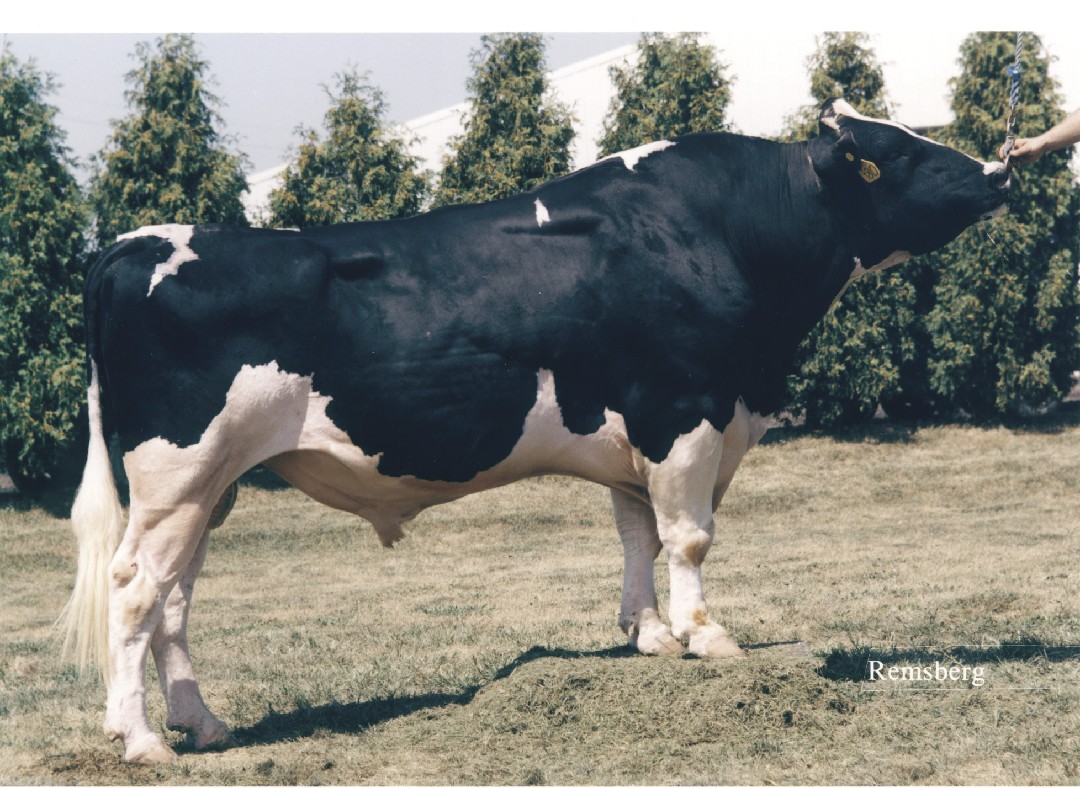
Walkway Chief Mark (VG-87-GM) — the backup bull from Foster Walk’s Neoga, Illinois herd whose genetics now account for roughly seven percent of every Holstein genome in North America. Named one of Select Sires’ “Impact Sires of the Breed,” his udder-transmitting brilliance and structural trade-offs shaped the modern Holstein in ways nobody saw coming when this photo was taken.

Walk into any Holstein barn in North America tonight. Pick out the best-uddered cow in the string — the one whose fore attachment makes you stop mid-stride, the one pushing components that keep surprising you. Trace her pedigree back far enough, and you’ll almost certainly land on the same bull.

A bull who was never supposed to be sampled. A bull who got his shot because his brother died.

His name was Walkway Chief Mark. He accounts for roughly seven percent of every Holstein genome on this continent. And his story is the strangest, most consequential accident in the history of dairy cattle breeding.

A Farmer’s Eye and a Dead Brother

Foster Walk farmed outside Neoga, Illinois — a speck of a town in Cumberland County where the land flattens out and the horizon stretches until it gives up. This was the late 1970s. Corn ran under two bucks a bushel, Elevation daughters were the standard everyone measured type against, and most breeding decisions happened on gut instinct and a phone call to your AI rep. Genomic testing? That was science fiction nobody had dreamed up yet. 

Foster had what the old cattlemen call “the eye.” While big-name breeders flew to national sales and bid top dollar on headline animals, Foster worked the margins. He’d buy groups of heifers at 21 cents a pound — bargain-bin stock by any standard — and somehow spot genetic potential hiding under less-than-perfect frames. Diamonds in the rough. That was his phrase, and he had an infuriating tendency to be right about it. 

Walkway Farm wasn’t some fly-by-night operation, either. Foster had been advertising registered Holsteins in Holstein World as far back as 1958 — two full decades before his most famous calf hit the ground. When a cow in his herd hit a production milestone, the Journal Gazette and Times-Courier out of Mattoon ran it: Walkway Janice Prince, 20,511 pounds of milk and 876 pounds of butterfat in 365 days. This was a working dairy with the Walkway prefix on real cattle making real milk, not just a pedigree footnote.

Foster Walk (left) and his son Tom at Walkway Farm near Neoga, Illinois, 1983 — the year Chief Mark daughters were already hitting milking strings across the country. Behind every bull that reshapes a breed, there’s a family that bred the cow that made him.

A young sire analyst named Charlie Will had grown up in the same neighborhood. He’d graduated from the University of Illinois in 1974 and tried to get hired at Select Sires. They turned him down. He took a sales territory in Wisconsin that nobody else wanted, worked it until a sire analyst position finally opened in 1978, and got his shot — the same year Chief Mark was born.

Charlie had his eye on Foster’s operation, but not for the calf who’d change everything. He wanted Monroe — Chief Mark’s older brother. The contract was signed and the collection schedule set. Monroe was the plan.

Then Monroe died during test services. ​

One phone call. Charlie Will — the analyst who’d been rejected himself — decided to gamble on the younger full brother. Born June 13, 1978, registration HOUSA000001773417, a Pawnee Farm Arlinda Chief son out of a EX-90 No-Na-Me Fond Matt daughter named Walkway Matt Mamie (EX-90 GMD DOM). Mark was the first bull Charlie ever bought for Select Sires. (Read more: Charlie Will’s Comeback: How One Rejection Letter Created Holstein History)

A rejected analyst picking a replacement bull from a neighbor’s farm as his very first acquisition. You can’t make this stuff up.

Whether Foster or Charlie imagined what that calf would become, the record doesn’t say. But that replacement bull would go on to sire 57,654 daughters and reshape the genetic architecture of an entire breed.

The Contradiction

When Chief Mark’s first daughter proofs came back through Select Sires — coded 7HO980 in every AI catalog in the country — the reaction wasn’t celebration. It was bewilderment. 
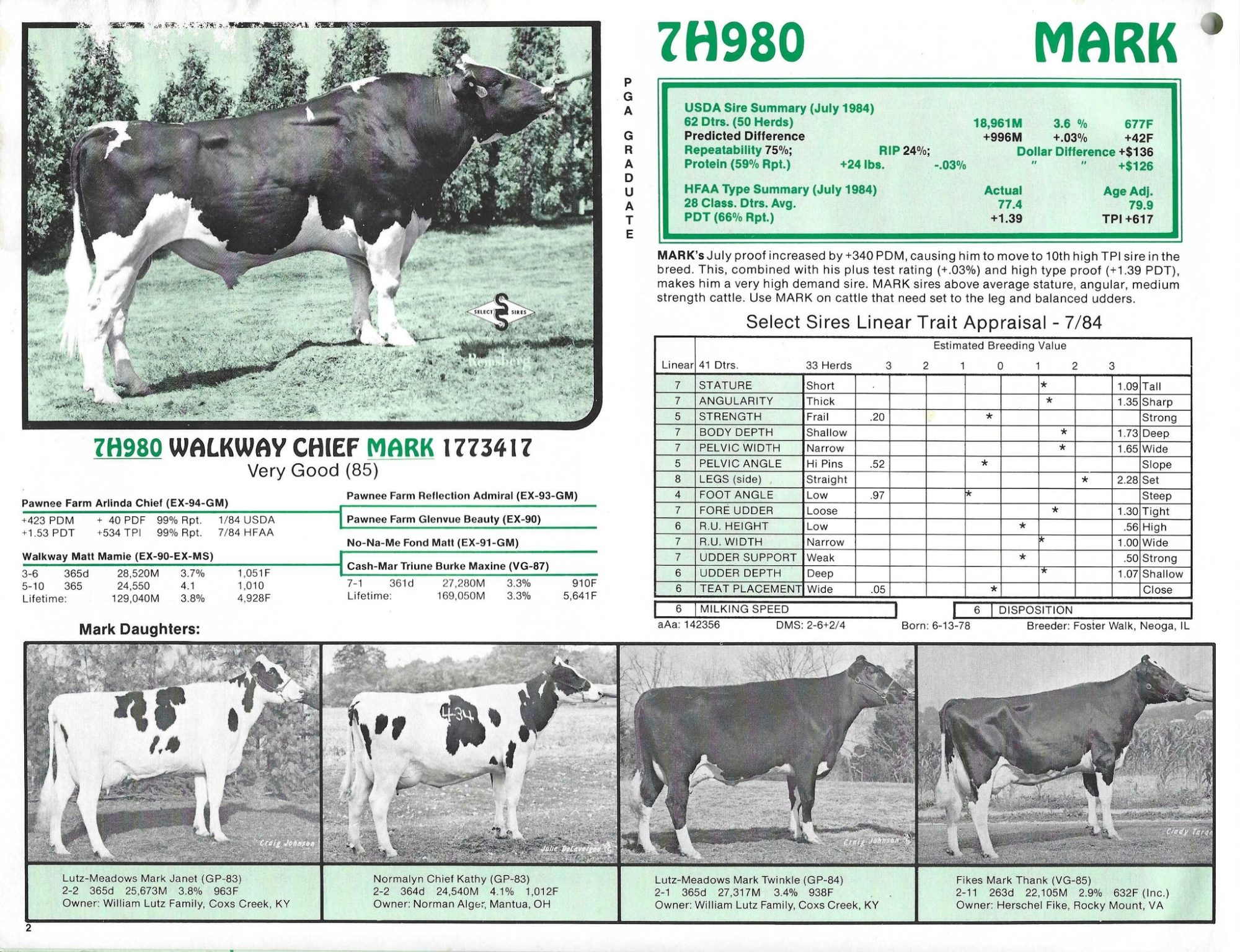
Chief Mark’s July 1984 Select Sires catalog page — the proof sheet that launched a paradox. Just 62 daughters in, and the description already told breeders exactly what they were getting into: “Use MARK on cattle that need set to the leg and balanced udders.” The udder magic and the structural trade-off were both right there in black and green from the very first proof. Note the early daughter photos at bottom — all GP or low VG first-calvers that gave no hint of the EX-90+ mammary systems his mature daughters would carry. (Select Sires, July 1984)

You have to understand how breeding evaluation worked in the early 1980s. There were no genomic predictions. No SNP chips. You bred daughters, waited years, measured them against their contemporaries, and published the deviations. Everything was relative — how much better or worse did this bull’s daughters perform compared to the current cow population?

Relative to the Holstein cows of that era, Chief Mark’s udder transmitting ability was a leap forward, unlike anything the breed had seen at that scale. Fore attachments, rear attachments, teat placement, udder depth — all trending dramatically above what anyone else in the lineup was producing. Breeders who saw his early daughters in person talk about them with a specific kind of reverence: large, sharply attached mammary systems with long, clean necks into the body wall, deep angular ribbing, dairy character you could spot from across the yard. One breeder on a Holstein forum captured it perfectly: “When they come into the show, you love them”. 
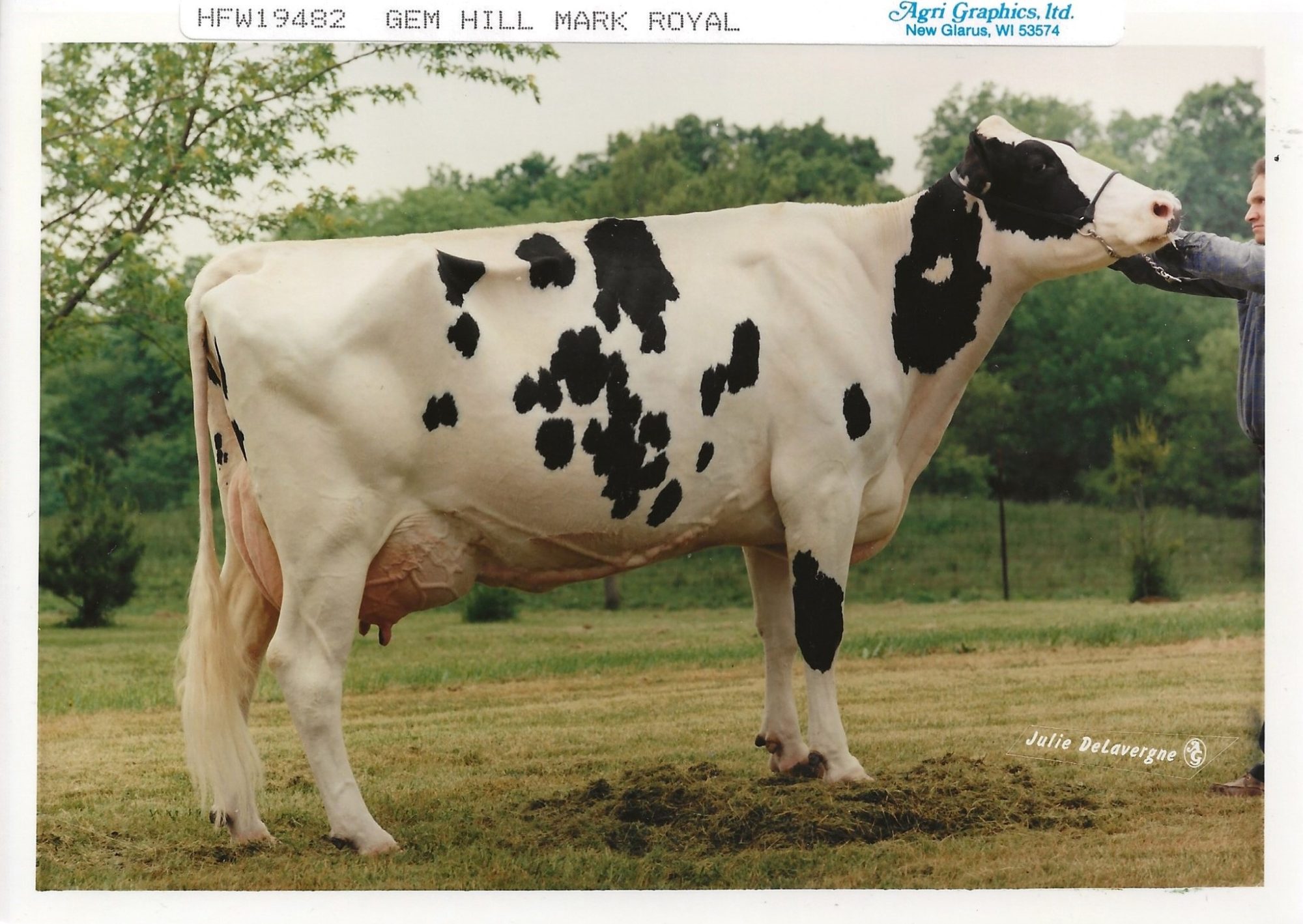
Gem-Hill Mark Royal EX-96 — Chief Mark’s highest-classified daughter. Bred by Brightbill-Gem Hill Farms, Loudonville, Ohio, she embodied everything breeders gambled on when they punched Chief Mark’s code into their breeding programs: the stature, the dairy character, and the mammary system that made his proof sheets famous.

Then he finished the thought: “however when they turned side way, you see the legs and high pins”. 

There it was. The paradox.

Because when you flipped to the structural data, even on a relative basis, the numbers were devastating. Shallow heels. Weak pasterns. The structural curse traced back through his maternal line, through No-Na-Me Fond Matt, like a family inheritance nobody could outrun. 

Measured against the cows of his era, the greatest udder improver of his generation was also one of the worst structural sires alive. The same genetics that built those magnificent mammary systems wrecked the feet beneath them.

And breeders had a decision to make.

The Deal with Fine Print

They took it. By the thousands.

Ask anyone who milked Chief Mark daughters in the ’90s, and they’ll tell you the same thing: best udders in the barn, worst feet in the barn. Some guys swore by him. Some guys swore at him. Most did both.

Smart breeders figured out the workaround. As one veteran put it, “you would have to protect the mating”—use Chief Mark on cow families with strong feet and legs, and let the udder magic do its work. The strategy wasn’t perfect, but it worked often enough to justify the gamble. When it worked, the daughters were jaw-dropping.
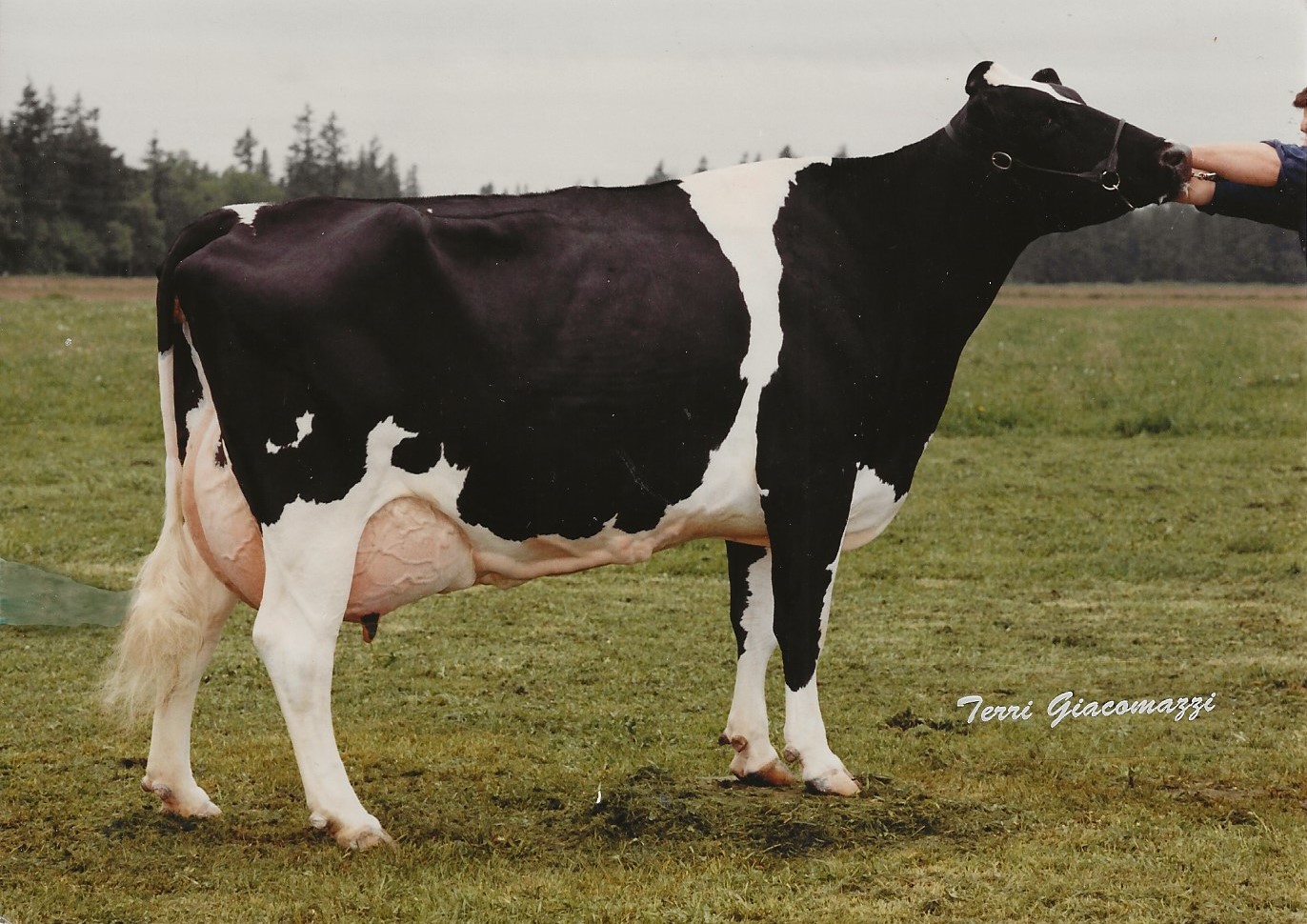
 

Mainstream Mark Harmony EX-93 — bred by Randy Kortus at Mainstream Holsteins, Lynden, Washington, and born in 1986 out of the Gold Medal Dam Mainstream Bell Honor VG-88 GMD DOM. This is what happened when Chief Mark’s udder genetics landed on a cow family with Elevation Celebrity blood behind it: the kind of daughter that made breeders forgive those feet-and-leg numbers.

By the mid-1990s, the NAAB database would eventually show 57,654 production-tested daughters carrying his genetics across American herds. Most AI studs don’t produce that many daughters from their entire lineup in a decade. Chief Mark did it from a single catalog entry. 
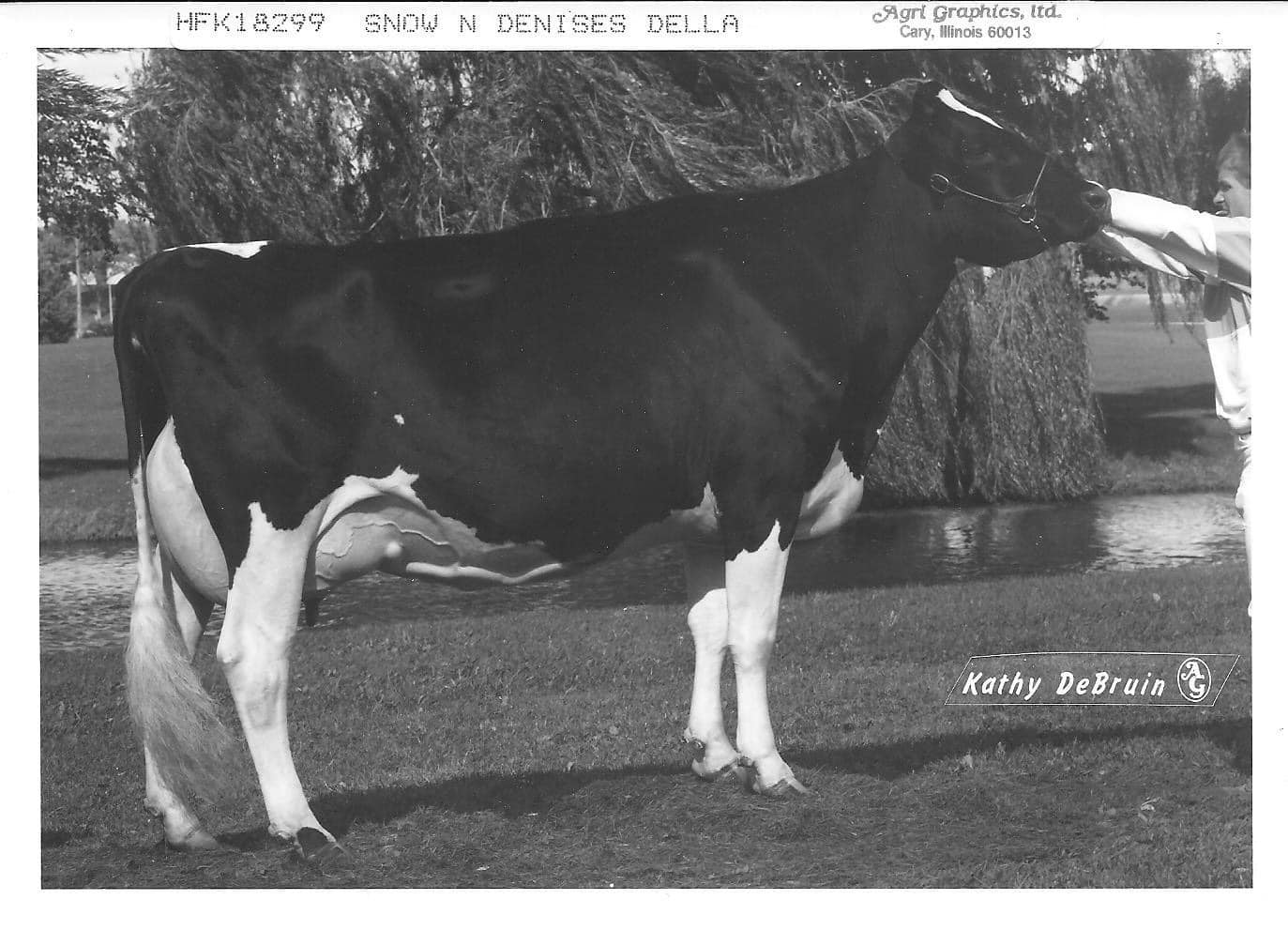
Snow-N Denises Dellia EX-95-3E GMD DOM 5 — Chief Mark’s most famous daughter and arguably the most influential brood cow of the modern Holstein era. Born in 1986 on Bob Snow’s Wisconsin farm and later the cornerstone of Regancrest Farm in Waukon, Iowa, she produced Durham, Die-Hard, and Million, along with 76 registered daughters and 44 AI-sampled sons. Named Holstein International Global Cow of the Year in 2005, Dellia was living proof that Chief Mark’s udder genetics, crossed on the right cow family, could reshape the breed for generations. (Read more: Snow-N Denises Dellia: The Holstein Legend Who Redefined Dairy Genetics)

But genetics always collects its debts.

On larger operations that used him heavily without careful mating management, the structural toll was brutal. By the third lactation, the feet caught up. Trimming schedules accelerated. Digital dermatitis became a constant battle. You’d walk through a pen of Chief Mark daughters, making 90-pound peaks — udders attached like textbook illustrations, production numbers rewriting the farm’s economics — and half of them were sore-footed.

You don’t want to ship a cow making that kind of milk. But you can’t keep a cow that can’t stand up.

The Hidden Killer Nobody Knew About

The scope of Chief Mark’s influence becomes truly staggering when you trace it back to his father.

Pawnee Farm Arlinda Chief was born in 1962 and produced 16,000 daughters, 500,000 granddaughters, and more than 2 million great-granddaughters. His chromosomes account for almost 14 percent of the genome in the current U.S. Holstein population. Chief Mark, as one of Chief’s most prolific sons, carried and amplified that genetic footprint through a massive daughter population of his own. 
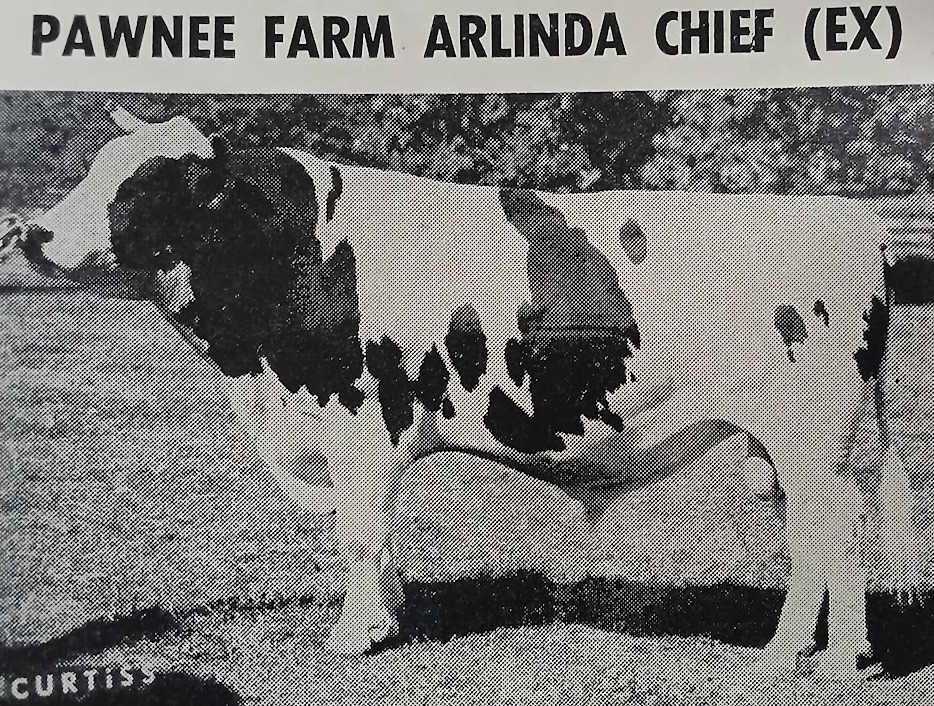
Pawnee Farm Arlinda Chief EX-91 — Chief Mark’s sire, and the bull whose chromosomes account for nearly 15% of the modern Holstein genome. Born in 1962, he produced 16,000 daughters, 500,000 granddaughters, and over 2 million great-granddaughters through Curtiss Breeding Service. He gave the breed unprecedented milk production — and unknowingly passed along the APAF1 mutation that would cost the industry an estimated 500,000 calves before researchers finally identified it in 2011. Chief Mark inherited both the gift and the curse. (Read more: The $4,300 Gamble That Reshaped Global Dairy Industry: The Pawnee Farm Arlinda Chief Story and Four Bulls That Changed the Holstein Breed: Genius, Gambles, and the Price We’re Still Paying)

What nobody knew — for three decades — was that Chief had given his descendants something besides production and udder quality.

In 2011, USDA researchers identified a problematic haplotype on chromosome 5 in Holstein cows that was associated with lower fertility and embryo loss. They traced it back to Chief. They contacted Harris Lewin, a geneticist who had sequenced both Chief and Chief Mark at the University of Illinois in 2009, and asked whether his team could identify a candidate mutation. 

Lewin and co-author Heather Adams found it in less than 24 hours. 

“It was a Eureka moment!” Lewin said. 

The mutation sat in a gene called APAF1 — a “nonsense” mutation that shortens an amino acid chain critical for protein-to-protein interactions. One copy makes a calf a carrier. Two copies — one from each parent — kill the embryo. Among more than 246,000 Holsteins tested, researchers found zero animals carrying APAF1 from both parents. Every double-copy pregnancy ended before the calf drew a breath. 

The numbers were staggering. Over 30 years, the APAF1 mutation caused an estimated 500,000 spontaneous abortions worldwide — more than 100,000 in the United States alone. A single midterm abortion costs a dairy about $800. Total estimated loss: approximately $420 million. 

Think about that for a second. For decades, every time a farmer milking Chief descendants saw an unexplained pregnancy loss, they shrugged, logged it as bad luck, and moved on — that was APAF1. One bull’s hidden genetic tax, collected silently across thousands of operations for a generation.

But the math cuts both directions. Chief’s beneficial genetic contributions — the production, the udders, the overall improvement — are estimated at roughly $30 billion in increased milk production over the same period. Thirty billion against $420 million. The value outpaced the cost seventy-to-one. 

And now breeders can test for APAF1 and avoid mating two carriers while keeping everything that made the lineage great. The curse has been identified and neutralized. The gifts remain. 

Both Sides of the Pedigree

When analysts traced the pedigrees of the breed’s top 10 GTPI females they kept running into the same name. Mark. Forty-two times across those ten pedigrees, with Starbuck the only other bull in the same league at thirty-five. And here’s the telling detail: thirty-three of those Mark appearances were as sire of a female in the lineage, while nine were as sire of the male. He dominated both sides of the pedigree. 

Only a handful of bulls in Holstein history have earned what The Bullvine’s own analysis calls the distinction of “sons and daughters both extraordinary”. Chief Mark was one of them. 
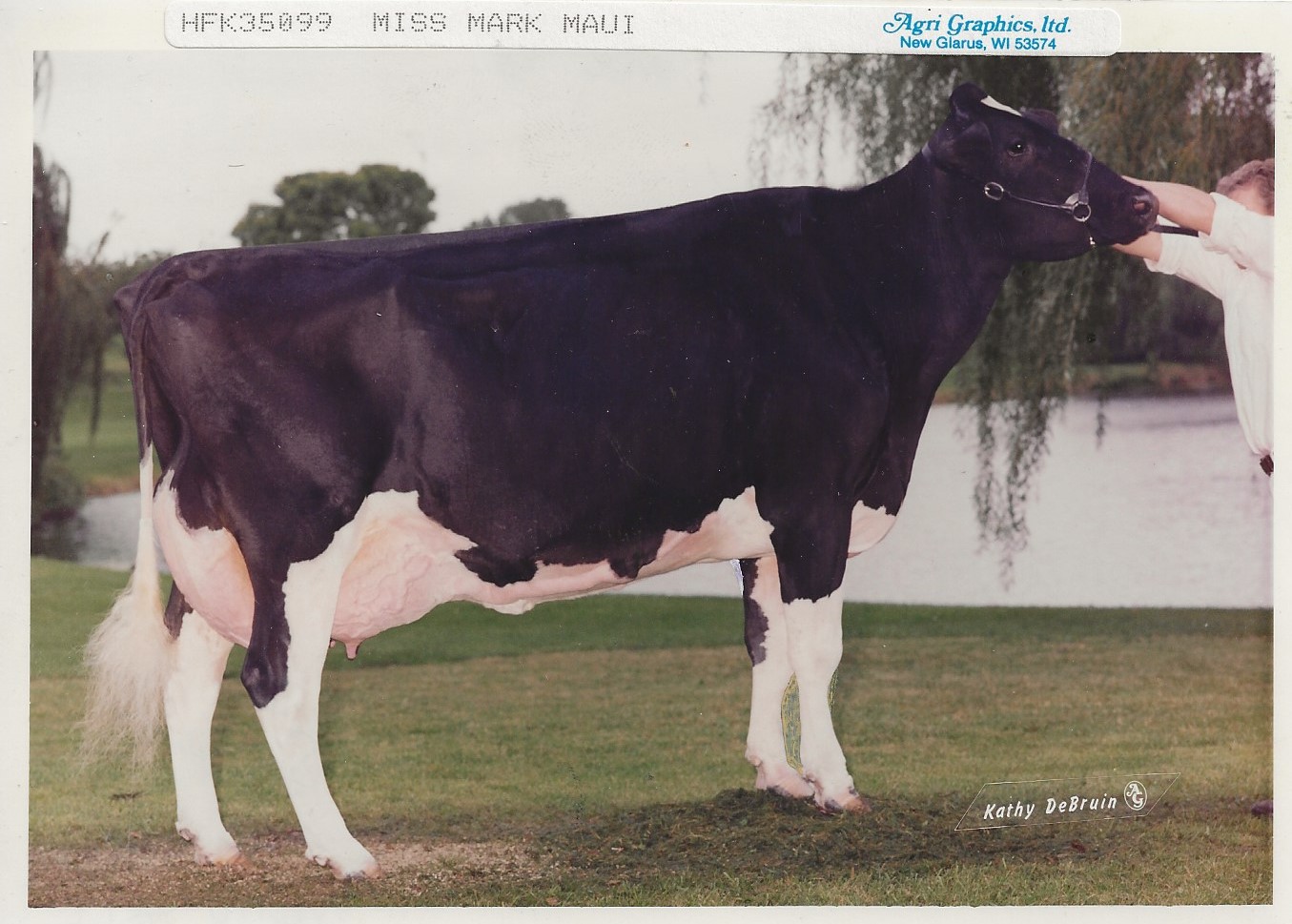
Miss Mark Maui EX-95-2E GMD DOM — the 1994 All-American Junior 2-Year-Old, showing the mammary quality and dairy character that would define her career. Sired by Chief Mark out of Gettinger Maggie EX-93 GMD DOM, she produced over 252,000 pounds of lifetime milk, flushed Excellent daughters by Lee, Rudolph, Durham, and Starbuck, and sent sons including Mr Millennium to AI. Owned by Kietzman, Sigwarth, and Breitbach of Iowa, she was the kind of Mark daughter breeders built entire cow families around. 

And the most consequential genetic river flowing from Chief Mark ran through a son named Mark CJ Gilbrook Grand.

The Goldwyn Connection

Grand’s name doesn’t ring bells with most modern breeders. But it should. Because Grand sired Shoremar James. And Shoremar James sired Braedale Goldwyn. 

In Goldwyn’s lineage were three crosses to Walkway Chief Mark: Shoremar James and Braedale Gypsy Grand were both by Mark CJ Gillbrook Grand, a Chief Mark son; while Gypsy’s maternal granddam was Sunnylodge Chief Vick (VG 2*), a Chief Mark daughter”. 

Three crosses. Three separate paths through one pedigree, all converging on a backup bull from Neoga, Illinois.

RF Goldwyn Hailey EX-97-5E 6 — two-time World Dairy Expo Grand Champion (2012, 2014) and one of only seven cows in Expo history to win the Grand title twice. Bred by R&F Livestock and Chilliwack Cattle Company, exhibited by Gen-Com Holsteins of Quebec, and pictured here at Madison in 2014 claiming her second crown. Three crosses of Walkway Chief Mark flow through the Goldwyn pedigree she carried into that ring — the backup bull from Neoga, under the lights at the Coliseum.

Goldwyn — bred by Braedale Holsteins at Cumberland, Ontario — became arguably the most decorated show sire in modern Holstein history. Premier Sire at the World Dairy Expo ten times. His daughters, RF Goldwyn Hailey (EX-97) and Eastside Lewisdale Gold Missy (EX-95) became the most famous show cows of their generation. By October 2018, he’d produced 3,415 Excellent daughters in Canada alone, according to Holstein Canada. Goldwyn died in 2008, just eight years old, but his genetics kept sweeping classes at Madison and the Royal for another decade and beyond. 
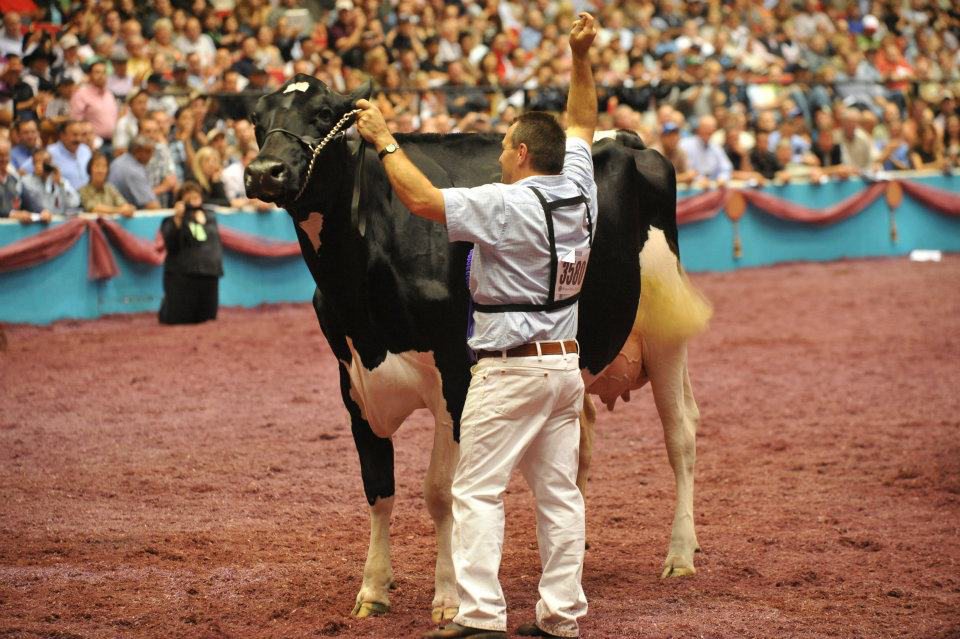
Eastside Lewisdale Gold Missy EX-95-2E 30 — Supreme Champion at both World Dairy Expo and the Royal Winter Fair in 2011, Holstein Canada Cow of the Year in 2012, and the $1.2 million cow who became the most expensive Holstein on the planet. Bred on Prince Edward Island by Eastside Holsteins and Lewisdale, she carried Goldwyn’s genetics — and through him, three crosses of Walkway Chief Mark — to the highest stage the breed has ever known.

Woven through all of it — three times in every Goldwyn pedigree — was Walkway Chief Mark.

The Supersire Empire

Chief Mark’s genetics didn’t just flow through the show ring.

Through maternal pedigree lines — including Jeanlu Louange Chief Mark (VG-87), a Chief Mark daughter deep in the maternal line — his influence reached Seagull-Bay Supersire, a Robust son bred by the Andersen family in American Falls, Idaho, and owned by Select Sires. 
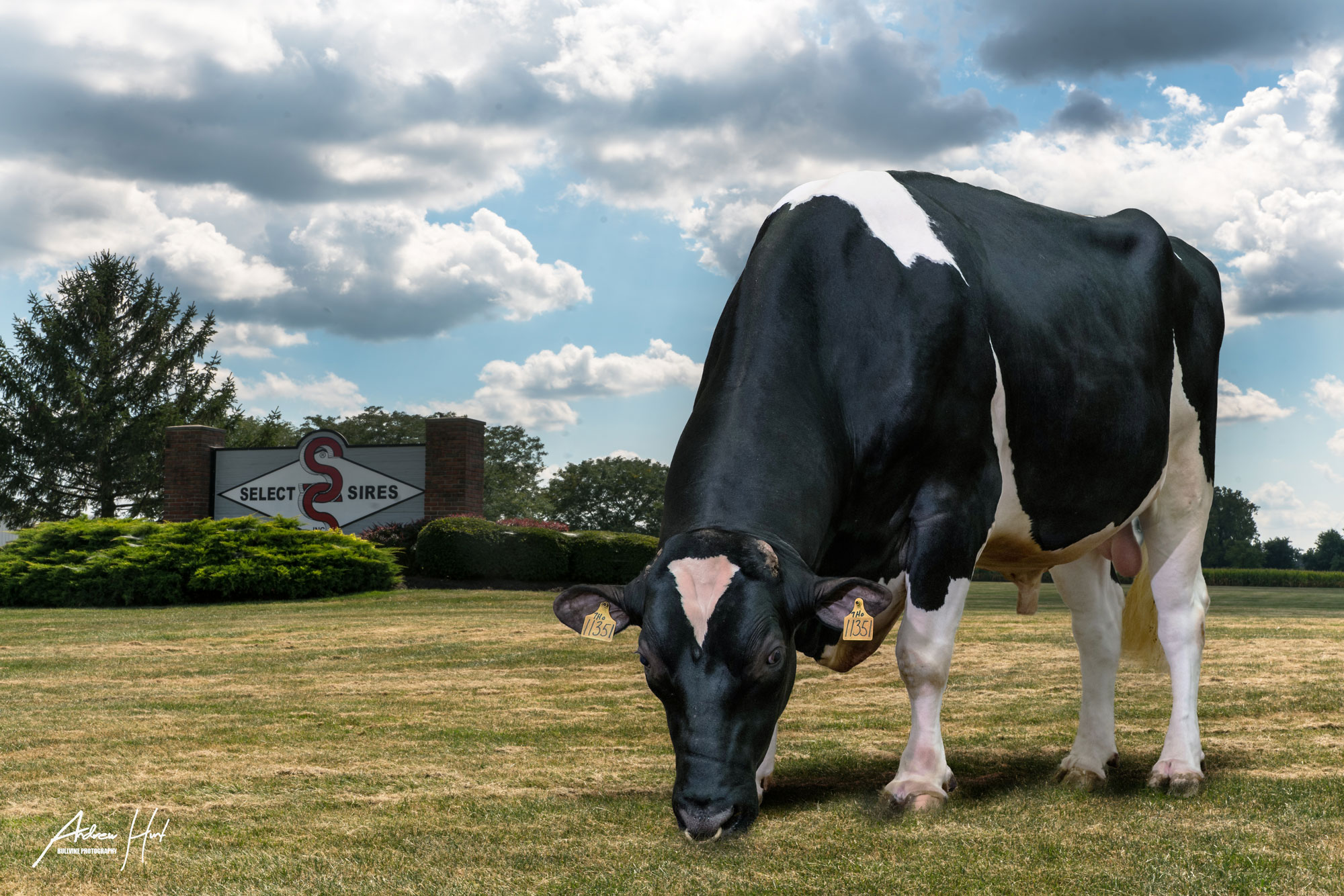
Seagull-Bay Supersire-ET EX-90-GM — grazing at Select Sires headquarters in Plain City, Ohio, where he stood as the breed’s No. 1 GTPI sire and sold over one million doses of semen. A Robust son bred by the Andersen family in American Falls, Idaho, Supersire’s maternal line traces back through Wesswood-HC Rudy Missy — the $8,100 “auction reject” who became 2014 Global Cow of the Year — and further still to Jeanlu Louange Chief Mark VG-87, a Chief Mark daughter quietly anchoring the empire from generations back.

Supersire debuted as the breed’s No. 1 GTPI sire in April 2015 and reigned as the breed leader for four consecutive genetic evaluations. He’d scored 2530 gTPI as a genomic young sire back in December 2012; six years and 33,087 daughters later, his proven TPI came in at 2518. Holstein International called it “right in the DNA bull’s eye” and named him a “milk transmitter par excellence” — the world’s 55th millionaire sire and Select Sires’ eleventh bull to sell one million units of semen. 

“The beautiful thing about SUPERSIRE daughters is they outproduce the herd while doing it in a healthy fashion,” said Rick VerBeek, Holstein sire analyst at Select Sires. “SUPERSIRE should be regarded as one of the all-time great profit generators of his generation!” 

In 2019, more than 60 percent of bulls on the Select Sires active lineup carried Supersire in their pedigree. Sixty percent of an entire AI organization’s catalog, tracing back through a genetic chain that started with a second-choice bull and a phone call about a dead brother. 

Supersire passed away in late 2021. His legacy was already secure. But buried in that pedigree — quiet, easy to miss, generations back on the maternal side — was the ghost of Walkway Chief Mark, still shaping the breed he’d accidentally been invited to improve. 

Twenty-Five Times

And then came Lambda.

In 2024, an analysis that made even seasoned geneticists pause. They’d been tracing the pedigree of Farnear Delta-Lambda — one of the most influential contemporary sires in the global breed, the bull behind Siemers Paris 27856 EX-91, Global Cow of the Year in 2023, and her high-ranking son Parfect. 

When they finished mapping Lambda’s ancestry, they found Walkway Chief Mark appeared twenty-five times.  Twenty-five separate lines of descent converging in a single pedigree, all flowing back to a replacement bull born on a modest Illinois farm in June of 1978.
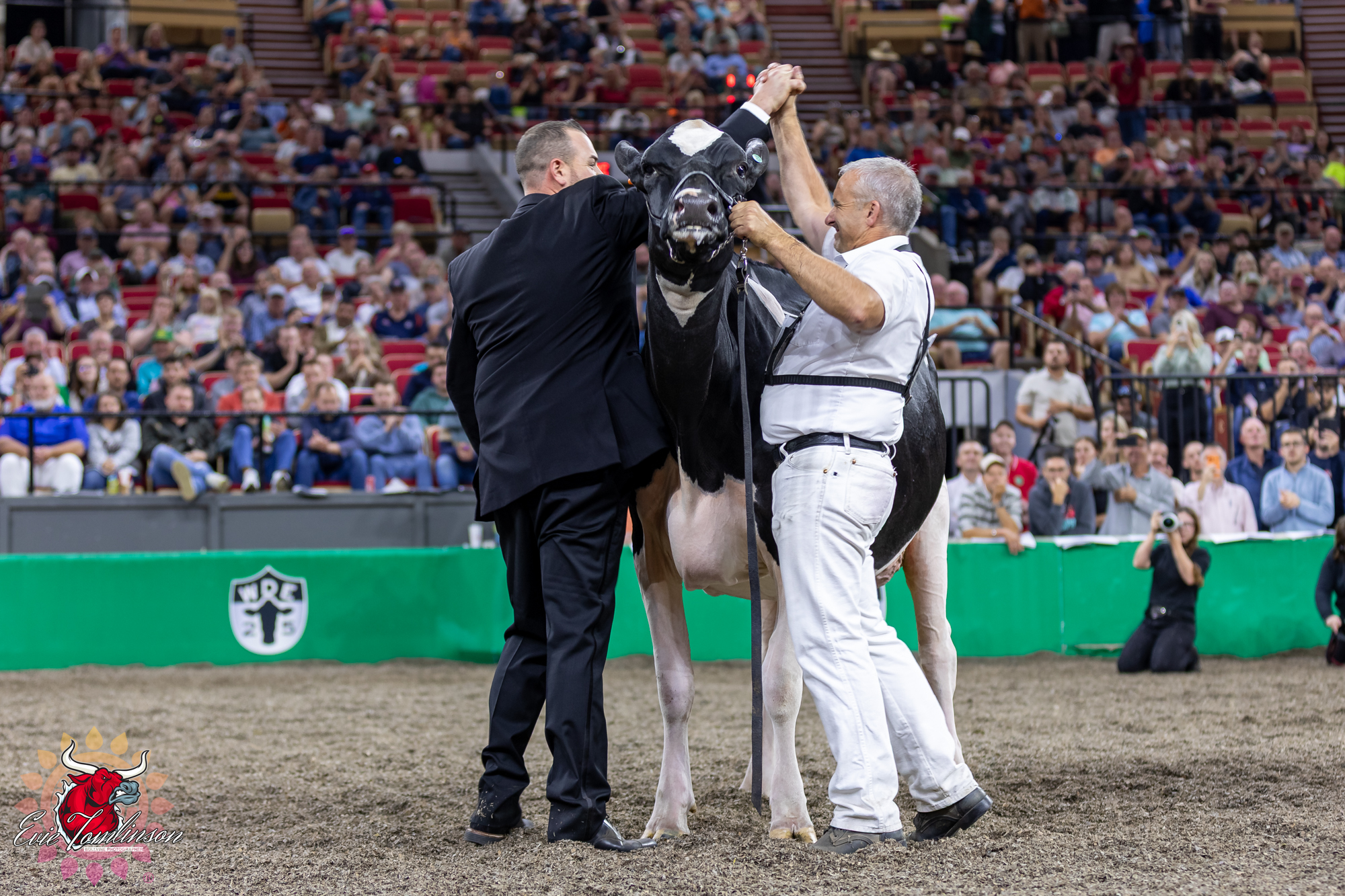
West-Adub Lambda Sadie — Intermediate Champion and Reserve Grand Champion of the 2025 International Holstein Show at World Dairy Expo, exhibited by Butlerview Farm of Chebanse, Illinois. Sired by Farnear Delta-Lambda — the bull who carries Walkway Chief Mark 25 times in his pedigree — she stood on the red shavings at Madison just 100 miles from Neoga, proof that a backup bull’s genetic echo is still shaping champions nearly five decades later.

Holstein International called it “the righteous revenge of Walkway Chief Mark.” Together with Lambda mania, they wrote, “we can also talk about Mark mania”. 

Forty-seven years after a dead brother opened the door, the backup plan’s roar is louder than ever.

The Ghost at 4 AM

Chief Mark’s story doesn’t come with a tidy ending. There’s no dispersal sale to narrate, no final show-ring walk, no sunset-lit portrait. His semen was collected, stored, and distributed across the globe, and his physical life passed quietly while his genetic life was only beginning its exponential expansion. The NAAB database lists him as “Inactive” — a status that says everything about bureaucracy and nothing about legacy. 

Whether Foster Walk lived to see the full scope of what his backup bull built, the record doesn’t tell us. But his eye for diamonds in the rough — that eye is now validated in 57,654 daughters, seven percent of a continental genome, and 25 appearances in the pedigree of one of the breed’s most influential modern sires. 

What the record also tells us: three crosses in the pedigree of the most decorated show sire in modern Holstein history. A Chief Mark daughter deep in the maternal line of a millionaire sire who reshaped global dairy genetics. A hidden lethal mutation — half a million dead calves — was identified and neutralized because someone had the foresight to sequence his DNA back in 2009. And a reputation as an udder improver that, decades and multiple base changes later, still echoes in the mammary quality of his descendants’ descendants’ descendants. 

He arrived as a replacement. He became irreplaceable.

Every breeding decision echoes forward through time. Most of those echoes fade within a generation or two — diluted, selected against, bred out. Chief Mark’s didn’t fade. It amplified. Seven percent of a continental genome, a frequency so deep it has become the baseline hum of the breed itself. The backup plan from Neoga, Illinois, built an empire nobody saw coming. 

Next time you’re walking your barn before dawn — flashlight cutting through the steam rising off a hundred backs, bulk tank humming in the parlor, a fresh cow somewhere letting down for the first time — look at the udders. Look at the attachments. Look at the dairy character carved into the ribs and flanks of your best animals. You’re looking at Foster Walk’s diamond in the rough, still paying dividends nearly five decades and fifty-seven thousand daughters later. Still proving what every breeder who ever took a chance on an unlikely animal already knows in their bones: in this business, the ones who change everything aren’t always the ones you planned on.

Key Takeaways:

  • Walkway Chief Mark started as the backup bull from Foster Walk’s Neoga, Illinois herd, sampled only after his brother Monroe died — but his genes now account for about 7% of every Holstein on the continent.
  • He gave breeders one of the biggest trade‑offs in Holstein history: daughters with era‑setting udders and some of the weakest relative feet and legs, forcing anyone who used him to “protect the mating” or live with the consequences.
  • Together with his sire Pawnee Farm Arlinda Chief, he helped define modern Holstein genetics on both sides of the ledger — huge gains in type and production, and the APAF1 lethal mutation later linked to roughly 500,000 spontaneous abortions worldwide before it was identified and managed. ​
  • His blood now threads through three confirmed crosses in Braedale Goldwyn’s pedigree, deep in the maternal line of Seagull‑Bay Supersire, and an astonishing 25 times in Farnear Delta‑Lambda’s ancestry, tying one small Illinois farm to many of today’s most influential sires.
  • The piece leaves readers in a pre‑dawn barn with a simple realization: when you study the best udders in your herd today, you’re almost certainly looking at the long shadow of a once‑overlooked bull from Neoga.

Executive Summary: 

Walkway Chief Mark was never meant to be a legend; he was the backup bull from Foster Walk’s Neoga, Illinois herd, sampled only because his brother Monroe died — yet his DNA now sits in roughly seven percent of every Holstein you milk. His proof told a story every breeder understands: daughters with era-changing udders riding on some of the weakest relative feet and legs in the book, forcing people to “protect the mating” if they wanted the magic without the wreckage below the hocks. The article walks through that reality in the barn, then zooms out to show how Chief Mark and his sire Pawnee Farm Arlinda Chief helped build the modern Holstein genome — for better (udder quality, production, show-ring type) and for worse, through the APAF1 mutation tied to an estimated 500,000 spontaneous abortions before scientists pinned it down in 2011. From there, it follows his blood into names everyone knows today: three confirmed crosses in Braedale Goldwyn’s pedigree, deep maternal influence in Seagull-Bay Supersire, and an almost unbelievable 25 Chief Mark appearances in Farnear Delta-Lambda’s ancestry. Along the way, Foster Walk steps out of the shadows as a real dairyman — a guy whose Walkway cows showed up in Holstein World ads and local production records long before anyone dreamed of genomic percentiles. It all ends back in a quiet 4 a.m. barn, inviting readers to study the best udders in their own string and realize that, whether they planned it or not, they’re still working with a once-forgotten bull from Neoga whose influence just won’t let go.

Complete references and supporting documentation are available upon request by contacting the editorial team at editor@thebullvine.com.

Continue the Story

  • Charlie Will: A Career Spent at the Top of the Chart – Experience the era through the eyes of the man who risked his early reputation on a neighbor’s backup bull, proving that the breed’s greatest genetic leaps often come from analysts with the guts to trust their eye.
  • Pawnee Farm Arlinda Chief – Genetic Giant – Step back into the world that birthed an empire and explore the massive shadow cast by Mark’s sire, a bull who fundamentally rewrote the Holstein blueprint and set the stage for a global genomic revolution.
  • Durham vs. Goldwyn: A Clash of Two Titans – Trace the lineage from Foster Walk’s quiet Illinois farm to the bright lights of Madison, where Mark’s genetic influence finally found its ultimate expression in a show-ring rivalry that defined a whole generation of breeders.

Join the Revolution!

Join over 30,000 successful dairy professionals who rely on Bullvine Weekly for their competitive edge. Delivered directly to your inbox each week, our exclusive industry insights help you make smarter decisions while saving precious hours every week. Never miss critical updates on milk production trends, breakthrough technologies, and profit-boosting strategies that top producers are already implementing. Subscribe now to transform your dairy operation’s efficiency and profitability—your future success is just one click away.

NewsSubscribe
First
Last
Consent

Charlie Will’s Comeback: How One Rejection Letter Created Holstein History

Charlie Will helped build the dairy industry’s greatest genetic empire. All because Select Sires told him no.

Listen, I’ve been in this industry long enough to know that rejection letters rarely lead to revolutions. But Charlie Will’s story… this one hits different.

Spring of ’74—Nixon’s still in office, gas is 55 cents a gallon—and Charlie’s sitting there with his fresh University of Illinois dairy science degree. Select Sires, the largest AI company in the industry, tells him, “Thanks, but no thanks.” No openings in their Sire Department.

Here’s what gets me, though. Most of us would’ve taken that rejection and gone into feed sales, maybe found a nice co-op job. Not Charlie.

Fast forward to this week—the National Association of Animal Breeders just announced Charlie as their 2025 Pioneer Award winner. After nearly 40 years with Select Sires (yeah, the same company that wouldn’t hire him), his bulls have sold millions of units worldwide. We’re talking about genetics that influence basically every Holstein pedigree you’ll pull up today.

Learning Cattle the Old-School Way

Southern Illinois dairy country in the 1960s wasn’t exactly genetic headquarters, but it’s where Charlie learned cattle. Growing up on the family’s commercial Holstein farm, working those twice-daily milkings. You know that barn smell—silage, sawdust, and that sweet-sour mix of fresh milk and manure—that’s where Charlie’s education started.

The neighbors at Walkway Farms—Foster Walkway ran that place—had cattle worth the drive from Chicago. Charlie spent a considerable amount of time studying those genetics.

At the University of Illinois, Charlie made the dairy judging team. While everybody else was doing… well, whatever college kids did in the early ’70s, he was evaluating cattle across the Midwest.

Spring ’74 comes around. Charlie sends resumes to every AI stud in North America. Every single one says no.

The Wisconsin Detour That Changed Everything

So Charlie’s reading the classifieds in Hoard’s when he spots this tiny ad. MABC—that’s a Select Sires member cooperative—needed a sales rep for Western Indiana.

Not glamorous. Not what he wanted. But here’s the thing—MABC was connected to Select Sires.

Two years later, they asked him to move to Wisconsin. Green Bay area. Open new territory as both a sales rep and SMS evaluator. Northern Wisconsin winters aren’t exactly Miami Beach, but this was real dairy country where farmers knew their genetics.

Four years, Charlie worked those territories, building relationships farm by farm. Word started getting back to Select Sires headquarters in Plain City, Ohio—that massive complex off US Highway 42 with bull barns stretching across the landscape.

When a sire analyst position finally opened in 1978, Dick Chitester took what he called “a risk” and hired Charlie. The guy they’d rejected was finally inside.

Learning From the Veterans

Charlie’s first bull selection was Walkway Chief MARK from back home. The bull worked—good daughters, exceptional brood cows.

But the real education came from the veterans. Ron Long, who Charlie called “one of the greatest cowmen to this day that I have ever met”. George Miller, the marketing director.

The early Select Sires dairy sire team, foundational to the company’s success: (L-R) Rodger Hoyt, John Hecker, Charlie Will, and Ron Long. This group established the industry-leading standards for sire sampling and correct semen usage, providing the framework for Charlie’s future million-unit bulls.

According to company records and those who worked with him, Miller’s philosophy was simple: genetics isn’t about what looks good in catalogs—it’s about solving problems for farmers.

The BLACKSTAR Breakthrough

Spring 1988. Picture the scene—Select Sires’ genetics department, everyone crowded around those old dot-matrix printers that sounded like typewriters on steroids. The proofs are coming out for a bull Charlie had acquired called To-Mar BLACKSTAR.

BLACKSTAR didn’t just prove good—he topped both domestic and international rankings. This wasn’t just any Holstein bull with the typical black and white patches. We’re talking about a bull built like a freight train—wide chest, strong legs, the kind of frame that screams power. Within days, every AI stud on the planet wanted BLACKSTAR sons.

The 1985 Select Sires Sire Analyst Team, including Ron Long (back left), Charlie Will (back center), Rodger Hoyt (back right), Scott Johnson (front left), and John Hecker (front right). This was the team, guided by mentors like Ron Long, within which Charlie honed his skills and, shortly after, acquired the groundbreaking bull, BLACKSTAR.

At the next proof meeting, Dick Chitester stands up with a letter signed by the entire sire team. The message: Charlie was officially off probation.

A few weeks before his death, the legendary To-Mar BLACKSTAR, whose proofs in 1988 topped global rankings, secured Charlie Will’s position at Select Sires. The bull was described as being “built like a freight train—wide chest, strong legs, the kind of frame that screams power.”

Ten years. He’d been at Select Sires for ten years, and management had been watching, evaluating whether this guy who’d come in through the back door could really deliver. They’d been waiting for him to prove he belonged.

Finding Diamonds in the Rough

After BLACKSTAR, Charlie could’ve played it safe. Instead, he looked for bulls others had passed on.

Take ELTON—7H2236 Emprise Bell ELTON. His dam scored Good Plus with a Good udder. Today, that wouldn’t even get you past the first sort. But Charlie drove to Minnesota in February to see ELTON’s daughters himself.

Walking into that barn—you know how it is, that warm, humid air hits you after the bitter cold outside, steam rising off the cows’ backs, the rhythmic sound of milkers running. What he found—exceptional udders with that deep cleft you want to see, rear attachments high and wide like someone had engineered them, feet and legs built for longevity.

The legendary 7H2236 Emprise Bell ELTON. His dam scored only Good Plus, but Charlie Will’s personal inspection of his daughters in the barn—not the catalog—revealed the exceptional udders and strong feet and legs that made ELTON the sire of DURHAM and maternal grandsire of OMAN, influencing Holstein genetics for decades.

ELTON became the sire of DURHAM, who produced 5,039 Excellent daughters. Also became maternal grandsire of OMAN.

Speaking of OMAN—O-Bee MANfred Justice—he delivered what the industry was crying for in the early 2000s. Better calving ease, improved health traits, and increased production.

The impact of his selections is staggering when you look at the unit sales :

  • OMAN: Over 1,000,000 units sold
  • MATHIE: 1,000,000+ units
  • MILLION: 1,000,000+ units
  • INTEGRITY: 1,500,000+ units
  • BLITZ: Over 1.52 million units—still the Select Sires record
Charlie Will (left) with Brian and Wendy Fust, breeders of Fustead Emory BLITZ, at Select Sires. Behind them, Fustead Emory BLITZ himself stands as a testament to Charlie’s eye for “diamonds in the rough”—a bull that would go on to sell over 1.52 million units for Select Sires, a company record.

The Teacher Who Packed Barns from Tokyo to Turin

By the late ’90s, Charlie wasn’t just selecting bulls—he was the industry’s educator. Presented in 49 states and 18 countries.

I remember hearing about one of his seminars in Wisconsin—standing in front of 200 dairy farmers, Charlie pulls out a chart and says, “Forget everything you think you know about linear traits for a minute”. Then he’d walk them through how a bull scoring +2.0 for udder depth actually translates to daughters that milk two lactations longer. Made it real, you know? Not just numbers on paper.

Scott Ruby from World Wide Sires captured it perfectly: “He had an incredible gift for taking complex genetic concepts and making them understandable to every dairy farmer”.

When Genomics Changed the Game

The thing about 2008 and genomics—it completely upended how we’d done business for decades.

The old-timers were skeptical. Charlie, approaching 60, could’ve resisted. Instead, he embraced it.

As he explained, before genomics, parent averages gave you maybe a 50-50 shot. Genomic markers? Way better odds.

But here’s what Charlie also recognized—everyone chasing the same high genomic bulls was narrowing the genetic base. Take a look at what’s happening now… Recent studies indicate that Holstein inbreeding levels are approaching a critical threshold in elite lines. “We need to be stewards of the breed,” Charlie argued.

Under his guidance, Select Sires deliberately used bulls with lower indexes but diverse pedigrees. Cost them money, but as Charlie said, “If we don’t maintain genetic diversity, who will?”.

The results? Between 2008 and 2019, genomics added $50 per cow per year in genetic value, totaling $4 billion. We now run over a million genomic tests annually.

What This Means Right Now

October 2025, and the industry Charlie helped build faces some real challenges.

Milk’s at $17.19/cwt according to CME—not exactly lighting anyone’s world on fire. The government shutdown’s affecting USDA services, making things harder for everyone. Nestlé has recently withdrawn from a global methane reduction initiative, sparking widespread discussion.

But here’s what’s interesting—despite everything, about 75% of farmers expect to be profitable this year. We’ve got $8 billion in new dairy processing coming online. Beef-on-dairy is absolutely booming.

And look at the genetics we’re working with now. The April 2025 base change was the largest in Holstein history—45 pounds of rollback on butterfat and 30 on protein. That means our cows are improving at a faster rate than ever. The average Holstein today? She’s more moderate in stature—not those skyscraper cows from 20 years ago—but producing more efficiently than ever.

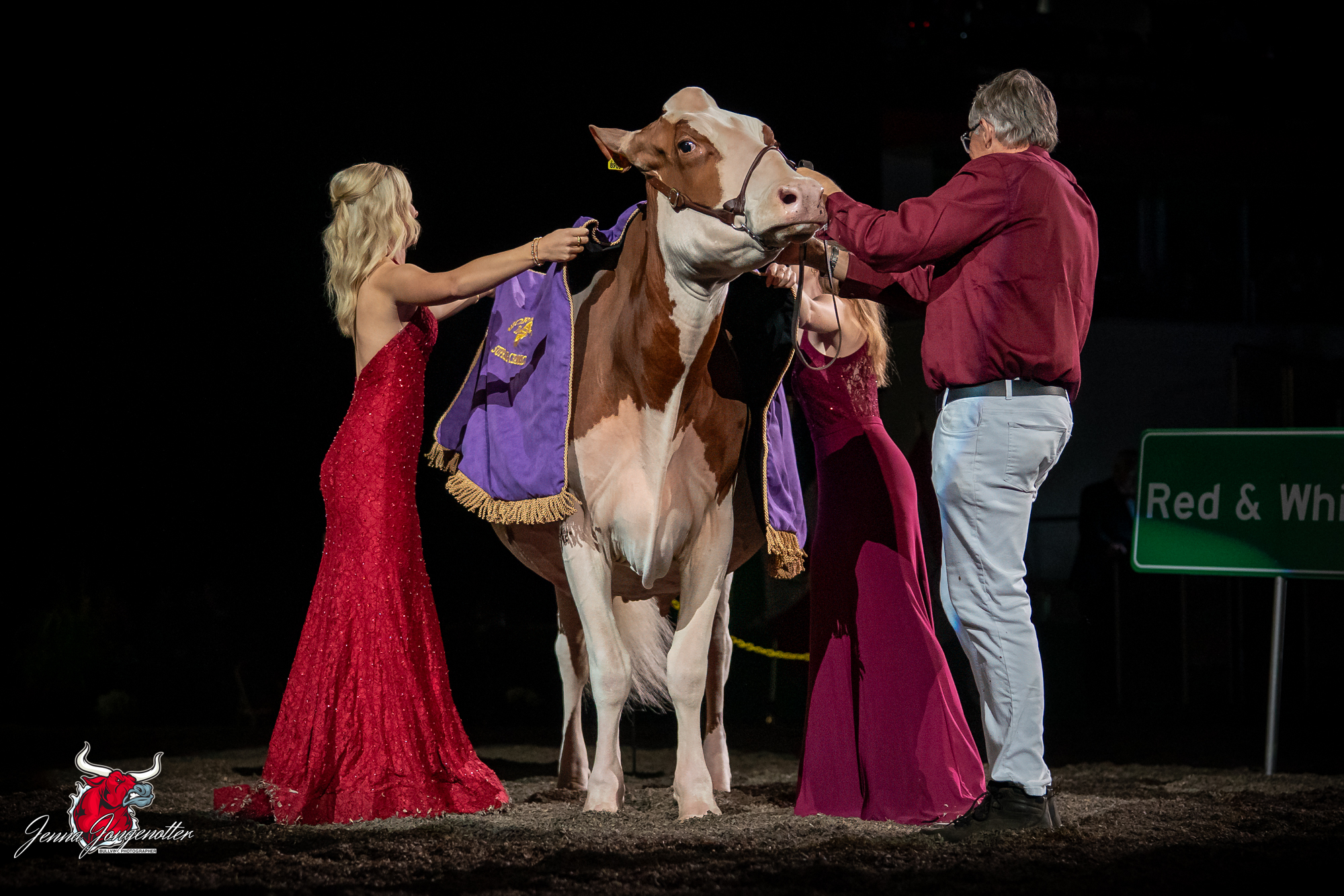
Golden-Oaks Temptres-Red-ET, crowned Supreme Champion at World Dairy Expo last week, exemplifies the ongoing genetic progress in the Holstein breed. This first Red & White Supreme Champion in 20 years visually confirms how the genetics championed by pioneers like Charlie Will continue to influence elite cattle, even decades later.

At World Dairy Expo last week, Golden-Oaks Temptres-Red-ET took Supreme Champion. First Red & White in 20 years. You look at genetics like that, and you’re seeing the influence of bulls Charlie championed decades ago.

The Philosophy That Built Success

Young people always ask Charlie what his secret is. His answer never changes.

“It’s the people,” he says. The mentorship from Dick Chitester, Ron Long, and George Miller.

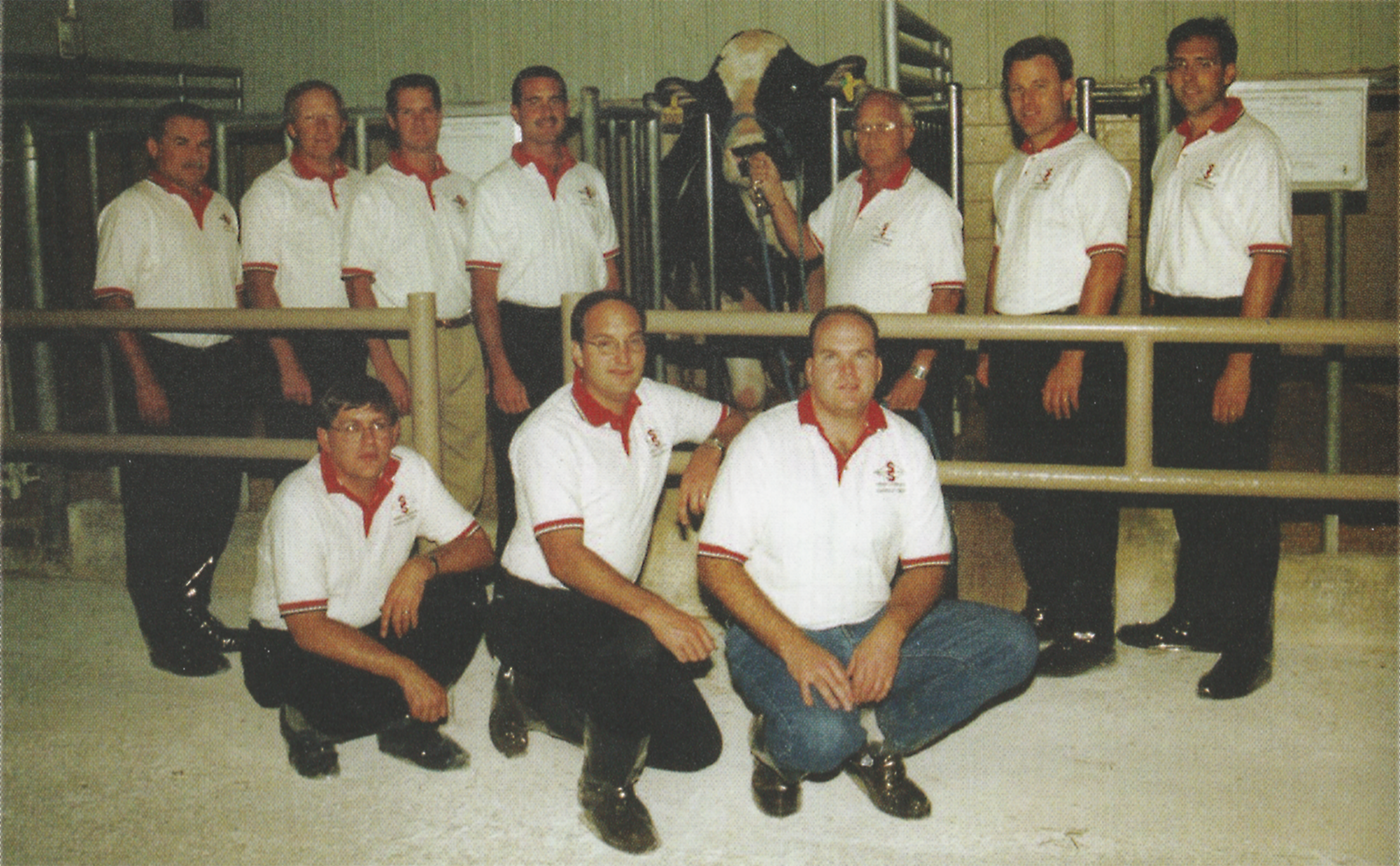
The Select Sires Sire Department in 2000, illustrating the stability and mentorship Charlie Will valued. Pictured (back row, second from left) is Charlie Will, alongside long-time colleagues like Ron Long (back row, second from right). The fact that seven of the ten members were still active 15 years later underscores the power of the team-based philosophy Charlie credited for his success.

But also three principles :

  • Find the right people—not just smart ones, but people who understand genetics is about improving farms.
  • Work as a team—Select Sires is farmer-owned, every decision affects someone’s livelihood.
  • Embrace new tools—genomics, IVF, sexed semen, whatever comes next.

But the real secret? Customer focus. Charlie didn’t select bulls for catalogs. He selected for what worked in barns.

The Bottom Line for Today’s Industry

7H3707 Paradise-R Cleitus MATHIE represents another “million-unit club” bull, hand-picked by Charlie Will. His genetics, prized for combining strong type with significant milk production improvement, helped shape the modern Holstein herd under Charlie’s guidance at Select Sires.

Charlie Will’s story teaches us something crucial right now.

That rejection letter from Select Sires could’ve ended everything. But Charlie found another way through MABC. Spent four years in Wisconsin proving himself. Waited ten years for Select Sires to acknowledge he belonged. Then, they spent the next thirty years changing how the world breeds dairy cattle.

For young people trying to break in—and I know it’s tough with the current job market—Charlie’s message is clear : Your first job won’t be your dream job. Use it as education. Build your reputation. When the right opportunity comes, you’ll be ready.

Look, we’re facing real challenges. Milk prices aren’t great, input costs are still high, and now we’ve got this government shutdown complicating everything. But we’ve been through worse. And the genetics Charlie helped develop? They’re part of why we’ll get through this, too.

The 2025 NAAB Pioneer Award recognizes Charlie Will’s massive contribution. But walk through any dairy barn today—breathe in that familiar mix of silage and sawdust, look at those moderate-framed Holsteins producing like champions—and you’re seeing his real legacy.

The farm kid from Southern Illinois who couldn’t get hired didn’t just prove Select Sires wrong.

He revolutionized the way the world breeds dairy cattle.

One bull at a time. 

Key Takeaways:

  • The backdoor strategy works: Charlie’s path from rejection → MABC sales → Wisconsin territory → Select Sires pioneer proves alternative routes beat giving up
  • Challenge conventional wisdom: ELTON’s “Good Plus” dam produced genetics that created 5,039 Excellent daughters—look beyond the obvious
  • Embrace disruption at any age: At 60, Charlie championed genomics while peers resisted. Result? $4 billion industry impact
  • Solve real problems, not catalog dreams: OMAN’s million+ units came from fixing calving ease, not chasing show ring extremes
  • Today’s application: With $17/cwt milk and margins tight, Charlie’s “customer-first” genetics philosophy is your survival guide

Executive Summary:

Charlie Will got rejected by Select Sires in 1974. Today, his bulls influence virtually every Holstein pedigree on the planet. After sneaking in through a Wisconsin sales territory nobody wanted, Charlie spent 40 years finding genetic diamonds others dismissed—like ELTON, whose “Good Plus” dam produced 5,039 Excellent granddaughters through DURHAM. His selections shattered records: BLACKSTAR topped global rankings in ’88, OMAN solved the calving crisis with over a million units sold, and BLITZ became Select Sires’ all-time bestseller. When genomics disrupted everything in 2008, 60-year-old Charlie embraced what his younger peers fought, contributing to today’s $4 billion industry transformation. With current milk at $17/cwt and margins tighter than ever, Charlie’s philosophy—pick bulls that solve real problems, not catalog dreams—is your blueprint for survival. This week’s NAAB Pioneer Award just confirms what the pedigrees already prove: the farm kid nobody would hire revolutionized how the world breeds dairy cattle.

Learn More:

  • The Practical Application of the Genetic Tools We Have Today – This tactical article reveals methods for leveraging modern selection indexes (like NM$ and TPI) to prioritize the functional, profitable traits—health, fertility, and longevity—that Charlie Will championed throughout his career. It demonstrates how to align complex genetic numbers with real-world barn profitability.
  • Beef on Dairy is Still the Best Way to Use Low Genetic Females – Expanding on the booming Beef-on-Dairy trend mentioned in the article, this strategic analysis provides producers with actionable steps to maximize revenue from the bottom end of their herd. It offers a clear framework for optimizing inventory and genetics to boost overall farm gate returns in a $17/cwt market.
  • Is Holstein Inbreeding Level A Bigger Concern Than You Think? – This innovative piece explores the modern data behind Charlie Will’s foresight on genetic diversity, offering a deep-dive analysis into the specific risks and economic costs associated with rising inbreeding levels. It provides strategic context on why his deliberate use of diverse pedigrees continues to be essential for breed stewardship.

Join the Revolution!

Join over 30,000 successful dairy professionals who rely on Bullvine Weekly for their competitive edge. Delivered directly to your inbox each week, our exclusive industry insights help you make smarter decisions while saving precious hours every week. Never miss critical updates on milk production trends, breakthrough technologies, and profit-boosting strategies that top producers are already implementing. Subscribe now to transform your dairy operation’s efficiency and profitability—your future success is just one click away.

NewsSubscribe
First
Last
Consent

The Genetic Genius of Darwin, Mendel and Hunt – Genetic Transmission and the Holstein Cow

There is no question that when it comes to understanding what cows will transmit and what cows will not, it is an enigma wrapped in a conundrum.  There is much that we don’t know and some would argue it is not meant to be known.  The problem is, for those of us with a passion for breeding great dairy cattle, we want to know it all.  For that I turn to the three greatest genetic geniuses in the history of the world, Darwin, Mendel and Hunt (No they are not a law firm).

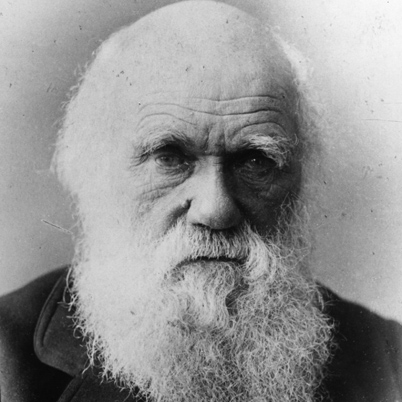
Charles Robert Darwin He established that all species of life have descended over time from common ancestors, and proposed the scientific theory that this branching pattern of evolution resulted from a process that he called natural selection, in which the struggle for existence has a similar effect to the artificial selection involved in selective breeding.

Charles Darwin

Ask anyone in the world to name a geneticist and the first name that comes to mind has to be Charles Darwin.  No better demonstration of Darwin’s theory of evolution exists in the world than in dairy cattle breeding.  While there is no question that artificial selection and selective breeding exist on a daily basis, a cow’s ability to reproduce and produce milk leads to a natural level of selection that epitomizes Darwin’s theory.  “The laws governing inheritance,” Darwin wrote, “are for the most part unknown.”  Moreover, while many modern geneticists have theories about the tendencies of the modern Holstein cow, their genetic transmission pathways in large part remain a mystery to this day.

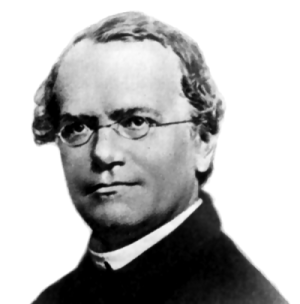
Gregor Mendel

Gregor Mendel

Then along came Gregor Mendel who introduced the concept of “genes” to explain heritability.  Mendel changed the whole way we look at breeding when he introduced the theory that the chromosome is the carrier of genetic traits.  He also explained why a trait can disappear in one generation and reappear in the next and why these traits occur in a three-to-one ratio.  One of Mendel’s disciples, three quarters of a century later, was Thomas B. Macaulay.  Macaulay conducted his own studies, on his Mount Victoria Farms (Read more: Mount Victoria Farms – The art and science of great breeding).

Thomas Hunt Morgan

Thomas Hunt Morgan

Then along came Hunt. Well, more specifically, Thomas Hunt Morgan, but my ego wouldn’t let this go as my name is Andrew Morgan Hunt (Read more about my ego: I’m Sorry But I’ve Had Just About Enough Of… ).  In research that is now reproduced by grade 9 science students around the world, Morgan introduced the concept of X and Y-chromosomes.  Morgan concluded that a female has two X chromosomes and that males have both X and Y-chromosomes.  He also posited that the male of the species, because of the presence of the Y chromosome, transmits differently than the female.

To get a better understanding of this, let’s look at this from both sides of the story.

His side of the story (XY)

If you look at Holstein bulls throughout history you find four distinct patterns:

  1. Great daughters but no legacy sons
    These are the bulls that sired amazing brood cows but none of their sons were able to continue their genetic legacy.  Examples are Hanover-Hill Triple Threat, Carlin-M Ivanhoe Bell, and Braedale Goldwyn.  They all were able to sire brood cow daughters beyond compare, but no real sons to advance that genetic legacy.  Why did these sires seem to produce better on the female side than that of the male?  For that we need to turn to Morgan and his X and Y chromosome theory.  Since the Y chromosome is the only one that is inherited solely via the paternal  line, this leads  some geneticists to believe that it carries little genetic information, and as a result  a great sires genetic legacy rest more with his daughters than with his sons.  Therefore, with this first group of sires it is thought that much of their genetics were transmitted on the X chromosome rather than the Y.
  2. Great sons but not as many brood cows
    Bulls that sired outstanding sons but never produced a top daughter.  A couple of great examples of this are Montvic Rag Apple Sovereign, Maizefield Bellwood and O-Bee Manfred Justice.  All of these sires have left outstanding sons, but are not found as often in the maternal sire stack of the great sires.  There is no question as to their genetic contribution to the breed, but it was more as a sire of sons than their ability to leave an equal number of brood cows.
  3. Sons and daughters both extraordinary
    These are the sires that have gone down in history as the all-time greats.  Sires like Johanna Rag Apple Pabst, Governor of Carnation, Montvic Chieftain, Wisconsin Admiral Burke Lad, A.B.C. Reflection Sovereign, Round Oak Rag Apple Elevation, Pawnee Farm Alrinda Chief, Walkway Chief Mark, Hanoverhill Starbuck, Madawaska Aerostar and Maughlin Storm.  These are the bulls that not only displayed personal greatness but were also able to transmit both outstanding brood cows as well as legacy sons.
  4. Sons and daughters that were inferior
    Sons and daughters that are both below average.  These bulls left inferior daughters and as a result were never even given the chance to produce sons.  Bulls in this category are too numerous to mention and loads of their daughters go to the slaughterhouses every day.  No explanation necessary other than a lack of genetic merit and here enters the need for genomics (Read more: The Truth About Genomic Indexes – “Show Me” That They Work).

Her side the story (XX)

The female side of the story uses the same four distinct groups.

  1. Great daughters but no legacy sons
    These are cows with outstanding female descendants but undistinguished males.  Great examples of these are the cow families of Hanover Hill Papoose, Krull Broker Elegance and Plunshanski Chief Faith.  They all were able to leave outstanding female descendants generation after generation, but were never really able to accomplish the same feat on the male side of the story.
  2. Great sons but not as many brood cows
    These are the cows with potent transmitting sons, but daughters who didn’t outperform the average.  Examples of these are Wylamyna Tidy Kathleen (dam of Sir Bess Tidy and Sir Bess Ormsby Tidy Fobes) Lakefield Fobes Delight (dam of Lakefield Fond Hope, Lakefield Fond Delight Fobes and Carnation Royal Master) and Pawnee Farm Glenvue Beauty (dam of Pawnee Farm Arlinda Chief).  All of these cows had outstanding maternal lines but for some reason were just not able to transmit that legacy through their daughters.
  3. Sons and daughters both extraordinary
    Among the females in this category are Glenridge Citation Roxy, Mil-R-Mor Roxette, Comestar Laurie Sheik, Braedale Gypsy Grand and Snow-N Denises Dellia.
  4. Sons and daughters that were inferior
    Cows who, in terms of influence, failed to produce anything worthwhile.  Blame it on lack of genetics, bad breeding, improper management, or just bad luck, these cows just didn’t influence the breed. We have all seen examples.

The Bullvine Bottom Line

There has never been a clear explanation of why some bloodlines seem to transmit better through maternal lines, others through the paternal, and still others do well in both.  Even genomics does not answer this.  There are high genomic animals that still have these same tendencies.  Maybe if we could genomic test the genes on each chromosome we might find the answers?  Until then Genetic Transmission in the Holstein Cow will remain a mystery.

To read more about this get a copy of The Holstein History by Edward Morwick and read the chapter on Inheritance Patterns.


The Dairy Breeders No BS Guide to Genomics


Not sure what all this hype about genomics is all about?

Want to learn what it is and what it means to your breeding program?

Download this free guide.


[related-posts-thumbnails]

Send this to a friend