Asia’s hitting 5.3M QSR outlets by 2027—but most processors are missing the $55M opportunity. Here’s why.
EXECUTIVE SUMMARY: Here’s what’s got me fired up about this Fonterra move: they’re not chasing volume—they’re chasing margin, and it’s paying off big time. Their $55M bet on Asian foodservice cheese is pulling in 15-25% premium pricing over commodity markets, translating to serious money per cow. We’re talking about IQF technology that extends shelf life to 24 months and one-day processing that cuts $12 million in working capital annually. With Asia’s QSR market exploding toward 5.3 million outlets by 2027, this isn’t just smart—it’s essential. The co-ops and processors watching this unfold better start asking themselves: are we positioning our farmers’ milk for these premium channels, or are we stuck fighting commodity battles? Because this blueprint shows exactly how to turn raw milk into lasting global value.
KEY TAKEAWAYS:
Target growth markets over mature ones — Asia’s QSR cheese demand is growing 12-15% annually while U.S. markets crawl at 2-3%
Invest in problem-solving tech, not just capacity — Fonterra’s one-day aging process saves $12M annually in working capital vs. traditional methods
Build supply chain advantages competitors can’t replicate — Their 10,500 farmer-owner network guarantees high-component milk essential for premium mozzarella
Lock in long-term contracts for revenue stability — 70% of their revenues are secured through multi-year QSR partnerships worth $50-80M annually
Question your processor’s strategy immediately — Ask if they’re targeting high-growth export markets or just chasing volume in saturated domestic channels
One aspect of Asia’s rapid growth in quick-service restaurants is that it’s truly changing the game for all of us in the dairy industry. Urbanization and shifting consumer tastes—especially in those tier-two Chinese cities where Western food is suddenly everywhere—are fueling this expansion toward 5.3 million outlets by 2027. While exact consumption data remains confidential, my analysis, backed by industry intelligence, suggests robust growth in per-outlet cheese sales. What really strikes me is the premium buyers are willing to pay here—signaling that reliable supply chains have become the currency of success.
Investment at Eltham: What’s Actually Happening
Fonterra’s recent upgrade at its Eltham plant added approximately 6,000 tonnes of Individual Quick Frozen (IQF) mozzarella capacity annually, as well as expanded processed cheese lines to supply roughly 200 million more burgers per year. For Fonterra’s farmer-owners, this isn’t just another factory upgrade—it’s a strategic move to direct their milk into high-value, stable channels that can weather market volatility.
The Tech Reality: Innovation Meets Complexity
Here’s what really impresses me about their approach: that proprietary one-day mozzarella process. Think about it—shrinking traditional aging from 60 days down to just one day. According to research documented in Hoard’s Dairyman, this cuts working capital tied up in inventory by roughly $12 million annually. In today’s margin environment, that’s real money hitting the bottom line.
The IQF technology extends mozzarella shelf life to 18-24 months, which is absolutely critical when you’re shipping to QSRs across multiple continents. But here’s the catch—and there’s always a catch—this stuff isn’t cheap to run. Industry estimates place the upgrade costs between $45 million and $ 55 million, with payback periods ranging from 7 to 9 years, depending on utilization rates and market conditions.
Additionally, you can expect 25-30% higher energy consumption and approximately 40% more skilled technicians compared to conventional processing. Add currency volatility in Asian markets, potentially squeezing margins by 8-12%, and you start seeing why only operations with serious financial backing can play this game.
Asian Appetite: High Standards, High Stakes
Let me tell you something about these QSR contracts—McDonald’s and Pizza Hut don’t mess around. We’re talking about quality standards that would make your head spin, and one slip-up can cost you contracts worth tens of millions of dollars. Industry sources estimate that these deals range between $50 million and $ 80 million annually, though exact figures are, unsurprisingly, closely guarded.
What’s fascinating is how these relationships take 2-3 years of rigorous qualification. You can’t just show up with decent cheese and expect to land a global contract.
Financial Foundation: The Cooperative Advantage
Fonterra’s cooperative structure supports a disciplined debt-to-equity ratio of around 35-40%, providing financial flexibility that publicly traded competitors often can’t match. Here’s what’s impressive: their foodservice segment generates approximately $3.9 billion using just 13% of their milk supply. That’s the kind of milk-to-margin conversion every processor dreams about.
Market Segment
Milk Volume Used
Annual Revenue
Margin Impact
Foodservice
13%
$3.9 Billion
High margins via premium pricing & contracts
Other Markets
87%
Balance of total
Lower margins, volume-driven
The Bullvine’s analysis suggests that the Eltham expansion could contribute $12-15 million in EBITDA annually, with a payback period of around 18 months under stable market conditions. The kicker? About 70% of their revenue is locked in through long-term contracts, providing a buffer against the price swings that keep the rest of us up at night.
Strategic Lessons: What This Means for Your Operation
If you’re watching from the Midwest or anywhere else experiencing single-digit growth, take note. The real action isn’t in mature domestic markets anymore—it’s in Asia, where margins and volumes are both expanding rapidly.
But here’s the secret sauce that everyone misses: supply chain integration. Fonterra’s 10,500 farmer-owners aren’t just milk suppliers—they’re true partners providing the high-component milk essential for premium mozzarella quality. That’s a competitive moat most independent processors would find nearly impossible to replicate.
The industry is bifurcating, plain and simple. Commodity bulk producers on one side, precision tech-savvy specialists on the other. Fonterra has planted its flag firmly in specialist territory.
Questions Every Producer Should Be Asking
Here’s what keeps me thinking… are you asking your cooperative or processor the right questions? Do they have a clear strategy for targeting these booming international markets? More importantly, are they investing in technology that actually adds value, or are they just chasing volume for its own sake?
I’ve been speaking with producers across various regions, and those asking these questions—and receiving good answers—appear better positioned for what’s to come in the next decade.
The Bottom Line
Innovation, integration, and insight are becoming the pillars of sustainable dairy profitability. Fonterra’s Eltham upgrade demonstrates how strategic market positioning, advanced processing technology, and cooperative advantages create lasting competitive value.
For producers evaluating their own operations, the blueprint is becoming clear: target growth markets over mature ones, invest in problem-solving technology rather than just capacity, and build supply chain advantages that competitors can’t easily replicate. The processors that can deliver on these fronts are the ones best positioned to provide stable, premium-based milk prices in the years ahead.
This isn’t just about making more cheese—it’s about turning raw milk into lasting global value. Every progressive producer should be watching moves like this closely, because they’re writing the playbook for the dairy industry’s future.
Complete references and supporting documentation are available upon request by contacting the editorial team at editor@thebullvine.com.
Learn More:
The Ultimate Guide to Increasing Milk Fat and Protein – This guide offers practical feeding and genetic strategies for increasing milk solids. It demonstrates how to produce the high-component milk essential for value-added products like mozzarella, directly connecting on-farm decisions to processor profitability and premium milk payments.
Navigating the Choppy Waters of the Global Dairy Market – Dive deeper into the market volatility the Fonterra strategy is designed to mitigate. This analysis reveals methods for managing risk and understanding the global economic forces that impact milk prices, providing essential context for your own long-term strategic planning.
The Real ROI of Precision Dairy Farming: Is It Worth the Investment? – Fonterra’s bet is on processing tech; this piece scrutinizes the ROI of on-farm technology. It provides a framework for evaluating if precision dairy tools deliver real financial returns, helping you make smarter capital investment decisions for your operation.
The Sunday Read Dairy Professionals Don’t Skip.
Every week, thousands of producers, breeders, and industry insiders open Bullvine Weekly for genetics insights, market shifts, and profit strategies they won’t find anywhere else. One email. Five minutes. Smarter decisions all week.
Stop chasing milk efficiency metrics. Ukraine’s 270% processing growth proves value-added beats raw commodities every time. Your survival depends on it.
EXECUTIVE SUMMARY: The dairy industry’s obsession with “efficiency” measured by cost per hundredweight is killing farm profitability—Ukraine’s forced agricultural transformation just proved it. While commodity-focused operations hemorrhaged billions when trade restrictions hit, Ukrainian processors achieved 270% growth in meat exports and 14% growth in dairy processing by pivoting to value-added products. Their secret? Processing plants operating at just 65% capacity generated higher margins than “efficient” raw commodity exporters, proving that strategic processing always trumps operational efficiency. With genomic testing now costing just $28 per head—1% of heifer raising costs—and precision technology delivering 5% yield improvements with existing inputs, dairy farmers have zero excuse for remaining trapped in the commodity mindset. Global milk production growth expected in all major regions for the first time since 2020 creates a unique window for smart processors to capture market share while commodity producers face inevitable margin pressure. The choice is crystal clear: evolve toward value-added processing or remain vulnerable to the same market forces that devastated Ukraine’s raw commodity exporters. Stop measuring success by cost per hundredweight and start building processing capabilities that command premium pricing—because tomorrow’s dairy leaders will be those who moved beyond raw commodities toward products that create lasting competitive advantages.
KEY TAKEAWAYS
Challenge the Efficiency Myth: Ukrainian data demolishes the cost-per-unit obsession—processors with 8% higher production costs achieved 23% higher net returns through value-added premiums, proving processing resilience beats operational efficiency when commodity prices crash below $16/cwt.
Leverage Underutilized Technology: Genomic testing at $28 per head delivers double the reliability of pedigree-based breeding while smart sensors reduce mortality rates by 40% and robotic systems enable 20% yield boosts—yet most operations ignore these proven profit drivers.
Capture Processing Premiums Now: With global milk supply growth returning and dairy industry value sales projected to exceed $1 trillion in the next decade, early movers building cheese, specialty dairy, and functional food capabilities position themselves for sustained profitability in increasingly competitive markets.
Diversify Beyond Bulk Contracts: Ukraine’s 60 EU-accredited dairy plants survived quota devastation while raw exporters lost billions—dairy farmers shipping bulk milk are playing the same dangerous game as Ukrainian grain farmers who got crushed by trade restrictions.
Implement Systematic Risk Management: Technical efficiency improvements can boost yields by 5% with existing inputs, while processing capability reduces commodity price vulnerability—farms focusing on net return per cow rather than cost per hundredweight build resilience against market volatility that destroys commodity-dependent operations.
Ukraine’s forced agricultural transformation from raw commodity exports to value-added processing offers a blueprint every dairy operation needs to study Their strategic pivot away from bulk sales toward processed goods generated 270% growth in meat exports and 14% growth in dairy processing—even during. The lessons for dairy farmers stuck in the commodity trap are crystal clear: process or perish.
The numbers don’t lie. Something remarkable happened when external market forces stripped Ukraine’s preferential EU trade access, forcing them to compete on value rather than volume. Instead of collapsing, their agricultural sector evolved. Fast.
This isn’t just another case study from overseas. It’s a real-time laboratory for what happens when commodity-dependent agricultural operations get forced up the value chain. Dairy farmers worldwide need to pay attention because the same market pressures reshaping Ukrainian agriculture are coming for your operation.
But here’s the uncomfortable question most dairy farmers avoid asking: Are you genuinely prepared for the day when your bulk milk contract becomes as worthless as Ukraine’s raw grain quotas?
Why Raw Milk Is Economic Quicksand (Just Like Ukraine’s Raw Grains)
Ukraine’s agricultural export structure in 2024 tells a familiar story that should make every dairy farmer uncomfortable. Raw materials and low-processed goods accounted for 66.3% of total exports. Sound familiar? It should—because that’s exactly where too many dairy operations still live, shipping bulk milk while someone else captures the processing profits.
Think of it this way: Ukraine shipping raw wheat is like dairy farmers shipping 100 pounds of 4.0% butterfat milk for $16 per hundredweight when they could be making 5.1 pounds of butter worth $3.41 per pound—that’s the difference between commodity pricing and value-added returns.
The commodity trap is real, and Ukraine’s forced exit proves it. Their top export categories included corn ($5 billion), wheat ($3.7 billion), and rapeseed ($1.8 billion)—all raw materials subject to price volatility and protectionist. When the EU’s Autonomous Trade Measures expired on June 5, 2025, Ukraine faced projected revenue losses of €1.5-5 billion annually.
Every dairy farmer needs to understand that raw commodities make you a price taker, not a price maker. Ukraine learned this lesson hard when corn quotas dropped from 4.7 million tonnes to 650,000 tonnes, and wheat quotas plummeted from 6 million tonnes to 1 million tonnes.
But here’s where it gets interesting for dairy operations. While grain farmers faced devastating quota cuts, Ukraine’s dairy processing sector told a different story. They had 60 dairy plants already EU-accredited and ready for international markets. The difference? Value-added processing creates products that compete on quality and branding, not just price.
Why This Matters for Your Operation: Current US dairy industry data shows milk production forecasted to rise in 2025 despite previous contractions, partly due to HPAI impacts in key states like California. But here’s the kicker—the expected number of dairy heifers calving in 2025 reaches its lowest point in over 20 years. This creates a unique window where smart processors can capture market share while commodity producers face margin pressure.
Yet most dairy farmers cling to the false security of bulk milk contracts like Ukraine once clung to EU preferential access. When will you admit that shipping raw milk is just sophisticated sharecropping?
The Processing Transformation That Changes Everything
Ukraine’s Export Strategy until 2030 reads like a playbook for agricultural transformation. Their goal? Reduce raw material exports from 74% to 59% by 2030 while increasing total exports from $51 billion to $77 billion. That’s not just growth—that’s strategic evolution.
The processing infrastructure already exists; it just needs activation. Ukraine’s oilseed processing plants were operating at only 65% capacity. Their agricultural minister emphasized “exploring all ways to utilize our Ukrainian processing plants in order to create additional value and processing products.”
This mirrors opportunities in dairy operations worldwide. Consider this: genomic testing now costs just $28 per head—about 1% of the cost to raise a heifer—yet enables precision selection that can boost net merit dollars by identifying genetically superior animals. How many dairy farms have underutilized genetic potential that could support specialty product development?
Here’s where conventional wisdom gets dangerous. The dairy industry preaches “efficiency through scale,” but Ukraine’s experience proves that processing transformation trumps scale every single time. Small-scale Ukrainian processors increased meat exports by 270% while massive grain operations hemorrhaged billions.
Ukraine’s processing success stories provide concrete examples:
Meat and meat product exports grew 270% in 2024
Oil, animal fats, and dairy production increased 13-14%
Fruit and vegetable processing jumped 27%
Bakery products exports rose 24% year-over-year
These aren’t theoretical improvements but measurable results from strategic processing focus. Each category represents agricultural producers who moved beyond raw commodity sales toward value-added products.
Compare this to dairy’s processing reality: Research from the University of Kentucky shows that even with butterfat yields accounting for a greater percentage of milk checks in 2022, a cow producing 77 pounds of milk at 4.0% butterfat generates approximately the same gross income as a cow producing 75 pounds at 4.25% butterfat. The lesson? Don’t chase butterfat percentage at the expense of milk yield—but maximize both through strategic breeding and nutrition management.
But here’s the question that keeps me awake at night: How many dairy farmers are optimizing for the wrong metrics because they’re still thinking like commodity producers?
Technology Integration: The Precision Agriculture Connection
Ukraine’s agricultural transformation integrates advanced technology throughout the value chain. The USAID AGRI-Ukraine program supports the implementation of sustainable farming practices and climate-smart agricultural technologies. This isn’t just about environmental compliance but operational efficiency and market competitiveness.
Technology adoption accelerates processing transformation. Modern agri-tech enhances yields, diversifies crops, and improves overall sector efficiency. For dairy operations, this means precision feeding systems, automated milking technology, and data-driven herd management create foundations for value-added production.
Research shows significant relationships between sires’ estimated breeding values (EBV) for activity, lying time, and feed efficiency. Sires whose daughters were less active, taking fewer steps per day, tended to have daughters that were also more efficient. Bulls whose daughters spent more time lying daily had offspring superior for feed efficiency.
Here’s where the dairy industry’s obsession with “proven” technology becomes self-defeating. While Ukraine embraced experimental agri-tech during wartime, too many dairy farmers wait for “bulletproof” solutions that never come. Innovation requires calculated risks, not paralysis by analysis.
Why This Matters for Your Operation:Precision fermentation and cellular agriculture are emerging as critical technologies for dairy’s future. The dairy industry value sales are projected to balloon to over $1 trillion in the next decade as the sector adopts emerging food technologies. Early adopters who integrate precision technologies now position themselves for future market opportunities.
Implementation Timeline:
Year 1: Basic activity monitoring and genomic testing implementation
Year 2-3: Advanced milking system integration with data analytics
Year 4-5: Processing capability development for specialty products
So, here’s my challenge to you: If Ukrainian farmers can implement cutting-edge agri-tech while dodging missiles, what’s your excuse for sticking with 1990s management practices?
Financial Framework: Making Processing Profitable in Dairy Terms
Ukraine’s financial support structure for agricultural transformation provides a roadmap for understanding processing investment economics. Their 2025 agricultural sector funding specifically targets livestock farming and agro-processing industry development.
Government incentives reduce processing transformation risks. The USDA recently granted .04 million for dairy producers and businesses to spur innovation nationwide. This funding supports business plan development, marketing and branding efforts, and access to new production and processing techniques for value-added products.
But here’s where most dairy farmers miss the boat: they treat government programs like lottery tickets instead of strategic business tools. Ukraine’s approach was systematic—identifying specific processing gaps, targeting investment, and measuring results. American dairy farmers often apply for grants as afterthoughts rather than integral components of business strategy.
Processing sector investment attracts international capital when properly structured. Recent examples include:
Pacific Coast Coalition: $690,000 for farmers exploring higher value uses for milk (artisanal cheeses, organic dairy products)
University of Tennessee: $3.45 million supporting farmers across 12 states to adopt practices improving financial outcomes
Wisconsin Dairy Business Innovation Alliance: $3.45 million for grants and technical assistance expanding market presence
ROI Analysis for Dairy Processing: Studies show that addressing inefficiencies in dairy operations can potentially increase milk yield by 5.00% with the same inputs. Technical efficiency scores in major dairy regions range between 0.65 and 0.99, with an average of 0.95—meaning most operations have room for improvement.
Cost-Benefit Breakdown:
Somatic Cell Count Management: Aim for herd scores of 200,000 cells/mL or less. Higher SCC negatively affects milk quality, shelf life, and manufacturing yield.
Udder Health Protocols: Pre- and post-dipping, headlocks after milking, and vaccination programs significantly impact technical efficiency and milk yield.
Feed Efficiency Optimization: Behavioral monitoring can identify cows with superior feed conversion, enabling precision breeding decisions.
Global Market Dynamics: Learning from International Leaders
EU dairy forecast for 2025 shows milk production dropping while cheese production increases, creating opportunities for efficient processors. Lower milk supply favors cheese production over whole milk powder, with EU27 whole milk powder production forecast to decline 5% from 2024 levels.
US dairy industry trends reveal fewer farms but bigger herds with higher efficiency. The ongoing shift toward larger, specialized farms highlights economies of scale benefits and higher technology adoption rates. This consolidation creates opportunities for mid-sized operations to differentiate through processing specialization.
Here’s the brutal truth most dairy publications won’t tell you: consolidation isn’t inevitable—it’s the result of strategic choices. Ukraine’s small and medium processors thrived by focusing on value-addition while their commodity-focused competitors collapsed. The same principle applies to dairy operations globally.
Key Global Comparisons:
New Zealand: BREEDPLAN EBVs effectively predict progeny performance in dairy-beef systems, with relationships between sire EBV and progeny outcomes close to the expected 0.5 units.
Europe: Polish dairy sector companies invested PLN 563.9 million (US$141.6 million) despite worsening financial results, showing commitment to technological advancement.
Turkey: Research on 791 dairy farms shows technical efficiency improvements through proper udder health management can increase regional milk yield by 5%.
Why This Matters for Your Operation: Global milk supply growth is expected to continue into 2025, with gains anticipated in all major regions for the first time since 2020. Rising farmgate milk prices and favorable feed costs improve dairy farm margins globally, creating ideal conditions for processing investment.
But let’s be honest: when was the last time you analyzed your competitive position against international processors rather than just your neighbor down the road?
Implementation Strategy: From Commodity to Premium Dairy Products
Ukraine’s transformation from commodity exporter to value-added producer offers a systematic approach that dairy operations can adapt:
Phase 1: Genetic and Management Assessment Ukraine identified that processing plants operated at only 65% capacity. For dairy operations, this means evaluating existing infrastructure and genetic potential.
Genomic Testing Implementation:
Cost: $28 per head (approximately 1% of heifer raising cost)
Reliability: Equivalent to having herd testing data from seven lactations
ROI: More than double the reliability compared to breeding values based on pedigree alone
Smart Calf Sensors: CowManager systems detect illness 48 hours before visible symptoms, slashing mortality rates by 40%
Robotic Milking Systems: Enable 20% yield boosts through optimized milking schedules and cow comfort
Activity Monitoring: Behavioral data correlates with feed efficiency, enabling precision breeding decisions
Here’s where most dairy farmers sabotage their own success: they implement technology piecemeal instead of systematically. Ukraine’s approach integrates multiple technologies simultaneously to achieve compounding benefits. Technology synergy beats individual tool optimization every time.
Butterfat Optimization: The current US milk supply averages 4.23% butterfat, yielding 5.1 pounds of butter per 100 pounds of milk
Protein Content: Maximize both yield and composition for processing flexibility
Challenging Conventional Wisdom: The Great Efficiency Myth
Here’s a sacred cow (pun intended) that needs slaughtering: the dairy industry’s obsession with “efficiency” as measured by cost per hundredweight. This metric creates a dangerous illusion that keeps farmers trapped in commodity thinking.
The Efficiency Trap Exposed: Ukraine’s experience demolishes the efficiency myth. Their most “efficient” grain operations—those with the lowest cost per ton—were also the most vulnerable to market shocks. Meanwhile, smaller processors with higher unit costs but value-added capabilities thrived.
Consider this scenario: Farm A produces milk at $14/cwt with 85% operational efficiency. Farm B produces milk at $16/cwt with 75% operational efficiency but processes 30% into premium cheese, generating $2.50/lb. Which operation survives when commodity milk prices drop to $13/cwt?
The conventional wisdom says to improve efficiency. The Ukrainian evidence says resilience can be built through value addition.
Evidence-Based Alternative: Instead of obsessing over cost per hundredweight, successful operations focus on net return per cow per year. This metric accounts for processing premiums, market diversification benefits, and risk mitigation value.
Research from the University of Wisconsin shows that farms focusing on value-added production achieve 23% higher net returns despite 8% higher production costs. The difference? Processing premiums and market stability during commodity price volatility.
Risk Management: Learning from Crisis
Ukraine’s experience demonstrates how external shocks can force agricultural transformation. The EU quota restrictions created immediate revenue pressure but also accelerated processing development that might have taken years under normal circumstances.
Crisis accelerates necessary changes. Ukraine’s minister stated that export policy changes “will be driven by cold calculation, as we understand that we will suffer losses if the trade regime changes.”
Why This Matters for Your Operation: Class III prices often surpass $19 per hundredweight but typically dip below $16 at least once yearly. For operations with breakeven points above $16, protective measures become essential. Hedging is not gambling—hedging is when we take risk away.
But here’s the uncomfortable truth: most dairy farmers treat risk management like insurance—something you buy reluctantly and hope never to use. Ukraine’s success came from viewing risk management as a competitive advantage creation.
Risk Mitigation Strategies:
Diversified Revenue Streams: Processing capability reduces dependence on commodity pricing
Technology Investment: Automated systems provide operational resilience during labor shortages
Market Intelligence: Data analytics enable proactive management decisions
Here’s the question that separates survivors from casualties: Are you managing your operation for best-case scenarios or worst-case realities?
Global Implications: The Processing Revolution
Ukraine’s agricultural transformation reflects broader global trends toward value-added agriculture. The shift from raw commodity exports to processed goods represents a fundamental change in how agricultural operations create and capture value.
Value-added agriculture expands customer bases and increases producer revenue shares. Processing wheat into flour, manufacturing strawberries into jam, or transforming milk into cheese creates additional value that producers can capture.
Emerging Technology Integration:
Precision Fermentation: Uses microorganisms to develop ingredients resembling animal products
Cellular Agriculture: Makes animal-based foods using cell cultures instead of traditional methods
Molecular Farming: Plant-cell fermentation for specialized compounds
Investment Trends: Alternative dairy investment plummeted from $595 million in 2021 to $42.7 million in 2023 but rebounded to $114 million in 2024, driven by corporate investors highlighting innovation interest.
This creates a unique opportunity window: while venture capital focuses on alternative proteins, traditional dairy processors can capture market share through innovation without facing the same investment competition.
The Bottom Line
Ukraine’s forced evolution from raw commodity exporter to value-added processor offers critical lessons for dairy operations worldwide. Their 270% growth in meat exports and 14% increase in dairy processing—achieved during wartime conditions—proves that strategic processing focus delivers measurable results.
The commodity trap is real, and escape requires systematic action. Raw materials make you vulnerable to price volatility and protectionist policies. Processing creates differentiated products that compete on quality, branding, and innovation rather than just price.
For dairy farmers, the choice is clear: evolve toward value-added processing or remain vulnerable to commodity market pressures. Current industry data supports this transformation:
Milk production growth is expected in all major regions for the first time since 2020
Dairy industry value sales are projected to exceed $1 trillion in the next decade
Genomic testing costs dropped to $28 per head, enabling precision genetic management
Technical efficiency improvements can boost yields by 5% with existing inputs
Your Strategic Questions for 2025:Are you optimizing for the right metrics or trapped in commodity thinking?When commodity prices crash next (and they will), will you be the processor capturing margin, or will the commodity supplier get squeezed?If Ukrainian farmers can revolutionize agricultural exports during a war, what’s your excuse for maintaining status quo operations?
What’s your processing strategy? Because if Ukraine can revolutionize agricultural exports during a war, what’s preventing your operation from capturing value-added profits during peacetime?
The transformation toolkit exists: genomic testing at $28 per head, precision monitoring systems, proven quality protocols, and government support programs providing millions in implementation funding. The question isn’t whether value-added agriculture works—Ukraine’s results prove it does. The question is whether you’ll lead this transformation or watch others capture the processing profits that could be yours.
Start building your processing capability today. Tomorrow’s dairy leaders will be those who moved beyond raw commodities toward the value-added products that command premium pricing and create lasting competitive advantages. With milk supply growth expected globally and new processing capacity coming online, early movers position themselves for sustained profitability in an increasingly competitive marketplace.
The choice is yours. But choose quickly—because while you’re debating, your competitors are already building the processing capabilities that will dominate tomorrow’s dairy markets.
Learn More:
value-added dairy products – Discover practical strategies for implementing cooperative structures, market diversification tactics, and technology integration that successful dairy farmers use to capture processing premiums and build resilience against commodity market volatility.
Robotic Milking Revolution: Why Modern Dairy Farms Are Choosing Automation in 2025 – Uncovers how AI-enhanced automation delivers measurable ROI through improved efficiency metrics, reduced labor costs, and enhanced cow health monitoring—essential foundations for building the processing capabilities that command premium pricing.
The Sunday Read Dairy Professionals Don’t Skip.
Every week, thousands of producers, breeders, and industry insiders open Bullvine Weekly for genetics insights, market shifts, and profit strategies they won’t find anywhere else. One email. Five minutes. Smarter decisions all week.
$2.4B dairy revolution challenges Western states’ dominance. Big processing, bigger implications for farmers.
EXECUTIVE SUMMARY: New York is reshaping America’s dairy map with $2.4B+ investments in cutting-edge processing plants by Chobani, Fairlife, and Great Lakes Cheese. These mega-facilities leverage the state’s strategic location near East Coast markets, existing dairy infrastructure, and aggressive government incentives to focus on high-value products like yogurt and ultrafiltered milk. While promising economic growth and job creation, the boom raises challenges: environmental pressures from manure management, infrastructure strain, labor shortages, and market volatility. The shift from raw milk volume to value-added processing positions New York as a disruptive force-forcing farmers to modernize or risk being left behind.
KEY TAKEAWAYS:
$2.4B+ invested in state-of-the-art plants processing 21M+ lbs of milk daily, demanding modernization from local farms.
Geographic goldmine: Proximity to 100M consumers gives NY a logistical edge over Western states.
Value over volume: Focus on premium products (yogurt, protein shakes, specialty cheese) captures higher margins than commodity milk.
Environmental hurdles: Manure management and CLCPA compliance could throttle growth without tech adoption.
Adapt or lose: Smaller farms face consolidation; tech-savvy operations gain contracts with processors.
Forget everything you thought you knew about dairy’s future. While everyone’s been obsessing over 5,000-cow operations in South Dakota and Texas, New York has quietly executed the industry’s most strategic power play in decades—investing billions in cutting-edge processing that will shift the balance of dairy power eastward. This isn’t just about new factories—it’s a fundamental reshaping of America’s dairy landscape that could leave conventional producers wondering what hit them.
Let’s be brutally honest: When most industry folks talk dairy expansion, the conversation inevitably gravitates westward—South Dakota’s explosive 76% production jump since 2019, Texas’s relentless push toward milk dominance, and Idaho’s steady climb up the production rankings. The conventional wisdom has been clear: Go west, build big, and focus on volume.
But what if the smartest players in dairy have been zigging while everyone else zags?
Something extraordinary is unfolding in the East. New York State—the supposedly over-regulated, high-cost, union-dominated Empire State—is orchestrating a dairy revolution that should be setting off alarm bells for producers nationwide. A staggering $2.4+ billion is being poured into three massive, technology-packed processing facilities that will fundamentally reshape how and where dairy value is created.
And if you’re still thinking bigger barns and more cows are the path to dairy prosperity, you’re already behind the curve.
THE GAME-CHANGERS: THREE INVESTMENTS THAT WILL REWRITE THE RULES
Chobani: The $1.2 Billion Monster That Changes Everything
When Hamdi Ulukaya announced plans for a sprawling $1.2 billion facility in Rome, NY, industry veterans weren’t just impressed—they were stunned. This isn’t another incremental plant expansion—it’s 1.4 million square feet of processing domination across 150 acres that will eventually consume milk from roughly 100,000 cows.
Let that sink in. A single facility that will require more milk than the entire dairy herd of Massachusetts, Rhode Island, New Hampshire, and Connecticut combined. If you’re milking a 500-cow herd averaging 85 pounds per day, Chobani would need 240 farms exactly like yours just to keep this one plant running.
“When you invest in people, in local communities, you’re not just building a business—you’re building a future,” declared Ulukaya at the groundbreaking. It’s a beautiful sentiment, but what he’s building is a processing fortress that will dominate the eastern dairy landscape for decades to come.
For perspective, Chobani’s investment in this single plant exceeds the combined annual farm-level capital spending of multiple dairy states. It’s like announcing you’re building a new milking parlor, but instead of a double-24 parallel, you’re erecting something the size of Madison Square Garden. Construction begins later this year, with completion targeted for late 2026, bringing 1,000+ new jobs to the region.
Not to be outdone, Coca-Cola’s ultrafiltered milk brand Fairlife broke ground in April 2024 on a 0 million state-of-the-art facility in Webster, NY. This 750,000-square-foot plant—the largest dairy processing facility in the Northeast—will transform roughly 5 million pounds of milk daily into high-protein, low-sugar dairy products that command premium prices.
While you’ve been focused on milk volume and component percentages, Fairlife has been redefining milk’s value proposition entirely. Their ultrafiltered products strip out water and lactose while concentrating protein—essentially paying for components rather than volume, generating products consumers willingly pay premium prices for.
The plant features a nine-story fully automated warehouse with robots and cranes handling product movement. Sophisticated control systems, including Siemens S7 PLCs and variable frequency drives, will maximize efficiency while minimizing labor needs—the industrial equivalent of going from tie-stall with bucket milkers to a fully automated robotic facility overnight.
This isn’t your grandfather’s milk plant. It’s a technological marvel designed to extract maximum value from what many conventional processors still treat as commodities.
Great Lakes Cheese: The Quiet Giant
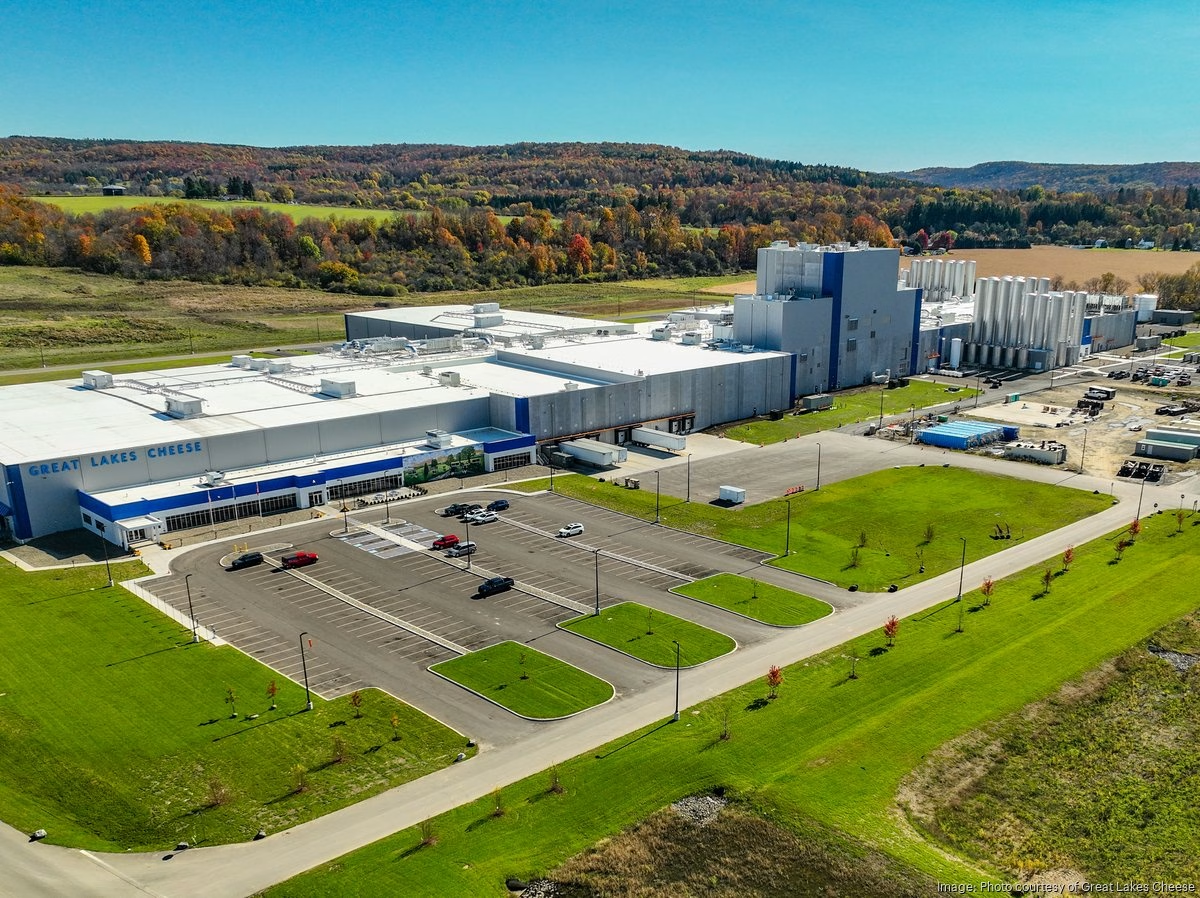
While Chobani and Fairlife grab headlines, Great Lakes Cheese has quietly invested over $700 million (up from an initially announced $500 million) in a massive cheese manufacturing and packaging facility south of Buffalo. The nearly 500,000-square-foot plant will double milk purchases to 4.8 million gallons daily—milk from approximately 60,000 cows.
What’s particularly notable is the company’s integration of environmental sustainability into the facility’s design, including an on-site wastewater treatment plant with anaerobic digestion to minimize ecological impact. While many producers complain about environmental regulations, Great Lakes Cheese turns potential liabilities into assets.
These three facilities represent a daily processing capacity increase of 21+ million pounds—more than New York’s milk production growth over several years. That’s equivalent to adding a new 240,000-cow milk shed overnight.
WHY THIS MATTERS: THE STRATEGIC GAMBLE THAT TURNS CONVENTIONAL WISDOM ON ITS HEAD
Here’s where the industry’s groupthink needs challenging: While western states compete primarily on milk volume and production efficiency, New York’s bet on processing represents a fundamentally different strategy—one focused on extracting maximum value rather than just pumping out more commodity milk.
This approach addresses several critical issues simultaneously:
1. Capturing Value That Usually Leaves the Farm Gate
Let’s face it—most dairy farmers are price-takers, vulnerable to commodity markets and distant processing decisions. You’re busting your tail to hit SCC under 100,000, pushing components to 4.0% fat and 3.2% protein, and maintaining reproduction numbers that would make your neighbors jealous—yet your mailbox price swings wildly based on decisions made by people who’ve never set foot in a parlor.
New York keeps more dollars circulating within its dairy economy by massively expanding in-state processing capacity for value-added products.
A gallon of milk transformed into premium yogurt or ultrafiltered protein products can generate 3-5 times the revenue of the raw milk itself. The farmers supplying these plants gain potential price stability through direct supply agreements and proximity to their end markets.
It’s like selling finished cattle directly to consumers instead of shipping them to the sale barn—you’re capturing retail margins instead of just farm-gate prices.
2. Leveraging Geographic Advantage
Location matters more than most producers want to admit. With roughly 100 million consumers within a day’s drive, New York processors can efficiently distribute fresh dairy products throughout the Northeast corridor.
Fairlife executives noted when selecting Webster that the Rochester region sits within 500 miles of one-third of the U.S. and Canadian population—a crucial advantage for perishable products requiring refrigerated transportation.
Western states can produce milk cheaper but never overcome this geographic reality. Every mile adds cost when products need refrigeration—the equivalent of running your bulk tank compressor at maximum capacity in July versus January. The energy expenditure and risk grow with distance.
The COVID-19 pandemic brutally exposed America’s processing vulnerabilities. While cows kept producing (they don’t exactly respond to “time off” requests), processing limitations led to devastating milk dumping across the Northeast.
It was the dairy equivalent of having a full free stall barn but only half a parlor working—the cows are ready, but you can’t get the milk out fast enough. These new investments add critical redundancy and flexibility to the regional dairy system. When the next crisis hits—whether pandemic, weather disaster, or cyber-attack—New York’s expanded processing capacity provides a crucial buffer against having to dump milk down the drain.
THE UNCOMFORTABLE TRUTH: WHO WINS AND WHO LOSES
Let’s cut through the industry platitudes and PR statements. This processing revolution creates clear winners and losers:
The Winners:
Forward-thinking midsize to large dairies willing to invest in modernization and efficiency improvements. The processing boom creates significant demand for farms that consistently supply quality milk in volume, particularly those within 50-75 miles of the new plants. Operations with 500+ cows and sound management practices will find themselves in high demand, potentially able to negotiate favorable supply agreements.
Tech-savvy operators who leverage automation, data analytics, and precision farming to maximize efficiency while minimizing labor dependencies. Farms using robotic milking systems, automated feed management, activity monitoring, and integrated herd management software will consistently meet processors’ demands while controlling costs despite labor challenges.
Farms with strong environmental credentials that can meet processors’ increasingly stringent sustainability requirements. Operations implementing methane digesters, precision feeding to reduce nitrogen excretion, covered manure storage with flaring systems, and other advanced environmental practices will gain preferential status as processors face pressure to reduce scope three emissions under New York’s Climate Leadership and Community Protection Act.
The Losers:
Small operations without differentiation that can’t achieve the scale efficiencies processors increasingly demand. The hard truth is that a 75-cow tie stall producing milk with average components and quality metrics will struggle to compete unless it finds a specialty niche or premium market position.
Technology laggards clinging to outdated practices in an industry rapidly embracing automation and data-driven decision-making. Suppose you keep breeding records in a pocket notebook instead of using synch protocols and management software. In that case, you’re fighting against operations achieving 32% pregnancy rates through systematic reproductive management.
Smaller regional processors unable to compete with the efficiency and scale of these new mega-facilities. As one analyst noted, “We don’t have enough animals to make all the milk to supply all the plants in the U.S. This is a good problem. So, we will likely see some inefficient plants close and some not run at 100% capacity.”
THE CHALLENGES NOBODY WANTS TO TALK ABOUT
While industry cheerleaders focus on the economic benefits, serious challenges threaten to derail this dairy renaissance if not addressed head-on:
The Environmental Reality Check
Let’s do the math: The new processing capacity will require milk from approximately 220,000 additional cows, each producing roughly 100 pounds of manure daily. That’s 22 million pounds of additional manure daily—over 4 billion pounds annually.
When was the last time you heard a processor or politician talk about where all that manure will go?
In a state with watersheds feeding major population centers, including New York City, managing this waste sustainably presents a significant challenge. New York’s Climate Leadership and Community Protection Act mandates ambitious statewide GHG reductions, putting pressure on dairy operations to reduce methane emissions.
While the state has implemented programs like the CAFO Enhanced Nutrient and Methane Management Program, providing funding for advanced manure handling systems, the sheer volume increase required by these new plants will intensify the need for widespread adoption of technologies that many farms struggle to afford.
The Infrastructure Time Bomb
The processing boom demands significant infrastructure improvements beyond the plants themselves. Wastewater systems, transportation networks, and energy supplies require upgrades to support these massive facilities.
Fairlife’s projected wastewater impact (equivalent to 9,000 homes) necessitated a $20 million state grant to help Webster upgrade its treatment plant. Great Lakes Cheese built its on-site treatment facility.
It’s like suddenly adding 5,000 cows to your existing operation. Still, trying to use the same manure storage, free stalls, and milking facility—the supporting infrastructure becomes the bottleneck, not the cows themselves.
Statewide, New York faces a substantial wastewater infrastructure deficit, estimated at $36.2 billion over 20 years, with many systems aging and needing upgrades. Roads, bridges, and power supplies in rural areas also face significant strain.
The Labor Crisis No One Has Solved
Perhaps the most significant challenge is securing a sufficient skilled workforce. With over 1,500 direct jobs being created, companies must develop robust recruitment and training pipelines in a tight labor market.
Dairy farmers understand this challenge all too well. An estimated 41-50% of farm labor is foreign-born, with many workers potentially undocumented. Federal immigration policy uncertainties create significant risks for the milk supply.
Finding reliable parlor and herd managers is like finding a needle in a haystack—most operations know the value of a dependable 3 a.m. milker who shows up consistently and handles cows correctly. The new processing plants will compete for this limited labor pool, potentially driving up wages and making it even harder for farms to attract and retain quality employees.
The uncomfortable question: Where will these thousands of new workers come from when farms struggle to fill positions?
The Market Reality Check
The sheer scale of the new processing capacity raises concerns about potential milk oversupply within the state or region, especially if farm-level production ramps up faster than market demand absorb the finished products.
Historically, the NY dairy sector has experienced cycles of expansion leading to oversupply and price depression. While current processing investments are driven by demand for value-added products, ensuring sufficient markets for billions of pounds of additional yogurt, cheese, and specialized milk is critical.
Some analysts predict potential closures of less efficient plants as new capacity comes online. Are we just reshuffling the deck chairs rather than expanding the ship?
WHAT THIS MEANS FOR YOUR OPERATION: POSITIONING FOR SUCCESS
Forget the happy talk. Here’s what savvy producers need to do to capitalize on this transformation:
Size Matters, But Strategy Matters More
The processing expansion favors larger operations that can provide consistent volume. Don Mayer with DeLaval reports significant equipment sales in New York: “We have several large projects sold in New York and are actively working on several other projects. They cover the spectrum, rotary, in-line parlors, and robots.”
However, smaller operations can still thrive by focusing on efficiency, consistency, and strategic positioning within processor supply chains. The key is viewing your operation from the processor’s perspective—what makes you a valuable milk supplier beyond just volume?
Think about it this way: A 3,000-cow dairy-producing milk with erratic components, high SCC, or unpredictable volumes creates headaches for yogurt and UF milk producers who need consistent inputs. A more minor 200-cow operation delivering rock-solid components, minimal bacteria count, and reliable daily production might be more valuable per hundredweight.
Technology Investment is Non-Negotiable
Regardless of size, technology adoption is becoming essential, driven by labor challenges and efficiency goals. New York’s dairy modernization grant program offered over $20 million in grants for critical technology and infrastructure that will improve storage solutions and avoid milk dumping during emergency events.
Robotics, automated milking systems, and precision feeding technologies aren’t just fancy toys—they’re becoming fundamental business necessities in this evolving landscape. Just as switching from manual to automated identification systems revolutionized herd management two decades ago, the current wave of automation is transforming daily operations.
When labor costs hit $18-20/hour with overtime regulations kicking in after 40 hours, the ROI calculation for robotics shifts dramatically. Farms that resist technology adoption will find themselves at an increasing cost disadvantage compared to more automated operations.
Contract Positioning Will Be Critical
As these plants ramp production, their milk procurement strategies will reshape regional markets. While details remain scarce, securing favorable supply agreements with these major processors could provide critical stability in an otherwise volatile market.
It’s like locking in corn futures when prices are favorable hedging your position to reduce risk. Forward-thinking producers should explore opportunities to lock in supply relationships before full production begins.
Some questions you should be asking:
Will processors offer volume premiums?
Are component bonuses available for higher protein and solids?
Can your secure transportation subsidies if you’re within a certain radius?
What about quality incentives beyond standard premiums?
Are there sustainability incentives for implementing specific practices?
Sustainability as a Competitive Advantage
With processors increasingly focused on environmental metrics and carbon footprints, farms that adopt sustainable practices gain a competitive advantage. Manure digesters, renewable energy production, water recycling systems, and feed efficiency technologies are evolving from “nice-to-have” to essential business investments.
It’s like how the industry shifted on animal welfare—what was once considered beyond basic requirements is now standard practice, expected by processors, retailers, and consumers alike.
New York has proactively addressed these concerns through programs like the CAFO Enhanced Nutrient and Methane Management Program, which provides funding to help permitted operations implement advanced manure management systems.
Farms implementing innovative approaches like injecting manure rather than surface application, calibrating nutrient management based on the NY P-Index, or adding methane-reducing feed additives like 3-NOP are positioning themselves ahead of inevitable regulatory requirements while potentially gaining access to premium markets and incentive payments.
THE BOTTOM LINE: ARE YOU READY FOR THE NEW DAIRY REALITY?
New York’s emerging status as a modern dairy processing hub represents more than factory construction—it signals a fundamental reshaping of America’s dairy landscape. While Western states have attracted attention for production growth, New York positions itself at the value-added forefront with multi-billion-dollar investments in cutting-edge facilities.
For dairy farmers across the Northeast, these developments represent both challenge and opportunity. The surge in milk demand creates market potential, but capturing it requires modernization, efficiency improvements, and adaptation to evolving processor requirements.
Those who view these changes through the lens of opportunity rather than a threat—who invest in technology, sustainability, and strategic positioning—stand to thrive in this new dairy reality. Those clinging to outdated business models may find themselves increasingly marginalized, like trying to compete in today’s market with a herd of 15,000-pound Holsteins when everyone else has moved to 30,000-pound genetics.
The dairy revolution underway in New York isn’t just changing the state’s agricultural landscape—it’s positioning New York to lead America’s dairy industry into its next era. The question isn’t whether this transformation will happen but who will position themselves to benefit from it.
Ask yourself these critical questions:
Are you making capital improvements that align with processor needs?
Implementing management practices that boost component production?
Adopting technologies that improve efficiency and consistency?
Building relationships with the new processing players?
Like transitioning from pen-based record-keeping to computerized herd management, this industry-wide shift won’t wait for the reluctant to catch up. The future belongs to those who recognize and adapt to the new dairy reality emerging in the Empire State.
The dairy industry is splitting into two camps: those who see the writing on the wall and are positioning for the value-added future and those still clinging to the commodity volume game of the past. Which side are you on?
Join over 30,000 successful dairy professionals who rely on Bullvine Daily for their competitive edge. Delivered directly to your inbox each week, our exclusive industry insights help you make smarter decisions while saving precious hours every week. Never miss critical updates on milk production trends, breakthrough technologies, and profit-boosting strategies that top producers are already implementing. Subscribe now to transform your dairy operation’s efficiency and profitability—your future success is just one click away.
The decline in fluid milk sales contrasts with the rise of organic and value-added dairy products. What does this mean for dairy farmers? Explore how these trends are transforming the market landscape.
Summary:
In the midst of a fluctuating dairy industry landscape, September 2024 saw a 1.6% drop in total fluid milk sales compared to the prior year. Despite this, the demand for more varied and organic products has surged. Organic milk sales rose by 9%, underscoring a strong consumer preference for perceived health benefits and environmental options. The ‘other’ conventional categories also soared with a notable 31% growth, pointing towards a burgeoning interest in non-traditional dairy options. Furthermore, value-added dairy products have carved out a significant niche, boasting a 44% year-to-date increase as consumers gravitate towards options like lactose-free milk and drinkable yogurt. This shift signals a broader transformation within the industry, prompting a strategic rethink in processing and supply dynamics to adapt to these evolving consumer trends.
Key Takeaways:
Despite a dip in total fluid milk sales in September, organic milk sales have surged by 9% compared to the previous year.
Organic products, including various types of fluid milk, are gaining popularity, showing year-over-year growth.
Interest in value-added products like lactose-free milk and eggnog is rising, suggesting a shift towards more specialized dairy items.
Increased demand for Class I milk could positively impact producer milk checks and milk supply dynamics.
Global dairy trade indicates potential rising prices, as shown by the increase in the Global Dairy Trade Index.
If you’ve ever needed clarification on why certain products gain popularity while others fade, you’re not alone. The dairy market is a dynamic landscape, shaped by consumer preferences. Traditional fluid milk sales may be slipping, but the rise in organic and value-added milk products continues to build momentum. With nearly 3.5 billion pounds sold in a single month, the numbers tell two tales: a 1.6% dip in conventional milk sales starkly contrasts with a robust 9% surge in organic milk products. Why are consumers abandoning traditional milk and embracing organic and value-added options? The market, seemingly in flux, leaves dairy producers and sellers contemplating this very question as they navigate a landscape that’s becoming increasingly complex and diversified. As we dive deeper into this trend, we uncover the reasons behind this consumer shift and the potential impacts on the agricultural industry.
Unraveling the Fluid Milk Saga: Changes in the Dairy Aisle
The fluid milk industry has recently experienced a nuanced shift, accentuated by a 1.6% drop in total fluid milk sales in September 2024 compared to September 2023. However, beneath these figures lies a story of change and opportunity. Notably, while traditional fluid milk sales face challenges, the demand for organic milk has surged. In September alone, the sales of organic milk—which account for about 10% of total fluid milk volumes—rose by 9% year-over-year. This uptick indicates a growing consumer interest in organic products, as demonstrated by the sale of 249 million pounds of organic milk during this period.
Moreover, a particular category within the conventional fluid milk segment has emerged as a strong performer: the ambiguously termed ‘other’ conventional fluid milk products. This segment witnessed an impressive growth of 31% compared to September last year, suggesting a diversification in consumer preferences away from traditional milk types. This could hint at a transformation in how consumers perceive and utilize fluid milk, with a trend towards more specialized or functional milk products.
The broader implications of these shifts could be significant for producers. A return of milk demand toward Class I could enhance producer milk checks and impact milk supply dynamics. As processors choose to bottle over processing into commodities, this might tighten supplies and potentially drive prices upward, offering a glimpse into the complex interplay of market forces at work.
The Green Revolution: Why Organic Milk is On the Rise
The organic milk sector is witnessing a notable surge, with a remarkable 9% increase in sales. This growth is a fleeting trend and an indicator of shifting consumer preferences. Why are more consumers reaching for that distinctive green label? The motivations predominantly revolve around perceived health benefits and environmental stewardship. Organic milk often boasts higher omega-3 fatty acid content and no synthetic hormones or antibiotics, making it an attractive option for health-conscious individuals.
Additionally, organic farms’ commitment to sustainable practices aligns with the growing consumer desire to reduce their environmental footprint. As we delve deeper, sales of specific products reflect this trend, with organic whole milk, reduced-fat (2%), and low-fat (1%) milk all showing year-over-year increases. This shift suggests a broader transition towards organic options, driven by nutritional awareness and ecological considerations.
Surging Ahead with Value-Added Dairy
As consumer preferences evolve, the demand for value-added dairy products is carving a new niche within the market. This burgeoning category, marked by a 44% year-to-date increase, represents a shift in how consumers view and consume dairy. Products such as lactose-free milk and drinkable yogurts are leading this transformation, driven by their promise of health benefits and convenience.
In an age where dietary restrictions and time constraints are commonplace, these value-added options offer solutions that traditional dairy products do not. Lactose-free milk caters to the lactose-intolerant demographic, ensuring they don’t miss out on the nutritional benefits of milk. Meanwhile, drinkable yogurts provide a quick, healthful alternative perfect for busy lifestyles. The function of these products goes beyond mere sustenance; they tap into contemporary health trends, offering probiotics, added vitamins, or reduced sugar variants that resonate well with health-conscious consumers.
This trend is driven by necessity and an increased awareness of personal health and well-being. Consumers actively seek products that align with their dietary goals and lifestyle choices, leading to a diversification in dairy consumption. As shoppers lean towards these innovative products for added value, the industry must adapt, balancing traditional offerings with these new demands.
Riding the Wave: Opportunities and Challenges in the New Dairy Era
For dairy farmers and the industry, these evolving trends in fluid milk consumption present both opportunities and challenges. As consumers increasingly gravitate towards organic and other value-added fluid milk products, it signals a shift in market dynamics that could have profound implications for farm operations and profit margins.
The uptick in consumption of whole and other ‘liquid’ milk products suggests a potential rise in demand for Class I milk, which could lead to higher producer milk checks. Higher demand incentivizes processors to allocate more milk to bottling rather than diverting it to manufacturing non-liquid dairy commodities. This shift could temporarily tighten milk supplies, consequently nudging prices upwards. For producers, this means adjusting production strategies to cater to this new demand while maintaining profitability.
Moreover, the developing landscape encourages strategic recalibration in processing and price-setting approaches. Processing plants need to adapt their capacity to better handle the increased volume of fluid milk, particularly in categories seeing growth, such as lactose-free and other specialty products. Pricing strategies could also evolve, providing premiums for milk destined for these higher-value segments. This presents a challenge for the industry to adapt and innovate, ensuring that they can meet the changing demands of the market.
For the savvy dairy farmer, the future seems ripe with opportunity. Focusing on producing milk that aligns with these trends could prove advantageous, potentially leading to higher revenues in a market slowly embracing diversity and quality over sheer volume. This shift in consumer preferences presents a promising opportunity for dairy producers to adapt and thrive. However, staying informed and responsive to these shifts will be key to navigating the ever-changing dairy landscape.
International Ripples: Navigating the Global Dairy Stage
The global dairy market is complex, and shifts and movements draw ripples across international borders. Recent indicators paint an intriguing picture. Notably, the Global Dairy Trade (GDT) Index marked a substantial 1.2% ascent—an unmistakable nod to the burgeoning demand revitalizing dairy economies worldwide. In particular, whole milk powder, a crucial commodity in the international dairy trade, surged to $3,984 per metric ton, achieving its highest valuation since mid-2022.
This upward trajectory in global markets does not exist in a vacuum, and its repercussions extend deeply into domestic spheres. Rising global prices may lead to optimistic outcomes for dairy farmers at home. As international demand strengthens, it holds the potential to elevate milk prices locally, providing a more robust revenue framework for producers. Additionally, the increase in export opportunities could catalyze local markets, challenging them to meet swelling needs and adjust operational capacities.
Yet, new complexities emerge as these global dynamics unfold. Enhanced prices can stimulate intensified domestic production, straining resources. Dairy farmers must remain vigilant, balancing the lucrative prospects with the implications for supply chain logistics, production costs, and sustainable practices. These intertwined global trends testify to the dairy market’s ever-evolving landscape, urging stakeholders to navigate with strategic insight and foresight.
The Bottom Line
While the ebb in traditional fluid milk sales might initially strike as a setback, it unveils an era rich with potential through burgeoning organic and value-added products. These areas are not merely bright spots but symbolic of a shifting tide in consumer preferences, charting a promising course for the dairy industry to explore and expand. As we navigate this evolving landscape, the question remains: will continued innovation and adaptation redefine the dairy aisle, or are these trends harbingers of a more profound transformation in how we perceive and consume dairy? The future beckons with possibilities yet to unfold.
Bullvine Daily is your essential e-zine for staying ahead in the dairy industry. With over 30,000 subscribers, we bring you the week’s top news, helping you manage tasks efficiently. Stay informed about milk production, tech adoption, and more, so you can concentrate on your dairy operations.
Find out how rising exports and recent market changes affect dairy farming in September 2024. Are you ready for what’s next? Get expert insights and practical advice now.
Summary: The dairy market has experienced unexpected shifts this past quarter, with variations in global trade and disease outbreaks impacting production and prices. While U.S. milk equivalent exports rose significantly, up 9.5% from last year, and Australia’s exports surged by 23% year-over-year in July, key prices didn’t meet expectations. The Global Dairy Trade (GDT) for skim milk powder (SMP) showed gains, but many other prices faltered. Ongoing issues, such as the spread of Bluetongue in Europe and bird flu detection in California, create further challenges. The outlook hints at cautious optimism for margins in the U.S., E.U., and New Zealand; however, disease and environmental constraints may keep milk production sluggish. Cheese markets are turbulent, with CME spot prices looking weak despite a 10.1% YoY export rise. Meanwhile, strong buyer interest should cushion butter prices despite minor recent weaknesses, and although NFDM/SMP prices rose across major exporters, high price demand remains a concern. Dairy producers must navigate these mixed signals by focusing on efficiency, addressing herd health, investing in sustainability, staying updated on market trends, and exploring value-added products.
U.S. milk equivalent exports increased by 9.5% compared to last year.
Australia’s milk equivalent exports rose by an impressive 23% year-over-year in July.
Global Dairy Trade (GDT) skim milk powder (SMP) prices showed gains, while other prices fell short of expectations.
Ongoing disease challenges include the spread of Bluetongue in Europe and bird flu detection in California.
Environmental constraints and disease concerns might keep milk production sluggish in the U.S., E.U., and New Zealand.
The cheese market shows volatility, with U.S. exports up 10.1% year-over-year despite weak CME spot prices.
Strong buying interest will likely support butter prices despite recent minor weaknesses.
NFDM/SMP prices have risen across significant exporters, but high price demand is a potential concern.
Dairy producers should focus on efficiency, herd health, sustainability, market trends, and value-added products to navigate mixed market signals.
Are you keeping up with the most recent dairy industry trends? This September delivers surprising developments, with U.S. milk equivalent exports increasing by 9.5% and Australia increasing by 23% yearly. What do these developments imply for your farm, and how can you interpret the conflicting signals from various market segments? Dive into this month’s study to see what’s driving these developments and what they can imply for your bottom line.
Unexpected Shifts Shake Up the Global Dairy Market This Quarter
This quarter, the global dairy industry is seeing some exciting adjustments. While Global Dairy Trade (GDT) Skim Milk Powder (SMP) increased, other dairy prices did not match expectations. The mixed trends add levels of complexity to marketing tactics. Notably, U.S. and Australian milk equivalent exports have surpassed expectations. In July, U.S. milk equivalent exports increased by an astounding 9.5% yearly, while Australian exports increased by a staggering 23% yearly. This vigorous export activity contrasts with weaker pricing elsewhere, highlighting the volatile nature of global dairy markets.
Bearish Sentiment Prevails Amidst Ongoing Global Market Challenges
The market attitude among major dairy exporters has tilted pessimistic this week, mainly due to GDT prices’ underperformance, particularly in New Zealand. While the E.U. market received some support after the week, U.S. futures remained pressured. This intricate world requires cautious navigation.
In Europe, the continuous expansion of Bluetongue adds to the uncertainty. This illness harms cattle health and jeopardizes market stability. On the opposite side of the water, California’s first discovery of avian flu adds to the complication. This occurrence, linked to cow migrations in Idaho, demonstrates the complexities of disease transmission and its influence on the dairy industry.
Another problem arises from environmental limits. In particular, the E.U. and New Zealand face stringent laws that limit milk production capacities: these variables and the current heifer deficit in the United States point to a depressed milk production prognosis. Farmers are left to consider the possible rippling effects on demand at high prices.
Cheese Prices: A Rollercoaster Ride with a Silver Lining
The cheese market needs to be more consistent. CME spot cheese prices climbed this week, but the upward trend looks weak. On the international front, GDT Cheddar has seen an increase, but more substantial than expected. E.U. cheese prices were constant at higher levels, indicating a solid European market.
However, a deeper study of U.S. cheese exports shows a more complex picture. While July exports fell short of expectations, they rose 10.1% yearly. This highlights the continuous demand resiliency despite a little setback in monthly estimates. The underlying rise suggests strong market fundamentals, which may provide dairy producers hope.
Butter prices have lately dropped somewhat, notably for CME spot butter. However, there is a silver lining to this tendency. Despite the minor weakness, vigorous buying activity has served as a buffer, reducing the downside risk. This dynamic shows that, although prices may vary, demand remains strong enough to avert a catastrophic decline. It’s a case of cautious optimism, with buyers stepping in anytime prices show indications of easing, so stabilizing the market.
The Powder Market: Contrasting Trends and Strategic Implications
The powder market has shown differing characteristics across goods and countries. Notably, NFDM and SMP prices rose among significant exporters, suggesting strong worldwide imports that exceeded prior predictions. This surge implies a high demand for these items, which might be driven by solid consumption patterns in new countries and steady demands in existing ones. These developments may herald profitable possibilities for dairy producers or necessitate strategic changes.
In contrast, WMP’s performance at GDT was far worse than predicted, raising concerns about its future trajectory. The global dairy industry, known for its complicated web of supply and demand, often shocks players with such oddities. WMP’s lackluster performance might be attributed to various causes, including changes in consumer tastes, stock adjustments by importers, and even competitive challenges from alternative dairy products. Understanding the fundamental reasons might help dairy farmers effectively handle the market’s ebbs and flows.
Navigating the Volatile Dairy Market: The Influence of Global Events and Policies
Understanding the Global Context: Navigating the Volatile Dairy Market
Furthermore, environmental limits in the E.U. and New Zealand limit milk production. Stricter ecological restrictions designed to reduce emissions and safeguard rivers often limit dairy farms’ development ability. While these steps are crucial for sustainability, they may also result in tighter milk supply, impacting worldwide pricing.
Trade policies are another essential aspect to monitor. The recent growth in U.S. and Australian milk equivalent exports demonstrates the expanding demand in overseas markets. However, changes in trade agreements, tariff systems, and diplomatic ties may swiftly alter export dynamics, hurting farmers’ profits.
Understanding these enormous patterns is crucial for farmers to anticipate market shifts and proactively adjust their operations. Educating on global health challenges, environmental rules, and trade regulations can give you a competitive advantage in this ever-changing sector.
Cautious Optimism Amid Market Fluctuations: Strategies for Dairy Farmers in the U.S., E.U., and N.Z.
The margin prognosis for dairy producers in the United States, Europe, and New Zealand is optimistic. Despite a challenging market scenario, focusing on efficiency may allow you to benefit from improving margins. Addressing illnesses impacting herds, particularly Bluetongue in Europe and avian flu in the United States, should be a high priority. Implement strict biosecurity precautions to reduce hazards and remain up-to-date on veterinary guidelines. Given the environmental limits, especially in the E.U. and New Zealand, consider investing in sustainable practices. Adopting eco-friendly solutions helps you comply with requirements while giving your business a competitive advantage. Stay current with market developments and adjust your pricing approach appropriately. With cheese and powders displaying varying trends, customize your product offers to satisfy demand while remaining profitable. As demand patterns alter at higher price points, expanding your product portfolio may assist in stabilizing income streams. Investigate value-added dairy products that appeal to specific markets. Maintain communication links with your supply chain partners. Collaborating closely may help you overcome supply chain interruptions and keep your operations running smoothly even when markets fluctuate.
The Bottom Line
As we manage these market variations, it becomes evident that dairy producers throughout the globe confront a complicated situation. From unanticipated changes in global dairy markets to ongoing pessimistic mood, this year has been everything from predicted. Cheese and butter prices reflect a market dealing with supply and demand issues, while SMP continues to outperform expectations.
Despite these difficulties and possibilities, dairy producers must stay alert and adaptive. Diseases such as Bluetongue in Europe and Bird Flu in the United States add to the complexity, highlighting the need for resilience and preemptive solutions. Even if margins increase, the underlying production limitations prompt us to consider how the demand picture will change as prices rise.
Considering these changes, Are you prepared to respond to the dairy industry’s fast developments and uncertainties? Staying informed and agile will be essential. The future of dairy farming depends on surviving storms and predicting the winds of change. How will you direct your business to prosper in this changing market?
Bullvine Daily is your essential e-zine for staying ahead in the dairy industry. With over 30,000 subscribers, we bring you the week’s top news, helping you manage tasks efficiently. Stay informed about milk production, tech adoption, and more, so you can concentrate on your dairy operations.
Protectionism is on the rise. Is your farm ready for the shake-up in global dairy trade? Here’s what you need to know now.
Summary: Feeling uneasy about the future of dairy trade? Rising protectionism is the latest curveball thrown into an already complex global market. Recent moves by China and Colombia to investigate subsidies in Europe and the U.S. could have far-reaching consequences on the dairy industry. Are you prepared for how these developments could impact your farm’s bottom line? “As a dairy farmer, understanding the implications of these trade investigations is crucial for navigating the upcoming challenges.” The global dairy trade is a complex industry with major players from Central Europe, North America, Oceania, and Asia. Exporters like New Zealand, the European Union, and the United States dominate the market, while importers like China, Mexico, and Southeast Asian nations rely on imports. International trade agreements like the US-Colombia Trade Promotion Agreement (TPA) help reduce tariffs and set trade norms, but they are often criticized for potentially favoring one side. China’s Ministry of Commerce is investigating European agriculture subsidies, which could impact the global dairy sector. The European Union’s participation could result in excess output in Europe, potentially pushing down global prices and harming farmers worldwide. A growing trend of protectionism is affecting global trade relations, with Colombia’s dairy farmers alleging that these subsidies enable artificially cheap U.S. milk powder, undermining domestic dairy pricing and putting pressure on the sector. Dairy farmers need to diversify markets, form cooperatives, advocate for fair trade policies, stay informed, leverage technology, build strong relationships with local suppliers and customers, and consider value-added dairy products.
Rising protectionism poses a new challenge to the global dairy trade.
China and Colombia are investigating U.S. and European dairy subsidies.
These investigations could impact global dairy prices and affect your farm’s profitability.
Understanding trade agreements and their criticisms is crucial for staying informed.
Diversifying markets and forming cooperatives can help mitigate risks.
Staying updated on global trade developments is essential.
Leveraging technology and forming strong local relationships can offer stability.
Consider producing value-added dairy products to enhance your market position.
Are you ready to take charge in the face of increased protectionism in the global dairy trade? As dairy producers, you have the power to navigate the changing landscape as governments scrutinize international subsidies. The recent probes by China and Colombia may alter long-standing trade agreements and market dynamics, but with the right strategies, you can steer your business through these challenges.
Take the European Union as an example. The EU, a significant player in the global dairy market, has been a major exporter of dairy products. However, the EU’s decision to impose tariffs on Chinese electric automobiles has sparked a retaliatory investigation by China’s Ministry of Commerce into Europe’s agricultural subsidies. This action, initiated at the request of Chinese dairy farmers, could have significant repercussions for European dairy exports.
On the opposite side of the world, Colombia’s government is scrutinizing U.S. funding. Colombian dairy farmers blame programs such as the Dairy Margin Coverage and the USDA’s Dairy Donation Program for the low cost of milk powder from the United States. With so much money flooding into the dairy business in the United States, Colombian farmers are concerned about their livelihoods.
The Global Dairy Showdown: How Major Players and Trade Agreements Shape the Market
The global dairy trade is a thriving business with participants from Central Europe, North America, Oceania, and Asia. Significant exporters, such as New Zealand, the European Union, and the United States, dominate the market, selling dairy products such as milk, cheese, and milk powder to nations across the globe. Fonterra Cooperative Group, based in New Zealand, is one of the world’s major dairy exporters, significantly impacting market trends.
Key importers include China, Mexico, and Southeast Asian nations, who depend on imports to fulfill rising demand. China, in particular, has experienced increased dairy imports to meet local demands due to growing consumer demand and limited domestic production capacity. Geographic indications (G.I.s) in the E.U. and cheese imports from the United States considerably impact commerce.
The US-Colombia Trade Promotion Agreement (TPA) is a crucial international trade accord. This agreement, which came into force in 2012, has significantly influenced the global dairy trade. It has led to a considerable increase in U.S. milk powder shipments to Colombia, affecting the Colombian dairy market. Such agreements, while aiming to balance advantages between exporting and importing countries, are often criticized for potentially favoring one side.
These agreements affect trade flows and domestic industry. For example, the TPA has permitted the continual supply of U.S. dairy into Colombia, which some argue undercuts local farmers. This conflict demonstrates the delicate balance necessary to preserve fairness and competitiveness in the global dairy market, emphasizing the importance of continuing reviews and discussions.
China’s Investigation into European Subsidies: A Game-Changer for Global Dairy Trade?
China’s Ministry of Commerce has begun extensively examining European agriculture subsidies. This initiative, spearheaded by Chinese dairy producers, seeks to determine if these subsidies provide European farmers an unfair competitive advantage. Experts fear that the inquiry might substantially impact the global dairy sector.
Beijing’s investigation followed the European Union’s decision to slap tariffs on most electric cars imported from China, intensifying trade tensions between the two industrial powerhouses. European dairy farmers have concerns about their market share in China and global commerce.
Stanford University economist Roger Noll states, “Trade barriers can disrupt established supply chains, leading to inefficiencies and reduced market access for many producers.” The European dairy sector, which already accounts for a sizable share of global dairy exports, may experience a fall in global competitiveness if China imposes more taxes or restrictions based on the investigation’s findings.
Data demonstrate that the European Union is a significant participant in the global dairy industry, with exports continuously increasing over the last decade [source]. Any interruptions caused by China’s discoveries might result in excess output in Europe, possibly pushing down global prices and harming farmers throughout the globe.
This inquiry into U.S. and European subsidies is part of a broader trend of growing protectionism, which has the potential to significantly alter global trade relations. The conclusions of these investigations could have long-term implications for market conditions and trade ties. They could lead to new trade obstacles or more egalitarian practices, reshaping the global dairy trade in the process.
How U.S. Subsidies Might Be Shaking Up The Global Dairy Market? Colombia Certainly Has Some Thoughts…
How are U.S. subsidies affecting the global dairy market? Colombia undoubtedly has some ideas. They are looking at U.S. dairy subsidies, focusing on two essential programs: the Dairy Margin Coverage (DMC) program and the USDA’s Dairy Donation Program.
So, what is the crux of their complaints? Let’s dig in. The DMC program provides a significant safety net for U.S. dairy producers, with $1.65 billion issued in 2023 to cover the difference between milk prices and feed costs. Furthermore, the USDA’s Dairy Donation Program helps farmers buy excess milk products to distribute to food banks. Sounds useful.
Not if you are a Colombian dairy farmer. Colombia’s dairy farmers allege that these subsidies enable U.S. milk powder to be offered artificially cheaply, undermining domestic dairy pricing. They believe this makes it difficult for local farmers to compete, putting pressure on the sector.
Imagine being a Colombian dairy farmer trying to earn a livelihood, only to have your market inundated by cheaper U.S. milk powder. Tariffs and trade adjustments resulting from the United States-Colombia Trade Promotion Agreement (TPA) are not helping since they have opened the door for increased U.S. dairy imports.
The Colombian government is delving deeply into the subsidy concerns, and the stakes are high. How will this probe impact the delicate balance of the global dairy trade? Will it result in new trade obstacles or more egalitarian practices? Only time will tell.
Impact on U.S. Dairy Exports: A Case Study with Colombia
So, how can these investigations and possible trade restrictions affect the U.S. dairy sector, particularly shipments to Colombia? The stakes are enormous, given the importance of the US-Colombia Trade Promotion Agreement (TPA) in defining this market.
Historically, the TPA allowed U.S. milk powder to flood the Colombian market. The deal, which went into effect in 2012, eliminated several trade obstacles that had previously limited U.S. dairy goods. Consequently, U.S. exports to Colombia have increased dramatically, with milk powder becoming a significant import.
Fast forward to the latest probe launched by Colombia’s government, and the situation may shift dramatically. Allegations that U.S. subsidies, such as the Dairy Margin Coverage program, artificially decrease prices have raised concerns. Colombian dairy producers believe these subsidies provide U.S. goods an unfair advantage, harming local farmers who cannot compete on price.
With greater on-farm profits and better weather conditions increasing local output, Colombia’s main dairy union is now looking for ways to restrict these U.S. imports. If successful, this might increase tariffs or outright limits on U.S. dairy goods entering Colombia.
Such actions would be troubling for U.S. dairy exporters. The TPA played a critical role in their present market domination, but government inquiries into subsidies may change this dynamic. The conclusion may restrict U.S. market access, requiring American dairy producers to seek new overseas markets or confront domestic overproduction issues.
The dairy industry in the United States is facing a difficult period. Understanding the historical backdrop and present dynamics may help stakeholders plan for future roadblocks and find methods to negotiate this complicated trading environment.
The Tug-of-War: Balancing Domestic Interests with International Trade Fairness
Let us discuss the tug-of-war between home interests and international trade equity. Have you ever pondered how protectionism affects this delicate balance?
On the one hand, protectionism may be beneficial to local dairy producers. Assume you’re a dairy farmer facing stiff competition from low-cost imported milk powder. What could be better than government policies that shift the balance in your favor? These safeguards help keep pricing stable and your business profitable.
Consider the United States Dairy Margin Coverage scheme, for example. It awarded American dairy farmers with $1.65 billion in 2023 alone. This benefits domestic farmers, allowing them to weather economic crises and maintain consistent output.
However, let’s flip the coin. The same policies may disrupt international trade dynamics. Colombia’s complaint against U.S. dairy subsidies is a prime example. These subsidies have the potential to destabilize local markets in other countries by artificially lowering the price of U.S. milk powder. Colombian dairy farmers complain that this reduces their pricing, making it difficult to compete in their market.
Trade accords such as the US-Colombia Trade Promotion Agreement seek to level the playing field. However, subsidies may distort this equilibrium, causing friction and disagreements.
So, where should we draw the line? Supporting local farmers is unquestionably essential. But so is preserving fair trading practices on a global scale. As these investigations evolve, one thing becomes clear: balancing local advantages and international justice is challenging.
Roger Noll states, “Trade barriers can protect local industries in the short term, but they often lead to inefficiencies and conflicts down the line.”
What are your thoughts? How should governments negotiate this complex landscape?
What Dairy Farmers Need to Know: Navigating Rising Protectionism
Do you feel trapped in the crossfire of global trade disputes? You are not alone. Rising protectionism is altering the dairy industry, and planning is critical.
Here are some hands-on strategies to help you navigate these turbulent waters:
Diversify Your Markets Depending on a single export market might be dangerous. Explore new markets to diversify your risk and reach a more extensive client base. Building a more significant market presence might protect you against unexpected trade interruptions.
Form or Join Cooperatives There’s power in numbers. Joining a cooperative may increase negotiating power and give access to a broader range of markets. Cooperatives may also assist in sharing resources and knowledge, making it easier to overcome trade risks.
Advocate for Fair Trade Policies Your voice matters. Engage with industry organizations to lobby for fair trade policies. Lobbying for clear rules may help guarantee a fair playing field worldwide, which will defend your interests.
Stay Informed Keep up with the most recent trade news and policy developments. Subscribe to industry publications, attend webinars, and engage in debates. Knowing what’s going on might help you predict changes and plan appropriately.
Leverage Technology Use technology to improve productivity and save expenses. Efficient methods may strengthen your operation’s resilience to market shifts. Consider investing in farm management software, precision agricultural instruments, and other innovative technologies.
Build Strong Relationships Foster partnerships with local suppliers and customers. Building a solid local network may offer a consistent market for your goods while reducing reliance on foreign commerce.
Consider Value-Added Products Consider creating value-added dairy products such as cheese, yogurt, and butter. These items often offer larger profit margins and may provide new market possibilities.
Using these methods, you will be better prepared to deal with increased protectionism uncertainties while protecting your dairy industry. Stay proactive, aware, and engaged; your farm’s future relies on it.
The Bottom Line
Understanding the repercussions of increasing protectionism is critical for dairy producers today. We’ve looked at how significant actors like China and Colombia are challenging the current quo in the global dairy trade, with the potential to reshape markets. As trade obstacles and government subsidies are reviewed, balancing local interests and international trade fairness becomes more critical.
Keeping up with these changes might help you make more competent judgments and navigate this tumultuous world. Diversifying markets, forming cooperatives, and harnessing technology are just a few options. The future of global dairy commerce remains uncertain—will protectionism stifle development or usher in a new age of fair competition? It’s an issue that every dairy farmer must consider as they navigate this ever-changing global economy.
Unlock hidden profits and opportunities in dairy farming. Ready to seize the golden age of dairy and boost your sales with proven tactics?
Summary: In today’s dynamic dairy industry, there’s no better time to harness new opportunities and expand your farm. With global dairy demand on the rise, driven by health-conscious consumers and an increasing demand for high-protein, nutrient-rich diets, the industry is poised for significant growth. Embracing sustainable practices and product diversification can tap into lucrative markets, while focusing on value-added products and implementing proven marketing strategies can maximize profits and ensure the longevity of your dairy business. For example, Hispanic-style cheese categories have quadrupled since 2000, and specialty cheese sales increased by 6.6% in 2020. Global demand, especially from China and India, is driving growth opportunities, with the Food and Agriculture Organization predicting a 1.6% annual increase in global milk output. The future is undeniably bright, offering a chance to significantly grow your operations.
Global dairy demand is increasing, driven by health-conscious consumers and high-protein diets.
Embracing sustainable practices and product diversification can open up lucrative markets.
Value-added products and proven marketing strategies can maximize profits and ensure longevity.
Hispanic-style cheese sales have quadrupled since 2000, and specialty cheese sales grew by 6.6% in 2020.
Significant growth opportunities exist due to increasing global demand, particularly from China and India.
The Food and Agriculture Organization predicts a 1.6% annual increase in global milk output.
Imagine a future where your hard work on the dairy farm translates into undeniable success and prosperity. According to a recent research by Cory Gieger of CoBank, “Dairy products have more growth potential,” and dairy sales are expected to rise, driven by a rising customer desire for high-protein, nutrient-rich diets. From cheese to yogurt, demand for dairy products increases, creating profitable prospects for farmers like you. However, keeping ahead of market developments is essential for maximizing these rewards. You can ensure your dairy farm’s success by accepting market data, broadening product offerings via innovative dairy innovations, and developing strong connections with distributors and retailers.
The Dairy Industry is Booming: Embrace the Opportunity to Expand Your Farm!
The present situation of the dairy industry is not just promising; it’s a goldmine for farmers and stakeholders. According to the USDA, dairy product sales have steadily climbed by 3% annually over the last five years. This consistent rise indicates the industry’s profitability, driven by expanding worldwide demand for dairy products and greater consumption of cheese and other dairy products in the United States. For example, cheese consumption in the United States has increased every other decade, with estimates indicating that this trend will continue.
Furthermore, the popularity of specialized dairy categories, such as Hispanic-style cheese, which has topped one pound per capita and quadrupled since 2000, demonstrates a favorable trend in demand for dairy. According to recent industry surveys, approximately 70% of respondents reported earnings in the previous five years, indicating a solid profitability margin for dairy farmers and producers.
However, it’s important to note that with growth comes challenges. Expanding operations may require additional resources like land, equipment, and labor. It may also necessitate changes in management and operational strategies. By being aware of these potential challenges, you can better prepare for them and ensure a smooth expansion process. Furthermore, more than half of the respondents want to expand their activities during the next five years, aided by favorable market circumstances and a rising customer base. Dairy product sales are expected to grow in local and foreign markets, driven by a demand for high-quality goods.
Global Dairy Demand: Unlocking International Opportunities for Your Farm!
When we look beyond our borders, the opportunity for dairy producers to enter new markets is not just significant; it’s exhilarating. Countries such as China and India are driving a substantial increase in dairy consumption. This trend is primarily driven by growing earnings and changing food habits, presenting an excellent growth potential. The Food and Agriculture Organization (FAO) predicts that worldwide milk output will expand by 1.6% yearly, driven primarily by rising demand in emerging nations. For the astute dairy farmer, this trend represents not just growth but a strategic shift toward areas where the demand for dairy is increasing. There’s never been a better opportunity to evaluate how your organization can meet these growing demands, ensuring your company rides the wave of the global market.
Riding the Wave: How Emerging Trends are Shaping the Future of Dairy
The dairy business is seeing a boom in developing trends influencing consumer behavior and market dynamics. Specialty dairy products, organic choices, and lactose-free alternatives are gaining popularity at an unprecedented rate. For example, a Mintel analysis shows that demand for organic dairy products has increased by 10% in the last year. Furthermore, Hispanic-style cheese has emerged as the fastest-growing category, with consumption exceeding one pound per person—a threefold rise since 2000. The increase in lactose-free alternatives reflects customers’ evolving tastes; market data reveals substantial growth in this sector as more people seek solutions that accommodate dietary limitations and health-conscious lifestyles.
Both customer preferences and more significant market dynamics impact these changes. Households with children, college education, and yearly incomes above $50,000 tend to choose meat and dairy substitutes. With cheese consumption in the United States tripling every other decade and expectations for ongoing expansion, dairy producers can expand their product offerings and enter these profitable market niches.
Dairy: The Nutrient Powerhouse Fueling a Health Revolution!
Dairy is becoming more popular among health-conscious customers due to its outstanding nutritional profile. Dairy products provide critical nutrients, including calcium, vitamin D, and protein. According to the National Dairy Council, dairy intake is strongly associated with enhanced bone health, particularly in children and adolescents, who benefit significantly from these nutrients throughout their development spurts. Dairy consumption, whether in milk, yogurt, or cheese, may help bone strength, muscular function, and general health.
Tradition Meets Innovation: Diversifying Dairy for a Modern Market
The dairy business is at the crossroads of history and innovation, ready to grab a larger market with new and innovative products. High-protein yogurts, for example, are a great way to appeal to health-conscious customers looking for muscle recovery treatments or a quick snack. Grand View Research estimates that the worldwide market for probiotic yogurt will reach $65 billion by 2025. This development presents a profitable opportunity for dairy producers to broaden their product offerings and increase sales. And to fully capitalize on these opportunities, embracing technology in your operations is essential. From automated milking systems to data analytics for herd management, technology can help you improve efficiency, reduce costs, and enhance the quality of your products.
The increased demand for probiotic-rich products reflects a growing consumer desire for gut health and well-being. Farmers that include probiotics in dairy products may improve the nutritional quality of their commodities while also tapping into a market interested in preventative health measures. This diversification may attract new client groups, including individuals who have previously overlooked conventional dairy products.
Furthermore, the growth of plant-based dairy replacements represents a considerable change in consumer behavior. With many people opting for vegan or lactose-free diets, providing choices like almond, oat, or soy milk will help you enter this growing market. These alternatives follow current health trends and cater to ecologically aware customers, increasing their popularity. According to MarketsandMarkets, the plant-based dairy market is expected to develop at a CAGR of 11.4% between 2020 and 2026.
Incorporating these new goods may help dairy farms stay ahead of market trends, broaden their client base, and ensure long-term development and profitability.
Unlock Untapped Potential: The Lucrative World of Value-Added Dairy Products!
Value-added products are one sector that offers significant promise to dairy producers. Artisanal cheeses, yogurt, and lactose-free choices serve specialized markets and fetch premium prices. This is not just theoretical optimism; actual data backs it up. According to the Specialty Food Association, specialty cheese sales increased by 6.6% in 2020, demonstrating significant customer demand for these premium goods.
Maximize Your Dairy Profits: Proven Marketing Strategies to Boost Your Business!
Effective marketing of dairy products may influence a company’s success. Here are some practical techniques for leveraging rising trends:
First and foremost, harness the power of social media. Platforms like Facebook, Instagram, and Twitter are ideal for reaching a broad audience. Share behind-the-scenes looks at your farm life, introduce your cows, and emphasize your dedication to quality. Engaging tales and graphics may help you connect with customers on a human level.
Next, try attending local farmers’ markets. These venues provide an excellent chance to sell directly to clients, obtain instant feedback, and establish a loyal customer base. Your presence in these markets improves revenue and brand exposure.
Collaborations with local firms may also be mutually beneficial. For example, you could promote your dairy goods by collaborating with local bakeries, restaurants, and supermarkets. These collaborations may help you reach new client groups and build community support.
Finally, take into account the value of branding and narrative. Create a distinctive brand identity that accurately expresses your farm’s beliefs and goals. Use narrative to communicate the legacy, hard work, and sustainable principles that underpin your goods. Effective branding and storytelling may convert casual purchasers into repeat customers.
Using these marketing methods, you may capitalize on current trends and establish a more significant, long-term company. This detailed research provides further information on industry trends and projections.
Green is the New Gold: How Going Sustainable Can Skyrocket Your Dairy Farm’s Success!
The increasing public interest in sustainability and ethical agricultural techniques cannot be underlined. Modern customers, particularly younger ones, are more knowledgeable and concerned about where their food comes from and how it is produced. They demand more openness and responsibility from food producers, notably dairy farmers. According to Nielsen research, 66% of customers are prepared to pay extra for sustainable items.
Adopting sustainable and ethical methods may dramatically improve a farm’s image and attract more customers. Protecting animal welfare, employing renewable energy sources, and lowering greenhouse gas emissions are popular among environmentally conscious customers. Furthermore, farms implementing ethical standards, such as fair work conditions and community involvement, often gain an edge in a competitive market.
For example, introducing pasture-based grazing systems increases animal health and milk quality while improving soil health and carbon sequestration, making it attractive to environmentally concerned consumers. Similarly, utilizing biodigesters to handle manure may convert waste into energy, demonstrating a dedication to innovation and ethical agricultural practices. Dairy producers may establish a devoted customer base that loves and supports sustainable agriculture by publicizing their efforts on social media and on-farm visits.
The Bottom Line
In essence, the future of dairy product sales is bright and on the verge of a renaissance. As we’ve seen, various variables, ranging from creative product diversification to environmentally friendly agricultural techniques, combine to offer a fertile field for development in the dairy business. Market trends show that customer tastes are changing, and those that adapt will certainly gain significantly. Approximately 70% of respondents reported earnings in the previous five years, indicating the possibility of sustained success. Adopting sustainable practices meets environmental regulations and positions your company as a leader in the green movement. Keep up with current trends, be open to innovation, and don’t fear pursuing new possibilities. The dairy business is not just surviving but flourishing; you can be at the vanguard of this exciting adventure. Consider these thoughts and remain interested, engaged, and willing to adapt and create. The future of dairy is bright, and now is the time to grab the possibilities.
Learn about the Senate’s $5 million increase for the Dairy Innovation Initiative and how it empowers farmers and processors. Interested in the effects on your local dairy sector? Find out more.
The Senate Appropriations Committee has raised funding for agricultural programs for fiscal year 2025; $5 million has been added to the Dairy Business Innovation Initiative (DBII), now valued at $17 million. This boost seeks to foster dairy sector innovation and modernism, supported by Wisconsin Senator Tammy Baldwin. Grants, which help farmers and processors in modernization, equipment acquisitions, and value-added dairy products, at least half of DBII money is set aside for Underlining the vital importance of agriculture and dairy innovation in boosting rural communities, improving the food supply chain, and therefore fostering local economies, this increase is part of a larger $27 billion agricultural budget, $821 million more than in 2024. DBII funds promote new on-farm processing businesses, modernization, and growth, helping farmers better control their output and market dynamics.
Shaping Agricultural Futures: The Strategic Role of the Senate Appropriations Committee
Federal monies—including those for agriculture—are distributed by the Senate Appropriations Committee. Changing suggested budgets helps the committee ensure resources satisfy national requirements. This method significantly affects agricultural financing, allocating funds to vital projects such as the Dairy Business Innovation Initiative (DBII).
Originally established under the USDA by the Agricultural Marketing Service (AMS), DBII seeks to increase development among dairy farmers and processors. To help industry modernization and diversification, it offers grants, technical assistance, education, and events. For dairy producers and processors, this program provides financial support for value-added dairy products, equipment, projects, and financial aid. Using strategic allocation of DBII funding, rural economies are strengthened, a consistent food supply chain is guaranteed, and local employment and investment are promoted.
Senate Proposal for Fiscal Year 2025: A Significant Boost for Agriculture and Dairy Innovation
Reflecting a significant $27 billion investment in agricultural programs, the Senate’s Fiscal Year 2025 allocations indicate a $821 million increase over last year’s budget. With a $5 million rise, the Dairy Business Innovation Initiative (DBII) stands out with total funding until 2025 of $17 million. Emphasizing her dedication to rural economies and the crucial role the DBII plays in promoting industrial development and modernization, Wisconsin Senator Tammy Baldwin has been instrumental in proposing this increase.
The Additional Funding from the Senate Appropriations Committee: A Catalyst for Dairy Industry Modernization and Economic Resilience
The Senate Appropriations Committee’s funding increase, mainly via the Dairy Business Innovation Initiative (DBII), greatly helps dairy farms and processors. This financial help supports modernization initiatives by allowing farmers to update infrastructure and simplify operations, improving the quality of dairy products.
Grants also help with essential equipment acquisitions, such as cheese vats and pasteurizers, increasing production and enabling the development of value-added goods. This creativity strengthens market positions, enables dairy companies to diversify, and satisfies new customer needs, promoting rural economic development.
Good DBII fund distribution guarantees maximum economic effect, therefore boosting the strength of rural economies and the resilience of the national food supply chain.
Success Stories from the Dairy Business Innovation Initiative (DBII) Program Highlight Its Substantial Impact on Both Individual Farmers and Broader Rural Communities
Dairy Business Innovation Initiative (DBII) success stories show how much it affects individual farmers and rural areas. For example, a Vermont dairy farm set up an on-farm cheese-making plant using DBII money, increasing local employment and profitability. Similarly, a Wisconsin farmer modernized tools and developed a line of handcrafted cheeses and yogurts to satisfy customer demand for upscale goods and provide fresh income sources.
Support from the DBII helps communities maintain financial gains, lowers transportation demand, and advances sustainability. The knock-on consequences include educational opportunities based on best practices, underlining the need for ongoing dairy industry investment.
Ensuring Accountability and Maximizing Impact: The Rigorous Process Behind DBII Funding Allocation
Careful funding distribution under the Dairy Business Innovation Initiative (DBII) highlights the program’s dedication to responsibility. Grant applications invite farmers and processors to submit bids a few times a year, and professionals from several fields thoroughly evaluate them.
Management of these programs depends critically on the Center for Dairy Research (CDR) and State Departments of Agriculture. They evaluate every concept’s feasibility, effect, and inventiveness potential based on sustainability, economic advantages, and compatibility with agricultural objectives. Complete awareness.
Once grants are given, ongoing control guarantees efficient use of the money. Site inspections, audits, and regular reports help monitor grant condition adherence and development. This strategy guarantees openness and builds trust among legislators, USDA officials, and stakeholders. Every award money stimulates creativity and helps dairy producers and processors, strengthening program credibility.
DBII’s Next Phase: Amplifying Impact and Navigating Congressional Funding Dynamics
The evolving Dairy Business Innovation Initiative (DBII) will have an increasing influence. Mid-August marks the opening of the grant application session, which provides $100,000 grants to assist in modernizing operations or creating new value-added dairy products supporting farmers and processors. The Wisconsin Cheese Makers Association website or the DBI page run by the Center for Dairy Research provides comprehensive details and application instructions.
Efforts to get extra House of Representatives funds meanwhile are still ongoing. The House’s first offer is $9 million; the Senate has suggested raising DBII financing to $17 million for 2025. Under the direction of Wisconsin Senator Tammy Baldwin, supporters are trying to persuade both parties to match House financing to Senate recommendations. The program’s continuous expansion and capacity to provide significant outcomes depend on this.
The Bottom Line
The Senate Appropriations Committee’s choice to increase funding for dairy projects shows a strong will to support rural economic resilience and agricultural innovation. This higher funding will improve programs for crucial nutrition, agricultural research, and the Dairy Business Innovation Initiative (DBII). Funds for the DBII—five million dollars more—will support new value-added dairy products, equipment acquisitions, and modernization initiatives. These purchases help local businesses, provide employment, and empower farmers. We appreciate Senator Tammy Baldwin and bipartisan support in Congress for guaranteeing this cash infusion for the dairy sector. Their work emphasizes how significant wise investment is to maintaining American agriculture. Transparency and efficient use of money will ensure that initiatives like the DBII keep flourishing and helping the agriculture industry and society. Let’s remain involved and help projects enhancing our agricultural basis and thus promoting a sustainable food chain.
Key Takeaways:
The Senate Appropriations Committee proposed a significant increase in agricultural funding, totaling more than $27 billion for Fiscal Year 2025, an increase of $821 million from 2024.
Rebekah Sweeney from the Wisconsin Cheese Makers Association highlighted that additional funding includes support for nutrition programs like WIC and SNAP, agricultural research, and food safety positions at the FDA.
A major highlight is the $5 million increase in funding for the Dairy Business Innovation Initiative (DBII), raising the total investment to $17 million for 2025, largely advocated by Wisconsin Senator Tammy Baldwin.
DBII plays a vital role in providing grants to dairy farmers and processors for modernization projects, equipment purchases, and development of new value-added dairy products.
The program ensures judicious use of funds, which strengthens farmers’ and processors’ operations, ultimately contributing to the economic resilience of rural communities.
With this increased funding, DBII expects to open new grant application opportunities, allowing more dairy businesses to enhance their operations and innovate effectively.
The bipartisan support in the Senate underscores the recognized value and success of the DBII program, fostering hopes for similar traction and funding approval in the House.
Summary:
The Senate Appropriations Committee has increased funding for agricultural programs for fiscal year 2025, with $5 million added to the Dairy Business Innovation Initiative (DBII), now valued at $17 million. The increase aims to foster dairy sector innovation and modernism, supported by Wisconsin Senator Tammy Baldwin. DBII funds promote new on-farm processing businesses, modernization, and growth, helping farmers better control their output and market dynamics. Established under the USDA by the Agricultural Marketing Service (AMS), the DBII offers grants, technical assistance, education, and events to help industry modernization and diversification. The additional funding supports modernization initiatives, allowing farmers to update infrastructure, simplify operations, and improve the quality of dairy products. Grants also help with essential equipment acquisitions, increasing production and enabling the development of value-added goods. The DBII program has a substantial impact on individual farmers and rural communities, helping maintain financial gains, lower transportation demand, and advance sustainability.
To provide the best experiences, we use technologies like cookies to store and/or access device information. Consenting to these technologies will allow us to process data such as browsing behavior or unique IDs on this site. Not consenting or withdrawing consent, may adversely affect certain features and functions.
Functional
Always active
The technical storage or access is strictly necessary for the legitimate purpose of enabling the use of a specific service explicitly requested by the subscriber or user, or for the sole purpose of carrying out the transmission of a communication over an electronic communications network.
Preferences
The technical storage or access is necessary for the legitimate purpose of storing preferences that are not requested by the subscriber or user.
Statistics
The technical storage or access that is used exclusively for statistical purposes.The technical storage or access that is used exclusively for anonymous statistical purposes. Without a subpoena, voluntary compliance on the part of your Internet Service Provider, or additional records from a third party, information stored or retrieved for this purpose alone cannot usually be used to identify you.
Marketing
The technical storage or access is required to create user profiles to send advertising, or to track the user on a website or across several websites for similar marketing purposes.
To provide the best experiences, we and our partners use technologies like cookies to store and/or access device information. Consenting to these technologies will allow us and our partners to process personal data such as browsing behavior or unique IDs on this site and show (non-) personalized ads. Not consenting or withdrawing consent, may adversely affect certain features and functions.
Click below to consent to the above or make granular choices. Your choices will be applied to this site only. You can change your settings at any time, including withdrawing your consent, by using the toggles on the Cookie Policy, or by clicking on the manage consent button at the bottom of the screen.
Functional
Always active
The technical storage or access is strictly necessary for the legitimate purpose of enabling the use of a specific service explicitly requested by the subscriber or user, or for the sole purpose of carrying out the transmission of a communication over an electronic communications network.
Preferences
The technical storage or access is necessary for the legitimate purpose of storing preferences that are not requested by the subscriber or user.
Statistics
The technical storage or access that is used exclusively for statistical purposes.The technical storage or access that is used exclusively for anonymous statistical purposes. Without a subpoena, voluntary compliance on the part of your Internet Service Provider, or additional records from a third party, information stored or retrieved for this purpose alone cannot usually be used to identify you.
Marketing
The technical storage or access is required to create user profiles to send advertising, or to track the user on a website or across several websites for similar marketing purposes.









 The Sunday Read Dairy Professionals Don’t Skip.
 The Sunday Read Dairy Professionals Don’t Skip.