Archive for show ring success

The Room Went Quiet. Everyone Left. Then an $8,100 Phone Call Changed Holstein History Forever.

The untold stories of Rudy Missy, Blackrose, and the stockmen who saw what the experts couldn’t

It was early October in Madison, Wisconsin, and World Dairy Expo week had arrived.

For the Genosource team back in Iowa, this year carried extra weight, this year carried extra weight. Ladyrose Caught Your Eye—the Unix daughter they’d acquired immediately after Madison in 2021—had already achieved EX-95, cementing her place among the breed’s elite. Now she was back on the colored shavings, a three-time class winner, an All-American, an All-Canadian, representing a bloodline that had defied the odds for three decades.

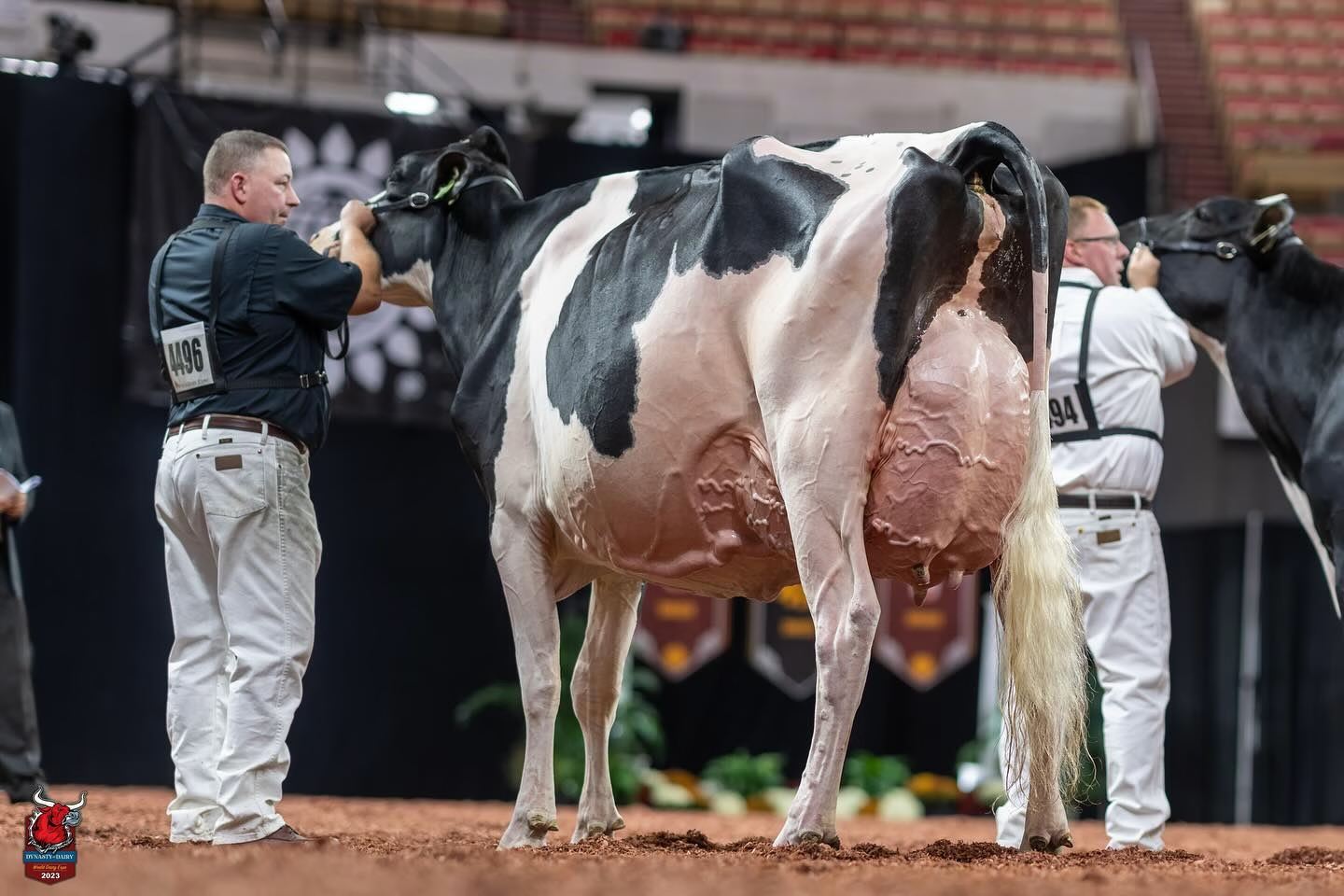
Ladyrose Caught Your Eye on the colored shavings at World Dairy Expo—a three-time class winner whose EX-96 mammary system tells only part of the story. The real story is the three decades of setbacks, second chances, and stubborn belief that put her there.

“She is one of those rare cows that combines cow family, show-winning type, and high genomics,” Tim Rauen of Genosource recalls. Standing in that ring in October, she was living proof.

I’ve covered many Expos over the years I’ve been writing about this industry. But what keeps bringing me back to this cow isn’t the banners or the scores—it’s knowing the decades of setbacks, second chances, and stubborn belief that led to her standing in that ring.

Because here’s what most people watching that week didn’t fully understand: they weren’t just witnessing one cow’s achievement. They were seeing the living proof of stories that began with barn fires, bankruptcy courts, rock stars investing in Holsteins, and phone calls that changed everything.

And those stories—the ones behind the cow in front of them—are what this is really about.

The Call That Changed Everything

Twenty-one years earlier, on a February afternoon in 2003, snow was falling sideways outside the Wisconsin Holstein Convention Sweetheart Sale.

The room was emptying. Experienced breeders—men who had driven through farm country slush and missed morning milking to be there—were already heading for the exits. A five-year-old Holstein named Wesswood-HC Rudy Missy stood in the ring, and the bidding had stalled at a price that felt almost insulting.

Her rump “wasn’t entirely balanced.” That’s what they were saying. And in the unforgiving world of elite cattle auctions, that phrase might as well be a death sentence.

Steve Hayes watched another bidder shake his head and walk away, and felt that familiar mix of disappointment and creeping doubt that every breeder knows—the voice that whispers whether you’ve been fooling yourself all along. This cow he’d helped develop, believed in, poured years into. Was she really going to slip through the cracks like this?

Then the phone rang in the back office.

Matt Steiner’s voice crackled through from Pine-Tree Dairy down in Ohio. The man had never even laid eyes on this cow in person. But something about her—maybe thirty years of studying what makes genetics tick, maybe an instinct honed through decades of disappointment and triumph—told him everything he needed to know.

His $8,100 bid secured what would become the  2014 Global Cow of the Year.

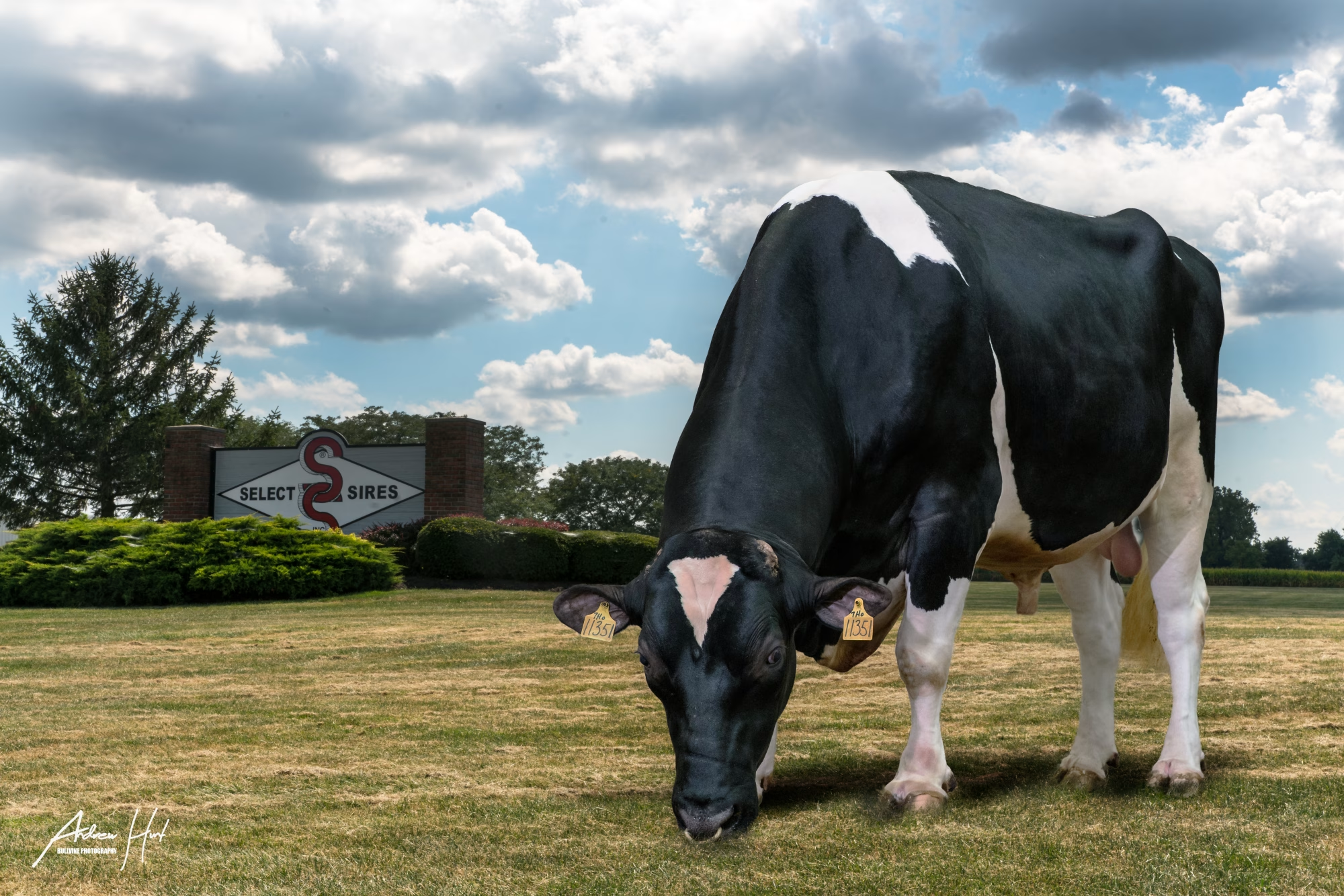
Seagull-Bay Supersire-ET stands proudly at Select Sires, representing the commercial pinnacle of the Wesswood-HC Rudy Missy genetic legacy. From a cow that couldn't attract buyers at $7,000 to a bull achieving millionaire status in AI sales, Supersire embodies how exceptional maternal genetics can reshape an entire industry. His success validates what Matt Steiner saw in that 2003 phone bid—sometimes the most transformative genetics come in

Seagull-Bay Supersire-ET stands proudly at Select Sires, representing the commercial pinnacle of the Wesswood-HC Rudy Missy genetic legacy. From a cow that couldn’t attract buyers at $7,000 to a bull achieving millionaire status in AI sales, Supersire embodies how exceptional maternal genetics can reshape an entire industry. His success validates what Matt Steiner saw in that 2003 phone bid—sometimes the most transformative genetics come in unexpected packages.

I keep thinking about that moment. A roomful of experts walking away from a cow that would reshape the breed, and one man on a phone line three states away who saw what they couldn’t. Today, her descendants include Seagull-Bay Supersire—with over 100,000 daughters worldwide—and Genosource Captain, who held the #1 TPI position for seven consecutive proof runs through December 2024 and remains among the breed’s most influential sires. The genetic value flowing from that single $8,100 phone bid has generated hundreds of millions in semen sales.

But here’s what I keep coming back to when I think about this story. It’s something Steve Wessing, Missy’s original co-breeder, said when reflecting on her journey: “I don’t think she would’ve ever scored EX-92 at our place.”

That’s the kind of honesty you don’t hear often enough—recognizing that cattle reach their potential in different environments, under different management systems. Matt Steiner didn’t just buy a cow that day. He gave her a stage where she could finally perform.

Of course, Steiner didn’t know that’s what he was doing. Nobody did. That certainty only comes later, when you’re telling the story. Living it is different.

The Two Steves: A Friendship Built Across a Fence Line

To understand how Rudy Missy even existed, you have to go back to a different Wisconsin pasture in the early 1990s.

Steve Wessing had started with eighteen registered Holsteins from the Milkstein herd—animals that came with warnings. “There wasn’t a lot of type in that herd,” the industry veterans told him and his wife, Cheryl. And honestly? The experts weren’t wrong. When those first cows got classified, only one scored Very Good: Milkstein Citation Della.

Nothing about Della screamed “genetic goldmine.” She was just a cow that showed up every day, did her job, and kept producing. The kind of cow you don’t think twice about.

But Steve Wessing trusted his eyes over other people’s opinions. And his neighbor, Steve Hayes, was paying attention.

Here’s what I love about this part of the story. Hayes walked past that fence line between their places every morning. He’d pause and study those young cows—the depth through their hearts, how they moved around the feed bunks. That quality you recognize when you see it, even if you can’t quite name it yet.

When Della’s granddaughter Wesswood Elton Mimi came along, both Steves knew they were looking at something special.

“She was a treasure of a cow, very low maintenance, easy to work with,” they’d later recall. “When new feed was delivered, she made sure she had her own place at the front of the line.”

I can picture her so clearly from that description. The kind of cow with personality. The kind you remember long after she’s gone.

Then the fire came.

The Night Everything Almost Ended

Anyone who’s been through it knows that a barn fire is the nightmare that never fully leaves you. The smell of smoke mixing with the panicked bellowing of cattle. The helplessness of watching years of work potentially disappear into the night air. The questions that come later—what could I have done differently, was there something I missed, why us?

Devastating flames tore through the Wisconsin barn one night, and thirteen-year-old Claudette—Mimi’s grandmother, who had already pumped out a quarter million pounds of milk for the Wessings—stood among the smoke and chaos. She survived, thank God. But hip problems from the trauma meant her production career was effectively over. She would have easily hit 300,000 pounds.

Steve Wessing stood in that ash-covered milking parlor afterward, doing the math that nobody wants to do. Adding up what was lost. Subtracting what insurance might cover. Trying to figure out if there was a path forward, or if this was the ending he’d never planned for.

By December 1994, he made the call that went against every farming instinct he had: dispersal sale.

Anyone who’s ever had to let go of something they built knows what that decision costs. It’s not just business. It’s admitting that sometimes the thing you poured yourself into doesn’t get to continue the way you planned. It’s signing the paperwork and then going home to a barn that feels different. Quieter. Wrong.

But then—and this is the part that still gets me—something happened that only happens when people genuinely care about each other.

Steve Hayes had worked out an understanding with his neighbor before the auction: if Hayes bid highest on Mimi, they’d own her together.

Think about that for a moment. A neighbor, watching another neighbor face the unthinkable, steps in instead of standing back. Not to buy cheap—to share the burden. To make sure the genetics survive. To keep his friend connected to something worth saving.

Watching Hayes keep raising his hand as the price climbed past what made most breeders squirm was something those present never forgot. When the gavel fell, two friends from rural Wisconsin suddenly owned what would become one of the most valuable cows in Holstein history.

Neither of them had any clue what they’d just bought.

The Heifer Calf Nobody Expected

When Mimi was bred to Startmore Rudolph—a breeding the AI stud specifically wanted because they expected a bull calf—the two Steves stood in that pasture together, both knowing this decision would either validate their partnership or haunt them for decades.

In 1997, a heifer calf was born: Wesswood-HC Rudy Missy.

At the time, a heifer when you wanted a bull just feels like the universe not cooperating. Again. You do the math on what you were hoping to sell, and you adjust. You move on. It’s only looking back that you can see how the thing that frustrated you became the thing that mattered most.

But that’s cold comfort when you’re standing in the barn wondering what went wrong.

As a cow, though, Missy became what geneticists call a “genetic multiplier”—ultimately producing eighteen sons in AI service and forty-two daughters classified Excellent or Very Good.

What nobody talks about is the waiting. You make a breeding decision, and you won’t really know if it worked for years, sometimes longer. You’re betting a piece of your future on outcomes you can’t see yet. Every one of these breeders lived through stretches where they just had to trust the process and keep showing up—not knowing whether they were building something or wasting their time.

Today, the Steiner family at Pine-Tree Dairy still welcomes Holstein enthusiasts during Ohio Holstein Convention tours. The legacy Matt Steiner’s phone call started continues through his sons, who initially had their doubts about Missy’s curved legs and long teats but learned to trust their father’s eye.

“We acquired her immediately after Madison in 2021,” Tim Rauen of Genosource recalls about Caught Your Eye, another cow woven into this genetic tapestry. “She is one of those rare cows that combines cow family, show-winning type, and high genomics.”

You see the same thing happening, over and over: stockmen seeing what others miss, trusting instinct over auction-day consensus, waiting to find out if they were right.

Breeding Gold from the Ashes of Financial Disaster

While Rudy Missy’s story unfolded in Wisconsin, another drama was playing out that would prove equally consequential—this one born from complete financial collapse.

The 1980s Investor Era had transformed dairy breeding into a playground for tax-bracket-chasing bankers. Section 46 of the Internal Revenue Code allowed wealthy outsiders to write off cattle purchases against their personal income, and prices went absolutely insane. Bulls that should have commanded $50,000 were selling for ten times that.

This was the era when John Lennon of The Beatles invested through George Morgan’s Dreamstreet operation—”threw so much money in the pot that they had to get rid of some of it very quickly,” as industry insiders recalled. Spring Farm Fond Rose, purchased for $56,000 with Lennon’s investment, sold for $250,000 just a few years later. Even rock royalty couldn’t predict which bloodlines would endure—but the money flowing into Holstein genetics signaled something extraordinary was happening in American agriculture.

Jack Stookey was the perfect man for that era—smooth as silk, could charm anyone. He built an empire on other people’s money, snapping up champions and dominating shows.

But bubbles always burst. They always do.

When the IRS started challenging these tax schemes, the money dried up overnight. What followed is hard to tell, even now.

On a Saturday afternoon in winter 1985, Stookey couldn’t pay his hired help, so he instructed them to load a trailer with bull calves destined for slaughter—animals he had previously planned to sell for breeding purposes. Among them were three sons of Continental Scarlet. An AI stud had already spoken for one of the bulls, but Jack couldn’t wait. The bills couldn’t wait.

I think about the hired hands who had to load those calves, knowing what was coming. About Jack making that call because there was no other call to make. About genetics that could have shaped the breed for generations, gone because the bills couldn’t wait another week.

There’s no clean way to tell that story. It’s just loss, compounded.

The Man Who Saw Something in the Wreckage

But where most people saw only the ashes of Stookey’s empire, Louis Prange saw something else entirely.

While everyone else was running from the mess, Prange looked at that barn full of world-class cattle sitting in legal limbo and recognized what nobody else could see. Decades of careful breeding don’t just vanish because someone files for bankruptcy, right? The genetics are still there. The potential is still there.

Prange worked out a deal with the bankruptcy trustee to lease the best cows, flush embryos, and split the proceeds. Among those salvaged genetics was Nandette TT Speckle-Red—the same red-and-white cow that had been dominating shows just years before.

What Prange did next still strikes me as quietly brilliant.

He planned what’s called a “corrective cross”—mating two animals whose strengths perfectly complement each other’s weaknesses. He wanted to breed Speckle to To-Mar Blackstar, a production powerhouse who could pump out incredible milk volumes but needed help on the structural side.

Jack, even in bankruptcy, was still trying to call shots, pushing for different bulls. When it came time to deliver the semen: “My tank ran dry,” he told Prange during that famous phone call.

So Prange went with his gut.

On March 24, 1990, Stookey Elm Park Blackrose came into this world—born in the shadow of bankruptcy court, conceived through a vision of what could be rather than what was.

Of course, standing in that barn in March 1990, nobody knew any of this. Prange had a calf. That’s all. Whether she’d amount to anything—whether any of them would—was still just hope and guesswork. The certainty only comes later, when you’re telling the story. Living it means showing up every day, not knowing if the bet will pay off.

First and Only: The Red Revolution That Changed Everything

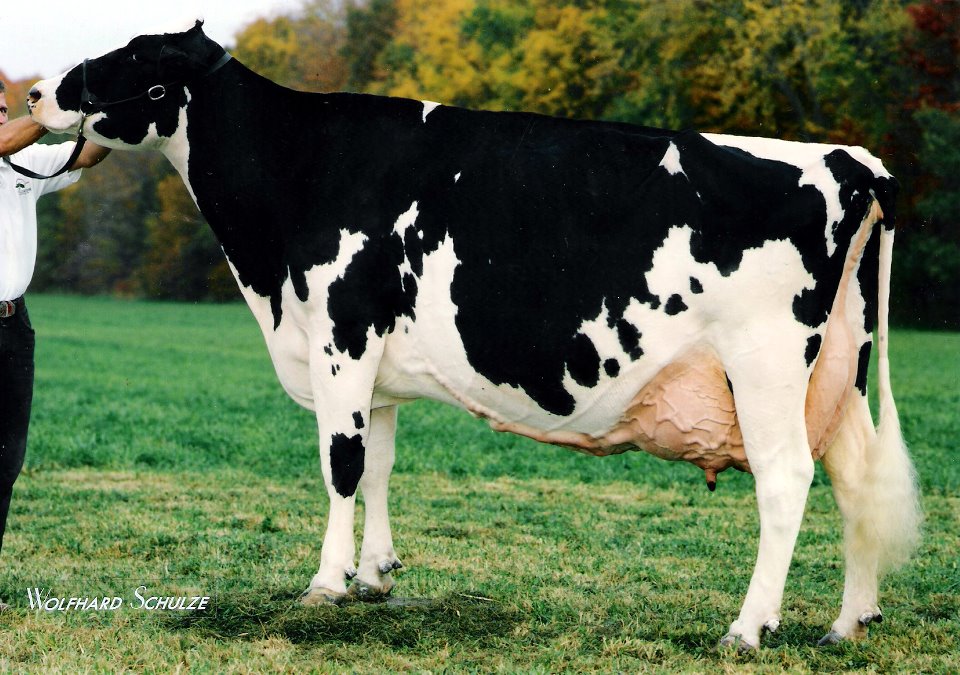
The legendary Stookey Elm Park Blackrose, a cow whose massive frame and amazing udder, captured here, hinted at the genetic revolution she would unleash.

When Blackrose hit the auction block in December 1991, she was just an 18-month-old Blackstar daughter selling for $4,500.

Mark Rueth was fitting cattle at that sale, and he had this feeling about her. He told his buddy Mark VanMersbergen: “This heifer’s got something special. Deep-ribbed, wide-rumped… you just know.”

They partnered with the Schaufs from Indianhead Holsteins on what turned out to be one of the most significant cattle purchases in Holstein history.

Blackrose grew into a massive, commanding presence that dominated wherever she went. Her numbers were off the charts: 42,229 pounds of milk at five years old, with 4.6% butterfat and 3.4% protein. That EX-96 classification put her in conversation with the most structurally perfect cows ever evaluated.

But the real magic was what she produced.

The culmination of a dynasty: Lavender Ruby Redrose-Red (EX-96). In 2005, she achieved the impossible, becoming the first Red & White cow ever named Supreme Champion at World Dairy Expo, proving the enduring magic of the Blackrose line.

Her lineage eventually led to Lavender Ruby Redrose-Red, who in 2005 did something that still stops me when I think about it— first Red & White cow ever named Supreme Champion over all breeds at World Dairy Expo.

First and only. Let me tell you what that moment meant.

For decades, breeders working with red genetics had been told—sometimes subtly, sometimes not—that their cattle were “second tier.” Beautiful, sure. Competitive within their color class, absolutely. But Supreme Champion material? The conventional wisdom said no.

When Redrose-Red stood alone in that Coliseum at the Alliant Energy Center in Madison, above every black and white champion in the building, it wasn’t just a win. It was permission. Permission to finally exhale. To stop defending what they’d chosen to love. To know, just once, that the doubters had been wrong all along.

For people who had spent their careers hearing “not quite good enough,” watching that cow take her place in history meant something that went bone-deep. The kind of vindication you wait a lifetime for and aren’t sure will ever come.

From bankruptcy to the history books in fifteen years.

And now, two decades later, that same bloodline flows through Ladyrose Caught Your Eye—the EX-95 cow who dominated the colored shavings at World Dairy Expo 2024 and proved the dynasty is far from finished.

What the Industry Still Gets Wrong

Here’s the uncomfortable truth that these stories reveal, and it’s something most people in our business don’t want to admit:

We are systematically terrible at recognizing genetic value when it stands right in front of us.

Rudy Missy’s “unbalanced rump” had breeders heading for the exits. Designer Miss sold for $2,100—the lowest price at the legendary 1985 Hanover Hill dispersal—while Brookview Tony Charity commanded $1.45 million at the same sale. Blackrose went for $4,500 at a bankruptcy auction. Even Lennon’s money couldn’t predict which Dreamstreet genetics would endure and which would fade.

Every single one of these so-called “rejects” outperformed the million-dollar sure bets.

The conventional wisdom of their eras dismissed them. The data available couldn’t fully capture what made them special. And yet, stockmen like Matt Steiner, Louis Prange, and the two Steves saw something—felt something—that the catalogs and classification scores couldn’t quantify. (For more on influential maternal lines, see The 7 Most Influential Holstein Brood Cows of the Modern Era.)

Today’s genomic tools are powerful. They tell us more than we’ve ever known. But even now, in December 2025, with all our technology, the fundamental challenge remains the same: the biggest mistake in dairy genetics isn’t buying the wrong cow—it’s walking away from the right one because she doesn’t look perfect on paper.

The Living Proof

As I write this, the legacies of these matriarchs aren’t historical footnotes—they’re actively shaping breeding decisions on farms from Wisconsin to New Zealand.

Genosource Captain—who held the #1 TPI position for seven consecutive proof runs through December 2024 and remains among the breed’s elite sires—traces directly back to Rudy Missy. The cow everyone walked away from at that Wisconsin sale barn is now the grandmother of one of the most influential bulls of his generation.

Ladyrose Caught Your Eye has produced four high-type sons by Lambda—currently one of the breed’s most sought-after sires for type—while continuing to dominate show rings. Her lineage traces directly back to Blackrose, the bankruptcy-born cow that rewrote what was possible for Red Holsteins.

And here’s something that keeps me thinking: Rudy Missy’s great-granddaughter, Ammon-Peachy Shauna-ET, was named 2015 Global Cow of the Year—making grandmother and great-granddaughter back-to-back Global Cow winners. That kind of consistency across generations isn’t luck. It’s something deeper.

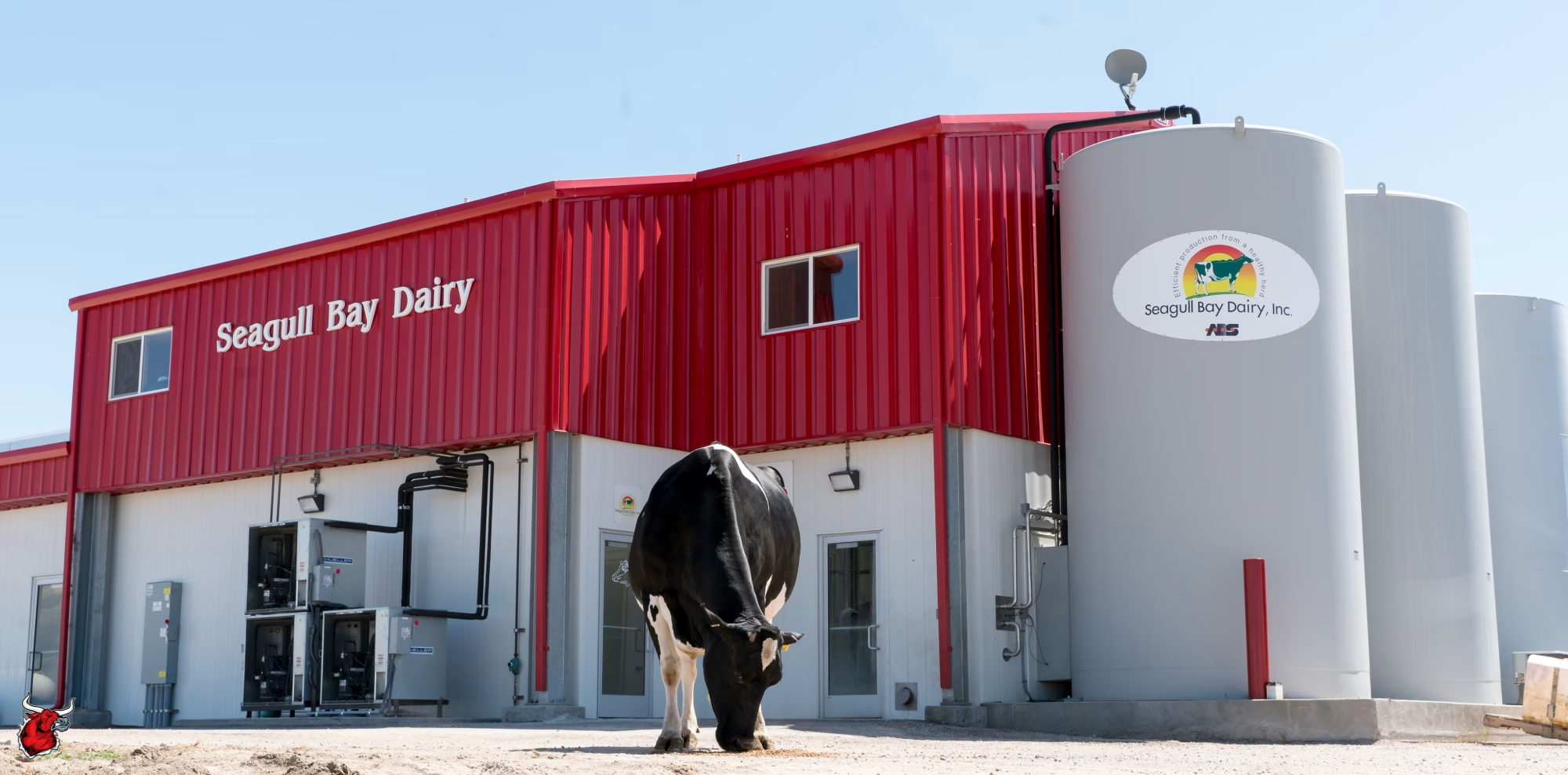
Ammon-Peachy Shauna-ET in front of the milkhouse at Seagull Bay Dairy.

The Steiner family at Pine-Tree Dairy continues hosting tours for Holstein enthusiasts, passing on the philosophy that maternal lines matter more than we ever thought.

I’d be lying if I said these outcomes were inevitable. Good decisions help. But so does timing you can’t control, and breaks that could easily have gone the other way. The two Steves were skilled, but they were also lucky—lucky the fire didn’t take more, lucky Hayes had the cash to bid, lucky that heifer calf had the genetics she had. Skill positions you. Luck decides.

What This Means for All of Us

I’ve spent months with these stories, and what strikes me most isn’t the scale of the achievement—it’s how human the whole thing is.

These aren’t tales of corporate breeding programs with unlimited resources. They’re stories of neighbors becoming partners across fence lines. Of a man betting his career on a phone call to buy a cow he’d never seen. Of someone salvaging genetics from a bankruptcy court when everyone else had given up. Of friendships that turned into dynasties.

What drove all of them forward wasn’t just data or dollars. It was observation, intuition, and the willingness to trust what they saw when everyone else was walking away.

What I don’t want to do is make this sound easy—like all you need is good instincts, and everything works out. For every Rudy Missy, there are cows that didn’t pan out. Partnerships that didn’t survive. Bets that cost people money they couldn’t afford to lose. The stockmen in these stories weren’t right every time. They were right often enough, and they kept going anyway. That’s the part that’s harder to teach.

The lessons these matriarchs leave us are simple to say, harder to live:

  • Trust your eyes over conventional wisdom. Steve Wessing bought cattle that others warned him about. Matt Steiner bid on a cow he’d never seen. Louis Prange invested in genetics that everyone else had abandoned.
  • Build partnerships with people who share your vision. The two Steves created more together than either could have alone. Great genetics need great teams.
  • Focus on transmission, not just individual performance. The cows that built empires weren’t always the flashiest—they were the ones who consistently passed their best traits to the next generation, regardless of the environment.
  • Be patient through adversity. Fires, bankruptcies, dismissive auctions—these setbacks became stepping stones for those who kept going when quitting would have been easier. And quieter. And probably smarter, on paper.

The Question That Matters

The next time you’re at a sale—or walking through your own barn before dawn, studying a heifer that doesn’t quite fit the mold—I hope you’ll think about these stories.

That heifer in the back pen, the one with the slightly off topline your neighbor dismissed last week. Maybe she’s nothing special. Or maybe she’s carrying something you can’t see yet—something that won’t show up for another generation or two.

Somewhere right now, a cow that nobody’s paying attention to is quietly carrying the genetics that will reshape our industry for the next fifty years. The question isn’t whether she exists.

The phone’s ringing. The room’s going quiet. The experts are walking away.

And somewhere in that ring—or in your own barn tomorrow morning—there’s a cow nobody’s fighting for.

Maybe that’s the one.

KEY TAKEAWAYS:

  • $8,100 built a genetic empire. Matt Steiner bought Rudy Missy by phone while experts walked away. She became the 2014 Global Cow of the Year—her descendants are worth hundreds of millions.
  • The cheap cow won. Designer Miss: $2,100. Brookview Tony Charity: $1.45 million. Same 1985 sale. The “reject” outperformed the record-breaker.
  • Friendship outlasts disaster. When fire forced Steve Wessing’s dispersal, his neighbor bid to share the loss—not profit from it. That partnership built a dynasty.
  • Bankruptcy can’t kill great genetics. Louis Prange salvaged Blackrose from court chaos. Fifteen years later: the first and only R&W Supreme Champion in World Dairy Expo history.
  • The cow nobody’s fighting for might be the one. Every empire here started with an animal that the industry dismissed. The next Rudy Missy is in someone’s barn right now. Maybe yours.

Learn More

Join the Revolution!

Join over 30,000 successful dairy professionals who rely on Bullvine Weekly for their competitive edge. Delivered directly to your inbox each week, our exclusive industry insights help you make smarter decisions while saving precious hours every week. Never miss critical updates on milk production trends, breakthrough technologies, and profit-boosting strategies that top producers are already implementing. Subscribe now to transform your dairy operation’s efficiency and profitability—your future success is just one click away.

NewsSubscribe
First
Last
Consent

The Charming Nomad: How Alberto Medina Became the Most Beloved Man in Global Dairy Shows

Traveling 12+ countries yearly with less than 100 nights at home, Alberto Medina has turned cattle fitting into a global art form built on charm and excellence.

A master in his element. This candid shot captures Alberto Medina’s calm, observant focus amidst the bustling pre-ring at the 2014 Royal Agricultural Winter Fair, completely at home in the organized chaos. (Photo by Carl Saucier)

You know that rare person who walks into any room and somehow makes everyone feel like they’ve just met their new best friend? Alberto Medina is that guy—except his “rooms” happen to be cattle barns scattered across five continents, and his magnetic presence has turned him into something of a legend in the dairy world.

Less than 100 nights a year—that’s how often this Spanish-born cattle fitter actually sleeps in his own bed. The rest of the time? He’s somewhere between customs lines and show rings, navigating airports with the confidence of a seasoned diplomat and somehow managing to be the most genuinely admired professional in an industry not exactly known for its abundance of humble superstars.

Here’s what strikes everyone about Alberto—in a business where success can breed contempt and competition often gets ugly, Alberto has managed to achieve unprecedented global recognition while earning genuine respect from virtually everyone he encounters.

The Boy Who Never Lost His Wonder

The story begins at Argomota Holsteins, where young Alberto absorbed something special from his parents—not just their passion for showing cattle, but their fundamental approach to treating people well. “My parents always loved the shows, so I started showing at a very early age,” he tells me, and you can hear decades of genuine enthusiasm still bubbling under those words.

A pivotal moment: Alberto Medina (left) and Santiago Llera celebrate their first National Grand Champion title with Llera Goldwyn Gala, a testament to Alberto’s early eye for exceptional cattle and a foreshadowing of his global success

What’s remarkable about Alberto’s journey is how organically it unfolded. While others fought their way up through regional politics and industry hierarchies, Alberto simply continued to excel at his craft, maintaining the same authentic enthusiasm that had first drawn people to him as a teenager, when he would clip cattle for friends.

After a decade with Semex Spain providing customer support and fitting services, he made the leap that changed everything: he went full-time as an independent fitter. “After that, I became a full-time fitter, and that’s how the traveling started. I was looking to fulfill my working days,” he explains with characteristic modesty, as if describing a weekend hobby rather than embarking on what would become an unprecedented global career.

A young Alberto Medina (second from the right) with the CIAQ/Semex daughter display team, showcasing his early commitment to the dairy genetics industry.

Living the Impossible Dream

Picture this: You land in Madrid after two weeks in Canada, rush home to change suitcases, maybe catch four hours of sleep, then hop on a 6 AM flight to New Zealand. Most people would be staggering zombies. Alberto steps off that plane looking refreshed and ready to tackle whatever challenges await.

“Sometimes I have to go home for a day, change luggage, sharpen my blades… and fly again the next day,” he says matter-of-factly. The logistics alone would break most people—navigating different electrical systems, language barriers, and cultural expectations that shift with every border crossing. But Alberto has mastered it all with an ease that borders on the supernatural.

Twelve to fifteen different countries annually. Thirty-plus shows a year. Only five of those shows are in his native Spain. That’s not just a career—that’s a lifestyle that would terrify most of us, yet Alberto has turned it into an art form.

Precision under pressure—Alberto’s ring-ready finish is the quiet edge behind champion results.

The Stories That Reveal Character

Every conversation with Alberto eventually becomes storytelling time, and his tales reveal layers of humor and grace under pressure. Take the great goat invasion: “A goat running in the ring full of cows was priceless,” he recalls with obvious delight. You can picture the whole scene—some prestigious European show, everything formal and serious, then suddenly chaos as a goat careens through a ring full of Holstein cows.

Or the highway cow chase during a trip from Spain to Italy: “We stopped for milking, one of the cows escaped and was so close to jumping onto the highway.” The way he tells it, you can feel the adrenaline spike, the frantic teamwork, the collective relief when disaster was averted. These aren’t just amusing anecdotes—they’re windows into someone who finds adventure and humor even in moments that would traumatize others.

But perhaps the story that best captures Alberto’s character involves a cow whose breeder wanted to milk her out before the show because, “in their opinion, she didn’t look any good.” Alberto saw something others missed—and she ended up Supreme Champion. That’s not just professional expertise; that’s someone who believes in potential when others have given up hope. This moment perfectly illustrates his ability to see beyond surface appearances and trust his instincts, even when others doubt him.

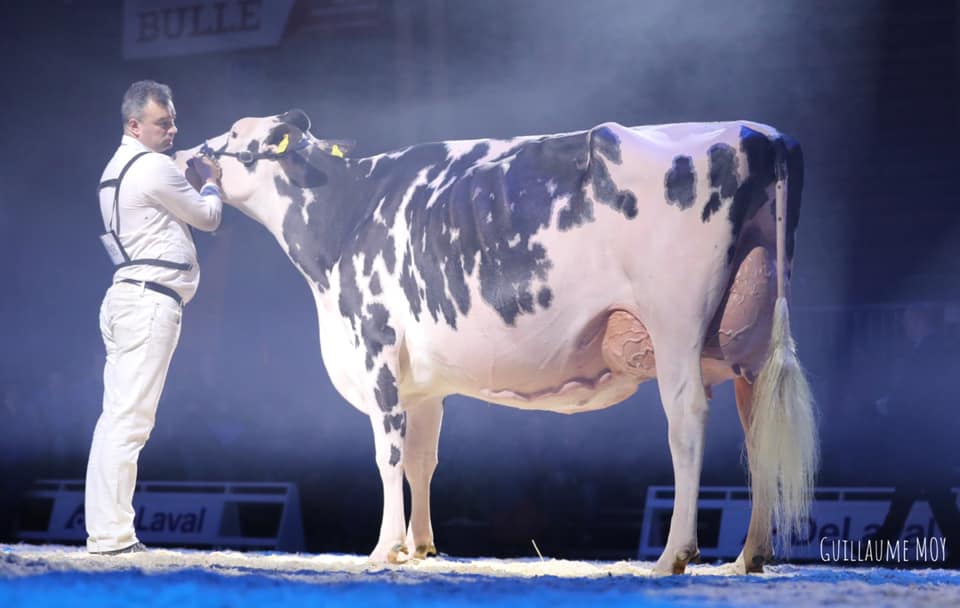
Mastering the moment. Alberto Medina guides Au Parchy Doorman Jolie in the spotlight at the 2019 Expo Bulle, where their flawless presentation led to a stunning upset victory for Grand Champion

The Professional Who Elevates Everyone

What distinguishes Alberto from other elite professionals is his collaborative philosophy. “Make a good team at every show because showing animals is not a one-person thing. Success is about teamwork,” he explains, and this isn’t just strategic thinking—it’s how he approaches every aspect of his career.

Rather than hoarding trade secrets or maintaining a competitive advantage through secrecy, Alberto freely shares knowledge and actively builds others up in the industry. When he talks about buying a cow with friends back in 2006 that became Grand Champion at the European Dairy Show in Italy in both 2008 and 2009, then Junior Champion at the Swiss Expo in 2020, you hear the joy of shared achievement. These weren’t solo victories—they were friendship triumphs that created lasting bonds across continents. His willingness to invest in partnerships and celebrate collective success has earned him respect that transcends mere professional accomplishment.

Teamwork makes the dream work at IDW 2020. Alberto Medina (standing) with the talented Blue Chip crew including Sheila Sundborg (kneeling, center left) and Katie Kearns (kneeling, center right) and Kelvin Cochrane (Queensland), embodying the collaborative spirit that defines his approach to the global show circuit.

The Master Who Wears Success Lightly

Alberto’s technical mastery is undeniable—he’s adapted to feeding systems ranging from TMR to pasture to full hay programs, stayed current with equipment that’s “changed completely in the past 30 years,” and somehow manages mental transitions between regional showing standards that would challenge seasoned diplomats.

Llinde Ariel Jordan—Grand Champion and Best Udder at Cremona, the matriarch Alberto has believed in for a decade.

Take his relationship with Llinde Ariel Jordan, a cow he first encountered as a “small, narrow, straight-legged, soft-pastured” two-year-old. Most professionals would have written her off as unpromising. Alberto saw potential and patiently watched her develop “into one of the best show cows in the world.” At 14 years old, she continues to compete and improve her skills. The pride in his voice when discussing her isn’t just professional satisfaction—it’s genuine affection for watching someone (even four-legged someones) exceed expectations.

Even challenging animals earn his respect. Kingboy Birdy is “one of the hardest cows I ever walked into the ring with,” yet he speaks of her with bemused fondness rather than frustration. He appreciates strong personalities even when they complicate his job.

A challenging partnership, a dream fulfilled. Alberto Medina presents Vinbert Kingboy Birdy in the final lineup at the 2022 Royal Agricultural Winter Fair, an event he called the realization of a lifelong dream after a rewarding year with “one of the hardest cows I ever walked into the ring with.

The Gentle Revolutionary

Here’s something most people don’t realize about operating at Alberto’s level—sometimes excellence itself becomes controversial. “People tried to ban me from going to do my job at a show because they think I’m too good at it. Yes, this happened,” he admits with characteristic understatement.

Praise from peers often means the most. Alberto shared his pride in this post from industry veteran Carl Saucier, which places him in the direct lineage of show ring legends like Donald Dubois—a testament to the deep respect he has earned at the highest level.

Think about that scenario: being so consistently successful that competitors attempt to exclude you from events. It’s the kind of situation that could make anyone defensive or bitter. Alberto tells the story with the same bemused calm he brings to everything else, seemingly genuinely puzzled by such reactions to professional excellence. His grace under this kind of pressure reveals the depth of his character and professional maturity.

The Philosophy of Authentic Excellence

Alberto’s approach to both life and work reveals someone who’s found genuine fulfillment in an unconventional path. His downtime activities perfectly capture his character: ‘Hanging out with friends, good restaurants, more traveling, and getting my heifers ready for the next show.’ Even relaxation centers on the things he values most—relationships, experiences, and continued engagement with his passion

Alberto’s approach to both life and work reveals someone who’s found genuine fulfillment in an unconventional path. His downtime activities perfectly capture his character: “Hanging out with friends, good restaurants, more traveling, and getting my heifers ready for the next show.” Even relaxation centers on the things he values most—relationships, experiences, and continued engagement with his passion.

When I ask about maintaining personal connections with such an intense travel schedule, he’s refreshingly honest: “It’s truly difficult.” But there’s no self-pity, just acceptance of choices made in pursuit of something he genuinely loves. That emotional honesty extends to his professional relationships as well.

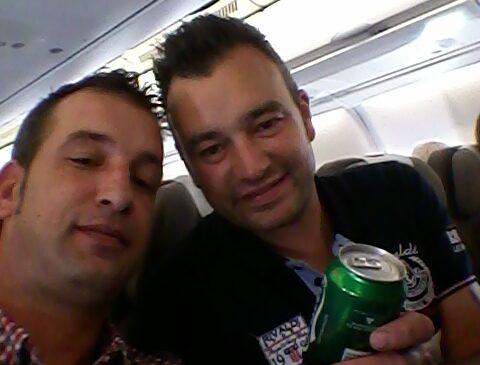
The life of a nomad is better with family. Alberto and his brother, Jose Medina, share a moment while en route to the World Dairy Expo in 2015, a rare bit of downtime in a schedule packed with international travel.

The Visionary with Feet on the Ground

Alberto’s insights about the industry come from an unmatched global perspective. His philosophy about cattle evaluation challenges conventional wisdom: “Wideness is the true type of cow. Modern cows have to have a wide chest, wide open rib, wide rumps, much more than being long and tall.” But he presents these views as contributions to ongoing conversation rather than final pronouncements, inviting discussion rather than demanding agreement.

The technical challenges of transitioning between different regional standards reveal the complexity of his work. “Still hard to adapt when you have 2 months in North America and go back straight to a show in Italy. Not so easy to change your mind that quick on… getting the udders too full,” he notes. This kind of cultural and technical switching demonstrates the mental agility required to succeed at his level.

The focus of a master craftsman. Alberto Medina demonstrates the precision and skill that make him sought-after worldwide, here fitting a show cow for Blue Chip at Australia’s International Dairy Week (IDW) in 2020.

His advice for aspiring professionals reflects both extensive experience and fundamental optimism: “Travel and see other ways of showing because every country is different and there are so many ways to do the same thing.” It’s counsel about embracing the world with curiosity and openness—life philosophy disguised as career guidance.

The Honest Realist

When I ask about his reputation for being universally liked, Alberto cuts through diplomatic nonsense with refreshing candor: “I don’t think so! Some people love me, but also many on the other side.”

That honesty is quintessentially Alberto. He’s not trying to convince anyone he’s perfect—just being genuine about the realities of high-level success. Yes, most people genuinely enjoy working with him. Yes, his consistent achievements have created some resentment. Both things can be true, and Alberto’s comfortable with that complexity in ways that reveal deep emotional maturity.

Dreams Still Dancing

Dreams realized across borders. Alberto proudly leads Marsella to Grand Champion honors at Agro Expo Bogota, Colombia, a testament to his ongoing pursuit of excellence and the global impact of his expertise.

Even after achieving global recognition that most professionals can only imagine, Alberto maintains specific ambitions that keep him energized. “I’ve been in the middle of the ring at the end of the day at almost every show I’ve been in the world but Expo,” he admits with a smile. World Dairy Expo—the crown jewel of North American dairy shows—remains unconquered territory.

This perspective—always having meaningful goals ahead—might explain how someone maintains enthusiasm across decades of demanding travel and competition. The moment you think you’ve achieved everything is probably when excellence starts to fade. Alberto’s far too fascinated by what’s around the next corner to let that happen.

The passion that fuels the dream. Alberto shares a heartfelt embrace with the Grand Champion at a recent show in Ecuador. Victories like these, filled with joy and genuine affection, are the moments that power his pursuit of a World Dairy Expo title

The Living Proof

What strikes me most about Alberto Medina isn’t his unprecedented travel statistics or technical expertise, though both are extraordinary. It’s how he’s demonstrated that success and kindness aren’t mutually exclusive—that you can achieve global recognition while maintaining the values that make you genuinely likable.

In an industry that sometimes rewards sharp elbows over generous spirits, Alberto has built an international reputation on competence paired with character. Every airport conversation, every patient explanation of a technique, and every shared celebration of others’ achievements contribute to a legacy that transcends mere professional accomplishment.

Those fewer than 100 nights at home annually represent something profound: a commitment to relationships and excellence that has literally transformed an entire industry. Every clipping session becomes an opportunity to mentor. Every show becomes a chance to help someone else achieve dreams they might not have believed possible.

As young professionals watch Alberto work—whether in Auckland or Amsterdam—they see living proof that excellence doesn’t require ego. His patient teaching, infectious enthusiasm, and genuine investment in others’ success have redefined what global leadership can look like.

The next time you encounter perfectly prepared cattle in any show ring around the world, remember the man who’s probably logged more miles in service of our industry than anyone else, while somehow making the whole impossible journey look like the most natural thing in the world.

Alberto Medina’s greatest achievement isn’t any single championship or distance record. It’s proving that the most effective way to conquer the world is to help it succeed, one genuine relationship at a time. For aspiring professionals in any field, his example provides both inspiration and practical guidance: master your craft, treat everyone with respect, find joy in the journey, and remember that the best victories are always shared.

And somewhere tonight, Alberto is probably planning his next adventure, sharpening his clippers, and reminding everyone lucky enough to be around him that work stops being work when you love what you do and genuinely care about the people you do it with. That might be the most beautiful lesson of all.

Key Takeaways:

  • Embrace adaptability: Master working across diverse cultures, climates, and management systems rather than limiting yourself to one approach
  • Build strong, collaborative teams: Success depends on teamwork—”showing animals is not a one-person thing”
  • Practice genuine humility and kindness: Authentic relationships and respect open more doors than technical skill alone
  • Commit to continuous learning: Stay current with evolving techniques and technology throughout your entire career
  • Trust your professional intuition: Learn to identify potential that others might miss, even when conventional wisdom disagrees
  • Develop resilience for challenges: Accept that pursuing excellence involves logistical difficulties and personal sacrifices
  • Balance passion with realistic expectations: Understand the trade-offs required for global success, including limited time at home
  • Prioritize long-term preparation: Focus on consistent, year-round excellence rather than relying on last-minute efforts

Executive Summary

Alberto Medina, the most traveled cattle fitter in the dairy industry, embodies a unique blend of technical mastery, humility, and genuine charm that has made him a beloved figure across five continents. Born at Argomota Holsteins in Spain, Alberto’s career spans over three decades, with annual travels to 12-15 countries and participation in more than 30 shows worldwide—sleeping fewer than 100 nights at home each year. Renowned for his ability to adapt effortlessly to diverse cultures, feeding systems, and show standards, he builds lasting relationships through authentic kindness and collaborative spirit, all while maintaining top-tier performance that has led to multiple championship wins, including his work with Llinde Ariel Jordan, who successfully competed at 14 years old. What sets Alberto apart isn’t just his unmatched global experience or technical expertise, but his rare combination of professional excellence and personal warmth—proving that in an industry where egos often clash, success and genuine likability can coexist beautifully, making him not just the most traveled fitter in the business, but quite possibly the most respected.

Learn More:

  • 7 Things You Must Do To Win In The Show Ring – This article provides a tactical checklist for aspiring showmen. It breaks down the key preparations and mindset, offering practical strategies to translate the professional excellence demonstrated by Alberto Medina into your own repeatable success in the ring.
  • The 21st Century Guide to Marketing Your Genetics – Moving from individual skill to business strategy, this piece explores how to build a powerful brand around your herd’s genetics. It reveals modern methods for capitalizing on show ring success to create long-term value and market influence.
  • Is It Time To Rethink The Perfect Dairy Cow? – This forward-looking analysis challenges breeders to consider the future of dairy type. It complements Alberto’s story by examining the evolving standards and economic realities that will shape the champion cows of tomorrow, prompting readers to innovate their breeding strategies.

Join the Revolution!

Join over 30,000 successful dairy professionals who rely on Bullvine Weekly for their competitive edge. Delivered directly to your inbox each week, our exclusive industry insights help you make smarter decisions while saving precious hours every week. Never miss critical updates on milk production trends, breakthrough technologies, and profit-boosting strategies that top producers are already implementing. Subscribe now to transform your dairy operation’s efficiency and profitability—your future success is just one click away.

NewsSubscribe
First
Last
Consent

From 4-H Project to Brown Swiss Legacy: The Brothers Three & Josh Hushon Story

From 4-H novices to genomics pioneers: How three brothers built an elite Brown Swiss legacy while balancing corporate careers and family life.

The morning sun streams across the Wisconsin pasture as Josh Hushon moves among his prized Brown Swiss cattle. What began in 1991 as a humble 4-H project has evolved into Brothers Three Brown Swiss, one of the country’s most respected Brown Swiss breeding operations. This remarkable journey intertwines with Josh’s influential career at Cargill and his reputation as a respected cattle judge, creating a unique story of passion, expertise, and family legacy in the dairy industry.

The Brothers Three team celebrates under the iconic willow trees at World Dairy Expo in Madison, Wisconsin, showcasing their champion Brown Swiss. From humble 4-H beginnings in 1991 to elite breeders today, this family partnership exemplifies how passion, mentorship, and genetic expertise can build a lasting Brown Swiss legacy while balancing careers and family life.

Humble Beginnings to Brown Swiss Legacy

The Brothers Three story didn’t begin with generations of dairy farming knowledge or an established Brown Swiss herd. Instead, it started with youthful curiosity and a willingness to learn that continues to define their approach today.

“We are first generation into Brown Swiss and even into showing at all, so I think being open-minded and learning from people we look up to is ingrained into us,” Josh explains. “We didn’t know anything about Brown Swiss when we started in 1991, so there was no ‘this is our breeding philosophy or how we do things’ to help or hold us back.”

That blank-slate approach may have been their greatest advantage. Without preconceptions about how things “should” be done, the Hushon family approached every challenge with humility and adaptability. Josh recalls how his parents had to find mentors to teach them techniques so they could pass that knowledge to their children. “I think that’s why we’ve never been afraid to ask the people we respect for help; we watched Mom and Dad do that constantly as kids.”

This foundation of learning from others has remained central to their operation even as they’ve risen to prominence. From local county fairs to the prestigious World Dairy Expo in Madison, Brothers Three has methodically climbed the ranks of the Brown Swiss world, gained knowledge, and perfected their craft with each step.

A Philosophy of Continuous Learning

Josh and Casey Hushon stand alongside mentoring partners Kyle Barton and Kenzie Ullmer at a recent show. As Josh notes, "We learn from each other, push each other, and have been showing together for the past four years with a lot of success and fun along the way!" This collaborative approach to continuous improvement embodies Brothers Three's philosophy of learning from peers within the industry.
Josh and Casey Hushon stand alongside mentoring partners Kyle Barton and Kenzie Ullmer at a recent show. As Josh notes, “We learn from each other, push each other, and have been showing together for the past four years with a lot of success and fun along the way!” This collaborative approach to continuous improvement embodies Brothers Three’s philosophy of learning from peers within the industry.

The Hushons exemplify the power of the mentor-mentee relationship in agriculture. As Josh eloquently says, “To know the road ahead, ask those coming back.” This approach has connected them with influential industry figures like Luke Peterson, who guided their preparation for the World Dairy Expo, turning a $1,200 purchase into a third-place finisher and Honorable Mention All-American. More recently, mentors like Tom Foss of Pit-Crew Genetics, Kelli and Tom Cull at Budjon and the Kyle Barton and Kenzie Ullmer team have shared invaluable insights about showing, selling, and merchandising strategy.

Family Dynamics and Evolution

What makes Brothers Three unique is how the brothers balance distinct roles while maintaining a unified vision. Though never anyone’s full-time job, their passion for Brown Swiss cattle drives their collaborative approach.

“Brothers Three has never been anyone’s full-time job, so our roles have all changed a lot in the 30+ years we’ve been in Brown Swiss as our careers and seasons of life have changed,” Josh notes. “Our Dad set the vision for us as we started in the breed, but over the past 15 years, we’ve taken that on.”

The farm operates with each brother contributing according to their strengths:

  • Jake leverages his role at New Generation Genetics to make most mating decisions, bringing industry-wide genetic insights
  • Josh and Casey manage day-to-day development and merchandising, determining which animals to show and invest in
  • Joe’s career has taken him toward agronomy, but he remains critical during the World Dairy Expo, helping balance careers and Brothers Three responsibilities

A pivotal moment came in 2014 when Josh and Casey purchased a small farm and began rebuilding their operation. “From 2009 until then, we had dwindled our numbers and were only boarding a few with the Topps in Ohio, who have been great friends and partners for years. The Brothers Three prefix might have become history without a major change,” Josh explains.

Josh and Casey Hushon celebrate with Topp B-3 Woodford after claiming the Intermediate Champion banner at the 2023 World Dairy Expo-a triumphant moment representing years of collaborative breeding decisions, shared daily management, and perseverance through setbacks. This championship exemplifies how Brothers Three's division of responsibilities allows each brother to contribute their unique strengths toward a unified vision of excellence.
Josh and Casey Hushon celebrate with Topp B-3 Woodford after claiming the Intermediate Champion banner at the 2023 World Dairy Expo-a triumphant moment representing years of collaborative breeding decisions, shared daily management, and perseverance through setbacks. This championship exemplifies how Brothers Three’s division of responsibilities allows each brother to contribute their unique strengths toward a unified vision of excellence.

This move allowed them to strategically rebuild their herd by acquiring animals from favorite cow families in the Brown Swiss and Ayrshire breeds. They incorporated advanced reproductive technologies like IVF and partnered with Crave Brothers for embryo implantation. They quickly improved their show string and established themselves as a source of top-quality animals in prestigious spring sales.

Daily Life at the Brothers Three

Far from the romantic notion of full-time farming, Brothers Three represents the reality of modern agricultural passion projects. Josh describes their operation as “a morning, evening, weekend, and any other spare moment that Casey and I can find a job!”

The farm maintains 10-15 show heifers at their small farm, with milk cows owned in partnership with the Nehls and Wolf families, who are boarded at quality operations like Budjon and Smith-Crest. (Read more: Making Dreams Come True: The Journey of Tom & Kelli Cull) Their daily routine involves pre- and post-work chores, with weekends dedicated to catching up on farm tasks.

Their showing schedule has expanded to nearly year-round activity. By January, they’re already back into the regular habit of clipping and working with heifers. Casey manages their meticulous hair care rotation—washing, conditioning, and rinsing—which intensifies for spring shows and continues through October.

Breeding Philosophy: Balancing Show Ring and Commercial Viability

At the heart of Brothers Three’s success is their commitment to breeding cattle that excel both in the show ring and the milking parlor—a balance that has become their hallmark.

“We have always bred for both type and production, even though we don’t have our dairy,” Jake explains. “It was always important to us that our cattle be productive in the milk string for the dairymen or partners who milk them as well as competitive in the show ring for us.”

Their breeding program builds upon the foundation established by their father, who emphasized four key elements: type, udders, cow families, and milk production. The first three attributes catered to show success, while milk production ensured their animals delivered value to the dairy farmers who milked them.

However, about a decade ago, the Brothers Three began experiencing reproductive challenges in their herd. Based on Jake’s experience with New Generation Genetics customers, they prioritized daughter pregnancy rate (DPR) in their breeding decisions—a forward-thinking move that anticipated industry trends.

“The show industry embraced this as well, and now many show-type breeders breed for positive daughter fertility traits, but 10 years ago, that wasn’t a huge part of bull selection,” Jake notes.

Victory moment: Topp B-3 Woodford is named Intermediate Champion at the 2023 World Dairy Expo Brown Swiss Show. This triumph represents the culmination of Brothers Three's balanced breeding philosophy-producing animals that excel in both the show ring and commercial settings while demonstrating the resilience that makes Brown Swiss cattle so valuable to the dairy industry.
Victory moment: Topp B-3 Woodford is named Intermediate Champion at the 2023 World Dairy Expo Brown Swiss Show. This triumph represents the culmination of Brothers Three’s balanced breeding philosophy-producing animals that excel in both the show ring and commercial settings while demonstrating the resilience that makes Brown Swiss cattle so valuable to the dairy industry.

“I love that cow more than you should love a cow… she’s broken my heart more than once, but I will keep putting my heart out there. She is my once-in-a-lifetime cow.” – Josh Hushon on Woodford

Advanced Reproductive Technologies in Practice

Brothers Three has embraced cutting-edge reproductive technologies to accelerate genetic progress. Their strategic use of in vitro fertilization (IVF) in partnership with Crave Brothers for embryo implantation has been instrumental in rapidly rebuilding their herd quality after 2014.

This approach allows them to multiply genetics from their most valuable females, as evidenced by the “ET” (Embryo Transfer) and “ETV” (Embryo Transfer Viable) suffixes that frequently appear in their animals’ names. The strategic mating of Woodford with Deluxe exemplifies this approach, producing three daughters with All-American nominations in just two years, plus a fourth that sold for $30,000 as the second-highest seller at the recent Quest for Success sale.

“Our goal is to breed great heifers who become great cows which is why we are really picky about the maternal lines we invest into and the bulls that we use,” Josh added. “If you buy one from us, we want her to have the potential to be a foundation animal in your herd.

Genomics: The Game-Changer

Genomic testing has revolutionized Brothers Three’s breeding approach, providing crucial insights that guide their decision-making process.

“Genomic testing has had a massive impact on our breeding program and continues to play a pivotal role,” Jake explains. “We started to test all females to get a glimpse into the future of each heifer. Just as each animal is designed with a specific nutrition program to maximize potential, genomics allows us to maximize the genetic potential through our matings.”

Their genomic strategy follows a dual approach:

  1. Testing all females to assess their genetic potential
  2. Selecting bulls that both maximize positive traits and address genetic weaknesses simultaneously

This genomic data integration has accelerated their genetic progress significantly, allowing them to make more informed breeding decisions than possible through traditional visual assessment and pedigree analysis alone.

Show Ring Success: Building Elite Cow Families

Brothers Three Wisper 2E-92: The matriarch who transformed a 4-H project into a breeding legacy. Twice named All-American, this beloved foundation cow contributed to nearly half of the operation's 50 All-American nominations through her descendants. More than her impressive show ring achievements, Wisper embodied the personal connection that defines Brothers Three-recognizing her handlers, perking up her distinctive Brown Swiss ears when called, and taking a family of first-generation exhibitors to heights they "only dreamed of." The backyard-raised heifer who became their first homebred All-American represents the perfect union of genetic excellence and heartfelt passion.
Brothers Three Wisper 2E-92: The matriarch who transformed a 4-H project into a breeding legacy. Twice named All-American, this beloved foundation cow contributed to nearly half of the operation’s 50 All-American nominations through her descendants. More than her impressive show ring achievements, Wisper embodied the personal connection that defines Brothers Three-recognizing her handlers, perking up her distinctive Brown Swiss ears when called, and taking a family of first-generation exhibitors to heights they “only dreamed of.” The backyard-raised heifer who became their first homebred All-American represents the perfect union of genetic excellence and heartfelt passion.

The Foundation: Brothers Three Wisper

The foundation of Brothers Three’s breeding program is Brothers Three Wisper 2E-92, a granddaughter of Top Acres EJ Whistle. Twice named All-American, Wisper was Junior Champion at the World Dairy Expo in 2001 and Grand Champion of the Junior Show in Madison in 2003.

Her genetic impact has been extraordinary, with 25 classified daughters, 21 Very Good or Excellent. “Almost half of our 50 All-American Nominations belong to her and her offspring,” Josh proudly states.

The most successful mating with Wisper came through Sunnyisle Total, producing daughters like Brothers Three TV Willa (the dam of their celebrated cow Woodford) and Brothers Three TV Wisco EX-93, who received three All-American nominations in milking form.

Creating Championship Genetics

Josh and Casey Hushon proudly pose with B3-Ayr Tux Wilma, their 2023 UNANIMOUS All-American Summer Yearling who dominated the show circuit with championship wins at World Dairy Expo and as Junior Champion at the North American International Livestock Exposition (NAILE). Wilma exemplifies Brothers Three's commitment to developing elite genetics with both style and substance.
Josh and Casey Hushon proudly pose with B3-Ayr Tux Wilma, their 2023 UNANIMOUS All-American Summer Yearling who dominated the show circuit with championship wins at World Dairy Expo and as Junior Champion at the North American International Livestock Exposition (NAILE). Wilma exemplifies Brothers Three’s commitment to developing elite genetics with both style and substance.

Brothers Three has methodically built its reputation on developing elite animals with staying power. Their success includes:

  • 14 All-Americans and 8 Reserve All-Americans
  • 50 total All-American nominations, with nearly half coming from Wisper’s family line
  • The 2023 Intermediate Champion at World Dairy Expo (Topp B-3 Woodford)
  • Successful entries in both Brown Swiss and Ayrshire breeds, including Junior Champion Ayrshire at World Dairy Expo

The Woodford Story: Perseverance Rewarded

Topp B-3 Woodford, shown here during her winning appearance as 1st Place Junior Three Year Old at the 2023 World Dairy Expo International Brown Swiss Show. Just 16 months after losing her calf and facing setbacks, Woodford’s triumphant return to the ring culminated in being named Intermediate Champion-a testament to Brothers Three’s perseverance and Josh Hushon’s unwavering faith in his “once in a lifetime cow.”

Perhaps no story better illustrates the Brothers Three’s journey than that of Topp B-3 Woodford, whose path to championship glory embodied both heartbreak and triumph.

“Standing in a pasture in late spring 2022 with tears in my eyes as they confirmed that Topp B-3 Woodford had lost her calf and was open, I could never have imagined in a million years that she would be Intermediate Champion at World Dairy Expo 16 months later,” Josh reflects with emotion.

Woodford had shown promise as a heifer, earning Reserve All-American Summer Yearling honors. After losing her calf, Josh feared his dreams for her were delayed, if not derailed. Yet, against all odds, she calved at 2 years and 11 months, and by August, she was named Intermediate and Reserve Grand Champion at the Wisconsin State Show under Jason Lloyd’s evaluation.

Her rise continued at World Dairy Expo 2023, where she claimed the Intermediate Championship, cementing her place in Brothers Three history. “I tell people that I love that cow more than you should love a cow, and she’s broken my heart more than once, but I will keep putting my heart out there. She is my once-in-a-lifetime cow,” Josh says with undisguised pride.

Star in the Spotlight: Casey Hushon with Budjon-Vail Autograph Kristina ETV as she enters the show ring at World Dairy Expo. The dramatic purple lighting highlights the results of Brothers Three's distinctive show preparation regimen-where Casey's meticulous hair care rotation combines with their growth-focused nutrition approach. This Winter Yearling champion exemplifies their philosophy that proper development creates animals with both the mass to compete and the style to win, representing hundreds of hours of daily care, conditioning, and hands-on work that defines the Brothers Three showing program.
Star in the Spotlight: Casey Hushon with Budjon-Vail Autograph Kristina ETV as she enters the Supreme Junior Champion Parade at World Dairy Expo. The dramatic purple lighting highlights the results of Brothers Three’s distinctive show preparation regimen-where Casey’s meticulous hair care rotation combines with their growth-focused nutrition approach. This Winter Yearling champion exemplifies their philosophy that proper development creates animals with both the mass to compete and the style to win, representing hundreds of hours of daily care, conditioning, and hands-on work that defines the Brothers Three showing program.

Show Preparation Techniques

Their show preparation regimen reflects their thoughtful, long-term approach to development. Rather than focusing solely on show-ready conditions year-round, they prioritize growth during winter months.

“I think one of the things that sets us apart from others, though, is that we feed them to grow through the winter, and if they come into the spring carrying more weight than ideal for showing, we’re fine with that,” Josh explains. “I joke that I am the guy that got the Junior Champion Ayrshire from Madison beat last year at Spring Show and was perfectly fine with that because I believe these heifers need that mass and growth to make the distance to Expo.”

This growth-focused approach continues until June or July, when they begin managing weight more actively. For yearlings needing to lose condition, their regimen can be intensive—Josh recalls walking two yearlings a mile daily after dinner, with each heifer completing this route more than 40 times between August and September. One of these animals became Junior Champion Ayrshire at the World Dairy Expo.

Their nutrition program benefits directly from Josh’s Cargill expertise, while Casey manages their comprehensive hair care routine, which becomes increasingly intensive as show season approaches. This combination of nutrition, hair care, exercise, and hands-on development forms their integrated approach to show preparation.

5 Key Breeding Strategies from Brothers Three

  1. Prioritize Fertility: Select a positive daughter pregnancy rate (DPR) to ensure reproductive success
  2. Balance Show Appeal and Commercial Viability: Breed for type, udders, and strong cow families while maintaining milk production
  3. Leverage Genomic Testing: Test all females to guide mating decisions and accelerate genetic progress
  4. Focus on Maternal Lines: Build upon proven cow families for consistent genetic transmission
  5. Strategic Partnerships: Form co-ownership relationships to access elite genetics and share risk

Josh Hushon: Bridging Corporate Strategy and Cattle Expertise

Josh Hushon delivers a presentation at the 2022 Connect Dairy Summit in his role as Strategic Dairy Marketing Lead for North America at Cargill. His expertise in corporate dairy strategy complements his passionate approach to Brown Swiss breeding at Brothers Three.

What makes the Brothers Three story particularly unique is Josh Hushon’s dual identity as both a passionate Brown Swiss breeder and a corporate strategist at Cargill. Since March 2020, Josh has served as Strategic Dairy Marketing Lead for North America at Cargill, leading a team responsible for crafting the North American dairy strategy and portfolio development.

His career journey includes previous roles as Calf & Heifer Commercialization Lead and Marketing Communications Lead at Cargill and five years as an Associate Editor at Hoard’s Dairyman from 2003-2008. This blend of agricultural journalism experience and corporate marketing expertise has shaped his approach to Brothers Three and his understanding of the broader dairy industry.

“At Cargill, I am the Director for strategy, marketing, and technology for our dairy nutrition business in the U.S. and Canada, and I see several mutual benefits to this dual role with my cattle,” Josh explains. “Working at Cargill gives me access to some of the best nutrition minds in the world. I’ve learned much about rumen development, reading a hay sample, and the latest technologies, such as phytogenics, which we’ve integrated into our program.”

This knowledge exchange works both ways. “At the same time, being a customer at Cargill and spending my social time with other dairy producers keeps me grounded in a reality that makes our work more impactful to our customers. As a marketer, having daily real-world insight helps our team to remain practical and innovative in our work.”

Sustainability Initiatives and Industry Impact

Josh brings valuable insights from Cargill’s sustainability initiatives to his farm operation. In a recent podcast appearance with Dr. Kate Cowles, Cargill’s North American Ruminant Innovation Lead, Josh highlighted the dairy industry’s significant progress in reducing its environmental footprint: “A gallon of milk now compared to 10 years ago to 60 years ago is probably 60 to 70% smaller carbon footprint in that timeframe, which is amazing progress as an industry.”

At Cargill, Josh helps develop dairy nutrition strategies that enhance production efficiency and environmental performance. The company leverages sophisticated tools like Dairy MAX™ software, which includes sustainability metrics to help producers understand and manage their rations’ environmental impact, particularly regarding methane emissions and nutrient efficiency.

This sustainability focus extends to Brothers Three, where Josh applies Cargill’s nutritional insights to optimize feed efficiency and animal health. His position at the intersection of corporate agricultural strategy and hands-on breeding gives him a comprehensive perspective on how sustainability initiatives can benefit individual operations and the industry.

Industry Service and Judging Impact

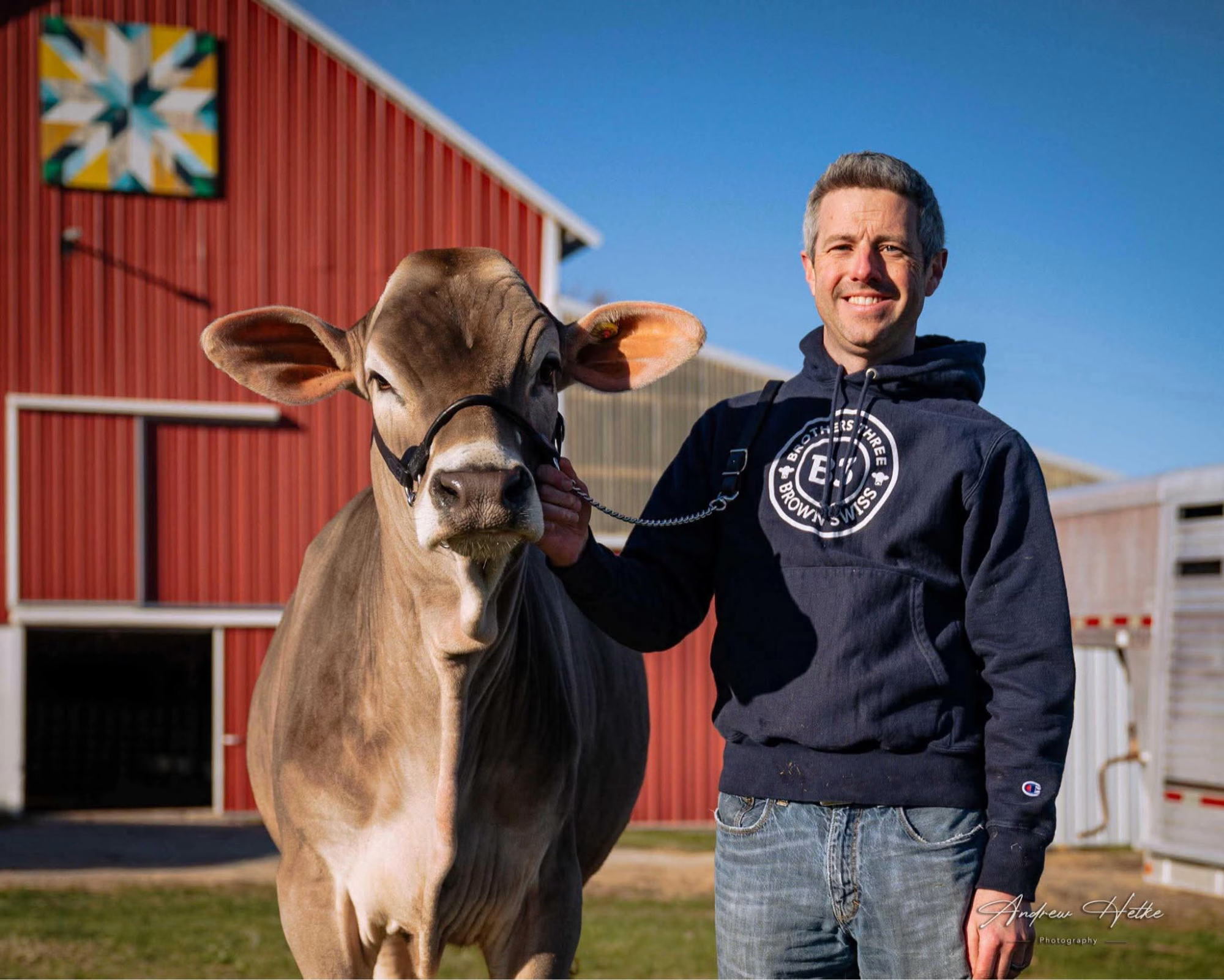
Josh Hushon with one of his prized Brown Swiss heifers at their Wisconsin farm. His hands-on experience raising elite cattle provides the foundation for his industry leadership and judging expertise, contributing to his upcoming 2025 Wisconsin Service Award.

Josh’s industry involvement extends well beyond Brothers Three and Cargill. After moving to Wisconsin in 2003, he quickly found community in the Wisconsin Brown Swiss Association, where he has made significant contributions, leading to his 2025 Wisconsin Service Award.

As the World Dairy Expo Representative for the Wisconsin Brown Swiss Association, Josh bridges his passion for the breed with organizational leadership. He has chaired two National Brown Swiss Conventions in Wisconsin (2013 and 2024). He has been instrumental in consolidating Wisconsin Spring Shows and Wisconsin State Shows into all-breeds events in Madison—an inter-breed collaboration he believes strengthens the entire dairy community.

Josh is an accomplished judge, earning All-American honors in 4-H Dairy Judging and being judged collegiately at Penn State University. His recent judging assignments include the Kentucky Spring National Brown Swiss Show and the Brown Swiss and Other Colored Breeds Show at Green County Dairy Days in 2024.

His brother Jake has also established himself as a respected cattle judge, bringing the Brothers Three philosophy into the evaluation ring. When approaching a class of Brown Swiss cattle, Jake emphasizes the balance of dairy character, strength, body depth, style, and an elusive “it factor” distinguishing top animals.

“In cows, the udder is by far the most important trait, and for me, it takes something truly special for the best-uddered cow in each class not to be in first,” Jake explains. His evaluation process systematically assesses feet and legs, topline strength, rump angle, and overall width and depth to sort animals through the class.

Brown Swiss vs. Holstein: Competitive Advantages in Today’s Market

CharacteristicBrown SwissHolstein
Component ProductionHigher butterfat and protein percentagesHigher total milk volume
Heat ToleranceSuperior heat toleranceLess heat tolerant
LongevityGreater productive lifespanVariable lifespan
Beef ValueSuperior carcass value for crossbred calvesLower beef value
A2 StatusHigh percentage of A2 geneticsLower percentage of A2
Feed EfficiencyGood converters with strong componentsEfficient volume producers

The Next Generation and Future Vision

Looking ahead, Brothers Three balances tradition with a fresh perspective as they consider the next generation. The four boys who make up what they call “B3 Gen 2,” with a fifth on the way in July 2025, represent potential future leadership for the operation.

“The oldest boys are just old enough for 4-H, so we’ll give them all a chance to show if they have an interest in it, and if not, that’s okay too!” Josh says, reflecting the same open-minded approach that has defined Brothers Three from the beginning.

Market Trends and Growth Opportunities

As the story of the Brothers Three unfolds, Josh and his brothers remain optimistic about the future of Brown Swiss cattle in an evolving dairy landscape. Jake identifies two key opportunities for the breed: its growing popularity in the show ring, with high-profile breeders adding Brown Swiss to their operations, and its economic advantages in commercial settings.

“In economic terms, our breed fights for stall spaces and uterus slots on large dairy farms today with many dairy breeds, European red breeds, and now beef semen,” Jake observes. “Two things Brown Swiss can and must capitalize on are the high payment for fat and the sale carcass value of the beef calves out of Brown Swiss cattle vs. a Holstein or Jersey at market. Add in A2, which is a large percentage of the population, and our opportunity to become a mainstream breed in the USA, like they are in Europe, is here.”

Adapting to Industry Shifts

Josh acknowledges the impact of industry consolidation on the Brown Swiss breed. “We certainly feel consolidation as we see smaller farms exit that were long-time Brown Swiss breeders, and we find more of our show calf market being driven by hobbyists like us or even Holstein breeders looking to diversify with a Brown Swiss. I suspect that trend will continue, and it will be interesting to see the profile of someone buying Brown Swiss a decade from now.”

This changing landscape creates both challenges and opportunities. The traditional base of commercial Brown Swiss herds may be shrinking, but interest from show enthusiasts, specialized breeders, and crossbreeding programs offers new markets. The breed’s inherent advantages—component production, heat tolerance, and carcass value—position it well for specialized applications in a diversifying dairy industry.

Brothers Three continues to adapt by focusing on high-value genetics that appeal to show enthusiasts and progressive commercial producers. Their emphasis on balanced traits—combining show appeal with functional attributes like fertility and production—aligns perfectly with the needs of this evolving marketplace.

The Brothers Three team at World Dairy Expo 2023, where family tradition meets future vision. Representing both current leadership and the next generation of "B3 Gen 2," this moment captures the essence of their legacy-building approach as they introduce the youngest family members to the show ring environment that has defined their three-decade journey in Brown Swiss breeding.
The Brothers Three team at World Dairy Expo 2023, where family tradition meets future vision. Representing both current leadership and the next generation of “B3 Gen 2,” this moment captures the essence of their legacy-building approach as they introduce the youngest family members to the show ring environment that has defined their three-decade journey in Brown Swiss breeding.

The Bullvine Bottom Line: A Legacy Built on Passion and Actionable Wisdom

The Brothers Three’s journey—from novice 4-H participants to respected breeders of champion Brown Swiss cattle—embodies the best of American agriculture: innovation, dedication, and a willingness to learn from both success and setbacks.

Through Josh Hushon’s unique perspective as a Cargill executive and passionate cattle breeder, Brothers Three has positioned itself at the intersection of corporate agricultural strategy and hands-on cattle expertise. This balance allows them to appreciate the microscopic details of an individual animal’s development and the macroscopic trends shaping the global dairy industry.

Lessons for Progressive Dairy Breeders

The Brothers Three story offers valuable insights for anyone pursuing excellence in dairy genetics:

  1. Seek Knowledge from Proven Mentors: As Josh says, “To know the road ahead, ask those coming back.” Find mentors who have achieved your goals and follow their guidance precisely.
  2. Leverage Genomic Testing Strategically: Test females early to “glimpse their future” and make more informed breeding decisions. Use the data to both maximize strengths and address weaknesses in your herd.
  3. Balance Show Appeal with Commercial Viability: Even if showing is your passion, breeding for production, components, and fertility ensures your animals deliver value beyond the ring.
  4. Invest in Your Best Cow Families: Focus resources on developing strong maternal lines. As Brothers Three demonstrates with Wisper’s family, one exceptional female can transform an entire breeding program.
  5. Embrace Adaptability and Innovation: From reproductive technologies to marketing approaches, be willing to evolve your operation to meet changing market demands and capitalize on new opportunities.

What began as three brothers learning to show cattle has evolved into a multi-generational legacy of excellence in the Brown Swiss world. With their eyes fixed firmly on the future—from genomic advancements to the next generation of family involvement—Brothers Three continues to write new chapters in their remarkable story of agricultural passion and achievement.

As Josh reflects on his journey with Brothers Three, his words capture the essence of their success: “To know the road ahead, ask those coming back.” By honoring tradition while embracing innovation, Brothers Three and Josh Hushon have not only found their road—they’re helping chart the course for Brown Swiss breeders everywhere.

Key Takeaways

  • Mentorship drives success: The brothers attribute their achievements to strategic mentor relationships at each career stage-from early guidance on showing technique to advanced breeding partnerships-proving that knowing when to seek expert advice accelerates progress.
  • Balanced breeding philosophy: Their approach balances four key elements (type, udders, cow families, milk production) while incorporating fertility traits, creating animals that succeed both in elite shows and commercial settings.
  • Genomic testing as a game-changer: By testing all females and using data to guide mating decisions, they’ve accelerated genetic progress beyond what traditional visual assessment allows, transforming breeding strategy.
  • Specialty positioning creates opportunity: In a consolidating industry, Brown Swiss offers advantages in component production, heat tolerance, and beef value-creating market potential even as traditional farms disappear.
  • Passion projects can achieve excellence: Despite never being anyone’s full-time occupation, Brothers Three demonstrates how strategic partnerships, specialized knowledge, and dedicated off-hours management can build elite genetics without requiring full-time farming.

Executive Summary

Brothers Three Brown Swiss represents a remarkable journey from a humble 1991 4-H project to a nationally respected Brown Swiss breeding operation, demonstrating how passion projects can achieve excellence without requiring full-time farming. Founded by the Hushon brothers with no prior dairy experience, the operation thrives on their collaborative approach-with Jake handling genetics through his New Generation Genetics role, Josh and Casey managing daily development while Josh applies his Cargill executive expertise, and Joe contributing crucial support during World Dairy Expo. Their success stems from a balanced breeding philosophy that produces cattle excelling both in show rings and commercial settings, strategic adoption of technologies like genomic testing and IVF, and their foundational belief in continuous learning from mentors-epitomized in Josh’s mantra: “To know the road ahead, ask those coming back.” This unique blend of corporate strategy and hands-on breeding has positioned Brothers Three to adapt to industry changes while establishing a multi-generational legacy.

Learn more:

  • International Brown Swiss Show 2024 – Follow the latest results from Madison where top Brown Swiss breeders competed, including notable achievements in the same show where Brothers Three’s Woodford previously claimed honors.
  • Are dairy genetics a commodity? – Explore this thought-provoking analysis of modern dairy genetics economics that complements Brothers Three’s balanced breeding philosophy of combining show ring excellence with commercial viability.
  • National Brown Swiss Convention 2024 – Discover highlights from the Wisconsin-hosted event that Josh Hushon helped chair, bringing together over 200 Brown Swiss enthusiasts to celebrate the breed’s community and accomplishments.

Join the Revolution!

Join over 30,000 successful dairy professionals who rely on Bullvine Weekly for their competitive edge. Delivered directly to your inbox each week, our exclusive industry insights help you make smarter decisions while saving precious hours every week. Never miss critical updates on milk production trends, breakthrough technologies, and profit-boosting strategies that top producers are already implementing. Subscribe now to transform your dairy operation’s efficiency and profitability—your future success is just one click away.

NewsSubscribe
First
Last
Consent

Send this to a friend