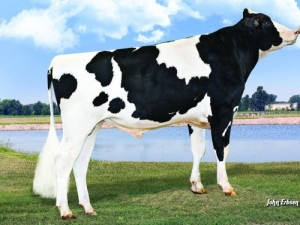
Archive for Select Sires

Bell’s Paradox: The Worst Best Bull in Holstein History

Your tank is full because of Bell. Your calves die because of Bell. Welcome to the dairy’s devil’s bargain.

CARLIN-M IVANHOE BELL: The bull who tore the Holstein industry in half. His unprecedented production promise came with a hidden cost, leaving a legacy still debated in every genomic evaluation today.

Picture this: It’s a crisp September morning in 1971, and John Carlin is driving across Oklahoma with a cattle trailer he’d just picked up, heading to help a friend at an auction. The future Kansas governor isn’t planning to buy anything—he’s just there to read pedigrees as a favor to Bob Braswell, who’s dispersing his B&W herd.

But when that first heifer steps into the ring… something clicks.

“I liked her for many reasons,” Carlin would say later, though he couldn’t have known he was looking at the dam of the most controversial Holstein bull in modern history.

That heifer was B&W Heilo Creamelle. Her son would be Carlin-M Ivanhoe Bell—and honestly? He’d end up tearing our industry right down the middle, and we’re still dealing with the consequences today.

Here’s what gets me about Bell’s story… it’s still playing out in every genomic evaluation we look at. Every time you see those sky-high milk numbers paired with concerning type scores, you’re having the exact same conversation dairy producers had forty years ago. The technology’s better, the data’s more precise, but that fundamental question hasn’t changed: What do we really value in a dairy cow?

When Production Went Nuclear

From what I’m seeing on farms—and I’ve been visiting operations from Wisconsin to California for the past thirty years—Bell’s daughters were like nothing producers had experienced before. We’re talking about cows that made milk meters spin like slot machines, hitting a jackpot.

Those early 1980s… man, I remember walking into freestall barns across the Midwest and seeing something that just didn’t compute. These smaller-framed cows would come into the parlor with an incredible intensity, as if they understood their job at a cellular level. They’d attach cleanly, stand quietly, and just flood the system with milk.

The thing is, though… walk those same barns with the classic breeders—the folks building their reputations on show-ring champions—and you’d get a completely different reaction. They’d pause at the Bell daughters, squint a little, then shake their heads. “Small, weak, narrow,” they’d mutter, and they weren’t wrong.

One breeder nailed it perfectly: Bell was like “a drunken guest at a house party”—undeniably powerful, but lacking the refinement you’d want representing your operation at the county fair.

Both sides were absolutely right. And that’s what made Bell so fascinating… and so dangerous.

I was talking to a nutritionist last month who made an interesting observation about what we’re seeing in modern herds. “The Holstein’s appetite for production isn’t just about genetics,” he said. “It’s about metabolic programming that goes back generations. Bell didn’t just change what cows could produce; he changed how they thought about producing.”

That intensity? That relentless drive to convert feed into milk? You can trace it straight back to Bell’s genetic signature, still humming through our herds nearly fifty years later.

Kansas Politics Meets Dairy Genetics

What strikes me about Bell’s origin is how perfectly it captures the way breakthrough genetics often emerge—not from grand master plans, but from good stockmanship meeting opportunity at exactly the right moment. Kind of like how the best breeding decisions happen when you’re not overthinking them.

John Carlin was living a double life that would be impossible today. Picture this: 4 AM milkings on his 800-acre operation, then rushing to the state capitol for afternoon legislative sessions as he climbed toward the governor’s mansion. His partner Lawrence Mayer handled the day-to-day stuff (“I took care of the cattle,” Mayer once said with typical understatement), but Carlin made the breeding calls.

And that September day in Oklahoma… here’s where it gets interesting. Carlin figured out exactly why Braswell started his dispersal with Creamelle. If you’re selling your herd and you lead with one animal, that’s the one you believe has the most potential. Classic stockman’s intuition—something you can’t teach in ag school.

The fact that Carlin had just picked up a cattle trailer on his way to the sale? Pure luck. But recognizing genetic potential when you see it? That’s a skill developed over years of watching cows move through parlors, studying udder attachments, and understanding what makes a cow work in commercial conditions.

I’ve often wondered what would’ve happened if Carlin had stayed home that day. Would someone else have spotted Creamelle’s potential? Would Bell have ever existed? Sometimes the biggest changes in our industry hang on the smallest decisions—like whether to help a friend read pedigrees on a September morning.

The AI Gamble That Almost Didn’t Happen

When John Hecker from Select Sires visited Carlin Farms in spring 1973, he almost walked away empty-handed. Think about what the AI industry was like then—no genomic tests, no DNA profiles, no reliability percentages. Just visual appraisal, production records, and pedigree knowledge built up over decades.

Hecker looked at Creamelle—who’d classified 84 points as a two-year-old (decent, not spectacular)—and wasn’t impressed. Her family tree showed unclassified dams with modest production. In today’s world, we’d have genomic data showing exactly what she carried for everything from milk yield to haplotype carriers. Back then? You had to trust your eye and your gut.

What saved the day was outcross breeding. Commercial producers were drowning in Chief and Elevation descendants, and here was genuine diversity—Burkgov Inka DeKol through her sire, plus some rare Dauntless-Dunloggin genetics further back. The industry was hungry for something different, something that could break through the genetic bottleneck that was starting to worry thoughtful breeders.

The deal Hecker struck shows how much faith—and financial risk—went into sire development back then. Select Sires would mate Creamelle to Penn State Ivanhoe Star and, if the calf were a bull, buy it if it reclassified at 85 points or better. She made it. Barely.

That “outcross” marketing angle? Brilliant, even if slightly misleading. Bell and Elevation were actually “kissing cousins” through Osborndale Ivanhoe—something that would raise red flags with today’s genetic diversity protocols. But the maternal side offered genuine diversity that commercial producers desperately needed.

It’s worth noting that, buried deep in Bell’s maternal pedigree, was an extraordinary genetic treasure that nobody fully appreciated at the time. His twelfth dam was May Walker Ollie Homestead—the first cow in the United States to produce 1,500 pounds of butter and the first to mother three All-American offspring. This deep, powerful maternal ancestry provided a production foundation that would re-emerge with explosive force generations later.

The Production Revolution Nobody Saw Coming

CARLIN-M IVANHOE BELL’s 1985 Select Sires proof. Note the unprecedented +1,704 lbs milk PD, a figure that revolutionized Holstein production and sent milk meters spinning, even as his type traits (like “Weak” udders) hinted at the coming challenges.

When Bell’s first daughters hit milking parlors across America, something unprecedented happened. We’re not just talking about higher production—we’re talking about a fundamental shift in what Holstein genetics could deliver under real farm conditions.

Picture walking into a modern freestall barn in central Wisconsin, circa 1982. The Bell daughters are unmistakable—smaller framed than their herdmates, but with this incredible… intensity. They’d come into the parlor with purpose, attach cleanly, and just flood the system with milk.

These cows were producing extreme milk, fat, and protein yields that showed up immediately in monthly milk checks. But here’s what made Bell different from other high-production bulls: his daughters actually worked in commercial settings. Good feet and legs that held up on concrete. Well-attached udders with proper teat placement that made milking efficient. Calving ease that meant fewer middle-of-the-night vet calls.

Select Sires knew exactly how to market this combination: “for the discriminating dairymen looking for economical, highly productive dairy cattle”. Translation? These cows will make you money without breaking your back—a message that resonated powerfully with producers dealing with tight margins and labor shortages.

By the mid-1980s, Bell was siring over 30% of the cows on the Holstein Locator List. His Predicted Difference for milk was +1,704 pounds based on over 32,000 daughters across 8,221 herds. Those numbers put him among the most elite production sires of his era.

But those same daughters… they carried problems that wouldn’t become fully apparent until years later.

When the Numbers Tell a Darker Story

Here’s where Bell’s story gets complicated—and frankly, a little scary when you think about modern AI practices and genetic concentration.

The structural issues were obvious from the start. Picture this: you’re walking through a herd where 40% of the cows trace back to Bell. What you’d see is cow after cow that looked… diminished. Small frames, weak substance, udders that just didn’t have the capacity for the kind of longevity that builds sustainable herds.

His daughters were described as “small, weak, and narrow”. The classic breeders weren’t being picky—they were seeing real deficiencies that would impact herd sustainability. These cows might flood the bulk tank for a few lactations, but they wouldn’t be around long enough to build a genetic foundation on.

The health concerns were subtler but equally serious. Higher somatic cell scores were associated with more mastitis treatments. A below-average productive life meant more frequent—and expensive—replacements. What initially appeared to be fertility issues in the field (though his modern genetic evaluation actually shows a positive Daughter Pregnancy Rate of +2.8—interesting how initial impressions can stick even when the data tells a different story).

But the real nightmare was still hidden in his DNA.

The Genetic Time Bomb

What’s happening across the industry today—all our genetic testing, carrier screening, and mandatory disclosure requirements—traces back to Bell and the crisis he inadvertently created.

Picture getting that phone call in 1999. Danish researchers had just discovered this lethal genetic disorder called Complex Vertebral Malformation in Holstein calves. When they traced its origins, every single case led back to one source: Carlin-M Ivanhoe Bell. He was also carrying Bovine Leukocyte Adhesion Deficiency, another lethal recessive.

The emotional and economic impact was devastating. Lost pregnancies, culled cows, dead calves. I remember talking to a veterinarian in Iowa who’d seen his first CVM case in the late ’90s. “It was heartbreaking,” he told me. “Here’s this producer who’d been using Bell genetics for fifteen years, building his whole program around that production, and suddenly he’s losing calves to something he’d never heard of.”

Imagine that conversation in the farm kitchen. Your favorite cow—maybe a Bell daughter or granddaughter who’d been flooding your bulk tank for years—just lost her calf. Not to a difficult birth, not to environmental factors, but to a genetic defect that’s been lurking in your herd’s bloodlines for decades.

By the time we understood what was happening, 31% of elite Danish sires and 32.5% of Japanese sires were CVM carriers. Bell hadn’t created these mutations—he’d inherited them from his sire and grandsire—but his massive popularity had spread them globally.

This is what happens when one bull gets too popular, too fast. The AI industry learned a costly lesson about genetic concentration that still influences every breeding decision we make today.

Real Farm Stories: Living with the Consequences

The reality of the Bell daughters comes through in conversations I’ve had with producers who milked them during their heyday. The experience was… let’s call it educational.

One producer in central Wisconsin told me about his herd composition in the late 1980s—about 40% Bell daughters. “Those cows could milk like nothing we’d ever seen,” he said, his voice mixing pride with something closer to regret. “I’d never seen butterfat numbers like that on our operation. But they were small, and when the market got tough in ’89, they were the first ones to go. The production was incredible, but the longevity just wasn’t there.”

I’ve heard similar stories from operations across the Midwest. The Bell daughters would give you these fantastic first and second lactations—milk production that made you feel like you’d figured out the secret to dairy farming. Then you’d watch them struggle to maintain condition in their third lactation, their small frames just not built for the metabolic demands of sustained high production.

That productive life issue was real. Modern data shows that Bell daughters had an average of 2.2 years less productive life than their contemporaries. For a commercial operation, that’s the difference between profitable cows and replacement headaches.

But here’s the interesting part—and this is where Bell’s story gets really nuanced. Producers who used him strategically, mating him only to their tallest, strongest cows, often got exceptional results. The legendary Emprise Bell Elton came from exactly this approach—Bell bred to a tall, powerful Glendell daughter. Sometimes the genetic magic happened when you provided the right maternal foundation.

Emprise Bell Elton, Bell’s legendary son and the ultimate result of strategic breeding. Created by mating Bell to a tall, powerful Glendell daughter, Elton proved that managing Bell’s flaws on the maternal side could unlock his immense genetic potential and create a breed-defining sire.

What strikes me about these stories is how they capture an essential tension in our industry: the constant struggle between short-term profit and long-term sustainability. Bell daughters could deliver immediate cash flow, but they also forced producers to confront the hidden costs of genetic shortcuts.

Nectarlin Bobbie Jo Bell (GP-84): A classic daughter who perfectly embodied the “Bell bargain”—functional type with world-class genetic potential. While not a show champion, her incredible production and breeding value were passed down to her descendant, the famous Ohio “millionaire” sire Picston Shottle.

The Corrective Breeding Breakthrough

What’s really interesting here is how the smartest breeders figured out how to turn Bell’s flaws into advantages. They didn’t abandon Bell genetics—they learned to use them surgically, almost like a precision tool.

The classic example? The Bell x Chief Mark cross.

Think about it: Chief Mark sired spectacular udders but struggled with feet and legs. Bell’s single greatest strength was transmitting correct feet and legs. Match a Bell daughter to Chief Mark, and you got the best of both worlds—assuming you could manage the other genetic variables.

Snow-N Denises Dellia (EX-95 GMD DOM): The poster child for corrective breeding genius. Sired by Chief Mark and out of a Bell daughter, she embodied the perfect fusion—combining elite type with Bell’s ferocious will to milk and creating a genetic dynasty.

Snow-N Denises Dellia became the poster child for this strategy. Picture the excitement when this mating worked: her dam was a Bell daughter, her sire was Chief Mark, and she combined elite type with the Bell family’s relentless will to milk. This wasn’t just lucky—this was sophisticated corrective breeding that showed the industry how to turn genetic weaknesses into strengths.

The success stories kept coming: Hartline Titanic, Carol Prelude Mtoto, all built on that Chief Mark-Bell foundation. What had seemed like an impossible choice—production or structure—suddenly became achievable through strategic mating.

This approach resonates today as we evaluate genomic bulls. The question isn’t whether a bull has weaknesses—they all do. The question is whether you can use those strengths strategically while protecting against the flaws. Bell taught us that even imperfect genetics can contribute to genetic progress when used with wisdom and restraint.

The Line Breeding Success Nobody Expected

Here’s where it gets really complicated, though. Bell actually line-bred better than almost any bull with serious structural flaws had a right to. Makes you wonder about the deeper genetic mechanisms at work.

The secret was distance and selection pressure. The further back Bell appeared in a pedigree, the more generations of selection had occurred to preserve his production ability while weeding out his structural problems. Breeders in Holland and the U.S. began deliberately line-breeding on Bell, creating bulls like Etazon Celsius, Regancrest Elton Durham, and Mara-Thon BW Marshall.

The ultimate proof of successful line breeding. Sheeknoll Durham Arrow, a daughter of the legendary Bell descendant Regancrest Elton Durham, was crowned Grand Champion at the 2016 World Dairy Expo, showcasing how breeders perfected the Bell line to achieve both elite, show-winning type and immense production.

Marshall’s particularly fascinating—he was approved for AI service in 2007 and 2008, more than thirty years after Bell’s birth. That’s the mark of genetics with genuine staying power, genes that could survive multiple generations of selection and still contribute something valuable.

This pattern teaches us something important about genetic evaluation: sometimes the most valuable genetics come wrapped in imperfect packages. The breeders who succeeded with Bell weren’t the ones who used him indiscriminately—they were the ones who understood his profile well enough to concentrate his strengths while selecting against his weaknesses.

What Bell Teaches Modern Breeders

Walk into any dairy operation today, and you’ll find Bell’s influence. Recent pedigree analysis shows his genetic presence remains significant in modern Holstein populations—a staggering persistence for a bull born in 1974.

But here’s what’s really relevant for today’s breeding decisions: Bell’s story perfectly illustrates both the power and the danger of our genetic selection tools.

In Bell’s era, a bull with his production power would have been used regardless of his structural flaws. We didn’t have the testing capabilities to identify BLAD and CVM carriers beforehand. We couldn’t predict daughter longevity with today’s accuracy. Breeding decisions were made with limited information and huge risks.

Today’s genomic tools would have revealed Bell’s genetic defects decades before widespread use. Modern evaluations provide reliable predictions for traits such as productive life and somatic cell score. We can identify carrier status for dozens of genetic disorders before a bull ever enters AI service.

But—and this is crucial—we’re still making the same fundamental trade-offs. Look at any current genomic ranking, and you’ll find bulls with exceptional production but concerning type scores. The tools are better, but the decisions are just as complex.

Here’s what I tell producers when they’re evaluating bulls: Bell’s story isn’t ancient history—it’s a roadmap for understanding genetic risk. Every time you see a bull with extreme production but structural concerns, you’re looking at a potential Bell scenario. The question isn’t whether to use him, but how to use him strategically.

Current genomic selection practices have their own version of the Bell dilemma. We’re selecting for production traits with unprecedented accuracy, but are we creating new genetic bottlenecks? Are we trading today’s problems for tomorrow’s crises?

Take a bull like Ladys-Manor Park. Exceptional genomics for production and health, but not exactly what you’d call a structural powerhouse. Sound familiar? The same decisions we made with Bell—use him strategically on the right cows, manage his weaknesses, capture his strengths—apply to every bull evaluation we make today.

The Enduring Will to Milk

What can’t be disputed—even by Bell’s harshest critics—is his singular contribution to Holstein production capacity. He “injected the breed with a tremendous will to milk”, and that drive continues to flow through modern dairy herds in ways that would probably surprise him.

Visit operations across the Midwest, Northeast, or California, and you’ll see it in action. That relentless, efficient conversion of feed to milk that characterizes today’s Holstein cow? It owes much to the genetic foundation Bell established. Walk through a modern freestall barn during peak lactation, and you’re witnessing the culmination of decades of selection for metabolic efficiency that started with bulls like Bell.

The economic realities of modern dairying—thin margins, volatile feed costs, labor shortages, and environmental regulations—make Bell’s production genetics more relevant than ever. His daughters might have been small and structurally challenged, but they understood their job: convert feed to milk as efficiently as possible.

I was talking to a nutritionist last month who made an interesting observation about what we’re seeing in modern herds. “The Holstein’s appetite for production isn’t just about genetics,” he said. “It’s about metabolic programming that goes back generations. Bell didn’t just change what cows could produce; he changed how they thought about producing.”

This metabolic intensity—this cellular understanding of the cow’s primary function—is part of Bell’s enduring legacy. Every time we see a fresh cow attack her TMR with purpose, every time we watch a high-producing cow maintain her body condition through peak lactation, we’re seeing echoes of Bell’s genetic contribution.

The Lessons That Still Matter

Here’s what Bell’s story really teaches us about our industry: genetic progress is never simple, never perfect, and never without unintended consequences.

He forced us to confront uncomfortable questions about breeding priorities that we’re still wrestling with today. Do we breed for short-term profitability or long-term sustainability? How much structural compromise is acceptable for production gains? When does genetic concentration become dangerous?

The answers vary by operation, by market conditions, and by management philosophy. But the questions remain constant, and they’re more pressing now than ever.

Bell’s legacy isn’t just about one controversial bull—it’s about the ongoing challenge of making breeding decisions with incomplete information and competing priorities. Every genomic evaluation we study, every mating decision we make, every genetic trend we follow connects back to the fundamental tension Bell embodied.

Sometimes I wonder what would have happened if we’d had today’s genetic testing when Bell entered AI service. Would we have used him differently? Would we have avoided the CVM and BLAD crisis? Would the industry have progressed faster… or slower?

The thing is, though, we can’t rewrite history. But we can learn from it.

What strikes me most about Bell’s story is how it reveals the inherent tension in our industry between innovation and tradition, between risk and reward, between the pull of profit and the push of principle. Every generation of dairy farmers faces this same dilemma in different forms.

We’re seeing it again with genomic selection. We have incredible tools for identifying production potential, but are we adequately accounting for the complexity of genetic interactions? Are we preserving enough genetic diversity? Are we learning from Bell’s lessons about the dangers of genetic concentration?

The reality is that breeding decisions will always involve trade-offs. The key is making those trade-offs consciously, with full awareness of the risks and benefits, and with strategies for managing the consequences.

Bell taught us that genetic power comes with genetic responsibility. That convenience and profit can’t be our only considerations. That diversity matters as much as elite performance. That the decisions we make today will echo through generations of cattle—and farmers—we’ll never meet.

The Ghost in Every Tank

Bell’s immense influence is immortalized in the Select Sires ‘Impact Sires of the Breed’ artwork. He stands among legends he created or defined: his famous son (Elton), the ideal corrective cross (Mark), and powerful line-bred descendants like Durham and Marshall. This isn’t just a collection of great sires; it’s a visual map of Bell’s enduring genetic dominance.

And in those quiet moments between milkings, when we watch the steady rhythm of modern Holsteins moving through our parlors, we’re witnessing the complicated legacy of a Kansas-born bull who refused to be simple, refused to be perfect, but somehow managed to be transformational.

That tension between greatness and compromise? It’s still there in every breeding decision we make. Every time we look at a genomic evaluation. Every time we balance production against longevity, efficiency against sustainability, profit against principle.

Bell just made it impossible to ignore.

His ghost is still in the machine—in the genetic algorithms that drive modern selection, in the milk flowing through our bulk tanks, in the conversations we have about what really matters in a dairy cow. He’s there in every difficult breeding decision, every genetic trade-off, every moment when we have to choose between competing priorities.

The bull who split our industry in half also taught us something invaluable: that genetic progress requires both courage and wisdom, both innovation and restraint, both the willingness to take risks and the humility to learn from our mistakes.

In the end, maybe that’s Bell’s greatest legacy—not just the milk he put in our tanks, but the questions he forced us to ask, the lessons he taught us about the complexity of genetic improvement, and the reminder that every breeding decision has consequences that ripple through generations.

Every time we use a high-production bull with structural concerns, we’re walking in Bell’s footsteps. Every time we implement carrier testing, we’re applying lessons learned from his genetic legacy. Every time we balance short-term gains against long-term sustainability, we’re grappling with the same fundamental questions he forced our industry to confront.

The ghost in the machine isn’t just Bell’s genetics—it’s the enduring challenge of making breeding decisions that serve both our immediate needs and our industry’s future. He didn’t solve that challenge. But he made sure we could never ignore it.

The final resting place of Carlin-M Ivanhoe Bell at Select Sires. Though his physical journey ended in 1989, his genetic legacy – and the complex questions he raised – continues to shape the Holstein breed and every breeding decision made today.

Key Takeaways

  • Bell’s bargain: +1,704 lbs milk came with CVM and BLAD—proving maximum production demands maximum caution
  • The 2-lactation trap: Bell daughters peaked early, died young—replacements cost more than the milk was worth
  • Corrective breeding genius: Matching Bell daughters to Chief Mark created legends—flawed genetics + smart strategy = gold
  • Today’s blind spot: We learned nothing—genomic concentration is creating Bell 2.0 right now

Executive Summary:

Bell made dairymen rich, then made them pay—his daughters’ record production came packaged with early death and lethal genetics that still kill calves today. From a chance $1,500 purchase in 1971 to global genetic disaster by 1999, Carlin-M Ivanhoe Bell’s story reads like a Greek tragedy: the bull who revolutionized Holstein production (+1,704 lbs milk) while secretly spreading CVM and BLAD to 31% of elite sires worldwide. Commercial producers worshipped him; traditional breeders saw disaster coming, calling Bell’s influence “a drunken guest at a house party.” The industry learned to harness his flaws through strategic breeding—Bell daughters crossed with Chief Mark created legends—proving that even poisoned genetics could produce gold with the right management. Five decades later, Bell’s ghost haunts every genomic evaluation, his legacy a permanent warning: today’s genetic miracle is tomorrow’s industry crisis.

Learn More:

Charlie Will’s Comeback: How One Rejection Letter Created Holstein History

Charlie Will helped build the dairy industry’s greatest genetic empire. All because Select Sires told him no.

Listen, I’ve been in this industry long enough to know that rejection letters rarely lead to revolutions. But Charlie Will’s story… this one hits different.

Spring of ’74—Nixon’s still in office, gas is 55 cents a gallon—and Charlie’s sitting there with his fresh University of Illinois dairy science degree. Select Sires, the largest AI company in the industry, tells him, “Thanks, but no thanks.” No openings in their Sire Department.

Here’s what gets me, though. Most of us would’ve taken that rejection and gone into feed sales, maybe found a nice co-op job. Not Charlie.

Fast forward to this week—the National Association of Animal Breeders just announced Charlie as their 2025 Pioneer Award winner. After nearly 40 years with Select Sires (yeah, the same company that wouldn’t hire him), his bulls have sold millions of units worldwide. We’re talking about genetics that influence basically every Holstein pedigree you’ll pull up today.

Learning Cattle the Old-School Way

Southern Illinois dairy country in the 1960s wasn’t exactly genetic headquarters, but it’s where Charlie learned cattle. Growing up on the family’s commercial Holstein farm, working those twice-daily milkings. You know that barn smell—silage, sawdust, and that sweet-sour mix of fresh milk and manure—that’s where Charlie’s education started.

The neighbors at Walkway Farms—Foster Walkway ran that place—had cattle worth the drive from Chicago. Charlie spent a considerable amount of time studying those genetics.

At the University of Illinois, Charlie made the dairy judging team. While everybody else was doing… well, whatever college kids did in the early ’70s, he was evaluating cattle across the Midwest.

Spring ’74 comes around. Charlie sends resumes to every AI stud in North America. Every single one says no.

The Wisconsin Detour That Changed Everything

So Charlie’s reading the classifieds in Hoard’s when he spots this tiny ad. MABC—that’s a Select Sires member cooperative—needed a sales rep for Western Indiana.

Not glamorous. Not what he wanted. But here’s the thing—MABC was connected to Select Sires.

Two years later, they asked him to move to Wisconsin. Green Bay area. Open new territory as both a sales rep and SMS evaluator. Northern Wisconsin winters aren’t exactly Miami Beach, but this was real dairy country where farmers knew their genetics.

Four years, Charlie worked those territories, building relationships farm by farm. Word started getting back to Select Sires headquarters in Plain City, Ohio—that massive complex off US Highway 42 with bull barns stretching across the landscape.

When a sire analyst position finally opened in 1978, Dick Chitester took what he called “a risk” and hired Charlie. The guy they’d rejected was finally inside.

Learning From the Veterans

Charlie’s first bull selection was Walkway Chief MARK from back home. The bull worked—good daughters, exceptional brood cows.

But the real education came from the veterans. Ron Long, who Charlie called “one of the greatest cowmen to this day that I have ever met”. George Miller, the marketing director.

The early Select Sires dairy sire team, foundational to the company’s success: (L-R) Rodger Hoyt, John Hecker, Charlie Will, and Ron Long. This group established the industry-leading standards for sire sampling and correct semen usage, providing the framework for Charlie’s future million-unit bulls.

According to company records and those who worked with him, Miller’s philosophy was simple: genetics isn’t about what looks good in catalogs—it’s about solving problems for farmers.

The BLACKSTAR Breakthrough

Spring 1988. Picture the scene—Select Sires’ genetics department, everyone crowded around those old dot-matrix printers that sounded like typewriters on steroids. The proofs are coming out for a bull Charlie had acquired called To-Mar BLACKSTAR.

BLACKSTAR didn’t just prove good—he topped both domestic and international rankings. This wasn’t just any Holstein bull with the typical black and white patches. We’re talking about a bull built like a freight train—wide chest, strong legs, the kind of frame that screams power. Within days, every AI stud on the planet wanted BLACKSTAR sons.

The 1985 Select Sires Sire Analyst Team, including Ron Long (back left), Charlie Will (back center), Rodger Hoyt (back right), Scott Johnson (front left), and John Hecker (front right). This was the team, guided by mentors like Ron Long, within which Charlie honed his skills and, shortly after, acquired the groundbreaking bull, BLACKSTAR.

At the next proof meeting, Dick Chitester stands up with a letter signed by the entire sire team. The message: Charlie was officially off probation.

A few weeks before his death, the legendary To-Mar BLACKSTAR, whose proofs in 1988 topped global rankings, secured Charlie Will’s position at Select Sires. The bull was described as being “built like a freight train—wide chest, strong legs, the kind of frame that screams power.”

Ten years. He’d been at Select Sires for ten years, and management had been watching, evaluating whether this guy who’d come in through the back door could really deliver. They’d been waiting for him to prove he belonged.

Finding Diamonds in the Rough

After BLACKSTAR, Charlie could’ve played it safe. Instead, he looked for bulls others had passed on.

Take ELTON—7H2236 Emprise Bell ELTON. His dam scored Good Plus with a Good udder. Today, that wouldn’t even get you past the first sort. But Charlie drove to Minnesota in February to see ELTON’s daughters himself.

Walking into that barn—you know how it is, that warm, humid air hits you after the bitter cold outside, steam rising off the cows’ backs, the rhythmic sound of milkers running. What he found—exceptional udders with that deep cleft you want to see, rear attachments high and wide like someone had engineered them, feet and legs built for longevity.

The legendary 7H2236 Emprise Bell ELTON. His dam scored only Good Plus, but Charlie Will’s personal inspection of his daughters in the barn—not the catalog—revealed the exceptional udders and strong feet and legs that made ELTON the sire of DURHAM and maternal grandsire of OMAN, influencing Holstein genetics for decades.

ELTON became the sire of DURHAM, who produced 5,039 Excellent daughters. Also became maternal grandsire of OMAN.

Speaking of OMAN—O-Bee MANfred Justice—he delivered what the industry was crying for in the early 2000s. Better calving ease, improved health traits, and increased production.

The impact of his selections is staggering when you look at the unit sales :

  • OMAN: Over 1,000,000 units sold
  • MATHIE: 1,000,000+ units
  • MILLION: 1,000,000+ units
  • INTEGRITY: 1,500,000+ units
  • BLITZ: Over 1.52 million units—still the Select Sires record
Charlie Will (left) with Brian and Wendy Fust, breeders of Fustead Emory BLITZ, at Select Sires. Behind them, Fustead Emory BLITZ himself stands as a testament to Charlie’s eye for “diamonds in the rough”—a bull that would go on to sell over 1.52 million units for Select Sires, a company record.

The Teacher Who Packed Barns from Tokyo to Turin

By the late ’90s, Charlie wasn’t just selecting bulls—he was the industry’s educator. Presented in 49 states and 18 countries.

I remember hearing about one of his seminars in Wisconsin—standing in front of 200 dairy farmers, Charlie pulls out a chart and says, “Forget everything you think you know about linear traits for a minute”. Then he’d walk them through how a bull scoring +2.0 for udder depth actually translates to daughters that milk two lactations longer. Made it real, you know? Not just numbers on paper.

Scott Ruby from World Wide Sires captured it perfectly: “He had an incredible gift for taking complex genetic concepts and making them understandable to every dairy farmer”.

When Genomics Changed the Game

The thing about 2008 and genomics—it completely upended how we’d done business for decades.

The old-timers were skeptical. Charlie, approaching 60, could’ve resisted. Instead, he embraced it.

As he explained, before genomics, parent averages gave you maybe a 50-50 shot. Genomic markers? Way better odds.

But here’s what Charlie also recognized—everyone chasing the same high genomic bulls was narrowing the genetic base. Take a look at what’s happening now… Recent studies indicate that Holstein inbreeding levels are approaching a critical threshold in elite lines. “We need to be stewards of the breed,” Charlie argued.

Under his guidance, Select Sires deliberately used bulls with lower indexes but diverse pedigrees. Cost them money, but as Charlie said, “If we don’t maintain genetic diversity, who will?”.

The results? Between 2008 and 2019, genomics added $50 per cow per year in genetic value, totaling $4 billion. We now run over a million genomic tests annually.

What This Means Right Now

October 2025, and the industry Charlie helped build faces some real challenges.

Milk’s at $17.19/cwt according to CME—not exactly lighting anyone’s world on fire. The government shutdown’s affecting USDA services, making things harder for everyone. Nestlé has recently withdrawn from a global methane reduction initiative, sparking widespread discussion.

But here’s what’s interesting—despite everything, about 75% of farmers expect to be profitable this year. We’ve got $8 billion in new dairy processing coming online. Beef-on-dairy is absolutely booming.

And look at the genetics we’re working with now. The April 2025 base change was the largest in Holstein history—45 pounds of rollback on butterfat and 30 on protein. That means our cows are improving at a faster rate than ever. The average Holstein today? She’s more moderate in stature—not those skyscraper cows from 20 years ago—but producing more efficiently than ever.

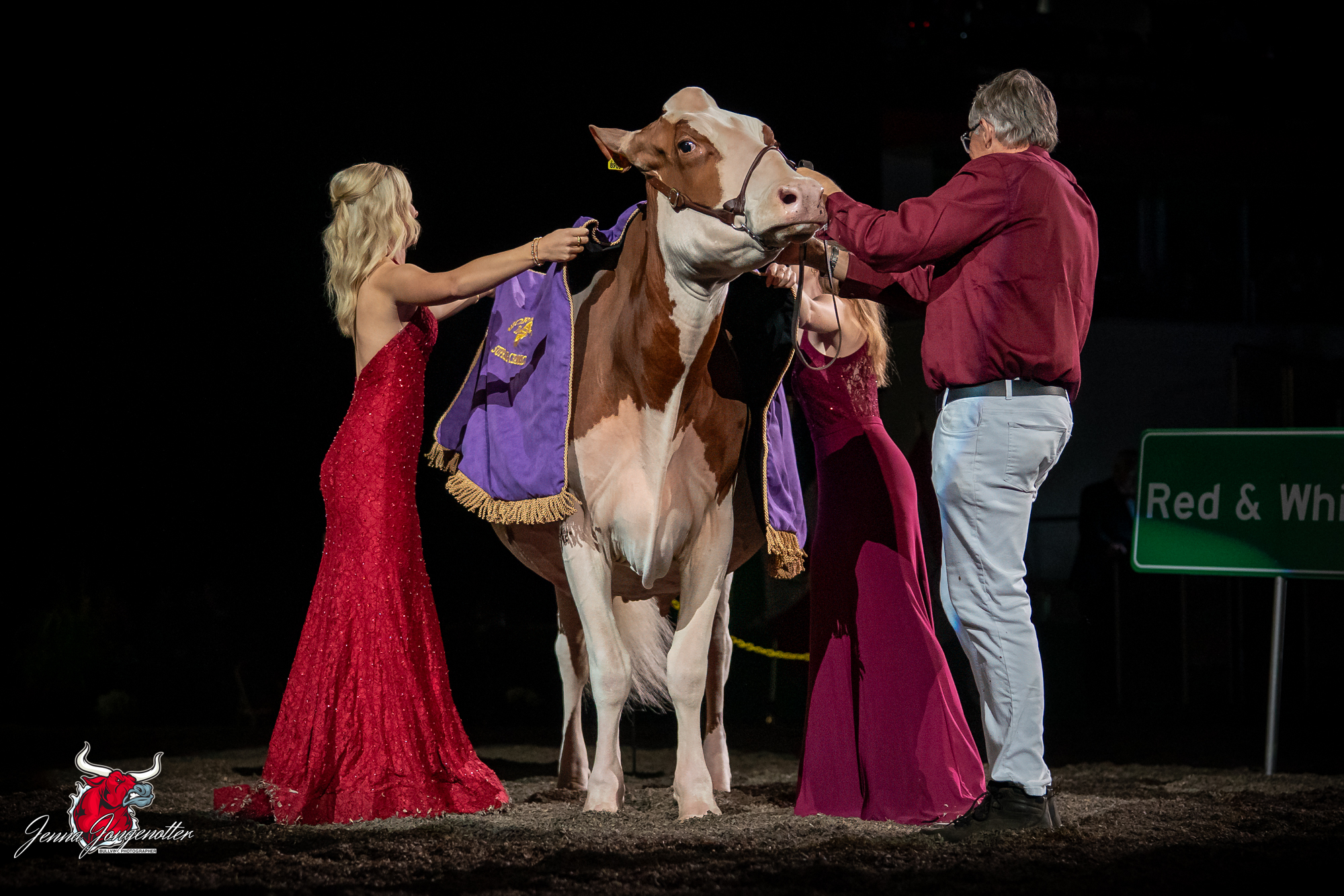
Golden-Oaks Temptres-Red-ET, crowned Supreme Champion at World Dairy Expo last week, exemplifies the ongoing genetic progress in the Holstein breed. This first Red & White Supreme Champion in 20 years visually confirms how the genetics championed by pioneers like Charlie Will continue to influence elite cattle, even decades later.

At World Dairy Expo last week, Golden-Oaks Temptres-Red-ET took Supreme Champion. First Red & White in 20 years. You look at genetics like that, and you’re seeing the influence of bulls Charlie championed decades ago.

The Philosophy That Built Success

Young people always ask Charlie what his secret is. His answer never changes.

“It’s the people,” he says. The mentorship from Dick Chitester, Ron Long, and George Miller.

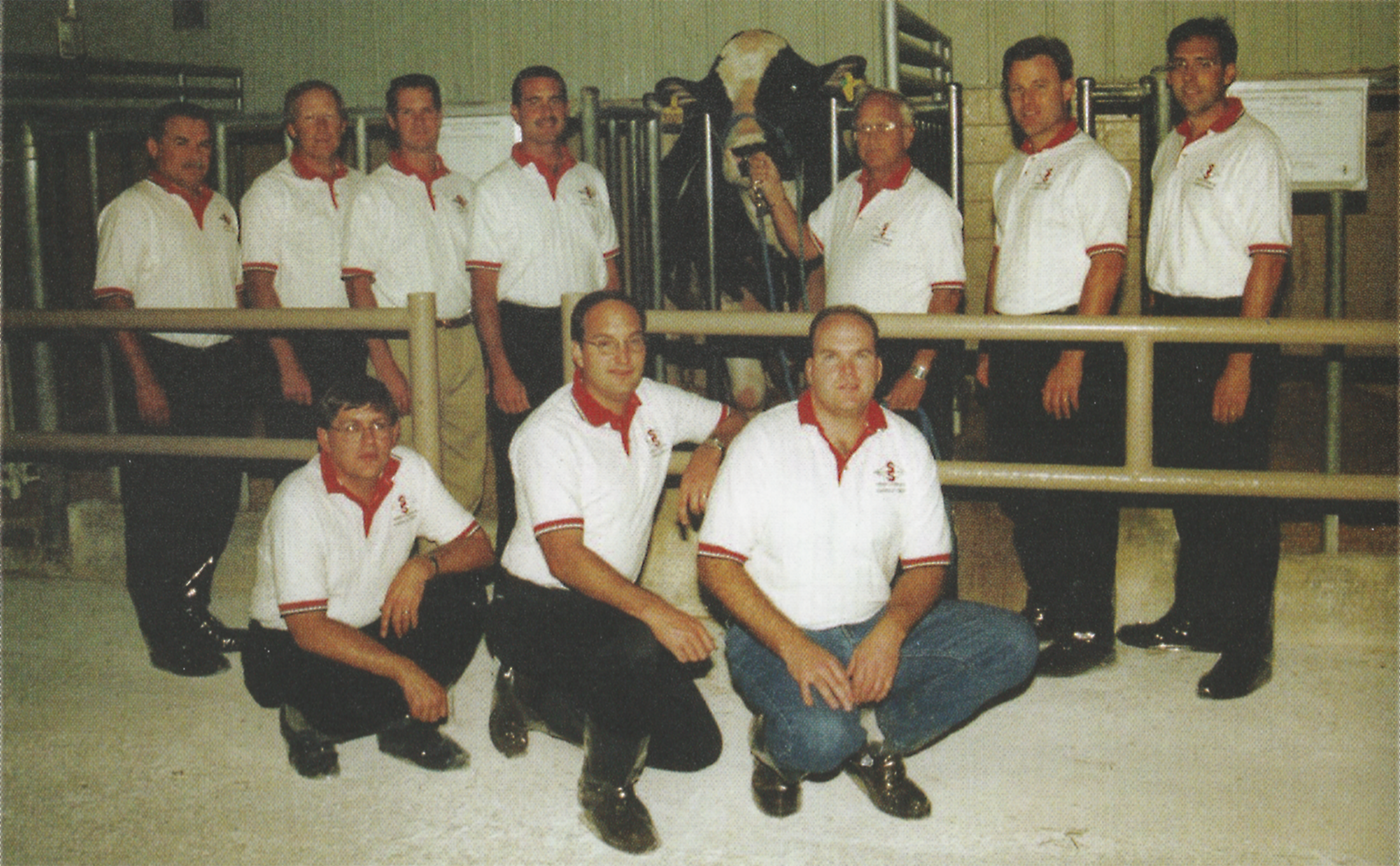
The Select Sires Sire Department in 2000, illustrating the stability and mentorship Charlie Will valued. Pictured (back row, second from left) is Charlie Will, alongside long-time colleagues like Ron Long (back row, second from right). The fact that seven of the ten members were still active 15 years later underscores the power of the team-based philosophy Charlie credited for his success.

But also three principles :

  • Find the right people—not just smart ones, but people who understand genetics is about improving farms.
  • Work as a team—Select Sires is farmer-owned, every decision affects someone’s livelihood.
  • Embrace new tools—genomics, IVF, sexed semen, whatever comes next.

But the real secret? Customer focus. Charlie didn’t select bulls for catalogs. He selected for what worked in barns.

The Bottom Line for Today’s Industry

7H3707 Paradise-R Cleitus MATHIE represents another “million-unit club” bull, hand-picked by Charlie Will. His genetics, prized for combining strong type with significant milk production improvement, helped shape the modern Holstein herd under Charlie’s guidance at Select Sires.

Charlie Will’s story teaches us something crucial right now.

That rejection letter from Select Sires could’ve ended everything. But Charlie found another way through MABC. Spent four years in Wisconsin proving himself. Waited ten years for Select Sires to acknowledge he belonged. Then, they spent the next thirty years changing how the world breeds dairy cattle.

For young people trying to break in—and I know it’s tough with the current job market—Charlie’s message is clear : Your first job won’t be your dream job. Use it as education. Build your reputation. When the right opportunity comes, you’ll be ready.

Look, we’re facing real challenges. Milk prices aren’t great, input costs are still high, and now we’ve got this government shutdown complicating everything. But we’ve been through worse. And the genetics Charlie helped develop? They’re part of why we’ll get through this, too.

The 2025 NAAB Pioneer Award recognizes Charlie Will’s massive contribution. But walk through any dairy barn today—breathe in that familiar mix of silage and sawdust, look at those moderate-framed Holsteins producing like champions—and you’re seeing his real legacy.

The farm kid from Southern Illinois who couldn’t get hired didn’t just prove Select Sires wrong.

He revolutionized the way the world breeds dairy cattle.

One bull at a time. 

Key Takeaways:

  • The backdoor strategy works: Charlie’s path from rejection → MABC sales → Wisconsin territory → Select Sires pioneer proves alternative routes beat giving up
  • Challenge conventional wisdom: ELTON’s “Good Plus” dam produced genetics that created 5,039 Excellent daughters—look beyond the obvious
  • Embrace disruption at any age: At 60, Charlie championed genomics while peers resisted. Result? $4 billion industry impact
  • Solve real problems, not catalog dreams: OMAN’s million+ units came from fixing calving ease, not chasing show ring extremes
  • Today’s application: With $17/cwt milk and margins tight, Charlie’s “customer-first” genetics philosophy is your survival guide

Executive Summary:

Charlie Will got rejected by Select Sires in 1974. Today, his bulls influence virtually every Holstein pedigree on the planet. After sneaking in through a Wisconsin sales territory nobody wanted, Charlie spent 40 years finding genetic diamonds others dismissed—like ELTON, whose “Good Plus” dam produced 5,039 Excellent granddaughters through DURHAM. His selections shattered records: BLACKSTAR topped global rankings in ’88, OMAN solved the calving crisis with over a million units sold, and BLITZ became Select Sires’ all-time bestseller. When genomics disrupted everything in 2008, 60-year-old Charlie embraced what his younger peers fought, contributing to today’s $4 billion industry transformation. With current milk at $17/cwt and margins tighter than ever, Charlie’s philosophy—pick bulls that solve real problems, not catalog dreams—is your blueprint for survival. This week’s NAAB Pioneer Award just confirms what the pedigrees already prove: the farm kid nobody would hire revolutionized how the world breeds dairy cattle.

Learn More:

  • The Practical Application of the Genetic Tools We Have Today – This tactical article reveals methods for leveraging modern selection indexes (like NM$ and TPI) to prioritize the functional, profitable traits—health, fertility, and longevity—that Charlie Will championed throughout his career. It demonstrates how to align complex genetic numbers with real-world barn profitability.
  • Beef on Dairy is Still the Best Way to Use Low Genetic Females – Expanding on the booming Beef-on-Dairy trend mentioned in the article, this strategic analysis provides producers with actionable steps to maximize revenue from the bottom end of their herd. It offers a clear framework for optimizing inventory and genetics to boost overall farm gate returns in a $17/cwt market.
  • Is Holstein Inbreeding Level A Bigger Concern Than You Think? – This innovative piece explores the modern data behind Charlie Will’s foresight on genetic diversity, offering a deep-dive analysis into the specific risks and economic costs associated with rising inbreeding levels. It provides strategic context on why his deliberate use of diverse pedigrees continues to be essential for breed stewardship.

Join the Revolution!
Join over 30,000 successful dairy professionals who rely on Bullvine Weekly for their competitive edge. Delivered directly to your inbox each week, our exclusive industry insights help you make smarter decisions while saving precious hours every week. Never miss critical updates on milk production trends, breakthrough technologies, and profit-boosting strategies that top producers are already implementing. Subscribe now to transform your dairy operation’s efficiency and profitability—your future success is just one click away.

NewsSubscribe
First
Last
Consent

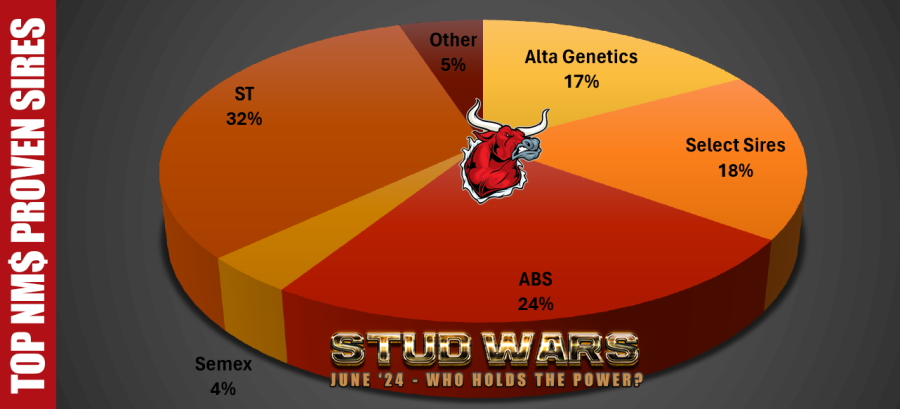
STUD WARS: Which AI Company Holds the Power in the Dairy Cattle Genetics Universe

Find out which AI company is the leader in dairy cattle genetics. Compare the top sires and see who really dominates the industry. Who has the most power in this genetic competition?

A long time ago in a galaxy not so far away, the fate of dairy cattle genetics was firmly in the hands of farmers and breeders. Today, the balance of power has shifted dramatically. Artificial Insemination (AI) companies now command unrivaled control over the genetic future of dairy herds worldwide. Much like the interstellar battles in Star Wars, these AI giants wield incredible influence, shaping the destiny of dairy cattle and the dairy industry. But one question remains: Who holds the most power among these titans? 

As these companies duel with pedigree charts in one hand and genomic test results in the other, the landscape of dairy cattle genetics has become a battleground for supremacy. Each AI company claims to have the best sire lineups. Like the legendary clashes between the Sith and the Jedi, only one can truly dominate the genetic universe. So, let’s embark on this journey to uncover which AI company reigns supreme.

TPI

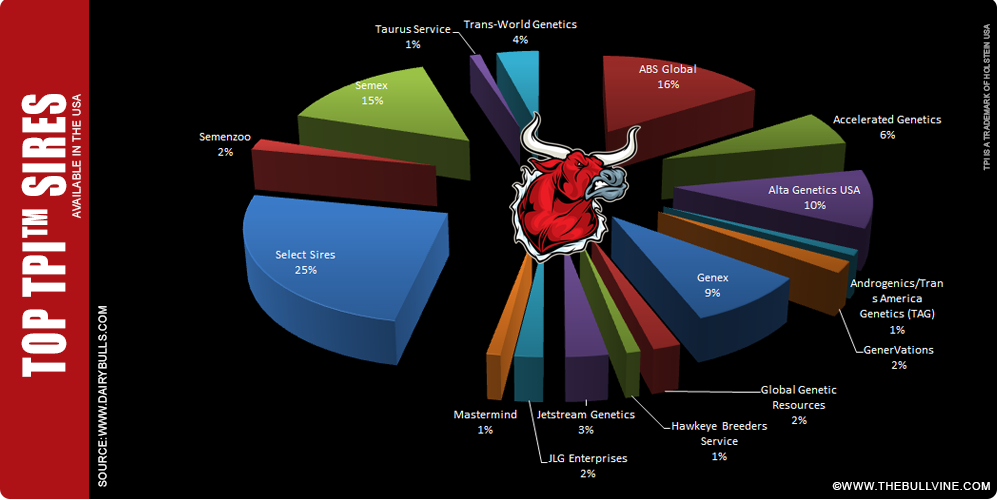
URUSSelect SiresABSSemexSTgenOther
Proven TPI1630108315
Genomic TPI9324242011
TPI256214325116

Select Sires holds the largest market share at 31%, featuring a well-balanced group of both proven and genomic sires. Hot on their heels is STgen with a 25.5% share, boasting the strongest proven sire TPI lineup. Semex completes the top studs with a 16% market share, driven by an impressive genomic sire lineup.

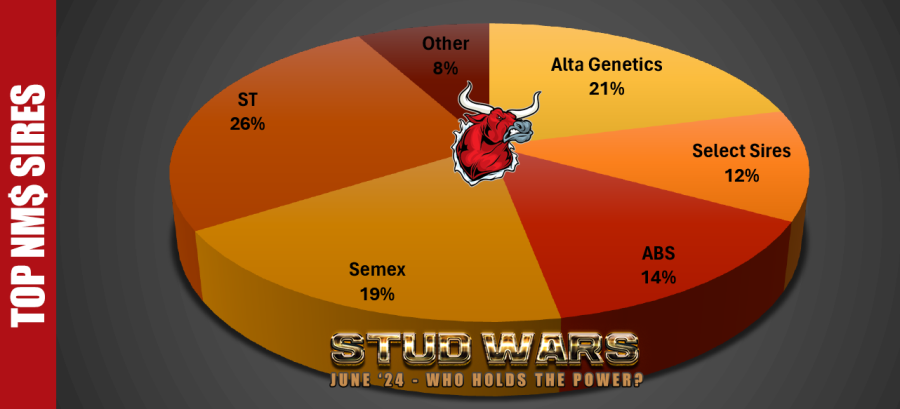
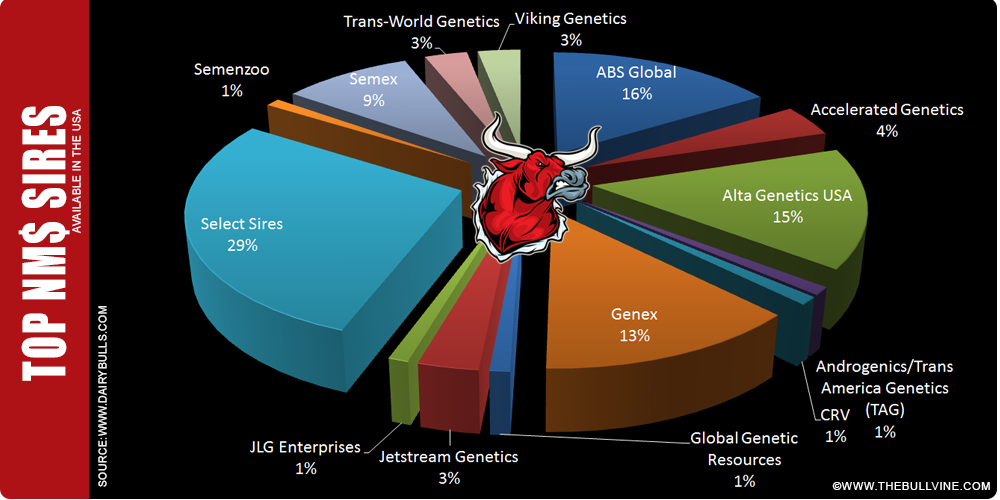
NM$

ListURUSSelect SiresABSSemexSTgenOther
Proven NM$1718244325
Genomic NM$2564342011
NM$422428385216

STgen shows impressive strength with a 26.5% share of top NM$ sires. Meanwhile, URUS steps up with a robust NM$ lineup, claiming 21% of the top sires. Rounding out the top, Semex holds a solid 19% and a very strong genomic NM$ sire lineup.

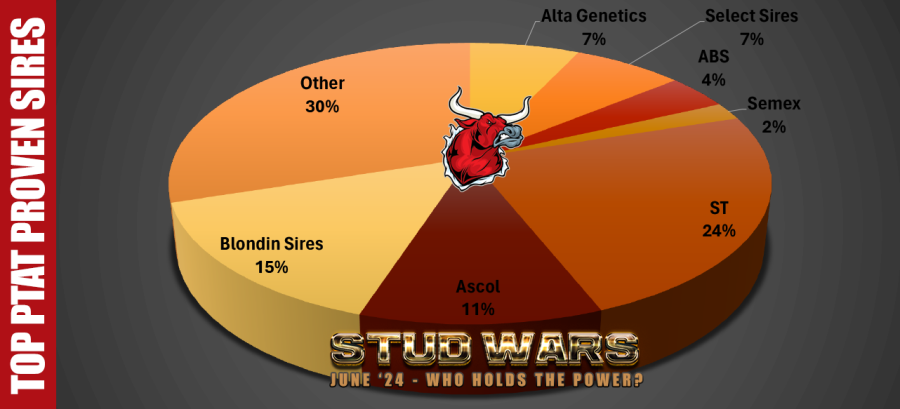
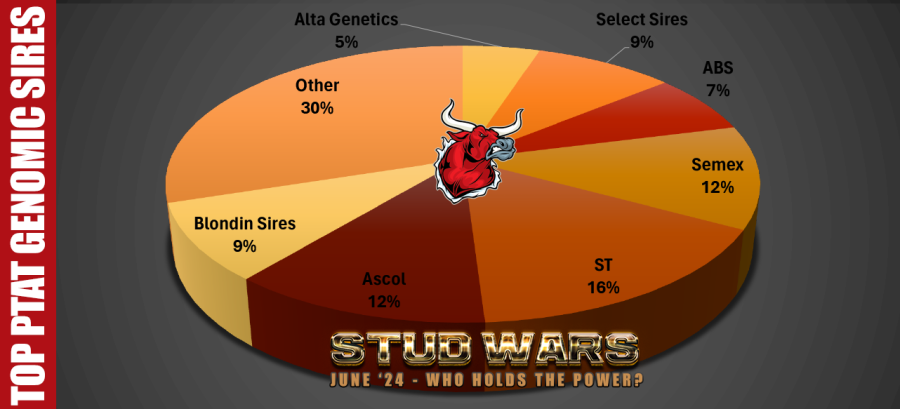
PTAT

URUSSelect SiresABSSemexSTAscolBlondin SiresOther
Proven PTAT774224111530
Genomic PTAT597121612930
PTAT1216111440232460

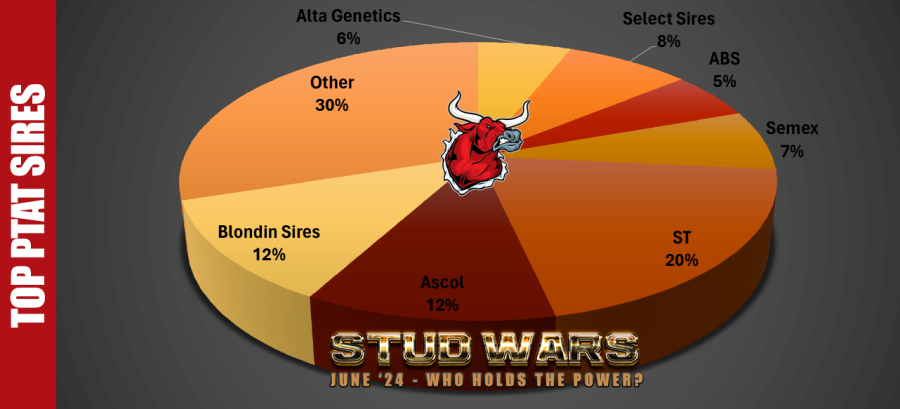
STgen leads the PTAT rankings with a commanding 20% market share, showcasing a robust lineup of proven sire PTATs. Next is the specialist AI stud Blondin Sires, which boasts the second strongest lineup, combining both proven and genomic lists, capturing a 12% share. Completing the top three, Ascol holds a 12.5% share, demonstrating its impressive offerings.

Red & White

Alta GeneticsSelect SiresABSSemexSTAscolBlondin SiresOther
Red & White41052156742

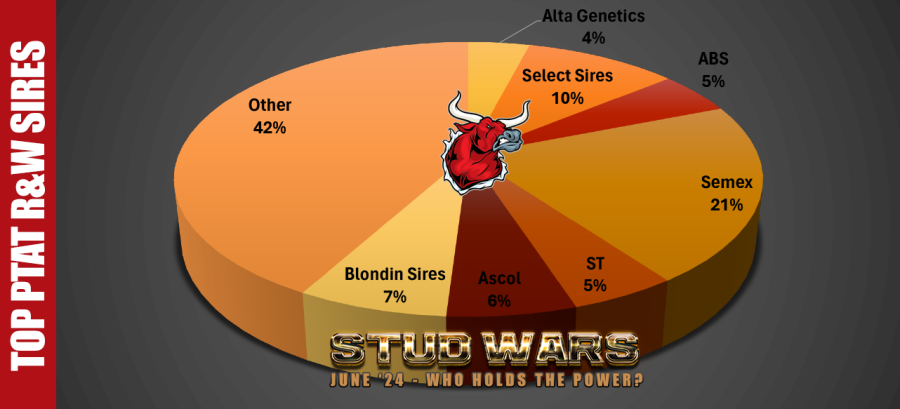
When it comes to the most diverse list of top Red & White PTAT sires, Semex takes the lead with 21% of the top sires. Right behind them are Select Sires with 10% and ST with 13%.

Polled

Alta GeneticsSelect SiresABSSemexSTOther
Polled61513222222

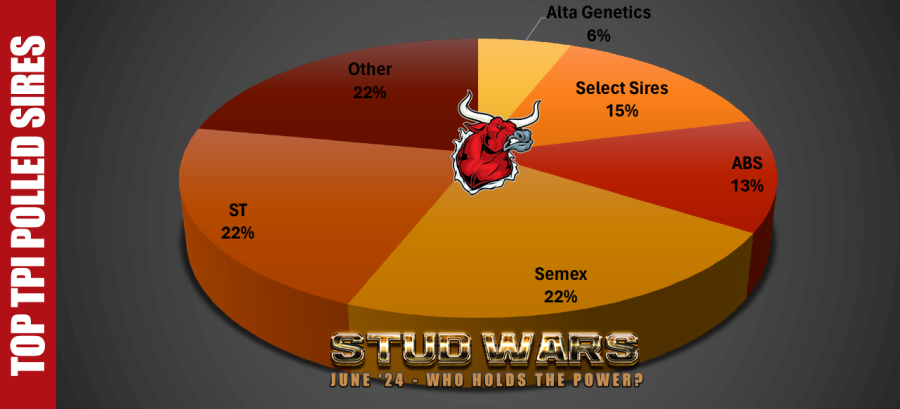
Similar to the Red & White list, the top 100 polled sires feature a diverse range of ownership. A notable shift from the past is that major AI companies have now significantly strengthened their lineups. Semex and ST each command 22%, closely followed by Select Sires at 15%.

Genomic Sire Lineup

Alta GeneticsSelect SiresABSSemexSTOther
49723311383155

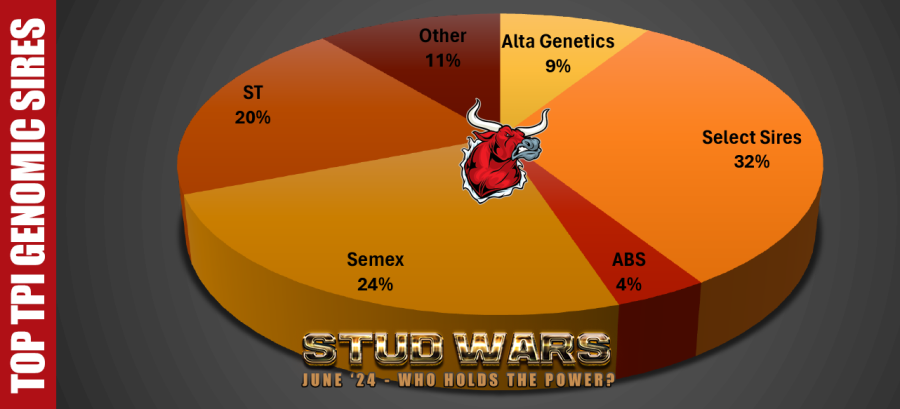
When it comes to the major players in the genomic sire market, Semex undeniably takes the lead, boasting a formidable 22% of the top genomic sires. Trailing behind them is STgen with 16%, and Select Sires at 14%. This marks a significant shift from our previous analysis when Select Sires held the top position with 19%, followed by ABS Global at 18%, and STgen at 14%. Semex has clearly upped their game, immensely strengthening their genomic lineup.

Proven Sire Line Up

Alta GeneticsSelect SiresABSSemexSTOther
405538148766

In the proven sires’ category, STgen is leading the pack, boasting 29% of the top sires. Trailing behind, Select Sires holds an 18% share, while Alta Genetics and ABS are tied at 13%. It’s also worth noting that Semex, with a 5% share, explains why they have been focusing heavily on genomic sires to revamp their overall lineup.

Overall Line Up

Alta GeneticsSelect SiresABSSemexSTOther
8912771127170216

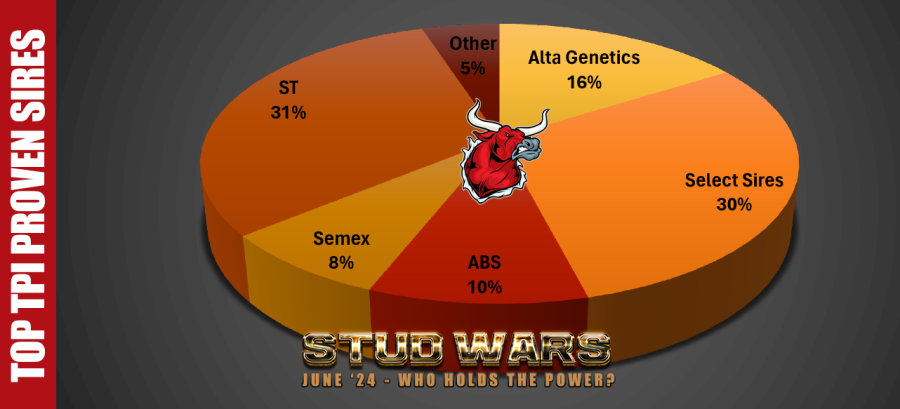
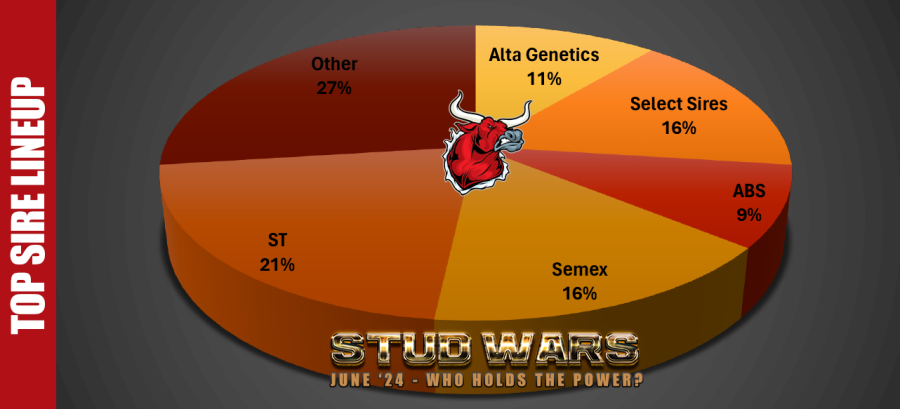
STgenetics leads the pack with a commanding 21% share of the top sires. Their robust genomic and proven lineup underscores the value of ongoing investment in superior genetics. Tied for second place are Select Sires and Semex, each holding 16% of the top sires with 127 entries apiece. Despite arriving at the same percentage, they employ markedly different strategies. Semex has ramped up their genomic investments to compensate for a relatively weaker proven lineup compared to their competitors. Interestingly, our analysis reveals a significant shift in the last couple of years. ABS, previously holding an 18% share, now only 9%. Meanwhile, Ascol and Blondin Sires have each doubled their market share from 2% to 4%.

The Bottom Line

The genetics universe of dairy cattle is vast and continuously evolving. Our journey through the galaxies of TPI, NM$, PTAT, Red & White, Polled, Genomic, and Proven Sire Lineups has revealed the power dynamics of the major players and the emergent contenders. STgen, Semex, ABS Global, and the Select Sires federation remain strong forces, innovating and adapting their strategies to maintain dominance. Meanwhile, new entrants like Blondin Sires and Ascol are trying to shake the status quo, offering tantalizing glimpses of the future. 

As you navigate the cosmic landscape of dairy cattle genetics, the key takeaway is balancing both proven and genomic sires. Keeping an eye on emerging trends, understanding the strengths and weaknesses of each player, and making informed decisions will steer your herd toward stellar success. The universe may be unpredictable, but you can chart a course toward prosperity with the right choices. May the force of informed decision-making be with you!
Summary: The landscape of dairy cattle genetics is evolving rapidly, with major players like STgen, Select Sires and Semex, and new entrants such as Blondin Sires and Ascol making significant strides across various segments. While traditional metrics like TPI and NM$ still hold weight, the focus on specialized categories such as Red & White, Polled, and genomic sires shows a dynamic shift towards more targeted breeding strategies. Companies like Validity Genetics are carving out notable shares, particularly in the genomic Polled segment, indicating a competitive and diverse market. This evolving competition among Artificial Insemination companies highlights the increasing importance of niche segments and innovative genetic offerings, reshaping the power dynamics in the dairy cattle genetics universe.

Artificial Insemination – Is Doing It Yourself Really Saving You Money?

“She’s pregnant!” Those are very welcome words for breeders to hear at pregnancy check time. The ideal is that the pregnancy occurs after one A.I. service in the time period 70 to 100 days in milk, while the cow is producing high volumes of milk, fat and protein. In a perfect world that single A.I. heifer service should occur between 12 and 14 months of age.  Getting to that success depends on many factors, not the least of which is the skill of the inseminator.

Do What you Know or Use a Pro?

It takes a wide range of skills to successfully run a dairy operation at a level that is both sustainable and profitable.  Professional A.I. technicians recognize that many breeders rise to the challenge of taking on this most vital aspect of their dairy business. They realize that many breeders want complete control of the reproduction program on their farm. Dr. Hernando Lopez, Global Technical Service Director for Genus ABS acknowledges that control is important and sums up the breeder perspective saying, “They believe that they can inseminate successfully themselves’. Dr. Ray Nebel, Senior Reproductive Specialist for Select Sires, outlines further reasons that breeders give for doing their own artificial insemination. “They want the flexibility of when to breed. They prefer having semen available from several different A.I. organizations in their farm tank and being able to change the mating right up to the last minute”.  Of course, both Dr. Lopez and Dr.Nebel are aware that cost is one of the strongest motivating factors in choosing who inseminates the cows.

Times have Changed

Thirty years ago there were many more dairy herds and most of them had less than 50 milking cows. Shorter travel distances and labor costs per cow bred by the technician were much lower than today. In that scenario, with only two or three breedings per week, breeders could not become proficient at inseminating. However, with the current average herd size in the US being 187 milking cows, with many miles between herds and with breeders focused on costs, they often choose D.I.Y. artificial insemination for expedience and cost reasons.

Is D.I.Y Really Cheaper?

The monthly bill for technician supplied A.I. needs to subdivided into semen costs and costs for technician services. It’s easy to quote the professional technician’s bill for arm service but expenses must also be pencilled in for the D.I.Y. tech on the farm and for all the costs leading up to the actual insemination.

Remember there is a labor cost for heat detection, including the checking of cows bred 21 days previously. There are additional time related expenses as well.  Time to check computer records or activity monitors. Time to check with all staff members for heats others may have seen. Time to call in for service and time to enter breeding information into the herd records.  Furthermore for on-farm staff there are costs associated with social security tax, insurance, workers compensation, sick time and other benefits that owners must provide.  These time and employment costs are not usually quickly remembered and easily quoted when we sum up the costs of getting cows and heifers in calf. Add in gloves, rods, training and re-training, semen tank purchase and semen tank maintenance and you are getting closer to the true total cost for A.I. Although, at first glance, D.I.Y. seems cost effective and faster, the real question in every dairy manager’s mind should be, “What is the return on the investment?”

Think about it.  In a herd of 200 milking cows, it may take a farm employee up to half their time to monitor animals and carry out other aspects of the herd’s reproduction. Some owners take the next step and assign the farm’s repro staff member to the job of doing the breeding. On the surface it sounds like a cost savings but who covers on days-off? What happens when the farm breeding person is needed elsewhere and he/she does not do all the daily reproduction duties including checking for heats? Only seeing 70% of the heats can soon become a major negative factor for the farm’s bottom line. Missed heats result in more days open, lower daily herd average milk production, more non-productive days in the dry pens and an age at first calving of 26 instead of 22-24 months. Add to this the fact that the on-farm inseminator must be trained and monitored and will need to spend time on skills upgrading and, very quickly, the savings from do-it-yourself insemination are rapidly disappearing.

A.I. Results: Are You Getting Professional or Passable?

Of course, if your pregnancy rate is 23+% and you are meeting or exceeding all your established targets, you can stop reading now.  However, if your results are not at that level, working with a professional technician could be a discerning business decision for you to consider.

Times have changed from when the only service offered by the technician was insemination. Today organizations providing A.I. tech services wish to provide their customers with a full range of services.  Both Lopez and Nebel emphasize that the professional technician becomes part of the on-farm production team, where the goal is to achieve a high pregnancy rate as part of a complete reproduction program.

Dr. Nebel notes that “Herds have gotten bigger, days on the farm have become more demanding, milk per cow has increased and more cows are housed in confinement than they were twenty years ago. These are all challenges when it comes to getting cattle pregnant.” Dr. Lopez also outlines how change is affecting dairy breeding. “Today there is more focus on cow welfare, cow comfort, the successful integration of reproductive technologies like synchronization and heat detection aids and the handling and compliance for large groups of cows. Today successful breeding goes beyond the proper insemination technique. It requires all aspects of dairy management to be correctly working and their needs to be great teamwork.” When breeders work with profession A.I. companies they have access to complete reproduction services including: full cow side services including, walk, chalk, synchronization and insemination’ data entry into herd management software including report generation; management of automated activity and heat detection systems and reproductive consultation.

With all of this potential information and support, one wonders why more breeders not asking for competitive bids from companies that provided genetic and reproductive services to dairy farms.

When it comes to pregnancy rate, whether you are your own professional or hire a professional, you can’t afford less than professional results.

Jack of All Trades or Master of Pregnancy?

Professional technicians employed by A.I. companies breed between 5,000 and 20,000 animals per year. They are continually being monitored for their performance.  As new techniques become available they receive training. Their only focus is on getting animals pregnant. Their livelihood depends of delivering top notch service. Dr. Lopez provides this very sound advice: “Most operations can economically benefit from outsourcing breeding or a total reproductive service to a professional technician not only because of the superior consistent results but also due to all the technical support and resources producers have access to through the professional breeding services”.

The Bullvine Bottom Line

Every aspect of dairy farming needs to be penciled out as to cost and return on investment. Every breeder has an area of dairy farming that they like best and do to a professional level.  In the end, A.I. breeding is all about fewer breedings, less semen used, more pregnancies, fewer reproductive culls and the best use of time and services. There is too much at stake to be a jack of all insemination trades and master of none.

Breeders need to be totally objective about every step from heat detection to confirmed conception.  If you agree that insemination is all about the results, then ask yourself two questions, “How important is an excellent A.I. program?” and “Who performs artificial insemination best?”


Get original “Bullvine” content sent straight to your email inbox for free.


[related-posts-thumbnails]

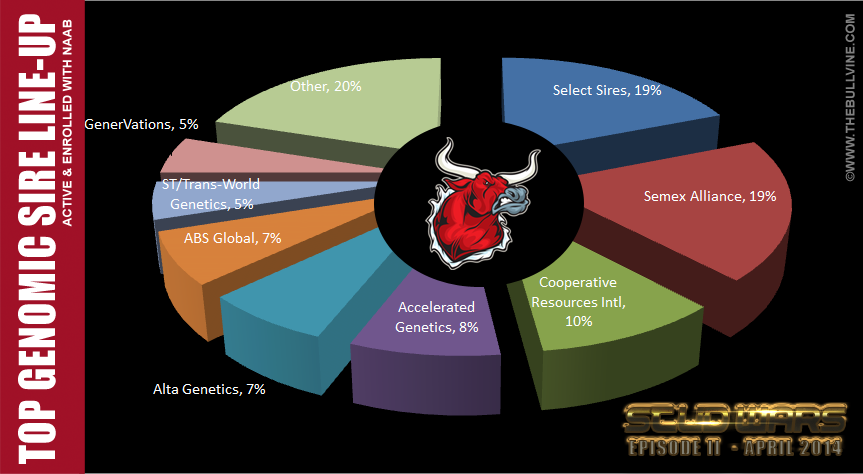
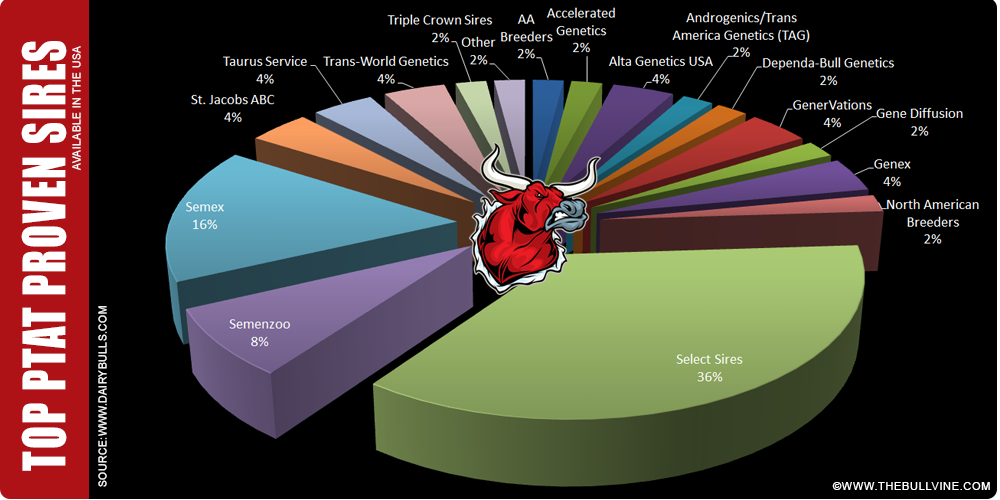
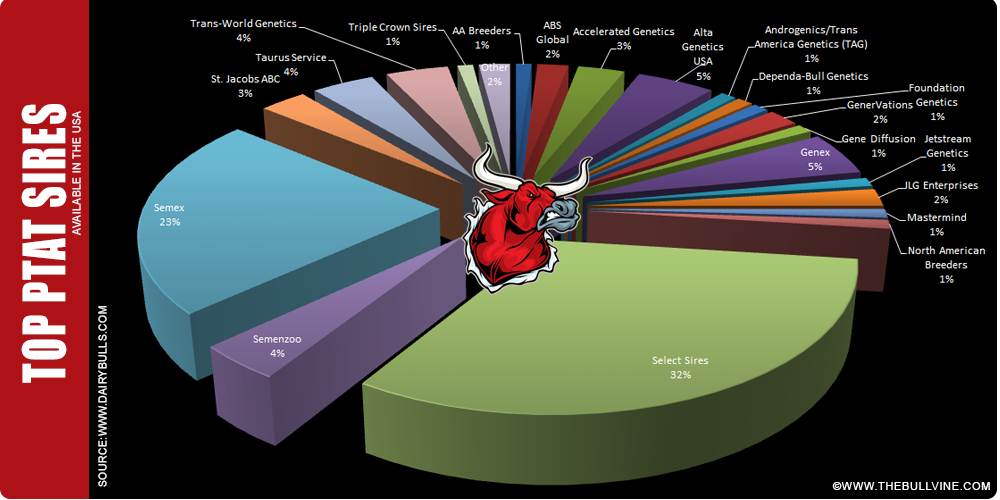
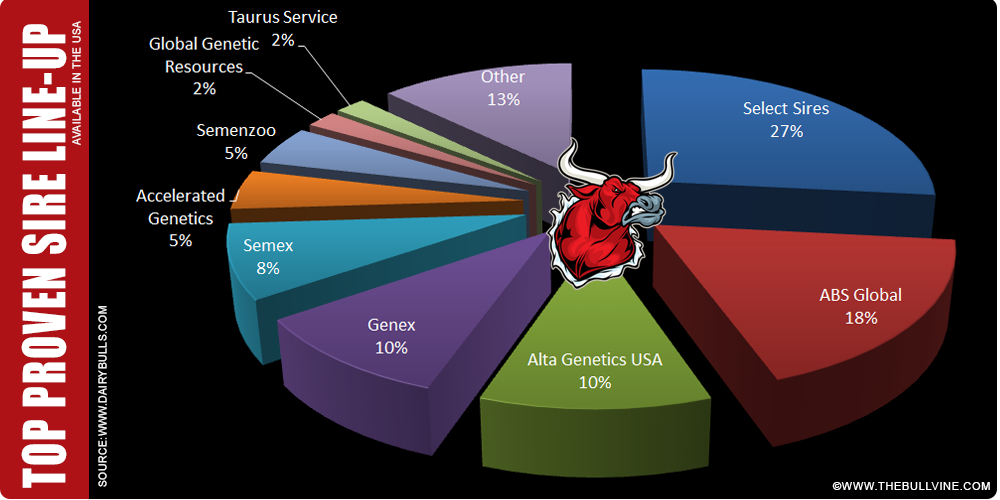
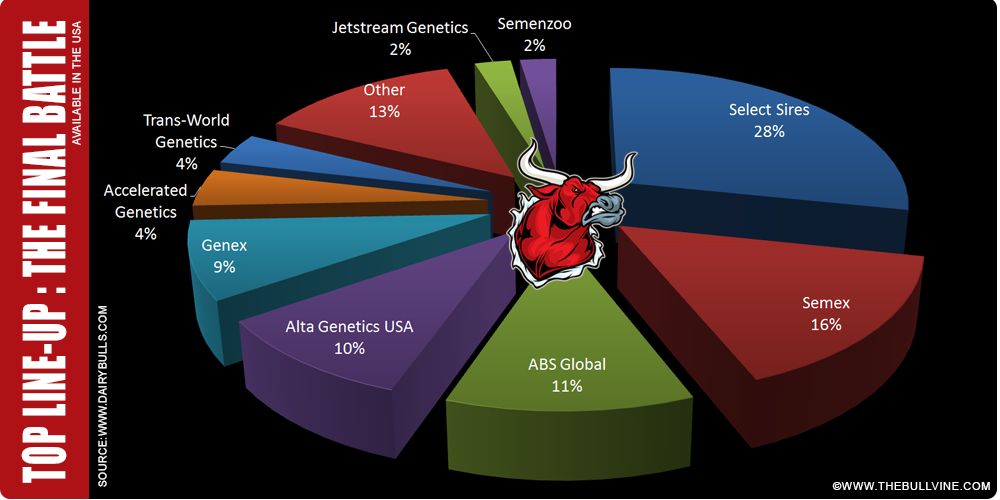
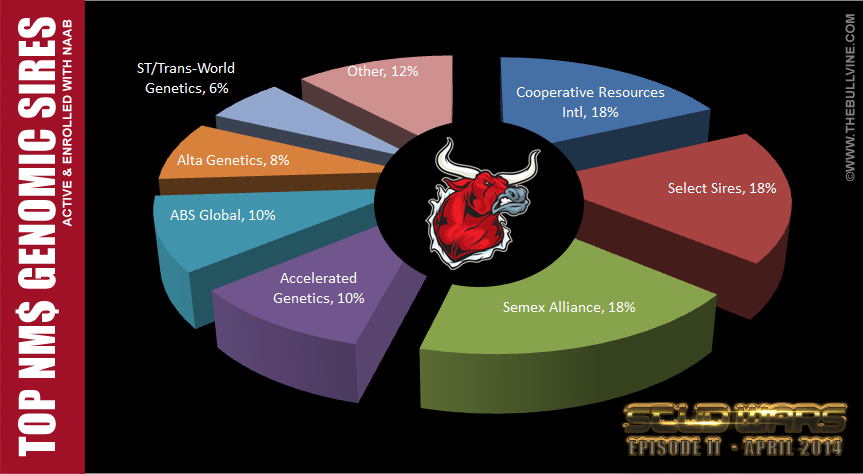
Stud Wars: Episode II – April 2014

Just as we have learned with the Rebels versus the Republic in Star Wars, the Stud wars are far from over.  However, instead of clones we have Genomic Sires versus Proven Sires and large A.I. companies versus smaller organizations.  The April 2014 genetic evaluations have seen the gap between the haves and have nots decrease.  Many of the larger studs that had in the past not focused on Genomic sires greatly increased their genomic offerings and some of the smaller studs greatly increased their niche market offerings.  Stud Wars, like Star Wars, thrive on new releases, talent, unexpected changes and rivalries.

TPI

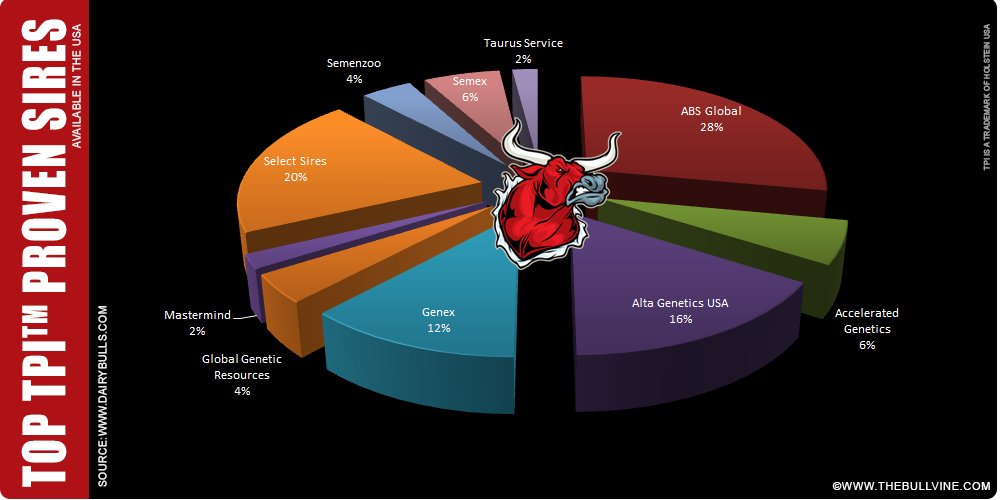
TOP TPI PROVEN SIRES

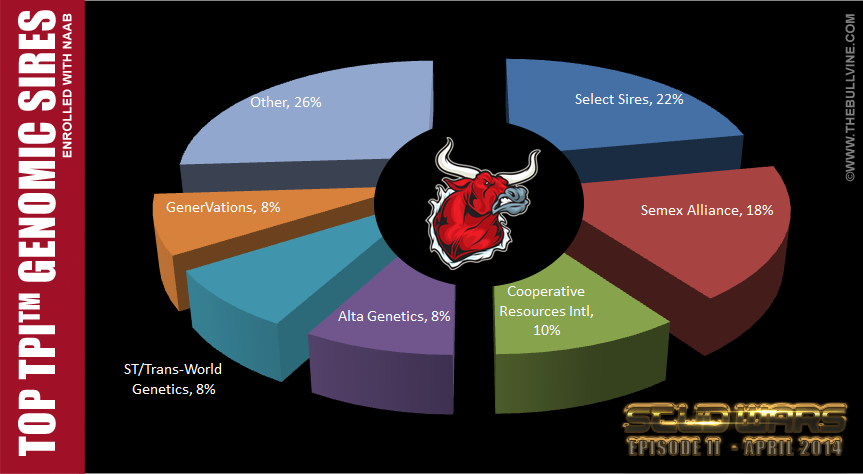
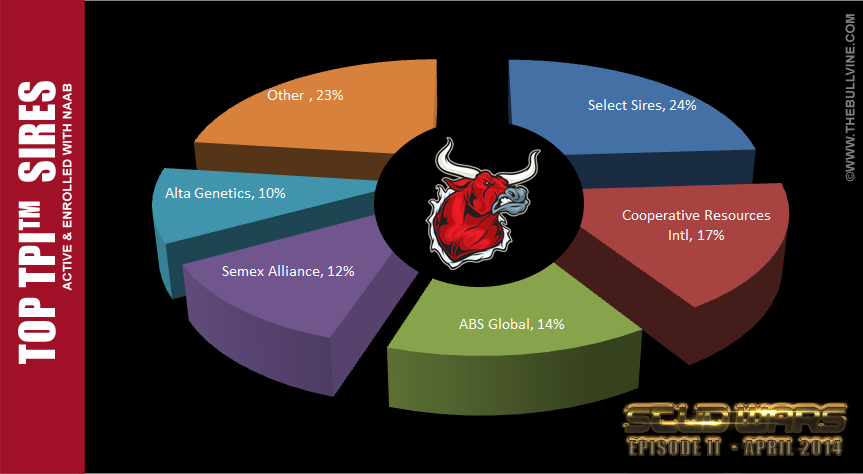
As we found in our initial stud wars (Stud Wars – The Battle for A.I. Supremacy), market share of the pre-genomic era correlates very highly with the big five being ABS, Select Sires, Alta Genetics, Accelerated Genetics and CRI.  Since the last proof run, Select Sires has taken over the top spot with two more sires entering the top 50, and CRI has doubled the number of proven sires they had in the top 50 TPI to move into the #2 Spot.  Former #1 holder ABS Global has dropped from 14 sires to 11 in the top 50 TPI and now holds the #3 position. A sign of the time is the way Accelerated has dropped market share.

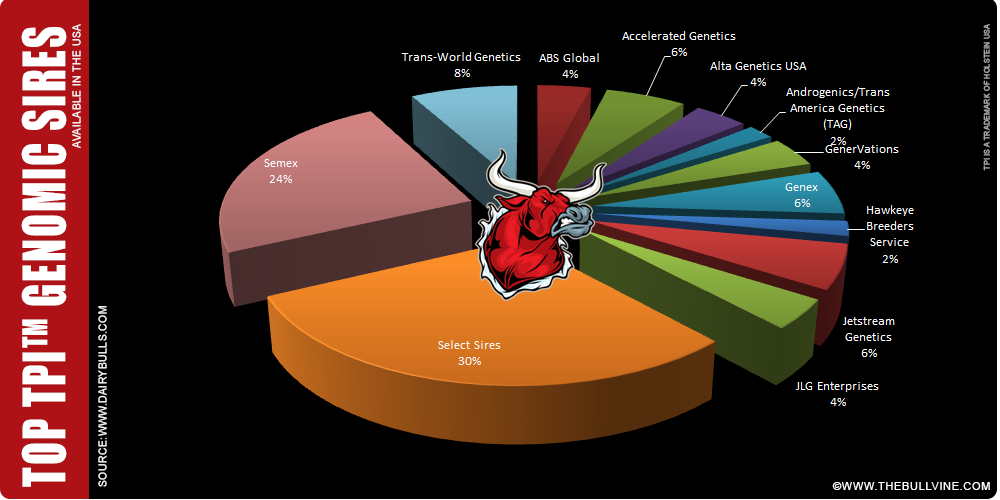
TOP TPI GENOMIC SIRES

Both our previous gTPI leaders from December 2013 have dropped but still hold the #1, Select Sires, and #2 Semex spots on our list.  Making a significant jump on the list is CRI who now holds the #3 spot on the list with 5 sires in the top 50 gTPI.  Also seeing an increase is Alta Genetics who now has 4 sires in the top 50 gTPI.

TOP TPI SIRES

Select Sires continues to lead the way with top TPI offerings both Genomic and Proven. Making a jump into the #2 spot, thanks to an increase in their top TPI proven sires, is CRI. They are followed by Semex who continues to have a strong Genomic TPI offering.  .

NM$

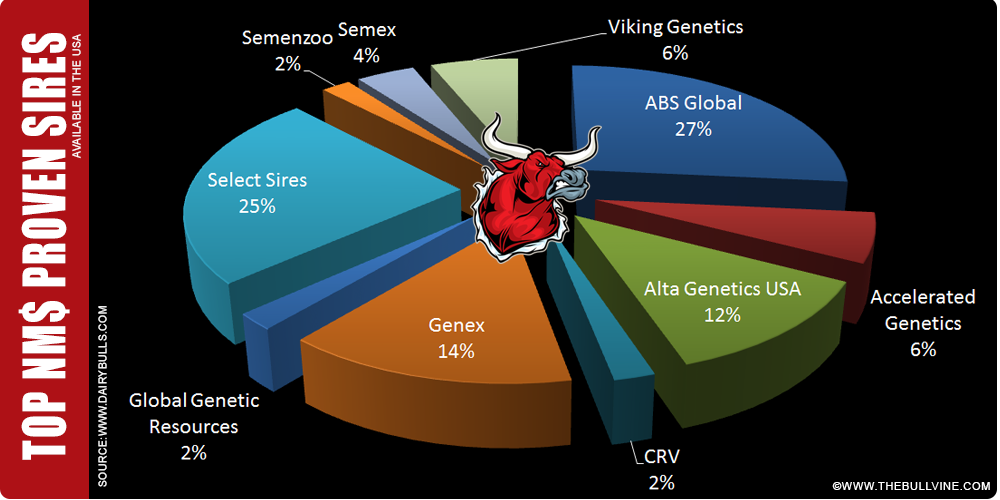
TOP NM$ PROVEN SIRES

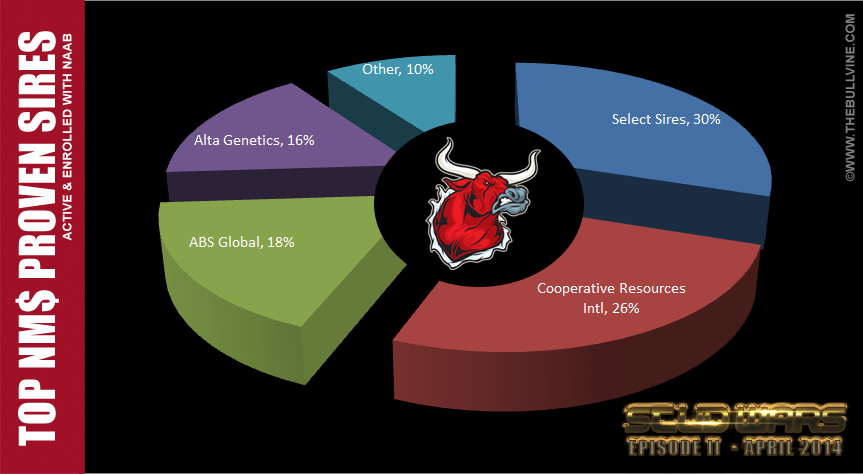
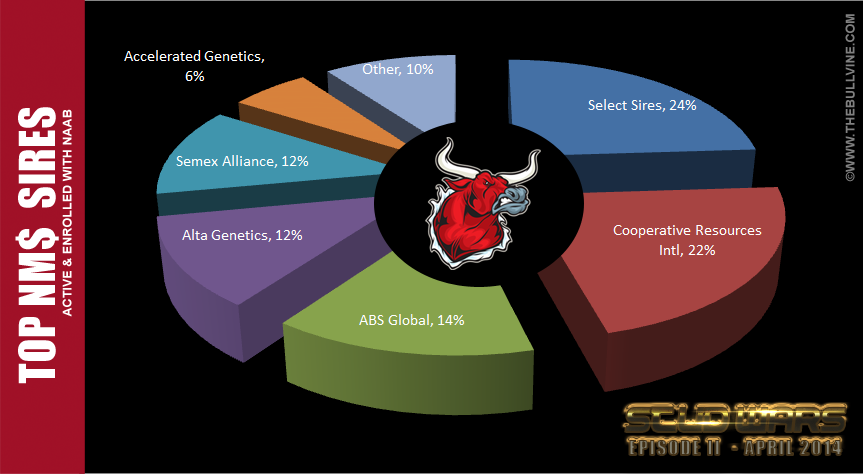
It is no surprise that, for the larger AI centers, the focus on the commercial producer market continues to dominate the proven NM$ list.  Select Sires moves into the #1 position with the two additional sires in the top list, with CRI moving into the #2 position, almost doubling the number of top 50 NM$ sires they have to offer.  Dropping significantly was ABS Global who now finds themselves in the #3 position with 5 fewer  sires in the top 50 NM$ list.

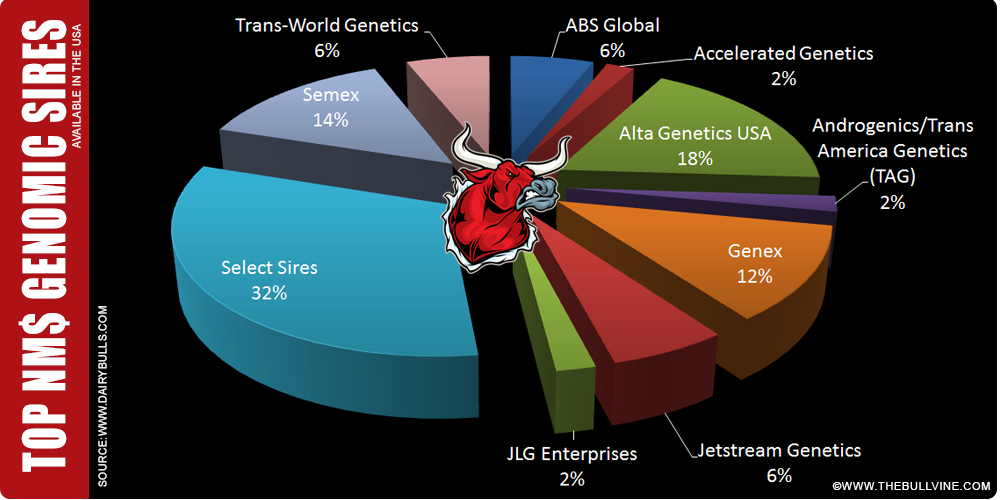
TOP NM$ GENOMIC SIRES

A list that was dominated last round by Select Sires who had 32% of the top sires, now finds them tied with CRI and Semex – all with 18% each.  Also seeing a significant drop in top gNM$ sires is Alta Genetics who went from 9 last round to just 4 this round.

TOP NM$ SIRES

On the strength of their strong proven and genomic NM$ offering, Select Sires retains the strongest NM$ offering in the US.  Thanks to a significant investment in Genomic sires CRI now find themselves with the 2nd strongest NM$ offering.

PTAT

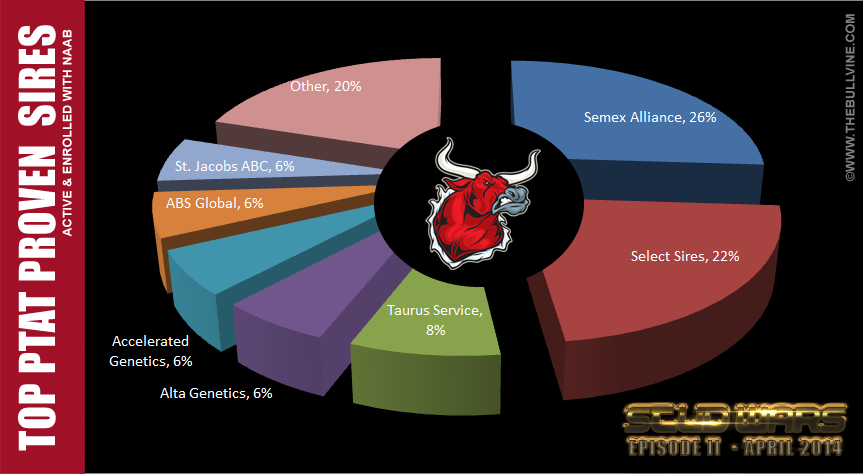
TOP PTAT PROVEN SIRES

Probably one of the most significant changes of this proof round is Semex moving into the strongest type proven sire offering in the world, with 5 more proven sires moving into the top 50 PTAT.  Former #1 Select Sires goes from having 18 sires in the top 50 to 11 and holds the #2 spot.

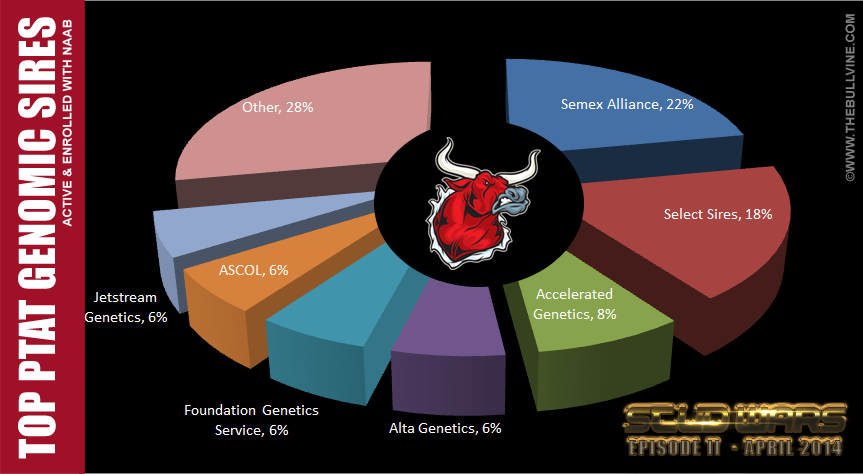
TOP PTAT GENOMIC SIRES

When it comes to the top 50 Genomic PTAT sires, Semex and Select Sires still top the list, but both have seen significant declines in totals.  Many small A.I. studs now find themselves with 1 to 3 sires in the top 50.

TOP PTAT SIRES

On the strength of a greatly improved proven type sire line up, Semex now find themselves on top of the overall PTAT list, followed by Select Sires.  However the ever increasing trend continues where more and more smaller AI organizations have a top 50 PTAT proven or genomic sire.

Polled

TOP TPI POLLED SIRES

As we continue to see trends change in the industry, we see the sire line-ups in key markets are also starting to change.  Nowhere is it more evident than in the polled trend.  With that in mind, we decided to add two key niche markets to our stud wars analysis: (1) polled TPI sires and (2) Red type sires.  For both of these lists we are using the top 50 proven or genomic sires.

Not surprising DairyBullsOnline.com the Polled specialists lead the list.  Followed by Select Sires and GenerVations.

PTAT R&W SIRES

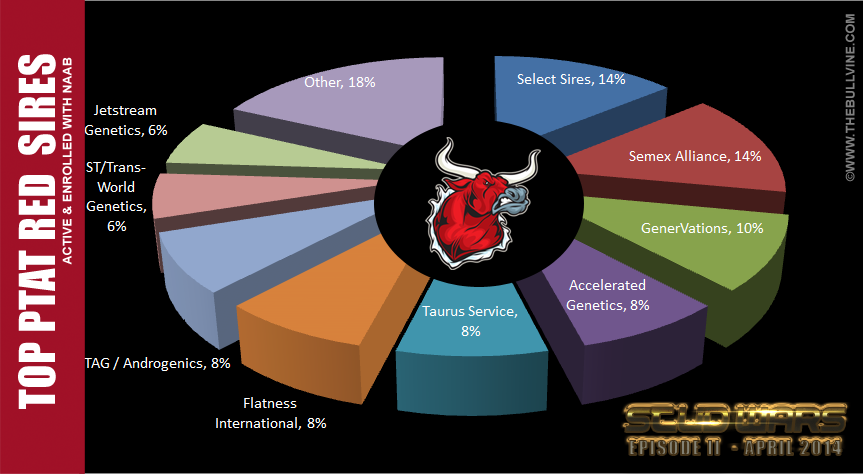
TOP PTAT RED SIRES

As we saw in the overall PTAT list, Semex and Select Sires continue to lead the way in type offerings.  Also similar to the B&W PTAT lists, we find a number of smaller studs also offering 1-4 of the top red and white sires.

The Bullvine Bottom Line

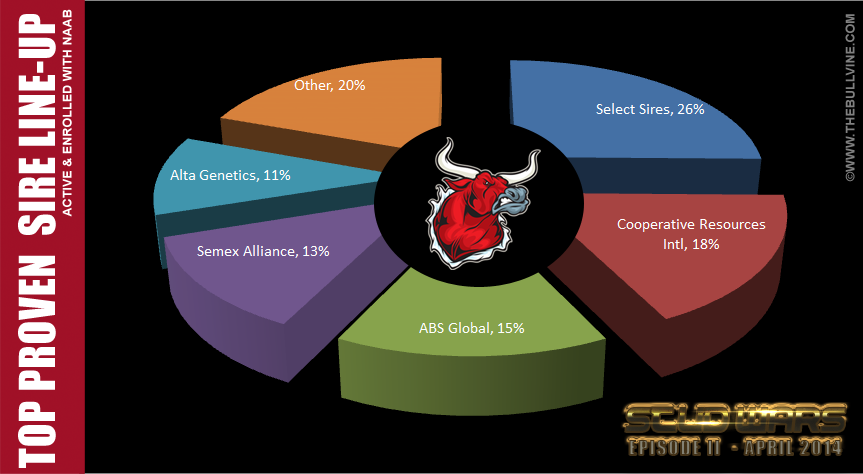
TOP PROVEN SIRE LINE UP

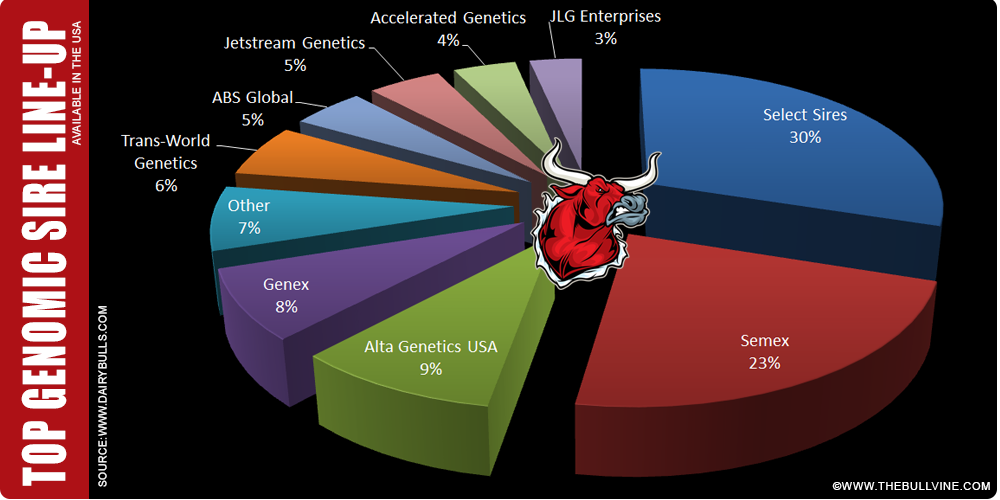
Holding strong with the best proven sire line-up is Select Sires.  Seeing a significant increase and moving into the 2nd strongest proven sire line-up position is CRI.  They rise on the strength of their significant increase in top NM$ proven sires. Also seeing an increase and moving into the #3 position is ABS Global.  Semex finds themselves with 15 less proven sires on our top lists and drops from the #2 position in December to the #4 position currently.

TOP GENOMIC SIRE LINE UP

Tied at the top genomic for genomic sires are Select Sires and Semex.  These are the same two studs that ranked #1 and #2 last round.  Moving up 2 spots from last round is CRI, powered by a significant investment in top gNM$ sires.  Also making a strong showing is the Sexing Technologies / Trans-World Genetics partnership powered by their agreement with the EDG group, who own many of the top genomic females in the world.

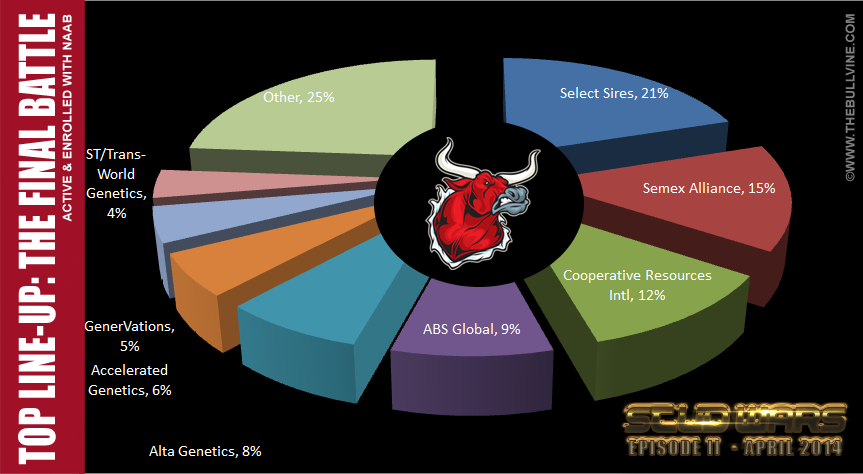
TOP LINE UP

Retaining the title of as the strongest overall sire line-up is Select Sires, though it should be noted that Select went from 28% of the top sires in December 2013 to 21% this time.  Holding steady with increases in their proven sire line-up and slight decreases in their genomic sire line-up, Semex comes in as the 2nd strongest sire line-up.  Moving up to the #3 sire line-up with significant improvements in their proven TPI sire line-up as well as genomic offerings is CRI. ABS Global and Alta Genetics round out the top 5.

Join us in staying tuned to the next order of business in the expanding universe of the Stud Wars.

For complete genetic evaluations from around the world click here.


Get original “Bullvine” content sent straight to your email inbox for free.


[related-posts-thumbnails]

The 16 Sires Every Dairy Breeder Should Be Using to Accelerate Genetic Gain in Your Herd

With each new proof round comes new sires, new rankings and, frankly, new headaches.  Wanting to do more than just pump out the same old lists that really do not mean anything to anyone but the semen marketers, or just promote the bulls from the studs who pay us the most money, the Bullvine took a look at the recent December 2013 Genetic Evaluations to find not only the list toppers, but a deeper look to find those unique sires that will address your key breeding challenges.

Overall Performance Improvement

When looking for the sire that  will help improve your herd across the board, we looked for sires that have a balance of production and longevity, and most importantly a proven pedigree that ensures that their performance  will last. We also wanted great health and fertility traits that will deliver a low maintenance cow (Read more – Fact vs. Fantasy: A realistic approach to sire selection). Here are our top four:

  • ROYLANE SOCRA ROBUST
    Socrates x O Man x Manat
    Proven Sire –  Select Sires
    +1464 lbs. Milk +0.12 %F  +87 lbs. F +0.04 %P +53 lbs P 5.5 PL 2.95 SCS +1.95 PTAT +2248TPI
    +1946 kgs Milk +0.41F +116 kgs. F +0.15 %P +79 kgs P +110 HL 3.00 SCS +5 Conf. +3188 LPI
    Long a popular high genomic sire, with his high debut in August and sustained numbers as he adds more daughters, Robust has proven to be a great performance improver. He  is a high NM$ (+765) Velvet-View-KJ SOCRATES-ET (EX-94-GM) son from Seagull-Bay Oman Mirror (VG-86-DOM). He transmits exceptional components (+.12% Fat, +87 Fat, +.04% Protein, +53 Protein) and outstanding longevity (+5.5 Productive Life).  A Calving Ease and relative outcross sire, ROBUST moderates stature and adds height and width to the rear udder.   Robust will work best on tall deep cattle that need feet and leg improvement.
  • KINGS-RANSOM B RUBLE
    Bolton x Boliver x Bombay
    Proven Sire –  ABS Global
    +2534 lbs Milk  -0.07 %F  +73 lbs. F -0.01 %P +72 lbs P 0.7 PL 2.95 SCS +1.84 PTAT +2067TPI
    +2978 kgs. Milk -0.25F +85 kgs. F -0.05 %P +90 kgs P +102 HL 2.99 SCS +7 Conf. +2953 LPI
    With so many O Man, Planet, Goldwyn, Shottle, and Freddie sons dominating the lists, it nice to see a sire like RUBLE ranking among them.  The cow family behind RUBLE features five consecutive generations of AI bull mothers. RUBLE’s five closest dams all produced milk records in excess of 32,000 lbs. RUBLE’s grand dam, Bombay Rale was a tremendous brood cow leaving 6-VG & 4-EX daughters in the herd by seven different sires.  RUBLE daughters are moderate stature and dairy. Protect for strength as they can be narrow through the chest. Udders are everything  you would  expect from the two popular pedigrees. High, wide rear udders, smooth blending fore udders, and a deep seam to carry their high production through many lactations. Daughters track straight with a correct foot, though you need to protect for a slight set to rear legs and protect rumps for pin width.
  • SILVERRIDGE V WICKHAM
    Mogul x Snowman x Planet
    Genomic Sire – Semex
    +1964 lbs Milk  +0.04 %F  +81 lbs. F +0.01 %P +61 lbs P 4.3 PL 2.68 SCS +3.31 PTAT +2446 TPI
    +2516 kgs. Milk +0.07F +100 kgs. F +0.01 %P +82 kgs P +113 HL 2.69 SCS +18 Conf. +3483 LPI
    Wickham’s high genomic numbers should not surprise anyone.  Coming from the same family that has produced genomic giants, Epic, Emmet and many others.  Wickham is an early Mogul son from the Whittier-Farms Lead Mae family.  Look for Wickham to sire tall angular daughters with average depth.  Expect great mammary systems and feet and legs though he should be protected on straightness of leg and chest width.
  • DE-SU 11236 BALISTO
    Bookem x Watson x O Man
    Genomic Sire – ABS Global
    +1725 lbs Milk  +0.12 %F  +96 lbs. F +0.01 %P +78 lbs P 4.3 PL 2.71 SCS +2.72 PTAT +2424 TPI
    +1923 kgs. Milk +0.31F +104 kgs. F +0.30 %P +94 kgs P +111 HL 2.54 SCS +10 Conf. +3409 LPI
    For those of you looking for a high genomic outcross sire, Balisto can certainly do the trick.  Balisto is the Bookem brother to the #1 gLPI sire in the world De-Su Mg Davinci 11288.  Their dam is the outcross Watson daughter of Pine-Tree Missy Miranda (Full sister to De-Su 199 Chart Topper), then of course Wesswood-HC Rudy Missy herself.   Look for Balisto to sire outstanding components, with solid type and health traits.  Balisto will need to be protected on rumps as he  will tend to have a high rump angle and will be a touch weaker in the loins.

Production Improvement

It might be easy to just take the top milk lists or combine the fat plus protein and say those sires are the best for overall production. We here at the Bullvine would not want to totally forgo type as well as health and fertility, so we are looking for the sires that give you the maximum production gain, without sacrificing everything to get it.  In addition to Robust, Ruble and  Balisto mentioned above, some other production improvement sires to consider include:

  • FLEVO GENETICS SNOWMAN
    O Man x BW Marshall x Aaron
    Proven Sire
    +2075 lbs Milk  -0.03 %F  +67 lbs. F -0.01 %P +61 lbs P 1.9 PL 2.79 SCS +2.43 PTAT +2109 TPI
    +3059 kgs. Milk -0.15 F +98 kgs. F -0.03 %P +94 kgs P +104 HL 2.67 SCS +11 Conf. +3112 LPI
    When it comes to production improvement it is hard to argue with  Snowman.  While many people are mixed on Snowman daughters, there is no question that they know how to milk.  Snowman is your classic milk bull. He has extreme component yields with average type.  However,  as history teaches us, extreme sires are exactly  the ones that we need to use most in order to accelerate genetic advancement.  While  not high type, Snowman daughters are surprising many by being solid VG  milk cows.  He certainly needs to be protected for fat percentage and straight rear legs and most definitely DPR.  But if you have the high fat percent heifer or cow that needs an instant production hit, Snowman is the man.  Since semen is in limited supply maybe consider a couple of his sons, full brothers SEAGULL-BAY PLATINUM or DIAMOND or maybe S-S-I SNOWMAN MAYFLOWER.
  • MARS ALTAFIXMAN
    Fibrax x O Man x Sinatra
    Proven Sire – Alta Genetics
    +911 lbs Milk  +0.19 %F  +84 lbs. F +0.12 %P +60 lbs P 0.3 PL 3.13 SCS +0.91 PTAT +1986 TPI
    +1246 kgs. Milk +0.52F +100 kgs. F +0.36 %P +78 kgs P +104 HL 3.22 SCS +3 Conf. +2918 LPI
    With the exception of O Man,  most breeders would probably never have heard of many of the sires in AltaFixman’s pedigree.  That’s mostly a result of the international genetics marketplace these days, as his sire, Fibrax is from Italy and his dam, FROUKJE 375 is from the Mars herd in The Netherlands.  But don’t let this relatively unknown pedigree scare you.  It is actually based on generation after generation of strong type and production. Although his overall Milk numbers may seem average,  his components are out of this world.  At +.19%F +84 lbs of Fat and +.12%P +60lbs of Protein, AltaFixman is certainly a strong component punch whenever you need it. Type wise look for AltaFixman to sire good all around solid cows that could be protected on median suspensory ligament and body depth. As an added bonus, since AltaFixman is such a non North American pedigree, he is certainly an outcross to most North American cattle.
  • SEAGULL-BAY SUPERSIRE
    Robust x Planet x Shottle
    Genomic Sire – Select Sires
    +2342 lbs Milk  +0.08 %F  +107 lbs. F +0.02 %P +75 lbs P 5.4 PL 2.80 SCS +2.38 PTAT +2413 TPI
    +2586 kgs. Milk +0.25F +122 kgs. F +0.06 %P +91 kgs P +111 HL 2.85 SCS +9 Conf. +3395 LPI
    Of course it’s hard to mention any  production improvement without including Supersire.   This Robust son from AMMON-PEACHEY SHAUNA VG-87-2YR-USA, really is a genomic wonder. Not only does he have the highest genomic values in the breed for production but he also has great functional type and health traits to go with it. Here you have a sire that is 2342 lbs. for milk, with positive component deviations, 2.38 for type, and over +5 for productive life.  Supersire daughters and sons are already topping many of the lists.  While Supersire daughters will not be winning many shows, his no holes type linear has resulted in his widespread  use and so far he has delivered on all expectations.
  • BUSH-BROS ALTABGOOD
    Robust x Massey x Boliver
    Genomic Sire – Alta Genetics
    +1603 lbs Milk  +0.13 %F  +93 lbs. F +0.09 %P +71 lbs P 4.5 PL 2.85 SCS +2.41 PTAT +2373 TPI
    +858 kgs. Milk +0.41F +113 kgs. F +0.28 %P +89 kgs P +110 HL 2.89 SCS +7 Conf. +3256 LPI
    Another Robust son that should certainly get your attention is AltaBgood.  While not an international pedigree like AltaFixman, AltaBgood’s pedigree will not spark instant recognition for most breeders.  What you do get is generation after generation of genomic performance that is higher than their parent averages.  While those wanting pedigree power to go with the genomic test may not want to use AltaBgood, those that have confidence in the genomic system should  certainly take a look.  Like AltaFixman, AltaBgood will also sire extreme component improvement (+.13%F +93lbs F +.09%P +71 lbs P).  He combines these outstanding components with a strong type linear and average health traits.  AltaBgood will need to be protected for high pins and dairy strength.

Longevity Improvement

While some would try to tell you that high type equals longevity, that is not necessarily the case.    When it comes to longevity, it’s  hard to argue with actual performance indices like Herd Life and Productive Life.  In order to give a more balanced approach to longevity, we looked at both and came up with the following top sires:

  • COYNE-FARMS DORCY
    Bolton x Bret x Rudolph
    Proven Sire – ABS Global
    +1603 lbs Milk  -0.04 %F  +46 lbs. F -0.01 %P +46 lbs P 4.9 PL 2.70 SCS +3.00 PTAT +2267 TPI
    +1721 kgs. Milk -0.16F +48 kgs. F -0.02 %P +53 kgs P +114 HL 2.67 SCS +13 Conf. +2971 LPI
    Another popular genomic sire that has become a mainstay on the proven sire lists is Dorcy.  DORCY offers breeders a little different pedigree with no O Man, Planet, Goldwyn or Shottle  in it. The impressive combination of type and production from his cow family and daughters are readily evident in DORCY’s proof with +1603M +46F +46P +623NM 2.70SCS +4.90PL and +3.00T +3.22UDC +3.07FLC. He has good ratings for all functional traits except for calving ease. Breeders interested in a Bolton son from an outcross pedigree, top notch udders, very good feet & legs and functional traits may consider Dorcy. Dairy Strength and Rump are only slightly above breed norms.  Look for Dorcy to sire balanced dairy cattle that have great udders and very good feet & legs, though he will need to be protected for  fat percent and dairy strength, specifically his body depth and chest width.
  • KINGS-RANSOM ERDMAN CRI
    Planet x Ramos x Bullet
    Proven Sire – Cooperative Resources International (CRI)
    +1156 lbs Milk  +0.11 %F  +71 lbs. F +0.02 %P +39 lbs P 7.7 PL 2.76 SCS +0.93 PTAT +2157 TPI
    +1386 kgs. Milk +0.36 F +90 kgs. F +0.06 %P +50 kgs P +112 HL 2.70 SCS +2 Conf. +2853 LPI
    While Erdman is a Planet son, the rest of his pedigree Ramos x Bullet x Brandon actually makes Erdman a relative outcross sire.  His pedigree also demonstrates one high productive life sire after another.  A product of the Genesis program by CRI, he has been built to sire highly profitable (+803NM$) cattle.  While many type breeders will not love his +0.93 PTAT, his 7.7 for productive life (112 herd life), his 2.76 SCS and 110 daughter fertility (+1.9 DPR) will certainly catch the eye of many producers. Expect Erdman daughters to have strong mammary systems and sound legs. He will need protected on foot angle, pin width and dairy strength.
  • JEANLU FIX
    Mogul x Observer x Shottle
    Genomic Sire – Semex
    +908 lbs Milk  +0.09 %F  +56 lbs. F +0.03 %P +36 lbs P 7.4 PL 2.49 SCS +3.01 PTAT +2417 TPI
    +1375 kgs. Milk +0.21F +73 kgs. F +0.08 %P +53 kgs P +119 HL 2.43 SCS +14 Conf. +3243 LPI
    Fix’s dam SPEEK-NJ OBSERV FANDANGO VG-86-2yr has the rare combination of being high index and from 8 generations of EX behind her (Read more: FERME J.P. POULIN: YOU’RE ALWAYS WELCOME! TOUJOURS BIENVENU!) a testament to the longevity of his maternal lines Combine that with the high productive life sire Mogul and you certainly have an unbeatable longevity package.  Look for him to sire great udders with  strong feet and legs though he may need to be protected on stature for some breeders preferences.
  • LONE-OAK-ACRES ALTAROBLE
    Mogul x Observer x Shottle
    Genomic Sire – Alta Genetics
    +1282 lbs Milk  +0.03 %F  +45 lbs. F +0.02 %P +50 lbs P 6.7 PL 2.64 SCS +3.12 PTAT +2426 TPI
    +1666 kgs. Milk +0.05 F +66 kgs. F +0.09 %P +63 kgs P +118 HL 2.63 SCS +14 Conf. +3273 LPI
    This seems to be the magic sire stack for longevity improvement.  With a linear that is off the charts and strong production numbers and health and fertility traits, AltaRoble certainly deserves your attention.  A +6.7 productive life, +2.4 Daughter Pregnancy Rate and +2.64 SCS certainly shows that AltaRoble not only has the type numbers, he actually has the longevity numbers to back it up.  Breeders may want to protect him on body depth and teat length.

Health and Fertility Improvement

With the constant improvement in the accuracy of health and fertility  index calculations, more and more breeders are confidently including Health and Fertility traits in their breeding requirements.

  • DE-SU OBSERVER
    Planet x O Man x BW Marshall
    Proven Sire – Select Sires
    +1416 lbs Milk  +0.00 %F  +43 lbs. F -0.01 %P +49 lbs P 5.9 PL 2.84 SCS +2.64 PTAT +2186 TPI
    +1973 kgs. Milk -0.05 F +68 kgs. F +0.02 %P +66 kgs P +111 HL 2.83 SCS +12 Conf. +3072 LPI
    Carrying the flag and riding the wave of the health and fertility trend is  De-Su Observer.  This sire has been the poster child for high health and fertility since his early genomic numbers came back and catapulted him into international use.  With his daughter performance validating his early numbers, Observer has to be one of the quickest sires in history to get to 99% Reliability.  His daughters stamp out a pretty consistent pattern with strong production and solid type.  Type wise he has actually performed pretty well, with daughters exhibiting outstanding udders (watch out for short teats) and solid feet and legs.  One area you will also want to protect him on is his dairy strength, as his daughters are certainly not deep and could stand to have more chest width.
  • ZANI BOLTON MASCALESE
    Bolton x O Man x Adam
    Proven Sire – Semenzoo
    +1562 lbs Milk  +0.02 %F  +53 lbs. F +0.01 %P +59 lbs P -0.3 PL 2.75 SCS +2.79 PTAT +2072 TPI
    +2084 kgs. Milk -0.05 F +73 kgs. F +0.07 %P +75 kgs P +104 HL 2.76 SCS +14 Conf. +3091 LPI
    With such a push on health traits over the past few years, it’s actually almost impossible to find an outcross sire on the top lists.  If you are one of the few that didn’t go heavy on Mascalese as a genomic sire, you certainly can take advantage of that now by using him or one of his many sons.   Possessing greater conformation than his sire stack would indicate, MASACLESE sires strong dairy cattle that are durable and possess good health  traits.   For those looking for a more outcross sire that is high for health and fertility, try Erdman mentioned above.
  • MR LOOKOUT P ENFORCER
    Facebook x Shottle x O Man
    Genomic Sire – Semex
    +1628 lbs Milk  +0.05 %F  +62 lbs. F +0.03 %P +68 lbs P +4.7 PL 2.76 SCS +2.42 PTAT +2348 TPI
    +1955 kgs. Milk +0.05 F +78 kgs. F +0.13 %P +78 kgs P +114 HL 2.82 SCS +13 Conf. +3352 LPI
    This Marbri Facebook son has some of the highest DGVs in the breed. Look for him to sire extreme component yields from strong dairy cattle with great feet and legs. One area to be cautious about, when using him, is his body depth. Both his sire stack and his DGVs would say this area needs protecting.
  • CO-OP UPD HUNTER SALVINO
    Hunter x Massey x Ally
    Genomic Sire – Cooperative Resources International (CRI)
    +1265 lbs Milk  +0.21 %F  +101 lbs. F +0.08 %P +61 lbs P +3.9 PL 2.81 SCS +2.46 PTAT +2401 TPI
    +1474 kgs. Milk +0.51 F +107 kgs. F +0.22 %P +72 kgs P +112 HL 2.78 SCS +12 Conf. +3353 LPI
    If you’re looking for something a little different and an outcross pedigree, try Salvino.  Another product of the Genesis program at CRI, Salvino is a 2nd generation product of this program. His dam’s sire, Massey, was one of the early success stories of this program.  Look for Salvino to sire strong component improvement with a solid type linear.  In a market place flooded with many of the same bloodlines, finding a sire that is a little different and yet still able to deliver top progeny can be a challenge.  Salvino may be your best option for a relative outcross sire that still can compete with the other top genomic sires.

The Bullvine Bottom Line

We have stated it many times. In maximizing your genetic gain, you can’t just pick from the top of the TPI or LPI list.  You need to make sure that your matings are the best corrective cross.  Breeding great cattle is part art and part science. You need to have both parts.   It takes careful consideration and generation after generation of corrective mating to breed great cow families.  That is why, instead of just giving you a list of the top 12, we have tried to provide you with insight into which sires will provide you with the maximum gain in each specific area.

Check out our Genetic Evaluations Section for more information.


Get original “Bullvine” content sent straight to your email inbox for free.


[related-posts-thumbnails]


Stud Wars – The Battle for A.I. Supremacy

A long time ago in a galaxy far away……Who are we kidding the A.I. stud wars are now and the battleground is the USA, the most lucrative genetics market in the world.  For years I have heard the debate from all sides about which stud has the best sire line-up.  The problem is most of it has been anecdotal and no one has really backed it up with numbers.  So, in true Bullvine fashion, we thought we would bring numbers to this galactic battle.

To settle this confrontation, we decided to let genomics and genetic evaluations determine exactly which stud rules the empire.  Specifically we looked at top 50 proven and genomic sires for TPITM, NM$ and PTAT to determine who are the studs and who are the duds.  The following is what we found.  (Please note we deemed a sire to be available if the had an NAAB Code)

TPI

tpi proven siressw

Click on image for enlargement

It’s interesting to see how the percentages seem to be similar to market share, prior to the genomic era.  The big five being ABS, Select Sires, Alta Genetics, Accelerated Genetics and Genex.

Click on image for enlargement

Click on image for enlargement

The top gPA TPI sires tell a very different story than that of the proven sires.  Studs like ABS Global and Alta Genetics do not have as large a portion of the top bulls whereas Semex and Select Sires have invested heavily in obtaining top gPA TPI sires.

Click on image for enlargement

Click on image for enlargement

When it comes to strength of line-up from a TPI perspective, it’s interesting to see how Semex and some of the smaller studs have made a big push on getting the top genomic sires, in order to have that stronger line-up in the future.  On the other hand, some of the established studs are resting on their proven laurels. (Please note for top list we used the top 50 genomic and top 50 proven sires.)

NM$

nm$ proven siressw

Click on image for enlargement

It is interesting how the studs that are more milk producer focused as opposed to breeder focused rise up on this list.  Specifically Genex, Alta Genetics and ABS have their best showings here.

Click on image for enlargement

Click on image for enlargement

Even the studs who have not gone heavily into genomics, are at least sampling some high genomic sires for NM$.  When it comes to selling volumes of semen, nothing compares to a high NM$ sire.  Yes the top TPI sires will sell well, but the high NM$ will move in volume as they attractive the commercial market.


Click on image for enlargement

Click on image for enlargement

The greatest spread of the top sires amongst the studs occurs in NM$.  This is not surprising since this is such a lucrative market for so many studs.  They all are trying to get the top sires.

PTAT

Click on image for enlargement

Click on image for enlargement

When it comes to the top type bulls, it seems like everyone wants a shot at them.  Type sires are a premium market delivering high margins to the units.  This is certainly one area where type oriented countries and their respective studs excel (Example, Semenzoo and Semex).

Click on image for enlargement

Click on image for enlargement

Similar to the proven bull list, this is an area where everyone wants to play.  It is interesting to see that many of the type niche studs don’t have more on these lists.  That could be due to the fact that they are focusing on show type and not necessarily on sires who have high genomic tests for PTAT.

ptat siressw

Click on image for enlargement

A subject of great debate on our Facebook page has been who has the better type sire lineup, Select Sires or Semex.  If you go by the numbers, there is no question that Select Sires has the advantage.  Looking deeper into this, we decided to take the top 5 proven and the top 5 genomic sires from each stud and see whose were better.  Select Sires averaged 4.14 PTAT and Semex averaged 3.72.  So Select not only has an advantage in numbers but also in quality.

The Bullvine Bottom Line

Click on image for enlargement

Click on image for enlargement

Click on image for enlargement

Click on image for enlargement

Click on image for enlargement

Click on image for enlargement

It’s always interesting when you get into the debate about which studs have the best sire lineup to see the perceptions people have.  Most look at it based on what their breeding goals are and state their opinion relative to that.  Nevertheless there are many that are guilty of looking at things through rose colored glasses for the studs they prefer and hence discrediting other studs because of it.  The one thing you cannot deny is that, when you look across the board,   the US sire line up at Select Sires has the largest market share and are a player in each major market.  Studs like Semex (type) and ABS, Alta Genetics, and Genex (NM$ and TPI) do well in niche segments.

For complete genetic evaluations from around the world click here.


Get original “Bullvine” content sent straight to your email inbox for free.


[related-posts-thumbnails]

FRANCISCO RODRIGUEZ: Passion with a Purpose

As we research topics here at The Bullvine there is always an undercurrent of expectation.  You never know the “when” or “where” of the next big surprise.  Most often it is the “who” that makes our days special.  As we began the background work on a series we have planned on robotic milking, we lined up several interviews (Read more – Robotic Milking: More than just automation it’s a new style of herd management).  It became obvious that the go-to expert in this area would be Francisco Rodriguez, DVM, Holstein Breeder, Dairy Management Advisor Automatic Milking for DeLaval North America.  Not only did we get tremendous insight from his experience in this new and growing field but, once again, we met a passionate cow man who is following a dream.

Five Farming Generations in Colombia

Francisco is the 5th generation of farmers in Colombia. His grandfather was a dairyman, cattleman and one of the pioneers in the genetic development of the Paso Fino horse. Francisco, like others in his family, inherited that love for raising livestock. He recounts how his own interest was ignited. “Our dairy was relatively small and my Dad needed a simultaneous job to keep up with his new family. Then he joined Semex Colombia as a sales representative, I remember going to the farm since the beginning of my life, but I got in love of Dairy cows when every month a catalogue or a magazine from Canada or USA arrived home. Instead of reading about superman or batman I started reading about Starbuck, Aerostar, Raider, Laurie Sheik, etc. etc. I developed a true love for cows and genetics becoming the foundation of my life together with my passion for business, as my mother has had clothing stores her entire life, allowing me to get the entrepreneur spirit at a very young age.

Single Minded Student

Because of his passion for dairy cows and horses, Francisco decided to go to Vet School after graduating from High School. He had tremendous academic success and was the best student in the faculty for four years in succession. After graduation, Francisco’s internship continued in the USA. “When I finished my Vet School I started an internship in one of the largest and most progressive western dairies in the USA. I learned from the management of an operation milking thousands of cows.”

Vet-Businessman in Colombia

After one year gaining experience, Francisco made the decision to move back to Colombia.  His career now became more business focused as he adapted to the opportunities arising there. “When I arrived in Colombia two very interesting things happened. My Dad Francisco Rodriguez and my genetics mentor Juan Pablo Muriel started a partnership and became the exclusive Select Sires Dealership in Colombia!!” This was exciting explains Francisco because of the opportunity it gave him to understand both the genetics industry from both the Canadian and the US perspective.  A new opportunity soon presented itself. “At the same time DeLaval hired me as a Sales Manager for The Andean and Caribbean countries, working with farmers from 1 – 30,000 milking cows, from Water Buffalo to High yielding Holsteins, and traveling all over the world learning the different dimensions in milk production. “

More Diversity. More Studies. Big Vision.

By now, it was clear that Francisco like generations before him could comfortably handle several different challenges at the same time.  He clarifies. “Simultaneously with my work at DeLaval I continued developing my business skills graduating from Business School as a Strategic Marketing Management Specialist. I am a passionate individual, a dreamer, and I’ve been developing my life under friendship, excellence, focus and education, always starting small but thinking big, with a wide vision.

Achieving the Dream

Colganados It isn`t surprising that someone whose family, studies and passion all revolve around cows would want to own them as well. Sure enough he confirms, “Since I was a kid I had a dream of my own registered Holstein herd, I liked my Dad’s commercial cows but that was not enough for me, I wanted purebreds, I wanted to become a real breeder.”  With that end in mind he worked very hard to make it become reality.  He outlines what it took. “Simultaneously with my position at DeLaval, in 2007 my parents and I founded Colganados RV.” Colganados is a dairy business based on added value strategies, particularly genetics.  Francisco explains how they carried out this philosophy. “Colganados started with 15 cows, 30 heifers and 25 embryos selected from the best cow families available in the Colombian Market, most of them coming from well known Canadian and American Blood lines. Today Colganados RV milks approximately 200 registered Holsteins and develops one of the most aggressive Holstein breeding programs in Latin America.”

Open to A New Opportunity

For many, this would have marked the high point in a fast-rising career.  For Francisco – dairyman- veterinarian- breeder- businessman it was just the beginning. In 2010 DeLaval offered to relocate Francisco to Madison, WI as the Dairy Management Advisor – Automatic Milking for North America. In describing what this felt like, he says, “I compare it to a pilot being asked to race in Formula 1.” Joking aside he admits that it was a tough decision to make. “I had a life built in Colombia and at the same time I had a unique opportunity in the heart of the dairy industry. My parents and employees gave me the strength and then I accepted the challenge and moved to Madison in 2011.”

Francisco Rodriguez and his wife Sofia Cordabo

Francisco Rodriguez and his wife Sofia Cordabo

Love and Marriage

2011 marked special changes in Francisco’s life. He sums it up, “I got married to a wonderful woman, met wonderful people, made new friends and of course that put in the best place to continue reaching my dreams and accomplishing goals as a professional and as a breeder.”

Seen here are (l-r) Juan David Rodriguez, Francisco Rodriguez and his wife Sofia Cordabo with KHW Regiment Apple A1-Red-ETN.

Seen here are (l-r) Juan David Rodriguez, Francisco Rodriguez and his wife Sofia Cordabo with KHW Regiment Apple A1-Red-ETN.

Enter Robotic Milking

An interesting facet of Francisco’s career opportunity would be that he would be working with Robotic Milking and high end technology. This has been tremendously positive he reports. “It has exposed me to the most progressive farmers and advisors around the world, especially in the North American Market. On average I visit two robotic herds every day, it is amazing to evaluate the quantity of miles and farms we see in a year!!!”

KHW REGIMENT APPLE-RED EX-95-2E-USA    DOM   2*

KHW REGIMENT APPLE-RED EX-95-2E-USA DOM 2*
ALL-AMERICAN JR.2-YR 2006
RES. ALL-CANADIAN R&W MATURE COW 2009
GRAND MADISON R&W 2011
RES.GRAND ROYAL R&W 2009
1ST MATURE COW MADISON R&W 2011
1ST JR.2-YR MADISON 2006

Building on a Firm Family Foundation

Even more amazing than the miles Francisco travels, are the achievements he makes on several fronts simultaneously.  “In the beginning of 2012 I was missing having my own herd so together with my wife we started looking for the next level. For us that would mean being a dairy breeder in the North American Market with a global Scope.” Never one to dream big without doing his homework Francisco tells what they did next, all the while making it sound easy. “After visiting some of the most influential herds in the USA and Canada we met the foundation of our new project KHW Regiment Apple A1 RED-ETN a clone of the R & W world champion 2011 and million dollar APPLE.”  This purchase is a fascinating story on its own.  Another day perhaps.

KHW REGIMENT APPLE 1-RED

KHW REGIMENT APPLE 1-RED

The Bullvine Bottom Line

And so a passionate cattle man continues on several fronts to build his dream. In April 2012 Colganados began its history as a member of the USA Holstein Association. There have been many dimensions to the journey so far but Francisco recognizes that the diversity is what keeps him passionate “At the end of the day, the combination of all different kinds of knowledge, experiences and daily life bring a unique vision for every person.”  Exactly!

[related-posts-thumbnails]

A Wake-up Call to All A.I. Companies

Lately, there has been a great deal of discussion regarding March 2013 when dairy breeders will be able to genomically test their own bulls.  (Read – How Genomics Is Killing the Dairy Industry)  One thing for sure is that it is forcing many Artificial Insemination companies to re-think their corporate strategy.

Probably one of the greatest areas for executives at the AI companies to look at for examples on how to position their companies is the retail industry.  There are many similarities between A.I. and retail, especially considering the need for product differentiation as well as being a service organization.  Three great retail examples to look at are Wal-Mart, Apple, and Amazon.

Wal-Mart

If you look at the large artificial insemination companies, you can already see that many of them are heading toward the Wal-Mart model, where they try to offer the highest quality product at “always low prices.”  Companies like Alta Genetics, ABS Global, Accelerated, and CRI have identified the largest portion of the marketplace, the commercial producer.  This is where they can sell the highest volume semen and maximize profit not through the semen prices they charge but rather through how efficiently they can operate.

Similar to the Wal-Mart, one stop shopping model, many of these A.I. organizations now try to be a complete solution to their customers offering such services as, herd health, feed & nutrition in addition to their genetic and reproductive services.

When it comes to their genetic offerings, the key here is that they are selling shelf space.  No longer is it as much about the product they are selling, as it is about the complete package they are trying to offer to the commercial breeder.  That means that they are looking to provide  a consistent product rather than seeking  to have the #1 TPI or LPI sire.  Therefore, they do not have to go out and source the top sires but, rather, they need to provide consistent reliable genetics that can help advance their commercial partner herds.  This means they will not have to get as aggressive on their lease deals and can still focus on their efficiencies and volumes as opposed to the ultra-aggressive sourcing of top gPA TPI and gPA LPI sires.

Once the world’s most dominating retail entity, there is no question that the Wal-Mart model works, Although  it was once believed that only one company could survive and thrive in the ultra-competitive big box store world.  The recent performance of companies like Target does hold out some hope for the many A.I. companies looking to battle for this large market segment.

Apple

In  contrast to the Wal-Mart model is Apple.  The most admired company in the world has built its market position through developing, marketing and direct selling their own unique product to what most would consider a niche market.  They key part to this model is having a very clear vision who your marketplace is and developing an extremely differentiated product in the eyes of their customers. A.I. companies that seem to be emulating this model are GenerVations with their work with the Lylehaven Lila Z and Wabash-Way Evett families, JetStream Genetics with their work with Regancrest  S Chassity, and Select Sires through their Aggressive Reproductive Technologies (ART) program, though to a much larger audience that the first two (Read – Select Sires vs Semex: A contrast in Cooperatives).

Similar to how Apple has received widespread criticism for some of their own business practices, companies like Select Sires have received criticism for owning females (Read –Should A.I. Companies Own Females ). Though as the Apple model demonstrates you need to have a distinctive product in order to survive. The biggest thing that all three of these companies have learned is that, in order to compete in this ultra-competitive marketplace, they need to cost effectively source their genetics.  That means producing their own sires and accelerating their rate of genetic advancement so that they can have a product that is unique in the marketplace. (Read – The Genomic Advancement Rate – The Battle for Genetic Supremacy)

There are two main lessons I think many of these A.I. companies can learn.  First always be innovative and at the front of the marketplace.  If you are not pushing the front end of product development/sire sampling, you will fall behind your competitors and get lost in no man’s land.  The second lesson is that you have to control the license to your product.  Apple has never allowed other companies to come in and license their product.  They also did not create the iPhone or iPad and then the next day let their competitors take their products and designs and create their own versions knock off versions.  Companies that did allow this to happen, like Microsoft, have developed much larger market share, but have fallen on financial challenges. For A.I. companies that means you need to control your young sire sampling so that you have the next generation of genetics before your competitors do.  While some would say that is not fair, in order for these companies to compete they have no option but to do so.  While having negative sentiment in a small segment of  the marketplace is not ideal, the risk of not having a differentiated product is a much bigger gamble.

Amazon.com

More recently, I have seen the emergence of online semen retailers akin to the amazon.com model.  Companies like DairyBullsOnline in North America and Dairy Daughters in the UK, are able to compete not on their size and scale, or their own distinctive product (though DairyBullsOnline does have a strong segment in the polled and red and white market) but rather through their efficiencies.  These companies do not have large facilities with great numbers of staff, but rather they are extremely efficient in their operations and source their product direct from breeders or smaller A.I. organizations.  Leveraging technology both on the web as well as for shipping semen internationally these companies are able to operate at much higher efficiency, passing benefits back to the producers and the breeders they source their genetics from.  Despite what they lack in market share, they are able to attract unique genetics through offering seed stock breeders a much higher royalty percentage.

The interesting part about this model is that Amazon was able to stay competitive and fight off many competitors by developing private labels and exclusive marketing arrangements, including being the online e-tailer for many large retail companies.  As many of the organizations are forced to get more efficient will they be able to reduce costs and develop their own platforms that will take away the advantage these companies have?  You can already see it in the retail world with traditional companies like Wal-Mart and Best Buy committing significant resources to their web properties.

The Bullvine Bottom Line

The artificial insemination world is changing very rapidly.  While many companies have already identified what part of the market segment they are going to try to occupy, others seem to be taking a sit and wait approach.  The problem is, if they have not already identified whether they are going to be a Wal-Mart, Apple, or Amazon, it is too late, as many of the other companies already have a significant head start.

[related-posts-thumbnails]

Select Sires vs. Semex – A Contrast in Cooperatives

While many would think that all farmer-owned cooperatives would have the same challenges and the same mandates, there could no greater contrast than the approaches taken by Select Sires and Semex.  Select Sires is a federation of nine farmer-owned-and-controlled cooperative and Semex is a partnership of three breeder owned cooperatives.  So structurally they are quite similar with perhaps some significant differences in mandates.  However these two artificial insemination companies are headed in very different directions when it comes to approaches to communications and product development.

The Art of Sire Sampling

GLEN-TOCTIN BOLT LUCILLE VG-87 - one of the dams selected for the ART program

GLEN-TOCTIN BOLT LUCILLE VG-87
one of the dams selected for the ART program and dam of S-S-I DOMAIN LITHIUM

There no question that how an AI company defines its genetic mission, contracts young sires and proves bulls will greatly affect the profitability of the company.  In 2009, the Select Sires board saw the writing on the wall with genomics, the new tool on the scene.  The Board directed management to find new and better ways of procuring additional high-ranking, uniquely bred genetics in the most cost effect manner possible.  This lead to the development of Aggressive Reproductive Technologies (ARTTM), a program that involves the ownership of a small group of elite females (Read – Should A.I. Companies Own Females).  The females were purchased with plans to purposely breed them to create new and unique genetics for Select Sires, a product that would help differentiate them in the marketplace.

While Select insist that “the bulls resulting from the ART program compliment, not replace, bull calves that we continue to purchase from seed-stock producers” explains Jeff Ziegler, Genomics Program Manager at Select Sires.  Semex, on the other hand, have made it very clear that they have “no interest in owning females” and decided that they would stick to what they know best, sire sampling, and let the breeders specialize in breeding the cattle.  That may be a great brand position with their traditional seed-stock breeders, but if they cannot procure and prove they have the top genetics, it will mean nothing and prove to be a very costly mistake.

The Golden Rule – He Who Has The Bulls Has The Power

S-S-I DOMAIN LITHIUM

S-S-I DOMAIN LITHIUM

So how has this been working out?  Seventeen of the top new 200 new release females for October are members of the ART program at Select Sires (Read – Top 200 New Release Females for October).  In fact, this is a growing trend with 10/200 in September and 8/200 in July.  There are also early genomic young sires making their mark, including MOUNTFIELD SSI DCY MOGUL (purchased as an embryo) who is already being used as a sire of sons.  Two recent success stories from the female ownership side of ART are S-S-I BOOKEM MORGAN and S-S-I LITHIUM. Both are top 10 bulls on Holstein USA’s August active genomic young sires for GTPI at +2495 and +2470,respectively.

However, Select Sires ability to perform at an A+ level does not just come from the ART program.  In recent August 2012 sire summary, Select Sires leads the industry with 36 sires on Holstein USA’s Top 100 Total Performance Index (TPI) list with at least 97 percent reliability for milk and type.  In addition, Select Sires is home to 10 sires over +3.00 for PTAT including the new #1 Type sire, MAPLE-DOWNS-I G W ATWOOD EX-90.  They own the No. 1 TPI sire above 97% reliability for milk and type, Ensenada Taboo Planet EX-90-GM.  The future is also looking bright with 24 of the top 50 GTPI active genomic young sires coming from the Select Sires Super SamplerTM lineup.

So how has Semex policy of partnering with top breeders instead of owning females being working for them?  According to our analysis of the August 2012 New Release sires in Canada, a few of Semex’s partner herds have not been delivering the product.  Two key Semex partner herds Stanton’s and Claynook saw nine sires proven with an average drop of 418 LPI points when compared to the GPA LPI’s.  Those same two herds have seen an average drop of 635 points on over 40 bulls since the introduction of genomics back in August 2009 (Read – The Hot House Effect on Sire Sampling).

In fact, Select Sires owns the #1 LPI sire, Ensenada Taboo Planet EX-90-GM.  Even in the market where Semex dominates in the number of young sires sampled it only have five out of the top 10 GPA LPI young sires from the August 2012 release.  Remember they sample over 70% of the sires in Canada.   and they only has three of the top 30 GPA TPI sires.  By comparison GenerVations, which has been very active in the ownership of females, has four of the top 30 GPA LPI sires and they sample a small fraction of the sires that Semex does.

No Longer a Dictatorship –It Is Now A Two Way Conversation

In today’s business world, if you don’t have a better product, you had better do a great job of marketing your product.  For years, Semex has been able to market and sell based on the ‘Canadian Kind’.  However, genomic evaluations has pretty much all but removed any customer loyalty and regional advantages that may have existed for AI companies in the past. Breeding programs have been adjusted by most major AI companies so they can deliver product that will satisfy breeders individual breeding strategies.  AI companies, the world over, have had to redefine their business model  over the past few years and rebranding has had to be addressed. Recent print ads and website changes would suggest that without the top of the list product to sell Semex has started to rebrand itself.



Yet, as the world becomes more social,  information, access to it and the ways the product will generate more customer profit as driving forces in today’s dairy cattle breeding world. It is no longer about control it is about accurate and new information.  It’s about open two-way discussion.  No longer can you dictate what people are to think, but rather you need to engage them in open honest conversations.

In the Bullvine’s recent articles about 7 Sires to Use in Order to Breed the Next World Dairy Expo ChampionThe Top 12 Holstein Genomic Young Sires To Use for Maximum Genetic Gain and The Sensational 6 Top 6 North American Genomic Holsteins We Would Invest In, Select Sires not only allowed us to share it with their readers they actually posted it themselves on Facebook and Tweeted it as well.  Semex either deleted our posts or did not even respond.  It’s no wonder that Select Sires has the larger social following.  Gone are the days when the one who pays the most control’s the media, as is evident by us here at the Bullvine.

The Bullvine Bottom Line

The marketing place is evolving, those companies that evolve and adjust will survive and thrive, those that don’t will fizzle out.  I am not saying that Semex needs to run out and buy females, nor am I a saying that Select Sires is doing everything correctly.  However, there are some significant differences in how these two companies procure and market their genetic products. These differences are leading the two companies in very different directions.

[related-posts-thumbnails]

Are You Ready For Genetically Modified Cattle?

The recent announcement by Canadian Dairy Network, Holstein Canada, Pfizer Animal Health, The Semex Alliance and its owner partners to support delivery of genetic services to the Canadian dairy industry got me thinking about what the future holds for the dairy breeding industry.  This alliance has me drawing parallels to what has occurred in the corn industry and the effects that had on consumers as well as producers.

While the announcement just covers the identification of genetic markers that has already revolutionized the dairy breeding industry, the part that catches my attention is a company the size of Pfizer entering into the marketplace.  When Monsanto entered into the corn breeding industry, it not only became a competitor to the other established players but it also used its vast resources to take the process to a completely new level.  While Monsanto had been a market leader for many years in the sale of herbicides this research gave them the ability to apply their expertise on the genetic level.

With Pfizer entering the genomics game, does that mean that we will start to see them  offer their own genetics available for sale that have been bred or rather modified to be disease resistant or even worse modified to produce more milk, or have better feet and legs.  If you thought the manipulation of photos to make cattle look better was an issue (read more here Has Photo Enhancement Gone Too Far), what happens when they can do it on the genomic level?  While the practical side of me sees how having cattle that are more disease resistant, that is polled and milk 20,000 kgs, for 10+ lacations would be beneficial, the breeder in me has concerns.  Part of what makes animal breeding great is the fact that it’s an art form.  What happens when that art form is handed over to science?

One thing that you will know for sure is that the sale of animal genetics will become a commoditized market place dominated by the big players such as Pfizer, Monsanto, and other multinational conglomerates.  While there is no question that these conglomerates will dominate over the average breeder, they will also dominate over the current major A.I. companies.  It has me asking myself “Is this move by Semex a step in building a partnership because they see the future coming?”  If so good on them for at least being proactive and at least trying to sustain their long-term viability.

If it’s more by chance, as I think it is, I think the whole industry needs to look at what the future holds and maybe have a wakeup call to where this is all heading.  Animal breeding is becoming big business, as evidenced by companies like Select Sires that have expanded their breeding programs to include owning females (read more about this at Should A.I. Companies Own Females?).  As the ability to deliver predictable results at a lower cost of development continues, larger and larger companies will enter the marketplace and begin to dominate the current players.

In the past, dairy cattle breeding has benefited from great moves, such as happened when T.B. Macauley, an insurance executive, started Montvic, when J. Rockafeller Prentice, from oil and banking fame, started A.B.S. and, likewise, when Peter Heffering, using outside industry investors, collected great cows and started Hanover Hill Holsteins.

There is also the consumer side to this equation.  We all witnessed consumer reaction to the use of rBST.  Over time while there has remained a small portion of the marketplace that actively buys non-rBST milk.  However, for the most part the issue has died off.  In the same way, the GMO corn issue has died off and much of the general public is not even aware that it exists.  Thus, there may be uproar as this “new technology” enters the marketplace, however, in time, the result will be the same for this commoditized product.  As long as the cost to consumer is lower, they will buy it.

The Bullvine Bottom Line

On the one hand, Thanks to genomics, the future of the animal breeding industry has never look brighter.  On the other hand, it also may be facing its greatest risk. Genomics has taken animal breeding from an art form to a science.  Furthermore, science will continue to define and refine the process.  With companies like Pfizer entering the marketplace this process will be accelerated at a completely new pace.  Those players that have the most resources available will also dominate it.  This means that the average breeder, as well as the current A.I. companies, need to realistically consider what the future holds as this happens.

So my question to you is, are you ready for GMC (Genetically Modified Cattle)?

[related-posts-thumbnails]

Send this to a friend