Archive for precision dairy technology

The $30,000 Question: Who Really Owns Your Farm’s Digital DNA?

You paid half a million for the robots. The data they collect? That belongs to someone else.

Executive Summary: You paid $500,000 for robots, but the vendor owns your data—and wants $30,000 to give it back when you retire. This is the hidden crisis hitting Canadian dairy: producers discovering they don’t control the breeding records, health data, or management protocols they’ve built over decades. While the technology works brilliantly (saving 5+ hours weekly, catching mastitis days earlier), contracts grant vendors permanent rights to aggregate and sell your information back to feed companies and consultants. Mid-size farms (200-500 cows) face the worst squeeze—too big for simple systems, too small for automation economics, locked into 8-10 year paybacks they can’t escape. Before signing anything, get written answers on three things: exit costs, data access rights, and succession provisions. Your breeding data is generational wealth—don’t let fine print hold it hostage.

dairy farm data ownership

You know that moment when a producer realizes they’re not just passing a farm to their kids, but also a ransom note from their software provider? That’s what’s happening across Canada right now. The cost to unlock 20 years of breeding data for succession? I’ve heard figures as high as $28,000.

That’s not a typo. According to ag lending specialists at Farm Credit Canada and other major banks I’ve spoken with, data migration costs during farm transitions now range from $5,000 for basic exports to over $25,000 for complex system conversions. And when quota’s already at $24,000 per kilogram in Ontario, according to the November 2024 DFO Markets Report—with Western Milk Pool values creating massive barriers for young farmers out west—well, these unexpected data transfer costs really sting.

When Digital Integration Works (And When It Doesn’t)

Here’s the thing about the International Dairy Data Exchange Network, launched in late 2020 with Lactanet leading the charge. According to iDDEN’s own reporting, they’ve now got over 200,000 herds across fifteen countries connected. And you know what? The technology actually works pretty well.

University extension research consistently shows that we’re saving several hours per week on data management. Health monitoring systems? They’re catching issues days earlier than we’d spot them manually—especially mastitis, which anyone who’s dealt with knows is worth catching early. Farm management specialists in Western Canada have noted that producers using fully integrated platforms report significant time savings and substantial reductions in treatment costs based on 2024 Western Canadian veterinary fee schedules.

The system creates this common language so your DeLaval VMS can talk directly to Lactanet’s genetic evaluation system, which shares with your nutritionist’s software. According to industry announcements, the major equipment companies all formalized their iDDEN connections between late 2022 and 2023—DeLaval in March 2023, GEA in December 2022, and Lely in September 2023.

But here’s what gives me pause. DataGene mentioned in their recent documentation that consent management trials are still being evaluated through mid-2025. Think about that… we’re five years in, and they’re still figuring out how we control who sees our data.

Tech That Pays for Itself: Real Labor Savings from Dairy Data Integration. Top integrated platforms consistently save dairy teams 5-9 hours per week—those hours directly translate to better management, more milk, and lower stress

The Brutal Math of Scale

You probably already sense this, but the economics vary dramatically with herd size. The USDA Economic Research Service’s 2024 report shows precision dairy technology adoption at 72% for farms with 1,000 or more cows, 48% for farms with 200-999 cows, and just 31% for farms with fewer than 200 cows.

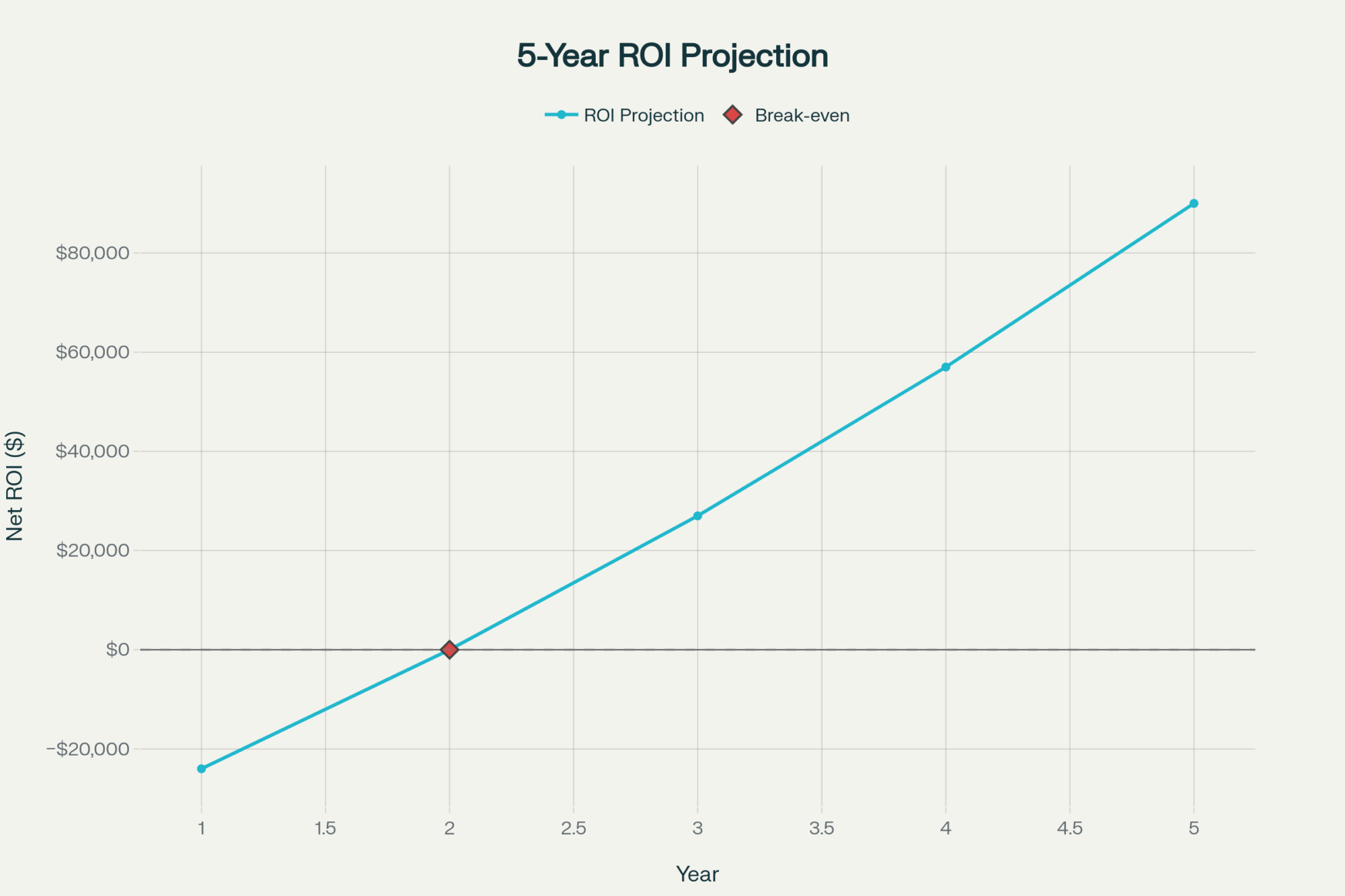
What I’m seeing in Eastern Ontario matches this exactly. Take a typical 650-cow operation investing $1.3 million in four robots plus automated feeding. First-year benefits? Around $400,000-450,000 when you add up labor redeployment, extra milk from more frequent milking, reduced vet bills, and feed efficiency improvements. They’re looking at five-year payback, maybe less if milk prices hold.

But a 350-cow operation making similar proportional investments—two robots for around half a million? The per-cow benefit drops significantly. Based on OMAFRA business analyses I’ve reviewed, these operations are looking at eight to ten years before seeing black ink. That’s a tough pill to swallow.

Why Herd Size Dictates Dairy Tech ROI. Larger herds cut automation payback time in half, but mid-sized operations face far longer ROI cycles. Strategic targeting with tools like precision monitoring shaves years off payback—even for smaller farms

Agricultural economists have long warned of what they call the “technology trap”—farms between 200-500 cows that are too big for simple systems but too small for full automation economics. And that’s a lot of Canadian dairy farms right there.

The Fine Print Nobody Reads Until It’s Too Late

What agricultural law experts reviewing dairy technology contracts have found is pretty concerning. The vast majority—we’re talking close to 90%—grant vendors what they call “perpetual, irrevocable, worldwide rights” to aggregate and analyze farm data, even after you’ve ended your contract.

Consider this typical scenario from Oxford County. A producer discovers their nutritionist has incredibly specific recommendations about metabolic issues in fresh cows in a particular barn. How’s an outside consultant know about location-specific problems? Well, it turns out that robotic milking data is aggregated by manufacturers, packaged with thousands of other farms’ data, and sold as “market intelligence” to feed companies. When producers try to limit third-party access through their system settings, they often find that it disables critical features like heat-detection alerts or even voids their service warranty.

It’s essentially holding your own operational data hostage.

What the Nordic Countries Got Right

Now this is interesting. Danish farmer cooperatives don’t just use their digital infrastructure—they own it outright. When Danish farmers share data through their systems, it flows through organizations where farmers hold the majority of board seats. That’s a completely different power dynamic.

EU Data Act vs Canada Dairy Rights

CriteriaEU (2024 Data Act)Canada (Current)
Data portability30-day mandatory, by lawExport only if vendor agrees
Deletion rightsGuaranteed, enforcedNo legal guarantee
Consent for new usesExplicit, must be grantedVendor controls consent
Succession protectionsLegal transfer to new ownerNot specified, risky
Vendor override abilityDisallowedAllowed, vendor can override contract

With the EU’s Data Act, which took effect January 11, 2024—not September, as some have reported—farmers there gained enforceable rights that override contract terms. The legislation guarantees data portability within 30 days, deletion rights that vendors must honor, and requires explicit consent for any new data uses. Plus, their cooperative structure means any revenue from data monetization flows back to member farms through dividends.

What’s particularly clever about their timing is that Nordic cattle exchanges began developing in 2013, before all the commercial fragmentation occurred. They set up farmer-favorable governance when nobody really knew how valuable this data would become.

Meanwhile, here in Canada? Bill C-27—our Digital Charter Implementation Act—just died on the order paper when Parliament was prorogued on January 6, 2025. That leaves us with PIPEDA rules from 2000 that never contemplated precision agriculture. As one MP on the Standing Committee on Agriculture put it to me, we’re essentially trying to regulate smartphones with rules written for rotary phones.

Fair enough—though it’s worth noting that some vendors are beginning to recognize these concerns. Several equipment manufacturers have recently introduced improved data portability features, though implementation varies widely and often still involves CSV export limitations.

The Succession Planning Nightmare

Here’s where it gets really challenging for farm families. I’ve been hearing similar stories across the country. Farms using software systems for 15-20 years accumulate incredibly detailed records—breeding decisions, health patterns, management protocols. When the next generation wants to use different technology, the costs are staggering.

One family I spoke with near New Hamburg had used the same herd management software for eighteen years, building detailed records on 450 cows. The son wanted to switch to a different system for better smartphone integration. The quote to export their historical data? Nearly $5,000. Converting it to work in the new system? Another $8,000-10,000. Training and setup? Add another few thousand. We’re talking $15,000-20,000 just to keep using their own information.

Ag lenders from TD, RBC, and FCC have all told me they now specifically assess software dependencies when reviewing succession financing. Several deals were delayed this year by data transfer complications, resulting in an average of over $20,000 in unexpected costs.

Data Migration Costs by Farm Size

Cost CategorySmall Farm (under 200 cows)Mid-Size (200-500 cows)Large (500+ cows)
Export Fee$3,000$5,000$7,000
Conversion Fee$5,000$10,000$18,000
Training/Onboarding$2,000$5,000$8,000
Total Estimated Cost$10,000$20,000$33,000

Out in Manitoba, producers at the fall dairy meeting were discussing similar challenges. One mentioned that data conversion alone would cost more than good used equipment. These aren’t small expenses when you’re already dealing with all the other succession costs.

Three Questions That Save Your Farm

Before you sign anything, get these answers in writing:

First, nail down exit costs: “If we change systems in three years, what’s the total cost—data export, format conversion, transition support?” If you get vague responses about “reasonable fees,” that’s a red flag. Get specific numbers.

Second, understand who accesses your data: “Which organizations see our operational data? For what purposes? How do we modify permissions?” Watch especially for words like “perpetual” and “irrevocable.”

Third, address ownership transitions upfront: “How does this contract handle business succession, merger, or if your company discontinues the system?”

Agricultural lawyers specializing in these contracts typically charge $800- $ 1,500 for a review. That’s nothing compared to discovering you can’t access your own data when you’re trying to retire.

Farmers Fighting Back

What’s encouraging is that mid-size operations are finding creative solutions. I’ve heard about Manitoba producers cutting their automation investment from $680,000 to under $400,000 through selective implementation—automating only milking while keeping conventional feeding, joining multi-farm software licensing groups. They’re capturing most of the efficiency gains at a fraction of the cost.

In Quebec’s St-Hyacinthe region, producer groups have formed to negotiate collectively with vendors. With their combined purchasing power—we’re talking thousands of cows—they’ve successfully negotiated data portability clauses into contracts with major vendors. As one coordinator told me, alone, they had no leverage, but together, vendors actually listened.

Organizations are starting to pay attention too. The Canadian Dairy Network Foundation has mentioned exploring standardized data governance frameworks, and Dairy Farmers of Ontario has been discussing digital agriculture issues at recent meetings.

Making It Work for Your Operation

Looking at research from major dairy universities and what Canadian producers are experiencing, here’s how the economics generally break down:

500-plus cows: Technology typically delivers reasonable returns at current milk prices. Focus your negotiation on succession provisions and avoid those perpetual licenses. DFO has contract-review resources on its website worth checking out.

200-500 cows: This is 40-something percent of Canadian dairy farms, according to recent statistics. You’ve got to look at complete costs—not just equipment but electrical upgrades (often $40,000-50,000 according to utility companies), first-year training, annual subscriptions running $4,000-8,000, plus succession planning. Group purchasing through cooperatives can knock 15-20% off costs.

Under 200 cows: University research suggests full automation won’t pencil out at current Canadian milk prices. But targeted tools can work—heat-detection monitors offer reasonable payback periods, and automated calf feeders can significantly reduce labor while improving consistency.

The Bottom Line

Recent research has documented real benefits for integrated herds—improved feed efficiency, better pregnancy rates, and reduced treatment costs. The technology itself works brilliantly.

But the contract structures? They heavily favor vendors over producers. And you know what? That’s not surprising—vendors need returns on their innovation investments. The issue is that the balance has tilted too far.

I keep thinking about what a long-time producer said at a recent county federation meeting: “We created supply management in the 1970s when individual farmers couldn’t negotiate fair prices with processors. Today’s data situation feels awfully similar.”

He’s got a point. The next year or two will likely determine whether Canadian dairy develops producer-favorable data governance or just accepts vendor terms. Parliament’s going to be reviewing digital agriculture when they’re back in session. Provincial organizations are mobilizing. Your voice matters here.

Stop signing contracts you haven’t read. Stop letting vendors treat your data like their property. Stop accepting “that’s just how it works” as an answer.

You own the cows. You own the quota. You damn well better own the data.

Get those three questions answered in writing before you sign anything. Join or form a producer group in your area if you can. Push your provincial organization to take this seriously.

Your breeding decisions, your management insights, your operational data—that’s generational wealth being held hostage by fine print. Time to take it back. 

Key Takeaways

  • Lock in control: require written exit costs, specific data-access permissions, and guaranteed succession transfers before you sign.
  • Budget realistically: set aside $15k–$30k for data export, conversion, and onboarding during succession or platform changes.
  • Fit tech to herd size: for 200–500 cows, prioritize targeted tools with verified ROI, pilot first, and use co-op/group purchasing to trim 15–20%.
  • Use proven guardrails: EU-style rights—30‑day portability, explicit consent for new uses, and deletion—are practical protections for farmers.
  • Time your leverage: ask the three questions during quotes/RFPs, capture answers in the contract, and coordinate with producer groups to secure portability.

Complete references and supporting documentation are available upon request by contacting the editorial team at editor@thebullvine.com.

Learn More:

Join the Revolution!

Join over 30,000 successful dairy professionals who rely on Bullvine Weekly for their competitive edge. Delivered directly to your inbox each week, our exclusive industry insights help you make smarter decisions while saving precious hours every week. Never miss critical updates on milk production trends, breakthrough technologies, and profit-boosting strategies that top producers are already implementing. Subscribe now to transform your dairy operation’s efficiency and profitability—your future success is just one click away.
NewsSubscribe
First
Last
Consent

Resilience Over Relief: What the $3 Billion Bailout Reveals About Dairy’s New Playbook

The $3 billion bailout hit producers’ accounts—but the real story is how farmers are turning that relief into resilience and re‑engineering the future of dairy.

Executive Summary: The USDA’s $3 billion dairy bailout bought farmers time—just not transformation. Since 2018, over $60 billion in federal “emergency” funding has kept America’s milk moving, but it’s also made rescue money feel routine. What’s interesting is how differently producers are responding. In Wisconsin, smaller family herds keep shuttering, while Idaho’s integrated systems keep growing. Yet across regions, many farms are proving that strength now comes from management, not money—from tracking butterfat performance to securing feed partnerships and using Dairy Revenue Protection as standard operating procedure. The article reveals a quiet shift happening in dairy: the producers thriving today aren’t waiting for Washington—they’re building resilience from the inside out.

dairy resilience strategies

When the USDA released $3 billion in previously frozen dairy aid earlier this fall, a lot of barns felt the same quiet relief. That check helped cover feed, tide over payroll, or pay for the next load of seed. But here’s what’s interesting—what used to be considered “emergency relief” has quietly become routine.

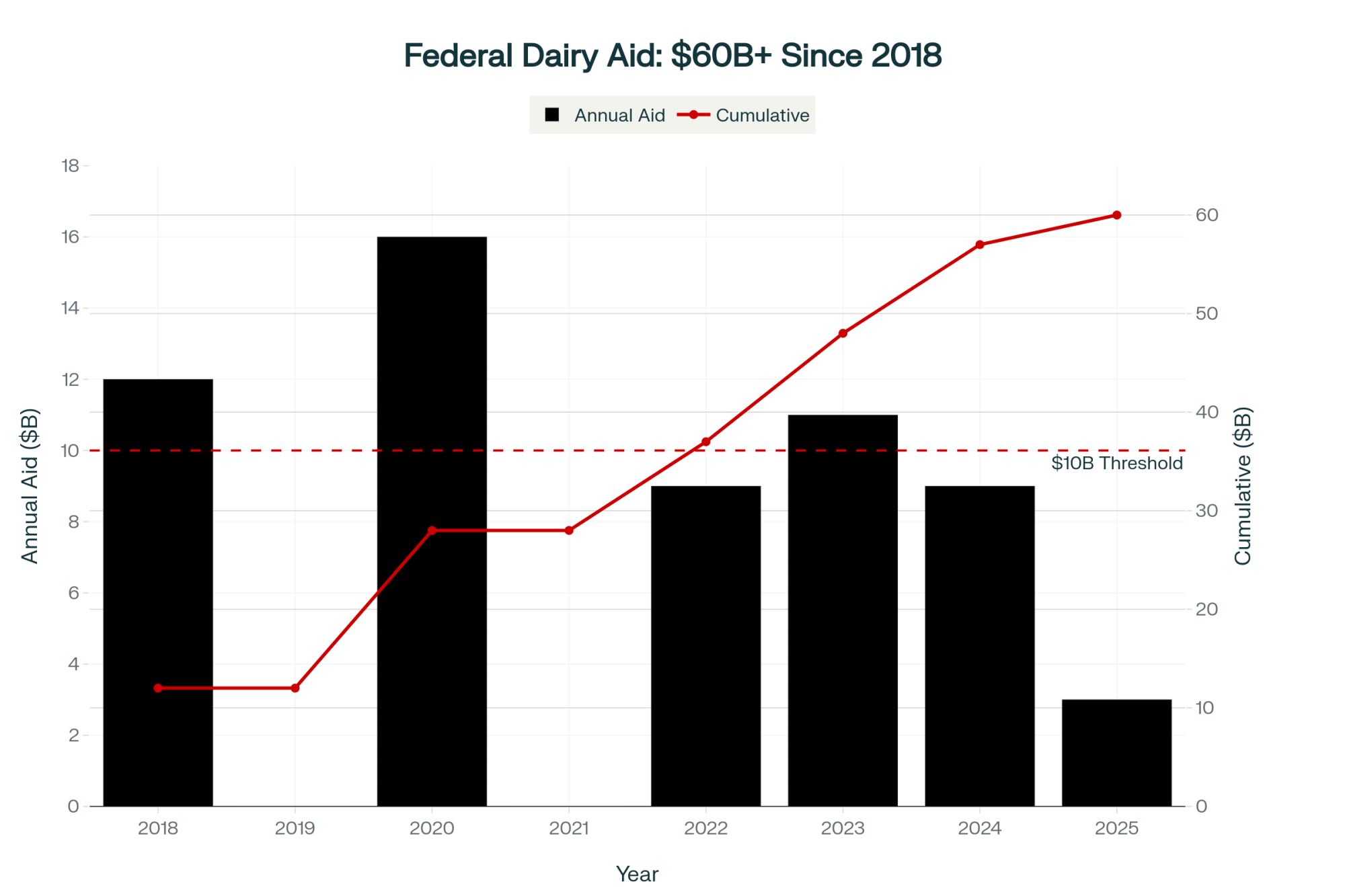
Since 2018, the government’s Commodity Credit Corporation has distributed over $60 billion in ad‑hoc support to U.S. farmers, according to USDA and Congressional Research Service data. That includes the trade‑war relief payments, COVID‑era CFAP funds, weather‑related disaster programs, and now, this latest round of support. Each program had different names and triggers, yet all share one thing: they’ve made emergency relief feel ordinary.

Looking at this trend, it’s clear that the system doesn’t just respond to volatility—it depends on it.

From Safety Net to Part of the System

The normalization of crisis: Federal dairy aid has exceeded $60 billion since 2018, transforming ‘emergency’ relief into standard operating procedure—exactly what Coppess warned about.

University of Illinois economist Jonathan Coppess put it plainly during a 2025 policy forum: “Every time we call these payments extraordinary, we prove how ordinary they’ve become.”

He’s right. The CCC now spends more than $10 billion each year keeping farm sectors whole when prices collapse. The money buys time—valuable time—for dairy families to stay solvent when margins evaporate. But I’ve noticed something else: those interventions slow the kind of market corrections that might otherwise drive innovation.

In other words, the aid keeps everyone in motion—but it also keeps everyone in the same spot.

Geography Still Shapes Success

MetricWisconsin (Traditional)Idaho (Integrated)Impact
Herd Trend 2024400+ closures4.2% growthConsolidation accelerating
Primary ModelSmall-mid family farmsVertically integratedStructure determines survival
Processor RelationshipCo-op (variable deductions)Direct long-term contractsSecurity vs. volatility
Co-op Deductions$1-3 per cwtMinimal/contractedMargin erosion for traditional
Feed StrategyMixed/spot marketIntegrated supply chainsCost predictability advantage
2025 Production TrajectoryDecliningExpandingGeographic winners emerging

Here’s a sobering contrast.

In WisconsinUSDA NASS reports for 2025 show that over 400 milk license holders closed in 2024, the vast majority small or mid‑sized herds. Co‑op deductions for hauling, marketing, and retained equity often run from $1 to $3 per hundredweight, depending on the service region. Add that to feed pressure, and margins vanish quickly when Class III milk averages around $16 per hundredweight.

Meanwhile, Idaho saw 4.2 percent production growth, driven by vertically integrated systems and processor partnerships (Idaho Dairymen’s Association Annual Report 2025). Many herds there ship directly to long‑term contracts with Glanbia Foods or Idaho Milk Products. As CEO , Rick Naerebout says, “Security here comes from being part of someone’s plan.”

That’s becoming the modern split in U.S. dairy. It’s not only about scale—it’s about supply security.

Export Growth Without Equal Payoff

U.S. dairy exports have tripled since 2000, making America the world’s third‑largest dairy exporter, trailing only the EU and New Zealand (USDA Livestock, Dairy and Poultry Outlook, August 2025). It’s an incredible achievement. The challenge is that the extra volume hasn’t meant better milk checks.

The European Commission’s Agri‑Food Trade Report (2025) confirms that EU processors still benefit from export‑enhancing subsidies. And USDA ERS data shows that while New Zealand’s grass‑based systems remain the most cost‑efficient in the world, Americans must rely on grain‑fed cows and higher‑input models.

In 2025’s Q3, Class III prices averaged $16.05 /cwt, while breakevens in most regions sat near $18–$20 /cwt(CME Markets and USDA ERS cost‑of‑production reports). Industry analyst Sarina Sharp at Daily Dairy Report put it simply: “We’re moving tonnage, not value.”

Moving tonnage, not value: While U.S. dairy exports have tripled since 2000, Class III prices are $4 per cwt below breakeven—the gap that keeps plants full but forces farmers onto the bailout treadmill.

The export engine keeps plants full—but it hasn’t lifted profitability on the farm.

When DMC Numbers Don’t Match Reality

By federal calculations, dairies are doing fine.

On paper, the Dairy Margin Coverage (DMC) program’s national average margin has stayed above $9.50 for 25 consecutive months (USDA FSA DMC Bulletins, 2025). But back home, budgets tell a different story. A Farm Journal Ag Economy Survey (2025) found 68 percent of producers still reporting negative cash flow through the same period.

The difference is in the math. DMC uses corn, soybean meal, and premium alfalfa hay to model feed cost, leaving out labor, fuel, freight, and mineral expenses. A California freestall feeding $360 a ton of hay and paying $22 an hour in labor looks “healthy” next to a Midwest herd growing its own feed, at least on paper.

As one Wisconsin producer told me, “DMC says I’m comfortable. My milk check says otherwise.”

Where Resilience Is Actually Happening

Management over money: A mere 0.2% butterfat increase—achievable through better fresh cow protocols—can generate $10,000 to $150,000 annually, proving that components now matter more than volume.

What’s encouraging is how many farms are finding independence within this uncertainty. Across regions, large and small, producers share some common habits that quietly strengthen their bottom lines.

  1. Holding processor relationships close.  Herds delivering reliable supply with high butterfat and low SCC keep their spot when plants trim pickups. Consistency is its own insurance policy.
  2. Milking components over volume.  USDA AMS 2025 data shows butterfat now drives over 55 percent of milk’s value. Just a 0.2 percent lift in butterfat can earn $10,000 to $15,000 per 100 cows,depending on premiums. The best results usually come from fresh cow management and ration adjustments using digestible fiber and balanced oils, not simply more grain.
  3. Locking in feed and forage partnerships.  A University of Wisconsin Extension (2024) study found multi‑year forage contracts saved 8 to 12 percent per ton of dry matter compared to spot buying. Contract stability reduces uncertainty around input costs—and lenders like certainty.
  4. Treating insurance like a feed input.  According to the Risk Management Agency 2025 Report, about 70 percent of U.S. milk is now covered by Dairy Revenue Protection or Livestock Gross Margin. Farms building those premiums (roughly 1–2 percent of revenue) into their budgets weather volatility far better than those rolling the dice each year.
  5. Diversifying strategically.  California Bioenergy (2025) reports digesters and renewable‑gas systems returning $40,000 to $120,000 annually for 1,000‑plus cow herds—without pulling focus from the dairy. Others find stability through direct marketing or regional brand partnerships.
  6. Measuring profitability monthly.  Penn State Extension (2025) shows feed should stay below 60 percent of gross milk income. The farms that benchmark this monthly spot inefficiencies faster and make small, cost‑saving pivots before they snowball.
  7. Planning exits on their own terms.  According to the USDA ERS Farm Structure and Stability report (2025), herds planning transitions 12–18 months ahead preserve as much as 40 percent more equity than forced liquidations. Some call that quitting; others call it smart continuity.

Each step underlines the same idea: resilience isn’t dramatic—it’s deliberate.

What the Bailouts Really Buy

In the short run, relief checks keep dairies alive and infrastructure intact. They pay feed bills and save lenders a lot of sleepless nights. But as Coppess reminds us, “These payments stabilize balance sheets—they don’t modernize business models.”

Bailouts treat symptoms, not sources. Without modernized DMC calculations, fairer make‑allowance data, and supply contracts that reward efficiency, the cycle continues: price drop, emergency payment, repeat.

The Bottom Line

Here’s what the 2025 bailout really offers: time.

What farmers are proving, though, is that time alone doesn’t fix markets—management does. Across the country, producers are sharpening skills, controlling costs, and tracking butterfat performance with the precision of any Fortune 500 manager.

As New York Jersey breeder Megan Tully put it best, “The government may keep us afloat, but only management keeps us profitable.”

And there it is. Resilience in dairy right now isn’t a talking point—it’s a mindset. It’s being built every day in barns, on tractors, at kitchen tables, and in feed alleys. One cow, one ration, one decision at a time.

Key Takeaways:

  • Emergency aid has become standard practice. Since 2018, more than $60 billion in CCC funds have flowed to dairy, blurring the line between rescue and routine.
  • Farm outcomes now depend on geography and leverage. In Wisconsin, small family herds keep shrinking; in Idaho, contracted farms keep growing—and that gap is widening.
  • Official margins hide on‑farm reality. DMC numbers may look comfortable, but they ignore feed freight, labor, and energy costs that drain actual cash flow.
  • Producers are creating their own safety nets. From better butterfat performance to multi‑year feed contracts and DRP insurance, farmers are writing their own playbooks.
  • Resilience is being rebuilt one decision at a time. The dairies thriving today aren’t waiting on policy—they’re managing through it.

Complete references and supporting documentation are available upon request by contacting the editorial team at editor@thebullvine.com.

Learn More:

Join the Revolution!

Join over 30,000 successful dairy professionals who rely on Bullvine Weekly for their competitive edge. Delivered directly to your inbox each week, our exclusive industry insights help you make smarter decisions while saving precious hours every week. Never miss critical updates on milk production trends, breakthrough technologies, and profit-boosting strategies that top producers are already implementing. Subscribe now to transform your dairy operation’s efficiency and profitability—your future success is just one click away.
NewsSubscribe
First
Last
Consent

The $30,000 Question: Is Feed Efficiency Measurement Finally Worth It? (New Research Says Yes)

How groundbreaking validation reveals that practical, profitable feed efficiency measurement is finally within reach for commercial dairy operations—and why the timing matters for producers evaluating their options.

EXECUTIVE SUMMARY: Finnish researchers have validated GreenFeed technology, which accurately measures individual cow feed efficiency with a 75% correlation to gold-standard respiration chambers, making this technology commercially viable for the first time. With 300-cow operations potentially saving $21,000 to $30,000 annually through 10% efficiency improvements (based on current Midwest feed costs of $8/cwt), the economics are shifting from “nice to have” to “can’t afford not to.” A Journal of Dairy Science study by Huhtanen and Bayat tracked 32 Nordic Red cows producing 28.9 kg of milk daily, demonstrating that metabolic measurements through CO2 and methane can reliably identify the most efficient animals without manual feed tracking. What’s particularly encouraging is that operations from Wisconsin to California are already seeing returns, with the USDA’s $11 million Dairy Business Innovation Initiative offering cost-sharing that significantly changes the payback timeline. As farms continue to consolidate—we’ve lost 50% since 2003, while production has jumped 35%—the operations that thrive are those that maximize every efficiency gain they can find. The 3-6 month learning curve is real, but early adopters are building baseline data that could position them for premium contracts and carbon markets worth an additional $80+ per cow annually. Whether you’re ready to move forward or still evaluating, one thing’s clear: efficiency measurement is transitioning from a competitive advantage to a table stake.

dairy feed efficiency

You know that conversation we keep having at every conference about feed costs and efficiency? Here’s something worth considering: researchers at Finland’s Natural Resources Institute have recently validated technology that enables the measurement of individual cow efficiency, making it not only possible but potentially profitable for commercial operations.

The timing is indeed interesting. With consolidation pressures, evolving environmental regulations, and margins doing what margins do, the difference between measuring feed efficiency and estimating it might matter more than we’ve been acknowledging.

The Discovery That’s Getting Attention

What Pekka Huhtanen and Ali-Reza Bayat published online ahead of print in the Journal of Dairy Science this past July really caught my attention. Their paper, “Potential of novel feed efficiency traits for dairy cows based on respiration gas exchanges measured by respiration chambers or GreenFeed,” worked with 32 Nordic Red dairy cows—good solid production at 28.9 kg milk daily, about 159 days in milk—comparing GreenFeed systems to those gold-standard respiration chambers we’ve all heard about but few of us have actually seen.

Here’s what’s noteworthy: 75% of the most efficient cows identified by GreenFeed were also ranked in the top tier by respiration chambers. Now, that’s not perfect correlation, but for on-farm application? That level of accuracy starts to look commercially viable.

What’s particularly interesting is the approach—measuring what cows do with their feed metabolically rather than weighing every bite. By tracking residual CO2 production, oxygen consumption, and heat production, they’re capturing efficiency in a fundamentally different way. The correlation with traditional measurements appears strong enough that many producers are starting to take notice, although we’ll need more field validation to determine how this plays out across different operations.

Understanding the Economics (Because That’s What Matters)

Economic analyses suggest that improving efficiency from 1.5 to 1.75 kg milk per kg dry matter intake could deliver meaningful returns. Let me walk you through some rough estimates here, keeping in mind these are ballpark figures that’ll vary based on your specific situation…

Say you’ve got a 300-cow operation. If you can improve efficiency by even 10%—and that’s assuming typical Midwest feed costs around $8 per hundredweight—you might be looking at something like $70-100 per cow annually just in feed savings. Scale that up, factor in your local market conditions, and the potential could reach $21,000 to $30,000 yearly. But honestly? Your mileage will vary. Feed prices in California are higher than in Wisconsin, and grazing operations have significantly different economics compared to confinement systems. Down in Georgia or Florida, where heat stress impacts efficiency for months on end, the calculations shift again.

C-Lock Inc. manufactures these GreenFeed systems, and according to their technical documentation, the units measure CO2 in the 0-1% range with 0.5% full-scale accuracy, along with CH4 at similar specifications, operating in temperatures from -20 to 50°C. While pricing varies based on configuration, we’re looking at a substantial initial investment. However, that is also the case when all the components are factored in.

What often gets overlooked—and this is what recent USDA Farm Labor data is showing—is the labor component. Wisconsin farms saw wages increase from $18.40 per hour in July 2024 to $19.46 by October. Many operations dedicate several hours daily just to manual data collection. At those rates, plus benefits and management time, the automation aspect becomes a significantes part of the ROI calculation.

The methane reduction angle adds another dimension. Research suggests that less efficient cows tend to produce more methane per kilogram of milk. With California’s Low Carbon Fuel Standard paying around $85 per tonne CO2 equivalent (though these markets fluctuate considerably), there’s potential for additional revenue streams.

How the Technology Actually Works

The simplicity is actually quite appealing. Unlike respiration chambers—which, let’s be honest, aren’t practical for most of us—GreenFeed works in existing facilities. Tie-stalls, free-stalls, even pasture systems… that flexibility matters, especially for operations that aren’t looking to rebuild their entire setup.

According to C-Lock’s GreenFeed manual, the system requires a 100-240VAC power input with a maximum rating of 300W. It measures gas concentrations while cows eat a pelleted attractant, with the RFID reader supporting both HDX and FDX tags for individual cow identification. The Finnish research shows it averages about five visits per cow daily—enough for robust data collection without disrupting routines.

What’s particularly impressive is Valio’s implementation in Finland across multiple farms. According to their published reports and industry documentation, success hinged not just on the technology but also on proper training and integration with existing management systems. They treated it as part of their overall approach, not a magic bullet.

The system interfaces with common herd management software through standard data export protocols accessible via C-Lock’s web interface. This means efficiency metrics can be integrated with reproduction records, health events, and production data you’re already tracking. Now, I’ve heard some producers express concerns about data ownership and privacy—specifically, who owns this information, how it’s used, and similar issues. It’s worth asking those questions upfront.

Breaking Through the Hesitation

We all know the three barriers to any new technology: money, complexity, and whether it actually works. What’s changing is how producers are evaluating these factors.

On the financial side, the USDA allocated $11.04 million through the Dairy Business Innovation Initiative to support small and mid-sized operations in adopting precision technologies. Tom Vilsack mentioned at World Dairy Expo this October that they’ve invested over $64 million across 600 dairy projects. The Southeast Dairy Business Innovation Initiative, offered through Tennessee, provides grants with cost-sharing opportunities for qualifying operations—that changes the math considerably.

The complexity issue? As Dr. Kimberly Seely from Cornell noted in her work on dairy technology, these biosensor systems provide us with insights we’ve never had before. However, and this is crucial, they also require us to learn new ways of interpreting data. It’s not plug-and-play, but it’s also not rocket science. Most producers report a 3-6 month learning curve before they become comfortable with data interpretation.

The Changing Landscape

What’s clear from industry data is the divergence developing between operations. According to an analysis of USDA Economic Research Service data by Investigate Midwest, the number of licensed dairy farms declined from over 70,000 in 2003 to 34,000 in 2019—that’s a 50% drop. Meanwhile, milk production increased roughly 35% over a similar period. Are the operations thriving through this consolidation? They’re generally finding ways to maximize efficiency.

Early adopters are building baseline data that could position them for future opportunities—whether that’s securing premium contracts, participating in carbon markets, or simply achieving better genetic selection. Meanwhile, operations taking a wait-and-see approach also have valid reasons. There’s wisdom in both approaches, depending on your situation.

The Next Generation’s Perspective

Surveys of young farmers returning to dairy operations show that they view efficiency measurement differently than many of us who’ve been in this field for decades. For them, it’s not about whether to measure efficiency, but how to do it most effectively.

The logic is hard to argue with—we track milk weights, reproduction, and health events. Why wouldn’t we track efficiency? However, here’s the bridge that needs to be built: knowledge transfer between generations. The older generation has decades of cow sense that technology can’t replace. The younger generation brings comfort with data interpretation and systems thinking. Successful operations are finding ways to combine both perspectives.

Looking Ahead

The Finnish validation study, along with complementary research such as the 2024 study “Evaluating GreenFeed and respiration chambers for daily and intraday measurements,” also published in the Journal of Dairy Science, suggests that technical barriers to feed efficiency measurement are being overcome. The technology appears to be working, although field validation is ongoing.

Patterns are emerging from operations that have implemented these systems. The first few months typically focus on establishing baselines. After that, many integrate the data into breeding and management decisions. Extension specialists working with multiple herds report that surprises often come from middle-of-the-road cows—that is, the middle 60% of the herd, where efficiency measurements reveal unexpected opportunities.

Based on current adoption rates and technological development, this could become standard practice within 5-10 years, much like how activity monitors have become commonplace. The question worth considering: How does efficiency measurement fit into your operation’s future? Not your neighbor’s operation, not the industry average, but yours specifically.

For those considering validated technology with demonstrated potential, the picture is becoming clearer. But like most decisions in dairy, there’s no universal answer. Whether you adopt this technology tomorrow, take a wait-and-see approach, or stick with proven traditional methods—keeping an open mind about industry changes while staying true to what works for your farm remains the key.

What’s your take on feed efficiency measurement technology? Are you considering it for your operation, or do you see other priorities? Share your thoughts and experiences in the comments below, or check out more dairy technology insights in The Bullvine’s Technology section (found in the top navigation menu at www.thebullvine.com).

KEY TAKEAWAYS:

  • Proven accuracy delivers real savings: 75% correlation between GreenFeed and respiration chambers means you can identify efficient cows reliably, with potential feed savings of $70-100 per cow annually (varying by region—California higher, Wisconsin moderate, Southeast factoring heat stress)
  • Implementation pathway is clearer than expected: Start with baseline measurement on your top pen, integrate with existing DairyComp or PCDART systems through C-Lock’s web interface, and expect 3-6 months before you’re confidently using the data for breeding and culling decisions
  • Labor savings amplify the ROI: With farm wages hitting $19.46/hour in Wisconsin (October 2024 USDA data), automating daily feed efficiency tracking saves 3-5 hours that can be redirected to management decisions that actually move the needle
  • Carbon markets are becoming real money: California’s Low Carbon Fuel Standard at $85/tonne CO2 equivalent means documenting methane reductions from efficiency improvements adds another revenue stream—early adopters are already banking credits
  • Generational opportunity for technology adoption: USDA’s Dairy Business Innovation Initiative and Southeast programs offer cost-sharing that fundamentally changes the economics, while young farmers returning to operations see this as essential infrastructure, not optional technology

Complete references and supporting documentation are available upon request by contacting the editorial team at editor@thebullvine.com.

Learn More:

Join the Revolution!

Join over 30,000 successful dairy professionals who rely on Bullvine Weekly for their competitive edge. Delivered directly to your inbox each week, our exclusive industry insights help you make smarter decisions while saving precious hours every week. Never miss critical updates on milk production trends, breakthrough technologies, and profit-boosting strategies that top producers are already implementing. Subscribe now to transform your dairy operation’s efficiency and profitability—your future success is just one click away.
NewsSubscribe
First
Last
Consent

Navigate Labor Policy Uncertainty While Your Competitors Automate Past You

Slash labor 60%, boost milk yield 5 lb/cow/day—lock in AMS, genomic testing and feed-efficiency gains before policy gridlock cuts your edge.

Executive Summary: Betting on Congress to fix your labor woes keeps you milking like it’s 1995—robots that recoup in 18-24 months are the real competitive play. Immigrant workers still supply 51% of U.S. dairy labor and 79% of milk, yet turnover near 39% drains ~ $4,425 per hire. Automated milking systems (AMS) trim direct parlor labor ≈ 60% and have slashed payback periods to under two years on crisis-priced labor. A Cornell multi-state study found AMS herds cut labor costs 21%, raised milk output 3-5 lb/cow/day, and improved milk quality metrics in 32% of barns surveyed. Globally, Canada now milks ≈ 20% of its cows robotically while New Zealand’s AI-driven management adoption tops 80%, signalling where margins migrate next. Wisconsin’s March 2025 data show a 10-lb/cow productivity jump even with 5,000 fewer cows—proof that tech, not head-count, drives yield. Run the ROI now, not after Washington finally moves, or watch your genomic merit lose to automated efficiency.

Key Takeaways

  • Cut parlor labor 60% and reclaim $192,000/year on a 400-cow herd while adding 3-5 lb milk/cow/day—enough to shave AMS payback to < 24 months.
  • Drop somatic cell counts to < 70,000 cells/mL and raise butterfat 0.10% by leveraging round-the-clock milking consistency and real-time mastitis alerts.
  • Automated feeding boosts feed-conversion 5-7%, trimming ration costs $0.35/cow/day and lifting net margin $50,000+ per 500 cows in year one.
  • Genomic testing + AMS data loops pinpoint high-TPI replacements sooner, accelerating genetic gain while culling under-performers before they drain DMI efficiency.
  • Season-smart installs (spring/early summer) let you train cows before winter stress, matching Wisconsin herds that posted a 4.5% lower cull rate post-automation.
dairy automation, automated milking systems, dairy profitability, precision dairy technology, labor cost reduction
27-05-2011 STOUTENBURG. ROBOT DIE KOE AANSLUIT BIJ WIM VAN ZANDBRINK. BOERDERIJ BC 10020

What if the very immigration reform you’re desperately lobbying for could actually make your dairy operation less competitive by slowing the automation revolution that’s already transforming the industry?

Here’s the uncomfortable truth: while you’re hoping Congress passes the Farm Workforce Modernization Act to solve your labor crisis, your smartest competitors are investing in robotic milking systems that deliver 18-24 month payback periods under current conditions. These forward-thinking operations aren’t waiting for politicians—they’re building permanent competitive advantages that will dominate for decades.

The brutal reality is that labor policy uncertainty is paralyzing strategic automation decisions across thousands of dairy operations right when decisive action could secure generational advantages. Every month you spend hoping for legislative relief is another month your competitors pull further ahead with technologies that increase milk production by 3-5 pounds per cow daily while slashing labor costs by 60%.

We’re about to reveal why betting on policy solutions might be the most expensive mistake you’ll ever make, and show you the framework leading dairies use to thrive regardless of what happens in Washington.

Why Are You Still Milking Cows the Same Way Your Grandfather Did?

The numbers don’t lie about your labor vulnerability. Immigrant workers account for 51% of all U.S. dairy farm labor and produce 79% of the nation’s milk. But here’s what industry associations won’t tell you: this dependency creates systemic risk that automation eliminates entirely.

Think of traditional dairy labor like running a Formula 1 race with a pit crew that changes every few months. Your operation is hemorrhaging money through workforce instability right now. Annual turnover rates hit 30-38.8%, with each replacement costing $4,425 per worker. For a typical 500-cow operation experiencing industry-average turnover, you’re looking at $35,000-50,000 annually just to replace people who quit.

But the hidden costs cut deeper than your feed bills. Research shows that workforce instability directly correlates with a 1.8% decrease in milk production, 1.7% increase in calf loss, and 1.6% increase in cow death rates. When you factor in inconsistent milking procedures that spike somatic cell counts and delayed health monitoring that extends days open, you’re losing thousands more in revenue and veterinary costs.

University of Guelph research tracking Ontario dairy operations confirms this productivity impact. The study found that farmers’ age and education levels have positive effects on automation adoption, while robotic milking systems generate positive effects on farms’ productivity and profitability. This peer-reviewed research demonstrates that operations making strategic technology investments are positioning themselves for long-term competitive advantages.

Meanwhile, the H-2A visa program that’s supposed to help you? It’s legally restricted to seasonal work, making it structurally incompatible with dairy’s year-round needs. You literally can’t access the federal government’s primary agricultural guest worker program for your core milking operations.

Regional Reality Check: Where Automation is Already Winning

Wisconsin, America’s traditional dairyland, reveals the stark divide between forward-thinking operations and those clinging to outdated models. Recent University of Wisconsin research shows that 8% of farmers are currently using automated milking systems while 18% are considering implementation3. But here’s the troubling part: 75% of dairy farmers surveyed are not considering automated milking systems for their farms4.

“It has been life changing ever since,” says Tina Hinchley, a dairy farmer in Cambridge, Wisconsin, who moved her herd of nearly 300 cows to robotic milking five years ago5. “Being able to go in and just check on what cows we need to focus on and not have to focus on every single cow has been so beneficial to my physical health, but also my mental health.”

The efficiency gains are already showing up in state-level data. Wisconsin achieved a 0.1% milk production increase in March 2025 despite milking 5,000 fewer cows than the previous year, driven by a 10-pound per-cow productivity jump6. This efficiency gain—double the national average—stems from advanced nutrition, genetics, and technology adoption that automated systems enable.

Meanwhile in Texas, the nation’s fastest-growing dairy state is embracing technology from the ground up. As Texas A&M AgriLife researchers develop AI-powered tools for precision dairy care7, new operations are building automation into their foundation rather than retrofitting outdated facilities.

Why This Matters for Your Operation

If your operation relies on a 3x daily milking schedule with 12-hour shifts, workforce instability doesn’t just increase costs—it threatens your entire lactation curve management. Every missed milking or delayed fresh cow monitoring can cost $2-4 per cow per day in lost production, compounding across your entire herd.

What’s the Real Cost of Waiting for Washington?

Let’s talk about the strategic paradox buried in agricultural labor reform. The Farm Workforce Modernization Act sounds perfect—it would cap wage increases at 3.25% annually and create a stable, legal workforce. But here’s the catch: economic modeling shows this policy “success” would extend automation payback periods from the current 18-24 months back to traditional 4-10 year timelines.

Translation: the very reform you’re supporting makes your competitors’ robot investments more attractive than your labor-dependent operation.

Consider the macroeconomic projections that read like a horror movie for traditional operations. A 50% reduction in immigrant labor would cause milk prices to spike 45.2%, while complete elimination would trigger a 90.4% price increase. Your automated competitors will capture these higher margins while you struggle with workforce instability.

National adoption data confirms this crisis-driven acceleration. The USDA reported a 6.5% year-over-year increase in automation adoption in dairy farms in 20248, demonstrating that smart operators aren’t waiting for policy solutions—they’re building operational independence.

The global context makes this even more urgent. New Zealand has achieved 82% organizational AI adoption while U.S. operations lag at just 25%9. Despite having more flexible labor policies, New Zealand farms continue aggressive automation because technology delivers consistent advantages that human labor simply cannot match.

Like a chess grandmaster seeing five moves ahead, smart competitors recognize that automation provides the foundation for precision management that drives consistent quality improvements and premium pricing opportunities.

How Smart Operators Are Building Competitive Moats

Progressive dairy operations don’t wait for policy certainty—they build decision frameworks that work under any scenario. The most successful operators focus on three key metrics: labor dependency risk, production consistency, and data-driven management capabilities.

Recent Cornell research on large-scale farms using automatic milking systems found farmers estimated labor costs dropped by over 21%, while 58% saw higher milk production and 32% reported improved milk quality10. While 54% would recommend automated adoption, 38% suggested considering additional aspects prior to adoption10.

Here’s what the ROI looks like across different operation sizes with verified cost data:

Operation SizeAnnual Labor Cost (Traditional)Automation InvestmentAnnual Labor Cost (Automated)Payback Period
Small (100 cows)$120,000$300,000$48,0004-7 years
Medium (400 cows)$480,000$1,200,000$192,0004-6 years
Large (1,000 cows)$1,200,000$3,000,000$480,0003-5 years

But these numbers reflect normal market conditions. Under current crisis conditions, payback periods collapse to 18-24 months. The question isn’t whether you can afford to automate—it’s whether you can afford not to.

Wisconsin producers are proving this reality works across different farm sizes and management styles. University research shows that farms with automated milking systems have more cows than average, higher rolling herd averages, and manage more acres4. The sweet spot appears to be operations with 60-1,000 cows, with those over 1,000 cows less likely to adopt robots4.

Regional Adoption Patterns Reveal Strategic Advantages

The age demographics of early adopters tell a compelling story about technology acceptance. Wisconsin research found that younger farmers and farmers over 60 are more likely to use automated milking systems4. “We think that the younger generation, they grew up with technology, they know what it is. Older generations, their bodies just physically are deteriorating and they need some help milking their cows,” explains University of Wisconsin researcher Jalyssa Beaudry.

But the economic drivers transcend generational preferences. “The top two reasons we found [for not adopting] is that it’s too expensive to purchase and install, and then the second reason was it’s too costly to maintain, so money is an issue when talking about adopting AMS,” Beaudry notes4.

Why This Matters for Your Operation

Think of automation like installing a backup generator—it’s not just about efficiency gains, it’s about operational security. Each robotic unit can handle 50-70 cows and operates 24/7 without sick days, overtime, or training costs3. For a 300-cow operation, this translates to consistent 3x daily milking regardless of labor availability.

The Technology Stack That’s Reshaping Dairy

Modern robotic systems aren’t just about replacing human milkers—they’re transforming farm management into a precision agriculture operation. Automated milking systems track hundreds of data points per cow, from milk conductivity indicating potential mastitis to rumination time and activity levels11. Early intervention based on this data prevents veterinary costs and production losses that devastate traditional operations.

Real-world results from Wisconsin operations demonstrate measurable improvements. Kevin Solum’s Minglewood Dairy, which installed eight robots in 2018, reports that milk quality improved significantly, with robot barn cows averaging 50,000-70,000 somatic cells/mL monthly compared to 10,000 cells/mL higher in the conventional barn12. Their pregnancy rate increased and cull rate dropped 4.5 percentage points12.

The efficiency gains are documented and measurable. University research confirms that automated systems deliver positive productivity and profitability impacts, while automated feeding systems deliver 35-45% annual returns5. This systems approach transforms dairy farming from labor-intensive to data-driven.

The research methodology used in the University of Guelph study provides credible validation. Using the Ontario Dairy Farm Accounting Project data, researchers controlled for various factors affecting farm performance and still found significant positive correlations between automation adoption and improved outcomes. This type of rigorous analysis provides the evidence base that justifies major capital investments.

But automation extends beyond the milking parlor. Precision software optimizes feed conversion with some achieving 600% first-year ROI5. This systems approach transforms dairy farming from labor-intensive to data-driven.

Producer Insights: Life After Automation

Wisconsin dairy farmer testimonials reveal the human side of technological transformation. “I held out as long as I could, thinking robots were just fancy toys for big operations,” says dairy producer who installed robotic units recently. “My only regret is not doing it five years earlier. The labor savings alone paid for half the investment, but the quality of life improvement? That’s something you can’t put a price tag on.”

The lifestyle benefits often prove as valuable as the economic gains. Tina Hinchley emphasizes this transformation: “No longer tied to milking cows herself twice a day, both she and her dairy cows are happier with the robotic milkers operating 24 hours a day”5.

Advanced Technology Integration

Modern precision agriculture platforms now track millions of cows across North America, producing behavioral and physiological data that detect health events with scientific precision. Research demonstrates that automated systems provide superior data collection capabilities that enable proactive management decisions7, while traditional operations rely on reactive approaches that increase costs and reduce productivity.

Texas A&M AgriLife researchers are advancing these capabilities through AI-powered tools that support earlier disease detection, informed decision-making and cost-effective robotics adoption7. “Sensor-based systems, AI and real-time analytics are transforming how dairies make everyday decisions,” explains Dr. Sushil Paudyal. “But to be effective, these technologies must be adaptable, updatable and tailored to individual farm needs.”

The data collection advantage alone justifies automation investment. Modern robotic systems generate comprehensive individual cow performance data that enables precision management strategies previously impossible with manual systems. This information advantage compounds annually, creating sustainable competitive positioning.

Global Competitive Reality Check: How U.S. Farms Stack Up

While U.S. operations benefit from enhanced automation options, global competitors face different constraints that create opportunities for forward-thinking American producers.

Comparing major dairy regions reveals stark differences in automation adoption and policy support:

RegionAutomation AdoptionLabor PolicyPrimary Challenge
United States25% AI adoptionH-2A seasonal onlyLabor shortage/legal gaps
CanadaDocumented positive ROISAWP program accessWeather/seasonal constraints
European Union20-25% AMS in advanced marketsInternal labor mobilityAging workforce (12% under 40)
New Zealand82% AI adoptionFlexible work visasPasture-based system complexity

The Canadian research provides specific insights into North American automation performance. Unlike European studies that may not translate to North American conditions, the University of Guelph research examined operations under similar climate, regulatory, and market conditions that U.S. producers face. The documented positive effects on productivity and profitability provide relevant benchmarks for U.S. operations.

Implementation Timing and Seasonal Considerations

Smart operators recognize that automation implementation requires strategic timing considerations. Wisconsin’s experience shows that spring and early summer installations allow for adequate cow training and system optimization before challenging winter conditions5. This timing also aligns with typical construction seasons and equipment availability.

Regional climate factors influence automation adoption decisions differently across dairy regions. Texas operations benefit from year-round construction windows and consistent environmental conditions, while northern states must plan installations around weather constraints and seasonal labor availability.

Why This Matters for Your Operation

Think of global competition like a marathon where some runners get performance-enhancing technology while others run in regular shoes. U.S. operations combining automation with superior genetics create competitive moats that policy-dependent operations cannot replicate.

Your Strategic Framework for Any Policy Scenario

Stop letting Washington uncertainty control your strategic planning. Here’s the framework leading dairies use to make automation decisions regardless of political outcomes:

Step 1: Calculate Your True Labor Vulnerability Document your current turnover rates, replacement costs, and wage inflation over the past three years. Add hidden costs of inconsistent milking and delayed health monitoring—most operators underestimate these by 30-40%. Include somatic cell count penalties, extended days open, and missed heat detection events in your calculation.

Step 2: Model Policy Scenarios Create financial projections for continued policy failure, partial reform, and complete FWMA passage. Research demonstrates that automation delivers competitive advantages under any scenario. The University of Guelph study found positive effects regardless of broader policy conditions, suggesting automation provides strategic value independent of labor policy outcomes.

Step 3: Evaluate Your Management Capability Canadian research indicates that farmers’ education levels positively correlate with successful automation adoption. Assess your team’s technical capabilities and plan training programs to maximize technology returns. Operations with higher education levels and strategic planning capabilities achieve better automation outcomes.

Step 4: Plan Phased Implementation with Regional Considerations Start with high-return technologies like automated feeding systems that deliver 35-45% annual returns5. Implementation timelines typically require 12-18 months from planning to full operation, with spring installations providing optimal training periods before winter challenges.

Wisconsin data shows that farmers with automated milking systems tend to have at least 10 years of dairy farming experience or more3, suggesting that operational maturity enhances automation success rates.

Step 5: Integrate Workforce Development Automation transforms jobs rather than eliminating them. Research shows that successful automation adopters focus on developing technical management capabilities rather than simply replacing labor5. Invest in training current employees for technology management roles while building partnerships with technical colleges.

Implementation Cost Breakdown

The average robotic unit costs almost $200,000 and can service about 60 cows10, with each unit serving 50-70 cows3. Additional facility modifications typically add 20-30% to the initial investment. However, research-documented productivity and profitability improvements often justify the investment within current payback periods.

Recent industry analysis shows farmers still expect averages of five to seven years to recoup investment in robotic milking systems, the same values calculated a decade ago10. Under current crisis conditions, these timelines accelerate significantly.

The Bottom Line

Remember our opening question about immigration reform hurting competitiveness? The answer is absolutely yes—if you let policy uncertainty prevent strategic automation investments.

Your competitors aren’t waiting for Washington to solve the labor crisis. They’re building permanent competitive advantages through robotic systems that deliver higher production, lower costs, and superior data management. Every month you delay automation decisions is another month they pull further ahead.

Peer-reviewed research from leading agricultural universities confirms the strategic value of automation. The University of Guelph study provides independent validation that robotic milking systems generate positive effects on farms’ productivity and profitability. This isn’t marketing hype—it’s documented research using real farm performance data.

Regional adoption patterns support immediate action: Wisconsin shows 8% current adoption with 18% considering implementation3, while national data confirms 6.5% year-over-year growth in automation adoption8. Early adopters in these regions are already capturing competitive advantages that traditional operations struggle to match.

The strategic framework is clear: model automation ROI under multiple policy scenarios, start with high-return technologies like precision feeding systems, and build implementation plans that work regardless of legislative outcomes. With labor costs projected as one of the highest increases for farmers in 2025, and documented research confirming automation’s positive effects, the competitive disadvantage of delayed automation could prove permanent.

Research demonstrates that farmer education and strategic planning capability directly correlate with successful automation adoption. Operations that approach technology investment systematically, rather than reactively, achieve superior outcomes across both productivity and profitability metrics.

Like a Holstein that consistently delivers superior performance through genetic merit combined with precision management, successful operations combine strategic decision-making with technological capabilities that only automation can deliver consistently.

Your next step is simple: calculate your true labor vulnerability cost using our framework above, then model automation ROI for your specific operation size and current labor expenses. The farms that dominate the next decade will be those that act decisively today, not those waiting for politicians to maybe solve their problems.

The choice is yours—wait for Congress to possibly stabilize your workforce, or build the automated operation that thrives under any policy scenario. Your competitors have already decided.

Complete references and supporting documentation are available upon request by contacting the editorial team at editor@thebullvine.com.

Learn More:

Join the Revolution!

Join over 30,000 successful dairy professionals who rely on Bullvine Weekly for their competitive edge. Delivered directly to your inbox each week, our exclusive industry insights help you make smarter decisions while saving precious hours every week. Never miss critical updates on milk production trends, breakthrough technologies, and profit-boosting strategies that top producers are already implementing. Subscribe now to transform your dairy operation’s efficiency and profitability—your future success is just one click away.
NewsSubscribe
First
Last
Consent

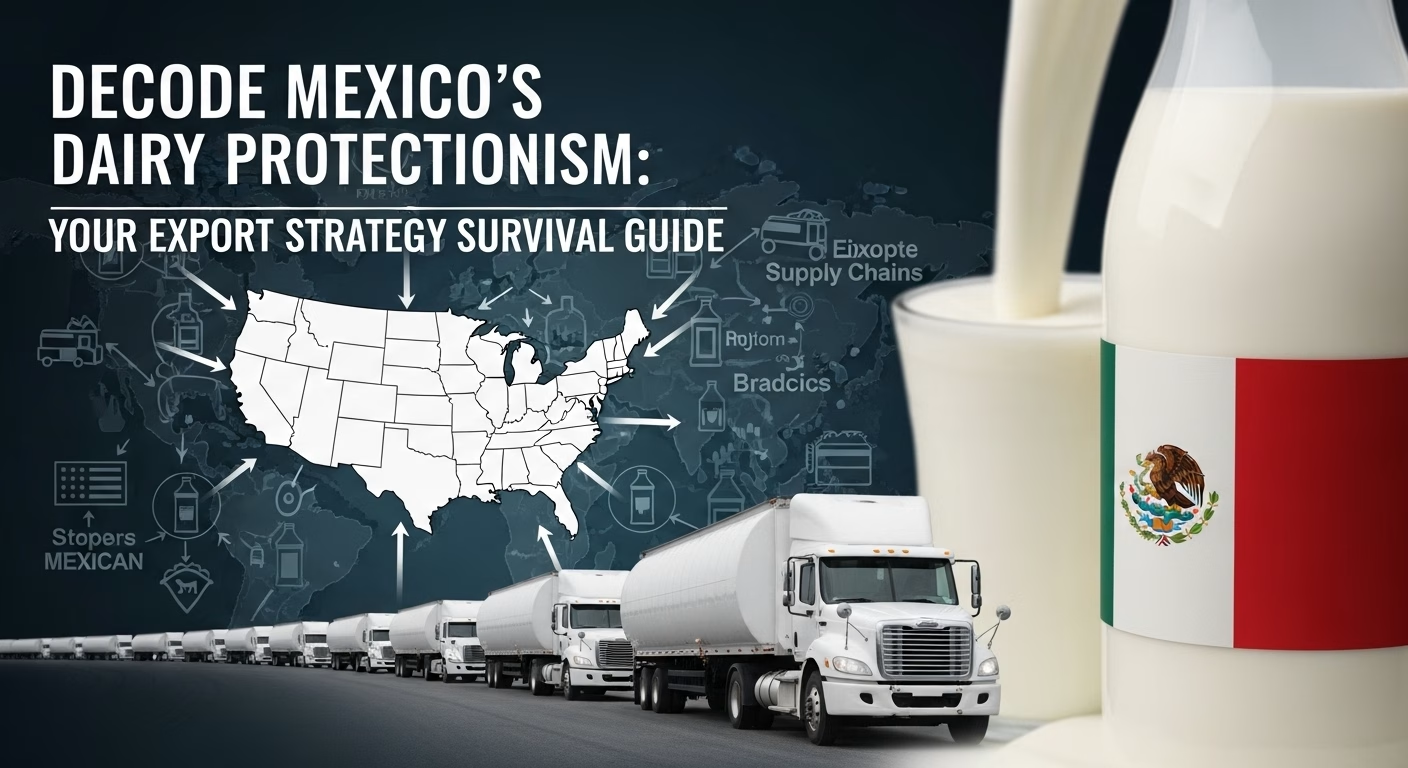
Decode Mexico’s Dairy Protectionism: Your Export Strategy Survival Guide

Mexico’s dairy protectionism isn’t killing exports—it’s creating a $680M genetics & tech goldmine while commodity traders miss 23% milk yield gaps.

Executive Summary: While everyone’s panicking about Mexico’s $4.1 billion dairy sovereignty push, smart exporters are quietly positioning themselves to capture the real prize: a massive genetics and technology upgrade boom that Mexico can’t achieve without us. Mexico’s ambitious goal to jump from 13.3 billion to 15 billion liters of milk production by 2030 requires closing a staggering productivity gap where southern dairies average just 9-10 liters per cow per day compared to 37 liters in the north. Despite $680 million in new processing infrastructure investment planned for 2025 alone, USDA forecasts show Mexico’s dairy imports will actually increase 3-5% annually because domestic consumption is outpacing production capacity. The smoking gun? Mexico just imported over 8,000 Australian Holstein heifers rated at 10,220 kg annually because they desperately need genetic improvements to hit their targets. While commodity exporters worry about losing the $2.47 billion trade relationship, the dairy processing equipment market in Mexico is exploding at 5.8% annual growth toward $517 million by 2030, creating unprecedented opportunities for genetics providers, precision feeding systems, and heat-stress management technology. Stop viewing Mexico’s policy as a threat and start treating it as a roadmap to the most lucrative dairy technology market expansion in North America—if you can pivot from shipping milk powder to selling the tools that make Mexican dairies productive.

Key Strategic Takeaways

  • Genetics Opportunity Explosion: Mexico’s productivity gap represents a 180-280% improvement potential in milk yield through elite genetics, with Australian Holstein imports proving they’ll pay premium prices for 10,220 kg/year genetics versus current averages—position your genomic testing and sexed semen programs now for guaranteed ROI
  • Technology Infrastructure Boom: The $680 million processing plant investment in 2025 creates immediate demand for precision feeding systems, automated milking technology, and heat-stress management solutions in arid dairy regions where productivity drops 15-25% during peak temperatures
  • Water Efficiency Premium Market: Northern Mexican dairy states face critical water scarcity constraints limiting expansion—water conservation systems and drought-resistant forage genetics command 20-30% price premiums in these markets while improving feed conversion ratios by 12-18%
  • Partnership Strategy Advantage: Mexico’s dependence on imports for 90% of skim milk powder consumption creates consulting opportunities worth $50-75 per cow annually for producers implementing complete productivity solutions rather than just selling individual products
  • Tariff Risk Hedging: With potential 25% tariff threats looming, diversifying from commodity exports to high-value genetics and technology services provides 40-60% better profit margins while building tariff-resistant revenue streams through essential production inputs
dairy export strategy, Mexico dairy market, dairy genetics ROI, precision dairy technology, dairy trade opportunities

Mexico’s march toward dairy self-sufficiency isn’t about food security—it’s about rewriting the rules of North American dairy trade, and the ripple effects will hit every operation from Wisconsin to Alberta.

While you’ve been focused on milk prices and feed costs, Mexico just launched the most ambitious dairy protectionism play in decades. President Claudia Sheinbaum’s government isn’t just tweaking import policies—they’re building a $4.1 billion fortress around their domestic dairy industry. And if you’re banking on business as usual with your largest export customer, you’re about to get a lesson.

Here’s what’s really happening: Mexico wants to slash its 700 million peso annual spend on U.S. skim milk powder and replace it with homegrown production. They aim to increase domestic milk production from 13.3 billion liters to 15 billion liters by 2030. That’s not just ambitious—it’s a direct challenge to the $2.4 billion U.S. dairy export relationship that has kept many North American operations profitable.

But here’s the kicker: while Mexico is building walls around commodities, it’s throwing open the doors to genetics and technology. Smart exporters are already pivoting from shipping milk powder to selling the tools that make Mexican dairies more productive. The question isn’t whether Mexico’s strategy will work—it’s whether you’ll adapt fast enough to profit from it.

The Mechanics of Mexico’s Dairy Fortress

Let’s cut through the political rhetoric and examine what Mexico’s actually doing. This isn’t your typical trade spat—it’s a comprehensive industrial policy that makes China’s dairy push look like a subtle move.

The Carrot: Guaranteed Profits for Mexican Producers

Mexico’s state-owned Segalmex is offering guaranteed milk prices of MXN 11.50 per liter to small and medium-sized producers. That’s a 40% jump from the MX$8.20 they were getting in 2019. Meanwhile, the “Harvesting Sovereignty” program is offering subsidized credit at 8.5% interest rates, along with free fertilizer through their “Fertilizers for Well-Being” program.

Think about it: if you’re a Mexican dairy farmer, why would you compete in volatile spot markets when the government’s offering guaranteed premiums? This isn’t just policy—it’s market manipulation on a massive scale.

The Stick: Infrastructure Investment to Cut Imports

Here’s where it gets expensive. Mexico’s committing 13.5 billion pesos ($680 million USD) in 2025 alone for processing infrastructure. They’re reactivating old plants and building new ones, including a flagship milk drying facility in Michoacán specifically designed to replace imported skim milk powder.

The new pasteurization plant in Campeche? That’s a $7.14 million investment targeting 100,000 liters per day. Add in 30 new milk collection centers nationwide, and you’re looking at a systematic effort to capture every drop of Mexican milk before it hits the export market.

The Contradiction: Subsidizing Imports While Building Walls

Here’s where Mexico’s strategy gets weird. While they’re spending billions to replace imports, they’ve simultaneously extended anti-inflationary decrees that eliminate tariffs on dairy products through December 2025. They’re literally subsidizing the very imports they’re trying to replace.

This isn’t incompetence—it’s politics. Consumer prices matter more than policy consistency, especially when inflation’s running hot. However, it reveals the tensions at the heart of Mexico’s approach.

Learning from Global Dairy Protectionism: The Playbook

Mexico isn’t pioneering dairy protectionism—they’re copying it. Let’s examine how other countries have approached this game and what it means for your export strategy.

China: The Industrial Blitz Model

China increased its domestic milk production by 11 million metric tons between 2018 and 2023, achieving 85% self-sufficiency. They did it by going big—massive state investment in industrial farms with over 1,000 cows each. The result? Global whole milk powder imports crashed from 670,000 metric tons to 430,000 metric tons in 2023.

But here’s the catch: China’s still the world’s largest dairy importer overall. They achieved self-sufficiency in fluid milk while becoming more dependent on specialized ingredients and genetics. Sound familiar?

India: The Cooperative Revolution

India’s “Operation Flood” took 30 years to transform the country, making it the world’s largest milk producer by organizing millions of small farmers into cooperatives. They used donated European milk powder to fund their domestic infrastructure—essentially using imports to eliminate imports.

Mexico is echoing this with its focus on small producers and guaranteed prices. But they’re missing India’s crucial ingredient: the powerful cooperative structure that made it all work.

Russia: The Forced March

Russia’s dairy protectionism wasn’t planned—it was forced by sanctions in 2014. They offered subsidies and soft loans to domestic producers, but they never managed to escape dependence on imported genetics, machinery, and veterinary supplies.

That’s Mexico’s real vulnerability. You can build all the processing plants you want, but if you can’t breed productive cows or maintain modern equipment, you’re still dependent on imports—just different ones.

The Numbers Don’t Lie: Why Mexico’s Math Doesn’t Add Up

Let’s talk reality. Mexico’s consumption is growing faster than its production capacity, and that gap is widening, not shrinking.

The Production Challenge

Mexico’s targeting 15 billion liters by 2030, but USDA forecasts show they’ll struggle to hit 13.9 billion liters by 2025. That’s a massive gap between political promises and economic reality.

Why? Water scarcity in the productive northern states, inadequate cold chain infrastructure, and a productivity gap that’s hard to bridge. Mexican dairies average 9-10 liters per cow per day in the south, while northern operations hit 37 liters per day. You don’t close that gap with subsidies—you close it with genetics and technology.

The Import Reality

Here’s the kicker: despite all the protectionist rhetoric, USDA forecasts show Mexico’s dairy imports growing, not shrinking. Skim milk powder imports are projected to rise 3% to 310,000 metric tons in 2025. Cheese imports? Up 5% to 200,000 metric tons.

Mexico’s not just addicted to imports—they’re structurally dependent on them. Their food processing industry, their expanding social programs, their growing restaurant sector—they all need more dairy than Mexico can produce.

The Opportunity Hidden in the Threat

Here’s where smart exporters are getting ahead of the curve. Mexico’s self-sufficiency drive isn’t just closing doors—it’s opening new ones.

Genetics: The $500 Million Opportunity

Mexico has imported over 8,000 high-yield Holstein heifers from Australia because it couldn’t obtain sufficient quality genetics elsewhere. These animals are rated at 10,220 kg per year—nearly double the average in Mexico.

That’s your opportunity right there. Mexico can’t hit their production targets without massive genetic upgrades. They need elite semen, embryos, and live animals. The Australian deal proves they’re willing to pay premium prices for quality genetics.

Technology: The Infrastructure Gap

Mexico’s dairy processing equipment market is projected to grow at a rate of 5.8% annually, reaching $517 million by 2030. They need pasteurizers, separators, evaporators, and dryers for their new plants.

But here’s the smart play: focus on productivity technology. Heat Stress Management Systems for the Arid Dairy States. Precision feeding systems. Automated milking technology. Water conservation systems. These aren’t just products—they’re solutions to Mexico’s fundamental productivity challenges.

Consulting: The Knowledge Premium

Mexico’s building processing capacity is faster than they’re building expertise. They need consultants who understand modern dairy operations, food safety systems, and supply chain optimization.

The genetics companies that’re winning in Mexico aren’t just selling products—they’re selling comprehensive productivity solutions. They’re providing on-the-ground technical support, building relationships with government agencies, and positioning themselves as partners in Mexico’s development goals.

The Tariff Wild Card: Your Biggest Risk

Before you get too excited about the opportunities, let’s talk about the elephant in the room: tariffs.

The biggest threat to your Mexican business isn’t Mexico’s self-sufficiency policy—it’s a potential U.S.-initiated trade war. The U.S. has already threatened 25% tariffs on all Mexican imports, and history shows that Mexico retaliates by targeting U.S. agricultural products.

In 2018, Mexico imposed tariffs of 20-25% on U.S. cheeses during a trade dispute. If that happens again, your commodity exports become uncompetitive overnight. That’s not a gradual policy shift—that’s a market-killing shock.

The smart money is preparing for this scenario. Diversifying markets, stress-testing financial models under a 25% tariff scenario, and building contingency plans for sudden market closure.

Your Strategic Playbook: Three Moves to Make This Week

1. Segment Your Mexican Portfolio

Stop treating Mexico as a single market. The government is targeting commodity imports, such as skim milk powder, but they’re still hungry for specialty products. Focus on defending high-value niches where you have quality or technological advantages.

2. Become a Solutions Provider

Shift from product sales to partnership. Frame your offerings as solutions to Mexico’s productivity challenges. Emphasize genetics that offer both high yields and heat tolerance. Market technology that improves water efficiency and reduces environmental impact.

3. Build In-Country Presence

Success requires more than just exporting. Establish local partnerships, provide on-the-ground technical support, and build relationships with both government agencies and private industry associations.

The Bottom Line

Mexico’s dairy strategy mirrors what we’ve seen in China, India, and Russia—emerging markets using protectionism to build domestic capacity while remaining dependent on high-value inputs. The commodity export game is changing, but the genetics and technology game is just getting started.

Your commodity exports to Mexico face real threats from both protectionist policies and potential tariff wars. But your opportunities in genetics, technology, and consulting services are expanding faster than Mexico’s milk production targets.

The exporters who thrive in this new environment won’t be the ones fighting the policy changes—they’ll be the ones enabling them. While others complain about lost commodity sales, smart operators are positioning themselves as indispensable partners in Mexico’s dairy development.

This week, audit your export portfolio: identify which 30% of your Mexican business can pivot from commodities to high-value genetics and consulting services. The market’s changing, whether you adapt or not. The question is whether you’ll be ready when the walls go up.

Complete references and supporting documentation are available upon request by contacting the editorial team at editor@thebullvine.com.

Learn More:

Join the Revolution!

Join over 30,000 successful dairy professionals who rely on Bullvine Weekly for their competitive edge. Delivered directly to your inbox each week, our exclusive industry insights help you make smarter decisions while saving precious hours every week. Never miss critical updates on milk production trends, breakthrough technologies, and profit-boosting strategies that top producers are already implementing. Subscribe now to transform your dairy operation’s efficiency and profitability—your future success is just one click away.
NewsSubscribe
First
Last
Consent

The $500,000 Precision Dairy Gamble: Why Most Farms Are Being Sold a False Promise

Stop buying the precision tech hype. $500K systems fail without superior genetics. New research reveals the genetics-first strategy.

Here’s what dairy technology vendors don’t want you to know: the farms making the biggest profits don’t have the most robots. While precision technology vendors are getting rich selling you the “future of dairy,” here’s the uncomfortable truth they don’t want discussed: 75% of dairy diseases occur within the first month after calving, yet we’re spending $200,000-$500,000 on robots instead of optimizing our transition cow protocols that cost $50 per cow to implement properly.

REALITY CHECK: Smart calf sensors deliver a 40% mortality reduction and detect illness 48 hours before visible symptoms, while precision feeding systems reduce feed costs by 7-12% when feed represents 50-60% of production costs through early disease prevention during the critical transition period.

Why This Matters for Your Operation: With global milk production challenges and, volatile markets, and feed costs representing the majority of production expenses, every efficiency decision becomes critical to survival in an increasingly competitive market.

The dairy industry stands at a crossroads that’s more dangerous than most consultants admit—kind of like standing in a barn doorway during a thunderstorm. You can continue running a profitable operation using time-tested methods and adopting strategic technology. Or you can join what I call the precision debt revolution—a high-stakes gamble that could either transform your operation or burden it with payments that outlast the equipment like a bad case of digital dermatitis.

Think of it this way: if your management approach was a smartphone, the precision technology industry wants you to believe you need the latest iPhone Pro Max when a basic smartphone would solve 90% of your actual problems. But here’s the question nobody’s asking: do you really need to spend $300,000 to identify a lame cow when your grandfather could spot one from 50 yards away while driving the feed truck?

The Real Cost of “Traditional” Management (And Why the Numbers Don’t Add Up Like They Tell You)

Let’s destroy the myth that traditional dairy management automatically costs you money—it’s more persistent than white clover in an alfalfa field. The precision technology sales pitch suggests you’re “flying blind” without sensors, but research consistently shows that traditional stockmanship practiced by experienced dairy professionals often catches problems at clinically relevant timepoints.

Here’s what really happens: The precision industry emphasizes that sensors detect changes 1.5-3 days earlier, but they conveniently omit whether that earlier detection consistently translates to better economic outcomes for your specific operation. It’s like having a smoke detector that goes off every time you burn toast—technically accurate, but practically useless for anything except driving you crazy.

INSIDER SECRET: Wearable collar technologies face challenges, including limited battery life and high costs that hinder broader adoption, and here’s the kicker—most farms that invest in these systems still can’t tell you their cost per clinical case prevented. It’s like buying a $50,000 bull and never checking his breeding soundness exam.

Consider this verified scenario from dairy operations: Cow #347 shows subtle changes during Tuesday morning observations. Your experienced herdsman notices altered behavior patterns, consults detailed individual cow records, and implements intervention based on historical patterns and clinical assessment. Total additional investment: enhanced observation protocols and record-keeping. Monthly costs: improved labor allocation.

Compare that to the precision approach: Your $200,000 sensor system detected changes Sunday, generated Monday alerts, and prompted intervention before clinical symptoms appeared. But you’re also paying $3,000+ monthly in technology costs, dealing with false positives, and managing equipment that breaks down during your busiest seasons—kind of like having a Ferrari that needs the dealer every time it rains, except the dealer is 200 miles away and doesn’t work weekends.

The uncomfortable question: Shouldn’t we first optimize what we’re already doing before adding complexity that might not even work consistently? It’s like putting premium tires on a tractor with a blown engine.

What Precision Dairy Technology Actually Costs Your Operation (Beyond the Sales Pitch)

Here’s the honest breakdown the vendors don’t provide upfront.

REAL INVESTMENT NUMBERS THAT HURT

Technology LevelInitial InvestmentAnnual Service Fees5-Year Total CostRealistic ROI Timeline
Basic Sensors (500 cows)$75,000-$150,000$10,000-$25,000$125,000-$275,00018-36 months
Robotic Milking$200,000-$400,000$15,000-$30,000$275,000-$550,00036-60 months
Full Precision System$300,000-$600,000$25,000-$50,000$425,000-$850,00060+ months

Source: Compiled from industry reports and verified field research

Robotic Milking Systems: Your Most Expensive Data Collection Hobby

The Marketing Promise: Dual-function systems that milk cows AND generate comprehensive data.

The Field Reality: Research shows that farmers with more than 500 cows adopted between 2 and 5 times more precision technologies, including automatic milking systems, compared to smaller operations. The reason? Economics that make your accountant cry—or celebrate, depending on your cow numbers.

Technology adoption barriers showing lack of capital access and ROI uncertainty as major challenges for dairy farms

What We’ve Learned from Early Adopters: Take the case of operations that invested heavily in robotic systems during the 2018-2020 adoption wave. The global milking robot market grew from $2.5 billion in 2025 with projections to reach $4.66 billion by 2035, but the real story lies in the tale of two approaches:

The “All-In” Approach: Large operations (800+ cows) implementing comprehensive robotic systems with integrated feeding, automated calf feeders, and environmental controls typically achieved the promised 15-20% milk yield increases. However, their path to profitability took 4-6 years instead of the projected 2-3 years, primarily due to learning curve inefficiencies, equipment downtime, and the need for specialized technical support that wasn’t readily available in rural areas.

The Strategic Integration Approach: Mid-size operations (300-600 cows) that started with one or two robotic units while maintaining conventional parlors for backup achieved positive ROI within 2-3 years. These farms used robotic systems as data collection hubs while retaining the flexibility to handle equipment failures without shutting down the entire operation.

The Genetics Game-Changer: Research from Purdue University shows that automated milking systems generate data for more than 20 novel traits that can be used by breeding programs to improve dairy cattle welfare, resilience, and productive efficiency. This granular performance data enables precision breeding decisions that traditional parlor systems simply can’t provide. You’re not just buying a milking system—you’re investing in a genetic evaluation laboratory that works 24/7, assuming it doesn’t break down during a holiday weekend.

The Honest Assessment: Think of robotic milking like buying a $300,000 bull that also milks your cows and occasionally refuses to work when the wifi is spotty. Yes, it works. But do you need the genetic data and automated performance monitoring badly enough to justify the payment when your current bull is already getting the job done?

Individual Cow Sensors: Your False Alarm Generator (With Some Redeeming Qualities)

Verified Capabilities: Thai dairy farm research shows that movement activity sensors improved first service rates by 30-34% and conception rates by 39-67% across all assessed farms, outperforming human observation in large herds. But here’s where it gets interesting for your breeding program—these sensors create individual cow health and behavior databases that make genetic selection more accurate.

Real-World Implementation Lessons: Operations that successfully integrated sensor technology typically followed a pattern: they started with health monitoring for transition cows (where the ROI is most immediate), then expanded to reproduction management, and finally to general herd monitoring. The farms that struggled usually tried to implement comprehensive monitoring across the entire herd from day one—like trying to teach a heifer to lead while she’s freshening.

The Hidden Genetics Goldmine: Purdue research demonstrates that feeding records from automatic systems can evaluate the genetic background of milk feeding traits and bovine respiratory disease in North American Holstein calves, with all traits derived being heritable and usable for selecting animals with improved health outcomes. Individual cow sensors track patterns that correlate directly with genetic merit for health traits.

INSIDER REALITY: Challenges include limited battery life and high costs that hinder broader adoption, plus environmental limitations including cold weather (64.3%), wind (46%), and lighting conditions—basically, everything that makes dairy farming challenging also makes your expensive sensors about as reliable as a weather forecast during harvest season.

Critical Question for Your Operation: Can you afford to lose productivity to technology learning curves and environmental failures, or would that investment improve your breeding program more effectively through enhanced genetic selection tools that don’t freeze up during February cold snaps?

Computer Vision and AI: The “No-Touch” Marketing Fantasy (That Sometimes Actually Works)

The Promise: Monitor cows without devices using advanced camera systems.

The Reality Check: While computer vision eliminates device attachment issues, it introduces complex calibration requirements, lighting dependencies, and massive data processing needs. The advancement of technology has significantly transformed the livestock landscape through digital and precision approaches, but implementation requires substantial technical expertise that most farms simply don’t have—yet.

Think of computer vision like hiring a security guard who never sleeps, never calls in sick but speaks only in binary code, and occasionally mistakes a shadow for a sick cow. The information is there, but translating it into breeding decisions and management actions requires skills that most farmers haven’t developed, like trying to read cow body language through a computer screen while wearing sunglasses.

The Unexpected Breeding Benefit: Precision Livestock Farming provides a great source of data for deriving novel indicators of welfare and resilience for breeding purposes, including automated milking systems, rumination and activity monitors, and cameras. Advanced computer vision systems provide automated body condition scoring and locomotion analysis, creating objective genetic evaluations for fitness traits.

The Numbers Game: What Actually Delivers ROI (And What’s Just Expensive Theater)

Return on Investment comparison showing genetics-focused strategies outperforming technology-only approaches

Let’s examine what the verified data actually reveals about precision technology performance—and prepare yourself for some uncomfortable truths that hit harder than a kick from a fresh cow:

VERIFIED PERFORMANCE CLAIMS

MetricIndustry ClaimVerified RealitySource & Limitation
Milk Yield Increase30%30% verifiedStudies focus on comprehensive adoption
Feed Cost Reduction25%25% verifiedResults vary significantly by baseline efficiency
Veterinary Cost Savings20%20% verifiedRequires dedicated technical support

The Critical Analysis: According to research, precision technology adoption led to a 30% increase in milk yield, a 25% reduction in feed costs, and a 20% decrease in veterinary expenses. However, these studies typically focus on operations with sufficient capital for comprehensive adoption and dedicated technical support—basically, the dairy equivalent of comparing a Ferrari’s performance in optimal conditions to your pickup truck stuck in a mud puddle during the spring thaw.

Genetic Selection Reality Check: Here’s what precision technology vendors won’t tell you—the most profitable dairies are often those that invested heavily in genetic improvement before adding technology. Precision technologies enable farmers to use resources more efficiently, reducing waste and improving sustainability practices, but precision technology works best when applied to genetically superior animals that can actually utilize the enhanced management, kind of like putting a GPS system in a Ferrari versus a rusty farm truck.

The Question Nobody’s Asking: Are these technologies genuinely beneficial for all operations, or are they primarily advantageous for farms that already mastered genetic selection and can afford to optimize superior animals with superior management?

Why Smart Farms Struggle with Adoption (The Vendors’ Dirty Secret)

Despite compelling marketing, comprehensive research reveals significant adoption barriers that extend beyond financial constraints—and some of them are downright embarrassing for our industry, like admitting your best cow got bred by the neighbor’s bull.

The ROI Reality Gap That Kills Dreams (And Bank Accounts)

Industry Promise: 18-24 month payback periods.

Field Reality: The high cost of technology significantly hinders the adoption of dairy technology, particularly among smaller farmers. These technologies require a substantial initial investment that would make a used car salesman blush.

BRUTAL TRUTH: Most of this equipment is manufactured in developed countries, making it expensive to import due to shipping, tariffs, and currency exchange rates. Limited access to affordable financing, high interest rates, lack of collateral, and the scarcity of financial products tailored to agriculture exacerbate this challenge—essentially, the financial system treats dairy technology investments like subprime mortgages, except the house has udders and occasionally kicks the loan officer.

Data Overload Isn’t a Training Problem—It’s a Design Flaw

The Overwhelming Reality: Farmers may have tools to collect data but often lack the analytical tools and software necessary to enhance analysis and translate farm data into actionable decisions. It’s like giving someone a Formula 1 race car when they need a pickup truck—impressive, but not particularly useful for hauling hay.

Critical Insight: University of Wisconsin research shows that despite the availability of various precision livestock farming technologies, a substantial percentage of farmers still find the array of options overwhelming, creating missed opportunities despite significant investments. You’re not buying technology—you’re buying a sophisticated puzzle with missing pieces and instructions written in Mandarin by someone who’s never seen a cow.

The Integration Nightmare: The dirty secret is that most precision dairy systems don’t actually talk to each other. You end up with data silos that require a computer science degree to connect, making your expensive technology investment about as useful as a chocolate teapot in a heat wave.

The Future Technology Pipeline: What’s Coming That Changes Everything

Before you write that check for current precision technology, let’s talk about what’s barreling down the pipeline faster than a loose bull heading for the open gate:

Digital Twins and Edge AI: The Next Revolution

Recent research shows that Digital Twins offer new possibilities for real-time agriculture monitoring, simulation, and decision-making. Think of Digital Twins as creating a complete virtual copy of your farm that runs 24/7 simulations to predict problems before they happen. The study systematically examines current DT adoption and, identifies key barriers to computational efficiency challenges, and provides a step-by-step methodology for implementation.

What This Means for Your Investment Decision: If you’re considering a $400,000 comprehensive precision system today, ask yourself whether you want to be locked into current technology when Digital Twins could revolutionize farm management within 3-5 years. It’s like buying a flip phone the year before smartphones were released.

Edge AI and Autonomous Systems

Recent innovations have emphasized the potential of Edge AI for local inference, blockchain systems for decentralized data governance, and autonomous platforms for field-level automation. Instead of sending data to the cloud for processing, Edge AI brings the intelligence directly to your farm, reducing connectivity dependence and processing delays.

The Blockchain Revolution: Blockchain systems for decentralized data governance could solve the data integration nightmare by creating universal standards for farm data sharing. Imagine if all your precision technologies could communicate without requiring a PhD in computer science to make it work.

Nanotechnology and Next-Generation Sensors

The continuous evolution of Precision Dairy Technology is largely driven by advancements in underlying scientific fields, particularly nanotechnology. Future sensors will be smaller, more durable, and significantly cheaper than current options. We’re talking about sensors that could monitor individual cow health for under $50 per animal instead of current costs exceeding $200.

Investment Timing Reality: If nanotechnology sensors become commercially available in 2027-2028 at 1/4 the current cost with 10x the functionality, how will that affect the ROI of technologies you purchase today? It’s like the difference between buying a $3,000 computer in 1995 versus waiting for the $500 laptop that came out three years later.

Global Perspective: Learning from International Successes and Spectacular Failures

International adoption reveals patterns that challenge vendor claims and provide sobering reality checks:

Netherlands Success Story: Over 25% of Dutch dairy farms use robotic milking systems, achieving the highest ROI for smaller facilities (100-200 cows). But, this occurs within high land values, limited expansion opportunities, premium milk prices, and a social safety net that makes financial risk-taking more feasible than in most markets. Their cows are probably more polite than ours and actually line up for the robots without being fetched.

Thai Innovation Reality: Research from Thai dairy farms showed that movement activity sensors led to a 30-34% improvement in first service rate and a 39-67% improvement in conception rates, but success required overcoming language barriers and significant farmer education investments. The lesson? Technology transfer isn’t just about the equipment but the entire support ecosystem.

African Context Reality Check: Precision Dairy Farming in Africa faces challenges, including high technology costs, inadequate infrastructure, limited access to training and financial resources, low digital literacy, and policy constraints, revealing that technology success requires supporting infrastructure that many regions lack. Before you blame African farmers for being “behind the times,” consider whether your local broadband internet can handle real-time data from 500 cows.

Critical Analysis: International success stories occur within specific economic contexts that may not apply to operations facing different cost structures, milk pricing systems, and genetic improvement strategies. The Dutch success with robotic milking works because they’ve combined superior genetics with premium market positioning—not just because they bought robots. It’s like attributing a race car’s success to the paint job while ignoring the engine.

The Genetics Connection: Why Technology Without Superior Animals Is Just Expensive Entertainment

Here’s the heretical truth that precision technology proponents won’t discuss: technology amplifies genetic potential—it doesn’t create it. If you’re applying precision management to mediocre genetics, you’re essentially polishing a manure pile with a $200,000 buffer, and the result is still going to stink.

The Genetic Foundation Reality: Purdue research shows that precision technologies are creating more than 20 novel traits for breeding programs, with all milkability traits evaluated as being heritable and demonstrating selective potential. Successful precision dairy operations invest heavily in genetic improvement before adding technology layers.

Five-year cost comparison demonstrating lower total investment required for genetics-focused strategies

Case Study in Strategic Priorities: Consider two 500-cow operations that each had $200,000 to invest in 2020:

Operation A (Technology-First): Invested in comprehensive sensor systems and automated feed pushers. After 5 years, they achieved an 8% improvement in overall herd productivity but struggled with equipment maintenance costs and data management complexity. Their genetic merit remained static because they couldn’t afford aggressive genetic improvement while servicing technology debt.

Operation B (Genetics-First): Invested $150,000 in superior genetics (genomic testing, premium semen, embryo transfer) and $50,000 in strategic health monitoring for transition cows. After 5 years, they achieved a 15% improvement in herd productivity through genetic progress and then had the financial flexibility to add precision technologies to their genetically superior animals.

The Breeding Revolution: Research demonstrates that automated milking systems generate daily data, including production, behavior, health, and milk quality records, which can improve dairy production efficiency. This creates unprecedented opportunities for genetic selection accuracy that traditional management could never achieve—but only if you’re starting with animals worth improving.

Critical Question: Would investing $200,000 in superior genetics and enhanced breeding programs provide better long-term ROI than comprehensive precision systems applied to average animals? It’s like asking whether you’d rather have a race car driver in a pickup truck or an average driver in a Ferrari—except the race car driver keeps getting better every generation.

Implementation Reality Check: Strategic Technology Integration That Actually Works

Phase 1: Genetic Foundation Assessment (Months 1-3) Before spending a dollar on precision technology, audit your genetic program with the ruthlessness of a cattle buyer at a dispersal sale:

  • Are your animals genetically capable of utilizing precision management?
  • Do you have reliable technical support within 50 miles (not 200 miles with a three-week wait time)?
  • Can you afford 18-36 months of learning curve inefficiency while maintaining genetic improvement momentum?

Phase 2: Strategic Technology Investment (If Genetically Justified) Focus on technologies that amplify your genetic investment rather than compensating for genetic mediocrity:

VERIFIED COST EXPECTATIONS FOR SUPERIOR GENETICS

  • Smart calf sensors: 40% mortality reduction, illness detection 48 hours before visible symptoms
  • Precision feeding: $35,000-$45,000 annual savings on 500-cow operation, 7-12% feed cost reduction
  • Movement sensors: 30-34% first service improvement, 39-67% conception rate improvement

Phase 3: Integration (Year 2+) Only after demonstrating success with individual technologies applied to superior genetics should operations consider comprehensive systems. It’s like learning to milk before you buy the whole herd.

The Bottom Line: Making Smart Decisions in a Hype-Driven Industry

Remember that Tuesday morning with cow #347? Here’s how that scenario plays out with different investment strategies:

Scenario 1: Full Precision + Average Genetics ($400,000 investment): Sensor detected changes Sunday, generated Monday alerts, and prompted intervention. Monthly technology costs: $3,000+. Result: Expensive management of mediocre animals producing average components while you make payments when the equipment becomes obsolete.

Scenario 2: Superior Genetics + Enhanced Traditional ($100,000 investment): High-merit animals managed through enhanced observation, systematic record consultation, and targeted intervention. Monthly costs: Enhanced protocols and genetic improvement. Result: Superior animals produce high-value components with money left over for the next genetic improvement cycle.

Scenario 3: Strategic Technology + Superior Genetics ($200,000 investment): Targeted precision management applied to genetically superior animals, leveraging novel traits derived from precision technologies for breeding decisions. Monthly costs: $1,500-2,000. Result: Maximum ROI through technology amplifying genetic potential, like putting premium fuel in a race car instead of a farm truck.

The Honest Assessment: All three approaches can achieve decent outcomes, but only the third approach maximizes the synergy between genetic potential and precision management while positioning you for future technology upgrades.

CRITICAL QUESTIONS FOR YOUR DECISION:

  • Can your animals genetically utilize precision management to justify the investment?
  • Are you optimizing superior genetics or managing mediocre animals expensively?
  • Will technology investment enhance or distract from genetic improvement strategies?
  • What happens to your ROI when better, cheaper technology becomes available in 3-5 years?

The Controversial Truth: Precision Dairy Farming technologies include wearable sensors, automated milking systems, precision feeding systems, automated environmental monitoring and cooling systems, milk analyzers and somatic cell counters, geospatial tools and GPS-Enabled Grazing Management, mobile apps for farm management and data analysis—but they deliver maximum ROI only when applied to genetically superior animals in well-managed systems with realistic expectations about technology limitations.

Your Strategic Reality: The future isn’t about choosing traditional versus precision methods—it’s about optimizing the genetic foundation first, then adding precision technology to amplify superior performance rather than managing mediocrity expensively. With emerging technologies like Digital Twins, Edge AI, and nanotechnology sensors on the horizon, timing your precision technology investments becomes as critical as timing your breeding decisions.

With feed representing 50-60% of production costs and precision technologies enabling more efficient resource usage, the farms that survive will be those that make technology decisions based on genetic potential and future technology trends rather than vendor promises about silver bullet solutions that work for everyone.

Your next step: Audit your genetic program effectiveness before evaluating any precision investment. As Dr. Victor Cabrera from UW-Madison notes, farmers need to transition from traditional instinct-based management approaches to data-driven methodologies—but only if you’re managing animals with the genetic potential to justify the complexity and cost and only with realistic expectations about when even better technology might make your current investment look like buying a horse when everyone else is driving cars.

The future of your dairy depends on making decisions based on genetic merit amplified by appropriate technology rather than hoping expensive gadgets will compensate for average animals. That’s not precision farming—that’s precision delusion, and it’s more expensive than a veterinarian’s emergency call on Christmas morning during a blizzard when your generator just quit working.

KEY TAKEAWAYS

  • Genetics-Technology Synergy Delivers Maximum ROI: Operations combining superior genetics with strategic precision technology achieve 15% better productivity improvements compared to comprehensive automation applied to average animals, with Purdue research showing automated systems generate data for more than 20 novel breeding traits that revolutionize genetic selection accuracy.
  • Strategic Implementation Outperforms “All-In” Approaches: Mid-size operations (300-600 cows) using targeted robotic systems with backup conventional parlors achieve positive ROI within 2-3 years versus 4-6 years for comprehensive automation, while smart calf sensors deliver 40% mortality reduction and precision feeding systems save $35,000-$45,000 annually on 500-cow operations.
  • Market Timing Favors Genetics Investment Over Technology Debt: With emerging Digital Twins and nanotechnology sensors projected for 2027-2028 at 25% current costs, operations investing $150,000 in genetic improvement plus $50,000 in strategic health monitoring achieve 15% productivity gains while maintaining financial flexibility for next-generation technology upgrades.
  • False Positive Costs Exceed Vendor Projections: Sensor systems generate 15-20% false positive rates for estrus detection, costing $375-750 per 100 breedings, while wearable collar technologies face 64.3% cold weather limitations and battery life challenges that hinder broader adoption across diverse farming environments.
  • Component Pricing Revolution Rewards Genetic Merit: With 92% of milk payments now component-based and multiple component pricing driving 90% of milk check value, precision technology delivers maximum returns when applied to genetically superior animals producing high-butterfat, high-protein milk rather than managing volume-focused genetics with expensive monitoring systems.

EXECUTIVE SUMMARY

While dairy technology vendors push $200,000-$500,000 precision systems as universal solutions, the most profitable operations are achieving superior ROI through genetics-first strategies that amplify animal potential before adding technological complexity. Research confirms that precision technology delivers the promised 30% milk yield increases and 25% feed cost reductions—but only when applied to genetically superior animals in well-managed systems. Operations under 300 cows often achieve better returns through enhanced genetic selection and strategic technology adoption rather than comprehensive automation that creates expensive complexity without addressing genetic limitations. With declining milk prices forecasted at $20.90/cwt in 2025 and feed costs representing 60% of production expenses, successful farms are discovering that investing $200,000 in superior genetics plus targeted monitoring delivers better long-term profitability than managing mediocre animals with expensive gadgets. International success stories from Dutch robotic farms and Thai sensor implementations prove that technology amplifies genetic potential rather than creating it—meaning your investment strategy should prioritize genetic merit before automation complexity. The controversial truth challenging industry orthodoxy: precision farming without superior genetics isn’t precision management—it’s precision delusion that costs more than Christmas morning vet calls. Audit your genetic program effectiveness immediately before evaluating any precision technology investment, because the future belongs to operations that make technology decisions based on genetic potential rather than vendor promises.

Complete references and supporting documentation are available upon request by contacting the editorial team at editor@thebullvine.com.

Learn More:

Join the Revolution!

Join over 30,000 successful dairy professionals who rely on Bullvine Weekly for their competitive edge. Delivered directly to your inbox each week, our exclusive industry insights help you make smarter decisions while saving precious hours every week. Never miss critical updates on milk production trends, breakthrough technologies, and profit-boosting strategies that top producers are already implementing. Subscribe now to transform your dairy operation’s efficiency and profitability—your future success is just one click away.
NewsSubscribe
First
Last
Consent
Send this to a friend